Building a user-focused information
architecture
Devin Asaro, Content Strategist — @copydev

Greg Harron, UX Strategist — @gregharron
#IAatDMFB
What is information architecture?
#IAatDMFB
IA is not
just your
sitemap
#IAatDMFB image source: http://bit.ly/1JFL0MU
IA is not
just your
content
model
#IAatDMFB image source: http://bit.ly/1JFL0MU
IA is not
just your
taxonomy
#IAatDMFB image source: http://bit.ly/1JFL0MU
IA is not
just your
metadata
#IAatDMFB image source: http://bit.ly/1JFL0MU
IA is not
just your
tagging
structure
#IAatDMFB image source: http://bit.ly/1JFL0MU
IA is not
just your
product
hierarchy
#IAatDMFB image source: http://bit.ly/1JFL0MU
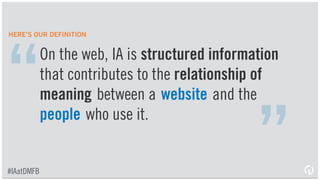
“On the web, IA is structured information
that contributes to the relationship of
meaning between a website and the
people who use it.
HERE’S OUR DEFINITION
”#IAatDMFB @copydev
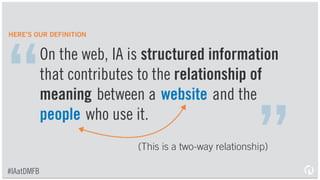
On the web, IA is structured information
that contributes to the relationship of
meaning between a website and the
people who use it.
(This is a two-way relationship)
“
”
HERE’S OUR DEFINITION
#IAatDMFB
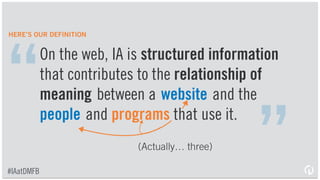
(Actually… three)
On the web, IA is structured information
that contributes to the relationship of
meaning between a website and the
people and programs that use it.
“
”
HERE’S OUR DEFINITION
#IAatDMFB
Information architecture is about helping
people understand their surroundings and
find what they're looking for—in the real
world as well as online.
— The IA Institute
http://bit.ly/1EE08pT
“
”
BUT OTHER PEOPLE SAY SMART STUFF, TOO…
#IAatDMFB
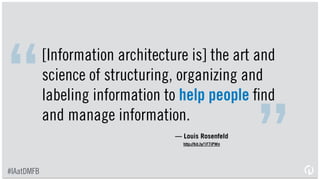
— Louis Rosenfeld
http://bit.ly/1F7iPWn
[Information architecture is] the art and
science of structuring, organizing and
labeling information to help people find
and manage information.
“
”#IAatDMFB
Notice a pattern?
#IAatDMFB
image source: http://bit.ly/1bPp2eJ
The world is confusing.
We’re here to help people navigate it.
#IAatDMFB
image source: http://bit.ly/1bPp2eJ
IA isn’t just for
information architects,
just as design isn’t just
for designers.
IA is for business
people, too.
#IAatDMFB
#IAatDMFB
My company can’t agree on anything.
Do we need to fix our culture before we
can build our IA?
Yes and no
#IAatDMFB
IA can actually help you overcome
organizational conflicts.
No.
#IAatDMFB
First, you have to agree to reframe your
thinking, and seek a common
solution.
…but yes.
And that takes some doing.
#IAatDMFB
#IAatDMFB
How do we do it?
Phase One:
Establishing IA Foundation
image source: http://bit.ly/1H1Qsqw
#IAatDMFB
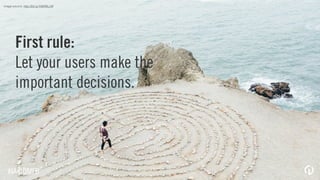
First rule:
Let your users make the
important decisions.
image source: http://bit.ly/1AWWLcW
#IAatDMFB
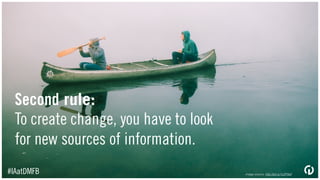
Second rule:
To create change, you have to look
for new sources of information.
#IAatDMFB image source: http://bit.ly/1zZP9eF
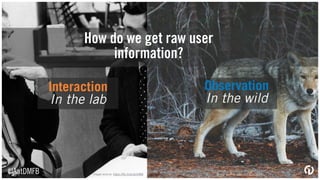
Interaction
How do we get raw user
information?
Observation
In the lab In the wild
image source: http://bit.ly/1L0qZlhimage source: https://flic.kr/p/doVSMj#IAatDMFB
image source: http://bit.ly/1A09m3T
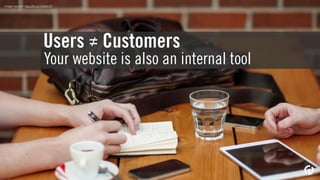
Users ≠ Customers
Your website is also an internal tool
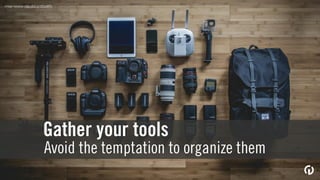
Lay out your tools
(in no particular order)
image source: http://bit.ly/1E5uWPv
Gather your tools
Avoid the temptation to organize them
image source: bit.ly/1cA1qvk
Your CEO is NOT a primary user
Balance opinion against empirical data
image source: http://bit.ly/1zXefL6
Phase Two:
Create logical groupings
#IAatDMFB
!
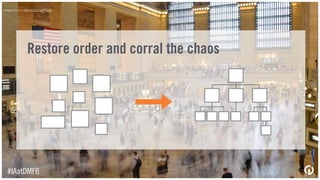
Restore order and corral the chaos
#IAatDMFB
image source: http://bit.ly/1zZPCgG
#IAatDMFB
What do you need?
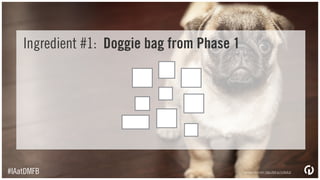
Ingredient #1: Doggie bag from Phase 1
#IAatDMFB image source: http://bit.ly/1zXefL6
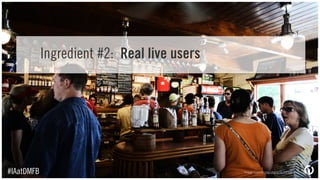
Ingredient #2: Real live users
#IAatDMFB image source: http://bit.ly/1L1YPX3
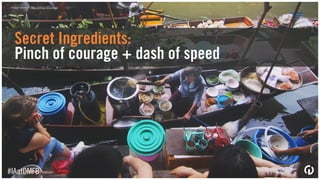
Secret Ingredients:
Pinch of courage + dash of speed
#IAatDMFB
image source: http://bit.ly/1ECscuu
But first, let’s demystify this card sorting stuff.
What is card sorting?
#IAatDMFB
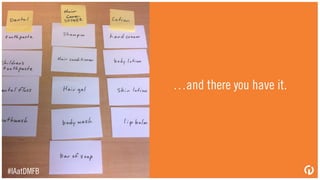
…and there you have it.
#IAatDMFB
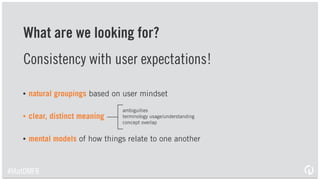
What are we looking for?
!
!
!
!
Consistency with user expectations!
• natural groupings based on user mindset
• clear, distinct meaning
• mental models of how things relate to one another
ambiguities
terminology usage/understanding
concept overlap
#IAatDMFB
#IAatDMFB
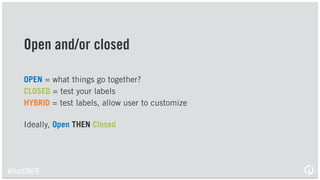
Open and/or closed
!
OPEN = what things go together?
CLOSED = test your labels
HYBRID = test labels, allow user to customize
!
Ideally, Open THEN Closed
!
!
!
#IAatDMFB
Scenario 1: Wide Open
image source: http://bit.ly/1JdgBYi
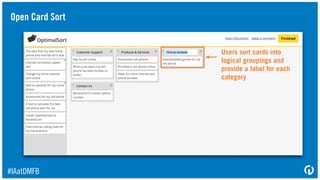
Users sort cards into
logical groupings and
provide a label for each
category
Open Card Sort
#IAatDMFB
Scenario 2: Round Holes?
#IAatDMFB
image source: http://bit.ly/1A0kC0D
#IAatDMFB
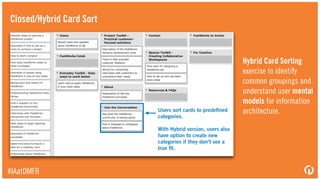
Closed/Hybrid Card Sort
Hybrid Card Sorting
exercise to identify
common groupings and
understand user mental
models for information
architecture.Users sort cards to predefined
categories.
!
With Hybrid version, users also
have option to create new
categories if they don’t see a
true fit.
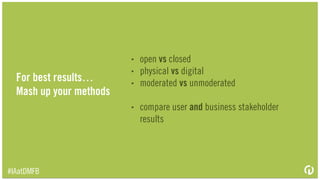
For best results…
Mash up your methods
!
!
#IAatDMFB
• open vs closed
• physical vs digital
• moderated vs unmoderated
!
• compare user and business stakeholder
results
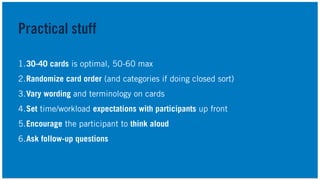
Practical stuff
!
1.30-40 cards is optimal, 50-60 max
2.Randomize card order (and categories if doing closed sort)
3.Vary wording and terminology on cards
4.Set time/workload expectations with participants up front
5.Encourage the participant to think aloud
6.Ask follow-up questions
#IAatDMFB
Analyze results
-Similarity - which cards were grouped together most commonly
-Categorization - how often did cards get grouped to the same category
-Qualitative review of notes and observations
#IAatDMFB
!
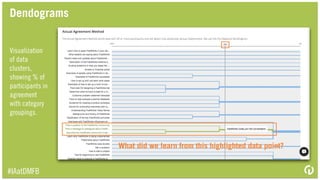
Visualization
of data
clusters,
showing % of
participants in
agreement
with category
groupings.
What did we learn from this highlighted data point?
Dendograms
Toolkit #1
Toolkit #2
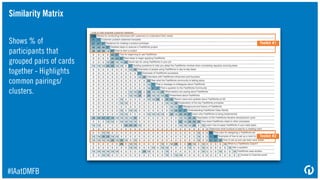
Similarity Matrix
#IAatDMFB
Shows % of
participants that
grouped pairs of cards
together - Highlights
common pairings/
clusters.
Let the data do the talking
#IAatDMFB
image source: http://bit.ly/1K6gLSQ
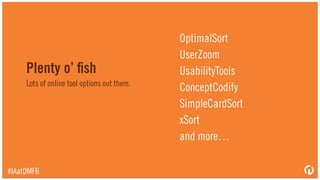
Plenty o’ fish
Lots of online tool options out there.
OptimalSort
UserZoom
UsabilityTools
ConceptCodify
SimpleCardSort
xSort
and more…
#IAatDMFB
What now?
#IAatDMFB
image source: http://bit.ly/1JHzhNX
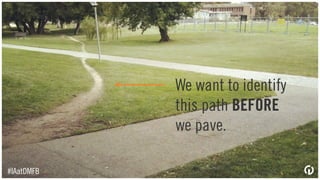
We want to identify
this path BEFORE
we pave.
#IAatDMFB
Tree Test
Scenario-based test to quickly test intuitiveness of site navigation and
architecture BEFORE building the site.
#IAatDMFB
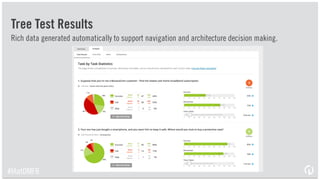
Tree Test Results
Rich data generated automatically to support navigation and architecture decision making.
#IAatDMFB
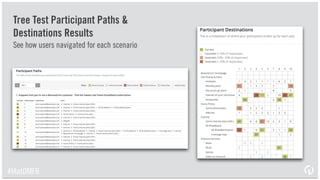
Tree Test Participant Paths &
Destinations Results
See how users navigated for each scenario
#IAatDMFB
#IAatDMFB
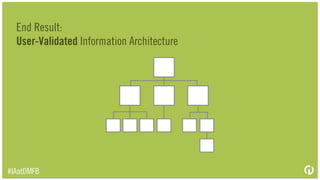
End Result:
User-Validated Information Architecture
Questions?
Devin Asaro, Content Strategist @copydev
Greg Harron, UX Strategist @gregharron
#IAatDMFB

Building a User-Focused Information Architecture

  • 1.
    Building a user-focusedinformation architecture Devin Asaro, Content Strategist — @copydev
 Greg Harron, UX Strategist — @gregharron #IAatDMFB
  • 2.
    What is informationarchitecture? #IAatDMFB
  • 3.
    IA is not justyour sitemap #IAatDMFB image source: http://bit.ly/1JFL0MU
  • 4.
    IA is not justyour content model #IAatDMFB image source: http://bit.ly/1JFL0MU
  • 5.
    IA is not justyour taxonomy #IAatDMFB image source: http://bit.ly/1JFL0MU
  • 6.
    IA is not justyour metadata #IAatDMFB image source: http://bit.ly/1JFL0MU
  • 7.
    IA is not justyour tagging structure #IAatDMFB image source: http://bit.ly/1JFL0MU
  • 8.
    IA is not justyour product hierarchy #IAatDMFB image source: http://bit.ly/1JFL0MU
  • 9.
    “On the web,IA is structured information that contributes to the relationship of meaning between a website and the people who use it. HERE’S OUR DEFINITION ”#IAatDMFB @copydev
  • 10.
    On the web,IA is structured information that contributes to the relationship of meaning between a website and the people who use it. (This is a two-way relationship) “ ” HERE’S OUR DEFINITION #IAatDMFB
  • 11.
    (Actually… three) On theweb, IA is structured information that contributes to the relationship of meaning between a website and the people and programs that use it. “ ” HERE’S OUR DEFINITION #IAatDMFB
  • 12.
    Information architecture isabout helping people understand their surroundings and find what they're looking for—in the real world as well as online. — The IA Institute http://bit.ly/1EE08pT “ ” BUT OTHER PEOPLE SAY SMART STUFF, TOO… #IAatDMFB
  • 13.
    — Louis Rosenfeld http://bit.ly/1F7iPWn [Informationarchitecture is] the art and science of structuring, organizing and labeling information to help people find and manage information. “ ”#IAatDMFB
  • 14.
    Notice a pattern? #IAatDMFB imagesource: http://bit.ly/1bPp2eJ
  • 15.
    The world isconfusing. We’re here to help people navigate it. #IAatDMFB image source: http://bit.ly/1bPp2eJ
  • 16.
    IA isn’t justfor information architects, just as design isn’t just for designers. IA is for business people, too. #IAatDMFB
  • 17.
  • 18.
    My company can’tagree on anything. Do we need to fix our culture before we can build our IA? Yes and no #IAatDMFB
  • 19.
    IA can actuallyhelp you overcome organizational conflicts. No. #IAatDMFB
  • 20.
    First, you haveto agree to reframe your thinking, and seek a common solution. …but yes. And that takes some doing. #IAatDMFB
  • 21.
  • 22.
    Phase One: Establishing IAFoundation image source: http://bit.ly/1H1Qsqw #IAatDMFB
  • 23.
    First rule: Let yourusers make the important decisions. image source: http://bit.ly/1AWWLcW #IAatDMFB
  • 24.
    Second rule: To createchange, you have to look for new sources of information. #IAatDMFB image source: http://bit.ly/1zZP9eF
  • 25.
    Interaction How do weget raw user information? Observation In the lab In the wild image source: http://bit.ly/1L0qZlhimage source: https://flic.kr/p/doVSMj#IAatDMFB
  • 26.
    image source: http://bit.ly/1A09m3T Users≠ Customers Your website is also an internal tool
  • 27.
    Lay out yourtools (in no particular order) image source: http://bit.ly/1E5uWPv Gather your tools Avoid the temptation to organize them
  • 28.
    image source: bit.ly/1cA1qvk YourCEO is NOT a primary user Balance opinion against empirical data
  • 29.
    image source: http://bit.ly/1zXefL6 PhaseTwo: Create logical groupings #IAatDMFB
  • 30.
    ! Restore order andcorral the chaos #IAatDMFB image source: http://bit.ly/1zZPCgG
  • 31.
  • 32.
    Ingredient #1: Doggiebag from Phase 1 #IAatDMFB image source: http://bit.ly/1zXefL6
  • 33.
    Ingredient #2: Reallive users #IAatDMFB image source: http://bit.ly/1L1YPX3
  • 34.
    Secret Ingredients: Pinch ofcourage + dash of speed #IAatDMFB image source: http://bit.ly/1ECscuu
  • 35.
    But first, let’sdemystify this card sorting stuff. What is card sorting? #IAatDMFB
  • 36.
    …and there youhave it. #IAatDMFB
  • 37.
    What are welooking for? ! ! ! ! Consistency with user expectations! • natural groupings based on user mindset • clear, distinct meaning • mental models of how things relate to one another ambiguities terminology usage/understanding concept overlap #IAatDMFB
  • 38.
    #IAatDMFB Open and/or closed ! OPEN= what things go together? CLOSED = test your labels HYBRID = test labels, allow user to customize ! Ideally, Open THEN Closed ! ! !
  • 39.
    #IAatDMFB Scenario 1: WideOpen image source: http://bit.ly/1JdgBYi
  • 40.
    Users sort cardsinto logical groupings and provide a label for each category Open Card Sort #IAatDMFB
  • 41.
    Scenario 2: RoundHoles? #IAatDMFB image source: http://bit.ly/1A0kC0D
  • 42.
    #IAatDMFB Closed/Hybrid Card Sort HybridCard Sorting exercise to identify common groupings and understand user mental models for information architecture.Users sort cards to predefined categories. ! With Hybrid version, users also have option to create new categories if they don’t see a true fit.
  • 43.
    For best results… Mashup your methods ! ! #IAatDMFB • open vs closed • physical vs digital • moderated vs unmoderated ! • compare user and business stakeholder results
  • 44.
    Practical stuff ! 1.30-40 cardsis optimal, 50-60 max 2.Randomize card order (and categories if doing closed sort) 3.Vary wording and terminology on cards 4.Set time/workload expectations with participants up front 5.Encourage the participant to think aloud 6.Ask follow-up questions
  • 45.
    #IAatDMFB Analyze results -Similarity -which cards were grouped together most commonly -Categorization - how often did cards get grouped to the same category -Qualitative review of notes and observations
  • 46.
    #IAatDMFB ! Visualization of data clusters, showing %of participants in agreement with category groupings. What did we learn from this highlighted data point? Dendograms
  • 47.
    Toolkit #1 Toolkit #2 SimilarityMatrix #IAatDMFB Shows % of participants that grouped pairs of cards together - Highlights common pairings/ clusters.
  • 48.
    Let the datado the talking #IAatDMFB image source: http://bit.ly/1K6gLSQ
  • 49.
    Plenty o’ fish Lotsof online tool options out there. OptimalSort UserZoom UsabilityTools ConceptCodify SimpleCardSort xSort and more… #IAatDMFB
  • 50.
    What now? #IAatDMFB image source:http://bit.ly/1JHzhNX
  • 51.
    We want toidentify this path BEFORE we pave. #IAatDMFB
  • 52.
    Tree Test Scenario-based testto quickly test intuitiveness of site navigation and architecture BEFORE building the site. #IAatDMFB
  • 53.
    Tree Test Results Richdata generated automatically to support navigation and architecture decision making. #IAatDMFB
  • 54.
    Tree Test ParticipantPaths & Destinations Results See how users navigated for each scenario #IAatDMFB
  • 55.
  • 56.
    Questions? Devin Asaro, ContentStrategist @copydev Greg Harron, UX Strategist @gregharron #IAatDMFB