


Murphy Choy, University College Dublin
Building a decision tree
from decision stumps
Contents
•Introduction to decision trees
•What is a decision tree stump?
•CART VS CHAID
•Criterion for splitting
•Building a decision tree stump macro
•Linking the tree up
•Conclusion
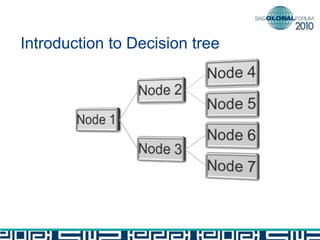
Introduction to Decision tree
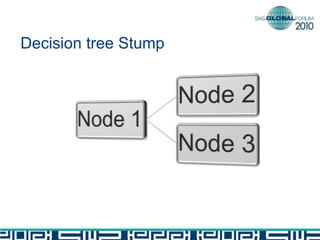
Decision tree Stump
CART VS CHAID
•Easier to understand splits
oBinary splits are easier to understand
oCan be phrased as an either or statement
•Able to handle different data types
oCART is able to handle nominal, categorical and
missing values simultaneously unlike CHAID.
CART VS CHAID
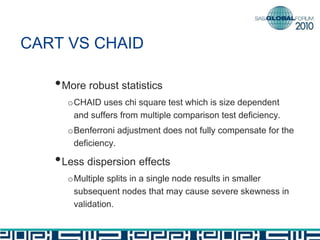
•More robust statistics
oCHAID uses chi square test which is size dependent
and suffers from multiple comparison test deficiency.
oBenferroni adjustment does not fully compensate for the
deficiency.
•Less dispersion effects
oMultiple splits in a single node results in smaller
subsequent nodes that may cause severe skewness in
validation.
Splitting criterion
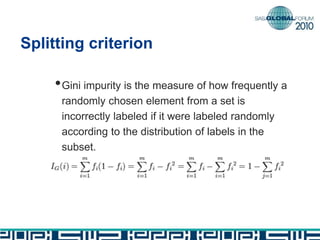
•Gini impurity is the measure of how frequently a
randomly chosen element from a set is
incorrectly labeled if it were labeled randomly
according to the distribution of labels in the
subset.
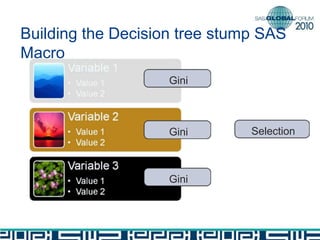
Building the Decision tree stump SAS
Macro
Gini
Gini
Gini
Selection
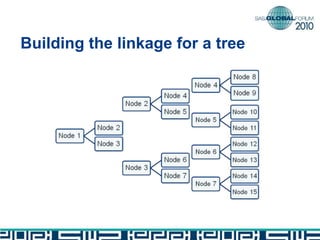
Building the linkage for a tree
Conclusion
•Useful for a variety of purposes
•Build a full decision tree

Building a decision tree from decision stumps

  • 1.
    Murphy Choy, UniversityCollege Dublin Building a decision tree from decision stumps
  • 2.
    Contents •Introduction to decisiontrees •What is a decision tree stump? •CART VS CHAID •Criterion for splitting •Building a decision tree stump macro •Linking the tree up •Conclusion
  • 3.
  • 4.
  • 5.
    CART VS CHAID •Easierto understand splits oBinary splits are easier to understand oCan be phrased as an either or statement •Able to handle different data types oCART is able to handle nominal, categorical and missing values simultaneously unlike CHAID.
  • 6.
    CART VS CHAID •Morerobust statistics oCHAID uses chi square test which is size dependent and suffers from multiple comparison test deficiency. oBenferroni adjustment does not fully compensate for the deficiency. •Less dispersion effects oMultiple splits in a single node results in smaller subsequent nodes that may cause severe skewness in validation.
  • 7.
    Splitting criterion •Gini impurityis the measure of how frequently a randomly chosen element from a set is incorrectly labeled if it were labeled randomly according to the distribution of labels in the subset.
  • 8.
    Building the Decisiontree stump SAS Macro Gini Gini Gini Selection
  • 9.
  • 10.
    Conclusion •Useful for avariety of purposes •Build a full decision tree

Editor's Notes

  • #5 Single layer decision tree Often used in large sample segmentation Also used to do simple prediction in small sample Easy to manage in terms of coding
  • #9 Pre-summarization Calculate the gini impurity Selecting the split
  • #10 Iterative calling of the decision stumps to build a tree