CLASSIFICATION
Dr. Amanpreet Kaur​
Associate Professor,
Chitkara University,
Punjab
AGENDA
Introduction​
Primary goals
​Areas of growth
Timeline
​Summary​
CLASSIFICATION
• Classification predictive modeling involves assigning a
class label to input examples.
• Binary classification refers to predicting one of two classes
and multi-class classification involves predicting one of
more than two classes.
• Multi-label classification involves predicting one or more
classes for each example and imbalanced classification
refers to classification tasks where the distribution of
examples across the classes is not equal.
• Examples of classification problems include:
• Given an example, classify if it is spam or not.
• Given a handwritten character, classify it as one of the known
characters.
• Given recent user behavior, classify as churn or not.
3
•Text categorization (e.g., spam filtering)
•Fraud detection
•Optical character recognition
•Machine vision (e.g., face detection)
•Natural-language processing
• (e.g., spoken language understanding)
•Market segmentation
• (e.g.: predict if customer will respond to promotion)
•Bioinformatics
•(e.g., classify proteins according to their function)
4
EXAMPLE OF
CLASSIFICATION
DECISION TREE
• The decision tree algorithm builds the classification
model in the form of a tree structure.
• It utilizes the if-then rules which are equally exhaustive
and mutually exclusive in classification.
• The process goes on with breaking down the data into
smaller structures and eventually associating it with an
incremental decision tree.
• The final structure looks like a tree with nodes and
leaves. The rules are learned sequentially using the
training data one at a time.
• Each time a rule is learned, the tuples covering the
rules are removed. The process continues on the
training set until the termination point is met.
5
6
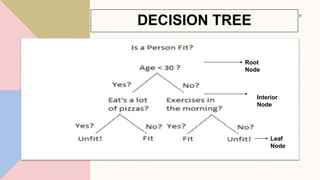
DECISION TREE
Root
Node
Interior
Node
Leaf
Node
• Terminologies Related to Decision Tree Algorithms
• Root Node: This node gets divided into different homogeneous
nodes. It represents entire sample.
• Splitting: It is the process of splitting or dividing a node into two
or more sub-nodes.
• Interior Nodes: They represent different tests on an attribute.
• Branches: They hold the outcomes of those tests.
• Leaf Nodes: When the nodes can’t be split further, they are
called leaf nodes.
• Parent and Child Nodes: The node from where sub-nodes are
created is called a parent node. And, the sub-nodes are called
the child nodes.
7
DECISION TREE
DECISIONTREE
CLASSIFIER ()
• DecisionTreeClassifier (): It is nothing but the decision tree
classifier function to build a decision tree model in Machine
Learning using Python. The DecisionTreeClassifier() function
looks like this:
• DecisionTreeClassifier (criterion = ‘gini’, random_state =
None, max_depth = None, min_samples_leaf =1)
• Here are a few important parameters:
• criterion: It is used to measure the quality of a split in the
decision tree classification. By default, it is ‘gini’; it also supports
‘entropy’.
• max_depth: This is used to add maximum depth to the
decision tree after the tree is expanded.
• min_samples_leaf: This parameter is used to add the
minimum number of samples required to be present at a leaf
node.
8
DECISION TREE
REGRESSOR ()
• DecisionTreeRegressio (): It is the decision tree regressor function used to
build a decision tree model in Machine Learning using Python. The
DecisionTreeRegressor () function looks like this:
• DecisionTreeRegressor (criterion = ‘mse’, random_state =None ,
max_depth=None, min_samples_leaf=1,)
• criterion: This function is used to measure the quality of a split in the decision
tree regression. By default, it is ‘mse’ (the mean squared error), and it also
supports ‘mae’ (the mean absolute error).
• max_depth: This is used to add maximum depth to the decision tree after the
tree is expanded.
• min_samples_leaf: This function is used to add the minimum number of
samples required to be present at a leaf node.
9
GAINS CHART
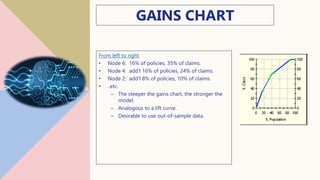
From left to right:
• Node 6: 16% of policies, 35% of claims.
• Node 4: add’l 16% of policies, 24% of claims.
• Node 2: add’l 8% of policies, 10% of claims.
• ..etc.
– The steeper the gains chart, the stronger the
model.
– Analogous to a lift curve.
– Desirable to use out-of-sample data.
10
SPLITTING RULES
• Select the variable value (X=t1) that produces the
greatest “separation” in the target variable.
• “Separation” defined in many ways.
– Regression Trees (continuous target): use sum of squared errors.
– Classification Trees (categorical target): choice of entropy, Gini measure,
“twoing” splitting rule.
11
REGRESSION TREES
• Tree-based modeling for continuous target
variable
• most intuitively appropriate method for loss
ratio analysis
• Find split that produces greatest separation in
∑[y – E(y)]2
• i.e.: find nodes with minimal within variance
• and therefore greatest between variance
• like credibility theory
12
CLASSIFICATION TREES
• Tree-based modeling for discrete target
variable
• In contrast with regression trees, various
measures of purity are used
• Common measures of purity:
• Gini, entropy, “twoing”
• Intuition: an ideal retention model would
produce nodes that contain either defectors
only or non-defectors only
13
REGRESSION VS. CLASSIFICATION
TREES
14
• Splitting Criteria:
– Gini, Entropy, Twoing
• Goodness of fit measure:
– misclassification rates
• Prior probabilities and misclassification costs
– available as model “tuning parameters”
• Splitting Criterion:
– sum of squared errors
• Goodness of fit:
– same measure!
– sum of squared errors
• No priors or misclassification costs…
– … just let it run
HOW CART SELECTS THE
OPTIMAL TREE
• Use cross-validation (CV) to select the optimal
decision tree.
• Built into the CART algorithm.
– Essential to the method; not an add-on
• Basic idea: “grow the tree” out as far as you can….
Then “prune back”.
• CV: tells you when to stop pruning.
15
GROWING AND
PRUNING
• One approach: stop growing the tree early.
• But how do you know when to stop?
• CART: just grow the tree all the way out; then prune back.
• Sequentially collapse nodes that result in the smallest
change in purity.
• “weakest link” pruning.
16
CART ADVANTAGES
• Nonparametric (no probabilistic assumptions)
• Automatically performs variable selection
• Uses any combination of continuous/discrete variables
– Very nice feature: ability to automatically bin massively
categorical variables into a few categories.
• zip code, business class, make/model…
• Discovers “interactions” among variables
– Good for “rules” search
– Hybrid GLM-CART models
17
CART DISADVANTAGES
• The model is a step function, not a continuous score
• So if a tree has 10 nodes, yhat can only take on 10 possible values.
• MARS improves this.
• Might take a large tree to get good lift
• But then hard to interpret
• Data gets chopped thinner at each split
• Instability of model structure
• Correlated variables  random data fluctuations could result in
entirely different trees.
• CART does a poor job of modeling linear structure
18
USES OF CART
• Building predictive models
– Alternative to GLMs, neural nets, etc
• Exploratory Data Analysis
– Breiman et al: a different view of the data.
– You can build a tree on nearly any data set with
minimal data preparation.
– Which variables are selected first?
– Interactions among variables
– Take note of cases where CART keeps re-splitting the
same variable (suggests linear relationship)
• Variable Selection
– CART can rank variables
– Alternative to stepwise regression 19
REFERENCES
E Books-
Peter Harrington “Machine Learning In Action”,
DreamTech Press
Ethem Alpaydın, “Introduction to Machine
Learning”, MIT Press
Video Links-
https://www.youtube.com/watch?v=atw7hUrg3_8
https://www.youtube.com/watch?v=FuJVLsZYkuE
20
THANK YOU
aman_preet_k@yahoo.co.in

Classification.pptx

  • 1.
    CLASSIFICATION Dr. Amanpreet Kaur​ AssociateProfessor, Chitkara University, Punjab
  • 2.
  • 3.
    CLASSIFICATION • Classification predictivemodeling involves assigning a class label to input examples. • Binary classification refers to predicting one of two classes and multi-class classification involves predicting one of more than two classes. • Multi-label classification involves predicting one or more classes for each example and imbalanced classification refers to classification tasks where the distribution of examples across the classes is not equal. • Examples of classification problems include: • Given an example, classify if it is spam or not. • Given a handwritten character, classify it as one of the known characters. • Given recent user behavior, classify as churn or not. 3
  • 4.
    •Text categorization (e.g.,spam filtering) •Fraud detection •Optical character recognition •Machine vision (e.g., face detection) •Natural-language processing • (e.g., spoken language understanding) •Market segmentation • (e.g.: predict if customer will respond to promotion) •Bioinformatics •(e.g., classify proteins according to their function) 4 EXAMPLE OF CLASSIFICATION
  • 5.
    DECISION TREE • Thedecision tree algorithm builds the classification model in the form of a tree structure. • It utilizes the if-then rules which are equally exhaustive and mutually exclusive in classification. • The process goes on with breaking down the data into smaller structures and eventually associating it with an incremental decision tree. • The final structure looks like a tree with nodes and leaves. The rules are learned sequentially using the training data one at a time. • Each time a rule is learned, the tuples covering the rules are removed. The process continues on the training set until the termination point is met. 5
  • 6.
  • 7.
    • Terminologies Relatedto Decision Tree Algorithms • Root Node: This node gets divided into different homogeneous nodes. It represents entire sample. • Splitting: It is the process of splitting or dividing a node into two or more sub-nodes. • Interior Nodes: They represent different tests on an attribute. • Branches: They hold the outcomes of those tests. • Leaf Nodes: When the nodes can’t be split further, they are called leaf nodes. • Parent and Child Nodes: The node from where sub-nodes are created is called a parent node. And, the sub-nodes are called the child nodes. 7 DECISION TREE
  • 8.
    DECISIONTREE CLASSIFIER () • DecisionTreeClassifier(): It is nothing but the decision tree classifier function to build a decision tree model in Machine Learning using Python. The DecisionTreeClassifier() function looks like this: • DecisionTreeClassifier (criterion = ‘gini’, random_state = None, max_depth = None, min_samples_leaf =1) • Here are a few important parameters: • criterion: It is used to measure the quality of a split in the decision tree classification. By default, it is ‘gini’; it also supports ‘entropy’. • max_depth: This is used to add maximum depth to the decision tree after the tree is expanded. • min_samples_leaf: This parameter is used to add the minimum number of samples required to be present at a leaf node. 8
  • 9.
    DECISION TREE REGRESSOR () •DecisionTreeRegressio (): It is the decision tree regressor function used to build a decision tree model in Machine Learning using Python. The DecisionTreeRegressor () function looks like this: • DecisionTreeRegressor (criterion = ‘mse’, random_state =None , max_depth=None, min_samples_leaf=1,) • criterion: This function is used to measure the quality of a split in the decision tree regression. By default, it is ‘mse’ (the mean squared error), and it also supports ‘mae’ (the mean absolute error). • max_depth: This is used to add maximum depth to the decision tree after the tree is expanded. • min_samples_leaf: This function is used to add the minimum number of samples required to be present at a leaf node. 9
  • 10.
    GAINS CHART From leftto right: • Node 6: 16% of policies, 35% of claims. • Node 4: add’l 16% of policies, 24% of claims. • Node 2: add’l 8% of policies, 10% of claims. • ..etc. – The steeper the gains chart, the stronger the model. – Analogous to a lift curve. – Desirable to use out-of-sample data. 10
  • 11.
    SPLITTING RULES • Selectthe variable value (X=t1) that produces the greatest “separation” in the target variable. • “Separation” defined in many ways. – Regression Trees (continuous target): use sum of squared errors. – Classification Trees (categorical target): choice of entropy, Gini measure, “twoing” splitting rule. 11
  • 12.
    REGRESSION TREES • Tree-basedmodeling for continuous target variable • most intuitively appropriate method for loss ratio analysis • Find split that produces greatest separation in ∑[y – E(y)]2 • i.e.: find nodes with minimal within variance • and therefore greatest between variance • like credibility theory 12
  • 13.
    CLASSIFICATION TREES • Tree-basedmodeling for discrete target variable • In contrast with regression trees, various measures of purity are used • Common measures of purity: • Gini, entropy, “twoing” • Intuition: an ideal retention model would produce nodes that contain either defectors only or non-defectors only 13
  • 14.
    REGRESSION VS. CLASSIFICATION TREES 14 •Splitting Criteria: – Gini, Entropy, Twoing • Goodness of fit measure: – misclassification rates • Prior probabilities and misclassification costs – available as model “tuning parameters” • Splitting Criterion: – sum of squared errors • Goodness of fit: – same measure! – sum of squared errors • No priors or misclassification costs… – … just let it run
  • 15.
    HOW CART SELECTSTHE OPTIMAL TREE • Use cross-validation (CV) to select the optimal decision tree. • Built into the CART algorithm. – Essential to the method; not an add-on • Basic idea: “grow the tree” out as far as you can…. Then “prune back”. • CV: tells you when to stop pruning. 15
  • 16.
    GROWING AND PRUNING • Oneapproach: stop growing the tree early. • But how do you know when to stop? • CART: just grow the tree all the way out; then prune back. • Sequentially collapse nodes that result in the smallest change in purity. • “weakest link” pruning. 16
  • 17.
    CART ADVANTAGES • Nonparametric(no probabilistic assumptions) • Automatically performs variable selection • Uses any combination of continuous/discrete variables – Very nice feature: ability to automatically bin massively categorical variables into a few categories. • zip code, business class, make/model… • Discovers “interactions” among variables – Good for “rules” search – Hybrid GLM-CART models 17
  • 18.
    CART DISADVANTAGES • Themodel is a step function, not a continuous score • So if a tree has 10 nodes, yhat can only take on 10 possible values. • MARS improves this. • Might take a large tree to get good lift • But then hard to interpret • Data gets chopped thinner at each split • Instability of model structure • Correlated variables  random data fluctuations could result in entirely different trees. • CART does a poor job of modeling linear structure 18
  • 19.
    USES OF CART •Building predictive models – Alternative to GLMs, neural nets, etc • Exploratory Data Analysis – Breiman et al: a different view of the data. – You can build a tree on nearly any data set with minimal data preparation. – Which variables are selected first? – Interactions among variables – Take note of cases where CART keeps re-splitting the same variable (suggests linear relationship) • Variable Selection – CART can rank variables – Alternative to stepwise regression 19
  • 20.
    REFERENCES E Books- Peter Harrington“Machine Learning In Action”, DreamTech Press Ethem Alpaydın, “Introduction to Machine Learning”, MIT Press Video Links- https://www.youtube.com/watch?v=atw7hUrg3_8 https://www.youtube.com/watch?v=FuJVLsZYkuE 20
  • 21.