Bug Huntin’ With Media Formats
A Quick and Dirty Guide to Finding Media Bugs
By xort
BHWMF::Overview
•What Defines a Media Format?
•Who’s Having Problems
•Studying A Format  for Common Issues
•Common Obstacles to Overcome
•Tools
•Creating Tools For the Job
•Analyzing data
•Examples
Bug Huntin’ With Media Formats
What Defines a Media Format? – Tons of stuff! – lose term
(This presentation is focused mostly around applications that provide users with graphical content)
Some Are Relatively simple ( BMP, ICO, GIF, JPG, JIF, JFIF, JP2, JPX, J2K, 
J2C, PNG, TIFF, FPX, PCD, DIB, …. The list goes on and on)
‐ These can often be fuzzed with little programming
‐ A great deal of fuzzers are already out there that you can take advantage of 
(don’t re‐invent the wheel unless you suspect it’s a shitty wheel )
Some Are a Bit More Complicated ( PDF, PPT, etc… )
‐ These often serve as container encapsulation formats for collections of 
smaller/more simple formats  like above
Bug Huntin’ With Media Formats
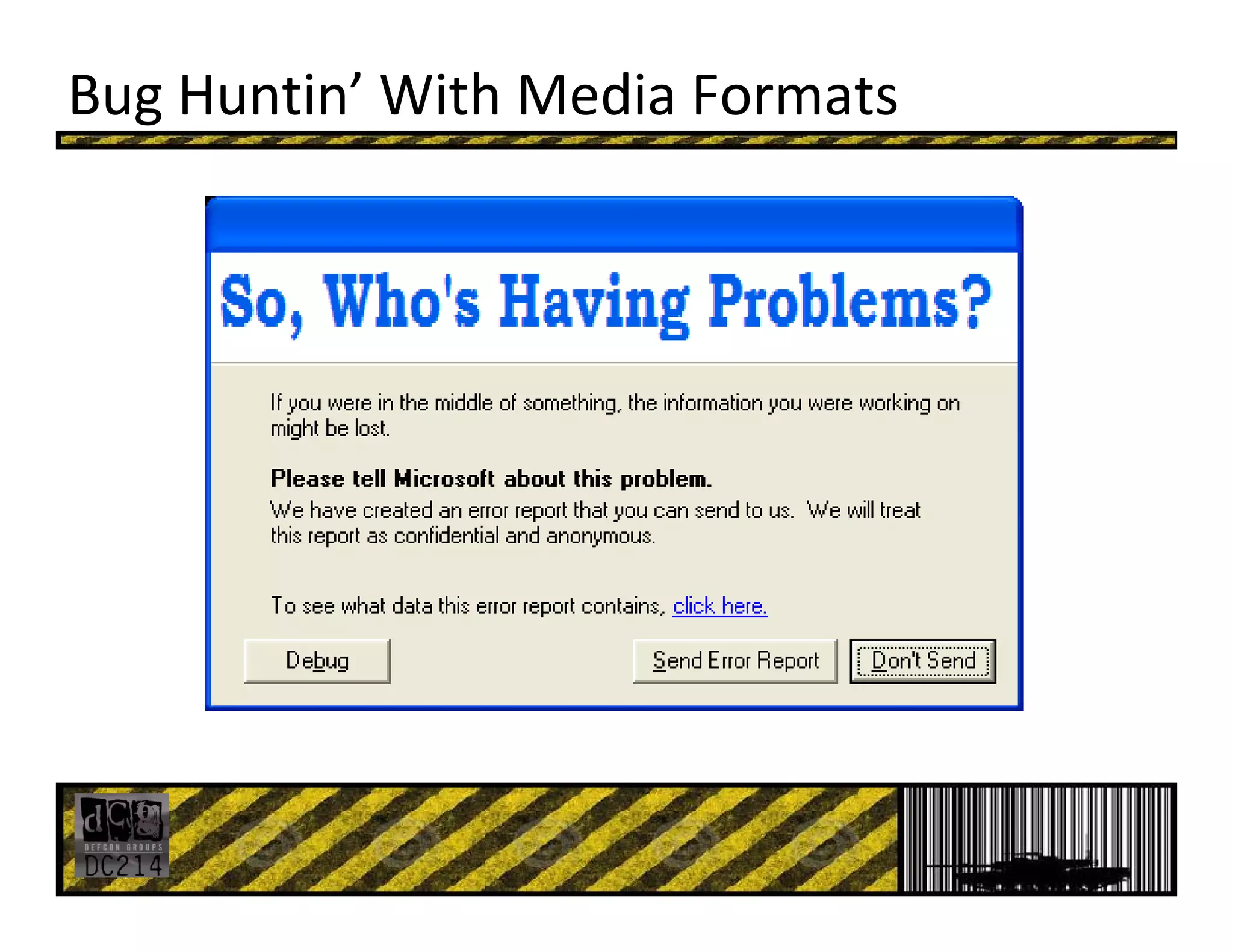
BHWMF::Who’s Having Problems
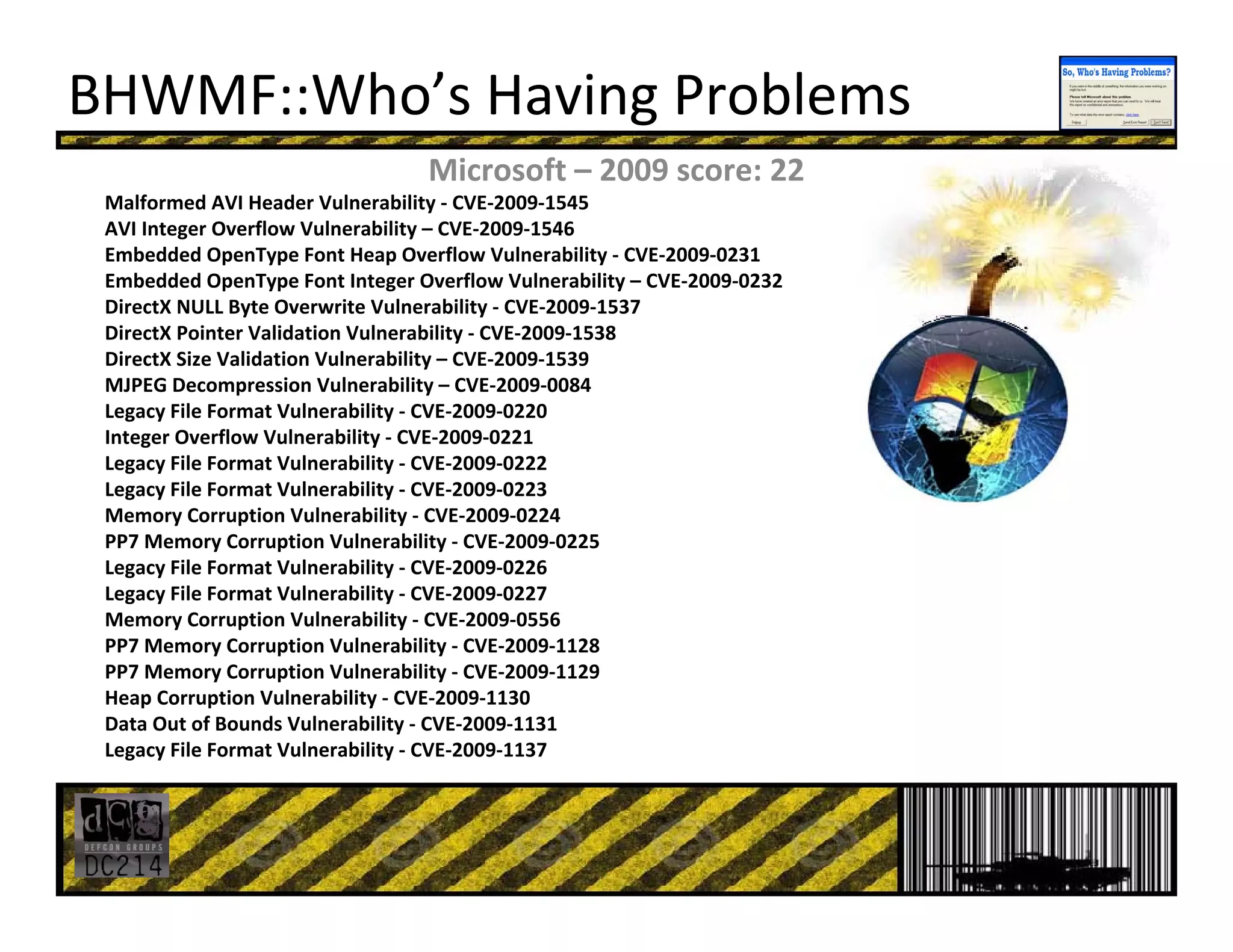
Microsoft – 2009 score: 22
Malformed AVI Header Vulnerability ‐ CVE‐2009‐1545
AVI Integer Overflow Vulnerability – CVE‐2009‐1546
Embedded OpenType Font Heap Overflow Vulnerability ‐ CVE‐2009‐0231
Embedded OpenType Font Integer Overflow Vulnerability – CVE‐2009‐0232
DirectX NULL Byte Overwrite Vulnerability ‐ CVE‐2009‐1537
DirectX Pointer Validation Vulnerability ‐ CVE‐2009‐1538
DirectX Size Validation Vulnerability – CVE‐2009‐1539
MJPEG Decompression Vulnerability – CVE‐2009‐0084
Legacy File Format Vulnerability ‐ CVE‐2009‐0220
Integer Overflow Vulnerability ‐ CVE‐2009‐0221
Legacy File Format Vulnerability ‐ CVE‐2009‐0222
Legacy File Format Vulnerability ‐ CVE‐2009‐0223
Memory Corruption Vulnerability ‐ CVE‐2009‐0224
PP7 Memory Corruption Vulnerability ‐ CVE‐2009‐0225
Legacy File Format Vulnerability ‐ CVE‐2009‐0226
Legacy File Format Vulnerability ‐ CVE‐2009‐0227
Memory Corruption Vulnerability ‐ CVE‐2009‐0556
PP7 Memory Corruption Vulnerability ‐ CVE‐2009‐1128
PP7 Memory Corruption Vulnerability ‐ CVE‐2009‐1129
Heap Corruption Vulnerability ‐ CVE‐2009‐1130
Data Out of Bounds Vulnerability ‐ CVE‐2009‐1131
Legacy File Format Vulnerability ‐ CVE‐2009‐1137
BHWMF::Who’s Having Problems
Adobe – 2009 score: 40
SEC RESEARCHERS SMELL BLOOD IN THE WATER…
CVE‐2009‐2186, CVE‐2009‐2028, CVE‐2009‐1870, CVE‐2009‐1869,
CVE‐2009‐1868, CVE‐2009‐1867, CVE‐2009‐1866, CVE‐2009‐1865, 
CVE‐2009‐1864, CVE‐2009‐1863, CVE‐2009‐1862, CVE‐2009‐1861,
CVE‐2009‐1860, CVE‐2009‐1859, CVE‐2009‐1858, CVE‐2009‐1857, 
CVE‐2009‐1856, CVE‐2009‐1855, CVE‐2009‐1599, CVE‐2009‐1493,
CVE‐2009‐1492, CVE‐2009‐1365, CVE‐2009‐1062, CVE‐2009‐1061,
CVE‐2009‐0928, CVE‐2009‐0927, CVE‐2009‐0889, CVE‐2009‐0888, 
CVE‐2009‐0658, CVE‐2009‐0522, CVE‐2009‐0521, CVE‐2009‐0520, 
CVE‐2009‐0519, CVE‐2009‐0512, CVE‐2009‐0511, CVE‐2009‐0510,
CVE‐2009‐0509, CVE‐2009‐0198, CVE‐2009‐0193, CVE‐2009‐0114
BHWMF::Who’s Having Problems
Adobe – 2009 score: 41
Another Bad Apple…
CVE‐2009‐0001, CVE‐2009‐0002, CVE‐2009‐0003, CVE‐2009‐0004,
CVE‐2009‐0006, CVE‐2009‐0007, CVE‐2009‐0008, CVE‐2009‐0009,
CVE‐2009‐0010, CVE‐2009‐0040, CVE‐2009‐0145, CVE‐2009‐0154,
CVE‐2009‐0155, CVE‐2009‐0160, CVE‐2009‐0165, CVE‐2009‐0185,
CVE‐2009‐0188, CVE‐2009‐0519, CVE‐2009‐0520, CVE‐2009‐0946,
CVE‐2009‐0950, CVE‐2009‐0951, CVE‐2009‐0952, CVE‐2009‐0953,
CVE‐2009‐0955, CVE‐2009‐0957, CVE‐2009‐0959, CVE‐2009‐1693,
CVE‐2009‐1703, CVE‐2009‐1704, CVE‐2009‐1705, CVE‐2009‐1709,
CVE‐2009‐1719, CVE‐2009‐1720, CVE‐2009‐1721, CVE‐2009‐1722,
CVE‐2009‐1726, CVE‐2009‐1727, CVE‐2009‐1728, CVE‐2009‐2188,
CVE‐2009‐2468
Bug Huntin’ With Media Formats
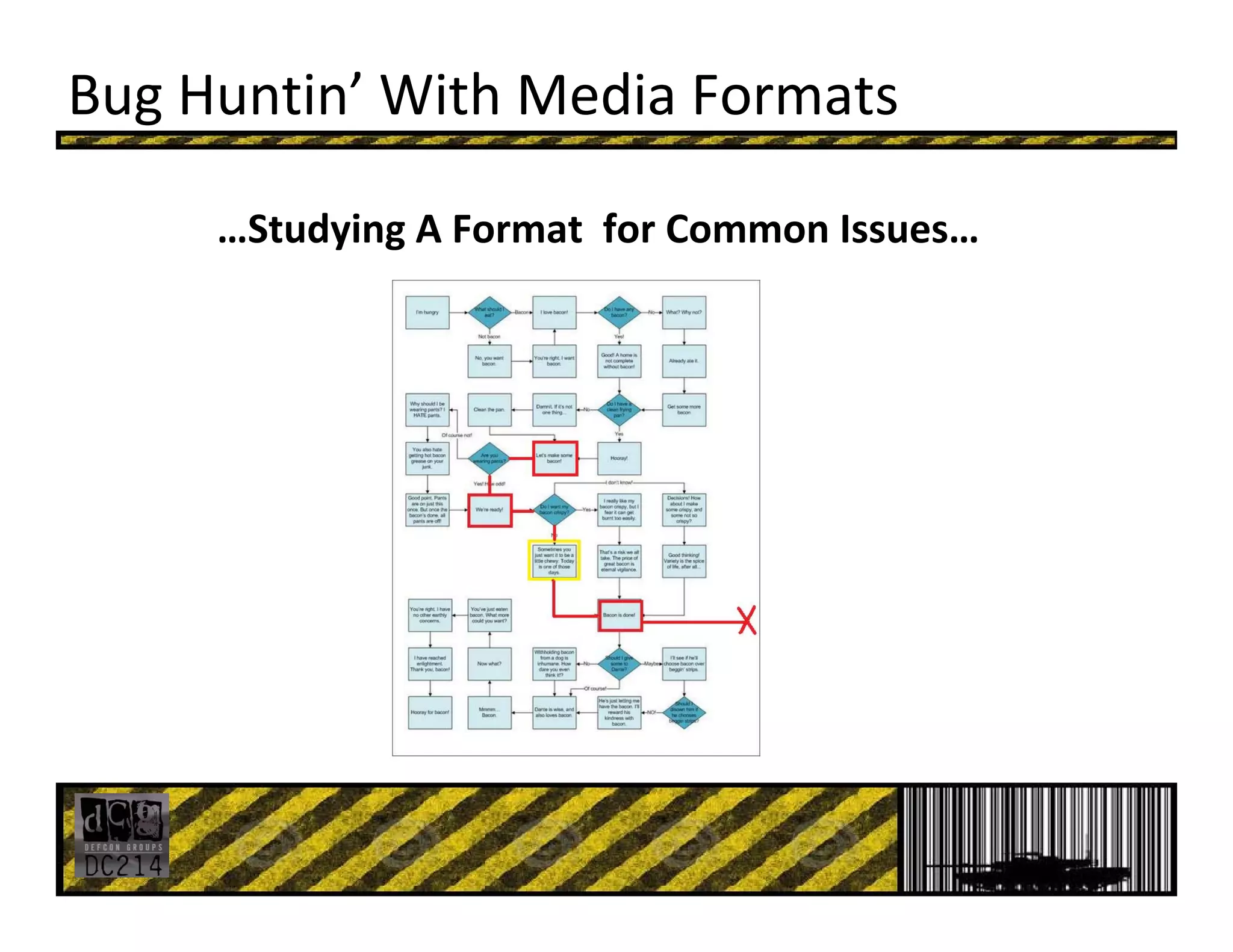
…Studying A Format  for Common Issues…
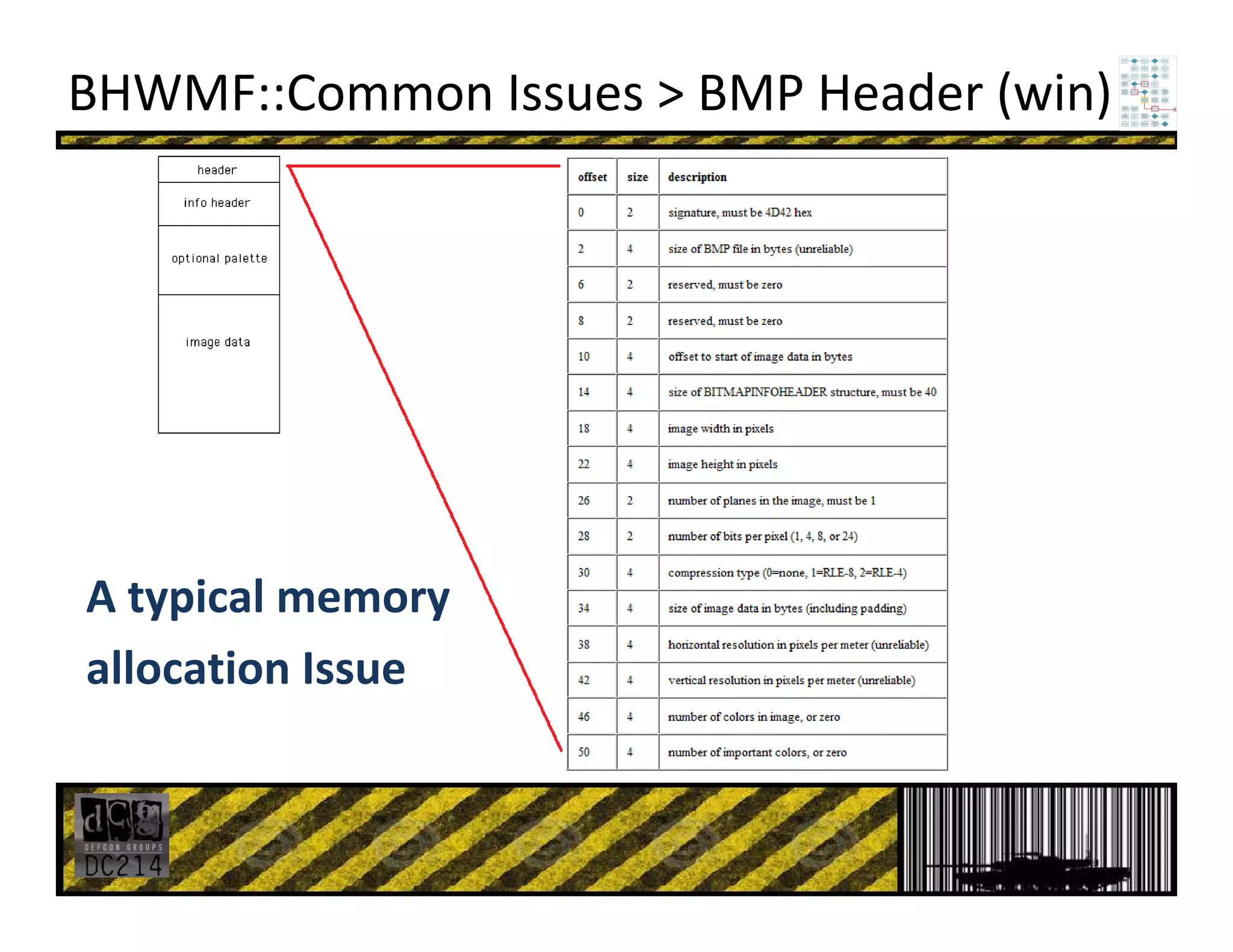
BHWMF::Common Issues > BMP Header (win)
A typical memory
allocation Issue
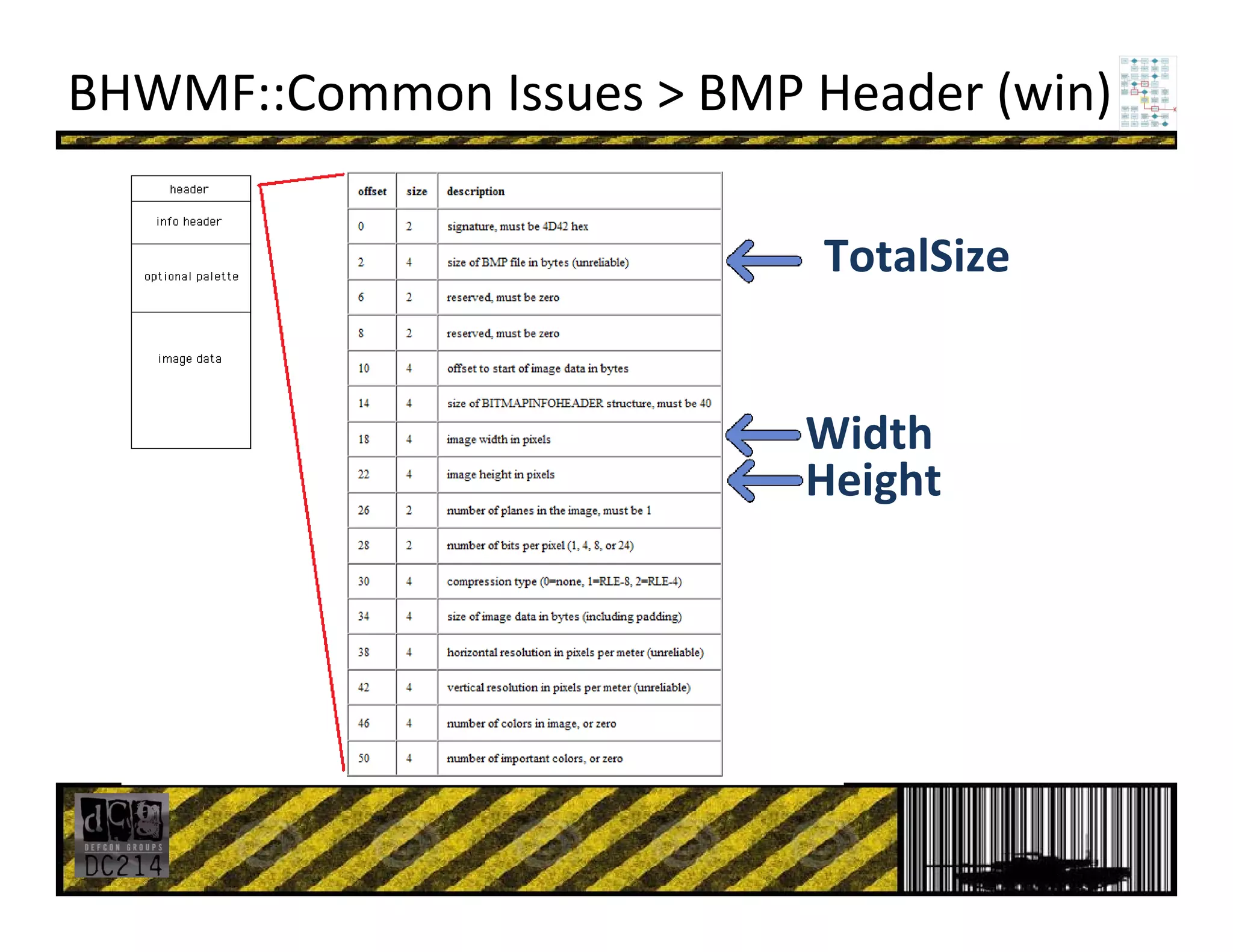
BHWMF::Common Issues > BMP Header (win)
TotalSize
Width
Height
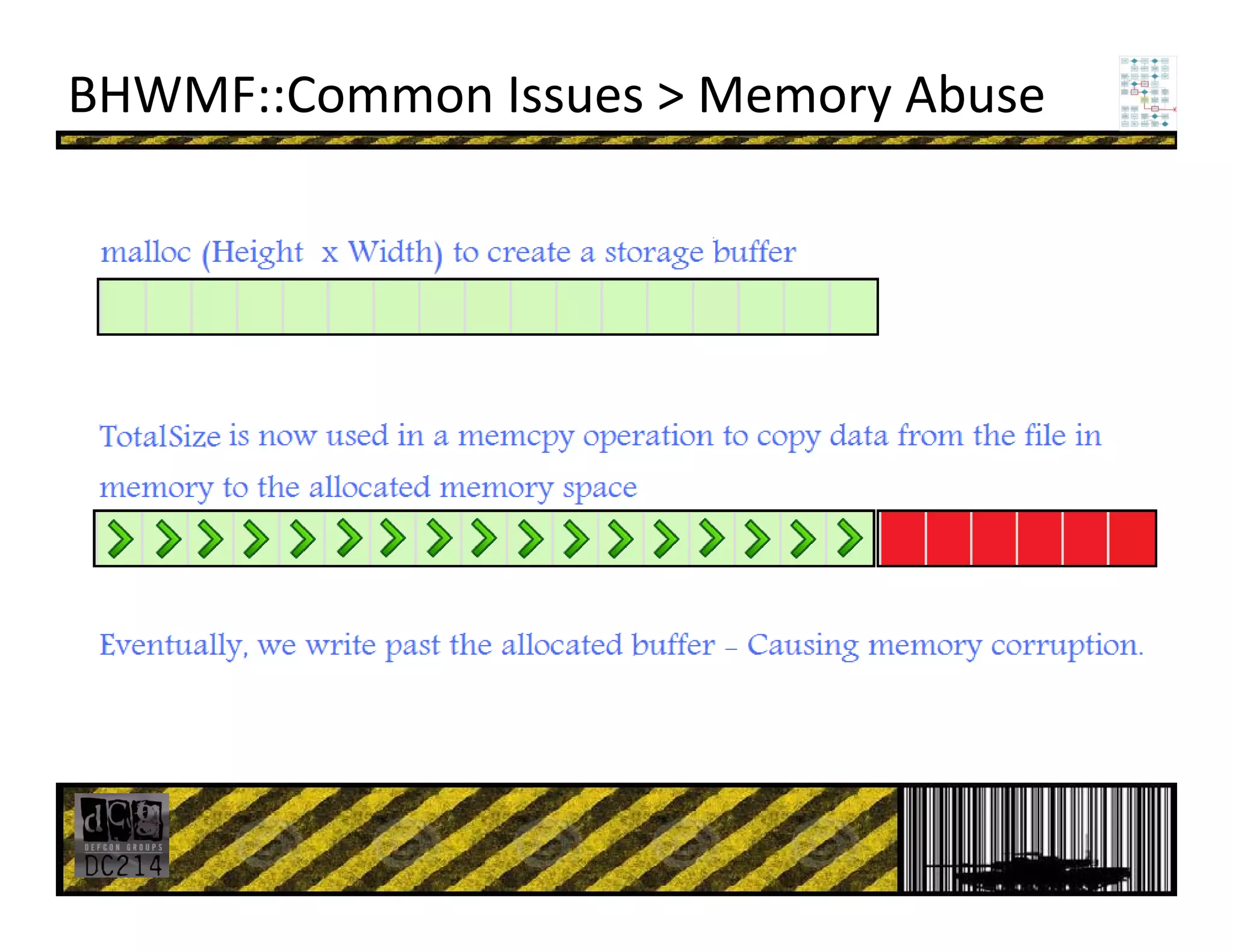
BHWMF::Common Issues > Memory Abuse
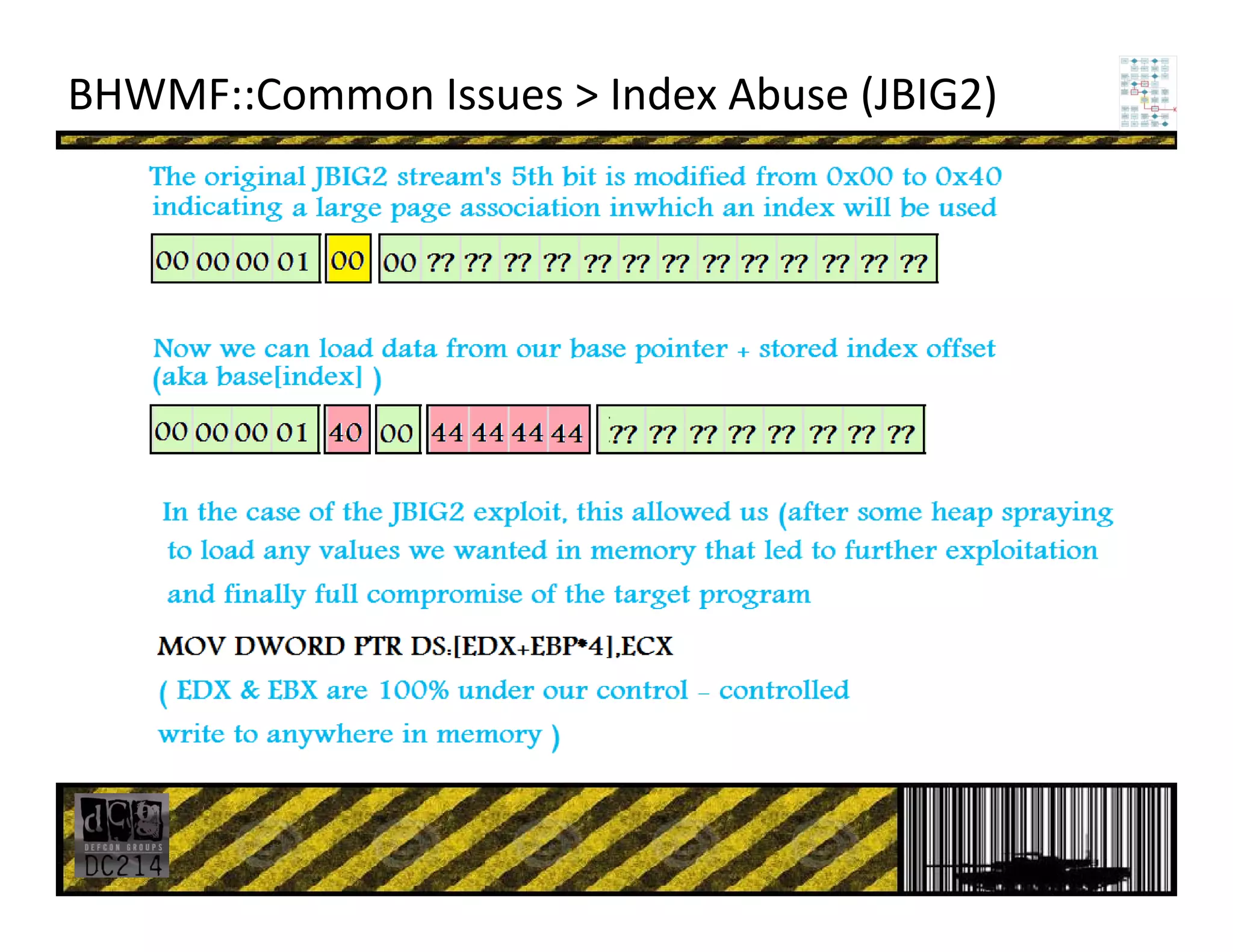
BHWMF::Common Issues > Index Abuse (JBIG2)
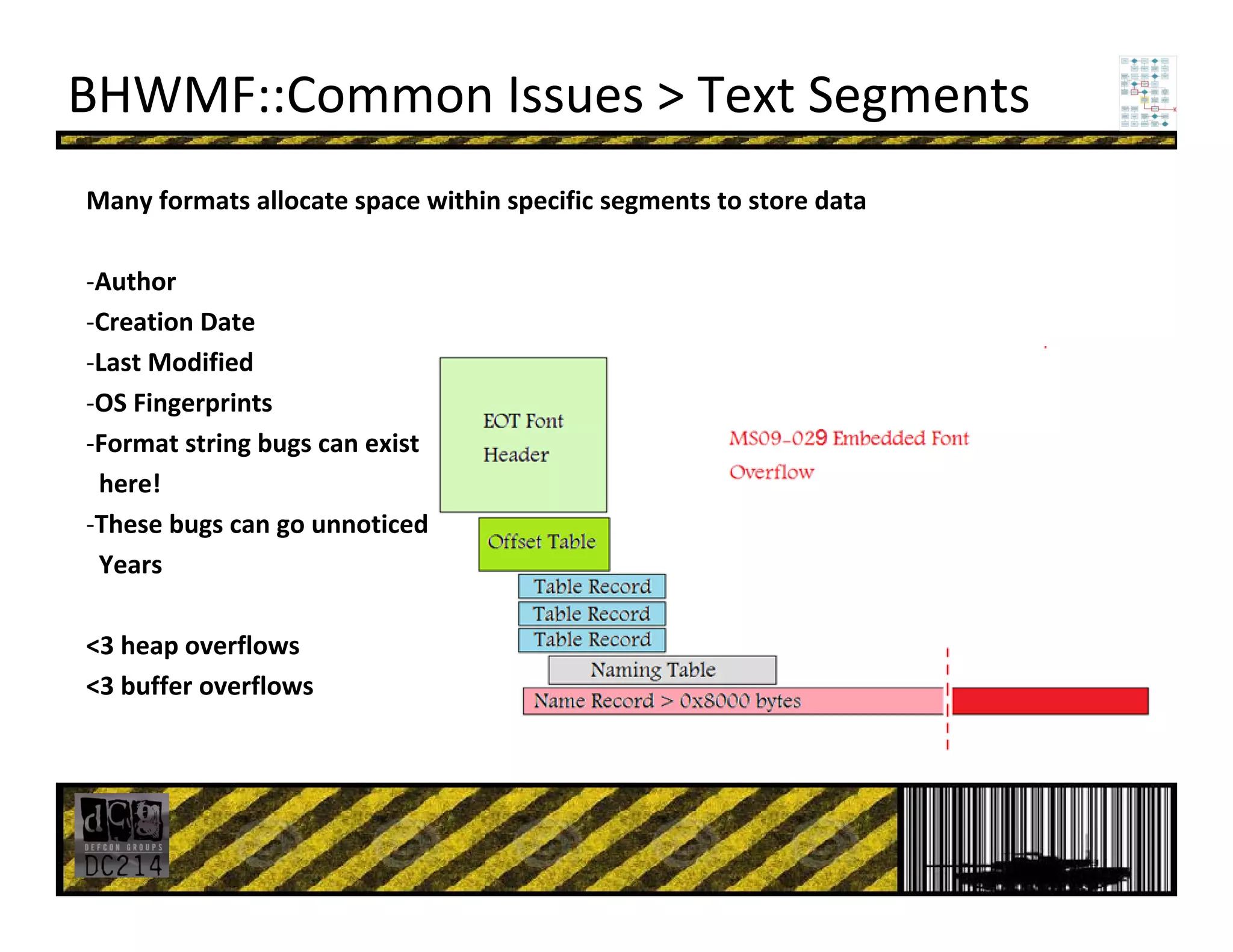
BHWMF::Common Issues > Text Segments
Many formats allocate space within specific segments to store data
‐Author
‐Creation Date
‐Last Modified
‐OS Fingerprints
‐Format string bugs can exist
here!
‐These bugs can go unnoticed
Years
<3 heap overflows
<3 buffer overflows
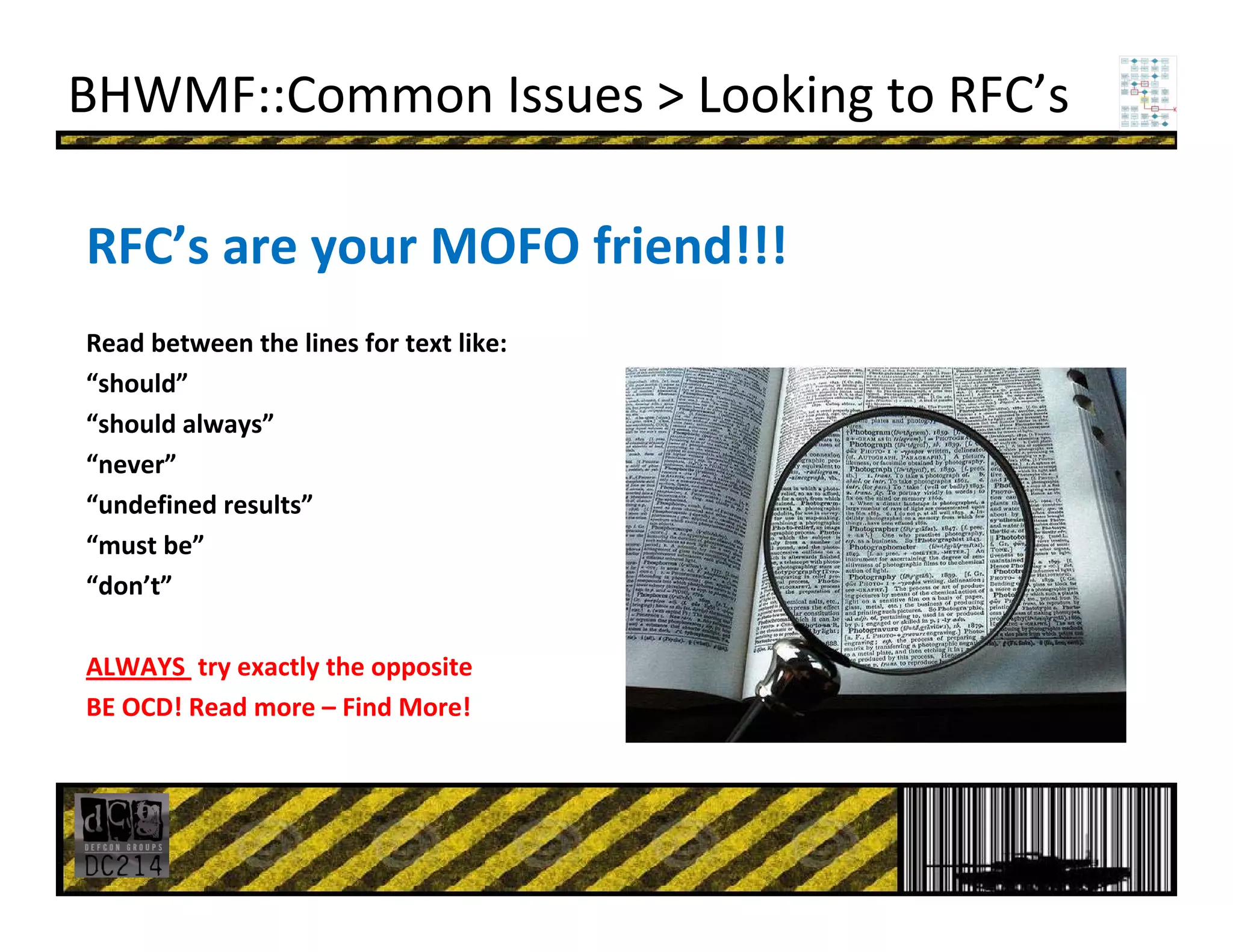
BHWMF::Common Issues > Looking to RFC’s
RFC’s are your MOFO friend!!!
Read between the lines for text like:
“should”
“should always”
“never”
“undefined results”
“must be”
“don’t”
ALWAYS  try exactly the opposite
BE OCD! Read more – Find More!
Bug Huntin’ With Media Formats
Common Obstacles 
BHWMF::Common Obstacles > Basics
Compression Routines – Most media formats, these days, utilize 
compression algorithms.  Often these must be satisfied to get any 
real kind of fuzzing accomplished.
Don’t Ignore them completely !  sometimes this is where the 
vulnerabilities are!
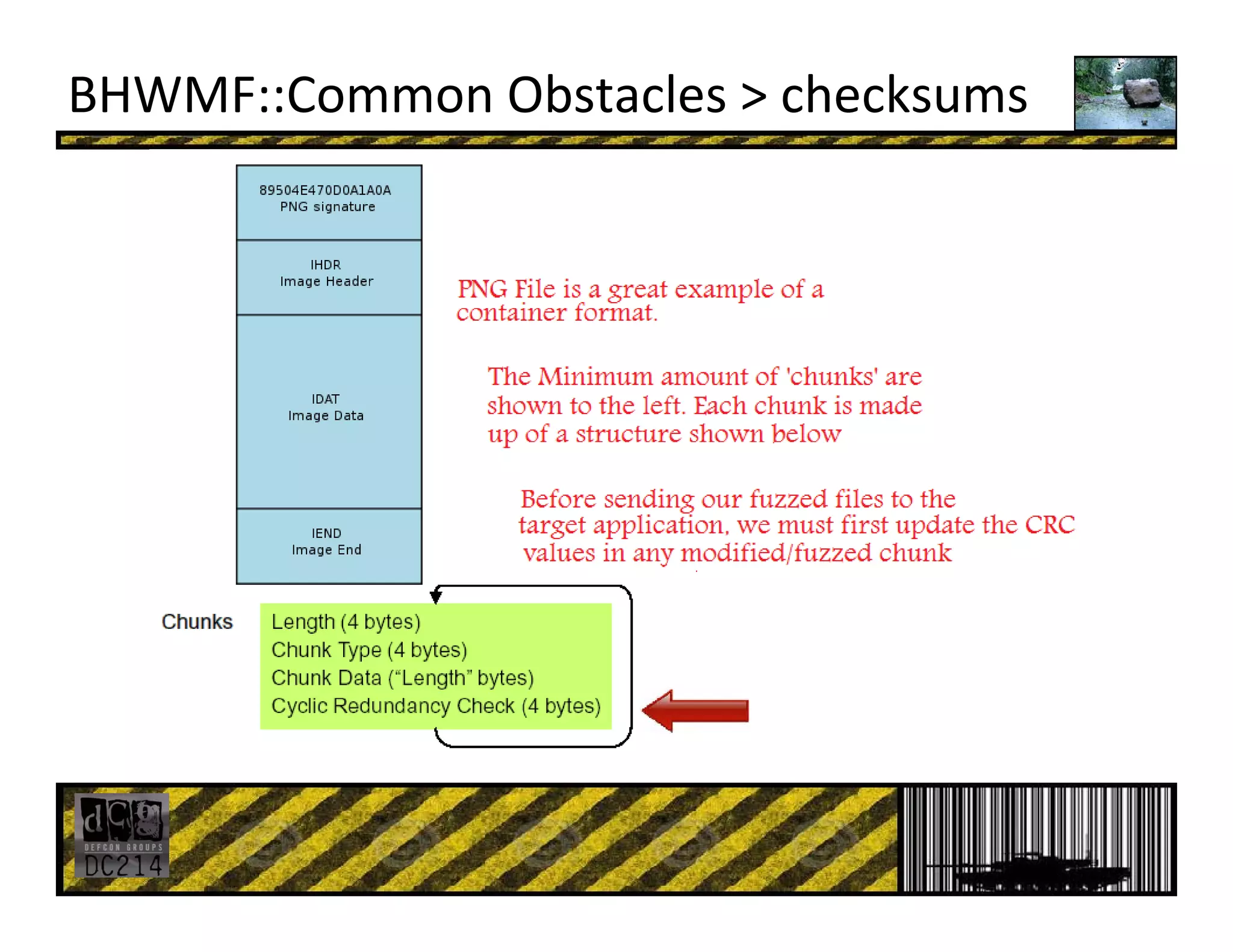
Checksums & Indexes – If you do not account for specific fail‐
checking algorithms in a format, then you WILL NOT find the bugs 
beyond these sort of checks. 
BHWMF::Common Obstacles > checksums
BHWMF::Common Obstacles > Index Tables
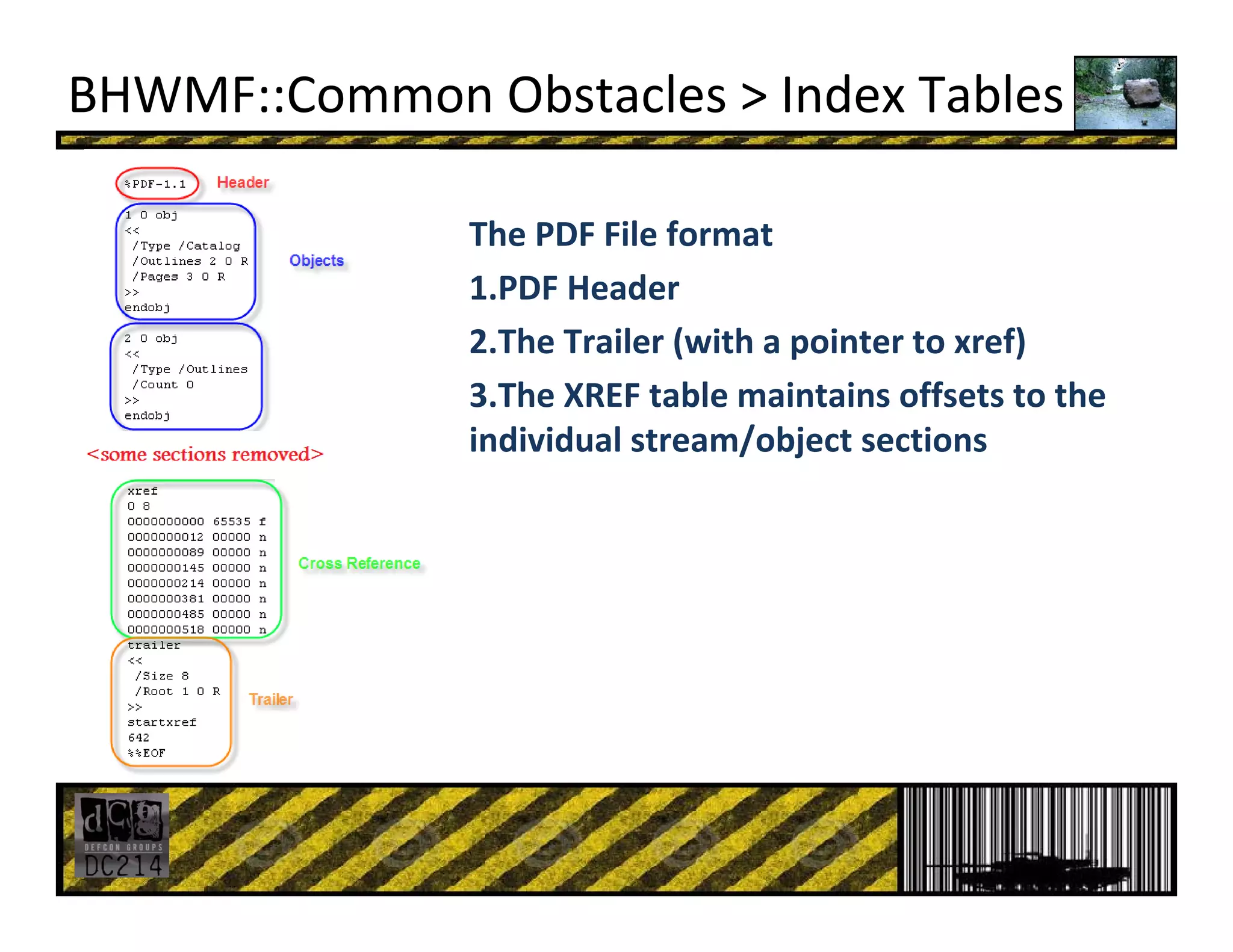
The PDF File format
1.PDF Header
2.The Trailer (with a pointer to xref)
3.The XREF table maintains offsets to the 
individual stream/object sections 
BHWMF::Common Obstacles > Errors
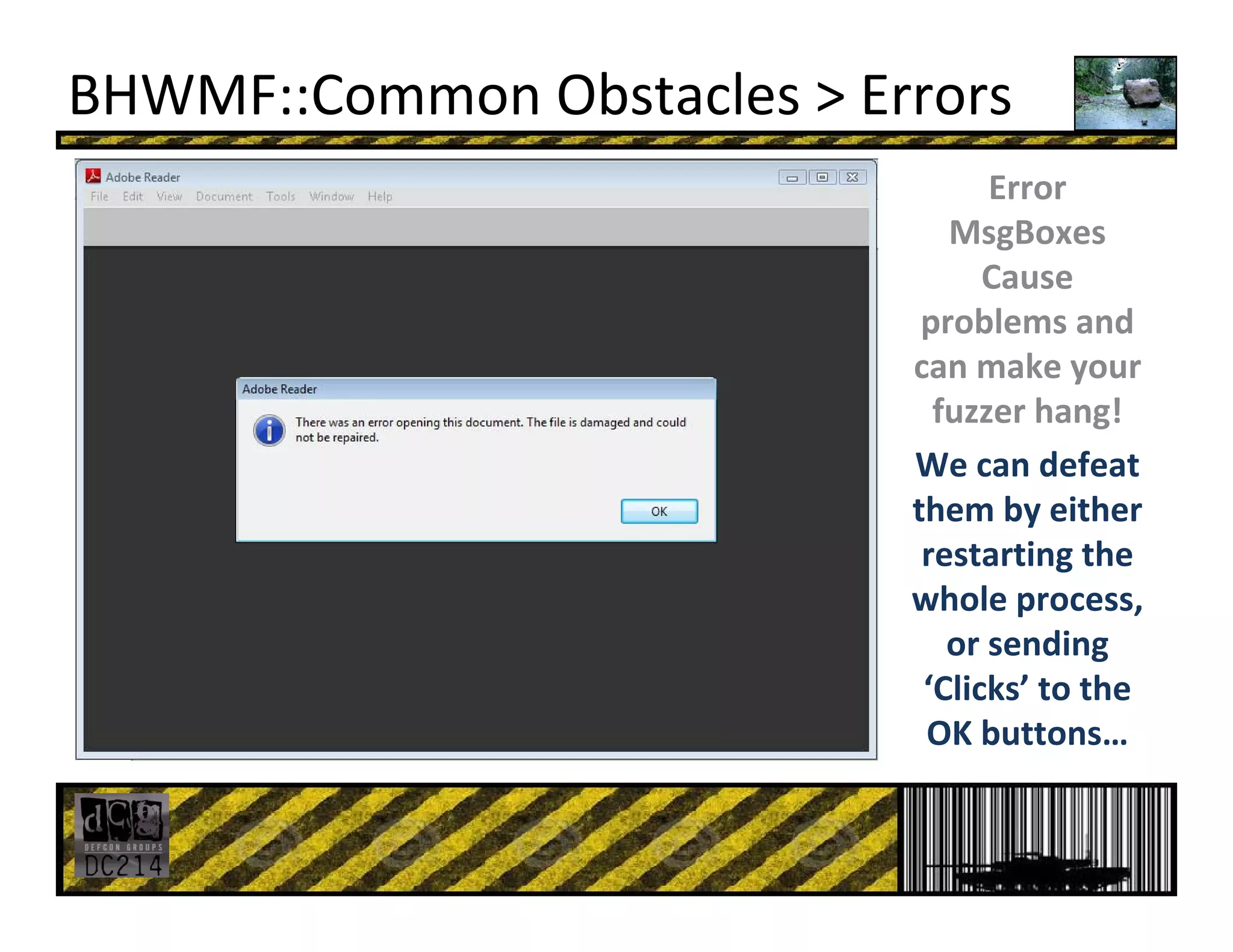
Error 
MsgBoxes
Cause 
problems and 
can make your 
fuzzer hang!
We can defeat 
them by either 
restarting the 
whole process, 
or sending 
‘Clicks’ to the 
OK buttons…
BHWMF::Common Obstacles
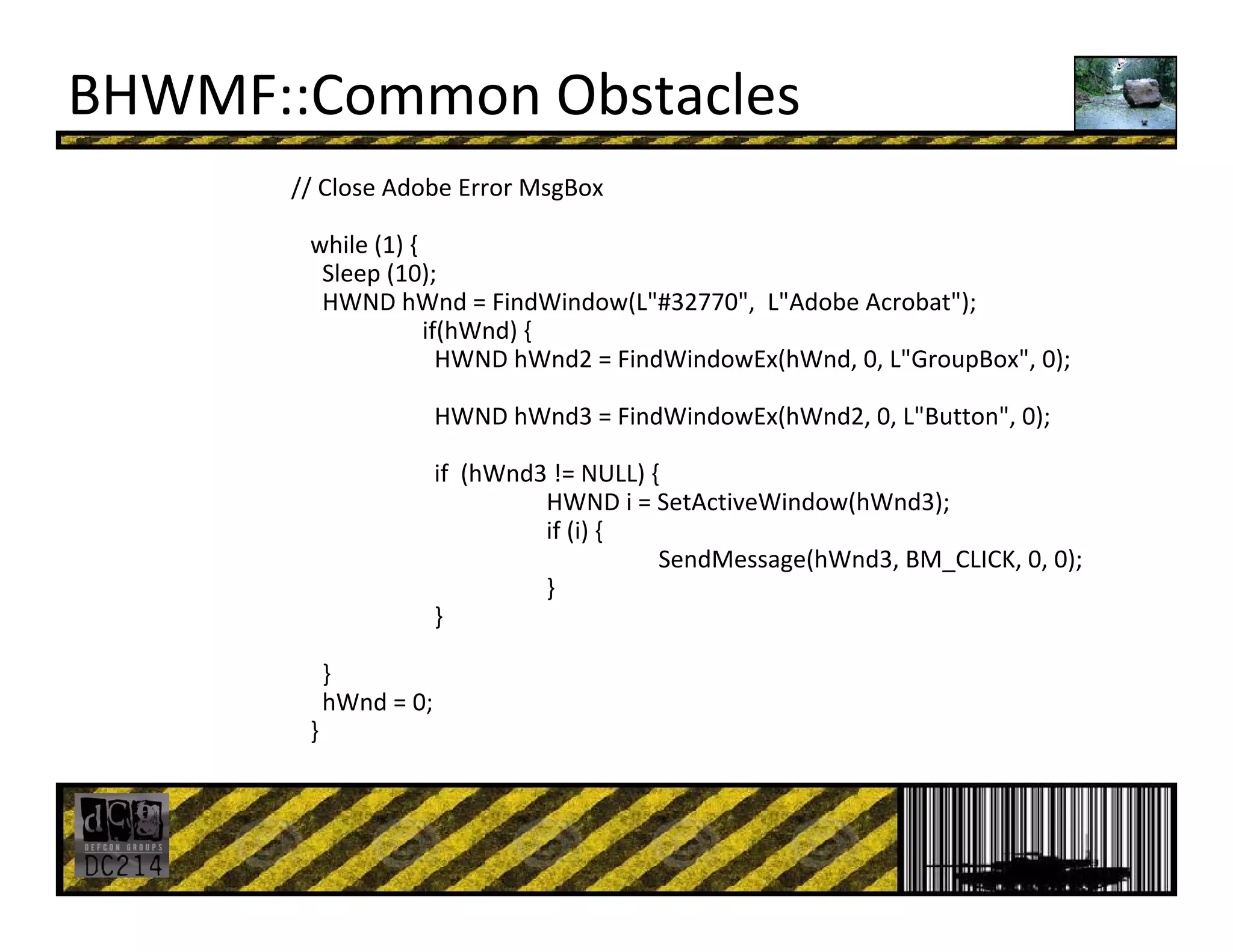
// Close Adobe Error MsgBox
while (1) {
Sleep (10);
HWND hWnd = FindWindow(L"#32770",  L"Adobe Acrobat");
if(hWnd) {
HWND hWnd2 = FindWindowEx(hWnd, 0, L"GroupBox", 0);
HWND hWnd3 = FindWindowEx(hWnd2, 0, L"Button", 0);
if  (hWnd3 != NULL) {
HWND i = SetActiveWindow(hWnd3);
if (i) {
SendMessage(hWnd3, BM_CLICK, 0, 0);
}
}
}
hWnd = 0;
}
Bug Huntin’ With Media Formats
Tools – taking advantage of what 
is already out there
BHWMF::Existing Tools > winfuzz
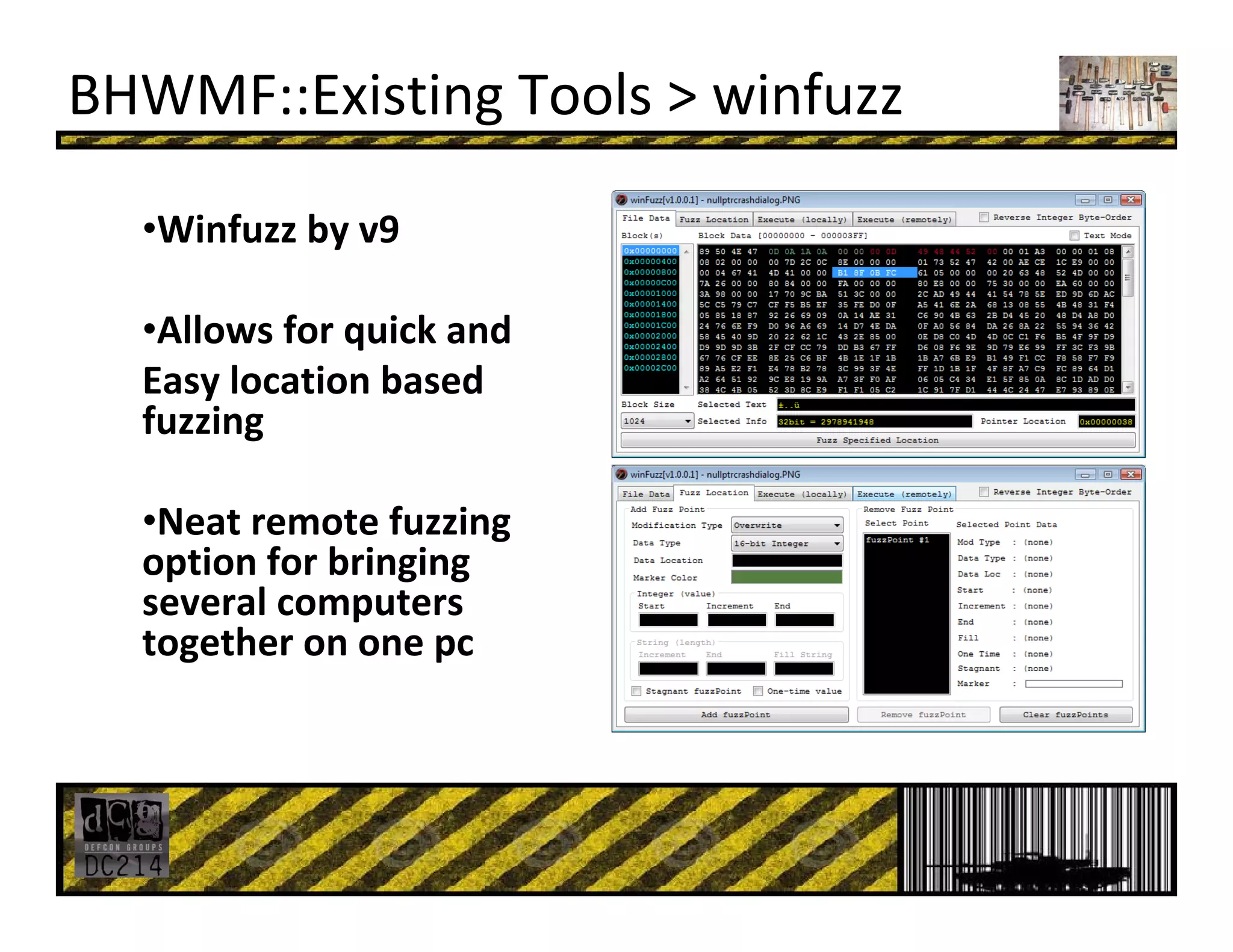
•Winfuzz by v9 
•Allows for quick and
Easy location based 
fuzzing
•Neat remote fuzzing
option for bringing 
several computers 
together on one pc
BHWMF::Existing Tools > Peachfuzz
•PeachFuzz v2
•Awesome versatile 
framework
V2 comes with nice 
documentation and 
examples (finally!)
BHWMF::Existing Tools > SpikeFuzz
•SpikeFuzz by Immunitysec
•One of the First Real 
Fuzzing Frameworks
•Nice Library base that will 
help tackle almost any 
format
BHWMF::Existing Tools > others…
•Hundreds of other fuzzers out there! 
•Check some of them out:
•http://www.krakowlabs.com/lof.html
(list of public fuzzers)
Bug Huntin’ With Media Formats
•Creating Tools For the Job
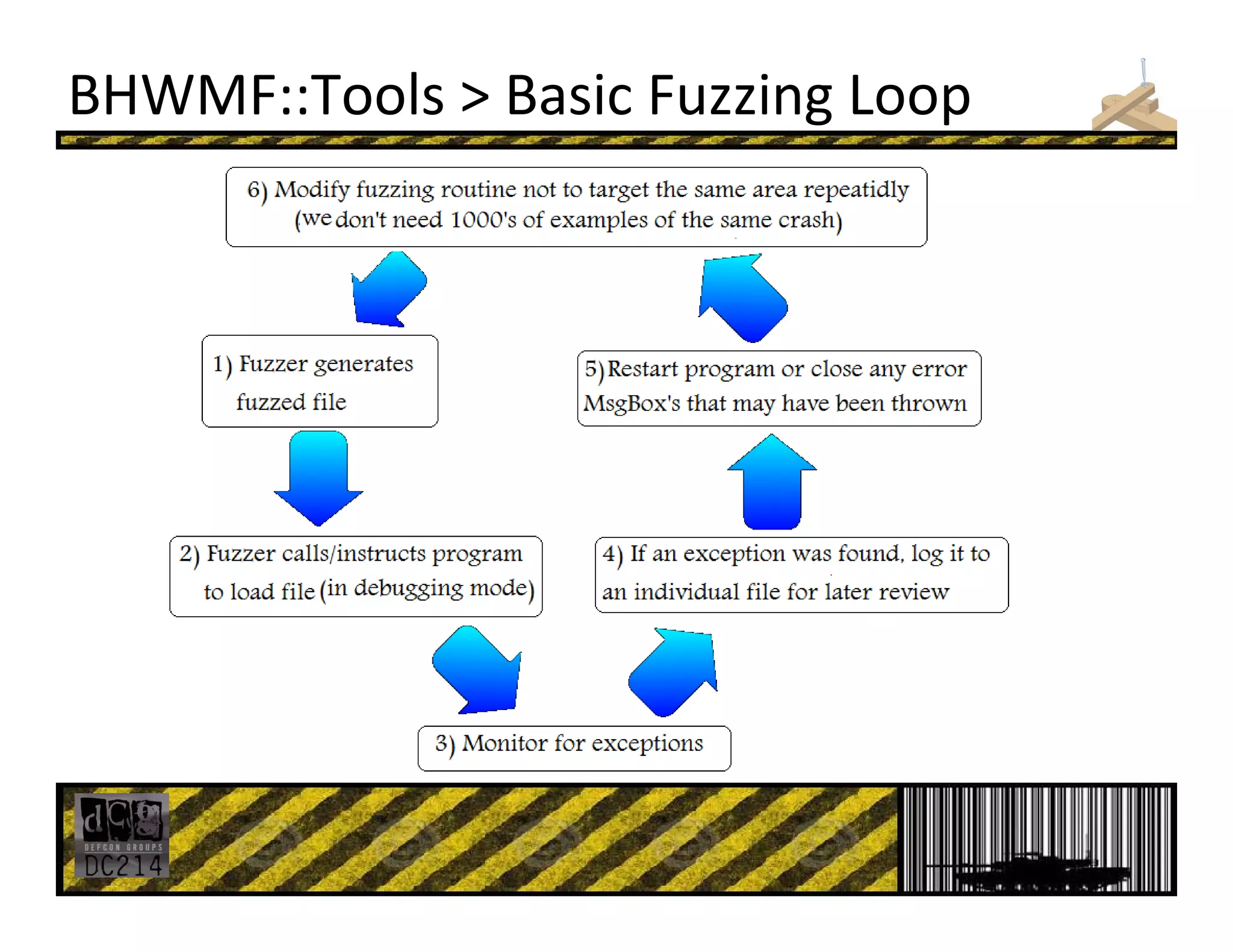
BHWMF::Tools > Basic Fuzzing Loop
BHWMF::Tools > Fuzzing Techniques
Random (blind) Fuzzing
•Modifying randomly selected areas of a file 
•The beginning of headers and embedded structures will produce 
more results
•Bit Bashing (ex: 0x41 to 0x61 )
•String Injection (ex: 414141414141414141… )
•Winfuzz is great for this
Inject in more then one location! Lots more bugs
will be found this way. First write enables an option,
second write gives it a bad value you can catch!
BHWMF::Tools > Fuzzing Techniques
Formatted Fudging
Learn the basic layout of a files format and abide by the “rules”.
Checksums must be met. 
You will find more than blind fuzzing
Requires at least some programming knowledge
Try inserting data that appears similar to what might occur in the file. 
(Better to reference existing files for visual aid first)
BHWMF::Tools > Fuzzing Techniques
Existing Template Modification
Have your fuzzer load an existing file and recognize its internal 
structures
Modify one or more of these existing structures
Account for checksums or other checks
Really good technique to find those deep/hard to find bugs
Not TOO time consuming on the fuzzing side – Researching your 
findings can be testing though.
BHWMF::Tools > Fuzzing Techniques
Full Blown Fuzzer
Meet all of RFC’s expectations
Can take weeks of programming to implement
Cheat: steal code / modify it where you can 
(or trick redsand into writing it)
You will have a much greater understanding of what/where the bugs 
you find are ‐ and more importantly ‐ exactly how to exploit them.
BHWMF::Tools > Fuzzing Techniques
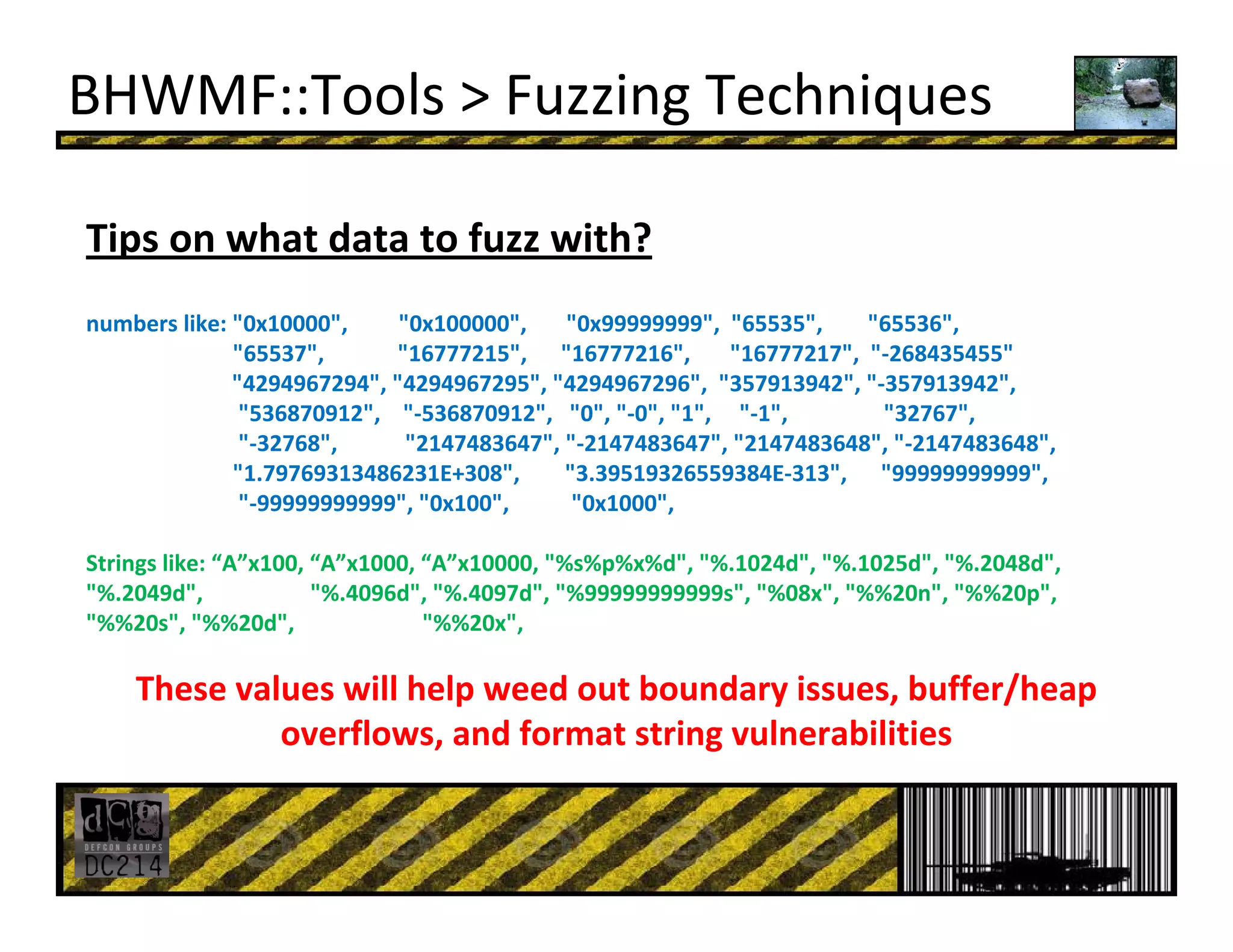
Tips on what data to fuzz with?
numbers like: "0x10000",         "0x100000",       "0x99999999", "65535",        "65536", 
"65537",             "16777215",      "16777216",       "16777217",  "‐268435455"
"4294967294", "4294967295", "4294967296",  "357913942", "‐357913942",
"536870912",    "‐536870912",   "0", "‐0", "1",     "‐1",                 "32767",
"‐32768",            "2147483647", "‐2147483647", "2147483648", "‐2147483648",
"1.79769313486231E+308",        "3.39519326559384E‐313",      "99999999999", 
"‐99999999999", "0x100",           "0x1000",
Strings like: “A”x100, “A”x1000, “A”x10000, "%s%p%x%d", "%.1024d", "%.1025d", "%.2048d", 
"%.2049d",               "%.4096d", "%.4097d", "%99999999999s", "%08x", "%%20n", "%%20p", 
"%%20s", "%%20d",  "%%20x",
These values will help weed out boundary issues, buffer/heap 
overflows, and format string vulnerabilities
BHWMF::Tools > Fuzzing Techniques
Controlling the target – the DDE / OLE way
Some applications like Adobe Acrobat/Reader can be simply controlled through 
transport control mediums such as OLE/DDE. 
We can create basic loops that loop through DDE controls like such:
acrobat.Exec('[DocClose("%s")]' % doc)
acrobat.Exec('[FileOpen("%s")]' % doc)
acrobat.Exec('[DocOpen("%s")]' % doc)
acrobat.Exec('[DocGoTo("%s", %d)]' % (doc, page))
BHWMF::Tools > PeachFuzz Example
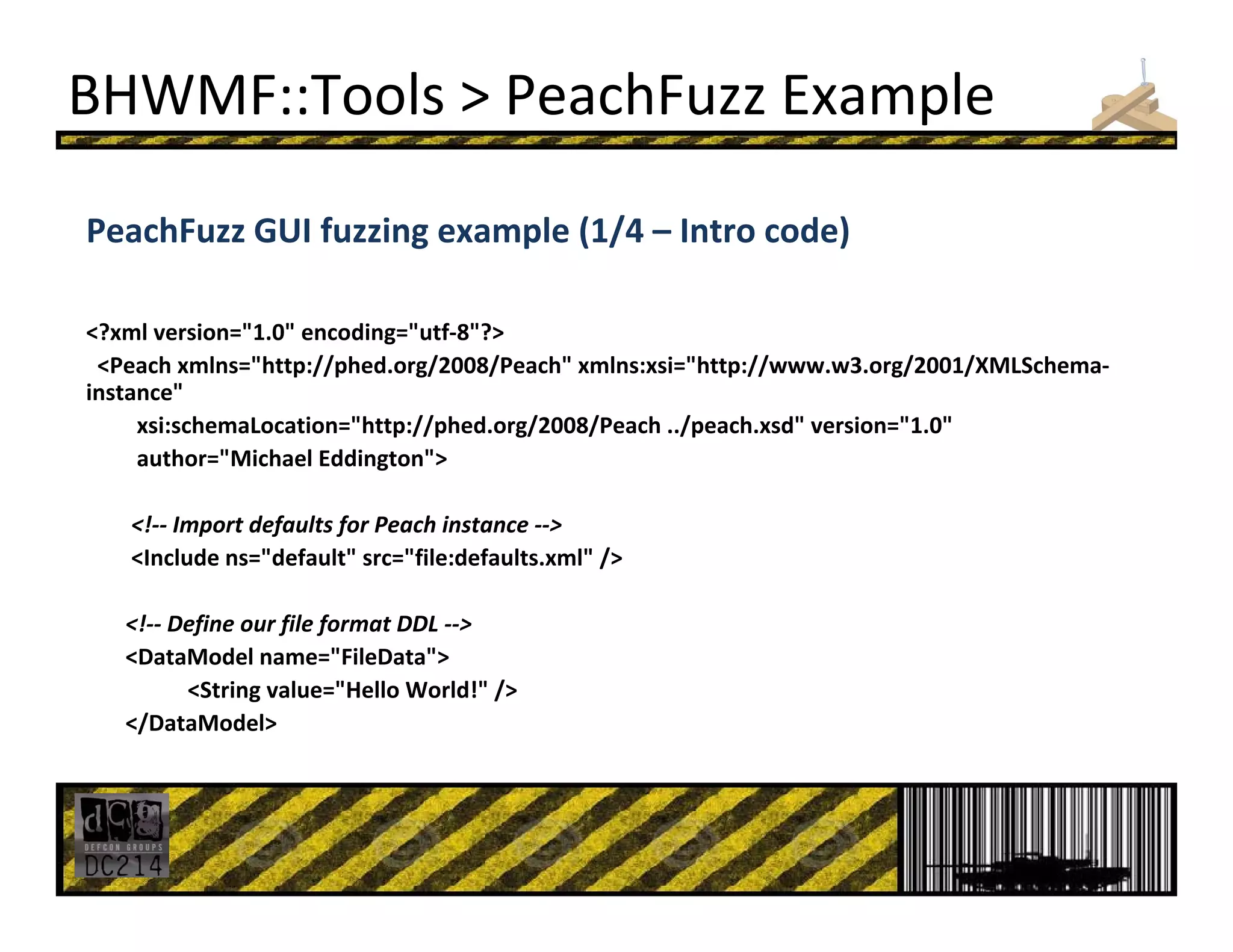
PeachFuzz GUI fuzzing example (1/4 – Intro code)
<?xml version="1.0" encoding="utf‐8"?>
<Peach xmlns="http://phed.org/2008/Peach" xmlns:xsi="http://www.w3.org/2001/XMLSchema‐
instance" 
xsi:schemaLocation="http://phed.org/2008/Peach ../peach.xsd" version="1.0" 
author="Michael Eddington">
<!‐‐ Import defaults for Peach instance ‐‐>
<Include ns="default" src="file:defaults.xml" /> 
<!‐‐ Define our file format DDL ‐‐>
<DataModel name="FileData">
<String value="Hello World!" /> 
</DataModel>
BHWMF::Tools > PeachFuzz Example
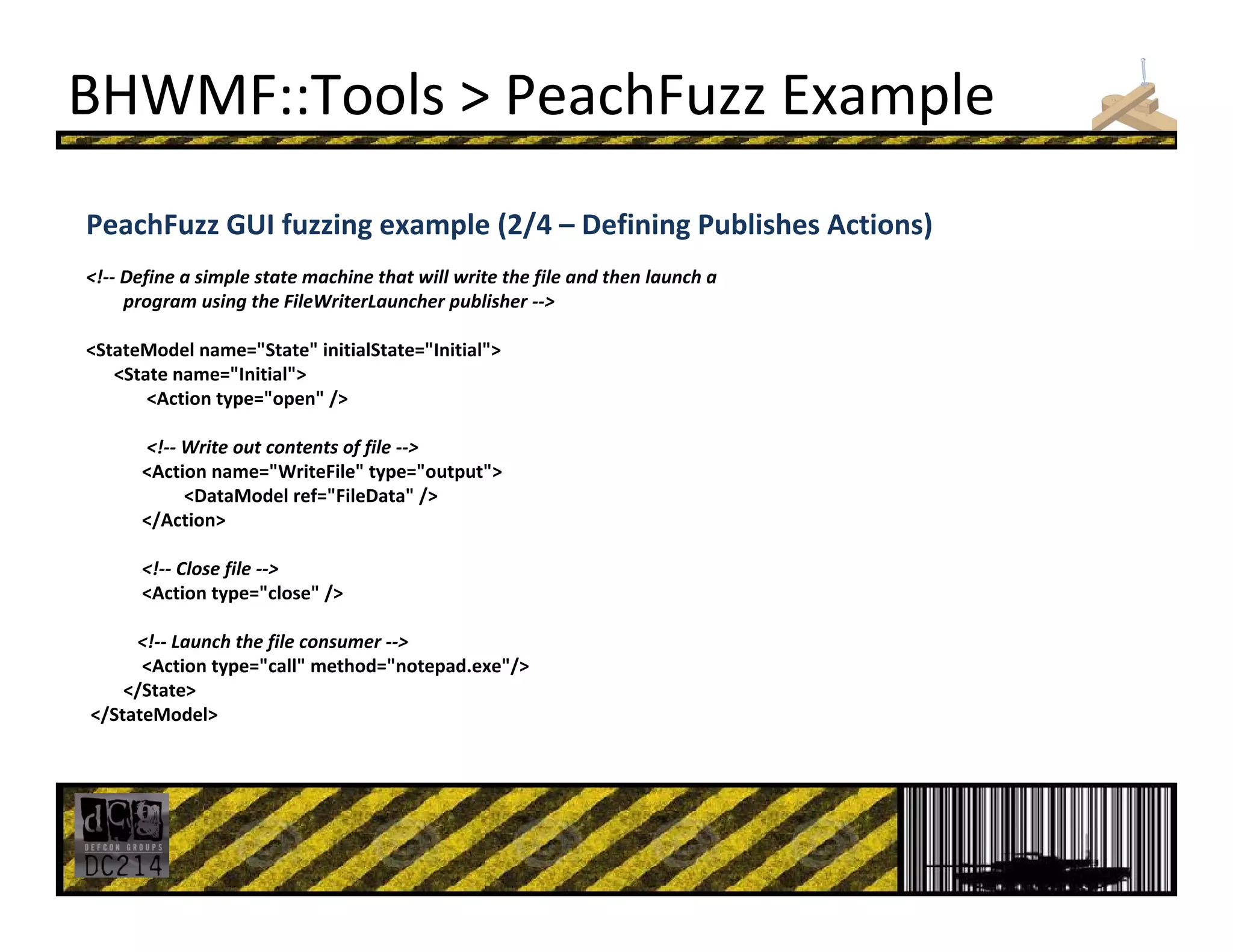
PeachFuzz GUI fuzzing example (2/4 – Defining Publishes Actions)
<!‐‐ Define a simple state machine that will write the file and then launch a 
program using the FileWriterLauncher publisher ‐‐>
<StateModel name="State" initialState="Initial">
<State name="Initial"> 
<Action type="open" />
<!‐‐ Write out contents of file ‐‐>
<Action name="WriteFile" type="output">
<DataModel ref="FileData" /> 
</Action> 
<!‐‐ Close file ‐‐>
<Action type="close" />
<!‐‐ Launch the file consumer ‐‐>
<Action type="call" method="notepad.exe"/> 
</State> 
</StateModel> 
BHWMF::Tools > PeachFuzz Example
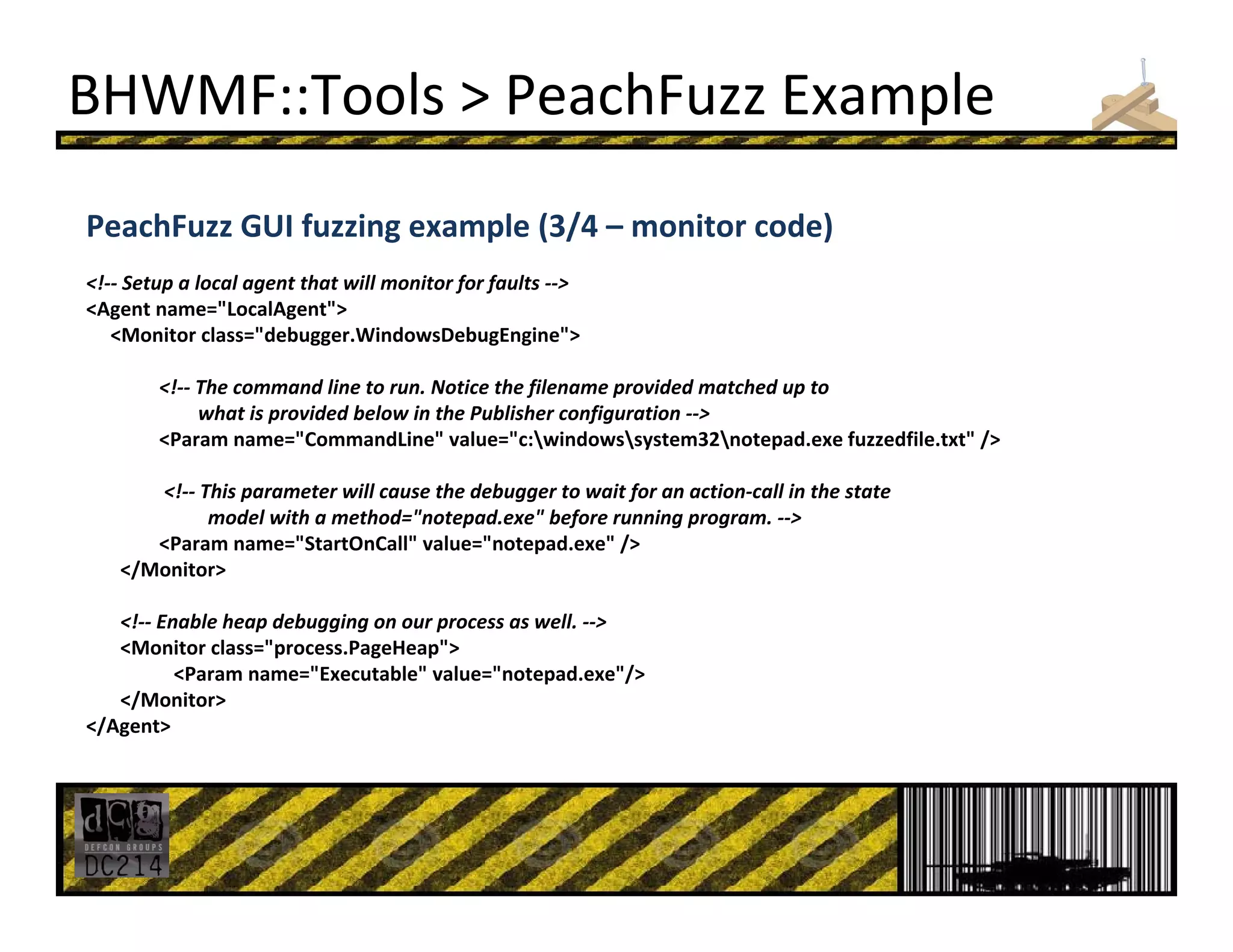
PeachFuzz GUI fuzzing example (3/4 – monitor code)
<!‐‐ Setup a local agent that will monitor for faults ‐‐>
<Agent name="LocalAgent">
<Monitor class="debugger.WindowsDebugEngine"> 
<!‐‐ The command line to run. Notice the filename provided matched up to
what is provided below in the Publisher configuration ‐‐>
<Param name="CommandLine" value="c:windowssystem32notepad.exe fuzzedfile.txt" /> 
<!‐‐ This parameter will cause the debugger to wait for an action‐call in the state 
model with a method="notepad.exe" before running program. ‐‐>
<Param name="StartOnCall" value="notepad.exe" /> 
</Monitor> 
<!‐‐ Enable heap debugging on our process as well. ‐‐>
<Monitor class="process.PageHeap"> 
<Param name="Executable" value="notepad.exe"/>
</Monitor> 
</Agent> 
BHWMF::Tools > PeachFuzz Example
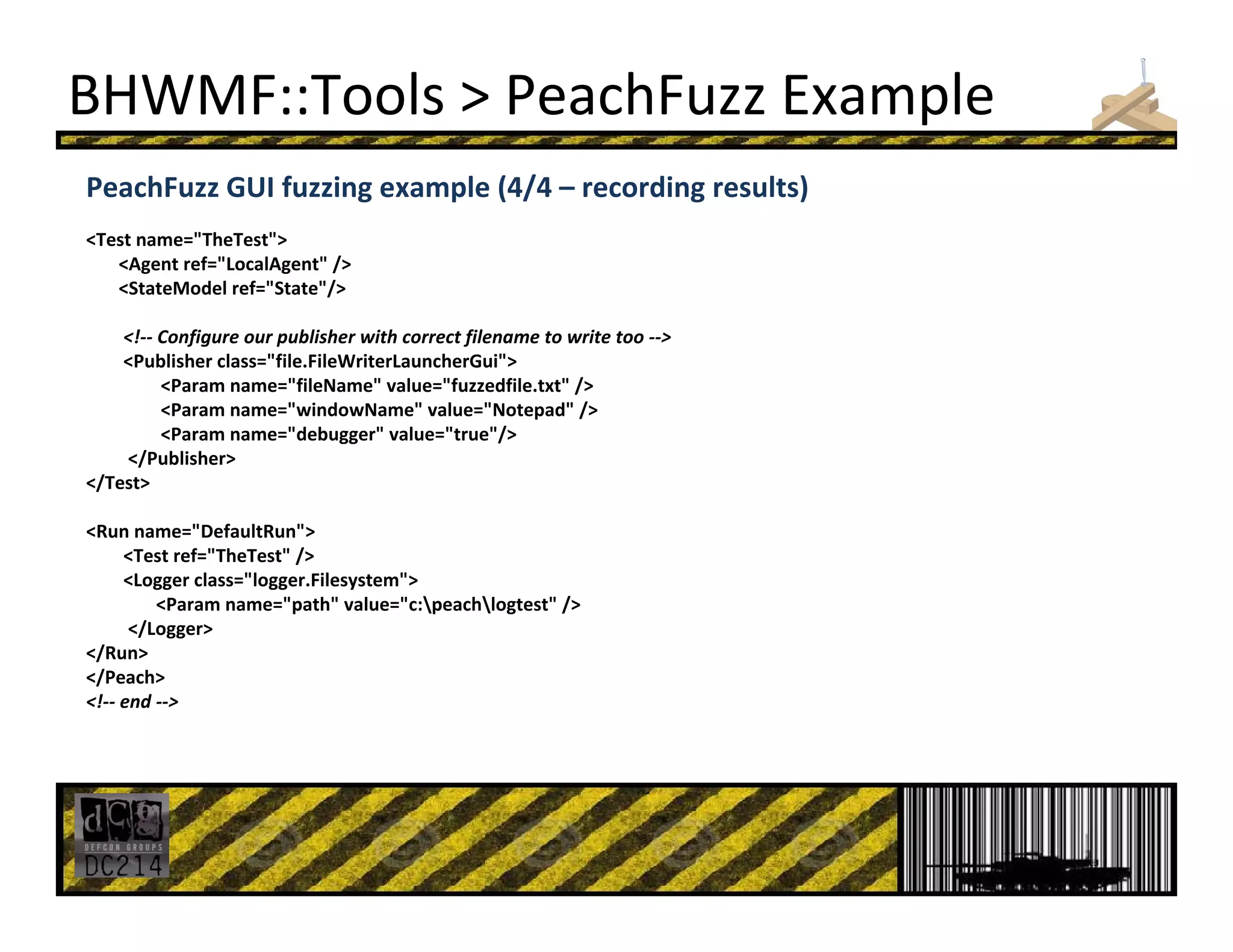
PeachFuzz GUI fuzzing example (4/4 – recording results)
<Test name="TheTest">
<Agent ref="LocalAgent" /> 
<StateModel ref="State"/> 
<!‐‐ Configure our publisher with correct filename to write too ‐‐>
<Publisher class="file.FileWriterLauncherGui"> 
<Param name="fileName" value="fuzzedfile.txt" /> 
<Param name="windowName" value="Notepad" /> 
<Param name="debugger" value="true"/> 
</Publisher> 
</Test> 
<Run name="DefaultRun"> 
<Test ref="TheTest" /> 
<Logger class="logger.Filesystem"> 
<Param name="path" value="c:peachlogtest" /> 
</Logger> 
</Run> 
</Peach> 
<!‐‐ end ‐‐>
BHWMF::Tools > Fuzzing Libraries!!!
One Last Important note….
•Never write a fuzzer for a specific program.
•Try writing library functions that return your fuzzed data
•This will allow you to be flexible and fuzz multiple applications
•Also, allows you to hit things you wouldn't be able to before  
( i.e. call a generate_jpeg() subfunction and then use that in your
generate_pdf() code! )
Bug Huntin’ With Media Formats
•Analyzing Data
BHWMF::Analyzing Data
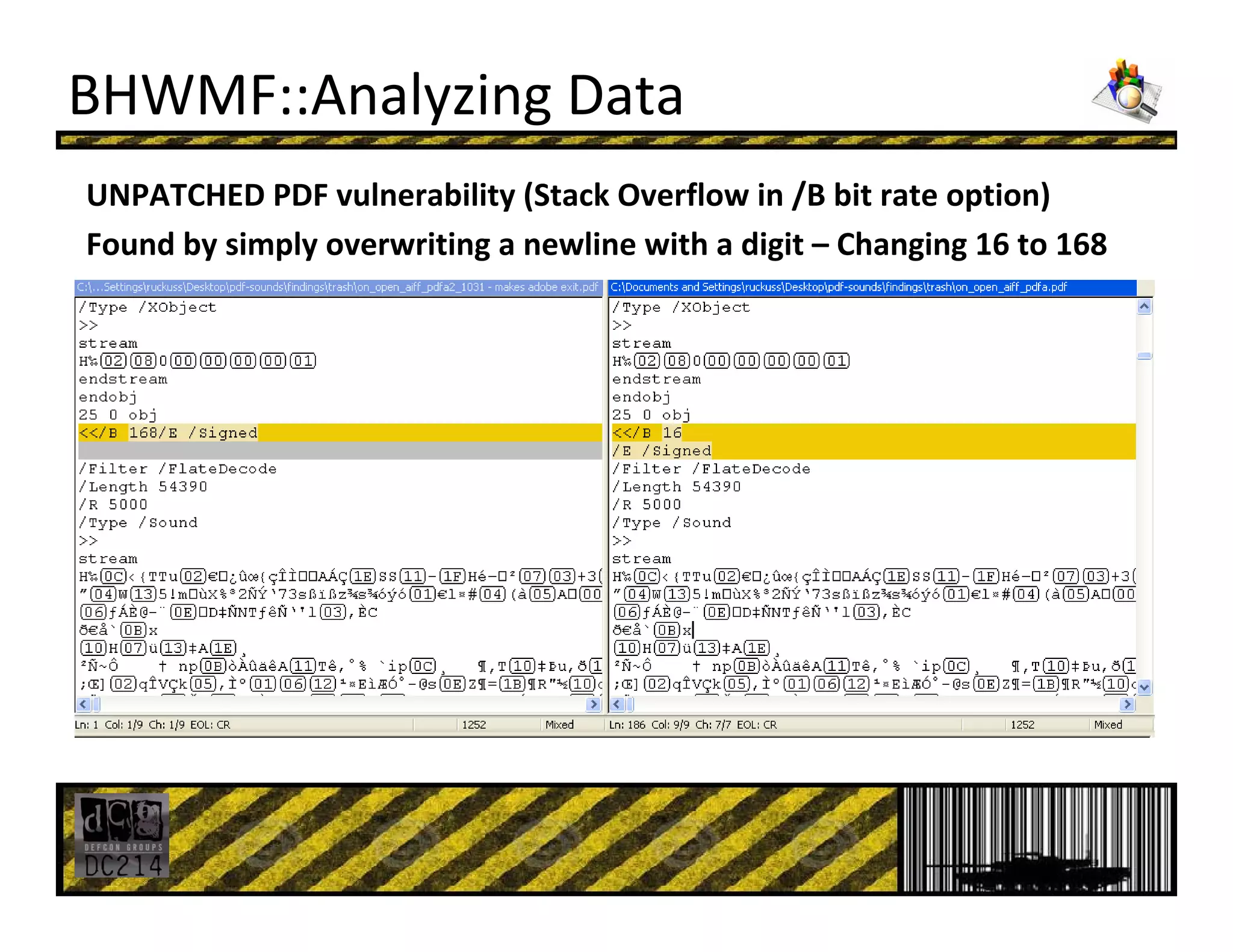
UNPATCHED PDF vulnerability (Stack Overflow in /B bit rate option)
Found by simply overwriting a newline with a digit – Changing 16 to 168
BHWMF::Analyzing Data
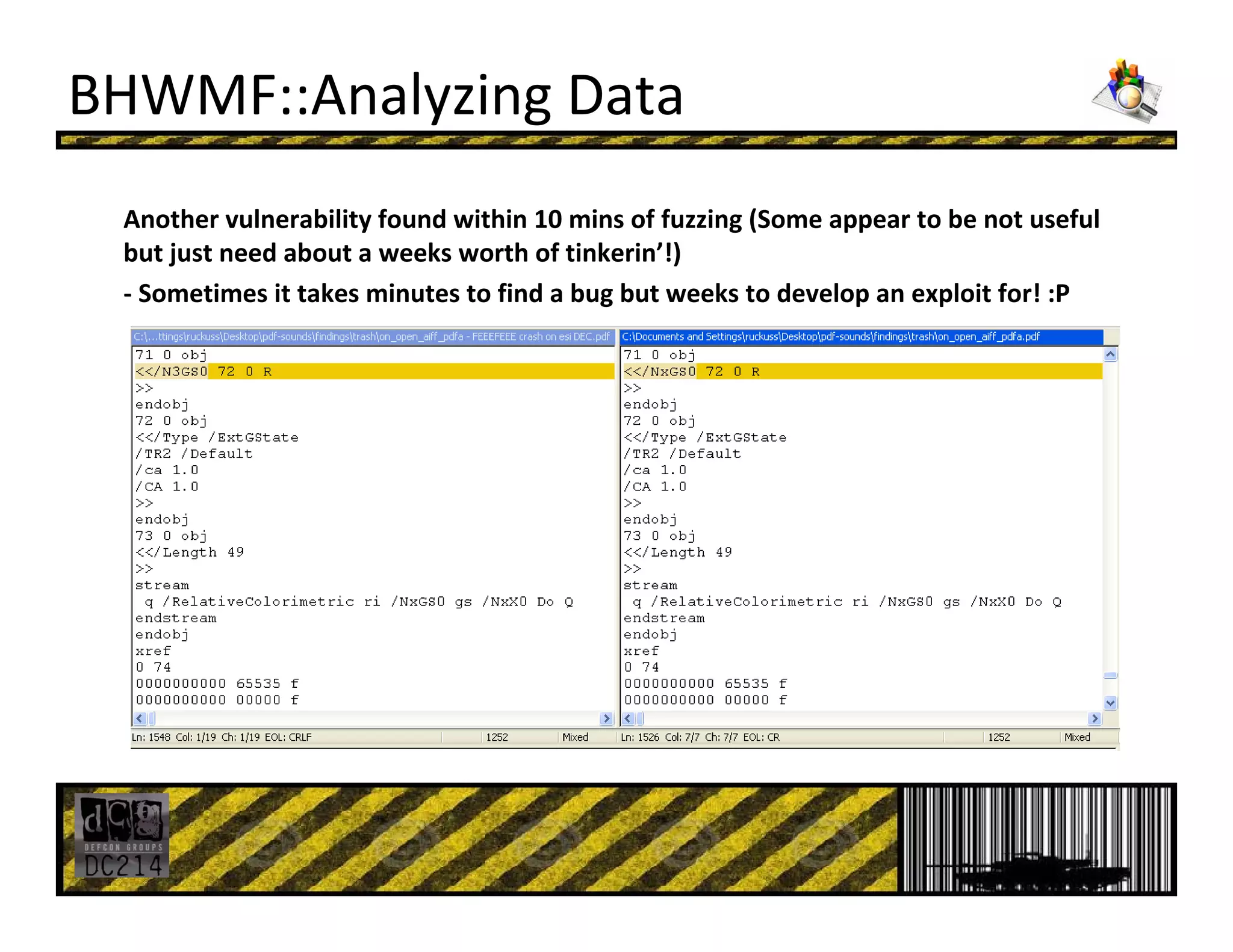
Another vulnerability found within 10 mins of fuzzing (Some appear to be not useful 
but just need about a weeks worth of tinkerin’!) 
‐ Sometimes it takes minutes to find a bug but weeks to develop an exploit for! :P
BHWMF::EOT 

Bug Hunting with Media Formats