I.ThebackgroundofBuddhism
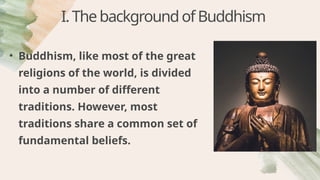
• Buddhism, likemost of the great
religions of the world, is divided
into a number of different
traditions. However, most
traditions share a common set of
fundamental beliefs.
3.
I.ThebackgroundofBuddhism
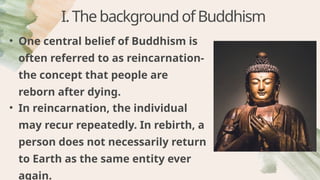
• One centralbelief of Buddhism is
often referred to as reincarnation-
the concept that people are
reborn after dying.
• In reincarnation, the individual
may recur repeatedly. In rebirth, a
person does not necessarily return
to Earth as the same entity ever
again.
4.
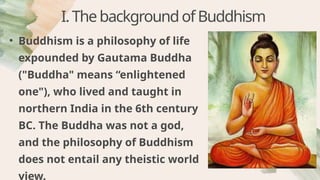
• Buddhism isa philosophy of life
expounded by Gautama Buddha
("Buddha" means “enlightened
one"), who lived and taught in
northern India in the 6th century
BC. The Buddha was not a god,
and the philosophy of Buddhism
does not entail any theistic world
view.
I.ThebackgroundofBuddhism
5.
The basic teachingsof Buddha, which are core
to Buddhism, are:
• The Three Universal Truths;
• The Four Noble Truths; and
• The Noble Eightfold Path.
6.
1.Nothing is lostin the universe.
2.Everything changes.
3.The law of cause and effect
II.Thethreeuniversaltruths
In Buddhism, the law of karma, says “for every event
that occurs, there will follow another event whose
existence was caused by the first, and this second
event will be pleasant or unpleasant according as its
cause was skillful or unskillful.
7.
Thethreetrainingsorpractices
1.Sila: Virtue, goodconduct, morality. This is based
on two fundamental principles: the principle of
equality (that all living entities are equal) and
the principle of reciprocity (like the "Golden
Rule"-to do unto others as you would wish them
to do unto you). It is found in all major religions.
8.
Thethreetrainingsorpractices
2. Samadhi: Concentration,meditation, mental
development. Developing one's mind is the path to
wisdom which, in turn, leads to personal freedom.
3. Prajna: Discernment, insight, wisdom,
enlightenment. This is the real heart of Buddhism.
Wisdom will emerge if your mind is pure and calm.
9.
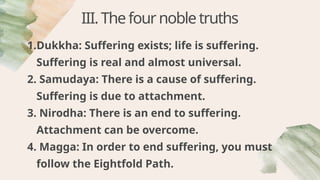
III.Thefournobletruths
1.Dukkha: Suffering exists;life is suffering.
Suffering is real and almost universal.
2. Samudaya: There is a cause of suffering.
Suffering is due to attachment.
3. Nirodha: There is an end to suffering.
Attachment can be overcome.
4. Magga: In order to end suffering, you must
follow the Eightfold Path.
10.
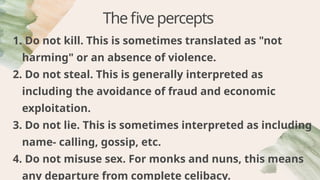
Thefivepercepts
1. Do notkill. This is sometimes translated as "not
harming" or an absence of violence.
2. Do not steal. This is generally interpreted as
including the avoidance of fraud and economic
exploitation.
3. Do not lie. This is sometimes interpreted as including
name- calling, gossip, etc.
4. Do not misuse sex. For monks and nuns, this means
any departure from complete celibacy.
11.
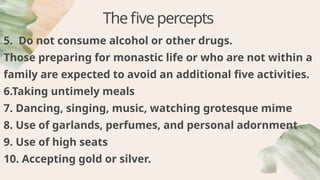
Thefivepercepts
5. Do notconsume alcohol or other drugs.
Those preparing for monastic life or who are not within a
family are expected to avoid an additional five activities.
6.Taking untimely meals
7. Dancing, singing, music, watching grotesque mime
8. Use of garlands, perfumes, and personal adornment
9. Use of high seats
10. Accepting gold or silver.
12.
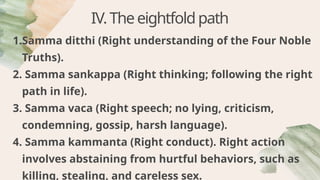
IV.Theeightfoldpath
1.Samma ditthi (Rightunderstanding of the Four Noble
Truths).
2. Samma sankappa (Right thinking; following the right
path in life).
3. Samma vaca (Right speech; no lying, criticism,
condemning, gossip, harsh language).
4. Samma kammanta (Right conduct). Right action
involves abstaining from hurtful behaviors, such as
killing, stealing, and careless sex.
13.
IV.Theeightfoldpath
5. Samma ajiva(Right livelihood). Support yourself
without harming others.
These three are referred to as Shila (or morality).
6. Samma vayama (Right effort). Promote good thoughts;
conquer evil thoughts.
7. Samma sati (Right mindfulness). Become aware of your
body, mind, and feelings.
8. Samma samadhi (Right concentration). Meditate to
achieve a higher state of consciousness.
14.
fiveprinciplesofPanchsheel
1.Do not totake life;
2.Do not to steal;
3.Do not to commit adultery;
4.Do not lie;
5.Do not to consume liquor or other intoxicants.
PT/SW#1
Instructions: On yournotebook illustrate the
image of Buddha. State below the features and
principles that you like about Buddha. One
paragraph not less than five sentences.




![kindsofadverbs-140623033327-phpapp02 [Autosaved].pptx](https://cdn.slidesharecdn.com/ss_thumbnails/kindsofadverbs-140623033327-phpapp02autosaved-260108123922-7b13f28e-thumbnail.jpg?width=640&height=640&fit=bounds)


