BTI 2018 Country Report
Mongolia
This report is part of the Bertelsmann Stiftung’s Transformation Index (BTI) 2018. It covers
the period from February 1, 2015 to January 31, 2017. The BTI assesses the transformation
toward democracy and a market economy as well as the quality of political management in 129
countries. More on the BTI at http://www.bti-project.org.
Please cite as follows: Bertelsmann Stiftung, BTI 2018 Country Report — Mongolia. Gütersloh:
Bertelsmann Stiftung, 2018.
This work is licensed under a Creative Commons Attribution 4.0 International License.
Contact
Bertelsmann Stiftung
Carl-Bertelsmann-Strasse 256
33111 Gütersloh
Germany
Sabine Donner
Phone +49 5241 81 81501
sabine.donner@bertelsmann-stiftung.de
Hauke Hartmann
Phone +49 5241 81 81389
hauke.hartmann@bertelsmann-stiftung.de
Robert Schwarz
Phone +49 5241 81 81402
robert.schwarz@bertelsmann-stiftung.de
Sabine Steinkamp
Phone +49 5241 81 81507
sabine.steinkamp@bertelsmann-stiftung.de
BTI 2018 | Mongolia 3
Key Indicators
Population M 3.0 HDI 0.735 GDP p.c., PPP $ 12220
Pop. growth1
% p.a. 1.7 HDI rank of 188 92 Gini Index 32.0
Life expectancy years 69.1 UN Education Index 0.766 Poverty3
% 3.2
Urban population % 72.8 Gender inequality2
0.278 Aid per capita $ 79.1
Sources (as of October 2017): The World Bank, World Development Indicators 2017 | UNDP, Human Development
Report 2016. Footnotes: (1) Average annual growth rate. (2) Gender Inequality Index (GII). (3) Percentage of
population living on less than $3.20 a day at 2011 international prices.
Executive Summary
Mongolia displayed unprecedented growth rates in 2011 and 2012 and became one of the fastest
growing economies in the world, largely driven by a booming mining sector. However, the end of
the mining boom in 2013 put the natural resource dependent country in a challenging situation.
Mongolia’s economic growth reached 2.4% in 2015 and slowed to 1.0% in 2016. China’s
economic slowdown and the drop in commodity prices – namely copper and coal, Mongolia’s
most valuable natural resources – had a strong impact on the country’s mining sector and its
contribution to the national economy. Foreign direct investment (FDI) dropped from an average
of 35% of GDP in 2011 to 2013 to around 0.9% of GDP in 2015. As a result, government revenues
are much lower than expected. Mismanagement and lack of transparency of fiscal revenues and
expenditure played their part in the economic downturn. While fiscal revenues have decreased by
75%, government spending has tripled in nominal terms since 2011. The amount of government
salaries, infrastructure costs, subsidized loans and cash transfers has exploded since 2011. The
Bank of Mongolia’s available cash seriously declined after the government once again increased
spending ahead of June 2016 elections. The government launched unbudgeted spending programs
in the first half of 2016. In addition, the government spent over MNT 400 billion for the Housing
Mortgage Program that was previously undertaken by the Bank of Mongolia. At 19.5% of GDP,
Mongolia’s budget deficit was one of the world’s highest in 2016. As of January 2017, the
government net debt is 84.8% of GDP, of which 54% is external debt, and the country is at risk of
defaulting on foreign debt obligations.
On April 22, 2016 (two months before election day), the Constitutional Court made a decision to
cancel the mixed parallel electoral system that was used in the previous election in 2012, which
was widely seen as a politically motivated decision under the pressure from the ruling political
party. Parliamentary elections held on 29 June 2016 resulted in a landslide victory of the
opposition Mongolian People’s Party, which won 65 of the 76 seats. The incumbent Democratic
Party (DP) won nine seats, and the Mongolian People’s Revolutionary Party (MPRP) one seat.
Only one independent candidate was elected into parliament. The Mongolian People’s Party’s
BTI 2018 | Mongolia 4
(MPP) victory was followed by its dominance in local elections in November 2016. The campaign
environment was largely peaceful and all parties accepted the election results from the electronic
voting machines. Despite the very difficult economic situation in Mongolia, Mongolian voters
rejected populist appeals by defeating many prominent populist candidates.
Democratically elected political representatives have considerable power to govern in Mongolia.
However, the power of politico-business clientelistic network or “oligarchic groups” puts
democratic procedures and the power of state institutions at risk, enforcing their special-interest
policies in the past several years. The prevalence of clientelistic networks and financial non-
transparency in major political parties has become a serious threat to the country’s democratic
transformation.
There is an increasing level of public dissatisfaction and frustration regarding a lack of democracy
and accountability within political parties. Corruption continues to affect all spheres of the public
sector. The government’s efforts to combat corruption have not translated into significant
improvements.
The Mongolian government has made important progress in devising policies, laws and
regulations that comply with international standards and agreements on fostering partnerships with
the private sector, civil society and international development partners. However, the
implementation of such policies and laws has been slow and disrupted by short-term political
agendas.
History and Characteristics of Transformation
In 1992, the first democratically elected parliament of Mongolia, the State Great Khural, adopted
a new constitution, confirming the nation’s aspiration to become a democratic and prosperous
country. Mongolia’s dual transition from nearly 70 years of centrally planned economy and single-
party authoritarian system to a free market economy and multiparty parliamentary system provided
a great opportunity for the country to strengthen its independence and achieve development goals.
Mongolia faced dramatic economic difficulties in the first decade of the transition in the 1990s.
The country has taken considerable steps forward in establishing a more modern and vibrant
economy, with a booming mining sector in the 2000s, driving double-digit economic growth.
However, the end of mining boom in 2013 put the natural resource-dependent country in a
challenging situation.
Spread out across 1.54 million square kilometers, Mongolia is the world’s 19th largest country,
but has a population of just three million, making it the least densely populated country in the
world. Slightly more than half (54.2%) of the population is Buddhist. The country boasts a high
degree of religious freedom and a very high literacy rate of 98.3%. Traditionally, Mongolia has
been a country of nomadic pastoralists with a heavy reliance on agriculture; at least 25% of the
population still depends on animal husbandry.
BTI 2018 | Mongolia 5
The head of the state is the directly elected president. The prime minister is the head of
government, and all legislative power is vested in the Great State Khural, Mongolia’s unicameral
parliament, which has 76 members elected by popular vote to terms of four years. The last
parliamentary election (29 June 2016) yielded the following results: the Mongolian People’s Party
(MPP) won 65 of the 76 seats, the incumbent Democratic Party (DP) won nine seats, and the
Mongolian People’s Revolutionary Party (MPRP) won one seat. Only one independent candidate
was elected into parliament. The MPP’s landslide was followed by its dominance in local elections
in November 2016. Mongolians will elect a new president in June 2017.
Mongolia enjoyed unprecedented growth rates in 2011 and 2012 and became one of the fastest
growing economies in the world. Driving this growth was a booming mining sector in which
Mongolia holds significant copper, gold, coking-coal and uranium deposits with a combined value
of more than $1.2 trillion. Mongolia has a major competitive advantage in being located next to
China, the largest commodity consumer in the world. However, given that more than 90% of the
landlocked country’s exports go to China, the Mongolian economy is currently heavily dependent
on China’s growth. China’s economic slowdown seriously hampered the country’s economic
growth, as did commodity price shocks since 2013, and the economy contracted in 2016 for the
first time in eight years.
Mongolia has often been praised as “an island or oasis of democracy” in the heart of Asia by
international observers for its achievement in democratic stability. Indeed, most of the conditions
commonly identified by political scientists as necessary for a successful democratic transition were
absent in the country at the onset of transition. Mongolia lacked any meaningful pre-communist
experience with modern parliamentary democracy and civil society. The country had a weaker
industrial base and less market advantages compared to neighbor countries. A large section of the
population experienced poverty and livelihoods depended on subsistence animal husbandry, which
inhibited the emergence of an independent middle class. Finally, Mongolia’s location between
China and Russia posed serious geostrategic challenges. After 25 years of transformation,
Mongolia’s democracy is still in a nascent stage, especially regarding its institutional
consolidation. Entrenched corruption and cronyism in government and political parties have
become increasingly threatening, eroding the rule of law and trust in political institutions.
BTI 2018 | Mongolia 6
The BTI combines text analysis and numerical assessments. The score for each
question is provided below its respective title. The scale ranges from 1 (worst) to
10 (best).
Transformation Status
I. Political Transformation
1 | Stateness
Question
Score
The state’s monopoly on the use of force throughout the entire territory has not been
challenged since the onset of the democratic transition. Political and social protest
movements against corruption in government and specific public policies have been
mobilized, but there have been no organized groups strong enough to challenge the
state’s existence and monopoly on the use of force.
Monopoly on the
use of force
10
The entirety of the Mongolian population accepts the nation-state as legitimate.
Ethnically, Mongolia is fairly homogeneous with the majority of the population
comprised of the same social and ethnic groups. There is a fairly substantial Kazakh-
speaking Muslim minority (3.9% according to the 2015 Population and Housing by-
census), the majority of which live in Bayan-Ulgii province in western Mongolia.
Mongolian Kazakhs enjoy significant cultural, linguistic and political minority rights.
Citizenship is not denied to particular groups within Mongolia. However, the
citizenship of Mongolian Kazakhs who left the country for Kazakhstan in the early
1990s and later returned to Mongolia remains unclear. In 2016, the president of
Mongolia submitted a draft law on allowing dual citizenship for Mongolian citizens.
The draft law was widely debated in the public domain and no government decisions
have been announced.
State identity
10
The Mongolian constitution explicitly recognizes the separation of church and state.
Religion was repressed during the communist era and Mongolia witnessed a revival
of religion, especially Buddhism and the traditional shamanism, after the transition
in 1990. According to the national census of 2010, 53% individuals aged 15 and
above self-identified as Buddhist, with 3.9% self-identifying as Muslim, 2.9% as
shamanist, 2.1% as Christian, and 38.6% as nonreligious believers. While some high-
level officials are known to have deep religious beliefs and follow traditional norms,
No interference of
religious dogmas
10
BTI 2018 | Mongolia 7
there are no religious groups that have substantial influence on national politics and
its decision-making process. In 2016, Mongolia’s deep ties with the Dalai Lama were
challenged. His visit to Mongolia in November 2016 caused an angry response and
economic retaliation from the Chinese government toward Mongolia, which forced
Mongolian Foreign Minister Ts. Munkh-Orgil to state that the Dalai Lama would not
visit Mongolia again under the current government.
The administrative structures of the state provide most basic public services
throughout the country. Mongolia is a unitary state with the central government and
three tiers of sub-national government: aimags (provinces) and capital city; soums
(rural districts) and duuregs (urban districts); and bag (rural sub-districts) and
khoroos (urban sub-districts). Economic growth and an expanded state budget in the
early years of the 2010s led to an improvement in the quality and reach of delivery
of basic public services. National health insurance coverage increased from 73% in
2007 to 98% in 2013. Access to water services increased by 26% over the last 15
years. According to the 2016 Mongolia Human Development Report, the net
enrollment rate reached 99.1% in primary education and 96.1% in secondary
education.
The low population density of Mongolia poses significant hurdles to the maintenance
of state infrastructure and the provision of services such as health care, security and
the judiciary, especially for the roughly 25% of the population who are pastoral
herders. The poor quality of rural and remote health care facilities and outreach
services, which are inadequately staffed and equipped, is a major challenge. Although
there have been improvements in rural health facilities to provide quality medical
care, local people often face expensive trips to aimag centers and Ulaanbaatar to have
specialized and quality medical care.
Poor sanitation and waste collection in rural residential centers and in the “Ger Areas”
of Ulaanbaatar (areas where people live in traditional tents or “gers”) is widely
reported.
Corruption in local government is widespread, especially in public procurement. Yet
there have been significant improvements as well. Mongolia is a member of the Open
Government Partnership and implemented National Action Plan I in 2014-2016. The
Mongolian government successfully introduced a wide range of electronic services
in many areas such as taxation, registration and procurement. Local Development
Funds, a participatory mechanism through which local community members can
propose and vote for priority local development projects have contributed to the
delivery of public services.
Basic
administration
6
BTI 2018 | Mongolia 8
2 | Political Participation
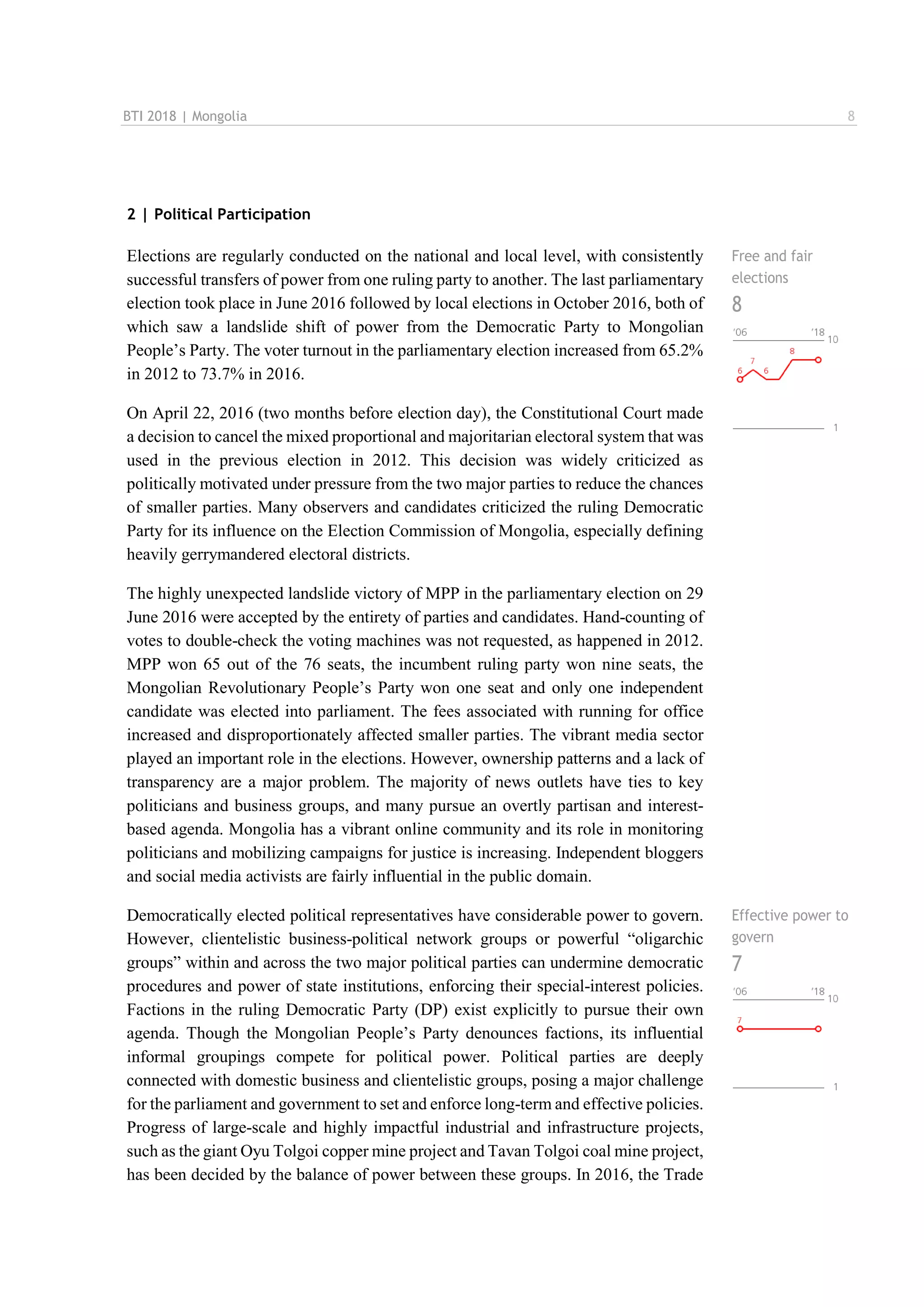
Elections are regularly conducted on the national and local level, with consistently
successful transfers of power from one ruling party to another. The last parliamentary
election took place in June 2016 followed by local elections in October 2016, both of
which saw a landslide shift of power from the Democratic Party to Mongolian
People’s Party. The voter turnout in the parliamentary election increased from 65.2%
in 2012 to 73.7% in 2016.
On April 22, 2016 (two months before election day), the Constitutional Court made
a decision to cancel the mixed proportional and majoritarian electoral system that was
used in the previous election in 2012. This decision was widely criticized as
politically motivated under pressure from the two major parties to reduce the chances
of smaller parties. Many observers and candidates criticized the ruling Democratic
Party for its influence on the Election Commission of Mongolia, especially defining
heavily gerrymandered electoral districts.
The highly unexpected landslide victory of MPP in the parliamentary election on 29
June 2016 were accepted by the entirety of parties and candidates. Hand-counting of
votes to double-check the voting machines was not requested, as happened in 2012.
MPP won 65 out of the 76 seats, the incumbent ruling party won nine seats, the
Mongolian Revolutionary People’s Party won one seat and only one independent
candidate was elected into parliament. The fees associated with running for office
increased and disproportionately affected smaller parties. The vibrant media sector
played an important role in the elections. However, ownership patterns and a lack of
transparency are a major problem. The majority of news outlets have ties to key
politicians and business groups, and many pursue an overtly partisan and interest-
based agenda. Mongolia has a vibrant online community and its role in monitoring
politicians and mobilizing campaigns for justice is increasing. Independent bloggers
and social media activists are fairly influential in the public domain.
Free and fair
elections
8
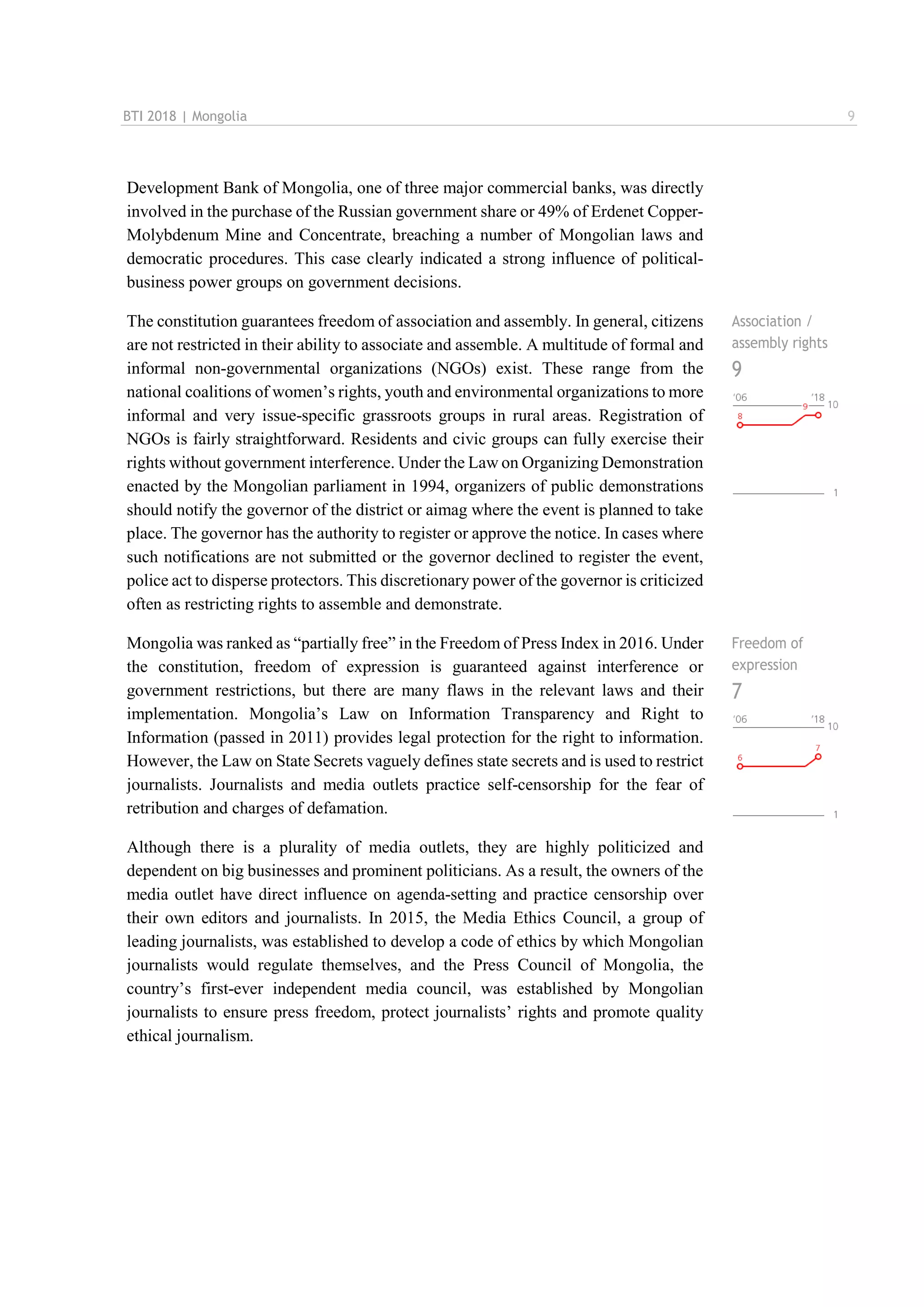
Democratically elected political representatives have considerable power to govern.
However, clientelistic business-political network groups or powerful “oligarchic
groups” within and across the two major political parties can undermine democratic
procedures and power of state institutions, enforcing their special-interest policies.
Factions in the ruling Democratic Party (DP) exist explicitly to pursue their own
agenda. Though the Mongolian People’s Party denounces factions, its influential
informal groupings compete for political power. Political parties are deeply
connected with domestic business and clientelistic groups, posing a major challenge
for the parliament and government to set and enforce long-term and effective policies.
Progress of large-scale and highly impactful industrial and infrastructure projects,
such as the giant Oyu Tolgoi copper mine project and Tavan Tolgoi coal mine project,
has been decided by the balance of power between these groups. In 2016, the Trade
Effective power to
govern
7
BTI 2018 | Mongolia 9
Development Bank of Mongolia, one of three major commercial banks, was directly
involved in the purchase of the Russian government share or 49% of Erdenet Copper-
Molybdenum Mine and Concentrate, breaching a number of Mongolian laws and
democratic procedures. This case clearly indicated a strong influence of political-
business power groups on government decisions.
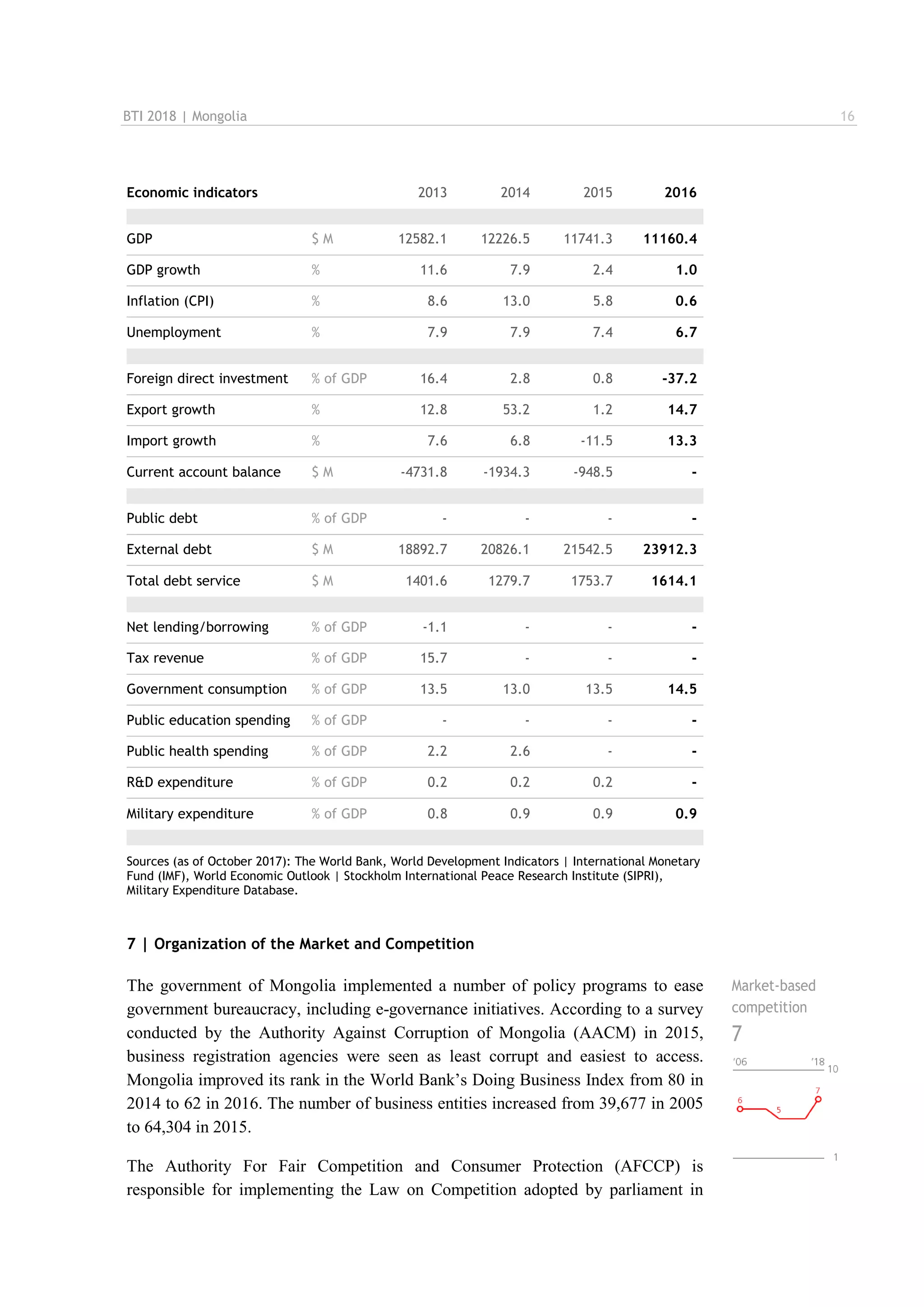
The constitution guarantees freedom of association and assembly. In general, citizens
are not restricted in their ability to associate and assemble. A multitude of formal and
informal non-governmental organizations (NGOs) exist. These range from the
national coalitions of women’s rights, youth and environmental organizations to more
informal and very issue-specific grassroots groups in rural areas. Registration of
NGOs is fairly straightforward. Residents and civic groups can fully exercise their
rights without government interference. Under the Law on Organizing Demonstration
enacted by the Mongolian parliament in 1994, organizers of public demonstrations
should notify the governor of the district or aimag where the event is planned to take
place. The governor has the authority to register or approve the notice. In cases where
such notifications are not submitted or the governor declined to register the event,
police act to disperse protectors. This discretionary power of the governor is criticized
often as restricting rights to assemble and demonstrate.
Association /
assembly rights
9
Mongolia was ranked as “partially free” in the Freedom of Press Index in 2016. Under
the constitution, freedom of expression is guaranteed against interference or
government restrictions, but there are many flaws in the relevant laws and their
implementation. Mongolia’s Law on Information Transparency and Right to
Information (passed in 2011) provides legal protection for the right to information.
However, the Law on State Secrets vaguely defines state secrets and is used to restrict
journalists. Journalists and media outlets practice self-censorship for the fear of
retribution and charges of defamation.
Although there is a plurality of media outlets, they are highly politicized and
dependent on big businesses and prominent politicians. As a result, the owners of the
media outlet have direct influence on agenda-setting and practice censorship over
their own editors and journalists. In 2015, the Media Ethics Council, a group of
leading journalists, was established to develop a code of ethics by which Mongolian
journalists would regulate themselves, and the Press Council of Mongolia, the
country’s first-ever independent media council, was established by Mongolian
journalists to ensure press freedom, protect journalists’ rights and promote quality
ethical journalism.
Freedom of
expression
7
BTI 2018 | Mongolia 10
3 | Rule of Law
The 1992 constitution laid out strong formal separation of power mechanisms,
keeping any individual or institution from having excessive power. Legislative power
is vested in the unicameral parliament, the State Great Khural, which comprises 76
directly elected members. The parliament confirms the appointment of the prime
minister and cabinet ministers. The parliament has the power to draft legislation,
enact and amend laws, approve the annual budget, foreign and domestic policies,
declare states of emergency and war and ratify international treaties and agreements.
Mongolia can be described as a semi-presidential system because the president is
elected directly by the people, and has extensive powers such heading the National
Security Council, issuing guidelines for the government, initiating legislative bills
and appointing Supreme Court judges.
The constitutional amendments made in 2000 allowed members of parliament to
simultaneously hold posts in the cabinet, blurring check and balance of the legislative
and executive branches of government. The lack of clarity in the definition of powers
and responsibilities held by the president and the prime minister was an ongoing
source of tension in the period under review.
In 2015, major political parties expressed their support for constitutional reform. The
newly elected parliament in 2016 has established a working group to prepare
constitutional amendments.
Separation of
powers
7
The Mongolian judicial system consists of the Constitutional Court, the Supreme
Court, aimag and capital city courts, soum and district courts. The Mongolian legal
system is a hybrid civil law-common law system. Although judges may take notice
of prior rulings in cases similar to those that come before them, Mongolian laws lack
the specificity needed for consistent interpretation and application. The Judicial
General Council (JGC) has the responsibility to ensure independence of the judiciary
by appointing judges and ensuring their impartiality. However, the council lacks
authority to investigate allegations of judicial misconduct and is dependent on
political power holders. Mongolian prosecutors have a strong influence on
Mongolian courts. Very few objections of the prosecution are dismissed by courts.
Despite a series of judicial reforms launched by the government in the past decade,
Mongolia still lacks the consistent legislative framework and institutional
consolidation necessary to enhance independent judiciary. Political influence on the
appointments of judges and corruption in judicial processes are widely reported.
The judiciary reform policy initiated and implemented by the Minister of Justice in
2012 to 2014 was canceled and retracted by the next minister in 2015 to 2016.
Moreover, the Mongolian government decided to reduce the salary fund of judges by
Independent
judiciary
6
BTI 2018 | Mongolia 11
35% due to the economic downturn and budget deficit in 2016, jeopardizing the
economic independence of judges.
According to the Justice Integrity Study in 2016, Mongolia has made significant
progress in enhancing transparency of court decisions. All court decisions must be
available online. The study highlighted that enhanced transparency would
significantly improve accountability of judges.
Many officeholders who allegedly broke the law and engaged in corruption were
investigated by the Independent Authority Against Corruption (IAAC), the principal
agency responsible for investigating corruption cases, in the period under review.
They range from a former president, a former prime minister and provincial
governors to bankers and tax and customs officers. Of the 185 investigations in the
first three quarters in 2015, 13 cases resulted in convictions, 45 referred for
prosecution, 24 referred to other agencies, 22 merged with other criminal cases, and
32 dropped at either the prosecutor or court level. This relatively high rate of cases
being dismissed or dropped at prosecutor and court levels has been met with some
criticism.
The real impact of the IAAC on high-level political corruption has been viewed
widely as random and politically biased. The head of the IAAC was replaced in July
2016 a week after the parliamentary election. There are widespread suspicions that
the IAAC has become a tool for political retribution and is largely controlled by
political interests who do not themselves want to face corruption charges by a truly
independent authority.
Offshore leaks made public by the International Consortium of Investigative
Journalists /ICIJ/ verified 48 Mongolian citizens with offshore accounts, including
many politicians and public officials. They attracted adverse publicity. Amendments
to the Law on Conflict of Interests outlawing offshore accounts for officials were
initiated by a group of parliamentarians in late 2016 and are expected to be discussed
by parliament in 2017.
Prosecution of
office abuse
5
Civil rights are codified by law, but are not properly respected and protected. The
protection and guarantee of the right to life and security, equality before the law and
access to justice are insufficient, and legal systems and measures for protecting
physical integrity rights and preventing torture are inadequate. The annual study of
the National Human Rights Committee of Mongolia in 2016 reported numerous civil
rights violations such as police abuse of prisoners and detainees, poor conditions in
detention centers and poor working conditions.
On December 4, 2015, the parliament of Mongolia passed the Law on Infringement.
The law redefined the main punishment types for infringements. The former potential
punishment of arrest for 7-30 days was removed but high fines were introduced.
Civil rights
7
BTI 2018 | Mongolia 12
There is no institutionalized discrimination against people based on gender, religion
or ethnicity.
Domestic violence remains a serious and widespread problem. A total of 94 women
died and 4,102 people were injured in 2010 to 2016 due to domestic violence.
However, Mongolia made significant progress in 2016 in combating domestic
violence when the Law to Combat Domestic Violence was finally approved by
parliament in December 2016, which labels domestic violence a crime.
4 | Stability of Democratic Institutions
Democratic institutions perform their functions, but have proved in some respects
inefficient. An excessive focus on short-term results at the expense of long-term
interests is prevalent at all levels and branches of government. Many long-term
development programs have been adopted by the Mongolian parliament in the past
decade but the alignment of actual government policies with them has not been
adequate. Government policies are often disrupted by changes in leadership and
follow-up shuffles. While the Civil Service Council of Mongolia has a system of
selecting civil servants based on merit, it is usually the case that the ruling party
appoints civil servants to posts based on political affiliation rather than merit. The
capacity of the parliament and government for conducting, using and integrating high
quality policy-oriented research is minimal.
Performance of
democratic
institutions
7
Although public trust in individual democratic institutions has decreased in the past
decade, the majority of the population view the country’s democratic political system
as the right path. Debates about the effectiveness of parliamentary and presidential
systems exist. A significant segment of the population is disillusioned with the
performance of parliament and dysfunctional cabinets and prefers a strong,
democratic presidential system. The turnout of the parliamentary election in June
2016 was 73% (eight points higher than 2012), indicating increased interest in
participating in democratic processes. Mongolian voters rejected a number of
prominent populist candidates in the election confirming their commitment to
democracy. A wide range of ideas to reform the existing political regime have been
raised by political parties and civic activists, but the scope and purpose of them was
not directed at democratic institutions. The president is commander-in-chief of the
armed forces. The Mongolian military is not involved in political processes at all.
Commitment to
democratic
institutions
8
BTI 2018 | Mongolia 13
5 | Political and Social Integration
The first multiparty election was held in 1990 after the Mongolian People’s
Revolutionary Party (now Mongolian’s People Party) accepted the reform program
of the democratic movement. Mongolia has seen a marked shift in the past two
decades toward a two-party system. In April 2016, under the influence of the major
political parties, the Constitutional Court revoked the mixed electoral system in favor
of a purely majoritarian system, which provides less opportunities for third parties,
such as the reformed Mongolian People’s Revolutionary Party and the newly formed
National Labor Party, to win a significant number of seats. Currently, three out of the
24 parties registered at the Supreme Court of Mongolia have seats in parliament. The
two major parties won 74 of 76 seats.
The major political parties do not express clear differences in their key political and
economic policy positions. The Mongolian People’s Party (MPP) has the largest party
membership and traditionally draws its support from the countryside. The main
opposition party, the Democratic Party (DP), was formed in 2000 through the
amalgamation of a number of smaller parties. The DP claims that it has about 180,000
members. The two parties have party committees at all territorial-administrative
levels. Voter support for the two parties is becoming relatively stable but the election
results have been largely influenced by the nature of election system.
The prevalence of clientelistic networks and lack of financial transparency in major
political parties have become serious threats to the country’s democratic
transformation. There is an increasing level of public dissatisfaction and frustration
regarding a lack of democracy and accountability within political parties. Public
opinion surveys have continuously confirmed that the majority of Mongolians do not
trust political parties. According to the Asia Foundation’s new study on Public
Perceptions of Corruption in 2016, political parties are identified as the most corrupt
institution in Mongolia.
Party system
6
There is a fairly broad range of interest groups reflecting many different interests and
communities in society. Associations established on the principles of freedom and
democratic assembly emerged only after the democratic transition. Some of the
satellite organizations of the communist party such as youth federations and women’s
committees continued to operate embracing new values and agenda. The Mongolian
Youth Federation is still a prominent non-governmental organization (NGO) with
members and activities throughout the country. Mongolia has a large number of
NGOs, with many prominent NGOs in the fields of human rights, environmental
protection, women’s rights, education and social welfare. Non-partisan homeland
associations have formed to represent the concerns of specific provinces in the
political process. There are many associations that express and advocate private
sector interests and professional communities. Associations advocating on behalf of
Interest groups
7
BTI 2018 | Mongolia 14
sexual minorities attracted increased public attention and donor organizations’
support in the period under review.
The fundamentals of Mongolian democracy remain strong. Despite economic
hardships and the lack of a previous democratic legacy, Mongolians have
overwhelmingly approved the notion of a democratic regime since 1990. A number
of cross-national public opinion surveys confirm that 85-90% of Mongolians regard
democracy as the best form of government. While support for the strong presidential
system is observed sometimes, the democratic principles and values are widely
accepted by the population. A slight decline in the approval rating of the current form
of government can be attributed in large part to the government’s inability to fight
corruption and enhance inclusive economic growth. The National Survey of Public
Opinion conducted by the International Republican Institute in May 2016 shows that
Mongolians believe in democracy as the guiding general principle and vision, but
they have less trust in individual political institutions.
Approval of
democracy
7
In general, many Mongolians prefer to trust people with whom they have close
relationships or who have local regional affiliations. This can be attributed in part to
the legacy of communism and in part to traditions of self-reliance in nomadic culture.
The lack of general trust is exacerbated by the increasing pace of migration to urban
areas, as migrants lose their sense of community when they arrive in a new
environment. Increasing crime rates further undermine social capital and trust, which
in turn reinforces a tendency to rely on those one knows rather than on abstract laws
and institutions. The adverse effects of a lack of interpersonal trust or strong norms
of cooperation can be observed in efforts to create collaborative and transparent
organizations.
The recent growth of the use of social media has contributed to the increase of formal
and informal interest groups and online support groups. There are many
independently organized cultural, environmental, faith-based and social
organizations in urban areas. However, many of these are rather small and cannot
directly replace kin and friendship networks as the essential social groups in
Mongolia.
Social capital
6
BTI 2018 | Mongolia 15
II. Economic Transformation
6 | Level of Socioeconomic Development
Question
Score
The Human Development Index (HDI) score reached 0.727 in the period under
review, up from a previous 0.698 and Mongolia was ranked 90th in the world,
maintaining its place in the “high human development” category. However,
Mongolia’s economic growth slowed down to 2.4% in 2015. The crisis continued in
2016 as economic growth dropped to -1.6% in the third quarter, according to the
National Statistics Office (NSO). The country had not seen a negative economic
growth rate after the economic crisis in 2009 when economic growth dropped to -
1.27%.
The economic recession led to a situation where the government is at risk of
defaulting on its debt amounting to billions of dollars. As of 2017, the government
net debt is 84.8% of GDP, of which 54% is external debt. Though Mongolia moved
from lower middle-income status to upper middle-income in the World Bank ranking
in 2015 this status was downgraded to lower middle-income in 2016.
A comprehensive assessment of the impact of the recession, for instance whether it
reversed the significant decrease of the poverty rate during the mining boom of 2010
to 2013, is not available. However, there is widespread belief that poverty increased
significantly in the period under review. The unemployment rate indicates this trend:
it increased from 7.6% to 9.8% in 2016. The Gini coefficient (36.5 in 2014) shows a
moderate level of social inequality. However, as the urban-rural divide with regard
to the poverty rate (26.6% in urban areas, 33.3% in rural areas) indicates, there are
serious income disparities across different regions.
The country ranked 63rd in the Gender Inequality Index in 2014 and 58th in the
Global Gender Gap Index in 2016, which states that Mongolia is one of the five most-
improved countries over the past decade on the health and survival gender gap.
Mongolia received higher scores on education attainment (0.99), health and survival
(0.98), and economic participation and opportunity (0.77), and lower scores on
gender gap among legislators, senior officials and managers.
Socioeconomic
barriers
5
BTI 2018 | Mongolia 16
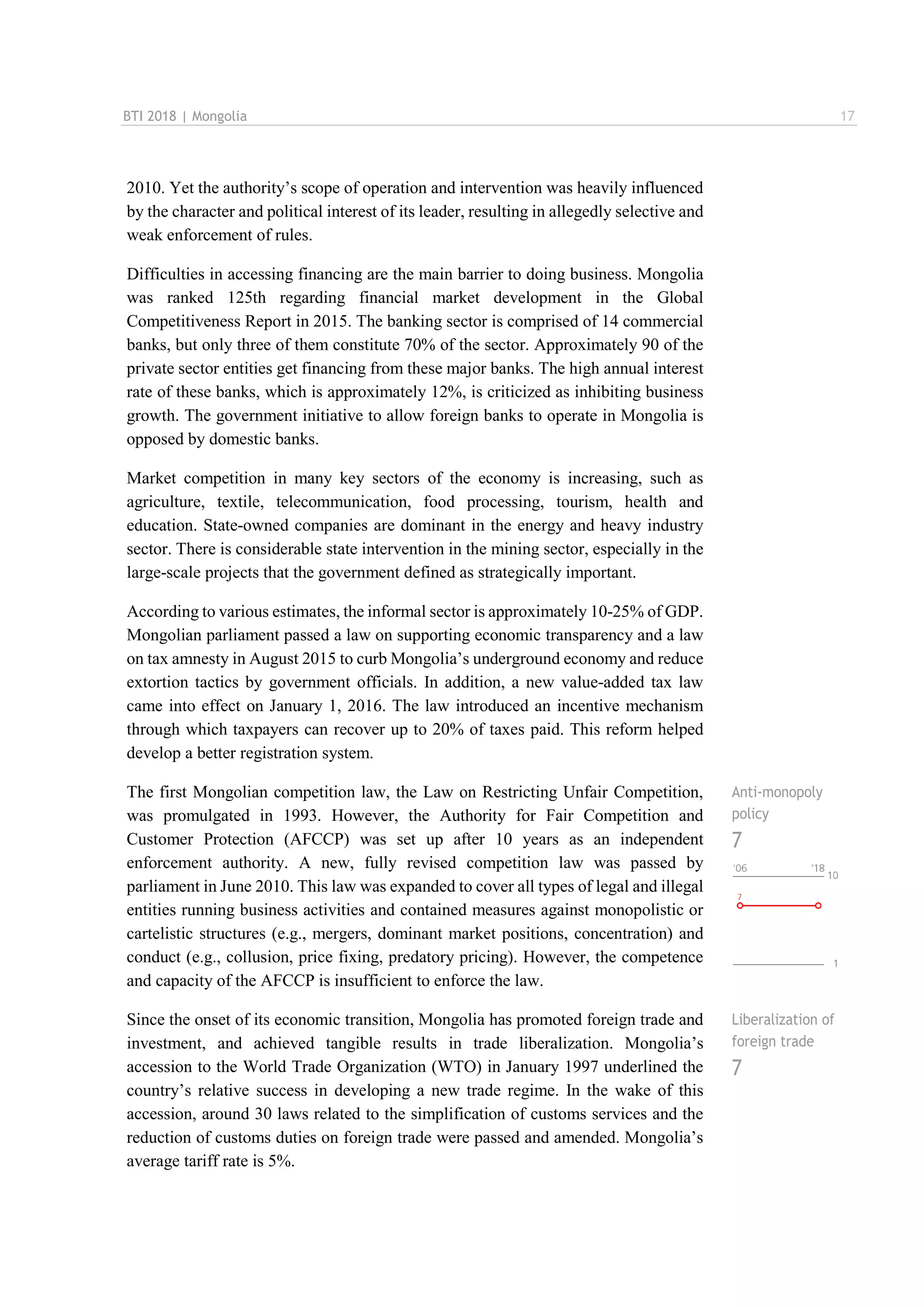
Economic indicators 2013 2014 2015 2016
GDP $ M 12582.1 12226.5 11741.3 11160.4
GDP growth % 11.6 7.9 2.4 1.0
Inflation (CPI) % 8.6 13.0 5.8 0.6
Unemployment % 7.9 7.9 7.4 6.7
Foreign direct investment % of GDP 16.4 2.8 0.8 -37.2
Export growth % 12.8 53.2 1.2 14.7
Import growth % 7.6 6.8 -11.5 13.3
Current account balance $ M -4731.8 -1934.3 -948.5 -
Public debt % of GDP - - - -
External debt $ M 18892.7 20826.1 21542.5 23912.3
Total debt service $ M 1401.6 1279.7 1753.7 1614.1
Net lending/borrowing % of GDP -1.1 - - -
Tax revenue % of GDP 15.7 - - -
Government consumption % of GDP 13.5 13.0 13.5 14.5
Public education spending % of GDP - - - -
Public health spending % of GDP 2.2 2.6 - -
R&D expenditure % of GDP 0.2 0.2 0.2 -
Military expenditure % of GDP 0.8 0.9 0.9 0.9
Sources (as of October 2017): The World Bank, World Development Indicators | International Monetary
Fund (IMF), World Economic Outlook | Stockholm International Peace Research Institute (SIPRI),
Military Expenditure Database.
7 | Organization of the Market and Competition
The government of Mongolia implemented a number of policy programs to ease
government bureaucracy, including e-governance initiatives. According to a survey
conducted by the Authority Against Corruption of Mongolia (AACM) in 2015,
business registration agencies were seen as least corrupt and easiest to access.
Mongolia improved its rank in the World Bank’s Doing Business Index from 80 in
2014 to 62 in 2016. The number of business entities increased from 39,677 in 2005
to 64,304 in 2015.
The Authority For Fair Competition and Consumer Protection (AFCCP) is
responsible for implementing the Law on Competition adopted by parliament in
Market-based
competition
7
BTI 2018 | Mongolia 17
2010. Yet the authority’s scope of operation and intervention was heavily influenced
by the character and political interest of its leader, resulting in allegedly selective and
weak enforcement of rules.
Difficulties in accessing financing are the main barrier to doing business. Mongolia
was ranked 125th regarding financial market development in the Global
Competitiveness Report in 2015. The banking sector is comprised of 14 commercial
banks, but only three of them constitute 70% of the sector. Approximately 90 of the
private sector entities get financing from these major banks. The high annual interest
rate of these banks, which is approximately 12%, is criticized as inhibiting business
growth. The government initiative to allow foreign banks to operate in Mongolia is
opposed by domestic banks.
Market competition in many key sectors of the economy is increasing, such as
agriculture, textile, telecommunication, food processing, tourism, health and
education. State-owned companies are dominant in the energy and heavy industry
sector. There is considerable state intervention in the mining sector, especially in the
large-scale projects that the government defined as strategically important.
According to various estimates, the informal sector is approximately 10-25% of GDP.
Mongolian parliament passed a law on supporting economic transparency and a law
on tax amnesty in August 2015 to curb Mongolia’s underground economy and reduce
extortion tactics by government officials. In addition, a new value-added tax law
came into effect on January 1, 2016. The law introduced an incentive mechanism
through which taxpayers can recover up to 20% of taxes paid. This reform helped
develop a better registration system.
The first Mongolian competition law, the Law on Restricting Unfair Competition,
was promulgated in 1993. However, the Authority for Fair Competition and
Customer Protection (AFCCP) was set up after 10 years as an independent
enforcement authority. A new, fully revised competition law was passed by
parliament in June 2010. This law was expanded to cover all types of legal and illegal
entities running business activities and contained measures against monopolistic or
cartelistic structures (e.g., mergers, dominant market positions, concentration) and
conduct (e.g., collusion, price fixing, predatory pricing). However, the competence
and capacity of the AFCCP is insufficient to enforce the law.
Anti-monopoly
policy
7
Since the onset of its economic transition, Mongolia has promoted foreign trade and
investment, and achieved tangible results in trade liberalization. Mongolia’s
accession to the World Trade Organization (WTO) in January 1997 underlined the
country’s relative success in developing a new trade regime. In the wake of this
accession, around 30 laws related to the simplification of customs services and the
reduction of customs duties on foreign trade were passed and amended. Mongolia’s
average tariff rate is 5%.
Liberalization of
foreign trade
7
BTI 2018 | Mongolia 18
The Mongolian parliament ratified a number of important treaties and legislative
changes in the period under review to facilitate foreign trade. Mongolia ratified the
Trade Facilitation Agreement (TFA) of WTO in November 2016. When ratified by
two-thirds of the member countries and implemented fully, TFA can reduce
members’ trade costs by an average of 14%. Mongolia’s first bilateral free trade
agreement, the Japan-Mongolia Economic Partnership Agreement (EPA), entered
into force on June 7, 2016. It was signed on February 10, 2015, in Tokyo, following
the completion of respective necessary legal procedures in both countries.
The United States and Mongolia signed a Trade and Investment Framework
Agreement (TIFA) in July 2004. Furthermore, they signed an Agreement on
Transparency in Matters Related to International Trade and Investment between the
United States and Mongolia in 2013 and completed their respective legal
requirements and procedures in 2016.
In 2016, there were a total of 14 commercial banks, which had 1,469 branches. Major
commercial banks have already adopted international best practices with regard to
corporate governance and business processes. There were 2.4 million deposit
accounts and 835,300 borrowers. Active assets of the banking sector make up 97%
of the Mongolian financial sector. Mongolian banks offer loans with high interest
rates (approximately 19%). On the other hand, interest rates for the savings of
individuals and companies are approximately 13%, which is considered too high.
The financial system has undergone rigorous modernization in recent years. This
began with the establishment of the Financial Regulatory Commission in 2006, which
is tasked with regulating financial services by supervising legal compliance and
protecting the rights of investors and clients. As the country’s economy is dependent
on a few sectors, the bank loans concentrate in those sectors and increase risks to the
banking system. As of 2016, 60.7% of past-due loans of the banking sector are from
mining, manufacturing, construction, real estate and trade companies. The ratio of
non-performing loans reached 9.1% in 2016.
Transparency and accountability in the banking sector is a looming problem. The
Trade and Development Bank of Mongolia, one the largest three banks in Mongolia,
orchestrated the purchase of 49% of the share of the Erdenet Copper-Molybdenum
Mine and Processing Plant from the Russian government through its proxy company
in the first half of 2016. A special parliamentary commission investigated this case
and reported that the deal breached the law, including the banking law.
Moody’s Investors Service stated in early 2016 that the negative outlook for
Mongolia’s banking system has not changed since 2013 due to the challenging
operating environment, continued deterioration in asset quality and capital, and tight
funding and liquidity. In November 2016, Moody’s downgraded the local currency
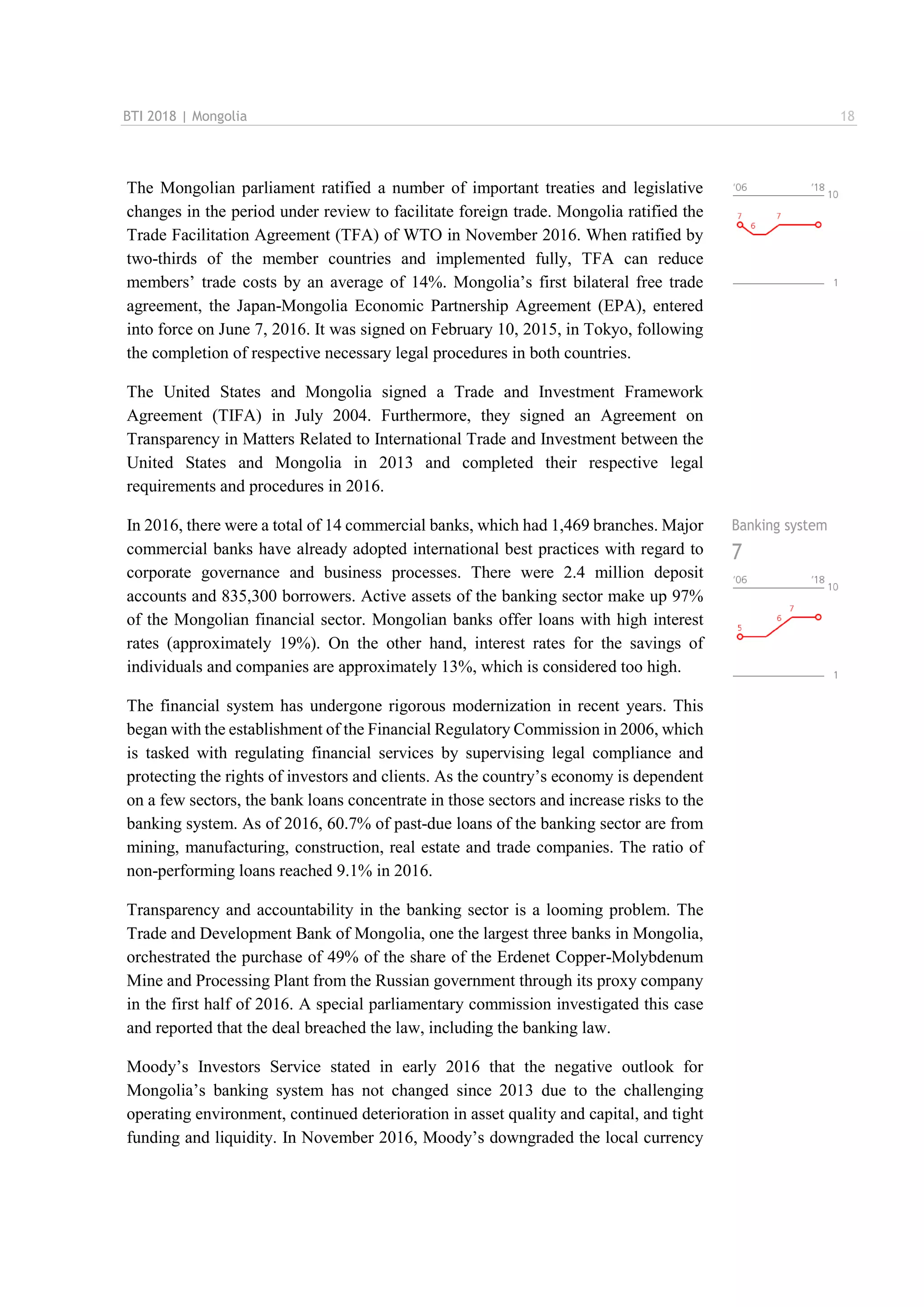
Banking system
7
BTI 2018 | Mongolia 19
long-term deposit ratings of seven Mongolian banks to Caa1 from B3, following the
downgrade of Mongolia’s sovereign rating to Caa1 from B3 with a stable outlook.
8 | Currency and Price Stability
In August 2016, Bloomberg reported that the Mongolian tugrik (MNT) had been the
world’s poorest performing currency. The tugrik slumped 15% between June and
October 2016. Although Mongolia’s central bank, the Bank of Mongolia (BoM),
lifted the benchmark interest rate by 4.5 percentage points to 15% in August 2016,
the tugrik fell 24.4% compared to the previous year at the end of 2016.
Mongolia’s economic stagnation, caused mainly by falling commodities prices,
economic slowdown in China and waning interest by foreign investors, was key to
the currency slump in the period under review. However, the BoM was widely
criticized for its inability to pursue an independent monetary policy. The BoM’s
available cash declined 23.1% from 2015 after the government increased spending
ahead of the elections in June 2016. The government launched unbudgeted spending
programs in the first half of 2016. These programs included three policy loan
programs (Good Herder/Student/Fence Programs) and a buyback program of the
Erdenes Tavan Tolgoi (state-owned coal mine project) shares owned by Mongolian
citizens (Good Share Program). Over MNT 500 billion was spent for the four Good
Programs. In addition, the government spent over MNT 400 billion for the Housing
Mortgage Program that was previously undertaken by the BoM.
A principle objective of the BoM is to ensure the stability of the Mongolian national
currency, the tugrik. By law, the governor of the BoM is formally independent from
the government, is appointed for a six-year period by the State Great Khural, and
reports to the parliament. However, its independence from the government has been
questionable. In reality, the appointment of the governor has followed four-yearly
parliamentary elections.
The NSO reports that the inflation rate in Mongolia was 11% in December 2014 and
it dropped to 1.9% in 2015 and 1.1% in 2016. The World Bank Q3 2016 report stated
that inflation eased due to the decrease in food, meat and energy prices. However, if
the tugrik continues to weaken, it will likely result in higher import costs and
inflation.
Anti-inflation /
forex policy
6
Fitch Ratings downgraded Mongolia’s creditworthiness from B to B- in 2016. Fitch
Ratings stated that Mongolia’s fiscal indicators deteriorated significantly due to large
pre-election spending programs and weaker economic growth. The general budget
deficit reached 19.7% of GDP in 2016. Although the Fiscal Stability Law (FSL) went
into full effect from January 2013, which aimed to ensure fiscal stability in the
medium and long term, the government of Mongolia (GoM) repeatedly missed targets
set under the law. The budget deficit sharply rose in the first half of 2016 due to
Macrostability
6
BTI 2018 | Mongolia 20
increased government spending and decreased revenue. Mongolia’s total external
debt is estimated at around $23.5 billion, nearly twice the size of its $12 billion
economy. Of that, government debt is about $8.4 billion. The GoM should redeem a
$580 million bond issued by the state-run Development Bank of Mongolia in March
2017.
Mongolian parliament approved a revised Medium-Term Fiscal Framework for
2016-2018 to reduce the budget deficit to 9.1% of the country`s GDP in 2017, and
7.5% of GDP in 2018. Mongolia requested emergency loans from bilateral partners
and international financial institutions including China and the International
Monetary Fund.
9 | Private Property
The 1992 constitution established basic property rights, which were further secured
by such laws as the Law on Property Ownership Rights and the Law on Registration
of Property Ownership. The constitution limits the right to privately own land to
citizens of Mongolia. Conflicts regarding land ownership are common, especially in
Ulaanbaatar.
According to data collected by the World Bank’s Doing Business Survey 2016,
registering property in Mongolia requires five procedures, takes 10.5 days and costs
2.1% of the property value, which ranks Mongolia 46 out of 190 economies. The
survey shows a higher investor protection index (26th), indicating that the country’s
regulations offer stronger investor protections against self-dealing in the areas
measured. However, the survey finds that contract enforcement takes 374 days and
costs 30.6% of the value of the claim, ranking Mongolia 85th on the ease of enforcing
contracts. Compared to China, Russia and Kazakhstan, Mongolia has very ineffective
judicial processes and system. In Mongolia, all contested foreclosure actions require
court review and are subject to appeals up to the Supreme Court. However, final
resolution can take up to 36 months. According to the U.S. Department of State’s
Mongolia Investment Climate Statement in 2016, foreign and domestic businesses
report inconsistent enforcement of court orders.
Mongolia is a member of the World Intellectual Property Organization (WIPO) and
has signed and ratified most relevant treaties and conventions, including the World
Trade Organization Agreement on Trade Related Aspects of Intellectual Property
Rights (WTO TRIPS). The key laws protecting intellectual property (IP) in Mongolia
are Copyright Law, Trade Names and Trademarks Law, and Patent Law. The
Intellectual Property Office of Mongolia is mainly responsible for ensuring
Mongolia’s compliance with these agreements.
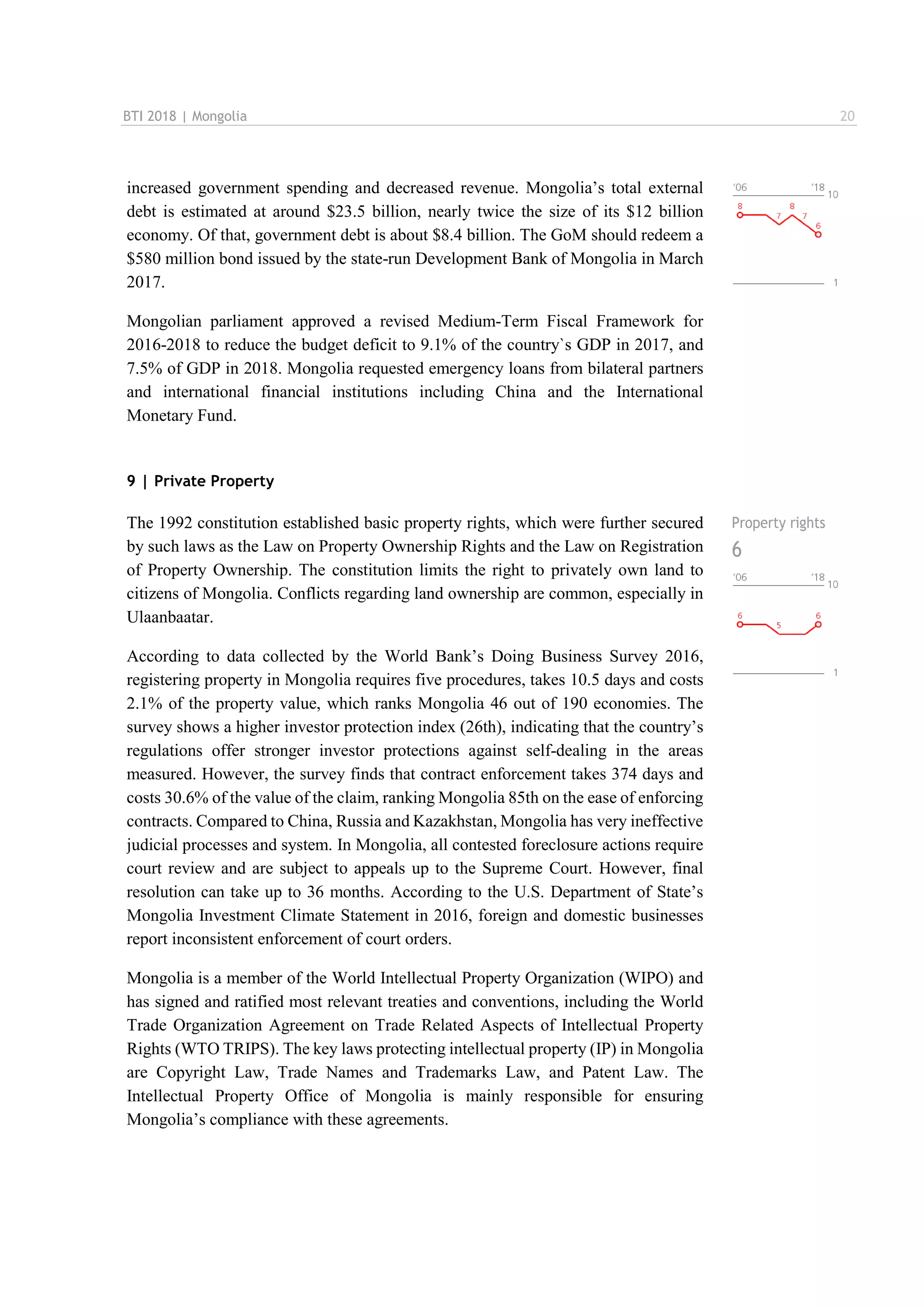
Property rights
6
BTI 2018 | Mongolia 21
The private sector constitutes approximately 80% of GDP and 75% of employment
in Mongolia according to various estimates. The role of the private sector in the
national economy and in overcoming the economic stagnation was widely
acknowledged in the period under review. The regulatory framework became more
supportive of fostering private-sector growth. The government implemented a range
of local enterprise support loan programs. The Mongolian parliament passed a law
on supporting economic transparency and a law on tax amnesty in August 2015 in
part to support private sector growth.
Key economic sectors are dominated by a few big companies. Especially, oligopolies
are evident in petroleum, banking and telecommunications sectors. The boundaries
between private companies and major political parties are often blurred and there
exist widespread conflicts of interest. The maturity of most private companies is in
its early stage. Mongolia has many companies with group, holdings and corporation
status. However, reliable information about management structure and performance
is often difficult to obtain.
Privatization of state companies has not always taken place in transparent and
competitive ways. The Mongolian parliament approved a list of state-owned entities
to be privatized in 2015-2016. Importantly, though the government’s proposal on
privatization of several state-owned companies, especially Mongol Post, became a
controversial issue. In 2016, 34% of Mongol Post was sold through the Mongolian
Stock Exchange and many observers viewed it as consistent with market principles.
Private enterprise
7
10 | Welfare Regime
Social welfare programs are defined mainly in the 2012 social welfare law. The
welfare regime is based on the provision of social pensions, allowances and services
to citizens with special needs. The government, through the Ministry of Population
Development and Social Protection (MPDSP) and the General Office of Social
Welfare Services (GOSWS), implements 71 social welfare programs. In addition to
these social welfare programs, the government implemented the Child Money
Program (CMP), funded from the Human Development Fund. In 2015, it also
allocated MNT 285 billion to social welfare. The CMP contributed an additional
MNT 246 billion. According to the Asian Development Bank (ADB) report, the
combined funding amounts to 2.7% of Mongolia’s GDP, exceeding the average 1.6%
of GDP in other emerging economies.
The top 40% of the population by income receives 28% of the total welfare transfers,
and just 56% of Mongolia’s welfare spending goes to the poorest 40% of the
population, according to the World Bank report in 2015. The Food Stamp Program is
the only program targeted at the poor, which has been implemented since 2013,
distributing MNT 18 billion to its 144,000 beneficiaries in 2015. The program
supports the consumption of basic food items by extremely poor families to increase
Social safety nets
6
BTI 2018 | Mongolia 22
their daily calorie intake. However, the amount distributed to individuals cover only
9.8% of their consumption, which is two to three times less than the global average.
The new government formed after the parliamentary election in 2016 initiated a
number of new social protection programs such as allowances for people older than
70 and support programs for mothers with more than one child. The government
significantly decreased funding for CMP by using proxy tests that differentiated poor
families in 2016.
All Mongolians have access to state health insurance, and medical care is relatively
inexpensive. All rural centers have health care facilities. Non-citizens are allowed to
be a member of state health insurance.
Women and members of ethnic, religious and other groups have near-equal access to
education, public office and employment. Mongolia has a score of 0.32 on the 2014
Gender Inequality Index (GII). The country maintains a significant positive trend
toward decreasing gender inequality. Mongolia had a score of 0.411 in 2010.
Mongolia has received very high scores on education attainment, health and survival
and economic participation and opportunity. Gross enrollment ratio in primary
education is 96% and secondary education is 93%. The adult literacy rate is reported
to be 97.8%. The ratio of female to male enrollment (GPI) is 0.98. Mongolians tend
to highly value girls’ education.
The low quality of Mongolian language education in Bayan-Ulgii aimag where the
majority of citizens are Kazakhs is an important concern.
Women do not enjoy fully equal opportunities in politics and the workplace.
Mongolian parliament decreased a 30% quota for women candidates to 20% before
the June 2016 election. Mongolia ranked 58th in the Global Gender Gap Report in
2016, which highlighted a widening gender gap among legislators, senior officials
and managers. Women’s participation in the labor market is 56.6%, which is lower
than 69.3% for men. The share of women holding decision-making positions is very
low. In the public service, 26.6% of state secretaries are women, 30% of middle
managers and 15% of senior managers in Mongolia.
Although religious tolerance is relatively strong in Mongolia, there was a widely
supported public campaign targeting a female senior government official who was
allegedly involved in the Unification Church, or “the Moonies” – a new religious
group originated from South Korea – in the period under review. Some cases of
discrimination against Christian believers in the workplace and schools are reported,
but in general it is not widespread. O.Baasankhuu, member of the Mongolian
People’s Party and the first Christian MP, was re-elected in 2016.
Equal opportunity
6
BTI 2018 | Mongolia 23
11 | Economic Performance
Economic growth, which reached the world highest 17.3% in 2012, plunged to 12.3%
in 2012, 11.6% in 2013, 7.89% in 2014, and 2.3% in 2015. Mongolia’s economy was
still maintaining some growth even though the mining boom faded.
The World Bank forecasted growth of 7.7% for 2016. However, the economy shrunk
by 1.6% in Q3 2016. The unemployment rate reached 9.4% in the third quarter of
2016 (on the yearly basis it was 9.8% in 2016). The biggest negative factor in
Mongolia’s economic performance was a severe drop in FDI in the period under
review. In 2011, FDI equaled $4.62 billion, but it decreased to $544 million in 2015.
Although the agreement to resume a delayed $5 billion underground expansion at
Oyu Tolgoi was signed by the government and Rio Tinto in May 2015, ending a row
that scared off foreign investors, FDI did not increase as expected. The giant Tavan
Tolgoi’s long-term off-take agreement with Chalco, designed to repay debt owed by
Mongolia’s state-owned mining company, hampered the government’s ability to
benefit from high coal prices in China. Several mining investment agreements
covering Mongolia’s biggest mines including Tavan Tolgoi did not proceed as
expected.
The percentage of export of raw materials increased from 84% in 1995 to 2005 to
93.8% in 2011 to 2016 of total exports. According to the Bank of Mongolia,
Mongolian export decreased by 18.6% in 2015, primarily caused by the decrease in
commodity prices, specifically copper and coal, Mongolia’s most valuable natural
resources. The country is almost entirely dependent on Chinese demand for its
mineral exports. Coking-coal, copper concentrate, iron ore, crude oil and non-
monetary gold export decreased by nearly 33%, 8%, 66%, 25% and 35% respectively,
which accounted for 20% decrease in the growth of mining export in 2015.
In 2016, Standard & Poor’s decreased Mongolia’s credit rating to B- from B and
estimated that overall government debt has ballooned from 26% of GDP in 2010 to
78% in 2016.
Output strength
5
12 | Sustainability
Mongolia’s reliance on the extractive sector for economic growth has induced and
exacerbated environmental degradation. In order to sustain economic growth
objectives, Mongolia will need to address a number of serious environmental
challenges such as water scarcity, degradation of grassland, climatic volatility and
environmental pollution in urban areas, especially air and soil pollution Ulaanbaatar.
The World Health Organization (WHO) has listed the capital, Ulaanbaatar, as one of
the five most polluted cities in the world.
Environmental
policy
5
BTI 2018 | Mongolia 24
In recent years, the Mongolian parliament approved a number of important policy
documents that aim to integrate environmental and sustainable development goals
into development and economic policy-making and implementation. The Mongolian
parliament adopted the action plan of its Green Development Policy that incorporated
poverty, environment and gender concerns in December 2015 and adopted the
National Sustainable Development Concept 2030 in February 2016, which was based
on the global Sustainable Development Goals and the country’s priority development
challenges.
The Mongolian government has declared that it will increase renewables from 7% of
installed power-generation capacity to 20% by 2023. The Mongolian parliament
amended its renewable energy law, passed in 2007, to strengthen public-private
partnerships and create a market-oriented framework for the energy sector. While the
first independent renewable-energy generator, the 50-megawatt Salkhit Wind Farm,
started production in 2013, Mongolia’s first-ever solar power station launched in
January 2017.
Mongolia has a 5-4-3 formal education structure. Primary school has an official entry
age of six and a duration of five grades. Secondary school is divided into two cycles:
lower secondary consists of grades six to nine, and upper secondary consists of grades
10 to 12. In principle, primary and secondary school are free and primary and lower
secondary school are compulsory. According to the Mongolia Human Development
Report 2016, the net enrollment rate had reached 99.1% in primary education and
96.1% in secondary education. The urban-rural difference in access to education has
narrowed. The share of girls and boys up to lower-secondary school are almost equal.
The government spent 5.3% of GDP on education in 2014 and 4.3% in 2015.
However, public funding has been insufficient to finance the education reform agenda
of the government. Though spending for education as a percentage of GDP seem to
be relatively high, it is important to note that as a result of the country’s young
population, harsh climate and poor condition of school facilities, large sums are spent
on capital expenditure and maintenance and heating costs.
As of 2016, there are 17 public, 74 private and four international universities and
colleges in Mongolia. The quality and international competitiveness of these
institutions have been weak. Spending on research and development is insufficient,
inhibiting development of scientific research. R&D represents just 0.17% of GDP
PPP (as of 2013). The Global Competitiveness Index 2016-2017 ranked Mongolia at
59th in the world in regard to education and training.
The low quality of education at all levels is a major challenge for Mongolia although
the government has made some efforts to improve the education sector in recent
years. Rural secondary schools have shortages in well-qualified teachers and learning
resources. It is widely criticized that universities and colleges do not equip the youth
with the skills required for the labor market, which is confirmed by the high
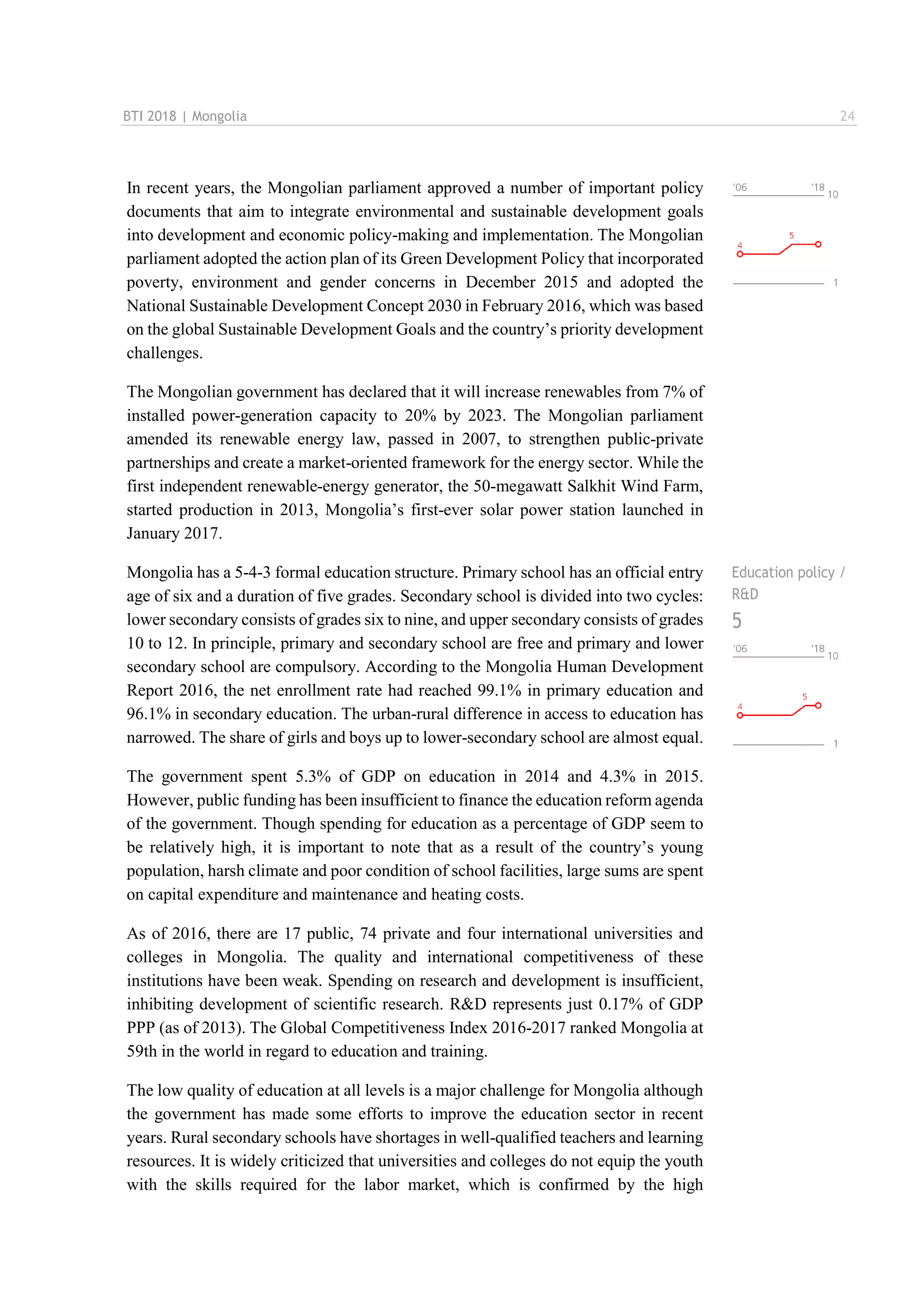
Education policy /
R&D
5
BTI 2018 | Mongolia 25
unemployment rates among young people with TVET and higher educational
attainment. In the period under review, the government introduced new education
standards, strengthened the university accreditation system, supported lifelong
education programs and implemented a special program on teacher training.
BTI 2018 | Mongolia 26
Governance
I. Level of Difficulty
Management performance faces several structural constraints. The country’s vast
territory, combined with a small and sparsely located population, makes development
difficult in administrative, economic and infrastructural terms. In addition, the
country is landlocked, which is a disadvantage for trade.
Mongolia is the second largest landlocked country in the world and exposed to winter
temperatures as low as -40° Celsius. While experiencing rapid urbanization (currently
at 66.4%), Mongolia has the lowest population density. Semi-nomadic and pastoral
livelihoods continue to prevail in rural areas and their livelihoods are becoming very
sensitive to the impacts of climate change.
In the winter of 2016 to 2017, around 150,000 herders in Mongolia are at risk of
losing their livelihoods due to harsh climatic conditions and extreme events.
According to the National Emergency Management Authority (NEMA), as of
December 2016, a total of 110 soums in 13 provinces were identified as “at risk.”
Mongolia is still reeling from the 2015 to 2016 dzud, a Mongolian term for a severe
winter, which killed 1.2 million livestock and left tens of thousands of herders in
poverty. Even though the government’s preparedness for dzuds improved in recent
years, capacity is expected to be much lower this year due to budget cuts and the
impacts of the previous dzud.
Nearly 60% of Ulaanbaatar’s 1.37 million inhabitants live in under-serviced areas, as
the city’s infrastructure grid was originally designed for a much smaller population.
Ulaanbaatar is among the ten most polluted cities in the world, with extremely high
levels of air pollution during winter months owing to the use of solid fuel for heating
and cooking at the household level.
Structural
constraints
7
Mongolian civil society comprises several broad groups of organizations, such as
non-governmental organizations (NGOs), trade unions, chambers of commerce,
saving and credit cooperatives, local groups under political parties, apartment
owners’ unions, nonprofit media and informal self-help and leisure groups or
community groups. Among them, the most influential actors are NGOs. Although
there were trade union, women, youth and elders’ associations during the communist
era, they were not voluntarily established, nor separate from the state. They were
Civil society
traditions
6
BTI 2018 | Mongolia 27
components of the dominant communist party. The 1992 constitution and the law on
non-governmental organizations opened up a legitimate ground for NGOs. In
particular, after the law on NGOs (1997), the number of NGOs registered to the State
Registration Agency has boomed and reached over 23,694 (State Registration
Agency, 2017). The law guarantees the right of Mongolian citizens to freely establish
an NGO on the basis of their interests and opinions without any state or other parties’
intervention.
Mongolia has been slow to recognize the important role of the private sector, civil
society and local governments in national development. Local governments, the
private sector and civil society still lack the necessary experience, awareness and
capacity to collaborate with the government as an equal partner. Further efforts are
required to ensure nation-wide development of civil society by providing an enabling
policy environment. This would include enacting favorable tax and insurance
policies, strengthening CSO rights and freedoms, institutionalizing channels of
communication between CSOs and local and central government, and ensuring the
legal standing of CSOs in the court of law, particularly in public interest lawsuits.
There are no violent incidents based on social, ethnic or religious differences.
Although Mongolians have increasingly questioned the nature and quality of their
democratic institutions, no significant violent incidents have occurred since the post-
election riots in 2008. Mongolians are debating in peaceful and open ways the need
to reform the constitutional framework and the electoral system.
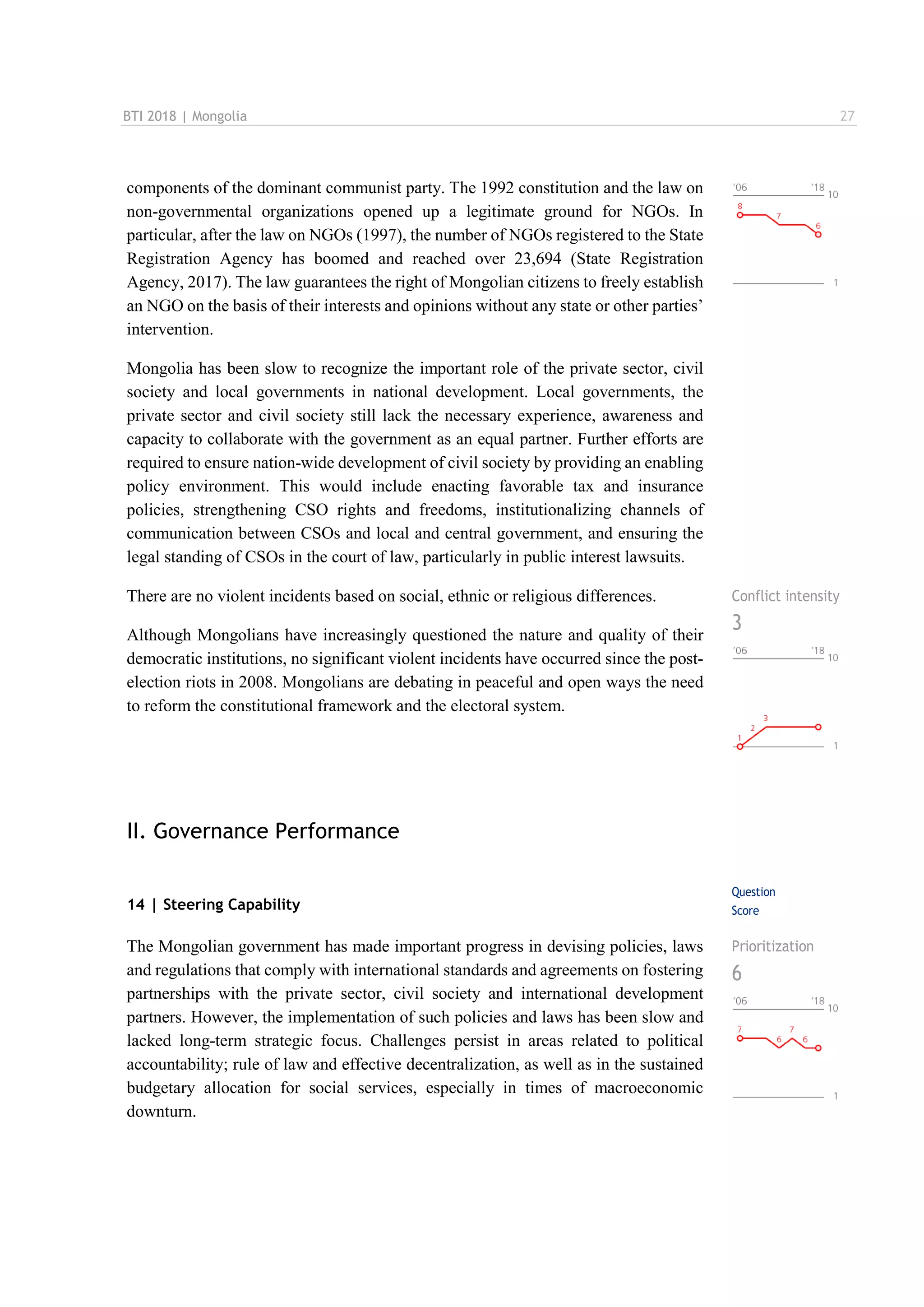
Conflict intensity
3
II. Governance Performance
14 | Steering Capability
Question
Score
The Mongolian government has made important progress in devising policies, laws
and regulations that comply with international standards and agreements on fostering
partnerships with the private sector, civil society and international development
partners. However, the implementation of such policies and laws has been slow and
lacked long-term strategic focus. Challenges persist in areas related to political
accountability; rule of law and effective decentralization, as well as in the sustained
budgetary allocation for social services, especially in times of macroeconomic
downturn.
Prioritization
6
BTI 2018 | Mongolia 28
Fitch Ratings has downgraded Mongolia’s Long-Term Foreign- and Local-Currency
Issuer Default Ratings (IDRs) to B- from B in 2016. Large pre-election spending
programs and weaker economic growth contributed to a dramatic widening of the
general government deficit to 19.7% of GDP in 2016.
The new majority party after every parliamentary election tends to undo the previous
government’s policies and replace personnel throughout the government with their
own party-affiliated staff, inhibiting development and implementation of long-term
planning. The establishment of the Ministry of Economic Development (MoED) in
2012 was an important initiative to support long-term development planning and
coordination. However, it was excluded from the new government structure in 2016.
Mongolia has made remarkable progress toward achieving the Millennium
Development Goals, including a fourfold reduction in under-five mortality rates
(U5MR) from 107 (1990) to 25 (2015) per 1,000 live births; decrease in stunting from
33% in 2000 to 10.8% in 2015; and high net enrollment rates (NER) for primary and
secondary education, reaching 99.1% and 96.1% respectively. According to the
World Bank, the country has also experienced a steady decrease in monetary poverty
rates from almost 39% in 2010 to approximately 22% in 2015. In 2015, Mongolia
has been classified for the first time as a high human development country (but was
downgraded again in 2016).
2016 marks the first year of implementation of the Sustainable Development Goals
(SDGs) as a global call-to-action to make sure that all people benefit from
development. Mongolia has approved its own version of the SDGs with the Mongolia
2030 Sustainable Development Vision. Following the parliamentary election in June
2016, the new MPP government developed its action program to be implemented in
the period of 2016 to 2020, reflecting Mongolia’s Sustainable Development Vision
2030 and the MPP’s election platform.
Although the government has established strategic priorities and develops policies
that address these priorities, the effectiveness of its policy implementation has
invariably been questionable. Implementation efficacy is often undermined by the
political actors’ parochial interests and a lack of human and financial resources. Anti-
air pollution policy provides a glaring example of the government’s inability to
implement its own policies effectively.
Implementation
6
In the period under review, the Mongolian parliament did not alter persistent annual
fiscal deficits. While the volatile nature of minerals – the main source of Mongolia
export earnings – has been discussed and caused alarm among members of
parliament, researchers and international consultants over the past decade, politicians
did not act on limiting government over-spending. The new cabinet appointed after
the elections in June 2016 took measures to reduce fiscal deficits and limit
government spending.
Policy learning
6
BTI 2018 | Mongolia 29
Institutional memory is often at risk because of a highly politicized environment
prevalent in government institutions. While the government attempts to absorb and
apply best practices from success stories in other contexts, the lack of institutional
memory inhibits policy learning.
The government made notable attempts to innovate the routines of its policy-making
through information and communication technology. For example, in February 2015,
the government went to the nation’s mobile phone subscribers with an opinion poll
that asked them to vote for one of two futures for the country: budget cuts or economic
austerity. While the intent and wording of the poll was widely criticized, it clearly
demonstrated a new way of integrating public opinion into policy-making.
Attempts to increase the incorporation of international good practices into laws and
government policies commonly exist. Members of parliament have allocated budgets
for international study visits when they initiate laws and amendments. Key
international donors such as World Bank, UNDP and Asian Development Bank have
provided assistance to facilitate international cooperation and exchanges relevant to
policy-making.
Policy-driven or applied research institutions that should provide policy advice for
the parliament and government have not been adequately funded and staffed in
Mongolia. The Mongolian parliament has a policy research center but its capacity to
deliver high quality output is very limited. Ad hoc committees and working groups
consisting of local consultants, lawyers and academic researchers are often formed to
work on drafting new laws and amendments.
15 | Resource Efficiency
Mongolia has been praised for its efforts toward establishing an efficient and
transparent public finance management system and budget execution. The
government has developed a consistent legal framework for public finance (law on
glass account, law on budget stability), as well as medium-term and annual budget
planning frameworks. However, Mongolia has repeatedly missed targets set under its
fiscal stability law, evidence of a poor track record of policy implementation. The
most salient example is the Mongolian People’s Party’s use of the country’s Human
Development Fund for cash handouts prior to the 2008 and 2012 elections. These
cash transfers came at the cost of state investment in institutions such as education
and infrastructure. The fiscal stability law, which went into effect in January 2013,
caps the state structural deficit at 2% of GDP.
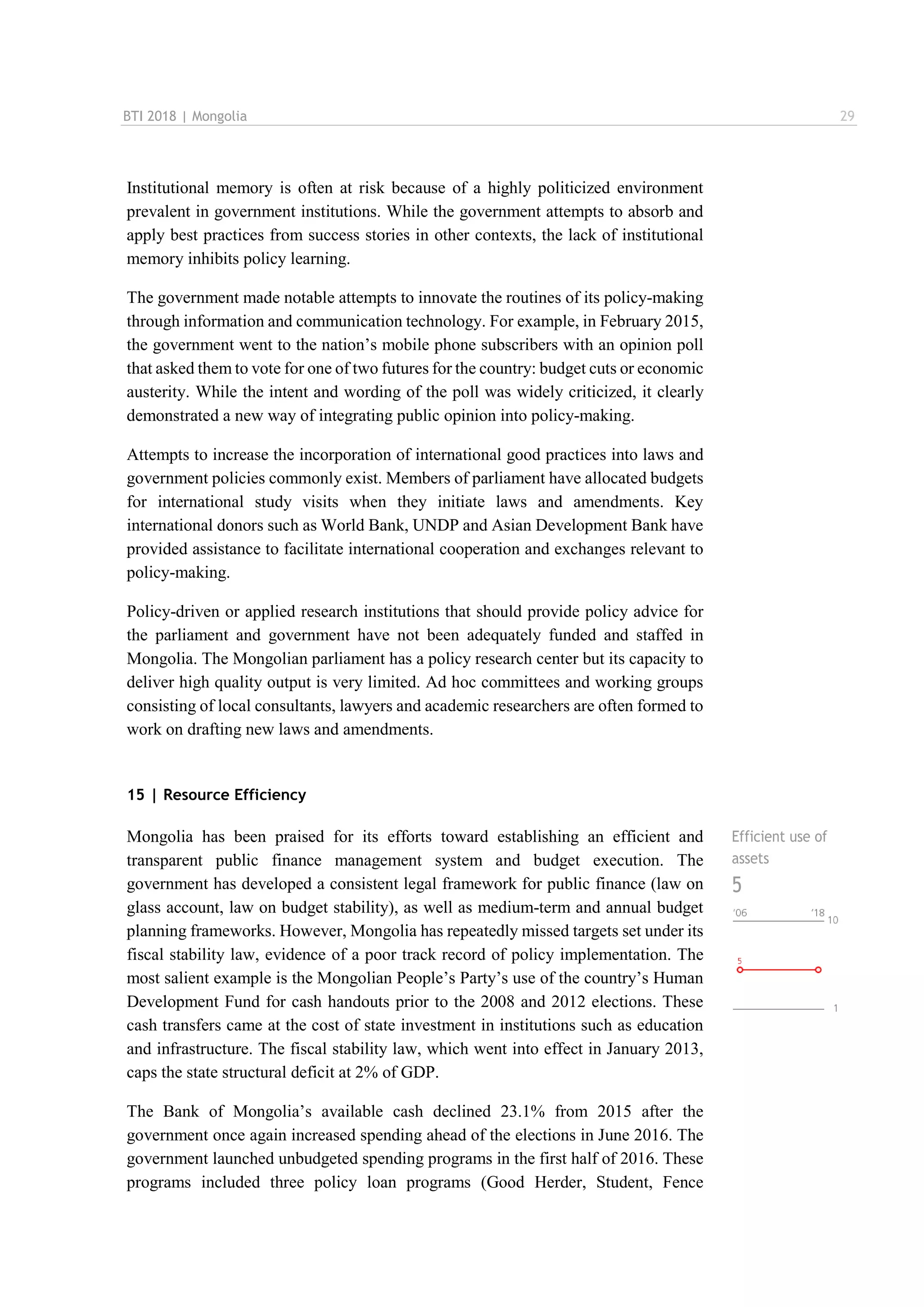
The Bank of Mongolia’s available cash declined 23.1% from 2015 after the
government once again increased spending ahead of the elections in June 2016. The
government launched unbudgeted spending programs in the first half of 2016. These
programs included three policy loan programs (Good Herder, Student, Fence
Efficient use of
assets
5
BTI 2018 | Mongolia 30
Programs) and a buyback program of the Erdenes Tavan Tolgoi (state-owned coal
mine project) shares owned by Mongolian citizens (Good Share Program). Over
MNT 500 billion was spent for the four Good Programs. In addition, the government
spent over MNT 400 billion for the Housing Mortgage Program that was previously
undertaken by the Bank of Mongolia. The budget deficit increased to 19.7% of GDP
as of August 2016. As of January 2017, Mongolia is on the verge of defaulting on
foreign debt obligations.
A high number of politically motivated dismissals and new appointments of public
servants has been prevalent in Mongolia. Although the law on public service requires
competitive recruiting procedures it has not been implemented adequately. Party
affiliation, money and personal networks have become crucial conditions for
becoming a public servant.
Overall, policy coordination, which in Mongolia depends entirely on individuals and
lacks a systematic framework, is inadequate and in its early stages of development.
The establishment of reliable monitoring and evaluation frameworks at the national
and local levels to track policy implementation and progress is the main challenge for
policy coordination. For instance, parliament adopted the Millennium Development
Goals-based Comprehensive National Development Strategy of Mongolia, reflecting
the government action program, annual state budget and annual guidelines for
socioeconomic development. However, when in the final year of the Millennium
Development Goals, there was no nationwide monitoring and evaluation for the
implementation of the national development strategy. This type of policy
abandonment also happened to the National Human Rights Action Plan adopted in
2003 by the parliament.
The law on coordination of foreign loans and grant aid is the main law on foreign
assistance. However, not all donors and line ministries have followed the procedures
specified by the law. This has led to a lack of government coordination, causing an
imbalance in the distribution of government efforts and development partners’
interventions.
Policy
coordination
5
Corruption continues to affect all spheres of the public sector. The government
intensified its policy against corruption by strengthening e-procurement programs,
improving budget expenditure reporting and approving the National Program on
Anti-Corruption. However, these efforts to combat corruption have not translated into
significant improvements.
The anti-corruption legal framework draws primarily on the 1990 law on political
parties, the 1996 law on anti-corruption (amended in 2006), the 2000 public
procurement law and the 2002 National Program for Combating Corruption. The
Independent Authority Against Corruption (IAAC), which was established in 2007,
has the ultimate power to investigate anyone whom the authority considers to be
involved in corruption. The legal framework for battling corruption improved
Anti-corruption
policy
5
BTI 2018 | Mongolia 31
dramatically in January 2012, when the parliament passed the Law on Regulating
Public and Private Interests in Public Services and Preventing Conflicts of Interest.
Officeholders and members of parliament are required to declare their assets to the
IAAC each year, although the absolute accuracy of these declarations has been called
into question. There have been concerns that the IAAC has acted in a biased manner
by selectively targeting individuals; however, the concern itself appears to be
politically motivated.
The Glass Accounts Law, which entered into force on January 2015, obliges all
government agencies and legal entities with state involvement to disclose publicly
information on budgets and financial matters. Implementation of this law was widely
supported and helped reveal many financial misconducts. In 2016, a new law to
improve transparency of political parties, especially financial accountability, was
rejected at the first reading in parliament.
In last two decades, land administration, mining and customs were considered the
most corrupt sectors in Mongolia. According to the Asia Foundation’s new study on
Public Perceptions of Corruption in 2016, political parties are identified as the most
corrupt institution in Mongolia. In 2016, several members of parliament drafted a
proposal for a new law on offshore accounts, in response to the Panama Papers, which
contained the names and offshore account details of several Mongolian nationals,
including high-level government officials.
16 | Consensus-Building
All major political actors agree on building a democracy. At the same time, public
opinion polls indicate that the general assessment of democratic values is much
higher than trust in the ruling institutions, such as state authorities and the judiciary.
There is little question of Mongolia’s commitment to a market economy; however,
Mongolian policymakers continue to struggle with balancing market forces while
providing social safety nets and advancing responsible/sustainable development.
There is considerable thought given to long-term development goals, in particular
among increasingly active civil society organizations.
Consensus on goals
9
Reformers can successfully exclude or co-opt all actors with anti-democratic
interests. There are no anti-democratic actors with substantial influence or veto
powers. While there are a small number of people advocating the establishment of a
non-democratic regime, these people are not taken seriously by the public or the
government. Such groups are primarily limited to hypernationalist parties or gangs.
They have no influence, and are largely peripheral. The Mongolian Armed Forces do
not have a history of seeking political control, and there are no indications that the
military seeks any policy-making role.
Anti-democratic
actors
9
BTI 2018 | Mongolia 32
The political leadership generally prevents cleavage-based conflicts from escalating.
However, socioeconomic gaps have been growing, leading to an unstable political
environment fueled by populism and social media campaigns. The urban-rural divide,
along with the generally lower socioeconomic status of migrants to urban areas, mark
significant socioeconomic cleavages.
Cleavage /
conflict
management
8
Civil society has emerged as an important partner for the government, playing a
crucial role in promoting democratic reforms, human rights and gender equality as
well as providing much needed services to vulnerable groups. The political leadership
permits civil society participation within the policy-making process. It takes account
of and accommodates the interests of most civil society actors. Laws on formal
hearings and other mechanisms for soliciting comment have been approved by
parliament and implemented in the past several years. As a result, some important
laws and government decisions were developed in collaboration with civil society. A
notable example is the newly amended law on domestic violence of 2016 that resulted
from more than 15 years of civil society-led campaigning. Another example is a quota
for civil society representatives to be members of boards and monitoring committees
of public organizations such as national TV and radio and the National Gender
Committee.
Civil society
participation
7
Although political repression and purges did take place under the former communist
regime, Mongolians have not undergone any massive, systematic injustice since the
Stalinist purges. From 1922 to 1940, political leaders and other individuals
considered potentially subversive such as aristocrats, national entrepreneurs and
Buddhist monks, were purged. This activity resulted in capital punishment for more
than 30,000 people and the imprisonment of tens of thousands. After World War II,
many intellectuals with nationalist views were subject to repression. Over time,
political repression in Mongolia evolved from outright state terror to forms of
administrative measures, defamation of personal dignity and discrimination on the
basis of opinion.
After the transition to democracy in 1990, a National Rehabilitation Commission was
formed to examine each individual case of repression. The commission established
around 36,000 case files. In January 1998, parliament passed a Law on the
Rehabilitation of Victims of Political Repression and on Granting Compensation. As
of today, around 17,400 victims have been recognized and 16 billion tugrik have been
paid in compensation. In 1996, the Democratic Party officially asked for a pardon of
its members on behalf of the government and party leaders of Mongolia. The MPP
did the same in March 2011.
Reconciliation
n/a
BTI 2018 | Mongolia 33
In 2016, the NGO Children of Executed Political Victims demanded fair and adequate
compensations and revision of the current law on the rehabilitation of victims of
political repression and on granting compensation by making it compliant with the
Convention against Torture and Other Cruel, Inhuman or Degrading Treatment or
Punishment and the Declaration of Basic Principles of Justice for Victims of Crime
and Abuse of Power. There has been no response from the government.
17 | International Cooperation
Mongolia receives substantial amounts of aid in critical areas such as energy,
infrastructure, governance, education and social protection. Over 40 donors are
involved in a variety of development areas. On a per capita basis, Mongolia is one of
the top recipients of official development aid (ODA). This is mostly due to its small
population.
Convergence between development aid programs and Mongolia’s national priorities,
sector plans and budget are weak. The government needs to put in place a more
systematic framework for aid coordination and allocation in accordance with national
development priorities. Progress has been slow toward promoting harmonization and
mutual accountability of international aid, which is not supported by a proper system
of results monitoring and management.
Some aid programs are donor-driven. In many cases, donors formulated loan and
grant projects using their own strategies and priorities, then proposed them to the line
ministries or other local entities. On the Mongolian side, such projects have often
been approved for implementation without regard for national priorities and budget
allocations. Such donor-driven projects did not produce a sense of national ownership
and were ineffective.
Effective use of
support
7
Besides its current economic status, Mongolian democratic and diplomatic
credentials are well established in the international community. As a U.N. member
state since 1961, Mongolia plays a constructive role in the intergovernmental policy-
making process and has demonstrated its firm commitment to peace, security and
dialogue. Notably, in 2006, Mongolia passed the U.N. General Assembly resolution
on Mongolia’s international security and nuclear-weapon-free status (GA resolution
61/87). With this act, Mongolia became the only member-state with an internationally
recognized nuclear weapon-free status.
Mongolia has been elected as a member of the U.N. Human Rights Council by
winning the votes of 172 U.N. member states. Mongolia will serve on the U.N.
Human Rights Council in 2016 to 2018.
Mongolia hosted the 11th Asia-Europe Meeting in Ulaanbaatar in July 2016, attended
by the heads of state and government of 51 European and Asian countries. In the last
eight years, Mongolia has been actively engaged in the World Economic Forum held
in Davos, Switzerland.
Credibility
8
BTI 2018 | Mongolia 34
Developing international partnerships has particular significance for Mongolia, a
country that is landlocked between two great neighbors. Mongolia’s foreign policy
emphasizes balanced relations with Russia, on which Mongolia relies for energy, and
China, which is Mongolia’s main channel for import and export.
Mongolia views balanced foreign relations as key to its ability to maintain national
sovereignty and ensure development. Hence, Mongolia has pursued an open and
nonaligned policy, maintaining strong commitment to upholding peace. Mongolia’s
President Ts.Elbegdorj, President of Russia Vladimir Putin and President of China
Xi Jinping signed an agreement in June 2016 on a trilateral economic corridor, a
major cooperation initiative aimed to boost infrastructure and trade integration of the
three nations.
Multilateralism is an important pillar of Mongolia’s foreign policy. Conceptualized
in its Third Neighbor policy, Mongolia’s efforts to balance out the influence of its
two big neighbors led it to assume an active role in international and regional
organizations. Aside from its close cooperation with the Asia-Pacific Economic
Cooperation (APEC) and Association of Southeast Asian Nations (ASEAN),
Mongolia became a participating State of the Organization for Security and
Cooperation in Europe (OSCE) in November 2012. The government created the
International Cooperation Fund (ICF) as its development aid program in 2013.
Although budgets have been declining, the ICF aims at promoting democratization
and sound governance principles of natural resources with partner countries across
Asia, most actively with North Korea, Myanmar and Kyrgyzstan. Mongolia is also
notable for having maintained ties with other communist states, despite its own
successful transition. Mongolia enjoys open relations with North Korea and ties to
Laos.
Regional
cooperation
9
BTI 2018 | Mongolia 35
Strategic Outlook
Mongolia is on the verge of defaulting on its foreign debt obligations. This dire economic
circumstance will likely continue unless the government acts in a highly effective and quick
manner to increase foreign direct investment and improve budget discipline. Foreign investment
into long-awaited large-scale mining, energy and infrastructure projects can have a significant
positive impact on the economy, helping overcome the debt crisis and leading to higher economic
growth. The Mongolian public is increasingly becoming intolerant of a failure of political
leadership. Pressures will likely mount on the government to deal with the crisis in 2017.
Oligarchic groups (consisting of businessmen, politicians and state officials) have a significant
influence on the country’s politics and wealth distribution and their conflicts may jeopardize the
country’s continued political stability and development. The following policy measures would
likely prove helpful to successfully advance the socioeconomic transformation:
1. The Mongolian parliament needs to act decisively to improve the accountability of public
office holders and curb political elite-driven corruption in order to restore public trust in
the government and political institutions. Supporting the independence of the judiciary
should be key to achieving this objective.
2. While re-attracting foreign investment is a key priority for the government, it is crucial to
develop and implement a comprehensive, long-term policy to support the development of
the public sector and improve the stability and competitiveness of domestic companies
operating in non-mining sectors such as agriculture, organic food, textile, tourism and IT.
3. Political parties have become the backbone of political corruption in Mongolia because of
the dominance of oligarchic groups, improper funding schemes and widespread cronyism
in party politics. The Democratic Party (DP), now the main opposition party in the
Mongolian parliament, should continue its efforts to genuinely integrate internal party
democracy and political accountability mechanisms, setting a benchmark.
4. Public pressure to fix imbalances in the separation of powers and the lack of political
accountability is looming. Mongolia must be extremely careful in its attempt to amend
and reform its constitution to ensure the continuity of successful democratic
transformation.
5. In the coming years strengthening the democratic quality of the justice system will be key
to restoring public confidence in political institutions, underpinning business confidence,
job creation and economic growth. The media and civil society need to put more emphasis
on demanding justice reform that should lead to independent and strong courts.
6. Public-private partnerships and foreign direct investment for green development
initiatives and renewable clean energy projects must have a high priority in the national
development strategy. Effective incentive mechanisms must be introduced in order to deal
BTI 2018 | Mongolia 36
with the emergent issues of environmental pollution and over-reliance on imported oil
from Russia.
7. Mongolia should maintain its active role in regional cooperation and multi-pillar foreign
policy to strengthen its position in the changing political landscape in North-East Asia and
the world. Its foreign policy formulation and implementation must be highly effective and
consistent.

Bti 2018 mongolia

  • 1.
    BTI 2018 CountryReport Mongolia
  • 2.
    This report ispart of the Bertelsmann Stiftung’s Transformation Index (BTI) 2018. It covers the period from February 1, 2015 to January 31, 2017. The BTI assesses the transformation toward democracy and a market economy as well as the quality of political management in 129 countries. More on the BTI at http://www.bti-project.org. Please cite as follows: Bertelsmann Stiftung, BTI 2018 Country Report — Mongolia. Gütersloh: Bertelsmann Stiftung, 2018. This work is licensed under a Creative Commons Attribution 4.0 International License. Contact Bertelsmann Stiftung Carl-Bertelsmann-Strasse 256 33111 Gütersloh Germany Sabine Donner Phone +49 5241 81 81501 sabine.donner@bertelsmann-stiftung.de Hauke Hartmann Phone +49 5241 81 81389 hauke.hartmann@bertelsmann-stiftung.de Robert Schwarz Phone +49 5241 81 81402 robert.schwarz@bertelsmann-stiftung.de Sabine Steinkamp Phone +49 5241 81 81507 sabine.steinkamp@bertelsmann-stiftung.de
  • 3.
    BTI 2018 |Mongolia 3 Key Indicators Population M 3.0 HDI 0.735 GDP p.c., PPP $ 12220 Pop. growth1 % p.a. 1.7 HDI rank of 188 92 Gini Index 32.0 Life expectancy years 69.1 UN Education Index 0.766 Poverty3 % 3.2 Urban population % 72.8 Gender inequality2 0.278 Aid per capita $ 79.1 Sources (as of October 2017): The World Bank, World Development Indicators 2017 | UNDP, Human Development Report 2016. Footnotes: (1) Average annual growth rate. (2) Gender Inequality Index (GII). (3) Percentage of population living on less than $3.20 a day at 2011 international prices. Executive Summary Mongolia displayed unprecedented growth rates in 2011 and 2012 and became one of the fastest growing economies in the world, largely driven by a booming mining sector. However, the end of the mining boom in 2013 put the natural resource dependent country in a challenging situation. Mongolia’s economic growth reached 2.4% in 2015 and slowed to 1.0% in 2016. China’s economic slowdown and the drop in commodity prices – namely copper and coal, Mongolia’s most valuable natural resources – had a strong impact on the country’s mining sector and its contribution to the national economy. Foreign direct investment (FDI) dropped from an average of 35% of GDP in 2011 to 2013 to around 0.9% of GDP in 2015. As a result, government revenues are much lower than expected. Mismanagement and lack of transparency of fiscal revenues and expenditure played their part in the economic downturn. While fiscal revenues have decreased by 75%, government spending has tripled in nominal terms since 2011. The amount of government salaries, infrastructure costs, subsidized loans and cash transfers has exploded since 2011. The Bank of Mongolia’s available cash seriously declined after the government once again increased spending ahead of June 2016 elections. The government launched unbudgeted spending programs in the first half of 2016. In addition, the government spent over MNT 400 billion for the Housing Mortgage Program that was previously undertaken by the Bank of Mongolia. At 19.5% of GDP, Mongolia’s budget deficit was one of the world’s highest in 2016. As of January 2017, the government net debt is 84.8% of GDP, of which 54% is external debt, and the country is at risk of defaulting on foreign debt obligations. On April 22, 2016 (two months before election day), the Constitutional Court made a decision to cancel the mixed parallel electoral system that was used in the previous election in 2012, which was widely seen as a politically motivated decision under the pressure from the ruling political party. Parliamentary elections held on 29 June 2016 resulted in a landslide victory of the opposition Mongolian People’s Party, which won 65 of the 76 seats. The incumbent Democratic Party (DP) won nine seats, and the Mongolian People’s Revolutionary Party (MPRP) one seat. Only one independent candidate was elected into parliament. The Mongolian People’s Party’s
  • 4.
    BTI 2018 |Mongolia 4 (MPP) victory was followed by its dominance in local elections in November 2016. The campaign environment was largely peaceful and all parties accepted the election results from the electronic voting machines. Despite the very difficult economic situation in Mongolia, Mongolian voters rejected populist appeals by defeating many prominent populist candidates. Democratically elected political representatives have considerable power to govern in Mongolia. However, the power of politico-business clientelistic network or “oligarchic groups” puts democratic procedures and the power of state institutions at risk, enforcing their special-interest policies in the past several years. The prevalence of clientelistic networks and financial non- transparency in major political parties has become a serious threat to the country’s democratic transformation. There is an increasing level of public dissatisfaction and frustration regarding a lack of democracy and accountability within political parties. Corruption continues to affect all spheres of the public sector. The government’s efforts to combat corruption have not translated into significant improvements. The Mongolian government has made important progress in devising policies, laws and regulations that comply with international standards and agreements on fostering partnerships with the private sector, civil society and international development partners. However, the implementation of such policies and laws has been slow and disrupted by short-term political agendas. History and Characteristics of Transformation In 1992, the first democratically elected parliament of Mongolia, the State Great Khural, adopted a new constitution, confirming the nation’s aspiration to become a democratic and prosperous country. Mongolia’s dual transition from nearly 70 years of centrally planned economy and single- party authoritarian system to a free market economy and multiparty parliamentary system provided a great opportunity for the country to strengthen its independence and achieve development goals. Mongolia faced dramatic economic difficulties in the first decade of the transition in the 1990s. The country has taken considerable steps forward in establishing a more modern and vibrant economy, with a booming mining sector in the 2000s, driving double-digit economic growth. However, the end of mining boom in 2013 put the natural resource-dependent country in a challenging situation. Spread out across 1.54 million square kilometers, Mongolia is the world’s 19th largest country, but has a population of just three million, making it the least densely populated country in the world. Slightly more than half (54.2%) of the population is Buddhist. The country boasts a high degree of religious freedom and a very high literacy rate of 98.3%. Traditionally, Mongolia has been a country of nomadic pastoralists with a heavy reliance on agriculture; at least 25% of the population still depends on animal husbandry.
  • 5.
    BTI 2018 |Mongolia 5 The head of the state is the directly elected president. The prime minister is the head of government, and all legislative power is vested in the Great State Khural, Mongolia’s unicameral parliament, which has 76 members elected by popular vote to terms of four years. The last parliamentary election (29 June 2016) yielded the following results: the Mongolian People’s Party (MPP) won 65 of the 76 seats, the incumbent Democratic Party (DP) won nine seats, and the Mongolian People’s Revolutionary Party (MPRP) won one seat. Only one independent candidate was elected into parliament. The MPP’s landslide was followed by its dominance in local elections in November 2016. Mongolians will elect a new president in June 2017. Mongolia enjoyed unprecedented growth rates in 2011 and 2012 and became one of the fastest growing economies in the world. Driving this growth was a booming mining sector in which Mongolia holds significant copper, gold, coking-coal and uranium deposits with a combined value of more than $1.2 trillion. Mongolia has a major competitive advantage in being located next to China, the largest commodity consumer in the world. However, given that more than 90% of the landlocked country’s exports go to China, the Mongolian economy is currently heavily dependent on China’s growth. China’s economic slowdown seriously hampered the country’s economic growth, as did commodity price shocks since 2013, and the economy contracted in 2016 for the first time in eight years. Mongolia has often been praised as “an island or oasis of democracy” in the heart of Asia by international observers for its achievement in democratic stability. Indeed, most of the conditions commonly identified by political scientists as necessary for a successful democratic transition were absent in the country at the onset of transition. Mongolia lacked any meaningful pre-communist experience with modern parliamentary democracy and civil society. The country had a weaker industrial base and less market advantages compared to neighbor countries. A large section of the population experienced poverty and livelihoods depended on subsistence animal husbandry, which inhibited the emergence of an independent middle class. Finally, Mongolia’s location between China and Russia posed serious geostrategic challenges. After 25 years of transformation, Mongolia’s democracy is still in a nascent stage, especially regarding its institutional consolidation. Entrenched corruption and cronyism in government and political parties have become increasingly threatening, eroding the rule of law and trust in political institutions.
  • 6.
    BTI 2018 |Mongolia 6 The BTI combines text analysis and numerical assessments. The score for each question is provided below its respective title. The scale ranges from 1 (worst) to 10 (best). Transformation Status I. Political Transformation 1 | Stateness Question Score The state’s monopoly on the use of force throughout the entire territory has not been challenged since the onset of the democratic transition. Political and social protest movements against corruption in government and specific public policies have been mobilized, but there have been no organized groups strong enough to challenge the state’s existence and monopoly on the use of force. Monopoly on the use of force 10 The entirety of the Mongolian population accepts the nation-state as legitimate. Ethnically, Mongolia is fairly homogeneous with the majority of the population comprised of the same social and ethnic groups. There is a fairly substantial Kazakh- speaking Muslim minority (3.9% according to the 2015 Population and Housing by- census), the majority of which live in Bayan-Ulgii province in western Mongolia. Mongolian Kazakhs enjoy significant cultural, linguistic and political minority rights. Citizenship is not denied to particular groups within Mongolia. However, the citizenship of Mongolian Kazakhs who left the country for Kazakhstan in the early 1990s and later returned to Mongolia remains unclear. In 2016, the president of Mongolia submitted a draft law on allowing dual citizenship for Mongolian citizens. The draft law was widely debated in the public domain and no government decisions have been announced. State identity 10 The Mongolian constitution explicitly recognizes the separation of church and state. Religion was repressed during the communist era and Mongolia witnessed a revival of religion, especially Buddhism and the traditional shamanism, after the transition in 1990. According to the national census of 2010, 53% individuals aged 15 and above self-identified as Buddhist, with 3.9% self-identifying as Muslim, 2.9% as shamanist, 2.1% as Christian, and 38.6% as nonreligious believers. While some high- level officials are known to have deep religious beliefs and follow traditional norms, No interference of religious dogmas 10
  • 7.
    BTI 2018 |Mongolia 7 there are no religious groups that have substantial influence on national politics and its decision-making process. In 2016, Mongolia’s deep ties with the Dalai Lama were challenged. His visit to Mongolia in November 2016 caused an angry response and economic retaliation from the Chinese government toward Mongolia, which forced Mongolian Foreign Minister Ts. Munkh-Orgil to state that the Dalai Lama would not visit Mongolia again under the current government. The administrative structures of the state provide most basic public services throughout the country. Mongolia is a unitary state with the central government and three tiers of sub-national government: aimags (provinces) and capital city; soums (rural districts) and duuregs (urban districts); and bag (rural sub-districts) and khoroos (urban sub-districts). Economic growth and an expanded state budget in the early years of the 2010s led to an improvement in the quality and reach of delivery of basic public services. National health insurance coverage increased from 73% in 2007 to 98% in 2013. Access to water services increased by 26% over the last 15 years. According to the 2016 Mongolia Human Development Report, the net enrollment rate reached 99.1% in primary education and 96.1% in secondary education. The low population density of Mongolia poses significant hurdles to the maintenance of state infrastructure and the provision of services such as health care, security and the judiciary, especially for the roughly 25% of the population who are pastoral herders. The poor quality of rural and remote health care facilities and outreach services, which are inadequately staffed and equipped, is a major challenge. Although there have been improvements in rural health facilities to provide quality medical care, local people often face expensive trips to aimag centers and Ulaanbaatar to have specialized and quality medical care. Poor sanitation and waste collection in rural residential centers and in the “Ger Areas” of Ulaanbaatar (areas where people live in traditional tents or “gers”) is widely reported. Corruption in local government is widespread, especially in public procurement. Yet there have been significant improvements as well. Mongolia is a member of the Open Government Partnership and implemented National Action Plan I in 2014-2016. The Mongolian government successfully introduced a wide range of electronic services in many areas such as taxation, registration and procurement. Local Development Funds, a participatory mechanism through which local community members can propose and vote for priority local development projects have contributed to the delivery of public services. Basic administration 6
  • 8.
    BTI 2018 |Mongolia 8 2 | Political Participation Elections are regularly conducted on the national and local level, with consistently successful transfers of power from one ruling party to another. The last parliamentary election took place in June 2016 followed by local elections in October 2016, both of which saw a landslide shift of power from the Democratic Party to Mongolian People’s Party. The voter turnout in the parliamentary election increased from 65.2% in 2012 to 73.7% in 2016. On April 22, 2016 (two months before election day), the Constitutional Court made a decision to cancel the mixed proportional and majoritarian electoral system that was used in the previous election in 2012. This decision was widely criticized as politically motivated under pressure from the two major parties to reduce the chances of smaller parties. Many observers and candidates criticized the ruling Democratic Party for its influence on the Election Commission of Mongolia, especially defining heavily gerrymandered electoral districts. The highly unexpected landslide victory of MPP in the parliamentary election on 29 June 2016 were accepted by the entirety of parties and candidates. Hand-counting of votes to double-check the voting machines was not requested, as happened in 2012. MPP won 65 out of the 76 seats, the incumbent ruling party won nine seats, the Mongolian Revolutionary People’s Party won one seat and only one independent candidate was elected into parliament. The fees associated with running for office increased and disproportionately affected smaller parties. The vibrant media sector played an important role in the elections. However, ownership patterns and a lack of transparency are a major problem. The majority of news outlets have ties to key politicians and business groups, and many pursue an overtly partisan and interest- based agenda. Mongolia has a vibrant online community and its role in monitoring politicians and mobilizing campaigns for justice is increasing. Independent bloggers and social media activists are fairly influential in the public domain. Free and fair elections 8 Democratically elected political representatives have considerable power to govern. However, clientelistic business-political network groups or powerful “oligarchic groups” within and across the two major political parties can undermine democratic procedures and power of state institutions, enforcing their special-interest policies. Factions in the ruling Democratic Party (DP) exist explicitly to pursue their own agenda. Though the Mongolian People’s Party denounces factions, its influential informal groupings compete for political power. Political parties are deeply connected with domestic business and clientelistic groups, posing a major challenge for the parliament and government to set and enforce long-term and effective policies. Progress of large-scale and highly impactful industrial and infrastructure projects, such as the giant Oyu Tolgoi copper mine project and Tavan Tolgoi coal mine project, has been decided by the balance of power between these groups. In 2016, the Trade Effective power to govern 7
  • 9.
    BTI 2018 |Mongolia 9 Development Bank of Mongolia, one of three major commercial banks, was directly involved in the purchase of the Russian government share or 49% of Erdenet Copper- Molybdenum Mine and Concentrate, breaching a number of Mongolian laws and democratic procedures. This case clearly indicated a strong influence of political- business power groups on government decisions. The constitution guarantees freedom of association and assembly. In general, citizens are not restricted in their ability to associate and assemble. A multitude of formal and informal non-governmental organizations (NGOs) exist. These range from the national coalitions of women’s rights, youth and environmental organizations to more informal and very issue-specific grassroots groups in rural areas. Registration of NGOs is fairly straightforward. Residents and civic groups can fully exercise their rights without government interference. Under the Law on Organizing Demonstration enacted by the Mongolian parliament in 1994, organizers of public demonstrations should notify the governor of the district or aimag where the event is planned to take place. The governor has the authority to register or approve the notice. In cases where such notifications are not submitted or the governor declined to register the event, police act to disperse protectors. This discretionary power of the governor is criticized often as restricting rights to assemble and demonstrate. Association / assembly rights 9 Mongolia was ranked as “partially free” in the Freedom of Press Index in 2016. Under the constitution, freedom of expression is guaranteed against interference or government restrictions, but there are many flaws in the relevant laws and their implementation. Mongolia’s Law on Information Transparency and Right to Information (passed in 2011) provides legal protection for the right to information. However, the Law on State Secrets vaguely defines state secrets and is used to restrict journalists. Journalists and media outlets practice self-censorship for the fear of retribution and charges of defamation. Although there is a plurality of media outlets, they are highly politicized and dependent on big businesses and prominent politicians. As a result, the owners of the media outlet have direct influence on agenda-setting and practice censorship over their own editors and journalists. In 2015, the Media Ethics Council, a group of leading journalists, was established to develop a code of ethics by which Mongolian journalists would regulate themselves, and the Press Council of Mongolia, the country’s first-ever independent media council, was established by Mongolian journalists to ensure press freedom, protect journalists’ rights and promote quality ethical journalism. Freedom of expression 7
  • 10.
    BTI 2018 |Mongolia 10 3 | Rule of Law The 1992 constitution laid out strong formal separation of power mechanisms, keeping any individual or institution from having excessive power. Legislative power is vested in the unicameral parliament, the State Great Khural, which comprises 76 directly elected members. The parliament confirms the appointment of the prime minister and cabinet ministers. The parliament has the power to draft legislation, enact and amend laws, approve the annual budget, foreign and domestic policies, declare states of emergency and war and ratify international treaties and agreements. Mongolia can be described as a semi-presidential system because the president is elected directly by the people, and has extensive powers such heading the National Security Council, issuing guidelines for the government, initiating legislative bills and appointing Supreme Court judges. The constitutional amendments made in 2000 allowed members of parliament to simultaneously hold posts in the cabinet, blurring check and balance of the legislative and executive branches of government. The lack of clarity in the definition of powers and responsibilities held by the president and the prime minister was an ongoing source of tension in the period under review. In 2015, major political parties expressed their support for constitutional reform. The newly elected parliament in 2016 has established a working group to prepare constitutional amendments. Separation of powers 7 The Mongolian judicial system consists of the Constitutional Court, the Supreme Court, aimag and capital city courts, soum and district courts. The Mongolian legal system is a hybrid civil law-common law system. Although judges may take notice of prior rulings in cases similar to those that come before them, Mongolian laws lack the specificity needed for consistent interpretation and application. The Judicial General Council (JGC) has the responsibility to ensure independence of the judiciary by appointing judges and ensuring their impartiality. However, the council lacks authority to investigate allegations of judicial misconduct and is dependent on political power holders. Mongolian prosecutors have a strong influence on Mongolian courts. Very few objections of the prosecution are dismissed by courts. Despite a series of judicial reforms launched by the government in the past decade, Mongolia still lacks the consistent legislative framework and institutional consolidation necessary to enhance independent judiciary. Political influence on the appointments of judges and corruption in judicial processes are widely reported. The judiciary reform policy initiated and implemented by the Minister of Justice in 2012 to 2014 was canceled and retracted by the next minister in 2015 to 2016. Moreover, the Mongolian government decided to reduce the salary fund of judges by Independent judiciary 6
  • 11.
    BTI 2018 |Mongolia 11 35% due to the economic downturn and budget deficit in 2016, jeopardizing the economic independence of judges. According to the Justice Integrity Study in 2016, Mongolia has made significant progress in enhancing transparency of court decisions. All court decisions must be available online. The study highlighted that enhanced transparency would significantly improve accountability of judges. Many officeholders who allegedly broke the law and engaged in corruption were investigated by the Independent Authority Against Corruption (IAAC), the principal agency responsible for investigating corruption cases, in the period under review. They range from a former president, a former prime minister and provincial governors to bankers and tax and customs officers. Of the 185 investigations in the first three quarters in 2015, 13 cases resulted in convictions, 45 referred for prosecution, 24 referred to other agencies, 22 merged with other criminal cases, and 32 dropped at either the prosecutor or court level. This relatively high rate of cases being dismissed or dropped at prosecutor and court levels has been met with some criticism. The real impact of the IAAC on high-level political corruption has been viewed widely as random and politically biased. The head of the IAAC was replaced in July 2016 a week after the parliamentary election. There are widespread suspicions that the IAAC has become a tool for political retribution and is largely controlled by political interests who do not themselves want to face corruption charges by a truly independent authority. Offshore leaks made public by the International Consortium of Investigative Journalists /ICIJ/ verified 48 Mongolian citizens with offshore accounts, including many politicians and public officials. They attracted adverse publicity. Amendments to the Law on Conflict of Interests outlawing offshore accounts for officials were initiated by a group of parliamentarians in late 2016 and are expected to be discussed by parliament in 2017. Prosecution of office abuse 5 Civil rights are codified by law, but are not properly respected and protected. The protection and guarantee of the right to life and security, equality before the law and access to justice are insufficient, and legal systems and measures for protecting physical integrity rights and preventing torture are inadequate. The annual study of the National Human Rights Committee of Mongolia in 2016 reported numerous civil rights violations such as police abuse of prisoners and detainees, poor conditions in detention centers and poor working conditions. On December 4, 2015, the parliament of Mongolia passed the Law on Infringement. The law redefined the main punishment types for infringements. The former potential punishment of arrest for 7-30 days was removed but high fines were introduced. Civil rights 7
  • 12.
    BTI 2018 |Mongolia 12 There is no institutionalized discrimination against people based on gender, religion or ethnicity. Domestic violence remains a serious and widespread problem. A total of 94 women died and 4,102 people were injured in 2010 to 2016 due to domestic violence. However, Mongolia made significant progress in 2016 in combating domestic violence when the Law to Combat Domestic Violence was finally approved by parliament in December 2016, which labels domestic violence a crime. 4 | Stability of Democratic Institutions Democratic institutions perform their functions, but have proved in some respects inefficient. An excessive focus on short-term results at the expense of long-term interests is prevalent at all levels and branches of government. Many long-term development programs have been adopted by the Mongolian parliament in the past decade but the alignment of actual government policies with them has not been adequate. Government policies are often disrupted by changes in leadership and follow-up shuffles. While the Civil Service Council of Mongolia has a system of selecting civil servants based on merit, it is usually the case that the ruling party appoints civil servants to posts based on political affiliation rather than merit. The capacity of the parliament and government for conducting, using and integrating high quality policy-oriented research is minimal. Performance of democratic institutions 7 Although public trust in individual democratic institutions has decreased in the past decade, the majority of the population view the country’s democratic political system as the right path. Debates about the effectiveness of parliamentary and presidential systems exist. A significant segment of the population is disillusioned with the performance of parliament and dysfunctional cabinets and prefers a strong, democratic presidential system. The turnout of the parliamentary election in June 2016 was 73% (eight points higher than 2012), indicating increased interest in participating in democratic processes. Mongolian voters rejected a number of prominent populist candidates in the election confirming their commitment to democracy. A wide range of ideas to reform the existing political regime have been raised by political parties and civic activists, but the scope and purpose of them was not directed at democratic institutions. The president is commander-in-chief of the armed forces. The Mongolian military is not involved in political processes at all. Commitment to democratic institutions 8
  • 13.
    BTI 2018 |Mongolia 13 5 | Political and Social Integration The first multiparty election was held in 1990 after the Mongolian People’s Revolutionary Party (now Mongolian’s People Party) accepted the reform program of the democratic movement. Mongolia has seen a marked shift in the past two decades toward a two-party system. In April 2016, under the influence of the major political parties, the Constitutional Court revoked the mixed electoral system in favor of a purely majoritarian system, which provides less opportunities for third parties, such as the reformed Mongolian People’s Revolutionary Party and the newly formed National Labor Party, to win a significant number of seats. Currently, three out of the 24 parties registered at the Supreme Court of Mongolia have seats in parliament. The two major parties won 74 of 76 seats. The major political parties do not express clear differences in their key political and economic policy positions. The Mongolian People’s Party (MPP) has the largest party membership and traditionally draws its support from the countryside. The main opposition party, the Democratic Party (DP), was formed in 2000 through the amalgamation of a number of smaller parties. The DP claims that it has about 180,000 members. The two parties have party committees at all territorial-administrative levels. Voter support for the two parties is becoming relatively stable but the election results have been largely influenced by the nature of election system. The prevalence of clientelistic networks and lack of financial transparency in major political parties have become serious threats to the country’s democratic transformation. There is an increasing level of public dissatisfaction and frustration regarding a lack of democracy and accountability within political parties. Public opinion surveys have continuously confirmed that the majority of Mongolians do not trust political parties. According to the Asia Foundation’s new study on Public Perceptions of Corruption in 2016, political parties are identified as the most corrupt institution in Mongolia. Party system 6 There is a fairly broad range of interest groups reflecting many different interests and communities in society. Associations established on the principles of freedom and democratic assembly emerged only after the democratic transition. Some of the satellite organizations of the communist party such as youth federations and women’s committees continued to operate embracing new values and agenda. The Mongolian Youth Federation is still a prominent non-governmental organization (NGO) with members and activities throughout the country. Mongolia has a large number of NGOs, with many prominent NGOs in the fields of human rights, environmental protection, women’s rights, education and social welfare. Non-partisan homeland associations have formed to represent the concerns of specific provinces in the political process. There are many associations that express and advocate private sector interests and professional communities. Associations advocating on behalf of Interest groups 7
  • 14.
    BTI 2018 |Mongolia 14 sexual minorities attracted increased public attention and donor organizations’ support in the period under review. The fundamentals of Mongolian democracy remain strong. Despite economic hardships and the lack of a previous democratic legacy, Mongolians have overwhelmingly approved the notion of a democratic regime since 1990. A number of cross-national public opinion surveys confirm that 85-90% of Mongolians regard democracy as the best form of government. While support for the strong presidential system is observed sometimes, the democratic principles and values are widely accepted by the population. A slight decline in the approval rating of the current form of government can be attributed in large part to the government’s inability to fight corruption and enhance inclusive economic growth. The National Survey of Public Opinion conducted by the International Republican Institute in May 2016 shows that Mongolians believe in democracy as the guiding general principle and vision, but they have less trust in individual political institutions. Approval of democracy 7 In general, many Mongolians prefer to trust people with whom they have close relationships or who have local regional affiliations. This can be attributed in part to the legacy of communism and in part to traditions of self-reliance in nomadic culture. The lack of general trust is exacerbated by the increasing pace of migration to urban areas, as migrants lose their sense of community when they arrive in a new environment. Increasing crime rates further undermine social capital and trust, which in turn reinforces a tendency to rely on those one knows rather than on abstract laws and institutions. The adverse effects of a lack of interpersonal trust or strong norms of cooperation can be observed in efforts to create collaborative and transparent organizations. The recent growth of the use of social media has contributed to the increase of formal and informal interest groups and online support groups. There are many independently organized cultural, environmental, faith-based and social organizations in urban areas. However, many of these are rather small and cannot directly replace kin and friendship networks as the essential social groups in Mongolia. Social capital 6
  • 15.
    BTI 2018 |Mongolia 15 II. Economic Transformation 6 | Level of Socioeconomic Development Question Score The Human Development Index (HDI) score reached 0.727 in the period under review, up from a previous 0.698 and Mongolia was ranked 90th in the world, maintaining its place in the “high human development” category. However, Mongolia’s economic growth slowed down to 2.4% in 2015. The crisis continued in 2016 as economic growth dropped to -1.6% in the third quarter, according to the National Statistics Office (NSO). The country had not seen a negative economic growth rate after the economic crisis in 2009 when economic growth dropped to - 1.27%. The economic recession led to a situation where the government is at risk of defaulting on its debt amounting to billions of dollars. As of 2017, the government net debt is 84.8% of GDP, of which 54% is external debt. Though Mongolia moved from lower middle-income status to upper middle-income in the World Bank ranking in 2015 this status was downgraded to lower middle-income in 2016. A comprehensive assessment of the impact of the recession, for instance whether it reversed the significant decrease of the poverty rate during the mining boom of 2010 to 2013, is not available. However, there is widespread belief that poverty increased significantly in the period under review. The unemployment rate indicates this trend: it increased from 7.6% to 9.8% in 2016. The Gini coefficient (36.5 in 2014) shows a moderate level of social inequality. However, as the urban-rural divide with regard to the poverty rate (26.6% in urban areas, 33.3% in rural areas) indicates, there are serious income disparities across different regions. The country ranked 63rd in the Gender Inequality Index in 2014 and 58th in the Global Gender Gap Index in 2016, which states that Mongolia is one of the five most- improved countries over the past decade on the health and survival gender gap. Mongolia received higher scores on education attainment (0.99), health and survival (0.98), and economic participation and opportunity (0.77), and lower scores on gender gap among legislators, senior officials and managers. Socioeconomic barriers 5
  • 16.
    BTI 2018 |Mongolia 16 Economic indicators 2013 2014 2015 2016 GDP $ M 12582.1 12226.5 11741.3 11160.4 GDP growth % 11.6 7.9 2.4 1.0 Inflation (CPI) % 8.6 13.0 5.8 0.6 Unemployment % 7.9 7.9 7.4 6.7 Foreign direct investment % of GDP 16.4 2.8 0.8 -37.2 Export growth % 12.8 53.2 1.2 14.7 Import growth % 7.6 6.8 -11.5 13.3 Current account balance $ M -4731.8 -1934.3 -948.5 - Public debt % of GDP - - - - External debt $ M 18892.7 20826.1 21542.5 23912.3 Total debt service $ M 1401.6 1279.7 1753.7 1614.1 Net lending/borrowing % of GDP -1.1 - - - Tax revenue % of GDP 15.7 - - - Government consumption % of GDP 13.5 13.0 13.5 14.5 Public education spending % of GDP - - - - Public health spending % of GDP 2.2 2.6 - - R&D expenditure % of GDP 0.2 0.2 0.2 - Military expenditure % of GDP 0.8 0.9 0.9 0.9 Sources (as of October 2017): The World Bank, World Development Indicators | International Monetary Fund (IMF), World Economic Outlook | Stockholm International Peace Research Institute (SIPRI), Military Expenditure Database. 7 | Organization of the Market and Competition The government of Mongolia implemented a number of policy programs to ease government bureaucracy, including e-governance initiatives. According to a survey conducted by the Authority Against Corruption of Mongolia (AACM) in 2015, business registration agencies were seen as least corrupt and easiest to access. Mongolia improved its rank in the World Bank’s Doing Business Index from 80 in 2014 to 62 in 2016. The number of business entities increased from 39,677 in 2005 to 64,304 in 2015. The Authority For Fair Competition and Consumer Protection (AFCCP) is responsible for implementing the Law on Competition adopted by parliament in Market-based competition 7
  • 17.
    BTI 2018 |Mongolia 17 2010. Yet the authority’s scope of operation and intervention was heavily influenced by the character and political interest of its leader, resulting in allegedly selective and weak enforcement of rules. Difficulties in accessing financing are the main barrier to doing business. Mongolia was ranked 125th regarding financial market development in the Global Competitiveness Report in 2015. The banking sector is comprised of 14 commercial banks, but only three of them constitute 70% of the sector. Approximately 90 of the private sector entities get financing from these major banks. The high annual interest rate of these banks, which is approximately 12%, is criticized as inhibiting business growth. The government initiative to allow foreign banks to operate in Mongolia is opposed by domestic banks. Market competition in many key sectors of the economy is increasing, such as agriculture, textile, telecommunication, food processing, tourism, health and education. State-owned companies are dominant in the energy and heavy industry sector. There is considerable state intervention in the mining sector, especially in the large-scale projects that the government defined as strategically important. According to various estimates, the informal sector is approximately 10-25% of GDP. Mongolian parliament passed a law on supporting economic transparency and a law on tax amnesty in August 2015 to curb Mongolia’s underground economy and reduce extortion tactics by government officials. In addition, a new value-added tax law came into effect on January 1, 2016. The law introduced an incentive mechanism through which taxpayers can recover up to 20% of taxes paid. This reform helped develop a better registration system. The first Mongolian competition law, the Law on Restricting Unfair Competition, was promulgated in 1993. However, the Authority for Fair Competition and Customer Protection (AFCCP) was set up after 10 years as an independent enforcement authority. A new, fully revised competition law was passed by parliament in June 2010. This law was expanded to cover all types of legal and illegal entities running business activities and contained measures against monopolistic or cartelistic structures (e.g., mergers, dominant market positions, concentration) and conduct (e.g., collusion, price fixing, predatory pricing). However, the competence and capacity of the AFCCP is insufficient to enforce the law. Anti-monopoly policy 7 Since the onset of its economic transition, Mongolia has promoted foreign trade and investment, and achieved tangible results in trade liberalization. Mongolia’s accession to the World Trade Organization (WTO) in January 1997 underlined the country’s relative success in developing a new trade regime. In the wake of this accession, around 30 laws related to the simplification of customs services and the reduction of customs duties on foreign trade were passed and amended. Mongolia’s average tariff rate is 5%. Liberalization of foreign trade 7
  • 18.
    BTI 2018 |Mongolia 18 The Mongolian parliament ratified a number of important treaties and legislative changes in the period under review to facilitate foreign trade. Mongolia ratified the Trade Facilitation Agreement (TFA) of WTO in November 2016. When ratified by two-thirds of the member countries and implemented fully, TFA can reduce members’ trade costs by an average of 14%. Mongolia’s first bilateral free trade agreement, the Japan-Mongolia Economic Partnership Agreement (EPA), entered into force on June 7, 2016. It was signed on February 10, 2015, in Tokyo, following the completion of respective necessary legal procedures in both countries. The United States and Mongolia signed a Trade and Investment Framework Agreement (TIFA) in July 2004. Furthermore, they signed an Agreement on Transparency in Matters Related to International Trade and Investment between the United States and Mongolia in 2013 and completed their respective legal requirements and procedures in 2016. In 2016, there were a total of 14 commercial banks, which had 1,469 branches. Major commercial banks have already adopted international best practices with regard to corporate governance and business processes. There were 2.4 million deposit accounts and 835,300 borrowers. Active assets of the banking sector make up 97% of the Mongolian financial sector. Mongolian banks offer loans with high interest rates (approximately 19%). On the other hand, interest rates for the savings of individuals and companies are approximately 13%, which is considered too high. The financial system has undergone rigorous modernization in recent years. This began with the establishment of the Financial Regulatory Commission in 2006, which is tasked with regulating financial services by supervising legal compliance and protecting the rights of investors and clients. As the country’s economy is dependent on a few sectors, the bank loans concentrate in those sectors and increase risks to the banking system. As of 2016, 60.7% of past-due loans of the banking sector are from mining, manufacturing, construction, real estate and trade companies. The ratio of non-performing loans reached 9.1% in 2016. Transparency and accountability in the banking sector is a looming problem. The Trade and Development Bank of Mongolia, one the largest three banks in Mongolia, orchestrated the purchase of 49% of the share of the Erdenet Copper-Molybdenum Mine and Processing Plant from the Russian government through its proxy company in the first half of 2016. A special parliamentary commission investigated this case and reported that the deal breached the law, including the banking law. Moody’s Investors Service stated in early 2016 that the negative outlook for Mongolia’s banking system has not changed since 2013 due to the challenging operating environment, continued deterioration in asset quality and capital, and tight funding and liquidity. In November 2016, Moody’s downgraded the local currency Banking system 7
  • 19.
    BTI 2018 |Mongolia 19 long-term deposit ratings of seven Mongolian banks to Caa1 from B3, following the downgrade of Mongolia’s sovereign rating to Caa1 from B3 with a stable outlook. 8 | Currency and Price Stability In August 2016, Bloomberg reported that the Mongolian tugrik (MNT) had been the world’s poorest performing currency. The tugrik slumped 15% between June and October 2016. Although Mongolia’s central bank, the Bank of Mongolia (BoM), lifted the benchmark interest rate by 4.5 percentage points to 15% in August 2016, the tugrik fell 24.4% compared to the previous year at the end of 2016. Mongolia’s economic stagnation, caused mainly by falling commodities prices, economic slowdown in China and waning interest by foreign investors, was key to the currency slump in the period under review. However, the BoM was widely criticized for its inability to pursue an independent monetary policy. The BoM’s available cash declined 23.1% from 2015 after the government increased spending ahead of the elections in June 2016. The government launched unbudgeted spending programs in the first half of 2016. These programs included three policy loan programs (Good Herder/Student/Fence Programs) and a buyback program of the Erdenes Tavan Tolgoi (state-owned coal mine project) shares owned by Mongolian citizens (Good Share Program). Over MNT 500 billion was spent for the four Good Programs. In addition, the government spent over MNT 400 billion for the Housing Mortgage Program that was previously undertaken by the BoM. A principle objective of the BoM is to ensure the stability of the Mongolian national currency, the tugrik. By law, the governor of the BoM is formally independent from the government, is appointed for a six-year period by the State Great Khural, and reports to the parliament. However, its independence from the government has been questionable. In reality, the appointment of the governor has followed four-yearly parliamentary elections. The NSO reports that the inflation rate in Mongolia was 11% in December 2014 and it dropped to 1.9% in 2015 and 1.1% in 2016. The World Bank Q3 2016 report stated that inflation eased due to the decrease in food, meat and energy prices. However, if the tugrik continues to weaken, it will likely result in higher import costs and inflation. Anti-inflation / forex policy 6 Fitch Ratings downgraded Mongolia’s creditworthiness from B to B- in 2016. Fitch Ratings stated that Mongolia’s fiscal indicators deteriorated significantly due to large pre-election spending programs and weaker economic growth. The general budget deficit reached 19.7% of GDP in 2016. Although the Fiscal Stability Law (FSL) went into full effect from January 2013, which aimed to ensure fiscal stability in the medium and long term, the government of Mongolia (GoM) repeatedly missed targets set under the law. The budget deficit sharply rose in the first half of 2016 due to Macrostability 6
  • 20.
    BTI 2018 |Mongolia 20 increased government spending and decreased revenue. Mongolia’s total external debt is estimated at around $23.5 billion, nearly twice the size of its $12 billion economy. Of that, government debt is about $8.4 billion. The GoM should redeem a $580 million bond issued by the state-run Development Bank of Mongolia in March 2017. Mongolian parliament approved a revised Medium-Term Fiscal Framework for 2016-2018 to reduce the budget deficit to 9.1% of the country`s GDP in 2017, and 7.5% of GDP in 2018. Mongolia requested emergency loans from bilateral partners and international financial institutions including China and the International Monetary Fund. 9 | Private Property The 1992 constitution established basic property rights, which were further secured by such laws as the Law on Property Ownership Rights and the Law on Registration of Property Ownership. The constitution limits the right to privately own land to citizens of Mongolia. Conflicts regarding land ownership are common, especially in Ulaanbaatar. According to data collected by the World Bank’s Doing Business Survey 2016, registering property in Mongolia requires five procedures, takes 10.5 days and costs 2.1% of the property value, which ranks Mongolia 46 out of 190 economies. The survey shows a higher investor protection index (26th), indicating that the country’s regulations offer stronger investor protections against self-dealing in the areas measured. However, the survey finds that contract enforcement takes 374 days and costs 30.6% of the value of the claim, ranking Mongolia 85th on the ease of enforcing contracts. Compared to China, Russia and Kazakhstan, Mongolia has very ineffective judicial processes and system. In Mongolia, all contested foreclosure actions require court review and are subject to appeals up to the Supreme Court. However, final resolution can take up to 36 months. According to the U.S. Department of State’s Mongolia Investment Climate Statement in 2016, foreign and domestic businesses report inconsistent enforcement of court orders. Mongolia is a member of the World Intellectual Property Organization (WIPO) and has signed and ratified most relevant treaties and conventions, including the World Trade Organization Agreement on Trade Related Aspects of Intellectual Property Rights (WTO TRIPS). The key laws protecting intellectual property (IP) in Mongolia are Copyright Law, Trade Names and Trademarks Law, and Patent Law. The Intellectual Property Office of Mongolia is mainly responsible for ensuring Mongolia’s compliance with these agreements. Property rights 6
  • 21.
    BTI 2018 |Mongolia 21 The private sector constitutes approximately 80% of GDP and 75% of employment in Mongolia according to various estimates. The role of the private sector in the national economy and in overcoming the economic stagnation was widely acknowledged in the period under review. The regulatory framework became more supportive of fostering private-sector growth. The government implemented a range of local enterprise support loan programs. The Mongolian parliament passed a law on supporting economic transparency and a law on tax amnesty in August 2015 in part to support private sector growth. Key economic sectors are dominated by a few big companies. Especially, oligopolies are evident in petroleum, banking and telecommunications sectors. The boundaries between private companies and major political parties are often blurred and there exist widespread conflicts of interest. The maturity of most private companies is in its early stage. Mongolia has many companies with group, holdings and corporation status. However, reliable information about management structure and performance is often difficult to obtain. Privatization of state companies has not always taken place in transparent and competitive ways. The Mongolian parliament approved a list of state-owned entities to be privatized in 2015-2016. Importantly, though the government’s proposal on privatization of several state-owned companies, especially Mongol Post, became a controversial issue. In 2016, 34% of Mongol Post was sold through the Mongolian Stock Exchange and many observers viewed it as consistent with market principles. Private enterprise 7 10 | Welfare Regime Social welfare programs are defined mainly in the 2012 social welfare law. The welfare regime is based on the provision of social pensions, allowances and services to citizens with special needs. The government, through the Ministry of Population Development and Social Protection (MPDSP) and the General Office of Social Welfare Services (GOSWS), implements 71 social welfare programs. In addition to these social welfare programs, the government implemented the Child Money Program (CMP), funded from the Human Development Fund. In 2015, it also allocated MNT 285 billion to social welfare. The CMP contributed an additional MNT 246 billion. According to the Asian Development Bank (ADB) report, the combined funding amounts to 2.7% of Mongolia’s GDP, exceeding the average 1.6% of GDP in other emerging economies. The top 40% of the population by income receives 28% of the total welfare transfers, and just 56% of Mongolia’s welfare spending goes to the poorest 40% of the population, according to the World Bank report in 2015. The Food Stamp Program is the only program targeted at the poor, which has been implemented since 2013, distributing MNT 18 billion to its 144,000 beneficiaries in 2015. The program supports the consumption of basic food items by extremely poor families to increase Social safety nets 6
  • 22.
    BTI 2018 |Mongolia 22 their daily calorie intake. However, the amount distributed to individuals cover only 9.8% of their consumption, which is two to three times less than the global average. The new government formed after the parliamentary election in 2016 initiated a number of new social protection programs such as allowances for people older than 70 and support programs for mothers with more than one child. The government significantly decreased funding for CMP by using proxy tests that differentiated poor families in 2016. All Mongolians have access to state health insurance, and medical care is relatively inexpensive. All rural centers have health care facilities. Non-citizens are allowed to be a member of state health insurance. Women and members of ethnic, religious and other groups have near-equal access to education, public office and employment. Mongolia has a score of 0.32 on the 2014 Gender Inequality Index (GII). The country maintains a significant positive trend toward decreasing gender inequality. Mongolia had a score of 0.411 in 2010. Mongolia has received very high scores on education attainment, health and survival and economic participation and opportunity. Gross enrollment ratio in primary education is 96% and secondary education is 93%. The adult literacy rate is reported to be 97.8%. The ratio of female to male enrollment (GPI) is 0.98. Mongolians tend to highly value girls’ education. The low quality of Mongolian language education in Bayan-Ulgii aimag where the majority of citizens are Kazakhs is an important concern. Women do not enjoy fully equal opportunities in politics and the workplace. Mongolian parliament decreased a 30% quota for women candidates to 20% before the June 2016 election. Mongolia ranked 58th in the Global Gender Gap Report in 2016, which highlighted a widening gender gap among legislators, senior officials and managers. Women’s participation in the labor market is 56.6%, which is lower than 69.3% for men. The share of women holding decision-making positions is very low. In the public service, 26.6% of state secretaries are women, 30% of middle managers and 15% of senior managers in Mongolia. Although religious tolerance is relatively strong in Mongolia, there was a widely supported public campaign targeting a female senior government official who was allegedly involved in the Unification Church, or “the Moonies” – a new religious group originated from South Korea – in the period under review. Some cases of discrimination against Christian believers in the workplace and schools are reported, but in general it is not widespread. O.Baasankhuu, member of the Mongolian People’s Party and the first Christian MP, was re-elected in 2016. Equal opportunity 6
  • 23.
    BTI 2018 |Mongolia 23 11 | Economic Performance Economic growth, which reached the world highest 17.3% in 2012, plunged to 12.3% in 2012, 11.6% in 2013, 7.89% in 2014, and 2.3% in 2015. Mongolia’s economy was still maintaining some growth even though the mining boom faded. The World Bank forecasted growth of 7.7% for 2016. However, the economy shrunk by 1.6% in Q3 2016. The unemployment rate reached 9.4% in the third quarter of 2016 (on the yearly basis it was 9.8% in 2016). The biggest negative factor in Mongolia’s economic performance was a severe drop in FDI in the period under review. In 2011, FDI equaled $4.62 billion, but it decreased to $544 million in 2015. Although the agreement to resume a delayed $5 billion underground expansion at Oyu Tolgoi was signed by the government and Rio Tinto in May 2015, ending a row that scared off foreign investors, FDI did not increase as expected. The giant Tavan Tolgoi’s long-term off-take agreement with Chalco, designed to repay debt owed by Mongolia’s state-owned mining company, hampered the government’s ability to benefit from high coal prices in China. Several mining investment agreements covering Mongolia’s biggest mines including Tavan Tolgoi did not proceed as expected. The percentage of export of raw materials increased from 84% in 1995 to 2005 to 93.8% in 2011 to 2016 of total exports. According to the Bank of Mongolia, Mongolian export decreased by 18.6% in 2015, primarily caused by the decrease in commodity prices, specifically copper and coal, Mongolia’s most valuable natural resources. The country is almost entirely dependent on Chinese demand for its mineral exports. Coking-coal, copper concentrate, iron ore, crude oil and non- monetary gold export decreased by nearly 33%, 8%, 66%, 25% and 35% respectively, which accounted for 20% decrease in the growth of mining export in 2015. In 2016, Standard & Poor’s decreased Mongolia’s credit rating to B- from B and estimated that overall government debt has ballooned from 26% of GDP in 2010 to 78% in 2016. Output strength 5 12 | Sustainability Mongolia’s reliance on the extractive sector for economic growth has induced and exacerbated environmental degradation. In order to sustain economic growth objectives, Mongolia will need to address a number of serious environmental challenges such as water scarcity, degradation of grassland, climatic volatility and environmental pollution in urban areas, especially air and soil pollution Ulaanbaatar. The World Health Organization (WHO) has listed the capital, Ulaanbaatar, as one of the five most polluted cities in the world. Environmental policy 5
  • 24.
    BTI 2018 |Mongolia 24 In recent years, the Mongolian parliament approved a number of important policy documents that aim to integrate environmental and sustainable development goals into development and economic policy-making and implementation. The Mongolian parliament adopted the action plan of its Green Development Policy that incorporated poverty, environment and gender concerns in December 2015 and adopted the National Sustainable Development Concept 2030 in February 2016, which was based on the global Sustainable Development Goals and the country’s priority development challenges. The Mongolian government has declared that it will increase renewables from 7% of installed power-generation capacity to 20% by 2023. The Mongolian parliament amended its renewable energy law, passed in 2007, to strengthen public-private partnerships and create a market-oriented framework for the energy sector. While the first independent renewable-energy generator, the 50-megawatt Salkhit Wind Farm, started production in 2013, Mongolia’s first-ever solar power station launched in January 2017. Mongolia has a 5-4-3 formal education structure. Primary school has an official entry age of six and a duration of five grades. Secondary school is divided into two cycles: lower secondary consists of grades six to nine, and upper secondary consists of grades 10 to 12. In principle, primary and secondary school are free and primary and lower secondary school are compulsory. According to the Mongolia Human Development Report 2016, the net enrollment rate had reached 99.1% in primary education and 96.1% in secondary education. The urban-rural difference in access to education has narrowed. The share of girls and boys up to lower-secondary school are almost equal. The government spent 5.3% of GDP on education in 2014 and 4.3% in 2015. However, public funding has been insufficient to finance the education reform agenda of the government. Though spending for education as a percentage of GDP seem to be relatively high, it is important to note that as a result of the country’s young population, harsh climate and poor condition of school facilities, large sums are spent on capital expenditure and maintenance and heating costs. As of 2016, there are 17 public, 74 private and four international universities and colleges in Mongolia. The quality and international competitiveness of these institutions have been weak. Spending on research and development is insufficient, inhibiting development of scientific research. R&D represents just 0.17% of GDP PPP (as of 2013). The Global Competitiveness Index 2016-2017 ranked Mongolia at 59th in the world in regard to education and training. The low quality of education at all levels is a major challenge for Mongolia although the government has made some efforts to improve the education sector in recent years. Rural secondary schools have shortages in well-qualified teachers and learning resources. It is widely criticized that universities and colleges do not equip the youth with the skills required for the labor market, which is confirmed by the high Education policy / R&D 5
  • 25.
    BTI 2018 |Mongolia 25 unemployment rates among young people with TVET and higher educational attainment. In the period under review, the government introduced new education standards, strengthened the university accreditation system, supported lifelong education programs and implemented a special program on teacher training.
  • 26.
    BTI 2018 |Mongolia 26 Governance I. Level of Difficulty Management performance faces several structural constraints. The country’s vast territory, combined with a small and sparsely located population, makes development difficult in administrative, economic and infrastructural terms. In addition, the country is landlocked, which is a disadvantage for trade. Mongolia is the second largest landlocked country in the world and exposed to winter temperatures as low as -40° Celsius. While experiencing rapid urbanization (currently at 66.4%), Mongolia has the lowest population density. Semi-nomadic and pastoral livelihoods continue to prevail in rural areas and their livelihoods are becoming very sensitive to the impacts of climate change. In the winter of 2016 to 2017, around 150,000 herders in Mongolia are at risk of losing their livelihoods due to harsh climatic conditions and extreme events. According to the National Emergency Management Authority (NEMA), as of December 2016, a total of 110 soums in 13 provinces were identified as “at risk.” Mongolia is still reeling from the 2015 to 2016 dzud, a Mongolian term for a severe winter, which killed 1.2 million livestock and left tens of thousands of herders in poverty. Even though the government’s preparedness for dzuds improved in recent years, capacity is expected to be much lower this year due to budget cuts and the impacts of the previous dzud. Nearly 60% of Ulaanbaatar’s 1.37 million inhabitants live in under-serviced areas, as the city’s infrastructure grid was originally designed for a much smaller population. Ulaanbaatar is among the ten most polluted cities in the world, with extremely high levels of air pollution during winter months owing to the use of solid fuel for heating and cooking at the household level. Structural constraints 7 Mongolian civil society comprises several broad groups of organizations, such as non-governmental organizations (NGOs), trade unions, chambers of commerce, saving and credit cooperatives, local groups under political parties, apartment owners’ unions, nonprofit media and informal self-help and leisure groups or community groups. Among them, the most influential actors are NGOs. Although there were trade union, women, youth and elders’ associations during the communist era, they were not voluntarily established, nor separate from the state. They were Civil society traditions 6
  • 27.
    BTI 2018 |Mongolia 27 components of the dominant communist party. The 1992 constitution and the law on non-governmental organizations opened up a legitimate ground for NGOs. In particular, after the law on NGOs (1997), the number of NGOs registered to the State Registration Agency has boomed and reached over 23,694 (State Registration Agency, 2017). The law guarantees the right of Mongolian citizens to freely establish an NGO on the basis of their interests and opinions without any state or other parties’ intervention. Mongolia has been slow to recognize the important role of the private sector, civil society and local governments in national development. Local governments, the private sector and civil society still lack the necessary experience, awareness and capacity to collaborate with the government as an equal partner. Further efforts are required to ensure nation-wide development of civil society by providing an enabling policy environment. This would include enacting favorable tax and insurance policies, strengthening CSO rights and freedoms, institutionalizing channels of communication between CSOs and local and central government, and ensuring the legal standing of CSOs in the court of law, particularly in public interest lawsuits. There are no violent incidents based on social, ethnic or religious differences. Although Mongolians have increasingly questioned the nature and quality of their democratic institutions, no significant violent incidents have occurred since the post- election riots in 2008. Mongolians are debating in peaceful and open ways the need to reform the constitutional framework and the electoral system. Conflict intensity 3 II. Governance Performance 14 | Steering Capability Question Score The Mongolian government has made important progress in devising policies, laws and regulations that comply with international standards and agreements on fostering partnerships with the private sector, civil society and international development partners. However, the implementation of such policies and laws has been slow and lacked long-term strategic focus. Challenges persist in areas related to political accountability; rule of law and effective decentralization, as well as in the sustained budgetary allocation for social services, especially in times of macroeconomic downturn. Prioritization 6
  • 28.
    BTI 2018 |Mongolia 28 Fitch Ratings has downgraded Mongolia’s Long-Term Foreign- and Local-Currency Issuer Default Ratings (IDRs) to B- from B in 2016. Large pre-election spending programs and weaker economic growth contributed to a dramatic widening of the general government deficit to 19.7% of GDP in 2016. The new majority party after every parliamentary election tends to undo the previous government’s policies and replace personnel throughout the government with their own party-affiliated staff, inhibiting development and implementation of long-term planning. The establishment of the Ministry of Economic Development (MoED) in 2012 was an important initiative to support long-term development planning and coordination. However, it was excluded from the new government structure in 2016. Mongolia has made remarkable progress toward achieving the Millennium Development Goals, including a fourfold reduction in under-five mortality rates (U5MR) from 107 (1990) to 25 (2015) per 1,000 live births; decrease in stunting from 33% in 2000 to 10.8% in 2015; and high net enrollment rates (NER) for primary and secondary education, reaching 99.1% and 96.1% respectively. According to the World Bank, the country has also experienced a steady decrease in monetary poverty rates from almost 39% in 2010 to approximately 22% in 2015. In 2015, Mongolia has been classified for the first time as a high human development country (but was downgraded again in 2016). 2016 marks the first year of implementation of the Sustainable Development Goals (SDGs) as a global call-to-action to make sure that all people benefit from development. Mongolia has approved its own version of the SDGs with the Mongolia 2030 Sustainable Development Vision. Following the parliamentary election in June 2016, the new MPP government developed its action program to be implemented in the period of 2016 to 2020, reflecting Mongolia’s Sustainable Development Vision 2030 and the MPP’s election platform. Although the government has established strategic priorities and develops policies that address these priorities, the effectiveness of its policy implementation has invariably been questionable. Implementation efficacy is often undermined by the political actors’ parochial interests and a lack of human and financial resources. Anti- air pollution policy provides a glaring example of the government’s inability to implement its own policies effectively. Implementation 6 In the period under review, the Mongolian parliament did not alter persistent annual fiscal deficits. While the volatile nature of minerals – the main source of Mongolia export earnings – has been discussed and caused alarm among members of parliament, researchers and international consultants over the past decade, politicians did not act on limiting government over-spending. The new cabinet appointed after the elections in June 2016 took measures to reduce fiscal deficits and limit government spending. Policy learning 6
  • 29.
    BTI 2018 |Mongolia 29 Institutional memory is often at risk because of a highly politicized environment prevalent in government institutions. While the government attempts to absorb and apply best practices from success stories in other contexts, the lack of institutional memory inhibits policy learning. The government made notable attempts to innovate the routines of its policy-making through information and communication technology. For example, in February 2015, the government went to the nation’s mobile phone subscribers with an opinion poll that asked them to vote for one of two futures for the country: budget cuts or economic austerity. While the intent and wording of the poll was widely criticized, it clearly demonstrated a new way of integrating public opinion into policy-making. Attempts to increase the incorporation of international good practices into laws and government policies commonly exist. Members of parliament have allocated budgets for international study visits when they initiate laws and amendments. Key international donors such as World Bank, UNDP and Asian Development Bank have provided assistance to facilitate international cooperation and exchanges relevant to policy-making. Policy-driven or applied research institutions that should provide policy advice for the parliament and government have not been adequately funded and staffed in Mongolia. The Mongolian parliament has a policy research center but its capacity to deliver high quality output is very limited. Ad hoc committees and working groups consisting of local consultants, lawyers and academic researchers are often formed to work on drafting new laws and amendments. 15 | Resource Efficiency Mongolia has been praised for its efforts toward establishing an efficient and transparent public finance management system and budget execution. The government has developed a consistent legal framework for public finance (law on glass account, law on budget stability), as well as medium-term and annual budget planning frameworks. However, Mongolia has repeatedly missed targets set under its fiscal stability law, evidence of a poor track record of policy implementation. The most salient example is the Mongolian People’s Party’s use of the country’s Human Development Fund for cash handouts prior to the 2008 and 2012 elections. These cash transfers came at the cost of state investment in institutions such as education and infrastructure. The fiscal stability law, which went into effect in January 2013, caps the state structural deficit at 2% of GDP. The Bank of Mongolia’s available cash declined 23.1% from 2015 after the government once again increased spending ahead of the elections in June 2016. The government launched unbudgeted spending programs in the first half of 2016. These programs included three policy loan programs (Good Herder, Student, Fence Efficient use of assets 5
  • 30.
    BTI 2018 |Mongolia 30 Programs) and a buyback program of the Erdenes Tavan Tolgoi (state-owned coal mine project) shares owned by Mongolian citizens (Good Share Program). Over MNT 500 billion was spent for the four Good Programs. In addition, the government spent over MNT 400 billion for the Housing Mortgage Program that was previously undertaken by the Bank of Mongolia. The budget deficit increased to 19.7% of GDP as of August 2016. As of January 2017, Mongolia is on the verge of defaulting on foreign debt obligations. A high number of politically motivated dismissals and new appointments of public servants has been prevalent in Mongolia. Although the law on public service requires competitive recruiting procedures it has not been implemented adequately. Party affiliation, money and personal networks have become crucial conditions for becoming a public servant. Overall, policy coordination, which in Mongolia depends entirely on individuals and lacks a systematic framework, is inadequate and in its early stages of development. The establishment of reliable monitoring and evaluation frameworks at the national and local levels to track policy implementation and progress is the main challenge for policy coordination. For instance, parliament adopted the Millennium Development Goals-based Comprehensive National Development Strategy of Mongolia, reflecting the government action program, annual state budget and annual guidelines for socioeconomic development. However, when in the final year of the Millennium Development Goals, there was no nationwide monitoring and evaluation for the implementation of the national development strategy. This type of policy abandonment also happened to the National Human Rights Action Plan adopted in 2003 by the parliament. The law on coordination of foreign loans and grant aid is the main law on foreign assistance. However, not all donors and line ministries have followed the procedures specified by the law. This has led to a lack of government coordination, causing an imbalance in the distribution of government efforts and development partners’ interventions. Policy coordination 5 Corruption continues to affect all spheres of the public sector. The government intensified its policy against corruption by strengthening e-procurement programs, improving budget expenditure reporting and approving the National Program on Anti-Corruption. However, these efforts to combat corruption have not translated into significant improvements. The anti-corruption legal framework draws primarily on the 1990 law on political parties, the 1996 law on anti-corruption (amended in 2006), the 2000 public procurement law and the 2002 National Program for Combating Corruption. The Independent Authority Against Corruption (IAAC), which was established in 2007, has the ultimate power to investigate anyone whom the authority considers to be involved in corruption. The legal framework for battling corruption improved Anti-corruption policy 5
  • 31.
    BTI 2018 |Mongolia 31 dramatically in January 2012, when the parliament passed the Law on Regulating Public and Private Interests in Public Services and Preventing Conflicts of Interest. Officeholders and members of parliament are required to declare their assets to the IAAC each year, although the absolute accuracy of these declarations has been called into question. There have been concerns that the IAAC has acted in a biased manner by selectively targeting individuals; however, the concern itself appears to be politically motivated. The Glass Accounts Law, which entered into force on January 2015, obliges all government agencies and legal entities with state involvement to disclose publicly information on budgets and financial matters. Implementation of this law was widely supported and helped reveal many financial misconducts. In 2016, a new law to improve transparency of political parties, especially financial accountability, was rejected at the first reading in parliament. In last two decades, land administration, mining and customs were considered the most corrupt sectors in Mongolia. According to the Asia Foundation’s new study on Public Perceptions of Corruption in 2016, political parties are identified as the most corrupt institution in Mongolia. In 2016, several members of parliament drafted a proposal for a new law on offshore accounts, in response to the Panama Papers, which contained the names and offshore account details of several Mongolian nationals, including high-level government officials. 16 | Consensus-Building All major political actors agree on building a democracy. At the same time, public opinion polls indicate that the general assessment of democratic values is much higher than trust in the ruling institutions, such as state authorities and the judiciary. There is little question of Mongolia’s commitment to a market economy; however, Mongolian policymakers continue to struggle with balancing market forces while providing social safety nets and advancing responsible/sustainable development. There is considerable thought given to long-term development goals, in particular among increasingly active civil society organizations. Consensus on goals 9 Reformers can successfully exclude or co-opt all actors with anti-democratic interests. There are no anti-democratic actors with substantial influence or veto powers. While there are a small number of people advocating the establishment of a non-democratic regime, these people are not taken seriously by the public or the government. Such groups are primarily limited to hypernationalist parties or gangs. They have no influence, and are largely peripheral. The Mongolian Armed Forces do not have a history of seeking political control, and there are no indications that the military seeks any policy-making role. Anti-democratic actors 9
  • 32.
    BTI 2018 |Mongolia 32 The political leadership generally prevents cleavage-based conflicts from escalating. However, socioeconomic gaps have been growing, leading to an unstable political environment fueled by populism and social media campaigns. The urban-rural divide, along with the generally lower socioeconomic status of migrants to urban areas, mark significant socioeconomic cleavages. Cleavage / conflict management 8 Civil society has emerged as an important partner for the government, playing a crucial role in promoting democratic reforms, human rights and gender equality as well as providing much needed services to vulnerable groups. The political leadership permits civil society participation within the policy-making process. It takes account of and accommodates the interests of most civil society actors. Laws on formal hearings and other mechanisms for soliciting comment have been approved by parliament and implemented in the past several years. As a result, some important laws and government decisions were developed in collaboration with civil society. A notable example is the newly amended law on domestic violence of 2016 that resulted from more than 15 years of civil society-led campaigning. Another example is a quota for civil society representatives to be members of boards and monitoring committees of public organizations such as national TV and radio and the National Gender Committee. Civil society participation 7 Although political repression and purges did take place under the former communist regime, Mongolians have not undergone any massive, systematic injustice since the Stalinist purges. From 1922 to 1940, political leaders and other individuals considered potentially subversive such as aristocrats, national entrepreneurs and Buddhist monks, were purged. This activity resulted in capital punishment for more than 30,000 people and the imprisonment of tens of thousands. After World War II, many intellectuals with nationalist views were subject to repression. Over time, political repression in Mongolia evolved from outright state terror to forms of administrative measures, defamation of personal dignity and discrimination on the basis of opinion. After the transition to democracy in 1990, a National Rehabilitation Commission was formed to examine each individual case of repression. The commission established around 36,000 case files. In January 1998, parliament passed a Law on the Rehabilitation of Victims of Political Repression and on Granting Compensation. As of today, around 17,400 victims have been recognized and 16 billion tugrik have been paid in compensation. In 1996, the Democratic Party officially asked for a pardon of its members on behalf of the government and party leaders of Mongolia. The MPP did the same in March 2011. Reconciliation n/a
  • 33.
    BTI 2018 |Mongolia 33 In 2016, the NGO Children of Executed Political Victims demanded fair and adequate compensations and revision of the current law on the rehabilitation of victims of political repression and on granting compensation by making it compliant with the Convention against Torture and Other Cruel, Inhuman or Degrading Treatment or Punishment and the Declaration of Basic Principles of Justice for Victims of Crime and Abuse of Power. There has been no response from the government. 17 | International Cooperation Mongolia receives substantial amounts of aid in critical areas such as energy, infrastructure, governance, education and social protection. Over 40 donors are involved in a variety of development areas. On a per capita basis, Mongolia is one of the top recipients of official development aid (ODA). This is mostly due to its small population. Convergence between development aid programs and Mongolia’s national priorities, sector plans and budget are weak. The government needs to put in place a more systematic framework for aid coordination and allocation in accordance with national development priorities. Progress has been slow toward promoting harmonization and mutual accountability of international aid, which is not supported by a proper system of results monitoring and management. Some aid programs are donor-driven. In many cases, donors formulated loan and grant projects using their own strategies and priorities, then proposed them to the line ministries or other local entities. On the Mongolian side, such projects have often been approved for implementation without regard for national priorities and budget allocations. Such donor-driven projects did not produce a sense of national ownership and were ineffective. Effective use of support 7 Besides its current economic status, Mongolian democratic and diplomatic credentials are well established in the international community. As a U.N. member state since 1961, Mongolia plays a constructive role in the intergovernmental policy- making process and has demonstrated its firm commitment to peace, security and dialogue. Notably, in 2006, Mongolia passed the U.N. General Assembly resolution on Mongolia’s international security and nuclear-weapon-free status (GA resolution 61/87). With this act, Mongolia became the only member-state with an internationally recognized nuclear weapon-free status. Mongolia has been elected as a member of the U.N. Human Rights Council by winning the votes of 172 U.N. member states. Mongolia will serve on the U.N. Human Rights Council in 2016 to 2018. Mongolia hosted the 11th Asia-Europe Meeting in Ulaanbaatar in July 2016, attended by the heads of state and government of 51 European and Asian countries. In the last eight years, Mongolia has been actively engaged in the World Economic Forum held in Davos, Switzerland. Credibility 8
  • 34.
    BTI 2018 |Mongolia 34 Developing international partnerships has particular significance for Mongolia, a country that is landlocked between two great neighbors. Mongolia’s foreign policy emphasizes balanced relations with Russia, on which Mongolia relies for energy, and China, which is Mongolia’s main channel for import and export. Mongolia views balanced foreign relations as key to its ability to maintain national sovereignty and ensure development. Hence, Mongolia has pursued an open and nonaligned policy, maintaining strong commitment to upholding peace. Mongolia’s President Ts.Elbegdorj, President of Russia Vladimir Putin and President of China Xi Jinping signed an agreement in June 2016 on a trilateral economic corridor, a major cooperation initiative aimed to boost infrastructure and trade integration of the three nations. Multilateralism is an important pillar of Mongolia’s foreign policy. Conceptualized in its Third Neighbor policy, Mongolia’s efforts to balance out the influence of its two big neighbors led it to assume an active role in international and regional organizations. Aside from its close cooperation with the Asia-Pacific Economic Cooperation (APEC) and Association of Southeast Asian Nations (ASEAN), Mongolia became a participating State of the Organization for Security and Cooperation in Europe (OSCE) in November 2012. The government created the International Cooperation Fund (ICF) as its development aid program in 2013. Although budgets have been declining, the ICF aims at promoting democratization and sound governance principles of natural resources with partner countries across Asia, most actively with North Korea, Myanmar and Kyrgyzstan. Mongolia is also notable for having maintained ties with other communist states, despite its own successful transition. Mongolia enjoys open relations with North Korea and ties to Laos. Regional cooperation 9
  • 35.
    BTI 2018 |Mongolia 35 Strategic Outlook Mongolia is on the verge of defaulting on its foreign debt obligations. This dire economic circumstance will likely continue unless the government acts in a highly effective and quick manner to increase foreign direct investment and improve budget discipline. Foreign investment into long-awaited large-scale mining, energy and infrastructure projects can have a significant positive impact on the economy, helping overcome the debt crisis and leading to higher economic growth. The Mongolian public is increasingly becoming intolerant of a failure of political leadership. Pressures will likely mount on the government to deal with the crisis in 2017. Oligarchic groups (consisting of businessmen, politicians and state officials) have a significant influence on the country’s politics and wealth distribution and their conflicts may jeopardize the country’s continued political stability and development. The following policy measures would likely prove helpful to successfully advance the socioeconomic transformation: 1. The Mongolian parliament needs to act decisively to improve the accountability of public office holders and curb political elite-driven corruption in order to restore public trust in the government and political institutions. Supporting the independence of the judiciary should be key to achieving this objective. 2. While re-attracting foreign investment is a key priority for the government, it is crucial to develop and implement a comprehensive, long-term policy to support the development of the public sector and improve the stability and competitiveness of domestic companies operating in non-mining sectors such as agriculture, organic food, textile, tourism and IT. 3. Political parties have become the backbone of political corruption in Mongolia because of the dominance of oligarchic groups, improper funding schemes and widespread cronyism in party politics. The Democratic Party (DP), now the main opposition party in the Mongolian parliament, should continue its efforts to genuinely integrate internal party democracy and political accountability mechanisms, setting a benchmark. 4. Public pressure to fix imbalances in the separation of powers and the lack of political accountability is looming. Mongolia must be extremely careful in its attempt to amend and reform its constitution to ensure the continuity of successful democratic transformation. 5. In the coming years strengthening the democratic quality of the justice system will be key to restoring public confidence in political institutions, underpinning business confidence, job creation and economic growth. The media and civil society need to put more emphasis on demanding justice reform that should lead to independent and strong courts. 6. Public-private partnerships and foreign direct investment for green development initiatives and renewable clean energy projects must have a high priority in the national development strategy. Effective incentive mechanisms must be introduced in order to deal
  • 36.
    BTI 2018 |Mongolia 36 with the emergent issues of environmental pollution and over-reliance on imported oil from Russia. 7. Mongolia should maintain its active role in regional cooperation and multi-pillar foreign policy to strengthen its position in the changing political landscape in North-East Asia and the world. Its foreign policy formulation and implementation must be highly effective and consistent.