BUSINESS COUNCIL of MONGOLIA
NewsWire
www.bcmongolia.org
info@bcmongolia.org
Issue 340 – August 29, 2014
NEWS HIGHLIGHTS:
Business
 China set to lend $162 mn to Development Bank;
 Court returns tax case against SouthGobi due to insufficient evidence;
 Erdene intersects largest gold interval at Altan Nar;
 Xanadu announces drill results from Kharmagtai;
 Voyager cuts spending on Mongolian assets;
 Viking Mines investors snap up shares in capital raise;
 Aspire closer to developing Ovoot with China-Mongolia ties;
 Taiwan plans to help Mongolia in capital markets;
 Mongolia-China border checkpoint adopts new technology;
 Poh Group to list Mongolian subsidiary;
 Prime Minister attends aerocrete factory launch;
 Leather garment manufacturer receives MNT 3 bn financing;
 Mongolia starts manufacturing LED lights;
 EXIM Bank of China finances Buyant-Ukhaa II in Ulaanbaatar;
 Government to finance potato factory in Tuv;
 Pilot project for rice production to launch in Tuv;
 Ard Financial appoints new chair and CEO;
 12th annual Discover Mongolia conference set for 4-5 September;
 Matrade eyes $10 mn in business deals at Mongolian trade fair;
 Trade fair inaugurates China-Mongolia customs arrangement;
 Khan Bank named the ‘Best Bank in Mongolia’ by Euromoney.
Economy
 Mongol Bank: FX auction, swap agreements, 1-week bills, treasury notes;
 China, Mongolia eye $10 bn trade by 2020;
 China state visit to Mongolia sees raft of rail, resource deals;
 China grants CNY 1.3 bn (USD 212 mn) to Mongolia's mining sector;
 Swap line expansion with China is credit positive, says Moody’s;
 Tender auctions for 106 licenses to launch soon, says MRA official;
 UGH-Gashuunk Sukhait rail line on hold as financing peters out;
 China extends port operation time for Mongolia;
 China, Mongolia work to ease air traffic congestion;
 Inspection agency revises customs procedures;
 Altanbulag-Zamiin Uud highway plans move forward;
 JICA grants aid for university hospital;
 Miners seek reset in Mongolia;
 Mongolia trading up;
 Mongolia third for copper concentrate export to China in 2013;
 Coal and copper export volume on the rise;
 Wheat production to meet domestic demand;
 Copper prices make a comeback;
 Iron ore tumbles to two-year low;
 China economy flashes red again.
Politics
 South Korea, Mongolia vow to strengthen strategic partnership;
 Mongolia-Russia intergovernmental sub-commission meets ahead of Putin visit;
 Xi speaks to Parliament;
 China pitches for closer neighborhood ties for growth, stability;
 China supports Mongolia's entry into APEC;
 Ministers sign Mongolia-China prisoner transfer agreement;
 Russian cultural days come to Ulaanbaatar;
 Oyungerel calls brother's defamation charge “threat to democracy and free expression”;
 Twitter users outraged at blocked access to adult websites;
 Former Civil Aviation Authority director sentenced 6-7 years for graft;
 Mongolian ship seized over illegal fuel transfer;
 Mongolia investors unimpressed by new mining legislation.
Others
 Announcements;
 BCM Updates - Working Groups; Websites; Social Networks; Photo Gallery.
ECONOMIC INDICATORS
 Weekly Market Indicators from MIBG;
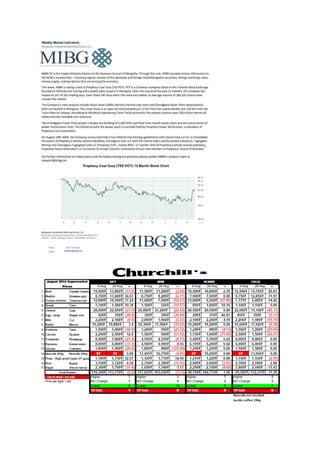
 Supermarket Prices from Churchill’s
 Inflation;
 Central bank Policy Rate;
 Currency Rates.
*Click on titles above to link to articles.
SPONSORS
Khan Bank International SOS
Wagner Asia Automotive Invest Mongolia Agency
BCM MEETING RECAP
The BCM meeting on 25 August was held in the Crystal conference room in Blue Sky Tower and
Hotel with Bayanjargal Byambasaikhan in the chair. In attendance were 154 members and invited
guests.
Byambasaikhan welcomed members back after the July break for the Naadam holiday. BCM
currently has 256 members. The six newest members are:
1. Air Trans was established in 1997 as Mongolia’s first International Airline ticket agency.
The ticket seller has always been the leader in this industry being the foremost company with
permission to issue tickets from the IATA (International Air Transport Association) and with its
introduction of the GALILEO airline ticket booking system. Air Trans is the official agent for ticket
sales out of Ulaanbaatar for MIAT Mongolian Airlines, Air China, Aeroflot, Korean Air as well as the
following airlines: United Airlines, Nippon Airways, Singapore Airlines, Lufthansa, Thai Airways, and
Air Astana.
2. Clyde & Co is a global law firm with a pioneering heritage and a resolute focus on its core sectors
of aviation, energy, infrastructure, insurance, marine, and trade.
With over 1,400 lawyers operating from 37 offices and associated offices in six continents, the firm
advises corporates, financial institutions, private individuals, and governments.
The firm has a reputation for its work in emerging markets, being the largest international firm in
the Middle East and with a rapidly expanding network across Asia, Latin America and Africa.
3. Frontier Securities is the first local Mongolian securities firm with a global network and
international expertise. Since its establishment, Frontier’s primary area of focus has been the
cross-border investment banking and advisory business.
Frontier’s team in Ulaanbaatar supports Mongolian companies in their fundraising efforts and strives
to open the doors of Mongolia to foreign investors.
4. GGGI is a new kind of international organization — an interdisciplinary, multi-stakeholder entity
driven by the needs of emerging and developing countries. It has been established by several
forward-thinking governments to maximize the opportunity for bottom-up progress on climate
change and other environmental challenges within core economic policy and business strategies.
5. Professional Accounting and Tax Consulting (PATC) LLC is a new accounting and tax consulting
firm providing a wide range of outsourcing services. PATC has three excellent junior accountants
and four accounting experts to guide companies. Team members are certified with CPA, CPTA, and
MBA credentials, and two have auditor’s rights.
6. SkyPath Partners LLC is a financing advisory, strategic consulting and principal investing firm.
Headquartered in Mongolia, the firm is focused on bringing international capital, services and
capabilities to Mongolian companies and investing in the growth of the country’s economy.
SkyPath is filling an unmet need for a trusted and capable advisor to help Mongolian firms,
government and international companies navigate complex financial and strategic issues by
providing the bridge to world-class expertise and capital from international sources.
The first speaker of the evening was Masa Igata, founder and chief executive officer of Frontier
Securities, to discuss the upcoming 8th
annual Invest Mongolia Conference. The conference will see
the gathering of delegates representing business and government to discuss topics concerning the
economy, Mongolia's largest business endeavors, auditing and corporate governance. And while the
mining sector, which usually takes up the most talk during conferences, will be be given some
focus, time will also be given for discussion on agriculture, healthcare, and tourism. But most
importantly, said Igata, guests and delegates will be given the opportunity to debate ways to steer
Mongolia toward the right direction for political stability and economic recovery.
"We don't see any signs of a FDI pickup. Something is wrong and something needs to be done," he
said.
Looking forward, Igata also told his audience that the Investment Mongolia Agriculture Conference
was slated for 5 to 7 November, which may see a special visit by Hollywood martial arts stuntman
and actor Jackie Chan, as well as the Invest Mongolia Tokyo conference in December.
Next up to speak was D. Enkhbold, executive director of the Mongolian National Mining Association,
to discuss another upcoming conference, the 12 annual Discover Mongolia international investment
conference. This year organizers are hoping the conference can help steer foreign investment back
to Mongolia after two years of declines in foreign investment.
"When we started Discover Mongolia in 2003 it was to attract foreign investment. Our motto this
year is 'Welcome Back.'"
The conference will again feature appearances by important government officials, including
representatives of local governments.
Matthew Pottle, country managing partner for PricewaterhouseCoopers PwC) Mongolia, presented
the results of its "PwC CEO Survey: 2014 Global Outlook." The survey allowed PwC to gauge the
attitudes of chief executives across 68 countries for the 17th consecutive year. What they found
was chief executives around the world are having to deal with a dramatic shift in how business is
conducted and how to manage staff.
"What we see clearly is that global CEOs are more optimistic but looking at the new world order.
The way they do business may be changing," he said.
Technology was paramount to chief executives for introducing greater efficiency, said Pottle, as
well as finding new ways to reach consumers.
Retaining the young workforce is also a concern, he said. Management must now, more than ever
before, recognize that young people are looking at their career paths as a journey with multiple
stops and detours.
"CEOs haven't yet figured out how to harness young talent, which they know is more ambitious and
less loyal, with shorter expectations of when work becomes interesting and should have paybacks,"
said Pottle.
Pottle also took a look back at PwC's Mongolia-focused survey that was released earlier this year.
They found then that chief executives had grown increasingly frustrated with government
interference into business and were greatly anticipating a resolution to conflicts between the
government and Rio Tinto PLC over their tremendous joint venture, the $6.5 billion Oyu Tolgoi
copper mine.
Next was a discussion of MCS Energy's venture into coal-to-liquid (CTL) fuel production by the
company chief executive, T. Munkhtur. The project of focus was Baganuur Energy Corp., a 50-50
venture with South Korea's POSCO. The planned facility would be able to produce 450,000 tons of
diesel fuel - half of Mongolia's demand - as well as enough gas fuel to meet the demand of half of
Ulaanbaatar's ger districts.
"We have to admit, without strategic foreign partners, it will be impossible to do these projects,"
said Munkhtur.
The gas produced could be used to fuel a new type of portable stove that could be used to heat
gers. Burning this non-conventional gas would help combat Ulaanbaatar's dire air pollution in winter
as well as lessen the burden on household budgets. He said a winter's supply of gas would cost USD
535 a year compared with USD 700 a year for coal.
The evening's presentations concluded with a final speech delivered by Cameron McRae, president
of the Institute for National Strategy. The idea to create an organization to look at long-term issues
and identify possible negative impacts to the economy came out of a 2013 conference, said McRae.
He said they came to the conclusion then that an organization was needed to help help steer public
policy to help alleviate economic concerns at the time. Now, a year later, the institute is facing an
economy in an even worse economic state.
"We believe there needs to be political parties focused on public policy rather than what people
wear or what freebees they can deliver," said McRae.
The institute plans to achieve this by releasing a series of articles over the next six months. The
first, which is to be published in September, will outline exactly what the institute exists for and
seeks to achieve and how it can go about reaching its goals. A follow up to that article will look at
how Mongolia can regain its credibility with investors and foreign partners. Subsequent articles will
focus on topics such as instilling economic stability, ideal cooperation between government and
business, and the importance of rule of law.
BUSINESS
CHINA SET TO LEND $162 MN TO DEVELOPMENT BANK
The China Development Bank (CDB) is set to sign a USD 162 million contract agreement with the
Development Bank of Mongolia.
Negotiations for the contract occurred when Deputy Prime Minister and the Mongolian
representative to the China-Mongolia's intergovernmental commission D. Terbishdagva met with
CDB President and Vice Chair Zhijie Zeng.
“This is a start of our cooperation, and it will become closer and will finance more projects and
programs,” Mr. Zhijie said.
CDB is China's largest bank with an asset value of USD 350 billion and cooperates with 115 nations.
Source: Montsame
COURT RETURNS TAX CASE AGAINST SOUTHGOBI DUE TO INSUFFICIENT EVIDENCE
A panel of judges returned the Prosecutor's General's case against SouthGobi Sands LLC on 25
August for further investigation due to insufficient evidence presented. The panel of three
appointed judges found insufficient evidence in the tax investigation, which was launched in May
2012 against the SouthGobi Resources Ltd. Mongolian subsidiary and three of its former employees.
Source: SouthGobi Resources Ltd.
ERDENE INTERSECTS LARGEST GOLD INTERVAL AT ALTAN NAR
Erdene Resource Development Corp. reported its highest-ever grade of gold to date at the Altan
Nar gold base metal project in an update on trenching operations.
Erdene at the Altan Nar during second quarter drilling at the Discovery Zone uncovered 17.7 grams
per ton of gold over five meters, within 19 meters of 5.8 grams per ton gold; and 37 grams per ton
silver and 2.6 percent combined lead and zinc within 60 meters of surface. Second quarter drilling
at Union North, 1.3 kilometers northwest of Discovery Zone, returned 22 meters of 2.1 grams per
ton of gold and below that 12 meters of 4 grams per ton gold; 10 grams per ton of silver; and 2.5
percent combined lead and zinc within 35 meters of surface. Twenty individual targets, all
exhibiting gold and base metal mineralization at surface, have been established and prioritized by
Erdene for additional evaluation. Another trenching program is scheduled to commence in
September to better assess potential of new targets and increase confidence in areas planned for
resource definition drilling
Exploration at the Khuvyn Khar copper porphyry project saw geochemical rock chip sampling, vein
density mapping, and geophysical modeling completed during the second quarter result in the
identification of new targets. A trenching program, testing both the western targets as well as the
main Khuvyn Khar copper prospect, commenced on 18 August as part of Erdene's alliance with Teck
Resource Ltd.
Source: Erdene Resource Development Corp.
XANADU ANNOUNCES DRILL RESULTS FROM KHARMAGTAI
Xanadu Mines Ltd. on 25 August announced drilling results at three drill holes at its Kharmagtai
project.
Results for drill hole KHDDH347, which was drilled to a final depth of 704.7 meters, showed
intersected gold-rich porphyry mineralization associated with well-developed quartz-chalcopyrite-
bornite stockwork veining hosted in epidote-magnetite altered quartz monzodiorite porphyry.
KHDDH350 intersected visible copper sulphides from a depth of 30 meters to 575 meters. The
copper sulphide mineralization predominantly comprises tourmaline breccia-hosted mineralization
hosted in strongly tourmaline-magnetite altered quartz monzodiorite porphyry. KHDDH351
intersected visible copper sulphides from a depth of 208m to 310m (end of hole 488.8m, assays
pending). The copper mineralization is primarily hosted in tourmaline breccias and minor
dissemination in strongly potassic altered quartz monzodiorite porphyry.
Two new drill holes have been collared to continue defining the broad zones of high-grade, copper-
gold mineralization (greater than 1 percent CuEq) hosted at East Altan Tolgoi. The continuous strike
length of the entire Altan Tolgoi system has been demonstrated to be over 800 meters. The
prospect remains open to the west, east and at depth.
Source: Xanadu Mines Ltd.
VOYAGER CUTS SPENDING ON MONGOLIAN ASSETS
Voyager Resources Ltd. announced on 27 August that it will no longer focus funding on Mongolian
assets in favor of assets its Brazil due to the poor investment climate.
“Whilst the Company maintains that its Mongolian assets are of high quality and warrant further
investment, it is obvious that further funds for investment in Mongolia will not be made available in
the short term,” reads the Source
Voyager will instead focus on its Brazil copper portfolio for the Carajas Province. Voyager shares
will remain suspended until a further announcement is made.
Source: Voyager Resources Ltd.
VIKING MINES INVESTORS SNAP UP SHARES IN CAPITAL RAISE
Viking Mines on 25 August received a strong show of support from investors with applications for its
offer of shares and options having exceeded its minimum level of USD 2.09 million. Interest is
expected to swell further before it closes on Friday, 29 August 2014.
Proceeds from the offer will complete the Auminco takeover, fund exploration and development of
its gold and coal assets as well as for general working capital. The company is looking to raise up to
USD 3.04 million by the issue of up to 80 million shares priced at USD 0.038 each with one free
attaching option for every four shares subscribed. These are exercisable at USD 0.09 at any time on
or before 30 April 2017. Auminco, an unlisted public coal development company that holds the
Berkh Uul bituminous coal project in northern Mongolia, is currently the subject of a takeover offer
by Viking. To date, more than 97 percent of Auminco’s shareholder base has accepted the offer.
Auminco's other holdings are the Khonkhor Zag anthracitic coal project in the trans-Altai coal basin
in Gobi-Altai Aimag; the Buduun project in Khovd Aimag; the Dalt and Budargana coal projects in
Dundgobi Aimag; and the Tsairt Zinc joint venture project in Sukhbaatar Aimag.
Source: Proactive Investors
ASPIRE CLOSER TO DEVELOPING OVOOT WITH CHINA-MONGOLIA TIES
Aspire Mining Ltd. is a step closer towards developing its Ovoot coking coal project in Mongolia
after Chinese President Xi Jinping’s official visit to Ulaanbaatar last week upgraded ties between
the two countries to a comprehensive strategic partnership.
For Ovoot, the agreements reached between the two countries will provide more efficient
transport across border points on the Mongolian-Chinese border; the ability to negotiate rail access
to a number of Chinese North-Eastern seaports; and potential access to Chinese financing set aside
specifically for mineral resource and infrastructure development in Mongolia.
“This state visit by the Chinese President is an important milestone in Sino-Mongolian relations and
should lead to the significant increase in trade sought through to 2020,” managing director David
Paull said. “Coal exports will be a leading contributor to this increase in trade.
The agreements add to the progress that Aspire has achieved for the wholly-owned Ovoot project in
northwestern Mongolia as well as the key Northern Line Rail Line (NRL). Current off-take interest in
Ovoot coking coal exceeds targeted production with memoranda of understanding signed for up to
7.4 million tons per annum, or 148 percent of planned initial production. The project—along with
the Tavan Tolgoi coal operation—has also been recognized as one of the key potential coal suppliers
to Mongolia’s Sainshand Industrial Park. It has also signed a non-binding memorandum to sell up to
250,000 tons of oxidized coal a year to Zavkhan Power Station about 70 kilometers south of Ovoot.
The agreements between China and Mongolia will benefit Aspire Mining by providing boosting trade,
particularly of coal exports. More specifically, it will provide the Ovoot coking coal project more
efficient transport across border points; allow negotiations for rail access to a number of Chinese
North-Eastern seaports; and potentially access Chinese financing. Access to seaports will also assist
in attracting investment.
Source: Proactive Investors
TAIWAN PLANS TO HELP MONGOLIA IN CAPITAL MARKETS
Taiwan plans to help Mongolia set up trading on an emerging stock board and a deposit insurance
system, Financial Supervisory Commission (FSC) Chairman Tseng Ming-chung said Wednesday.
Tseng plans to visit Mongolia Thursday, a reciprocal visit following that country's financial
supervisory officials' trip to Taiwan in July. The FSC may sign a supervisory memorandum of
understanding with its Mongolian counterpart during the trip for the trading on an emerging stock
board, a market with less strict regulations than the over the counter (OTC) market, according to
Tseng. The Mongolian authority has also shown interests in deposit insurance, he added.
Tseng said helping Mongolia improve its capital markets could showcase the international
credentials of Taiwan's capital market.
Source: Focus Taiwan
MONGOLIA-CHINA BORDER CHECKPOINT ADOPTS NEW TECHNOLOGY
The Mongolian company Saikhan Ordos Tuuri (SOT) LLC has installed new equipment at Mongolia's
main export gateway to China.
SOT installed belt transporter and detector at the Gashuun Sukhait-Gants Mod border checkpoint to
cut down on dust given off by coal on transport. The large clouds of dust were putting a heavy toll
on the surrounding environment and the health of residents.
Mongolia was tasked with removing bottlenecks when it set the goal of doubling the volume of
export in 2014 from the year before. With the border point already overloaded, Gashuun Sukhait
saw 60 percent of the 18 million tons of coal and 65,000 tons of copper concentrate exported last
year pass through.
Source: Montsame
POH GROUP TO LIST MONGOLIAN SUBSIDIARY
Singaporean investment company Poh Group has announced it will list one of its Mongolian
subsidiaries, Tian Poh Resources, on the Australian Securities Exchange (ASX) to raise up to AUD 6
million (USD 6.97 million).
Poh on 26 August said it is offering between 10 million and 30 million shares at AUD 0.20 each. Net
proceeds from the initial public offering will be used to fund the development and exploration
activities of Tian Poh's exploration assets in Mongolia. Tian Poh holds 10 concessions spanning
125,000 hectares in Mongolia. Among its assets is the Huabei Kuangye coking coal deposit, which
already has a 30-year mining license.
Poh Kay Ping, chief executive of Tian Poh and Poh Group, said in the statement that "our strategy is
to generate early cash flow through bringing Huabei Kuangye to production, so as to fund the
advancement of our other coal, gold and copper assets. We believe the timing for new shareholders
is favorable given Mongolia's shift towards attracting and maintaining foreign investment and its
pro-mining initiatives."
Source: Channel News Asia
PRIME MINISTER ATTENDS AEROCRETE FACTORY LAUNCH
Prime Minister Norov Altankhuyag delivered a speech for the opening ceremony of a lightweight
concrete factory owned by Dorniin Tsas LLC.
Dorniin Tsas’s new concrete factory, which began construction in 2013, has the capacity to produce
200,000 cubic meters of the lightweight aerocrete a year. Mongolia imports around 2,000 to 3,000
wagons of concrete from overseas a year. Dorniin can contribute to the some 600 cubic meters of
concrete necessary each year to develop Mongolia's infrastructure
“We have to congratulate Dorniin Tsas LLC for commencing a factory that is able to produce 30
percent of the concrete demanded in the Mongolian market,” said Altankhuyag.
Source: Mongol News
LEATHER GARMENT MANUFACTURER RECEIVES MNT 3BN FINANCING
The Ministry of Industry and Agriculture has lent MNT 3 billion to leather garment producer Darkhan
Nekhii as part of its cross-sector initiative to help finance industry start-ups and assist growth in
existing operations.
Darkhan Nekhii, which recently underwent a full technical overhaul, will use the funds to build up
production capacity. The leather manufacturer is already one of the country’s leading producers of
leather garments and exports goods to Italy, Spain, the Netherlands and Russia. China is Darkhan
Nekhii's next target destination for export.
Darkhan Nekhii was selected from the 888 government-approved projects to help launch industrial
growth in Mongolia for exports and to replace imports. The government has lent funds to
commercial banks to then in turn lend to businesses. About MNT 5 billion will finance milk and dairy
production, MNT 15 billion for wool manufacturing, and MNT 10 billion for the production of knit
products. The Development Bank of Mongolia approved lending of MNT 42.5 billion for 14 projects.
Source: Mongolian Economy
MONGOLIA STARTS MANUFACTURING LED LIGHTS
TD LED LLC has launched the manufacturing of energy-efficient LED lights.
The company imports the main parts for assembling the lights, such as chips and transformers, from
the United States, Germany, Taiwan and Singapore. The light products, which range from street to
office lighting, are assembled at TD LED's factory at Govil Baga of Erdenet, Orkhon Aimag. The
factory currently employs six workers.
An official opening ceremony for the factory will be held on 11 September.
Source: Montsame
EXIM BANK OF CHINA FINANCES BUYANT-UKHAA II IN ULAANBAATAR
State Housing Corporation of Mongolia and the Export and Import Bank of China signed a deal to
finance housing projects in rural areas during the President of China Xi Jinping’s visit to Mongolia
last week.
The Chinese bank granted USD 150 million with annual interest of 2 percent for 15 years. In
addition to this, the corporation will also receive a loan worth USD 120 million to finance Buyant-
Ukhaa II or 4,323 apartments in Ulaanbaatar. This forms part of the Government’s plan to build
1,000 housing projects in every province from Dornod, Sukhbaatar, Umnugobi, Khuvsgul, Gobi-Altai,
Zavkhan to Ulaanbaatar. This November, 1,000 houses are expected for commission from Buyant-
Ukhaa II—a 48-building project near Ulaanbaatar’s sport complex.
According to the State Housing Corporation, Buyant-Ukhaa I was commissioned and its first
residents have moved in. Out of the total 1,764 apartments, 1,534 have been sold, while 228 signed
contracts will be allocated to employees of the government’s Cabinet Office to reach government
quota. There are 62 residents, who have not yet chosen their apartment. All residents are expected
to move in this November, however. Currently, 168 apartments will be sold to those selected who
currently have funds available.
“This housing project is projected to generate MNT 84 billion. At the moment, we have earned MNT
25.2 billion. There are 400 families who are waiting for their bank loans,” said N. Gantulga, the
director of the corporation.
The State Housing Corporation also implemented similar projects in rural areas. Further, the
corporation has started the 1000 Housing Project in Arkhangai province last month. In Uvs Aimag,
implementation is almost half way through with commissioning of the apartments expected to take
place in November, 2014. In this province, 228 houses are complete. In Darkhan-Uul province, 180
residences for public housing and 60 private residences for private housing in Bor-Undur, Khentii
will be completed by the end of this year. As for Orkhon, Khovd and Khuvsgul provinces a
construction tender was announced. The 1000 Housing Project construction tender will be released
next year in Bulgan, Tuv, Sukhbaatar, Gobi-Altai Aimags.
Source: Mongolian Economy
GOVERNMENT TO FINANCE POTATO FACTORY IN TUV
Government is providing MNT 150 million in financing for development and construction of a potato
starch and chip factory to be built in Jargalant Soum, Tuv Aimag.
The factory is scheduled to open next fall and will source potatoes from Jargalant, Sumber,
Bornuur and Ugtaaltsaidam Soums of Tuv. The factory will process small-sized potatoes to
marginalize losses with the expected fall in potato prices due to growing supply. The factory will
produce 2,000 tons of starch a year, or about half as much as Mongolia exports.
Source: Unuudur
PILOT PROJECT FOR RICE PRODUCTION TO LAUNCH IN TUV
The Tuv Aimag government has partnered with sumo wrestler M. "Khakhuho" Davaajargal for a joint
venture in rice production.
Two people from Ugtaal-Tsaidam Soum who were sent on a six months training in Japan will return
to Mongolia this year for the project. Project developers have planned a pilot run for rice
production in greenhouses spanning 0.5 hectares at Ugtaaltsaidam and Jargalant Soums, said L.
Davaasuren, the head of Industry and Agricultural Department for Tuv. The pilot run project will
test how well crops can stand up against Mongolia's harsh winter climate, he said.
Source: Unuudur
ARD FINANCIAL APPOINTS NEW CHAIR AND CHIEF EXECUTIVE OFFICER
Ard Financial Group's board of directors on 15 August elected Janchiv Oyungerel as its chairwoman
and Chuluun-Hutagt Gankhuyag as its chief executive officer.
Oyungerel was the founder of Petrovis Group. She started her career as a petroleum economist at
the central oil supply depot for the Oil Supply Management Authority, and in 1982 started working
as a chief economist in the Oil Supply Management Authority. Between 1990 and 1996, she worked
as general director of the state-owned Neft Import Concern (NIC), and in 1997 became chief
executive officer and chair of Petrovis LLC.
“We are embarking on a challenging mission to grow this group into a comprehensive financial
services company with leadership positions in all areas we are engaged in. Ard will have a profound
positive impact on the development of the Mongolian financial services industry. And I am confident
that the joint efforts of all shareholders, Board, and the management will be rewarded with
success,” said Oyungerel.
Gankhuyag is the founding chief executive officer of XacBank and TenGer Financial Group. He
served as vice minister of finance from 2010 to 2012, and in 2012 became executive chair of Equity
Investment Trust, the predecessor to ARD.
“I always believed that people should take an ownership stake in the wealth they are creating. Ard
stands for people in Mongolian,” said Gankhuyag.
Source: Ard Financial Group
12TH ANNUAL DISCOVER MONGOLIA CONFERENCE SET FOR 4-5 SEPTEMBER
The 12th Discover Mongolia international mining investors’ forum will be held in Ulaanbaatar on 4
and 5 September.
The conference venue will again be the Children’s Palace—the location of the conference for the
past 11 years. The forum shall comprise of a mining conference consisting of two days of intensive
minerals and mining discourse and a two-day investors exchange exhibition. Additional events
include technical sessions, presentations on new investment opportunities, and mine site visits.
Source: Montsame
MATRADE EYES $10 MN IN BUSINESS DEALS AT MONGOLIAN TRADE FAIR
Malaysia External Trade Development Corp (Matrade) is eyeing USD 10 million of business deals at
its participation at the trade fair in Mongolia.
Its director for the business services and building materials section, Ong Yew Chee, said Matrade
would coordinate the participation of ten Malaysian firms at the Ulaanbaatar Partnership
International Trade Fair 2014 from 11 to 15 September. "The companies are from the food and
beverages, creative, logistics and professional services sectors. We are still waiting for confirmation
from a private university to be one of the participants as the educational sector there has a lot of
potentials," he said at a media briefing here Tuesday.
Ong said Mongolia, an important emerging market and one of the Asia's fastest-growing countries,
should be further tapped by Malaysian firms in their quest for global growth and expansion plans.
Among Mongolia's potential sectors are infrastructure development, tourism, hotels and hospitality,
healthcare, prepared food, energy as well as mining," he said.
Ong said Malaysian exports to Mongolia had been growing at an annual average rate of about 30 per
cent since 2009. Malaysia's trade with Mongolia in the first half of this year rose by 62 percent to
MYR 65.4 million (USD 20.7 million) and exports increased by 60.8 per cent to MYR64 million (USD
20.3 million) compared with the same period last year. Malaysia's imports from the country for the
first half were MYR1.4 million.
Mongolian National Chamber of Commerce and Industry representative Dasmzeveg Sukhbatar said,
in line with economic growth and the increase in purchasing power, Mongolians were now more
receptive to high-quality products and services.
Source: Bernama
TRADE FAIR INAUGURATES CHINA-MONGOLIA CUSTOMS ARRANGEMENT
The China-Mongolia-Russia Economic and Trade Cooperation Fair opened on 20 August with the
inauguration of a center to process a cost-saving customs document in Erenhot, a city on the China-
Mongolia border.
The center handled ATA Carnets, an international customs document which allows duty-free
temporary export and import of goods for up to a year. Its establishment will help boost border
trade, economic development and cultural exchanges, said Lu Ming, deputy head of the law
department of the China Council for the Promotion of International Trade.
"With the service center, we will never have to make customs declaration for our costumes and
stage properties when going abroad for performances," said Qiqige, a student with the art school of
Inner Mongolia University who performed in Mongolia in July.
More than 400 exhibitors from China, Mongolia, Russia, the United States, Myanmar, Thailand,
Vietnam and the Republic of Korea attended the fair. It featured exhibits ranging from clothes and
accessories to heavy machinery and tourism services. Discussion was also held on regional
cooperation, including the Silk Road Economic Belt, which is the proposed network of trade
infrastructure which covers the three countries.
Source: People's Daily Online
KHAN BANK NAMED THE ‘BEST BANK IN MONGOLIA’ BY EUROMONEY
Khan Bank LLC was named “Best Bank in Mongolia” at the 2014 Euromoney Awards for Excellence in
Hong Kong.
Khan reportedly received the award for a solid and strong financial performance, continued efforts
in implementing large-scale projects, efforts to introduce innovative banking products and services
such as the bancassurance, smart phone banking. The award is granted to banks commitment to
transparency, openness and fairness.
Each year Euromoney selects the best performing banks in the categories of the “Best Global
Bank,” “Best Regional Bank” and “Country Awards for Excellence,” based on the careful analysis of
each bank’s financial strength, scope of operations, acquired market share and sustainability.
Source: Khan Bank LLC
SPONSORS
Oxford Business Group Mongolian Economy Magazine
ECONOMY
MONGOL BANK: FX AUCTION, SWAP AGREEMENTS, 1-WEEK BILLS, TREASURY NOTES
The Bank of Mongolia on 28 August rejected bid offers and ask offers for U.S. dollar auctions. The
central bank did, however, accept a swap agreement bid offer for the equivalent of USD 24 million
from local commercial banks.
The central bank reported on 27 August the issue of one-week bills worth MNT 87.2 billion at a
weighted interest of 12 percent a year.
The central bank reported on 28 August MNT 27.02 billion in bids for the auction for 28-week
treasury notes with a face value of MNT 27.02 billion. The bills were sold at a discounted price with
an average yield of 15.352 percent. On 27 August the central bank reported the canceled sale of
five-year treasury notes due to the absence of both competitive and non-competitive bids.
Source: Bank of Mongolia
CHINA, MONGOLIA EYE $10 BN TRADE BY 2020
China and Mongolia agreed on 21 August to work toward lifting bilateral trade to USD 10 billion by
2020.
Two-way trade between China and Mongolia stood at 324 million U.S. dollars in 2002, but the yearly
volume rocketed to nearly 6 billion dollars in 2013, accounting for more than half of Mongolia's
total foreign trade.
China has been Mongolia's largest trading partner and largest source of foreign investment over the
past 10-plus years.
Source: People's Daily Online
CHINA STATE VISIT TO MONGOLIA SEES RAFT OF RAIL, RESOURCE DEALS
China and Mongolia have signed 26 new deals on railroads, mining and power generation during
Chinese President Xi Jinping's state visit that began last Thursday, Mongolia's Ministry of Foreign
Affairs said.
Xi's visit, the first by a Chinese head of state since Hu Jintao in 2003, could give rise to more than
30 deals, said Mongolian President Tsakhia Elbegdorj on Thursday evening during a joint press
conference. The foreign affairs ministry and the Mongolian president's press secretary both said
there was at present no available figure for the value of the deals.
"Assuming these projects move forward, these accords represent the most significant economic
development since the Oyu Tolgoi agreement was signed [in 2009]," said Nick Cousyn, chief
operating officer at Ulaanbaatar-based brokerage BDSec.
Four agreements were signed on Thursday for the development of Mongolia's rail network, with two
still pending. Poor rail infrastructure has prevented Mongolia from capitalizing fully on China's need
for raw minerals, while at the same time its lack of access to sea ports makes it overly dependent
on the Chinese market. Mongolia is keen to use China's rail network to deliver coal and other
minerals to other Asia markets, and one of the deals will involve trans-shipment of resources to
Chinese ports. Elbegdorj said he and Xi had also discussed the use of the Trans-Mongolian railway as
a land route for trade between Asia and Europe. The goal was to see the transport of 100 million
tons of cargo by rail to Europe by 2020, he said
Additionally, Mongolia has been trying to tap its own resources to kick its dependence on Russian oil
imports, and one of the 26 agreements was a memorandum of understanding with China National
Petroleum Corporation (CNPC). Last year in October, Sinopec Corp signed a memorandum of
understanding with the Mongolia's Ministry of Mining, which looks forward to a deal with state-
owned miner Erdenes Tavan Tolgoi LLC for a coal-to-liquid fuel plant.
Source: Reuters
CHINA GRANTS CNY 1.3 BN (USD 212 MN) TO MONGOLIA'S MINING SECTOR
China gave a grant of CNY 1.3 billion (USD 211.6 million) for the development of Mongolia's mining
sector during the visit of Chinese President Xi Jinping, said mining officials during a regular press
conference. Xi also signed an agreement for a USD 1 billion purchase agreement loan.
Source: Business-Mongolia.com
SWAP LINE EXPANSION WITH CHINA IS CREDIT POSITIVE, SAYS MOODY'S
The Bank of Mongolia and the People’s Bank of China (PBOC) on 21 August increased their currency
swap agreement to CNY15 billion (USD 2.4 billion) from CNY 10 billion (USD 1.6 billion), effective
for three years. The extension of the bilateral facility is credit positive for Mongolia (B2 negative)
because it will help address the country’s rapidly dwindling foreign reserves, stem downside
pressure on the tugrik currency and bolster a weak external payments position.
The agreement falls short of the Bank of Mongolia's goal of doubling the swap line to CNY 20 billion.
However, the extension—the second since the BOM and PBOC set up their original RMB5 billion swap
line in 2011—signifies the economic and geopolitical importance that China (Aa3 stable) places on
improving its relationship with Mongolia. China has become Mongolia’s largest market, taking
almost 90 percent of the country’s exports.
Strengthening ties with China comes amid deteriorating relations between Mongolia and large
western investors in the mining industry, which account for 20 percent of GDP. Mongolia’s gross
foreign exchange reserves fell to a low of USD 1.3 billion in June 2014, from USD 2.2 billion at the
start of the year and USD 4.1 billion at the start of 2013. Meanwhile, foreign direct investment has
plunged and expansionary policies have fueled demand for imports, while the exchange rate has
plunged 33 percent against the U.S. dollar since the end of 2012. Reserves would be even lower
were it not for the BOM drawing down its swap line with the PBOC.
The larger currency swap agreement and improved prospects for China’s investment in Mongolia
should also help bolster Mongolia’s external payments position. The Source's external vulnerability
indicator (EVI), which measures external debt maturing within a year against foreign-exchange
reserves, climbed beyond a financially prudent 100 percent level to 130 percent in 2014, and was
forecasted to reach 196 percent in 2015. In 2012, the EVI was just 42 percent.
Source: Moody's Investors Service
TENDER AUCTIONS FOR 106 LICENSES TO LAUNCH SOON, SAYS MRA OFFICIAL
Open tendering for last year's 106 revoked mining licenses is set to begin soon, said a Mining
Ministry official.
Tenders will be announced publicly through media, said Chief of the Policy Implementation
Regulatory Agency at the Ministry of Mining B. Batkhuu. He said 14 companies had their initial re-
tendering prices determined and open tendering was ready to begin. Companies will have 30 days
to submit offers with a starting price of 30 percent of the initial tendering price. Batkhuu said some
preferential rights would be granted to the companies who originally lost their licenses, however.
“The former license holders don’t have to place any collateral in an account,” said Batkhuu.
“However, other third parties have to place 30 percent of the initial tendering price and compete.
An evaluation commission will evaluate all the proposals and grant licenses to the selected
bidders.”
Last year, a judge ordered the cancellation of 106 mineral exploration licenses granted by former
chairman of the Mineral Resource Authority D. Batkhuyag, who was found guilty of corruption.
Companies claim to have lost millions because of the decision. Last July Parliament passed a
resolution for a new tender auction for the licenses.
Source: UB Post
UGH-GASHUUNK SUKHAIT RAIL LINE ON HOLD AS FINANCING PETERS OUT
Construction of the Ukhaa Khudag-Gashuun Sukhait railway line for the government's “New
Railway” project has been put on suspension due to a lack of financing, said a rail workers'
representative.
“According to the last report 76 percent of soil work or fundamental work had been completed,”
said S. Battsengel, secretary of the Mongolian Railway Contractors Association. “However, financing
stopped on 26 June. The 26th was the day we were to receive financing.” Battsengel added that
market conditions concerning railway fuel made material suppliers reluctant to make a deal with
Mongolia or for banks to lend.
Lead contractor Samsung C&T Corp. has hired 12 companies to build the rail line while two
companies determine the technical aspects, he said.
Source: Undesnii Shuudan
CHINA EXTENDS PORT OPERATION TIME FOR MONGOLIA
China’s General Administration of Customs said that a seasonal port used by China and Mongolia will
remain open for a full year in order to handle the increasing commerce between the two countries.
The Ebuduge port mainly handles crude oil between the two countries for just two months a year.
Wednesday’s announcement extends the port’s operation time to 12 months. Customs data shows
the bilateral trade volume at the Ebuduge port was about 500 tons in 2013 and this year reached
56,000 tons by the end of July.
Source: CNTV
CHINA, MONGOLIA WORK TO EASE AIR TRAFFIC CONGESTION
Civil aviation authorities from China and Mongolia are scheduled to apply the same air traffic
control separation standards from 18 September.
The move will ease air traffic congestion between Europe and East Asia, the Civil Aviation
Administration of China (CAAC) said Sunday in a statement. Starting on 18 September, air traffic
control separation standards in Mongolia and northern China will reduce from the current 90
kilometers to 30 kilometers, and the two country's civil aviation authorities will sign a new air
control agreement, the CAAC said. According to the CAAC, new separation standards will result in
more flights over the Chinese and Mongolian airspace.
Air traffic between Europe and China, Southeast Asia, Japan and the Republic of Korea are
expected to become less congested.
Source: People's Daily Online
INSPECTION AGENCY REVISES CUSTOMS PROCEDURES
The General Agency for Specialized Inspection (GASI) has introduced new regulations to make
customs clearance quicker and more efficient.
GASI head D. Batmunkh on 22 August rolled out new inspection and control protocols so that
customs and GASI will receive separate forms, depending on the goods category, rather than one
general form. Customs controls have set clear guidance on how certain categories of items will be
handled, reducing redundancies in customs clearance, as well as a more standardized clearing
process. That means customs authorities will no longer be able to ask for additional, unspecified
forms. Additionally, goods with the proper paperwork that regularly pass through customs will only
be subject to laboratory analysis once every three months rather than each time it passes through
customs.
Source: Udriin Sonin
ALTANBULAG-ZAMYN UUD HIGHWAY PLANS MOVE FORWARD
Mongolia and China announced the September launch of the “Steppe Road” project for the
construction of a road between Altanbulag and Zamyn Uud during the state visit of Chinese
President Xi Jinping last week.
The Sukhbaatar Batbold government that was voted out in 2012 had selected the Chinggis Land
Development Group and New Development Road consortium to lead the construction of the 1,000
kilometer highway over two to three years. Chinggis Land will retain ownership of the highway from
2015 to 2040, when ownership with transfer to the state.
The project was for the wider regional Asian Highway Network project, which Mongolia agreed to in
2004 by signing the Intergovernmental Agreement on the Asian Highway Network with members of
the U.N. Economic and Social Commission for Asia. The Asian Highway Network, or the Great Asian
Highway, is a planned 141,000-kilometer network of roads running across 32 countries.
Source: News.mn
JICA GRANTS AID FOR UNIVERSITY HOSPITAL
The Japan International Cooperation Agency (JICA) will provide grants to fund Mongolia's first
university hospital for the National University of Medical Sciences in Bayanzurkh District.
The facility will be used for the training of health care professional to improve skills in Mongolia
and provide modern technology diagnostics and treatment equipment. Construction will launch in
2015 and the hospital is scheduled to commission in 2017.
Source: News.mn
MINERS SEEK RESET IN MONGOLIA
Chinese president Xi Jinping’s visit to Mongolia last week was a timely reminder of why foreign
investors have poured money into the country over the past five years.
While the two neighbors share a difficult history, relations appear to be warming, and the
geography is hard to ignore. Resource-rich Mongolia, which is sitting on top of huge reserves of
copper, gold and coal is right next door to the world’s biggest market for minerals. That
combination prompted Rio Tinto PLC to sink billions of dollars into the Oyu Tolgoi gold and copper
mine and attracted dozens more resources companies, including a handful of Australia-listed
explorers, to try their luck in the mining frontier.
But Mongolia has had a tough few years. Many of the investors, who flocked to the country in the
euphoria which followed the 2009 signing of Rio’s investment agreement with the government,
have lost faith. Relations between the Mongolian government and Rio have been strained, putting
the USD 6 billion second-stage underground project at Oyu Tolgoi under a cloud. And some
companies are reluctant to base staff in the country, fearing they will become targets for
regulators, which appear hostile to foreign operators.
“The business environment has been pretty stagnant,” says Minter Ellison partner Elisabeth Ellis,
who is based in Ulaanbaatar. “While we’ve actually had a busy six months, it’s been advising on
redundancies, potential enforcement, insolvency and, unfortunately, helping a few companies
leave the country.”
While many of the Australia-listed exploration companies focused on Mongolia have struggled in line
with the country’s deteriorating economic outlook and complex regulatory issues, there are some
positive stories emerging. Shares in Xanadu Mines Ltd., which switched its focus from coal to
copper and gold, have quadrupled to USD 0.16 over the past two months on the back of positive
drilling results at its flagship Kharmagtai project. Chief executive George Lloyd says some of the
difficulties facing companies in Mongolia have been caused by unrealistic investment expectations
three to five years ago. These days, a lot of the “hot” money has gone, and remaining companies
are taking a more sustainable approach.
Source: Financial Review
MONGOLIA TRADING UP
In a bid to lower trade barriers and eliminate customs duties, Mongolia has struck its first major
trade deal with Japan, which could pave the way for a broader network of free trade agreements
(FTAs) while also boosting its chances of becoming a trade and logistics hub in the years to come.
At the end of July, Mongolia and Japan signed an economic partnership agreement (EPA), which will
lift almost all tariffs on goods and services traded between the two countries. “The Economic
Partnership Agreement will create a favorable business and investment environment and establish a
stable legal framework. I do believe that our two parties can sign and ratify the agreement in the
first quarter of 2015,” said Mongolian President Tsakhia Elbegdorj.
One key element of the agreement is the development of an investor-state dispute settlement
(ISDS) framework, which sets out mechanisms for foreign firms operating in Mongolia to seek
redress if they believe their business has been unfairly impacted by state policies. Mongolia hopes
this will quell concerns from past instances of shifts in state policy leaving overseas companies
exposed. Changes in the terms governing mining leases was an example often cited. For Japan, the
EPA could place it in pole position to take advantage of any increase in personal spending.
While the agreement with Japan has been sealed, more such deals could be in the pipeline. In late
May, Mongolian and Russian officials held talks in Moscow to discuss trade ties, according to an
online statement by Russian's Economic Development Ministry. The focus of discussions was the
possibility of Mongolia joining the Russian-led Customs Union that has brought down trade barriers
between Russia, Kazakhstan and Belarus, with Armenia and Kyrgyzstan also expected to join the
fledgling bloc. According to Alexei Ulyukayev, Russia’s minister for economic development,
increased investments by his country in the Mongolian economy, in particular in transport
infrastructure, would help facilitate the creation of a free trade zone amongst the countries. The
union, which came into being in 2010 and is seen as a rival to the European Union, has also seen
interest from other countries.
Source: Oxford Business Group
MONGOLIA THIRD FOR COPPER CONCENTRATE EXPORT TO CHINA IN 2013
Mongolia was China's fifth largest supplier for cooper concentrate in August, according to Chinese
customs.
August saw copper exports grow 56.5 percent from the year before, by 461,360 tons. Last year,
Mongolia was China's third largest supplier of copper, supplying 12 percent of China's total copper
concentrate last year. That year Mongolia's copper concentrates export to China climbed to 108.2
tons, growing 124 percent year-on-year.
Zinc concentrate exports to China are also on the rise. Mongolian miners exported 13.9 thousand
tons of zinc concentrate to China in the year up to August.
Source: Montsame
COAL AND COPPER EXPORT VOLUME ON THE RISE
Mongolia saw export volumes grow for its two largest mineral exports in the year up to August from
the year before.
Coal exports by volume grew 25.8 percent while copper concentrate doubled. Mines produced
565,700 tons of copper concentrate while exporting 703,000 tons and 12.6 million tons of coal while
exporting 10.4 million tons. Copper concentrate production increased 45.4 percent
Production for other minerals and petroleum also saw growth by volume in the first seven months
of this year from the year before. Mongolian mines produced 3.7 million tons of iron ore while
exporting 3.1 million tons, 56.400 tons of zinc concentrate while exporting 53,200, and 40 million
barrels oil while exporting 3.8 million. Iron ore production grew by 18 percent, fluorspar by 51.9
percent and oil by 53.9 percent. Oil exports grew by 45.7 percent.
Total exports of natural resources was MNT 624.7 billion.
Source: Montsame
WHEAT PRODUCTION TO MEET DOMESTIC DEMAND
Mongolia is expecting to produce 16,000 tons more wheat this year than in 2013 for total production
of 439,000 tons of wheat harvested from 293,000 hectares.
Only 320,000 tons will be processed for domestic flour production, but that will still surpass annual
demand of 240,000 tons. The 439,000 tons will be reduced to 410,000 tons after cleaning, and
50,000 tons will be used to plant new crops for 2015. Another 20,000 tons will be made into cattle
feed as well as 10,000 tons for alcohol production.
Source: Undesnii Shuudan
COPPER PRICES MAKE A COMEBACK
Copper is mounting a comeback as investors grow more confident about the global economy.
Prices rose 3.3 percent last week after Glencore, a major commodities trading house and miner,
surprised markets with an upbeat forecast for copper demand in the second half of this year, while
data from the U.S. show an economic rebound is gaining traction. Some investors also believe
China, the world's largest consumer of the metal, may be preparing to launch a second round of
economic stimulus, which could further boost copper demand. Copper's rally has nearly reversed a
sharp drop recorded earlier this month, although prices are still down about 7 percent for the year.
Copper for delivery in August ended Friday at a nearly three-week high of USD 3.1990 a pound.
With Chinese economic growth expected to slow from the blistering pace of the last few decades,
investors have been looking to the United States to take up some of the slack. But some investors
believe China's slowdown will continue to weigh on copper demand. Preliminary Chinese
manufacturing data for August showed an unexpectedly sharp drop in growth. Meanwhile,
Indonesia, home to one of the world's largest copper mines, resumed partial exports of the metal
this month after a six-month pause, contributing to an expected global surplus of copper in the
second half of the year.
"China is buying much less metal, and there is a good amount of copper coming into the system,
which is a negative," said Edward Meir, an analyst at INTL FCStone.
Others, however, note that the weak Chinese data could have a positive effect, pushing the
government to give the economy another boost.
"The copper market seems to be looking past the poor Chinese numbers towards expectations of
more economic stimulus," said Eugene Weinberg, an analyst at Commerzbank.
Source: Wall Street Journal
IRON ORE TUMBLES TO TWO-YEAR LOW
Iron ore, which represented 8 percent all exports in the year up to July, fell for the eighth day in a
row on Wednesday, tumbling to a fresh two-year low.
Benchmark Australian ore, with a 62 percent iron content, dropped 70 cents to USD 88.20 a ton,
according to The Steel Index, bringing the losses since the middle of the month to 5.6 percent. The
price of the steelmaking ingredient has sunk 35 percent this year on concerns about increasing
global supplies and slower demand in China, which consumes around two-thirds of world seaborne
iron ore.
The commodity is crucial to the profitability of several of the world’s largest mining companies,
including Rio Tinto PLC and Anglo American PLC. They are spending billions of dollars increasing
output to meet anticipated future demand, and capture market share, while pushing the global
market into surplus. When the scale of the supply glut became clear this year, the iron ore price
briefly dropped below USD 90 a ton in June. Higher-cost miners received a brief respite when the
price recovered to USD 98 a ton a month later as Chinese steel mills built up inventories. But this
restocking has now slowed, analysts say, causing prices to slide once more, to levels last seen in
September 2012.
“The willingness from Chinese steel mills to take on more stock is weakening, and marginal buyers
are lacking in the market,” said Hamilton. “Given that mill inventories are not low, the price could
still fall further.”
If the iron ore price slips another USD 2 a ton, it will be the lowest since October 2009.
Chinese steel production has expanded by nearly 3 percent this year, but demand growth during the
first half of the year was only 0.4 percent, according to the China Iron and Steel Association. One
reason for this slowdown is the weakness in the country’s property sector. The big iron ore
producers are betting that their increased production—and the resultant lower prices—will force
supply curtailments elsewhere.
Source: Financial Times
CHINA ECONOMY FLASHES RED AGAIN
Investors should be growing used to China's start-stop economy. It seems time for another stop.
HSBC's preliminary manufacturing purchasing managers index, among the earliest reads on
economic activity in the month, fell sharply in August to 50.3 from 51.7 last month. Just above the
expansion level of 50, it confirms other recent data that the mini-economic rally of the past few
months is petering out. It's also a sign that more stimulus is in the cards. The slowdown in growth
momentum fits a pattern of the past few years. As the economy wanes, the government steps in
with cheaper lending, project approvals and other moves to keep the official growth rate heading
toward Beijing's target. Each time though, the stimulus is a bit less, as officials are wary of
reinflating credit bubbles, resulting over the longer term in the a slow deceleration in China's
growth rate.
The trajectory toward slower growth is a policy priority—and shouldn't surprise investors. Beijing
knows slower growth is more sustainable growth. Without a deceleration, it becomes nearly
impossible to implement a raft of necessary reforms such as interest-rate liberalization in the
banking system, restructuring of state companies and deleveraging of local governments. Top
officials have hinted they will again lower the growth target for the economy, currently 7.5
percent, to 7 percent next year. At the same time, leaders don't want to let the economy slow too
much, for fear that it becomes self-reinforcing and slips out of their control. Thus every time the
growth rate drops below their comfort zone, another batch of growth-boosting measures is
unleashed.
Source: Wall Street Journal
POLITICS
SOUTH KOREA, MONGOLIA VOW TO STRENGTHEN STRATEGIC PARTNERSHIP
Mongolia and South Korea's top diplomats Tuesday established an official government channel to
discuss trade, economic and other bilateral issues as part of efforts to strengthen their countries'
strategic partnership, Seoul's foreign ministry said.
Foreign Minister Yun Byung-se arrived for a three-day visit to Mongolia starting on Monday. On
Tuesday, he held talks with his Mongolian counterpart Luvsanvandan Bold, the South Korean foreign
ministry said in a news release. The two foreign ministers agreed to launch a ministerial-level
consultative channel within this year, through which the two nations will closely discuss an array of
bilateral issues, the ministry said.
Yun and Bold also shared the view that North Korea's denuclearization is the key to peace and
stability in Northeast Asia and vowed to closely cooperate in curbing the North's nuclear weapons
program, it added. "Yun expected Mongolia to play an active role in prodding the North into a
course of reforms and liberalization, given Mongolia transferred itself into a country with
democracy and the market economy," the ministry noted.
Yun also participated in an economic forum where he stressed the need to expand business
cooperation between the two nations, the ministry said. To that goal, he suggested that the
countries need to increase cooperation in the infrastructure area in order to beef up connectivity
and expand cultural and other exchanges. South Korea is Mongolia's fourth-largest trade partner. As
of 2013, two-way trade amounted to USD 427 million with Seoul's exports reaching USD 400 million.
The foreign ministers' meeting came in less than one month as they held talks in Myanmar in early
August on the sidelines of this year's ASEAN Regional Forum. Next year marks the 25th anniversary
of the establishment of diplomatic relations between the two countries.
Source: Korea Herald
MONGOLIA-RUSSIA INTERGOVERNMENTAL SUB-COMMISSION MEETS AHEAD OF PUTIN VISIT
The 11th meeting of the sub-commission for the regional and border cooperation at the
intergovernmental commission of the trade, economy, sciences and technical cooperation ran
Monday in Moscow, Russia on 25 August.
Mongolia and Russia agreed on the need to amend their intergovernmental agreement for bilateral
border control and regional collaboration. An agreement was also made for cooperation to support
commercial and economic cooperation. Looking forward, Mongolian and Russia plan to seek out
benefits for the export of meat products and establishing an annual meeting for Mongolia and
Russia.
The meeting was held in the lead up to Russian President Vladimir Putin's visit to Mongolia in early
September. The last meeting was held three years ago Ulaanbaatar, also just prior to the Russian
president's visit to Mongolia.
Source: Montsame
XI SPEAKS TO PARLIAMENT
Chinese President Xi Jinping concluded a two-day state visit Friday with an address to Parliament.
“We will uphold the guidelines of amity, sincerity, mutual benefit and inclusiveness in
neighborhood diplomacy,” Xi said.
Xi said that China would always respect Mongolia’s independence, territorial integrity and right to
make its own decisions. China’s president is the country’s first head of state to visit Mongolia in 11
years, emphasizing the growing ties between the two nations. Mongolians are now looking to China
to help lift their ailing economy amid a sharp decline in foreign investment and delays in exploiting
the country’s abundance of coal, copper and other mineral resources.
Source: CCTV
CHINA PITCHES FOR CLOSER NEIGHBORHOOD TIES FOR GROWTH, STABILITY
President Xi Jinping's two-day visit to Mongolia highlighted the importance China places on ties with
neighbors and showcased the country's positive approach to neighborhood diplomacy.
The short but fruitful tour, the second of its kind made by Xi this year, also represents a new
strategy for foreign policy. China tops the world in terms of the number of neighboring countries. It
shares land borders with 14 other countries and maritime boundaries with six. Neighborhood
diplomacy is an important part of China's foreign policy and the country views its surrounding
countries as a community that share a common goal.
It is easy to understand why Chinese leaders have proposed a series of strategic concepts aimed at
promoting regional prosperity and development. These include the Silk Road Economic Belt with
Central Asian countries, a Shanghai Cooperation Organization (SCO) development bank and a 21st-
century maritime Silk Road with Southeast Asian countries. The country also called for concerted
efforts with the Association of Southeast Asian Nations (ASEAN) to build a China-ASEAN community
Mongolia is the seventh country at China's doorstep Xi had visited after he took office as the
Chinese President in 2013. Already, the play-well-with-neighbors approach has seen him in Russia,
Kazakhstan, Tajikistan, Indonesia, Malaysia, and South Korea. Economic cooperation constitutes a
major theme of these visits.
But there is more to China's neighborhood diplomacy than just economic cooperation. China
established strategic partnerships with Turkmenistan and Kyrgyzstan last year, and upgraded
bilateral ties with Indonesia and Malaysia to comprehensive strategic partnerships. The recent visit
to Ulaanbaatar also saw Xi and his Mongolian counterpart Tsakhia Elbegdorj sign a joint declaration
to upgrade bilateral ties to a comprehensive strategic partnership, signaling a higher level of
political trust between the two sides. Greater emphasis was put on the security front as well. China
is devoted to building a closer neighborhood of growth and stability which is conducive to regional
development and peace.
Source: CNTV
CHINA SUPPORTS MONGOLIA'S ENTRY INTO APEC
China supports Mongolia's bid to join the Asia-Pacific Economic Cooperation (APEC) mechanism, said
a joint declaration signed in Ulaanbaatar on Thursday by Chinese President Xi Jinping and his
Mongolian counterpart, Tsakhia Elbegdorj.
China and Mongolia have been consistently pursuing peace-oriented foreign policies and supporting
international cooperation aimed at strengthening peace and security, said the document. China is
willing to see Mongolia play an active role in East Asian cooperation, and backs its efforts to
participate in an appropriate manner in East Asia Summits as well as the trilateral cooperation
between China, South Korea and Japan, said the declaration. The two neighbors agreed to enhance
communication and coordination in such multilateral organizations and cooperation mechanisms as
the United Nations, the Asia-Europe Meeting, the Shanghai Cooperation Organization and the
Greater Tumen Initiative.
The two sides will further deepen bilateral contact and coordination on peace, security and
development issues in northeast Asia, said the document. According to the declaration, Mongolia
supports China's efforts to restart the Six-Party Talks, and stands ready to join the cooperation
programs within the framework of the Silk Road Economic Belt initiative and the construction of an
Asian infrastructure investment bank as a founding member. China voiced support for Mongolia's
proposal to hold a trilateral summit with Russia so as to further strengthen consultation and
cooperation among the three neighbors.
Additionally, China said in the declaration that it backs the "Ulaanbaatar Dialogue on Northeast
Asian Security" initiative proposed by the Mongolian president. China is the host of the 22nd APEC
Economic Leaders' Meeting, due to be held from 5 to 11 November in Beijing.
Source: Xinhua
MINISTERS SIGN MONGOLIA-CHINA PRISONER TRANSFER AGREEMENT
The Justice Minister of Mongolia and Chinese Foreign Affairs Minister Wang Yi on 22 August signed a
prisoner transfer agreement.
Justice Minister of Mongolia Khishigdemberel Temuujin and Chinese Foreign Affairs Minister Wang Yi
signed the "Protocol on Exchange of Note on Agreement on Transfer of Prisoners between Mongolia
and China." The agreement will be effective in 30 days, on 30 September.
There are approximately 40 Mongolian nationals jailed in China. Thirty-two were sentenced for
cases involving marijuana.
Source: News.mn
RUSSIAN CULTURAL DAYS COME TO ULAANBAATAR
Ulaanbaatar celebrated Russian culture this week in observation of the 75th anniversary of the
victory at the World War II Battles of Khalkh Gol. New Russian films were screened for the public
during the event, along with the arrival of well-known Russian artists and filmmakers.
Source: News.mn
OYUNGEREL CALLS BROTHER'S DEFAMATION CHARGE THREAT TO FREE EXPRESSION
Minister of Culture Tsedevdamba Oyungerel has issued a scathing assessment of the recent libel
case which saw her brother, Bat, imprisoned for some three months for criticizing Transport
Minister A. Gansukh on Twitter.
The culture minister blasted Gansukh for what she sees as a significant threat to Mongolian
democratic values. “[This case] gives a very bad message about Mongolia,” she said. “I think that
this [case] shows that Mongolia doesn’t have any protection for whistleblowers.” The culture
minister said she believes the case was politically motivated. “If I list all the punishments that (Bat)
received over the course of the past two years, we can say that it was political,” she says.
“Imprisonment is just a culmination of what is happening between the whistleblower and the
minister.”
Both the culture and transport ministers have come into conflict in the past as a result of her
longstanding opposition to the privatization of MIAT Mongolian Airlines, a policy then led by the
transport minister. Oyungerel said she was the main figure of opposition when Gansukh first
proposed the idea to Parliament years ago.
Bat had been on medical leave when he was fired for speaking out against Gansukh, and his health
is frail, according to his sister. Support has emerged online for Bat’s release, with small protests
from the local Twitter community taking place in Chinggis Khan Square earlier in the week, and
#FreeBat trending via Twitter. Minister Oyungerel also described Mongolia’s criminal defamation
law as a question of Mongolian democracy.
“Since 2000, I have been advocating to decriminalize defamation, but it still hasn’t happened that
way. Our government actually submitted a draft law—a law on the criminal code—that would
decriminalize defamation and libel. But the new law has not been passed yet,” she said.
She added, “Minister Gansukh actually signed in support of the new draft as a Cabinet Member. So
his philosophy is very different from his signatory, supposedly in support of decriminalizing
defamation.”
Source: UB Post
TWITTER USERS OUTRAGED AT BLOCKED ACCESS TO ADULT WEBSITES
A new wave of outrage hit Mongolia’s Twitter community as the Communications Regulatory
Commission (CRC) allegedly blocked access to pornographic websites last week.
Some 166 websites have been cataloged on the website black-list.mn after being blocked by
government authorities. Authorities [no specific citation given -ed] said CRC, the Intellectual
Property Community, Criminal Police Department, and Fair Competition and Consumer Rights
Protection Agency selected sites to be blocked because they violated Mongolian laws. Those
authorities cited laws on obscenity, children’s rights, intellectual property protection, fair
competition, consumer rights, advertising regulations and the criminal code.
But the black out of adult website is a violation of Internet freedom, say critics on Twitter. The
incident comes on the heels of outrage on Twitter for the recent conviction of Ts. Bat on
defamation charges for tweeting criticism against Roads and Transport Minister A. Gansukh. Now
the hashtag #FreeBat is trending on Twitter alongside #FreePorn.
“With these new measures, the Democratic Party can’t hope to be reelected in 2016 #FreeBat
#FreePorn,” said Twitter user @bayarkuu.
“Xaxaxa #FreeBat #FreePorn, they say blocking alcohol made us alcoholics, blocking cigarettes
made us smokers, and blocking porn will make us prostitutes,” said @ariunbileg.
Source: UB Post
FORMER CIVIL AVIATION AUTHORITY DIRECTOR SENTENCED 6-7 YEARS FOR GRAFT
A court sentenced former Civil Aviation Authority Director S. Batmunkh to six years in prison for
corruption.
The Independent Agency Against Corruption accused Batmunkh of the misappropriation of property,
abuse of power and embezzlement for his dealings with the company Electronic Systems LLC.
Batman allegedly gave illegal preference to the company in tender bidding for a contract assigning
a company the task of allotting funds to Chinggis Khan International Airport. Investigators said the
company was chosen so the convicted could embezzle funds from the company.
Electronic Systems LLC received MNT 1 billion in its bank account, said investigators. The company
had already transferred USD 150,000 to the HSBC bank account of the company Media Summit Ltd.
by then. Then Electronic Systems took back USD 144.960 and deposited into its Golomt Bank
account.
In addition to Batmunkh, a former general manager of air transport policy regulations, D.
Erdenebat, received six years and six months in prison. Electronic Systems Director M. Batbold also
received a sentence while charges against G. Narantsetseg, The Civil Aviation Authority's general
manager of finance and economy, were dismissed. The court ruled that MNT 1 billion worth of the
property would be seized from the three.
Source: Udriin Sonin
MONGOLIAN SHIP SEIZED OVER ILLEGAL FUEL TRANSFER
A Mongolian vessel and one other were seized and their crews arrested over an alleged illegal fuel
transfer off the coast of Malaysia last week, Malaysian newspaper the Star reports.
The Malaysian Maritime Enforcement Agency (MMEA) said enforcement officers found the ships in
the midst of a transfer of 50,000 liters of diesel on Tuesday near George Town in northwestern
Malaysia. One of the ships involved MT Victory Star, registered in Mongolia. The other was the
Honduras-registered MT Moresby 9, the same ship that was reported attacked by pirates on July 4.
The MMEA said there were 25 crew members on the ships, all from Indonesia or Thailand.
In the July 4 incident, authorities reported that pirates stole about 2.4 million liters of marine gas
oil (MGO), as well as navigation and communications equipment and crew belongings, after tying up
the crew. The Moresby 9 had also allegedly been attacked by pirates two previous times this year,
industry news site Seatrade Global reported last month.
Source: Ship and Bunker
MONGOLIA INVESTORS UNIMPRESSED BY NEW MINING LEGISLATION
Mongolia's lawmakers were betting investors would rejoice at new watershed legislation for the
country's mining sector. However, investors are more concerned with the problems of today than
promises for the future.
Mongolia's flagging economy has put great pressure on Prime Minister Norov Altankhuyag to kick
start investment flows, and the passage of the new legislation was part of a 100-day economic
stimulus initiative. However, for many, the poorly received legislation is just more evidence
backing the U.S. Embassy's opinion that Mongolia's support of foreign investment is more "aspiration
than reality."
The good news is the passage of the amendment to the Minerals Law lifted a moratorium for new
exploration licensing that has been in place since 2010. In addition, the duration of new licenses
was extended from nine to twelve years. The law also makes it a bit harder for the government to
revoke licenses. What it's missing, as law firm Minter Ellison pointed out in an overview, is the
introduction of a competitive process for license tenders. Instead, the current "first-come-first-
served" basis for applications is retained. The largest outcry, meanwhile, came from the miners
who say they can't find the "win-win" solution the government had privately promised them to
resolve a dispute over licenses revoked late last year.
"The government realizes that the court made the wrong decision, but still stands by the decision.
It's been made very clear by this tender resolution," said Tumurkhuu Batbayar, who heads an
association representing the former license holders.
However, the long squabble with the country's biggest investor remains Mongolia's largest obstacle
to getting investment flows going again. A tax dispute with the Oyu Tolgoi copper mine could be
the catalyst for new problems with its indirect majority owner, Rio Tinto PLC. Turquoise Hill, in a
statement on 25 June, reported that it had submitted a notice of dispute after it received notice
Mongolia's General Tax Authority that the company owed USD 130 million in taxes for 2010 to 2012,
plus interest and penalties.
"If the taxpayer confirms the conclusion, then that's the final word," Tax Authority Commissioner
Tunrev Batmagnai. "If not then we have the dispute council [to refer to]... Right now Oyu Tolgoi
and the government of Mongolia are at this point." He also lamented that Oyu Tolgoi had caused
the audit to drag on because it did not have all of the relevant documents in Mongolia, as specified
by Mongolian law. "They're going against the law, how they've handled this," he said.
Maybe so, but investors will likely be more interested in the outcome of the tax dispute than claims
against Rio's paperwork management.
Source: BNE
___________________________________________________________
ANNOUNCEMENTS
INVEST MONGOLIA, 2-3 SEPTEMBER, ULAANBAATAR
Frontier Securities' 8th annual Invest Mongolia conference is scheduled for 2 and 3 September in
Ulaanbaatar at Blue Sky Hotel.
This year, the conference will be held over two days for presentations and discussions on “smart”
governance, a road map for Mongolia to come out of its economic crisis, and industries such as
mining, infrastructure, tourism, real estate and oil.
BCM members will receive a 15 percent discount at registration. Register online at frontier-
conference.com. For more information call 976-7011-9999 or email: conference@frontier.mn
____________________________________________________________________
2014 DISCOVER MONGOLIA, 4-5 SEPTEMBER, ULAANBAATAR
The 12th Discover Mongolia International Mining Investors Forum (IMIF) will be held in Ulaanbaatar,
Mongolia on 4 and 5 September at the Children's Palace of Mongolia— the location of the
conference for the past 11 years.
The forum will have two days of intensive minerals and mining discourse and exhibition for
companies. Although the Mongolian economy is undergoing serious challenges and difficulties, some
decisions and resolutions adopted at the law-making and executive branches of the government
help us restore confidence and trust. Parliament’s decision to harness the country’s economic and
business environment makes long-term steps to nurture investor confidence and trust in Mongolia.
The 12th annual Discover Mongolia-2014 IMIF is pleased to announce its Platinum Sponsors are
Xanadu Mines and Mongol Metals and its Gold Sponsor is Anglo American.
Business Council of Mongolia is again supporting Discover Mongolia 2014 International Mining. BCM
members will receive an early bird rate to attend the forum. For Exhibition, Sponsorship and
Delegates information visit discovermongolaiforum.com. For more information call 976-7014-9762,
fax 976-7014-9762, or email info@discovermongoliaforum.com.
____________________________________________________________________
OIL & OIL SHALE MONGOLIA 2014, 10-11 SEPTEMBER, UB
The international investment conference Oil & Oil Shale Mongolia 2014 is back with a new
scheduled date on 10 and 11 September.
The Ministry of Mining and Petroleum Authority and Minex Mongolia LLC have decided to host the
event after the passage of the long-awaited new Petroleum Law. This will be the country's first
international investment conference on oil, gas, and oil shale. The event will be attended by
international investors, oil, gas, and oil shale companies, service providers, consultancies,
equipment suppliers, and traders. Delegates will have the opportunity to network with key industry
contacts and obtain vital information on legislation and policies on oil, gas, and oil shale
exploration and production regulations from government authorities.
BCM members will receive a 15 percent discount to attend the conference. For more information or
to register email Chimednyam at chimednyam@minex.mn or call +976 344488, or +976 9910-5877.
_____________________________________________________________________
MONGOLIA PROJECTS & INVESTMENT SUMMIT, HONG KONG, 17-19 NOVEMBER
The Mongolia Projects & Investment Summit will be held in Hong Kong from 17 to 19 November,
where Prime Minister Norovyn Altankhuyag will present his vision to sustain Mongolia’s growth.
The context of the Summit will be a constructive, productive and sincere appraisal of Mongolia as a
place for FDI, given the current circumstances, and what is being done to strengthen its
attractiveness to the international investment community. The Mongolia Projects & Investment
Summit Hong Kong will bring together leading business, investment and governmental figureheads
in an environment of progressive discussion and action.
The implementation of the new Investment Law, amendments made to the Mining Law, a realized
dedication to PPP and more do show that the government is moving in the right direction. The
question on investors’ minds is what tangible progress has been made since last November which
would warrant a return of FDI?
BCM members will be eligible for a 15 percent early bird special that lasts until 12 September.
Download the brochure for the conference agenda here. For registration logon here, or for more
information email info@beaconevents.com or call: +852 2219 0111.
BCM WORKING GROUP NEWS
The BCM Environmental Working Group met on Thursday, 28 August with 33 members attending.
Bayarmaa A, Vice Director, BCM opened the meeting and announced the new chair of BCM`s
Environmental WG.
New chair Bulganmurun Ts, Senior Officer at GGGI moderated the session. Congratulations to her
new role.
New Participants: Otgonsuren A-Wildlife Conservation Society, Yokoyama Hiroki-JICA, Sugarkhorloo
E-Techenomics, Sarnai G-Areva, Jargalsaikhan D, Ganchimeg R-MIH group, Naoh Elbat, Ryan
Calvert-Xac Bank, Darisuren P-US Embassy, Munkhjargal B-Mongolian Association of Unban Centers,
David Tsiklaur-USAID, Steffi Klawiter-MNU, Zandan B-UK Embassy.
Guests: Bjoern Wahlstedt-GIZ, Bunchingiv B-UNDP, Robert Angle-UC Merced Foundation, University
of California, Sugar E-Professional sport training center, Quentin Moreau-People in Need, Itgel B-
Gateway Development Mongolia, Bat-Erdene A-Green trends
Speakers and topics were:
Introductory Remarks by Ms. Bulganmurun Tsevegjav, Senior Officer at GGGI’s Mongolia
Representative Office, as our new Working Group Chair;
Presentation on “GGGI’s work in Mongolia and Mongolia’s National Green Development Strategy
with Focus on Greening the Building Sector Opportunities and Challenges” by Ms. Bulganmurun
Tsevegjav;
Presentation on “Mongolia’s Green Building Council and Experience Sharing on Green Building
Potentials” by Ms. Nergui Dorj, Founder and Board Member of MGBC and Director of Mongolian
National University;
Presentation on “Urban NEXUS activities of Ulaanbaatar city government with focus on buildings”
by Mr. Otgonbaatar Dorjgotov, Head of the Project and Cooperation Department, Ulaanbaatar city.
If you have any questions, please contact Erdenetsetseg at erka@bcmongolia.org
BCM WEBSITES
MONGOLIAN WEBSITE: ‘PRESENTATIONS’
The following statistics and reports posted on Presentations section in Mongolian:
http://bcmongolia.org/mn/илтгэлүүд
• Монгол улсын нийгэм эдийн засгийн байдал, 2014 оны 4 сарын байдлаар, Үндэсний
статистикийн хороо
• Мандал Женерал Даатгал тайлан, 2014 оны 5 сар
• Сант марал сангаас гаргасан УЛС ТӨРИЙН БАРОМЕТР №13(47), 2014 ОН 3 САР
• Монгол улсын нийгэм эдийн засгийн байдал, 2014 оны 3 сарын байдлаар, Үндэсний
статистикийн хороо
• “Anti-Corruption legislation and State Policy” (Mongolian) by D. Munkhjargal, Prevention
and Public Awareness Department, Senior Commissioner, Independent Authority Against Corruption
(IAAC) Mongolia at the “ANTI-CORRUPTION LEGISLATION/POLICY, INTERNATIONAL BEST PRACTICE
ON TRANSPARENCY” Training seminar, Mar 06, 2014
___________________________________________
ENGLISH WEBSITE: 'PRESENTATIONS', 'MONGOLIA REPORTS', ‘INTERVIEWS‘, MONGOLIAN
BUSINESS NEWS’, ‘PHOTO GALLERY’
2 presentations from BCM monthly meeting on June 23, 2014:
• T. Gansuld, Executive Director, Outotec Mongolia – “Outotec Mineral Processing Solutions
and Experience in Mongolia”
• Lisa Gardner, Journalist & Media Trainer – “Mongolia’s Media Laws: Defamation, Libel and
Threats to Press Freedom”
3 presentations from BCM monthly meeting on May 26, 2014:
• B. Lakshmi, Director, Mongolia Economic Forum – “Why Mongolia Business Summit?”
• Nick Cousyn, Co-chair, BCM Capital Markets Working Group – “Use of MSE for State
Privatizations”
• Peter Benson, VicRoads Team Leader, ADB Capacity Building Project – “Mongolia Roads –
Achievements and Challenges”
• China Metals & Mining Thermal Coal, Coking Coal, Copper, Gold, Steel by Macquarie Capital
Securities Limited
Mongolia Reports: http://bcmongolia.org/en/mongolia-reports
• Mongolia Economic Report – August 2014 by BCM;
• World Investment Report 2014 by United Nations Conference on Trade and Development ;
• Social and economic situation of Mongolia as of May 2014 by National Statistical Office of
Mongolia; (available in Mongolian language - Монгол улсын нийгэм эдийн засгийн байдал 2014
оны 3 сарын байдлаар, Үндэсний статистикийн хороо);
• Real Estate Report 2014 by Mongolia Properties;
• ASIA Reaching for the Top by International Monetary Fund, June 2014;
• ASIA Achieving Its Potential by International Monetary Fund, June 2014;
• Mongolia: Economy outlook 2014, by Asian Development Bank;
• Polit Barometer by Sant Maral Foundation, March 2014.
Interview Section: http://bcmongolia.org/en/interviews
• Talking to United World, the Executive Director of the Mongolian Drilling Association (MDA)
Professor J. Tseveenjav. Source: http://www.worldfolio.co.uk/;
• Jim Dwyer, Executive Director, BCM – “Business need more business”;
• Damshnamjil Tsogtbaatar, Chairman of the SPC: “Privatizing Mongolia”;
• Jan Hansen, Economist, ADB: “The depreciation should help to increase the
competitiveness and to develop the non-mining industrial sector”.
BCM's English website includes the “Mongolia Business News” section. BCM continuously posts news
stories and analysis of relevance to Mongolia at ‘Mongolian Business News” before they are all put
together each week for Friday's weekly NewsWire.
The “Photo Gallery” contains photos from the 6th Anniversary BCM Renewal dinner on November
11, 2013.
The BCM NewsWire will continue to be issued each Friday, incorporating items already on the home
page for a consolidated account of the week’s events.
SOCIAL NETWORK WITH BCM
The Business Council of Mongolia (BCM) has expanded its reach to your favorite social networks.
Keep up to date on the latest business deals in Mongolia and how the climate for investment is
improving each day with BCM.
Add BCM on Facebook at https://www.facebook.com/TheBusinessCouncilOfMongolia to read the
latest announcements and comment on events carried in the NewsWire with the community.
Hear breaking news and announcements as they happen when you follow BCM on Twitter at
https://twitter.com/bcmongolia.
The bulk of the content on BCM’s new LinkedIn page is Mongolian language to better cater to BCM's
Mongolian-speaking audience and members. Please click on the below link to follow us on our new
LinkedIn page.
http://www.linkedin.com/company/business-council-of-mongolia?trk=company_logo
Social stats: BCM now has 5,963 fans on our Facebook fans page, 1,718 connections on LinkedIn
network, and 1,208 followers on Twitter.
Of course for news information, interviews, event photos, VIDEOS and announcements regarding our
organization, visit the official BCM website at http://bcmongolia.org/en/
INFLATION
Year 2006 6.0% [source: National Statistical Office of Mongolia (NSOM)]
Year 2007 *15.1% [source: NSOM]
Year 2008 *22.1% [source: NSOM]
Year 2009 *4.2% [source: NSOM]
Year 2010 *13.0% [source: NSOM]
Year 2011 *10.2% [source: NSOM]
Year 2012 *14.0% [source: NSOM]
Year 2013 *12.5% [source: NSOM]
July 31, 2014 *14.9% [source: NSOM]
*Year-over-year (y-o-y), nationwide
Note: 15.4% y-o-y, Ulaanbaatar city, July 31, 2014
CENTRAL BANK POLICY LOAN RATE
December 31, 2008 9.75% [source: IMF]
March 11, 2009 14.00% [source: IMF]
May 12, 2009 12.75% [source: IMF]
June 12, 2009 11.50% [source: IMF]
September 30, 2009 10.00% [source: IMF]
May 12, 2010 11.00% [source: IMF]
April 28, 2011 11.50% [source: IMF]
August 25, 2011 11.75% [source: IMF]
October 25, 2011 12.25% [source: IMF]
March 19, 2012 12.75% [source: Mongol Bank]
April 18, 2012 13.25% [source: Mongol Bank]
January 25, 2013 12.50% [source: Mongol Bank]
April 8, 2013 11.50% [source: Mongol Bank]
June 25, 2013 10.50% [source: Mongol Bank]
July 30, 2014 12.00% {source: Mongol Bank}
CURRENCY RATES – 28 AUGUST 2014
Currency Name Currency Rate
US Dollar USD 1,817.66
Euro EUR 2,399.58
Japanese yen JPY 17.52
British pound GBP 3,015.32
Hong Kong dollar HKD 234.53
Chinese Yuan CNY 295.90
Russian Ruble RUB 49.82
South Korean won KRW 1.79
Disclaimer: Except for reporting on BCM’s activities, all information in the BCM NewsWire is
selected from various news sources. Opinions are those of the respective news sources.
To stop receiving these emails: unsubscribelink

29.08.2014, NEWSWIRE, Issue 340

  • 1.
    BUSINESS COUNCIL ofMONGOLIA NewsWire www.bcmongolia.org info@bcmongolia.org Issue 340 – August 29, 2014 NEWS HIGHLIGHTS: Business  China set to lend $162 mn to Development Bank;  Court returns tax case against SouthGobi due to insufficient evidence;  Erdene intersects largest gold interval at Altan Nar;  Xanadu announces drill results from Kharmagtai;  Voyager cuts spending on Mongolian assets;  Viking Mines investors snap up shares in capital raise;  Aspire closer to developing Ovoot with China-Mongolia ties;  Taiwan plans to help Mongolia in capital markets;  Mongolia-China border checkpoint adopts new technology;  Poh Group to list Mongolian subsidiary;  Prime Minister attends aerocrete factory launch;  Leather garment manufacturer receives MNT 3 bn financing;  Mongolia starts manufacturing LED lights;  EXIM Bank of China finances Buyant-Ukhaa II in Ulaanbaatar;  Government to finance potato factory in Tuv;  Pilot project for rice production to launch in Tuv;  Ard Financial appoints new chair and CEO;  12th annual Discover Mongolia conference set for 4-5 September;  Matrade eyes $10 mn in business deals at Mongolian trade fair;  Trade fair inaugurates China-Mongolia customs arrangement;  Khan Bank named the ‘Best Bank in Mongolia’ by Euromoney. Economy  Mongol Bank: FX auction, swap agreements, 1-week bills, treasury notes;  China, Mongolia eye $10 bn trade by 2020;  China state visit to Mongolia sees raft of rail, resource deals;  China grants CNY 1.3 bn (USD 212 mn) to Mongolia's mining sector;  Swap line expansion with China is credit positive, says Moody’s;  Tender auctions for 106 licenses to launch soon, says MRA official;  UGH-Gashuunk Sukhait rail line on hold as financing peters out;  China extends port operation time for Mongolia;  China, Mongolia work to ease air traffic congestion;  Inspection agency revises customs procedures;  Altanbulag-Zamiin Uud highway plans move forward;  JICA grants aid for university hospital;  Miners seek reset in Mongolia;  Mongolia trading up;  Mongolia third for copper concentrate export to China in 2013;  Coal and copper export volume on the rise;  Wheat production to meet domestic demand;  Copper prices make a comeback;  Iron ore tumbles to two-year low;  China economy flashes red again.
  • 2.
    Politics  South Korea,Mongolia vow to strengthen strategic partnership;  Mongolia-Russia intergovernmental sub-commission meets ahead of Putin visit;  Xi speaks to Parliament;  China pitches for closer neighborhood ties for growth, stability;  China supports Mongolia's entry into APEC;  Ministers sign Mongolia-China prisoner transfer agreement;  Russian cultural days come to Ulaanbaatar;  Oyungerel calls brother's defamation charge “threat to democracy and free expression”;  Twitter users outraged at blocked access to adult websites;  Former Civil Aviation Authority director sentenced 6-7 years for graft;  Mongolian ship seized over illegal fuel transfer;  Mongolia investors unimpressed by new mining legislation. Others  Announcements;  BCM Updates - Working Groups; Websites; Social Networks; Photo Gallery. ECONOMIC INDICATORS  Weekly Market Indicators from MIBG;  Supermarket Prices from Churchill’s  Inflation;  Central bank Policy Rate;  Currency Rates. *Click on titles above to link to articles. SPONSORS Khan Bank International SOS Wagner Asia Automotive Invest Mongolia Agency BCM MEETING RECAP
  • 3.
    The BCM meetingon 25 August was held in the Crystal conference room in Blue Sky Tower and Hotel with Bayanjargal Byambasaikhan in the chair. In attendance were 154 members and invited guests. Byambasaikhan welcomed members back after the July break for the Naadam holiday. BCM currently has 256 members. The six newest members are: 1. Air Trans was established in 1997 as Mongolia’s first International Airline ticket agency. The ticket seller has always been the leader in this industry being the foremost company with permission to issue tickets from the IATA (International Air Transport Association) and with its introduction of the GALILEO airline ticket booking system. Air Trans is the official agent for ticket sales out of Ulaanbaatar for MIAT Mongolian Airlines, Air China, Aeroflot, Korean Air as well as the following airlines: United Airlines, Nippon Airways, Singapore Airlines, Lufthansa, Thai Airways, and Air Astana. 2. Clyde & Co is a global law firm with a pioneering heritage and a resolute focus on its core sectors of aviation, energy, infrastructure, insurance, marine, and trade. With over 1,400 lawyers operating from 37 offices and associated offices in six continents, the firm advises corporates, financial institutions, private individuals, and governments. The firm has a reputation for its work in emerging markets, being the largest international firm in the Middle East and with a rapidly expanding network across Asia, Latin America and Africa. 3. Frontier Securities is the first local Mongolian securities firm with a global network and international expertise. Since its establishment, Frontier’s primary area of focus has been the cross-border investment banking and advisory business. Frontier’s team in Ulaanbaatar supports Mongolian companies in their fundraising efforts and strives to open the doors of Mongolia to foreign investors. 4. GGGI is a new kind of international organization — an interdisciplinary, multi-stakeholder entity driven by the needs of emerging and developing countries. It has been established by several forward-thinking governments to maximize the opportunity for bottom-up progress on climate change and other environmental challenges within core economic policy and business strategies. 5. Professional Accounting and Tax Consulting (PATC) LLC is a new accounting and tax consulting firm providing a wide range of outsourcing services. PATC has three excellent junior accountants and four accounting experts to guide companies. Team members are certified with CPA, CPTA, and MBA credentials, and two have auditor’s rights. 6. SkyPath Partners LLC is a financing advisory, strategic consulting and principal investing firm. Headquartered in Mongolia, the firm is focused on bringing international capital, services and capabilities to Mongolian companies and investing in the growth of the country’s economy. SkyPath is filling an unmet need for a trusted and capable advisor to help Mongolian firms, government and international companies navigate complex financial and strategic issues by providing the bridge to world-class expertise and capital from international sources. The first speaker of the evening was Masa Igata, founder and chief executive officer of Frontier Securities, to discuss the upcoming 8th annual Invest Mongolia Conference. The conference will see the gathering of delegates representing business and government to discuss topics concerning the economy, Mongolia's largest business endeavors, auditing and corporate governance. And while the mining sector, which usually takes up the most talk during conferences, will be be given some focus, time will also be given for discussion on agriculture, healthcare, and tourism. But most importantly, said Igata, guests and delegates will be given the opportunity to debate ways to steer Mongolia toward the right direction for political stability and economic recovery.
  • 4.
    "We don't seeany signs of a FDI pickup. Something is wrong and something needs to be done," he said. Looking forward, Igata also told his audience that the Investment Mongolia Agriculture Conference was slated for 5 to 7 November, which may see a special visit by Hollywood martial arts stuntman and actor Jackie Chan, as well as the Invest Mongolia Tokyo conference in December. Next up to speak was D. Enkhbold, executive director of the Mongolian National Mining Association, to discuss another upcoming conference, the 12 annual Discover Mongolia international investment conference. This year organizers are hoping the conference can help steer foreign investment back to Mongolia after two years of declines in foreign investment. "When we started Discover Mongolia in 2003 it was to attract foreign investment. Our motto this year is 'Welcome Back.'" The conference will again feature appearances by important government officials, including representatives of local governments. Matthew Pottle, country managing partner for PricewaterhouseCoopers PwC) Mongolia, presented the results of its "PwC CEO Survey: 2014 Global Outlook." The survey allowed PwC to gauge the attitudes of chief executives across 68 countries for the 17th consecutive year. What they found was chief executives around the world are having to deal with a dramatic shift in how business is conducted and how to manage staff. "What we see clearly is that global CEOs are more optimistic but looking at the new world order. The way they do business may be changing," he said. Technology was paramount to chief executives for introducing greater efficiency, said Pottle, as well as finding new ways to reach consumers. Retaining the young workforce is also a concern, he said. Management must now, more than ever before, recognize that young people are looking at their career paths as a journey with multiple stops and detours. "CEOs haven't yet figured out how to harness young talent, which they know is more ambitious and less loyal, with shorter expectations of when work becomes interesting and should have paybacks," said Pottle. Pottle also took a look back at PwC's Mongolia-focused survey that was released earlier this year. They found then that chief executives had grown increasingly frustrated with government interference into business and were greatly anticipating a resolution to conflicts between the government and Rio Tinto PLC over their tremendous joint venture, the $6.5 billion Oyu Tolgoi copper mine. Next was a discussion of MCS Energy's venture into coal-to-liquid (CTL) fuel production by the company chief executive, T. Munkhtur. The project of focus was Baganuur Energy Corp., a 50-50 venture with South Korea's POSCO. The planned facility would be able to produce 450,000 tons of diesel fuel - half of Mongolia's demand - as well as enough gas fuel to meet the demand of half of Ulaanbaatar's ger districts. "We have to admit, without strategic foreign partners, it will be impossible to do these projects," said Munkhtur. The gas produced could be used to fuel a new type of portable stove that could be used to heat gers. Burning this non-conventional gas would help combat Ulaanbaatar's dire air pollution in winter as well as lessen the burden on household budgets. He said a winter's supply of gas would cost USD 535 a year compared with USD 700 a year for coal. The evening's presentations concluded with a final speech delivered by Cameron McRae, president of the Institute for National Strategy. The idea to create an organization to look at long-term issues and identify possible negative impacts to the economy came out of a 2013 conference, said McRae. He said they came to the conclusion then that an organization was needed to help help steer public policy to help alleviate economic concerns at the time. Now, a year later, the institute is facing an economy in an even worse economic state. "We believe there needs to be political parties focused on public policy rather than what people wear or what freebees they can deliver," said McRae.
  • 5.
    The institute plansto achieve this by releasing a series of articles over the next six months. The first, which is to be published in September, will outline exactly what the institute exists for and seeks to achieve and how it can go about reaching its goals. A follow up to that article will look at how Mongolia can regain its credibility with investors and foreign partners. Subsequent articles will focus on topics such as instilling economic stability, ideal cooperation between government and business, and the importance of rule of law. BUSINESS CHINA SET TO LEND $162 MN TO DEVELOPMENT BANK The China Development Bank (CDB) is set to sign a USD 162 million contract agreement with the Development Bank of Mongolia. Negotiations for the contract occurred when Deputy Prime Minister and the Mongolian representative to the China-Mongolia's intergovernmental commission D. Terbishdagva met with CDB President and Vice Chair Zhijie Zeng. “This is a start of our cooperation, and it will become closer and will finance more projects and programs,” Mr. Zhijie said. CDB is China's largest bank with an asset value of USD 350 billion and cooperates with 115 nations. Source: Montsame COURT RETURNS TAX CASE AGAINST SOUTHGOBI DUE TO INSUFFICIENT EVIDENCE A panel of judges returned the Prosecutor's General's case against SouthGobi Sands LLC on 25 August for further investigation due to insufficient evidence presented. The panel of three appointed judges found insufficient evidence in the tax investigation, which was launched in May 2012 against the SouthGobi Resources Ltd. Mongolian subsidiary and three of its former employees. Source: SouthGobi Resources Ltd. ERDENE INTERSECTS LARGEST GOLD INTERVAL AT ALTAN NAR Erdene Resource Development Corp. reported its highest-ever grade of gold to date at the Altan Nar gold base metal project in an update on trenching operations. Erdene at the Altan Nar during second quarter drilling at the Discovery Zone uncovered 17.7 grams per ton of gold over five meters, within 19 meters of 5.8 grams per ton gold; and 37 grams per ton silver and 2.6 percent combined lead and zinc within 60 meters of surface. Second quarter drilling at Union North, 1.3 kilometers northwest of Discovery Zone, returned 22 meters of 2.1 grams per ton of gold and below that 12 meters of 4 grams per ton gold; 10 grams per ton of silver; and 2.5 percent combined lead and zinc within 35 meters of surface. Twenty individual targets, all exhibiting gold and base metal mineralization at surface, have been established and prioritized by Erdene for additional evaluation. Another trenching program is scheduled to commence in September to better assess potential of new targets and increase confidence in areas planned for resource definition drilling Exploration at the Khuvyn Khar copper porphyry project saw geochemical rock chip sampling, vein density mapping, and geophysical modeling completed during the second quarter result in the identification of new targets. A trenching program, testing both the western targets as well as the main Khuvyn Khar copper prospect, commenced on 18 August as part of Erdene's alliance with Teck Resource Ltd. Source: Erdene Resource Development Corp. XANADU ANNOUNCES DRILL RESULTS FROM KHARMAGTAI Xanadu Mines Ltd. on 25 August announced drilling results at three drill holes at its Kharmagtai project. Results for drill hole KHDDH347, which was drilled to a final depth of 704.7 meters, showed intersected gold-rich porphyry mineralization associated with well-developed quartz-chalcopyrite- bornite stockwork veining hosted in epidote-magnetite altered quartz monzodiorite porphyry.
  • 6.
    KHDDH350 intersected visiblecopper sulphides from a depth of 30 meters to 575 meters. The copper sulphide mineralization predominantly comprises tourmaline breccia-hosted mineralization hosted in strongly tourmaline-magnetite altered quartz monzodiorite porphyry. KHDDH351 intersected visible copper sulphides from a depth of 208m to 310m (end of hole 488.8m, assays pending). The copper mineralization is primarily hosted in tourmaline breccias and minor dissemination in strongly potassic altered quartz monzodiorite porphyry. Two new drill holes have been collared to continue defining the broad zones of high-grade, copper- gold mineralization (greater than 1 percent CuEq) hosted at East Altan Tolgoi. The continuous strike length of the entire Altan Tolgoi system has been demonstrated to be over 800 meters. The prospect remains open to the west, east and at depth. Source: Xanadu Mines Ltd. VOYAGER CUTS SPENDING ON MONGOLIAN ASSETS Voyager Resources Ltd. announced on 27 August that it will no longer focus funding on Mongolian assets in favor of assets its Brazil due to the poor investment climate. “Whilst the Company maintains that its Mongolian assets are of high quality and warrant further investment, it is obvious that further funds for investment in Mongolia will not be made available in the short term,” reads the Source Voyager will instead focus on its Brazil copper portfolio for the Carajas Province. Voyager shares will remain suspended until a further announcement is made. Source: Voyager Resources Ltd. VIKING MINES INVESTORS SNAP UP SHARES IN CAPITAL RAISE Viking Mines on 25 August received a strong show of support from investors with applications for its offer of shares and options having exceeded its minimum level of USD 2.09 million. Interest is expected to swell further before it closes on Friday, 29 August 2014. Proceeds from the offer will complete the Auminco takeover, fund exploration and development of its gold and coal assets as well as for general working capital. The company is looking to raise up to USD 3.04 million by the issue of up to 80 million shares priced at USD 0.038 each with one free attaching option for every four shares subscribed. These are exercisable at USD 0.09 at any time on or before 30 April 2017. Auminco, an unlisted public coal development company that holds the Berkh Uul bituminous coal project in northern Mongolia, is currently the subject of a takeover offer by Viking. To date, more than 97 percent of Auminco’s shareholder base has accepted the offer. Auminco's other holdings are the Khonkhor Zag anthracitic coal project in the trans-Altai coal basin in Gobi-Altai Aimag; the Buduun project in Khovd Aimag; the Dalt and Budargana coal projects in Dundgobi Aimag; and the Tsairt Zinc joint venture project in Sukhbaatar Aimag. Source: Proactive Investors ASPIRE CLOSER TO DEVELOPING OVOOT WITH CHINA-MONGOLIA TIES Aspire Mining Ltd. is a step closer towards developing its Ovoot coking coal project in Mongolia after Chinese President Xi Jinping’s official visit to Ulaanbaatar last week upgraded ties between the two countries to a comprehensive strategic partnership. For Ovoot, the agreements reached between the two countries will provide more efficient transport across border points on the Mongolian-Chinese border; the ability to negotiate rail access to a number of Chinese North-Eastern seaports; and potential access to Chinese financing set aside specifically for mineral resource and infrastructure development in Mongolia. “This state visit by the Chinese President is an important milestone in Sino-Mongolian relations and should lead to the significant increase in trade sought through to 2020,” managing director David Paull said. “Coal exports will be a leading contributor to this increase in trade. The agreements add to the progress that Aspire has achieved for the wholly-owned Ovoot project in northwestern Mongolia as well as the key Northern Line Rail Line (NRL). Current off-take interest in Ovoot coking coal exceeds targeted production with memoranda of understanding signed for up to 7.4 million tons per annum, or 148 percent of planned initial production. The project—along with
  • 7.
    the Tavan Tolgoicoal operation—has also been recognized as one of the key potential coal suppliers to Mongolia’s Sainshand Industrial Park. It has also signed a non-binding memorandum to sell up to 250,000 tons of oxidized coal a year to Zavkhan Power Station about 70 kilometers south of Ovoot. The agreements between China and Mongolia will benefit Aspire Mining by providing boosting trade, particularly of coal exports. More specifically, it will provide the Ovoot coking coal project more efficient transport across border points; allow negotiations for rail access to a number of Chinese North-Eastern seaports; and potentially access Chinese financing. Access to seaports will also assist in attracting investment. Source: Proactive Investors TAIWAN PLANS TO HELP MONGOLIA IN CAPITAL MARKETS Taiwan plans to help Mongolia set up trading on an emerging stock board and a deposit insurance system, Financial Supervisory Commission (FSC) Chairman Tseng Ming-chung said Wednesday. Tseng plans to visit Mongolia Thursday, a reciprocal visit following that country's financial supervisory officials' trip to Taiwan in July. The FSC may sign a supervisory memorandum of understanding with its Mongolian counterpart during the trip for the trading on an emerging stock board, a market with less strict regulations than the over the counter (OTC) market, according to Tseng. The Mongolian authority has also shown interests in deposit insurance, he added. Tseng said helping Mongolia improve its capital markets could showcase the international credentials of Taiwan's capital market. Source: Focus Taiwan MONGOLIA-CHINA BORDER CHECKPOINT ADOPTS NEW TECHNOLOGY The Mongolian company Saikhan Ordos Tuuri (SOT) LLC has installed new equipment at Mongolia's main export gateway to China. SOT installed belt transporter and detector at the Gashuun Sukhait-Gants Mod border checkpoint to cut down on dust given off by coal on transport. The large clouds of dust were putting a heavy toll on the surrounding environment and the health of residents. Mongolia was tasked with removing bottlenecks when it set the goal of doubling the volume of export in 2014 from the year before. With the border point already overloaded, Gashuun Sukhait saw 60 percent of the 18 million tons of coal and 65,000 tons of copper concentrate exported last year pass through. Source: Montsame POH GROUP TO LIST MONGOLIAN SUBSIDIARY Singaporean investment company Poh Group has announced it will list one of its Mongolian subsidiaries, Tian Poh Resources, on the Australian Securities Exchange (ASX) to raise up to AUD 6 million (USD 6.97 million). Poh on 26 August said it is offering between 10 million and 30 million shares at AUD 0.20 each. Net proceeds from the initial public offering will be used to fund the development and exploration activities of Tian Poh's exploration assets in Mongolia. Tian Poh holds 10 concessions spanning 125,000 hectares in Mongolia. Among its assets is the Huabei Kuangye coking coal deposit, which already has a 30-year mining license. Poh Kay Ping, chief executive of Tian Poh and Poh Group, said in the statement that "our strategy is to generate early cash flow through bringing Huabei Kuangye to production, so as to fund the advancement of our other coal, gold and copper assets. We believe the timing for new shareholders is favorable given Mongolia's shift towards attracting and maintaining foreign investment and its pro-mining initiatives." Source: Channel News Asia PRIME MINISTER ATTENDS AEROCRETE FACTORY LAUNCH Prime Minister Norov Altankhuyag delivered a speech for the opening ceremony of a lightweight concrete factory owned by Dorniin Tsas LLC.
  • 8.
    Dorniin Tsas’s newconcrete factory, which began construction in 2013, has the capacity to produce 200,000 cubic meters of the lightweight aerocrete a year. Mongolia imports around 2,000 to 3,000 wagons of concrete from overseas a year. Dorniin can contribute to the some 600 cubic meters of concrete necessary each year to develop Mongolia's infrastructure “We have to congratulate Dorniin Tsas LLC for commencing a factory that is able to produce 30 percent of the concrete demanded in the Mongolian market,” said Altankhuyag. Source: Mongol News LEATHER GARMENT MANUFACTURER RECEIVES MNT 3BN FINANCING The Ministry of Industry and Agriculture has lent MNT 3 billion to leather garment producer Darkhan Nekhii as part of its cross-sector initiative to help finance industry start-ups and assist growth in existing operations. Darkhan Nekhii, which recently underwent a full technical overhaul, will use the funds to build up production capacity. The leather manufacturer is already one of the country’s leading producers of leather garments and exports goods to Italy, Spain, the Netherlands and Russia. China is Darkhan Nekhii's next target destination for export. Darkhan Nekhii was selected from the 888 government-approved projects to help launch industrial growth in Mongolia for exports and to replace imports. The government has lent funds to commercial banks to then in turn lend to businesses. About MNT 5 billion will finance milk and dairy production, MNT 15 billion for wool manufacturing, and MNT 10 billion for the production of knit products. The Development Bank of Mongolia approved lending of MNT 42.5 billion for 14 projects. Source: Mongolian Economy MONGOLIA STARTS MANUFACTURING LED LIGHTS TD LED LLC has launched the manufacturing of energy-efficient LED lights. The company imports the main parts for assembling the lights, such as chips and transformers, from the United States, Germany, Taiwan and Singapore. The light products, which range from street to office lighting, are assembled at TD LED's factory at Govil Baga of Erdenet, Orkhon Aimag. The factory currently employs six workers. An official opening ceremony for the factory will be held on 11 September. Source: Montsame EXIM BANK OF CHINA FINANCES BUYANT-UKHAA II IN ULAANBAATAR State Housing Corporation of Mongolia and the Export and Import Bank of China signed a deal to finance housing projects in rural areas during the President of China Xi Jinping’s visit to Mongolia last week. The Chinese bank granted USD 150 million with annual interest of 2 percent for 15 years. In addition to this, the corporation will also receive a loan worth USD 120 million to finance Buyant- Ukhaa II or 4,323 apartments in Ulaanbaatar. This forms part of the Government’s plan to build 1,000 housing projects in every province from Dornod, Sukhbaatar, Umnugobi, Khuvsgul, Gobi-Altai, Zavkhan to Ulaanbaatar. This November, 1,000 houses are expected for commission from Buyant- Ukhaa II—a 48-building project near Ulaanbaatar’s sport complex. According to the State Housing Corporation, Buyant-Ukhaa I was commissioned and its first residents have moved in. Out of the total 1,764 apartments, 1,534 have been sold, while 228 signed contracts will be allocated to employees of the government’s Cabinet Office to reach government quota. There are 62 residents, who have not yet chosen their apartment. All residents are expected to move in this November, however. Currently, 168 apartments will be sold to those selected who currently have funds available. “This housing project is projected to generate MNT 84 billion. At the moment, we have earned MNT 25.2 billion. There are 400 families who are waiting for their bank loans,” said N. Gantulga, the director of the corporation. The State Housing Corporation also implemented similar projects in rural areas. Further, the corporation has started the 1000 Housing Project in Arkhangai province last month. In Uvs Aimag,
  • 9.
    implementation is almosthalf way through with commissioning of the apartments expected to take place in November, 2014. In this province, 228 houses are complete. In Darkhan-Uul province, 180 residences for public housing and 60 private residences for private housing in Bor-Undur, Khentii will be completed by the end of this year. As for Orkhon, Khovd and Khuvsgul provinces a construction tender was announced. The 1000 Housing Project construction tender will be released next year in Bulgan, Tuv, Sukhbaatar, Gobi-Altai Aimags. Source: Mongolian Economy GOVERNMENT TO FINANCE POTATO FACTORY IN TUV Government is providing MNT 150 million in financing for development and construction of a potato starch and chip factory to be built in Jargalant Soum, Tuv Aimag. The factory is scheduled to open next fall and will source potatoes from Jargalant, Sumber, Bornuur and Ugtaaltsaidam Soums of Tuv. The factory will process small-sized potatoes to marginalize losses with the expected fall in potato prices due to growing supply. The factory will produce 2,000 tons of starch a year, or about half as much as Mongolia exports. Source: Unuudur PILOT PROJECT FOR RICE PRODUCTION TO LAUNCH IN TUV The Tuv Aimag government has partnered with sumo wrestler M. "Khakhuho" Davaajargal for a joint venture in rice production. Two people from Ugtaal-Tsaidam Soum who were sent on a six months training in Japan will return to Mongolia this year for the project. Project developers have planned a pilot run for rice production in greenhouses spanning 0.5 hectares at Ugtaaltsaidam and Jargalant Soums, said L. Davaasuren, the head of Industry and Agricultural Department for Tuv. The pilot run project will test how well crops can stand up against Mongolia's harsh winter climate, he said. Source: Unuudur ARD FINANCIAL APPOINTS NEW CHAIR AND CHIEF EXECUTIVE OFFICER Ard Financial Group's board of directors on 15 August elected Janchiv Oyungerel as its chairwoman and Chuluun-Hutagt Gankhuyag as its chief executive officer. Oyungerel was the founder of Petrovis Group. She started her career as a petroleum economist at the central oil supply depot for the Oil Supply Management Authority, and in 1982 started working as a chief economist in the Oil Supply Management Authority. Between 1990 and 1996, she worked as general director of the state-owned Neft Import Concern (NIC), and in 1997 became chief executive officer and chair of Petrovis LLC. “We are embarking on a challenging mission to grow this group into a comprehensive financial services company with leadership positions in all areas we are engaged in. Ard will have a profound positive impact on the development of the Mongolian financial services industry. And I am confident that the joint efforts of all shareholders, Board, and the management will be rewarded with success,” said Oyungerel. Gankhuyag is the founding chief executive officer of XacBank and TenGer Financial Group. He served as vice minister of finance from 2010 to 2012, and in 2012 became executive chair of Equity Investment Trust, the predecessor to ARD. “I always believed that people should take an ownership stake in the wealth they are creating. Ard stands for people in Mongolian,” said Gankhuyag. Source: Ard Financial Group 12TH ANNUAL DISCOVER MONGOLIA CONFERENCE SET FOR 4-5 SEPTEMBER The 12th Discover Mongolia international mining investors’ forum will be held in Ulaanbaatar on 4 and 5 September. The conference venue will again be the Children’s Palace—the location of the conference for the past 11 years. The forum shall comprise of a mining conference consisting of two days of intensive
  • 10.
    minerals and miningdiscourse and a two-day investors exchange exhibition. Additional events include technical sessions, presentations on new investment opportunities, and mine site visits. Source: Montsame MATRADE EYES $10 MN IN BUSINESS DEALS AT MONGOLIAN TRADE FAIR Malaysia External Trade Development Corp (Matrade) is eyeing USD 10 million of business deals at its participation at the trade fair in Mongolia. Its director for the business services and building materials section, Ong Yew Chee, said Matrade would coordinate the participation of ten Malaysian firms at the Ulaanbaatar Partnership International Trade Fair 2014 from 11 to 15 September. "The companies are from the food and beverages, creative, logistics and professional services sectors. We are still waiting for confirmation from a private university to be one of the participants as the educational sector there has a lot of potentials," he said at a media briefing here Tuesday. Ong said Mongolia, an important emerging market and one of the Asia's fastest-growing countries, should be further tapped by Malaysian firms in their quest for global growth and expansion plans. Among Mongolia's potential sectors are infrastructure development, tourism, hotels and hospitality, healthcare, prepared food, energy as well as mining," he said. Ong said Malaysian exports to Mongolia had been growing at an annual average rate of about 30 per cent since 2009. Malaysia's trade with Mongolia in the first half of this year rose by 62 percent to MYR 65.4 million (USD 20.7 million) and exports increased by 60.8 per cent to MYR64 million (USD 20.3 million) compared with the same period last year. Malaysia's imports from the country for the first half were MYR1.4 million. Mongolian National Chamber of Commerce and Industry representative Dasmzeveg Sukhbatar said, in line with economic growth and the increase in purchasing power, Mongolians were now more receptive to high-quality products and services. Source: Bernama TRADE FAIR INAUGURATES CHINA-MONGOLIA CUSTOMS ARRANGEMENT The China-Mongolia-Russia Economic and Trade Cooperation Fair opened on 20 August with the inauguration of a center to process a cost-saving customs document in Erenhot, a city on the China- Mongolia border. The center handled ATA Carnets, an international customs document which allows duty-free temporary export and import of goods for up to a year. Its establishment will help boost border trade, economic development and cultural exchanges, said Lu Ming, deputy head of the law department of the China Council for the Promotion of International Trade. "With the service center, we will never have to make customs declaration for our costumes and stage properties when going abroad for performances," said Qiqige, a student with the art school of Inner Mongolia University who performed in Mongolia in July. More than 400 exhibitors from China, Mongolia, Russia, the United States, Myanmar, Thailand, Vietnam and the Republic of Korea attended the fair. It featured exhibits ranging from clothes and accessories to heavy machinery and tourism services. Discussion was also held on regional cooperation, including the Silk Road Economic Belt, which is the proposed network of trade infrastructure which covers the three countries. Source: People's Daily Online KHAN BANK NAMED THE ‘BEST BANK IN MONGOLIA’ BY EUROMONEY Khan Bank LLC was named “Best Bank in Mongolia” at the 2014 Euromoney Awards for Excellence in Hong Kong. Khan reportedly received the award for a solid and strong financial performance, continued efforts in implementing large-scale projects, efforts to introduce innovative banking products and services such as the bancassurance, smart phone banking. The award is granted to banks commitment to transparency, openness and fairness.
  • 11.
    Each year Euromoneyselects the best performing banks in the categories of the “Best Global Bank,” “Best Regional Bank” and “Country Awards for Excellence,” based on the careful analysis of each bank’s financial strength, scope of operations, acquired market share and sustainability. Source: Khan Bank LLC SPONSORS Oxford Business Group Mongolian Economy Magazine ECONOMY MONGOL BANK: FX AUCTION, SWAP AGREEMENTS, 1-WEEK BILLS, TREASURY NOTES The Bank of Mongolia on 28 August rejected bid offers and ask offers for U.S. dollar auctions. The central bank did, however, accept a swap agreement bid offer for the equivalent of USD 24 million from local commercial banks. The central bank reported on 27 August the issue of one-week bills worth MNT 87.2 billion at a weighted interest of 12 percent a year. The central bank reported on 28 August MNT 27.02 billion in bids for the auction for 28-week treasury notes with a face value of MNT 27.02 billion. The bills were sold at a discounted price with an average yield of 15.352 percent. On 27 August the central bank reported the canceled sale of five-year treasury notes due to the absence of both competitive and non-competitive bids. Source: Bank of Mongolia CHINA, MONGOLIA EYE $10 BN TRADE BY 2020 China and Mongolia agreed on 21 August to work toward lifting bilateral trade to USD 10 billion by 2020. Two-way trade between China and Mongolia stood at 324 million U.S. dollars in 2002, but the yearly volume rocketed to nearly 6 billion dollars in 2013, accounting for more than half of Mongolia's total foreign trade. China has been Mongolia's largest trading partner and largest source of foreign investment over the past 10-plus years. Source: People's Daily Online CHINA STATE VISIT TO MONGOLIA SEES RAFT OF RAIL, RESOURCE DEALS China and Mongolia have signed 26 new deals on railroads, mining and power generation during Chinese President Xi Jinping's state visit that began last Thursday, Mongolia's Ministry of Foreign Affairs said. Xi's visit, the first by a Chinese head of state since Hu Jintao in 2003, could give rise to more than 30 deals, said Mongolian President Tsakhia Elbegdorj on Thursday evening during a joint press conference. The foreign affairs ministry and the Mongolian president's press secretary both said there was at present no available figure for the value of the deals. "Assuming these projects move forward, these accords represent the most significant economic development since the Oyu Tolgoi agreement was signed [in 2009]," said Nick Cousyn, chief operating officer at Ulaanbaatar-based brokerage BDSec.
  • 12.
    Four agreements weresigned on Thursday for the development of Mongolia's rail network, with two still pending. Poor rail infrastructure has prevented Mongolia from capitalizing fully on China's need for raw minerals, while at the same time its lack of access to sea ports makes it overly dependent on the Chinese market. Mongolia is keen to use China's rail network to deliver coal and other minerals to other Asia markets, and one of the deals will involve trans-shipment of resources to Chinese ports. Elbegdorj said he and Xi had also discussed the use of the Trans-Mongolian railway as a land route for trade between Asia and Europe. The goal was to see the transport of 100 million tons of cargo by rail to Europe by 2020, he said Additionally, Mongolia has been trying to tap its own resources to kick its dependence on Russian oil imports, and one of the 26 agreements was a memorandum of understanding with China National Petroleum Corporation (CNPC). Last year in October, Sinopec Corp signed a memorandum of understanding with the Mongolia's Ministry of Mining, which looks forward to a deal with state- owned miner Erdenes Tavan Tolgoi LLC for a coal-to-liquid fuel plant. Source: Reuters CHINA GRANTS CNY 1.3 BN (USD 212 MN) TO MONGOLIA'S MINING SECTOR China gave a grant of CNY 1.3 billion (USD 211.6 million) for the development of Mongolia's mining sector during the visit of Chinese President Xi Jinping, said mining officials during a regular press conference. Xi also signed an agreement for a USD 1 billion purchase agreement loan. Source: Business-Mongolia.com SWAP LINE EXPANSION WITH CHINA IS CREDIT POSITIVE, SAYS MOODY'S The Bank of Mongolia and the People’s Bank of China (PBOC) on 21 August increased their currency swap agreement to CNY15 billion (USD 2.4 billion) from CNY 10 billion (USD 1.6 billion), effective for three years. The extension of the bilateral facility is credit positive for Mongolia (B2 negative) because it will help address the country’s rapidly dwindling foreign reserves, stem downside pressure on the tugrik currency and bolster a weak external payments position. The agreement falls short of the Bank of Mongolia's goal of doubling the swap line to CNY 20 billion. However, the extension—the second since the BOM and PBOC set up their original RMB5 billion swap line in 2011—signifies the economic and geopolitical importance that China (Aa3 stable) places on improving its relationship with Mongolia. China has become Mongolia’s largest market, taking almost 90 percent of the country’s exports. Strengthening ties with China comes amid deteriorating relations between Mongolia and large western investors in the mining industry, which account for 20 percent of GDP. Mongolia’s gross foreign exchange reserves fell to a low of USD 1.3 billion in June 2014, from USD 2.2 billion at the start of the year and USD 4.1 billion at the start of 2013. Meanwhile, foreign direct investment has plunged and expansionary policies have fueled demand for imports, while the exchange rate has plunged 33 percent against the U.S. dollar since the end of 2012. Reserves would be even lower were it not for the BOM drawing down its swap line with the PBOC. The larger currency swap agreement and improved prospects for China’s investment in Mongolia should also help bolster Mongolia’s external payments position. The Source's external vulnerability indicator (EVI), which measures external debt maturing within a year against foreign-exchange reserves, climbed beyond a financially prudent 100 percent level to 130 percent in 2014, and was forecasted to reach 196 percent in 2015. In 2012, the EVI was just 42 percent. Source: Moody's Investors Service TENDER AUCTIONS FOR 106 LICENSES TO LAUNCH SOON, SAYS MRA OFFICIAL Open tendering for last year's 106 revoked mining licenses is set to begin soon, said a Mining Ministry official. Tenders will be announced publicly through media, said Chief of the Policy Implementation Regulatory Agency at the Ministry of Mining B. Batkhuu. He said 14 companies had their initial re- tendering prices determined and open tendering was ready to begin. Companies will have 30 days
  • 13.
    to submit offerswith a starting price of 30 percent of the initial tendering price. Batkhuu said some preferential rights would be granted to the companies who originally lost their licenses, however. “The former license holders don’t have to place any collateral in an account,” said Batkhuu. “However, other third parties have to place 30 percent of the initial tendering price and compete. An evaluation commission will evaluate all the proposals and grant licenses to the selected bidders.” Last year, a judge ordered the cancellation of 106 mineral exploration licenses granted by former chairman of the Mineral Resource Authority D. Batkhuyag, who was found guilty of corruption. Companies claim to have lost millions because of the decision. Last July Parliament passed a resolution for a new tender auction for the licenses. Source: UB Post UGH-GASHUUNK SUKHAIT RAIL LINE ON HOLD AS FINANCING PETERS OUT Construction of the Ukhaa Khudag-Gashuun Sukhait railway line for the government's “New Railway” project has been put on suspension due to a lack of financing, said a rail workers' representative. “According to the last report 76 percent of soil work or fundamental work had been completed,” said S. Battsengel, secretary of the Mongolian Railway Contractors Association. “However, financing stopped on 26 June. The 26th was the day we were to receive financing.” Battsengel added that market conditions concerning railway fuel made material suppliers reluctant to make a deal with Mongolia or for banks to lend. Lead contractor Samsung C&T Corp. has hired 12 companies to build the rail line while two companies determine the technical aspects, he said. Source: Undesnii Shuudan CHINA EXTENDS PORT OPERATION TIME FOR MONGOLIA China’s General Administration of Customs said that a seasonal port used by China and Mongolia will remain open for a full year in order to handle the increasing commerce between the two countries. The Ebuduge port mainly handles crude oil between the two countries for just two months a year. Wednesday’s announcement extends the port’s operation time to 12 months. Customs data shows the bilateral trade volume at the Ebuduge port was about 500 tons in 2013 and this year reached 56,000 tons by the end of July. Source: CNTV CHINA, MONGOLIA WORK TO EASE AIR TRAFFIC CONGESTION Civil aviation authorities from China and Mongolia are scheduled to apply the same air traffic control separation standards from 18 September. The move will ease air traffic congestion between Europe and East Asia, the Civil Aviation Administration of China (CAAC) said Sunday in a statement. Starting on 18 September, air traffic control separation standards in Mongolia and northern China will reduce from the current 90 kilometers to 30 kilometers, and the two country's civil aviation authorities will sign a new air control agreement, the CAAC said. According to the CAAC, new separation standards will result in more flights over the Chinese and Mongolian airspace. Air traffic between Europe and China, Southeast Asia, Japan and the Republic of Korea are expected to become less congested. Source: People's Daily Online INSPECTION AGENCY REVISES CUSTOMS PROCEDURES The General Agency for Specialized Inspection (GASI) has introduced new regulations to make customs clearance quicker and more efficient. GASI head D. Batmunkh on 22 August rolled out new inspection and control protocols so that customs and GASI will receive separate forms, depending on the goods category, rather than one general form. Customs controls have set clear guidance on how certain categories of items will be
  • 14.
    handled, reducing redundanciesin customs clearance, as well as a more standardized clearing process. That means customs authorities will no longer be able to ask for additional, unspecified forms. Additionally, goods with the proper paperwork that regularly pass through customs will only be subject to laboratory analysis once every three months rather than each time it passes through customs. Source: Udriin Sonin ALTANBULAG-ZAMYN UUD HIGHWAY PLANS MOVE FORWARD Mongolia and China announced the September launch of the “Steppe Road” project for the construction of a road between Altanbulag and Zamyn Uud during the state visit of Chinese President Xi Jinping last week. The Sukhbaatar Batbold government that was voted out in 2012 had selected the Chinggis Land Development Group and New Development Road consortium to lead the construction of the 1,000 kilometer highway over two to three years. Chinggis Land will retain ownership of the highway from 2015 to 2040, when ownership with transfer to the state. The project was for the wider regional Asian Highway Network project, which Mongolia agreed to in 2004 by signing the Intergovernmental Agreement on the Asian Highway Network with members of the U.N. Economic and Social Commission for Asia. The Asian Highway Network, or the Great Asian Highway, is a planned 141,000-kilometer network of roads running across 32 countries. Source: News.mn JICA GRANTS AID FOR UNIVERSITY HOSPITAL The Japan International Cooperation Agency (JICA) will provide grants to fund Mongolia's first university hospital for the National University of Medical Sciences in Bayanzurkh District. The facility will be used for the training of health care professional to improve skills in Mongolia and provide modern technology diagnostics and treatment equipment. Construction will launch in 2015 and the hospital is scheduled to commission in 2017. Source: News.mn MINERS SEEK RESET IN MONGOLIA Chinese president Xi Jinping’s visit to Mongolia last week was a timely reminder of why foreign investors have poured money into the country over the past five years. While the two neighbors share a difficult history, relations appear to be warming, and the geography is hard to ignore. Resource-rich Mongolia, which is sitting on top of huge reserves of copper, gold and coal is right next door to the world’s biggest market for minerals. That combination prompted Rio Tinto PLC to sink billions of dollars into the Oyu Tolgoi gold and copper mine and attracted dozens more resources companies, including a handful of Australia-listed explorers, to try their luck in the mining frontier. But Mongolia has had a tough few years. Many of the investors, who flocked to the country in the euphoria which followed the 2009 signing of Rio’s investment agreement with the government, have lost faith. Relations between the Mongolian government and Rio have been strained, putting the USD 6 billion second-stage underground project at Oyu Tolgoi under a cloud. And some companies are reluctant to base staff in the country, fearing they will become targets for regulators, which appear hostile to foreign operators. “The business environment has been pretty stagnant,” says Minter Ellison partner Elisabeth Ellis, who is based in Ulaanbaatar. “While we’ve actually had a busy six months, it’s been advising on redundancies, potential enforcement, insolvency and, unfortunately, helping a few companies leave the country.” While many of the Australia-listed exploration companies focused on Mongolia have struggled in line with the country’s deteriorating economic outlook and complex regulatory issues, there are some positive stories emerging. Shares in Xanadu Mines Ltd., which switched its focus from coal to copper and gold, have quadrupled to USD 0.16 over the past two months on the back of positive drilling results at its flagship Kharmagtai project. Chief executive George Lloyd says some of the
  • 15.
    difficulties facing companiesin Mongolia have been caused by unrealistic investment expectations three to five years ago. These days, a lot of the “hot” money has gone, and remaining companies are taking a more sustainable approach. Source: Financial Review MONGOLIA TRADING UP In a bid to lower trade barriers and eliminate customs duties, Mongolia has struck its first major trade deal with Japan, which could pave the way for a broader network of free trade agreements (FTAs) while also boosting its chances of becoming a trade and logistics hub in the years to come. At the end of July, Mongolia and Japan signed an economic partnership agreement (EPA), which will lift almost all tariffs on goods and services traded between the two countries. “The Economic Partnership Agreement will create a favorable business and investment environment and establish a stable legal framework. I do believe that our two parties can sign and ratify the agreement in the first quarter of 2015,” said Mongolian President Tsakhia Elbegdorj. One key element of the agreement is the development of an investor-state dispute settlement (ISDS) framework, which sets out mechanisms for foreign firms operating in Mongolia to seek redress if they believe their business has been unfairly impacted by state policies. Mongolia hopes this will quell concerns from past instances of shifts in state policy leaving overseas companies exposed. Changes in the terms governing mining leases was an example often cited. For Japan, the EPA could place it in pole position to take advantage of any increase in personal spending. While the agreement with Japan has been sealed, more such deals could be in the pipeline. In late May, Mongolian and Russian officials held talks in Moscow to discuss trade ties, according to an online statement by Russian's Economic Development Ministry. The focus of discussions was the possibility of Mongolia joining the Russian-led Customs Union that has brought down trade barriers between Russia, Kazakhstan and Belarus, with Armenia and Kyrgyzstan also expected to join the fledgling bloc. According to Alexei Ulyukayev, Russia’s minister for economic development, increased investments by his country in the Mongolian economy, in particular in transport infrastructure, would help facilitate the creation of a free trade zone amongst the countries. The union, which came into being in 2010 and is seen as a rival to the European Union, has also seen interest from other countries. Source: Oxford Business Group MONGOLIA THIRD FOR COPPER CONCENTRATE EXPORT TO CHINA IN 2013 Mongolia was China's fifth largest supplier for cooper concentrate in August, according to Chinese customs. August saw copper exports grow 56.5 percent from the year before, by 461,360 tons. Last year, Mongolia was China's third largest supplier of copper, supplying 12 percent of China's total copper concentrate last year. That year Mongolia's copper concentrates export to China climbed to 108.2 tons, growing 124 percent year-on-year. Zinc concentrate exports to China are also on the rise. Mongolian miners exported 13.9 thousand tons of zinc concentrate to China in the year up to August. Source: Montsame COAL AND COPPER EXPORT VOLUME ON THE RISE Mongolia saw export volumes grow for its two largest mineral exports in the year up to August from the year before. Coal exports by volume grew 25.8 percent while copper concentrate doubled. Mines produced 565,700 tons of copper concentrate while exporting 703,000 tons and 12.6 million tons of coal while exporting 10.4 million tons. Copper concentrate production increased 45.4 percent Production for other minerals and petroleum also saw growth by volume in the first seven months of this year from the year before. Mongolian mines produced 3.7 million tons of iron ore while exporting 3.1 million tons, 56.400 tons of zinc concentrate while exporting 53,200, and 40 million
  • 16.
    barrels oil whileexporting 3.8 million. Iron ore production grew by 18 percent, fluorspar by 51.9 percent and oil by 53.9 percent. Oil exports grew by 45.7 percent. Total exports of natural resources was MNT 624.7 billion. Source: Montsame WHEAT PRODUCTION TO MEET DOMESTIC DEMAND Mongolia is expecting to produce 16,000 tons more wheat this year than in 2013 for total production of 439,000 tons of wheat harvested from 293,000 hectares. Only 320,000 tons will be processed for domestic flour production, but that will still surpass annual demand of 240,000 tons. The 439,000 tons will be reduced to 410,000 tons after cleaning, and 50,000 tons will be used to plant new crops for 2015. Another 20,000 tons will be made into cattle feed as well as 10,000 tons for alcohol production. Source: Undesnii Shuudan COPPER PRICES MAKE A COMEBACK Copper is mounting a comeback as investors grow more confident about the global economy. Prices rose 3.3 percent last week after Glencore, a major commodities trading house and miner, surprised markets with an upbeat forecast for copper demand in the second half of this year, while data from the U.S. show an economic rebound is gaining traction. Some investors also believe China, the world's largest consumer of the metal, may be preparing to launch a second round of economic stimulus, which could further boost copper demand. Copper's rally has nearly reversed a sharp drop recorded earlier this month, although prices are still down about 7 percent for the year. Copper for delivery in August ended Friday at a nearly three-week high of USD 3.1990 a pound. With Chinese economic growth expected to slow from the blistering pace of the last few decades, investors have been looking to the United States to take up some of the slack. But some investors believe China's slowdown will continue to weigh on copper demand. Preliminary Chinese manufacturing data for August showed an unexpectedly sharp drop in growth. Meanwhile, Indonesia, home to one of the world's largest copper mines, resumed partial exports of the metal this month after a six-month pause, contributing to an expected global surplus of copper in the second half of the year. "China is buying much less metal, and there is a good amount of copper coming into the system, which is a negative," said Edward Meir, an analyst at INTL FCStone. Others, however, note that the weak Chinese data could have a positive effect, pushing the government to give the economy another boost. "The copper market seems to be looking past the poor Chinese numbers towards expectations of more economic stimulus," said Eugene Weinberg, an analyst at Commerzbank. Source: Wall Street Journal IRON ORE TUMBLES TO TWO-YEAR LOW Iron ore, which represented 8 percent all exports in the year up to July, fell for the eighth day in a row on Wednesday, tumbling to a fresh two-year low. Benchmark Australian ore, with a 62 percent iron content, dropped 70 cents to USD 88.20 a ton, according to The Steel Index, bringing the losses since the middle of the month to 5.6 percent. The price of the steelmaking ingredient has sunk 35 percent this year on concerns about increasing global supplies and slower demand in China, which consumes around two-thirds of world seaborne iron ore. The commodity is crucial to the profitability of several of the world’s largest mining companies, including Rio Tinto PLC and Anglo American PLC. They are spending billions of dollars increasing output to meet anticipated future demand, and capture market share, while pushing the global market into surplus. When the scale of the supply glut became clear this year, the iron ore price briefly dropped below USD 90 a ton in June. Higher-cost miners received a brief respite when the price recovered to USD 98 a ton a month later as Chinese steel mills built up inventories. But this
  • 17.
    restocking has nowslowed, analysts say, causing prices to slide once more, to levels last seen in September 2012. “The willingness from Chinese steel mills to take on more stock is weakening, and marginal buyers are lacking in the market,” said Hamilton. “Given that mill inventories are not low, the price could still fall further.” If the iron ore price slips another USD 2 a ton, it will be the lowest since October 2009. Chinese steel production has expanded by nearly 3 percent this year, but demand growth during the first half of the year was only 0.4 percent, according to the China Iron and Steel Association. One reason for this slowdown is the weakness in the country’s property sector. The big iron ore producers are betting that their increased production—and the resultant lower prices—will force supply curtailments elsewhere. Source: Financial Times CHINA ECONOMY FLASHES RED AGAIN Investors should be growing used to China's start-stop economy. It seems time for another stop. HSBC's preliminary manufacturing purchasing managers index, among the earliest reads on economic activity in the month, fell sharply in August to 50.3 from 51.7 last month. Just above the expansion level of 50, it confirms other recent data that the mini-economic rally of the past few months is petering out. It's also a sign that more stimulus is in the cards. The slowdown in growth momentum fits a pattern of the past few years. As the economy wanes, the government steps in with cheaper lending, project approvals and other moves to keep the official growth rate heading toward Beijing's target. Each time though, the stimulus is a bit less, as officials are wary of reinflating credit bubbles, resulting over the longer term in the a slow deceleration in China's growth rate. The trajectory toward slower growth is a policy priority—and shouldn't surprise investors. Beijing knows slower growth is more sustainable growth. Without a deceleration, it becomes nearly impossible to implement a raft of necessary reforms such as interest-rate liberalization in the banking system, restructuring of state companies and deleveraging of local governments. Top officials have hinted they will again lower the growth target for the economy, currently 7.5 percent, to 7 percent next year. At the same time, leaders don't want to let the economy slow too much, for fear that it becomes self-reinforcing and slips out of their control. Thus every time the growth rate drops below their comfort zone, another batch of growth-boosting measures is unleashed. Source: Wall Street Journal POLITICS SOUTH KOREA, MONGOLIA VOW TO STRENGTHEN STRATEGIC PARTNERSHIP Mongolia and South Korea's top diplomats Tuesday established an official government channel to discuss trade, economic and other bilateral issues as part of efforts to strengthen their countries' strategic partnership, Seoul's foreign ministry said. Foreign Minister Yun Byung-se arrived for a three-day visit to Mongolia starting on Monday. On Tuesday, he held talks with his Mongolian counterpart Luvsanvandan Bold, the South Korean foreign ministry said in a news release. The two foreign ministers agreed to launch a ministerial-level consultative channel within this year, through which the two nations will closely discuss an array of bilateral issues, the ministry said. Yun and Bold also shared the view that North Korea's denuclearization is the key to peace and stability in Northeast Asia and vowed to closely cooperate in curbing the North's nuclear weapons program, it added. "Yun expected Mongolia to play an active role in prodding the North into a course of reforms and liberalization, given Mongolia transferred itself into a country with democracy and the market economy," the ministry noted.
  • 18.
    Yun also participatedin an economic forum where he stressed the need to expand business cooperation between the two nations, the ministry said. To that goal, he suggested that the countries need to increase cooperation in the infrastructure area in order to beef up connectivity and expand cultural and other exchanges. South Korea is Mongolia's fourth-largest trade partner. As of 2013, two-way trade amounted to USD 427 million with Seoul's exports reaching USD 400 million. The foreign ministers' meeting came in less than one month as they held talks in Myanmar in early August on the sidelines of this year's ASEAN Regional Forum. Next year marks the 25th anniversary of the establishment of diplomatic relations between the two countries. Source: Korea Herald MONGOLIA-RUSSIA INTERGOVERNMENTAL SUB-COMMISSION MEETS AHEAD OF PUTIN VISIT The 11th meeting of the sub-commission for the regional and border cooperation at the intergovernmental commission of the trade, economy, sciences and technical cooperation ran Monday in Moscow, Russia on 25 August. Mongolia and Russia agreed on the need to amend their intergovernmental agreement for bilateral border control and regional collaboration. An agreement was also made for cooperation to support commercial and economic cooperation. Looking forward, Mongolian and Russia plan to seek out benefits for the export of meat products and establishing an annual meeting for Mongolia and Russia. The meeting was held in the lead up to Russian President Vladimir Putin's visit to Mongolia in early September. The last meeting was held three years ago Ulaanbaatar, also just prior to the Russian president's visit to Mongolia. Source: Montsame XI SPEAKS TO PARLIAMENT Chinese President Xi Jinping concluded a two-day state visit Friday with an address to Parliament. “We will uphold the guidelines of amity, sincerity, mutual benefit and inclusiveness in neighborhood diplomacy,” Xi said. Xi said that China would always respect Mongolia’s independence, territorial integrity and right to make its own decisions. China’s president is the country’s first head of state to visit Mongolia in 11 years, emphasizing the growing ties between the two nations. Mongolians are now looking to China to help lift their ailing economy amid a sharp decline in foreign investment and delays in exploiting the country’s abundance of coal, copper and other mineral resources. Source: CCTV CHINA PITCHES FOR CLOSER NEIGHBORHOOD TIES FOR GROWTH, STABILITY President Xi Jinping's two-day visit to Mongolia highlighted the importance China places on ties with neighbors and showcased the country's positive approach to neighborhood diplomacy. The short but fruitful tour, the second of its kind made by Xi this year, also represents a new strategy for foreign policy. China tops the world in terms of the number of neighboring countries. It shares land borders with 14 other countries and maritime boundaries with six. Neighborhood diplomacy is an important part of China's foreign policy and the country views its surrounding countries as a community that share a common goal. It is easy to understand why Chinese leaders have proposed a series of strategic concepts aimed at promoting regional prosperity and development. These include the Silk Road Economic Belt with Central Asian countries, a Shanghai Cooperation Organization (SCO) development bank and a 21st- century maritime Silk Road with Southeast Asian countries. The country also called for concerted efforts with the Association of Southeast Asian Nations (ASEAN) to build a China-ASEAN community Mongolia is the seventh country at China's doorstep Xi had visited after he took office as the Chinese President in 2013. Already, the play-well-with-neighbors approach has seen him in Russia, Kazakhstan, Tajikistan, Indonesia, Malaysia, and South Korea. Economic cooperation constitutes a major theme of these visits.
  • 19.
    But there ismore to China's neighborhood diplomacy than just economic cooperation. China established strategic partnerships with Turkmenistan and Kyrgyzstan last year, and upgraded bilateral ties with Indonesia and Malaysia to comprehensive strategic partnerships. The recent visit to Ulaanbaatar also saw Xi and his Mongolian counterpart Tsakhia Elbegdorj sign a joint declaration to upgrade bilateral ties to a comprehensive strategic partnership, signaling a higher level of political trust between the two sides. Greater emphasis was put on the security front as well. China is devoted to building a closer neighborhood of growth and stability which is conducive to regional development and peace. Source: CNTV CHINA SUPPORTS MONGOLIA'S ENTRY INTO APEC China supports Mongolia's bid to join the Asia-Pacific Economic Cooperation (APEC) mechanism, said a joint declaration signed in Ulaanbaatar on Thursday by Chinese President Xi Jinping and his Mongolian counterpart, Tsakhia Elbegdorj. China and Mongolia have been consistently pursuing peace-oriented foreign policies and supporting international cooperation aimed at strengthening peace and security, said the document. China is willing to see Mongolia play an active role in East Asian cooperation, and backs its efforts to participate in an appropriate manner in East Asia Summits as well as the trilateral cooperation between China, South Korea and Japan, said the declaration. The two neighbors agreed to enhance communication and coordination in such multilateral organizations and cooperation mechanisms as the United Nations, the Asia-Europe Meeting, the Shanghai Cooperation Organization and the Greater Tumen Initiative. The two sides will further deepen bilateral contact and coordination on peace, security and development issues in northeast Asia, said the document. According to the declaration, Mongolia supports China's efforts to restart the Six-Party Talks, and stands ready to join the cooperation programs within the framework of the Silk Road Economic Belt initiative and the construction of an Asian infrastructure investment bank as a founding member. China voiced support for Mongolia's proposal to hold a trilateral summit with Russia so as to further strengthen consultation and cooperation among the three neighbors. Additionally, China said in the declaration that it backs the "Ulaanbaatar Dialogue on Northeast Asian Security" initiative proposed by the Mongolian president. China is the host of the 22nd APEC Economic Leaders' Meeting, due to be held from 5 to 11 November in Beijing. Source: Xinhua MINISTERS SIGN MONGOLIA-CHINA PRISONER TRANSFER AGREEMENT The Justice Minister of Mongolia and Chinese Foreign Affairs Minister Wang Yi on 22 August signed a prisoner transfer agreement. Justice Minister of Mongolia Khishigdemberel Temuujin and Chinese Foreign Affairs Minister Wang Yi signed the "Protocol on Exchange of Note on Agreement on Transfer of Prisoners between Mongolia and China." The agreement will be effective in 30 days, on 30 September. There are approximately 40 Mongolian nationals jailed in China. Thirty-two were sentenced for cases involving marijuana. Source: News.mn RUSSIAN CULTURAL DAYS COME TO ULAANBAATAR Ulaanbaatar celebrated Russian culture this week in observation of the 75th anniversary of the victory at the World War II Battles of Khalkh Gol. New Russian films were screened for the public during the event, along with the arrival of well-known Russian artists and filmmakers. Source: News.mn OYUNGEREL CALLS BROTHER'S DEFAMATION CHARGE THREAT TO FREE EXPRESSION
  • 20.
    Minister of CultureTsedevdamba Oyungerel has issued a scathing assessment of the recent libel case which saw her brother, Bat, imprisoned for some three months for criticizing Transport Minister A. Gansukh on Twitter. The culture minister blasted Gansukh for what she sees as a significant threat to Mongolian democratic values. “[This case] gives a very bad message about Mongolia,” she said. “I think that this [case] shows that Mongolia doesn’t have any protection for whistleblowers.” The culture minister said she believes the case was politically motivated. “If I list all the punishments that (Bat) received over the course of the past two years, we can say that it was political,” she says. “Imprisonment is just a culmination of what is happening between the whistleblower and the minister.” Both the culture and transport ministers have come into conflict in the past as a result of her longstanding opposition to the privatization of MIAT Mongolian Airlines, a policy then led by the transport minister. Oyungerel said she was the main figure of opposition when Gansukh first proposed the idea to Parliament years ago. Bat had been on medical leave when he was fired for speaking out against Gansukh, and his health is frail, according to his sister. Support has emerged online for Bat’s release, with small protests from the local Twitter community taking place in Chinggis Khan Square earlier in the week, and #FreeBat trending via Twitter. Minister Oyungerel also described Mongolia’s criminal defamation law as a question of Mongolian democracy. “Since 2000, I have been advocating to decriminalize defamation, but it still hasn’t happened that way. Our government actually submitted a draft law—a law on the criminal code—that would decriminalize defamation and libel. But the new law has not been passed yet,” she said. She added, “Minister Gansukh actually signed in support of the new draft as a Cabinet Member. So his philosophy is very different from his signatory, supposedly in support of decriminalizing defamation.” Source: UB Post TWITTER USERS OUTRAGED AT BLOCKED ACCESS TO ADULT WEBSITES A new wave of outrage hit Mongolia’s Twitter community as the Communications Regulatory Commission (CRC) allegedly blocked access to pornographic websites last week. Some 166 websites have been cataloged on the website black-list.mn after being blocked by government authorities. Authorities [no specific citation given -ed] said CRC, the Intellectual Property Community, Criminal Police Department, and Fair Competition and Consumer Rights Protection Agency selected sites to be blocked because they violated Mongolian laws. Those authorities cited laws on obscenity, children’s rights, intellectual property protection, fair competition, consumer rights, advertising regulations and the criminal code. But the black out of adult website is a violation of Internet freedom, say critics on Twitter. The incident comes on the heels of outrage on Twitter for the recent conviction of Ts. Bat on defamation charges for tweeting criticism against Roads and Transport Minister A. Gansukh. Now the hashtag #FreeBat is trending on Twitter alongside #FreePorn. “With these new measures, the Democratic Party can’t hope to be reelected in 2016 #FreeBat #FreePorn,” said Twitter user @bayarkuu. “Xaxaxa #FreeBat #FreePorn, they say blocking alcohol made us alcoholics, blocking cigarettes made us smokers, and blocking porn will make us prostitutes,” said @ariunbileg. Source: UB Post FORMER CIVIL AVIATION AUTHORITY DIRECTOR SENTENCED 6-7 YEARS FOR GRAFT A court sentenced former Civil Aviation Authority Director S. Batmunkh to six years in prison for corruption. The Independent Agency Against Corruption accused Batmunkh of the misappropriation of property, abuse of power and embezzlement for his dealings with the company Electronic Systems LLC. Batman allegedly gave illegal preference to the company in tender bidding for a contract assigning
  • 21.
    a company thetask of allotting funds to Chinggis Khan International Airport. Investigators said the company was chosen so the convicted could embezzle funds from the company. Electronic Systems LLC received MNT 1 billion in its bank account, said investigators. The company had already transferred USD 150,000 to the HSBC bank account of the company Media Summit Ltd. by then. Then Electronic Systems took back USD 144.960 and deposited into its Golomt Bank account. In addition to Batmunkh, a former general manager of air transport policy regulations, D. Erdenebat, received six years and six months in prison. Electronic Systems Director M. Batbold also received a sentence while charges against G. Narantsetseg, The Civil Aviation Authority's general manager of finance and economy, were dismissed. The court ruled that MNT 1 billion worth of the property would be seized from the three. Source: Udriin Sonin MONGOLIAN SHIP SEIZED OVER ILLEGAL FUEL TRANSFER A Mongolian vessel and one other were seized and their crews arrested over an alleged illegal fuel transfer off the coast of Malaysia last week, Malaysian newspaper the Star reports. The Malaysian Maritime Enforcement Agency (MMEA) said enforcement officers found the ships in the midst of a transfer of 50,000 liters of diesel on Tuesday near George Town in northwestern Malaysia. One of the ships involved MT Victory Star, registered in Mongolia. The other was the Honduras-registered MT Moresby 9, the same ship that was reported attacked by pirates on July 4. The MMEA said there were 25 crew members on the ships, all from Indonesia or Thailand. In the July 4 incident, authorities reported that pirates stole about 2.4 million liters of marine gas oil (MGO), as well as navigation and communications equipment and crew belongings, after tying up the crew. The Moresby 9 had also allegedly been attacked by pirates two previous times this year, industry news site Seatrade Global reported last month. Source: Ship and Bunker MONGOLIA INVESTORS UNIMPRESSED BY NEW MINING LEGISLATION Mongolia's lawmakers were betting investors would rejoice at new watershed legislation for the country's mining sector. However, investors are more concerned with the problems of today than promises for the future. Mongolia's flagging economy has put great pressure on Prime Minister Norov Altankhuyag to kick start investment flows, and the passage of the new legislation was part of a 100-day economic stimulus initiative. However, for many, the poorly received legislation is just more evidence backing the U.S. Embassy's opinion that Mongolia's support of foreign investment is more "aspiration than reality." The good news is the passage of the amendment to the Minerals Law lifted a moratorium for new exploration licensing that has been in place since 2010. In addition, the duration of new licenses was extended from nine to twelve years. The law also makes it a bit harder for the government to revoke licenses. What it's missing, as law firm Minter Ellison pointed out in an overview, is the introduction of a competitive process for license tenders. Instead, the current "first-come-first- served" basis for applications is retained. The largest outcry, meanwhile, came from the miners who say they can't find the "win-win" solution the government had privately promised them to resolve a dispute over licenses revoked late last year. "The government realizes that the court made the wrong decision, but still stands by the decision. It's been made very clear by this tender resolution," said Tumurkhuu Batbayar, who heads an association representing the former license holders. However, the long squabble with the country's biggest investor remains Mongolia's largest obstacle to getting investment flows going again. A tax dispute with the Oyu Tolgoi copper mine could be the catalyst for new problems with its indirect majority owner, Rio Tinto PLC. Turquoise Hill, in a statement on 25 June, reported that it had submitted a notice of dispute after it received notice Mongolia's General Tax Authority that the company owed USD 130 million in taxes for 2010 to 2012, plus interest and penalties.
  • 22.
    "If the taxpayerconfirms the conclusion, then that's the final word," Tax Authority Commissioner Tunrev Batmagnai. "If not then we have the dispute council [to refer to]... Right now Oyu Tolgoi and the government of Mongolia are at this point." He also lamented that Oyu Tolgoi had caused the audit to drag on because it did not have all of the relevant documents in Mongolia, as specified by Mongolian law. "They're going against the law, how they've handled this," he said. Maybe so, but investors will likely be more interested in the outcome of the tax dispute than claims against Rio's paperwork management. Source: BNE ___________________________________________________________ ANNOUNCEMENTS INVEST MONGOLIA, 2-3 SEPTEMBER, ULAANBAATAR Frontier Securities' 8th annual Invest Mongolia conference is scheduled for 2 and 3 September in Ulaanbaatar at Blue Sky Hotel. This year, the conference will be held over two days for presentations and discussions on “smart” governance, a road map for Mongolia to come out of its economic crisis, and industries such as mining, infrastructure, tourism, real estate and oil. BCM members will receive a 15 percent discount at registration. Register online at frontier- conference.com. For more information call 976-7011-9999 or email: conference@frontier.mn ____________________________________________________________________ 2014 DISCOVER MONGOLIA, 4-5 SEPTEMBER, ULAANBAATAR The 12th Discover Mongolia International Mining Investors Forum (IMIF) will be held in Ulaanbaatar, Mongolia on 4 and 5 September at the Children's Palace of Mongolia— the location of the conference for the past 11 years. The forum will have two days of intensive minerals and mining discourse and exhibition for companies. Although the Mongolian economy is undergoing serious challenges and difficulties, some decisions and resolutions adopted at the law-making and executive branches of the government help us restore confidence and trust. Parliament’s decision to harness the country’s economic and business environment makes long-term steps to nurture investor confidence and trust in Mongolia. The 12th annual Discover Mongolia-2014 IMIF is pleased to announce its Platinum Sponsors are Xanadu Mines and Mongol Metals and its Gold Sponsor is Anglo American. Business Council of Mongolia is again supporting Discover Mongolia 2014 International Mining. BCM members will receive an early bird rate to attend the forum. For Exhibition, Sponsorship and Delegates information visit discovermongolaiforum.com. For more information call 976-7014-9762, fax 976-7014-9762, or email info@discovermongoliaforum.com. ____________________________________________________________________ OIL & OIL SHALE MONGOLIA 2014, 10-11 SEPTEMBER, UB The international investment conference Oil & Oil Shale Mongolia 2014 is back with a new scheduled date on 10 and 11 September. The Ministry of Mining and Petroleum Authority and Minex Mongolia LLC have decided to host the event after the passage of the long-awaited new Petroleum Law. This will be the country's first international investment conference on oil, gas, and oil shale. The event will be attended by international investors, oil, gas, and oil shale companies, service providers, consultancies, equipment suppliers, and traders. Delegates will have the opportunity to network with key industry contacts and obtain vital information on legislation and policies on oil, gas, and oil shale exploration and production regulations from government authorities. BCM members will receive a 15 percent discount to attend the conference. For more information or to register email Chimednyam at chimednyam@minex.mn or call +976 344488, or +976 9910-5877. _____________________________________________________________________
  • 23.
    MONGOLIA PROJECTS &INVESTMENT SUMMIT, HONG KONG, 17-19 NOVEMBER The Mongolia Projects & Investment Summit will be held in Hong Kong from 17 to 19 November, where Prime Minister Norovyn Altankhuyag will present his vision to sustain Mongolia’s growth. The context of the Summit will be a constructive, productive and sincere appraisal of Mongolia as a place for FDI, given the current circumstances, and what is being done to strengthen its attractiveness to the international investment community. The Mongolia Projects & Investment Summit Hong Kong will bring together leading business, investment and governmental figureheads in an environment of progressive discussion and action. The implementation of the new Investment Law, amendments made to the Mining Law, a realized dedication to PPP and more do show that the government is moving in the right direction. The question on investors’ minds is what tangible progress has been made since last November which would warrant a return of FDI? BCM members will be eligible for a 15 percent early bird special that lasts until 12 September. Download the brochure for the conference agenda here. For registration logon here, or for more information email info@beaconevents.com or call: +852 2219 0111. BCM WORKING GROUP NEWS The BCM Environmental Working Group met on Thursday, 28 August with 33 members attending. Bayarmaa A, Vice Director, BCM opened the meeting and announced the new chair of BCM`s Environmental WG. New chair Bulganmurun Ts, Senior Officer at GGGI moderated the session. Congratulations to her new role. New Participants: Otgonsuren A-Wildlife Conservation Society, Yokoyama Hiroki-JICA, Sugarkhorloo E-Techenomics, Sarnai G-Areva, Jargalsaikhan D, Ganchimeg R-MIH group, Naoh Elbat, Ryan Calvert-Xac Bank, Darisuren P-US Embassy, Munkhjargal B-Mongolian Association of Unban Centers, David Tsiklaur-USAID, Steffi Klawiter-MNU, Zandan B-UK Embassy. Guests: Bjoern Wahlstedt-GIZ, Bunchingiv B-UNDP, Robert Angle-UC Merced Foundation, University of California, Sugar E-Professional sport training center, Quentin Moreau-People in Need, Itgel B- Gateway Development Mongolia, Bat-Erdene A-Green trends Speakers and topics were: Introductory Remarks by Ms. Bulganmurun Tsevegjav, Senior Officer at GGGI’s Mongolia Representative Office, as our new Working Group Chair; Presentation on “GGGI’s work in Mongolia and Mongolia’s National Green Development Strategy with Focus on Greening the Building Sector Opportunities and Challenges” by Ms. Bulganmurun Tsevegjav; Presentation on “Mongolia’s Green Building Council and Experience Sharing on Green Building Potentials” by Ms. Nergui Dorj, Founder and Board Member of MGBC and Director of Mongolian National University; Presentation on “Urban NEXUS activities of Ulaanbaatar city government with focus on buildings” by Mr. Otgonbaatar Dorjgotov, Head of the Project and Cooperation Department, Ulaanbaatar city. If you have any questions, please contact Erdenetsetseg at erka@bcmongolia.org BCM WEBSITES MONGOLIAN WEBSITE: ‘PRESENTATIONS’ The following statistics and reports posted on Presentations section in Mongolian: http://bcmongolia.org/mn/илтгэлүүд • Монгол улсын нийгэм эдийн засгийн байдал, 2014 оны 4 сарын байдлаар, Үндэсний статистикийн хороо
  • 24.
    • Мандал ЖенералДаатгал тайлан, 2014 оны 5 сар • Сант марал сангаас гаргасан УЛС ТӨРИЙН БАРОМЕТР №13(47), 2014 ОН 3 САР • Монгол улсын нийгэм эдийн засгийн байдал, 2014 оны 3 сарын байдлаар, Үндэсний статистикийн хороо • “Anti-Corruption legislation and State Policy” (Mongolian) by D. Munkhjargal, Prevention and Public Awareness Department, Senior Commissioner, Independent Authority Against Corruption (IAAC) Mongolia at the “ANTI-CORRUPTION LEGISLATION/POLICY, INTERNATIONAL BEST PRACTICE ON TRANSPARENCY” Training seminar, Mar 06, 2014 ___________________________________________ ENGLISH WEBSITE: 'PRESENTATIONS', 'MONGOLIA REPORTS', ‘INTERVIEWS‘, MONGOLIAN BUSINESS NEWS’, ‘PHOTO GALLERY’ 2 presentations from BCM monthly meeting on June 23, 2014: • T. Gansuld, Executive Director, Outotec Mongolia – “Outotec Mineral Processing Solutions and Experience in Mongolia” • Lisa Gardner, Journalist & Media Trainer – “Mongolia’s Media Laws: Defamation, Libel and Threats to Press Freedom” 3 presentations from BCM monthly meeting on May 26, 2014: • B. Lakshmi, Director, Mongolia Economic Forum – “Why Mongolia Business Summit?” • Nick Cousyn, Co-chair, BCM Capital Markets Working Group – “Use of MSE for State Privatizations” • Peter Benson, VicRoads Team Leader, ADB Capacity Building Project – “Mongolia Roads – Achievements and Challenges” • China Metals & Mining Thermal Coal, Coking Coal, Copper, Gold, Steel by Macquarie Capital Securities Limited Mongolia Reports: http://bcmongolia.org/en/mongolia-reports • Mongolia Economic Report – August 2014 by BCM; • World Investment Report 2014 by United Nations Conference on Trade and Development ; • Social and economic situation of Mongolia as of May 2014 by National Statistical Office of Mongolia; (available in Mongolian language - Монгол улсын нийгэм эдийн засгийн байдал 2014 оны 3 сарын байдлаар, Үндэсний статистикийн хороо); • Real Estate Report 2014 by Mongolia Properties; • ASIA Reaching for the Top by International Monetary Fund, June 2014; • ASIA Achieving Its Potential by International Monetary Fund, June 2014; • Mongolia: Economy outlook 2014, by Asian Development Bank; • Polit Barometer by Sant Maral Foundation, March 2014. Interview Section: http://bcmongolia.org/en/interviews • Talking to United World, the Executive Director of the Mongolian Drilling Association (MDA) Professor J. Tseveenjav. Source: http://www.worldfolio.co.uk/; • Jim Dwyer, Executive Director, BCM – “Business need more business”; • Damshnamjil Tsogtbaatar, Chairman of the SPC: “Privatizing Mongolia”; • Jan Hansen, Economist, ADB: “The depreciation should help to increase the competitiveness and to develop the non-mining industrial sector”. BCM's English website includes the “Mongolia Business News” section. BCM continuously posts news stories and analysis of relevance to Mongolia at ‘Mongolian Business News” before they are all put together each week for Friday's weekly NewsWire.
  • 25.
    The “Photo Gallery”contains photos from the 6th Anniversary BCM Renewal dinner on November 11, 2013. The BCM NewsWire will continue to be issued each Friday, incorporating items already on the home page for a consolidated account of the week’s events. SOCIAL NETWORK WITH BCM The Business Council of Mongolia (BCM) has expanded its reach to your favorite social networks. Keep up to date on the latest business deals in Mongolia and how the climate for investment is improving each day with BCM. Add BCM on Facebook at https://www.facebook.com/TheBusinessCouncilOfMongolia to read the latest announcements and comment on events carried in the NewsWire with the community. Hear breaking news and announcements as they happen when you follow BCM on Twitter at https://twitter.com/bcmongolia. The bulk of the content on BCM’s new LinkedIn page is Mongolian language to better cater to BCM's Mongolian-speaking audience and members. Please click on the below link to follow us on our new LinkedIn page. http://www.linkedin.com/company/business-council-of-mongolia?trk=company_logo Social stats: BCM now has 5,963 fans on our Facebook fans page, 1,718 connections on LinkedIn network, and 1,208 followers on Twitter. Of course for news information, interviews, event photos, VIDEOS and announcements regarding our organization, visit the official BCM website at http://bcmongolia.org/en/
  • 27.
    INFLATION Year 2006 6.0%[source: National Statistical Office of Mongolia (NSOM)] Year 2007 *15.1% [source: NSOM] Year 2008 *22.1% [source: NSOM] Year 2009 *4.2% [source: NSOM] Year 2010 *13.0% [source: NSOM] Year 2011 *10.2% [source: NSOM] Year 2012 *14.0% [source: NSOM] Year 2013 *12.5% [source: NSOM] July 31, 2014 *14.9% [source: NSOM] *Year-over-year (y-o-y), nationwide Note: 15.4% y-o-y, Ulaanbaatar city, July 31, 2014 CENTRAL BANK POLICY LOAN RATE December 31, 2008 9.75% [source: IMF] March 11, 2009 14.00% [source: IMF] May 12, 2009 12.75% [source: IMF] June 12, 2009 11.50% [source: IMF] September 30, 2009 10.00% [source: IMF] May 12, 2010 11.00% [source: IMF] April 28, 2011 11.50% [source: IMF] August 25, 2011 11.75% [source: IMF] October 25, 2011 12.25% [source: IMF] March 19, 2012 12.75% [source: Mongol Bank] April 18, 2012 13.25% [source: Mongol Bank] January 25, 2013 12.50% [source: Mongol Bank] April 8, 2013 11.50% [source: Mongol Bank] June 25, 2013 10.50% [source: Mongol Bank] July 30, 2014 12.00% {source: Mongol Bank} CURRENCY RATES – 28 AUGUST 2014 Currency Name Currency Rate US Dollar USD 1,817.66 Euro EUR 2,399.58 Japanese yen JPY 17.52 British pound GBP 3,015.32 Hong Kong dollar HKD 234.53 Chinese Yuan CNY 295.90 Russian Ruble RUB 49.82 South Korean won KRW 1.79 Disclaimer: Except for reporting on BCM’s activities, all information in the BCM NewsWire is selected from various news sources. Opinions are those of the respective news sources. To stop receiving these emails: unsubscribelink