Brownian Motion
Rishikesh M S—Riswan Sulfi—Sabarinath S—Sourath J H
Brownian motion
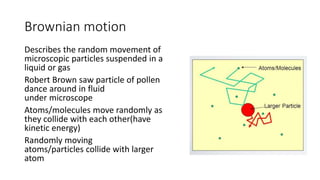
Describes the random movement of
microscopic particles suspended in a
liquid or gas
Robert Brown saw particle of pollen
dance around in fluid
under microscope
Atoms/molecules move randomly as
they collide with each other(have
kinetic energy)
Randomly moving
atoms/particles collide with larger
atom
Einstein theory of Brownian motion
• In 1905 proposed a quantitative explanation for Brownian motion
• Conducted a theoretical analysis of Brownian motion
• Found that Brownian motion properties and diffusion constant
are related.
• Einstein determined the diffusion coefficient in two ways
• From the irregular random motion of the suspended particles
• From the difference in osmotic pressure
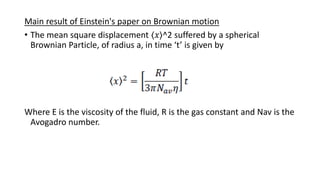
Main result of Einstein's paper on Brownian motion
• The mean square displacement ⟨𝑥⟩^2 suffered by a spherical
Brownian Particle, of radius a, in time ‘t’ is given by
Where E is the viscosity of the fluid, R is the gas constant and Nav is the
Avogadro number.
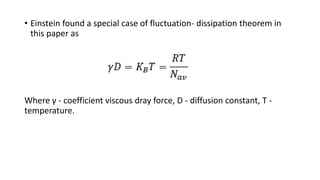
• Einstein found a special case of fluctuation- dissipation theorem in
this paper as
Where γ - coefficient viscous dray force, D - diffusion constant, T -
temperature.
• Einstein also found a diffusion equation
• He established a link between random walk of single particle the
diffusion of many particles. For the initial condition P(x,0) =δ (x), the
solution of the diffusion equation is
Langevin's Theory of Brownian Motion
• In 1908, Langevin presented a simpler approach of Brownian motion
• This was based on the following assumptions
i. Brownian motion is entirely irregular and there is no effect of gravity on it
ii. Each Brownian particle In liquid sufferers a large no of collisions by
the molecules of the liquid (approx. 1022 collisions per second)
iii. Each collision is expected to produce a deflection in the path of the particle
• According to Langevin, the force experienced by a Brownian particle
in liquid is of 2 types
1. Viscous Force (Fv) : Assuming a Spherical Brownian particle, the viscous force
experienced by the particle in the given fluid is given by the equation
Where, is the coefficient of viscosity of the liquid
r is the radius of Brownian particle
V is the velocity of Brownian particle
2. Fluctuating Force (Fl) : Force due to all external influences of surrounding
medium
Net Force (F) = Viscous Force (Fv) + Fluctuating Force (Fl)
• Taking the average values in equation
• According to law of equipartition of energy
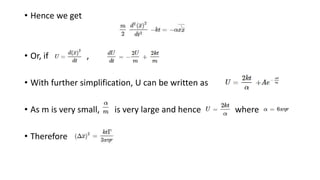
• Hence we get
• Or, if ,
• With further simplification, U can be written as
• As m is very small, is very large and hence where
• Therefore
Thank You

Brownian motion

  • 1.
    Brownian Motion Rishikesh MS—Riswan Sulfi—Sabarinath S—Sourath J H
  • 2.
    Brownian motion Describes therandom movement of microscopic particles suspended in a liquid or gas Robert Brown saw particle of pollen dance around in fluid under microscope Atoms/molecules move randomly as they collide with each other(have kinetic energy) Randomly moving atoms/particles collide with larger atom
  • 3.
    Einstein theory ofBrownian motion • In 1905 proposed a quantitative explanation for Brownian motion • Conducted a theoretical analysis of Brownian motion • Found that Brownian motion properties and diffusion constant are related. • Einstein determined the diffusion coefficient in two ways • From the irregular random motion of the suspended particles • From the difference in osmotic pressure
  • 4.
    Main result ofEinstein's paper on Brownian motion • The mean square displacement ⟨𝑥⟩^2 suffered by a spherical Brownian Particle, of radius a, in time ‘t’ is given by Where E is the viscosity of the fluid, R is the gas constant and Nav is the Avogadro number.
  • 5.
    • Einstein founda special case of fluctuation- dissipation theorem in this paper as Where γ - coefficient viscous dray force, D - diffusion constant, T - temperature.
  • 6.
    • Einstein alsofound a diffusion equation • He established a link between random walk of single particle the diffusion of many particles. For the initial condition P(x,0) =δ (x), the solution of the diffusion equation is
  • 7.
    Langevin's Theory ofBrownian Motion • In 1908, Langevin presented a simpler approach of Brownian motion • This was based on the following assumptions i. Brownian motion is entirely irregular and there is no effect of gravity on it ii. Each Brownian particle In liquid sufferers a large no of collisions by the molecules of the liquid (approx. 1022 collisions per second) iii. Each collision is expected to produce a deflection in the path of the particle
  • 8.
    • According toLangevin, the force experienced by a Brownian particle in liquid is of 2 types 1. Viscous Force (Fv) : Assuming a Spherical Brownian particle, the viscous force experienced by the particle in the given fluid is given by the equation Where, is the coefficient of viscosity of the liquid r is the radius of Brownian particle V is the velocity of Brownian particle 2. Fluctuating Force (Fl) : Force due to all external influences of surrounding medium Net Force (F) = Viscous Force (Fv) + Fluctuating Force (Fl)
  • 9.
    • Taking theaverage values in equation • According to law of equipartition of energy
  • 10.
    • Hence weget • Or, if , • With further simplification, U can be written as • As m is very small, is very large and hence where • Therefore
  • 11.