Science
Unit:
Diffusion
Solutions
Keywords
random
Brownian motion
medium
diffusion
fluid
Keywords
Something that happens without a clear pattern, making it
unpredictable, is described as random.
Brownian motion is the random movement of particles in a fluid, due to their
collision with particles in the surrounding medium.
A medium is usually a liquid or gas that other substances can mix into or
move through, enabling other substances to mix or interact.
Diffusion is the movement of particles from an area where there are lots, until
there is a random distribution of particles throughout a medium.
A fluid is a substance that flows or takes the shape of its container. Liquids
and gases can be described as fluids.
Lesson outline
Brownian motion
Diffusion
Diffusion
Factors affecting the speed of diffusion
Explanation
Ideas in science have their origins in observations.
Brownian motion
During the 18th century technology improved, and
the use of microscopes became a popular way of
making observations.
Robert Brown was a Scottish botanist
at the turn of the 19th century; he
studied plants using microscopes.
18th century
microscope
Right: M0000212: Nachet collection: Dellebarre microscope, Wellcome Collection, licensed under CC BY 4.0
Explanation
Brownian motion
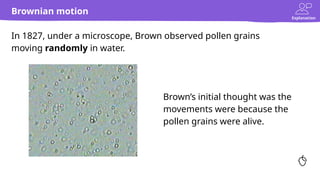
In 1827, under a microscope, Brown observed pollen grains
moving randomly in water.
Brown’s initial thought was the
movements were because the
pollen grains were alive.
Explanation
To test his hypothesis, Brown observed other tiny
substances, like fine dust and soot particles, under his
microscope.
Brownian motion
Brown noticed these other particles moved
about in a similarly random way but struggled
to explain why.
It wasn’t until the early 20th century that work by various other
scientists confirmed and explained what Brown had observed.
Explanation
Today, the random movements Robert Brown first
observed is known as Brownian motion.
Brownian motion
Brownian motion is the random movement of
particles in a fluid (i.e., a liquid or gas), due to
their collision with particles in the surrounding
medium.
The yellow spot tracks the movement of just one
particle as it collides with the other black particles.
Brownian motion large.gif, Francisco Esquembre, Fu-Kwun and lookang, 2012, licensed under CC BY 3.0 SG
Explanation
Brownian motion
The medium is a fluid (i.e., gas or liquid material) that other
substances can mix into or move through.
medium
(water)
random movement
of another fluid
Explanation
Brownian motion
The key to Brownian motion is that the particles of one
fluid randomly collide with particles of the medium.
This results in the
unpredictable
movement of the
particles in both fluids.
larger blue dots = medium; smaller red dots = another fluid
Simulation by PhET Interactive Simulations, University of Colorado Boulder, licensed under CC-BY-4.0 (https://phet.colorado.edu)
True False
Justify your answer
True or false?
T F
Check
a
b
Particles’ movement is not impacted by the movement of
other particles.
Brownian motion is the orderly movement of fluid particles.
Particles can collide, pushing other particles onto a new,
random path.
Brownian motion
Task A
Practice
Brownian colliding random smoke
Brownian motion
Laura attended the theatre at the weekend. She’s
wondering why the smoke seemed to dance around the stage when
there was no wind.
Use the words in the box to complete the explanation
below.
The smoke particles are __________ with air particles
above the stage.
When the and air particles collide, both are
pushed into , unpredictable directions.
This action is known as motion.
Task A
Feedback
Brownian motion
Laura attended the theatre at the weekend. She’s
wondering why the smoke seemed to dance around the stage when
there was no wind.
Use the words in the box to complete the explanation
below.
Brownian colliding random smoke
The smoke particles are colliding with air particles
above the stage.
When the smoke and air particles collide, both are
pushed into random, unpredictable directions.
This action is known as Brownian motion.
Lesson outline
Brownian motion
Diffusion
Diffusion
Factors affecting the speed of diffusion
Explanation
Brownian motion helps us to understand common
experiences.
Diffusion
smelling flowers
All these experiences occur because of diffusion.
watching water
change colour
smelling freshly
baked bread
Explanation
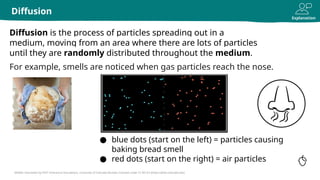
Diffusion is the process of particles spreading out in a
medium, moving from an area where there are lots of particles
until they are randomly distributed throughout the medium.
Diffusion
● blue dots (start on the left) = particles causing
baking bread smell
● red dots (start on the right) = air particles
For example, smells are noticed when gas particles reach the nose.
Middle: Simulation by PhET Interactive Simulations, University of Colorado Boulder, licensed under CC-BY-4.0 (https://phet.colorado.edu)
Explanation
Fluid particles are able to diffuse because they are constantly
moving and colliding with each other and the medium’s particles.
Diffusion
The collisions between particles pushes them in random, new directions.
● blue dots (start on the left) = particles
causing incense smell
● red dots (start on the right) = air particles
Middle: Simulation by PhET Interactive Simulations, University of Colorado Boulder, licensed under CC-BY-4.0 (https://phet.colorado.edu)
Explanation
Diffusion
Diffusion by Brownian motion also occurs in liquids.
Middle: Simulation by PhET Interactive Simulations, University of Colorado Boulder, licensed under CC-BY-4.0 (https://phet.colorado.edu)
Check
a
b
c
Diffusion
dissolving
diffusion
Brownian motion
What name is given to the process of particles spreading out, moving from
an area where there are lots of them until they are randomly spread
throughout a medium?
Practice
Task B
On his way to his history lesson, Lucas could smell cupcakes. The
food technology room is at the other end of the corridor from the
history classroom.
Diffusion
The particles spread throughout the
air in the corridor (via Brownian
motion), to where….
There are many particles
causing the cupcake smell
in the food tech room.
This process is known
as diffusion.
As the food tech
door opens, they
collide with air
particles in the
corridor.
…there are fewer particles
causing the cupcake smell.
Put Lucas’ thoughts into a sensible order to explain why he can
smell the cupcakes.
Task B
Feedback
On his way to his history lesson, Lucas could smell cupcakes.
The food technology room is at the other end of the corridor
from the history classroom.
Put Lucas’ thoughts into a sensible order to explain why he can
smell the cupcakes.
Diffusion
There are many particles causing the cupcake smell in the
food tech room.
As the food tech door opens, they collide with air particles
in the corridor.
The particles spread throughout the air in the corridor (via Brownian
motion) to where there are fewer particles causing the cupcake smell.
This process is known as diffusion.
Lesson outline
Brownian motion
Diffusion
Diffusion
Factors affecting the speed of diffusion
Explanation
Some factors affect the speed at which particles
undergo diffusion:
Factors affecting the speed of diffusion
● the number of particles
● the amount of energy the particles have
(affected by the temperature of the substances)
● the size of the particles
These factors relate to the particles of both the medium and
the diffusing fluid.
Explanation
Recall that diffusion depends upon collisions that occur
randomly via Brownian motion.
Factors affecting the speed of diffusion
more particles = more collisions
fewer particles = fewer collisions
Simulations by PhET Interactive Simulations, University of Colorado Boulder, licensed under CC-BY-4.0 (https://phet.colorado.edu)
Explanation
More particles colliding means diffusion can occur faster,
but only to a point…
Factors affecting the speed of diffusion
…too many particles can slow
diffusion
Simulations by PhET Interactive Simulations, University of Colorado Boulder, licensed under CC-BY-4.0 (https://phet.colorado.edu)
Explanation
Factors affecting the speed of diffusion
Smaller particles diffuse quickly because they are lightweight.
smaller particles = faster diffusion
Larger particles require collisions with more energy to move at speed.
larger particles = slower diffusion
Simulations by PhET Interactive Simulations, University of Colorado Boulder, licensed under CC-BY-4.0 (https://phet.colorado.edu)
Explanation
Factors affecting the speed of diffusion
An increase in temperature means particles have more
energy. As such, the particles move faster, colliding more
often and with more force. This results in faster diffusion.
colder particles = slower diffusion hotter particles = faster diffusion
Simulations by PhET Interactive Simulations, University of Colorado Boulder, licensed under CC-BY-4.0 (https://phet.colorado.edu)
True False
Justify your answer
True or false?
Check
a
b
T F
Having more particles involved in diffusion always speeds up the
process of diffusion.
Factors affecting the speed of diffusion
More particles means there are fewer collisions, pushing
particles into new positions; therefore, diffusion is faster.
If too many particles are colliding, this can make it difficult
for particles to spread out (i.e., diffuse) quickly.
Check
In which temperature water will the tea diffuse fastest?
Factors affecting the speed of diffusion
60°C 75°C 90°C
Practice
Task C
Sam’s bus passes a sewage treatment works on
the way to school. The smell from the facility is more
noticeable in June than it is in February. Explain why that is.
Factors affecting the speed of diffusion
Task C
Feedback
Sam’s bus passes a sewage treatment works on
the way to school. The smell from the facility is more noticeable
in June than it is in February. Explain why that is.
Factors affecting the speed of diffusion
Your answer may include:
● The temperature is warmer in June than in
February.
The smell is more
noticeable in June
because…
● At higher temperatures, particles have
more energy and can collide more often.
● This means that the diffusion of particles
causing the sewage smell happens faster
when the temperature is higher (i.e. in
June).
Summary
● Particles released into a fluid (i.e., gas or liquid), move around
due to Brownian motion. This motion is caused by particles
randomly colliding into each other.
Diffusion
● Diffusion occurs via Brownian motion. It is the movement of
particles from an area where there are lots, until there is a
random distribution of particles throughout a medium.
● The speed of diffusion is affected by the number and size of the
particles colliding, and the energy the particles have when they
collide.

Diffusion.pptxppppppppppppppppppppppppppp

  • 1.
  • 2.
  • 3.
    Keywords Something that happenswithout a clear pattern, making it unpredictable, is described as random. Brownian motion is the random movement of particles in a fluid, due to their collision with particles in the surrounding medium. A medium is usually a liquid or gas that other substances can mix into or move through, enabling other substances to mix or interact. Diffusion is the movement of particles from an area where there are lots, until there is a random distribution of particles throughout a medium. A fluid is a substance that flows or takes the shape of its container. Liquids and gases can be described as fluids.
  • 4.
  • 5.
    Explanation Ideas in sciencehave their origins in observations. Brownian motion During the 18th century technology improved, and the use of microscopes became a popular way of making observations. Robert Brown was a Scottish botanist at the turn of the 19th century; he studied plants using microscopes. 18th century microscope Right: M0000212: Nachet collection: Dellebarre microscope, Wellcome Collection, licensed under CC BY 4.0
  • 6.
    Explanation Brownian motion In 1827,under a microscope, Brown observed pollen grains moving randomly in water. Brown’s initial thought was the movements were because the pollen grains were alive.
  • 7.
    Explanation To test hishypothesis, Brown observed other tiny substances, like fine dust and soot particles, under his microscope. Brownian motion Brown noticed these other particles moved about in a similarly random way but struggled to explain why. It wasn’t until the early 20th century that work by various other scientists confirmed and explained what Brown had observed.
  • 8.
    Explanation Today, the randommovements Robert Brown first observed is known as Brownian motion. Brownian motion Brownian motion is the random movement of particles in a fluid (i.e., a liquid or gas), due to their collision with particles in the surrounding medium. The yellow spot tracks the movement of just one particle as it collides with the other black particles. Brownian motion large.gif, Francisco Esquembre, Fu-Kwun and lookang, 2012, licensed under CC BY 3.0 SG
  • 9.
    Explanation Brownian motion The mediumis a fluid (i.e., gas or liquid material) that other substances can mix into or move through. medium (water) random movement of another fluid
  • 10.
    Explanation Brownian motion The keyto Brownian motion is that the particles of one fluid randomly collide with particles of the medium. This results in the unpredictable movement of the particles in both fluids. larger blue dots = medium; smaller red dots = another fluid Simulation by PhET Interactive Simulations, University of Colorado Boulder, licensed under CC-BY-4.0 (https://phet.colorado.edu)
  • 11.
    True False Justify youranswer True or false? T F Check a b Particles’ movement is not impacted by the movement of other particles. Brownian motion is the orderly movement of fluid particles. Particles can collide, pushing other particles onto a new, random path. Brownian motion
  • 12.
    Task A Practice Brownian collidingrandom smoke Brownian motion Laura attended the theatre at the weekend. She’s wondering why the smoke seemed to dance around the stage when there was no wind. Use the words in the box to complete the explanation below. The smoke particles are __________ with air particles above the stage. When the and air particles collide, both are pushed into , unpredictable directions. This action is known as motion.
  • 13.
    Task A Feedback Brownian motion Lauraattended the theatre at the weekend. She’s wondering why the smoke seemed to dance around the stage when there was no wind. Use the words in the box to complete the explanation below. Brownian colliding random smoke The smoke particles are colliding with air particles above the stage. When the smoke and air particles collide, both are pushed into random, unpredictable directions. This action is known as Brownian motion.
  • 14.
  • 15.
    Explanation Brownian motion helpsus to understand common experiences. Diffusion smelling flowers All these experiences occur because of diffusion. watching water change colour smelling freshly baked bread
  • 16.
    Explanation Diffusion is theprocess of particles spreading out in a medium, moving from an area where there are lots of particles until they are randomly distributed throughout the medium. Diffusion ● blue dots (start on the left) = particles causing baking bread smell ● red dots (start on the right) = air particles For example, smells are noticed when gas particles reach the nose. Middle: Simulation by PhET Interactive Simulations, University of Colorado Boulder, licensed under CC-BY-4.0 (https://phet.colorado.edu)
  • 17.
    Explanation Fluid particles areable to diffuse because they are constantly moving and colliding with each other and the medium’s particles. Diffusion The collisions between particles pushes them in random, new directions. ● blue dots (start on the left) = particles causing incense smell ● red dots (start on the right) = air particles Middle: Simulation by PhET Interactive Simulations, University of Colorado Boulder, licensed under CC-BY-4.0 (https://phet.colorado.edu)
  • 18.
    Explanation Diffusion Diffusion by Brownianmotion also occurs in liquids. Middle: Simulation by PhET Interactive Simulations, University of Colorado Boulder, licensed under CC-BY-4.0 (https://phet.colorado.edu)
  • 19.
    Check a b c Diffusion dissolving diffusion Brownian motion What nameis given to the process of particles spreading out, moving from an area where there are lots of them until they are randomly spread throughout a medium?
  • 20.
    Practice Task B On hisway to his history lesson, Lucas could smell cupcakes. The food technology room is at the other end of the corridor from the history classroom. Diffusion The particles spread throughout the air in the corridor (via Brownian motion), to where…. There are many particles causing the cupcake smell in the food tech room. This process is known as diffusion. As the food tech door opens, they collide with air particles in the corridor. …there are fewer particles causing the cupcake smell. Put Lucas’ thoughts into a sensible order to explain why he can smell the cupcakes.
  • 21.
    Task B Feedback On hisway to his history lesson, Lucas could smell cupcakes. The food technology room is at the other end of the corridor from the history classroom. Put Lucas’ thoughts into a sensible order to explain why he can smell the cupcakes. Diffusion There are many particles causing the cupcake smell in the food tech room. As the food tech door opens, they collide with air particles in the corridor. The particles spread throughout the air in the corridor (via Brownian motion) to where there are fewer particles causing the cupcake smell. This process is known as diffusion.
  • 22.
  • 23.
    Explanation Some factors affectthe speed at which particles undergo diffusion: Factors affecting the speed of diffusion ● the number of particles ● the amount of energy the particles have (affected by the temperature of the substances) ● the size of the particles These factors relate to the particles of both the medium and the diffusing fluid.
  • 24.
    Explanation Recall that diffusiondepends upon collisions that occur randomly via Brownian motion. Factors affecting the speed of diffusion more particles = more collisions fewer particles = fewer collisions Simulations by PhET Interactive Simulations, University of Colorado Boulder, licensed under CC-BY-4.0 (https://phet.colorado.edu)
  • 25.
    Explanation More particles collidingmeans diffusion can occur faster, but only to a point… Factors affecting the speed of diffusion …too many particles can slow diffusion Simulations by PhET Interactive Simulations, University of Colorado Boulder, licensed under CC-BY-4.0 (https://phet.colorado.edu)
  • 26.
    Explanation Factors affecting thespeed of diffusion Smaller particles diffuse quickly because they are lightweight. smaller particles = faster diffusion Larger particles require collisions with more energy to move at speed. larger particles = slower diffusion Simulations by PhET Interactive Simulations, University of Colorado Boulder, licensed under CC-BY-4.0 (https://phet.colorado.edu)
  • 27.
    Explanation Factors affecting thespeed of diffusion An increase in temperature means particles have more energy. As such, the particles move faster, colliding more often and with more force. This results in faster diffusion. colder particles = slower diffusion hotter particles = faster diffusion Simulations by PhET Interactive Simulations, University of Colorado Boulder, licensed under CC-BY-4.0 (https://phet.colorado.edu)
  • 28.
    True False Justify youranswer True or false? Check a b T F Having more particles involved in diffusion always speeds up the process of diffusion. Factors affecting the speed of diffusion More particles means there are fewer collisions, pushing particles into new positions; therefore, diffusion is faster. If too many particles are colliding, this can make it difficult for particles to spread out (i.e., diffuse) quickly.
  • 29.
    Check In which temperaturewater will the tea diffuse fastest? Factors affecting the speed of diffusion 60°C 75°C 90°C
  • 30.
    Practice Task C Sam’s buspasses a sewage treatment works on the way to school. The smell from the facility is more noticeable in June than it is in February. Explain why that is. Factors affecting the speed of diffusion
  • 31.
    Task C Feedback Sam’s buspasses a sewage treatment works on the way to school. The smell from the facility is more noticeable in June than it is in February. Explain why that is. Factors affecting the speed of diffusion Your answer may include: ● The temperature is warmer in June than in February. The smell is more noticeable in June because… ● At higher temperatures, particles have more energy and can collide more often. ● This means that the diffusion of particles causing the sewage smell happens faster when the temperature is higher (i.e. in June).
  • 32.
    Summary ● Particles releasedinto a fluid (i.e., gas or liquid), move around due to Brownian motion. This motion is caused by particles randomly colliding into each other. Diffusion ● Diffusion occurs via Brownian motion. It is the movement of particles from an area where there are lots, until there is a random distribution of particles throughout a medium. ● The speed of diffusion is affected by the number and size of the particles colliding, and the energy the particles have when they collide.
Editor's Notes