© 2012 Society of Vacuum Coaters 505/856-7188 445
55th Annual Technical Conference Proceedings, Santa Clara, CA April 28–May 3, 2012 ISSN 0737-5921
Choosing the Right Mass Flow Controller for your Application
N.K. Glover, Brooks Instrument, Snellville, GA
AbSTRACT
There are four main considerations to evaluate in order to
specify a Thermal Mass Flow Controller (MFC) for your
application. Flow range, gas conditions, desired accuracy,
and communications are all important constraints. There are
a five additional considerations including interior finish for
high and ultra high purity applications, materials used in the
flow path, the environment such as installations near furnaces
or some sort of NEMA rating, mounting attitude such as
vertical flow up, and serviceability.
InTRoDUCTIon
MFCs are used to measure and control the flow of gasses in a
process. The overall flow rate is an important consideration.
Some processes require very small flows usually specified in
standardcubiccentimetersperminute(SCCM).Higherflows
are typically given in standard liters per minute (SLPM) or
standard cubic feet per minute (SCFM). Many manufactur-
ers make devices able to measure flows of 200 sccm up to
30 slpm. The same body size can be used for this wide range
of flows; however, the internal components are changed to
give a more precise flow range. Typically, once you choose
a maximum flow, you are able to measure and control down
from there a certain amount. Having a 10 to 1 turndown is
common. Being able to control to a 50:1 or even 100:1 is
available from some of the leading manufactures. Setting
the maximum flow to something very small like 10 sccm
or even 3 sccm and then being able to measure and control
from that point down to 2% is remarkable, but is standard
for some. Once the desired flow is more than 30 slpm (or 1
scfm), usually the physical size of the MFC body changes a
bit. This allows greater flow as there are larger passageways
inside the device. Flows to 100 slpm or 200 slpm are typical
in this arrangement. Once the flow gets higher than that, the
body size really jumps and this allows flows up to 2500 slpm
to be controlled or 9000 slpm flows to be measured (without
a control valve).
The gas itself is an important consideration.Are you flowing
oneofthesimple,commongassessuchasair,oxygen,nitrogen,
helium, hydrogen, argon, CO or CO2
? If so, a simple design
of the MFC can be used. If your gas is very dangerous, you
may be required to treat it differently. If it is susceptible to
contamination, such as reacting with moisture, the interior
of the MFC may be polished and the connections changed
from screwed or compressed fitting to higher purity type
connections such as VCR or VCO which utilize metal seals
and are considered when high and ultra high purity gases are
being used. If the process is being run at a positive pressure,
the design of the MFC is such that it can contain that pres-
sure. Some MFCs are limited to 100 psi or 500 psi maximum
working pressures. Industrial MFCs are usually standard at
1500 psi (100 bar) and can be made to withstand 4500 psi
(300 bar) pressure sometimes found in catalyst research,
hydrogenation of food or drugs, or many petrochemical
processes. On the other hand, if your process operates under
vacuum, the design of the MFC has to be adjusted accord-
ingly.Gasesbehavedifferentlyatpositivepressuresthanthey
do under high vacuum and calibrating an MFC for vacuum
service is a precise process. Temperatures of the gases are
to be considered. Usually the gases are measured and con-
trolled at relatively mild temperatures and elevated after the
MFC if high temperatures are required in the process. There
are temperature limits inside an MFC due to the measuring
technology which utilizes the thermal properties of the gas to
determine the flow. So, typically, 140-160°F is the working
limit for gasses in MFCs.
When asked about accuracy, many applications require the
most accurate system available. However some processes are
not precise and a less accurate device can be used. Sometimes
accuracy is not as important as repeatability. You must first
understand the difference between percent of full scale ac-
curacy statements and percent of rate accuracy statements.
They mean the same thing only when the device is operating
at 100 percent of its rated capacity. If you ask the MFC to
control the gas flow to a lower set point, the amount of error
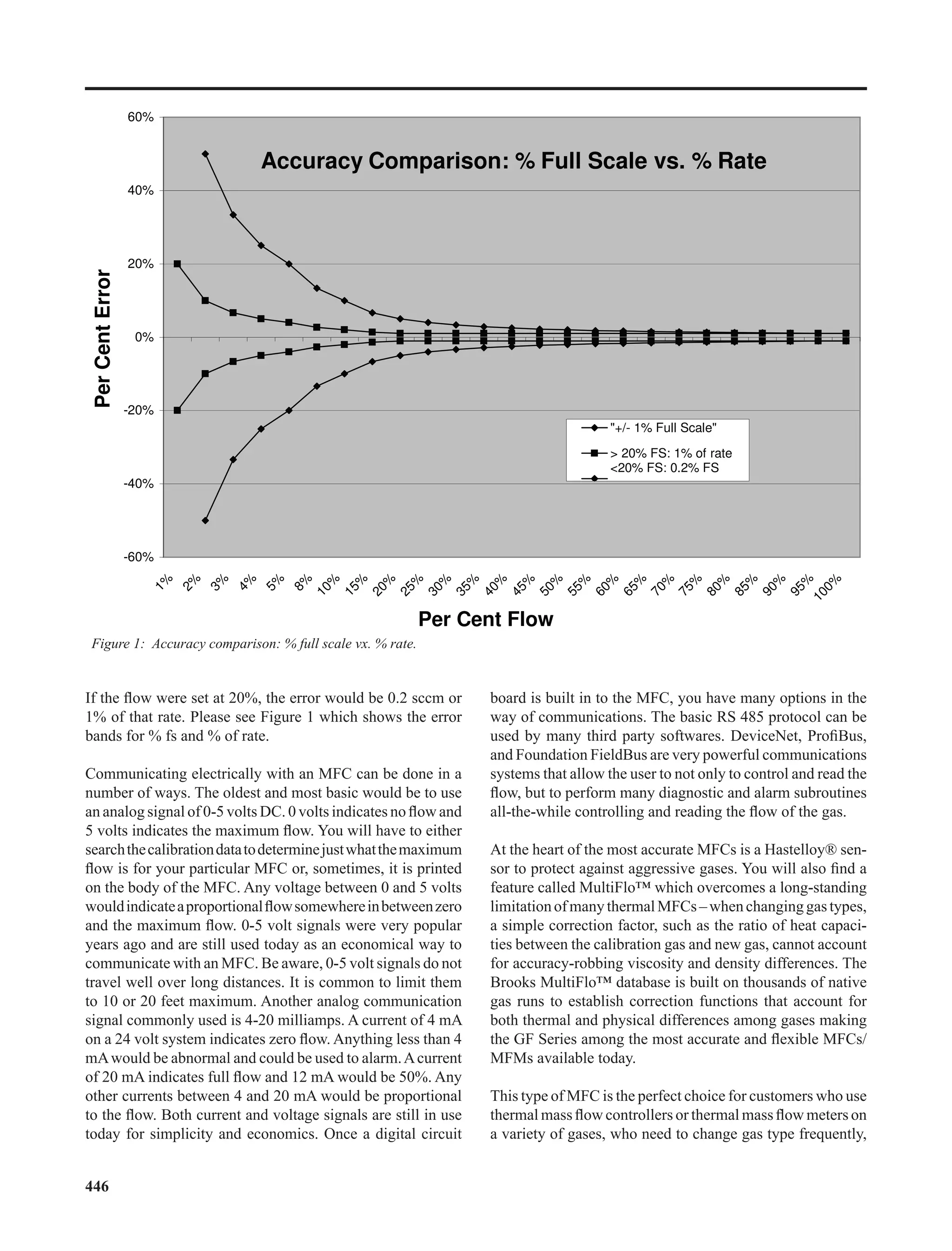
varies in different MFC designs. Older, analog MFCs typi-
cally have accuracy statements such as +/- 1 % of full scale.
This means a 100 sccm MFC would have an acceptable error
of 1 sccm at any flow. If the flow were to be set at 50%, a
1% FS error would actually be 2% of that rate. If the flow
were at 20%, the same 1 sccm deviation would now be a 5%
error. Devices with error statements given in % fs are not as
accurate as those given in % rate. Let us look at a device with
a stated accuracy of +/- 1% of rate from 100% flow down to
20% flow and +/- 0.2% of full scale below 20 percent flow.
Using the same example, if the 100 sccm MFC were flowing
at 50% the maximum error would be ½ sccm or 1 % of rate.
446
If the flow were set at 20%, the error would be 0.2 sccm or
1% of that rate. Please see Figure 1 which shows the error
bands for % fs and % of rate.
Communicating electrically with an MFC can be done in a
number of ways. The oldest and most basic would be to use
an analog signal of 0-5 volts DC. 0 volts indicates no flow and
5 volts indicates the maximum flow. You will have to either
searchthecalibrationdatatodeterminejustwhatthemaximum
flow is for your particular MFC or, sometimes, it is printed
on the body of the MFC. Any voltage between 0 and 5 volts
wouldindicateaproportionalflowsomewhereinbetweenzero
and the maximum flow. 0-5 volt signals were very popular
years ago and are still used today as an economical way to
communicate with an MFC. Be aware, 0-5 volt signals do not
travel well over long distances. It is common to limit them
to 10 or 20 feet maximum. Another analog communication
signal commonly used is 4-20 milliamps. A current of 4 mA
on a 24 volt system indicates zero flow. Anything less than 4
mAwould be abnormal and could be used to alarm.Acurrent
of 20 mA indicates full flow and 12 mA would be 50%. Any
other currents between 4 and 20 mA would be proportional
to the flow. Both current and voltage signals are still in use
today for simplicity and economics. Once a digital circuit
board is built in to the MFC, you have many options in the
way of communications. The basic RS 485 protocol can be
used by many third party softwares. DeviceNet, ProfiBus,
and Foundation FieldBus are very powerful communications
systems that allow the user to not only to control and read the
flow, but to perform many diagnostic and alarm subroutines
all-the-while controlling and reading the flow of the gas.
At the heart of the most accurate MFCs is a Hastelloy® sen-
sor to protect against aggressive gases. You will also find a
feature called MultiFlo™ which overcomes a long-standing
limitationofmanythermalMFCs–whenchanginggastypes,
a simple correction factor, such as the ratio of heat capaci-
ties between the calibration gas and new gas, cannot account
for accuracy-robbing viscosity and density differences. The
Brooks MultiFlo™ database is built on thousands of native
gas runs to establish correction functions that account for
both thermal and physical differences among gases making
the GF Series among the most accurate and flexible MFCs/
MFMs available today.
This type of MFC is the perfect choice for customers who use
thermal mass flow controllers or thermal mass flow meters on
a variety of gases, who need to change gas type frequently,
Accuracy Comparison: % Full Scale vs. % Rate
-60%
-40%
-20%
0%
20%
40%
60%
1%
2%
3%
4%
5%
8%
10%
15%
20%
25%
30%
35%
40%
45%
50%
55%
60%
65%
70%
75%
80%
85%
90%
95%
100%
Per Cent Flow
PerCentError
"+/- 1% Full Scale"
> 20% FS: 1% of rate
<20% FS: 0.2% FS
Figure 1: Accuracy comparison: % full scale vx. % rate.
447
or who need to re-range while preserving gas measurement
and control accuracy. Some examples:
• OEMs will reduce the number of gas- and range-specific
MFCs that they inventory.
• Solar, biotech, CVD, plasma, glass, web coating, nano-
technology,vacuumprocessingandsimilarlargeusersof
mass flow meters and mass flow controllers will greatly
reduce their gas- and range-specific spares inventory.
• R&D, research, and laboratory users can quickly change
experiment conditions and achieve much better actual
process gas accuracy vs. traditional mass flow devices.
MultiFlo™ programming is simple and fast – a new gas and
rangecanbeprogrammedunder60secondsplusthedevicecan
be programmed without removing it from service or discon-
necting the device from any process or tool control system.
SUMMARY
In summary, a mass flow meter or mass flow controller can
be a very simple device to measure and control the flow of
a gas or it can be utilized in the most demanding of applica-
tions; but only if you address the four major considerations
detailed above (flow range, gas conditions, desired accuracy,
and communications).

Brooks Instrument - Choosing the Right Flow Controller

  • 1.
    © 2012 Societyof Vacuum Coaters 505/856-7188 445 55th Annual Technical Conference Proceedings, Santa Clara, CA April 28–May 3, 2012 ISSN 0737-5921 Choosing the Right Mass Flow Controller for your Application N.K. Glover, Brooks Instrument, Snellville, GA AbSTRACT There are four main considerations to evaluate in order to specify a Thermal Mass Flow Controller (MFC) for your application. Flow range, gas conditions, desired accuracy, and communications are all important constraints. There are a five additional considerations including interior finish for high and ultra high purity applications, materials used in the flow path, the environment such as installations near furnaces or some sort of NEMA rating, mounting attitude such as vertical flow up, and serviceability. InTRoDUCTIon MFCs are used to measure and control the flow of gasses in a process. The overall flow rate is an important consideration. Some processes require very small flows usually specified in standardcubiccentimetersperminute(SCCM).Higherflows are typically given in standard liters per minute (SLPM) or standard cubic feet per minute (SCFM). Many manufactur- ers make devices able to measure flows of 200 sccm up to 30 slpm. The same body size can be used for this wide range of flows; however, the internal components are changed to give a more precise flow range. Typically, once you choose a maximum flow, you are able to measure and control down from there a certain amount. Having a 10 to 1 turndown is common. Being able to control to a 50:1 or even 100:1 is available from some of the leading manufactures. Setting the maximum flow to something very small like 10 sccm or even 3 sccm and then being able to measure and control from that point down to 2% is remarkable, but is standard for some. Once the desired flow is more than 30 slpm (or 1 scfm), usually the physical size of the MFC body changes a bit. This allows greater flow as there are larger passageways inside the device. Flows to 100 slpm or 200 slpm are typical in this arrangement. Once the flow gets higher than that, the body size really jumps and this allows flows up to 2500 slpm to be controlled or 9000 slpm flows to be measured (without a control valve). The gas itself is an important consideration.Are you flowing oneofthesimple,commongassessuchasair,oxygen,nitrogen, helium, hydrogen, argon, CO or CO2 ? If so, a simple design of the MFC can be used. If your gas is very dangerous, you may be required to treat it differently. If it is susceptible to contamination, such as reacting with moisture, the interior of the MFC may be polished and the connections changed from screwed or compressed fitting to higher purity type connections such as VCR or VCO which utilize metal seals and are considered when high and ultra high purity gases are being used. If the process is being run at a positive pressure, the design of the MFC is such that it can contain that pres- sure. Some MFCs are limited to 100 psi or 500 psi maximum working pressures. Industrial MFCs are usually standard at 1500 psi (100 bar) and can be made to withstand 4500 psi (300 bar) pressure sometimes found in catalyst research, hydrogenation of food or drugs, or many petrochemical processes. On the other hand, if your process operates under vacuum, the design of the MFC has to be adjusted accord- ingly.Gasesbehavedifferentlyatpositivepressuresthanthey do under high vacuum and calibrating an MFC for vacuum service is a precise process. Temperatures of the gases are to be considered. Usually the gases are measured and con- trolled at relatively mild temperatures and elevated after the MFC if high temperatures are required in the process. There are temperature limits inside an MFC due to the measuring technology which utilizes the thermal properties of the gas to determine the flow. So, typically, 140-160°F is the working limit for gasses in MFCs. When asked about accuracy, many applications require the most accurate system available. However some processes are not precise and a less accurate device can be used. Sometimes accuracy is not as important as repeatability. You must first understand the difference between percent of full scale ac- curacy statements and percent of rate accuracy statements. They mean the same thing only when the device is operating at 100 percent of its rated capacity. If you ask the MFC to control the gas flow to a lower set point, the amount of error varies in different MFC designs. Older, analog MFCs typi- cally have accuracy statements such as +/- 1 % of full scale. This means a 100 sccm MFC would have an acceptable error of 1 sccm at any flow. If the flow were to be set at 50%, a 1% FS error would actually be 2% of that rate. If the flow were at 20%, the same 1 sccm deviation would now be a 5% error. Devices with error statements given in % fs are not as accurate as those given in % rate. Let us look at a device with a stated accuracy of +/- 1% of rate from 100% flow down to 20% flow and +/- 0.2% of full scale below 20 percent flow. Using the same example, if the 100 sccm MFC were flowing at 50% the maximum error would be ½ sccm or 1 % of rate.
  • 2.
    446 If the flowwere set at 20%, the error would be 0.2 sccm or 1% of that rate. Please see Figure 1 which shows the error bands for % fs and % of rate. Communicating electrically with an MFC can be done in a number of ways. The oldest and most basic would be to use an analog signal of 0-5 volts DC. 0 volts indicates no flow and 5 volts indicates the maximum flow. You will have to either searchthecalibrationdatatodeterminejustwhatthemaximum flow is for your particular MFC or, sometimes, it is printed on the body of the MFC. Any voltage between 0 and 5 volts wouldindicateaproportionalflowsomewhereinbetweenzero and the maximum flow. 0-5 volt signals were very popular years ago and are still used today as an economical way to communicate with an MFC. Be aware, 0-5 volt signals do not travel well over long distances. It is common to limit them to 10 or 20 feet maximum. Another analog communication signal commonly used is 4-20 milliamps. A current of 4 mA on a 24 volt system indicates zero flow. Anything less than 4 mAwould be abnormal and could be used to alarm.Acurrent of 20 mA indicates full flow and 12 mA would be 50%. Any other currents between 4 and 20 mA would be proportional to the flow. Both current and voltage signals are still in use today for simplicity and economics. Once a digital circuit board is built in to the MFC, you have many options in the way of communications. The basic RS 485 protocol can be used by many third party softwares. DeviceNet, ProfiBus, and Foundation FieldBus are very powerful communications systems that allow the user to not only to control and read the flow, but to perform many diagnostic and alarm subroutines all-the-while controlling and reading the flow of the gas. At the heart of the most accurate MFCs is a Hastelloy® sen- sor to protect against aggressive gases. You will also find a feature called MultiFlo™ which overcomes a long-standing limitationofmanythermalMFCs–whenchanginggastypes, a simple correction factor, such as the ratio of heat capaci- ties between the calibration gas and new gas, cannot account for accuracy-robbing viscosity and density differences. The Brooks MultiFlo™ database is built on thousands of native gas runs to establish correction functions that account for both thermal and physical differences among gases making the GF Series among the most accurate and flexible MFCs/ MFMs available today. This type of MFC is the perfect choice for customers who use thermal mass flow controllers or thermal mass flow meters on a variety of gases, who need to change gas type frequently, Accuracy Comparison: % Full Scale vs. % Rate -60% -40% -20% 0% 20% 40% 60% 1% 2% 3% 4% 5% 8% 10% 15% 20% 25% 30% 35% 40% 45% 50% 55% 60% 65% 70% 75% 80% 85% 90% 95% 100% Per Cent Flow PerCentError "+/- 1% Full Scale" > 20% FS: 1% of rate <20% FS: 0.2% FS Figure 1: Accuracy comparison: % full scale vx. % rate.
  • 3.
    447 or who needto re-range while preserving gas measurement and control accuracy. Some examples: • OEMs will reduce the number of gas- and range-specific MFCs that they inventory. • Solar, biotech, CVD, plasma, glass, web coating, nano- technology,vacuumprocessingandsimilarlargeusersof mass flow meters and mass flow controllers will greatly reduce their gas- and range-specific spares inventory. • R&D, research, and laboratory users can quickly change experiment conditions and achieve much better actual process gas accuracy vs. traditional mass flow devices. MultiFlo™ programming is simple and fast – a new gas and rangecanbeprogrammedunder60secondsplusthedevicecan be programmed without removing it from service or discon- necting the device from any process or tool control system. SUMMARY In summary, a mass flow meter or mass flow controller can be a very simple device to measure and control the flow of a gas or it can be utilized in the most demanding of applica- tions; but only if you address the four major considerations detailed above (flow range, gas conditions, desired accuracy, and communications).