Broken Windows  Team Rath Minhal Dhanjy Donnie Rath Leigh Silver Jessica Lister  Jude Ndudi 4 th
Introduction -Later school times *Stay up late to do homework * Students in extracurricular activities come home at around 8. -Earlier school times * Students have more time to do extracurricular activities. * More time for homework * More time to do things that aren’t related to school.
Cont. Brainstorming problems Selecting and defining the problems Establishing the criteria for workable solution Analyzing the problem Recording results Suggesting possible solutions Evaluate each solution Carrying out the solution *Concluded that it is more sensible to start and end school earlier than what it already is.
Step 1: Brainstorming the Problems Hallway Cramming  School Timings  Cafeteria Food Sanitation  Lunch Organization Traffic Buses  Dress Code Cell Phones
Step 2: Selecting and Defining the Problem Criteria: 1) It has to reflect the majority of the student body so it’d be a welcomed change. 2) It either has to save money or not cause extra spending so the school’s income won’t be affected. 3) It has to be approved by the majority of the school’s faculty so they will like the change,
Cont. Rankings School timings Sanitation Busses  Traffic Cafeteria Food Dress Code
Cont. Selected Problem The problem we will attempt to change is  School Timings.  This is a problem because it affects how the students and staff spend afternoons after school.
Step 3: Establishing Criteria for Workable Solution Criteria It should not cost the school a significant amount of money. It will allow the school’s budget not to be affected. It should give students and teachers long afternoons so they can do want they want in their days. It should be a reasonable solution that is wanted by both the students and the faculty.
Step 4: Analyze the Problem Tests Teacher Survey - It should support our ideas that starting school earlier would be a welcomed change to the teacher. Student Survey - It should be a change most students want.  Principal Interviews – The principals should support our ideas.
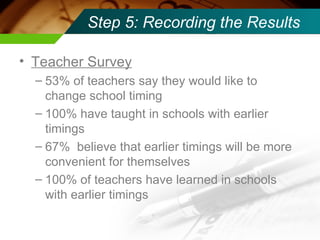
Step 5: Recording the Results Teacher Survey 53% of teachers say they would like to change school timing 100% have taught in schools with earlier timings 67%  believe that earlier timings will be more convenient for themselves 100% of teachers have learned in schools with earlier timings
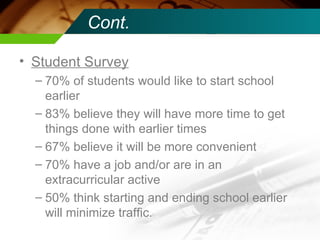
Cont. Student Survey 70% of students would like to start school earlier 83% believe they will have more time to get things done with earlier times 67% believe it will be more convenient  70% have a job and/or are in an extracurricular active 50% think starting and ending school earlier will minimize traffic.
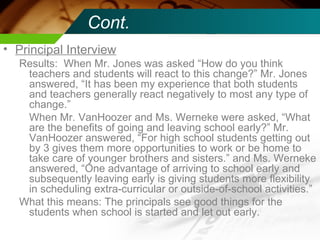
Cont. Principal Interview Results:  When Mr. Jones was asked “How do you think teachers and students will react to this change?” Mr. Jones answered, “It has been my experience that both students and teachers generally react negatively to most any type of change.” When Mr. VanHoozer and Ms. Werneke were asked, “What are the benefits of going and leaving school early?” Mr. VanHoozer answered, “For high school students getting out by 3 gives them more opportunities to work or be home to take care of younger brothers and sisters.” and Ms. Werneke answered, “One advantage of arriving to school early and subsequently leaving early is giving students more flexibility in scheduling extra-curricular or outside-of-school activities.” What this means: The principals see good things for the students when school is started and let out early.
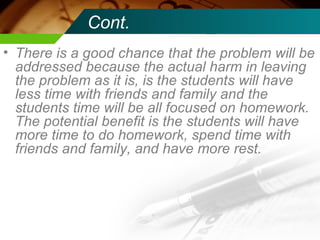
Cont. There is a good chance that the problem will be addressed because the actual harm in leaving the problem as it is, is the students will have less time with friends and family and the students time will be all focused on homework. The potential benefit is the students will have more time to do homework, spend time with friends and family, and have more rest.
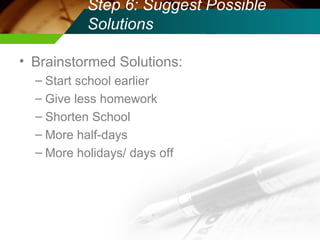
Step 6: Suggest Possible Solutions Brainstormed Solutions: Start school earlier Give less homework Shorten School More half-days More holidays/ days off
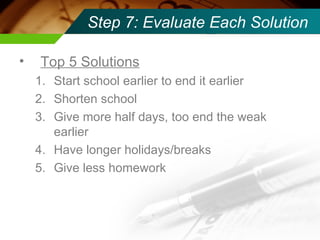
Step 7: Evaluate Each Solution Top 5 Solutions Start school earlier to end it earlier Shorten school Give more half days, too end the weak earlier Have longer holidays/breaks Give less homework
Step 8: Carrying out the Solution Start School Earlier to End it Earlier –
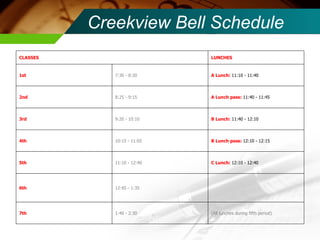
Creekview Bell Schedule  (All lunches during fifth period) 1:40 - 2:30 7th 12:45 - 1:35 6th C Lunch:  12:10 - 12:40 11:10 - 12:40 5th B Lunch pass:  12:10 - 12:15 10:15 - 11:05 4th B Lunch:  11:40 - 12:10 9:20 - 10:10 3rd A Lunch pass:  11:40 - 11:45 8:25 - 9:15 2nd A Lunch:  11:10 - 11:40 7:30 - 8:20 1st LUNCHES CLASSES
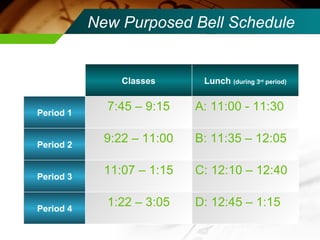
New Purposed Bell Schedule  B: 11:35 – 12:05 9:22 – 11:00 Period 2 A: 11:00 - 11:30 7:45 – 9:15 Period 1 D: 12:45 – 1:15 1:22 – 3:05 Period 4 C: 12:10 – 12:40 11:07 – 1:15 Period 3 Lunch  (during 3 rd  period) Classes
Conclusion Brainstorming problems Selecting and defining the problems Establishing the criteria for workable solution Analyzing the problem Recording results Suggesting possible solutions Evaluate each solution Carrying out the solution *Concluded that it is more sensible to start and end school earlier than what it already is.
After our group has brainstormed and planned the early time changes, we have concluded that it is more sensible to start school at an earlier time. Students as well as employees of Hebron High School will have more free time to do things after school while going to sleep and waking up at reasonable hours.
Bibliography &quot;Bell Schedules.&quot;  Creekview High School . 20 Mar.  2009  <http://cfbstaff.cfbisd.edu/creekview/SupportSer vices/schoolPolicies/schedule.htm>.   Jones, Hugh. Personal Interview. 20 March 2009. VanHoozer, Stan. Personal Interview. 20 March 2009. Werneke, Amanda. Personal Interview. 20 March  2009.

Broken Windows 4th[2]

  • 1.
    Broken Windows Team Rath Minhal Dhanjy Donnie Rath Leigh Silver Jessica Lister Jude Ndudi 4 th
  • 2.
    Introduction -Later schooltimes *Stay up late to do homework * Students in extracurricular activities come home at around 8. -Earlier school times * Students have more time to do extracurricular activities. * More time for homework * More time to do things that aren’t related to school.
  • 3.
    Cont. Brainstorming problemsSelecting and defining the problems Establishing the criteria for workable solution Analyzing the problem Recording results Suggesting possible solutions Evaluate each solution Carrying out the solution *Concluded that it is more sensible to start and end school earlier than what it already is.
  • 4.
    Step 1: Brainstormingthe Problems Hallway Cramming School Timings Cafeteria Food Sanitation Lunch Organization Traffic Buses Dress Code Cell Phones
  • 5.
    Step 2: Selectingand Defining the Problem Criteria: 1) It has to reflect the majority of the student body so it’d be a welcomed change. 2) It either has to save money or not cause extra spending so the school’s income won’t be affected. 3) It has to be approved by the majority of the school’s faculty so they will like the change,
  • 6.
    Cont. Rankings Schooltimings Sanitation Busses Traffic Cafeteria Food Dress Code
  • 7.
    Cont. Selected ProblemThe problem we will attempt to change is School Timings. This is a problem because it affects how the students and staff spend afternoons after school.
  • 8.
    Step 3: EstablishingCriteria for Workable Solution Criteria It should not cost the school a significant amount of money. It will allow the school’s budget not to be affected. It should give students and teachers long afternoons so they can do want they want in their days. It should be a reasonable solution that is wanted by both the students and the faculty.
  • 9.
    Step 4: Analyzethe Problem Tests Teacher Survey - It should support our ideas that starting school earlier would be a welcomed change to the teacher. Student Survey - It should be a change most students want. Principal Interviews – The principals should support our ideas.
  • 10.
    Step 5: Recordingthe Results Teacher Survey 53% of teachers say they would like to change school timing 100% have taught in schools with earlier timings 67% believe that earlier timings will be more convenient for themselves 100% of teachers have learned in schools with earlier timings
  • 11.
    Cont. Student Survey70% of students would like to start school earlier 83% believe they will have more time to get things done with earlier times 67% believe it will be more convenient 70% have a job and/or are in an extracurricular active 50% think starting and ending school earlier will minimize traffic.
  • 12.
    Cont. Principal InterviewResults: When Mr. Jones was asked “How do you think teachers and students will react to this change?” Mr. Jones answered, “It has been my experience that both students and teachers generally react negatively to most any type of change.” When Mr. VanHoozer and Ms. Werneke were asked, “What are the benefits of going and leaving school early?” Mr. VanHoozer answered, “For high school students getting out by 3 gives them more opportunities to work or be home to take care of younger brothers and sisters.” and Ms. Werneke answered, “One advantage of arriving to school early and subsequently leaving early is giving students more flexibility in scheduling extra-curricular or outside-of-school activities.” What this means: The principals see good things for the students when school is started and let out early.
  • 13.
    Cont. There isa good chance that the problem will be addressed because the actual harm in leaving the problem as it is, is the students will have less time with friends and family and the students time will be all focused on homework. The potential benefit is the students will have more time to do homework, spend time with friends and family, and have more rest.
  • 14.
    Step 6: SuggestPossible Solutions Brainstormed Solutions: Start school earlier Give less homework Shorten School More half-days More holidays/ days off
  • 15.
    Step 7: EvaluateEach Solution Top 5 Solutions Start school earlier to end it earlier Shorten school Give more half days, too end the weak earlier Have longer holidays/breaks Give less homework
  • 16.
    Step 8: Carryingout the Solution Start School Earlier to End it Earlier –
  • 17.
    Creekview Bell Schedule (All lunches during fifth period) 1:40 - 2:30 7th 12:45 - 1:35 6th C Lunch: 12:10 - 12:40 11:10 - 12:40 5th B Lunch pass: 12:10 - 12:15 10:15 - 11:05 4th B Lunch: 11:40 - 12:10 9:20 - 10:10 3rd A Lunch pass: 11:40 - 11:45 8:25 - 9:15 2nd A Lunch: 11:10 - 11:40 7:30 - 8:20 1st LUNCHES CLASSES
  • 18.
    New Purposed BellSchedule B: 11:35 – 12:05 9:22 – 11:00 Period 2 A: 11:00 - 11:30 7:45 – 9:15 Period 1 D: 12:45 – 1:15 1:22 – 3:05 Period 4 C: 12:10 – 12:40 11:07 – 1:15 Period 3 Lunch (during 3 rd period) Classes
  • 19.
    Conclusion Brainstorming problemsSelecting and defining the problems Establishing the criteria for workable solution Analyzing the problem Recording results Suggesting possible solutions Evaluate each solution Carrying out the solution *Concluded that it is more sensible to start and end school earlier than what it already is.
  • 20.
    After our grouphas brainstormed and planned the early time changes, we have concluded that it is more sensible to start school at an earlier time. Students as well as employees of Hebron High School will have more free time to do things after school while going to sleep and waking up at reasonable hours.
  • 21.
    Bibliography &quot;Bell Schedules.&quot; Creekview High School . 20 Mar. 2009 <http://cfbstaff.cfbisd.edu/creekview/SupportSer vices/schoolPolicies/schedule.htm>. Jones, Hugh. Personal Interview. 20 March 2009. VanHoozer, Stan. Personal Interview. 20 March 2009. Werneke, Amanda. Personal Interview. 20 March 2009.