TEAM MENBER

Sisi Jin
He Liu
Xinya He
Hanjiao Qian
Muzi Li
Binhui Hao
Overview

 1.   Corporate’s operation & strategy

 2.   Accounting Policies Analysis

 3.   Ratio Analysis

 4.   Cash Flow Analysis

 5.   Conclusion
Q1:A brief discussion on the company’s
Operation & Strategy
Sisi Jin
(08119790)
Company’s operation
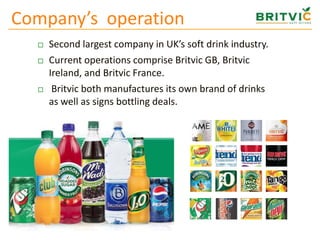
     Second largest company in UK’s soft drink industry.
     Current operations comprise Britvic GB, Britvic
      Ireland, and Britvic France.
      Britvic both manufactures its own brand of drinks
      as well as signs bottling deals.
Strategy
Critical Success Factors
   Differentiation (3 Brand water strategy)
       Distinct consumer targeting
       High growth segments
       Differentiated brand positioning

   Licensing / Franchising of Britvic brands
       Enable other local companies to use its trademark and ingredients
       Produce and sell Pepsi products in GB an Ireland.

   Distribution Network
       On-the-go distribution

   Strong Customer Base
       “Big 4” supermarket
Strategy
Critical Success Factors Analysis
   Differentiation (3 Brand water strategy)
       Distinct consumer targeting
       High growth segments
       Differentiated brand positioning

   Licensing / Franchising of Britvic brands
       Enable other local companies to use its trademark and ingredients
       Produce and sell Pepsi products in GB an Ireland.

   Distribution Network
       On-the-go distribution

   Strong Customer Base
       “Big 4” supermarket
Strategy
Critical Success Factors Analysis
   Differentiation (3 Brand water strategy)
       Distinct consumer targeting
       High growth segments
       Differentiated brand positioning

   Licensing / Franchising of Britvic brands
       Enable other local companies to use its trademark and ingredients
       Produce and sell Pepsi products in GB an Ireland.

   Distribution Network
       On-the-go distribution

   Strong Customer Base
       “Big 4” supermarket
Strategy
Critical Success Factors Analysis
   Differentiation (3 Brand water strategy)
       Distinct consumer targeting
       High growth segments
       Differentiated brand positioning

   Licensing / Franchising of Britvic brands
       Enable other local companies to use its trademark and ingredients
       Produce and sell Pepsi products in GB an Ireland.

   Distribution Network
       On-the-go distribution

   Strong Customer Base
       “Big 4” supermarket
Strategy
Critical Success Factors Analysis
   Differentiation (3 Brand water strategy)
       Distinct consumer targeting
       High growth segments
       Differentiated brand positioning

   Licensing / Franchising of Britvic brands
       Enable other local companies to use its trademark and ingredients
       Produce and sell Pepsi products in GB an Ireland.

   Distribution Network
       On-the-go distribution

   Strong Customer Base
       “Big 4” supermarket
Q2:Accounting Policies Analysis
He Liu
(08117632)
Step 1: Key accounting policies

    Revenue recognition:
    Allows for sales related discounts and rebates


    Intangible assets and goodwill:
    Acquisition method
    Goodwill is not amortized
    Intangible assets: trademarks; franchises rights, customer lists
     and software costs
Step 2: Degree of accounting flexibility


    Post-retirement benefit:
 Assumptions: factors such as discount rate, inflation, pension
   plans, salary increase, expected return on scheme assets,
   mortality and other demographic assumptions.


    The numbers they allocated in the financial
     statement did not seem outlandish or vary
     greatly from year before
Step 3: Evaluation of accounting strategy

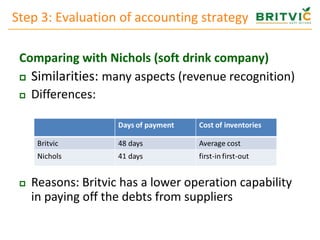
 Comparing with Nichols (soft drink company)
  Similarities: many aspects (revenue recognition)

  Differences:


    Reasons: Britvic has a lower operation capability
     in paying off the debts from suppliers
Step 3 (cont.)


  Significant change (voluntarily)
 The average days of payment:
 2008: 36 days; 2009: 49 days (driven by higher
   trade payables)
Q2:Accounting Policies Analysis

Xinya He
(08118756)
Step 4: Quality of disclosure

    Dis-aggregation--------The overall items are broken down as its segmental
    reporting that is organized into five reportable units through its geographic
    areas, which are GB stills- United Kingdom excluding Northern Ireland, GB Carbs-
    United Kingdom excluding Northern Ireland, Ireland, International and France


    Good relation with shareholders-------Company gives presentations covering
    annual and interim results to analysts, investors and perspective investors.
    Business reviews section in annual report discloses the details of company’s
    financial performance, the risks it faces and plans for future.
Step 5: Potential red flag


 Impairment in 2010 is 116.7 million while this figure is merely 4.2 million in the
   previous year. Possible explanations has been disclosed in the company’s annual
   report which states that Ireland business segment encountered a sustained
   economic downturn which cause 89.6 million impairment losses.
Step 6: Accounting Distortion


 “Exceptional items” -----which permitted by the accounting rules group many one-off
 events that cause losses. So a company can produce two figures regarding earnings per
 share (EPS); the basic EPS figure which includes these losses and an "adjusted" EPS which
 doesn't
 Britvic did this in its 2010 accounts; a statutory loss of 21.4p per share became an
 adjusted profit of 39.8p when the exceptional losses were ignored.
Q3:Ratio analysis

Hanjiao Qian
(08119866)
Overview
Five categories of ratio: (FY 2008-2011, Britvic Vs. Nichols)

1.   Profitability

2.   Liquidity

3.   Gearing/Leverage

4.   Working capital management

5.   Investment activities
Profitability
    ROE is a comprehensive indicator of a firm’s performance. But it cannot be
     used to assess Britvic’s performance, because it disinvested one of its
     subsidiaries which leads to a huge retained loss in 2006, making the total
     shareholders’ equity be negative, and remains negative in following years.
    ROA becomes the best choice.
    Overall, Nichols performs better than Britvic, and shows quicker recovery
     than Britvic.

                                     ROA comparison
               25.00%

               20.00%
                                             21.46%    20.62%
                                   19.46%
               15.00%

               10.00%                                            ROA(Britvic)

                5.00%    8.08%                                   ROA(Nichols)
                                   5.48%               5.48%
                0.00%    4.30%

                         FY 2008   FY 2009   FY 2010   FY 2011
                -5.00%
                                             -4.61%
               -10.00%
Profitability
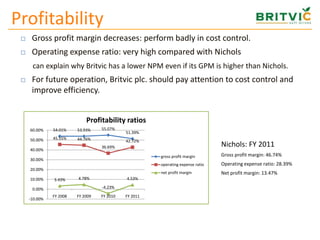
     Gross profit margin decreases: perform badly in cost control.
     Operating expense ratio: very high compared with Nichols
      can explain why Britvic has a lower NPM even if its GPM is higher than Nichols.
     For future operation, Britvic plc. should pay attention to cost control and
      improve efficiency.


                             Profitability ratios
     60.00%    54.01%    53.93%    55.07%
                                             51.39%
     50.00%    45.55%    44.76%              42.72%
                                   36.69%                                        Nichols: FY 2011
     40.00%
                                                       gross profit margin       Gross profit margin: 46.74%
     30.00%
                                                       operating expense ratio   Operating expense ratio: 28.39%
     20.00%
                                                       net profit margin         Net profit margin: 13.47%
     10.00%    3.43%     4.78%               4.53%

      0.00%                        -4.23%

               FY 2008   FY 2009   FY 2010   FY 2011
     -10.00%
Liquidity
    Two ratios are both improved.
    Current ratio: (1) increase;
                      (2) value of ratio is still less than 1 (the ability of repayment).
    Quick ratio (assess a company’s ability to meet CL based on higher liquid assets):
                       (1) use CA to repay CL more quickly than previous years.
    Nichols plc. still shows more efficiency in utilizing liquid assets to meet
     current obligations.

                             Liquidity ratios
      1.20
                                    1.00         0.99
      1.00               0.90
              0.81                  0.77         0.76
      0.80
              0.63
                         0.72
                                                                          Nichols: FY 2011
      0.60                                                current ratio   Current ratio: 2.14
      0.40                                                quick ratio
                                                                          Quick ratio: 1.88
      0.20

      0.00
             FY 2008    FY 2009    FY 2010      FY 2011
Gearing/Leverage
    D/E ratio computation is meaningless (negative total SH’s
     equity).
    But negative total SH’s equity indicates TA is less than TL,
     reflecting high risk of liquidation.
    Interest coverage: although PBIT can cover interest payment,
     compared with Nichols, less safe.
                           Britvic    Britvic    Britvic    Britvic   Nichols
                          FY 2011    FY 2010    FY 2009    FY 2008    FY 2011


      Interest coverage    3.50                  3.81       2.90      156.46
Working capital management
      Days’ inventory increases: limit the ability to manage inventory efficiently.
      Days’ receivable increases: having problems in credit terms and collecting
       cash from customers.
      Days’ payable increases then decreases: a free source of borrowing (due to
       negative total SH equity), negative impact on company’s credit rating.
      Nichols shows more efficient working capital management.

                          Working capital management
 250.00
                                        228.48
                          216.90                      209.03
 200.00
            191.67
                                                                                       Nichols: FY 2011
 150.00
                                                                    Days' inventory    Days’ inventory: 31.90

 100.00                                                             Days' receivable   Days’ receivable: 69.88
                                                                    Days' payable      Days’ payable: 118.60
                           61.64         65.06         67.60
  50.00      55.86                       48.51         50.07
             40.56         41.41

     0.00
                FY 2008       FY 2009       FY 2010       FY 2011
Investment ratios
   P/E ratio: a measure of future earnings growth.
    Huge loss in Irish market in 2010 had an impact of SH’s expectation of Britvic.
   Dividend cover: a measure of security.
    Reduce dividend is a bad signal.
   Nichols in 2011 shows higher future earnings growth and safe
    dividend coverage than Britvic.

                       Britvic    Britvic     Britvic      Britvic    Nichols
                      FY 2011    FY 2010     FY 2009      FY 2008     FY 2011


       P/E ratio       13.01                  16.32        14.53       14.46


     Dividend cover    1.45                   1.68         1.29        2.57
Q3:Cash flow analysis

Muzi Li
(08119660)
Cash flow statement                                                                Britvic   Britvic   Britvic   Britvic   Nichols
                                                                                      2011      2010      2009      2008      2011

                  Net Income                                                          79.9      (28.8)    66.2      51.8      11.759
Long-term         Income tax paid                                                     (20.9)    (21.8)    (18.9)    (8.1)     (3.068)
operating         Financial costs                                                     32        26.3      23.6      26.6      (0.072)
Accruals          Other financial instruments                                         10.2      1.5       -         -         -
                  Impairment of property, plant and equipment and intangible assets   0.5       116.7     4.2       4.2       4.8
                  Depreciation and amortization                                       48.5      42.4      38.7      42.6      0.17
                  Shared-based payments                                               3.8       7.8       6.9       7.8       -
                  Net pension charge less contribution                                (27.9)    (16)      (13.4)    (12.4)    (0.748)

                 Loss on disposal of tangible and intangible assets                   4.6       1.3       1.7       3.0       -
                 Tax expense recognized in the IS                                     -         -         -         -         4.225
                 Change in provisions                                                 -         -         -         -         (0.179)
                 Operating cash flow before working capital investments               130.7     129.4     109       116.1     12.087
                 (Increase)/decrease in inventory                                     (4.4)     1.3       (1.0)     (2.0)     (2.302)
                 (Increase)/decrease in trade and other receivables                   (24.1)    10.4      (18.9)    (15.3)    (4.652)
                 Increase/(decrease) in trade and other payables                      22.8      (16.6)    41.8      44.4      7.05
                 Operating cash flow before investment in long-term assets            125.0     124.5     130.9     143.2     12.183
Net (investments Proceeds from sale of property, plant and equipment                  0.6       4.7       9.5       6.1       -
in) or           Purchases of property, plant and equipment                           (37.7)    (40.2)    (38.3)    (45.3)    (0.154)
Liquidation of   Purchases of intangible assets                                       (11.9)    (9.8)     (11.9)    (5.9)     -
operating long-
                 Acquisition of subsidiary net of cash acquired                       (4.5)     (151.9)   -         (6.8)     (2.3)
term assets and
equipment
                 Interest received                                                    -         -         -         0.3       -
                 Finance income                                                       -         -         -         -         0.072
                 Free cash flow available to debt and equity                          71.5      (72.7)    90.2      91.6      9.801
                 After tax net interest income (expense)                              (31.1)    (24.9)    (25.2)    (26.9)    -
                 Net debt (repayment) or issuance                                     (9.5)     54.8      (7.3)     (45.5)    -
                 Free cash flow available to equity                                   30.9      (42.8)    57.7      19.2      9.801
                 Dividend (payments)                                                  (40.3)    (34.9)    (27.8)    (24.7)    (5.195)
                 Net stock issuance (repurchase) and other equity changes             (1.0)     92.5      (3.3)     (8.1)     0.083
                 Net increase (decrease) in cash balance                              (10.4)    14.8      26.6      (13.6)    4.689
                 Exchange rate differences                                            (0.6)     (0.5)     0.2       0.8       -
                 Net increase (decrease) in cash balance- As Reported                 (11.0)    14.3      26.8      (14.4)    4.689
Cash Flow Analysis
   Operating cash flow before working capital investments
①    Depreciation and amortization and financial costs
②    Pension charges
③    Outstanding impairment shown in 2010


   Operating cash flow before investment in long-term assets
①    Constant increase in receivables
②    Constant decrease in payables
③    Inverse situation witnessed in 2010
Continued Cash Flow Analysis
   Operating cash flow before investment in long-term assets
①    Constant growth or expansion
②    Acquisition of Britvic France was realized in 2010

   Free cash flow available to debt and equity
①    Constant debt and dividend payments
②    In 2010, Britvic issued new debt and new stock to pay back the debt
     and to raise fund.
Q4: Conclusion & Forecasting
Binhui Hao
(08119214)
Business Strategy


Recommendations
 Reinforcing their loyalty to maintain their strong customer base

 Updating products to hold on market niche and attract new
 customers
Accounting Quality

Red Flags
 The ratio of sales and receivables
 The ratio of inventories
 The ratio of Operating Activities


Recommendation
 Paying more attentions to its overall operations to explain these
 dramatic and abnormal changes
Financial Health
Less Competitive
 Lower liquidity
 Lower profitability
   Higher leverage


Recommendations
 Maintaining a certain current ratio in order to ensure adequate liquidity.
 Cost control and efficiency performance should be the priority of the
 further development.
Forecasting
The successive growth of 7% in Sales and 10.8% in Gross profit in
2012


The historical sales trend          Business Strategy
 An average annual growth rate      New-product introducing
  of 6.6%                            Expanding market share
Forecasting
  The successive growth of Net Revenue on an average of 1.8%
  in 2012


The historical sales trend        The Conpany situation
 An average annual growth rate    Mature market
  of 1.8%                          Increasing sales and gross profits
THANK YOU FOR LISTENING!

Britvic company evaluation

  • 1.
    TEAM MENBER Sisi Jin HeLiu Xinya He Hanjiao Qian Muzi Li Binhui Hao
  • 2.
    Overview 1. Corporate’s operation & strategy 2. Accounting Policies Analysis 3. Ratio Analysis 4. Cash Flow Analysis 5. Conclusion
  • 3.
    Q1:A brief discussionon the company’s Operation & Strategy Sisi Jin (08119790)
  • 4.
    Company’s operation  Second largest company in UK’s soft drink industry.  Current operations comprise Britvic GB, Britvic Ireland, and Britvic France.  Britvic both manufactures its own brand of drinks as well as signs bottling deals.
  • 5.
    Strategy Critical Success Factors  Differentiation (3 Brand water strategy)  Distinct consumer targeting  High growth segments  Differentiated brand positioning  Licensing / Franchising of Britvic brands  Enable other local companies to use its trademark and ingredients  Produce and sell Pepsi products in GB an Ireland.  Distribution Network  On-the-go distribution  Strong Customer Base  “Big 4” supermarket
  • 6.
    Strategy Critical Success FactorsAnalysis  Differentiation (3 Brand water strategy)  Distinct consumer targeting  High growth segments  Differentiated brand positioning  Licensing / Franchising of Britvic brands  Enable other local companies to use its trademark and ingredients  Produce and sell Pepsi products in GB an Ireland.  Distribution Network  On-the-go distribution  Strong Customer Base  “Big 4” supermarket
  • 7.
    Strategy Critical Success FactorsAnalysis  Differentiation (3 Brand water strategy)  Distinct consumer targeting  High growth segments  Differentiated brand positioning  Licensing / Franchising of Britvic brands  Enable other local companies to use its trademark and ingredients  Produce and sell Pepsi products in GB an Ireland.  Distribution Network  On-the-go distribution  Strong Customer Base  “Big 4” supermarket
  • 8.
    Strategy Critical Success FactorsAnalysis  Differentiation (3 Brand water strategy)  Distinct consumer targeting  High growth segments  Differentiated brand positioning  Licensing / Franchising of Britvic brands  Enable other local companies to use its trademark and ingredients  Produce and sell Pepsi products in GB an Ireland.  Distribution Network  On-the-go distribution  Strong Customer Base  “Big 4” supermarket
  • 9.
    Strategy Critical Success FactorsAnalysis  Differentiation (3 Brand water strategy)  Distinct consumer targeting  High growth segments  Differentiated brand positioning  Licensing / Franchising of Britvic brands  Enable other local companies to use its trademark and ingredients  Produce and sell Pepsi products in GB an Ireland.  Distribution Network  On-the-go distribution  Strong Customer Base  “Big 4” supermarket
  • 10.
  • 11.
    Step 1: Keyaccounting policies  Revenue recognition:  Allows for sales related discounts and rebates  Intangible assets and goodwill:  Acquisition method  Goodwill is not amortized  Intangible assets: trademarks; franchises rights, customer lists and software costs
  • 12.
    Step 2: Degreeof accounting flexibility  Post-retirement benefit: Assumptions: factors such as discount rate, inflation, pension plans, salary increase, expected return on scheme assets, mortality and other demographic assumptions.  The numbers they allocated in the financial statement did not seem outlandish or vary greatly from year before
  • 13.
    Step 3: Evaluationof accounting strategy Comparing with Nichols (soft drink company)  Similarities: many aspects (revenue recognition)  Differences:  Reasons: Britvic has a lower operation capability in paying off the debts from suppliers
  • 14.
    Step 3 (cont.)  Significant change (voluntarily) The average days of payment: 2008: 36 days; 2009: 49 days (driven by higher trade payables)
  • 15.
  • 16.
    Step 4: Qualityof disclosure  Dis-aggregation--------The overall items are broken down as its segmental reporting that is organized into five reportable units through its geographic areas, which are GB stills- United Kingdom excluding Northern Ireland, GB Carbs- United Kingdom excluding Northern Ireland, Ireland, International and France  Good relation with shareholders-------Company gives presentations covering annual and interim results to analysts, investors and perspective investors. Business reviews section in annual report discloses the details of company’s financial performance, the risks it faces and plans for future.
  • 17.
    Step 5: Potentialred flag  Impairment in 2010 is 116.7 million while this figure is merely 4.2 million in the previous year. Possible explanations has been disclosed in the company’s annual report which states that Ireland business segment encountered a sustained economic downturn which cause 89.6 million impairment losses.
  • 18.
    Step 6: AccountingDistortion  “Exceptional items” -----which permitted by the accounting rules group many one-off events that cause losses. So a company can produce two figures regarding earnings per share (EPS); the basic EPS figure which includes these losses and an "adjusted" EPS which doesn't  Britvic did this in its 2010 accounts; a statutory loss of 21.4p per share became an adjusted profit of 39.8p when the exceptional losses were ignored.
  • 19.
  • 20.
    Overview Five categories ofratio: (FY 2008-2011, Britvic Vs. Nichols) 1. Profitability 2. Liquidity 3. Gearing/Leverage 4. Working capital management 5. Investment activities
  • 21.
    Profitability  ROE is a comprehensive indicator of a firm’s performance. But it cannot be used to assess Britvic’s performance, because it disinvested one of its subsidiaries which leads to a huge retained loss in 2006, making the total shareholders’ equity be negative, and remains negative in following years.  ROA becomes the best choice.  Overall, Nichols performs better than Britvic, and shows quicker recovery than Britvic. ROA comparison 25.00% 20.00% 21.46% 20.62% 19.46% 15.00% 10.00% ROA(Britvic) 5.00% 8.08% ROA(Nichols) 5.48% 5.48% 0.00% 4.30% FY 2008 FY 2009 FY 2010 FY 2011 -5.00% -4.61% -10.00%
  • 22.
    Profitability  Gross profit margin decreases: perform badly in cost control.  Operating expense ratio: very high compared with Nichols can explain why Britvic has a lower NPM even if its GPM is higher than Nichols.  For future operation, Britvic plc. should pay attention to cost control and improve efficiency. Profitability ratios 60.00% 54.01% 53.93% 55.07% 51.39% 50.00% 45.55% 44.76% 42.72% 36.69% Nichols: FY 2011 40.00% gross profit margin Gross profit margin: 46.74% 30.00% operating expense ratio Operating expense ratio: 28.39% 20.00% net profit margin Net profit margin: 13.47% 10.00% 3.43% 4.78% 4.53% 0.00% -4.23% FY 2008 FY 2009 FY 2010 FY 2011 -10.00%
  • 23.
    Liquidity  Two ratios are both improved.  Current ratio: (1) increase;  (2) value of ratio is still less than 1 (the ability of repayment).  Quick ratio (assess a company’s ability to meet CL based on higher liquid assets): (1) use CA to repay CL more quickly than previous years.  Nichols plc. still shows more efficiency in utilizing liquid assets to meet current obligations. Liquidity ratios 1.20 1.00 0.99 1.00 0.90 0.81 0.77 0.76 0.80 0.63 0.72 Nichols: FY 2011 0.60 current ratio Current ratio: 2.14 0.40 quick ratio Quick ratio: 1.88 0.20 0.00 FY 2008 FY 2009 FY 2010 FY 2011
  • 24.
    Gearing/Leverage  D/E ratio computation is meaningless (negative total SH’s equity).  But negative total SH’s equity indicates TA is less than TL, reflecting high risk of liquidation.  Interest coverage: although PBIT can cover interest payment, compared with Nichols, less safe. Britvic Britvic Britvic Britvic Nichols FY 2011 FY 2010 FY 2009 FY 2008 FY 2011 Interest coverage 3.50 3.81 2.90 156.46
  • 25.
    Working capital management  Days’ inventory increases: limit the ability to manage inventory efficiently.  Days’ receivable increases: having problems in credit terms and collecting cash from customers.  Days’ payable increases then decreases: a free source of borrowing (due to negative total SH equity), negative impact on company’s credit rating.  Nichols shows more efficient working capital management. Working capital management 250.00 228.48 216.90 209.03 200.00 191.67 Nichols: FY 2011 150.00 Days' inventory Days’ inventory: 31.90 100.00 Days' receivable Days’ receivable: 69.88 Days' payable Days’ payable: 118.60 61.64 65.06 67.60 50.00 55.86 48.51 50.07 40.56 41.41 0.00 FY 2008 FY 2009 FY 2010 FY 2011
  • 26.
    Investment ratios  P/E ratio: a measure of future earnings growth. Huge loss in Irish market in 2010 had an impact of SH’s expectation of Britvic.  Dividend cover: a measure of security. Reduce dividend is a bad signal.  Nichols in 2011 shows higher future earnings growth and safe dividend coverage than Britvic. Britvic Britvic Britvic Britvic Nichols FY 2011 FY 2010 FY 2009 FY 2008 FY 2011 P/E ratio 13.01 16.32 14.53 14.46 Dividend cover 1.45 1.68 1.29 2.57
  • 27.
  • 28.
    Cash flow statement Britvic Britvic Britvic Britvic Nichols 2011 2010 2009 2008 2011 Net Income 79.9 (28.8) 66.2 51.8 11.759 Long-term Income tax paid (20.9) (21.8) (18.9) (8.1) (3.068) operating Financial costs 32 26.3 23.6 26.6 (0.072) Accruals Other financial instruments 10.2 1.5 - - - Impairment of property, plant and equipment and intangible assets 0.5 116.7 4.2 4.2 4.8 Depreciation and amortization 48.5 42.4 38.7 42.6 0.17 Shared-based payments 3.8 7.8 6.9 7.8 - Net pension charge less contribution (27.9) (16) (13.4) (12.4) (0.748) Loss on disposal of tangible and intangible assets 4.6 1.3 1.7 3.0 - Tax expense recognized in the IS - - - - 4.225 Change in provisions - - - - (0.179) Operating cash flow before working capital investments 130.7 129.4 109 116.1 12.087 (Increase)/decrease in inventory (4.4) 1.3 (1.0) (2.0) (2.302) (Increase)/decrease in trade and other receivables (24.1) 10.4 (18.9) (15.3) (4.652) Increase/(decrease) in trade and other payables 22.8 (16.6) 41.8 44.4 7.05 Operating cash flow before investment in long-term assets 125.0 124.5 130.9 143.2 12.183 Net (investments Proceeds from sale of property, plant and equipment 0.6 4.7 9.5 6.1 - in) or Purchases of property, plant and equipment (37.7) (40.2) (38.3) (45.3) (0.154) Liquidation of Purchases of intangible assets (11.9) (9.8) (11.9) (5.9) - operating long- Acquisition of subsidiary net of cash acquired (4.5) (151.9) - (6.8) (2.3) term assets and equipment Interest received - - - 0.3 - Finance income - - - - 0.072 Free cash flow available to debt and equity 71.5 (72.7) 90.2 91.6 9.801 After tax net interest income (expense) (31.1) (24.9) (25.2) (26.9) - Net debt (repayment) or issuance (9.5) 54.8 (7.3) (45.5) - Free cash flow available to equity 30.9 (42.8) 57.7 19.2 9.801 Dividend (payments) (40.3) (34.9) (27.8) (24.7) (5.195) Net stock issuance (repurchase) and other equity changes (1.0) 92.5 (3.3) (8.1) 0.083 Net increase (decrease) in cash balance (10.4) 14.8 26.6 (13.6) 4.689 Exchange rate differences (0.6) (0.5) 0.2 0.8 - Net increase (decrease) in cash balance- As Reported (11.0) 14.3 26.8 (14.4) 4.689
  • 29.
    Cash Flow Analysis  Operating cash flow before working capital investments ① Depreciation and amortization and financial costs ② Pension charges ③ Outstanding impairment shown in 2010  Operating cash flow before investment in long-term assets ① Constant increase in receivables ② Constant decrease in payables ③ Inverse situation witnessed in 2010
  • 30.
    Continued Cash FlowAnalysis  Operating cash flow before investment in long-term assets ① Constant growth or expansion ② Acquisition of Britvic France was realized in 2010  Free cash flow available to debt and equity ① Constant debt and dividend payments ② In 2010, Britvic issued new debt and new stock to pay back the debt and to raise fund.
  • 31.
    Q4: Conclusion &Forecasting Binhui Hao (08119214)
  • 32.
    Business Strategy Recommendations  Reinforcingtheir loyalty to maintain their strong customer base  Updating products to hold on market niche and attract new customers
  • 33.
    Accounting Quality Red Flags The ratio of sales and receivables  The ratio of inventories  The ratio of Operating Activities Recommendation  Paying more attentions to its overall operations to explain these dramatic and abnormal changes
  • 34.
    Financial Health Less Competitive Lower liquidity  Lower profitability  Higher leverage Recommendations  Maintaining a certain current ratio in order to ensure adequate liquidity.  Cost control and efficiency performance should be the priority of the further development.
  • 35.
    Forecasting The successive growthof 7% in Sales and 10.8% in Gross profit in 2012 The historical sales trend Business Strategy  An average annual growth rate  New-product introducing of 6.6%  Expanding market share
  • 36.
    Forecasting Thesuccessive growth of Net Revenue on an average of 1.8% in 2012 The historical sales trend The Conpany situation  An average annual growth rate  Mature market of 1.8%  Increasing sales and gross profits
  • 37.
    THANK YOU FORLISTENING!