British	Studies
Governmental	System Arif Furqan,	S.S,	M.A.
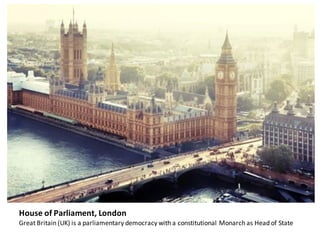
House	of	Parliament,	London
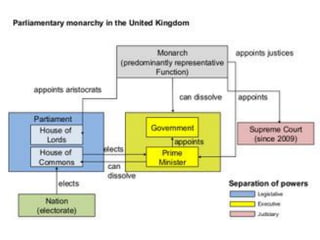
Great	Britain	(UK)	is	a	parliamentary	democracy	with	a	constitutional	Monarch	as	Head	of	State
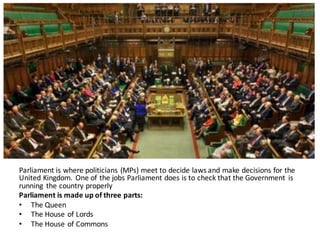
Parliament	is	where	politicians	(MPs)	meet	to	decide	laws	and	make	decisions	for	the	
United	Kingdom.	One	of	the	jobs	Parliament	does	is	to	check	that	the	Government	 is	
running	 the	country	properly
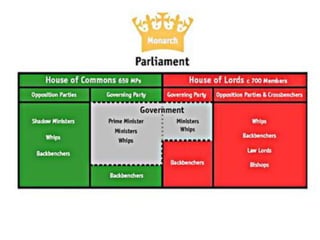
Parliament	is	made	up	of	three	parts:
• The	Queen
• The	House	of	Lords
• The	House	of	Commons
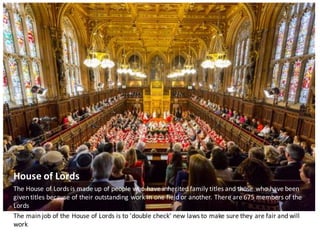
House	of	Lords
The	House	of	Lords	is	made	up	of	people	who	have	inherited	family	titles	and	those	who	have	been	
given	titles	because	of	their	outstanding	work	in	one	field	or	another.	There	are	675	members	of	the	
Lords
The	main	job	of	the	House	of	Lords	is	to	'double	check'	new	laws	to	make	sure	they	are	fair	and	will	
work
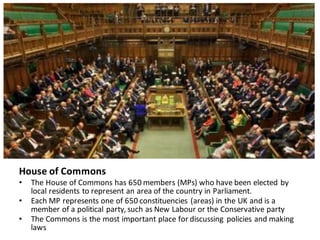
House	of	Commons
• The	House	of	Commons	has	650	members	(MPs)	who	have	been	elected	by	
local	residents	to	represent	an	area	of	the	country	in	Parliament.
• Each	MP	represents	one	of	650	constituencies	(areas)	in	the	UK	and	is	a	
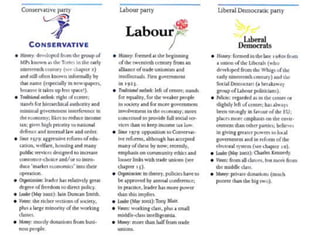
member	of	a	political	party,	such	as	New	Labour or	the	Conservative	party
• The	Commons	is	the	most	important	place	for	discussing	policies	and	making	
laws
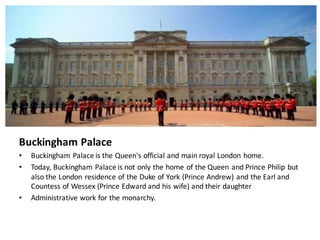
Buckingham	Palace
• Buckingham	Palace	is	the	Queen's	official	and	main	royal	London	home.	
• Today,	Buckingham	Palace	is	not	only	the	home	of	the	Queen	and	Prince	Philip	but	
also	the	London	residence	of	the	Duke	of	York	(Prince	Andrew)	and	the	Earl	and	
Countess	of	Wessex (Prince	Edward	and	his	wife)	and	their	daughter
• Administrative	work	for	the	monarchy.
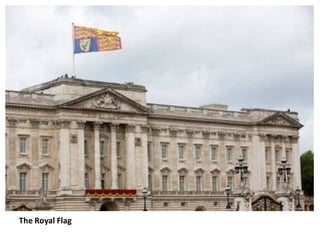
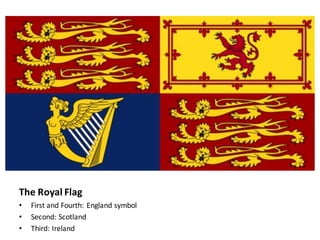
The	Royal	Flag
The	Royal	Flag
• First	and	Fourth:	England	symbol
• Second:	Scotland
• Third:	Ireland
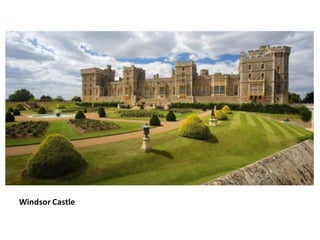
Windsor	Castle
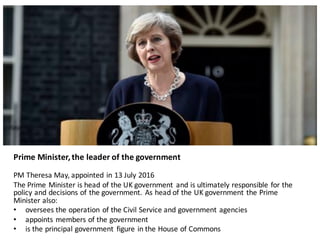
Prime	Minister,	the	leader	of	the	government
PM	Theresa	May,	appointed	in	13	July	2016
The	Prime	Minister	is	head	of	the	UK	government	 and	is	ultimately	responsible	for	the	
policy	and	decisions	of	the	government.	As	head	of	the	UK	government	the	Prime	
Minister	also:
• oversees	the	operation	of	the	Civil	Service	and	government	agencies
• appoints	members	of	the	government
• is	the	principal	government	 figure	in	the	House	of	Commons
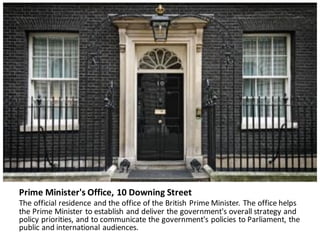
Prime	Minister's	Office,	10	Downing	Street
The	official	residence	and	the	office	of	the	British	Prime	Minister.	The	office	helps	
the	Prime	Minister	to	establish	and	deliver	the	government's	overall	strategy	and	
policy	priorities,	and	to	communicate	the	government's	policies	to	Parliament,	the	
public	and	international	audiences.
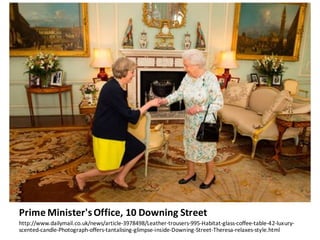
Prime	Minister's	Office,	10	Downing	Street
http://www.dailymail.co.uk/news/article-3978498/Leather-trousers-995-Habitat-glass-coffee-table-42-luxury-
scented-candle-Photograph-offers-tantalising-glimpse-inside-Downing-Street-Theresa-relaxes-style.html
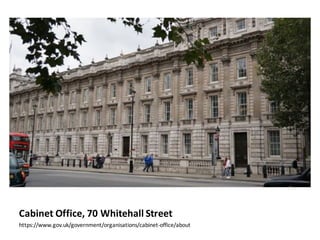
Cabinet	Office,	70	Whitehall	Street
https://www.gov.uk/government/organisations/cabinet-office/about
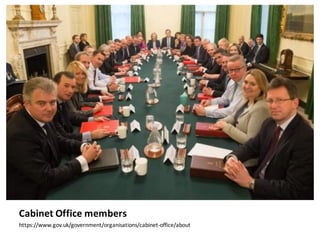
Cabinet	Office	members
https://www.gov.uk/government/organisations/cabinet-office/about
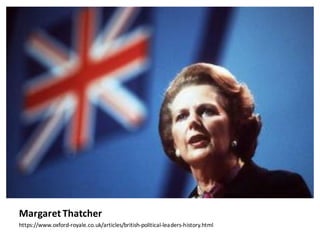
Margaret	Thatcher
https://www.oxford-royale.co.uk/articles/british-political-leaders-history.html
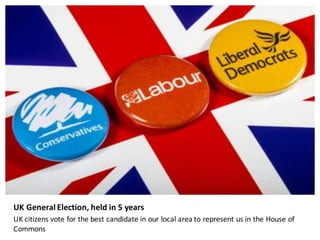
UK	General	Election,	held	in	5	years
UK	citizens	vote	for	the	best	candidate	in	our	local	area	to	represent	us	in	the	House	of	
Commons
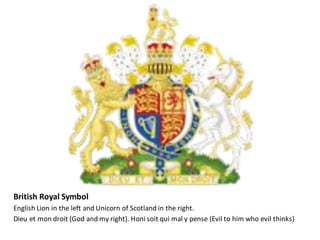
British	Royal	Symbol
English	Lion	in	the	left	and	Unicorn	of	Scotland	in	the	right.
Dieu et	mon droit (God	and	my	right).	Honi soit qui	mal	y	pense (Evil	to	him	who	evil	thinks)
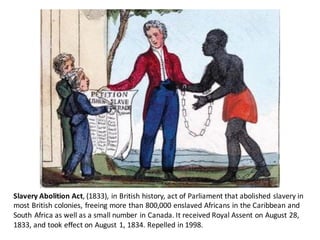
Slavery	Abolition	Act,	(1833),	in	British	history,	act	of	Parliament	that	abolished	slavery	in	
most	British	colonies,	freeing	more	than	800,000	enslaved	Africans	in	the	Caribbean	and	
South	Africa	as	well	as	a	small	number	in	Canada.	It	received	Royal	Assent	on	August	28,	
1833,	and	took	effect	on	August	1,	1834.	Repelled	in	1998.
• In	1928	all	women	aged	over	21	were	given	voting	rights.
• Race	Relations	Act	1965
• International	Convention	on	the	Elimination	of	All	Forms	of	Racial	
Discrimination	1965
• 1967	- Abortion	Act
The	1967	Act	legalized	abortion	in	the	UK,	for	women	who	were	up	to	24	weeks	
pregnant.
• Sex	Discrimination	Act	1975
The	Act	made	gender-based	discrimination	illegal	in	the	areas	of	employment,	
education	and	the	provision	of	goods,	facilities	and	services.
• Race	Relations	Act	1976
The	Act	enshrined	many	of	the	laws	on	race	discrimination.	It	made	race	
discrimination	unlawful	in	employment,	training,	housing,	education	and	the	
provision	of	goods,	facilities	and	services.
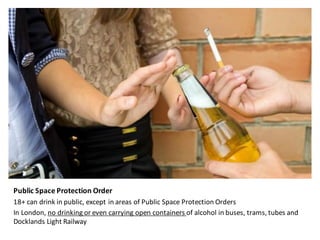
Public	Space	Protection	Order
18+	can	drink	in	public,	except	in	areas	of	Public	Space	Protection	Orders	
In	London,	no	drinking	or	even	carrying	open	containers	of	alcohol	in	buses,	trams,	tubes	and	
Docklands	Light	Railway
Britain	is	led	by	the	Queen,	also	the	
current	Prime	Minister	Theresa	May.	
Indonesia	also	has	its	first	woman	
president,	Megawati
Do	you	believe	in	equality?

British studies government low