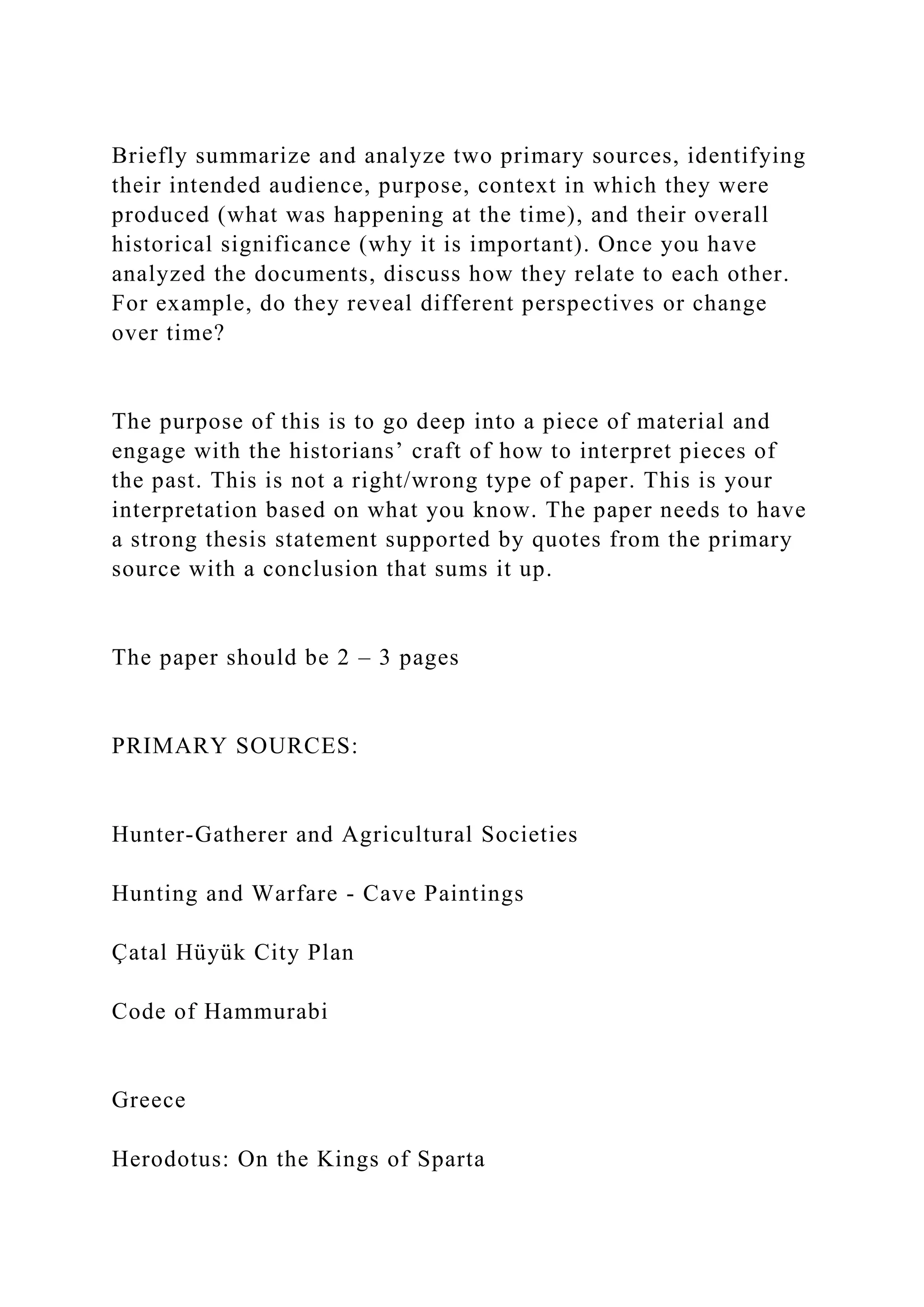
Briefly summarize and analyze two primary sources, identifying
their intended audience, purpose, context in which they were
produced (what was happening at the time), and their overall
historical significance (why it is important). Once you have
analyzed the documents, discuss how they relate to each other.
For example, do they reveal different perspectives or change
over time?
The purpose of this is to go deep into a piece of material and
engage with the historians’ craft of how to interpret pieces of
the past. This is not a right/wrong type of paper. This is your
interpretation based on what you know. The paper needs to have
a strong thesis statement supported by quotes from the primary
source with a conclusion that sums it up.
The paper should be 2 – 3 pages
PRIMARY SOURCES:
Hunter-Gatherer and Agricultural Societies
Hunting and Warfare - Cave Paintings
Çatal Hüyük City Plan
Code of Hammurabi
Greece
Herodotus: On the Kings of Sparta
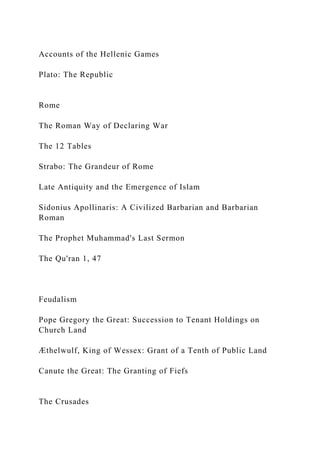
Accounts of the Hellenic Games
Plato: The Republic
Rome
The Roman Way of Declaring War
The 12 Tables
Strabo: The Grandeur of Rome
Late Antiquity and the Emergence of Islam
Sidonius Apollinaris: A Civilized Barbarian and Barbarian
Roman
The Prophet Muhammad's Last Sermon
The Qu'ran 1, 47
Feudalism
Pope Gregory the Great: Succession to Tenant Holdings on
Church Land
Æthelwulf, King of Wessex: Grant of a Tenth of Public Land
Canute the Great: The Granting of Fiefs
The Crusades
Gregory VII: Call for a Crusade [First Crusade]
Eugene III: Summons for a Crusade [Second Crusade]
The Decline of Christian Power in the Holy Land
Richard the Lion-Hearted Conquers Cypress
The Middle Ages
Gregory of Tours: The Harsh Treatment of Serfs and Slaves
Geoffrey Chaucer, The Canterbury Tales: The Prologue to the
Wife of Bath's Tale
The Renaissance and Discovery
Niccolo Machiavelli: The Prince [excerpts]
The Book of the Courtier [Excerpt]
The Life of Leonardo da Vinci
Christopher Columbus: Extracts from Journal
Sir Francis Drake's Famous Voyage Around the World
Briefly summarize and analyze two primary sources, identifying their.docx

Briefly summarize and analyze two primary sources, identifying their.docx

  • 1.
    Briefly summarize andanalyze two primary sources, identifying their intended audience, purpose, context in which they were produced (what was happening at the time), and their overall historical significance (why it is important). Once you have analyzed the documents, discuss how they relate to each other. For example, do they reveal different perspectives or change over time? The purpose of this is to go deep into a piece of material and engage with the historians’ craft of how to interpret pieces of the past. This is not a right/wrong type of paper. This is your interpretation based on what you know. The paper needs to have a strong thesis statement supported by quotes from the primary source with a conclusion that sums it up. The paper should be 2 – 3 pages PRIMARY SOURCES: Hunter-Gatherer and Agricultural Societies Hunting and Warfare - Cave Paintings Çatal Hüyük City Plan Code of Hammurabi Greece Herodotus: On the Kings of Sparta
  • 2.
    Accounts of theHellenic Games Plato: The Republic Rome The Roman Way of Declaring War The 12 Tables Strabo: The Grandeur of Rome Late Antiquity and the Emergence of Islam Sidonius Apollinaris: A Civilized Barbarian and Barbarian Roman The Prophet Muhammad's Last Sermon The Qu'ran 1, 47 Feudalism Pope Gregory the Great: Succession to Tenant Holdings on Church Land Æthelwulf, King of Wessex: Grant of a Tenth of Public Land Canute the Great: The Granting of Fiefs The Crusades
  • 3.
    Gregory VII: Callfor a Crusade [First Crusade] Eugene III: Summons for a Crusade [Second Crusade] The Decline of Christian Power in the Holy Land Richard the Lion-Hearted Conquers Cypress The Middle Ages Gregory of Tours: The Harsh Treatment of Serfs and Slaves Geoffrey Chaucer, The Canterbury Tales: The Prologue to the Wife of Bath's Tale The Renaissance and Discovery Niccolo Machiavelli: The Prince [excerpts] The Book of the Courtier [Excerpt] The Life of Leonardo da Vinci Christopher Columbus: Extracts from Journal Sir Francis Drake's Famous Voyage Around the World