A member of CGIAR consortium www.iita.org
Breeding Programs in the
Private Sector
Ousmane Boukar and Ismail Y. Rabbi
A member of CGIAR consortium www.iita.org
Program Structure
A member of CGIAR consortium www.iita.org
• Type and scope of activities depend on:
– Crop
– Size of company
– Resources available
– Division of activities among different operating
units
A member of CGIAR consortium www.iita.org
R&D Pipeline
• Discovery
• Phase 1 – Proof of concept
• Phase 2 – Early development phase
• Phase 3 – Advanced development phase
• Phase 4 – Pre-launch
• Launch
A member of CGIAR consortium www.iita.org
• Four areas of the variety development
pipeline
– Breeding (including molecular breeding)
– Biotechnology
– Agronomy
– Analytical Technologies
– Informatics (Genetics, Biometrics,
Bioinformatics, Programmers...)
A member of CGIAR consortium www.iita.org
Uses of markers in breeding pipelines
• Quality Assurance:
– Parentage analysis
– Genetic purity tests
• Germplasm analysis through DNA fingerprinting
– Arrangement of diversity (clustering, PCA, etc.)
– Protection of intellectual property (IITA == impact assessment
through adoption studies).
• Trait Analysis
– Association of traits with genomic regions (GWAS or QTL)
– Understanding of relationship among traits (linkage vs.
pleiotropy?)
– Understanding the causes of variation (aid in gene cloning)
• Breeding
– Assist in indirect selection of qualitative and quantitative traits
– Marker Assisted Backcrossing
• Seed chipping (non-destructive genotyping)
A member of CGIAR consortium www.iita.org
• Right research approach and organization
• Solving problem with better solutions
(always try to improve in throughput,
efficiency and targetting)
• Building on strengths
A member of CGIAR consortium www.iita.org
Enabling environment
• Fostering excellence (Pioneer)
– Stimulating environment for R&D scientists
– Offering scientific opportunities: training and
development programs
• Breeding academy (breeding and germplasm
management) focuses on developing the critical
skills necessary for modern breeding
• 3PM Academy: Excellence in project, Program and
Portofolio management
• Syngenta fellows programs
A member of CGIAR consortium www.iita.org
Priority Setting
A member of CGIAR consortium www.iita.org
• Research priority depends on growers and
consumers (Market)
• The direction of new research is guided by
our crop teams and based on customer
need, technology, regulatory requirements
and socio-political trends (Syngenta)
• Targets:
– Biotic stresses (weeds, insects, fungal
diseases, nematodes),
– Abiotic stresses (environmental pressures
such as drought or cold)
– Improved crop yield and quality.
A member of CGIAR consortium www.iita.org
Data Management/Decision
Support
A member of CGIAR consortium www.iita.org
• Big focus of R&D is the management of all the
data being produced in research and development
using computational biology
– Phenotype (field and lab)
– Genotype
– Environment
– Soil
• Scientists produce, process, analyze, interpret,
and report more 2.5 million data-points each day
(Syngenta)
• All have centralized database
(phenotype/genotype/more)
• Informatics support group (mentioned before)
A member of CGIAR consortium www.iita.org
Partnerships
A member of CGIAR consortium www.iita.org
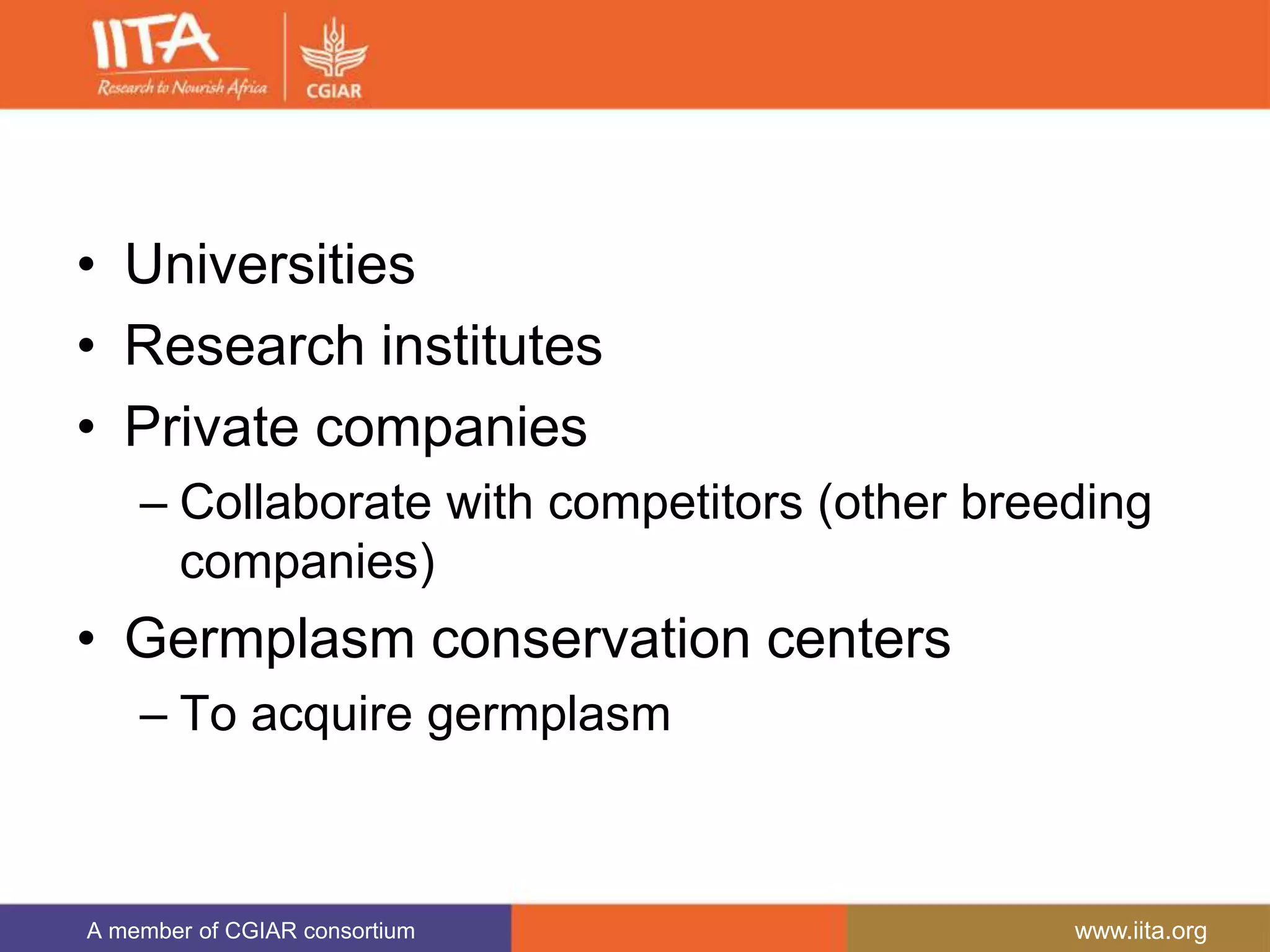
• Universities
• Research institutes
• Private companies
– Collaborate with competitors (other breeding
companies)
• Germplasm conservation centers
– To acquire germplasm
A member of CGIAR consortium www.iita.org
Resource Allocation
A member of CGIAR consortium www.iita.org
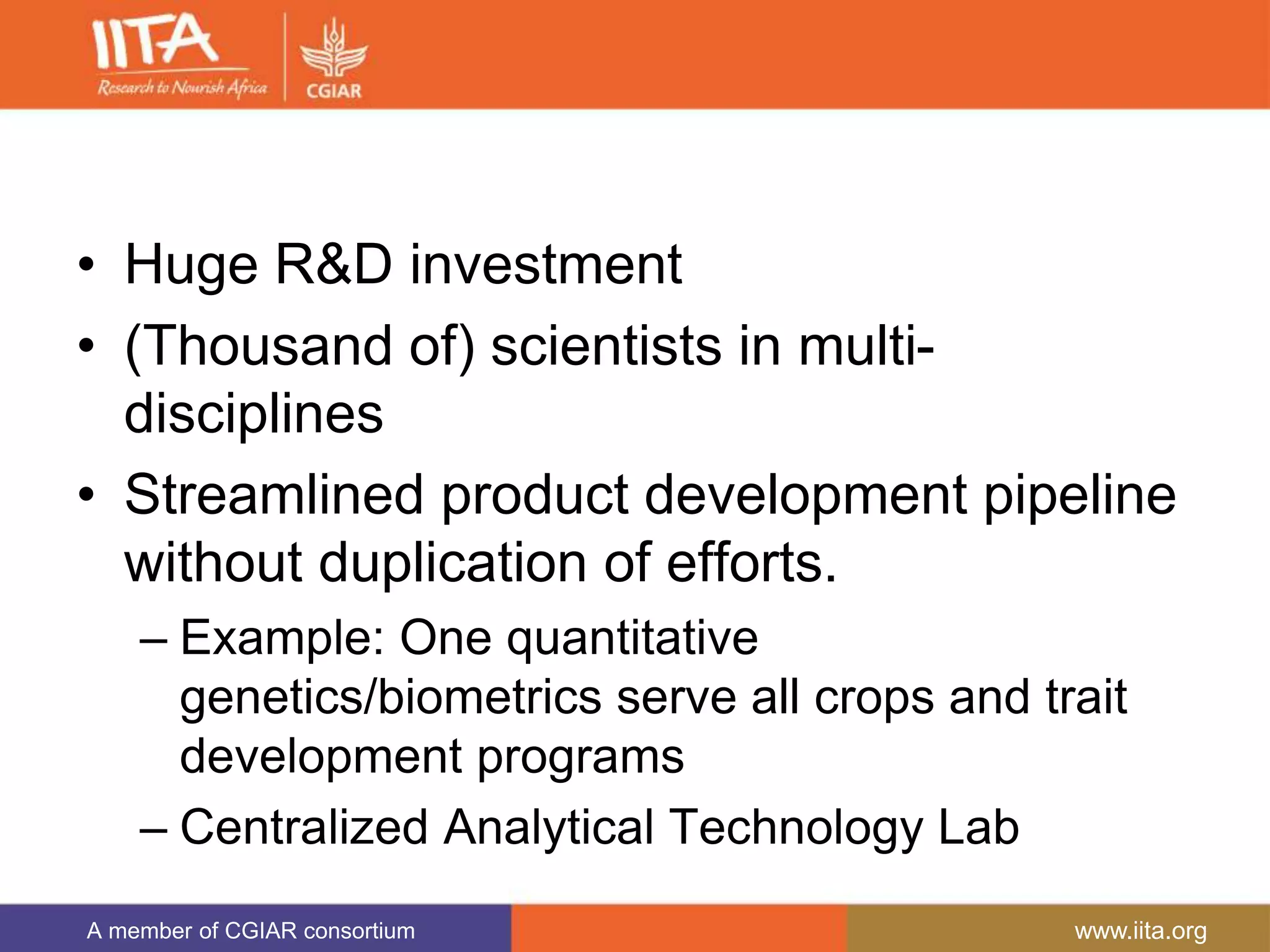
• Huge R&D investment
• (Thousand of) scientists in multi-
disciplines
• Streamlined product development pipeline
without duplication of efforts.
– Example: One quantitative
genetics/biometrics serve all crops and trait
development programs
– Centralized Analytical Technology Lab
A member of CGIAR consortium www.iita.org
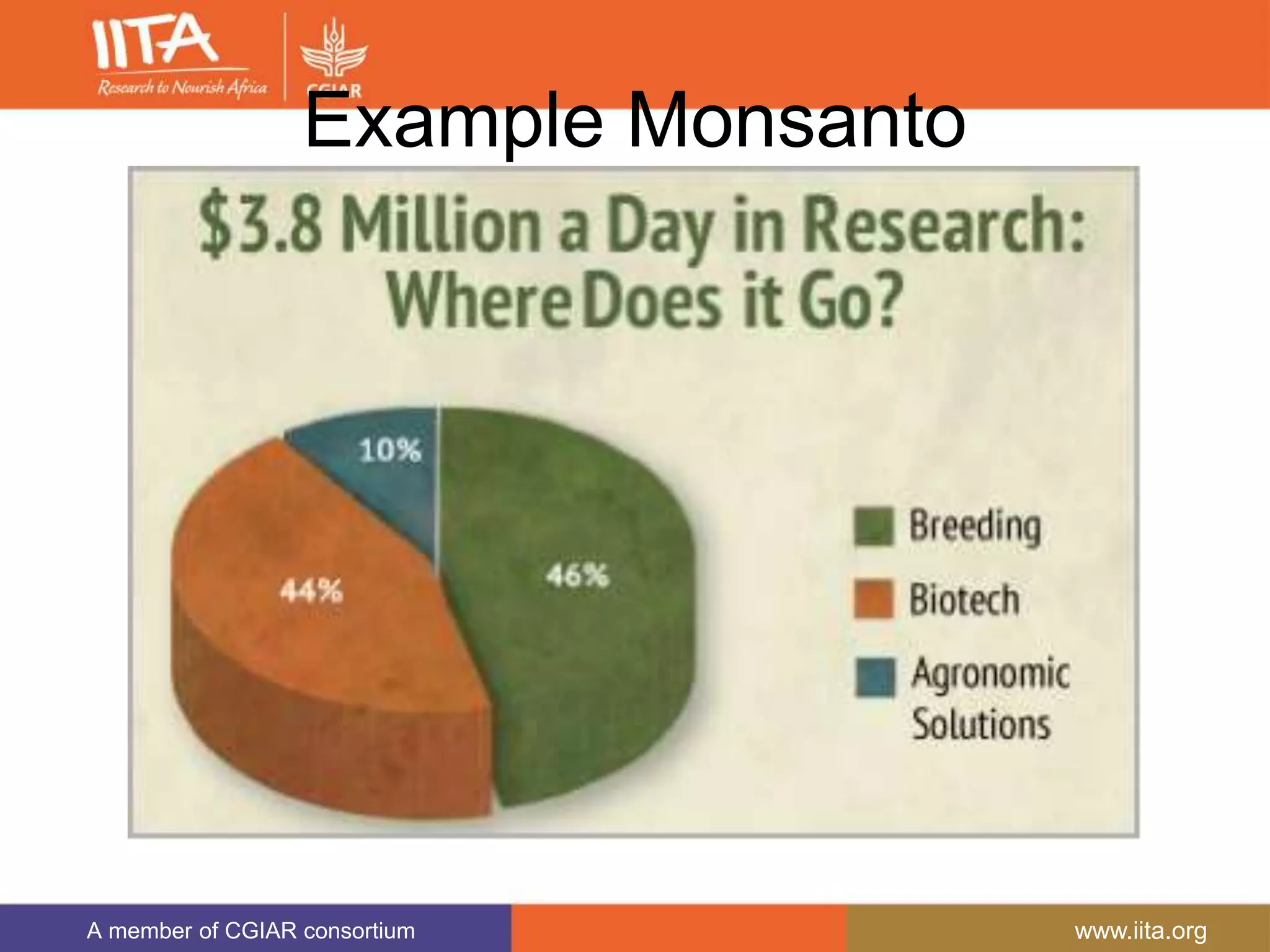
Example Monsanto
A member of CGIAR consortium www.iita.org
Example Pioneer
• In the past five years, DuPont Pioneer
R&D has doubled investment, increased
greenhouse space by more than 60% and
increased research square footage by
more than 30%. DuPont Pioneer R&D is
now comprised of more than 4,400
researchers operating in 125+ research
sites in 25 countries on six continents
A member of CGIAR consortium www.iita.org
Links with Allied Disciplines
A member of CGIAR consortium www.iita.org
• Functional areas:
– Agronomy
– Pathology
– Entomology
– Cell biology and tissue culture
– Applied genomics
– Plant transformation
– Quality analyses
– Regulatory affairs and intellectual property
issues
– Data base management, data analyses
A member of CGIAR consortium www.iita.org
• Collaboration across R&D
– Open innovation platform
– Formal R&D network
– Though seeders (external collaboration) -
Pioneer
A member of CGIAR consortium www.iita.org
Product Orientation, Delivery, and
Stewardship
A member of CGIAR consortium www.iita.org
• Delivery options based on convenience and
efficiency
• Global distribution network with flexibility to
meet local needs
• Several sales professionals
• Wealth of information on product
• Numerous services to customers (expertise,
solutions, financing…)
• Link key players across the agricultural value
chain
A member of CGIAR consortium www.iita.org
Product stewardship
• Clear responsibility from initial research to
discontinuation of a product
• Management of the life cycle of
technologies for maximum product value,
benefits, and longevity
• Pioneer:
– Grain marketing and approval
– Patents covered by technology agreement
– Product use guide
A member of CGIAR consortium www.iita.org
• Material safety data sheets
• Non-GMO validation certificates
• Insect resistance/weed management
• Best management practices for a
particular technology
• Seed treatment stewardship

Breeding programs in the Private Sector

  • 1.
    A member ofCGIAR consortium www.iita.org Breeding Programs in the Private Sector Ousmane Boukar and Ismail Y. Rabbi
  • 2.
    A member ofCGIAR consortium www.iita.org Program Structure
  • 3.
    A member ofCGIAR consortium www.iita.org • Type and scope of activities depend on: – Crop – Size of company – Resources available – Division of activities among different operating units
  • 4.
    A member ofCGIAR consortium www.iita.org R&D Pipeline • Discovery • Phase 1 – Proof of concept • Phase 2 – Early development phase • Phase 3 – Advanced development phase • Phase 4 – Pre-launch • Launch
  • 5.
    A member ofCGIAR consortium www.iita.org • Four areas of the variety development pipeline – Breeding (including molecular breeding) – Biotechnology – Agronomy – Analytical Technologies – Informatics (Genetics, Biometrics, Bioinformatics, Programmers...)
  • 6.
    A member ofCGIAR consortium www.iita.org Uses of markers in breeding pipelines • Quality Assurance: – Parentage analysis – Genetic purity tests • Germplasm analysis through DNA fingerprinting – Arrangement of diversity (clustering, PCA, etc.) – Protection of intellectual property (IITA == impact assessment through adoption studies). • Trait Analysis – Association of traits with genomic regions (GWAS or QTL) – Understanding of relationship among traits (linkage vs. pleiotropy?) – Understanding the causes of variation (aid in gene cloning) • Breeding – Assist in indirect selection of qualitative and quantitative traits – Marker Assisted Backcrossing • Seed chipping (non-destructive genotyping)
  • 7.
    A member ofCGIAR consortium www.iita.org • Right research approach and organization • Solving problem with better solutions (always try to improve in throughput, efficiency and targetting) • Building on strengths
  • 8.
    A member ofCGIAR consortium www.iita.org Enabling environment • Fostering excellence (Pioneer) – Stimulating environment for R&D scientists – Offering scientific opportunities: training and development programs • Breeding academy (breeding and germplasm management) focuses on developing the critical skills necessary for modern breeding • 3PM Academy: Excellence in project, Program and Portofolio management • Syngenta fellows programs
  • 9.
    A member ofCGIAR consortium www.iita.org Priority Setting
  • 10.
    A member ofCGIAR consortium www.iita.org • Research priority depends on growers and consumers (Market) • The direction of new research is guided by our crop teams and based on customer need, technology, regulatory requirements and socio-political trends (Syngenta) • Targets: – Biotic stresses (weeds, insects, fungal diseases, nematodes), – Abiotic stresses (environmental pressures such as drought or cold) – Improved crop yield and quality.
  • 11.
    A member ofCGIAR consortium www.iita.org Data Management/Decision Support
  • 12.
    A member ofCGIAR consortium www.iita.org • Big focus of R&D is the management of all the data being produced in research and development using computational biology – Phenotype (field and lab) – Genotype – Environment – Soil • Scientists produce, process, analyze, interpret, and report more 2.5 million data-points each day (Syngenta) • All have centralized database (phenotype/genotype/more) • Informatics support group (mentioned before)
  • 13.
    A member ofCGIAR consortium www.iita.org Partnerships
  • 14.
    A member ofCGIAR consortium www.iita.org • Universities • Research institutes • Private companies – Collaborate with competitors (other breeding companies) • Germplasm conservation centers – To acquire germplasm
  • 15.
    A member ofCGIAR consortium www.iita.org Resource Allocation
  • 16.
    A member ofCGIAR consortium www.iita.org • Huge R&D investment • (Thousand of) scientists in multi- disciplines • Streamlined product development pipeline without duplication of efforts. – Example: One quantitative genetics/biometrics serve all crops and trait development programs – Centralized Analytical Technology Lab
  • 17.
    A member ofCGIAR consortium www.iita.org Example Monsanto
  • 18.
    A member ofCGIAR consortium www.iita.org Example Pioneer • In the past five years, DuPont Pioneer R&D has doubled investment, increased greenhouse space by more than 60% and increased research square footage by more than 30%. DuPont Pioneer R&D is now comprised of more than 4,400 researchers operating in 125+ research sites in 25 countries on six continents
  • 19.
    A member ofCGIAR consortium www.iita.org Links with Allied Disciplines
  • 20.
    A member ofCGIAR consortium www.iita.org • Functional areas: – Agronomy – Pathology – Entomology – Cell biology and tissue culture – Applied genomics – Plant transformation – Quality analyses – Regulatory affairs and intellectual property issues – Data base management, data analyses
  • 21.
    A member ofCGIAR consortium www.iita.org • Collaboration across R&D – Open innovation platform – Formal R&D network – Though seeders (external collaboration) - Pioneer
  • 22.
    A member ofCGIAR consortium www.iita.org Product Orientation, Delivery, and Stewardship
  • 23.
    A member ofCGIAR consortium www.iita.org • Delivery options based on convenience and efficiency • Global distribution network with flexibility to meet local needs • Several sales professionals • Wealth of information on product • Numerous services to customers (expertise, solutions, financing…) • Link key players across the agricultural value chain
  • 24.
    A member ofCGIAR consortium www.iita.org Product stewardship • Clear responsibility from initial research to discontinuation of a product • Management of the life cycle of technologies for maximum product value, benefits, and longevity • Pioneer: – Grain marketing and approval – Patents covered by technology agreement – Product use guide
  • 25.
    A member ofCGIAR consortium www.iita.org • Material safety data sheets • Non-GMO validation certificates • Insect resistance/weed management • Best management practices for a particular technology • Seed treatment stewardship

Editor's Notes

  • #6 Genomics Genomics involves the mapping of the genes of plants to understand their structure and the role they play in how the plant functions. Molecular Breeding Molecular breeding involves the use of DNA markers for genes in combination with physical measurement of traits to manage plant breeding programs. Molecular breeding significantly accelerates the efficiency in bringing new varieties to market. Crop analytics Crop analytics involves the application of advanced analytical methods and technologies to identify the composition of food and feed traits. Biotechnology