BREECH PRESENTATION
Dr. Bickey Khadgi
Definition
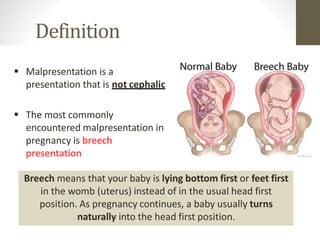
BREECH? Malpresentation is a
presentation that is not cephalic
 The most commonly
encountered malpresentation in
pregnancy is breech
presentation
Breech means that your baby is lying bottom first or feet first
in the womb (uterus) instead of in the usual head first
position. As pregnancy continues, a baby usually turns
naturally into the head first position.
INCIDENCE
This presentation occurs in:
1. 3-4% of term pregnancies.
2. 7% of pregnancies at 32 weeks
3. 25% of pregnancies of less than 28 weeks’
TYPES OF BREECH
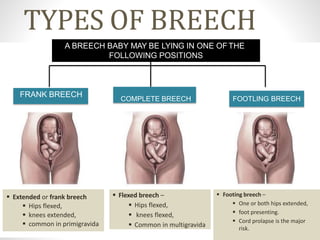
FRANK BREECH
FOOTLING BREECHCOMPLETE BREECH
 Extended or frank breech
 Hips flexed,
 knees extended,
 common in primigravida
 Flexed breech –
 Hips flexed,
 knees flexed,
 Common in multigravida
 Footing breech –
 One or both hips extended,
 foot presenting.
 Cord prolapse is the major
risk.
A BREECH BABY MAY BE LYING IN ONE OF THE
FOLLOWING POSITIONS
FRANK
(50-70%)
COMPLETE
(5-10%)
FOOTLING
(10-30%)
Causes
MATERNAL
FETAL / PLACENTAL
 Fibroids
 Congenital uterine abnormalities
 Uterine surgery
 Multiple Gestation
 Prematurity
 Placenta praevia
 Abnormality, e.g. anencephaly or hydrocephalus
 Oligohydramnios
 Polyhydramnios
DIAGNOSIS
• The diagnosis of breech presentation may be
made by:
1. Abdominal palpation
2. Vaginal examination
3. Confirmed by ultrasound
CLINICAL
DIAGNOSI
S
• Palpation
–Fundal grips; the head is felt with its characters.
–Pelvic grip; the breech is felt, with its
characters.
• Auscultation
–The fetal heart sounds are head just at, or
above the level of the umbilicus
ABDOMINAL EXAMINATION
VAGINAL EXAMINATION
• Slow dilatation of cervix
• After rupture of the membranes, the presenting part is felt that
is , the two buttocks with the anus in between , the genitalia on
one side and the sacral spines on the opposite side.
• In case of complete breech, the feet are felt on the same level
as the buttocks.
• In case of breech with extended legs, the buttocks only are felt.
• In case of footling presentation, the feet are at a lower level
than the buttocks.
Management
ENT
1. EXTERNAL CEPHALIC VERSION
2. Vaginal delivery
3. Lower segment caesarean section (LSCS)
MANAGEMENT
1. EXTERNAL CEPHALIC VERSION
 The procedure is performed at or after 37 completed weeks by an
experienced obstetrician.
 ECV should be performed with tocolytics (e.g. nifedipine) as this
has been shown to improve the success rate.
 The woman is laid flat with a left lateral tilt having ensured that
she has emptied her bladder and is comfortable.
RISK OF ECV
 Placental abruption
 Premature rupture of membrane (PROM)
 Placental hemorrhage
 Fetal bradycardia
VAGINAL BREECH DELIVERY
2 MODE OFDELIVERY
INDICATIONS
 Presentation should be either extended or
flexed
 Estimated fetal weight < 3.5 kg
 No evidence of hyperextension of fetal head
and fetal abnormalities (hydrocephalus)
TECHNIQUE
1. Delivery of the buttocks
2. Delivery Of the legs and lower body
3. Delivery of shoulders
The body of the fetus is then rotated 180 degrees in the
reverse direction to deliver the other shoulder and arm
The trunk is rotated in such a way that the anterior shoulder and arm
appear at the vulva and can easily be released and delivered first.
The appearance of one axilla indicates that its time to
deliver the shoulders
Downward traction until the lower halves of the
scapulas are delivered
TECHNIQUE
4. Delivery of THE HEAD
 Delivered using the
Mauriceau- smellie-veit
Manoeuvre
The index and middle finger
of one hand are applied over
the maxilla, to flex the head,
while the fetal body rests on
the palm of the hand and
forearm.
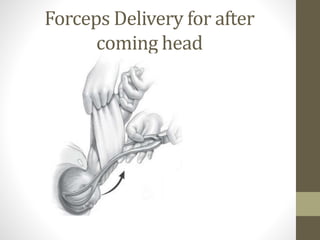
Forceps Delivery for after
coming head
3MODE OF DELIVERY
• Lower Segment Caesarean
Section (LSCS)
Thank
You

Breech presentation

  • 1.
  • 2.
    Definition BREECH? Malpresentation isa presentation that is not cephalic  The most commonly encountered malpresentation in pregnancy is breech presentation Breech means that your baby is lying bottom first or feet first in the womb (uterus) instead of in the usual head first position. As pregnancy continues, a baby usually turns naturally into the head first position.
  • 3.
    INCIDENCE This presentation occursin: 1. 3-4% of term pregnancies. 2. 7% of pregnancies at 32 weeks 3. 25% of pregnancies of less than 28 weeks’
  • 4.
    TYPES OF BREECH FRANKBREECH FOOTLING BREECHCOMPLETE BREECH  Extended or frank breech  Hips flexed,  knees extended,  common in primigravida  Flexed breech –  Hips flexed,  knees flexed,  Common in multigravida  Footing breech –  One or both hips extended,  foot presenting.  Cord prolapse is the major risk. A BREECH BABY MAY BE LYING IN ONE OF THE FOLLOWING POSITIONS
  • 5.
  • 6.
    Causes MATERNAL FETAL / PLACENTAL Fibroids  Congenital uterine abnormalities  Uterine surgery  Multiple Gestation  Prematurity  Placenta praevia  Abnormality, e.g. anencephaly or hydrocephalus  Oligohydramnios  Polyhydramnios
  • 7.
    DIAGNOSIS • The diagnosisof breech presentation may be made by: 1. Abdominal palpation 2. Vaginal examination 3. Confirmed by ultrasound
  • 8.
    CLINICAL DIAGNOSI S • Palpation –Fundal grips;the head is felt with its characters. –Pelvic grip; the breech is felt, with its characters. • Auscultation –The fetal heart sounds are head just at, or above the level of the umbilicus ABDOMINAL EXAMINATION
  • 11.
    VAGINAL EXAMINATION • Slowdilatation of cervix • After rupture of the membranes, the presenting part is felt that is , the two buttocks with the anus in between , the genitalia on one side and the sacral spines on the opposite side. • In case of complete breech, the feet are felt on the same level as the buttocks. • In case of breech with extended legs, the buttocks only are felt. • In case of footling presentation, the feet are at a lower level than the buttocks.
  • 12.
    Management ENT 1. EXTERNAL CEPHALICVERSION 2. Vaginal delivery 3. Lower segment caesarean section (LSCS)
  • 13.
    MANAGEMENT 1. EXTERNAL CEPHALICVERSION  The procedure is performed at or after 37 completed weeks by an experienced obstetrician.  ECV should be performed with tocolytics (e.g. nifedipine) as this has been shown to improve the success rate.  The woman is laid flat with a left lateral tilt having ensured that she has emptied her bladder and is comfortable.
  • 15.
    RISK OF ECV Placental abruption  Premature rupture of membrane (PROM)  Placental hemorrhage  Fetal bradycardia
  • 16.
  • 17.
    INDICATIONS  Presentation shouldbe either extended or flexed  Estimated fetal weight < 3.5 kg  No evidence of hyperextension of fetal head and fetal abnormalities (hydrocephalus)
  • 18.
    TECHNIQUE 1. Delivery ofthe buttocks 2. Delivery Of the legs and lower body
  • 19.
    3. Delivery ofshoulders
  • 20.
    The body ofthe fetus is then rotated 180 degrees in the reverse direction to deliver the other shoulder and arm The trunk is rotated in such a way that the anterior shoulder and arm appear at the vulva and can easily be released and delivered first. The appearance of one axilla indicates that its time to deliver the shoulders Downward traction until the lower halves of the scapulas are delivered
  • 21.
    TECHNIQUE 4. Delivery ofTHE HEAD  Delivered using the Mauriceau- smellie-veit Manoeuvre The index and middle finger of one hand are applied over the maxilla, to flex the head, while the fetal body rests on the palm of the hand and forearm.
  • 22.
    Forceps Delivery forafter coming head
  • 23.
    3MODE OF DELIVERY •Lower Segment Caesarean Section (LSCS)
  • 24.