Breast Cancer, Genes, and
           the Environment

                                  UNC-Chapel Hill
     Center for Environmental Health and Susceptibility


Funded by the National Institute of Environmental
Health Sciences (NIEHS), P30ES10126
Collaborators: Breast Cancer Coalition of North
Carolina, University of Cincinnati

11/2005
Goals

• To learn about breast cancer risks
• To learn how individual genetics and
  environmental factors may contribute to
  increased breast cancer risk
• To identify risk reduction activities
What Is Breast Cancer?
• Cells in the breast
  grow out of control
  and form a lump              Lobules

                                  Ducts
• Lumps can either be
  benign or malignant

• Malignant growths
  are called breast
  cancer
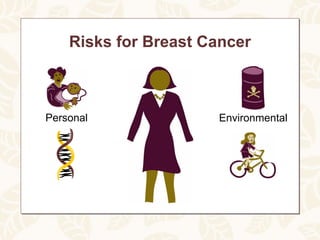
Risks for Breast Cancer


Personal              Environmental
Personal Estrogen-Related Risks

• Early menstruation
  Before 12yrs old -- increased risk

• Oral contraceptives
  Increased risk dissipates since time of last use

• Child bearing
  First child born after age 30 -- increased risk
  No children -- increased risk
Personal Estrogen-Related Risks
• Breastfeeding
  12+months -- decreased risk

• Late menopause
  After 55yrs old -- increased risk

• Long-term hormone
  replacement therapy
  More than 5yrs -- increased risk
Other Personal Risks

• Being age 55 or older

• Having breast cancer previously

• Family history of breast cancer

• Some types of breast disease

• Dense breast tissue
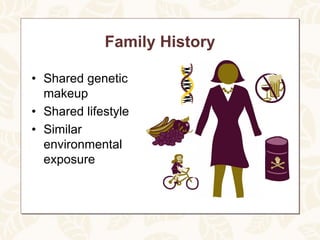
Family History

• Shared genetic
  makeup
• Shared lifestyle
• Similar
  environmental
  exposure
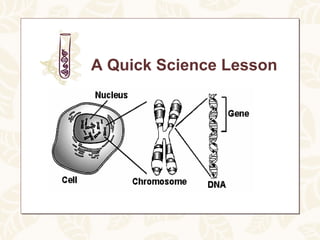
A Quick Science Lesson

Genes: Present in all cells and help
       provide instructions for how to
       build and maintain a human.
A Quick Science Lesson

Environment: Everything around you.
   (air, water, diet, home, workplace, etc.)
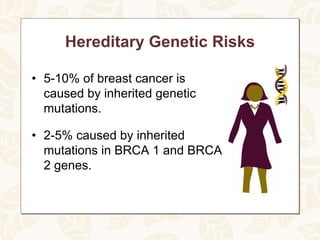
Hereditary Genetic Risks

• 5-10% of breast cancer is
  caused by inherited genetic
  mutations.

• 2-5% caused by inherited
  mutations in BRCA 1 and BRCA
  2 genes.
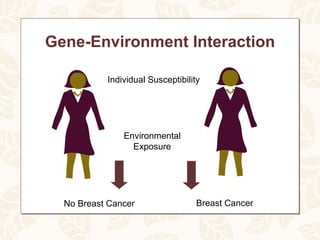
Gene-Environment Interaction

           Individual Susceptibility


               Environmental
                 Exposure


  No Breast Cancer                 Breast Cancer
Environmental Risk Factors and
        Preventive Steps
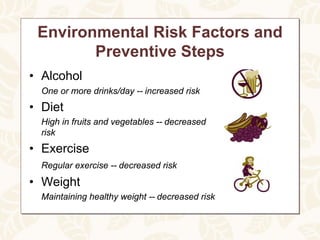
• Alcohol
  One or more drinks/day -- increased risk
• Diet
  High in fruits and vegetables -- decreased
  risk
• Exercise
  Regular exercise -- decreased risk
• Weight
  Maintaining healthy weight -- decreased risk
Environmental Risk

• Toxins can damage breast DNA. Over
  time damaged DNA can lead to
  cancer.

• Exposure to high doses of radiation,
  such as for treating Hodgkin’s
  disease, in women under 30 shows
  increased risk for breast cancer.
Environmental Risk

• Organochlorines such as DDT
  and PCBs
  No association with increased breast
  cancer risk


• Electromagnetic fields
  No association with increased breast
  cancer risk


                                  Long Island Breast Cancer Study Project, 2002
                                  Carolina Breast Cancer Study, 2001
Environmental Risk

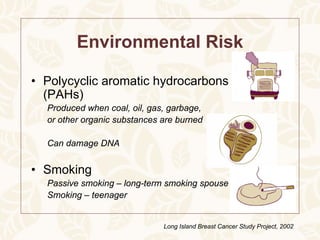
• Polycyclic aromatic hydrocarbons
  (PAHs)
  Produced when coal, oil, gas, garbage,
  or other organic substances are burned

  Can damage DNA


• Smoking
  Passive smoking – long-term smoking spouse
  Smoking – teenager


                              Long Island Breast Cancer Study Project, 2002
Screening for Breast Cancer

• Breast self-exam
• Clinical breast exam            +
                                      +
• Annual mammogram after      +
  age 40
                                      +
• Early diagnosis increases
                              +       +
  chance of survival
Questions?
          Kathleen Gray, Acting Director
UNC CEHS Community Outreach and Education Program
                 (919) 966-9799
                 kgray@unc.edu

        Diana Degen, Research Associate
UNC CEHS Community Outreach and Education Program
                (919) 966-2463
             degen@email.unc.edu

Breastcancer genes-ppt

  • 1.
    Breast Cancer, Genes,and the Environment UNC-Chapel Hill Center for Environmental Health and Susceptibility Funded by the National Institute of Environmental Health Sciences (NIEHS), P30ES10126 Collaborators: Breast Cancer Coalition of North Carolina, University of Cincinnati 11/2005
  • 2.
    Goals • To learnabout breast cancer risks • To learn how individual genetics and environmental factors may contribute to increased breast cancer risk • To identify risk reduction activities
  • 3.
    What Is BreastCancer? • Cells in the breast grow out of control and form a lump Lobules Ducts • Lumps can either be benign or malignant • Malignant growths are called breast cancer
  • 4.
    Risks for BreastCancer Personal Environmental
  • 5.
    Personal Estrogen-Related Risks •Early menstruation Before 12yrs old -- increased risk • Oral contraceptives Increased risk dissipates since time of last use • Child bearing First child born after age 30 -- increased risk No children -- increased risk
  • 6.
    Personal Estrogen-Related Risks •Breastfeeding 12+months -- decreased risk • Late menopause After 55yrs old -- increased risk • Long-term hormone replacement therapy More than 5yrs -- increased risk
  • 7.
    Other Personal Risks •Being age 55 or older • Having breast cancer previously • Family history of breast cancer • Some types of breast disease • Dense breast tissue
  • 8.
    Family History • Sharedgenetic makeup • Shared lifestyle • Similar environmental exposure
  • 9.
    A Quick ScienceLesson Genes: Present in all cells and help provide instructions for how to build and maintain a human.
  • 10.
  • 11.
    A Quick ScienceLesson Environment: Everything around you. (air, water, diet, home, workplace, etc.)
  • 12.
    Hereditary Genetic Risks •5-10% of breast cancer is caused by inherited genetic mutations. • 2-5% caused by inherited mutations in BRCA 1 and BRCA 2 genes.
  • 13.
    Gene-Environment Interaction Individual Susceptibility Environmental Exposure No Breast Cancer Breast Cancer
  • 14.
    Environmental Risk Factorsand Preventive Steps • Alcohol One or more drinks/day -- increased risk • Diet High in fruits and vegetables -- decreased risk • Exercise Regular exercise -- decreased risk • Weight Maintaining healthy weight -- decreased risk
  • 15.
    Environmental Risk • Toxinscan damage breast DNA. Over time damaged DNA can lead to cancer. • Exposure to high doses of radiation, such as for treating Hodgkin’s disease, in women under 30 shows increased risk for breast cancer.
  • 16.
    Environmental Risk • Organochlorinessuch as DDT and PCBs No association with increased breast cancer risk • Electromagnetic fields No association with increased breast cancer risk Long Island Breast Cancer Study Project, 2002 Carolina Breast Cancer Study, 2001
  • 17.
    Environmental Risk • Polycyclicaromatic hydrocarbons (PAHs) Produced when coal, oil, gas, garbage, or other organic substances are burned Can damage DNA • Smoking Passive smoking – long-term smoking spouse Smoking – teenager Long Island Breast Cancer Study Project, 2002
  • 18.
    Screening for BreastCancer • Breast self-exam • Clinical breast exam + + • Annual mammogram after + age 40 + • Early diagnosis increases + + chance of survival
  • 19.
    Questions? Kathleen Gray, Acting Director UNC CEHS Community Outreach and Education Program (919) 966-9799 kgray@unc.edu Diana Degen, Research Associate UNC CEHS Community Outreach and Education Program (919) 966-2463 degen@email.unc.edu