Breaking Down 2016
Building Up for 2017
Hope McLaughlin
Director of Governmental Relations
2016 Legislative Session Overview
 60 – day budget session
 Nearly 1,500 pieces of legislation filed (KSBA tracked over 200)
 About 130 pieces of legislation became law
 Budget negotiations dominated all conversations
 P-12 education, KSP and Corrections were the only areas in the final budget with
funding held constant 4.5 – 9% cuts in every other area
 Final budget
 Unprecedented $1 Billion for pensions
 SEEK stable with up to $10 million for shortfall
 $125 Million in a permanent pension trust fund
 $7.5 Million per year for early childhood partnerships
Education Bills, Passed
 HB184 (J. Donohue, Louisville), Principal Selection JCPS – Allow an alternative principal
selection process for JCPS. Superintendent may make recommendation for principal
candidate to school councils and those candidates for principal vacancies can be kept
confidential and be discussed in closed session. Must make final recommendation in public
meeting.
 HB626 (G. Stumbo, Prestonsburg), Work Ready KY – Sets up last dollar in scholarship
program or conversion loan for students to attend public/private/KCTCS when working
toward associate’s degree, establishes dual-credit scholarship rate and provides scholarships
to students for up to three courses, establishes Workforce Investment Fund Advisory Board
and processes for grants to be awarded in each congressional district from $100M bond
pool under Education & Workforce Cabinet. Vetoed, now subject to litigation, bond pool and
dual credit funds still available.
 SB228 (D. Carroll, Paducah)/HB316 (R. Smart, Richmond), Student Safety – Requires school
districts to prohibit bullying and defines bullying. We have a session available on this topic.
 SB33 (M. Wise, Campbellsville), CPR Training – Requires school districts provide CPR training
to students one time while enrolled between grades 9-12. Does not require any equipment
or AEDs to be purchased. KY Nurses Association will donate a mannequin to each school
district.
Education Bills, Failed
 HB270 (J. DuPlessis, Elizabethtown)/SB223 (S. West, Paris), School Marshals – Would
have allowed local school boards to create a position of school marshal. The school
marshal would have been allowed to carry a firearm on school property. School
marshal would have been required to purchase the firearm and fungible ammunition.
Ammunition would be required to be locked in school office. (No hearing)
 HB620 (A. Wuchner, Burlington)/SB273 (M. Wilson, Bowling Green), Vouchers for
students with disabilities – Would have set up a voucher system through the state
treasury to be used by parents of students with IEPs, a 504 plan or students meeting
the definition of disability under IDEA. Funds could be used for tuition, textbooks,
private tutoring, curriculum materials, technology, transportation etc. (No hearing)
Education Bills, Failed
 SB1 (M. Wilson, Bowling Green), Public Education – Sweeping education reform,
would have removed program reviews, would have set up standards review
process, would have reformed statewide assessment system, and developed
turnaround models for low performing schools. (Passed Senate, No hearing in
House)
 SB50 (C. Girdler, Somerset), School Start Date – Would have required school to start
Monday closest to Aug. 26. Bill amended to establish calendar committee with
each local board of education and incentivize districts to start Monday closest to
Aug. 26 by giving flexibility in meeting 1,062 instructional hours. (Passed Senate as
amended, No hearing in House)
 SB88 (D. Givens, Greensburg), Teacher Tribunal – Would have required formal
hearing officers for teacher tribunals and allow for final determination to uphold or
overturn the decision of the superintendent. (No hearing, modified version
attached to another bill also failed)
 SB253 (M. Wilson, Bowling Green), Charter Schools – Would have created charter
school pilot project in JCPS and FCPS. Bill was amended to make local boards the
only authorizers of charter schools. (Passed Senate as amended, No hearing in
House)
Pension Issues
 Approximately 30 pension bills filed in 2016 – a few passed
 Takeaways from 2016 on pensions
 Over $1 Billion included in the budget
 There is a strong desire to make changes to the systems to increase transparency and
find cost savings
 New $125 million trust fund to assist in funding pensions, $3 million for audits
 Auditor has issued an RFP to look into ALL state pension systems for
 Overall solvency/liquidity
 Assessment of outstanding obligations
 A critical review of past revenue and expenditures to identify reasons for current financial status
of plans
 Analysis of the impact of alternative courses of future actions that might be considered by the
Commonwealth and their effect on the long-term solvency and successes of the plans
Other Issues
 HB40 (D. Owens, Louisville), Felony Expungement – Will allow for a number of low-level
felonies, such as burglary, theft and drug possession to be vacated and have records
expunged. If a prior felony has been expunged or charges are pending expungement
may not occur. Violent crimes and sex crimes are not included in the list of felonies that
are eligible for expungement.
 HB80 (C. Harris, Forest Hills), The Revenue Bill/General Govt. – Raises threshold of
universities using cash from $600K to $1M before gaining approval from Capital Projects
Comm, IRS Code update, SFCC may award cash grants to schools to bring them up to
code under certain criteria, nickel levies will receive equalization only through the life of
the bond of a project, school districts may be open on election day if no schools in a
district are used as a polling place, and several other provisions.
What will the 2017 session hold?
 Any changes necessary to implement ESSA
 SB1 from last session is likely to return in some form
 Pension issues
 Governance
 Structural changes
 Transparency issues
 Potential separation of CERS from KRS
 Charter school legislation
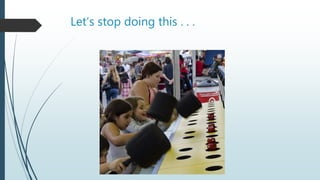
Let’s stop doing this . . .
What do you need to make public
education better?
 Online survey highlights
 95% of you want to see tribunal reform
 92% of you want to see tax reform provide additional funding to
education
 88% of you said superintendents should select the principal in a low
performing school
 78% of you want to see tenure reform
 These policy changes were also the most common answers
when asked what changes could be made to improve public
education
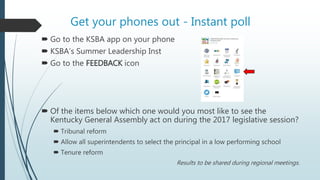
Get your phones out - Instant poll
 Go to the KSBA app on your phone
 KSBA’s Summer Leadership Inst
 Go to the FEEDBACK icon
 Of the items below which one would you most like to see the
Kentucky General Assembly act on during the 2017 legislative session?
 Tribunal reform
 Allow all superintendents to select the principal in a low performing school
 Tenure reform
Results to be shared during regional meetings.
How do we advocate for
public education during
the interim?
We are not just school
board members,
administrators or
superintendents. We are not
even just advocates for
public education.
We are all
AMBASSADORS for public
education!
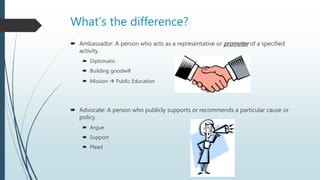
What’s the difference?
 Ambassador: A person who acts as a representative or promoter of a specified
activity.
 Diplomatic
 Building goodwill
 Mission  Public Education
 Advocate: A person who publicly supports or recommends a particular cause or
policy.
 Argue
 Support
 Plead
Challenge:
Be an AMBASSADOR not just
an advocate
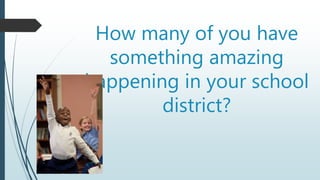
How many of you have
something amazing
happening in your school
district?
How many of you have
shared that amazing
thing with a legislator in
your district?
Become an ambassador:
 Invite your local legislators to see an amazing thing
happening in your school.
 New programs? Arts? STEM+H? Summer enrichment?
 New technology?
 Never underestimate the power of cute kids
 Ask for help identifying things – Superintendent, PR, DACs, Counselors
 Board meetings
Invite your legislator to a board meeting
Are you approving something good for students
Featuring students
Receiving a recognition
How to extend an invitation
www.lrc.ky.gov
Find your legislator in the drop down menu
Who’s my legislator
LRC Offices: (502) 564-8100
Need help? Call or email me!
Build a network locally
 Build a network around public education with the PTA, school
councils, local chamber, other local elected officials and invite your
network to see the amazing things happening in your district
 Attend and engage at community events – talk about your schools
 Include the press in school events
 Use social media
 Legislator Twitter handles available on LRC website
 Follow Brad Hughes @ksbanews, Mike Armstrong @KSBAMike and Hope
McLaughlin @McLHope
 Tweet about your district – use board meeting breaks, student
performances, approving a building
 Post photos and events on Facebook
But Hope?
 “They don’t believe in public education.”
 “We need more of . . .”
 “There are so many mandates . . .”
 “They should do . . .”
 Show them how, show them what is good, make them believe
- The rest will come
 Be and ambassador first and an advocate second
 A positive message is always well received
 Remember you get more flies with honey
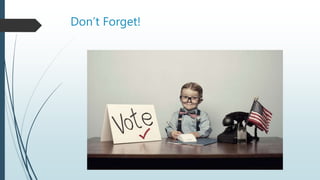
Don’t Forget!
Be an ambassador
Thank you!

Breaking Down 2016 and Building Up for 2017

  • 1.
    Breaking Down 2016 BuildingUp for 2017 Hope McLaughlin Director of Governmental Relations
  • 2.
    2016 Legislative SessionOverview  60 – day budget session  Nearly 1,500 pieces of legislation filed (KSBA tracked over 200)  About 130 pieces of legislation became law  Budget negotiations dominated all conversations  P-12 education, KSP and Corrections were the only areas in the final budget with funding held constant 4.5 – 9% cuts in every other area  Final budget  Unprecedented $1 Billion for pensions  SEEK stable with up to $10 million for shortfall  $125 Million in a permanent pension trust fund  $7.5 Million per year for early childhood partnerships
  • 3.
    Education Bills, Passed HB184 (J. Donohue, Louisville), Principal Selection JCPS – Allow an alternative principal selection process for JCPS. Superintendent may make recommendation for principal candidate to school councils and those candidates for principal vacancies can be kept confidential and be discussed in closed session. Must make final recommendation in public meeting.  HB626 (G. Stumbo, Prestonsburg), Work Ready KY – Sets up last dollar in scholarship program or conversion loan for students to attend public/private/KCTCS when working toward associate’s degree, establishes dual-credit scholarship rate and provides scholarships to students for up to three courses, establishes Workforce Investment Fund Advisory Board and processes for grants to be awarded in each congressional district from $100M bond pool under Education & Workforce Cabinet. Vetoed, now subject to litigation, bond pool and dual credit funds still available.  SB228 (D. Carroll, Paducah)/HB316 (R. Smart, Richmond), Student Safety – Requires school districts to prohibit bullying and defines bullying. We have a session available on this topic.  SB33 (M. Wise, Campbellsville), CPR Training – Requires school districts provide CPR training to students one time while enrolled between grades 9-12. Does not require any equipment or AEDs to be purchased. KY Nurses Association will donate a mannequin to each school district.
  • 4.
    Education Bills, Failed HB270 (J. DuPlessis, Elizabethtown)/SB223 (S. West, Paris), School Marshals – Would have allowed local school boards to create a position of school marshal. The school marshal would have been allowed to carry a firearm on school property. School marshal would have been required to purchase the firearm and fungible ammunition. Ammunition would be required to be locked in school office. (No hearing)  HB620 (A. Wuchner, Burlington)/SB273 (M. Wilson, Bowling Green), Vouchers for students with disabilities – Would have set up a voucher system through the state treasury to be used by parents of students with IEPs, a 504 plan or students meeting the definition of disability under IDEA. Funds could be used for tuition, textbooks, private tutoring, curriculum materials, technology, transportation etc. (No hearing)
  • 5.
    Education Bills, Failed SB1 (M. Wilson, Bowling Green), Public Education – Sweeping education reform, would have removed program reviews, would have set up standards review process, would have reformed statewide assessment system, and developed turnaround models for low performing schools. (Passed Senate, No hearing in House)  SB50 (C. Girdler, Somerset), School Start Date – Would have required school to start Monday closest to Aug. 26. Bill amended to establish calendar committee with each local board of education and incentivize districts to start Monday closest to Aug. 26 by giving flexibility in meeting 1,062 instructional hours. (Passed Senate as amended, No hearing in House)  SB88 (D. Givens, Greensburg), Teacher Tribunal – Would have required formal hearing officers for teacher tribunals and allow for final determination to uphold or overturn the decision of the superintendent. (No hearing, modified version attached to another bill also failed)  SB253 (M. Wilson, Bowling Green), Charter Schools – Would have created charter school pilot project in JCPS and FCPS. Bill was amended to make local boards the only authorizers of charter schools. (Passed Senate as amended, No hearing in House)
  • 6.
    Pension Issues  Approximately30 pension bills filed in 2016 – a few passed  Takeaways from 2016 on pensions  Over $1 Billion included in the budget  There is a strong desire to make changes to the systems to increase transparency and find cost savings  New $125 million trust fund to assist in funding pensions, $3 million for audits  Auditor has issued an RFP to look into ALL state pension systems for  Overall solvency/liquidity  Assessment of outstanding obligations  A critical review of past revenue and expenditures to identify reasons for current financial status of plans  Analysis of the impact of alternative courses of future actions that might be considered by the Commonwealth and their effect on the long-term solvency and successes of the plans
  • 7.
    Other Issues  HB40(D. Owens, Louisville), Felony Expungement – Will allow for a number of low-level felonies, such as burglary, theft and drug possession to be vacated and have records expunged. If a prior felony has been expunged or charges are pending expungement may not occur. Violent crimes and sex crimes are not included in the list of felonies that are eligible for expungement.  HB80 (C. Harris, Forest Hills), The Revenue Bill/General Govt. – Raises threshold of universities using cash from $600K to $1M before gaining approval from Capital Projects Comm, IRS Code update, SFCC may award cash grants to schools to bring them up to code under certain criteria, nickel levies will receive equalization only through the life of the bond of a project, school districts may be open on election day if no schools in a district are used as a polling place, and several other provisions.
  • 8.
    What will the2017 session hold?  Any changes necessary to implement ESSA  SB1 from last session is likely to return in some form  Pension issues  Governance  Structural changes  Transparency issues  Potential separation of CERS from KRS  Charter school legislation
  • 9.
  • 10.
    What do youneed to make public education better?  Online survey highlights  95% of you want to see tribunal reform  92% of you want to see tax reform provide additional funding to education  88% of you said superintendents should select the principal in a low performing school  78% of you want to see tenure reform  These policy changes were also the most common answers when asked what changes could be made to improve public education
  • 11.
    Get your phonesout - Instant poll  Go to the KSBA app on your phone  KSBA’s Summer Leadership Inst  Go to the FEEDBACK icon  Of the items below which one would you most like to see the Kentucky General Assembly act on during the 2017 legislative session?  Tribunal reform  Allow all superintendents to select the principal in a low performing school  Tenure reform Results to be shared during regional meetings.
  • 12.
    How do weadvocate for public education during the interim?
  • 13.
    We are notjust school board members, administrators or superintendents. We are not even just advocates for public education.
  • 14.
    We are all AMBASSADORSfor public education!
  • 15.
    What’s the difference? Ambassador: A person who acts as a representative or promoter of a specified activity.  Diplomatic  Building goodwill  Mission  Public Education  Advocate: A person who publicly supports or recommends a particular cause or policy.  Argue  Support  Plead
  • 16.
    Challenge: Be an AMBASSADORnot just an advocate
  • 17.
    How many ofyou have something amazing happening in your school district?
  • 18.
    How many ofyou have shared that amazing thing with a legislator in your district?
  • 19.
    Become an ambassador: Invite your local legislators to see an amazing thing happening in your school.  New programs? Arts? STEM+H? Summer enrichment?  New technology?  Never underestimate the power of cute kids  Ask for help identifying things – Superintendent, PR, DACs, Counselors  Board meetings Invite your legislator to a board meeting Are you approving something good for students Featuring students Receiving a recognition
  • 20.
    How to extendan invitation www.lrc.ky.gov Find your legislator in the drop down menu Who’s my legislator LRC Offices: (502) 564-8100 Need help? Call or email me!
  • 21.
    Build a networklocally  Build a network around public education with the PTA, school councils, local chamber, other local elected officials and invite your network to see the amazing things happening in your district  Attend and engage at community events – talk about your schools  Include the press in school events  Use social media  Legislator Twitter handles available on LRC website  Follow Brad Hughes @ksbanews, Mike Armstrong @KSBAMike and Hope McLaughlin @McLHope  Tweet about your district – use board meeting breaks, student performances, approving a building  Post photos and events on Facebook
  • 22.
    But Hope?  “Theydon’t believe in public education.”  “We need more of . . .”  “There are so many mandates . . .”  “They should do . . .”  Show them how, show them what is good, make them believe - The rest will come  Be and ambassador first and an advocate second  A positive message is always well received  Remember you get more flies with honey
  • 23.
  • 24.
  • 25.

Editor's Notes

  • #2 Good Evening I am Hope McLaughlin, Director of Governmental Relations for KSBA. This evening we are going to look back at the 2016 legislative session to start and help us see where we stand today. Then we will look at what will come up in 2017. During that time we start the process of looking at our priorities for 2017. We will use the KSBA app to do this so if you haven’t downloaded the app and know how you can do that now. If you need assistance we can help you this evening or even tomorrow as you will still have time to weigh in. Finally we will look at how to effectively engage with legislators during the interim.
  • #3 60 – day budget session Nearly 1,500 pieces of legislation filed (KSBA tracked over 200) About 130 pieces of legislation became law Budget negotiations dominated all conversations P-12 education, KSP and Corrections were the only areas in the final budget with funding held constant 4.5 – 9% cuts in every other area Final budget Unprecedented $1 Billion for pensions SEEK stable with up to $10 million for shortfall $125 Million in a permanent pension trust fund $7.5 Million per year for early childhood partnerships
  • #4 HB184 (J. Donohue, Louisville), Principal Selection JCPS – Allow an alternative principal selection process for JCPS. Superintendent may make recommendation for principal candidate to school councils and those candidates for principal vacancies can be kept confidential and be discussed in closed session. Must make final recommendation in public meeting. HB626 (G. Stumbo, Prestonsburg), Work Ready KY – Sets up last dollar in scholarship program or conversion loan for students to attend public/private/KCTCS when working toward associate’s degree, establishes dual-credit scholarship rate and provides scholarships to students for up to three courses, establishes Workforce Investment Fund Advisory Board and processes for grants to be awarded in each congressional district from $100M bond pool under Education & Workforce Cabinet. Vetoed, now subject to litigation, bond pool and dual credit funds still available. SB228 (D. Carroll, Paducah)/HB316 (R. Smart, Richmond), Student Safety – Requires school districts to prohibit bullying and defines bullying. We have a session available on this topic. SB33 (M. Wise, Campbellsville), CPR Training – Requires school districts provide CPR training to students one time while enrolled between grades 9-12. Does not require any equipment or AEDs to be purchased. KY Nurses Association will donate a mannequin to each school district.
  • #5 HB270 (J. DuPlessis, Elizabethtown)/SB223 (S. West, Paris), School Marshals – Would have allowed local school boards to create a position of school marshal. The school marshal would have been allowed to carry a firearm on school property. School marshal would have been required to purchase the firearm and fungible ammunition. Ammunition would be required to be locked in school office. (No hearing) HB620 (A. Wuchner, Burlington)/SB273 (M. Wilson, Bowling Green), Vouchers for students with disabilities – Would have set up a voucher system through the state treasury to be used by parents of students with IEPs, a 504 plan or students meeting the definition of disability under IDEA. Funds could be used for tuition, textbooks, private tutoring, curriculum materials, technology, transportation etc. (No hearing)
  • #6 SB1 (M. Wilson, Bowling Green), Public Education – Sweeping education reform, would have removed program reviews, would have set up standards review process, would have reformed statewide assessment system, and developed turnaround models for low performing schools. (Passed Senate, No hearing in House) SB50 (C. Girdler, Somerset), School Start Date – Would have required school to start Monday closest to Aug. 26. Bill amended to establish calendar committee with each local board of education and incentivize districts to start Monday closest to Aug. 26 by giving flexibility in meeting 1,062 instructional hours. (Passed Senate as amended, No hearing in House) SB88 (D. Givens, Greensburg), Teacher Tribunal – Would have required formal hearing officers for teacher tribunals and allow for final determination to uphold or overturn the decision of the superintendent. (No hearing, modified version attached to another bill also failed) SB253 (M. Wilson, Bowling Green), Charter Schools – Would have created charter school pilot project in JCPS and FCPS. Bill was amended to make local boards the only authorizers of charter schools. (Passed Senate as amended, No hearing in House)
  • #7 Approximately 30 pension bills filed in 2016 – a few passed Takeaways from 2016 on pensions Over $1 Billion included in the budget There is a strong desire to make changes to the systems to increase transparency and find cost savings New $125 million trust fund to assist in funding pensions, $3 million for audits Auditor has issued an RFP to look into ALL state pension systems for Overall solvency/liquidity Assessment of outstanding obligations A critical review of past revenue and expenditures to identify reasons for current financial status of plans Analysis of the impact of alternative courses of future actions that might be considered by the Commonwealth and their effect on the long-term solvency and successes of the plans
  • #8 HB40 (D. Owens, Louisville), Felony Expungement – Will allow for a number of low-level felonies, such as burglary, theft and drug possession to be vacated and have records expunged. If a prior felony has been expunged or charges are pending expungement may not occur. Violent crimes and sex crimes are not included in the list of felonies that are eligible for expungement. HB80 (C. Harris, Forest Hills), The Revenue Bill/General Govt. – Raises threshold of universities using cash from $600K to $1M before gaining approval from Capital Projects Comm, IRS Code update, SFCC may award cash grants to schools to bring them up to code under certain criteria, nickel levies will receive equalization only through the life of the bond of a project, school districts may be open on election day if no schools in a district are used as a polling place, and several other provisions.
  • #9 What will the 2017 session hold? Any changes necessary to implement ESSA SB1 from last session is likely to return in some form Pension issues Governance Structural changes Transparency issues Potential separation of CERS from KRS Charter school legislation Do these look like our priorities? We will certainly be heavily involved in all of these issues in 2017 but I don’t know that we would categorize any of them as a lead priority.
  • #10 -Let’s stop doing this and get behind something that will improve public education and improve teaching and learning. I want us to be pushing up those moles and pushing our priorities to the front of the line.
  • #11 I sent out the 2016-17 legislative issues survey via email a few weeks ago. Thank you the 200 or so of you that took the time to take this survey. These are the issues that rose to the top as having the most support. Online survey highlights 95% of you want to see tribunal reform 92% of you want to see tax reform provide additional funding to education 88% of you said superintendents should select the principal in a low performing school 78% of you want to see tenure reform I also asked an open ended question and gave you the option to include anything you could think of to make public education better. These policy changes were also the most common answers when asked what changes could be made to improve public education
  • #12 With looking at the priorities that rose to the top I want to focus on the education specific issues. We will of course be involved in any tax reform packages that move forward but if tax reform gains traction that is not an issue that one group or sector of groups like education will be behind. That is a statewide comprehensive iniative. So I would like you to get your phone out and go into the KSBA app and the Summer Leadership Institute. Go to the Feedback icon on the right hand side of the app. Could you tell me which item would you most like to see the Kentucky General Assembly act on during the 2017 legislative session? Tribunal reform Allow all superintendents to select the principal in a low performing school Tenure reform Which one of these things would you like me to start working on now to try to get this to move through in 2017? I will share the results at the 2017 regional meetings and we will prioritize our legislative agenda.
  • #13 So now that we have decided what we want to advocate for during the 2017 legislative session how do we begin advocating for that now?
  • #14 Stop and think about some things over the next few minutes. We are not just school board members, administrators or superintendents. We are not even just advocates for public education.
  • #15 We are all AMBASSADORS for public education! Keep thinking about what that means, and what that means to you.
  • #16 So What’s the difference? Ambassador: A person who acts as a representative or promoter of a specified activity. Diplomatic Building goodwill Mission  Public Education Advocate: A person who publicly supports or recommends a particular cause or policy. Argue Support Plead These images are images frequently used to describe ambassadors and advocates and I think they give a good visual as to the difference.
  • #17 I want to Challenge all of you Your Challenge: Be an AMBASSADOR not just an advocate
  • #18 How many of you have something amazing happening in your school district? Everyone should have their hands up. I’m not talking about curing deadly diseases I’m talking about providing good learning environments for students. Does everyone have at least one amazing thing they are thinking about now?
  • #19 How many of you have shared that amazing thing with a legislator in your district? If you haven’t why not?
  • #20 Share those amazing things! This is what being an ambassador is about! Invite your local legislators to see an amazing thing happening in your school. New programs? Arts? STEM+H? Summer enrichment? New technology? Never underestimate the power of cute kids Ask for help identifying things – Superintendent, PR, DACs, Counselors Board meetings Invite your legislator to a board meeting Are you approving something good for students Featuring students Receiving a recognition
  • #21 How do you extend an invitation. Email or phone www.lrc.ky.gov Find your legislator in the drop down menu Who’s my legislator LRC Offices: (502) 564-8100 Need help? Call or email me!
  • #22 Build a network locally Build a network around public education with the PTA, school councils, local chamber, other local elected officials and invite your network to see the amazing things happening in your district Attend and engage at community events – talk about your schools Include the press in school events Use social media Legislator Twitter handles available on LRC website Follow Brad Hughes @ksbanews, Mike Armstrong @KSBAMike and Hope McLaughlin @McLHope Tweet about your district – use board meeting breaks, student performances, approving a building Post photos and events on Facebook
  • #23 I know some of you are thinking But Hope? “They don’t believe in public education.” “We need more of . . .” “There are so many mandates . . .” “They should do . . .” Show them how, show them what is good, make them believe - The rest will come Be and ambassador first and an advocate second A positive message is always well received Remember you get more flies with honey
  • #24 Don’t underestimate how important it is to vote! Don’t forget to go to the polls and learn about the candidates.
  • #25 -These are ways that you can be ambassadors for public education. - Don’t forget about the challenge to be an ambassador. By the time we have our LEAD advocacy day, tentatively scheduled for February 9 each local board of education will have invited their legislator to see an amazing thing in their district. This will be a great way to show our legislators all the amazing things happening in our schools.