Legislative Outlook
  112th Congress
       1 st Session


              Ellen Fern
Washington Partners, LLC
         efern@wpllc.net
         March 18, 2011
112th Congress
Overview

    Department of Education
    Congress
         Congressional Leadership and Committee Membership
         Issues
    Federal FY 2011 Budget Status
    Federal FY 2012 Budget
         Budget Outline
         Education Overview
    Congressional Education Agenda
         Overview
         WIA
         ESEA
         Dream Act
Department of Education
Leadership

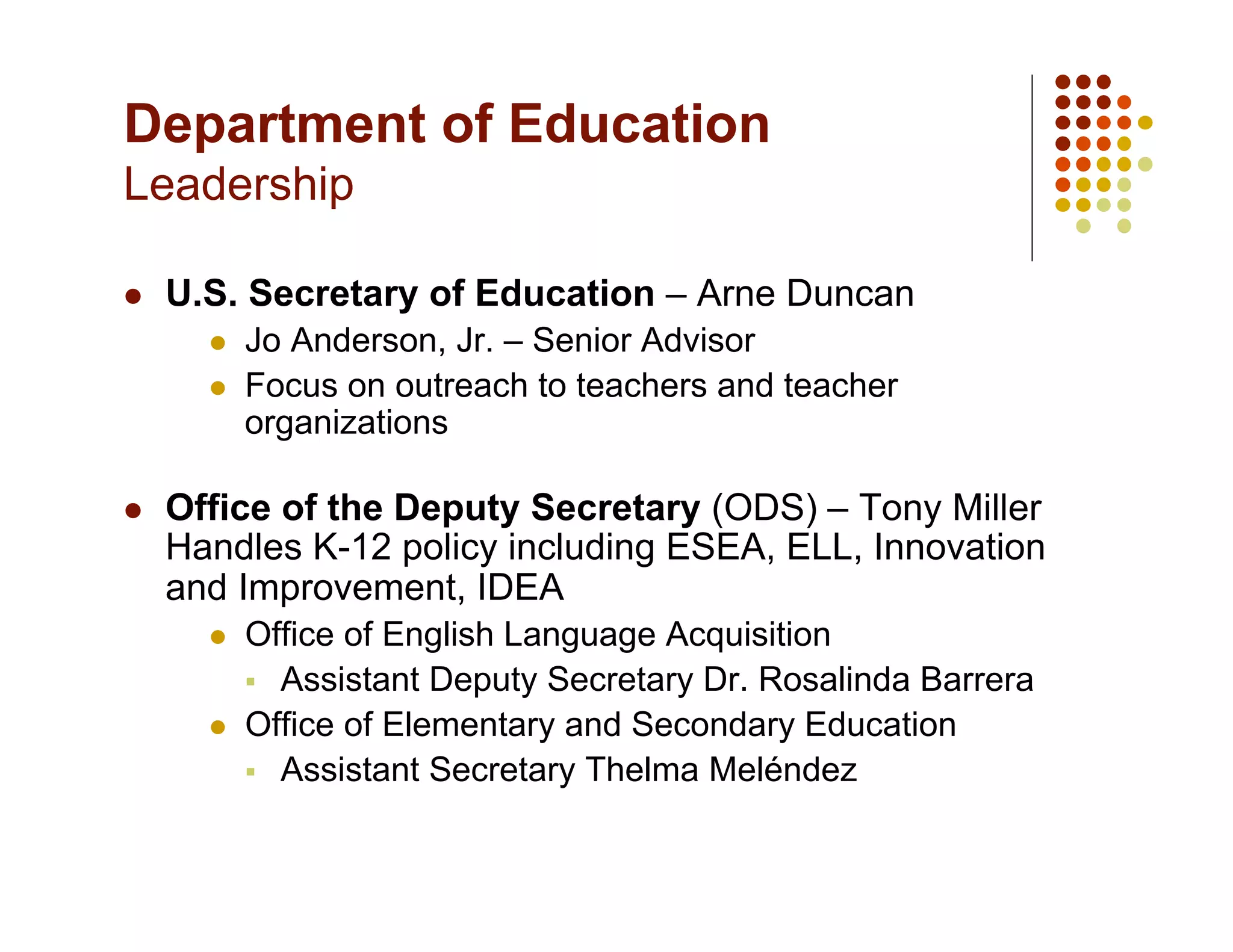
    U.S. Secretary of Education – Arne Duncan
           Jo Anderson, Jr. – Senior Advisor
           Focus on outreach to teachers and teacher
            organizations

    Office of the Deputy Secretary (ODS) – Tony Miller
     Handles K-12 policy including ESEA, ELL, Innovation
     and Improvement, IDEA
           Office of English Language Acquisition
              Assistant Deputy Secretary Dr. Rosalinda Barrera
           Office of Elementary and Secondary Education
              Assistant Secretary Thelma Meléndez
Department of Education
Leadership

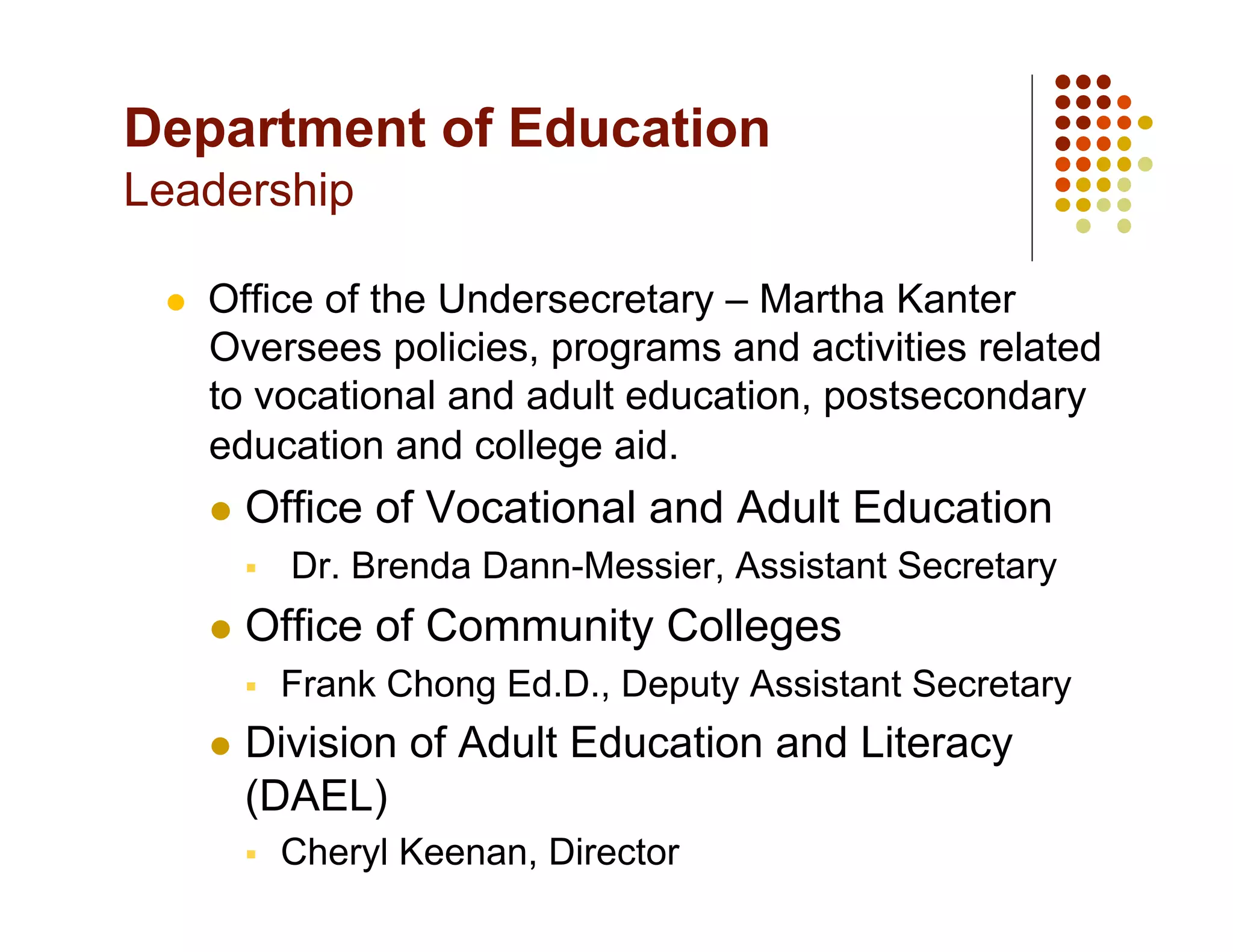
     Office of the Undersecretary – Martha Kanter
      Oversees policies, programs and activities related
      to vocational and adult education, postsecondary
      education and college aid.
        Office   of Vocational and Adult Education
            Dr. Brenda Dann-Messier, Assistant Secretary
        Office   of Community Colleges
            Frank Chong Ed.D., Deputy Assistant Secretary
        Division   of Adult Education and Literacy
        (DAEL)
            Cheryl Keenan, Director
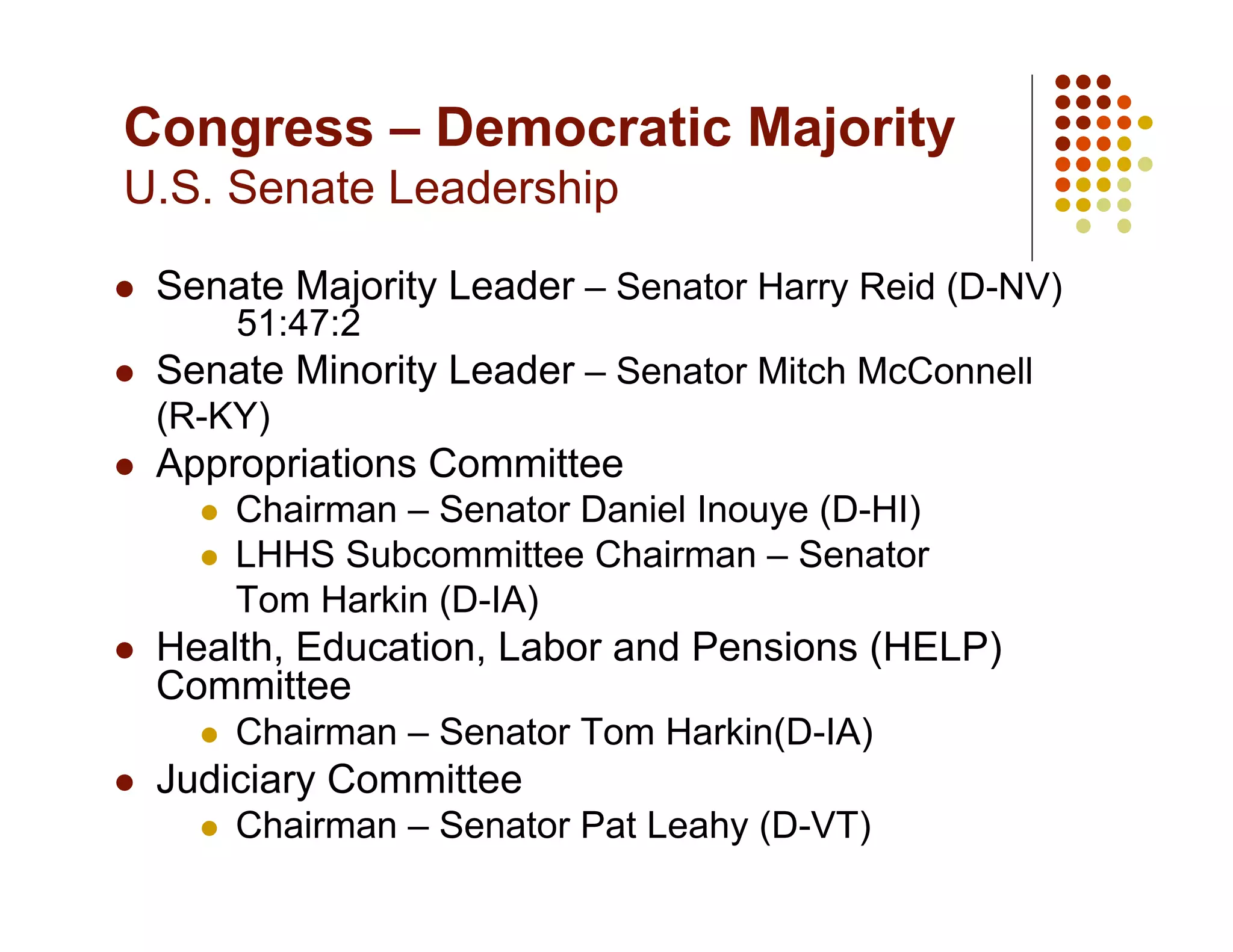
Congress – Democratic Majority
U.S. Senate Leadership

    Senate Majority Leader – Senator Harry Reid (D-NV)
            51:47:2
    Senate Minority Leader – Senator Mitch McConnell
     (R-KY)
    Appropriations Committee
           Chairman – Senator Daniel Inouye (D-HI)
           LHHS Subcommittee Chairman – Senator
            Tom Harkin (D-IA)
    Health, Education, Labor and Pensions (HELP)
     Committee
           Chairman – Senator Tom Harkin(D-IA)
    Judiciary Committee
           Chairman – Senator Pat Leahy (D-VT)
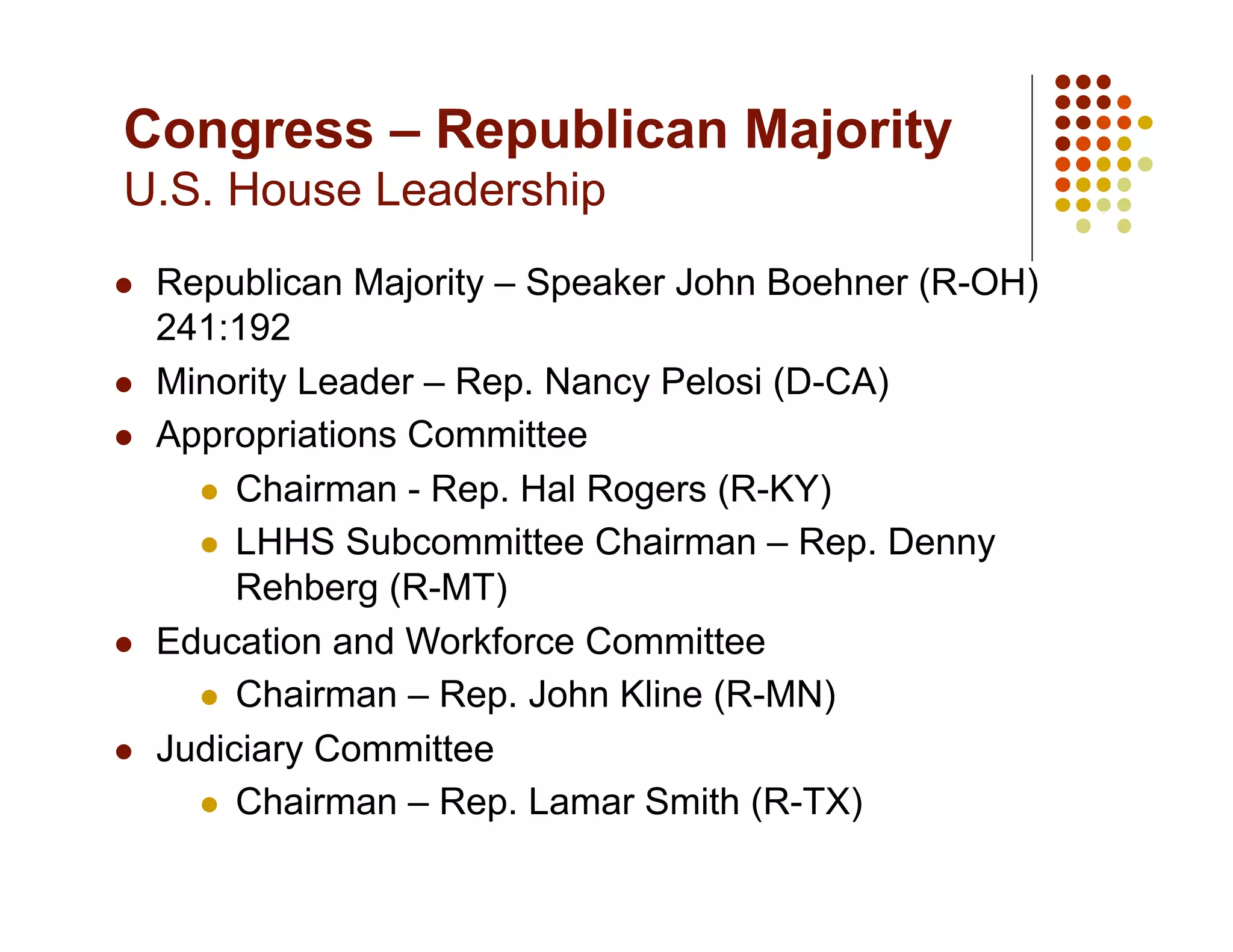
Congress – Republican Majority
U.S. House Leadership
    Republican Majority – Speaker John Boehner (R-OH)
     241:192
    Minority Leader – Rep. Nancy Pelosi (D-CA)
    Appropriations Committee
         Chairman - Rep. Hal Rogers (R-KY)

         LHHS Subcommittee Chairman – Rep. Denny
          Rehberg (R-MT)
    Education and Workforce Committee
         Chairman – Rep. John Kline (R-MN)

    Judiciary Committee
         Chairman – Rep. Lamar Smith (R-TX)
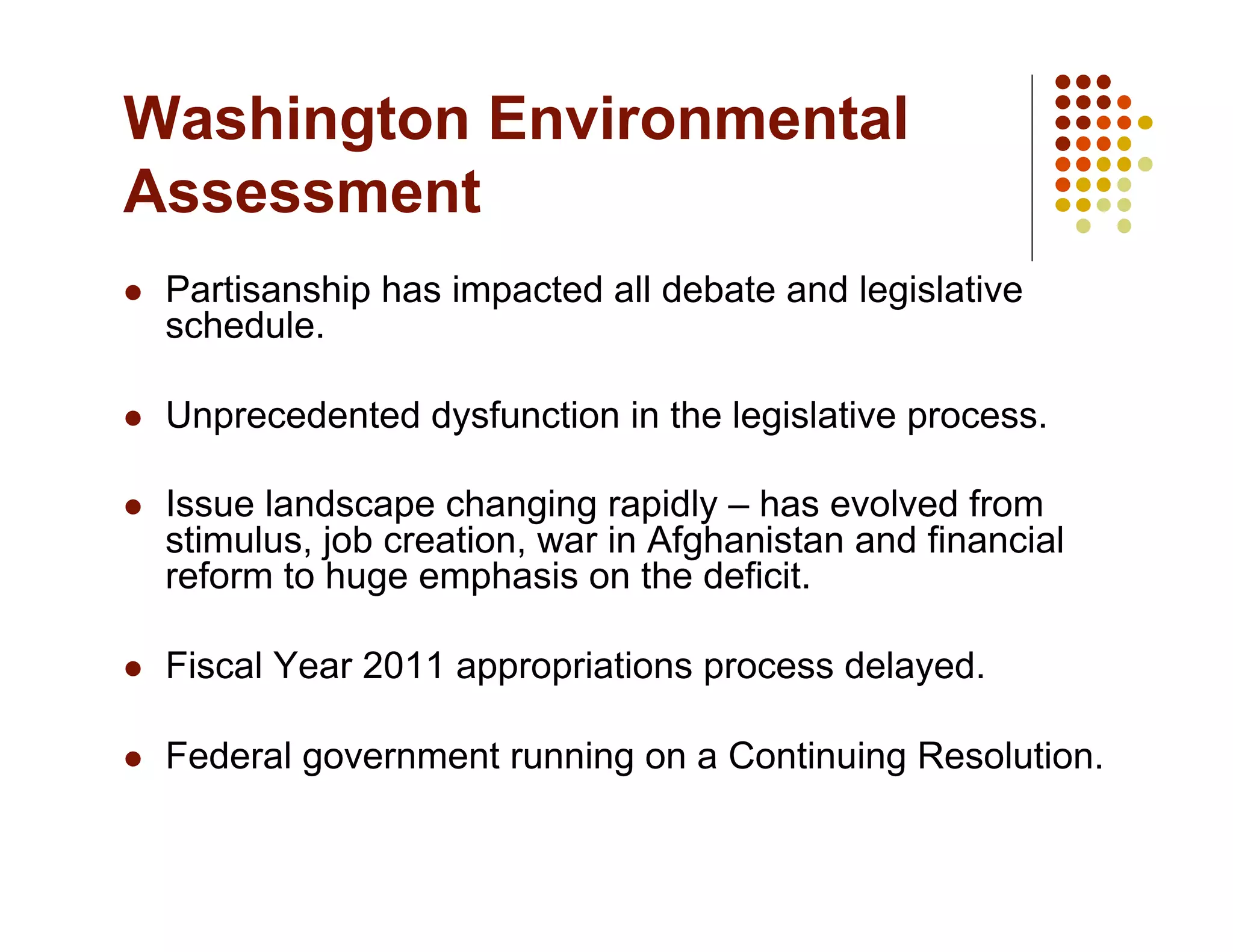
Washington Environmental
Assessment
    Partisanship has impacted all debate and legislative
     schedule.

    Unprecedented dysfunction in the legislative process.

    Issue landscape changing rapidly – has evolved from
     stimulus, job creation, war in Afghanistan and financial
     reform to huge emphasis on the deficit.

    Fiscal Year 2011 appropriations process delayed.

    Federal government running on a Continuing Resolution.
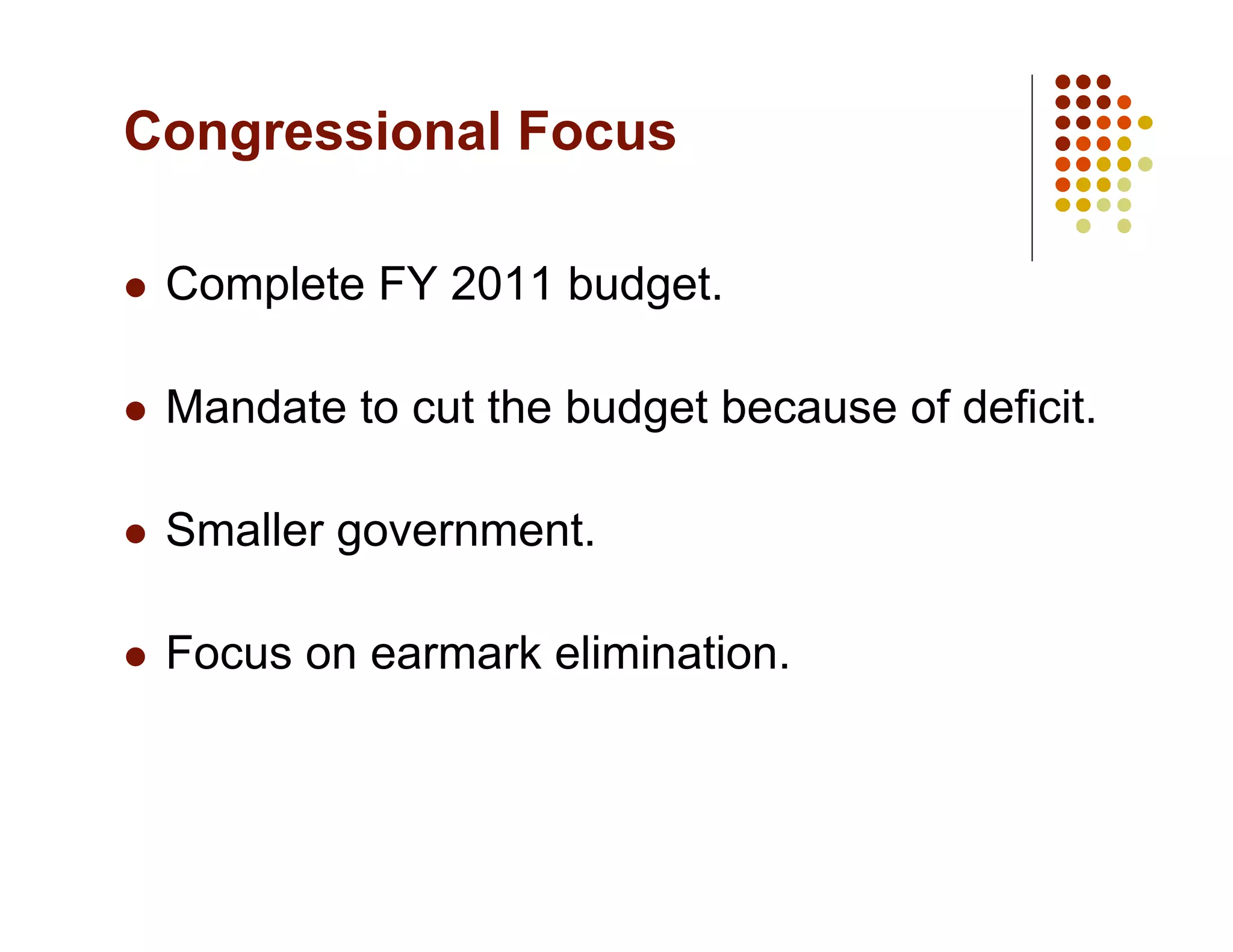
Congressional Focus

    Complete FY 2011 budget.

    Mandate to cut the budget because of deficit.

    Smaller government.

    Focus on earmark elimination.
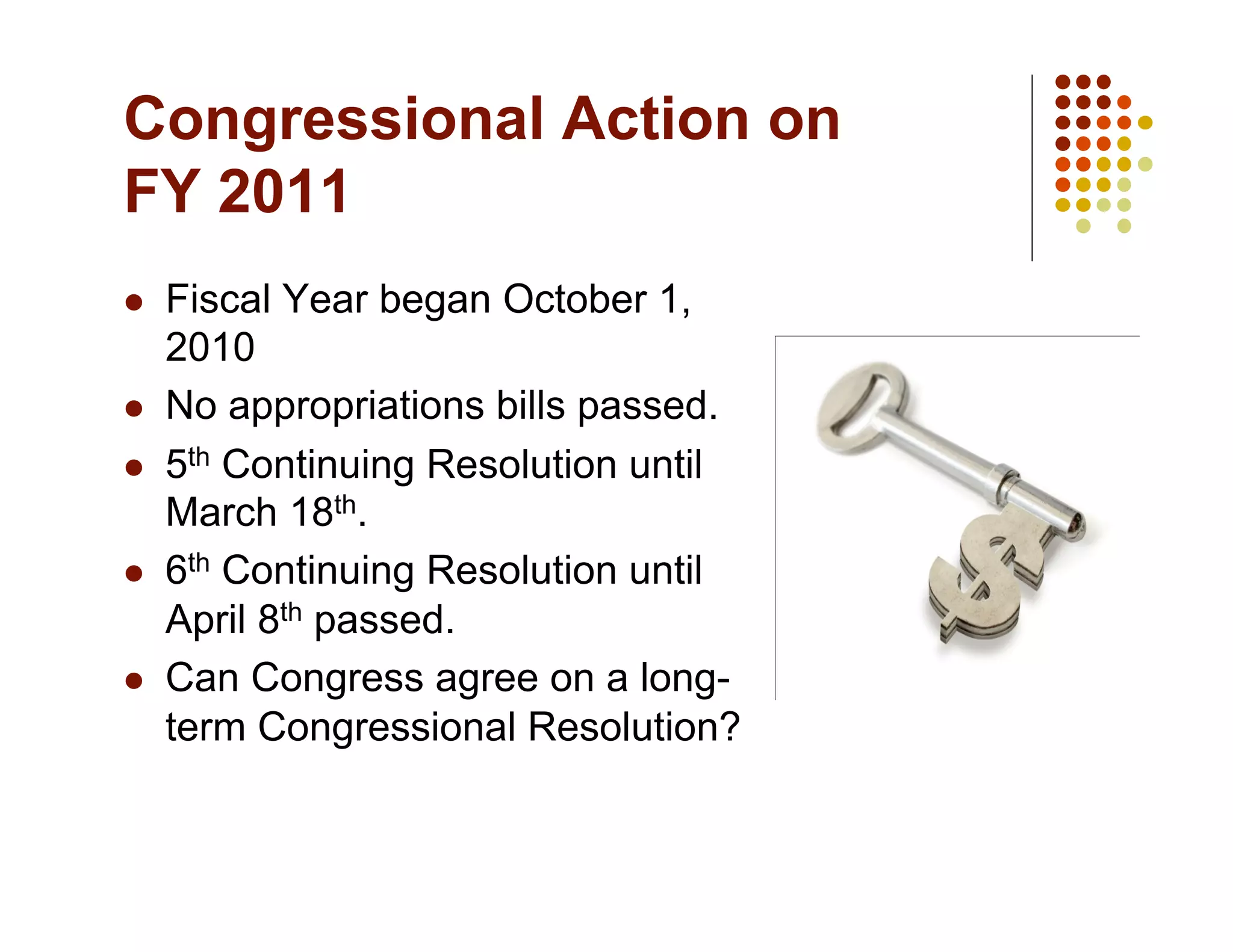
Congressional Action on
FY 2011
    Fiscal Year began October 1,
     2010
    No appropriations bills passed.
    5th Continuing Resolution until
     March 18th.
    6th Continuing Resolution until
     April 8th passed.
    Can Congress agree on a long-
     term Congressional Resolution?
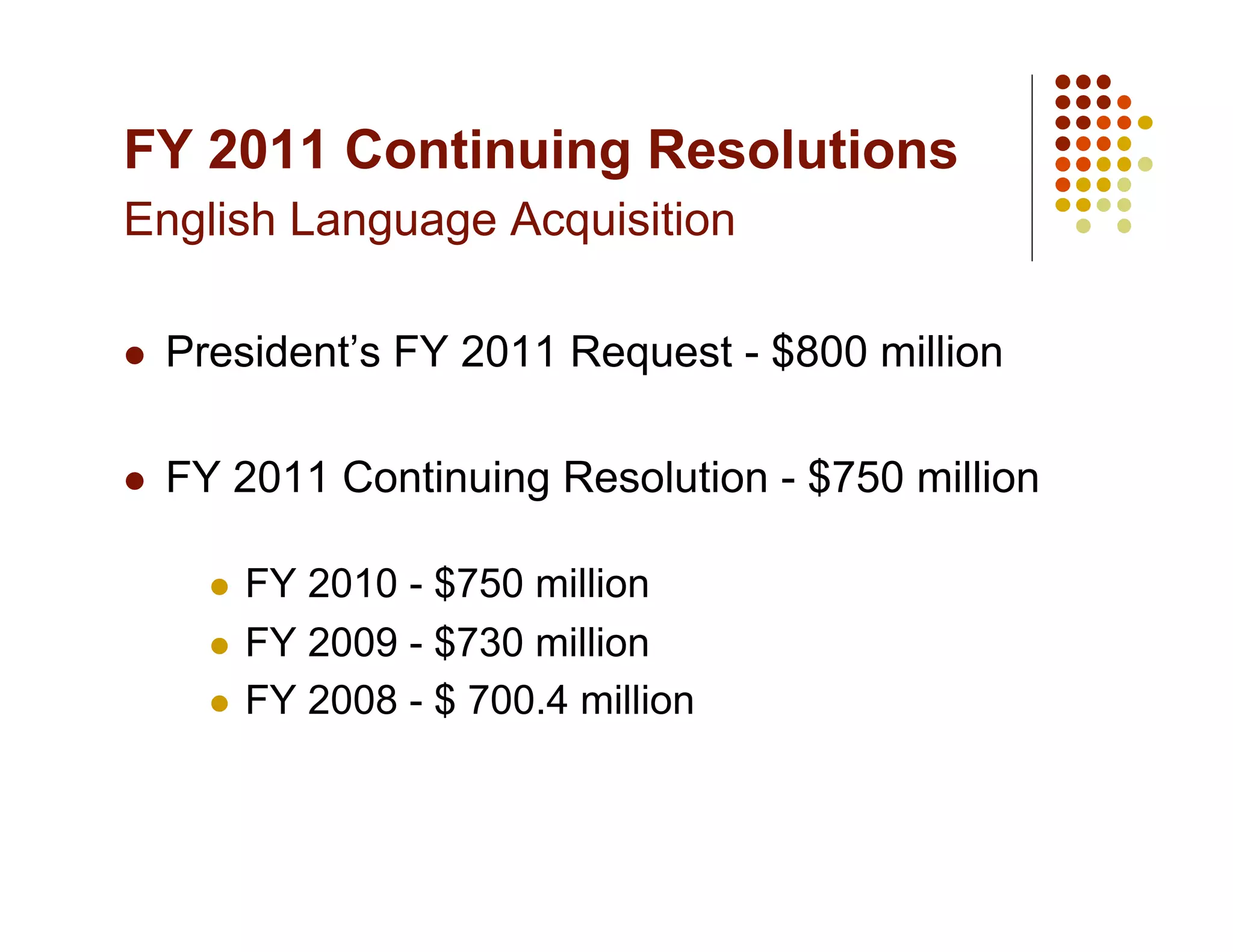
FY 2011 Continuing Resolutions
English Language Acquisition

    President’s FY 2011 Request - $800 million

    FY 2011 Continuing Resolution - $750 million

         FY 2010 - $750 million
         FY 2009 - $730 million

         FY 2008 - $ 700.4 million
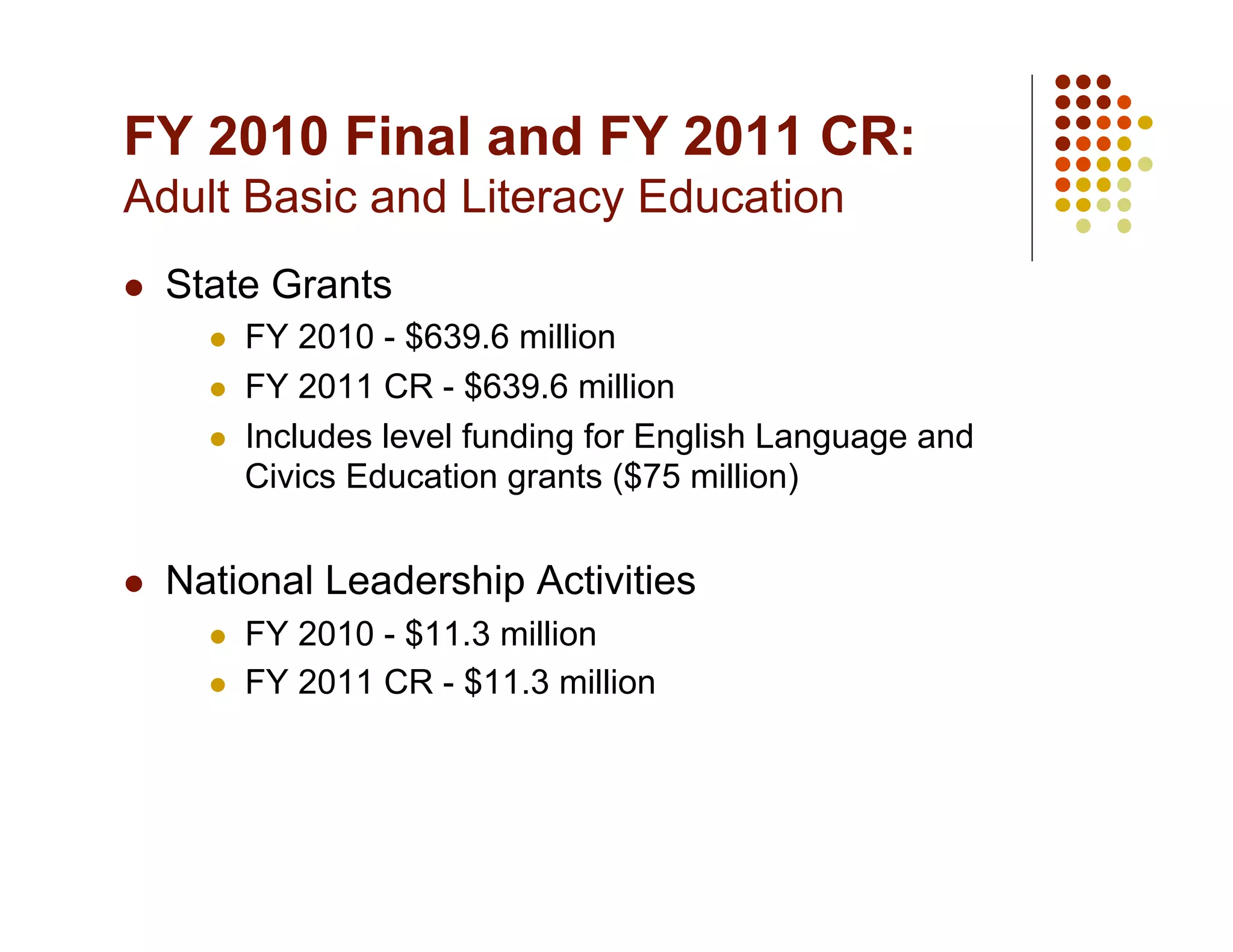
FY 2010 Final and FY 2011 CR:
Adult Basic and Literacy Education
    State Grants
           FY 2010 - $639.6 million
           FY 2011 CR - $639.6 million
           Includes level funding for English Language and
            Civics Education grants ($75 million)


    National Leadership Activities
           FY 2010 - $11.3 million
           FY 2011 CR - $11.3 million
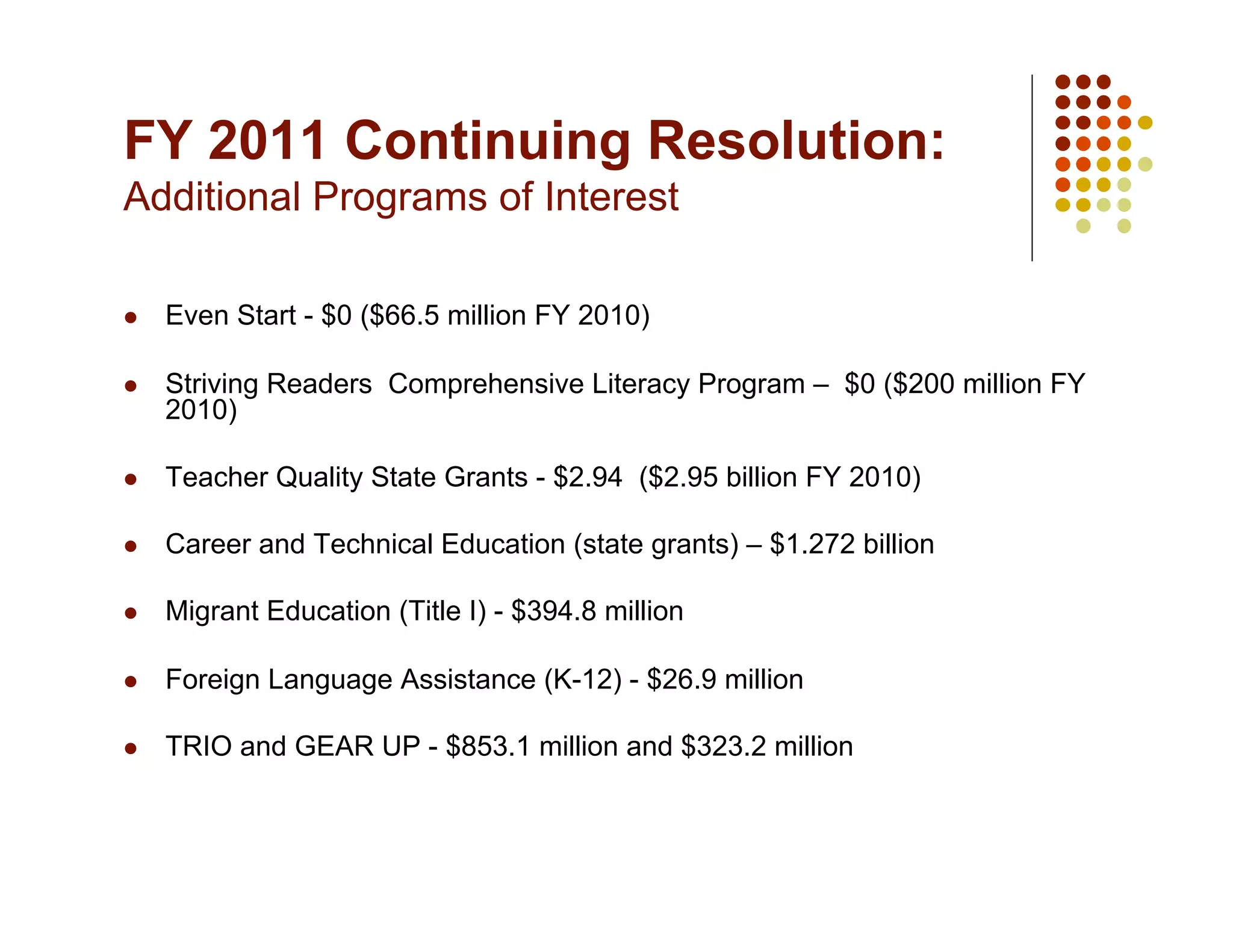
FY 2011 Continuing Resolution:
Additional Programs of Interest

    Even Start - $0 ($66.5 million FY 2010)

    Striving Readers Comprehensive Literacy Program – $0 ($200 million FY
     2010)

    Teacher Quality State Grants - $2.94 ($2.95 billion FY 2010)

    Career and Technical Education (state grants) – $1.272 billion

    Migrant Education (Title I) - $394.8 million

    Foreign Language Assistance (K-12) - $26.9 million

    TRIO and GEAR UP - $853.1 million and $323.2 million
Winning the Future
FY 2012 Budget: President’s Outline
    Budget Goals
         To win the future, “we have to out-innovate, out-
          educate and out-build the rest of the world.”
         Take responsibility for our deficit, “by investing in
          what makes America stronger and cutting what
          doesn’t.”
         Reform government so that it’s “smarter, leaner,
          and better able to take on the challenges of the
          21st century.”
FY 2012 Budget Detail

    $3.73 trillion request which cuts the deficit by
     $1 trillion over the next decade.

    $1.65 trillion deficit in FY 2012.

    5-year freeze to most discretionary spending.
         Maintains priority investments to critical areas
          including education.

    Must work together to make hard choices.
FY 2012 Budget Outline
Education Overview

  $77.4 billion for ED - $2 billion increase over
   FY 2010.
  Creates educational reform that emphasizes
   “cutting where we can, to invest where we
   must.”
  Investments made in innovative, outcome-
   orientated programs that build on Race to the
   Top.
  Consolidates 38 K-12 programs into 11.

  Eliminates 13 programs.
FY 2012 Budget
Education Overview

    Five priorities for ED:
     1.    Early learning programs;
     2.    Elementary and secondary innovation and
           reform;
     3.    Recruitment of top teachers and
           professionals;
     4.    College completion; and
     5.    Supporting at-risk student populations, e.g.,
           English language learners.
FY 2010 Budget
Education Overview: K-12 Focus

     Rewarding excellence and promoting
      innovation
           $900 million Race to the Top (District level).
           $300 million i3 Fund.
           $90 million ARPA-ED (Advanced Research Projects
            Agency).
           Support for effective charter schools and comprehensive
            school choice.


     Great teachers and leaders.
           $3.25 billion Excellent Instructional Team initiative
            (consolidates 9 programs).
           $835 million Effective Teachers and Learning.
FY 2010 Budget
Education Overview: K-12

    All students college- and career-ready.

         $750 million for ELL program to ensure these
          students reach same college- and career-ready
          goals as other students.

         $420 million to help States improve quality of
          assessment systems.
FY 2012 Budget Outline
Education Overview: Adult Learners

    Variety of programs targeting adult learners.
         $635 million for Adult Basic and Literacy
          Education State Grants.
         8 percent of funds used for Workforce
          Innovation Fund (WIF) – joint initiative with DOL
          to improve WIA programs by testing and
          validating innovation.
         $23 million National Leadership Activities – new
          evaluation and technology infrastructure.
FY 2012 Budget
Response

    The response on Capitol Hill to the
     President’s budget not enough.

         Still working on FY 2011.
         Education budget not written to statute.

         Tea Party members will demand fiscal
          discipline.
FY 2012 Budget:
Congressional Action
     Both chambers have begun to have
      hearings.
        Senate Budget Committee has heard testimony
         from Secretary Duncan.
        House Ed and Workforce Committee has heard
         testimony from Secretary Duncan.
        House LHHS Appropriations Subcommittee has
         heard testimony from Secretary Duncan.
Congressional Education Agenda
Overview
    Workforce Investment Act/Adult Education
          Long overdue – hasn’t been reauthorized since
           1998.

          Title II – Adult Education and Family Literacy
           Act .

          Senate HELP Committee has draft.

          House Education and Workforce Committee
           has many new members – must educate them.
Elementary and Secondary Education
Act (ESEA) Reauthorization
    President Obama Priority – speech at
     Kenmore Middle School on Monday.
         Wants Congress to send him bill to “fix” law before
          new school year.
    Secretary Duncan Priority.
         Law is broken; must fix it to make it more “fair,
          flexible and focused.”
         Focus on lowest performing schools and students
          most at-risk.
ESEA: TESOL Recommendations


    Widespread recognition of benefits and
     problems for ELL learners

         ESEA has shined a light on ELL learners and
          forced schools to educate these students.
         Teaching has improved.

         Major issues with language of law and state
          implementation.
         Slow guidance from Department of Education.
ESEA: TESOL Recommendations
Accountability – Title I

  Include accountability for the development of
   academic English language proficiency.
  Incorporate English language proficiency
   level as weighted factor into content area
   achievement.
  Distinguish among students within ELL
   English language proficiency level within age
   groups.
  Require disaggregation of graduation rates
   based on subgroup.
ESEA: TESOL Recommendations
Accountability – Title III

    Require uniform statewide criteria for
     identification and classification of English
     Language Learners.

    Require states to develop and implement
     system to monitor and report on effectiveness
     of language instruction programs.
ESEA: TESOL Recommendations
Assessment and Accommodations
  Require states to use valid and reliable
   assessments and to submit evidence of
   validity and reliability of assessments.
  Require states to report on accommodations
   used and provide guidance to districts.
  Allow use of multiple measures for
   assessment.
  Codify ED regulation allowing 1-year
   exemption from ELA assessment for recently
   arrived ELLs and lowest proficiency level.
ESEA: TESOL Recommendations
Advancing Expertise – Title II
  Define ESL as core academic subject.
  Require states to provide unique licensure
   credentials for ESL/bilingual as well as other
   educators who work with ELLs.
  Require states to demonstrate core academic
   content teachers also prepared to meet
   needs of ELLs.
  Incentives to give funding priority to prof
   development programs focused on ESL/
   bilingual educators.
ESEA: TESOL Recommendations
Advancing Expertise - Title III
  Reinstate fellowship program to support new
   generation of teachers and researchers to
   support ELLs.
  Provide incentives to districts to develop
   career ladder programs for ESL/bilingual.
  Develop new discretionary grant program for
   “new-growth” districts.
  Provide funding for further research.

  Establish funding to develop English language
   proficiency standards linked to Common Core.
ESEA: TESOL Recommendations
Promoting Innovation – Title I
    Allow states to measure linguistic and
     academic progress in more than 1 language.

    Provide resources to promote family literacy
     so families of ELLs have access to effective
     early childhood and adult education
     programs.
ESEA: TESOL Recommendations
Promoting Innovation – Title III
  Allow Title III funds to support development of
   native language literacy.
  Create competitive grant for innovative
   programs to serve ELLs.
  Establish new grant program targeted to
   high-need areas to support programs that
   maintain and develop learners’ native
   languages.
  Provide funding to develop content-area
   assessments in native/heritage languages.
Other Education Priorities

    STEM education

    Comprehensive birth-grade 12 literacy
     initiative

    Middle school and high school reform
The Dream Act
Status

    Did not pass in 111th Congress.

    Will be introduced by Sen. Richard Durbin
     (D-IL) and Rep. Howard Berman (D-CA) in
     April.

    President has expressed support for bill in
     past.
What Will Get Done?
             Will partisanship rule the day?

Will President be able to sign a new ESEA?

              Will WIA ever be introduced?

2011 TESOL US Federal Update

  • 1.
    Legislative Outlook 112th Congress 1 st Session Ellen Fern Washington Partners, LLC efern@wpllc.net March 18, 2011
  • 2.
    112th Congress Overview   Department of Education   Congress   Congressional Leadership and Committee Membership   Issues   Federal FY 2011 Budget Status   Federal FY 2012 Budget   Budget Outline   Education Overview   Congressional Education Agenda   Overview   WIA   ESEA   Dream Act
  • 3.
    Department of Education Leadership   U.S. Secretary of Education – Arne Duncan   Jo Anderson, Jr. – Senior Advisor   Focus on outreach to teachers and teacher organizations   Office of the Deputy Secretary (ODS) – Tony Miller Handles K-12 policy including ESEA, ELL, Innovation and Improvement, IDEA   Office of English Language Acquisition   Assistant Deputy Secretary Dr. Rosalinda Barrera   Office of Elementary and Secondary Education   Assistant Secretary Thelma Meléndez
  • 4.
    Department of Education Leadership   Office of the Undersecretary – Martha Kanter Oversees policies, programs and activities related to vocational and adult education, postsecondary education and college aid.   Office of Vocational and Adult Education   Dr. Brenda Dann-Messier, Assistant Secretary   Office of Community Colleges   Frank Chong Ed.D., Deputy Assistant Secretary   Division of Adult Education and Literacy (DAEL)   Cheryl Keenan, Director
  • 5.
    Congress – DemocraticMajority U.S. Senate Leadership   Senate Majority Leader – Senator Harry Reid (D-NV) 51:47:2   Senate Minority Leader – Senator Mitch McConnell (R-KY)   Appropriations Committee   Chairman – Senator Daniel Inouye (D-HI)   LHHS Subcommittee Chairman – Senator Tom Harkin (D-IA)   Health, Education, Labor and Pensions (HELP) Committee   Chairman – Senator Tom Harkin(D-IA)   Judiciary Committee   Chairman – Senator Pat Leahy (D-VT)
  • 6.
    Congress – RepublicanMajority U.S. House Leadership   Republican Majority – Speaker John Boehner (R-OH) 241:192   Minority Leader – Rep. Nancy Pelosi (D-CA)   Appropriations Committee   Chairman - Rep. Hal Rogers (R-KY)   LHHS Subcommittee Chairman – Rep. Denny Rehberg (R-MT)   Education and Workforce Committee   Chairman – Rep. John Kline (R-MN)   Judiciary Committee   Chairman – Rep. Lamar Smith (R-TX)
  • 7.
    Washington Environmental Assessment   Partisanship has impacted all debate and legislative schedule.   Unprecedented dysfunction in the legislative process.   Issue landscape changing rapidly – has evolved from stimulus, job creation, war in Afghanistan and financial reform to huge emphasis on the deficit.   Fiscal Year 2011 appropriations process delayed.   Federal government running on a Continuing Resolution.
  • 8.
    Congressional Focus   Complete FY 2011 budget.   Mandate to cut the budget because of deficit.   Smaller government.   Focus on earmark elimination.
  • 9.
    Congressional Action on FY2011   Fiscal Year began October 1, 2010   No appropriations bills passed.   5th Continuing Resolution until March 18th.   6th Continuing Resolution until April 8th passed.   Can Congress agree on a long- term Congressional Resolution?
  • 10.
    FY 2011 ContinuingResolutions English Language Acquisition   President’s FY 2011 Request - $800 million   FY 2011 Continuing Resolution - $750 million   FY 2010 - $750 million   FY 2009 - $730 million   FY 2008 - $ 700.4 million
  • 11.
    FY 2010 Finaland FY 2011 CR: Adult Basic and Literacy Education   State Grants   FY 2010 - $639.6 million   FY 2011 CR - $639.6 million   Includes level funding for English Language and Civics Education grants ($75 million)   National Leadership Activities   FY 2010 - $11.3 million   FY 2011 CR - $11.3 million
  • 12.
    FY 2011 ContinuingResolution: Additional Programs of Interest   Even Start - $0 ($66.5 million FY 2010)   Striving Readers Comprehensive Literacy Program – $0 ($200 million FY 2010)   Teacher Quality State Grants - $2.94 ($2.95 billion FY 2010)   Career and Technical Education (state grants) – $1.272 billion   Migrant Education (Title I) - $394.8 million   Foreign Language Assistance (K-12) - $26.9 million   TRIO and GEAR UP - $853.1 million and $323.2 million
  • 13.
    Winning the Future FY2012 Budget: President’s Outline   Budget Goals   To win the future, “we have to out-innovate, out- educate and out-build the rest of the world.”   Take responsibility for our deficit, “by investing in what makes America stronger and cutting what doesn’t.”   Reform government so that it’s “smarter, leaner, and better able to take on the challenges of the 21st century.”
  • 14.
    FY 2012 BudgetDetail   $3.73 trillion request which cuts the deficit by $1 trillion over the next decade.   $1.65 trillion deficit in FY 2012.   5-year freeze to most discretionary spending.   Maintains priority investments to critical areas including education.   Must work together to make hard choices.
  • 15.
    FY 2012 BudgetOutline Education Overview   $77.4 billion for ED - $2 billion increase over FY 2010.   Creates educational reform that emphasizes “cutting where we can, to invest where we must.”   Investments made in innovative, outcome- orientated programs that build on Race to the Top.   Consolidates 38 K-12 programs into 11.   Eliminates 13 programs.
  • 16.
    FY 2012 Budget EducationOverview   Five priorities for ED: 1.  Early learning programs; 2.  Elementary and secondary innovation and reform; 3.  Recruitment of top teachers and professionals; 4.  College completion; and 5.  Supporting at-risk student populations, e.g., English language learners.
  • 17.
    FY 2010 Budget EducationOverview: K-12 Focus   Rewarding excellence and promoting innovation   $900 million Race to the Top (District level).   $300 million i3 Fund.   $90 million ARPA-ED (Advanced Research Projects Agency).   Support for effective charter schools and comprehensive school choice.   Great teachers and leaders.   $3.25 billion Excellent Instructional Team initiative (consolidates 9 programs).   $835 million Effective Teachers and Learning.
  • 18.
    FY 2010 Budget EducationOverview: K-12   All students college- and career-ready.   $750 million for ELL program to ensure these students reach same college- and career-ready goals as other students.   $420 million to help States improve quality of assessment systems.
  • 19.
    FY 2012 BudgetOutline Education Overview: Adult Learners   Variety of programs targeting adult learners.   $635 million for Adult Basic and Literacy Education State Grants.   8 percent of funds used for Workforce Innovation Fund (WIF) – joint initiative with DOL to improve WIA programs by testing and validating innovation.   $23 million National Leadership Activities – new evaluation and technology infrastructure.
  • 20.
    FY 2012 Budget Response   The response on Capitol Hill to the President’s budget not enough.   Still working on FY 2011.   Education budget not written to statute.   Tea Party members will demand fiscal discipline.
  • 21.
    FY 2012 Budget: CongressionalAction   Both chambers have begun to have hearings.   Senate Budget Committee has heard testimony from Secretary Duncan.   House Ed and Workforce Committee has heard testimony from Secretary Duncan.   House LHHS Appropriations Subcommittee has heard testimony from Secretary Duncan.
  • 22.
    Congressional Education Agenda Overview   Workforce Investment Act/Adult Education   Long overdue – hasn’t been reauthorized since 1998.   Title II – Adult Education and Family Literacy Act .   Senate HELP Committee has draft.   House Education and Workforce Committee has many new members – must educate them.
  • 23.
    Elementary and SecondaryEducation Act (ESEA) Reauthorization   President Obama Priority – speech at Kenmore Middle School on Monday.   Wants Congress to send him bill to “fix” law before new school year.   Secretary Duncan Priority.   Law is broken; must fix it to make it more “fair, flexible and focused.”   Focus on lowest performing schools and students most at-risk.
  • 24.
    ESEA: TESOL Recommendations   Widespread recognition of benefits and problems for ELL learners   ESEA has shined a light on ELL learners and forced schools to educate these students.   Teaching has improved.   Major issues with language of law and state implementation.   Slow guidance from Department of Education.
  • 25.
    ESEA: TESOL Recommendations Accountability– Title I   Include accountability for the development of academic English language proficiency.   Incorporate English language proficiency level as weighted factor into content area achievement.   Distinguish among students within ELL English language proficiency level within age groups.   Require disaggregation of graduation rates based on subgroup.
  • 26.
    ESEA: TESOL Recommendations Accountability– Title III   Require uniform statewide criteria for identification and classification of English Language Learners.   Require states to develop and implement system to monitor and report on effectiveness of language instruction programs.
  • 27.
    ESEA: TESOL Recommendations Assessmentand Accommodations   Require states to use valid and reliable assessments and to submit evidence of validity and reliability of assessments.   Require states to report on accommodations used and provide guidance to districts.   Allow use of multiple measures for assessment.   Codify ED regulation allowing 1-year exemption from ELA assessment for recently arrived ELLs and lowest proficiency level.
  • 28.
    ESEA: TESOL Recommendations AdvancingExpertise – Title II   Define ESL as core academic subject.   Require states to provide unique licensure credentials for ESL/bilingual as well as other educators who work with ELLs.   Require states to demonstrate core academic content teachers also prepared to meet needs of ELLs.   Incentives to give funding priority to prof development programs focused on ESL/ bilingual educators.
  • 29.
    ESEA: TESOL Recommendations AdvancingExpertise - Title III   Reinstate fellowship program to support new generation of teachers and researchers to support ELLs.   Provide incentives to districts to develop career ladder programs for ESL/bilingual.   Develop new discretionary grant program for “new-growth” districts.   Provide funding for further research.   Establish funding to develop English language proficiency standards linked to Common Core.
  • 30.
    ESEA: TESOL Recommendations PromotingInnovation – Title I   Allow states to measure linguistic and academic progress in more than 1 language.   Provide resources to promote family literacy so families of ELLs have access to effective early childhood and adult education programs.
  • 31.
    ESEA: TESOL Recommendations PromotingInnovation – Title III   Allow Title III funds to support development of native language literacy.   Create competitive grant for innovative programs to serve ELLs.   Establish new grant program targeted to high-need areas to support programs that maintain and develop learners’ native languages.   Provide funding to develop content-area assessments in native/heritage languages.
  • 32.
    Other Education Priorities   STEM education   Comprehensive birth-grade 12 literacy initiative   Middle school and high school reform
  • 33.
    The Dream Act Status   Did not pass in 111th Congress.   Will be introduced by Sen. Richard Durbin (D-IL) and Rep. Howard Berman (D-CA) in April.   President has expressed support for bill in past.
  • 34.
    What Will GetDone? Will partisanship rule the day? Will President be able to sign a new ESEA? Will WIA ever be introduced?