Brazil Healthcare Market &
ASAP Launching
17th. October 2012

Andre Gibrail
ASAP member of Board of Directors
AxisMed COO - Chief Operating Officer

The Forum12

1
Brazil in Brief - Overview
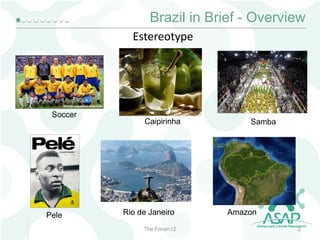
Estereotype

Soccer

Pele

Caipirinha

Rio de Janeiro
The Forum12

Samba

Amazon
2
Brazil in Brief - Overview
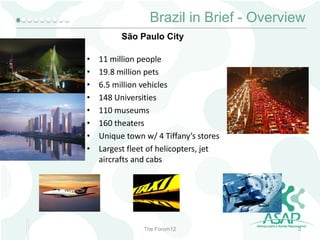
São Paulo City
•
•
•
•
•
•
•
•

11 million people
19.8 million pets
6.5 million vehicles
148 Universities
110 museums
160 theaters
Unique town w/ 4 Tiffany’s stores
Largest fleet of helicopters, jet
aircrafts and cabs

The Forum12

3
Brazil in Brief - Overview
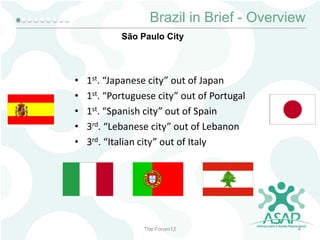
São Paulo City

•
•
•
•
•

1st. “Japanese city” out of Japan
1st. “Portuguese city” out of Portugal
1st. “Spanish city” out of Spain
3rd. “Lebanese city” out of Lebanon
3rd. “Italian city” out of Italy

The Forum12

4
Brazil in Brief - Overview

The Forum12

5
Brazil in Brief - Overview
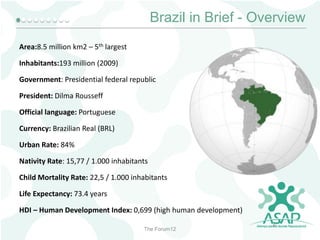
Area:8.5 million km2 – 5th largest
Inhabitants:193 million (2009)

Government: Presidential federal republic
President: Dilma Rousseff
Official language: Portuguese

Currency: Brazilian Real (BRL)
Urban Rate: 84%
Nativity Rate: 15,77 / 1.000 inhabitants
Child Mortality Rate: 22,5 / 1.000 inhabitants
Life Expectancy: 73.4 years
HDI – Human Development Index: 0,699 (high human development)
The Forum12

6
Brazil in Brief - Overview
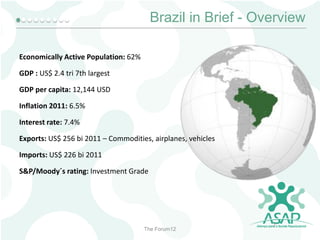
Economically Active Population: 62%
GDP : US$ 2.4 tri 7th largest
GDP per capita: 12,144 USD
Inflation 2011: 6.5%
Interest rate: 7.4%
Exports: US$ 256 bi 2011 – Commodities, airplanes, vehicles
Imports: US$ 226 bi 2011

S&P/Moody´s rating: Investment Grade

The Forum12

7
Brazil in Brief - Overview
Economic Momentum

Economy: Stable with significant growth
Population: Annual Income Increase
Broadening of the “middle class”
39 million people became middle class in the last 10 years
High growth of total outstanding credit in financial market
Government social programs decreased extreme poverty

The Forum12

8
Brazil in Brief - Overview
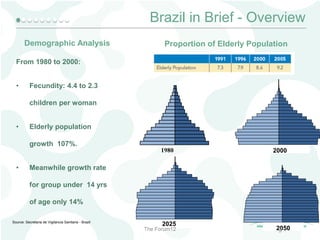
Demographic Analysis

Proportion of Elderly Population

From 1980 to 2000:
•

Fecundity: 4.4 to 2.3
children per woman

•

Elderly population

growth 107%.
•

1980

2000

2025

9

Meanwhile growth rate
for group under 14 yrs
of age only 14%

Source: Secretaria de Vigilancia Sanitaria - Brazil

The Forum12

2050
9
Brazil in Brief - Overview
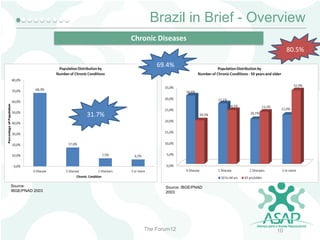
Chronic Diseases
80.5%
69.4%

31.7%

Source:
IBGE/PNAD 2003

Source: IBGE/PNAD
2003

The Forum12

10
Brazil in Brief - Overview
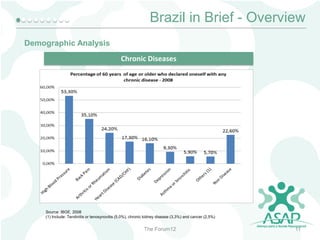
Demographic Analysis

Chronic Diseases

Source: IBGE, 2008
(1) Include: Tendinitis or tenosynovitis (5.0%), chronic kidney disease (3,3%) and cancer (2,5%)

The Forum12

11
Brazil in Brief - Overview
Brazilian Health Care Model – Public x Private Sector

• Public sector – SUS (Unified Health System)
– Government-run public healthcare system
– Around 150 million people
– Universal and comprehensive care (From basic
prevention to organ transplants)
– Family Health Program: multidisciplinary teams responsible for
attendance families at circumscribed regions.
• Currently covers 95% of total (5.290) city councils

• Private sector
– 48.7 million people
– Business Models:
•
•
•
•

Self-Managed Plans,
Health Maintenance Organizations,
Health Co-Operatives of Physicians, and
Health Insurance Companies The Forum12

12
12
Brazil in Brief - Overview
ANS – Healthcare National Agency

• Regulatory Agenda – 9 themes
– Financial Model of the sector – looking for best ways to finance the elderly
– Ensuring access and quality of care – quality and quantity of network providers
based on the number of members
– Payment model to suppliers – starting discussion on P4P
– Pharmaceutical assistance – bring PBMs initiatives for people with common
chronic diseases
– Incentive to competitiveness – standardizing and making public main KPIs
– Access to information – making ANS’s website and publications become a
reference for the stakeholders: members, health plans, providers and society
– Old contracts – Incentives to adapt the contracts signed before the regulation
– Care to the elderly – Incentives to provide a preventive and
holistic care
– Integration between private and public sector – Members ID
unification to reduce overlays
Source: ANS

The Forum12

13
13
Brazil in Brief - Overview
ANS – Healthcare National Agency

• Disease Management and Wellness Promotion
August 2011 – ANS publish 2 “Regulatory rule making” to incentive the
implementation of disease management and wellness programs by
Health Plans.
Nowadays, there are 760 programs registered and approved by ANS
covering 1.2 million beneficiaries.
Programs focus on: physical activities, healthy eating, cancer prevention,
sexually transmitted diseases, osteoporosis, hypertension, diabetes,
smoking cessation and obesity.
Another focus is the health of the elderly
Source: ANS

The Forum12

14
14
Brazil in Brief - Overview
ANS – Healthcare National Agency

• Disease Management and Wellness Promotion Results
– Reduced exposure to risk factors such as physical inactivity, inadequate nutrition
and smoke;
– Adoption of health habits;
– Increased functional ability;
– Increase use of preventive screenings and early treatment of cancer;
– Reducing rate of hospitalization for chronic diseases;
– Changes in habits and home environment to prevent falls in the elderly;
– Proven financial return on the investment made
by Health Plans in the Programs

Source: ANS

The Forum12

15
15
Brazil in Brief - Overview
ANS – Healthcare National Agency

• Disease Management and Wellness Promotion – Examples of
Results
70.4% Reduction in the number of hospitalizations in the elderly
11.8% Reduction of fractures in people over 85 years old
18.8% Reduction in demand for care in emergency rooms
92.1% Patients with high BP controls BP
62.3% People who lost weight after 8 months
63.5% Diabetic patients controlled (glycated hemoglobin less than 6.5%)
83.3% Patients with controlled dyslipidemia (LDL <130)
Source: ANS

The Forum12

16
16
Brazil in Brief - Overview
ANS – Healthcare National Agency

• Disease Management and Wellness Promotion
“It is a paradigm shift: the goal to the health system should be promote
health and, not only, to treat diseases. The ANS invites Brazilian society
to participate in this change”.
Mauricio Ceschin – President of ANS

The Forum12

17
17
Brazil in Brief - Overview

Foundation of ASAP

The Forum12

18
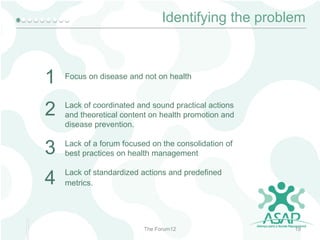
Identifying the problem

1

Focus on disease and not on health

2

Lack of coordinated and sound practical actions
and theoretical content on health promotion and
disease prevention.

3

Lack of a forum focused on the consolidation of
best practices on health management

4

Lack of standardized actions and predefined
metrics.

The Forum12

19
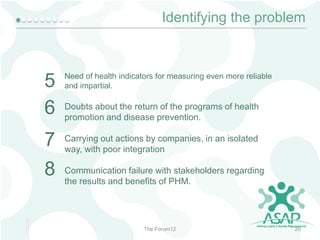
Identifying the problem

5
6

Need of health indicators for measuring even more reliable
and impartial.

7
8

Carrying out actions by companies, in an isolated
way, with poor integration

Doubts about the return of the programs of health
promotion and disease prevention.

Communication failure with stakeholders regarding
the results and benefits of PHM.

The Forum12

20
Challenges continue to face

Life expectancy of the population continuously increasing:

Technological advances in medicine;

Development of pharmacology;
Democratization of the access to information.
The challenges are magnified, bringing questions to health managers.

The Forum12

21
Questions
How to transform a reactive model of health in a
proactive system?
How to define actions against the explosive growth
of chronic diseases?

How to disseminate and replicate best practices?
How to measure the quality of services and
outcomes?

How to manage the risks of health preventively?

How to optimize health costs without sacrificing
quality?

The Forum12

22
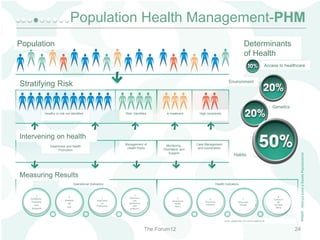
Population Health Management-PHM

The Population Health Management
has all the virtues and strategies to address
these challenges.

The Forum12

23
Population Health Management-PHM
Population

Determinants
of Health
Access to healthcare

Environment

Stratifying Risk

Genetics
Healthy or risk not Identified

Risk Identified

In treatment

High complexity

Intervening on health
Management of
Health Risks

Awareness and health
Promotion

Monitoring,
Orientation and
Support

Case Management
and coordination

Habits

Measuring Results
Operational Indicators

1
Economic,
Financial,
and
Actuarial

2
Analysis
Of
Use

3
Organizatio
nal
Productivity

Health Indicators

4
Adherence
and
satisfactions
with
programs

5
Clinical and
Health
Status

6
Prevention
Indicators

7
Behavioral
Change

8
Quality of
life
and wellbeing

Source: Adapted from CCA outcome guidelines #5

The Forum12

24
Foundation of ASAP

With a new vision of health,
ASAP is born with the clear purpose
to promote an alliance between all
stakeholders, working for the outcomes,
results and progress, as well as best
practices. This framework is clearly
understood and applied in health
promotion to different populations, with
results even more effective and viable.

The Forum12

25
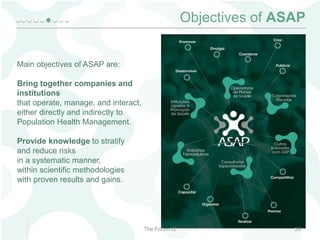
Objectives of ASAP

Main objectives of ASAP are:
Bring together companies and
institutions
that operate, manage, and interact,
either directly and indirectly to
Population Health Management.
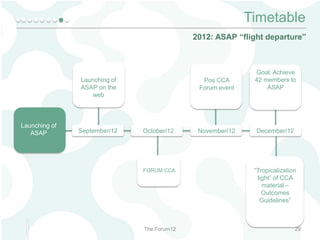
Provide knowledge to stratify
and reduce risks
in a systematic manner,
within scientific methodologies
with proven results and gains.

The Forum12

26
Partnership

The CCA is an institution
recognized internationally that,
in the last decade, led the
convergence of U.S. companies
and other parts of the world who
work within the value chain of
PHM, establishing standards and
metrics that become
reference for the Industry.

The Forum12

27
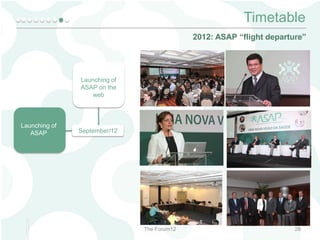
Timetable
2012: ASAP “flight departure”

Launching of
ASAP on the
web

Launching of
ASAP

September/12

The Forum12

28
Timetable
2012: ASAP “flight departure”

Pos CCA
Forum event

Launching of
ASAP on the
web

Launching of
ASAP

September/12

October/12

FORUM CCA

The Forum12

Goal: Achieve
42 members to
ASAP

November/12

December/12

“Tropicalization
light” of CCA
material –
Outcomes
Guidelines”

29
Timetable
2013 to ASAP

In 2013, we plan to :

Consolidate the importance of its creation;
Build the initial technical basis;
Attract new members.

The Forum12

30
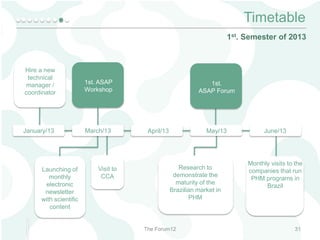
Timetable
1st. Semester of 2013

Hire a new
technical
manager /
coordinator

1st. ASAP
Workshop

January/13

March/13

Launching of
monthly
electronic
newsletter
with scientific
content

Visit to
CCA

1st.
ASAP Forum

April/13

May/13

Research to
demonstrate the
maturity of the
Brazilian market in
PHM

The Forum12

June/13

Monthly visits to the
companies that run
PHM programs in
Brazil

31
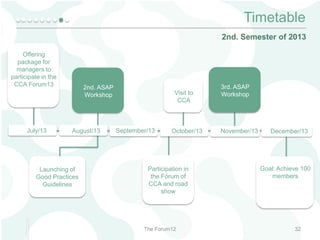
Timetable
2nd. Semester of 2013
Offering
package for
managers to
participate in the
CCA Forum13

July/13

2nd. ASAP
Workshop

August/13

Launching of
Good Practices
Guidelines

Visit to
CCA

September/13

October/13

Participation in
the Fórum of
CCA and road
show

The Forum12

3rd. ASAP
Workshop

November/13

December/13

Goal: Achieve 100
members

32
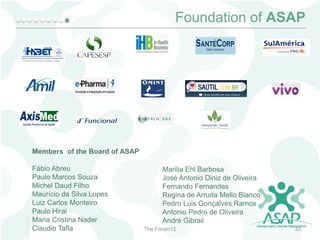
Foundation of ASAP

Members of the Board of ASAP
Fábio Abreu
Paulo Marcos Souza
Michel Daud Filho
Maurício da Silva Lopes
Luiz Carlos Monteiro
Paulo Hirai
Maria Cristina Nader
Claudio Tafla

Marilia Ehl Barbosa
José Antonio Diniz de Oliveira
Fernando Fernandes
Regina de Arruda Mello Blanco
Pedro Luis Gonçalves Ramos
Antonio Pedro de Oliveira
André Gibrail
The Forum12

33
Foundation of ASAP

Summary of Brazilian HealthCare Market
Growth Opportunity

The Forum12

34
34
Foundation of ASAP
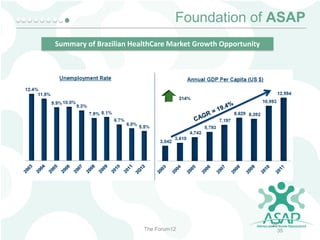
Summary of Brazilian HealthCare Market Growth Opportunity

The Forum12

35
35
Foundation of ASAP
Summary of Brazilian HealthCare Market Growth Opportunity
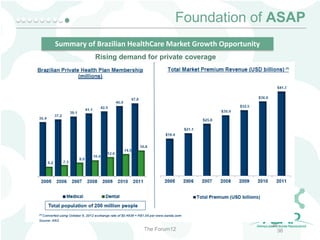
Rising demand for private coverage

The Forum12

36
36
Foundation of ASAP
Summary of Brazilian HealthCare Market Growth Opportunity
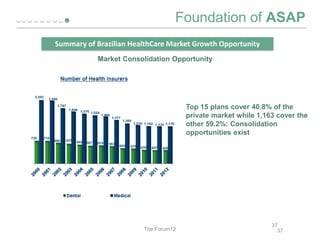
Market Consolidation Opportunity

Top 15 plans cover 40.8% of the
private market while 1,163 cover the
other 59.2%: Consolidation
opportunities exist

The Forum12

37
37
Foundation of ASAP
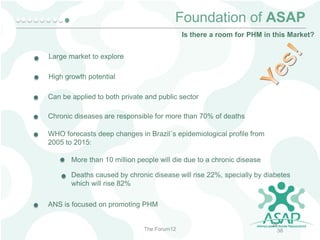
Is there a room for PHM in this Market?
Large market to explore
High growth potential
Can be applied to both private and public sector
Chronic diseases are responsible for more than 70% of deaths
WHO forecasts deep changes in Brazil´s epidemiological profile from
2005 to 2015:
More than 10 million people will die due to a chronic disease
Deaths caused by chronic disease will rise 22%, specially by diabetes
which will rise 82%
ANS is focused on promoting PHM

The Forum12

38
38
“ It is not because things are difficult that we do not dare,
it is because we do not dare that things are difficult.”
Seneca

Roman Stoic philosopher

The Forum12

39
Thank you.
www.asapsaude.org.br

Andre Gibrail
andre.gibrail@asapsaude.org.br

The Forum12

40

Brazil presentation the CCA Forum12

  • 1.
    Brazil Healthcare Market& ASAP Launching 17th. October 2012 Andre Gibrail ASAP member of Board of Directors AxisMed COO - Chief Operating Officer The Forum12 1
  • 2.
    Brazil in Brief- Overview Estereotype Soccer Pele Caipirinha Rio de Janeiro The Forum12 Samba Amazon 2
  • 3.
    Brazil in Brief- Overview São Paulo City • • • • • • • • 11 million people 19.8 million pets 6.5 million vehicles 148 Universities 110 museums 160 theaters Unique town w/ 4 Tiffany’s stores Largest fleet of helicopters, jet aircrafts and cabs The Forum12 3
  • 4.
    Brazil in Brief- Overview São Paulo City • • • • • 1st. “Japanese city” out of Japan 1st. “Portuguese city” out of Portugal 1st. “Spanish city” out of Spain 3rd. “Lebanese city” out of Lebanon 3rd. “Italian city” out of Italy The Forum12 4
  • 5.
    Brazil in Brief- Overview The Forum12 5
  • 6.
    Brazil in Brief- Overview Area:8.5 million km2 – 5th largest Inhabitants:193 million (2009) Government: Presidential federal republic President: Dilma Rousseff Official language: Portuguese Currency: Brazilian Real (BRL) Urban Rate: 84% Nativity Rate: 15,77 / 1.000 inhabitants Child Mortality Rate: 22,5 / 1.000 inhabitants Life Expectancy: 73.4 years HDI – Human Development Index: 0,699 (high human development) The Forum12 6
  • 7.
    Brazil in Brief- Overview Economically Active Population: 62% GDP : US$ 2.4 tri 7th largest GDP per capita: 12,144 USD Inflation 2011: 6.5% Interest rate: 7.4% Exports: US$ 256 bi 2011 – Commodities, airplanes, vehicles Imports: US$ 226 bi 2011 S&P/Moody´s rating: Investment Grade The Forum12 7
  • 8.
    Brazil in Brief- Overview Economic Momentum Economy: Stable with significant growth Population: Annual Income Increase Broadening of the “middle class” 39 million people became middle class in the last 10 years High growth of total outstanding credit in financial market Government social programs decreased extreme poverty The Forum12 8
  • 9.
    Brazil in Brief- Overview Demographic Analysis Proportion of Elderly Population From 1980 to 2000: • Fecundity: 4.4 to 2.3 children per woman • Elderly population growth 107%. • 1980 2000 2025 9 Meanwhile growth rate for group under 14 yrs of age only 14% Source: Secretaria de Vigilancia Sanitaria - Brazil The Forum12 2050 9
  • 10.
    Brazil in Brief- Overview Chronic Diseases 80.5% 69.4% 31.7% Source: IBGE/PNAD 2003 Source: IBGE/PNAD 2003 The Forum12 10
  • 11.
    Brazil in Brief- Overview Demographic Analysis Chronic Diseases Source: IBGE, 2008 (1) Include: Tendinitis or tenosynovitis (5.0%), chronic kidney disease (3,3%) and cancer (2,5%) The Forum12 11
  • 12.
    Brazil in Brief- Overview Brazilian Health Care Model – Public x Private Sector • Public sector – SUS (Unified Health System) – Government-run public healthcare system – Around 150 million people – Universal and comprehensive care (From basic prevention to organ transplants) – Family Health Program: multidisciplinary teams responsible for attendance families at circumscribed regions. • Currently covers 95% of total (5.290) city councils • Private sector – 48.7 million people – Business Models: • • • • Self-Managed Plans, Health Maintenance Organizations, Health Co-Operatives of Physicians, and Health Insurance Companies The Forum12 12 12
  • 13.
    Brazil in Brief- Overview ANS – Healthcare National Agency • Regulatory Agenda – 9 themes – Financial Model of the sector – looking for best ways to finance the elderly – Ensuring access and quality of care – quality and quantity of network providers based on the number of members – Payment model to suppliers – starting discussion on P4P – Pharmaceutical assistance – bring PBMs initiatives for people with common chronic diseases – Incentive to competitiveness – standardizing and making public main KPIs – Access to information – making ANS’s website and publications become a reference for the stakeholders: members, health plans, providers and society – Old contracts – Incentives to adapt the contracts signed before the regulation – Care to the elderly – Incentives to provide a preventive and holistic care – Integration between private and public sector – Members ID unification to reduce overlays Source: ANS The Forum12 13 13
  • 14.
    Brazil in Brief- Overview ANS – Healthcare National Agency • Disease Management and Wellness Promotion August 2011 – ANS publish 2 “Regulatory rule making” to incentive the implementation of disease management and wellness programs by Health Plans. Nowadays, there are 760 programs registered and approved by ANS covering 1.2 million beneficiaries. Programs focus on: physical activities, healthy eating, cancer prevention, sexually transmitted diseases, osteoporosis, hypertension, diabetes, smoking cessation and obesity. Another focus is the health of the elderly Source: ANS The Forum12 14 14
  • 15.
    Brazil in Brief- Overview ANS – Healthcare National Agency • Disease Management and Wellness Promotion Results – Reduced exposure to risk factors such as physical inactivity, inadequate nutrition and smoke; – Adoption of health habits; – Increased functional ability; – Increase use of preventive screenings and early treatment of cancer; – Reducing rate of hospitalization for chronic diseases; – Changes in habits and home environment to prevent falls in the elderly; – Proven financial return on the investment made by Health Plans in the Programs Source: ANS The Forum12 15 15
  • 16.
    Brazil in Brief- Overview ANS – Healthcare National Agency • Disease Management and Wellness Promotion – Examples of Results 70.4% Reduction in the number of hospitalizations in the elderly 11.8% Reduction of fractures in people over 85 years old 18.8% Reduction in demand for care in emergency rooms 92.1% Patients with high BP controls BP 62.3% People who lost weight after 8 months 63.5% Diabetic patients controlled (glycated hemoglobin less than 6.5%) 83.3% Patients with controlled dyslipidemia (LDL <130) Source: ANS The Forum12 16 16
  • 17.
    Brazil in Brief- Overview ANS – Healthcare National Agency • Disease Management and Wellness Promotion “It is a paradigm shift: the goal to the health system should be promote health and, not only, to treat diseases. The ANS invites Brazilian society to participate in this change”. Mauricio Ceschin – President of ANS The Forum12 17 17
  • 18.
    Brazil in Brief- Overview Foundation of ASAP The Forum12 18
  • 19.
    Identifying the problem 1 Focuson disease and not on health 2 Lack of coordinated and sound practical actions and theoretical content on health promotion and disease prevention. 3 Lack of a forum focused on the consolidation of best practices on health management 4 Lack of standardized actions and predefined metrics. The Forum12 19
  • 20.
    Identifying the problem 5 6 Needof health indicators for measuring even more reliable and impartial. 7 8 Carrying out actions by companies, in an isolated way, with poor integration Doubts about the return of the programs of health promotion and disease prevention. Communication failure with stakeholders regarding the results and benefits of PHM. The Forum12 20
  • 21.
    Challenges continue toface Life expectancy of the population continuously increasing: Technological advances in medicine; Development of pharmacology; Democratization of the access to information. The challenges are magnified, bringing questions to health managers. The Forum12 21
  • 22.
    Questions How to transforma reactive model of health in a proactive system? How to define actions against the explosive growth of chronic diseases? How to disseminate and replicate best practices? How to measure the quality of services and outcomes? How to manage the risks of health preventively? How to optimize health costs without sacrificing quality? The Forum12 22
  • 23.
    Population Health Management-PHM ThePopulation Health Management has all the virtues and strategies to address these challenges. The Forum12 23
  • 24.
    Population Health Management-PHM Population Determinants ofHealth Access to healthcare Environment Stratifying Risk Genetics Healthy or risk not Identified Risk Identified In treatment High complexity Intervening on health Management of Health Risks Awareness and health Promotion Monitoring, Orientation and Support Case Management and coordination Habits Measuring Results Operational Indicators 1 Economic, Financial, and Actuarial 2 Analysis Of Use 3 Organizatio nal Productivity Health Indicators 4 Adherence and satisfactions with programs 5 Clinical and Health Status 6 Prevention Indicators 7 Behavioral Change 8 Quality of life and wellbeing Source: Adapted from CCA outcome guidelines #5 The Forum12 24
  • 25.
    Foundation of ASAP Witha new vision of health, ASAP is born with the clear purpose to promote an alliance between all stakeholders, working for the outcomes, results and progress, as well as best practices. This framework is clearly understood and applied in health promotion to different populations, with results even more effective and viable. The Forum12 25
  • 26.
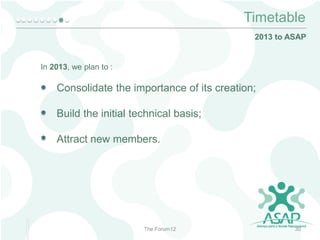
    Objectives of ASAP Mainobjectives of ASAP are: Bring together companies and institutions that operate, manage, and interact, either directly and indirectly to Population Health Management. Provide knowledge to stratify and reduce risks in a systematic manner, within scientific methodologies with proven results and gains. The Forum12 26
  • 27.
    Partnership The CCA isan institution recognized internationally that, in the last decade, led the convergence of U.S. companies and other parts of the world who work within the value chain of PHM, establishing standards and metrics that become reference for the Industry. The Forum12 27
  • 28.
    Timetable 2012: ASAP “flightdeparture” Launching of ASAP on the web Launching of ASAP September/12 The Forum12 28
  • 29.
    Timetable 2012: ASAP “flightdeparture” Pos CCA Forum event Launching of ASAP on the web Launching of ASAP September/12 October/12 FORUM CCA The Forum12 Goal: Achieve 42 members to ASAP November/12 December/12 “Tropicalization light” of CCA material – Outcomes Guidelines” 29
  • 30.
    Timetable 2013 to ASAP In2013, we plan to : Consolidate the importance of its creation; Build the initial technical basis; Attract new members. The Forum12 30
  • 31.
    Timetable 1st. Semester of2013 Hire a new technical manager / coordinator 1st. ASAP Workshop January/13 March/13 Launching of monthly electronic newsletter with scientific content Visit to CCA 1st. ASAP Forum April/13 May/13 Research to demonstrate the maturity of the Brazilian market in PHM The Forum12 June/13 Monthly visits to the companies that run PHM programs in Brazil 31
  • 32.
    Timetable 2nd. Semester of2013 Offering package for managers to participate in the CCA Forum13 July/13 2nd. ASAP Workshop August/13 Launching of Good Practices Guidelines Visit to CCA September/13 October/13 Participation in the Fórum of CCA and road show The Forum12 3rd. ASAP Workshop November/13 December/13 Goal: Achieve 100 members 32
  • 33.
    Foundation of ASAP Membersof the Board of ASAP Fábio Abreu Paulo Marcos Souza Michel Daud Filho Maurício da Silva Lopes Luiz Carlos Monteiro Paulo Hirai Maria Cristina Nader Claudio Tafla Marilia Ehl Barbosa José Antonio Diniz de Oliveira Fernando Fernandes Regina de Arruda Mello Blanco Pedro Luis Gonçalves Ramos Antonio Pedro de Oliveira André Gibrail The Forum12 33
  • 34.
    Foundation of ASAP Summaryof Brazilian HealthCare Market Growth Opportunity The Forum12 34 34
  • 35.
    Foundation of ASAP Summaryof Brazilian HealthCare Market Growth Opportunity The Forum12 35 35
  • 36.
    Foundation of ASAP Summaryof Brazilian HealthCare Market Growth Opportunity Rising demand for private coverage The Forum12 36 36
  • 37.
    Foundation of ASAP Summaryof Brazilian HealthCare Market Growth Opportunity Market Consolidation Opportunity Top 15 plans cover 40.8% of the private market while 1,163 cover the other 59.2%: Consolidation opportunities exist The Forum12 37 37
  • 38.
    Foundation of ASAP Isthere a room for PHM in this Market? Large market to explore High growth potential Can be applied to both private and public sector Chronic diseases are responsible for more than 70% of deaths WHO forecasts deep changes in Brazil´s epidemiological profile from 2005 to 2015: More than 10 million people will die due to a chronic disease Deaths caused by chronic disease will rise 22%, specially by diabetes which will rise 82% ANS is focused on promoting PHM The Forum12 38 38
  • 39.
    “ It isnot because things are difficult that we do not dare, it is because we do not dare that things are difficult.” Seneca Roman Stoic philosopher The Forum12 39
  • 40.