Fernando Bez, Lisa O’Brien
David Broderick & Michael de Korte
Emerging Market Entry
A Strategic Analysis of Brazil


                  Fernando Bez, Lisa O’Brien
                  David Broderick & Michael de Korte
Agenda

•   Brazil’s Market Assessment/Economic Profile
•   SWOT Analysis
•   Market Entry Strategy
•   E-Commerce in Brazil / Competitors
•   Risk Analysis
•   Conclusion
•   Recommendations
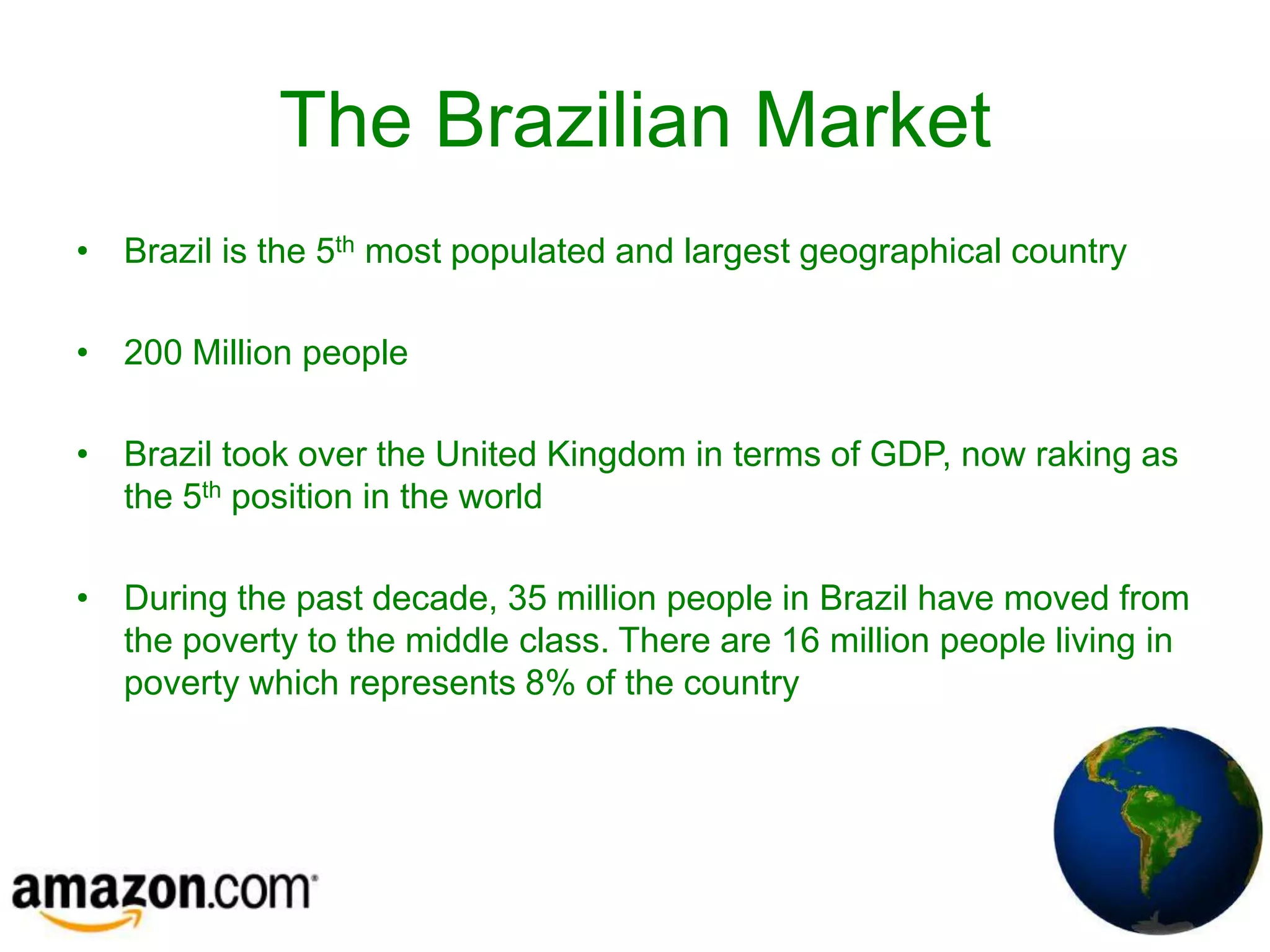
The Brazilian Market
• Brazil is the 5th most populated and largest geographical country

• 200 Million people

• Brazil took over the United Kingdom in terms of GDP, now raking as
  the 5th position in the world

• During the past decade, 35 million people in Brazil have moved from
  the poverty to the middle class. There are 16 million people living in
  poverty which represents 8% of the country
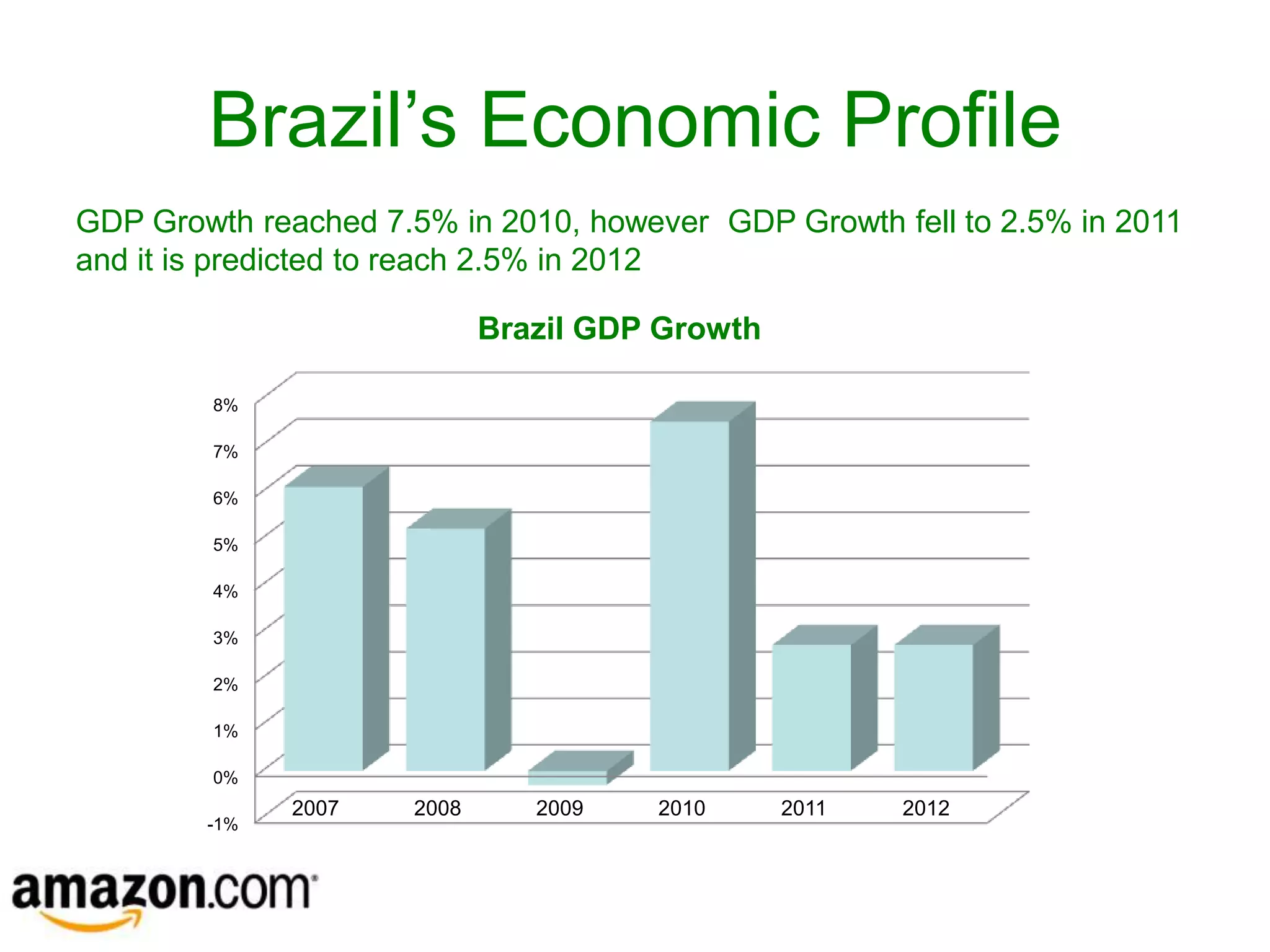
Brazil’s Economic Profile
GDP Growth reached 7.5% in 2010, however GDP Growth fell to 2.5% in 2011
and it is predicted to reach 2.5% in 2012

                             Brazil GDP Growth

        8%

        7%

        6%

        5%

        4%

        3%

        2%

        1%

        0%
              2007    2008      2009   2010      2011   2012
        -1%
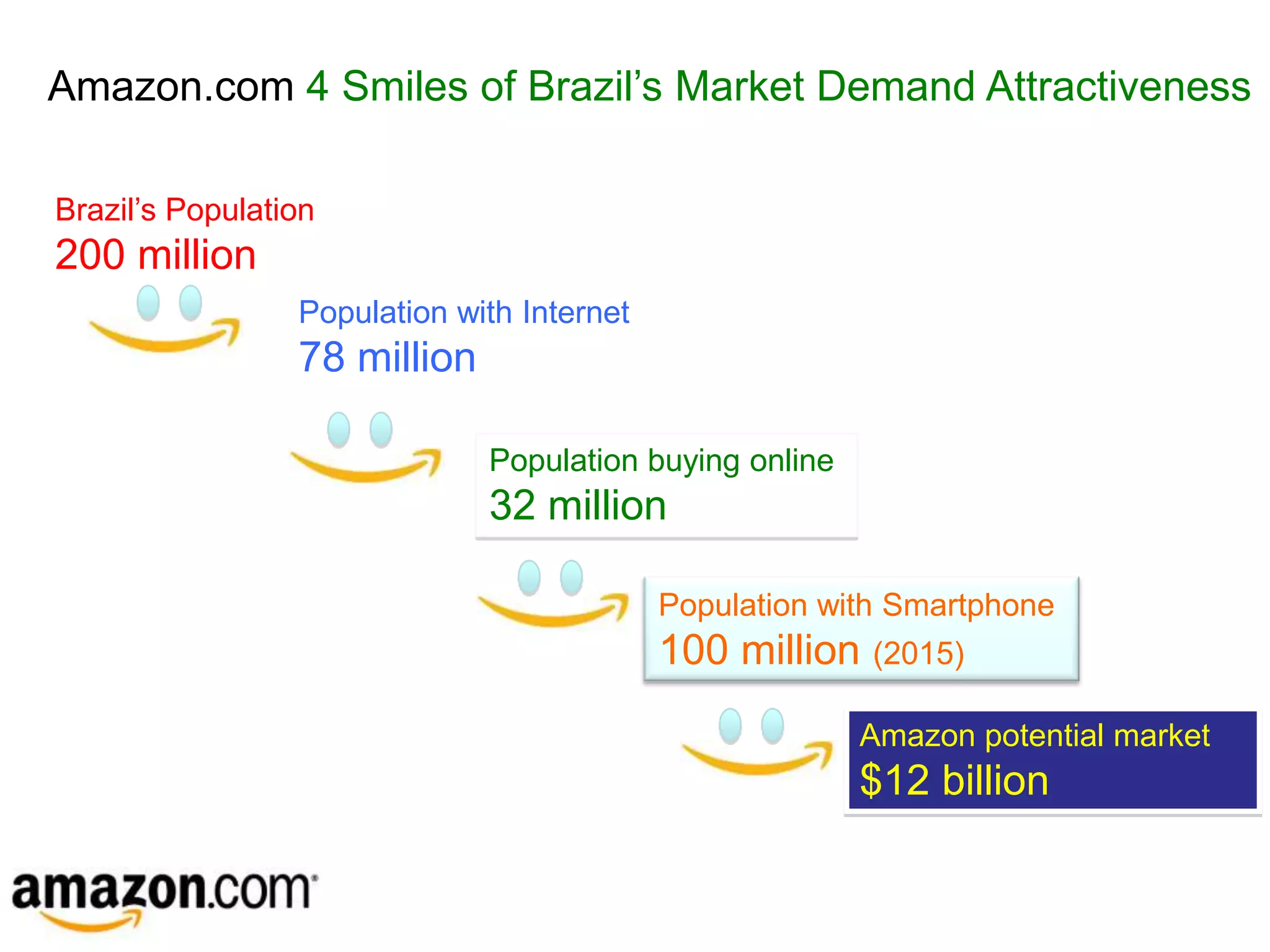
Amazon.com 4 Smiles of Brazil’s Market Demand Attractiveness

Brazil’s Population
200 million
                 Population with Internet
                 78 million

                              Population buying online
                              32 million

                                            Population with Smartphone
                                            100 million (2015)
                                                         Amazon potential market
                                                         $12 billion
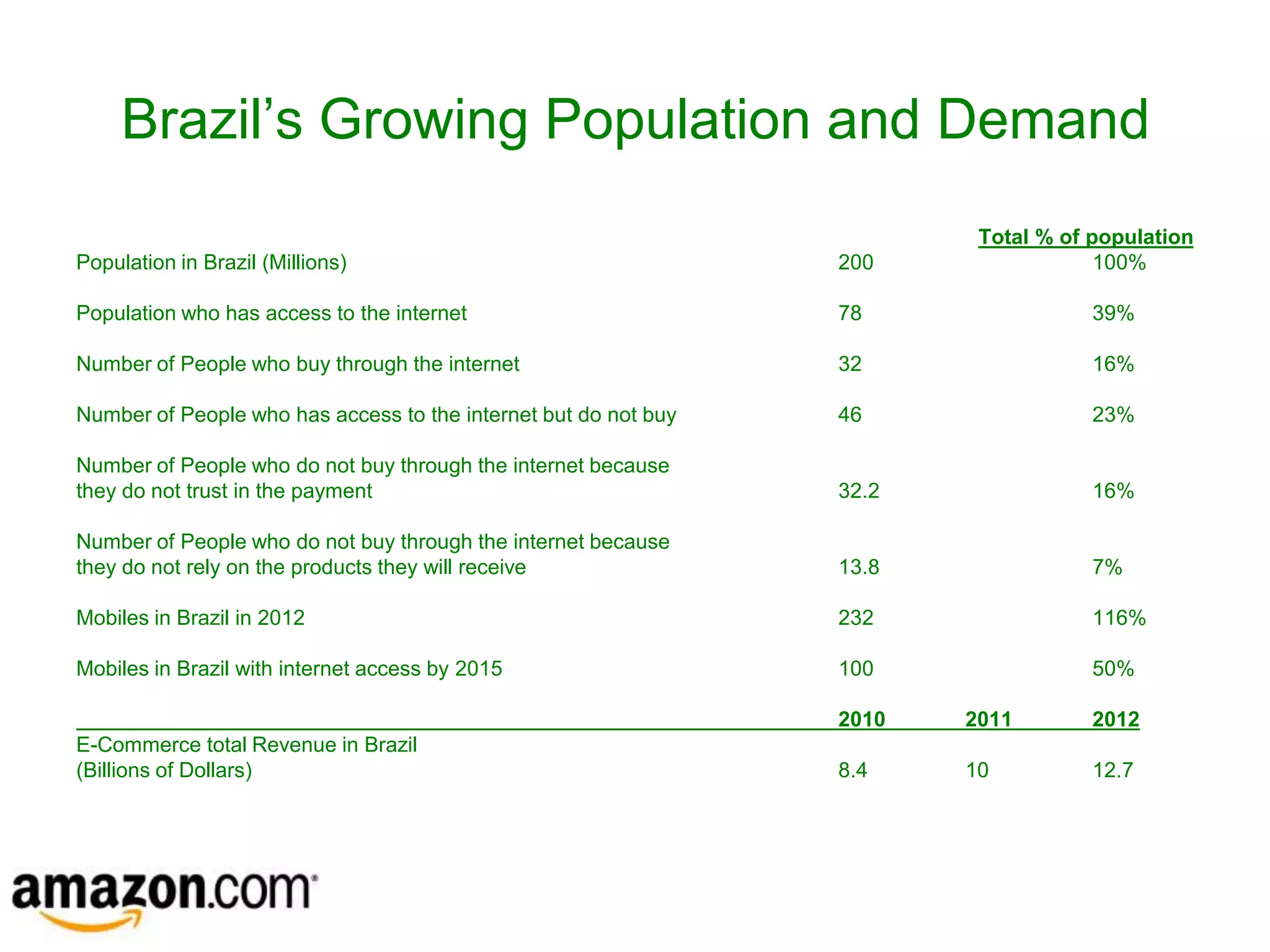
Brazil’s Growing Population and Demand
                                                                         Total % of population
Population in Brazil (Millions)                                  200                 100%

Population who has access to the internet                        78                 39%

Number of People who buy through the internet                    32                 16%

Number of People who has access to the internet but do not buy   46                 23%

Number of People who do not buy through the internet because
they do not trust in the payment                                 32.2               16%

Number of People who do not buy through the internet because
they do not rely on the products they will receive               13.8               7%

Mobiles in Brazil in 2012                                        232                116%

Mobiles in Brazil with internet access by 2015                   100                50%

                                                                 2010   2011        2012
E-Commerce total Revenue in Brazil
(Billions of Dollars)                                            8.4    10          12.7
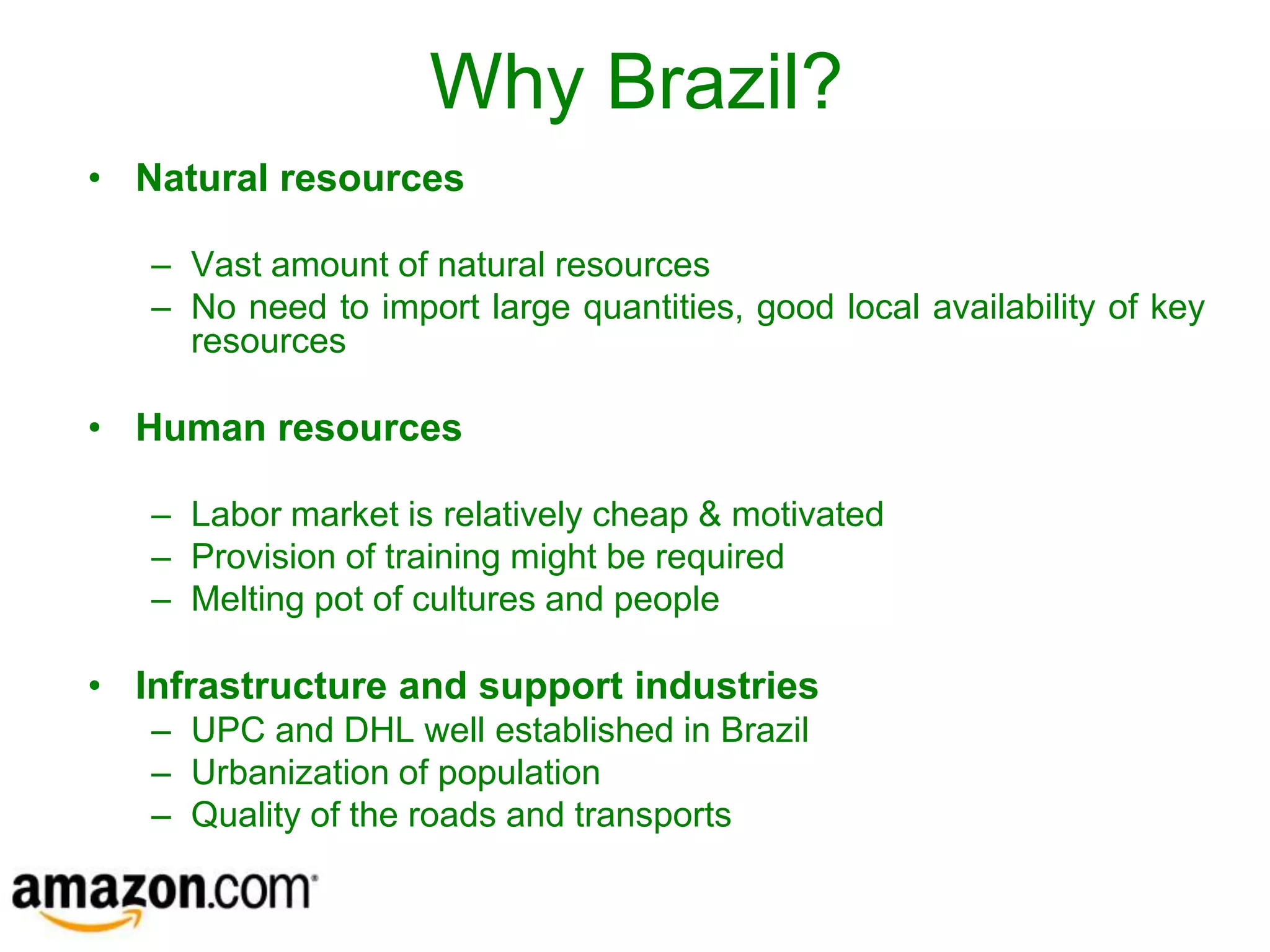
Why Brazil?
• Natural resources

   – Vast amount of natural resources
   – No need to import large quantities, good local availability of key
     resources

• Human resources

   – Labor market is relatively cheap & motivated
   – Provision of training might be required
   – Melting pot of cultures and people

• Infrastructure and support industries
   – UPC and DHL well established in Brazil
   – Urbanization of population
   – Quality of the roads and transports
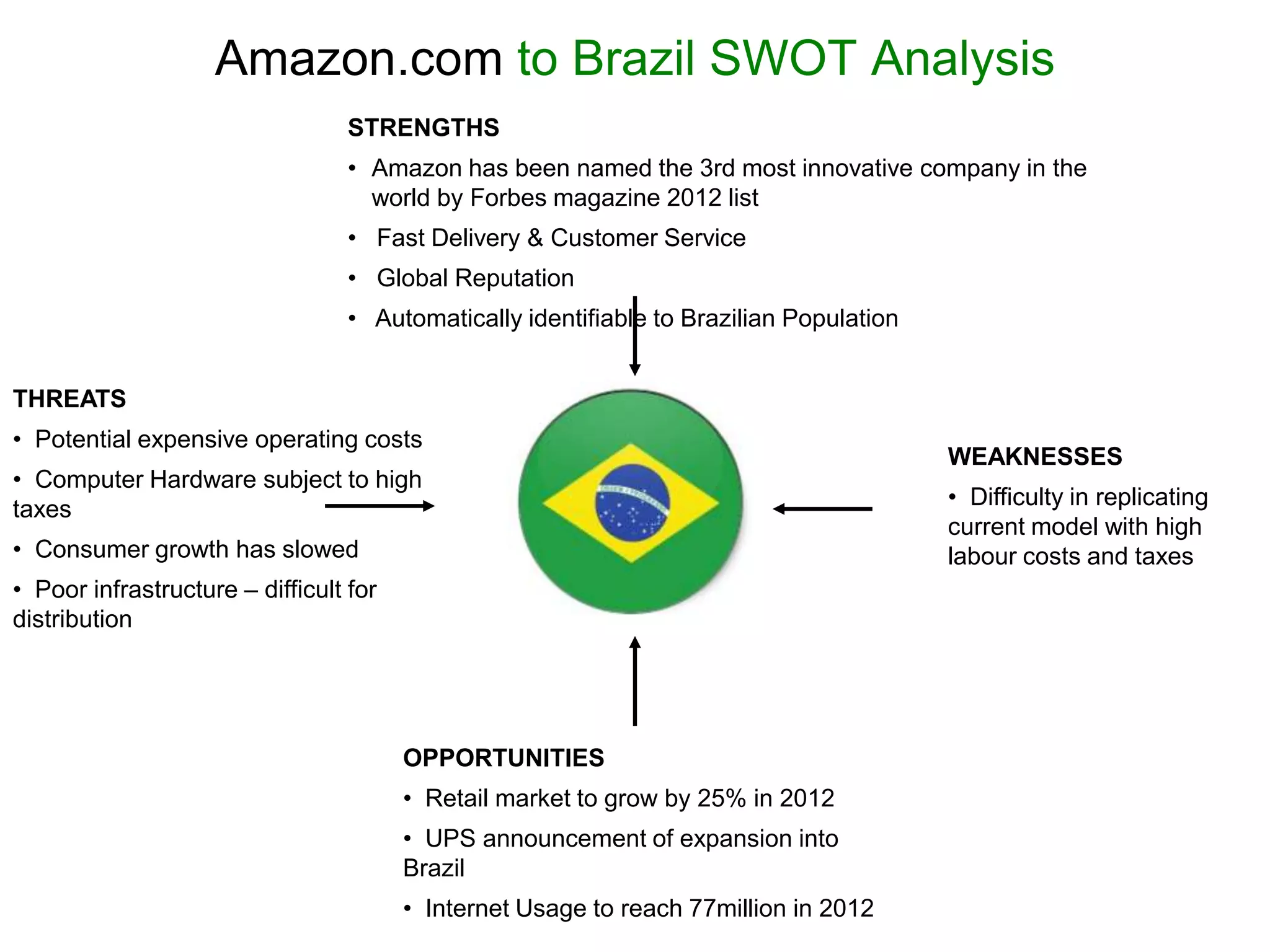
Amazon.com to Brazil SWOT Analysis
                                  STRENGTHS
                                  • Amazon has been named the 3rd most innovative company in the
                                    world by Forbes magazine 2012 list
                                  • Fast Delivery & Customer Service
                                  • Global Reputation
                                  • Automatically identifiable to Brazilian Population


THREATS
• Potential expensive operating costs
                                                                                         WEAKNESSES
• Computer Hardware subject to high
taxes                                                                                    • Difficulty in replicating
                                                                                         current model with high
• Consumer growth has slowed                                                             labour costs and taxes
• Poor infrastructure – difficult for
distribution


                                        OPPORTUNITIES
                                        • Retail market to grow by 25% in 2012
                                        • UPS announcement of expansion into
                                        Brazil
                                        • Internet Usage to reach 77million in 2012
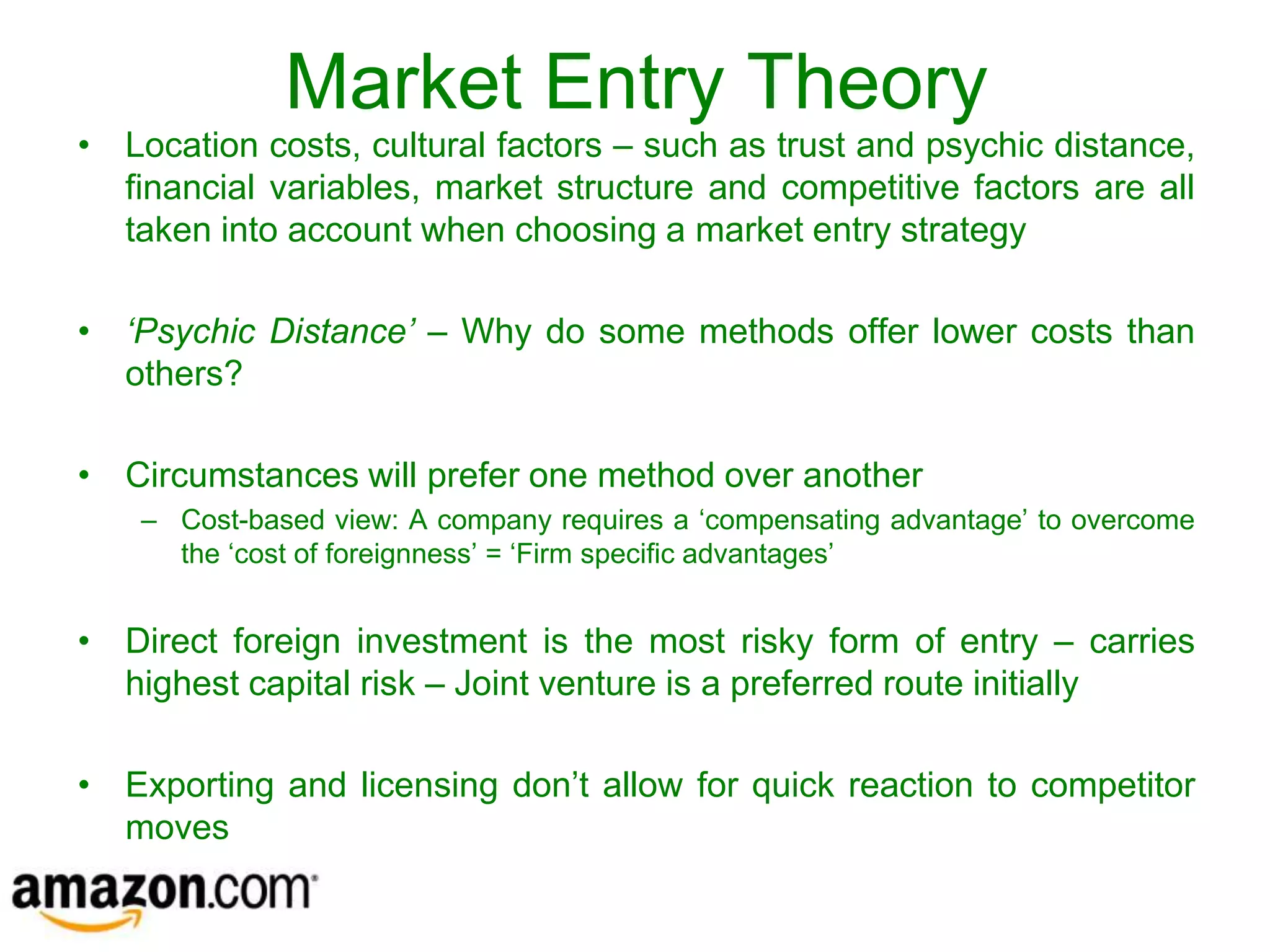
Market Entry Theory
• Location costs, cultural factors – such as trust and psychic distance,
  financial variables, market structure and competitive factors are all
  taken into account when choosing a market entry strategy

• ‘Psychic Distance’ – Why do some methods offer lower costs than
  others?

• Circumstances will prefer one method over another
    – Cost-based view: A company requires a ‘compensating advantage’ to overcome
      the ‘cost of foreignness’ = ‘Firm specific advantages’


• Direct foreign investment is the most risky form of entry – carries
  highest capital risk – Joint venture is a preferred route initially

• Exporting and licensing don’t allow for quick reaction to competitor
  moves
Market Entry Strategy
• Direct Imports
   – From the world market place
   – Creating a center of distribution in order to deliver world-wide
     products to South America

• Direct Exports
   – Distribution to the whole of South America

• Partnerships and Alliances
   – Strategic choices of key market players
   – Building upon existing partnerships and alliances
   – Increasing the market reach of existing relationships
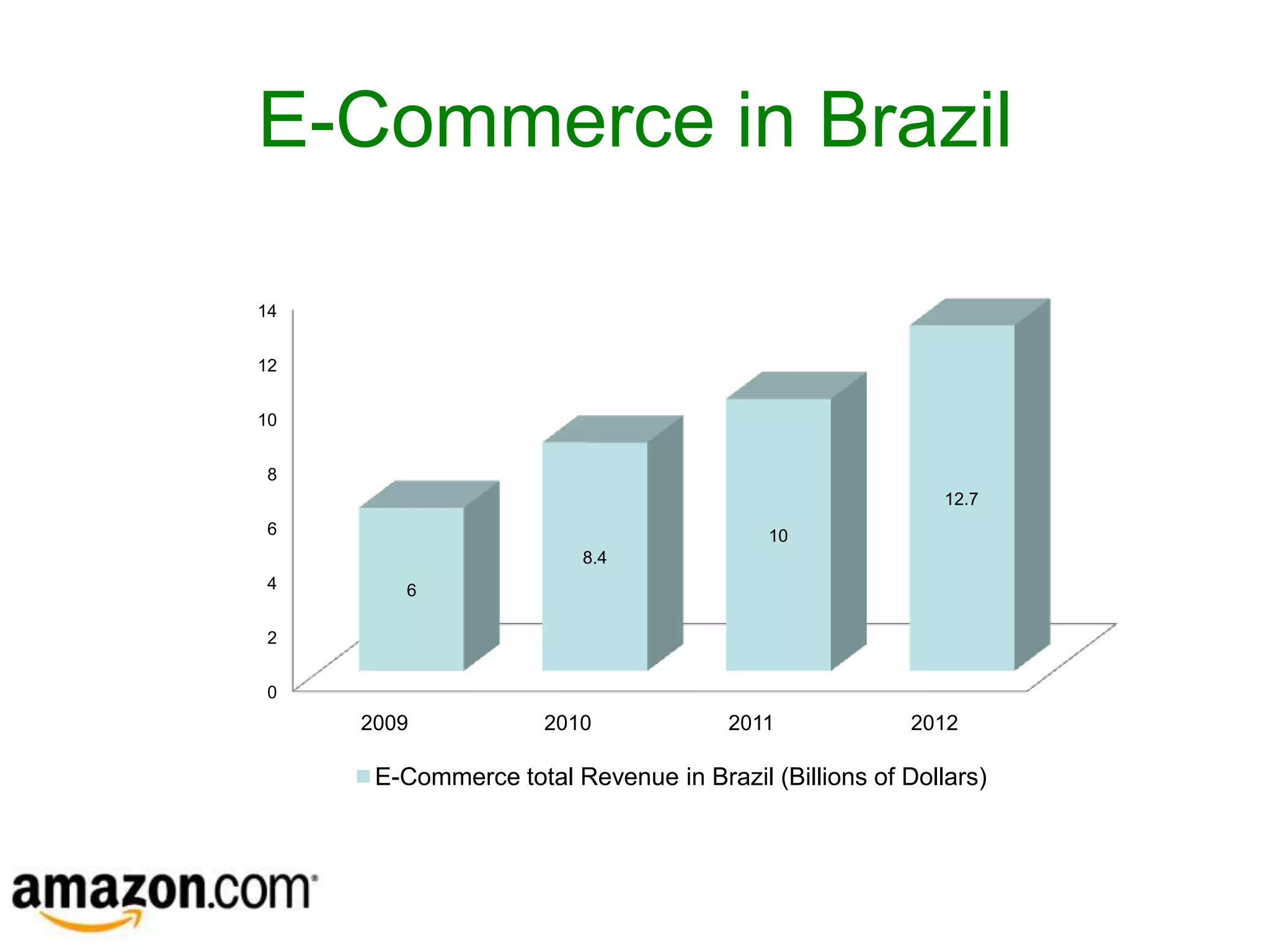
E-Commerce in Brazil

14


12


10


8
                                                          12.7
6                                         10
                         8.4
4       6

2


0
     2009            2010             2011             2012

      E-Commerce total Revenue in Brazil (Billions of Dollars)
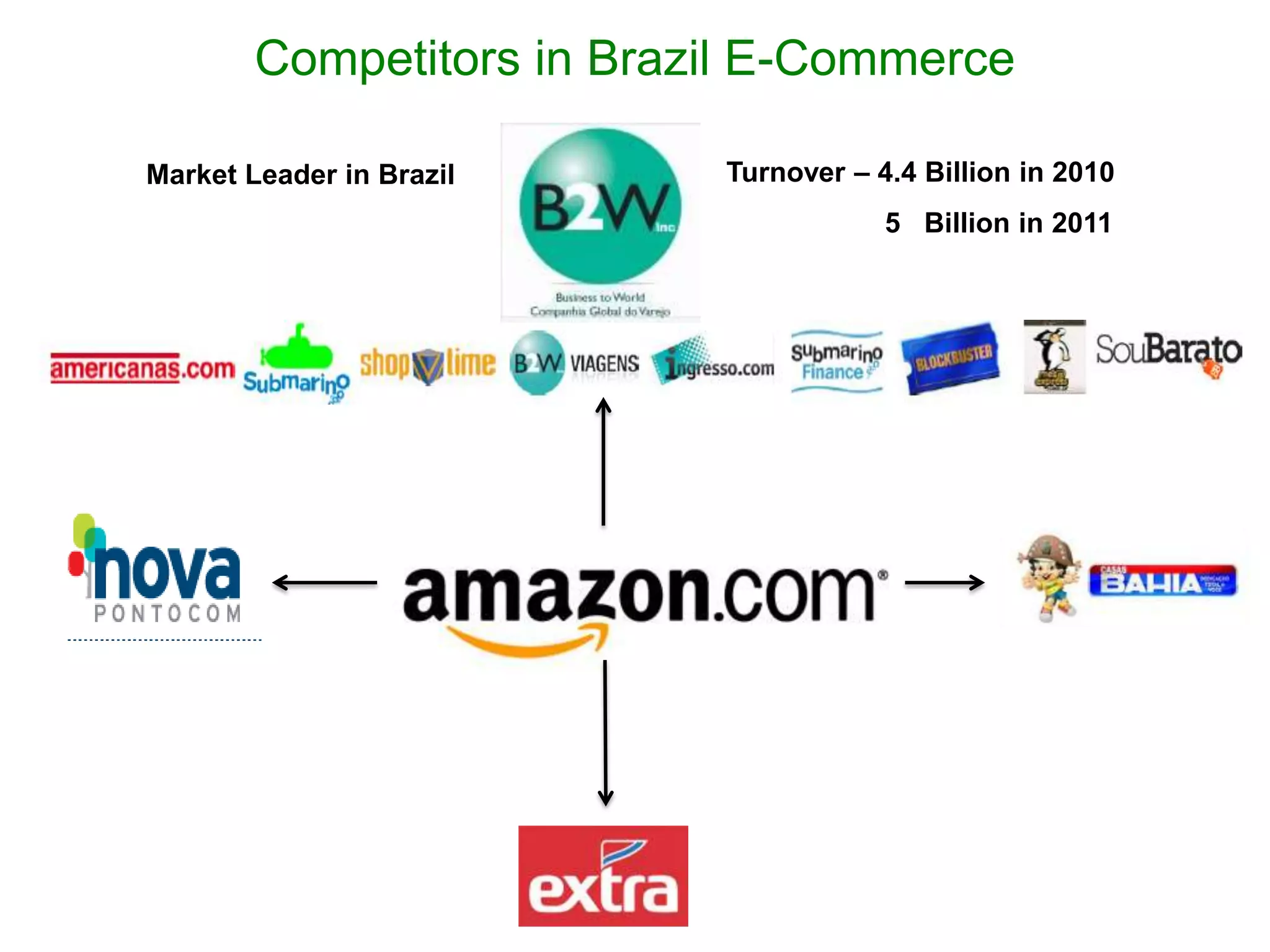
Competitors in Brazil E-Commerce

Market Leader in Brazil    Turnover – 4.4 Billion in 2010
                                       5 Billion in 2011
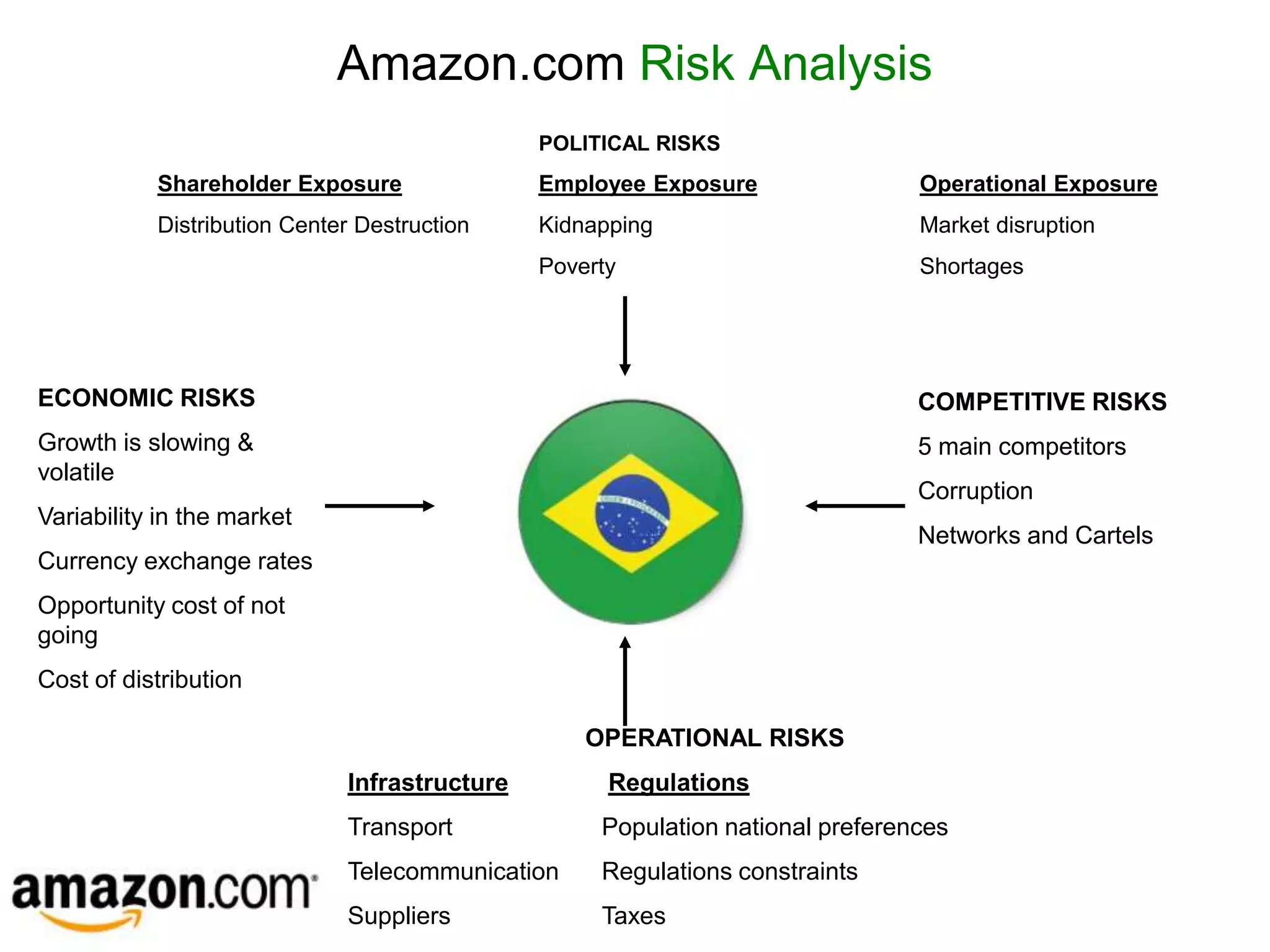
Amazon.com Risk Analysis
                                              POLITICAL RISKS
           Shareholder Exposure               Employee Exposure                Operational Exposure
           Distribution Center Destruction    Kidnapping                       Market disruption
                                              Poverty                          Shortages


ECONOMIC RISKS                                                                 COMPETITIVE RISKS
Growth is slowing &                                                            5 main competitors
volatile
                                                                               Corruption
Variability in the market
                                                                               Networks and Cartels
Currency exchange rates
Opportunity cost of not
going
Cost of distribution

                                                  OPERATIONAL RISKS
                             Infrastructure         Regulations
                             Transport             Population national preferences
                             Telecommunication     Regulations constraints
                             Suppliers             Taxes
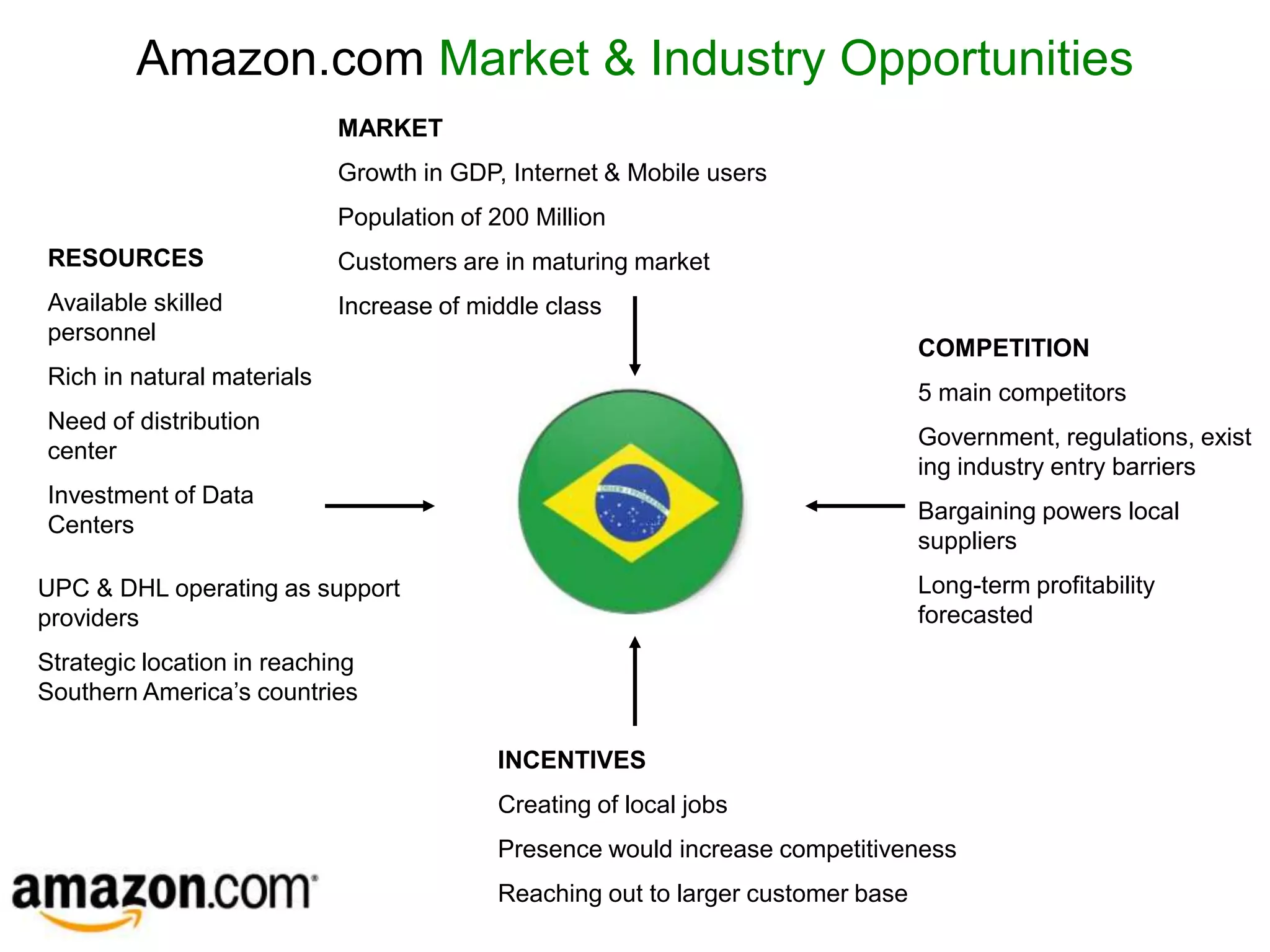
Amazon.com Market & Industry Opportunities
                            MARKET
                            Growth in GDP, Internet & Mobile users
                            Population of 200 Million
RESOURCES                   Customers are in maturing market
Available skilled           Increase of middle class
personnel
                                                                                 COMPETITION
Rich in natural materials
                                                                                 5 main competitors
Need of distribution
                                                                                 Government, regulations, exist
center
                                                                                 ing industry entry barriers
Investment of Data
                                                                                 Bargaining powers local
Centers
                                                                                 suppliers
UPC & DHL operating as support                                                   Long-term profitability
providers                                                                        forecasted
Strategic location in reaching
Southern America’s countries

                                          INCENTIVES
                                          Creating of local jobs
                                          Presence would increase competitiveness
                                          Reaching out to larger customer base
Recommendations

• Pursue a Marketing strategy that allays the fears of the
  Brazilian population in terms of trust and reliability of their
  service

• Conduct in-depth interviews with key players in the market

• Conduct comparative analysis with local competitors

• Do a feasibility study and research locations

• Verify if desk research corresponds reality in Brazil
Emerging Market Entry - A strategic Analysis of Brazil - Amazon

Emerging Market Entry - A strategic Analysis of Brazil - Amazon

  • 1.
    Fernando Bez, LisaO’Brien David Broderick & Michael de Korte
  • 2.
    Emerging Market Entry AStrategic Analysis of Brazil Fernando Bez, Lisa O’Brien David Broderick & Michael de Korte
  • 3.
    Agenda • Brazil’s Market Assessment/Economic Profile • SWOT Analysis • Market Entry Strategy • E-Commerce in Brazil / Competitors • Risk Analysis • Conclusion • Recommendations
  • 4.
    The Brazilian Market •Brazil is the 5th most populated and largest geographical country • 200 Million people • Brazil took over the United Kingdom in terms of GDP, now raking as the 5th position in the world • During the past decade, 35 million people in Brazil have moved from the poverty to the middle class. There are 16 million people living in poverty which represents 8% of the country
  • 5.
    Brazil’s Economic Profile GDPGrowth reached 7.5% in 2010, however GDP Growth fell to 2.5% in 2011 and it is predicted to reach 2.5% in 2012 Brazil GDP Growth 8% 7% 6% 5% 4% 3% 2% 1% 0% 2007 2008 2009 2010 2011 2012 -1%
  • 6.
    Amazon.com 4 Smilesof Brazil’s Market Demand Attractiveness Brazil’s Population 200 million Population with Internet 78 million Population buying online 32 million Population with Smartphone 100 million (2015) Amazon potential market $12 billion
  • 7.
    Brazil’s Growing Populationand Demand Total % of population Population in Brazil (Millions) 200 100% Population who has access to the internet 78 39% Number of People who buy through the internet 32 16% Number of People who has access to the internet but do not buy 46 23% Number of People who do not buy through the internet because they do not trust in the payment 32.2 16% Number of People who do not buy through the internet because they do not rely on the products they will receive 13.8 7% Mobiles in Brazil in 2012 232 116% Mobiles in Brazil with internet access by 2015 100 50% 2010 2011 2012 E-Commerce total Revenue in Brazil (Billions of Dollars) 8.4 10 12.7
  • 8.
    Why Brazil? • Naturalresources – Vast amount of natural resources – No need to import large quantities, good local availability of key resources • Human resources – Labor market is relatively cheap & motivated – Provision of training might be required – Melting pot of cultures and people • Infrastructure and support industries – UPC and DHL well established in Brazil – Urbanization of population – Quality of the roads and transports
  • 10.
    Amazon.com to BrazilSWOT Analysis STRENGTHS • Amazon has been named the 3rd most innovative company in the world by Forbes magazine 2012 list • Fast Delivery & Customer Service • Global Reputation • Automatically identifiable to Brazilian Population THREATS • Potential expensive operating costs WEAKNESSES • Computer Hardware subject to high taxes • Difficulty in replicating current model with high • Consumer growth has slowed labour costs and taxes • Poor infrastructure – difficult for distribution OPPORTUNITIES • Retail market to grow by 25% in 2012 • UPS announcement of expansion into Brazil • Internet Usage to reach 77million in 2012
  • 11.
    Market Entry Theory •Location costs, cultural factors – such as trust and psychic distance, financial variables, market structure and competitive factors are all taken into account when choosing a market entry strategy • ‘Psychic Distance’ – Why do some methods offer lower costs than others? • Circumstances will prefer one method over another – Cost-based view: A company requires a ‘compensating advantage’ to overcome the ‘cost of foreignness’ = ‘Firm specific advantages’ • Direct foreign investment is the most risky form of entry – carries highest capital risk – Joint venture is a preferred route initially • Exporting and licensing don’t allow for quick reaction to competitor moves
  • 12.
    Market Entry Strategy •Direct Imports – From the world market place – Creating a center of distribution in order to deliver world-wide products to South America • Direct Exports – Distribution to the whole of South America • Partnerships and Alliances – Strategic choices of key market players – Building upon existing partnerships and alliances – Increasing the market reach of existing relationships
  • 13.
    E-Commerce in Brazil 14 12 10 8 12.7 6 10 8.4 4 6 2 0 2009 2010 2011 2012 E-Commerce total Revenue in Brazil (Billions of Dollars)
  • 14.
    Competitors in BrazilE-Commerce Market Leader in Brazil Turnover – 4.4 Billion in 2010 5 Billion in 2011
  • 15.
    Amazon.com Risk Analysis POLITICAL RISKS Shareholder Exposure Employee Exposure Operational Exposure Distribution Center Destruction Kidnapping Market disruption Poverty Shortages ECONOMIC RISKS COMPETITIVE RISKS Growth is slowing & 5 main competitors volatile Corruption Variability in the market Networks and Cartels Currency exchange rates Opportunity cost of not going Cost of distribution OPERATIONAL RISKS Infrastructure Regulations Transport Population national preferences Telecommunication Regulations constraints Suppliers Taxes
  • 16.
    Amazon.com Market &Industry Opportunities MARKET Growth in GDP, Internet & Mobile users Population of 200 Million RESOURCES Customers are in maturing market Available skilled Increase of middle class personnel COMPETITION Rich in natural materials 5 main competitors Need of distribution Government, regulations, exist center ing industry entry barriers Investment of Data Bargaining powers local Centers suppliers UPC & DHL operating as support Long-term profitability providers forecasted Strategic location in reaching Southern America’s countries INCENTIVES Creating of local jobs Presence would increase competitiveness Reaching out to larger customer base
  • 17.
    Recommendations • Pursue aMarketing strategy that allays the fears of the Brazilian population in terms of trust and reliability of their service • Conduct in-depth interviews with key players in the market • Conduct comparative analysis with local competitors • Do a feasibility study and research locations • Verify if desk research corresponds reality in Brazil