Brand Management – 325 661Brand Audit-Nintendo2010, semester 1Wanda Lee, ChunChang Wu<br />Table of Content TOC \o \"
1-3\"
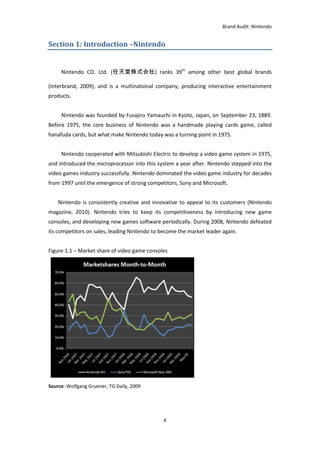
 \h \z \u Executive Summary PAGEREF _Toc261894951 \h 3Section 1: Introduction –Nintendo PAGEREF _Toc261894952 \h 4Section 2: Marketing Strategy and Positioning PAGEREF _Toc261894953 \h 52.0 Marketing Objectives: PAGEREF _Toc261894954 \h 52.1 Market Targeting PAGEREF _Toc261894955 \h 52.2 Product PAGEREF _Toc261894956 \h 52.3 Pricing PAGEREF _Toc261894957 \h 62.4 Promotion PAGEREF _Toc261894958 \h 62.5 Brand Positioning PAGEREF _Toc261894959 \h 7Section 3: Brand Elements PAGEREF _Toc261894960 \h 8Section 4: Consumer-Based Brand Equity Analysis PAGEREF _Toc261894961 \h 94.1 Identity ------------Salience PAGEREF _Toc261894962 \h 94.2 Meaning --------Imagery PAGEREF _Toc261894963 \h 94.3 Meaning -----------Performance PAGEREF _Toc261894964 \h 124.4 Response----------Judgments PAGEREF _Toc261894965 \h 154.5 Response----------Feelings PAGEREF _Toc261894966 \h 174.6 Relationships-----Resonance PAGEREF _Toc261894967 \h 18Section 5: Recommendations PAGEREF _Toc261894968 \h 20Recommendation 1 –Develop market for elders PAGEREF _Toc261894969 \h 20Recommendation 2 –Recapture the core gamers PAGEREF _Toc261894970 \h 20Recommendation 3 –Support online download games PAGEREF _Toc261894971 \h 21Reference PAGEREF _Toc261894972 \h 22Appendix 1 – 2009~2010 Nintendo TV ad PAGEREF _Toc261894973 \h 24Appendix 2 – Questionnaire and Result PAGEREF _Toc261894974 \h 26Questionnaire Result PAGEREF _Toc261894975 \h 29Appendix 3 – Nintendo 2008 Annual Report PAGEREF _Toc261894976 \h 36Appendix 4 – Slogans PAGEREF _Toc261894977 \h 38<br /> <br />Executive Summary<br />Nintendo, ranked 39 among other global brands (Interbrand, 2009), positions itself in an interactive entertainment market of people for all ages. Starting in 1889, one heritage of Nintendo is innovation, which it has utilized to move ahead of its competitors (Nintendo magazine, 2010). By changing people’s perception of gaming, Nintendo attracts non-gamers to enjoy the seventh generation of gaming. Wii, released in 2006, and nothing like any other game console market has grown to be the market leader in 2008.<br />Analyze Nintendo’s Consumer-based brand equity (CBBE) model<br />Identity: Nintendo is highly recognized and recalled by consumers, and launches TV commercials to communicate its customers that it is a brand for everyone. Wii and its related games can satisfy people’s different needs.<br />Imagery: Nintendo is a classy and unique brand, and its products help people to kill time or socialize with others. <br />Performance: the creation of unique, innovative, upscale features that differentiate Nintendo from Sony and Microsoft.<br />Judgment: People judge Nintendo as a brand with good quality and worth trusting.<br />Feelings: Nintendo is a fun, cool and exciting brand.<br />Relationship: one out of two people are willing to purchase Nintendo’s products again and Nintendo has the biggest market share of game consoles. The establishment of Nintendo Club as a community hub for further engagement and entertainment.<br />Recommendations<br />Develop market for elders<br />Recapture the core gamers<br />Support online downloading games<br />Section 1: Introduction –Nintendo<br />Nintendo CO. Ltd. (任天堂株式会社) ranks 39th among other best global brands (Interbrand, 2009), and is a multinational company, producing interactive entertainment products. <br />Nintendo was founded by Fusajiro Yamauchi in Kyoto, Japan, on September 23, 1889. Before 1975, the core business of Nintendo was a handmade playing cards game, called hanafuda cards, but what make Nintendo today was a turning point in 1975.<br />Nintendo cooperated with Mitsubishi Electric to develop a video game system in 1975, and introduced the microprocessor into this system a year after. Nintendo stepped into the video games industry successfully. Nintendo dominated the video game industry for decades from 1997 until the emergence of strong competitors, Sony and Microsoft.<br />Nintendo is consistently creative and innovative to appeal to its customers (Nintendo magazine, 2010). Nintendo tries to keep its competitiveness by introducing new game consoles, and developing new games software periodically. During 2008, Nintendo defeated its competitors on sales, leading Nintendo to become the market leader again.<br />Figure 1.1 – Market share of video game consoles <br />Source: Wolfgang Gruener, TG Daily, 2009<br />Section 2: Marketing Strategy and Positioning <br />2.0 Marketing Objectives:  <br />Nintendo wants to expand the worldwide gaming audience and keep profiting without losing its current target customers of 5 to 17 years old males. <br />2.1 Market Targeting<br />\"
Today there are people who play and people who do not,\"
 said Fils-Aime, executive vice president of marketing for Nintendo of America. \"
Wii will help destroy that wall between them. Regardless of age, gender of game experience, anyone can instantly understand Wii.\"
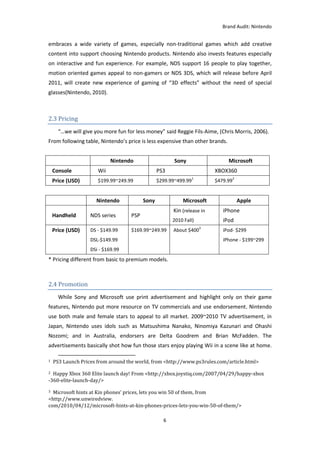
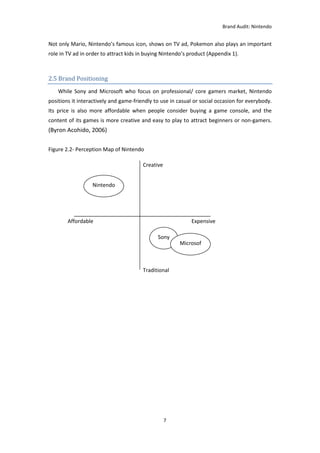
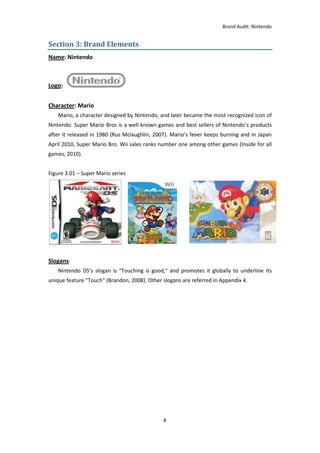
 (Chris Morris, 2006)<br />Demographic Segmentation <br />5-17 young adults<br />Family<br />Female<br />Behavioural Segmentation<br />Non-traditional gamers who are looking forward to try new type games.<br />Social/ party gamers<br />Causal gamers <br />Video game lovers<br />2.2 Product<br />Nintendo has three product lines: Wii, NDS series and Nintendo’s game (Figure 2.1). “We had to make the games more immersive, not from a visual standpoint, but from a game-play standpoint,” said Fils-Aime. (Matt Hartley, 2007)<br />Figure 2.1 – Nintendo Products: Wii, NDS series and Super MarioBros game <br />When Sony and Microsoft center on developing traditional games, such as shooting and fighting games, emphasizing on high definition graph on games or game consoles, Nintendo embraces a wide variety of games, especially non-traditional games which add creative content into support choosing Nintendo products. Nintendo also invests features especially on interactive and fun experience. For example, NDS support 16 people to play together, motion oriented games appeal to non-gamers or NDS 3DS, which will release before April 2011, will create new experience of gaming of “3D effects” without the need of special glasses(Nintendo, 2010). <br />2.3 Pricing <br />“…we will give you more fun for less money” said Reggie Fils-Aime, (Chris Morris, 2006). From following table, Nintendo’s price is less expensive than other brands. <br />NintendoSonyMicrosoftConsoleWiiPS3XBOX360Price (USD)$199.99~249.99$299.99~499.99$479.99<br />NintendoSonyMicrosoftAppleHandheldNDS seriesPSPKin (release in 2010 Fall)iPhoneiPodPrice (USD)DS - $149.99DSL-$149.99DSi - $169.99  $169.99~249.99About $400iPod- $299iPhone - $199~299<br />* Pricing different from basic to premium models. <br />2.4 Promotion<br />While Sony and Microsoft use print advertisement and highlight only on their game features, Nintendo put more resource on TV commercials and use endorsement. Nintendo use both male and female stars to appeal to all market. 2009~2010 TV advertisement, in Japan, Nintendo uses idols such as Matsushima Nanako, Ninomiya Kazunari and Ohashi Nozomi; and in Australia, endorsers are Delta Goodrem and Brian McFadden. The advertisements basically shot how fun those stars enjoy playing Wii in a scene like at home. Not only Mario, Nintendo’s famous icon, shows on TV ad, Pokemon also plays an important role in TV ad in order to attract kids in buying Nintendo’s product (Appendix 1). <br />2.5 Brand Positioning <br />While Sony and Microsoft who focus on professional/ core gamers market, Nintendo positions it interactively and game-friendly to use in casual or social occasion for everybody. Its price is also more affordable when people consider buying a game console, and the content of its games is more creative and easy to play to attract beginners or non-gamers. (Byron Acohido, 2006)<br />SonyMicrosoftFigure 2.2- Perception Map of NintendoNintendoCreative Traditional Affordable Expensive<br />Section 3: Brand Elements<br />Name: Nintendo<br />Logo: <br />Character: Mario<br />Mario, a character designed by Nintendo, and later became the most recognized icon of Nintendo. Super Mario Bros is a well-known games and best sellers of Nintendo’s products after it released in 1980 (Rus Mclaughlin, 2007). Mario’s fever keeps burning and in Japan April 2010, Super Mario Bro. Wii sales ranks number one among other games (Inside for all games, 2010).   <br />Figure 3.01 – Super Mario series<br />Slogans:<br />Nintendo DS’s slogan is “Touching is good,\"
 and promotes it globally to underline its unique feature \"
Touch\"
 (Brandon, 2008). Other slogans are referred in Appendix 4.<br />Section 4: Consumer-Based Brand Equity Analysis <br />This section will use Keller’s (1993) Consumer-Based Brand Equity (CBBE) model to evaluate Nintendo’s brand equity. The analysis will base on the four steps of CBBE mode: identity, meaning, response, and relationship. Primary and secondary data are collected to illustrate. The primary data (Appendix 2) is based on the questionnaire we surveyed during April 2010, and sample size is 35 people. <br />4.1 Identity ------------Salience<br />Brand <br />Nintendo launched advertising campaign to increase its customers’ awareness. In TV ad, Nintendo refreshes it as a family and social game brand rather a traditional, nerdy-like one. For needs satisfied, a survey (James Ransom-Wiley, 2009) showed that 86 % of young adults are asking for at least one video game during holiday gift-getting season and Nintendo’s product can meet their need. For \"
Girly Girl,\"
 \"
All Things Sports,\"
 \"
The Adventurer,\"
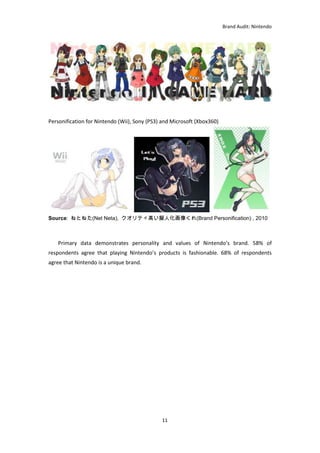
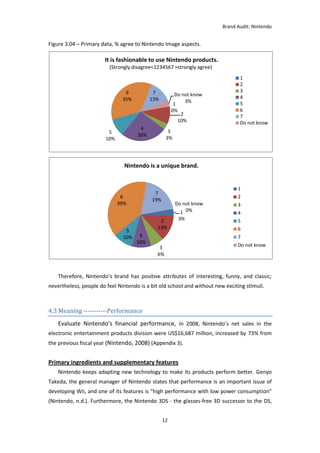
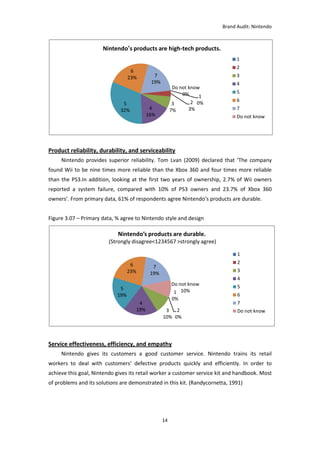
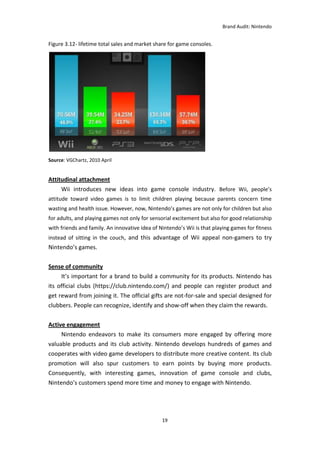
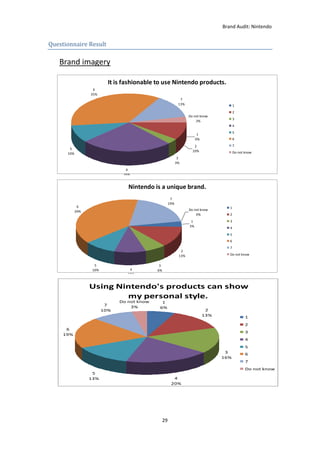
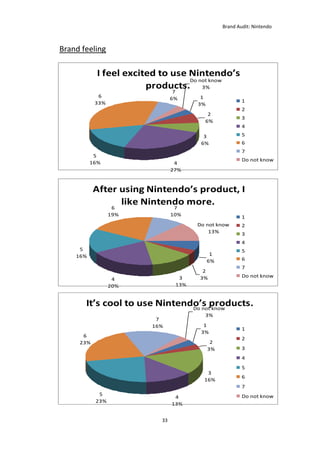
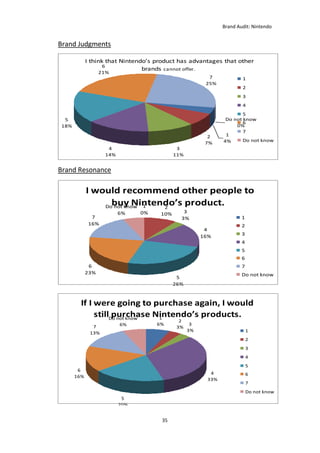
 Wii, along with “Wii Sports Resort,” and “New Super Mario Brothers,” would be their ideal choice.  <br />Nintendo is highly recognized and recalled by consumers. Observed from primary data, firstly, for video games’ dimension, 25% of respondent said Nintendo is the first brand that comes to their mind. The rest of respondents think of Sony and other games developers, such as Square Enix. Second, we asked “what is the first brand comes to your mind when you think of game console and portable game console?” More than 50% of respondents answered Nintendo. However, an interesting phenomenon is people not directly think of its brand’s name, but products’ name instead, such as Wii, PS3, and Xbox360. In other words, Wii as a sub-brand of Nintendo is overwhelming than Nintendo itself. Last but not least, for all brands of game consoles which come to consumers’ mind, mainly there are three brands mentioned, Nintendo, Sony, and Microsoft, but Apple’s iPhone is referred occasionally as well.<br />4.2 Meaning --------Imagery<br />User profile<br />Nintendo’s original target customers are males in their teens to twenties. After Wii, which pronounces like “we,” launched in 2006, people consider Nintendo’s users as cross-gender and of all ages (Byron Acohido, 2006).<br />Purchase and usage situations<br />According to primary data, people most likely use Nintendo’s products in three situations. <br />Feel bored and want to kill time after school or work. <br />Commute and try to find something to do on the trams or trains.<br />Get together with their friends or families and want to have fun and relaxing.  <br />Other answer includes using Wii to exercise at home.<br />History, heritage, and experience<br />Starting on 1889, Nintendo is a company with long history. Throughout its history in the home entertainment arena, Nintendo has created unique hardware and software as one integrated entertainment product. From Game boy’s hit in 90s, Nintendo roots in many people’s childhood memory and invoked people’s nostalgic feeling. In our survey, 81% of respondents agree that Nintendo is a classic brand.<br />Figure 3.02 – Primary Data, % of Nintendo is a classic brand <br />Personality and values<br />When people personify Nintendo’s game consoles, they tend to draw a more diverse and cute image, comparing with Sony’s cool and high-tech and Microsoft’s mature image (Net Neta, 2010)<br />Figure 3.03 – an anonymous artist draw 12 different Nintendo DS personification.<br />Personification for Nintendo (Wii), Sony (PS3) and Microsoft (Xbox360) <br />   <br />Source: ねとねた(Net Neta), クオリティ高い擬人化画像くれ(Brand Personification) , 2010<br />Primary data demonstrates personality and values of Nintendo’s brand. 58% of respondents agree that playing Nintendo’s products is fashionable. 68% of respondents agree that Nintendo is a unique brand. <br />Figure 3.04 – Primary data, % agree to Nintendo Image aspects. <br />Therefore, Nintendo’s brand has positive attributes of interesting, funny, and classic; nevertheless, people do feel Nintendo is a bit old school and without new exciting stimuli. <br />4.3 Meaning -----------Performance<br />Evaluate Nintendo’s financial performance, in 2008, Nintendo’s net sales in the electronic entertainment products division were US$16,687 million, increased by 73% from the previous fiscal year (Nintendo, 2008) (Appendix 3). <br />Primary ingredients and supplementary features<br />Nintendo keeps adapting new technology to make its products perform better. Genyo Takeda, the general manager of Nintendo states that performance is an important issue of developing Wii, and one of its features is “high performance with low power consumption” (Nintendo, n.d.). Furthermore, the Nintendo 3DS - the glasses-free 3D successor to the DS, also feature backward compatibility with Nintendo DS series software, will light special spark in 2011 when it releases (Nintendo, 2010).<br />Figure 3.05- NINTENDO DS 3D demo <br /> <br />Source: Youtube, 2010 (http://www.youtube.com/watch?v=pWYgM1RGixM)<br /> Indicated from our survey result, 81% of respondents agree Nintendo’s products are innovative, 85% of them agree Nintendo’s products are user-friendly, and 75% of them agree Nintendo’s products are high-tech products.<br />Figure 3.06 – Primary data, % agree to Nintendo Performance aspects.       <br />Product reliability, durability, and serviceability<br />Nintendo provides superior reliability. Tom Lvan (2009) declared that ‘The company found Wii to be nine times more reliable than the Xbox 360 and four times more reliable than the PS3.In addition, looking at the first two years of ownership, 2.7% of Wii owners reported a system failure, compared with 10% of PS3 owners and 23.7% of Xbox 360 owners’. From primary data, 61% of respondents agree Nintendo’s products are durable.<br />Figure 3.07 – Primary data, % agree to Nintendo style and design<br />Service effectiveness, efficiency, and empathy<br />Nintendo gives its customers a good customer service. Nintendo trains its retail workers to deal with customers’ defective products quickly and efficiently. In order to achieve this goal, Nintendo gives its retail worker a customer service kit and handbook. Most of problems and its solutions are demonstrated in this kit. (Randycornetta, 1991) <br />Style and design<br />Nintendo’s products designers endowed Nintendo’s products many features. For example, the size of Wii is smaller than other competitors’ consoles, and consumers can easily store it. The high-tech appearance of Wii makes people feel this product is stylish. In primary data, 71% of respondents agree Nintendo’s products have good style and design.<br />Figure 3.08 – Primary data, % agree to Nintendo style and design<br />Price <br />Nintendo’s price strategy is to set a price more everyone affordable than Sony and Microsoft. One reason is the shift of target customers. The price must be attractive to non-gamers. Another reason is Nintendo do not directly compete Sony, Microsoft for realistic-graphic games, which have to invest significantly.<br />4.4 Response----------Judgments<br />Satoru Iwata, the Nintendo game developer mentioned:<br />\"
...I've never once been embarrassed that children have supported Nintendo. I'm proud of it. That's because children judge products based on instinct. Everyone wants to appeal to people's instincts, but it's not easy. That doesn't mean we're making products just for children. We believe that there's interactive entertainment that people in their 60s, 70s and 80s can enjoy, so we're doing various things.\"
 (Steven L. Kent, 2004)<br />In our survey, we investigated people’s attitudes and opinions toward Nintendo’s products. 72% of respondents agree Nintendo’s products are of good quality and 68% of them trust Nintendo’s brand.<br />Figure 3.09 – Primary data, % agree to Nintendo Judgment aspects<br />Nintendo made lot of effort to keep innovation and competitiveness. Nintendo not only invests new technology and releases new consoles periodically but also modifies its design by understanding what its customers’ consideration. Up to 64% of respondents agree that Nintendo’s products have advantages which other competitors cannot offer.<br />Figure 3.10– Primary data, % agree to Nintendo Judgment aspects<br />4.5 Response----------Feelings<br />Consumers’ feeling toward a brand is what people feel and react with the brand. In our survey, respondents of high percentage agree Nintendo makes them feel fun, cool, and exciting. Up to 45% and 62% of respondents agree that they like Nintendo’s products more after using and they have good memory of Nintendo’s products. Even more remarkable, 56% of respondents agree they grow up with Nintendo’s products.<br />4.6 Relationships-----Resonance <br />Behavioral loyalty<br />Behavioral loyalty represents in two dimensions, one is repeat purchases and another is the market share of the product’s category. In our survey, 49% of respondents agree that they are willing to purchase Nintendo’s products again, and 65% of respondents agree they are willing to recommend other to buy Nintendo’s products.<br />Figure 3.11 - Primary data, % agree to Nintendo Resonance aspects. <br />For the share of category volume attributed to the brand, up to April 2010, Nintendo’s market share wins the biggest share and sells most comparing with Sony and Microsoft in game console industry. Lifetime console sold around the world are 70.56 million for the Wii (Nintendo), 39.54 million for the Xbox 360 (Microsoft) and 34.25 million for the PS3 (Sony). Respective market shares are 48.9%, 27.4% and 23.1% (Brent Williams, 2010). <br />Figure 3.12- lifetime total sales and market share for game consoles.<br />Source: VGChartz, 2010 April<br />Attitudinal attachment<br />Wii introduces new ideas into game console industry. Before Wii, people’s attitude toward video games is to limit children playing because parents concern time wasting and health issue. However, now, Nintendo’s games are not only for children but also for adults, and playing games not only for sensorial excitement but also for good relationship with friends and family. An innovative idea of Nintendo’s Wii is that playing games for fitness instead of sitting in the couch, and this advantage of Wii appeal non-gamers to try Nintendo’s games.<br />Sense of community<br />It’s important for a brand to build a community for its products. Nintendo has its official clubs (https://club.nintendo.com/) and people can register product and get reward from joining it. The official gifts are not-for-sale and special designed for clubbers. People can recognize, identify and show-off when they claim the rewards.   <br />Active engagement<br />Nintendo endeavors to make its consumers more engaged by offering more valuable products and its club activity. Nintendo develops hundreds of games and cooperates with video game developers to distribute more creative content. Its club promotion will also spur customers to earn points by buying more products. Consequently, with interesting games, innovation of game console and clubs, Nintendo’s customers spend more time and money to engage with Nintendo.<br />Section 5: Recommendations<br />Based on primary and secondary data, this section will give recommendations to Nintendo to enhance its brand equity and build stronger customer relationships.<br />Recommendation 1 –Develop market for elders<br />Over the past three decades, the baby boom generation, being retired, has strong purchasing power (Emily Kaiser, 2008). Most of them are looking for new stimuli in their lives. Another important issue for senior citizens is how to keep their brain and body healthy, so exercising and brain training are valued by them. This big potential market is what Nintendo must solidify (Justin McCurry, 2006).<br />The first recommendation for Nintendo is to build a stronger presence amongst this generation. This can be achieved by developing suitable games and consoles for these senior citizens or marketing existing games to appeal to them, such as the cooking game “America Test Kitchen.” Many elders love to do crossroad puzzle and Suduku to keep them thinking and to prevent dementia. Therefore, Nintendo should develop games to aid elders to do brain training with more fun and relaxation, and to provide equipment to assist elders to watch screens more easily and to use controllers more comfortably.<br />Recommendation 2 –Recapture the core gamers  <br />Nintendo succeeds in capturing casual gamers and non-gamers, but lost focus on core gamers. Compared with casual gamers, core gamers spend much more time and money on games and pride in master the rules of games. Nintendo’s core gamers preferences are those games, such as RPG (role-playing game), which require more effort and time to complete (Tom goldman, 2010). <br />In our survey, some respondents said Nintendo’s games just cannot intrigue them. One ex-Nintendo consumer complained that Nintendo should have more RPG games, and that is what Nintendo was in the past and he desires that feature back. For core gamers, there are few games on Wii which can appeal to them except Super Mario bros, but this does not mean Nintendo should compete in the high resolution gaming market by upgrading their hardware.<br /> On a point of RPG genre, designing a game can tell really good story do help a video game console manufacturer. For example, Final Fantasy series, a classic RPG game, sold millions units worldwide and boost the sales of PS and PS2 (Jim Hargreaves, 2009). Released in 2009, Final Fantasy 13 is played on PS3 and Xbox360 with high resolution and realistic graphics, but it cannot break the selling record of Final Fantasy 7(1997), which is highly recognized as having the best story. Thus, Nintendo should offer special designed RPG games to resonate with gamers and draw them back playing Nintendo’s products.<br />Recommendation 3 –Support online download games<br />Another reflection from primary data, one consumer mentioned that she dislikes going to game store to buy games, and cassette wastes space to store. Since Nintendo DSi released in 2008, Nintendo consoles can support wireless downloading software and Nintendo DSi also has new feature of SD memory card slot to enlarge capacity of game storage ; however, now, from online store NDSiWare (http://www.nintendo.co.jp/ds/ dsiware/) what consumers can download is just small applications such as notebook, clock, map, puzzle and dictionary, not for ‘real’ games such as Super Mario Bro or cooking game “America Test Kitchen.” In addition, one of the biggest handheld console competitor Apple’s iPhone support downloading big game such as Avatar 3D iPhone game (http://www. avatariphonegame.com/). For consumer’s convenience and environmental concerned, Nintendo should ease the regulation of downloading, enable customers download more games online.<br />Reference<br />Brandon, 5 January 2008, “Is Touching Good? Nintendo slogans through the years,” in Portable Video Gamer, accessed 27 April 2010, from <http://portablevideogamer.com/2008/01/is-touching-good-nintendo-slogans-through-the-years/ ><br />Brent Williams, 30 April 2010, “2010 Year on Year Sales and Market Share Update to April 24th,” in VGChartz, accessed 3 May 2010, from < http://news.vgchartz.com/news.php?id=8029&mp=1 ><br />Byron Acohido, 15 August 2006, “Nintendo hopes Wii spells wiinner,” in USA Today, accessed 3 May 2010, from < http://www.usatoday.com/tech/gaming/2006-08-14-nintendo-qa_x.htm ><br />Chris Morris, 9 May 2006, “Nintendo continues to play coy - No launch date or price for new gaming system, but it will launch with Zelda,” in CNNMoney.com, accessed 20 April 2010,from < http://money.cnn.com/2006/05/09/technology /e3_nintendo/ index.htm ><br />Emily Kaiser, 31 January 2008, “Economy faces bigger bust without Boomers,” in Reuters.com, accessed 28 April 2010, from <http://money.cnn.com/2006/05/09/technology /e3_nintendo/ index.htm ><br />Inside for all games, 25 April 2010, “Game Sales Weekly Ranking,” in Inside for all games- global gamers network: inside games-JP, accessed 1 May 2010, from <http://www.inside-games.jp/ranking/weekly.php?week=151 ><br />Interbrand, 2009, “best global brands: 2009 rankings,” in Interbrand, accessed 27 April 2010,from < http://www.interbrand.com/best_global_brands.aspx?year= 2009&langid=1000 ><br />James Ransom-Wiley, 27 October 2009, “Survey says, yes, teens and tweens still want video games this holiday,” in Joystiq, accessed 27 April 2010, from <http://www.joystiq.com/2009/10/27/survey-says-yes-teens-and-tweens-still-want-video-games/><br />Jim Hargreavers, 25 December 2009, “Final Fantasy XIII breaks Japanese sales records, boosts PS3 sales,” in Neoseeker, accessed 4 May 2010, from < http://www.neoseeker.com/news/12687-final-fantasy-xiii-breaks-japanese-sales-records-boosts-ps3-sales/><br />Justin McCurry, 7 March 2006, “Video games for elderly: an answer to dementia or a marketing tool,” in Guardian.co.uk, accessed 4 May 2010, from <http://www.guardian.co.uk/technology/2006/mar/07/nintendods.games> <br />Keller, Kevin Lane, 1993. “Conceptualizing, Measuring, and Managing Customer-Based Brand Equity,” in Journal of Marketing, 57 (January) 1-22<br />Matt Hartley, 10 December, 2007, “Reginald Fils-Aime: Nintendo goes for wild ride,” in The Globe and Mail, accessed 20 April 2010, from <http://www.theglobeandmail. com/news/technology/article802825.ece ><br />Net Neta (ねとねた), 2010, “クオリティ高い擬人化画像(Brand Personification),” inねとねた(Net Neta ), accessed 27 April 2010, from < http://vitaminabcdefg.blog6.fc2.com/blog-entry-697.html><br />Nintendo, 2008. “Annual Financial Report -2008,” in Nintendo: Corporate, accessed 27 April 2010, from < http://www.nintendo.com/corp/annual_report.jsp><br />Nintendo, 23 March 2010. \"
Launch of New Portable Game Machine,\"
 in Nintendo | Investor Relations, accessed 27 April 2010, from <http://www.nintendo.co.jp/ ir/pdf/2010/100323e.pdf> <br />Nintendo, n.d., \"
Iwata Asks\"
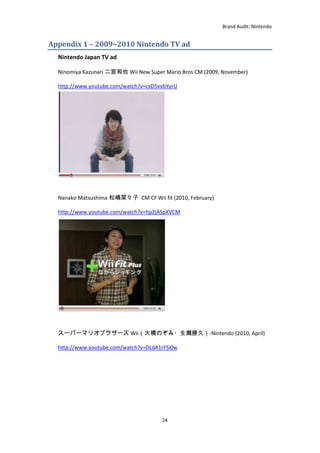
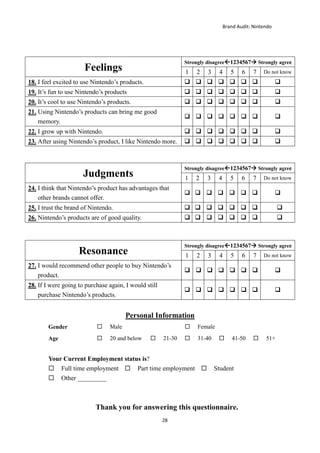
 in Nintendo |what is wii, Iwata asks”, accessed 1May 2010, from <hhttp://www.nintendo.com/wii/what/iwataasks/volume-1/part-1><br />Nintendo magazine, 26 February 2010, “wii 2 won’t be coming soon,” in Nintendo magazine, accessed 2 May 2010, from <http://www.officialnintendomagazine.co.uk/article.php?id=15548><br />Randycornetta, 3 February, 2009. “Nintendo training 1991” In Youtube, accessed 2 May 2010, from <http://www.youtube.com/watch?v=WYjgHLFZMa0&feature=player_embedde> <br />Rus Mclaughin, 8 November, 2007.” IGN Presents The History of Super Mario Bros.It's-a Mario! A look back at the greatest franchise in gaming.” In IGN, accessed 1 May 2010, from <http://au.games.ign.com/articles/833/833615p1.html><br />Steven L. Kent, 11 April, 2004. “Nintendo's New Direction,” in game spy, accessed 2 May 2010 from <http://au.gamespy.com/articles/505/505234p1.html><br />Tom Goldman, 7 March 2010. “Microsoft: Natal Won't Divert Core Gamer Focus,” in the Eecapist, accessed 2 May 2010 from< http://www.escapistmagazine.com/news/view/98924-Microsoft-Natal-Wont-Divert-Core-Gamer-Focus><br />Tom Lvan, 2 September 2009. “Wii Tops console Reliability Study,” in EDGE, accessed 3 May 2010, from <http://www.edge-online.com/news/wii-tops-console-reliability-study><br /> Wolfgang Gruener, 17 July 2009, “Nintendo Wii surrenders market share in weak game console market,” in TG Daily, accessed 3 May 2010, from <http://www.tgdaily.com/trendwatch-features/43289-nintendo-wii-surrenders-market-share-in-weak-game-console-market><br />Appendix 1 – 2009~2010 Nintendo TV ad<br />Nintendo Japan TV ad<br />Ninomiya Kazunari二宮和也Wii New Super Mario Bros CM (2009, November)<br />http://www.youtube.com/watch?v=cxD5vvbYyrU<br />Nanako Matsushima松嶋菜々子 CM CF Wii fit (2010, February)<br />http://www.youtube.com/watch?v=hp2jASpXVCM<br />スーパーマリオブラザーズWii(大橋のぞみ・生瀬勝久)-Nintendo (2010, April)<br />http://www.youtube.com/watch?v=DLdA1rFSi0w<br />Nintendo Australian TV ad<br />Wii TV Ad with Delta Goodrem & Brian McFadden (2009, March)<br />http://www.youtube.com/watch?v=Go0fa4j-c2U<br />Pokemon HeartGold and SoulSilver Australian TV Commercial (2010, April)<br />http://www.youtube.com/watch?v=c20neEsK_H4<br />Appendix 2 – Questionnaire and Result <br />This survey was prepared by students enrolled in the brand management course at the Graduate school of Management, University of Melbourne. We are conducting this questionnaire to investigate brand equity of a chosen brand. All information you give in this questionnaire is only for academic use and your feedback is highly appreciated.<br />Which brand first comes to your mind when you think of video games?<br />                                                                       <br />                                                                       <br />                                                                       <br />                                                                       <br />Which brand first comes to your mind when you think of game console or portable game console?<br />                                                                       <br />                                                                       <br />                                                                       <br />                                                                       <br />What are the brands coming to your mind when you think of game console or portable game console?<br />                                                                       <br />                                                                       <br />                                                                       <br />                                                                        <br />Please answer following questions for Nintendo products.<br />(Wii, NDS, NDSL, NDSi and Nintendo’s games)<br />When you think of the brand name Nintendo, please write down all the thoughts that come to your mind?<br />                                                                          <br />                                                                          <br />                                                                          <br />In what occasion would you use Nintendo’s products and play games?<br />                                                                                   <br />                                                                                <br />                                                                                <br />What do you like the best about the brand?<br />                                                                                  <br />                                                                                 <br />                                                                                         <br />What are the disadvantages of the brand?<br />                                                                          <br />                                                                               <br />                                                                           <br />ImageStrongly disagree1234567 Strongly agree1234567Do not knowIt is fashionable to use Nintendo products.Using Nintendo's products can show my personal style.Nintendo is a unique brand.Nintendo is a classic brand.<br />PerformanceStrongly disagree1234567 Strongly agree1234567Do not knowNintendo’s products have good style and design.Nintendo’s products are durable.Nintendo’s products are multifunctional.Nintendo’s products are innovative.Nintendo’s products are user-friendly.Nintendo’s products are high-tech products.<br />FeelingsStrongly disagree1234567 Strongly agree1234567Do not knowI feel excited to use Nintendo’s products.It’s fun to use Nintendo’s productsIt’s cool to use Nintendo’s products.Using Nintendo’s products can bring me good memory.I grow up with Nintendo.After using Nintendo’s product, I like Nintendo more.<br />JudgmentsStrongly disagree1234567 Strongly agree1234567Do not knowI think that Nintendo’s product has advantages that other brands cannot offer.I trust the brand of Nintendo.Nintendo’s products are of good quality. <br />ResonanceStrongly disagree1234567 Strongly agree1234567Do not knowI would recommend other people to buy Nintendo’s product.If I were going to purchase again, I would still purchase Nintendo’s products.<br />Personal Information<br />GenderMaleFemaleAge20 and below21-3031-4041-5051+<br />Your Current Employment status is?<br />Full time employmentPart time employmentStudent Other _________<br />Thank you for answering this questionnaire.<br />Questionnaire Result<br />Brand imagery<br />Brand imagery<br />Brand Performance<br />Brand Performance<br />Brand Performance<br />Brand feeling<br />Brand feeling<br />Brand feeling<br />Brand Judgments<br />Brand Judgments<br />Brand Resonance<br />Appendix 3 – Nintendo 2008 Annual Report<br />Excerpt from Nintendo 2008 Annual Reports, retrieved from: <br />http://www.nintendo.co.jp/ir/pdf/2008/annual0803e.pdf<br />Revenue and Expenses<br />With respect to sales by business category within the electronic entertainment products division, “Nintendo DS” hardware continued to enjoy robust sales worldwide, selling a total of 30.31 million units during the fiscal year (70.6 million units life-to-date).“Nintendo DS” software made a strong contribution to sales in the category. For example, “Pokémon Diamond and Pearl” which were released overseas after the launch in Japan last fiscal year, sold the combined total of 9.56 million units worldwide (14.77 million units life-to-date). In addition, both “Brain age: Train Your Brain in Minutes a Day!” and the sequel version “Brain Age 2: More Training in Minutes a Day!” performed well, reaching the combined total of 11.81 million units (23.81 million units life-todate). Furthermore, new release titles such as “Mario Party DS” and “The Legend of Zelda: Phantom Hourglass”, as well as the long seller titles such as “Nintendogs” series and “New Super Mario Bros.”, recorded strong sales. As a result, Nintendo DS continued to enjoy favorable software sales as the number of million-seller titles life-to-date (licensee titles included) increased from 30 to 57 compared with that of the last fiscal year. <br />In the console business, “Wii” hardware, which was launched last fiscal year, sold a total of 18.61 million units worldwide (24.45 million units life-to-date). As for “Wii” software, “Wii Fit”, (which uses the “Wii Balance Board” to assist you and your family members to achieve improved fitness while having fun at same time) was launched in Japan, selling a total of 1.85 million units. “Super Smash Bros. Brawl”, (which is the latest action game offering battle competition through the internet), was launched in Japan and the U.S., selling a total of 1.61 million units, and 3.24 million units, respectively. In addition, “Wii Sports” and “Wii Play”, released in the previous fiscal year and “Super Mario Galaxy” and “Mario Party 8”, have enjoyed favorable sales as well. These titles contributed to a significant rise in console software sales in the fiscal year and the number of million-seller titles life-todate (licensee titles included) increased from 5 to 26 compared with that of the last fiscal year. <br />As a result, net sales in the electronic entertainment products division were 1,668.7 billion yen (US$16,687 million) increased by 73.0 percent from the previous fiscal year, while sales in the other products division (playing cards, karuta, etc.) were 3.6 billion yen (US$36 million) increased by 68.5 percent from the previous fiscal year.<br />Appendix 4 – Slogans<br />Here are the slogans on Nintendo (Slogans that Nintendo has used other than in English are also included):<br />Now you're playing with power. (NES, 1985)<br />Now you're playing with power. Super power. (SNES, 1991)<br />Now you're playing with portable power. (Game Boy)<br />Play it loud! (SNES, 1994)<br />3-D game for a 3-D World (Virtual Boy)<br />Get into it! (Game Boy Color, 1998)<br />Vous n'en reviendrez pas (N64, France 1998)<br />Feel Everything Everywhere (Game Boy Color, Europe 1999)<br />Welcome to the future (N64, Europe 1999)<br />Change the System (N64)<br />Get N or get out. (N64)<br />Life, Advanced. (Game Boy Advance, 2001)<br />La vie est un jeu (GameCube, France 2002)<br />Gaming 24:7 (Europe 2002)<br />Touching Is Good. (Nintendo DS)<br />Touch Me!\"
Touchez-moi!\"
 (DS, 2005)<br />Pick up and play (DS, Europe 2005)<br />Open up and play (DS, Europe 2005)<br />Pour changer (Wii, France 2006)<br />Playing = Believing (Wii, 2006)<br />Wii would like to play. (wii)<br />Who are you? (Etats-Unis)<br />Too much fun. (Canada)<br />What will you and i do? (Nintendo DSi, 2009-present)<br />Source:  http://en.wikiquote.org/wiki/Nintendo<br />
Brand Audit: Nintendo

Brand Audit: Nintendo

  • 1.
    Brand Management –325 661Brand Audit-Nintendo2010, semester 1Wanda Lee, ChunChang Wu<br />Table of Content TOC \o \" 1-3\" \h \z \u Executive Summary PAGEREF _Toc261894951 \h 3Section 1: Introduction –Nintendo PAGEREF _Toc261894952 \h 4Section 2: Marketing Strategy and Positioning PAGEREF _Toc261894953 \h 52.0 Marketing Objectives: PAGEREF _Toc261894954 \h 52.1 Market Targeting PAGEREF _Toc261894955 \h 52.2 Product PAGEREF _Toc261894956 \h 52.3 Pricing PAGEREF _Toc261894957 \h 62.4 Promotion PAGEREF _Toc261894958 \h 62.5 Brand Positioning PAGEREF _Toc261894959 \h 7Section 3: Brand Elements PAGEREF _Toc261894960 \h 8Section 4: Consumer-Based Brand Equity Analysis PAGEREF _Toc261894961 \h 94.1 Identity ------------Salience PAGEREF _Toc261894962 \h 94.2 Meaning --------Imagery PAGEREF _Toc261894963 \h 94.3 Meaning -----------Performance PAGEREF _Toc261894964 \h 124.4 Response----------Judgments PAGEREF _Toc261894965 \h 154.5 Response----------Feelings PAGEREF _Toc261894966 \h 174.6 Relationships-----Resonance PAGEREF _Toc261894967 \h 18Section 5: Recommendations PAGEREF _Toc261894968 \h 20Recommendation 1 –Develop market for elders PAGEREF _Toc261894969 \h 20Recommendation 2 –Recapture the core gamers PAGEREF _Toc261894970 \h 20Recommendation 3 –Support online download games PAGEREF _Toc261894971 \h 21Reference PAGEREF _Toc261894972 \h 22Appendix 1 – 2009~2010 Nintendo TV ad PAGEREF _Toc261894973 \h 24Appendix 2 – Questionnaire and Result PAGEREF _Toc261894974 \h 26Questionnaire Result PAGEREF _Toc261894975 \h 29Appendix 3 – Nintendo 2008 Annual Report PAGEREF _Toc261894976 \h 36Appendix 4 – Slogans PAGEREF _Toc261894977 \h 38<br /> <br />Executive Summary<br />Nintendo, ranked 39 among other global brands (Interbrand, 2009), positions itself in an interactive entertainment market of people for all ages. Starting in 1889, one heritage of Nintendo is innovation, which it has utilized to move ahead of its competitors (Nintendo magazine, 2010). By changing people’s perception of gaming, Nintendo attracts non-gamers to enjoy the seventh generation of gaming. Wii, released in 2006, and nothing like any other game console market has grown to be the market leader in 2008.<br />Analyze Nintendo’s Consumer-based brand equity (CBBE) model<br />Identity: Nintendo is highly recognized and recalled by consumers, and launches TV commercials to communicate its customers that it is a brand for everyone. Wii and its related games can satisfy people’s different needs.<br />Imagery: Nintendo is a classy and unique brand, and its products help people to kill time or socialize with others. <br />Performance: the creation of unique, innovative, upscale features that differentiate Nintendo from Sony and Microsoft.<br />Judgment: People judge Nintendo as a brand with good quality and worth trusting.<br />Feelings: Nintendo is a fun, cool and exciting brand.<br />Relationship: one out of two people are willing to purchase Nintendo’s products again and Nintendo has the biggest market share of game consoles. The establishment of Nintendo Club as a community hub for further engagement and entertainment.<br />Recommendations<br />Develop market for elders<br />Recapture the core gamers<br />Support online downloading games<br />Section 1: Introduction –Nintendo<br />Nintendo CO. Ltd. (任天堂株式会社) ranks 39th among other best global brands (Interbrand, 2009), and is a multinational company, producing interactive entertainment products. <br />Nintendo was founded by Fusajiro Yamauchi in Kyoto, Japan, on September 23, 1889. Before 1975, the core business of Nintendo was a handmade playing cards game, called hanafuda cards, but what make Nintendo today was a turning point in 1975.<br />Nintendo cooperated with Mitsubishi Electric to develop a video game system in 1975, and introduced the microprocessor into this system a year after. Nintendo stepped into the video games industry successfully. Nintendo dominated the video game industry for decades from 1997 until the emergence of strong competitors, Sony and Microsoft.<br />Nintendo is consistently creative and innovative to appeal to its customers (Nintendo magazine, 2010). Nintendo tries to keep its competitiveness by introducing new game consoles, and developing new games software periodically. During 2008, Nintendo defeated its competitors on sales, leading Nintendo to become the market leader again.<br />Figure 1.1 – Market share of video game consoles <br />Source: Wolfgang Gruener, TG Daily, 2009<br />Section 2: Marketing Strategy and Positioning <br />2.0 Marketing Objectives: <br />Nintendo wants to expand the worldwide gaming audience and keep profiting without losing its current target customers of 5 to 17 years old males. <br />2.1 Market Targeting<br />\" Today there are people who play and people who do not,\" said Fils-Aime, executive vice president of marketing for Nintendo of America. \" Wii will help destroy that wall between them. Regardless of age, gender of game experience, anyone can instantly understand Wii.\" (Chris Morris, 2006)<br />Demographic Segmentation <br />5-17 young adults<br />Family<br />Female<br />Behavioural Segmentation<br />Non-traditional gamers who are looking forward to try new type games.<br />Social/ party gamers<br />Causal gamers <br />Video game lovers<br />2.2 Product<br />Nintendo has three product lines: Wii, NDS series and Nintendo’s game (Figure 2.1). “We had to make the games more immersive, not from a visual standpoint, but from a game-play standpoint,” said Fils-Aime. (Matt Hartley, 2007)<br />Figure 2.1 – Nintendo Products: Wii, NDS series and Super MarioBros game <br />When Sony and Microsoft center on developing traditional games, such as shooting and fighting games, emphasizing on high definition graph on games or game consoles, Nintendo embraces a wide variety of games, especially non-traditional games which add creative content into support choosing Nintendo products. Nintendo also invests features especially on interactive and fun experience. For example, NDS support 16 people to play together, motion oriented games appeal to non-gamers or NDS 3DS, which will release before April 2011, will create new experience of gaming of “3D effects” without the need of special glasses(Nintendo, 2010). <br />2.3 Pricing <br />“…we will give you more fun for less money” said Reggie Fils-Aime, (Chris Morris, 2006). From following table, Nintendo’s price is less expensive than other brands. <br />NintendoSonyMicrosoftConsoleWiiPS3XBOX360Price (USD)$199.99~249.99$299.99~499.99$479.99<br />NintendoSonyMicrosoftAppleHandheldNDS seriesPSPKin (release in 2010 Fall)iPhoneiPodPrice (USD)DS - $149.99DSL-$149.99DSi - $169.99 $169.99~249.99About $400iPod- $299iPhone - $199~299<br />* Pricing different from basic to premium models. <br />2.4 Promotion<br />While Sony and Microsoft use print advertisement and highlight only on their game features, Nintendo put more resource on TV commercials and use endorsement. Nintendo use both male and female stars to appeal to all market. 2009~2010 TV advertisement, in Japan, Nintendo uses idols such as Matsushima Nanako, Ninomiya Kazunari and Ohashi Nozomi; and in Australia, endorsers are Delta Goodrem and Brian McFadden. The advertisements basically shot how fun those stars enjoy playing Wii in a scene like at home. Not only Mario, Nintendo’s famous icon, shows on TV ad, Pokemon also plays an important role in TV ad in order to attract kids in buying Nintendo’s product (Appendix 1). <br />2.5 Brand Positioning <br />While Sony and Microsoft who focus on professional/ core gamers market, Nintendo positions it interactively and game-friendly to use in casual or social occasion for everybody. Its price is also more affordable when people consider buying a game console, and the content of its games is more creative and easy to play to attract beginners or non-gamers. (Byron Acohido, 2006)<br />SonyMicrosoftFigure 2.2- Perception Map of NintendoNintendoCreative Traditional Affordable Expensive<br />Section 3: Brand Elements<br />Name: Nintendo<br />Logo: <br />Character: Mario<br />Mario, a character designed by Nintendo, and later became the most recognized icon of Nintendo. Super Mario Bros is a well-known games and best sellers of Nintendo’s products after it released in 1980 (Rus Mclaughlin, 2007). Mario’s fever keeps burning and in Japan April 2010, Super Mario Bro. Wii sales ranks number one among other games (Inside for all games, 2010). <br />Figure 3.01 – Super Mario series<br />Slogans:<br />Nintendo DS’s slogan is “Touching is good,\" and promotes it globally to underline its unique feature \" Touch\" (Brandon, 2008). Other slogans are referred in Appendix 4.<br />Section 4: Consumer-Based Brand Equity Analysis <br />This section will use Keller’s (1993) Consumer-Based Brand Equity (CBBE) model to evaluate Nintendo’s brand equity. The analysis will base on the four steps of CBBE mode: identity, meaning, response, and relationship. Primary and secondary data are collected to illustrate. The primary data (Appendix 2) is based on the questionnaire we surveyed during April 2010, and sample size is 35 people. <br />4.1 Identity ------------Salience<br />Brand <br />Nintendo launched advertising campaign to increase its customers’ awareness. In TV ad, Nintendo refreshes it as a family and social game brand rather a traditional, nerdy-like one. For needs satisfied, a survey (James Ransom-Wiley, 2009) showed that 86 % of young adults are asking for at least one video game during holiday gift-getting season and Nintendo’s product can meet their need. For \" Girly Girl,\" \" All Things Sports,\" \" The Adventurer,\" Wii, along with “Wii Sports Resort,” and “New Super Mario Brothers,” would be their ideal choice. <br />Nintendo is highly recognized and recalled by consumers. Observed from primary data, firstly, for video games’ dimension, 25% of respondent said Nintendo is the first brand that comes to their mind. The rest of respondents think of Sony and other games developers, such as Square Enix. Second, we asked “what is the first brand comes to your mind when you think of game console and portable game console?” More than 50% of respondents answered Nintendo. However, an interesting phenomenon is people not directly think of its brand’s name, but products’ name instead, such as Wii, PS3, and Xbox360. In other words, Wii as a sub-brand of Nintendo is overwhelming than Nintendo itself. Last but not least, for all brands of game consoles which come to consumers’ mind, mainly there are three brands mentioned, Nintendo, Sony, and Microsoft, but Apple’s iPhone is referred occasionally as well.<br />4.2 Meaning --------Imagery<br />User profile<br />Nintendo’s original target customers are males in their teens to twenties. After Wii, which pronounces like “we,” launched in 2006, people consider Nintendo’s users as cross-gender and of all ages (Byron Acohido, 2006).<br />Purchase and usage situations<br />According to primary data, people most likely use Nintendo’s products in three situations. <br />Feel bored and want to kill time after school or work. <br />Commute and try to find something to do on the trams or trains.<br />Get together with their friends or families and want to have fun and relaxing. <br />Other answer includes using Wii to exercise at home.<br />History, heritage, and experience<br />Starting on 1889, Nintendo is a company with long history. Throughout its history in the home entertainment arena, Nintendo has created unique hardware and software as one integrated entertainment product. From Game boy’s hit in 90s, Nintendo roots in many people’s childhood memory and invoked people’s nostalgic feeling. In our survey, 81% of respondents agree that Nintendo is a classic brand.<br />Figure 3.02 – Primary Data, % of Nintendo is a classic brand <br />Personality and values<br />When people personify Nintendo’s game consoles, they tend to draw a more diverse and cute image, comparing with Sony’s cool and high-tech and Microsoft’s mature image (Net Neta, 2010)<br />Figure 3.03 – an anonymous artist draw 12 different Nintendo DS personification.<br />Personification for Nintendo (Wii), Sony (PS3) and Microsoft (Xbox360) <br /> <br />Source: ねとねた(Net Neta), クオリティ高い擬人化画像くれ(Brand Personification) , 2010<br />Primary data demonstrates personality and values of Nintendo’s brand. 58% of respondents agree that playing Nintendo’s products is fashionable. 68% of respondents agree that Nintendo is a unique brand. <br />Figure 3.04 – Primary data, % agree to Nintendo Image aspects. <br />Therefore, Nintendo’s brand has positive attributes of interesting, funny, and classic; nevertheless, people do feel Nintendo is a bit old school and without new exciting stimuli. <br />4.3 Meaning -----------Performance<br />Evaluate Nintendo’s financial performance, in 2008, Nintendo’s net sales in the electronic entertainment products division were US$16,687 million, increased by 73% from the previous fiscal year (Nintendo, 2008) (Appendix 3). <br />Primary ingredients and supplementary features<br />Nintendo keeps adapting new technology to make its products perform better. Genyo Takeda, the general manager of Nintendo states that performance is an important issue of developing Wii, and one of its features is “high performance with low power consumption” (Nintendo, n.d.). Furthermore, the Nintendo 3DS - the glasses-free 3D successor to the DS, also feature backward compatibility with Nintendo DS series software, will light special spark in 2011 when it releases (Nintendo, 2010).<br />Figure 3.05- NINTENDO DS 3D demo <br /> <br />Source: Youtube, 2010 (http://www.youtube.com/watch?v=pWYgM1RGixM)<br /> Indicated from our survey result, 81% of respondents agree Nintendo’s products are innovative, 85% of them agree Nintendo’s products are user-friendly, and 75% of them agree Nintendo’s products are high-tech products.<br />Figure 3.06 – Primary data, % agree to Nintendo Performance aspects. <br />Product reliability, durability, and serviceability<br />Nintendo provides superior reliability. Tom Lvan (2009) declared that ‘The company found Wii to be nine times more reliable than the Xbox 360 and four times more reliable than the PS3.In addition, looking at the first two years of ownership, 2.7% of Wii owners reported a system failure, compared with 10% of PS3 owners and 23.7% of Xbox 360 owners’. From primary data, 61% of respondents agree Nintendo’s products are durable.<br />Figure 3.07 – Primary data, % agree to Nintendo style and design<br />Service effectiveness, efficiency, and empathy<br />Nintendo gives its customers a good customer service. Nintendo trains its retail workers to deal with customers’ defective products quickly and efficiently. In order to achieve this goal, Nintendo gives its retail worker a customer service kit and handbook. Most of problems and its solutions are demonstrated in this kit. (Randycornetta, 1991) <br />Style and design<br />Nintendo’s products designers endowed Nintendo’s products many features. For example, the size of Wii is smaller than other competitors’ consoles, and consumers can easily store it. The high-tech appearance of Wii makes people feel this product is stylish. In primary data, 71% of respondents agree Nintendo’s products have good style and design.<br />Figure 3.08 – Primary data, % agree to Nintendo style and design<br />Price <br />Nintendo’s price strategy is to set a price more everyone affordable than Sony and Microsoft. One reason is the shift of target customers. The price must be attractive to non-gamers. Another reason is Nintendo do not directly compete Sony, Microsoft for realistic-graphic games, which have to invest significantly.<br />4.4 Response----------Judgments<br />Satoru Iwata, the Nintendo game developer mentioned:<br />\" ...I've never once been embarrassed that children have supported Nintendo. I'm proud of it. That's because children judge products based on instinct. Everyone wants to appeal to people's instincts, but it's not easy. That doesn't mean we're making products just for children. We believe that there's interactive entertainment that people in their 60s, 70s and 80s can enjoy, so we're doing various things.\" (Steven L. Kent, 2004)<br />In our survey, we investigated people’s attitudes and opinions toward Nintendo’s products. 72% of respondents agree Nintendo’s products are of good quality and 68% of them trust Nintendo’s brand.<br />Figure 3.09 – Primary data, % agree to Nintendo Judgment aspects<br />Nintendo made lot of effort to keep innovation and competitiveness. Nintendo not only invests new technology and releases new consoles periodically but also modifies its design by understanding what its customers’ consideration. Up to 64% of respondents agree that Nintendo’s products have advantages which other competitors cannot offer.<br />Figure 3.10– Primary data, % agree to Nintendo Judgment aspects<br />4.5 Response----------Feelings<br />Consumers’ feeling toward a brand is what people feel and react with the brand. In our survey, respondents of high percentage agree Nintendo makes them feel fun, cool, and exciting. Up to 45% and 62% of respondents agree that they like Nintendo’s products more after using and they have good memory of Nintendo’s products. Even more remarkable, 56% of respondents agree they grow up with Nintendo’s products.<br />4.6 Relationships-----Resonance <br />Behavioral loyalty<br />Behavioral loyalty represents in two dimensions, one is repeat purchases and another is the market share of the product’s category. In our survey, 49% of respondents agree that they are willing to purchase Nintendo’s products again, and 65% of respondents agree they are willing to recommend other to buy Nintendo’s products.<br />Figure 3.11 - Primary data, % agree to Nintendo Resonance aspects. <br />For the share of category volume attributed to the brand, up to April 2010, Nintendo’s market share wins the biggest share and sells most comparing with Sony and Microsoft in game console industry. Lifetime console sold around the world are 70.56 million for the Wii (Nintendo), 39.54 million for the Xbox 360 (Microsoft) and 34.25 million for the PS3 (Sony). Respective market shares are 48.9%, 27.4% and 23.1% (Brent Williams, 2010). <br />Figure 3.12- lifetime total sales and market share for game consoles.<br />Source: VGChartz, 2010 April<br />Attitudinal attachment<br />Wii introduces new ideas into game console industry. Before Wii, people’s attitude toward video games is to limit children playing because parents concern time wasting and health issue. However, now, Nintendo’s games are not only for children but also for adults, and playing games not only for sensorial excitement but also for good relationship with friends and family. An innovative idea of Nintendo’s Wii is that playing games for fitness instead of sitting in the couch, and this advantage of Wii appeal non-gamers to try Nintendo’s games.<br />Sense of community<br />It’s important for a brand to build a community for its products. Nintendo has its official clubs (https://club.nintendo.com/) and people can register product and get reward from joining it. The official gifts are not-for-sale and special designed for clubbers. People can recognize, identify and show-off when they claim the rewards. <br />Active engagement<br />Nintendo endeavors to make its consumers more engaged by offering more valuable products and its club activity. Nintendo develops hundreds of games and cooperates with video game developers to distribute more creative content. Its club promotion will also spur customers to earn points by buying more products. Consequently, with interesting games, innovation of game console and clubs, Nintendo’s customers spend more time and money to engage with Nintendo.<br />Section 5: Recommendations<br />Based on primary and secondary data, this section will give recommendations to Nintendo to enhance its brand equity and build stronger customer relationships.<br />Recommendation 1 –Develop market for elders<br />Over the past three decades, the baby boom generation, being retired, has strong purchasing power (Emily Kaiser, 2008). Most of them are looking for new stimuli in their lives. Another important issue for senior citizens is how to keep their brain and body healthy, so exercising and brain training are valued by them. This big potential market is what Nintendo must solidify (Justin McCurry, 2006).<br />The first recommendation for Nintendo is to build a stronger presence amongst this generation. This can be achieved by developing suitable games and consoles for these senior citizens or marketing existing games to appeal to them, such as the cooking game “America Test Kitchen.” Many elders love to do crossroad puzzle and Suduku to keep them thinking and to prevent dementia. Therefore, Nintendo should develop games to aid elders to do brain training with more fun and relaxation, and to provide equipment to assist elders to watch screens more easily and to use controllers more comfortably.<br />Recommendation 2 –Recapture the core gamers <br />Nintendo succeeds in capturing casual gamers and non-gamers, but lost focus on core gamers. Compared with casual gamers, core gamers spend much more time and money on games and pride in master the rules of games. Nintendo’s core gamers preferences are those games, such as RPG (role-playing game), which require more effort and time to complete (Tom goldman, 2010). <br />In our survey, some respondents said Nintendo’s games just cannot intrigue them. One ex-Nintendo consumer complained that Nintendo should have more RPG games, and that is what Nintendo was in the past and he desires that feature back. For core gamers, there are few games on Wii which can appeal to them except Super Mario bros, but this does not mean Nintendo should compete in the high resolution gaming market by upgrading their hardware.<br /> On a point of RPG genre, designing a game can tell really good story do help a video game console manufacturer. For example, Final Fantasy series, a classic RPG game, sold millions units worldwide and boost the sales of PS and PS2 (Jim Hargreaves, 2009). Released in 2009, Final Fantasy 13 is played on PS3 and Xbox360 with high resolution and realistic graphics, but it cannot break the selling record of Final Fantasy 7(1997), which is highly recognized as having the best story. Thus, Nintendo should offer special designed RPG games to resonate with gamers and draw them back playing Nintendo’s products.<br />Recommendation 3 –Support online download games<br />Another reflection from primary data, one consumer mentioned that she dislikes going to game store to buy games, and cassette wastes space to store. Since Nintendo DSi released in 2008, Nintendo consoles can support wireless downloading software and Nintendo DSi also has new feature of SD memory card slot to enlarge capacity of game storage ; however, now, from online store NDSiWare (http://www.nintendo.co.jp/ds/ dsiware/) what consumers can download is just small applications such as notebook, clock, map, puzzle and dictionary, not for ‘real’ games such as Super Mario Bro or cooking game “America Test Kitchen.” In addition, one of the biggest handheld console competitor Apple’s iPhone support downloading big game such as Avatar 3D iPhone game (http://www. avatariphonegame.com/). For consumer’s convenience and environmental concerned, Nintendo should ease the regulation of downloading, enable customers download more games online.<br />Reference<br />Brandon, 5 January 2008, “Is Touching Good? Nintendo slogans through the years,” in Portable Video Gamer, accessed 27 April 2010, from <http://portablevideogamer.com/2008/01/is-touching-good-nintendo-slogans-through-the-years/ ><br />Brent Williams, 30 April 2010, “2010 Year on Year Sales and Market Share Update to April 24th,” in VGChartz, accessed 3 May 2010, from < http://news.vgchartz.com/news.php?id=8029&mp=1 ><br />Byron Acohido, 15 August 2006, “Nintendo hopes Wii spells wiinner,” in USA Today, accessed 3 May 2010, from < http://www.usatoday.com/tech/gaming/2006-08-14-nintendo-qa_x.htm ><br />Chris Morris, 9 May 2006, “Nintendo continues to play coy - No launch date or price for new gaming system, but it will launch with Zelda,” in CNNMoney.com, accessed 20 April 2010,from < http://money.cnn.com/2006/05/09/technology /e3_nintendo/ index.htm ><br />Emily Kaiser, 31 January 2008, “Economy faces bigger bust without Boomers,” in Reuters.com, accessed 28 April 2010, from <http://money.cnn.com/2006/05/09/technology /e3_nintendo/ index.htm ><br />Inside for all games, 25 April 2010, “Game Sales Weekly Ranking,” in Inside for all games- global gamers network: inside games-JP, accessed 1 May 2010, from <http://www.inside-games.jp/ranking/weekly.php?week=151 ><br />Interbrand, 2009, “best global brands: 2009 rankings,” in Interbrand, accessed 27 April 2010,from < http://www.interbrand.com/best_global_brands.aspx?year= 2009&langid=1000 ><br />James Ransom-Wiley, 27 October 2009, “Survey says, yes, teens and tweens still want video games this holiday,” in Joystiq, accessed 27 April 2010, from <http://www.joystiq.com/2009/10/27/survey-says-yes-teens-and-tweens-still-want-video-games/><br />Jim Hargreavers, 25 December 2009, “Final Fantasy XIII breaks Japanese sales records, boosts PS3 sales,” in Neoseeker, accessed 4 May 2010, from < http://www.neoseeker.com/news/12687-final-fantasy-xiii-breaks-japanese-sales-records-boosts-ps3-sales/><br />Justin McCurry, 7 March 2006, “Video games for elderly: an answer to dementia or a marketing tool,” in Guardian.co.uk, accessed 4 May 2010, from <http://www.guardian.co.uk/technology/2006/mar/07/nintendods.games> <br />Keller, Kevin Lane, 1993. “Conceptualizing, Measuring, and Managing Customer-Based Brand Equity,” in Journal of Marketing, 57 (January) 1-22<br />Matt Hartley, 10 December, 2007, “Reginald Fils-Aime: Nintendo goes for wild ride,” in The Globe and Mail, accessed 20 April 2010, from <http://www.theglobeandmail. com/news/technology/article802825.ece ><br />Net Neta (ねとねた), 2010, “クオリティ高い擬人化画像(Brand Personification),” inねとねた(Net Neta ), accessed 27 April 2010, from < http://vitaminabcdefg.blog6.fc2.com/blog-entry-697.html><br />Nintendo, 2008. “Annual Financial Report -2008,” in Nintendo: Corporate, accessed 27 April 2010, from < http://www.nintendo.com/corp/annual_report.jsp><br />Nintendo, 23 March 2010. \" Launch of New Portable Game Machine,\" in Nintendo | Investor Relations, accessed 27 April 2010, from <http://www.nintendo.co.jp/ ir/pdf/2010/100323e.pdf> <br />Nintendo, n.d., \" Iwata Asks\" in Nintendo |what is wii, Iwata asks”, accessed 1May 2010, from <hhttp://www.nintendo.com/wii/what/iwataasks/volume-1/part-1><br />Nintendo magazine, 26 February 2010, “wii 2 won’t be coming soon,” in Nintendo magazine, accessed 2 May 2010, from <http://www.officialnintendomagazine.co.uk/article.php?id=15548><br />Randycornetta, 3 February, 2009. “Nintendo training 1991” In Youtube, accessed 2 May 2010, from <http://www.youtube.com/watch?v=WYjgHLFZMa0&feature=player_embedde> <br />Rus Mclaughin, 8 November, 2007.” IGN Presents The History of Super Mario Bros.It's-a Mario! A look back at the greatest franchise in gaming.” In IGN, accessed 1 May 2010, from <http://au.games.ign.com/articles/833/833615p1.html><br />Steven L. Kent, 11 April, 2004. “Nintendo's New Direction,” in game spy, accessed 2 May 2010 from <http://au.gamespy.com/articles/505/505234p1.html><br />Tom Goldman, 7 March 2010. “Microsoft: Natal Won't Divert Core Gamer Focus,” in the Eecapist, accessed 2 May 2010 from< http://www.escapistmagazine.com/news/view/98924-Microsoft-Natal-Wont-Divert-Core-Gamer-Focus><br />Tom Lvan, 2 September 2009. “Wii Tops console Reliability Study,” in EDGE, accessed 3 May 2010, from <http://www.edge-online.com/news/wii-tops-console-reliability-study><br /> Wolfgang Gruener, 17 July 2009, “Nintendo Wii surrenders market share in weak game console market,” in TG Daily, accessed 3 May 2010, from <http://www.tgdaily.com/trendwatch-features/43289-nintendo-wii-surrenders-market-share-in-weak-game-console-market><br />Appendix 1 – 2009~2010 Nintendo TV ad<br />Nintendo Japan TV ad<br />Ninomiya Kazunari二宮和也Wii New Super Mario Bros CM (2009, November)<br />http://www.youtube.com/watch?v=cxD5vvbYyrU<br />Nanako Matsushima松嶋菜々子 CM CF Wii fit (2010, February)<br />http://www.youtube.com/watch?v=hp2jASpXVCM<br />スーパーマリオブラザーズWii(大橋のぞみ・生瀬勝久)-Nintendo (2010, April)<br />http://www.youtube.com/watch?v=DLdA1rFSi0w<br />Nintendo Australian TV ad<br />Wii TV Ad with Delta Goodrem & Brian McFadden (2009, March)<br />http://www.youtube.com/watch?v=Go0fa4j-c2U<br />Pokemon HeartGold and SoulSilver Australian TV Commercial (2010, April)<br />http://www.youtube.com/watch?v=c20neEsK_H4<br />Appendix 2 – Questionnaire and Result <br />This survey was prepared by students enrolled in the brand management course at the Graduate school of Management, University of Melbourne. We are conducting this questionnaire to investigate brand equity of a chosen brand. All information you give in this questionnaire is only for academic use and your feedback is highly appreciated.<br />Which brand first comes to your mind when you think of video games?<br /> <br /> <br /> <br /> <br />Which brand first comes to your mind when you think of game console or portable game console?<br /> <br /> <br /> <br /> <br />What are the brands coming to your mind when you think of game console or portable game console?<br /> <br /> <br /> <br /> <br />Please answer following questions for Nintendo products.<br />(Wii, NDS, NDSL, NDSi and Nintendo’s games)<br />When you think of the brand name Nintendo, please write down all the thoughts that come to your mind?<br /> <br /> <br /> <br />In what occasion would you use Nintendo’s products and play games?<br /> <br /> <br /> <br />What do you like the best about the brand?<br /> <br /> <br /> <br />What are the disadvantages of the brand?<br /> <br /> <br /> <br />ImageStrongly disagree1234567 Strongly agree1234567Do not knowIt is fashionable to use Nintendo products.Using Nintendo's products can show my personal style.Nintendo is a unique brand.Nintendo is a classic brand.<br />PerformanceStrongly disagree1234567 Strongly agree1234567Do not knowNintendo’s products have good style and design.Nintendo’s products are durable.Nintendo’s products are multifunctional.Nintendo’s products are innovative.Nintendo’s products are user-friendly.Nintendo’s products are high-tech products.<br />FeelingsStrongly disagree1234567 Strongly agree1234567Do not knowI feel excited to use Nintendo’s products.It’s fun to use Nintendo’s productsIt’s cool to use Nintendo’s products.Using Nintendo’s products can bring me good memory.I grow up with Nintendo.After using Nintendo’s product, I like Nintendo more.<br />JudgmentsStrongly disagree1234567 Strongly agree1234567Do not knowI think that Nintendo’s product has advantages that other brands cannot offer.I trust the brand of Nintendo.Nintendo’s products are of good quality. <br />ResonanceStrongly disagree1234567 Strongly agree1234567Do not knowI would recommend other people to buy Nintendo’s product.If I were going to purchase again, I would still purchase Nintendo’s products.<br />Personal Information<br />GenderMaleFemaleAge20 and below21-3031-4041-5051+<br />Your Current Employment status is?<br />Full time employmentPart time employmentStudent Other _________<br />Thank you for answering this questionnaire.<br />Questionnaire Result<br />Brand imagery<br />Brand imagery<br />Brand Performance<br />Brand Performance<br />Brand Performance<br />Brand feeling<br />Brand feeling<br />Brand feeling<br />Brand Judgments<br />Brand Judgments<br />Brand Resonance<br />Appendix 3 – Nintendo 2008 Annual Report<br />Excerpt from Nintendo 2008 Annual Reports, retrieved from: <br />http://www.nintendo.co.jp/ir/pdf/2008/annual0803e.pdf<br />Revenue and Expenses<br />With respect to sales by business category within the electronic entertainment products division, “Nintendo DS” hardware continued to enjoy robust sales worldwide, selling a total of 30.31 million units during the fiscal year (70.6 million units life-to-date).“Nintendo DS” software made a strong contribution to sales in the category. For example, “Pokémon Diamond and Pearl” which were released overseas after the launch in Japan last fiscal year, sold the combined total of 9.56 million units worldwide (14.77 million units life-to-date). In addition, both “Brain age: Train Your Brain in Minutes a Day!” and the sequel version “Brain Age 2: More Training in Minutes a Day!” performed well, reaching the combined total of 11.81 million units (23.81 million units life-todate). Furthermore, new release titles such as “Mario Party DS” and “The Legend of Zelda: Phantom Hourglass”, as well as the long seller titles such as “Nintendogs” series and “New Super Mario Bros.”, recorded strong sales. As a result, Nintendo DS continued to enjoy favorable software sales as the number of million-seller titles life-to-date (licensee titles included) increased from 30 to 57 compared with that of the last fiscal year. <br />In the console business, “Wii” hardware, which was launched last fiscal year, sold a total of 18.61 million units worldwide (24.45 million units life-to-date). As for “Wii” software, “Wii Fit”, (which uses the “Wii Balance Board” to assist you and your family members to achieve improved fitness while having fun at same time) was launched in Japan, selling a total of 1.85 million units. “Super Smash Bros. Brawl”, (which is the latest action game offering battle competition through the internet), was launched in Japan and the U.S., selling a total of 1.61 million units, and 3.24 million units, respectively. In addition, “Wii Sports” and “Wii Play”, released in the previous fiscal year and “Super Mario Galaxy” and “Mario Party 8”, have enjoyed favorable sales as well. These titles contributed to a significant rise in console software sales in the fiscal year and the number of million-seller titles life-todate (licensee titles included) increased from 5 to 26 compared with that of the last fiscal year. <br />As a result, net sales in the electronic entertainment products division were 1,668.7 billion yen (US$16,687 million) increased by 73.0 percent from the previous fiscal year, while sales in the other products division (playing cards, karuta, etc.) were 3.6 billion yen (US$36 million) increased by 68.5 percent from the previous fiscal year.<br />Appendix 4 – Slogans<br />Here are the slogans on Nintendo (Slogans that Nintendo has used other than in English are also included):<br />Now you're playing with power. (NES, 1985)<br />Now you're playing with power. Super power. (SNES, 1991)<br />Now you're playing with portable power. (Game Boy)<br />Play it loud! (SNES, 1994)<br />3-D game for a 3-D World (Virtual Boy)<br />Get into it! (Game Boy Color, 1998)<br />Vous n'en reviendrez pas (N64, France 1998)<br />Feel Everything Everywhere (Game Boy Color, Europe 1999)<br />Welcome to the future (N64, Europe 1999)<br />Change the System (N64)<br />Get N or get out. (N64)<br />Life, Advanced. (Game Boy Advance, 2001)<br />La vie est un jeu (GameCube, France 2002)<br />Gaming 24:7 (Europe 2002)<br />Touching Is Good. (Nintendo DS)<br />Touch Me!\" Touchez-moi!\" (DS, 2005)<br />Pick up and play (DS, Europe 2005)<br />Open up and play (DS, Europe 2005)<br />Pour changer (Wii, France 2006)<br />Playing = Believing (Wii, 2006)<br />Wii would like to play. (wii)<br />Who are you? (Etats-Unis)<br />Too much fun. (Canada)<br />What will you and i do? (Nintendo DSi, 2009-present)<br />Source: http://en.wikiquote.org/wiki/Nintendo<br />