1
BRAIN-BASED LEARNING AND READING OUTCOME OF THE
GRADE III SPED GT LEARNERS
____________
An Action Research
Presented to
The Regional Research Committee
DepED Regional Office 02
____________
By:
ELISA S. MARCELINO
Master Teacher II
Diffun Central School
JUNE-JULY, 2016
2
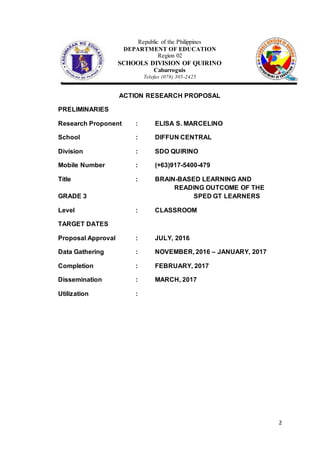
Republic of the Philippines
DEPARTMENT OF EDUCATION
Region 02
SCHOOLS DIVISION OF QUIRINO
Cabarroguis
Telefax (078) 305-2425
ACTION RESEARCH PROPOSAL
PRELIMINARIES
Research Proponent : ELISA S. MARCELINO
School : DIFFUN CENTRAL
Division : SDO QUIRINO
Mobile Number : (+63)917-5400-479
Title : BRAIN-BASED LEARNING AND
READING OUTCOME OF THE
GRADE 3 SPED GT LEARNERS
Level : CLASSROOM
TARGET DATES
Proposal Approval : JULY, 2016
Data Gathering : NOVEMBER, 2016 – JANUARY, 2017
Completion : FEBRUARY, 2017
Dissemination : MARCH, 2017
Utilization :
3
Abstract
The research was conducted to determine how effectively Brain-based
Learning develop the reading skills of the Grade Three SPED GT learners of Diffun
Central School for SY 2016-2017. The study utilized experimental-research design
using pretest and posttest wherein statistical tools used in the analysis of data were
Mean and standard deviation, Paired Samples t- Test and Eta-squared. The
Statistical Package for Social Sciences version 21 was used to analyze the data.
This was conducted using the universal technique. Results showed that there was a
significant difference of the scores between Pre-Test and Post-Test. It further
revealed that Brain-based have a large effect when it was applied in the classroom to
develop the reading skills of the learners. It is highly recommended that teachers
should continually engage their learners in more meaningful and interesting activities
in the classroom to improve reading outcomes. Teachers must create an
environment that is brain-friendly and learner-centric–an environment that will cause
learners to sit up, pay attention and become actively involved in their own learning,
while taking ownership and responsibility for their learning outcomes.
4
ACKNOWLEDGMENT
“In everything give thanks with prayer and supplication give praise unto the
Lord. In everything you do put God first and He will direct your path.”
When God works, nothing is impossible. He uses individuals to become a part
of one’s life and be a channel of blessing. The reason behind the researcher is
thankful to God for He always at her side throughout the study.
Likewise, God uses different people to be a part of this undertaking. Thus, the
researcher would like to extend thanks to the following:
The Region 02 Research Team Committee for working overnight in
evaluating this work to become a valuable one. They have been the source of
wisdom and motivation by the author;
SDO Qurino Research Committee, for their words of encouragement and
inspiration. They always push the researcher to come up with an action research;
Dr. Sonia C. Pagbilao, PSDS, for her unending encouragement and for being
available to give her comments, suggestions in the manuscripts. She is a great
administrator and a role model;
Mrs. Mely G. Claro, Principal I, for her usual support extended to the
researcher;
The Grade 3 SPED GT parents and pupils for their support and cooperation;
Valentino M. Marcelino, author’s husband, for striving hard to augment our
resources. The proponent fall short of words to describe the support he extended to
the author; and
Lavli and Elijah’s sweet embrace. They are the author’s biological children. for
They serve as the stress reliever in every tiresome moment.
To all of you, God bless you more.
ESM
5
IV. CONTEXT AND RATIONALE
Poor reading skill is manifested with poor comprehension. Numerous
researches and studies were conducted to address the problem on poor
comprehension but still intervention programs and special activities are needed to be
conducted in every classroom to cater the specific needs of pupils. As George Carlin
once said: “Don’t just teach your children to read…teach them to question what they
read. Teach them to question everything.”
In the case of the Grade Three SPED Gifted and Talented (GT) class of
Diffun Central School, a good reading habit has been a problem to them. To this
computer age, most of them neglected reading and did not know the importance that
they will derive from it. Printed materials were just nothing to them. They love online
games and playing with their gadgets rather than to read, one of the reasons they
have poor reading skills. As a teacher, the proponent does want to revive their love
for reading, hence to develop their reading skills.
Based on the result of the Oral and Silent Reading Test in English conducted
to the Grade III SPED GT Learners 1st
week of June, 2016, only 4 out of 30 pupils or
13.33% were under independent level. It shows that majority of the class was under
instructional and frustration level. Again, midweek of August when a reading test was
conducted to the Grade 3 SPED GT learners and found out that 16 out of 30 learners
were under independent and instructional level. There were still 14 or 46.67% who
were under frustration level. This prompted the proponent to conduct this study to
improve the reading performance of the Grade 3 SPED GT learners of Diffun Central
School.
However, the proponent observed that most of the learners are fond of acting,
doing caricatures, some inclined to singing and still others to writing. Some may like
working on puzzles and others do monologue. In short, they possess the multiple
6
intelligences which have a big role in learning. With this, the proponent wanted to use
their skills to develop their reading comprehension skills.
It is along this premise that the researcher conducted an action research
entitled BRAIN-BASED LEARNING AND READING OUTCOME OF THEGRADE III
SPED GT LEARNERS.
This study aimed to determine the effectiveness of Brain-based Learning in
developing the reading skills of the Grade 3 SPED Gifted and Talented Learners of
Diffun Central School for the School Year 2016-2017.
Brain-based teaching emphasizes how the brain learns naturally and is based
on what we currently know about the actual structure and function of the human brain
at varying developmental stages. Brain-Based Learning is the purposeful
engagement of strategies that apply to how our brain works in the context of
education. This theory also helps explain recurring learning behaviors, and is a meta-
concept that includes an eclectic mix of techniques. This allows teachers to connect
learning to learners’ real lives and emotional experiences, as well as their personal
histories and experiences. This form of learning also encompasses such newer
educational concepts like the multiple intelligences.
According to Wilson (2013), one of the key tenets of brain-based education is
that attention follows emotion, and both music and art often tap into the emotional
areas and thus are natural conduits for remembering and connecting information. It
provides many learners with avenues of expression and emotional connection and
release.
Calhoun (2010) on her Brain-Based Teaching: Does It Really Work? states
that involving all parts of the brain in the learning process does, in fact, increase
student achievement. Gozuyesil, et.al. (2014) likewise conducted the Effect of Brain
Based Learning on Academic Achievement. The findings indicate that 35 out of
42 comparisons had positive effect sizes. It revealed that brain-based learning has a
7
positive but medium effect (d = 0.640) on students' academic achievement. Duman
(2010) likewise investigated the effects of brain based learning on the academic
achievement of students with different learning styles. The findings of the study
revealed that the Brain Based Learning approach used in the experimental group
was more effective in increasing student achievement than the traditional approach
used in the control group. However no significant difference was observed among the
achievement levels of the experimental group students with different learning styles.
Saleh (2011) also studied the effectiveness of the brain based teaching approach in
dealing with issues related to the learning motivation towards the subject of Physics
among secondary school students. The findings of the study showed that the BBTA
module was an effective teaching approach in dealing with the issues afore
mentioned.
Kiedinger (2011) examined the influence of brain based learning on reading
outcome in elementary aged students. The study found an increase in reading scores
as measured by the WKCE. There was positive correlation between brain-based
learning strategies and expected student achievement for these students.
From these, it is understood that brain based learning focuses on concepts
that create an opportunity to maximize attainment and retention of information. Also it
can be applied to the learning process to understand the structure of the brain by
considering the needs and styles of learners to evaluate and improve the course
format and content delivery. The proponent came up with Brain-based Learning
and Reading Outcome of the Grade III SPED GT Learners of Diffun Central
School for the School Year 2016-2017.
It is because Brain-based education is about eliminating barriers and
allowing the mind to work without distractions. Studies show that a traditional lecture
environment is less effective than immersion in a subject. The goal is to make the
lesson memorable so the factual elements stick as well.
8
The following tricks were used by the proponent to help promote natural
learning during the duration of the study.
 Made use of the classroom space to arouse all senses. For example, built
a pushcart simulation in the classroom while studying the story about Efren
Peῆaflorida. By placing pushcart loaded with books, pens, tables, and chairs,
children automatically associated certain event in the story. Learners used the
pushcart as their classroom, too.
 Have learners relaxed in order to improve alertness. School is a
challenging environment that often produces a stress response that can
interfere with learning. The proponent played music; introduced soft scents
and dim lighting to promote a stress free learning area.
 Stimulated social skills to improve learners’ experience. Learners retain
better understanding of a concept when they utilize their social skills. Set up
work groups around the room for discussion. The bulletin boards reflect the
topic for total immersion. If learning about the Butterfly and the Caterpillar,
cardboard trees, grasses and flowers were placed on the walls. Played a
melody with the sound of butterfly flipping in a garden as background while
narrating the story.
 Introduced art and music into lessons. This triggered images in the
learners’ brain that reinforced them to do the task assigned to them.
 Set up a learning folder for each child. This provides reflection to their past
work assignments. This is where learners store their artwork, other elements
of the learning process. They looked through the folders to self-assess their
progress.
V. INNOVATION, INTERVENTION, AND STRATEGY
In an effort to keep up with today's advanced learners, methods and
strategies used in modern classrooms are ever-changing. Yes, we are now dealing
9
with 21st
century learners who are also craving for 21st
century learning-teaching
styles. The skills of learners in the cognition of concepts greatly depend on the
instructional materials or teaching strategies being used by the teacher. Hence, with
the aim to enhance/ develop the reading skills of Grade 3 SPED GT learners of
Diffun Central School, the researcher proposed the strategic intervention: Brain-
based Learning. This intervention was designed in a creative manner using the
learners multiple intelligences. Brain-based learning was implemented for 8 weeks
on the 3rd
Quarter starting on November 7, 2016 to January 13, 2017.
Stories/Selections were adopted from different sources. Some of these were
copied from the Learners Materials in English 3. The reading materials were all within
the level of the grade three learners to make them easily understand the contents.
Different activities were asked to the learners as an application of their skills in
reading comprehension like: role play, draw, compose a song/ jingle, write, etc.
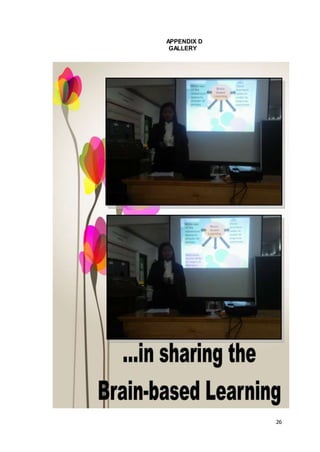
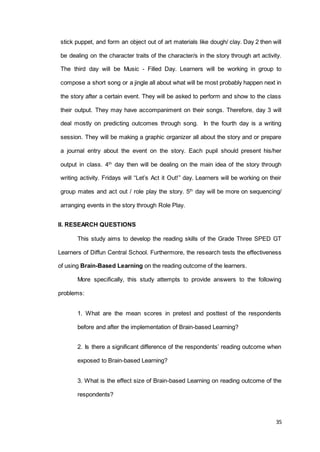
It was a five-day interrelated activity. Brain-based learning dealt only on
noting details, inferring the character traits, predicting outcomes, identifying main
idea, and sequencing/ arranging events in the story. During the first day, there was
a story telling and/or reading activity. A selection or a story applying any among the
different reading strategies, comprehension questions were raised after reading to
check pupils comprehension. In short, Day 1 was all on developing noting details.
The second day was for Art Activity. Learners were asked to draw the characters in
the story. They also asked to write one or two sentences about the character traits
of the characters they draw. They made scrap book on some other times, stick
puppet, and form an object out of art materials like dough/ clay. Day 2 then dealt on
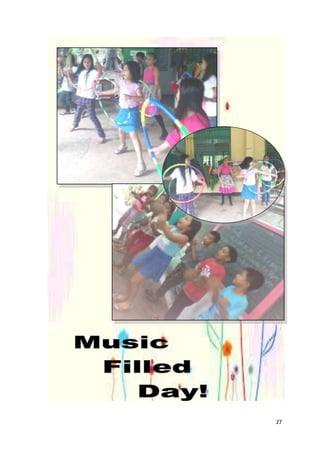
the character traits of the character/s in the story through art activity. The third day
was Music - Filled Day. Learners worked in group to compose a short song or a
jingle all about what most probably happened next in the story after a certain event.
They were asked to perform and show to the class their output. Some groups have
10
accompaniment on their songs. Day 3 dealt mostly on predicting outcomes through
song. In the fourth day was a writing session. They made a graphic organizer all
about the story and prepared a journal entry about the event on the story. Each
pupil presented his/her output in class. 4th
day dealt on the main idea of the story
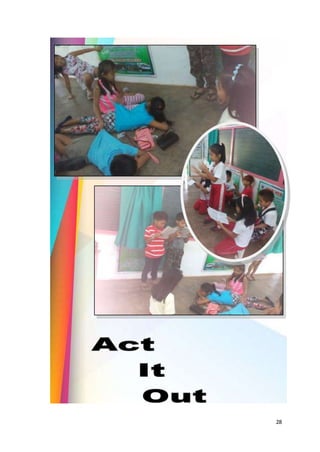
through writing activity. Fridays was “Let’s Act it Out!” day. Learners worked on their
group mates and acted out / role played the story. 5th
day were more on sequencing/
arranging events in the story through Role Play.
VI. ACTION RESEARCH QUESTIONS
This study aimed to develop the reading skills of the Grade Three SPED GT
Learners of Diffun Central School. Furthermore, the research tested the effectiveness
of using Brain-Based Learning on the reading outcome of the learners.
More specifically, this study attempted to provide answers to the following
problems:
1. What are the mean scores in pretest and posttest of the respondents
before and after the implementation of Brain-based Learning?
2. Is there a significant difference of the respondents’ reading outcome when
exposed to Brain-based Learning?
3. What is the effect size of Brain-based Learning on reading outcome of the
respondents?
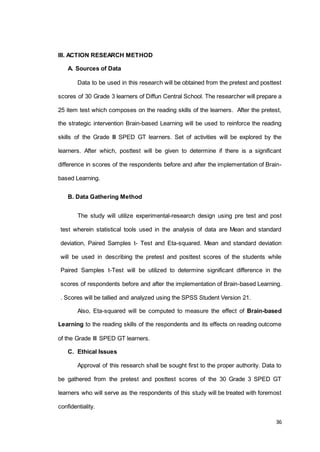
VII. ACTION RESEARCH METHODS
A. Participants and/ or other Sources of Data and Information
Data used in this research obtained from the pretest and posttest scores of 30
Grade 3 learners of Diffun Central School. The researcher prepared a 25 item test
which composed on the reading skills of the learners. After the pretest, the strategic
intervention Brain-based Learning was used to reinforce the reading skills of the
Grade III SPED GT learners. Set of activities were explored by the learners. After
11
which, posttest was given to determine if there is a significant difference in scores of
the respondents before and after the implementation of Brain-based Learning.
B. Data Gathering Methods
The study utilized experimental-research design using pretest and posttest
wherein statistical tools used in the analysis of data were Mean and standard
deviation, Paired Samples t- Test and Eta-squared. Mean and standard deviation
were used in describing the pretest and posttest scores of the students while Paired
Samples t-Test was utilized to determine significant difference in the scores of
respondents before and after the implementation of Brain-based Learning. . Scores
tallied and analyzed using the SPSS Student Version 21.
Also, Eta-squared was computed to measure the effect of Brain-based
Learning to the reading skills of the respondents and its effects on reading outcome
of the Grade III SPED GT learners.
VIII. DISCUSSION OF RESULTS AND REFLECTION
The following tables present the results of the investigation:
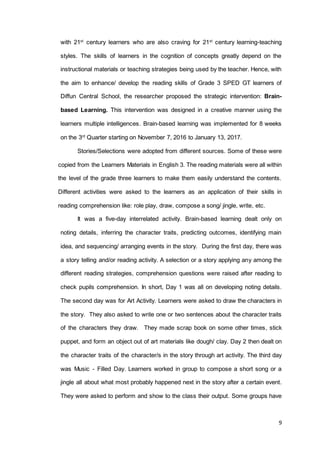
Table 1
Scores Before and After the Implementation of Brain-based Learning
Brain-based
Learning
n sd Mean
Descriptive
Interpretation
Pre-test 30 3.10376 7.4333 poor
Post test 30 2.32651 25.0333 Excellent
Legend:
0-6 = very poor
7-12 = poor
13-18 = good
19-24 = very good
25-30 = excellent
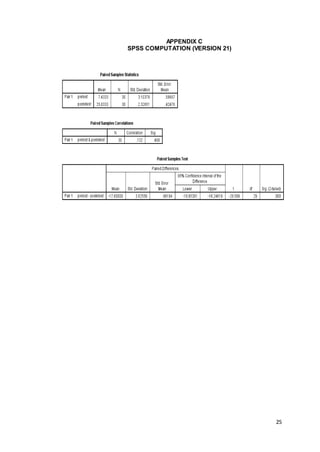
Table 1 displays the scores of the learners before and after the
implementation of Brain-based Learning. It shows that pupils achieved a mean
score of 7.4333 in the pre- test with 3.10376 Standard Deviation. It also depicts that
pupils achieved a mean score of 25.0333in the posttest with 2.32651 Standard
Deviation. This provides information that learners’ skills on reading was enhanced
and fully develop after the implementation of Brain-based Learning.
12
It can be interpreted based from the table that before the intervention was
given, learners performed poorly in their reading skills, while the learners’ skills
improved significantly from poor to moving excellent when Brain-based Learning
was introduced. Meaning, when teachers engage their learners in more meaningful
and interesting activities in the classroom utilizing their multiple intelligences, it can
improve reading outcomes of the learners.
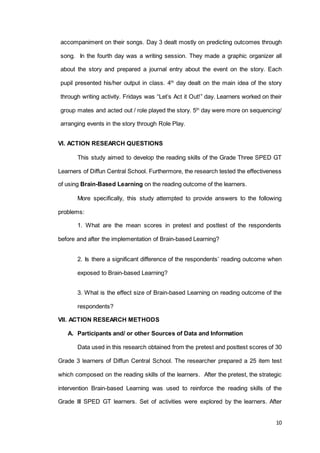
Table 2
Paired Samples t-test on Brain-based Learning
Brain-based
Learning
n df t-value p value Remarks
Pre & Post Test 30 29 -66.589 .000 Significant
Table 2 shows the paired sample t-test on the significant difference between
the pre and post test scores of the learners after the Brain-based Learning was
implemented. It displays a t value of --66.589 and generated a p-value of .000 which
marked as Significant.
The result of the study is supported by Kiedinger (2011) who examined the
influence of brain based learning on reading outcome in elementary aged students.
The study found an increase in reading scores as measured by the WKCE. There
was positive correlation between brain-based learning strategies and expected
student achievement for these students.
Likewise, Gozuyesil, et.al. (2014), Effect of Brain Based Learning on
Academic Achievement. The findings indicate that 35 out of 42 comparisons had
positive effect sizes. It revealed that brain-based learning has a positive but medium
effect (d = 0.640) on students' academic achievement.
13
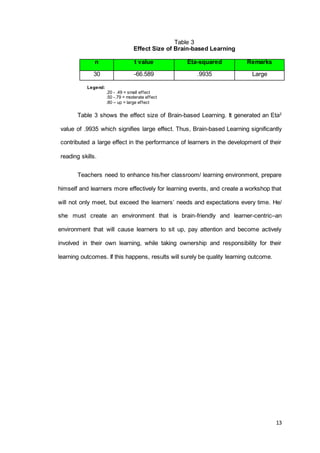
Table 3
Effect Size of Brain-based Learning
n t value Eta-squared Remarks
30 -66.589 .9935 Large
Legend:
.20 - .49 = small effect
.50 -.79 = moderate effect
.80 – up = large effect
Table 3 shows the effect size of Brain-based Learning. It generated an Eta2
value of .9935 which signifies large effect. Thus, Brain-based Learning significantly
contributed a large effect in the performance of learners in the development of their
reading skills.
Teachers need to enhance his/her classroom/ learning environment, prepare
himself and learners more effectively for learning events, and create a workshop that
will not only meet, but exceed the learners’ needs and expectations every time. He/
she must create an environment that is brain-friendly and learner-centric–an
environment that will cause learners to sit up, pay attention and become actively
involved in their own learning, while taking ownership and responsibility for their
learning outcomes. If this happens, results will surely be quality learning outcome.
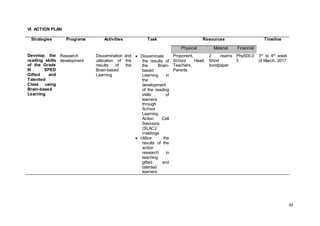
14
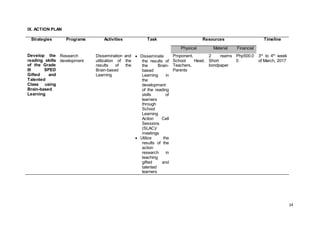
IX. ACTION PLAN
Strategies Programs Activities Task Resources Timeline
Physical Material Financial
Develop the
reading skills
of the Grade
III SPED
Gifted and
Talented
Class using
Brain-based
Learning
Research
development
Dissemination and
utilization of the
results of the
Brain-based
Learning
 Disseminate
the results of
the Brain-
based
Learning in
the
development
of the reading
skills of
learners
through
School
Learning
Action Cell
Sessions
(SLAC)/
meetings
 Utilize the
results of the
action
research in
teaching
gifted and
talented
learners
Proponent,
School Head,
Teachers,
Parents
2 reams
Short
bondpaper
Php500.0
0
3rd
to 4th
week
of March, 2017
15
X. REFERENCES
Binulal.KR, D. A. (2013, July 7). Worldwide Journal. Retrieved July 21, 2016, from
Review of Related Literature on Brain Based Learning:
http://www.worldwidejournals.com/indian-journal-of-applied-research-
(IJAR)/file.php?val=July_2013_1372686433_45dd6_54.pdf
Calhoun, C. F. (2015, April 12). ERIC brainbased development. Retrieved July 20,
2016, from ERIC: https://eric.ed.gov/? q=brain+based+learning+
in+development+of+learners+reading+compprehension&id=ED535937
education.cu-portland.educ. (2013, February 14). Retrieved October 10, 2016, from
education.cu-portland.educ: http://education.cu-portland.edu/bog/reference-
material/bringing-brain-base-learning-theories-into-the-classroom
Gozuyesil, E., & Dikici, A. (2014). ERIC. Retrieved July 20, 2016, from ERIC
brainbased learning: https://eric.ed.gov/? q=brain+based+ learning&id=
EJ1038792
Kiedinger, R. S. (2011, May). Brain-based Learning . Retrieved July 21, 2016, from
Brain-based Learning and its Effects on Student Outcome:
http://www2.uwstout.edu/content/lib/thesis/2011/2011kiedingerr.pdf
Mil Flores Ponciano, e. (2015). Let's Get Better in English 3 Teacher's Guide. Pasig
City: Rex Bookstore,Inc.
Mil Flores Ponciano, e. (2015). Let's Get Better in English 3 Learner's Material Pasig
City: Rex Bookstore,Inc.
Wachob, D. A. (2012). Public School Teachers' Knowledge, Perception, and
Implementation of Brain-Based Learning Practices. ProQuest LLC. 789 East
Eisenhower Parkway, P.O. Box 1346, Ann Arbor, MI 48106. Tel: 800-521-
0600; Web site: http://www.proquest.com/en-US/products/ dissertations/
individuals.shtml.
Wilson, L. O. (2013). The Second Principle (Brainbased Education: An Overview). t
provides many learners with avenues of expression and emotional connection
and release.
16
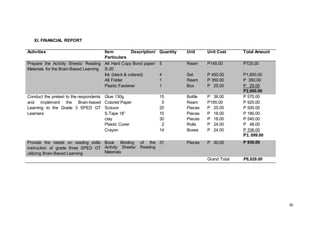
XI. FINANCIAL REPORT
Activities Item Description/
Particulars
Quantity Unit Unit Cost Total Amount
Prepare the Activity Sheets/ Reading
Materials for the Brain-Based Learning
A4 Hard Copy Bond paper/
S-20
Ink (black & colored)
A$ Folder
Plastic Fastener
5
4
1
1
Ream
Set
Ream
Box
P145.00
P 450.00
P 350.00
P 25.00
P725.00
P1,800.00
P 350.00
P 25.00
P2,900.00
Conduct the pretest to the respondents
and implement the Brain-based
Learning to the Grade 3 SPED GT
Learners
Glue 130g
Colored Paper
Scissor
S.Tape 18”
clay
Plastic Cover
Crayon
15
5
20
10
30
2
14
Bottle
Ream
Pieces
Pieces
Pieces
Rolls
Boxes
P 38.00
P185.00
P 25.00
P 18.00
P 18.00
P 24.00
P 24.00
P 570.00
P 925.00
P 500.00
P 180.00
P 540.00
P 48.00
P 336.00
P3, 099.00
Provide the needs on reading skills
instruction of grade three SPED GT
utilizing Brain-Based Learning
Book Binding of the
Activity Sheets/ Reading
Materials
31 Pieces P 30.00 P 930.00
Grand Total P6,929.00
17
APPENDICES
18
APPENDIX A
PRE/POST TEST W/ TABLE OF SPECIFICATIONS
Republic of the Philippines
Department of Education
Region 02
Schools Division of Quirino
District 1 of Diffun
Diffun Central School
Table of Specifications
Pre/ Post Test
Objectives Percentage No. of
Items
Item Placement
Get the main idea of a set of
pictures
20% 5 1,2,3,4,5
Note details and answer wh-
questions
20% 5 6,7,8,9,10
Identify character traits 20% 5 11,12,13,14,15
Sequence the events in the
story
20% 5 16, 17,18,19,20
Predict outcomes 20% 5 21,22,23,24,25
TOTAL 100% 25 25
Prepared by:
ELISA S. MARCELINO
Master teacher II
19
Republic of the Philippines
Department of Education
Region 02
Schools Division of Quirino
District 1 of Diffun
Diffun Central School
Pre/ Post Test
Directions: Read each item carefully. Write the letter of the correct answer on your
answer sheet.
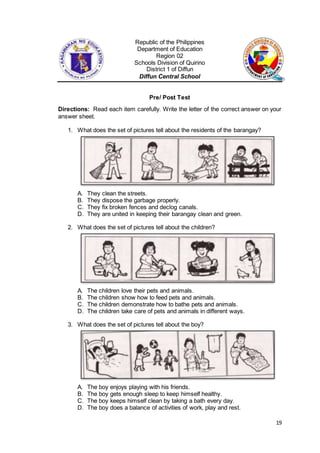
1. What does the set of pictures tell about the residents of the barangay?
A. They clean the streets.
B. They dispose the garbage properly.
C. They fix broken fences and declog canals.
D. They are united in keeping their barangay clean and green.
2. What does the set of pictures tell about the children?
A. The children love their pets and animals.
B. The children show how to feed pets and animals.
C. The children demonstrate how to bathe pets and animals.
D. The children take care of pets and animals in different ways.
3. What does the set of pictures tell about the boy?
A. The boy enjoys playing with his friends.
B. The boy gets enough sleep to keep himself healthy.
C. The boy keeps himself clean by taking a bath every day.
D. The boy does a balance of activities of work, play and rest.
20
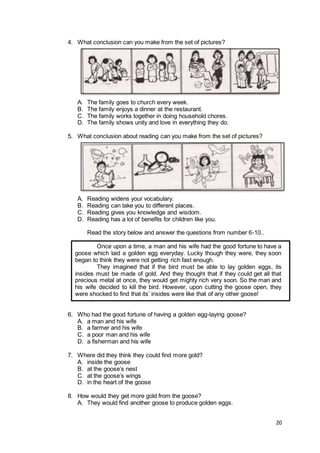
4. What conclusion can you make from the set of pictures?
A. The family goes to church every week.
B. The family enjoys a dinner at the restaurant.
C. The family works together in doing household chores.
D. The family shows unity and love in everything they do.
5. What conclusion about reading can you make from the set of pictures?
A. Reading widens your vocabulary.
B. Reading can take you to different places.
C. Reading gives you knowledge and wisdom.
D. Reading has a lot of benefits for children like you.
Read the story below and answer the questions from number 6-10..
Once upon a time, a man and his wife had the good fortune to have a
goose which laid a golden egg everyday. Lucky though they were, they soon
began to think they were not getting rich fast enough.
They imagined that if the bird must be able to lay golden eggs, its
insides must be made of gold. And they thought that if they could get all that
precious metal at once, they would get mighty rich very soon. So the man and
his wife decided to kill the bird. However, upon cutting the goose open, they
were shocked to find that its’ insides were like that of any other goose!
6. Who had the good fortune of having a golden egg-laying goose?
A. a man and his wife
B. a farmer and his wife
C. a poor man and his wife
D. a fisherman and his wife
7. Where did they think they could find more gold?
A. inside the goose
B. at the goose’s nest
C. at the goose’s wings
D. in the heart of the goose
8. How would they get more gold from the goose?
A. They would find another goose to produce golden eggs.
21
B. They would kill the goose to get the golden eggs inside it.
C. They would give the goose more food to produce more eggs.
D. They would let the goose rest to give more eggs the following day.
9. What did they find out after they killed the bird?
A. The goose had more eggs inside
B. The bird did not have any gold inside.
C. There were small pieces of gold inside.
D. The goose was just like any ordinary goose.
10. Why did the two kill the goose?
A. They ran out of food to eat.
B. Their neighbors might steal the goose.
C. They had enough gold and were very rich.
D. They wanted more gold and get rich fast enough.
11. Jenny and her three-year old sister were left home and their mother would
come back later that night. Suddenly, the lights went out and Jenny’s sister
was very scared. Jenny comforted her and guided her through the dark until
their mother arrived. What character trait did Jenny demonstrate?
A. honesty
B. courage
C. fairness
D. determination
12. George and his dad were on their way to the park. A beggar came to them,
asking for food. George’s dad brought out their lunch box and handed to the
beggar one of the sandwiches. George’s father showed _____ to the beggar.
A. loyalty
B. diligence
C. kindness
D. sincerity
13. Lucy came from a very poor family. Although her parents could not afford to
send her to school, she made sure she wouldn’t miss the chance to get a
good education. She asked her Aunt Liza if she could work for her in
exchange of sending her to school. Aunt Liza gladly agreed. Lucy had the
______ to succeed.
A. patience
B. courage
C. responsibility
D. determination
14. Now that Lucy is studying through the help of her aunt, she makes sure that
she serves her aunt’s family well. She wakes up early in the morning to help
in the household chores. At the end of the day, Lucy offers to rub her aunt’s
arms and legs to soothe her aching muscles from her day’s work. All of these
are acts of _______ by Lucy.
A. kindness
B. gratitude
C. sincerity
D. love
22
15. Beth’s family is not rich but they are definitely happy. Even if they cannot
afford to buy the latest gadgets and appliances. Beth is satisfied knowing that
her parents love each other and she feels their love for her. When asked if
she would prefer to be born to a wealthier family, Beth answered that nothing
or nobody could replace her family. Beth shows _____ with regard to her
family.
A. contentment
B. love
C. sincerity
D. loyalty
Read the story below and do the activity that follows.
The Mice summoned a meeting to decide how they might best devise
means for obtaining notice of the approach of their great enemy the Cat.
Among the many plans devised, the one that found the most favor was
the proposal to tie a bell to the neck of the Cat. When they would do so,
they would be warned by the sound of the tinkling of the bell every time
the Cat would come. Then they would have time to run away and hide in
their holes. But when the Mice was about to decide who among them
would “bell the Cat,” there was no one found to do it.
For items 16-20, Sequence the events of the story by writing A to E on the
space before each sentence.
_________16. When they were about to decide who would tie the bell in the cat,
none of them wanted to do it.
_________17. There were many suggestions given but one of these stood out,
that was to “bell the Cat.”
_________18. The Mice had a council to decide how they could gain advantage
over their enemy, the Cat.
_________19. The bell would warn the Mice of the approach of the Cat since it
would produce a sound.
_________20. That would give time for the Mice to run away and hide in their
holes.
21. Kyla wanted to have an ipad mini. She saved as much as could in order to
buy one. One day, she passed by the store when she saw that her favorite
gadget was sale 50% off. Sarah hurriedly and excitedly went home. What do you
think will happen next?
A. Kyla will open her piggy bank and buy the ipad mini.
B. Kyla will convince her mother to buy he the gadget.
C. Kyla will have second thoughts opening her savings.
D. Kyla will tell her father to buy the gadget in the store.
22. Danilo was hungry. But it was midnight already. He went down the kitchen
and looked for food. He saw the cookie jar on top of the refrigerator. He took a
stool and stepped on it. Just as he grabbed one big cookie from the jar, he felt
the jar begin to tip. He tried to stop it with his other hand but he lost his balance.
There was a loud crash. What is most likely to happen with Danilo?
23
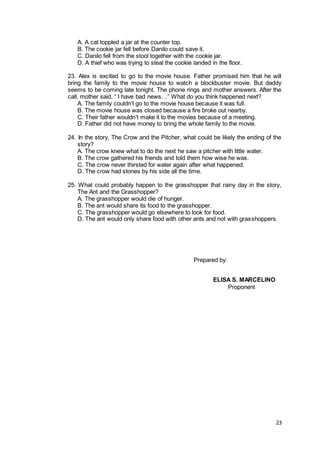
A. A cat toppled a jar at the counter top.
B. The cookie jar fell before Danilo could save it.
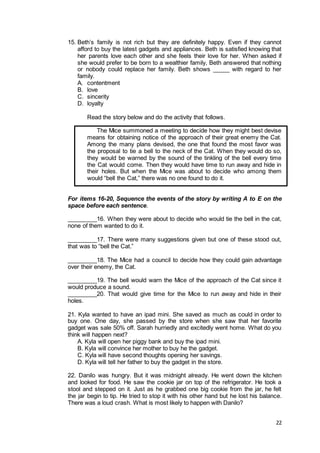
C. Danilo fell from the stool together with the cookie jar.
D. A thief who was trying to steal the cookie landed in the floor.
23. Alex is excited to go to the movie house. Father promised him that he will
bring the family to the movie house to watch a blockbuster movie. But daddy
seems to be coming late tonight. The phone rings and mother answers. After the
call, mother said, “ I have bad news…” What do you think happened next?
A. The family couldn’t go to the movie house because it was full.
B. The movie house was closed because a fire broke out nearby.
C. Their father wouldn’t make it to the movies because of a meeting.
D. Father did not have money to bring the whole family to the movie.
24. In the story, The Crow and the Pitcher, what could be likely the ending of the
story?
A. The crow knew what to do the next he saw a pitcher with little water.
B. The crow gathered his friends and told them how wise he was.
C. The crow never thirsted for water again after what happened.
D. The crow had stones by his side all the time.
25. What could probably happen to the grasshopper that rainy day in the story,
The Ant and the Grasshopper?
A. The grasshopper would die of hunger.
B. The ant would share its food to the grasshopper.
C. The grasshopper would go elsewhere to look for food.
D. The ant would only share food with other ants and not with grasshoppers.
Prepared by:
ELISA S. MARCELINO
Proponent
24
APPENDIX B
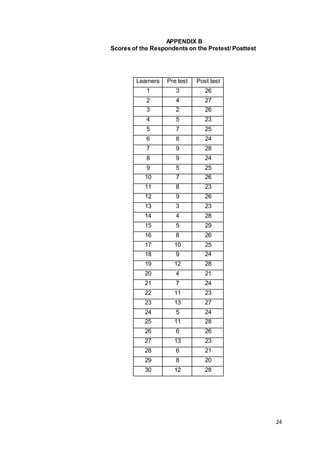
Scores of the Respondents on the Pretest/ Posttest
Learners Pre test Post test
1 3 26
2 4 27
3 2 26
4 5 23
5 7 25
6 8 24
7 9 28
8 9 24
9 5 25
10 7 26
11 8 23
12 9 26
13 3 23
14 4 28
15 5 29
16 8 26
17 10 25
18 9 24
19 12 28
20 4 21
21 7 24
22 11 23
23 13 27
24 5 24
25 11 28
26 6 26
27 13 23
28 6 21
29 8 20
30 12 28
25
APPENDIX C
SPSS COMPUTATION (VERSION 21)
26
APPENDIX D
GALLERY
27
28
29
APPENDIX E
APPROVED RESEARCH PROPOSAL
30
BRAIN-BASED LEARNING AND READING OUTCOME OF THE
GRADE III SPED GT LEARNERS
I. RATIONALE
A. Context
Poor reading skill is manifested with poor comprehension. Numerous
researches and studies were conducted to address the problem on poor
comprehension but still intervention programs and special activities are needed to be
conducted in every classroom to cater the specific needs of pupils. As George Carlin
once said: “Don’t just teach your children to read…teach them to question what they
read. Teach them to question everything.”
In the case of the Grade Three SPED Gifted and Talented (GT) class of
Diffun Central School, a good reading habit has been a problem to them. To this
computer age, most of them neglected reading and did not know the importance that
they will derive from it. Printed materials were just nothing to them. They love online
games and playing with their gadgets rather than to read, one of the reasons they
have poor reading skills. As a teacher, the proponent does want to revive their love
for reading, hence to develop their reading skills.
Based on the result of the Oral and Silent Reading Test in English conducted
to the Grade III SPED GT Learners 1st
week of June, 2016, only 4 out of 30 pupils or
13.33% were under independent level. It shows that majority of the class was under
instructional and frustration level. Again, midweek of August when a reading test was
conducted to the Grade 3 SPED GT learners and found out that 16 out of 30 learners
were under independent and instructional level. There were still 14 or 46.67% who
were under frustration level. This prompted the proponent to conduct this study to
improve the reading performance of the Grade 3 SPED GT learners of Diffun Central
School.
31
However, the proponent observed that most of the learners are fond of acting,
doing caricatures, some inclined to singing and still others to writing. Some may like
working on puzzles and others do monologue. In short, they possess the multiple
intelligences which have a big role in learning. With this, the proponent wanted to use
their skills to develop their reading comprehension skills.
It is along this premise that the researcher conducted an action research
entitled BRAIN-BASED LEARNING AND READING OUTCOME OF THEGRADE III
SPED GT LEARNERS.
This study aimed to determine the effectiveness of Brain-based Learning in
developing the reading skills of the Grade 3 SPED Gifted and Talented Learners of
Diffun Central School for the School Year 2016-2017.
Brain-based teaching emphasizes how the brain learns naturally and is based
on what we currently know about the actual structure and function of the human brain
at varying developmental stages. Brain-Based Learning is the purposeful
engagement of strategies that apply to how our brain works in the context of
education. This theory also helps explain recurring learning behaviors, and is a meta-
concept that includes an eclectic mix of techniques. This allows teachers to connect
learning to learners’ real lives and emotional experiences, as well as their personal
histories and experiences. This form of learning also encompasses such newer
educational concepts like the multiple intelligences.
According to Wilson (2013), one of the key tenets of brain-based education is
that attention follows emotion, and both music and art often tap into the emotional
areas and thus are natural conduits for remembering and connecting information. It
provides many learners with avenues of expression and emotional connection and
release.
Calhoun (2010) on her Brain-Based Teaching: Does It Really Work? states
that involving all parts of the brain in the learning process does, in fact, increase
32
student achievement. Gozuyesil, et.al. (2014) likewise conducted the Effect of Brain
Based Learning on Academic Achievement. The findings indicate that 35 out of
42 comparisons had positive effect sizes. It revealed that brain-based learning has a
positive but medium effect (d = 0.640) on students' academic achievement. Duman
(2010) likewise investigated the effects of brain based learning on the academic
achievement of students with different learning styles. The findings of the study
revealed that the Brain Based Learning approach used in the experimental group
was more effective in increasing student achievement than the traditional approach
used in the control group. However no significant difference was observed among the
achievement levels of the experimental group students with different learning styles.
Saleh (2011) also studied the effectiveness of the brain based teaching approach in
dealing with issues related to the learning motivation towards the subject of Physics
among secondary school students. The findings of the study showed that the BBTA
module was an effective teaching approach in dealing with the issues afore
mentioned.
Kiedinger (2011) examined the influence of brain based learning on reading
outcome in elementary aged students. The study found an increase in reading scores
as measured by the WKCE. There was positive correlation between brain-based
learning strategies and expected student achievement for these students.
From these, it is understood that brain based learning focuses on concepts
that create an opportunity to maximize attainment and retention of information. Also it
can be applied to the learning process to understand the structure of the brain by
considering the needs and styles of learners to evaluate and improve the course
format and content delivery. The proponent came up with Brain-based Learning
and Reading Outcome of the Grade III SPED GT Learners of Diffun Central
School for the School Year 2016-2017.
33
It is because Brain-based education is about eliminating barriers and
allowing the mind to work without distractions. Studies show that a traditional lecture
environment is less effective than immersion in a subject. The goal is to make the
lesson memorable so the factual elements stick as well.
The following tricks were used by the proponent to help promote natural
learning during the duration of the study.
 Made use of the classroom space to arouse all senses. For example, built
a pushcart simulation in the classroom while studying the story about Efren
Peῆaflorida. By placing pushcart loaded with books, pens, tables, and chairs,
children automatically associated certain event in the story. Learners used the
pushcart as their classroom, too.
 Have learners relaxed in order to improve alertness. School is a
challenging environment that often produces a stress response that can
interfere with learning. The proponent played music; introduced soft scents
and dim lighting to promote a stress free learning area.
 Stimulated social skills to improve learners’ experience. Learners retain
better understanding of a concept when they utilize their social skills. Set up
work groups around the room for discussion. The bulletin boards reflect the
topic for total immersion. If learning about the Butterfly and the Caterpillar,
cardboard trees, grasses and flowers were placed on the walls. Played a
melody with the sound of butterfly flipping in a garden as background while
narrating the story.
 Introduced art and music into lessons. This triggered images in the
learners’ brain that reinforced them to do the task assigned to them.
 Set up a learning folder for each child. This provides reflection to their past
work assignments. This is where learners store their artwork, other elements
34
of the learning process. They looked through the folders to self-assess their
progress.
B. Intervention
In an effort to keep up with today's advanced learners, methods and
strategies used in modern classrooms are ever-changing. Yes, we are now dealing
with 21st
century learners who are also craving for 21st
century learning-teaching
styles. The skills of learners in the cognition of concepts greatly depend on the
instructional materials or teaching strategies being used by the teacher. Hence, with
the aim to enhance/ develop the reading skills of Grade 3 SPED GT learners of
Diffun Central School, the researcher proposed the strategic intervention: Brain-
based Learning. This intervention was designed in a creative manner using the
learners multiple intelligences. Brain-based learning was implemented for 8 weeks
on the 3rd
Quarter starting on November 7, 2016 to January 13, 2017.
Stories/Selections were adopted from different sources. Some of these were
copied from the Learners Materials in English 3. The reading materials were all within
the level of the grade three learners to make them easily understand the contents.
Different activities will be asked to the learners as an application of their skills in
reading comprehension like: role play, draw, compose a song/ jingle, write, etc.
It is five-day interrelated activities. Brain-based learning will be dealing only
on noting details, inferring the character traits, predicting outcomes, identifying main
idea, and sequencing/ arranging events in the story. During the first day, there is a
story telling and/or reading activity. A selection or a story applying any among the
different reading strategies, comprehension questions are raised after reading to
check pupils comprehension. In short, Day 1 will all be on developing noting details.
The second day is for Art Activity. Learners will be asked to draw the characters in
the story. They will also be asked to write one or two sentences about the character
traits of the characters they draw. They will make scrap book on some other times,
35
stick puppet, and form an object out of art materials like dough/ clay. Day 2 then will
be dealing on the character traits of the character/s in the story through art activity.
The third day will be Music - Filled Day. Learners will be working in group to
compose a short song or a jingle all about what will be most probably happen next in
the story after a certain event. They will be asked to perform and show to the class
their output. They may have accompaniment on their songs. Therefore, day 3 will
deal mostly on predicting outcomes through song. In the fourth day is a writing
session. They will be making a graphic organizer all about the story and or prepare
a journal entry about the event on the story. Each pupil should present his/her
output in class. 4th
day then will be dealing on the main idea of the story through
writing activity. Fridays will “Let’s Act it Out!” day. Learners will be working on their
group mates and act out / role play the story. 5th
day will be more on sequencing/
arranging events in the story through Role Play.
II. RESEARCH QUESTIONS
This study aims to develop the reading skills of the Grade Three SPED GT
Learners of Diffun Central School. Furthermore, the research tests the effectiveness
of using Brain-Based Learning on the reading outcome of the learners.
More specifically, this study attempts to provide answers to the following
problems:
1. What are the mean scores in pretest and posttest of the respondents
before and after the implementation of Brain-based Learning?
2. Is there a significant difference of the respondents’ reading outcome when
exposed to Brain-based Learning?
3. What is the effect size of Brain-based Learning on reading outcome of the
respondents?
36
III. ACTION RESEARCH METHOD
A. Sources of Data
Data to be used in this research will be obtained from the pretest and posttest
scores of 30 Grade 3 learners of Diffun Central School. The researcher will prepare a
25 item test which composes on the reading skills of the learners. After the pretest,
the strategic intervention Brain-based Learning will be used to reinforce the reading
skills of the Grade III SPED GT learners. Set of activities will be explored by the
learners. After which, posttest will be given to determine if there is a significant
difference in scores of the respondents before and after the implementation of Brain-
based Learning.
B. Data Gathering Method
The study will utilize experimental-research design using pre test and post
test wherein statistical tools used in the analysis of data are Mean and standard
deviation, Paired Samples t- Test and Eta-squared. Mean and standard deviation
will be used in describing the pretest and posttest scores of the students while
Paired Samples t-Test will be utilized to determine significant difference in the
scores of respondents before and after the implementation of Brain-based Learning.
. Scores will be tallied and analyzed using the SPSS Student Version 21.
Also, Eta-squared will be computed to measure the effect of Brain-based
Learning to the reading skills of the respondents and its effects on reading outcome
of the Grade III SPED GT learners.
C. Ethical Issues
Approval of this research shall be sought first to the proper authority. Data to
be gathered from the pretest and posttest scores of the 30 Grade 3 SPED GT
learners who will serve as the respondents of this study will be treated with foremost
confidentiality.
37
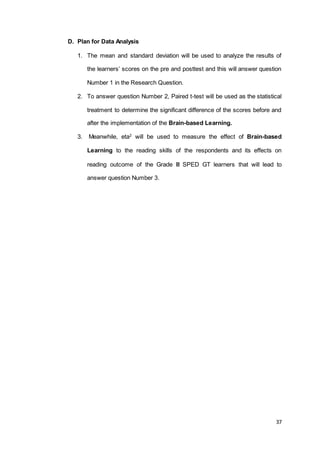
D. Plan for Data Analysis
1. The mean and standard deviation will be used to analyze the results of
the learners’ scores on the pre and posttest and this will answer question
Number 1 in the Research Question.
2. To answer question Number 2, Paired t-test will be used as the statistical
treatment to determine the significant difference of the scores before and
after the implementation of the Brain-based Learning.
3. Meanwhile, eta2
will be used to measure the effect of Brain-based
Learning to the reading skills of the respondents and its effects on
reading outcome of the Grade III SPED GT learners that will lead to
answer question Number 3.
38
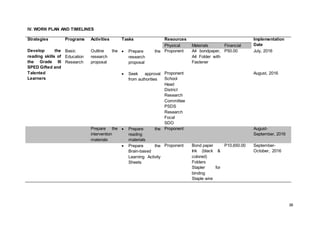
IV. WORK PLAN AND TIMELINES
Strategies Programs Activities Tasks Resources Implementation
DatePhysical Materials Financial
Develop the
reading skills of
the Grade III
SPED Gifted and
Talented
Learners
Basic
Education
Research
Outline the
research
proposal
 Prepare the
research
proposal
 Seek approval
from authorities
Proponent
Proponent
School
Head
District
Research
Committee
PSDS
Research
Focal
SDO
A4 bondpaper,
A4 Folder with
Fastener
P50.00 July, 2016
August, 2016
Prepare the
intervention
materials
 Prepare the
reading
materials
Proponent August-
September, 2016
 Prepare the
Brain-based
Learning Activity
Sheets
Proponent Bond paper
Ink (black &
colored)
Folders
Stapler for
binding
Staple wire
P10,650.00 September-
October, 2016
39
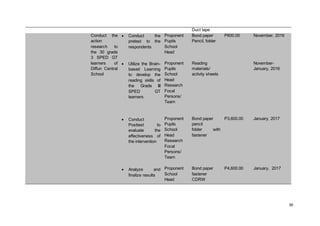
Duct tape
Conduct the
action
research to
the 30 grade
3 SPED GT
learners of
Diffun Central
School
 Conduct the
pretest to the
respondents
 Utilize the Brain-
based Learning
to develop the
reading skills of
the Grade III
SPED GT
learners
 Conduct
Posttest to
evaluate the
effectiveness of
the intervention
 Analyze and
finalize results
Proponent
Pupils
School
Head
Proponent
Pupils
School
Head
Research
Focal
Persons/
Team
Proponent
Pupils
School
Head
Research
Focal
Persons/
Team
Proponent
School
Head
Bond paper
Pencil, folder
Reading
materials/
activity sheets
Bond paper
pencil
folder with
fastener
Bond paper
fastener
CDRW
P600.00
P3,600.00
P4,600.00
November, 2016
November-
January, 2016
January, 2017
January, 2017
40
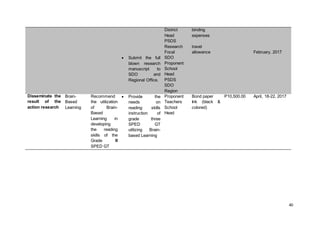
 Submit the full
blown research
manuscript to
SDO and
Regional Office.
District
Head
PSDS
Research
Focal
SDO
Proponent
School
Head
PSDS
SDO
Region
binding
expenses
travel
allowance February, 2017
Disseminate the
result of the
action research
Brain-
Based
Learning
Recommend
the utilization
of Brain-
Based
Learning in
developing
the reading
skills of the
Grade III
SPED GT
 Provide the
needs on
reading skills
instruction of
grade three
SPED GT
utilizing Brain-
based Learning
Proponent
Teachers
School
Head
Bond paper
Ink (black &
colored)
P10,500.00 April, 18-22, 2017
41
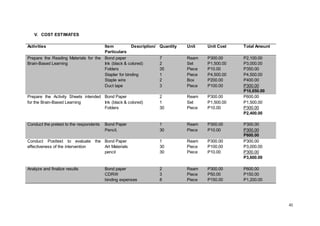
V. COST ESTIMATES
Activities Item Description/
Particulars
Quantity Unit Unit Cost Total Amount
Prepare the Reading Materials for the
Brain-Based Learning
Bond paper
Ink (black & colored)
Folders
Stapler for binding
Staple wire
Duct tape
7
2
35
1
2
3
Ream
Set
Piece
Piece
Box
Piece
P300.00
P1,500.00
P10.00
P4,500.00
P200.00
P100.00
P2,100.00
P3,000.00
P350.00
P4,500.00
P400.00
P300.00
P10,650.00
Prepare the Activity Sheets intended
for the Brain-Based Learning
Bond Paper
Ink (black & colored)
Folders
2
1
30
Ream
Set
Piece
P300.00
P1,500.00
P10.00
P600.00
P1,500.00
P300.00
P2,400.00
Conduct the pretest to the respondents Bond Paper
Pencil,
1
30
Ream
Piece
P300.00
P10.00
P300.00
P300.00
P600.00
Conduct Posttest to evaluate the
effectiveness of the intervention
Bond Paper
Art Materials
pencil
1
30
30
Ream
Piece
Piece
P300.00
P100.00
P10.00
P300.00
P3,000.00
P300.00
P3,600.00
Analyze and finalize results Bond paper
CDRW
binding expenses
2
3
8
Ream
Piece
Piece
P300.00
P50.00
P150.00
P600.00
P150.00
P1,200.00
42
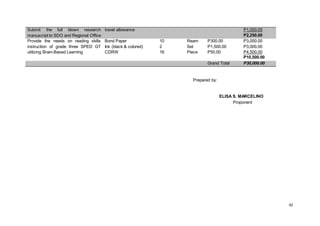
Submit the full blown research
manuscript to SDO and Regional Office
travel allowance P1,000.00
P2,250.00
Provide the needs on reading skills
instruction of grade three SPED GT
utilizing Brain-Based Learning
Bond Paper
Ink (black & colored)
CDRW
10
2
16
Ream
Set
Piece
P300.00
P1,500.00
P50.00
P3,000.00
P3,000.00
P4,500.00
P10,500.00
Grand Total P30,000.00
Prepared by:
ELISA S. MARCELINO
Proponent
43
VI. ACTION PLAN
Strategies Programs Activities Task Resources Timeline
Physical Material Financial
Develop the
reading skills
of the Grade
III SPED
Gifted and
Talented
Class using
Brain-based
Learning
Research
development
Dissemination and
utilization of the
results of the
Brain-based
Learning
 Disseminate
the results of
the Brain-
based
Learning in
the
development
of the reading
skills of
learners
through
School
Learning
Action Cell
Sessions
(SLAC)/
meetings
 Utilize the
results of the
action
research in
teaching
gifted and
talented
learners
Proponent,
School Head,
Teachers,
Parents
2 reams
Short
bondpaper
Php500.0
0
3rd
to 4th
week
of March, 2017
44
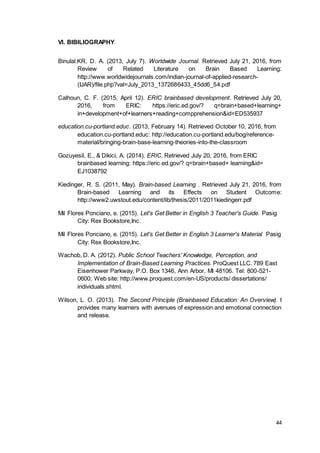
VI. BIBILIOGRAPHY
Binulal.KR, D. A. (2013, July 7). Worldwide Journal. Retrieved July 21, 2016, from
Review of Related Literature on Brain Based Learning:
http://www.worldwidejournals.com/indian-journal-of-applied-research-
(IJAR)/file.php?val=July_2013_1372686433_45dd6_54.pdf
Calhoun, C. F. (2015, April 12). ERIC brainbased development. Retrieved July 20,
2016, from ERIC: https://eric.ed.gov/? q=brain+based+learning+
in+development+of+learners+reading+compprehension&id=ED535937
education.cu-portland.educ. (2013, February 14). Retrieved October 10, 2016, from
education.cu-portland.educ: http://education.cu-portland.edu/bog/reference-
material/bringing-brain-base-learning-theories-into-the-classroom
Gozuyesil, E., & Dikici, A. (2014). ERIC. Retrieved July 20, 2016, from ERIC
brainbased learning: https://eric.ed.gov/? q=brain+based+ learning&id=
EJ1038792
Kiedinger, R. S. (2011, May). Brain-based Learning . Retrieved July 21, 2016, from
Brain-based Learning and its Effects on Student Outcome:
http://www2.uwstout.edu/content/lib/thesis/2011/2011kiedingerr.pdf
Mil Flores Ponciano, e. (2015). Let's Get Better in English 3 Teacher's Guide. Pasig
City: Rex Bookstore,Inc.
Mil Flores Ponciano, e. (2015). Let's Get Better in English 3 Learner's Material Pasig
City: Rex Bookstore,Inc.
Wachob, D. A. (2012). Public School Teachers' Knowledge, Perception, and
Implementation of Brain-Based Learning Practices. ProQuest LLC. 789 East
Eisenhower Parkway, P.O. Box 1346, Ann Arbor, MI 48106. Tel: 800-521-
0600; Web site: http://www.proquest.com/en-US/products/ dissertations/
individuals.shtml.
Wilson, L. O. (2013). The Second Principle (Brainbased Education: An Overview). t
provides many learners with avenues of expression and emotional connection
and release.

Brain based ar results

  • 1.
    1 BRAIN-BASED LEARNING ANDREADING OUTCOME OF THE GRADE III SPED GT LEARNERS ____________ An Action Research Presented to The Regional Research Committee DepED Regional Office 02 ____________ By: ELISA S. MARCELINO Master Teacher II Diffun Central School JUNE-JULY, 2016
  • 2.
    2 Republic of thePhilippines DEPARTMENT OF EDUCATION Region 02 SCHOOLS DIVISION OF QUIRINO Cabarroguis Telefax (078) 305-2425 ACTION RESEARCH PROPOSAL PRELIMINARIES Research Proponent : ELISA S. MARCELINO School : DIFFUN CENTRAL Division : SDO QUIRINO Mobile Number : (+63)917-5400-479 Title : BRAIN-BASED LEARNING AND READING OUTCOME OF THE GRADE 3 SPED GT LEARNERS Level : CLASSROOM TARGET DATES Proposal Approval : JULY, 2016 Data Gathering : NOVEMBER, 2016 – JANUARY, 2017 Completion : FEBRUARY, 2017 Dissemination : MARCH, 2017 Utilization :
  • 3.
    3 Abstract The research wasconducted to determine how effectively Brain-based Learning develop the reading skills of the Grade Three SPED GT learners of Diffun Central School for SY 2016-2017. The study utilized experimental-research design using pretest and posttest wherein statistical tools used in the analysis of data were Mean and standard deviation, Paired Samples t- Test and Eta-squared. The Statistical Package for Social Sciences version 21 was used to analyze the data. This was conducted using the universal technique. Results showed that there was a significant difference of the scores between Pre-Test and Post-Test. It further revealed that Brain-based have a large effect when it was applied in the classroom to develop the reading skills of the learners. It is highly recommended that teachers should continually engage their learners in more meaningful and interesting activities in the classroom to improve reading outcomes. Teachers must create an environment that is brain-friendly and learner-centric–an environment that will cause learners to sit up, pay attention and become actively involved in their own learning, while taking ownership and responsibility for their learning outcomes.
  • 4.
    4 ACKNOWLEDGMENT “In everything givethanks with prayer and supplication give praise unto the Lord. In everything you do put God first and He will direct your path.” When God works, nothing is impossible. He uses individuals to become a part of one’s life and be a channel of blessing. The reason behind the researcher is thankful to God for He always at her side throughout the study. Likewise, God uses different people to be a part of this undertaking. Thus, the researcher would like to extend thanks to the following: The Region 02 Research Team Committee for working overnight in evaluating this work to become a valuable one. They have been the source of wisdom and motivation by the author; SDO Qurino Research Committee, for their words of encouragement and inspiration. They always push the researcher to come up with an action research; Dr. Sonia C. Pagbilao, PSDS, for her unending encouragement and for being available to give her comments, suggestions in the manuscripts. She is a great administrator and a role model; Mrs. Mely G. Claro, Principal I, for her usual support extended to the researcher; The Grade 3 SPED GT parents and pupils for their support and cooperation; Valentino M. Marcelino, author’s husband, for striving hard to augment our resources. The proponent fall short of words to describe the support he extended to the author; and Lavli and Elijah’s sweet embrace. They are the author’s biological children. for They serve as the stress reliever in every tiresome moment. To all of you, God bless you more. ESM
  • 5.
    5 IV. CONTEXT ANDRATIONALE Poor reading skill is manifested with poor comprehension. Numerous researches and studies were conducted to address the problem on poor comprehension but still intervention programs and special activities are needed to be conducted in every classroom to cater the specific needs of pupils. As George Carlin once said: “Don’t just teach your children to read…teach them to question what they read. Teach them to question everything.” In the case of the Grade Three SPED Gifted and Talented (GT) class of Diffun Central School, a good reading habit has been a problem to them. To this computer age, most of them neglected reading and did not know the importance that they will derive from it. Printed materials were just nothing to them. They love online games and playing with their gadgets rather than to read, one of the reasons they have poor reading skills. As a teacher, the proponent does want to revive their love for reading, hence to develop their reading skills. Based on the result of the Oral and Silent Reading Test in English conducted to the Grade III SPED GT Learners 1st week of June, 2016, only 4 out of 30 pupils or 13.33% were under independent level. It shows that majority of the class was under instructional and frustration level. Again, midweek of August when a reading test was conducted to the Grade 3 SPED GT learners and found out that 16 out of 30 learners were under independent and instructional level. There were still 14 or 46.67% who were under frustration level. This prompted the proponent to conduct this study to improve the reading performance of the Grade 3 SPED GT learners of Diffun Central School. However, the proponent observed that most of the learners are fond of acting, doing caricatures, some inclined to singing and still others to writing. Some may like working on puzzles and others do monologue. In short, they possess the multiple
  • 6.
    6 intelligences which havea big role in learning. With this, the proponent wanted to use their skills to develop their reading comprehension skills. It is along this premise that the researcher conducted an action research entitled BRAIN-BASED LEARNING AND READING OUTCOME OF THEGRADE III SPED GT LEARNERS. This study aimed to determine the effectiveness of Brain-based Learning in developing the reading skills of the Grade 3 SPED Gifted and Talented Learners of Diffun Central School for the School Year 2016-2017. Brain-based teaching emphasizes how the brain learns naturally and is based on what we currently know about the actual structure and function of the human brain at varying developmental stages. Brain-Based Learning is the purposeful engagement of strategies that apply to how our brain works in the context of education. This theory also helps explain recurring learning behaviors, and is a meta- concept that includes an eclectic mix of techniques. This allows teachers to connect learning to learners’ real lives and emotional experiences, as well as their personal histories and experiences. This form of learning also encompasses such newer educational concepts like the multiple intelligences. According to Wilson (2013), one of the key tenets of brain-based education is that attention follows emotion, and both music and art often tap into the emotional areas and thus are natural conduits for remembering and connecting information. It provides many learners with avenues of expression and emotional connection and release. Calhoun (2010) on her Brain-Based Teaching: Does It Really Work? states that involving all parts of the brain in the learning process does, in fact, increase student achievement. Gozuyesil, et.al. (2014) likewise conducted the Effect of Brain Based Learning on Academic Achievement. The findings indicate that 35 out of 42 comparisons had positive effect sizes. It revealed that brain-based learning has a
  • 7.
    7 positive but mediumeffect (d = 0.640) on students' academic achievement. Duman (2010) likewise investigated the effects of brain based learning on the academic achievement of students with different learning styles. The findings of the study revealed that the Brain Based Learning approach used in the experimental group was more effective in increasing student achievement than the traditional approach used in the control group. However no significant difference was observed among the achievement levels of the experimental group students with different learning styles. Saleh (2011) also studied the effectiveness of the brain based teaching approach in dealing with issues related to the learning motivation towards the subject of Physics among secondary school students. The findings of the study showed that the BBTA module was an effective teaching approach in dealing with the issues afore mentioned. Kiedinger (2011) examined the influence of brain based learning on reading outcome in elementary aged students. The study found an increase in reading scores as measured by the WKCE. There was positive correlation between brain-based learning strategies and expected student achievement for these students. From these, it is understood that brain based learning focuses on concepts that create an opportunity to maximize attainment and retention of information. Also it can be applied to the learning process to understand the structure of the brain by considering the needs and styles of learners to evaluate and improve the course format and content delivery. The proponent came up with Brain-based Learning and Reading Outcome of the Grade III SPED GT Learners of Diffun Central School for the School Year 2016-2017. It is because Brain-based education is about eliminating barriers and allowing the mind to work without distractions. Studies show that a traditional lecture environment is less effective than immersion in a subject. The goal is to make the lesson memorable so the factual elements stick as well.
  • 8.
    8 The following trickswere used by the proponent to help promote natural learning during the duration of the study.  Made use of the classroom space to arouse all senses. For example, built a pushcart simulation in the classroom while studying the story about Efren Peῆaflorida. By placing pushcart loaded with books, pens, tables, and chairs, children automatically associated certain event in the story. Learners used the pushcart as their classroom, too.  Have learners relaxed in order to improve alertness. School is a challenging environment that often produces a stress response that can interfere with learning. The proponent played music; introduced soft scents and dim lighting to promote a stress free learning area.  Stimulated social skills to improve learners’ experience. Learners retain better understanding of a concept when they utilize their social skills. Set up work groups around the room for discussion. The bulletin boards reflect the topic for total immersion. If learning about the Butterfly and the Caterpillar, cardboard trees, grasses and flowers were placed on the walls. Played a melody with the sound of butterfly flipping in a garden as background while narrating the story.  Introduced art and music into lessons. This triggered images in the learners’ brain that reinforced them to do the task assigned to them.  Set up a learning folder for each child. This provides reflection to their past work assignments. This is where learners store their artwork, other elements of the learning process. They looked through the folders to self-assess their progress. V. INNOVATION, INTERVENTION, AND STRATEGY In an effort to keep up with today's advanced learners, methods and strategies used in modern classrooms are ever-changing. Yes, we are now dealing
  • 9.
    9 with 21st century learnerswho are also craving for 21st century learning-teaching styles. The skills of learners in the cognition of concepts greatly depend on the instructional materials or teaching strategies being used by the teacher. Hence, with the aim to enhance/ develop the reading skills of Grade 3 SPED GT learners of Diffun Central School, the researcher proposed the strategic intervention: Brain- based Learning. This intervention was designed in a creative manner using the learners multiple intelligences. Brain-based learning was implemented for 8 weeks on the 3rd Quarter starting on November 7, 2016 to January 13, 2017. Stories/Selections were adopted from different sources. Some of these were copied from the Learners Materials in English 3. The reading materials were all within the level of the grade three learners to make them easily understand the contents. Different activities were asked to the learners as an application of their skills in reading comprehension like: role play, draw, compose a song/ jingle, write, etc. It was a five-day interrelated activity. Brain-based learning dealt only on noting details, inferring the character traits, predicting outcomes, identifying main idea, and sequencing/ arranging events in the story. During the first day, there was a story telling and/or reading activity. A selection or a story applying any among the different reading strategies, comprehension questions were raised after reading to check pupils comprehension. In short, Day 1 was all on developing noting details. The second day was for Art Activity. Learners were asked to draw the characters in the story. They also asked to write one or two sentences about the character traits of the characters they draw. They made scrap book on some other times, stick puppet, and form an object out of art materials like dough/ clay. Day 2 then dealt on the character traits of the character/s in the story through art activity. The third day was Music - Filled Day. Learners worked in group to compose a short song or a jingle all about what most probably happened next in the story after a certain event. They were asked to perform and show to the class their output. Some groups have
  • 10.
    10 accompaniment on theirsongs. Day 3 dealt mostly on predicting outcomes through song. In the fourth day was a writing session. They made a graphic organizer all about the story and prepared a journal entry about the event on the story. Each pupil presented his/her output in class. 4th day dealt on the main idea of the story through writing activity. Fridays was “Let’s Act it Out!” day. Learners worked on their group mates and acted out / role played the story. 5th day were more on sequencing/ arranging events in the story through Role Play. VI. ACTION RESEARCH QUESTIONS This study aimed to develop the reading skills of the Grade Three SPED GT Learners of Diffun Central School. Furthermore, the research tested the effectiveness of using Brain-Based Learning on the reading outcome of the learners. More specifically, this study attempted to provide answers to the following problems: 1. What are the mean scores in pretest and posttest of the respondents before and after the implementation of Brain-based Learning? 2. Is there a significant difference of the respondents’ reading outcome when exposed to Brain-based Learning? 3. What is the effect size of Brain-based Learning on reading outcome of the respondents? VII. ACTION RESEARCH METHODS A. Participants and/ or other Sources of Data and Information Data used in this research obtained from the pretest and posttest scores of 30 Grade 3 learners of Diffun Central School. The researcher prepared a 25 item test which composed on the reading skills of the learners. After the pretest, the strategic intervention Brain-based Learning was used to reinforce the reading skills of the Grade III SPED GT learners. Set of activities were explored by the learners. After
  • 11.
    11 which, posttest wasgiven to determine if there is a significant difference in scores of the respondents before and after the implementation of Brain-based Learning. B. Data Gathering Methods The study utilized experimental-research design using pretest and posttest wherein statistical tools used in the analysis of data were Mean and standard deviation, Paired Samples t- Test and Eta-squared. Mean and standard deviation were used in describing the pretest and posttest scores of the students while Paired Samples t-Test was utilized to determine significant difference in the scores of respondents before and after the implementation of Brain-based Learning. . Scores tallied and analyzed using the SPSS Student Version 21. Also, Eta-squared was computed to measure the effect of Brain-based Learning to the reading skills of the respondents and its effects on reading outcome of the Grade III SPED GT learners. VIII. DISCUSSION OF RESULTS AND REFLECTION The following tables present the results of the investigation: Table 1 Scores Before and After the Implementation of Brain-based Learning Brain-based Learning n sd Mean Descriptive Interpretation Pre-test 30 3.10376 7.4333 poor Post test 30 2.32651 25.0333 Excellent Legend: 0-6 = very poor 7-12 = poor 13-18 = good 19-24 = very good 25-30 = excellent Table 1 displays the scores of the learners before and after the implementation of Brain-based Learning. It shows that pupils achieved a mean score of 7.4333 in the pre- test with 3.10376 Standard Deviation. It also depicts that pupils achieved a mean score of 25.0333in the posttest with 2.32651 Standard Deviation. This provides information that learners’ skills on reading was enhanced and fully develop after the implementation of Brain-based Learning.
  • 12.
    12 It can beinterpreted based from the table that before the intervention was given, learners performed poorly in their reading skills, while the learners’ skills improved significantly from poor to moving excellent when Brain-based Learning was introduced. Meaning, when teachers engage their learners in more meaningful and interesting activities in the classroom utilizing their multiple intelligences, it can improve reading outcomes of the learners. Table 2 Paired Samples t-test on Brain-based Learning Brain-based Learning n df t-value p value Remarks Pre & Post Test 30 29 -66.589 .000 Significant Table 2 shows the paired sample t-test on the significant difference between the pre and post test scores of the learners after the Brain-based Learning was implemented. It displays a t value of --66.589 and generated a p-value of .000 which marked as Significant. The result of the study is supported by Kiedinger (2011) who examined the influence of brain based learning on reading outcome in elementary aged students. The study found an increase in reading scores as measured by the WKCE. There was positive correlation between brain-based learning strategies and expected student achievement for these students. Likewise, Gozuyesil, et.al. (2014), Effect of Brain Based Learning on Academic Achievement. The findings indicate that 35 out of 42 comparisons had positive effect sizes. It revealed that brain-based learning has a positive but medium effect (d = 0.640) on students' academic achievement.
  • 13.
    13 Table 3 Effect Sizeof Brain-based Learning n t value Eta-squared Remarks 30 -66.589 .9935 Large Legend: .20 - .49 = small effect .50 -.79 = moderate effect .80 – up = large effect Table 3 shows the effect size of Brain-based Learning. It generated an Eta2 value of .9935 which signifies large effect. Thus, Brain-based Learning significantly contributed a large effect in the performance of learners in the development of their reading skills. Teachers need to enhance his/her classroom/ learning environment, prepare himself and learners more effectively for learning events, and create a workshop that will not only meet, but exceed the learners’ needs and expectations every time. He/ she must create an environment that is brain-friendly and learner-centric–an environment that will cause learners to sit up, pay attention and become actively involved in their own learning, while taking ownership and responsibility for their learning outcomes. If this happens, results will surely be quality learning outcome.
  • 14.
    14 IX. ACTION PLAN StrategiesPrograms Activities Task Resources Timeline Physical Material Financial Develop the reading skills of the Grade III SPED Gifted and Talented Class using Brain-based Learning Research development Dissemination and utilization of the results of the Brain-based Learning  Disseminate the results of the Brain- based Learning in the development of the reading skills of learners through School Learning Action Cell Sessions (SLAC)/ meetings  Utilize the results of the action research in teaching gifted and talented learners Proponent, School Head, Teachers, Parents 2 reams Short bondpaper Php500.0 0 3rd to 4th week of March, 2017
  • 15.
    15 X. REFERENCES Binulal.KR, D.A. (2013, July 7). Worldwide Journal. Retrieved July 21, 2016, from Review of Related Literature on Brain Based Learning: http://www.worldwidejournals.com/indian-journal-of-applied-research- (IJAR)/file.php?val=July_2013_1372686433_45dd6_54.pdf Calhoun, C. F. (2015, April 12). ERIC brainbased development. Retrieved July 20, 2016, from ERIC: https://eric.ed.gov/? q=brain+based+learning+ in+development+of+learners+reading+compprehension&id=ED535937 education.cu-portland.educ. (2013, February 14). Retrieved October 10, 2016, from education.cu-portland.educ: http://education.cu-portland.edu/bog/reference- material/bringing-brain-base-learning-theories-into-the-classroom Gozuyesil, E., & Dikici, A. (2014). ERIC. Retrieved July 20, 2016, from ERIC brainbased learning: https://eric.ed.gov/? q=brain+based+ learning&id= EJ1038792 Kiedinger, R. S. (2011, May). Brain-based Learning . Retrieved July 21, 2016, from Brain-based Learning and its Effects on Student Outcome: http://www2.uwstout.edu/content/lib/thesis/2011/2011kiedingerr.pdf Mil Flores Ponciano, e. (2015). Let's Get Better in English 3 Teacher's Guide. Pasig City: Rex Bookstore,Inc. Mil Flores Ponciano, e. (2015). Let's Get Better in English 3 Learner's Material Pasig City: Rex Bookstore,Inc. Wachob, D. A. (2012). Public School Teachers' Knowledge, Perception, and Implementation of Brain-Based Learning Practices. ProQuest LLC. 789 East Eisenhower Parkway, P.O. Box 1346, Ann Arbor, MI 48106. Tel: 800-521- 0600; Web site: http://www.proquest.com/en-US/products/ dissertations/ individuals.shtml. Wilson, L. O. (2013). The Second Principle (Brainbased Education: An Overview). t provides many learners with avenues of expression and emotional connection and release.
  • 16.
    16 XI. FINANCIAL REPORT ActivitiesItem Description/ Particulars Quantity Unit Unit Cost Total Amount Prepare the Activity Sheets/ Reading Materials for the Brain-Based Learning A4 Hard Copy Bond paper/ S-20 Ink (black & colored) A$ Folder Plastic Fastener 5 4 1 1 Ream Set Ream Box P145.00 P 450.00 P 350.00 P 25.00 P725.00 P1,800.00 P 350.00 P 25.00 P2,900.00 Conduct the pretest to the respondents and implement the Brain-based Learning to the Grade 3 SPED GT Learners Glue 130g Colored Paper Scissor S.Tape 18” clay Plastic Cover Crayon 15 5 20 10 30 2 14 Bottle Ream Pieces Pieces Pieces Rolls Boxes P 38.00 P185.00 P 25.00 P 18.00 P 18.00 P 24.00 P 24.00 P 570.00 P 925.00 P 500.00 P 180.00 P 540.00 P 48.00 P 336.00 P3, 099.00 Provide the needs on reading skills instruction of grade three SPED GT utilizing Brain-Based Learning Book Binding of the Activity Sheets/ Reading Materials 31 Pieces P 30.00 P 930.00 Grand Total P6,929.00
  • 17.
  • 18.
    18 APPENDIX A PRE/POST TESTW/ TABLE OF SPECIFICATIONS Republic of the Philippines Department of Education Region 02 Schools Division of Quirino District 1 of Diffun Diffun Central School Table of Specifications Pre/ Post Test Objectives Percentage No. of Items Item Placement Get the main idea of a set of pictures 20% 5 1,2,3,4,5 Note details and answer wh- questions 20% 5 6,7,8,9,10 Identify character traits 20% 5 11,12,13,14,15 Sequence the events in the story 20% 5 16, 17,18,19,20 Predict outcomes 20% 5 21,22,23,24,25 TOTAL 100% 25 25 Prepared by: ELISA S. MARCELINO Master teacher II
  • 19.
    19 Republic of thePhilippines Department of Education Region 02 Schools Division of Quirino District 1 of Diffun Diffun Central School Pre/ Post Test Directions: Read each item carefully. Write the letter of the correct answer on your answer sheet. 1. What does the set of pictures tell about the residents of the barangay? A. They clean the streets. B. They dispose the garbage properly. C. They fix broken fences and declog canals. D. They are united in keeping their barangay clean and green. 2. What does the set of pictures tell about the children? A. The children love their pets and animals. B. The children show how to feed pets and animals. C. The children demonstrate how to bathe pets and animals. D. The children take care of pets and animals in different ways. 3. What does the set of pictures tell about the boy? A. The boy enjoys playing with his friends. B. The boy gets enough sleep to keep himself healthy. C. The boy keeps himself clean by taking a bath every day. D. The boy does a balance of activities of work, play and rest.
  • 20.
    20 4. What conclusioncan you make from the set of pictures? A. The family goes to church every week. B. The family enjoys a dinner at the restaurant. C. The family works together in doing household chores. D. The family shows unity and love in everything they do. 5. What conclusion about reading can you make from the set of pictures? A. Reading widens your vocabulary. B. Reading can take you to different places. C. Reading gives you knowledge and wisdom. D. Reading has a lot of benefits for children like you. Read the story below and answer the questions from number 6-10.. Once upon a time, a man and his wife had the good fortune to have a goose which laid a golden egg everyday. Lucky though they were, they soon began to think they were not getting rich fast enough. They imagined that if the bird must be able to lay golden eggs, its insides must be made of gold. And they thought that if they could get all that precious metal at once, they would get mighty rich very soon. So the man and his wife decided to kill the bird. However, upon cutting the goose open, they were shocked to find that its’ insides were like that of any other goose! 6. Who had the good fortune of having a golden egg-laying goose? A. a man and his wife B. a farmer and his wife C. a poor man and his wife D. a fisherman and his wife 7. Where did they think they could find more gold? A. inside the goose B. at the goose’s nest C. at the goose’s wings D. in the heart of the goose 8. How would they get more gold from the goose? A. They would find another goose to produce golden eggs.
  • 21.
    21 B. They wouldkill the goose to get the golden eggs inside it. C. They would give the goose more food to produce more eggs. D. They would let the goose rest to give more eggs the following day. 9. What did they find out after they killed the bird? A. The goose had more eggs inside B. The bird did not have any gold inside. C. There were small pieces of gold inside. D. The goose was just like any ordinary goose. 10. Why did the two kill the goose? A. They ran out of food to eat. B. Their neighbors might steal the goose. C. They had enough gold and were very rich. D. They wanted more gold and get rich fast enough. 11. Jenny and her three-year old sister were left home and their mother would come back later that night. Suddenly, the lights went out and Jenny’s sister was very scared. Jenny comforted her and guided her through the dark until their mother arrived. What character trait did Jenny demonstrate? A. honesty B. courage C. fairness D. determination 12. George and his dad were on their way to the park. A beggar came to them, asking for food. George’s dad brought out their lunch box and handed to the beggar one of the sandwiches. George’s father showed _____ to the beggar. A. loyalty B. diligence C. kindness D. sincerity 13. Lucy came from a very poor family. Although her parents could not afford to send her to school, she made sure she wouldn’t miss the chance to get a good education. She asked her Aunt Liza if she could work for her in exchange of sending her to school. Aunt Liza gladly agreed. Lucy had the ______ to succeed. A. patience B. courage C. responsibility D. determination 14. Now that Lucy is studying through the help of her aunt, she makes sure that she serves her aunt’s family well. She wakes up early in the morning to help in the household chores. At the end of the day, Lucy offers to rub her aunt’s arms and legs to soothe her aching muscles from her day’s work. All of these are acts of _______ by Lucy. A. kindness B. gratitude C. sincerity D. love
  • 22.
    22 15. Beth’s familyis not rich but they are definitely happy. Even if they cannot afford to buy the latest gadgets and appliances. Beth is satisfied knowing that her parents love each other and she feels their love for her. When asked if she would prefer to be born to a wealthier family, Beth answered that nothing or nobody could replace her family. Beth shows _____ with regard to her family. A. contentment B. love C. sincerity D. loyalty Read the story below and do the activity that follows. The Mice summoned a meeting to decide how they might best devise means for obtaining notice of the approach of their great enemy the Cat. Among the many plans devised, the one that found the most favor was the proposal to tie a bell to the neck of the Cat. When they would do so, they would be warned by the sound of the tinkling of the bell every time the Cat would come. Then they would have time to run away and hide in their holes. But when the Mice was about to decide who among them would “bell the Cat,” there was no one found to do it. For items 16-20, Sequence the events of the story by writing A to E on the space before each sentence. _________16. When they were about to decide who would tie the bell in the cat, none of them wanted to do it. _________17. There were many suggestions given but one of these stood out, that was to “bell the Cat.” _________18. The Mice had a council to decide how they could gain advantage over their enemy, the Cat. _________19. The bell would warn the Mice of the approach of the Cat since it would produce a sound. _________20. That would give time for the Mice to run away and hide in their holes. 21. Kyla wanted to have an ipad mini. She saved as much as could in order to buy one. One day, she passed by the store when she saw that her favorite gadget was sale 50% off. Sarah hurriedly and excitedly went home. What do you think will happen next? A. Kyla will open her piggy bank and buy the ipad mini. B. Kyla will convince her mother to buy he the gadget. C. Kyla will have second thoughts opening her savings. D. Kyla will tell her father to buy the gadget in the store. 22. Danilo was hungry. But it was midnight already. He went down the kitchen and looked for food. He saw the cookie jar on top of the refrigerator. He took a stool and stepped on it. Just as he grabbed one big cookie from the jar, he felt the jar begin to tip. He tried to stop it with his other hand but he lost his balance. There was a loud crash. What is most likely to happen with Danilo?
  • 23.
    23 A. A cattoppled a jar at the counter top. B. The cookie jar fell before Danilo could save it. C. Danilo fell from the stool together with the cookie jar. D. A thief who was trying to steal the cookie landed in the floor. 23. Alex is excited to go to the movie house. Father promised him that he will bring the family to the movie house to watch a blockbuster movie. But daddy seems to be coming late tonight. The phone rings and mother answers. After the call, mother said, “ I have bad news…” What do you think happened next? A. The family couldn’t go to the movie house because it was full. B. The movie house was closed because a fire broke out nearby. C. Their father wouldn’t make it to the movies because of a meeting. D. Father did not have money to bring the whole family to the movie. 24. In the story, The Crow and the Pitcher, what could be likely the ending of the story? A. The crow knew what to do the next he saw a pitcher with little water. B. The crow gathered his friends and told them how wise he was. C. The crow never thirsted for water again after what happened. D. The crow had stones by his side all the time. 25. What could probably happen to the grasshopper that rainy day in the story, The Ant and the Grasshopper? A. The grasshopper would die of hunger. B. The ant would share its food to the grasshopper. C. The grasshopper would go elsewhere to look for food. D. The ant would only share food with other ants and not with grasshoppers. Prepared by: ELISA S. MARCELINO Proponent
  • 24.
    24 APPENDIX B Scores ofthe Respondents on the Pretest/ Posttest Learners Pre test Post test 1 3 26 2 4 27 3 2 26 4 5 23 5 7 25 6 8 24 7 9 28 8 9 24 9 5 25 10 7 26 11 8 23 12 9 26 13 3 23 14 4 28 15 5 29 16 8 26 17 10 25 18 9 24 19 12 28 20 4 21 21 7 24 22 11 23 23 13 27 24 5 24 25 11 28 26 6 26 27 13 23 28 6 21 29 8 20 30 12 28
  • 25.
  • 26.
  • 27.
  • 28.
  • 29.
  • 30.
    30 BRAIN-BASED LEARNING ANDREADING OUTCOME OF THE GRADE III SPED GT LEARNERS I. RATIONALE A. Context Poor reading skill is manifested with poor comprehension. Numerous researches and studies were conducted to address the problem on poor comprehension but still intervention programs and special activities are needed to be conducted in every classroom to cater the specific needs of pupils. As George Carlin once said: “Don’t just teach your children to read…teach them to question what they read. Teach them to question everything.” In the case of the Grade Three SPED Gifted and Talented (GT) class of Diffun Central School, a good reading habit has been a problem to them. To this computer age, most of them neglected reading and did not know the importance that they will derive from it. Printed materials were just nothing to them. They love online games and playing with their gadgets rather than to read, one of the reasons they have poor reading skills. As a teacher, the proponent does want to revive their love for reading, hence to develop their reading skills. Based on the result of the Oral and Silent Reading Test in English conducted to the Grade III SPED GT Learners 1st week of June, 2016, only 4 out of 30 pupils or 13.33% were under independent level. It shows that majority of the class was under instructional and frustration level. Again, midweek of August when a reading test was conducted to the Grade 3 SPED GT learners and found out that 16 out of 30 learners were under independent and instructional level. There were still 14 or 46.67% who were under frustration level. This prompted the proponent to conduct this study to improve the reading performance of the Grade 3 SPED GT learners of Diffun Central School.
  • 31.
    31 However, the proponentobserved that most of the learners are fond of acting, doing caricatures, some inclined to singing and still others to writing. Some may like working on puzzles and others do monologue. In short, they possess the multiple intelligences which have a big role in learning. With this, the proponent wanted to use their skills to develop their reading comprehension skills. It is along this premise that the researcher conducted an action research entitled BRAIN-BASED LEARNING AND READING OUTCOME OF THEGRADE III SPED GT LEARNERS. This study aimed to determine the effectiveness of Brain-based Learning in developing the reading skills of the Grade 3 SPED Gifted and Talented Learners of Diffun Central School for the School Year 2016-2017. Brain-based teaching emphasizes how the brain learns naturally and is based on what we currently know about the actual structure and function of the human brain at varying developmental stages. Brain-Based Learning is the purposeful engagement of strategies that apply to how our brain works in the context of education. This theory also helps explain recurring learning behaviors, and is a meta- concept that includes an eclectic mix of techniques. This allows teachers to connect learning to learners’ real lives and emotional experiences, as well as their personal histories and experiences. This form of learning also encompasses such newer educational concepts like the multiple intelligences. According to Wilson (2013), one of the key tenets of brain-based education is that attention follows emotion, and both music and art often tap into the emotional areas and thus are natural conduits for remembering and connecting information. It provides many learners with avenues of expression and emotional connection and release. Calhoun (2010) on her Brain-Based Teaching: Does It Really Work? states that involving all parts of the brain in the learning process does, in fact, increase
  • 32.
    32 student achievement. Gozuyesil,et.al. (2014) likewise conducted the Effect of Brain Based Learning on Academic Achievement. The findings indicate that 35 out of 42 comparisons had positive effect sizes. It revealed that brain-based learning has a positive but medium effect (d = 0.640) on students' academic achievement. Duman (2010) likewise investigated the effects of brain based learning on the academic achievement of students with different learning styles. The findings of the study revealed that the Brain Based Learning approach used in the experimental group was more effective in increasing student achievement than the traditional approach used in the control group. However no significant difference was observed among the achievement levels of the experimental group students with different learning styles. Saleh (2011) also studied the effectiveness of the brain based teaching approach in dealing with issues related to the learning motivation towards the subject of Physics among secondary school students. The findings of the study showed that the BBTA module was an effective teaching approach in dealing with the issues afore mentioned. Kiedinger (2011) examined the influence of brain based learning on reading outcome in elementary aged students. The study found an increase in reading scores as measured by the WKCE. There was positive correlation between brain-based learning strategies and expected student achievement for these students. From these, it is understood that brain based learning focuses on concepts that create an opportunity to maximize attainment and retention of information. Also it can be applied to the learning process to understand the structure of the brain by considering the needs and styles of learners to evaluate and improve the course format and content delivery. The proponent came up with Brain-based Learning and Reading Outcome of the Grade III SPED GT Learners of Diffun Central School for the School Year 2016-2017.
  • 33.
    33 It is becauseBrain-based education is about eliminating barriers and allowing the mind to work without distractions. Studies show that a traditional lecture environment is less effective than immersion in a subject. The goal is to make the lesson memorable so the factual elements stick as well. The following tricks were used by the proponent to help promote natural learning during the duration of the study.  Made use of the classroom space to arouse all senses. For example, built a pushcart simulation in the classroom while studying the story about Efren Peῆaflorida. By placing pushcart loaded with books, pens, tables, and chairs, children automatically associated certain event in the story. Learners used the pushcart as their classroom, too.  Have learners relaxed in order to improve alertness. School is a challenging environment that often produces a stress response that can interfere with learning. The proponent played music; introduced soft scents and dim lighting to promote a stress free learning area.  Stimulated social skills to improve learners’ experience. Learners retain better understanding of a concept when they utilize their social skills. Set up work groups around the room for discussion. The bulletin boards reflect the topic for total immersion. If learning about the Butterfly and the Caterpillar, cardboard trees, grasses and flowers were placed on the walls. Played a melody with the sound of butterfly flipping in a garden as background while narrating the story.  Introduced art and music into lessons. This triggered images in the learners’ brain that reinforced them to do the task assigned to them.  Set up a learning folder for each child. This provides reflection to their past work assignments. This is where learners store their artwork, other elements
  • 34.
    34 of the learningprocess. They looked through the folders to self-assess their progress. B. Intervention In an effort to keep up with today's advanced learners, methods and strategies used in modern classrooms are ever-changing. Yes, we are now dealing with 21st century learners who are also craving for 21st century learning-teaching styles. The skills of learners in the cognition of concepts greatly depend on the instructional materials or teaching strategies being used by the teacher. Hence, with the aim to enhance/ develop the reading skills of Grade 3 SPED GT learners of Diffun Central School, the researcher proposed the strategic intervention: Brain- based Learning. This intervention was designed in a creative manner using the learners multiple intelligences. Brain-based learning was implemented for 8 weeks on the 3rd Quarter starting on November 7, 2016 to January 13, 2017. Stories/Selections were adopted from different sources. Some of these were copied from the Learners Materials in English 3. The reading materials were all within the level of the grade three learners to make them easily understand the contents. Different activities will be asked to the learners as an application of their skills in reading comprehension like: role play, draw, compose a song/ jingle, write, etc. It is five-day interrelated activities. Brain-based learning will be dealing only on noting details, inferring the character traits, predicting outcomes, identifying main idea, and sequencing/ arranging events in the story. During the first day, there is a story telling and/or reading activity. A selection or a story applying any among the different reading strategies, comprehension questions are raised after reading to check pupils comprehension. In short, Day 1 will all be on developing noting details. The second day is for Art Activity. Learners will be asked to draw the characters in the story. They will also be asked to write one or two sentences about the character traits of the characters they draw. They will make scrap book on some other times,
  • 35.
    35 stick puppet, andform an object out of art materials like dough/ clay. Day 2 then will be dealing on the character traits of the character/s in the story through art activity. The third day will be Music - Filled Day. Learners will be working in group to compose a short song or a jingle all about what will be most probably happen next in the story after a certain event. They will be asked to perform and show to the class their output. They may have accompaniment on their songs. Therefore, day 3 will deal mostly on predicting outcomes through song. In the fourth day is a writing session. They will be making a graphic organizer all about the story and or prepare a journal entry about the event on the story. Each pupil should present his/her output in class. 4th day then will be dealing on the main idea of the story through writing activity. Fridays will “Let’s Act it Out!” day. Learners will be working on their group mates and act out / role play the story. 5th day will be more on sequencing/ arranging events in the story through Role Play. II. RESEARCH QUESTIONS This study aims to develop the reading skills of the Grade Three SPED GT Learners of Diffun Central School. Furthermore, the research tests the effectiveness of using Brain-Based Learning on the reading outcome of the learners. More specifically, this study attempts to provide answers to the following problems: 1. What are the mean scores in pretest and posttest of the respondents before and after the implementation of Brain-based Learning? 2. Is there a significant difference of the respondents’ reading outcome when exposed to Brain-based Learning? 3. What is the effect size of Brain-based Learning on reading outcome of the respondents?
  • 36.
    36 III. ACTION RESEARCHMETHOD A. Sources of Data Data to be used in this research will be obtained from the pretest and posttest scores of 30 Grade 3 learners of Diffun Central School. The researcher will prepare a 25 item test which composes on the reading skills of the learners. After the pretest, the strategic intervention Brain-based Learning will be used to reinforce the reading skills of the Grade III SPED GT learners. Set of activities will be explored by the learners. After which, posttest will be given to determine if there is a significant difference in scores of the respondents before and after the implementation of Brain- based Learning. B. Data Gathering Method The study will utilize experimental-research design using pre test and post test wherein statistical tools used in the analysis of data are Mean and standard deviation, Paired Samples t- Test and Eta-squared. Mean and standard deviation will be used in describing the pretest and posttest scores of the students while Paired Samples t-Test will be utilized to determine significant difference in the scores of respondents before and after the implementation of Brain-based Learning. . Scores will be tallied and analyzed using the SPSS Student Version 21. Also, Eta-squared will be computed to measure the effect of Brain-based Learning to the reading skills of the respondents and its effects on reading outcome of the Grade III SPED GT learners. C. Ethical Issues Approval of this research shall be sought first to the proper authority. Data to be gathered from the pretest and posttest scores of the 30 Grade 3 SPED GT learners who will serve as the respondents of this study will be treated with foremost confidentiality.
  • 37.
    37 D. Plan forData Analysis 1. The mean and standard deviation will be used to analyze the results of the learners’ scores on the pre and posttest and this will answer question Number 1 in the Research Question. 2. To answer question Number 2, Paired t-test will be used as the statistical treatment to determine the significant difference of the scores before and after the implementation of the Brain-based Learning. 3. Meanwhile, eta2 will be used to measure the effect of Brain-based Learning to the reading skills of the respondents and its effects on reading outcome of the Grade III SPED GT learners that will lead to answer question Number 3.
  • 38.
    38 IV. WORK PLANAND TIMELINES Strategies Programs Activities Tasks Resources Implementation DatePhysical Materials Financial Develop the reading skills of the Grade III SPED Gifted and Talented Learners Basic Education Research Outline the research proposal  Prepare the research proposal  Seek approval from authorities Proponent Proponent School Head District Research Committee PSDS Research Focal SDO A4 bondpaper, A4 Folder with Fastener P50.00 July, 2016 August, 2016 Prepare the intervention materials  Prepare the reading materials Proponent August- September, 2016  Prepare the Brain-based Learning Activity Sheets Proponent Bond paper Ink (black & colored) Folders Stapler for binding Staple wire P10,650.00 September- October, 2016
  • 39.
    39 Duct tape Conduct the action researchto the 30 grade 3 SPED GT learners of Diffun Central School  Conduct the pretest to the respondents  Utilize the Brain- based Learning to develop the reading skills of the Grade III SPED GT learners  Conduct Posttest to evaluate the effectiveness of the intervention  Analyze and finalize results Proponent Pupils School Head Proponent Pupils School Head Research Focal Persons/ Team Proponent Pupils School Head Research Focal Persons/ Team Proponent School Head Bond paper Pencil, folder Reading materials/ activity sheets Bond paper pencil folder with fastener Bond paper fastener CDRW P600.00 P3,600.00 P4,600.00 November, 2016 November- January, 2016 January, 2017 January, 2017
  • 40.
    40  Submit thefull blown research manuscript to SDO and Regional Office. District Head PSDS Research Focal SDO Proponent School Head PSDS SDO Region binding expenses travel allowance February, 2017 Disseminate the result of the action research Brain- Based Learning Recommend the utilization of Brain- Based Learning in developing the reading skills of the Grade III SPED GT  Provide the needs on reading skills instruction of grade three SPED GT utilizing Brain- based Learning Proponent Teachers School Head Bond paper Ink (black & colored) P10,500.00 April, 18-22, 2017
  • 41.
    41 V. COST ESTIMATES ActivitiesItem Description/ Particulars Quantity Unit Unit Cost Total Amount Prepare the Reading Materials for the Brain-Based Learning Bond paper Ink (black & colored) Folders Stapler for binding Staple wire Duct tape 7 2 35 1 2 3 Ream Set Piece Piece Box Piece P300.00 P1,500.00 P10.00 P4,500.00 P200.00 P100.00 P2,100.00 P3,000.00 P350.00 P4,500.00 P400.00 P300.00 P10,650.00 Prepare the Activity Sheets intended for the Brain-Based Learning Bond Paper Ink (black & colored) Folders 2 1 30 Ream Set Piece P300.00 P1,500.00 P10.00 P600.00 P1,500.00 P300.00 P2,400.00 Conduct the pretest to the respondents Bond Paper Pencil, 1 30 Ream Piece P300.00 P10.00 P300.00 P300.00 P600.00 Conduct Posttest to evaluate the effectiveness of the intervention Bond Paper Art Materials pencil 1 30 30 Ream Piece Piece P300.00 P100.00 P10.00 P300.00 P3,000.00 P300.00 P3,600.00 Analyze and finalize results Bond paper CDRW binding expenses 2 3 8 Ream Piece Piece P300.00 P50.00 P150.00 P600.00 P150.00 P1,200.00
  • 42.
    42 Submit the fullblown research manuscript to SDO and Regional Office travel allowance P1,000.00 P2,250.00 Provide the needs on reading skills instruction of grade three SPED GT utilizing Brain-Based Learning Bond Paper Ink (black & colored) CDRW 10 2 16 Ream Set Piece P300.00 P1,500.00 P50.00 P3,000.00 P3,000.00 P4,500.00 P10,500.00 Grand Total P30,000.00 Prepared by: ELISA S. MARCELINO Proponent
  • 43.
    43 VI. ACTION PLAN StrategiesPrograms Activities Task Resources Timeline Physical Material Financial Develop the reading skills of the Grade III SPED Gifted and Talented Class using Brain-based Learning Research development Dissemination and utilization of the results of the Brain-based Learning  Disseminate the results of the Brain- based Learning in the development of the reading skills of learners through School Learning Action Cell Sessions (SLAC)/ meetings  Utilize the results of the action research in teaching gifted and talented learners Proponent, School Head, Teachers, Parents 2 reams Short bondpaper Php500.0 0 3rd to 4th week of March, 2017
  • 44.
    44 VI. BIBILIOGRAPHY Binulal.KR, D.A. (2013, July 7). Worldwide Journal. Retrieved July 21, 2016, from Review of Related Literature on Brain Based Learning: http://www.worldwidejournals.com/indian-journal-of-applied-research- (IJAR)/file.php?val=July_2013_1372686433_45dd6_54.pdf Calhoun, C. F. (2015, April 12). ERIC brainbased development. Retrieved July 20, 2016, from ERIC: https://eric.ed.gov/? q=brain+based+learning+ in+development+of+learners+reading+compprehension&id=ED535937 education.cu-portland.educ. (2013, February 14). Retrieved October 10, 2016, from education.cu-portland.educ: http://education.cu-portland.edu/bog/reference- material/bringing-brain-base-learning-theories-into-the-classroom Gozuyesil, E., & Dikici, A. (2014). ERIC. Retrieved July 20, 2016, from ERIC brainbased learning: https://eric.ed.gov/? q=brain+based+ learning&id= EJ1038792 Kiedinger, R. S. (2011, May). Brain-based Learning . Retrieved July 21, 2016, from Brain-based Learning and its Effects on Student Outcome: http://www2.uwstout.edu/content/lib/thesis/2011/2011kiedingerr.pdf Mil Flores Ponciano, e. (2015). Let's Get Better in English 3 Teacher's Guide. Pasig City: Rex Bookstore,Inc. Mil Flores Ponciano, e. (2015). Let's Get Better in English 3 Learner's Material Pasig City: Rex Bookstore,Inc. Wachob, D. A. (2012). Public School Teachers' Knowledge, Perception, and Implementation of Brain-Based Learning Practices. ProQuest LLC. 789 East Eisenhower Parkway, P.O. Box 1346, Ann Arbor, MI 48106. Tel: 800-521- 0600; Web site: http://www.proquest.com/en-US/products/ dissertations/ individuals.shtml. Wilson, L. O. (2013). The Second Principle (Brainbased Education: An Overview). t provides many learners with avenues of expression and emotional connection and release.