Introduction
of
Pharmaceutical Analysis
Introduction of
Pharmaceutical Analysis
• Introduction
– Definition
– Types of analysis
– Applications
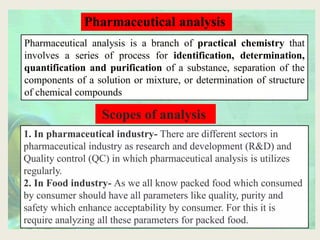
Definition
• Pharmaceutical analysis
involves
• Identification
• Determination
• Quantification
• Purification of a substance
• Separation of components of
a solution or mixture
• Determination of structure
of chemical compounds
Types
1.Qualitative –
Identification
• Detection of evolved gas
• Formation of precipitates
• Limit tests
• Colour change reactions
• Melting point
• Boiling point test etc.,
1.Qualitative
2.Quantitative
analysis
This test is performed to indicate whether the compound or
substance is present in the sample or not.
Types
2. Quantitative –
Estimation
• Non-instrumental methods
Volumetric method
• Instrumental methods
– Electrochemical measurements
– Spectroscopy methods
• Absorption
• Emission
– Chromatography
• Bio assays and microbiological
assays
1.Qualitative
2.Quantitative
analysis
This test is used to quantify the compound or substance in the sample.
Chemical reactions
• Titrations
– Acid base titrations
– Complexometric titrations
– Redox titrations
– Non aqueous titrations
– Precipitation titrations
– Nitrimetic titrations
• Gravimetric methods
• Gasometric analysis
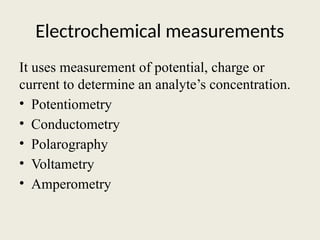
Electrochemical measurements
It uses measurement of potential, charge or
current to determine an analyte’s concentration.
• Potentiometry
• Conductometry
• Polarography
• Voltametry
• Amperometry
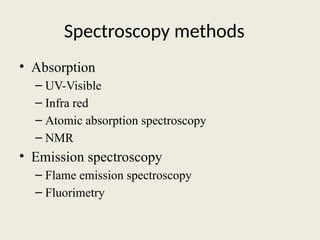
Spectroscopy methods
• Absorption
– UV-Visible
– Infra red
– Atomic absorption spectroscopy
– NMR
• Emission spectroscopy
– Flame emission spectroscopy
– Fluorimetry
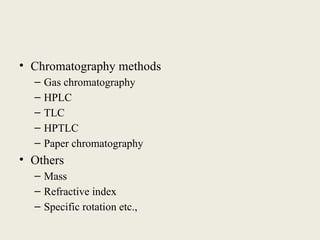
• Chromatography methods
– Gas chromatography
– HPLC
– TLC
– HPTLC
– Paper chromatography
• Others
– Mass
– Refractive index
– Specific rotation etc.,
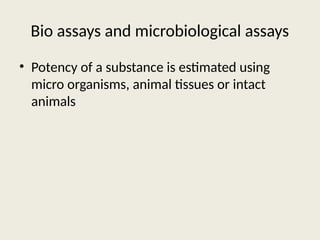
Bio assays and microbiological assays
• Potency of a substance is estimated using
micro organisms, animal tissues or intact
animals
Applications
• In pharma industry
– Quality control
– Quality assurance
– Analytical Research and development etc.,
• In geographical surveys
– To analyse soil samples
• In pollution control
– To analyse air samples, water, soil etc.,
Thank
you

BP102 T_Pharmaceutical_analysis_intro.pptx

  • 1.
  • 2.
    Introduction of Pharmaceutical Analysis •Introduction – Definition – Types of analysis – Applications
  • 5.
    Definition • Pharmaceutical analysis involves •Identification • Determination • Quantification • Purification of a substance • Separation of components of a solution or mixture • Determination of structure of chemical compounds
  • 6.
    Types 1.Qualitative – Identification • Detectionof evolved gas • Formation of precipitates • Limit tests • Colour change reactions • Melting point • Boiling point test etc., 1.Qualitative 2.Quantitative analysis This test is performed to indicate whether the compound or substance is present in the sample or not.
  • 7.
    Types 2. Quantitative – Estimation •Non-instrumental methods Volumetric method • Instrumental methods – Electrochemical measurements – Spectroscopy methods • Absorption • Emission – Chromatography • Bio assays and microbiological assays 1.Qualitative 2.Quantitative analysis This test is used to quantify the compound or substance in the sample.
  • 8.
    Chemical reactions • Titrations –Acid base titrations – Complexometric titrations – Redox titrations – Non aqueous titrations – Precipitation titrations – Nitrimetic titrations • Gravimetric methods • Gasometric analysis
  • 9.
    Electrochemical measurements It usesmeasurement of potential, charge or current to determine an analyte’s concentration. • Potentiometry • Conductometry • Polarography • Voltametry • Amperometry
  • 10.
    Spectroscopy methods • Absorption –UV-Visible – Infra red – Atomic absorption spectroscopy – NMR • Emission spectroscopy – Flame emission spectroscopy – Fluorimetry
  • 11.
    • Chromatography methods –Gas chromatography – HPLC – TLC – HPTLC – Paper chromatography • Others – Mass – Refractive index – Specific rotation etc.,
  • 12.
    Bio assays andmicrobiological assays • Potency of a substance is estimated using micro organisms, animal tissues or intact animals
  • 13.
    Applications • In pharmaindustry – Quality control – Quality assurance – Analytical Research and development etc., • In geographical surveys – To analyse soil samples • In pollution control – To analyse air samples, water, soil etc.,
  • 14.