BP STATISTICS ANALYSIS
By:
Arpit Gour
BPStatisticsAnalysis2015-16
INTRODUCTION
 Fossil fuel remains a dominant source of energy providing around 60% of growth in
energy and account for almost 85% of total energy supply in 2015.
 Gas is the fastest growing Fossil Fuel ( i.e. 1.8% annum) and its share increasing
gradually in the energy mix.
 Oil grows steadily ( 0.9% per annum) although trend decline and its share continues.
 In contrast coal suffers a sharp fall after gaining shares since 2000 the growth of coal is
projected sharply( 0.5% per annum), such that by 2035 the share of coal in the energy
mix will be at an all time low with gas replacing it as a second largest energy source.
 The share of renewable energy in energy mix is growing 3% today to approx. 9% by
2035.
BPStatisticsAnalysis2015-16
PRIMARY ENERGY
41
38
16
5
0 0
38
27
23
6
5
1
32
30
24
7
4
3
28
23
27
7
6
9
0
5
10
15
20
25
30
35
40
45
Oil Coal Gas Hydro Nuclear Renewable
Percentage
Energy
Share of Primary Energy
1965
2000
2016
2035
BPStatisticsAnalysis2015-16
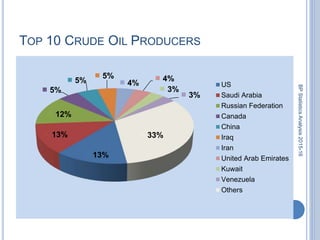
TOP 10 CRUDE OIL PRODUCERS
BPStatisticsAnalysis2015-16
13%
13%
12%
5%
5%
5%
4%
4%
3%
3%
33%
US
Saudi Arabia
Russian Federation
Canada
China
Iraq
Iran
United Arab Emirates
Kuwait
Venezuela
Others
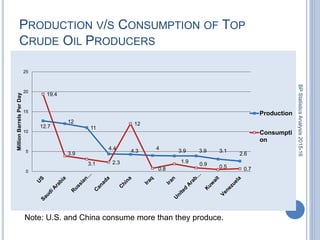
PRODUCTION V/S CONSUMPTION OF TOP
CRUDE OIL PRODUCERS
12.7
12
11
4.4 4.3
4 3.9 3.9 3.1
2.6
19.4
3.9
3.1 2.3
12
0.8
1.9 0.9 0.5 0.70
5
10
15
20
25
MillionBarrelsPerDay
Production
Consumpti
on
BPStatisticsAnalysis2015-16
Note: U.S. and China consume more than they produce.
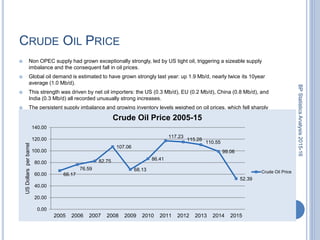
CRUDE OIL PRICE
 Non OPEC supply had grown exceptionally strongly, led by US tight oil, triggering a sizeable supply
imbalance and the consequent fall in oil prices.
 Global oil demand is estimated to have grown strongly last year: up 1.9 Mb/d, nearly twice its 10year
average (1.0 Mb/d).
 This strength was driven by net oil importers: the US (0.3 Mb/d), EU (0.2 Mb/d), China (0.8 Mb/d), and
India (0.3 Mb/d) all recorded unusually strong increases.
 The persistent supply imbalance and growing inventory levels weighed on oil prices, which fell sharply
towards the end of 2014 and into 2015.
BPStatisticsAnalysis2015-16
66.17
76.59
82.75
107.06
68.13
86.41
117.23
115.28
110.55
99.06
52.39
0.00
20.00
40.00
60.00
80.00
100.00
120.00
140.00
2005 2006 2007 2008 2009 2010 2011 2012 2013 2014 2015
USDollarsperbarrel
Crude Oil Price 2005-15
Crude Oil Price
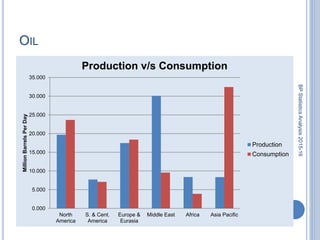
OIL
0.000
5.000
10.000
15.000
20.000
25.000
30.000
35.000
North
America
S. & Cent.
America
Europe &
Eurasia
Middle East Africa Asia Pacific
MillionBarrelsPerDay
World Oil Production
1965
1975
1985
1995
2005
2015
BPStatisticsAnalysis2015-16
• Global oil demand is estimated to have grown strongly last year: up 1.9 Mb/d, nearly twice its 10year average (1.0
Mb/d).
OIL
0.000
5.000
10.000
15.000
20.000
25.000
30.000
35.000
North
America
S. & Cent.
America
Europe &
Eurasia
Middle East Africa Asia Pacific
MillionBarrelsPerDay
Production v/s Consumption
Production
Consumption
BPStatisticsAnalysis2015-16
NATURAL GAS
 Natural gas consumption grew by 1.7 percent in 2015 to an all-time high.
 U.S. production hit an all-time record of 2101.11 billion cubic meter per day (Bcm/d).
 Russia is runner-up with 1571.58 Bcm/d.
BPStatisticsAnalysis2015-16
-
200.0
400.0
600.0
800.0
1000.0
1200.0
Total North
America
Total S. &
Cent.
America
Total Europe
& Eurasia
Total Middle
East
Total Africa Total Asia
Pacific
Billioncubicmeterperday
World Natural Gas Production
1970
1980
1990
2000
2005
2015
NATURAL GAS
-
200.0
400.0
600.0
800.0
1000.0
1200.0
North
America
S. & Cent.
America
Europe &
Eurasia
Middle East Africa Asia Pacific
Billioncubicmeter
Production v/s Consumption
Production
Consumption
BPStatisticsAnalysis2015-16
Note: The U.S. consumes approximately as much as it produces, while Russia’s 37.9 Bcf/d of consumption
enables it to export huge volumes of natural gas.
COAL
 The coal industry had perhaps its worst year ever.
 Annual consumption drop in at least half a century.
 Consumption in the U.S. was down a whopping 12.7 percent, while the world’s leading producer and
consumer of coal — China — used 1.5 percent less of it.
BPStatisticsAnalysis2015-16
-
500.0
1000.0
1500.0
2000.0
2500.0
3000.0
North America S. & Cent.
America
Europe &
Eurasia
Middle East Africa Asia Pacific
Milliontonnesoilequivalent
World Coal Production
1886
1995
2005
2015
COAL
 Global coal consumption fell by 1.8% in 2015, well below the 10-year average annual growth of 2.1%
and the largest percentage (and volumetric) decline in our data set. Coal’s share of global primary
energy consumption fell to 29.2%, the lowest share since 2005.
 The net decline in coal consumption was entirely accounted for by the US (-12.7%, the world’s largest
volumetric decline) and China (-1.5%), with more modest increases registered in India (+4.8%) and
Indonesia (+15%).
 Global coal production fell by 4%, with large declines in the US (-10.4%), Indonesia (-14.4%), and China
(-2%).
BPStatisticsAnalysis2015-16
-
500.0
1000.0
1500.0
2000.0
2500.0
3000.0
North
America
S. & Cent.
America
Europe &
Eurasia
Middle East Africa Asia Pacific
Milliontonnesoilequivalent
Production v/s Consumption
Production
Consumption
NUCLEAR ENERGY
 Nuclear power continues to slowly recover from the 2011.
 2011 and 2012, the world has now experienced three straight years of growth in nuclear power
consumption.
 Global nuclear output grew by 1.3%, with China (+28.9%). China passed South Korea to become the
fourth largest supplier of nuclear power.
 Nuclear power accounted for 4.4% of global primary energy consumption.
BPStatisticsAnalysis2015-16
-
50.0
100.0
150.0
200.0
250.0
300.0
North America S. & Cent.
America
Europe &
Eurasia
Middle East Africa Asia Pacific
Milliontonnesoilequivalent
Nuclear Energy Consumption
2010
2011
2012
2013
2014
2015
HYDROELECTRICITY
 Global hydroelectric output grew by a below average 1%. Hydroelectric output accounted for 6.8% of
global primary energy consumption.
 China recorded the largest increment of hydroelectric output growth (+5%) and remains by far the
world’s largest producer of hydroelectricity.
BPStatisticsAnalysis2015-16
-
50.0
100.0
150.0
200.0
250.0
300.0
350.0
400.0
North America S. & Cent.
America
Europe &
Eurasia
Middle East Africa Asia Pacific
Milliontonnesoilequivalent
Hydroelectricity Consumption
2010
2011
2012
2013
2014
2015
RENEWABLE ENERGY
 Renewables had a record year, with strong growth in solar power (+33 percent year-over-year) leading
the way.
 Wind power consumption grew 17 percent.
 The gains by geothermal (+5 percent), hydropower (+1 percent), and biofuels (+0.9 percent) were
modest.
Solar:
BPStatisticsAnalysis2015-16
-
5.0
10.0
15.0
20.0
25.0
30.0
North
America
S. & Cent.
America
Europe &
Eurasia
Middle East Africa Asia Pacific
Milliontonnesoilequivalent
Renewable Solar Consumption
2010
2011
2012
2013
2014
2015
RENEWABLE ENERGY
Wind:
Geothermal & Biomass:
BPStatisticsAnalysis2015-16
-
10.0
20.0
30.0
40.0
50.0
60.0
70.0
80.0
North
America
S. & Cent.
America
Europe &
Eurasia
Middle East Africa Asia Pacific
Milliontonnesoilequivalent
Renewable Wind Consumption
2010
2011
2012
2013
2014
2015
-
10.0
20.0
30.0
40.0
50.0
North
America
S. & Cent.
America
Europe &
Eurasia
Middle East Africa Asia Pacific
Milliontonnesoil
equivalent
Renewable Geothermal & Biomass
Consumption
2010
2011
2012
2013
2014
CO2 EMISSION
-
2000.0
4000.0
6000.0
8000.0
10000.0
12000.0
14000.0
16000.0
18000.0
North
America
S. & Cent.
America
Europe &
Eurasia
Middle East Africa Asia Pacific
Milliontonnescarbondioxide
Co2 Emission
1965
1975
1985
1995
2005
2015
BPStatisticsAnalysis2015-16
• Carbon dioxide emissions in 2015 were 36 million metric tons higher than in 2014.
• Carbon dioxide emissions in 2013 were 505 million tons higher than in 2012, but then 2014 and 2015 respectively
saw increases of 224 million metric tons and 36 million metric tons.
REFINERY CAPACITY
 Refinery throughout rose by 1.8 Mb/d in 2015, more than triple its 10year average growth.
 The increase in refining runs dwarfed the expansion in refining capacity (0.5 Mb/d).
BPStatisticsAnalysis2015-16
0.000
5.000
10.000
15.000
20.000
25.000
30.000
35.000
North
America
S. & Cent.
America
Europe &
Eurasia
Middle East Africa Asia Pacific
MillionBarrelsPerDay
Refinery Capacity
1965
1975
1985
1995
2005
2015
Thank You
BPStatisticsAnalysis2015-16

BP Statistics Analysis

  • 1.
    BP STATISTICS ANALYSIS By: ArpitGour BPStatisticsAnalysis2015-16
  • 2.
    INTRODUCTION  Fossil fuelremains a dominant source of energy providing around 60% of growth in energy and account for almost 85% of total energy supply in 2015.  Gas is the fastest growing Fossil Fuel ( i.e. 1.8% annum) and its share increasing gradually in the energy mix.  Oil grows steadily ( 0.9% per annum) although trend decline and its share continues.  In contrast coal suffers a sharp fall after gaining shares since 2000 the growth of coal is projected sharply( 0.5% per annum), such that by 2035 the share of coal in the energy mix will be at an all time low with gas replacing it as a second largest energy source.  The share of renewable energy in energy mix is growing 3% today to approx. 9% by 2035. BPStatisticsAnalysis2015-16
  • 3.
    PRIMARY ENERGY 41 38 16 5 0 0 38 27 23 6 5 1 32 30 24 7 4 3 28 23 27 7 6 9 0 5 10 15 20 25 30 35 40 45 OilCoal Gas Hydro Nuclear Renewable Percentage Energy Share of Primary Energy 1965 2000 2016 2035 BPStatisticsAnalysis2015-16
  • 4.
    TOP 10 CRUDEOIL PRODUCERS BPStatisticsAnalysis2015-16 13% 13% 12% 5% 5% 5% 4% 4% 3% 3% 33% US Saudi Arabia Russian Federation Canada China Iraq Iran United Arab Emirates Kuwait Venezuela Others
  • 5.
    PRODUCTION V/S CONSUMPTIONOF TOP CRUDE OIL PRODUCERS 12.7 12 11 4.4 4.3 4 3.9 3.9 3.1 2.6 19.4 3.9 3.1 2.3 12 0.8 1.9 0.9 0.5 0.70 5 10 15 20 25 MillionBarrelsPerDay Production Consumpti on BPStatisticsAnalysis2015-16 Note: U.S. and China consume more than they produce.
  • 6.
    CRUDE OIL PRICE Non OPEC supply had grown exceptionally strongly, led by US tight oil, triggering a sizeable supply imbalance and the consequent fall in oil prices.  Global oil demand is estimated to have grown strongly last year: up 1.9 Mb/d, nearly twice its 10year average (1.0 Mb/d).  This strength was driven by net oil importers: the US (0.3 Mb/d), EU (0.2 Mb/d), China (0.8 Mb/d), and India (0.3 Mb/d) all recorded unusually strong increases.  The persistent supply imbalance and growing inventory levels weighed on oil prices, which fell sharply towards the end of 2014 and into 2015. BPStatisticsAnalysis2015-16 66.17 76.59 82.75 107.06 68.13 86.41 117.23 115.28 110.55 99.06 52.39 0.00 20.00 40.00 60.00 80.00 100.00 120.00 140.00 2005 2006 2007 2008 2009 2010 2011 2012 2013 2014 2015 USDollarsperbarrel Crude Oil Price 2005-15 Crude Oil Price
  • 7.
    OIL 0.000 5.000 10.000 15.000 20.000 25.000 30.000 35.000 North America S. & Cent. America Europe& Eurasia Middle East Africa Asia Pacific MillionBarrelsPerDay World Oil Production 1965 1975 1985 1995 2005 2015 BPStatisticsAnalysis2015-16 • Global oil demand is estimated to have grown strongly last year: up 1.9 Mb/d, nearly twice its 10year average (1.0 Mb/d).
  • 8.
    OIL 0.000 5.000 10.000 15.000 20.000 25.000 30.000 35.000 North America S. & Cent. America Europe& Eurasia Middle East Africa Asia Pacific MillionBarrelsPerDay Production v/s Consumption Production Consumption BPStatisticsAnalysis2015-16
  • 9.
    NATURAL GAS  Naturalgas consumption grew by 1.7 percent in 2015 to an all-time high.  U.S. production hit an all-time record of 2101.11 billion cubic meter per day (Bcm/d).  Russia is runner-up with 1571.58 Bcm/d. BPStatisticsAnalysis2015-16 - 200.0 400.0 600.0 800.0 1000.0 1200.0 Total North America Total S. & Cent. America Total Europe & Eurasia Total Middle East Total Africa Total Asia Pacific Billioncubicmeterperday World Natural Gas Production 1970 1980 1990 2000 2005 2015
  • 10.
    NATURAL GAS - 200.0 400.0 600.0 800.0 1000.0 1200.0 North America S. &Cent. America Europe & Eurasia Middle East Africa Asia Pacific Billioncubicmeter Production v/s Consumption Production Consumption BPStatisticsAnalysis2015-16 Note: The U.S. consumes approximately as much as it produces, while Russia’s 37.9 Bcf/d of consumption enables it to export huge volumes of natural gas.
  • 11.
    COAL  The coalindustry had perhaps its worst year ever.  Annual consumption drop in at least half a century.  Consumption in the U.S. was down a whopping 12.7 percent, while the world’s leading producer and consumer of coal — China — used 1.5 percent less of it. BPStatisticsAnalysis2015-16 - 500.0 1000.0 1500.0 2000.0 2500.0 3000.0 North America S. & Cent. America Europe & Eurasia Middle East Africa Asia Pacific Milliontonnesoilequivalent World Coal Production 1886 1995 2005 2015
  • 12.
    COAL  Global coalconsumption fell by 1.8% in 2015, well below the 10-year average annual growth of 2.1% and the largest percentage (and volumetric) decline in our data set. Coal’s share of global primary energy consumption fell to 29.2%, the lowest share since 2005.  The net decline in coal consumption was entirely accounted for by the US (-12.7%, the world’s largest volumetric decline) and China (-1.5%), with more modest increases registered in India (+4.8%) and Indonesia (+15%).  Global coal production fell by 4%, with large declines in the US (-10.4%), Indonesia (-14.4%), and China (-2%). BPStatisticsAnalysis2015-16 - 500.0 1000.0 1500.0 2000.0 2500.0 3000.0 North America S. & Cent. America Europe & Eurasia Middle East Africa Asia Pacific Milliontonnesoilequivalent Production v/s Consumption Production Consumption
  • 13.
    NUCLEAR ENERGY  Nuclearpower continues to slowly recover from the 2011.  2011 and 2012, the world has now experienced three straight years of growth in nuclear power consumption.  Global nuclear output grew by 1.3%, with China (+28.9%). China passed South Korea to become the fourth largest supplier of nuclear power.  Nuclear power accounted for 4.4% of global primary energy consumption. BPStatisticsAnalysis2015-16 - 50.0 100.0 150.0 200.0 250.0 300.0 North America S. & Cent. America Europe & Eurasia Middle East Africa Asia Pacific Milliontonnesoilequivalent Nuclear Energy Consumption 2010 2011 2012 2013 2014 2015
  • 14.
    HYDROELECTRICITY  Global hydroelectricoutput grew by a below average 1%. Hydroelectric output accounted for 6.8% of global primary energy consumption.  China recorded the largest increment of hydroelectric output growth (+5%) and remains by far the world’s largest producer of hydroelectricity. BPStatisticsAnalysis2015-16 - 50.0 100.0 150.0 200.0 250.0 300.0 350.0 400.0 North America S. & Cent. America Europe & Eurasia Middle East Africa Asia Pacific Milliontonnesoilequivalent Hydroelectricity Consumption 2010 2011 2012 2013 2014 2015
  • 15.
    RENEWABLE ENERGY  Renewableshad a record year, with strong growth in solar power (+33 percent year-over-year) leading the way.  Wind power consumption grew 17 percent.  The gains by geothermal (+5 percent), hydropower (+1 percent), and biofuels (+0.9 percent) were modest. Solar: BPStatisticsAnalysis2015-16 - 5.0 10.0 15.0 20.0 25.0 30.0 North America S. & Cent. America Europe & Eurasia Middle East Africa Asia Pacific Milliontonnesoilequivalent Renewable Solar Consumption 2010 2011 2012 2013 2014 2015
  • 16.
    RENEWABLE ENERGY Wind: Geothermal &Biomass: BPStatisticsAnalysis2015-16 - 10.0 20.0 30.0 40.0 50.0 60.0 70.0 80.0 North America S. & Cent. America Europe & Eurasia Middle East Africa Asia Pacific Milliontonnesoilequivalent Renewable Wind Consumption 2010 2011 2012 2013 2014 2015 - 10.0 20.0 30.0 40.0 50.0 North America S. & Cent. America Europe & Eurasia Middle East Africa Asia Pacific Milliontonnesoil equivalent Renewable Geothermal & Biomass Consumption 2010 2011 2012 2013 2014
  • 17.
    CO2 EMISSION - 2000.0 4000.0 6000.0 8000.0 10000.0 12000.0 14000.0 16000.0 18000.0 North America S. &Cent. America Europe & Eurasia Middle East Africa Asia Pacific Milliontonnescarbondioxide Co2 Emission 1965 1975 1985 1995 2005 2015 BPStatisticsAnalysis2015-16 • Carbon dioxide emissions in 2015 were 36 million metric tons higher than in 2014. • Carbon dioxide emissions in 2013 were 505 million tons higher than in 2012, but then 2014 and 2015 respectively saw increases of 224 million metric tons and 36 million metric tons.
  • 18.
    REFINERY CAPACITY  Refinerythroughout rose by 1.8 Mb/d in 2015, more than triple its 10year average growth.  The increase in refining runs dwarfed the expansion in refining capacity (0.5 Mb/d). BPStatisticsAnalysis2015-16 0.000 5.000 10.000 15.000 20.000 25.000 30.000 35.000 North America S. & Cent. America Europe & Eurasia Middle East Africa Asia Pacific MillionBarrelsPerDay Refinery Capacity 1965 1975 1985 1995 2005 2015
  • 19.