Boundary Controls
• The boundary subsystem establishes the interface
between the would-be user of a computer system
and the computer system itself.
• Once boundary subsystem functions are complete,
the user can commence to use the resources of the
system.
• Boundary subsystem controls have one primary pu
rpose: to establish the identity and authenticity of
would-be users of a system.
• This chapter examines some of the major types of
security exercised in the boundary subsystem.
Boundary Controls
Access Controls
• An Access Control Mechanism is used in a compute
r installation for preventing unauthorized access to
and use of resources.
Boundary Controls
Functions of an Access Control Mechanism.
• An access control mechanism associates with ident
ified, authorized users the resources they are perm
itted to access and the action privileges they have
with respect to those resources.
• The mechanism processes user's requests in three
steps, identification, authentication, and authorizat
ion
Boundary Controls
Identification and Authentication
• Four classes of authentication are remembered inf
ormation, possessed information, personal charact
eristics and dialog.
• There is need to understand the weaknesses in ea
ch of the class of authentication.
• Passwords, possessed objects, and personal charac
teristics all have a further weakness that the authe
ntication information is reduced to a bit stream wh
ich can be wiretapped.
Boundary Controls
Object Resources
• In a generalized access control mechanism, all reso
urces must be named since the mechanism must c
ouple users with resources they are permitted to u
se.
• It is important that the access control mechanism h
ave a means of identifying the authenticity of the o
bject resources it provides to a user .e.g assigning
object resources a unique identity that can not be
copied.
Boundary Controls
Action Privileges
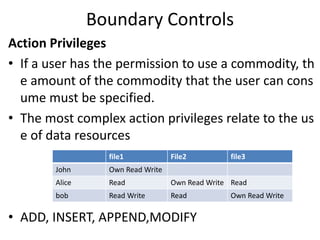
• If a user has the permission to use a commodity, th
e amount of the commodity that the user can cons
ume must be specified.
• The most complex action privileges relate to the us
e of data resources
• ADD, INSERT, APPEND,MODIFY
file1 File2 file3
John Own Read Write
Alice Read Own Read Write Read
bob Read Write Read Own Read Write
Boundary Controls
Action privileges
• Data independent – all the contents of a file ar
e subject to the action privilege assigned to th
e file
• Data dependent – can apply to data items wit
hin a file e.g salary < 15000
Boundary Controls
• One of the important restrictions on action privileg
es is a temporal restriction e.g no access to the ter
minal after working hours.
Implementing an Access Control Mechanism
• Full implementation of an ACM can be costly. In pr
actise, some trade offs must be made; overall contr
ol must be decreased to reduce costs and improve
performance.
• The tradeoffs made in the ACM must be reasonabl
e, given the overall control requirements of the ins
tallation
Boundary Controls
Problems in Implementing ACM
(1)Open Vs Closed Environment
• While an open environment allows for an easier im
plementation of an ACM, only in a closed environm
ent can effective control be exercised over users.
(2)Approaches to Authorization
• They are two approaches to implementing the aut
horization module in an access control mechanism:
Boundary Controls
• A ticket oriented approach?
• A list oriented approach?
(3)Dynamics of Authorization
• Some difficult implementation problems arise in th
e area of authorization dynamics.
Boundary Controls
Cryptographic Controls
• Cryptology is the science of secret codes
• Cryptography deals with systems for translating dat
a into codes that are meaningless to anyone who d
oes not possess the system for recovering the initia
l data.
• Cryptanalysis are the techniques for recovering enc
rypted data
• Cipher is an algorithm for performing encryption o
r decryption
Boundary Controls
Cryptographic Techniques
They are three classes of techniques for enciphering
plaintext:
• Substitution ciphers
• Transposition ciphers.
• Product ciphers
Boundary Controls
Choosing a Cipher System
• A cipher system has two components: algorithm an
d the key
• Five desirable properties of a cipher system:
• High Work Factor
• Small key
• Simplicity
• Low error propagation
• Little expansion of message size.
Boundary Controls
Public Key Cryptosystems
• Ensuring the secure distribution of a private key to
parties who need the key is a difficult task.
• The widely known public key cryptosystem is the R
SA scheme.
• The disadvantage of public key cryptosystems is th
at they are slow relative to the processing time req
uired for private-key cryptosystems.
Boundary Controls
Key Distribution
• Maintaining the secrecy of the cryptographic key is
of paramount importance.
• The method chosen to distribute a key must be reli
able; and maintain the secrecy of the keys thus mai
ntaining overall secrecy of the cryptosystem.
• Reminder: assignment diffie-hellman key exchange
protocol
Boundary Controls
Explain Diffie-Hellman key exchange, El-gamal a
nd RSA Algorithms.
Boundary Controls
Digital Signatures
• Establishing the authenticity of individuals and pre
venting the disavowal of messages and or contract
s are still critical requirements when data is exchan
ged in electronic form.
• A digital signature is simply a string of 0s and 1s rat
her than a line drawn on a page.
• Public key cryptosystems can be used to establish:
secret messages
signed messages
signed, secret messages.
Boundary Controls
Secret Message
• S Pur(m)
• R Prr[Pur(m)]
Signed Secret Message
• S Pur(m)
• S Prs[Pur(m)]
• R Pus (Prs[Pur(m)])
• R Prr[Pur(m)]

boundary_security.pptx

  • 1.
    Boundary Controls • Theboundary subsystem establishes the interface between the would-be user of a computer system and the computer system itself. • Once boundary subsystem functions are complete, the user can commence to use the resources of the system. • Boundary subsystem controls have one primary pu rpose: to establish the identity and authenticity of would-be users of a system. • This chapter examines some of the major types of security exercised in the boundary subsystem.
  • 2.
    Boundary Controls Access Controls •An Access Control Mechanism is used in a compute r installation for preventing unauthorized access to and use of resources.
  • 3.
    Boundary Controls Functions ofan Access Control Mechanism. • An access control mechanism associates with ident ified, authorized users the resources they are perm itted to access and the action privileges they have with respect to those resources. • The mechanism processes user's requests in three steps, identification, authentication, and authorizat ion
  • 4.
    Boundary Controls Identification andAuthentication • Four classes of authentication are remembered inf ormation, possessed information, personal charact eristics and dialog. • There is need to understand the weaknesses in ea ch of the class of authentication. • Passwords, possessed objects, and personal charac teristics all have a further weakness that the authe ntication information is reduced to a bit stream wh ich can be wiretapped.
  • 5.
    Boundary Controls Object Resources •In a generalized access control mechanism, all reso urces must be named since the mechanism must c ouple users with resources they are permitted to u se. • It is important that the access control mechanism h ave a means of identifying the authenticity of the o bject resources it provides to a user .e.g assigning object resources a unique identity that can not be copied.
  • 6.
    Boundary Controls Action Privileges •If a user has the permission to use a commodity, th e amount of the commodity that the user can cons ume must be specified. • The most complex action privileges relate to the us e of data resources • ADD, INSERT, APPEND,MODIFY file1 File2 file3 John Own Read Write Alice Read Own Read Write Read bob Read Write Read Own Read Write
  • 7.
    Boundary Controls Action privileges •Data independent – all the contents of a file ar e subject to the action privilege assigned to th e file • Data dependent – can apply to data items wit hin a file e.g salary < 15000
  • 8.
    Boundary Controls • Oneof the important restrictions on action privileg es is a temporal restriction e.g no access to the ter minal after working hours. Implementing an Access Control Mechanism • Full implementation of an ACM can be costly. In pr actise, some trade offs must be made; overall contr ol must be decreased to reduce costs and improve performance. • The tradeoffs made in the ACM must be reasonabl e, given the overall control requirements of the ins tallation
  • 9.
    Boundary Controls Problems inImplementing ACM (1)Open Vs Closed Environment • While an open environment allows for an easier im plementation of an ACM, only in a closed environm ent can effective control be exercised over users. (2)Approaches to Authorization • They are two approaches to implementing the aut horization module in an access control mechanism:
  • 10.
    Boundary Controls • Aticket oriented approach? • A list oriented approach? (3)Dynamics of Authorization • Some difficult implementation problems arise in th e area of authorization dynamics.
  • 11.
    Boundary Controls Cryptographic Controls •Cryptology is the science of secret codes • Cryptography deals with systems for translating dat a into codes that are meaningless to anyone who d oes not possess the system for recovering the initia l data. • Cryptanalysis are the techniques for recovering enc rypted data • Cipher is an algorithm for performing encryption o r decryption
  • 12.
    Boundary Controls Cryptographic Techniques Theyare three classes of techniques for enciphering plaintext: • Substitution ciphers • Transposition ciphers. • Product ciphers
  • 13.
    Boundary Controls Choosing aCipher System • A cipher system has two components: algorithm an d the key • Five desirable properties of a cipher system: • High Work Factor • Small key • Simplicity • Low error propagation • Little expansion of message size.
  • 14.
    Boundary Controls Public KeyCryptosystems • Ensuring the secure distribution of a private key to parties who need the key is a difficult task. • The widely known public key cryptosystem is the R SA scheme. • The disadvantage of public key cryptosystems is th at they are slow relative to the processing time req uired for private-key cryptosystems.
  • 15.
    Boundary Controls Key Distribution •Maintaining the secrecy of the cryptographic key is of paramount importance. • The method chosen to distribute a key must be reli able; and maintain the secrecy of the keys thus mai ntaining overall secrecy of the cryptosystem. • Reminder: assignment diffie-hellman key exchange protocol
  • 16.
    Boundary Controls Explain Diffie-Hellmankey exchange, El-gamal a nd RSA Algorithms.
  • 17.
    Boundary Controls Digital Signatures •Establishing the authenticity of individuals and pre venting the disavowal of messages and or contract s are still critical requirements when data is exchan ged in electronic form. • A digital signature is simply a string of 0s and 1s rat her than a line drawn on a page. • Public key cryptosystems can be used to establish: secret messages signed messages signed, secret messages.
  • 18.
    Boundary Controls Secret Message •S Pur(m) • R Prr[Pur(m)] Signed Secret Message • S Pur(m) • S Prs[Pur(m)] • R Pus (Prs[Pur(m)]) • R Prr[Pur(m)]