Boundary Value Analysis and
Equivalence Class Partitioning
Testing
Practically, due to time and budget considerations, it is not possible to
perform exhausting testing for each set of test data, especially when
there is a large pool of input combinations.
• We need an easy way or special techniques that can select test cases
intelligently from the pool of test-case, such that all test scenarios are
covered.
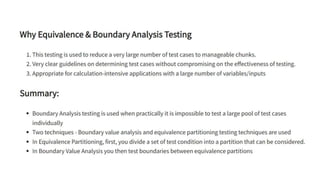
• We use two techniques – Equivalence Partitioning & Boundary Value
Analysis testing techniques to achieve this.
Why need BVA and ECP
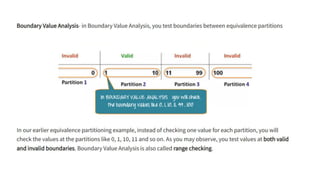
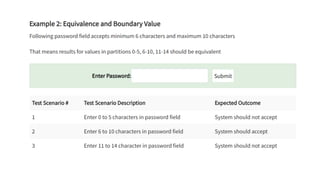
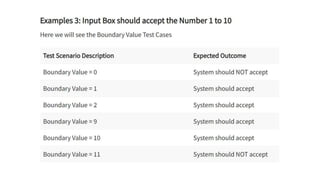
What is Boundary Testing?
• Boundary testing is the process of testing between extreme ends or
boundaries between partitions of the input values.
• So these extreme ends like Start- End, Lower- Upper, Maximum-Minimum,
Just Inside-Just Outside values are called boundary values and the testing is
called “boundary testing”.
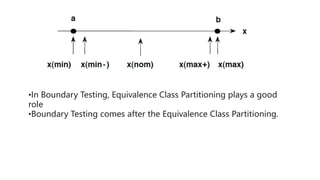
• The basic idea in normal boundary value testing is to select input variable
values at their:
• Minimum
• Just above the minimum
• A nominal value
• Just below the maximum
• Maximum
•In Boundary Testing, Equivalence Class Partitioning plays a good
role
•Boundary Testing comes after the Equivalence Class Partitioning.
Equivalence Partitioning
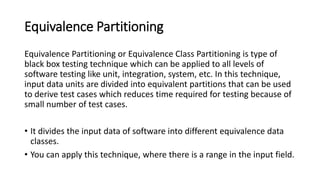
Equivalence Partitioning or Equivalence Class Partitioning is type of
black box testing technique which can be applied to all levels of
software testing like unit, integration, system, etc. In this technique,
input data units are divided into equivalent partitions that can be used
to derive test cases which reduces time required for testing because of
small number of test cases.
• It divides the input data of software into different equivalence data
classes.
• You can apply this technique, where there is a range in the input field.
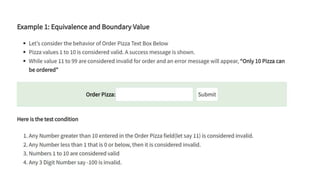
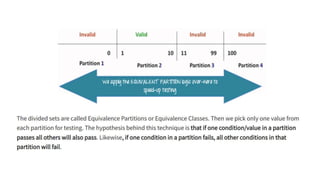
We cannot test all the possible values because if done, the number of
test cases will be more than 100. To address this problem, we use
equivalence partitioning hypothesis where we divide the possible
values of tickets into groups or sets as shown below where the system
behavior can be considered the same.
Boundary Value Analysis and Equivalence class Partitioning Testing.pptx

Boundary Value Analysis and Equivalence class Partitioning Testing.pptx

  • 1.
    Boundary Value Analysisand Equivalence Class Partitioning Testing
  • 2.
    Practically, due totime and budget considerations, it is not possible to perform exhausting testing for each set of test data, especially when there is a large pool of input combinations. • We need an easy way or special techniques that can select test cases intelligently from the pool of test-case, such that all test scenarios are covered. • We use two techniques – Equivalence Partitioning & Boundary Value Analysis testing techniques to achieve this. Why need BVA and ECP
  • 3.
    What is BoundaryTesting? • Boundary testing is the process of testing between extreme ends or boundaries between partitions of the input values. • So these extreme ends like Start- End, Lower- Upper, Maximum-Minimum, Just Inside-Just Outside values are called boundary values and the testing is called “boundary testing”. • The basic idea in normal boundary value testing is to select input variable values at their: • Minimum • Just above the minimum • A nominal value • Just below the maximum • Maximum
  • 4.
    •In Boundary Testing,Equivalence Class Partitioning plays a good role •Boundary Testing comes after the Equivalence Class Partitioning.
  • 5.
    Equivalence Partitioning Equivalence Partitioningor Equivalence Class Partitioning is type of black box testing technique which can be applied to all levels of software testing like unit, integration, system, etc. In this technique, input data units are divided into equivalent partitions that can be used to derive test cases which reduces time required for testing because of small number of test cases. • It divides the input data of software into different equivalence data classes. • You can apply this technique, where there is a range in the input field.
  • 7.
    We cannot testall the possible values because if done, the number of test cases will be more than 100. To address this problem, we use equivalence partitioning hypothesis where we divide the possible values of tickets into groups or sets as shown below where the system behavior can be considered the same.