








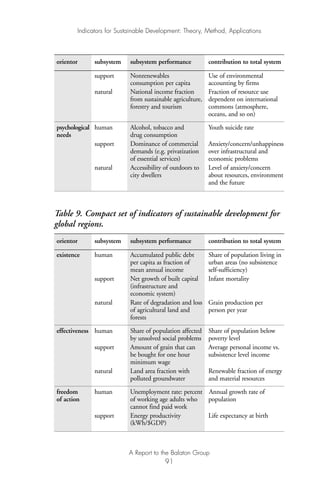
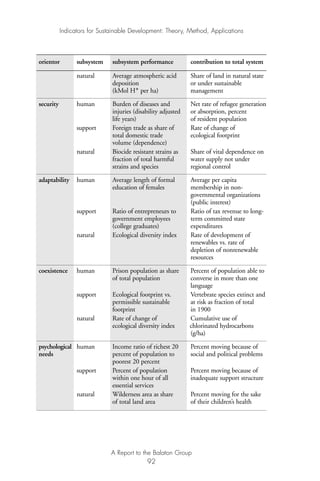
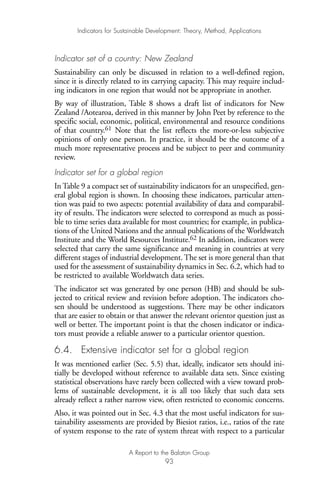
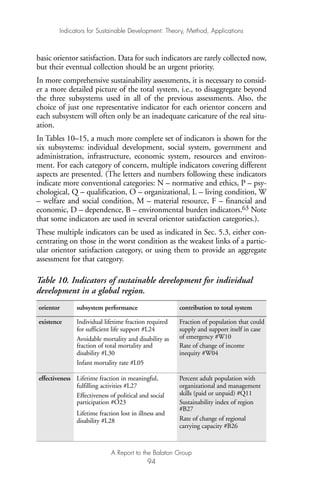
Indicators for Sustainable
Development:
Theory, Method, Applications
IISD
INTERNATIONAL INSTITUTE FOR
SUSTAINABLE DEVELOPMENT
INSTITUT INTERNATIONAL DU
DÉVELOPPEMENT DURABLE
A Report to the Balaton Group
IndicatorsforSustainableDevelopment:Theory,Method,ApplicationsIISD
Hartmut Bossel
Ind for SD - Balaton cover 12/21/98 3:37 PM Page 1
Indicators for Sustainable
Development:
Theory, Method,
Applications
A Report to the Balaton Group
Hartmut Bossel
IISD
INTERNATIONAL INSTITUTE FOR
SUSTAINABLE DEVELOPMENT
INSTITUT INTERNATIONAL DU
DÉVELOPPEMENT DURABLE
Ind for SD - Balaton 12/21/98 4:19 PM Page i
The International Institute for Sustainable Development (IISD) is an
independent, not-for-profit corporation headquartered in Winnipeg,
Canada, established and supported by the governments of Canada
and Manitoba. Its mandate is to promote sustainable development in
decision-making in Canada and around the world.
Copyright © Hartmut Bossel 1999
Published by the International Institute for Sustainable Development
All rights reserved
Printed in Canada
Copies are available for purchase from IISD.
Copies may also be ordered through IISD's online order form at
http://iisd.ca/about/prodcat/ordering.htm
ISBN 1-895536-13-8
This publication is printed on recycled paper.
International Institute for Sustainable Development
161 Portage Avenue East, 6th Floor
Winnipeg, Manitoba
Canada
R3B 0Y4
Tel: (204) 958-7700
Fax: (204) 958-7710
E-mail: info@iisd.ca
Internet: http://iisd.ca
Indictors for sustainable development: Theory, method, applications
is a work in progress. Constructive criticism, suggestions for
improvement and feedback about applications and experience are
welcome.
Please contact:
Hartmut Bossel, Professor Emeritus, Sustainable Systems Research
Galgenkoeppel 6 B, D 34289 Zierenberg, Germany
E-mail: H.Bossel@T-online.de
Indictors for sustainable development: Theory, method, applications
was produced with the aid of a grant from RIVM (the National
Institute of Public Health and the Environment in Bilthoven, the
Netherlands), and the Center for Environmental Systems Research,
University of Kassel, Germany. IISD provided support through
proofing, editing and coordinating the print production of this
publication.
Indicators for Sustainable Development: Theory, Method, Applications
A Report to the Balaton Group
ii
Ind for SD - Balaton 12/21/98 4:19 PM Page ii
Table of Contents
List of Tables viii
Figure Captions ix
Background and overview xi
1. What is sustainable development? Concepts and constraints 1
1.1. Sustainability of human society 1
Sustainability in an evolving world can only mean 1
sustainable development
Different concepts of sustainable development 2
1.2. Sustainable development is constrained by what is accessible 3
Constraints of physical conditions and laws of nature: 4
not everything is possible
Constraints of human nature and human goals: 5
not everything is desirable
Constraints of time: dynamics and evolution determine 6
pace and direction
1.3. Sustainable development requires systems information 6
Indicators provide comprehensive information about 7
the systems shaping sustainable development
2. How to recognize sustainable development? 8
Looking for indicators
2.1. The difficulty: so many systems and variables to watch 8
Recognizing patterns: understanding from a few indicators 8
Indicators summarize complex information of value 9
to the observer
Being fully informed means watching relevant indicators 9
for all vital aspects of a development
Two types of indicators: for the viability of a system and for 10
its contribution to the performance of another system
2.2. A critique of popular indicators of development: missing 11
vital information
Keep it simple: pitfalls of watching a single indicator 11
A single indicator like GDP cannot capture all vital aspects 12
of sustainable development
Aggregate indexes are an improvement, but aggregation 12
can conceal serious deficits
Indicators for Sustainable Development: Theory, Method, Applications
A Report to the Balaton Group
iii
Ind for SD - Balaton 12/21/98 4:19 PM Page iii
Measuring sustainability: ecological footprint 13
and barometer of sustainability
Ad hoc or trial-and-error selection of indicators 13
is inadequate
Pressure–state–response frameworks fail to account 13
for system relationships and dynamics
A systems approach is required to structure the search 14
for indicators
2.3. Sustainable development is coevolution of human 17
and natural systems
In a systems view of sustainable development six 17
essential subsystems can be distinguished
The six subsystems correspond to potentials that 18
must be sustainably maintained
The six subsystems can be aggregated to three subsystems: 19
human system, support system, natural system
3. What does sustainability of a system imply? 20
Orientors of viability
3.1. Using systems theory to identify the vital aspects of 20
sustainable development and relevant indicators
The task: defining a framework and a process for 20
finding a set of indicators
Essential system concepts 20
Hierarchy and subsidiarity facilitate efficient operation 21
Subsystems contribute to the viability of the total system 22
Essential information about system viability and 23
performance is contained in (1) the states (stocks)
and (2) the rates of change (flows) of a system
Viability is determined both by the system 24
and its environment
3.2. Fundamental properties of system environments 25
General properties of system environments must be 25
reflected in fundamental orientations of systems
System environments are characterized by six 27
fundamental environmental properties
Each of the environmental properties is unique 28
Indicators for Sustainable Development: Theory, Method, Applications
A Report to the Balaton Group
iv
Ind for SD - Balaton 12/21/98 4:19 PM Page iv
3.3. Fundamental orientations of systems: basic orientors 29
Environmental and system properties cause 29
distinct orientations in systems
Basic orientors represent basic system interests 30
Orientors as normative guidelines; finding indicators 32
of orientor satisfaction
Basic orientors are unique: one orientor cannot 32
substitute for another
The basic orientor currently ‘in the minimum’ is the 33
limiting factor of system development
3.4. Other evidence of basic orientors and their role 34
Evidence of basic orientors is found in many 34
fields of science
4. What indicators to select? Unavoidable choice 39
4.1. The general scheme: basic orientors provide a checklist 39
Illustrative examples 39
Application to sustainable development 39
4.2. Indicators for dynamic systems in a dynamic environment 41
Rates of change, intrinsic dynamics and system pace 41
depend on system structure
Delays, early warning and the role of models 42
4.3. Is there enough time for corrections? 43
Defining Biesiot indicators
Response time and respite time 43
Biesiot indicators for threats to basic orientors 44
Quantification with Biesiot indicators and visualization 45
of the state of viability
4.4. The cyclical nature of system evolution and indicators 46
of sustainability
Growth and decay in real systems 46
Indicator emphasis changes during the 47
development cycle
The need for flexibility and periodic revision of 47
indicator sets
Indicators for Sustainable Development: Theory, Method, Applications
A Report to the Balaton Group
v
Ind for SD - Balaton 12/21/98 4:19 PM Page v
4.5. The horizon of attention 48
Essential systems and multidimensional viability: 48
the need for many indicators
Looking for the weakest links 48
Comparable results of sustainability assessments 49
despite subjective choice
The horizon of attention defines indicator selection 50
Indicator selection can be independent of ideology 51
4.6. The horizon of responsibility 52
The decision for sustainable development defines 52
a horizon of responsibility
Ethical choice is unavoidable 53
4.7. Arguments for a wide horizon of responsibility 54
Different ethical principles have different consequences 54
for sustainability
Protecting evolutionary potential by a wide horizon 54
of responsibility
Using the Principle of Partnership to guide 55
indicator selection
Relationship between ethics and the systems view 55
5. Defining indicator sets: procedure 57
5.1. The procedure: a summary 57
5.2. Conceptual understanding of the total system 57
5.3. Identifying representative indicators 59
Recursive scheme for finding indicators of viability 59
Reducing the number of indicators to a manageable set 60
Adding detail: orientor hierarchies 61
Systematic approach to asking the relevant questions 62
Other criteria for indicators of sustainable development 62
5.4. Quantifying basic orientor satisfaction 63
Viability assessment may not have to be quantitative 63
Quantitative sustainability assessment 63
5.5. Participative process of indicator selection 64
Role of scientific method 64
Role of experts and the need for a participative process 65
The Seattle process 66
Indicators for Sustainable Development: Theory, Method, Applications
A Report to the Balaton Group
vi
Ind for SD - Balaton 12/21/98 4:19 PM Page vi
6. Defining and using indicator sets: examples 69
6.1. Sample applications: overview 69
6.2. Assessment of global sustainability dynamics 69
Objectives 69
Method and database 70
Formalizing the sustainability assessment process 71
Indicator selection and orientor satisfaction assessment 72
Indicators and assessment functions for the human system 75
Indicators and assessment functions for the support system 76
Indicators and assessment functions for the natural system 78
Dynamics of orientor satisfaction 1950 to 2000 81
Discussion and conclusions 84
6.3. Compact indicator sets 84
Indicator set for a city: Seattle 85
Indicator set for a state: Upper Austria 87
Indicator set of a country: New Zealand 93
Indicator set for a global region 93
6.4. Extensive indicator set for a global region 93
7. Summary, conclusions, outlook 107
Notes 111
References 118
Indicators for Sustainable Development: Theory, Method, Applications
A Report to the Balaton Group
vii
Ind for SD - Balaton 12/21/98 4:19 PM Page vii
List of Tables
Table 1. Basic orientors reflected in psychological and social 36
needs, lifestyles, social systems, and ecosystems.
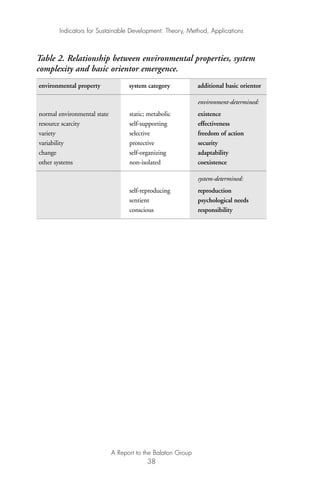
Table 2. Relationship between environmental properties, 38
system complexity, and basic orientor emergence.
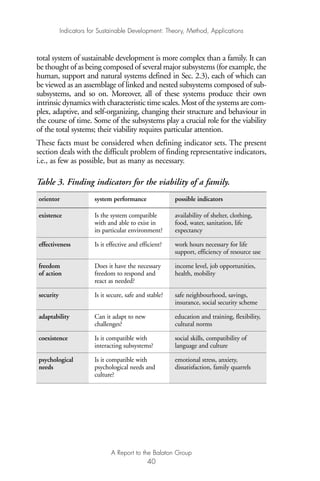
Table 3. Finding indicators for the viability of a family. 40
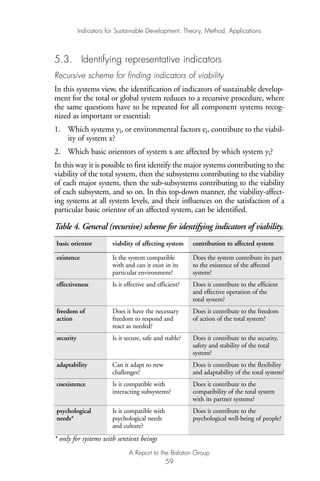
Table 4. General (recursive) scheme for identifying indicators 59
of viability.
Table 5. Indicator set using Worldwatch database (January 1998). 72
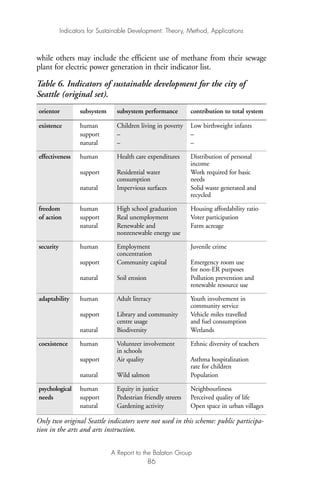
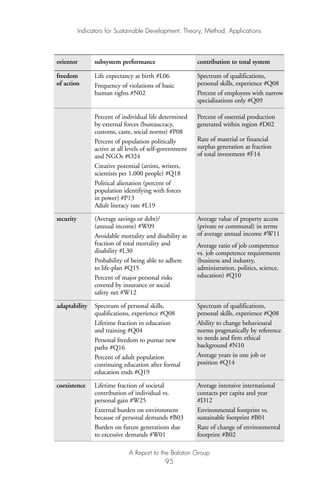
Table 6. Indicators of sustainable development for the city of 86
Seattle (original set).
Table 7. Compact set of indicators of sustainable development 88
for the state of Upper Austria.
Table 8. Compact set of indicators of sustainable development 90
for New Zealand.
Table 9. Compact set of indicators of sustainable development 91
for global regions.
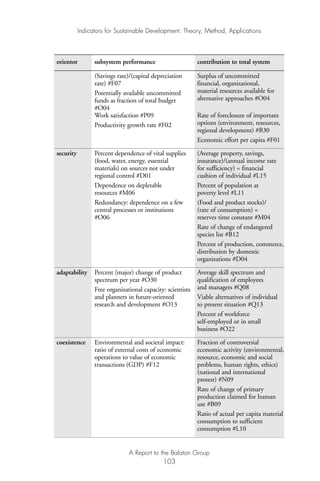
Table 10. Indicators of sustainable development for individual 94
development in a global region.
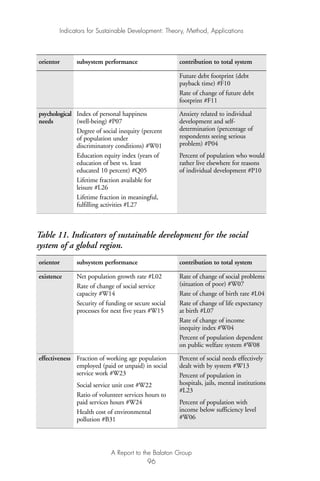
Table 11. Indicators of sustainable development for the social 96
system of a global region.
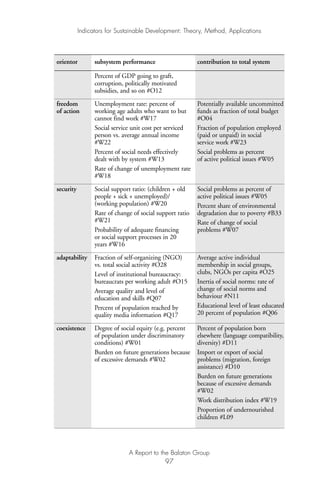
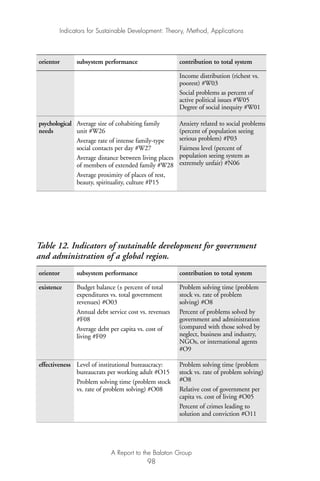
Table 12. Indicators of sustainable development for government 98
and administration of a global region.
Table 13. Indicators of sustainable development for the 100
infrastructure system of a global region.
Table 14. Indicators of sustainable development for the economic 102
system of a global region.
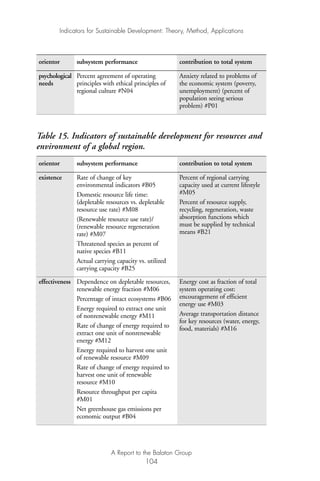
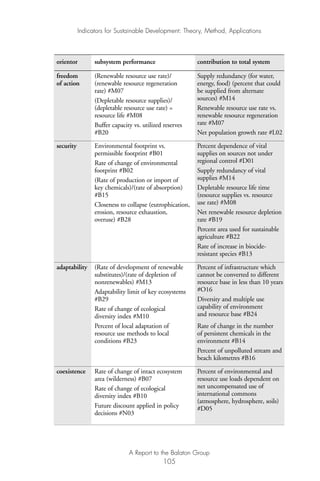
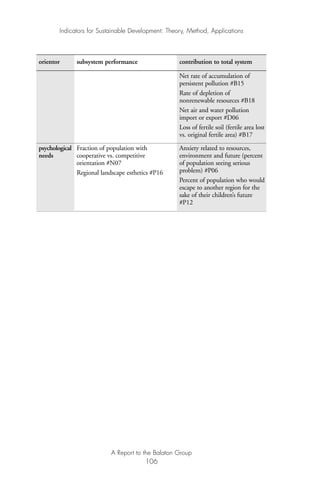
Table 15. Indicators of sustainable development for resources 104
and environment of a global region.
Indicators for Sustainable Development: Theory, Method, Applications
A Report to the Balaton Group
viii
Ind for SD - Balaton 12/21/98 4:19 PM Page viii
Figure Captions
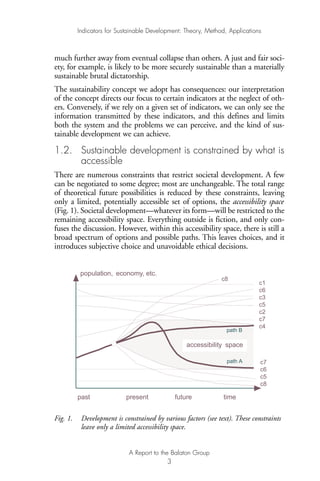
Fig. 1. Development is constrained by various factors (see text). 3
These constraints leave only a limited accessibility space.
Fig. 2. In systems that depend on subsystems, viability has two 11
separate aspects: (1) viability of the subsystem, and (2) the
subsystem’s contribution to the performance of the system.
This is a recursive relationship: subsystems may depend on
sub-subsystems, and so on.
Fig. 3. The six major systems of the anthroposphere and their 18
majorrelationships. These six sector systems can be
aggregated to the three subsystems: human system,
support system and natural system.
Fig. 4. A system interacts with its system environment through 20
system inputs and outputs.
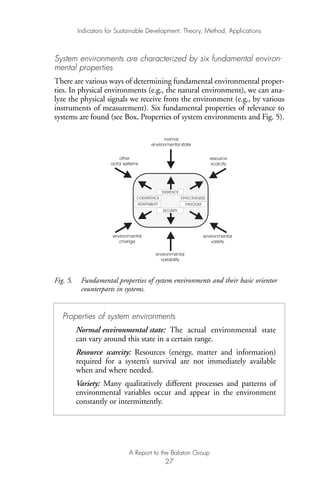
Fig. 5. Fundamental properties of system environments and their 27
basic orientor counterparts in systems.
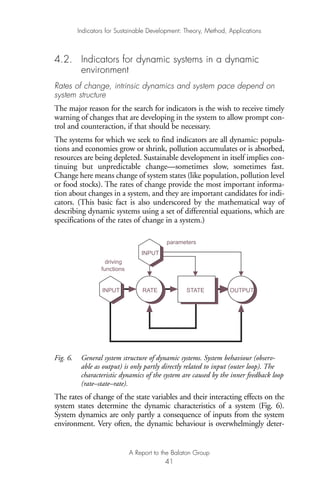
Fig. 6. General system structure of dynamic systems. System 41
behaviour (observable as output) is only partly directly
related to input (outer loop). The characteristic dynamics
of the system are caused by the inner feedback loop
(rate–state–rate).
Fig. 7. Orientor star using Biesiot indicators: the system is not 45
viable if any of the orientor satisfactions, expressed by the
ratio of rate of response to rate of threat, has a value of
less than one, i.e., is inside the unit circle.
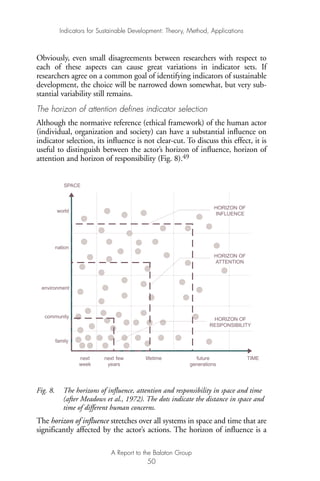
Fig. 8. The horizons of influence, attention and responsibility in 50
space and time (after Meadows et al., 1972). The dots
indicate the distance in space and time of different human
concerns.
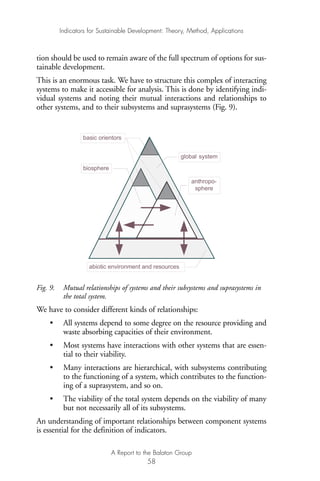
Fig. 9. Mutual relationships of systems and their subsystems and 58
suprasystems in the total system.
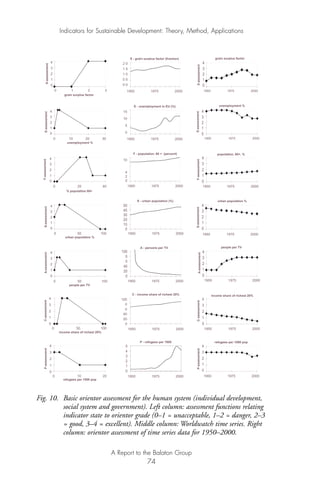
Fig. 10. Basic orientor assessment for the human system (individual 74
development, social system and government). Left column:
assessment functions relating indicator state to orientor
grade (0–1 = unacceptable, 1–2 = danger, 2–3 = good,
3–4 = excellent). Middle column: Worldwatch time series.
Right column: orientor assessment of time series data for
1950–2000.
Indicators for Sustainable Development: Theory, Method, Applications
A Report to the Balaton Group
ix
Ind for SD - Balaton 12/21/98 4:19 PM Page ix
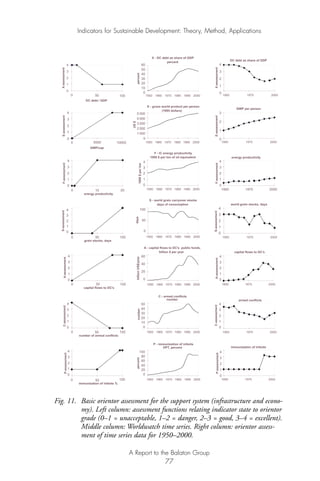
Fig. 11. Basic orientor assessment for the support system 77
(infrastructure and economy). Left column: assessment
functions relating indicator state to orientor grade
(0–1 = unacceptable, 1–2 = danger, 2–3 = good,
3–4 = excellent). Middle column: Worldwatch time series.
Right column: orientor assessment of time series data for
1950–2000.
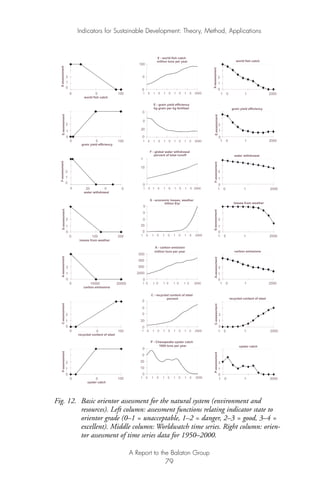
Fig. 12. Basic orientor assessment for the natural system 79
(environment and resources). Left column: assessment
functions relating indicator state to orientor grade
(0–1 = unacceptable, 1–2 = danger, 2–3 = good,
3–4 = excellent). Middle column: Worldwatch time series.
Right column: orientor assessment of time series data for
1950–2000.
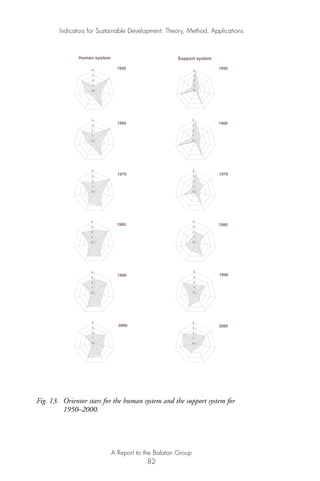
Fig. 13. Orientor stars for the human system and the support 82
system for 1950–2000.
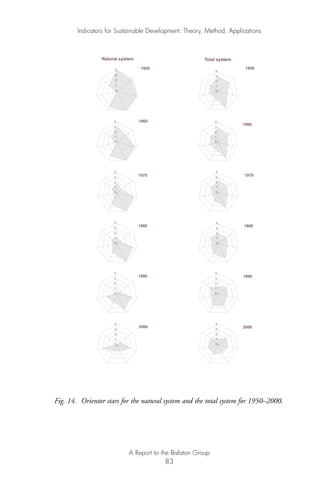
Fig. 14. Orientor stars for the natural system and the total system 83
for 1950–2000.
Indicators for Sustainable Development: Theory, Method, Applications
A Report to the Balaton Group
x
Ind for SD - Balaton 12/21/98 4:19 PM Page x
Background and overview
Sustainable development has become a widely recognized goal for human
society ever since deteriorating environmental conditions in many parts of
the world indicate that its sustainability may be at stake. But how do we
know for sure? And how can we tell when we are on a path of sustainable
development? We need appropriate indicators.
Finding an appropriate set of indicators of sustainable development for a
community, a city, a region, a country or even the world is not an easy task.
It requires knowledge of what is important for the viability of the systems
involved, and how that contributes to sustainable development. The num-
ber of representative indicators should be as small as possible, but as large
as essential.
Many members of the Balaton Group have been concerned with this prob-
lem for a long time, in many different countries and in many different pro-
jects. To pool and coordinate this accumulated experience, the first formal
workshop on Indicators of Sustainable Development was initiated by
Donella Meadows and organized at the National Institute of Public Health
and the Environment (RIVM) in Bilthoven, the Netherlands in April
1996. Several smaller follow-up workshops were held to deal in particular
with systems theoretical aspects, notably in September 1996 and 1997, and
December 1997, supplemented by extensive e-mail exchanges. Some
Balaton members pursued the subject continuously on their own and in
international collaboration.
Results of this work are reported in a Report to the Balaton Group (Donella
Meadows: Indicators and Information Systems for Sustainable
Development. Sustainability Institute, P.O. Box 174, Hartland Four
Corners, VT 05049, USA) and in the present companion report, which
concentrates on development and application of a systems theoretical
framework for defining indicator sets for sustainable development.
In Chapter 1, What is sustainable development? Concepts and constraints,
I define sustainable development in a holistic systems sense and point to the
various constraints that restrict possible development paths to accessibility
space.
In Chapter 2, How to recognize sustainable development? Looking for
indicators, I look at the reasons for having relevant indicators, review exist-
ing approaches for defining indicator sets, and identify major systems of
societal development for which indicators are required.
In Chapter 3, What does sustainability of a system imply? Orientors of via-
bility, I concentrate on identifying essential interests or basic orientors of
Indicators for Sustainable Development: Theory, Method, Applications
A Report to the Balaton Group
xi
Ind for SD - Balaton 12/21/98 4:19 PM Page xi
systems that have to be fulfilled to some minimum degree to insure a sys-
tem’s viability and sustainable development.
In Chapter 4, What indicators to select? Unavoidable choice, I argue that
indicators must be selected to reflect the state of satisfaction of the basic ori-
entors. Moreover, the choice of indicators must reflect important charac-
teristics of dynamic systems as well as ethical concerns.
In Chapter 5, Defining indicator sets: Procedure, I outline the practical
steps for developing a comprehensive set of indicators of sustainable devel-
opment, and for assessing viability and sustainability.
In Chapter 6, Defining and using indicator sets: Examples, I apply the
approach at the level of community, state, country, region and global devel-
opment. Using Worldwatch data series, a set of indicators is defined and
used for computer-assisted assessment of global sustainability dynamics
from 1950 to 2000.
Substantial inputs to the present report have come in particular from
Wouter Biesiot and the participants of the smaller workshops: Alan
AtKisson, Joan Davis, Donella Meadows, Jørgen Nørgård, John Peet,
Katherine Peet, Laszlo Pinter, Aromar Revi and Bert de Vries. Especially
helpful have been extensive written comments by Donella Meadows, John
and Katherine Peet, Karl-Friedrich Müller-Reissmann and Bernd
Hornung. Although I have tried to incorporate all ideas and suggestions, it
has not always been possible to include them in a cohesive framework. The
report reflects very much my own way of fitting pieces together. It is a
report on work in progress, and constructive criticism, suggestions for
improvement, and feedback about applications and experience are wel-
come.
Indicators for Sustainable Development: Theory, Method, Applications
A Report to the Balaton Group
xii
Ind for SD - Balaton 12/21/98 4:19 PM Page xii
1. What is sustainable development?
Concepts and constraints
1.1. Sustainability of human society
There is only one alternative to sustainability: unsustainability. But sus-
tainability involves a time dimension: unsustainability now rarely implies
an immediate existential threat. Existence is threatened only in the distant
future, perhaps too far away to be properly recognized. Even if threats are
understood, they may not cause much concern now: there still seems to be
enough time for them to disappear, or for finding solutions.
In the past, the sustainability of human society was not really at stake: the
glacial change of its environment left plenty of time for adaptive response
and evasion.
Threats to sustainability of a system require urgent attention if their rate of
change begins to approach the speed with which the system can adequate-
ly respond. As the rate of change overwhelms this ability to respond, the
system loses its viability and sustainability. The sustainability of humankind
is now threatened by both of these factors: the dynamics of its technology,
economy and population accelerate the environmental and social rates of
change, while growing structural inertia reduces the ability to respond in
time. Response time lengthens while respite time—the time available for
adequate response—shortens:1 the sustainability of human society becomes
an urgent concern.
Sustainability in an evolving world can only mean sustainable
development
In previous times, sustainability of humankind was taken for granted and
did not appear as an explicit goal. It certainly was an implicit goal: no
human society has ever consciously promoted its own unsustainability.
Global developments now focus attention on sustainability as an explicit goal.
But the concept has to be translated into the practical dimensions of the real
world to make it operational. We must be able to recognize the presence or
absence of sustainability, or of threats to sustainability, in the systems under
our stewardship. We need proper indicators to provide this information, to
tell us where we stand with respect to the goal of sustainability.
To sustain means “to maintain; keep in existence; keep going; prolong.”2 If
applied only in this sense, sustainability does not make much sense for
human society. Human society cannot be maintained in the same state,
Indicators for Sustainable Development: Theory, Method, Applications
A Report to the Balaton Group
1
Ind for SD - Balaton 12/21/98 4:19 PM Page 1
whatever it should be. Human society is a complex adaptive system embed-
ded in another complex adaptive system—the natural environment—on
which it depends for support. These systems coevolve in mutual interac-
tion, and they each consist of a myriad of subsystems that coevolve in
mutual interaction. There is permanent change and evolution. Moreover,
this ability for change and evolution must be maintained if the systems are
to remain viable (able to cope with their changing system environment)
and sustainable. The sustainability goal translates more accurately into a
goal of sustainable development.
Different concepts of sustainable development
How do we define sustainable development? One of the most commonly
cited definitions stresses the economic aspects by defining sustainable devel-
opment as “economic development that meets the needs of the present gen-
eration without compromising the ability of future generations to meet their
own needs.”3 Another takes a broader view by defining sustainable develop-
ment as “the kind of human activity that nourishes and perpetuates the his-
torical fulfillment of the whole community of life on earth.”4
There are many ways of securing sustainability, with very different conse-
quences for the participants. Nature has successfully demonstrated sustain-
able development for a few billion years, with blind disregard of the fate of
individuals and even species. The principle of survival of the fittest with its
effectiveness and dynamics, but also its cruelty and hardship, would not be
accepted as a principle for sustainable development by the majority of
humankind.
Some human societies have been sustainable in their environment over long
periods of time by institutionalizing systems of exploitation, injustice, and
class privilege that would be equally unacceptable today for most of
humankind.
If we would achieve environmental sustainability coupled with a continua-
tion of present trends, where a small minority lives in luxury, partly at the
expense of an underprivileged majority, this would be socially unsustainable
in the long run because of the stresses caused by the institutionalized injus-
tice. And an equitable, environmentally and physically sustainable society
that exploits the environment at the maximum sustainable rate would still
be psychologically and culturally unsustainable.
Sustainable development of human society has environmental, material,
ecological, social, economic, legal, cultural, political and psychological
dimensions that require attention: some forms of sustainable development
can be expected to be much more acceptable to humans and, therefore,
Indicators for Sustainable Development: Theory, Method, Applications
A Report to the Balaton Group
2
Ind for SD - Balaton 12/21/98 4:19 PM Page 2
much further away from eventual collapse than others. A just and fair soci-
ety, for example, is likely to be more securely sustainable than a materially
sustainable brutal dictatorship.
The sustainability concept we adopt has consequences: our interpretation
of the concept directs our focus to certain indicators at the neglect of oth-
ers. Conversely, if we rely on a given set of indicators, we can only see the
information transmitted by these indicators, and this defines and limits
both the system and the problems we can perceive, and the kind of sus-
tainable development we can achieve.
1.2. Sustainable development is constrained by what is
accessible
There are numerous constraints that restrict societal development. A few
can be negotiated to some degree; most are unchangeable. The total range
of theoretical future possibilities is reduced by these constraints, leaving
only a limited, potentially accessible set of options, the accessibility space
(Fig. 1). Societal development—whatever its form—will be restricted to the
remaining accessibility space. Everything outside is fiction, and only con-
fuses the discussion. However, within this accessibility space, there is still a
broad spectrum of options and possible paths. This leaves choices, and it
introduces subjective choice and unavoidable ethical decisions.
Fig. 1. Development is constrained by various factors (see text). These constraints
leave only a limited accessibility space.
population, economy, etc.
past present future time
c1
c6
c3
c5
c2
c7
c4
c7
c6
c5
c8
c8
taccessibili y space
path B
path A
Indicators for Sustainable Development: Theory, Method, Applications
A Report to the Balaton Group
3
Ind for SD - Balaton 12/21/98 4:19 PM Page 3
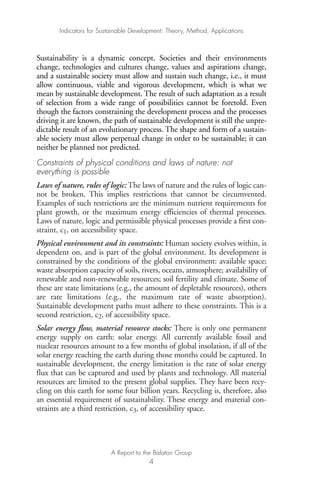
Sustainability is a dynamic concept. Societies and their environments
change, technologies and cultures change, values and aspirations change,
and a sustainable society must allow and sustain such change, i.e., it must
allow continuous, viable and vigorous development, which is what we
mean by sustainable development. The result of such adaptation as a result
of selection from a wide range of possibilities cannot be foretold. Even
though the factors constraining the development process and the processes
driving it are known, the path of sustainable development is still the unpre-
dictable result of an evolutionary process. The shape and form of a sustain-
able society must allow perpetual change in order to be sustainable; it can
neither be planned nor predicted.
Constraints of physical conditions and laws of nature: not
everything is possible
Laws of nature, rules of logic: The laws of nature and the rules of logic can-
not be broken. This implies restrictions that cannot be circumvented.
Examples of such restrictions are the minimum nutrient requirements for
plant growth, or the maximum energy efficiencies of thermal processes.
Laws of nature, logic and permissible physical processes provide a first con-
straint, c1, on accessibility space.
Physical environment and its constraints: Human society evolves within, is
dependent on, and is part of the global environment. Its development is
constrained by the conditions of the global environment: available space;
waste absorption capacity of soils, rivers, oceans, atmosphere; availability of
renewable and non-renewable resources; soil fertility and climate. Some of
these are state limitations (e.g., the amount of depletable resources), others
are rate limitations (e.g., the maximum rate of waste absorption).
Sustainable development paths must adhere to these constraints. This is a
second restriction, c2, of accessibility space.
Solar energy flow, material resource stocks: There is only one permanent
energy supply on earth: solar energy. All currently available fossil and
nuclear resources amount to a few months of global insolation, if all of the
solar energy reaching the earth during those months could be captured. In
sustainable development, the energy limitation is the rate of solar energy
flux that can be captured and used by plants and technology. All material
resources are limited to the present global supplies. They have been recy-
cling on this earth for some four billion years. Recycling is, therefore, also
an essential requirement of sustainability. These energy and material con-
straints are a third restriction, c3, of accessibility space.
Indicators for Sustainable Development: Theory, Method, Applications
A Report to the Balaton Group
4
Ind for SD - Balaton 12/21/98 4:19 PM Page 4
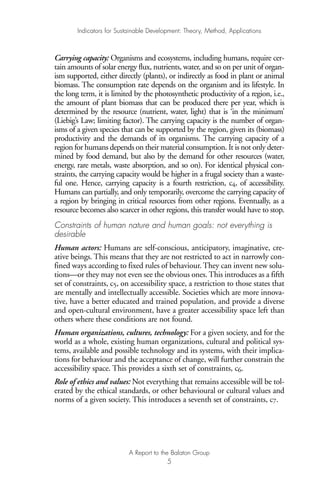
Carrying capacity: Organisms and ecosystems, including humans, require cer-
tain amounts of solar energy flux, nutrients, water, and so on per unit of organ-
ism supported, either directly (plants), or indirectly as food in plant or animal
biomass. The consumption rate depends on the organism and its lifestyle. In
the long term, it is limited by the photosynthetic productivity of a region, i.e.,
the amount of plant biomass that can be produced there per year, which is
determined by the resource (nutrient, water, light) that is ‘in the minimum’
(Liebig’s Law; limiting factor). The carrying capacity is the number of organ-
isms of a given species that can be supported by the region, given its (biomass)
productivity and the demands of its organisms. The carrying capacity of a
region for humans depends on their material consumption. It is not only deter-
mined by food demand, but also by the demand for other resources (water,
energy, rare metals, waste absorption, and so on). For identical physical con-
straints, the carrying capacity would be higher in a frugal society than a waste-
ful one. Hence, carrying capacity is a fourth restriction, c4, of accessibility.
Humans can partially, and only temporarily, overcome the carrying capacity of
a region by bringing in critical resources from other regions. Eventually, as a
resource becomes also scarcer in other regions, this transfer would have to stop.
Constraints of human nature and human goals: not everything is
desirable
Human actors: Humans are self-conscious, anticipatory, imaginative, cre-
ative beings. This means that they are not restricted to act in narrowly con-
fined ways according to fixed rules of behaviour. They can invent new solu-
tions—or they may not even see the obvious ones. This introduces as a fifth
set of constraints, c5, on accessibility space, a restriction to those states that
are mentally and intellectually accessible. Societies which are more innova-
tive, have a better educated and trained population, and provide a diverse
and open-cultural environment, have a greater accessibility space left than
others where these conditions are not found.
Human organizations, cultures, technology: For a given society, and for the
world as a whole, existing human organizations, cultural and political sys-
tems, available and possible technology and its systems, with their implica-
tions for behaviour and the acceptance of change, will further constrain the
accessibility space. This provides a sixth set of constraints, c6.
Role of ethics and values: Not everything that remains accessible will be tol-
erated by the ethical standards, or other behavioural or cultural values and
norms of a given society. This introduces a seventh set of constraints, c7.
Indicators for Sustainable Development: Theory, Method, Applications
A Report to the Balaton Group
5
Ind for SD - Balaton 12/21/98 4:19 PM Page 5
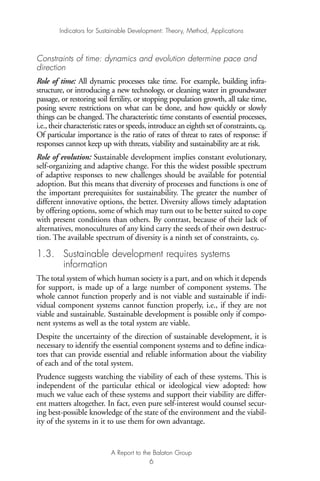
Constraints of time: dynamics and evolution determine pace and
direction
Role of time: All dynamic processes take time. For example, building infra-
structure, or introducing a new technology, or cleaning water in groundwater
passage, or restoring soil fertility, or stopping population growth, all take time,
posing severe restrictions on what can be done, and how quickly or slowly
things can be changed. The characteristic time constants of essential processes,
i.e., their characteristic rates or speeds, introduce an eighth set of constraints, c8.
Of particular importance is the ratio of rates of threat to rates of response: if
responses cannot keep up with threats, viability and sustainability are at risk.
Role of evolution: Sustainable development implies constant evolutionary,
self-organizing and adaptive change. For this the widest possible spectrum
of adaptive responses to new challenges should be available for potential
adoption. But this means that diversity of processes and functions is one of
the important prerequisites for sustainability. The greater the number of
different innovative options, the better. Diversity allows timely adaptation
by offering options, some of which may turn out to be better suited to cope
with present conditions than others. By contrast, because of their lack of
alternatives, monocultures of any kind carry the seeds of their own destruc-
tion. The available spectrum of diversity is a ninth set of constraints, c9.
1.3. Sustainable development requires systems
information
The total system of which human society is a part, and on which it depends
for support, is made up of a large number of component systems. The
whole cannot function properly and is not viable and sustainable if indi-
vidual component systems cannot function properly, i.e., if they are not
viable and sustainable. Sustainable development is possible only if compo-
nent systems as well as the total system are viable.
Despite the uncertainty of the direction of sustainable development, it is
necessary to identify the essential component systems and to define indica-
tors that can provide essential and reliable information about the viability
of each and of the total system.
Prudence suggests watching the viability of each of these systems. This is
independent of the particular ethical or ideological view adopted: how
much we value each of these systems and support their viability are differ-
ent matters altogether. In fact, even pure self-interest would counsel secur-
ing best-possible knowledge of the state of the environment and the viabil-
ity of the systems in it to use them for own advantage.
Indicators for Sustainable Development: Theory, Method, Applications
A Report to the Balaton Group
6
Ind for SD - Balaton 12/21/98 4:19 PM Page 6
Indicators provide comprehensive information about the systems
shaping sustainable development
A number of requirements follow for finding indicators of sustainable
development:
• Indicators of sustainable development are needed to guide policies
and decisions at all levels of society: village, town, city, county,
state, region, nation, continent and world.
• These indicators must represent all important concerns: An ad hoc
collection of indicators that just seem relevant is not adequate. A
more systematic approach must look at the interaction of systems
and their environment.
• The number of indicators should be as small as possible, but not
smaller than necessary. That is, the indicator set must be compre-
hensive and compact, covering all relevant aspects.
• The process of finding an indicator set must be participatory to
ensure that the set encompasses the visions and values of the com-
munity or region for which it is developed.
• Indicators must be clearly defined, reproducible, unambiguous,
understandable and practical. They must reflect the interests and
views of different stakeholders.
• From a look at these indicators, it must be possible to deduce the
viability and sustainability of current developments, and to com-
pare with alternative development paths.
• A framework, a process and criteria for finding an adequate set of
indicators of sustainable development are needed.
Indicators for Sustainable Development: Theory, Method, Applications
A Report to the Balaton Group
7
Ind for SD - Balaton 12/21/98 4:19 PM Page 7
2. How to recognize sustainable
development? Looking for indicators
2.1. The difficulty: so many systems and variables to
watch
The world around us is a complex adaptive system composed of a multi-
tude of systems that interact in various ways. While each has a certain mea-
sure of autonomy, each also depends on the functions of other systems, and
plays a part in supporting other systems and the functioning of the total
system. Plants recycle carbon dioxide—a waste product of all organisms
and human technology—into biomass with the help of solar energy.
Biomass serves as food, fodder and fuel for animals and humans.
Microorganisms in soil and water decompose wastes into their mineral con-
stituents, which then serve as plant nutrients. Cells cooperate in specialized
organs like the heart or liver, roots or flowers. The different organs cooper-
ate to make an organism a viable system in its particular environment.
Human individuals form systems such as families, communities, organiza-
tions, corporations, states and cultures. When we speak of sustainable
development, we clearly have to include environmental, economic, tech-
nological, social, political and psychological aspects.The corresponding sys-
tems are linked in various and often crucial ways in one complex total sys-
tem.
Recognizing patterns: understanding from a few indicators
A deeper look at the world reveals many relationships and component sys-
tems that are important to the operation and viability of the total system,
even though they are not immediately obvious. A systems view is, therefore,
required for capturing and understanding essential relationships.
The crucial part is identifying the essential relationships in a system. This
requires a process of aggregation and condensation of available information,
and the directed search for missing information needed for a comprehensive
description of the system. This process of systems analysis is guided by the
particular task, and the knowledge and experience of the analysts. It requires
choice and selection at every stage. A circumspect and self-critical approach
by analysts is essential. It should be coupled with independent analysis by
others with different points of view, representing in particular the interests
of those who may be affected by policy decisions. The result of this effort is
some kind of a model—a mental model, a verbal description, or a more for-
mal mathematical or computer model. This model is then used to identify
indicators providing essential information about the system.
Indicators for Sustainable Development: Theory, Method, Applications
A Report to the Balaton Group
8
Ind for SD - Balaton 12/21/98 4:19 PM Page 8
The process of condensing large amounts of information to a recognizable
pattern of a few indicators is not unique to systems analysis. It is actually
accomplished continuously by each of us. It is only in this way that we can
comprehend events around us and respond appropriately. Indicators facili-
tate orientation in a complex world.
We live by such indicators. A smile signals friendliness; a gray sky, possible
rain; a red traffic light, danger of collision; the hands of a watch, the time
of day; a high body temperature, illness; rising unemployment, social trou-
ble. The more complex the little world in which each of us lives, the more
indicators we have to watch. If we want to assess how we are doing as indi-
viduals or as society, we have to look at indicators that provide relevant
information about current and possible future developments.
Indicators summarize complex information of value to the observer
Indicators are our link to the world. They condense its enormous com-
plexity to a manageable amount of meaningful information, to a small sub-
set of observations informing our decisions and directing our actions. If we
have learned to watch the relevant indicators, we can understand and cope
with our dynamic environment. If we follow the wrong signals, we get con-
fused or misled, responding inappropriately, against our intrinsic interests
and intentions, going in a direction in which we don’t want to go.
Indicators represent valuable information. In the course of growing up, in
our formal education, and in learning to cope with our specific personal
and professional environment we have learned the meaning and signifi-
cance of the indicators we use in our daily lives. The indicators we watch
mean something to us, they are of value to us because they tell us some-
thing that is in some way important to us. They help us to construct a pic-
ture of the state of our environment on which we can base intelligent deci-
sions to protect and promote what we care about. Indicators, therefore, are
also an expression of values.
Being fully informed means watching relevant indicators for all vital
aspects of a development
Essential indicators are not always obvious. Learning to handle a complex
system means learning to recognize a specific set of indicators, and to assess
what their current state means for the health, or viability, of the system.
Often this learning of indicators is intuitive, informal, subconscious: a
mother learning to recognize and to respond to the signals from her new-
born baby, or a farmer learning to recognize the signals from the animals,
plants and soils under his or her care.
Indicators for Sustainable Development: Theory, Method, Applications
A Report to the Balaton Group
9
Ind for SD - Balaton 12/21/98 4:19 PM Page 9
Intuitive learning is not sufficient for handling many of the complex sys-
tems that humans have constructed, such as airplanes, production systems,
and the economy. In fact, such systems require specific instruments pro-
viding indicator information to the humans in charge of them, such as air
speed indicators, pressure and temperature gauges, cost-of-living and
employment indicators, or the Dow-Jones index. Essential indicators are
often not obvious or intuitive. Sometimes they are eventually revealed by
trial and error. Often, we have to search for them, based on our mental
model of the system and its processes.
Two types of indicators: for the viability of a system and for its
contribution to the performance of another system
Indicator sets about a given system are determined by two distinct require-
ments: (1) they have to provide vital information providing a picture about
the current state and corresponding viability of that system; and (2) they
have to provide sufficient information about the system’s contribution to
the performance of other systems that depend on them. This is particular-
ly obvious where humans try to manage systems for their own goals and
interests. Here, they need indicators not only to inform them of the state
of the system they are managing (e.g., a forest, an airplane), but also rele-
vant indicators to successfully intervene and correct system behaviour in
accordance with given objectives, and to determine the relative success of
this intervention (e.g., maximizing economic yield, reaching a given desti-
nation). In other words, indicator sets are determined by (1) the system
itself, and (2) the interests, needs, or objectives of the system(s) depending
on them.
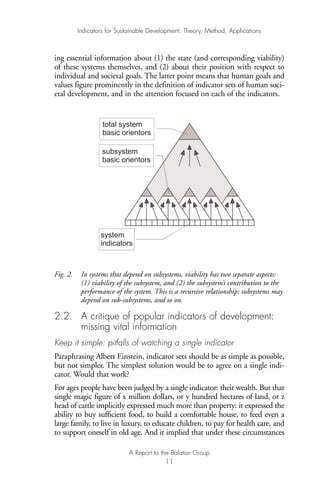
In complex real systems, this is a recursive relationship: systems depend on
other systems that depend on yet another set of systems, and so on. The
general relationship is shown in Fig. 2.
An airplane is a good example of this dual role of indicators. There are basi-
cally two groups of instruments providing information about (1) the cur-
rent state and functional integrity of the airplane itself, and (2) its position
and heading with respect to the destination chosen by the pilot. Moreover,
these indicators will not all be of equal importance to the pilot and to the
operation of the airplane. Some of these, like airspeed and altitude indica-
tors, require continuous attention, while others, like fuel and oil pressure
gauges, are only needed for occasional checks.
The human societal system, its component systems, and the resource and
environmental system on which they depend, are complex dynamic sys-
tems. Just like the pilots of aircraft, the human individuals and organiza-
tions who run these systems need comprehensive sets of indicators provid-
Indicators for Sustainable Development: Theory, Method, Applications
A Report to the Balaton Group
10
Ind for SD - Balaton 12/21/98 4:19 PM Page 10
ing essential information about (1) the state (and corresponding viability)
of these systems themselves, and (2) about their position with respect to
individual and societal goals. The latter point means that human goals and
values figure prominently in the definition of indicator sets of human soci-
etal development, and in the attention focused on each of the indicators.
Fig. 2. In systems that depend on subsystems, viability has two separate aspects:
(1) viability of the subsystem, and (2) the subsystem’s contribution to the
performance of the system. This is a recursive relationship: subsystems may
depend on sub-subsystems, and so on.
2.2. A critique of popular indicators of development:
missing vital information
Keep it simple: pitfalls of watching a single indicator
Paraphrasing Albert Einstein, indicator sets should be as simple as possible,
but not simpler. The simplest solution would be to agree on a single indi-
cator. Would that work?
For ages people have been judged by a single indicator: their wealth. But that
single magic figure of x million dollars, or y hundred hectares of land, or z
head of cattle implicitly expressed much more than property: it expressed the
ability to buy sufficient food, to build a comfortable house, to feed even a
large family, to live in luxury, to educate children, to pay for health care, and
to support oneself in old age. And it implied that under these circumstances
total system
basic orientors
subsystem
basic orientors
system
indicators
Indicators for Sustainable Development: Theory, Method, Applications
A Report to the Balaton Group
11
Ind for SD - Balaton 12/21/98 4:19 PM Page 11
one could be reasonably happy. In other words, under prevailing conditions,
wealth could be used as an aggregate indicator for completely different
dimensions of life contributing to general happiness. But it could not account
for personal tragedy or disability, and wealth would fail as an indicator for
happiness if, say, the children were killed in an accident. In real life we usual-
ly need more than one indicator to capture all important aspects of a situa-
tion. A single indicator can never tell the whole story.
A single indicator like GDP cannot capture all vital aspects of
sustainable development
The fascination with a single indicator has carried over to economics and
national development, with a rather bizarre twist: economists have not
focused on per capita wealth (of financial assets, land or resources), but—in
addition to watching inflation and unemployment rates—devote most of
their attention to an indicator that essentially measures the rate at which nat-
ural resource wealth is being depleted—the faster, the better.This is the GDP
indicator—gross domestic product—the total money value of the annual
flow of goods and services produced in an economy. This includes all goods
and services, irrespective of their contribution to national development: social
goods (such as education, food and housing) as well as social bads (such as
cost of crime, pollution, car accidents, disability and poor health). Since, with
current technology, each of these goods and services is associated with signif-
icant consumption of non-renewable resources and generation of environ-
mental pollution, GDP is now mainly a measure of how fast resources are
squandered and converted into money flows, irrespective of their effect on
society.5 Hardly an indicator of national wealth and well-being!
Aggregate indexes are an improvement, but aggregation can con-
ceal serious deficits
In response to these obvious shortcomings of the popular GDP, various groups
have sought to define aggregate indicators that present a more accurate picture
of material well-being.6 In the Index of Sustainable EconomicWelfare (ISEW—
later evolved into the Genuine Progress Indicator, GPI7), GDP is corrected by
subtracting (rather than adding) social bads (like the cost of pollution clean up
or car accidents), and adding (rather than ignoring) the value of unpaid services
(e.g., in households and communities). Other aggregate indicators include con-
cerns beyond money flows. The UNDP’s Human Development Indicator
(HDI), for example, includes literacy and life expectancy.
These are important improvements but they cannot remove a fundamental
deficiency of aggregate indicators: aggregation may hide serious deficits in some
sectors, which actually threaten the overall health of the system. And aggregate
Indicators for Sustainable Development: Theory, Method, Applications
A Report to the Balaton Group
12
Ind for SD - Balaton 12/21/98 4:19 PM Page 12
indicators become even more questionable when they require adding apples
and oranges (as in the HDI), i.e., items that cannot be measured in the same
units (such as money flows). Why not use separate indicators in the first place?
Measuring sustainability: ecological footprint and barometer of
sustainability
An aggregate indicator that makes physical sense is the Ecological Footprint
or the almost equivalent Sustainable Progress Index (SPI).8 It measures the
total land area that is required to maintain the food, water, energy and
waste-disposal demands per person, per product or per city.This is an excel-
lent summary indicator of the major environmental impacts of economic
activity, but it does not—and is not meant to—capture the social dimen-
sions of sustainable development, for example.
In order to evaluate simultaneously both the environmental and social com-
ponents of sustainable development, the barometer of sustainability has been
developed.9 In this two-dimensional graph, the states of ecosystem well-being
and human well-being are plotted on relative scales from 0 to 100, indicating
the range from bad to good conditions. The location of the point defined by
these two values gives an indication of sustainability (or unsustainability). In
an application for Manitoba, Canada,10 ecosystem well-being is computed
by aggregating six indicators, while human well-being uses 28 indicators.
Ad hoc or trial-and-error selection of indicators is inadequate
In response to the deficiencies of the aggregate indicator concept, some
researchers prefer to use more or less extensive lists of indicators covering
the problem area under investigation.11 While they are an improvement
over the aggregate indicator concept, these lists must be criticized on sever-
al counts: (1) they are derived ad hoc, without a systems theoretical frame-
work to reflect the operation and viability of the total system; (2) they
always reflect the specific expertise and research interest of their authors; (3)
as a consequence of (1) and (2), they are overly dense in some areas (mul-
tiple indicators for essentially the same concern), and sparse or even empty
in other important areas. In other words, they are not a systematic and
complete reflection of the total system, i.e., human society in interaction
with its natural environment.
Pressure–state–response frameworks fail to account for system
relationships and dynamics
In an attempt to be more systematic, the PSR (pressure, state, response)12
and PSIR (pressure, state, impact, response) frameworks have been intro-
duced and are widely applied to sustainable development problems.13 In
Indicators for Sustainable Development: Theory, Method, Applications
A Report to the Balaton Group
13
Ind for SD - Balaton 12/21/98 4:19 PM Page 13
this approach, isolated chains of cause and effect are identified for a partic-
ular environmental problem and corresponding indicators are monitored.
For example: CO2-emissions (pressure) ¡ ( CO2 concentration of the atmos-
phere (state) ¡ ( global temperature (impact) ¡ ( carbon tax (response).
The most serious objection to this approach is that it neglects the systemic
and dynamic nature of the processes, and their embedding in a larger total
system containing many feedback loops. Representation of impact chains by
isolated PSIR-chains will usually not be permissible, and will often not even
be an adequate approximation. Impacts in one causal chain can be pressures,
and in another can be states, and vice versa. Multiple pressures and impacts
are not considered. The real, usually nonlinear relationships between the dif-
ferent components of a chain cannot be accounted for. States, and rates of
change (stocks and flows) are treated inconsistently.14 For example, a PSIR
chain of the CO2-emissions problem would not account for the facts that
CO2-concentration is only partially caused by human emissions, that global
temperature is only partially determined by CO2-emissions, that a carbon tax
may be introduced for other reasons, and that this tax has many other (eco-
nomic and social) repercussions besides affecting CO2-emissions.
A systems approach is required to structure the search for indicators
The conclusion from this brief look at indicator schemes is that none of
them is adequate for the purpose defined in the previous section: (1) to pro-
vide all essential information about the viability of a system and its rate of
change, and (2) to indicate the contribution to the overall objective (e.g.,
of sustainable development). There is a general awareness of these short-
comings in the research community, and it has led to the formulation of the
Bellagio Principles as “guidelines for practical assessment of progress toward
sustainable development”15 (see Box on Bellagio Principles).
Realizing the inadequacy of current approaches to indicators of sustainable
development, we must analyze the entire complex of problems and tasks
more carefully.This requires a reasonably detailed (mental or formal) model
of the total system and its components. There are three separate tasks:
1. We must identify the major systems that are relevant in the context of
sustainable development;
2. We must develop an approach for identifying indicators of viability and
sustainability of these systems; and
3. We must think about how to use this information for assessing viabili-
ty and sustainability of human development at different levels of soci-
etal organization.16
Indicators for Sustainable Development: Theory, Method, Applications
A Report to the Balaton Group
14
Ind for SD - Balaton 12/21/98 4:19 PM Page 14
Bellagio Principles—Guidelines for Practical Assessment of
Progress Toward Sustainable Development
(from Hardi, P. and T. Zdan, 1997. Assessing Sustainable Development:
Principles in Practice. Winnipeg: IISD)
1. GUIDING VISION AND GOALS
Assessment of progress toward sustainable development should:
• be guided by a clear vision of sustainable development and goals that
define that vision.
2. HOLISTIC PERSPECTIVE
Assessment of progress toward sustainable development should:
• include review of the whole system as well as its parts;
• consider the well-being of social, ecological and economic subsystems,
their state as well as the direction and rate of change of the state, of
their component parts, and the interaction between parts;
• consider both positive and negative consequences of human activity in
a way that reflects the costs and benefits for human and ecological sys-
tems, both in monetary and non-monetary terms.
3. ESSENTIAL ELEMENTS
Assessment of progress toward sustainable development should:
• consider equity and disparity within the current population and
between present and future generations, dealing with such concerns as
resource use, overconsumption and poverty, human rights, and access
to services, as appropriate;
• consider the ecological conditions on which life depends;
• consider economic development and other non-market activities that
contribute to human and social well-being.
4. ADEQUATE SCOPE
Assessment of progress toward sustainable development should:
• adopt a time horizon long enough to capture both human and ecosys-
tem time scales, thus responding to current short-term decision-mak-
ing needs as well as those of future generations;
• define the space of study large enough to include not only local but
also long distance impacts on people and ecosystems;
• build on historic and current conditions to anticipate future condi-
tions: where we want to go, where we could go.
5. PRACTICAL FOCUS
Assessment of progress toward sustainable development should be based on:
• an explicit set of categories or an organizing framework that links
vision and goals to indicators and assessment criteria;
• a limited number of key issues for analysis;
Indicators for Sustainable Development: Theory, Method, Applications
A Report to the Balaton Group
15
Ind for SD - Balaton 12/21/98 4:19 PM Page 15
• a limited number of indicators or indicator combinations to provide a
clearer signal of progress;
• standardizing measurement wherever possible to permit comparison;
• comparing indicator values to targets, reference values, ranges, thresh-
olds or direction of trends, as appropriate.
6. OPENNESS
Assessment of progress toward sustainable development should:
• make the methods and data that are used accessible to all;
• make explicit all judgments, assumptions and uncertainties in data and
interpretations.
7. EFFECTIVE COMMUNICATION
Assessment of progress toward sustainable development should:
• be designed to address the needs of the audience and set of users;
• draw from indicators and other tools that are stimulating and serve to
engage decision-makers;
• aim, from the outset, for simplicity in structure and use of clear and
plain language.
8. BROAD PARTICIPATION
Assessment of progress toward sustainable development should:
• obtain broad representation of key grassroots, professional, technical
and social groups, including youth, women and indigenous people to
ensure recognition of diverse and changing values;
• ensure the participation of decision-makers to secure a firm link to
adopted policies and resulting action.
9. ONGOING ASSESSMENT
Assessment of progress toward sustainable development should:
• develop a capacity for repeated measurement to determine trends;
• be iterative, adaptive and responsive to change and uncertainty because
systems are complex and change frequently;
• adjust goals, frameworks and indicators as new insights are gained;
• promote development of collective learning and feedback to decision-
making.
10. INSTITUTIONAL CAPACITY
Continuity of assessing progress toward sustainable development should be
assured by:
• clearly assigning responsibility and providing ongoing support in the
decision-making process;
• providing institutional capacity for data collection, maintenance and
documentation;
• supporting development of local assessment capacity.
Indicators for Sustainable Development: Theory, Method, Applications
A Report to the Balaton Group
16
Ind for SD - Balaton 12/21/98 4:19 PM Page 16
2.3. Sustainable development is coevolution of human
and natural systems
In a systems view of sustainable development six essential subsystems
can be distinguished
In order to define an indicator set for the assessment of societal develop-
ment, we must first identify the different relevant sectors or subsystems of
the societal system. We must include the systems that constitute society as
well as the systems on which human society depends. A useful distinction
of subsystems is the following:17
• Individual development (civil liberties and human rights, equity,
individual autonomy and self-determination, health, right to work,
social integration and participation, gender and class-specific role,
material standard of living, qualification, specialization, adult edu-
cation, family and life planning horizon, leisure and recreation, arts)
• Social system (population development, ethnic composition,
income distribution and class structure, social groups and organi-
zations, social security, medical care, old age provisions)
• Government (government and administration, public finances and
taxes, political participation and democracy, conflict resolution
(national, international), human rights policy, population and
immigration policy, legal system, crime control, international
assistance policy, technology policy)
• Infrastructure (settlements and cities, transportation and distribu-
tion, supply system (energy, water, food, goods, services), waste
disposal, health services, communication and media, facilities for
education and training, science, research and development)
• Economic system (production and consumption, money, com-
merce and trade, labour and employment, income, market, inter-
regional trade)
• Resources and environment (natural environment, atmosphere and
hydrosphere, natural resources, ecosystems, species, depletion of
nonrenewable resources, regeneration of renewable resources,
waste absorption, material recycling, pollution, degradation, car-
rying capacity)
Other ways of subdividing the total system are possible.
In order for the total system (the human system embedded in the natural
system) to be viable, each of these essential subsystems must be viable: the
Indicators for Sustainable Development: Theory, Method, Applications
A Report to the Balaton Group
17
Ind for SD - Balaton 12/21/98 4:19 PM Page 17
viability of the total system depends on the proper functioning of the sub-
systems. The task will be to find relevant indicators for each subsystem.
Moreover, we must identify indicators that provide information about the
contribution of each subsystem to the viability of the total system.
The six subsystems correspond to potentials that must be sustainably
maintained
Although other classifications are possible, this identification of subsystems
is not arbitrary. These subsystems are all essential parts of the anthropos-
phere, i.e., the sphere that is affected by and affects human society. The
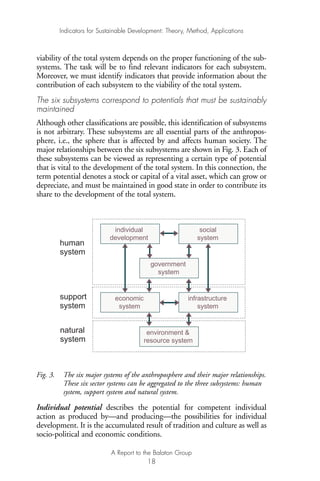
major relationships between the six subsystems are shown in Fig. 3. Each of
these subsystems can be viewed as representing a certain type of potential
that is vital to the development of the total system. In this connection, the
term potential denotes a stock or capital of a vital asset, which can grow or
depreciate, and must be maintained in good state in order to contribute its
share to the development of the total system.
Fig. 3. The six major systems of the anthroposphere and their major relationships.
These six sector systems can be aggregated to the three subsystems: human
system, support system and natural system.
Individual potential describes the potential for competent individual
action as produced by—and producing—the possibilities for individual
development. It is the accumulated result of tradition and culture as well as
socio-political and economic conditions.
individual
development
social
system
government
system
economic
system
infrastructure
system
environment &
resource system
human
system
support
system
natural
system
Indicators for Sustainable Development: Theory, Method, Applications
A Report to the Balaton Group
18
Ind for SD - Balaton 12/21/98 4:19 PM Page 18
Social potential denotes something less tangible: the ability to deal con-
structively with social processes, and to employ them for the benefit of the
total system. This has a strong cultural component determining social
coherence and relationships. It includes such aspects as honesty, trust, com-
petence and efficiency.
Organizational potential, as manifest in the know-how and performance
standards of government, administration, business and management, is
vital for effective resource use (natural and human) for the benefit of the
total system.
Infrastructure potential denotes the stock of built structures like cities,
roads, water supply systems, schools and universities. It is the essential
backbone of all economic and social activity.
Production potential of the economic system includes the stock of produc-
tion, distribution and marketing facilities. It provides the means for all eco-
nomic activity.
Natural potential represents the stock of renewable and nonrenewable
resources of materials, energy and biosystems, including the capacity for
waste absorption and regeneration.
The six subsystems can be aggregated to three subsystems: human
system, support system, natural system
As we shall see below, for each subsystem we need a number of indicators
to capture all aspects of its viability and sustainability and of their contri-
butions to viability and sustainability of the total system. The total number
of indicators increases with the number of subsystems we include. To keep
the number of indicators at manageable level, we can aggregate the six sec-
tor systems to three subsystems:
• human system = social system + individual development + gov-
ernment
• support system = infrastructure + economic system
• natural system = resources + environment
These three subsystems correspond to the three categories of capital that are
often used in analyses of the total system: human capital, structural (built)
capital and natural capital.
Indicators for Sustainable Development: Theory, Method, Applications
A Report to the Balaton Group
19
Ind for SD - Balaton 12/21/98 4:19 PM Page 19
3. What does sustainability of a system
imply? Orientors of viability
3.1. Using systems theory to identify the vital aspects of
sustainable development and relevant indicators
The task: defining a framework and a process for finding a set of
indicators
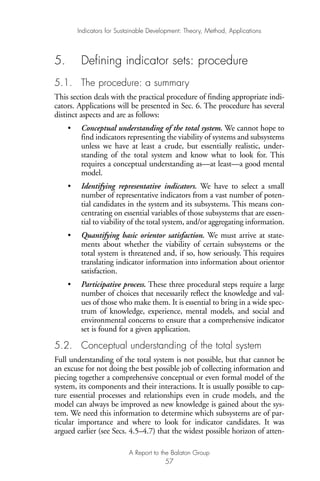
We now know what we need and want as indicators: system variables that
provide us with all essential information about the viability of a system and
its rate of change and about how that contributes to sustainable develop-
ment of the overall system.
It is more difficult to actually define a suitable set of indicators for a given
application. In what follows, a framework and a process for defining a com-
prehensive set of indicators for sustainable development will be present-
ed.18 For this, some essential system concepts are needed.
Essential system concepts
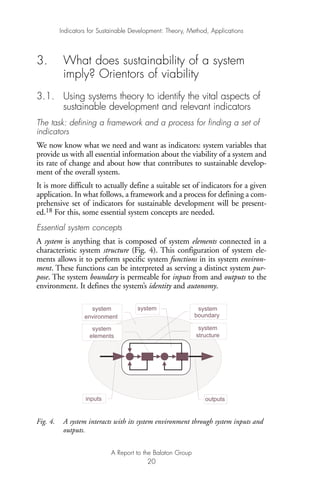
A system is anything that is composed of system elements connected in a
characteristic system structure (Fig. 4). This configuration of system ele-
ments allows it to perform specific system functions in its system environ-
ment. These functions can be interpreted as serving a distinct system pur-
pose. The system boundary is permeable for inputs from and outputs to the
environment. It defines the system’s identity and autonomy.
Fig. 4. A system interacts with its system environment through system inputs and
outputs.
environment boundary
systemsystem
outputsinputs
system
system
structure
system
elements
Indicators for Sustainable Development: Theory, Method, Applications
A Report to the Balaton Group
20
Ind for SD - Balaton 12/21/98 4:19 PM Page 20
It is useful to distinguish different categories of systems. Identifying distinct
qualitative differences, we can categorize systems as follows:19
• Static systems.They do not interact with their environment and do
not change. Examples: a rock or a chair.
• Metabolic systems. They require a throughput of energy, matter or
information to exist. Examples: a waterfall, a flame, a radio or a
motor.
• Self-supporting systems. They have the ability to secure necessary
resources (matter, energy and information). Examples: simple
organisms or exploration robots running on solar energy.
• Selective systems. They can respond selectively to environmental
challenges. Examples: organisms responding selectively to light,
heat, water, acidity, and so on.
• Protective systems. They can protect themselves from adverse influ-
ences. Examples: organisms using or even constructing shelters.
• Self-organizing systems. They can change their system structure to
adapt to changes in their environment. Examples: plants, animals,
ecosystems or human organizations.
• Non-isolated systems. They modify their behaviour in response to
the presence and activities of other systems. Examples: competing
predators or firms.
• Self-reproducing (autopoietic20) systems. They can reproduce sys-
tems of their own kind. Examples: body cells, populations or
human organizations and culture.
• Sentient systems. They can experience pain, stress, emotions, and
so on. Examples: animals and humans.
• Conscious systems. They can reflect about their actions and subse-
quent impacts. Examples: humans and primates.
This sequence also indicates a sequence of development stages from the
simple to the complex, with the more complex systems having most if not
all of the properties of their predecessors.
Hierarchy and subsidiarity facilitate efficient operation
Systems are termed complex if they have an internal structure of many
qualitatively different processes, subsystems, interconnections and interac-
tions. Besides assuring their own viability, the individual systems that are
Indicators for Sustainable Development: Theory, Method, Applications
A Report to the Balaton Group
21
Ind for SD - Balaton 12/21/98 4:19 PM Page 21
part of a complex total system specialize in certain functions that contribute
to the viability of the total system. Viability of subsystems and the total sys-
tem requires that subsystem functions and interactions are organized effi-
ciently (or at least effectively). In the evolution of complex systems two
organizing principles in particular have established themselves: hierarchy
and subsidiarity. They can be found in all successful complex systems: bio-
logical, ecological, social, political, technological.
Hierarchical organization means a nesting of subsystems and responsibilities
within the total system. Each subsystem has a certain autonomy for specif-
ic actions, and is responsible for performing certain tasks contributing to
the viability of the total system. For example, body cells are relatively
autonomous subsystems, but contribute specific functions to the operation
of particular body organs, which in turn contribute to the viability of an
organism.
Subsidiarity means that each subsystem is given the responsibility and the
means for keeping its own house in order within the range of its own abil-
ities and potential. Only if conditions occur that cannot be handled by the
subsystem would the suprasystem step in and help.
Subsystems contribute to the viability of the total system
Only healthy, viable systems can develop sustainably. But it is not enough
to be concerned with the viability of individual systems: there are no iso-
lated systems in the real world; all systems depend in one way or another
on other systems. Hence their viability and ultimately the viability of the
total system are also preconditions for sustainable development. This means
that a holistic system view must be adopted in the search for indicators.
The principles of hierarchical organization and subsidiarity require that
each subsystem have a certain measure of autonomy. In its particular sys-
tem environment, each subsystem must be viable. The total system can
only be viable if each of the subsystems supporting it is viable. For exam-
ple, a region can only be viable if its economic system is viable. This has
implications for the understanding and management of sustainable devel-
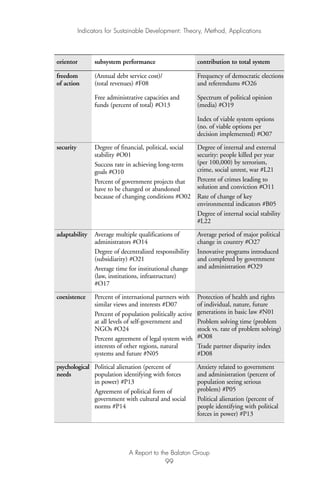
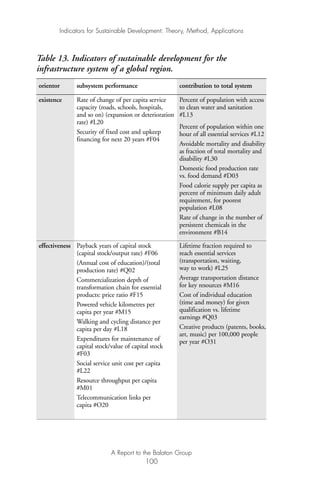
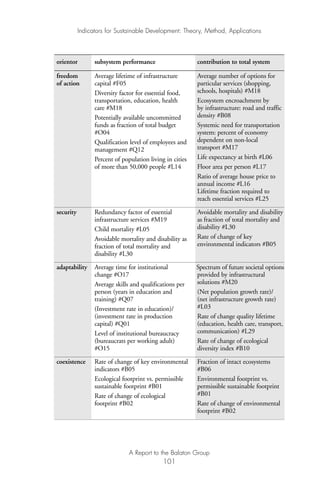
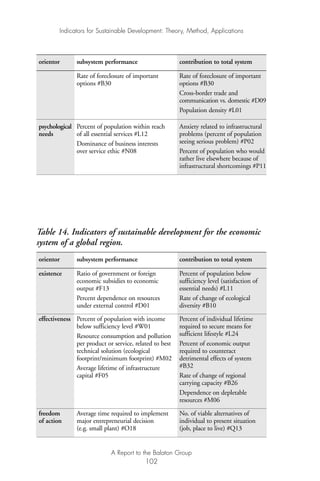
opment: we must identify the subsystems that are essential for the func-
tioning of the total system, and must determine subsystem variables (indi-
cators) that can provide essential information about the viability of each
subsystem. This may require defining a set of indicators that mirrors the
hierarchy of systems.
An example: There is more to a successful football team than a collection
of healthy football players. Each subsystem must also contribute its charac-
teristic share to the viability of the total system. And the viability of the total
Indicators for Sustainable Development: Theory, Method, Applications
A Report to the Balaton Group
22
Ind for SD - Balaton 12/21/98 4:19 PM Page 22
system will be reflected by indicators that may bear no relationship to the
viability of the subsystems. The viability of the football team will be reflect-
ed by its wins and losses over a season, by the crowds it attracts, and the net
proceeds it generates.
Note that this way of looking at complex systems is recursive: If necessary,
we can apply the same system/subsystem dichotomy of viable systems again
at other organizational levels (see Sec. 2.1 and Fig. 2). For example, a per-
son is a subsystem of a family; a family is a subsystem of a community; a
community is a subsystem of a state; a state is a subsystem of a nation, and
so on.
Essential information about system viability and performance is
contained in (1) the states (stocks) and (2) the rates of change
(flows) of a system
Despite distinct qualitative differences, and an enormous variety of com-
plex system structures, systems share some basic elements that allow ana-
lyzing them with the same basic tools of systems analysis. In the following,
the concepts of the theory of dynamic systems21 will be in the foreground,
since sustainable development implies dynamic change of a multitude of
physical and non-physical variables. Although other system descriptions of
non-material processes such as the cognitive and communicative processes
of social systems are possible,22 the theory of dynamic systems can provide
an adequate base for selecting indicators also in these cases (by dealing with
knowledge stocks, organizational potential, degree of communication, and
the like).
Observation as well as systems theory provide some insight into the gener-
al nature of indicators. There are just three types: indicators corresponding
to states, rates and converters. The first type of indicator provides informa-
tion of system states (stocks or levels such as the content of a fuel tank or the
size of a population). The second type of indicator monitors the rates of
change of system state (flows, such as current fuel consumption per minute
or food sales per month). The third type provides information obtained by
appropriate conversion of state and rate information (such as average per
capita food consumption, computed from total food sales per month and
the size of the population). Such indicators are often important, but since
they can be obtained by measurement of states and rates and their proper
conversion, the choice of representative indicators really boils down to
identifying states and rates that provide relevant information about system
viability: we don’t have to use every variable in the system as an indicator,
only a very limited set. But the choice of that set is a real challenge.
Indicators for Sustainable Development: Theory, Method, Applications
A Report to the Balaton Group
23
Ind for SD - Balaton 12/21/98 4:19 PM Page 23
In the context of sustainable development, indicators that disclose impend-
ing threats are of particular relevance. Specifically, ratios comparing the rate
of system response to the rate of threatening change can be used as crucial
indicators (Biesiot indicators). The system is sustainable if such ratios are
greater than or equal to one; it is unsustainable if they are less than one
(more on this in Sec. 4.3).
Indicator information can be quantitative (hard numbers) or qualitative
(e.g., sufficient food or substandard education). In the end, any hard num-
ber must be translated to a qualitative statement anyway in determining
whether that indicator contributes to system viability or goal achievement.
This brings in unavoidably subjective valuation.
Viability is determined both by the system and its environment
Health means “physical and mental well-being; soundness; freedom from
defect, pain, or disease; normality of mental and physical functions.”23 And
viable is defined as “able…to live and develop; able to take root and
grow.”24 When we talk about a viable system, we mean that this system is
able to survive, be healthy and develop in its particular system environ-
ment. In other words, system viability has something to do with both the
system and its properties, and with the system environment and its prop-
erties. And since a system usually adapts to its environment in a process of
coevolution, we can expect that the properties of the system’s environment
will be reflected in the properties of the system. Also, viability obviously
implies sustainability (and vice versa). Here, both terms will be used inter-
changeably.
A system can only exist and prosper in its environment if its structure and
functions are adapted to that environment. If a system is to be successful in
its environment, the particular features of that environment must be
reflected in its structure and functions. The form of a fish and its mode of
motion reflect the laws of fluid dynamics of its aquatic environment, and
the legal system of a society reflects the social environment in which it
developed.
Indicators of sustainable development must inform us about the state of the
system we are concerned about. Since that state is significantly determined
by the system’s environment, the indicators must reliably capture important
aspects of the system’s interaction with its environment. Indicators are relat-
ed to the system environment, and it makes sense to start the search by first
looking at properties of system environments.
Indicators for Sustainable Development: Theory, Method, Applications
A Report to the Balaton Group
24
Ind for SD - Balaton 12/21/98 4:19 PM Page 24
3.2. Fundamental properties of system environments
General properties of system environments must be reflected in
fundamental orientations of systems
There is obviously an immense variety of system environments, just as there
is an immense variety of systems. But could it be that all of these environ-
ments have some common general properties? If that were the case, we
could expect their reflections as basic system needs or system interests in all
systems that have been shaped by their environments. These reflections
would orient not just structure and function of systems, but also their
behaviour in the environment. Moreover, with proper attention to these
fundamental orientations or basic orientors of systems toward general prop-
erties of their environment, we could design systems to be successful in a
given environment.25 The indicators we are looking for would have to
reflect how well the basic system needs or basic orientors are satisfied under
given circumstances.
Let us first determine general properties of system environments. In Sec.
3.3, we will consider how systems have to respond to these properties, i.e.,
which system orientors can be expected to shape system structure, function
and behaviour (see Box, Indicators, orientors and sustainable develop-
ment).
Indicators for Sustainable Development: Theory, Method, Applications
A Report to the Balaton Group
25
Indicators, orientors and sustainable development
As humans we use various indicators to guide our decisions and
actions. Indicators are quantitative or qualitative measurements of the
state of something that is important to us, like our body temperature,
heart beat or blood pressure.
But why are these indicators important? Because they provide infor-
mation about the state of our health. And why do we want to have
information about our health? Because it is vitally important to our
existence. The concern for health and, more fundamentally, for exis-
tence represents very important interests that orient most of our deci-
sions and actions, directly or indirectly. We use the term orientors to
represent such interests, values, criteria or objectives. Orientors are
labels for certain categories of concerns or interests. Different systems
may have the same orientors, but would have different corresponding
indicators. We speak of the health of plants, for example, but might
use the colour of their leaves as an appropriate indicator.
Ind for SD - Balaton 12/21/98 4:19 PM Page 25
Indicators for Sustainable Development: Theory, Method, Applications
A Report to the Balaton Group
26
Orientors are mostly general terms like health, existence, freedom,
security, and so on that represent important interests of people or sys-
tems in general, but which cannot usually be measured directly. We
can only infer their state of fulfillment from observing appropriate
indicators, like body temperature, or leaf colour, or gross national
product, or rate of inflation, or crime rate. Thus, if the thermometer
indicates a temperature of 41 degrees C, we know that the orientor
health of a human being is in jeopardy.
It does not make much sense to develop indicator systems without
explicit reference to the orientors about which they are to provide
information. But that means starting by first analyzing the funda-
mental interests or orientors of the system for which we want to define
indicators. The set of indicators we pick should provide complete and
reliable information about satisfaction—or lack thereof—of all orien-
tors. If we need indicators for sustainable development, we should be
clear about what we mean by this concept, and what orientors would
have to be satisfied to ensure a path of sustainable development.
Appropriate indicators will follow from this analysis.
Sustainable development is a property of viable systems: if a system is
viable in its environment, it will be sustainable. Hence, we first look
for the orientors of viable systems. It turns out that viability of a sys-
tem requires fulfillment of a set of basic orientors that are identical
across all systems (see main text). This list of basic orientors can be
used to develop a checklist for defining indicators for a whole range
of diverse applications (see Table 4). If we follow that checklist in
searching for suitable indicators, we can be reasonably certain that
everything of importance has been considered.
The theory behind this approach—orientation theory—was devel-
oped in the 1970s in an effort to understand and analyze the diverg-
ing visions of the future and normative interests of different societal
actors (political parties, industry, environmental NGOs), and to
define criteria and indicators for sustainable development (Bossel
1977; 1978; 1987; 1998). Besides numerous applications in these
areas, the orientor concept has recently been applied extensively in
ecosystem studies (e.g., F. Müller, M. Leupelt (eds.), 1998. Eco targets,
goal functions, and orientors, Berlin, Heidelberg, New York: Springer).
Ind for SD - Balaton 12/21/98 4:19 PM Page 26
System environments are characterized by six fundamental environ-
mental properties
There are various ways of determining fundamental environmental proper-
ties. In physical environments (e.g., the natural environment), we can ana-
lyze the physical signals we receive from the environment (e.g., by various
instruments of measurement). Six fundamental properties of relevance to
systems are found (see Box, Properties of system environments and Fig. 5).
Fig. 5. Fundamental properties of system environments and their basic orientor
counterparts in systems.
normal
environmental state
resource
scarcity
environmental
variety
environmental
variability
environmental
change
other
actor systems
COEXISTENCE
ADAPTABILITY
SECURITY
FREEDOM
EFFECTIVENESS
EXISTENCE
Indicators for Sustainable Development: Theory, Method, Applications
A Report to the Balaton Group
27
Properties of system environments
Normal environmental state: The actual environmental state
can vary around this state in a certain range.
Resource scarcity: Resources (energy, matter and information)
required for a system’s survival are not immediately available
when and where needed.
Variety: Many qualitatively different processes and patterns of
environmental variables occur and appear in the environment
constantly or intermittently.
Ind for SD - Balaton 12/21/98 4:19 PM Page 27
Let us use a family as an example. Normal environmental state: A family liv-
ing in a small town in a particular European country has to deal with spe-
cific economic, social, cultural, legal and political environments different
from those, say, in India. Resource scarcity: The family needs money, water,
food, electricity, consumer goods, medical services, sanitation and so on, all
of which can only be secured with considerable effort. Variety: The family
has to exist in an environment containing a host of very different neigh-
bours, different shops and a multitude of social and cultural offerings.
Variability: A new neighbour moves in, or members of the family become
ill, change their friends, lose their jobs, or have to move. Change: Economic
and social conditions change, new technologies enter the house and the
workplace, the members of the family age. Other systems: The family has to
care for their pets and aging parents and accommodate the interests of an
employer, or of neighbours, of other drivers in traffic.
Each of the environmental properties is unique
We could analyze the environments of other systems—a business, a forest
ecosystem, a tree, a Mars lander, a child, a cow, a nation. We would always
find the same fundamental properties of the respective environments. It
becomes clear from such examples that we are indeed discussing very gen-
eral properties of all system environments. Other fundamental properties
do not appear to exist.
These fundamental properties of the environment are each unique, i.e.,
each property cannot be expressed by any combination of other funda-
mental properties. If we want to describe a system’s environment fully, we
have to say something about each of these properties: what is the normal
environment? what resources are available in the environment? how rare are
Indicators for Sustainable Development: Theory, Method, Applications
A Report to the Balaton Group
28
Variability: The state of the environment fluctuates around the
normal environmental state in random ways, and the fluctuations
may occasionally take the environment far from the normal state.
Change: In the course of time, the normal environmental state
may gradually or abruptly change to a permanently different nor-
mal environmental state, i.e., it shifts to a different normal envi-
ronmental state.
Other systems: The environment contains other actor systems
whose behaviour may have system-specific (subjective) signifi-
cance for a given actor system.
Ind for SD - Balaton 12/21/98 4:19 PM Page 28
they? how are they distributed? what is the diversity and variety of the envi-
ronment? how variable is it? what are the trends of change in the environ-
ment? what other actor systems have to be respected in one way or another?
The specific content of these fundamental environmental properties is,
however, system-specific. The same physical environment presents different
environmental characteristics to different systems existing in it. For exam-
ple, in a meadow environment shared by cows and bees, resources mean
grass to the cow, and nectar and pollen to the bee; other systems mean other
cows and the farmer to the cow, and other nectar-collecting insects to the
bee, and so on.
3.3. Fundamental orientations of systems: basic orientors
Environmental and system properties cause distinct orientations in
systems
Systems must be compatible with their system environment and its charac-
teristic properties in order to be viable and to exist sustainably. The envi-
ronmental properties can, therefore, be viewed as imposing certain require-
ments and restrictions on systems, which orient their functions, develop-
ment and behaviour.
Examples: The physical properties of different environments (sea, land,
desert, arctic) enforce attention to an orientation EXISTENCE, causing
organisms to avoid environments with which they are not compatible.
Resource scarcity (water, land and energy) imposes an orientation of EFFEC-
TIVENESS, causing humans to develop effective and efficient means of
using scarce resources. The diversity and variety of environments cause an
orientation of FREEDOM OF ACTION, allowing humans and human
organizations to respond selectively and appropriately to a multitude of
environmental challenges. The unpredictable variability of the weather
imposes an orientation of SECURITY on humans and animals, causing
search for shelter and food storage. Eventual change in the environment
(partly a result of the coevolution of systems) causes an orientation of
ADAPTABILITY, enabling organisms, ecosystems and human organiza-
tions to cope with changing environments by changing their own structure
and processes. The presence and behaviour of other systems in the same envi-
ronment causes an orientation of coexistence, enabling animals and
humans to interact appropriately with kin, competitors or predators, and
so on.26
Specific properties of systems may also impose certain orientations. Self-
reproducing systems such as organisms and populations have to pay attention
to an orientation of REPRODUCTION and replication at either the level
Indicators for Sustainable Development: Theory, Method, Applications
A Report to the Balaton Group
29
Ind for SD - Balaton 12/21/98 4:19 PM Page 29
of the individual or the population, or both. Sentient beings (animals and
humans) can experience stress and pain and other emotions, and corre-
sponding PSYCHOLOGICAL NEEDS appear as a separate orientation.
Conscious beings (mainly humans) can reflect about their own actions and
their impacts, and make conscious choices that necessitate RESPONSI-
BILITY as an orientation.
Basic orientors represent basic system interests
Corresponding to the six fundamental environmental properties, there are
six environment-determined basic orientors (existence, effectiveness, freedom
of action, security, adaptability, and coexistence) that apply to all
autonomous self-organizing systems, plus three system-determined basic ori-
entors (reproduction, psychological needs, and responsibility) that are pecu-
liar to self-reproducing (autopoietic), sentient and conscious beings. The
basic orientors and their relationship to the corresponding properties of the
system environment27 are summarized below (see box, Basic orientors of
systems).
Let us use a family as an example. EXISTENCE: The family should be
compatible with its natural, physical, social and economic environment,
should be able to communicate with others, and should be within reach of
necessary resources. EFFECTIVENESS: It should be able to earn money,
buy food, fuel and goods, and obtain water, sanitation and medical services,
all with a reasonable effort. FREEDOM OF ACTION: It should be able
to cope with a great variety of different situations, i.e., different people, dif-
ferent situations at home, at work and elsewhere. SECURITY: It should
have shelter and clothing, and be able to protect itself from unpredictable
sudden fluctuations of its normal environment such as accident or illness,
loss of job, and interruption of water, power or food supply.
ADAPTABILITY: It should prepare for possible change by securing a
broad education and job qualifications, and have the ability to adopt a dif-
ferent lifestyle, if necessary. COEXISTENCE: It has to coexist with other
individuals and families; this requires social skills and consideration of the
interests of others. REPRODUCTION: Individuals as well as populations
are self-reproducing systems and must have the opportunity and the means
to regenerate their bodies and reproduce their populations.
PSYCHOLOGICAL NEEDS: A family is composed of humans as sentient
beings, with a whole spectrum of psychological needs that must be satisfied,
such as identity, love, affection, and avoidance of pain and stress.
RESPONSIBILITY: A family and its individuals are conscious actors that
are aware of consequences of their actions and cannot escape responsible
choice.
Indicators for Sustainable Development: Theory, Method, Applications
A Report to the Balaton Group
30
Ind for SD - Balaton 12/21/98 4:19 PM Page 30
This example shows that system orientors can be used as a handy checklist
of what is important in and for systems, i.e., the basic system needs. In dis-
cussing sustainable development, this checklist of basic orientors can be used
to find indicators for the viability of the different systems (see Sec. 5.3).
Indicators for Sustainable Development: Theory, Method, Applications
A Report to the Balaton Group
31
Basic orientors of systems
Environment-determined:
EXISTENCE: The system must be compatible with and able to
exist in the normal environmental state.The information, energy and
material inputs necessary to sustain the system must be available.
EFFECTIVENESS: The system should on balance (over the long
term) be effective (not necessarily efficient) in its efforts to secure
scarce resources (information, matter, energy) and to exert influ-
ence on its environment.28
FREEDOM OF ACTION: The system must have the ability to
cope in various ways with the challenges posed by environmental
variety.
SECURITY: The system must be able to protect itself from the
detrimental effects of environmental variability, i.e., variable, fluc-
tuating and unpredictable conditions outside the normal envi-
ronmental state.
ADAPTABILITY: The system should be able to learn, adapt and
self-organize to generate more appropriate responses to challenges
posed by environmental change.
COEXISTENCE: The system must be able to modify its behav-
iour to account for behaviour and interests (orientors) of other
(actor) systems in its environment.29
System-determined:
REPRODUCTION: Self-reproducing (autopoietic) systems
must be able to reproduce (either as individuals and/or as popu-
lations).
PSYCHOLOGICAL NEEDS: Sentient beings have psychologi-
cal needs that must be satisfied.
RESPONSIBILITY: Conscious actors are responsible for their
actions and must comply with a normative reference.
Ind for SD - Balaton 12/21/98 4:19 PM Page 31
Orientors as normative guidelines; finding indicators of orientor
satisfaction
We use the term orientor as a general term to denote such orientations,
interests or guidelines. In the human context, orientors are normative
objects like values, norms, goals and objectives. The different orientors are
essentially reminders on a checklist to which a viable system would (con-
sciously or automatically) have to pay at least a minimum of attention.
Basic orientors represent the most fundamental aspects of systems orienta-
tion. The basic orientors resulting from the fundamental environmental
properties are identical across all self-organizing systems, irrespective of
their functional type or physical nature. In a particular application, this
general checklist of basic orientors must be made system and context spe-
cific. We must say what we specifically mean, for example, by freedom of
action of a commercial enterprise. This will normally lead to a more con-
crete subset of orientors (such as freedom from government interference,
independence from suppliers, innovative potential, and so on) and perhaps
a whole hierarchy of orientors.30
To assess the viability of a system, indicators must be defined that provide
information about the state of basic orientor satisfaction. This is not possible
at the level of the basic orientors themselves: systems have no state variables
such as freedom of action or security. Rather, the state of satisfaction of these
basic orientors must be inferred from available state or rate variables, or their
combinations. This often requires the specification of an orientor hierarchy
with several layers of orientors to convert the information from a specific
indicator into information about corresponding basic orientor satisfaction.
Basic orientors are unique: one orientor cannot substitute for another
Our objective is to develop a general method for finding a comprehensive
set of indicators of sustainable development, i.e., a set of indicators that
captures all essential aspects of system viability. The basic orientors are to
serve as a checklist to make sure that essential aspects of viability and sus-
tainability are not overlooked.
Because it is better adapted to the different aspects of its environment, the
system equipped for securing better overall basic orientor satisfaction will
have better fitness, and will, therefore, have a better chance for long-term
survival and sustainability.31 Assessment of orientor satisfaction provides an
indication of system fitness in its environment, i.e., its viability and sus-
tainability. The assessment of orientor satisfaction, i.e., of system viability,
can be done by identifying indicators that can provide information about
how well each of the orientors is being fulfilled at a given time.
Indicators for Sustainable Development: Theory, Method, Applications
A Report to the Balaton Group
32
Ind for SD - Balaton 12/21/98 4:19 PM Page 32
But do the basic orientors cover all essential aspects? Second, are all the
basic orientors required, or could we perhaps replace a particular orientor
by one or a combination of other orientors?
These questions are important. If we have not captured all essential aspects,
the picture will be incomplete—some vital dimension will be missing
(assume, for example, that we forgot security). And if we are using too
many dimensions (orientors), the assessment will be distorted because of
double-counting (assume, for example, we had listed security and safety as
two separate orientors). To use an analogy, we need a set of orientors that
allows us to represent any picture in full colour by using the minimum set
of primary colors (red, blue and yellow).
The evidence from much research32 seems to be that the set of basic orien-
tors is complete (covering all essential aspects), and that each basic orientor
is unique (cannot be replaced by others). Everyday language seems to con-
firm this. We have names for everything that reality has taught us as being
important, but there do not seem to be any major concerns of systems ori-
entation that could not be represented by the basic orientors.
Each of the basic orientors is assumed to stand for a unique requirement.
That means that a minimum of attention must be paid to each of them,
and that compensation of deficits of one orientor by over-fulfillment of
other basic orientors is not possible. For example, a deficit of FREEDOM
OF ACTION in a society cannot be compensated by a surplus of SECU-
RITY. Viability requires adequate satisfaction of each basic orientor.
Note that uniqueness of each of the basic orientor dimensions (categories)
does not imply independence of individual basic orientor satisfactions. For
example, better satisfaction of the SECURITY orientor may require a sac-
rifice in FREEDOM OF ACTION because financial resources are needed
for the former, and are then unavailable for the latter. But that doesn’t mean
that freedom can be used as a substitute for security. Also, there may be syn-
ergistic effects, where improving satisfaction of one orientor may also
improve satisfaction of another. For example, more efficient resource use
(effectiveness) may lead to more freedom of action as resources are freed for
other uses. That does not change the fact that EFFECTIVENESS and
FREEDOM OF ACTION are entirely different categories of orientation.
The basic orientor currently ‘in the minimum’ is the limiting factor of
system development
Viability and sustainability of a system require adequate satisfaction of each of
the system’s basic orientors, just like plants need adequate supplies of each
growth factor (light, water, nitrogen, phosphate, potassium, and so on).
Indicators for Sustainable Development: Theory, Method, Applications
A Report to the Balaton Group
33
Ind for SD - Balaton 12/21/98 4:19 PM Page 33
Planning, decisions and actions in societal systems must, therefore, always
reflect at least the handful of basic orientors (or derived criteria) simultane-
ously. Comprehensive assessments of system behaviour and development must
hence be multi-criteria assessments. In analogy to Liebig’s Principle of the
Minimum, which states that plant growth may be constrained by a limiting
factor (e.g., insufficient nitrogen or water), a system’s development will be con-
strained by the basic orientor that is currently ‘in the minimum.’ Particular
attention will have to focus on those orientors that are currently constraining.
In the orientation of system behaviour, we deal with a two-phase assessment
process where each phase is different from the other.
Phase 1: First, a certain minimum satisfaction must be obtained separately
for each of the basic orientors. A deficit in even one of the orientors threat-
ens long-term survival of the whole system. The system will have to focus
its attention on this deficit.
Phase 2: Only if the required minimum satisfaction of all basic orientors is
guaranteed is it permissible to try to raise system satisfaction by improving
satisfaction of individual orientors further—if conditions, in particular other
systems, will allow this. However, there are upper limits to basic orientor sat-
isfaction. For example, excessive emphasis on SECURITY or FREEDOM
OF ACTION or ADAPTABILITY is obviously pathological and reduces
viability and sustainability.
Viable systems, with adequate minimum satisfaction of all basic orientors, may
differ in their basic orientor emphasis. Characteristic differences in the behav-
iour (life strategies) of organisms, or of humans or human systems (organiza-
tions, political or cultural groups) can often be explained by differences in the
relative importance attached to different orientors (i.e., emphasis on FREE-
DOM, or SECURITY, or EFFECTIVENESS, or ADAPTABILITY) in
Phase 2 (i.e., after minimum requirements for all basic orientors have been sat-
isfied in Phase 1).33
3.4. Other evidence of basic orientors and their role
Evidence of basic orientors is found in many fields of science
The emergence of basic orientors in response to the general properties of
environments can be deduced from systems theoretical arguments, as has
been done here, but supporting empirical evidence and related theoretical
concepts can also be found in such fields as ecology, psychology, sociology,
religion, and the study of artificial life.
If basic orientors are indeed the consequence of adaptation to general envi-
ronmental properties, and, therefore, of fundamental importance to the
Indicators for Sustainable Development: Theory, Method, Applications
A Report to the Balaton Group
34
Ind for SD - Balaton 12/21/98 4:19 PM Page 34
viability of individuals, then we can expect them to be reflected in our emo-
tions. This is indeed the case.34 Each of the basic orientor has a character-
istic counterpart in our emotions.
Also, we find that all societies have developed methods of punishment by
selective basic orientor deprivation.35 The spectrum of punishment applied
by most societies is an indirect confirmation of the importance of the basic
orientor dimensions to human life and well-being: depending on kind and
severity of the offence, the delinquent is denied full satisfaction of one of the
basic orientors—society takes away what is most valuable to the individual.
Perhaps the most vivid and striking description of basic orientors and the con-
sequences of removal of orientor satisfaction for the individual and society is
found in the Bible (Deuteronomy, the fifth book of Moses) 28, verse 1–69).36
In the final section of the explication of Mosaic laws, very explicit blessings and
curses are formulated for those that either uphold or violate the laws.They deal
with EXISTENCE (22, 27, 48, 53-57), EFFECTIVENESS (23, 28f, 30, 32,
38), FREEDOM OF ACTION (41, 43f, 48), SECURITY (52, 65-67),
ADAPTABILITY (22, 24, 27, 35, 44, 48, 51, 59, 61), and COEXISTENCE
(26, 29, 37, 38f, 42, 43f, 53-57).
The empirical results of psychologists like Cantril, Maslow and Rokeach37
can easily be brought into agreement with the orientation theoretic frame-
work used here.38 In his work on human scale development, Manfred A.
Max-Neef has classified human needs according to several categories that
can be mapped onto the seven basic orientors39 (Table 1). The coincidence
of these two independently developed lists is striking, but some remarks are
in order. As explained above, the first six entries are basic system needs that
apply to any self-organizing system, human or not. It comes as no surprise
that they also appear as basic human needs. Since they are manifest in cor-
responding emotions, they can be interpreted as psychological needs,
although their origin is of a general system nature. However, the items
affection and identity in Max-Neef’s list are truly psychological needs; they
cannot be explained by system requirements alone. Why are understanding
and leisure juxtaposed with the effectiveness orientor? Effectiveness is obvi-
ously a function of knowledge and understanding. But effectiveness is also
a function of rest, contemplation and creative idleness.
Cultural theory40 identifies five types of individuals in the social world,
each having characteristic and distinct value orientation and lifestyle: egal-
itarians, hierarchists, individualists, fatalists and hermits. Orientation theo-
ry explains these different lifestyles in terms of different basic orientor
emphasis, and furthermore fills two obvious gaps in cultural theory: inno-
vators and organizers (Table 1). The egalitarian stresses partnership in
Indicators for Sustainable Development: Theory, Method, Applications
A Report to the Balaton Group
35
Ind for SD - Balaton 12/21/98 4:20 PM Page 35
COEXISTENCE with others, the hierarchist tries to gain SECURITY by
regulation and institutionalized authority, the individualist tries to keep his
FREEDOM by staying free from control by others and the system, and the
fatalist just tries to secure his EXISTENCE in whatever circumstances he
finds himself in. The autonomous hermit, stressing his own PSYCHO-
LOGICAL NEEDS, is of no practical relevance to the social system. The
innovator stresses the basic orientor ADAPTABILITY, while the organizer
concentrates on EFFECTIVENESS.
Table 1. Basic orientors reflected in psychological and social needs,
lifestyles, social systems and ecosystems.
basic orientors psychological cultural theory social system ecosystem
and social needs lifestyle concepts properties
(Bossel 1977) (Max-Neef (Thompson (Luhmann, (Müller and
1991) et al. 1990) see Baraldi Fath 1998)
et al. 1997)
existence subsistence fatalist environmental (meta)stability,
compatibility resilience
effectiveness understanding, (organizer) code, programs cycling,
leisure loss reduction
freedom freedom individualist variety heterogeneity,
of action diversity
security protection hierarchist redundancy redundancy,
storage
adaptability creation (innovator) autopoiesis genetic
diversity,
patch
dynamics
coexistence participation egalitarian double landscape
contingency gradients,
ecotone
structures
psychological affection, hermit reflection
needs identity
Indicators for Sustainable Development: Theory, Method, Applications
A Report to the Balaton Group
36
Ind for SD - Balaton 12/21/98 4:20 PM Page 36
Although Luhmann’s theory of social systems41 concentrates on the cogni-
tive and communicative processes of social systems while neglecting their
material structure and state-determined dynamics, the basic orientor
aspects can also be recognized in his theory (Table 1).
Müller and Fath have related general ecosystem properties to the basic ori-
entors42 (Table 1). These ecosystem properties can be understood as spe-
cific processes that emerged in ecosystems in the course of their coevolu-
tionary development in response to basic orientor demands.
One can find solid evidence of the basic orientors even in computer exper-
iments with ‘animats’ that simulate the evolution of intelligence in artificial
life.43 This artificial intelligence evolves differently in different animats,
resulting in different lifestyles. The differences can be traced back to differ-
ent emphases on the basic orientors (i.e., emphasis on FREEDOM, or
SECURITY, or EFFECTIVENESS, or ADAPTABILITY). These value
dimensions emerge in the animat’s cognitive system as it gradually learns to
cope with its environment. These experiments in artificial life show that
values are not subjective inventions of the human mind, but are basic sys-
tem requirements emerging from a system’s interaction with its environ-
ment.
This conclusion is also evident from Table 2, where the emergence of basic
orientors is linked to qualitative jumps in system complexity (as discussed
in Sec. 3.1).
In our search for indicators of sustainable development, we have to apply
the basic orientor concepts to systems of the highest level of complexity:
natural systems and human systems. This means that for assessment of their
viability and that of their diverse subsystems, the indicators selected have to
represent the full list of basic orientors, with RESPONSIBILITY only for
systems with human actors. However, in all of the following, the REPRO-
DUCTION aspect will be subsumed under the EXISTENCE orientor,
while the RESPONSIBILITY orientor is reflected in the selection of the
horizon of responsibility (see below), i.e., in the selection of present and
future systems for whose development responsibility is assumed. This leaves
the seven basic orientors: EXISTENCE, EFFECTIVENESS, FREEDOM
OF ACTION, SECURITY, ADAPTABILITY, COEXISTENCE, and
PSYCHOLOGICAL NEEDS.
Indicators for Sustainable Development: Theory, Method, Applications
A Report to the Balaton Group
37
Ind for SD - Balaton 12/21/98 4:20 PM Page 37
Table 2. Relationship between environmental properties, system
complexity and basic orientor emergence.
environmental property system category additional basic orientor
environment-determined:
normal environmental state static; metabolic existence
resource scarcity self-supporting effectiveness
variety selective freedom of action
variability protective security
change self-organizing adaptability
other systems non-isolated coexistence
system-determined:
self-reproducing reproduction
sentient psychological needs
conscious responsibility
Indicators for Sustainable Development: Theory, Method, Applications
A Report to the Balaton Group
38
Ind for SD - Balaton 12/21/98 4:20 PM Page 38
4. What indicators to select? Unavoidable
choice
4.1. The general scheme: basic orientors provide
a checklist
Illustrative examples
If we went through the list of basic orientors before embarking on a jour-
ney in an unknown car,
• the EXISTENCE orientor would remind us to check the car’s struc-
tural integrity and reliability,
• the EFFECTIVENESS orientor would have us check steering and
fuel consumption,
• the FREEDOM OF ACTION orientor would let us make sure
that we have enough fuel, and that the fuel indicator works,
• the SECURITY orientor would have us check brakes, oil-level and
seat belts,
• the ADAPTABILITY orientor would make us test the heater, roll
the windows up and down, try the seat adjustment, and check the
spare tire and tools,
• the COEXISTENCE orientor would cause us to check headlights,
brake lights and turn indicator lights, and
• the PSYCHOLOGICAL NEEDS orientor would let us choose a
make and model agreeing with our personal taste and perhaps
social status.
Viability of a system requires that an essential minimum of satisfaction of
each of the basic orientors must be assured. This leads to specific questions
for which we have to provide answers by finding and observing appropri-
ate indicators. In this way we arrive at the general scheme used in this report
for defining indicator sets. Table 3 illustrates how the list of basic orientors
can be used for finding indicators of viability for a family.
Application to sustainable development
Attention to all basic orientors of all the different subsystems and the total sys-
tem would guide us in finding reliable indicators and making sensible deci-
sions with respect to sustainable development of human society. However, the
Indicators for Sustainable Development: Theory, Method, Applications
A Report to the Balaton Group
39
Ind for SD - Balaton 12/21/98 4:20 PM Page 39
total system of sustainable development is more complex than a family. It can
be thought of as being composed of several major subsystems (for example, the
human, support and natural systems defined in Sec. 2.3), each of which can
be viewed as an assemblage of linked and nested subsystems composed of sub-
subsystems, and so on. Moreover, all of these systems produce their own
intrinsic dynamics with characteristic time scales. Most of the systems are com-
plex, adaptive, and self-organizing, changing their structure and behaviour in
the course of time. Some of the subsystems play a crucial role for the viability
of the total systems; their viability requires particular attention.
These facts must be considered when defining indicator sets. The present
section deals with the difficult problem of finding representative indicators,
i.e., as few as possible, but as many as necessary.
Table 3. Finding indicators for the viability of a family.
orientor system performance possible indicators
existence Is the system compatible availability of shelter, clothing,
with and able to exist in food, water, sanitation, life
its particular environment? expectancy
effectiveness Is it effective and efficient? work hours necessary for life
support, efficiency of resource use
freedom Does it have the necessary income level, job opportunities,
of action freedom to respond and health, mobility
react as needed?
security Is it secure, safe and stable? safe neighbourhood, savings,
insurance, social security scheme
adaptability Can it adapt to new education and training, flexibility,
challenges? cultural norms
coexistence Is it compatible with social skills, compatibility of
interacting subsystems? language and culture
psychological Is it compatible with emotional stress, anxiety,
needs psychological needs and dissatisfaction, family quarrels
culture?
Indicators for Sustainable Development: Theory, Method, Applications
A Report to the Balaton Group
40
Ind for SD - Balaton 12/21/98 4:20 PM Page 40
4.2. Indicators for dynamic systems in a dynamic
environment
Rates of change, intrinsic dynamics and system pace depend on
system structure
The major reason for the search for indicators is the wish to receive timely
warning of changes that are developing in the system to allow prompt con-
trol and counteraction, if that should be necessary.
The systems for which we seek to find indicators are all dynamic: popula-
tions and economies grow or shrink, pollution accumulates or is absorbed,
resources are being depleted. Sustainable development in itself implies con-
tinuing but unpredictable change—sometimes slow, sometimes fast.
Change here means change of system states (like population, pollution level
or food stocks). The rates of change provide the most important informa-
tion about changes in a system, and they are important candidates for indi-
cators. (This basic fact is also underscored by the mathematical way of
describing dynamic systems using a set of differential equations, which are
specifications of the rates of change in a system.)
Fig. 6. General system structure of dynamic systems. System behaviour (observ-
able as output) is only partly directly related to input (outer loop). The
characteristic dynamics of the system are caused by the inner feedback loop
(rate–state–rate).
The rates of change of the state variables and their interacting effects on the
system states determine the dynamic characteristics of a system (Fig. 6).
System dynamics are only partly a consequence of inputs from the system
environment. Very often, the dynamic behaviour is overwhelmingly deter-
INPUT OUTPUTSTATERATE
parameters
INPUT
driving
functions
Indicators for Sustainable Development: Theory, Method, Applications
A Report to the Balaton Group
41
Ind for SD - Balaton 12/21/98 4:20 PM Page 41
mined by the internal structure and processes of the system and can hardly be
influenced from the outside. The interactions within the system, in particu-
lar possible feedback loops in the system structure, cause intrinsic dynamics
(eigendynamics) that are characteristic for the system, and that may be much
stronger than external influences. These intrinsic dynamics have time con-
stants (i.e., delay times) and natural frequencies that are characteristic for the
system. These time constants and characteristic frequencies must be respect-
ed in dealing with the system; they determine the pace of system response.
Because dynamic processes operate largely at their own pace, they will resist
attempts to force them to respond in ways that do not agree with their char-
acteristic time constants and frequencies. We are familiar with this phe-
nomenon: pushing a swing at the wrong time will stop it; pushing it at the
right time will make it fly higher. The complex systems involved in sus-
tainable development show the same general characteristic. The indicators
we choose should be compatible with this pace of the system to provide us
with timely information about its dynamics.
Delays, early warning and the role of models
The intrinsic system dynamics are directly related to system viability. If
destructive processes in the system or its environment can build up at a
faster rate than countermeasures can be taken by the system or its man-
agers, its existence is at stake. If its processes of learning and adaptation are
slower than the pace of environmental changes, then its adaptability is inad-
equate for ensuring long-term viability, i.e., sustainability.
The fact that system states can only change gradually means that in real systems
the response to even a strong interaction will always be delayed. For example, it
will take years before significant impacts of birth control or pollution control
become apparent. Because of the often long delays before an undesirable or dan-
gerousdevelopmentbecomesobviousthroughchangingsystemstates,itisessen-
tial to look for indicators that provide an early warning. For this reason it makes
sense to prefer indicators that show impending change, i.e., rate variables, over
those that only register change when it has been completed, i.e., state variables.
For sustainability, reactive control may come too late; proactive (anticipatory)
control is often needed. It may not be enough to wait until a crucial variable
actually changes (feedback control), but it may be necessary to anticipate that
change before it happens (feedforward control). Anticipation requires having
a dynamic model that can reliably predict what is going to happen next.
Flood control illustrates the crucial difference between feedback and feed-
forward indicators. Feedback means waiting until people start complaining
of water in their living rooms, before doing something when it would be
Indicators for Sustainable Development: Theory, Method, Applications
A Report to the Balaton Group
42
Ind for SD - Balaton 12/21/98 4:20 PM Page 42
too late anyway. Feedforward means monitoring rainfall and water levels in
the upstream watershed and starting flood prevention measures before a
flood develops, using a mental or computer model based on experience.
In view of the dynamics of real systems, it is essential to focus on indicators that
provide early warning of impending threats, leaving enough time for adequate
response. This requires having reasonably good understanding of the systems
involved, i.e., adequate models (mental, mathematical or computer models) of
system structure and dynamic behaviour under different conditions.
4.3. Is there enough time for corrections? Defining
Biesiot indicators
Response time and respite time
For assessing sustainable development, we have to be concerned with the
viability of the different essential systems and their contribution to the via-
bility of the total system. In particular we have to determine whether the
viability of the different systems is improving or deteriorating. This requires
concentrating on indicators that relate the rates of change of threats to the
satisfaction of the different basic orientors to the rates of evasive system
response, or the respite time to the response time.44
To stay viable and sustainable, a system must be able to respond or adapt
to threats before they get a chance to do serious damage. In other words,
there must be enough time (respite time) for an effective response. The time
it takes to get an effective response under way (response time) must be less
than the respite time. The concept of respite time originated in nuclear
technology.45 Respite time, also called walk-away time, is the length of time
a nuclear reactor can be left unattended. In current reactors, this is only a
few seconds: the Chernobyl nuclear accident was a result of the respite time
being much shorter than the response time.
The respite time concept is important for societal development as well.There
are some destructive developments that do not leave enough time for coun-
termeasures once the process has started. There are two possibilities: (1) the
respite time of such processes must be lengthened, i.e., they must be slowed
down, and/or (2) the response time of the system and/or its managers must
be shortened. Coping successfully with these possibilities calls for early and
accurate signals, i.e., proper indicators of the rate of threats and of the possi-
ble speed of response. This information can be combined in one indicator, a
non-dimensional Biesiot indicator, by taking the ratio of the two rates.
Response time is the inverse of the rate of response: if the rate of response
is high, the response time will be short. Since it is usually rates of change
Indicators for Sustainable Development: Theory, Method, Applications
A Report to the Balaton Group
43
Ind for SD - Balaton 12/21/98 4:20 PM Page 43
that are available as indicators, it makes sense to relate a rate of response to
the threatening rate of change in the system or its environment to which
the system has to respond in order to remain sustainable. If this ratio is
greater or equal to one, the system will stay ahead of the challenge; if it is
less than one, its viability is being eroded, and its eventual survival is at
stake. It’s a simple, everyday concept: if the rabbit outruns (response) the
pursuing fox (threat), it will be safe; if not, it will be eaten.
Biesiot indicators for threats to basic orientors
Sustainable development implies environmental change because of the coevo-
lution of human and natural systems. Changes in the human system, and
changes imposed on it by its environmental system, must be slower than cor-
responding adaptation processes in the human system and the natural
processes on which it depends. It is, therefore, important to identify indica-
tors that provide timely information about crucial changes of the human sys-
tem and its environment and to relate this information to the possible rate of
response with respect to each of the basic orientor categories.
We have to apply this idea to each of the basic orientors of a given system:
we know that if one of them is threatened, viability will be at stake. Hence,
we must define indicators that give as a clear picture of the ratio of system
response rate to orientor erosion rate.
• EXISTENCE. Is the speed of escape from an existential danger
greater than the speed of its approach? Example: Does the rate of
increase of grain production stay ahead of the rate of increase of
grain demand of a growing population?
• EFFECTIVENESS. Is the rate of increase in resource use efficiency
(matter, energy, information) greater than the rate of erosion of
resource availability? Example: Can the rate of water use reduction
due to advances in irrigation technology offset the rate of ground-
water depletion?
• FREEDOM OF ACTION. Is the rate of increase in the spectrum
of possible responses (system variety) greater that the rate of
appearance of new challenges (environmental variety)? Example:
Are new concepts introduced into educational curricula at a suffi-
cient rate to keep up with the rate of increase of diversity and vari-
ety in society and technology?
• SECURITY. Does the rate of installation of protective measures
keep up with the rate of increase of threats? Example: Are dikes
thrown up quickly enough to stop a rising flood?
Indicators for Sustainable Development: Theory, Method, Applications
A Report to the Balaton Group
44
Ind for SD - Balaton 12/21/98 4:20 PM Page 44
• ADAPTABILITY. Does the rate of structural change in the system
keep up with the rate of irreversible changes in the environment?
Example: Can the rate of creation of new jobs in new industries
keep up with the rate of jobs lost to productivity increases?
• COEXISTENCE. Can the rate of change in interaction and com-
munication keep up with the rate of appearance of new actors?
Example: Can the perceptions and prejudices in a community
change quickly enough to cope with the rate of influx of foreign
immigrants?
• PSYCHOLOGICAL NEEDS. Does the rate of appearance of
psychological stresses and strains remain below the rate at which
they can be absorbed? Example: Do insults, injuries and injustices
to children in a particular society cause permanent psychological
damage?
Quantification with Biesiot indicators and visualization of the state
of viability
Fig. 7. Orientor star using Biesiot indicators: the system is not viable if
any of the orientor satisfactions, expressed by the ratio of rate of response
to rate of threat, has a value of less than one, i.e., is inside the unit circle.
of
existence
effectiveness
freedom
action
security
adaptability
coexistence
unit circle
Indicators for Sustainable Development: Theory, Method, Applications
A Report to the Balaton Group
45
Ind for SD - Balaton 12/21/98 4:20 PM Page 45
A Biesiot indicator is defined as the ratio of two particular time rates of
change of a given quantity: its rate of restoration (or response) and its rate
of deterioration (or threat). It can also be defined by the inverse of the two
rates, i.e., the time constants of respective processes (respite time vs.
response time). The Biesiot ratio is nondimensional; it has the value of
unity if both rates are equal. The value one, therefore, marks the critical
point: if the rate of response is greater than the rate of threat, the system can
handle the particular threat; if it is smaller, system viability is threatened.
If Biesiot ratios are used to express basic orientor satisfactions of a system,
the corresponding indicators provide a direct measure of viability: viability
(and hence sustainability) is threatened if any of the indicators falls below
a value of one. The viability state of a system becomes immediately obvious
if the values of the respective Biesiot indicators are plotted on the rays of an
orientor star (Fig. 7).
4.4. The cyclical nature of system evolution and
indicators of sustainability
Growth and decay in real systems
The processes of self-organization that continuously change the complex
systems in the real world often exhibit their own cyclical dynamics. These
development cycles have some relevance for the selection of indicators,
since the focus of attention will necessarily shift during the cycle.
Four distinct stages can be identified:46 (1) renewal and growth, (2) con-
servation, (3) deterioration and creative destruction, and (4) innovation
and reorganization. The cycle then repeats. This sequence can be observed
in industrial and urban development as well as in the gap dynamics of nat-
ural forests, and in many other processes of evolutionary self-organization.
It can be expected to also play a role in the sustainable development of soci-
eties, and the selection of indicators should take account of it.
The penetration of new technologies, the renewal of infrastructure and pro-
duction capital, changes in work and employment, changes in the age com-
position with their implications for infrastructure and social and cultural
changes all drive this cycle. In fact, in a process of entrainment (mode-lock-
ing), the different processes are likely to reinforce each other, leading to a
synergetic process of cyclical self-organization.47
The cyclical process of renewal is not a circle leading back to the same condi-
tions, but rather a spiral leading to a new evolutionary plateau after each cycle,
with a different system structure from before. During the dynamic periods of
innovation and reorganization, renewal and growth, new structures are built up.
Indicators for Sustainable Development: Theory, Method, Applications
A Report to the Balaton Group
46
Ind for SD - Balaton 12/21/98 4:20 PM Page 46
Growth then stagnates, and the existing structures serve and support the system
during a lengthy period of conservation, before they begin to deteriorate and
are finally destroyed to make room again for innovation and reorganization.
Indicator emphasis changes during the development cycle
The different phases of this cyclical process of evolutionary renewal favour
or even require different basic orientor emphasis (life strategies) of the
actors in this process. As noted before (Sec. 3.4), these life strategies can be
related to the life styles of cultural theory.48
• The renewal and growth phase requires an emphasis on EFFEC-
TIVENESS and FREEDOM OF ACTION, corresponding to
the organizer and the individualist life strategies.
• The conservation phase requires an emphasis on SECURITY, cor-
responding to the hierarchist life strategy.
• The deterioration phase requires an emphasis on EXISTENCE,
and perhaps COEXISTENCE, corresponding to the fatalist and
the egalitarian life strategy.
• The innovation phase requires an emphasis on ADAPTABILITY,
corresponding to the innovator strategy.
Note that in all phases all life strategies (cultural types) will be present, but
different strategies are likely to dominate in the different phases.
An actor with a life strategy emphasizing FREEDOM OF ACTION is like-
ly to also stress corresponding indicators. The same is true for all other life
strategies. We can expect that in the different phases of the development
cycle, the emphasis on indicators is likely to shift from EFFECTIVENESS
and FREEDOM OF ACTION in Phase 1, to SECURITY in Phase 2, to
EXISTENCE and COEXISTENCE in Phase 3, to ADAPTABILITY in
Phase 4. This is acceptable as long as the indicator set remains complete, i.e.,
covers all aspects of viability (the basic orientor dimensions) adequately.
The need for flexibility and periodic revision of indicator sets
As systems change and develop in a changing environment, individual indi-
cators may lose their relevance and may have to be replaced by others that are
more relevant under current conditions. Where once coal consumption per
capita may have been a useful indicator of living standard, the number of
computer chips in use per person may be a better indicator at another time.
Social and technological change require periodic reassessment and revision of
the indicator set. Occasionally, this may not be enough: there may be a qual-
itative change of conditions leading to a completely new threat that requires
Indicators for Sustainable Development: Theory, Method, Applications
A Report to the Balaton Group
47
Ind for SD - Balaton 12/21/98 4:20 PM Page 47
its own indicators. It is important to maintain flexibility and the ability to
revise the indicator set quickly in response to new challenges.
4.5. The horizon of attention
Essential systems and multidimensional viability: the need for many
indicators
The systems aspect of sustainable development implies concern about a
total system composed of the many natural and human subsystems, while
the long-term aspect of sustainable development implies concern even
about the future of these systems. Obviously it is a practical impossibility
to develop and use an indicator set that includes indicators of viability from
every system in the total system.
Realizing that a drastic restriction to a manageable number of indicators is
essential, we face the difficult task of defining a set of indicators that can
provide a picture of the viability and sustainability of the total system and
essential subsystems. We found earlier that the hope for a single index of
sustainability is futile and that a system-oriented approach is needed to
define a minimum set of representative indicators.
We concluded earlier that, as a minimum, the viability of three essential sys-
tems would have to be considered: the human system, the support system,
and the natural system (representing human, built, and natural capital; see
Sec. 2.3). Furthermore, their individual contribution to the viability of the
total system has to be assessed.
We also found that viability of a system is a multidimensional concern and
can only be assessed by determining the state of satisfaction of each of the
seven basic orientors. A full sustainability assessment, therefore, requires a
minimum of 3x2x7 or 42 representative indicators.
Looking for the weakest links
As large as this number may seem, it still means that a single indicator
would, for example, represent the SECURITY of all of the natural system.
This may seem preposterous, but it cannot be an argument for rejecting the
method: this would only throw us back to indicator systems that are either
ad hoc or have other serious systematic deficiencies (see Sec. 2.2). It would
be an argument for using a finer-grained representation of the systems
involved and of basic orientor satisfactions (e.g., by a detailed orientor hier-
archy, see Sec. 5.3), but this would increase the number of indicators again.
The practical solution to this dilemma is to define indicators that represent
the weakest links (component systems) in the total system. Viability
Indicators for Sustainable Development: Theory, Method, Applications
A Report to the Balaton Group
48
Ind for SD - Balaton 12/21/98 4:20 PM Page 48
depends on balanced minimum basic orientor satisfaction, and it is the ori-
entor deficits that threaten sustainability. Hence, we must focus on those
component systems that show such deficits. But since a present deficit,
caused by one component system, may eventually disappear and be
replaced by another, caused by another component system, it will then be
essential to periodically review and redefine the set of indicators.
The selection of indicators is contingent on having a fair amount of infor-
mation about a system. Variables that could be used as indicators must not
only be recognized, but also known for what role they play in the system, how
essential they are for the viability of the system, or whether they represent a
weak link. Defining indicators of viability, therefore, requires at least a good
conceptual if not formalized and/or computerized model of the system.
Comparable results of sustainability assessments despite subjective choice
Even with a solid scientific approach, based on physical facts as well as sys-
tems theory and analysis, indicator sets cannot be defined without a signif-
icant amount of subjective choice. We should not be surprised if researchers
using the same data and scientific method produce different indicator sets.
Although this may superficially appear as another of those cases where sci-
entists cannot agree, these indicator sets are far from arbitrary selections. If
indicators have been selected to represent basic orientor satisfactions of
essential systems, it is likely that sustainability assessments will produce
comparable results, even if the indicator sets are completely different.
It is useful to recall where subjective choice is inevitable in the process of
determining an indicator set:
• Knowledge about and perception of the total system. What is our
model of the total system? What is the organization and intercon-
nection of subsystems?
• Perception of subsystems and their interrelationships. What are the
parts and processes of subsystems? How do they interact?
• Scenarios of future developments. Which developments are possi-
ble; which are likely?
• Time horizon. How far should we try to look ahead?
• Systemic horizon. Should only essential systems be observed, or
should nonessential systems be included, like rare species without
economic value?
• Interests of the observer/manager. What information is of interest
for various reasons? What information is needed for management?
Indicators for Sustainable Development: Theory, Method, Applications
A Report to the Balaton Group
49
Ind for SD - Balaton 12/21/98 4:20 PM Page 49
Obviously, even small disagreements between researchers with respect to
each of these aspects can cause great variations in indicator sets. If
researchers agree on a common goal of identifying indicators of sustainable
development, the choice will be narrowed down somewhat, but very sub-
stantial variability still remains.
The horizon of attention defines indicator selection
Although the normative reference (ethical framework) of the human actor
(individual, organization and society) can have a substantial influence on
indicator selection, its influence is not clear-cut. To discuss this effect, it is
useful to distinguish between the actor’s horizon of influence, horizon of
attention and horizon of responsibility (Fig. 8).49
Fig. 8. The horizons of influence, attention and responsibility in space and time
(after Meadows et al., 1972). The dots indicate the distance in space and
time of different human concerns.
The horizon of influence stretches over all systems in space and time that are
significantly affected by the actor’s actions. The horizon of influence is a
environment
family
community
nation
world
next
week
next few
years
lifetime future
generations
TIME
SPACE
HORIZON OF
INFLUENCE
HORIZON OF
ATTENTION
HORIZON OF
RESPONSIBILITY
Indicators for Sustainable Development: Theory, Method, Applications
A Report to the Balaton Group
50
Ind for SD - Balaton 12/21/98 4:20 PM Page 50
factual consequence of the relationships in the real system and the power of
the actor. Given these facts, the actor cannot define his horizon of influence
at will.
The horizon of attention comprises all systems whose behaviour or develop-
ment is of some interest to the actor, and whose fate is given some atten-
tion by the actor. The horizon of attention is defined by the curiosity of the
actor. It does not imply any commitment on his part for any of the systems
within the horizon of attention.
The horizon of responsibility is limited to those systems for whose interests
the observer would actually give up advantages (time, resources) or suffer
inconveniences, i.e., for whose fate he would take some responsibility. The
horizon of responsibility is defined by ethical considerations of the actor. It
implies non-zero commitment to the fate of systems within the horizon of
responsibility.
The horizon of attention, i.e., the indicators observed, may actually be
identical for actors with very different ethics, perhaps because their factual
knowledge about the real world agrees. The actor’s ethics do not necessari-
ly determine the spectrum of indicators selected. However, the horizon of
responsibility is certainly a product of the normative reference, and will
have a substantial influence on how individual indicators affect decisions.
For example, a selfish but very clever actor would probably attempt to col-
lect as much information about his or her environment as possible (wide
horizon of attention), in the hope that even some of the seemingly irrele-
vant indicators might provide clues of impending developments that could
be used to advantage. His horizon of attention could be even wider than
that of an altruist carefully observing indicators of the many systems he feels
he has to be concerned about. However, the horizon of responsibility of the
selfish actor would be essentially limited to himself or herself.
Ideally, the horizon of responsibility would coincide with the horizon of
influence, while the horizon of attention would be at least as wide as the
horizon of responsibility.
Indicator selection can be independent of ideology
We conclude from this that ideological differences, fortunately, must not stand
in the way of agreeing to a common comprehensive set of indicators of sus-
tainable development. The choice of horizon of attention, i.e., the indicators
set, is independent of a particular ethical commitment. If one group insists on
adding a particular indicator, this will be merely a piece of additional informa-
tion that cannot hurt the other group. In fact, the process of indicator selection
will be much more effective if representatives of different interests participate in
Indicators for Sustainable Development: Theory, Method, Applications
A Report to the Balaton Group
51
Ind for SD - Balaton 12/21/98 4:20 PM Page 51
it. This is no licence for endless inflation of the indicator set: all participants
should still honour the goal of parsimony, obtaining the maximum amount of
information from the smallest possible set of indicators.
Normative differences, however, definitely determine the horizon of
responsibility and play a major role in determining decisions based on indi-
cator information, i.e., how much importance is attached to this or that
indicator of this or that system.
4.6. The horizon of responsibility
The decision for sustainable development defines a horizon of
responsibility
There is an important relationship between the horizon of attention and
the horizon of responsibility: responsible action requires that the horizon of
attention must be at least as large as the horizon of responsibility, but it
must not be smaller. There is no harm in knowing more about the world
than we are responsible for, but knowing less would be clearly irresponsi-
ble, equivalent to driving at high speed in a fog.
The decision for sustainable development implies assuming responsibility
for long-term development of human and natural systems inasmuch as it is
significantly influenced by us. That automatically expands the necessary
horizon of attention to a significant number of interconnected systems, and
far into the future. But even genuinely sustainable development can come
in different forms and shapes, as we have seen earlier (see Sec. 1.1). The
spectrum reaches from just maintaining minimum viability and sustain-
ability levels of man and beast to development at a maximum level of diver-
sity and coevolutionary potential of human society and natural environ-
ment.
On top of a minimum set of indicators mandated by the decision for sus-
tainable development, the decision for a particular type of sustainable
development, therefore, requires additional indicators that capture con-
cerns reaching beyond the bare minimum of human sustainability. The
type of sustainable development chosen reflects a particular ethical princi-
ple or normative reference: do we want a sustainable world serving the eco-
nomic interests, selfishness and greed of transnational corporations and
their shareholders, or are we aiming for a world sustaining maximum evo-
lutionary potential by respecting the interests of all beings? Each choice
implies a different horizon of responsibility, hence a different horizon of
attention, and hence a different set of indicators.
Indicators for Sustainable Development: Theory, Method, Applications
A Report to the Balaton Group
52
Ind for SD - Balaton 12/21/98 4:20 PM Page 52
Ethical choice is unavoidable
In a world of limited resources (energy, materials, water, food and time),
systems (such as organisms and species) often compete for resources, advan-
tages and even survival. Even more dramatic, they may have no choice but
to destroy other systems or organisms in order to survive, as in grazing or
predator-prey food chains.
Even with the best of intentions, humans cannot be exempt from this fact
of life. But being conscious beings, we have knowledge of what we are
doing, we can visualize its implications for other beings and systems, we
usually have the choice between different possible actions, and we are
responsible for our actions. In other words, we cannot escape an ethical
choice about our horizon of responsibility, and we have to adopt an ethical
framework for our actions. This has direct consequences for the indicator
set we are looking for: it has to include indicators at least for the systems
within our horizon of self-assumed responsibility. If it has additional indi-
cators for the larger horizon of attention, so much the better.
Ethics is essentially about how much relative importance we assign to our-
selves, other human or non-human beings, ecosystems and future genera-
tions. That may reach from pure selfishness to an all-inclusive altruism.
However, the decision for sustainable development narrows the choice of
ethical reference considerably. The necessary concern for future generations
and for the natural environment on which human society depends, for
example, is not compatible with unrestrained selfishness or anthropocen-
trism.
It is impossible to prove a right system of ethics, as philosophers have con-
cluded again and again over past millennia until today.50 But it may be pru-
dent to adopt a particular set of ethics for practical reasons.
This particular discussion is outside the scope of this report. However, a
discussion of the implications of ethical choice for the selection of indica-
tors will be helpful for defining an indicator set. Adopting the indicator set
consistent with the horizon of responsibility of a particular ethic does not
mean adopting that particular ethic; it merely means adopting the corre-
sponding horizon of attention.
Indicators for Sustainable Development: Theory, Method, Applications
A Report to the Balaton Group
53
Ind for SD - Balaton 12/21/98 4:20 PM Page 53
4.7. Arguments for a wide horizon of responsibility
Different ethical principles have different consequences for
sustainability
Sustainable development of human society is possible only with substantial
support from the natural system. Hence, a minimum set of indicators from
that system would be required to assess the sustainability of its processes. If
such a society would merely focus on the material well-being of humans, its
horizon of responsibility would only include those components of the nat-
ural environment that would provide material contributions to society:
food, energy, materials and waste disposal. There would be no logical rea-
son to feel responsible for the fate of species having no perceivable eco-
nomic value, or to protect unique landscapes or ecosystems, or to expend
resources on protection of social and cultural achievements. Such a society
would have a limited set of indicators, but it could be physically sustain-
able.
The problem is that such a society would be operating at the edge of sus-
tainability: a small change in its natural environment or an internal change
in society could lead to collapse because diversity, variety and redundancy
of the human and natural systems have been minimized in favour of mate-
rial well-being. The potential to cope adaptively with unforeseen changes
may be insufficient. If only indicators corresponding to the horizon of
responsibility of this particular ethical framework were adopted, society
would not be able to monitor all the information that may be decisive for
the sustainability of its development.
Protecting evolutionary potential by a wide horizon of responsibility
Sustainable development as a process of coevolution of human and natural
systems under constantly changing conditions suggests a wider view. In
fact, there are good reasons for adopting the widest possible view, i.e., hori-
zon of attention, by protecting and encouraging as much variety, diversity
and redundancy as possible, irrespective of its current usefulness. These are
the factors that guarantee the widest possible spectrum of adaptive coevo-
lutionary potential of systems even under severe change of conditions, i.e.,
a maximum amount of sustainability. In essence this boils down to con-
ceding that human understanding and prevision of such coevolutionary
developments in human and natural systems will always be incomplete and
insufficient, and that it would be prudent to keep a maximum number of
options open by respecting the viability interests of all living and non-liv-
ing, present and future systems and beings, irrespective of their current use-
fulness for humans. Such a view is held by a partnership ethic.
Indicators for Sustainable Development: Theory, Method, Applications
A Report to the Balaton Group
54
Ind for SD - Balaton 12/21/98 4:20 PM Page 54
Using the Principle of Partnership to guide indicator selection
In a partnership ethic, ethical considerations are extended to all present and
future component systems of the total system, human or non-human, liv-
ing or non-living. The Principle of Partnership51 states that “All systems that
are sufficiently unique and irreplaceable have an equal right to present and
future existence and development.”
The principle protects individual conscious beings, species, singular ecosys-
tems, original works of art or cultural achievements for their uniqueness,
but not, for example, the individual mosquito or chicken. A similar princi-
ple of respect for system interests has been formulated by Johnson:52 “Give
due respect to all the interests of all beings that have interests, in proportion
to their interests.” A system is said to have interests if it can be observed to
express preferences; e.g., a plant growing toward light. An ethic based on
the sustainability postulate and the partnership principle implies the fol-
lowing in particular:
1. With respect to the natural environment, it means acknowledging species
and ecosystems as systems having their own identity and right to exis-
tence, in the present and in the future. The natural environment cannot
be viewed as a supposedly infinite source of resources, but must be viewed
as life space on which our existence depends, full of systems having inter-
ests for whose future we are responsible because of our influence on them.
2. With respect to human systems, it means respecting the right to equi-
table treatment for all living humans, without differentiation by region,
religion, race, gender, political conviction, income, wealth or education.
3. With respect to future systems, it means respecting the right for exis-
tence and development of future generations, species and ecosystems.
Relationship between ethics and the systems view
The Partnership Principle provides a sufficiently wide horizon of responsi-
bility for maximum diversity and hence coevolutionary potential. Even if
this principle is not adopted as an ethical guideline, it would be prudent to
adopt its horizon of responsibility as a proper horizon of attention and to
select indicators accordingly.
These insights have to guide our choice of indicator sets for sustainable
development. In particular, they call for proper representation of the inter-
ests of all component systems. We have to at least try to assess their role and
function in the total system, now and in the future. This is the task of sys-
tems analysis. We find an unexpected connection between ethics and the
systems view in issues of sustainable development; namely,
Indicators for Sustainable Development: Theory, Method, Applications
A Report to the Balaton Group
55
Ind for SD - Balaton 12/21/98 4:20 PM Page 55
1. If we start with a systems view, trying to identify the role of all component
systems for the sustainable development of the total system, we shall find
that ethical criteria must be developed and applied to protect the interests
of the various component systems contributing to the total system.
2. If we start with the ethical choice for sustainable development and try
to break it down into practical ethical criteria for decision-making, we
shall find that we cannot accomplish this without fairly detailed sys-
tems studies that also take into account the dynamics of development.
Indicators for Sustainable Development: Theory, Method, Applications
A Report to the Balaton Group
56
Ind for SD - Balaton 12/21/98 4:20 PM Page 56
5. Defining indicator sets: procedure
5.1. The procedure: a summary
This section deals with the practical procedure of finding appropriate indi-
cators. Applications will be presented in Sec. 6. The procedure has several
distinct aspects and are as follows:
• Conceptual understanding of the total system. We cannot hope to
find indicators representing the viability of systems and subsystems
unless we have at least a crude, but essentially realistic, under-
standing of the total system and know what to look for. This
requires a conceptual understanding as—at least—a good mental
model.
• Identifying representative indicators. We have to select a small
number of representative indicators from a vast number of poten-
tial candidates in the system and its subsystems. This means con-
centrating on essential variables of those subsystems that are essen-
tial to viability of the total system, and/or aggregating information.
• Quantifying basic orientor satisfaction. We must arrive at state-
ments about whether the viability of certain subsystems or the
total system is threatened and, if so, how seriously. This requires
translating indicator information into information about orientor
satisfaction.
• Participative process. These three procedural steps require a large
number of choices that necessarily reflect the knowledge and val-
ues of those who make them. It is essential to bring in a wide spec-
trum of knowledge, experience, mental models, and social and
environmental concerns to ensure that a comprehensive indicator
set is found for a given application.
5.2. Conceptual understanding of the total system
Full understanding of the total system is not possible, but that cannot be
an excuse for not doing the best possible job of collecting information and
piecing together a comprehensive conceptual or even formal model of the
system, its components and their interactions. It is usually possible to cap-
ture essential processes and relationships even in crude models, and the
model can always be improved as new knowledge is gained about the sys-
tem. We need this information to determine which subsystems are of par-
ticular importance and where to look for indicator candidates. It was
argued earlier (see Secs. 4.5–4.7) that the widest possible horizon of atten-
Indicators for Sustainable Development: Theory, Method, Applications
A Report to the Balaton Group
57
Ind for SD - Balaton 12/21/98 4:20 PM Page 57
tion should be used to remain aware of the full spectrum of options for sus-
tainable development.
This is an enormous task. We have to structure this complex of interacting
systems to make it accessible for analysis. This is done by identifying indi-
vidual systems and noting their mutual interactions and relationships to
other systems, and to their subsystems and suprasystems (Fig. 9).
Fig. 9. Mutual relationships of systems and their subsystems and suprasystems in
the total system.
We have to consider different kinds of relationships:
• All systems depend to some degree on the resource providing and
waste absorbing capacities of their environment.
• Most systems have interactions with other systems that are essen-
tial to their viability.
• Many interactions are hierarchical, with subsystems contributing
to the functioning of a system, which contributes to the function-
ing of a suprasystem, and so on.
• The viability of the total system depends on the viability of many
but not necessarily all of its subsystems.
An understanding of important relationships between component systems
is essential for the definition of indicators.
global system
anthropo-
sphere
abiotic environment and resources
biosphere
basic orientors
Indicators for Sustainable Development: Theory, Method, Applications
A Report to the Balaton Group
58
Ind for SD - Balaton 12/21/98 4:20 PM Page 58
5.3. Identifying representative indicators
Recursive scheme for finding indicators of viability
In this systems view, the identification of indicators of sustainable develop-
ment for the total or global system reduces to a recursive procedure, where
the same questions have to be repeated for all component systems recog-
nized as important or essential:
1. Which systems yi, or environmental factors ei, contribute to the viabil-
ity of system x?
2. Which basic orientors of system x are affected by which system yi?
In this way it is possible to first identify the major systems contributing to the
viability of the total system, then the subsystems contributing to the viability
of each major system, then the sub-subsystems contributing to the viability
of each subsystem, and so on. In this top-down manner, the viability-affect-
ing systems at all system levels, and their influences on the satisfaction of a
particular basic orientor of an affected system, can be identified.
Table 4. General (recursive) scheme for identifying indicators of viability.
basic orientor viability of affecting system contribution to affected system
existence Is the system compatible Does the system contribute its part
with and can it exist in its to the existence of the affected
particular environment? system?
effectiveness Is it effective and efficient? Does it contribute to the efficient
and effective operation of the
total system?
freedom of Does it have the necessary Does it contribute to the freedom
action freedom to respond and of action of the total system?
react as needed?
security Is it secure, safe and stable? Does it contribute to the security,
safety and stability of the total
system?
adaptability Can it adapt to new Does it contribute to the flexibility
challenges? and adaptability of the total system?
coexistence Is it compatible with Does it contribute to the
interacting subsystems? compatibility of the total system
with its partner systems?
psychological Is it compatible with Does it contribute to the
needs* psychological needs psychological well-being of people?
and culture?
* only for systems with sentient beings
Indicators for Sustainable Development: Theory, Method, Applications
A Report to the Balaton Group
59
Ind for SD - Balaton 12/21/98 4:20 PM Page 59
From this recursive procedure we can deduce a general bottom-up scheme
of orientor assessment questions that have to be repeated for each pair of
affecting system y and affected system x. Indicators are defined by two sets
of questions: (1) What is the viability of the affecting system? (i.e., satisfac-
tion of each basic orientor of that system), and (2) How does each affect-
ing system contribute to the viability (the basic orientors) of the affected
system? The general scheme of questions to which the indicator system
must provide answers is given in Table 4.
Reducing the number of indicators to a manageable set
It will be obvious that a detailed analysis following this scheme will usually
produce a large number of component systems, long viability chains and
many potential indicators. Furthermore, there will generally be several, per-
haps many, appropriate indicators for answering each of the assessment
questions or particular aspects of it. It is, therefore, essential to condense the
systems analysis and the indicator set as much as permissible without los-
ing essential information. There are several possibilities:
• Aggregation. Use the highest level of aggregation possible. For
example, in the applications in Secs. 6.2 and 6.3, the total system
is disaggregated to only three component systems: human, support
and natural system.
• Condensation. Locate an appropriate indicator representing the
ultimate cause of a particular viability problem, without bothering
with indicators for intermediate systems (the intermediate viability
chain). For example, using fossil fuel consumption as an indicator
for threats to global climate and viability of the global system.
• Weakest-link approach. Identify the weakest links in the system
and define appropriate indicators. Do not bother with other com-
ponents that may be vital but pose no viability threats under fore-
seeable circumstances. For example, using availability of water in
savanna agriculture as a weakest link, not nutrients, labour or farm
machinery.
• Basket average. If several indicators representing somewhat differ-
ent aspects of an orientor question should all be considered, define
an index that provides an average reading of the situation. For
example, using the representative basket of consumer goods for
economic statistics.
• Basket minimum. If a particular orientor satisfaction depends on
the acceptable state of each of several indicators, adopt the one
with the currently worst performance as representative indicator.
Indicators for Sustainable Development: Theory, Method, Applications
A Report to the Balaton Group
60
Ind for SD - Balaton 12/21/98 4:20 PM Page 60
Note: this means that a changing set of indicators will be used dur-
ing system development. For example, using soil nutrient content
represented by the nutrient being ‘in the minimum’ and, therefore,
limiting soil productivity.
• Representative indicator. Identify a variable that provides a reliable
information characteristic of a whole complex situation. For exam-
ple, using the occurrence of lichen as indicator of air pollution.
Note: when using a representative indicator, it is particularly
important to state clearly what it is supposed to represent.
• Subjective viability assessment. If little quantitative information
for a vital component system is available, use a summary subjec-
tive viability assessment. For example, usually it will be sufficient
to assess the viability of a system by the subjective impression of
health or lack of it of a component system, such as a person, ani-
mal, forest or company.
Adding detail: orientor hierarchies
In some applications it may not be possible to provide a definite answer to
a basic orientor question by reference to a single indicator. It may be nec-
essary to employ several indicators to cover different aspects of the question
(e.g., about SECURITY), and it may even be necessary to construct a hier-
archy of orientors to correctly represent different aspects and to define cor-
responding indicators. The following scheme illustrates the approach for
SECURITY at the national level using a three-level orientor hierarchy.53
For each of the orientors and suborientors in this hierarchy, appropriate
indicators would have to defined.
SECURITY
SUPPLY SECURITY
DIVERSIFICATION OF INPUTS
CONSERVATION OF RESOURCES
NATIONAL SECURITY
INTERNATIONAL PEACE
MILITARY STRENGTH
RISK PROTECTION
SAFE LIVING CONDITIONS
SOCIAL SECURITY
LEGAL SECURITY
RESILIENCE
PERTURBATION SECURITY
SOLIDARITY
JUSTICE
Indicators for Sustainable Development: Theory, Method, Applications
A Report to the Balaton Group
61
Ind for SD - Balaton 12/21/98 4:20 PM Page 61
Systematic approach to asking the relevant questions
The systematic and theory-based feature of this method of determining
indicators is important: we are not simply asking people to find and agree
on a set of indicators; we are asking them to find answers (indicators) to
very specific questions concerning all the vital aspects of viability and sus-
tainability, i.e., the basic orientors. In this structured approach, based on sys-
tems theory and empirical evidence, we can be reasonably certain to obtain
a comprehensive set of indicators covering all important aspects of systems
viability and sustainability. The method avoids both unnecessary bunching
of redundant indicators in some areas and creating gaping holes of oversight
and neglect in others.
While it is advisable to choose indicators that allow unambiguous quantifi-
cation, and hence comparison with conditions at other points in time or in
other regions, this is not a necessity with the method proposed here. The
important point is that the indicators chosen provide us with reliable
answers to the different orientor assessment questions (Table 4). If satisfac-
tory qualitative answers are obtained in all categories for all subsystems and
the total system, we can conclude that the system is currently viable and
sustainable. If just one of the categories is in an unsatisfactory state, a prob-
lem endangering viability and sustainable development is indicated.
Other criteria for indicators of sustainable development
In addition to providing reliable answers to the respective orientor assess-
ment question in Table 4, indicators must satisfy other criteria. Of particu-
lar relevance is attention to those Bellagio Principles (see Box, Bellagio
Principles) that deal with openness of the definition and assessment
process; effective communication to an audience, users and decision-mak-
ers; broad participation and representation of different groups; capacity for
ongoing assessment in an adaptive process of learning and feedback, and
providing institutional capacity and assigning responsibility for data sup-
port.
The indicators chosen should be readily available and unambiguous. Their
meaning should be completely clear and understandable by all concerned
groups, independent of their educational background. The data collection
should not necessitate a complex, expensive and time-consuming effort.
Ideally, it should be possible to gather the relevant information from sim-
ple observations of everyday life. Much relevant indicator information can
come from data regularly collected and published by various organizations
and by clever combination of such data to provide informative indicators.
Indicators for Sustainable Development: Theory, Method, Applications
A Report to the Balaton Group
62
Ind for SD - Balaton 12/21/98 4:20 PM Page 62
5.4. Quantifying basic orientor satisfaction
Viability assessment may not have to be quantitative
Assessments of viability and sustainability can be made at different levels of
refinement: we can use the method for (1) quick and crude assessment, or
for (2) detailed grading of orientor satisfaction, or for (3) computer-assisted
assessments based on formal mathematical mapping functions (see Sec.
6.2).
The orientor assessment questions can often be adequately answered with-
out an extensive database of numerical indicators by people with a good
knowledge of the systems involved. In many applications it will not be nec-
essary to wait until an expensive and time-consuming data collection effort
gets under way. For a more systematic analysis and comparison of regional
developments, numerical indicators would be required. If more detail is
needed, several indicators may have to be defined for a particular category.
Note again that the different indicators cannot be combined into one
number describing the current state of sustainability. The basic needs of sys-
tems, as represented by their basic orientors, are always multidimensional;
each of the basic orientors has to be satisfied separately. It is not possible to
trade or even compare, say, a lack of personal freedom with an overabun-
dance of food.
It is possible to aggregate and simplify in another way: if all orientors are in
a satisfactory state, i.e., if all interests of the system are adequately cared for,
then we can simply state that the system is viable and, hence, sustainable.
Here, we don’t have to bother giving all the numerical details of the indi-
cators we used to arrive at that conclusion. We may even have sufficient
proof from other evidence that the system is viable without having to mea-
sure a set of indicators, much as a good doctor or farmer will be able to see
how healthy a patient or a crop is.
Sustainability assessments often reduce to finding which of the affected sys-
tems are currently not viable, what the reasons are, and then finding solu-
tions to the existing problems. In other words, we don’t have to deal with
the immense control panel of indicators all of the time, but only concen-
trate on the red lights.
Quantitative sustainability assessment
Quantification of the sustainability assessment is necessary in particular for
international comparisons and for analysis of development trends in time.
If fully documented in all its steps, quantification can make results repro-
ducible and analyzable.
Indicators for Sustainable Development: Theory, Method, Applications
A Report to the Balaton Group
63
Ind for SD - Balaton 12/21/98 4:20 PM Page 63
Nevertheless, it should not be overlooked that quantitative assessments are
still subject to the many subjective factors mentioned in Sec. 4.5, in partic-
ular the unavoidable subjectivity in the choice of indicators and assessment
functions (see examples in Sec. 6.2). Quantitative sustainability assessments
can be objective only within the limitations of the method and assumptions
used.
Subjective bias in the actual viability assessment of a system is eliminated if
Biesiot indicators can be used to quantify basic orientor satisfaction. These
indicators consist of the ratio of a rate of system response to the rate of sys-
tem threat, or respite time to response time, both with respect to a partic-
ular process (see Sec. 4.3). Both of these rates can in principle be quantita-
tively determined unambiguously by observing the system and its environ-
ment. The Biesiot ratio produces a very clear signal about viability. If the
ratio is greater than or equal to one for a particular basic orientor, that ori-
entor is not threatened. If it is less than one, the orientor and with it the
viability of the system are at stake. If such indicators are plotted on the rays
of an orientor star, the state of viability of a system becomes immediately
obvious (see Fig. 7).
Data are often unavailable for defining Biesiot indicators. Here, the indica-
tor states must be translated to corresponding orientor satisfaction states by
using assessment functions. This mapping of indicator state on orientor sat-
isfaction can only be produced by subjective assessment of the researcher.
This quantification of the assessment function, however, is a vast improve-
ment over a less formal subjective assessment, where the result varies with
the person producing the assessment and his or her mood. It is, therefore,
irreproducible. The quantitative assessment functions are open to discus-
sion and change, can be entered into formal and computerized assessment,
and can be applied to successive assessments to yield reproducible results.
This approach is used for the formal sustainability assessment of the
Worldwatch Institute time series in Sec. 6.2.
5.5. Participative process of indicator selection
Role of scientific method
While systems theory can provide a systematic framework for guiding the
search for indicators and assessing viability and sustainability, it cannot
determine the final choice of indicators. This task remains to be completed
by the investigators and it requires their subjective choice. The results will
obviously be influenced by background, knowledge and experience of the
investigators. It is, therefore, extremely important that people of different
social and scientific backgrounds and political persuasion independently
Indicators for Sustainable Development: Theory, Method, Applications
A Report to the Balaton Group
64
Ind for SD - Balaton 12/21/98 4:20 PM Page 64
derive indicator sets by defining participating systems and use the scheme
of orientor impact questions (Table 4). Initially, these indicator sets will dif-
fer, but experience shows that in intensive discussions with different points
of view, the indicator lists will gradually converge.
Science cannot provide an objective method for finding the one-and-only
true indicator set for a complex system. The reason is simple: the number
of potential indicator candidates in such systems is very large, while the set
of indicators must be relatively compact if it is to be of any value. Hence,
there must be selection and aggregation. Moreover, there is always less than
full knowledge about a system or problem, and there is no guarantee that
all vital indicators are already in the list of candidates. Hence, there will
usually also be a search process that may yield more candidates, but that still
cannot guarantee identifying all vital indicators. All of these processes of
search, selection and aggregation require decisions that are based on the
knowledge, experience and values of those who make the search and selec-
tion. The best we can do is to accept the unavoidable subjectivity and to
make these processes as systematic, scientific and encompassing as possible,
i.e., comprehensive, complete and reproducible. This requires transparency
and reproducibility of the process, a compact and systematic approach, and
comparability of the results.
Science can help significantly in assuring that the processes of indicator
search, selection and aggregation are as objective and circumspect as possi-
ble. Science provides extensive knowledge and complex models in most
fields. Even if this information does not and never will represent ultimate
truth, it can be used to inventory and structure available knowledge. In par-
ticular, it is important to avoid an ad hoc collection of indicators. The
choice should be based on a consistent theoretical framework supported by
sufficient empirical evidence. In this way, systematic methods for indicator
search and selection can be developed that can assure reliable results if care-
fully applied.
Role of experts and the need for a participative process
Letting a group of experts make a selection of indicators in an area as com-
plex as sustainable development is, however, obviously the wrong method.
Because they are experts, they are likely to focus on issues and items of their
professional expertise while neglecting others that may have a significant
effect in the real system. A search for indicators can only be as complete and
comprehensive as the imagination, knowledge and experience of the inves-
tigators allow. But the best knowledge of systems and problems, including
their long-term perspective, can usually be found with those who have to
cope with them daily: citizens, unemployed persons, small business, man-
Indicators for Sustainable Development: Theory, Method, Applications
A Report to the Balaton Group
65
Ind for SD - Balaton 12/21/98 4:20 PM Page 65
agers and administrators, farmers, doctors, social workers, police and edu-
cators. Hence, this pool of intimate system and problem knowledge must
be systematically included in the process of indicator search and selection.
In addition to this effort to cover the full spectrum of knowledge, a similar
attempt must be made to represent the full spectrum of values. While avail-
able knowledge constrains the search and selection of indicators, values shape
it. It is, therefore, necessary to include all relevant world views and value
perspectives of a community in a participatory search and selection process.
The Seattle process
A participatory process for indicator selection is not a new idea. More and
more communities54 are using it. It is a necessity borne of the need to
define an indicator set that can provide a full and complete picture of a
problem situation or the viability of a given system. The search for a set of
indicators of sustainable development can bring together citizens, adminis-
trators, business people and experts in a participatory process that strength-
ens sustainability-oriented planning and decision-making. In the following,
a brief description of the Seattle Process is provided.55
Step 1: Convene a working group representing a broad range of views
and experience. The working group should consist of at least 10, but
not more than about 25 people. They should represent the full spec-
trum of knowledge and values of the community for which the indi-
cator set is sought. They should be selected for their ability to work
together in a spirit of cooperation, despite their different views and
backgrounds. They should be committed to meet regularly and to fol-
low through with the process, even though it may take one or two
years.
Step 2: Define a statement of purpose. In the beginning of its work, the
group must agree on and write down a statement of purpose. This
statement should clearly delineate the objective in a way that can later
serve to refocus the effort, should there be tendencies to shift the topic.
Step 3: Develop the values and visions of the group. Unless the group
is clear about the spectrum of values and visions within the group from
the beginning, there will be endless ideological discussions about every
individual indicator later. The group must try to identify and write
down the common values and visions that are supported by all and
which will be used later to select the indicator set. It must also record
differences in values and visions between group members. They will
later serve as critical test criteria for the comprehensiveness and com-
pleteness of the indicator set.
Indicators for Sustainable Development: Theory, Method, Applications
A Report to the Balaton Group
66
Ind for SD - Balaton 12/21/98 4:20 PM Page 66
Step 4: Review available data. Indicator sets should make as much use
of available data as possible, but the available data should not deter-
mine the indicator selection! Survey data and regularly collected statis-
tics can usually provide a large part of the data even for a complex set
of indicators of sustainable development. Care must be taken, howev-
er, that indicators are not merely selected to fit available data. Often
some indicators that are absolutely crucial for sustainable development
have never been collected in conventional surveys. For this reason the
drafting of an initial tentative indicator set, based on the method
explained in this book, should precede the review of available data.
This identifies an ideal set of indicators irrespective of their actual or
potential availability. Every effort should be made to retain on this list
indicators that are deemed important, even though data are currently
not available for all of them.
Step 5: Draft an initial indicator set. Based on the ideal set and infor-
mation about available data, an indicator set is drafted by the group.
The systematic viability assessment procedure explained in this book
should be used at this stage to identify a compact and yet complete set
of indicators. There are several important reasons for avoiding ad hoc
selection: it is an extremely inefficient process; its results are unpre-
dictable and shaped by spur-of-the-moment insights; the indicator lists
produced in this way typically have large gaps in some important areas
and are overly dense in others; the selection is shaped by a few vocal
participants; and it is not reproducible. While limiting the number of
indicators to a manageable set, the group must ensure that all impor-
tant aspects are represented.
Step 6: Involve community participation in critiquing and improving
the indicator set. Once the group feels that it has developed a compre-
hensive set of indicators that fully represents its spectrum of knowledge
and values, it must submit it to the wider community for critical review
and improvement. This would involve publication in the local press,
publication of brochures explaining the selection, public discussion,
and public hearings. The feedback from this community participation
serves to revise and improve the indicator set.
Step 7: Involve experts in technical review of the indicator set. Even an
extensive and participatory search and selection process is no guarantee
for a good indicator set. Many of the indicators may involve technical
issues that only experts in their respective fields can adequately address.
A technical review of the indicator set by experts is essential.This is also
true for the necessary check for completeness of the indicator set, based
on the viability assessment procedure. However, the role of the experts
Indicators for Sustainable Development: Theory, Method, Applications
A Report to the Balaton Group
67
Ind for SD - Balaton 12/21/98 4:20 PM Page 67
should be very clear to all: they are called in to ensure precision, com-
pleteness and measurability of the set. They are not permitted to revise
the indicator set according to their own limited view of the world.
Step 8: Research for required indicator data. Indicator sets should
make as much use of available data as possible. Survey data and regu-
larly collected statistics can usually provide a large part of the data even
for a complex set of indicators of sustainable development. However, it
is highly unlikely that data for all indicators of the set will be readily
available. Many will never have been collected. Often it will be possi-
ble to use combinations of existing statistical data to quantify a partic-
ular indicator. In this phase of the effort, the sources for the required
indicator data have to be identified, and measurement programs for
missing data have to be defined. Obviously, if it is impossible for orga-
nizational or financial reasons to obtain data for a particular indicator,
a more accessible replacement will have to be found. But expediency
should never be used as an excuse for not adopting and measuring an
indicator for an aspect that is deemed essential.
Step 9: Publish and promote the indicator set. Once the final indicator
set is adopted, and means of quantifying all the indicators have been
found, every effort must be made to ensure that it will be used by all
sectors of society for the assessment of current conditions and the guid-
ance of policy. The indicator set and the sources of information for it
must be published and made widely available. It should be actively pro-
moted to ensure that it will be used as a reference for public discussion
of issues of sustainable development and related contexts. It is not nec-
essary that the indicator set is formally adopted by political and admin-
istrative bodies. In fact, use of the set by non-governmental organiza-
tions as an instrument for checking and controlling government and
administration may be much more effective.
Step 10: Review and update the indicator set in a transparent, formal
process. Sustainable development implies constant change, and the
indicator set itself will have to be adapted to changing conditions. It is,
therefore, necessary to provide for periodic review and update of the
indicator set, its database and the values and visions underlying its con-
ception. It seems advisable56 to review and update the database every
two years, to have a technical review every five years, to review every 10
years the values and visions, and to update the indicator set accordingly.
Indicators for Sustainable Development: Theory, Method, Applications
A Report to the Balaton Group
68
Ind for SD - Balaton 12/21/98 4:20 PM Page 68
6. Defining and using indicator sets:
examples
6.1. Sample applications: overview
As a practical guide for developing and using sets of indicators of sustain-
able development, several examples are presented in this chapter. They
cover the range from a compact set of 21 indicators, to an extensive set of
some 220 indicators, spanning applications from a city, state, nation and
global region, to the world as a whole. These applications should be taken
as examples and suggestions; they make no claim to being ideal.
The first application (Sec. 6.2) demonstrates the complete process of com-
puter-assisted dynamic sustainability assessment for a compact set of 21
indicators for the state of the world. Indicator time series are selected from
the Worldwatch Institute database. Formal assessment functions allow
mapping indicator states on respective orientor satisfaction impacts. Results
are presented in graphic form using orientor stars for the three component
systems (social, support and natural system) and the total system.
The second set of applications (Sec. 6.3) shows how the recursive method
of Table 4 is used to define indicator sets for a state, a nation and a global
region (42 indicators each), also using three component systems. The
method is also applied to the independently derived set of Seattle indica-
tors, showing that the original results correspond to the results of the ori-
entor-based derivation scheme.
The final application (Sec. 6.4) presents a comprehensive set of some 220
indicators for the sustainability assessment of a global region. Here, the
total system is broken down into six component systems (individual devel-
opment, social system, government and administration, infrastructure,
economic system, resources and environment).
6.2. Assessment of global sustainability dynamics
Objectives
The major objective of the present section is to demonstrate the method of
orientor assessment using real data. To minimize the data collection effort
and facilitate indicator selection, the up-to-date and widely available data-
base of the Worldwatch Institute is used (Worldwatch Database Disk,
January 1998). The selection of indicators from this database, the formula-
tion of assessment functions, the formal assessment process, and assessment
results for the state of the world from 1950 to 2000 are presented and dis-
Indicators for Sustainable Development: Theory, Method, Applications
A Report to the Balaton Group
69
Ind for SD - Balaton 12/21/98 4:20 PM Page 69
cussed in some detail. The objective of this exercise is mainly pedagogic: to
provide an example of how the method can be applied in practice and to
demonstrate its possibilities and limitations. For this reason, a reduced set
of 21 indicators (seven basic orientors with three component systems) is
used. The results are a quick check. Nevertheless, they show some basic and
interesting trends of global dynamics.
Method and database
It is relatively easy to identify promising indicators using the orientor assess-
ment questions of Table 4; it is much more difficult to find or collect cor-
responding time series data for the system for which the assessment is to be
made.
The problem is avoided here by picking indicators from an available data-
base. The Worldwatch Institute (1776 Massachusetts Ave., NW,
Washington, DC 20036) publishes a semi-annual database disk containing
time series of several hundred indicators from its regular publications (State
of the World, Vital Signs, Worldwatch Papers). Most of these time series pro-
vide data at annual intervals, beginning in 1950. Since these indicators are
collected to describe the state of the world, they cover a wide spectrum of
concerns. As shown below, it is possible to identify from this database a set
of indicators adequately covering the different facets of orientor satisfaction
assessment.
While some regional and national indicators are found in the Worldwatch
database, most indicators deal with global problems. The present assessment,
therefore, also looks at the global system as a whole. As before, three major
component systems are distinguished: the human system (social system, indi-
vidual development and government), the support system (infrastructure and
economy), and the natural system (environment and resources).
In the assessment scheme developed in this report (see Table 4), two sepa-
rate assessments are required: one dealing with the viability of the compo-
nent system itself, the other with its contribution to the viability of the total
system. This requires a set of 42 indicators. In the present exercise, the two
separate assessments are combined into one assessment, reducing the num-
ber of indicators to 21. Now, the relevant assessment question is: What is
the state of satisfaction of orientor O of the total system with respect to (1)
the human/social aspect, (2) the infrastructure/economy aspect, and (3) the
environment/resources aspect of the total system?
The 21 indicators from the Worldwatch database were chosen for their
ability to provide answers to the corresponding 21 questions. Since the
database was collected for other purposes, it can hardly be expected that we
Indicators for Sustainable Development: Theory, Method, Applications
A Report to the Balaton Group
70
Ind for SD - Balaton 12/21/98 4:20 PM Page 70
would find indicators ideally matching those questions. For each of the
indicators, the reasoning behind the choice is explained below.
Formalizing the sustainability assessment process
Indicator selection is one unavoidable subjective component of the
method; the other is the definition of the impact functions that map indi-
cator states on orientor satisfactions. Except for simple cases, there is cur-
rently no method for objectively measuring indicator impact on orientor
satisfaction. These impact functions have to be generated by subjective
assessments. The reasoning behind the choice of each of the 21 impact
functions is also explained below. Unfortunately, the Worldwatch database
does not contain time series that could be used to define Biesiot-type indi-
cators (see Sec. 4.3).
Despite the unavoidable subjectivity embodied in the method, it should
not be dismissed as another subjective method. There is a decisive differ-
ence between the orientor assessment method and intuitive assessments: in
our formalized method all steps and data and, in particular, the subjective
components (choice of indicators and impact functions), are fully docu-
mented. They can be inspected, discussed, agreed to, rejected and changed.
If a computer program is used—as in our case—it is a simple matter to
change the subjective components and produce the corresponding assess-
ment. There are no intuitive or hidden components, processes or factors
that would influence the results. All conclusions can be reconstructed from
the documented components of the formalized assessment process. All
results are reproducible and cannot change with the mood of the investiga-
tor.
The complete assessment procedure, including graphic output, is pro-
grammed on an Excel worksheet. The program consists of the following
sections for each of the three component systems and for the total system:
• Table of indicator time series (1950 to 2000) (one representative
indicator for each basic orientor);
• Time graphs of indicators;
• Impact functions for each indicator;
• Orientor impact assessment tables for each indicator (time series
1950 to 2000);
• Time graphs of orientor impact for each indicator;
• Orientor star diagrams for 1950 to 2000 in 10-year intervals for
each component system;
Indicators for Sustainable Development: Theory, Method, Applications
A Report to the Balaton Group
71
Ind for SD - Balaton 12/21/98 4:20 PM Page 71
• Table of average orientor impact (from the three component sys-
tems) as measure of the orientor state of the total system; and
• Orientor star diagrams for 1950 to 2000 in 10-year intervals for
the total system.
Indicator selection and orientor satisfaction assessment
The 21 indicators selected for this assessment are shown in Table 5. The file
name and line number of the Worldwatch worksheet where the indicator is
defined are also listed. The choice of each indicator, its time development,
the choice of orientor impact function, and the assessment result for the
time period from 1950 to 2000 are explained and presented in this section.
Table 5. Indicator set using Worldwatch database
(January 1998).
basic orientor human system support system natural system
existence Grain surplus factor Debt as share of GDP World fish catch
in developing countries
GRNPROD.16/200 DEBT.57 FISH.15
effectiveness Unemployment in Gross world product Grain yield
European Union per person efficiency
GRNPROD.16/
INCOME.83 GWP.11 FERTILIZ.14
freedom Share of population Energy productivity Water use as share
of action age 60 and over in industrial nation of total runoff
DEMOGRA.188 PRDUCTVT.13 WATERUSE.195
security Share of population World grain Economic losses
in cities carryover stock from weather
disasters
CITIES.14 GRAIN:126 DISASTER.37
adaptability Persons per television Capital flow Carbon emissions
set (1 TV per (public funds) to
household) developing countries
TVS.1 FINANCE.14 CARBON.20
coexistence Income share of Number of Recycled content
richest 20% of armed conflicts of US steel
population
INCOME20 CONFLICTS.10 STEEL.71
psychological Refugees per Immunization Chesapeake
needs 1,000 people of infants oyster catch
REFUGEES.17 DISEASE.22 (DPT) RESOURCE.13
Indicators for Sustainable Development: Theory, Method, Applications
A Report to the Balaton Group
72
Ind for SD - Balaton 12/21/98 4:20 PM Page 72
A few general comments about the choice of indicators and impact assess-
ment functions are in order.
1. Each indicator is chosen to represent the particular aspect of orien-
tor assessment for which it was selected, and only that aspect. It must
be judged under that particular aspect only, not under others (for
which it may also be relevant). An example: The number of ham-
burgers wolfed down by a customer can be taken as an indicator of
his hunger, his gourmet taste, his wealth or his nutritional awareness.
In an assessment, it must be clearly said how the indicator is inter-
preted. Care must be taken to avoid mixing up different concerns.
2. The restriction to one indicator for each orientor aspect and each
component system is obviously a crude simplification. Each indi-
cator must be understood as representing certain general trends; it
should not merely be viewed within its own limited context.
3. Some indicators represent regional, not global developments.
Their use is justified for the following reason: a chain is only as
strong as its weakest link, and orientor theory requires that we
choose indicators representing the weakest features of a system.
4. The impact assessment functions focus on one particular orientor
aspect. This restriction must be strictly adhered to in making the
assessment. An example: A certain amount of income inequality
might be bad for COEXISTENCE, but good for EFFECTIVE-
NESS. It is important to mentally separate these effects and to
resist the temptation to generate a balanced assessment.
5. The impact assessment functions shown (in Figs. 10–12) are crude
and angular; they could be drawn more smoothly. But these func-
tions can only be defined by subjective assessments anyway, which
must be open to discussion and alteration. In such discussions it is
much easier to agree on the location of three or four breakpoints
than on the exact shape of the curve.
6. A scale from 0 to 4 is used to grade orientor impact. The scale can
be translated as follows: range 0 to 1 = red, completely unsatisfac-
tory state; 1 to 2 = amber, danger; 2 to 3 = green, good condition;
3 to 4 = blue, excellent condition.
7. The last data points on most time series are for 1996 or 1997. The
values shown for 2000 are extrapolated. For a few time series, data
points for earlier years or intermediate years had to be found by
estimates or interpolation. Fluctuations of two or three time series
were smoothed by taking three- or five-year symmetric averages.
Indicators for Sustainable Development: Theory, Method, Applications
A Report to the Balaton Group
73
Ind for SD - Balaton 12/21/98 4:20 PM Page 73
Fig. 10. Basic orientor assessment for the human system (individual development,
social system and government). Left column: assessment functions relating
indicator state to orientor grade (0–1 = unacceptable, 1–2 = danger, 2–3
= good, 3–4 = excellent). Middle column: Worldwatch time series. Right
column: orientor assessment of time series data for 1950–2000.
0
1
2
3
4
0 10 20
refugees per 1000 pop
P-assessment
0
1
2
3
4
0 50 100
people per TV
A-assessment
0
1
2
3
4
0 50 100
income share of richest 20%
C-assessment
people per TV
0
1
2
3
4
1950 1975 2000
A-assessment
income share of richest 20%
0
1
2
3
4
1950 1975 2000
C-assessment
refugees per 1000 pop
0
1
2
3
4
1950 1975 2000
P-assessment
P - refugees per 1000
0
1
2
3
4
5
1950 1975 2000
A - persons per TV
0
20
40
0
0
100
1950 1975 2000
C - income share of richest 20%
0
20
40
0
0
100
1950 1975 2000
0
1
2
3
4
0 20 40
% population 60+
F-assessment
0
1
2
3
4
0 50 100
urban population %
S-assessment
population, 60+, %
0
1
2
3
4
1950 1975 2000
F-assessment
urban population %
0
1
2
3
4
1950 1975 2000
S-assessment
S - urban population (%)
0
10
20
30
40
50
1950 1975 2000
F - population, 60 + (percent)
0
2
4
10
1950 1975 2000
grain surplus factor
0
1
2
3
4
1950 1975 2000
X-assessment
unemployment %
0
1
2
3
4
0 10 20 30
E-assessment
unemployment %
0
1
2
3
4
1950 1975 2000
E-assessment
grain surplus factor
0
1
2
3
4
0 1 2 3
X-assessment
X - grain surplus factor (fraction)
0 0
0 5
1 0
1 5
2 0
1950 1975 2000
E - unemployment in EU (%)
0
5
10
15
1950 1975 2000
Indicators for Sustainable Development: Theory, Method, Applications
A Report to the Balaton Group
74
Ind for SD - Balaton 12/21/98 4:20 PM Page 74
Indicators and assessment functions for the human system
For each of the seven basic orientors, the respective assessment function, the
Worldwatch time series, and the result of the orientor assessment of that
time series are plotted in Fig. 10 for the human system.
EXISTENCE: Grain surplus factor. This indicator is computed from
Worldwatch data by dividing grain per person (kg) by minimum grain
requirement for a pure grain diet (200 kg). The grain surplus factor
indicates the amount of surplus grain that is now mostly fed to live-
stock; it is also an indication of the quality of the diet. This is reflected
in the assessment function. Below a value of one, existence is not pos-
sible. Beyond a grain surplus factor of two, conditions are excellent
with respect to EXISTENCE. The seemingly small variation of the
time plot for the indicator translates into a much larger orientor impact
variation.
EFFECTIVENESS: Unemployment in the European Union. The unem-
ployment level of an industrialized region is used as an indicator of the
global ability to generate and operate an effectively functioning human
system. The assessment function reflects the fact that effectiveness is
low for high unemployment as well as for vanishing unemployment. In
the latter case effectiveness is low because it becomes difficult to find
qualified labour to fill open positions.
FREEDOM OF ACTION: Share of population age 60 and over. A low
share of older people in a population indicates low life expectancy and
hence a significant loss of freedom of action for individuals. Assuming
a rectangular steady-state age pyramid and a life expectancy of about
80 years, the share of the above-60 age group could not exceed a quar-
ter of the population. If it is above this level, the FREEDOM OF
ACTION of the human system is reduced as a result of the large share
of the population that has to be supported in old age.
SECURITY: Share of population in cities. A large share of population in
cities means a loss of self-support ability as well as mounting organiza-
tional and social problems. Disruptions of support functions will affect
large parts of the population. Hence, SECURITY is reduced as the
urban share increases. However, a vanishing urban share would indi-
cate a deficit of central facilities and would also lead to security deficits.
In the assessment function a security optimum is assumed for a low
urban share of the population.
ADAPTABILITY: Persons per television set. Adaptability means that
innovations and structural changes required by changing conditions
Indicators for Sustainable Development: Theory, Method, Applications
A Report to the Balaton Group
75
Ind for SD - Balaton 12/21/98 4:20 PM Page 75
are adopted in time to prevent deterioration of the system state.
Television is an effective means of disseminating information, and is
used here to indicate adaptability of the human system. The assessment
function reflects the reasoning that television probably has its greatest
effect on ADAPTABILITY if it is watched in small groups, stimulat-
ing discussion and social interaction. Television as an indicator repre-
sents developments in the entire information, communication and
media technology and industry and their effects on adaptability.
COEXISTENCE: Income share of richest 20% of population. Large dis-
crepancies in the distribution of income and wealth cause social stress
and political unrest, increasing the risk of violent upheaval. Income
inequality is used as an indicator of the satisfaction state of the COEX-
ISTENCE orientor. Income equality (income share of the richest 20%
= 20% of the total income) corresponds to optimum COEXIS-
TENCE satisfaction.
PSYCHOLOGICAL NEEDS: Refugees per 1,000 people. Refugees are
evidence of unacceptable conditions somewhere, of corresponding psy-
chological stress of those affected, and related stress in social institutions.
Indicators and assessment functions for the support system
For each of the seven basic orientors, the respective assessment function, the
Worldwatch time series, and the result of the orientor assessment of that
time series are plotted in Fig. 11 for the support system.
EXISTENCE: Debt as share of GDP in developing countries. Foreign
debt indicates threats to existence of a country in two respects: (1) it is
not self-supporting with respect to financing vital investments or oper-
ations—it could not exist for itself, and (2) moreover, a large part of
any revenues are committed to unproductive servicing of debt, further
deteriorating the EXISTENCE status. If foreign debt becomes sub-
stantial compared with the gross domestic product, EXISTENCE of
the support system is in danger.
EFFECTIVENESS: Gross world product per person. The ability of the
global economy to produce goods and services for a high material qual-
ity of life is a measure of its overall effectiveness. Beyond a certain level,
however, more production will not correspond to further increases of
effectiveness and may actually lead to its deterioration.
FREEDOM OF ACTION: Energy productivity in industrial nations.
Increasing energy productivity means that more goods and services
become available for the same amount of energy used. It can be expect-
ed that energy efficiency improvements are indicative of similar develop
Indicators for Sustainable Development: Theory, Method, Applications
A Report to the Balaton Group
76
Ind for SD - Balaton 12/21/98 4:20 PM Page 76
Fig. 11. Basic orientor assessment for the support system (infrastructure and econo-
my). Left column: assessment functions relating indicator state to orientor
grade (0–1 = unacceptable, 1–2 = danger, 2–3 = good, 3–4 = excellent).
Middle column: Worldwatch time series. Right column: orientor assess-
ment of time series data for 1950–2000.
0
1
2
3
4
0 50 100
number of armed conflicts
C-assessment
F - IC energy productivity
1000 $ per ton of oil equivalent
0
1
2
3
4
1950 1960 1970 1980 1990 2000
1000$pertoe
world grain stocks, days
0
1
2
3
4
1950 1975 2000
S-assessment
energy productivity
0
1
2
3
4
1950 1975 2000
F-assessment
P - immunization of infants
DPT, percent
0
20
40
60
80
100
1950 1960 1970 1980 1990 2000
percent
C - armed conflicts
number
0
10
20
30
40
50
1950 1960 1970 1980 1990 2000
number
A - capital flows to DC's public funds,
billion $ per year
0
20
40
60
1950 1960 1970 1980 1990 2000
billionUS$/year
S - world grain carryover stocks
days of consumption
0
50
100
1950 1960 1970 1980 1990 2000
days
E - gross world product per person
(1995 dollars)
0
1'000
2'000
3'000
4'000
5'000
1950 1960 1970 1980 1990 2000
US$
X - DC debt as share of GDP
percent
0
10
20
30
40
50
60
1950 1960 1970 1980 1990 2000
percent
0
1
2
3
4
0 50 100
capital flows to DC's
A-assessment
0
1
2
3
4
0 50 100
immunization of infants %
P-assessment
0
1
2
3
4
0 50 100
DC debt / GDP
X-assessment
0
1
2
3
4
0 5000 10000
GWP/cap
E-assessment
0
1
2
3
4
0 10 20
energy productivity
F-assessment
0
1
2
3
4
0 50 100
grain stocks, days
S-assessment DC debt as share of GDP
0
1
2
3
4
1950 1975 2000
X-assessment
armed conflicts
0
1
2
3
4
1950 1975 2000
C-assessment
immunization of infants
0
1
2
3
4
1950 1975 2000
P-assessment
GWP per person
0
1
2
3
1950 1975 2000
E-assessment
capital flows to DC's
0
1
2
3
4
1950 1975 2000
A-assessment
Indicators for Sustainable Development: Theory, Method, Applications
A Report to the Balaton Group
77
Ind for SD - Balaton 12/21/98 4:20 PM Page 77
ments in other parts of the support system. In this way, resources (ener-
gy, material and labour) are freed for other tasks: FREEDOM OF
ACTION increases.The assessment function reflects the fact that ener-
gy productivity is currently far below its technological limit.
SECURITY: World grain carryover stock. A human population cannot
survive without an adequate supply of grain. As harvests are seasonal,
grain stocks must allow adequate nutrition for all until the next har-
vest. To guard against the risk of harvest failures, grain stocks must
actually be larger than this minimum. The world grain carryover stock
is used as an indicator for the SECURITY of the support system.
ADAPTABILITY: Capital flow from public funds to developing coun-
tries. This capital flow is an indicator not only of surplus produced in
an economy, but also of willingness to spend it elsewhere to change
existing conditions. It is indicative of the potential for adaptive change,
i.e., adaptability.
COEXISTENCE: Number of armed conflicts. Armed conflict indicates
a breakdown of peaceful coexistence between different populations.
The number of armed conflicts at a given time is an indicator of the
satisfaction status of the COEXISTENCE orientor.
PSYCHOLOGICAL NEEDS: Immunization of infants. The availabil-
ity of adequate health care reduces suffering and stress significantly.
The share of children who are immunized against common communi-
cable diseases is a measure of the availability of health care and similar
services. It is used to assess the satisfaction of the PSYCHOLOGICAL
NEEDS orientor.
Indicators and assessment functions for the natural system
For each of the seven basic orientors, the respective assessment function, the
Worldwatch time series, and the result of the orientor assessment of that
time series are plotted in Fig. 12 for the natural system.
EXISTENCE: World fish catch. Despite or because of an enormous
expansion and modernization of the world’s fishing fleet the world fish
catch has been stagnating for almost a decade. In some areas, fish pop-
ulations have collapsed. The stagnating fish catch is an indication that
the marine ecosystem is being harvested at or beyond its sustainable
limit. The world fish catch is taken as an indicator for the EXIS-
TENCE status of the natural system. Note: The assessment function
used here refers to sustained catch and assumes that fish populations
will recover if annual catch is reduced.
Indicators for Sustainable Development: Theory, Method, Applications
A Report to the Balaton Group
78
Ind for SD - Balaton 12/21/98 4:20 PM Page 78
Fig. 12. Basic orientor assessment for the natural system (environment and
resources). Left column: assessment functions relating indicator state to
orientor grade (0–1 = unacceptable, 1–2 = danger, 2–3 = good, 3–4 =
excellent). Middle column: Worldwatch time series. Right column: orien-
tor assessment of time series data for 1950–2000.
X - world fish catch
million tons per year
0
0
100
1 0 1 0 1 0 1 0 1 0 2000
E - grain yield efficiency
kg grain per kg fertilizer
0
20
0
0
1 0 1 0 1 0 1 0 1 0 2000
F - global water withdrawal
percent of total runoff
0
10
1
1 0 1 0 1 0 1 0 1 0 2000
S - economic losses, weather
billion $/yr
0
20
0
0
0
1 0 1 0 1 0 1 0 1 0 2000
A - carbon emission
million tons per year
0
2000
000
000
000
1 0 1 0 1 0 1 0 1 0 2000
C - recycled content of steel
percent
0
20
0
0
0
1 0 1 0 1 0 1 0 1 0 2000
P - Chesapeake oyster catch
1000 tons per year
0
10
20
0
0
1 0 1 0 1 0 1 0 1 0 2000
0
1
2
0 0 100
world fish catch
X-assessment
water withdrawal
0
1
2
1 0 1 2000
F-assessment
grain yield efficiency
0
1
2
1 0 1 2000
E-assessment
world fish catch
0
1
2
1 0 1 2000
X-assessment
0
1
2
0 0 100
grain yield efficiency
E-assessment
water withdrawal
0
1
2
0 20 0 0
F-assessment
losses from weather
1 0 1 2000
S-assessment
0
1
2
0 100 200
losses from weather
S-assessment
0
1
2
0 10000 20000
carbon emissions
A-assessment
0
1
2
0 0 100
recycled content of steel
C-assessment
0
1
2
0 0 100
oyster catch
P-assessment
0
1
2
carbon emissions
1 0 1 2000
A-assessment
0
1
2
oyster catch
1 0 1 2000
P-assessment
0
1
2
recycled content of steel
1 0 1 2000
C-assessment
0
1
2
Indicators for Sustainable Development: Theory, Method, Applications
A Report to the Balaton Group
79
Ind for SD - Balaton 12/21/98 4:20 PM Page 79
EFFECTIVENESS: Grain yield efficiency. As populations increase and
economies grow, more people become richer and can afford more meat in
their diets. Agricultural production is challenged by the task of producing
more food and feed grain on a shrinking grain land area in increasingly
polluted and eroded soils. The loss in productive efficiency of the land is
reflected in the decreasing ratio of grain produced to fertilizer applied.
This change in grain yield efficiency is assumed to be indicative also of
developments in the natural system at large. Grain yield efficiency is used
as an indicator for EFFECTIVENESS of the natural system.
FREEDOM OF ACTION: Water withdrawal as share of total runoff.
If a greater share of the total water runoff is withdrawn for use by the
human system, less remains for the natural system, ecosystems and
their organisms. Water withdrawal is an indicator for the remaining
FREEDOM OF ACTION of the natural system.
SECURITY: Economic losses from weather disasters. The dramatic increase
of economic losses from weather disasters is already being used as an indi-
cator of human interference with natural processes. It is used here to
assess the SECURITY of the natural system, i.e., its ability to hold risks
at levels that pose no permanent threats to the viability of the system.
ADAPTABILITY: Carbon emissions. Only a small part of carbon emis-
sions from the human support system can be absorbed by the natural
carbon cycle. Most of the emissions lead to a rising level of carbon
dioxide in the atmosphere, and corresponding temperature increase
and climate change. As the excess of human over natural carbon emis-
sions increases, ecosystems and organisms are less and less able to adapt
to the consequences. The ratio of human carbon-emissions to natural
carbon-emissions in the carbon cycle (assumed at 100 billion tonnes of
carbon a year) is used to assess the effect on the ADAPTABILITY state
of the natural system.
COEXISTENCE: Recycled content of steel. The sustainable systems of
nature have recycled all matter for several billion years. Human use of
natural resources without recycling implies continuing and accelerating
depletion of these resources. The share of recycled material in products
is an indication of how close a system is to sustainability. The recycled
content of steel is used as an indicator for the COEXISTENCE state
of the natural system as it is affected by the support system. It is
assumed that this indicator also represents similar efforts with respect
to other key materials.
PSYCHOLOGICAL NEEDS: Chesapeake oyster catch. The concern of
people about the state of the environment, and their psychological stress
Indicators for Sustainable Development: Theory, Method, Applications
A Report to the Balaton Group
80
Ind for SD - Balaton 12/21/98 4:20 PM Page 80
about the loss of species, ecosystems, beauty and evolutionary potential is
often connected to specific environmental tragedies. Although a regional
development, the Chesapeake oyster catch is used as a representative indi-
cator to assess the state of the PSYCHOLOGICAL NEEDS orientor.
Dynamics of orientor satisfaction 1950 to 2000
It is difficult to discern a coherent picture of the state of the world and its
dynamic development from 1950 to 2000 from the 21 tables or time
graphs of either the indicators or their orientor impact assessments in Figs.
10–12. Developments become much more obvious in the orientor star dia-
grams for each of the component systems and the total system. These are
presented separately for the years from 1950 to 2000 in 10-year intervals.
Human system. The 50-year dynamics of the global human and social
system are shown in Fig. 13 (left). The system progresses from a rather
unbalanced satisfaction of orientors in the earlier decades to a more
balanced but still deficient satisfaction in later decades, with the obvi-
ous exception of the coexistence orientor. Its inadequate state is caused
by the rising income gap between the rich and the poor.
Support system. Orientor satisfaction dynamics for the support system
are shown in Fig. 13 (right). Initially extremely unbalanced, the orien-
tor satisfactions relative to the support system (infrastructure and eco-
nomic system) become more balanced in later decades, although at
unsatisfactorily low levels.
Natural system. The dynamics of orientor satisfaction of the natural sys-
tem in Fig. 14 (left) reflect very clearly the continuing degradation of this
system. At the beginning of the period the system appears in good shape
with one exception: the coexistence orientor is already in an unaccept-
able state. This is because of wasteful use of resources (without any recy-
cling attempt) threatening the sustainability of the system.
Total system. The average satisfaction ratings of the three component
systems combined are shown in the orientor stars of Fig. 14 (right).
They show a much more balanced state of orientor satisfaction,
although at a low and steadily decreasing level. These graphs conceal
the rather more dramatic developments evident from the orientors
stars of the three component systems. Referring back to the orientor
stars for the three component systems, it becomes evident that any
improvements appearing in the diagrams for the human and the sup-
port system are clearly coupled to corresponding viability losses in the
natural system.
Indicators for Sustainable Development: Theory, Method, Applications
A Report to the Balaton Group
81
Ind for SD - Balaton 12/21/98 4:20 PM Page 81
Fig. 13. Orientor stars for the human system and the support system for
1950–2000.
2000
0
1
2
3
4
1990
0
1
2
3
4
1980
0
1
2
3
4
1970
0
1
2
3
4
1960
0
1
2
3
4
Human system
1950
0
1
2
3
4
2000
0
1
2
3
4
1990
0
1
2
3
4
1980
0
1
2
3
4
1970
0
1
2
3
4
1960
0
1
2
3
4
Support system
2
1950
0
1
3
4
Indicators for Sustainable Development: Theory, Method, Applications
A Report to the Balaton Group
82
Ind for SD - Balaton 12/21/98 4:20 PM Page 82
Fig. 14. Orientor stars for the natural system and the total system for 1950–2000.
2000
0
1
2
3
4
1990
0
1
2
3
4
1980
0
1
2
3
4
1970
0
1
2
3
4
1960
0
1
2
3
4
Natural system
1950
0
1
2
3
4
2000
0
1
2
3
4
1990
0
1
2
3
4
1980
0
1
2
3
4
1970
0
1
2
3
4
1960
0
1
2
3
4
Total system
0
1
2
3
4
1950
Indicators for Sustainable Development: Theory, Method, Applications
A Report to the Balaton Group
83
Ind for SD - Balaton 12/21/98 4:20 PM Page 83
Discussion and conclusions
Experience with this state of the world assessment leads to some observa-
tions and conclusions:
1. Assessment of satisfaction of a particular orientor now hinges on the
state of a single indicator. This is acceptable if the indicator is either
fully representative of dynamic trends with respect to that orientor and
that particular component system, or if it represents the weakest link,
without which the system could not function properly. If neither of
these cases applies, then a proper aggregate index made of several infor-
mative indicators should be found and used (see Sec. 5.3).
2. Some of the indicators used in the state of the world assessment had to
be used for lack of something better in the Worldwatch database.
Proposals for more adequate indicators are made in the set of 42 indi-
cators presented in Table 9 (below), and the set of some 220 indicators
shown in Tables 10–15 (below).
3. As mentioned in the beginning, both the indicator selection and the
definition of the assessment functions are highly subjective processes.
If different choices are made, different results can be expected. An
important advantage of the method is that these selections have to be
explicitly documented, and that they can be easily changed to experi-
ment with different choices within legitimate factual limits.
4. The time sequence of orientor stars clearly brings out the dynamics of
stresses and threats to a system and allows tracing their origins.
6.3. Compact indicator sets
The method of finding indicators of sustainability by considering measures
of basic orientor satisfaction (Table 4) is completely general. It can be
applied to a family, a firm, or a country, as well as to an individual. This
section presents some examples for a city, a state, a country, and a global
region. In all of these cases, the total system is visualized as being composed
of three major subsystems (human system, support system and natural sys-
tem), as explained in Sec. 2.3. In each case, only one representative indica-
tor is adopted for each system and orientor category, hence each indicator
set contains 42 indicators. From these examples, it will be clear that we
cannot hope to capture essential aspects relevant to sustainable develop-
ment in one simple indicator or index such as GDP, nor even a handful of
indicators. Rather, a set of the order of some 40 or more indicators appears
to be necessary.
Indicators for Sustainable Development: Theory, Method, Applications
A Report to the Balaton Group
84
Ind for SD - Balaton 12/21/98 4:20 PM Page 84
Indicator set for a city: Seattle
In the transition process to sustainable development, the community may
be the most crucial component. (The term community as used here refers
to a political entity at the level of village, town or city). The community is
the smallest cell of human interaction that contains all the vital subsystems
that we find in the larger units (cities, states and nations) of human society:
Individual development: Schools and other educational institutions,
sports and recreation facilities, libraries, places of worship.
Social system: Population size and growth, social structure, ethnic com-
position, cultural diversity, income distribution, employment, clubs,
social problems, welfare and social security, crime.
Government system: Community administration, citizen participation,
non-governmental organizations.
Infrastructure system: Roads, buildings, hospitals, water supply, sewer
lines and sewage plant, electric power supply, telephone system.
Economic system: Shops, markets, businesses of all kinds, banks.
Resources and environment: Waste generation and disposal, recycling,
energy efficiency of public and private buildings, material balances of
plants, ecological footprint of community, parks and wilderness area.
For practical reasons, it is advisable to aggregate the six sector subsystems
into three subsystems as suggested earlier: human system (individual devel-
opment, social system and government), support system (infrastructure and
economic system), and natural system (resources and environment).
For any community, a set of indicators can always be found by going
through the basic orientor assessment questions of Table 4 for each of the
subsystems, and finding indicators that can answer those questions for the
particular circumstances of the community.57 This work will already pro-
duce a much better understanding of the community as a living system
integrated in the global system, of its needs and functions, and of its poten-
tial to contribute to sustainable development of the global system.
There is such a diverse spectrum of communities in the world that it is
impossible to find a set of indicators that would apply to all of them. For
some, the run of wild salmon in the local river58 might be an important
indicator of environmental quality, for others, it might be the air pollution
by a local steel mill. Some communities, trying to provide essential services,
might have to count the number of outdoor latrines per 1,000 people,
Indicators for Sustainable Development: Theory, Method, Applications
A Report to the Balaton Group
85
Ind for SD - Balaton 12/21/98 4:20 PM Page 85
while others may include the efficient use of methane from their sewage
plant for electric power generation in their indicator list.
Table 6. Indicators of sustainable development for the city of
Seattle (original set).
orientor subsystem subsystem performance contribution to total system
existence human Children living in poverty Low birthweight infants
support – –
natural – –
effectiveness human Health care expenditures Distribution of personal
income
support Residential water Work required for basic
consumption needs
natural Impervious surfaces Solid waste generated and
recycled
freedom human High school graduation Housing affordability ratio
of action support Real unemployment Voter participation
natural Renewable and Farm acreage
nonrenewable energy use
security human Employment Juvenile crime
concentration
support Community capital Emergency room use
for non-ER purposes
natural Soil erosion Pollution prevention and
renewable resource use
adaptability human Adult literacy Youth involvement in
community service
support Library and community Vehicle miles travelled
centre usage and fuel consumption
natural Biodiversity Wetlands
coexistence human Volunteer involvement Ethnic diversity of teachers
in schools
support Air quality Asthma hospitalization
rate for children
natural Wild salmon Population
psychological human Equity in justice Neighbourliness
needs support Pedestrian friendly streets Perceived quality of life
natural Gardening activity Open space in urban villages
Only two original Seattle indicators were not used in this scheme: public participa-
tion in the arts and arts instruction.
Indicators for Sustainable Development: Theory, Method, Applications
A Report to the Balaton Group
86
Ind for SD - Balaton 12/21/98 4:20 PM Page 86
Comprehensive indicator systems have been derived by citizen groups in
many cities.59 A famous and often copied example is the set of indicators
of sustainable development for the city of Seattle, Washington. This set is
the result of a long process of discussion and development, involving inten-
sive citizen participation, as explained in Sec. 5.5. Table 6 shows this set of
indicators in an orientation-theoretic scheme corresponding to Table 4.
Remarkably, there is an almost perfect correspondence between the original
set and the orientor-based scheme (with the exception of two indicators
pertaining to the arts). This seems to indicate that the Seattle indicators are
indeed comprehensive, covering all important aspects of basic orientor ful-
fillment for viability and sustainability.
As a general rule, indicators will be region-specific, especially here with its
‘wild salmon runs.’ Obviously, the indicator sets for a village in Lapland and
a village of similar size in West Africa would be quite different, although
overall conclusions concerning the sustainability of each system could again
be comparable.
Indicator set for a state: Upper Austria
Indicator sets for sustainable development of small geographic regions will
have to reflect specific regional concerns. Using the basic orientor frame-
work, a tentative set of 42 indicators for sustainable development has been
developed for the federal state of Upper Austria.60
Table 7 presents the provisional indicator set for this state. The set was
developed by a working group of about a dozen scientists, planners and
government officials from that state in response to an explicit mandate
from the state legislature to develop a set of indicators for monitoring
progress in the official sustainable development program of the state. The
orientor-based approach (Table 4) was used to obtain this set.
The indicator set was developed by the group in a three-day workshop at a
remote conference site. The participants had familiarized themselves with
the orientor-based approach by reading some introductory materials,
roughly equivalent to the present book. However, the systems approach and
the basic orientor concepts were new to them, and the first day was spent
on identifying the relevant systems, their boundaries, and mutual relation-
ships, i.e., the human system, support system, natural system and the total
system, and on discussing the meaning of the orientor questions (of Table
4) with respect to these systems.
On the second day, the group split into three working groups, each work-
ing on indicators for one of the three subsystems. For each of the seven
basic orientors, potential indicators were identified for subsystem perfor-
mance, and its contribution to the total system. The corresponding 7x2
Indicators for Sustainable Development: Theory, Method, Applications
A Report to the Balaton Group
87
Ind for SD - Balaton 12/21/98 4:20 PM Page 87
matrix was eventually filled by some three to 10 proposed indicators for
each slot. Some care was taken at this point to make sure that the proposed
indicators could be procured, at least in principle.
The full list of indicators developed by the three working groups was discussed
and modified in plenary on the third day. For each of the 42 slots in the scheme,
one preferred indicator was identified. Other indicators identified as useful were
kept as supplemental indicators. Within a few weeks after the workshop, the list
was modified by the workshop organizers, based on additional comments and
suggestions submitted by the workshop participants.
Participants connected to the state government’s statistical office then tried to
match the indicators as far as possible with existing time series. Obtaining time
series data for this indicator set turned out to be more difficult than expected,
as most of the information is collected at the national level only. Unfortunately,
due to a change in government, the project lost the necessary financial and
humanpower support. At the time of this writing, the work has not been com-
pleted and the indicator set has not been officially adopted.
Table 7. Compact set of indicators of sustainable development for
the state of Upper Austria.
orientor subsystem subsystem performance contribution to total system
existence human Number of full-time Rate of change of life
employed people as expectancy
fraction of population
support Ratio of investment Rate of change of
rate for renewal to number of farms
depreciation rate
natural Rate of change of Fraction of essential life
species diversity support systems originating
in the region
effectiveness human Number of state Fraction of population
employees as fraction below poverty level
of population
support Average residence time of Ratio of average income
consumer goods (value of to poverty level
stock/purchases/year)
natural Fraction of total area with Fraction of renewable energy
polluted groundwater supply in total energy consumption
freedom human Fraction of state revenue Average education level
of action that is required to meet (school years)
existing commitments
Indicators for Sustainable Development: Theory, Method, Applications
A Report to the Balaton Group
88
Ind for SD - Balaton 12/21/98 4:20 PM Page 88
orientor subsystem subsystem performance contribution to total system
support Fraction of industrial Weekly work hours required
capital controlled by to secure basic needs at
foreign interests actual minimum wage
natural Fraction of total area Fraction of occupations
covered by natural forest depending on regional
resources (>1% of employed)
security human Rate of change of state debt Crime rate
(percent per year or
$ per capita per year)
support Bankruptcies per year as Emission rate of persistent
fraction of total enterprises wastes and pollutants
(chlororganic, radioactive)
natural Fraction of agricultural Depletion rate of
and forest area threatened non-renewable resources
by soil erosion
adaptability human Average number of Ratio of newly evolving
months before unemployed professions and training
person finds new work programs to existing ones
support Diversity of industrial Qualifications demanded in
and commercial activity the labour market (diversity,
level)
natural Land use: rate of increase Degree of utilization of
of sealed surfaces per year total primary production
coexistence human Fraction of women in Value of voluntary services as
upper management fraction of total services
(private and public)
support Consumption of Fraction of enterprises using
nonrenewable resources environmental accounting
per capita per year (eco-audit)
natural Income fraction from Fraction of protected natural
agriculture, forestry areas of transregional
and tourism importance
psychological human Fraction of adult Suicide rate
needs population with alcohol
and drug addiction
support Fraction of population Fraction of population leaving
within walking distance because of infrastructural
of essential services deficits (percent/yr)
natural Fraction of population Number of overnight stays
living near (< 2 km) by tourists per capita of
large forest or park areas population
Indicators for Sustainable Development: Theory, Method, Applications
A Report to the Balaton Group
89
Ind for SD - Balaton 12/21/98 4:20 PM Page 89
Indicators for Sustainable Development: Theory, Method, Applications
A Report to the Balaton Group
90
Table 8. Compact set of indicators of sustainable development for
New Zealand.
orientor subsystem subsystem performance contribution to total system
existence human Children in poverty Violent crime rate
support Ratio of investment and Percent of people with
maintenance to depreciation inadequate access to general
rate (built capital) services
natural Depletable resources Percent of carrying capacity
lifetime used at current lifestyle
effectiveness human Voluntary social services Households living below
involvement poverty level
support Percent of GDP going to Housing affordability
education (incl. ACE)
natural Greenhouse gases (e.g. Renewable fraction of total
tonnes CO2/$GDP) materials and energy
resources used
freedom human Income security and Average education level—
of action employment security adult literacy, tertiary
qualifications level
support Fraction of infrastructure Hours of paid work required
capital controlled by to meet basic needs at actual
overseas interests minimum wage
natural (Renewable resource use)/ Supply redundancy—energy,
regeneration water, food
security human Ratio of dependents/ Government financial and
producers political security
support Bankruptcies, fraction Percent of population with
per year basic needs satisfied
natural (Ecological footprint)/ Percent dependence of vital
(sustainable footprint) supplies on sources not
under regional control
adaptability human Subsidiarity extent Public participation in
voluntary activities in
community
support Diversity of industrial and Percent of workforce in small
commercial activity business
natural Rate of development of Ability of essential
renewable resources/ infrastructure to shift to
depletion of nonrenewables alternative resource base
coexistence human Extent of community Ratio of top to bottom
commitment to incomes
sustainability
Ind for SD - Balaton 12/21/98 4:20 PM Page 90
Indicators for Sustainable Development: Theory, Method, Applications
A Report to the Balaton Group
91
orientor subsystem subsystem performance contribution to total system
support Nonrenewables Use of environmental
consumption per capita accounting by firms
natural National income fraction Fraction of resource use
from sustainable agriculture, dependent on international
forestry and tourism commons (atmosphere,
oceans, and so on)
psychological human Alcohol, tobacco and Youth suicide rate
needs drug consumption
support Dominance of commercial Anxiety/concern/unhappiness
demands (e.g. privatization over infrastructural and
of essential services) economic problems
natural Accessibility of outdoors to Level of anxiety/concern
city dwellers about resources, environment
and the future
Table 9. Compact set of indicators of sustainable development for
global regions.
orientor subsystem subsystem performance contribution to total system
existence human Accumulated public debt Share of population living in
per capita as fraction of urban areas (no subsistence
mean annual income self-sufficiency)
support Net growth of built capital Infant mortality
(infrastructure and
economic system)
natural Rate of degradation and loss Grain production per
of agricultural land and person per year
forests
effectiveness human Share of population affected Share of population below
by unsolved social problems poverty level
support Amount of grain that can Average personal income vs.
be bought for one hour subsistence level income
minimum wage
natural Land area fraction with Renewable fraction of energy
polluted groundwater and material resources
freedom human Unemployment rate: percent Annual growth rate of
of action of working age adults who population
cannot find paid work
support Energy productivity Life expectancy at birth
(kWh/$GDP)
Ind for SD - Balaton 12/21/98 4:20 PM Page 91
Indicators for Sustainable Development: Theory, Method, Applications
A Report to the Balaton Group
92
orientor subsystem subsystem performance contribution to total system
natural Average atmospheric acid Share of land in natural state
deposition or under sustainable
(kMol H+ per ha) management
security human Burden of diseases and Net rate of refugee generation
injuries (disability adjusted or absorption, percent
life years) of resident population
support Foreign trade as share of Rate of change of
total domestic trade ecological footprint
volume (dependence)
natural Biocide resistant strains as Share of vital dependence on
fraction of total harmful water supply not under
strains and species regional control
adaptability human Average length of formal Average per capita
education of females membership in non-
governmental organizations
(public interest)
support Ratio of entrepreneurs to Ratio of tax revenue to long-
government employees term committed state
(college graduates) expenditures
natural Ecological diversity index Rate of development of
renewables vs. rate of
depletion of nonrenewable
resources
coexistence human Prison population as share Percent of population able to
of total population converse in more than one
language
support Ecological footprint vs. Vertebrate species extinct and
permissible sustainable at risk as fraction of total
footprint in 1900
natural Rate of change of Cumulative use of
ecological diversity index chlorinated hydrocarbons
(g/ha)
psychological human Income ratio of richest 20 Percent moving because of
needs percent of population to social and political problems
poorest 20 percent
support Percent of population Percent moving because of
within one hour of all inadequate support structure
essential services
natural Wilderness area as share Percent moving for the sake
of total land area of their children’s health
Ind for SD - Balaton 12/21/98 4:20 PM Page 92
Indicator set of a country: New Zealand
Sustainability can only be discussed in relation to a well-defined region,
since it is directly related to its carrying capacity. This may require includ-
ing indicators in one region that would not be appropriate in another.
By way of illustration, Table 8 shows a draft list of indicators for New
Zealand /Aotearoa, derived in this manner by John Peet by reference to the
specific social, economic, political, environmental and resource conditions
of that country.61 Note that the list reflects the more-or-less subjective
opinions of only one person. In practice, it should be the outcome of a
much more representative process and be subject to peer and community
review.
Indicator set for a global region
In Table 9 a compact set of sustainability indicators for an unspecified, gen-
eral global region is shown. In choosing these indicators, particular atten-
tion was paid to two aspects: potential availability of data and comparabil-
ity of results. The indicators were selected to correspond as much as possi-
ble to time series data available for most countries; for example, in publica-
tions of the United Nations and the annual publications of the Worldwatch
Institute and the World Resources Institute.62 In addition, indicators were
selected that carry the same significance and meaning in countries at very
different stages of industrial development. The set is more general than that
used for the assessment of sustainability dynamics in Sec. 6.2, which had to
be restricted to available Worldwatch data series.
The indicator set was generated by one person (HB) and should be sub-
jected to critical review and revision before adoption. The indicators cho-
sen should be understood as suggestions. There may be other indicators
that are easier to obtain or that answer the relevant orientor question just as
well or better. The important point is that the chosen indicator or indica-
tors must provide a reliable answer to a particular orientor question.
6.4. Extensive indicator set for a global region
It was mentioned earlier (Sec. 5.5) that, ideally, indicator sets should ini-
tially be developed without reference to available data sets. Since existing
statistical observations have rarely been collected with a view toward prob-
lems of sustainable development, it is all too likely that such data sets
already reflect a rather narrow view, often restricted to economic concerns.
Also, it was pointed out in Sec. 4.3 that the most useful indicators for sus-
tainability assessments are provided by Biesiot ratios, i.e., ratios of the rate
of system response to the rate of system threat with respect to a particular
Indicators for Sustainable Development: Theory, Method, Applications
A Report to the Balaton Group
93
Ind for SD - Balaton 12/21/98 4:20 PM Page 93
basic orientor satisfaction. Data for such indicators are rarely collected now,
but their eventual collection should be an urgent priority.
In more comprehensive sustainability assessments, it is necessary to consid-
er a more detailed picture of the total system, i.e., to disaggregate beyond
the three subsystems used in all of the previous assessments. Also, the
choice of just one representative indicator for each orientor concern and
each subsystem will often only be an inadequate caricature of the real situ-
ation.
In Tables 10–15, a much more complete set of indicators is shown for the
six subsystems: individual development, social system, government and
administration, infrastructure, economic system, resources and environ-
ment. For each category of concern, multiple indicators covering different
aspects are presented. (The letters and numbers following these indicators
indicate more conventional categories: N – normative and ethics, P – psy-
chological, Q – qualification, O – organizational, L – living condition, W
– welfare and social condition, M – material resource, F – financial and
economic, D – dependence, B – environmental burden indicators.63 Note
that some indicators are used in several orientor satisfaction categories.).
These multiple indicators can be used as indicated in Sec. 5.3, either con-
centrating on those in the worst condition as the weakest links of a partic-
ular orientor satisfaction category, or using them to provide an aggregate
assessment for that category.
Table 10. Indicators of sustainable development for individual
development in a global region.
orientor subsystem performance contribution to total system
existence Individual lifetime fraction required Fraction of population that could
for sufficient life support #L24 supply and support itself in case
Avoidable mortality and disability as of emergency #W10
fraction of total mortality and Rate of change of income
disability #L30 inequity #W04
Infant mortality rate #L05
effectiveness Lifetime fraction in meaningful, Percent adult population with
fulfilling activities #L27 organizational and management
Effectiveness of political and social skills (paid or unpaid) #Q11
participation #O23 Sustainability index of region
Lifetime fraction lost in illness and
#B27
disability #L28 Rate of change of regional
carrying capacity #B26
Indicators for Sustainable Development: Theory, Method, Applications
A Report to the Balaton Group
94
Ind for SD - Balaton 12/21/98 4:20 PM Page 94
Indicators for Sustainable Development: Theory, Method, Applications
A Report to the Balaton Group
95
orientor subsystem performance contribution to total system
freedom Life expectancy at birth #L06 Spectrum of qualifications,
of action Frequency of violations of basic personal skills, experience #Q08
human rights #N02 Percent of employees with narrow
specializations only #Q09
Percent of individual life determined Percent of essential production
by external forces (bureaucracy, generated within region #D02
customs, caste, social norms) #P08
Percent of population politically Rate of material or financial
active at all levels of self-government surplus generation as fraction
and NGOs #O24 of total investment #F14
Creative potential (artists, writers,
scientists per 1,000 people) #Q18
Political alienation (percent of
population identifying with forces
in power) #P13
Adult literacy rate #L19
security (Average savings or debt)/ Average value of property access
(annual income) #W09 (private or communal) in terms
Avoidable mortality and disability as of average annual income #W11
fraction of total mortality and Average ratio of job competence
disability #L30 vs. job competence requirements
Probability of being able to adhere (business and industry,
to life-plan #Q15 administration, politics, science,
Percent of major personal risks education) #Q10
covered by insurance or social
safety net #W12
adaptability Spectrum of personal skills, Spectrum of qualifications,
qualifications, experience #Q08 personal skills, experience #Q08
Lifetime fraction in education Ability to change behavioural
and training #Q04 norms pragmatically by reference
Personal freedom to pursue new to needs and firm ethical
paths #Q16 background #N10
Percent of adult population Average years in one job or
continuing education after formal position #Q14
education ends #Q19
coexistence Lifetime fraction of societal Average intensive international
contribution of individual vs. contacts per capita and year
personal gain #W25 #D12
External burden on environment Environmental footprint vs.
because of personal demands #B03 sustainable footprint #B01
Burden on future generations due Rate of change of environmental
to excessive demands #W01 footprint #B02
Ind for SD - Balaton 12/21/98 4:20 PM Page 95
Indicators for Sustainable Development: Theory, Method, Applications
A Report to the Balaton Group
96
orientor subsystem performance contribution to total system
Future debt footprint (debt
payback time) #F10
Rate of change of future debt
footprint #F11
psychological Index of personal happiness Anxiety related to individual
needs (well-being) #P07 development and self-
Degree of social inequity (percent determination (percentage of
of population under respondents seeing serious
discriminatory conditions) #W01 problem) #P04
Education equity index (years of Percent of population who would
education of best vs. least rather live elsewhere for reasons
educated 10 percent) #Q05 of individual development #P10
Lifetime fraction available for
leisure #L26
Lifetime fraction in meaningful,
fulfilling activities #L27
Table 11. Indicators of sustainable development for the social
system of a global region.
orientor subsystem performance contribution to total system
existence Net population growth rate #L02 Rate of change of social problems
Rate of change of social service (situation of poor) #W07
capacity #W14 Rate of change of birth rate #L04
Security of funding or secure social Rate of change of life expectancy
processes for next five years #W15 at birth #L07
Rate of change of income
inequity index #W04
Percent of population dependent
on public welfare system #W08
effectiveness Fraction of working age population Percent of social needs effectively
employed (paid or unpaid) in social dealt with by system #W13
service work #W23 Percent of population in
Social service unit cost #W22 hospitals, jails, mental institutions
Ratio of volunteer services hours to
#L23
paid services hours #W24 Percent of population with
Health cost of environmental income below sufficiency level
pollution #B31 #W06
Ind for SD - Balaton 12/21/98 4:20 PM Page 96
Indicators for Sustainable Development: Theory, Method, Applications
A Report to the Balaton Group
97
orientor subsystem performance contribution to total system
Percent of GDP going to graft,
corruption, politically motivated
subsidies, and so on #O12
freedom Unemployment rate: percent of Potentially available uncommitted
of action working age adults who want to but funds as fraction of total budget
cannot find work #W17 #O04
Social service unit cost per serviced Fraction of population employed
person vs. average annual income (paid or unpaid) in social
#W22 service work #W23
Percent of social needs effectively Social problems as percent
dealt with by system #W13 of active political issues #W05
Rate of change of unemployment rate
#W18
security Social support ratio: (children + old Social problems as percent of
people + sick + unemployed)/ active political issues #W05
(working population) #W20 Percent share of environmental
Rate of change of social support ratio degradation due to poverty #B33
#W21 Rate of change of social
Probability of adequate financing problems #W07
or social support processes in 20
years #W16
adaptability Fraction of self-organizing (NGO) Average active individual
vs. total social activity #O28 membership in social groups,
Level of institutional bureaucracy: clubs, NGOs per capita #O25
bureaucrats per working adult #O15 Inertia of social norms: rate of
Average quality and level of change of social norms and
education and skills #Q07 behaviour #N11
Percent of population reached by Educational level of least educated
quality media information #Q17 20 percent of population #Q06
coexistence Degree of social equity (e.g. percent Percent of population born
of population under discriminatory elsewhere (language compatibility,
conditions) #W01 diversity) #D11
Burden on future generations because Import or export of social
of excessive demands #W02 problems (migration, foreign
assistance) #D10
Burden on future generations
because of excessive demands
#W02
Work distribution index #W19
Proportion of undernourished
children #L09
Ind for SD - Balaton 12/21/98 4:20 PM Page 97
Indicators for Sustainable Development: Theory, Method, Applications
A Report to the Balaton Group
98
orientor subsystem performance contribution to total system
Income distribution (richest vs.
poorest) #W03
Social problems as percent of
active political issues #W05
Degree of social inequity #W01
psychological Average size of cohabiting family Anxiety related to social problems
needs unit #W26 (percent of population seeing
Average rate of intense family-type serious problem) #P03
social contacts per day #W27 Fairness level (percent of
Average distance between living places population seeing system as
of members of extended family #W28 extremely unfair) #N06
Average proximity of places of rest,
beauty, spirituality, culture #P15
Table 12. Indicators of sustainable development for government
and administration of a global region.
orientor subsystem performance contribution to total system
existence Budget balance (± percent of total Problem solving time (problem
expenditures vs. total government stock vs. rate of problem
revenues) #O03 solving) #O8
Annual debt service cost vs. revenues Percent of problems solved by
#F08 government and administration
Average debt per capita vs. cost of (compared with those solved by
living #F09 neglect, business and industry,
NGOs, or international agents
#O9
effectiveness Level of institutional bureaucracy: Problem solving time (problem
bureaucrats per working adult #O15 stock vs. rate of problem solving)
Problem solving time (problem stock #O8
vs. rate of problem solving) #O08 Relative cost of government per
capita vs. cost of living #O05
Percent of crimes leading to
solution and conviction #O11
Ind for SD - Balaton 12/21/98 4:20 PM Page 98
Indicators for Sustainable Development: Theory, Method, Applications
A Report to the Balaton Group
99
orientor subsystem performance contribution to total system
freedom (Annual debt service cost)/ Frequency of democratic elections
of action (total revenues) #F08 and referendums #O26
Free administrative capacities and Spectrum of political opinion
funds (percent of total) #O13 (media) #O19
Index of viable system options
(no. of viable options per
decision implemented) #O07
security Degree of financial, political, social Degree of internal and external
stability #O01 security: people killed per year
Success rate in achieving long-term (per 100,000) by terrorism,
goals #O10 crime, social unrest, war #L21
Percent of government projects that Percent of crimes leading to
have to be changed or abandoned solution and conviction #O11
because of changing conditions #O02 Rate of change of key
environmental indicators #B05
Degree of internal social stability
#L22
adaptability Average multiple qualifications of Average period of major political
administrators #O14 change in country #O27
Degree of decentralized responsibility Innovative programs introduced
(subsidiarity) #O21 and completed by government
Average time for institutional change and administration #O29
(law, institutions, infrastructure)
#O17
coexistence Percent of international partners with Protection of health and rights
similar views and interests #D07 of individual, nature, future
Percent of population politically active generations in basic law #N01
at all levels of self-government and Problem solving time (problem
NGOs #O24 stock vs. rate of problem solving)
Percent agreement of legal system with #O08
interests of other regions, natural Trade partner disparity index
systems and future #N05 #D08
psychological Political alienation (percent of Anxiety related to government
needs population identifying with forces and administration (percent of
in power) #P13 population seeing serious
Agreement of political form of problem) #P05
government with cultural and social Political alienation (percent of
norms #P14 people identifying with political
forces in power) #P13
Ind for SD - Balaton 12/21/98 4:20 PM Page 99
Indicators for Sustainable Development: Theory, Method, Applications
A Report to the Balaton Group
100
Table 13. Indicators of sustainable development for the
infrastructure system of a global region.
orientor subsystem performance contribution to total system
existence Rate of change of per capita service Percent of population with access
capacity (roads, schools, hospitals, to clean water and sanitation
and so on) (expansion or deterioration #L13
rate) #L20
Percent of population within one
Security of fixed cost and upkeep hour of all essential services #L12
financing for next 20 years #F04
Avoidable mortality and disability
as fraction of total mortality and
disability #L30
Domestic food production rate
vs. food demand #D03
Food calorie supply per capita as
percent of minimum daily adult
requirement, for poorest
population #L08
Rate of change in the number of
persistent chemicals in the
environment #B14
effectiveness Payback years of capital stock Lifetime fraction required to
(capital stock/output rate) #F06 reach essential services
(Annual cost of education)/(total (transportation, waiting,
production rate) #Q02 way to work) #L25
Commercialization depth of Average transportation distance
transformation chain for essential for key resources #M16
products: price ratio #F15 Cost of individual education
Powered vehicle kilometres per (time and money) for given
capita per year #M15 qualification vs. lifetime
Walking and cycling distance per
earnings #Q03
capita per day #L18 Creative products (patents, books,
Expenditures for maintenance of
art, music) per 100,000 people
capital stock/value of capital stock
per year #O31
#F03
Social service unit cost per capita
#L22
Resource throughput per capita
#M01
Telecommunication links per
capita #O20
Ind for SD - Balaton 12/21/98 4:20 PM Page 100
Indicators for Sustainable Development: Theory, Method, Applications
A Report to the Balaton Group
101
orientor subsystem performance contribution to total system
freedom Average lifetime of infrastructure Average number of options for
of action capital #F05 particular services (shopping,
Diversity factor for essential food, schools, hospitals) #M18
transportation, education, health Ecosystem encroachment by
care #M18 by infrastructure: road and traffic
Potentially available uncommitted density #B08
funds as fraction of total budget Systemic need for transportation
#O04 system: percent of economy
Qualification level of employees and dependent on non-local
management #Q12 transport #M17
Percent of population living in cities Life expectancy at birth #L06
of more than 50,000 people #L14 Floor area per person #L17
Ratio of average house price to
annual income #L16
Lifetime fraction required to
reach essential services #L25
security Redundancy factor of essential Avoidable mortality and disability
infrastructure services #M19 as fraction of total mortality and
Child mortality #L05 disability #L30
Avoidable mortality and disability as Rate of change of key
fraction of total mortality and environmental indicators #B05
disability #L30
adaptability Average time for institutional Spectrum of future societal options
change #O17 provided by infrastructural
Average skills and qualifications per solutions #M20
person (years in education and (Net population growth rate)/
training) #Q07 (net infrastructure growth rate)
(Investment rate in education)/ #L03
(investment rate in production Rate of change quality lifetime
capital) #Q01 (education, health care, transport,
Level of institutional bureaucracy communication) #L29
(bureaucrats per working adult) Rate of change of ecological
#O15 diversity index #B10
coexistence Rate of change of key environmental Fraction of intact ecosystems
indicators #B05 #B06
Ecological footprint vs. permissible Environmental footprint vs.
sustainable footprint #B01 permissible sustainable footprint
Rate of change of ecological #B01
footprint #B02 Rate of change of environmental
footprint #B02
Ind for SD - Balaton 12/21/98 4:20 PM Page 101
Indicators for Sustainable Development: Theory, Method, Applications
A Report to the Balaton Group
102
orientor subsystem performance contribution to total system
Rate of foreclosure of important Rate of foreclosure of important
options #B30 options #B30
Cross-border trade and
communication vs. domestic #D09
Population density #L01
psychological Percent of population within reach Anxiety related to infrastructural
needs of all essential services #L12 problems (percent of population
Dominance of business interests seeing serious problem) #P02
over service ethic #N08 Percent of population who would
rather live elsewhere because of
infrastructural shortcomings #P11
Table 14. Indicators of sustainable development for the economic
system of a global region.
orientor subsystem performance contribution to total system
existence Ratio of government or foreign Percent of population below
economic subsidies to economic sufficiency level (satisfaction of
output #F13 essential needs) #L11
Percent dependence on resources Rate of change of ecological
under external control #D01 diversity #B10
effectiveness Percent of population with income Percent of individual lifetime
below sufficiency level #W01 required to secure means for
Resource consumption and pollution sufficient lifestyle #L24
per product or service, related to best Percent of economic output
technical solution (ecological required to counteract
footprint/minimum footprint) #M02 detrimental effects of system
Average lifetime of infrastructure #B32
capital #F05 Rate of change of regional
carrying capacity #B26
Dependence on depletable
resources #M06
freedom Average time required to implement No. of viable alternatives of
of action major entrepreneurial decision individual to present situation
(e.g. small plant) #O18 (job, place to live) #Q13
Ind for SD - Balaton 12/21/98 4:20 PM Page 102
Indicators for Sustainable Development: Theory, Method, Applications
A Report to the Balaton Group
103
orientor subsystem performance contribution to total system
(Savings rate)/(capital depreciation Surplus of uncommitted
rate) #F07 financial, organizational,
Potentially available uncommitted material resources available for
funds as fraction of total budget alternative approaches #O04
#O04
Work satisfaction #P09 Rate of foreclosure of important
Productivity growth rate #F02 options (environment, resources,
regional development) #B30
Economic effort per capita #F01
security Percent dependence of vital supplies (Average property, savings,
(food, water, energy, essential insurance)/(annual income rate
materials) on sources not under for sufficiency) = financial
regional control #D01 cushion of individual #L15
Dependence on depletable Percent of population at
resources #M06 poverty level #L11
Redundancy: dependence on a few (Food and product stocks)/
central processes or institutions (rate of consumption) =
#O06 reserves time constant #M04
Rate of change of endangered
species list #B12
Percent of production, commerce,
distribution by domestic
organizations #D04
adaptability Percent (major) change of product Average skill spectrum and
spectrum per year #O30 qualification of employees
Free organizational capacity: scientists and managers #Q08
and planners in future-oriented Viable alternatives of individual
research and development #O13 to present situation #Q13
Percent of workforce
self-employed or in small
business #O22
coexistence Environmental and societal impact: Fraction of controversial
ratio of external costs of economic economic activity (environmental,
operations to value of economic resource, economic and social
transactions (GDP) #F12 problems, human rights, ethics)
(national and international
protest) #N09
Rate of change of primary
production claimed for human
use #B09
Ratio of actual per capita material
consumption to sufficient
consumption #L10
Ind for SD - Balaton 12/21/98 4:20 PM Page 103
Indicators for Sustainable Development: Theory, Method, Applications
A Report to the Balaton Group
104
orientor subsystem performance contribution to total system
psychological Percent agreement of operating Anxiety related to problems of
needs principles with ethical principles of the economic system (poverty,
regional culture #N04 unemployment) (percent of
population seeing serious
problem) #P01
Table 15. Indicators of sustainable development for resources and
environment of a global region.
orientor subsystem performance contribution to total system
existence Rate of change of key Percent of regional carrying
environmental indicators #B05 capacity used at current lifestyle
Domestic resource life time: #M05
(depletable resources vs. depletable Percent of resource supply,
resource use rate) #M08 recycling, regeneration, waste
(Renewable resource use rate)/ absorption functions which
(renewable resource regeneration must be supplied by technical
rate) #M07 means #B21
Threatened species as percent of
native species #B11
Actual carrying capacity vs. utilized
carrying capacity #B25
effectiveness Dependence on depletable resources, Energy cost as fraction of total
renewable energy fraction #M06 system operating cost:
Percentage of intact ecosystems #B06 encouragement of efficient
Energy required to extract one unit
energy use #M03
of nonrenewable energy #M11 Average transportation distance
Rate of change of energy required to
for key resources (water, energy,
extract one unit of nonrenewable
food, materials) #M16
energy #M12
Energy required to harvest one unit
of renewable resource #M09
Rate of change of energy required to
harvest one unit of renewable
resource #M10
Resource throughput per capita
#M01
Net greenhouse gas emissions per
economic output #B04
Ind for SD - Balaton 12/21/98 4:20 PM Page 104
Indicators for Sustainable Development: Theory, Method, Applications
A Report to the Balaton Group
105
orientor subsystem performance contribution to total system
freedom (Renewable resource use rate)/ Supply redundancy (for water,
of action (renewable resource regeneration energy, food) (percent that could
rate) #M07 be supplied from alternate
(Depletable resource supplies)/ sources) #M14
(depletable resource use rate) = Renewable resource use rate vs.
resource life #M08 renewable resource regeneration
Buffer capacity vs. utilized reserves rate #M07
#B20 Net population growth rate #L02
security Environmental footprint vs. Percent dependence of vital
permissible footprint #B01 supplies on sources not under
Rate of change of environmental regional control #D01
footprint #B02 Supply redundancy of vital
(Rate of production or import of supplies #M14
key chemicals)/(rate of absorption) Depletable resource life time
#B15 (resource supplies vs. resource
Closeness to collapse (eutrophication, use rate) #M08
erosion, resource exhaustion, Net renewable resource depletion
overuse) #B28 rate #B19
Percent area used for sustainable
agriculture #B22
Rate of increase in biocide-
resistant species #B13
adaptability (Rate of development of renewable Percent of infrastructure which
substitutes)/(rate of depletion of cannot be converted to different
nonrenewables) #M13 resource base in less than 10 years
Adaptability limit of key ecosystems #O16
#B29 Diversity and multiple use
Rate of change of ecological capability of environment
diversity index #M10 and resource base #B24
Percent of local adaptation of Rate of change in the number
resource use methods to local of persistent chemicals in the
conditions #B23 environment #B14
Percent of unpolluted stream and
beach kilometres #B16
coexistence Rate of change of intact ecosystem Percent of environmental and
area (wilderness) #B07 resource use loads dependent on
Rate of change of ecological net uncompensated use of
diversity index #B10 international commons
Future discount applied in policy
(atmosphere, hydrosphere, soils)
decisions #N03
#D05
Ind for SD - Balaton 12/21/98 4:20 PM Page 105
Indicators for Sustainable Development: Theory, Method, Applications
A Report to the Balaton Group
106
orientor subsystem performance contribution to total system
Net rate of accumulation of
persistent pollution #B15
Rate of depletion of
nonrenewable resources #B18
Net air and water pollution
import or export #D06
Loss of fertile soil (fertile area lost
vs. original fertile area) #B17
psychological Fraction of population with Anxiety related to resources,
needs cooperative vs. competitive environment and future (percent
orientation #N07 of population seeing serious
Regional landscape esthetics #P16 problem) #P06
Percent of population who would
escape to another region for the
sake of their children’s future
#P12
Ind for SD - Balaton 12/21/98 4:20 PM Page 106
7. Summary, conclusions, outlook
Sustainable development is a particular type of development that is charac-
terized by certain criteria. These criteria of sustainability and evolutionary
development can be clearly specified. They provide particular orientations
to the systems and actors that are part of the development, causing them to
prefer certain actions, paths and impacts compared with others. For assess-
ing progress and actual or expected consequences of actions, the actors need
a comprehensive set of indicators describing the state of the systems under
their care and of their environment.
The search for appropriate indicators of sustainable development has been
going on for many years at many different levels of societal organization:
small community, city, region, country and the world as a whole. There
seems to be general agreement that a single indicator of sustainable devel-
opment cannot be defined, and that a substantial number of indicators is
necessary to capture all important aspects of sustainable development in a
particular application. However, defining an appropriate set of indicators
for sustainable development turns out to be a difficult task. If too few indi-
cators are monitored, crucially important developments may escape atten-
tion. If a large number of indicators has to be watched, data acquisition and
data analysis may become prohibitively expensive and time consuming.
Obviously, practical schemes cannot include indicators for everything. It is
essential to define a set of representative indicators that provide a compre-
hensive description—as many as essential, but no more. But what are the
essential indicators?
In the past, this problem has mostly been solved by the intuitive assessment
of experts familiar with their particular discipline; for example, economics,
ecology, sociology and engineering. Corresponding indicator sets are usually
characterized by specific disciplinary biases, with gaping holes of oversight in
some critical areas, and overly dense indicator specifications in others.
A different system-based approach has been described in this book.
Sustainable development is seen as a coevolutionary process of interacting
systems in a common environment, where each system follows its own path
of self-organization in response to the challenges of its particular environ-
ment. The complex web of interacting systems can then be broken down
recursively into a network of individual systems, each of them affecting its
own fate, and that of another system. Indicators then have to be found that
describe the performance of the individual system and its contribution to
the performance of the other system. A first task in the search for a proper
indicator set consists of identifying the essential systems and subsystems,
Indicators for Sustainable Development: Theory, Method, Applications
A Report to the Balaton Group
107
Ind for SD - Balaton 12/21/98 4:20 PM Page 107
and analyzing and defining the relevant system structure. Obviously, a con-
siderable amount of aggregation and condensation is required at this point
to keep the project within manageable dimensions.
The next step demands finding essential indicators for the performance of
each system and its contribution to another system. Following orientation
theory, it has been argued here that the essential indicators are those that
provide a complete description of the state of satisfaction of the funda-
mental interests of each system, i.e. its basic orientors: existence, effective-
ness, freedom of action, security, adaptability, coexistence and psychologi-
cal needs (for humans and for systems with humans as components). This
leads to the selection of a comprehensive but minimum set of indicators
providing information about all essential aspects of viability and sustain-
ability (applying the check list of Table 4).
For each of the slots in the check list of Table 4, it will usually be possible
to find a number of relevant indicators. Sometimes it may even be neces-
sary to define a set of indicators corresponding to a hierarchy of orientors
(see Sec. 5.3). Methods such as aggregation, condensation, identifying
weakest links, taking averages, or choosing a representative indicator to
stand for a whole range of similar developments will have to be used to keep
the number of indicators down without losing essential information. Also,
it is advisable to concentrate on indicator ratios that compare the rate of
system response with the rate of threat, giving early warning where process-
es are threatening to overwhelm the defensive responses of a system.
The approach outlined in Sections 1 to 5 has been applied in Section 6 to
define indicator sets for sustainable development at several levels: global,
country, state or region and city. Using Worldwatch Institute time series
from 1950 to 2000, it was demonstrated how indicator measurements can
be translated to a formal assessment of basic orientor satisfaction, and hence
system viability and sustainability, and how the results can be presented in
graphic form as orientor stars. The results show some disturbing trends.
From the many applications to date it can be concluded that a systems
approach using orientor concepts can be a very useful tool not only for
defining comprehensive indicator sets for sustainable development, but also
for checking existing sets for completeness in the mathematical sense of
covering all essential aspects and possible redundancy. It provides systemat-
ic guidance for a comprehensive indicator search, thus minimizing the dan-
ger of overlooking essential areas or overemphasizing others.
In contrast with indicator sets developed by various ad hoc methods, indi-
cator sets derived by the orientor-based approach provide answers to a very
specific set of questions (Table 4) covering all essential aspects of viability
Indicators for Sustainable Development: Theory, Method, Applications
A Report to the Balaton Group
108
Ind for SD - Balaton 12/21/98 4:20 PM Page 108
and sustainable development. This has an important consequence: if all
those questions can be truthfully answered in the affirmative, the respective
system is viable and sustainable and contributes to the viability and sus-
tainability of the affected system. These answers would not have to come
from costly and time-consuming measurements of individual indicators;
they could also come from the informed judgment of people familiar with
the particular system. The unavailability of data, or of funds to collect more
data, is not always a good excuse for not making a sustainability assessment.
In particular, the check list of Table 4 can help to guide sustainability assess-
ments that have to be completed under severe constraints of time and
funds. Often it will become obvious that a question on the check list can
be answered reliably by some simple indicator instead of sophisticated data
that may be difficult to obtain and to analyze.
It is suggested that the orientor-based approach of indicator selection
should be applied retroactively to validate already existing indicator sys-
tems, in particular those that are to be used in large-scale international ven-
tures. It may well be that such validation will only confirm the indicator set,
as seems to be the case for the Seattle indicators (see Sec. 6.3). But since all
of the sets in current use have been derived without a solid systems-theo-
retical framework, such an orientor-based validation attempt would proba-
bly lead to further improvements of the indicator set in question.
The orientor-based approach of indicator selection will also make the
search process much more meaningful for the various indicator initiatives
working or beginning to work in the field. It means that their efforts would
first have to concentrate on developing an orientor hierarchy for a specific
system in its specific environment, moving down from the basic orientors.
Indicators would then have to be selected to correspond to the orientors on
the lowest level of the orientor hierarchy, i.e., closest to reality. The orien-
tor hierarchy encompasses a holistic system understanding as well as the
values and visions of the group. This approach makes it highly unlikely that
important aspects will be overlooked, and it also makes obvious any
attempt of particular stakeholders to bias the indicator selection in their
favour.
In a broader context, regarding indicators as reflections of fundamental
interests (basic orientors) of all participants and affected systems puts a solid
foundation under the search for indicator sets and removes much of the
arbitrariness implicit in current and proposed indicator sets. It turns the
focus from an uncertain ad hoc search and bargaining process to a much
more systematic procedure with a clear goal: to find indicators representing
all important aspects of sustainable development.
Indicators for Sustainable Development: Theory, Method, Applications
A Report to the Balaton Group
109
Ind for SD - Balaton 12/21/98 4:20 PM Page 109
The orientor-based method will affect the selection and application of indi-
cators for sustainable development in the following different domains:
• In the technical domain it provides a framework and guidelines for
constructing comprehensive and reliable indicator sets.
• In the capacity domain it focuses data collection on essential data
and minimizes unproductive collection, processing and dissemina-
tion of irrelevant or redundant data.
• In the institutional domain it provides a common framework facil-
itating the collection and exchange of data and experience between
permanent and networked agencies.
• In the public domain it assists in developing the ability of the pub-
lic, of administrations and of business to correctly interpret and
use indicator sets for sustainable development.
Indicators for Sustainable Development: Theory, Method, Applications
A Report to the Balaton Group
110
Ind for SD - Balaton 12/21/98 4:20 PM Page 110
Notes
1 Wouter Biesiot, Balaton Group Meeting, September 1997.
2 Webster’s New World Dictionary of the American Language (Cleveland and
New York: World Publishing, 1962).
3 World Commission on Environment and Development (WCED), Our
common future: The Brundtland report, (Oxford: Oxford University Press,
1987).
4 J. R. Engel, “Introduction: The ethics of sustainable development,” In: J. R.
Engel and J. G. Engel, (eds.): Ethics of environment and development: Global
challenge, international response, (London: Belhaven Press and Tucson:
University of Arizona Press, 1990), p. 10-11.
5 C. Cobb, T. Halstead and J. Rowe, “If the GDP is up, why is America
down?” Atlantic Monthly, October 1995, pp. 59-78.
6 See, for example, R. Hueting, P. Bosch and B. de Boer, Methodology for the
calculation of sustainable national income. (Voorburg, 1991);
R. Hueting and P. Bosch, “Note on the correction of national income for
environment losses,” Statistical Journal of the United Nations Economic
Commission for Europe, vol. 7, no. 2, 75-83, IOS Press, 1990;
A. Baranzini and M. O’Connor, Green national product: The neoclassical cap-
ital theory and its application (forthcoming), 1996;
S. Faucheu and M. O’Connor (eds.), Valuation for sustainable development:
methods and policy indicators, (Cheltenham: Elward Elgar, 1997);
R. Brouwer, M. O’Connor and W. Radermacher, Defining cost-effective
responses to environmental deterioration in a periodic accounting system,
London group meeting on environmental accounting, Stockholm, 1996;
W. Radermacher, “Sustainable income: reflections on the valuation of nature
in environmental-economic accounting,” Statistical Journal of the United
Nations ECE 11, 35-51, 1994; and
B. Moldan, S. Billharz and R. Matravers, (eds.), Sustainability indicators: A
report on the project on indicators of sustainable development (SCOPE 58),
(Chichester and New York: John Wiley, 1997).
7 Redefining Progress, The genuine progress indicator: Summary of data and
methodology. (San Francisco: Redefining Progress, 1995).
Indicators for Sustainable Development: Theory, Method, Applications
A Report to the Balaton Group
111
Ind for SD - Balaton 12/21/98 4:20 PM Page 111
8 M. Wackernagel and W. Rees, Our ecological footprint, (Philadelphia: New
Society Publ. (Gabriola, Canada), 1996);
C. Krotscheck and M. Narodoslawsky, “The Sustainable Process Index (SPI):
A new dimension in ecological evaluation,” Ecological Engineering 206, 1996.
9 R. Prescott-Allen, The wellbeing of nations: report on British Columbia’s
progress toward sustainability. BC Commission on Resources and
Environment, interim draft (unpublished);
see also Manitoba Environment, Reporting progress on sustainable development
for Manitoba’s prairie ecozone, (Winnipeg: International Institute for
Sustainable Development, 1997) pp. 78-79, 147-152.
10 Manitoba Environment 1997 (see previous note).
11 United Nations, Work programme on indicators of sustainable development
of the commission on sustainable development, (UN-DPCSD, February
1996); and
World Bank, Monitoring Environmental Progress, (Washington D.C., 1995).
12 OECD, Organization for Economic Cooperation and Development core set of
indicators for environmental performance reviews. A synthesis report by the
Group on the State of the Environment. (Paris: OECD, 1993)
13 R. J. Swart and J. Bakkes, eds., Scanning the global environment: A framework
and methodology for integrated environmental reporting and assessment.
(Bilthoven, the Netherlands: RIVM, 1995);
J. Jesinghaus, Green accounting and environmental indicators: The Pressure
Indices Project, SCOPE Workshop on Indicators of Sustainable Development,
(Wuppertal, EUROSTATE/Commission of the European Communities,
1995);
I. Guinomet et al., “Approaches to indicators of sustainable development in
the European Commission,” In: Moldan, B. and S. Billharz, (eds.),
Sustainability Indicators, (Chichester and New York: John Wiley, 1997).
14 For important systems aspects not dealt with by the PSR and PSIR
approaches see Meadows 1998.
15 P. Hardi, Measurement and indicators program at the International Institute
for Sustainable Development, In: Moldan, B., S. Billharz and R. Matravers,
(eds.), Sustainability indicators: A report on the project on indicators of sustain-
able development (SCOPE 58), (Chichester and New York: John Wiley,
1997).
16 For a comprehensive survey from a systems viewpoint and extensive bibliog-
raphy, see H. Bossel, “Ecosystems and society: Implications for sustainable
development.” World Futures vol. 47, 143-213, 1996.
Indicators for Sustainable Development: Theory, Method, Applications
A Report to the Balaton Group
112
Ind for SD - Balaton 12/21/98 4:20 PM Page 112
17 H. Bossel, Earth at a crossroads: Paths to a sustainable future. (Cambridge:
Cambridge University Press, 1998) [German: Globale Wende – Wege zu einem
gesellschaftlichen und ökologischen Strukturwandel. Droemer-Knaur, Munich,
1998].
18 For a comprehensive database of indicator initiatives and publications, see L.
Pinter and P. Hardi, Performance measurement for sustainable development: A
compendium of experts, initiatives and publications. Winnipeg: International
Institute for Sustainable Development, 1995; and Moldan, Billharz and
Matravers,1997.
19 Bossel 1998, p. 38-40.
20 H. R. Maturana and F. J. Varela, 1987 (1984), The tree of knowledge: The bio-
logical roots of human understanding, (Shambhala: New Science Library,
1984). In his social systems theory, Luhmann (Baraldi et al. 1997) applies the
term also to cognitive and communicative processes.
21 For example, P. M. DeRusso, R. J. Roy and C. M. Close, State variables for
engineers, (New York: Wiley, 1965);
J. W. Forrester, Principles of systems, (Cambridge: Wright-Allen Press, 1968);
D. G., Luenberger, Introduction to dynamic system: Theory, models, applica-
tions, (New York: John Wiley., 1979); and
L. Padulo and M. A. Arbib, Systems theory: A unified state-space approach to
continuous and discrete systems, (Philadelphia: Saunders, 1974).
22 For example, Luhmann’s social systems theory, see Baraldi et al. 1997.
23 Webster’s 1962.
24 Webster’s 1962.
25 H. Bossel, “Orientors of nonroutine behaviour.” In H. Bossel (ed.), Concepts
and tools of computer-assisted policy analysis, (Basel: Birkhäuser, 1977), 227-265;
Bossel, “Viability and sustainability: Matching development goals to
resource constraints.” Futures, vol. 19, no. 2, 114-128, 1987; and
Bossel, Modeling and simulation, (Wellesley MA: A K Peters and Wiesbaden:
Vieweg, 1994).
26 Double contingency in terms of Luhmann’s theory of social systems (Baraldi
et al. 1997).
27 For example Bossel 1977; Bossel 1994.
Indicators for Sustainable Development: Theory, Method, Applications
A Report to the Balaton Group
113
Ind for SD - Balaton 12/21/98 4:20 PM Page 113
28 The distinction between effectiveness and efficiency is important in this con-
text. Effectiveness means accomplishing a task with the available resources,
during the time available. Efficiency requires in addition the economical use
of time and resources. If competitive pressures are absent, natural evolution
will merely produce effective solutions. Fitness competition may result in
more efficient solutions.
29 The basic orientor coexistence does not have a normative connotation. It is
merely a reminder that the presence of other systems has to be reflected in
some way in a system’s behaviour.
30 See, for example, B. R. Hornung, Grundlagen einer problemfunktionalistis-
chen Systemtheorie gesellschaftlicher Entwicklung, (Frankfurt/M: Peter Lang,
1988).
31 This can be demonstrated in simulations of the cognitive self-organization of
an artificial animal. See F. Krebs and H. Bossel, “Emergent value orientation
in self-organization of an animat,” Ecological Modelling 96, 143-164, 1997.
32 See also next section.
33 Compare with Krebs and Bossel, 1997.
34 Bossel 1978, p. 47; Bossel 1998, p. 82.
35 Bossel 1978, p. 47; Bossel 1998, p. 83.
36 K. F. Müller-Reissmann, Zu den systemtheoretischen Grundlagen des
Orientorenansatzes. Working paper in: Beiträge zur Diskussion des
Orientorenansatzes, Wissenschaftliches Zentrum für Umweltsystemforschung,
Universität Gh Kassel, 1997; (personal communication 1977).
37 H. Cantril, The pattern of human concerns. (New Brunswick: Rutgers
University Press, 1965);
A. Maslow, Towards a psychology of being, (New York: Van Nostrand, 1968);
Maslow, 1970. Motivation and personality, (New York: Harper and Row,
1970); and
M. Rokeach, The nature of human values, (New York: The Free Press, 1973).
38 Bossel 1977, p. 245-253; and
B. R. Hornung, Grundlagen einer problemfunktionalistischen Systemtheorie
gesellschaftlicher Entwicklung. (Frankfurt/M: Peter Lang, 1988), p. 240.
39 M. A. Max-Neef, Human scale development, (New York and London: Apex
Press, 1991).
40 M. Thompson, R. Ellis and A. Wildavsky, Cultural theory, (Boulder, San
Francisco, Oxford: Westview Press, 1990).
Indicators for Sustainable Development: Theory, Method, Applications
A Report to the Balaton Group
114
Ind for SD - Balaton 12/21/98 4:20 PM Page 114
41 An excellent and compact exposition of Luhmann’s concepts is Baraldi et al.
1997.
42 F. Müller and B. Fath, The physical basis of ecological goal functions: An
integrative discussion. In: Müller, F., and Leupelt, M. (eds.), Eco targets, goal
functions, and orientors, (Berlin, Heidelberg, NewYork: Springer, 1998).
43 Krebs and Bossel 1997.
44 Biesiot 1997.
45 Biesiot 1997.
46 These cycles have been described in economics and ecology, in particular, by
J. A. Schumpeter, Business cycles. (New York , 1939);
C. S. Holling, The resilience of terrestrial ecosystems: Local surprise and
global change. In: Clark, W. M. and Munn, R. E. (eds.), Sustainable devel-
opment in the biosphere, (Oxford: Oxford University Press), 1986, 292-320;
and
Kondratieff (J. D. Sterman, The economic long wave: Theory and evidence.
System Dynamics Review 2, 87–125, 1986).
47 Bossel 1998.
48 Thompson et al. 1990
49 Consequences of different horizons for sustainability are pointed out in
Meadows et al. 1972.
50 For example, D. Birnbacher, Verantwortung für zukünftige Generationen,
(Stuttgart: Enke, 1988);
F. H. Borman and S. R. Kellert, (eds.), Ecology, economy, ethics: The broken
circle, (New Haven: Yale University Press, 1991);
B. Devall and G. Sessions, Deep ecology: Living as if nature mattered, (Layton,
UT: Peregrine Smith, 1985);
W. Fox, “A critical overview of environmental ethics,” World Futures vol. 46,
1-21, 1996;
G. Hardin, Exploring new ethics for survival, (New York: Viking Press, 1972);
L. E. Johnson, A morally deep world: An essay on moral significance and envi-
ronmental ethics, (Cambridge: Cambridge University Press, 1991);
H. Jonas, Das Prinzip Verantwortung, (Frankfurt/M: Insel Verlag, 1979);
A. Krebs, (ed.), Naturethik – Grundtexte der gegenwärtigen tier- und ökoethis-
chen Diskussion, (Frankfurt/Main: Suhrkamp, 1997);
H. Küng, Global responsibility: In search of a new world ethic, (New York:
Crossroad Publ., 1991);
Indicators for Sustainable Development: Theory, Method, Applications
A Report to the Balaton Group
115
Ind for SD - Balaton 12/21/98 4:20 PM Page 115
L. J. Pojman, Ethical theory: classical and contemporary readings, (Belmont:
Wadworth, 1989);
V. R. Potter, Bioethics: Bridge to the future, (Englewood Cliffs: Prentice Hall,
1971);
J. Rawls, A theory of justice, (London: Oxford University Press, 1972);
P. Singer, Practical ethics, 2nd ed, (Cambridge and New York: Cambridge
University Press, 1993);
P. Singer, (ed.), Ethics, (Oxford and New York: Oxford University Press,
1994);
R. Spämann, Basic moral concepts, (London and New York: Routledge,
1989);
P. W. Taylor, Respect for nature: A theory of environmental ethics, (Princeton:
Princeton University Press, 1986) and E. Tugendhat, Vorlesungen über
Ethik, (Frankfurt/Main: Suhrkamp, 1993).
51 Bossel 1978, p. 71: “Alle heutigen und zukünftigen Systeme, die hinreichend
einmalig und unersetzlich sind, haben gleiches Recht auf Erhaltung und
Entfaltung.”
52 Johnson 1991.
53 B. R. Hornung, p. 218.
54 A. AtKisson et al. (eds.), The community handbook: Measuring progress toward
healthy and sustainable communities, (San Francisco: Redefining Progress,
1997).
55 More detail in AtKisson 1997.
56 See Seattle process in AtKisson 1997.
57 See an extensive list of community concerns in Bossel 1998.
58 ‘Sustainable Seattle’ indicators, see <http://www /subjectmatters.com /indi-
cators>.
59 More information: see previous note.
60 Working papers, Oberösterreichische Umweltakademie, Linz 1997.
61 J. Peet, “Linking the where? and the how? to the why?” Working paper,
University of Canterbury, Christchurch NZ, 1996; and
Peet, “A system-structured normative perspective on indicators of sustainable
development,” Working paper, University of Canterbury, Christchurch NZ,
1997.
Indicators for Sustainable Development: Theory, Method, Applications
A Report to the Balaton Group
116
Ind for SD - Balaton 12/21/98 4:20 PM Page 116
62 Worldwatch Institute since 1984, Brown et al. since 1992, World Resources
Institute since 1986, UNDP 1990, UNEP 1989a, UNEP 1989b, United
Nations (current).
63 See Bossel 1997.
Indicators for Sustainable Development: Theory, Method, Applications
A Report to the Balaton Group
117
Ind for SD - Balaton 12/21/98 4:20 PM Page 117
References
AtKisson, A. et al. (eds.), 1997. The community handbook: Measuring
progress toward healthy and sustainable communities. San Francisco:
Redefining Progress.
Baraldi, C., G. Corsi and E. Esposito, 1997. GLU – Glossar zu Niklas
Lumanns Theorie sozialer Systeme. Frankfurt: Suhrkamp.
Baranzini, A. and M. O’Connor, 1996. Green national product: The neo-
classical capital theory and its application (forthcoming).
Biesiot, W., 1997. Respite time and response time. Balaton Bulletin, Fall
1997, 12–13.
Birnbacher, D. 1988. Verantwortung für zukünftige Generationen. Stuttgart:
Enke.
Borman, F. H. and S. R. Kellert, (eds.) 1991. Ecology, economy, ethics: The
broken circle. New Haven: Yale University Press.
Bossel, H., 1977. “Orientors of nonroutine behaviour.” In H. Bossel (ed.),
Concepts and tools of computer-assisted policy analysis. Basel: Birkhäuser, 227-
265.
Bossel, H., 1978. Bürgerinitiativen entwerfen die Zukunft – Neue Leitbilder,
neue Werte, 30 Szenarien. (NGO’s Design the Future - New Visions, New
Values) Frankfurt am Main: Fischer.
Bossel, H., 1987. “Viability and sustainability: Matching development
goals to resource constraints.” Futures, vol. 19, no. 2, 114-128.
Bossel, H., 1994. Modeling and simulation. Wellesley MA: A K Peters and
Wiesbaden: Vieweg.
Bossel, H., 1996. “Ecosystems and society: Implications for sustainable
development.” World Futures vol. 47, 143-213.
Bossel, H., 1997. “Deriving indicators of sustainable development.”
Environmental Modeling and Assessment, vol. 1, no. 4, 193-218.
Bossel, H., 1998. Earth at a crossroads: Paths to a sustainable future.
Cambridge: Cambridge University Press. (German: Globale Wende – Wege
zu einem gesellschaftlichen und ökologischen Strukturwandel. Droemer-
Knaur, Munich, 1998).
Indicators for Sustainable Development: Theory, Method, Applications
A Report to the Balaton Group
118
Ind for SD - Balaton 12/21/98 4:20 PM Page 118
Brouwer, R., M. O’Connor and W. Radermacher, 1996. “Defining cost-
effective responses to environmental deterioration in a periodic accounting
system,” London group meeting on environmental accounting, Stockholm.
Cantril, H., 1965. The pattern of human concerns. New Brunswick: Rutgers
University Press.
Cobb, C., T. Halstead and J. Rowe, 1995. If the GDP is up, why is America
down? Atlantic Monthly, Oct. 59-78.
DeRusso, P. M., R. J. Roy and C. M. Close, 1965. State variables for engi-
neers. New York: Wiley.
Devall, B. and G. Sessions, 1985. Deep ecology: Living as if nature mattered.
Layton, UT: Peregrine Smith.
Engel, J. R., 1990. “Introduction: The ethics of sustainable development.”
In: Engel, J.R. and J. G Engel. (eds.): Ethics of environment and develop-
ment: Global challenge, international response. London: Belhaven Press and
Tucson: University of Arizona Press; 1-23.
Faucheu, S. and M. O’Connor, (eds.), 1997. Valuation for sustainable devel-
opment: Methods and policy indicators. Cheltenham: Elward Elgar.
Forrester, J. W., 1968. Principles of systems. Cambridge: Wright-Allen Press.
Fox, W., 1996. “A critical overview of environmental ethics.” World Futures
vol. 46, 1-21.
Fromm, E. 1976. To have or to be? New York: Harper and Row.
Guinomet, I., A. Sensi, J. Jesinghaus and J. Parker, 1997. “Approaches to
indicators of sustainable development in the European Commission.” In:
Moldan, B. and S. Billharz, (eds.): Sustainability indicators. Chichester and
New York: John Wiley.
Hardi, P., 1997. Measurement and indicators program at the International
Institute for Sustainable Development. In: Moldan, B., S. Billharz and R.
Matravers, (eds.). Sustainability indicators: A report on the project on indica-
tors of sustainable development (SCOPE 58). Chichester and New York: John
Wiley, pp. 28-32.
Hardi, P. and T. Zdan, 1997. Assessing sustainable development: Principles in
practice. Winnipeg: International Institute for Sustainable Development.
Hardin, G. 1972. Exploring new ethics for survival. New York: Viking Press.
Indicators for Sustainable Development: Theory, Method, Applications
A Report to the Balaton Group
119
Ind for SD - Balaton 12/21/98 4:20 PM Page 119
Holling, C. S. 1986. “The resilience of terrestrial ecosystems: Local surprise
and global change.” In: Clark, W. M. and R. E. Munn, (eds.), Sustainable
development in the biosphere. Oxford: Oxford University Press, 292-320.
Hornung, B. R., 1988. Grundlagen einer problemfunktionalistischen
Systemtheorie gesellschaftlicher Entwicklung. Frankfurt/M: Peter Lang.
Hueting, R. and P. Bosch, 1990. “Note on the correction of national
income for environment losses.” Statistical Journal of the United Nations
Economic Commission for Europe, vol. 7, no. 2, 75-83, IOS Press.
Hueting, R., P. Bosch and B. de Boer, 1991. Methodology for the calculation
of sustainable national income. Voorburg.
Jesinghaus, J., 1995. “Green accounting and environmental indicators: The
Pressure Indices Project,” SCOPE Workshop on Indicators of Sustainable
Development, Wuppertal, EUROSTATE/Commission of the European
Communities.
Johnson, L. E., 1991. A morally deep world: An essay on moral significance
and environmental ethics. Cambridge: Cambridge University Press.
Jonas, H. 1979. Das Prinzip Verantwortung. Frankfurt/M: Insel Verlag.
Krebs, A. (ed.), 1997. Naturethik – Grundtexte der gegenwärtigen tier- und
ökoethischen Diskussion. Frankfurt/Main: Suhrkamp.
Krebs, F. and H. Bossel, 1997. “Emergent value orientation in self-organi-
zation of an animat.” Ecological Modelling 96, 143-164.
Krotscheck, C. and M. Narodoslawsky, 1996. “The Sustainable Process
Index (SPI): A new dimension in ecological evaluation.” Ecological
Engineering 206.
Küng, H. 1991. Global responsibility: In search of a new world ethic. New
York: Crossroad Publ.
Luenberger, D. G., 1979. Introduction to dynamic systems: Theory, models,
applications. New York: John Wiley.
Manitoba Environment 1997. Reporting progress on sustainable development
for Manitoba’s prairie ecozone. (Focus chapter from State of the Environment
Report for Manitoba 1997). Winnipeg: International Institute for Sustainable
Development.
Maslow, A., 1968. Towards a psychology of being. New York: Van Nostrand.
Maslow, A., 1970. Motivation and personality. New York: Harper and Row.
Indicators for Sustainable Development: Theory, Method, Applications
A Report to the Balaton Group
120
Ind for SD - Balaton 12/21/98 4:20 PM Page 120
Maturana, H. R. and F. J. Varela, 1987 (1984). The tree of knowledge: The
biological roots of human understanding. Shambhala: New Science Library.
Max-Neef, M. A., 1991. Human scale development. New York and London:
Apex Press, pp. 32-33.
Meadows, D. H., et al. 1972. The Limits to Growth. Potomac Associates
1972 (Signet).
Meadows, D. H. Indicators and information systems for sustainable develop-
ment. A report to the Balaton Group. Hartland Four Corners:
Sustainability Institute.
Moldan, B., S. Billharz and R. Matravers, (eds.) 1997. Sustainability indi-
cators: A report on the project on indicators of sustainable development
(SCOPE 58). Chichester and New York: John Wiley.
Müller, F. and B. Fath, 1998. “The physical basis of ecological goal func-
tions: An integrative discussion.” In: Müller, F. and M. Leupelt, M. (eds.),
1998. Eco targets, goal functions, and orientors. Berlin, Heidelberg,
NewYork: Springer.
Müller F. and M. Leupelt (eds.), 1998. Eco targets, goal functions, and ori-
entors. Berlin/Heidelberg/New York: Springer.
Müller-Reissmann, K. F., 1997. “Zu den systemtheoretischen Grundlagen
des Orientorenansatzes.” Working paper in: Beiträge zur Diskussion des
Orientorenansatzes, Wissenschaftliches Zentrum für Umweltsystemfor-
schung, Universität Gh Kassel.
OECD, 1993. Organization for Economic Cooperation and Development core
set of indicators for environmental performance reviews. A synthesis report by
the Group on the State of the Environment. Paris: OECD.
Padulo, L. and M. A. Arbib, 1974. Systems theory: A unified state-space
approach to continuous and discrete systems. Philadelphia: Saunders.
Peet, J., 1996. “Linking the where? and the how? to the why?” Working
paper, University of Canterbury, Christchurch, NZ.
Peet, J., 1997. “A system-structured normative perspective on indicators of
sustainable development,” Working paper, University of Canterbury,
Christchurch, NZ.
Pinter, L. and P. Hardi, 1995. Performance measurement for sustainable
development: A compendium of experts, initiatives and publications.
Winnipeg: International Institute for Sustainable Development.
Indicators for Sustainable Development: Theory, Method, Applications
A Report to the Balaton Group
121
Ind for SD - Balaton 12/21/98 4:20 PM Page 121
Pojman, L. J., 1989. Ethical theory: classical and contemporary readings.
Belmont: Wadworth.
Prescott-Allen, R., 1996. The wellbeing of nations: report on British
Columbia’s progress toward sustainability. BC Commission on Resources and
Environment, interim draft (unpublished).
Potter, V. R. 1971. Bioethics: Bridge to the future. Englewood Cliffs: Prentice
Hall.
Radermacher, W., 1994. “Sustainable income: Reflections on the valuation
of nature in environmental-economic accounting,” Statistical Journal of the
United Nations ECE 11, 35-51.
Rawls, J. 1972. A theory of justice. London: Oxford University Press.
Redefining Progress, 1995. The Genuine Progress Indicator: Summary of
data and methodology. San Francisco: Redefining Progress.
Rokeach, M., 1973. The nature of human values. New York: The Free Press.
Schumpeter, J. A., 1939. Business Cycles. New York.
Singer, P. (ed.), 1994. Ethics. Oxford and New York: Oxford University
Press.
Singer, P., 1993. Practical ethics, 2nd ed. Cambridge and New York:
Cambridge University Press.
Spämann, R. 1989. Basic moral concepts. London and New York:
Routledge.
Sterman, J. D., 1986. “The economic long wave: Theory and evidence.”
System Dynamics Review 2, 87–125.
Swart, R. J. and J. Bakkes, (eds.), 1995. Scanning the global environment: A
framework and methodology for integrated environmental reporting and assess-
ment. The Netherlands: RIVM Bilthoven.
Taylor, P. W., 1986. Respect for nature: A theory of environmental ethics.
Princeton: Princeton University Press.
Thompson, M., R. Ellis and A. Wildavsky, 1990. Cultural theory. Boulder,
San Francisco, Oxford: Westview Press.
Tugendhat, E., 1993. Vorlesungen über Ethik. Frankfurt/Main: Suhrkamp.
UNDP 1990 ff. Human development report. New York: UN.
UNEP 1989a. Environmental data report. 2nd ed. Oxford.
Indicators for Sustainable Development: Theory, Method, Applications
A Report to the Balaton Group
122
Ind for SD - Balaton 12/21/98 4:20 PM Page 122
UNEP 1989b. The state of the environment. London.
United Nations (current). Statistical yearbook. New York: UN.
United Nations, February 1996. Work programme on indicators of sus-
tainable development of the Commission on Sustainable Development,
UN-DPCSD.
Wackernagel, M. and W. Rees, 1996. Our ecological footprint. Philadelphia:
New Society Publ. (Gabriola, Canada).
WCED (World Commission on Environment and Development), 1987.
Our common future: The Brundtland report. Oxford: Oxford University
Press.
Webster’s New World Dictionary of the American Language. 1962. Cleveland
and New York: World Publishing.
World Bank, 1995. Monitoring environmental progress. Washington D.C.
World Resources Institute and International Institute for Environment and
Development, since 1986. World Resources. New York and Oxford: Oxford
University Press.
Worldwatch Institute (L. R. Brown et al.), since 1984. State of the world.
New York and London: Norton.
Worldwatch Institute (L. R. Brown et al.), since 1992. Vital signs. New
York and London: Norton.
Indicators for Sustainable Development: Theory, Method, Applications
A Report to the Balaton Group
123
Ind for SD - Balaton 12/21/98 4:20 PM Page 123
Indicators for Sustainable Development: Theory, Method, Applications
A Report to the Balaton Group
124
Ind for SD - Balaton 12/21/98 4:20 PM Page 124
In
The
IndicatorsforSustainableDevelopment:Theory,Method,ApplicationsIISD
Indicators for Sustainable Development:
Theory, method, applications
What do we mean by sustainable development and how do we
know if we are unsustainable? How can we tell if we are
making progress?
"If you don't use a system-based approach, you are running
the risk of collecting a lot of useless information at great cost,
while remaining ignorant of the indicators that are really
important!" — Dr. Hartmut Bossel
In Indicators for Sustainable Development, Dr. Bossel, an
engineer and leading systems scientist, shows that we need
indicators for sustainable development that provide reliable
information about the natural, physical and social world in
which we live, and on which our survival and quality of life
depend. He illustrates that popular indicators like the gross
domestic product are inadequate, as they inform us only about
monetary flows and not about the state of the environment,
the destruction of resources or the quality of life.
The former professor of environmental systems analysis and
director of the Center for Environmental Systems Research of
the University of Kassel, Germany summarizes a systems
approach for finding indicators of sustainable development,
and applies this approach to finding indicator sets for
communities, states, countries and the world. He shares the
theoretical foundations, the implementation procedure and
the practical experience, providing several complete lists of
indicators of sustainable development for different regions.
Ind for SD - Balaton cover 12/21/98 3:38 PM Page 1

Bossel

  • 1.
    Indicators for Sustainable Development: Theory,Method, Applications IISD INTERNATIONAL INSTITUTE FOR SUSTAINABLE DEVELOPMENT INSTITUT INTERNATIONAL DU DÉVELOPPEMENT DURABLE A Report to the Balaton Group IndicatorsforSustainableDevelopment:Theory,Method,ApplicationsIISD Hartmut Bossel Ind for SD - Balaton cover 12/21/98 3:37 PM Page 1
  • 2.
    Indicators for Sustainable Development: Theory,Method, Applications A Report to the Balaton Group Hartmut Bossel IISD INTERNATIONAL INSTITUTE FOR SUSTAINABLE DEVELOPMENT INSTITUT INTERNATIONAL DU DÉVELOPPEMENT DURABLE Ind for SD - Balaton 12/21/98 4:19 PM Page i
  • 3.
    The International Institutefor Sustainable Development (IISD) is an independent, not-for-profit corporation headquartered in Winnipeg, Canada, established and supported by the governments of Canada and Manitoba. Its mandate is to promote sustainable development in decision-making in Canada and around the world. Copyright © Hartmut Bossel 1999 Published by the International Institute for Sustainable Development All rights reserved Printed in Canada Copies are available for purchase from IISD. Copies may also be ordered through IISD's online order form at http://iisd.ca/about/prodcat/ordering.htm ISBN 1-895536-13-8 This publication is printed on recycled paper. International Institute for Sustainable Development 161 Portage Avenue East, 6th Floor Winnipeg, Manitoba Canada R3B 0Y4 Tel: (204) 958-7700 Fax: (204) 958-7710 E-mail: info@iisd.ca Internet: http://iisd.ca Indictors for sustainable development: Theory, method, applications is a work in progress. Constructive criticism, suggestions for improvement and feedback about applications and experience are welcome. Please contact: Hartmut Bossel, Professor Emeritus, Sustainable Systems Research Galgenkoeppel 6 B, D 34289 Zierenberg, Germany E-mail: H.Bossel@T-online.de Indictors for sustainable development: Theory, method, applications was produced with the aid of a grant from RIVM (the National Institute of Public Health and the Environment in Bilthoven, the Netherlands), and the Center for Environmental Systems Research, University of Kassel, Germany. IISD provided support through proofing, editing and coordinating the print production of this publication. Indicators for Sustainable Development: Theory, Method, Applications A Report to the Balaton Group ii Ind for SD - Balaton 12/21/98 4:19 PM Page ii
  • 4.
    Table of Contents Listof Tables viii Figure Captions ix Background and overview xi 1. What is sustainable development? Concepts and constraints 1 1.1. Sustainability of human society 1 Sustainability in an evolving world can only mean 1 sustainable development Different concepts of sustainable development 2 1.2. Sustainable development is constrained by what is accessible 3 Constraints of physical conditions and laws of nature: 4 not everything is possible Constraints of human nature and human goals: 5 not everything is desirable Constraints of time: dynamics and evolution determine 6 pace and direction 1.3. Sustainable development requires systems information 6 Indicators provide comprehensive information about 7 the systems shaping sustainable development 2. How to recognize sustainable development? 8 Looking for indicators 2.1. The difficulty: so many systems and variables to watch 8 Recognizing patterns: understanding from a few indicators 8 Indicators summarize complex information of value 9 to the observer Being fully informed means watching relevant indicators 9 for all vital aspects of a development Two types of indicators: for the viability of a system and for 10 its contribution to the performance of another system 2.2. A critique of popular indicators of development: missing 11 vital information Keep it simple: pitfalls of watching a single indicator 11 A single indicator like GDP cannot capture all vital aspects 12 of sustainable development Aggregate indexes are an improvement, but aggregation 12 can conceal serious deficits Indicators for Sustainable Development: Theory, Method, Applications A Report to the Balaton Group iii Ind for SD - Balaton 12/21/98 4:19 PM Page iii
  • 5.
    Measuring sustainability: ecologicalfootprint 13 and barometer of sustainability Ad hoc or trial-and-error selection of indicators 13 is inadequate Pressure–state–response frameworks fail to account 13 for system relationships and dynamics A systems approach is required to structure the search 14 for indicators 2.3. Sustainable development is coevolution of human 17 and natural systems In a systems view of sustainable development six 17 essential subsystems can be distinguished The six subsystems correspond to potentials that 18 must be sustainably maintained The six subsystems can be aggregated to three subsystems: 19 human system, support system, natural system 3. What does sustainability of a system imply? 20 Orientors of viability 3.1. Using systems theory to identify the vital aspects of 20 sustainable development and relevant indicators The task: defining a framework and a process for 20 finding a set of indicators Essential system concepts 20 Hierarchy and subsidiarity facilitate efficient operation 21 Subsystems contribute to the viability of the total system 22 Essential information about system viability and 23 performance is contained in (1) the states (stocks) and (2) the rates of change (flows) of a system Viability is determined both by the system 24 and its environment 3.2. Fundamental properties of system environments 25 General properties of system environments must be 25 reflected in fundamental orientations of systems System environments are characterized by six 27 fundamental environmental properties Each of the environmental properties is unique 28 Indicators for Sustainable Development: Theory, Method, Applications A Report to the Balaton Group iv Ind for SD - Balaton 12/21/98 4:19 PM Page iv
  • 6.
    3.3. Fundamental orientationsof systems: basic orientors 29 Environmental and system properties cause 29 distinct orientations in systems Basic orientors represent basic system interests 30 Orientors as normative guidelines; finding indicators 32 of orientor satisfaction Basic orientors are unique: one orientor cannot 32 substitute for another The basic orientor currently ‘in the minimum’ is the 33 limiting factor of system development 3.4. Other evidence of basic orientors and their role 34 Evidence of basic orientors is found in many 34 fields of science 4. What indicators to select? Unavoidable choice 39 4.1. The general scheme: basic orientors provide a checklist 39 Illustrative examples 39 Application to sustainable development 39 4.2. Indicators for dynamic systems in a dynamic environment 41 Rates of change, intrinsic dynamics and system pace 41 depend on system structure Delays, early warning and the role of models 42 4.3. Is there enough time for corrections? 43 Defining Biesiot indicators Response time and respite time 43 Biesiot indicators for threats to basic orientors 44 Quantification with Biesiot indicators and visualization 45 of the state of viability 4.4. The cyclical nature of system evolution and indicators 46 of sustainability Growth and decay in real systems 46 Indicator emphasis changes during the 47 development cycle The need for flexibility and periodic revision of 47 indicator sets Indicators for Sustainable Development: Theory, Method, Applications A Report to the Balaton Group v Ind for SD - Balaton 12/21/98 4:19 PM Page v
  • 7.
    4.5. The horizonof attention 48 Essential systems and multidimensional viability: 48 the need for many indicators Looking for the weakest links 48 Comparable results of sustainability assessments 49 despite subjective choice The horizon of attention defines indicator selection 50 Indicator selection can be independent of ideology 51 4.6. The horizon of responsibility 52 The decision for sustainable development defines 52 a horizon of responsibility Ethical choice is unavoidable 53 4.7. Arguments for a wide horizon of responsibility 54 Different ethical principles have different consequences 54 for sustainability Protecting evolutionary potential by a wide horizon 54 of responsibility Using the Principle of Partnership to guide 55 indicator selection Relationship between ethics and the systems view 55 5. Defining indicator sets: procedure 57 5.1. The procedure: a summary 57 5.2. Conceptual understanding of the total system 57 5.3. Identifying representative indicators 59 Recursive scheme for finding indicators of viability 59 Reducing the number of indicators to a manageable set 60 Adding detail: orientor hierarchies 61 Systematic approach to asking the relevant questions 62 Other criteria for indicators of sustainable development 62 5.4. Quantifying basic orientor satisfaction 63 Viability assessment may not have to be quantitative 63 Quantitative sustainability assessment 63 5.5. Participative process of indicator selection 64 Role of scientific method 64 Role of experts and the need for a participative process 65 The Seattle process 66 Indicators for Sustainable Development: Theory, Method, Applications A Report to the Balaton Group vi Ind for SD - Balaton 12/21/98 4:19 PM Page vi
  • 8.
    6. Defining andusing indicator sets: examples 69 6.1. Sample applications: overview 69 6.2. Assessment of global sustainability dynamics 69 Objectives 69 Method and database 70 Formalizing the sustainability assessment process 71 Indicator selection and orientor satisfaction assessment 72 Indicators and assessment functions for the human system 75 Indicators and assessment functions for the support system 76 Indicators and assessment functions for the natural system 78 Dynamics of orientor satisfaction 1950 to 2000 81 Discussion and conclusions 84 6.3. Compact indicator sets 84 Indicator set for a city: Seattle 85 Indicator set for a state: Upper Austria 87 Indicator set of a country: New Zealand 93 Indicator set for a global region 93 6.4. Extensive indicator set for a global region 93 7. Summary, conclusions, outlook 107 Notes 111 References 118 Indicators for Sustainable Development: Theory, Method, Applications A Report to the Balaton Group vii Ind for SD - Balaton 12/21/98 4:19 PM Page vii
  • 9.
    List of Tables Table1. Basic orientors reflected in psychological and social 36 needs, lifestyles, social systems, and ecosystems. Table 2. Relationship between environmental properties, 38 system complexity, and basic orientor emergence. Table 3. Finding indicators for the viability of a family. 40 Table 4. General (recursive) scheme for identifying indicators 59 of viability. Table 5. Indicator set using Worldwatch database (January 1998). 72 Table 6. Indicators of sustainable development for the city of 86 Seattle (original set). Table 7. Compact set of indicators of sustainable development 88 for the state of Upper Austria. Table 8. Compact set of indicators of sustainable development 90 for New Zealand. Table 9. Compact set of indicators of sustainable development 91 for global regions. Table 10. Indicators of sustainable development for individual 94 development in a global region. Table 11. Indicators of sustainable development for the social 96 system of a global region. Table 12. Indicators of sustainable development for government 98 and administration of a global region. Table 13. Indicators of sustainable development for the 100 infrastructure system of a global region. Table 14. Indicators of sustainable development for the economic 102 system of a global region. Table 15. Indicators of sustainable development for resources 104 and environment of a global region. Indicators for Sustainable Development: Theory, Method, Applications A Report to the Balaton Group viii Ind for SD - Balaton 12/21/98 4:19 PM Page viii
  • 10.
    Figure Captions Fig. 1.Development is constrained by various factors (see text). 3 These constraints leave only a limited accessibility space. Fig. 2. In systems that depend on subsystems, viability has two 11 separate aspects: (1) viability of the subsystem, and (2) the subsystem’s contribution to the performance of the system. This is a recursive relationship: subsystems may depend on sub-subsystems, and so on. Fig. 3. The six major systems of the anthroposphere and their 18 majorrelationships. These six sector systems can be aggregated to the three subsystems: human system, support system and natural system. Fig. 4. A system interacts with its system environment through 20 system inputs and outputs. Fig. 5. Fundamental properties of system environments and their 27 basic orientor counterparts in systems. Fig. 6. General system structure of dynamic systems. System 41 behaviour (observable as output) is only partly directly related to input (outer loop). The characteristic dynamics of the system are caused by the inner feedback loop (rate–state–rate). Fig. 7. Orientor star using Biesiot indicators: the system is not 45 viable if any of the orientor satisfactions, expressed by the ratio of rate of response to rate of threat, has a value of less than one, i.e., is inside the unit circle. Fig. 8. The horizons of influence, attention and responsibility in 50 space and time (after Meadows et al., 1972). The dots indicate the distance in space and time of different human concerns. Fig. 9. Mutual relationships of systems and their subsystems and 58 suprasystems in the total system. Fig. 10. Basic orientor assessment for the human system (individual 74 development, social system and government). Left column: assessment functions relating indicator state to orientor grade (0–1 = unacceptable, 1–2 = danger, 2–3 = good, 3–4 = excellent). Middle column: Worldwatch time series. Right column: orientor assessment of time series data for 1950–2000. Indicators for Sustainable Development: Theory, Method, Applications A Report to the Balaton Group ix Ind for SD - Balaton 12/21/98 4:19 PM Page ix
  • 11.
    Fig. 11. Basicorientor assessment for the support system 77 (infrastructure and economy). Left column: assessment functions relating indicator state to orientor grade (0–1 = unacceptable, 1–2 = danger, 2–3 = good, 3–4 = excellent). Middle column: Worldwatch time series. Right column: orientor assessment of time series data for 1950–2000. Fig. 12. Basic orientor assessment for the natural system 79 (environment and resources). Left column: assessment functions relating indicator state to orientor grade (0–1 = unacceptable, 1–2 = danger, 2–3 = good, 3–4 = excellent). Middle column: Worldwatch time series. Right column: orientor assessment of time series data for 1950–2000. Fig. 13. Orientor stars for the human system and the support 82 system for 1950–2000. Fig. 14. Orientor stars for the natural system and the total system 83 for 1950–2000. Indicators for Sustainable Development: Theory, Method, Applications A Report to the Balaton Group x Ind for SD - Balaton 12/21/98 4:19 PM Page x
  • 12.
    Background and overview Sustainabledevelopment has become a widely recognized goal for human society ever since deteriorating environmental conditions in many parts of the world indicate that its sustainability may be at stake. But how do we know for sure? And how can we tell when we are on a path of sustainable development? We need appropriate indicators. Finding an appropriate set of indicators of sustainable development for a community, a city, a region, a country or even the world is not an easy task. It requires knowledge of what is important for the viability of the systems involved, and how that contributes to sustainable development. The num- ber of representative indicators should be as small as possible, but as large as essential. Many members of the Balaton Group have been concerned with this prob- lem for a long time, in many different countries and in many different pro- jects. To pool and coordinate this accumulated experience, the first formal workshop on Indicators of Sustainable Development was initiated by Donella Meadows and organized at the National Institute of Public Health and the Environment (RIVM) in Bilthoven, the Netherlands in April 1996. Several smaller follow-up workshops were held to deal in particular with systems theoretical aspects, notably in September 1996 and 1997, and December 1997, supplemented by extensive e-mail exchanges. Some Balaton members pursued the subject continuously on their own and in international collaboration. Results of this work are reported in a Report to the Balaton Group (Donella Meadows: Indicators and Information Systems for Sustainable Development. Sustainability Institute, P.O. Box 174, Hartland Four Corners, VT 05049, USA) and in the present companion report, which concentrates on development and application of a systems theoretical framework for defining indicator sets for sustainable development. In Chapter 1, What is sustainable development? Concepts and constraints, I define sustainable development in a holistic systems sense and point to the various constraints that restrict possible development paths to accessibility space. In Chapter 2, How to recognize sustainable development? Looking for indicators, I look at the reasons for having relevant indicators, review exist- ing approaches for defining indicator sets, and identify major systems of societal development for which indicators are required. In Chapter 3, What does sustainability of a system imply? Orientors of via- bility, I concentrate on identifying essential interests or basic orientors of Indicators for Sustainable Development: Theory, Method, Applications A Report to the Balaton Group xi Ind for SD - Balaton 12/21/98 4:19 PM Page xi
  • 13.
    systems that haveto be fulfilled to some minimum degree to insure a sys- tem’s viability and sustainable development. In Chapter 4, What indicators to select? Unavoidable choice, I argue that indicators must be selected to reflect the state of satisfaction of the basic ori- entors. Moreover, the choice of indicators must reflect important charac- teristics of dynamic systems as well as ethical concerns. In Chapter 5, Defining indicator sets: Procedure, I outline the practical steps for developing a comprehensive set of indicators of sustainable devel- opment, and for assessing viability and sustainability. In Chapter 6, Defining and using indicator sets: Examples, I apply the approach at the level of community, state, country, region and global devel- opment. Using Worldwatch data series, a set of indicators is defined and used for computer-assisted assessment of global sustainability dynamics from 1950 to 2000. Substantial inputs to the present report have come in particular from Wouter Biesiot and the participants of the smaller workshops: Alan AtKisson, Joan Davis, Donella Meadows, Jørgen Nørgård, John Peet, Katherine Peet, Laszlo Pinter, Aromar Revi and Bert de Vries. Especially helpful have been extensive written comments by Donella Meadows, John and Katherine Peet, Karl-Friedrich Müller-Reissmann and Bernd Hornung. Although I have tried to incorporate all ideas and suggestions, it has not always been possible to include them in a cohesive framework. The report reflects very much my own way of fitting pieces together. It is a report on work in progress, and constructive criticism, suggestions for improvement, and feedback about applications and experience are wel- come. Indicators for Sustainable Development: Theory, Method, Applications A Report to the Balaton Group xii Ind for SD - Balaton 12/21/98 4:19 PM Page xii
  • 14.
    1. What issustainable development? Concepts and constraints 1.1. Sustainability of human society There is only one alternative to sustainability: unsustainability. But sus- tainability involves a time dimension: unsustainability now rarely implies an immediate existential threat. Existence is threatened only in the distant future, perhaps too far away to be properly recognized. Even if threats are understood, they may not cause much concern now: there still seems to be enough time for them to disappear, or for finding solutions. In the past, the sustainability of human society was not really at stake: the glacial change of its environment left plenty of time for adaptive response and evasion. Threats to sustainability of a system require urgent attention if their rate of change begins to approach the speed with which the system can adequate- ly respond. As the rate of change overwhelms this ability to respond, the system loses its viability and sustainability. The sustainability of humankind is now threatened by both of these factors: the dynamics of its technology, economy and population accelerate the environmental and social rates of change, while growing structural inertia reduces the ability to respond in time. Response time lengthens while respite time—the time available for adequate response—shortens:1 the sustainability of human society becomes an urgent concern. Sustainability in an evolving world can only mean sustainable development In previous times, sustainability of humankind was taken for granted and did not appear as an explicit goal. It certainly was an implicit goal: no human society has ever consciously promoted its own unsustainability. Global developments now focus attention on sustainability as an explicit goal. But the concept has to be translated into the practical dimensions of the real world to make it operational. We must be able to recognize the presence or absence of sustainability, or of threats to sustainability, in the systems under our stewardship. We need proper indicators to provide this information, to tell us where we stand with respect to the goal of sustainability. To sustain means “to maintain; keep in existence; keep going; prolong.”2 If applied only in this sense, sustainability does not make much sense for human society. Human society cannot be maintained in the same state, Indicators for Sustainable Development: Theory, Method, Applications A Report to the Balaton Group 1 Ind for SD - Balaton 12/21/98 4:19 PM Page 1
  • 15.
    whatever it shouldbe. Human society is a complex adaptive system embed- ded in another complex adaptive system—the natural environment—on which it depends for support. These systems coevolve in mutual interac- tion, and they each consist of a myriad of subsystems that coevolve in mutual interaction. There is permanent change and evolution. Moreover, this ability for change and evolution must be maintained if the systems are to remain viable (able to cope with their changing system environment) and sustainable. The sustainability goal translates more accurately into a goal of sustainable development. Different concepts of sustainable development How do we define sustainable development? One of the most commonly cited definitions stresses the economic aspects by defining sustainable devel- opment as “economic development that meets the needs of the present gen- eration without compromising the ability of future generations to meet their own needs.”3 Another takes a broader view by defining sustainable develop- ment as “the kind of human activity that nourishes and perpetuates the his- torical fulfillment of the whole community of life on earth.”4 There are many ways of securing sustainability, with very different conse- quences for the participants. Nature has successfully demonstrated sustain- able development for a few billion years, with blind disregard of the fate of individuals and even species. The principle of survival of the fittest with its effectiveness and dynamics, but also its cruelty and hardship, would not be accepted as a principle for sustainable development by the majority of humankind. Some human societies have been sustainable in their environment over long periods of time by institutionalizing systems of exploitation, injustice, and class privilege that would be equally unacceptable today for most of humankind. If we would achieve environmental sustainability coupled with a continua- tion of present trends, where a small minority lives in luxury, partly at the expense of an underprivileged majority, this would be socially unsustainable in the long run because of the stresses caused by the institutionalized injus- tice. And an equitable, environmentally and physically sustainable society that exploits the environment at the maximum sustainable rate would still be psychologically and culturally unsustainable. Sustainable development of human society has environmental, material, ecological, social, economic, legal, cultural, political and psychological dimensions that require attention: some forms of sustainable development can be expected to be much more acceptable to humans and, therefore, Indicators for Sustainable Development: Theory, Method, Applications A Report to the Balaton Group 2 Ind for SD - Balaton 12/21/98 4:19 PM Page 2
  • 16.
    much further awayfrom eventual collapse than others. A just and fair soci- ety, for example, is likely to be more securely sustainable than a materially sustainable brutal dictatorship. The sustainability concept we adopt has consequences: our interpretation of the concept directs our focus to certain indicators at the neglect of oth- ers. Conversely, if we rely on a given set of indicators, we can only see the information transmitted by these indicators, and this defines and limits both the system and the problems we can perceive, and the kind of sus- tainable development we can achieve. 1.2. Sustainable development is constrained by what is accessible There are numerous constraints that restrict societal development. A few can be negotiated to some degree; most are unchangeable. The total range of theoretical future possibilities is reduced by these constraints, leaving only a limited, potentially accessible set of options, the accessibility space (Fig. 1). Societal development—whatever its form—will be restricted to the remaining accessibility space. Everything outside is fiction, and only con- fuses the discussion. However, within this accessibility space, there is still a broad spectrum of options and possible paths. This leaves choices, and it introduces subjective choice and unavoidable ethical decisions. Fig. 1. Development is constrained by various factors (see text). These constraints leave only a limited accessibility space. population, economy, etc. past present future time c1 c6 c3 c5 c2 c7 c4 c7 c6 c5 c8 c8 taccessibili y space path B path A Indicators for Sustainable Development: Theory, Method, Applications A Report to the Balaton Group 3 Ind for SD - Balaton 12/21/98 4:19 PM Page 3
  • 17.
    Sustainability is adynamic concept. Societies and their environments change, technologies and cultures change, values and aspirations change, and a sustainable society must allow and sustain such change, i.e., it must allow continuous, viable and vigorous development, which is what we mean by sustainable development. The result of such adaptation as a result of selection from a wide range of possibilities cannot be foretold. Even though the factors constraining the development process and the processes driving it are known, the path of sustainable development is still the unpre- dictable result of an evolutionary process. The shape and form of a sustain- able society must allow perpetual change in order to be sustainable; it can neither be planned nor predicted. Constraints of physical conditions and laws of nature: not everything is possible Laws of nature, rules of logic: The laws of nature and the rules of logic can- not be broken. This implies restrictions that cannot be circumvented. Examples of such restrictions are the minimum nutrient requirements for plant growth, or the maximum energy efficiencies of thermal processes. Laws of nature, logic and permissible physical processes provide a first con- straint, c1, on accessibility space. Physical environment and its constraints: Human society evolves within, is dependent on, and is part of the global environment. Its development is constrained by the conditions of the global environment: available space; waste absorption capacity of soils, rivers, oceans, atmosphere; availability of renewable and non-renewable resources; soil fertility and climate. Some of these are state limitations (e.g., the amount of depletable resources), others are rate limitations (e.g., the maximum rate of waste absorption). Sustainable development paths must adhere to these constraints. This is a second restriction, c2, of accessibility space. Solar energy flow, material resource stocks: There is only one permanent energy supply on earth: solar energy. All currently available fossil and nuclear resources amount to a few months of global insolation, if all of the solar energy reaching the earth during those months could be captured. In sustainable development, the energy limitation is the rate of solar energy flux that can be captured and used by plants and technology. All material resources are limited to the present global supplies. They have been recy- cling on this earth for some four billion years. Recycling is, therefore, also an essential requirement of sustainability. These energy and material con- straints are a third restriction, c3, of accessibility space. Indicators for Sustainable Development: Theory, Method, Applications A Report to the Balaton Group 4 Ind for SD - Balaton 12/21/98 4:19 PM Page 4
  • 18.
    Carrying capacity: Organismsand ecosystems, including humans, require cer- tain amounts of solar energy flux, nutrients, water, and so on per unit of organ- ism supported, either directly (plants), or indirectly as food in plant or animal biomass. The consumption rate depends on the organism and its lifestyle. In the long term, it is limited by the photosynthetic productivity of a region, i.e., the amount of plant biomass that can be produced there per year, which is determined by the resource (nutrient, water, light) that is ‘in the minimum’ (Liebig’s Law; limiting factor). The carrying capacity is the number of organ- isms of a given species that can be supported by the region, given its (biomass) productivity and the demands of its organisms. The carrying capacity of a region for humans depends on their material consumption. It is not only deter- mined by food demand, but also by the demand for other resources (water, energy, rare metals, waste absorption, and so on). For identical physical con- straints, the carrying capacity would be higher in a frugal society than a waste- ful one. Hence, carrying capacity is a fourth restriction, c4, of accessibility. Humans can partially, and only temporarily, overcome the carrying capacity of a region by bringing in critical resources from other regions. Eventually, as a resource becomes also scarcer in other regions, this transfer would have to stop. Constraints of human nature and human goals: not everything is desirable Human actors: Humans are self-conscious, anticipatory, imaginative, cre- ative beings. This means that they are not restricted to act in narrowly con- fined ways according to fixed rules of behaviour. They can invent new solu- tions—or they may not even see the obvious ones. This introduces as a fifth set of constraints, c5, on accessibility space, a restriction to those states that are mentally and intellectually accessible. Societies which are more innova- tive, have a better educated and trained population, and provide a diverse and open-cultural environment, have a greater accessibility space left than others where these conditions are not found. Human organizations, cultures, technology: For a given society, and for the world as a whole, existing human organizations, cultural and political sys- tems, available and possible technology and its systems, with their implica- tions for behaviour and the acceptance of change, will further constrain the accessibility space. This provides a sixth set of constraints, c6. Role of ethics and values: Not everything that remains accessible will be tol- erated by the ethical standards, or other behavioural or cultural values and norms of a given society. This introduces a seventh set of constraints, c7. Indicators for Sustainable Development: Theory, Method, Applications A Report to the Balaton Group 5 Ind for SD - Balaton 12/21/98 4:19 PM Page 5
  • 19.
    Constraints of time:dynamics and evolution determine pace and direction Role of time: All dynamic processes take time. For example, building infra- structure, or introducing a new technology, or cleaning water in groundwater passage, or restoring soil fertility, or stopping population growth, all take time, posing severe restrictions on what can be done, and how quickly or slowly things can be changed. The characteristic time constants of essential processes, i.e., their characteristic rates or speeds, introduce an eighth set of constraints, c8. Of particular importance is the ratio of rates of threat to rates of response: if responses cannot keep up with threats, viability and sustainability are at risk. Role of evolution: Sustainable development implies constant evolutionary, self-organizing and adaptive change. For this the widest possible spectrum of adaptive responses to new challenges should be available for potential adoption. But this means that diversity of processes and functions is one of the important prerequisites for sustainability. The greater the number of different innovative options, the better. Diversity allows timely adaptation by offering options, some of which may turn out to be better suited to cope with present conditions than others. By contrast, because of their lack of alternatives, monocultures of any kind carry the seeds of their own destruc- tion. The available spectrum of diversity is a ninth set of constraints, c9. 1.3. Sustainable development requires systems information The total system of which human society is a part, and on which it depends for support, is made up of a large number of component systems. The whole cannot function properly and is not viable and sustainable if indi- vidual component systems cannot function properly, i.e., if they are not viable and sustainable. Sustainable development is possible only if compo- nent systems as well as the total system are viable. Despite the uncertainty of the direction of sustainable development, it is necessary to identify the essential component systems and to define indica- tors that can provide essential and reliable information about the viability of each and of the total system. Prudence suggests watching the viability of each of these systems. This is independent of the particular ethical or ideological view adopted: how much we value each of these systems and support their viability are differ- ent matters altogether. In fact, even pure self-interest would counsel secur- ing best-possible knowledge of the state of the environment and the viabil- ity of the systems in it to use them for own advantage. Indicators for Sustainable Development: Theory, Method, Applications A Report to the Balaton Group 6 Ind for SD - Balaton 12/21/98 4:19 PM Page 6
  • 20.
    Indicators provide comprehensiveinformation about the systems shaping sustainable development A number of requirements follow for finding indicators of sustainable development: • Indicators of sustainable development are needed to guide policies and decisions at all levels of society: village, town, city, county, state, region, nation, continent and world. • These indicators must represent all important concerns: An ad hoc collection of indicators that just seem relevant is not adequate. A more systematic approach must look at the interaction of systems and their environment. • The number of indicators should be as small as possible, but not smaller than necessary. That is, the indicator set must be compre- hensive and compact, covering all relevant aspects. • The process of finding an indicator set must be participatory to ensure that the set encompasses the visions and values of the com- munity or region for which it is developed. • Indicators must be clearly defined, reproducible, unambiguous, understandable and practical. They must reflect the interests and views of different stakeholders. • From a look at these indicators, it must be possible to deduce the viability and sustainability of current developments, and to com- pare with alternative development paths. • A framework, a process and criteria for finding an adequate set of indicators of sustainable development are needed. Indicators for Sustainable Development: Theory, Method, Applications A Report to the Balaton Group 7 Ind for SD - Balaton 12/21/98 4:19 PM Page 7
  • 21.
    2. How torecognize sustainable development? Looking for indicators 2.1. The difficulty: so many systems and variables to watch The world around us is a complex adaptive system composed of a multi- tude of systems that interact in various ways. While each has a certain mea- sure of autonomy, each also depends on the functions of other systems, and plays a part in supporting other systems and the functioning of the total system. Plants recycle carbon dioxide—a waste product of all organisms and human technology—into biomass with the help of solar energy. Biomass serves as food, fodder and fuel for animals and humans. Microorganisms in soil and water decompose wastes into their mineral con- stituents, which then serve as plant nutrients. Cells cooperate in specialized organs like the heart or liver, roots or flowers. The different organs cooper- ate to make an organism a viable system in its particular environment. Human individuals form systems such as families, communities, organiza- tions, corporations, states and cultures. When we speak of sustainable development, we clearly have to include environmental, economic, tech- nological, social, political and psychological aspects.The corresponding sys- tems are linked in various and often crucial ways in one complex total sys- tem. Recognizing patterns: understanding from a few indicators A deeper look at the world reveals many relationships and component sys- tems that are important to the operation and viability of the total system, even though they are not immediately obvious. A systems view is, therefore, required for capturing and understanding essential relationships. The crucial part is identifying the essential relationships in a system. This requires a process of aggregation and condensation of available information, and the directed search for missing information needed for a comprehensive description of the system. This process of systems analysis is guided by the particular task, and the knowledge and experience of the analysts. It requires choice and selection at every stage. A circumspect and self-critical approach by analysts is essential. It should be coupled with independent analysis by others with different points of view, representing in particular the interests of those who may be affected by policy decisions. The result of this effort is some kind of a model—a mental model, a verbal description, or a more for- mal mathematical or computer model. This model is then used to identify indicators providing essential information about the system. Indicators for Sustainable Development: Theory, Method, Applications A Report to the Balaton Group 8 Ind for SD - Balaton 12/21/98 4:19 PM Page 8
  • 22.
    The process ofcondensing large amounts of information to a recognizable pattern of a few indicators is not unique to systems analysis. It is actually accomplished continuously by each of us. It is only in this way that we can comprehend events around us and respond appropriately. Indicators facili- tate orientation in a complex world. We live by such indicators. A smile signals friendliness; a gray sky, possible rain; a red traffic light, danger of collision; the hands of a watch, the time of day; a high body temperature, illness; rising unemployment, social trou- ble. The more complex the little world in which each of us lives, the more indicators we have to watch. If we want to assess how we are doing as indi- viduals or as society, we have to look at indicators that provide relevant information about current and possible future developments. Indicators summarize complex information of value to the observer Indicators are our link to the world. They condense its enormous com- plexity to a manageable amount of meaningful information, to a small sub- set of observations informing our decisions and directing our actions. If we have learned to watch the relevant indicators, we can understand and cope with our dynamic environment. If we follow the wrong signals, we get con- fused or misled, responding inappropriately, against our intrinsic interests and intentions, going in a direction in which we don’t want to go. Indicators represent valuable information. In the course of growing up, in our formal education, and in learning to cope with our specific personal and professional environment we have learned the meaning and signifi- cance of the indicators we use in our daily lives. The indicators we watch mean something to us, they are of value to us because they tell us some- thing that is in some way important to us. They help us to construct a pic- ture of the state of our environment on which we can base intelligent deci- sions to protect and promote what we care about. Indicators, therefore, are also an expression of values. Being fully informed means watching relevant indicators for all vital aspects of a development Essential indicators are not always obvious. Learning to handle a complex system means learning to recognize a specific set of indicators, and to assess what their current state means for the health, or viability, of the system. Often this learning of indicators is intuitive, informal, subconscious: a mother learning to recognize and to respond to the signals from her new- born baby, or a farmer learning to recognize the signals from the animals, plants and soils under his or her care. Indicators for Sustainable Development: Theory, Method, Applications A Report to the Balaton Group 9 Ind for SD - Balaton 12/21/98 4:19 PM Page 9
  • 23.
    Intuitive learning isnot sufficient for handling many of the complex sys- tems that humans have constructed, such as airplanes, production systems, and the economy. In fact, such systems require specific instruments pro- viding indicator information to the humans in charge of them, such as air speed indicators, pressure and temperature gauges, cost-of-living and employment indicators, or the Dow-Jones index. Essential indicators are often not obvious or intuitive. Sometimes they are eventually revealed by trial and error. Often, we have to search for them, based on our mental model of the system and its processes. Two types of indicators: for the viability of a system and for its contribution to the performance of another system Indicator sets about a given system are determined by two distinct require- ments: (1) they have to provide vital information providing a picture about the current state and corresponding viability of that system; and (2) they have to provide sufficient information about the system’s contribution to the performance of other systems that depend on them. This is particular- ly obvious where humans try to manage systems for their own goals and interests. Here, they need indicators not only to inform them of the state of the system they are managing (e.g., a forest, an airplane), but also rele- vant indicators to successfully intervene and correct system behaviour in accordance with given objectives, and to determine the relative success of this intervention (e.g., maximizing economic yield, reaching a given desti- nation). In other words, indicator sets are determined by (1) the system itself, and (2) the interests, needs, or objectives of the system(s) depending on them. In complex real systems, this is a recursive relationship: systems depend on other systems that depend on yet another set of systems, and so on. The general relationship is shown in Fig. 2. An airplane is a good example of this dual role of indicators. There are basi- cally two groups of instruments providing information about (1) the cur- rent state and functional integrity of the airplane itself, and (2) its position and heading with respect to the destination chosen by the pilot. Moreover, these indicators will not all be of equal importance to the pilot and to the operation of the airplane. Some of these, like airspeed and altitude indica- tors, require continuous attention, while others, like fuel and oil pressure gauges, are only needed for occasional checks. The human societal system, its component systems, and the resource and environmental system on which they depend, are complex dynamic sys- tems. Just like the pilots of aircraft, the human individuals and organiza- tions who run these systems need comprehensive sets of indicators provid- Indicators for Sustainable Development: Theory, Method, Applications A Report to the Balaton Group 10 Ind for SD - Balaton 12/21/98 4:19 PM Page 10
  • 24.
    ing essential informationabout (1) the state (and corresponding viability) of these systems themselves, and (2) about their position with respect to individual and societal goals. The latter point means that human goals and values figure prominently in the definition of indicator sets of human soci- etal development, and in the attention focused on each of the indicators. Fig. 2. In systems that depend on subsystems, viability has two separate aspects: (1) viability of the subsystem, and (2) the subsystem’s contribution to the performance of the system. This is a recursive relationship: subsystems may depend on sub-subsystems, and so on. 2.2. A critique of popular indicators of development: missing vital information Keep it simple: pitfalls of watching a single indicator Paraphrasing Albert Einstein, indicator sets should be as simple as possible, but not simpler. The simplest solution would be to agree on a single indi- cator. Would that work? For ages people have been judged by a single indicator: their wealth. But that single magic figure of x million dollars, or y hundred hectares of land, or z head of cattle implicitly expressed much more than property: it expressed the ability to buy sufficient food, to build a comfortable house, to feed even a large family, to live in luxury, to educate children, to pay for health care, and to support oneself in old age. And it implied that under these circumstances total system basic orientors subsystem basic orientors system indicators Indicators for Sustainable Development: Theory, Method, Applications A Report to the Balaton Group 11 Ind for SD - Balaton 12/21/98 4:19 PM Page 11
  • 25.
    one could bereasonably happy. In other words, under prevailing conditions, wealth could be used as an aggregate indicator for completely different dimensions of life contributing to general happiness. But it could not account for personal tragedy or disability, and wealth would fail as an indicator for happiness if, say, the children were killed in an accident. In real life we usual- ly need more than one indicator to capture all important aspects of a situa- tion. A single indicator can never tell the whole story. A single indicator like GDP cannot capture all vital aspects of sustainable development The fascination with a single indicator has carried over to economics and national development, with a rather bizarre twist: economists have not focused on per capita wealth (of financial assets, land or resources), but—in addition to watching inflation and unemployment rates—devote most of their attention to an indicator that essentially measures the rate at which nat- ural resource wealth is being depleted—the faster, the better.This is the GDP indicator—gross domestic product—the total money value of the annual flow of goods and services produced in an economy. This includes all goods and services, irrespective of their contribution to national development: social goods (such as education, food and housing) as well as social bads (such as cost of crime, pollution, car accidents, disability and poor health). Since, with current technology, each of these goods and services is associated with signif- icant consumption of non-renewable resources and generation of environ- mental pollution, GDP is now mainly a measure of how fast resources are squandered and converted into money flows, irrespective of their effect on society.5 Hardly an indicator of national wealth and well-being! Aggregate indexes are an improvement, but aggregation can con- ceal serious deficits In response to these obvious shortcomings of the popular GDP, various groups have sought to define aggregate indicators that present a more accurate picture of material well-being.6 In the Index of Sustainable EconomicWelfare (ISEW— later evolved into the Genuine Progress Indicator, GPI7), GDP is corrected by subtracting (rather than adding) social bads (like the cost of pollution clean up or car accidents), and adding (rather than ignoring) the value of unpaid services (e.g., in households and communities). Other aggregate indicators include con- cerns beyond money flows. The UNDP’s Human Development Indicator (HDI), for example, includes literacy and life expectancy. These are important improvements but they cannot remove a fundamental deficiency of aggregate indicators: aggregation may hide serious deficits in some sectors, which actually threaten the overall health of the system. And aggregate Indicators for Sustainable Development: Theory, Method, Applications A Report to the Balaton Group 12 Ind for SD - Balaton 12/21/98 4:19 PM Page 12
  • 26.
    indicators become evenmore questionable when they require adding apples and oranges (as in the HDI), i.e., items that cannot be measured in the same units (such as money flows). Why not use separate indicators in the first place? Measuring sustainability: ecological footprint and barometer of sustainability An aggregate indicator that makes physical sense is the Ecological Footprint or the almost equivalent Sustainable Progress Index (SPI).8 It measures the total land area that is required to maintain the food, water, energy and waste-disposal demands per person, per product or per city.This is an excel- lent summary indicator of the major environmental impacts of economic activity, but it does not—and is not meant to—capture the social dimen- sions of sustainable development, for example. In order to evaluate simultaneously both the environmental and social com- ponents of sustainable development, the barometer of sustainability has been developed.9 In this two-dimensional graph, the states of ecosystem well-being and human well-being are plotted on relative scales from 0 to 100, indicating the range from bad to good conditions. The location of the point defined by these two values gives an indication of sustainability (or unsustainability). In an application for Manitoba, Canada,10 ecosystem well-being is computed by aggregating six indicators, while human well-being uses 28 indicators. Ad hoc or trial-and-error selection of indicators is inadequate In response to the deficiencies of the aggregate indicator concept, some researchers prefer to use more or less extensive lists of indicators covering the problem area under investigation.11 While they are an improvement over the aggregate indicator concept, these lists must be criticized on sever- al counts: (1) they are derived ad hoc, without a systems theoretical frame- work to reflect the operation and viability of the total system; (2) they always reflect the specific expertise and research interest of their authors; (3) as a consequence of (1) and (2), they are overly dense in some areas (mul- tiple indicators for essentially the same concern), and sparse or even empty in other important areas. In other words, they are not a systematic and complete reflection of the total system, i.e., human society in interaction with its natural environment. Pressure–state–response frameworks fail to account for system relationships and dynamics In an attempt to be more systematic, the PSR (pressure, state, response)12 and PSIR (pressure, state, impact, response) frameworks have been intro- duced and are widely applied to sustainable development problems.13 In Indicators for Sustainable Development: Theory, Method, Applications A Report to the Balaton Group 13 Ind for SD - Balaton 12/21/98 4:19 PM Page 13
  • 27.
    this approach, isolatedchains of cause and effect are identified for a partic- ular environmental problem and corresponding indicators are monitored. For example: CO2-emissions (pressure) ¡ ( CO2 concentration of the atmos- phere (state) ¡ ( global temperature (impact) ¡ ( carbon tax (response). The most serious objection to this approach is that it neglects the systemic and dynamic nature of the processes, and their embedding in a larger total system containing many feedback loops. Representation of impact chains by isolated PSIR-chains will usually not be permissible, and will often not even be an adequate approximation. Impacts in one causal chain can be pressures, and in another can be states, and vice versa. Multiple pressures and impacts are not considered. The real, usually nonlinear relationships between the dif- ferent components of a chain cannot be accounted for. States, and rates of change (stocks and flows) are treated inconsistently.14 For example, a PSIR chain of the CO2-emissions problem would not account for the facts that CO2-concentration is only partially caused by human emissions, that global temperature is only partially determined by CO2-emissions, that a carbon tax may be introduced for other reasons, and that this tax has many other (eco- nomic and social) repercussions besides affecting CO2-emissions. A systems approach is required to structure the search for indicators The conclusion from this brief look at indicator schemes is that none of them is adequate for the purpose defined in the previous section: (1) to pro- vide all essential information about the viability of a system and its rate of change, and (2) to indicate the contribution to the overall objective (e.g., of sustainable development). There is a general awareness of these short- comings in the research community, and it has led to the formulation of the Bellagio Principles as “guidelines for practical assessment of progress toward sustainable development”15 (see Box on Bellagio Principles). Realizing the inadequacy of current approaches to indicators of sustainable development, we must analyze the entire complex of problems and tasks more carefully.This requires a reasonably detailed (mental or formal) model of the total system and its components. There are three separate tasks: 1. We must identify the major systems that are relevant in the context of sustainable development; 2. We must develop an approach for identifying indicators of viability and sustainability of these systems; and 3. We must think about how to use this information for assessing viabili- ty and sustainability of human development at different levels of soci- etal organization.16 Indicators for Sustainable Development: Theory, Method, Applications A Report to the Balaton Group 14 Ind for SD - Balaton 12/21/98 4:19 PM Page 14
  • 28.
    Bellagio Principles—Guidelines forPractical Assessment of Progress Toward Sustainable Development (from Hardi, P. and T. Zdan, 1997. Assessing Sustainable Development: Principles in Practice. Winnipeg: IISD) 1. GUIDING VISION AND GOALS Assessment of progress toward sustainable development should: • be guided by a clear vision of sustainable development and goals that define that vision. 2. HOLISTIC PERSPECTIVE Assessment of progress toward sustainable development should: • include review of the whole system as well as its parts; • consider the well-being of social, ecological and economic subsystems, their state as well as the direction and rate of change of the state, of their component parts, and the interaction between parts; • consider both positive and negative consequences of human activity in a way that reflects the costs and benefits for human and ecological sys- tems, both in monetary and non-monetary terms. 3. ESSENTIAL ELEMENTS Assessment of progress toward sustainable development should: • consider equity and disparity within the current population and between present and future generations, dealing with such concerns as resource use, overconsumption and poverty, human rights, and access to services, as appropriate; • consider the ecological conditions on which life depends; • consider economic development and other non-market activities that contribute to human and social well-being. 4. ADEQUATE SCOPE Assessment of progress toward sustainable development should: • adopt a time horizon long enough to capture both human and ecosys- tem time scales, thus responding to current short-term decision-mak- ing needs as well as those of future generations; • define the space of study large enough to include not only local but also long distance impacts on people and ecosystems; • build on historic and current conditions to anticipate future condi- tions: where we want to go, where we could go. 5. PRACTICAL FOCUS Assessment of progress toward sustainable development should be based on: • an explicit set of categories or an organizing framework that links vision and goals to indicators and assessment criteria; • a limited number of key issues for analysis; Indicators for Sustainable Development: Theory, Method, Applications A Report to the Balaton Group 15 Ind for SD - Balaton 12/21/98 4:19 PM Page 15
  • 29.
    • a limitednumber of indicators or indicator combinations to provide a clearer signal of progress; • standardizing measurement wherever possible to permit comparison; • comparing indicator values to targets, reference values, ranges, thresh- olds or direction of trends, as appropriate. 6. OPENNESS Assessment of progress toward sustainable development should: • make the methods and data that are used accessible to all; • make explicit all judgments, assumptions and uncertainties in data and interpretations. 7. EFFECTIVE COMMUNICATION Assessment of progress toward sustainable development should: • be designed to address the needs of the audience and set of users; • draw from indicators and other tools that are stimulating and serve to engage decision-makers; • aim, from the outset, for simplicity in structure and use of clear and plain language. 8. BROAD PARTICIPATION Assessment of progress toward sustainable development should: • obtain broad representation of key grassroots, professional, technical and social groups, including youth, women and indigenous people to ensure recognition of diverse and changing values; • ensure the participation of decision-makers to secure a firm link to adopted policies and resulting action. 9. ONGOING ASSESSMENT Assessment of progress toward sustainable development should: • develop a capacity for repeated measurement to determine trends; • be iterative, adaptive and responsive to change and uncertainty because systems are complex and change frequently; • adjust goals, frameworks and indicators as new insights are gained; • promote development of collective learning and feedback to decision- making. 10. INSTITUTIONAL CAPACITY Continuity of assessing progress toward sustainable development should be assured by: • clearly assigning responsibility and providing ongoing support in the decision-making process; • providing institutional capacity for data collection, maintenance and documentation; • supporting development of local assessment capacity. Indicators for Sustainable Development: Theory, Method, Applications A Report to the Balaton Group 16 Ind for SD - Balaton 12/21/98 4:19 PM Page 16
  • 30.
    2.3. Sustainable developmentis coevolution of human and natural systems In a systems view of sustainable development six essential subsystems can be distinguished In order to define an indicator set for the assessment of societal develop- ment, we must first identify the different relevant sectors or subsystems of the societal system. We must include the systems that constitute society as well as the systems on which human society depends. A useful distinction of subsystems is the following:17 • Individual development (civil liberties and human rights, equity, individual autonomy and self-determination, health, right to work, social integration and participation, gender and class-specific role, material standard of living, qualification, specialization, adult edu- cation, family and life planning horizon, leisure and recreation, arts) • Social system (population development, ethnic composition, income distribution and class structure, social groups and organi- zations, social security, medical care, old age provisions) • Government (government and administration, public finances and taxes, political participation and democracy, conflict resolution (national, international), human rights policy, population and immigration policy, legal system, crime control, international assistance policy, technology policy) • Infrastructure (settlements and cities, transportation and distribu- tion, supply system (energy, water, food, goods, services), waste disposal, health services, communication and media, facilities for education and training, science, research and development) • Economic system (production and consumption, money, com- merce and trade, labour and employment, income, market, inter- regional trade) • Resources and environment (natural environment, atmosphere and hydrosphere, natural resources, ecosystems, species, depletion of nonrenewable resources, regeneration of renewable resources, waste absorption, material recycling, pollution, degradation, car- rying capacity) Other ways of subdividing the total system are possible. In order for the total system (the human system embedded in the natural system) to be viable, each of these essential subsystems must be viable: the Indicators for Sustainable Development: Theory, Method, Applications A Report to the Balaton Group 17 Ind for SD - Balaton 12/21/98 4:19 PM Page 17
  • 31.
    viability of thetotal system depends on the proper functioning of the sub- systems. The task will be to find relevant indicators for each subsystem. Moreover, we must identify indicators that provide information about the contribution of each subsystem to the viability of the total system. The six subsystems correspond to potentials that must be sustainably maintained Although other classifications are possible, this identification of subsystems is not arbitrary. These subsystems are all essential parts of the anthropos- phere, i.e., the sphere that is affected by and affects human society. The major relationships between the six subsystems are shown in Fig. 3. Each of these subsystems can be viewed as representing a certain type of potential that is vital to the development of the total system. In this connection, the term potential denotes a stock or capital of a vital asset, which can grow or depreciate, and must be maintained in good state in order to contribute its share to the development of the total system. Fig. 3. The six major systems of the anthroposphere and their major relationships. These six sector systems can be aggregated to the three subsystems: human system, support system and natural system. Individual potential describes the potential for competent individual action as produced by—and producing—the possibilities for individual development. It is the accumulated result of tradition and culture as well as socio-political and economic conditions. individual development social system government system economic system infrastructure system environment & resource system human system support system natural system Indicators for Sustainable Development: Theory, Method, Applications A Report to the Balaton Group 18 Ind for SD - Balaton 12/21/98 4:19 PM Page 18
  • 32.
    Social potential denotessomething less tangible: the ability to deal con- structively with social processes, and to employ them for the benefit of the total system. This has a strong cultural component determining social coherence and relationships. It includes such aspects as honesty, trust, com- petence and efficiency. Organizational potential, as manifest in the know-how and performance standards of government, administration, business and management, is vital for effective resource use (natural and human) for the benefit of the total system. Infrastructure potential denotes the stock of built structures like cities, roads, water supply systems, schools and universities. It is the essential backbone of all economic and social activity. Production potential of the economic system includes the stock of produc- tion, distribution and marketing facilities. It provides the means for all eco- nomic activity. Natural potential represents the stock of renewable and nonrenewable resources of materials, energy and biosystems, including the capacity for waste absorption and regeneration. The six subsystems can be aggregated to three subsystems: human system, support system, natural system As we shall see below, for each subsystem we need a number of indicators to capture all aspects of its viability and sustainability and of their contri- butions to viability and sustainability of the total system. The total number of indicators increases with the number of subsystems we include. To keep the number of indicators at manageable level, we can aggregate the six sec- tor systems to three subsystems: • human system = social system + individual development + gov- ernment • support system = infrastructure + economic system • natural system = resources + environment These three subsystems correspond to the three categories of capital that are often used in analyses of the total system: human capital, structural (built) capital and natural capital. Indicators for Sustainable Development: Theory, Method, Applications A Report to the Balaton Group 19 Ind for SD - Balaton 12/21/98 4:19 PM Page 19
  • 33.
    3. What doessustainability of a system imply? Orientors of viability 3.1. Using systems theory to identify the vital aspects of sustainable development and relevant indicators The task: defining a framework and a process for finding a set of indicators We now know what we need and want as indicators: system variables that provide us with all essential information about the viability of a system and its rate of change and about how that contributes to sustainable develop- ment of the overall system. It is more difficult to actually define a suitable set of indicators for a given application. In what follows, a framework and a process for defining a com- prehensive set of indicators for sustainable development will be present- ed.18 For this, some essential system concepts are needed. Essential system concepts A system is anything that is composed of system elements connected in a characteristic system structure (Fig. 4). This configuration of system ele- ments allows it to perform specific system functions in its system environ- ment. These functions can be interpreted as serving a distinct system pur- pose. The system boundary is permeable for inputs from and outputs to the environment. It defines the system’s identity and autonomy. Fig. 4. A system interacts with its system environment through system inputs and outputs. environment boundary systemsystem outputsinputs system system structure system elements Indicators for Sustainable Development: Theory, Method, Applications A Report to the Balaton Group 20 Ind for SD - Balaton 12/21/98 4:19 PM Page 20
  • 34.
    It is usefulto distinguish different categories of systems. Identifying distinct qualitative differences, we can categorize systems as follows:19 • Static systems.They do not interact with their environment and do not change. Examples: a rock or a chair. • Metabolic systems. They require a throughput of energy, matter or information to exist. Examples: a waterfall, a flame, a radio or a motor. • Self-supporting systems. They have the ability to secure necessary resources (matter, energy and information). Examples: simple organisms or exploration robots running on solar energy. • Selective systems. They can respond selectively to environmental challenges. Examples: organisms responding selectively to light, heat, water, acidity, and so on. • Protective systems. They can protect themselves from adverse influ- ences. Examples: organisms using or even constructing shelters. • Self-organizing systems. They can change their system structure to adapt to changes in their environment. Examples: plants, animals, ecosystems or human organizations. • Non-isolated systems. They modify their behaviour in response to the presence and activities of other systems. Examples: competing predators or firms. • Self-reproducing (autopoietic20) systems. They can reproduce sys- tems of their own kind. Examples: body cells, populations or human organizations and culture. • Sentient systems. They can experience pain, stress, emotions, and so on. Examples: animals and humans. • Conscious systems. They can reflect about their actions and subse- quent impacts. Examples: humans and primates. This sequence also indicates a sequence of development stages from the simple to the complex, with the more complex systems having most if not all of the properties of their predecessors. Hierarchy and subsidiarity facilitate efficient operation Systems are termed complex if they have an internal structure of many qualitatively different processes, subsystems, interconnections and interac- tions. Besides assuring their own viability, the individual systems that are Indicators for Sustainable Development: Theory, Method, Applications A Report to the Balaton Group 21 Ind for SD - Balaton 12/21/98 4:19 PM Page 21
  • 35.
    part of acomplex total system specialize in certain functions that contribute to the viability of the total system. Viability of subsystems and the total sys- tem requires that subsystem functions and interactions are organized effi- ciently (or at least effectively). In the evolution of complex systems two organizing principles in particular have established themselves: hierarchy and subsidiarity. They can be found in all successful complex systems: bio- logical, ecological, social, political, technological. Hierarchical organization means a nesting of subsystems and responsibilities within the total system. Each subsystem has a certain autonomy for specif- ic actions, and is responsible for performing certain tasks contributing to the viability of the total system. For example, body cells are relatively autonomous subsystems, but contribute specific functions to the operation of particular body organs, which in turn contribute to the viability of an organism. Subsidiarity means that each subsystem is given the responsibility and the means for keeping its own house in order within the range of its own abil- ities and potential. Only if conditions occur that cannot be handled by the subsystem would the suprasystem step in and help. Subsystems contribute to the viability of the total system Only healthy, viable systems can develop sustainably. But it is not enough to be concerned with the viability of individual systems: there are no iso- lated systems in the real world; all systems depend in one way or another on other systems. Hence their viability and ultimately the viability of the total system are also preconditions for sustainable development. This means that a holistic system view must be adopted in the search for indicators. The principles of hierarchical organization and subsidiarity require that each subsystem have a certain measure of autonomy. In its particular sys- tem environment, each subsystem must be viable. The total system can only be viable if each of the subsystems supporting it is viable. For exam- ple, a region can only be viable if its economic system is viable. This has implications for the understanding and management of sustainable devel- opment: we must identify the subsystems that are essential for the func- tioning of the total system, and must determine subsystem variables (indi- cators) that can provide essential information about the viability of each subsystem. This may require defining a set of indicators that mirrors the hierarchy of systems. An example: There is more to a successful football team than a collection of healthy football players. Each subsystem must also contribute its charac- teristic share to the viability of the total system. And the viability of the total Indicators for Sustainable Development: Theory, Method, Applications A Report to the Balaton Group 22 Ind for SD - Balaton 12/21/98 4:19 PM Page 22
  • 36.
    system will bereflected by indicators that may bear no relationship to the viability of the subsystems. The viability of the football team will be reflect- ed by its wins and losses over a season, by the crowds it attracts, and the net proceeds it generates. Note that this way of looking at complex systems is recursive: If necessary, we can apply the same system/subsystem dichotomy of viable systems again at other organizational levels (see Sec. 2.1 and Fig. 2). For example, a per- son is a subsystem of a family; a family is a subsystem of a community; a community is a subsystem of a state; a state is a subsystem of a nation, and so on. Essential information about system viability and performance is contained in (1) the states (stocks) and (2) the rates of change (flows) of a system Despite distinct qualitative differences, and an enormous variety of com- plex system structures, systems share some basic elements that allow ana- lyzing them with the same basic tools of systems analysis. In the following, the concepts of the theory of dynamic systems21 will be in the foreground, since sustainable development implies dynamic change of a multitude of physical and non-physical variables. Although other system descriptions of non-material processes such as the cognitive and communicative processes of social systems are possible,22 the theory of dynamic systems can provide an adequate base for selecting indicators also in these cases (by dealing with knowledge stocks, organizational potential, degree of communication, and the like). Observation as well as systems theory provide some insight into the gener- al nature of indicators. There are just three types: indicators corresponding to states, rates and converters. The first type of indicator provides informa- tion of system states (stocks or levels such as the content of a fuel tank or the size of a population). The second type of indicator monitors the rates of change of system state (flows, such as current fuel consumption per minute or food sales per month). The third type provides information obtained by appropriate conversion of state and rate information (such as average per capita food consumption, computed from total food sales per month and the size of the population). Such indicators are often important, but since they can be obtained by measurement of states and rates and their proper conversion, the choice of representative indicators really boils down to identifying states and rates that provide relevant information about system viability: we don’t have to use every variable in the system as an indicator, only a very limited set. But the choice of that set is a real challenge. Indicators for Sustainable Development: Theory, Method, Applications A Report to the Balaton Group 23 Ind for SD - Balaton 12/21/98 4:19 PM Page 23
  • 37.
    In the contextof sustainable development, indicators that disclose impend- ing threats are of particular relevance. Specifically, ratios comparing the rate of system response to the rate of threatening change can be used as crucial indicators (Biesiot indicators). The system is sustainable if such ratios are greater than or equal to one; it is unsustainable if they are less than one (more on this in Sec. 4.3). Indicator information can be quantitative (hard numbers) or qualitative (e.g., sufficient food or substandard education). In the end, any hard num- ber must be translated to a qualitative statement anyway in determining whether that indicator contributes to system viability or goal achievement. This brings in unavoidably subjective valuation. Viability is determined both by the system and its environment Health means “physical and mental well-being; soundness; freedom from defect, pain, or disease; normality of mental and physical functions.”23 And viable is defined as “able…to live and develop; able to take root and grow.”24 When we talk about a viable system, we mean that this system is able to survive, be healthy and develop in its particular system environ- ment. In other words, system viability has something to do with both the system and its properties, and with the system environment and its prop- erties. And since a system usually adapts to its environment in a process of coevolution, we can expect that the properties of the system’s environment will be reflected in the properties of the system. Also, viability obviously implies sustainability (and vice versa). Here, both terms will be used inter- changeably. A system can only exist and prosper in its environment if its structure and functions are adapted to that environment. If a system is to be successful in its environment, the particular features of that environment must be reflected in its structure and functions. The form of a fish and its mode of motion reflect the laws of fluid dynamics of its aquatic environment, and the legal system of a society reflects the social environment in which it developed. Indicators of sustainable development must inform us about the state of the system we are concerned about. Since that state is significantly determined by the system’s environment, the indicators must reliably capture important aspects of the system’s interaction with its environment. Indicators are relat- ed to the system environment, and it makes sense to start the search by first looking at properties of system environments. Indicators for Sustainable Development: Theory, Method, Applications A Report to the Balaton Group 24 Ind for SD - Balaton 12/21/98 4:19 PM Page 24
  • 38.
    3.2. Fundamental propertiesof system environments General properties of system environments must be reflected in fundamental orientations of systems There is obviously an immense variety of system environments, just as there is an immense variety of systems. But could it be that all of these environ- ments have some common general properties? If that were the case, we could expect their reflections as basic system needs or system interests in all systems that have been shaped by their environments. These reflections would orient not just structure and function of systems, but also their behaviour in the environment. Moreover, with proper attention to these fundamental orientations or basic orientors of systems toward general prop- erties of their environment, we could design systems to be successful in a given environment.25 The indicators we are looking for would have to reflect how well the basic system needs or basic orientors are satisfied under given circumstances. Let us first determine general properties of system environments. In Sec. 3.3, we will consider how systems have to respond to these properties, i.e., which system orientors can be expected to shape system structure, function and behaviour (see Box, Indicators, orientors and sustainable develop- ment). Indicators for Sustainable Development: Theory, Method, Applications A Report to the Balaton Group 25 Indicators, orientors and sustainable development As humans we use various indicators to guide our decisions and actions. Indicators are quantitative or qualitative measurements of the state of something that is important to us, like our body temperature, heart beat or blood pressure. But why are these indicators important? Because they provide infor- mation about the state of our health. And why do we want to have information about our health? Because it is vitally important to our existence. The concern for health and, more fundamentally, for exis- tence represents very important interests that orient most of our deci- sions and actions, directly or indirectly. We use the term orientors to represent such interests, values, criteria or objectives. Orientors are labels for certain categories of concerns or interests. Different systems may have the same orientors, but would have different corresponding indicators. We speak of the health of plants, for example, but might use the colour of their leaves as an appropriate indicator. Ind for SD - Balaton 12/21/98 4:19 PM Page 25
  • 39.
    Indicators for SustainableDevelopment: Theory, Method, Applications A Report to the Balaton Group 26 Orientors are mostly general terms like health, existence, freedom, security, and so on that represent important interests of people or sys- tems in general, but which cannot usually be measured directly. We can only infer their state of fulfillment from observing appropriate indicators, like body temperature, or leaf colour, or gross national product, or rate of inflation, or crime rate. Thus, if the thermometer indicates a temperature of 41 degrees C, we know that the orientor health of a human being is in jeopardy. It does not make much sense to develop indicator systems without explicit reference to the orientors about which they are to provide information. But that means starting by first analyzing the funda- mental interests or orientors of the system for which we want to define indicators. The set of indicators we pick should provide complete and reliable information about satisfaction—or lack thereof—of all orien- tors. If we need indicators for sustainable development, we should be clear about what we mean by this concept, and what orientors would have to be satisfied to ensure a path of sustainable development. Appropriate indicators will follow from this analysis. Sustainable development is a property of viable systems: if a system is viable in its environment, it will be sustainable. Hence, we first look for the orientors of viable systems. It turns out that viability of a sys- tem requires fulfillment of a set of basic orientors that are identical across all systems (see main text). This list of basic orientors can be used to develop a checklist for defining indicators for a whole range of diverse applications (see Table 4). If we follow that checklist in searching for suitable indicators, we can be reasonably certain that everything of importance has been considered. The theory behind this approach—orientation theory—was devel- oped in the 1970s in an effort to understand and analyze the diverg- ing visions of the future and normative interests of different societal actors (political parties, industry, environmental NGOs), and to define criteria and indicators for sustainable development (Bossel 1977; 1978; 1987; 1998). Besides numerous applications in these areas, the orientor concept has recently been applied extensively in ecosystem studies (e.g., F. Müller, M. Leupelt (eds.), 1998. Eco targets, goal functions, and orientors, Berlin, Heidelberg, New York: Springer). Ind for SD - Balaton 12/21/98 4:19 PM Page 26
  • 40.
    System environments arecharacterized by six fundamental environ- mental properties There are various ways of determining fundamental environmental proper- ties. In physical environments (e.g., the natural environment), we can ana- lyze the physical signals we receive from the environment (e.g., by various instruments of measurement). Six fundamental properties of relevance to systems are found (see Box, Properties of system environments and Fig. 5). Fig. 5. Fundamental properties of system environments and their basic orientor counterparts in systems. normal environmental state resource scarcity environmental variety environmental variability environmental change other actor systems COEXISTENCE ADAPTABILITY SECURITY FREEDOM EFFECTIVENESS EXISTENCE Indicators for Sustainable Development: Theory, Method, Applications A Report to the Balaton Group 27 Properties of system environments Normal environmental state: The actual environmental state can vary around this state in a certain range. Resource scarcity: Resources (energy, matter and information) required for a system’s survival are not immediately available when and where needed. Variety: Many qualitatively different processes and patterns of environmental variables occur and appear in the environment constantly or intermittently. Ind for SD - Balaton 12/21/98 4:19 PM Page 27
  • 41.
    Let us usea family as an example. Normal environmental state: A family liv- ing in a small town in a particular European country has to deal with spe- cific economic, social, cultural, legal and political environments different from those, say, in India. Resource scarcity: The family needs money, water, food, electricity, consumer goods, medical services, sanitation and so on, all of which can only be secured with considerable effort. Variety: The family has to exist in an environment containing a host of very different neigh- bours, different shops and a multitude of social and cultural offerings. Variability: A new neighbour moves in, or members of the family become ill, change their friends, lose their jobs, or have to move. Change: Economic and social conditions change, new technologies enter the house and the workplace, the members of the family age. Other systems: The family has to care for their pets and aging parents and accommodate the interests of an employer, or of neighbours, of other drivers in traffic. Each of the environmental properties is unique We could analyze the environments of other systems—a business, a forest ecosystem, a tree, a Mars lander, a child, a cow, a nation. We would always find the same fundamental properties of the respective environments. It becomes clear from such examples that we are indeed discussing very gen- eral properties of all system environments. Other fundamental properties do not appear to exist. These fundamental properties of the environment are each unique, i.e., each property cannot be expressed by any combination of other funda- mental properties. If we want to describe a system’s environment fully, we have to say something about each of these properties: what is the normal environment? what resources are available in the environment? how rare are Indicators for Sustainable Development: Theory, Method, Applications A Report to the Balaton Group 28 Variability: The state of the environment fluctuates around the normal environmental state in random ways, and the fluctuations may occasionally take the environment far from the normal state. Change: In the course of time, the normal environmental state may gradually or abruptly change to a permanently different nor- mal environmental state, i.e., it shifts to a different normal envi- ronmental state. Other systems: The environment contains other actor systems whose behaviour may have system-specific (subjective) signifi- cance for a given actor system. Ind for SD - Balaton 12/21/98 4:19 PM Page 28
  • 42.
    they? how arethey distributed? what is the diversity and variety of the envi- ronment? how variable is it? what are the trends of change in the environ- ment? what other actor systems have to be respected in one way or another? The specific content of these fundamental environmental properties is, however, system-specific. The same physical environment presents different environmental characteristics to different systems existing in it. For exam- ple, in a meadow environment shared by cows and bees, resources mean grass to the cow, and nectar and pollen to the bee; other systems mean other cows and the farmer to the cow, and other nectar-collecting insects to the bee, and so on. 3.3. Fundamental orientations of systems: basic orientors Environmental and system properties cause distinct orientations in systems Systems must be compatible with their system environment and its charac- teristic properties in order to be viable and to exist sustainably. The envi- ronmental properties can, therefore, be viewed as imposing certain require- ments and restrictions on systems, which orient their functions, develop- ment and behaviour. Examples: The physical properties of different environments (sea, land, desert, arctic) enforce attention to an orientation EXISTENCE, causing organisms to avoid environments with which they are not compatible. Resource scarcity (water, land and energy) imposes an orientation of EFFEC- TIVENESS, causing humans to develop effective and efficient means of using scarce resources. The diversity and variety of environments cause an orientation of FREEDOM OF ACTION, allowing humans and human organizations to respond selectively and appropriately to a multitude of environmental challenges. The unpredictable variability of the weather imposes an orientation of SECURITY on humans and animals, causing search for shelter and food storage. Eventual change in the environment (partly a result of the coevolution of systems) causes an orientation of ADAPTABILITY, enabling organisms, ecosystems and human organiza- tions to cope with changing environments by changing their own structure and processes. The presence and behaviour of other systems in the same envi- ronment causes an orientation of coexistence, enabling animals and humans to interact appropriately with kin, competitors or predators, and so on.26 Specific properties of systems may also impose certain orientations. Self- reproducing systems such as organisms and populations have to pay attention to an orientation of REPRODUCTION and replication at either the level Indicators for Sustainable Development: Theory, Method, Applications A Report to the Balaton Group 29 Ind for SD - Balaton 12/21/98 4:19 PM Page 29
  • 43.
    of the individualor the population, or both. Sentient beings (animals and humans) can experience stress and pain and other emotions, and corre- sponding PSYCHOLOGICAL NEEDS appear as a separate orientation. Conscious beings (mainly humans) can reflect about their own actions and their impacts, and make conscious choices that necessitate RESPONSI- BILITY as an orientation. Basic orientors represent basic system interests Corresponding to the six fundamental environmental properties, there are six environment-determined basic orientors (existence, effectiveness, freedom of action, security, adaptability, and coexistence) that apply to all autonomous self-organizing systems, plus three system-determined basic ori- entors (reproduction, psychological needs, and responsibility) that are pecu- liar to self-reproducing (autopoietic), sentient and conscious beings. The basic orientors and their relationship to the corresponding properties of the system environment27 are summarized below (see box, Basic orientors of systems). Let us use a family as an example. EXISTENCE: The family should be compatible with its natural, physical, social and economic environment, should be able to communicate with others, and should be within reach of necessary resources. EFFECTIVENESS: It should be able to earn money, buy food, fuel and goods, and obtain water, sanitation and medical services, all with a reasonable effort. FREEDOM OF ACTION: It should be able to cope with a great variety of different situations, i.e., different people, dif- ferent situations at home, at work and elsewhere. SECURITY: It should have shelter and clothing, and be able to protect itself from unpredictable sudden fluctuations of its normal environment such as accident or illness, loss of job, and interruption of water, power or food supply. ADAPTABILITY: It should prepare for possible change by securing a broad education and job qualifications, and have the ability to adopt a dif- ferent lifestyle, if necessary. COEXISTENCE: It has to coexist with other individuals and families; this requires social skills and consideration of the interests of others. REPRODUCTION: Individuals as well as populations are self-reproducing systems and must have the opportunity and the means to regenerate their bodies and reproduce their populations. PSYCHOLOGICAL NEEDS: A family is composed of humans as sentient beings, with a whole spectrum of psychological needs that must be satisfied, such as identity, love, affection, and avoidance of pain and stress. RESPONSIBILITY: A family and its individuals are conscious actors that are aware of consequences of their actions and cannot escape responsible choice. Indicators for Sustainable Development: Theory, Method, Applications A Report to the Balaton Group 30 Ind for SD - Balaton 12/21/98 4:19 PM Page 30
  • 44.
    This example showsthat system orientors can be used as a handy checklist of what is important in and for systems, i.e., the basic system needs. In dis- cussing sustainable development, this checklist of basic orientors can be used to find indicators for the viability of the different systems (see Sec. 5.3). Indicators for Sustainable Development: Theory, Method, Applications A Report to the Balaton Group 31 Basic orientors of systems Environment-determined: EXISTENCE: The system must be compatible with and able to exist in the normal environmental state.The information, energy and material inputs necessary to sustain the system must be available. EFFECTIVENESS: The system should on balance (over the long term) be effective (not necessarily efficient) in its efforts to secure scarce resources (information, matter, energy) and to exert influ- ence on its environment.28 FREEDOM OF ACTION: The system must have the ability to cope in various ways with the challenges posed by environmental variety. SECURITY: The system must be able to protect itself from the detrimental effects of environmental variability, i.e., variable, fluc- tuating and unpredictable conditions outside the normal envi- ronmental state. ADAPTABILITY: The system should be able to learn, adapt and self-organize to generate more appropriate responses to challenges posed by environmental change. COEXISTENCE: The system must be able to modify its behav- iour to account for behaviour and interests (orientors) of other (actor) systems in its environment.29 System-determined: REPRODUCTION: Self-reproducing (autopoietic) systems must be able to reproduce (either as individuals and/or as popu- lations). PSYCHOLOGICAL NEEDS: Sentient beings have psychologi- cal needs that must be satisfied. RESPONSIBILITY: Conscious actors are responsible for their actions and must comply with a normative reference. Ind for SD - Balaton 12/21/98 4:19 PM Page 31
  • 45.
    Orientors as normativeguidelines; finding indicators of orientor satisfaction We use the term orientor as a general term to denote such orientations, interests or guidelines. In the human context, orientors are normative objects like values, norms, goals and objectives. The different orientors are essentially reminders on a checklist to which a viable system would (con- sciously or automatically) have to pay at least a minimum of attention. Basic orientors represent the most fundamental aspects of systems orienta- tion. The basic orientors resulting from the fundamental environmental properties are identical across all self-organizing systems, irrespective of their functional type or physical nature. In a particular application, this general checklist of basic orientors must be made system and context spe- cific. We must say what we specifically mean, for example, by freedom of action of a commercial enterprise. This will normally lead to a more con- crete subset of orientors (such as freedom from government interference, independence from suppliers, innovative potential, and so on) and perhaps a whole hierarchy of orientors.30 To assess the viability of a system, indicators must be defined that provide information about the state of basic orientor satisfaction. This is not possible at the level of the basic orientors themselves: systems have no state variables such as freedom of action or security. Rather, the state of satisfaction of these basic orientors must be inferred from available state or rate variables, or their combinations. This often requires the specification of an orientor hierarchy with several layers of orientors to convert the information from a specific indicator into information about corresponding basic orientor satisfaction. Basic orientors are unique: one orientor cannot substitute for another Our objective is to develop a general method for finding a comprehensive set of indicators of sustainable development, i.e., a set of indicators that captures all essential aspects of system viability. The basic orientors are to serve as a checklist to make sure that essential aspects of viability and sus- tainability are not overlooked. Because it is better adapted to the different aspects of its environment, the system equipped for securing better overall basic orientor satisfaction will have better fitness, and will, therefore, have a better chance for long-term survival and sustainability.31 Assessment of orientor satisfaction provides an indication of system fitness in its environment, i.e., its viability and sus- tainability. The assessment of orientor satisfaction, i.e., of system viability, can be done by identifying indicators that can provide information about how well each of the orientors is being fulfilled at a given time. Indicators for Sustainable Development: Theory, Method, Applications A Report to the Balaton Group 32 Ind for SD - Balaton 12/21/98 4:19 PM Page 32
  • 46.
    But do thebasic orientors cover all essential aspects? Second, are all the basic orientors required, or could we perhaps replace a particular orientor by one or a combination of other orientors? These questions are important. If we have not captured all essential aspects, the picture will be incomplete—some vital dimension will be missing (assume, for example, that we forgot security). And if we are using too many dimensions (orientors), the assessment will be distorted because of double-counting (assume, for example, we had listed security and safety as two separate orientors). To use an analogy, we need a set of orientors that allows us to represent any picture in full colour by using the minimum set of primary colors (red, blue and yellow). The evidence from much research32 seems to be that the set of basic orien- tors is complete (covering all essential aspects), and that each basic orientor is unique (cannot be replaced by others). Everyday language seems to con- firm this. We have names for everything that reality has taught us as being important, but there do not seem to be any major concerns of systems ori- entation that could not be represented by the basic orientors. Each of the basic orientors is assumed to stand for a unique requirement. That means that a minimum of attention must be paid to each of them, and that compensation of deficits of one orientor by over-fulfillment of other basic orientors is not possible. For example, a deficit of FREEDOM OF ACTION in a society cannot be compensated by a surplus of SECU- RITY. Viability requires adequate satisfaction of each basic orientor. Note that uniqueness of each of the basic orientor dimensions (categories) does not imply independence of individual basic orientor satisfactions. For example, better satisfaction of the SECURITY orientor may require a sac- rifice in FREEDOM OF ACTION because financial resources are needed for the former, and are then unavailable for the latter. But that doesn’t mean that freedom can be used as a substitute for security. Also, there may be syn- ergistic effects, where improving satisfaction of one orientor may also improve satisfaction of another. For example, more efficient resource use (effectiveness) may lead to more freedom of action as resources are freed for other uses. That does not change the fact that EFFECTIVENESS and FREEDOM OF ACTION are entirely different categories of orientation. The basic orientor currently ‘in the minimum’ is the limiting factor of system development Viability and sustainability of a system require adequate satisfaction of each of the system’s basic orientors, just like plants need adequate supplies of each growth factor (light, water, nitrogen, phosphate, potassium, and so on). Indicators for Sustainable Development: Theory, Method, Applications A Report to the Balaton Group 33 Ind for SD - Balaton 12/21/98 4:19 PM Page 33
  • 47.
    Planning, decisions andactions in societal systems must, therefore, always reflect at least the handful of basic orientors (or derived criteria) simultane- ously. Comprehensive assessments of system behaviour and development must hence be multi-criteria assessments. In analogy to Liebig’s Principle of the Minimum, which states that plant growth may be constrained by a limiting factor (e.g., insufficient nitrogen or water), a system’s development will be con- strained by the basic orientor that is currently ‘in the minimum.’ Particular attention will have to focus on those orientors that are currently constraining. In the orientation of system behaviour, we deal with a two-phase assessment process where each phase is different from the other. Phase 1: First, a certain minimum satisfaction must be obtained separately for each of the basic orientors. A deficit in even one of the orientors threat- ens long-term survival of the whole system. The system will have to focus its attention on this deficit. Phase 2: Only if the required minimum satisfaction of all basic orientors is guaranteed is it permissible to try to raise system satisfaction by improving satisfaction of individual orientors further—if conditions, in particular other systems, will allow this. However, there are upper limits to basic orientor sat- isfaction. For example, excessive emphasis on SECURITY or FREEDOM OF ACTION or ADAPTABILITY is obviously pathological and reduces viability and sustainability. Viable systems, with adequate minimum satisfaction of all basic orientors, may differ in their basic orientor emphasis. Characteristic differences in the behav- iour (life strategies) of organisms, or of humans or human systems (organiza- tions, political or cultural groups) can often be explained by differences in the relative importance attached to different orientors (i.e., emphasis on FREE- DOM, or SECURITY, or EFFECTIVENESS, or ADAPTABILITY) in Phase 2 (i.e., after minimum requirements for all basic orientors have been sat- isfied in Phase 1).33 3.4. Other evidence of basic orientors and their role Evidence of basic orientors is found in many fields of science The emergence of basic orientors in response to the general properties of environments can be deduced from systems theoretical arguments, as has been done here, but supporting empirical evidence and related theoretical concepts can also be found in such fields as ecology, psychology, sociology, religion, and the study of artificial life. If basic orientors are indeed the consequence of adaptation to general envi- ronmental properties, and, therefore, of fundamental importance to the Indicators for Sustainable Development: Theory, Method, Applications A Report to the Balaton Group 34 Ind for SD - Balaton 12/21/98 4:19 PM Page 34
  • 48.
    viability of individuals,then we can expect them to be reflected in our emo- tions. This is indeed the case.34 Each of the basic orientor has a character- istic counterpart in our emotions. Also, we find that all societies have developed methods of punishment by selective basic orientor deprivation.35 The spectrum of punishment applied by most societies is an indirect confirmation of the importance of the basic orientor dimensions to human life and well-being: depending on kind and severity of the offence, the delinquent is denied full satisfaction of one of the basic orientors—society takes away what is most valuable to the individual. Perhaps the most vivid and striking description of basic orientors and the con- sequences of removal of orientor satisfaction for the individual and society is found in the Bible (Deuteronomy, the fifth book of Moses) 28, verse 1–69).36 In the final section of the explication of Mosaic laws, very explicit blessings and curses are formulated for those that either uphold or violate the laws.They deal with EXISTENCE (22, 27, 48, 53-57), EFFECTIVENESS (23, 28f, 30, 32, 38), FREEDOM OF ACTION (41, 43f, 48), SECURITY (52, 65-67), ADAPTABILITY (22, 24, 27, 35, 44, 48, 51, 59, 61), and COEXISTENCE (26, 29, 37, 38f, 42, 43f, 53-57). The empirical results of psychologists like Cantril, Maslow and Rokeach37 can easily be brought into agreement with the orientation theoretic frame- work used here.38 In his work on human scale development, Manfred A. Max-Neef has classified human needs according to several categories that can be mapped onto the seven basic orientors39 (Table 1). The coincidence of these two independently developed lists is striking, but some remarks are in order. As explained above, the first six entries are basic system needs that apply to any self-organizing system, human or not. It comes as no surprise that they also appear as basic human needs. Since they are manifest in cor- responding emotions, they can be interpreted as psychological needs, although their origin is of a general system nature. However, the items affection and identity in Max-Neef’s list are truly psychological needs; they cannot be explained by system requirements alone. Why are understanding and leisure juxtaposed with the effectiveness orientor? Effectiveness is obvi- ously a function of knowledge and understanding. But effectiveness is also a function of rest, contemplation and creative idleness. Cultural theory40 identifies five types of individuals in the social world, each having characteristic and distinct value orientation and lifestyle: egal- itarians, hierarchists, individualists, fatalists and hermits. Orientation theo- ry explains these different lifestyles in terms of different basic orientor emphasis, and furthermore fills two obvious gaps in cultural theory: inno- vators and organizers (Table 1). The egalitarian stresses partnership in Indicators for Sustainable Development: Theory, Method, Applications A Report to the Balaton Group 35 Ind for SD - Balaton 12/21/98 4:20 PM Page 35
  • 49.
    COEXISTENCE with others,the hierarchist tries to gain SECURITY by regulation and institutionalized authority, the individualist tries to keep his FREEDOM by staying free from control by others and the system, and the fatalist just tries to secure his EXISTENCE in whatever circumstances he finds himself in. The autonomous hermit, stressing his own PSYCHO- LOGICAL NEEDS, is of no practical relevance to the social system. The innovator stresses the basic orientor ADAPTABILITY, while the organizer concentrates on EFFECTIVENESS. Table 1. Basic orientors reflected in psychological and social needs, lifestyles, social systems and ecosystems. basic orientors psychological cultural theory social system ecosystem and social needs lifestyle concepts properties (Bossel 1977) (Max-Neef (Thompson (Luhmann, (Müller and 1991) et al. 1990) see Baraldi Fath 1998) et al. 1997) existence subsistence fatalist environmental (meta)stability, compatibility resilience effectiveness understanding, (organizer) code, programs cycling, leisure loss reduction freedom freedom individualist variety heterogeneity, of action diversity security protection hierarchist redundancy redundancy, storage adaptability creation (innovator) autopoiesis genetic diversity, patch dynamics coexistence participation egalitarian double landscape contingency gradients, ecotone structures psychological affection, hermit reflection needs identity Indicators for Sustainable Development: Theory, Method, Applications A Report to the Balaton Group 36 Ind for SD - Balaton 12/21/98 4:20 PM Page 36
  • 50.
    Although Luhmann’s theoryof social systems41 concentrates on the cogni- tive and communicative processes of social systems while neglecting their material structure and state-determined dynamics, the basic orientor aspects can also be recognized in his theory (Table 1). Müller and Fath have related general ecosystem properties to the basic ori- entors42 (Table 1). These ecosystem properties can be understood as spe- cific processes that emerged in ecosystems in the course of their coevolu- tionary development in response to basic orientor demands. One can find solid evidence of the basic orientors even in computer exper- iments with ‘animats’ that simulate the evolution of intelligence in artificial life.43 This artificial intelligence evolves differently in different animats, resulting in different lifestyles. The differences can be traced back to differ- ent emphases on the basic orientors (i.e., emphasis on FREEDOM, or SECURITY, or EFFECTIVENESS, or ADAPTABILITY). These value dimensions emerge in the animat’s cognitive system as it gradually learns to cope with its environment. These experiments in artificial life show that values are not subjective inventions of the human mind, but are basic sys- tem requirements emerging from a system’s interaction with its environ- ment. This conclusion is also evident from Table 2, where the emergence of basic orientors is linked to qualitative jumps in system complexity (as discussed in Sec. 3.1). In our search for indicators of sustainable development, we have to apply the basic orientor concepts to systems of the highest level of complexity: natural systems and human systems. This means that for assessment of their viability and that of their diverse subsystems, the indicators selected have to represent the full list of basic orientors, with RESPONSIBILITY only for systems with human actors. However, in all of the following, the REPRO- DUCTION aspect will be subsumed under the EXISTENCE orientor, while the RESPONSIBILITY orientor is reflected in the selection of the horizon of responsibility (see below), i.e., in the selection of present and future systems for whose development responsibility is assumed. This leaves the seven basic orientors: EXISTENCE, EFFECTIVENESS, FREEDOM OF ACTION, SECURITY, ADAPTABILITY, COEXISTENCE, and PSYCHOLOGICAL NEEDS. Indicators for Sustainable Development: Theory, Method, Applications A Report to the Balaton Group 37 Ind for SD - Balaton 12/21/98 4:20 PM Page 37
  • 51.
    Table 2. Relationshipbetween environmental properties, system complexity and basic orientor emergence. environmental property system category additional basic orientor environment-determined: normal environmental state static; metabolic existence resource scarcity self-supporting effectiveness variety selective freedom of action variability protective security change self-organizing adaptability other systems non-isolated coexistence system-determined: self-reproducing reproduction sentient psychological needs conscious responsibility Indicators for Sustainable Development: Theory, Method, Applications A Report to the Balaton Group 38 Ind for SD - Balaton 12/21/98 4:20 PM Page 38
  • 52.
    4. What indicatorsto select? Unavoidable choice 4.1. The general scheme: basic orientors provide a checklist Illustrative examples If we went through the list of basic orientors before embarking on a jour- ney in an unknown car, • the EXISTENCE orientor would remind us to check the car’s struc- tural integrity and reliability, • the EFFECTIVENESS orientor would have us check steering and fuel consumption, • the FREEDOM OF ACTION orientor would let us make sure that we have enough fuel, and that the fuel indicator works, • the SECURITY orientor would have us check brakes, oil-level and seat belts, • the ADAPTABILITY orientor would make us test the heater, roll the windows up and down, try the seat adjustment, and check the spare tire and tools, • the COEXISTENCE orientor would cause us to check headlights, brake lights and turn indicator lights, and • the PSYCHOLOGICAL NEEDS orientor would let us choose a make and model agreeing with our personal taste and perhaps social status. Viability of a system requires that an essential minimum of satisfaction of each of the basic orientors must be assured. This leads to specific questions for which we have to provide answers by finding and observing appropri- ate indicators. In this way we arrive at the general scheme used in this report for defining indicator sets. Table 3 illustrates how the list of basic orientors can be used for finding indicators of viability for a family. Application to sustainable development Attention to all basic orientors of all the different subsystems and the total sys- tem would guide us in finding reliable indicators and making sensible deci- sions with respect to sustainable development of human society. However, the Indicators for Sustainable Development: Theory, Method, Applications A Report to the Balaton Group 39 Ind for SD - Balaton 12/21/98 4:20 PM Page 39
  • 53.
    total system ofsustainable development is more complex than a family. It can be thought of as being composed of several major subsystems (for example, the human, support and natural systems defined in Sec. 2.3), each of which can be viewed as an assemblage of linked and nested subsystems composed of sub- subsystems, and so on. Moreover, all of these systems produce their own intrinsic dynamics with characteristic time scales. Most of the systems are com- plex, adaptive, and self-organizing, changing their structure and behaviour in the course of time. Some of the subsystems play a crucial role for the viability of the total systems; their viability requires particular attention. These facts must be considered when defining indicator sets. The present section deals with the difficult problem of finding representative indicators, i.e., as few as possible, but as many as necessary. Table 3. Finding indicators for the viability of a family. orientor system performance possible indicators existence Is the system compatible availability of shelter, clothing, with and able to exist in food, water, sanitation, life its particular environment? expectancy effectiveness Is it effective and efficient? work hours necessary for life support, efficiency of resource use freedom Does it have the necessary income level, job opportunities, of action freedom to respond and health, mobility react as needed? security Is it secure, safe and stable? safe neighbourhood, savings, insurance, social security scheme adaptability Can it adapt to new education and training, flexibility, challenges? cultural norms coexistence Is it compatible with social skills, compatibility of interacting subsystems? language and culture psychological Is it compatible with emotional stress, anxiety, needs psychological needs and dissatisfaction, family quarrels culture? Indicators for Sustainable Development: Theory, Method, Applications A Report to the Balaton Group 40 Ind for SD - Balaton 12/21/98 4:20 PM Page 40
  • 54.
    4.2. Indicators fordynamic systems in a dynamic environment Rates of change, intrinsic dynamics and system pace depend on system structure The major reason for the search for indicators is the wish to receive timely warning of changes that are developing in the system to allow prompt con- trol and counteraction, if that should be necessary. The systems for which we seek to find indicators are all dynamic: popula- tions and economies grow or shrink, pollution accumulates or is absorbed, resources are being depleted. Sustainable development in itself implies con- tinuing but unpredictable change—sometimes slow, sometimes fast. Change here means change of system states (like population, pollution level or food stocks). The rates of change provide the most important informa- tion about changes in a system, and they are important candidates for indi- cators. (This basic fact is also underscored by the mathematical way of describing dynamic systems using a set of differential equations, which are specifications of the rates of change in a system.) Fig. 6. General system structure of dynamic systems. System behaviour (observ- able as output) is only partly directly related to input (outer loop). The characteristic dynamics of the system are caused by the inner feedback loop (rate–state–rate). The rates of change of the state variables and their interacting effects on the system states determine the dynamic characteristics of a system (Fig. 6). System dynamics are only partly a consequence of inputs from the system environment. Very often, the dynamic behaviour is overwhelmingly deter- INPUT OUTPUTSTATERATE parameters INPUT driving functions Indicators for Sustainable Development: Theory, Method, Applications A Report to the Balaton Group 41 Ind for SD - Balaton 12/21/98 4:20 PM Page 41
  • 55.
    mined by theinternal structure and processes of the system and can hardly be influenced from the outside. The interactions within the system, in particu- lar possible feedback loops in the system structure, cause intrinsic dynamics (eigendynamics) that are characteristic for the system, and that may be much stronger than external influences. These intrinsic dynamics have time con- stants (i.e., delay times) and natural frequencies that are characteristic for the system. These time constants and characteristic frequencies must be respect- ed in dealing with the system; they determine the pace of system response. Because dynamic processes operate largely at their own pace, they will resist attempts to force them to respond in ways that do not agree with their char- acteristic time constants and frequencies. We are familiar with this phe- nomenon: pushing a swing at the wrong time will stop it; pushing it at the right time will make it fly higher. The complex systems involved in sus- tainable development show the same general characteristic. The indicators we choose should be compatible with this pace of the system to provide us with timely information about its dynamics. Delays, early warning and the role of models The intrinsic system dynamics are directly related to system viability. If destructive processes in the system or its environment can build up at a faster rate than countermeasures can be taken by the system or its man- agers, its existence is at stake. If its processes of learning and adaptation are slower than the pace of environmental changes, then its adaptability is inad- equate for ensuring long-term viability, i.e., sustainability. The fact that system states can only change gradually means that in real systems the response to even a strong interaction will always be delayed. For example, it will take years before significant impacts of birth control or pollution control become apparent. Because of the often long delays before an undesirable or dan- gerousdevelopmentbecomesobviousthroughchangingsystemstates,itisessen- tial to look for indicators that provide an early warning. For this reason it makes sense to prefer indicators that show impending change, i.e., rate variables, over those that only register change when it has been completed, i.e., state variables. For sustainability, reactive control may come too late; proactive (anticipatory) control is often needed. It may not be enough to wait until a crucial variable actually changes (feedback control), but it may be necessary to anticipate that change before it happens (feedforward control). Anticipation requires having a dynamic model that can reliably predict what is going to happen next. Flood control illustrates the crucial difference between feedback and feed- forward indicators. Feedback means waiting until people start complaining of water in their living rooms, before doing something when it would be Indicators for Sustainable Development: Theory, Method, Applications A Report to the Balaton Group 42 Ind for SD - Balaton 12/21/98 4:20 PM Page 42
  • 56.
    too late anyway.Feedforward means monitoring rainfall and water levels in the upstream watershed and starting flood prevention measures before a flood develops, using a mental or computer model based on experience. In view of the dynamics of real systems, it is essential to focus on indicators that provide early warning of impending threats, leaving enough time for adequate response. This requires having reasonably good understanding of the systems involved, i.e., adequate models (mental, mathematical or computer models) of system structure and dynamic behaviour under different conditions. 4.3. Is there enough time for corrections? Defining Biesiot indicators Response time and respite time For assessing sustainable development, we have to be concerned with the viability of the different essential systems and their contribution to the via- bility of the total system. In particular we have to determine whether the viability of the different systems is improving or deteriorating. This requires concentrating on indicators that relate the rates of change of threats to the satisfaction of the different basic orientors to the rates of evasive system response, or the respite time to the response time.44 To stay viable and sustainable, a system must be able to respond or adapt to threats before they get a chance to do serious damage. In other words, there must be enough time (respite time) for an effective response. The time it takes to get an effective response under way (response time) must be less than the respite time. The concept of respite time originated in nuclear technology.45 Respite time, also called walk-away time, is the length of time a nuclear reactor can be left unattended. In current reactors, this is only a few seconds: the Chernobyl nuclear accident was a result of the respite time being much shorter than the response time. The respite time concept is important for societal development as well.There are some destructive developments that do not leave enough time for coun- termeasures once the process has started. There are two possibilities: (1) the respite time of such processes must be lengthened, i.e., they must be slowed down, and/or (2) the response time of the system and/or its managers must be shortened. Coping successfully with these possibilities calls for early and accurate signals, i.e., proper indicators of the rate of threats and of the possi- ble speed of response. This information can be combined in one indicator, a non-dimensional Biesiot indicator, by taking the ratio of the two rates. Response time is the inverse of the rate of response: if the rate of response is high, the response time will be short. Since it is usually rates of change Indicators for Sustainable Development: Theory, Method, Applications A Report to the Balaton Group 43 Ind for SD - Balaton 12/21/98 4:20 PM Page 43
  • 57.
    that are availableas indicators, it makes sense to relate a rate of response to the threatening rate of change in the system or its environment to which the system has to respond in order to remain sustainable. If this ratio is greater or equal to one, the system will stay ahead of the challenge; if it is less than one, its viability is being eroded, and its eventual survival is at stake. It’s a simple, everyday concept: if the rabbit outruns (response) the pursuing fox (threat), it will be safe; if not, it will be eaten. Biesiot indicators for threats to basic orientors Sustainable development implies environmental change because of the coevo- lution of human and natural systems. Changes in the human system, and changes imposed on it by its environmental system, must be slower than cor- responding adaptation processes in the human system and the natural processes on which it depends. It is, therefore, important to identify indica- tors that provide timely information about crucial changes of the human sys- tem and its environment and to relate this information to the possible rate of response with respect to each of the basic orientor categories. We have to apply this idea to each of the basic orientors of a given system: we know that if one of them is threatened, viability will be at stake. Hence, we must define indicators that give as a clear picture of the ratio of system response rate to orientor erosion rate. • EXISTENCE. Is the speed of escape from an existential danger greater than the speed of its approach? Example: Does the rate of increase of grain production stay ahead of the rate of increase of grain demand of a growing population? • EFFECTIVENESS. Is the rate of increase in resource use efficiency (matter, energy, information) greater than the rate of erosion of resource availability? Example: Can the rate of water use reduction due to advances in irrigation technology offset the rate of ground- water depletion? • FREEDOM OF ACTION. Is the rate of increase in the spectrum of possible responses (system variety) greater that the rate of appearance of new challenges (environmental variety)? Example: Are new concepts introduced into educational curricula at a suffi- cient rate to keep up with the rate of increase of diversity and vari- ety in society and technology? • SECURITY. Does the rate of installation of protective measures keep up with the rate of increase of threats? Example: Are dikes thrown up quickly enough to stop a rising flood? Indicators for Sustainable Development: Theory, Method, Applications A Report to the Balaton Group 44 Ind for SD - Balaton 12/21/98 4:20 PM Page 44
  • 58.
    • ADAPTABILITY. Doesthe rate of structural change in the system keep up with the rate of irreversible changes in the environment? Example: Can the rate of creation of new jobs in new industries keep up with the rate of jobs lost to productivity increases? • COEXISTENCE. Can the rate of change in interaction and com- munication keep up with the rate of appearance of new actors? Example: Can the perceptions and prejudices in a community change quickly enough to cope with the rate of influx of foreign immigrants? • PSYCHOLOGICAL NEEDS. Does the rate of appearance of psychological stresses and strains remain below the rate at which they can be absorbed? Example: Do insults, injuries and injustices to children in a particular society cause permanent psychological damage? Quantification with Biesiot indicators and visualization of the state of viability Fig. 7. Orientor star using Biesiot indicators: the system is not viable if any of the orientor satisfactions, expressed by the ratio of rate of response to rate of threat, has a value of less than one, i.e., is inside the unit circle. of existence effectiveness freedom action security adaptability coexistence unit circle Indicators for Sustainable Development: Theory, Method, Applications A Report to the Balaton Group 45 Ind for SD - Balaton 12/21/98 4:20 PM Page 45
  • 59.
    A Biesiot indicatoris defined as the ratio of two particular time rates of change of a given quantity: its rate of restoration (or response) and its rate of deterioration (or threat). It can also be defined by the inverse of the two rates, i.e., the time constants of respective processes (respite time vs. response time). The Biesiot ratio is nondimensional; it has the value of unity if both rates are equal. The value one, therefore, marks the critical point: if the rate of response is greater than the rate of threat, the system can handle the particular threat; if it is smaller, system viability is threatened. If Biesiot ratios are used to express basic orientor satisfactions of a system, the corresponding indicators provide a direct measure of viability: viability (and hence sustainability) is threatened if any of the indicators falls below a value of one. The viability state of a system becomes immediately obvious if the values of the respective Biesiot indicators are plotted on the rays of an orientor star (Fig. 7). 4.4. The cyclical nature of system evolution and indicators of sustainability Growth and decay in real systems The processes of self-organization that continuously change the complex systems in the real world often exhibit their own cyclical dynamics. These development cycles have some relevance for the selection of indicators, since the focus of attention will necessarily shift during the cycle. Four distinct stages can be identified:46 (1) renewal and growth, (2) con- servation, (3) deterioration and creative destruction, and (4) innovation and reorganization. The cycle then repeats. This sequence can be observed in industrial and urban development as well as in the gap dynamics of nat- ural forests, and in many other processes of evolutionary self-organization. It can be expected to also play a role in the sustainable development of soci- eties, and the selection of indicators should take account of it. The penetration of new technologies, the renewal of infrastructure and pro- duction capital, changes in work and employment, changes in the age com- position with their implications for infrastructure and social and cultural changes all drive this cycle. In fact, in a process of entrainment (mode-lock- ing), the different processes are likely to reinforce each other, leading to a synergetic process of cyclical self-organization.47 The cyclical process of renewal is not a circle leading back to the same condi- tions, but rather a spiral leading to a new evolutionary plateau after each cycle, with a different system structure from before. During the dynamic periods of innovation and reorganization, renewal and growth, new structures are built up. Indicators for Sustainable Development: Theory, Method, Applications A Report to the Balaton Group 46 Ind for SD - Balaton 12/21/98 4:20 PM Page 46
  • 60.
    Growth then stagnates,and the existing structures serve and support the system during a lengthy period of conservation, before they begin to deteriorate and are finally destroyed to make room again for innovation and reorganization. Indicator emphasis changes during the development cycle The different phases of this cyclical process of evolutionary renewal favour or even require different basic orientor emphasis (life strategies) of the actors in this process. As noted before (Sec. 3.4), these life strategies can be related to the life styles of cultural theory.48 • The renewal and growth phase requires an emphasis on EFFEC- TIVENESS and FREEDOM OF ACTION, corresponding to the organizer and the individualist life strategies. • The conservation phase requires an emphasis on SECURITY, cor- responding to the hierarchist life strategy. • The deterioration phase requires an emphasis on EXISTENCE, and perhaps COEXISTENCE, corresponding to the fatalist and the egalitarian life strategy. • The innovation phase requires an emphasis on ADAPTABILITY, corresponding to the innovator strategy. Note that in all phases all life strategies (cultural types) will be present, but different strategies are likely to dominate in the different phases. An actor with a life strategy emphasizing FREEDOM OF ACTION is like- ly to also stress corresponding indicators. The same is true for all other life strategies. We can expect that in the different phases of the development cycle, the emphasis on indicators is likely to shift from EFFECTIVENESS and FREEDOM OF ACTION in Phase 1, to SECURITY in Phase 2, to EXISTENCE and COEXISTENCE in Phase 3, to ADAPTABILITY in Phase 4. This is acceptable as long as the indicator set remains complete, i.e., covers all aspects of viability (the basic orientor dimensions) adequately. The need for flexibility and periodic revision of indicator sets As systems change and develop in a changing environment, individual indi- cators may lose their relevance and may have to be replaced by others that are more relevant under current conditions. Where once coal consumption per capita may have been a useful indicator of living standard, the number of computer chips in use per person may be a better indicator at another time. Social and technological change require periodic reassessment and revision of the indicator set. Occasionally, this may not be enough: there may be a qual- itative change of conditions leading to a completely new threat that requires Indicators for Sustainable Development: Theory, Method, Applications A Report to the Balaton Group 47 Ind for SD - Balaton 12/21/98 4:20 PM Page 47
  • 61.
    its own indicators.It is important to maintain flexibility and the ability to revise the indicator set quickly in response to new challenges. 4.5. The horizon of attention Essential systems and multidimensional viability: the need for many indicators The systems aspect of sustainable development implies concern about a total system composed of the many natural and human subsystems, while the long-term aspect of sustainable development implies concern even about the future of these systems. Obviously it is a practical impossibility to develop and use an indicator set that includes indicators of viability from every system in the total system. Realizing that a drastic restriction to a manageable number of indicators is essential, we face the difficult task of defining a set of indicators that can provide a picture of the viability and sustainability of the total system and essential subsystems. We found earlier that the hope for a single index of sustainability is futile and that a system-oriented approach is needed to define a minimum set of representative indicators. We concluded earlier that, as a minimum, the viability of three essential sys- tems would have to be considered: the human system, the support system, and the natural system (representing human, built, and natural capital; see Sec. 2.3). Furthermore, their individual contribution to the viability of the total system has to be assessed. We also found that viability of a system is a multidimensional concern and can only be assessed by determining the state of satisfaction of each of the seven basic orientors. A full sustainability assessment, therefore, requires a minimum of 3x2x7 or 42 representative indicators. Looking for the weakest links As large as this number may seem, it still means that a single indicator would, for example, represent the SECURITY of all of the natural system. This may seem preposterous, but it cannot be an argument for rejecting the method: this would only throw us back to indicator systems that are either ad hoc or have other serious systematic deficiencies (see Sec. 2.2). It would be an argument for using a finer-grained representation of the systems involved and of basic orientor satisfactions (e.g., by a detailed orientor hier- archy, see Sec. 5.3), but this would increase the number of indicators again. The practical solution to this dilemma is to define indicators that represent the weakest links (component systems) in the total system. Viability Indicators for Sustainable Development: Theory, Method, Applications A Report to the Balaton Group 48 Ind for SD - Balaton 12/21/98 4:20 PM Page 48
  • 62.
    depends on balancedminimum basic orientor satisfaction, and it is the ori- entor deficits that threaten sustainability. Hence, we must focus on those component systems that show such deficits. But since a present deficit, caused by one component system, may eventually disappear and be replaced by another, caused by another component system, it will then be essential to periodically review and redefine the set of indicators. The selection of indicators is contingent on having a fair amount of infor- mation about a system. Variables that could be used as indicators must not only be recognized, but also known for what role they play in the system, how essential they are for the viability of the system, or whether they represent a weak link. Defining indicators of viability, therefore, requires at least a good conceptual if not formalized and/or computerized model of the system. Comparable results of sustainability assessments despite subjective choice Even with a solid scientific approach, based on physical facts as well as sys- tems theory and analysis, indicator sets cannot be defined without a signif- icant amount of subjective choice. We should not be surprised if researchers using the same data and scientific method produce different indicator sets. Although this may superficially appear as another of those cases where sci- entists cannot agree, these indicator sets are far from arbitrary selections. If indicators have been selected to represent basic orientor satisfactions of essential systems, it is likely that sustainability assessments will produce comparable results, even if the indicator sets are completely different. It is useful to recall where subjective choice is inevitable in the process of determining an indicator set: • Knowledge about and perception of the total system. What is our model of the total system? What is the organization and intercon- nection of subsystems? • Perception of subsystems and their interrelationships. What are the parts and processes of subsystems? How do they interact? • Scenarios of future developments. Which developments are possi- ble; which are likely? • Time horizon. How far should we try to look ahead? • Systemic horizon. Should only essential systems be observed, or should nonessential systems be included, like rare species without economic value? • Interests of the observer/manager. What information is of interest for various reasons? What information is needed for management? Indicators for Sustainable Development: Theory, Method, Applications A Report to the Balaton Group 49 Ind for SD - Balaton 12/21/98 4:20 PM Page 49
  • 63.
    Obviously, even smalldisagreements between researchers with respect to each of these aspects can cause great variations in indicator sets. If researchers agree on a common goal of identifying indicators of sustainable development, the choice will be narrowed down somewhat, but very sub- stantial variability still remains. The horizon of attention defines indicator selection Although the normative reference (ethical framework) of the human actor (individual, organization and society) can have a substantial influence on indicator selection, its influence is not clear-cut. To discuss this effect, it is useful to distinguish between the actor’s horizon of influence, horizon of attention and horizon of responsibility (Fig. 8).49 Fig. 8. The horizons of influence, attention and responsibility in space and time (after Meadows et al., 1972). The dots indicate the distance in space and time of different human concerns. The horizon of influence stretches over all systems in space and time that are significantly affected by the actor’s actions. The horizon of influence is a environment family community nation world next week next few years lifetime future generations TIME SPACE HORIZON OF INFLUENCE HORIZON OF ATTENTION HORIZON OF RESPONSIBILITY Indicators for Sustainable Development: Theory, Method, Applications A Report to the Balaton Group 50 Ind for SD - Balaton 12/21/98 4:20 PM Page 50
  • 64.
    factual consequence ofthe relationships in the real system and the power of the actor. Given these facts, the actor cannot define his horizon of influence at will. The horizon of attention comprises all systems whose behaviour or develop- ment is of some interest to the actor, and whose fate is given some atten- tion by the actor. The horizon of attention is defined by the curiosity of the actor. It does not imply any commitment on his part for any of the systems within the horizon of attention. The horizon of responsibility is limited to those systems for whose interests the observer would actually give up advantages (time, resources) or suffer inconveniences, i.e., for whose fate he would take some responsibility. The horizon of responsibility is defined by ethical considerations of the actor. It implies non-zero commitment to the fate of systems within the horizon of responsibility. The horizon of attention, i.e., the indicators observed, may actually be identical for actors with very different ethics, perhaps because their factual knowledge about the real world agrees. The actor’s ethics do not necessari- ly determine the spectrum of indicators selected. However, the horizon of responsibility is certainly a product of the normative reference, and will have a substantial influence on how individual indicators affect decisions. For example, a selfish but very clever actor would probably attempt to col- lect as much information about his or her environment as possible (wide horizon of attention), in the hope that even some of the seemingly irrele- vant indicators might provide clues of impending developments that could be used to advantage. His horizon of attention could be even wider than that of an altruist carefully observing indicators of the many systems he feels he has to be concerned about. However, the horizon of responsibility of the selfish actor would be essentially limited to himself or herself. Ideally, the horizon of responsibility would coincide with the horizon of influence, while the horizon of attention would be at least as wide as the horizon of responsibility. Indicator selection can be independent of ideology We conclude from this that ideological differences, fortunately, must not stand in the way of agreeing to a common comprehensive set of indicators of sus- tainable development. The choice of horizon of attention, i.e., the indicators set, is independent of a particular ethical commitment. If one group insists on adding a particular indicator, this will be merely a piece of additional informa- tion that cannot hurt the other group. In fact, the process of indicator selection will be much more effective if representatives of different interests participate in Indicators for Sustainable Development: Theory, Method, Applications A Report to the Balaton Group 51 Ind for SD - Balaton 12/21/98 4:20 PM Page 51
  • 65.
    it. This isno licence for endless inflation of the indicator set: all participants should still honour the goal of parsimony, obtaining the maximum amount of information from the smallest possible set of indicators. Normative differences, however, definitely determine the horizon of responsibility and play a major role in determining decisions based on indi- cator information, i.e., how much importance is attached to this or that indicator of this or that system. 4.6. The horizon of responsibility The decision for sustainable development defines a horizon of responsibility There is an important relationship between the horizon of attention and the horizon of responsibility: responsible action requires that the horizon of attention must be at least as large as the horizon of responsibility, but it must not be smaller. There is no harm in knowing more about the world than we are responsible for, but knowing less would be clearly irresponsi- ble, equivalent to driving at high speed in a fog. The decision for sustainable development implies assuming responsibility for long-term development of human and natural systems inasmuch as it is significantly influenced by us. That automatically expands the necessary horizon of attention to a significant number of interconnected systems, and far into the future. But even genuinely sustainable development can come in different forms and shapes, as we have seen earlier (see Sec. 1.1). The spectrum reaches from just maintaining minimum viability and sustain- ability levels of man and beast to development at a maximum level of diver- sity and coevolutionary potential of human society and natural environ- ment. On top of a minimum set of indicators mandated by the decision for sus- tainable development, the decision for a particular type of sustainable development, therefore, requires additional indicators that capture con- cerns reaching beyond the bare minimum of human sustainability. The type of sustainable development chosen reflects a particular ethical princi- ple or normative reference: do we want a sustainable world serving the eco- nomic interests, selfishness and greed of transnational corporations and their shareholders, or are we aiming for a world sustaining maximum evo- lutionary potential by respecting the interests of all beings? Each choice implies a different horizon of responsibility, hence a different horizon of attention, and hence a different set of indicators. Indicators for Sustainable Development: Theory, Method, Applications A Report to the Balaton Group 52 Ind for SD - Balaton 12/21/98 4:20 PM Page 52
  • 66.
    Ethical choice isunavoidable In a world of limited resources (energy, materials, water, food and time), systems (such as organisms and species) often compete for resources, advan- tages and even survival. Even more dramatic, they may have no choice but to destroy other systems or organisms in order to survive, as in grazing or predator-prey food chains. Even with the best of intentions, humans cannot be exempt from this fact of life. But being conscious beings, we have knowledge of what we are doing, we can visualize its implications for other beings and systems, we usually have the choice between different possible actions, and we are responsible for our actions. In other words, we cannot escape an ethical choice about our horizon of responsibility, and we have to adopt an ethical framework for our actions. This has direct consequences for the indicator set we are looking for: it has to include indicators at least for the systems within our horizon of self-assumed responsibility. If it has additional indi- cators for the larger horizon of attention, so much the better. Ethics is essentially about how much relative importance we assign to our- selves, other human or non-human beings, ecosystems and future genera- tions. That may reach from pure selfishness to an all-inclusive altruism. However, the decision for sustainable development narrows the choice of ethical reference considerably. The necessary concern for future generations and for the natural environment on which human society depends, for example, is not compatible with unrestrained selfishness or anthropocen- trism. It is impossible to prove a right system of ethics, as philosophers have con- cluded again and again over past millennia until today.50 But it may be pru- dent to adopt a particular set of ethics for practical reasons. This particular discussion is outside the scope of this report. However, a discussion of the implications of ethical choice for the selection of indica- tors will be helpful for defining an indicator set. Adopting the indicator set consistent with the horizon of responsibility of a particular ethic does not mean adopting that particular ethic; it merely means adopting the corre- sponding horizon of attention. Indicators for Sustainable Development: Theory, Method, Applications A Report to the Balaton Group 53 Ind for SD - Balaton 12/21/98 4:20 PM Page 53
  • 67.
    4.7. Arguments fora wide horizon of responsibility Different ethical principles have different consequences for sustainability Sustainable development of human society is possible only with substantial support from the natural system. Hence, a minimum set of indicators from that system would be required to assess the sustainability of its processes. If such a society would merely focus on the material well-being of humans, its horizon of responsibility would only include those components of the nat- ural environment that would provide material contributions to society: food, energy, materials and waste disposal. There would be no logical rea- son to feel responsible for the fate of species having no perceivable eco- nomic value, or to protect unique landscapes or ecosystems, or to expend resources on protection of social and cultural achievements. Such a society would have a limited set of indicators, but it could be physically sustain- able. The problem is that such a society would be operating at the edge of sus- tainability: a small change in its natural environment or an internal change in society could lead to collapse because diversity, variety and redundancy of the human and natural systems have been minimized in favour of mate- rial well-being. The potential to cope adaptively with unforeseen changes may be insufficient. If only indicators corresponding to the horizon of responsibility of this particular ethical framework were adopted, society would not be able to monitor all the information that may be decisive for the sustainability of its development. Protecting evolutionary potential by a wide horizon of responsibility Sustainable development as a process of coevolution of human and natural systems under constantly changing conditions suggests a wider view. In fact, there are good reasons for adopting the widest possible view, i.e., hori- zon of attention, by protecting and encouraging as much variety, diversity and redundancy as possible, irrespective of its current usefulness. These are the factors that guarantee the widest possible spectrum of adaptive coevo- lutionary potential of systems even under severe change of conditions, i.e., a maximum amount of sustainability. In essence this boils down to con- ceding that human understanding and prevision of such coevolutionary developments in human and natural systems will always be incomplete and insufficient, and that it would be prudent to keep a maximum number of options open by respecting the viability interests of all living and non-liv- ing, present and future systems and beings, irrespective of their current use- fulness for humans. Such a view is held by a partnership ethic. Indicators for Sustainable Development: Theory, Method, Applications A Report to the Balaton Group 54 Ind for SD - Balaton 12/21/98 4:20 PM Page 54
  • 68.
    Using the Principleof Partnership to guide indicator selection In a partnership ethic, ethical considerations are extended to all present and future component systems of the total system, human or non-human, liv- ing or non-living. The Principle of Partnership51 states that “All systems that are sufficiently unique and irreplaceable have an equal right to present and future existence and development.” The principle protects individual conscious beings, species, singular ecosys- tems, original works of art or cultural achievements for their uniqueness, but not, for example, the individual mosquito or chicken. A similar princi- ple of respect for system interests has been formulated by Johnson:52 “Give due respect to all the interests of all beings that have interests, in proportion to their interests.” A system is said to have interests if it can be observed to express preferences; e.g., a plant growing toward light. An ethic based on the sustainability postulate and the partnership principle implies the fol- lowing in particular: 1. With respect to the natural environment, it means acknowledging species and ecosystems as systems having their own identity and right to exis- tence, in the present and in the future. The natural environment cannot be viewed as a supposedly infinite source of resources, but must be viewed as life space on which our existence depends, full of systems having inter- ests for whose future we are responsible because of our influence on them. 2. With respect to human systems, it means respecting the right to equi- table treatment for all living humans, without differentiation by region, religion, race, gender, political conviction, income, wealth or education. 3. With respect to future systems, it means respecting the right for exis- tence and development of future generations, species and ecosystems. Relationship between ethics and the systems view The Partnership Principle provides a sufficiently wide horizon of responsi- bility for maximum diversity and hence coevolutionary potential. Even if this principle is not adopted as an ethical guideline, it would be prudent to adopt its horizon of responsibility as a proper horizon of attention and to select indicators accordingly. These insights have to guide our choice of indicator sets for sustainable development. In particular, they call for proper representation of the inter- ests of all component systems. We have to at least try to assess their role and function in the total system, now and in the future. This is the task of sys- tems analysis. We find an unexpected connection between ethics and the systems view in issues of sustainable development; namely, Indicators for Sustainable Development: Theory, Method, Applications A Report to the Balaton Group 55 Ind for SD - Balaton 12/21/98 4:20 PM Page 55
  • 69.
    1. If westart with a systems view, trying to identify the role of all component systems for the sustainable development of the total system, we shall find that ethical criteria must be developed and applied to protect the interests of the various component systems contributing to the total system. 2. If we start with the ethical choice for sustainable development and try to break it down into practical ethical criteria for decision-making, we shall find that we cannot accomplish this without fairly detailed sys- tems studies that also take into account the dynamics of development. Indicators for Sustainable Development: Theory, Method, Applications A Report to the Balaton Group 56 Ind for SD - Balaton 12/21/98 4:20 PM Page 56
  • 70.
    5. Defining indicatorsets: procedure 5.1. The procedure: a summary This section deals with the practical procedure of finding appropriate indi- cators. Applications will be presented in Sec. 6. The procedure has several distinct aspects and are as follows: • Conceptual understanding of the total system. We cannot hope to find indicators representing the viability of systems and subsystems unless we have at least a crude, but essentially realistic, under- standing of the total system and know what to look for. This requires a conceptual understanding as—at least—a good mental model. • Identifying representative indicators. We have to select a small number of representative indicators from a vast number of poten- tial candidates in the system and its subsystems. This means con- centrating on essential variables of those subsystems that are essen- tial to viability of the total system, and/or aggregating information. • Quantifying basic orientor satisfaction. We must arrive at state- ments about whether the viability of certain subsystems or the total system is threatened and, if so, how seriously. This requires translating indicator information into information about orientor satisfaction. • Participative process. These three procedural steps require a large number of choices that necessarily reflect the knowledge and val- ues of those who make them. It is essential to bring in a wide spec- trum of knowledge, experience, mental models, and social and environmental concerns to ensure that a comprehensive indicator set is found for a given application. 5.2. Conceptual understanding of the total system Full understanding of the total system is not possible, but that cannot be an excuse for not doing the best possible job of collecting information and piecing together a comprehensive conceptual or even formal model of the system, its components and their interactions. It is usually possible to cap- ture essential processes and relationships even in crude models, and the model can always be improved as new knowledge is gained about the sys- tem. We need this information to determine which subsystems are of par- ticular importance and where to look for indicator candidates. It was argued earlier (see Secs. 4.5–4.7) that the widest possible horizon of atten- Indicators for Sustainable Development: Theory, Method, Applications A Report to the Balaton Group 57 Ind for SD - Balaton 12/21/98 4:20 PM Page 57
  • 71.
    tion should beused to remain aware of the full spectrum of options for sus- tainable development. This is an enormous task. We have to structure this complex of interacting systems to make it accessible for analysis. This is done by identifying indi- vidual systems and noting their mutual interactions and relationships to other systems, and to their subsystems and suprasystems (Fig. 9). Fig. 9. Mutual relationships of systems and their subsystems and suprasystems in the total system. We have to consider different kinds of relationships: • All systems depend to some degree on the resource providing and waste absorbing capacities of their environment. • Most systems have interactions with other systems that are essen- tial to their viability. • Many interactions are hierarchical, with subsystems contributing to the functioning of a system, which contributes to the function- ing of a suprasystem, and so on. • The viability of the total system depends on the viability of many but not necessarily all of its subsystems. An understanding of important relationships between component systems is essential for the definition of indicators. global system anthropo- sphere abiotic environment and resources biosphere basic orientors Indicators for Sustainable Development: Theory, Method, Applications A Report to the Balaton Group 58 Ind for SD - Balaton 12/21/98 4:20 PM Page 58
  • 72.
    5.3. Identifying representativeindicators Recursive scheme for finding indicators of viability In this systems view, the identification of indicators of sustainable develop- ment for the total or global system reduces to a recursive procedure, where the same questions have to be repeated for all component systems recog- nized as important or essential: 1. Which systems yi, or environmental factors ei, contribute to the viabil- ity of system x? 2. Which basic orientors of system x are affected by which system yi? In this way it is possible to first identify the major systems contributing to the viability of the total system, then the subsystems contributing to the viability of each major system, then the sub-subsystems contributing to the viability of each subsystem, and so on. In this top-down manner, the viability-affect- ing systems at all system levels, and their influences on the satisfaction of a particular basic orientor of an affected system, can be identified. Table 4. General (recursive) scheme for identifying indicators of viability. basic orientor viability of affecting system contribution to affected system existence Is the system compatible Does the system contribute its part with and can it exist in its to the existence of the affected particular environment? system? effectiveness Is it effective and efficient? Does it contribute to the efficient and effective operation of the total system? freedom of Does it have the necessary Does it contribute to the freedom action freedom to respond and of action of the total system? react as needed? security Is it secure, safe and stable? Does it contribute to the security, safety and stability of the total system? adaptability Can it adapt to new Does it contribute to the flexibility challenges? and adaptability of the total system? coexistence Is it compatible with Does it contribute to the interacting subsystems? compatibility of the total system with its partner systems? psychological Is it compatible with Does it contribute to the needs* psychological needs psychological well-being of people? and culture? * only for systems with sentient beings Indicators for Sustainable Development: Theory, Method, Applications A Report to the Balaton Group 59 Ind for SD - Balaton 12/21/98 4:20 PM Page 59
  • 73.
    From this recursiveprocedure we can deduce a general bottom-up scheme of orientor assessment questions that have to be repeated for each pair of affecting system y and affected system x. Indicators are defined by two sets of questions: (1) What is the viability of the affecting system? (i.e., satisfac- tion of each basic orientor of that system), and (2) How does each affect- ing system contribute to the viability (the basic orientors) of the affected system? The general scheme of questions to which the indicator system must provide answers is given in Table 4. Reducing the number of indicators to a manageable set It will be obvious that a detailed analysis following this scheme will usually produce a large number of component systems, long viability chains and many potential indicators. Furthermore, there will generally be several, per- haps many, appropriate indicators for answering each of the assessment questions or particular aspects of it. It is, therefore, essential to condense the systems analysis and the indicator set as much as permissible without los- ing essential information. There are several possibilities: • Aggregation. Use the highest level of aggregation possible. For example, in the applications in Secs. 6.2 and 6.3, the total system is disaggregated to only three component systems: human, support and natural system. • Condensation. Locate an appropriate indicator representing the ultimate cause of a particular viability problem, without bothering with indicators for intermediate systems (the intermediate viability chain). For example, using fossil fuel consumption as an indicator for threats to global climate and viability of the global system. • Weakest-link approach. Identify the weakest links in the system and define appropriate indicators. Do not bother with other com- ponents that may be vital but pose no viability threats under fore- seeable circumstances. For example, using availability of water in savanna agriculture as a weakest link, not nutrients, labour or farm machinery. • Basket average. If several indicators representing somewhat differ- ent aspects of an orientor question should all be considered, define an index that provides an average reading of the situation. For example, using the representative basket of consumer goods for economic statistics. • Basket minimum. If a particular orientor satisfaction depends on the acceptable state of each of several indicators, adopt the one with the currently worst performance as representative indicator. Indicators for Sustainable Development: Theory, Method, Applications A Report to the Balaton Group 60 Ind for SD - Balaton 12/21/98 4:20 PM Page 60
  • 74.
    Note: this meansthat a changing set of indicators will be used dur- ing system development. For example, using soil nutrient content represented by the nutrient being ‘in the minimum’ and, therefore, limiting soil productivity. • Representative indicator. Identify a variable that provides a reliable information characteristic of a whole complex situation. For exam- ple, using the occurrence of lichen as indicator of air pollution. Note: when using a representative indicator, it is particularly important to state clearly what it is supposed to represent. • Subjective viability assessment. If little quantitative information for a vital component system is available, use a summary subjec- tive viability assessment. For example, usually it will be sufficient to assess the viability of a system by the subjective impression of health or lack of it of a component system, such as a person, ani- mal, forest or company. Adding detail: orientor hierarchies In some applications it may not be possible to provide a definite answer to a basic orientor question by reference to a single indicator. It may be nec- essary to employ several indicators to cover different aspects of the question (e.g., about SECURITY), and it may even be necessary to construct a hier- archy of orientors to correctly represent different aspects and to define cor- responding indicators. The following scheme illustrates the approach for SECURITY at the national level using a three-level orientor hierarchy.53 For each of the orientors and suborientors in this hierarchy, appropriate indicators would have to defined. SECURITY SUPPLY SECURITY DIVERSIFICATION OF INPUTS CONSERVATION OF RESOURCES NATIONAL SECURITY INTERNATIONAL PEACE MILITARY STRENGTH RISK PROTECTION SAFE LIVING CONDITIONS SOCIAL SECURITY LEGAL SECURITY RESILIENCE PERTURBATION SECURITY SOLIDARITY JUSTICE Indicators for Sustainable Development: Theory, Method, Applications A Report to the Balaton Group 61 Ind for SD - Balaton 12/21/98 4:20 PM Page 61
  • 75.
    Systematic approach toasking the relevant questions The systematic and theory-based feature of this method of determining indicators is important: we are not simply asking people to find and agree on a set of indicators; we are asking them to find answers (indicators) to very specific questions concerning all the vital aspects of viability and sus- tainability, i.e., the basic orientors. In this structured approach, based on sys- tems theory and empirical evidence, we can be reasonably certain to obtain a comprehensive set of indicators covering all important aspects of systems viability and sustainability. The method avoids both unnecessary bunching of redundant indicators in some areas and creating gaping holes of oversight and neglect in others. While it is advisable to choose indicators that allow unambiguous quantifi- cation, and hence comparison with conditions at other points in time or in other regions, this is not a necessity with the method proposed here. The important point is that the indicators chosen provide us with reliable answers to the different orientor assessment questions (Table 4). If satisfac- tory qualitative answers are obtained in all categories for all subsystems and the total system, we can conclude that the system is currently viable and sustainable. If just one of the categories is in an unsatisfactory state, a prob- lem endangering viability and sustainable development is indicated. Other criteria for indicators of sustainable development In addition to providing reliable answers to the respective orientor assess- ment question in Table 4, indicators must satisfy other criteria. Of particu- lar relevance is attention to those Bellagio Principles (see Box, Bellagio Principles) that deal with openness of the definition and assessment process; effective communication to an audience, users and decision-mak- ers; broad participation and representation of different groups; capacity for ongoing assessment in an adaptive process of learning and feedback, and providing institutional capacity and assigning responsibility for data sup- port. The indicators chosen should be readily available and unambiguous. Their meaning should be completely clear and understandable by all concerned groups, independent of their educational background. The data collection should not necessitate a complex, expensive and time-consuming effort. Ideally, it should be possible to gather the relevant information from sim- ple observations of everyday life. Much relevant indicator information can come from data regularly collected and published by various organizations and by clever combination of such data to provide informative indicators. Indicators for Sustainable Development: Theory, Method, Applications A Report to the Balaton Group 62 Ind for SD - Balaton 12/21/98 4:20 PM Page 62
  • 76.
    5.4. Quantifying basicorientor satisfaction Viability assessment may not have to be quantitative Assessments of viability and sustainability can be made at different levels of refinement: we can use the method for (1) quick and crude assessment, or for (2) detailed grading of orientor satisfaction, or for (3) computer-assisted assessments based on formal mathematical mapping functions (see Sec. 6.2). The orientor assessment questions can often be adequately answered with- out an extensive database of numerical indicators by people with a good knowledge of the systems involved. In many applications it will not be nec- essary to wait until an expensive and time-consuming data collection effort gets under way. For a more systematic analysis and comparison of regional developments, numerical indicators would be required. If more detail is needed, several indicators may have to be defined for a particular category. Note again that the different indicators cannot be combined into one number describing the current state of sustainability. The basic needs of sys- tems, as represented by their basic orientors, are always multidimensional; each of the basic orientors has to be satisfied separately. It is not possible to trade or even compare, say, a lack of personal freedom with an overabun- dance of food. It is possible to aggregate and simplify in another way: if all orientors are in a satisfactory state, i.e., if all interests of the system are adequately cared for, then we can simply state that the system is viable and, hence, sustainable. Here, we don’t have to bother giving all the numerical details of the indi- cators we used to arrive at that conclusion. We may even have sufficient proof from other evidence that the system is viable without having to mea- sure a set of indicators, much as a good doctor or farmer will be able to see how healthy a patient or a crop is. Sustainability assessments often reduce to finding which of the affected sys- tems are currently not viable, what the reasons are, and then finding solu- tions to the existing problems. In other words, we don’t have to deal with the immense control panel of indicators all of the time, but only concen- trate on the red lights. Quantitative sustainability assessment Quantification of the sustainability assessment is necessary in particular for international comparisons and for analysis of development trends in time. If fully documented in all its steps, quantification can make results repro- ducible and analyzable. Indicators for Sustainable Development: Theory, Method, Applications A Report to the Balaton Group 63 Ind for SD - Balaton 12/21/98 4:20 PM Page 63
  • 77.
    Nevertheless, it shouldnot be overlooked that quantitative assessments are still subject to the many subjective factors mentioned in Sec. 4.5, in partic- ular the unavoidable subjectivity in the choice of indicators and assessment functions (see examples in Sec. 6.2). Quantitative sustainability assessments can be objective only within the limitations of the method and assumptions used. Subjective bias in the actual viability assessment of a system is eliminated if Biesiot indicators can be used to quantify basic orientor satisfaction. These indicators consist of the ratio of a rate of system response to the rate of sys- tem threat, or respite time to response time, both with respect to a partic- ular process (see Sec. 4.3). Both of these rates can in principle be quantita- tively determined unambiguously by observing the system and its environ- ment. The Biesiot ratio produces a very clear signal about viability. If the ratio is greater than or equal to one for a particular basic orientor, that ori- entor is not threatened. If it is less than one, the orientor and with it the viability of the system are at stake. If such indicators are plotted on the rays of an orientor star, the state of viability of a system becomes immediately obvious (see Fig. 7). Data are often unavailable for defining Biesiot indicators. Here, the indica- tor states must be translated to corresponding orientor satisfaction states by using assessment functions. This mapping of indicator state on orientor sat- isfaction can only be produced by subjective assessment of the researcher. This quantification of the assessment function, however, is a vast improve- ment over a less formal subjective assessment, where the result varies with the person producing the assessment and his or her mood. It is, therefore, irreproducible. The quantitative assessment functions are open to discus- sion and change, can be entered into formal and computerized assessment, and can be applied to successive assessments to yield reproducible results. This approach is used for the formal sustainability assessment of the Worldwatch Institute time series in Sec. 6.2. 5.5. Participative process of indicator selection Role of scientific method While systems theory can provide a systematic framework for guiding the search for indicators and assessing viability and sustainability, it cannot determine the final choice of indicators. This task remains to be completed by the investigators and it requires their subjective choice. The results will obviously be influenced by background, knowledge and experience of the investigators. It is, therefore, extremely important that people of different social and scientific backgrounds and political persuasion independently Indicators for Sustainable Development: Theory, Method, Applications A Report to the Balaton Group 64 Ind for SD - Balaton 12/21/98 4:20 PM Page 64
  • 78.
    derive indicator setsby defining participating systems and use the scheme of orientor impact questions (Table 4). Initially, these indicator sets will dif- fer, but experience shows that in intensive discussions with different points of view, the indicator lists will gradually converge. Science cannot provide an objective method for finding the one-and-only true indicator set for a complex system. The reason is simple: the number of potential indicator candidates in such systems is very large, while the set of indicators must be relatively compact if it is to be of any value. Hence, there must be selection and aggregation. Moreover, there is always less than full knowledge about a system or problem, and there is no guarantee that all vital indicators are already in the list of candidates. Hence, there will usually also be a search process that may yield more candidates, but that still cannot guarantee identifying all vital indicators. All of these processes of search, selection and aggregation require decisions that are based on the knowledge, experience and values of those who make the search and selec- tion. The best we can do is to accept the unavoidable subjectivity and to make these processes as systematic, scientific and encompassing as possible, i.e., comprehensive, complete and reproducible. This requires transparency and reproducibility of the process, a compact and systematic approach, and comparability of the results. Science can help significantly in assuring that the processes of indicator search, selection and aggregation are as objective and circumspect as possi- ble. Science provides extensive knowledge and complex models in most fields. Even if this information does not and never will represent ultimate truth, it can be used to inventory and structure available knowledge. In par- ticular, it is important to avoid an ad hoc collection of indicators. The choice should be based on a consistent theoretical framework supported by sufficient empirical evidence. In this way, systematic methods for indicator search and selection can be developed that can assure reliable results if care- fully applied. Role of experts and the need for a participative process Letting a group of experts make a selection of indicators in an area as com- plex as sustainable development is, however, obviously the wrong method. Because they are experts, they are likely to focus on issues and items of their professional expertise while neglecting others that may have a significant effect in the real system. A search for indicators can only be as complete and comprehensive as the imagination, knowledge and experience of the inves- tigators allow. But the best knowledge of systems and problems, including their long-term perspective, can usually be found with those who have to cope with them daily: citizens, unemployed persons, small business, man- Indicators for Sustainable Development: Theory, Method, Applications A Report to the Balaton Group 65 Ind for SD - Balaton 12/21/98 4:20 PM Page 65
  • 79.
    agers and administrators,farmers, doctors, social workers, police and edu- cators. Hence, this pool of intimate system and problem knowledge must be systematically included in the process of indicator search and selection. In addition to this effort to cover the full spectrum of knowledge, a similar attempt must be made to represent the full spectrum of values. While avail- able knowledge constrains the search and selection of indicators, values shape it. It is, therefore, necessary to include all relevant world views and value perspectives of a community in a participatory search and selection process. The Seattle process A participatory process for indicator selection is not a new idea. More and more communities54 are using it. It is a necessity borne of the need to define an indicator set that can provide a full and complete picture of a problem situation or the viability of a given system. The search for a set of indicators of sustainable development can bring together citizens, adminis- trators, business people and experts in a participatory process that strength- ens sustainability-oriented planning and decision-making. In the following, a brief description of the Seattle Process is provided.55 Step 1: Convene a working group representing a broad range of views and experience. The working group should consist of at least 10, but not more than about 25 people. They should represent the full spec- trum of knowledge and values of the community for which the indi- cator set is sought. They should be selected for their ability to work together in a spirit of cooperation, despite their different views and backgrounds. They should be committed to meet regularly and to fol- low through with the process, even though it may take one or two years. Step 2: Define a statement of purpose. In the beginning of its work, the group must agree on and write down a statement of purpose. This statement should clearly delineate the objective in a way that can later serve to refocus the effort, should there be tendencies to shift the topic. Step 3: Develop the values and visions of the group. Unless the group is clear about the spectrum of values and visions within the group from the beginning, there will be endless ideological discussions about every individual indicator later. The group must try to identify and write down the common values and visions that are supported by all and which will be used later to select the indicator set. It must also record differences in values and visions between group members. They will later serve as critical test criteria for the comprehensiveness and com- pleteness of the indicator set. Indicators for Sustainable Development: Theory, Method, Applications A Report to the Balaton Group 66 Ind for SD - Balaton 12/21/98 4:20 PM Page 66
  • 80.
    Step 4: Reviewavailable data. Indicator sets should make as much use of available data as possible, but the available data should not deter- mine the indicator selection! Survey data and regularly collected statis- tics can usually provide a large part of the data even for a complex set of indicators of sustainable development. Care must be taken, howev- er, that indicators are not merely selected to fit available data. Often some indicators that are absolutely crucial for sustainable development have never been collected in conventional surveys. For this reason the drafting of an initial tentative indicator set, based on the method explained in this book, should precede the review of available data. This identifies an ideal set of indicators irrespective of their actual or potential availability. Every effort should be made to retain on this list indicators that are deemed important, even though data are currently not available for all of them. Step 5: Draft an initial indicator set. Based on the ideal set and infor- mation about available data, an indicator set is drafted by the group. The systematic viability assessment procedure explained in this book should be used at this stage to identify a compact and yet complete set of indicators. There are several important reasons for avoiding ad hoc selection: it is an extremely inefficient process; its results are unpre- dictable and shaped by spur-of-the-moment insights; the indicator lists produced in this way typically have large gaps in some important areas and are overly dense in others; the selection is shaped by a few vocal participants; and it is not reproducible. While limiting the number of indicators to a manageable set, the group must ensure that all impor- tant aspects are represented. Step 6: Involve community participation in critiquing and improving the indicator set. Once the group feels that it has developed a compre- hensive set of indicators that fully represents its spectrum of knowledge and values, it must submit it to the wider community for critical review and improvement. This would involve publication in the local press, publication of brochures explaining the selection, public discussion, and public hearings. The feedback from this community participation serves to revise and improve the indicator set. Step 7: Involve experts in technical review of the indicator set. Even an extensive and participatory search and selection process is no guarantee for a good indicator set. Many of the indicators may involve technical issues that only experts in their respective fields can adequately address. A technical review of the indicator set by experts is essential.This is also true for the necessary check for completeness of the indicator set, based on the viability assessment procedure. However, the role of the experts Indicators for Sustainable Development: Theory, Method, Applications A Report to the Balaton Group 67 Ind for SD - Balaton 12/21/98 4:20 PM Page 67
  • 81.
    should be veryclear to all: they are called in to ensure precision, com- pleteness and measurability of the set. They are not permitted to revise the indicator set according to their own limited view of the world. Step 8: Research for required indicator data. Indicator sets should make as much use of available data as possible. Survey data and regu- larly collected statistics can usually provide a large part of the data even for a complex set of indicators of sustainable development. However, it is highly unlikely that data for all indicators of the set will be readily available. Many will never have been collected. Often it will be possi- ble to use combinations of existing statistical data to quantify a partic- ular indicator. In this phase of the effort, the sources for the required indicator data have to be identified, and measurement programs for missing data have to be defined. Obviously, if it is impossible for orga- nizational or financial reasons to obtain data for a particular indicator, a more accessible replacement will have to be found. But expediency should never be used as an excuse for not adopting and measuring an indicator for an aspect that is deemed essential. Step 9: Publish and promote the indicator set. Once the final indicator set is adopted, and means of quantifying all the indicators have been found, every effort must be made to ensure that it will be used by all sectors of society for the assessment of current conditions and the guid- ance of policy. The indicator set and the sources of information for it must be published and made widely available. It should be actively pro- moted to ensure that it will be used as a reference for public discussion of issues of sustainable development and related contexts. It is not nec- essary that the indicator set is formally adopted by political and admin- istrative bodies. In fact, use of the set by non-governmental organiza- tions as an instrument for checking and controlling government and administration may be much more effective. Step 10: Review and update the indicator set in a transparent, formal process. Sustainable development implies constant change, and the indicator set itself will have to be adapted to changing conditions. It is, therefore, necessary to provide for periodic review and update of the indicator set, its database and the values and visions underlying its con- ception. It seems advisable56 to review and update the database every two years, to have a technical review every five years, to review every 10 years the values and visions, and to update the indicator set accordingly. Indicators for Sustainable Development: Theory, Method, Applications A Report to the Balaton Group 68 Ind for SD - Balaton 12/21/98 4:20 PM Page 68
  • 82.
    6. Defining andusing indicator sets: examples 6.1. Sample applications: overview As a practical guide for developing and using sets of indicators of sustain- able development, several examples are presented in this chapter. They cover the range from a compact set of 21 indicators, to an extensive set of some 220 indicators, spanning applications from a city, state, nation and global region, to the world as a whole. These applications should be taken as examples and suggestions; they make no claim to being ideal. The first application (Sec. 6.2) demonstrates the complete process of com- puter-assisted dynamic sustainability assessment for a compact set of 21 indicators for the state of the world. Indicator time series are selected from the Worldwatch Institute database. Formal assessment functions allow mapping indicator states on respective orientor satisfaction impacts. Results are presented in graphic form using orientor stars for the three component systems (social, support and natural system) and the total system. The second set of applications (Sec. 6.3) shows how the recursive method of Table 4 is used to define indicator sets for a state, a nation and a global region (42 indicators each), also using three component systems. The method is also applied to the independently derived set of Seattle indica- tors, showing that the original results correspond to the results of the ori- entor-based derivation scheme. The final application (Sec. 6.4) presents a comprehensive set of some 220 indicators for the sustainability assessment of a global region. Here, the total system is broken down into six component systems (individual devel- opment, social system, government and administration, infrastructure, economic system, resources and environment). 6.2. Assessment of global sustainability dynamics Objectives The major objective of the present section is to demonstrate the method of orientor assessment using real data. To minimize the data collection effort and facilitate indicator selection, the up-to-date and widely available data- base of the Worldwatch Institute is used (Worldwatch Database Disk, January 1998). The selection of indicators from this database, the formula- tion of assessment functions, the formal assessment process, and assessment results for the state of the world from 1950 to 2000 are presented and dis- Indicators for Sustainable Development: Theory, Method, Applications A Report to the Balaton Group 69 Ind for SD - Balaton 12/21/98 4:20 PM Page 69
  • 83.
    cussed in somedetail. The objective of this exercise is mainly pedagogic: to provide an example of how the method can be applied in practice and to demonstrate its possibilities and limitations. For this reason, a reduced set of 21 indicators (seven basic orientors with three component systems) is used. The results are a quick check. Nevertheless, they show some basic and interesting trends of global dynamics. Method and database It is relatively easy to identify promising indicators using the orientor assess- ment questions of Table 4; it is much more difficult to find or collect cor- responding time series data for the system for which the assessment is to be made. The problem is avoided here by picking indicators from an available data- base. The Worldwatch Institute (1776 Massachusetts Ave., NW, Washington, DC 20036) publishes a semi-annual database disk containing time series of several hundred indicators from its regular publications (State of the World, Vital Signs, Worldwatch Papers). Most of these time series pro- vide data at annual intervals, beginning in 1950. Since these indicators are collected to describe the state of the world, they cover a wide spectrum of concerns. As shown below, it is possible to identify from this database a set of indicators adequately covering the different facets of orientor satisfaction assessment. While some regional and national indicators are found in the Worldwatch database, most indicators deal with global problems. The present assessment, therefore, also looks at the global system as a whole. As before, three major component systems are distinguished: the human system (social system, indi- vidual development and government), the support system (infrastructure and economy), and the natural system (environment and resources). In the assessment scheme developed in this report (see Table 4), two sepa- rate assessments are required: one dealing with the viability of the compo- nent system itself, the other with its contribution to the viability of the total system. This requires a set of 42 indicators. In the present exercise, the two separate assessments are combined into one assessment, reducing the num- ber of indicators to 21. Now, the relevant assessment question is: What is the state of satisfaction of orientor O of the total system with respect to (1) the human/social aspect, (2) the infrastructure/economy aspect, and (3) the environment/resources aspect of the total system? The 21 indicators from the Worldwatch database were chosen for their ability to provide answers to the corresponding 21 questions. Since the database was collected for other purposes, it can hardly be expected that we Indicators for Sustainable Development: Theory, Method, Applications A Report to the Balaton Group 70 Ind for SD - Balaton 12/21/98 4:20 PM Page 70
  • 84.
    would find indicatorsideally matching those questions. For each of the indicators, the reasoning behind the choice is explained below. Formalizing the sustainability assessment process Indicator selection is one unavoidable subjective component of the method; the other is the definition of the impact functions that map indi- cator states on orientor satisfactions. Except for simple cases, there is cur- rently no method for objectively measuring indicator impact on orientor satisfaction. These impact functions have to be generated by subjective assessments. The reasoning behind the choice of each of the 21 impact functions is also explained below. Unfortunately, the Worldwatch database does not contain time series that could be used to define Biesiot-type indi- cators (see Sec. 4.3). Despite the unavoidable subjectivity embodied in the method, it should not be dismissed as another subjective method. There is a decisive differ- ence between the orientor assessment method and intuitive assessments: in our formalized method all steps and data and, in particular, the subjective components (choice of indicators and impact functions), are fully docu- mented. They can be inspected, discussed, agreed to, rejected and changed. If a computer program is used—as in our case—it is a simple matter to change the subjective components and produce the corresponding assess- ment. There are no intuitive or hidden components, processes or factors that would influence the results. All conclusions can be reconstructed from the documented components of the formalized assessment process. All results are reproducible and cannot change with the mood of the investiga- tor. The complete assessment procedure, including graphic output, is pro- grammed on an Excel worksheet. The program consists of the following sections for each of the three component systems and for the total system: • Table of indicator time series (1950 to 2000) (one representative indicator for each basic orientor); • Time graphs of indicators; • Impact functions for each indicator; • Orientor impact assessment tables for each indicator (time series 1950 to 2000); • Time graphs of orientor impact for each indicator; • Orientor star diagrams for 1950 to 2000 in 10-year intervals for each component system; Indicators for Sustainable Development: Theory, Method, Applications A Report to the Balaton Group 71 Ind for SD - Balaton 12/21/98 4:20 PM Page 71
  • 85.
    • Table ofaverage orientor impact (from the three component sys- tems) as measure of the orientor state of the total system; and • Orientor star diagrams for 1950 to 2000 in 10-year intervals for the total system. Indicator selection and orientor satisfaction assessment The 21 indicators selected for this assessment are shown in Table 5. The file name and line number of the Worldwatch worksheet where the indicator is defined are also listed. The choice of each indicator, its time development, the choice of orientor impact function, and the assessment result for the time period from 1950 to 2000 are explained and presented in this section. Table 5. Indicator set using Worldwatch database (January 1998). basic orientor human system support system natural system existence Grain surplus factor Debt as share of GDP World fish catch in developing countries GRNPROD.16/200 DEBT.57 FISH.15 effectiveness Unemployment in Gross world product Grain yield European Union per person efficiency GRNPROD.16/ INCOME.83 GWP.11 FERTILIZ.14 freedom Share of population Energy productivity Water use as share of action age 60 and over in industrial nation of total runoff DEMOGRA.188 PRDUCTVT.13 WATERUSE.195 security Share of population World grain Economic losses in cities carryover stock from weather disasters CITIES.14 GRAIN:126 DISASTER.37 adaptability Persons per television Capital flow Carbon emissions set (1 TV per (public funds) to household) developing countries TVS.1 FINANCE.14 CARBON.20 coexistence Income share of Number of Recycled content richest 20% of armed conflicts of US steel population INCOME20 CONFLICTS.10 STEEL.71 psychological Refugees per Immunization Chesapeake needs 1,000 people of infants oyster catch REFUGEES.17 DISEASE.22 (DPT) RESOURCE.13 Indicators for Sustainable Development: Theory, Method, Applications A Report to the Balaton Group 72 Ind for SD - Balaton 12/21/98 4:20 PM Page 72
  • 86.
    A few generalcomments about the choice of indicators and impact assess- ment functions are in order. 1. Each indicator is chosen to represent the particular aspect of orien- tor assessment for which it was selected, and only that aspect. It must be judged under that particular aspect only, not under others (for which it may also be relevant). An example: The number of ham- burgers wolfed down by a customer can be taken as an indicator of his hunger, his gourmet taste, his wealth or his nutritional awareness. In an assessment, it must be clearly said how the indicator is inter- preted. Care must be taken to avoid mixing up different concerns. 2. The restriction to one indicator for each orientor aspect and each component system is obviously a crude simplification. Each indi- cator must be understood as representing certain general trends; it should not merely be viewed within its own limited context. 3. Some indicators represent regional, not global developments. Their use is justified for the following reason: a chain is only as strong as its weakest link, and orientor theory requires that we choose indicators representing the weakest features of a system. 4. The impact assessment functions focus on one particular orientor aspect. This restriction must be strictly adhered to in making the assessment. An example: A certain amount of income inequality might be bad for COEXISTENCE, but good for EFFECTIVE- NESS. It is important to mentally separate these effects and to resist the temptation to generate a balanced assessment. 5. The impact assessment functions shown (in Figs. 10–12) are crude and angular; they could be drawn more smoothly. But these func- tions can only be defined by subjective assessments anyway, which must be open to discussion and alteration. In such discussions it is much easier to agree on the location of three or four breakpoints than on the exact shape of the curve. 6. A scale from 0 to 4 is used to grade orientor impact. The scale can be translated as follows: range 0 to 1 = red, completely unsatisfac- tory state; 1 to 2 = amber, danger; 2 to 3 = green, good condition; 3 to 4 = blue, excellent condition. 7. The last data points on most time series are for 1996 or 1997. The values shown for 2000 are extrapolated. For a few time series, data points for earlier years or intermediate years had to be found by estimates or interpolation. Fluctuations of two or three time series were smoothed by taking three- or five-year symmetric averages. Indicators for Sustainable Development: Theory, Method, Applications A Report to the Balaton Group 73 Ind for SD - Balaton 12/21/98 4:20 PM Page 73
  • 87.
    Fig. 10. Basicorientor assessment for the human system (individual development, social system and government). Left column: assessment functions relating indicator state to orientor grade (0–1 = unacceptable, 1–2 = danger, 2–3 = good, 3–4 = excellent). Middle column: Worldwatch time series. Right column: orientor assessment of time series data for 1950–2000. 0 1 2 3 4 0 10 20 refugees per 1000 pop P-assessment 0 1 2 3 4 0 50 100 people per TV A-assessment 0 1 2 3 4 0 50 100 income share of richest 20% C-assessment people per TV 0 1 2 3 4 1950 1975 2000 A-assessment income share of richest 20% 0 1 2 3 4 1950 1975 2000 C-assessment refugees per 1000 pop 0 1 2 3 4 1950 1975 2000 P-assessment P - refugees per 1000 0 1 2 3 4 5 1950 1975 2000 A - persons per TV 0 20 40 0 0 100 1950 1975 2000 C - income share of richest 20% 0 20 40 0 0 100 1950 1975 2000 0 1 2 3 4 0 20 40 % population 60+ F-assessment 0 1 2 3 4 0 50 100 urban population % S-assessment population, 60+, % 0 1 2 3 4 1950 1975 2000 F-assessment urban population % 0 1 2 3 4 1950 1975 2000 S-assessment S - urban population (%) 0 10 20 30 40 50 1950 1975 2000 F - population, 60 + (percent) 0 2 4 10 1950 1975 2000 grain surplus factor 0 1 2 3 4 1950 1975 2000 X-assessment unemployment % 0 1 2 3 4 0 10 20 30 E-assessment unemployment % 0 1 2 3 4 1950 1975 2000 E-assessment grain surplus factor 0 1 2 3 4 0 1 2 3 X-assessment X - grain surplus factor (fraction) 0 0 0 5 1 0 1 5 2 0 1950 1975 2000 E - unemployment in EU (%) 0 5 10 15 1950 1975 2000 Indicators for Sustainable Development: Theory, Method, Applications A Report to the Balaton Group 74 Ind for SD - Balaton 12/21/98 4:20 PM Page 74
  • 88.
    Indicators and assessmentfunctions for the human system For each of the seven basic orientors, the respective assessment function, the Worldwatch time series, and the result of the orientor assessment of that time series are plotted in Fig. 10 for the human system. EXISTENCE: Grain surplus factor. This indicator is computed from Worldwatch data by dividing grain per person (kg) by minimum grain requirement for a pure grain diet (200 kg). The grain surplus factor indicates the amount of surplus grain that is now mostly fed to live- stock; it is also an indication of the quality of the diet. This is reflected in the assessment function. Below a value of one, existence is not pos- sible. Beyond a grain surplus factor of two, conditions are excellent with respect to EXISTENCE. The seemingly small variation of the time plot for the indicator translates into a much larger orientor impact variation. EFFECTIVENESS: Unemployment in the European Union. The unem- ployment level of an industrialized region is used as an indicator of the global ability to generate and operate an effectively functioning human system. The assessment function reflects the fact that effectiveness is low for high unemployment as well as for vanishing unemployment. In the latter case effectiveness is low because it becomes difficult to find qualified labour to fill open positions. FREEDOM OF ACTION: Share of population age 60 and over. A low share of older people in a population indicates low life expectancy and hence a significant loss of freedom of action for individuals. Assuming a rectangular steady-state age pyramid and a life expectancy of about 80 years, the share of the above-60 age group could not exceed a quar- ter of the population. If it is above this level, the FREEDOM OF ACTION of the human system is reduced as a result of the large share of the population that has to be supported in old age. SECURITY: Share of population in cities. A large share of population in cities means a loss of self-support ability as well as mounting organiza- tional and social problems. Disruptions of support functions will affect large parts of the population. Hence, SECURITY is reduced as the urban share increases. However, a vanishing urban share would indi- cate a deficit of central facilities and would also lead to security deficits. In the assessment function a security optimum is assumed for a low urban share of the population. ADAPTABILITY: Persons per television set. Adaptability means that innovations and structural changes required by changing conditions Indicators for Sustainable Development: Theory, Method, Applications A Report to the Balaton Group 75 Ind for SD - Balaton 12/21/98 4:20 PM Page 75
  • 89.
    are adopted intime to prevent deterioration of the system state. Television is an effective means of disseminating information, and is used here to indicate adaptability of the human system. The assessment function reflects the reasoning that television probably has its greatest effect on ADAPTABILITY if it is watched in small groups, stimulat- ing discussion and social interaction. Television as an indicator repre- sents developments in the entire information, communication and media technology and industry and their effects on adaptability. COEXISTENCE: Income share of richest 20% of population. Large dis- crepancies in the distribution of income and wealth cause social stress and political unrest, increasing the risk of violent upheaval. Income inequality is used as an indicator of the satisfaction state of the COEX- ISTENCE orientor. Income equality (income share of the richest 20% = 20% of the total income) corresponds to optimum COEXIS- TENCE satisfaction. PSYCHOLOGICAL NEEDS: Refugees per 1,000 people. Refugees are evidence of unacceptable conditions somewhere, of corresponding psy- chological stress of those affected, and related stress in social institutions. Indicators and assessment functions for the support system For each of the seven basic orientors, the respective assessment function, the Worldwatch time series, and the result of the orientor assessment of that time series are plotted in Fig. 11 for the support system. EXISTENCE: Debt as share of GDP in developing countries. Foreign debt indicates threats to existence of a country in two respects: (1) it is not self-supporting with respect to financing vital investments or oper- ations—it could not exist for itself, and (2) moreover, a large part of any revenues are committed to unproductive servicing of debt, further deteriorating the EXISTENCE status. If foreign debt becomes sub- stantial compared with the gross domestic product, EXISTENCE of the support system is in danger. EFFECTIVENESS: Gross world product per person. The ability of the global economy to produce goods and services for a high material qual- ity of life is a measure of its overall effectiveness. Beyond a certain level, however, more production will not correspond to further increases of effectiveness and may actually lead to its deterioration. FREEDOM OF ACTION: Energy productivity in industrial nations. Increasing energy productivity means that more goods and services become available for the same amount of energy used. It can be expect- ed that energy efficiency improvements are indicative of similar develop Indicators for Sustainable Development: Theory, Method, Applications A Report to the Balaton Group 76 Ind for SD - Balaton 12/21/98 4:20 PM Page 76
  • 90.
    Fig. 11. Basicorientor assessment for the support system (infrastructure and econo- my). Left column: assessment functions relating indicator state to orientor grade (0–1 = unacceptable, 1–2 = danger, 2–3 = good, 3–4 = excellent). Middle column: Worldwatch time series. Right column: orientor assess- ment of time series data for 1950–2000. 0 1 2 3 4 0 50 100 number of armed conflicts C-assessment F - IC energy productivity 1000 $ per ton of oil equivalent 0 1 2 3 4 1950 1960 1970 1980 1990 2000 1000$pertoe world grain stocks, days 0 1 2 3 4 1950 1975 2000 S-assessment energy productivity 0 1 2 3 4 1950 1975 2000 F-assessment P - immunization of infants DPT, percent 0 20 40 60 80 100 1950 1960 1970 1980 1990 2000 percent C - armed conflicts number 0 10 20 30 40 50 1950 1960 1970 1980 1990 2000 number A - capital flows to DC's public funds, billion $ per year 0 20 40 60 1950 1960 1970 1980 1990 2000 billionUS$/year S - world grain carryover stocks days of consumption 0 50 100 1950 1960 1970 1980 1990 2000 days E - gross world product per person (1995 dollars) 0 1'000 2'000 3'000 4'000 5'000 1950 1960 1970 1980 1990 2000 US$ X - DC debt as share of GDP percent 0 10 20 30 40 50 60 1950 1960 1970 1980 1990 2000 percent 0 1 2 3 4 0 50 100 capital flows to DC's A-assessment 0 1 2 3 4 0 50 100 immunization of infants % P-assessment 0 1 2 3 4 0 50 100 DC debt / GDP X-assessment 0 1 2 3 4 0 5000 10000 GWP/cap E-assessment 0 1 2 3 4 0 10 20 energy productivity F-assessment 0 1 2 3 4 0 50 100 grain stocks, days S-assessment DC debt as share of GDP 0 1 2 3 4 1950 1975 2000 X-assessment armed conflicts 0 1 2 3 4 1950 1975 2000 C-assessment immunization of infants 0 1 2 3 4 1950 1975 2000 P-assessment GWP per person 0 1 2 3 1950 1975 2000 E-assessment capital flows to DC's 0 1 2 3 4 1950 1975 2000 A-assessment Indicators for Sustainable Development: Theory, Method, Applications A Report to the Balaton Group 77 Ind for SD - Balaton 12/21/98 4:20 PM Page 77
  • 91.
    ments in otherparts of the support system. In this way, resources (ener- gy, material and labour) are freed for other tasks: FREEDOM OF ACTION increases.The assessment function reflects the fact that ener- gy productivity is currently far below its technological limit. SECURITY: World grain carryover stock. A human population cannot survive without an adequate supply of grain. As harvests are seasonal, grain stocks must allow adequate nutrition for all until the next har- vest. To guard against the risk of harvest failures, grain stocks must actually be larger than this minimum. The world grain carryover stock is used as an indicator for the SECURITY of the support system. ADAPTABILITY: Capital flow from public funds to developing coun- tries. This capital flow is an indicator not only of surplus produced in an economy, but also of willingness to spend it elsewhere to change existing conditions. It is indicative of the potential for adaptive change, i.e., adaptability. COEXISTENCE: Number of armed conflicts. Armed conflict indicates a breakdown of peaceful coexistence between different populations. The number of armed conflicts at a given time is an indicator of the satisfaction status of the COEXISTENCE orientor. PSYCHOLOGICAL NEEDS: Immunization of infants. The availabil- ity of adequate health care reduces suffering and stress significantly. The share of children who are immunized against common communi- cable diseases is a measure of the availability of health care and similar services. It is used to assess the satisfaction of the PSYCHOLOGICAL NEEDS orientor. Indicators and assessment functions for the natural system For each of the seven basic orientors, the respective assessment function, the Worldwatch time series, and the result of the orientor assessment of that time series are plotted in Fig. 12 for the natural system. EXISTENCE: World fish catch. Despite or because of an enormous expansion and modernization of the world’s fishing fleet the world fish catch has been stagnating for almost a decade. In some areas, fish pop- ulations have collapsed. The stagnating fish catch is an indication that the marine ecosystem is being harvested at or beyond its sustainable limit. The world fish catch is taken as an indicator for the EXIS- TENCE status of the natural system. Note: The assessment function used here refers to sustained catch and assumes that fish populations will recover if annual catch is reduced. Indicators for Sustainable Development: Theory, Method, Applications A Report to the Balaton Group 78 Ind for SD - Balaton 12/21/98 4:20 PM Page 78
  • 92.
    Fig. 12. Basicorientor assessment for the natural system (environment and resources). Left column: assessment functions relating indicator state to orientor grade (0–1 = unacceptable, 1–2 = danger, 2–3 = good, 3–4 = excellent). Middle column: Worldwatch time series. Right column: orien- tor assessment of time series data for 1950–2000. X - world fish catch million tons per year 0 0 100 1 0 1 0 1 0 1 0 1 0 2000 E - grain yield efficiency kg grain per kg fertilizer 0 20 0 0 1 0 1 0 1 0 1 0 1 0 2000 F - global water withdrawal percent of total runoff 0 10 1 1 0 1 0 1 0 1 0 1 0 2000 S - economic losses, weather billion $/yr 0 20 0 0 0 1 0 1 0 1 0 1 0 1 0 2000 A - carbon emission million tons per year 0 2000 000 000 000 1 0 1 0 1 0 1 0 1 0 2000 C - recycled content of steel percent 0 20 0 0 0 1 0 1 0 1 0 1 0 1 0 2000 P - Chesapeake oyster catch 1000 tons per year 0 10 20 0 0 1 0 1 0 1 0 1 0 1 0 2000 0 1 2 0 0 100 world fish catch X-assessment water withdrawal 0 1 2 1 0 1 2000 F-assessment grain yield efficiency 0 1 2 1 0 1 2000 E-assessment world fish catch 0 1 2 1 0 1 2000 X-assessment 0 1 2 0 0 100 grain yield efficiency E-assessment water withdrawal 0 1 2 0 20 0 0 F-assessment losses from weather 1 0 1 2000 S-assessment 0 1 2 0 100 200 losses from weather S-assessment 0 1 2 0 10000 20000 carbon emissions A-assessment 0 1 2 0 0 100 recycled content of steel C-assessment 0 1 2 0 0 100 oyster catch P-assessment 0 1 2 carbon emissions 1 0 1 2000 A-assessment 0 1 2 oyster catch 1 0 1 2000 P-assessment 0 1 2 recycled content of steel 1 0 1 2000 C-assessment 0 1 2 Indicators for Sustainable Development: Theory, Method, Applications A Report to the Balaton Group 79 Ind for SD - Balaton 12/21/98 4:20 PM Page 79
  • 93.
    EFFECTIVENESS: Grain yieldefficiency. As populations increase and economies grow, more people become richer and can afford more meat in their diets. Agricultural production is challenged by the task of producing more food and feed grain on a shrinking grain land area in increasingly polluted and eroded soils. The loss in productive efficiency of the land is reflected in the decreasing ratio of grain produced to fertilizer applied. This change in grain yield efficiency is assumed to be indicative also of developments in the natural system at large. Grain yield efficiency is used as an indicator for EFFECTIVENESS of the natural system. FREEDOM OF ACTION: Water withdrawal as share of total runoff. If a greater share of the total water runoff is withdrawn for use by the human system, less remains for the natural system, ecosystems and their organisms. Water withdrawal is an indicator for the remaining FREEDOM OF ACTION of the natural system. SECURITY: Economic losses from weather disasters. The dramatic increase of economic losses from weather disasters is already being used as an indi- cator of human interference with natural processes. It is used here to assess the SECURITY of the natural system, i.e., its ability to hold risks at levels that pose no permanent threats to the viability of the system. ADAPTABILITY: Carbon emissions. Only a small part of carbon emis- sions from the human support system can be absorbed by the natural carbon cycle. Most of the emissions lead to a rising level of carbon dioxide in the atmosphere, and corresponding temperature increase and climate change. As the excess of human over natural carbon emis- sions increases, ecosystems and organisms are less and less able to adapt to the consequences. The ratio of human carbon-emissions to natural carbon-emissions in the carbon cycle (assumed at 100 billion tonnes of carbon a year) is used to assess the effect on the ADAPTABILITY state of the natural system. COEXISTENCE: Recycled content of steel. The sustainable systems of nature have recycled all matter for several billion years. Human use of natural resources without recycling implies continuing and accelerating depletion of these resources. The share of recycled material in products is an indication of how close a system is to sustainability. The recycled content of steel is used as an indicator for the COEXISTENCE state of the natural system as it is affected by the support system. It is assumed that this indicator also represents similar efforts with respect to other key materials. PSYCHOLOGICAL NEEDS: Chesapeake oyster catch. The concern of people about the state of the environment, and their psychological stress Indicators for Sustainable Development: Theory, Method, Applications A Report to the Balaton Group 80 Ind for SD - Balaton 12/21/98 4:20 PM Page 80
  • 94.
    about the lossof species, ecosystems, beauty and evolutionary potential is often connected to specific environmental tragedies. Although a regional development, the Chesapeake oyster catch is used as a representative indi- cator to assess the state of the PSYCHOLOGICAL NEEDS orientor. Dynamics of orientor satisfaction 1950 to 2000 It is difficult to discern a coherent picture of the state of the world and its dynamic development from 1950 to 2000 from the 21 tables or time graphs of either the indicators or their orientor impact assessments in Figs. 10–12. Developments become much more obvious in the orientor star dia- grams for each of the component systems and the total system. These are presented separately for the years from 1950 to 2000 in 10-year intervals. Human system. The 50-year dynamics of the global human and social system are shown in Fig. 13 (left). The system progresses from a rather unbalanced satisfaction of orientors in the earlier decades to a more balanced but still deficient satisfaction in later decades, with the obvi- ous exception of the coexistence orientor. Its inadequate state is caused by the rising income gap between the rich and the poor. Support system. Orientor satisfaction dynamics for the support system are shown in Fig. 13 (right). Initially extremely unbalanced, the orien- tor satisfactions relative to the support system (infrastructure and eco- nomic system) become more balanced in later decades, although at unsatisfactorily low levels. Natural system. The dynamics of orientor satisfaction of the natural sys- tem in Fig. 14 (left) reflect very clearly the continuing degradation of this system. At the beginning of the period the system appears in good shape with one exception: the coexistence orientor is already in an unaccept- able state. This is because of wasteful use of resources (without any recy- cling attempt) threatening the sustainability of the system. Total system. The average satisfaction ratings of the three component systems combined are shown in the orientor stars of Fig. 14 (right). They show a much more balanced state of orientor satisfaction, although at a low and steadily decreasing level. These graphs conceal the rather more dramatic developments evident from the orientors stars of the three component systems. Referring back to the orientor stars for the three component systems, it becomes evident that any improvements appearing in the diagrams for the human and the sup- port system are clearly coupled to corresponding viability losses in the natural system. Indicators for Sustainable Development: Theory, Method, Applications A Report to the Balaton Group 81 Ind for SD - Balaton 12/21/98 4:20 PM Page 81
  • 95.
    Fig. 13. Orientorstars for the human system and the support system for 1950–2000. 2000 0 1 2 3 4 1990 0 1 2 3 4 1980 0 1 2 3 4 1970 0 1 2 3 4 1960 0 1 2 3 4 Human system 1950 0 1 2 3 4 2000 0 1 2 3 4 1990 0 1 2 3 4 1980 0 1 2 3 4 1970 0 1 2 3 4 1960 0 1 2 3 4 Support system 2 1950 0 1 3 4 Indicators for Sustainable Development: Theory, Method, Applications A Report to the Balaton Group 82 Ind for SD - Balaton 12/21/98 4:20 PM Page 82
  • 96.
    Fig. 14. Orientorstars for the natural system and the total system for 1950–2000. 2000 0 1 2 3 4 1990 0 1 2 3 4 1980 0 1 2 3 4 1970 0 1 2 3 4 1960 0 1 2 3 4 Natural system 1950 0 1 2 3 4 2000 0 1 2 3 4 1990 0 1 2 3 4 1980 0 1 2 3 4 1970 0 1 2 3 4 1960 0 1 2 3 4 Total system 0 1 2 3 4 1950 Indicators for Sustainable Development: Theory, Method, Applications A Report to the Balaton Group 83 Ind for SD - Balaton 12/21/98 4:20 PM Page 83
  • 97.
    Discussion and conclusions Experiencewith this state of the world assessment leads to some observa- tions and conclusions: 1. Assessment of satisfaction of a particular orientor now hinges on the state of a single indicator. This is acceptable if the indicator is either fully representative of dynamic trends with respect to that orientor and that particular component system, or if it represents the weakest link, without which the system could not function properly. If neither of these cases applies, then a proper aggregate index made of several infor- mative indicators should be found and used (see Sec. 5.3). 2. Some of the indicators used in the state of the world assessment had to be used for lack of something better in the Worldwatch database. Proposals for more adequate indicators are made in the set of 42 indi- cators presented in Table 9 (below), and the set of some 220 indicators shown in Tables 10–15 (below). 3. As mentioned in the beginning, both the indicator selection and the definition of the assessment functions are highly subjective processes. If different choices are made, different results can be expected. An important advantage of the method is that these selections have to be explicitly documented, and that they can be easily changed to experi- ment with different choices within legitimate factual limits. 4. The time sequence of orientor stars clearly brings out the dynamics of stresses and threats to a system and allows tracing their origins. 6.3. Compact indicator sets The method of finding indicators of sustainability by considering measures of basic orientor satisfaction (Table 4) is completely general. It can be applied to a family, a firm, or a country, as well as to an individual. This section presents some examples for a city, a state, a country, and a global region. In all of these cases, the total system is visualized as being composed of three major subsystems (human system, support system and natural sys- tem), as explained in Sec. 2.3. In each case, only one representative indica- tor is adopted for each system and orientor category, hence each indicator set contains 42 indicators. From these examples, it will be clear that we cannot hope to capture essential aspects relevant to sustainable develop- ment in one simple indicator or index such as GDP, nor even a handful of indicators. Rather, a set of the order of some 40 or more indicators appears to be necessary. Indicators for Sustainable Development: Theory, Method, Applications A Report to the Balaton Group 84 Ind for SD - Balaton 12/21/98 4:20 PM Page 84
  • 98.
    Indicator set fora city: Seattle In the transition process to sustainable development, the community may be the most crucial component. (The term community as used here refers to a political entity at the level of village, town or city). The community is the smallest cell of human interaction that contains all the vital subsystems that we find in the larger units (cities, states and nations) of human society: Individual development: Schools and other educational institutions, sports and recreation facilities, libraries, places of worship. Social system: Population size and growth, social structure, ethnic com- position, cultural diversity, income distribution, employment, clubs, social problems, welfare and social security, crime. Government system: Community administration, citizen participation, non-governmental organizations. Infrastructure system: Roads, buildings, hospitals, water supply, sewer lines and sewage plant, electric power supply, telephone system. Economic system: Shops, markets, businesses of all kinds, banks. Resources and environment: Waste generation and disposal, recycling, energy efficiency of public and private buildings, material balances of plants, ecological footprint of community, parks and wilderness area. For practical reasons, it is advisable to aggregate the six sector subsystems into three subsystems as suggested earlier: human system (individual devel- opment, social system and government), support system (infrastructure and economic system), and natural system (resources and environment). For any community, a set of indicators can always be found by going through the basic orientor assessment questions of Table 4 for each of the subsystems, and finding indicators that can answer those questions for the particular circumstances of the community.57 This work will already pro- duce a much better understanding of the community as a living system integrated in the global system, of its needs and functions, and of its poten- tial to contribute to sustainable development of the global system. There is such a diverse spectrum of communities in the world that it is impossible to find a set of indicators that would apply to all of them. For some, the run of wild salmon in the local river58 might be an important indicator of environmental quality, for others, it might be the air pollution by a local steel mill. Some communities, trying to provide essential services, might have to count the number of outdoor latrines per 1,000 people, Indicators for Sustainable Development: Theory, Method, Applications A Report to the Balaton Group 85 Ind for SD - Balaton 12/21/98 4:20 PM Page 85
  • 99.
    while others mayinclude the efficient use of methane from their sewage plant for electric power generation in their indicator list. Table 6. Indicators of sustainable development for the city of Seattle (original set). orientor subsystem subsystem performance contribution to total system existence human Children living in poverty Low birthweight infants support – – natural – – effectiveness human Health care expenditures Distribution of personal income support Residential water Work required for basic consumption needs natural Impervious surfaces Solid waste generated and recycled freedom human High school graduation Housing affordability ratio of action support Real unemployment Voter participation natural Renewable and Farm acreage nonrenewable energy use security human Employment Juvenile crime concentration support Community capital Emergency room use for non-ER purposes natural Soil erosion Pollution prevention and renewable resource use adaptability human Adult literacy Youth involvement in community service support Library and community Vehicle miles travelled centre usage and fuel consumption natural Biodiversity Wetlands coexistence human Volunteer involvement Ethnic diversity of teachers in schools support Air quality Asthma hospitalization rate for children natural Wild salmon Population psychological human Equity in justice Neighbourliness needs support Pedestrian friendly streets Perceived quality of life natural Gardening activity Open space in urban villages Only two original Seattle indicators were not used in this scheme: public participa- tion in the arts and arts instruction. Indicators for Sustainable Development: Theory, Method, Applications A Report to the Balaton Group 86 Ind for SD - Balaton 12/21/98 4:20 PM Page 86
  • 100.
    Comprehensive indicator systemshave been derived by citizen groups in many cities.59 A famous and often copied example is the set of indicators of sustainable development for the city of Seattle, Washington. This set is the result of a long process of discussion and development, involving inten- sive citizen participation, as explained in Sec. 5.5. Table 6 shows this set of indicators in an orientation-theoretic scheme corresponding to Table 4. Remarkably, there is an almost perfect correspondence between the original set and the orientor-based scheme (with the exception of two indicators pertaining to the arts). This seems to indicate that the Seattle indicators are indeed comprehensive, covering all important aspects of basic orientor ful- fillment for viability and sustainability. As a general rule, indicators will be region-specific, especially here with its ‘wild salmon runs.’ Obviously, the indicator sets for a village in Lapland and a village of similar size in West Africa would be quite different, although overall conclusions concerning the sustainability of each system could again be comparable. Indicator set for a state: Upper Austria Indicator sets for sustainable development of small geographic regions will have to reflect specific regional concerns. Using the basic orientor frame- work, a tentative set of 42 indicators for sustainable development has been developed for the federal state of Upper Austria.60 Table 7 presents the provisional indicator set for this state. The set was developed by a working group of about a dozen scientists, planners and government officials from that state in response to an explicit mandate from the state legislature to develop a set of indicators for monitoring progress in the official sustainable development program of the state. The orientor-based approach (Table 4) was used to obtain this set. The indicator set was developed by the group in a three-day workshop at a remote conference site. The participants had familiarized themselves with the orientor-based approach by reading some introductory materials, roughly equivalent to the present book. However, the systems approach and the basic orientor concepts were new to them, and the first day was spent on identifying the relevant systems, their boundaries, and mutual relation- ships, i.e., the human system, support system, natural system and the total system, and on discussing the meaning of the orientor questions (of Table 4) with respect to these systems. On the second day, the group split into three working groups, each work- ing on indicators for one of the three subsystems. For each of the seven basic orientors, potential indicators were identified for subsystem perfor- mance, and its contribution to the total system. The corresponding 7x2 Indicators for Sustainable Development: Theory, Method, Applications A Report to the Balaton Group 87 Ind for SD - Balaton 12/21/98 4:20 PM Page 87
  • 101.
    matrix was eventuallyfilled by some three to 10 proposed indicators for each slot. Some care was taken at this point to make sure that the proposed indicators could be procured, at least in principle. The full list of indicators developed by the three working groups was discussed and modified in plenary on the third day. For each of the 42 slots in the scheme, one preferred indicator was identified. Other indicators identified as useful were kept as supplemental indicators. Within a few weeks after the workshop, the list was modified by the workshop organizers, based on additional comments and suggestions submitted by the workshop participants. Participants connected to the state government’s statistical office then tried to match the indicators as far as possible with existing time series. Obtaining time series data for this indicator set turned out to be more difficult than expected, as most of the information is collected at the national level only. Unfortunately, due to a change in government, the project lost the necessary financial and humanpower support. At the time of this writing, the work has not been com- pleted and the indicator set has not been officially adopted. Table 7. Compact set of indicators of sustainable development for the state of Upper Austria. orientor subsystem subsystem performance contribution to total system existence human Number of full-time Rate of change of life employed people as expectancy fraction of population support Ratio of investment Rate of change of rate for renewal to number of farms depreciation rate natural Rate of change of Fraction of essential life species diversity support systems originating in the region effectiveness human Number of state Fraction of population employees as fraction below poverty level of population support Average residence time of Ratio of average income consumer goods (value of to poverty level stock/purchases/year) natural Fraction of total area with Fraction of renewable energy polluted groundwater supply in total energy consumption freedom human Fraction of state revenue Average education level of action that is required to meet (school years) existing commitments Indicators for Sustainable Development: Theory, Method, Applications A Report to the Balaton Group 88 Ind for SD - Balaton 12/21/98 4:20 PM Page 88
  • 102.
    orientor subsystem subsystemperformance contribution to total system support Fraction of industrial Weekly work hours required capital controlled by to secure basic needs at foreign interests actual minimum wage natural Fraction of total area Fraction of occupations covered by natural forest depending on regional resources (>1% of employed) security human Rate of change of state debt Crime rate (percent per year or $ per capita per year) support Bankruptcies per year as Emission rate of persistent fraction of total enterprises wastes and pollutants (chlororganic, radioactive) natural Fraction of agricultural Depletion rate of and forest area threatened non-renewable resources by soil erosion adaptability human Average number of Ratio of newly evolving months before unemployed professions and training person finds new work programs to existing ones support Diversity of industrial Qualifications demanded in and commercial activity the labour market (diversity, level) natural Land use: rate of increase Degree of utilization of of sealed surfaces per year total primary production coexistence human Fraction of women in Value of voluntary services as upper management fraction of total services (private and public) support Consumption of Fraction of enterprises using nonrenewable resources environmental accounting per capita per year (eco-audit) natural Income fraction from Fraction of protected natural agriculture, forestry areas of transregional and tourism importance psychological human Fraction of adult Suicide rate needs population with alcohol and drug addiction support Fraction of population Fraction of population leaving within walking distance because of infrastructural of essential services deficits (percent/yr) natural Fraction of population Number of overnight stays living near (< 2 km) by tourists per capita of large forest or park areas population Indicators for Sustainable Development: Theory, Method, Applications A Report to the Balaton Group 89 Ind for SD - Balaton 12/21/98 4:20 PM Page 89
  • 103.
    Indicators for SustainableDevelopment: Theory, Method, Applications A Report to the Balaton Group 90 Table 8. Compact set of indicators of sustainable development for New Zealand. orientor subsystem subsystem performance contribution to total system existence human Children in poverty Violent crime rate support Ratio of investment and Percent of people with maintenance to depreciation inadequate access to general rate (built capital) services natural Depletable resources Percent of carrying capacity lifetime used at current lifestyle effectiveness human Voluntary social services Households living below involvement poverty level support Percent of GDP going to Housing affordability education (incl. ACE) natural Greenhouse gases (e.g. Renewable fraction of total tonnes CO2/$GDP) materials and energy resources used freedom human Income security and Average education level— of action employment security adult literacy, tertiary qualifications level support Fraction of infrastructure Hours of paid work required capital controlled by to meet basic needs at actual overseas interests minimum wage natural (Renewable resource use)/ Supply redundancy—energy, regeneration water, food security human Ratio of dependents/ Government financial and producers political security support Bankruptcies, fraction Percent of population with per year basic needs satisfied natural (Ecological footprint)/ Percent dependence of vital (sustainable footprint) supplies on sources not under regional control adaptability human Subsidiarity extent Public participation in voluntary activities in community support Diversity of industrial and Percent of workforce in small commercial activity business natural Rate of development of Ability of essential renewable resources/ infrastructure to shift to depletion of nonrenewables alternative resource base coexistence human Extent of community Ratio of top to bottom commitment to incomes sustainability Ind for SD - Balaton 12/21/98 4:20 PM Page 90
  • 104.
    Indicators for SustainableDevelopment: Theory, Method, Applications A Report to the Balaton Group 91 orientor subsystem subsystem performance contribution to total system support Nonrenewables Use of environmental consumption per capita accounting by firms natural National income fraction Fraction of resource use from sustainable agriculture, dependent on international forestry and tourism commons (atmosphere, oceans, and so on) psychological human Alcohol, tobacco and Youth suicide rate needs drug consumption support Dominance of commercial Anxiety/concern/unhappiness demands (e.g. privatization over infrastructural and of essential services) economic problems natural Accessibility of outdoors to Level of anxiety/concern city dwellers about resources, environment and the future Table 9. Compact set of indicators of sustainable development for global regions. orientor subsystem subsystem performance contribution to total system existence human Accumulated public debt Share of population living in per capita as fraction of urban areas (no subsistence mean annual income self-sufficiency) support Net growth of built capital Infant mortality (infrastructure and economic system) natural Rate of degradation and loss Grain production per of agricultural land and person per year forests effectiveness human Share of population affected Share of population below by unsolved social problems poverty level support Amount of grain that can Average personal income vs. be bought for one hour subsistence level income minimum wage natural Land area fraction with Renewable fraction of energy polluted groundwater and material resources freedom human Unemployment rate: percent Annual growth rate of of action of working age adults who population cannot find paid work support Energy productivity Life expectancy at birth (kWh/$GDP) Ind for SD - Balaton 12/21/98 4:20 PM Page 91
  • 105.
    Indicators for SustainableDevelopment: Theory, Method, Applications A Report to the Balaton Group 92 orientor subsystem subsystem performance contribution to total system natural Average atmospheric acid Share of land in natural state deposition or under sustainable (kMol H+ per ha) management security human Burden of diseases and Net rate of refugee generation injuries (disability adjusted or absorption, percent life years) of resident population support Foreign trade as share of Rate of change of total domestic trade ecological footprint volume (dependence) natural Biocide resistant strains as Share of vital dependence on fraction of total harmful water supply not under strains and species regional control adaptability human Average length of formal Average per capita education of females membership in non- governmental organizations (public interest) support Ratio of entrepreneurs to Ratio of tax revenue to long- government employees term committed state (college graduates) expenditures natural Ecological diversity index Rate of development of renewables vs. rate of depletion of nonrenewable resources coexistence human Prison population as share Percent of population able to of total population converse in more than one language support Ecological footprint vs. Vertebrate species extinct and permissible sustainable at risk as fraction of total footprint in 1900 natural Rate of change of Cumulative use of ecological diversity index chlorinated hydrocarbons (g/ha) psychological human Income ratio of richest 20 Percent moving because of needs percent of population to social and political problems poorest 20 percent support Percent of population Percent moving because of within one hour of all inadequate support structure essential services natural Wilderness area as share Percent moving for the sake of total land area of their children’s health Ind for SD - Balaton 12/21/98 4:20 PM Page 92
  • 106.
    Indicator set ofa country: New Zealand Sustainability can only be discussed in relation to a well-defined region, since it is directly related to its carrying capacity. This may require includ- ing indicators in one region that would not be appropriate in another. By way of illustration, Table 8 shows a draft list of indicators for New Zealand /Aotearoa, derived in this manner by John Peet by reference to the specific social, economic, political, environmental and resource conditions of that country.61 Note that the list reflects the more-or-less subjective opinions of only one person. In practice, it should be the outcome of a much more representative process and be subject to peer and community review. Indicator set for a global region In Table 9 a compact set of sustainability indicators for an unspecified, gen- eral global region is shown. In choosing these indicators, particular atten- tion was paid to two aspects: potential availability of data and comparabil- ity of results. The indicators were selected to correspond as much as possi- ble to time series data available for most countries; for example, in publica- tions of the United Nations and the annual publications of the Worldwatch Institute and the World Resources Institute.62 In addition, indicators were selected that carry the same significance and meaning in countries at very different stages of industrial development. The set is more general than that used for the assessment of sustainability dynamics in Sec. 6.2, which had to be restricted to available Worldwatch data series. The indicator set was generated by one person (HB) and should be sub- jected to critical review and revision before adoption. The indicators cho- sen should be understood as suggestions. There may be other indicators that are easier to obtain or that answer the relevant orientor question just as well or better. The important point is that the chosen indicator or indica- tors must provide a reliable answer to a particular orientor question. 6.4. Extensive indicator set for a global region It was mentioned earlier (Sec. 5.5) that, ideally, indicator sets should ini- tially be developed without reference to available data sets. Since existing statistical observations have rarely been collected with a view toward prob- lems of sustainable development, it is all too likely that such data sets already reflect a rather narrow view, often restricted to economic concerns. Also, it was pointed out in Sec. 4.3 that the most useful indicators for sus- tainability assessments are provided by Biesiot ratios, i.e., ratios of the rate of system response to the rate of system threat with respect to a particular Indicators for Sustainable Development: Theory, Method, Applications A Report to the Balaton Group 93 Ind for SD - Balaton 12/21/98 4:20 PM Page 93
  • 107.
    basic orientor satisfaction.Data for such indicators are rarely collected now, but their eventual collection should be an urgent priority. In more comprehensive sustainability assessments, it is necessary to consid- er a more detailed picture of the total system, i.e., to disaggregate beyond the three subsystems used in all of the previous assessments. Also, the choice of just one representative indicator for each orientor concern and each subsystem will often only be an inadequate caricature of the real situ- ation. In Tables 10–15, a much more complete set of indicators is shown for the six subsystems: individual development, social system, government and administration, infrastructure, economic system, resources and environ- ment. For each category of concern, multiple indicators covering different aspects are presented. (The letters and numbers following these indicators indicate more conventional categories: N – normative and ethics, P – psy- chological, Q – qualification, O – organizational, L – living condition, W – welfare and social condition, M – material resource, F – financial and economic, D – dependence, B – environmental burden indicators.63 Note that some indicators are used in several orientor satisfaction categories.). These multiple indicators can be used as indicated in Sec. 5.3, either con- centrating on those in the worst condition as the weakest links of a partic- ular orientor satisfaction category, or using them to provide an aggregate assessment for that category. Table 10. Indicators of sustainable development for individual development in a global region. orientor subsystem performance contribution to total system existence Individual lifetime fraction required Fraction of population that could for sufficient life support #L24 supply and support itself in case Avoidable mortality and disability as of emergency #W10 fraction of total mortality and Rate of change of income disability #L30 inequity #W04 Infant mortality rate #L05 effectiveness Lifetime fraction in meaningful, Percent adult population with fulfilling activities #L27 organizational and management Effectiveness of political and social skills (paid or unpaid) #Q11 participation #O23 Sustainability index of region Lifetime fraction lost in illness and #B27 disability #L28 Rate of change of regional carrying capacity #B26 Indicators for Sustainable Development: Theory, Method, Applications A Report to the Balaton Group 94 Ind for SD - Balaton 12/21/98 4:20 PM Page 94
  • 108.
    Indicators for SustainableDevelopment: Theory, Method, Applications A Report to the Balaton Group 95 orientor subsystem performance contribution to total system freedom Life expectancy at birth #L06 Spectrum of qualifications, of action Frequency of violations of basic personal skills, experience #Q08 human rights #N02 Percent of employees with narrow specializations only #Q09 Percent of individual life determined Percent of essential production by external forces (bureaucracy, generated within region #D02 customs, caste, social norms) #P08 Percent of population politically Rate of material or financial active at all levels of self-government surplus generation as fraction and NGOs #O24 of total investment #F14 Creative potential (artists, writers, scientists per 1,000 people) #Q18 Political alienation (percent of population identifying with forces in power) #P13 Adult literacy rate #L19 security (Average savings or debt)/ Average value of property access (annual income) #W09 (private or communal) in terms Avoidable mortality and disability as of average annual income #W11 fraction of total mortality and Average ratio of job competence disability #L30 vs. job competence requirements Probability of being able to adhere (business and industry, to life-plan #Q15 administration, politics, science, Percent of major personal risks education) #Q10 covered by insurance or social safety net #W12 adaptability Spectrum of personal skills, Spectrum of qualifications, qualifications, experience #Q08 personal skills, experience #Q08 Lifetime fraction in education Ability to change behavioural and training #Q04 norms pragmatically by reference Personal freedom to pursue new to needs and firm ethical paths #Q16 background #N10 Percent of adult population Average years in one job or continuing education after formal position #Q14 education ends #Q19 coexistence Lifetime fraction of societal Average intensive international contribution of individual vs. contacts per capita and year personal gain #W25 #D12 External burden on environment Environmental footprint vs. because of personal demands #B03 sustainable footprint #B01 Burden on future generations due Rate of change of environmental to excessive demands #W01 footprint #B02 Ind for SD - Balaton 12/21/98 4:20 PM Page 95
  • 109.
    Indicators for SustainableDevelopment: Theory, Method, Applications A Report to the Balaton Group 96 orientor subsystem performance contribution to total system Future debt footprint (debt payback time) #F10 Rate of change of future debt footprint #F11 psychological Index of personal happiness Anxiety related to individual needs (well-being) #P07 development and self- Degree of social inequity (percent determination (percentage of of population under respondents seeing serious discriminatory conditions) #W01 problem) #P04 Education equity index (years of Percent of population who would education of best vs. least rather live elsewhere for reasons educated 10 percent) #Q05 of individual development #P10 Lifetime fraction available for leisure #L26 Lifetime fraction in meaningful, fulfilling activities #L27 Table 11. Indicators of sustainable development for the social system of a global region. orientor subsystem performance contribution to total system existence Net population growth rate #L02 Rate of change of social problems Rate of change of social service (situation of poor) #W07 capacity #W14 Rate of change of birth rate #L04 Security of funding or secure social Rate of change of life expectancy processes for next five years #W15 at birth #L07 Rate of change of income inequity index #W04 Percent of population dependent on public welfare system #W08 effectiveness Fraction of working age population Percent of social needs effectively employed (paid or unpaid) in social dealt with by system #W13 service work #W23 Percent of population in Social service unit cost #W22 hospitals, jails, mental institutions Ratio of volunteer services hours to #L23 paid services hours #W24 Percent of population with Health cost of environmental income below sufficiency level pollution #B31 #W06 Ind for SD - Balaton 12/21/98 4:20 PM Page 96
  • 110.
    Indicators for SustainableDevelopment: Theory, Method, Applications A Report to the Balaton Group 97 orientor subsystem performance contribution to total system Percent of GDP going to graft, corruption, politically motivated subsidies, and so on #O12 freedom Unemployment rate: percent of Potentially available uncommitted of action working age adults who want to but funds as fraction of total budget cannot find work #W17 #O04 Social service unit cost per serviced Fraction of population employed person vs. average annual income (paid or unpaid) in social #W22 service work #W23 Percent of social needs effectively Social problems as percent dealt with by system #W13 of active political issues #W05 Rate of change of unemployment rate #W18 security Social support ratio: (children + old Social problems as percent of people + sick + unemployed)/ active political issues #W05 (working population) #W20 Percent share of environmental Rate of change of social support ratio degradation due to poverty #B33 #W21 Rate of change of social Probability of adequate financing problems #W07 or social support processes in 20 years #W16 adaptability Fraction of self-organizing (NGO) Average active individual vs. total social activity #O28 membership in social groups, Level of institutional bureaucracy: clubs, NGOs per capita #O25 bureaucrats per working adult #O15 Inertia of social norms: rate of Average quality and level of change of social norms and education and skills #Q07 behaviour #N11 Percent of population reached by Educational level of least educated quality media information #Q17 20 percent of population #Q06 coexistence Degree of social equity (e.g. percent Percent of population born of population under discriminatory elsewhere (language compatibility, conditions) #W01 diversity) #D11 Burden on future generations because Import or export of social of excessive demands #W02 problems (migration, foreign assistance) #D10 Burden on future generations because of excessive demands #W02 Work distribution index #W19 Proportion of undernourished children #L09 Ind for SD - Balaton 12/21/98 4:20 PM Page 97
  • 111.
    Indicators for SustainableDevelopment: Theory, Method, Applications A Report to the Balaton Group 98 orientor subsystem performance contribution to total system Income distribution (richest vs. poorest) #W03 Social problems as percent of active political issues #W05 Degree of social inequity #W01 psychological Average size of cohabiting family Anxiety related to social problems needs unit #W26 (percent of population seeing Average rate of intense family-type serious problem) #P03 social contacts per day #W27 Fairness level (percent of Average distance between living places population seeing system as of members of extended family #W28 extremely unfair) #N06 Average proximity of places of rest, beauty, spirituality, culture #P15 Table 12. Indicators of sustainable development for government and administration of a global region. orientor subsystem performance contribution to total system existence Budget balance (± percent of total Problem solving time (problem expenditures vs. total government stock vs. rate of problem revenues) #O03 solving) #O8 Annual debt service cost vs. revenues Percent of problems solved by #F08 government and administration Average debt per capita vs. cost of (compared with those solved by living #F09 neglect, business and industry, NGOs, or international agents #O9 effectiveness Level of institutional bureaucracy: Problem solving time (problem bureaucrats per working adult #O15 stock vs. rate of problem solving) Problem solving time (problem stock #O8 vs. rate of problem solving) #O08 Relative cost of government per capita vs. cost of living #O05 Percent of crimes leading to solution and conviction #O11 Ind for SD - Balaton 12/21/98 4:20 PM Page 98
  • 112.
    Indicators for SustainableDevelopment: Theory, Method, Applications A Report to the Balaton Group 99 orientor subsystem performance contribution to total system freedom (Annual debt service cost)/ Frequency of democratic elections of action (total revenues) #F08 and referendums #O26 Free administrative capacities and Spectrum of political opinion funds (percent of total) #O13 (media) #O19 Index of viable system options (no. of viable options per decision implemented) #O07 security Degree of financial, political, social Degree of internal and external stability #O01 security: people killed per year Success rate in achieving long-term (per 100,000) by terrorism, goals #O10 crime, social unrest, war #L21 Percent of government projects that Percent of crimes leading to have to be changed or abandoned solution and conviction #O11 because of changing conditions #O02 Rate of change of key environmental indicators #B05 Degree of internal social stability #L22 adaptability Average multiple qualifications of Average period of major political administrators #O14 change in country #O27 Degree of decentralized responsibility Innovative programs introduced (subsidiarity) #O21 and completed by government Average time for institutional change and administration #O29 (law, institutions, infrastructure) #O17 coexistence Percent of international partners with Protection of health and rights similar views and interests #D07 of individual, nature, future Percent of population politically active generations in basic law #N01 at all levels of self-government and Problem solving time (problem NGOs #O24 stock vs. rate of problem solving) Percent agreement of legal system with #O08 interests of other regions, natural Trade partner disparity index systems and future #N05 #D08 psychological Political alienation (percent of Anxiety related to government needs population identifying with forces and administration (percent of in power) #P13 population seeing serious Agreement of political form of problem) #P05 government with cultural and social Political alienation (percent of norms #P14 people identifying with political forces in power) #P13 Ind for SD - Balaton 12/21/98 4:20 PM Page 99
  • 113.
    Indicators for SustainableDevelopment: Theory, Method, Applications A Report to the Balaton Group 100 Table 13. Indicators of sustainable development for the infrastructure system of a global region. orientor subsystem performance contribution to total system existence Rate of change of per capita service Percent of population with access capacity (roads, schools, hospitals, to clean water and sanitation and so on) (expansion or deterioration #L13 rate) #L20 Percent of population within one Security of fixed cost and upkeep hour of all essential services #L12 financing for next 20 years #F04 Avoidable mortality and disability as fraction of total mortality and disability #L30 Domestic food production rate vs. food demand #D03 Food calorie supply per capita as percent of minimum daily adult requirement, for poorest population #L08 Rate of change in the number of persistent chemicals in the environment #B14 effectiveness Payback years of capital stock Lifetime fraction required to (capital stock/output rate) #F06 reach essential services (Annual cost of education)/(total (transportation, waiting, production rate) #Q02 way to work) #L25 Commercialization depth of Average transportation distance transformation chain for essential for key resources #M16 products: price ratio #F15 Cost of individual education Powered vehicle kilometres per (time and money) for given capita per year #M15 qualification vs. lifetime Walking and cycling distance per earnings #Q03 capita per day #L18 Creative products (patents, books, Expenditures for maintenance of art, music) per 100,000 people capital stock/value of capital stock per year #O31 #F03 Social service unit cost per capita #L22 Resource throughput per capita #M01 Telecommunication links per capita #O20 Ind for SD - Balaton 12/21/98 4:20 PM Page 100
  • 114.
    Indicators for SustainableDevelopment: Theory, Method, Applications A Report to the Balaton Group 101 orientor subsystem performance contribution to total system freedom Average lifetime of infrastructure Average number of options for of action capital #F05 particular services (shopping, Diversity factor for essential food, schools, hospitals) #M18 transportation, education, health Ecosystem encroachment by care #M18 by infrastructure: road and traffic Potentially available uncommitted density #B08 funds as fraction of total budget Systemic need for transportation #O04 system: percent of economy Qualification level of employees and dependent on non-local management #Q12 transport #M17 Percent of population living in cities Life expectancy at birth #L06 of more than 50,000 people #L14 Floor area per person #L17 Ratio of average house price to annual income #L16 Lifetime fraction required to reach essential services #L25 security Redundancy factor of essential Avoidable mortality and disability infrastructure services #M19 as fraction of total mortality and Child mortality #L05 disability #L30 Avoidable mortality and disability as Rate of change of key fraction of total mortality and environmental indicators #B05 disability #L30 adaptability Average time for institutional Spectrum of future societal options change #O17 provided by infrastructural Average skills and qualifications per solutions #M20 person (years in education and (Net population growth rate)/ training) #Q07 (net infrastructure growth rate) (Investment rate in education)/ #L03 (investment rate in production Rate of change quality lifetime capital) #Q01 (education, health care, transport, Level of institutional bureaucracy communication) #L29 (bureaucrats per working adult) Rate of change of ecological #O15 diversity index #B10 coexistence Rate of change of key environmental Fraction of intact ecosystems indicators #B05 #B06 Ecological footprint vs. permissible Environmental footprint vs. sustainable footprint #B01 permissible sustainable footprint Rate of change of ecological #B01 footprint #B02 Rate of change of environmental footprint #B02 Ind for SD - Balaton 12/21/98 4:20 PM Page 101
  • 115.
    Indicators for SustainableDevelopment: Theory, Method, Applications A Report to the Balaton Group 102 orientor subsystem performance contribution to total system Rate of foreclosure of important Rate of foreclosure of important options #B30 options #B30 Cross-border trade and communication vs. domestic #D09 Population density #L01 psychological Percent of population within reach Anxiety related to infrastructural needs of all essential services #L12 problems (percent of population Dominance of business interests seeing serious problem) #P02 over service ethic #N08 Percent of population who would rather live elsewhere because of infrastructural shortcomings #P11 Table 14. Indicators of sustainable development for the economic system of a global region. orientor subsystem performance contribution to total system existence Ratio of government or foreign Percent of population below economic subsidies to economic sufficiency level (satisfaction of output #F13 essential needs) #L11 Percent dependence on resources Rate of change of ecological under external control #D01 diversity #B10 effectiveness Percent of population with income Percent of individual lifetime below sufficiency level #W01 required to secure means for Resource consumption and pollution sufficient lifestyle #L24 per product or service, related to best Percent of economic output technical solution (ecological required to counteract footprint/minimum footprint) #M02 detrimental effects of system Average lifetime of infrastructure #B32 capital #F05 Rate of change of regional carrying capacity #B26 Dependence on depletable resources #M06 freedom Average time required to implement No. of viable alternatives of of action major entrepreneurial decision individual to present situation (e.g. small plant) #O18 (job, place to live) #Q13 Ind for SD - Balaton 12/21/98 4:20 PM Page 102
  • 116.
    Indicators for SustainableDevelopment: Theory, Method, Applications A Report to the Balaton Group 103 orientor subsystem performance contribution to total system (Savings rate)/(capital depreciation Surplus of uncommitted rate) #F07 financial, organizational, Potentially available uncommitted material resources available for funds as fraction of total budget alternative approaches #O04 #O04 Work satisfaction #P09 Rate of foreclosure of important Productivity growth rate #F02 options (environment, resources, regional development) #B30 Economic effort per capita #F01 security Percent dependence of vital supplies (Average property, savings, (food, water, energy, essential insurance)/(annual income rate materials) on sources not under for sufficiency) = financial regional control #D01 cushion of individual #L15 Dependence on depletable Percent of population at resources #M06 poverty level #L11 Redundancy: dependence on a few (Food and product stocks)/ central processes or institutions (rate of consumption) = #O06 reserves time constant #M04 Rate of change of endangered species list #B12 Percent of production, commerce, distribution by domestic organizations #D04 adaptability Percent (major) change of product Average skill spectrum and spectrum per year #O30 qualification of employees Free organizational capacity: scientists and managers #Q08 and planners in future-oriented Viable alternatives of individual research and development #O13 to present situation #Q13 Percent of workforce self-employed or in small business #O22 coexistence Environmental and societal impact: Fraction of controversial ratio of external costs of economic economic activity (environmental, operations to value of economic resource, economic and social transactions (GDP) #F12 problems, human rights, ethics) (national and international protest) #N09 Rate of change of primary production claimed for human use #B09 Ratio of actual per capita material consumption to sufficient consumption #L10 Ind for SD - Balaton 12/21/98 4:20 PM Page 103
  • 117.
    Indicators for SustainableDevelopment: Theory, Method, Applications A Report to the Balaton Group 104 orientor subsystem performance contribution to total system psychological Percent agreement of operating Anxiety related to problems of needs principles with ethical principles of the economic system (poverty, regional culture #N04 unemployment) (percent of population seeing serious problem) #P01 Table 15. Indicators of sustainable development for resources and environment of a global region. orientor subsystem performance contribution to total system existence Rate of change of key Percent of regional carrying environmental indicators #B05 capacity used at current lifestyle Domestic resource life time: #M05 (depletable resources vs. depletable Percent of resource supply, resource use rate) #M08 recycling, regeneration, waste (Renewable resource use rate)/ absorption functions which (renewable resource regeneration must be supplied by technical rate) #M07 means #B21 Threatened species as percent of native species #B11 Actual carrying capacity vs. utilized carrying capacity #B25 effectiveness Dependence on depletable resources, Energy cost as fraction of total renewable energy fraction #M06 system operating cost: Percentage of intact ecosystems #B06 encouragement of efficient Energy required to extract one unit energy use #M03 of nonrenewable energy #M11 Average transportation distance Rate of change of energy required to for key resources (water, energy, extract one unit of nonrenewable food, materials) #M16 energy #M12 Energy required to harvest one unit of renewable resource #M09 Rate of change of energy required to harvest one unit of renewable resource #M10 Resource throughput per capita #M01 Net greenhouse gas emissions per economic output #B04 Ind for SD - Balaton 12/21/98 4:20 PM Page 104
  • 118.
    Indicators for SustainableDevelopment: Theory, Method, Applications A Report to the Balaton Group 105 orientor subsystem performance contribution to total system freedom (Renewable resource use rate)/ Supply redundancy (for water, of action (renewable resource regeneration energy, food) (percent that could rate) #M07 be supplied from alternate (Depletable resource supplies)/ sources) #M14 (depletable resource use rate) = Renewable resource use rate vs. resource life #M08 renewable resource regeneration Buffer capacity vs. utilized reserves rate #M07 #B20 Net population growth rate #L02 security Environmental footprint vs. Percent dependence of vital permissible footprint #B01 supplies on sources not under Rate of change of environmental regional control #D01 footprint #B02 Supply redundancy of vital (Rate of production or import of supplies #M14 key chemicals)/(rate of absorption) Depletable resource life time #B15 (resource supplies vs. resource Closeness to collapse (eutrophication, use rate) #M08 erosion, resource exhaustion, Net renewable resource depletion overuse) #B28 rate #B19 Percent area used for sustainable agriculture #B22 Rate of increase in biocide- resistant species #B13 adaptability (Rate of development of renewable Percent of infrastructure which substitutes)/(rate of depletion of cannot be converted to different nonrenewables) #M13 resource base in less than 10 years Adaptability limit of key ecosystems #O16 #B29 Diversity and multiple use Rate of change of ecological capability of environment diversity index #M10 and resource base #B24 Percent of local adaptation of Rate of change in the number resource use methods to local of persistent chemicals in the conditions #B23 environment #B14 Percent of unpolluted stream and beach kilometres #B16 coexistence Rate of change of intact ecosystem Percent of environmental and area (wilderness) #B07 resource use loads dependent on Rate of change of ecological net uncompensated use of diversity index #B10 international commons Future discount applied in policy (atmosphere, hydrosphere, soils) decisions #N03 #D05 Ind for SD - Balaton 12/21/98 4:20 PM Page 105
  • 119.
    Indicators for SustainableDevelopment: Theory, Method, Applications A Report to the Balaton Group 106 orientor subsystem performance contribution to total system Net rate of accumulation of persistent pollution #B15 Rate of depletion of nonrenewable resources #B18 Net air and water pollution import or export #D06 Loss of fertile soil (fertile area lost vs. original fertile area) #B17 psychological Fraction of population with Anxiety related to resources, needs cooperative vs. competitive environment and future (percent orientation #N07 of population seeing serious Regional landscape esthetics #P16 problem) #P06 Percent of population who would escape to another region for the sake of their children’s future #P12 Ind for SD - Balaton 12/21/98 4:20 PM Page 106
  • 120.
    7. Summary, conclusions,outlook Sustainable development is a particular type of development that is charac- terized by certain criteria. These criteria of sustainability and evolutionary development can be clearly specified. They provide particular orientations to the systems and actors that are part of the development, causing them to prefer certain actions, paths and impacts compared with others. For assess- ing progress and actual or expected consequences of actions, the actors need a comprehensive set of indicators describing the state of the systems under their care and of their environment. The search for appropriate indicators of sustainable development has been going on for many years at many different levels of societal organization: small community, city, region, country and the world as a whole. There seems to be general agreement that a single indicator of sustainable devel- opment cannot be defined, and that a substantial number of indicators is necessary to capture all important aspects of sustainable development in a particular application. However, defining an appropriate set of indicators for sustainable development turns out to be a difficult task. If too few indi- cators are monitored, crucially important developments may escape atten- tion. If a large number of indicators has to be watched, data acquisition and data analysis may become prohibitively expensive and time consuming. Obviously, practical schemes cannot include indicators for everything. It is essential to define a set of representative indicators that provide a compre- hensive description—as many as essential, but no more. But what are the essential indicators? In the past, this problem has mostly been solved by the intuitive assessment of experts familiar with their particular discipline; for example, economics, ecology, sociology and engineering. Corresponding indicator sets are usually characterized by specific disciplinary biases, with gaping holes of oversight in some critical areas, and overly dense indicator specifications in others. A different system-based approach has been described in this book. Sustainable development is seen as a coevolutionary process of interacting systems in a common environment, where each system follows its own path of self-organization in response to the challenges of its particular environ- ment. The complex web of interacting systems can then be broken down recursively into a network of individual systems, each of them affecting its own fate, and that of another system. Indicators then have to be found that describe the performance of the individual system and its contribution to the performance of the other system. A first task in the search for a proper indicator set consists of identifying the essential systems and subsystems, Indicators for Sustainable Development: Theory, Method, Applications A Report to the Balaton Group 107 Ind for SD - Balaton 12/21/98 4:20 PM Page 107
  • 121.
    and analyzing anddefining the relevant system structure. Obviously, a con- siderable amount of aggregation and condensation is required at this point to keep the project within manageable dimensions. The next step demands finding essential indicators for the performance of each system and its contribution to another system. Following orientation theory, it has been argued here that the essential indicators are those that provide a complete description of the state of satisfaction of the funda- mental interests of each system, i.e. its basic orientors: existence, effective- ness, freedom of action, security, adaptability, coexistence and psychologi- cal needs (for humans and for systems with humans as components). This leads to the selection of a comprehensive but minimum set of indicators providing information about all essential aspects of viability and sustain- ability (applying the check list of Table 4). For each of the slots in the check list of Table 4, it will usually be possible to find a number of relevant indicators. Sometimes it may even be neces- sary to define a set of indicators corresponding to a hierarchy of orientors (see Sec. 5.3). Methods such as aggregation, condensation, identifying weakest links, taking averages, or choosing a representative indicator to stand for a whole range of similar developments will have to be used to keep the number of indicators down without losing essential information. Also, it is advisable to concentrate on indicator ratios that compare the rate of system response with the rate of threat, giving early warning where process- es are threatening to overwhelm the defensive responses of a system. The approach outlined in Sections 1 to 5 has been applied in Section 6 to define indicator sets for sustainable development at several levels: global, country, state or region and city. Using Worldwatch Institute time series from 1950 to 2000, it was demonstrated how indicator measurements can be translated to a formal assessment of basic orientor satisfaction, and hence system viability and sustainability, and how the results can be presented in graphic form as orientor stars. The results show some disturbing trends. From the many applications to date it can be concluded that a systems approach using orientor concepts can be a very useful tool not only for defining comprehensive indicator sets for sustainable development, but also for checking existing sets for completeness in the mathematical sense of covering all essential aspects and possible redundancy. It provides systemat- ic guidance for a comprehensive indicator search, thus minimizing the dan- ger of overlooking essential areas or overemphasizing others. In contrast with indicator sets developed by various ad hoc methods, indi- cator sets derived by the orientor-based approach provide answers to a very specific set of questions (Table 4) covering all essential aspects of viability Indicators for Sustainable Development: Theory, Method, Applications A Report to the Balaton Group 108 Ind for SD - Balaton 12/21/98 4:20 PM Page 108
  • 122.
    and sustainable development.This has an important consequence: if all those questions can be truthfully answered in the affirmative, the respective system is viable and sustainable and contributes to the viability and sus- tainability of the affected system. These answers would not have to come from costly and time-consuming measurements of individual indicators; they could also come from the informed judgment of people familiar with the particular system. The unavailability of data, or of funds to collect more data, is not always a good excuse for not making a sustainability assessment. In particular, the check list of Table 4 can help to guide sustainability assess- ments that have to be completed under severe constraints of time and funds. Often it will become obvious that a question on the check list can be answered reliably by some simple indicator instead of sophisticated data that may be difficult to obtain and to analyze. It is suggested that the orientor-based approach of indicator selection should be applied retroactively to validate already existing indicator sys- tems, in particular those that are to be used in large-scale international ven- tures. It may well be that such validation will only confirm the indicator set, as seems to be the case for the Seattle indicators (see Sec. 6.3). But since all of the sets in current use have been derived without a solid systems-theo- retical framework, such an orientor-based validation attempt would proba- bly lead to further improvements of the indicator set in question. The orientor-based approach of indicator selection will also make the search process much more meaningful for the various indicator initiatives working or beginning to work in the field. It means that their efforts would first have to concentrate on developing an orientor hierarchy for a specific system in its specific environment, moving down from the basic orientors. Indicators would then have to be selected to correspond to the orientors on the lowest level of the orientor hierarchy, i.e., closest to reality. The orien- tor hierarchy encompasses a holistic system understanding as well as the values and visions of the group. This approach makes it highly unlikely that important aspects will be overlooked, and it also makes obvious any attempt of particular stakeholders to bias the indicator selection in their favour. In a broader context, regarding indicators as reflections of fundamental interests (basic orientors) of all participants and affected systems puts a solid foundation under the search for indicator sets and removes much of the arbitrariness implicit in current and proposed indicator sets. It turns the focus from an uncertain ad hoc search and bargaining process to a much more systematic procedure with a clear goal: to find indicators representing all important aspects of sustainable development. Indicators for Sustainable Development: Theory, Method, Applications A Report to the Balaton Group 109 Ind for SD - Balaton 12/21/98 4:20 PM Page 109
  • 123.
    The orientor-based methodwill affect the selection and application of indi- cators for sustainable development in the following different domains: • In the technical domain it provides a framework and guidelines for constructing comprehensive and reliable indicator sets. • In the capacity domain it focuses data collection on essential data and minimizes unproductive collection, processing and dissemina- tion of irrelevant or redundant data. • In the institutional domain it provides a common framework facil- itating the collection and exchange of data and experience between permanent and networked agencies. • In the public domain it assists in developing the ability of the pub- lic, of administrations and of business to correctly interpret and use indicator sets for sustainable development. Indicators for Sustainable Development: Theory, Method, Applications A Report to the Balaton Group 110 Ind for SD - Balaton 12/21/98 4:20 PM Page 110
  • 124.
    Notes 1 Wouter Biesiot,Balaton Group Meeting, September 1997. 2 Webster’s New World Dictionary of the American Language (Cleveland and New York: World Publishing, 1962). 3 World Commission on Environment and Development (WCED), Our common future: The Brundtland report, (Oxford: Oxford University Press, 1987). 4 J. R. Engel, “Introduction: The ethics of sustainable development,” In: J. R. Engel and J. G. Engel, (eds.): Ethics of environment and development: Global challenge, international response, (London: Belhaven Press and Tucson: University of Arizona Press, 1990), p. 10-11. 5 C. Cobb, T. Halstead and J. Rowe, “If the GDP is up, why is America down?” Atlantic Monthly, October 1995, pp. 59-78. 6 See, for example, R. Hueting, P. Bosch and B. de Boer, Methodology for the calculation of sustainable national income. (Voorburg, 1991); R. Hueting and P. Bosch, “Note on the correction of national income for environment losses,” Statistical Journal of the United Nations Economic Commission for Europe, vol. 7, no. 2, 75-83, IOS Press, 1990; A. Baranzini and M. O’Connor, Green national product: The neoclassical cap- ital theory and its application (forthcoming), 1996; S. Faucheu and M. O’Connor (eds.), Valuation for sustainable development: methods and policy indicators, (Cheltenham: Elward Elgar, 1997); R. Brouwer, M. O’Connor and W. Radermacher, Defining cost-effective responses to environmental deterioration in a periodic accounting system, London group meeting on environmental accounting, Stockholm, 1996; W. Radermacher, “Sustainable income: reflections on the valuation of nature in environmental-economic accounting,” Statistical Journal of the United Nations ECE 11, 35-51, 1994; and B. Moldan, S. Billharz and R. Matravers, (eds.), Sustainability indicators: A report on the project on indicators of sustainable development (SCOPE 58), (Chichester and New York: John Wiley, 1997). 7 Redefining Progress, The genuine progress indicator: Summary of data and methodology. (San Francisco: Redefining Progress, 1995). Indicators for Sustainable Development: Theory, Method, Applications A Report to the Balaton Group 111 Ind for SD - Balaton 12/21/98 4:20 PM Page 111
  • 125.
    8 M. Wackernageland W. Rees, Our ecological footprint, (Philadelphia: New Society Publ. (Gabriola, Canada), 1996); C. Krotscheck and M. Narodoslawsky, “The Sustainable Process Index (SPI): A new dimension in ecological evaluation,” Ecological Engineering 206, 1996. 9 R. Prescott-Allen, The wellbeing of nations: report on British Columbia’s progress toward sustainability. BC Commission on Resources and Environment, interim draft (unpublished); see also Manitoba Environment, Reporting progress on sustainable development for Manitoba’s prairie ecozone, (Winnipeg: International Institute for Sustainable Development, 1997) pp. 78-79, 147-152. 10 Manitoba Environment 1997 (see previous note). 11 United Nations, Work programme on indicators of sustainable development of the commission on sustainable development, (UN-DPCSD, February 1996); and World Bank, Monitoring Environmental Progress, (Washington D.C., 1995). 12 OECD, Organization for Economic Cooperation and Development core set of indicators for environmental performance reviews. A synthesis report by the Group on the State of the Environment. (Paris: OECD, 1993) 13 R. J. Swart and J. Bakkes, eds., Scanning the global environment: A framework and methodology for integrated environmental reporting and assessment. (Bilthoven, the Netherlands: RIVM, 1995); J. Jesinghaus, Green accounting and environmental indicators: The Pressure Indices Project, SCOPE Workshop on Indicators of Sustainable Development, (Wuppertal, EUROSTATE/Commission of the European Communities, 1995); I. Guinomet et al., “Approaches to indicators of sustainable development in the European Commission,” In: Moldan, B. and S. Billharz, (eds.), Sustainability Indicators, (Chichester and New York: John Wiley, 1997). 14 For important systems aspects not dealt with by the PSR and PSIR approaches see Meadows 1998. 15 P. Hardi, Measurement and indicators program at the International Institute for Sustainable Development, In: Moldan, B., S. Billharz and R. Matravers, (eds.), Sustainability indicators: A report on the project on indicators of sustain- able development (SCOPE 58), (Chichester and New York: John Wiley, 1997). 16 For a comprehensive survey from a systems viewpoint and extensive bibliog- raphy, see H. Bossel, “Ecosystems and society: Implications for sustainable development.” World Futures vol. 47, 143-213, 1996. Indicators for Sustainable Development: Theory, Method, Applications A Report to the Balaton Group 112 Ind for SD - Balaton 12/21/98 4:20 PM Page 112
  • 126.
    17 H. Bossel,Earth at a crossroads: Paths to a sustainable future. (Cambridge: Cambridge University Press, 1998) [German: Globale Wende – Wege zu einem gesellschaftlichen und ökologischen Strukturwandel. Droemer-Knaur, Munich, 1998]. 18 For a comprehensive database of indicator initiatives and publications, see L. Pinter and P. Hardi, Performance measurement for sustainable development: A compendium of experts, initiatives and publications. Winnipeg: International Institute for Sustainable Development, 1995; and Moldan, Billharz and Matravers,1997. 19 Bossel 1998, p. 38-40. 20 H. R. Maturana and F. J. Varela, 1987 (1984), The tree of knowledge: The bio- logical roots of human understanding, (Shambhala: New Science Library, 1984). In his social systems theory, Luhmann (Baraldi et al. 1997) applies the term also to cognitive and communicative processes. 21 For example, P. M. DeRusso, R. J. Roy and C. M. Close, State variables for engineers, (New York: Wiley, 1965); J. W. Forrester, Principles of systems, (Cambridge: Wright-Allen Press, 1968); D. G., Luenberger, Introduction to dynamic system: Theory, models, applica- tions, (New York: John Wiley., 1979); and L. Padulo and M. A. Arbib, Systems theory: A unified state-space approach to continuous and discrete systems, (Philadelphia: Saunders, 1974). 22 For example, Luhmann’s social systems theory, see Baraldi et al. 1997. 23 Webster’s 1962. 24 Webster’s 1962. 25 H. Bossel, “Orientors of nonroutine behaviour.” In H. Bossel (ed.), Concepts and tools of computer-assisted policy analysis, (Basel: Birkhäuser, 1977), 227-265; Bossel, “Viability and sustainability: Matching development goals to resource constraints.” Futures, vol. 19, no. 2, 114-128, 1987; and Bossel, Modeling and simulation, (Wellesley MA: A K Peters and Wiesbaden: Vieweg, 1994). 26 Double contingency in terms of Luhmann’s theory of social systems (Baraldi et al. 1997). 27 For example Bossel 1977; Bossel 1994. Indicators for Sustainable Development: Theory, Method, Applications A Report to the Balaton Group 113 Ind for SD - Balaton 12/21/98 4:20 PM Page 113
  • 127.
    28 The distinctionbetween effectiveness and efficiency is important in this con- text. Effectiveness means accomplishing a task with the available resources, during the time available. Efficiency requires in addition the economical use of time and resources. If competitive pressures are absent, natural evolution will merely produce effective solutions. Fitness competition may result in more efficient solutions. 29 The basic orientor coexistence does not have a normative connotation. It is merely a reminder that the presence of other systems has to be reflected in some way in a system’s behaviour. 30 See, for example, B. R. Hornung, Grundlagen einer problemfunktionalistis- chen Systemtheorie gesellschaftlicher Entwicklung, (Frankfurt/M: Peter Lang, 1988). 31 This can be demonstrated in simulations of the cognitive self-organization of an artificial animal. See F. Krebs and H. Bossel, “Emergent value orientation in self-organization of an animat,” Ecological Modelling 96, 143-164, 1997. 32 See also next section. 33 Compare with Krebs and Bossel, 1997. 34 Bossel 1978, p. 47; Bossel 1998, p. 82. 35 Bossel 1978, p. 47; Bossel 1998, p. 83. 36 K. F. Müller-Reissmann, Zu den systemtheoretischen Grundlagen des Orientorenansatzes. Working paper in: Beiträge zur Diskussion des Orientorenansatzes, Wissenschaftliches Zentrum für Umweltsystemforschung, Universität Gh Kassel, 1997; (personal communication 1977). 37 H. Cantril, The pattern of human concerns. (New Brunswick: Rutgers University Press, 1965); A. Maslow, Towards a psychology of being, (New York: Van Nostrand, 1968); Maslow, 1970. Motivation and personality, (New York: Harper and Row, 1970); and M. Rokeach, The nature of human values, (New York: The Free Press, 1973). 38 Bossel 1977, p. 245-253; and B. R. Hornung, Grundlagen einer problemfunktionalistischen Systemtheorie gesellschaftlicher Entwicklung. (Frankfurt/M: Peter Lang, 1988), p. 240. 39 M. A. Max-Neef, Human scale development, (New York and London: Apex Press, 1991). 40 M. Thompson, R. Ellis and A. Wildavsky, Cultural theory, (Boulder, San Francisco, Oxford: Westview Press, 1990). Indicators for Sustainable Development: Theory, Method, Applications A Report to the Balaton Group 114 Ind for SD - Balaton 12/21/98 4:20 PM Page 114
  • 128.
    41 An excellentand compact exposition of Luhmann’s concepts is Baraldi et al. 1997. 42 F. Müller and B. Fath, The physical basis of ecological goal functions: An integrative discussion. In: Müller, F., and Leupelt, M. (eds.), Eco targets, goal functions, and orientors, (Berlin, Heidelberg, NewYork: Springer, 1998). 43 Krebs and Bossel 1997. 44 Biesiot 1997. 45 Biesiot 1997. 46 These cycles have been described in economics and ecology, in particular, by J. A. Schumpeter, Business cycles. (New York , 1939); C. S. Holling, The resilience of terrestrial ecosystems: Local surprise and global change. In: Clark, W. M. and Munn, R. E. (eds.), Sustainable devel- opment in the biosphere, (Oxford: Oxford University Press), 1986, 292-320; and Kondratieff (J. D. Sterman, The economic long wave: Theory and evidence. System Dynamics Review 2, 87–125, 1986). 47 Bossel 1998. 48 Thompson et al. 1990 49 Consequences of different horizons for sustainability are pointed out in Meadows et al. 1972. 50 For example, D. Birnbacher, Verantwortung für zukünftige Generationen, (Stuttgart: Enke, 1988); F. H. Borman and S. R. Kellert, (eds.), Ecology, economy, ethics: The broken circle, (New Haven: Yale University Press, 1991); B. Devall and G. Sessions, Deep ecology: Living as if nature mattered, (Layton, UT: Peregrine Smith, 1985); W. Fox, “A critical overview of environmental ethics,” World Futures vol. 46, 1-21, 1996; G. Hardin, Exploring new ethics for survival, (New York: Viking Press, 1972); L. E. Johnson, A morally deep world: An essay on moral significance and envi- ronmental ethics, (Cambridge: Cambridge University Press, 1991); H. Jonas, Das Prinzip Verantwortung, (Frankfurt/M: Insel Verlag, 1979); A. Krebs, (ed.), Naturethik – Grundtexte der gegenwärtigen tier- und ökoethis- chen Diskussion, (Frankfurt/Main: Suhrkamp, 1997); H. Küng, Global responsibility: In search of a new world ethic, (New York: Crossroad Publ., 1991); Indicators for Sustainable Development: Theory, Method, Applications A Report to the Balaton Group 115 Ind for SD - Balaton 12/21/98 4:20 PM Page 115
  • 129.
    L. J. Pojman,Ethical theory: classical and contemporary readings, (Belmont: Wadworth, 1989); V. R. Potter, Bioethics: Bridge to the future, (Englewood Cliffs: Prentice Hall, 1971); J. Rawls, A theory of justice, (London: Oxford University Press, 1972); P. Singer, Practical ethics, 2nd ed, (Cambridge and New York: Cambridge University Press, 1993); P. Singer, (ed.), Ethics, (Oxford and New York: Oxford University Press, 1994); R. Spämann, Basic moral concepts, (London and New York: Routledge, 1989); P. W. Taylor, Respect for nature: A theory of environmental ethics, (Princeton: Princeton University Press, 1986) and E. Tugendhat, Vorlesungen über Ethik, (Frankfurt/Main: Suhrkamp, 1993). 51 Bossel 1978, p. 71: “Alle heutigen und zukünftigen Systeme, die hinreichend einmalig und unersetzlich sind, haben gleiches Recht auf Erhaltung und Entfaltung.” 52 Johnson 1991. 53 B. R. Hornung, p. 218. 54 A. AtKisson et al. (eds.), The community handbook: Measuring progress toward healthy and sustainable communities, (San Francisco: Redefining Progress, 1997). 55 More detail in AtKisson 1997. 56 See Seattle process in AtKisson 1997. 57 See an extensive list of community concerns in Bossel 1998. 58 ‘Sustainable Seattle’ indicators, see <http://www /subjectmatters.com /indi- cators>. 59 More information: see previous note. 60 Working papers, Oberösterreichische Umweltakademie, Linz 1997. 61 J. Peet, “Linking the where? and the how? to the why?” Working paper, University of Canterbury, Christchurch NZ, 1996; and Peet, “A system-structured normative perspective on indicators of sustainable development,” Working paper, University of Canterbury, Christchurch NZ, 1997. Indicators for Sustainable Development: Theory, Method, Applications A Report to the Balaton Group 116 Ind for SD - Balaton 12/21/98 4:20 PM Page 116
  • 130.
    62 Worldwatch Institutesince 1984, Brown et al. since 1992, World Resources Institute since 1986, UNDP 1990, UNEP 1989a, UNEP 1989b, United Nations (current). 63 See Bossel 1997. Indicators for Sustainable Development: Theory, Method, Applications A Report to the Balaton Group 117 Ind for SD - Balaton 12/21/98 4:20 PM Page 117
  • 131.
    References AtKisson, A. etal. (eds.), 1997. The community handbook: Measuring progress toward healthy and sustainable communities. San Francisco: Redefining Progress. Baraldi, C., G. Corsi and E. Esposito, 1997. GLU – Glossar zu Niklas Lumanns Theorie sozialer Systeme. Frankfurt: Suhrkamp. Baranzini, A. and M. O’Connor, 1996. Green national product: The neo- classical capital theory and its application (forthcoming). Biesiot, W., 1997. Respite time and response time. Balaton Bulletin, Fall 1997, 12–13. Birnbacher, D. 1988. Verantwortung für zukünftige Generationen. Stuttgart: Enke. Borman, F. H. and S. R. Kellert, (eds.) 1991. Ecology, economy, ethics: The broken circle. New Haven: Yale University Press. Bossel, H., 1977. “Orientors of nonroutine behaviour.” In H. Bossel (ed.), Concepts and tools of computer-assisted policy analysis. Basel: Birkhäuser, 227- 265. Bossel, H., 1978. Bürgerinitiativen entwerfen die Zukunft – Neue Leitbilder, neue Werte, 30 Szenarien. (NGO’s Design the Future - New Visions, New Values) Frankfurt am Main: Fischer. Bossel, H., 1987. “Viability and sustainability: Matching development goals to resource constraints.” Futures, vol. 19, no. 2, 114-128. Bossel, H., 1994. Modeling and simulation. Wellesley MA: A K Peters and Wiesbaden: Vieweg. Bossel, H., 1996. “Ecosystems and society: Implications for sustainable development.” World Futures vol. 47, 143-213. Bossel, H., 1997. “Deriving indicators of sustainable development.” Environmental Modeling and Assessment, vol. 1, no. 4, 193-218. Bossel, H., 1998. Earth at a crossroads: Paths to a sustainable future. Cambridge: Cambridge University Press. (German: Globale Wende – Wege zu einem gesellschaftlichen und ökologischen Strukturwandel. Droemer- Knaur, Munich, 1998). Indicators for Sustainable Development: Theory, Method, Applications A Report to the Balaton Group 118 Ind for SD - Balaton 12/21/98 4:20 PM Page 118
  • 132.
    Brouwer, R., M.O’Connor and W. Radermacher, 1996. “Defining cost- effective responses to environmental deterioration in a periodic accounting system,” London group meeting on environmental accounting, Stockholm. Cantril, H., 1965. The pattern of human concerns. New Brunswick: Rutgers University Press. Cobb, C., T. Halstead and J. Rowe, 1995. If the GDP is up, why is America down? Atlantic Monthly, Oct. 59-78. DeRusso, P. M., R. J. Roy and C. M. Close, 1965. State variables for engi- neers. New York: Wiley. Devall, B. and G. Sessions, 1985. Deep ecology: Living as if nature mattered. Layton, UT: Peregrine Smith. Engel, J. R., 1990. “Introduction: The ethics of sustainable development.” In: Engel, J.R. and J. G Engel. (eds.): Ethics of environment and develop- ment: Global challenge, international response. London: Belhaven Press and Tucson: University of Arizona Press; 1-23. Faucheu, S. and M. O’Connor, (eds.), 1997. Valuation for sustainable devel- opment: Methods and policy indicators. Cheltenham: Elward Elgar. Forrester, J. W., 1968. Principles of systems. Cambridge: Wright-Allen Press. Fox, W., 1996. “A critical overview of environmental ethics.” World Futures vol. 46, 1-21. Fromm, E. 1976. To have or to be? New York: Harper and Row. Guinomet, I., A. Sensi, J. Jesinghaus and J. Parker, 1997. “Approaches to indicators of sustainable development in the European Commission.” In: Moldan, B. and S. Billharz, (eds.): Sustainability indicators. Chichester and New York: John Wiley. Hardi, P., 1997. Measurement and indicators program at the International Institute for Sustainable Development. In: Moldan, B., S. Billharz and R. Matravers, (eds.). Sustainability indicators: A report on the project on indica- tors of sustainable development (SCOPE 58). Chichester and New York: John Wiley, pp. 28-32. Hardi, P. and T. Zdan, 1997. Assessing sustainable development: Principles in practice. Winnipeg: International Institute for Sustainable Development. Hardin, G. 1972. Exploring new ethics for survival. New York: Viking Press. Indicators for Sustainable Development: Theory, Method, Applications A Report to the Balaton Group 119 Ind for SD - Balaton 12/21/98 4:20 PM Page 119
  • 133.
    Holling, C. S.1986. “The resilience of terrestrial ecosystems: Local surprise and global change.” In: Clark, W. M. and R. E. Munn, (eds.), Sustainable development in the biosphere. Oxford: Oxford University Press, 292-320. Hornung, B. R., 1988. Grundlagen einer problemfunktionalistischen Systemtheorie gesellschaftlicher Entwicklung. Frankfurt/M: Peter Lang. Hueting, R. and P. Bosch, 1990. “Note on the correction of national income for environment losses.” Statistical Journal of the United Nations Economic Commission for Europe, vol. 7, no. 2, 75-83, IOS Press. Hueting, R., P. Bosch and B. de Boer, 1991. Methodology for the calculation of sustainable national income. Voorburg. Jesinghaus, J., 1995. “Green accounting and environmental indicators: The Pressure Indices Project,” SCOPE Workshop on Indicators of Sustainable Development, Wuppertal, EUROSTATE/Commission of the European Communities. Johnson, L. E., 1991. A morally deep world: An essay on moral significance and environmental ethics. Cambridge: Cambridge University Press. Jonas, H. 1979. Das Prinzip Verantwortung. Frankfurt/M: Insel Verlag. Krebs, A. (ed.), 1997. Naturethik – Grundtexte der gegenwärtigen tier- und ökoethischen Diskussion. Frankfurt/Main: Suhrkamp. Krebs, F. and H. Bossel, 1997. “Emergent value orientation in self-organi- zation of an animat.” Ecological Modelling 96, 143-164. Krotscheck, C. and M. Narodoslawsky, 1996. “The Sustainable Process Index (SPI): A new dimension in ecological evaluation.” Ecological Engineering 206. Küng, H. 1991. Global responsibility: In search of a new world ethic. New York: Crossroad Publ. Luenberger, D. G., 1979. Introduction to dynamic systems: Theory, models, applications. New York: John Wiley. Manitoba Environment 1997. Reporting progress on sustainable development for Manitoba’s prairie ecozone. (Focus chapter from State of the Environment Report for Manitoba 1997). Winnipeg: International Institute for Sustainable Development. Maslow, A., 1968. Towards a psychology of being. New York: Van Nostrand. Maslow, A., 1970. Motivation and personality. New York: Harper and Row. Indicators for Sustainable Development: Theory, Method, Applications A Report to the Balaton Group 120 Ind for SD - Balaton 12/21/98 4:20 PM Page 120
  • 134.
    Maturana, H. R.and F. J. Varela, 1987 (1984). The tree of knowledge: The biological roots of human understanding. Shambhala: New Science Library. Max-Neef, M. A., 1991. Human scale development. New York and London: Apex Press, pp. 32-33. Meadows, D. H., et al. 1972. The Limits to Growth. Potomac Associates 1972 (Signet). Meadows, D. H. Indicators and information systems for sustainable develop- ment. A report to the Balaton Group. Hartland Four Corners: Sustainability Institute. Moldan, B., S. Billharz and R. Matravers, (eds.) 1997. Sustainability indi- cators: A report on the project on indicators of sustainable development (SCOPE 58). Chichester and New York: John Wiley. Müller, F. and B. Fath, 1998. “The physical basis of ecological goal func- tions: An integrative discussion.” In: Müller, F. and M. Leupelt, M. (eds.), 1998. Eco targets, goal functions, and orientors. Berlin, Heidelberg, NewYork: Springer. Müller F. and M. Leupelt (eds.), 1998. Eco targets, goal functions, and ori- entors. Berlin/Heidelberg/New York: Springer. Müller-Reissmann, K. F., 1997. “Zu den systemtheoretischen Grundlagen des Orientorenansatzes.” Working paper in: Beiträge zur Diskussion des Orientorenansatzes, Wissenschaftliches Zentrum für Umweltsystemfor- schung, Universität Gh Kassel. OECD, 1993. Organization for Economic Cooperation and Development core set of indicators for environmental performance reviews. A synthesis report by the Group on the State of the Environment. Paris: OECD. Padulo, L. and M. A. Arbib, 1974. Systems theory: A unified state-space approach to continuous and discrete systems. Philadelphia: Saunders. Peet, J., 1996. “Linking the where? and the how? to the why?” Working paper, University of Canterbury, Christchurch, NZ. Peet, J., 1997. “A system-structured normative perspective on indicators of sustainable development,” Working paper, University of Canterbury, Christchurch, NZ. Pinter, L. and P. Hardi, 1995. Performance measurement for sustainable development: A compendium of experts, initiatives and publications. Winnipeg: International Institute for Sustainable Development. Indicators for Sustainable Development: Theory, Method, Applications A Report to the Balaton Group 121 Ind for SD - Balaton 12/21/98 4:20 PM Page 121
  • 135.
    Pojman, L. J.,1989. Ethical theory: classical and contemporary readings. Belmont: Wadworth. Prescott-Allen, R., 1996. The wellbeing of nations: report on British Columbia’s progress toward sustainability. BC Commission on Resources and Environment, interim draft (unpublished). Potter, V. R. 1971. Bioethics: Bridge to the future. Englewood Cliffs: Prentice Hall. Radermacher, W., 1994. “Sustainable income: Reflections on the valuation of nature in environmental-economic accounting,” Statistical Journal of the United Nations ECE 11, 35-51. Rawls, J. 1972. A theory of justice. London: Oxford University Press. Redefining Progress, 1995. The Genuine Progress Indicator: Summary of data and methodology. San Francisco: Redefining Progress. Rokeach, M., 1973. The nature of human values. New York: The Free Press. Schumpeter, J. A., 1939. Business Cycles. New York. Singer, P. (ed.), 1994. Ethics. Oxford and New York: Oxford University Press. Singer, P., 1993. Practical ethics, 2nd ed. Cambridge and New York: Cambridge University Press. Spämann, R. 1989. Basic moral concepts. London and New York: Routledge. Sterman, J. D., 1986. “The economic long wave: Theory and evidence.” System Dynamics Review 2, 87–125. Swart, R. J. and J. Bakkes, (eds.), 1995. Scanning the global environment: A framework and methodology for integrated environmental reporting and assess- ment. The Netherlands: RIVM Bilthoven. Taylor, P. W., 1986. Respect for nature: A theory of environmental ethics. Princeton: Princeton University Press. Thompson, M., R. Ellis and A. Wildavsky, 1990. Cultural theory. Boulder, San Francisco, Oxford: Westview Press. Tugendhat, E., 1993. Vorlesungen über Ethik. Frankfurt/Main: Suhrkamp. UNDP 1990 ff. Human development report. New York: UN. UNEP 1989a. Environmental data report. 2nd ed. Oxford. Indicators for Sustainable Development: Theory, Method, Applications A Report to the Balaton Group 122 Ind for SD - Balaton 12/21/98 4:20 PM Page 122
  • 136.
    UNEP 1989b. Thestate of the environment. London. United Nations (current). Statistical yearbook. New York: UN. United Nations, February 1996. Work programme on indicators of sus- tainable development of the Commission on Sustainable Development, UN-DPCSD. Wackernagel, M. and W. Rees, 1996. Our ecological footprint. Philadelphia: New Society Publ. (Gabriola, Canada). WCED (World Commission on Environment and Development), 1987. Our common future: The Brundtland report. Oxford: Oxford University Press. Webster’s New World Dictionary of the American Language. 1962. Cleveland and New York: World Publishing. World Bank, 1995. Monitoring environmental progress. Washington D.C. World Resources Institute and International Institute for Environment and Development, since 1986. World Resources. New York and Oxford: Oxford University Press. Worldwatch Institute (L. R. Brown et al.), since 1984. State of the world. New York and London: Norton. Worldwatch Institute (L. R. Brown et al.), since 1992. Vital signs. New York and London: Norton. Indicators for Sustainable Development: Theory, Method, Applications A Report to the Balaton Group 123 Ind for SD - Balaton 12/21/98 4:20 PM Page 123
  • 137.
    Indicators for SustainableDevelopment: Theory, Method, Applications A Report to the Balaton Group 124 Ind for SD - Balaton 12/21/98 4:20 PM Page 124
  • 138.
    In The IndicatorsforSustainableDevelopment:Theory,Method,ApplicationsIISD Indicators for SustainableDevelopment: Theory, method, applications What do we mean by sustainable development and how do we know if we are unsustainable? How can we tell if we are making progress? "If you don't use a system-based approach, you are running the risk of collecting a lot of useless information at great cost, while remaining ignorant of the indicators that are really important!" — Dr. Hartmut Bossel In Indicators for Sustainable Development, Dr. Bossel, an engineer and leading systems scientist, shows that we need indicators for sustainable development that provide reliable information about the natural, physical and social world in which we live, and on which our survival and quality of life depend. He illustrates that popular indicators like the gross domestic product are inadequate, as they inform us only about monetary flows and not about the state of the environment, the destruction of resources or the quality of life. The former professor of environmental systems analysis and director of the Center for Environmental Systems Research of the University of Kassel, Germany summarizes a systems approach for finding indicators of sustainable development, and applies this approach to finding indicator sets for communities, states, countries and the world. He shares the theoretical foundations, the implementation procedure and the practical experience, providing several complete lists of indicators of sustainable development for different regions. Ind for SD - Balaton cover 12/21/98 3:38 PM Page 1