
UNITED NATIONS


                           THE FUTURE WE WANT 1

                Major groups’s comments on section III through V,
                         received by 29 February, 2012
        as per Ambassador Kim’s offer to Major groups on 27 January 2012


Recognizing the importance of civil society or stakeholder sectors – or Major Groups as
they are categorized in Agenda 21– the Rio+20 Bureau’s co-chair Ambassador Kim, at
the Bureau meeting with Major groups on January 27, 2012, invited Major Groups to
submit their amendments to the Rio+20 Zero draft outcome to him.

The Secretariat has compiled these amendments into one single document. Major groups
sector amendments are included in the text in the first section of the document. Since the
NGO Major Groups submissions were developed by different thematic clusters facilitated
by one or several NGOs, in several instances, amendment language differ. These
differences are indicated with the phrase ** Non-agreement between NGOs **.

Several organizations decided to submit their own individual submissions (even though
most of them took part in the NGO clusters). These submissions appear at the end of the
document under their organization’s name.

Disclaimer: Views represented in this document are those of the major groups and
submitting organizations. They do not necessarily represent the views of the Secretariat
who only aggregated the submissions.


                                                                                           1
Table of Contents


Major Group Amendments ………………………………………..……Pages 04 - 92
Individual Organizations Amendments …………………………..……Pages 93 - 288


                                                                   2
III. Green Economy in the context of sustainable development and
poverty eradication

         A.    Framing the context of the green economy, challenges and
               opportunities…………………………………………………….                             25-31

         B.    Toolkits and experience sharing…………………………………                   32-36

         C.    Framework for action……………………………………………                          37-43

IV. Institutional Framework for Sustainable Development

         A.    Strengthening/reforming/integrating the three pillars……………     44

         B.    GA, ECOSOC, CSD, SDC proposal…………………………….                      45-49

         C.    UNEP, specialized agency on environment proposal, IFIs,
               United Nations operational activities at country level…………     50-58

         D.    Regional, National, Local………………………………………                       59-62

V. Framework for action and follow-up

         A.    Priority/key/thematic/cross-sectoral issues and areas……………     63-104

         B.    Accelerating and measuring progress (SDGs, GDP and others)..   105-
   111

         C.    Means of Implementation (finance, access to and transfer of
               technology, capacity building)…………………………………..                  112-
         128


                                                                                      3
III. Green Economy in the context of sustainable development and poverty
eradication
III. [Green Economy in the context of – NGOs – Delete] sustainable development
and poverty eradication


A. Framing the context of the green economy, challenges and opportunities

A. Framing the context of [the green economy – NGOs – Delete] [sustainable
development – NGOs], challenges and opportunities

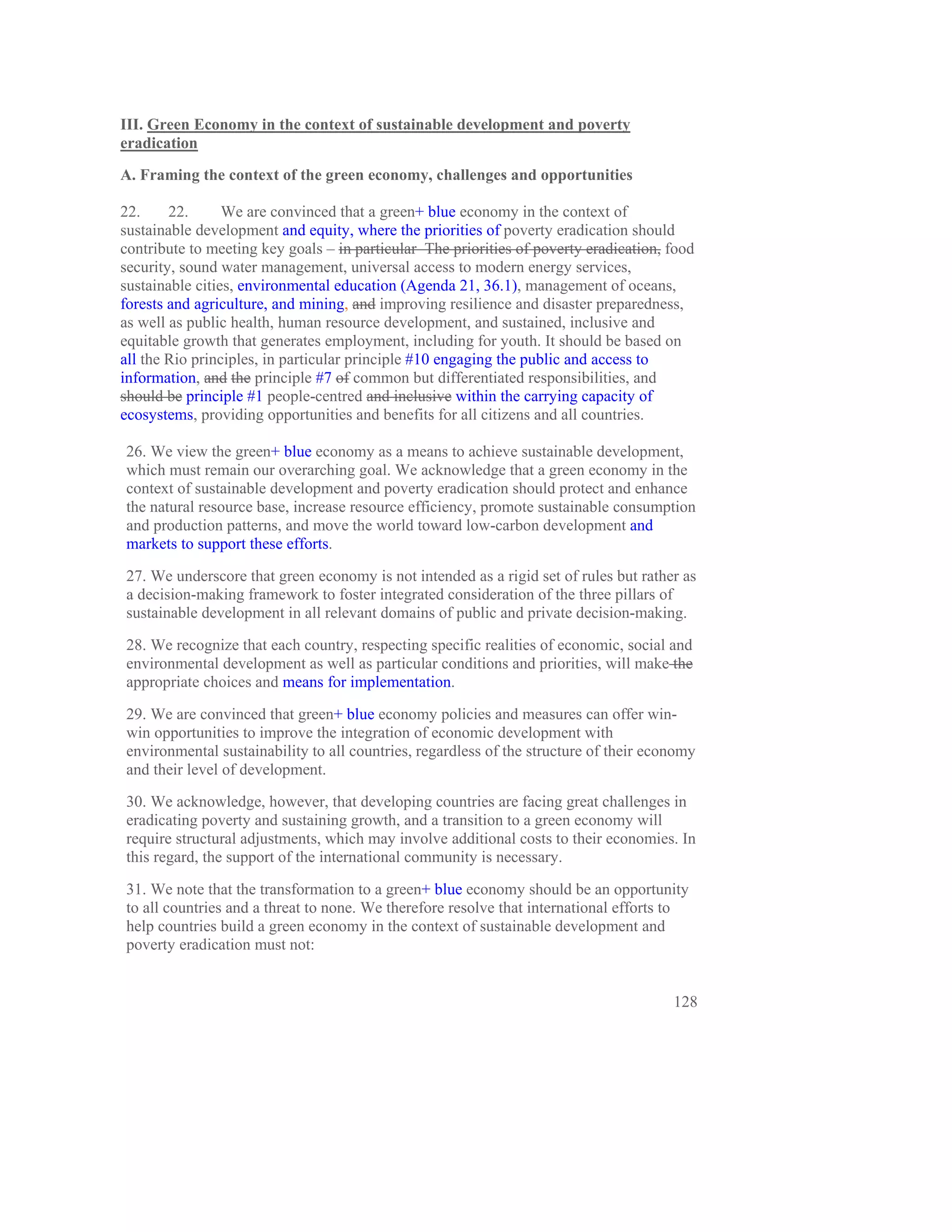
25. We are convinced that a green economy in the context of sustainable development
and poverty eradication should contribute to meeting key goals – in particular the
priorities of poverty eradication, food security, sound water management, universal
access to modern energy services, sustainable cities, management of oceans and
improving resilience and disaster preparedness, as well as public health, human resource
development and sustained, inclusive and equitable growth that generates employment,
including for youth. It should be based on the Rio principles, in particular the principle of
common but differentiated responsibilities, and should be people-centred and inclusive,
providing opportunities and benefits for all citizens and all countries.

[pre 25. The green economy framework must embrace economic diversity, as well as
the specific realities of different countries and different peoples. Therefore all
references to the Green Economy in the Zero Draft must be changed to green
economies. Operationalization of green economies, requires respect for diversity,
and a combined application of human rights-based, ecosystems-based and
knowledged-based approaches. – Indigenous Peoples]

[pre 25 bis. Diverse local economies are critical components of resilient ecosystems
and green economies, promoting sustainable local livelihoods, community solidarity
and poverty eradication. These longstanding green economies, also called
development with identity and Indigenous Peoples’ Self-determined Development,
are indigenous peoples’ vital contributions to 21st century green economies. For
99% of human history and development, local economies have provided these
multiple values, and are as important as ever, in the light of the contemporary
multiple crises. The globalized, fossil fuel-based industrial economy, dominant for
the 200 years- less than .01% of human history - has brought in its wake the crises
of environment, development and climate change. Green economies comprise the
existing diversity of sustainable local economies, contemporary transition town
initiatives, and transformed industrial sectors away from the carbon-intensive
global model of economy and trade. – Indigenous Peoples]

[pre 25 ter. Safeguard the lands, territories and resources, and associated customary
management and sustainable use systems of Indigenous Peoples, small producers
and local communities as essential contributions to sustainable development. –
Indigenous Peoples]


                                                                                            4
[pre 25 quat. The renewed political commitment to sustainable development must
empower and benefit the poor. Overemphasis and focus on the macro-economy
without due regard and targeted support for diverse local economies will not deliver
on poverty eradication goals. – Indigenous Peoples]
[pre 25 quint. Beyond income, indigenous peoples and the poor, need to have secure
rights over their lands, territories and resources and to exercise their customary
resource management and sustainable use systems, which are their basic sources of
wealth and well-being. – Indigenous Peoples]
[pre 25 sext. Public policy must prioritise support for building resilient local
economies and ecosystems and the self-development efforts of Indigenous Peoples,
including strong government regulation to protect local economies from predatory
investments. – Indigenous Peoples]
[pre 25 sept. Governments must address the intensifying land and natural resource
conflicts arising from resource extractive industries – oil, gas and mining, as well as
logging and export-oriented forestry and agriculture – which transfer wealth away
from local peoples, while degrading ecosystems and creating poverty. Rio+20 must
signal the need for strong international standards for corporate accountability
addressing the social, cultural and environmental pillars of sustainable
development. – Indigenous Peoples]
[pre 25 oct. Moreover, operationalization of green economies in the context of
sustainable development and poverty eradication, requires integration and
coherence with the UN’s human rights-based approach to development, as well as
the ecosystems-based approach of the UN multi-lateral environmental agreements
(MEAs). – Indigenous Peoples]

[pre 25 non. Indigenous and traditional knowledge are distinct and special
contributions to 21st century learning and action. – Indigenous Peoples]

[pre 25 dec. In addition, knowledge-based approaches and tool kits to deal with 21st
century challenges, must embrace the full diversity of knowledge systems, including
indigenous and traditional knowledge, innovations and practices, as complementary
to modern science and technology. References in the Zero draft to learning and
knowledge-sharing platforms must embrace indigenous and local knowledge, and
diverse knowledge systems. They are equally important as science for the purposes
of assessment processes, monitoring and defining indicators for sustainable
development. – Indigenous Peoples]

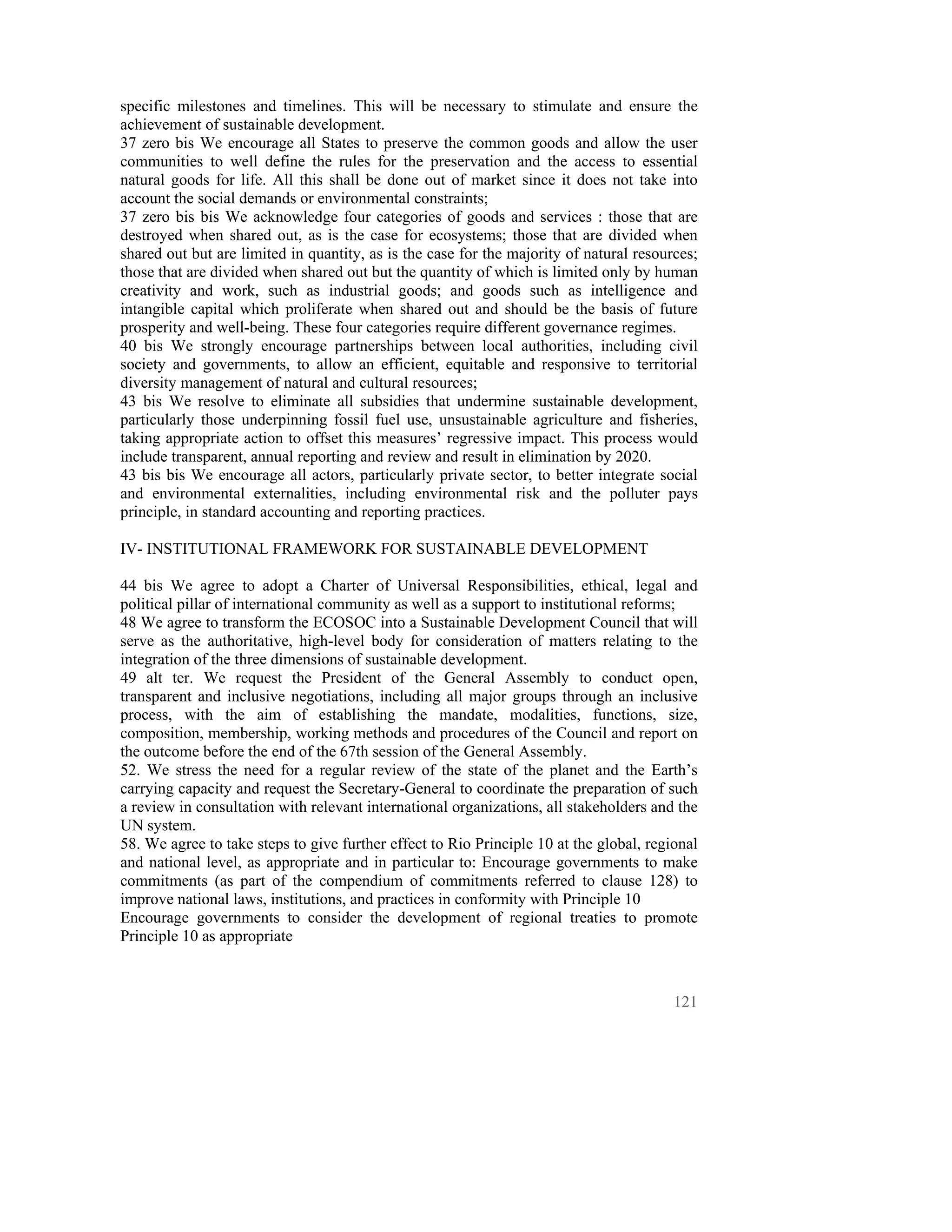
25. [Implementing Green economy had to be seen as one of the means for achieving
sustainable development, which must remain our overarching goal. - NGOs] [We –
NGOs - Delete] [are convinced – Women – Delete] [that a green economy in the
context of – Women / NGOs - Delete] [green economies – NGOs] [reaffirm –
Women] [Transforming the economy in the context of – NGOs] [sustainable
development and poverty eradication –NGOs –Delete / NGOs – Not Delete (Non-
agreement between NGOs)] [policies – NGOs] [has the potential – NGOs] [as our


                                                                                      5
overarching goals, and that greening of the economy – Women] [should contribute
to meeting – NGOs – Delete] [key – Women/NGOs – Delete] [these – Women] [goals
– NGOs – Delete / NGOs – Not Delete(Non-agreement between NGOs)] [This will
result in development which brings human well-being, social equity and gender
equality whilst remaining within the carrying capacity of the planet and halting
irreversible damage to our environment and natural resources. - Women] [ in –
Women/NGOs – Delete] [particular – NGOs – Delete] [the – Women/NGOs –
Delete] [priorities – NGOs – Delete] [of – Women/NGOs – Delete] [poverty
eradication, - NGOs – Delete] [access to voluntary reproductive health services,
nutritional security - NGOs] [health, - Women/NGOs] [social inclusion,
safeguarding human health, food and nutrition – NGOs] [food security, - NGOs –
Delete][food sovereignty, sound resources management – NGOs] [reduction of
greenhouse gas emissions, biodiversity conservation, land restoration, – NGOs]
[sound water management, universal access to – NGOs - Delete] [modern –
Women/NGOs - delete] [sustainable – Women] [energy services, sustainable cities, -
NGOs – Delete] [ecosystem resilience, - NGOs] [management of oceans – NGOs -
Delete] [and landscapes – NGOs] [and improving resilience and disaster
preparedness, as well as public health, human resource development and sustained,
inclusive and equitable – NGOs – Delete] [growth – NGOs] [and sustainable use of
natural systems – NGOs] [growth – NGOs – Delete] [development – NGOs] [that
generates – NGOs – Delete] [that respects traditional livelihoods and occupations
and – NGOs] [employment – NGOs/Workers & Trade Unions – Delete] [green and –
NGOs] [decent work - Workers & Trade Unions / NGOs], [including – NGOs –
Delete] [expanded opportunities for women and – Women] [for youth. – NGOs –
Delete] [, while remaining within the carrying capacity of the planet. – NGOs] [,
while combating climate change and respecting a range of other critical natural
boundaries at relevant scales – NGO] It should be based on [all – Women] [the –
Women – Delete] Rio principles, [in particular the principle of common but
differentiated responsibilities, - Women – Delete] [and adopt a rights-based
approach to sustainable development. It should foster balanced relationships
between humans and nature. – NGOs] [and precautionary principle – NGOs] [and –
NGOs – Delete] [It – NGOs] should be [both nature-centered and –NGOs] [people-
centred – NGOs – Delete/ NGOs – Not Delete (Non-agreement between NGOs)] [,
human rights based – NGO] and inclusive, providing opportunities and benefits for all
[citizens and all countries – NGOs – Delete/ NGO – Not Delete (Non-agreement
between NGOs)] [, and fostering balanced human-nature relationships, beneficial
for all peoples and the planet. – NGOs] [all peoples and the planet, and preserving
the integrity of natural ecosystems and species – NGOs]. [In particular the needs of
the vulnerable and marginalized groups must be prioritized in the creation of green
economies. – NGOs]

[25bis. We commit to create green economies based on “inclusive wealth” which
includes all forms of capital –natural, social and human, as well as financial and
manufactured – and in which intergenerational wellbeing increases over time.
Green economies require to incorporate the multiple values of biodiversity and


                                                                                     6
ecosystem services into policy and management decisions. – Scientific &
Technological Community]


26. We view the green economy as a means to achieve sustainable development, which
must remain our overarching goal. We acknowledge that a green economy in the context
of sustainable development and poverty eradication should protect and enhance the
natural resource base, increase resource efficiency, promote sustainable consumption and
production patterns, and move the world toward low-carbon development.

26. [We recognize our obligation to prevent harm to the commons that we hold in
trust for future generations. Governments in consultation with communities have a
key role to play in protecting the commons, and in doing this they should be guided
by ethics rather than profits. – NGOs] We [reaffirm that – NGOs] [view - NGOs –
Delete] [the green economy – Women /NGOs – Delete] [greening economies –
Women/Indigenous Peoples] [sustainable economies – NGOs] [as a means to achieve
sustainable development – NGOs – Delete] [and poverty eradication – NGOs] [- by
protecting and enhancing diverse local economies and the natural resource base,
increasing resource efficiency, promoting sustainable consumption and production
patterns, and moving the world toward low-carbon development – Indigenous
Peoples], [which must remain our overarching goal – NGOs – Delete] [must remain
the overarching goals of our efforts to transform our economies – NGOs / NGOs –
Delete (Non-agreement between NGOs)]. [We acknowledge that – Indigenous
Peoples – Delete] [a green economy – NGOs – Delete] [sustainable economies –
NGOs] [sustainable and inclusive economy – NGOs] [in the context of sustainable
development and poverty eradication – NGOs - Delete] should [be within the limits
of the carrying capacity of the planet and human capital. – NGOs][protect and
enhance – NGOs – Delete/ NGOs – Not Delete (Non-agreement between NGOs)] [the
natural resource base – NGOs – Delete/ NGOs – Not Delete (Non-agreement
between NGOs)]] [biodiversity – NGOs / NGOs – Not Add (Non-agreement between
NGOs)], [respect the rights of nature – NGOs] [promote social equity and gender
equality, - Women] [It should – NGOs] increase resource efficiency [and sufficiency,
phase out the unsustainable consumption– NGOs], [promote sustainable
consumption - NGOs – Delete/ NGO – Not Delete (Non-agreement between NGOs)]
[advance human health, food and nutrition security – NGOs] and production
patterns, [and waste reduction – NGOs] [and – Women/NGOs – Delete] move the
world toward low-carbon [development – NGOs – Delete / NGO – Not Delete (Non-
agreement between NGOs)] [on the way to a zero carbon emissions target. – NGO]
[economies – NGO] [, and - Women/NGOs] [ensure human health and nutrition. -
Women] [and respect for Earth-system processes necessary for ensuring social and
ecological well-being. – NGOs] [Commitments to advance green economies by
governments must be concrete and ambitious. - NGOs] [In this regard, the following
core items describe the high level system conditions that are required to transition
towards a green economy, from both business and governments: Social innovation
1. Awareness 2. Education and skills 3. Employment; Environment innovation
4.Resource efficiency and decoupling 5. Life cycle approach; Economic innovation


                                                                                       7
6. Open and competitive markets 7. Metrics, accounting, and reporting 8. Finance
and investment; Mutually enforcing cross-cutting elements 9. Integrated
environmental, social and economic policy and decision making and 10. Governance
and partnerships. – Business & Industry]

27. We underscore that green economy is not intended as a rigid set of rules but rather as
a decision-making framework to foster integrated consideration of the three pillars of
sustainable development in all relevant domains of public and private decision-making.

27. [We underscore that [green – NGOs – Delete] [a sustainable – NGOs] economy
[is – NGOs –Delete] [should – NGOs] [constitute – Indigenous Peoples] not intended
as a rigid set of rules but rather as a decision-making framework to foster integrated
consideration of the three pillars of sustainable development in all relevant domains of
public and private decision-making. – NGOs – Delete para. (Non-agreement between
NGOs)]

[Achieving world wide Green Economies, and with that resource justice, means also
a scheme of contraction and convergence for over- and underconsumers of natural
resources and waste disposal. – NGOs]

[27 bis. We recognize the importance of ensuring that green economy policies and
projects contribute to sustainable development. In order to guide action, we agree
that green economy activities must comply with the following principles:
           1. Equity between and within countries.
           2. Inclusiveness and participation (youth, women, poor and low skilled
           workers)
           3. Transformation of traditional and creation of new green and decent
           jobs.
           4. Respect for the rights of workers and trade unions.
           5. Fulfilment of social objectives and satisfaction of human needs in the
           long term, including universal access to water, food, housing, energy,
           land, health, education, transport and culture.
           6. Based on the efficient use of natural resources, prioritisation of
           renewable sources, internalisation of social and environmental costs, life-
           cycle analysis and aiming at being zero carbon and zero waste.
           7. Focus on materials’ productivity rather than on cutting labour costs.
           8. Just Transition for workers and communities that might be affected by
           change, including widening social protection schemes and developing
           social dialogue mechanisms on green economy policies.
           9. Promotion of democracy.
           10. Based on the real economy and be non-speculative. - Workers &
           Trade Unions]


                                                                                           8
28. We recognize that each country, respecting specific realities of economic, social and
environmental development as well as particular conditions and priorities, will make the
appropriate choices.

28. We recognize that each country, respecting specific realities of economic, social and
environmental development as well as particular conditions and priorities, will make the
[appropriate – NGOs - Deleted] [necessary – NGOs] choices [adapted to their own
conditions – NGOs] [, but respecting international legal frameworks and regulations
- NGOs] [that incorporate international human rights obligations and principles –
NGOs] [, applying human rights-based and ecosystems-based approaches –
Indigenous Peoples].

29. We are convinced that green economy policies and measures can offer win-win
opportunities to improve the integration of economic development with environmental
sustainability to all countries, regardless of the structure of their economy and their level
of development.

29. [We [are convinced that – Women/NGOs – Delete / NGOs – Not Delete] [support
socially responsive – Women] [green – NGOs – Delete] [a sustainable - NGOs] [note
the potential of green – NGOs] [economy – NGOs - Delete] [economic – NGOs /
Indigenous Peoples] policies and measures [can offer win-win –NGOs – Delete] [to
offer – NGOs] opportunities to improve the integration of economic development with
environmental sustainability [and social equity - Women] [to – NGOs – Delete] [in –
NGOs] all countries[, regardless of the structure of their economy and their level of
development. – NGOs – Delete] – NGO – Delete para. (Non-agreement between
NGOs)]

30. We acknowledge, however, that developing countries are facing great challenges in
eradicating poverty and sustaining growth, and a transition to a green economy will
require structural adjustments which may involve additional costs to their economies. In
this regard, the support of the international community is necessary.

30. We acknowledge, however, that developing countries are facing great challenges in
eradicating poverty and [sustaining growth – NGOs – Delete] [the necessary economic
development for achieving well being – NGOs], and a transition to a [green – NGOs –
Delete] [sustainable - NGOs] [and inclusive economies – NGOs] economy [will
require structural adjustments which – NGOs / Indigenous Peoples – Delete] the
support of the international community [is necessary – Indigenous Peoples – Delete] [,
especially in terms of promoting technology transfer and redirecting unfair and
perverse subsidies and providing stable, predictable and adequate public financial
support in light of the volatility and instability of private investments and market-
based financing mechanisms – NGOs]. [, especially for the Least Developed
Countries. Green economies policies must also lay due emphasis on social justice –
NGOs]. [We also encourage developing countries to develop new strategies that
would emancipate them from international support – NGOs].


                                                                                                9
[30.bis.We recognize that the green economy transformation requires a systematic
consideration of equity, social inclusion, gender equality, and human rights,
harnessing and realizing the economic potential of poor and excluded groups, and
women, ensuring that they have access to services, technologies, natural resources,
land, and financing resources. – Women]

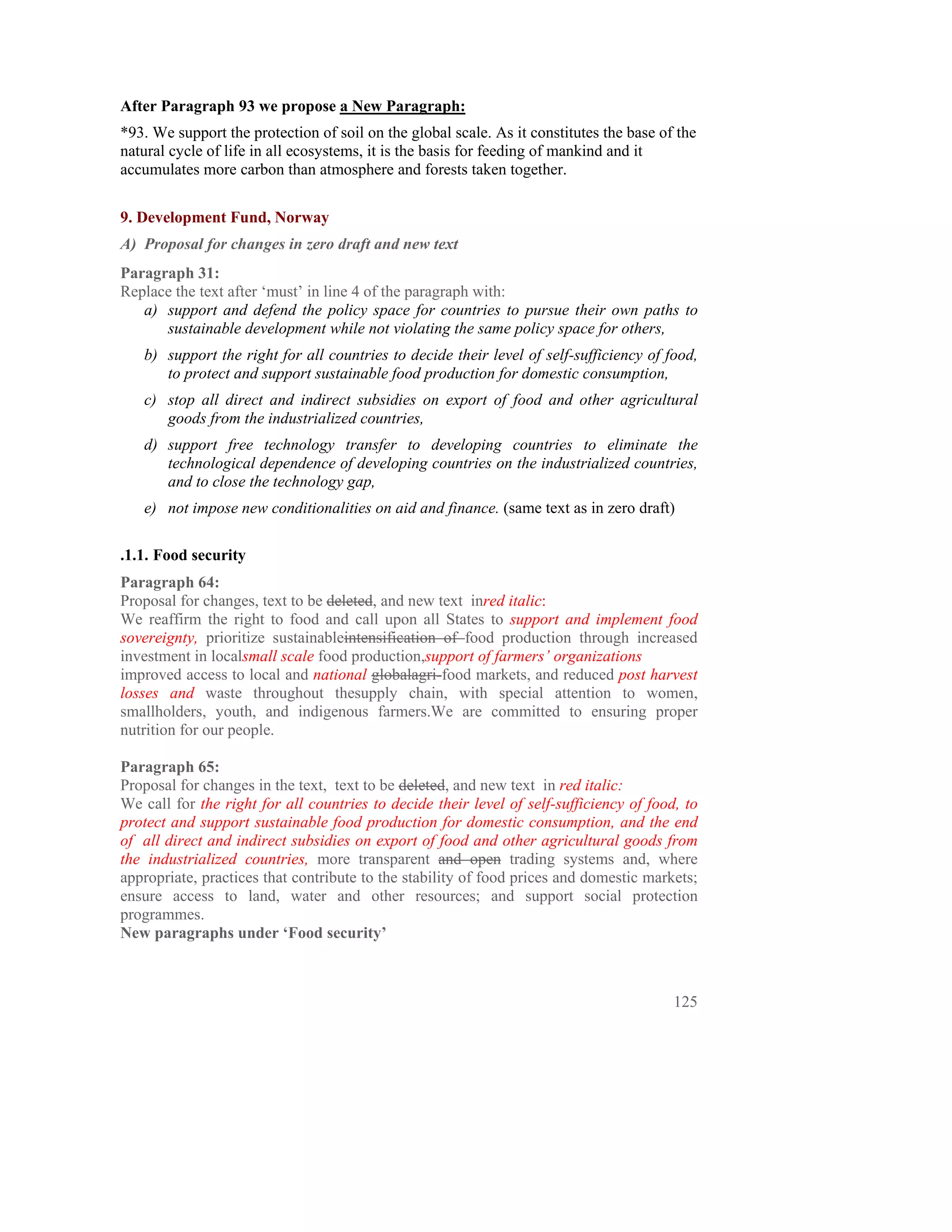
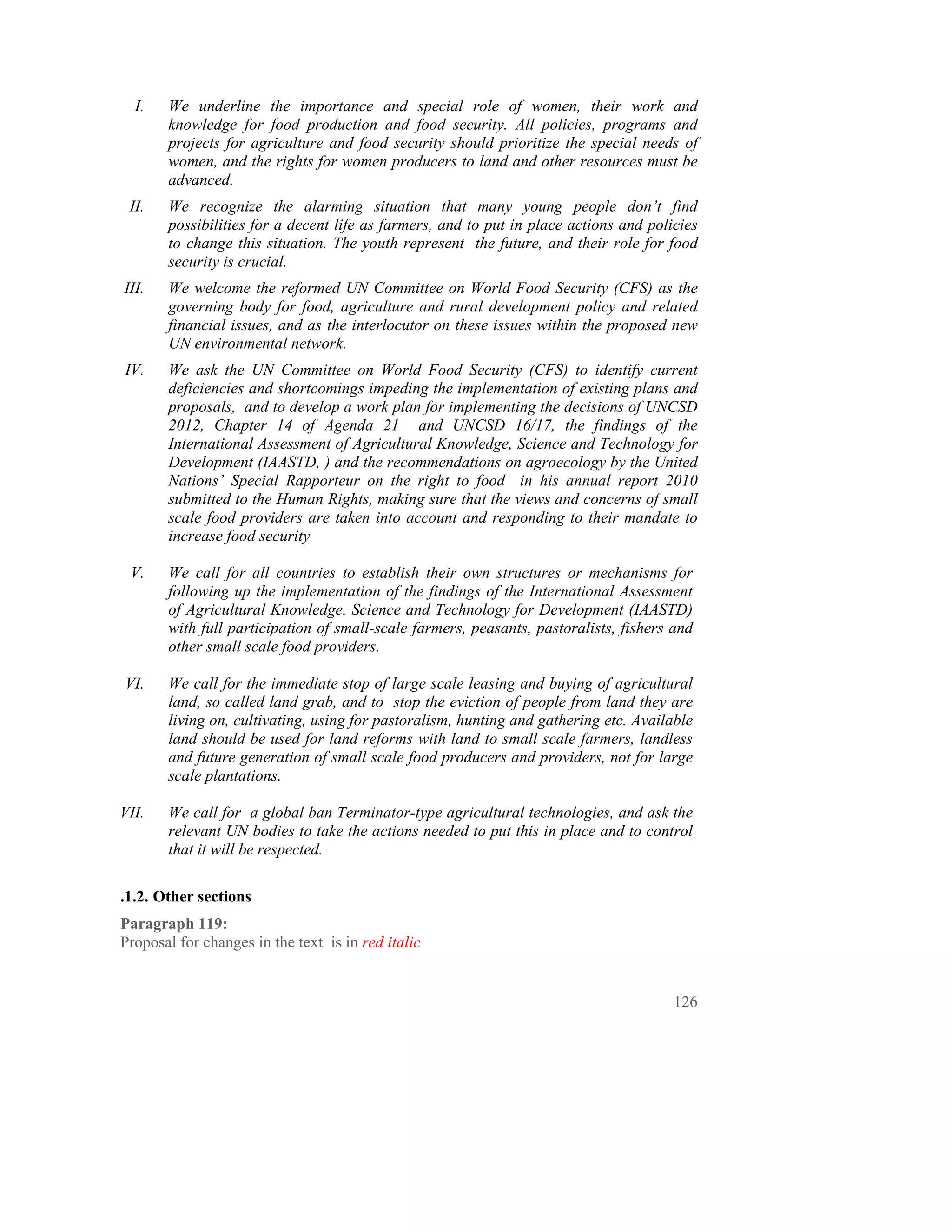
31. We note that the transformation to a green economy should be an opportunity to all
countries and a threat to none. We therefore resolve that international efforts to help
countries build a green economy in the context of sustainable development and poverty
eradication must not::

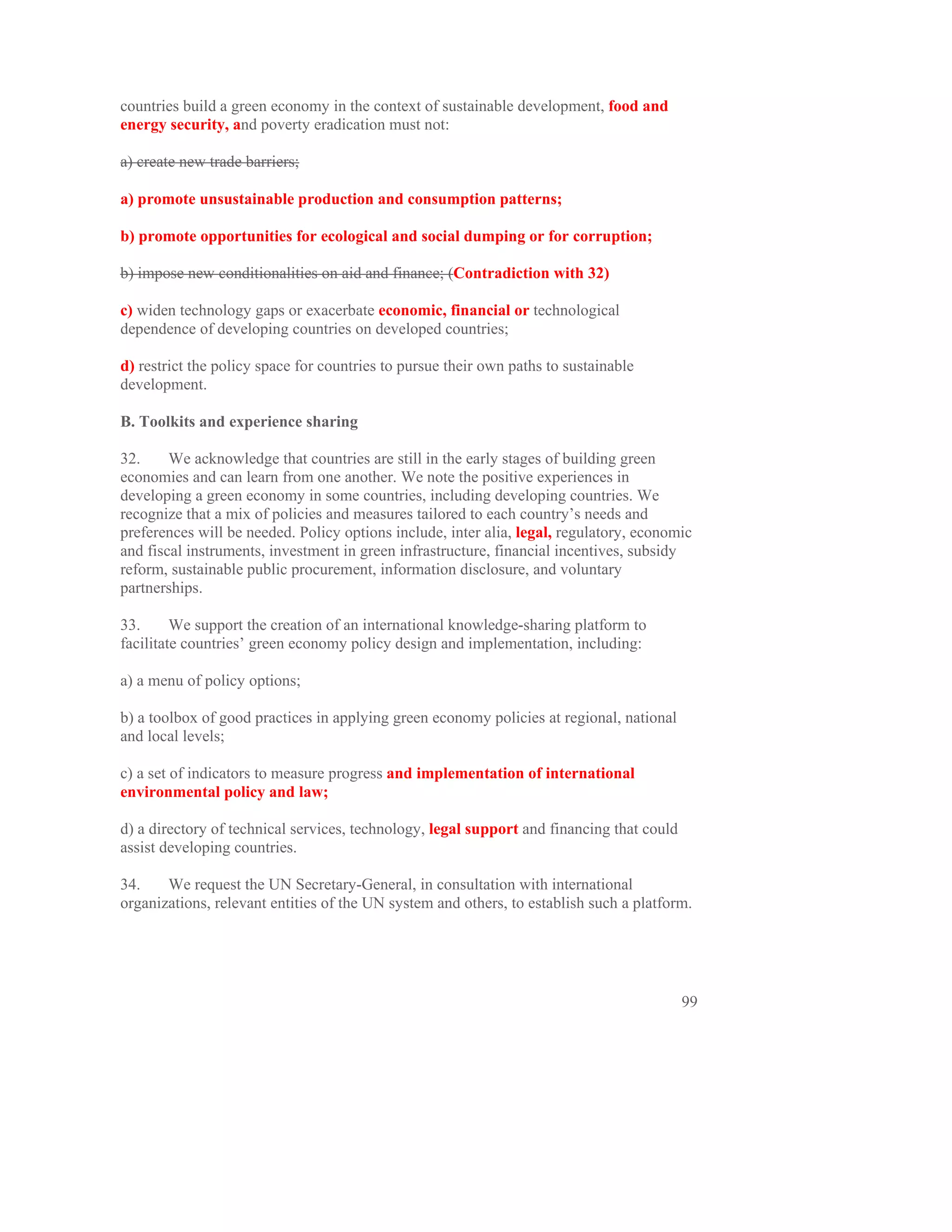
a) create new trade barriers;

b) impose new conditionalities on aid and finance;

c) widen technology gaps or exacerbate technological dependence of developing
countries on developed countries;

d) restrict the policy space for countries to pursue their own paths to sustainable
development.


31. We [note – NGOs – Delete] [acknowledge – NGOs] that the transformation to [a –
Indigenous Peoples – Delete] [green – NGOs – Delete] [sustainable – NGOs]
economy [sustainable and inclusive economies – NGOs] should be an opportunity [to –
NGOs – Delete] [for – NGOs] [green economies provide opportunities – Indigenous
Peoples] all countries [to pursue their own path towards sustainable development –
NGOs] and [are – Indigenous Peoples] a threat to none. We therefore resolve that
international efforts to help countries build [a – NGOs - Delete] [green – NGOs –
Delete] [sustainable – NGOs] [economy – NGOs – Delete] [economies – NGOs /
Indigenous Peoples] [in the context of sustainable development and poverty
eradication – Indigenous Peoples – Delete]

[must:

a) support the strengthening of local and regional markets as a priority
b) ensure food sovereignty and farmers livelihood
c) allow countries to develop their own technological know how out of intellectual
property rights framework

and – NGOs]

[should:
a) be compatible with all international agreements (ILO, MEAs, Human Rights, ..);
b) increase level of ODA;
c) implement Bali Action Plan on technology transfer


                                                                                          10
d) strengthen the ability of countries to pursue their own paths to sustainable
development.
e) give possibilities for countries to protect their national reserves of biodiversity
and ecosystems. – NGOs]

must not:

a) create new trade barriers [unless they are a temporary tool to protect small
producers and small enterprises from international competition – NGOs] ;

b) impose new conditionalities on aid and finance [and exacerbate existing inequalities
– Women];

c) [widen technology gaps or exacerbate technological dependence of developing
countries on developed countries; - Business & Industry – Delete] [Undermine
countries’ ability to invest in research and development, adoption, deployment, and
diffusion of technology – Business & Industry]

d) restrict the policy space for countries to pursue their own paths to sustainable
development. - NGOs]

[d bis) introduce or impose technologies which threaten the environment or
undermine livelihoods, health or human rights; - NGO]

[ADD e) discriminate against and disrespect the culture of any particular group, or
exacerbate existing inequalities; - NGOs]

[e bis) prioritize investors' and corporations' rights against rights of people and of
Nature; - NGOs]

[e ter) Take the place of efforts in developed countries to transform economic
environmental and social systems – NGOs]

[e quat) threaten the security of IP and local communities to their lands, territories
and resources. – Indigenous Peoples]

[e quint) Take the place of efforts in developed countries to transform economic
environmental and social systems. – Women]

[ADD f)- threaten the rights of indigenous peoples to their lands, territories and
resources. - NGOs]

[f bis) introduce or impose technologies which threaten the environment or
undermine livelihoods, health or human rights; - NGOs]


                                                                                         11
[f ter) introduce or impose technologies which threaten the environment or
undermine livelihoods, health or human rights; - NGOs]

[f quat) Should not allow for harmful technologies which have not been assessed on
their long term impacts on human health and ecosystems – Women]

[ADD g) create barriers to swiftly reducing atmospheric greenhouse gas
concentrations; - NGOs]

[ADD h) introduce or impose technologies that threaten the environment or
undermine livelihoods, health or human rights; - NGOs]

[31.bis When building green economies we recognize that a mix of policies and
measures tailored to each country’s needs and priorities will be necessary through
the development of policy options and effective regulatory frameworks that include,
inter alia,
 o Taxation reform and fiscal incentives
 o Stop environmentally harmful subsidies, including fossil fuel and nuclear
      energy subsidies
 o Investment in green and disaster resilient infrastructure
 o Sustainable Public and Corporate Procurement
 o Innovative financing
 o Setting up of Indicators,
 o information disclosure,
 o Convention of Corporate Social Responsibility and accountability
 o Strict productnorms to abolish unsustainable products
 o Capacity building, Education,| Training and Skills strategies, and Awareness
      raising initiatives,
 o Research, including for promoting social innovation
 o Social policies
 o Transparency and accountability
 o Acknowledge of indigenous traditions and structures – NGOs]

B. Toolkits and experience sharing

32. We acknowledge that countries are still in the early stages of building green
economies and can learn from one another. We note the positive experiences in
developing a green economy in some countries, including developing countries. We
recognize that a mix of policies and measures tailored to each country’s needs and
preferences will be needed. Policy options include, inter alia, regulatory, economic and
fiscal instruments, investment in green infrastructure, financial incentives, subsidy
reform, sustainable public procurement, information disclosure, and voluntary
partnerships.

32. We acknowledge that countries [, peoples and communities – Indigenous Peoples]
are still in the early stages of [the transition into – NGOs] [building – NGOs – Delete]
[green – NGOs – Delete/ NGOs - Not Delete (Non-agreement between NGOs)]


                                                                                           12
[sustainable – NGOs] [and inclusive – NGOs] economies and can learn from one
another. We note the positive experiences in developing a [green – NGOs – Delete]
[sustainable – NGOs] [economy – Indigenous Peoples – Delete] [economies –
Indigenous Peoples] in some countries, including developing countries. [We recognize
that a mix of policies and measures tailored to each country’s needs and preferences will
be needed. Policy options include, inter alia, regulatory, economic and fiscal instruments,
[ respect for diverse local economies, - Indigenous Peoples] investment in [green –
NGOs – Delete] [sustainable – NGOs] infrastructure [and in green R&D – Scientific
& Technological Community], financial incentives, subsidy reform, [regional or
multilateral environmental agreements, - NGOs] sustainable public procurement,
[gender-responsive budgets, - Women] information disclosure, [education and public
awareness, - Indigenous Peoples] and [voluntary – Women – Delete] partnerships.
[We support prioritization of policies that maximize positive impacts on both the
environment and social progress, such as community management of natural
resources; taxes-and-transfers, and asset reforms that are socially-progressive and
environmentally-friendly; and full cost accounting for internalizing socio-
environmental costs – NGOs]. – NGOs – Delete from We recognize..]

[32 bis. We recommend to prioritise policies that generate and maximise positive
impacts on both the environment and social progress, such as taxation reforms that
are socially-progressive and environmentally-friendly. – Workers & Trade Unions]

33. We support the creation of an international knowledge-sharing platform to facilitate
countries’ green economy policy design and implementation, including:

a) a menu of policy options;

b) a toolbox of good practices in applying green economy policies at regional, national
and local levels;

c) a set of indicators to measure progress;

d) a directory of technical services, technology and financing that could assist developing
countries.

33. We support the creation of [an international – Women / NGOs / Indigenous
Peoples - Delete] [a UN-based – Women / NGOs] [, multilingual – NGOs] knowledge-
sharing platform [s at all various levels – Indigenous Peoples] to facilitate countries’
[green – NGOs – Delete] [sustainable – NGOs] [facilitate – by involving scientific
expertise and feed-back of non-state actors – NGOs] economy [economic –
Indigenous Peoples] policy design and implementation, including:

a) a menu of policy options [, determined after comprehensive consultations with
multistakeholders – NGOs] ;


                                                                                          13
b) a toolbox of [good – NGOs – Delete] [promising – NGOs] practices in applying
[green – NGOs – Delete] [sustainable – NGOs] economy policies [and targets –
NGOs] at regional, national and local levels [,such good practices should use common
assets trusts and public goods protections - NGOs];

c) a set of [integrated science-based – Scientific & Technological Community]
[environmental, socio-economic, and health – Women/NGOs] indicators[, including
disaggregated environmental, socioeconomic, and health indicators, - NGOs]
[including alternatives to GDP and commonly used economic indicators – NGOs] [,
including community local level monitoring tools; - Indigenous Peoples] to measure
progress [including gender indicators – Women] [and distributional impacts –
NGOs];

[d) a directory of technical [and – Women] [services – Women / NGOs– Delete],
technology [-related information – Women / NGOs] [information – NGOs] [and
financing – Women / NGOs – Delete] that could [assist – Women / NGOs – Delete]
[be relevant for – Women / NGOs] developing countries [, including environmental,
health and social impacts analysis. – Women / NGOs]. – NGOs - delete section]

[d bis) a set of methodologies for policy evaluation; - NGOs]

[ADD e)a set of measures to draw the attention of states to the multiple benefices of
sustainable development – NGOs].

[33 bis. The use of any given technology requires a thorough analysis of the
technological and economical feasibility, as well as of the environmental impact, for
implementing scientifically sound and efficiently engineered solutions. – Scientific &
Technological Community] 

34. We request the UN Secretary-General, in consultation with international
organizations, relevant entities of the UN system and others, to establish such a platform.

34. We request the UN Secretary-General, in consultation with international
organizations, relevant entities of the UN system [, including the regional commissions
– NGOs] and others, to [establish – Indigenous Peoples – Delete] [enable –
Indigenous Peoples] such a platform [, in close cooperation with stakeholders- NGOs]
[, through a participatory process allowing ownership by all stakeholders – NGOs]
[and to establish a review process to determine the linkage of such platform with
already existing institutions - NGOs] [Funding and expertise for such a platform
can be mobilized through above ,mentioned 15/15/15 UN – Civil Society partnership
formula - NGOs].

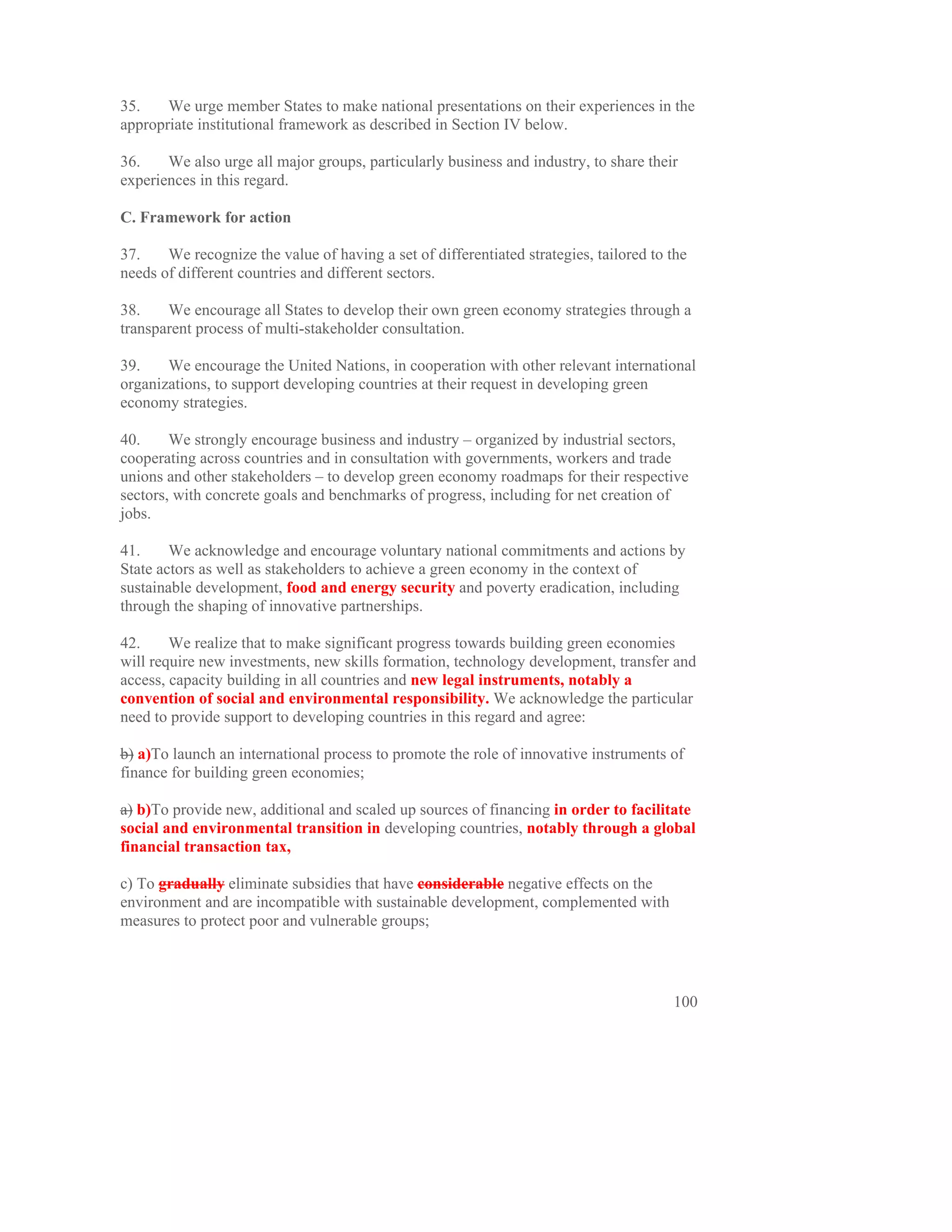
35. We urge member States to make national presentations on their experiences in the
appropriate institutional framework as described in Section IV below.


                                                                                         14
35. We urge member States [and international organizations – NGOs] to make
national presentations on their experiences in the appropriate institutional framework as
described in Section IV below [, as well as in other venues – NGOs].

36. We also urge all major groups, particularly business and industry, to share their
experiences in this regard.

[36. We also urge all major groups, [particularly business and industry – Women /
NGOs / Indigenous Peoples - Delete] [and the scientific and technological
communities – Scientific & Technological Community], to share their experiences
[widely – NGOs] in this regard [and aim to support those with the least resources. –
Women]. [We recognize the crucial roles of the scientific and technological
community in the work of the platform, such as ensuring that its work is based on
the best available scientific knowledge and appropriate technologies. - Scientific &
Technological Community]. – Indigenous Peoples – Delete para.]

C. Framework for action

37. We recognize the value of having a set of differentiated strategies, tailored to the
needs of different countries and different sectors.

[pre 37. A main outcome of RIO+20 will be the establishment of a roadmap with a
concrete action plan, targets and timetables for achieving SD. – NGOs]

37. We recognize the value of having a set of differentiated strategies, tailored to the
needs of different countries [, peoples – NGOs] and different sectors [, and diverse
ecosystems – Indigenous Peoples].

38. We encourage all States to develop their own green economy strategies through a
transparent process of multi-stakeholder consultation.

38. We encourage all States to develop their own [green – NGOs – Delete] [sustainable
– NGOs] [economy – NGOs – Delete] [sustainable development – NGOs] [economic -
Indigenous Peoples] strategies [, making use of transition into green economies –
NGOs] through a transparent process of multi-stakeholder consultation [and
coordination at a multi-governmental level – Local Authorities] [and participation –
NGOs] [that includes and actively engages all the diverse actors of civil society at all
levels of decision-making, ensuring more support for major groups with the least
resources – NGOs] [, devolved to the lowest appropriate level. – Indigenous
Peoples].


39. We encourage the United Nations, in cooperation with other relevant international
organizations, to support developing countries at their request in developing green
economy strategies.


                                                                                           15
39. We encourage the United Nations, in cooperation with other relevant international
organizations, to support developing countries at their request in developing [green –
NGOs – Delete] [sustainable – NGOs] [economy – NGOs – Delete] [sustainability –
NGOs] [economic – Indigenous Peoples] strategies [and action plans – NGOs]
[through formalized centre of knowledge sharing and capacity building - NGOs].

40. We strongly encourage business and industry – organized by industrial sectors,
cooperating across countries and in consultation with governments, workers and trade
unions and other stakeholders – to develop green economy roadmaps for their respective
sectors, with concrete goals and benchmarks of progress, including for net creation of
jobs.

[40. We [strongly encourage – NGOs – Delete] [urge – NGOs] business and industry
[– organized by industrial sectors, - Business & Industry – Delete] [and scientists
and engineers – Scientific & Technological Community] cooperating across countries
and in consultation with governments, [local communities – NGOs] workers and trade
unions and other stakeholders – to develop [green – NGOs – Delete] [sustainable –
NGOs] [economy – NGOs – Delete] [sustainability – NGOs] roadmaps [for their
respective sectors, - Business & Industry – Delete] [along supply and value chains,
taking into account the potential for synergies within each sector, - Business &
Industry] [ for green economies – Indigenous Peoples] with concrete goals and
benchmarks of progress, including for net creation of [green and decent – NGOs] jobs.
[New scientifically sound integrated indicators should be developed to monitor
progress towards sustainable development and a green economy. - Scientific &
Technological Community] [We encourage Local Authorities to develop Sustainable
Economy strategies, with concrete goals and benchmarks of progress, to support the
national sustainable economy strategies. – NGOs] – NGOs – Delete para. (Non-
agreement between NGOs)]

[40 alt. We strongly recognize the importance of putting the prices right and
internalize all external costs, throughout he whole production chain. We also
strongly encourage business and industry to adopt the UN guiding principles on
Business and Human Rights. – NGOs (Non-agreement between NGOs)]


[40bis We encourage Local and Subnational Authorities to develop [Green – NGOs
– Delete] [Sustainable – NGOs] Urban Economy strategies, with concrete goals and
benchmarks of progress, to support the national green economy strategies. [Local
Authorities]

[40 ter. We recognize existing local diverse economies and transition initiatives as
foundations of green economies. – Indigenous Peoples]


41. We acknowledge and encourage voluntary national commitments and actions by State
actors as well as stakeholders to achieve a green economy in the context of sustainable


                                                                                       16
development and poverty eradication, including through the shaping of innovative
partnerships.

41. We acknowledge and encourage [binding or – Women] [voluntary – NGOs –
Delete] [and regulatory – NGOs] national commitments and actions by State actors as
well as stakeholders [and each individual global citizen - NGOs ] to [transform the
economy – NGOs] [achieve a green economy in the context of –NGOs – Delete]
[economies – Indigenous Peoples] sustainable development and poverty eradication,
including through the shaping of innovative partnerships [We also commit ourselves to
develop an adapted and normative framework of actions enabling international
institutions to compel member states to achieve significant change – NGO].

42. We realize that to make significant progress towards building green economies will
require new investments, new skills formation, technology development, transfer and
access, and capacity building in all countries. We acknowledge the particular need to
provide support to developing countries in this regard and agree:

a) To provide new, additional and scaled up sources of financing to developing countries;

b) To launch an international process to promote the role of innovative instruments of
finance for building green economies;

c) To gradually eliminate subsidies that have considerable negative effects on the
environment and are incompatible with sustainable development, complemented with
measures to protect poor and vulnerable groups;

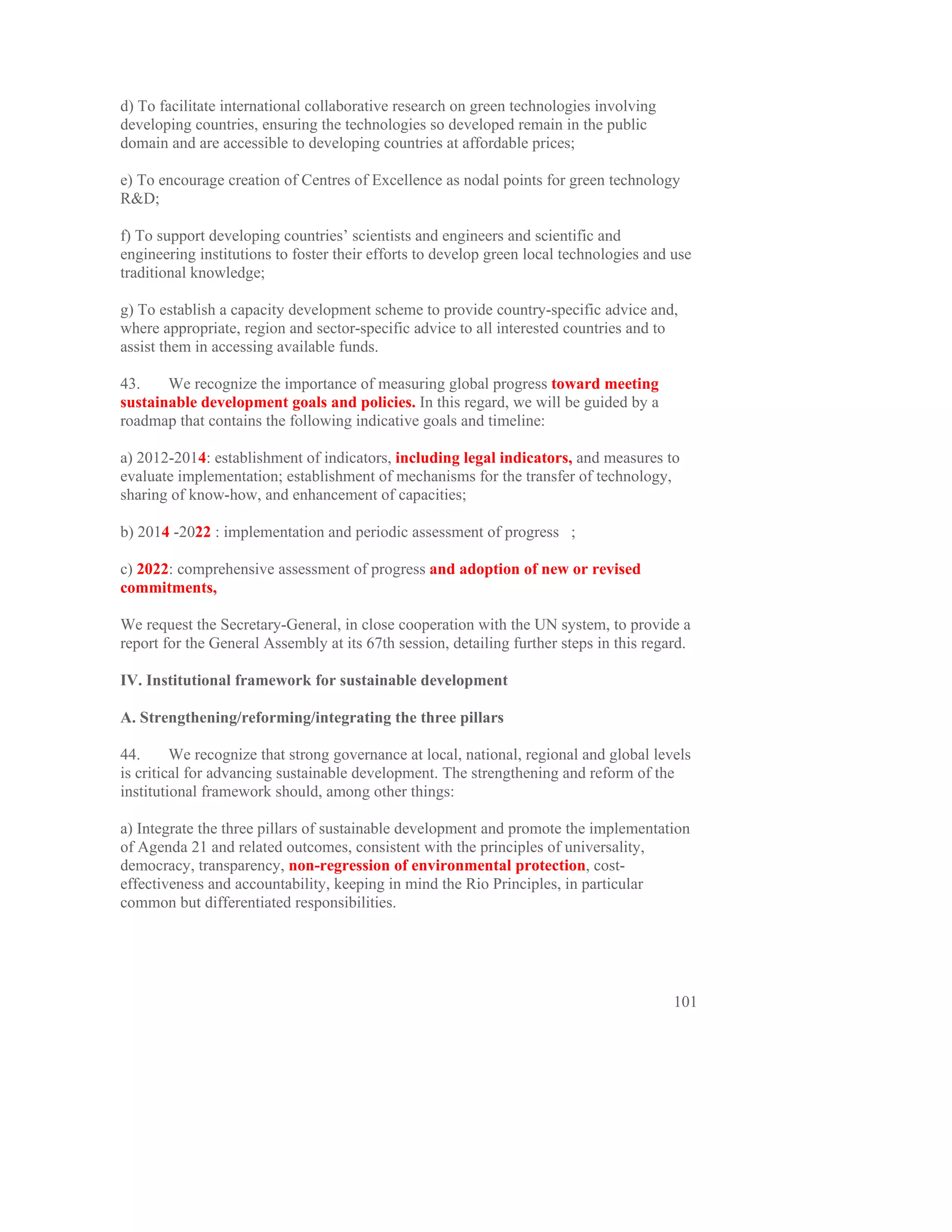
d) To facilitate international collaborative research on green technologies involving
developing countries, ensuring the technologies so developed remain in the public
domain and are accessible to developing countries at affordable prices;

e) To encourage creation of Centres of Excellence as nodal points for green technology
R&D;

f) To support developing countries’ scientists and engineers and scientific and
engineering institutions to foster their efforts to develop green local technologies and use
traditional knowledge;

g) To establish a capacity development scheme to provide country-specific advice and,
where appropriate, region and sector-specific advice to all interested countries and to
assist them in accessing available funds.

42. We realize that to make significant progress towards building [green – NGOs –
Delete] [sustainable – NGOs] [and inclusive – NGOs] economies will require [new –
NGOs – Delete] [a shift in – NGOs] [support for traditional knowledge and
innovations, - Indigenous Peoples] investments, new skills formation, [technology
development, - Business & Industry – Delete] [assessment, - NGOs] [transfer and


                                                                                          17
access, - Business & Industry – Delete] [(based on UNFCCC agreed definition of
technology transfer) enhanced research and development, demonstration,
deployment, diffusion and transfer of technology (hereinafter referred as technology
development and transfer) – Business & Industry]and capacity building in all
countries. We acknowledge the particular need to provide support to developing countries
in this regard and agree:

a) To provide new, [predictable, stable, - NGOs] additional and scaled up sources of
financing to developing countries;

b) To [launch an international process to – NGOs – Delete / NGOs – Not Delete
(Non-agreement between NGOs)] [design and – NGOs ] promote the role of
innovative [non-market based – NGOs] instruments of finance for [building – NGOs –
Delete] [green – NGOs – Delete] [sustainable – NGOs] [and inclusive – NGOs]
economies [including a Financial Transactions Tax, taxation of shipping fuel and
aviation, and redeployment of funds currently used for fossil fuel subsidies – NGOs]
[including taxation of currency and financial transactions, monetization of Special
Drawing Rights of the International Monetary Fund, and others – NGOs][ while
taking care that all stakeholders, including indigenous communities, accept and
benefit from these new instruments – NGO];

c) To [gradually – NGOs – Delete] [urgently – NGOs] eliminate subsidies [and
economic policies – NGOs] that have [considerable – NGOs – Delete] negative effects
on the environment [human health, fair trade – NGOs] [and society – NGOs] and are
incompatible with sustainable development, [including rapid elimination of all
subsidies (direct and indirect) that perpetuate emission of greenhouse gasses, -
NGOs] complemented with measures to protect poor and vulnerable groups;

[c bis) [Subsidies that are incompatible with sustainable development and that have
considerable negative effects on the environment should be eliminated, phased out
or reformed by 2020 at the latest – NGOs].

[c ter) To involve and protect the livelihoods of people, often women, working in the
informal sector; - Women]

d) [To facilitate international collaborative research on – Business & Industry –
Delete] [environmentally and socially sound and safe – NGOs] [green – Business &
Industry / NGOs – Delete] [technologies involving developing countries, ensuring
the technologies so developed – Business & Industry – Delete] [are evaluated for
their impacts, - NGOs] [remain in the public domain – Business & Industry –
Delete] [and – Business & Industry / NGOs – Delete] [are accessible to developing
countries at affordable prices; - Business & Industry – Delete] [We also urge
countries to strictly apply the precautionary approach to any technologies that
might imply a serious risk for the environment or human society, including in
particular synthetic biology, geo-engineering, genetic modification, nuclear energy
and nanotechnology ;– NGOs] [using language from the agreed UNCCC AWG LCA
text on technology transfer as the reference]: Promote and enhance national and


                                                                                       18
international cooperative action to facilitate research, development and
demonstration of new technologies which are required to meet the key objectives of
sustainable development; - Business & Industry]

[d bis) To avoid irreversible and long-term damage from untested technologies,
create an independent technology assessment and monitoring body at the UN –
Women]

e) [Support and complement the work under way in the UNFCCC through the
creation of the Climate Change Technology Center and Network and – Business &
Industry] [To - Business & Industry - Delete] encourage creation of [additional -
Business & Industry] Centres of Excellence as nodal points for [green – NGOs –
Delete] [sustainable – NGOs] technology R&D [with the active participation of all
relevant stakeholders – NGOs] [where needed - Business & Industry] [with the
active participation of different stakeholders – Women/ NGOs] [and ensuring that
such points are geographically balanced – NGOs];

f) To support developing countries’ [governments, business and industry, - NGOs]
scientists and engineers and scientific and engineering institutions to foster their efforts to
develop [green – NGOs – Delete/ NGOs – Not Delete (Non-agreement between
NGOs)] [sustainable and safe – NGOs] [and appropriate – NGOs] local technologies
[, as well as green economic models and land-water management systems, -
Scientific & Technological Community] and [use – Women / NGOs / Indigenous
peoples – Delete] [apply – Women] [respect the – NGOs] [harness and support –
NGOs / Indigenous Peoples] traditional knowledge [of Indigenous peoples and local
communities – NGOs] [and practices in collaboration with indigenous peoples and
local communities - NGOs] [,ensuring local and indigenous communities and
women contribute expertise and retain control over the knowledge – Women] [while
keeping the precautionary principles as a rule for using new technologies or
scientific knowledge – NGOs];

g) To establish a capacity development scheme to provide country-specific advice and,
where appropriate, region and sector-specific advice to all interested countries and to
assist them in accessing available funds.

[ADD - h) To develop international and national financial mechanisms accessible to
subnational and local governments to implement sustainable development’s
programs. - Local Authorities]

[h bis) To upgrade the International Panel of Natural Resources, and give it the
mandate to measure and manage the reserves of natural resources, which has to be
the base for green economy strategies. – NGOs]

[h ter To support traditional knowledge, innovation and practices, and the
implementation of ecosystems-based approaches – Indigenous Peoples]


                                                                                            19
[h quat) To support the formation of a “Global Forum on Innovative Resource
Mobilization for Education and Science” in the context of 15/15/15 UN-Civil Society
Formula which will nurture – in close collaboration with UNESCO, its regional
offices and national commissions - global research networks on global challenges,
UN Academic Impact initiative, Global University Network for Innovation,
International Human Dimensions Programme on Global Environmental Change
research initiative "Knowledge, Learning, and Societal Change: Finding paths to a
sustainable future" etc.), (formal and informal) Education for Sustainable
Development efforts on all levels, etc with the needed financial and human resources
for their important work. – NGOs]


43. We recognize the importance of measuring global progress. In this regard, we will be
guided by a roadmap that contains the following indicative goals and timeline:

a) 2012~2015: establishment of indicators and measures to evaluate implementation;
establishment of mechanisms for the transfer of technology, sharing of know-how, and
enhancement of capacities;

b) 2015~2030: implementation and periodic assessment of progress;

c) 2030: comprehensive assessment of progress.

We request the Secretary-General, in close cooperation with the UN system, to provide a
report for the General Assembly at its 67th session, detailing further steps in this regard.

43. We recognize the [fundamental – NGOs] importance of measuring global progress.
In this regard, we will be guided by a roadmap [that contains – NGOs – Delete] [with
concrete targets and mechanisms to ensure accountability, that contain – NGOs] the
following indicative goals and timeline:

a) 2012~2015: establishment of indicators [, including gender indicators, - Women]
and measures to evaluate implementation [and well-being – NGOs]; [establishment of
mechanisms for the – Business & Industry – Delete] [assessment and – NGOs]
[transfer of technology, - Business & Industry – Delete] [commit to supporting the
work of the Technology Mechanism established under UNFCCC to facilitate
research, development, and deployment of technologies, as well as that of other
similar mechanisms and programmes - Business & Industry]

[a bis) 2012 – 2015 establishment of measurement of all natural resources and global
management and distribution schemes per country. – NGOs]

[b) 2015~2030: implementation and periodic assessment of progress; - Business and
Industry – Delete]


                                                                                          20
[b alt) sharing of know-how, and enhancement of capacities; - Business & Industry]

[c) 2030: comprehensive assessment of progress. – NGOs / Business & Industry–
Delete]

[c alt) 2015~2030: implementation and periodic assessment of progress; - Business &
Industry]

[c alt bis) 2020: elimination of subsidies that have considerable negative effects on
the environment, particularly on biodiversity and climate, particularly subsidies on
fossil fuels; - NGOs]

We request the Secretary-General, in close cooperation with the UN system [and major
groups – NGOs], to provide a report for the General Assembly at its 67th session,
detailing further steps in this regard.

[43 bis: We agree that sustainable public procurement can create and upscale
markets for green and socially enabling/inclusive products, works and services. It
will also set the right example for private procurement and consumption patterns of
citizens. Systematic application of sustainable public procurement, based on robust
criteria and reliable tools (including voluntary certification schemes and low cost
and accessible guarantee systems), can therewith be an important driver for a green
economy. It can enable the realisation to the priority themes, such as sustainable
forest management, sustainable agriculture and food security, and sustainable cities.
Countries with experience should assist those early on in the process. Where a
domestic market for sustainable products, works and services does not exist yet, a
gradual introduction can trigger innovation by creating a reliable perspective for
large scale demand. – NGOs]

IV. Institutional framework for sustainable development

A. Strengthening/reforming/integrating the three pillars

44. We recognize that strong governance at local, national, regional and global levels is
critical for advancing sustainable development. The strengthening and reform of the
institutional framework should, among other things:

a) Integrate the three pillars of sustainable development and promote the implementation
of Agenda 21 and related outcomes, consistent with the principles of universality,
democracy, transparency, cost-effectiveness and accountability, keeping in mind the Rio
Principles, in particular common but differentiated responsibilities.

b) Provide cohesive, government-driven policy guidance on sustainable development and
identify specific actions in order to fulfil the sustainable development agenda through the
promotion of integrated decision making at all levels.


                                                                                            21
c) Monitor progress in the implementation of Agenda 21 and relevant outcomes and
agreements, at local, national, regional and global levels.

d) Reinforce coherence among the agencies, funds and programmes of the United
Nations system, including the International Financial and Trade Institutions.

44. We recognize that strong [people-centered – NGOs/ Women] [and nature-
centered – NGOs] governance at local, [and subnational, - Local Authorities] national,
regional and global levels is critical for advancing sustainable development. [Any reform
of the institutional framework for sustainable development should deliver
sustainable economies by ensuring adequate monitoring, review and
implementation of sustainable development measures. – NGOs] [We also recognize
that the human right to a healthy environment, and the right of nature itself to be
healthy, lie at the basis of the institutional and governance framework for
sustainable development. – NGOs] The strengthening and reform of the institutional
framework should, among other things:

a) Integrate the three pillars of sustainable development [including its cultural
dimensions- Indigenous Peoples] and promote the implementation of Agenda 21 and
related outcomes, consistent with the principles of universality, [human rights, -
NGOs/Women] [and environmental rights – NGOs] democracy, [diversity-
Indigenous Peoples] transparency, [access to justice, - NGOs] cost-effectiveness [by
full cost and full benefit accounting – NGOs] and accountability, keeping in mind [the
– Women/NGOs – Delete] [all – NGOs/Women] Rio Principles, [including- NGOs]
[in particular – NGOs – Delete] common but differentiated responsibilities. [As a
conceptual framework for this integration the feasibility of the approach shall be
explored that all resources needed for sustainable development by present and
future generation can be framed as “global commons” and sustainable development
efforts as ‘collaborative wealth generation’
http://www.glocha.info/index.php/glocha-initiatives/collaborative-global-commons -
NGOs]

b) Provide cohesive, government-driven [and people-centered – NGOs/Women] [and
nature-centered – NGOs] policy guidance on sustainable development and identify
specific actions in order to fulfil the sustainable development agenda through the
promotion of [integrated- Indigenous Peoples – Delete] [holistic- Indigenous peoples]
[and participatory] decision making at all levels.

c) Monitor progress in [and review – NGOs] the implementation of Agenda 21 and
relevant outcomes and agreements, at local, national, regional and global levels.

d) Reinforce coherence [, transparency, - NGOs] [and accountability mechanisms –
Women/NGOs] among the agencies, funds and programmes of the United Nations
system, including [in particular – NGOs] the International Financial and Trade
Institutions.


                                                                                      22
[ADD e) Strengthen public participation of all the nine major groups – women,
children and youth, indigenous peoples, non-governmentalorganisations, local
authorities, workers and trade unions, business and industry, the scientific and
technological community, and farmers– in all the governance bodies on sustainable
development, a.o. by increasing the representation especially from LDCs and the
Global South. – Women]

[ADD f) Assure gender responsive and gender-parity-based Sustainable
Development institutions, legislation and policies that advance women’s
participation and leadership at all levels – Women]

[ADD g) Improve institutional integration of global health and nutrition agencies
within sustainable development initiatives, including WHO and FAO, in order to
diminish policy fragmentation and thereby strengthen synergies and accelerate
coordinated action to address the three pillars of sustainable development –
Women]

[ADD h) [Improve institutional integration of global health and nutrition agencies
within sustainable development initiatives, including WHO and FAO, in order to
diminish policy fragmentation and thereby strengthen synergies and accelerate
coordinated action to address the three pillars of sustainable development – NGOs]

[ADD i) Provide a means to ensure that the needs of future generations are taken
into account in all relevant policies and decision-making processes – NGOs]

[ADD j) Strengthen public participation of all the nine major groups, including by
increasing support for the participation of groups from LDCs and the Global South.
– NGOs]

[ADD k) Assure gender responsive and gender-parity-based Sustainable
Development institutions, legislation and policies that advance women’s
participation and leadership at all levels. – NGOs]

[ADD l) Integrate “culture” in the pillars of Sustainable Development. – NGOs]

[ADD m) Establish a global registry of commitments on sustainable developments.
– NGOs]

[ADD n) Provide a means to ensure that the needs of future generations are taken
into account in all relevant policies and decision making process – NGOs]

[ADD o) Provide a means to ensure that the needs of future generations are taken
into account in all relevant policies and decision-making processes. - NGOs]

[44 bis. The future IFSD shall be designed to ensure healthy, happiness and decent
livelihoods for all people, while aligning natural resource extraction and use with
the ecosystems services available, through a green economy. - Local Authorities]


                                                                                   23
B. GA, ECOSOC, CSD, SDC proposal

General Assembly

45. We reaffirm the central role of the General Assembly as the highest policy-making
body, and call for it to further integrate sustainable development as a key element of the
overarching framework for United Nations activities.

45. We reaffirm the central role of the General Assembly as the highest policy-making
body, and call for it to further integrate sustainable development as a key element of the
overarching framework for United Nations activities.

[45 bis The General Assembly should several times per year convene with the
Council for Sustainable Development/ Extended EcoSoc on independent monitoring
and assessments on risks of new technologies including the whole range of
sustainable development criteria, including environmental and social economic. The
expertise which can be called upon by governments. – Women]

[45. ter The General Assembly should convene XX times a year with the Council for
Sustainable Development/ Extended EcoSoc on independent monitoring and
assessments on risks of new technologies based on the whole range of sustainable
development criteria, including environmental and social economic considerations,
with expertise that can be called upon by governments. – NGO]

Economic and Social Council

46. We reaffirm that the Economic and Social Council is a central mechanism for the
coordination of the United Nations system and its specialized agencies and supervision of
its subsidiary bodies, in particular its functional commissions.

46. We reaffirm that the Economic and Social Council is a central mechanism for the
coordination of the United Nations system and its specialized agencies and supervision of
its subsidiary bodies, in particular its functional commissions.

47. We also reaffirm that ECOSOC is a central forum for intergovernmental deliberations
on economic and social issues, and provides guidance and coordination to the UN
system’s operational activities for development in the field.

47. We also reaffirm that ECOSOC is a central forum for intergovernmental deliberations
on economic and social issues, and provides guidance and coordination to the UN
system’s operational activities for development in the field.

48. We agree to promote the role of ECOSOC in the integration of the three pillars of
sustainable development including by making better use of the coordination segment of
ECOSOC for monitoring implementation of agreements on sustainable development and,
similarly, making use of the ECOSOC operational activities and humanitarian segments


                                                                                         24
to promote mainstreaming of sustainable development into programmes of UN agencies
and programmes.

48. We agree to promote the role of ECOSOC in the integration of the three pillars of
sustainable development including by making better use of the coordination segment of
ECOSOC for monitoring implementation of agreements on sustainable development and,
similarly, making use of the ECOSOC operational activities and humanitarian segments
to promote mainstreaming of sustainable development into programmes of UN agencies
and programmes. [We agree to reform ECOSOC to integrate and strengthen the
sustainable development mandate, enhance dialogue with G20 and IFIs. We commit
to a full time president, secretariat, increased funding and increased implementation
mandate. – NGOs] [, including programmes for capacity building for implementing
sustainable development and assessing programmes and technologies to further it.
All sustainable development programmes shall integrate human rights standards
and mechanisms. – Women] [This will include the integration of all human rights
standards and mechanisms to ensure that sustainable development and human
rights are inextricably linked. – NGOs]

[Commission on - NGOs – Delete] Sustainable Development [Council – NGOs]

49. We reaffirm the role of the Commission on Sustainable Development as the high
level commission on sustainable development in the United Nations system. We agree to
consider options for improving the working methods, the agenda and programme of work
of the Commission to better facilitate, promote, and coordinate sustainable development
implementation, including measures to ensure more focused, balanced and responsive
engagement with a more limited set of issues, and enhanced implementation of its
decisions. We also agree to consider means to enhance the review function of the
Commission, including through a voluntary review process.

 [49. We reaffirm the role of the Commission on Sustainable Development as the high
level commission on sustainable development in the United Nations system. We agree to
consider options for improving the working methods, the agenda and programme of work
of the Commission to better facilitate, promote, and coordinate sustainable development
implementation, including measures to ensure more focused, balanced and responsive
engagement with a more limited set of issues, and enhanced implementation of its
decisions. We also agree to consider means to enhance the review function of the
Commission, including through a voluntary review process. [The proposal to upgrade
the UN Commission on Sustainable Development to a new Council should ensure
adequate and meaningful participation of all stakeholders, similar to the
mechanisms for civil society participation in the Committee on World Food Security
– NGOs] – NGOs – Delete Para (Non-agreement between NGOs)]


OR


                                                                                    25
Sustainable Development Council

49 alt. We resolve to transform the CSD into a Sustainable Development Council that
will serve as the authoritative, high-level body for consideration of matters relating to the
integration of the three dimensions of sustainable development. [including its cultural
dimensions- Indigenous Peoples] [Pursuant to our commitment to further
strengthen the United Nations Sustainable Development machinery, we resolve to
create a Sustainable Development Council.- NGOs]

49 alt. bis The work of the Council should be based on fundamental documents on
sustainable development such as Agenda 21, the Rio [p – Women – Delete] [P –
Women]rinciples and related outcomes. The Council should, inter alia, fully carry out the
functions and mandates of the Commission for Sustainable Development. It would be
guided by the need to promote integration of the three pillars of sustainable development,
promote effective implementation at all levels and promote effective institutional
coherence [, including between the Bretton Woods and UN institutions. – NGOs]. It
should [help in enhancing - NGOs – delete] [ensure – NGOs] the [meaningful –
NGOs] involvement of all stakeholders, particularly major groups, [with increased
participation, - Women/NGOs] [and representativeness- NGOs] in [decision-making
and – NGOs] the follow-up of Rio+20 [and in the implementation of sustainable
development at all levels. The various mandates for the Sustainable Development
Council should include independent monitoring and assessment tasks a.o.assessing
the social, economic, health and environmental risks of new technologies – NGOs].
[and in the implementation of sustainable development policies and strategies at all
levels. The Council can learn from the mechanisms for civil society participation in
the Committee on World Food Security. – NGOs]

[49 alt bis (a) The Council should in particular address the new and emerging
challenges and their inter-linkages. The Councils high level segment should be
chaired by a Head of State and relevant government departments,
intergovernmental bodies should attend. – NGOs]

[49 alt. bis (b) Reaffirms the WSSD commitment : “The General Assembly of the
United Nations should adopt sustainable development as a key element of the
overarching framework for United Nations activities, particularly for achieving the
internationally agreed development goals “ - NGOs]

[49: alt bis (c). We resolve to close down the CSD with a final organizing session in
2013. - NGOs]

[49 alt ter. We request the President of the General Assembly to conduct open,
transparent and inclusive negotiations, with the aim of establishing the mandate,
modalities, functions, size, composition, membership, working methods and
procedures of the Council and report on the outcome before the end of the 67th
session of the General Assembly. "NGOs]


                                                                                           26
49 alt quat. We request the President of the General Assembly to conduct open,
transparent and inclusive negotiations, with the aim of establishing the mandate,
modalities, functions, size, composition, membership, working methods and procedures
of the Council and report on the outcome before the end of the 67th session of the
General Assembly. [The various mandates for the Sustainable Development Council
should include independent monitoring and assessment tasks inter alia, assessing the
social, economic, health, environmental and human rights implications of new
treaties, programs and technologies. –NGOs]

[49 alt quint. The various mandates for the Sustanable Development Council should
include independent monitoring and assessment tasks, such as assessing the social,
economic, health and environmental risks of new technologies. – NGOs]


C. UNEP, specialized agency on environment proposal, IFIs, United Nations
operational activities at country level

50. We reaffirm the need to strengthen international environmental governance within the
context of the institutional framework for sustainable development, in order to promote a
balanced integration of the economic, social and environmental pillars of sustainable
development, and to this end:

50. We reaffirm the need to strengthen international environmental governance [– based
on guidelines and safeguards for assuring human rights – Women/NGOs] within the
context of the institutional framework for sustainable development, in order to promote a
balanced integration of the economic, social and environmental pillars of sustainable
development, and to this end:

51. We agree to strengthen the capacity of UNEP to fulfil its mandate by establishing
universal membership in its Governing Council and call for significantly increasing its
financial base to deepen policy coordination and enhance means of implementation.

 [51. We agree to strengthen the capacity of UNEP to fulfil its mandate by
establishing universal membership in its Governing Council and call for
significantly increasing its financial base to deepen policy coordination and enhance
means of implementation. – NGOs- Delete para (Non-agreement between NGOs)]

OR

51 alt. We resolve to establish a UN specialized agency for the environment with
universal membership of its Governing Council, based on UNEP, with a revised and
strengthened mandate, supported by stable, adequate and predictable financial
contributions and operating on an equal footing with other UN specialized agencies. This
agency, based in Nairobi, would cooperate closely with other specialized agencies.


                                                                                          27
51 alt. We resolve to establish a UN specialized agency for the environment with
universal membership of its Governing Council, based on UNEP, with a revised and
strengthened mandate, supported by stable, adequate and predictable financial
contributions and operating on an equal footing with other UN specialized agencies. This
agency, based in Nairobi, would cooperate closely with other specialized agencies. [and
would integrate the effective participation of civil society at all levels of decision
making, on the basis of the nine major groups. – NGOs] [A special added value of
such UN specialized agency for the environment could be its innovative design
which would enable integration of civil society resources (funding, knowledge,
volunteering, etc.) for global environment protection efforts, providing the basis for
governance innovations of UN system also in other fields. – NGOs]

[51 bis We resolve to further enhance the participation of local and subnational
authorities in all UN sustainable development settings by incorporating them into a
new Stakeholder Group called ‘Governmental Stakeholders’. - Local Authorities]

52. We stress the need for a regular review of the state of the planet and the Earth’s
carrying capacity and request the Secretary-General to coordinate the preparation of such
a review in consultation with relevant international organizations and the UN system.

52. [We stress the need for a regular [(at least annual), integrated, peer-reviewed
global monitoring report on - NGOs] [review of- NGOs – delete] the state of the
planet [including the social and economic dimensions- NGOs] and the Earth’s carrying
capacity [. Such a review could take the form of an Intergovernmental Panel on
Sustainable Development to bring coherence to the science-policy interface and
serve to contribute to uniting the three pillars of sustainable development. We-
NGOs] and request the Secretary-General to coordinate the preparation of such a [review
– NGOs – delete] [global monitoring report – NGOs] in consultation with relevant
international organizations and the UN system [including International Financial
Institutions and the full cooperation of the international science community.- NGOs]
[This report shall include an accounting of progress in reducing greenhouse gas
emissions across the planet. Data, information and assessments supporting the
annual report shall be made publicly available. – NGOs] Move para 52 to Para 49,
bis – NGOs]

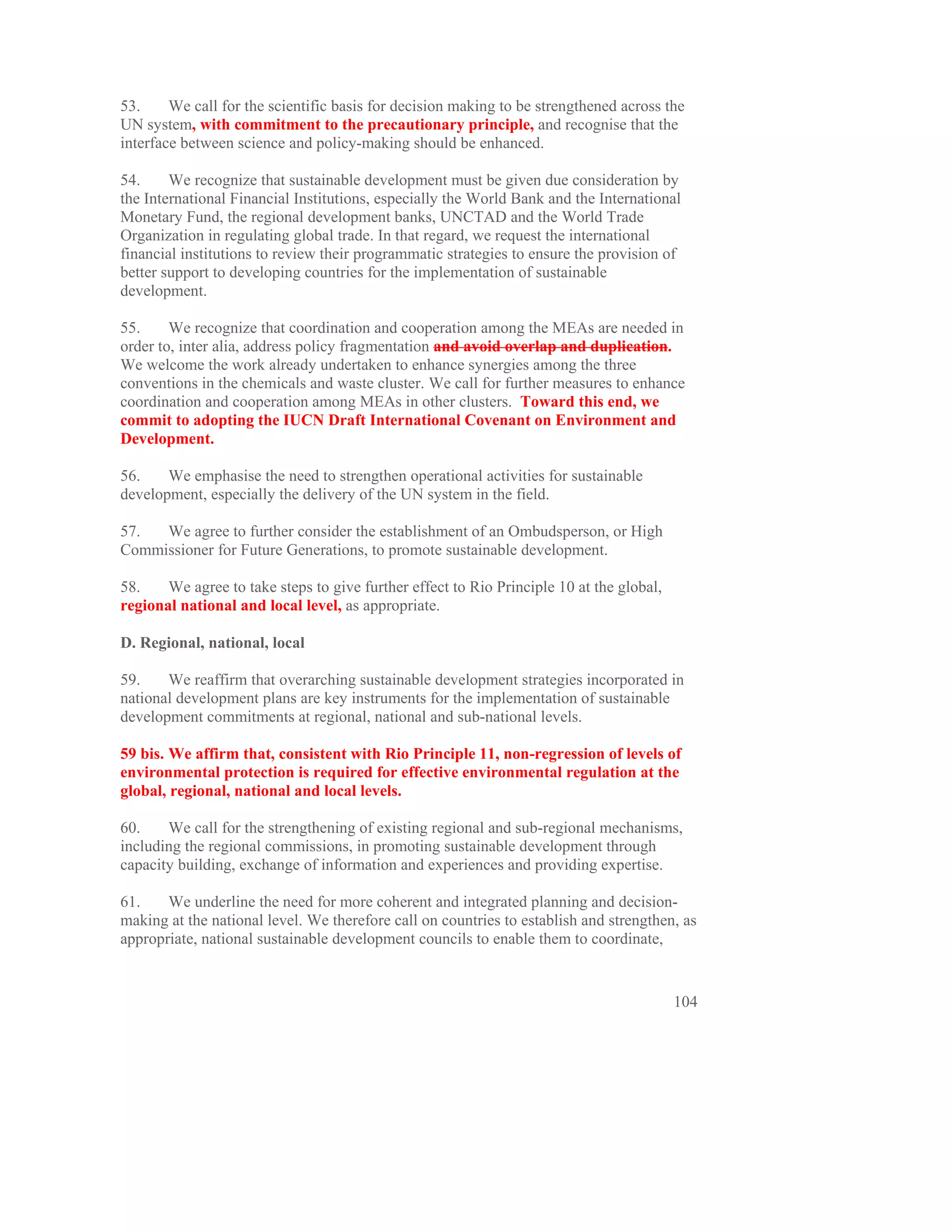
53. We call for the scientific basis for decision making to be strengthened across the UN
system and recognise that the interface between science and policy-making should be
enhanced.

[53. We call for [the – Women/NGOs – Delete] [strengthening the independent –
Women/NGOs] [scientific basis – Indigenous People – Delete] [and engineering –
Scientific & Technological Community] [a robust knowledge base- Indigenous
Peoples] for decision making [and monitoring- NGOs] [to be strengthened – Women
– Delete] across the UN system [through the appointment of a UN Chief Scientific
Advisor, reporting directly to the Secretary General, to oversee science coordination
throughout the United Nations, and liaise closely with national chiefs scientists.]


                                                                                        28
[and- delete – NGOs] [We – NGOs] [recognize – Women – Delete] [recognizing –
Women] that the interface between science [,diverse knowledge systems, - Indigenous
Peoples] and policy-making should be enhanced. [and recommend the UN system
builds close bonds with the international research community’s ten-year global
sustainability initiative, Future Earth, beginning in 2012. – NGOs] [, whilst assuring
the application of the precautionary principle, in particular, we call for the creation
of an independent technology assessment and monitoring body. – Women] [and
establishing an independent technology assessment and monitoring body – NGOs]
[We call for the establishment of an Intergovernmental Panel on Sustainable
Development, that functions as an umbrella organization which would review
relevant scientific knowledge (including natural sciences, social sciences, economics
and traditional knowledge). The Panel should also be mandated to provide an
assessment of ecological boundaries. –NGOs] NGOs- Delete Para (Non-agreement
between NGOs)]

[53 alt. We call for the scientific inputs into decision making to be strengthened
across the UN system, including by enhancing the role of social and physical
sciences, and the strict application of the precautionary principle, in addition to
ensuring meaningful access to participation in decision-making by vulnerable and
marginalized communities. – NGOs]

[53 bis. We call for strengthening the basis for decision making across the UN
system, recognising that the interface between science and policy-making, whilst
assuring the application of the precautionary principle, in particular, we call for the
creation of an independent technology assessment and monitoring body that allows
meaningful and effective participation to affected communities in decision-making.-
NGOs]

[53 ter. The Rio+20 conference agrees to launch a process to develop a new contract
between science, engineering and society to deliver the knowledge necessary for a
sustainable future. There should be a better exchange and application of existing
knowledge and technology towards solutions, and support for globally coordinated
research initiatives on sustainable development challenges, as well as technological
innovation. Policies and decision making should be based on the best available
natural science, social science, economic science, up-to-date engineering criteria and
appropriate technology and they must benefit from scientific advances and
engineering, technological, economic and social innovation. Efforts to improve the
institutional framework for sustainable development at all levels, and international
environmental governance institutions, must therefore include strengthening of
science and policy links, and strengthening science, engineering and technology
capacity within all institutions. – Scientific & Technological Community]

54. We recognize that sustainable development must be given due consideration by the
International Financial Institutions, especially the World Bank and the International
Monetary Fund, the regional development banks, UNCTAD and the World Trade
Organization in regulating global trade. In that regard, we request the international
financial institutions to review their programmatic strategies to ensure the provision of


                                                                                            29
better support to developing countries for the implementation of sustainable
development.

54. We recognize that sustainable development [and human rights – NGOs] must be
[given due consideration – NGOs – Delete] [embedded – NGOs] [considered as a
binding framework – NGOs] by the International Financial Institutions, especially the
World Bank and the International Monetary Fund, the regional development banks,
UNCTAD and the World Trade Organization in regulating global trade [and
investments- NGOs.] In that regard, we request the international financial institutions to
review their programmatic strategies [and address contradictory policies – NGOs]
[,stop perverse incentives, and - Women] [to – Women – Delete] ensure the provision
of better support to developing countries for the implementation of sustainable
development. [with adequate safeguards for human rights. – NGOs] [, by ensuring
that environmental and human rights safeguards are implemented. – NGOs ]

55. We recognize that coordination and cooperation among the MEAs are needed in order
to, inter alia, address policy fragmentation and avoid overlap and duplication. We
welcome the work already undertaken to enhance synergies among the three conventions
in the chemicals and waste cluster. We call for further measures to enhance coordination
and cooperation among MEAs in other clusters.

55. We recognize that coordination and cooperation among the MEAs are needed in order
to, inter alia, address policy fragmentation and avoid overlap and duplication. We
welcome the work already undertaken to enhance synergies among the three [Rio –
Women/NGO] conventions in the chemicals and waste cluster. We call for further
measures to enhance coordination and cooperation among MEAs in other clusters [and to
extend the model of the Joint Coordination Group on Gender (JCGG) of the
Secretariats of the three Rio Conventions (CBD, UNFCC, UNCDD) to all
international organisations working on sustainable development, thus ensuring
gender mainstreaming and accountability to Rio Principle 20 – Women/NGOs].

[55. bis We also recognize the urgent need to review the adequacy of MEAs and
other international agreements to safeguard the Earth-system processes necessary
for ensuring social and ecological well-being. We request [[UNEP][the new
specialized agency]] to work closely with the Secretary-General to ensure that the
results of such a review are included in the review of the state of the planet
requested under paragraph 52. – NGOs]


56. We emphasise the need to strengthen operational activities for sustainable
development, especially the delivery of the UN system in the field.

56. [We emphasise the need to strengthen operational activities for sustainable
development, especially the delivery of the UN system in the field – NGOs – Delete]
[Transparency of governance structures at all levels is foundational for better
service delivery. All UN Agencies will establish access to information and


                                                                                        30
mechanisms consistent with international best practice at the national and
international level. – NGOs] [and the funding priorities and activities of the Global
Environment Facility. Both these vehicles must ensure that gender is mainstreamed
– Women/NGOs].

[56 alt. Transparency of governance structures at all levels is foundational for better
service delivery and more legitimate policy-making. All UN agencies relevant to
sustainable development will establish access to information mechanisms, standards
for public participation, and access to justice consistent with best practice at the
national and international level.- NGOs]


57. We agree to further consider the establishment of an Ombudsperson, or High
Commissioner for Future Generations, to promote sustainable development.

57. We [call for – Women] [agree to further consider – Women/Workers &Trade
Unions/NGOs – delete] [the establishment of - Workers & Trade Unions/NGOs –
Delete] [support the proposal to establish - Workers & Trade Unions/NGOs] an
Ombudsperson, or High Commissioner for Future Generations, [to promote - Workers
& Trade Unions/NGOs – Delete] [with an agenda setting and monitoring role, to act
as the advocate and representative for promoting - Workers & Trade
Unions/NGOs] sustainable development [, helping to provide an integrated approach
at the highest level of UN decision making. – Workers & Trade Unions/NGOs] [It
would function in close cooperation with major groups and stakeholders - Workers
& Trade Unions]. [the Office of an Ombudsperson or High Commissioner for
Future Generations should exercise its functions in close co-operation with civil
society- NGOs] [with an agenda setting and monitoring role, to act as the advocate
for the interests and needs of future generations and their right to a healthy
environment in the context of sustainable development, helping to provide an
integrated approach at the highest level of UN decision making, policies and
programmes. The Office of an Ombudsperson or High Commissioner for Future
Generations should exercise its functions in close co-operation with civil society. We
further agree to the establishment of an International Tribunal of Environmental
and Climate Justice to judge and sanction environmental crimes and actions that
violate the rights of nature. We further commit to supporting the development of
national courts, and broadening the functions of existing courts, to address
environmental crimes and violations of nature’s rights. – NGOs]


[57. bis We agree to the establishment of an International Tribunal of
Environmental and Climate Justice to judge and sanction crimes that violate the
rights of nature. We further commit to supporting the development of national
courts, and broadening the functions of existing courts, to address violations of
nature’s rights. – NGOs]


                                                                                    31
[57 ter We agree to establish a high-level committee of experts to include
representatives of all nine Major Groups to prepare a series of options on the
mandate, modalities and functions and deliver its proposal to the UN General
Assembly no later than at the termination of the next General Assembly session
beginning in September 2012.- NGOs]

58. We agree to take steps to give further effect to Rio Principle 10 at the global, regional
and national level, as appropriate.

58. We agree to take steps to give [further effect to – NGOs – delete] [develop binding
agreements on – NGOs] Rio Principle 10 at the global, regional and national level, [as
appropriate – NGOs – Delete] [and to launch negotiations for a global Principle 10
convention. We also agree to introduce minimum standards for public participation
in international processes.] – NGOs] [and in particular to: a) provide support to
UNEP through a robust programme to implement the Bali guidelines on Principle
10; b) encourage governments to make commitments (as part of the compendium of
commitments referred to clause 128) to improve national laws, institutions, and
practices in conformity with Principle 10 and develop a partnership for capacity
building and institutions in those countries; c) encourage governments to consider
the development of regional treaties to promote Principle 10 as appropriate; and d)
mandate UNEP to begin the process of conducting open, transparent, and inclusive
negotiations, for a global treaty on Principle 10; We agree to take steps at various
levels to give further effect to Rio Principle 10 at the global, regional and national
level, as appropriate, including establishing an International Court for the
Environment. Environmental problems extend across international boundaries, but
there are few effective international institutions to deal with them properly.
Strengthening international environmental law mechanisms is essential to securing
sustainable development. This would build trust, harmonise and complement
existing legal regimes and provide clarity and access to justice as well as redress. –
NGOs] [and in particular to: a) launch negotiations for the establishment of an
international convention on Principle 10 of the Rio Declaration, that deals with
access to information, public participation and environmental justice, b) improve
national laws, institutions and practices so as they extend these rights to workers’
representatives at the workplace - Workers & Trade Unions] [inter alia by
launching negotiations to develop an international convention on Principle 10. At
the global level we call on the governing bodies of MEAs to take the necessary steps
to establish, where they are not already in place, participatory compliance
mechanisms which allow for a review of any Party’s compliance to be triggered
inter alia by communications from the public. We also resolve to develop global
guidelines on civil society participation in international SD-related forums –
Women]. [We call all relevant political institutions to consider the representation of
a minimum of 2 non-voting representatives of civil society in their respective
bureaux. – NGOs]


                                                                                          32
[58 alt. We agree to take steps at various levels to give further effect to Rio Principle
10 at the global, regional, national and subnational level, as appropriate, and in
particular to:

   1. First and foremost, we call for Rio+20 to launch negotiations on a global
      convention on Principle 10, and guidelines to strengthen participation in
      international SD-related forums;
   2. Consider the development of regional treaties to promote Principle 10 as
      appropriate;
   3. Commit to a robust capacity building programme by UNEP to implement
      the 2010 Bali Guidelines on Principle 10 and should encourage the
      development of regional conventions on principle 10.
   4. Invite the governing bodies of and Parties to international treaties relating to
      the environment, including but not limited to multilateral environmental
      agreements, to ensure that the substantive outcomes under such instruments
      promote effective access to information, public participation and access to
      justice. We urge governments to enhance the role that civil society can play
      in achieving better implementation of environmental laws, both at national
      level through strengthening access to justice provisions and at international
      level;
   5. Commit to developing and adopt a set of guidelines guaranteeing minimum
      standards for public participation in international decision-making processes
      and multilateral environmental agreements.
   6. Encourage governments to make commitments (as part of the compendium
      of commitments referred to clause 128) to improve national laws, institutions
      and practices in conformity with Principle 10 and develop a partnership for
      capacity building of institutions in those countries. – NGOs]

[58.bis We agree to launch negotiations for the establishment of an international
framework convention on Principle 10 of the Rio Declaration and/or regional
conventions, that deals with access to information, public participation and
environmental justice.

58. ter. We call for the establishment of a World Environmental Court to take
decisions related to the non-respect of national obligations under international
environmental law. This court will provide a forum for individuals and communities
to hold states party to international environmental agreements legally accountable
of their commitments. Procedures for individuals and communities to file a
complaint to the Court should be based on those of existing Human Rights courts. –
NGOs]

D. [Regional, national, local – Indigenous Peoples – Separate into 3 different
sections]


                                                                                      33
59. We reaffirm that overarching sustainable development strategies incorporated in
national development plans are key instruments for the implementation of sustainable
development commitments at regional, national and sub-national levels.

59. We [reaffirm that – Women/NGOs – Delete] [commit to incorporating –
Women] [commit to establish national multi-stakeholder sustainable development
councils to ensure – NGOs] overarching sustainable development strategies [are-
NGOs] [incorporated - Women - Delete] in national development plans [are- NGOs
delete] [and serve as – NGOs] key instruments for the implementation of sustainable
development commitments at regional, national and sub-national levels. [, including
gender assessments, targets and indicators to assure beneficial impact on both men,
women and future generations. – Women]

60. We call for the strengthening of existing regional and sub-regional mechanisms,
including the regional commissions, in promoting sustainable development through
capacity building, exchange of information and experiences and providing expertise.

60. We call for the strengthening of [existing- NGOs] regional and sub-regional
mechanisms, including the regional commissions, in promoting sustainable development
[inter alia- NGOs] through [national policy reviews, more efficient and effective-
NGOs] capacity building, exchange of information and experiences and providing
expertise. [and reinforcing monitoring and accountability mechanisms. –
Women/NGOs] [including distributional analysis with targets and indicators to
assure equitable impact across genders and socio-economic groupings. - NGOs]

[60 bis. We call for the science base of decision making to be strengthened at
regional, national and local levels, including through the creation or enhancement of
specific interface mechanisms between science and policy-making. – Scientific &
Technological Community]

61. We underline the need for more coherent and integrated planning and decision-
making at the national level. We therefore call on countries to establish and strengthen, as
appropriate, national sustainable development councils to enable them to coordinate,
consolidate and ensure the mainstreaming of cross-cutting issues in the highest decision-
making bodies, with the integration and full participation of all stakeholders.

61. We underline the need for more [coherent and integrated planning and- NGOs –
delete] [improved integration of sustainability into all- NGO] decision-making at the
national [and subnational – Indigenous Peoples] level. We therefore [call on – NGOs –
Delete] [urge – NGOs] countries to establish [in national law Ombudspersons for
Future Generations, independent of the executive, with access to information, legal
powers and duties to report, monitor and examine progress by government and
public bodies advocating for the interests and needs of future generations. This
institution would be expected to consider petitions from the public to enhance
stakeholder participation in sustainable development policy making. We call on
countries to establish – NGOs] and strengthen, as appropriate, national [multi-


                                                                                         34
stakeholder- NGO] sustainable development councils to enable them to coordinate [with
national Ombudspersons, -NGOs] consolidate and ensure the mainstreaming of cross-
cutting issues [- such as gender, human rights and climate change- Women] in the
highest decision-making bodies, with the integration and full participation of all
stakeholders. [in upholding social and ecological diversity and resilience – Indigenous
Peoples] [We agree to establish a global program and multi-stakeholder partnership
initiative to support and assist all countries and communities in developing and
implementing their Local and National Sustainability Strategies and Action Plans
on Sustainable Consumption and Production in an integrated and cohesive manner.
– NGO]

[61. bis. We call on countries to establish in national law Ombudspersons for Future
Generations, independent of the executive, with access to information, legal powers
and duties to report, monitor and examine progress by government and public
bodies advocating for the interests and needs of future generations. This institution
would be expected to consider and act upon petitions from the public. –NGOs]

[61. ter. We emphasize the importance of decentralized decision-making on
sustainable development, and recognize the contributions of customary law,
governance and institutions in this regard – Indigenous Peoples]

62. We recognise the need to integrate sustainable urban development policy as a key
component of a national sustainable development policy and, in this regard, to empower
local authorities to work more closely with national governments. We recognize that
partnerships among cities have emerged as a leading force for action on sustainable
development. We commit to support international cooperation among local authorities,
including through assistance from international organizations.

62. We recognise the need to integrate sustainable urban development policy [at all
government levels- NGOs] as a key component of a national sustainable development
policy and, in this regard, [we commit – NGOs] to empower local authorities to work
more closely with national governments [,in order to identify and increasingly use
financial levers and incentives at national or municipal level for sustainable urban
development - NGOs]. We recognize that partnerships among cities have emerged as a
leading force for action on sustainable development. We commit to support international
cooperation among local authorities, including through assistance from international
organizations. [We commit to full participation of Local and Subnational Authorities
in global sustainable development policy-shaping. – Local Authorities / NGOs] [We
commit to develop financing strategies to urgently provide sufficient up-front
capital costs for low-carbon urban infrastructure initiatives in developing counties
and to promote increased sharing and implementation of best practice in
sustainable urban planning among local authorities in developed and developing
countries. – NGOs] [to tackle economic, environmental, public health, climate,
demographic and social challenges affecting urban areas – NGOs]

V. Framework for action and follow-up


                                                                                     35
A. Priority/key/thematic/cross-sectoral issues and areas

63. We recognize that progress in implementation requires attention to a number of
sectoral and cross-sectoral priority areas as well as to the linkage among different sectors.
We also recognize that assessing progress in these areas can benefit from defining
aspirational goals, targets and indicators, as appropriate. We therefore commit to the
following actions:

63. We recognize that progress in implementation requires attention to a number of
sectoral and cross-sectoral priority areas [,in particular the need for binding
safeguards and rights for women, low income communities and indigenous peoples,
- Women] [as well as to the – NGOs – Delete] linkage among different sectors [as well
as distributional impacts of policies – NGOs]. We also recognize that assessing
progress in these areas can benefit from defining aspirational goals, targets and
[disaggregated – NGOs] indicators, as appropriate. [Noting the special challenges
associated with ensuring integration amongst the sectors/themes covered below, we
reiterate the need to strengthen, as appropriate national sustainable development
councils, and commit to establishing or strengthening sub-national processes, such
as landscape planning processes, that ensure integration across such thematic areas
as food, water, forestry and energy. – Scientific & Technological Community] We
therefore commit to the following actions:

[ADD Health
   • We recognize that environmental degradation and unsustainable resources
     use has important health implications and that access by all people to
     nutritional security and health is an essential condition for sustainable
     development and social inclusion, and therefore, we commit to maintaining
     and strengthening the integration of health concerns within the pursuit of
     sustainable development. We underscore the importance of health in
     galvanizing multisectoral action for sustainable development at global,
     national, and local levels. We support the need for attention to
     environmentally-linked global health priorities in addressing current
     challenges in economic development and environmental stewardship,
     including the inclusion of health concerns in defining priorities, strategies of
     action, and monitoring impacts of sustainable development.
   • We call for the need for health focused components of sustainable
     development to address the full spectrum of contemporary rural and urban
     health challenges in all resource settings brought upon by current
     development trajectories, from the established concerns of the global health
     and development communities (e.g., infectious diseases, malnutrition,
     maternal and child health) to the prevention and control of emergent health
     concerns, such as non-communicable diseases (e.g., cardiovascular disease,
     cancer, diabetes, and chronic respiratory diseases), that have accompanied
     contemporary demographic transformations, changes in resource use
     patterns, and increasing urbanization.


                                                                                          36
•   We affirm the importance for internationally agreed upon targets and
       indicators for sustainable development to encompass communicable diseases,
       non-communicable diseases, and other major causes of death and disability
       that are environmentally linked.
   •   Recognize that the goals of sustainable development can only be achieved in
       the absence of a high prevalence of debilitating diseases, while obtaining
       health gains for the whole population requires poverty eradication.
       [Reference: para 53, Johannesburg Declaration on Sustainable Development]
   •   Recognize prior commitments to place particular focus on and give priority
       attention to 'the fight against the worldwide conditions that pose severe
       threats to the sustainable development, which include communicable and
       chronic diseases, in particular HIV/AIDS, malaria and tuberculosis.'
       [Reference: para 19, Johannesburg Declaration on Sustainable Development]
   •   Recognize the promotion of health equity [as] essential to sustainable
       development [Reference: Para 4, Rio PD on SDH
   •   Strengthen the capacity of health-care systems to deliver basic health services
       to all in an efficient, accessible, affordable, and sustainable manner aimed at
       preventing, controlling and treating diseases, and to reduce environmental
       health threats, in conformity with human rights and fundamental freedoms
       and consistent with national laws and cultural and religious values, and
       taking into account the reports of relevant United Nations conferences and
       summits and of special sessions of the General Assembly. - NGOs]

Food security

Food security [and Food sovereignty – Women]

64. We reaffirm the right to food and call upon all States to prioritize sustainable
intensification of food production through increased investment in local food production,
improved access to local and global agri-food markets, and reduced waste throughout the
supply chain, with special attention to women, smallholders, youth, and indigenous
farmers. We are committed to ensuring proper nutrition for our people.

64. [Recalling principle 1 of the Rio declaration, - NGOs] [We – NGOs – Delete] [we
– NGOs] reaffirm the right to food [and the importance of farming to social and
economic development, - Children & Youth] [and proper nutrition, and are
committed – NGOs] [and call upon all States – NGOs – Delete] to prioritize [food
sovereignty, land reform and the environmentally and socially, implementation of
agrarian and aquatic reform in order to ensure equitable access to land, water,
seeds; investment in local and small-holder food production; promoting the
transition to or rehabilitation of low external input and biodiverse agriculture
systems such as permaculture and analog forestry in line with the recommendations
of the International Assessment of Agricultural Knowledge, Science and Technology
(IAASTD) report; – NGOs] sustainable [intensification of – Women / NGOs -
Delete] [food – NGOs – Delete] production [, developing sustainable food systems, -
Children & Youth] [of food – NGOs] through increased investment in [local –


                                                                                       37
Business & Industry – Delete] [agro-ecological – NGOs/ Women] food production [at
multiple scales- NGOs] [diversification in food production, - NGOs (Non-agreement
between NGOs)], [research/ R&D/ innovation - Business & Industry] improved
access to [land, water, seeds, and other productive resources – NGOs] [local, - NGOs
– Delete] [national – Women] [and global – NGOs – Delete] [agri-food – Women –
Delete] [markets, - NGOs – Delete] [, in particular access of smallholders to
domestic and international markets, - NGOs] [for small-scale and peasant farmers, -
NGOs] [maintenance and rebuilding of soils, - Women] [We also call for the
reinforcement of farmers’ role – Children & Youth] [and – Women – Delete]
[reduced waste – NGOs - Delete] [and reducing environmental footprint – NGOs]
[and increased transparency – NGOs/ Women] throughout the [value – Children &
Youth] supply chain, with special attention to [marginalized groups such as – NGOs]
women, smallholders, youth, [and – Indigenous People - Delete] [subsistence and –
NGOs] [, - indigenous people] indigenous [peoples and– Indigenous People] [and
subsistence – Women] farmers. We are committed to ensuring [healthy, sufficient, safe
and appropriate – NGOs] [proper – NGOs – Delete] nutrition for our people [and the
protection of ecosystem services – Children & Youth] [, including both addressing
under-nutrition and significantly reducing over-consumption – Scientific &
Technological Community] [,and preventing under nutrition and diet-linked non-
communicable diseases through policies and actions that enable access to nutritious
dietary options, whilst respecting the integrity of ecosystems and safeguarding the
welfare of animals. Only a transformation of agriculture and food systems will
enable nourishment of all people and communities with healthy, diverse and
culturally appropriate food that respects people’s rights, animal welfare and the
integrity of natural ecosystems at both the local and global level. - NGOs].

[64 bis. We are convinced that a transformation of agriculture and food system is
needed to achieve food and nutrition security for all, to manage natural resources
sustainably, and to protect and improve livelihoods for people in both rural and
urban landscapes, with special attention to women, smallholder, youth, and
indigenous producers of all food and fibre (crops, livestock, fisheries, forests). –
NGOs]

[64 ter. In order to support the transformation of the food system, we call for
expanding the evidence based approach and scientific basis for political action on
sustainable agriculture for food and nutrition security to provide timely and
effective responses to emerging global challenges and changes. In this regard, the
UN Committee on World Food Security and its High Level Panel of Experts is
invited to explore options to conduct a regular, intergovernmental, participatory,
cross-sectoral, and multistakeholder assessment of agricultural knowledge, science,
and technology. - NGOs]

[64 quat. We affirm that the agriculture and food system needs to be based on
agriculture practices that do not degrade natural resources, are ecologically sound,
less wasteful, more water conserving and ecosystem-based, such as i.a. locally
adapted cultivation methods, and sustainable humane livestock farming. Such


                                                                                       38
practices will be resilient to climate change, use less fossil fuels, restore soil fertility
and water quality, reduce desertification and contribute to animal welfare. We also
recognize that sustainable diets, and the prevention of post-harvest losses and waste,
are essential for food and nutrition security. - NGOs]

[64 quint. We call for an implementation mandate for the UN Committee on World
Food Security to support, guide and monitor actions taken to enhance food and
nutrition security and sustainable agriculture for all. The mandate shall be based on
the findings of relevant reports on this matter, and include the development of
indicators for measuring sustainable food and nutrition security, to monitor and
map progress made across international, national and, to the extent possible, local
levels in different regions towards nutritious food for all. - NGOs]

64 sext. We agree with and support an ongoing role for high level engagement by
civil society in the institutional framework for food and nutrition security and
sustainable agriculture. Specifically we call for a civil society mechanism within the
Institutional Framework for Sustainable Development, modeled after the CSO
mechanism in the UN Committee on World Food Security. - NGOs]

[64 sept. The challenges of sustainable cities and sustainable urban food and
nutrition security need to be linked as an outcome of Rio+20. In this regard, we call
upon national governments to promote food and nutrition security measures
developed and led by decentralised alliances of local and subnational authorities --
with the participation of civil society -- to manage city-region food systems at a
landscape level, promoting urban rural linkages, integrating food biodiversity,
water, energy and planning for enhanced resilience. - NGOs]

[64 oct. We recognize the importance of secure land and resources tenure for
indigenous peoples and small farmers as a precondition for food security. –
Indigenous People]

65. We call for more transparent and open trading systems and, where appropriate,
practices that contribute to the stability of food prices and domestic markets; ensure
access to land, water and other resources; and support social protection programmes.

65. We call for more [fair, responsible, - NGOs] [equitable, – NGOs/ Indigenous
People] transparent and [flexible– NGOs] [open – Women – Delete] [equitable –
NGOs/Women] trading systems [that integrate in trade rules and practices concerns
such as environmental protection and the right to a sustainable livelihood for all –
NGOs] and, [where appropriate, - NGOs – Delete] practices that contribute to the
stability of food prices and domestic markets [such as establishing local national and/
or regional reserves and enacting financial regulations that can limit speculation to
help address food price volatility - NGOs/Women]; [prevent land grabbing and –
NGOs] ensure [secure customary rights - Indigenous People] [sustainable use, access
and respect for – NGOs] [access – NGOs – Delete] [and rights – Women] [to – NGOs
– Delete] land, water and other resources [and contribute sustainable food and


                                                                                         39
nutrition security for all countries – NGOs] [by enacting anti-eviction laws and
recognising tenure holders and their rights on the basis of local level mapping –
Women] [by enacting anti-eviction laws and registering land in the name of land
users on the basis of local level mapping – NGOs] ; [resource efficiency, - Children
& Youth] and [that – NGOs] support social protection programmes.[We ask for a
global review of bioenergy targets and support schemes in the light of their impacts
on food sovereignty and security, biodiversity and sustainable farming systems. We
call for countries to prevent land-grabbing and to address the roots causes of
excessive food and agricultural commodity price volatility at all levels, including the
role of corporate concentration and financial speculation. – NGOs]

 [65 bis. We call on all countries, including subnational and local authorities, to
implement policies to promote sustainable and decent livelihoods for all food
producers and waged food system workers, while promoting strategies to
progressively achieve the right to food for all and protect the natural
resource foundation for a diverse food supply for all consumers. We call for national
and international investments in food production and a use of agricultural lands
that are in accordance with national and international guidelines and principles. We
call for the end of all direct and indirect subsidies on export of food and other
agricultural goods that could harm the access to markets on the part of small scale
producers.- NGOs]

[65 ter. Ensure access to land, water and other resources; protection of land rights
of small-scale and peasant farmers, with special attention to women, smallholders,
youth, subsistence and indigenous farmers; and support social protection
programmes. – NGOs]

66. We further support initiatives at all levels that improve access to information,
enhance interactions among farmers and experts through education and extension
services, and increase the use of appropriate technologies for sustainable agriculture.

66. We further [strongly – NGOs] support initiatives at all levels that improve
[inclusiveness and – NGOs] access to [and efficient use of technical – NGOs]
information, [including disclosure regarding health implications of agri-chemicals
and genetic engineering of crops and local knowledge, - NGOs] [including full
disclosure regarding health implications of agri-chemicals and genetic engineering
of crops,as well as – Women] enhance interactions among [small and large-scale –
NGOs] [farmers – NGOs – Delete] [, food producers – Indigenous People]
[Producers, local communities, - NGOs] [and – NGOs – Delete] [experts – Women –
Delete] [peasants taking into account their traditional knowledge – Women] [and
government officials,- NGOs] through [ research – NGOs], education [,development –
NGOs] [, extension services and diverse forms of farmer advisories - Scientific &
Technological Community – delete] [, taking into account traditional knowledge,
particularly to prevent soil degradation, support natural soil fertility, and avoid
exploitation of water – NGOs] [, extension services and diverse forms of farmer
advisories – Scientific & Technological Community], and increase the use of [locally –


                                                                                          40
NGOs]appropriate [practices – NGOs] [technologies – NGOs – Delete] for sustainable
agriculture [We specifically call on all actors to increase support for agricultural
knowledge systems including research, advisory services, vocational training, and
farmer-to-farmer training – Business & Industry] [, including those agronomic
practices that are part of multifunctional, agro-ecological and localized food
production systems – NGOs/Women] [while strictly applying the precautionary
approach to risky technologies like genetically modified organisms – NGOs].

[66 alt. We call on all actors to ramp up support for agricultural knowledge systems
including research, advisory services, vocational training, and farmer-to-farmer
training. – Children & Youth]

[66 bis. Food security and sovereignty need full implementation of the
Precautionary Principle regarding GMOs and measures to halt the concentration of
seeds by conglomerates or multinational corporations. – Women]

[66 ter. Boosting agricultural productivity, improving soil quality, ensuring the
safety of food and, as appropriate, enhancing the nutritional quality of food is
essential and needs to be done in ways that are socially, economically and
environmentally sustainable. Moreover, a comprehensive approach integrating
post-harvest storage and processing to reduce losses and add value, distribution and
marketing infrastructure to link to markets and capacity building at all stages,
particularly in developing countries, is needed. Farmers and farm workers, female
and male, especially small, and resource-poor, indigenous people and rural
communities, need to be central actors in a green revolution in a sustainable way,
with a sound balance and mutually beneficial linkages among small- and large-scale
agricultural enterprises. - Business & Industry]

[66 quat. A healthy and dynamic agricultural sector is an important foundation of
rural development, generating strong linkages to other economic sectors. Rural
livelihoods are enhanced through effective participation of rural people and rural
communities in the management of their own social, economic and environmental
objectives by empowering people in rural areas, particularly women and youth,
including through organizations such as local cooperatives and by applying the
bottom-up approach. - Business & Industry]

66 quint. [We call for special measures and mechanisms to ensure food security
while also addressing energy security, fibre production, climate change adaptation,
and reducing the greenhouse gas and environmental footprint of agriculture. This
could include landscape approaches at sub-national levels and information systems
that integrate sectoral data, amongst others – Scientific & Technological
Community]

Water

Water [and Sanitation – NGOs]


                                                                                     41
67. We underline the importance of the right to safe and clean drinking water and
sanitation as a human right that is essential for the full enjoyment of life and all human
rights. Furthermore, we highlight the critical importance of water resources for
sustainable development, including poverty and hunger eradication, public health, food
security, hydropower, agriculture and rural development.

67. We [recognize the global challenge and we – Children & Youth] [underline –
NGOs – Delete] [reaffirm - NGOs] the importance of the right to safe and clean
drinking water and sanitation as [a human right – NGOs – Delete] [human rights –
NGOs] that [is – NGOs – Delete] [are – NGOs] essential for the full enjoyment of life
and [for the realization of – NGOs] all human rights [and we commit to accelerate
implementation thereof at national level – NGOs]. [We recognize the role of the
private sector and civil society in meeting this overachieving goal. – Children &
Youth] Furthermore, we highlight the critical importance of water resources for
sustainable development, including poverty and hunger eradication, public health, food
security, [energy security, gender equality, - NGOs] hydropower, agriculture [, urban
– Children & Youth] and rural development. [Human water security should not be at
the expense of ecosystem integrity to ensure the base for ecosystem services and
resilience. – Scientific & Technological Community] [We also underline the
importance of the restoration and conservation of forests and other ecosystems that
play a crucial role in the conservation of watersheds. We reiterate our commitment
under chapter 18 of Agenda 21 to implement participatory, equitable and
sustainable Integrated Water Resources Management and commit to the
implementation of an Environmental Reserve ensuring healthy flows of water in
rivers and other water systems for thriving species and habitats, a Basic Needs
Reserve ensuring adequate flows for the realization of the human right to water,
and the urgent need to halt the further reduction of aquatic biodiversity. – NGOs]

[67 alt. We recognize the importance of the protection of all water sources, for
present and future generations. We will take steps to develop global guidelines to
protect water sources from irreversible depletion, damage, pollution and to assure
their benefit for all peoples, upstream and downstream. – Women]

[67 alt bis. We underline the importance of the right to safe and clean drinking
water and sanitation as a human right that is essential for the full enjoyment of life
and all human rights. Furthermore, we highlight the critical importance of water
resources for sustainable development, including poverty and hunger eradication,
public health, including universal access to reproductive health, food security,
hydropower, agriculture and rural development. – Women]

[67 bis. We highlight the protection of clean unpolluted water supplies and fossil
water sources, the importance of social and environmental reserves before
industrial use, and the prevention and limitation of irresponsible and profligate use
for industrial processes. – Indigenous People]


                                                                                             42
68. We recognize the necessity of setting goals for wastewater management, including
reducing water pollution from households, industrial and agricultural sources and
promoting water efficiency, wastewater treatment and the use of wastewater as a
resource, particularly in expanding urban areas.

68. We recognize [the importance of protecting water commons for future
generations, and recognize that protection of the right to water of present and
future generations involves taking appropriate steps to avoid the contamination of
water supplies, and we reaffirm our commitment to Rio Principle 16 and call on
national authorities to internalize environmental costs in water usage. We
encourage governments to prioritise water and sanitation investments using public
ownership and public management in order to ensure universal access to these
fundamental services. We recognize - NGOs] the necessity of [adopting lifestyle
changes and – NGOs] setting goals for [good governance for access to water supply
and – Local Authorities] wastewater management, including reducing water pollution
[ADD others, such as mining OR DELETE ALL – Business & Industry] from
households, [mining – Indigenous People] industrial and agricultural sources and
promoting water efficiency, wastewater treatment and the use of [treated – Business &
Industry] wastewater as a resource, particularly in expanding urban areas. [The rights of
indigenous and local communities to collectively control, manage and use water
should be recognized, and any intervention affecting water should be with their free
prior informed consent. – NGOs]

[68.bis We recognize that the experiment with privatisation in the water and
sanitation sector has failed to deliver for the poor. Therefore, we encourage
governments to prioritise water and sanitation investments using public ownership
and public management in order to ensure universal access to these fundamental
services. Further commodification of water will only lead to greater exclusion for
the most poor and vulnerable. This is true not only for direct water and sanitation
services, but also in agriculture, energy, industry and other sectors. – Workers &
Trade Unions]


69. We renew our commitment made in the Johannesburg Plan of Implementation (JPOI)
regarding the development and implementation of integrated water resources
management and water efficiency plans. We reaffirm our commitment to the 2005-2015
International Decade for Action “Water for Life”. We encourage cooperation initiatives
for water resources management in particular through capacity development, exchange of
experiences, best practices and lessons learned, as well as sharing appropriate
environmentally sound technologies and know-how.

69. We renew our commitment made in the Johannesburg Plan of Implementation (JPOI)
regarding the development and implementation of [participatory, sustainable and
equitable – NGOs] integrated water resources management [, the nexus approach –
Children & Youth] and water efficiency plans [,to be in place by 2015. We recognize
that water management is critical to climate change adaptation and mitigation


                                                                                       43
measures. – NGOs] [We call for the development of specific water efficiency
measures to track water use throughout all sectors including agriculture, energy,
industrial and urban use. We call member states to consider the impact of economic
and social policies in the water availability in their countries. Furthermore, we call
for the implementation of national and regional water-basin frameworks to improve
mechanism for solving conflicts among water users, improving public-private
dialogue and promoting assessment and monitoring systems. – Children & Youth]
[We recognise also the need emphasize implementation and achievement of tangible
goals over the next decade. – Scientific & Technological Community] We reaffirm
our commitment to the 2005-2015 International Decade for Action “Water for Life” [and
recognize the need to reaffirm our commitment beyond 2015. We stress the
importance of cooperation at national and transboundary levels, welcome progress
towards the entry into force of UN Convention on the Law of the Non-navigational
uses of International Watercourses, and commit to the full and effective
implementation of the United Nations Declaration on the Rights of Indigenous
Peoples. – NGOs]. We encourage cooperation initiatives [and especially decentralized
cooperation – Local Authorities] for water resources management in particular through
capacity development [for sustainable and equitable public water management,
engagement of local communities in decision making, - NGOs] [for efficient,
sustainable and equitable public water management – Women], exchange of
experiences, best practices and lessons learned, as well as sharing appropriate
environmentally sound technologies [and know-how – Children & Youth – Delete]
[and the development of capacity toolkit for the promotion of small scale efficient
use of water and risk-management techniques. – Children & Youth] [as part of
adaptation finance, to help bridge the technology gap to help reduce their water
footprint in industrial sectors in developing countries – NGOs].

[69 bis. We recognise the importance of clear standards and the inclusion of affected
populations in decisions making for the sustainable and equitable management of
international watercourses, and will move towards the full ratification of the UN
Watercourses Convention 1997. – NGOs]

[69 ter. We also reaffirm our commitments made in the Johannesburg Plan of
Implementation; to increase access to sanitation to improve human health and
reduce infant and child mortality, prioritising water and sanitation in national
sustainable development strategies and agreeing to halve, by the year 2015, the
proportion of people who are unable to reach or to afford safe drinking water and
the proportion of people who do not have access to basic sanitation. – NGOs]

[69 quart. We recognise that there are more people today without sanitation than
there were in 1990, and call for urgent renewed action to bring improved sanitation
to those currently without access. We reaffirm our support to the commitment of
the Least Developed Countries in the 2011 Istanbul Programme of Action to ‘strive
to provide sustainable access to safe drinking water and basic sanitation to all by
2020. – NGOs]


                                                                                    44
[ADD Mining
69 (bis) We recognize the continuing global need for minerals while recognizing the
grave social and environmental impacts that have resulted from mining. We seek to
reduce the unwanted impacts of mining by a range of measures including the active
promotion of re-use of mineral based products, increased recycling of processed
minerals and substitution of mined minerals with more sustainable materials.
Redesigning of products and production processes for durability and sustainability
will also be promoted to contribute towards sustainability

69 (ter) Minimising of greenfield site mining will be a positive planning goal.

69 (quat) Mining processes that have the greatest adverse impacts should, in line
with emerging best practice, be rapidly reduced or ended, such as coastal sands
mining, strip mining, riverine and marine mine waste dumping. In addition
measures should be taken to reduce the global trend to extensive low grade ore
extraction including the controlled release of existing gold stores for industrial use,
increased refinement of waste collection and reuse of metals including copper and
aluminium. – Indigenous People]


Energy

70. We propose to build on the Sustainable Energy for All initiative launched by the
Secretary-General, with the goals of providing universal access to a basic minimum level
of modern energy services for both consumption and production uses by 2030; improving
energy efficiency at all levels with a view to doubling the rate of improvement by 2030;
and doubling the share of renewable energy in the global energy mix by 2030 through
promoting the development and use of renewable energy sources and technologies in all
countries. We call for provision of adequate financial resources, of sufficient quality and
delivered in a timely manner, to developing countries for providing efficient and wider
use of energy sources.

[70. We [agree that each country should devote adequate financial and human
resources, including earmarked funds for developing countries, to promote – NGOs]
[propose to build on – NGOs – Delete] the Sustainable Energy for All initiative
launched by the Secretary-General, [with – Children & Youth – Delete] [reiterates –
Children & Youth] the goals [established, by Agenda 21 and the framework of
implementation laid out by JPOI; with special attention to the WEHAB cross-
sectoral priority areas. – Children & Youth] [of providing universal access to a basic
minimum level of - Children & Youth – Delete] [zero carbon – NGOs] [modern –
Children & Youth – Delete] [Those goals being the provision of universal access to
affordable – Children & Youth] energy services for both consumption and
production uses by 2030; improving energy [and resource – Children & Youth]
efficiency at all levels with a view to doubling the rate of improvement by 2030; and
doubling the share of renewable [and clean – Scientific & Technological
Community] energy in the global energy mix [(excluding hydropower and agro


                                                                                        45
fuels) while halving the contribution of fossil fuels – NGOs] by 2030 through
promoting the development and use of renewable energy sources and [a
precautionary approach to the development of – NGOs] [appropriate - Women]
technologies in all countries [, and eliminating (indirect) subsidies to unsustainable
energy, fossil and nuclear. We call for development of binding safeguards to avoid
negative impacts from renewable energies including pollution with agrochemicals
and displacement of local communities and indigenous peoples –Women]. [End-use
efficiency, power-plant efficiency, biomass, biofuels, nuclear and carbon capture
and storage need to contribute. Hydro and wind power are suited to be deployed for
the long term. Energy storage technologies are key to the management of
intermittent renewable energy sources. Carbon capture and storage (CCS) is being
developed and demonstrated at large scale. These global objectives imply vigorous
and transformational change in individual countries and could be achieved by
association of countries through joint market instruments such as feeding tariffs,
trading of certificates and standards. – Scientific & Technological Community] We
call for provision of adequate financial resources, of sufficient quality and delivered
in a timely manner, [and a precautionary approach to the deployment of new
technologies – Women] to developing countries for providing [safe – Women]
efficient and wider use of [diverse and appropriate – Women] energy sources
[,assuring specific capacity building and funding windows for women’s access to
safe and renewable energy.We call removal of constraints limiting the ability of
women to take advantage of business opportunities offered by new energy options,
including legal barriers that limit their property rights, landtenure, and access to
credit – Women]. [We encourage governments to prioritise public ownership and
public management of energy services in order to ensure universal access to these
fundamental services. – NGOs] NGOs delete para]

[70 alt. We commit to the goal of providing universal access to a basic minimum
level (as defined by the IEA 2011) of environmentally and socially sustainable and
safe renewable and affordable energy services for both consumption and production
uses by 2030, taking into account gender aspects; In order to capture the large
potentials of cost-effective energy conservation and to curtail ever increasing
wasteful energy use, we agree to at least tripling the rate of energy efficiency
improvements by 2030.With a view to achieving a fully renewable energy system by
2050 we aim for achieving a world energy mix based on environmentally and
socially sustainable and safe renewable energy of at least 40% by 2030. This target
will be achieved through promoting the development and use of locally feasible
environmentally and socially sustainable and safe renewable energy sources and the
transfer of such technologies in all countries. It should be ensured renewable energy
sources and technologies do not pose threats to the environment, food supplies, or
to the livelihoods or cultures of local and indigenous communities, or use synthetic
organisms whose environmental impacts are unknown.We call for provision of
adequate financial resources, of sufficient quantity for planning and
implementation, including capacity building for transferred technologies and
delivered in a timely manner, to developing countries for providing effective,
efficient and wider use of energy sources. In particular, we recognize that in average


                                                                                     46
we need to deliver 48billion USD per year in investments for achieving universal
access to energy. – NGOs]

[70 alt bis. We endorse that access to electricity for the rural poor is often best
achieved through the use and promotion of off-grid or mini-grid renewable energy
technologies.We also note with concern that women are often disproportionately
adversely affected by the lack of access to sustainable energy. At the same time
women are instrumental in changing energy consumption patterns.
We commit to adopting strong, effective and predictable institutional and
regulatory frameworks creating an enabling investment environment, including
adequate policy tools, and specific sector targets. – NGOs]

[70 alt ter. Developed country governments commit to supporting technology
cooperation for the dissemination of clean, safe, environmentally and socially
sustainable and affordable energy solutions, including providing technical capacity
building on national level for private sector, government institutions and civil
society through our regular donor cooperation, while a precautionary approach to
the deployment of new technologies. – NGOs]

[70 alt quat. We agree to developing and committing to nationally defined specific,
legally binding and clear energy access targets for the short and mid-term with a
view to achieving 100% energy access on national level by 2030. Such targets will be
supported by realistic implementation frameworks and plans developed through
inclusive multi-stakeholder processes. – NGOs]

[70 alt quint. We agree to undertake a review of existing renewable energy policies
and incentive schemes, especially in the field of bioenergy, to ensure all direct and
indirect impacts on food security, biodiversity, climate change, human health and
poverty eradication are taken into account. Where necessary, national targets and
incentive schemes will be redirected. – NGOs]

[70 alt sext. We propose to build on the Sustainable Energy for All initiative
launched by the Secretary-General, with the goals of providing universal access to a
basic minimum level of modern energy services for both consumption and
production uses by 2030; improving energy efficiency at all levels with a view to
tripling the rate of improvement by 2030; and doubling the share of renewable
energy in the global energy mix by 2020 through promoting the development and
use of renewable energy sources and technologies in all countries. We commit to
adopting strong, effective and predictable institutional and regulatory frameworks
in all countries to create an enabling investment environment, including adequate
policy tools, and specific sector targets, to progressively phase out fossil fuels and
fossil fuel subsidies in order to meet the globally agreed target of limiting climate
change to not more than 2°C degrees average temperature increase. We agree to
nationally defined specific, legally binding and clear energy access targets with a
view to achieving 100% energy access on national level by 2030. We call for
provision of policy capacity building and adequate financial resources to developing
countries for the utilization of renewable energy sources. We recognize the nexus


                                                                                    47
between energy and water, the need to integrate energy and water systems to
achieve poverty alleviation and sustainable development, and the role that
renewable energy can play in addressing water scarcity and security through
desalination and aquifer and groundwater management, particularly for arid
regions and small island states. (Non-agreement between NGOs)]


71. We agree that each country should work for low-carbon development. We encourage
more widespread use of energy planning tools to provide a robust framework for donors
and partners to coordinate their development cooperation efforts.

71. We [call for countries to work towards – Scientific & Technological Community]
[agree that each country should work for - Scientific & Technological Community –
Delete] [the rapid shift to – Indigenous People] [low- NGOs - Delete] [zero- NGOs]
carbon development [and develop, through a multi-stakeholder process, a detailed
low-carbon development plan. The low carbon development plans will ensure that
we meet the objective of reducing global greenhouse gas emissions by 80% by 2050
globally and 95% in developed countries in order to keep global temperature
increase below 1,5° C compared to pre-industrial levels. Low-carbon development
plans should be developed and implemented at the national and local levels, by
mainstreaming climate action through existing development policies and plans as
well as through new initiatives to develop renewable energies, improve energy
efficiency, reduce and eventually reverse deforestation, invest in public
transportation and insulation of housing – NGOs]. We encourage [the development
of (non-hydropower) renewable energy strategies that are conducive for the
development of sustainable energy systems and their implementation through clear
legal, planning, economic and regulatory frameworks at national and regional level.
– NGOs] [more widespread use of energy planning – NGOs – Delete] [and
assessment – Women] [tools – NGOs – Delete] [to implement targets and timelines
to achieve these objectives as well as - Scientific & Technological Community] [to
provide a robust framework for donors and partners to coordinate their
development cooperation efforts. – NGOs – Delete] [, to accelerate the move away
from carbon energy sources and towards renewables particularly solar, wind and
ocean power. – Indigenous People]
 [We call for full cost accounting of the life cycle of energy sources, including all
externalities, from mining clean-up and closure to safe reuse of waste for all energy
options. – Women] [The significant savings from fossil fuel subsidies reform could
be redirected into massive investments implementing these commitments. – NGOs]

[71.bis. We call for the application of the precautionary principle, for all energy
sources, and to strengthen legislation to protect women and children health from
ionizing radiation, in the workplace, homes and schools, and call on a global phase
out of nuclear energy. – Women]

[71 ter. Mining, oil and industrial planning should also be directed towards
accelerating reductions in carbon energy production.


                                                                                   48
71 quat. We encourage the promotion of recycling of minerals to minimize energy
consumption through segregated waste collection and increased recycling of
minerals rather than energy intensive primary processing.

71 quint. A strategic vision for energy supply from wind, wave, water, sun needs to
be prioritized over forms that pose their own massive as yet irresolvable challenges
such as nuclear power and large hydro dams. – Indigenous People]

Cities


72. We commit to promote an integrated and holistic approach to planning and building
sustainable cities through support to local authorities, efficient transportation and
communication networks, greener buildings and an efficient human settlements and
service delivery system, improved air and water quality, reduced waste, improved
disaster preparedness and response and increased climate resilience.

[pre 72. We recognize that policies and initiatives to promote sustainable cities will
strengthen the three pillars of sustainable development and improve overall health
conditions in urban populations. – NGOs]

[pre 72 bis. "Renew commitment to reduce respiratory diseases and other health
impacts resulting from air pollution." – NGOs]

72. We commit to promote an [aggresive and – NGOs] integrated and holistic approach
to planning and building sustainable [and healthy – Women / NGOs] cities [through
support to – Local Authorities / Scientific & Technological Community- Delete] [,
recognizing the sustainability challenges within, as well as the regional and global
linkages and impacts of, cities. We commit to support – Scientific & Technological
Community] [by creating enabling and supportive conditions for – Local
Authorities] local authorities [to be effective guardians of environmentally
sustainable human settlements and through supporting – Local Authorities],
efficient transportation and communication networks, [that prioritize walking, cycling
and public transport, integrated energy and water systems, - NGOs] greener
buildings and an efficient human settlements and service delivery system, improved air
and water quality, [sustainable consumption, – NGOs] reduced waste, [reduced
impacts on biodiversity, investment in ecosystem restoration and increased green
spaces, - NGOs] improved disaster preparedness and response [urban ecosystems
management and biodiversity - Local Authorities] and increased climate resilience
[through the implementation of sustainable master-plans and drainage plans. –
Children & Youth] [, all with a view to protect cultures and traditions and enhanced
social inclusion and cohesion – Local Authorities] [, We call attention to the need to
incorporate the prevention and control of non-communicable disease as a necessary
component of green development policies and initiatives to promote sustainable
cities – Women].


                                                                                     49
[72 bis. We welcome the setting up of a global network of Global Challenges centers
as points of crystallization for multi-stakeholder partnerships on global commons
growth which are linked up with UN system through a shared vision and a global
documentation system. An integrated, multi-sectoral community based approach to
sustainable rural development is also needed. We call on the UN to establish a global
network of grassroots support organizations, resource and service centers, and
training programs to develop local capacity building and assist villages and rural
communities in eradicating poverty and meeting basic human needs. We note that
sustainable development requires full use of data on demographic trends and
population dynamics, including population growth, density, migration, urbanization
and ageing. – NGOs]

[72 ter. We recognize the value of preservation, research, use, and integration of
historical and traditional practices for sustainable cities and urban areas. We
commend the local authorities around the world already taking a leading role in
making their cities and communities more sustainable. We commit to establish
national policies and financing mechanisms to accelerate the implementation of
sustainability plans and projects in urban areas. – NGOs]

[72 quat. We support the creation of a global regulatory system or a Global
Sustainable Cities Framework on the built environment, in particular on housing,
based on and incorporating agreed standards of health, environment and
sustainable development to enable cities to measure and share, as well as accelerate,
progress towards increased sustainability. The Framework should be based on
sustainable development principles and should establish verifiable and transparent
indicators. Recognizing that there is no “one size fits all” solution, local authorities,
informed by citizen participation and with national support, are encouraged to
create their own roadmaps to achieve the following key elements of sustainable
urban systems: 1. Compact, mixed-use urban design and transportation planning;
2.Healthy socio-cultural conditions (green and equitable economy, lifelong
education, healthy culture, community capacity and governance, well-being);
3.Healthy bio-geo-physical conditions (integrated energy and water systems, air,
food, soil, materials and resources, reduced waste); and within the context of
4.Global ecological imperatives (living within Earth’s carrying capacity, improved
disaster preparedness and response, increased climate resilience). – NGOs]

[72 quint. We furthermore recommend the following timeline for the development
of the
Global Sustainable Cities Framework and pledge to help cities share best practices
and encourage the preparation of an annual progress report.

   •   2012 -- 2015
          o Global Sustainable City standards and indicators first draft
              completed in partnership with cities, international city networks, and
              local government associations.


                                                                                       50
·   2015 – 2017
          o Initial GSC evaluations are completed by interested cities with the
             support of regional and national government and the United Nations,
             with corresponding GSC Action Plans created with the assistance of
             local government associations and the NGO sector as appropriate,
             ensuring outreach and dialogue ongoing with citizens and citizens
             groups.
          o Cities implementing GSC Action Plans are supported by national
             supportive policies and financing mechanisms. - NGOs]

[72 sext. We encourage scientific studies aiming at providing guidance to sustainable
urban development, through better understanding of the linkages between cities and
their resource basis, through better understanding of the inter-linkages of different
sectors and components within cities, and through building and sharing knowledge
of innovative urban practices. - Scientific & Technological Community]

[72. sept: We request that a UN Decade on Sustainable Urbanization is launched.
We commend the local authorities around the world already taking a leading role in
making cities and human settlements more sustainable. We commit to the
development of national policies in close consultation with subnational governments
and to set up financing mechanisms to accelerate the implementation of
sustainability plans and projects in urban areas. – Local Authorities]

[72. oct We support the creation of a Global Sustainable Cities and Human
Settlements Framework to enable cities and human settlements to measure and
share, as well as accelerate progress towards increased sustainability. The
Framework should be based on sustainable development principles and should
establish verifiable and transparent indicators. Recognizing that there is no “one
size fits all” solution, local authorities, informed by citizen participation and with
national support, are encouraged to create their own road maps to achieve the
following key elements of sustainable urban systems: 1. Compact, mixed-use urban
design and transportation planning; 2. Healthy social and cultural conditions (green
and equitable economy, lifelong education, acknowledgment of diversity of cultures,
community capacity and governance, well-being); 3. Healthy bio-geo-physical
conditions (water, air, food, soil, materials and resources, reduced waste); and
within the context of 4. Global ecological imperatives (living within Earth’s carrying
capacity, improved disaster preparedness and response, increased climate
resilience). – Local Authorities]

[72 non. We furthermore recommend the following timeline for the development of
the Global Sustainable Cities and Human Settlements Framework and pledge to
help cities and human settlements share best practices and encourage the
preparation of an annual progress report.

       2012 -- 2015


                                                                                   51
o   Global Sustainable City and Human Settlement standards and indicators
       first draft completed in partnership with cities and human settlements,
       international city networks, and local government associations.

   •   2015 – 2017

   o    Initial GSCHS evaluations are completed by interested cities and subnational
       governments with the support of regional and national government and the
       United Nations, with corresponding GSCHS Action Plans created with the
       assistance of local government associations and the NGO sector as
       appropriate, ensuring outreach and dialogue ongoing with citizens and
       citizens groups.
   o    Cities and human settlements implementing GSCHS Action Plans are
       supported by national supportive policies and financing mechanisms. – Local
       Authorities]

[72 dec. According to the Hangzhou Declaration on coastal mega-cities, integrated
coastal area management, including sustainable urban and coastal systems, should
be recognized as the appropriate tool to effectively address the management and
planning of coastal urban areas, and that natural and social sciences should inform
this process from start to end. – NGOs]

[72 onz. We recognise that progress in improving slum conditions has not been
sufficient to offset the growth of informal settlements, with more urban residents
living in slum conditions today than there were in 1990. Redoubled efforts are
needed to improve the lives of the urban poor through ensuring the provision of
decent housing and water and sanitation. – NGOs]


Green jobs-social inclusion

[Green – NGOs – Delete] [Sustainable – NGOs] jobs-social inclusion

73. We recognize that the development of human capacity is essential to achieving broad-
based economic growth, building strong, sustainable communities, promoting social well-
being, and improving the environment. Workers must have the skills and protections
necessary to participate in and benefit from the transition to a green economy, which has
great potential to create decent jobs, particularly for the youth, and eradicate poverty.

73. We recognize that [the – NGOs – Delete] [human – NGOs] development [of
human capacity – NGOs - Delete] is essential to achieving [sustainable – NGOs]
[broad-based economic growth – NGOs – Delete] [development – NGOs], building
strong, sustainable communities, promoting social well-being, and improving the
environment [for all – NGOs]. Workers must have [the – NGOs – Delete] [to education,
and to - NGOs] skills [,health and well-being, - NGOs] [, social – Workers and Trade
Unions / Women] [and - Workers and Trade Unions / Women - Delete] protections


                                                                                      52
[and occupational health and safety standards - Workers and Trade Unions /
Women] [as well as occupational health and safety standards – NGOs] necessary to
participate in and benefit from the transition to a [green – NGOs – Delete] [sustainable
– NGOs] economy, which [has – NGOs – Delete] [have – NGOs] great potential to
create decent jobs, particularly for [the – Women – Delete] [Women and –
Women/NGOs] youth, and eradicate poverty. [We will establish ambitious targets to
assure that women and youth will benefit from green job creation. – Women]

[73. bis) We call for specialized measures and training programs to facilitate gender
equality in the economic sphere through enhanced participation of women into the
workplace. – Children & Youth]

74. We also recognize that significant job creation opportunities can be availed through
investments in public works for restoration and enhancement of natural capital,
sustainable land and water management practices, family farming, ecological farming,
organic production systems, sustainable forest management, rational use of biodiversity
for economic purposes, and new markets linked to renewable and unconventional energy
sources. We encourage business and industry to contribute to green job creation
throughout their global supply chains, including through support to small and medium
enterprises.

74. We also recognize that significant [decent – NGOs] job creation opportunities can be
availed through [support for diverse local economies and sustainable local livelihoods
and traditional occupations, - Indigenous People] investments in public works for
restoration and enhancement of natural [capital – NGOs – Delete] [resources – NGOs]
[and degraded land – Business & Industry], sustainable land and water management
practices, [family farming, ecological farming, organic production systems, -
Business & Industry- Delete] [replace by ‘Sustainable farming/agricultural systems,
OR ADD other examples: ‘climate smart agriculture, conservation tillage,
integrated farming, precision agriculture – Business & Industry] [ecologically and
socially – NGOs] sustainable forest [restoration and – NGOs] management, [rational –
NGOs – Delete] [sustainable – NGOs] [use of biodiversity for economic purposes, -
NGOs – Delete / NGOs – Not Delete (Non-agreement between NGOs)] [ethical
sourcing of biodiversity along supply chains, locally appropriate conservation,
restoration and sustainable use of biodiversity, and the development of sustainable,
affordable, clean, modern and efficient energy services - NGOs] and [new markets
linked to – NGOs – Delete] [environmentally and socially sound and safe forms of –
NGOs] renewable [and unconventional – NGOs – Delete] [and clean – Scientific &
Technological Community] energy [production – NGOs] [sources – NGOs – Delete].
[We also recognise opportunities for traditional economic sectors such as
construction, manufacturing and transport – Workers & Trade Unions]. We
encourage [government to lead, and - NGOs] business and industry to contribute
[significantly – NGOs] to [green – NGOs – Delete] [sustainable – NGOs] job creation
throughout [their – NGOs – Delete] [local, national and – NGOs] global supply chains,
including through support to small and medium enterprises [, in ways that respect the
ecological limits of the planet and the biological and cultural diversity of local
communities and Indigenous Peoples. Mechanisms are needed to ensure that


                                                                                       53
employees of damaging industries receive training for alternative livelihoods. We
highlight also the great potentials of social innovation and social entrepreneurship
for innovative employment generation and social inclusion – NGOs]. [We also call
businesses and policy-makers to create green angles in all jobs to ensure that every
profession has a sustainable dimension. – Children & Youth]

[74 bis. It is fundamental to ensure that these jobs are decent jobs. A green job
should be one which reduces environmental impacts of enterprises and economic
sectors to sustainable levels, while providing decent working and living conditions to
all those involved in production and ensuring workers’ and labour rights are
respected. Under this definition, several dimensions of green jobs must be taken into
account: their ability to reduce environmental impacts in different sectors, their
capacity to deliver Decent Work, their respect for trade union rights and their
ability to enable the inclusion of women and youth in the labour market. – Workers
& Trade Unions / Women]


[74 ter. We propose to develop 5-10 year plans for creating and transforming jobs
through green investments of at least 2% GDP - Workers & Trade Unions /
Women]

[74 quart. Investments in sustainable fisheries and ocean management, including
capacity building for sustainable livelihoods, should be included as a contribution to
job creation. – NGOs]

75. We recognise and acknowledge that social well being and growth are also built on
robust and high quality infrastructure that creates jobs and wealth, adds long term value
and allows for broad inclusion. In this regard, we commit to enhanced infrastructure
investment which promotes sustainable development.

75. We recognise and acknowledge that social well being and [growth – NGOs – Delete]
[sustainable development – NGOs] are also built on robust and high quality [, cradle-
to-cradle based – NGOs] infrastructure that [protects local livelihoods and –
Indigenous People] creates jobs and wealth, adds long term value and allows for broad
inclusion. In this regard, we commit to enhanced infrastructure investment [which –
NGOs - Delete] [that – NGOs] promotes sustainable development [, such as investing
in the improvement of already existing infrastructures used for public purposes and
leads to a rapid reduction in greenhouse gas emissions. We support further analysis
to identify the constraints to creating green and decent jobs and the adoption of a
systemic approach to overcoming those constraints. – NGOs]

76. Understanding that building green economies will depend critically on creating green
jobs, we agree to take the following measures:

a) improve knowledge of green jobs trends and developments, and integrate relevant data
into national economic statistics;


                                                                                        54
b) address potential skills shortages through skills mapping and promoting of green jobs
training programs;

c) put in place an enabling environment for robust creation of decent jobs by private
enterprises investing in the green economy, including by small and medium enterprises.

76. Understanding that building [green – NGOs – Delete] [sustainable and inclusive –
NGOs] economies will depend critically on creating [green – NGOs – Delete] [and
implementing strong social safeguards, ensuring distributional and labour equity,
including amongst women and men, and sustainable – NGOs] jobs, [and protecting
existing sustainable livelihoods, - Indigenous People] we agree to take the following
measures:

a) [consult with trade unions, farmers associations, employers, experts and local
communities to – NGOs] improve knowledge of [green – NGOs – Delete] [sustainable
– NGOs] jobs trends and developments [, recognize existing traditional livelihoods
and occupations – Indigenous People], and integrate relevant data into national
economic statistics [.Consultation with trade unions will ensure this information is
complete and that integrates all dimensions of the world of work – Workers &
Trade Unions] ;

b) address potential skills shortages [and mismatches – NGOs] through skills mapping
[revision of training curricula – NGOs] and promoting of [green – NGOs – Delete]
[sustainable – NGOs] jobs training programs;

c) [on the basis of participatory public consultation, - NGOs] put in place an enabling
environment [including transition strategies – NGOs] for robust creation of decent jobs
by private enterprises investing in the [green – NGOs – Delete] [sustainable – NGOs]
economy [, including by small and medium enterprises – Children & Youth] [and a
robust protection of existing traditional occupations and livelihood in agriculture,
food production and land management – Indigenous People].

[ADD d) Building green economies needs putting in place Just Transition strategies,
aimed at accompanying workers towards a sustainable production model, therefore
promoting new employment opportunities through economic diversification, putting
in place dedicated social protection schemes and developing a participatory strategy
where workers, and communities have their say on the new economic framework. –
Workers & Trade Unions]
[d bis) ensure that green job creation allows for increased opportunities for
marginalised people - NGOs]

[d ter) putting in place Just Transition strategies, aimed at accompanying workers
towards a sustainable production model, including promoting new employment
opportunities through economic diversification, putting in place dedicated social
protection schemes, and developing a participatory strategy where workers and
communities have their say on the new economic framework - NGOs]


                                                                                       55
77. We stress the need to provide social protection to all members of society, including
those who are not employed in the formal economy. In this regard, we strongly encourage
national and local initiatives aimed at providing a social protection floor for all citizens.

77. We stress the need [to comply with previous commitments - Workers & Trade
Unions / Women/ NGOs] to provide [and facilitate – NGOs] social protection to all
members of society, including those who are not employed in the formal economy [and
those engaged in subsistence economies – Indigenous People] [, such as subsistence
producers – NGOs]. In this regard, we strongly encourage national and local initiatives
aimed at providing a social protection floor for all citizens [, (especially women and
children), including ensuring their right to food, right to water and access to other
basic services such as health, education and basic energy services. – NGOs] [,
including ensuring their right to food, right to water and access to other basic
services such as health, education and safe energy services – Women]. [We commit
to fully implement ILO instrument on social protection floors –to be adopted in
June 2012- by 2020 and we encourage adoption, ratification and implementation of
ILO Convention 102 on Social Security. – Workers & Trade Unions]

Oceans and Seas, SIDS

78. We recognize that oceans are critical to sustaining Earth’s life support systems.
Careless exploitation of the oceans and their resources puts at risk the ability of oceans to
continue to provide food, other economic benefits and environmental services to
humankind. We stress the importance of the conservation, sustainable management and
equitable sharing of marine and ocean resources. We also recognize the significant
economic, social and environmental contribution of coral reefs to island and coastal
States, and support cooperation based on the Coral Triangle Initiative (CTI), and the
International Coral Reef Initiative (ICRI).

78. We recognize that oceans are critical to sustaining Earth’s life support systems.
Careless exploitation [and pollution – Indigenous People] of the oceans and their
resources [through, among other threats, global warming, overfishing and
acidification, and human disasters such as nuclear accidents and oil spills destroy
marine and coastal biodiversity and - NGOs] [puts – NGOs – Delete] [put – NGOs]
at risk the ability of oceans to continue to provide food, [and regulate climate, and
provide – NGOs] other economic benefits [and environmental services – NGOs –
Delete] to humankind. [Worldwide, there is a large population that relies heavily or
solely upon fisheries and the ocean for sustenance and livelihood. – Children &
Youth] [We are deeply concerned by the extreme risks posed to coral reefs and
associated biodiversity through these changes. – NGOs] We stress the importance of
the conservation, sustainable [use and – NGOs] management and equitable sharing of
marine and ocean resources [, as well as the inherent rights of all marine ecosystems
and species to thrive and evolve – NGOs]. We also recognize the significant economic,
social and environmental contribution of coral reefs to island and coastal States, and
support cooperation [based on the Coral Triangle Initiative (CTI), and the
International Coral Reef Initiative (ICRI) – NGOs – Delete] [initiatives in the
protection of coral reefs - NGOs].


                                                                                           56
[78 bis. We note, with concern, the major threats facing the health and well-being of
marine ecosystems and species, and the direct impacts that such threats have on
human well-being. – NGOs]

[78 ter. We recognize the important social benefits that oceans provide. – NGOs]

79. We endorse the Regular Process for the Global Marine Assessment as a credible,
robust process, and support the completion of its first global integrated assessment of the
state of the marine environment by 2014. We call for consideration of assessment
findings in formulation of national, regional and global oceans policy.

79. We endorse the Regular Process for the Global Marine Assessment as a credible,
robust process, and support the completion of its first global integrated assessment of the
state of the marine environment by 2014. We call for consideration of assessment
findings in formulation of national, regional and global oceans policy.

80. We note the establishment by the UN General Assembly of an Ad Hoc Open-ended
Informal Working Group to study issues relating to the conservation and sustainable use
of marine biological diversity beyond areas of national jurisdiction, and we agree to
initiate, as soon as possible, the negotiation of an implementing agreement to UNCLOS
that would address the conservation and sustainable use of marine biodiversity in areas
beyond national jurisdiction.

80. We note the establishment by the UN General Assembly of an Ad Hoc Open-ended
Informal Working Group to study issues relating to the conservation and sustainable use
of marine biological diversity beyond areas of national jurisdiction, and we agree to
initiate [immediately – Children & Youth] [, as soon as possible, - Children & Youth
- Delete] the negotiation of an implementing agreement to UNCLOS that would address
the conservation and sustainable use of marine biodiversity in areas beyond national
jurisdiction [, including the establishment of marine protected areas. We endorse the
Strategic Plan for Biodiversity 2011-2020 and the Nagoya Protocol adopted at the
tenth meeting of the Conference of the Parties to the Convention on Biodiversity –
NGOs] [,based on a sense of shared responsibility and the principles of subsidiarity
and intergenerational equity. This process should lead by 2015 to the establishment
of a permanent, legally-binding Global Commons Trust that cooperatively and
responsibly develop, manage, maintain, and equitably share in the usage and
benefits coming from resources that are held in common by the community at
large. – Children & Youth].


81. We call on countries to advance implementation of the Global Programme of Action
for the Protection of the Marine Environment from Land-based Activities, including
further capacity-building and mobilization of resources for investment in treatment of
human wastes and waste water and to develop a global action plan to combat marine litter
and pollution.


                                                                                         57
81. [Marine water quality is negatively affected by pollution from a number of
sources, and increasingly from plastic. – NGOs] We [therefore – NGOs] call on
countries to advance implementation of the Global Programme of Action for the
Protection of the Marine Environment from Land-based Activities, including further
capacity-building and mobilization of resources for investment in treatment of human
wastes and waste water and to develop a global action plan to combat marine litter and
pollution [including from mining and industrial waste and from radiation –
Indigenous People]. [We further call on countries to refrain from using all ocean
fertilization technologies and other marine based geo-engineering activities in
conformity with decisions taken under the London Convention and Protocol and the
Convention on Biological Diversity. – Women / NGOs]

[81 bis. We further call on countries to act in conformity with decisions taken under
the Convention on Biological Diversity (Decision IX/16 C, Decision X/33 paragraphs
8(w) and 8(x)) and the London Convention and Protocol (Resolution LC-LP.1(2008)
and Resolution LC-LP.2(2010)) regarding restrictions on ocean fertilization and
other marine-based geoengineering activities. – NGOs]

[81 ter. Implementation of the Global Programme of Action for the Protection of the
Marine Environment from Land-based Activities should be carried out in the
context of integrated coastal and ocean management. – NGOs]


82. We also propose to implement an international observing network for ocean
acidification and to work collectively to prevent further ocean acidification.

82. [We note with deep concern the impacts of climate change on the marine
environment, including acidification, and – NGOs] [We also – NGOs – Delete]
propose to implement an international observing network for ocean acidification and to
work collectively to prevent further ocean acidification [through greenhouse gas
emissions reductions. – NGOs].

[82 bis Growing greenhouse gas emissions and climate change threaten global ocean
health, particularly due to rising sea temperatures and increasing acidification. We
must reduce global carbon dioxide emissions and address other ocean stressors,
including overfishing, destructive fishing practices and land-based pollution. These
threats are particularly relevant for coastal communities in SIDS and developing
coastal countries. – NGOs]

[82 ter. We support the implementation of an international observing network for
ocean acidification, including chemical, biological and ecosystem
monitoring/observation as an early warning system, and commit to work collectively
to prevent further ocean acidification. The observing network must include
chemical, biological and ecosystem monitoring/observation in order to act as an
early warning system of this threat. – NGOs]


                                                                                         58
[82 quat. Sea-level rise poses a severe threat to marine ecosystems and coastal
communities around the world. – NGOs]

[82 quint. We must establish representative networks of marine protected areas,
including in particular marine reserves, to increase the resilience of marine
ecosystems. – NGOs]

[82 sext. Ecosystem-based adaptation, supported by sufficient funding, is needed to
increase the resilience of marine ecosystems and coastal communities. – NGOs]

83. We note that despite agreement to restore global fish stocks to sustainable levels by
2015, many stocks continue to be depleted unsustainably. We call upon States to re-
commit to maintaining or restoring depleted fish stocks to sustainable levels and to
further commit to implementing science-based management plans to rebuild stocks by
2015.

83. We note that despite agreement to restore global fish [stocks – NGOs – Delete]
[populations – NGOs] to [levels that can produce the Maximum Sustainable Yield –
NGOs] [sustainable – NGOs] levels by 2015, many [stocks – NGOs - Delete] [fish
populations – NGOs] continue to be depleted [unsustainably – NGOs – Delete] [ , to
the point at which their rights to exist, thrive and evolve are significantly threatened
– NGOs]. We call upon States [to commit to a regulatory process based on the rights
of fish populations to exist, thrive, and evolve, and – NGOs] to re-commit to
maintaining or restoring depleted fish [stocks – NGOs – Delete] [populations – NGOs]
to sustainable levels [and to – NGOs – Delete] further commit to [the Johannesburg
targets, and to put in place legally binding measures to end overfishing and – NGOs]
[implementing science-based – NGOs – Delete] [implement – NGOs] management
[plans – Children & Youth – Delete] [plan – Children & Youth] [to rebuild –
Children & Youth – Delete] [stocks – NGOs/Children &Youth – Delete] [fish
populations – NGOs] by 2015.

[83 bis. States must urgently strengthen efforts to maintain and restore fish stocks to
levels which can produce maximum sustainable yield and to further commit to
managing fisheries based on the precautionary and ecosystem approaches as
established in Articles 5 and 6 of the 1995 UN Fish Stocks Agreement, including
implementing science-based management plans to rebuild overfished stocks by 2015,
recognizing that MSY is a minimum target for rebuilding, and reducing or
suspending fishing catch and effort for all stocks being over-fished or at risk of over-
fishing. – NGOs]

[83 ter.] Science-based fisheries management should be based on the precautionary
principle and ecosystem approach. – NGOs]

[83 quart. Fisheries impacts must be reduced to levels that are within safe ecological
limits by 2020. – NGOs]


                                                                                            59
[***Note: The sustainable development challenges related to SIDS go beyond
vulnerability related to increasing sea levels. By including SIDS within the oceans
sections, other challenges related to energy generation, pollution and geospatial
considerations are not recognized. - Children & Youth]

84. We urge countries to combat illegal, unreported and unregulated (IUU) fishing by
adopting and implementing effective tools, in accordance with international law. We note
the agreement on port state measures to prevent, deter and eliminate illegal, unreported
and unregulated fishing approved by FAO in 2009 and urge States that have not yet
acceded to the agreement to do so.

84. We urge countries to combat illegal, unreported and unregulated (IUU) fishing by
adopting and implementing effective tools, in accordance with international law
[,including through the implementation of the International Plan of Action to
prevent, deter and eliminate IUU fishing and the establishment of effective
monitoring, reporting and enforcement and control of fishing vessels – NGOs]. We
note the agreement on port state measures to prevent, deter and eliminate illegal,
unreported and unregulated fishing approved by FAO in 2009 [and other international
agreements – NGOs] and urge States that have not yet acceded to the agreement to do
so. [We call on all countries to put moratorium on all mining activities that dump
their mining wastes to the oceans. – Indigenous People]

[84 bis. Illegal fishing is criminal activity and must be recognized as such. – NGOs]

[84 ter. Bottom fishing not in compliance with existing UNGA resolutions should be
considered illegal, unregulated and unreported (IUU) and should be ended
immediately. – NGOs]

[84 quat. States must combat IUU fishing by adopting and implementing effective
tools, including through strengthened flag State, port State, national and market
measures and the establishment of effective measures for monitoring, control,
surveillance and enforcement. States should also adopt a global register of vessels
fishing on the high seas. – NGOs]

85. We reaffirm that Small Island Developing States (SIDS) remain a special case for
sustainable development in view of their unique and particular vulnerabilities. The
vulnerability of SIDS has worsened over the last two decades, primarily because of
higher exposure to external shocks, including increasing adverse impacts of climate
change and more frequent and intense natural disasters as well as the fuel, food, and
financial crises, combined with inadequate international support.

85. We reaffirm that Small Island Developing States (SIDS) remain a special case for
sustainable development in view of their unique and particular vulnerabilities. The
vulnerability of SIDS has worsened over the last two decades, primarily because of
higher exposure to external shocks, including increasing adverse impacts of climate


                                                                                        60
change and more frequent and intense natural disasters as well as the fuel, food, and
financial crises, combined with inadequate international support.

[85 bis. Small Island Developing States (SIDS) are at the frontline of climate change
and face the most immediate and severe threats from impacts such as sea level rise
and extreme weather events. – NGOs]

86. We call for increased efforts to assist SIDS in implementing the BPOA and MSI and
achieving sustainable development, including improvement and strengthening of the
relevant entities within the United Nations system that support SIDS' sustainable
development. We also call for the convening of the third international conference for the
sustainable development of Small Island Developing States in 2014.

86. We call for increased efforts to assist SIDS in implementing the BPOA and MSI and
achieving sustainable development, including improvement and strengthening of the
relevant entities within the United Nations system that support SIDS' sustainable
development. We also call for the convening of the third international conference for the
sustainable development of Small Island Developing States in 2014.

[86 bis. SIDS and developing countries must be supported in enjoying the full
economic and social benefits derived from the sustainable use of their marine
resources. – NGOs]

[86 ter. We note the particular threat posed to small islands and small island states
by large scale mining projects including on the surrounding waters and urge
adherence to best practice that recommends avoidance of mining on small islands
and eschews marine dumping of mining wastes. – Indigenous People]

Natural disasters

[Anthropogenic Hazards and – Children & Youth] Natural [and Human – NGOs]
disasters

87. We reiterate the call for disaster risk reduction to continue to be addressed in the
context of sustainable development and placed within the post-2015 development agenda.
We call for increased coordination among national, regional and international levels for a
robust response to environmental emergencies and improved forecasting and early
warning systems, as well as closer coordination between emergency response, early
recovery and development efforts, including adoption of a post “Hyogo Framework” and
its integration into development policy.

87. [We recognize that disasters including human disasters such as nuclear
accidents, which occur associated with natural disasters, are urgent threats to the
sustainability of human society and the earth’s life-support systems. – NGOs] We
reiterate the call for disaster risk reduction to continue to be addressed in the context of
sustainable development and placed within the post-2015 development agenda [,


                                                                                               61
including through an integrated approach to development which jointly addresses
climate change adaptation and mitigation, disaster risk reduction, and ecosystem
management and restoration – NGOs]. We call for increased coordination among
[local, - Indigenous People/Scientific & Technological Community] national, regional
and international levels for robust [response to – Scientific & Technological - Delete]
[and sustainable management of - Scientific & Technological] [, multilevel
prevention preparedness and response to natural disasters/hazards, - NGOs]
environmental [risks and - Scientific & Technological] emergencies [and - Scientific &
Technological – Delete] [, including disaster prevention measures, - Scientific &
Technological] improved forecasting and early warning systems [and prevention –
Children & Youth], [as well as closer coordination between – Scientific &
Technological – Delete] emergency response[s – Scientific & Technological
Community], [and - Scientific & Technological Community] early recovery [and
development efforts, - Scientific & Technological- Delete] [.We also call for closer
coordination between disaster risk management and development efforts, -
Scientific & Technological] including adoption of a post “Hyogo Framework” and its
integration into development policy [that recognizes and capitalizes upon the role of
healthy, resilient ecosystems and hybrid solutions in disaster risk reduction. We
note that global climate change is increasing extreme weather disasters. – NGOs]
[We also recognize the need to address specific human hazards that increase
Member States vulnerability to natural disasters such as conflict, deforestation and
unsustainable planning. – Children & Youth]

[87 bis. We recognize the need to support local and subnational governments on
financial, technical and institutional support to reduce disaster risk. – Local
Authorities]

Climate change

88. We reaffirm that climate change is one of the greatest challenges of our time, and
express our deep concern that developing countries are particularly vulnerable to and are
experiencing increased negative impacts from climate change, which is severely
undermining food security and efforts to eradicate poverty, and also threatens the
territorial integrity, viability and the very existence of small island developing states. We
welcome the outcome of COP17 at Durban and look forward to the urgent
implementation of all the agreements reached.

88. [We note that continued increases in greenhouse gas emissions are pushing the
world towards potentially irreversible climate change. – NGOs] We reaffirm that
climate change is one of the greatest challenges of our time, and express our deep
concern [that levels of greenhouse gas emissions continue to increase. We are also
deeply concerned – Scientific & Technological] that developing countries are
particularly vulnerable to and are experiencing increased negative impacts from climate
change, which is severely [undermining - Scientific & Technological - Delete]
[threatening human security, including - Scientific & Technological] food security [,
water security – NGOs] and efforts to eradicate poverty, and also threatens the territorial


                                                                                           62
integrity, viability and the very existence of - Scientific & Technological - Delete] [. We
call for an increased focus on those hardest hit by climate change, in particular
where the very existence of populations are threatened, including - Scientific &
Technological] small island developing states. [We welcome the outcome of COP17 at
Durban and look forward to the urgent implementation of all the agreements
reached. – NGOs - Delete] [We welcome the set up of the Green Climate Fund and
urge Parties to ensure that the appropriate level of funding is feeding into the Fund,
including by mobilizing financial transaction taxes and maritime and aviation
bunkers. – NGOs]

[88 bis. We reiterate the call for disaster risk reduction to continue to be addressed
in the context of sustainable development and placed within the post-2015
development agenda. We call for increased coordination among national, regional
and international levels for a robust response to environmental emergencies and
improved forecasting and early warning systems, better collection, analysis and use
of data on social and demographic determinants of disaster risk, as well as closer
coordination between emergency response, early recovery and development efforts,
including adoption of a post “Hyogo Framework” and its integration into
development policy. – NGOs]

89. We encourage international initiatives and partnerships to address the
interrelationship among water, energy, food and climate change in order to achieve
synergies as well as to minimize conflicts among policy objectives, being particularly
sensitive to impacts on vulnerable populations.

89. We encourage [coordinated – NGOs] initiatives and partnerships [at all scales,
including local, national and international, - Scientific & Technological] to address
the interrelationship [among – NGOs – Delete] [between – NGOs] water, energy,
[human health including access to reproductive health services, -Women] food [,
biodiversity, infectious diseases, non-communicable diseases, – NGOs] [,land use –
Business & Industry] [, health, biodiversity - Scientific & Technological] and climate
change in order to [strengthen policy coherence and to – NGOs] achieve synergies [as
well as to minimize conflicts among policy objectives, - NGOs – Delete] being
particularly sensitive to impacts on [poor and – NGOs] vulnerable populations [of
climate change, land degradation, biodiversity loss and their impacts on water,
energy and food supplies. In particular, the conservation and restoration of
ecosystems is crucial to ensure food, energy and water access and to increase the
resilience of local communities in the face of climate change – NGOs].

[89 bis. We note with concern the considerable health impacts of climate change,
which will disproportionately affect women, young people, and other vulnerable
groups. We call for climate change adaptation interventions to respond to these
health needs, including reproductive health services and voluntary family planning.
We recognize the interrelationships between population, the environment and
climate change, and note that population dynamics, including population growth,
urbanization, migration and household size can increase pressure on natural
resources and vulnerability to climate change, as well as influence consumption


                                                                                         63
patterns. We support investment in integrated and community-based adaptation
strategies that build on peoples expressed needs and desires, including education
and increased access to reproductive and family planning services, which enhance
adaptive capacity and reduce environmental pressures and vulnerability. – NGOs]
Forests and biodiversity

[89 ter. We urge the protection of existing coastal ecologies free from mining of
coastal sands, sea level extraction that may lead to encroachment by the sea into
mine sites particularly were this may lead to water acidification and acid leaching. –
Indigenous People]

Forests and biodiversity

90. We support policy frameworks and market instruments that effectively slow, halt and
reverse deforestation and forest degradation and promote the sustainable use and
management of forests, as well as their conservation and restoration. We call for the
urgent implementation of the “Non-Legally Binding Instrument on all Types of Forests
(NLBI)”.

90. [We recognize the dramatic consequences of deforestation and forest
degradation for the global climate, biodiversity and people and are concerned about
the ongoing alarming rate of 13 million hectares forest loss per year. – NGOs] We
[support – NGOs – Delete] [take note of the – NGOs] policy frameworks [and –
NGOs – Delete/ Indigenous People] [market – NGOs/ Indigenous People – Delete]
[policy – Indigenous People] [instruments – NGOs – Delete/ Indigenous People] [and
technology – Children & Youth] that effectively [address the direct and underlying
causes of forest loss and support community governance over forests with the aim of
– NGOs] [slow, halt and reverse– NGOs – Delete] [halting and reversing – NGOs]
deforestation and forest degradation and [promote the sustainable use and
management of forests, - NGOs – Delete] [promoting sustainable livelihoods
(buenvivir), - NGOs] as well as [their conservation and – NGOs – Delete] [the –
NGOs] restoration [of forest ecosystems. We commit to prevent the direct and
indirect conversion of forests and other ecosystems into tree plantations and to
review forest definitions so as to clearly distinguish forest ecosystems from
plantations no later than 2014.We urge countries to respect the rights of Indigenous
Peoples and local communities in all forest-related policies and projects, including in
particular the right of Free, Prior and Informed Consent and other rights enshrined
in the UN Declaration on the Rights of Indigenous Peoples, and to fully respect the
rights, needs and role of women in forest policies. We call upon all relevant actors to
reduce the negative footprint on forests through the harmonization of land use
policies across different sectors, the enforcement of laws and forest governance and
through developing and implementing sustainable and responsible production,
procurement and consumption policies, taking into account the right of consumers
to appropriate information on the sustainability of forest products.We urge
Governments to ensure that climate change mitigation and adaptation strategies do
not negatively impact on forest-dependent communities and Indigenous Peoples,


                                                                                     64
and to address forest land grabbing and the destruction of traditional knowledge
and livelihoods through the commodification and privatization of forests.We call
upon all countries to review and redirect bioenergy targets and policies in the light
of their direct and indirect impacts on forests and other ecosystems and food
security. We also urge countries to remove causes of deforestation such as large
scale conversion for commercial oilpalm, soy or cattle production, clearing of
coastal mangrove forests and related wetlands for shrimp farmsas well illegal forest
conversion and harvesting of forest products. We will support and engage with
Indigenous peoples, local communities and other stakeholders initiatives to
undertake environmentally and socially responsible forest restoration effortswith
native species, with the aim of restoring over 150 million hectares of cleared or
degraded forest landscapes by 2020, which will enhance livelihoods and contribute
significantly to climate change adaptation and mitigation. – NGOs] We call for the
urgent implementation of the [Expanded Work Program on Forest Biodiversity of the
Convention on Biodiversity and the – NGOs] “Non-Legally Binding Instrument on all
Types of Forests (NLBI)”.

[90 alt. We support mainstreaming of biodiversity and ecosystem services in policies
and decision-making processes at international, regional and national levels, and
encourage appropriate incentives policies, which support a sustainable and
equitable use of biological diversity and ecosystems, and stop perverse incentives. –
Women]

[90 bis. We welcome the Nagoya Protocol adopted at the tenth meeting of the
Conference of the Parties to the Convention on Biodiversity, integrating equity and
fairness into sustainable use and conservation issues. – Women]

[90 ter. We commit to the reduction of the negative footprint on forests through the
harmonization of land use policies across different sectors, the enforcement of laws
and forest governance and through developing and implementing sustainable and
responsible production, procurement and consumption policies, taking into account
the right of consumers to appropriate information on the sustainability of forest
products. We seek to ensure that climate change mitigation and adaptation
strategies do not negatively impact on forest-dependent communities and
Indigenous Peoples, and to address forest land grabbing and the destruction of
traditional knowledge and livelihoods through the commodification and
privatization of forests. We commit to review and redirect bioenergy targets and
policies in the light of their direct and indirect impacts on forests and other
ecosystems and food security. We also commit to remove causes of deforestation
such as large scale conversion for commercial oilpalm, soy or cattle production,
clearing of coastal mangrove forests and related wetlands for shrimp farms as well
illegal forest conversion and harvesting of forest products. – NGOs]

[90 quart. We will support and engage with Indigenous peoples, local communities,
whose traditional knowledge and customary sustainable use in resource
management and policy making we recognize, as well as other stakeholders’
initiatives to undertake environmentally and socially responsible forest restoration


                                                                                   65
efforts with native species, with the aim of restoring over 150 million hectares of
cleared or degraded forest landscapes by 2020, which will enhance livelihoods and
contribute significantly to climate change adaptation and mitigation. – NGOs]

[90 quint. We commit to the urgent implementation of the Expanded Work
Program on Forest Biodiversity of the Convention on Biodiversity and the “Non-
Legally Binding Instrument on all Types of Forests (NLBI)”.- NGOs]

91. We welcome the Nagoya Protocol adopted at the tenth meeting of the Conference of
the Parties to the Convention on Biodiversity. We support mainstreaming of biodiversity
and ecosystem services in policies and decision-making processes at international,
regional and national levels, and encourage investments in natural capital through
appropriate incentives and policies, which support a sustainable and equitable use of
biological diversity and ecosystems.

91. [We reaffirm that global biodiversity loss is one of the greatest challenges of our
time, which undermines global development affecting the food security, nutrition
and health of the rural poor and increases their vulnerability to external shocks.
Biological resources (timber, fisheries, productive land) make up a large proportion
of the ‘wealth’ of developing countries. Poor people are most directly dependent on
ecosystems, and therefore are most affected by the loss of biodiversity. Legally
binding international and national corporate accountability and liability
frameworks should be in place to prevent biodiversity loss by industrial, nuclear
and other human-induced disasters, and to ensure the victims of biodiversity loss
are financially compensated. We call for a review of biodiversity offset initiatives in
light of their questionable scientific basis, their potential negative impacts on
indigenous peoples and local communities and the risk that they undermine policies
to prevent biodiversity loss. – NGOs] We [welcome – NGOs – Delete] [note – NGOs]
the Nagoya Protocol [the Strategic Plan for 2010 - 2020and the Aichi Biodiversity
Targets and the commitment to substantially increase the current level of resources
in support of biodiversity as a global framework for these efforts – NGOs] adopted at
the tenth meeting of the Conference of the Parties to the Convention on [Biodiversity -
Scientific & Technological – Delete] [Biological Diversity - Scientific &
Technological]. [Taking into account the volatility, uncertainty and instability of
market-based mechanisms and private sector investments we emphasize the need
for stable and predictable public funding sources for biodiversity conservation. We
recognize the important role of Indigenous and community conserved territories
and areas in biodiversity conservation and restoration and commit to mobilizing
legal, political and financial support for such initiatives.We support the
enhancement of biodiversity through the development of legal processes that
recognize the rights of species and ecosystems to exist, thrive, and evolve. – NGOs]
We support mainstreaming of biodiversity and ecosystem [services – NGOs – Delete]
[conservation and restoration – NGOs] in policies and decision-making processes
[through positive incentive mechanisms – Business & Industry] at [the – NGOs]
international, regional and national levels, [as well as in business policies and practices
along supply chains. We – NGOs] [and – NGOs – Delete] encourage [ethical –
NGOs] investments in [natural capital – NGOs – Delete] [the conservation and


                                                                                        66
restoration of biodiversityand the development of – NGOs] [that balance food
security needs and environmental impacts - Business & Industry] [through – NGOs
– Delete] appropriate incentives [tools – NGOs] and policies, [that promote and
facilitate – NGOs] [which support – NGOs – Delete] a sustainable and equitable use of
biological diversity and ecosystems.

[91 alt. We support frameworks and instruments that effectively slow, halt and
reverse deforestation and forest degradation and promote the sustainable use and
management of forests, as well as their conservation. – Women]

Land degradation and desertification

92. We recognize the economic and social significance of land, particularly its
contribution to growth, food security, and poverty eradication, and note that the intensity
of desertification of most of Africa’s arable land is a serious challenge to sustainable
development in the region. We call for enhanced support by the international community
to the implementation of the United Nations Convention to Combat Desertification
(UNCCD).

92. We recognize the economic [, environmental – NGOs] [and – Indigenous People –
Delete] [, - Indigenous People] social [and cultural – Indigenous People] significance
of land, particularly its contribution to [development, - NGOs] growth, food security,
[climate stability, sound water management and improved resilience and disaster
prevention – NGOs] and poverty eradication, and [underline the collective right to
land access as a human right, particularly for indigenous peoples. We – NGOs] note
that the intensity of desertification of most of Africa’s arable land is a serious challenge
to sustainable development in the region. We call for enhanced support by the
international community to the implementation of the United Nations Convention to
Combat Desertification (UNCCD) [and we are aware that global temperature
increases will worsen the rate of land degradation and desertification. We recognize
the global character of this challenge and the need for international collaboration to
face it. – NGOs].

93. We agree to support partnerships and initiatives for the safeguarding of soil resources
such as the Global Soil Partnership (GSP). We also encourage scientific studies and
initiatives aimed at raising wider awareness of the economic benefits of sustainable land
management policies that achieve healthy and productive land and soil.

93. We agree to support partnerships and initiatives for the safeguarding of soil resources
[such as the Global Soil Partnership (GSP) – NGOs – Delete]. [we recognize the
important role of Integrated Soil Fertility Management (ISFM) in providing
appropriate techniques to farmers facing depleted soils, and encourage supporting
the dissemination of these best practices. – Business & Industry]We also encourage
scientific studies and initiatives aimed at raising wider awareness of the economic
[health, and nutritional – Women/ NGOs] [, environmental, social, health, and
nutritional – NGOs] benefits of sustainable land management policies that achieve
healthy and productive land and soil [,with the active participation of small-holder


                                                                                         67
farmers’ organizations – Women/NGOs]. [We agree that healthy and productive
land and soil are fundamental to human (animal and plant) health and food
sovereignty. We encourage sustainable land management policies that work with
small-scale food producers and indigenous peoples applying agroecological
approaches. – NGOs]

[93 bis. We agree that healthy and productive land and soil are fundamental to
human (animal and plant) health and food sovereignty. We encourage sustainable
land management policies that work with smallscale food producers and indigenous
peoples applying agroecological approaches. – NGOs]

[93 ter. We recognize that massive conversion of forests to mono-crop plantations
have adverse impacts on food security and biodiversity. We call on all governments
to review existing policies towards a sustainable land use and land use change,
securing customary land tenure and rights of indigenous peoples and local
communities to their lands, territories and resources. – Indigenous People]


Mountains

94. We recognize that mountains are highly vulnerable to global changes such as climate
change, and are often home to communities including of indigenous peoples, who have
developed sustainable uses of their resources yet are often marginalized, sometimes with
high poverty rates, exposure to natural risks and food insecurity. We recognize the
benefits derived from mountains and their associated ecosystems. We also recognize the
need to explore global, regional, national, and local mechanisms to compensate and
reward mountain communities for the services they provide through ecosystem
protection.

94. We recognize that mountains [ecosystems – NGOs] are highly vulnerable to global
changes such as climate change [and biodiversity loss,- NGOs] , and are often home to
communities including of indigenous peoples, who have developed sustainable uses of
their resources yet are often marginalized, sometimes with high poverty rates, exposure to
natural risks and food [and nutrition – NGOs] insecurity. We recognize the benefits
derived from mountains and their associated ecosystems [including their role as
watersheds. – Indigenous People] [and stress that continued effort will be required
in dealing with poverty, food and nutrition insecurity, social exclusion and
environmental degradation in these areas. We stress the importance of mountain
ecosystems in the maintenance of the global hydrological cycle and the regulation of
Earth’s climate – NGOs]. We also recognize the need to explore global, regional,
national, and local mechanisms to [compensate and – NGOs – Delete] [reward –
Women/NGOs – Delete] [sustain – NGOs/ Women] mountain communities [including
indigenous communities, - NGOs] [for – Women/NGOs – Delete] [and recognize –
Women/NGOs] [the – NGOs – Delete / NGOs – Not Delete (Non-agreement between
NGOs)] [their investments in – NGOs] [services they provide through – NGOs –
Delete / NGOs – Not Delete (Non-agreement between NGOs)] ecosystem protection
[and to protect such vulnerable and vital ecosystems from damage through


                                                                                       68
extractive industries, and threats that unnaturally accelerate glacier shrinkage and
disappearance – Indigenous People].

[94 alt. We recognize that mountainous regions and people provide essential goods
and services for human survival. We recognize the need to create global, regional,
national, and local mechanisms to support mountain communities in providing
essential resources and services for human well-being. We underline the importance
of supporting green and low-carbon economic activities in mountain regions
through capacity building and development of suitable technologies, as well as
innovative means of financing for sustainable development and conservation of
mountain regions. We stress the pivotal role of regional centres of competence in
research and development to achieve solutions that take into account the
specificities of mountain areas. We welcome new opportunities for public-private
partnerships and investments in mountain ecosystem goods and services, especially
in the fields of renewable energy, sustainable forest management, sustainable
tourism, responsible industrial development, and climate-smart agriculture
including promotion of natural products. – Children & Youth]

Chemicals and waste

95. We call for strengthening the Strategic Approach to International Chemicals
Management (SAICM), to step up efforts towards a more robust, coherent, effective and
efficient international regime for chemicals throughout their lifecycle. Sustainable and
adequate long-term funding will be important to assist developing countries with sound
chemical and waste management through an integrated approach.

[Pre 95 We acknowledge that sound chemicals management is essential to achieving
the Millennium Development Goals, and that chemical safety and chemical policy
reform incorporating the precautionary approach occupies a place at the core of
the economic and development agenda. We stress that sound chemicals
management must be taken into account while determining the direction of
international development assistance and a program implemented to eliminate the
toxic legacy faced by countries as a result of unsound chemicals management.
Concrete and measureable deadlines are crucial to ensuring focus, credibility and
public trust. – NGOs]

[pre 95 bis. We recognise that to achieve a sustainable future, a sustainable chemical
industry is essential. The chemical industry plays a significant role in the global
economy with a steadily increasing share of the world’s chemical production
shifting to developing and transition countries. We support cost internalization
mechanisms as an effective method to provide the resources needed to establish
infrastructure and foster investment in safer practices and in the substitution of
hazardous chemicals and materials with the least toxic alternatives possible. Clear
criteria need to be developed to encourage investments in a sustainable chemical
industry and help to phase out unsustainable chemical production, support green


                                                                                       69
chemistry and protect developing and transition countries from unjust burdens. –
NGOs]

95. [We re-confirm the Johannesburg commitment to eliminate harmful chemicals
in products by 2020, and recognize that too little progress has been made, despite
SAICM. We call for the immediate substitution of hormone disrupting, persistent,
bioaccumulative, mutagenic, reprotoxic and carcinogenic chemicals in consumer
products. – Women] We call for strengthening the Strategic Approach to International
Chemicals Management (SAICM), to [achieve – Business & Industry] [step up efforts
towards a more robust, coherent, effective and efficient international regime for -
Business & Industry - Delete] [the sound management of - Business & Industry]
chemicals throughout their lifecycle [, including cradle-to-cradle, environmentally
sound management of waste with a goal of zero waste – NGOs] [so that by 2020
chemicals are used and produced in ways that lead to the minimization of
significant adverse effects on human health and the environment - Business &
Industry]. Sustainable and adequate long-term funding will be important to assist
developing [and transition – NGOs] countries with sound chemical and waste
management through an integrated approach. [We also recognize that toxic chemicals
can work accumulate and cause lasting impacts to biodiversity. We commit to
further research into these chemicals and their effects on the environment. –
Children & Youth] [A precautionary approach for chemicals management and cost
internalization will increase investment in safer practices and ensure the
substitution of less hazardous chemicals and materials. We call for a progressive
ban and use (by 2013) of lead-infused paints or ink, as well as mercury and highly
toxic or hazardous pesticides, since 80% of farming is done by women global –
Women] [A precautionary approach for chemicals management and cost
internalization mechanisms are effective mechanisms to ensure more investment in
safer practices and the substitution of less hazardous chemicals and materials. –
NGOs] [We call on UNEP to establish a multi-sectoral and multi-stakeholder
process to assess SAICM progress and establish a plan for further
intergovernmental actions to ensure that chemicals are used and produced in ways
that minimise adverse effects on human health with particular emphasis on
vulnerable populations and communities, and on the environment in all countries. –
NGOs]

[95 bis. We call for development of a global convention for safe chemicals
management based on the precautionary principle, the ‘no date no market’
principle, the “cradle to cradle” principle and cost internalization mechanisms to
ensure investment in safer practices and the substitution towards non-chemical
alternatives and safe materials. – Women]

96. We commend the increased coordination and cooperation among the Basel
Convention, the Rotterdam Convention and the Stockholm Convention on Persistent
Organic Pollutants, and call for public-private partnerships aiming to enhance capacity
and technology for environmentally sound waste management. We also note with
concern the emerging challenges of electronic waste and plastics in the marine


                                                                                          70
environment, which should be addressed inter alia through appropriate programmes and
environmentally sound technologies for material and energy recovery.

96. We commend the increased coordination and cooperation among the Basel
Convention, the Rotterdam Convention and the Stockholm Convention on Persistent
Organic Pollutants[, and call for public-private partnerships aiming to enhance
capacity - NGOs – Delete] [and engineering – Scientific & Technological
Community] [and technology for environmentally sound waste management. –
NGOs – Delete] We also note [with concern – Business & Industry – Delete] the
[emerging – NGOs – Delete] challenges [of electronic waste and plastics in the
marine environment, which should be – Business & Industry – Delete] [urgently –
NGOs] [addressed inter alia through appropriate programmes and environmentally
sound - Business & Industry – Delete] [engineering – Scientific & Technological
Community] [technologies for material and energy recovery – Business & Industry
– Delete] [and recycling. – Children & Youth] [used and obsolete electronics and call
for continued support of the Basel Convention activity on used and obsolete
electronics, including implementation of the technical guidelines for the sound
refurbishment and end of life management of electronics under the Basel
Convention Partnership for Action on Computing Equipment (PACE). We further
note the emerging challenge of plastics in the marine environment, which should be
addressed inter alia through appropriate programmes and environmentally sound
technologies for material and energy recovery. - Business & Industry] [Enforce the
precautionary and “polluter pays” principles at all levels, phase out landfills and
make the substitution of hazardous materials mandatory. – Women] [We also
commit to reviewing renewable energy policies in the light of the negative
environmental impacts caused by toxic emissions of waste combustion and the risk
of undermining recycling and waste reduction policies. – NGOs] [We encourage all
Governments to ratify the Basel Ban Amendment to ensure developing and
transition countries are not the final destination for the developed world’s wastes, in
particular, electronic waste, and thereby, uphold international environmental
justice. We support tighter controls and encourage greater efforts to stop the traffic
in banned and illegal chemicals, including banned pesticides and POPs. – NGOs]


[96 bis. We also note with concern the emerging challenges of electronic waste and
plastics in the marine environment, which should be addressed inter alia through
appropriate programmes and the careful assessment ofenvironmentally sound
technologicaloptions for material and energy recovery and a binding global
convention on elimination of plastic and electronic waste, through a full take-back
and recycling programme paid for by levies on plastic and electronic sales, as well as
a financial mechanism for clean-up of marine pollution by plastics. – Women]

[96 ter. We recognise the importance of chemical safety and the important role of
the industry in providing toxicological data and information to prevent possible
harm to human health and the environment before chemicals are placed on the
market. International sourcing of products with undefined material and chemical
composition poses threats to consumers globally. We note the urgency of


                                                                                    71
implementing a precautionary, cradle to cradle, life cycle approach and green
design to protect children, women, consumers, workers, and community health. We
call on UNEP to establish a multisectoral and multistakeholder process to define a
global standard for the provision of information on the chemical composition of
products and materials. – NGOs]

[96 quart. We acknowledge that many chemicals on the market are unmanageable
and a global phase-out of particularly hazardous chemicals, including hazardous
nanomaterials, is needed. These should include highly hazardous pesticides,
persistent bioaccumulative toxins (PBTs), very persistent and very bioaccumulative
substances (vPvBs), genotoxins, carcinogens, chemicals affecting reproduction, the
immune and nervous systems, substances that undergo long-range transport,
endocrine disruptors, and toxic metals such as mercury, cadmium and lead. A
global phase out is essential in order to avoid banned and restricted chemicals from
one country being sold or dumped in another. Furthermore, concrete and
measureable deadlines are crucial to achieving this and ensuring credibility and
public trust. All efforts should be made, using life cycle considerations and
alternatives assessments, to ensure that alternatives to these chemicals be safer and
more sustainable. We also note the value of low and non-chemical alternatives in
agriculture such as integrated pest management (IPM) and agroecological practices.
– NGOs]

[96 quint. We acknowledge the concurrent exposure on human health and
ecosystems of persistent organic pollutants (POPs) and changing climates. We urge
all countries and intergovernmental organisations to develop a coordinated and
global response to counteract immediate, medium and long-term combined negative
impacts of climate change and POPs, including support for mitigation activities
with co-benefits. – NGOs]

Sustainable Consumption and Production

97. We agree to establish a 10-Year Framework of Programmes on sustainable
consumption and production (SCP) as part of a global pact on sustainable consumption
and production, based on the text elaborated in the negotiations in the United Nations
Commission on Sustainable Development at its nineteenth session.

97. [Unsustainable consumption and production patterns must be phased out, using
a broad range of policy instruments, including regulatory measures, fiscal policy
tools, green and social public procurement, the phasing out of environmentally
harmful subsidies, increased research on innovation, the internalization of
environmental costs and other incentives, while at the same time promoting
sustainable life-styles and the active involvement of consumers in the transition. –
NGOs] We agree to establish a 10-Year Framework of Programmes on sustainable
consumption and production (SCP) as part of a global pact on sustainable consumption
and production, based on the text elaborated in the negotiations in the United Nations
Commission on Sustainable Development at its nineteenth session [, with a special focus


                                                                                         72
on gender issues and on the informal, precarious and subsistence sectors - Women]
[We commit to making sustainable choices easily available and affordable. We
recognize that energy production by fossil fuels cannot be deemed sustainable. We
agree that global social responsibility and low carbon lifestyles of each global citizen
are the foundation of a sustainable world and commit to support in cooperation
with global civil society the development of standards for responsible living -
NGOs].


[ADD Culture
98. We underline the importance of the right to participate in cultural life as a
human right that is essential for the full enjoyment of life and all human rights. We
highlight the critical importance of cultural diversity for sustainable development.

99. We recognize the importance to include culture in all national and local
integrated long-term planning for sustainable development. Culture provides the
soul of a sustainable development which is meaningful to all peoples and to
humanity.

100. We acknowledge the need to an in-depth analysis on the relation between
sustainability and culture during the next years through a “UN Decade on Culture
for Sustainable Development”. – Local Authorities]

Education [Training and Research – Children & Youth]

98. We recognize that access by all people to quality education is an essential condition
for sustainable development and social inclusion. We commit to strengthening the
contribution of our education systems to the pursuit of sustainable development,
including through enhanced teacher training and curricula development.

98. We recognize that access by all people [,particularly of young people, girls and
women, - NGOs] to [culturally appropriate – NGOs] quality education [, including
informal education, - Indigenous People] is an essential condition for sustainable
development and social inclusion. [We also recognize that education and life-long
training for sustainable development serve as the basis for a green economy and
green society. – Children & Youth] We commit to strengthening the contribution of our
education systems to the pursuit of sustainable development, including through enhanced
teacher training and curricula development [and use of I-CT. Education and training
for sustainable development should be cross-sectoral and multi-disciplinary, and
provide a basic set of knowledge, skills and competences related to sustainable
development for all. – Children & Youth] [, the development of integrated curricula
that better match the sustainability challenges we face today, taking into account the
need to respect traditional knowledge and the rights to culturally appropriate
education enshrined in the UN Declaration on the Rights of Indigenous Peoples, and
consideration of gender inequality, and to the promotion of full civic participation
and engagement. We also urge countries to achieve Millennium Development Goal


                                                                                        73
3a: To eliminate gender disparity in primary and secondary education, preferably
by 2005, and in all levels of education no later than 2015 – NGOs].

[98. bis We recognize that the fulfilment of the human right to education for all
from birth is an essential condition for equity, social inclusion and environmental
sustainability. It is key for a social transformation grounded on the ethics of care
among people and with nature, geared towards social and environmental justice, the
recognition and valuing of diversity and the dignification of life. We commit to
strengthening our education systems both formal and non-formal to this end,
including through enhanced teacher training, curricula development and increased
financial resources. – Women]

[98 ter. We call for, in particular, special initiatives to promote education, both
primary and beyond primary, for girls. – Children & Youth]

99. We call upon universities to become models of best practice and transformation by
setting an example of sustainability of facilities on their campuses and teaching
sustainable development as a module across all disciplines. In this way sustainable
practices will become embedded in learning and action.

99. We call upon [schools and – Indigenous People] [universities – Women/NGOs –
Delete] [educational institutions – Women/NGOs] to become models of best practice
and transformation by setting an example [,with the active participation of students, -
NGOs] of sustainability of facilities on their campuses and teaching sustainable
development as a module across all disciplines. [We call for equal access of women in
all scientific and technical areas including technological innovations. – Women] [In
this way – Children & Youth – Delete] [Through the active participation of faculty
and students, - Children & Youth] sustainable practices will become embedded in
learning and action. [Educational institutions should be further supported to carry
out research and innovation in the field of education for sustainable development so
that quality and availability of such programmes is ensured at all levels. - NGOs]

[99 bis . We call on States set urgent priorities towards the right to education for
young people and adults, right bearers who have been side-lined in public policies.
This also requires recognising the role not only of formal education, but also non
formal and informal education, in the context of lifelong learning and its strategies
to ensure that all women and men can participate effectively towards promoting a
sustainable development. – Women]

100. We encourage international education exchange activities on education for
sustainable development, including the creation of fellowships and scholarships for
international study in disciplines and inter-disciplinary fields pertinent to the promotion
of sustainable development.

100. We encourage international education exchange activities [and partnerships –
NGOs] on education for sustainable development, including the creation of fellowships


                                                                                          74
and scholarships for international study in disciplines and inter-disciplinary fields
pertinent to the promotion of sustainable development.

[100 alt. We commit to promote formal, non-formal and informal Education for
Sustainable Development (ESD) to address the various stakeholders and the public
at large in order to promote the principles of sustainable development. – Children &
Youth]

[100. bis We recognise that the strengthening of democracies is a cornerstone to
environmental and social justice and that active participation of civil society in
policy making is crucial to this end. Educational systems must thus foster
strengthened citizenship and critical thinking from birth and throughout life. –
Women]

101. We agree to promote education for sustainable development beyond the end of the
United Nations Decade of Education for Sustainable Development in 2014, to educate a
new generation of students in the values, key disciplines and holistic, cross-disciplinary
approaches essential to promoting sustainable development.

101. We [agree – Children & Youth - Delete] [commit – Children & Youth] to
promote education [, training and research – NGOs/Children & Youth] for sustainable
development beyond the end of the United Nations Decade of Education for Sustainable
Development in 2014, [through the implementation of relevant strategies and tools –
Children & Youth] to educate a new generation of students in the values, key disciplines
and holistic, cross-disciplinary approaches essential to promoting sustainable
development [, including with respect to climate change We encourage the
proponents of 15/15/15 UN Civil Society partnership to design the initiative in such
a way that adequate resources will be channeled to Education for Sustainable
Development on all levels. – NGOs]. [We call upon academic ranking, accreditation
institutions and governments to integrate sustainable development education,
training and research activities as a new criterion in their evaluations of the
performance of Higher Education Institution. – Children & Youth] [We agree that
education is indispensable to ensuring environmental and social justice and
 requires that governments enterprises, mass media including TIC’s prioritize
and guarantee the right to education for young people and adults, and especially the
fundamental right to basic education without discrimination, providing these key
rights the legal status they deserve, and to allocate the resources required for their
full implementation. – Women]

[101 bis. We agree to support existing community-based education and schools that
advocate protection of biodiversity and culture. – Indigenous People]

[101 ter. We call for the continuation of the activities of the UN Decade of Education
for Sustainable Development beyond 2014 and assign UNESCO as the coordinator,
involving interested states, relevant intergovernmental organizations and
stakeholders. This partnership should set concrete short-, mid- and long-term
objectives for the promotion and implementation of ESD, build on best practices,


                                                                                         75
and be periodically reviewed. This partnership should also mobilize resources via
voluntary contributions to facilitate a scaling up existing local, national, regional
and global initiatives on ESD and the Green Education Fund. – Children & Youth]


Gender equality

Gender equality [move to the top of Section A, after para 63. – Women]

102. We recognize that sustainable development is linked to and depends on women’s
economic contributions, both formal and informal. We note with concern that persistent
social and economic inequities continue to affect women and children, who make up the
majority of those living in poverty.

102. We recognize [the importance of gender equality and – NGOs] that [gender
equality is integral to – Women] sustainable development [, which – Women] is linked
to and depends on [women’s - NGOs – Delete] [social, cultural environmental and –
Indigenous People] [economic – NGOs – Delete] [achieving gender equality, to
ensure the full and equal participation of women in all areas of sustainable
development. - NGOs] [and political – Women] [contributions, both formal and
informal. – NGOs – Delete] [We note with concern that persistent social - Women –
Delete] [, political, - NGOs] [and economic inequities continue to affect women and
children - Women – Delete] [and youth – NGOs] [, who make up the majority of
those living in poverty. - Women – Delete] [Poverty is a major barrier to education,
especially for women and girls. Education is the key to unlocking successive
barriers to women and girls in society. – Children & Youth] [We affirm that simply
recognizing gender “differences” within the current framework does not result in
more autonomy for women and will not lead to substantive transformation to
achieve gender equality.- NGOs] [It is a cross cutting thread that has to be
acknowledged in all sustainable development priorities, goals, and actions –
Women]

[102 bis. We note with concern that persistent social and economic inequities
continue to affect women, girls, boys and young people, who make up the majority
of those living in poverty. We affirm that simply recognizing gender “differences”
within the current framework will not lead to substantive transformation to achieve
gender equality. - Women]

103. We call for removing barriers that have prevented women from being full
participants in the economy and unlocking their potential as drivers of sustainable
development, and agree to prioritize measures to promote gender equality in all spheres
of our societies, including education, employment, ownership of resources, access to
justice, political representation, institutional decision-making, care giving and household
and community management.

103. We call for [national and local initiatives for - NGOs] removing [of all – NGOs]
barriers [to women’s empowerment – Women / NGOs] [, including sexism and


                                                                                         76
gender division of labor, - NGOs] that have prevented women from being [recognized
as – NGOs] full participants in the economy [, despite their role in the care economy –
NGOs] [and society – Women] and unlocking their potential as drivers of sustainable
development, [including through the removal of discriminatory laws and policies and
the promotion of gender-responsive sustainable development institutions and
policies that advance women’s participation and leadership at all levels. - Women]
[and – Women – Delete] [We – Women] agree to prioritize measures to promote gender
equality in all spheres of our societies, including education, [health – NGOs] [and
lifelong learning initiatives, health, including sexual and reproductive health and
rights, – Women] employment, [access to, control and – Women] ownership of
[productive assets and – Women] resources, access to justice, [access to clean
drinking water and sanitation, - NGOs] political representation [and participation
including at local and subnational level – Local Authorities], institutional decision-
making, [care giving – Children & Youth – Delete] [, health including sexual and
reproductive rights and health – Women] [and household and community
management – Children & Youth – Delete] [, as well as the traditional spheres of
caregiving and household management. – Children & Youth] [, among others –
Indigenous People]. [We stress that overcoming these barriers to gender equality is
also important to increase the capacity of girls and women to adapt to the impacts of
climate change, to which they are particularly vulnerable. We are committed to
achieving universal access to reproductive health, including access to family
planning, as stipulated in MDG 5. – NGOs]

[103 bis. We reaffirm and call for renewed actions for the full and effective
implementation of the Beijing Platform for Action, and the Programme of Action of
the International Conference on Population and Development. – NGOs]

[103. ADD a) We reaffirm the connection between women’s equality, education, and
sexual and reproductive rights and lower rates of unintended pregnancies. We
further affirm that reproductive rights are a form of self-determination, and affect a
woman’s ability to fully participate in education initiatives as well as the workplace.
– Children & Youth]

[103. ADD b) We recognize that women must have access to reproductive health
care and family planning resources in order to be able to participate in productive
activities. We therefore call upon all countries to provide accessible reproductive
healthcare and to actively promote and protect reproductive and sexual rights. –
Children & Youth]

104. We support the work of UN Women in achieving gender equality and the
empowerment of women in all aspects of life and bringing greater attention to the
linkages between gender equality and the promotion of sustainable development.

104. We support the work of UN Women [, other intergovernmental agencies working
on gender equality and women’s empowerment, and women’s organizations and
networks in civil society, - Women] [,UNFPA, UNDP and other UN agencies – NGOs]


                                                                                    77
in achieving gender equality [and justice – Women] and the empowerment of women in
all aspects of life and bringing greater attention to the linkages between gender equality
and the [promotion – Women – Delete] [achievement – Women] of sustainable
development [, as part of a transformative agenda to achieve sustainable, socio-
cultural and economic wellbeing for current and future generations – NGOs].

[104 bis. We recognize that overcoming barriers to gender equality will require
increasing the capacity of women and girls to mitigate and adapt to the impacts of
climate change, to which they are particularly vulnerable. We are committed to
achieving universal access to reproductive health, including access to family
planning, as stipulated in MDG 5, in order to empower women with the knowledge
and means to decide freely on the number and spacing of their children. We
reaffirm and call for renewed actions for the full and effective implementation of the
Beijing Platform for Action, and the Programme of Action of the International
Conference on Population and Development as well as the CEDAW and its optional
protocol. – Women]

[ADD Indigenous Peoples

We urge countries to respect and implement the rights of Indigenous peoples as
enshrined in the UN Declaration on the Rights of Indigenous peoples, including in
particular their right to free, prior and informed consent regarding any sustainable
development and other policies that might impact on their rights and territories. –
NGOs]

B. Accelerating and measuring progress

105. We recognize that goals, targets and milestones are essential for measuring and
accelerating progress towards sustainable development and agree to launch an inclusive
process to devise by 2015:

a) a set of global Sustainable Development Goals that reflect an integrated and balanced
treatment of the three dimensions of sustainable development, are consistent with the
principles of Agenda 21, and are universal and applicable to all countries but allowing for
differentiated approaches among countries;

b) a mechanism for periodic follow-up and reporting on progress made toward their
achievement.

105. We recognize that goals, targets and milestones are essential for measuring and
accelerating progress towards sustainable development and agree to launch an inclusive
process to devise by 2015:

a) a set of global [cost-effective – Children & Youth] Sustainable Development Goals
[that reflect an integrated and balanced treatment of the three dimensions of
sustainable development, are consistent with the principles of Agenda 21, and are –
NGOs – Delete] [that are – NGOs] universal and applicable to all countries but


                                                                                        78
allowing for differentiated approaches among countries [that re-orient the economic
dimension of sustainable development to deliver the full realization of human rights
while respecting critical natural boundaries, consistent with the principles of
Agenda 21 – NGOs]; [the process shall consider the resources that would be needed
to meet and report on the SDGs and possible trade offs in achieving current goals to
ensure any new goal adds synergies to existing efforts. ADD: The Sustainable
Development Goals should reflect the balance of the three pillars of development
and be focused on measuring the outcomes of efforts, not the processes. – Business
& Industry]

b) a [multi-stakeholder – NGOs] mechanism for periodic [monitoring, - Indigenous
People] follow-up and reporting on progress made toward their achievement [and ensure
compliance – NGOs].

106. We invite all stakeholders to join this process and request the UN Secretary-General
to coordinate this process.

106. We invite all stakeholders to join this process and request the UN Secretary-General
to coordinate this process. [We recognize the important role of Major groups in
moving the sustainable development agenda forward. We also acknowledge the
critical role of the private sector to make practical and substantial contributions to
sustainable development and multilateral processes. In this regard, we welcome a
more meaningful engagement of the private sector in these processes and call for the
development of a roadmap (with timeline) that would define the enhanced role of
the private sector. - Business & Industry]

[106 bis. A necessary action within the SDG framework is that all nations agree to
voluntarily evaluate and report on the aggregated bio-physical resource
sustainability of their total societal activities. Resource sufficiency ‘balance sheets’
shall be periodically computed - and reported in a transparent fashion - to the
national citizenry, national policy institutions, and to appropriate international
environmental governance bodies. – NGOs]

107. We propose that the Sustainable Development Goals could include sustainable
consumption and production patterns as well as priority areas such as oceans; food
security and sustainable agriculture; sustainable energy for all; water access and
efficiency; sustainable cities; green jobs, decent work and social inclusion; and disaster
risk reduction and resilience.

107. We propose that the Sustainable Development Goals could include sustainable
consumption and production patterns as well as priority areas such as [biodiversity; -
NGOs] oceans; food security and sustainable agriculture; [the conservation and
sustainable use of biodiversity, health, gender equality, - NGOs] sustainable energy
for all; [sanitation and hygiene promotion; - NGOs] water access [for all – NGOs]
[and efficiency – NGOs – Delete]; [sustainable water resource use; - NGOs]
sustainable cities; [green – NGOs – Delete] [local and rural communities; sustainable


                                                                                             79
– NGOs] jobs [and traditional livelihoods – Indigenous People], decent work and
social inclusion; [gender equality; health including sexual and reproductive health
and rights – Women] and [due attention to population dynamics and reproductive
health and - NGOs] disaster risk reduction and resilience [and conversion towards a
zero carbon economy that includes significant reduction of atmospheric greenhouse
gas emissions. The Goals shall also include the development, implementation and
tracking of a process that implements the obligations of humans to respect the rights
of nature to exist, thrive, and evolve. The Goals shall also include the development,
implementation and tracking of a process that implements the obligations of
humans to respect the rights of nature and Mother Earth to exist, thrive, and evolve.
Particular attention should be paid to devising goals which integrate social and
environmental considerations in the context of those Earth-system processes that
are necessary for ensuring social and ecological well-being. – NGOs (Non-agreement
between NGOs)]

[107 alt. Sustainable development goals shall be established which include
sustainable production and consumption patterns, sustainable food security in
context with durable agricultural practices, transformation to clean-energy systems
with improved energy access for all who desire it, fresh water utilization and
sufficiency planning, and the advancement of resource efficient cities, green jobs,
gender equality, reproductive health and family planning services, disaster risk
assessment and risk reduction planning. – NGOs (Non-agreement between NGOs)]

[107 bis. Sustainable Development Goals shall be established to encourage greater
global resource equity, equality of opportunity, and social inclusion for all peoples
of the world. These goals shall recognize that human development done today, if
over-exploitive of natural resources, can compromise opportunities for future
generations. Therefore, equity SDGs must be put forth with careful design that
considers inter-generational equity as well as the distribution of benefits associated
with current development practices. – NGOs]

[107 ter. Sustainable fisheries should be included as a priority area under the
Sustainable Development Goals. – NGOs]

108. We consider that the Sustainable Development Goals should complement and
strengthen the MDGs in the development agenda for the post-2015 period, with a view to
establishing a set of goals in 2015 which are part of the post-2015 UN Development
Agenda.

108. We consider that the Sustainable Development Goals [should – NGOs – Delete]
[shall – NGOs] complement and strengthen the MDGs in the development agenda for the
post-2015 period, [and strengthen the ICPD Programme of Action under review in
2014, - Women/ NGOs] with a view to establishing a set of goals in 2015 [which are
part of the post-2015 UN Development Agenda – NGOs – Delete] [that ensure
maximum human development progress within the natural resource limits of the
planet – NGOs].


                                                                                     80
109. We also propose that progress towards these Goals should be measured by
appropriate indicators and evaluated by specific targets to be achieved possibly by 2030,
and request the Secretary-General for proposals in this regard.

109. We also propose that progress towards these Goals should be measured by
appropriate indicators and evaluated by specific targets to be achieved possibly by 2030,
and request the Secretary-General for proposals in this regard [, and to develop his
proposals alongside and taking into account the regular reviews of the state of the
planet under paragraph 52 – NGOs] [, including for monitoring of progress –
Indigenous People].

110. We resolve to strengthen the capacity of all countries to collect and analyze data and
information needed to support the monitoring of progress towards the Sustainable
Development Goals. We request the Secretary-General, with the support of interested
donors, the UN system, international organizations and other entities, to promote a global
partnership in this regard.

110. We resolve to strengthen the capacity of all countries to collect and analyze data and
information needed to support the monitoring of progress towards the Sustainable
Development Goals [, with due attention to the development of systematic long-term
observations and socio-economic data collection. – Scientific & Technological
Community]. We request the Secretary-General, with the support of interested donors,
the UN system, international organizations and other entities, to promote a global
partnership in this regard.

111. We also recognize the limitations of GDP as a measure of well-being. We agree to
further develop and strengthen indicators complementing GDP that integrate economic,
social and environmental dimensions in a balanced manner. We request the Secretary-
General to establish a process in consultation with the UN system and other relevant
organizations.

111. We also recognize the limitations of GDP as a measure of well-being. We agree to
further develop and strengthen [science-based - Scientific & Technological
Community] indicators complementing GDP that integrate economic, social [, cultural
– Indigenous People] and environmental dimensions in a balanced manner. [The
informal, precarious and subsistence sectors, which are the daily reality of women,
children, youth and old people, need to be a special focus for the improvement of
economic indicators for well-being and sustainable development. Women’s unpaid
work needs to be reflected in economic indicators. – Women] We request the
Secretary-General to establish a process in consultation with the UN system and other
relevant organizations.

C. Means of implementation

Finance


                                                                                        81
112. We call for the fulfilment of all official development assistance commitments,
including the commitments by many developed countries to achieve the target of 0.7 per
cent of gross national product for official development assistance to developing countries
by 2015, as well as a target of 0.15 to 0.20 per cent of gross national product for official
development assistance to least developed countries. To reach their agreed timetables,
donor countries should take all necessary and appropriate measures to raise the rate of aid
disbursements to meet their existing commitments. We urge those developed countries
that have not yet done so to make additional concrete efforts towards the target of 0.7 per
cent of gross national product for official development assistance to developing countries,
including the specific target of 0.15 to 0.20 per cent of gross national product for official
development assistance to least developed countries in line with the Istanbul Programme
of Action for the Least Developed Countries for the decade 2011-2020 in accordance
with their commitments.

[pre 72. Given the importance of large pools of private and sovereign capital to
enable the transition to sustainable development, we call on the following entities to
explore a range of measures to apply sustainable development criteria, including:
       (a) The boards of sovereign wealth funds and of national and international
       public pension funds, as well as other major financial institutions, in their
       investment decisions;
       (b) Governments or stock market regulators, to adopt or revise regulations in
       order to encourage their use;
       (c) Stock exchanges, to facilitate their application in the analysis of
       companies and their reports on compliance;
       (d) Governments, to develop incentives and create an enabling environment
       by making boards of directors attentive to them (fiduciary duty);
       (e) Governments and credit rating agencies, to integrate them into their
       respective risk assessments. – NGOs]


112. We call for the fulfilment of all official development assistance commitments,
including the commitments by many developed countries to achieve the target of 0.7 per
cent of gross national product for official development assistance to developing countries
by 2015, as well as a target of 0.15 to 0.20 per cent of gross national product for official
development assistance to least developed countries. To reach their agreed timetables,
donor countries should take all necessary and appropriate measures to raise the rate of aid
disbursements to meet their existing commitments. We urge those developed countries
that have not yet done so to make additional concrete efforts towards the target of 0.7 per
cent of gross national product for official development assistance to developing countries,
including the specific target of 0.15 to 0.20 per cent of gross national product for official
development assistance to least developed countries in line with the Istanbul Programme
of Action for the Least Developed Countries for the decade 2011-2020 in accordance
with their commitments. [We also expect that emerging donors will gradually
increase their contribution to financing the international development and
humanitarian effort in step with their growing wealth. – NGOs]


                                                                                          82
113. We call for the prioritization of sustainable development in the allocation of
resources in line with the priorities and needs of developing countries, and for substantial
increases in the provision of financing to developing countries for sustainable
development.

113. [We recognize that the transition to sustainable development pathways cannot
happen without significant changes in the patterns of investments and financial
flows. – NGOs] We [therefore – NGOs] call for the prioritization of sustainable
development in the allocation of resources in line with the priorities and needs of
developing countries, and for substantial increases in the provision of financing to
developing countries for sustainable development. [In the context of the financial crisis,
various sources of funding are needed to meet the increasing needs for financing
climate action, biodiversity protection as well as Sustainable Development Goals
and other public goods. We also call for banking sector regulations to apply
sustainable development criteria on financing and investment. – NGOs]

114. We call for increased aid effectiveness, taking into account the Paris Declaration, the
Accra Action Agenda and the Busan Partnership for Effective Development Cooperation
in ensuring that aid is effective, accountable and responsive to the needs and priorities of
developing countries. There is a need for greater coherence at both the international and
national levels, including effective oversight of resources to ensure that developing
countries have steady and predictable access to adequate financing, including by the
private sector, to promote sustainable development.

114. We call for increased aid [and development – NGOs] effectiveness, taking into
account the Paris Declaration, the Accra Action Agenda and the Busan Partnership for
Effective Development Cooperation in ensuring that aid is effective, [transparent –
NGOs] accountable and responsive to the needs and priorities of developing countries.
There is a need for greater coherence [and transparency – NGOs] at both the
international and national levels, including effective oversight of resources to ensure that
developing countries have [relevant information on, and – NGOs] steady and
predictable access to adequate financing, including by the private sector, to promote
sustainable development. [Managing for and monitoring results is also important,
including ensuring that citizens have democratic ownership, participation and
access to the information needed for holding governments accountable. – NGOs]

115. We welcome the ongoing efforts to strengthen and support South-South cooperation
and triangular cooperation. We stress that South-South cooperation is not a substitute for,
but rather a complement to, North-South cooperation. We also stress that triangular
cooperation should be further utilized as an effective modality for development
cooperation.

115. We welcome the ongoing efforts to strengthen and support South-South cooperation
and triangular cooperation [encourage partners to make more information available
on such arrangements and experience gained – NGOs]. We stress that South-South
cooperation is not a substitute for, but rather a complement to, North-South cooperation.


                                                                                          83
We also stress that triangular cooperation should be further utilized as an effective
modality for development cooperation.

116. We reaffirm the key role of the private sector in promoting sustainable development
including through multi-stakeholder partnerships. Public policy should create a stable
investment climate and regulatory framework conducive to long-term investment and
socially and environmentally responsible behaviour by business and industry.

116. [We reaffirm the key role of - NGOs – Delete] [the private sector – Women/
NGOs – Delete] [all – Indigenous People] [major groups – Women/Indigenous
People] [in promoting sustainable development – NGOs – Delete] [based on the
framework of diverse green economies, - Indigenous People] [including through
multi-stakeholder partnerships – NGOs – Delete]. Public policy should create a stable
investment climate and regulatory framework conducive to [long-term investment and –
NGOs – Delete] [public-private collaborations to further positive social and
environmental impacts. - Business & Industry] [socially and environmentally
responsible behaviour by business and industry. - Business & Industry – Delete /
NGOs] [, as well as for the meaningful participation of all major groups in
sustainable development. We trust that global solidarity and philanthropy are
strong arguments for innovative mobilization of financial and other kinds of
resources as means of implementation of Rio+20 outcomes and support therefore
the 15/15/15 Un – Civil Society partnership formula of IAAI – NGOs] [Additionally,
we call for specific investments in irrigation, rainwater harvesting and natural
systems to increase climate resiliency as well as increasing overseas development
assistance (ODA) focused on agriculture. – Children & Youth]

117. We call for the Global Environment Facility to be strengthened, with regularity in
funding flows and reform of governance processes towards more transparent and
democratic systems. We urge simplification of procedures and assistance to the least
developed countries and SIDS in accessing resources from the GEF.

117. We call for the Global Environment Facility to be strengthened, with regularity in
funding flows and reform of governance processes towards more transparent and
democratic systems. We urge simplification of procedures and assistance to the least
developed countries and SIDS in accessing resources from the GEF [and enhancing
coordination with other relevant instruments and programmes – NGOs].

[117 bis. We call for the Sanitation and Water for All partnership to be
strengthened, with all member countries committing to increased finance and better
coordination of funds. We call for the SWA to be used to coordinate international
financial and technical support for national plans in developed countries to
considerably improve and expand water and sanitation provision. – NGOs]


                                                                                          84
Science and Technology [and Diverse Knowledge Systems – Indigenous People]

118. We reaffirm the commitments related to science and technology contained in the Rio
Declaration on Environment and Development, Agenda 21 and in the outcomes of other
major United Nations Summits and Conferences.

118. We reaffirm the commitments related to science and technology contained in the Rio
Declaration on Environment and Development, Agenda 21 and in the outcomes of other
major United Nations Summits and Conferences. [We recognize the urgency of
strengthening international, regional and national capacities in technology
assessment as provided in Chapter 34 of Agenda 21, especially in view of the rapid
development and deployment of new, high-risk technologies (nanotechnology,
synthetic biology, geoengineering) that may negatively impact sustainable
development. – NGOs]

[118bis.We affirm that a strong science base underlying integrated decision-making
for sustainable development at all levels is of fundamental importance. All domains
of science and technology should be involved as they have a fundamental role to
play in developing systems of knowledge, defining targets, implementing solutions
and monitoring progress for the integrated social, economic and environmental
challenges of sustainable development. – Scientific & Technological Community]


[118 ter. We recognize the urgency of strengthening international, regional and
national capacities in technology assessment as provided in Chapter 34 of Agenda
21 especially in view of the rapid development and deployment of new high-risk
technologies (nanotechnology, synthetic biology, geo-engineering) that may have
negative impacts on sustainable development. – Women / NGOs]

119. We recognize the importance of strengthening the scientific, technological and
innovation capacities of countries to promote sustainable development. In this regard, we
stress the need for effective mechanisms, enhanced means, appropriate enabling
environments, and the removal of obstacles to the scaling up of the development and
transfer of technology to developing countries.

119. We recognize [the importance of – Women/ NGOs – Delete] [that – NGOs/
Women] strengthening the scientific, [engineering, - Scientific & Technological]
technological and innovation capacities of countries [to promote – Women/ NGOs–
Delete] [can contribute to – Women/ NGOs] sustainable development [, including the
recognition of traditional knowledge, innovations and practices. – Indigenous
People] [, and in particular to reduce greenhouse gas emissions. It is equally
important however to ensure that the development and transfer of technology does
not pose threats to the environment, health, livelihoods and cultures of communities.
We thus call for effective technology assessment mechanisms, appropriate enabling
environments, and enhanced means of transferring and scaling up appropriate
technologies to developing countries – NGOs]. [It is equally important however to
ensure that the development and transfer of technology does not pose threats to the


                                                                                       85
environment, health, livelihoods and cultures of local communities. – Women] [In
this regard, we stress the – Women/NGOs – Delete] [We – Women] [need – NGOs –
Delete] [for – Women/NGOs – Delete] [effective – NGOs – Delete] [technology
assessment –Women] [mechanisms, enhanced means – NGOs - Delete] [of
transferring appropriate technologies to developing countries, and – Women],
[appropriate enabling environments, - NGOs – Delete] [enhanced actions to
facilitate – Business & Industry] [and the – Women/NGOs – Delete] [removal of
obstacles to – Business & Industry / Women/NGOs – Delete] [the scaling up of the
development and transfer of technology to developing countries – Women/NGOs -
Delete] [as well as local innovation and development capacity – Business &
Industry]. [We recognize the need for global sustainable development to develop
into flexible and adaptive innovation systems that can cope with disruptive change
and other stress factors. It is equally important however to ensure that the
development and transfer of technologies does not pose threats to the environment,
health, livelihoods and cultures of local communities. We need effective technology
assessment mechanisms and, enhanced means of transferring appropriate
technologies to developing countries. - NGOs]

[119 bis. We affirm that science and technology alone should not seek to shape
sustainable development, but should equally consider the concrete realities,
capacities and indispensable contributions of people and communities. We call for
the strict application of the Precautionary Principle in all technology assessments. –
NGOs]

120. We agree to strengthen international cooperation conducive to investment and
technology transfer, development and diffusion.

120. We agree to strengthen international cooperation conducive to investment and
technology [assessment, - NGOs] transfer, development [and assessment – Women]
and diffusion [that does not threaten the environment, or the health or sustainable
livelihoods of people. We emphasize the need to establish a methodological basis for
bettering reflecting environmental and social costs and benefits in technology
development and prices. – NGOs] [, that do not threaten the environment, or the
health or sustainable livelihoods of people - Women].

[120 bis. We recognize the role of information and communication technologies
(ICT) in enabling the green economy and providing the intelligent products that
support solutions in the areas of water resources, energy efficiency, sustainable
cities, sustainable biodiversity and ecosystems and education. We call for policy
actions that encourage the development and deployment of ICT-enabled solutions to
achieve sustainable development goals. Business & Industry]

[120 ter. We agree [to launch an inclusive process to establish] to support the
establishment of a global mechanism for science on sustainable development
challenges, tasked to foster and coordinate international scientific collaboration
(North-South, South-South and triangular cooperation), including to promote and


                                                                                    86
coordinate integrated research, as well as capacity-building in developing countries.
This should build on existing international scientific cooperation bodies and
programmes from inside and outside the UN system. - Scientific & Technological
Community]

[120 quat. We also call for significantly increased large- scale public and private
investment at all levels in solution oriented science, clean technology, and innovation
for a sustainable future. At the global level, the “mechanism for science on
sustainable development should play a pivotal role of coordinating fund raising. -
Scientific & Technological Community]

[120 quint We agree to adopt a ban on the real-world testing of geo-engineering
technologies (the large-scale intentional manipulation of the Earth’s systems to
modify the climate) as long as there is no international consensus regarding their
development or deployment. – Women]

Capacity Building

121. We reaffirm the need for providing support to existing regional and sub-regional
structures and mechanisms in developing countries and encouraging their creation, where
needed, with the aim of facilitating cooperation and the exchange of information,
including capacity building, exchange of experiences and expertise to advance the
implementation of the decisions at regional and sub regional levels.

121. We reaffirm the need for providing support to existing regional and sub-regional
[basin-wide and local participatory – Children & Youth] structures and mechanisms
in developing countries and encouraging their creation, where needed, with the aim of
facilitating cooperation and the exchange of information, including capacity building,
exchange of experiences and expertise to advance the implementation of the decisions at
regional and sub regional [and basin-wide – Children & Youth] levels. [We hope that
15/15/15 UN-Civl Society Partnership initiative and Global Forum on Innovative
Resource Mobilization for Science and Education will support governmental and
international efforts in this field. – NGOs]

122. We call for the immediate implementation of the Bali Strategic Plan for Technology
Support and Capacity Building.

122. We call for the immediate [, continued and focused – NGOs] implementation of
the Bali Strategic Plan for Technology Support and Capacity Building.

123. We urge the participation and representation of scientists from developing countries
in processes related to global environmental and sustainable development assessment to
strengthen scientific capacities in these countries.

123. We urge the participation and representation of scientists [and engineers –
Scientific & Technological Community] from developing countries [and affected


                                                                                       87
peoples or sectors – NGOs] in processes related to global environmental and sustainable
development assessment to strengthen scientific [and engineering – Scientific &
Technological Community] capacities [and multi-stakeholder policy development –
NGOs] in these countries.

Trade

124. We urge the members of the WTO to redouble efforts to achieve a universal, rules-
based, open, non-discriminatory and equitable multilateral trading system and for an
early balanced, ambitious and development-oriented outcome of the Doha Development
Round of multilateral trade negotiations. We call for the full realization of the
commitments made in the 2005 Hong-Kong Ministerial Declaration of the WTO in
favour of the least developed countries.

124. We urge [the members of the WTO to redouble efforts to achieve a universal,
rules-based, open, non-discriminatory and equitable multilateral trading system
and – NGOs – Delete] [countries to review the current unfair trade systems that
cause significant negative impacts on people and the global environment and to
promote social and environmental justice instead. We commit to strive – NGOs] for
[an early – NGOs – Delete] [a – NGOs] balanced, ambitious and development-oriented
[outcome of the Doha Development Round of multilateral trade negotiations –
NGOs – Delete] [global trade system focused on local and regional markets
integration and food sovereignty – NGOs]. We call for the full realization of the
commitments made in the 2005 Hong-Kong Ministerial Declaration of the WTO in
favour of the least developed countries [to the extent that such rules and their
application also promote sustainable development. – NGOs].

125. We reaffirm that there is an urgent need for the international economic and financial
institutions to work together to ensure that developing countries, particularly the least
developed countries, are able to benefit from the advantages of the multilateral trade
system and their integration into global markets.

125. We reaffirm that there is an urgent need for the international [and regional –
NGOs] economic and financial institutions [and with UN agencies – Women] to work
together [with UN agencies – NGOs] to ensure that [the environmental and societal
needs of – NGOs] developing countries, particularly the least developed countries, are
able to benefit from [the advantages of the – NGOs – Delete] multilateral trade system
and their integration into global markets.

126. We support the eventual phase out of market distorting and environmentally harmful
subsidies that impede the transition to sustainable development, including those on fossil
fuels, agriculture and fisheries, with safeguards to protect vulnerable groups.

126. We [support – NGOs – Delete] [call for a global program and partnership
initiatives to support and assist with – NGOs] the [eventual – NGOs – Delete]
[accelerated – NGOs] phase out [, at the latest by 2020, - NGOs] of market distorting


                                                                                        88
and environmentally harmful subsidies [(both indirect and direct) – NGOs] that impede
the transition to sustainable [investment and sustainable – NGOs] development,
including those on [fossil – Scientific & Technological Community – Delete]
[greenhouse gas emitter - Scientific & Technological Community] fuels, [, nuclear
power, - Indigenous People] agriculture and fisheries, with safeguards to protect
vulnerable groups [, and for particular attention to be paid to those subsidies that
harm Earth-system processes necessary for ensuring social and ecological well-being
– NGOs].

[126 bis. Harmful subsidies that impede the transition to sustainable development
and which threaten food security should be eliminated, reformed or phased out by
2020 at the latest. Harmful subsidies include fisheries subsidies that contribute to
IUU fishing and to overcapacity. – NGOs]

127. We support the trade capacity building and facilitation activities of international and
regional organizations which would assist developing countries, particularly the least
developed countries, in identifying and seizing new export opportunities, including those
created by the transition towards a green economy.

 [127. We support the trade capacity building and facilitation activities of
international and regional organizations which would assist developing countries,
particularly the least developed countries, in identifying and seizing new export
opportunities, including those created by the transition towards – NGOs - Delete]
[more sustainable – Women] [a green economy – Women/NGOs - Delete] [green
economies – Women].

[ADD Oceans and SIDS
Integrated, ecosystem-based governance
    • We call for enhanced integrated, ecosystem-based governance and
       management of oceans and coasts at the local, national, regional, and global
       level, including through the scaling-up of successful integrated coastal and
       ocean management initiatives.

   •   We call for ecosystem-based approaches for ensuring the conservation and
       sustainable use of marine biodiversity, including through marine spatial
       planning and the establishment of networks of marine protected areas with a
       view to achieving the CBD Aichi Biodiversity Target of conserving or
       managing at least 10% of marine and coastal areas by 2020.

   •   Recalling the Johannesburg Plan of Implementation (JPOI) commitment and
       CBD Aichi Biodiversity Target 11, States must strengthen efforts to establish
       representative networks of MPAs and marine reserves and marine spatial
       planning.

Capacity Building
   • We call for increased levels of strategic funding for capacity building at local,


                                                                                          89
national, and regional levels, including through sustainable financing
       instruments such as targeted funds, to enhance integrated, ecosystem-based
       ocean and coastal management, supported by periodic assessments of overall
       expenditures and aggregate impact of capacity development efforts.

   • We support knowledge and technology transfer, and capacity building for
     renewable energy as an important means of addressing energy security and
     poverty alleviation for coastal communities in SIDS and developing
     countries.

Sustainable Fisheries
   • We urge relevant RFMO/As to provide priority access to fish resources for
       low-impact small-scale fisheries and direct investments are made in sound
       economic and sustainable fishing practices that maximize benefits to local
       communities.

   •   States, individually and through RFMO/As must implement effective,
       transparent and science-based fisheries management in accordance with the
       ecosystem approach and precautionary principle. Implementation should be
       accountable to the UNGA.

   •   We renew the JPOI commitment to eliminate destructive fishing practices,
       which damage vulnerable marine ecosystems and recognize that deep sea
       bottom trawling is the single most destructive fishing method on the high
       seas. States should agree to phase out this practice by 2015.

   •   We recommit to implement the FAO IPOA-Overcapacity and IPOA-IUU on
       an urgent basis.

   • We support the need to reaffirm and uphold a human rights approach
     towards sustainable fisheries, recognizing the social importance and
     ecological value of sustainable artisanal and small-scale fisheries and the
     need to promote the nutritional security of the poor.

   • States, aid agencies, multilateral development banks and other relevant
     international organizations should ensure that their policies and practices
     related to the promotion of international fish trade and export production do
     not result in environmental degradation or adversely impact the nutritional
     rights and needs of people for whom sustainable fisheries are critical to their
     health and well-being and for whom other comparable sources of food are
     not readily available or affordable.

   • We support the development of an international agency to implement effective
     monitoring, control, surveillance, compliance and enforcement measures on
     the high seas and to promote prosecution of illegal, unreported and
     unregulated (IUU) fishing activities.


                                                                                    90
• We call for improved access to, and the use of, the International Tribunal for
     the Law of the Sea as a means of resolving disputes or clarifying the
     interpretation of oceans related law (e.g. the duties of flag States with respect
     to fisheries on the high seas).

Blue Economy
   • The blue economy represents a significant opportunity for achieving
      sustainable development priorities. In this respect, human uses of ocean and
      coasts should contribute significantly to: (1) income and jobs; (2) reduction
      in harmful emissions and pollutants; (3) conservation and sustainable use of
      marine biodiversity; and (4) sustainable development of oceans and coasts,
      social equity and inclusiveness, and poverty reduction.

UN Coordination and Reform
  • We call for the elevation of oceans to the highest levels of the UN system to
     enable a cross-cutting approach and timely response to major threats and
     opportunities, including through the establishment of a UN Secretary-
     General or other high-level coordination mechanism on oceans. – NGOs]

Registry/compendium of commitments

128. We welcome the voluntary commitments made at Rio+20 and invite the Secretary-
General to compile them in a registry/compendium that will serve as an accountability
framework.

 [128. We [welcome – Women/ NGOs – Delete] [note – Women] the [voluntary –
NGOs/Children & Youth – Delete] commitments made at Rio+20 [, and all legally-
binding commitments such as international human rights obligations and
multilateral environmental agreements, - NGOs] and invite the Secretary-General
to compile [them – NGOs – Delete] [these – NGOs] in a registry/compendium [that
will serve – NGOs – Delete] [a modest framework for – Women] [as an – NGOs –
Delete] [for – NGOs] accountability [purposes – NGOs] [framework – NGOs –
Delete] [and provide a mechanism for public access to information on such
voluntary and binding commitments. Efforts will be made to link on conceptual
level (by framing all sustainable development resources as ‘global commons’) and
with a common global documentation system sustainable development efforts of
International organizations, national and local public authorities, corporations (in
the context of Corporate social responsibility), civil society organizations, global
citizens. Participating entities and individuals will be invited to endorse a Charter
on Shared Social Responsibility for Global Commons and will be invited to
report/register on an annual basis their sustainable development efforts. – NGOs]
[by providing a mechanism for public access to information on international
commitments for sustainable development – Women] [accessible to all members of
civil society – Children & Youth] NGOs – para delete (Non-agreement between
NGOs)].


                                                                                    91
[128 alt. We note the voluntary commitments made at Rio+20 and invite the
Secretary-General to compile them in a registry/compendium that will serve as an
accountability framework. Such an accountability framework should be
administered by a designated secretariat. Pledges themselves should be pertain to
globally agreed upon goals, and should be specific, time-bound, measurable,
verifiable, and scaled to the complexity of the sustainable development challenge.
Pledges in the Compendium of Commitments made by governments should undergo
a process of participatory development, review, and renewal. – NGOs (Non-
agreement between NGOs)]


                                                                               92
OTHER AMENDMENTS SUBMITTED


1. The Access Initiative


SECTION IV: Institutional Framework for Sustainable Development
Paragraph 56: TRANSPARENCY OF INTERNATIONAL AGENCIES
      Transparency of governance structures at all levels is foundational for better
      service delivery and more legitimate policy-making. All UN agencies relevant to
      sustainable development will establish access to information mechanisms and
      minimum standards for public participation consistent with best practice at the
      national and international level.

Paragraph 58: Principle 10 OF THE RIO DECLARATION
   We agree to take steps at various levels to give further effect to Rio Principle 10 at
   the global, regional and national level, as appropriate, and in particular to:
       (a) provide support to UNEP through a robust program to implement the 2010
           UNEP Bali guidelines on Principle 10;
       (b) encourage governments to make commitments (as part of the compendium of
           commitments referred to clause 128) to improve national laws, institutions
           and practices in conformity with Principle 10 and develop a partnership for
           capacity building of institutions in those countries;
       (c) encourage governments to consider the development of regional treaties to
           promote Principle 10 as appropriate; and
       (d) mandate UNEP to begin the process of conducting open, transparent and
           inclusive negotiations, for a global treaty on Principle 10.

Proposed Clause (a): The UNEP Governing Council’s recent adoption of the Guidelines
for the Development of National Legislation on Access to Information, Public
Participation, and Access to Justice (the “Bali Guidelines”) provides unprecedented form
to the concept of good practice for Principle 10. While numerous, disparate efforts have
achieved much in implementation of Principle 10, none has clearly outlined the steps for
all countries to take in development of legislation as the Bali Guidelines do. The Bali
Guidelines, however, lack an effective means of implementation. The most logical means
to begin intensive capacity-building will be through a robust, well-funded program within
UNEP.

Proposed Clause (b): The current text calls for a compendium of commitments. We
strongly encourage governments to make clear Principle 10-relevant commitments.
(Please see next section for format for commitments.)

Proposed Clauses (c) and (d): International agreements, especially legally binding ones,
can play an important role in promoting and strengthening rights to information,
participation and justice in sustainable development at the national and local levels.
International agreements can catalyze and drive the development of national legislation


                                                                                            93
and practice, bringing about positive changes that would not otherwise have occurred.
Three governments, in their submissions to the Zero draft have called for a binding legal
instrument at the global or regional level to ensure implementation of P10 in their
submissions. Brazil, the host country, has called for the negotiation of an international
convention on P10. Jamaica and Chile both called for a regional convention on P10.
Civil society has also issued this call in their submissions. Rio+20 could serve as the
venue to launch the process for negotiation of regional or global conventions on P10.


SECTION V: Framework for Action and Follow-Up
Paragraph 105: SUSTAINABLE DEVELOPMENT GOALS
We recognize that the capability and the freedom to shape one’s own destiny is essential
to sustainable human development and poverty eradication. People must have the
capability to affect policymaking processes, and governments the capacity to responsibly
deliver services. This capability and capacity is enabled by transparent, inclusive, and
accountable decision-making. Therefore we urge the Secretary-General to consider
governance as an independent, cross-cutting goal for consideration in the SDGs.
Governance both a means to an end and an end-in-and-of itself. Key aspects of
governance that can be included in a set of quantitative, time bound SDGs include, inter
alia, freedom of information, public participation processes in place for all major
development decisions, and access to judicial and administrative remedies.


Paragraph 128: COMPENDIUM OF COMMITMENTS

   •   Ambition of pledges:
          o Make pledges reflect globally agreed-upon goals.
          o Make pledges specific, time-bound, measurable, and verifiable: The
              accuracy of reports on commitments can be monitored by parties other
              than the reporting party.
          o Make pledges systemic or scaled to the challenge
          o Build ambition into the DNA of the pledge-and-review framework
          o Support domestic constituencies’ participation in the design of pledges
              and commitments
   •   Consider country context
          o Support weak agencies in implementing commitments.
          o Ensure that commitments need to be made at the institutional level
          o Continued support for non-governmental counterparts beyond the pledge
              phase is needed. Such support should continue into the review phase.
   •   Means of Review and Compliance
          o Consider making the pledge-and-review process periodical.
          o Examine the range of options for compliance monitoring from voluntary
              self-reporting to independent, regular third party evaluation of compliance
              and performance.


                                                                                       94
o Consider a range or combination of actors to carry out monitoring.
           o Contemplate a range of enforcement mechanisms, from publication of
             independent findings to denial of exclusive membership in an initiative.
           o Secure predictable funding for pledge-and-review initiatives.
           o Allow for autonomy and innovation of the initiative secretariat.

       We welcome the voluntary commitments made at Rio+20 and invite the Secretary-
       General to compile them in a registry/compendium that will serve as an
       accountability framework. Such an accountability framework should be
       administered by a designated secretariat. Pledges themselves should be new or
       additional, specific, time-bound, measurable, verifiable, and scaled to the
       complexity of the sustainable development challenge. Pledges in the Compendium
       of Commitments made by governments should undergo a process of participatory
       development, review, and renewal.


2. Active Remedy


Chapter V paragraph. 94

Mountains

We recognize that mountain [s – Active Remedy Ltd. delete] [ecosystems – Active
Remedy Ltd.] are highly vulnerable to global changes such as climate change, and are
often home to communities including of indigenous peoples, who have developed
sustainable uses of their resources yet are often marginalized, sometimes with high
poverty rates, exposure to natural risks and food insecurity. [We stress the importance
of recognizing the vulnerability of mountain ecosystems within the three Rio
conventions and of adopting action plans for each related to sustainable
development - Active Remedy Ltd.].

We recognize the [essential and unaccounted economic and environmental- Active
Remedy Ltd.] benefits [derived from mountains and their associated ecosystems –
Active Remedy Ltd. delete] [that mountains and mountain ecosystems provide not
only to highland communities, but also to the majority of the world’s population
living in lowland areas – Active Remedy Ltd.].

[We stress the importance of mountain ecosystems in the maintenance of the global
hydrological cycle and the regulation of Earth’s climate – Active Remedy Ltd.].

We also recognize the need to explore global, regional, national, and local mechanisms to
compensate and reward mountain communities for the [indispensable resources and –
Active Remedy Ltd.] services they provide [all economic activity and human well-
being - Active Remedy Ltd.] through ecosystem protection. [We underline the


                                                                                        95
importance of developing practical, innovative means of financing for their
protection - Active Remedy Ltd.]

[We stress the importance of the protection and regeneration of the natural
biodiversity of mountain regions for global environmental sustainability in a
manner, which integrates the traditional knowledge of the local communities- Active
Remedy Ltd.]

[We emphasise the importance of promoting educational and advocacy programmes
in order to foster sustainable mountain development at all levels and recognize that
sustainable mountain development is a fundamental component in achieving the
Millennium Development Goals throughout the world - Active Remedy Ltd.]

We recognise the need to strengthen and enhance higher and continuing education
on mountain issues throughout institutions worldwide - Active Remedy Ltd.]


3. Biovision Foundation and the Millennium Institute

Proposed Text to Amend Section V, par 64-66, on Food security of the Zero Draft
[Food security and Sustainable Agriculture]
64. We reaffirm the right to food and call upon all States to prioritize sustainable
intensification of food production through increased investment in local food production,
improved access to local and global agri-food markets, in particular access of
smallholders to domestic markets, and reduced waste throughout the food value chain,
with special attention to women, smallholders, youth, and indigenous farmers. We are
committed to ensuring healthy, sufficient, and appropriate nutrition for our people.

64bis. We are convinced that a transformation of agriculture and food system is needed to
achieve global food and nutrition security, to manage natural resources sustainably, and
to improve livelihoods across the rural-urban continuum, with special attention to
women, smallholders, youth, and indigenous farmers. In this regard, also the challenges
of sustainable cities and sustainable food and nutrition security need to be linked.

64tres. We affirm that the agriculture and food system needs to be based on practices that
are ecologically sound, less wasteful, more water conserving and ecosystem-based, such
as i.a. locally adapted cultivation methods, and sustainable humane livestock farming, in
order to be resilient to climate change, use less fossil fuels, restore soil fertility, reduce
desertification and contribute to locally-available sustainable diets for all.

65. We call for more transparent and fair trading systems and, where appropriate,
practices that contribute to the stability of food prices and domestic markets; ensure
access to land, water and other resources. and support social protection programmes

66. We further support initiatives at all levels that improve access to information,
enhance interactions among farmers and experts through education and extension
services, and increase the use of locally appropriate practices for sustainable agriculture.


                                                                                           96
66bis. We call for a mandate to an International Organisation [tbd] to propose actions to
implement sustainable agriculture based on the findings of relevant reports on this matter,
and in view of relevant sections on Food Security, Agriculture and Land Degradation of
this document. The mandate shall also include the development of a set of most relevant
indicators for measuring food security and sustainable agriculture, to develop its own
monitoring, by mapping progress made in different regions.

66tres. We call for strengthening the scientific basis for political action on sustainable
agriculture and food and nutrition security, in order to provide timely and effective
responses to emerging global challenges and changes. In this regard, we invite the
CFS/HLPE to explore options to conduct a regular, intergovernmental, participatory,
cross-sectoral, and multistakeholder assessment of agricultural knowledge, science, and
technology, while taking into account preexisting processes.


4. BUND/Friends of the Earth Germany-
 
Conference on Sustainable Development in Rio de Janeiro, June 2012 „Rio+20“  
Comments on the Zero Draft by BUND/ Friends of the Earth Germany  
‐ (ad 26‐31) The Green Economy concept may not become so arbitrary as to allow for 
greenwashing of high‐risk and environmentally harmful technologies. Prominent examples are 
CCS, genetic engineering, nuclear power, and shale gas exploration.  

‐ (ad 64) To contribute to food security and social justice in the long term, a sustainable 
agriculture must build on local and organic food production, prioritise small‐hold farming and 
counteract monopolies and speculation in the agricultural and natural resources sector.  

‐ (ad 67) Due to its evident social and environmental damages, hydropower should not become 
a political priority mentioned in the final document.  

‐ (Ad 94) Measures, frameworks and global pacts on Sustainable Consumption and Production 
(including the proposed 10 years Framework of Programmes on SCP) should foster goods and 
packaging that are long‐lived, produced sustainably, and recycled to reduce the amount of litter 
as well as the consumption of natural resources. Exploitation and production of natural 
resources and commodities have to happen in an environmentally friendly manner and under 
conditions that support the economic development and sovereignty of the host country and 
respect the rights of local populations. This has to be reflected in world trade agreements. 
Sustainable consumption should be promoted not only through consumer education, but also 
through the legal betterment of sustainably produced goods.  

‐ (ad 93) The congregation at the Rio Conference should pass a mandate for a convention 
binding under international law on the protection of soils. A general commitment to initiatives 
and partnerships for soil protection falls short of acknowledging the global importance of the 
issue.  


                                                                                                  97
5. CIDCE

III. Green Economy in the context of sustainable development and poverty
eradication

A. Framing the context of the green economy, challenges and opportunities

25.      We are convinced that a green economy in the context of sustainable development
and poverty eradication should contribute to meeting key goals – in particular the
priorities of poverty eradication, food security, sound water management, sustainable
agriculture and rural development, universal access to modern energy services,
sustainable cities, management of oceans and improving resilience and disaster
preparedness, as well as public health, human resource development and sustained,
inclusive and equitable growth that generates employment, including for youth and
women. It should be based on the Rio principles, in particular the principle of common
but differentiated responsibilities, and should be people-centred and inclusive, providing
opportunities and benefits for all citizens and all countries.

26.     We view the green economy as a means to achieve sustainable development,
which must remain our overarching goal. We acknowledge that a green economy in the
context of sustainable development and poverty eradication should protect and enhance
the natural resource base, increase resource efficiency, promote sustainable consumption
and production patterns, and move the world toward low-carbon development.

27.     We underscore that green economy is not intended as a rigid set of rules but rather
as a decision-making framework to foster integrated consideration of the three pillars of
sustainable development in all relevant domains of public and private decision-making.

28.    We recognize that each country, respecting specific realities of economic, social
and environmental development as well as particular conditions and priorities, will make
the appropriate choices. Delete

29.     We are convinced that green economy policies and measures can offer win-win
opportunities to improve the integration of economic development with environmental
and social sustainability for all countries, regardless of the structure of their economy and
their level of development.

30.      We acknowledge, however, that developing countries are facing great challenges
in eradicating poverty and sustaining growth, achieving food security and a transition to
a green economy will require structural adjustments which may involve additional costs
to their economies. In this regard, the support of the international community is
necessary.

31.     We note that the transformation to a green economy should be an opportunity to
all countries and a threat to none. We therefore resolve that international efforts to help


                                                                                          98
countries build a green economy in the context of sustainable development, food and
energy security, and poverty eradication must not:

a) create new trade barriers;

a) promote unsustainable production and consumption patterns;

b) promote opportunities for ecological and social dumping or for corruption;

b) impose new conditionalities on aid and finance; (Contradiction with 32)

c) widen technology gaps or exacerbate economic, financial or technological
dependence of developing countries on developed countries;

d) restrict the policy space for countries to pursue their own paths to sustainable
development.

B. Toolkits and experience sharing

32.     We acknowledge that countries are still in the early stages of building green
economies and can learn from one another. We note the positive experiences in
developing a green economy in some countries, including developing countries. We
recognize that a mix of policies and measures tailored to each country’s needs and
preferences will be needed. Policy options include, inter alia, legal, regulatory, economic
and fiscal instruments, investment in green infrastructure, financial incentives, subsidy
reform, sustainable public procurement, information disclosure, and voluntary
partnerships.

33.      We support the creation of an international knowledge-sharing platform to
facilitate countries’ green economy policy design and implementation, including:

a) a menu of policy options;

b) a toolbox of good practices in applying green economy policies at regional, national
and local levels;

c) a set of indicators to measure progress and implementation of international
environmental policy and law;

d) a directory of technical services, technology, legal support and financing that could
assist developing countries.

34.    We request the UN Secretary-General, in consultation with international
organizations, relevant entities of the UN system and others, to establish such a platform.


                                                                                           99
35.    We urge member States to make national presentations on their experiences in the
appropriate institutional framework as described in Section IV below.

36.    We also urge all major groups, particularly business and industry, to share their
experiences in this regard.

C. Framework for action

37.    We recognize the value of having a set of differentiated strategies, tailored to the
needs of different countries and different sectors.

38.    We encourage all States to develop their own green economy strategies through a
transparent process of multi-stakeholder consultation.

39.    We encourage the United Nations, in cooperation with other relevant international
organizations, to support developing countries at their request in developing green
economy strategies.

40.     We strongly encourage business and industry – organized by industrial sectors,
cooperating across countries and in consultation with governments, workers and trade
unions and other stakeholders – to develop green economy roadmaps for their respective
sectors, with concrete goals and benchmarks of progress, including for net creation of
jobs.

41.     We acknowledge and encourage voluntary national commitments and actions by
State actors as well as stakeholders to achieve a green economy in the context of
sustainable development, food and energy security and poverty eradication, including
through the shaping of innovative partnerships.

42.     We realize that to make significant progress towards building green economies
will require new investments, new skills formation, technology development, transfer and
access, capacity building in all countries and new legal instruments, notably a
convention of social and environmental responsibility. We acknowledge the particular
need to provide support to developing countries in this regard and agree:

b) a)To launch an international process to promote the role of innovative instruments of
finance for building green economies;

a) b)To provide new, additional and scaled up sources of financing in order to facilitate
social and environmental transition in developing countries, notably through a global
financial transaction tax,

c) To gradually eliminate subsidies that have considerable negative effects on the
environment and are incompatible with sustainable development, complemented with
measures to protect poor and vulnerable groups;


                                                                                        100
d) To facilitate international collaborative research on green technologies involving
developing countries, ensuring the technologies so developed remain in the public
domain and are accessible to developing countries at affordable prices;

e) To encourage creation of Centres of Excellence as nodal points for green technology
R&D;

f) To support developing countries’ scientists and engineers and scientific and
engineering institutions to foster their efforts to develop green local technologies and use
traditional knowledge;

g) To establish a capacity development scheme to provide country-specific advice and,
where appropriate, region and sector-specific advice to all interested countries and to
assist them in accessing available funds.

43.    We recognize the importance of measuring global progress toward meeting
sustainable development goals and policies. In this regard, we will be guided by a
roadmap that contains the following indicative goals and timeline:

a) 2012-2014: establishment of indicators, including legal indicators, and measures to
evaluate implementation; establishment of mechanisms for the transfer of technology,
sharing of know-how, and enhancement of capacities;

b) 2014 -2022 : implementation and periodic assessment of progress ;

c) 2022: comprehensive assessment of progress and adoption of new or revised
commitments,

We request the Secretary-General, in close cooperation with the UN system, to provide a
report for the General Assembly at its 67th session, detailing further steps in this regard.

IV. Institutional framework for sustainable development

A. Strengthening/reforming/integrating the three pillars

44.      We recognize that strong governance at local, national, regional and global levels
is critical for advancing sustainable development. The strengthening and reform of the
institutional framework should, among other things:

a) Integrate the three pillars of sustainable development and promote the implementation
of Agenda 21 and related outcomes, consistent with the principles of universality,
democracy, transparency, non-regression of environmental protection, cost-
effectiveness and accountability, keeping in mind the Rio Principles, in particular
common but differentiated responsibilities.


                                                                                         101
b) Provide cohesive, government-driven policy guidance on sustainable development and
identify specific actions in order to fulfil the sustainable development agenda through the
promotion of integrated decision making at all levels.

c) Monitor progress in the implementation of Agenda 21 and relevant outcomes and
agreements, at local, national, regional and global levels.

d) Reinforce coherence among the agencies, funds and programmes of the United
Nations system, including the International Financial and Trade Institutions.

B. GA, ECOSOC, CSD, SDC proposal

[General Assembly]

45.     We reaffirm the central role of the General Assembly as the highest policy-
making body, and call for it, as wel as the Security Council, to further integrate
sustainable development as a key element of the overarching framework for United
Nations activities.

46.     We reaffirm that the Economic and Social Council is a central mechanism for the
coordination of the United Nations system and its specialized agencies and supervision of
its subsidiary bodies, in particular its functional commissions.

47.     We also reaffirm that ECOSOC is a central forum for intergovernmental
deliberations on economic, social and environmental issues, and provides guidance and
coordination to the UN system’s operational activities for development in the field.

48.     We agree to promote the role of ECOSOC in the integration of the three pillars of
sustainable development including by explicitly adding environmental issues to the
ECOSOC portfolio, and by making better use of the coordination segment of ECOSOC
for monitoring implementation of agreements on sustainable development and, similarly,
making use of the ECOSOC operational activities and humanitarian segments to promote
mainstreaming of sustainable development into programmes of UN agencies and
programmes.

[Commission on Sustainable Development]

49. We reaffirm the role of the Commission on Sustainable Development as the high
level commission on sustainable development in the United Nations system. We agree to
consider options for improving the working methods, the agenda and programme of work
of the Commission to better facilitate, promote, and coordinate sustainable development
implementation, including measures to ensure more focused, balanced and responsive
engagement with a more limited set of issues, and enhanced implementation of its
decisions. We also agree to consider means to enhance the review function of the
Commission, including through a voluntary review process.


                                                                                       102
[Sustainable Development Council]

49 alt. We resolve to transform the CSD into a Sustainable Development Council that
will serve as the authoritative, high-level body for consideration of matters relating to the
integration of the three dimensions of sustainable development

49 alt. bis The work of the Council should be based on fundamental documents on
sustainable development such as Agenda 21, the Rio principles and related outcomes.
The Council should, inter alia, fully carry out the functions and mandates of the
Commission for Sustainable Development. It would be guided by the need to promote
integration of the three pillars of sustainable development, promote effective
implementation at all levels and promote effective institutional coherence. It should
ensure the representation help in enhancing the involvement of all stakeholders,
particularly major groups, in the follow-up of Rio+20.

49 alt ter. We request the President of the General Assembly to conduct open, transparent
and inclusive negotiations, with the aim of establishing the mandate, modalities,
functions, size, composition, membership, working methods and procedures of the
Council and report on the outcome before the end of the 67th session of the General
Assembly.

C. UNEP, specialized agency on environment proposal, IFIs, United Nations
operational activities at country level

50.     We reaffirm the need to strengthen international environmental governance within
the context of the institutional framework for sustainable development, in order to
promote balanced integration of the economic, social and environmental pillars of
sustainable development, and to this end:

51.     We agree to strengthen the capacity of UNEP to fulfil its mandate by establishing
universal membership in its Governing Council and call for significantly increasing its
financial base to deepen policy coordination and enhance means of implementation.

OR

51 alt. We resolve to establish a UN specialized agency for the environment with
universal membership of its Governing Council, based on UNEP, with a revised and
strengthened mandate, supported by stable, adequate and predictable financial
contributions and operating on an equal footing with other UN specialized agencies. This
agency, based in Nairobi, would cooperate closely with other specialized agencies.

52.    We stress the need for a regular review of the state of the planet and the Earth’s
carrying capacity, supported by an expanded, adequately funded global network of
environmental research and monitoring, and request the Secretary-General to
coordinate the preparation of such a review in consultation with relevant international
organizations and the UN system.


                                                                                         103
53.     We call for the scientific basis for decision making to be strengthened across the
UN system, with commitment to the precautionary principle, and recognise that the
interface between science and policy-making should be enhanced.

54.     We recognize that sustainable development must be given due consideration by
the International Financial Institutions, especially the World Bank and the International
Monetary Fund, the regional development banks, UNCTAD and the World Trade
Organization in regulating global trade. In that regard, we request the international
financial institutions to review their programmatic strategies to ensure the provision of
better support to developing countries for the implementation of sustainable
development.

55.     We recognize that coordination and cooperation among the MEAs are needed in
order to, inter alia, address policy fragmentation and avoid overlap and duplication.
We welcome the work already undertaken to enhance synergies among the three
conventions in the chemicals and waste cluster. We call for further measures to enhance
coordination and cooperation among MEAs in other clusters. Toward this end, we
commit to adopting the IUCN Draft International Covenant on Environment and
Development.

56.    We emphasise the need to strengthen operational activities for sustainable
development, especially the delivery of the UN system in the field.

57.  We agree to further consider the establishment of an Ombudsperson, or High
Commissioner for Future Generations, to promote sustainable development.

58.    We agree to take steps to give further effect to Rio Principle 10 at the global,
regional national and local level, as appropriate.

D. Regional, national, local

59.    We reaffirm that overarching sustainable development strategies incorporated in
national development plans are key instruments for the implementation of sustainable
development commitments at regional, national and sub-national levels.

59 bis. We affirm that, consistent with Rio Principle 11, non-regression of levels of
environmental protection is required for effective environmental regulation at the
global, regional, national and local levels.

60.    We call for the strengthening of existing regional and sub-regional mechanisms,
including the regional commissions, in promoting sustainable development through
capacity building, exchange of information and experiences and providing expertise.

61.    We underline the need for more coherent and integrated planning and decision-
making at the national level. We therefore call on countries to establish and strengthen, as
appropriate, national sustainable development councils to enable them to coordinate,


                                                                                          104
consolidate and ensure the mainstreaming of cross-cutting issues in the highest decision-
making bodies, with the integration and full participation of all stakeholders.

62.     We recognise the need to integrate sustainable urban development policy as a key
component of a national sustainable development policy and, in this regard, to empower
local authorities to work more closely with national governments. We recognize that
partnerships among cities have emerged as a leading force for action on sustainable
development. We commit to support international cooperation among local authorities,
including through assistance from international organizations.

V. Framework for action and follow-up
A. Priority/key/thematic/cross-sectoral issues and areas

63.     We recognize that progress in implementation of our commitments to poverty
eradication, energy and food securiety and sustainable development requires
attention to a number of sectoral and cross-sectoral priority areas as well as to the linkage
among different sectors. We also recognize that assessing progress in these areas can
benefit from defining aspirational goals, targets and indicators, as appropriate. We
therefore commit to the following actions:

[Food security]

64.      We reaffirm the human right to adequate food and call upon all States to
prioritize sustainable intensification of food production through increased investment in
local food production, enhanced agro-ecological practices, improved access to local and
global agri-food markets, and reduced waste throughout the supply chain, with special
attention to women, smallholders, youth, and indigenous farmers. We are committed to
ensuring sufficient nutritious food for our people while avoiding overconsumption and
waste, through adequate food security policies and laws.

65.     We call for more transparent and open trading systems and, where appropriate,
practices that contribute to the stability of food prices and domestic markets; ensure
responsible governance and secure tenure of natural resources for food security,
including through fair access to land, water, forests, pastures and other resources;
protect agriculture assets against large-scale land acquisitions that harm local
ecosystems and communities; and support social protection programmes.

66.     We further support initiatives at all levels that improve access to information,
enhance interactions among farmers and experts through education and extension
services, acknowledge and respond to the special needs of women and smallholders
involved in farming, and increase the use of appropriate technologies for sustainable
agriculture.

[Water]


                                                                                         105
67.     We underline the importance of the right to safe and clean drinking water and
sanitation as a human right that is essential for the full enjoyment of life and all human
rights. Furthermore, we highlight the critical importance of water resources for
sustainable development, including poverty and hunger eradication, public health, food
security, hydropower, agriculture and rural development, and empowerment of women.

68.    We recognize the necessity of setting goals for wastewater management,
including reducing water pollution from households, industrial and agricultural sources
and promoting water efficiency, wastewater treatment and the use of wastewater as a
resource, particularly in expanding urban areas.

69.     We renew our commitment made in the Johannesburg Plan of Implementation
(JPOI) regarding the development and implementation of integrated water resources
management and water efficiency plans. We reaffirm our commitment to the 2005-2015
International Decade for Action “Water for Life”. We encourage cooperation initiatives
for water resources management in particular through capacity development, exchange of
experiences, best practices and lessons learned, as well as sharing appropriate
environmentally sound technologies and know-how.

[Energy]

70. We recognize that the right to energy should be considered as a human right to
satisfy basic human needs.

70 bis. We propose to build on the Sustainable Energy for All initiative launched by the
Secretary-General, with the goals of providing universal access to a basic minimum level
of modern energy services for both consumption and production uses by 2030; improving
energy saving and energy efficiency at all levels with a view to doubling the rate of
improvement by 2030; and doubling the share of renewable energy in the global energy
mix by 2030, and reaching 80% of renewable energy sources in the global energy
mix by 2050, through promoting the development and use of renewable energy sources
and technologies in all countries. We call for provision of adequate financial resources,
of sufficient quality and delivered in a timely manner, to developing countries for
providing efficient and wider use of energy sources.

71. We agree that each country should work for low-carbon development. We encourage
more widespread use of energy planning tools to provide a robust framework for donors
and partners to coordinate their development cooperation efforts.

71 bis. We call on countries to promote clean energy by conducting energy impact
assessments for activities, programs and policies likely to significantly increase
energy requirements, taking into account potential for energy savings, energy
efficiency, embodied energy, availability of renewable sources, fair sharing of
energy exploitation, and energy recovery.


                                                                                       106
71 ter. We recognize that subsidies for non-renewable energy development should
be eliminated and replaced with a global tax on the production of energy from non-
renewable resources. The income of this tax should be allocated to renewable energy
development.

71 quarter. We encourage the International Renewable Energy Agency (IRENA) to
adopt without delay a plan of action to achieve these renewable energy objectives,
with participation of all stakeholders.

71 quinquies. We support efforts to promote education regarding energy issues,
especially by incorporating energy education in school curricula and vocational
training.

71. sexties. We affirm that goods, services and activities should be subjected to
energy performance labeling that is standardized and easy to understand.

[Cities]

72.     We commit to promote an integrated and holistic approach to planning and
building sustainable cities through support to local authorities, efficient transportation
and communication networks, greener buildings and an efficient human settlements and
service delivery system, improved air and water quality, reduced waste, improved
disaster preparedness and response and increased climate resilience.

[Green jobs-social inclusion]

73.     We recognize that the development of human capacity is essential to achieving
broad-based economic growth stability, building strong, sustainable communities,
promoting social well-being, and improving the environment. Workers must have the
skills and protections necessary to participate in and benefit from the transition to a green
economy, which has great potential to create decent jobs, particularly for the youth, and
eradicate poverty.

74.     We also recognize that significant job creation opportunities can be availed
through investments in public works for restoration and enhancement of natural capital,
sustainable land and water management practices, family farming, ecological farming,
organic production systems, sustainable forest management, rational use of biodiversity
for socio-economic purposes, and new markets linked to renewable and unconventional
energy sources. We encourage business and industry to contribute to green job creation
throughout their global supply chains, including through support to women workers and
small and medium enterprises.

75.     We recognise and acknowledge that social well being and growth economic
stability are also built on robust and high quality infrastructure that creates jobs and
wealth well-being, adds long term value and allows for broad inclusion. In this regard,


                                                                                         107
we commit to enhanced infrastructure investment which promotes sustainable
development.

76.     Understanding that building green economies will depend critically on creating
green jobs, we agree to take the following measures:

a) improve knowledge of green jobs trends and developments, and integrate relevant data
into national economic statistics;

b) address potential skills shortages through skills mapping and promoting of green jobs
training programs;

c) put in place an enabling environment for robust creation of decent jobs by private
enterprises investing in the green economy, including by small and medium enterprises
and in ways that include employment opportunities for women.

77.     We stress the need to provide social protection to all members of society,
including those who are not employed in the formal economy. In this regard, we strongly
encourage national and local initiatives aimed at providing a social protection floor for all
citizens.

[Oceans and Seas, Costal Zones, SIDS]

78.      We recognize that oceans are critical to sustaining Earth’s life support systems.
Careless exploitation of the oceans and their resources contributes to loss of
biodiversity and puts at risk the ability of oceans and costal zones to continue to
provide food, other economic benefits and environmental services to humankind. We
stress the importance of the conservation, sustainable management and equitable sharing
of marine, ocean and coastal resources. We also recognize the significant economic,
social and environmental contribution of coral reefs to island and coastal States, and
support cooperation based on the Coral Triangle Initiative (CTI), and the International
Coral Reef Initiative (ICRI).

79.     We endorse the Regular Process for the Global Marine Assessment as a credible,
robust process, and support the completion of its first global integrated assessment of the
state of the marine environment by 2014. We call for consideration of assessment
findings in formulation of national, regional and global oceans policy.

79 bis. We support the extension integrated coastal zone management to regional
seas.

80.     We note the establishment by the UN General Assembly of an Ad Hoc Open-
ended Informal Working Group to study issues relating to the conservation and
sustainable use of marine biological diversity beyond areas of national jurisdiction, and
we agree to initiate, as soon as possible, the negotiation of an implementing agreement to


                                                                                         108
UNCLOS that would address the conservation and sustainable use of marine biodiversity
in areas beyond national jurisdiction.

81.     We call on countries to initiate negotiation of a global convention for the
protection of the marine environment from land-based activities, and to advance
implementation of the Global Programme of Action for the Protection of the Marine
Environment from Land-based Activities, including further capacity-building and
mobilization of resources for investment in treatment of human wastes and waste water
and to develop a global action plan to combat marine litter and pollution.

82.     We also propose to implement an international observing network for ocean
acidification and to work collectively to prevent further ocean acidification.

82 bis. We commit to working toward the adoption of international rules of conduct
regarding offshore oil drilling, ensuring environmental protection and safeguarding
protected marine areas.

83.     We note that despite agreement to restore global fish stocks to sustainable levels
by 2015, many stocks continue to be depleted unsustainably. We call upon States to re-
commit to maintaining or restoring depleted fish stocks to sustainable levels and to
further commit to implementing science-based management plans to rebuild stocks by
2015.

84.     We urge countries to combat illegal, unreported and unregulated (IUU) fishing by
adopting and implementing effective tools, in accordance with international law. We note
the agreement on port state measures to prevent, deter and eliminate illegal, unreported
and unregulated fishing approved by FAO in 2009 and urge States that have not yet
acceded to the agreement to do so.

85.     We reaffirm that Small Island Developing States (SIDS) remain a special case for
sustainable development in view of their unique and particular vulnerabilities. The
vulnerability of SIDS has worsened over the last two decades, primarily because of
higher exposure to external shocks, including increasing adverse impacts of climate
change and more frequent and intense natural disasters as well as the fuel, food, and
financial crises, combined with inadequate international support.

86.     We call for increased efforts to assist SIDS in implementing the BPOA and MSI
and achieving sustainable development, including improvement and strengthening of the
relevant entities within the United Nations system that support SIDS' sustainable
development. We also call for the convening of the third international conference for the
sustainable development of Small Island Developing States in 2014.

[Natural disasters]

87.    We reiterate the call for disaster risk reduction to continue to be addressed in the
context of sustainable development and placed within the post-2015 development agenda,


                                                                                        109
taking into account the need to respect human rights in preventing, responding to
and recovering from disasters. We call for increased coordination among national,
regional and international levels for a robust response to environmental emergencies and
improved prevention, forecasting and early warning systems, as well as closer
coordination between emergency response, early recovery and development efforts,
including adoption of a post “Hyogo Framework” and its integration into development
policy.

87 bis. We call for increased attention to the growing gravity of the problems posed
by the displacement of families and peoples as a result of disasters and stress the
urgent need for an appropriate international legal status and assistance programs
for displaced people.

[Climate change]

88.      We reaffirm that climate change is one of the greatest challenges of our time, and
express our deep concern that developing countries are particularly vulnerable to and are
experiencing increased negative impacts from climate change, which is severely
undermining food security and efforts to eradicate poverty, and also threatens the
territorial integrity, viability and the very existence of small island developing states. We
welcome the outcome of COP17 at Durban and look forward to the urgent
implementation of all the agreements reached.

89.     We encourage international initiatives and partnerships to address the
interrelationship among water, energy, food and climate change in order to achieve
synergies as well as to minimize conflicts among policy objectives, being particularly
sensitive to impacts on vulnerable populations.

[Forests and biodiversity]

90.     We support policy and regulatory frameworks and market instruments that
effectively slow, halt and reverse deforestation and forest degradation and promote the
sustainable use and management of forests, as well as their conservation and restoration
at local, national, regional and global levels. We call for the urgent implementation of
the “Non-Legally Binding Instrument on all Types of Forests (NLBI)” and look forward
to the negotiation and adoption, through the United Nations Forum on Forests, of a
legally binding global forestry agreement by 2015.

91.     We welcome the Nagoya Protocol adopted at the tenth meeting of the Conference
of the Parties to the Convention on Biodiversity. We support mainstreaming of
biodiversity and ecosystem services in policies and decision-making processes at
international, regional and national levels, and encourage investments in natural capital
through appropriate incentives and policies, which support a sustainable and equitable
use of biological diversity and ecosystems.

[Land degradation, desertification and soil conservation]


                                                                                          110
92.     We recognize the environmental, economic and social significance of land,
particularly its contribution to growth well-being, livelihoods, food security, and poverty
eradication, and note that the intensity of desertification of most of Africa’s arable land is
a serious challenge to sustainable development in the region. We call for enhanced
support by the international community to the implementation of the United Nations
Convention to Combat Desertification (UNCCD).

93.     We agree to support partnerships and initiatives for the safeguarding of soil
resources such as the Global Soil Partnership (GSP). We also encourage scientific studies
and initiatives aimed at raising wider awareness of the economic benefits of sustainable
land management policies that achieve healthy and productive land and soil.

[Landscape]

93 bis. We recognize that landscapes express our cultural and natural heritage and
are a fundamental element of sustainable development. We also recognize that
landscapes are undergoing increasing degradation and should be preserved
consistent with sustainable development principles and goals.

93 ter. We commit to continue the process initiated by UNESCO concerning the
opportunity and feasibility of developing a global convention on landscapes.

[Mountains]

94.     We recognize that mountains are highly vulnerable to global changes such as
climate change, and are often home to communities including of indigenous peoples, who
have developed sustainable uses of their resources yet are often marginalized, sometimes
with high poverty rates, exposure to natural risks and food insecurity. We recognize the
benefits derived from mountains and their associated ecosystems. We also recognize the
need to explore global, regional, national, and local mechanisms to compensate and
reward mountain communities for the services they provide through ecosystem
protection.

[Chemicals and waste]

95.     We call for strengthening the Strategic Approach to International Chemicals
Management (SAICM), to step up efforts towards a more robust, coherent, effective and
efficient international regime for chemicals throughout their lifecycle. Sustainable and
adequate long-term funding will be important to assist developing countries with sound
chemical and waste management through an integrated approach.

96.    We commend the increased coordination and cooperation among the Basel
Convention, the Rotterdam Convention and the Stockholm Convention on Persistent
Organic Pollutants, and call for public-private partnerships aiming to enhance capacity
and technology for environmentally sound waste management. We also note with
concern the emerging challenges of electronic waste and plastics in the marine


                                                                                          111
environment, which should be addressed inter alia through appropriate programmes and
environmentally sound technologies for material and energy recovery.

96 bis. We commit to accelerating the negotiation through UNEP of a legally
binding international convention on mercury, and urge States to sign and ratify the
convention as soon as possible.

[Sustainable Consumption and Production]

97.    We agree to establish a 10-Year Framework of Programmes on sustainable
consumption and production (SCP) as part of a global pact on sustainable consumption
and production, based on the text elaborated in the negotiations in the United Nations
Commission on Sustainable Development at its nineteenth session.

[Education]

98.    We recognize that access by all people to quality education is an essential
condition for sustainable development and social inclusion. We commit to strengthening
the contribution of our education systems to the pursuit of sustainable development,
including through enhanced teacher training and curricula development.

99.     We call upon universities to become models of best practice and transformation
by setting an example of sustainability of facilities on their campuses and teaching
sustainable development as a module across all disciplines. In this way sustainable
practices will become embedded in learning and action.

100. We encourage international education exchange activities on education for
sustainable development, including the creation of fellowships and scholarships for
international study in disciplines and inter-disciplinary fields pertinent to the promotion
of sustainable development.

101. We agree to promote education for sustainable development beyond the end of the
United Nations Decade of Education for Sustainable Development in 2014, to educate a
new generation of students in the values, key disciplines and holistic, cross-disciplinary
approaches essential to promoting sustainable development.

[Gender equality]

102. We recognize that sustainable development is linked to and depends on women’s
political participation and economic, social and environmental contributions, both
formal and informal. We note with concern that persistent legal, cultural, social and
economic inequities continue to affect women, who make up the majority of those living
in poverty.

103. We call for removing barriers that have prevented women from being full
political and economic participants and unlocking their potential as drivers of


                                                                                         112
sustainable development, and agree to prioritize measures to promote gender equality in
all spheres of our societies, including education, employment, ownership of land and
access to resources, access to justice and information, political representation,
institutional decision-making, care giving and household and community management.

104. We support the work of UN Women in achieving gender equality and the
empowerment of women in all aspects of life and bringing greater attention to the
linkages between gender equality and the promotion of sustainable development.

B. Accelerating and measuring progress

105. We recognize that goals, targets and milestones are essential for measuring and
accelerating progress towards sustainable development and agree to launch an inclusive
process to devise by 2015:

a) a set of global Sustainable Development Goals that reflect an integrated and balanced
treatment of the three dimensions of sustainable development, are consistent with the
principles of Agenda 21, and are universal and applicable to all countries but allowing for
differentiated approaches among countries;

b) a mechanism for periodic follow-up and reporting on progress made toward their
achievement.

106. We invite all stakeholders to join this process and request the UN Secretary-
General to coordinate this process.

107. We propose that the Sustainable Development Goals could include sustainable
consumption and production patterns as well as priority areas such as oceans; food
security and sustainable agriculture; sustainable energy for all; water access and
efficiency; sustainable cities; green jobs, decent work and social inclusion; and disaster
risk reduction and resilience.

108. We consider that the Sustainable Development Goals should complement and
strengthen the MDGs in the development agenda for the post-2015 period, with a view to
establishing a set of goals in 2015 which are part of the post-2015 UN Development
Agenda.

109. We also propose that progress towards these Goals should be measured by
appropriate indicators and evaluated by specific targets to be achieved possibly by 2030,
and request the Secretary-General for proposals in this regard.

110. We resolve to strengthen the capacity of all countries to collect and analyze data
and information needed to support the monitoring of progress towards the Sustainable
Development Goals. We request the Secretary-General, with the support of interested
donors, the UN system, international organizations and other entities, to promote a global
partnership in this regard.


                                                                                         113
111. We also recognize the limitations of GDP as a measure of well-being. We agree
to further develop and strengthen indicators complementing or replacing GDP that
integrate economic, social and environmental dimensions in a balanced an appropriate
manner. We request the Secretary-General to establish a process in consultation with the
UN system and other relevant organizations.

C. Means of implementation

[Finance]

112. We call for the fulfilment of all official development assistance commitments,
including the commitments by many developed countries to achieve the target of 0.7 per
cent of gross national product for official development assistance to developing countries
by 2015, as well as a target of 0.15 to 0.20 per cent of gross national product for official
development assistance to least developed countries. To reach their agreed timetables,
donor countries should take all necessary and appropriate measures to raise the rate of aid
disbursements to meet their existing commitments. We urge those developed countries
that have not yet done so to make additional concrete efforts towards the target of 0.7 per
cent of gross national product for official development assistance to developing countries,
including the specific target of 0.15 to 0.20 per cent of gross national product for official
development assistance to least developed countries in line with the Istanbul Programme
of Action for the Least Developed Countries for the decade 2011-2020 in accordance
with their commitments.

113. We call for the prioritization of sustainable development in the allocation of
resources in line with the priorities and needs of developing countries, and for substantial
increases in the provision of financing to developing countries for sustainable
development.

114. We call for increased aid effectiveness, taking into account the Paris Declaration,
the Accra Action Agenda and the Busan Partnership for Effective Development
Cooperation in ensuring that aid is effective, accountable and responsive to the needs and
priorities of developing countries. There is a need for greater coherence at both the
international and national levels, including effective oversight of resources to ensure that
developing countries have steady and predictable access to adequate financing, including
by the private sector, to promote sustainable development.

115. We welcome the ongoing efforts to strengthen and support South-South
cooperation and triangular cooperation. We stress that South-South cooperation is not a
substitute for, but rather a complement to, North-South cooperation. We also stress that
triangular cooperation should be further utilized as an effective modality for development
cooperation.

116. We reaffirm the key role of the private sector in promoting sustainable
development including through multi-stakeholder partnerships. Public policy should
create a stable investment climate and regulatory framework conducive to long-term


                                                                                         114
investment and socially and environmentally responsible behaviour by business and
industry.

117. We call for the Global Environment Facility to be strengthened, with regularity in
funding flows and reform of governance processes towards more transparent and
democratic systems. We urge simplification of procedures and assistance to the least
developed countries and SIDS in accessing resources from the GEF.

[Science and Technology]

118. We reaffirm the commitments related to science and technology contained in the
Rio Declaration on Environment and Development, Agenda 21 and in the outcomes of
other major United Nations Summits and Conferences.

119. We recognize the importance of strengthening the scientific, technological and
innovation capacities of countries to promote sustainable development. In this regard, we
stress the need for effective mechanisms, enhanced means, appropriate enabling
environments, and the removal of obstacles to the scaling up of the development and
transfer of technology to developing countries.

120. We agree to strengthen international cooperation conducive to investment and
technology transfer, development and diffusion.

[Capacity Building]

121. We reaffirm the need for providing support to existing regional and sub-regional
structures and mechanisms in developing countries and encouraging their creation, where
needed, with the aim of facilitating cooperation and the exchange of information,
including capacity building, exchange of experiences and expertise to advance the
implementation of the decisions at regional and sub regional levels.

122. We call for the immediate implementation of the Bali Strategic Plan for
Technology Support and Capacity Building.

123. We urge the participation and representation of scientists from developing
countries in processes related to global environmental and sustainable development
assessment to strengthen scientific capacities in these countries.

[Trade]

124. We urge the members of the WTO to redouble efforts to achieve a universal,
rules-based, open, non-discriminatory and equitable multilateral trading system and for
an early balanced, ambitious and development-oriented outcome of the Doha
Development Round of multilateral trade negotiations. We call for the full realization of
the commitments made in the 2005 Hong-Kong Ministerial Declaration of the WTO in
favour of the least developed countries.


                                                                                      115
125. We reaffirm that there is an urgent need for the international economic and
financial institutions to work together to ensure that developing countries, particularly the
least developed countries, are able to benefit from the advantages of the multilateral trade
system and their integration into global markets.

126. We support the eventual rapid phase out of market distorting and
environmentally harmful subsidies that impede the transition to sustainable development,
including those on fossil fuels, agriculture and fisheries, with safeguards to protect
vulnerable groups.

127. We support the trade capacity building and facilitation activities of international
and regional organizations which would assist developing countries, particularly the least
developed countries, in identifying and seizing new export opportunities, including those
created by the transition towards a green economy.

127 bis. We recognize that to be consistent with sustainable development, trade
must not be conducted in a manner that promotes overconsumption, waste, social
and economic inequality or that that threatens the ability of the global ecosystem to
provide for the well-being of humans and other living things.

[Registry/compendium of commitments]

128. We welcome the voluntary commitments made at Rio+20 and invite the
Secretary-General to compile them in a registry/compendium that will serve as an
accountability framework.

[1] Submitted by the co-Chairs on behalf of the Bureau in accordance with the decision in
Prepcom 2 to present the zero-draft of the outcome document for consideration by
Member States and other stakeholders no later than early January 2012.

6. CIVICUS

III. Green Economy in the context of sustainable development and poverty
eradication
25. We are convinced that a green economy in the context of sustainable development
and poverty eradication should contribute to meeting key goals – in particular the
priorities of poverty eradication, food security, sound water management, universal
access to modern energy services, sustainable cities, management of oceans and
improving resilience and disaster preparedness, as well as public health, human resource
development and sustained, inclusive and equitable growth that generates employment,
including for youth. It should be based on the Rio principles, in particular the principle of
common but differentiated responsibilities, and should be people-centred and inclusive to
ensure equitable distribution of benefits arising out a green economy for all citizens and
all countries. ADD: In particular, the needs of the vulnerable and marginalised
groups must be prioritised in the creation of a green economy.


                                                                                         116
27. We underscore that green economy is not intended as a rigid set of rules but rather as
a decision-making framework to foster integrated consideration of the three pillars of
sustainable development in all relevant domains of public and private decision-making.
ADD: Nevertheless, commitments to advance a green economy by governments
must be concrete and ambitious.
29. We are convinced that green economy policies and measures can offer win-win
opportunities to improve the integration of economic development with environmental
sustainability to all countries, regardless of the structure of their economy and their level
of development. ADD: Green economy policies must also lay due emphasis on social
justice by integrating it with the other two pillars of sustainable development.
33. We support the creation of an international knowledge-sharing platform to facilitate
countries’ green economy policy design and implementation, including:
a) a menu of policy options ADD: determined after comprehensive consultations with
multi- stakeholders.
38. We encourage all States to develop their own green economy strategies through a
transparent process, ADD: with specific modalities for engaging multi-stakeholders in
consultations.
40. We strongly encourage business and industry – organized by industrial sectors,
cooperating across countries and in consultation with governments, workers and trade
unions and other stakeholders – to develop green economy roadmaps for their respective
sectors, with concrete goals and benchmarks of progress, including for net creation of
jobs.
ADD: We also strongly encourage business and industry to adopt the UN Guiding
Principles on Business and Human Rights.
42. We realize that to make significant progress towards building green economies will
require new investments, new skills formation, technology development, transfer and
access, and capacity building in all countries. We acknowledge the particular need to
provide support to developing countries in this regard and agree:
c) To gradually eliminate subsidies ADD: and economic policies that have considerable
negative effects on the environment and are incompatible with sustainable development,
complemented with measures to protect poor and vulnerable groups;
43. We recognize the importance of measuring global progress. In this regard, we will be
guided by ADD: concrete targets and mechanisms to ensure accountability that
contain the following indicative goals and timeline

IV. Institutional Framework for Sustainable Development
44. We recognize that strong governance at local, national, regional and global levels is
critical for advancing sustainable development. The strengthening and reform of the
institutional framework should, among other things:
c) Monitor progress in the implementation of Agenda 21 and relevant outcomes and
agreements, at local, national, regional and global levels. Mechanisms should be
established to engage multi-stakeholders in the monitoring and implementation.
49 alt. bis The work of the Council should be based on fundamental documents on
sustainable development such as Agenda 21, the Rio principles and related outcomes.
The Council should, inter alia, fully carry out the functions and mandates of the
Commission for Sustainable Development. It would be guided by the need to promote


                                                                                         117
integration of the three pillars of sustainable development, promote effective
implementation at all levels and promote effective institutional coherence. It should help
in enhancing the involvement of all stakeholders, particularly major groups, in the
follow-up of Rio+20. Add: including review and reform of current multi-stakeholder
modalities.
49 alt ter. We request the President of the General Assembly to conduct open, transparent
and inclusive negotiations, with the aim of establishing the mandate, modalities,
functions, size, composition, membership, working methods and procedures of the
Council and report on the outcome before the end of the 67th session of the General
Assembly. ADD: We also request the formal participation of multi-stakeholders in
determining the makeup of the Council.
54. We recognize that sustainable development must be given due consideration by the
International Financial Institutions, especially the World Bank and the International
Monetary Fund, the regional development banks, UNCTAD and the World Trade
Organization in regulating global trade. In that regard, we request the international
financial institutions to review their programmatic strategies to ensure the provision of
better support to developing countries for the implementation of sustainable
development. ADD: We call on IFIs to democratise their governance to better serve
the needs of developing countries.
57. We agree to further consider the establishment of an Ombudsperson, or High
Commissioner for Future Generations, to promote sustainable development. REPLACE
WITH: We resolve to establish an Ombudsperson for Future Generations to ensure
prioritisation of sustainable development by UN member states and UN agencies.
58. We agree to take steps to give further effect to Rio Principle 10 ADD: and agree to
prioritise public participation, access to information, and judicial remedies at the
global, regional and national level, as appropriate.
61. We underline the need for more coherent and integrated planning and decision-
making at the national level. We therefore call on countries to establish and strengthen, as
appropriate, national sustainable development councils to enable them to coordinate,
consolidate and ensure the mainstreaming of cross-cutting issues in the highest decision-
making bodies, with ADD: specific modalities for the integration and full participation
of all stakeholders.

V. Framework for action and follow-up
77. We stress the need to provide social protection to all members of society, including
those who are not employed in the formal economy. In this regard, we strongly encourage
national and local initiatives aimed at providing a social protection floor for all citizens.
ADD: We also stress that human rights must remain at the centre of economic
growth initiatives.
88. We reaffirm that climate change is one of the greatest challenges of our time, and
express our deep concern that developing countries are particularly vulnerable to and are
experiencing increased negative impacts from climate change, which is severely
undermining food security and efforts to eradicate poverty, and also threatens the
territorial integrity, viability and the very existence of small island developing states.
ADD: We call for a fair, ambitious and binding treaty to combat climate change and
stress the urgent need for commitments to cut greenhouse gas emissions. We


                                                                                         118
welcome the outcome of COP17 at Durban and look forward to the urgent
implementation of all the agreements reached.
89. We encourage ADD: ambitious and binding international initiatives and
partnerships to address the interrelationship among water, energy, food and climate
change in order to achieve synergies as well as to minimize conflicts among policy
objectives, being particularly sensitive to impacts on vulnerable populations.
97. We agree to establish a 10-Year Framework of Programmes on sustainable
consumption and production (SCP) as part of a global pact on sustainable consumption
and production, based on the text elaborated in the negotiations in the United Nations
Commission on Sustainable Development at its nineteenth session. ADD: As part of this
developed countries commit to ambitious targets that will reduce consumption and
production.
103. We call for removing barriers ADD: and all discriminatory legislation that have
prevented women from being full participants in the economy and unlocking their
potential as drivers of sustainable development, and agree to prioritize measures to
promote gender equality in all spheres of our societies, including education, employment,
ownership of resources, access to justice, political representation, institutional decision-
making, care giving and household and community management.
105. We recognize that goals, targets and milestones are essential for measuring and
accelerating progress towards sustainable development and agree to launch an inclusive
process to devise by 2015:
a) a set of global Sustainable Development Goals that reflect an integrated and balanced
treatment of the three dimensions of sustainable development, are consistent with the
principles of Agenda 21, and are universal and applicable to all countries but allowing for
differentiated ADD: yet concrete and measurable approaches among countries;
106. We ADD: request specific modalities for the inclusion of all stakeholders to join
this process and request the UN Secretary-General to coordinate this process.
110. We resolve to strengthen the capacity of all countries in partnership with civil
society to collect and analyze data and information needed to support the monitoring of
progress towards the Sustainable Development Goals. ADD: Civil society must be
involved in the monitoring and evaluation of progress. We request the Secretary-
General, with the support of interested donors, the UN system, international organizations
and other entities, to promote a global partnership in this regard.
116. We reaffirm the key role of the private sector in promoting sustainable development
including through multi-stakeholder partnerships. Public policy should create a stable
investment climate and regulatory framework conducive to long-term investment and
socially and environmentally responsible behaviour by business and industry. ADD: We
also call for the implementation of a Financial Transaction Tax to raise funding for
sustainable development.

7. Collectif Rio+20


III – GREEN ECONOMY IN THE CONTEXT OF SUSTAINABLE DEVELOPMENT
AND POVERTY
ERADICATION


                                                                                        119
25zero We commit to take the necessary steps to ensure that a global transition that
promotes longterm sustainability and social justice, preserve the commons, create decent
jobs, and hence eradicate poverty around the world, providing-benefits for all individuals
and gender equality, and offering winwin opportunities to all countries, regardless of the
structure of their economy and their level of development.
25 bis We commit to reconcile the pursuit of well-being for all ensuring the preservation
and the integrity of the planet in the quest for sustainable societies.
27 bis. We recognize the importance of ensuring that green economy policies and
projects contribute to sustainable development. In order to guide action, we agree that
green economy activities must comply with the following principles:
1. Equity between and within countries.
2. Inclusiveness and participation (youth, women, poor and low skilled workers)
3. Transformation of traditional and creation of new green and decent jobs.
4. Respect for the rights of workers and trade unions.
5. Fulfilment of social objectives and satisfaction of human needs in the long term,
including universal access to water, food, housing, energy, land, health, education,
transport and culture.
6. Based on the efficient use of natural resources, prioritisation of renewable sources,
internalization of social and environmental costs, life-cycle analysis and aiming at being
zero carbon and zero waste.
7. Focus on materials’ productivity rather than on cutting labour costs.
8. Just Transition for workers and communities that might be affected by change,
including widening social protection schemes and developing social dialogue
mechanisms on green economy policies.
9. Promotion of democracy.
10. Based on the real economy and be non-speculative]
29bis We agree to extend short production-consumption circuits, particularly in the field
of food and energy, and ensure that long distribution patterns which guarantee equitable
remuneration for producers and have a low impact on natural resources and the
environment
31 bis When building what should be a green economy we recognize that a mix of
policies and measures will be necessary through the development of policy options, inter
alia, economical and financial regulation, subsidy reforms, sustainable public
procurement, fight against corruption, taxation, information disclosure, education and
training, eliminate tax havens and offshore finance and stop land grabbing .
36 bis We request the enhancement of business transparency, particularly with respect to
transnational corporations, in the tax, social and environmental domains through
corporate social responsibility and accountability in a legally binding framework which
will establish an automatic sharing of tax information between countries jurisdictions in
which firms operate.
36 bis bis We request all actors, particularly private sector, to establish sustainable supply
chains from exploitation of raw resources to consumption and recycling.
37zero We recognize that to trigger the start of a profound, world-wide transition towards
a sustainable future, a cohesive framework for action is required, that maps out financial
and economical regulation, concrete actions and commitments to be undertaken, with


                                                                                          120
specific milestones and timelines. This will be necessary to stimulate and ensure the
achievement of sustainable development.
37 zero bis We encourage all States to preserve the common goods and allow the user
communities to well define the rules for the preservation and the access to essential
natural goods for life. All this shall be done out of market since it does not take into
account the social demands or environmental constraints;
37 zero bis bis We acknowledge four categories of goods and services : those that are
destroyed when shared out, as is the case for ecosystems; those that are divided when
shared out but are limited in quantity, as is the case for the majority of natural resources;
those that are divided when shared out but the quantity of which is limited only by human
creativity and work, such as industrial goods; and goods such as intelligence and
intangible capital which proliferate when shared out and should be the basis of future
prosperity and well-being. These four categories require different governance regimes.
40 bis We strongly encourage partnerships between local authorities, including civil
society and governments, to allow an efficient, equitable and responsive to territorial
diversity management of natural and cultural resources;
43 bis We resolve to eliminate all subsidies that undermine sustainable development,
particularly those underpinning fossil fuel use, unsustainable agriculture and fisheries,
taking appropriate action to offset this measures’ regressive impact. This process would
include transparent, annual reporting and review and result in elimination by 2020.
43 bis bis We encourage all actors, particularly private sector, to better integrate social
and environmental externalities, including environmental risk and the polluter pays
principle, in standard accounting and reporting practices.

IV- INSTITUTIONAL FRAMEWORK FOR SUSTAINABLE DEVELOPMENT

44 bis We agree to adopt a Charter of Universal Responsibilities, ethical, legal and
political pillar of international community as well as a support to institutional reforms;
48 We agree to transform the ECOSOC into a Sustainable Development Council that will
serve as the authoritative, high-level body for consideration of matters relating to the
integration of the three dimensions of sustainable development.
49 alt ter. We request the President of the General Assembly to conduct open,
transparent and inclusive negotiations, including all major groups through an inclusive
process, with the aim of establishing the mandate, modalities, functions, size,
composition, membership, working methods and procedures of the Council and report on
the outcome before the end of the 67th session of the General Assembly.
52. We stress the need for a regular review of the state of the planet and the Earth’s
carrying capacity and request the Secretary-General to coordinate the preparation of such
a review in consultation with relevant international organizations, all stakeholders and the
UN system.
58. We agree to take steps to give further effect to Rio Principle 10 at the global, regional
and national level, as appropriate and in particular to: Encourage governments to make
commitments (as part of the compendium of commitments referred to clause 128) to
improve national laws, institutions, and practices in conformity with Principle 10
Encourage governments to consider the development of regional treaties to promote
Principle 10 as appropriate


                                                                                         121
58 bis We agree to take steps at various levels to give further effect to Rio Principle 10 at
the global, regional, and national level, as appropriate, including establishing an
International Environmental Court.
59. We encourage regional, national, subnational and local authorities as well as the
private sector to set up overarching sustainable development strategies for guiding
decision making on all levels. This encompasses the creation of vision, long term
thinking, and skills to implement commitments in an integrative way. Sector strategies
provided by e.g. development plans and green economy roadmaps need to become strong
and effective parts of sustainable strategies.
60. We call for the strengthening of existing regional and sub-regional mechanisms,
including the regional commissions, in promoting sustainable development through
capacity building, exchange of information and experiences and providing expertise. We
call for sufficient capacities and accountability structures that will ensure implementation
of these tasks. Enforce the principle of subsidiarity in order to assure that decision are
taken at level which policies can better integrate general interest and economic, social
and ecological dimensions, through a democratic process that engages citizens allowing
for greater efficiency;
61. We underline the need for more coherent and integrated planning and decision-
making at all levels, as well as strengthened civil society participation. We therefore call
on countries to establish Sustainable Development Councils or similar multi-stakeholder
bodies that bring in new ideas, set the agenda, change market patterns, make participation
schemes work and stimulate informed debate.
The challenge lies in linking possible long-term futures and threats with solutions and
decisions. We expect the (new) UN Council for Sustainable Development to establish
working links to national and sub-national Sustainable Development Councils or similar
multi-stakeholder bodies.

V- FRAMEWORK FOR ACTION AND FOLLOW-UP

63 zero We commit to adopt a roadmap on cycle of negotiations for the 2012-2020 period
to assure the transition of all States to sustainable development paths. In order to achieve
this, Rio+20 should:
• Set up a negotiating mandate and a global agenda at 67th General Assembly;
• Create an international commission to manage the process; and
• Establish an annual cycle of international negotiations.
68 bis We recognize that the experiment with privatisation in the water and sanitation
sector has failed to deliver for the poor. Therefore, we encourage governments to
prioritise water and sanitation investments using public ownership and public
management in order to ensure universal access to these fundamental services. Further
commodification of water will only lead to greater exclusion for the most poor and
vulnerable. This is true not only for direct water and sanitation services, but also in
agriculture, energy, industry and other sectors.
73 We recognise that the development of human capacity is essential (…). Workers must
have the skills [add: social] [delete: and] protections [add: and occupational health and
safety standards] necessary to participate in and benefit from the transition to a green
economy, wich has great potential to create decent jobs and eradicate poverty.


                                                                                         122
98 We recognize that access by all people to quality education is an essential condition
for sustainable development and social inclusion. We commit to strengthening the
contribution of our education systems to the pursuit of sustainable development,
including promoting better access to information and training at all ages
98 bis We commit to support education and training at all ages, as well as policies and
projects that support widespread knowledge sharing, in an effort to help people grasp the
complexity of the world and to enhance learning methods based on experimentation,
knowledge contextualization and solidarity practices and deepen the relation between
humankind and nature;
111 We also recognize the limitations of GDP as a measure of well-being. We agree to
further develop and strengthen indicators complementing GDP that address economic,
social and environmental dimensions with different measures for each of the three pillars
in a way that does not allow substitution between the three pillars, with separate sets of
indicators for each of them. This implies the rejection of global monetary indicators such
as Adjusted Net Savings. We request the Secretary-General to establish a working
process in consultation with the UN system, with all stakeholders concerned and other
relevant organizations.
113 bis We agree to effectively implement the commitments of developed countries to
allocate at least 0.7% of their gross national income to official development assistance
giving priority to grants rather than loans;
114 bis We agree to introduce a global Financial Transaction Tax (FTT), with revenues
raised being earmarked for implementing Rio+20 outcomes;
118 bis We call for the establishment of participatory democratic policies and practices at
all States creating spaces for public dialogue and for debates about patterns for the future,
scientific and technical choices, including the institution of “Scientific and Technical
Mediation Offices” at parliamentary level;
118 bis bis We recognize the urgent need to reduce uncertainty about the future and to
renew awareness of public and private responsibilities, promoting the principle of shared
social responsibility to engage the knowledge and resources of individual and collective
actors in decisionmaking processes in terms of social, environmental and
intergenerational justice, in a long term vision;
125 bis We agree to establish a coherence body, under the aegis of United Nations, to
settle economic, social and environmental disputes;


8. Committee for Nature Conservation Polish Academy of Sciences


Proposals for Addition of New Paragraphs:

Section V. Framework for action and follow-up

A. Priority/key/thematic/cross-sectoral issues and areas:

[Water]
After Paragraph 69 we propose a New Paragraph:


                                                                                         123
*69.We support the protection of mountains, zones around watersheds, catchments of
large rivers and lakes, and wetlands strategically important for sources of freshwater.
We agree that exploitation of non-renewable ground waters, glaciers and ice sheets for
industrial, agriculture and commercial purposes should be restricted or forbidden.
Therefore, we encourage creating large scale form of nature conservation beyond national
boarders in areas, which are strategically important for freshwater resources in the form
of Continental Protected Areas (CPAs), and which would optimally comprise of 35% of
all continents to provide 9 billion people with sufficient amount of freshwater in the 21st
century.

[Oceans and Seas, SIDS]
After Paragraph 78 we propose a New Paragraph:
*78. We support the protection of economically important polar oceans (Arctic and South
Ocean) and seas, and also cold sea-currents, ocean trenches, areas with underwater
volcanic activities, most of world mangrove forests , waters rich with colonies of algae
which form “subaqueous forests”.
After Paragraph 80 we propose a New Paragraph:
*80. We endorse the formation of Oceanic Protected Areas (OPAs) which would create
global network under patronage and supervision of the United Nations. OPAs should
encompass about 30% of the entire World Ocean to achieve sustainable development for
9 billion people around 2050.
After Paragraph 81 we propose a New Paragraph:
* 81. We support the clean-up operations of huge islands debris on international waters
by specified and specialized agencies of the United Nations with participation of
interested qualified interdisciplinary experts.

After Paragraph 84 we propose a New Paragraph:
*84. We call for introducing a ban on trawling. We also support the protection of areas of
fish spawning, and migration routes of fish and other marine organisms.

[Climate change]
After Paragraph 89 we propose a New Paragraph:
* 89.We support the restoration of large forests and grasslands in the mountains,
watersheds, and semi-arid areas, which will contribute to reduce of CO2 in the
atmosphere, which in turn will have positive effect on stabilization of global climate and
conditions of adjacent agriculture areas and betterment of lives for vulnerable
communities.
We also encourage the protection of large boreal peat deposits as important factor
lowering carbon level and keeping methane in these ecosystems.

[Land degradation and desertification]


                                                                                       124
After Paragraph 93 we propose a New Paragraph:
*93. We support the protection of soil on the global scale. As it constitutes the base of the
natural cycle of life in all ecosystems, it is the basis for feeding of mankind and it
accumulates more carbon than atmosphere and forests taken together.

9. Development Fund, Norway
A) Proposal for changes in zero draft and new text
Paragraph 31:
Replace the text after ‘must’ in line 4 of the paragraph with:
   a) support and defend the policy space for countries to pursue their own paths to
      sustainable development while not violating the same policy space for others,
   b) support the right for all countries to decide their level of self-sufficiency of food,
      to protect and support sustainable food production for domestic consumption,
   c) stop all direct and indirect subsidies on export of food and other agricultural
      goods from the industrialized countries,
   d) support free technology transfer to developing countries to eliminate the
      technological dependence of developing countries on the industrialized countries,
      and to close the technology gap,
   e) not impose new conditionalities on aid and finance. (same text as in zero draft)

.1.1. Food security
Paragraph 64:
Proposal for changes, text to be deleted, and new text inred italic:
We reaffirm the right to food and call upon all States to support and implement food
sovereignty, prioritize sustainableintensification of food production through increased
investment in localsmall scale food production,support of farmers’ organizations
improved access to local and national globalagri-food markets, and reduced post harvest
losses and waste throughout thesupply chain, with special attention to women,
smallholders, youth, and indigenous farmers.We are committed to ensuring proper
nutrition for our people.

Paragraph 65:
Proposal for changes in the text, text to be deleted, and new text in red italic:
We call for the right for all countries to decide their level of self-sufficiency of food, to
protect and support sustainable food production for domestic consumption, and the end
of all direct and indirect subsidies on export of food and other agricultural goods from
the industrialized countries, more transparent and open trading systems and, where
appropriate, practices that contribute to the stability of food prices and domestic markets;
ensure access to land, water and other resources; and support social protection
programmes.
New paragraphs under ‘Food security’


                                                                                         125
I.   We underline the importance and special role of women, their work and
       knowledge for food production and food security. All policies, programs and
       projects for agriculture and food security should prioritize the special needs of
       women, and the rights for women producers to land and other resources must be
       advanced.
 II.   We recognize the alarming situation that many young people don’t find
       possibilities for a decent life as farmers, and to put in place actions and policies
       to change this situation. The youth represent the future, and their role for food
       security is crucial.
III.   We welcome the reformed UN Committee on World Food Security (CFS) as the
       governing body for food, agriculture and rural development policy and related
       financial issues, and as the interlocutor on these issues within the proposed new
       UN environmental network.
IV.    We ask the UN Committee on World Food Security (CFS) to identify current
       deficiencies and shortcomings impeding the implementation of existing plans and
       proposals, and to develop a work plan for implementing the decisions of UNCSD
       2012, Chapter 14 of Agenda 21 and UNCSD 16/17, the findings of the
       International Assessment of Agricultural Knowledge, Science and Technology for
       Development (IAASTD, ) and the recommendations on agroecology by the United
       Nations’ Special Rapporteur on the right to food in his annual report 2010
       submitted to the Human Rights, making sure that the views and concerns of small
       scale food providers are taken into account and responding to their mandate to
       increase food security

 V.    We call for all countries to establish their own structures or mechanisms for
       following up the implementation of the findings of the International Assessment
       of Agricultural Knowledge, Science and Technology for Development (IAASTD)
       with full participation of small-scale farmers, peasants, pastoralists, fishers and
       other small scale food providers.

VI.    We call for the immediate stop of large scale leasing and buying of agricultural
       land, so called land grab, and to stop the eviction of people from land they are
       living on, cultivating, using for pastoralism, hunting and gathering etc. Available
       land should be used for land reforms with land to small scale farmers, landless
       and future generation of small scale food producers and providers, not for large
       scale plantations.

VII.   We call for a global ban Terminator-type agricultural technologies, and ask the
       relevant UN bodies to take the actions needed to put this in place and to control
       that it will be respected.

.1.2. Other sections
Paragraph 119:
Proposal for changes in the text is in red italic


                                                                                       126
We recognize the importance of strengthening the scientific, technological and
innovation capacities of countries to promote sustainable development. In this regard, we
stress the need for effective mechanisms, enhanced means, appropriate enabling
environments, precautionary assessment of technologies for their social and
environmental impacts,and the removal of obstacles to the scaling up of the development
and transferof technology to developing countries.

Paragraph 124:
The first period of the paragraph should be replaced by the following:
We urge the members of the UN and the WTO to revise international trade rules in the
light of the needs for sustainable policies and actions to eradicate hunger and poverty,
deal with the food crises, climate change, the financial and economic crises. There is an
urgent need for new policies. Countries must have policy space to decide their own path
to sustainable development and poverty eradication while not violating the same policy
space for others. Each country must have the right to decide their level of self-sufficiency
of food, to protect and support sustainable food production for domestic consumption

Proposal for a new paragraph
We commit the UN - in 2012, to a negotiating process leading to an international
technology assessment (bio, nano and geoengineering) and information mechanism that
strengthens national sovereignty and choice and respects the Precautionary Principle
and builds the capacity of developing countries and communities to assess the health,
environmental, economic and social impacts of new and emerging technologies


10. Eco Forum

(comments) Chapter V parag. 94
Mountains
We recognize that mountain [s - Mountain Partnership delete] [ecosystems – Eco-
Forum] are highly vulnerable to global changes such as climate change, and are often
home to communities including of indigenous peoples, who have developed sustainable
uses of their resources yet are often marginalized, sometimes with high poverty rates,
exposure to natural risks and food insecurity. We recognize the benefits derived from
mountains and their associated ecosystems. We also recognize the need to explore global,
regional, national, and local mechanisms to compensate and reward mountain
communities for the services they provide through ecosystem protection.
[We agree to support partnerships and initiatives for the safeguarding of Mountain
ecosystems such as the Mountain Partnership – Eco-Forum].

11. Education Caucus

1 Submitted by the co-Chairs on behalf of the Bureau in accordance with the decision in
Prepcom 2 to present the zero-draft
of the outcome document for consideration by Member States and other stakeholders no
later than early January 2012.


                                                                                        127
III. Green Economy in the context of sustainable development and poverty
eradication
A. Framing the context of the green economy, challenges and opportunities

22.     22.      We are convinced that a green+ blue economy in the context of
sustainable development and equity, where the priorities of poverty eradication should
contribute to meeting key goals – in particular The priorities of poverty eradication, food
security, sound water management, universal access to modern energy services,
sustainable cities, environmental education (Agenda 21, 36.1), management of oceans,
forests and agriculture, and mining, and improving resilience and disaster preparedness,
as well as public health, human resource development, and sustained, inclusive and
equitable growth that generates employment, including for youth. It should be based on
all the Rio principles, in particular principle #10 engaging the public and access to
information, and the principle #7 of common but differentiated responsibilities, and
should be principle #1 people-centred and inclusive within the carrying capacity of
ecosystems, providing opportunities and benefits for all citizens and all countries.

26. We view the green+ blue economy as a means to achieve sustainable development,
which must remain our overarching goal. We acknowledge that a green economy in the
context of sustainable development and poverty eradication should protect and enhance
the natural resource base, increase resource efficiency, promote sustainable consumption
and production patterns, and move the world toward low-carbon development and
markets to support these efforts.

27. We underscore that green economy is not intended as a rigid set of rules but rather as
a decision-making framework to foster integrated consideration of the three pillars of
sustainable development in all relevant domains of public and private decision-making.

28. We recognize that each country, respecting specific realities of economic, social and
environmental development as well as particular conditions and priorities, will make the
appropriate choices and means for implementation.

29. We are convinced that green+ blue economy policies and measures can offer win-
win opportunities to improve the integration of economic development with
environmental sustainability to all countries, regardless of the structure of their economy
and their level of development.

30. We acknowledge, however, that developing countries are facing great challenges in
eradicating poverty and sustaining growth, and a transition to a green economy will
require structural adjustments, which may involve additional costs to their economies. In
this regard, the support of the international community is necessary.

31. We note that the transformation to a green+ blue economy should be an opportunity
to all countries and a threat to none. We therefore resolve that international efforts to
help countries build a green economy in the context of sustainable development and
poverty eradication must not:


                                                                                       128
a) create new trade barriers;
       b) impose new conditionalities on aid and finance;
       c) widen technology gaps or exacerbate technological dependence of
           developing countries on developed countries;
       d) restrict the policy space for countries to pursue their own paths to
           sustainable development.

B. Toolkits and experience sharing

32.     We acknowledge that countries are still in the early stages of building green+ blue
economies and can learn from one another. We note the positive experiences in
developing a green economy in some countries, including developing countries. We
recognize that a mix of policies and measures tailored to each country’s needs and
preferences will be needed. Environmental education, public awareness, and community
engagement sill be essential for the long-term success of these policies. Policy options
include, inter alia, regulatory, economic and fiscal instruments, investment in green+ blue
infrastructure, financial incentives, subsidy reform, sustainable public procurement,
information disclosure, and voluntary partnerships.

33. We support the creation of an international knowledge-sharing platform to
facilitate countries’ green+ blue economy policy design and implementation, including:

           a) a menu of policy options;
           b) a toolbox of good practices in applying green+ blue economy policies at
               regional, national and local levels;
           c) a set of indicators to measure progress;
           d) a directory of technical services, technology, training resources, and
               financing that could assist developing countries.
           e) an interactive information center providing access to monitoring,
               evaluation, assessment tools, current data, innovations, and management
               levers.

34. We request the UN Secretary-General, in consultation with international
organizations, relevant entities of the UN system and others, to establish such a
platform.

35. We urge member States to make national presentations on their experiences in the
appropriate institutional framework as described in Section IV below.

36. We also urge all major groups stakeholders, particularly business and industry, to
share their experiences in this regard.


                                                                                        129
C. Framework for action

37. We recognize the value of having a set of differentiated strategies, tailored to the
needs of different countries and different sectors. We affirm and support the work of
young people from every country in response to sustainable development as they are not
only an important human resource for economic development, protection of ecosystems,
social change, and technological innovations but they are the future leaders.

1.      38.     We encourage all States to develop their own green+ blue economy
strategies through a transparent consultative process of based upon a multi-stakeholder,
intergenerational platform. consultation.

39.    We encourage the United Nations, in cooperation with other relevant international
organizations, to support developing countries at their request in developing green
economy strategies.

40.     We strongly encourage business and industry – organized by industrial sectors,
cooperating across countries and in consultation with governments, workers and trade
unions and other stakeholders – to develop green economy roadmaps for their respective
sectors, with concrete goals and benchmarks of progress, including for net creation of
jobs.

41.     41.     We acknowledge and encourage voluntary national commitments and
actions by State actors as well as stakeholders to achieve a green economy in the context
of sustainable development and poverty eradication, including through the shaping of
innovative partnerships.

42. 42.       We realize that to make significant progress towards building green + blue
economies will require new investments, new skills formation, technology development,
transfer and access, and capacity building in all countries. We acknowledge the
particular need to provide support to developing countries in this regard and agree:

       a) To provide new, additional and scaled up sources of financing to
           developing countries;
       b) To launch an international process to promote the role of innovative
           instruments of finance for building green economies;
       c) To gradually eliminate subsidies that have considerable negative effects on
           the environment and are incompatible with sustainable development,
           complemented with measures to protect poor and vulnerable groups; To
           facilitate international collaborative research on green technologies
           involving developing countries, ensuring the technologies so developed
           remain in the public domain and are accessible to developing countries at
           affordable prices;
       e) To encourage creation of Centres of Excellence as nodal points for
           green technology R&D;
       f) To support developing countries’ scientists and engineers and scientific and
           engineering institutions to foster their efforts to develop green local
           technologies and use traditional knowledge;


                                                                                         130
g) To establish a capacity development scheme to provide country-specific
           advice and, where appropriate, region and sector-specific advice to all
           interested countries and to assist them in accessing available funds.

       h) To create an enabling environment that will support education and learning
           as a means of implementation to equip society with the knowledge and
           skills to become actors in a green+ blue economy.

43.    We recognize the importance of measuring global progress. In this regard, we
will be guided by a roadmap that contains the following indicative goals and timeline:
       a) 2012~2015: establishment of indicators and measures to evaluate
           implementation; establishment of mechanisms for the transfer of technology,
           sharing of know-how, and enhancement of capacities;
       b) 2015~2030: implementation and periodic assessment of progress;
       c) 2030: comprehensive assessment of progress.
We request the Secretary-General, in close cooperation with the UN system, to
provide a report for the General Assembly at its 67th session, detailing further steps
in this regard.

IV. Institutional framework for sustainable development
A. Strengthening/reforming/integrating the three pillars

44. We recognize that strong governance at local, sub-national, federated states,
national, regional and global levels is critical for advancing sustainable development.
We call upon the Secretary-General, the UN systems, reflecting the need
for 21st century models, to convene a convention revisiting the three
pillars to include environmental education (Agenda 21, 36.1) as a fourth
pillar, to add “- Cultural” to the Social pillar reading “Social-Cultural”.
The strengthening and reform of the institutional framework should, among other
things:
       a) Integrate the three pillars of sustainable development and promote the
           implementation of Agenda 21 and related outcomes, consistent with the
           principles of universality, democracy, transparency, cost-effectiveness and
           accountability, keeping in mind the Rio Principles, in particular common but
           differentiated responsibilities.
       b) Provide cohesive, government-driven policy guidance on sustainable
           development and identify specific actions in order to fulfil the sustainable
           development agenda through the promotion of integrated decision making at
           all levels.
       c) Monitor progress in the implementation of Agenda 21 and relevant outcomes
           and agreements, at local, sub-national, federated states, national, regional and
           global levels.


                                                                                          131
d) Reinforce coherence among the agencies, funds and programmes of the
          United Nations system, including the International Financial and Trade
          Institutions.

B. GA, ECOSOC, CSD, SDC proposal

General Assembly
45. We reaffirm the central role of the General Assembly as the highest policy-
making body, and call for it to further integrate sustainable development as a key
element of the overarching framework for United Nations activities.


Economic and Social Council


-      46.      We reaffirm that the Economic and Social Council is a central mechanism
for the coordination of the United Nations system and its specialized agencies and
supervision of its subsidiary bodies, in particular its functional commissions.
-      47.      We also reaffirm that ECOSOC is a central forum for intergovernmental
deliberations on economic and social-cultural issues, and provides guidance and
coordination to the UN system’s operational activities for development in the field.
-      48.      We agree to promote the role of ECOSOC in the integration of the three
pillars of sustainable development including by making better use of the coordination
segment of ECOSOC for monitoring implementation of agreements on sustainable
development and, similarly, making use of the ECOSOC operational activities and
humanitarian segments to promote mainstreaming of sustainable development into
programmes of UN agencies and programmes.

Commission on Sustainable Development
49. We reaffirm the role of the Commission on Sustainable Development as the high
level commission on sustainable development in the United Nations system. We agree to
consider options for improving the working methods, the agenda and programme of
work of the Commission to better facilitate, promote, and coordinate sustainable
development implementation, including measures to ensure more focused, balanced and
responsive engagement with a more limited set of issues, and enhanced implementation
of its decisions. We also agree to consider means to enhance the review function of the
Commission, including through a voluntary review process.
OR
Sustainable Development Council
49 alt. We resolve to transform the CSD into a Sustainable Development Council that
will serve as the authoritative, high-level body for consideration of matters relating to
the integration of the three dimensions of sustainable development
49 alt. bis The work of the Council should be based on fundamental documents on
sustainable development such as Agenda 21, the Rio principles and related outcomes.


                                                                                       132
The Council should, inter alia, fully carry out the functions and mandates of the
Commission for Sustainable Development. It would be guided by the need to promote
integration of the three pillars of sustainable development, promote effective
implementation at all levels and promote effective institutional coherence. It should
help in enhancing the involvement of all stakeholders, particularly major groups, in the
follow-up of Rio+20.
49 alt ter. We request the President of the General Assembly to conduct open,
transparent and inclusive negotiations, with the aim of establishing the mandate,
modalities, functions, size, composition, membership, working methods and
procedures of the Council and report on the outcome before the end of the 67th
session of the General Assembly.

C. UNEP, specialized agency on environment proposal, IFIs, United
Nations operational activities at country level
50. We reaffirm the need to strengthen international environmental governance within
the context of the institutional framework for sustainable development, in order to
promote a balanced integration of the economic, social and environmental pillars of
sustainable development, and to this end:
51. 51.         We agree to strengthen the capacity of UNEP to fulfil its mandate by
establishing universal membership in its Governing Council and call for significantly
increasing its financial base to deepen policy coordination and enhance leadership and
the means of implementation through a diverse multi-stakeholder, intergenerational
platform, educational and informational processes.
OR
51 alt. We resolve to establish a UN specialized agency for the environment with
universal membership of its Governing Council, based on UNEP, with a revised and
strengthened mandate, supported by stable, adequate and predictable financial
contributions and operating on an equal footing with other UN specialized agencies.
This agency, based in Nairobi, would cooperate closely with other specialized agencies.
a)     52.     We stress the need for a regular review of the state of the planet and the
Earth’s carrying capacity and request the Secretary-General to coordinate the
preparation of such a review in consultation with relevant international organizations
and the UN system.
b)     53.     We call for the scientific basis for decision making, as well as
environmental education and public engagement, to be strengthened across the UN
system and recognise that the interface between science and policy-making should be
enhanced.
c)     54.     We recognize that sustainable development must be given due
consideration by the International Financial Institutions, especially the World Bank and
the International Monetary Fund, the regional development banks, UNCTAD and the
World Trade Organization in regulating global trade. In that regard, we request the
international financial institutions to review their programmatic strategies to ensure the
provision of better support to developing countries for the implementation of sustainable
development.


                                                                                      133
d)     55.     We recognize that coordination and cooperation among the MEAs are
needed in order to, inter alia, address policy fragmentation and avoid overlap and
duplication. We welcome the work already undertaken to enhance synergies among the
three conventions in the chemicals and waste cluster. We call for further measures to
enhance coordination and cooperation among MEAs in other clusters.
We emphasise the need to strengthen operational activities for sustainable development,
especially the delivery of the UN system in the field.

51. 56.    We agree to further consider the establishment of an Ombudsperson, or
High Commissioner for Future Generations, to promote sustainable development.

57.MOVE TO: (Education) under Framework for action and follow-up
We agree to take steps to give further effect to the means of implementation of
environmental education, including Rio Principle #10 at the global, regional and
national level, as appropriate.


D. Regional, national, local
51.     57.     We reaffirm that overarching sustainable development strategies
incorporated in national development plans are key instruments for the implementation of
sustainable development commitments at regional, national, federated states, and sub-
national levels.

60. We call for the strengthening of existing regional and sub-regional mechanisms,
including the regional commissions, in promoting sustainable development through
capacity building, exchange of information and experiences and providing expertise.

61.     61.     We underline the need for more coherent and integrated planning and
decision-making at the national level. We therefore call on countries to establish and
strengthen, as appropriate, national sustainable development councils to enable them to
coordinate, consolidate and ensure the mainstreaming of cross-cutting issues in the
highest decision-making bodies, with the integration and full participation of all
stakeholders, including women and youth.

A.      62.     We recognise the need to integrate sustainable urban development policy
as a key component of a national sustainable development policy and, in this regard, to
empower local authorities to work more closely with sub-regional, federated states, and
national governments. We recognize that partnerships among cities have emerged as a
leading force for action on sustainable development. We commit to support international
cooperation among local authorities, including through assistance from international
organizations.

V. Framework for action and follow-up

A. Priority/key/thematic/cross-sectoral issues and areas


                                                                                      134
63. We recognize that progress in implementation requires attention to a number of
sectoral and cross-sectoral priority areas as well as to the linkage among different
sectors. We also recognize that assessing progress in these areas can benefit from
defining aspirational goals, targets and indicators, as appropriate, such as access to:
clean air, shelter and clothing, energy, water, and peace. We therefore commit to the
following actions:

Food security
64. 64.        We reaffirm the right to food and call upon all States to prioritize
sustainable intensification of food production through increased investment in local food
production, improved access to local and global agri-food markets, and reduced waste
throughout the supply chain, with special attention to women, smallholders, youth, and
indigenous farmers. We are committed to ensuring proper, healthy nutrition for our
people.

65. 65.       We call for more transparent and open trading systems and, where
appropriate, practices that contribute to the stability of food prices and domestic
markets; ensure access to land, water and other resources; and support social protection
programmes.

66. 66.       We further support initiatives at all levels that improve access to
information, enhance interactions among farmers and experts through education and
extension services, and increase the use of appropriate technologies and know-how,
including ICT, for sustainable agriculture ala Rio principle #10.

Water
67. We underline the importance of the right to safe and clean drinking water and
sanitation as a human right that is essential for the full enjoyment of life and all human
rights. Furthermore, we highlight the critical importance of water resources for
sustainable development, including poverty and hunger eradication, public health, food
security, hydropower, agriculture and rural development driven by a minimal goal
structure for achievement.

68. We recognize the necessity of setting goals for water resources and wastewater
management, including reducing water pollution from households, industrial and
agricultural sources and promoting water efficiency, wastewater treatment and the use of
wastewater as a resource, particularly in expanding urban areas.

69. We renew our commitment made in the Johannesburg Plan of Implementation
(JPOI) regarding the development and implementation of integrated water resources
management and water efficiency plans. We reaffirm our commitment to the 2005-2015
International Decade for Action “Water for Life”. We encourage cooperation initiatives,
including decentralized cooperation, for water resources management in particular
through capacity development, exchange of experiences, best practices and lessons
learned, as well as sharing appropriate environmentally sound technologies and know-
how.


                                                                                          135
Energy
70. 70.       We propose to build on the Sustainable Energy for All initiative launched
by the Secretary-General, with the goals of providing universal access to a basic
minimum level of modern energy services for both consumption and production uses by
2030; improving energy efficiency at all levels with a view to doubling the rate of
improvement by 2030; and doubling the share of renewable energy in the global energy
mix by 2030 through promoting the development and use of renewable energy sources
and technologies in all countries. We call for a transparent and democratic provision of
adequate financial resources, of sufficient quality and delivered in a timely manner, to
developing countries for providing efficient and wider use of energy sources.

71. 71.       We agree that each country should work for low-carbon development. We
encourage more widespread use of energy planning tools to provide a robust framework
for donors and partners to coordinate their development cooperation efforts.
71a. Transparency and democratic decision-making processes are needed over the full
long-term social and environmental costs, and risks of all forms of energy including
nuclear energy, so that informed choices can be made.

Cities
72. We commit to promote an integrated and holistic approach to planning and
building sustainable cities through support to local authorities, environmental
education and public engagement, efficient transportation and communication
networks, greener buildings and an efficient human settlements and service delivery
system, improved air and water quality, reduced waste, improved disaster
preparedness and response and increased climate resilience.

Green jobs-social inclusion
73. We recognize that the development of human capacity is essential to achieving
broad-based economic growth, building strong, sustainable communities, promoting
social wellbeing, and improving the environment. We call upon member states to re-
commit to the need for environmental education, which prepares and equips society to
play active roles in building sustainable societies and the green economy. Stakeholders
such as women, youth, and workers must have the skills and protections necessary to
participate in and benefit from the transition to a green economy, which has great
potential to create decent jobs, particularly for the youth, and eradicate poverty.

74.    We also recognize that significant job creation opportunities can be availed
through investments in public works for restoration and enhancement of natural capital,
sustainable land and water management practices, family farming, ecological farming,
organic production systems, sustainable forest management, rational use of biodiversity
for economic purposes, and new markets linked to renewable and unconventional energy
sources. We encourage business and industry to contribute to green+ blue job creation
throughout their global supply chains, including through support to small and medium
enterprises.


                                                                                      136
75. We recognise and acknowledge that social well being and growth are also built on
robust and high quality, affordable, socially acceptable and culturally appropriate, and
environmentally sound, infrastructure that creates jobs and wealth, adds long term value
and allows for broad inclusion. In this regard, we commit to enhanced infrastructure
investment which promotes sustainable development.

76. Understanding that building green economies will depend critically on creating
green jobs, we agree to take the following measures:

          a) improve knowledge of green jobs trends and developments, and
              integrate relevant data into national economic statistics;
          b) address potential skills shortages through skills mapping and promoting
              of green jobs training programs;
          c) put in place an enabling environment for robust creation of decent jobs
              by private enterprises investing in the green economy, including by
              small and medium enterprises.

          d) recognize the role of youth entrepreneurship and facilitate their access
              to finance, including through adequate financial instruments such as
              micro-credit, guaranty funds and equity investments in youth projects.

77. We stress the need to provide social protection to all members of society,
including those who are not employed in the formal economy. In this regard, we
strongly encourage national and local initiatives aimed at providing a social protection
floor for all citizens.

77.bis: We recognize that the economic sectors of ICT, systems of knowledge and
culture are also components of the green+blue economy and create jobs, therefore we
commit to integrate them into green economy+ blue policies.

Oceans and Seas, SIDS
78. We recognize that oceans are critical to sustaining Earth’s life support systems.
Careless exploitation of the oceans and their resources puts at risk the ability of oceans
to continue to provide food, other economic benefits and environmental services to
humankind. We stress the importance of the conservation, sustainable management and
equitable sharing of marine and ocean resources. We also recognize the significant
economic, social and environmental contribution of coral reefs to island and coastal
States, and support cooperation based on the Coral Triangle Initiative (CTI), and the
International Coral Reef Initiative (ICRI).

79.     We endorse the Regular Process for the Global Marine Assessment as a credible,
robust process, and support the completion of its first global integrated assessment of the
state of the marine environment by 2014. We call for consideration of assessment
findings in formulation of national, regional and global oceans policy.


                                                                                        137
80.    We note the establishment by the UN General Assembly of an Ad Hoc Open-
ended Informal Working Group to study issues relating to the conservation and
sustainable use of marine biological diversity beyond areas of national jurisdiction, and
we agree to initiate, as soon as possible, the negotiation of an implementing agreement
to UNCLOS that would address the conservation and sustainable use of marine
biodiversity in areas beyond national jurisdiction.

81.    We call on countries to advance implementation of the Global Programme of
Action for the Protection of the Marine Environment from Land-based Activities,
including further capacity-building and mobilization of resources for investment in
treatment of human wastes and waste water and to develop a global action plan to
combat marine litter and pollution.

82.     We also propose to implement an international observing network for ocean
acidification and salinity, and to work collectively to prevent further ocean acidification.

83. We note that despite agreement to restore global fish stocks to sustainable levels
by 2015, many stocks continue to be depleted unsustainably. We call upon States to re-
commit to maintaining or restoring depleted fish stocks to sustainable levels and to
further commit to implementing science-based management plans to rebuild stocks by
2015.

84. We urge countries to combat illegal, unreported and unregulated (IUU) fishing by
adopting and implementing effective tools, in accordance with international law. We
note the agreement on port state measures to prevent, deter and eliminate illegal,
unreported and unregulated fishing approved by FAO in 2009 and urge States that have
not yet acceded to the agreement to do so.

85. We reaffirm that Small Island Developing States (SIDS) remain a special case for
sustainable development in view of their unique and particular vulnerabilities. The
vulnerability of SIDS has worsened over the last two decades, primarily because of
higher exposure to external shocks, including increasing adverse impacts of climate
change and more frequent and intense natural disasters as well as the fuel, food, and
financial crises, combined with inadequate international support.

86.    We call for increased efforts to assist SIDS in implementing the BPOA and MSI
and achieving sustainable development, including improvement and strengthening of the
relevant entities within the United Nations system that support SIDS' sustainable
development. We also call for the convening of the third international conference for the
sustainable development of Small Island Developing States in 2014.

Natural disasters
87.    We reiterate the call for disaster risk reduction to continue to be addressed in the
context of sustainable development and placed within the post-2015 development agenda.
We call for increased coordination among local, sub-national, federated states, national,
regional and international levels for a robust response to environmental emergencies and
improved forecasting and early warning systems, as well as closer coordination between


                                                                                        138
emergency response, early recovery and development efforts, including adoption of a
post “Hyogo Framework” and its integration into development policy.


Climate change
88.      88.     We reaffirm that climate change is one of the greatest challenges of our
time, and express our deep concern that developing countries are particularly vulnerable
to and are experiencing increased negative impacts from climate change, which is
severely undermining food security and efforts to eradicate poverty, and also threatens
the territorial integrity, viability and the very existence of small island developing states.
We welcome the outcome of COP17 at Durban and look forward to the urgent
implementation of all the agreements reached.

89.     89.     We encourage international initiatives and partnerships to address the
interrelationship among water, energy, food and climate change in order to achieve
synergies as well as to minimize conflicts among policy objectives, being particularly
sensitive to impacts on vulnerable populations.

89biz: We propose to build upon environmental education and public engagement
(Agenda 21, 36.1) as an essential factor in the global response to climate change,
creating an enabling environment to develop a well-prepared society, effectively
promoting action-based priorities in transitioning to a green economy and the
implementation of needed response mechanisms to combat the impacts of climate
change including:

       a) Document and monitor the existing and future policies, legislation, and
       strategies on Environmental Education.

       b) Identify ways to strengthen the capacity of the Parties in order to promote
       Environmental Education in climate change, exchanging views on innovative
       policies, strategic management levers, and administrative systems that lead to
       action and implementation.

       c) Link cross-sectoral, cross-generational knowledge and skills to understanding
       and action, within a broad strategic multi-stakeholder platform for capacity
       building taking into account the principles of equity, common but differentiated
       responsibilities and respected capabilities.

       d) Recognize the work of young people from every country in response to
       climate change as they are not only an important human resource for economic
       development, social change, and technological innovations but they are the future
       leaders.


Forests and biodiversity
90.    We support policy frameworks and market instruments that effectively slow, halt


                                                                                           139
and reverse deforestation and forest degradation and promote the sustainable use and
management of forests, as well as their conservation and restoration. We call for the
urgent implementation of the “Non-Legally Binding Instrument on all Types of Forests
(NLBI)”.

91.     We welcome the Nagoya Protocol adopted at the tenth meeting of the Conference
of the Parties to the Convention on Biodiversity. We support mainstreaming of
biodiversity and ecosystem services in policies and decision-making processes at
international, regional and national levels, and encourage investments in natural capital
through appropriate incentives and policies, which support a sustainable and equitable
use of biological diversity and ecosystems.

Land degradation and desertification

92. 92.        We recognize the economic and social significance of land, particularly its
contribution to growth, food security, and poverty eradication, and note that the intensity
of desertification of most of Africa’s arable land is a serious challenge to sustainable
development in the region. We call for enhanced support by the international community
to the implementation of the United Nations Convention to Combat Desertification
(UNCCD).

93. 93.        We agree to support partnerships and initiatives for the safeguarding of
soil resources such as the Global Soil Partnership (GSP). We also encourage scientific
studies and initiatives aimed at raising wider awareness of the economic benefits of
sustainable land management policies that achieve healthy and productive land and soil.

Mountains
94. We recognize that mountains are highly vulnerable to global changes such as climate
change, and are often home to communities including of indigenous peoples, who have
developed sustainable uses of their resources yet are often marginalized, sometimes with
high poverty rates, exposure to natural risks and food insecurity. We recognize the
benefits derived from mountains and their associated ecosystems. We also recognize the
need to explore global, regional, national, and local mechanisms to compensate and
reward mountain communities for the services they provide through ecosystem
protection.

Chemicals and waste
95. 95.       We call for strengthening the Strategic Approach to International
Chemicals Management (SAICM), to step up efforts towards a more robust, coherent,
effective and efficient international regime for chemicals throughout their lifecycle.
Sustainable and adequate long-term funding will be important to assist developing
countries with sound chemical and waste management through an integrated approach.

96. 96.      We commend the increased coordination and cooperation among the Basel
Convention, the Rotterdam Convention and the Stockholm Convention on Persistent
Organic Pollutants, and call for public-private partnerships aiming to enhance capacity


                                                                                       140
and technology for environmentally sound waste management. We also note with
concern the emerging challenges of electronic waste and plastics in the marine
environment, which should be addressed inter alia through appropriate programmes and
environmentally sound technologies for material and energy recovery.

Sustainable Consumption and Production
97.    We agree to establish a 10-Year Framework of Programmes on sustainable
consumption and production (SCP) as part of a global pact on sustainable
consumption and production, based on the text elaborated in the negotiations in the
United Nations Commission on Sustainable Development at its nineteenth session
including outcomes from the Marrakech Programme of Work on sustainable
Production and Consumption.

Education

98. Recalling in Agenda 21 that education, public awareness and training are a means
of implementation and capacity building, we recognize the need to mainstream
education as a policy instrument at all levels of institutional frameworks for sustainable
development and frameworks for action. We request the guidance of the UN Secretary
General to integrate education as a fourth pillar of sustainable development and the
designation of a diverse multi-stakeholder, intergenerational “Community of Educators”
platform.

98 (a) We agree to take steps to give further effect to the means of implementation of
environmental education Agenda 21(Chapter 36.1), including Rio Principle #10 at the
global, regional and national level, federated states, sub-national, and local levels, as
appropriate.

98 (b) We recognize that reinvigorating the global partnership for sustainable
development requires 21st century models of engaged leadership to achieve broad public
participation. We request that the UN system institute a ‘learning’ platform based upon
a diverse multi-stakeholder, intergenerational to create an enabling environment to
exchange views with Member States on the effectiveness of emerging models.

98 (c) We urge governments to strengthen institutional and human capacities at the
national, federated states, sub-national, and local levels, in view of the complexity of
implementing education for sustainable development ensuring professional training and
equal access to education, skills, and training for women, youth, indigenous peoples and
local communities.

99 (d) We encourage public authorities, the public and private sector, and Civil
Society Organizations responsible for the formulation, arrangement and financing of
educational resources programmes to engage in a dialogue with users.


98.   We recognize that access by all people to quality education is an essential


                                                                                        141
condition for sustainable development and social inclusion. We commit to strengthening
the contribution of our education systems to the pursuit of sustainable development,
including through enhanced teacher training and curricula development.

99. We call upon universities the academic community to integrate sustainable
development into their policies and practice at the community, sub-national, and
national levels. become models of best practice and transformation by setting an
example of sustainability of facilities on their campuses and teaching sustainable
development as a module across all disciplines. In this way sustainable practices will
become embedded in learning and action.

100. We encourage international education exchange activities on education for
sustainable development, including the creation of fellowships and scholarships for
international study in disciplines and inter-disciplinary fields pertinent to the promotion
of sustainable development.

101. We agree to promote education for sustainable development beyond the end of the
United Nations Decade of Education for Sustainable Development in 2014, to educate a
new generation of students stakeholders in the values, key disciplines and holistic, cross-
inter-disciplinary, approaches essential to promoting sustainable development.

CULTURE
101 Bis We agree that integrating the cultural dimension in sustainable development
policies advances a human-centered, inclusive and rights-based development approach,
reflecting the nexus of complexity, global priorities and local contexts, facilitates the
creation of a conducive environment for a green economy through the engagement of
diverse stakeholder knowledge systems.

101 (a) We call upon the international community, in particular, the organizations of the
United Nations system, to strengthen capacity-building programmes taking into account
the social-cultural dimensions of achieving a green economy within the context of
poverty reduction.


Gender equality

102. We recognize that sustainable development is linked to and depends on women’s
economic contributions, both formal and informal. We note with concern that persistent
social and economic inequities continue to affect women and children, who make up the
majority of those living in poverty.

103. We call for removing barriers that have prevented women from being full
participants in the economy and unlocking their potential as drivers of sustainable
development, and agree to prioritize measures to promote gender equality in all spheres
of our societies, including education, employment, ownership of resources, access to
justice, political representation, institutional decision-making, care giving and household
and community management.


                                                                                         142
104. 104. We support the work of UN Women in achieving gender equality and the
empowerment of women in all aspects of life and bringing greater attention to the
linkages between gender equality and the promotion of sustainable development.

B. Accelerating and measuring progress
105. We recognize that goals, targets and milestones are essential for measuring
and accelerating progress towards sustainable development and agree to launch an
inclusive process to devise by 2015:
a) a set of global Sustainable Development Goals that reflect an integrated and
balanced treatment of the three dimensions of sustainable development, are consistent
with the principles of Agenda 21, and are universal and applicable to all countries but
allowing for differentiated approaches among countries;
b) a mechanism for periodic follow-up and reporting on progress made toward their
achievement.

106. We invite all stakeholders to join this process and request the UN Secretary-
General to coordinate this process.

107. We propose that the Sustainable Development Goals could include sustainable
consumption and production patterns as well as priority areas such as oceans; food
security and sustainable agriculture; sustainable energy for all; water access and
efficiency; environmental education; sustainable cities; green jobs, decent work and
social inclusion; and disaster risk reduction and resilience.
We consider that the Sustainable Development Goals should complement and strengthen
the MDGs in the development agenda for the post-2015 period,

108. We also propose that progress towards these Goals should be measured by
appropriate indicators and evaluated by specific targets to be achieved possibly by 2030,
and request the Secretary-General for proposals in this regard.

109. We resolve to strengthen the capacity of all countries to collect and analyze data
and information needed to support the monitoring of progress towards the Sustainable
Development Goals. We request the Secretary-General, with the support of interested
donors, the UN system, international organizations and other entities, to promote a global
partnership in this regard.

110. We also recognize the limitations of GDP as a measure of well-being. We agree
to further develop and strengthen indicators complementing GDP that integrate
economic, social and environmental dimensions in a balanced manner. We request the
Secretary-General to establish a process in consultation with the UN system and other
relevant organizations.

C. Means of implementation
Finance

112. We call for the fulfilment of all official development assistance commitments,


                                                                                          143
including the commitments by many developed countries to achieve the target of 0.7 per
cent of gross national product for official development assistance to developing countries
by 2015, as well as a target of 0.15 to 0.20 per cent of gross national product for official
development assistance to least developed countries. To reach their agreed timetables,
donor countries should take all necessary and appropriate measures to raise the rate of aid
disbursements to meet their existing commitments. We urge those developed countries
that have not yet done so to make additional concrete efforts towards the target of 0.7 per
cent of gross national product for official development assistance to developing countries,
including the specific target of 0.15 to 0.20 per cent of gross national product for official
development assistance to least developed countries in line with the Istanbul Programme
of Action for the Least Developed Countries for the decade 2011-2020 in accordance
with their commitments.

113. We call for the prioritization of sustainable development in the allocation of
resources in line with the priorities and needs of developing countries, and for substantial
increases in the provision of financing to developing countries for sustainable
development.

114. We call for increased aid effectiveness, taking into account the Paris Declaration, the
Accra Action Agenda and the Busan Partnership for Effective Development Cooperation
inensuring that aid is effective, accountable and responsive to the needs and priorities of
developing countries. There is a need for greater coherence at both the international and
national levels, including effective oversight of resources to ensure that developing
countries have steady and predictable access to adequate financing, including by the
private sector, to promote sustainable development.

115. We welcome the ongoing efforts to strengthen and support South-South cooperation
and triangular cooperation. We stress that South-South cooperation is not a substitute for,
but rather a complement to, North-South cooperation. We also stress that triangular
cooperation should be further utilized as an effective modality for development
cooperation.

116. We reaffirm the key role of the private sector in promoting sustainable development
including through multi-stakeholder partnerships. Public policy should create a stable
investment climate and regulatory framework conducive to long-term investment and
socially and environmentally responsible behaviour by business and industry.

117. We call for the Global Environment Facility to be strengthened, with regularity in
funding flows and reform of governance processes towards more transparent and
democratic systems. We urge simplification of procedures and assistance to the least
developed countries and SIDS in accessing resources from the GEF.

Science and Technology

 118. 118. We reaffirm the commitments related to science and technology contained
in the Rio Declaration on Environment and Development, Agenda 21 and in the
outcomes of other major United Nations Summits and Conferences.


                                                                                         144
119. 119. We recognize the importance of strengthening the scientific, technological
and innovation capacities of countries to promote sustainable development. In this
regard, we stress the need for effective mechanisms, enhanced means, appropriate
enabling environments, and the removal of obstacles to the scaling up of the
development and transfer of technology to developing countries.

 We stress the importance of public engagement and education to provide citizens with
 the knowledge and skills needed to be active participants in building sustainable
 societies, supporting the development of a green economy.

118. 120. We agree to strengthen international cooperation and institutional learning
mechanisms conducive to investment and technology transfer, development, education,
and diffusion.

Capacity Building

118. 121. We reaffirm the need for providing support to existing regional and sub-
regional structures and mechanisms in developing countries and encouraging their
creation, where needed, with the aim of facilitating cooperation and the exchange of
information, including capacity building, exchange of experiences and expertise to
advance the implementation of the decisions at regional and sub-regional levels
including carbon offset credit mechanisms.

119. 122. We call for the immediate implementation of the Bali Strategic Plan for
Technology Support and Capacity Building to develop a well-prepared society.

120. 123. We urge the participation and representation of scientists from developing
countries in processes related to global environmental and sustainable development
assessment to strengthen scientific and institutional capacities in these countries.

123 bis We reaffirm the need for capacity building of a diverse multi-stakeholder,
intergenerational platform in the negotiations on sustainable development, including
through the diffusion of information and main documents in all the working languages
of the UN.

Trade

118. 124. We urge the members of the WTO to redouble efforts to achieve a
universal, rules-based, open, non-discriminatory and equitable multilateral trading
system and for an early balanced, ambitious and development-oriented outcome of the
Doha Development Round of multilateral trade negotiations. We call for the full
realization of the commitments made in the 2005 Hong-Kong Ministerial Declaration of
the WTO in favour of the least developed countries.

119. 125. We reaffirm that there is an urgent need for the international economic and
financial institutions to work together to ensure that developing countries, particularly
the least developed countries, are able to benefit from the advantages of the multilateral
trade system and their integration into global markets.


                                                                                      145
120. 126. We support the eventual phase out of market distorting and
environmentally harmful subsidies that impede the transition to sustainable
development, including those on fossil fuels, agriculture and fisheries, with safeguards
to protect vulnerable groups.

121. 127. We support the trade capacity building and facilitation activities of
international and regional organizations which would assist developing countries,
particularly the least developed countries, in identifying and seizing new export
opportunities, including those created by the transition towards a green economy.

Registry/compendium of commitments

128. We welcome the voluntary commitments made at Rio+20 and invite the
Secretary-General to compile them in a registry/compendium that will serve as an
accountability framework.

12. Working Group Sustainable Development of EEAC - the European
Environmental and Sustainable Development Advisory Councils

III. Green Economy in the context of sustainable development and poverty
eradication

A. Framing the context of the green economy, challenges and opportunities

25 zero. We view the green economy as a means to achieve sustainable development,
which must remain our overarching goal. A Ggreen Eeconomy will results in
improved human well-being, and social equity, greater opportunities for individuals
and gender equality, while significantly reducing pressure on the environmental,
ecological risks and ecological scarcities of natural resources, and should as such
contributes to meeting key global goals.

25.    We are convinced that a green economy in the context of sustainable
development and poverty eradication should contribute to meeting key goals – in
particular the priorities of poverty eradication, food security,sound water
management, universal access to modern energy services, sustainable cities,
management of oceans and improving resilience and disaster preparedness, as well
as public health, human resource development and sustained, inclusive and
equitable growth that generates employment, including for youth. It should be
based on the Rio principles, in the principle of common but differentiated
responsibilities, and should be people-centred and inclusive, providing opportunities
and benefits for all citizens and all countries. For global growth to be sustainable in
the long term, it must be achieved alongside the objectives of eradicating poverty,
tackling climate change, and the sustainable use of natural resources. We commit to
take the necessary steps to ensure a global and just transition to a green economy
that promotes long-term sustainable and equitable growth, create green and decent
jobs and hence eradicate poverty around the world, providing benefits for and
empowerment of all citizens and offering win-win opportunities to all countries,


                                                                                      146
regardless of the structure of their economy and their level of development, within
the carrying capacity of ecosystems.

 25 bis.      We acknowledge emphasize that in a green economy many challenges
can be transformed into economic opportunities, not only reversing negative
environmental trends, but also driving future sustainable growth, innovation and
decent jobs, and also providing new sources for investment and helping to develop
local economies and reducing poverty.

26.     We view the green economy as a means to achieve sustainable development,
which must remain our overarching goal. We acknowledge that a green economy in
the context of sustainable development and poverty eradication should protect and
enhance the natural resource base, increase resource efficiency, promote sustainable
consumption and production patterns, and move the world toward low-carbon
development. We emphasize the importance of increasing resource and energy
efficiency, promoting sustainable consumption and production producing patterns,
tackling climate change, protecting biodiversity, combating land degradation and
desertification, reducing pollution, improving public health, ensuring social
protection in order to strengthen social cohesion, improving ecosystem resilience as
well as using and managing natural resources and ecosystems in a sustainable and
socially responsible manner, both as requirements and key vehicles to ensure the
just transition towards a green economy.

26 bis.       We underline that water, energy and food security are important
elements of a the green economy and should be considered in particular the "water,
energy and food security" nexus in a comprehensive perspective based on an
integrated assessment of challenges and opportunities, ensuring full policy
coherence and well-functioning ecosystems, with a view to exploiting synergies and
avoiding adverse consequences across sectors, as a basis for sustainable growth and
job creation.                                                                              Comment [m1]: 2 MS suggest to
                                                                                           delete the complete para.

26 bis-bis.    We recognize that low carbon           development is synergetic with
economic development, access to energy and            poverty eradication that carries
important co-benefits such as energy-savings,         reduced energy dependence and
pollution, and improved health. We encourage          low carbon development to take
place through pricing policies that ensure            the inclusion of environmental
externalities based on the polluters pay principle.

27.     We underscore that the objective of a green economy is not intended to be
achieved through as a rigid set of rules but rather by fostering an as a decision-making
framework to foster integrated consideration of the three pillars dimensions of
sustainable development in all relevant domains of public and private decision-making at
all levels. This involves establishing an enabling regulatory framework, creating
strong incentives for green markets and eco-innovation, generating knowledge on
effective and efficient policy instruments, leveraging financial resources, and
promoting sustainable entrepreneurship, greater business engagement, corporate


                                                                                    147
social responsibility, socially responsible investment and public-private
partnerships, recognising the Internationally Agreed Global Guidelines on
Responsible Business Practices, the Global Reporting Initiative and the principles of
the UN Global Compact. It also involves the proper recognition and development of
the economic values of the natural capital, and a revision of the way in which we
measure and evaluate growth and progress.

27bis          We agree to establish a global green economy roadmap, with
deadlines for specific goals, objectives and concrete actions at the international level
in a limited number of crosscutting and thematic areas, as a tool to facilitate the
transition to a green economy.                                                             Comment [m2]: Suggestion to move
                                                                                           this to part C as it more action oriented,
                                                                                           which actually makes sense. Moved to
28.      We recognize that each country, respecting taking into account its specific       New 37 and rephrased
realities of economic, social and environmental development as well as particular
conditions and national priorities, will make the appropriate choices to promote its
transition to a green economy. A green economy roadmap will include the global
cooperative actions set out in part V and will be further developed as a way to
accelerating and measuring progress in the areas covered by this declaration.              Comment [m3]: Suggestion to move
                                                                                           this to part C, which actually makes
                                                                                           sense. Moved to new37 and 37bis and
29.    We are convinced that green economy policies and measures can offer win-            rephrased
win opportunities to improve the integration of economic development with
environmental sustainability to all countries, regardless of the structure of their
economy and their level of development.                                                    Comment [m4]: This para is now
                                                                                           partly covered by para 25.

30.     We acknowledge, however, that many developing countries face great
challenges in eradicating poverty and ensuring sustainable sustaining growth, and a
transition to a green economy will may require structural adjustments, some and which
may involve additional short term costs to their economies. In addressing these
challenges and in order to seize opportunities this regard, the support of the
international community, including the engagement of in particular the private sector,
is necessary, especially to for the Least Developed Countries.

31.     We acknowledge note that the transition transformation to a green economy
provides opportunities to for all countries to pursue their own path towards
sustainable development and a threat to none. We therefore resolve that international
efforts to help countries build a green economy policies and measures in the context of
sustainable development and poverty eradication must should not aim to:
        a) Creat new trade barriers, nor be incompatible be compatible with
            multilateral trade rules and avoid trade barriers;
       b) Impose new conditionalities on aid and finance improve the sustainability of
          aid and finance without imposing conditionalities;
       c) Widen contribute to close technology gaps and diminish or exacerbate
          technological dependence of developing countries on developed countries;
       d) Restrict strengthen the ability of policy space for countries to pursue their
          own paths to sustainable development.


                                                                                    148
e) Hamper improve the quality of employment and jobs.

       f) [avoid pollution leakages from developed to developing countries]

31bis          When building a green economy we recognize that a mix of policies and
measures tailored to each country’s needs and preferences priorities will be needed
necessary through the development of policy options and effective regulatory
frameworks that include, inter alia, regulatory, economic and fiscal instruments,
investment in Green infrastructure, financial incentives, subsidy reform, sustainable
public procurement, and voluntary partnerships.
 o Taxation reform and fiscal incentives
 o Reducing or reforming environmentally harmful subsidies, including fossil fuel
     subsidiesSubsidy reform
 o Iinvestment in green and disaster resilient infrastructure
 o Sustainable Public and Corporate Procurement
 o Innovative financing
 o Setting up of Indicators,
 o information disclosure,
 o Voluntary partnerships and measures to promote Corporate Social
     Responsibility
 o Technical standards and ecodesign
 o Capacity building, Education,| Training and Skills strategies, and Awareness
     raising initiatives,
 o Research
 o Valuing and accounting for natural resources and ecosystems
 o Information and communication technology
 o Social policies
 o Transparency and accountability


B. Toolkits and experience sharing

32.    We acknowledge that countries are still in the early stages of the transition
tobuilding green economies and can learn from one another. We note the positive
experiences in developing a green economy in some countries, including developing
countries, and the significant supporting role played by regional environmental
agreements. We recognize that a mix of policies and measures tailored to each
country’s needs and preferences will be needed. Policy options include, inter alia,
regulatory, economic and fiscal instruments, investment in green infrastructure,
financial incentives, subsidy reform, sustainable public procurement, information
disclosure, and voluntary partnerships.                                                 Comment [n5]: Move up to 31bis as
                                                                                        this is part of “framing the context”

33.   We support the creation of resolve to create a capacity development scheme
that would serve as an international multilingual knowledge-sharing platform to
develop capacities and facilitate countries’ green economy policy design and
                                                                                        Comment [m6]: NB! 2 MS would
implementation, including:                                                              like to see this funded on a voluntary
                                                                                        basis.


                                                                                 149
a) a menu of policy options and guidance;
          b) a toolbox of good practices in applying green economy policies, targets
             and measures at regional, national and local levels;
          c) a set examples of indicators to measure progress;
          d) a set of methodologies for policy evaluation
          e) a directory of technical services, technology and know-how, training
             resources and financing that could assist developing countries.


33bis. In this regard we acknowledge the work of UNEP, GGGI, the World Bank,
and OECD and GGGI to collaborate to create and launch the Green Growth
Knowledge Platform, call for an implementation oriented approach and encourage
other relevant institutions to join in this effort.
34.    We request the UN Secretary-General, in consultation with relevant international
organizations, relevant entities of the UN system, including the regional commissions,
and others, to establish such a platform scheme, in a participatory approach allowing
ownership by all stakeholders.

35.   We urge member States, observersinternational organizations and major
groups to make national presentations on present their experiences and best practices
through this scheme and other means.

36.    We also urge all major groups, particularly business and industry, to share their
experiences in this regard and disclose information on their environmental
performance through this scheme and other means. We encourage their
involvement by creating a more transparent and enabling environment, including in
connection to international negotiating processes.

C. Framework for action Making the transition happen

37zero. We recognize that to trigger the start of a profound, world-wide just
transition towards a sustainable future, a cohesive framework for action is required,
that maps out concrete goals, actions and commitments to be undertaken, with
specific milestones and timelines and linked to verifiable monitoring. This will be
necessary to stimulate and ensure change in the next 20 years and beyond.

New 37.                We agree to establish a global green economy roadmap, with
deadlines timeframes for specific goals, objectives and concrete actions at the
international level in a limited specific number of crosscutting and thematic areas,
as a tool to facilitate the transition to a green economy. This global green economy       Comment [m7]: Moved from para
                                                                                           27bis and 28 and rephrased
roadmap will include the global cooperative actions set out in part V and will be
further developed as a way to identifying drivers of sustainable growth and
development as well as accelerating and measuring progress in the areas covered by
this declaration


                                                                                    150
37bis. We recognize that each country, respecting taking into account its specific
realities of economic, social and environmental development as well as particular
conditions and national priorities, will make the appropriate choices to promote its
transition to a green economy, taking into account the possible impacts of those
choices on other countries. A green economy roadmap will include the global
cooperative actions set out in part V and will be further developed as a way to
accelerating and measuring progress in the areas covered by this declaration.              Comment [m8]: Moved from para 28
                                                                                           and rephrased


37.     We recognize the value of having in a global green economy roadmap a set of
differentiated strategies and measures, tailored to the needs of different countries and
different sectors.                                                                         Comment [m9]: This is covered by
                                                                                           the two paragraphs above.

38.     We encourage all States to develop their own green economy roadmaps
strategies, or integrate green economy measures into national sustainable
development strategies, through an inclusive and transparent process of multi-
stakeholder consultation that includes and actively engage all government levels and
all the relevant actors of civil society, including youth, and actively engage the
private sector.

38bis. We encourage to set up cross-sectoral committees to ensure an interlinked,
integrated and transparent approach to policy-making among portfolios.

39.    We encourage the United Nations, in cooperation with other relevant international
organizations, to support developing countries at their request in developing green
economy strategies roadmaps and action plans with a priority for Least Developed
Countries.

40.    We strongly encourage urge business and industry and in consultation with
governments, local communities and authorities, indigenous communities, workers
and trade unions, health, education and research sectors and other stakeholders – to
develop green economy roadmaps for their respective sectors, with concrete goals and
benchmarks of progress, including for net creation of green and decent jobs.

40 bis . We recognize the importance of capturing the real costs of goods and
services to society and the environment to inform choices of companies and
consumers and the importance of adequate incentives and of an enabling regulatory
environment. We encourage innovative market-based mechanisms to create
incentives for companies to move towards more sustainable patterns of production
and take a longer term view on profitability.

41.     We acknowledge and encourage voluntary national and local commitments and
actions by State and non-State actors to achieve build a green economy in the context of
sustainable development and poverty eradication, including through the shaping of
innovative partnerships.


                                                                                    151
42.     We realize that significant progress towards building green economies will
require new investments and provide gains in this regard we stress the role of both
the public and the private sector new skills formation, technology development,
transfer and access, and capacity building in all countries. We acknowledge that to
strengthen progress in this regard, particularly in need to provide support to
developing least developed countries, we agree in this regard and:
      a) To ensure that financing available form all sources is conducive to
         progress towards green economies.That the means of financing, which
         can also help catalyzing private investments to developing countries, will
         be drawn from a broad range of sources, including ODA, international
         financial institutions, south-south and triangular cooperation and other
         sources to reflect ongoing diversification in global economy                        Comment [UM10]: Suggestion by 1
                                                                                             MS, allegedly based on a agreement in
      b) To launch and international process on how To explore ways to finance the           MoI sub group, here added triangular
         transition to a green economy, building on current processes, and                   cooperation – to be seen in conjunction
                                                                                             with section II and V
         especially on the to promoteion of the role of innovative instruments of
         finance and the right regulatory and incentivizing framework for building
         green economies;
      c) [To gradually eliminate subsidies that have considerable negative effects
         on the environment and are sustainable development, complemented with
         measures to protect poor and vulnerable groups; ]                                   Comment [k11]: this is an important
                                                                                             outcome, and is repeated in Section V
      d) To facilitate international collaborative research with developing countries        under MoI. We should suggest that it is
         on green technologies and services as well as, on eco innovation and public         given a specific paragraph of its own –
                                                                                             such as para 43bis (below)
         private partnerships, involving developing countries, ensuring the
         technologies so developed reamin in the public domain and are to develop
         green solutions which are accessible to developing countries at affordable
         prices;
      e) To encourage creation of Centres of Excellence as nodal points for green
         technology R&D;
      f) To support developing countries’ scientists and engineers and scientific and
         engineering institutions to foster their efforts to develop green local
         technologies and use traditional knowledge;
      g) [[To establish a capacity development scheme to provide country-specific
         advice on legal, economic and other instruments and policies and, where
         appropriate, region and sector-specific advice to all interested countries and to
         assist them in accessing available funds. The scheme – with input from the
         UN system, International Financial Institutions, bilateral and multilateral
         donors and the private sector – should be voluntary, demand-driven,
         based on interested countries’ own leadership and respecting national
         differences.]]                                                                      Comment [L12]: Can delete since 33
                                                                                             is referring to the capacity scheme
      h) To support concrete initiatives improving understanding of the role for
         promoting and leveraging the contribution of the private sector can play
         and its participation in the transition towards a green economy
      i) To open markets through harmonized standards, which are essential in
         order to secure the global development and dissemination of cost effective
         solutions that support diffusion of green technologies, reduce costs by


                                                                                      152
enabling scaling up of production, encourage competition and enable
          consumers globally to purchase green technologies.
       j) To promote the commitment of organizations and institutions to social
          and environmental responsibility i.e. by making a link between the global
          objectives of sustainable development and their individual contribution,
          including the use of international standards as ISO 26000.
       k) To support the roll out of tried and tested green technologies and
          approaches, particularly in the agricultural sector.


43.     In the transition to a green economy, wWWe recognize the fundamental
importance of measuring global progress towards sustainable development and the
just transition to a green economy. In this regard, we will be guided by athe roadmap
that contains the following indicative goals and timelines:
       a) 2012~2015: based on previous work and experiences within the UN, other
          international organisations and UN Member States, establishment of a
          comprehensive, harmonized and easy to access core set of indicators
          (including indicators beyond GDP) and measures to evaluate                           Comment [m13]: 1 MS call for a
                                                                                               separate paragraph on “Beynd GDP”
          implementation; establishment of mechanisms for the transfer of technology,          indicators, to emphasise its importance.
          sharing of know-how, and enhancement of capacities;
       b) 2015~2030: implementation and periodic assessment of progress, at all
          appropriate levels, including national and regional;
       c) 2030: comprehensive assessment of progress.
We request the Secretary-General, in close cooperation with the UN system, to provide a
report for the General Assembly at its 67th session, detailing further steps in this regard.

43bis We agree to eliminate at the latest by 2020 subsidies that have considerable
negative effects on the environment and are incompatible with undermining
sustainable development, particularly subsidies on fossil fuels, agriculture and
fisheries, complemented with measures to protect poor and vulnerable groups and                Comment [k14]: moved from 42c
                                                                                               above as this is an important outcome
to ensure an enabling environment is put in place for the transition to a green                deserving its own para
economy;

IV.   Institutional framework for sustainable development
A. Strengthening/reforming/integrating the three pillars dimensions

44zero We underscore the importance of governance for sustainable development
and the need for a reformed IFSD that is better prepared to respond to current and
future challenges, to more efficiently bridge gaps in the implementation of the
sustainable development agenda as well as to accelerate global action towards a
greener and more sustainable economy and eradication of poverty worldwide. Any
reform of the institutional framework for sustainable development must support the
transition to a green economy by ensuring adequate monitoring, review and
implementation of sustainable development measures.


                                                                                        153
44.      We recognize that strong governance at local, national, regional and global levels
is critical for advancing sustainable development. The strengthening and reform of the
institutional framework should, among other things:
     a) Integrate the three pillars dimensions of sustainable development and promote
        the implementation of Agenda 21 and related outcomes, consistent with the
        principles of universality, democracy, human rights, transparency, cost-
        effectiveness, transparency and accountability, keeping in mind the Rio               Comment [ad15]: 1 MS suggestion
                                                                                              of placement
        Principles, in particular common but differentiated responsibilities.


     a bis) Attract high-level political leadership and direction and attain universal
     legitimacy;


     b) Provide cohesive, government-driven policy guidance on sustainable
        development and identify specific actions in order to fulfil the sustainable
        development agenda through the promotion of improved awareness,
        knowledge and integrated decision making at all levels and taking a
        systematic approach to interlinked issues, supported by a framework for
        sustainability impact assessment.


       b bis) Ensure effective implementation through better assessment of country
       performances and sharing of best practices, inter alia through the
       development of a mechanism for periodic review encouraging States and
       other stakeholders, in a constructive spirit, to explain their policies, to share
       experiences and lessons learned, and to fulfil their commitments on
       sustainable development.


       b ter) Broaden and deepen the active participation of all stakeholders, also
       through a better utilization of the expertise and resources of non-state actors
       and also ensure women’s equal participation and gender equality in all
       decision making processes
     c) Monitor progress and review, against clear goals and objectives, report and           Comment [ID16]: Delete review
                                                                                              from here, as it is covered by b bis); this
        follow-up on in the implementation of Agenda 21 and relevant outcomes and             para should be about monitoring progress
        agreements the sustainable development agenda, at local, sub-national,
        national, regional and global levels.


     d) Reinforce coherence among the agencies, funds and programmes of the United
        Nations system, including as well as the International Financial and Trade
        Institutions and other relevant organisations, including the World Trade
        Organisation and promote effective and efficient delivery of results.


                                                                                       154
d bis) Encourage partnerships among various stakeholders, including non-
     state actors such as the private sector, and review the implementation of such
     partnerships.


     d ter) Promote measures to strengthen the science-policy interface between
     policymaking and science in order to facilitate informed political decision-
                                                                                            Comment [L17]: Keep functions in
     making on sustainable development issues,                                              this para and operational language is
                                                                                            inserted in para 52, based on GSP report
                                                                                            44


     e) Establish a global registry of commitments on sustainable developments


                                                                                            Comment [ad18]: Several MS have
B. GA, ECOSOC, CSD, SDC proposal                                                            reserved their position to comment on
                                                                                            this section/parts of it at a later stage,
                                                                                            subject to political deliberations. Most
                                                                                            MS, simply have not sent in any
[General Assembly]                                                                          comment.
                                                                                            More direct 1 MS has requested deletion
45.    We reaffirm the central role of the General Assembly as the highest universal        of the SDC paras entirely.
policy-making body, and call for it to further integrate sustainable development as a key
element of the overarching framework for United Nations activities.


[Economic and Social Council]
46.     We reaffirm that the Economic and Social Council is a central mechanism for the
coordination of the United Nations system and its specialized agencies and supervision of
its subsidiary bodies, in particular its functional commissions.


47.     We also reaffirm that ECOSOC is a central forum for intergovernmental
deliberations on economic and social issues, and provides guidance and coordination to
                                                                                            Comment [ad19]: If we revert to
the UN system’s operational activities for development in the field.                        original 46 we need to do the same for
                                                                                            47, otherwise 47 becomes repetitive.


48.     We agree to further promote the role of ECOSOC in the integration of the three
pillars of sustainable development including by making better use of the coordination
segment of ECOSOC for monitoring implementation of agreements on sustainable
development and, similarly, making use of the ECOSOC operational activities and
humanitarian segments to promote mainstreaming of sustainable development into
                                                                                            Comment [ad20]: 1 MS suggests to
programmes of UN agencies and programmes.                                                   go back to original


                                                                                     155
Comment [UM21]: 1 suggests only
AND/OR                                                                                           “OR” but you could strengthen ECOSOC
                                                                                                 regardless of whether a Council or a new
                                                                                                 entity under ECOSOC would come out of
                                                                                                 Rio+20
[Commission on Sustainable Development]
49.     We reaffirm the role of the Commission on Sustainable Development as the [high
level] commission on sustainable development in the United Nations system. We agree to
consider options for improving the working methods, the agenda and programme of work
of the Commission to better facilitate, promote, and coordinate sustainable development
implementation, including measures to ensure more focused, balanced and responsive
engagement with a more limited set of issues, and enhanced implementation of its
decisions. We also agree to consider means to enhance the review function of the
                                                                                                 Comment [ad22]: 1 MS – delete later
Commission, including through a voluntary review process.                                        in process; 4 MS – reserve for now; 1 MS
                                                                                                 – delete now.
OR


[Sustainable Development Council]


49 alt.         We resolve to transform the CSD into a Sustainable Development Council
that will serve as the authoritative, high-level body for consideration of matters relating to
the integration of the three dimensions of sustainable development taking into account
the mandate of ECOSOC


49 alt. bis   The work of the Council should be based on fundamental documents on
sustainable development such as Agenda 21, the Rio principles, and related outcomes.
The Council [should, inter alia, fully carry out the functions and mandates of the
Commission for Sustainable Development]. It would be guided by the need to promote
integration of the three pillars of sustainable development, promote effective
implementation at all levels and promote effective institutional coherence. It should help
in enhancing the involvement of all stakeholders, particularly major groups, in the
                                                                                                 Comment [L23]: GO back to original
follow-up of Rio+20.                                                                             zero draft; additions proposed have been
                                                                                                 saved in para 44.


49 alt ter.    We request      the President of the General Assembly to conduct open,
transparent and inclusive      negotiations, with the aim of establishing the mandate,
modalities, functions, size,   composition, membership, working methods and procedures
of the Council and report      on the outcome before the end of the 67th session of the
General Assembly.
                                                                                                 Comment [ID24]: Suggestion by 1
C. Specialized agency on environment proposal                                                    MS to split the title into smaller sections

50.     We reaffirm the need to strengthen international environmental governance within
the context of the institutional framework for sustainable development, in order to
promote a balanced integration of the economic, social and environmental pillars of
sustainable development, and to this end:


                                                                                          156
51.     We agree to strengthen the capacity of UNEP to fulfil its mandate by establishing
universal membership in its Governing Council and call for significantly increasing its
                                                                                             Comment [ID25]: 3 MS wish to
financial base to deepen policy coordination and enhance means of implementation.            delete this whole para


51alt We resolve agree to establish a UN specialized agency for the environment [with
universal membership of its Governing Council] based on UNEP, with a revised and             Comment [ID26]: 3 MS want to keep
                                                                                             “with universal membership”, several
strengthened mandate, supported by stable, adequate and predictable financial                want to delete.
contributions and operating on an equal footing with other UN specialized agencies. This
agency, based in Nairobi, would cooperate closely with the UN system and other
specialized agencies and other relevant stakeholders.


51 bis. This specialized agency should also ensure effective participation of non-state
actors, through a formal, organized, efficient consultation process, able to add
substance and facilitate decision-making by states.


51 bis bis. Its mandate would be consistent with the added-value of a specialized
agency over UNEP: Being in an adequate position within the UN system to fulfil the
tasks that governments have, in 1972, entrusted to UNEP: and being better
positioned to help developing countries reinforce capacity and environmental
policies.


51 ter. We request the General Assembly that UNEP should be transformed into a
specialized agency. To this end, we invite the UN Secretary-General in consultation,
with the Executive Director of UNEP, to submit to the General Assembly, before the
end of its 67th session, draft statues of a specialized agency for the environment.
These draft statues shall be prepared by a plenary intergovernmental committee
                                                                                             Comment [ID27]: 51 bis-ter are
under the auspices of the General Assembly.                                                  based on 2 MS proposals.


52.    We stress the need for a 5 yearly regular review of the state of the planet and the
Earth’s carrying capacity and request the Secretary-General to coordinate the preparation
of such a review in consultation with relevant international organizations and the UN
system learning lessons from the IPCC process. [Within this there should be a
robust and comprehensive monitoring framework with effective indicators for
                                                                                             Comment [MVBB28]: 1 MS wishes
different and inter-relating sectors.]                                                       to move this para to 44d bis bis

[OR]
We stress the need for continuation of a regular review of the state of the planet and
the Earth’s carrying capacity within the Global Environmental Outlook process
                                                                                             Comment [MVBB29]: Suggestion by
driven by UNEP.                                                                              1 MS

[OR]


                                                                                      157
We stress the need for access to reliable, relevant and timely data, information and
assessments to support informed decision-making, and to this end request the
preparation of a regular review Global Sustainable Development Outlook report on
the state of the planet and the Earth’s carrying capacity bringing together information
and assessments currently dispersed across institutions, and analyzing them in an
integrated way. We request the Secretary-General to coordinate the preparation of such
a review report in consultation with relevant international organizations, the UN system,
                                                                                            Comment [k30]: First part is
private sector and other relevant stakeholders.                                             suggested by one. The part after ‘”to this
                                                                                            end” is inspired by GSP


53.   We call for the scientific basis for decision making to be strengthened across the
UN system and recognise that the interface between science and policy-making should be
enhanced at all levels for example through bodies such as the IPCC and IPBES.


[53 bis in previous version moved to new para 56]


54.     We recognize that sustainable development must be given due consideration by
the International Financial Institutions, especially the World Bank and the International
Monetary Fund, the regional development banks, UNCTAD and the World Trade
Organization in regulating global trade. In that regard, we request the international
financial institutions to review their programmatic strategies to ensure the provision of
better support to developing countries for the implementation of sustainable
development. [Delete text here and move to new para under new D Delivering as one,
IFIs, and United Nations operational activities at country level]


New 54.[former 55] We recognize that coordination and cooperation among the MEAs
are needed the significant contributions made by the MEAs and encourage further
coordination and cooperation among them and the rest of the UN system in order to,
inter alia, address promote global, regional, and national policy fragmentation
coherence and avoid overlap and duplication. We welcome the work already undertaken
to enhance synergies among the three conventions in the chemicals and waste cluster and
agree to further cooperation and coordination that involves the Strategic Approach
to International Chemicals Management and on any future conventions in the                  Comment [k31]: 1 MS suggests to
                                                                                            delete reference to SAICM
cluster, with the aim of achieving a robust, coherent and transparent framework
that can effectively address future challenges. We also call for further measures to
enhance coordination and cooperation among MEAs in this and other clusters, in full
respect of the relevant mandates of the MEAs concerned.


New 55. [former 58] We resolve agree to take steps to give further effect to Rio
Principle 10 at the global, regional and national level, as appropriate, and commit to
establishing regional instruments inspired by UNECE Aarhus Convention. to promote
enhanced access to information, public participation in decision-making and access


                                                                                     158
to justice in environmental matters and making it globally applicable, including by
considering one or more legally binding frameworks at the most appropriate level.


D. Delivering as one, IFIs, and United Nations operational activities at country level


New 56. [former 53bis]      We invite the UN SG to further strengthen and
streamline policy coordination and internal mechanisms such as the Chief Executive
Board (CEB), the UN Development Group (UNDG), the Environmental
Management Group (EMG) as effective coordinating arrangements in support of
sustainable development and to further consider ways of ensuring more efficient
working methods and joint reporting exercises.

New 57. [former 56] We emphasise the need to strengthen operational activities for
sustainable development, especially the coordinated delivery of the UN system in the
field. We emphasize the need to make effective use of existing expertise and to build
on lessons learned from Delivering as One (DaO), to improve support to developing
countries in their transition to a green economy. In this regard, we recognize the
need to strengthen the role of the Resident Coordinator and the UN country Team
in support of the formulation and implementation of sustainable development
policies at the national level, including by better integrating environmental concerns
into country programs.


58. [former 54]        We recognize that, within the constraints of their respective
Articles of Agreement sustainable development must be given due consideration by the
International Financial Institutions, especially the World Bank and the International
Monetary Fund, the regional development banks, UNCTAD and the World Trade
Organization in regulating global trade. In that regard, we request the international
financial institutions to review their programmatic strategies and the programmatic
opportunities for enhancing their support to ensure the provision of better support to
developing countries for the implementation of sustainable development to take into
account where relevant better support to developing countries for the
implementation of sustainable development.


[OR]
We recognize that, within the constraints of their respective Articles of Agreement
sustainable development must be given due consideration by the International Financial
Institutions, especially the World Bank and the International Monetary Fund, the regional
development banks, UNCTAD and the World Trade Organization in regulating global
trade. In that regard, we request the international financial institutions to review their
programmatic strategies and the programmatic opportunities for enhancing their
support to ensure the provision of better support to developing countries for the
implementation of sustainable development and to establish sustainable development


                                                                                      159
as a guiding principle in their mandate, programs, strategies and decision-making
processes to support developing countries in the implementation of sustainable
                                                                                               Comment [ID32]: 1 MS suggestion
development.                                                                                   based on language from JPOI § 18


[Former 57 – move to para 49 under CSD
We agree to further consider the establishment within existing resources of an
Ombudsperson, or High Commissioner for Future Generations to promote sustainable
development Special Envoy (or Representative) as the high-level voice and advocate
for Future Generations to promote for sustainable development called upon to
promote an integrated and coherent approach to sustainable development through
                                                                                               Comment [MVBB33]: 1 MS
continuous dialogue with policy-makers and the UN system.]                                     proposes to move former 57 to para 49
                                                                                               under CSD.
                                                                                               Another MS wishes to delete as this
E. Regional, national, local                                                                   proposal has no added value, in addition
                                                                                               it presents additional structure, financial
                                                                                               and administrative burden, without
59.     We encourage regional, national, sub-national and local authorities as well as         clearer idea on IFSD reform.
the private sector to set up overarching sustainable development strategies for
guiding decision-making on all levels. This encompasses long-term thinking and
skills to implement commitments in an integrative way. We reaffirm that overarching
sustainable development strategies incorporated in national development plans are key
instruments for the implementation of sustainable development commitments at regional,
national and sub-national levels.
60.    We call for the strengthening of existing regional and sub-regional mechanisms,
including the regional commissions, in promoting sustainable development inter alia
through national policy reviews, more efficient and effective capacity building,
exchange of information and experiences and providing expertise.
61.    We underline the need for more coherent and integrated planning and decision-
making at the national level. We therefore call on countries to establish and strengthen, as
appropriate, national sustainable development councils, or other multi-stakeholder
mechanisms to enable them to coordinate, consolidate and ensure the mainstreaming of
cross-cutting issues sustainable development in the highest policy and decision-
making bodies, with the integration and full participation of all stakeholders. We also
call upon countries to apply appropriate impact assessment.
62.    We recognize the need to integrate sustainable urban development policy at all
government levels as a key component of a national sustainable development policy as
well as in the UN system and, in this regard, to empower local authorities to work more
closely with national governments to tackle economic, environmental, climate,
demographic and social challenges affecting urban areas.


62bis. We recognize that partnerships among cities have emerged as a leading force for
action on sustainable development. We commit to support international cooperation
among local authorities, including through assistance from international organizations.


                                                                                        160
V.     Framework for action and follow-up

A. Priority/key/thematic/cross-sectoral issues and areas

63.     We recognize that progress in implementation requires attention to a number of
sectoral and cross-sectoral priority areas as well as to the linkage among different sectors.
We also recognize that assessing progress in these areas can benefit from defining
aspirational goals, targets and indicators, as appropriate. We therefore commit to the
following actions:

63bis. We encourage results-driven initiatives and partnerships to address the
interrelationship among water, energy, food, biodiversity and climate change in
order to achieve synergies as well as to minimize conflicts among policy objectives,
being particularly sensitive to impacts on vulnerable populations .                             Comment [k34]: moved up from
                                                                                                para 89 to ‘frame’ the section

We therefore commit to the following actions:

[Food security, nutrition and sustainable agriculture]
64.    We reaffirm the right to food and call upon all States to prioritize an integrated
approach to sustainable and resource efficient agriculture, increasing productivity,
increasing resilience to climate change and minimizing negative impacts to the
environment. This includes improving:
       - sustainable intensification of food consumption and production through
increased investment in small-scale, local and organic food production,
       - water efficiency and soil protection,
        - improved access to local, national and global agri-food and fisheries markets,
including through improved access to credit and, improved farm inputs, access to
and education and training, access to and use of agricultural research, and
       - reduction of reduced waste and losses throughout the supply chain, including
reduced post harvest losses. with
The specific attention must be paid to challenges faced by poor smallholder farmers,
particularly Special attention must be paid to women, smallholders youth, poor urban
dwellers and indigenous farmers should be the focus of specific attention, including to
ensuring their participation in decision making processes. We should also ensure                Comment [ID35]: Not all text is new
                                                                                                from original, but the structure is
that social protection and safety nets will be integrated into an overall policy                somewhat different.
framework

64.bis We are committed to ensuring proper nutrition for our people and will call
upon States to work together to achieve this, including through supporting the
Scaling Up Nutrition movement and increasing support for direct nutrition and
nutrition sensitive interventions, particularly in countries with high levels of chronic
under nutrition, and through prioritizing nutrition programmes that target the first
1000 days of a child’s life.


                                                                                         161
65.     We call for more transparent and open trading systems in support of food
security and, where appropriate, practices that contribute to the stability of food prices
and domestic markets; enable conditions for ensure local peoples’ equitable and
transparent access to land, water and other resources; promote agro-biodiversity and
resilience in support of food security and support social protection programmes. This
should involve all actors across the food supply chain. We call for countries to
implement the Voluntary Guidelines on the responsible governance of tenure of
land, fisheries and forests in the context of national food security

65.bis. We stress the need to address the roots causes of excessive food price
volatility, including its structural causes, at all levels, the need to manage the risks
linked to high and excessively volatile prices in agricultural commodities and their
consequences for global food security and nutrition.


66.    We further support initiatives at all levels that improve inclusiveness, access to
information and know-how , enhance interactions among farmers and experts through
education and extension services, particularly to prevent soil degradation and
overexploitation of water and, support natural soil fertility. We promote
agricultural research to expand increase the use of appropriate technologies, practices
and crops, for sustainable agriculture and increased productivity, based on innovation
and science adapted to local conditions.


[Water]
67.     We underline the importance of the right universal access to safe and clean
drinking water and access to basic sanitation as a human right that is essential for the full
enjoyment of life and all human rights. We commit to achieving universal access to
safe drinking water and basic sanitation by 2030. Furthermore, we highlight the
critical importance of integrated water resources management for sustainable
development, including poverty and hunger eradication, public health, food and
nutrition security, hydropower, energy, agriculture and, rural development as well as
for maintaining the protection of biodiversity and ecosystem services.

67 bis/ new 68. We reiterate the importance of integrating water in development and
sector policies, in particular agricultural, rural development and energy related
policies. We will strive to improve water efficiency, reduce water losses and ensure
the sustainability of water services. We encourage payments for ecosystem services
aiming at reducing water supply and treatment costs while securing the
sustainability of natural water capital.

68.    We recognize the necessity of setting goals for wastewater management,
including reducing water pollution from households, industrial and agricultural sources to
aquatic and marine environment, enhancing the water absorption capacity of soils,
and promoting water efficiency, wastewater treatment and the use of wastewater as a
resource, particularly in expanding urban areas.


                                                                                         162
69.     We renew our commitment made in the Johannesburg Plan of Implementation
(JPOI) regarding the development and implementation of integrated water resources
management and water efficiency plans. We recognize that sustainably managing our
valuable water resources is a cornerstone and prerequisite for green growth, and
therefore agree to strengthening of the implementation of internationally agreed
goals for water and sanitation and promote new commitments to reduce water
pollution from households, industrial and agricultural sources, increase water
efficiency and appropriate waste water treatment, promote the use of waste water as
a resource. We reaffirm our commitment to the 2005-2015 International Decade for
Action “Water for Life” and recognize the need to continue our effort beyond 2015.
We stress the importance of cooperation at national and transboundary levels We
encourage cooperation initiatives for water resources management in particular through
partnerships, the need for capacity development, exchange of experiences, best
practices and lessons learned, as well as sharing appropriate environmentally sound
technologies and know-how. We welcome that the year 2013 has been dedicated to
the water cooperation.

69 bis. We welcome progress towards the entry into force of UN Convention on the
Law of the Non-navigational uses of International Watercourses and the
forthcoming global opening of the UN ECE Convention on the Protection and Use of
Transboundary Watercourses and International Lakes.

[Energy]
70zero. We note that development is not possible without energy, and sustainable
development is not possible without sustainable energy.

70 zero bis. We recognize the importance of access to sustainable energy services in
order to achieve the Millennium Development Goals, save lives, improve health and
ensure basic human needs and the importance of improving energy efficiency and
increasing the share of renewable energy in order to address the challenges caused
by climate change and achieve the objective to limit global climate change to an
average increase of 2oC, compared to pre-industrial levels.

70.     We agree that each country should commit to promote andpropose to build on
the Sustainable Energy for All initiative launched by the Secretary-General, with the
goals by 2030 of: ensuring providing universal access to a basic minimum level of
modern sustainable modern energy services for all both consumption and production
uses by 2030; doubling the global rate of improvementing in energy efficiency at all
levels with a view to doubling the rate of improvement by 2030; and doubling the share
of renewable energy in the global energy mix by 2030 through promoting the
development and use of renewable energy sources and deployment of renewable energy
and energy efficiency technologies in all countries. We call for provision of adequate
financial resources, of sufficient quality and delivered in a timely manner, to developing
countries for providing efficient and wider use of energy sources. Also, we recognize
that development assistance alone will be inadequate to meet the challenge of


                                                                                      163
providing access to sustainable energy services to the 1.3 billion people who lack
electricity or the 2.7 billion people who rely on fuelwood, charcoal, animal waste,
and coal for cooking and heating. We also note with concern that women are often
disproportionately adversely affected by the lack of access to sustainable energy. At
the same time women are instrumental in changing energy consumption patterns.
We welcome the development of partnerships with the private sector to create
enabling environments for business and spur investment in energy development
together with awareness programmes in educational institutions.

71.     We agree that each country should commit to work for sustainable low-carbon
development. We encourage more widespread use of energy planning tools to the
development of energy strategies that are conducive for the development of
sustainable energy systems and their implementation through clear legal, economic
and regulatory frameworks at national and regional level. This will provide a robust
framework for donors and partners to coordinate their development cooperation and
investment efforts. To this end we commit to support national plans for
electrification and dissemination of clean cooking and heating solutions and
international efforts to accelerate the deployment of energy efficiency and
renewable energy technologies, including by collaborative action to share and adopt
best practices and policies and to develop and harmonize minimum standards and
labels. We recognize furthermore the great value of Information and
Communication technologies as factors to achieve significant energy savings.

[Cities]
72.    We commit to promote an integrated and holistic approach to planning and
building sustainable and more compact cities through support to local authorities,
acknowledging their role in decision-making and policy-shaping., We are also
committed to promote resource efficient and green transportation and communication
networks, greener buildings, green infrastructure, and an efficient human settlements
and the delivery of sustainable energy, safe water and proper sustainable sanitation
services and service delivery systems, improved air and water quality, less soil sealing,
reduced generation and sustainable management of waste, improved disaster
preparedness and response and increased climate resilience.

72 bis. We underline the need to increase the number of metropolitan regions, cities
and towns adopting and implementing policies and strategies for sustainable and
effective urban planning and urban design in order to respond to expected
population growth in the next few decades. We note that sustainable development             Comment [k36]: Text based on UN
                                                                                            Habitat proposal
planning requires full use of data on demographic trends and population dynamics,
including population growth, density, migration, urbanization and ageing.

[Green jobs-social inclusion]
73.    We recognize that the human development of human capacity is essential to
achieving broad-based pro poor sustainable and inclusive economic growth and
innovation, building strong, sustainable communities, promoting social well-being and


                                                                                     164
job creation, and improving working and living conditions as well as the environment.
Workers must should have access to the education, skills, healthcare, well-being and
protections necessary to participate in and benefit from the transition to a green economy,
which has great potential to create decent jobs, including for young people and women,
particularly for the youth, and lift more people out of eradicate poverty.


74.    We also recognize that significant job creation opportunities can be availed
through investments in public works for restoration and enhancement of natural capital,
investments in low carbon economy, sustainable land and water management practices,
sustainable resource management, sustainable food production and family farming
practices, ecological farming and organic production systems, sustainable forest
management, sustainable tourism, rational sustainable use of biodiversity and
restoration of ecosystems and the services they provide, for economic purposes, and
new markets linked to renewable and unconventional energy sources the development of
sustainable, affordable, clean, modern and efficient energy services and the ensuring
of energy savings. We encourage business and industry to contribute to the creation of
green jobs creation throughout their global supply chains, including through support to
small and medium enterprises, and with special attention to women. We encourage
business and industry to contribute to decent and green job creation through the
development of more eco-efficient products, sustainable production, consumption
and distribution modes, the greening of their supply chains, the development of
greener industries, including through supporting eco-entrepreneurship, innovative
green business models as well as partnerships and linkages with small and medium-
sized enterprises.

75.     We recognise and acknowledge that social well-being and growth are also built on
robust and high quality infrastructure that creates jobs and wealth, adds long term value
and allows for broad inclusion. In this regard, we commit to enhanced infrastructure
investment which promotes sustainable development as well as quality and affordable
social services to support vulnerable groups into decent jobs.

75 bis. We support further analysis to identify the constraints to creating green and
decent jobs and the adoption of a systemic approach to lifting them.

76.     Understanding that the transition to green economies will depend critically on
creating green and decent jobs, as well as greening existing jobs, we agree to take the
following measures:

           a) improve knowledge of green jobs trends and developments related to
              green jobs, and integrate relevant data into national economic statistics;
           b) address potential skills shortages and mismatches through skills mapping,
              revision of relevant curricula, and promoting of green jobs training
              programs;
           c) put in place an enabling environment for robust creation of decent jobs by
              private enterprises investing in the green economy, including by small and


                                                                                       165
medium enterprises, and through effective social dialogue and
              participation.
           d) Facilitate the access of young entrepreneurship to finance, including
              through adequate financial instruments such as micro credit.
           e) Support research and development into green job creations and innovation
              through strategic public and private partnerships.

77.     We stress the need to provide and facilitate social protection to all members of
society, including those who are not employed in the formal economy. In this regard, we
strongly encourage national and local initiatives aimed at providing a social protection
floor for all citizens.

[Oceans, Small Island Development States and Seas, Marine environments,
fisheries, SIDS]
78.    We recognize that oceans are critical to sustaining Earth’s life support systems.
Careless exploitation Sustainable management of the oceans and their resources is
necessary to preserve puts at risk the ability of oceans to continue to provide food, other
economic and social benefits and environmental services to humankind. We stress the
importance of the conservation, sustainable management and equitable sharing of marine
and ocean resources. We also recognize the significant economic, social and
environmental contribution of coral reefs and mangroves to island and coastal States,
and support cooperation based on initiatives like the Coral Triangle Initiative (CTI), and
the International Coral Reef Initiative (ICRI). We agree to promote a holistic and
integrated approach to the governance of oceans, seas and coasts by all States
including through the use of the precautionary approach and the ecosystem
approach as guiding principles and the development of cross-sectoral policy tools
and approaches such as Integrated Coastal Zone Management (ICZM). We also
commit to develop a global action plan to better combat marine litter and pollution.

78 bis. We also recognize the importance of achieving the goals of the green
economy in the maritime context of the blue economy, in terms of sustainable
economic growth, poverty eradication and job creation with decent working
conditions while at the same time protecting biodiversity and the marine
environment.

79.    We endorse the Regular Process for the Global Marine Assessment regular
process under the United Nations for global reporting and assessment of the state of
the marine environment, including socio-economic aspects, as a credible, robust
process, and support the completion of its first global integrated assessment of the state of
the marine environment by 2014 in line with the general assessment on biodiversity let
by IPBES. We call for consideration of assessment findings in formulation of national,
regional and global oceans policy.

80.     We note the establishment by the UN General Assembly of an Ad Hoc Open-
ended Informal Working Group to study issues relating to the conservation and
sustainable use of marine biological diversity beyond areas of national jurisdiction, and


                                                                                         166
we agree to initiate, as soon as possible, the negotiation of an implementing agreement to
UNCLOS that would address the conservation and sustainable use of marine biodiversity
in areas beyond national jurisdiction. Taking note of the Strategic Plan for
Biodiversity 2011-2020 and the Nagoya Protocol adopted at the tenth meeting of the
Conference of the Parties to the Convention on Biodiversity, Wwe commit to launch
as soon as possible the negotiation of a new implementing agreement under
UNCLOS for the conservation and sustainable use of marine biological diversity, in
particular addressing marine protected areas, environmental impact assessments
and the access to and benefits of sharing genetic resources in areas beyond national
jurisdiction (ABNJ), and note in this regard the establishment by the UN General
Assembly of an Ad Hoc Open-ended Informal Working Group. We note with
concern the slow progress towards achieving the 2012 target within the
Johannesburg Plan of Implementation for the establishment of marine protected
areas consistent with international law and based on scientific information including
representative networks. We urge all states to strengthen the efforts to meet this
target and the commitments agreed at Nagoya in the context of the CBD as rapidly
as possible.

80 bis. We call on countries that have not yet done so to become parties to UNCLOS.

81.     The quality of the oceanic water resource is negatively affected by pollution
from a number of sources, and increasingly from plastic. We therefore call on
countries to advance implementation of the Global Programme of Action for the
Protection of the Marine Environment from Land-based Activities, including further
capacity-building and mobilization of resources for investment in treatment of human
wastes and waste water and to develop a global action plan to combat marine litter and
pollution, including plastic from all important sources, building on existing
structures and activities, and involving the relevant stakeholders. Also an adequate
prevention strategy is needed to counter the vulnerability of coastal states to the
negative impacts from incidents directly related to maritime and coastal activities.

82.     We note with deep concern the impacts of climate change on the marine
environment and We also propose to implement an international observing network for
ocean acidification and to work collectively to prevent further ocean acidification, which
implies CO2 emission reduction. and maintenance and restoration of natural carbon
stocks.

83.     We note that despite agreement at Johannesburg to restore global fish stocks to
levels that can produce the maximum sustainable levels yield (MSY) by 2015, many
stocks continue to be fished depleted unsustainably. We call upon States to re-commit to
the Johannesburg targets and to put in place measures for brining overfishing to an
end, in particular for maintaining or restoring depleted fish stocks to MSY sustainable
levels and to further commit to implementing science-based management plans to rebuild
stocks by 2015, in particular by collecting the information necessary for such
management and to implement precautionary low risk policies where this remains
inadequate. Furthermore, we also call on States, individually and through regional


                                                                                      167
fisheries management organizations and arrangement, to reduce the global
overcapacity of fishing fleets, to minimize catches of unwanted fish and to eliminate
discards, and to avoid significant adverse impacts of fishing gears on threatened
species and vulnerable marine ecosystems in order to achieve the long term
sustainability of fish stocks and marine ecosystems as well as fisheries, in full
coherence with the commitments adopted at Nagoya on marine biodiversity.

84.     We urge countries to combat illegal, unreported and unregulated (IUU) fishing by
adopting and implementing effective tools, in accordance with international law,
including through implementation of the International Plan of Action to prevent,
deter and eliminate IUU fishing and the establishment of effective monitoring,
reporting and enforcement and control of fishing vessels. We note the agreement on
port state measures to prevent, deter and eliminate illegal, unreported and unregulated
fishing approved by FAO in 2009 and other international agreements mentioned in
the FAO IPOA IUU and urge States that have not yet acceded to these agreement to do
so.

85.     We reaffirm that Small Island Developing States (SIDS) remain a special case for
sustainable development in view of their unique and particular vulnerabilities. The
vulnerability of SIDS has worsened over the last two decades, primarily because of
higher exposure to external shocks, including increasing adverse impacts of climate
change and more frequent and intense natural disasters as well as the fuel, food, and
financial crises, combined with the difficulty for the international community,
including the UN system to find an inadequate international and coordinated support
to the multiple challenges of SIDS.

86.    We call for increased efforts to assist SIDS in implementing the BPOA and MSI
and achieving sustainable development, including improvement and strengthening of the
relevant entities within the United Nations system that support SIDS' sustainable
development. [We also call for the convening of the third international conference for the
sustainable development of Small Island Developing States in 20142016].

Natural and man-made disasters [Natural Disasters / Natural Hazards]
87.     We reiterate the call for disaster risk reduction to continue to be addressed in the
context of sustainable development and placed within the post-2015 development agenda.
For the purpose of building resilience, we call for increased coordination among local,
national, regional and international levels for a robust multi-level prevention,
preparedness and response to environmental emergencies natural disasters / natural
hazards. We stress the need for increased investment in prevention, integration of
Disaster Risk Reduction measures into other policies and actions, strengthened risk
assessment and disaster management planning, and improved forecasting and early
warning systems, better collection, analysis and use of data on social and
demographic determinants of natural hazards, as well as closer coordination stronger
linkages between Disaster Risk Reduction, emergency response early recovery and
development efforts, including adoption of a post “Hyogo Framework for Action” and its
integration into development policy.


                                                                                        168
87bis. We stress the need to address the relation between security, development and
environment. Armed conflicts and fragility remain a major impediment to
sustainable development in many parts of the world. Natural resource scarcity and
climate change may further exacerbate tensions and pose risks for international
peace and security. At the same time, shared natural resources and hazards should
also be seen as potential pathways for enhanced cooperation, dialogue and
confidence building.                                                                          Comment [k37]: Suggestion by 1 MS
                                                                                              with “hazards” instead of “common
                                                                                              environmental threats”.
87 bis bis. We further call for enhanced cross-border cooperation in respect of
environmental hazards, building on existing experience, such as the UNECE
Convention on the Transboundary Effects of Industrial Accidents.                              Comment [MVBB38]: Compilation
                                                                                              of 2 MS suggestions.


[Climate change]
88zero. We reaffirm that climate change represents an urgent and potentially
irreversible threat to human societies and the planet and thus requires to be
urgently addressed by all Parties, and acknowledging that the global nature of
climate change calls for the widest possible cooperation by all countries and their
participation in an effective and appropriate international response, with a view to
accelerating the reduction of global greenhouse gas emissions.

88.      We reaffirm that climate change is one of the greatest challenges of our time, and
express our deep concern that developing countries are particularly vulnerable to and the
most vulnerable countries, in particular LDCs, and SIDS, are likely to experienceing
the most severe increased negative impacts from climate change, which is severely
undermining food security and efforts to eradicate poverty, and also threatens the
territorial integrity, viability and the very existence of small island developing states,
thus making adaptation to climate change even more important. We welcome the
outcome of the Climate Conference at Durban (COP17/CMP7) at Durban and look
forward to the urgent implementation of all the agreements reached, including in
particular the adoption completion of a single global and comprehensive legally
binding agreement applicable to all Parties by 2015 at the latest for it to come into
effect and be implemented from no later than the beginning of 2020. We stress that
a significant mitigation gap remains to be bridged in order to reach the objective of
staying below 2oC and that all Parties need to take swift and effective action to
bridge the global ambition gap in the period up to 2020 and beyond.

88bis We encourage low emission and climate resilient strategies at domestic level
using robust climate action as a solution to sustainable development, poverty
eradication and to the economic crisis and that addresses climate impacts but also
carries important co-benefits such as energy savings, reduced energy dependence,
employment and growth, health benefits, enhanced competitiveness on growing
global markets and assets to attract investments.


                                                                                       169
88ter. We recognize the role that tackling climate change plays in promoting green
economies and sustainable development and the need to promote synergies between
the work being developed in the different UN agencies related to sustainable
development and climate change.

88quar. We recognize the interrelationships between population, the environment
and climate change, and note that population dynamics, including population
growth, urbanization, migration and household size can increase pressure on
natural resources and vulnerability to climate change, as well as influence
consumptions patterns. We support investment in adaptation strategies that build
on peoples' expressed needs and desires, including education and increased access to
reproductive and family planning services, which enhance adaptive capacity and
reduce environmental pressures and vulnerability.

89.     We encourage international initiatives and partnerships to address the
interrelationship among water, energy, food, biodiversity and climate change in order to
achieve synergies as well as to minimize conflicts among policy objectives, being
particularly sensitive to impacts on vulnerable populations.                               Comment [M39]: Moved to para
                                                                                           63bis


[Forests and biodiversity]
90.     We support policy frameworks, and market instruments, including setting
performance-based incentives, and investment programs, public procurement
policies and credible voluntary certification systems that promote the sustainable use
and management of forests, as well as including their sustainable use, protection,
conservation and restoration, and that effectively slow, halt and reverse deforestation
and forest degradation. We call for the urgent further full implementation of the “Non-
Legally Binding Instrument on all Types of Forests (NLBI)” and other relevant forest
instruments and for increased efforts to tackle the drivers of deforestation and
degradation. Good governance and proper forest law enforcement and fight against
illegal logging and associated trade are important instruments in that regard. We
recognize the rights of forest communities and indigenous peoples to participate
fully in the management of forest, on the basis of the free, prior and informed
consent principle. We highlight the significant potential for synergies between
sustainable forest management and objectives for climate change action,
biodiversity conservation as well as economic development and poverty reduction.

90bis. We encourage the further development of partnerships on forests for assisting
the countries in developing more robust and transparent forest governance,
building on existing international schemes such as REDD+ .

[Ecosystem services and biodiversity]

91zero. We reaffirm that global biodiversity loss and degradation of ecosystem
services are amongst is one of the greatest challenges of our time, which undermines
global development affecting the food and nutrition security, the access to water,


                                                                                    170
nutrition and the health of the rural poor and increasing their vulnerability to
external impactsshocks. Biological resources Ecosystem goods and services
(including timber, fisheries and productive land) and healthy ecosystems make up a
large proportion of the ‘wealth’ and natural capital of developed and particularly
developing countries and when used sustainably are a comparative advantage on
which the long-term economic and social development can be built and which must
be preserved for future generations. Poor people are most directly dependent on
these goods and services, and therefore are most immediately affected by the loss of
biodiversity and the degradation of ecosystem resilience and ecosystem services.

91.    We welcome the Nagoya Protocol adopted at the tenth meeting of the Conference
of the Parties to the Convention on Biodiversity. We support mainstreaming of
biodiversity and ecosystem services in policies into policy formation and decision-
making processes at international, regional, and national and local levels, and encourage
valuation of biodiversity and ecosystem services and investments in natural capital
through by means of appropriate incentives and policies, which support the
conservation anda sustainable and equitable use of biological diversity and ecosystems.
We support the promotion of sustainable consumption and production patterns that
preserve natural resources. We therefore welcome and encourage progress on the
package decisions adopted at the tenth meeting of the Conference of the Parties to
the Convention on Biological Ddiversity comprising the Nagoya Protocol on “Access
to Genetic Resources and the Fair and Equitable Sharing of the Benefits Arising
from their Utilization”, the Strategic Plan for Biodiversity 2011-2020 and theits 20
associated “Aichi targets” and support its effective implementation. We also
welcome, and the Strategy for Resource Mobilization, including the commitment to
substantially increase the current level of financial resources from all sources in
support of biodiversity as a global framework for these efforts.

91bis. We support the establishment of International Partnerships amongst
governments, international organizations, NGOs, financial actors and private
companies to share and promote best practices related to biodiversity and Natural
Capital, including measurement and valuation tools, integrating physical and
monetary values in accounting and reporting systems at national and international
level, and promoting incentives and policies to protect biodiversity and encourage
investment in natural capital.

91 bis bis. We call for strengthening CITES (the Convention on International
Trade in Endangered Species of Wild Fauna and Flora)[, an
international agreement] that stands at the intersection between trade, environment
and development and which has put into practice the concept of sustainable use of
biodiversity for over three decades with tangible benefits for biodiversity as well as
local people and the global environment.

 91 ter. We recognize the economic, social and environmental impacts of illicit
trafficking in wildlife, its links to transnational organized crime, and the importance
of effective cooperation between relevant international organizations. We call for


                                                                                     171
enhanced support by the international community to the implementation of the
Resolution of the United Nations Commission on Crime Prevention and Criminal
Justice on illicit trafficking in endangered species of wild fauna and flora, including
through the International Consortium on Combating Wildlife Crime.

[Soil Land and soil degradation and desertification]
92.     We recognize the environmental, economic and social significance of land,
particularly its contribution to growth, food security, and poverty eradication,
and note that land degradation is a global phenomenon and that the intensity of
desertification of most of Africa’s arable land is a serious challenge to sustainable
development in the region
and note that desertification, land degradation and drought are serious challenges
to sustainable development, particularly in Africa and the South Mediterranean.
We call for the enhanced implementation of the United Nations Convention to Combat
Desertification (UNCCD) through its 10 Year Strategy and broadening its scope to
cover all land degradation with specific targets in the context of the United Nations
Convention to Combat Desertification (UNCCD).

93.      We agree to support encourage the establishment and use of partnerships and
initiatives for the safeguarding of land and soil resources such as the Global Soil
Partnership (GSP) and its Inter-governmental Panel on Soil (IPS). We also encourage
scientific studies and initiatives aimed at that strengthen the scientific basis and aim at
raising wider awareness on land/soil degradation and desertification issues, in
particular the economic, social and environmental benefits of sustainable land
management policies that achieve healthy and productive land and soil, soil such as the
Economics of Land Degradation. We also recognize the need to better link with
science/policy interphase bodies such as IPBES and IPCC in that respect.

93bis We note that better soil and land management can and ought to contribute to
food security, climate change mitigation and adaptation, and fighting natural
resource base and biodiversity losses. We therefore recognize the necessity of setting
an ambitious but attainable target of ‘zero net rate of land degradation’, with clear
intermediate operational goals for minimizing Sustainable Land Management that
minimizes erosion, maintains and, where possible, increases soil organic matter
through improved technologies and production systems. particularly in organic
soils, and preventing unsustainable and uncontrolled urban expansion. We call for
strengthening many forms of sustainable agriculture intensification practices, which
are low-cost means of mitigating climate change through carbon sequestration, that
can be readily implemented through a range of proven Sustainable Land
Management (SLM) technologies, such as agroforestry, integrated crop-livestock
systems, as well as organic agriculture systems. Targeted investment programmes
and equitable payment mechanisms to support farmers during a transition period,
will be required to promote adoption of recommended management practices to
restore soil quality, particularly among poor farmers who live in marginal areas.


                                                                                       172
[Mountains]
94.    We recognize that mountains are highly vulnerable to global changes such as
climate change and biodiversity loss, and are often home to communities including of
indigenous peoples, who have developed sustainable uses of their resources yet are often
marginalized, sometimes with high poverty rates, exposure to natural risks and food and
nutrition insecurity. We recognize the benefits derived from mountains and their
associated ecosystems and stress that continued effort will be required in dealing
with poverty, food and nutrition insecurity, social exclusion and environmental
degradation in these areas. We also recognize the need to explore global, regional,
national, and local mechanisms to compensate and reward mountain communities for the
services they provide through ecosystem protection for the quality of the natural and
human environment.

[Chemicals and waste]
95 zero. We recognize the adverse effects of improper management of chemicals on
human health and the environment. We reiterate the 2020 WSSD goal of sound
management of chemicals and encourage further progress across countries and
regions in order to close the gaps since significant but uneven progress has been
made in order to achieve the 2020 goal.                                                    Comment [m40]: Proposed to mirror
                                                                                           the structure in other sections.

95.     To protect human health and the environment, including the protection
quality of natural resources We we call for strengthening the Strategic Approach to
International Chemicals Management (SAICM), to step up efforts towards a more robust,
coherent, effective and efficient international regime for sound management of
chemicals throughout their lifecycle, which can react timely to emerging challenges,
including. Eenvironmentally sound management of waste will be an integral part.
Additional Eefforts are needed to shall include enhanceing work ontowards closing
the gaps and addressing discrepancies in capacities, including through i.a.
partnerships, and technical assistance and a future proof governance structure. We
encourage SAICM to cooperate strongly with other relevant global and regional UN
entities as well as with MEAs to facilitate the enforcement of policies. Sustainable and
adequate predictable long-term funding, through an integrated approach, that
includes financing from the private sector and through mainstreaming in national
policies and budgets and traditional aid programmes as well as financing from
external sources will be important to support assist developing countries to optimally
implement a strategy for with sound chemical and waste management through an
integrated approach.

96.    We commend the increased coordination and cooperation among the chemicals
and wastes conventions, namely the Basel Convention, the Rotterdam Convention and
the Stockholm Convention on Persistent Organic Pollutants which should be expanded
to other future relevant conventions and as appropriate SAICM and other future
relevant conventions. We will seek to improve resource efficiency and reduce human
exposure to hazardous chemicals through e.g. eco-design, waste prevention and


                                                                                    173
improved waste management, and call for public-private partnerships aiming to
enhance capacity and technology to this end., and call for public-private partnerships
aiming to enhance capacity and technology for environmentally sound waste
management. We also note with concern the emerging challenges of electronic waste and
plastics in the marine environment, which should be addressed inter alia through
appropriate programmes and environmentally sound technologies for material and energy
recovery. We commit ourselves to the finalization of the negotiations on a legally
binding instrument on mercury in 2013, and agree that call for it, once adopted
agreed, to be incorporated it into the synergies process. We support cooperation and
coordination between the Cconventions and SAICM in implementation and
financing.

96bis We will seek to improve resource efficiency and reduce human exposure to
hazardous chemicals through e.g. eco-design, waste prevention and improved waste
management, and Wwe call for public-private partnerships aiming to enhance capacity
and technology to this end for environmentally sound waste management. We also note
with concern the emerging challenges of electronic waste and plastics in the marine
environment and electronic waste, which should be addressed inter alia through life cycle
approach thinking at the design stage, appropriate programmes and environmentally
sound waste management technologies for material and energy recovery.

96 bis bis In line with the priority objectives of waste management including a
“waste hierarchy” with prevention as the preferred option, we call for the
development and enforcement of comprehensive national and local waste
management policies and strategies. We also call for action to tackle the emerging
challenges of specific waste streams such as electronic waste, plastics, including in
the marine environment, construction and demolition waste and end-of-life vehicles,
which should be addressed inter alia through life cycle thinking at the design stage,
appropriate programmes for waste prevention, re-use and recycling and
environmentally sound technologies for material and energy recovery. We call for
the development and enforcement of comprehensive national and local waste
management policies and strategies.                                                         Comment [los41]: proposed by 1


[Sustainable Consumption and Production]
97.    We agree commit to establish a 10-Year Framework of Programmes on
sustainable consumption and production (SCP) as part of a global pact on sustainable
consumption and production, based on as set out in the text elaborated in the
negotiations in the United Nations Commission on Sustainable Development at its
nineteenth session.

97 bis. We commit to making sustainable choices more easily available, affordable
and attractive to consumers by setting, together with the private sector, sustainable
product standards, in accordance with the best available technology and without
creating trade barriers, by supporting eco-innovation and by applying price
incentives and disincentives.


                                                                                     174
[Sustainable Transport]
97 ter. We note that sustainable transport is a central component of sustainable
development and economic growth. Addressing the growing transport challenges is
increasingly urgent. Access to mobility is essential to achieve the MDGs. But the
growing use of motorized transport can have negative impacts on environment and
human health. Appropriate and effective policies and measures can facilitate and
enhance safe, efficient, secure, affordable and environmentally sustainable transport
and mobility for poverty eradication.


[Sustainable Tourism]
97 quint.      We emphasize that tourism as one of the largest global productive as
well as services' sectors with consistent growth trends can make a significant
contribution as a driver of green economies and sustainable production and
consumption patterns. We recognize the benefits deriving from sustainably designed
and marketed touristic approaches for long-term sustainable growth and poverty
reduction, livelihood of local communities, improved infrastructure, the creation of
decent jobs and a high valuation of environment, climate, biodiversity and
ecosystem services. We urge the members to pledge stronger commitment to the
recommendations of the UN WTO Global Code of Ethics, to the International Task
Force on Sustainable Tourism Development (ITF-STD) and the Guidelines on
Biodiversity and Tourism Development within the Convention of Biological
Diversity (CBD).


[Education]
98 zero. We recognize that the younger generations are the custodians of the future
and commit to strengthening their capacities and opportunities by further
improving access to education opportunities beyond the primary level; to
information and services, particularly for sexual and reproductive health and
promoting their full participation and civic engagement, as well as addressing
gender inequality.

98.     We recognize that access by all people to quality education is an essential
condition for sustainable development and social inclusion. We commit to strengthening
the contribution of our education systems to the pursuit of sustainable development,
including through enhanced teacher training, curricula development and use of ITC on
all levels of the education systems..

99.     We call upon educational institutions to become models of best practice and
transformation by setting an example, with the active participation of students, of
sustainability of facilities on their campuses and teaching sustainable development as a
module across all disciplines. In this way sustainable practices will become embedded in
learning and action.


                                                                                    175
100. We encourage international education exchange activities and partnerships on
education for sustainable development, including the creation of fellowships and
scholarships for international study in disciplines and inter-disciplinary fields pertinent to
the promotion of sustainable development.

[100alt. We agree to promote awareness raising and formal, non formal and
informal Education for Sustainable Development (ESD) to address the various
stakeholders and the public at large in order to promote the principles of
sustainable development. Educational institutions should be further supported to
carry out research and innovation in the field of ESD so that quality and availability
of ESD programmes is ensured at all levels..

101. We agree commit to promote education, training and research for sustainable
development beyond the end of the United Nations Decade of Education for Sustainable
Development in 2014, through the implementation of relevant Strategies, means and
tools (e.g. UNECE Strategy for ESD) to educate a new coming generations of pupils in
the values, key disciplines and holistic, cross-disciplinary approaches essential to
promoting sustainable development. We note with appreciation the important on-
going work of UNESCO for developing options for transforming the United Nations
Decade of Education for Sustainable Development into an institutional process
beyond 2014. UNESCO should elaborate and put in place a permanent
activity/process for the promotion of ESD beyond 2012


Population and health

We recognize that health is a precondition, outcome and indicator of all three
dimensions of sustainable development. A green economy with a reduction of air,
water and chemical pollution as well as mitigation of and adaptation to climate
change is a prerequisite for health. Health is also largely influenced by the societal
determinants of health as described in the Rio Political Declaration of Social
Determinants of Health. Strengthening health systems towards universal coverage is
fundamental to avoid families falling into poverty and to have a productive
workforce.                                                                                       Comment [MM42]: Para introduced
                                                                                                 by 1 MS, since health issues was
                                                                                                 neglected in the zero draft


People are at the centre of our efforts to achieve our goal of sustainable
development, and we therefore commit to systematically consider population trends
and projections in our national, rural and urban development strategies and
policies. Through forward-looking planning, which anticipates changes in
population size, geographic distribution and age structures, we can address the
challenges and seize the opportunities that are associated with demographic
changes, including rapid urbanization and migration.

We remain committed to the full implementation of the Programme of Action of the
International Conference on Population, the key actions for further implementation


                                                                                          176
of the Programme of Action and the Beijing Declaration and Platform for Action,
and will pay special attention to gender equality and the right of women and men to
have control over and decide freely and responsibly on matters related to their
sexual and reproductive health. To this end, we will work actively to ensure that
health systems provide information and health services addressing the sexual and
reproductive needs of women, as this is crucial for women's rights, gender equality
and women's empowerment                                                                        Comment [L43]: EU position paper


We commit to address the unmet need for family planning and ensure that all
women. men and young people have comprehensive information about, access to
and choice of the widest possible range of safe, effective and affordable modern
methods of family planning as this is essential for women's health and human rights            Comment [MM44]: 1 MS note: The
                                                                                               language draws on CPD Resolution
and for advancing gender equality and will also influence population dynamics ,                2011/1, paragraph 16 and Outcome
contributing to poverty eradication and sustainable development. Facilitating the              Document of the 2010 Summit,
                                                                                               paragraph 75e).
demographic transition offers opportunities to drive development and progress to a
green economy.


[Gender equality]

102. We recognize the importance of gender equality and the vital role that
women’s equal economic and political participation has for achieving sustainable
development. We note with concern that persistent social and economic inequities
continue to affect women and children, who make up the majority of those living in
poverty.

103. We call for removing barriers that have prevented women from being full
participants in the economy and unlocking releasing their potential as drivers of
sustainable development, and reaffirm our resolve to prioritize further measures to
promote gender equality in all spheres of our societies, including education, employment,
ownership of resources, access to justice, political representation, institutional decision-
making, care giving and household and community management and agree to prioritize
their access and control of economic resources such as land, technology, education
and professional training. We agree to promote professional and equal pay in the
formal sector..


103bis We recognize that women play a key role in providing food security, that
they have knowledge in matter of environmental conservation and implement
adaption strategies which need to be enhanced. We call for greater participation of
women’s organization to all decisional process of sustainable development.


                                                                                        177
104. We support the work of all UN agencies in achieving gender equality and the
empowerment of women in all aspects of life and stress the need of ensuring better
linkages between gender equality and the promotion of sustainable development.

Private Sector

104 bis We recognize the need to establish a process towards global agreement on
Sustainability Accounting and Reporting. Such an agreement should lead into
reliable and robust system for national sustainability accounting across the world.

104 ter We also recognize the need for a global commitment for corporate
sustainability reporting for all listed companies based on the “Report or Explain”
principle with an objective to introduce comparable, reliable and output oriented
accounting and reporting system to complement the financial reporting and
applicable to all corporations. The Global Reporting Initiative launched in Rio in
1992 can serve as reference for such a commitment and its enforcement.

104 quint We encourage businesses to align their practices with universally accepted
principles concerning human rights, labour, environment and anti-corruption, such
as those set forth by the UN Global Compact.


B. Accelerating and measuring progress
105. [We recognize that goals, targets and milestones are essential for measuring and
accelerating progress towards sustainable development and agree to launch an inclusive
process to devise by 2015:
           a) a set of global Sustainable Development Goals that reflect an integrated
               and balanced treatment of the three dimensions of sustainable
               development, are consistent with the principles of Agenda 21, and are
               universal and applicable to all countries but allowing for differentiated
               approaches among countries;
           b) a mechanism for periodic follow-up and reporting on progress made
              toward their achievement. ]
106. We invite all stakeholders to join this process and request the UN Secretary-
General to coordinate this process.

107. We propose that the Sustainable Development Goals could include sustainable
consumption and production patterns as well as priority areas such as oceans; food
security and sustainable agriculture; sustainable energy for all; water access and
efficiency; sustainable cities; green jobs, decent work and social inclusion; and disaster
risk reduction and resilience.

108. We consider that the Sustainable Development Goals should complement and
strengthen the MDGs in the development agenda for the post-2015 period, with a view to


                                                                                      178
establishing a one integrated set of goals in 2015 which are part of the post-2015 UN
Development Agenda.

109. We also propose that progress towards these Goals should be measured by
appropriate indicators and evaluated by specific targets to be achieved possibly by 2030,
and request the Secretary-General for proposals in this regard.                              Comment [L45]: To be further
                                                                                             elaborated in the light of Council
                                                                                             discussions – At this stage, the text of the
110. We resolve to strengthen the capacity of all countries to collect and analyze data      co-chairs could be supported as such as it
                                                                                             doesn't impinge the EU positions and the
and information needed to support the monitoring of progress towards the Sustainable         green economy roadmap
Development Goals. We request the Secretary-General, with the support of interested
donors, the UN system, international organizations and other entities, to promote a global
partnership in this regard.

111. We also recognize the limitations of GDP as a measure of well-being. We agree
to further develop and strengthen indicators complementing GDP that integrate
economic, social and environmental dimensions in a balanced manner. We request the
Secretary-General to establish a process in consultation with the UN system and other
relevant organizations.


C. Means of implementation
[Finance]

112 zero The past decade has seen an unprecedented shift in global wealth, with
emerging economies becoming increasingly important partners in responding to
global challenges and as partners for low-income countries in terms of trade, foreign
direct investment, portfolio flows and technical cooperation. At the same time, low-
income countries as a group have registered higher growth rates and integration in
global trade and the volume of foreign direct investment going to these countries has
increased manifold. The transition to inclusive and sustainable development
requires that the new opportunities, new partnerships and new sources of
development finance – including promising innovative ones – that are part of the
new international development landscape are tapped alongside, as a complement to
and combined with the traditional Official Development Assistance, ODA financed
means of implementation. Multilateral organizations, such as the Multilateral
Development Banks can help bring emerging and traditional partners together. As
countries grow, resources mobilized domestically will play an increasingly
important role, gradually replacing ODA.

112 zero bis We undertake to mobilise all available means of implementation in line
with the holistic approach of the Monterrey Consensus, to achieve sustainable
development.


                                                                                      179
112 bis We emphasize that countries have responsibility for their own development
and the central role of national policies and development strategies in fostering
sustainable development. We recognize that the mobilization of domestic and
external resources and an enabling domestic and international environment are key
drivers of development and reaffirm the importance of the rule of law, sound
policies and good governance at all levels.

112 ter We recognize that both public and private sources are essential for financing
sustainable development and the transition to a green economygrowth. We
underline the key role of the private sector in promoting this transitionsustainable
development, including through multi-stakeholder partnerships. The public sector
must create an enabling business environment, including a regulatory framework
conducive to long-term investment and socially and environmentally responsible
corporate behaviour.(moved up from 116) As a complement to private finance,                   Comment [m46]: Moved up from
                                                                                              Paragraph 116.
public instruments such as guarantees, risk-sharing instruments, technical
assistance and concessional loans can help leverage finance for the transition to a
green economysustainable development and green growth. At the international
level, several initiatives demonstrate potential for leveraging innovative finance for
sustainable development.

112. We call for the fulfilment of all official development assistance commitments,
including the commitments by many developed countries to achieve the target of 0.7 per
cent of gross national income product for official development assistance to developing
countries by 2015, as well as the specific a target of 0.15 to 0.20 per cent of gross
national income product for official development assistance to least developed countries
in line with the Istanbul Programme of Action for the Least Developed Countries.
To reach their agreed timetables, donor countries who have not yet done so should take
all the necessary and appropriate steps measures to raise the rate of aid disbursements to
meet their existing commitments. We urge those developed countries that have not yet
done so to make additional concrete efforts towards the target of 0.7 per cent of gross
national product for official development assistance to developing countries, including
the specific target of 0.15 to 0.20 per cent of gross national product for official
development assistance to least developed countries in line with the Istanbul Programme
of Action for the Least Developed Countries for the decade 2011-2020 in accordance
with their commitments. We also expect that emerging donors will gradually increase
their contribution to financing the international development and humanitarian
effort in step with their growing wealth.

113. We call for the prioritization of sustainable development in the allocation of
resources in line with the national priorities and needs of developing countries, and for
substantial increases in the provision of financing to developing countries for sustainable
development.

114. We call for increased aid effectiveness, taking into account the Paris Declaration,
the Accra Action Agenda for Action and the Busan Outcome document, including the
New Deal for engagement in fragile states, focussing on country level


                                                                                       180
implementation and launching the new inclusive Global Partnership for Effective
Development Cooperation to support implementation at country level, as well as the
Busan Building Blocks. These commitments should ensure Partnership for Effective
Development Cooperation in ensuring that aid as well as financing for development
from other sources is are is delivered in ways that are effective, accountable,
transparent and responsive to the needs and priorities of developing partner countries.
There is a need for greater coherence and transparency at both the international and
national levels, including effective oversight of resources to ensure that developing
countries have relevant information on and a steady and predictable access to adequate
financing, including by the private sector, to promote sustainable development. In
addition to focusing on And there is a need to shift gear from focusing primarily on
aid effectiveness, more attention must be paid to concentrating on development
outcomes through development effectiveness. Managing for and monitoring results
is central important to this endeavour achieving this shift. Governments, civil
society and development cooperation partners must work together to monitor
progress on their joint and individual performance in delivering sustainable
development results and ensure that citizens have access to the information needed
for holding them accountable.

115. We welcome the ongoing efforts to strengthen and support South-South
cooperation and triangular cooperation and encourage partners to make more
information available on such arrangements and experience gained. We stress that
South-South cooperation is not a substitute for, but rather a complement to, North-South
cooperation. We also stress that triangular cooperation should be further utilized as an
effective modality for development cooperation.

116. We reaffirm that the private sector, through investment, trade, corporate
social responsibility initiatives and innovation has a key role to play in the transition
to a green economy without poverty, and that governments should provide the
enabling policy environment and regulatory and institutional framework. Through
fair trade, investment in cleaner technology, resource effective management and
healthy working conditions, public-private partnerships and research and
innovation, the private sector can play a key role in delivering a green economy and
sustainable patterns of production and consumption. Private companies adopting
sustainable business models in their supply chains and mainstreaming
environmental and social considerations in their investment decisions and daily
management are already contributing to the transition to a green economy. We
welcome the endorsement by the private sector in Busan of the principles guiding
more effective partnerships with the public sector for achieving “broad based,
inclusive and sustainable development”. the key role of the private sector investments,
innovation and growth in developing a green economy in support of promoting
sustainable development including through multi-stakeholder partnerships. Public policy
should create a stable investment climate and regulatory framework conducive to long-
term investment and socially and environmentally responsible behaviour by business and
industry.


                                                                                     181
117. We recognize the importance of call for the Global Environment Facility as an
instrument for financing sustainable development and call on the GEF to pursue its
reform agenda in order to facilitate access, in particular for to be strengthened, with
regularity in funding flows and reform of governance processes towards more transparent
and democratic systems. We urge simplification of procedures and assistance to the least
developed countries and small island developing states SIDS in accessing resources
from the GEF. and enhance coordination with other instruments and programmes
focusing on environmentally sustainable interventions.

[Science and Technology]

118. We reaffirm the commitments related to science and technology contained in the
Rio Declaration on Environment and Development, Agenda 21 and in the outcomes of
other major United Nations Summits and Conferences.

119. While acknowledging the premier role played by foreign direct investment in
providing access to new technology, wWe recognize the importance of strengthening
the scientific, technological and innovation capacities of countries and covering all
relevant scientific aspects to promote sustainable development. In this regard, we stress
the need for effective mechanisms, enhanced means, an appropriate enabling investment
environments and a strengthening of international cooperation conducive to
investment and , and the removal of obstacles to the scaleing up of the development and
transfer diffusion of technology and know-how to developing countries.

120. We agree to strengthen international cooperation conducive to investment and
technology transfer, development and diffusion.                                             Comment [AM47]: Now fully
                                                                                            integrated in 119.

120 bis Emphasize the need to further develop and eventually agree on the
methodological basis for integrating the sustainability dimensions into economic
analysis and national accounting as well as mechanisms that better reflect
environmental and social cost and benefits in market prices.

[Capacity Building]

121. [We emphasize the need for capacity-building reaffirm the need for providing
support to existing regional and sub-regional structures and mechanisms in developing
countries and at the international and regional levels and encouraging their creation,
where needed with the aim of facilitating cooperation and institution building through
the exchange of information, including capacity building, exchange of experiences and
expertise. to advance the implementation of the decisions at regional and sub regional
levels.


122. We call for the continued and focused immediate implementation of the Bali
Strategic Plan for Technology Support and Capacity Building.


                                                                                     182
123. We urge the participation and representation of scientists from developing
countries in processes related to global environmental and sustainable development
assessment to strengthen scientific capacities in these countries.

[Trade]

124. [We urge the members of the WTO to redouble efforts to achieve a strengthen
the universal, rules-based, open, non-discriminatory and equitable multilateral trading
system of the WTO and to achieve for an early balanced, ambitious and development-
oriented outcome of the Doha Development Round of multilateral trade negotiations. We
call for the full realization of the commitments made in the 2005 Hong-Kong Ministerial
Declaration of the WTO in favour of the least developed countries].

125. We reaffirm that there is an urgent need for development partners, the
international economic and financial institutions and regional organizations to work
together, especially through trade capacity building and facilitation, to ensure that
developing countries, particularly the least developed countries, are able to benefit from
the advantages of the multilateral trade system and their integration into global markets

125.bis. We reaffirm that there is an urgent need to continue for negotiations on
liberalization of trade in environmentally friendly goods and services [in accordance
with Article 31 of the WTO Ministerial Declaration from 2001]. To this end, actions
are required if the current stalemate in the Doha Development Round is to be
transcended. WTO members are encouraged to identify alternative ways to allow
environmentally friendly goods and services provided by other WTO-members to
flow without discriminatory treatment, with due consideration to special and
differential treatment of developing countries. Efforts must be intensified in Geneva
to speedily reach an agreement by subscribing to a meaningful list of green goods
and services.

126. We agree to support the eventual gradual phase out, at the latest by 2020, of
market distorting and environmentally harmful subsidies, including those on fossil fuels,
agriculture and fisheries, that encourage wasteful consumption and undermine
sustainable investment and sustainable development, while mitigating adverse
impacts on vulnerable groups. In this regard we support the establishment of a
platform, recommending international objectives and targets and facilitating the
most effective practices. This phasing out must be done in a manner that protects
the poor and eases the transition for affected groups. impede the transition to
sustainable development, including those on fossil fuels, agriculture and fisheries, with
safeguards to protect vulnerable groups. We support that in addition to the platform
countries pledge to assist other countries to phase-out fossil-fuel subsidies that
undermine sustainable development.

126bis. We commit to expand existing G20 and APEC commitments regarding the
rationalization and phasing out of inefficient fossil fuel subsidies in the medium


                                                                                      183
term to all UN Member States and timely implementation of the strategic goal and
targets on subsidies harmful to biodiversity set out in "The Strategic Plan for
Biodiversity 2011-2020".

127. We support the trade capacity building and facilitation activities of international,
and regional and bilateral organizations which would assist developing countries,
particularly the least developed countries, in identifying and seizing new export
opportunities, including those created by the transition towards a green economy. We
support the facilitation and enhancement of developing countries’ inclusion and
active participation international standardization processes through capacity
building and technical assistance.

[Registry/compendium of commitments]

128. We welcome the voluntary commitments made at Rio+20 and invite the
Secretary-General to compile them in a registry/compendium that will serve as an
accountability framework.


13. ETC Group Working Group Amendments


III. Green Economy in the context of sustainable development and poverty
eradication

A. Framing the context of the green economy, challenges and opportunities

25. A green economy in the context of sustainable development and poverty
eradication has the potential to contribute to meeting key goals – in particular the
priorities of poverty eradication, food security, sound water management, universal
access to modern energy services, sustainable cities, management of oceans and
improving resilience and disaster preparedness, as well as public health, human resource
development and sustained, inclusive and equitable development that generates
employment, including for youth. It should be based on the Rio principles, in particular
the principle of common but differentiated responsibilities, and should be people-centred
and inclusive, providing opportunities and benefits for all citizens and all countries.

26. We view the green economy as a means to achieve sustainable development, which
must remain our overarching goal. We acknowledge that a green economy in the context
of sustainable development and poverty eradication should protect and enhance the
natural resource base, increase resource efficiency, promote sustainable consumption and
production patterns, and move the world toward low-carbon development.

27. We underscore that green economy is not intended as a rigid set of rules but rather
as a decision-making framework to foster integrated consideration of the three pillars of
sustainable development in all relevant domains of public and private decision-making.


                                                                                      184
28. We recognize that each country, respecting specific realities of economic, social
and environmental development as well as particular conditions and priorities, will make
the appropriate choices.

29. We note the potential for green economic policies and measures to offer
opportunities to improve the integration of economic development with environmental
sustainability to all countries.

30. We acknowledge that developing countries are facing great challenges in
eradicating poverty and sustaining growth, and a transition to a green economy may
involve additional costs to their economies. In this regard, the support of the international
community is necessary.

31. We note that the transformation to a green economy should be an opportunity to all
countries and a threat to none. We therefore resolve that international efforts to help
countries build a green economy in the context of sustainable development and poverty
eradication must not:
a)     create new trade barriers;
b)     impose new conditionalities on aid and finance;
c)     widen technology gaps or exacerbate technological dependence of developing
countries on developed countries;
d)     introduce or impose technologies which threaten the environment or undermine
livelihoods, health or human rights;
e)     restrict the policy space for countries to pursue their own paths to sustainable
development.


B. Toolkits and experience sharing

32. We acknowledge that countries are still in the early stages of building green
economies and can learn from one another. We note the positive experiences in
developing a green economy in some countries, including developing countries. We
recognize that a mix of policies and measures tailored to each country’s needs and
preferences will be needed. Policy options include, inter alia, regulatory, economic and
fiscal instruments, investment in green infrastructure, financial incentives, subsidy
reform, sustainable public procurement, information disclosure, and partnerships.

33. We support the creation of a UN-based knowledge-sharing platform to facilitate
countries’ green economy policy design and implementation, including:

a)    a menu of policy options;
b)    a toolbox of good practices in applying green economy policies at regional, national
and local levels;
c)    a set of indicators to measure progress;
d)    a directory of technical and technology-related information that could be relevant


                                                                                         185
for developing countries, including environmental, health and social impacts analysis.

34. We request the UN Secretary-General, in consultation with international
organizations, relevant entities of the UN system and others, to establish such a platform.

35. We urge member States to make national presentations on their experiences in the
appropriate institutional framework as described in Section IV below.

36.   We also urge all major groups to share their experiences in this regard.

37. We recognize the value of having a set of differentiated strategies, tailored to the
needs of different countries and different sectors.

38. We encourage all States to develop their own green economy strategies through a
transparent process of multi-stakeholder consultation.

39. We encourage the United Nations, in cooperation with other relevant international
organizations, to support developing countries at their request in developing green
economy strategies.

40.
41. We acknowledge and encourage voluntary national commitments and actions by
State actors as well as stakeholders to achieve a green economy in the context of
sustainable development and poverty eradication, including through the shaping of
innovative partnerships.

C. Framework for action

42. We realize that to make significant progress towards building green economies will
require new investments, new skills formation, technology development, assessment,
transfer and access, and capacity building in all countries. We acknowledge the particular
need to provide support to developing countries in this regard and agree:
a)    To provide new, additional and scaled up sources of financing to developing
countries;
b)    To launch an international process to promote the role of innovative instruments of
finance for building green economies;
c)    To gradually eliminate subsidies that have considerable negative effects on the
environment and are incompatible with sustainable development, complemented with
measures to protect poor and vulnerable groups;
d)    To facilitate international collaborative research on green technologies involving
developing countries, ensuring the technologies so developed are evaluated for their
impacts, remain in the public domain and are accessible to developing countries at
affordable prices;
e)    To encourage creation of Centres of Excellence as nodal points for green
technology R&D with the active participation of different stakeholders;
f)    To support developing countries’ scientists and engineers and scientific and


                                                                                         186
engineering institutions to foster their efforts to develop green local technologies and use
and support traditional knowledge in collaboration with indigenous peoples and local
communities;
g)     To establish a capacity development scheme to provide country-specific advice
and, where appropriate, region and sector-specific advice to all interested countries and to
assist them in accessing available funds.

43. We recognize the importance of measuring global progress. In this regard, we will
be guided by a roadmap that contains the following indicative goals and timeline:
a)    2012~2015: establishment of indicators and measures to evaluate implementation;
establishment of mechanisms for the assessment and transfer of technology, sharing of
know-how, and enhancement of capacities;
b)    2015~2030: implementation and periodic assessment of progress; c) 2030:
comprehensive assessment of progress.
We request the Secretary-General, in close cooperation with the UN system, to provide a
report for the General Assembly at its 67th session, detailing further steps in this regard.

IV. A. Strengthening/reforming/integrating the three pillars
Institutional framework for sustainable development

44. We recognize that strong people-centered governance at local, national, regional
and global levels is critical for advancing sustainable development. The strengthening
and reform of the institutional framework should, among other things:
a)    Integrate the three pillars of sustainable development and promote the
implementation of Agenda 21 and related outcomes, consistent with the principles of
universality, human rights, democracy, transparency, cost-effectiveness and
accountability, keeping in mind the Rio Principles, in particular common but
differentiated responsibilities.
b)    Provide cohesive, government-driven and people-centered policy guidance on
sustainable development and identify specific actions in order to fulfil the sustainable
development agenda through the promotion of integrated decision making at all levels.
c)    Monitor progress in the implementation of Agenda 21 and relevant outcomes and
agreements, at local, national, regional and global levels.
d)    Reinforce coherence among the agencies, funds and programmes of the United
Nations system, including the International Financial and Trade Institutions.

B. GA, ECOSOC, CSD, SDC proposal
General Assembly
45. We reaffirm the central role of the General Assembly as the highest policy-making
body, and call for it to further integrate sustainable development as a key element of the
overarching framework for United Nations activities.

Economic and Social Council
46. We reaffirm that the Economic and Social Council is a central mechanism for the
coordination of the United Nations system and its specialized agencies and supervision of
its subsidiary bodies, in particular its functional commissions.


                                                                                         187
47. We also reaffirm that ECOSOC is a central forum for intergovernmental
deliberations on economic and social issues, and provides guidance and coordination to
the UN system’s operational activities for development in the field.

48. We agree to promote the role of ECOSOC in the integration of the three pillars of
sustainable development including by making better use of the coordination segment of
ECOSOC for monitoring implementation of agreements on sustainable development and,
similarly, making use of the ECOSOC operational activities and humanitarian segments
to promote mainstreaming of sustainable development into programmes of UN agencies
and programmes.

Commission on Sustainable Development
49. We reaffirm the role of the Commission on Sustainable Development as the high
level commission on sustainable development in the United Nations system. We agree to
consider options for improving the working methods, the agenda and programme of work
of the Commission to better facilitate, promote, and coordinate sustainable development
implementation, including measures to ensure more focused, balanced and responsive
engagement with a more limited set of issues, and enhanced implementation of its
decisions. We also agree to consider means to enhance the review function of the
Commission, including through a voluntary review process.

OR

Sustainable Development Council
49 alt.      We resolve to transform the CSD into a Sustainable Development Council
that will serve as the authoritative, high-level body for consideration of matters relating to
the integration of the three dimensions of sustainable development.

49 alt. bis The work of the Council should be based on fundamental documents on
sustainable development such as Agenda 21, the Rio principles and related outcomes.
The Council should, inter alia, fully carry out the functions and mandates of the
Commission for Sustainable Development. It would be guided by the need to promote
integration of the three pillars of sustainable development, promote effective
implementation at all levels and promote effective institutional coherence. It should help
in enhancing the involvement of all stakeholders, particularly major groups, in the
follow-up of Rio+20 and in the implementation of sustainable development at all levels.

49 alt ter. We request the President of the General Assembly to conduct open,
transparent and inclusive negotiations, with the aim of establishing the mandate,
modalities, functions, size, composition, membership, working methods and procedures
of the Council and report on the outcome before the end of the 67th session of the
General Assembly.

C. UNEP, specialized agency on environment proposal, IFIs, United Nations
operational activities at country level


                                                                                          188
50. We reaffirm the need to strengthen international environmental governance within
the context of the institutional framework for sustainable development, in order to
promote a balanced integration of the economic, social and environmental pillars of
sustainable development, and to this end:

51. We agree to strengthen the capacity of UNEP to fulfil its mandate by establishing
universal membership in its Governing Council and call for significantly increasing its
financial base to deepen policy coordination and enhance means of implementation.

OR

51 alt. We resolve to establish a UN specialized agency for the environment with
universal membership of its Governing Council, based on UNEP, with a revised and
strengthened mandate, supported by stable, adequate and predictable financial
contributions and operating on an equal footing with other UN specialized agencies. This
agency, based in Nairobi, would cooperate closely with other specialized agencies.

52. We stress the need for a regular review of the state of the planet and the Earth’s
carrying capacity and request the Secretary-General to coordinate the preparation of such
a review in consultation with relevant international organizations and the UN system.


54. We recognize that sustainable development must be given due consideration by the
International Financial Institutions, especially the World Bank and the International
Monetary Fund, the regional development banks, UNCTAD and the World Trade
Organization in regulating global trade. In that regard, we request the international
financial institutions to review their programmatic strategies to ensure the provision of
better support to developing countries for the implementation of sustainable
development.

55. We recognize that coordination and cooperation among the MEAs are needed in
order to, inter alia, address policy fragmentation and avoid overlap and duplication. We
welcome the work already undertaken to enhance synergies among the three conventions
in the chemicals and waste cluster. We call for further measures to enhance coordination
and cooperation among MEAs in other clusters.

56. We emphasise the need to strengthen operational activities for sustainable
development, especially the delivery of the UN system in the field.

57. We agree to further consider the establishment of an Ombudsperson, or High
Commissioner for Future Generations, to promote sustainable development.

58. We agree to take steps to give further effect to Rio Principle 10 at the global,
regional and national level.


                                                                                       189
D. Regional, national, local
59. We reaffirm that overarching sustainable development strategies incorporated in
national development plans are key instruments for the implementation of sustainable
development commitments at regional, national and sub-national levels.

60. We call for the strengthening of existing regional and sub-regional mechanisms,
including the regional commissions, in promoting sustainable development through
capacity building, exchange of information and experiences and providing expertise.

61. We underline the need for more coherent and integrated planning and decision-
making at the national level. We therefore call on countries to establish and strengthen, as
appropriate, national sustainable development councils to enable them to coordinate,
consolidate and ensure the mainstreaming of cross-cutting issues in the highest decision-
making bodies, with the integration and full participation of all stakeholders.

62. We recognise the need to integrate sustainable urban development policy as a key
component of a national sustainable development policy and, in this regard, to empower
local authorities to work more closely with national governments. We recognize that
partnerships among cities have emerged as a leading force for action on sustainable
development. We commit to support international cooperation among local authorities,
including through assistance from international organizations.

V.    Framework for action and follow-up

A. Priority/key/thematic/cross-sectoral issues and areas

63. We recognize that progress in implementation requires attention to a number of
sectoral and cross-sectoral priority areas as well as to the linkage among different sectors.
We also recognize that assessing progress in these areas can benefit from defining
aspirational goals, targets and indicators, as appropriate. We therefore commit to the
following actions:

Food security
64. We reaffirm the right to food and call upon all States to prioritize increased
investment in sustainable agriculture and ensure improved access to land, water, seeds,
and other productive resources for small-scale and peasant farmers, with special attention
to women, smallholders, youth, subsistence and indigenous farmers. We are committed to
ensuring proper nutrition for our people.

65. We call for more transparent, fair and open trading systems and practices that
contribute to the stability of food prices and domestic markets; ensure access to land,
water and other resources; and support social protection programmes.

66. We further support initiatives at all levels that improve access to information,
enhance interactions among farmers and experts through education and extension
services, and increase the use of appropriate technologies for sustainable agriculture.


                                                                                          190
Water
67. We underline the importance of the right to safe and clean drinking water and
sanitation as a human right that is essential for the full enjoyment of life and realization
of all human rights. Furthermore, we highlight the critical importance of water resources
for sustainable development, including poverty and hunger eradication, public health,
food security, hydropower, agriculture and rural development.

68. We recognize the necessity of setting goals for wastewater management, including
reducing water pollution from households, industrial and agricultural sources and
promoting
water efficiency, wastewater treatment and the use of wastewater as a resource,
particularly in expanding urban areas.

69. We renew our commitment made in the Johannesburg Plan of Implementation
(JPOI) regarding the development and implementation of integrated water resources
management and water efficiency plans. We reaffirm our commitment to the 2005-2015
International Decade for Action “Water for Life”. We encourage cooperation initiatives
for water resources management in particular through capacity development, exchange of
experiences, best practices and lessons learned, as well as sharing appropriate
environmentally sound technologies and know-how.

Energy
70. We propose to build on the Sustainable Energy for All initiative launched by the
Secretary-General, with the goals of providing universal access to a basic minimum level
of modern energy services for both consumption and production uses by 2030; improving
energy efficiency at all levels with a view to doubling the rate of improvement by 2030;
and doubling the share of renewable energy in the global energy mix by 2030 through
promoting the development and use of renewable energy sources and appropriate
technologies in all countries, provided the renewable energy sources and technologies do
not pose threats to the environment, food supplies, or to the livelihoods or cultures of
local and indigenous communities, or use synthetic organisms whose environmental
impacts are unknown. We call for provision of adequate financial resources, of sufficient
quality and delivered in a timely manner, and a precautionary approach to the deployment
of new technologies to developing countries for providing safe, efficient and wider use of
diverse and appropriate energy sources.
71. We agree that each country should work for low-carbon development. We
encourage more widespread use of energy planning and assessment tools to provide a
robust framework for donors and partners to coordinate their development cooperation
efforts.

Cities

72. We commit to promote an integrated and holistic approach to planning and building
sustainable cities through support to local authorities, efficient transportation and
communication networks, greener buildings and an efficient human settlements and


                                                                                         191
service delivery system, improved air and water quality, reduced waste, improved
disaster preparedness and response and increased climate resilience.

Green jobs-social inclusion

73. We recognize that the development of human capacity is essential to achieving
broad- based economic growth, building strong, sustainable communities, promoting
social well- being, and improving the environment. Workers must have the skills and
protections necessary to participate in and benefit from the transition to a green economy,
which has great potential to create decent jobs, particularly for the youth, and eradicate
poverty.

74. We also recognize that significant job creation opportunities can be availed through
investments in public works for sustainable land and water management practices, family
farming, ecological farming, organic production systems, sustainable forest management,
rational use of biodiversity, and new markets linked to some renewable and
unconventional energy sources.

75. We recognise and acknowledge that social well being and sustainable development
are also built on robust and high quality infrastructure that creates jobs and wealth, adds
long term value and allows for broad inclusion. In this regard, we commit to enhanced
infrastructure investment which promotes sustainable development.

76. Understanding that building green economies will depend critically on creating
green jobs, we agree to take the following measures:
a)    improve knowledge of green jobs trends and developments, and integrate relevant
data into national economic statistics;
b)    address potential skills shortages through skills mapping and promoting of green
jobs training programs;
c)    put in place an enabling environment for robust creation of decent jobs by private
enterprises investing in the green economy, including by small and medium enterprises. [
COMMENT: There has to be clear parameters set beyond the general “decent jobs” since
the nature and dynamics of job generation in the agricultural context is vastly different
from the industrial context, where the issue of control and ownership and relationship to
nature and culture are less directly at issue.]


77. We stress the need to provide social protection to all members of society, including
those who are not employed in the formal economy. In this regard, we strongly encourage
national and local initiatives aimed at providing a social protection floor for all citizens.

Oceans and Seas, SIDS

78. We recognize that oceans are critical to sustaining Earth’s life support systems.
Careless exploitation of the oceans and their resources puts at risk the ability of oceans to
continue to provide food, other economic benefits and environmental services to


                                                                                         192
humankind. We stress the importance of the conservation, sustainable management and
equitable sharing of marine and ocean resources. We also recognize the significant
economic, social and environmental contribution of coral reefs to island and coastal
States, and support cooperation in the protection of coral reefs.

79. We endorse the Regular Process for the Global Marine Assessment as a credible,
robust process, and support the completion of its first global integrated assessment of the
state of the marine environment by 2014. We call for consideration of assessment
findings in formulation of national, regional and global oceans policy.

80. We note the establishment by the UN General Assembly of an Ad Hoc Open-ended
Informal Working Group to study issues relating to the conservation and sustainable use
of marine biological diversity beyond areas of national jurisdiction, and we agree to
initiate, as soon as possible, the negotiation of an implementing agreement to UNCLOS
that would address the conservation and sustainable use of marine biodiversity in areas
beyond national jurisdiction.

81. We call on countries to advance implementation of the Global Programme of
Action for the Protection of the Marine Environment from Land-based Activities,
including further capacity-building and mobilization of resources for investment in
treatment of human wastes and waste water and to develop a global action plan to combat
marine litter and pollution. We further call on countries to refrain from all ocean
fertilization technologies and other marine based geoengineering activities in conformity
with decisions taken under the London Convention and Protocol and the Convention on
Biological Diversity.

82. We also propose to implement an international observing network for ocean
acidification and to work collectively to prevent further ocean acidification.

83. We note that despite agreement to restore global fish stocks to sustainable levels by
2015, many stocks continue to be depleted. We call upon States to re-commit to
maintaining or restoring depleted fish stocks to sustainable levels and to further commit
to implementing management plans to rebuild stocks by 2015.

84. We urge countries to combat illegal, unreported and unregulated (IUU) fishing by
adopting and implementing effective tools, in accordance with international law. We note
the agreement on port state measures to prevent, deter and eliminate illegal, unreported
and unregulated fishing approved by FAO in 2009 and urge States that have not yet
acceded to the agreement to do so.

85. We reaffirm that Small Island Developing States (SIDS) remain a special case for
sustainable development in view of their unique and particular vulnerabilities. The
vulnerability of SIDS has worsened over the last two decades, primarily because of
higher exposure to external shocks, including increasing adverse impacts of climate
change and more frequent and intense natural disasters as well as the fuel, food, and
financial crises, combined with inadequate international support.


                                                                                        193
86. We call for increased efforts to assist SIDS in implementing the BPOA and MSI
and achieving sustainable development, including improvement and strengthening of the
relevant entities within the United Nations system that support SIDS' sustainable
development. We also call for the convening of the third international conference for the
sustainable development of Small Island Developing States in 2014.

Natural disasters
87. We reiterate the call for disaster risk reduction to continue to be addressed in the
context of sustainable development and placed within the post-2015 development agenda.
We call for increased coordination among national, regional and international levels for a
robust response to environmental emergencies and improved forecasting and early
warning systems, as well as closer coordination between emergency response, early
recovery and development efforts, including adoption of a post “Hyogo Framework” and
its integration into development policy.

Climate change
88. We reaffirm that climate change is one of the greatest challenges of our time, and
express our deep concern that developing countries are particularly vulnerable to and are
experiencing increased negative impacts from climate change, which is severely
undermining food security and efforts to eradicate poverty, and also threatens the
territorial integrity, viability and the very existence of small island developing states.

89. We encourage international initiatives and partnerships to address the
interrelationship among water, energy, food and climate change in order to achieve
synergies as well as to minimize conflicts among policy objectives, being particularly
sensitive to impacts on vulnerable populations.

Forests and biodiversity
90. We take note of the policy frameworks that effectively slow, halt and reverse
deforestation and forest degradation and promote the sustainable use and management of
forests, as well as their conservation and restoration. We call for the urgent
implementation of the “Non-Legally Binding Instrument on all Types of Forests
(NLBI)”. [No support for REDD]

91. We welcome the Nagoya Protocol adopted at the tenth meeting of the Conference
of the Parties to the Convention on Biodiversity.

Land degradation and desertification
92. We recognize the economic and social significance of land, particularly its
contribution to growth, food security, and poverty eradication, and note that the intensity
of desertification of most of Africa’s arable land is a serious challenge to sustainable
development in the region. We call for enhanced support by the international community
to the implementation of the United Nations Convention to Combat Desertification
(UNCCD).


                                                                                         194
93. We agree to support partnerships and initiatives for the safeguarding of soil
resources. We also encourage scientific studies and initiatives aimed at raising wider
awareness of the economic benefits of sustainable land management policies that achieve
healthy and productive land and soil, with the active participation of farmers’
organizations.

Mountains
94. We recognize that mountains are highly vulnerable to global changes such as
climate change, and are often home to communities including of indigenous peoples, who
have developed sustainable uses of their resources yet are often marginalized, sometimes
with high poverty rates, exposure to natural risks and food insecurity. We recognize the
benefits derived from mountains and their associated ecosystems. We also recognize the
need to explore global, regional, national, and local mechanisms to sustain mountain
communities and recognize the services they provide through ecosystem protection.

Chemicals and waste
95. We call for strengthening the Strategic Approach to International Chemicals
Management (SAICM), to step up efforts towards a more robust, coherent, effective and
efficient international regime for chemicals throughout their lifecycle. Sustainable and
adequate long-term funding will be important to assist developing and transition
countries with sound chemical and waste management through an integrated approach. A
precautionary approach for chemicals management and cost internalization mechanisms
are effective mechanisms to ensure more investment in safer practices and the
substitution of less hazardous chemicals and materials.

96. We commend the increased coordination and cooperation among the Basel
Convention, the Rotterdam Convention and the Stockholm Convention on Persistent
Organic Pollutants. We also note with concern the challenges of electronic waste and
plastics in the marine environment, which should be addressed inter alia through
appropriate programmes and the careful assessment of environmentally sound
technological options for material and energy recovery.

Sustainable Consumption and Production
97. We agree to establish a 10-Year Framework of Programmes on sustainable
consumption and production (SCP) as part of a global pact on sustainable consumption
and production, based on the text elaborated in the negotiations in the United Nations
Commission on Sustainable Development at its nineteenth session.

Education
98. We recognize that access by all people to quality education is an essential condition
for sustainable development and social inclusion. We commit to strengthening the
contribution of our education systems to the pursuit of sustainable development,
including through enhanced teacher training and curricula development.

99. We call upon educational institutions to become models of best practice and
transformation by setting an example of sustainability of facilities on their campuses and


                                                                                       195
teaching sustainable development as a module across all disciplines. In this way
sustainable practices will become embedded in learning and action.

100. We encourage international education exchange activities on education for
sustainable development, including the creation of fellowships and scholarships for
international study in disciplines and inter-disciplinary fields pertinent to the promotion
of sustainable development.

101. We agree to promote education for sustainable development beyond the end of the
United Nations Decade of Education for Sustainable Development in 2014, to educate a
new generation of students in the values, key disciplines and holistic, cross-disciplinary
approaches essential to promoting sustainable development.

Gender equality
102. We recognize that sustainable development is linked to and depends on women’s
economic contributions, both formal and informal. We note with concern that persistent
social and economic inequities continue to affect women and children, who make up the
majority of those living in poverty.

103. We call for removing barriers that have prevented women from being full
participants in the economy and unlocking their potential as drivers of sustainable
development, and agree to prioritize measures to promote gender equality in all spheres
of our societies, including education, employment, ownership of resources, access to
justice, political representation, institutional decision-making, care giving and household
and community management.

104. We support the work of UN Women in achieving gender equality and the
empowerment of women in all aspects of life and bringing greater attention to the
linkages between gender equality and the promotion of sustainable development.

B. Accelerating and measuring progress

105. We recognize that goals, targets and milestones are essential for measuring and
accelerating progress towards sustainable development and agree to launch an inclusive
process to devise by 2015:

a)    a set of global Sustainable Development Goals that reflect an integrated and
balanced treatment of the three dimensions of sustainable development, are consistent
with the principles of Agenda 21, and are universal and applicable to all countries but
allowing for differentiated approaches among countries;
b)    a mechanism for periodic follow-up and reporting on progress made toward their
achievement.

106. We invite all stakeholders to join this process and request the UN Secretary-
General to coordinate this process.


                                                                                         196
107. We propose that the Sustainable Development Goals could include sustainable
consumption and production patterns as well as priority areas such as oceans; food
security and sustainable agriculture; sustainable energy for all; water access and
efficiency; sustainable cities; green jobs, decent work and social inclusion; and disaster
risk reduction and resilience.

108. We consider that the Sustainable Development Goals should complement and
strengthen the MDGs in the development agenda for the post-2015 period, with a view to
establishing a set of goals in 2015 which are part of the post-2015 UN Development
Agenda.

109. We also propose that progress towards these Goals should be measured by
appropriate indicators and evaluated by specific targets to be achieved possibly by 2030,
and request the Secretary-General for proposals in this regard.

110. We resolve to strengthen the capacity of all countries to collect and analyze data
and information needed to support the monitoring of progress towards the Sustainable
Development Goals. We request the Secretary-General, with the support of interested
donors, the UN system, international organizations and other entities, to promote a global
partnership in this regard.

111. We also recognize the limitations of GDP as a measure of well-being. We agree to
further develop and strengthen indicators complementing GDP that integrate economic,
social and environmental dimensions in a balanced manner. We request the Secretary-
General to establish a process in consultation with the UN system and other relevant
organizations.

C. Means of implementation
Finance
112. We call for the fulfilment of all official development assistance commitments,
including the commitments by many developed countries to achieve the target of 0.7 per
cent of gross national product for official development assistance to developing countries
by 2015, as well as a target of 0.15 to 0.20 per cent of gross national product for official
development assistance to least developed countries. To reach their agreed timetables,
donor countries should take all necessary and appropriate measures to raise the rate of aid
disbursements to meet their existing commitments. We urge those developed countries
that have not yet done so to make additional concrete efforts towards the target of 0.7 per
cent of gross national product for official development assistance to developing countries,
including the specific target of 0.15 to 0.20 per cent of gross national product for official
development assistance to least developed countries in line with the Istanbul Programme
of Action for the Least Developed Countries for the decade 2011-2020 in accordance
with their commitments.

113. We call for the prioritization of sustainable development in the allocation of
resources in line with the priorities and needs of developing countries, and for substantial
increases in the provision of financing to developing countries for sustainable


                                                                                         197
development.

114. We call for increased aid effectiveness, taking into account the Paris Declaration,
the Accra Action Agenda and the Busan Partnership for Effective Development
Cooperation inensuring that aid is effective, accountable and responsive to the needs and
priorities of developing countries. There is a need for greater coherence at both the
international and national levels, including effective oversight of resources to ensure that
developing countries have steady and predictable access to adequate financing, including
by the private sector, to promote sustainable development.

115. We welcome the ongoing efforts to strengthen and support South-South
cooperation and triangular cooperation. We stress that South-South cooperation is not a
substitute for, but rather a complement to, North-South cooperation. We also stress that
triangular cooperation should be further utilized as an effective modality for development
cooperation.
116. We reaffirm the key role of the major groups in promoting sustainable development
including through multi-stakeholder partnerships. Public policy should create a stable
investment climate and regulatory framework conducive to socially and environmentally
responsible behaviour by business and industry as well as for the meaningful
participation of all major groups in sustainable development .

117. We call for the Global Environment Facility to be strengthened, with regularity in
funding flows and reform of governance processes towards more transparent and
democratic systems. We urge simplification of procedures and assistance to the least
developed countries and SIDS in accessing resources from the GEF.

Science and Technology
118. We reaffirm the commitments related to science and technology contained in the
Rio Declaration on Environment and Development, Agenda 21 and in the outcomes of
other major United Nations Summits and Conferences.

118.bis We recognize the urgency of strengthening international, regional and national
capacities in technology assessment as provided in Chapter 34 of Agenda 21 especially in
view of the rapid development and deployment of new high-risk technologies
(nanotechnology, synthetic biology, geoengineering) that may have negative impacts on
sustainable development.


119. We recognize that strengthening the scientific, technological and innovation
capacities of countries can contribute to sustainable development. It is equally important
however to ensure that the development and transfer of technology does not pose threats
to the environment, health, livelihoods and cultures of local communities. We need
effective technology assessment mechanisms and enhanced means of transferring
appropriate technologies to developing countries.

120. We agree to strengthen international cooperation conducive to investment and


                                                                                         198
technology transfer, development, assessment and diffusion that do not threaten the
environment, or the health or sustainable livelihoods of people.

Capacity Building
121. We reaffirm the need for providing support to existing regional and sub-regional
structures and mechanisms in developing countries and encouraging their creation, where
needed, with the aim of facilitating cooperation and the exchange of information,
including capacity building, exchange of experiences and expertise to advance the
implementation of the decisions at regional and sub regional levels.

122. We call for the immediate implementation of the Bali Strategic Plan for
Technology Support and Capacity Building.

123. We urge the participation and representation of scientists from developing countries
and affected sectors in processes related to global environmental and sustainable
development assessment to strengthen scientific capacities and multi-stakeholder policy
development in these countries.

Trade
124. We urge the members of the WTO to redouble efforts to achieve a universal, rules-
based, open, non-discriminatory and equitable multilateral trading system and for an
early balanced, ambitious and development-oriented outcome of the Doha Development
Round of multilateral trade negotiations. We call for the full realization of the
commitments made in the 2005 Hong-Kong Ministerial Declaration of the WTO in
favour of the least developed countries.

125. We reaffirm that there is an urgent need for the international economic and
financial institutions to work with UN agencies to ensure that developing countries,
particularly the least developed countries, are able to benefit from the advantages of the
multilateral trade system and their integration into global markets.

126. We support the eventual phase out of market distorting and environmentally
harmful subsidies that impede the transition to sustainable development, including those
on fossil fuels, agriculture and fisheries, with safeguards to protect vulnerable groups.

127. We support the trade capacity building and facilitation activities of international
and regional organizations which would assist developing countries, particularly the least
developed countries, in identifying and seizing new export opportunities, including those
created by the transition towards more sustainable economies.

Registry/compendium of commitments
128. We note the voluntary commitments made at Rio+20 and invite the Secretary-
General to compile them in a registry/compendium that will serve as a modest framework
for accountability by providing a mechanism for public access to information on
international commitments for sustainable development.


                                                                                        199
14. European Environmental Bureau Rio+20 working group
III. Green Economy in the context of sustainable development and poverty
eradication
A. Framing the context of the green economy, challenges and opportunities
25. We are convinced that a green economy in the context of sustainable development
and poverty eradication must contribute to meeting key goals, including the MDGs – in
particular the priorities of poverty eradication, food security, sound water management,
universal access to modern energy services, sustainable cities, management of oceans and
improving resilience and disaster preparedness, as well as public health, human resource
development, and sustained, inclusive and equitable growth that generates employment,
including for youth, while combating climate change and respecting a range of other
critical natural boundaries at relevant scales. It should be based on the Rio principles,
including the principle of common but differentiated responsibilities, and should be
people-centred and inclusive, providing opportunities and benefits for all citizens and all
countries.
26. We view the green economy as a means to achieve sustainable development, which
must remain our overarching goal. The green economy should not be regarded as a green
part of the total economy. Rather entire economies need to be ‘greened’. We
acknowledge that a green economy in the context of sustainable development and poverty
eradication must protect and enhance the natural resource base, increase resource
efficiency, promote sustainable consumption and production patterns, and move the
world toward low-carbon development and respect for Earth-system processes necessary
for ensuring social and ecological well-being without neglecting or sidelining poverty
eradication and equity.
 27. We underscore that green economy is not intended as a rigid set of rules but rather as
a decision-making framework to foster integrated consideration of the three pillars of
sustainable development in all relevant domains of public and private decision-making.
Without fulfilling certain environmental goals, namely those related to staying within
planetary boundaries and avoiding the triggering of ecological tipping points, it will be
impossible to reach other important goals in the social and economic pillars.
28. We recognize that each country, respecting specific realities of economic, social and
environmental development as well as particular conditions and priorities, will make the
appropriate choices.
29. We are convinced that green economy policies and measures can offer win-win
opportunities to improve the integration of economic development with environmental
sustainability to all countries, regardless of the structure of their economy and their level
of development. However, the green economy implies that the developed world do not
only need to promote resource efficiency, but also to achieve absolute and in some cases
substantial reductions in its use of scarce resources. The notion that the green economy is
one in which we accelerate our way beyond ecological constraints through innovation is
attractive but not necessarily entirely valid, even though we do not exclude such win-win
outcomes from innovation.
30. We acknowledge, however, that developing countries are facing great challenges in
eradicating poverty and sustaining growth, and a transition to a green economy will


                                                                                         200
require structural adjustments which may involve additional costs to their economies. In
this regard, the support of the international community is necessary.
31. We note that the transformation to a green economy should be an opportunity to all
countries and a threat to none. We therefore resolve that international efforts to help
countries build a green economy in the context of sustainable development and poverty
eradication must not:
            create unjustified trade barriers;
            impose unwarranted conditionalities on aid and finance;
            widen technology gaps or exacerbate technological dependence of developing
            countries on developed countries;
            restrict the policy space for countries to pursue their own paths to sustainable
            development.
31 bis. We note that the kind of growth that has occurred in the developed world to date
is not compatible with living within planetary boundaries and therefore not with
sustainable development. Economic growth is an important parameter for poverty
alleviation but should not be a means in itself. Rather it is the economic incentives and
institutions that should develop in a way that promotes transition to sustainable
development. Economic growth should rather be considered an outcome of less value
than other welfare-related parameters, which need to be developed.

B. Toolkits and experience sharing

32. We acknowledge that countries are still in the early stages of building green
economies and can learn from one another. We note the positive experiences in
developing a green economy in some countries, including developing countries.
Experience and research shows that legally binding approaches are more effective than
voluntary approaches, but we recognize that a mix of policies and measures tailored to
each country’s needs and preferences will be needed. Policy options include, inter alia,
regulatory, economic and fiscal instruments, investment in green infrastructure, financial
incentives, subsidy reform, sustainable public procurement, information disclosure,
innovative financing and voluntary partnerships. In particular, green taxes have shown to
be effective and efficient for mitigating environmental pressures and may, with proper
design within the frames of green economy tax reforms, simultaneously promote
employment and growth.

33. We support the creation of an international knowledge-sharing platform to facilitate
countries’ green economy policy design and implementation, including:
       a menu of policy options;
       a toolbox of good practices in applying green economy policies at regional,
       national and local levels;
       a set of indicators to measure progress;
       a directory of technical services, technology and financing that could assist
       developing countries.


                                                                                        201
34. We request the UN Secretary-General, in consultation with international
organizations, relevant entities of the UN system and others, to establish such a platform.
35. We urge member States to make national presentations on their experiences in the
appropriate institutional framework as described in Section IV below.
36. We also urge all major groups, particularly business and industry, to share their
experiences in this regard.

C. Framework for action

           37. We recognize the value of having a set of differentiated strategies, tailored
           to the needs of different countries and different sectors and emphasize at the
           same time principle 16 in the Rio Declaration on the need to promote
           instruments for implementing the approach that the polluter should pay and
           bear the cost of pollution, e.g. to impose internalizing environmental taxes,
           preferably within the framework of a green economy tax reform, which
           ideally amount to ten percent of developed nations’ tax base within a decade.

38. We encourage all States to develop their own green economy strategies through a
transparent process of multi-stakeholder consultation.
39. We encourage the United Nations, in cooperation with other relevant international
organizations, to support developing countries at their request in developing green
economy strategies.
40. We strongly encourage business and industry – organized by industrial sectors,
cooperating across countries and in consultation with governments, workers and trade
unions and other stakeholders – to develop green economy roadmaps for their respective
sectors, with concrete goals and benchmarks of progress, including for net creation of
green and decent jobs for all. We call for the establishment of an intergovernmental
negotiating committee to create a framework convention on corporate environmental and
social responsibility (CSR) for the accountability of corporate investments for all
companies listed on stock exchanges worldwide and take into account the ISO 26000
standard on corporate accountability.
41. We acknowledge and encourage voluntary national commitments and actions by State
actors as well as stakeholders to achieve a green economy in the context of sustainable
development and poverty eradication, including through the shaping of innovative
partnerships.
42. We realize that to make significant progress towards building green economies will
require new investments, new skills formation, technology development, transfer and
access, and capacity building in all countries. We acknowledge the particular need to
provide support to developing countries in this regard and agree:
       To provide new, additional and scaled up sources of financing to developing
       countries;
       To launch an international process to develop, implement and promote the role of
       innovative instruments of finance, such as redirecting fossil fuel subsidies, carbon
       tax, auction of carbon credits, for building green economies;


                                                                                        202
To gradually eliminate subsidies that have considerable negative effects on the
       environment and are incompatible with sustainable development, complemented
       with measures to protect poor and vulnerable groups;
       To facilitate international collaborative research on green technologies involving
       developing countries, ensuring the technologies so developed remain in the public
       domain and are accessible to developing countries at affordable prices;
       To encourage creation of Centres of Excellence as nodal points for green
       technology R&D;
       To support developing countries’ scientists and engineers and scientific and
       engineering institutions to foster their efforts to develop green local technologies
       and use traditional knowledge;
       To establish a capacity development scheme to provide country-specific advice
       and, where appropriate, region and sector-specific advice to all interested
       countries and to assist them in accessing available funds.

43. We recognize the importance of measuring global progress. In this regard, we will be
guided by a roadmap that contains the following indicative goals and timeline:
        2012~2015: establishment of indicators and measures to evaluate implementation;
establishment of mechanisms for the transfer of technology, sharing of know-how, and
enhancement of capacities;
        2015~2030: implementation and periodic assessment of progress;
        2030: comprehensive assessment of progress.

We request the Secretary-General, in close cooperation with the UN system, to provide a
report for the General Assembly at its 67th session, detailing further steps in this regard.

IV. Institutional framework for sustainable development
A. Strengthening/reforming/integrating the three pillars
44. We recognize that strong governance at local, national, regional and global levels is
critical for advancing sustainable development. The strengthening and reform of the
institutional framework should, among other things:
         Include the creation of an accounting system of positive and negative
         contributions to the maintenance of the global natural systems.
         Integrate the three pillars of sustainable development and promote the
         implementation of Agenda 21 and related outcomes, consistent with the principles
         of universality, democracy, transparency, cost-effectiveness and accountability,
         building on the Rio Principles, including common but differentiated
         responsibilities.
         Provide cohesive, government-driven policy guidance on sustainable development
         and identify specific actions in order to fulfil the sustainable development agenda
         through the promotion of integrated decision making at all levels.
         Monitor progress in the implementation of Agenda 21 and relevant outcomes and
         agreements, at local, national, regional and global levels.
         Reinforce coherency and consistency among the agencies, funds and programmes
         of the United Nations system, including the International Financial and Trade


                                                                                        203
Institutions with environmental and developmental objectives being given priority
       over other objectives.
       Provide a means to ensure that the needs of future generations are taken into
       account in all relevant policies and decision-making processes
       Include the launch of negotiations towards an international treaty on
       environmental assessment, embracing decision-making at both the strategic and
       project levels.

B. GA, ECOSOC, CSD, SDC proposal
[General Assembly]
45. We reaffirm the central role of the General Assembly as the highest policy-making
body, and call for it to further integrate sustainable development as a key element of the
overarching framework for United Nations activities.
[Economic and Social Council]
46. We reaffirm that the Economic and Social Council is a central mechanism for the
coordination of the United Nations system and its specialized agencies and supervision of
its subsidiary bodies, in particular its functional commissions.
47. We also reaffirm that ECOSOC is a central forum for intergovernmental deliberations
on economic and social issues, and provides guidance and coordination to the UN
system’s operational activities for development in the field.
48. We agree to promote the role of ECOSOC in the integration of the three pillars of
sustainable development including by making better use of the coordination segment of
ECOSOC for monitoring implementation of agreements on sustainable development and,
similarly, making use of the ECOSOC operational activities and humanitarian segments
to promote mainstreaming of sustainable development into programmes of UN agencies
and programmes. The mandate of the UN Economic and Social Committee should be
revised to reflect the overarching goal of sustainable development.
 [Sustainable Development Council]
49 alt. We resolve to transform the CSD into a Sustainable Development Council that
will serve as the authoritative, high-level body for consideration of matters relating to the
integration of the three dimensions of sustainable development
49 alt. bis The work of the Council should be based on fundamental documents on
sustainable development such as Agenda 21, the Rio principles and related outcomes.
The Council should, inter alia, fully carry out the functions and mandates of the
Commission for Sustainable Development. It would be guided by the need to promote
integration of the three pillars of sustainable development, promote effective
implementation at all levels and promote effective institutional coherence. It should help
in enhancing the involvement of all stakeholders, particularly major groups, in the
follow-up of Rio+20.
49 alt ter. We request the President of the General Assembly to conduct open, transparent
and inclusive negotiations, with the aim of establishing the mandate, modalities,
functions, size, composition, membership, working methods and procedures of the
Council and report on the outcome before the end of the 67th session of the General
Assembly.


                                                                                         204
C. UNEP, specialized agency on environment proposal, IFIs, United Nations
operational activities at country level
50. We reaffirm the need to strengthen international environmental governance within the
context of the institutional framework for sustainable development, in order to promote a
balanced integration of the economic, social and environmental pillars of sustainable
development, and to this end:
51 alt. We resolve to establish a UN specialized agency for the environment with
universal membership of its Governing Council, based on UNEP, with a revised and
strengthened mandate, supported by stable, adequate and predictable financial
contributions and operating on an equal footing with other UN specialized agencies. This
agency, based in Nairobi, would cooperate closely with other specialized agencies.
52. We stress the need for a regular review of the state of the planet and the Earth’s
carrying capacity and request the Secretary-General to coordinate the preparation of such
a review in consultation with relevant international organizations and the UN system.
53. We call for the scientific basis for decision making to be strengthened across the UN
system and recognise that the interface between science and policy-making should be
enhanced.
54. Multilateral financing bodies, such as the World Bank, as well as international trade
law, investment policies and bilateral investment treaties, should be reshaped to make
trade and investments work for sustainable development, including human rights, social
equity and protection of the environment. The international financial institutions should
be obliged to report to it on their activities. International environmental treaties should in
general be made superior to e.g. trade treaties.
55. We recognize that coordination and cooperation among the MEAs are needed in order
to, inter alia, address policy fragmentation and avoid overlap and duplication. We
welcome the work already undertaken to enhance synergies among the three conventions
in the chemicals and waste cluster. We call for further measures to enhance coordination
and cooperation among MEAs in other clusters.
55A. We also recognize the urgent need to review the adequacy of MEAs and other
international agreements to safeguard the Earth-system processes necessary for ensuring
social and ecological well-being. We request [[UNEP][the new specialized agency]] to
work closely with the Secretary-General to ensure that the results of such a review are
included in the review of the state of the planet requested under paragraph 52.

56. We emphasise the need to strengthen operational activities for sustainable
development, especially the delivery of the UN system in the field.
57. We support the proposal to establish an Ombudsperson, or High Commissioner for
Future Generations, with an agenda setting and monitoring role, to act as the advocate for
the interests and needs of future generations in the context of sustainable development,
helping to provide an integrated approach at the highest level of UN decision making,
polices and programmes. The Office of an Ombudsperson or High Commissioner for
Future Generations should exercise its functions in close co-operation with civil society.


                                                                                          205
We agree to establish a high-level committee of experts to include representatives of all
nine Major Groups to prepare a series of options on the mandate, modalities and
functions and deliver its proposal to the UN General Assembly no later than at the
termination of the next General Assembly session beginning in September 2012.

58. We agree to take steps to give further effect to Rio Principle 10 at the global, regional
and national level, as appropriate, inter alia by launching negotiations to develop an
international convention on Principle 10 building on the 2010 UNEP guidelines that were
adopted in Bali, Indonesia and drawing on the experience with the Aarhus Convention.
We also resolve to develop global guidelines on civil society participation in international
SD-related forums. In addition we call on the governing bodies of MEAs to take the
necessary steps to establish, where they are not already in place, participatory compliance
mechanisms which allow for a review of any Party’s compliance to be triggered inter alia
by communications from the public.
D. Regional, national, local
59. We reaffirm that overarching sustainable development strategies incorporated in
national development plans are key instruments for the implementation of sustainable
development commitments at regional, national and sub-national levels.
60. We call for the strengthening of existing regional and sub-regional mechanisms,
including the regional commissions, in promoting sustainable development through
capacity building, exchange of information and experiences and providing expertise.
61. We underline the need for improved integration of sustainability into all decision-
making at the national level. We therefore call on countries to establish in national law
Ombudspersons for Future Generations, independent of the executive, with access to
information, legal powers and duties to report, monitor and examine progress by
government and public bodies advocating for the interests and needs of future
generations. This institution would be expected to consider petitions from the public to
enhance stakeholder participation in sustainable development policy making. We call on
countries to establish and strengthen, as appropriate, national sustainable development
councils to enable them to coordinate with national Ombudspersons, consolidate and
ensure the mainstreaming of cross-cutting issues in the highest decision-making bodies,
with the integration and full participation of all stakeholders. The councils should be
adequately resourced and should be afforded sufficient status to ensure that they have a
meaningful influence on government policy.
 62. We recognise the need to integrate sustainable urban development policy as a key
component of a national sustainable development policy and, in this regard, to empower
local authorities to work more closely with national governments. We recognize that
partnerships among cities have emerged as a leading force for action on sustainable
development. We commit to support international cooperation among local authorities,
including through assistance from international organizations.
V. Framework for action and follow-up


A. Priority/key/thematic/cross-sectoral issues and areas


                                                                                         206
63. We recognize that progress in implementation requires attention to a number of
sectoral and cross-sectoral priority areas as well as to the linkage among different sectors.
We also recognize that assessing progress in these areas can benefit from defining
aspirational goals, targets and indicators, as appropriate. We therefore commit to the
following actions:

[Food security]
64. We reaffirm the right to food and call upon all States to prioritize sustainable
intensification of food production through investment in local food production, improved
access to local and global agri-food markets, and reduced waste throughout the supply
chain, with special attention to women, smallholders, youth, and indigenous farmers. We
are committed to ensuring proper nutrition for our people. It is urgently needed to reform
agricultural policies, stimulating a development away from resource and chemicals
intensive, in some cases heavily subsidized, agriculture, while facilitating sustainable
agricultural and agro-ecological practices. The world’s many smallholder farmers need
access to appropriate resources and fair markets.
65. We call for more transparent and open trading systems and, where appropriate,
practices that contribute to the stability of food prices and domestic markets; ensure
access to land, water and other resources; and support social protection programmes.
66. We further support initiatives at all levels that improve access to information,
enhance interactions among farmers and experts through education and extension
services, and increase the use of appropriate technologies for sustainable agriculture.

[Water]
67. We underline the importance of the right to safe and clean drinking water and
sanitation as a human right that is essential for the full enjoyment of life and all human
rights. Furthermore, we highlight the critical importance of water resources for
sustainable development, including poverty and hunger eradication, public health, food
security, hydropower, agriculture and rural development.
68. We recognize the necessity of setting goals for wastewater management, including
reducing water pollution from households, industrial and agricultural sources and
promoting water efficiency, wastewater treatment and the use of wastewater as a
resource, particularly in expanding urban areas.
69. We renew our commitment made in the Johannesburg Plan of Implementation (JPOI)
regarding the development and implementation of integrated water resources
management and water efficiency plans. We reaffirm our commitment to the 2005-2015
International Decade for Action “Water for Life”. We encourage cooperation initiatives
for water resources management in particular through capacity development, exchange of
experiences, best practices and lessons learned, as well as sharing appropriate
environmentally sound technologies and know-how, where 1% of the local public
administration's water and sanitation budget is devoted to emergency aid projects and/or
medium or long term development projects.

[Energy]


                                                                                         207
70. We propose to build on the Sustainable Energy for All initiative launched by the
Secretary-General, with the goals of providing universal access to a basic minimum level
of modern energy services for both consumption and production uses by 2030; improving
energy efficiency at all levels with a view to doubling the rate of efficiency by 2030; and
reaching XX% renewable energy in the global energy mix by 2030 through promoting
the development and use of renewable energy sources and technologies in all countries.
We call for a global “Marshall Plan” to promote ecodevelopment with a provision of
adequate financial resources, of sufficient quality and delivered in a timely manner, to
developing countries for providing efficient and wider use of energy sources.
71. We agree that each country should work for low-carbon decentralised development.
We encourage more widespread use of energy planning tools to provide a robust
framework for donors and partners to coordinate their development cooperation efforts
with the comprehensive involvement of the public in the decision-making process.
71 bis. We recognize that there is a great potential for energy savings and for improved
efficiency due to development and implementation of clean, safe and decentrialised
technologies. A green economy must grasp these opportunities and set signals securing
improved energy efficiency, while supporting the poor parts of the world with clean, safe,
affordable and reliable energy services. Poverty alleviation can only occur when energy
can meet the needs of populations through improved education, health, business
opportunities and social interactions.

[Cities]
72. We commit to promote an integrated and holistic approach to planning and building
sustainable cities through support to local authorities, efficient transportation and
communication networks, greener buildings and an efficient human settlements and
service delivery system, improved air and water quality, reduced waste, improved
disaster preparedness and response and increased climate resilience.

[Green jobs-social inclusion]
73. We recognize that the development of human capacity is essential to achieving broad-
based economic growth, building strong, sustainable communities, promoting social well-
being, and improving the environment. Workers must have the skills and protections
necessary to participate in and benefit from the transition to a green economy, which has
great potential to create decent jobs, particularly for the youth, and eradicate poverty.
74. We also recognize that significant job creation opportunities can be availed through
investments in public works for restoration and enhancement of natural capital,
sustainable land and water management practices, family farming, ecological farming,
organic production systems, sustainable forest management, rational use of biodiversity
for economic purposes, and new markets linked to renewable and unconventional energy
sources. The right kind of regulation can provide confidence for green investment and
stimulate the creation of green jobs. We encourage business and industry to contribute to
green job creation throughout their global supply chains, including through support to
small and medium enterprises.
75. We recognise and acknowledge that social well being and growth are also built on
robust and high quality infrastructure that creates jobs and wealth, adds long term value


                                                                                       208
and allows for broad inclusion. In this regard, we commit to enhanced infrastructure
investment which promotes sustainable development.
76. Understanding that building green economies will depend critically on creating green
jobs, we agree to take the following measures:
       improve knowledge of green jobs trends and developments, and integrate relevant
       data into national economic statistics;
       address potential skills shortages through skills mapping and promoting of green
       jobs training programs;
       put in place an enabling environment for robust creation of decent jobs by private
       enterprises investing in the green economy, including by small and medium
       enterprises.

77. We stress the need to provide social protection to all members of society, including
those who are not employed in the formal economy. In this regard, we strongly encourage
national and local initiatives aimed at providing a social protection floor for all citizens.
[Oceans and Seas, SIDS]
78. We recognize that oceans are critical to sustaining Earth’s life support systems.
Careless exploitation of the oceans and their resources puts at risk the ability of oceans to
continue to provide food, other economic benefits and environmental services to
humankind. We stress the importance of the conservation, sustainable management and
equitable sharing of marine and ocean resources. We also recognize the significant
economic, social and environmental contribution of coral reefs to island and coastal
States, and support cooperation based on the Coral Triangle Initiative (CTI), and the
International Coral Reef Initiative (ICRI).
79. We endorse the Regular Process for the Global Marine Assessment as a credible,
robust process, and support the completion of its first global integrated assessment of the
state of the marine environment by 2014. We call for consideration of assessment
findings in formulation of national, regional and global oceans policy.
80. We note the establishment by the UN General Assembly of an Ad Hoc Open-ended
Informal Working Group to study issues relating to the conservation and sustainable use
of marine biological diversity beyond areas of national jurisdiction, and we agree to
initiate, as soon as possible, the negotiation of an implementing agreement to UNCLOS
that would address the conservation and sustainable use of marine biodiversity in areas
beyond national jurisdiction.
81. We call on countries to advance implementation of the Global Programme of Action
for the Protection of the Marine Environment from Land-based Activities, including
further capacity-building and mobilization of resources for investment in treatment of
human wastes and waste water and to develop a global action plan to combat marine litter
and pollution.
82. We also propose to implement an international observing network for ocean
acidification and to work collectively to prevent further ocean acidification.
83. We note that despite agreement to restore global fish stocks to sustainable levels by
2015, many stocks continue to be depleted unsustainably. We call upon States to re-
commit to maintaining or restoring depleted fish stocks to sustainable levels, interpreted


                                                                                         209
in line with the precautionary principle as set out in MEA for protection of the marine
environment, and to further commit to implementing science-based management plans to
rebuild stocks by 2015 at the latest. The ecosystem approach to management should be
the starting point for marine governance.
84. We urge countries to combat illegal, unreported and unregulated (IUU) fishing by
adopting and implementing effective tools, in accordance with international law. We note
the agreement on port state measures to prevent, deter and eliminate illegal, unreported
and unregulated fishing approved by FAO in 2009 and urge States that have not yet
acceded to the agreement to do so.

85. We reaffirm that Small Island Developing States (SIDS) remain a special case for
sustainable development in view of their unique and particular vulnerabilities. The
vulnerability of SIDS has worsened over the last two decades, primarily because of
higher exposure to external shocks, including increasing adverse impacts of climate
change and more frequent and intense natural disasters as well as the fuel, food, and
financial crises, combined with inadequate international support.
86. We call for increased efforts to assist SIDS in implementing the BPOA and MSI and
achieving sustainable development, including improvement and strengthening of the
relevant entities within the United Nations system that support SIDS' sustainable
development. We also call for the convening of the third international conference for the
sustainable development of Small Island Developing States in 2014.
Even seas that are within national jurisdictions do not enjoy adequate legal protection, but
the situation is much worse with respect to the high seas and oceans beyond national
jurisdiction, where no appropriate legal framework has ever been designed to guarantee
their protection from human activities. In 1992, heads of state and governments put high
on the agenda two crucial environmental global challenges: climate and biodiversity. 20
years after the Earth Summit, a new deal for the seas and the oceans should be sealed.
Such a treaty could regulate access to marine genetic resources.

[Natural disasters]
87. We reiterate the call for disaster risk reduction to continue to be addressed in the
context of sustainable development and placed within the post-2015 development agenda.
We call for increased coordination among national, regional and international levels for a
robust response to environmental emergencies and improved forecasting and early
warning systems, as well as closer coordination between emergency response, early
recovery and development efforts, including adoption of a post “Hyogo Framework” and
its integration into development policy.

[Climate change]
88. We reaffirm that climate change is one of the greatest challenges of our time, and
express our deep concern that developing countries are particularly vulnerable to and are
experiencing increased negative impacts from climate change, which is severely
undermining food security and efforts to eradicate poverty, and also threatens the
territorial integrity, viability and the very existence of small island developing states. We
welcome the outcome of COP17 at Durban and look forward to the urgent
implementation of all the agreements reached, ensuring that emission reduction pathways


                                                                                         210
to 2050 are based upon latest scientific information on keeping well below a 2°C rise,
bearing in mind an emerging consensus that staying below a 1.5°C rise is more likely to
be required.

89. We encourage international initiatives and partnerships to address the
interrelationship among water, energy, food and climate change in order to achieve
synergies as well as to minimize conflicts among policy objectives, being particularly
sensitive to impacts on vulnerable populations.

[Forests and biodiversity]
90. We support policy frameworks and market instruments that effectively slow, halt and
reverse deforestation and forest degradation and promote the sustainable use and
management of forests, as well as their conservation and restoration We call for the
urgent implementation of the “Non-Legally Binding Instrument on all Types of Forests
(NLBI)”.
91. We welcome the Nagoya Protocol adopted at the tenth meeting of the Conference of
the Parties to the Convention on Biodiversity. We support mainstreaming of biodiversity
and ecosystem services in policies and decision-making processes at international,
regional and national levels, and encourage investments in natural capital through
appropriate incentives and policies, which support a sustainable and equitable use of
biological diversity and ecosystems. We call for an associated `accounting system´ of
payment of ecosystem services or ecosystem services compensation as a positive
incentive to maintain and increase the availability of these same ecosystem services and
the underlying natural capital .

Land degradation and desertification
92. We recognize the economic and social significance of land, particularly its
contribution to growth, food security, and poverty eradication, and note that the intensity
of desertification of most of Africa’s arable land is a serious challenge to sustainable
development in the region. We call for enhanced support by the international community
to the implementation of the United Nations Convention to Combat Desertification
(UNCCD).
93. We agree to support partnerships and initiatives for the safeguarding of soil resources
such as the Global Soil Partnership (GSP). We also encourage scientific studies and
initiatives aimed at raising wider awareness of the economic benefits of sustainable land
management policies that achieve healthy and productive land and soil.

[Mountains]
94. We recognize that mountains are highly vulnerable to global changes such as climate
change, and are often home to communities including of indigenous peoples, who have
developed sustainable uses of their resources yet are often marginalized, sometimes with
high poverty rates, exposure to natural risks and food insecurity. We recognize the
benefits derived from mountains and their associated ecosystems. We also recognize the
need to explore global, regional, national, and local mechanisms to compensate and
reward mountain communities for the services they provide through ecosystem
protection.


                                                                                       211
[Chemicals and waste]
95. We call for strengthening the Strategic Approach to International Chemicals
Management (SAICM), to step up efforts towards a more robust, coherent, effective and
efficient international regime for chemicals throughout their lifecycle. Sustainable and
adequate long-term funding will be important to assist developing countries with sound
chemical and waste management through an integrated approach.
95 bis. A new international treaty on chemicals built on, in particular, the Strategic
Approach to Integrated Chemicals Management (SAICM), Agenda 21 (chapter 21), and
the Basel, Rotterdam and Stockholm conventions, needs to be established. Such a treaty
should establish a clear phase out objective for all hazardous substances, assessed in line
with the precautionary principle, in particular substances of very high concern (SVHC).
A differentiated timeline for developing countries may be established as well as
mechanisms extending the reach of the agreement to non-signatories (e.g. by export and
import bans regarding SVHCs). Obligations for all countries are needed regarding the
sharing of chemicals data. Any new agreement should also recognize and meet the
challenges following from exposure to cocktails of chemicals and should place
vulnerable groups, not least children, in focus and design protective measures for such
groups. One function of strengthened global environment institutions could be to
establish a UN-based International Chemicals Inspection Agency, to facilitate and
implement any global chemicals regulation. Green chemistry should be an integral part in
the discussions on transforming the world economic system into a “green economy”.
96. We commend the increased coordination and cooperation among the Basel
Convention, the Rotterdam Convention and the Stockholm Convention on Persistent
Organic Pollutants, and call for public-private partnerships aiming to enhance capacity
and technology for environmentally sound waste management. We also note with
concern the emerging challenges of electronic waste and plastics in the marine
environment, which should be addressed inter alia through appropriate programmes and
environmentally sound technologies for material and energy recovery.

[Sustainable Consumption and Production]
97. We agree to establish a 10-Year Framework of Programmes on sustainable
consumption and production (SCP) as part of a global pact on sustainable consumption
and production, based on the text elaborated in the negotiations in the United Nations
Commission on Sustainable Development at its nineteenth session.
[Education]
98. We recognize that access by all people to quality education is an essential condition
for sustainable development and social inclusion. We commit to strengthening the
contribution of our education systems to the pursuit of sustainable development,
including through enhanced teacher training and curricula development.
99. We call upon universities to become models of best practice and transformation by
setting an example of sustainability of facilities on their campuses and teaching
sustainable development as a module across all disciplines. In this way sustainable
practices will become embedded in learning and action.
100. We encourage international education exchange activities on education for
sustainable development, including the creation of fellowships and scholarships for


                                                                                       212
international study in disciplines and inter-disciplinary fields pertinent to the promotion
of sustainable development.
101. We agree to promote education for sustainable development beyond the end of the
United Nations Decade of Education for Sustainable Development in 2014, to educate a
new generation of students in the values, key disciplines and holistic, cross-disciplinary
approaches essential to promoting sustainable development.

[Gender equality]
102. We recognize that sustainable development is linked to and depends on women’s
economic contributions, both formal and informal. We note with concern that persistent
social and economic inequities continue to affect women and children, who make up the
majority of those living in poverty.
103. We call for removing barriers that have prevented women from being full
participants in the economy and unlocking their potential as drivers of sustainable
development, and agree to prioritize measures to promote gender equality in all spheres
of our societies, including education, employment, ownership of resources, access to
justice, political representation, institutional decision-making, care giving and household
and community management.
104. We support the work of UN Women in achieving gender equality and the
empowerment of women in all aspects of life and bringing greater attention to the
linkages between gender equality and the promotion of sustainable development.

B. Accelerating and measuring progress

105. We recognize that goals, targets and milestones are essential for measuring and
accelerating progress towards sustainable development and agree to launch an inclusive
process to devise by 2015:
    a set of global Sustainable Development Goals that are universal and applicable to all
    countries but allow for differentiated approaches among countries, that re-orient the
    economic dimension of sustainable development to deliver the full realization of
    human rights while respecting critical natural boundaries, consistent with the
    principles of Agenda 21, and are;
    a mechanism for periodic follow-up and reporting on progress made toward their
    achievement.
106. We invite all stakeholders to join this process and request the UN Secretary-General
to coordinate this process.
107. We propose that the Sustainable Development Goals could include sustainable
consumption and production patterns as well as priority areas such as oceans; food
security and sustainable agriculture; sustainable energy for all; water access and
efficiency; sustainable cities; green jobs, decent work and social inclusion; and disaster
risk reduction and resilience. Particular attention should be paid to devising goals which
integrate social and environmental considerations in the context of those Earth-system
processes that are necessary for ensuring social and ecological well-being.

108. We consider that the Sustainable Development Goals should complement and
strengthen the MDGs, as well as earlier adopted conventions and agreements on the right


                                                                                       213
to food, health, education etc, in the development agenda for the post-2015 period, with a
view to establishing a set of goals in 2015 which are part of the post-2015 UN
Development Agenda.
109. We also propose that progress towards these Goals should be measured by
appropriate indicators and evaluated by specific targets to be achieved possibly by 2030,
and request the Secretary-General for proposals in this regard, and to develop his
proposals alongside and taking into account the regular reviews of the state of the planet
under paragraph 52.
110. We resolve to strengthen the capacity of all countries to collect and analyze data and
information needed to support the monitoring of progress towards the Sustainable
Development Goals. We request the Secretary-General, with the support of interested
donors, the UN system, international organizations and other entities, to promote a global
partnership in this regard.
111. We also recognize the limitations of GDP as a measure of well-being. We agree to
further develop and strengthen indicators complementing GDP that integrate economic,
social and environmental dimensions in a balanced manner. We request the Secretary-
General to establish a process in consultation with the UN system and other relevant
organizations.

C. Means of implementation

[Finance]
112. We call for the fulfilment of all official development assistance commitments,
including the commitments by many developed countries to achieve the target of 0.7 per
cent of gross national product for official development assistance to developing countries
by 2015, as well as a target of 0.15 to 0.20 per cent of gross national product for official
development assistance to least developed countries. To reach their agreed timetables,
donor countries should take all necessary and appropriate measures to raise the rate of aid
disbursements to meet their existing commitments. We urge those developed countries
that have not yet done so to make additional concrete efforts towards the target of 0.7 per
cent of gross national product for official development assistance to developing countries,
including the specific target of 0.15 to 0.20 per cent of gross national product for official
development assistance to least developed countries in line with the Istanbul Programme
of Action for the Least Developed Countries for the decade 2011-2020 in accordance
with their commitments.
113. We call for the prioritization of sustainable development in the allocation of
resources in line with the priorities and needs of developing countries, and for substantial
increases in the provision of financing to developing countries for sustainable
development.
114. We call for increased aid effectiveness, taking into account the Paris Declaration, the
Accra Action Agenda and the Busan Partnership for Effective Development Cooperation
in ensuring that aid is effective, accountable and responsive to the needs and priorities of
developing countries. There is a need for greater coherence at both the international and
national levels, including effective oversight of resources to ensure that developing
countries have steady and predictable access to adequate financing, including by the
private sector, to promote sustainable development.


                                                                                         214
115. We welcome the ongoing efforts to strengthen and support South-South cooperation
and triangular cooperation. We stress that South-South cooperation is not a substitute for,
but rather a complement to, North-South cooperation. We also stress that triangular
cooperation should be further utilized as an effective modality for development
cooperation.
116. We reaffirm the key role of the private sector in promoting sustainable development
including through multi-stakeholder partnerships. Public policy should create a stable
investment climate and regulatory framework conducive to long-term investment and
socially and environmentally responsible behaviour by business and industry.
117. We call for the Global Environment Facility to be strengthened, with regularity in
funding flows and reform of governance processes towards more transparent and
democratic systems. We urge simplification of procedures and assistance to the least
developed countries and SIDS in accessing resources from the GEF.
The Rio +20 Conference should also agree on an ambitious work program to
operationalise additional innovative sources of finance needed to meet the financing
requirements for sustainable development.

[Science and Technology]
118. We reaffirm the commitments related to science and technology contained in the Rio
Declaration on Environment and Development, Agenda 21 and in the outcomes of other
major United Nations Summits and Conferences.
119. We recognize the importance of strengthening the scientific, technological and
innovation capacities of countries to promote sustainable development. In this regard, we
stress the need for effective mechanisms, enhanced means, appropriate enabling
environments, and the removal of obstacles to the scaling up of the development and
transfer of technology to developing countries.
120. We agree to strengthen international cooperation conducive to investment and
technology transfer, development and diffusion.
120bis. We note that the emergence of new technologies may pose new threats to health
and environment which justifies the introduction of a new treaty on technology
assessment, based on the precautionary principle.

[Capacity Building]
121. We reaffirm the need for providing support to existing regional and sub-regional
structures and mechanisms in developing countries and encouraging their creation, where
needed, with the aim of facilitating cooperation and the exchange of information,
including capacity building, exchange of experiences and expertise to advance the
implementation of the decisions at regional and sub regional levels.
122. We call for the immediate implementation of the Bali Strategic Plan for Technology
Support and Capacity Building.
123. We urge the participation and representation of scientists from developing countries
in processes related to global environmental and sustainable development assessment to
strengthen scientific capacities in these countries.

[Trade]


                                                                                       215
124. We urge the members of the WTO to redouble efforts to achieve a universal, rules-
based, open, non-discriminatory and equitable multilateral trading system that supports
the overarching goals of sustainable development and for an early balanced, ambitious
and development-oriented outcome of the Doha Development Round of multilateral trade
negotiations. We call for the full realization of the commitments made in the 2005 Hong-
Kong Ministerial Declaration of the WTO in favour of the least developed countries.
125. We reaffirm that there is an urgent need for the international economic and financial
institutions to work together to ensure that developing countries, particularly the least
developed countries, are able to benefit from the advantages of the multilateral trade
system and their integration into global markets.
126. We call for the accelerated phase out of market distorting and environmentally
harmful subsidies that impede the transition to sustainable development, including those
on fossil and nuclear fuels, agriculture and fisheries, with safeguards to protect vulnerable
groups, and for particular attention to be paid to those subsidies that harm Earth-system
processes that are necessary for ensuring social and ecological well-being.
127. We support the trade capacity building and facilitation activities of international and
regional organizations which would assist developing countries, particularly the least
developed countries, in identifying and seizing new export opportunities, including those
created by the transition towards a green economy.

[Registry/compendium of commitments]
128. We welcome the voluntary commitments made at Rio+20 and invite the Secretary-
General to compile them in a registry/compendium that will serve as an accountability
framework.


15. Forum de Lyon
III. Green Economy in the context of sustainable development and poverty
eradication

A. Framing the context of the green economy, challenges and opportunities

25. We are convinced that a green economy in the context of sustainable development
and poverty eradication should contribute to meeting key goals – in particular the
priorities of poverty eradication, food security, sound water management, universal
access to modern energy services, sustainable cities, management of oceans and
improving resilience and disaster preparedness, as well as public health, human resource
development, natural and cultural diversity and sustained, inclusive and equitable growth
that generates employment within the carrying capacity of ecosystems . It should be
based on the Rio principles, in particular the principle of common but differentiated
responsibilities, and should be people-centred and inclusive, providing opportunities and
benefits for all citizens and all countries.
26. We view the green economy as a means to achieve sustainable development, which
must remain our overarching goal. We acknowledge that a green economy in the context
of sustainable development and poverty eradication should protect and enhance the


                                                                                         216
natural resource base, increase resource efficiency, promote sustainable consumption and
production patterns, and move the world toward sustainable low-carbon development.
27. We underscore that green economy is not intended as a rigid set of rules but rather as
a decision-making framework to foster integrated consideration of the three pillars of
sustainable development in all relevant domains of public and private decision-making
and at all levels.
28. We recognize that each country, respecting specific realities of economic, social and
environmental development as well as particular conditions and priorities, will make the
appropriate choices.
29. We are convinced that green economy policies and measures can offer win-win
opportunities to improve the integration of economic development with environmental
sustainability to all countries, regardless of the structure of their economy and their level
of development.
30. We acknowledge, however, that developing countries are facing great challenges in
eradicating poverty and sustaining growth, and a transition to a green economy will
require structural adjustments which may involve additional costs to their economies. In
this, the support of the international community is necessary.
31. We note that the transformation to a green economy should be an opportunity to all
countries and a threat to none. We therefore resolve that international efforts to help
countries build a green economy in the context of sustainable development and poverty
eradication must not:

a) create new trade barriers;

b) impose new conditionalities on aid and finance;

c) widen technology gaps or exacerbate technological dependence of developing
countries on developed countries;

d) restrict the policy space for countries to pursue their own paths to sustainable
development.

B. Toolkits and experience sharing

32. We acknowledge that countries are still in the early stages of building green
economies and can learn from one another. We note the positive experiences in
developing a green economy in some countries, including developing countries. We
recognize that a mix of policies and measures tailored to each country’s needs and
preferences will be needed. Policy options include, inter alia, regulatory, economic and
fiscal instruments, investment in green infrastructure, education and capacity building,
financial incentives, subsidy reform, sustainable public procurement, information
disclosure, and voluntary partnerships to facilitate the construction of an inclusive, open
and democratic information society.
33. We support the creation of an international mulilingual knowledge-sharing platform
to facilitate countries’ green economy policy design and implementation, including:


                                                                                         217
a) a menu of policy options;

b) a toolbox of good practices in applying green economy policies at regional, national
and local levels;

c) a set of indicators to measure progress;

d) a directory of technical services, technology and know-how, training resources and
financing that could assist developing countries.

d)e) Satellite data, particularly for developing countries related to agriculture, forest
management, health, renewable energies,…

34. We request the UN Secretary-General, in consultation with international
organizations, relevant entities of the UN system and others, to establish such a platform,
in a participatory approach and establishing a governance model allowing its
sustainability and ownership by all stakeholders.
35. We urge member States to make national presentations on their experiences in the
appropriate institutional framework as described in Section IV below.
36. We also urge all major groups, particularly business and industry, to share their
experiences in this regard.

C. Framework for action

37. We recognize the value of having a set of differentiated strategies, tailored to the
needs of different countries and different sectors.
38. We encourage all States to develop their own green economy action plans/roadmaps
integrated in their sustainable development strategiesstrategies through a transparent
process of multi-stakeholder consultation.
39. We encourage the United Nations, in cooperation with other relevant international
organizations, to support developing countries at their request in developing green
economy action plans/roadmapsstrategies.
40. We strongly encourage business and industry – organized by industrial sectors,
cooperating across countries and in consultation with governments, workers and trade
unions and other stakeholders – to develop green economy roadmaps for their respective
sectors, with concrete goals and benchmarks of progress, including for net creation of
jobs.
41. We acknowledge and encourage voluntary national commitments and actions by State
actors as well as stakeholders to achieve a green economy in the context of sustainable
Mis en forme : Couleur de police :Couleur personnalisée(RVB(95;95;95)) development
and poverty eradication, including through the shaping of innovative partnerships.
42. We realize that to make significant progress towards building green economies will
require new investments, new skills formation, technology development, transfer and
access, and capacity building in all countries. We acknowledge the particular need to
provide support to developing countries in this regard and agree:


                                                                                       218
a) To provide new, additional and scaled up sources of financing to developing countries;

b) To launch an international process to promote the role of innovative instruments of
finance for building green economies and to train financial professionals;

c) To gradually eliminate subsidies that have considerable negative effects on the
environment and are incompatible with sustainable development, complemented with
measures to protect poor and vulnerable groups;

d) To facilitate international collaborative research on green technologies involving
developing countries, ensuring the technologies so developed remain in the public
domain and are accessible to developing countries at affordable prices and are socially
and culturally acceptable;

e) To encourage creation of Centres of Excellence as nodal points for green technology
R&D;

f) To support developing countries’ scientists and engineers and cultural, scientific and
engineering institutions to foster their efforts to develop green local technologies and
know how and use traditional knowledge;

g) To establish a capacity development schemes to provide country-specific advice and,
where appropriate, region and sector-specific advice to all interested countries and to
assist them in accessing available funds.

43. We recognize the importance of measuring global progress. In this regard, we will be
guided by a roadmap that contains the following indicative goals and timeline:

a) 2012~2015: establishment of indicators and measures to evaluate implementation;
establishment of mechanisms for the transfer of technology, sharing of know-how, and
enhancement of capacities;

b) 2015~2030: implementation and periodic assessment of progress;

c) 2030: comprehensive assessment of progress.

We request the Secretary-General, in close cooperation with the UN system, to provide a
report for the 67th GA, detailing further steps in this regard.
IV. Institutional framework for sustainable development
A. Strengthening/reforming/integrating the three pillars
44. We recognize that strong governance at local, national, regional and global levels is
critical for advancing sustainable development. The strengthening and reform of the
institutional framework should, among other things:

a) Integrate the three pillars of sustainable development and promote the implementation
of Agenda 21 and related outcomes, consistent with the principles of universality,


                                                                                     219
democracy, transparency, cost-effectiveness and accountability, keeping in mind the Rio
Principles, in particular common but differentiated responsibilities.

b) Provide cohesive, government-driven policy guidance on sustainable development and
identify specific actions in order to fulfil the sustainable development agenda through the
promotion of integrated decision making at all levels.

c) Monitor progress in the implementation of Agenda 21 and relevant outcomes and
agreements, at local, national, regional and global levels.

d) Reinforce coherence between the agencies, funds and programmes of the United
Nations system, including the International Financial and Trade Institutions.

d)e) Promote the commitment of organizations and institutions to social and
environmental responsibility i.e.by making a link between the global objectives of
sustainable development and their individual contribution, including the use of
international standards as ISO 26000.

B. GA, ECOSOC, CSD, SDC proposal
[General Assembly]
45. We reaffirm the central role of the General Assembly as the highest policy-making
body, and call for it to further integrate sustainable development as a key element of the
overarching framework for United Nations activities.
[Economic and Social Council]
46. We reaffirm that the Economic and Social Council is a central mechanism for the
coordination of the United Nations system and its specialized agencies and supervision of
its subsidiary bodies, in particular its functional commissions.
47. We also reaffirm that ECOSOC is a central forum for intergovernmental deliberations
on economic and social issues, and provides guidance and coordination to the UN
system’s operational activities for development in the field.
48. We agree to promote the role of ECOSOC in the integration of the three pillars of
sustainable development including by making better use of the coordination segment of
ECOSOC monitoring implementation of agreements on sustainable development and,
similarly, making use of the ECOSOC operational activities and humanitarian segments
to promote mainstreaming sustainable development into programmes of UN agencies and
programmes.
[Commission on Sustainable Development]
49. We reaffirm the role of the Commission on Sustainable Development as the high
level commission on sustainable development in the United Nations system. We agree to
consider options for improving the working methods, the agenda and programme of work
of the Commission to better facilitate, promote, and coordinate sustainable development
implementation, including measures to ensure more focused, balanced and responsive
engagement with a more limited set of issues, and enhanced implementation of its
decisions. We also agree to consider means to enhance the review function of the
Commission, including through a voluntary review process.
OR


                                                                                       220
[Sustainable Development Council]

49 alt. We resolve to transform the CSD into a Sustainable Development Council that
will serve as the authoritative, high-level body for consideration of matters relating to the
integration of the three dimensions of sustainable development
49 alt. bis The work of the Council should be based on fundamental documents on
sustainable development such as Agenda 21, the Rio principles and related outcomes.
The Council should, inter alia, fully carry out the functions and mandates of the
Commission for Sustainable Development. It would be guided by the need to promote
integration of the three pillars of sustainable development, promote effective
implementation at all levels and promote effective institutional coherence. It should help
in enhancing the involvement of all stakeholders, particularly major groups, in the
follow-up of Rio+20.

49 alt ter. We request the President of the General Assembly to conduct open, transparent
and inclusive negotiations, with the aim of establishing the mandate, modalities,
functions, size, composition, membership, working methods and procedures of the
Council and report on the outcome before the end of the 67th session of the General
Assembly.

C. UNEP, specialized agency on environment proposal, IFIs, United Nations
operational activities at country level
50. We reaffirm the need to strengthen international environmental governance within the
context of the institutional framework for sustainable development, in order to promote a
balanced integration of the economic, social and environmental pillars of sustainable
development, and to this end:
51. We agree to strengthen the capacity of UNEP to fulfil its mandate by establishing
universal membership in its Governing Council and call for significantly increasing its
financial base to deepen policy coordination and enhance means of implementation.
OR
51 alt. We resolve to establish a UN specialized agency for the environment with
universal membership of its Governing Council, based on UNEP, with a revised and
strengthened mandate, supported by stable, adequate and predictable financial
contributions and operating on an equal footing with other UN specialized agencies. This
agency, based in Nairobi, would cooperate closely with other specialized agencies.
52. We stress the need for a regular review of the state of the planet and the Earth’s
carrying capacity and request the Secretary-General to coordinate the preparation of such
a review in consultation with relevant international organizations and the UN system.
53. We call for the scientific basis for decision making to be strengthened across the UN
system and recognise that the interface between science and policy-making should be
enhanced.
54. We recognize that sustainable development must be given due consideration by the
International Financial Institutions, especially the World Bank and the International
Monetary Fund, the regional development banks, UNCTAD and the World Trade
Organization in regulating global trade. In that regard, we request the international
financial institutions to review their programmatic strategies to ensure the provision of


                                                                                         221
better support to developing countries for the implementation of sustainable
development.
55. We recognize that coordination and cooperation among the MEAs are needed in order
to, inter alia, address policy fragmentation and avoid overlap and duplication. We
welcome the work already undertaken to enhance synergies among the three conventions
in the chemicals and waste cluster. We call for further measures to enhance coordination
and cooperation among MEAs in other clusters.
56. We emphasise the need to strengthen operational activities for sustainable
development, especially the delivery of the UN system in the field.
57. We agree to further consider the establishment of an Ombudsperson, or High
Commissioner for Future Generations, to promote sustainable development.
58. We agree to take steps at various levels to give further effect to Rio Principle 10 at
the global, regional and national level, as appropriate.

D. Regional, national, local
59. We reaffirm that overarching sustainable development strategies incorporated in
national development plans are key instruments for the implementation of sustainable
development commitments at regional, national, and sub-national and local levels.
60. We call for the strengthening of existing regional and sub-regional mechanisms,
including the regional commissions, in promoting sustainable development through
capacity building, exchange of information and experiences and providing expertise.
61. We underline the need for more coherent and integrated planning and decision-
making at the national level. We therefore call on countries to establish and strengthen, as
appropriate, national sustainable development councils to enable them to coordinate,
consolidate and ensure the mainstreaming of cross-cutting issues in the highest decision-
making bodies, building on social and environmental responsibility, with the integration
and full participation of all stakeholders, including youth in particular .
62. We recognise the need to integrate sustainable urban development policy as a key
component of a national sustainable development policy and, in this regard, to empower
local authorities to work more closely with national governments. We recognize that
partnerships among cities have emerged as a leading force for action on sustainable
development. We commit to support international cooperation among local authorities,
including through assistance from international organizations.

V. Framework for action and follow-up
A. Priority/key/thematic/cross-sectoral issues and areas
63. We recognize that progress in implementation requires attention to a number of
sectoral and cross-sectoral priority areas as well as to the linkage among different sectors,
particularly access to basic services for all. We also recognize that assessing progress in
these areas can benefit from defining aspirational goals, targets and indicators, as
appropriate. We therefore commit to the following actions:
[Food security]
64. We reaffirm the right to food and call upon all States to prioritize sustainable
intensification of food production through increased investment in local food production,
improved access to local and global agri-food markets, and reduced waste throughout the


                                                                                         222
supply chain, with special attention to women, smallholders, youth, and indigenous
farmers. We are committed to ensuring proper and healthy nutrition for our people.
65. We call for more transparent and open trading systems and, where appropriate,
practices that contribute to the stability of food prices and domestic markets; ensure
access to land, water and other resources; and support social protection programmes.
66. We further support initiatives at all levels that improve access to information,
enhance interactions among farmers and experts through education and extension
services, and increase the use of appropriate technologies and know how, including ICT,
for sustainable agriculture.
[Water]
67. We underline the importance of the right to safe and clean drinking water and
sanitation as a human right that is essential for the full enjoyment of life and all human
rights. Furthermore, we highlight the critical importance of water resources for
sustainable development, including poverty and hunger eradication, public health, food
security, hydropower, agriculture and rural development.
68. We recognize the necessity of setting goals for water resources and wastewater
management, including reducing water pollution from households, industrial and
agricultural sources and promoting water efficiency, wastewater treatment and the use of
wastewater as a resource, particularly in expanding urban areas.
69. We renew our commitment made in Johannesburg Plan of Implementation (JPOI)
regarding the development and implementation of integrated water resources
management and water efficiency plans. We reaffirm our commitment to the 2005-2015
International Decade for Action “Water for Life”. We encourage cooperation initiatives,
including decentralized cooperation for water resources management in particular
through capacity development, exchange of experiences, best practices and lessons
learned, as well as sharing appropriate environmentally sound technologies and know-
how.
[Energy]
70. We propose to build on the Sustainable Energy for All initiative launched by the
Secretary-General, with the goals of providing universal access to a basic minimum level
of modern energy services for both consumption and production uses by 2030; improving
energy efficiency at all levels with a view to doubling the rate of improvement by 2030;
and doubling the share of renewable energy in the global energy mix by 2030 through
promoting the development and use of renewable energy sources and technologies in all
countries. We call for provision of adequate financial resources, of sufficient quality and
delivered in a timely manner, to developing countries for providing efficient and wider
use of energy sources.
71. We agree that each country should work for sustainable low-carbon development. We
encourage more widespread use of energy planning tools to provide a robust framework
for donors and partners to coordinate their development cooperation efforts.
[Cities]
72. We commit to promote an integrated and holistic approach to planning and building
sustainable cities through support to local authorities, efficient transportation and
communication networks, greener buildings and an efficient human settlements and
service delivery system, conservation and valorisation of the natural and cultural heritage,


                                                                                        223
revitalization of historic districts, improved air and water quality, reduced waste,
improved disaster preparedness and response and increased climate resilience.
[Green jobs-social inclusion]
73. We recognize that the development of human capacity is essential to achieving broad-
based economic growth, building strong, sustainable communities, promoting social well-
being, and improving the environment. Workers must have the skills and protections
necessary to participate in and benefit from the transition to a green economy, which has
great potential to create decent jobs and eradicate poverty.
74. We also recognize that significant job creation opportunities can be availed through
investments in public works for restoration and enhancement of natural capital,
sustainable land and water management practices, family farming, ecological farming,
organic production systems, sustainable forest management, rational use of biodiversity
for economic purposes, and new markets linked to renewable and unconventional energy
sources, and communication, knowledge and cultural industries. We encourage business
and industry to contribute to green job creation throughout their global supply chains,
including through support to small and medium enterprises.
75. We recognise and acknowledge that social well being and growth are also built on
robust and high quality, affordable, socially and culturally acceptable and
environmentally sound infrastructure that creates jobs and wealth, adds long term value
and allows for broad inclusion. In this regard, we commit to enhanced infrastructure
investment which promotes poverty eradication and sustainable development.
76. Understanding that building green economies will depend critically on creating green
jobs, and greening existing jobs we agree to take the following measures:

a) improve knowledge of green jobs trends and developments, and integrate relevant data
into national economic statistics;

b) address potential skills shortages through skills mapping and promoting of green jobs
training programs;

c) put in place an enabling environment for robust creation of decent jobs by private
enterprises investing in the green economy, including by small and medium enterprises.

c)d) Recognize the role of youth entrepreneurship and facilitate their access to finance,
including through adequate financial instruments such as micro-credit, guaranty funds
and equity investments in youth projects

77. We stress the need to provide social protection to all members of society, including
those who are not employed in the formal economy. In this regard, we strongly encourage
national and local initiatives aimed at providing a social protection floor for all citizens.

– Art 77bis: We recognize that the economic sectors of ICT, knowledge and culture are
also components of the green economy and create jobs and therefore we commit to
integrate them into green economy policies

[Oceans and SIDS]


                                                                                         224
78. We recognize that oceans are critical to sustaining Earth’s life support systems.
Careless exploitation of the oceans and their resources puts at risk the ability of oceans to
continue to provide food, other economic benefits and environmental services to
humankind. We stress the importance of the conservation, sustainable management and
equitable sharing 14 of marine and ocean resources. We also recognize the significant
economic, social and environmental contribution of coral reefs to island and coastal
States, and support cooperation based on the Coral Triangle Initiative (CTI), and the
International Coral Reef Initiative (ICRI).
79. We endorse the Regular Process for the Global Marine Assessment as a credible,
robust process, and support the completion of its first global integrated assessment of the
state of the marine environment by 2014. We call for consideration of assessment
findings in formulation of national, regional and global oceans policy.
80. We note the establishment by UNCLOS of an Ad Hoc Open-ended Informal Working
Group to study issues relating to the conservation and sustainable use of marine
biological diversity beyond areas of national jurisdiction, and we agree to initiate, as soon
as possible, the negotiation of an implementing agreement to UNCLOS that would
address the conservation and sustainable use of marine biodiversity in areas beyond
national jurisdiction.
81. We call on countries to advance implementation of the Global Programme of Action
for the Protection of the Marine Environment from Land -based Activities, including
further capacity-building and mobilization of resources for investment in treatment of
human wastes and waste water and to develop a global action plan to combat marine litter
and pollution.
82. We also propose to implement an international observing network for ocean
acidification and to work collectively to prevent further ocean acidification.
83. We note that despite agreement to restore global fish stocks to sustainable levels by
2015, many stocks continue to be depleted at increasingly unsustainable levels. We call
upon States to re-commit to maintaining or restoring depleted fish stocks to sustainable
levels and to further commit to implementing science-based management plans to rebuild
stocks by 2015.
84. We urge countries to combat illegal, unreported and unregulated (IUU) fishing by
adopting and implementing effective tools, in accordance with international law. We note
the agreement on port state measures to prevent, deter and eliminate illegal, unreported
and unregulated fishing approved by FAO in 2009 and urge States that have not yet
acceded to the agreement to do so.
85. We reaffirm that Small Island Developing States (SIDS) remain a special case for
sustainable development in view of their unique and particular vulnerabilities. The
vulnerability of SIDS has worsened over the last two decades, primarily because of
higher exposure to external shocks, including increasing adverse impacts of climate
change and more frequent and intense natural disasters as well as the fuel, food, and
financial crises, combined with inadequate international support.
86. We call for increased efforts to assist SIDS in implementing the BPOA and MSI and
achieving sustainable development, including improvement and strengthening of the
relevant entities within the United Nations system that support SIDS' sustainable
development. We also call for the convening of the third international conference for the
sustainable development of Small Island Developing States in 2014.


                                                                                         225
[Natural disasters]
87. We reiterate the call for disaster risk reduction to continue to be addressed in the
context of sustainable development and placed within the post-2015 development agenda.
We call for increased coordination among local, national, regional and international
levels for a robust response to environmental emergencies and improved forecasting and
early warning systems, as well as closer coordination between emergency response, early
recovery and development efforts, including adoption of a post “Hyogo Framework” and
its integration into development policy.
[Climate change]
88. We reaffirm that climate change is one of the greatest challenges of our time, and
express our deep concern that developing countries are particularly vulnerable to and are
experiencing increased negative impacts from climate change, which is severely
undermining food security and efforts to eradicate poverty, and also threatens the
territorial integrity, viability and the very existence of small island developing states. We
welcome the outcome of COP17 at Durban and look forward to the urgent
implementation of all the agreements reached.
89. We encourage international initiatives and partnerships to address the
interrelationship between water, energy, food and climate change in order to achieve
synergies as well as to minimize conflicts among policy objectives, being particularly
sensitive to impacts on vulnerable populations.
[Forests, biodiversity, land degradation and desertification]
90. We support policy frameworks and market instruments that effectively slow, halt and
reverse deforestation and forest degradation and promote the sustainable use and
management of forests, including agroforests systems as well as their conservation and
restoration. Forests provide, beyond economic and ecosystems services, socio-cultural
services, including cultural, heritage, educational and leisure, We call for the urgent
implementation of the “Non-Legally Binding Instrument on all Types of Forests
(NLBI)”.
91. We welcome the Nagoya Protocol adopted at the tenth meeting of the Conference of
the Parties to the Convention on Biodiversity.We support mainstreaming of biodiversity
and ecosystem services in policies and decision-making processes at international,
regional and national levels, and encourage investments in natural capital through
appropriate incentives and policies, which support a sustainable and equitable use of
biological diversity and ecosystems.
92. We recognize the economic and social significance of land, particularly its
contribution to growth, food security, and poverty eradication, and note that the intensity
of desertification of most of Africa’s arable land is a serious challenge to sustainable
development in the region. We call for enhanced support by the international community
to the implementation of the United Nations Convention to Combat Desertification
(UNCCD).
93. We agree to support partnerships and initiatives for the safeguarding of soil resources
such as the Global Soil Partnership (GSP). We also encourage scientific studies and
initiatives aimed at raising wider awareness of the economic benefits of sustainable land
management policies that achieve healthy and productive land and soil.
[Mountains]


                                                                                         226
94. We recognize that mountains are highly vulnerable to global changes such as climate
change, and are often home to communities including of indigenous peoples, who have
developed sustainable uses of their resources yet are often marginalized, sometimes with
high poverty rates, exposure to natural risks and food insecurity. We recognize the
benefits derived from mountains and their associated ecosystems. We also recognize the
need to explore global, regional, national, and local mechanisms to compensate and
reward mountain communities for the services they provide through ecosystem
protection.
[Chemicals and waste]
95. We call for strengthening the Strategic Approach to International Chemicals
Management (SAICM), to step up efforts towards a more robust, coherent, effective and
efficient international regime for chemicals throughout their lifecycle. Sustainable and
adequate long-term funding will be important to assist developing countries with sound
chemical and waste management through an integrated approach.
96. We commend the increased coordination and cooperation among the Basel
Convention, the Rotterdam Convention and the Stockholm Convention on Persistent
Organic Pollutants, and call for public-private partnerships aiming to enhance capacity
and technology for environmentally sound waste management. We also note with
concern the emerging challenges of electronic waste and plastics in the marine
environment, which should be addressed inter alia through appropriate programmes and
environmentally sound technologies for material and energy recovery.
[Sustainable Consumption and Production]
97.. We agree to establish a 10-Year Framework of Programmes on sustainable
consumption and production (SCP) as part of a global pact on sustainable consumption
and production, based on the text elaborated in the negotiations in the United Nations
Commission on Sustainable Development at its nineteenth session.
[Education, Training and Research]
98. We recognize that access by all people to quality education is an essential condition
for sustainable development and social inclusion. We commit to strengthening the
contribution of our education systems to the pursuit of sustainable development,
including through enhanced teacher training and curricula development and use of ICT .
Education, training and research for sustainable development should be cross-sectoral
99. We call upon universities to become models of best practice and transformation by
setting an example of sustainability of facilities on their campuses and teaching
sustainable development as a module across all disciplines. In this way sustainable
practices will become embedded in learning and action. We also call upon academics to
integrate sustainable development into all their activities
100. We encourage international education exchange activities on education for
sustainable development, including the creation of fellowships and scholarships for
international study in disciplines and inter-disciplinary fields pertinent to the promotion
of sustainable development.
101. We agree to promote education, training and research for sustainable development
beyond the end of the United Nations Decade of Education for Sustainable Development
in 2014, to educate a new generation of students and also current generations in the
values, key disciplines and holistic, cross-disciplinary approaches essential to promoting
sustainable development


                                                                                       227
CULTURE
101 Bis
We agree that integrating the cultural dimension in sustainable development policies
advances a human-centred, inclusive and equitable approach, reflects the complexity and
local contexts, facilitates the creation of a conducive environment for a green economy
and promotes the plurality of knowledge systems and expressions
We agree to support the conservation and valorisation of the natural and cultural heritage
and the traditional knowledge and skills associated with their maintenance.
We recognize that information, cultural and knowledge, industries, sustainable tourism
and heritage-based revitalisation are economic sectors that generate green employment,
stimulate local sustainable development and trade opportunities and foster social
inclusion and creativity
[Gender equality]
102. We recognize that sustainable development is linked to and depends on women’s
economic contributions, both formal and informal. We note with concern that persistent
social and economic inequities continue to affect women and children, who make up the
majority of those living in poverty.
103. We call for removing barriers that have prevented women from being full
participants in the economy and unlocking their potential as drivers of sustainable
development, and agree to prioritize measures to promote gender equality in all spheres
of our societies, including education, employment, ownership of resources, access to
justice, political representation, institutional decision-making, care giving and household
and community management.
104. We support the work of UN Women in achieving gender equality and the
empowerment of women in all aspects of life and bringing greater attention to the
linkages between gender equality and the promotion of sustainable development.
B. Accelerating and measuring progress
105. We recognize that goals, targets and milestones are essential for measuring and
accelerating progress towards sustainable development and agree to launch an inclusive
process to devise by 2015:

a) a set of global Sustainable Development Goals that reflect an integrated and balanced
treatment of the three dimensions of sustainable development, are consistent with the
principles of Agenda 21, and are universal and applicable to all countries but allowing for
differentiated approaches among countries;

b) a mechanism for periodic follow-up and reporting on progress made toward their
achievement.
106. We invite all stakeholders to join this process and request the UN Secretary-General
to coordinate this process.
107. We propose that the Sustainable Development Goals should include sustainable
consumption and production patterns as well as priority areas such as oceans; food
security and sustainable agriculture; sustainable energy for all; water access and
efficiency; sustainable cities; enhancement of the natural and cultural heritage, green
jobs, decent work and social inclusion; and disaster risk reduction and resilience.


                                                                                       228
108. We consider that the Sustainable Development Goals should complement and
strengthen the MDGs in the development agenda for the post-2015 period, with a view to
establishing a set of goals in 2015 which are part of the post-2015 UN Development
Agenda.
109. We also propose that progress towards these Goals should be measured by
appropriate indicators and evaluated by specific targets to be achieved possibly by 2030,
and request the Secretary-General for proposals in this regard.
110. We resolve to strengthen the capacity of all countries to collect and analyze data and
information needed to support the monitoring of progress towards the Sustainable
Development Goals. We request the Secretary-General, with the support of interested
donors, the UN system, international organizations and other entities, to promote a global
partnership in this regard.
111. We also recognize the limitations of GDP as a measure of well-being. We agree to
further develop and strengthen indicators complementing GDP that integrate economic,
social and environmental dimensions in a balanced manner, including cultural aspects.
We request the Secretary-General to establish a process in consultation with the UN
system and other relevant organizations.

C. Means of implementation

[Finance]
112. We call for the fulfilment of all official development assistance commitments,
including the commitments by many developed countries to achieve the target of 0.7 per
cent of gross national product for official development assistance to developing countries
by 2015, as well as a target of 0.15 to 0.20 per cent of gross national product for official
development assistance to least developed countries. To reach their agreed timetables,
donor countries should take all necessary and appropriate measures to raise the rate of aid
disbursements to meet their existing commitments. We urge those developed countries
that have not yet done so to make additional concrete efforts towards the target of 0.7 per
cent of gross national product for official development assistance to developing countries,
including the specific target of 0.15 to 0.20 per cent of gross national product for official
development assistance to least developed countries in line with the Istanbul Programme
of Action for the Least Developed Countries for the decade 2011-2020 in accordance
with their commitments.
113. We call for the prioritization of sustainable development in the allocation of
resources in line with the priorities and needs of developing countries, and for substantial
increases in the provision of financing to developing countries for sustainable
development.
114. We call for increased aid effectiveness, taking into account the Paris Declaration, the
Accra Action Agenda and the Busan Partnership for Effective Development Cooperation,
in ensuring that aid is effective, accountable and responsive to the needs and priorities of
developing countries. There is a need for greater coherence at both the international and
national levels, including effective oversight of resources to ensure that developing
countries have steady and predictable access to adequate financing, including by the
private sector, to promote sustainable development.


                                                                                         229
115. We welcome the ongoing efforts to strengthen and support South-South cooperation
and triangular cooperation. We stress that South-South cooperation is not a substitute for,
but rather a complement to, North-South cooperation. We also stress that triangular
cooperation should be further utilized as an effective modality for development
cooperation.
116. We reaffirm the key role of the private sector in promoting sustainable development
including through multi-stakeholder partnerships. Public policy should create a stable
investment climate and regulatory framework conducive to long-term investment and
socially and environmentally responsible behaviour by business and industry.
117. We call for the Global Environment Facility to be strengthened, with regularity in
funding flows and reform of governance processes towards more transparent and
democratic systems. We urge simplification of procedures and assistance to the least
developed countries and SIDS in accessing resources from the GEF.
[Science and Technology]
118. We reaffirm the commitments related to science and technology contained in the Rio
Declaration on Environment and Development, Agenda 21 and in the outcomes of other
major United Nations Summits and Conferences.
119. We recognize the importance of strengthening the scientific, technological and
innovation capacities of countries to promote sustainable development. In this regard, we
stress the need for effective mechanisms, enhanced means, appropriate enabling
environments, and the removal of obstacles to the scaling up of the development and
transfer of technology and know-how to developing countries.
120. We agree to strengthen international cooperation conducive to investment and
technology transfer, development and diffusion.
[Capacity Building]
121. We reaffirm the need for providing support to existing regional and sub-regional
structures and mechanisms in developing countries and encouraging their creation, where
needed, with the aim of facilitating cooperation and the exchange of information,
including capacity building, exchange of experiences and expertise to advance the
implementation of the decisions at regional and sub regional revels.
122. We call for the immediate implementation of the Bali Strategic Plan for Technology
Support and Capacity Building.
123. We urge the participation and representation of scientists from developing countries
in processes related to global environmental and sustainable development assessment to
strengthen scientific and organizational capacities in these countries.
123 bis We reaffirm the need for capacity building of all the stakeholders in the
international environmental and sustainable development negotiations, including through
the diffusion of information and main documents in all the working languages of the UN
[Trade]
124. We urge the members of the WTO to redouble efforts to achieve a universal, rules-
based, open, non-discriminatory and equitable multilateral trading system and for an
early balanced, ambitious and development-oriented outcome of the Doha Development
Round of multilateral trade negotiations. We call for the full realization of the
commitments made in the 2005 Hong-Kong Ministerial Declaration of the WTO in
favour of the least developed countries.


                                                                                       230
125. We reaffirm that there is an urgent need for the international economic and financial
institutions to work together to ensure that developing countries, particularly the least
developed countries, are able to benefit from the advantages of the multilateral trade
system and their integration into global markets.
126. We support the eventual phase out of market distorting and environmentally harmful
subsidies that impede the transition to sustainable development, including those on fossil
fuels, agriculture and fisheries, with safeguards to protect vulnerable groups.
127. We support the trade capacity building and facilitation activities of international and
regional organizations which would assist developing countries, particularly the least
developed countries, and in identifying and seizing new export opportunities, including
those created by the transition towards a green economy.
[Registry/compendium of commitments]
128. We welcome the voluntary commitments made at Rio+20 and invite the Secretary-
General to compile them in a registry/compendium that will serve as an accountability
framework.

16. GDF SUEZ


                    GDF SUEZ’s contribution to Rio+20 
                         Comments on the zero draft 
 
 
We suggest that these aspects should be for example further developed in these paragraphs: 
    ‐   §29: “...can offer win­win opportunities to improve the integration of economic 
        development with environmental sustainability to all countries (...)” :  
    ‐   §42  “we  realise  that  to  make  significant  progress  towards  building  green 
        economies  will  require  new  investments,  new  skills  formation,  technology 
        development (...)” 
We also recommend the following specific amendment: 
    ‐   §128:  We  welcome  the  voluntary  commitments  made  at  Rio+20  by  several 
        stakeholders,  including  business  sector,  and  invite  the  Secretary­  General 
        to compile them in a registry/compendium that will serve as an accountability 
        framework. 
 
    a) Definition of green economy / green jobs / “greening” of the economy  
    ‐   Green  economy:  §25,  26,  27.  Green  economy  is  defined  as  a  “decision‐making 
        framework”.  
    ‐   Green jobs: on “green jobs‐ social inclusion”, particularly §73.  
    b) Consumers’ responsibility 


                                                                                         231
‐   §71. We agree that each country should work for low­carbon development. We 
        encourage more widespread use of energy planning tools to provide a robust 
        framework for donors and partners to coordinate their development 
        cooperation efforts under the concept of shared­value actions.  
 
    c) Sustainable cities 
    ‐   §72  We  commit  to  promote  an  integrated  and  holistic  approach  to  planning 
        and  building  sustainable  cities  through  support  to  local  authorities,  efficient 
        transportation  and  communication  networks,  greener  buildings  and  an 
        efficient  human  settlements  and  service  delivery  system,  improved  air  and 
        water  quality,  safe  water  and  proper  sanitation  services,  reduced  waste 
        and  sustainable  management  of  waste,  improved  disaster  preparedness 
        and response and increased climate resilience. 
         
    d) SDGs: waste management, recycling and water access and sanitation 
    ‐   §107:  We  propose  that  the  Sustainable  Development  Goals  could  include 
        sustainable consumption and production patterns as well as priority areas such 
        as oceans; food security and sustainable agriculture; sustainable energy for all; 
        water and sanitation access and water efficiency; sustainable management 
        of waste ; sustainable cities; green jobs, decent work and social inclusion; and 
        disaster risk reduction and resilience. 
     
    e) Environmental governance 
    ‐   §31    Should we understand that under the statements of this paragraph, a 
        new treaty, legally engaging all countries toward a green economy, should be 
        created? 
    ‐   §32.  We  acknowledge  that  countries  are  still  in  the  early  stages  of  building 
        green  economies  and  can  learn  from  one  another.  We  note  the  positive 
        experiences  in  developing  a  green  economy  in  some  countries,  including 
        developing countries. We recognise that a mix of policies and measures tailored 
        to each country’s needs and preferences will be needed. Policy options include, 
        inter  alia,  regulatory,  economic  and  fiscal  instruments,  investment  in  green 
        infrastructure,  financial  incentives,  subsidy  reform,  sustainable  public 
        procurement,  anti­corruption  legislation,  information  disclosure,  and 
        voluntary partnerships.  
    ‐   §33. We support the creation of an international knowledge­sharing platform 
        to  facilitate  countries’  green  economy  policy  design  and  implementation, 
        including: 


                                                                                            232
a. a menu of policy options; 
           b. a  toolbox  of  good  practices  in  applying  green  economy  policies  at 
              regional, national and local levels; 
           c. a set of indicators to measure progress; 
           d. a  directory  of  technical  services,  technology  and  financing  that  could 
              assist developing countries. 

17. International Federation of Organic Agriculture Movements

IFOAM Response to the UNCSD Rio+20 Zero Draft – February 29th, 2012
SECTION III - Green Economy in the Context of Sustainable Development and Poverty
Eradication

   •   We call for a set of shared principles to guide the Rio Outcome, its implementation, and
       its ongoing impact assessment.

C. Framework for Action

   •   43 bis: We agree that sustainable public procurement can create and upscale markets
       for green and socially inclusive products, works and services. Systematic application of
       sustainable public procurement, based on robust criteria and reliable tools (including
       voluntary certification schemes and low cost and accessible guarantee systems), can be
       an important driver for encouraging green economies. Sustainable public procurement
       can contribute to the realization of food security and sustainable agriculture and many
       other Rio+20 priority themes including sustainable forest and biodiversity management,
       mountains, oceans and seas, energy etc. Where a domestic market for sustainable
       products, works and services does not yet exist, a gradual introduction can trigger
       innovation, green growth and local poverty eradicationthrough the creation of reliable
       markets.

SECTION V - Framework for Action and follow-up
Food security (Para 64to 66 of the ZD)

   •   Proposed changes to Para 64:We renew our commitment to agriculture made in the
       Johannesburg Plan of Implementation (JPOI).We reaffirm the right to food and are
       committed to ensuring healthy, diverse, sufficient, humane and culturally appropriate
       food and nutrition for our people, through increased investment in local food production,
       improved access to local and global agri-food markets, in particular the access of
       smallholders to domestic markets, and reduced waste throughout the food value chain.
       Enhancing the role of smallholders, women, youth, and indigenous farmers in all aspects
       of rural development, agriculture, nutrition and food security is imperative.We call upon
       all States to prioritize sustainable and resilientintensification of food and agriculture
       production that conserves and regenerates soil, land and water resources, respects animal
       welfare and the integrity of natural ecosystems at both the local and global level.


                                                                                            233
Green jobs-social inclusion (Paras 73 to 77 of the ZD)
   • Proposed changes to Para 73:All people, including workers, must have the skills and
       protections necessary to participate in and benefit from the transition to a green
       economiesthat have potential to eradicate poverty by strengthening livelihoods,
       facilitating entrepreneurialism and creating decent jobs, particularly for the worlds
       youthand women.

   •   In addition to business and industry,the roles of other actors, such as Local Authorities, in
       creating and strengthening green jobs and livelihoodsincluding the greater use and
       leverage of public investments and procurements to support sustainable agricultural
       development especially smallholder farmers must be recognized and encouraged in the
       outcome document.

   •   Agriculture must be ‘re-branded’ to make it more attractive and rewarding for young
       people through a number of complimentary incentive measures and facilitative
       mechanisms that enables them to lead green growth, sustainable agriculture and secure
       quality food and nutrition for current and future generations.

Oceans and Seas, SIDS (Paras 78 to 86 of the ZD)
   • Climate changeis the biggest threat to the health of the oceans and the very survival of
       SIDS. Urgent and deep reductions in greenhouse gas emissions are a global imperative.

   •   Oceans cover 70 percent of our earth. World fisheries support 170 million jobs and more
       than 1.5 billion people rely on marine resources for their protein intake. Coral reef
       ecosystems are particularly susceptible to climate change and ocean acidification, and
       may be the first marine ecosystem to collapse without greater and more urgent mitigation
       action.

   •   The Rio+20 Outcome Document must commit to delivering on existing ocean-related
       commitments and internationalgoals, such as the establishment of the global network of
       marine protected areas, as agreedat Rio+10 and the need for arrangements to ensure SIDS
       receivegreater benefits from their ocean resources in order to achieve
       sustainabledevelopment.

   •   The Rio+20 Outcome Document must also avoid diluting previous commitments. For
       instance Paragraph 83of the Zero Draft calls for “restoring depleted fishstocks to
       sustainable levels” which is significantly less then the commitment under the JPOI
       torestore “stocks to levels which can produce maximum sustainable yield”.

   •   The land area of many SIDS isoften limited and therefore requiresprotection and careful
       utilization. Organic Agriculture offers systems that; are robust in the face of intense
       weather events such as tropical storms, that protect and manage valuable natural
       resources including freshwater and soil and which respect the integrity and value of
       agricultural products based on their often unique biodiversity and pristine ecosystems.

   •   In order to address the specialand unique challenges that are faced by SIDS we support
       the call for creating and defining a formal SIDS category within the UN system.

Land degradation and desertification (Paras 92 to 93 of the ZD)
   • The title should be expanded to include soil; ‘Soil, land degradation and
      desertification’.


                                                                                                234
•   We call for the broadening of the scope of the UNCCD (United Nations Convention to
       Combat Desertification) to cover all land degradationand support the call for setting
       specific land related targets.

   •   Enhanced soil and land management is critical for addressing food security, climate
       change mitigation and adaptation, and fighting biodiversity loss. We therefore recognize
       the necessity of setting goals for minimizing erosion, maintaining soil organic matter, and
       preventing unsustainable and uncontrolled urban expansion.

   •   We call for the strengthening of affordable (low-cost) biodiversity based sustainable
       agriculture practices, which are means of mitigating and adapting to climate change and
       that can be readily implemented through a range of proven Sustainable Land
       Management (SLM) technologies, such as agroforestry, integrated crop-livestock
       systemsandorganic agriculture systems.

   •   Equitable payment mechanisms to support farmers during transition periods will be
       required to promote the adoption of sustainable practices to restore soil and land quality,
       particularly for poor farmers who live in marginal areas.

Mountains (Para 94 of the ZD)
  • Sustainable agriculture in mountain regions is critical for simultaneously protecting
      mountain ecosystems and addressing poverty through the promotion of local economies.
      Populations in mountain regions are frequently among the poorest in a given country.
      Food insecurity, social exclusion, hardship, out-migration, distance from both domestic
      and export markets, climate change, loss of biodiversity, erosion and environmental
      degradation are critical issues facing mountain regions. These challenges are often even
      greater in land-locked mountainous countries.

   •   The Rio+20 outcome document must commit governments and the international
       community to the specific concerns of mountain communities, in particular adequate and
       locally appropriate measures to cope with the adverse effects of climate change and the
       development of sustainable agriculturethat;secures local access to diverse and culturally
       appropriate food and nutrition, sustainably utilizes the high potential value of agricultural
       products and biodiversity from pristine mountain ecosystems; and which improves access
       to; and participation in,domestic and export markets, with a view to substantially
       increasing the income of mountain communities.

   •   Organic Agriculture offers mountain communities systems that; are robust in the face of
       climate change and extreme conditions, that help to protect and manage valuable natural
       resources including biodiversity, freshwater and soil, and which respect the integrity and
       value of products derived from their relatively pristine ecosystems.

Chemicals and waste (Paras 95 to 96 of the ZD)
   • We call for the recommendations of the 2011 Bonn UNDPI NGO Conference in which
      1,400 CSOs called for the transformation by 2030 of global agricultural production,from
      industrial to sustainable, including largely replacing the majority of chemical inputs,
      herbicides and pesticides with organic and biologicalalternatives.

Sustainable Consumption and Production (Para 97 of the ZD)
   • In the context of sustainable development, poverty eradication and food and nutrition
       security we call for greater use of Public Procurement as a tool for catalyzing the


                                                                                                235
transition to sustainable and humane agriculture aimed at supporting smallholders
        especially in domestic markets.

    •   We call for an initial target of 30% of public procurement of food for schools and
        hospitals etc. to be from local smallholder farmers and producers and, preferably
        organic by 2020.

Gender Equality (Paras 102 to 104 of the ZD)
   • Enhancing the role of women at all levels and in all aspects of rural development,
      agriculture, agribusiness and entrepreneurship, nutrition and food security is imperative
      as set out in Para 40 of Section IV(Protecting and Managing the Natural Resource Base
      of Economic and Social Development) of the JPOI. Rio+20 must ensure that these
      recommendations are urgently implemented.


18. Iguassu Iterei Centro de Referência do Movimento da Cidadania pelas Águas
Florestas e Montanhas

Chapter V parag. 94


Mountains

We recognize that mountain [s - delete] [ecosystems – Iguassu Iterei Centro de
Referência do Movimento da Cidadania pelas Águas Florestas e Montanhas are
highly vulnerable to global changes such as climate change, and are often home [in the
metropolis for thousands of people and to rural - Iguassu Iterei Centro de Referência
do Movimento da Cidadania pelas Águas Florestas e Montanhas ] communities
including of indigenous peoples, who have developed sustainable uses of their resources
yet are often marginalized, sometimes with high poverty rates, exposure to natural risks
and food insecurity. [We stress the importance of recognizing the vulnerability of
citie and rural mountain ecosystems ( within the three Rio conventions and of
adopting action plans for each related to sustainable development - Iguassu Iterei
Centro de Referência do Movimento da Cidadania pelas Águas Florestas e
Montanhas ].

We recognize the [positive and unaccounted economic - Iguassu Iterei Centro de
Referência do Movimento da Cidadania pelas Águas Florestas e Montanhas ]
benefits [derived from mountains and their associated ecosystems – Iguassu Iterei
Centro de Referência do Movimento da Cidadania pelas Águas Florestas e
Montanhas delete] [that mountains and mountain ecosystems provide not only to
highland communities, but also to a large portion of the world’s population living in
lowland areas and several Metropolis, such as São Paulo, Santos and smaller towns
fro example Registro, Miracatu–        Iguassu Iterei Centro de Referência do
Movimento da Cidadania pelas Águas Florestas e Montanhas ].

We also recognize the need to explore global, regional, national, and local mechanisms to
compensate and reward mountain [landowners- Iguassu Iterei Centro de Referência do


                                                                                             236
Movimento da Cidadania pelas Águas Florestas e Montanhas ] communities for the
[essential , and in most cases , when impacted by infra-structure or setlements,
non-mitigable or non -recuperable resources and - Iguassu Iterei Centro de
Referência do Movimento da Cidadania pelas Águas Florestas e Montanhas ]
services they provide [for human well-being and economic activity - Iguassu Iterei
Centro de Referência do Movimento da Cidadania pelas Águas Florestas e
Montanhas ] through ecosystem protection. [We underline the importance of
developing innovative means of financing , from landowners, associations to
government programs , for their protection - Iguassu Iterei Centro de Referência do
Movimento da Cidadania pelas Águas Florestas e Montanhas ]

[We welcome the growing contribution of sustainable tourism initiatives in
mountain regions as a way to enhance environmental protection and socio-economic
benefits to landowners, local communities and the fact that consumer demand is
increasingly moving towards responsible and sustainable tourism since the II
Global PT Conference Ecotourism for Peace, in Canada 1994- Iguassu Iterei
Centro de Referência do Movimento da Cidadania pelas Águas Florestas e
Montanhas ]

[We stress the importance of building capacity, estimulating ART ( latu sensu), in
all its forms of expression, with a focal view on Mountains, strengthening academic
research on Mountains, its natural resources, its interdependence with the valleys,
special means to apply infrastructure on Mountains, special means for rural and
cities mountains Habitat strengthening institutions and enhancing higher and
continuing education on mountain issues in order to expand opportunities and
encourage the retention of skilled people, including youth, in traditional mountain
areas - Iguassu Iterei Centro de Referência do Movimento da Cidadania pelas
Águas Florestas e Montanhas ]

[We stress the importance of promoting artistic, scientific , scientific research, and
educational and advocacy programmes in order to foster sustainable mountain
development at all levels and recognize that sustainable mountain development is a
key component in achieving the Millennium Development Goals in many regions of
the world - Iterei Iguassu Iterei Centro de Referência do Movimento da Cidadania
pelas Águas Florestas e Montanhas ]

19. Institute for Planetary Synthesis
The following has been worked on and endorsed by the following organizations:
Pachamama Alliance
International Association for the Advancement of Innovative Approaches (IAAI),
Indian Youth Climate Network
Envirohealthmatters
The Center for Women, the Earth and the Divine (CWED)
Open Forum for CSO Development Effectiveness, Nigeria,
CAFSO-WRAG for Development,
Campaign2015+International
Rio+20 and Biodiversity Japan


                                                                                  237
Earth Summit Japan 2012
Earth day Everyday
Sustainable Solutions
CEPA JAPAN
The Network Earth Village
Association of World Citizens
Institute for Planetary Synthesis
All-WIn Network with Commons Action for the United Nations


RECOMMENDATIONS FOR SECTIONS III - V OF THE ZERO DRAFT TEXT

25. We are convinced that a green economy in the context of sustainable development
and poverty eradication should be based on the wellbeing of all people and nature
and contribute to meeting key goals – in particular the priorities of eradicating
poverty, reducing greenhouse gas emissions, halting biodiversity loss, ending
resource depletion, and promoting ecosystem’s restoration, food security, sound
water management, universal access to modern energy services, sustainable cities,
management of oceans and improving resilience and disaster preparedness, as well as
public health, human resource development and sustained, inclusive and equitable growth
that generates employment, including for youth. It should be based on the Rio principles,
in particular the principle of common but differentiated responsibilities, and should be
people-centred and inclusive, providing opportunities and benefits for all citizens and all
countries

26. We view the green economy as a means to achieve sustainable development, which
must remain our overarching goal. It needs to be based on a commons approach to
sustainable development where the use and ownership of commons resources benefit
the well being of all people and nature. We acknowledge that a green economy in the
context of sustainable development and poverty eradication must protect and enhance the
natural resource base, increase resource efficiency, promote sustainable consumption and
production patterns, and movie the world toward low-carbon development.

33. We support the creation of an international knowledge-sharing platform to facilitate
countries’ green economy policy design and implementation, including:
a) a menu of policy options;
b) a toolbox of good practices in applying green economy policies at regional, national
and local levels;
c) a set of indicators to measure progress and the well being of all people, their
communities and nature;
d) a directory of technical services, technology and financing can be compiled by and to
benefit all, including developing countries and civil society initiatives, and be made
widely available including through the use of the social media.

40. We strongly encourage business and industry – organized by industrial sectors,
cooperating across countries and in consultation with governments, workers and trade


                                                                                       238
unions, civil society organizations and other stakeholders – to develop green economy
roadmaps for their respective sectors, with concrete goals and benchmarks of progress,
including for net creation of jobs.

42. We realize that to make significant progress towards building green economies will
require new investments, new skills formation, technology development, transfer and
access, and capacity building in all countries. We acknowledge the particular need to
provide support to developing countries in this regard and agree:

a) To provide new, additional and scaled up sources of financing to developing
countries;
b) To launch an international process to promote the role of innovative instruments of
finance for building green economies; including by capturing fees for the use of and
damage done to international and global commons resources, such as air and water;
a financial transaction tax; tax on greenhouse gas emissions; and fees charged at
source for extraction of non-renewable resources.
c) To gradually eliminate subsidies that have considerable negative effects on the
environment       and      are    incompatible     with    sustainable     development,
complemented with measures to protect poor and vulnerable groups;free poor and
vulnerable groups from want and to improve their conditions.
d) To facilitate international collaborative research on green technologies involving
developing countries, ensuring the technologies and the natural wealth of various
bioregions so developed remain in the public domain and are accessible to developing
countries at affordable prices; and through fair agreements.
e) To encourage creation of Centres of Excellence as nodal points for green technology
R&D;
f) To support developing countries’ governments, business and industry, scientists and
engineers and scientific and engineering institutions to foster their efforts to develop
green local technologies and apply, while respecting traditional knowledge of
indigenous and local communities; and ensuring that the benefits of such use accrue
to local stakeholders
g) To establish a capacity development scheme to provide country-specific advice and,
where appropriate, region and sector-specific advice to all interested countries and to
assist them in accessing available funds, including for the restoration of commons
goods, sustainable governance of non-renewable resources and sustainable
development education.

43. We recognize the importance of measuring global progress with indicators other
than GDP to reflect true costs and truely sustainable development and the inter-
dependent nature of the economy, in which production and consumption in one
country may have negative impacts in another.

In this regard, we will be guided by a roadmap that contains the following indicative
goals and timeline:

a) 2012~2014 15: establishment of indicators and measures to evaluate implementation;


                                                                                    239
establishment of mechanisms for the transfer of technology, sharing of know-how, and
enhancement of capacities;
b) 2015~2020 30: implementation and periodic assessment of progress;
c) 2020 30: comprehensive assessment of progress.

We request the Secretary-General, in close cooperation with the UN system, to provide a
report for the General Assembly at its 67th session, detailing further steps in this regard.

A. Strengthening/reforming/integrating the three pillars

44. We recognize that strong governance at local, national, regional and global levels is
critical for advancing sustainable development. The strengthening and reform of the
institutional framework should, among other things:

a) Integrate the three pillars of sustainable development and promote ensure the
implementation of Agenda 21 and related outcomes, consistent with the principles of
universality, democracy, transparency, cost-effectiveness and accountability, keeping in
mind the Rio Principles, in particular common but differentiated responsibilities.

45. We reaffirm the central role of the General Assembly as the highest policy-making
body, and call for it to further integrate sustainable development as a key element the
primary, or a foundational basis, of an overarching framework for United Nations
activities.

 49 alt ter. We request the President of the General Assembly to conduct open,
transparent and inclusive negotiations, with the aim of establishing the mandate,
modalities, functions, size, composition, membership, working methods and procedures
of the Council and report on the outcome before the end of the 67th session of the
General Assembly. Recognizing that civil society has been a driving force for both
advocacy and implementation, we agree to include the full participation of civil
society and the Major Groups in an open and transparent process.

52. We stress the need for a regular review of the state of the planet, and the Earth’s
carrying capacity using sustainability indicators and request the Secretary-General to
coordinate the preparation of such a review in consultation with relevant international
organizations and the UN system.

61. We underline the need for more coherent and integrated planning and decisionmaking
at all levels, including the national level. We therefore call on countries to establish and
strengthen, as appropriate, national sustainable development councils to enable them to
coordinate, consolidate and ensure the mainstreaming of cross-cutting issues in the
highest decisionmaking bodies, with the integration and full participation of all
stakeholders.

61 bis We agree to establish a global, multi-stakeholder partnership to support all
countries and communities in developing and implementing Local and National


                                                                                        240
Sustainability Strategies and Action Plans on Sustainable Consumption and
Production

66. We further support initiatives at all levels that improve access to information,
enhance
interactions among farmers and experts through education and extension services, and
increase the use of appropriate technologies for sustainable agriculture, thus also
supporting local food systems where farmers, local food processors and retailers and
consumers can support one another.

Water

67. We reaffirm GA resolution number 64/292 of 28 July, 2010 acknowledging that
clean drinking water and sanitation are integral to the realization of all human
rights. Furthermore, we highlight the critical importance of water resources for
sustainable development, including poverty and hunger eradication, public health, food
security, hydropower, agriculture and rural development, and of the restoration and
enhancement of natural capital such as forests and soils to provide water-related
ecosystem services.

68. We recognize the necessity of setting goals for wastewater management, including
reducing water pollution from households, industrial and agricultural sources and
promoting water efficiency, biological wastewater treatment, including human manure
composting and the use of wastewater as a resource, particularly in expanding urban
areas.

69. We renew our commitment made in the Johannesburg Plan of Implementation (JPOI)
regarding the development and implementation of integrated water resources
management and water efficiency plans. We reaffirm our commitment to the 2005-2015
International Decade for Action “Water for Life”. We encourage cooperation initiatives
for water resources management, in particular through capacity development, exchange
of experiences, best practices and lessons learned, as well as sharing appropriate
environmentally sound technologies and know-how. Customer-owned water
distribution systems and common ownership of water resources could provide a
cost-effective and equitable option to price increases due to privatization.

71. We agree that each country should work for low-carbon development. We encourage
more widespread use of energy planning tools to provide a robust framework for donors
and partners to coordinate their development cooperation efforts. These could include
community owned renewable energy infrastructure which provide both efficient
service delivery and low cost to consumers.

72. We commit to promote an integrated and holistic approach to planning and building
sustainable cities through support to local authorities, efficient transportation and
communication networks that prioritize walking, cycling and public transport,
greener buildings and an efficient human settlements and service delivery system,


                                                                                  241
improved air and water quality, reduced waste, improved disaster preparedness and
response and increased climate resilience. An integrated, multi-sectoral community
based approach to sustainable rural development is also needed. We call on the UN
to establish a global network of resource and service centers and training programs
to support villages and rural communities in meeting basic human needs.

74. We also recognize that significant job creation opportunities can be availed through
investments in public works for restoration and enhancement of natural capital,
sustainable land and water management practices, family farming, ecological farming,
organic production systems, sustainable forest management, rational use of biodiversity
for economic purposes, and new markets linked to renewable and unconventional energy
sources. We encourage business and industry to contribute to green job creation
throughout their global supply chains, including through support to small and medium
enterprises,in ways that respect the diversity of indigenous and local communities.

76. Understanding that building green economies will depend critically on creating green
jobs, we agree to take the following measures:

a) improve knowledge of green jobs trends and developments, and integrate relevant data
into national economic statistics;
b) address potential skills shortages through skills mapping and promoting of green jobs
training programs;
c) put in place an enabling environment for robust creation of decent jobs by both not-for
profit civil society initiatives and private enterprises investing in the green economy,
including by small and medium enterprises and worker cooperatives.

77. We stress the need to provide social protection to all members of society, including
those who are not employed in the formal economy. In this regard, we strongly encourage
national and local initiatives aimed at providing a social protection floor for all citizens.

Oceans and Seas, SIDS

78. We recognize that oceans are critical to sustaining Earth’s life support systems.
Careless exploitation of the oceans and their resources, oil spills, nuclear and
other human disasters destroy marine biodiversity, and puts at risk the ability of
oceans to
continue to provide food, other economic benefits and environmental services to
humankind. We stress the importance of the conservation, sustainable management and
equitable sharing of marine and ocean resources. We also recognize the significant
economic, social and environmental contribution of coral reefs to island and coastal
States, and support cooperation based on the Coral Triangle Initiative (CTI), and the
International Coral Reef Initiative (ICRI).

80. We note the establishment by the UN General Assembly of an Ad Hoc Open-ended
Informal Working Group to study issues relating to the conservation and sustainable use
of marine biological diversity beyond areas of national jurisdiction, and we agree to


                                                                                         242
initiate, as soon as possible, the negotiation of an implementing agreement to UNCLOS
that would address the conservation and sustainable use of marine biodiversity in areas
beyond national jurisdiction. Such areas need to be treated as the property of all (res
communis), which entails shared responsibilities for cooperative management of
marine resources, as opposed to a property of none (res nullius) which allows
unhindered exploitation.

Natural and human disasters

87. We reiterate the call for disaster risk reduction (including those resulting from
nuclear, chemical, mining, geo-engineering, biotechnology and other activities) to
continue to be addressed in the context of sustainable development and placed within the
post-2015 development agenda, thus honoring and fulfilling the precautionary
principle. We call for increased coordination among national, regional and international
levels for a robust response to environmental emergencies and improved forecasting and
early warning systems, as well as closer coordination between emergency response, early
recovery and development efforts, including adoption of a post “Hyogo Framework” and
its integration into development policy. We recognize that human disasters, such as
nuclear and chemical accidents, which often occur in association with natural
disasters, are great threats to the sustainability of human society and the earth's
life-support systems.

89. We encourage international initiatives and partnerships to address the
interrelationship among water, energy, food, biodiversity and climate change in order to
achieve synergies as well as to minimize conflicts among policy objectives, being
particularly sensitive to impacts on vulnerable populations.

Forests and biodiversity

90. We support policy frameworks and market as well as non-market or commons-
based instruments that effectively slow, halt and reverse deforestation and forest
degradation and promote the sustainable use and management of forests, as well as their
conservation and restoration. We call for the urgent implementation of the “Non-Legally
Binding Instrument on all Types of Forests (NLBI)”. We also agree to launch
negotiations for a legally binding agreement on forests to be adopted by 2015.

91. We welcome the Nagoya Protocol and the Strategic Plan for Biodiversity 2011-
2020 and the Aichi Biodiversity Targets adopted at the tenth meeting of the Conference
of the Parties to the Convention on Biodiversity, and strengthen our efforts to
implement the Strategic Plan based on United Nations Decade on Biodiversity 2011-
2020. We support mainstreaming of biodiversity and ecosystem services in policies and
decision-making processes at international, regional and national levels, and encourage
investments in natural capital through appropriate incentives and policies, which support
a sustainable and equitable use of biological diversity and ecosystems. We also support
the right of local communities to hold local natural resources in common, to


                                                                                     243
withhold them from the market if they choose to do so, and to manage them for the
sake of their own sustained well-being.

96. We commend the increased coordination and cooperation among the Basel
Convention, the Rotterdam Convention and the Stockholm Convention on Persistent
Organic Pollutants, and call for public-private partnerships incombination with civil-
society initiatives aiming to enhance capacity and technology for environmentally sound
waste management. We also note with concern the emerging challenges of electronic
waste and plastics in the marine environment, which should be addressed inter alia
through appropriate programmes and environmentally sound technologies for material
and energy recovery.

97. We agree to establish a 10-Year Framework of Programmes on sustainable
consumption and production (SCP) as part of a global pact on sustainable consumption
and production, based on the text elaborated in the negotiations in the United Nations
Commission on Sustainable Development at its nineteenth session. This should also
include civil society initiatives in the listing of topics and priority program areas.

105. We recognize that goals, targets, timelines and negotiated agreements at the global
level where overview of the global situation is most clearly seen, as well
as and milestones are essential for assessing, measuring and accelerating progress
towards sustainable development and agree to establish a multi-stakeholder panel and
inclusive process by 2015 to propose new indicators for the Green Economy to be
adopted as soon as possible, and no later than the end of 2014. These metrics
must include measures of human welfare, poverty eradication and reduction in the
unequal distribution of wealth within and across nations.

a) a set of global Sustainable Development Goals that reflect an integrated and balanced
treatment of the three dimensions of sustainable development, are consistent with the
principles of Agenda 21, and are universal and applicable to all countries but allowing for
differentiated approaches among countries;
b) a mechanism for periodic follow-up and Measurement, Reporting, and Verification
(MRV) on progress made toward their achievement.

106. We invite all stakeholders to join this process and request the UN Secretary-General
to coordinate this process.

107. We propose that the Sustainable Development Goals could include sustainable
consumption and production patterns as well as priority areas such
as biodiversity, oceans; food security and sustainable agriculture; sustainable energy for
all; water access and efficiency; sustainable cities; local and rural communities; green
jobs, decent work and social inclusion; and disaster risk reduction and resilience.

108. We consider that the Sustainable Development Goals should complement and
strengthen the MDGs in the development agenda for the post-2015 period, with a view to


                                                                                       244
establishing a set of goals in 2015 by the end of 2014 which are part of the will provide
a transition into the post-2015 UN Development Agenda.

109. We also propose that progress towards these Goals should be measured by
appropriate indicators and evaluated by specific targets to be achieved possibly by 2030,
and request the Secretary-General for proposals in this regard.

110. We resolve to strengthen the capacity of all countries to collect and analyze data and
information needed to support the monitoring of progress towards the Sustainable
Development Goals. We request the Secretary-General, with the support of interested
donors, the UN system, international organizations and other entities, to organize the
negotiation of a promote a global Agreement partnership in this regard, taking into
account Principle 10 of the Rio Principles.

111. We also recognize the limitationsthat GDP is not a reliable measure of truely
sustainable development and must play a much diminished role in the Green
Economy.as a measure of sustainability and well-being. We agree to further develop
and strengthen indicators complementing GDP that integrate economic, social and
environmental dimensions in a balanced manner in order to place the well-being of all
people and nature at the heart of the Green Economy. We request the Secretary-
General to establish a process in consultation with the UN system and other relevant
organizations.

116. We reaffirm the key role of the private sector in promoting sustainable development
including through multi-stakeholder partnerships. Public policy should create a stable
investment climate and regulatory framework conducive to long-term investment and
socially and environmentally responsible behaviour by business and industry.

116 bis We affirm the critical role of the "third sector" consisting of non-profit
organizations, non-governmental organizations, civil-society organizations, the
social and solidarity economy, and other organizations oriented to social purposes,
in promoting sustainable development. Public policy should promote their freedom
of organization, and support the creation of financing instruments and training
opportunities appropriate to their needs.

119. We recognize the importance of strengthening the scientific, technological and
innovation capacities of countries to promote sustainable development. In this regard, we
stress the need for effective mechanisms, enhanced means, appropriate enabling
environments, and the removal of obstacles such as overly restrictive intellectual
property rights to the scaling up of the development and transfer of technology to
developing countries.

Trade

124 bis Free trade can only be pursued within a framework that recognizes the need
to sustain natural resources and human communities for an indefinite future.


                                                                                       245
Therefore, mechanisms need to be developed to value both the natural environment
and human communities such that no country and no locality is forced to destroy or
degrade either for short-term gain or survival. Only within a context of cooperation
to protect our common heritage and to observe rules of fairness can we ethically
compete for individual or sectoral gains. Free trade policy must therefore be
subordinated to policies to preserve our collective well-being.

126. We agree to establish a global programs or partnership initiatives to support the
eventual phase out of market distorting and environmentally harmful subsidies that
impede the transition to sustainable development, including those on fossil fuels,
agriculture and fisheries, with safeguards to protect vulnerable groups.


20. Instituto Vitae Civilis

III. Green Economy in the context of sustainable development and poverty
eradication

D. Framing the context of the green economy, challenges and opportunities

25.      We are convinced that a green economy in the context of sustainable development
and poverty eradication should contribute to meeting key goals – in particular the
priorities of poverty eradication, food security, sound water management, universal
access to modern energy services, sustainable cities, management of oceans and
improving resilience and disaster preparedness, as well as public health, human resource
development and sustained, inclusive and equitable growth that generates employment .
It should be based on the Rio principles, in particular the principle of common but
differentiated responsibilities, and should be people-centred and inclusive, providing
opportunities and benefits for all citizens and all countries.
26.     We view the green economy as a means to achieve sustainable development,
which must remain our overarching goal. We acknowledge that a green economy in the
context of sustainable development and poverty eradication should protect and enhance
the natural resource base, increase resource efficiency, promote sustainable consumption
and production patterns, and move the world toward low-carbon development.
27.     We underscore that green economy is not intended as a rigid set of rules but rather
as a decision-making framework to foster integrated consideration of the three pillars of
sustainable development in all relevant domains of public and private decision-making.
28.    We recognize that each country, respecting specific realities of economic, social
and environmental development as well as particular conditions and priorities, will make
the appropriate choices.
29.     We are convinced that green economy policies and measures can offer win-win
opportunities to improve the integration of economic development with environmental
sustainability to all countries, regardless of the structure of their economy and their level
of development.


                                                                                          246
30.      We acknowledge, however, that developing countries are facing great challenges
in eradicating poverty and sustaining growth, and a transition to a green economy will
require structural adjustments which may involve additional costs to their economies. In
this, the support of the international community is necessary.
31.     We note that the transformation to a green economy should be an opportunity to
all countries and a threat to none. We therefore resolve that international efforts to help
countries build a green economy in the context of sustainable development and poverty
eradication must not:
       g) create new trade barriers;
       h) impose new conditionalities on aid and finance;
       i) widen technology gaps or exacerbate technological dependence of developing
          countries on developed countries;
       j) restrict the policy space for countries to pursue their own paths to sustainable
          development.


E. Toolkits and experience sharing

32.      We acknowledge that countries are still in the early stages of building green
economies and can learn from one another. We note the positive experiences in
developing a green economy in some countries, including developing countries. We
recognize that a mix of policies and measures tailored to each country’s needs and
preferences will be needed. Policy options include, inter alia, regulatory, economic and
fiscal instruments, investment in green infrastructure, financial incentives, subsidy
reform, sustainable public procurement, information disclosure, and voluntary
partnerships.
33.      We support the creation of an international knowledge-sharing platform to
facilitate countries’ green economy policy design and implementation, including:
           a) a menu of policy options;
           b) a toolbox of good practices in applying green economy policies at
              regional, national and local levels;
           c) a set of indicators to measure progress;
           d) a directory of technical services, technology and financing that could
              assist developing countries.
34.    We request the UN Secretary-General, in consultation with international
organizations, relevant entities of the UN system and others, to establish such a platform.
35.    We urge member States to make national presentations on their experiences in the
appropriate institutional framework as described in Section IV below.
36.    We also urge all major groups, particularly business and industry, to share their
experiences in this regard.


                                                                                         247
F. Framework for action

37.    We recognize the value of having a set of differentiated strategies, tailored to the
needs of different countries and different sectors.
38.    We encourage all States to develop their own green economy strategies through a
transparent process of multi-stakeholder consultation.
39.    We encourage the United Nations, in cooperation with other relevant international
organizations, to support developing countries at their request in developing green
economy strategies.
40.     We strongly encourage business and industry – organized by industrial sectors,
cooperating across countries and in consultation with governments, workers and trade
unions and other stakeholders – to develop green economy roadmaps for their respective
sectors, with concrete goals and benchmarks of progress, including for net creation of
jobs, for sustainability reporting for eliminating informality in their supply chains and for
the creation of redress mechanisms for those who have claims about human rights
violations.
41.     We acknowledge and encourage voluntary national commitments and actions by
State actors as well as stakeholders to achieve a green economy in the context of
sustainable development and poverty eradication, including through the shaping of
innovative partnerships.
42.     We realize that to make significant progress towards building green economies
will require new investments, new skills formation, technology development, transfer and
access, and capacity building in all countries. We acknowledge the particular need to
provide support to developing countries in this regard and agree:
       l) To provide new, additional and scaled up sources of financing to developing
          countries;
       m) To launch an international process to promote the role of innovative
          instruments of finance for building green economies;
       n) To gradually eliminate subsidies that have considerable negative effects on the
          environment and are incompatible with sustainable development,
          complemented with measures to protect poor and vulnerable groups;
       o) To facilitate international collaborative research on green technologies
          involving developing countries, ensuring the technologies so developed
          remain in the public domain and are accessible to developing countries at
          affordable prices;
       p) To encourage creation of Centres of Excellence as nodal points for green
          technology R&D;
       q) To support developing countries’ scientists and engineers and scientific and
          engineering institutions to foster their efforts to develop green local
          technologies and use traditional knowledge;


                                                                                         248
r) To establish a capacity development scheme to provide country-specific
          advice and, where appropriate, region and sector-specific advice to all
          interested countries and to assist them in accessing available funds.

43.    We recognize the importance of measuring global progress. In this regard, we will
be guided by a roadmap that contains the following indicative goals and timeline:
       d) 2012~2015: establishment of indicators and measures to evaluate
          implementation; establishment of mechanisms for the transfer of technology,
          sharing of know-how, and enhancement of capacities;
       e) 2015~2030: implementation and periodic assessment of progress;
       f) 2030: comprehensive assessment of progress.
We request the Secretary-General, in close cooperation with the UN system, to provide a
report for the 67th GA, detailing further steps in this regard.

IV.    Institutional framework for sustainable development

A. Strengthening/reforming/integrating the three pillars

44.      We recognize that strong governance at local, national, regional and global levels
is critical for advancing sustainable development. The strengthening and reform of the
institutional framework should, among other things:
       f) Integrate the three pillars of sustainable development and promote the
          implementation of Agenda 21 and related outcomes, consistent with the
          principles of universality, democracy, transparency, cost-effectiveness and
          accountability, keeping in mind the Rio Principles, in particular common but
          differentiated responsibilities.
       g) Provide cohesive, government-driven policy guidance on sustainable
          development and identify specific actions in order to fulfil the sustainable
          development agenda through the promotion of integrated decision making at
          all levels.
       h) Monitor progress in the implementation of Agenda 21 and relevant outcomes
          and agreements, at local, national, regional and global levels.
       i) Reinforce coherence between the agencies, funds and programmes of the
          United Nations system, including the International Financial and Trade
          Institutions.


B. GA, ECOSOC, CSD, SDC proposal
[General Assembly]
45.     We reaffirm the central role of the General Assembly as the highest policy-
making body, and call for it to further integrate sustainable development as a key element
of the overarching framework for United Nations activities.


                                                                                        249
[Economic and Social Council]
46.     We reaffirm that the Economic and Social Council is a central mechanism for the
coordination of the United Nations system and its specialized agencies and supervision of
its subsidiary bodies, in particular its functional commissions.
47.     We also reaffirm that ECOSOC is a central forum for intergovernmental
deliberations on economic and social issues, and provides guidance and coordination to
the UN system’s operational activities for development in the field.
48.     We agree to promote the role of ECOSOC in the integration of the three pillars of
sustainable development including by making better use of the coordination segment of
ECOSOC monitoring implementation of agreements on sustainable development and,
similarly, making use of the ECOSOC operational activities and humanitarian segments
to promote mainstreaming sustainable development into programmes of UN agencies and
programmes.


[Commission on Sustainable Development]
49.     We reaffirm the role of the Commission on Sustainable Development as the high
level commission on sustainable development in the United Nations system. We agree to
consider options for improving the working methods, the agenda and programme of work
of the Commission to better facilitate, promote, and coordinate sustainable development
implementation, including measures to ensure more focused, balanced and responsive
engagement with a more limited set of issues, and enhanced implementation of its
decisions. We also agree to consider means to enhance the review function of the
Commission, including through a voluntary review process.
OR
[Sustainable Development Council]
49 alt. We resolve to transform the CSD into a Sustainable Development Council that
will serve as the authoritative, high-level body for consideration of matters relating to the
integration of the three dimensions of sustainable development
49 alt. bis     The work of the Council should be based on fundamental documents on
sustainable development such as Agenda 21, the Rio principles and related outcomes.
The Council should, inter alia, fully carry out the functions and mandates of the
Commission for Sustainable Development. It would be guided by the need to promote
integration of the three pillars of sustainable development, promote effective
implementation at all levels and promote effective institutional coherence. It should help
in enhancing the involvement of all stakeholders, particularly major groups, in the
follow-up of Rio+20.
49 alt ter.    We request the President of the General Assembly to conduct open,
transparent and inclusive negotiations, with the aim of establishing the mandate,
modalities, functions, size, composition, membership, working methods and procedures


                                                                                         250
of the Council and report on the outcome before the end of the 67th session of the General
Assembly.


C. UNEP, specialized agency on environment proposal, IFIs, United Nations
operational activities at country level


50.    We reaffirm the need to strengthen international environmental governance within
the context of the institutional framework for sustainable development, in order to
promote a balanced integration of the economic, social and environmental pillars of
sustainable development, and to this end:
51.     We agree to strengthen the capacity of UNEP to fulfil its mandate by establishing
universal membership in its Governing Council and call for significantly increasing its
financial base to deepen policy coordination and enhance means of implementation.
OR
51 alt. We resolve to establish a UN specialized agency for the environment with
universal membership of its Governing Council, based on UNEP, with a revised and
strengthened mandate, supported by stable, adequate and predictable financial
contributions and operating on an equal footing with other UN specialized agencies. This
agency, based in Nairobi, would cooperate closely with other specialized agencies.
52.    We stress the need for a regular review of the state of the planet and the Earth’s
carrying capacity and request the Secretary-General to coordinate the preparation of such
a review in consultation with relevant international organizations and the UN system.
53.   We call for the scientific basis for decision making to be strengthened across the
UN system and recognise that the interface between science and policy-making should be
enhanced.
54.     We recognize that sustainable development must be given due consideration by
the International Financial Institutions, especially the World Bank and the International
Monetary Fund, the regional development banks, UNCTAD and the World Trade
Organization in regulating global trade. In that regard, we request the international
financial institutions to review their programmatic strategies to ensure the provision of
better support to developing countries for the implementation of sustainable
development.
55.     We recognize that coordination and cooperation among the MEAs are needed in
order to, inter alia, address policy fragmentation and avoid overlap and duplication. We
welcome the work already undertaken to enhance synergies among the three conventions
in the chemicals and waste cluster. We call for further measures to enhance coordination
and cooperation among MEAs in other clusters.
56.    We emphasise the need to strengthen operational activities for sustainable
development, especially the delivery of the UN system in the field.
57.  We agree to further consider the establishment of an Ombudsperson, or High
Commissioner for Future Generations, to promote sustainable development.


                                                                                       251
58.     We agree to take steps at various levels to give further effect to Rio Principle 10
at the global, regional and national level, as appropriate.


D. Regional, national, local
59.    We reaffirm that overarching sustainable development strategies incorporated in
national development plans are key instruments for the implementation of sustainable
development commitments at regional, national and sub-national levels.
60.    We call for the strengthening of existing regional and sub-regional mechanisms,
including the regional commissions, in promoting sustainable development through
capacity building, exchange of information and experiences and providing expertise.
61.    We underline the need for more coherent and integrated planning and decision-
making at the national level. We therefore call on countries to establish and strengthen, as
appropriate, national sustainable development councils to enable them to coordinate,
consolidate and ensure the mainstreaming of cross-cutting issues in the highest decision-
making bodies, with the integration and full participation of all stakeholders.
62.     We recognise the need to integrate sustainable urban development policy as a key
component of a national sustainable development policy and, in this regard, to empower
local authorities to work more closely with national governments. We recognize that
partnerships among cities have emerged as a leading force for action on sustainable
development. We commit to support international cooperation among local authorities,
including through assistance from international organizations.


V.     Framework for action and follow-up

A. Priority/key/thematic/cross-sectoral issues and areas

63.     We recognize that progress in implementation requires attention to a number of
sectoral and cross-sectoral priority areas as well as to the linkage among different sectors.
We also recognize that assessing progress in these areas can benefit from defining
aspirational goals, targets and indicators, as appropriate. We therefore commit to the
following actions:

[Food security]
64.     We reaffirm the right to food and call upon all States to prioritize sustainable
intensification of food production through increased investment in local food production,
improved access to local and global agri-food markets, and reduced waste throughout the
supply chain, with special attention to women, smallholders, youth, and indigenous
farmers. We are committed to ensuring proper nutrition for our people.

65.     We call for more transparent and open trading systems and, where appropriate,
practices that contribute to the stability of food prices and domestic markets; ensure
access to land, water and other resources; and support social protection programmes.


                                                                                         252
66.    We further support initiatives at all levels that improve access to information,
enhance interactions among farmers and experts through education and extension
services, and increase the use of appropriate technologies for sustainable agriculture.

[Water]
67.     We underline the importance of the right to safe and clean drinking water and
sanitation as a human right that is essential for the full enjoyment of life and all human
rights. Furthermore, we highlight the critical importance of water resources for
sustainable development, including poverty and hunger eradication, public health, food
security, hydropower, agriculture and rural development.

68.    We recognize the necessity of setting goals for wastewater management,
including reducing water pollution from households, industrial and agricultural sources
and promoting water efficiency, wastewater treatment and the use of wastewater as a
resource, particularly in expanding urban areas.

69.     We renew our commitment made in Johannesburg Plan of Implementation (JPOI)
regarding the development and implementation of integrated water resources
management and water efficiency plans. We reaffirm our commitment to the 2005-2015
International Decade for Action “Water for Life”. We encourage cooperation initiatives
for water resources management in particular through capacity development, exchange of
experiences, best practices and lessons learned, as well as sharing appropriate
environmentally sound technologies and know-how.

[Energy]
70.     We propose to build on the Sustainable Energy for All initiative launched by the
Secretary-General, with the goals of providing universal access to a basic minimum level
of modern energy services for both consumption and production uses by 2030; improving
energy efficiency at all levels with a view to doubling the rate of improvement by 2030;
and doubling the share of renewable energy in the global energy mix by 2030 through
promoting the development and use of renewable energy sources and technologies in all
countries. We call for provision of adequate financial resources, of sufficient quality and
delivered in a timely manner, to developing countries for providing efficient and wider
use of energy sources.

71.    We agree that each country should work for low-carbon development. We
encourage more widespread use of energy planning tools to provide a robust framework
for donors and partners to coordinate their development cooperation efforts.

[Cities]
72.    We commit to promote an integrated and holistic approach to planning and
building sustainable cities through support to local authorities, efficient transportation
and communication networks, greener buildings and an efficient human settlements and


                                                                                          253
service delivery system, improved air and water quality, reduced waste, improved
disaster preparedness and response and increased climate resilience.


[Green jobs-social inclusion]
73.     We recognize that the development of human capacity is essential to achieving
broad-based economic growth, building strong, sustainable communities, promoting
social well-being, and improving the environment. Workers must have the skills and
protections necessary to participate in and benefit from the transition to a green economy,
which has great potential to create decent jobs and eradicate poverty.

74.     We also recognize that significant job creation opportunities can be availed
through investments in public works for restoration and enhancement of natural capital,
sustainable land and water management practices, family farming, ecological farming,
organic production systems, sustainable forest management, rational use of biodiversity
for economic purposes, and new markets linked to renewable and unconventional energy
sources. We encourage business and industry to contribute to green job creation
throughout their global supply chains, including through support to small and medium
enterprises.

75.     We recognise and acknowledge that social well being and growth are also built on
robust and high quality infrastructure that creates jobs and wealth, adds long term value
and allows for broad inclusion. In this regard, we commit to enhanced infrastructure
investment which promotes sustainable development.

76.     Understanding that building green economies will depend critically on creating
green jobs, we agree to take the following measures:

           f) improve knowledge of green jobs trends and developments, and integrate
              relevant data into national economic statistics;
           g) address potential skills shortages through skills mapping and promoting of
              green jobs training programs;
           h) put in place an enabling environment for robust creation of decent jobs by
              private enterprises investing in the green economy, including by small and
              medium enterprises.

77.     We stress the need to provide social protection to all members of society,
including those who are not employed in the formal economy. In this regard, we strongly
encourage national and local initiatives aimed at providing a social protection floor for all
citizens.  

[Oceans and SIDS]
78.    We recognize that oceans are critical to sustaining Earth’s life support systems.
Careless exploitation of the oceans and their resources puts at risk the ability of oceans to
continue to provide food, other economic benefits and environmental services to


                                                                                         254
humankind. We stress the importance of the conservation, sustainable management and
equitable sharing of marine and ocean resources. We also recognize the significant
economic, social and environmental contribution of coral reefs to island and coastal
States, and support cooperation based on the Coral Triangle Initiative (CTI), and the
International Coral Reef Initiative (ICRI).

79.     We endorse the Regular Process for the Global Marine Assessment as a credible,
robust process, and support the completion of its first global integrated assessment of the
state of the marine environment by 2014. We call for consideration of assessment
findings in formulation of national, regional and global oceans policy.

80.     We note the establishment by UNCLOS of an Ad Hoc Open-ended Informal
Working Group to study issues relating to the conservation and sustainable use of marine
biological diversity beyond areas of national jurisdiction, and we agree to initiate, as soon
as possible, the negotiation of an implementing agreement to UNCLOS that would
address the conservation and sustainable use of marine biodiversity in areas beyond
national jurisdiction.

81.    We call on countries to advance implementation of the Global Programme of
Action for the Protection of the Marine Environment from Land -based Activities,
including further capacity-building and mobilization of resources for investment in
treatment of human wastes and waste water and to develop a global action plan to combat
marine litter and pollution.

82.     We also propose to implement an international observing network for ocean
acidification and to work collectively to prevent further ocean acidification.

83.     We note that despite agreement to restore global fish stocks to sustainable levels
by 2015, many stocks continue to be depleted at increasingly unsustainable levels. We
call upon States to re-commit to maintaining or restoring depleted fish stocks to
sustainable levels and to further commit to implementing science-based management
plans to rebuild stocks by 2015.

84.     We urge countries to combat illegal, unreported and unregulated (IUU) fishing by
adopting and implementing effective tools, in accordance with international law. We note
the agreement on port state measures to prevent, deter and eliminate illegal, unreported
and unregulated fishing approved by FAO in 2009 and urge States that have not yet
acceded to the agreement to do so.

85.     We reaffirm that Small Island Developing States (SIDS) remain a special case for
sustainable development in view of their unique and particular vulnerabilities. The
vulnerability of SIDS has worsened over the last two decades, primarily because of
higher exposure to external shocks, including increasing adverse impacts of climate
change and more frequent and intense natural disasters as well as the fuel, food, and
financial crises, combined with inadequate international support.


                                                                                         255
86.     We call for increased efforts to assist SIDS in implementing the BPOA and MSI
and achieving sustainable development, including improvement and strengthening of the
relevant entities within the United Nations system that support SIDS' sustainable
development. We also call for the convening of the third international conference for the
sustainable development of Small Island Developing States in 2014.

[Natural disasters]
87.      We reiterate the call for disaster risk reduction to continue to be addressed in the
context of sustainable development and placed within the post-2015 development agenda.
We call for increased coordination among national, regional and international levels for a
robust response to environmental emergencies and improved forecasting and early
warning systems, as well as closer coordination between emergency response, early
recovery and development efforts, including adoption of a post “Hyogo Framework” and
its integration into development policy.


[Climate change]
88.      We reaffirm that climate change is one of the greatest challenges of our time, and
express our deep concern that developing countries are particularly vulnerable to and are
experiencing increased negative impacts from climate change, which is severely
undermining food security and efforts to eradicate poverty, and also threatens the
territorial integrity, viability and the very existence of small island developing states. We
welcome the outcome of COP17 at Durban and look forward to the urgent
implementation of all the agreements reached.

89.     We encourage international initiatives and partnerships to address the
interrelationship between water, energy, food and climate change in order to achieve
synergies as well as to minimize conflicts among policy objectives, being particularly
sensitive to impacts on vulnerable populations.

[Forests, biodiversity, land degradation and desertification]
90.     We support policy frameworks and market instruments that effectively slow, halt
and reverse deforestation and forest degradation and promote the sustainable use and
management of forests, as well as their conservation and restoration. We call for the
urgent implementation of the “Non-Legally Binding Instrument on all Types of Forests
(NLBI)”.

91.     We welcome the Nagoya Protocol adopted at the tenth meeting of the Conference
of the Parties to the Convention on Biodiversity.We support mainstreaming of
biodiversity and ecosystem services in policies and decision-making processes at
international, regional and national levels, and encourage investments in natural capital
through appropriate incentives and policies, which support a sustainable and equitable
use of biological diversity and ecosystems.


                                                                                          256
92.     We recognize the economic and social significance of land, particularly its
contribution to growth, food security, and poverty eradication, and note that the intensity
of desertification of most of Africa’s arable land is a serious challenge to sustainable
development in the region. We call for enhanced support by the international community
to the implementation of the United Nations Convention to Combat Desertification
(UNCCD).

93.     We agree to support partnerships and initiatives for the safeguarding of soil
resources such as the Global Soil Partnership (GSP). We also encourage scientific studies
and initiatives aimed at raising wider awareness of the economic benefits of sustainable
land management policies that achieve healthy and productive land and soil.

[Mountains]
94.     We recognize that mountains are highly vulnerable to global changes such as
climate change, and are often home to communities including of indigenous peoples, who
have developed sustainable uses of their resources yet are often marginalized, sometimes
with high poverty rates, exposure to natural risks and food insecurity. We recognize the
benefits derived from mountains and their associated ecosystems. We also recognize the
need to explore global, regional, national, and local mechanisms to compensate and
reward mountain communities for the services they provide through ecosystem
protection.

[Chemicals and waste]
95.     We call for strengthening the Strategic Approach to International Chemicals
Management (SAICM), to step up efforts towards a more robust, coherent, effective and
efficient international regime for chemicals throughout their lifecycle. Sustainable and
adequate long-term funding will be important to assist developing countries with sound
chemical and waste management through an integrated approach.

96.    We commend the increased coordination and cooperation among the Basel
Convention, the Rotterdam Convention and the Stockholm Convention on Persistent
Organic Pollutants, and call for public-private partnerships aiming to enhance capacity
and technology for environmentally sound waste management. We also note with
concern the emerging challenges of electronic waste and plastics in the marine
environment, which should be addressed inter alia through appropriate programmes and
environmentally sound technologies for material and energy recovery.

[Sustainable Consumption and Production]

97.. We agree to establish a 10-Year Framework of Programmes on sustainable
consumption and production (SCP) as part of a global pact on sustainable consumption
and production, based on the text elaborated in the negotiations in the United Nations
Commission on Sustainable Development at its nineteenth session.

[Education]


                                                                                        257
98.    We recognize that access by all people to quality education is an essential
condition for sustainable development and social inclusion. We commit to strengthening
the contribution of our education systems to the pursuit of sustainable development,
including through enhanced teacher training and curricula development.

99.     We call upon universities to become models of best practice and transformation
by setting an example of sustainability of facilities on their campuses and teaching
sustainable development as a module across all disciplines. In this way sustainable
practices will become embedded in learning and action.

100. We encourage international education exchange activities on education for
sustainable development, including the creation of fellowships and scholarships for
international study in disciplines and inter-disciplinary fields pertinent to the promotion
of sustainable development.

101. We agree to promote education for sustainable development beyond the end of the
United Nations Decade of Education for Sustainable Development in 2014, to educate a
new generation of students in the values, key disciplines and holistic, cross-disciplinary
approaches essential to promoting sustainable development.

[Gender equality]

102. We recognize that sustainable development is linked to and depends on women’s
economic contributions, both formal and informal. We note with concern that persistent
social and economic inequities continue to affect women and children, who make up the
majority of those living in poverty.

103. We call for removing barriers that have prevented women from being full
participants in the economy and unlocking their potential as drivers of sustainable
development, and agree to prioritize measures to promote gender equality in all spheres
of our societies, including education, employment, ownership of resources, access to
justice, political representation, institutional decision-making, care giving and household
and community management.

104. We support the work of UN Women in achieving gender equality and the
empowerment of women in all aspects of life and bringing greater attention to the
linkages between gender equality and the promotion of sustainable development.

D. Accelerating and measuring progress
105. We recognize that goals, targets and milestones are essential for measuring and
accelerating progress towards sustainable development and agree to launch an inclusive
process to devise by 2015:
           c) a set of global Sustainable Development Goals that reflect an integrated
              and balanced treatment of the three dimensions of sustainable
              development, are consistent with the principles of Agenda 21, and are


                                                                                         258
universal and applicable to all countries but allowing for differentiated
               approaches among countries;
            d) a mechanism for periodic follow-up and reporting on progress made
               toward their achievement.
106. We invite all stakeholders to join this process and request the UN Secretary-
General to coordinate this process.
107. We propose that the Sustainable Development Goals should include sustainable
consumption and production patterns as well as priority areas such as oceans; food
security and sustainable agriculture; sustainable energy for all; water access and
efficiency; sustainable cities; green jobs, decent work and social inclusion; and disaster
risk reduction and resilience.
108. We consider that the Sustainable Development Goals should complement and
strengthen the MDGs in the development agenda for the post-2015 period, with a view to
establishing a set of goals in 2015 which are part of the post-2015 UN Development
Agenda.
109. We also propose that progress towards these Goals should be measured by
appropriate indicators and evaluated by specific targets to be achieved possibly by 2030,
and request the Secretary-General for proposals in this regard.
110. We resolve to strengthen the capacity of all countries to collect and analyze data
and information needed to support the monitoring of progress towards the Sustainable
Development Goals. We request the Secretary-General, with the support of interested
donors, the UN system, international organizations and other entities, to promote a global
partnership in this regard.
111. We also recognize the limitations of GDP as a measure of well-being. We agree
to further develop and strengthen indicators complementing GDP that integrate
economic, social and environmental dimensions in a balanced manner. We request the
Secretary-General to establish a process in consultation with the UN system and other
relevant organizations.


E. Means of implementation

[Finance]

112. We call for the fulfilment of all official development assistance commitments,
including the commitments by many developed countries to achieve the target of 0.7 per
cent of gross national product for official development assistance to developing countries
by 2015, as well as a target of 0.15 to 0.20 per cent of gross national product for official
development assistance to least developed countries. To reach their agreed timetables,
donor countries should take all necessary and appropriate measures to raise the rate of aid
disbursements to meet their existing commitments. We urge those developed countries
that have not yet done so to make additional concrete efforts towards the target of 0.7 per
cent of gross national product for official development assistance to developing countries,
including the specific target of 0.15 to 0.20 per cent of gross national product for official


                                                                                           259
development assistance to least developed countries in line with the Istanbul Programme
of Action for the Least Developed Countries for the decade 2011-2020 in accordance
with their commitments.

113. We call for the prioritization of sustainable development in the allocation of
resources in line with the priorities and needs of developing countries, and for substantial
increases in the provision of financing to developing countries for sustainable
development.

114. We call for increased aid effectiveness, taking into account the Paris Declaration,
the Accra Action Agenda and the Busan Partnership for Effective Development
Cooperation, in ensuring that aid is effective, accountable and responsive to the needs
and priorities of developing countries. There is a need for greater coherence at both the
international and national levels, including effective oversight of resources to ensure that
developing countries have steady and predictable access to adequate financing, including
by the private sector, to promote sustainable development.

115. We welcome the ongoing efforts to strengthen and support South-South
cooperation and triangular cooperation. We stress that South-South cooperation is not a
substitute for, but rather a complement to, North-South cooperation. We also stress that
triangular cooperation should be further utilized as an effective modality for development
cooperation.

116. We reaffirm the key role of the private sector in promoting sustainable
development including through multi-stakeholder partnerships. Public policy should
create a stable investment climate and regulatory framework conducive to long-term
investment and socially and environmentally responsible behaviour by business and
industry.

117. We call for the Global Environment Facility to be strengthened, with regularity in
funding flows and reform of governance processes towards more transparent and
democratic systems. We urge simplification of procedures and assistance to the least
developed countries and SIDS in accessing resources from the GEF.


[Science and Technology]

118. We reaffirm the commitments related to science and technology contained in the
Rio Declaration on Environment and Development, Agenda 21 and in the outcomes of
other major United Nations Summits and Conferences.
119. We recognize the importance of strengthening the scientific, technological and
innovation capacities of countries to promote sustainable development. In this regard, we
stress the need for effective mechanisms, enhanced means, appropriate enabling
environments, and the removal of obstacles to the scaling up of the development and
transfer of technology to developing countries.


                                                                                         260
120. We agree to strengthen international cooperation conducive to investment and
technology transfer, development and diffusion.


[Capacity Building]


121. We reaffirm the need for providing support to existing regional and sub-regional
structures and mechanisms in developing countries and encouraging their creation, where
needed, with the aim of facilitating cooperation and the exchange of information,
including capacity building, exchange of experiences and expertise to advance the
implementation of the decisions at regional and sub regional revels.
122. We call for the immediate implementation of the Bali Strategic Plan for
Technology Support and Capacity Building.
123. We urge the participation and representation of scientists from developing
countries in processes related to global environmental and sustainable development
assessment to strengthen scientific capacities in these countries.

[Trade]
124. We urge the members of the WTO to redouble efforts to achieve a universal,
rules-based, open, non-discriminatory and equitable multilateral trading system and for
an early balanced, ambitious and development-oriented outcome of the Doha
Development Round of multilateral trade negotiations. We call for the full realization of
the commitments made in the 2005 Hong-Kong Ministerial Declaration of the WTO in
favour of the least developed countries.
125. We reaffirm that there is an urgent need for the international economic and
financial institutions to work together to ensure that developing countries, particularly the
least developed countries, are able to benefit from the advantages of the multilateral trade
system and their integration into global markets.
126. We support the eventual phase out of market distorting and environmentally
harmful subsidies that impede the transition to sustainable development, including those
on fossil fuels, agriculture and fisheries, with safeguards to protect vulnerable groups.
127. We support the trade capacity building and facilitation activities of international
and regional organizations which would assist developing countries, particularly the least
developed countries, and in identifying and seizing new export opportunities, including
those created by the transition towards a green economy.

[Registry/compendium of commitments]

128. We welcome the voluntary commitments made at Rio+20 and invite the
Secretary-General to compile them in a registry/compendium that will serve as an
accountability framework.


                                                                                         261
21. International Coalition for Sustainable production and Consumption – ICSPAC

[Sustainable Consumption and Production]
97. We agree to establish a 10-Year Framework of Programmes on sustainable
consumption and production (SCP) as part of a global pact on sustainable consumption
and production, based on the text elaborated in the negotiations in the United Nations
Commission on Sustainable Development at its nineteenth session.
Add: We agree to encourage and support

•   development of Regional SCP Resource Centers to support SCP initiatives,
    research, dialogue and cooperation among the countries in those regions, as
    well as promote inter-regional cooperation and exchange;

•   establishment of an SCP Monitoring and Reporting Program to measure
    and track global and regional progress and needs;

•   development of a global SCP indicators program toenable meaningful
    assessment progress and identification of needs;

    aglobal SCP research program to promote cooperation among the global
    community of researchers.

•   establishment of a global program organzing and promoting a series of SCP
    festivals (perhaps in different regions) showcasing examples of initiatives
    and programs, especially those at the local level. (These would not be typical
    conferences or consultations but rather more of a celebration of the work that
    is being done and the ideas, visions and dialogues that are developing all
    around the world, but especially at the local level, celebrating traditions while
    exploring new ideas addressing the new challenges of the millennium.)


22. International Farmers Movement-

                                 La Vía Campesina
                             International FarmersMovement
                            Movimiento Campesino Internacional


La ViaCampesina submissions for change in the Zero Document

(CHANGES IN BOLD AND STRIKEOUT)

III. A new economy system in the context of ecological sustainability and elimination of the
roots of economic and social disparities


                                                                                          262
Section A. Framing the context of a new economic paradigm, challenges and opportunities

25. We are convinced that An alternative economic model of organization in the context of
ecological sustainability and elimination of the roots of economic and social disparities
should contribute to meeting key goals – in particular the priorities of wealth inequalities
eradication, food sovereignty, sound publicwaterand natural resource management, universal
access to public energy services, sustainable cities, publicmanagement of oceans and improving
resilience and disaster preparedness, as well as public healthand healthcare, human capacities
development and ecologically sustained, inclusive and equitable growth that generates
employment, including for youth. It should bebased on the Rio principles, in particular the
principle of common but differentiated responsibilities, and should be people-centered and
inclusive, providing opportunities and benefits for all citizens and all countries.

26. We view a new economy as a means to achieve sustainable development, which must remain
our overarching goal. We acknowledge that an alternative economy in the context of sustainable
development and poverty eradication should maintain in the public control, protect and enhance
the natural resource base, increase resource efficiency, and move the world toward sustainable
and low-carbon production and consumption patterns.

27. We underscore that a new economy is not intended as a rigid set of rules but rather as an
inclusive and equitable decision-making framework to fosterstrong integrated consideration of
an ecologically sustainable path of development in all relevant domains of public and private
decision-making.
…

30. We acknowledge, however, that many historically under-developed countries are facing
great challenges in eradicating the roots of poverty, economic and social inequalities and
implementing an ecologically sustainable pattern of growth, and a transition to an alternative
economy will require economic and social structural changes at the public and private level,
which may involve costs. In this regard, the support of the international community is necessary.

31. We note that the transformation to a new economy should be an opportunity to all people and
a threat to none. We therefore resolve that international effort and solidarityto help people and
their countries to build a new economy in the context of ecological sustainability and economic
and social inequalities eradication must not:
a) Allowtrade agreements that circumvent or supersede national and public protections of
food, energy, natural resources and the overall ecology;
b) imposenew conditionalities, such as structural adjustment programs, on aid and finance
that affect or deny peoples food, energy and ecological sovereignty;
c)widen technology gaps or exacerbate technological dependence of developing countries on
developed countries;
dbis)introduce or impose technologies which threaten the environment or undermine
livelihoods, health or human rights;
ebis) restrict the policy space for people and their countries to pursue their own paths to
sustainable development.
…

36. We also urge all people with their representative organizations and major groups,
particularly business and industry, to share their experiences in this regard.

…


                                                                                              263
40. We strongly encourage business and industry – organized by industrial sectors, cooperating
across countries and in consultation with governments, workers and trade unions and other
stakeholders – to develop green economy roadmaps for their respective sectors, with concrete
goals and benchmarks of progress, including for net creation of jobs.
…

54. An ecologically and socially sustainable development must be given due consideration
by the International Financial Institutions. The World Bank and the International Monetary Fund,
the regional development banks, UNCTAD and the World Trade Organization in regulating
global trade. In that regard, we request the international financial institutions tomust review their
programmatic strategies to ensure the provision of better support to developing countries for the
implementation of sustainable development that does not impose structural adjustment
programs or any other restriction that would violate the countries people ecological,
economic and energy sovereignty.

…

64. We reaffirm people’s food sovereignty and call upon all States to prioritize sustainable
extensificationof food production through, immediate agrarian reform that targets benefits
and support to peasant and small family farmers, guarantees access to productive lands
while prohibiting land grabs, reverts agricultural production to feed people and not
machines,increased investment in small scale family and peasant agroecological farming,
local food production and distribution, protection of and access to local and global agri-food
markets, and the reduction of waste by the industrial agriculture and food production the supply
chain, with special attention to women, smallholders, youth, and indigenous farmers. We must
ensure and guaranteehealthy and culturally proper nutrition for our people.

…

74. We also recognize that significant job creation opportunities can be availed through
investments in public works for restoration, enhancement, protection, and de-privitizationof
public commons, sustainable land and water management practices, peasant and small-family
farming, agroecological farming, organic production systems, sustainable and forestry
management, rationalthe ecologically responsible and sustainable use of biodiversity for
purposes of social economic benefit over private profit, and new publicly controlled markets
linked to renewable and unconventional energy sourceswhich also promote the disparate and
overconsumption of energy itself. We encourage business and industry to contribute to green
job creation throughout their global supply chains, including through support to small and
medium enterprises.

75. We recognise and acknowledge that economic and social well-being and growth are also built
on robust and high quality publicly owned and managed infrastructure that creates jobs and
wealth, adds long term value and allows for broad inclusion. In this regard, we commit to
enhanced infrastructure investment which promotes the transition into an ecologically
sustainable economy.

76. Understanding that building a new economy will depend critically on creating ecologically
sustainable jobs, we agree to take the following measures:
a) improve knowledge of ecological jobtrends and developments, and integrate relevant data into
national economic statistics;


                                                                                                 264
b) address potential skills shortages through skills mapping and promoting of ecologicalgreen
jobs training programs;
c) put in place an enabling environment for robust creation of sustainable jobs by
publicprivateand worker owned enterprises investing in the creation of a new economy,
including by small and medium enterprises.

77. We stress the need to provide social protection to all members of society, including those who
are not employed in the formal economy. In this regard, we strongly encouragewe call for
national and local initiatives aimed at providing a minimum social wageprotection floor for all
citizens.

…

90. We support policy frameworks, and marketpublic support and instruments that effectively
slow, halt and reverse deforestation and forest degradation, protect and promote the right of
stewardship,sustainable use and management of forestsby indigenous and native people, as
well as their conservation and restoration. We call for the urgent implementation of the “Non-
Legally Binding Instrument on all Types of Forests (NLBI)”.

91. We welcome the Nagoya Protocol adopted at the tenth meeting of the Conference of the
Parties to the Convention on Biodiversity. We support mainstreaming of biodiversity and
ecosystem services in policies and decision-making processes at international, regional and
national levels, and encourage investments in natural capital through appropriate incentives and
policies, which support a sustainable and equitable use of biological diversity and ecosystems.


23. INTERNATIONAL MOVEMENT ATD FOURTH WORLD

III. Green economy in the context of sustainable development and poverty
eradication
A. Framing the context of green economy, challenges and opportunities

25. We are convinced that a green economy in the context of sustainable development
and poverty eradication should contribute to meeting key goals – in particular the
priorities of poverty eradication, food security, sound water management, universal
access to modern energy services, sustainable cities, management of oceans and
improving resilience and disaster preparedness, as well as public health, human resource
development and sustained, inclusive and equitable growth that generates employment,
including for youth. It should be based on the Rio principles, in particular the principle of
common but differentiated responsibilities, and should be people-centred and inclusive,
[Delete : providing opportunities and benefits] [add: aimed at ensuring the full
enjoyment of fundamental rights] for all citizens and all countries. [add: Special
attention must be given to the most vulnerable and excluded, providing the means to
ensure their full participation and enjoyment of the benefits of a sustainable
developement].


26. We view the green economy as a means to achieve sustainable development, which


                                                                                                265
must remain our overarching goal. We acknowledge that a green economy in the context
of sustainable development and poverty eradication should protect and enhance the
natural resource base, increase resource efficiency, promote sustainable consumption and
production patterns, [Delete: and] move the world toward low-carbon development
[add: and promote social and environmental justice].


IV. Institutional framework for sustainable development
A. strenghening/reforming/integrating the three pillars
44. [add : e) Create the necessary conditions for effective citizen participation,
inlcuding for those living in poverty and social exclusion, in decision-making
processes at local, national, regional and global levels, facilitating access to
information and capacity building, eliminating obstacles and barriers to
participation and creating the necessary environment for equitable dialogue.]


D. Regional, national, local
61. We underline the need for more coherent and integrated planning and decision-
making at the national level. We therefore call on countries to establish and strengthen, as
appropriate, national sustainable development councils to enable them to coordinate,
consolidate and ensure the mainstreaming of cross-cutting issues in the highest decision-
making bodies, with the integration and full participation of all stakeholders.


V. Framework for action and follow-up
A. Priority/key/thematic/cross-sectorial issues and areas
Food security
64. We reaffirm the right to food and call upon all States to prioritize sustainable
intensification of [replace: intensification of sustainable forms of] food production
through increased investment in local food production, [add; ensuring full access for
small farmers and local communities to the means and resources (including land,
water, seeds and technology) for environmentally friendly and equitable food
prodution], improved access to local and global agri-food markets and reduced waste
trough the supply chain, [add; with emphasis on local markets and solidarity
distribution chains], with special attention to [add: people and groups living in
extreme poverty, icluding] women, smallholders, youth and indigenous farmers. We are
committed to ensuring proper nutrition of our people.


[add: 66. bis We recognize the importance of family agriculture for food production
and encourage the creation of legally binding mechanisms to protect land rights and
means of production by traditional communities, small farmers and other
vulnerable groups.]


                                                                                        266
Green jobs-social inclusion
73. We recognize that the development of human capacity is essential to achieving broad-
based economic growth, building strong, sustainable communities, promoting social well-
being and improving the envrionment. Workers must have the skills and protections
necessary to participate in and benefit from the transition to a green economy [replace:
which has great potential to create; for: with the goal of creating] decent jobs,
[replace: particularly for the youth, and eradicate poverty; for: with a priority for
youth and those who have been excluded long-term from decent work, contributing
to the eradication of extreme poverty.]


77. We stress the need to provide social protection to all members of society, including
those who are not employed in the formal economy. In this regard we strongly encourage
national and local intiatives aimed at providing a social protection floor for all citizens,
[add : founded on established human rights principles such as equality and non-
discrimination and that enable the progressive realisation of internationally agreed
economic and social rights.]


Natural disasters
[add: 87. bis Special attention must be given to groups most frequently and
adversely affected by natural disasters, in particular those experiencing the severest
forms of poverty and exclusion. Investments must be made to build on their efforts
in building resilience, in prevention and adaptation strategies. Risk reduction must
not be implented to the detriment of their rights and standard of living.]


Education
98. We recognize that access to all people to quality [add: and culturally relevant]
education is an essential condition for sustainable development and social inclusion. We
commit to strengthening the contribution for our education systems to the pursuit of
sustainable development, including through enhanced teacher trainning and curricula
development.


[Add section on marginalised groups after section on gender equality after
paragraph 104]
[add: 104 bis We recognize that groups and people historically and systematicaly
excluded from the benefits of sustainable development and suffering the worst
effects of enviromental degratation, notably people living in extreme poverty and
including women, indigenous and traditional communities, slum-dwellers, landless
farmers, must be at the centre of efforts to build sustainability at all levels. We
recognize that their knowledge and experience constitute an essential contribution
to humanity in dealing with global challenges. In order to achieve full respect of
fundamental rights for all and recognition as productive citizens, we strongly


                                                                                        267
encourage:
       a) the necessary long term investment to promote fair and equal
       participation, including the removal of economic, social, educational or
       cultural barriers to participation, access to information and capacity
       building, in decision-making process in all levels, including within
       international institutions. Special atention must be given to participation in
       the follow-up of the outcomes of this conference, in the assessment of the
       Millenium Development Goals and in the process to establish a post-2015
       framework.


       b) the creation of mechanisms to promote for the most vulnerable people and
       groups the benefits of transition to sustainability including formal
       recognition of the environmental services they provide, prioritising capacity
       building and access to green jobs, human rights safeguards to development
       and conservation projects and recognition of property rights and full access
       to the sustainable use of water, agricultural land, forests, oceans, clean
       energy and others common resources necessary to guarantee the fulfillment
       of fundamental rights.


       c) the adoption by the Human Rights Council and General Assembly of the
       Guiding Principles on Extreme Poverty and Human Rights as an important
       tool to promote the respect of human rights for all in sustainable
       development programs and to make progress on the eradication of extreme
       poverty.]


B. accelarating and measuring progress

105. We recognize that goals, targets and milestones are essential for measuring and
accelerating progress towards sustainable development and agree to launch [delete: an
inclusive process] [add: a fully participatory, inclusive and transparent process
involving all stakeholders, including people living in poverty whose lives and
livelihoods will be most impacted by such a framework, informed by lessons learned
in the formulation and implementation of the MDGs], to devise by 2015,

       a) a set of global Sustainable Development Goals that reflect an integrated and
       balanced treatment of the three dimensions of sustainable development, are
       consistent with the principles of Agenda 21, [add: are based on recognised
       human rights principles, are built on accepted human rights standards,
       ensure the full and equal enjoyment of human rights] and are universal and
       applicable to all countries but allowing for differentiated approaches among
       countries;


                                                                                  268
b) a [add: fully accountable] mechanism [add : that all stakeholders,
       including people living in poverty, can contribute towards] for periodic
       follow-up and reporting on progress made toward their achievement.


106. We invite all stakeholders to join this process and request the UN Secretary-General
to coordinate this process [add: which should include a formalised and meaningful
framework for civil society engagement to ensure participation by those directly
concerned by the challenges of sustainable development, particularly those who are
marginalised due to extreme poverty.]


107. We propose that the Sustainable Development Goals could include sustainable
consumption and production patterns as well as priority areas such as oceans; food
security and sustainable agriculture; sustainable energy for all; water access and
efficiency; sustainable cities; green jobs, decent work and social inclusion; [add: social
protection; full and effective enjoyment of human rights] and disaster risk reduction
and resilience.


108. We consider that the Sustainable Development Goals should [delete: complement
and strengthen the MDGs in the development agenda for the post-2015 period, with
a view to establishing a set of goals in 2015 which are part of the ] [add: be informed
by a full and meaningful review of existing development goals, including the MDGs,
and be fully integrated into a global over-arching post-2015 UN Development
Agenda with sustainable development and poverty eradication at its core.]


24. International Organization for the Protection and Welfare of Squirrels –
IOPWSquirrels

Chapter V paragraph 94

Mountains

We recognize that mountains are highly vulnerable to global changes such as climate
change [ changes that affect not only the human population, but the many Species
of wild animals that inhabit the mountains, some of them of a vital importance and
value for the life of mountains- such as Squirrels, which are credited with
maintaining and developing the forests for millions of years by burying the nuts
and planting the trees - International Organization for the protection and Welfare
of Squirrels] and are often home to communities including of indigenous people , who
have developed sustainable uses of their resources yet are often marginalized, sometimes


                                                                                      269
with high poverty rates, exposure to natural risks and food insecurity [we stress the
importance of offering and supporting financially viable, sustainable solutions to
generate sources of healthy food for communities while diminishing the
consumption of wild Species of animals , by involving the communities and
employing both traditional and advanced knowledge- International Organization
for the Protection and Welfare of Squirrels]. We recognize the benefits derived from
mountains and their associated ecosystems. We also recognize the need to explore
global, regional, national, and local mechanisms to compensate and reward mountain
communities for the services they provide through ecosystem protection [ and to
increase substantially the focus in using resources to educate the population about
the value and importance of the surrounding natural environment , the need to
protect it , to create a friendly link between humans and Species of wild animals -
International Organization for the Protection and Welfare of Squirrels].
 [ We stress the absolute need to take meaningful measures to protect Species of
wild animals of major importance for mountains, forests and the Planet-
specifically the Squirrels- with consideration to the very important facts that they
play a major role in the life of forests and mountains, that at this moment it is
estimated that , world-wide, 85% of the Squirrels are in peril (source: USA Federal
Government- Department of Forestry), that the disappearance of Squirrels would
result in decaying of forests with disastrous effects for mountains and the human
communities and other ecosystems- International Organization for the Protection
and Welfare of Squirrels].

25. IPEN

IPEN additions are in bold
Chemicals and Waste Section
94 bis. We acknowledge that sound chemicals management is essential to achieve the
Millennium Development Goals, and that chemical safety and chemical policy
reform incorporating the precautionary approach occupies a place at the core of the
economic and development agenda. We stress that sound chemicals management
must be taken into account while determining the direction of international
development assistance and a program implemented to eliminate the toxic legacy
faced by countries as a result of unsound chemicals management. Concrete and
measureable deadlines are crucial to ensuring focus, credibility and public trust

94 ter. We recognise that to achieve a sustainable future, a sustainable chemical
industry is essential. The chemical industry plays a significant role in the global
economy with a steadily increasing share of the world’s chemical production
shifting to developing and transition countries. We support cost internalization
mechanisms as an effective method to provide the resources needed to establish
infrastructure and foster investment in safer practices and in the substitution of
hazardous chemicals and materials with the least toxic alternatives possible. Clear
criteria need to be developed to encourage investments in a sustainable chemical
industry and help to phase out unsustainable chemical production, support green
chemistry and protect developing and transition countries from unjust burdens.


                                                                                 270
95. We call for strengthening the Strategic Approach to International Chemicals
Management (SAICM), to step up efforts towards a more robust, coherent, effective and
efficient international regime for chemicals throughout their lifecycle. Sustainable and
adequate long-term funding will be important to assist developing and transition
countries with sound chemical and waste management through an integrated approach.
We call on UNEP to establish a multi-sectoral and multi-stakeholder process to
assess SAICM progress and establish a plan for further intergovernmental actions
to ensure that chemicals are used and produced in ways that minimise adverse
effects on human health and the environment in all countries.

96. We commend the increased coordination and cooperation among the Basel
Convention, the Rotterdam Convention and the Stockholm Convention on Persistent
Organic Pollutants, and call for public-private partnerships aiming to enhance capacity
and technology for environmentally sound waste management. We also note with
concern the (Remove emerging) challenges of electronic waste and plastics in the marine
environment, which should be urgently addressed inter alia through appropriate
programmes and environmentally sound technologies for material and energy recovery.
We encourage all Governments to ratify the Basel Ban Amendment to ensure
developing and transition countries are not the final destination for the developed
world’s wastes, in particular, electronic waste. We support tighter controls and
encourage greater efforts to stop the traffic in banned and illegal chemicals,
including banned pesticides and POPs.

96 bis. We recognise the importance of chemical safety and the important role of the
industry in providing toxicological data and information to prevent possible harm to
human health and the environment before chemicals are placed on the market.
International sourcing of products with undefined material and chemical
compositions are posing threats to consumers globally. We note the urgency of
implementing cradle to cradle and green design approaches to equally protect
children, women, consumers, workers, and community health. We call on UNEP to
establish a multisectoral and multistakeholder process to define a global standard
for the provision of information on the chemical composition of products and
materials.

96 ter. We acknowledge that many chemicals on the market are unmanageable and
a global phase-out of particularly hazardous chemicals, including hazardous
nanomaterials, is needed. These should include highly hazardous pesticides,
persistent bioaccumulative toxins (PBTs), very persistent and very bioaccumulative
substances (vPvBs), genotoxins, carcinogens, chemicals affecting reproduction, the
immune and nervous systems, substances that undergo long-range transport,
endocrine disruptors, and toxic metals such as cadmium, lead, and mercury. A
global phase out is essential in order to avoid
banned and restricted chemicals from one country being sold or dumped in another.
Furthermore, concrete and measureable deadlines are crucial to achieving this and
ensuring credibility and public trust. All efforts should be made, using life cycle
considerations and alternatives assessments, to ensure that alternatives to these


                                                                                    271
chemicals be safer and more sustainable. We also note the value of low and non-
chemical alternatives in agriculture such as integrated pest management (IPM) and
agroecological practices.

96 quat. We acknowledge the concurrent exposure on human health and ecosystems
of persistent organic pollutants (POPs) and changing climates. We urge all countries
and intergovernmental organisations to develop a coordinated and global response
to counteract immediate, medium and long-term combined negative impacts of
climate change and POPs, including support for mitigation activities with co-
benefits.

Science and Technology Section
118 bis. We recognize the urgency of strengthening international, regional and
national capacities in technology assessment as provided in Chapter 34 of Agenda
21 especially in view of the rapid development and deployment of new high-risk
technologies (nanotechnology, synthetic biology, geoengineering) that may have
negative impacts on sustainable development.

119. We recognize that strengthening the scientific, technological and innovation
capacities of countries can contribute to sustainable development. It is equally
important however to ensure that the development and transfer of technology does
not pose threats to the environment, health, livelihoods and cultures of local
communities. We need effective technology assessment mechanisms and enhanced
means of transferring appropriate technologies to developing countries.
120. We agree to strengthen international cooperation conducive to investment and
technology transfer, development, assessment and diffusion that do not threaten the
environment, or the health or sustainable livelihoods of people.

120 bis. We agree to adopt a ban on the real-world testing of geoengineering
technologies (the large-scale intentional manipulation of the Earth’s systems to
modify the climate) as long as there is no international consensus regarding their
development or deployment.

26. Irish Doctors Environmental Association-

Under Section IV Institutional framework for sustainable development
A. Strengthening/reforming/integrating the three pillars

44. (Slot in as a new b)
b)Recognize that human health is a pivotal factor of sustainable development for it is
interdependent on the state of the three pillars.

Under Section V
Framework for action and follow-up
A. Priority/key/thematic/cross-sectoral issues and areas
Climate Change (page 14)


                                                                                         272
para,89 include "health" in sentence:
 We encourage international initiatives and partnerships to address the interrelationship
among water, energy, health, food and climate change in order ...


Land degradation and desertification
page 15, para 92. add "and its interdependence with health and well-being," to 1st
sentence,
We recognize the economic and social significance of land and its interdependence with
health and well-being, particularly its contribution to growth, food security and poverty
eradication ...

Education
page 16, para 98, add "... based on a more integrated, systems worldview" to end of last
sentence:
We commit to strengthening the contribution of our education systems to the pursuit of
sustainable development, including through enhanced teacher training and curricula
development based on a more integrated, systems worldview.

Science and Technology
p.18 para 119
Add "safe" before technology in last sentence ie.:
In this regard, we stress the need for effective mechanisms, enhanced means, appropriate
enabling environments, and the removal of obstacles to the scaling up of the development
and transfer of safe technology to developing countries.

Trade
page 19 para 126. remove the word "eventual" before phase out of market distorting...,
We support the phase out of market distorting and environmentally harmful subsidies that
impede the transition to unsustainable development, including those on fossil fuels,
agriculture and fisheries, with safeguards to protect vulnerable groups.


27. METSOVION INTERDISCIPLINARY RESEARCH CENTER (M.I.R.C.)
for the Protection and Development of Mountainous Environment
and Local European Cultures
NATIONAL TECHNICAL UNIVERSITY OF ATHENS

Contribution to the “Zero Draft” of the Outcome Document, Rio+20

Mountains

94. We recognize that mountains are highly vulnerable to global changes such as climate
change [human pressures, overexploitation and alienation of their traditional
character because of the dominant ideology and development model - MIRC] and
are often home to communities including [of - MIRC deleted] indigenous peoples, who


                                                                                       273
have developed [sustainable - MIRC deleted] [dialectically documented and
integrated - MIRC] uses of their resources [completely adapted and with respect to
Man and his natural and cultural environment - MIRC] yet are often marginalized,
sometimes with high poverty rates, exposure to natural risks and food insecurity.

We recognize the benefits derived from mountains and their associated ecosystems. We
also recognize the need to explore global, regional, national, and local mechanisms to
compensate and reward mountain communities for the services they provide through
[cultural and - MIRC] ecosystem protection.

[We stress the importance of promoting Worthliving Integrated Developmenti
strategies and policies in mountainous regions at social, political, economic, cultural,
environmental and appropriate technical/technological level, based on
interdisciplinary, holistic and innovative methodologies of approaching,
investigating and confronting the real problems and needs of mountains, taking into
account the specific characteristics, possibilities and limitations of each mountainous
area. - MIRC]


28. Mountain Partnership
On behalf of the Mountain Partnership, we are pleased to send our proposed text to
replace the current paragraph 94 (Chapter V) after a global consultation with our
Members.
Mountains
We recognize that mountain regions and populations provide essential goods and services
for human survival. Mountains are the water towers of the world, storing water in the
form of glaciers, snow, wetlands, lakes and subsurface sources. Supplying fresh water to
more than half of humankind, mountains are of strategic importance for agriculture, food
security, biodiversity, clean energy generation, industrial development and employment.
Mountains are also weather makers. Nonetheless, mountains are highly vulnerable to
climate and other global changes. Given the tight highland-lowland linkage, these
changes may have serious impacts far beyond the mountain boundaries. We recognize
that mountain communities, including indigenous peoples, have often been practicing
sustainable natural resource management, and that their efforts to maintain mountain
ecosystem services generate positive yet unaccounted economic benefits, not only to
themselves, but also to a large portion of the world’s lowland population including
urbanized areas. We recognize the need to create global, regional, national and local
mechanisms that justly support mountain communities in providing essential resources
and services for human well-being. We underline the importance of supporting green and
low-carbon economic activities in mountain regions through capacity building and
development of suitable technologies, as well as innovative means of financing for
sustainable development and conservation of mountain regions. We stress the pivotal role
of regional centres of competence in research and development to achieve solutions
which take into account the specificities of mountain areas. We recommend the adoption


                                                                                    274
of integrated ecosystem management approaches taking into account highland-lowland
linkages, transboundary cooperation and resource efficiency.

We recognize that mountain people are often marginalized, with insecure tenure and
access to resources, and high poverty rates. We stress the importance of building capacity
and strengthening institutions to promote inclusive development solutions, especially
targeted at youth and women. We acknowledge the efforts of the International
Partnership for Sustainable Development in Mountain Regions (“Mountain Partnership”),
as well as those of other UN bodies, governments, and other partners, to promote
cooperation among the institutions, initiatives, instruments, and conventions relevant to
mountain development. We welcome new opportunities for public-private partnerships
and investments in mountain ecosystem goods and services, especially in the fields of
renewable energy, sustainable forest management, sustainable tourism, responsible
industrial development and climate-smart agriculture, including promotion of natural
products. We acknowledge that actions in support of sustainable mountain development
are key to achieving the Millennium Development Goals.


29. Mountains Valleys Life & Citizienship Plataform For Sustainable Development
on Times of Climate Change

Mountains - regarding the existing Chapter V parag. 94

We recognize that mountain [s - delete] [ecosystems - Mountains Valleys Life &
Citizienship Plataform For Sustainable Development on Times of Climate Change are
highly vulnerable to global changes such as climate change, and are often home [for
millions of people in the Metropolitan Areas and for thousands of people on Forestal or
Rural Mountains as well as for - Mountains Valleys Life & Citizienship Plataform For
Sustainable Development on Times of Climate Change] communities including of
indigenous peoples, who have developed sustainable uses of their resources yet are often
marginalized, sometimes with high poverty rates, exposure to natural risks and food
insecurity. [We stress the importance of recognizing the vulnerability of mountain
ecosystems in the cities , forests, desert or rural areas within the three Rio
conventions and of adopting action plans for each related to sustainable
development - Mountains Valleys Life & Citizienship Plataform For Sustainable
Development on Times of Climate Change ].

We recognize the [positive and unaccounted economic, importance of mountains and
valleys, from the urban to the rural and the forested ones, regarding their space,
territoriality, local and downstream communities from the strategical, global
economic and socioenvironmental points of view through the perspective of climate
change; - Mountains Valleys Life & Citizienship Plataform For Sustainable
Development on Times of Climate Change ] benefits [derived from mountains and
their associated ecosystems - Iguassu Iterei Centro de Referência do Movimento da
Cidadania pelas Águas Florestas e Montanhas delete] [that mountains and mountain
ecosystems provide not only to highland communities, but also to a large portion of


                                                                                      275
the world's population living in lowland areas and several Global Metropolis as
São Paulo, Santos or smaller towns as example Registro, Miracatu ( BR) -
Mountains Valleys Life & Citizienship Plataform For Sustainable Development on Times
of Climate Change ].
We also recognize the need to explore global, regional, national, and local mechanisms to
compensate and reward mountain [landowners- Mountains Valleys Life & Citizienship
Plataform For Sustainable Development on Times of Climate Change] communities for
the [essential - Mountains Valleys Life & Citizienship Plataform For Sustainable
Development on Times of Climate Change ] services they provide [for human well-
being and economic activity - Mountains Valleys Life & Citizienship Plataform For
Sustainable Development on Times of Climate Change ] through ecosystem protection.
[We underline the importance of developing innovative means of financing , from
landowners, associations to government programs , for their protection - Mountains
Valleys Life & Citizienship Plataform For Sustainable Development on Times of Climate
Change ]

[We welcome the growing contribution of sustainable tourism initiatives in
mountain regions as a way to enhance environmental protection and socio-economic
benefits to landowners, local communities- Mountains Valleys Life & Citizienship
Plataform For Sustainable Development on Times of Climate Change ]
[We stress the importance of that all development activities, among them the
infrastructure for transmontana mobility, are seized based on the principles of
precaution and prevention, as well of the building capacity, estimulating all ART
expression, with a focal view on Mountains, strengthening academic research on
mountain ecosystems, its natural resources, its interdependence with the slopes and
valleys, special means to apply infrastructure on Mountains, special means for
rural and cities mountains Habitat strengthening institutions and enhancing higher
and continuing education on mountain issues in order to expand opportunities and
encourage the retention of skilled people, including youth, in traditional mountain
areas - Mountains Valleys Life & Citizienship Plataform For Sustainable Development
on Times of Climate Change ]

[We stress the importance on the maintenance of existing environmental legislation;
on the weighting of the true public interest, through the prism of medium and long
term, as to public and private enterprises, on the analysis of all alternatives, and
regardless of the immediate costs, the forecast is to opt for greater safety of the
population, to the less disastrous alternative, to the adoption of the best scientific
and technological knowledge, with the purpose of ensuring to all the multiple
functions of mountain ecosystems - Mountains Valleys Life & Citizienship Plataform
For Sustainable Development on Times of Climate Change ]

[We stress the importance of promoting artistic, scientific , research, and
educational and legal programmes in order to foster sustainable mountain
development at all levels and recognize that sustainable mountain development is a
key component in achieving the Millennium Development Goals in many regions of


                                                                                     276
the world - Mountains Valleys Life & Citizienship Plataform For Sustainable
Development on Times of Climate Change ]

30. Norwegian Forum for Development and the Environment
Green Economy in the context of sustainable development and poverty eradication

Toolkits and experience sharing

ForUM suggests an additional point after paragraph 33:

       •   We resolve to establish an international committee to carry out research on
           and consider measures aimed at reform of the banking and financial sector at
           the global level, drawing on the resources and experience of organizations,
           such as the Global Alliance for Banking on Values.


Framework for action

ForUM suggests the addition of the following text to the end of paragraph 38:

       …..in concert with national low carbon development plans.

“Greening the sectors” includes greening the financial sector. We suggest the following
additional points after paragraph 40:

       •   We strongly encourage banks and financial institutions primarily to reflect and
           serve the real economy.

       • We urge member States to work for a radical reduction of speculative and
         unproductive financial instruments, as well as speculation in natural resources
         and common goods.
ForUM suggests the addition of the following text to the end of paragraph 42 a):

       ….., including a tax on financial transactions earmarked for development and
       climate adaptation. We also emphasize the importance of established funding
       mechanisms of the United Nations Framework Convention on Climate Change -
       the Adaptation Fund and the Green Climate Fund. In this regard, we reaffirm the
       commitment of US$ 100 billion per annum for climate finance and urge
       industrialized countries to reach this goal, mainly through public funding, well
       before 2020.

ForUM suggests the addition of the following text to the end of paragraph 42 e):


                                                                                      277
….., in coordination with the newly established Center for Technology Transfer
        (of the United Nations Framework Convention on Climate Change).

ForUM suggests an additional point h) to paragraph 42:

        h) To discuss the role of Intellectual Property Rights (IPR) as a hindrance to just
        economic development in developing countries.


Institutional framework for sustainable development

ForUM suggests that paragraph 57 should read as follows:

        •   We resolve to establish an Ombudsman, or High Commissioner for Future
            Generations, with an agenda setting and monitoring role, to act as an advocate
            and representative for promoting sustainable development, helping to provide
            an integrated approach at the highest level of UN decision making and
            functioning in close co-operation with civil society.


Framework for action and follow-up

Food security

ForUM suggests an additional point after paragraph 64:

        •   We recognize the right of countries and regions to protect and stimulate food
            production and markets. In this regard, we:
               a) recognize the particular importance of smallholders and coastal
                   fisheries as food producers and providers of jobs and economic
                   activity. We commit to improve their access to inputs, markets and
                   technical assistance, and to assure their rights to traditional land and
                   waters;
               b) commit to strengthening sustainable, agro-ecological farming, and
                   boosting significantly participatory research in this field;
               c) emphasize the role of farmers’ and fisher folk’s organizations;
               d) recognize the Committee on World Food Security (CFS) as the
                   principal arena for policy making and regulation of food security
                   issues.
Water

ForUM suggests that the title of this section should be amended to Water and Sanitation.


                                                                                         278
ForUM suggests the following textual amendments to paragraph 67:

       We underline the importance of the right to safe, and clean, accessible and
       affordable drinking water and sanitation as a human right….

ForUM suggests an additional point after paragraph 67:

       •   We recognize the importance of innovation and investment in sustainable
           sanitation systems, including replacing water-based systems with waterless
           alternatives, and urge member States to allocate increased resources to this
           purpose.

Energy

ForUM suggests the following textual amendments to paragraph 70:

       •   We propose to build on the Sustainable Energy for All initiative launched by
           the Secretary General, with the goals of providing universal access to a basic
           minimum level of modern affordable sustainableenergy services for both
           consumption and production uses by 2030;…..

ForUM suggests the addition of the following text to paragraph 70 (ideally, as a second
sentence):
       In this regard, we agree that developing countries should double the share of
       renewable energy in their energy mix, and developed countries should increase
       production of renewable energy and reduce production of fossil fuel-based
       energy, in order to reach the IPCC target for developed countries of reducing
       emissions by 40% below 1990 levels by 2020, and for the world to reach carbon
       neutrality by 2050.

ForUM suggests the addition of the following text to paragraph 71:
     Decentralized off-grid-solutions must be given high priority.


ForUM suggests the following as an additional point after paragraph 71:

       •   The majority of people lacking sustainable energy solutions today are women
           living in rural areas. Governments must stress the importance of intensifying
           support for women’s access to energy.


Climate change


                                                                                          279
ForUM suggests the addition of two new points after paragraph 88. Alternatively, these
points canbe incorporated intoparagraph 88:

       •   We reaffirm our support for a new international climate treaty that includes all
           member States and respects the principle of Common but Differentiated
           Responsibilities, to be signed in 2015, and urge all member States to ratify the
           treaty promptly.

       •   We urge all members of the United Nations Framework Convention on
           Climate Change (UNFCCC) to establish ambitious targets for emission
           reductions and adaptation, in line with the IPCC’s recommendations.


Land degradation

ForUM suggests the addition of the following text to the end of paragraph 92:

       ….. and call for the best possible coordination with other adaptation measures.


Chemicals and waste

ForUM suggests the following additional point under this section:

       •   We recognize the potential dangerous risks for irreversible environmental
           damage, and impacts on human health from insufficiently tested new
           technologies and products, as well as the unintended mix of such products.
           We resolve to negotiate a new treaty or mechanism for the assessment of new
           technologies and products.


Militarism (new issue)

suggests the inclusion of the following points under this section:

       •   We recognize that progress in securing a sustainable future for our people and
           planet is constrained and threatened by the ongoing massive use of resources
           for military purposes and that annual spending of US$1.6 trillion a year on
           defence spending represents an enormous socio-economic opportunity cost.

       •   We recognize that military activity, including research, development and
           production of weapons systems, testing of weapons, military exercises,


                                                                                         280
proximity of military bases, dumping of dangerous waste, destruction of
            agricultural land and water resources, first and foremost through war itself,
            bears massive negative consequences for people, the environment and our
            collective heritage. Unbridled military spending and military activity
            represents a threat to the livelihoods of current and future generations.

        •   We urge member States to intensify efforts to resolve conflicts peacefully, to
            direct resources away from military spending towards sustainable
            development and poverty eradication, and to ensure strict regulation of the
            international weapons industry.


Finance

ForUM suggests the addition of the following text to the end of paragraph 112:

        We confirm that climate financing agreed under the United Nations Framework
        Convention on Climate Change (UNFCCC) must be additional to official
        development assistance.


Trade

ForUM suggests that the following point should be the first point of this section:

        •We acknowledge that if trade is to contribute to sustainable development, the
         global trade framework must be modified in order to secure policy space for
         governments to pursue a positive agenda for development, job creation and
         food security. Trade rules must facilitate, rather than hinder, efforts in any
         country to ensure sustainable economic development and financial stability, as
         well as access to health and medicines. All trade rules must be aligned with
         UN conventions and, if in conflict, the latter should prevail.
ForUM suggests that the first sentence of paragraph 124 should read as follows:

        We urge the members of the WTO to redouble efforts to achieve a multilateral
        trading system which grants developing countries policy space and special and
        differential treatment; delivers on “duty free, quota free” access for Least
        Developed Countries, and solves the implementation and cotton issues raised by
        developing countries.


                                                                                            281
31. Regional Environmental Center
Section III Green Economy in the context of sustainable development and poverty
eradication
39.    We encourage the United Nations, in cooperation with other relevant international
organizations including intergovernmental and regional organizations, to support
developing countries at their request in developing green economy strategies.

Section IV Institutional Framework for Sustainable Development
60.     We call for the strengthening of existing regional and sub-regional mechanisms,
including the regional commissions, intergovernmental and regional organizations, in
promoting sustainable development through capacity building, exchange of information
and experiences and providing expertise.

Section V Framework for action and follow-up
   121. We reaffirm the need for providing support to existing regional and sub-
         regional intergovernmental and regional organizations, structures and
         mechanisms in developing countries and encouraging their creation, where
         needed, with the aim of facilitating cooperation and the exchange of
         information, including capacity building, exchange of experiences and
         expertise to advance the implementation of the decisions at regional and sub
         regional levels.


32. World Farmers Organisation
Comments on Rio+20 draft


32. suggest move reference to subsidy reform to trade section

53. We call for the scientific basis for science-based decision making to be strengthened
across the UN system and recognise that the interface between science and policy-making
should be enhanced.

64. We reaffirm the right to food and the importance of farming to social and economic
development and call upon all States to prioritize sustainable intensification of food
production though increased investment in local food production, family farming,
improved access to local and global agri-food markets, reinforcing farmers’ position in
the food chain....

SUGGEST insert key text from CSD 17 clause 2 and partial clause 8 such as:
64 bis Boosting agricultural productivity, improving soil quality, ensuring the safety of
food and, as appropriate, enhancing the nutritional quality of food is essential and needs
to be done in ways that are socially, economically and environmentally sustainable.
Moreover, a comprehensive approach integrating post-harvest storage and processing to
reduce losses and add value, distribution and marketing infrastructure to link to markets


                                                                                      282
and capacity building at all stages, particularly in developing countries, is needed.
Farmers and farm workers, female and male, especially small, and resource-poor,
indigenous people and rural communities, need to be central actors in a green revolution
in a sustainable way, with a sound balance and mutually beneficial linkages among
small- and large-scale agricultural enterprises.

64 tre A healthy and dynamic agricultural sector is an important foundation of rural
development, generating strong linkages to other economic sectors. Rural livelihoods are
enhanced through effective participation of rural people and rural communities in the
management of their own social, economic and environmental objectives by empowering
people in rural areas, particularly women and youth, including through organizations
such as local cooperatives and by applying the bottom-up approach.


66. This clause is extremely important to farmers and that we would like to see a greater
call to action added at the end such as “We call on all actors to ramp up support for
agricultural knowledge systems including research, advisory services, vocational training,
and farmer-to-farmer training.”


68. We recognize the necessity of setting goals for wastewater management, including
reducing water pollution from households, industrial, mining, and agricultural sources
and promoting water efficiency, wastewater treatment and the use of treated wastewater
as a resource, particularly in expanding urban areas.

72. We commit to promote an integrated and holistic approach to planning and building
sustainable cities and rural areas through support to local authorities, efficient
transportation and communication networks, greener buildings and an efficient human
settlements and service delivery system, improved air and water quality, reduced waste,
improved disaster preparedness and response and increased climate resilience.

74. We also recognize that significant job creation opportunities can be availed through
investments in public works for restoration and enhancement of natural capital,
reclamation of degraded land, sustainable land and water management practices, such as
climate-smart farming, family farming, ecological farming, organic production
systems,(ALTERNATE TO LIST: USE “SUSTAINABLE AGRICULTURE” TO
COVER ALL POINTS OR JUST USE “SUSTAINABLE LAND AND WATER
MANAGEMENT PRACTICES”) sustainable forest management, rational use of
biodiversity for economic purposes, and new markets linked to renewable and
unconventional energy sources. We encourage business and industry to contribute to
green job creation throughout their global supply chains, including through support to
small and medium enterprises.

89. We encourage international initiatives and partnerships to address the
interrelationship among water, energy, food, land use and climate change in order to


                                                                                       283
achieve synergies as well as to minimize conflicts among policy objectives, being
particularly sensitive to impacts on vulnerable populations.

90. We support policy frameworks and market instruments that effectively slow, halt and
reverse deforestation and forest degradation and promote the sustainable use and
management of forests, as well as their conservation and restoration. We call for the
urgent implementation of the “Non-Legally Binding Instrument on all Types of Forests
(NLBI)” and regional programs such as Forests Europe, including sustainable forest
management.


91. We welcome the Nagoya Protocol adopted at the tenth meeting of the Conference of
the Parties to the Convention on Biodiversity. We support mainstreaming of biodiversity
and ecosystem services in policies and decision-making processes at international,
regional and national levels, and encourage investments in natural capital through
appropriate incentives and policies, which support a sustainable and equitable use of
biological diversity and ecosystems, according to the three pillars of sustainable
development.

Gender – Clauses 102-104

Draft language should include a reference to the unique needs of Rural Women and draw
on the outcome language of CSW 56 such as:
104 bis “Integrate a gender perspective into rural governance processes such as
policymaking, public administration, and service delivery, integrate a gender perspective
into all rural development and agricultural policies and programmes and prioritize rural
development and agriculture in national development plans to achieve equal access for
women to productive resources, essential services, employment opportunities, and
labour-saving technologies.”
(based on E/CN.6/2012/4, para. 69 (a); resolution on Agricultural technology for
development A/RES/66/195, para 6; resolution on Agriculture development and food
security A/RES/66/220), para. 3 and 25)

124-127. All trade issues should be kept in this section and OUT of the food security
section.


PRIORITY ITEM


33. World Future Council

Paragraphs 44, 57 and 61: Proposed amendments to the Zero Draft from the World
Future Council


                                                                                        284
Amendment to paragraph 44

e) Provide a means to ensure that the needs of future generations are taken into account in
all relevant policies and decision-making processes


Amendments to paragraph 57

57. We support the proposal to establish agree to further consider the establishment of an
Ombudsperson, or High Commissioner for Future Generations, with an agenda setting
and monitoring role, to act as the advocate for the interests and needs of future
generations in the context of to promote sustainable development, helping to provide an
integrated approach at the highest level of UN decision making, polices and programmes.
The Office of an Ombudsperson or High Commissioner for Future Generations should
exercise its functions in close co-operation with civil society.

We agree to establish a high-level committee of experts to include representatives of all
nine Major Groups to prepare a series of options on the mandate, modalities and
functions and deliver its proposal to the UN General Assembly no later than at the
termination of the next General Assembly session beginning in September 2012.

Amendments to paragraph 61

61. We underline the need for improved integration of sustainability into all more
coherent and integrated planning and decision-making at the national level. We therefore
call on countries to establish in national law Ombudspersons for Future Generations,
independent of the executive, with access to information, legal powers and duties to
report, monitor and examine progress by government and public bodies advocating for
the interests and needs of future generations. This institution would be expected to
consider petitions from the public to enhance stakeholder participation in sustainable
development policy making. We call on countries to establish and strengthen, as
appropriate, national sustainable development councils to enable them to coordinate with
national Ombudspersons, consolidate and ensure the mainstreaming of cross-cutting
issues in the highest decision-making bodies, with the integration and full participation of
all stakeholders.
 

34. World Mountain People Association - WMPA

Chapter V parag. 94

Mountains

We recognize that mountain regions and populations provide essential goods and services
for human survival. Mountains are the water towers of the world, storing water in the


                                                                                        285
form of glaciers, snow, wetlands, lakes and subsurface sources. Supplying fresh water to
more than half of humankind, mountains are of strategic importance for agriculture, food
security, biodiversity, clean energy generation, industrial development and employment.
Mountains are also weather makers. Nonetheless, mountains are highly vulnerable to
climate and other global changes. Given the tight highland-lowland linkage, these
changes may have serious impacts far beyond the mountain boundaries. We recognize
that mountain communities, including indigenous peoples, have often[developed highly
sophisticated cultures, based on respect towards nature and its laws, that have
driven them to practice - World Mountain People Association][been practicing -
World Mountain People Association delete] sustainable natural resource
management, and that their efforts to maintain[and, most of the times, enrich - World
Mountain People Association] mountain ecosystem services generate positive yet
unaccounted economic benefits, not only to themselves, but also to a large portion of the
world’s lowland population including urbanized areas. We recognize the need to create
global, regional, national and local mechanisms that justly support mountain communities
in [maintaining cultural values that presently attract lowland populations and-
World Mountain People Association]providing essential resources and services for
human well-being. We underline the importance of supporting green and low-carbon
economic activities in mountain regions through capacity building and development of
suitable technologies, as well as innovative means of financing for sustainable
development and conservation of mountain regions. We stress the pivotal role of regional
centres of competence in research and development to achieve solutions which take into
account the specificities of mountain areas. We recommend the adoption of integrated
ecosystem management approaches taking into account[the existing local successful
practices, - World Mountain People Association] highland-lowland linkages,
transboundary cooperation and resource efficiency.


We recognize that mountain people are often marginalized, with insecure tenure and
access to resources, and high poverty rates. We stress the importance of [empowering
them, restoring wherever necessary their ability and skills to resource sustainable
management,- World Mountain People Association] building capacity and
strengthening institutions topromote inclusive development solutions, especially targeted
at youth and women. We acknowledge the efforts of the International Partnership for
[Equitable and- World Mountain People Association] Sustainable Development in
Mountain Regions (“Mountain Partnership”), as well as those of other UN bodies,
governments, and other partners, to promote cooperation among the [local populations
and- World Mountain People Association] institutions, initiatives, instruments, and
conventions relevant to mountain development. We welcome new opportunities for
public-private partnerships and investments in mountain ecosystem goods and services,
especially in the fields of renewable energy, sustainable forest management, sustainable
tourism, responsible industrial development and climate-smart agriculture, including
promotion of natural products. We acknowledge that actions in support of sustainable
mountain development are key to achieving the Millennium Development Goals.


                                                                                      286
 
35. Yachai Wasi
III. [Green – Yachay Wasi delete] Economy in the context of sustainable development
[and poverty eradication –Yachay Wasi Delete]

A. Framing the context of [the green – Yachay Wasi Delete] [a sustainable – Yachay
Wasi] economy, challenges and opportunities]

25. We are convinced that [a green – Yachay Wasi Delete] [an - Yachay Wasi] economy
in the context of sustainable development [and poverty eradication – Yachay Wasi
Delete] should contribute to meeting key goals – in particular the priorities of
[environmental preservation, – Yachay Wasi] poverty eradication, food security, sound
water management, universal access to modern energy services, sustainable cities,
management of oceans and improving resilience and disaster preparedness, as well as
public health, human resource development and sustained, inclusive and equitable growth
that generates employment, including for youth. It should be based on the Rio principles,
in particular the principle of common but differentiated responsibilities, and should be
people-centered and inclusive, providing opportunities and benefits for all citizens and all
countries.

IV. Institutional framework for sustainable development

A. Strengthening/reforming/integrating the three pillars

C. UNEP, specialized agency on environment proposal, IFIs, United Nations operational
activities at country level

50. We reaffirm the need to strengthen international environmental governance within the
context of the institutional framework for sustainable development, in order to promote a
balanced integration of the [economic, social and – Yachay Wasi Delete] environmental
[, ethical and economic – Yachay Wasi] pillars of sustainable development, and to this
end:

51. We agree to strengthen the capacity of UNEP to fulfill its mandate by establishing
universal membership in its Governing Council and call for significantly increasing its
financial base to deepen policy coordination and enhance means of implementation. [This
would entail for UNEP to become a Specialized Agency which would include enhanced
partnerships with local governmental authorities and civil society organizations. –
Yachay Wasi]

V. Framework for action and follow-up

A. Priority/key/thematic/cross-sectoral issues and areas

(suggested listing after Forests and Biodiversity)


                                                                                        287
[SUSTAINABLE TOURISM
Sustainable Tourism is different from Eco Tourism. It entails ethical aspects aimed to
benefit Indigenous and Local ownership of Tourism in all areas of the world. The term
and concept were coined in the 1999 7th Session of the Commission on Sustainable
Development. – Yachay Wasi]


                                                                                  288

Major Groups amendments to the Rio+20 zero draft

  • 1.
    UNITED NATIONS THE FUTURE WE WANT 1 Major groups’s comments on section III through V, received by 29 February, 2012 as per Ambassador Kim’s offer to Major groups on 27 January 2012 Recognizing the importance of civil society or stakeholder sectors – or Major Groups as they are categorized in Agenda 21– the Rio+20 Bureau’s co-chair Ambassador Kim, at the Bureau meeting with Major groups on January 27, 2012, invited Major Groups to submit their amendments to the Rio+20 Zero draft outcome to him. The Secretariat has compiled these amendments into one single document. Major groups sector amendments are included in the text in the first section of the document. Since the NGO Major Groups submissions were developed by different thematic clusters facilitated by one or several NGOs, in several instances, amendment language differ. These differences are indicated with the phrase ** Non-agreement between NGOs **. Several organizations decided to submit their own individual submissions (even though most of them took part in the NGO clusters). These submissions appear at the end of the document under their organization’s name. Disclaimer: Views represented in this document are those of the major groups and submitting organizations. They do not necessarily represent the views of the Secretariat who only aggregated the submissions. 1
  • 2.
    Table of Contents MajorGroup Amendments ………………………………………..……Pages 04 - 92 Individual Organizations Amendments …………………………..……Pages 93 - 288 2
  • 3.
    III. Green Economyin the context of sustainable development and poverty eradication A. Framing the context of the green economy, challenges and opportunities……………………………………………………. 25-31 B. Toolkits and experience sharing………………………………… 32-36 C. Framework for action…………………………………………… 37-43 IV. Institutional Framework for Sustainable Development A. Strengthening/reforming/integrating the three pillars…………… 44 B. GA, ECOSOC, CSD, SDC proposal……………………………. 45-49 C. UNEP, specialized agency on environment proposal, IFIs, United Nations operational activities at country level………… 50-58 D. Regional, National, Local……………………………………… 59-62 V. Framework for action and follow-up A. Priority/key/thematic/cross-sectoral issues and areas…………… 63-104 B. Accelerating and measuring progress (SDGs, GDP and others).. 105- 111 C. Means of Implementation (finance, access to and transfer of technology, capacity building)………………………………….. 112- 128 3
  • 4.
    III. Green Economyin the context of sustainable development and poverty eradication III. [Green Economy in the context of – NGOs – Delete] sustainable development and poverty eradication A. Framing the context of the green economy, challenges and opportunities A. Framing the context of [the green economy – NGOs – Delete] [sustainable development – NGOs], challenges and opportunities 25. We are convinced that a green economy in the context of sustainable development and poverty eradication should contribute to meeting key goals – in particular the priorities of poverty eradication, food security, sound water management, universal access to modern energy services, sustainable cities, management of oceans and improving resilience and disaster preparedness, as well as public health, human resource development and sustained, inclusive and equitable growth that generates employment, including for youth. It should be based on the Rio principles, in particular the principle of common but differentiated responsibilities, and should be people-centred and inclusive, providing opportunities and benefits for all citizens and all countries. [pre 25. The green economy framework must embrace economic diversity, as well as the specific realities of different countries and different peoples. Therefore all references to the Green Economy in the Zero Draft must be changed to green economies. Operationalization of green economies, requires respect for diversity, and a combined application of human rights-based, ecosystems-based and knowledged-based approaches. – Indigenous Peoples] [pre 25 bis. Diverse local economies are critical components of resilient ecosystems and green economies, promoting sustainable local livelihoods, community solidarity and poverty eradication. These longstanding green economies, also called development with identity and Indigenous Peoples’ Self-determined Development, are indigenous peoples’ vital contributions to 21st century green economies. For 99% of human history and development, local economies have provided these multiple values, and are as important as ever, in the light of the contemporary multiple crises. The globalized, fossil fuel-based industrial economy, dominant for the 200 years- less than .01% of human history - has brought in its wake the crises of environment, development and climate change. Green economies comprise the existing diversity of sustainable local economies, contemporary transition town initiatives, and transformed industrial sectors away from the carbon-intensive global model of economy and trade. – Indigenous Peoples] [pre 25 ter. Safeguard the lands, territories and resources, and associated customary management and sustainable use systems of Indigenous Peoples, small producers and local communities as essential contributions to sustainable development. – Indigenous Peoples] 4
  • 5.
    [pre 25 quat.The renewed political commitment to sustainable development must empower and benefit the poor. Overemphasis and focus on the macro-economy without due regard and targeted support for diverse local economies will not deliver on poverty eradication goals. – Indigenous Peoples] [pre 25 quint. Beyond income, indigenous peoples and the poor, need to have secure rights over their lands, territories and resources and to exercise their customary resource management and sustainable use systems, which are their basic sources of wealth and well-being. – Indigenous Peoples] [pre 25 sext. Public policy must prioritise support for building resilient local economies and ecosystems and the self-development efforts of Indigenous Peoples, including strong government regulation to protect local economies from predatory investments. – Indigenous Peoples] [pre 25 sept. Governments must address the intensifying land and natural resource conflicts arising from resource extractive industries – oil, gas and mining, as well as logging and export-oriented forestry and agriculture – which transfer wealth away from local peoples, while degrading ecosystems and creating poverty. Rio+20 must signal the need for strong international standards for corporate accountability addressing the social, cultural and environmental pillars of sustainable development. – Indigenous Peoples] [pre 25 oct. Moreover, operationalization of green economies in the context of sustainable development and poverty eradication, requires integration and coherence with the UN’s human rights-based approach to development, as well as the ecosystems-based approach of the UN multi-lateral environmental agreements (MEAs). – Indigenous Peoples] [pre 25 non. Indigenous and traditional knowledge are distinct and special contributions to 21st century learning and action. – Indigenous Peoples] [pre 25 dec. In addition, knowledge-based approaches and tool kits to deal with 21st century challenges, must embrace the full diversity of knowledge systems, including indigenous and traditional knowledge, innovations and practices, as complementary to modern science and technology. References in the Zero draft to learning and knowledge-sharing platforms must embrace indigenous and local knowledge, and diverse knowledge systems. They are equally important as science for the purposes of assessment processes, monitoring and defining indicators for sustainable development. – Indigenous Peoples] 25. [Implementing Green economy had to be seen as one of the means for achieving sustainable development, which must remain our overarching goal. - NGOs] [We – NGOs - Delete] [are convinced – Women – Delete] [that a green economy in the context of – Women / NGOs - Delete] [green economies – NGOs] [reaffirm – Women] [Transforming the economy in the context of – NGOs] [sustainable development and poverty eradication –NGOs –Delete / NGOs – Not Delete (Non- agreement between NGOs)] [policies – NGOs] [has the potential – NGOs] [as our 5
  • 6.
    overarching goals, andthat greening of the economy – Women] [should contribute to meeting – NGOs – Delete] [key – Women/NGOs – Delete] [these – Women] [goals – NGOs – Delete / NGOs – Not Delete(Non-agreement between NGOs)] [This will result in development which brings human well-being, social equity and gender equality whilst remaining within the carrying capacity of the planet and halting irreversible damage to our environment and natural resources. - Women] [ in – Women/NGOs – Delete] [particular – NGOs – Delete] [the – Women/NGOs – Delete] [priorities – NGOs – Delete] [of – Women/NGOs – Delete] [poverty eradication, - NGOs – Delete] [access to voluntary reproductive health services, nutritional security - NGOs] [health, - Women/NGOs] [social inclusion, safeguarding human health, food and nutrition – NGOs] [food security, - NGOs – Delete][food sovereignty, sound resources management – NGOs] [reduction of greenhouse gas emissions, biodiversity conservation, land restoration, – NGOs] [sound water management, universal access to – NGOs - Delete] [modern – Women/NGOs - delete] [sustainable – Women] [energy services, sustainable cities, - NGOs – Delete] [ecosystem resilience, - NGOs] [management of oceans – NGOs - Delete] [and landscapes – NGOs] [and improving resilience and disaster preparedness, as well as public health, human resource development and sustained, inclusive and equitable – NGOs – Delete] [growth – NGOs] [and sustainable use of natural systems – NGOs] [growth – NGOs – Delete] [development – NGOs] [that generates – NGOs – Delete] [that respects traditional livelihoods and occupations and – NGOs] [employment – NGOs/Workers & Trade Unions – Delete] [green and – NGOs] [decent work - Workers & Trade Unions / NGOs], [including – NGOs – Delete] [expanded opportunities for women and – Women] [for youth. – NGOs – Delete] [, while remaining within the carrying capacity of the planet. – NGOs] [, while combating climate change and respecting a range of other critical natural boundaries at relevant scales – NGO] It should be based on [all – Women] [the – Women – Delete] Rio principles, [in particular the principle of common but differentiated responsibilities, - Women – Delete] [and adopt a rights-based approach to sustainable development. It should foster balanced relationships between humans and nature. – NGOs] [and precautionary principle – NGOs] [and – NGOs – Delete] [It – NGOs] should be [both nature-centered and –NGOs] [people- centred – NGOs – Delete/ NGOs – Not Delete (Non-agreement between NGOs)] [, human rights based – NGO] and inclusive, providing opportunities and benefits for all [citizens and all countries – NGOs – Delete/ NGO – Not Delete (Non-agreement between NGOs)] [, and fostering balanced human-nature relationships, beneficial for all peoples and the planet. – NGOs] [all peoples and the planet, and preserving the integrity of natural ecosystems and species – NGOs]. [In particular the needs of the vulnerable and marginalized groups must be prioritized in the creation of green economies. – NGOs] [25bis. We commit to create green economies based on “inclusive wealth” which includes all forms of capital –natural, social and human, as well as financial and manufactured – and in which intergenerational wellbeing increases over time. Green economies require to incorporate the multiple values of biodiversity and 6
  • 7.
    ecosystem services intopolicy and management decisions. – Scientific & Technological Community] 26. We view the green economy as a means to achieve sustainable development, which must remain our overarching goal. We acknowledge that a green economy in the context of sustainable development and poverty eradication should protect and enhance the natural resource base, increase resource efficiency, promote sustainable consumption and production patterns, and move the world toward low-carbon development. 26. [We recognize our obligation to prevent harm to the commons that we hold in trust for future generations. Governments in consultation with communities have a key role to play in protecting the commons, and in doing this they should be guided by ethics rather than profits. – NGOs] We [reaffirm that – NGOs] [view - NGOs – Delete] [the green economy – Women /NGOs – Delete] [greening economies – Women/Indigenous Peoples] [sustainable economies – NGOs] [as a means to achieve sustainable development – NGOs – Delete] [and poverty eradication – NGOs] [- by protecting and enhancing diverse local economies and the natural resource base, increasing resource efficiency, promoting sustainable consumption and production patterns, and moving the world toward low-carbon development – Indigenous Peoples], [which must remain our overarching goal – NGOs – Delete] [must remain the overarching goals of our efforts to transform our economies – NGOs / NGOs – Delete (Non-agreement between NGOs)]. [We acknowledge that – Indigenous Peoples – Delete] [a green economy – NGOs – Delete] [sustainable economies – NGOs] [sustainable and inclusive economy – NGOs] [in the context of sustainable development and poverty eradication – NGOs - Delete] should [be within the limits of the carrying capacity of the planet and human capital. – NGOs][protect and enhance – NGOs – Delete/ NGOs – Not Delete (Non-agreement between NGOs)] [the natural resource base – NGOs – Delete/ NGOs – Not Delete (Non-agreement between NGOs)]] [biodiversity – NGOs / NGOs – Not Add (Non-agreement between NGOs)], [respect the rights of nature – NGOs] [promote social equity and gender equality, - Women] [It should – NGOs] increase resource efficiency [and sufficiency, phase out the unsustainable consumption– NGOs], [promote sustainable consumption - NGOs – Delete/ NGO – Not Delete (Non-agreement between NGOs)] [advance human health, food and nutrition security – NGOs] and production patterns, [and waste reduction – NGOs] [and – Women/NGOs – Delete] move the world toward low-carbon [development – NGOs – Delete / NGO – Not Delete (Non- agreement between NGOs)] [on the way to a zero carbon emissions target. – NGO] [economies – NGO] [, and - Women/NGOs] [ensure human health and nutrition. - Women] [and respect for Earth-system processes necessary for ensuring social and ecological well-being. – NGOs] [Commitments to advance green economies by governments must be concrete and ambitious. - NGOs] [In this regard, the following core items describe the high level system conditions that are required to transition towards a green economy, from both business and governments: Social innovation 1. Awareness 2. Education and skills 3. Employment; Environment innovation 4.Resource efficiency and decoupling 5. Life cycle approach; Economic innovation 7
  • 8.
    6. Open andcompetitive markets 7. Metrics, accounting, and reporting 8. Finance and investment; Mutually enforcing cross-cutting elements 9. Integrated environmental, social and economic policy and decision making and 10. Governance and partnerships. – Business & Industry] 27. We underscore that green economy is not intended as a rigid set of rules but rather as a decision-making framework to foster integrated consideration of the three pillars of sustainable development in all relevant domains of public and private decision-making. 27. [We underscore that [green – NGOs – Delete] [a sustainable – NGOs] economy [is – NGOs –Delete] [should – NGOs] [constitute – Indigenous Peoples] not intended as a rigid set of rules but rather as a decision-making framework to foster integrated consideration of the three pillars of sustainable development in all relevant domains of public and private decision-making. – NGOs – Delete para. (Non-agreement between NGOs)] [Achieving world wide Green Economies, and with that resource justice, means also a scheme of contraction and convergence for over- and underconsumers of natural resources and waste disposal. – NGOs] [27 bis. We recognize the importance of ensuring that green economy policies and projects contribute to sustainable development. In order to guide action, we agree that green economy activities must comply with the following principles: 1. Equity between and within countries. 2. Inclusiveness and participation (youth, women, poor and low skilled workers) 3. Transformation of traditional and creation of new green and decent jobs. 4. Respect for the rights of workers and trade unions. 5. Fulfilment of social objectives and satisfaction of human needs in the long term, including universal access to water, food, housing, energy, land, health, education, transport and culture. 6. Based on the efficient use of natural resources, prioritisation of renewable sources, internalisation of social and environmental costs, life- cycle analysis and aiming at being zero carbon and zero waste. 7. Focus on materials’ productivity rather than on cutting labour costs. 8. Just Transition for workers and communities that might be affected by change, including widening social protection schemes and developing social dialogue mechanisms on green economy policies. 9. Promotion of democracy. 10. Based on the real economy and be non-speculative. - Workers & Trade Unions] 8
  • 9.
    28. We recognizethat each country, respecting specific realities of economic, social and environmental development as well as particular conditions and priorities, will make the appropriate choices. 28. We recognize that each country, respecting specific realities of economic, social and environmental development as well as particular conditions and priorities, will make the [appropriate – NGOs - Deleted] [necessary – NGOs] choices [adapted to their own conditions – NGOs] [, but respecting international legal frameworks and regulations - NGOs] [that incorporate international human rights obligations and principles – NGOs] [, applying human rights-based and ecosystems-based approaches – Indigenous Peoples]. 29. We are convinced that green economy policies and measures can offer win-win opportunities to improve the integration of economic development with environmental sustainability to all countries, regardless of the structure of their economy and their level of development. 29. [We [are convinced that – Women/NGOs – Delete / NGOs – Not Delete] [support socially responsive – Women] [green – NGOs – Delete] [a sustainable - NGOs] [note the potential of green – NGOs] [economy – NGOs - Delete] [economic – NGOs / Indigenous Peoples] policies and measures [can offer win-win –NGOs – Delete] [to offer – NGOs] opportunities to improve the integration of economic development with environmental sustainability [and social equity - Women] [to – NGOs – Delete] [in – NGOs] all countries[, regardless of the structure of their economy and their level of development. – NGOs – Delete] – NGO – Delete para. (Non-agreement between NGOs)] 30. We acknowledge, however, that developing countries are facing great challenges in eradicating poverty and sustaining growth, and a transition to a green economy will require structural adjustments which may involve additional costs to their economies. In this regard, the support of the international community is necessary. 30. We acknowledge, however, that developing countries are facing great challenges in eradicating poverty and [sustaining growth – NGOs – Delete] [the necessary economic development for achieving well being – NGOs], and a transition to a [green – NGOs – Delete] [sustainable - NGOs] [and inclusive economies – NGOs] economy [will require structural adjustments which – NGOs / Indigenous Peoples – Delete] the support of the international community [is necessary – Indigenous Peoples – Delete] [, especially in terms of promoting technology transfer and redirecting unfair and perverse subsidies and providing stable, predictable and adequate public financial support in light of the volatility and instability of private investments and market- based financing mechanisms – NGOs]. [, especially for the Least Developed Countries. Green economies policies must also lay due emphasis on social justice – NGOs]. [We also encourage developing countries to develop new strategies that would emancipate them from international support – NGOs]. 9
  • 10.
    [30.bis.We recognize thatthe green economy transformation requires a systematic consideration of equity, social inclusion, gender equality, and human rights, harnessing and realizing the economic potential of poor and excluded groups, and women, ensuring that they have access to services, technologies, natural resources, land, and financing resources. – Women] 31. We note that the transformation to a green economy should be an opportunity to all countries and a threat to none. We therefore resolve that international efforts to help countries build a green economy in the context of sustainable development and poverty eradication must not:: a) create new trade barriers; b) impose new conditionalities on aid and finance; c) widen technology gaps or exacerbate technological dependence of developing countries on developed countries; d) restrict the policy space for countries to pursue their own paths to sustainable development. 31. We [note – NGOs – Delete] [acknowledge – NGOs] that the transformation to [a – Indigenous Peoples – Delete] [green – NGOs – Delete] [sustainable – NGOs] economy [sustainable and inclusive economies – NGOs] should be an opportunity [to – NGOs – Delete] [for – NGOs] [green economies provide opportunities – Indigenous Peoples] all countries [to pursue their own path towards sustainable development – NGOs] and [are – Indigenous Peoples] a threat to none. We therefore resolve that international efforts to help countries build [a – NGOs - Delete] [green – NGOs – Delete] [sustainable – NGOs] [economy – NGOs – Delete] [economies – NGOs / Indigenous Peoples] [in the context of sustainable development and poverty eradication – Indigenous Peoples – Delete] [must: a) support the strengthening of local and regional markets as a priority b) ensure food sovereignty and farmers livelihood c) allow countries to develop their own technological know how out of intellectual property rights framework and – NGOs] [should: a) be compatible with all international agreements (ILO, MEAs, Human Rights, ..); b) increase level of ODA; c) implement Bali Action Plan on technology transfer 10
  • 11.
    d) strengthen theability of countries to pursue their own paths to sustainable development. e) give possibilities for countries to protect their national reserves of biodiversity and ecosystems. – NGOs] must not: a) create new trade barriers [unless they are a temporary tool to protect small producers and small enterprises from international competition – NGOs] ; b) impose new conditionalities on aid and finance [and exacerbate existing inequalities – Women]; c) [widen technology gaps or exacerbate technological dependence of developing countries on developed countries; - Business & Industry – Delete] [Undermine countries’ ability to invest in research and development, adoption, deployment, and diffusion of technology – Business & Industry] d) restrict the policy space for countries to pursue their own paths to sustainable development. - NGOs] [d bis) introduce or impose technologies which threaten the environment or undermine livelihoods, health or human rights; - NGO] [ADD e) discriminate against and disrespect the culture of any particular group, or exacerbate existing inequalities; - NGOs] [e bis) prioritize investors' and corporations' rights against rights of people and of Nature; - NGOs] [e ter) Take the place of efforts in developed countries to transform economic environmental and social systems – NGOs] [e quat) threaten the security of IP and local communities to their lands, territories and resources. – Indigenous Peoples] [e quint) Take the place of efforts in developed countries to transform economic environmental and social systems. – Women] [ADD f)- threaten the rights of indigenous peoples to their lands, territories and resources. - NGOs] [f bis) introduce or impose technologies which threaten the environment or undermine livelihoods, health or human rights; - NGOs] 11
  • 12.
    [f ter) introduceor impose technologies which threaten the environment or undermine livelihoods, health or human rights; - NGOs] [f quat) Should not allow for harmful technologies which have not been assessed on their long term impacts on human health and ecosystems – Women] [ADD g) create barriers to swiftly reducing atmospheric greenhouse gas concentrations; - NGOs] [ADD h) introduce or impose technologies that threaten the environment or undermine livelihoods, health or human rights; - NGOs] [31.bis When building green economies we recognize that a mix of policies and measures tailored to each country’s needs and priorities will be necessary through the development of policy options and effective regulatory frameworks that include, inter alia, o Taxation reform and fiscal incentives o Stop environmentally harmful subsidies, including fossil fuel and nuclear energy subsidies o Investment in green and disaster resilient infrastructure o Sustainable Public and Corporate Procurement o Innovative financing o Setting up of Indicators, o information disclosure, o Convention of Corporate Social Responsibility and accountability o Strict productnorms to abolish unsustainable products o Capacity building, Education,| Training and Skills strategies, and Awareness raising initiatives, o Research, including for promoting social innovation o Social policies o Transparency and accountability o Acknowledge of indigenous traditions and structures – NGOs] B. Toolkits and experience sharing 32. We acknowledge that countries are still in the early stages of building green economies and can learn from one another. We note the positive experiences in developing a green economy in some countries, including developing countries. We recognize that a mix of policies and measures tailored to each country’s needs and preferences will be needed. Policy options include, inter alia, regulatory, economic and fiscal instruments, investment in green infrastructure, financial incentives, subsidy reform, sustainable public procurement, information disclosure, and voluntary partnerships. 32. We acknowledge that countries [, peoples and communities – Indigenous Peoples] are still in the early stages of [the transition into – NGOs] [building – NGOs – Delete] [green – NGOs – Delete/ NGOs - Not Delete (Non-agreement between NGOs)] 12
  • 13.
    [sustainable – NGOs][and inclusive – NGOs] economies and can learn from one another. We note the positive experiences in developing a [green – NGOs – Delete] [sustainable – NGOs] [economy – Indigenous Peoples – Delete] [economies – Indigenous Peoples] in some countries, including developing countries. [We recognize that a mix of policies and measures tailored to each country’s needs and preferences will be needed. Policy options include, inter alia, regulatory, economic and fiscal instruments, [ respect for diverse local economies, - Indigenous Peoples] investment in [green – NGOs – Delete] [sustainable – NGOs] infrastructure [and in green R&D – Scientific & Technological Community], financial incentives, subsidy reform, [regional or multilateral environmental agreements, - NGOs] sustainable public procurement, [gender-responsive budgets, - Women] information disclosure, [education and public awareness, - Indigenous Peoples] and [voluntary – Women – Delete] partnerships. [We support prioritization of policies that maximize positive impacts on both the environment and social progress, such as community management of natural resources; taxes-and-transfers, and asset reforms that are socially-progressive and environmentally-friendly; and full cost accounting for internalizing socio- environmental costs – NGOs]. – NGOs – Delete from We recognize..] [32 bis. We recommend to prioritise policies that generate and maximise positive impacts on both the environment and social progress, such as taxation reforms that are socially-progressive and environmentally-friendly. – Workers & Trade Unions] 33. We support the creation of an international knowledge-sharing platform to facilitate countries’ green economy policy design and implementation, including: a) a menu of policy options; b) a toolbox of good practices in applying green economy policies at regional, national and local levels; c) a set of indicators to measure progress; d) a directory of technical services, technology and financing that could assist developing countries. 33. We support the creation of [an international – Women / NGOs / Indigenous Peoples - Delete] [a UN-based – Women / NGOs] [, multilingual – NGOs] knowledge- sharing platform [s at all various levels – Indigenous Peoples] to facilitate countries’ [green – NGOs – Delete] [sustainable – NGOs] [facilitate – by involving scientific expertise and feed-back of non-state actors – NGOs] economy [economic – Indigenous Peoples] policy design and implementation, including: a) a menu of policy options [, determined after comprehensive consultations with multistakeholders – NGOs] ; 13
  • 14.
    b) a toolboxof [good – NGOs – Delete] [promising – NGOs] practices in applying [green – NGOs – Delete] [sustainable – NGOs] economy policies [and targets – NGOs] at regional, national and local levels [,such good practices should use common assets trusts and public goods protections - NGOs]; c) a set of [integrated science-based – Scientific & Technological Community] [environmental, socio-economic, and health – Women/NGOs] indicators[, including disaggregated environmental, socioeconomic, and health indicators, - NGOs] [including alternatives to GDP and commonly used economic indicators – NGOs] [, including community local level monitoring tools; - Indigenous Peoples] to measure progress [including gender indicators – Women] [and distributional impacts – NGOs]; [d) a directory of technical [and – Women] [services – Women / NGOs– Delete], technology [-related information – Women / NGOs] [information – NGOs] [and financing – Women / NGOs – Delete] that could [assist – Women / NGOs – Delete] [be relevant for – Women / NGOs] developing countries [, including environmental, health and social impacts analysis. – Women / NGOs]. – NGOs - delete section] [d bis) a set of methodologies for policy evaluation; - NGOs] [ADD e)a set of measures to draw the attention of states to the multiple benefices of sustainable development – NGOs]. [33 bis. The use of any given technology requires a thorough analysis of the technological and economical feasibility, as well as of the environmental impact, for implementing scientifically sound and efficiently engineered solutions. – Scientific & Technological Community]  34. We request the UN Secretary-General, in consultation with international organizations, relevant entities of the UN system and others, to establish such a platform. 34. We request the UN Secretary-General, in consultation with international organizations, relevant entities of the UN system [, including the regional commissions – NGOs] and others, to [establish – Indigenous Peoples – Delete] [enable – Indigenous Peoples] such a platform [, in close cooperation with stakeholders- NGOs] [, through a participatory process allowing ownership by all stakeholders – NGOs] [and to establish a review process to determine the linkage of such platform with already existing institutions - NGOs] [Funding and expertise for such a platform can be mobilized through above ,mentioned 15/15/15 UN – Civil Society partnership formula - NGOs]. 35. We urge member States to make national presentations on their experiences in the appropriate institutional framework as described in Section IV below. 14
  • 15.
    35. We urgemember States [and international organizations – NGOs] to make national presentations on their experiences in the appropriate institutional framework as described in Section IV below [, as well as in other venues – NGOs]. 36. We also urge all major groups, particularly business and industry, to share their experiences in this regard. [36. We also urge all major groups, [particularly business and industry – Women / NGOs / Indigenous Peoples - Delete] [and the scientific and technological communities – Scientific & Technological Community], to share their experiences [widely – NGOs] in this regard [and aim to support those with the least resources. – Women]. [We recognize the crucial roles of the scientific and technological community in the work of the platform, such as ensuring that its work is based on the best available scientific knowledge and appropriate technologies. - Scientific & Technological Community]. – Indigenous Peoples – Delete para.] C. Framework for action 37. We recognize the value of having a set of differentiated strategies, tailored to the needs of different countries and different sectors. [pre 37. A main outcome of RIO+20 will be the establishment of a roadmap with a concrete action plan, targets and timetables for achieving SD. – NGOs] 37. We recognize the value of having a set of differentiated strategies, tailored to the needs of different countries [, peoples – NGOs] and different sectors [, and diverse ecosystems – Indigenous Peoples]. 38. We encourage all States to develop their own green economy strategies through a transparent process of multi-stakeholder consultation. 38. We encourage all States to develop their own [green – NGOs – Delete] [sustainable – NGOs] [economy – NGOs – Delete] [sustainable development – NGOs] [economic - Indigenous Peoples] strategies [, making use of transition into green economies – NGOs] through a transparent process of multi-stakeholder consultation [and coordination at a multi-governmental level – Local Authorities] [and participation – NGOs] [that includes and actively engages all the diverse actors of civil society at all levels of decision-making, ensuring more support for major groups with the least resources – NGOs] [, devolved to the lowest appropriate level. – Indigenous Peoples]. 39. We encourage the United Nations, in cooperation with other relevant international organizations, to support developing countries at their request in developing green economy strategies. 15
  • 16.
    39. We encouragethe United Nations, in cooperation with other relevant international organizations, to support developing countries at their request in developing [green – NGOs – Delete] [sustainable – NGOs] [economy – NGOs – Delete] [sustainability – NGOs] [economic – Indigenous Peoples] strategies [and action plans – NGOs] [through formalized centre of knowledge sharing and capacity building - NGOs]. 40. We strongly encourage business and industry – organized by industrial sectors, cooperating across countries and in consultation with governments, workers and trade unions and other stakeholders – to develop green economy roadmaps for their respective sectors, with concrete goals and benchmarks of progress, including for net creation of jobs. [40. We [strongly encourage – NGOs – Delete] [urge – NGOs] business and industry [– organized by industrial sectors, - Business & Industry – Delete] [and scientists and engineers – Scientific & Technological Community] cooperating across countries and in consultation with governments, [local communities – NGOs] workers and trade unions and other stakeholders – to develop [green – NGOs – Delete] [sustainable – NGOs] [economy – NGOs – Delete] [sustainability – NGOs] roadmaps [for their respective sectors, - Business & Industry – Delete] [along supply and value chains, taking into account the potential for synergies within each sector, - Business & Industry] [ for green economies – Indigenous Peoples] with concrete goals and benchmarks of progress, including for net creation of [green and decent – NGOs] jobs. [New scientifically sound integrated indicators should be developed to monitor progress towards sustainable development and a green economy. - Scientific & Technological Community] [We encourage Local Authorities to develop Sustainable Economy strategies, with concrete goals and benchmarks of progress, to support the national sustainable economy strategies. – NGOs] – NGOs – Delete para. (Non- agreement between NGOs)] [40 alt. We strongly recognize the importance of putting the prices right and internalize all external costs, throughout he whole production chain. We also strongly encourage business and industry to adopt the UN guiding principles on Business and Human Rights. – NGOs (Non-agreement between NGOs)] [40bis We encourage Local and Subnational Authorities to develop [Green – NGOs – Delete] [Sustainable – NGOs] Urban Economy strategies, with concrete goals and benchmarks of progress, to support the national green economy strategies. [Local Authorities] [40 ter. We recognize existing local diverse economies and transition initiatives as foundations of green economies. – Indigenous Peoples] 41. We acknowledge and encourage voluntary national commitments and actions by State actors as well as stakeholders to achieve a green economy in the context of sustainable 16
  • 17.
    development and povertyeradication, including through the shaping of innovative partnerships. 41. We acknowledge and encourage [binding or – Women] [voluntary – NGOs – Delete] [and regulatory – NGOs] national commitments and actions by State actors as well as stakeholders [and each individual global citizen - NGOs ] to [transform the economy – NGOs] [achieve a green economy in the context of –NGOs – Delete] [economies – Indigenous Peoples] sustainable development and poverty eradication, including through the shaping of innovative partnerships [We also commit ourselves to develop an adapted and normative framework of actions enabling international institutions to compel member states to achieve significant change – NGO]. 42. We realize that to make significant progress towards building green economies will require new investments, new skills formation, technology development, transfer and access, and capacity building in all countries. We acknowledge the particular need to provide support to developing countries in this regard and agree: a) To provide new, additional and scaled up sources of financing to developing countries; b) To launch an international process to promote the role of innovative instruments of finance for building green economies; c) To gradually eliminate subsidies that have considerable negative effects on the environment and are incompatible with sustainable development, complemented with measures to protect poor and vulnerable groups; d) To facilitate international collaborative research on green technologies involving developing countries, ensuring the technologies so developed remain in the public domain and are accessible to developing countries at affordable prices; e) To encourage creation of Centres of Excellence as nodal points for green technology R&D; f) To support developing countries’ scientists and engineers and scientific and engineering institutions to foster their efforts to develop green local technologies and use traditional knowledge; g) To establish a capacity development scheme to provide country-specific advice and, where appropriate, region and sector-specific advice to all interested countries and to assist them in accessing available funds. 42. We realize that to make significant progress towards building [green – NGOs – Delete] [sustainable – NGOs] [and inclusive – NGOs] economies will require [new – NGOs – Delete] [a shift in – NGOs] [support for traditional knowledge and innovations, - Indigenous Peoples] investments, new skills formation, [technology development, - Business & Industry – Delete] [assessment, - NGOs] [transfer and 17
  • 18.
    access, - Business& Industry – Delete] [(based on UNFCCC agreed definition of technology transfer) enhanced research and development, demonstration, deployment, diffusion and transfer of technology (hereinafter referred as technology development and transfer) – Business & Industry]and capacity building in all countries. We acknowledge the particular need to provide support to developing countries in this regard and agree: a) To provide new, [predictable, stable, - NGOs] additional and scaled up sources of financing to developing countries; b) To [launch an international process to – NGOs – Delete / NGOs – Not Delete (Non-agreement between NGOs)] [design and – NGOs ] promote the role of innovative [non-market based – NGOs] instruments of finance for [building – NGOs – Delete] [green – NGOs – Delete] [sustainable – NGOs] [and inclusive – NGOs] economies [including a Financial Transactions Tax, taxation of shipping fuel and aviation, and redeployment of funds currently used for fossil fuel subsidies – NGOs] [including taxation of currency and financial transactions, monetization of Special Drawing Rights of the International Monetary Fund, and others – NGOs][ while taking care that all stakeholders, including indigenous communities, accept and benefit from these new instruments – NGO]; c) To [gradually – NGOs – Delete] [urgently – NGOs] eliminate subsidies [and economic policies – NGOs] that have [considerable – NGOs – Delete] negative effects on the environment [human health, fair trade – NGOs] [and society – NGOs] and are incompatible with sustainable development, [including rapid elimination of all subsidies (direct and indirect) that perpetuate emission of greenhouse gasses, - NGOs] complemented with measures to protect poor and vulnerable groups; [c bis) [Subsidies that are incompatible with sustainable development and that have considerable negative effects on the environment should be eliminated, phased out or reformed by 2020 at the latest – NGOs]. [c ter) To involve and protect the livelihoods of people, often women, working in the informal sector; - Women] d) [To facilitate international collaborative research on – Business & Industry – Delete] [environmentally and socially sound and safe – NGOs] [green – Business & Industry / NGOs – Delete] [technologies involving developing countries, ensuring the technologies so developed – Business & Industry – Delete] [are evaluated for their impacts, - NGOs] [remain in the public domain – Business & Industry – Delete] [and – Business & Industry / NGOs – Delete] [are accessible to developing countries at affordable prices; - Business & Industry – Delete] [We also urge countries to strictly apply the precautionary approach to any technologies that might imply a serious risk for the environment or human society, including in particular synthetic biology, geo-engineering, genetic modification, nuclear energy and nanotechnology ;– NGOs] [using language from the agreed UNCCC AWG LCA text on technology transfer as the reference]: Promote and enhance national and 18
  • 19.
    international cooperative actionto facilitate research, development and demonstration of new technologies which are required to meet the key objectives of sustainable development; - Business & Industry] [d bis) To avoid irreversible and long-term damage from untested technologies, create an independent technology assessment and monitoring body at the UN – Women] e) [Support and complement the work under way in the UNFCCC through the creation of the Climate Change Technology Center and Network and – Business & Industry] [To - Business & Industry - Delete] encourage creation of [additional - Business & Industry] Centres of Excellence as nodal points for [green – NGOs – Delete] [sustainable – NGOs] technology R&D [with the active participation of all relevant stakeholders – NGOs] [where needed - Business & Industry] [with the active participation of different stakeholders – Women/ NGOs] [and ensuring that such points are geographically balanced – NGOs]; f) To support developing countries’ [governments, business and industry, - NGOs] scientists and engineers and scientific and engineering institutions to foster their efforts to develop [green – NGOs – Delete/ NGOs – Not Delete (Non-agreement between NGOs)] [sustainable and safe – NGOs] [and appropriate – NGOs] local technologies [, as well as green economic models and land-water management systems, - Scientific & Technological Community] and [use – Women / NGOs / Indigenous peoples – Delete] [apply – Women] [respect the – NGOs] [harness and support – NGOs / Indigenous Peoples] traditional knowledge [of Indigenous peoples and local communities – NGOs] [and practices in collaboration with indigenous peoples and local communities - NGOs] [,ensuring local and indigenous communities and women contribute expertise and retain control over the knowledge – Women] [while keeping the precautionary principles as a rule for using new technologies or scientific knowledge – NGOs]; g) To establish a capacity development scheme to provide country-specific advice and, where appropriate, region and sector-specific advice to all interested countries and to assist them in accessing available funds. [ADD - h) To develop international and national financial mechanisms accessible to subnational and local governments to implement sustainable development’s programs. - Local Authorities] [h bis) To upgrade the International Panel of Natural Resources, and give it the mandate to measure and manage the reserves of natural resources, which has to be the base for green economy strategies. – NGOs] [h ter To support traditional knowledge, innovation and practices, and the implementation of ecosystems-based approaches – Indigenous Peoples] 19
  • 20.
    [h quat) Tosupport the formation of a “Global Forum on Innovative Resource Mobilization for Education and Science” in the context of 15/15/15 UN-Civil Society Formula which will nurture – in close collaboration with UNESCO, its regional offices and national commissions - global research networks on global challenges, UN Academic Impact initiative, Global University Network for Innovation, International Human Dimensions Programme on Global Environmental Change research initiative "Knowledge, Learning, and Societal Change: Finding paths to a sustainable future" etc.), (formal and informal) Education for Sustainable Development efforts on all levels, etc with the needed financial and human resources for their important work. – NGOs] 43. We recognize the importance of measuring global progress. In this regard, we will be guided by a roadmap that contains the following indicative goals and timeline: a) 2012~2015: establishment of indicators and measures to evaluate implementation; establishment of mechanisms for the transfer of technology, sharing of know-how, and enhancement of capacities; b) 2015~2030: implementation and periodic assessment of progress; c) 2030: comprehensive assessment of progress. We request the Secretary-General, in close cooperation with the UN system, to provide a report for the General Assembly at its 67th session, detailing further steps in this regard. 43. We recognize the [fundamental – NGOs] importance of measuring global progress. In this regard, we will be guided by a roadmap [that contains – NGOs – Delete] [with concrete targets and mechanisms to ensure accountability, that contain – NGOs] the following indicative goals and timeline: a) 2012~2015: establishment of indicators [, including gender indicators, - Women] and measures to evaluate implementation [and well-being – NGOs]; [establishment of mechanisms for the – Business & Industry – Delete] [assessment and – NGOs] [transfer of technology, - Business & Industry – Delete] [commit to supporting the work of the Technology Mechanism established under UNFCCC to facilitate research, development, and deployment of technologies, as well as that of other similar mechanisms and programmes - Business & Industry] [a bis) 2012 – 2015 establishment of measurement of all natural resources and global management and distribution schemes per country. – NGOs] [b) 2015~2030: implementation and periodic assessment of progress; - Business and Industry – Delete] 20
  • 21.
    [b alt) sharingof know-how, and enhancement of capacities; - Business & Industry] [c) 2030: comprehensive assessment of progress. – NGOs / Business & Industry– Delete] [c alt) 2015~2030: implementation and periodic assessment of progress; - Business & Industry] [c alt bis) 2020: elimination of subsidies that have considerable negative effects on the environment, particularly on biodiversity and climate, particularly subsidies on fossil fuels; - NGOs] We request the Secretary-General, in close cooperation with the UN system [and major groups – NGOs], to provide a report for the General Assembly at its 67th session, detailing further steps in this regard. [43 bis: We agree that sustainable public procurement can create and upscale markets for green and socially enabling/inclusive products, works and services. It will also set the right example for private procurement and consumption patterns of citizens. Systematic application of sustainable public procurement, based on robust criteria and reliable tools (including voluntary certification schemes and low cost and accessible guarantee systems), can therewith be an important driver for a green economy. It can enable the realisation to the priority themes, such as sustainable forest management, sustainable agriculture and food security, and sustainable cities. Countries with experience should assist those early on in the process. Where a domestic market for sustainable products, works and services does not exist yet, a gradual introduction can trigger innovation by creating a reliable perspective for large scale demand. – NGOs] IV. Institutional framework for sustainable development A. Strengthening/reforming/integrating the three pillars 44. We recognize that strong governance at local, national, regional and global levels is critical for advancing sustainable development. The strengthening and reform of the institutional framework should, among other things: a) Integrate the three pillars of sustainable development and promote the implementation of Agenda 21 and related outcomes, consistent with the principles of universality, democracy, transparency, cost-effectiveness and accountability, keeping in mind the Rio Principles, in particular common but differentiated responsibilities. b) Provide cohesive, government-driven policy guidance on sustainable development and identify specific actions in order to fulfil the sustainable development agenda through the promotion of integrated decision making at all levels. 21
  • 22.
    c) Monitor progressin the implementation of Agenda 21 and relevant outcomes and agreements, at local, national, regional and global levels. d) Reinforce coherence among the agencies, funds and programmes of the United Nations system, including the International Financial and Trade Institutions. 44. We recognize that strong [people-centered – NGOs/ Women] [and nature- centered – NGOs] governance at local, [and subnational, - Local Authorities] national, regional and global levels is critical for advancing sustainable development. [Any reform of the institutional framework for sustainable development should deliver sustainable economies by ensuring adequate monitoring, review and implementation of sustainable development measures. – NGOs] [We also recognize that the human right to a healthy environment, and the right of nature itself to be healthy, lie at the basis of the institutional and governance framework for sustainable development. – NGOs] The strengthening and reform of the institutional framework should, among other things: a) Integrate the three pillars of sustainable development [including its cultural dimensions- Indigenous Peoples] and promote the implementation of Agenda 21 and related outcomes, consistent with the principles of universality, [human rights, - NGOs/Women] [and environmental rights – NGOs] democracy, [diversity- Indigenous Peoples] transparency, [access to justice, - NGOs] cost-effectiveness [by full cost and full benefit accounting – NGOs] and accountability, keeping in mind [the – Women/NGOs – Delete] [all – NGOs/Women] Rio Principles, [including- NGOs] [in particular – NGOs – Delete] common but differentiated responsibilities. [As a conceptual framework for this integration the feasibility of the approach shall be explored that all resources needed for sustainable development by present and future generation can be framed as “global commons” and sustainable development efforts as ‘collaborative wealth generation’ http://www.glocha.info/index.php/glocha-initiatives/collaborative-global-commons - NGOs] b) Provide cohesive, government-driven [and people-centered – NGOs/Women] [and nature-centered – NGOs] policy guidance on sustainable development and identify specific actions in order to fulfil the sustainable development agenda through the promotion of [integrated- Indigenous Peoples – Delete] [holistic- Indigenous peoples] [and participatory] decision making at all levels. c) Monitor progress in [and review – NGOs] the implementation of Agenda 21 and relevant outcomes and agreements, at local, national, regional and global levels. d) Reinforce coherence [, transparency, - NGOs] [and accountability mechanisms – Women/NGOs] among the agencies, funds and programmes of the United Nations system, including [in particular – NGOs] the International Financial and Trade Institutions. 22
  • 23.
    [ADD e) Strengthenpublic participation of all the nine major groups – women, children and youth, indigenous peoples, non-governmentalorganisations, local authorities, workers and trade unions, business and industry, the scientific and technological community, and farmers– in all the governance bodies on sustainable development, a.o. by increasing the representation especially from LDCs and the Global South. – Women] [ADD f) Assure gender responsive and gender-parity-based Sustainable Development institutions, legislation and policies that advance women’s participation and leadership at all levels – Women] [ADD g) Improve institutional integration of global health and nutrition agencies within sustainable development initiatives, including WHO and FAO, in order to diminish policy fragmentation and thereby strengthen synergies and accelerate coordinated action to address the three pillars of sustainable development – Women] [ADD h) [Improve institutional integration of global health and nutrition agencies within sustainable development initiatives, including WHO and FAO, in order to diminish policy fragmentation and thereby strengthen synergies and accelerate coordinated action to address the three pillars of sustainable development – NGOs] [ADD i) Provide a means to ensure that the needs of future generations are taken into account in all relevant policies and decision-making processes – NGOs] [ADD j) Strengthen public participation of all the nine major groups, including by increasing support for the participation of groups from LDCs and the Global South. – NGOs] [ADD k) Assure gender responsive and gender-parity-based Sustainable Development institutions, legislation and policies that advance women’s participation and leadership at all levels. – NGOs] [ADD l) Integrate “culture” in the pillars of Sustainable Development. – NGOs] [ADD m) Establish a global registry of commitments on sustainable developments. – NGOs] [ADD n) Provide a means to ensure that the needs of future generations are taken into account in all relevant policies and decision making process – NGOs] [ADD o) Provide a means to ensure that the needs of future generations are taken into account in all relevant policies and decision-making processes. - NGOs] [44 bis. The future IFSD shall be designed to ensure healthy, happiness and decent livelihoods for all people, while aligning natural resource extraction and use with the ecosystems services available, through a green economy. - Local Authorities] 23
  • 24.
    B. GA, ECOSOC,CSD, SDC proposal General Assembly 45. We reaffirm the central role of the General Assembly as the highest policy-making body, and call for it to further integrate sustainable development as a key element of the overarching framework for United Nations activities. 45. We reaffirm the central role of the General Assembly as the highest policy-making body, and call for it to further integrate sustainable development as a key element of the overarching framework for United Nations activities. [45 bis The General Assembly should several times per year convene with the Council for Sustainable Development/ Extended EcoSoc on independent monitoring and assessments on risks of new technologies including the whole range of sustainable development criteria, including environmental and social economic. The expertise which can be called upon by governments. – Women] [45. ter The General Assembly should convene XX times a year with the Council for Sustainable Development/ Extended EcoSoc on independent monitoring and assessments on risks of new technologies based on the whole range of sustainable development criteria, including environmental and social economic considerations, with expertise that can be called upon by governments. – NGO] Economic and Social Council 46. We reaffirm that the Economic and Social Council is a central mechanism for the coordination of the United Nations system and its specialized agencies and supervision of its subsidiary bodies, in particular its functional commissions. 46. We reaffirm that the Economic and Social Council is a central mechanism for the coordination of the United Nations system and its specialized agencies and supervision of its subsidiary bodies, in particular its functional commissions. 47. We also reaffirm that ECOSOC is a central forum for intergovernmental deliberations on economic and social issues, and provides guidance and coordination to the UN system’s operational activities for development in the field. 47. We also reaffirm that ECOSOC is a central forum for intergovernmental deliberations on economic and social issues, and provides guidance and coordination to the UN system’s operational activities for development in the field. 48. We agree to promote the role of ECOSOC in the integration of the three pillars of sustainable development including by making better use of the coordination segment of ECOSOC for monitoring implementation of agreements on sustainable development and, similarly, making use of the ECOSOC operational activities and humanitarian segments 24
  • 25.
    to promote mainstreamingof sustainable development into programmes of UN agencies and programmes. 48. We agree to promote the role of ECOSOC in the integration of the three pillars of sustainable development including by making better use of the coordination segment of ECOSOC for monitoring implementation of agreements on sustainable development and, similarly, making use of the ECOSOC operational activities and humanitarian segments to promote mainstreaming of sustainable development into programmes of UN agencies and programmes. [We agree to reform ECOSOC to integrate and strengthen the sustainable development mandate, enhance dialogue with G20 and IFIs. We commit to a full time president, secretariat, increased funding and increased implementation mandate. – NGOs] [, including programmes for capacity building for implementing sustainable development and assessing programmes and technologies to further it. All sustainable development programmes shall integrate human rights standards and mechanisms. – Women] [This will include the integration of all human rights standards and mechanisms to ensure that sustainable development and human rights are inextricably linked. – NGOs] [Commission on - NGOs – Delete] Sustainable Development [Council – NGOs] 49. We reaffirm the role of the Commission on Sustainable Development as the high level commission on sustainable development in the United Nations system. We agree to consider options for improving the working methods, the agenda and programme of work of the Commission to better facilitate, promote, and coordinate sustainable development implementation, including measures to ensure more focused, balanced and responsive engagement with a more limited set of issues, and enhanced implementation of its decisions. We also agree to consider means to enhance the review function of the Commission, including through a voluntary review process. [49. We reaffirm the role of the Commission on Sustainable Development as the high level commission on sustainable development in the United Nations system. We agree to consider options for improving the working methods, the agenda and programme of work of the Commission to better facilitate, promote, and coordinate sustainable development implementation, including measures to ensure more focused, balanced and responsive engagement with a more limited set of issues, and enhanced implementation of its decisions. We also agree to consider means to enhance the review function of the Commission, including through a voluntary review process. [The proposal to upgrade the UN Commission on Sustainable Development to a new Council should ensure adequate and meaningful participation of all stakeholders, similar to the mechanisms for civil society participation in the Committee on World Food Security – NGOs] – NGOs – Delete Para (Non-agreement between NGOs)] OR 25
  • 26.
    Sustainable Development Council 49alt. We resolve to transform the CSD into a Sustainable Development Council that will serve as the authoritative, high-level body for consideration of matters relating to the integration of the three dimensions of sustainable development. [including its cultural dimensions- Indigenous Peoples] [Pursuant to our commitment to further strengthen the United Nations Sustainable Development machinery, we resolve to create a Sustainable Development Council.- NGOs] 49 alt. bis The work of the Council should be based on fundamental documents on sustainable development such as Agenda 21, the Rio [p – Women – Delete] [P – Women]rinciples and related outcomes. The Council should, inter alia, fully carry out the functions and mandates of the Commission for Sustainable Development. It would be guided by the need to promote integration of the three pillars of sustainable development, promote effective implementation at all levels and promote effective institutional coherence [, including between the Bretton Woods and UN institutions. – NGOs]. It should [help in enhancing - NGOs – delete] [ensure – NGOs] the [meaningful – NGOs] involvement of all stakeholders, particularly major groups, [with increased participation, - Women/NGOs] [and representativeness- NGOs] in [decision-making and – NGOs] the follow-up of Rio+20 [and in the implementation of sustainable development at all levels. The various mandates for the Sustainable Development Council should include independent monitoring and assessment tasks a.o.assessing the social, economic, health and environmental risks of new technologies – NGOs]. [and in the implementation of sustainable development policies and strategies at all levels. The Council can learn from the mechanisms for civil society participation in the Committee on World Food Security. – NGOs] [49 alt bis (a) The Council should in particular address the new and emerging challenges and their inter-linkages. The Councils high level segment should be chaired by a Head of State and relevant government departments, intergovernmental bodies should attend. – NGOs] [49 alt. bis (b) Reaffirms the WSSD commitment : “The General Assembly of the United Nations should adopt sustainable development as a key element of the overarching framework for United Nations activities, particularly for achieving the internationally agreed development goals “ - NGOs] [49: alt bis (c). We resolve to close down the CSD with a final organizing session in 2013. - NGOs] [49 alt ter. We request the President of the General Assembly to conduct open, transparent and inclusive negotiations, with the aim of establishing the mandate, modalities, functions, size, composition, membership, working methods and procedures of the Council and report on the outcome before the end of the 67th session of the General Assembly. "NGOs] 26
  • 27.
    49 alt quat.We request the President of the General Assembly to conduct open, transparent and inclusive negotiations, with the aim of establishing the mandate, modalities, functions, size, composition, membership, working methods and procedures of the Council and report on the outcome before the end of the 67th session of the General Assembly. [The various mandates for the Sustainable Development Council should include independent monitoring and assessment tasks inter alia, assessing the social, economic, health, environmental and human rights implications of new treaties, programs and technologies. –NGOs] [49 alt quint. The various mandates for the Sustanable Development Council should include independent monitoring and assessment tasks, such as assessing the social, economic, health and environmental risks of new technologies. – NGOs] C. UNEP, specialized agency on environment proposal, IFIs, United Nations operational activities at country level 50. We reaffirm the need to strengthen international environmental governance within the context of the institutional framework for sustainable development, in order to promote a balanced integration of the economic, social and environmental pillars of sustainable development, and to this end: 50. We reaffirm the need to strengthen international environmental governance [– based on guidelines and safeguards for assuring human rights – Women/NGOs] within the context of the institutional framework for sustainable development, in order to promote a balanced integration of the economic, social and environmental pillars of sustainable development, and to this end: 51. We agree to strengthen the capacity of UNEP to fulfil its mandate by establishing universal membership in its Governing Council and call for significantly increasing its financial base to deepen policy coordination and enhance means of implementation. [51. We agree to strengthen the capacity of UNEP to fulfil its mandate by establishing universal membership in its Governing Council and call for significantly increasing its financial base to deepen policy coordination and enhance means of implementation. – NGOs- Delete para (Non-agreement between NGOs)] OR 51 alt. We resolve to establish a UN specialized agency for the environment with universal membership of its Governing Council, based on UNEP, with a revised and strengthened mandate, supported by stable, adequate and predictable financial contributions and operating on an equal footing with other UN specialized agencies. This agency, based in Nairobi, would cooperate closely with other specialized agencies. 27
  • 28.
    51 alt. Weresolve to establish a UN specialized agency for the environment with universal membership of its Governing Council, based on UNEP, with a revised and strengthened mandate, supported by stable, adequate and predictable financial contributions and operating on an equal footing with other UN specialized agencies. This agency, based in Nairobi, would cooperate closely with other specialized agencies. [and would integrate the effective participation of civil society at all levels of decision making, on the basis of the nine major groups. – NGOs] [A special added value of such UN specialized agency for the environment could be its innovative design which would enable integration of civil society resources (funding, knowledge, volunteering, etc.) for global environment protection efforts, providing the basis for governance innovations of UN system also in other fields. – NGOs] [51 bis We resolve to further enhance the participation of local and subnational authorities in all UN sustainable development settings by incorporating them into a new Stakeholder Group called ‘Governmental Stakeholders’. - Local Authorities] 52. We stress the need for a regular review of the state of the planet and the Earth’s carrying capacity and request the Secretary-General to coordinate the preparation of such a review in consultation with relevant international organizations and the UN system. 52. [We stress the need for a regular [(at least annual), integrated, peer-reviewed global monitoring report on - NGOs] [review of- NGOs – delete] the state of the planet [including the social and economic dimensions- NGOs] and the Earth’s carrying capacity [. Such a review could take the form of an Intergovernmental Panel on Sustainable Development to bring coherence to the science-policy interface and serve to contribute to uniting the three pillars of sustainable development. We- NGOs] and request the Secretary-General to coordinate the preparation of such a [review – NGOs – delete] [global monitoring report – NGOs] in consultation with relevant international organizations and the UN system [including International Financial Institutions and the full cooperation of the international science community.- NGOs] [This report shall include an accounting of progress in reducing greenhouse gas emissions across the planet. Data, information and assessments supporting the annual report shall be made publicly available. – NGOs] Move para 52 to Para 49, bis – NGOs] 53. We call for the scientific basis for decision making to be strengthened across the UN system and recognise that the interface between science and policy-making should be enhanced. [53. We call for [the – Women/NGOs – Delete] [strengthening the independent – Women/NGOs] [scientific basis – Indigenous People – Delete] [and engineering – Scientific & Technological Community] [a robust knowledge base- Indigenous Peoples] for decision making [and monitoring- NGOs] [to be strengthened – Women – Delete] across the UN system [through the appointment of a UN Chief Scientific Advisor, reporting directly to the Secretary General, to oversee science coordination throughout the United Nations, and liaise closely with national chiefs scientists.] 28
  • 29.
    [and- delete –NGOs] [We – NGOs] [recognize – Women – Delete] [recognizing – Women] that the interface between science [,diverse knowledge systems, - Indigenous Peoples] and policy-making should be enhanced. [and recommend the UN system builds close bonds with the international research community’s ten-year global sustainability initiative, Future Earth, beginning in 2012. – NGOs] [, whilst assuring the application of the precautionary principle, in particular, we call for the creation of an independent technology assessment and monitoring body. – Women] [and establishing an independent technology assessment and monitoring body – NGOs] [We call for the establishment of an Intergovernmental Panel on Sustainable Development, that functions as an umbrella organization which would review relevant scientific knowledge (including natural sciences, social sciences, economics and traditional knowledge). The Panel should also be mandated to provide an assessment of ecological boundaries. –NGOs] NGOs- Delete Para (Non-agreement between NGOs)] [53 alt. We call for the scientific inputs into decision making to be strengthened across the UN system, including by enhancing the role of social and physical sciences, and the strict application of the precautionary principle, in addition to ensuring meaningful access to participation in decision-making by vulnerable and marginalized communities. – NGOs] [53 bis. We call for strengthening the basis for decision making across the UN system, recognising that the interface between science and policy-making, whilst assuring the application of the precautionary principle, in particular, we call for the creation of an independent technology assessment and monitoring body that allows meaningful and effective participation to affected communities in decision-making.- NGOs] [53 ter. The Rio+20 conference agrees to launch a process to develop a new contract between science, engineering and society to deliver the knowledge necessary for a sustainable future. There should be a better exchange and application of existing knowledge and technology towards solutions, and support for globally coordinated research initiatives on sustainable development challenges, as well as technological innovation. Policies and decision making should be based on the best available natural science, social science, economic science, up-to-date engineering criteria and appropriate technology and they must benefit from scientific advances and engineering, technological, economic and social innovation. Efforts to improve the institutional framework for sustainable development at all levels, and international environmental governance institutions, must therefore include strengthening of science and policy links, and strengthening science, engineering and technology capacity within all institutions. – Scientific & Technological Community] 54. We recognize that sustainable development must be given due consideration by the International Financial Institutions, especially the World Bank and the International Monetary Fund, the regional development banks, UNCTAD and the World Trade Organization in regulating global trade. In that regard, we request the international financial institutions to review their programmatic strategies to ensure the provision of 29
  • 30.
    better support todeveloping countries for the implementation of sustainable development. 54. We recognize that sustainable development [and human rights – NGOs] must be [given due consideration – NGOs – Delete] [embedded – NGOs] [considered as a binding framework – NGOs] by the International Financial Institutions, especially the World Bank and the International Monetary Fund, the regional development banks, UNCTAD and the World Trade Organization in regulating global trade [and investments- NGOs.] In that regard, we request the international financial institutions to review their programmatic strategies [and address contradictory policies – NGOs] [,stop perverse incentives, and - Women] [to – Women – Delete] ensure the provision of better support to developing countries for the implementation of sustainable development. [with adequate safeguards for human rights. – NGOs] [, by ensuring that environmental and human rights safeguards are implemented. – NGOs ] 55. We recognize that coordination and cooperation among the MEAs are needed in order to, inter alia, address policy fragmentation and avoid overlap and duplication. We welcome the work already undertaken to enhance synergies among the three conventions in the chemicals and waste cluster. We call for further measures to enhance coordination and cooperation among MEAs in other clusters. 55. We recognize that coordination and cooperation among the MEAs are needed in order to, inter alia, address policy fragmentation and avoid overlap and duplication. We welcome the work already undertaken to enhance synergies among the three [Rio – Women/NGO] conventions in the chemicals and waste cluster. We call for further measures to enhance coordination and cooperation among MEAs in other clusters [and to extend the model of the Joint Coordination Group on Gender (JCGG) of the Secretariats of the three Rio Conventions (CBD, UNFCC, UNCDD) to all international organisations working on sustainable development, thus ensuring gender mainstreaming and accountability to Rio Principle 20 – Women/NGOs]. [55. bis We also recognize the urgent need to review the adequacy of MEAs and other international agreements to safeguard the Earth-system processes necessary for ensuring social and ecological well-being. We request [[UNEP][the new specialized agency]] to work closely with the Secretary-General to ensure that the results of such a review are included in the review of the state of the planet requested under paragraph 52. – NGOs] 56. We emphasise the need to strengthen operational activities for sustainable development, especially the delivery of the UN system in the field. 56. [We emphasise the need to strengthen operational activities for sustainable development, especially the delivery of the UN system in the field – NGOs – Delete] [Transparency of governance structures at all levels is foundational for better service delivery. All UN Agencies will establish access to information and 30
  • 31.
    mechanisms consistent withinternational best practice at the national and international level. – NGOs] [and the funding priorities and activities of the Global Environment Facility. Both these vehicles must ensure that gender is mainstreamed – Women/NGOs]. [56 alt. Transparency of governance structures at all levels is foundational for better service delivery and more legitimate policy-making. All UN agencies relevant to sustainable development will establish access to information mechanisms, standards for public participation, and access to justice consistent with best practice at the national and international level.- NGOs] 57. We agree to further consider the establishment of an Ombudsperson, or High Commissioner for Future Generations, to promote sustainable development. 57. We [call for – Women] [agree to further consider – Women/Workers &Trade Unions/NGOs – delete] [the establishment of - Workers & Trade Unions/NGOs – Delete] [support the proposal to establish - Workers & Trade Unions/NGOs] an Ombudsperson, or High Commissioner for Future Generations, [to promote - Workers & Trade Unions/NGOs – Delete] [with an agenda setting and monitoring role, to act as the advocate and representative for promoting - Workers & Trade Unions/NGOs] sustainable development [, helping to provide an integrated approach at the highest level of UN decision making. – Workers & Trade Unions/NGOs] [It would function in close cooperation with major groups and stakeholders - Workers & Trade Unions]. [the Office of an Ombudsperson or High Commissioner for Future Generations should exercise its functions in close co-operation with civil society- NGOs] [with an agenda setting and monitoring role, to act as the advocate for the interests and needs of future generations and their right to a healthy environment in the context of sustainable development, helping to provide an integrated approach at the highest level of UN decision making, policies and programmes. The Office of an Ombudsperson or High Commissioner for Future Generations should exercise its functions in close co-operation with civil society. We further agree to the establishment of an International Tribunal of Environmental and Climate Justice to judge and sanction environmental crimes and actions that violate the rights of nature. We further commit to supporting the development of national courts, and broadening the functions of existing courts, to address environmental crimes and violations of nature’s rights. – NGOs] [57. bis We agree to the establishment of an International Tribunal of Environmental and Climate Justice to judge and sanction crimes that violate the rights of nature. We further commit to supporting the development of national courts, and broadening the functions of existing courts, to address violations of nature’s rights. – NGOs] 31
  • 32.
    [57 ter Weagree to establish a high-level committee of experts to include representatives of all nine Major Groups to prepare a series of options on the mandate, modalities and functions and deliver its proposal to the UN General Assembly no later than at the termination of the next General Assembly session beginning in September 2012.- NGOs] 58. We agree to take steps to give further effect to Rio Principle 10 at the global, regional and national level, as appropriate. 58. We agree to take steps to give [further effect to – NGOs – delete] [develop binding agreements on – NGOs] Rio Principle 10 at the global, regional and national level, [as appropriate – NGOs – Delete] [and to launch negotiations for a global Principle 10 convention. We also agree to introduce minimum standards for public participation in international processes.] – NGOs] [and in particular to: a) provide support to UNEP through a robust programme to implement the Bali guidelines on Principle 10; b) encourage governments to make commitments (as part of the compendium of commitments referred to clause 128) to improve national laws, institutions, and practices in conformity with Principle 10 and develop a partnership for capacity building and institutions in those countries; c) encourage governments to consider the development of regional treaties to promote Principle 10 as appropriate; and d) mandate UNEP to begin the process of conducting open, transparent, and inclusive negotiations, for a global treaty on Principle 10; We agree to take steps at various levels to give further effect to Rio Principle 10 at the global, regional and national level, as appropriate, including establishing an International Court for the Environment. Environmental problems extend across international boundaries, but there are few effective international institutions to deal with them properly. Strengthening international environmental law mechanisms is essential to securing sustainable development. This would build trust, harmonise and complement existing legal regimes and provide clarity and access to justice as well as redress. – NGOs] [and in particular to: a) launch negotiations for the establishment of an international convention on Principle 10 of the Rio Declaration, that deals with access to information, public participation and environmental justice, b) improve national laws, institutions and practices so as they extend these rights to workers’ representatives at the workplace - Workers & Trade Unions] [inter alia by launching negotiations to develop an international convention on Principle 10. At the global level we call on the governing bodies of MEAs to take the necessary steps to establish, where they are not already in place, participatory compliance mechanisms which allow for a review of any Party’s compliance to be triggered inter alia by communications from the public. We also resolve to develop global guidelines on civil society participation in international SD-related forums – Women]. [We call all relevant political institutions to consider the representation of a minimum of 2 non-voting representatives of civil society in their respective bureaux. – NGOs] 32
  • 33.
    [58 alt. Weagree to take steps at various levels to give further effect to Rio Principle 10 at the global, regional, national and subnational level, as appropriate, and in particular to: 1. First and foremost, we call for Rio+20 to launch negotiations on a global convention on Principle 10, and guidelines to strengthen participation in international SD-related forums; 2. Consider the development of regional treaties to promote Principle 10 as appropriate; 3. Commit to a robust capacity building programme by UNEP to implement the 2010 Bali Guidelines on Principle 10 and should encourage the development of regional conventions on principle 10. 4. Invite the governing bodies of and Parties to international treaties relating to the environment, including but not limited to multilateral environmental agreements, to ensure that the substantive outcomes under such instruments promote effective access to information, public participation and access to justice. We urge governments to enhance the role that civil society can play in achieving better implementation of environmental laws, both at national level through strengthening access to justice provisions and at international level; 5. Commit to developing and adopt a set of guidelines guaranteeing minimum standards for public participation in international decision-making processes and multilateral environmental agreements. 6. Encourage governments to make commitments (as part of the compendium of commitments referred to clause 128) to improve national laws, institutions and practices in conformity with Principle 10 and develop a partnership for capacity building of institutions in those countries. – NGOs] [58.bis We agree to launch negotiations for the establishment of an international framework convention on Principle 10 of the Rio Declaration and/or regional conventions, that deals with access to information, public participation and environmental justice. 58. ter. We call for the establishment of a World Environmental Court to take decisions related to the non-respect of national obligations under international environmental law. This court will provide a forum for individuals and communities to hold states party to international environmental agreements legally accountable of their commitments. Procedures for individuals and communities to file a complaint to the Court should be based on those of existing Human Rights courts. – NGOs] D. [Regional, national, local – Indigenous Peoples – Separate into 3 different sections] 33
  • 34.
    59. We reaffirmthat overarching sustainable development strategies incorporated in national development plans are key instruments for the implementation of sustainable development commitments at regional, national and sub-national levels. 59. We [reaffirm that – Women/NGOs – Delete] [commit to incorporating – Women] [commit to establish national multi-stakeholder sustainable development councils to ensure – NGOs] overarching sustainable development strategies [are- NGOs] [incorporated - Women - Delete] in national development plans [are- NGOs delete] [and serve as – NGOs] key instruments for the implementation of sustainable development commitments at regional, national and sub-national levels. [, including gender assessments, targets and indicators to assure beneficial impact on both men, women and future generations. – Women] 60. We call for the strengthening of existing regional and sub-regional mechanisms, including the regional commissions, in promoting sustainable development through capacity building, exchange of information and experiences and providing expertise. 60. We call for the strengthening of [existing- NGOs] regional and sub-regional mechanisms, including the regional commissions, in promoting sustainable development [inter alia- NGOs] through [national policy reviews, more efficient and effective- NGOs] capacity building, exchange of information and experiences and providing expertise. [and reinforcing monitoring and accountability mechanisms. – Women/NGOs] [including distributional analysis with targets and indicators to assure equitable impact across genders and socio-economic groupings. - NGOs] [60 bis. We call for the science base of decision making to be strengthened at regional, national and local levels, including through the creation or enhancement of specific interface mechanisms between science and policy-making. – Scientific & Technological Community] 61. We underline the need for more coherent and integrated planning and decision- making at the national level. We therefore call on countries to establish and strengthen, as appropriate, national sustainable development councils to enable them to coordinate, consolidate and ensure the mainstreaming of cross-cutting issues in the highest decision- making bodies, with the integration and full participation of all stakeholders. 61. We underline the need for more [coherent and integrated planning and- NGOs – delete] [improved integration of sustainability into all- NGO] decision-making at the national [and subnational – Indigenous Peoples] level. We therefore [call on – NGOs – Delete] [urge – NGOs] countries to establish [in national law Ombudspersons for Future Generations, independent of the executive, with access to information, legal powers and duties to report, monitor and examine progress by government and public bodies advocating for the interests and needs of future generations. This institution would be expected to consider petitions from the public to enhance stakeholder participation in sustainable development policy making. We call on countries to establish – NGOs] and strengthen, as appropriate, national [multi- 34
  • 35.
    stakeholder- NGO] sustainabledevelopment councils to enable them to coordinate [with national Ombudspersons, -NGOs] consolidate and ensure the mainstreaming of cross- cutting issues [- such as gender, human rights and climate change- Women] in the highest decision-making bodies, with the integration and full participation of all stakeholders. [in upholding social and ecological diversity and resilience – Indigenous Peoples] [We agree to establish a global program and multi-stakeholder partnership initiative to support and assist all countries and communities in developing and implementing their Local and National Sustainability Strategies and Action Plans on Sustainable Consumption and Production in an integrated and cohesive manner. – NGO] [61. bis. We call on countries to establish in national law Ombudspersons for Future Generations, independent of the executive, with access to information, legal powers and duties to report, monitor and examine progress by government and public bodies advocating for the interests and needs of future generations. This institution would be expected to consider and act upon petitions from the public. –NGOs] [61. ter. We emphasize the importance of decentralized decision-making on sustainable development, and recognize the contributions of customary law, governance and institutions in this regard – Indigenous Peoples] 62. We recognise the need to integrate sustainable urban development policy as a key component of a national sustainable development policy and, in this regard, to empower local authorities to work more closely with national governments. We recognize that partnerships among cities have emerged as a leading force for action on sustainable development. We commit to support international cooperation among local authorities, including through assistance from international organizations. 62. We recognise the need to integrate sustainable urban development policy [at all government levels- NGOs] as a key component of a national sustainable development policy and, in this regard, [we commit – NGOs] to empower local authorities to work more closely with national governments [,in order to identify and increasingly use financial levers and incentives at national or municipal level for sustainable urban development - NGOs]. We recognize that partnerships among cities have emerged as a leading force for action on sustainable development. We commit to support international cooperation among local authorities, including through assistance from international organizations. [We commit to full participation of Local and Subnational Authorities in global sustainable development policy-shaping. – Local Authorities / NGOs] [We commit to develop financing strategies to urgently provide sufficient up-front capital costs for low-carbon urban infrastructure initiatives in developing counties and to promote increased sharing and implementation of best practice in sustainable urban planning among local authorities in developed and developing countries. – NGOs] [to tackle economic, environmental, public health, climate, demographic and social challenges affecting urban areas – NGOs] V. Framework for action and follow-up 35
  • 36.
    A. Priority/key/thematic/cross-sectoral issuesand areas 63. We recognize that progress in implementation requires attention to a number of sectoral and cross-sectoral priority areas as well as to the linkage among different sectors. We also recognize that assessing progress in these areas can benefit from defining aspirational goals, targets and indicators, as appropriate. We therefore commit to the following actions: 63. We recognize that progress in implementation requires attention to a number of sectoral and cross-sectoral priority areas [,in particular the need for binding safeguards and rights for women, low income communities and indigenous peoples, - Women] [as well as to the – NGOs – Delete] linkage among different sectors [as well as distributional impacts of policies – NGOs]. We also recognize that assessing progress in these areas can benefit from defining aspirational goals, targets and [disaggregated – NGOs] indicators, as appropriate. [Noting the special challenges associated with ensuring integration amongst the sectors/themes covered below, we reiterate the need to strengthen, as appropriate national sustainable development councils, and commit to establishing or strengthening sub-national processes, such as landscape planning processes, that ensure integration across such thematic areas as food, water, forestry and energy. – Scientific & Technological Community] We therefore commit to the following actions: [ADD Health • We recognize that environmental degradation and unsustainable resources use has important health implications and that access by all people to nutritional security and health is an essential condition for sustainable development and social inclusion, and therefore, we commit to maintaining and strengthening the integration of health concerns within the pursuit of sustainable development. We underscore the importance of health in galvanizing multisectoral action for sustainable development at global, national, and local levels. We support the need for attention to environmentally-linked global health priorities in addressing current challenges in economic development and environmental stewardship, including the inclusion of health concerns in defining priorities, strategies of action, and monitoring impacts of sustainable development. • We call for the need for health focused components of sustainable development to address the full spectrum of contemporary rural and urban health challenges in all resource settings brought upon by current development trajectories, from the established concerns of the global health and development communities (e.g., infectious diseases, malnutrition, maternal and child health) to the prevention and control of emergent health concerns, such as non-communicable diseases (e.g., cardiovascular disease, cancer, diabetes, and chronic respiratory diseases), that have accompanied contemporary demographic transformations, changes in resource use patterns, and increasing urbanization. 36
  • 37.
    We affirm the importance for internationally agreed upon targets and indicators for sustainable development to encompass communicable diseases, non-communicable diseases, and other major causes of death and disability that are environmentally linked. • Recognize that the goals of sustainable development can only be achieved in the absence of a high prevalence of debilitating diseases, while obtaining health gains for the whole population requires poverty eradication. [Reference: para 53, Johannesburg Declaration on Sustainable Development] • Recognize prior commitments to place particular focus on and give priority attention to 'the fight against the worldwide conditions that pose severe threats to the sustainable development, which include communicable and chronic diseases, in particular HIV/AIDS, malaria and tuberculosis.' [Reference: para 19, Johannesburg Declaration on Sustainable Development] • Recognize the promotion of health equity [as] essential to sustainable development [Reference: Para 4, Rio PD on SDH • Strengthen the capacity of health-care systems to deliver basic health services to all in an efficient, accessible, affordable, and sustainable manner aimed at preventing, controlling and treating diseases, and to reduce environmental health threats, in conformity with human rights and fundamental freedoms and consistent with national laws and cultural and religious values, and taking into account the reports of relevant United Nations conferences and summits and of special sessions of the General Assembly. - NGOs] Food security Food security [and Food sovereignty – Women] 64. We reaffirm the right to food and call upon all States to prioritize sustainable intensification of food production through increased investment in local food production, improved access to local and global agri-food markets, and reduced waste throughout the supply chain, with special attention to women, smallholders, youth, and indigenous farmers. We are committed to ensuring proper nutrition for our people. 64. [Recalling principle 1 of the Rio declaration, - NGOs] [We – NGOs – Delete] [we – NGOs] reaffirm the right to food [and the importance of farming to social and economic development, - Children & Youth] [and proper nutrition, and are committed – NGOs] [and call upon all States – NGOs – Delete] to prioritize [food sovereignty, land reform and the environmentally and socially, implementation of agrarian and aquatic reform in order to ensure equitable access to land, water, seeds; investment in local and small-holder food production; promoting the transition to or rehabilitation of low external input and biodiverse agriculture systems such as permaculture and analog forestry in line with the recommendations of the International Assessment of Agricultural Knowledge, Science and Technology (IAASTD) report; – NGOs] sustainable [intensification of – Women / NGOs - Delete] [food – NGOs – Delete] production [, developing sustainable food systems, - Children & Youth] [of food – NGOs] through increased investment in [local – 37
  • 38.
    Business & Industry– Delete] [agro-ecological – NGOs/ Women] food production [at multiple scales- NGOs] [diversification in food production, - NGOs (Non-agreement between NGOs)], [research/ R&D/ innovation - Business & Industry] improved access to [land, water, seeds, and other productive resources – NGOs] [local, - NGOs – Delete] [national – Women] [and global – NGOs – Delete] [agri-food – Women – Delete] [markets, - NGOs – Delete] [, in particular access of smallholders to domestic and international markets, - NGOs] [for small-scale and peasant farmers, - NGOs] [maintenance and rebuilding of soils, - Women] [We also call for the reinforcement of farmers’ role – Children & Youth] [and – Women – Delete] [reduced waste – NGOs - Delete] [and reducing environmental footprint – NGOs] [and increased transparency – NGOs/ Women] throughout the [value – Children & Youth] supply chain, with special attention to [marginalized groups such as – NGOs] women, smallholders, youth, [and – Indigenous People - Delete] [subsistence and – NGOs] [, - indigenous people] indigenous [peoples and– Indigenous People] [and subsistence – Women] farmers. We are committed to ensuring [healthy, sufficient, safe and appropriate – NGOs] [proper – NGOs – Delete] nutrition for our people [and the protection of ecosystem services – Children & Youth] [, including both addressing under-nutrition and significantly reducing over-consumption – Scientific & Technological Community] [,and preventing under nutrition and diet-linked non- communicable diseases through policies and actions that enable access to nutritious dietary options, whilst respecting the integrity of ecosystems and safeguarding the welfare of animals. Only a transformation of agriculture and food systems will enable nourishment of all people and communities with healthy, diverse and culturally appropriate food that respects people’s rights, animal welfare and the integrity of natural ecosystems at both the local and global level. - NGOs]. [64 bis. We are convinced that a transformation of agriculture and food system is needed to achieve food and nutrition security for all, to manage natural resources sustainably, and to protect and improve livelihoods for people in both rural and urban landscapes, with special attention to women, smallholder, youth, and indigenous producers of all food and fibre (crops, livestock, fisheries, forests). – NGOs] [64 ter. In order to support the transformation of the food system, we call for expanding the evidence based approach and scientific basis for political action on sustainable agriculture for food and nutrition security to provide timely and effective responses to emerging global challenges and changes. In this regard, the UN Committee on World Food Security and its High Level Panel of Experts is invited to explore options to conduct a regular, intergovernmental, participatory, cross-sectoral, and multistakeholder assessment of agricultural knowledge, science, and technology. - NGOs] [64 quat. We affirm that the agriculture and food system needs to be based on agriculture practices that do not degrade natural resources, are ecologically sound, less wasteful, more water conserving and ecosystem-based, such as i.a. locally adapted cultivation methods, and sustainable humane livestock farming. Such 38
  • 39.
    practices will beresilient to climate change, use less fossil fuels, restore soil fertility and water quality, reduce desertification and contribute to animal welfare. We also recognize that sustainable diets, and the prevention of post-harvest losses and waste, are essential for food and nutrition security. - NGOs] [64 quint. We call for an implementation mandate for the UN Committee on World Food Security to support, guide and monitor actions taken to enhance food and nutrition security and sustainable agriculture for all. The mandate shall be based on the findings of relevant reports on this matter, and include the development of indicators for measuring sustainable food and nutrition security, to monitor and map progress made across international, national and, to the extent possible, local levels in different regions towards nutritious food for all. - NGOs] 64 sext. We agree with and support an ongoing role for high level engagement by civil society in the institutional framework for food and nutrition security and sustainable agriculture. Specifically we call for a civil society mechanism within the Institutional Framework for Sustainable Development, modeled after the CSO mechanism in the UN Committee on World Food Security. - NGOs] [64 sept. The challenges of sustainable cities and sustainable urban food and nutrition security need to be linked as an outcome of Rio+20. In this regard, we call upon national governments to promote food and nutrition security measures developed and led by decentralised alliances of local and subnational authorities -- with the participation of civil society -- to manage city-region food systems at a landscape level, promoting urban rural linkages, integrating food biodiversity, water, energy and planning for enhanced resilience. - NGOs] [64 oct. We recognize the importance of secure land and resources tenure for indigenous peoples and small farmers as a precondition for food security. – Indigenous People] 65. We call for more transparent and open trading systems and, where appropriate, practices that contribute to the stability of food prices and domestic markets; ensure access to land, water and other resources; and support social protection programmes. 65. We call for more [fair, responsible, - NGOs] [equitable, – NGOs/ Indigenous People] transparent and [flexible– NGOs] [open – Women – Delete] [equitable – NGOs/Women] trading systems [that integrate in trade rules and practices concerns such as environmental protection and the right to a sustainable livelihood for all – NGOs] and, [where appropriate, - NGOs – Delete] practices that contribute to the stability of food prices and domestic markets [such as establishing local national and/ or regional reserves and enacting financial regulations that can limit speculation to help address food price volatility - NGOs/Women]; [prevent land grabbing and – NGOs] ensure [secure customary rights - Indigenous People] [sustainable use, access and respect for – NGOs] [access – NGOs – Delete] [and rights – Women] [to – NGOs – Delete] land, water and other resources [and contribute sustainable food and 39
  • 40.
    nutrition security forall countries – NGOs] [by enacting anti-eviction laws and recognising tenure holders and their rights on the basis of local level mapping – Women] [by enacting anti-eviction laws and registering land in the name of land users on the basis of local level mapping – NGOs] ; [resource efficiency, - Children & Youth] and [that – NGOs] support social protection programmes.[We ask for a global review of bioenergy targets and support schemes in the light of their impacts on food sovereignty and security, biodiversity and sustainable farming systems. We call for countries to prevent land-grabbing and to address the roots causes of excessive food and agricultural commodity price volatility at all levels, including the role of corporate concentration and financial speculation. – NGOs] [65 bis. We call on all countries, including subnational and local authorities, to implement policies to promote sustainable and decent livelihoods for all food producers and waged food system workers, while promoting strategies to progressively achieve the right to food for all and protect the natural resource foundation for a diverse food supply for all consumers. We call for national and international investments in food production and a use of agricultural lands that are in accordance with national and international guidelines and principles. We call for the end of all direct and indirect subsidies on export of food and other agricultural goods that could harm the access to markets on the part of small scale producers.- NGOs] [65 ter. Ensure access to land, water and other resources; protection of land rights of small-scale and peasant farmers, with special attention to women, smallholders, youth, subsistence and indigenous farmers; and support social protection programmes. – NGOs] 66. We further support initiatives at all levels that improve access to information, enhance interactions among farmers and experts through education and extension services, and increase the use of appropriate technologies for sustainable agriculture. 66. We further [strongly – NGOs] support initiatives at all levels that improve [inclusiveness and – NGOs] access to [and efficient use of technical – NGOs] information, [including disclosure regarding health implications of agri-chemicals and genetic engineering of crops and local knowledge, - NGOs] [including full disclosure regarding health implications of agri-chemicals and genetic engineering of crops,as well as – Women] enhance interactions among [small and large-scale – NGOs] [farmers – NGOs – Delete] [, food producers – Indigenous People] [Producers, local communities, - NGOs] [and – NGOs – Delete] [experts – Women – Delete] [peasants taking into account their traditional knowledge – Women] [and government officials,- NGOs] through [ research – NGOs], education [,development – NGOs] [, extension services and diverse forms of farmer advisories - Scientific & Technological Community – delete] [, taking into account traditional knowledge, particularly to prevent soil degradation, support natural soil fertility, and avoid exploitation of water – NGOs] [, extension services and diverse forms of farmer advisories – Scientific & Technological Community], and increase the use of [locally – 40
  • 41.
    NGOs]appropriate [practices –NGOs] [technologies – NGOs – Delete] for sustainable agriculture [We specifically call on all actors to increase support for agricultural knowledge systems including research, advisory services, vocational training, and farmer-to-farmer training – Business & Industry] [, including those agronomic practices that are part of multifunctional, agro-ecological and localized food production systems – NGOs/Women] [while strictly applying the precautionary approach to risky technologies like genetically modified organisms – NGOs]. [66 alt. We call on all actors to ramp up support for agricultural knowledge systems including research, advisory services, vocational training, and farmer-to-farmer training. – Children & Youth] [66 bis. Food security and sovereignty need full implementation of the Precautionary Principle regarding GMOs and measures to halt the concentration of seeds by conglomerates or multinational corporations. – Women] [66 ter. Boosting agricultural productivity, improving soil quality, ensuring the safety of food and, as appropriate, enhancing the nutritional quality of food is essential and needs to be done in ways that are socially, economically and environmentally sustainable. Moreover, a comprehensive approach integrating post-harvest storage and processing to reduce losses and add value, distribution and marketing infrastructure to link to markets and capacity building at all stages, particularly in developing countries, is needed. Farmers and farm workers, female and male, especially small, and resource-poor, indigenous people and rural communities, need to be central actors in a green revolution in a sustainable way, with a sound balance and mutually beneficial linkages among small- and large-scale agricultural enterprises. - Business & Industry] [66 quat. A healthy and dynamic agricultural sector is an important foundation of rural development, generating strong linkages to other economic sectors. Rural livelihoods are enhanced through effective participation of rural people and rural communities in the management of their own social, economic and environmental objectives by empowering people in rural areas, particularly women and youth, including through organizations such as local cooperatives and by applying the bottom-up approach. - Business & Industry] 66 quint. [We call for special measures and mechanisms to ensure food security while also addressing energy security, fibre production, climate change adaptation, and reducing the greenhouse gas and environmental footprint of agriculture. This could include landscape approaches at sub-national levels and information systems that integrate sectoral data, amongst others – Scientific & Technological Community] Water Water [and Sanitation – NGOs] 41
  • 42.
    67. We underlinethe importance of the right to safe and clean drinking water and sanitation as a human right that is essential for the full enjoyment of life and all human rights. Furthermore, we highlight the critical importance of water resources for sustainable development, including poverty and hunger eradication, public health, food security, hydropower, agriculture and rural development. 67. We [recognize the global challenge and we – Children & Youth] [underline – NGOs – Delete] [reaffirm - NGOs] the importance of the right to safe and clean drinking water and sanitation as [a human right – NGOs – Delete] [human rights – NGOs] that [is – NGOs – Delete] [are – NGOs] essential for the full enjoyment of life and [for the realization of – NGOs] all human rights [and we commit to accelerate implementation thereof at national level – NGOs]. [We recognize the role of the private sector and civil society in meeting this overachieving goal. – Children & Youth] Furthermore, we highlight the critical importance of water resources for sustainable development, including poverty and hunger eradication, public health, food security, [energy security, gender equality, - NGOs] hydropower, agriculture [, urban – Children & Youth] and rural development. [Human water security should not be at the expense of ecosystem integrity to ensure the base for ecosystem services and resilience. – Scientific & Technological Community] [We also underline the importance of the restoration and conservation of forests and other ecosystems that play a crucial role in the conservation of watersheds. We reiterate our commitment under chapter 18 of Agenda 21 to implement participatory, equitable and sustainable Integrated Water Resources Management and commit to the implementation of an Environmental Reserve ensuring healthy flows of water in rivers and other water systems for thriving species and habitats, a Basic Needs Reserve ensuring adequate flows for the realization of the human right to water, and the urgent need to halt the further reduction of aquatic biodiversity. – NGOs] [67 alt. We recognize the importance of the protection of all water sources, for present and future generations. We will take steps to develop global guidelines to protect water sources from irreversible depletion, damage, pollution and to assure their benefit for all peoples, upstream and downstream. – Women] [67 alt bis. We underline the importance of the right to safe and clean drinking water and sanitation as a human right that is essential for the full enjoyment of life and all human rights. Furthermore, we highlight the critical importance of water resources for sustainable development, including poverty and hunger eradication, public health, including universal access to reproductive health, food security, hydropower, agriculture and rural development. – Women] [67 bis. We highlight the protection of clean unpolluted water supplies and fossil water sources, the importance of social and environmental reserves before industrial use, and the prevention and limitation of irresponsible and profligate use for industrial processes. – Indigenous People] 42
  • 43.
    68. We recognizethe necessity of setting goals for wastewater management, including reducing water pollution from households, industrial and agricultural sources and promoting water efficiency, wastewater treatment and the use of wastewater as a resource, particularly in expanding urban areas. 68. We recognize [the importance of protecting water commons for future generations, and recognize that protection of the right to water of present and future generations involves taking appropriate steps to avoid the contamination of water supplies, and we reaffirm our commitment to Rio Principle 16 and call on national authorities to internalize environmental costs in water usage. We encourage governments to prioritise water and sanitation investments using public ownership and public management in order to ensure universal access to these fundamental services. We recognize - NGOs] the necessity of [adopting lifestyle changes and – NGOs] setting goals for [good governance for access to water supply and – Local Authorities] wastewater management, including reducing water pollution [ADD others, such as mining OR DELETE ALL – Business & Industry] from households, [mining – Indigenous People] industrial and agricultural sources and promoting water efficiency, wastewater treatment and the use of [treated – Business & Industry] wastewater as a resource, particularly in expanding urban areas. [The rights of indigenous and local communities to collectively control, manage and use water should be recognized, and any intervention affecting water should be with their free prior informed consent. – NGOs] [68.bis We recognize that the experiment with privatisation in the water and sanitation sector has failed to deliver for the poor. Therefore, we encourage governments to prioritise water and sanitation investments using public ownership and public management in order to ensure universal access to these fundamental services. Further commodification of water will only lead to greater exclusion for the most poor and vulnerable. This is true not only for direct water and sanitation services, but also in agriculture, energy, industry and other sectors. – Workers & Trade Unions] 69. We renew our commitment made in the Johannesburg Plan of Implementation (JPOI) regarding the development and implementation of integrated water resources management and water efficiency plans. We reaffirm our commitment to the 2005-2015 International Decade for Action “Water for Life”. We encourage cooperation initiatives for water resources management in particular through capacity development, exchange of experiences, best practices and lessons learned, as well as sharing appropriate environmentally sound technologies and know-how. 69. We renew our commitment made in the Johannesburg Plan of Implementation (JPOI) regarding the development and implementation of [participatory, sustainable and equitable – NGOs] integrated water resources management [, the nexus approach – Children & Youth] and water efficiency plans [,to be in place by 2015. We recognize that water management is critical to climate change adaptation and mitigation 43
  • 44.
    measures. – NGOs][We call for the development of specific water efficiency measures to track water use throughout all sectors including agriculture, energy, industrial and urban use. We call member states to consider the impact of economic and social policies in the water availability in their countries. Furthermore, we call for the implementation of national and regional water-basin frameworks to improve mechanism for solving conflicts among water users, improving public-private dialogue and promoting assessment and monitoring systems. – Children & Youth] [We recognise also the need emphasize implementation and achievement of tangible goals over the next decade. – Scientific & Technological Community] We reaffirm our commitment to the 2005-2015 International Decade for Action “Water for Life” [and recognize the need to reaffirm our commitment beyond 2015. We stress the importance of cooperation at national and transboundary levels, welcome progress towards the entry into force of UN Convention on the Law of the Non-navigational uses of International Watercourses, and commit to the full and effective implementation of the United Nations Declaration on the Rights of Indigenous Peoples. – NGOs]. We encourage cooperation initiatives [and especially decentralized cooperation – Local Authorities] for water resources management in particular through capacity development [for sustainable and equitable public water management, engagement of local communities in decision making, - NGOs] [for efficient, sustainable and equitable public water management – Women], exchange of experiences, best practices and lessons learned, as well as sharing appropriate environmentally sound technologies [and know-how – Children & Youth – Delete] [and the development of capacity toolkit for the promotion of small scale efficient use of water and risk-management techniques. – Children & Youth] [as part of adaptation finance, to help bridge the technology gap to help reduce their water footprint in industrial sectors in developing countries – NGOs]. [69 bis. We recognise the importance of clear standards and the inclusion of affected populations in decisions making for the sustainable and equitable management of international watercourses, and will move towards the full ratification of the UN Watercourses Convention 1997. – NGOs] [69 ter. We also reaffirm our commitments made in the Johannesburg Plan of Implementation; to increase access to sanitation to improve human health and reduce infant and child mortality, prioritising water and sanitation in national sustainable development strategies and agreeing to halve, by the year 2015, the proportion of people who are unable to reach or to afford safe drinking water and the proportion of people who do not have access to basic sanitation. – NGOs] [69 quart. We recognise that there are more people today without sanitation than there were in 1990, and call for urgent renewed action to bring improved sanitation to those currently without access. We reaffirm our support to the commitment of the Least Developed Countries in the 2011 Istanbul Programme of Action to ‘strive to provide sustainable access to safe drinking water and basic sanitation to all by 2020. – NGOs] 44
  • 45.
    [ADD Mining 69 (bis)We recognize the continuing global need for minerals while recognizing the grave social and environmental impacts that have resulted from mining. We seek to reduce the unwanted impacts of mining by a range of measures including the active promotion of re-use of mineral based products, increased recycling of processed minerals and substitution of mined minerals with more sustainable materials. Redesigning of products and production processes for durability and sustainability will also be promoted to contribute towards sustainability 69 (ter) Minimising of greenfield site mining will be a positive planning goal. 69 (quat) Mining processes that have the greatest adverse impacts should, in line with emerging best practice, be rapidly reduced or ended, such as coastal sands mining, strip mining, riverine and marine mine waste dumping. In addition measures should be taken to reduce the global trend to extensive low grade ore extraction including the controlled release of existing gold stores for industrial use, increased refinement of waste collection and reuse of metals including copper and aluminium. – Indigenous People] Energy 70. We propose to build on the Sustainable Energy for All initiative launched by the Secretary-General, with the goals of providing universal access to a basic minimum level of modern energy services for both consumption and production uses by 2030; improving energy efficiency at all levels with a view to doubling the rate of improvement by 2030; and doubling the share of renewable energy in the global energy mix by 2030 through promoting the development and use of renewable energy sources and technologies in all countries. We call for provision of adequate financial resources, of sufficient quality and delivered in a timely manner, to developing countries for providing efficient and wider use of energy sources. [70. We [agree that each country should devote adequate financial and human resources, including earmarked funds for developing countries, to promote – NGOs] [propose to build on – NGOs – Delete] the Sustainable Energy for All initiative launched by the Secretary-General, [with – Children & Youth – Delete] [reiterates – Children & Youth] the goals [established, by Agenda 21 and the framework of implementation laid out by JPOI; with special attention to the WEHAB cross- sectoral priority areas. – Children & Youth] [of providing universal access to a basic minimum level of - Children & Youth – Delete] [zero carbon – NGOs] [modern – Children & Youth – Delete] [Those goals being the provision of universal access to affordable – Children & Youth] energy services for both consumption and production uses by 2030; improving energy [and resource – Children & Youth] efficiency at all levels with a view to doubling the rate of improvement by 2030; and doubling the share of renewable [and clean – Scientific & Technological Community] energy in the global energy mix [(excluding hydropower and agro 45
  • 46.
    fuels) while halvingthe contribution of fossil fuels – NGOs] by 2030 through promoting the development and use of renewable energy sources and [a precautionary approach to the development of – NGOs] [appropriate - Women] technologies in all countries [, and eliminating (indirect) subsidies to unsustainable energy, fossil and nuclear. We call for development of binding safeguards to avoid negative impacts from renewable energies including pollution with agrochemicals and displacement of local communities and indigenous peoples –Women]. [End-use efficiency, power-plant efficiency, biomass, biofuels, nuclear and carbon capture and storage need to contribute. Hydro and wind power are suited to be deployed for the long term. Energy storage technologies are key to the management of intermittent renewable energy sources. Carbon capture and storage (CCS) is being developed and demonstrated at large scale. These global objectives imply vigorous and transformational change in individual countries and could be achieved by association of countries through joint market instruments such as feeding tariffs, trading of certificates and standards. – Scientific & Technological Community] We call for provision of adequate financial resources, of sufficient quality and delivered in a timely manner, [and a precautionary approach to the deployment of new technologies – Women] to developing countries for providing [safe – Women] efficient and wider use of [diverse and appropriate – Women] energy sources [,assuring specific capacity building and funding windows for women’s access to safe and renewable energy.We call removal of constraints limiting the ability of women to take advantage of business opportunities offered by new energy options, including legal barriers that limit their property rights, landtenure, and access to credit – Women]. [We encourage governments to prioritise public ownership and public management of energy services in order to ensure universal access to these fundamental services. – NGOs] NGOs delete para] [70 alt. We commit to the goal of providing universal access to a basic minimum level (as defined by the IEA 2011) of environmentally and socially sustainable and safe renewable and affordable energy services for both consumption and production uses by 2030, taking into account gender aspects; In order to capture the large potentials of cost-effective energy conservation and to curtail ever increasing wasteful energy use, we agree to at least tripling the rate of energy efficiency improvements by 2030.With a view to achieving a fully renewable energy system by 2050 we aim for achieving a world energy mix based on environmentally and socially sustainable and safe renewable energy of at least 40% by 2030. This target will be achieved through promoting the development and use of locally feasible environmentally and socially sustainable and safe renewable energy sources and the transfer of such technologies in all countries. It should be ensured renewable energy sources and technologies do not pose threats to the environment, food supplies, or to the livelihoods or cultures of local and indigenous communities, or use synthetic organisms whose environmental impacts are unknown.We call for provision of adequate financial resources, of sufficient quantity for planning and implementation, including capacity building for transferred technologies and delivered in a timely manner, to developing countries for providing effective, efficient and wider use of energy sources. In particular, we recognize that in average 46
  • 47.
    we need todeliver 48billion USD per year in investments for achieving universal access to energy. – NGOs] [70 alt bis. We endorse that access to electricity for the rural poor is often best achieved through the use and promotion of off-grid or mini-grid renewable energy technologies.We also note with concern that women are often disproportionately adversely affected by the lack of access to sustainable energy. At the same time women are instrumental in changing energy consumption patterns. We commit to adopting strong, effective and predictable institutional and regulatory frameworks creating an enabling investment environment, including adequate policy tools, and specific sector targets. – NGOs] [70 alt ter. Developed country governments commit to supporting technology cooperation for the dissemination of clean, safe, environmentally and socially sustainable and affordable energy solutions, including providing technical capacity building on national level for private sector, government institutions and civil society through our regular donor cooperation, while a precautionary approach to the deployment of new technologies. – NGOs] [70 alt quat. We agree to developing and committing to nationally defined specific, legally binding and clear energy access targets for the short and mid-term with a view to achieving 100% energy access on national level by 2030. Such targets will be supported by realistic implementation frameworks and plans developed through inclusive multi-stakeholder processes. – NGOs] [70 alt quint. We agree to undertake a review of existing renewable energy policies and incentive schemes, especially in the field of bioenergy, to ensure all direct and indirect impacts on food security, biodiversity, climate change, human health and poverty eradication are taken into account. Where necessary, national targets and incentive schemes will be redirected. – NGOs] [70 alt sext. We propose to build on the Sustainable Energy for All initiative launched by the Secretary-General, with the goals of providing universal access to a basic minimum level of modern energy services for both consumption and production uses by 2030; improving energy efficiency at all levels with a view to tripling the rate of improvement by 2030; and doubling the share of renewable energy in the global energy mix by 2020 through promoting the development and use of renewable energy sources and technologies in all countries. We commit to adopting strong, effective and predictable institutional and regulatory frameworks in all countries to create an enabling investment environment, including adequate policy tools, and specific sector targets, to progressively phase out fossil fuels and fossil fuel subsidies in order to meet the globally agreed target of limiting climate change to not more than 2°C degrees average temperature increase. We agree to nationally defined specific, legally binding and clear energy access targets with a view to achieving 100% energy access on national level by 2030. We call for provision of policy capacity building and adequate financial resources to developing countries for the utilization of renewable energy sources. We recognize the nexus 47
  • 48.
    between energy andwater, the need to integrate energy and water systems to achieve poverty alleviation and sustainable development, and the role that renewable energy can play in addressing water scarcity and security through desalination and aquifer and groundwater management, particularly for arid regions and small island states. (Non-agreement between NGOs)] 71. We agree that each country should work for low-carbon development. We encourage more widespread use of energy planning tools to provide a robust framework for donors and partners to coordinate their development cooperation efforts. 71. We [call for countries to work towards – Scientific & Technological Community] [agree that each country should work for - Scientific & Technological Community – Delete] [the rapid shift to – Indigenous People] [low- NGOs - Delete] [zero- NGOs] carbon development [and develop, through a multi-stakeholder process, a detailed low-carbon development plan. The low carbon development plans will ensure that we meet the objective of reducing global greenhouse gas emissions by 80% by 2050 globally and 95% in developed countries in order to keep global temperature increase below 1,5° C compared to pre-industrial levels. Low-carbon development plans should be developed and implemented at the national and local levels, by mainstreaming climate action through existing development policies and plans as well as through new initiatives to develop renewable energies, improve energy efficiency, reduce and eventually reverse deforestation, invest in public transportation and insulation of housing – NGOs]. We encourage [the development of (non-hydropower) renewable energy strategies that are conducive for the development of sustainable energy systems and their implementation through clear legal, planning, economic and regulatory frameworks at national and regional level. – NGOs] [more widespread use of energy planning – NGOs – Delete] [and assessment – Women] [tools – NGOs – Delete] [to implement targets and timelines to achieve these objectives as well as - Scientific & Technological Community] [to provide a robust framework for donors and partners to coordinate their development cooperation efforts. – NGOs – Delete] [, to accelerate the move away from carbon energy sources and towards renewables particularly solar, wind and ocean power. – Indigenous People] [We call for full cost accounting of the life cycle of energy sources, including all externalities, from mining clean-up and closure to safe reuse of waste for all energy options. – Women] [The significant savings from fossil fuel subsidies reform could be redirected into massive investments implementing these commitments. – NGOs] [71.bis. We call for the application of the precautionary principle, for all energy sources, and to strengthen legislation to protect women and children health from ionizing radiation, in the workplace, homes and schools, and call on a global phase out of nuclear energy. – Women] [71 ter. Mining, oil and industrial planning should also be directed towards accelerating reductions in carbon energy production. 48
  • 49.
    71 quat. Weencourage the promotion of recycling of minerals to minimize energy consumption through segregated waste collection and increased recycling of minerals rather than energy intensive primary processing. 71 quint. A strategic vision for energy supply from wind, wave, water, sun needs to be prioritized over forms that pose their own massive as yet irresolvable challenges such as nuclear power and large hydro dams. – Indigenous People] Cities 72. We commit to promote an integrated and holistic approach to planning and building sustainable cities through support to local authorities, efficient transportation and communication networks, greener buildings and an efficient human settlements and service delivery system, improved air and water quality, reduced waste, improved disaster preparedness and response and increased climate resilience. [pre 72. We recognize that policies and initiatives to promote sustainable cities will strengthen the three pillars of sustainable development and improve overall health conditions in urban populations. – NGOs] [pre 72 bis. "Renew commitment to reduce respiratory diseases and other health impacts resulting from air pollution." – NGOs] 72. We commit to promote an [aggresive and – NGOs] integrated and holistic approach to planning and building sustainable [and healthy – Women / NGOs] cities [through support to – Local Authorities / Scientific & Technological Community- Delete] [, recognizing the sustainability challenges within, as well as the regional and global linkages and impacts of, cities. We commit to support – Scientific & Technological Community] [by creating enabling and supportive conditions for – Local Authorities] local authorities [to be effective guardians of environmentally sustainable human settlements and through supporting – Local Authorities], efficient transportation and communication networks, [that prioritize walking, cycling and public transport, integrated energy and water systems, - NGOs] greener buildings and an efficient human settlements and service delivery system, improved air and water quality, [sustainable consumption, – NGOs] reduced waste, [reduced impacts on biodiversity, investment in ecosystem restoration and increased green spaces, - NGOs] improved disaster preparedness and response [urban ecosystems management and biodiversity - Local Authorities] and increased climate resilience [through the implementation of sustainable master-plans and drainage plans. – Children & Youth] [, all with a view to protect cultures and traditions and enhanced social inclusion and cohesion – Local Authorities] [, We call attention to the need to incorporate the prevention and control of non-communicable disease as a necessary component of green development policies and initiatives to promote sustainable cities – Women]. 49
  • 50.
    [72 bis. Wewelcome the setting up of a global network of Global Challenges centers as points of crystallization for multi-stakeholder partnerships on global commons growth which are linked up with UN system through a shared vision and a global documentation system. An integrated, multi-sectoral community based approach to sustainable rural development is also needed. We call on the UN to establish a global network of grassroots support organizations, resource and service centers, and training programs to develop local capacity building and assist villages and rural communities in eradicating poverty and meeting basic human needs. We note that sustainable development requires full use of data on demographic trends and population dynamics, including population growth, density, migration, urbanization and ageing. – NGOs] [72 ter. We recognize the value of preservation, research, use, and integration of historical and traditional practices for sustainable cities and urban areas. We commend the local authorities around the world already taking a leading role in making their cities and communities more sustainable. We commit to establish national policies and financing mechanisms to accelerate the implementation of sustainability plans and projects in urban areas. – NGOs] [72 quat. We support the creation of a global regulatory system or a Global Sustainable Cities Framework on the built environment, in particular on housing, based on and incorporating agreed standards of health, environment and sustainable development to enable cities to measure and share, as well as accelerate, progress towards increased sustainability. The Framework should be based on sustainable development principles and should establish verifiable and transparent indicators. Recognizing that there is no “one size fits all” solution, local authorities, informed by citizen participation and with national support, are encouraged to create their own roadmaps to achieve the following key elements of sustainable urban systems: 1. Compact, mixed-use urban design and transportation planning; 2.Healthy socio-cultural conditions (green and equitable economy, lifelong education, healthy culture, community capacity and governance, well-being); 3.Healthy bio-geo-physical conditions (integrated energy and water systems, air, food, soil, materials and resources, reduced waste); and within the context of 4.Global ecological imperatives (living within Earth’s carrying capacity, improved disaster preparedness and response, increased climate resilience). – NGOs] [72 quint. We furthermore recommend the following timeline for the development of the Global Sustainable Cities Framework and pledge to help cities share best practices and encourage the preparation of an annual progress report. • 2012 -- 2015 o Global Sustainable City standards and indicators first draft completed in partnership with cities, international city networks, and local government associations. 50
  • 51.
    · 2015 – 2017 o Initial GSC evaluations are completed by interested cities with the support of regional and national government and the United Nations, with corresponding GSC Action Plans created with the assistance of local government associations and the NGO sector as appropriate, ensuring outreach and dialogue ongoing with citizens and citizens groups. o Cities implementing GSC Action Plans are supported by national supportive policies and financing mechanisms. - NGOs] [72 sext. We encourage scientific studies aiming at providing guidance to sustainable urban development, through better understanding of the linkages between cities and their resource basis, through better understanding of the inter-linkages of different sectors and components within cities, and through building and sharing knowledge of innovative urban practices. - Scientific & Technological Community] [72. sept: We request that a UN Decade on Sustainable Urbanization is launched. We commend the local authorities around the world already taking a leading role in making cities and human settlements more sustainable. We commit to the development of national policies in close consultation with subnational governments and to set up financing mechanisms to accelerate the implementation of sustainability plans and projects in urban areas. – Local Authorities] [72. oct We support the creation of a Global Sustainable Cities and Human Settlements Framework to enable cities and human settlements to measure and share, as well as accelerate progress towards increased sustainability. The Framework should be based on sustainable development principles and should establish verifiable and transparent indicators. Recognizing that there is no “one size fits all” solution, local authorities, informed by citizen participation and with national support, are encouraged to create their own road maps to achieve the following key elements of sustainable urban systems: 1. Compact, mixed-use urban design and transportation planning; 2. Healthy social and cultural conditions (green and equitable economy, lifelong education, acknowledgment of diversity of cultures, community capacity and governance, well-being); 3. Healthy bio-geo-physical conditions (water, air, food, soil, materials and resources, reduced waste); and within the context of 4. Global ecological imperatives (living within Earth’s carrying capacity, improved disaster preparedness and response, increased climate resilience). – Local Authorities] [72 non. We furthermore recommend the following timeline for the development of the Global Sustainable Cities and Human Settlements Framework and pledge to help cities and human settlements share best practices and encourage the preparation of an annual progress report. 2012 -- 2015 51
  • 52.
    o Global Sustainable City and Human Settlement standards and indicators first draft completed in partnership with cities and human settlements, international city networks, and local government associations. • 2015 – 2017 o Initial GSCHS evaluations are completed by interested cities and subnational governments with the support of regional and national government and the United Nations, with corresponding GSCHS Action Plans created with the assistance of local government associations and the NGO sector as appropriate, ensuring outreach and dialogue ongoing with citizens and citizens groups. o Cities and human settlements implementing GSCHS Action Plans are supported by national supportive policies and financing mechanisms. – Local Authorities] [72 dec. According to the Hangzhou Declaration on coastal mega-cities, integrated coastal area management, including sustainable urban and coastal systems, should be recognized as the appropriate tool to effectively address the management and planning of coastal urban areas, and that natural and social sciences should inform this process from start to end. – NGOs] [72 onz. We recognise that progress in improving slum conditions has not been sufficient to offset the growth of informal settlements, with more urban residents living in slum conditions today than there were in 1990. Redoubled efforts are needed to improve the lives of the urban poor through ensuring the provision of decent housing and water and sanitation. – NGOs] Green jobs-social inclusion [Green – NGOs – Delete] [Sustainable – NGOs] jobs-social inclusion 73. We recognize that the development of human capacity is essential to achieving broad- based economic growth, building strong, sustainable communities, promoting social well- being, and improving the environment. Workers must have the skills and protections necessary to participate in and benefit from the transition to a green economy, which has great potential to create decent jobs, particularly for the youth, and eradicate poverty. 73. We recognize that [the – NGOs – Delete] [human – NGOs] development [of human capacity – NGOs - Delete] is essential to achieving [sustainable – NGOs] [broad-based economic growth – NGOs – Delete] [development – NGOs], building strong, sustainable communities, promoting social well-being, and improving the environment [for all – NGOs]. Workers must have [the – NGOs – Delete] [to education, and to - NGOs] skills [,health and well-being, - NGOs] [, social – Workers and Trade Unions / Women] [and - Workers and Trade Unions / Women - Delete] protections 52
  • 53.
    [and occupational healthand safety standards - Workers and Trade Unions / Women] [as well as occupational health and safety standards – NGOs] necessary to participate in and benefit from the transition to a [green – NGOs – Delete] [sustainable – NGOs] economy, which [has – NGOs – Delete] [have – NGOs] great potential to create decent jobs, particularly for [the – Women – Delete] [Women and – Women/NGOs] youth, and eradicate poverty. [We will establish ambitious targets to assure that women and youth will benefit from green job creation. – Women] [73. bis) We call for specialized measures and training programs to facilitate gender equality in the economic sphere through enhanced participation of women into the workplace. – Children & Youth] 74. We also recognize that significant job creation opportunities can be availed through investments in public works for restoration and enhancement of natural capital, sustainable land and water management practices, family farming, ecological farming, organic production systems, sustainable forest management, rational use of biodiversity for economic purposes, and new markets linked to renewable and unconventional energy sources. We encourage business and industry to contribute to green job creation throughout their global supply chains, including through support to small and medium enterprises. 74. We also recognize that significant [decent – NGOs] job creation opportunities can be availed through [support for diverse local economies and sustainable local livelihoods and traditional occupations, - Indigenous People] investments in public works for restoration and enhancement of natural [capital – NGOs – Delete] [resources – NGOs] [and degraded land – Business & Industry], sustainable land and water management practices, [family farming, ecological farming, organic production systems, - Business & Industry- Delete] [replace by ‘Sustainable farming/agricultural systems, OR ADD other examples: ‘climate smart agriculture, conservation tillage, integrated farming, precision agriculture – Business & Industry] [ecologically and socially – NGOs] sustainable forest [restoration and – NGOs] management, [rational – NGOs – Delete] [sustainable – NGOs] [use of biodiversity for economic purposes, - NGOs – Delete / NGOs – Not Delete (Non-agreement between NGOs)] [ethical sourcing of biodiversity along supply chains, locally appropriate conservation, restoration and sustainable use of biodiversity, and the development of sustainable, affordable, clean, modern and efficient energy services - NGOs] and [new markets linked to – NGOs – Delete] [environmentally and socially sound and safe forms of – NGOs] renewable [and unconventional – NGOs – Delete] [and clean – Scientific & Technological Community] energy [production – NGOs] [sources – NGOs – Delete]. [We also recognise opportunities for traditional economic sectors such as construction, manufacturing and transport – Workers & Trade Unions]. We encourage [government to lead, and - NGOs] business and industry to contribute [significantly – NGOs] to [green – NGOs – Delete] [sustainable – NGOs] job creation throughout [their – NGOs – Delete] [local, national and – NGOs] global supply chains, including through support to small and medium enterprises [, in ways that respect the ecological limits of the planet and the biological and cultural diversity of local communities and Indigenous Peoples. Mechanisms are needed to ensure that 53
  • 54.
    employees of damagingindustries receive training for alternative livelihoods. We highlight also the great potentials of social innovation and social entrepreneurship for innovative employment generation and social inclusion – NGOs]. [We also call businesses and policy-makers to create green angles in all jobs to ensure that every profession has a sustainable dimension. – Children & Youth] [74 bis. It is fundamental to ensure that these jobs are decent jobs. A green job should be one which reduces environmental impacts of enterprises and economic sectors to sustainable levels, while providing decent working and living conditions to all those involved in production and ensuring workers’ and labour rights are respected. Under this definition, several dimensions of green jobs must be taken into account: their ability to reduce environmental impacts in different sectors, their capacity to deliver Decent Work, their respect for trade union rights and their ability to enable the inclusion of women and youth in the labour market. – Workers & Trade Unions / Women] [74 ter. We propose to develop 5-10 year plans for creating and transforming jobs through green investments of at least 2% GDP - Workers & Trade Unions / Women] [74 quart. Investments in sustainable fisheries and ocean management, including capacity building for sustainable livelihoods, should be included as a contribution to job creation. – NGOs] 75. We recognise and acknowledge that social well being and growth are also built on robust and high quality infrastructure that creates jobs and wealth, adds long term value and allows for broad inclusion. In this regard, we commit to enhanced infrastructure investment which promotes sustainable development. 75. We recognise and acknowledge that social well being and [growth – NGOs – Delete] [sustainable development – NGOs] are also built on robust and high quality [, cradle- to-cradle based – NGOs] infrastructure that [protects local livelihoods and – Indigenous People] creates jobs and wealth, adds long term value and allows for broad inclusion. In this regard, we commit to enhanced infrastructure investment [which – NGOs - Delete] [that – NGOs] promotes sustainable development [, such as investing in the improvement of already existing infrastructures used for public purposes and leads to a rapid reduction in greenhouse gas emissions. We support further analysis to identify the constraints to creating green and decent jobs and the adoption of a systemic approach to overcoming those constraints. – NGOs] 76. Understanding that building green economies will depend critically on creating green jobs, we agree to take the following measures: a) improve knowledge of green jobs trends and developments, and integrate relevant data into national economic statistics; 54
  • 55.
    b) address potentialskills shortages through skills mapping and promoting of green jobs training programs; c) put in place an enabling environment for robust creation of decent jobs by private enterprises investing in the green economy, including by small and medium enterprises. 76. Understanding that building [green – NGOs – Delete] [sustainable and inclusive – NGOs] economies will depend critically on creating [green – NGOs – Delete] [and implementing strong social safeguards, ensuring distributional and labour equity, including amongst women and men, and sustainable – NGOs] jobs, [and protecting existing sustainable livelihoods, - Indigenous People] we agree to take the following measures: a) [consult with trade unions, farmers associations, employers, experts and local communities to – NGOs] improve knowledge of [green – NGOs – Delete] [sustainable – NGOs] jobs trends and developments [, recognize existing traditional livelihoods and occupations – Indigenous People], and integrate relevant data into national economic statistics [.Consultation with trade unions will ensure this information is complete and that integrates all dimensions of the world of work – Workers & Trade Unions] ; b) address potential skills shortages [and mismatches – NGOs] through skills mapping [revision of training curricula – NGOs] and promoting of [green – NGOs – Delete] [sustainable – NGOs] jobs training programs; c) [on the basis of participatory public consultation, - NGOs] put in place an enabling environment [including transition strategies – NGOs] for robust creation of decent jobs by private enterprises investing in the [green – NGOs – Delete] [sustainable – NGOs] economy [, including by small and medium enterprises – Children & Youth] [and a robust protection of existing traditional occupations and livelihood in agriculture, food production and land management – Indigenous People]. [ADD d) Building green economies needs putting in place Just Transition strategies, aimed at accompanying workers towards a sustainable production model, therefore promoting new employment opportunities through economic diversification, putting in place dedicated social protection schemes and developing a participatory strategy where workers, and communities have their say on the new economic framework. – Workers & Trade Unions] [d bis) ensure that green job creation allows for increased opportunities for marginalised people - NGOs] [d ter) putting in place Just Transition strategies, aimed at accompanying workers towards a sustainable production model, including promoting new employment opportunities through economic diversification, putting in place dedicated social protection schemes, and developing a participatory strategy where workers and communities have their say on the new economic framework - NGOs] 55
  • 56.
    77. We stressthe need to provide social protection to all members of society, including those who are not employed in the formal economy. In this regard, we strongly encourage national and local initiatives aimed at providing a social protection floor for all citizens. 77. We stress the need [to comply with previous commitments - Workers & Trade Unions / Women/ NGOs] to provide [and facilitate – NGOs] social protection to all members of society, including those who are not employed in the formal economy [and those engaged in subsistence economies – Indigenous People] [, such as subsistence producers – NGOs]. In this regard, we strongly encourage national and local initiatives aimed at providing a social protection floor for all citizens [, (especially women and children), including ensuring their right to food, right to water and access to other basic services such as health, education and basic energy services. – NGOs] [, including ensuring their right to food, right to water and access to other basic services such as health, education and safe energy services – Women]. [We commit to fully implement ILO instrument on social protection floors –to be adopted in June 2012- by 2020 and we encourage adoption, ratification and implementation of ILO Convention 102 on Social Security. – Workers & Trade Unions] Oceans and Seas, SIDS 78. We recognize that oceans are critical to sustaining Earth’s life support systems. Careless exploitation of the oceans and their resources puts at risk the ability of oceans to continue to provide food, other economic benefits and environmental services to humankind. We stress the importance of the conservation, sustainable management and equitable sharing of marine and ocean resources. We also recognize the significant economic, social and environmental contribution of coral reefs to island and coastal States, and support cooperation based on the Coral Triangle Initiative (CTI), and the International Coral Reef Initiative (ICRI). 78. We recognize that oceans are critical to sustaining Earth’s life support systems. Careless exploitation [and pollution – Indigenous People] of the oceans and their resources [through, among other threats, global warming, overfishing and acidification, and human disasters such as nuclear accidents and oil spills destroy marine and coastal biodiversity and - NGOs] [puts – NGOs – Delete] [put – NGOs] at risk the ability of oceans to continue to provide food, [and regulate climate, and provide – NGOs] other economic benefits [and environmental services – NGOs – Delete] to humankind. [Worldwide, there is a large population that relies heavily or solely upon fisheries and the ocean for sustenance and livelihood. – Children & Youth] [We are deeply concerned by the extreme risks posed to coral reefs and associated biodiversity through these changes. – NGOs] We stress the importance of the conservation, sustainable [use and – NGOs] management and equitable sharing of marine and ocean resources [, as well as the inherent rights of all marine ecosystems and species to thrive and evolve – NGOs]. We also recognize the significant economic, social and environmental contribution of coral reefs to island and coastal States, and support cooperation [based on the Coral Triangle Initiative (CTI), and the International Coral Reef Initiative (ICRI) – NGOs – Delete] [initiatives in the protection of coral reefs - NGOs]. 56
  • 57.
    [78 bis. Wenote, with concern, the major threats facing the health and well-being of marine ecosystems and species, and the direct impacts that such threats have on human well-being. – NGOs] [78 ter. We recognize the important social benefits that oceans provide. – NGOs] 79. We endorse the Regular Process for the Global Marine Assessment as a credible, robust process, and support the completion of its first global integrated assessment of the state of the marine environment by 2014. We call for consideration of assessment findings in formulation of national, regional and global oceans policy. 79. We endorse the Regular Process for the Global Marine Assessment as a credible, robust process, and support the completion of its first global integrated assessment of the state of the marine environment by 2014. We call for consideration of assessment findings in formulation of national, regional and global oceans policy. 80. We note the establishment by the UN General Assembly of an Ad Hoc Open-ended Informal Working Group to study issues relating to the conservation and sustainable use of marine biological diversity beyond areas of national jurisdiction, and we agree to initiate, as soon as possible, the negotiation of an implementing agreement to UNCLOS that would address the conservation and sustainable use of marine biodiversity in areas beyond national jurisdiction. 80. We note the establishment by the UN General Assembly of an Ad Hoc Open-ended Informal Working Group to study issues relating to the conservation and sustainable use of marine biological diversity beyond areas of national jurisdiction, and we agree to initiate [immediately – Children & Youth] [, as soon as possible, - Children & Youth - Delete] the negotiation of an implementing agreement to UNCLOS that would address the conservation and sustainable use of marine biodiversity in areas beyond national jurisdiction [, including the establishment of marine protected areas. We endorse the Strategic Plan for Biodiversity 2011-2020 and the Nagoya Protocol adopted at the tenth meeting of the Conference of the Parties to the Convention on Biodiversity – NGOs] [,based on a sense of shared responsibility and the principles of subsidiarity and intergenerational equity. This process should lead by 2015 to the establishment of a permanent, legally-binding Global Commons Trust that cooperatively and responsibly develop, manage, maintain, and equitably share in the usage and benefits coming from resources that are held in common by the community at large. – Children & Youth]. 81. We call on countries to advance implementation of the Global Programme of Action for the Protection of the Marine Environment from Land-based Activities, including further capacity-building and mobilization of resources for investment in treatment of human wastes and waste water and to develop a global action plan to combat marine litter and pollution. 57
  • 58.
    81. [Marine waterquality is negatively affected by pollution from a number of sources, and increasingly from plastic. – NGOs] We [therefore – NGOs] call on countries to advance implementation of the Global Programme of Action for the Protection of the Marine Environment from Land-based Activities, including further capacity-building and mobilization of resources for investment in treatment of human wastes and waste water and to develop a global action plan to combat marine litter and pollution [including from mining and industrial waste and from radiation – Indigenous People]. [We further call on countries to refrain from using all ocean fertilization technologies and other marine based geo-engineering activities in conformity with decisions taken under the London Convention and Protocol and the Convention on Biological Diversity. – Women / NGOs] [81 bis. We further call on countries to act in conformity with decisions taken under the Convention on Biological Diversity (Decision IX/16 C, Decision X/33 paragraphs 8(w) and 8(x)) and the London Convention and Protocol (Resolution LC-LP.1(2008) and Resolution LC-LP.2(2010)) regarding restrictions on ocean fertilization and other marine-based geoengineering activities. – NGOs] [81 ter. Implementation of the Global Programme of Action for the Protection of the Marine Environment from Land-based Activities should be carried out in the context of integrated coastal and ocean management. – NGOs] 82. We also propose to implement an international observing network for ocean acidification and to work collectively to prevent further ocean acidification. 82. [We note with deep concern the impacts of climate change on the marine environment, including acidification, and – NGOs] [We also – NGOs – Delete] propose to implement an international observing network for ocean acidification and to work collectively to prevent further ocean acidification [through greenhouse gas emissions reductions. – NGOs]. [82 bis Growing greenhouse gas emissions and climate change threaten global ocean health, particularly due to rising sea temperatures and increasing acidification. We must reduce global carbon dioxide emissions and address other ocean stressors, including overfishing, destructive fishing practices and land-based pollution. These threats are particularly relevant for coastal communities in SIDS and developing coastal countries. – NGOs] [82 ter. We support the implementation of an international observing network for ocean acidification, including chemical, biological and ecosystem monitoring/observation as an early warning system, and commit to work collectively to prevent further ocean acidification. The observing network must include chemical, biological and ecosystem monitoring/observation in order to act as an early warning system of this threat. – NGOs] 58
  • 59.
    [82 quat. Sea-levelrise poses a severe threat to marine ecosystems and coastal communities around the world. – NGOs] [82 quint. We must establish representative networks of marine protected areas, including in particular marine reserves, to increase the resilience of marine ecosystems. – NGOs] [82 sext. Ecosystem-based adaptation, supported by sufficient funding, is needed to increase the resilience of marine ecosystems and coastal communities. – NGOs] 83. We note that despite agreement to restore global fish stocks to sustainable levels by 2015, many stocks continue to be depleted unsustainably. We call upon States to re- commit to maintaining or restoring depleted fish stocks to sustainable levels and to further commit to implementing science-based management plans to rebuild stocks by 2015. 83. We note that despite agreement to restore global fish [stocks – NGOs – Delete] [populations – NGOs] to [levels that can produce the Maximum Sustainable Yield – NGOs] [sustainable – NGOs] levels by 2015, many [stocks – NGOs - Delete] [fish populations – NGOs] continue to be depleted [unsustainably – NGOs – Delete] [ , to the point at which their rights to exist, thrive and evolve are significantly threatened – NGOs]. We call upon States [to commit to a regulatory process based on the rights of fish populations to exist, thrive, and evolve, and – NGOs] to re-commit to maintaining or restoring depleted fish [stocks – NGOs – Delete] [populations – NGOs] to sustainable levels [and to – NGOs – Delete] further commit to [the Johannesburg targets, and to put in place legally binding measures to end overfishing and – NGOs] [implementing science-based – NGOs – Delete] [implement – NGOs] management [plans – Children & Youth – Delete] [plan – Children & Youth] [to rebuild – Children & Youth – Delete] [stocks – NGOs/Children &Youth – Delete] [fish populations – NGOs] by 2015. [83 bis. States must urgently strengthen efforts to maintain and restore fish stocks to levels which can produce maximum sustainable yield and to further commit to managing fisheries based on the precautionary and ecosystem approaches as established in Articles 5 and 6 of the 1995 UN Fish Stocks Agreement, including implementing science-based management plans to rebuild overfished stocks by 2015, recognizing that MSY is a minimum target for rebuilding, and reducing or suspending fishing catch and effort for all stocks being over-fished or at risk of over- fishing. – NGOs] [83 ter.] Science-based fisheries management should be based on the precautionary principle and ecosystem approach. – NGOs] [83 quart. Fisheries impacts must be reduced to levels that are within safe ecological limits by 2020. – NGOs] 59
  • 60.
    [***Note: The sustainabledevelopment challenges related to SIDS go beyond vulnerability related to increasing sea levels. By including SIDS within the oceans sections, other challenges related to energy generation, pollution and geospatial considerations are not recognized. - Children & Youth] 84. We urge countries to combat illegal, unreported and unregulated (IUU) fishing by adopting and implementing effective tools, in accordance with international law. We note the agreement on port state measures to prevent, deter and eliminate illegal, unreported and unregulated fishing approved by FAO in 2009 and urge States that have not yet acceded to the agreement to do so. 84. We urge countries to combat illegal, unreported and unregulated (IUU) fishing by adopting and implementing effective tools, in accordance with international law [,including through the implementation of the International Plan of Action to prevent, deter and eliminate IUU fishing and the establishment of effective monitoring, reporting and enforcement and control of fishing vessels – NGOs]. We note the agreement on port state measures to prevent, deter and eliminate illegal, unreported and unregulated fishing approved by FAO in 2009 [and other international agreements – NGOs] and urge States that have not yet acceded to the agreement to do so. [We call on all countries to put moratorium on all mining activities that dump their mining wastes to the oceans. – Indigenous People] [84 bis. Illegal fishing is criminal activity and must be recognized as such. – NGOs] [84 ter. Bottom fishing not in compliance with existing UNGA resolutions should be considered illegal, unregulated and unreported (IUU) and should be ended immediately. – NGOs] [84 quat. States must combat IUU fishing by adopting and implementing effective tools, including through strengthened flag State, port State, national and market measures and the establishment of effective measures for monitoring, control, surveillance and enforcement. States should also adopt a global register of vessels fishing on the high seas. – NGOs] 85. We reaffirm that Small Island Developing States (SIDS) remain a special case for sustainable development in view of their unique and particular vulnerabilities. The vulnerability of SIDS has worsened over the last two decades, primarily because of higher exposure to external shocks, including increasing adverse impacts of climate change and more frequent and intense natural disasters as well as the fuel, food, and financial crises, combined with inadequate international support. 85. We reaffirm that Small Island Developing States (SIDS) remain a special case for sustainable development in view of their unique and particular vulnerabilities. The vulnerability of SIDS has worsened over the last two decades, primarily because of higher exposure to external shocks, including increasing adverse impacts of climate 60
  • 61.
    change and morefrequent and intense natural disasters as well as the fuel, food, and financial crises, combined with inadequate international support. [85 bis. Small Island Developing States (SIDS) are at the frontline of climate change and face the most immediate and severe threats from impacts such as sea level rise and extreme weather events. – NGOs] 86. We call for increased efforts to assist SIDS in implementing the BPOA and MSI and achieving sustainable development, including improvement and strengthening of the relevant entities within the United Nations system that support SIDS' sustainable development. We also call for the convening of the third international conference for the sustainable development of Small Island Developing States in 2014. 86. We call for increased efforts to assist SIDS in implementing the BPOA and MSI and achieving sustainable development, including improvement and strengthening of the relevant entities within the United Nations system that support SIDS' sustainable development. We also call for the convening of the third international conference for the sustainable development of Small Island Developing States in 2014. [86 bis. SIDS and developing countries must be supported in enjoying the full economic and social benefits derived from the sustainable use of their marine resources. – NGOs] [86 ter. We note the particular threat posed to small islands and small island states by large scale mining projects including on the surrounding waters and urge adherence to best practice that recommends avoidance of mining on small islands and eschews marine dumping of mining wastes. – Indigenous People] Natural disasters [Anthropogenic Hazards and – Children & Youth] Natural [and Human – NGOs] disasters 87. We reiterate the call for disaster risk reduction to continue to be addressed in the context of sustainable development and placed within the post-2015 development agenda. We call for increased coordination among national, regional and international levels for a robust response to environmental emergencies and improved forecasting and early warning systems, as well as closer coordination between emergency response, early recovery and development efforts, including adoption of a post “Hyogo Framework” and its integration into development policy. 87. [We recognize that disasters including human disasters such as nuclear accidents, which occur associated with natural disasters, are urgent threats to the sustainability of human society and the earth’s life-support systems. – NGOs] We reiterate the call for disaster risk reduction to continue to be addressed in the context of sustainable development and placed within the post-2015 development agenda [, 61
  • 62.
    including through anintegrated approach to development which jointly addresses climate change adaptation and mitigation, disaster risk reduction, and ecosystem management and restoration – NGOs]. We call for increased coordination among [local, - Indigenous People/Scientific & Technological Community] national, regional and international levels for robust [response to – Scientific & Technological - Delete] [and sustainable management of - Scientific & Technological] [, multilevel prevention preparedness and response to natural disasters/hazards, - NGOs] environmental [risks and - Scientific & Technological] emergencies [and - Scientific & Technological – Delete] [, including disaster prevention measures, - Scientific & Technological] improved forecasting and early warning systems [and prevention – Children & Youth], [as well as closer coordination between – Scientific & Technological – Delete] emergency response[s – Scientific & Technological Community], [and - Scientific & Technological Community] early recovery [and development efforts, - Scientific & Technological- Delete] [.We also call for closer coordination between disaster risk management and development efforts, - Scientific & Technological] including adoption of a post “Hyogo Framework” and its integration into development policy [that recognizes and capitalizes upon the role of healthy, resilient ecosystems and hybrid solutions in disaster risk reduction. We note that global climate change is increasing extreme weather disasters. – NGOs] [We also recognize the need to address specific human hazards that increase Member States vulnerability to natural disasters such as conflict, deforestation and unsustainable planning. – Children & Youth] [87 bis. We recognize the need to support local and subnational governments on financial, technical and institutional support to reduce disaster risk. – Local Authorities] Climate change 88. We reaffirm that climate change is one of the greatest challenges of our time, and express our deep concern that developing countries are particularly vulnerable to and are experiencing increased negative impacts from climate change, which is severely undermining food security and efforts to eradicate poverty, and also threatens the territorial integrity, viability and the very existence of small island developing states. We welcome the outcome of COP17 at Durban and look forward to the urgent implementation of all the agreements reached. 88. [We note that continued increases in greenhouse gas emissions are pushing the world towards potentially irreversible climate change. – NGOs] We reaffirm that climate change is one of the greatest challenges of our time, and express our deep concern [that levels of greenhouse gas emissions continue to increase. We are also deeply concerned – Scientific & Technological] that developing countries are particularly vulnerable to and are experiencing increased negative impacts from climate change, which is severely [undermining - Scientific & Technological - Delete] [threatening human security, including - Scientific & Technological] food security [, water security – NGOs] and efforts to eradicate poverty, and also threatens the territorial 62
  • 63.
    integrity, viability andthe very existence of - Scientific & Technological - Delete] [. We call for an increased focus on those hardest hit by climate change, in particular where the very existence of populations are threatened, including - Scientific & Technological] small island developing states. [We welcome the outcome of COP17 at Durban and look forward to the urgent implementation of all the agreements reached. – NGOs - Delete] [We welcome the set up of the Green Climate Fund and urge Parties to ensure that the appropriate level of funding is feeding into the Fund, including by mobilizing financial transaction taxes and maritime and aviation bunkers. – NGOs] [88 bis. We reiterate the call for disaster risk reduction to continue to be addressed in the context of sustainable development and placed within the post-2015 development agenda. We call for increased coordination among national, regional and international levels for a robust response to environmental emergencies and improved forecasting and early warning systems, better collection, analysis and use of data on social and demographic determinants of disaster risk, as well as closer coordination between emergency response, early recovery and development efforts, including adoption of a post “Hyogo Framework” and its integration into development policy. – NGOs] 89. We encourage international initiatives and partnerships to address the interrelationship among water, energy, food and climate change in order to achieve synergies as well as to minimize conflicts among policy objectives, being particularly sensitive to impacts on vulnerable populations. 89. We encourage [coordinated – NGOs] initiatives and partnerships [at all scales, including local, national and international, - Scientific & Technological] to address the interrelationship [among – NGOs – Delete] [between – NGOs] water, energy, [human health including access to reproductive health services, -Women] food [, biodiversity, infectious diseases, non-communicable diseases, – NGOs] [,land use – Business & Industry] [, health, biodiversity - Scientific & Technological] and climate change in order to [strengthen policy coherence and to – NGOs] achieve synergies [as well as to minimize conflicts among policy objectives, - NGOs – Delete] being particularly sensitive to impacts on [poor and – NGOs] vulnerable populations [of climate change, land degradation, biodiversity loss and their impacts on water, energy and food supplies. In particular, the conservation and restoration of ecosystems is crucial to ensure food, energy and water access and to increase the resilience of local communities in the face of climate change – NGOs]. [89 bis. We note with concern the considerable health impacts of climate change, which will disproportionately affect women, young people, and other vulnerable groups. We call for climate change adaptation interventions to respond to these health needs, including reproductive health services and voluntary family planning. We recognize the interrelationships between population, the environment and climate change, and note that population dynamics, including population growth, urbanization, migration and household size can increase pressure on natural resources and vulnerability to climate change, as well as influence consumption 63
  • 64.
    patterns. We supportinvestment in integrated and community-based adaptation strategies that build on peoples expressed needs and desires, including education and increased access to reproductive and family planning services, which enhance adaptive capacity and reduce environmental pressures and vulnerability. – NGOs] Forests and biodiversity [89 ter. We urge the protection of existing coastal ecologies free from mining of coastal sands, sea level extraction that may lead to encroachment by the sea into mine sites particularly were this may lead to water acidification and acid leaching. – Indigenous People] Forests and biodiversity 90. We support policy frameworks and market instruments that effectively slow, halt and reverse deforestation and forest degradation and promote the sustainable use and management of forests, as well as their conservation and restoration. We call for the urgent implementation of the “Non-Legally Binding Instrument on all Types of Forests (NLBI)”. 90. [We recognize the dramatic consequences of deforestation and forest degradation for the global climate, biodiversity and people and are concerned about the ongoing alarming rate of 13 million hectares forest loss per year. – NGOs] We [support – NGOs – Delete] [take note of the – NGOs] policy frameworks [and – NGOs – Delete/ Indigenous People] [market – NGOs/ Indigenous People – Delete] [policy – Indigenous People] [instruments – NGOs – Delete/ Indigenous People] [and technology – Children & Youth] that effectively [address the direct and underlying causes of forest loss and support community governance over forests with the aim of – NGOs] [slow, halt and reverse– NGOs – Delete] [halting and reversing – NGOs] deforestation and forest degradation and [promote the sustainable use and management of forests, - NGOs – Delete] [promoting sustainable livelihoods (buenvivir), - NGOs] as well as [their conservation and – NGOs – Delete] [the – NGOs] restoration [of forest ecosystems. We commit to prevent the direct and indirect conversion of forests and other ecosystems into tree plantations and to review forest definitions so as to clearly distinguish forest ecosystems from plantations no later than 2014.We urge countries to respect the rights of Indigenous Peoples and local communities in all forest-related policies and projects, including in particular the right of Free, Prior and Informed Consent and other rights enshrined in the UN Declaration on the Rights of Indigenous Peoples, and to fully respect the rights, needs and role of women in forest policies. We call upon all relevant actors to reduce the negative footprint on forests through the harmonization of land use policies across different sectors, the enforcement of laws and forest governance and through developing and implementing sustainable and responsible production, procurement and consumption policies, taking into account the right of consumers to appropriate information on the sustainability of forest products.We urge Governments to ensure that climate change mitigation and adaptation strategies do not negatively impact on forest-dependent communities and Indigenous Peoples, 64
  • 65.
    and to addressforest land grabbing and the destruction of traditional knowledge and livelihoods through the commodification and privatization of forests.We call upon all countries to review and redirect bioenergy targets and policies in the light of their direct and indirect impacts on forests and other ecosystems and food security. We also urge countries to remove causes of deforestation such as large scale conversion for commercial oilpalm, soy or cattle production, clearing of coastal mangrove forests and related wetlands for shrimp farmsas well illegal forest conversion and harvesting of forest products. We will support and engage with Indigenous peoples, local communities and other stakeholders initiatives to undertake environmentally and socially responsible forest restoration effortswith native species, with the aim of restoring over 150 million hectares of cleared or degraded forest landscapes by 2020, which will enhance livelihoods and contribute significantly to climate change adaptation and mitigation. – NGOs] We call for the urgent implementation of the [Expanded Work Program on Forest Biodiversity of the Convention on Biodiversity and the – NGOs] “Non-Legally Binding Instrument on all Types of Forests (NLBI)”. [90 alt. We support mainstreaming of biodiversity and ecosystem services in policies and decision-making processes at international, regional and national levels, and encourage appropriate incentives policies, which support a sustainable and equitable use of biological diversity and ecosystems, and stop perverse incentives. – Women] [90 bis. We welcome the Nagoya Protocol adopted at the tenth meeting of the Conference of the Parties to the Convention on Biodiversity, integrating equity and fairness into sustainable use and conservation issues. – Women] [90 ter. We commit to the reduction of the negative footprint on forests through the harmonization of land use policies across different sectors, the enforcement of laws and forest governance and through developing and implementing sustainable and responsible production, procurement and consumption policies, taking into account the right of consumers to appropriate information on the sustainability of forest products. We seek to ensure that climate change mitigation and adaptation strategies do not negatively impact on forest-dependent communities and Indigenous Peoples, and to address forest land grabbing and the destruction of traditional knowledge and livelihoods through the commodification and privatization of forests. We commit to review and redirect bioenergy targets and policies in the light of their direct and indirect impacts on forests and other ecosystems and food security. We also commit to remove causes of deforestation such as large scale conversion for commercial oilpalm, soy or cattle production, clearing of coastal mangrove forests and related wetlands for shrimp farms as well illegal forest conversion and harvesting of forest products. – NGOs] [90 quart. We will support and engage with Indigenous peoples, local communities, whose traditional knowledge and customary sustainable use in resource management and policy making we recognize, as well as other stakeholders’ initiatives to undertake environmentally and socially responsible forest restoration 65
  • 66.
    efforts with nativespecies, with the aim of restoring over 150 million hectares of cleared or degraded forest landscapes by 2020, which will enhance livelihoods and contribute significantly to climate change adaptation and mitigation. – NGOs] [90 quint. We commit to the urgent implementation of the Expanded Work Program on Forest Biodiversity of the Convention on Biodiversity and the “Non- Legally Binding Instrument on all Types of Forests (NLBI)”.- NGOs] 91. We welcome the Nagoya Protocol adopted at the tenth meeting of the Conference of the Parties to the Convention on Biodiversity. We support mainstreaming of biodiversity and ecosystem services in policies and decision-making processes at international, regional and national levels, and encourage investments in natural capital through appropriate incentives and policies, which support a sustainable and equitable use of biological diversity and ecosystems. 91. [We reaffirm that global biodiversity loss is one of the greatest challenges of our time, which undermines global development affecting the food security, nutrition and health of the rural poor and increases their vulnerability to external shocks. Biological resources (timber, fisheries, productive land) make up a large proportion of the ‘wealth’ of developing countries. Poor people are most directly dependent on ecosystems, and therefore are most affected by the loss of biodiversity. Legally binding international and national corporate accountability and liability frameworks should be in place to prevent biodiversity loss by industrial, nuclear and other human-induced disasters, and to ensure the victims of biodiversity loss are financially compensated. We call for a review of biodiversity offset initiatives in light of their questionable scientific basis, their potential negative impacts on indigenous peoples and local communities and the risk that they undermine policies to prevent biodiversity loss. – NGOs] We [welcome – NGOs – Delete] [note – NGOs] the Nagoya Protocol [the Strategic Plan for 2010 - 2020and the Aichi Biodiversity Targets and the commitment to substantially increase the current level of resources in support of biodiversity as a global framework for these efforts – NGOs] adopted at the tenth meeting of the Conference of the Parties to the Convention on [Biodiversity - Scientific & Technological – Delete] [Biological Diversity - Scientific & Technological]. [Taking into account the volatility, uncertainty and instability of market-based mechanisms and private sector investments we emphasize the need for stable and predictable public funding sources for biodiversity conservation. We recognize the important role of Indigenous and community conserved territories and areas in biodiversity conservation and restoration and commit to mobilizing legal, political and financial support for such initiatives.We support the enhancement of biodiversity through the development of legal processes that recognize the rights of species and ecosystems to exist, thrive, and evolve. – NGOs] We support mainstreaming of biodiversity and ecosystem [services – NGOs – Delete] [conservation and restoration – NGOs] in policies and decision-making processes [through positive incentive mechanisms – Business & Industry] at [the – NGOs] international, regional and national levels, [as well as in business policies and practices along supply chains. We – NGOs] [and – NGOs – Delete] encourage [ethical – NGOs] investments in [natural capital – NGOs – Delete] [the conservation and 66
  • 67.
    restoration of biodiversityandthe development of – NGOs] [that balance food security needs and environmental impacts - Business & Industry] [through – NGOs – Delete] appropriate incentives [tools – NGOs] and policies, [that promote and facilitate – NGOs] [which support – NGOs – Delete] a sustainable and equitable use of biological diversity and ecosystems. [91 alt. We support frameworks and instruments that effectively slow, halt and reverse deforestation and forest degradation and promote the sustainable use and management of forests, as well as their conservation. – Women] Land degradation and desertification 92. We recognize the economic and social significance of land, particularly its contribution to growth, food security, and poverty eradication, and note that the intensity of desertification of most of Africa’s arable land is a serious challenge to sustainable development in the region. We call for enhanced support by the international community to the implementation of the United Nations Convention to Combat Desertification (UNCCD). 92. We recognize the economic [, environmental – NGOs] [and – Indigenous People – Delete] [, - Indigenous People] social [and cultural – Indigenous People] significance of land, particularly its contribution to [development, - NGOs] growth, food security, [climate stability, sound water management and improved resilience and disaster prevention – NGOs] and poverty eradication, and [underline the collective right to land access as a human right, particularly for indigenous peoples. We – NGOs] note that the intensity of desertification of most of Africa’s arable land is a serious challenge to sustainable development in the region. We call for enhanced support by the international community to the implementation of the United Nations Convention to Combat Desertification (UNCCD) [and we are aware that global temperature increases will worsen the rate of land degradation and desertification. We recognize the global character of this challenge and the need for international collaboration to face it. – NGOs]. 93. We agree to support partnerships and initiatives for the safeguarding of soil resources such as the Global Soil Partnership (GSP). We also encourage scientific studies and initiatives aimed at raising wider awareness of the economic benefits of sustainable land management policies that achieve healthy and productive land and soil. 93. We agree to support partnerships and initiatives for the safeguarding of soil resources [such as the Global Soil Partnership (GSP) – NGOs – Delete]. [we recognize the important role of Integrated Soil Fertility Management (ISFM) in providing appropriate techniques to farmers facing depleted soils, and encourage supporting the dissemination of these best practices. – Business & Industry]We also encourage scientific studies and initiatives aimed at raising wider awareness of the economic [health, and nutritional – Women/ NGOs] [, environmental, social, health, and nutritional – NGOs] benefits of sustainable land management policies that achieve healthy and productive land and soil [,with the active participation of small-holder 67
  • 68.
    farmers’ organizations –Women/NGOs]. [We agree that healthy and productive land and soil are fundamental to human (animal and plant) health and food sovereignty. We encourage sustainable land management policies that work with small-scale food producers and indigenous peoples applying agroecological approaches. – NGOs] [93 bis. We agree that healthy and productive land and soil are fundamental to human (animal and plant) health and food sovereignty. We encourage sustainable land management policies that work with smallscale food producers and indigenous peoples applying agroecological approaches. – NGOs] [93 ter. We recognize that massive conversion of forests to mono-crop plantations have adverse impacts on food security and biodiversity. We call on all governments to review existing policies towards a sustainable land use and land use change, securing customary land tenure and rights of indigenous peoples and local communities to their lands, territories and resources. – Indigenous People] Mountains 94. We recognize that mountains are highly vulnerable to global changes such as climate change, and are often home to communities including of indigenous peoples, who have developed sustainable uses of their resources yet are often marginalized, sometimes with high poverty rates, exposure to natural risks and food insecurity. We recognize the benefits derived from mountains and their associated ecosystems. We also recognize the need to explore global, regional, national, and local mechanisms to compensate and reward mountain communities for the services they provide through ecosystem protection. 94. We recognize that mountains [ecosystems – NGOs] are highly vulnerable to global changes such as climate change [and biodiversity loss,- NGOs] , and are often home to communities including of indigenous peoples, who have developed sustainable uses of their resources yet are often marginalized, sometimes with high poverty rates, exposure to natural risks and food [and nutrition – NGOs] insecurity. We recognize the benefits derived from mountains and their associated ecosystems [including their role as watersheds. – Indigenous People] [and stress that continued effort will be required in dealing with poverty, food and nutrition insecurity, social exclusion and environmental degradation in these areas. We stress the importance of mountain ecosystems in the maintenance of the global hydrological cycle and the regulation of Earth’s climate – NGOs]. We also recognize the need to explore global, regional, national, and local mechanisms to [compensate and – NGOs – Delete] [reward – Women/NGOs – Delete] [sustain – NGOs/ Women] mountain communities [including indigenous communities, - NGOs] [for – Women/NGOs – Delete] [and recognize – Women/NGOs] [the – NGOs – Delete / NGOs – Not Delete (Non-agreement between NGOs)] [their investments in – NGOs] [services they provide through – NGOs – Delete / NGOs – Not Delete (Non-agreement between NGOs)] ecosystem protection [and to protect such vulnerable and vital ecosystems from damage through 68
  • 69.
    extractive industries, andthreats that unnaturally accelerate glacier shrinkage and disappearance – Indigenous People]. [94 alt. We recognize that mountainous regions and people provide essential goods and services for human survival. We recognize the need to create global, regional, national, and local mechanisms to support mountain communities in providing essential resources and services for human well-being. We underline the importance of supporting green and low-carbon economic activities in mountain regions through capacity building and development of suitable technologies, as well as innovative means of financing for sustainable development and conservation of mountain regions. We stress the pivotal role of regional centres of competence in research and development to achieve solutions that take into account the specificities of mountain areas. We welcome new opportunities for public-private partnerships and investments in mountain ecosystem goods and services, especially in the fields of renewable energy, sustainable forest management, sustainable tourism, responsible industrial development, and climate-smart agriculture including promotion of natural products. – Children & Youth] Chemicals and waste 95. We call for strengthening the Strategic Approach to International Chemicals Management (SAICM), to step up efforts towards a more robust, coherent, effective and efficient international regime for chemicals throughout their lifecycle. Sustainable and adequate long-term funding will be important to assist developing countries with sound chemical and waste management through an integrated approach. [Pre 95 We acknowledge that sound chemicals management is essential to achieving the Millennium Development Goals, and that chemical safety and chemical policy reform incorporating the precautionary approach occupies a place at the core of the economic and development agenda. We stress that sound chemicals management must be taken into account while determining the direction of international development assistance and a program implemented to eliminate the toxic legacy faced by countries as a result of unsound chemicals management. Concrete and measureable deadlines are crucial to ensuring focus, credibility and public trust. – NGOs] [pre 95 bis. We recognise that to achieve a sustainable future, a sustainable chemical industry is essential. The chemical industry plays a significant role in the global economy with a steadily increasing share of the world’s chemical production shifting to developing and transition countries. We support cost internalization mechanisms as an effective method to provide the resources needed to establish infrastructure and foster investment in safer practices and in the substitution of hazardous chemicals and materials with the least toxic alternatives possible. Clear criteria need to be developed to encourage investments in a sustainable chemical industry and help to phase out unsustainable chemical production, support green 69
  • 70.
    chemistry and protectdeveloping and transition countries from unjust burdens. – NGOs] 95. [We re-confirm the Johannesburg commitment to eliminate harmful chemicals in products by 2020, and recognize that too little progress has been made, despite SAICM. We call for the immediate substitution of hormone disrupting, persistent, bioaccumulative, mutagenic, reprotoxic and carcinogenic chemicals in consumer products. – Women] We call for strengthening the Strategic Approach to International Chemicals Management (SAICM), to [achieve – Business & Industry] [step up efforts towards a more robust, coherent, effective and efficient international regime for - Business & Industry - Delete] [the sound management of - Business & Industry] chemicals throughout their lifecycle [, including cradle-to-cradle, environmentally sound management of waste with a goal of zero waste – NGOs] [so that by 2020 chemicals are used and produced in ways that lead to the minimization of significant adverse effects on human health and the environment - Business & Industry]. Sustainable and adequate long-term funding will be important to assist developing [and transition – NGOs] countries with sound chemical and waste management through an integrated approach. [We also recognize that toxic chemicals can work accumulate and cause lasting impacts to biodiversity. We commit to further research into these chemicals and their effects on the environment. – Children & Youth] [A precautionary approach for chemicals management and cost internalization will increase investment in safer practices and ensure the substitution of less hazardous chemicals and materials. We call for a progressive ban and use (by 2013) of lead-infused paints or ink, as well as mercury and highly toxic or hazardous pesticides, since 80% of farming is done by women global – Women] [A precautionary approach for chemicals management and cost internalization mechanisms are effective mechanisms to ensure more investment in safer practices and the substitution of less hazardous chemicals and materials. – NGOs] [We call on UNEP to establish a multi-sectoral and multi-stakeholder process to assess SAICM progress and establish a plan for further intergovernmental actions to ensure that chemicals are used and produced in ways that minimise adverse effects on human health with particular emphasis on vulnerable populations and communities, and on the environment in all countries. – NGOs] [95 bis. We call for development of a global convention for safe chemicals management based on the precautionary principle, the ‘no date no market’ principle, the “cradle to cradle” principle and cost internalization mechanisms to ensure investment in safer practices and the substitution towards non-chemical alternatives and safe materials. – Women] 96. We commend the increased coordination and cooperation among the Basel Convention, the Rotterdam Convention and the Stockholm Convention on Persistent Organic Pollutants, and call for public-private partnerships aiming to enhance capacity and technology for environmentally sound waste management. We also note with concern the emerging challenges of electronic waste and plastics in the marine 70
  • 71.
    environment, which shouldbe addressed inter alia through appropriate programmes and environmentally sound technologies for material and energy recovery. 96. We commend the increased coordination and cooperation among the Basel Convention, the Rotterdam Convention and the Stockholm Convention on Persistent Organic Pollutants[, and call for public-private partnerships aiming to enhance capacity - NGOs – Delete] [and engineering – Scientific & Technological Community] [and technology for environmentally sound waste management. – NGOs – Delete] We also note [with concern – Business & Industry – Delete] the [emerging – NGOs – Delete] challenges [of electronic waste and plastics in the marine environment, which should be – Business & Industry – Delete] [urgently – NGOs] [addressed inter alia through appropriate programmes and environmentally sound - Business & Industry – Delete] [engineering – Scientific & Technological Community] [technologies for material and energy recovery – Business & Industry – Delete] [and recycling. – Children & Youth] [used and obsolete electronics and call for continued support of the Basel Convention activity on used and obsolete electronics, including implementation of the technical guidelines for the sound refurbishment and end of life management of electronics under the Basel Convention Partnership for Action on Computing Equipment (PACE). We further note the emerging challenge of plastics in the marine environment, which should be addressed inter alia through appropriate programmes and environmentally sound technologies for material and energy recovery. - Business & Industry] [Enforce the precautionary and “polluter pays” principles at all levels, phase out landfills and make the substitution of hazardous materials mandatory. – Women] [We also commit to reviewing renewable energy policies in the light of the negative environmental impacts caused by toxic emissions of waste combustion and the risk of undermining recycling and waste reduction policies. – NGOs] [We encourage all Governments to ratify the Basel Ban Amendment to ensure developing and transition countries are not the final destination for the developed world’s wastes, in particular, electronic waste, and thereby, uphold international environmental justice. We support tighter controls and encourage greater efforts to stop the traffic in banned and illegal chemicals, including banned pesticides and POPs. – NGOs] [96 bis. We also note with concern the emerging challenges of electronic waste and plastics in the marine environment, which should be addressed inter alia through appropriate programmes and the careful assessment ofenvironmentally sound technologicaloptions for material and energy recovery and a binding global convention on elimination of plastic and electronic waste, through a full take-back and recycling programme paid for by levies on plastic and electronic sales, as well as a financial mechanism for clean-up of marine pollution by plastics. – Women] [96 ter. We recognise the importance of chemical safety and the important role of the industry in providing toxicological data and information to prevent possible harm to human health and the environment before chemicals are placed on the market. International sourcing of products with undefined material and chemical composition poses threats to consumers globally. We note the urgency of 71
  • 72.
    implementing a precautionary,cradle to cradle, life cycle approach and green design to protect children, women, consumers, workers, and community health. We call on UNEP to establish a multisectoral and multistakeholder process to define a global standard for the provision of information on the chemical composition of products and materials. – NGOs] [96 quart. We acknowledge that many chemicals on the market are unmanageable and a global phase-out of particularly hazardous chemicals, including hazardous nanomaterials, is needed. These should include highly hazardous pesticides, persistent bioaccumulative toxins (PBTs), very persistent and very bioaccumulative substances (vPvBs), genotoxins, carcinogens, chemicals affecting reproduction, the immune and nervous systems, substances that undergo long-range transport, endocrine disruptors, and toxic metals such as mercury, cadmium and lead. A global phase out is essential in order to avoid banned and restricted chemicals from one country being sold or dumped in another. Furthermore, concrete and measureable deadlines are crucial to achieving this and ensuring credibility and public trust. All efforts should be made, using life cycle considerations and alternatives assessments, to ensure that alternatives to these chemicals be safer and more sustainable. We also note the value of low and non-chemical alternatives in agriculture such as integrated pest management (IPM) and agroecological practices. – NGOs] [96 quint. We acknowledge the concurrent exposure on human health and ecosystems of persistent organic pollutants (POPs) and changing climates. We urge all countries and intergovernmental organisations to develop a coordinated and global response to counteract immediate, medium and long-term combined negative impacts of climate change and POPs, including support for mitigation activities with co-benefits. – NGOs] Sustainable Consumption and Production 97. We agree to establish a 10-Year Framework of Programmes on sustainable consumption and production (SCP) as part of a global pact on sustainable consumption and production, based on the text elaborated in the negotiations in the United Nations Commission on Sustainable Development at its nineteenth session. 97. [Unsustainable consumption and production patterns must be phased out, using a broad range of policy instruments, including regulatory measures, fiscal policy tools, green and social public procurement, the phasing out of environmentally harmful subsidies, increased research on innovation, the internalization of environmental costs and other incentives, while at the same time promoting sustainable life-styles and the active involvement of consumers in the transition. – NGOs] We agree to establish a 10-Year Framework of Programmes on sustainable consumption and production (SCP) as part of a global pact on sustainable consumption and production, based on the text elaborated in the negotiations in the United Nations Commission on Sustainable Development at its nineteenth session [, with a special focus 72
  • 73.
    on gender issuesand on the informal, precarious and subsistence sectors - Women] [We commit to making sustainable choices easily available and affordable. We recognize that energy production by fossil fuels cannot be deemed sustainable. We agree that global social responsibility and low carbon lifestyles of each global citizen are the foundation of a sustainable world and commit to support in cooperation with global civil society the development of standards for responsible living - NGOs]. [ADD Culture 98. We underline the importance of the right to participate in cultural life as a human right that is essential for the full enjoyment of life and all human rights. We highlight the critical importance of cultural diversity for sustainable development. 99. We recognize the importance to include culture in all national and local integrated long-term planning for sustainable development. Culture provides the soul of a sustainable development which is meaningful to all peoples and to humanity. 100. We acknowledge the need to an in-depth analysis on the relation between sustainability and culture during the next years through a “UN Decade on Culture for Sustainable Development”. – Local Authorities] Education [Training and Research – Children & Youth] 98. We recognize that access by all people to quality education is an essential condition for sustainable development and social inclusion. We commit to strengthening the contribution of our education systems to the pursuit of sustainable development, including through enhanced teacher training and curricula development. 98. We recognize that access by all people [,particularly of young people, girls and women, - NGOs] to [culturally appropriate – NGOs] quality education [, including informal education, - Indigenous People] is an essential condition for sustainable development and social inclusion. [We also recognize that education and life-long training for sustainable development serve as the basis for a green economy and green society. – Children & Youth] We commit to strengthening the contribution of our education systems to the pursuit of sustainable development, including through enhanced teacher training and curricula development [and use of I-CT. Education and training for sustainable development should be cross-sectoral and multi-disciplinary, and provide a basic set of knowledge, skills and competences related to sustainable development for all. – Children & Youth] [, the development of integrated curricula that better match the sustainability challenges we face today, taking into account the need to respect traditional knowledge and the rights to culturally appropriate education enshrined in the UN Declaration on the Rights of Indigenous Peoples, and consideration of gender inequality, and to the promotion of full civic participation and engagement. We also urge countries to achieve Millennium Development Goal 73
  • 74.
    3a: To eliminategender disparity in primary and secondary education, preferably by 2005, and in all levels of education no later than 2015 – NGOs]. [98. bis We recognize that the fulfilment of the human right to education for all from birth is an essential condition for equity, social inclusion and environmental sustainability. It is key for a social transformation grounded on the ethics of care among people and with nature, geared towards social and environmental justice, the recognition and valuing of diversity and the dignification of life. We commit to strengthening our education systems both formal and non-formal to this end, including through enhanced teacher training, curricula development and increased financial resources. – Women] [98 ter. We call for, in particular, special initiatives to promote education, both primary and beyond primary, for girls. – Children & Youth] 99. We call upon universities to become models of best practice and transformation by setting an example of sustainability of facilities on their campuses and teaching sustainable development as a module across all disciplines. In this way sustainable practices will become embedded in learning and action. 99. We call upon [schools and – Indigenous People] [universities – Women/NGOs – Delete] [educational institutions – Women/NGOs] to become models of best practice and transformation by setting an example [,with the active participation of students, - NGOs] of sustainability of facilities on their campuses and teaching sustainable development as a module across all disciplines. [We call for equal access of women in all scientific and technical areas including technological innovations. – Women] [In this way – Children & Youth – Delete] [Through the active participation of faculty and students, - Children & Youth] sustainable practices will become embedded in learning and action. [Educational institutions should be further supported to carry out research and innovation in the field of education for sustainable development so that quality and availability of such programmes is ensured at all levels. - NGOs] [99 bis . We call on States set urgent priorities towards the right to education for young people and adults, right bearers who have been side-lined in public policies. This also requires recognising the role not only of formal education, but also non formal and informal education, in the context of lifelong learning and its strategies to ensure that all women and men can participate effectively towards promoting a sustainable development. – Women] 100. We encourage international education exchange activities on education for sustainable development, including the creation of fellowships and scholarships for international study in disciplines and inter-disciplinary fields pertinent to the promotion of sustainable development. 100. We encourage international education exchange activities [and partnerships – NGOs] on education for sustainable development, including the creation of fellowships 74
  • 75.
    and scholarships forinternational study in disciplines and inter-disciplinary fields pertinent to the promotion of sustainable development. [100 alt. We commit to promote formal, non-formal and informal Education for Sustainable Development (ESD) to address the various stakeholders and the public at large in order to promote the principles of sustainable development. – Children & Youth] [100. bis We recognise that the strengthening of democracies is a cornerstone to environmental and social justice and that active participation of civil society in policy making is crucial to this end. Educational systems must thus foster strengthened citizenship and critical thinking from birth and throughout life. – Women] 101. We agree to promote education for sustainable development beyond the end of the United Nations Decade of Education for Sustainable Development in 2014, to educate a new generation of students in the values, key disciplines and holistic, cross-disciplinary approaches essential to promoting sustainable development. 101. We [agree – Children & Youth - Delete] [commit – Children & Youth] to promote education [, training and research – NGOs/Children & Youth] for sustainable development beyond the end of the United Nations Decade of Education for Sustainable Development in 2014, [through the implementation of relevant strategies and tools – Children & Youth] to educate a new generation of students in the values, key disciplines and holistic, cross-disciplinary approaches essential to promoting sustainable development [, including with respect to climate change We encourage the proponents of 15/15/15 UN Civil Society partnership to design the initiative in such a way that adequate resources will be channeled to Education for Sustainable Development on all levels. – NGOs]. [We call upon academic ranking, accreditation institutions and governments to integrate sustainable development education, training and research activities as a new criterion in their evaluations of the performance of Higher Education Institution. – Children & Youth] [We agree that education is indispensable to ensuring environmental and social justice and requires that governments enterprises, mass media including TIC’s prioritize and guarantee the right to education for young people and adults, and especially the fundamental right to basic education without discrimination, providing these key rights the legal status they deserve, and to allocate the resources required for their full implementation. – Women] [101 bis. We agree to support existing community-based education and schools that advocate protection of biodiversity and culture. – Indigenous People] [101 ter. We call for the continuation of the activities of the UN Decade of Education for Sustainable Development beyond 2014 and assign UNESCO as the coordinator, involving interested states, relevant intergovernmental organizations and stakeholders. This partnership should set concrete short-, mid- and long-term objectives for the promotion and implementation of ESD, build on best practices, 75
  • 76.
    and be periodicallyreviewed. This partnership should also mobilize resources via voluntary contributions to facilitate a scaling up existing local, national, regional and global initiatives on ESD and the Green Education Fund. – Children & Youth] Gender equality Gender equality [move to the top of Section A, after para 63. – Women] 102. We recognize that sustainable development is linked to and depends on women’s economic contributions, both formal and informal. We note with concern that persistent social and economic inequities continue to affect women and children, who make up the majority of those living in poverty. 102. We recognize [the importance of gender equality and – NGOs] that [gender equality is integral to – Women] sustainable development [, which – Women] is linked to and depends on [women’s - NGOs – Delete] [social, cultural environmental and – Indigenous People] [economic – NGOs – Delete] [achieving gender equality, to ensure the full and equal participation of women in all areas of sustainable development. - NGOs] [and political – Women] [contributions, both formal and informal. – NGOs – Delete] [We note with concern that persistent social - Women – Delete] [, political, - NGOs] [and economic inequities continue to affect women and children - Women – Delete] [and youth – NGOs] [, who make up the majority of those living in poverty. - Women – Delete] [Poverty is a major barrier to education, especially for women and girls. Education is the key to unlocking successive barriers to women and girls in society. – Children & Youth] [We affirm that simply recognizing gender “differences” within the current framework does not result in more autonomy for women and will not lead to substantive transformation to achieve gender equality.- NGOs] [It is a cross cutting thread that has to be acknowledged in all sustainable development priorities, goals, and actions – Women] [102 bis. We note with concern that persistent social and economic inequities continue to affect women, girls, boys and young people, who make up the majority of those living in poverty. We affirm that simply recognizing gender “differences” within the current framework will not lead to substantive transformation to achieve gender equality. - Women] 103. We call for removing barriers that have prevented women from being full participants in the economy and unlocking their potential as drivers of sustainable development, and agree to prioritize measures to promote gender equality in all spheres of our societies, including education, employment, ownership of resources, access to justice, political representation, institutional decision-making, care giving and household and community management. 103. We call for [national and local initiatives for - NGOs] removing [of all – NGOs] barriers [to women’s empowerment – Women / NGOs] [, including sexism and 76
  • 77.
    gender division oflabor, - NGOs] that have prevented women from being [recognized as – NGOs] full participants in the economy [, despite their role in the care economy – NGOs] [and society – Women] and unlocking their potential as drivers of sustainable development, [including through the removal of discriminatory laws and policies and the promotion of gender-responsive sustainable development institutions and policies that advance women’s participation and leadership at all levels. - Women] [and – Women – Delete] [We – Women] agree to prioritize measures to promote gender equality in all spheres of our societies, including education, [health – NGOs] [and lifelong learning initiatives, health, including sexual and reproductive health and rights, – Women] employment, [access to, control and – Women] ownership of [productive assets and – Women] resources, access to justice, [access to clean drinking water and sanitation, - NGOs] political representation [and participation including at local and subnational level – Local Authorities], institutional decision- making, [care giving – Children & Youth – Delete] [, health including sexual and reproductive rights and health – Women] [and household and community management – Children & Youth – Delete] [, as well as the traditional spheres of caregiving and household management. – Children & Youth] [, among others – Indigenous People]. [We stress that overcoming these barriers to gender equality is also important to increase the capacity of girls and women to adapt to the impacts of climate change, to which they are particularly vulnerable. We are committed to achieving universal access to reproductive health, including access to family planning, as stipulated in MDG 5. – NGOs] [103 bis. We reaffirm and call for renewed actions for the full and effective implementation of the Beijing Platform for Action, and the Programme of Action of the International Conference on Population and Development. – NGOs] [103. ADD a) We reaffirm the connection between women’s equality, education, and sexual and reproductive rights and lower rates of unintended pregnancies. We further affirm that reproductive rights are a form of self-determination, and affect a woman’s ability to fully participate in education initiatives as well as the workplace. – Children & Youth] [103. ADD b) We recognize that women must have access to reproductive health care and family planning resources in order to be able to participate in productive activities. We therefore call upon all countries to provide accessible reproductive healthcare and to actively promote and protect reproductive and sexual rights. – Children & Youth] 104. We support the work of UN Women in achieving gender equality and the empowerment of women in all aspects of life and bringing greater attention to the linkages between gender equality and the promotion of sustainable development. 104. We support the work of UN Women [, other intergovernmental agencies working on gender equality and women’s empowerment, and women’s organizations and networks in civil society, - Women] [,UNFPA, UNDP and other UN agencies – NGOs] 77
  • 78.
    in achieving genderequality [and justice – Women] and the empowerment of women in all aspects of life and bringing greater attention to the linkages between gender equality and the [promotion – Women – Delete] [achievement – Women] of sustainable development [, as part of a transformative agenda to achieve sustainable, socio- cultural and economic wellbeing for current and future generations – NGOs]. [104 bis. We recognize that overcoming barriers to gender equality will require increasing the capacity of women and girls to mitigate and adapt to the impacts of climate change, to which they are particularly vulnerable. We are committed to achieving universal access to reproductive health, including access to family planning, as stipulated in MDG 5, in order to empower women with the knowledge and means to decide freely on the number and spacing of their children. We reaffirm and call for renewed actions for the full and effective implementation of the Beijing Platform for Action, and the Programme of Action of the International Conference on Population and Development as well as the CEDAW and its optional protocol. – Women] [ADD Indigenous Peoples We urge countries to respect and implement the rights of Indigenous peoples as enshrined in the UN Declaration on the Rights of Indigenous peoples, including in particular their right to free, prior and informed consent regarding any sustainable development and other policies that might impact on their rights and territories. – NGOs] B. Accelerating and measuring progress 105. We recognize that goals, targets and milestones are essential for measuring and accelerating progress towards sustainable development and agree to launch an inclusive process to devise by 2015: a) a set of global Sustainable Development Goals that reflect an integrated and balanced treatment of the three dimensions of sustainable development, are consistent with the principles of Agenda 21, and are universal and applicable to all countries but allowing for differentiated approaches among countries; b) a mechanism for periodic follow-up and reporting on progress made toward their achievement. 105. We recognize that goals, targets and milestones are essential for measuring and accelerating progress towards sustainable development and agree to launch an inclusive process to devise by 2015: a) a set of global [cost-effective – Children & Youth] Sustainable Development Goals [that reflect an integrated and balanced treatment of the three dimensions of sustainable development, are consistent with the principles of Agenda 21, and are – NGOs – Delete] [that are – NGOs] universal and applicable to all countries but 78
  • 79.
    allowing for differentiatedapproaches among countries [that re-orient the economic dimension of sustainable development to deliver the full realization of human rights while respecting critical natural boundaries, consistent with the principles of Agenda 21 – NGOs]; [the process shall consider the resources that would be needed to meet and report on the SDGs and possible trade offs in achieving current goals to ensure any new goal adds synergies to existing efforts. ADD: The Sustainable Development Goals should reflect the balance of the three pillars of development and be focused on measuring the outcomes of efforts, not the processes. – Business & Industry] b) a [multi-stakeholder – NGOs] mechanism for periodic [monitoring, - Indigenous People] follow-up and reporting on progress made toward their achievement [and ensure compliance – NGOs]. 106. We invite all stakeholders to join this process and request the UN Secretary-General to coordinate this process. 106. We invite all stakeholders to join this process and request the UN Secretary-General to coordinate this process. [We recognize the important role of Major groups in moving the sustainable development agenda forward. We also acknowledge the critical role of the private sector to make practical and substantial contributions to sustainable development and multilateral processes. In this regard, we welcome a more meaningful engagement of the private sector in these processes and call for the development of a roadmap (with timeline) that would define the enhanced role of the private sector. - Business & Industry] [106 bis. A necessary action within the SDG framework is that all nations agree to voluntarily evaluate and report on the aggregated bio-physical resource sustainability of their total societal activities. Resource sufficiency ‘balance sheets’ shall be periodically computed - and reported in a transparent fashion - to the national citizenry, national policy institutions, and to appropriate international environmental governance bodies. – NGOs] 107. We propose that the Sustainable Development Goals could include sustainable consumption and production patterns as well as priority areas such as oceans; food security and sustainable agriculture; sustainable energy for all; water access and efficiency; sustainable cities; green jobs, decent work and social inclusion; and disaster risk reduction and resilience. 107. We propose that the Sustainable Development Goals could include sustainable consumption and production patterns as well as priority areas such as [biodiversity; - NGOs] oceans; food security and sustainable agriculture; [the conservation and sustainable use of biodiversity, health, gender equality, - NGOs] sustainable energy for all; [sanitation and hygiene promotion; - NGOs] water access [for all – NGOs] [and efficiency – NGOs – Delete]; [sustainable water resource use; - NGOs] sustainable cities; [green – NGOs – Delete] [local and rural communities; sustainable 79
  • 80.
    – NGOs] jobs[and traditional livelihoods – Indigenous People], decent work and social inclusion; [gender equality; health including sexual and reproductive health and rights – Women] and [due attention to population dynamics and reproductive health and - NGOs] disaster risk reduction and resilience [and conversion towards a zero carbon economy that includes significant reduction of atmospheric greenhouse gas emissions. The Goals shall also include the development, implementation and tracking of a process that implements the obligations of humans to respect the rights of nature to exist, thrive, and evolve. The Goals shall also include the development, implementation and tracking of a process that implements the obligations of humans to respect the rights of nature and Mother Earth to exist, thrive, and evolve. Particular attention should be paid to devising goals which integrate social and environmental considerations in the context of those Earth-system processes that are necessary for ensuring social and ecological well-being. – NGOs (Non-agreement between NGOs)] [107 alt. Sustainable development goals shall be established which include sustainable production and consumption patterns, sustainable food security in context with durable agricultural practices, transformation to clean-energy systems with improved energy access for all who desire it, fresh water utilization and sufficiency planning, and the advancement of resource efficient cities, green jobs, gender equality, reproductive health and family planning services, disaster risk assessment and risk reduction planning. – NGOs (Non-agreement between NGOs)] [107 bis. Sustainable Development Goals shall be established to encourage greater global resource equity, equality of opportunity, and social inclusion for all peoples of the world. These goals shall recognize that human development done today, if over-exploitive of natural resources, can compromise opportunities for future generations. Therefore, equity SDGs must be put forth with careful design that considers inter-generational equity as well as the distribution of benefits associated with current development practices. – NGOs] [107 ter. Sustainable fisheries should be included as a priority area under the Sustainable Development Goals. – NGOs] 108. We consider that the Sustainable Development Goals should complement and strengthen the MDGs in the development agenda for the post-2015 period, with a view to establishing a set of goals in 2015 which are part of the post-2015 UN Development Agenda. 108. We consider that the Sustainable Development Goals [should – NGOs – Delete] [shall – NGOs] complement and strengthen the MDGs in the development agenda for the post-2015 period, [and strengthen the ICPD Programme of Action under review in 2014, - Women/ NGOs] with a view to establishing a set of goals in 2015 [which are part of the post-2015 UN Development Agenda – NGOs – Delete] [that ensure maximum human development progress within the natural resource limits of the planet – NGOs]. 80
  • 81.
    109. We alsopropose that progress towards these Goals should be measured by appropriate indicators and evaluated by specific targets to be achieved possibly by 2030, and request the Secretary-General for proposals in this regard. 109. We also propose that progress towards these Goals should be measured by appropriate indicators and evaluated by specific targets to be achieved possibly by 2030, and request the Secretary-General for proposals in this regard [, and to develop his proposals alongside and taking into account the regular reviews of the state of the planet under paragraph 52 – NGOs] [, including for monitoring of progress – Indigenous People]. 110. We resolve to strengthen the capacity of all countries to collect and analyze data and information needed to support the monitoring of progress towards the Sustainable Development Goals. We request the Secretary-General, with the support of interested donors, the UN system, international organizations and other entities, to promote a global partnership in this regard. 110. We resolve to strengthen the capacity of all countries to collect and analyze data and information needed to support the monitoring of progress towards the Sustainable Development Goals [, with due attention to the development of systematic long-term observations and socio-economic data collection. – Scientific & Technological Community]. We request the Secretary-General, with the support of interested donors, the UN system, international organizations and other entities, to promote a global partnership in this regard. 111. We also recognize the limitations of GDP as a measure of well-being. We agree to further develop and strengthen indicators complementing GDP that integrate economic, social and environmental dimensions in a balanced manner. We request the Secretary- General to establish a process in consultation with the UN system and other relevant organizations. 111. We also recognize the limitations of GDP as a measure of well-being. We agree to further develop and strengthen [science-based - Scientific & Technological Community] indicators complementing GDP that integrate economic, social [, cultural – Indigenous People] and environmental dimensions in a balanced manner. [The informal, precarious and subsistence sectors, which are the daily reality of women, children, youth and old people, need to be a special focus for the improvement of economic indicators for well-being and sustainable development. Women’s unpaid work needs to be reflected in economic indicators. – Women] We request the Secretary-General to establish a process in consultation with the UN system and other relevant organizations. C. Means of implementation Finance 81
  • 82.
    112. We callfor the fulfilment of all official development assistance commitments, including the commitments by many developed countries to achieve the target of 0.7 per cent of gross national product for official development assistance to developing countries by 2015, as well as a target of 0.15 to 0.20 per cent of gross national product for official development assistance to least developed countries. To reach their agreed timetables, donor countries should take all necessary and appropriate measures to raise the rate of aid disbursements to meet their existing commitments. We urge those developed countries that have not yet done so to make additional concrete efforts towards the target of 0.7 per cent of gross national product for official development assistance to developing countries, including the specific target of 0.15 to 0.20 per cent of gross national product for official development assistance to least developed countries in line with the Istanbul Programme of Action for the Least Developed Countries for the decade 2011-2020 in accordance with their commitments. [pre 72. Given the importance of large pools of private and sovereign capital to enable the transition to sustainable development, we call on the following entities to explore a range of measures to apply sustainable development criteria, including: (a) The boards of sovereign wealth funds and of national and international public pension funds, as well as other major financial institutions, in their investment decisions; (b) Governments or stock market regulators, to adopt or revise regulations in order to encourage their use; (c) Stock exchanges, to facilitate their application in the analysis of companies and their reports on compliance; (d) Governments, to develop incentives and create an enabling environment by making boards of directors attentive to them (fiduciary duty); (e) Governments and credit rating agencies, to integrate them into their respective risk assessments. – NGOs] 112. We call for the fulfilment of all official development assistance commitments, including the commitments by many developed countries to achieve the target of 0.7 per cent of gross national product for official development assistance to developing countries by 2015, as well as a target of 0.15 to 0.20 per cent of gross national product for official development assistance to least developed countries. To reach their agreed timetables, donor countries should take all necessary and appropriate measures to raise the rate of aid disbursements to meet their existing commitments. We urge those developed countries that have not yet done so to make additional concrete efforts towards the target of 0.7 per cent of gross national product for official development assistance to developing countries, including the specific target of 0.15 to 0.20 per cent of gross national product for official development assistance to least developed countries in line with the Istanbul Programme of Action for the Least Developed Countries for the decade 2011-2020 in accordance with their commitments. [We also expect that emerging donors will gradually increase their contribution to financing the international development and humanitarian effort in step with their growing wealth. – NGOs] 82
  • 83.
    113. We callfor the prioritization of sustainable development in the allocation of resources in line with the priorities and needs of developing countries, and for substantial increases in the provision of financing to developing countries for sustainable development. 113. [We recognize that the transition to sustainable development pathways cannot happen without significant changes in the patterns of investments and financial flows. – NGOs] We [therefore – NGOs] call for the prioritization of sustainable development in the allocation of resources in line with the priorities and needs of developing countries, and for substantial increases in the provision of financing to developing countries for sustainable development. [In the context of the financial crisis, various sources of funding are needed to meet the increasing needs for financing climate action, biodiversity protection as well as Sustainable Development Goals and other public goods. We also call for banking sector regulations to apply sustainable development criteria on financing and investment. – NGOs] 114. We call for increased aid effectiveness, taking into account the Paris Declaration, the Accra Action Agenda and the Busan Partnership for Effective Development Cooperation in ensuring that aid is effective, accountable and responsive to the needs and priorities of developing countries. There is a need for greater coherence at both the international and national levels, including effective oversight of resources to ensure that developing countries have steady and predictable access to adequate financing, including by the private sector, to promote sustainable development. 114. We call for increased aid [and development – NGOs] effectiveness, taking into account the Paris Declaration, the Accra Action Agenda and the Busan Partnership for Effective Development Cooperation in ensuring that aid is effective, [transparent – NGOs] accountable and responsive to the needs and priorities of developing countries. There is a need for greater coherence [and transparency – NGOs] at both the international and national levels, including effective oversight of resources to ensure that developing countries have [relevant information on, and – NGOs] steady and predictable access to adequate financing, including by the private sector, to promote sustainable development. [Managing for and monitoring results is also important, including ensuring that citizens have democratic ownership, participation and access to the information needed for holding governments accountable. – NGOs] 115. We welcome the ongoing efforts to strengthen and support South-South cooperation and triangular cooperation. We stress that South-South cooperation is not a substitute for, but rather a complement to, North-South cooperation. We also stress that triangular cooperation should be further utilized as an effective modality for development cooperation. 115. We welcome the ongoing efforts to strengthen and support South-South cooperation and triangular cooperation [encourage partners to make more information available on such arrangements and experience gained – NGOs]. We stress that South-South cooperation is not a substitute for, but rather a complement to, North-South cooperation. 83
  • 84.
    We also stressthat triangular cooperation should be further utilized as an effective modality for development cooperation. 116. We reaffirm the key role of the private sector in promoting sustainable development including through multi-stakeholder partnerships. Public policy should create a stable investment climate and regulatory framework conducive to long-term investment and socially and environmentally responsible behaviour by business and industry. 116. [We reaffirm the key role of - NGOs – Delete] [the private sector – Women/ NGOs – Delete] [all – Indigenous People] [major groups – Women/Indigenous People] [in promoting sustainable development – NGOs – Delete] [based on the framework of diverse green economies, - Indigenous People] [including through multi-stakeholder partnerships – NGOs – Delete]. Public policy should create a stable investment climate and regulatory framework conducive to [long-term investment and – NGOs – Delete] [public-private collaborations to further positive social and environmental impacts. - Business & Industry] [socially and environmentally responsible behaviour by business and industry. - Business & Industry – Delete / NGOs] [, as well as for the meaningful participation of all major groups in sustainable development. We trust that global solidarity and philanthropy are strong arguments for innovative mobilization of financial and other kinds of resources as means of implementation of Rio+20 outcomes and support therefore the 15/15/15 Un – Civil Society partnership formula of IAAI – NGOs] [Additionally, we call for specific investments in irrigation, rainwater harvesting and natural systems to increase climate resiliency as well as increasing overseas development assistance (ODA) focused on agriculture. – Children & Youth] 117. We call for the Global Environment Facility to be strengthened, with regularity in funding flows and reform of governance processes towards more transparent and democratic systems. We urge simplification of procedures and assistance to the least developed countries and SIDS in accessing resources from the GEF. 117. We call for the Global Environment Facility to be strengthened, with regularity in funding flows and reform of governance processes towards more transparent and democratic systems. We urge simplification of procedures and assistance to the least developed countries and SIDS in accessing resources from the GEF [and enhancing coordination with other relevant instruments and programmes – NGOs]. [117 bis. We call for the Sanitation and Water for All partnership to be strengthened, with all member countries committing to increased finance and better coordination of funds. We call for the SWA to be used to coordinate international financial and technical support for national plans in developed countries to considerably improve and expand water and sanitation provision. – NGOs] 84
  • 85.
    Science and Technology[and Diverse Knowledge Systems – Indigenous People] 118. We reaffirm the commitments related to science and technology contained in the Rio Declaration on Environment and Development, Agenda 21 and in the outcomes of other major United Nations Summits and Conferences. 118. We reaffirm the commitments related to science and technology contained in the Rio Declaration on Environment and Development, Agenda 21 and in the outcomes of other major United Nations Summits and Conferences. [We recognize the urgency of strengthening international, regional and national capacities in technology assessment as provided in Chapter 34 of Agenda 21, especially in view of the rapid development and deployment of new, high-risk technologies (nanotechnology, synthetic biology, geoengineering) that may negatively impact sustainable development. – NGOs] [118bis.We affirm that a strong science base underlying integrated decision-making for sustainable development at all levels is of fundamental importance. All domains of science and technology should be involved as they have a fundamental role to play in developing systems of knowledge, defining targets, implementing solutions and monitoring progress for the integrated social, economic and environmental challenges of sustainable development. – Scientific & Technological Community] [118 ter. We recognize the urgency of strengthening international, regional and national capacities in technology assessment as provided in Chapter 34 of Agenda 21 especially in view of the rapid development and deployment of new high-risk technologies (nanotechnology, synthetic biology, geo-engineering) that may have negative impacts on sustainable development. – Women / NGOs] 119. We recognize the importance of strengthening the scientific, technological and innovation capacities of countries to promote sustainable development. In this regard, we stress the need for effective mechanisms, enhanced means, appropriate enabling environments, and the removal of obstacles to the scaling up of the development and transfer of technology to developing countries. 119. We recognize [the importance of – Women/ NGOs – Delete] [that – NGOs/ Women] strengthening the scientific, [engineering, - Scientific & Technological] technological and innovation capacities of countries [to promote – Women/ NGOs– Delete] [can contribute to – Women/ NGOs] sustainable development [, including the recognition of traditional knowledge, innovations and practices. – Indigenous People] [, and in particular to reduce greenhouse gas emissions. It is equally important however to ensure that the development and transfer of technology does not pose threats to the environment, health, livelihoods and cultures of communities. We thus call for effective technology assessment mechanisms, appropriate enabling environments, and enhanced means of transferring and scaling up appropriate technologies to developing countries – NGOs]. [It is equally important however to ensure that the development and transfer of technology does not pose threats to the 85
  • 86.
    environment, health, livelihoodsand cultures of local communities. – Women] [In this regard, we stress the – Women/NGOs – Delete] [We – Women] [need – NGOs – Delete] [for – Women/NGOs – Delete] [effective – NGOs – Delete] [technology assessment –Women] [mechanisms, enhanced means – NGOs - Delete] [of transferring appropriate technologies to developing countries, and – Women], [appropriate enabling environments, - NGOs – Delete] [enhanced actions to facilitate – Business & Industry] [and the – Women/NGOs – Delete] [removal of obstacles to – Business & Industry / Women/NGOs – Delete] [the scaling up of the development and transfer of technology to developing countries – Women/NGOs - Delete] [as well as local innovation and development capacity – Business & Industry]. [We recognize the need for global sustainable development to develop into flexible and adaptive innovation systems that can cope with disruptive change and other stress factors. It is equally important however to ensure that the development and transfer of technologies does not pose threats to the environment, health, livelihoods and cultures of local communities. We need effective technology assessment mechanisms and, enhanced means of transferring appropriate technologies to developing countries. - NGOs] [119 bis. We affirm that science and technology alone should not seek to shape sustainable development, but should equally consider the concrete realities, capacities and indispensable contributions of people and communities. We call for the strict application of the Precautionary Principle in all technology assessments. – NGOs] 120. We agree to strengthen international cooperation conducive to investment and technology transfer, development and diffusion. 120. We agree to strengthen international cooperation conducive to investment and technology [assessment, - NGOs] transfer, development [and assessment – Women] and diffusion [that does not threaten the environment, or the health or sustainable livelihoods of people. We emphasize the need to establish a methodological basis for bettering reflecting environmental and social costs and benefits in technology development and prices. – NGOs] [, that do not threaten the environment, or the health or sustainable livelihoods of people - Women]. [120 bis. We recognize the role of information and communication technologies (ICT) in enabling the green economy and providing the intelligent products that support solutions in the areas of water resources, energy efficiency, sustainable cities, sustainable biodiversity and ecosystems and education. We call for policy actions that encourage the development and deployment of ICT-enabled solutions to achieve sustainable development goals. Business & Industry] [120 ter. We agree [to launch an inclusive process to establish] to support the establishment of a global mechanism for science on sustainable development challenges, tasked to foster and coordinate international scientific collaboration (North-South, South-South and triangular cooperation), including to promote and 86
  • 87.
    coordinate integrated research,as well as capacity-building in developing countries. This should build on existing international scientific cooperation bodies and programmes from inside and outside the UN system. - Scientific & Technological Community] [120 quat. We also call for significantly increased large- scale public and private investment at all levels in solution oriented science, clean technology, and innovation for a sustainable future. At the global level, the “mechanism for science on sustainable development should play a pivotal role of coordinating fund raising. - Scientific & Technological Community] [120 quint We agree to adopt a ban on the real-world testing of geo-engineering technologies (the large-scale intentional manipulation of the Earth’s systems to modify the climate) as long as there is no international consensus regarding their development or deployment. – Women] Capacity Building 121. We reaffirm the need for providing support to existing regional and sub-regional structures and mechanisms in developing countries and encouraging their creation, where needed, with the aim of facilitating cooperation and the exchange of information, including capacity building, exchange of experiences and expertise to advance the implementation of the decisions at regional and sub regional levels. 121. We reaffirm the need for providing support to existing regional and sub-regional [basin-wide and local participatory – Children & Youth] structures and mechanisms in developing countries and encouraging their creation, where needed, with the aim of facilitating cooperation and the exchange of information, including capacity building, exchange of experiences and expertise to advance the implementation of the decisions at regional and sub regional [and basin-wide – Children & Youth] levels. [We hope that 15/15/15 UN-Civl Society Partnership initiative and Global Forum on Innovative Resource Mobilization for Science and Education will support governmental and international efforts in this field. – NGOs] 122. We call for the immediate implementation of the Bali Strategic Plan for Technology Support and Capacity Building. 122. We call for the immediate [, continued and focused – NGOs] implementation of the Bali Strategic Plan for Technology Support and Capacity Building. 123. We urge the participation and representation of scientists from developing countries in processes related to global environmental and sustainable development assessment to strengthen scientific capacities in these countries. 123. We urge the participation and representation of scientists [and engineers – Scientific & Technological Community] from developing countries [and affected 87
  • 88.
    peoples or sectors– NGOs] in processes related to global environmental and sustainable development assessment to strengthen scientific [and engineering – Scientific & Technological Community] capacities [and multi-stakeholder policy development – NGOs] in these countries. Trade 124. We urge the members of the WTO to redouble efforts to achieve a universal, rules- based, open, non-discriminatory and equitable multilateral trading system and for an early balanced, ambitious and development-oriented outcome of the Doha Development Round of multilateral trade negotiations. We call for the full realization of the commitments made in the 2005 Hong-Kong Ministerial Declaration of the WTO in favour of the least developed countries. 124. We urge [the members of the WTO to redouble efforts to achieve a universal, rules-based, open, non-discriminatory and equitable multilateral trading system and – NGOs – Delete] [countries to review the current unfair trade systems that cause significant negative impacts on people and the global environment and to promote social and environmental justice instead. We commit to strive – NGOs] for [an early – NGOs – Delete] [a – NGOs] balanced, ambitious and development-oriented [outcome of the Doha Development Round of multilateral trade negotiations – NGOs – Delete] [global trade system focused on local and regional markets integration and food sovereignty – NGOs]. We call for the full realization of the commitments made in the 2005 Hong-Kong Ministerial Declaration of the WTO in favour of the least developed countries [to the extent that such rules and their application also promote sustainable development. – NGOs]. 125. We reaffirm that there is an urgent need for the international economic and financial institutions to work together to ensure that developing countries, particularly the least developed countries, are able to benefit from the advantages of the multilateral trade system and their integration into global markets. 125. We reaffirm that there is an urgent need for the international [and regional – NGOs] economic and financial institutions [and with UN agencies – Women] to work together [with UN agencies – NGOs] to ensure that [the environmental and societal needs of – NGOs] developing countries, particularly the least developed countries, are able to benefit from [the advantages of the – NGOs – Delete] multilateral trade system and their integration into global markets. 126. We support the eventual phase out of market distorting and environmentally harmful subsidies that impede the transition to sustainable development, including those on fossil fuels, agriculture and fisheries, with safeguards to protect vulnerable groups. 126. We [support – NGOs – Delete] [call for a global program and partnership initiatives to support and assist with – NGOs] the [eventual – NGOs – Delete] [accelerated – NGOs] phase out [, at the latest by 2020, - NGOs] of market distorting 88
  • 89.
    and environmentally harmfulsubsidies [(both indirect and direct) – NGOs] that impede the transition to sustainable [investment and sustainable – NGOs] development, including those on [fossil – Scientific & Technological Community – Delete] [greenhouse gas emitter - Scientific & Technological Community] fuels, [, nuclear power, - Indigenous People] agriculture and fisheries, with safeguards to protect vulnerable groups [, and for particular attention to be paid to those subsidies that harm Earth-system processes necessary for ensuring social and ecological well-being – NGOs]. [126 bis. Harmful subsidies that impede the transition to sustainable development and which threaten food security should be eliminated, reformed or phased out by 2020 at the latest. Harmful subsidies include fisheries subsidies that contribute to IUU fishing and to overcapacity. – NGOs] 127. We support the trade capacity building and facilitation activities of international and regional organizations which would assist developing countries, particularly the least developed countries, in identifying and seizing new export opportunities, including those created by the transition towards a green economy. [127. We support the trade capacity building and facilitation activities of international and regional organizations which would assist developing countries, particularly the least developed countries, in identifying and seizing new export opportunities, including those created by the transition towards – NGOs - Delete] [more sustainable – Women] [a green economy – Women/NGOs - Delete] [green economies – Women]. [ADD Oceans and SIDS Integrated, ecosystem-based governance • We call for enhanced integrated, ecosystem-based governance and management of oceans and coasts at the local, national, regional, and global level, including through the scaling-up of successful integrated coastal and ocean management initiatives. • We call for ecosystem-based approaches for ensuring the conservation and sustainable use of marine biodiversity, including through marine spatial planning and the establishment of networks of marine protected areas with a view to achieving the CBD Aichi Biodiversity Target of conserving or managing at least 10% of marine and coastal areas by 2020. • Recalling the Johannesburg Plan of Implementation (JPOI) commitment and CBD Aichi Biodiversity Target 11, States must strengthen efforts to establish representative networks of MPAs and marine reserves and marine spatial planning. Capacity Building • We call for increased levels of strategic funding for capacity building at local, 89
  • 90.
    national, and regionallevels, including through sustainable financing instruments such as targeted funds, to enhance integrated, ecosystem-based ocean and coastal management, supported by periodic assessments of overall expenditures and aggregate impact of capacity development efforts. • We support knowledge and technology transfer, and capacity building for renewable energy as an important means of addressing energy security and poverty alleviation for coastal communities in SIDS and developing countries. Sustainable Fisheries • We urge relevant RFMO/As to provide priority access to fish resources for low-impact small-scale fisheries and direct investments are made in sound economic and sustainable fishing practices that maximize benefits to local communities. • States, individually and through RFMO/As must implement effective, transparent and science-based fisheries management in accordance with the ecosystem approach and precautionary principle. Implementation should be accountable to the UNGA. • We renew the JPOI commitment to eliminate destructive fishing practices, which damage vulnerable marine ecosystems and recognize that deep sea bottom trawling is the single most destructive fishing method on the high seas. States should agree to phase out this practice by 2015. • We recommit to implement the FAO IPOA-Overcapacity and IPOA-IUU on an urgent basis. • We support the need to reaffirm and uphold a human rights approach towards sustainable fisheries, recognizing the social importance and ecological value of sustainable artisanal and small-scale fisheries and the need to promote the nutritional security of the poor. • States, aid agencies, multilateral development banks and other relevant international organizations should ensure that their policies and practices related to the promotion of international fish trade and export production do not result in environmental degradation or adversely impact the nutritional rights and needs of people for whom sustainable fisheries are critical to their health and well-being and for whom other comparable sources of food are not readily available or affordable. • We support the development of an international agency to implement effective monitoring, control, surveillance, compliance and enforcement measures on the high seas and to promote prosecution of illegal, unreported and unregulated (IUU) fishing activities. 90
  • 91.
    • We callfor improved access to, and the use of, the International Tribunal for the Law of the Sea as a means of resolving disputes or clarifying the interpretation of oceans related law (e.g. the duties of flag States with respect to fisheries on the high seas). Blue Economy • The blue economy represents a significant opportunity for achieving sustainable development priorities. In this respect, human uses of ocean and coasts should contribute significantly to: (1) income and jobs; (2) reduction in harmful emissions and pollutants; (3) conservation and sustainable use of marine biodiversity; and (4) sustainable development of oceans and coasts, social equity and inclusiveness, and poverty reduction. UN Coordination and Reform • We call for the elevation of oceans to the highest levels of the UN system to enable a cross-cutting approach and timely response to major threats and opportunities, including through the establishment of a UN Secretary- General or other high-level coordination mechanism on oceans. – NGOs] Registry/compendium of commitments 128. We welcome the voluntary commitments made at Rio+20 and invite the Secretary- General to compile them in a registry/compendium that will serve as an accountability framework. [128. We [welcome – Women/ NGOs – Delete] [note – Women] the [voluntary – NGOs/Children & Youth – Delete] commitments made at Rio+20 [, and all legally- binding commitments such as international human rights obligations and multilateral environmental agreements, - NGOs] and invite the Secretary-General to compile [them – NGOs – Delete] [these – NGOs] in a registry/compendium [that will serve – NGOs – Delete] [a modest framework for – Women] [as an – NGOs – Delete] [for – NGOs] accountability [purposes – NGOs] [framework – NGOs – Delete] [and provide a mechanism for public access to information on such voluntary and binding commitments. Efforts will be made to link on conceptual level (by framing all sustainable development resources as ‘global commons’) and with a common global documentation system sustainable development efforts of International organizations, national and local public authorities, corporations (in the context of Corporate social responsibility), civil society organizations, global citizens. Participating entities and individuals will be invited to endorse a Charter on Shared Social Responsibility for Global Commons and will be invited to report/register on an annual basis their sustainable development efforts. – NGOs] [by providing a mechanism for public access to information on international commitments for sustainable development – Women] [accessible to all members of civil society – Children & Youth] NGOs – para delete (Non-agreement between NGOs)]. 91
  • 92.
    [128 alt. Wenote the voluntary commitments made at Rio+20 and invite the Secretary-General to compile them in a registry/compendium that will serve as an accountability framework. Such an accountability framework should be administered by a designated secretariat. Pledges themselves should be pertain to globally agreed upon goals, and should be specific, time-bound, measurable, verifiable, and scaled to the complexity of the sustainable development challenge. Pledges in the Compendium of Commitments made by governments should undergo a process of participatory development, review, and renewal. – NGOs (Non- agreement between NGOs)] 92
  • 93.
    OTHER AMENDMENTS SUBMITTED 1.The Access Initiative SECTION IV: Institutional Framework for Sustainable Development Paragraph 56: TRANSPARENCY OF INTERNATIONAL AGENCIES Transparency of governance structures at all levels is foundational for better service delivery and more legitimate policy-making. All UN agencies relevant to sustainable development will establish access to information mechanisms and minimum standards for public participation consistent with best practice at the national and international level. Paragraph 58: Principle 10 OF THE RIO DECLARATION We agree to take steps at various levels to give further effect to Rio Principle 10 at the global, regional and national level, as appropriate, and in particular to: (a) provide support to UNEP through a robust program to implement the 2010 UNEP Bali guidelines on Principle 10; (b) encourage governments to make commitments (as part of the compendium of commitments referred to clause 128) to improve national laws, institutions and practices in conformity with Principle 10 and develop a partnership for capacity building of institutions in those countries; (c) encourage governments to consider the development of regional treaties to promote Principle 10 as appropriate; and (d) mandate UNEP to begin the process of conducting open, transparent and inclusive negotiations, for a global treaty on Principle 10. Proposed Clause (a): The UNEP Governing Council’s recent adoption of the Guidelines for the Development of National Legislation on Access to Information, Public Participation, and Access to Justice (the “Bali Guidelines”) provides unprecedented form to the concept of good practice for Principle 10. While numerous, disparate efforts have achieved much in implementation of Principle 10, none has clearly outlined the steps for all countries to take in development of legislation as the Bali Guidelines do. The Bali Guidelines, however, lack an effective means of implementation. The most logical means to begin intensive capacity-building will be through a robust, well-funded program within UNEP. Proposed Clause (b): The current text calls for a compendium of commitments. We strongly encourage governments to make clear Principle 10-relevant commitments. (Please see next section for format for commitments.) Proposed Clauses (c) and (d): International agreements, especially legally binding ones, can play an important role in promoting and strengthening rights to information, participation and justice in sustainable development at the national and local levels. International agreements can catalyze and drive the development of national legislation 93
  • 94.
    and practice, bringingabout positive changes that would not otherwise have occurred. Three governments, in their submissions to the Zero draft have called for a binding legal instrument at the global or regional level to ensure implementation of P10 in their submissions. Brazil, the host country, has called for the negotiation of an international convention on P10. Jamaica and Chile both called for a regional convention on P10. Civil society has also issued this call in their submissions. Rio+20 could serve as the venue to launch the process for negotiation of regional or global conventions on P10. SECTION V: Framework for Action and Follow-Up Paragraph 105: SUSTAINABLE DEVELOPMENT GOALS We recognize that the capability and the freedom to shape one’s own destiny is essential to sustainable human development and poverty eradication. People must have the capability to affect policymaking processes, and governments the capacity to responsibly deliver services. This capability and capacity is enabled by transparent, inclusive, and accountable decision-making. Therefore we urge the Secretary-General to consider governance as an independent, cross-cutting goal for consideration in the SDGs. Governance both a means to an end and an end-in-and-of itself. Key aspects of governance that can be included in a set of quantitative, time bound SDGs include, inter alia, freedom of information, public participation processes in place for all major development decisions, and access to judicial and administrative remedies. Paragraph 128: COMPENDIUM OF COMMITMENTS • Ambition of pledges: o Make pledges reflect globally agreed-upon goals. o Make pledges specific, time-bound, measurable, and verifiable: The accuracy of reports on commitments can be monitored by parties other than the reporting party. o Make pledges systemic or scaled to the challenge o Build ambition into the DNA of the pledge-and-review framework o Support domestic constituencies’ participation in the design of pledges and commitments • Consider country context o Support weak agencies in implementing commitments. o Ensure that commitments need to be made at the institutional level o Continued support for non-governmental counterparts beyond the pledge phase is needed. Such support should continue into the review phase. • Means of Review and Compliance o Consider making the pledge-and-review process periodical. o Examine the range of options for compliance monitoring from voluntary self-reporting to independent, regular third party evaluation of compliance and performance. 94
  • 95.
    o Consider arange or combination of actors to carry out monitoring. o Contemplate a range of enforcement mechanisms, from publication of independent findings to denial of exclusive membership in an initiative. o Secure predictable funding for pledge-and-review initiatives. o Allow for autonomy and innovation of the initiative secretariat. We welcome the voluntary commitments made at Rio+20 and invite the Secretary- General to compile them in a registry/compendium that will serve as an accountability framework. Such an accountability framework should be administered by a designated secretariat. Pledges themselves should be new or additional, specific, time-bound, measurable, verifiable, and scaled to the complexity of the sustainable development challenge. Pledges in the Compendium of Commitments made by governments should undergo a process of participatory development, review, and renewal. 2. Active Remedy Chapter V paragraph. 94 Mountains We recognize that mountain [s – Active Remedy Ltd. delete] [ecosystems – Active Remedy Ltd.] are highly vulnerable to global changes such as climate change, and are often home to communities including of indigenous peoples, who have developed sustainable uses of their resources yet are often marginalized, sometimes with high poverty rates, exposure to natural risks and food insecurity. [We stress the importance of recognizing the vulnerability of mountain ecosystems within the three Rio conventions and of adopting action plans for each related to sustainable development - Active Remedy Ltd.]. We recognize the [essential and unaccounted economic and environmental- Active Remedy Ltd.] benefits [derived from mountains and their associated ecosystems – Active Remedy Ltd. delete] [that mountains and mountain ecosystems provide not only to highland communities, but also to the majority of the world’s population living in lowland areas – Active Remedy Ltd.]. [We stress the importance of mountain ecosystems in the maintenance of the global hydrological cycle and the regulation of Earth’s climate – Active Remedy Ltd.]. We also recognize the need to explore global, regional, national, and local mechanisms to compensate and reward mountain communities for the [indispensable resources and – Active Remedy Ltd.] services they provide [all economic activity and human well- being - Active Remedy Ltd.] through ecosystem protection. [We underline the 95
  • 96.
    importance of developingpractical, innovative means of financing for their protection - Active Remedy Ltd.] [We stress the importance of the protection and regeneration of the natural biodiversity of mountain regions for global environmental sustainability in a manner, which integrates the traditional knowledge of the local communities- Active Remedy Ltd.] [We emphasise the importance of promoting educational and advocacy programmes in order to foster sustainable mountain development at all levels and recognize that sustainable mountain development is a fundamental component in achieving the Millennium Development Goals throughout the world - Active Remedy Ltd.] We recognise the need to strengthen and enhance higher and continuing education on mountain issues throughout institutions worldwide - Active Remedy Ltd.] 3. Biovision Foundation and the Millennium Institute Proposed Text to Amend Section V, par 64-66, on Food security of the Zero Draft [Food security and Sustainable Agriculture] 64. We reaffirm the right to food and call upon all States to prioritize sustainable intensification of food production through increased investment in local food production, improved access to local and global agri-food markets, in particular access of smallholders to domestic markets, and reduced waste throughout the food value chain, with special attention to women, smallholders, youth, and indigenous farmers. We are committed to ensuring healthy, sufficient, and appropriate nutrition for our people. 64bis. We are convinced that a transformation of agriculture and food system is needed to achieve global food and nutrition security, to manage natural resources sustainably, and to improve livelihoods across the rural-urban continuum, with special attention to women, smallholders, youth, and indigenous farmers. In this regard, also the challenges of sustainable cities and sustainable food and nutrition security need to be linked. 64tres. We affirm that the agriculture and food system needs to be based on practices that are ecologically sound, less wasteful, more water conserving and ecosystem-based, such as i.a. locally adapted cultivation methods, and sustainable humane livestock farming, in order to be resilient to climate change, use less fossil fuels, restore soil fertility, reduce desertification and contribute to locally-available sustainable diets for all. 65. We call for more transparent and fair trading systems and, where appropriate, practices that contribute to the stability of food prices and domestic markets; ensure access to land, water and other resources. and support social protection programmes 66. We further support initiatives at all levels that improve access to information, enhance interactions among farmers and experts through education and extension services, and increase the use of locally appropriate practices for sustainable agriculture. 96
  • 97.
    66bis. We callfor a mandate to an International Organisation [tbd] to propose actions to implement sustainable agriculture based on the findings of relevant reports on this matter, and in view of relevant sections on Food Security, Agriculture and Land Degradation of this document. The mandate shall also include the development of a set of most relevant indicators for measuring food security and sustainable agriculture, to develop its own monitoring, by mapping progress made in different regions. 66tres. We call for strengthening the scientific basis for political action on sustainable agriculture and food and nutrition security, in order to provide timely and effective responses to emerging global challenges and changes. In this regard, we invite the CFS/HLPE to explore options to conduct a regular, intergovernmental, participatory, cross-sectoral, and multistakeholder assessment of agricultural knowledge, science, and technology, while taking into account preexisting processes. 4. BUND/Friends of the Earth Germany-   Conference on Sustainable Development in Rio de Janeiro, June 2012 „Rio+20“   Comments on the Zero Draft by BUND/ Friends of the Earth Germany   ‐ (ad 26‐31) The Green Economy concept may not become so arbitrary as to allow for  greenwashing of high‐risk and environmentally harmful technologies. Prominent examples are  CCS, genetic engineering, nuclear power, and shale gas exploration.   ‐ (ad 64) To contribute to food security and social justice in the long term, a sustainable  agriculture must build on local and organic food production, prioritise small‐hold farming and  counteract monopolies and speculation in the agricultural and natural resources sector.   ‐ (ad 67) Due to its evident social and environmental damages, hydropower should not become  a political priority mentioned in the final document.   ‐ (Ad 94) Measures, frameworks and global pacts on Sustainable Consumption and Production  (including the proposed 10 years Framework of Programmes on SCP) should foster goods and  packaging that are long‐lived, produced sustainably, and recycled to reduce the amount of litter  as well as the consumption of natural resources. Exploitation and production of natural  resources and commodities have to happen in an environmentally friendly manner and under  conditions that support the economic development and sovereignty of the host country and  respect the rights of local populations. This has to be reflected in world trade agreements.  Sustainable consumption should be promoted not only through consumer education, but also  through the legal betterment of sustainably produced goods.   ‐ (ad 93) The congregation at the Rio Conference should pass a mandate for a convention  binding under international law on the protection of soils. A general commitment to initiatives  and partnerships for soil protection falls short of acknowledging the global importance of the  issue.   97
  • 98.
    5. CIDCE III. GreenEconomy in the context of sustainable development and poverty eradication A. Framing the context of the green economy, challenges and opportunities 25. We are convinced that a green economy in the context of sustainable development and poverty eradication should contribute to meeting key goals – in particular the priorities of poverty eradication, food security, sound water management, sustainable agriculture and rural development, universal access to modern energy services, sustainable cities, management of oceans and improving resilience and disaster preparedness, as well as public health, human resource development and sustained, inclusive and equitable growth that generates employment, including for youth and women. It should be based on the Rio principles, in particular the principle of common but differentiated responsibilities, and should be people-centred and inclusive, providing opportunities and benefits for all citizens and all countries. 26. We view the green economy as a means to achieve sustainable development, which must remain our overarching goal. We acknowledge that a green economy in the context of sustainable development and poverty eradication should protect and enhance the natural resource base, increase resource efficiency, promote sustainable consumption and production patterns, and move the world toward low-carbon development. 27. We underscore that green economy is not intended as a rigid set of rules but rather as a decision-making framework to foster integrated consideration of the three pillars of sustainable development in all relevant domains of public and private decision-making. 28. We recognize that each country, respecting specific realities of economic, social and environmental development as well as particular conditions and priorities, will make the appropriate choices. Delete 29. We are convinced that green economy policies and measures can offer win-win opportunities to improve the integration of economic development with environmental and social sustainability for all countries, regardless of the structure of their economy and their level of development. 30. We acknowledge, however, that developing countries are facing great challenges in eradicating poverty and sustaining growth, achieving food security and a transition to a green economy will require structural adjustments which may involve additional costs to their economies. In this regard, the support of the international community is necessary. 31. We note that the transformation to a green economy should be an opportunity to all countries and a threat to none. We therefore resolve that international efforts to help 98
  • 99.
    countries build agreen economy in the context of sustainable development, food and energy security, and poverty eradication must not: a) create new trade barriers; a) promote unsustainable production and consumption patterns; b) promote opportunities for ecological and social dumping or for corruption; b) impose new conditionalities on aid and finance; (Contradiction with 32) c) widen technology gaps or exacerbate economic, financial or technological dependence of developing countries on developed countries; d) restrict the policy space for countries to pursue their own paths to sustainable development. B. Toolkits and experience sharing 32. We acknowledge that countries are still in the early stages of building green economies and can learn from one another. We note the positive experiences in developing a green economy in some countries, including developing countries. We recognize that a mix of policies and measures tailored to each country’s needs and preferences will be needed. Policy options include, inter alia, legal, regulatory, economic and fiscal instruments, investment in green infrastructure, financial incentives, subsidy reform, sustainable public procurement, information disclosure, and voluntary partnerships. 33. We support the creation of an international knowledge-sharing platform to facilitate countries’ green economy policy design and implementation, including: a) a menu of policy options; b) a toolbox of good practices in applying green economy policies at regional, national and local levels; c) a set of indicators to measure progress and implementation of international environmental policy and law; d) a directory of technical services, technology, legal support and financing that could assist developing countries. 34. We request the UN Secretary-General, in consultation with international organizations, relevant entities of the UN system and others, to establish such a platform. 99
  • 100.
    35. We urge member States to make national presentations on their experiences in the appropriate institutional framework as described in Section IV below. 36. We also urge all major groups, particularly business and industry, to share their experiences in this regard. C. Framework for action 37. We recognize the value of having a set of differentiated strategies, tailored to the needs of different countries and different sectors. 38. We encourage all States to develop their own green economy strategies through a transparent process of multi-stakeholder consultation. 39. We encourage the United Nations, in cooperation with other relevant international organizations, to support developing countries at their request in developing green economy strategies. 40. We strongly encourage business and industry – organized by industrial sectors, cooperating across countries and in consultation with governments, workers and trade unions and other stakeholders – to develop green economy roadmaps for their respective sectors, with concrete goals and benchmarks of progress, including for net creation of jobs. 41. We acknowledge and encourage voluntary national commitments and actions by State actors as well as stakeholders to achieve a green economy in the context of sustainable development, food and energy security and poverty eradication, including through the shaping of innovative partnerships. 42. We realize that to make significant progress towards building green economies will require new investments, new skills formation, technology development, transfer and access, capacity building in all countries and new legal instruments, notably a convention of social and environmental responsibility. We acknowledge the particular need to provide support to developing countries in this regard and agree: b) a)To launch an international process to promote the role of innovative instruments of finance for building green economies; a) b)To provide new, additional and scaled up sources of financing in order to facilitate social and environmental transition in developing countries, notably through a global financial transaction tax, c) To gradually eliminate subsidies that have considerable negative effects on the environment and are incompatible with sustainable development, complemented with measures to protect poor and vulnerable groups; 100
  • 101.
    d) To facilitateinternational collaborative research on green technologies involving developing countries, ensuring the technologies so developed remain in the public domain and are accessible to developing countries at affordable prices; e) To encourage creation of Centres of Excellence as nodal points for green technology R&D; f) To support developing countries’ scientists and engineers and scientific and engineering institutions to foster their efforts to develop green local technologies and use traditional knowledge; g) To establish a capacity development scheme to provide country-specific advice and, where appropriate, region and sector-specific advice to all interested countries and to assist them in accessing available funds. 43. We recognize the importance of measuring global progress toward meeting sustainable development goals and policies. In this regard, we will be guided by a roadmap that contains the following indicative goals and timeline: a) 2012-2014: establishment of indicators, including legal indicators, and measures to evaluate implementation; establishment of mechanisms for the transfer of technology, sharing of know-how, and enhancement of capacities; b) 2014 -2022 : implementation and periodic assessment of progress ; c) 2022: comprehensive assessment of progress and adoption of new or revised commitments, We request the Secretary-General, in close cooperation with the UN system, to provide a report for the General Assembly at its 67th session, detailing further steps in this regard. IV. Institutional framework for sustainable development A. Strengthening/reforming/integrating the three pillars 44. We recognize that strong governance at local, national, regional and global levels is critical for advancing sustainable development. The strengthening and reform of the institutional framework should, among other things: a) Integrate the three pillars of sustainable development and promote the implementation of Agenda 21 and related outcomes, consistent with the principles of universality, democracy, transparency, non-regression of environmental protection, cost- effectiveness and accountability, keeping in mind the Rio Principles, in particular common but differentiated responsibilities. 101
  • 102.
    b) Provide cohesive,government-driven policy guidance on sustainable development and identify specific actions in order to fulfil the sustainable development agenda through the promotion of integrated decision making at all levels. c) Monitor progress in the implementation of Agenda 21 and relevant outcomes and agreements, at local, national, regional and global levels. d) Reinforce coherence among the agencies, funds and programmes of the United Nations system, including the International Financial and Trade Institutions. B. GA, ECOSOC, CSD, SDC proposal [General Assembly] 45. We reaffirm the central role of the General Assembly as the highest policy- making body, and call for it, as wel as the Security Council, to further integrate sustainable development as a key element of the overarching framework for United Nations activities. 46. We reaffirm that the Economic and Social Council is a central mechanism for the coordination of the United Nations system and its specialized agencies and supervision of its subsidiary bodies, in particular its functional commissions. 47. We also reaffirm that ECOSOC is a central forum for intergovernmental deliberations on economic, social and environmental issues, and provides guidance and coordination to the UN system’s operational activities for development in the field. 48. We agree to promote the role of ECOSOC in the integration of the three pillars of sustainable development including by explicitly adding environmental issues to the ECOSOC portfolio, and by making better use of the coordination segment of ECOSOC for monitoring implementation of agreements on sustainable development and, similarly, making use of the ECOSOC operational activities and humanitarian segments to promote mainstreaming of sustainable development into programmes of UN agencies and programmes. [Commission on Sustainable Development] 49. We reaffirm the role of the Commission on Sustainable Development as the high level commission on sustainable development in the United Nations system. We agree to consider options for improving the working methods, the agenda and programme of work of the Commission to better facilitate, promote, and coordinate sustainable development implementation, including measures to ensure more focused, balanced and responsive engagement with a more limited set of issues, and enhanced implementation of its decisions. We also agree to consider means to enhance the review function of the Commission, including through a voluntary review process. 102
  • 103.
    [Sustainable Development Council] 49alt. We resolve to transform the CSD into a Sustainable Development Council that will serve as the authoritative, high-level body for consideration of matters relating to the integration of the three dimensions of sustainable development 49 alt. bis The work of the Council should be based on fundamental documents on sustainable development such as Agenda 21, the Rio principles and related outcomes. The Council should, inter alia, fully carry out the functions and mandates of the Commission for Sustainable Development. It would be guided by the need to promote integration of the three pillars of sustainable development, promote effective implementation at all levels and promote effective institutional coherence. It should ensure the representation help in enhancing the involvement of all stakeholders, particularly major groups, in the follow-up of Rio+20. 49 alt ter. We request the President of the General Assembly to conduct open, transparent and inclusive negotiations, with the aim of establishing the mandate, modalities, functions, size, composition, membership, working methods and procedures of the Council and report on the outcome before the end of the 67th session of the General Assembly. C. UNEP, specialized agency on environment proposal, IFIs, United Nations operational activities at country level 50. We reaffirm the need to strengthen international environmental governance within the context of the institutional framework for sustainable development, in order to promote balanced integration of the economic, social and environmental pillars of sustainable development, and to this end: 51. We agree to strengthen the capacity of UNEP to fulfil its mandate by establishing universal membership in its Governing Council and call for significantly increasing its financial base to deepen policy coordination and enhance means of implementation. OR 51 alt. We resolve to establish a UN specialized agency for the environment with universal membership of its Governing Council, based on UNEP, with a revised and strengthened mandate, supported by stable, adequate and predictable financial contributions and operating on an equal footing with other UN specialized agencies. This agency, based in Nairobi, would cooperate closely with other specialized agencies. 52. We stress the need for a regular review of the state of the planet and the Earth’s carrying capacity, supported by an expanded, adequately funded global network of environmental research and monitoring, and request the Secretary-General to coordinate the preparation of such a review in consultation with relevant international organizations and the UN system. 103
  • 104.
    53. We call for the scientific basis for decision making to be strengthened across the UN system, with commitment to the precautionary principle, and recognise that the interface between science and policy-making should be enhanced. 54. We recognize that sustainable development must be given due consideration by the International Financial Institutions, especially the World Bank and the International Monetary Fund, the regional development banks, UNCTAD and the World Trade Organization in regulating global trade. In that regard, we request the international financial institutions to review their programmatic strategies to ensure the provision of better support to developing countries for the implementation of sustainable development. 55. We recognize that coordination and cooperation among the MEAs are needed in order to, inter alia, address policy fragmentation and avoid overlap and duplication. We welcome the work already undertaken to enhance synergies among the three conventions in the chemicals and waste cluster. We call for further measures to enhance coordination and cooperation among MEAs in other clusters. Toward this end, we commit to adopting the IUCN Draft International Covenant on Environment and Development. 56. We emphasise the need to strengthen operational activities for sustainable development, especially the delivery of the UN system in the field. 57. We agree to further consider the establishment of an Ombudsperson, or High Commissioner for Future Generations, to promote sustainable development. 58. We agree to take steps to give further effect to Rio Principle 10 at the global, regional national and local level, as appropriate. D. Regional, national, local 59. We reaffirm that overarching sustainable development strategies incorporated in national development plans are key instruments for the implementation of sustainable development commitments at regional, national and sub-national levels. 59 bis. We affirm that, consistent with Rio Principle 11, non-regression of levels of environmental protection is required for effective environmental regulation at the global, regional, national and local levels. 60. We call for the strengthening of existing regional and sub-regional mechanisms, including the regional commissions, in promoting sustainable development through capacity building, exchange of information and experiences and providing expertise. 61. We underline the need for more coherent and integrated planning and decision- making at the national level. We therefore call on countries to establish and strengthen, as appropriate, national sustainable development councils to enable them to coordinate, 104
  • 105.
    consolidate and ensurethe mainstreaming of cross-cutting issues in the highest decision- making bodies, with the integration and full participation of all stakeholders. 62. We recognise the need to integrate sustainable urban development policy as a key component of a national sustainable development policy and, in this regard, to empower local authorities to work more closely with national governments. We recognize that partnerships among cities have emerged as a leading force for action on sustainable development. We commit to support international cooperation among local authorities, including through assistance from international organizations. V. Framework for action and follow-up A. Priority/key/thematic/cross-sectoral issues and areas 63. We recognize that progress in implementation of our commitments to poverty eradication, energy and food securiety and sustainable development requires attention to a number of sectoral and cross-sectoral priority areas as well as to the linkage among different sectors. We also recognize that assessing progress in these areas can benefit from defining aspirational goals, targets and indicators, as appropriate. We therefore commit to the following actions: [Food security] 64. We reaffirm the human right to adequate food and call upon all States to prioritize sustainable intensification of food production through increased investment in local food production, enhanced agro-ecological practices, improved access to local and global agri-food markets, and reduced waste throughout the supply chain, with special attention to women, smallholders, youth, and indigenous farmers. We are committed to ensuring sufficient nutritious food for our people while avoiding overconsumption and waste, through adequate food security policies and laws. 65. We call for more transparent and open trading systems and, where appropriate, practices that contribute to the stability of food prices and domestic markets; ensure responsible governance and secure tenure of natural resources for food security, including through fair access to land, water, forests, pastures and other resources; protect agriculture assets against large-scale land acquisitions that harm local ecosystems and communities; and support social protection programmes. 66. We further support initiatives at all levels that improve access to information, enhance interactions among farmers and experts through education and extension services, acknowledge and respond to the special needs of women and smallholders involved in farming, and increase the use of appropriate technologies for sustainable agriculture. [Water] 105
  • 106.
    67. We underline the importance of the right to safe and clean drinking water and sanitation as a human right that is essential for the full enjoyment of life and all human rights. Furthermore, we highlight the critical importance of water resources for sustainable development, including poverty and hunger eradication, public health, food security, hydropower, agriculture and rural development, and empowerment of women. 68. We recognize the necessity of setting goals for wastewater management, including reducing water pollution from households, industrial and agricultural sources and promoting water efficiency, wastewater treatment and the use of wastewater as a resource, particularly in expanding urban areas. 69. We renew our commitment made in the Johannesburg Plan of Implementation (JPOI) regarding the development and implementation of integrated water resources management and water efficiency plans. We reaffirm our commitment to the 2005-2015 International Decade for Action “Water for Life”. We encourage cooperation initiatives for water resources management in particular through capacity development, exchange of experiences, best practices and lessons learned, as well as sharing appropriate environmentally sound technologies and know-how. [Energy] 70. We recognize that the right to energy should be considered as a human right to satisfy basic human needs. 70 bis. We propose to build on the Sustainable Energy for All initiative launched by the Secretary-General, with the goals of providing universal access to a basic minimum level of modern energy services for both consumption and production uses by 2030; improving energy saving and energy efficiency at all levels with a view to doubling the rate of improvement by 2030; and doubling the share of renewable energy in the global energy mix by 2030, and reaching 80% of renewable energy sources in the global energy mix by 2050, through promoting the development and use of renewable energy sources and technologies in all countries. We call for provision of adequate financial resources, of sufficient quality and delivered in a timely manner, to developing countries for providing efficient and wider use of energy sources. 71. We agree that each country should work for low-carbon development. We encourage more widespread use of energy planning tools to provide a robust framework for donors and partners to coordinate their development cooperation efforts. 71 bis. We call on countries to promote clean energy by conducting energy impact assessments for activities, programs and policies likely to significantly increase energy requirements, taking into account potential for energy savings, energy efficiency, embodied energy, availability of renewable sources, fair sharing of energy exploitation, and energy recovery. 106
  • 107.
    71 ter. Werecognize that subsidies for non-renewable energy development should be eliminated and replaced with a global tax on the production of energy from non- renewable resources. The income of this tax should be allocated to renewable energy development. 71 quarter. We encourage the International Renewable Energy Agency (IRENA) to adopt without delay a plan of action to achieve these renewable energy objectives, with participation of all stakeholders. 71 quinquies. We support efforts to promote education regarding energy issues, especially by incorporating energy education in school curricula and vocational training. 71. sexties. We affirm that goods, services and activities should be subjected to energy performance labeling that is standardized and easy to understand. [Cities] 72. We commit to promote an integrated and holistic approach to planning and building sustainable cities through support to local authorities, efficient transportation and communication networks, greener buildings and an efficient human settlements and service delivery system, improved air and water quality, reduced waste, improved disaster preparedness and response and increased climate resilience. [Green jobs-social inclusion] 73. We recognize that the development of human capacity is essential to achieving broad-based economic growth stability, building strong, sustainable communities, promoting social well-being, and improving the environment. Workers must have the skills and protections necessary to participate in and benefit from the transition to a green economy, which has great potential to create decent jobs, particularly for the youth, and eradicate poverty. 74. We also recognize that significant job creation opportunities can be availed through investments in public works for restoration and enhancement of natural capital, sustainable land and water management practices, family farming, ecological farming, organic production systems, sustainable forest management, rational use of biodiversity for socio-economic purposes, and new markets linked to renewable and unconventional energy sources. We encourage business and industry to contribute to green job creation throughout their global supply chains, including through support to women workers and small and medium enterprises. 75. We recognise and acknowledge that social well being and growth economic stability are also built on robust and high quality infrastructure that creates jobs and wealth well-being, adds long term value and allows for broad inclusion. In this regard, 107
  • 108.
    we commit toenhanced infrastructure investment which promotes sustainable development. 76. Understanding that building green economies will depend critically on creating green jobs, we agree to take the following measures: a) improve knowledge of green jobs trends and developments, and integrate relevant data into national economic statistics; b) address potential skills shortages through skills mapping and promoting of green jobs training programs; c) put in place an enabling environment for robust creation of decent jobs by private enterprises investing in the green economy, including by small and medium enterprises and in ways that include employment opportunities for women. 77. We stress the need to provide social protection to all members of society, including those who are not employed in the formal economy. In this regard, we strongly encourage national and local initiatives aimed at providing a social protection floor for all citizens. [Oceans and Seas, Costal Zones, SIDS] 78. We recognize that oceans are critical to sustaining Earth’s life support systems. Careless exploitation of the oceans and their resources contributes to loss of biodiversity and puts at risk the ability of oceans and costal zones to continue to provide food, other economic benefits and environmental services to humankind. We stress the importance of the conservation, sustainable management and equitable sharing of marine, ocean and coastal resources. We also recognize the significant economic, social and environmental contribution of coral reefs to island and coastal States, and support cooperation based on the Coral Triangle Initiative (CTI), and the International Coral Reef Initiative (ICRI). 79. We endorse the Regular Process for the Global Marine Assessment as a credible, robust process, and support the completion of its first global integrated assessment of the state of the marine environment by 2014. We call for consideration of assessment findings in formulation of national, regional and global oceans policy. 79 bis. We support the extension integrated coastal zone management to regional seas. 80. We note the establishment by the UN General Assembly of an Ad Hoc Open- ended Informal Working Group to study issues relating to the conservation and sustainable use of marine biological diversity beyond areas of national jurisdiction, and we agree to initiate, as soon as possible, the negotiation of an implementing agreement to 108
  • 109.
    UNCLOS that wouldaddress the conservation and sustainable use of marine biodiversity in areas beyond national jurisdiction. 81. We call on countries to initiate negotiation of a global convention for the protection of the marine environment from land-based activities, and to advance implementation of the Global Programme of Action for the Protection of the Marine Environment from Land-based Activities, including further capacity-building and mobilization of resources for investment in treatment of human wastes and waste water and to develop a global action plan to combat marine litter and pollution. 82. We also propose to implement an international observing network for ocean acidification and to work collectively to prevent further ocean acidification. 82 bis. We commit to working toward the adoption of international rules of conduct regarding offshore oil drilling, ensuring environmental protection and safeguarding protected marine areas. 83. We note that despite agreement to restore global fish stocks to sustainable levels by 2015, many stocks continue to be depleted unsustainably. We call upon States to re- commit to maintaining or restoring depleted fish stocks to sustainable levels and to further commit to implementing science-based management plans to rebuild stocks by 2015. 84. We urge countries to combat illegal, unreported and unregulated (IUU) fishing by adopting and implementing effective tools, in accordance with international law. We note the agreement on port state measures to prevent, deter and eliminate illegal, unreported and unregulated fishing approved by FAO in 2009 and urge States that have not yet acceded to the agreement to do so. 85. We reaffirm that Small Island Developing States (SIDS) remain a special case for sustainable development in view of their unique and particular vulnerabilities. The vulnerability of SIDS has worsened over the last two decades, primarily because of higher exposure to external shocks, including increasing adverse impacts of climate change and more frequent and intense natural disasters as well as the fuel, food, and financial crises, combined with inadequate international support. 86. We call for increased efforts to assist SIDS in implementing the BPOA and MSI and achieving sustainable development, including improvement and strengthening of the relevant entities within the United Nations system that support SIDS' sustainable development. We also call for the convening of the third international conference for the sustainable development of Small Island Developing States in 2014. [Natural disasters] 87. We reiterate the call for disaster risk reduction to continue to be addressed in the context of sustainable development and placed within the post-2015 development agenda, 109
  • 110.
    taking into accountthe need to respect human rights in preventing, responding to and recovering from disasters. We call for increased coordination among national, regional and international levels for a robust response to environmental emergencies and improved prevention, forecasting and early warning systems, as well as closer coordination between emergency response, early recovery and development efforts, including adoption of a post “Hyogo Framework” and its integration into development policy. 87 bis. We call for increased attention to the growing gravity of the problems posed by the displacement of families and peoples as a result of disasters and stress the urgent need for an appropriate international legal status and assistance programs for displaced people. [Climate change] 88. We reaffirm that climate change is one of the greatest challenges of our time, and express our deep concern that developing countries are particularly vulnerable to and are experiencing increased negative impacts from climate change, which is severely undermining food security and efforts to eradicate poverty, and also threatens the territorial integrity, viability and the very existence of small island developing states. We welcome the outcome of COP17 at Durban and look forward to the urgent implementation of all the agreements reached. 89. We encourage international initiatives and partnerships to address the interrelationship among water, energy, food and climate change in order to achieve synergies as well as to minimize conflicts among policy objectives, being particularly sensitive to impacts on vulnerable populations. [Forests and biodiversity] 90. We support policy and regulatory frameworks and market instruments that effectively slow, halt and reverse deforestation and forest degradation and promote the sustainable use and management of forests, as well as their conservation and restoration at local, national, regional and global levels. We call for the urgent implementation of the “Non-Legally Binding Instrument on all Types of Forests (NLBI)” and look forward to the negotiation and adoption, through the United Nations Forum on Forests, of a legally binding global forestry agreement by 2015. 91. We welcome the Nagoya Protocol adopted at the tenth meeting of the Conference of the Parties to the Convention on Biodiversity. We support mainstreaming of biodiversity and ecosystem services in policies and decision-making processes at international, regional and national levels, and encourage investments in natural capital through appropriate incentives and policies, which support a sustainable and equitable use of biological diversity and ecosystems. [Land degradation, desertification and soil conservation] 110
  • 111.
    92. We recognize the environmental, economic and social significance of land, particularly its contribution to growth well-being, livelihoods, food security, and poverty eradication, and note that the intensity of desertification of most of Africa’s arable land is a serious challenge to sustainable development in the region. We call for enhanced support by the international community to the implementation of the United Nations Convention to Combat Desertification (UNCCD). 93. We agree to support partnerships and initiatives for the safeguarding of soil resources such as the Global Soil Partnership (GSP). We also encourage scientific studies and initiatives aimed at raising wider awareness of the economic benefits of sustainable land management policies that achieve healthy and productive land and soil. [Landscape] 93 bis. We recognize that landscapes express our cultural and natural heritage and are a fundamental element of sustainable development. We also recognize that landscapes are undergoing increasing degradation and should be preserved consistent with sustainable development principles and goals. 93 ter. We commit to continue the process initiated by UNESCO concerning the opportunity and feasibility of developing a global convention on landscapes. [Mountains] 94. We recognize that mountains are highly vulnerable to global changes such as climate change, and are often home to communities including of indigenous peoples, who have developed sustainable uses of their resources yet are often marginalized, sometimes with high poverty rates, exposure to natural risks and food insecurity. We recognize the benefits derived from mountains and their associated ecosystems. We also recognize the need to explore global, regional, national, and local mechanisms to compensate and reward mountain communities for the services they provide through ecosystem protection. [Chemicals and waste] 95. We call for strengthening the Strategic Approach to International Chemicals Management (SAICM), to step up efforts towards a more robust, coherent, effective and efficient international regime for chemicals throughout their lifecycle. Sustainable and adequate long-term funding will be important to assist developing countries with sound chemical and waste management through an integrated approach. 96. We commend the increased coordination and cooperation among the Basel Convention, the Rotterdam Convention and the Stockholm Convention on Persistent Organic Pollutants, and call for public-private partnerships aiming to enhance capacity and technology for environmentally sound waste management. We also note with concern the emerging challenges of electronic waste and plastics in the marine 111
  • 112.
    environment, which shouldbe addressed inter alia through appropriate programmes and environmentally sound technologies for material and energy recovery. 96 bis. We commit to accelerating the negotiation through UNEP of a legally binding international convention on mercury, and urge States to sign and ratify the convention as soon as possible. [Sustainable Consumption and Production] 97. We agree to establish a 10-Year Framework of Programmes on sustainable consumption and production (SCP) as part of a global pact on sustainable consumption and production, based on the text elaborated in the negotiations in the United Nations Commission on Sustainable Development at its nineteenth session. [Education] 98. We recognize that access by all people to quality education is an essential condition for sustainable development and social inclusion. We commit to strengthening the contribution of our education systems to the pursuit of sustainable development, including through enhanced teacher training and curricula development. 99. We call upon universities to become models of best practice and transformation by setting an example of sustainability of facilities on their campuses and teaching sustainable development as a module across all disciplines. In this way sustainable practices will become embedded in learning and action. 100. We encourage international education exchange activities on education for sustainable development, including the creation of fellowships and scholarships for international study in disciplines and inter-disciplinary fields pertinent to the promotion of sustainable development. 101. We agree to promote education for sustainable development beyond the end of the United Nations Decade of Education for Sustainable Development in 2014, to educate a new generation of students in the values, key disciplines and holistic, cross-disciplinary approaches essential to promoting sustainable development. [Gender equality] 102. We recognize that sustainable development is linked to and depends on women’s political participation and economic, social and environmental contributions, both formal and informal. We note with concern that persistent legal, cultural, social and economic inequities continue to affect women, who make up the majority of those living in poverty. 103. We call for removing barriers that have prevented women from being full political and economic participants and unlocking their potential as drivers of 112
  • 113.
    sustainable development, andagree to prioritize measures to promote gender equality in all spheres of our societies, including education, employment, ownership of land and access to resources, access to justice and information, political representation, institutional decision-making, care giving and household and community management. 104. We support the work of UN Women in achieving gender equality and the empowerment of women in all aspects of life and bringing greater attention to the linkages between gender equality and the promotion of sustainable development. B. Accelerating and measuring progress 105. We recognize that goals, targets and milestones are essential for measuring and accelerating progress towards sustainable development and agree to launch an inclusive process to devise by 2015: a) a set of global Sustainable Development Goals that reflect an integrated and balanced treatment of the three dimensions of sustainable development, are consistent with the principles of Agenda 21, and are universal and applicable to all countries but allowing for differentiated approaches among countries; b) a mechanism for periodic follow-up and reporting on progress made toward their achievement. 106. We invite all stakeholders to join this process and request the UN Secretary- General to coordinate this process. 107. We propose that the Sustainable Development Goals could include sustainable consumption and production patterns as well as priority areas such as oceans; food security and sustainable agriculture; sustainable energy for all; water access and efficiency; sustainable cities; green jobs, decent work and social inclusion; and disaster risk reduction and resilience. 108. We consider that the Sustainable Development Goals should complement and strengthen the MDGs in the development agenda for the post-2015 period, with a view to establishing a set of goals in 2015 which are part of the post-2015 UN Development Agenda. 109. We also propose that progress towards these Goals should be measured by appropriate indicators and evaluated by specific targets to be achieved possibly by 2030, and request the Secretary-General for proposals in this regard. 110. We resolve to strengthen the capacity of all countries to collect and analyze data and information needed to support the monitoring of progress towards the Sustainable Development Goals. We request the Secretary-General, with the support of interested donors, the UN system, international organizations and other entities, to promote a global partnership in this regard. 113
  • 114.
    111. We alsorecognize the limitations of GDP as a measure of well-being. We agree to further develop and strengthen indicators complementing or replacing GDP that integrate economic, social and environmental dimensions in a balanced an appropriate manner. We request the Secretary-General to establish a process in consultation with the UN system and other relevant organizations. C. Means of implementation [Finance] 112. We call for the fulfilment of all official development assistance commitments, including the commitments by many developed countries to achieve the target of 0.7 per cent of gross national product for official development assistance to developing countries by 2015, as well as a target of 0.15 to 0.20 per cent of gross national product for official development assistance to least developed countries. To reach their agreed timetables, donor countries should take all necessary and appropriate measures to raise the rate of aid disbursements to meet their existing commitments. We urge those developed countries that have not yet done so to make additional concrete efforts towards the target of 0.7 per cent of gross national product for official development assistance to developing countries, including the specific target of 0.15 to 0.20 per cent of gross national product for official development assistance to least developed countries in line with the Istanbul Programme of Action for the Least Developed Countries for the decade 2011-2020 in accordance with their commitments. 113. We call for the prioritization of sustainable development in the allocation of resources in line with the priorities and needs of developing countries, and for substantial increases in the provision of financing to developing countries for sustainable development. 114. We call for increased aid effectiveness, taking into account the Paris Declaration, the Accra Action Agenda and the Busan Partnership for Effective Development Cooperation in ensuring that aid is effective, accountable and responsive to the needs and priorities of developing countries. There is a need for greater coherence at both the international and national levels, including effective oversight of resources to ensure that developing countries have steady and predictable access to adequate financing, including by the private sector, to promote sustainable development. 115. We welcome the ongoing efforts to strengthen and support South-South cooperation and triangular cooperation. We stress that South-South cooperation is not a substitute for, but rather a complement to, North-South cooperation. We also stress that triangular cooperation should be further utilized as an effective modality for development cooperation. 116. We reaffirm the key role of the private sector in promoting sustainable development including through multi-stakeholder partnerships. Public policy should create a stable investment climate and regulatory framework conducive to long-term 114
  • 115.
    investment and sociallyand environmentally responsible behaviour by business and industry. 117. We call for the Global Environment Facility to be strengthened, with regularity in funding flows and reform of governance processes towards more transparent and democratic systems. We urge simplification of procedures and assistance to the least developed countries and SIDS in accessing resources from the GEF. [Science and Technology] 118. We reaffirm the commitments related to science and technology contained in the Rio Declaration on Environment and Development, Agenda 21 and in the outcomes of other major United Nations Summits and Conferences. 119. We recognize the importance of strengthening the scientific, technological and innovation capacities of countries to promote sustainable development. In this regard, we stress the need for effective mechanisms, enhanced means, appropriate enabling environments, and the removal of obstacles to the scaling up of the development and transfer of technology to developing countries. 120. We agree to strengthen international cooperation conducive to investment and technology transfer, development and diffusion. [Capacity Building] 121. We reaffirm the need for providing support to existing regional and sub-regional structures and mechanisms in developing countries and encouraging their creation, where needed, with the aim of facilitating cooperation and the exchange of information, including capacity building, exchange of experiences and expertise to advance the implementation of the decisions at regional and sub regional levels. 122. We call for the immediate implementation of the Bali Strategic Plan for Technology Support and Capacity Building. 123. We urge the participation and representation of scientists from developing countries in processes related to global environmental and sustainable development assessment to strengthen scientific capacities in these countries. [Trade] 124. We urge the members of the WTO to redouble efforts to achieve a universal, rules-based, open, non-discriminatory and equitable multilateral trading system and for an early balanced, ambitious and development-oriented outcome of the Doha Development Round of multilateral trade negotiations. We call for the full realization of the commitments made in the 2005 Hong-Kong Ministerial Declaration of the WTO in favour of the least developed countries. 115
  • 116.
    125. We reaffirmthat there is an urgent need for the international economic and financial institutions to work together to ensure that developing countries, particularly the least developed countries, are able to benefit from the advantages of the multilateral trade system and their integration into global markets. 126. We support the eventual rapid phase out of market distorting and environmentally harmful subsidies that impede the transition to sustainable development, including those on fossil fuels, agriculture and fisheries, with safeguards to protect vulnerable groups. 127. We support the trade capacity building and facilitation activities of international and regional organizations which would assist developing countries, particularly the least developed countries, in identifying and seizing new export opportunities, including those created by the transition towards a green economy. 127 bis. We recognize that to be consistent with sustainable development, trade must not be conducted in a manner that promotes overconsumption, waste, social and economic inequality or that that threatens the ability of the global ecosystem to provide for the well-being of humans and other living things. [Registry/compendium of commitments] 128. We welcome the voluntary commitments made at Rio+20 and invite the Secretary-General to compile them in a registry/compendium that will serve as an accountability framework. [1] Submitted by the co-Chairs on behalf of the Bureau in accordance with the decision in Prepcom 2 to present the zero-draft of the outcome document for consideration by Member States and other stakeholders no later than early January 2012. 6. CIVICUS III. Green Economy in the context of sustainable development and poverty eradication 25. We are convinced that a green economy in the context of sustainable development and poverty eradication should contribute to meeting key goals – in particular the priorities of poverty eradication, food security, sound water management, universal access to modern energy services, sustainable cities, management of oceans and improving resilience and disaster preparedness, as well as public health, human resource development and sustained, inclusive and equitable growth that generates employment, including for youth. It should be based on the Rio principles, in particular the principle of common but differentiated responsibilities, and should be people-centred and inclusive to ensure equitable distribution of benefits arising out a green economy for all citizens and all countries. ADD: In particular, the needs of the vulnerable and marginalised groups must be prioritised in the creation of a green economy. 116
  • 117.
    27. We underscorethat green economy is not intended as a rigid set of rules but rather as a decision-making framework to foster integrated consideration of the three pillars of sustainable development in all relevant domains of public and private decision-making. ADD: Nevertheless, commitments to advance a green economy by governments must be concrete and ambitious. 29. We are convinced that green economy policies and measures can offer win-win opportunities to improve the integration of economic development with environmental sustainability to all countries, regardless of the structure of their economy and their level of development. ADD: Green economy policies must also lay due emphasis on social justice by integrating it with the other two pillars of sustainable development. 33. We support the creation of an international knowledge-sharing platform to facilitate countries’ green economy policy design and implementation, including: a) a menu of policy options ADD: determined after comprehensive consultations with multi- stakeholders. 38. We encourage all States to develop their own green economy strategies through a transparent process, ADD: with specific modalities for engaging multi-stakeholders in consultations. 40. We strongly encourage business and industry – organized by industrial sectors, cooperating across countries and in consultation with governments, workers and trade unions and other stakeholders – to develop green economy roadmaps for their respective sectors, with concrete goals and benchmarks of progress, including for net creation of jobs. ADD: We also strongly encourage business and industry to adopt the UN Guiding Principles on Business and Human Rights. 42. We realize that to make significant progress towards building green economies will require new investments, new skills formation, technology development, transfer and access, and capacity building in all countries. We acknowledge the particular need to provide support to developing countries in this regard and agree: c) To gradually eliminate subsidies ADD: and economic policies that have considerable negative effects on the environment and are incompatible with sustainable development, complemented with measures to protect poor and vulnerable groups; 43. We recognize the importance of measuring global progress. In this regard, we will be guided by ADD: concrete targets and mechanisms to ensure accountability that contain the following indicative goals and timeline IV. Institutional Framework for Sustainable Development 44. We recognize that strong governance at local, national, regional and global levels is critical for advancing sustainable development. The strengthening and reform of the institutional framework should, among other things: c) Monitor progress in the implementation of Agenda 21 and relevant outcomes and agreements, at local, national, regional and global levels. Mechanisms should be established to engage multi-stakeholders in the monitoring and implementation. 49 alt. bis The work of the Council should be based on fundamental documents on sustainable development such as Agenda 21, the Rio principles and related outcomes. The Council should, inter alia, fully carry out the functions and mandates of the Commission for Sustainable Development. It would be guided by the need to promote 117
  • 118.
    integration of thethree pillars of sustainable development, promote effective implementation at all levels and promote effective institutional coherence. It should help in enhancing the involvement of all stakeholders, particularly major groups, in the follow-up of Rio+20. Add: including review and reform of current multi-stakeholder modalities. 49 alt ter. We request the President of the General Assembly to conduct open, transparent and inclusive negotiations, with the aim of establishing the mandate, modalities, functions, size, composition, membership, working methods and procedures of the Council and report on the outcome before the end of the 67th session of the General Assembly. ADD: We also request the formal participation of multi-stakeholders in determining the makeup of the Council. 54. We recognize that sustainable development must be given due consideration by the International Financial Institutions, especially the World Bank and the International Monetary Fund, the regional development banks, UNCTAD and the World Trade Organization in regulating global trade. In that regard, we request the international financial institutions to review their programmatic strategies to ensure the provision of better support to developing countries for the implementation of sustainable development. ADD: We call on IFIs to democratise their governance to better serve the needs of developing countries. 57. We agree to further consider the establishment of an Ombudsperson, or High Commissioner for Future Generations, to promote sustainable development. REPLACE WITH: We resolve to establish an Ombudsperson for Future Generations to ensure prioritisation of sustainable development by UN member states and UN agencies. 58. We agree to take steps to give further effect to Rio Principle 10 ADD: and agree to prioritise public participation, access to information, and judicial remedies at the global, regional and national level, as appropriate. 61. We underline the need for more coherent and integrated planning and decision- making at the national level. We therefore call on countries to establish and strengthen, as appropriate, national sustainable development councils to enable them to coordinate, consolidate and ensure the mainstreaming of cross-cutting issues in the highest decision- making bodies, with ADD: specific modalities for the integration and full participation of all stakeholders. V. Framework for action and follow-up 77. We stress the need to provide social protection to all members of society, including those who are not employed in the formal economy. In this regard, we strongly encourage national and local initiatives aimed at providing a social protection floor for all citizens. ADD: We also stress that human rights must remain at the centre of economic growth initiatives. 88. We reaffirm that climate change is one of the greatest challenges of our time, and express our deep concern that developing countries are particularly vulnerable to and are experiencing increased negative impacts from climate change, which is severely undermining food security and efforts to eradicate poverty, and also threatens the territorial integrity, viability and the very existence of small island developing states. ADD: We call for a fair, ambitious and binding treaty to combat climate change and stress the urgent need for commitments to cut greenhouse gas emissions. We 118
  • 119.
    welcome the outcomeof COP17 at Durban and look forward to the urgent implementation of all the agreements reached. 89. We encourage ADD: ambitious and binding international initiatives and partnerships to address the interrelationship among water, energy, food and climate change in order to achieve synergies as well as to minimize conflicts among policy objectives, being particularly sensitive to impacts on vulnerable populations. 97. We agree to establish a 10-Year Framework of Programmes on sustainable consumption and production (SCP) as part of a global pact on sustainable consumption and production, based on the text elaborated in the negotiations in the United Nations Commission on Sustainable Development at its nineteenth session. ADD: As part of this developed countries commit to ambitious targets that will reduce consumption and production. 103. We call for removing barriers ADD: and all discriminatory legislation that have prevented women from being full participants in the economy and unlocking their potential as drivers of sustainable development, and agree to prioritize measures to promote gender equality in all spheres of our societies, including education, employment, ownership of resources, access to justice, political representation, institutional decision- making, care giving and household and community management. 105. We recognize that goals, targets and milestones are essential for measuring and accelerating progress towards sustainable development and agree to launch an inclusive process to devise by 2015: a) a set of global Sustainable Development Goals that reflect an integrated and balanced treatment of the three dimensions of sustainable development, are consistent with the principles of Agenda 21, and are universal and applicable to all countries but allowing for differentiated ADD: yet concrete and measurable approaches among countries; 106. We ADD: request specific modalities for the inclusion of all stakeholders to join this process and request the UN Secretary-General to coordinate this process. 110. We resolve to strengthen the capacity of all countries in partnership with civil society to collect and analyze data and information needed to support the monitoring of progress towards the Sustainable Development Goals. ADD: Civil society must be involved in the monitoring and evaluation of progress. We request the Secretary- General, with the support of interested donors, the UN system, international organizations and other entities, to promote a global partnership in this regard. 116. We reaffirm the key role of the private sector in promoting sustainable development including through multi-stakeholder partnerships. Public policy should create a stable investment climate and regulatory framework conducive to long-term investment and socially and environmentally responsible behaviour by business and industry. ADD: We also call for the implementation of a Financial Transaction Tax to raise funding for sustainable development. 7. Collectif Rio+20 III – GREEN ECONOMY IN THE CONTEXT OF SUSTAINABLE DEVELOPMENT AND POVERTY ERADICATION 119
  • 120.
    25zero We committo take the necessary steps to ensure that a global transition that promotes longterm sustainability and social justice, preserve the commons, create decent jobs, and hence eradicate poverty around the world, providing-benefits for all individuals and gender equality, and offering winwin opportunities to all countries, regardless of the structure of their economy and their level of development. 25 bis We commit to reconcile the pursuit of well-being for all ensuring the preservation and the integrity of the planet in the quest for sustainable societies. 27 bis. We recognize the importance of ensuring that green economy policies and projects contribute to sustainable development. In order to guide action, we agree that green economy activities must comply with the following principles: 1. Equity between and within countries. 2. Inclusiveness and participation (youth, women, poor and low skilled workers) 3. Transformation of traditional and creation of new green and decent jobs. 4. Respect for the rights of workers and trade unions. 5. Fulfilment of social objectives and satisfaction of human needs in the long term, including universal access to water, food, housing, energy, land, health, education, transport and culture. 6. Based on the efficient use of natural resources, prioritisation of renewable sources, internalization of social and environmental costs, life-cycle analysis and aiming at being zero carbon and zero waste. 7. Focus on materials’ productivity rather than on cutting labour costs. 8. Just Transition for workers and communities that might be affected by change, including widening social protection schemes and developing social dialogue mechanisms on green economy policies. 9. Promotion of democracy. 10. Based on the real economy and be non-speculative] 29bis We agree to extend short production-consumption circuits, particularly in the field of food and energy, and ensure that long distribution patterns which guarantee equitable remuneration for producers and have a low impact on natural resources and the environment 31 bis When building what should be a green economy we recognize that a mix of policies and measures will be necessary through the development of policy options, inter alia, economical and financial regulation, subsidy reforms, sustainable public procurement, fight against corruption, taxation, information disclosure, education and training, eliminate tax havens and offshore finance and stop land grabbing . 36 bis We request the enhancement of business transparency, particularly with respect to transnational corporations, in the tax, social and environmental domains through corporate social responsibility and accountability in a legally binding framework which will establish an automatic sharing of tax information between countries jurisdictions in which firms operate. 36 bis bis We request all actors, particularly private sector, to establish sustainable supply chains from exploitation of raw resources to consumption and recycling. 37zero We recognize that to trigger the start of a profound, world-wide transition towards a sustainable future, a cohesive framework for action is required, that maps out financial and economical regulation, concrete actions and commitments to be undertaken, with 120
  • 121.
    specific milestones andtimelines. This will be necessary to stimulate and ensure the achievement of sustainable development. 37 zero bis We encourage all States to preserve the common goods and allow the user communities to well define the rules for the preservation and the access to essential natural goods for life. All this shall be done out of market since it does not take into account the social demands or environmental constraints; 37 zero bis bis We acknowledge four categories of goods and services : those that are destroyed when shared out, as is the case for ecosystems; those that are divided when shared out but are limited in quantity, as is the case for the majority of natural resources; those that are divided when shared out but the quantity of which is limited only by human creativity and work, such as industrial goods; and goods such as intelligence and intangible capital which proliferate when shared out and should be the basis of future prosperity and well-being. These four categories require different governance regimes. 40 bis We strongly encourage partnerships between local authorities, including civil society and governments, to allow an efficient, equitable and responsive to territorial diversity management of natural and cultural resources; 43 bis We resolve to eliminate all subsidies that undermine sustainable development, particularly those underpinning fossil fuel use, unsustainable agriculture and fisheries, taking appropriate action to offset this measures’ regressive impact. This process would include transparent, annual reporting and review and result in elimination by 2020. 43 bis bis We encourage all actors, particularly private sector, to better integrate social and environmental externalities, including environmental risk and the polluter pays principle, in standard accounting and reporting practices. IV- INSTITUTIONAL FRAMEWORK FOR SUSTAINABLE DEVELOPMENT 44 bis We agree to adopt a Charter of Universal Responsibilities, ethical, legal and political pillar of international community as well as a support to institutional reforms; 48 We agree to transform the ECOSOC into a Sustainable Development Council that will serve as the authoritative, high-level body for consideration of matters relating to the integration of the three dimensions of sustainable development. 49 alt ter. We request the President of the General Assembly to conduct open, transparent and inclusive negotiations, including all major groups through an inclusive process, with the aim of establishing the mandate, modalities, functions, size, composition, membership, working methods and procedures of the Council and report on the outcome before the end of the 67th session of the General Assembly. 52. We stress the need for a regular review of the state of the planet and the Earth’s carrying capacity and request the Secretary-General to coordinate the preparation of such a review in consultation with relevant international organizations, all stakeholders and the UN system. 58. We agree to take steps to give further effect to Rio Principle 10 at the global, regional and national level, as appropriate and in particular to: Encourage governments to make commitments (as part of the compendium of commitments referred to clause 128) to improve national laws, institutions, and practices in conformity with Principle 10 Encourage governments to consider the development of regional treaties to promote Principle 10 as appropriate 121
  • 122.
    58 bis Weagree to take steps at various levels to give further effect to Rio Principle 10 at the global, regional, and national level, as appropriate, including establishing an International Environmental Court. 59. We encourage regional, national, subnational and local authorities as well as the private sector to set up overarching sustainable development strategies for guiding decision making on all levels. This encompasses the creation of vision, long term thinking, and skills to implement commitments in an integrative way. Sector strategies provided by e.g. development plans and green economy roadmaps need to become strong and effective parts of sustainable strategies. 60. We call for the strengthening of existing regional and sub-regional mechanisms, including the regional commissions, in promoting sustainable development through capacity building, exchange of information and experiences and providing expertise. We call for sufficient capacities and accountability structures that will ensure implementation of these tasks. Enforce the principle of subsidiarity in order to assure that decision are taken at level which policies can better integrate general interest and economic, social and ecological dimensions, through a democratic process that engages citizens allowing for greater efficiency; 61. We underline the need for more coherent and integrated planning and decision- making at all levels, as well as strengthened civil society participation. We therefore call on countries to establish Sustainable Development Councils or similar multi-stakeholder bodies that bring in new ideas, set the agenda, change market patterns, make participation schemes work and stimulate informed debate. The challenge lies in linking possible long-term futures and threats with solutions and decisions. We expect the (new) UN Council for Sustainable Development to establish working links to national and sub-national Sustainable Development Councils or similar multi-stakeholder bodies. V- FRAMEWORK FOR ACTION AND FOLLOW-UP 63 zero We commit to adopt a roadmap on cycle of negotiations for the 2012-2020 period to assure the transition of all States to sustainable development paths. In order to achieve this, Rio+20 should: • Set up a negotiating mandate and a global agenda at 67th General Assembly; • Create an international commission to manage the process; and • Establish an annual cycle of international negotiations. 68 bis We recognize that the experiment with privatisation in the water and sanitation sector has failed to deliver for the poor. Therefore, we encourage governments to prioritise water and sanitation investments using public ownership and public management in order to ensure universal access to these fundamental services. Further commodification of water will only lead to greater exclusion for the most poor and vulnerable. This is true not only for direct water and sanitation services, but also in agriculture, energy, industry and other sectors. 73 We recognise that the development of human capacity is essential (…). Workers must have the skills [add: social] [delete: and] protections [add: and occupational health and safety standards] necessary to participate in and benefit from the transition to a green economy, wich has great potential to create decent jobs and eradicate poverty. 122
  • 123.
    98 We recognizethat access by all people to quality education is an essential condition for sustainable development and social inclusion. We commit to strengthening the contribution of our education systems to the pursuit of sustainable development, including promoting better access to information and training at all ages 98 bis We commit to support education and training at all ages, as well as policies and projects that support widespread knowledge sharing, in an effort to help people grasp the complexity of the world and to enhance learning methods based on experimentation, knowledge contextualization and solidarity practices and deepen the relation between humankind and nature; 111 We also recognize the limitations of GDP as a measure of well-being. We agree to further develop and strengthen indicators complementing GDP that address economic, social and environmental dimensions with different measures for each of the three pillars in a way that does not allow substitution between the three pillars, with separate sets of indicators for each of them. This implies the rejection of global monetary indicators such as Adjusted Net Savings. We request the Secretary-General to establish a working process in consultation with the UN system, with all stakeholders concerned and other relevant organizations. 113 bis We agree to effectively implement the commitments of developed countries to allocate at least 0.7% of their gross national income to official development assistance giving priority to grants rather than loans; 114 bis We agree to introduce a global Financial Transaction Tax (FTT), with revenues raised being earmarked for implementing Rio+20 outcomes; 118 bis We call for the establishment of participatory democratic policies and practices at all States creating spaces for public dialogue and for debates about patterns for the future, scientific and technical choices, including the institution of “Scientific and Technical Mediation Offices” at parliamentary level; 118 bis bis We recognize the urgent need to reduce uncertainty about the future and to renew awareness of public and private responsibilities, promoting the principle of shared social responsibility to engage the knowledge and resources of individual and collective actors in decisionmaking processes in terms of social, environmental and intergenerational justice, in a long term vision; 125 bis We agree to establish a coherence body, under the aegis of United Nations, to settle economic, social and environmental disputes; 8. Committee for Nature Conservation Polish Academy of Sciences Proposals for Addition of New Paragraphs: Section V. Framework for action and follow-up A. Priority/key/thematic/cross-sectoral issues and areas: [Water] After Paragraph 69 we propose a New Paragraph: 123
  • 124.
    *69.We support theprotection of mountains, zones around watersheds, catchments of large rivers and lakes, and wetlands strategically important for sources of freshwater. We agree that exploitation of non-renewable ground waters, glaciers and ice sheets for industrial, agriculture and commercial purposes should be restricted or forbidden. Therefore, we encourage creating large scale form of nature conservation beyond national boarders in areas, which are strategically important for freshwater resources in the form of Continental Protected Areas (CPAs), and which would optimally comprise of 35% of all continents to provide 9 billion people with sufficient amount of freshwater in the 21st century. [Oceans and Seas, SIDS] After Paragraph 78 we propose a New Paragraph: *78. We support the protection of economically important polar oceans (Arctic and South Ocean) and seas, and also cold sea-currents, ocean trenches, areas with underwater volcanic activities, most of world mangrove forests , waters rich with colonies of algae which form “subaqueous forests”. After Paragraph 80 we propose a New Paragraph: *80. We endorse the formation of Oceanic Protected Areas (OPAs) which would create global network under patronage and supervision of the United Nations. OPAs should encompass about 30% of the entire World Ocean to achieve sustainable development for 9 billion people around 2050. After Paragraph 81 we propose a New Paragraph: * 81. We support the clean-up operations of huge islands debris on international waters by specified and specialized agencies of the United Nations with participation of interested qualified interdisciplinary experts. After Paragraph 84 we propose a New Paragraph: *84. We call for introducing a ban on trawling. We also support the protection of areas of fish spawning, and migration routes of fish and other marine organisms. [Climate change] After Paragraph 89 we propose a New Paragraph: * 89.We support the restoration of large forests and grasslands in the mountains, watersheds, and semi-arid areas, which will contribute to reduce of CO2 in the atmosphere, which in turn will have positive effect on stabilization of global climate and conditions of adjacent agriculture areas and betterment of lives for vulnerable communities. We also encourage the protection of large boreal peat deposits as important factor lowering carbon level and keeping methane in these ecosystems. [Land degradation and desertification] 124
  • 125.
    After Paragraph 93we propose a New Paragraph: *93. We support the protection of soil on the global scale. As it constitutes the base of the natural cycle of life in all ecosystems, it is the basis for feeding of mankind and it accumulates more carbon than atmosphere and forests taken together. 9. Development Fund, Norway A) Proposal for changes in zero draft and new text Paragraph 31: Replace the text after ‘must’ in line 4 of the paragraph with: a) support and defend the policy space for countries to pursue their own paths to sustainable development while not violating the same policy space for others, b) support the right for all countries to decide their level of self-sufficiency of food, to protect and support sustainable food production for domestic consumption, c) stop all direct and indirect subsidies on export of food and other agricultural goods from the industrialized countries, d) support free technology transfer to developing countries to eliminate the technological dependence of developing countries on the industrialized countries, and to close the technology gap, e) not impose new conditionalities on aid and finance. (same text as in zero draft) .1.1. Food security Paragraph 64: Proposal for changes, text to be deleted, and new text inred italic: We reaffirm the right to food and call upon all States to support and implement food sovereignty, prioritize sustainableintensification of food production through increased investment in localsmall scale food production,support of farmers’ organizations improved access to local and national globalagri-food markets, and reduced post harvest losses and waste throughout thesupply chain, with special attention to women, smallholders, youth, and indigenous farmers.We are committed to ensuring proper nutrition for our people. Paragraph 65: Proposal for changes in the text, text to be deleted, and new text in red italic: We call for the right for all countries to decide their level of self-sufficiency of food, to protect and support sustainable food production for domestic consumption, and the end of all direct and indirect subsidies on export of food and other agricultural goods from the industrialized countries, more transparent and open trading systems and, where appropriate, practices that contribute to the stability of food prices and domestic markets; ensure access to land, water and other resources; and support social protection programmes. New paragraphs under ‘Food security’ 125
  • 126.
    I. We underline the importance and special role of women, their work and knowledge for food production and food security. All policies, programs and projects for agriculture and food security should prioritize the special needs of women, and the rights for women producers to land and other resources must be advanced. II. We recognize the alarming situation that many young people don’t find possibilities for a decent life as farmers, and to put in place actions and policies to change this situation. The youth represent the future, and their role for food security is crucial. III. We welcome the reformed UN Committee on World Food Security (CFS) as the governing body for food, agriculture and rural development policy and related financial issues, and as the interlocutor on these issues within the proposed new UN environmental network. IV. We ask the UN Committee on World Food Security (CFS) to identify current deficiencies and shortcomings impeding the implementation of existing plans and proposals, and to develop a work plan for implementing the decisions of UNCSD 2012, Chapter 14 of Agenda 21 and UNCSD 16/17, the findings of the International Assessment of Agricultural Knowledge, Science and Technology for Development (IAASTD, ) and the recommendations on agroecology by the United Nations’ Special Rapporteur on the right to food in his annual report 2010 submitted to the Human Rights, making sure that the views and concerns of small scale food providers are taken into account and responding to their mandate to increase food security V. We call for all countries to establish their own structures or mechanisms for following up the implementation of the findings of the International Assessment of Agricultural Knowledge, Science and Technology for Development (IAASTD) with full participation of small-scale farmers, peasants, pastoralists, fishers and other small scale food providers. VI. We call for the immediate stop of large scale leasing and buying of agricultural land, so called land grab, and to stop the eviction of people from land they are living on, cultivating, using for pastoralism, hunting and gathering etc. Available land should be used for land reforms with land to small scale farmers, landless and future generation of small scale food producers and providers, not for large scale plantations. VII. We call for a global ban Terminator-type agricultural technologies, and ask the relevant UN bodies to take the actions needed to put this in place and to control that it will be respected. .1.2. Other sections Paragraph 119: Proposal for changes in the text is in red italic 126
  • 127.
    We recognize theimportance of strengthening the scientific, technological and innovation capacities of countries to promote sustainable development. In this regard, we stress the need for effective mechanisms, enhanced means, appropriate enabling environments, precautionary assessment of technologies for their social and environmental impacts,and the removal of obstacles to the scaling up of the development and transferof technology to developing countries. Paragraph 124: The first period of the paragraph should be replaced by the following: We urge the members of the UN and the WTO to revise international trade rules in the light of the needs for sustainable policies and actions to eradicate hunger and poverty, deal with the food crises, climate change, the financial and economic crises. There is an urgent need for new policies. Countries must have policy space to decide their own path to sustainable development and poverty eradication while not violating the same policy space for others. Each country must have the right to decide their level of self-sufficiency of food, to protect and support sustainable food production for domestic consumption Proposal for a new paragraph We commit the UN - in 2012, to a negotiating process leading to an international technology assessment (bio, nano and geoengineering) and information mechanism that strengthens national sovereignty and choice and respects the Precautionary Principle and builds the capacity of developing countries and communities to assess the health, environmental, economic and social impacts of new and emerging technologies 10. Eco Forum (comments) Chapter V parag. 94 Mountains We recognize that mountain [s - Mountain Partnership delete] [ecosystems – Eco- Forum] are highly vulnerable to global changes such as climate change, and are often home to communities including of indigenous peoples, who have developed sustainable uses of their resources yet are often marginalized, sometimes with high poverty rates, exposure to natural risks and food insecurity. We recognize the benefits derived from mountains and their associated ecosystems. We also recognize the need to explore global, regional, national, and local mechanisms to compensate and reward mountain communities for the services they provide through ecosystem protection. [We agree to support partnerships and initiatives for the safeguarding of Mountain ecosystems such as the Mountain Partnership – Eco-Forum]. 11. Education Caucus 1 Submitted by the co-Chairs on behalf of the Bureau in accordance with the decision in Prepcom 2 to present the zero-draft of the outcome document for consideration by Member States and other stakeholders no later than early January 2012. 127
  • 128.
    III. Green Economyin the context of sustainable development and poverty eradication A. Framing the context of the green economy, challenges and opportunities 22. 22. We are convinced that a green+ blue economy in the context of sustainable development and equity, where the priorities of poverty eradication should contribute to meeting key goals – in particular The priorities of poverty eradication, food security, sound water management, universal access to modern energy services, sustainable cities, environmental education (Agenda 21, 36.1), management of oceans, forests and agriculture, and mining, and improving resilience and disaster preparedness, as well as public health, human resource development, and sustained, inclusive and equitable growth that generates employment, including for youth. It should be based on all the Rio principles, in particular principle #10 engaging the public and access to information, and the principle #7 of common but differentiated responsibilities, and should be principle #1 people-centred and inclusive within the carrying capacity of ecosystems, providing opportunities and benefits for all citizens and all countries. 26. We view the green+ blue economy as a means to achieve sustainable development, which must remain our overarching goal. We acknowledge that a green economy in the context of sustainable development and poverty eradication should protect and enhance the natural resource base, increase resource efficiency, promote sustainable consumption and production patterns, and move the world toward low-carbon development and markets to support these efforts. 27. We underscore that green economy is not intended as a rigid set of rules but rather as a decision-making framework to foster integrated consideration of the three pillars of sustainable development in all relevant domains of public and private decision-making. 28. We recognize that each country, respecting specific realities of economic, social and environmental development as well as particular conditions and priorities, will make the appropriate choices and means for implementation. 29. We are convinced that green+ blue economy policies and measures can offer win- win opportunities to improve the integration of economic development with environmental sustainability to all countries, regardless of the structure of their economy and their level of development. 30. We acknowledge, however, that developing countries are facing great challenges in eradicating poverty and sustaining growth, and a transition to a green economy will require structural adjustments, which may involve additional costs to their economies. In this regard, the support of the international community is necessary. 31. We note that the transformation to a green+ blue economy should be an opportunity to all countries and a threat to none. We therefore resolve that international efforts to help countries build a green economy in the context of sustainable development and poverty eradication must not: 128
  • 129.
    a) create newtrade barriers; b) impose new conditionalities on aid and finance; c) widen technology gaps or exacerbate technological dependence of developing countries on developed countries; d) restrict the policy space for countries to pursue their own paths to sustainable development. B. Toolkits and experience sharing 32. We acknowledge that countries are still in the early stages of building green+ blue economies and can learn from one another. We note the positive experiences in developing a green economy in some countries, including developing countries. We recognize that a mix of policies and measures tailored to each country’s needs and preferences will be needed. Environmental education, public awareness, and community engagement sill be essential for the long-term success of these policies. Policy options include, inter alia, regulatory, economic and fiscal instruments, investment in green+ blue infrastructure, financial incentives, subsidy reform, sustainable public procurement, information disclosure, and voluntary partnerships. 33. We support the creation of an international knowledge-sharing platform to facilitate countries’ green+ blue economy policy design and implementation, including: a) a menu of policy options; b) a toolbox of good practices in applying green+ blue economy policies at regional, national and local levels; c) a set of indicators to measure progress; d) a directory of technical services, technology, training resources, and financing that could assist developing countries. e) an interactive information center providing access to monitoring, evaluation, assessment tools, current data, innovations, and management levers. 34. We request the UN Secretary-General, in consultation with international organizations, relevant entities of the UN system and others, to establish such a platform. 35. We urge member States to make national presentations on their experiences in the appropriate institutional framework as described in Section IV below. 36. We also urge all major groups stakeholders, particularly business and industry, to share their experiences in this regard. 129
  • 130.
    C. Framework foraction 37. We recognize the value of having a set of differentiated strategies, tailored to the needs of different countries and different sectors. We affirm and support the work of young people from every country in response to sustainable development as they are not only an important human resource for economic development, protection of ecosystems, social change, and technological innovations but they are the future leaders. 1. 38. We encourage all States to develop their own green+ blue economy strategies through a transparent consultative process of based upon a multi-stakeholder, intergenerational platform. consultation. 39. We encourage the United Nations, in cooperation with other relevant international organizations, to support developing countries at their request in developing green economy strategies. 40. We strongly encourage business and industry – organized by industrial sectors, cooperating across countries and in consultation with governments, workers and trade unions and other stakeholders – to develop green economy roadmaps for their respective sectors, with concrete goals and benchmarks of progress, including for net creation of jobs. 41. 41. We acknowledge and encourage voluntary national commitments and actions by State actors as well as stakeholders to achieve a green economy in the context of sustainable development and poverty eradication, including through the shaping of innovative partnerships. 42. 42. We realize that to make significant progress towards building green + blue economies will require new investments, new skills formation, technology development, transfer and access, and capacity building in all countries. We acknowledge the particular need to provide support to developing countries in this regard and agree: a) To provide new, additional and scaled up sources of financing to developing countries; b) To launch an international process to promote the role of innovative instruments of finance for building green economies; c) To gradually eliminate subsidies that have considerable negative effects on the environment and are incompatible with sustainable development, complemented with measures to protect poor and vulnerable groups; To facilitate international collaborative research on green technologies involving developing countries, ensuring the technologies so developed remain in the public domain and are accessible to developing countries at affordable prices; e) To encourage creation of Centres of Excellence as nodal points for green technology R&D; f) To support developing countries’ scientists and engineers and scientific and engineering institutions to foster their efforts to develop green local technologies and use traditional knowledge; 130
  • 131.
    g) To establisha capacity development scheme to provide country-specific advice and, where appropriate, region and sector-specific advice to all interested countries and to assist them in accessing available funds. h) To create an enabling environment that will support education and learning as a means of implementation to equip society with the knowledge and skills to become actors in a green+ blue economy. 43. We recognize the importance of measuring global progress. In this regard, we will be guided by a roadmap that contains the following indicative goals and timeline: a) 2012~2015: establishment of indicators and measures to evaluate implementation; establishment of mechanisms for the transfer of technology, sharing of know-how, and enhancement of capacities; b) 2015~2030: implementation and periodic assessment of progress; c) 2030: comprehensive assessment of progress. We request the Secretary-General, in close cooperation with the UN system, to provide a report for the General Assembly at its 67th session, detailing further steps in this regard. IV. Institutional framework for sustainable development A. Strengthening/reforming/integrating the three pillars 44. We recognize that strong governance at local, sub-national, federated states, national, regional and global levels is critical for advancing sustainable development. We call upon the Secretary-General, the UN systems, reflecting the need for 21st century models, to convene a convention revisiting the three pillars to include environmental education (Agenda 21, 36.1) as a fourth pillar, to add “- Cultural” to the Social pillar reading “Social-Cultural”. The strengthening and reform of the institutional framework should, among other things: a) Integrate the three pillars of sustainable development and promote the implementation of Agenda 21 and related outcomes, consistent with the principles of universality, democracy, transparency, cost-effectiveness and accountability, keeping in mind the Rio Principles, in particular common but differentiated responsibilities. b) Provide cohesive, government-driven policy guidance on sustainable development and identify specific actions in order to fulfil the sustainable development agenda through the promotion of integrated decision making at all levels. c) Monitor progress in the implementation of Agenda 21 and relevant outcomes and agreements, at local, sub-national, federated states, national, regional and global levels. 131
  • 132.
    d) Reinforce coherenceamong the agencies, funds and programmes of the United Nations system, including the International Financial and Trade Institutions. B. GA, ECOSOC, CSD, SDC proposal General Assembly 45. We reaffirm the central role of the General Assembly as the highest policy- making body, and call for it to further integrate sustainable development as a key element of the overarching framework for United Nations activities. Economic and Social Council - 46. We reaffirm that the Economic and Social Council is a central mechanism for the coordination of the United Nations system and its specialized agencies and supervision of its subsidiary bodies, in particular its functional commissions. - 47. We also reaffirm that ECOSOC is a central forum for intergovernmental deliberations on economic and social-cultural issues, and provides guidance and coordination to the UN system’s operational activities for development in the field. - 48. We agree to promote the role of ECOSOC in the integration of the three pillars of sustainable development including by making better use of the coordination segment of ECOSOC for monitoring implementation of agreements on sustainable development and, similarly, making use of the ECOSOC operational activities and humanitarian segments to promote mainstreaming of sustainable development into programmes of UN agencies and programmes. Commission on Sustainable Development 49. We reaffirm the role of the Commission on Sustainable Development as the high level commission on sustainable development in the United Nations system. We agree to consider options for improving the working methods, the agenda and programme of work of the Commission to better facilitate, promote, and coordinate sustainable development implementation, including measures to ensure more focused, balanced and responsive engagement with a more limited set of issues, and enhanced implementation of its decisions. We also agree to consider means to enhance the review function of the Commission, including through a voluntary review process. OR Sustainable Development Council 49 alt. We resolve to transform the CSD into a Sustainable Development Council that will serve as the authoritative, high-level body for consideration of matters relating to the integration of the three dimensions of sustainable development 49 alt. bis The work of the Council should be based on fundamental documents on sustainable development such as Agenda 21, the Rio principles and related outcomes. 132
  • 133.
    The Council should,inter alia, fully carry out the functions and mandates of the Commission for Sustainable Development. It would be guided by the need to promote integration of the three pillars of sustainable development, promote effective implementation at all levels and promote effective institutional coherence. It should help in enhancing the involvement of all stakeholders, particularly major groups, in the follow-up of Rio+20. 49 alt ter. We request the President of the General Assembly to conduct open, transparent and inclusive negotiations, with the aim of establishing the mandate, modalities, functions, size, composition, membership, working methods and procedures of the Council and report on the outcome before the end of the 67th session of the General Assembly. C. UNEP, specialized agency on environment proposal, IFIs, United Nations operational activities at country level 50. We reaffirm the need to strengthen international environmental governance within the context of the institutional framework for sustainable development, in order to promote a balanced integration of the economic, social and environmental pillars of sustainable development, and to this end: 51. 51. We agree to strengthen the capacity of UNEP to fulfil its mandate by establishing universal membership in its Governing Council and call for significantly increasing its financial base to deepen policy coordination and enhance leadership and the means of implementation through a diverse multi-stakeholder, intergenerational platform, educational and informational processes. OR 51 alt. We resolve to establish a UN specialized agency for the environment with universal membership of its Governing Council, based on UNEP, with a revised and strengthened mandate, supported by stable, adequate and predictable financial contributions and operating on an equal footing with other UN specialized agencies. This agency, based in Nairobi, would cooperate closely with other specialized agencies. a) 52. We stress the need for a regular review of the state of the planet and the Earth’s carrying capacity and request the Secretary-General to coordinate the preparation of such a review in consultation with relevant international organizations and the UN system. b) 53. We call for the scientific basis for decision making, as well as environmental education and public engagement, to be strengthened across the UN system and recognise that the interface between science and policy-making should be enhanced. c) 54. We recognize that sustainable development must be given due consideration by the International Financial Institutions, especially the World Bank and the International Monetary Fund, the regional development banks, UNCTAD and the World Trade Organization in regulating global trade. In that regard, we request the international financial institutions to review their programmatic strategies to ensure the provision of better support to developing countries for the implementation of sustainable development. 133
  • 134.
    d) 55. We recognize that coordination and cooperation among the MEAs are needed in order to, inter alia, address policy fragmentation and avoid overlap and duplication. We welcome the work already undertaken to enhance synergies among the three conventions in the chemicals and waste cluster. We call for further measures to enhance coordination and cooperation among MEAs in other clusters. We emphasise the need to strengthen operational activities for sustainable development, especially the delivery of the UN system in the field. 51. 56. We agree to further consider the establishment of an Ombudsperson, or High Commissioner for Future Generations, to promote sustainable development. 57.MOVE TO: (Education) under Framework for action and follow-up We agree to take steps to give further effect to the means of implementation of environmental education, including Rio Principle #10 at the global, regional and national level, as appropriate. D. Regional, national, local 51. 57. We reaffirm that overarching sustainable development strategies incorporated in national development plans are key instruments for the implementation of sustainable development commitments at regional, national, federated states, and sub- national levels. 60. We call for the strengthening of existing regional and sub-regional mechanisms, including the regional commissions, in promoting sustainable development through capacity building, exchange of information and experiences and providing expertise. 61. 61. We underline the need for more coherent and integrated planning and decision-making at the national level. We therefore call on countries to establish and strengthen, as appropriate, national sustainable development councils to enable them to coordinate, consolidate and ensure the mainstreaming of cross-cutting issues in the highest decision-making bodies, with the integration and full participation of all stakeholders, including women and youth. A. 62. We recognise the need to integrate sustainable urban development policy as a key component of a national sustainable development policy and, in this regard, to empower local authorities to work more closely with sub-regional, federated states, and national governments. We recognize that partnerships among cities have emerged as a leading force for action on sustainable development. We commit to support international cooperation among local authorities, including through assistance from international organizations. V. Framework for action and follow-up A. Priority/key/thematic/cross-sectoral issues and areas 134
  • 135.
    63. We recognizethat progress in implementation requires attention to a number of sectoral and cross-sectoral priority areas as well as to the linkage among different sectors. We also recognize that assessing progress in these areas can benefit from defining aspirational goals, targets and indicators, as appropriate, such as access to: clean air, shelter and clothing, energy, water, and peace. We therefore commit to the following actions: Food security 64. 64. We reaffirm the right to food and call upon all States to prioritize sustainable intensification of food production through increased investment in local food production, improved access to local and global agri-food markets, and reduced waste throughout the supply chain, with special attention to women, smallholders, youth, and indigenous farmers. We are committed to ensuring proper, healthy nutrition for our people. 65. 65. We call for more transparent and open trading systems and, where appropriate, practices that contribute to the stability of food prices and domestic markets; ensure access to land, water and other resources; and support social protection programmes. 66. 66. We further support initiatives at all levels that improve access to information, enhance interactions among farmers and experts through education and extension services, and increase the use of appropriate technologies and know-how, including ICT, for sustainable agriculture ala Rio principle #10. Water 67. We underline the importance of the right to safe and clean drinking water and sanitation as a human right that is essential for the full enjoyment of life and all human rights. Furthermore, we highlight the critical importance of water resources for sustainable development, including poverty and hunger eradication, public health, food security, hydropower, agriculture and rural development driven by a minimal goal structure for achievement. 68. We recognize the necessity of setting goals for water resources and wastewater management, including reducing water pollution from households, industrial and agricultural sources and promoting water efficiency, wastewater treatment and the use of wastewater as a resource, particularly in expanding urban areas. 69. We renew our commitment made in the Johannesburg Plan of Implementation (JPOI) regarding the development and implementation of integrated water resources management and water efficiency plans. We reaffirm our commitment to the 2005-2015 International Decade for Action “Water for Life”. We encourage cooperation initiatives, including decentralized cooperation, for water resources management in particular through capacity development, exchange of experiences, best practices and lessons learned, as well as sharing appropriate environmentally sound technologies and know- how. 135
  • 136.
    Energy 70. 70. We propose to build on the Sustainable Energy for All initiative launched by the Secretary-General, with the goals of providing universal access to a basic minimum level of modern energy services for both consumption and production uses by 2030; improving energy efficiency at all levels with a view to doubling the rate of improvement by 2030; and doubling the share of renewable energy in the global energy mix by 2030 through promoting the development and use of renewable energy sources and technologies in all countries. We call for a transparent and democratic provision of adequate financial resources, of sufficient quality and delivered in a timely manner, to developing countries for providing efficient and wider use of energy sources. 71. 71. We agree that each country should work for low-carbon development. We encourage more widespread use of energy planning tools to provide a robust framework for donors and partners to coordinate their development cooperation efforts. 71a. Transparency and democratic decision-making processes are needed over the full long-term social and environmental costs, and risks of all forms of energy including nuclear energy, so that informed choices can be made. Cities 72. We commit to promote an integrated and holistic approach to planning and building sustainable cities through support to local authorities, environmental education and public engagement, efficient transportation and communication networks, greener buildings and an efficient human settlements and service delivery system, improved air and water quality, reduced waste, improved disaster preparedness and response and increased climate resilience. Green jobs-social inclusion 73. We recognize that the development of human capacity is essential to achieving broad-based economic growth, building strong, sustainable communities, promoting social wellbeing, and improving the environment. We call upon member states to re- commit to the need for environmental education, which prepares and equips society to play active roles in building sustainable societies and the green economy. Stakeholders such as women, youth, and workers must have the skills and protections necessary to participate in and benefit from the transition to a green economy, which has great potential to create decent jobs, particularly for the youth, and eradicate poverty. 74. We also recognize that significant job creation opportunities can be availed through investments in public works for restoration and enhancement of natural capital, sustainable land and water management practices, family farming, ecological farming, organic production systems, sustainable forest management, rational use of biodiversity for economic purposes, and new markets linked to renewable and unconventional energy sources. We encourage business and industry to contribute to green+ blue job creation throughout their global supply chains, including through support to small and medium enterprises. 136
  • 137.
    75. We recogniseand acknowledge that social well being and growth are also built on robust and high quality, affordable, socially acceptable and culturally appropriate, and environmentally sound, infrastructure that creates jobs and wealth, adds long term value and allows for broad inclusion. In this regard, we commit to enhanced infrastructure investment which promotes sustainable development. 76. Understanding that building green economies will depend critically on creating green jobs, we agree to take the following measures: a) improve knowledge of green jobs trends and developments, and integrate relevant data into national economic statistics; b) address potential skills shortages through skills mapping and promoting of green jobs training programs; c) put in place an enabling environment for robust creation of decent jobs by private enterprises investing in the green economy, including by small and medium enterprises. d) recognize the role of youth entrepreneurship and facilitate their access to finance, including through adequate financial instruments such as micro-credit, guaranty funds and equity investments in youth projects. 77. We stress the need to provide social protection to all members of society, including those who are not employed in the formal economy. In this regard, we strongly encourage national and local initiatives aimed at providing a social protection floor for all citizens. 77.bis: We recognize that the economic sectors of ICT, systems of knowledge and culture are also components of the green+blue economy and create jobs, therefore we commit to integrate them into green economy+ blue policies. Oceans and Seas, SIDS 78. We recognize that oceans are critical to sustaining Earth’s life support systems. Careless exploitation of the oceans and their resources puts at risk the ability of oceans to continue to provide food, other economic benefits and environmental services to humankind. We stress the importance of the conservation, sustainable management and equitable sharing of marine and ocean resources. We also recognize the significant economic, social and environmental contribution of coral reefs to island and coastal States, and support cooperation based on the Coral Triangle Initiative (CTI), and the International Coral Reef Initiative (ICRI). 79. We endorse the Regular Process for the Global Marine Assessment as a credible, robust process, and support the completion of its first global integrated assessment of the state of the marine environment by 2014. We call for consideration of assessment findings in formulation of national, regional and global oceans policy. 137
  • 138.
    80. We note the establishment by the UN General Assembly of an Ad Hoc Open- ended Informal Working Group to study issues relating to the conservation and sustainable use of marine biological diversity beyond areas of national jurisdiction, and we agree to initiate, as soon as possible, the negotiation of an implementing agreement to UNCLOS that would address the conservation and sustainable use of marine biodiversity in areas beyond national jurisdiction. 81. We call on countries to advance implementation of the Global Programme of Action for the Protection of the Marine Environment from Land-based Activities, including further capacity-building and mobilization of resources for investment in treatment of human wastes and waste water and to develop a global action plan to combat marine litter and pollution. 82. We also propose to implement an international observing network for ocean acidification and salinity, and to work collectively to prevent further ocean acidification. 83. We note that despite agreement to restore global fish stocks to sustainable levels by 2015, many stocks continue to be depleted unsustainably. We call upon States to re- commit to maintaining or restoring depleted fish stocks to sustainable levels and to further commit to implementing science-based management plans to rebuild stocks by 2015. 84. We urge countries to combat illegal, unreported and unregulated (IUU) fishing by adopting and implementing effective tools, in accordance with international law. We note the agreement on port state measures to prevent, deter and eliminate illegal, unreported and unregulated fishing approved by FAO in 2009 and urge States that have not yet acceded to the agreement to do so. 85. We reaffirm that Small Island Developing States (SIDS) remain a special case for sustainable development in view of their unique and particular vulnerabilities. The vulnerability of SIDS has worsened over the last two decades, primarily because of higher exposure to external shocks, including increasing adverse impacts of climate change and more frequent and intense natural disasters as well as the fuel, food, and financial crises, combined with inadequate international support. 86. We call for increased efforts to assist SIDS in implementing the BPOA and MSI and achieving sustainable development, including improvement and strengthening of the relevant entities within the United Nations system that support SIDS' sustainable development. We also call for the convening of the third international conference for the sustainable development of Small Island Developing States in 2014. Natural disasters 87. We reiterate the call for disaster risk reduction to continue to be addressed in the context of sustainable development and placed within the post-2015 development agenda. We call for increased coordination among local, sub-national, federated states, national, regional and international levels for a robust response to environmental emergencies and improved forecasting and early warning systems, as well as closer coordination between 138
  • 139.
    emergency response, earlyrecovery and development efforts, including adoption of a post “Hyogo Framework” and its integration into development policy. Climate change 88. 88. We reaffirm that climate change is one of the greatest challenges of our time, and express our deep concern that developing countries are particularly vulnerable to and are experiencing increased negative impacts from climate change, which is severely undermining food security and efforts to eradicate poverty, and also threatens the territorial integrity, viability and the very existence of small island developing states. We welcome the outcome of COP17 at Durban and look forward to the urgent implementation of all the agreements reached. 89. 89. We encourage international initiatives and partnerships to address the interrelationship among water, energy, food and climate change in order to achieve synergies as well as to minimize conflicts among policy objectives, being particularly sensitive to impacts on vulnerable populations. 89biz: We propose to build upon environmental education and public engagement (Agenda 21, 36.1) as an essential factor in the global response to climate change, creating an enabling environment to develop a well-prepared society, effectively promoting action-based priorities in transitioning to a green economy and the implementation of needed response mechanisms to combat the impacts of climate change including: a) Document and monitor the existing and future policies, legislation, and strategies on Environmental Education. b) Identify ways to strengthen the capacity of the Parties in order to promote Environmental Education in climate change, exchanging views on innovative policies, strategic management levers, and administrative systems that lead to action and implementation. c) Link cross-sectoral, cross-generational knowledge and skills to understanding and action, within a broad strategic multi-stakeholder platform for capacity building taking into account the principles of equity, common but differentiated responsibilities and respected capabilities. d) Recognize the work of young people from every country in response to climate change as they are not only an important human resource for economic development, social change, and technological innovations but they are the future leaders. Forests and biodiversity 90. We support policy frameworks and market instruments that effectively slow, halt 139
  • 140.
    and reverse deforestationand forest degradation and promote the sustainable use and management of forests, as well as their conservation and restoration. We call for the urgent implementation of the “Non-Legally Binding Instrument on all Types of Forests (NLBI)”. 91. We welcome the Nagoya Protocol adopted at the tenth meeting of the Conference of the Parties to the Convention on Biodiversity. We support mainstreaming of biodiversity and ecosystem services in policies and decision-making processes at international, regional and national levels, and encourage investments in natural capital through appropriate incentives and policies, which support a sustainable and equitable use of biological diversity and ecosystems. Land degradation and desertification 92. 92. We recognize the economic and social significance of land, particularly its contribution to growth, food security, and poverty eradication, and note that the intensity of desertification of most of Africa’s arable land is a serious challenge to sustainable development in the region. We call for enhanced support by the international community to the implementation of the United Nations Convention to Combat Desertification (UNCCD). 93. 93. We agree to support partnerships and initiatives for the safeguarding of soil resources such as the Global Soil Partnership (GSP). We also encourage scientific studies and initiatives aimed at raising wider awareness of the economic benefits of sustainable land management policies that achieve healthy and productive land and soil. Mountains 94. We recognize that mountains are highly vulnerable to global changes such as climate change, and are often home to communities including of indigenous peoples, who have developed sustainable uses of their resources yet are often marginalized, sometimes with high poverty rates, exposure to natural risks and food insecurity. We recognize the benefits derived from mountains and their associated ecosystems. We also recognize the need to explore global, regional, national, and local mechanisms to compensate and reward mountain communities for the services they provide through ecosystem protection. Chemicals and waste 95. 95. We call for strengthening the Strategic Approach to International Chemicals Management (SAICM), to step up efforts towards a more robust, coherent, effective and efficient international regime for chemicals throughout their lifecycle. Sustainable and adequate long-term funding will be important to assist developing countries with sound chemical and waste management through an integrated approach. 96. 96. We commend the increased coordination and cooperation among the Basel Convention, the Rotterdam Convention and the Stockholm Convention on Persistent Organic Pollutants, and call for public-private partnerships aiming to enhance capacity 140
  • 141.
    and technology forenvironmentally sound waste management. We also note with concern the emerging challenges of electronic waste and plastics in the marine environment, which should be addressed inter alia through appropriate programmes and environmentally sound technologies for material and energy recovery. Sustainable Consumption and Production 97. We agree to establish a 10-Year Framework of Programmes on sustainable consumption and production (SCP) as part of a global pact on sustainable consumption and production, based on the text elaborated in the negotiations in the United Nations Commission on Sustainable Development at its nineteenth session including outcomes from the Marrakech Programme of Work on sustainable Production and Consumption. Education 98. Recalling in Agenda 21 that education, public awareness and training are a means of implementation and capacity building, we recognize the need to mainstream education as a policy instrument at all levels of institutional frameworks for sustainable development and frameworks for action. We request the guidance of the UN Secretary General to integrate education as a fourth pillar of sustainable development and the designation of a diverse multi-stakeholder, intergenerational “Community of Educators” platform. 98 (a) We agree to take steps to give further effect to the means of implementation of environmental education Agenda 21(Chapter 36.1), including Rio Principle #10 at the global, regional and national level, federated states, sub-national, and local levels, as appropriate. 98 (b) We recognize that reinvigorating the global partnership for sustainable development requires 21st century models of engaged leadership to achieve broad public participation. We request that the UN system institute a ‘learning’ platform based upon a diverse multi-stakeholder, intergenerational to create an enabling environment to exchange views with Member States on the effectiveness of emerging models. 98 (c) We urge governments to strengthen institutional and human capacities at the national, federated states, sub-national, and local levels, in view of the complexity of implementing education for sustainable development ensuring professional training and equal access to education, skills, and training for women, youth, indigenous peoples and local communities. 99 (d) We encourage public authorities, the public and private sector, and Civil Society Organizations responsible for the formulation, arrangement and financing of educational resources programmes to engage in a dialogue with users. 98. We recognize that access by all people to quality education is an essential 141
  • 142.
    condition for sustainabledevelopment and social inclusion. We commit to strengthening the contribution of our education systems to the pursuit of sustainable development, including through enhanced teacher training and curricula development. 99. We call upon universities the academic community to integrate sustainable development into their policies and practice at the community, sub-national, and national levels. become models of best practice and transformation by setting an example of sustainability of facilities on their campuses and teaching sustainable development as a module across all disciplines. In this way sustainable practices will become embedded in learning and action. 100. We encourage international education exchange activities on education for sustainable development, including the creation of fellowships and scholarships for international study in disciplines and inter-disciplinary fields pertinent to the promotion of sustainable development. 101. We agree to promote education for sustainable development beyond the end of the United Nations Decade of Education for Sustainable Development in 2014, to educate a new generation of students stakeholders in the values, key disciplines and holistic, cross- inter-disciplinary, approaches essential to promoting sustainable development. CULTURE 101 Bis We agree that integrating the cultural dimension in sustainable development policies advances a human-centered, inclusive and rights-based development approach, reflecting the nexus of complexity, global priorities and local contexts, facilitates the creation of a conducive environment for a green economy through the engagement of diverse stakeholder knowledge systems. 101 (a) We call upon the international community, in particular, the organizations of the United Nations system, to strengthen capacity-building programmes taking into account the social-cultural dimensions of achieving a green economy within the context of poverty reduction. Gender equality 102. We recognize that sustainable development is linked to and depends on women’s economic contributions, both formal and informal. We note with concern that persistent social and economic inequities continue to affect women and children, who make up the majority of those living in poverty. 103. We call for removing barriers that have prevented women from being full participants in the economy and unlocking their potential as drivers of sustainable development, and agree to prioritize measures to promote gender equality in all spheres of our societies, including education, employment, ownership of resources, access to justice, political representation, institutional decision-making, care giving and household and community management. 142
  • 143.
    104. 104. Wesupport the work of UN Women in achieving gender equality and the empowerment of women in all aspects of life and bringing greater attention to the linkages between gender equality and the promotion of sustainable development. B. Accelerating and measuring progress 105. We recognize that goals, targets and milestones are essential for measuring and accelerating progress towards sustainable development and agree to launch an inclusive process to devise by 2015: a) a set of global Sustainable Development Goals that reflect an integrated and balanced treatment of the three dimensions of sustainable development, are consistent with the principles of Agenda 21, and are universal and applicable to all countries but allowing for differentiated approaches among countries; b) a mechanism for periodic follow-up and reporting on progress made toward their achievement. 106. We invite all stakeholders to join this process and request the UN Secretary- General to coordinate this process. 107. We propose that the Sustainable Development Goals could include sustainable consumption and production patterns as well as priority areas such as oceans; food security and sustainable agriculture; sustainable energy for all; water access and efficiency; environmental education; sustainable cities; green jobs, decent work and social inclusion; and disaster risk reduction and resilience. We consider that the Sustainable Development Goals should complement and strengthen the MDGs in the development agenda for the post-2015 period, 108. We also propose that progress towards these Goals should be measured by appropriate indicators and evaluated by specific targets to be achieved possibly by 2030, and request the Secretary-General for proposals in this regard. 109. We resolve to strengthen the capacity of all countries to collect and analyze data and information needed to support the monitoring of progress towards the Sustainable Development Goals. We request the Secretary-General, with the support of interested donors, the UN system, international organizations and other entities, to promote a global partnership in this regard. 110. We also recognize the limitations of GDP as a measure of well-being. We agree to further develop and strengthen indicators complementing GDP that integrate economic, social and environmental dimensions in a balanced manner. We request the Secretary-General to establish a process in consultation with the UN system and other relevant organizations. C. Means of implementation Finance 112. We call for the fulfilment of all official development assistance commitments, 143
  • 144.
    including the commitmentsby many developed countries to achieve the target of 0.7 per cent of gross national product for official development assistance to developing countries by 2015, as well as a target of 0.15 to 0.20 per cent of gross national product for official development assistance to least developed countries. To reach their agreed timetables, donor countries should take all necessary and appropriate measures to raise the rate of aid disbursements to meet their existing commitments. We urge those developed countries that have not yet done so to make additional concrete efforts towards the target of 0.7 per cent of gross national product for official development assistance to developing countries, including the specific target of 0.15 to 0.20 per cent of gross national product for official development assistance to least developed countries in line with the Istanbul Programme of Action for the Least Developed Countries for the decade 2011-2020 in accordance with their commitments. 113. We call for the prioritization of sustainable development in the allocation of resources in line with the priorities and needs of developing countries, and for substantial increases in the provision of financing to developing countries for sustainable development. 114. We call for increased aid effectiveness, taking into account the Paris Declaration, the Accra Action Agenda and the Busan Partnership for Effective Development Cooperation inensuring that aid is effective, accountable and responsive to the needs and priorities of developing countries. There is a need for greater coherence at both the international and national levels, including effective oversight of resources to ensure that developing countries have steady and predictable access to adequate financing, including by the private sector, to promote sustainable development. 115. We welcome the ongoing efforts to strengthen and support South-South cooperation and triangular cooperation. We stress that South-South cooperation is not a substitute for, but rather a complement to, North-South cooperation. We also stress that triangular cooperation should be further utilized as an effective modality for development cooperation. 116. We reaffirm the key role of the private sector in promoting sustainable development including through multi-stakeholder partnerships. Public policy should create a stable investment climate and regulatory framework conducive to long-term investment and socially and environmentally responsible behaviour by business and industry. 117. We call for the Global Environment Facility to be strengthened, with regularity in funding flows and reform of governance processes towards more transparent and democratic systems. We urge simplification of procedures and assistance to the least developed countries and SIDS in accessing resources from the GEF. Science and Technology 118. 118. We reaffirm the commitments related to science and technology contained in the Rio Declaration on Environment and Development, Agenda 21 and in the outcomes of other major United Nations Summits and Conferences. 144
  • 145.
    119. 119. Werecognize the importance of strengthening the scientific, technological and innovation capacities of countries to promote sustainable development. In this regard, we stress the need for effective mechanisms, enhanced means, appropriate enabling environments, and the removal of obstacles to the scaling up of the development and transfer of technology to developing countries. We stress the importance of public engagement and education to provide citizens with the knowledge and skills needed to be active participants in building sustainable societies, supporting the development of a green economy. 118. 120. We agree to strengthen international cooperation and institutional learning mechanisms conducive to investment and technology transfer, development, education, and diffusion. Capacity Building 118. 121. We reaffirm the need for providing support to existing regional and sub- regional structures and mechanisms in developing countries and encouraging their creation, where needed, with the aim of facilitating cooperation and the exchange of information, including capacity building, exchange of experiences and expertise to advance the implementation of the decisions at regional and sub-regional levels including carbon offset credit mechanisms. 119. 122. We call for the immediate implementation of the Bali Strategic Plan for Technology Support and Capacity Building to develop a well-prepared society. 120. 123. We urge the participation and representation of scientists from developing countries in processes related to global environmental and sustainable development assessment to strengthen scientific and institutional capacities in these countries. 123 bis We reaffirm the need for capacity building of a diverse multi-stakeholder, intergenerational platform in the negotiations on sustainable development, including through the diffusion of information and main documents in all the working languages of the UN. Trade 118. 124. We urge the members of the WTO to redouble efforts to achieve a universal, rules-based, open, non-discriminatory and equitable multilateral trading system and for an early balanced, ambitious and development-oriented outcome of the Doha Development Round of multilateral trade negotiations. We call for the full realization of the commitments made in the 2005 Hong-Kong Ministerial Declaration of the WTO in favour of the least developed countries. 119. 125. We reaffirm that there is an urgent need for the international economic and financial institutions to work together to ensure that developing countries, particularly the least developed countries, are able to benefit from the advantages of the multilateral trade system and their integration into global markets. 145
  • 146.
    120. 126. Wesupport the eventual phase out of market distorting and environmentally harmful subsidies that impede the transition to sustainable development, including those on fossil fuels, agriculture and fisheries, with safeguards to protect vulnerable groups. 121. 127. We support the trade capacity building and facilitation activities of international and regional organizations which would assist developing countries, particularly the least developed countries, in identifying and seizing new export opportunities, including those created by the transition towards a green economy. Registry/compendium of commitments 128. We welcome the voluntary commitments made at Rio+20 and invite the Secretary-General to compile them in a registry/compendium that will serve as an accountability framework. 12. Working Group Sustainable Development of EEAC - the European Environmental and Sustainable Development Advisory Councils III. Green Economy in the context of sustainable development and poverty eradication A. Framing the context of the green economy, challenges and opportunities 25 zero. We view the green economy as a means to achieve sustainable development, which must remain our overarching goal. A Ggreen Eeconomy will results in improved human well-being, and social equity, greater opportunities for individuals and gender equality, while significantly reducing pressure on the environmental, ecological risks and ecological scarcities of natural resources, and should as such contributes to meeting key global goals. 25. We are convinced that a green economy in the context of sustainable development and poverty eradication should contribute to meeting key goals – in particular the priorities of poverty eradication, food security,sound water management, universal access to modern energy services, sustainable cities, management of oceans and improving resilience and disaster preparedness, as well as public health, human resource development and sustained, inclusive and equitable growth that generates employment, including for youth. It should be based on the Rio principles, in the principle of common but differentiated responsibilities, and should be people-centred and inclusive, providing opportunities and benefits for all citizens and all countries. For global growth to be sustainable in the long term, it must be achieved alongside the objectives of eradicating poverty, tackling climate change, and the sustainable use of natural resources. We commit to take the necessary steps to ensure a global and just transition to a green economy that promotes long-term sustainable and equitable growth, create green and decent jobs and hence eradicate poverty around the world, providing benefits for and empowerment of all citizens and offering win-win opportunities to all countries, 146
  • 147.
    regardless of thestructure of their economy and their level of development, within the carrying capacity of ecosystems. 25 bis. We acknowledge emphasize that in a green economy many challenges can be transformed into economic opportunities, not only reversing negative environmental trends, but also driving future sustainable growth, innovation and decent jobs, and also providing new sources for investment and helping to develop local economies and reducing poverty. 26. We view the green economy as a means to achieve sustainable development, which must remain our overarching goal. We acknowledge that a green economy in the context of sustainable development and poverty eradication should protect and enhance the natural resource base, increase resource efficiency, promote sustainable consumption and production patterns, and move the world toward low-carbon development. We emphasize the importance of increasing resource and energy efficiency, promoting sustainable consumption and production producing patterns, tackling climate change, protecting biodiversity, combating land degradation and desertification, reducing pollution, improving public health, ensuring social protection in order to strengthen social cohesion, improving ecosystem resilience as well as using and managing natural resources and ecosystems in a sustainable and socially responsible manner, both as requirements and key vehicles to ensure the just transition towards a green economy. 26 bis. We underline that water, energy and food security are important elements of a the green economy and should be considered in particular the "water, energy and food security" nexus in a comprehensive perspective based on an integrated assessment of challenges and opportunities, ensuring full policy coherence and well-functioning ecosystems, with a view to exploiting synergies and avoiding adverse consequences across sectors, as a basis for sustainable growth and job creation. Comment [m1]: 2 MS suggest to delete the complete para. 26 bis-bis. We recognize that low carbon development is synergetic with economic development, access to energy and poverty eradication that carries important co-benefits such as energy-savings, reduced energy dependence and pollution, and improved health. We encourage low carbon development to take place through pricing policies that ensure the inclusion of environmental externalities based on the polluters pay principle. 27. We underscore that the objective of a green economy is not intended to be achieved through as a rigid set of rules but rather by fostering an as a decision-making framework to foster integrated consideration of the three pillars dimensions of sustainable development in all relevant domains of public and private decision-making at all levels. This involves establishing an enabling regulatory framework, creating strong incentives for green markets and eco-innovation, generating knowledge on effective and efficient policy instruments, leveraging financial resources, and promoting sustainable entrepreneurship, greater business engagement, corporate 147
  • 148.
    social responsibility, sociallyresponsible investment and public-private partnerships, recognising the Internationally Agreed Global Guidelines on Responsible Business Practices, the Global Reporting Initiative and the principles of the UN Global Compact. It also involves the proper recognition and development of the economic values of the natural capital, and a revision of the way in which we measure and evaluate growth and progress. 27bis We agree to establish a global green economy roadmap, with deadlines for specific goals, objectives and concrete actions at the international level in a limited number of crosscutting and thematic areas, as a tool to facilitate the transition to a green economy. Comment [m2]: Suggestion to move this to part C as it more action oriented, which actually makes sense. Moved to 28. We recognize that each country, respecting taking into account its specific New 37 and rephrased realities of economic, social and environmental development as well as particular conditions and national priorities, will make the appropriate choices to promote its transition to a green economy. A green economy roadmap will include the global cooperative actions set out in part V and will be further developed as a way to accelerating and measuring progress in the areas covered by this declaration. Comment [m3]: Suggestion to move this to part C, which actually makes sense. Moved to new37 and 37bis and 29. We are convinced that green economy policies and measures can offer win- rephrased win opportunities to improve the integration of economic development with environmental sustainability to all countries, regardless of the structure of their economy and their level of development. Comment [m4]: This para is now partly covered by para 25. 30. We acknowledge, however, that many developing countries face great challenges in eradicating poverty and ensuring sustainable sustaining growth, and a transition to a green economy will may require structural adjustments, some and which may involve additional short term costs to their economies. In addressing these challenges and in order to seize opportunities this regard, the support of the international community, including the engagement of in particular the private sector, is necessary, especially to for the Least Developed Countries. 31. We acknowledge note that the transition transformation to a green economy provides opportunities to for all countries to pursue their own path towards sustainable development and a threat to none. We therefore resolve that international efforts to help countries build a green economy policies and measures in the context of sustainable development and poverty eradication must should not aim to: a) Creat new trade barriers, nor be incompatible be compatible with multilateral trade rules and avoid trade barriers; b) Impose new conditionalities on aid and finance improve the sustainability of aid and finance without imposing conditionalities; c) Widen contribute to close technology gaps and diminish or exacerbate technological dependence of developing countries on developed countries; d) Restrict strengthen the ability of policy space for countries to pursue their own paths to sustainable development. 148
  • 149.
    e) Hamper improvethe quality of employment and jobs. f) [avoid pollution leakages from developed to developing countries] 31bis When building a green economy we recognize that a mix of policies and measures tailored to each country’s needs and preferences priorities will be needed necessary through the development of policy options and effective regulatory frameworks that include, inter alia, regulatory, economic and fiscal instruments, investment in Green infrastructure, financial incentives, subsidy reform, sustainable public procurement, and voluntary partnerships. o Taxation reform and fiscal incentives o Reducing or reforming environmentally harmful subsidies, including fossil fuel subsidiesSubsidy reform o Iinvestment in green and disaster resilient infrastructure o Sustainable Public and Corporate Procurement o Innovative financing o Setting up of Indicators, o information disclosure, o Voluntary partnerships and measures to promote Corporate Social Responsibility o Technical standards and ecodesign o Capacity building, Education,| Training and Skills strategies, and Awareness raising initiatives, o Research o Valuing and accounting for natural resources and ecosystems o Information and communication technology o Social policies o Transparency and accountability B. Toolkits and experience sharing 32. We acknowledge that countries are still in the early stages of the transition tobuilding green economies and can learn from one another. We note the positive experiences in developing a green economy in some countries, including developing countries, and the significant supporting role played by regional environmental agreements. We recognize that a mix of policies and measures tailored to each country’s needs and preferences will be needed. Policy options include, inter alia, regulatory, economic and fiscal instruments, investment in green infrastructure, financial incentives, subsidy reform, sustainable public procurement, information disclosure, and voluntary partnerships. Comment [n5]: Move up to 31bis as this is part of “framing the context” 33. We support the creation of resolve to create a capacity development scheme that would serve as an international multilingual knowledge-sharing platform to develop capacities and facilitate countries’ green economy policy design and Comment [m6]: NB! 2 MS would implementation, including: like to see this funded on a voluntary basis. 149
  • 150.
    a) a menuof policy options and guidance; b) a toolbox of good practices in applying green economy policies, targets and measures at regional, national and local levels; c) a set examples of indicators to measure progress; d) a set of methodologies for policy evaluation e) a directory of technical services, technology and know-how, training resources and financing that could assist developing countries. 33bis. In this regard we acknowledge the work of UNEP, GGGI, the World Bank, and OECD and GGGI to collaborate to create and launch the Green Growth Knowledge Platform, call for an implementation oriented approach and encourage other relevant institutions to join in this effort. 34. We request the UN Secretary-General, in consultation with relevant international organizations, relevant entities of the UN system, including the regional commissions, and others, to establish such a platform scheme, in a participatory approach allowing ownership by all stakeholders. 35. We urge member States, observersinternational organizations and major groups to make national presentations on present their experiences and best practices through this scheme and other means. 36. We also urge all major groups, particularly business and industry, to share their experiences in this regard and disclose information on their environmental performance through this scheme and other means. We encourage their involvement by creating a more transparent and enabling environment, including in connection to international negotiating processes. C. Framework for action Making the transition happen 37zero. We recognize that to trigger the start of a profound, world-wide just transition towards a sustainable future, a cohesive framework for action is required, that maps out concrete goals, actions and commitments to be undertaken, with specific milestones and timelines and linked to verifiable monitoring. This will be necessary to stimulate and ensure change in the next 20 years and beyond. New 37. We agree to establish a global green economy roadmap, with deadlines timeframes for specific goals, objectives and concrete actions at the international level in a limited specific number of crosscutting and thematic areas, as a tool to facilitate the transition to a green economy. This global green economy Comment [m7]: Moved from para 27bis and 28 and rephrased roadmap will include the global cooperative actions set out in part V and will be further developed as a way to identifying drivers of sustainable growth and development as well as accelerating and measuring progress in the areas covered by this declaration 150
  • 151.
    37bis. We recognizethat each country, respecting taking into account its specific realities of economic, social and environmental development as well as particular conditions and national priorities, will make the appropriate choices to promote its transition to a green economy, taking into account the possible impacts of those choices on other countries. A green economy roadmap will include the global cooperative actions set out in part V and will be further developed as a way to accelerating and measuring progress in the areas covered by this declaration. Comment [m8]: Moved from para 28 and rephrased 37. We recognize the value of having in a global green economy roadmap a set of differentiated strategies and measures, tailored to the needs of different countries and different sectors. Comment [m9]: This is covered by the two paragraphs above. 38. We encourage all States to develop their own green economy roadmaps strategies, or integrate green economy measures into national sustainable development strategies, through an inclusive and transparent process of multi- stakeholder consultation that includes and actively engage all government levels and all the relevant actors of civil society, including youth, and actively engage the private sector. 38bis. We encourage to set up cross-sectoral committees to ensure an interlinked, integrated and transparent approach to policy-making among portfolios. 39. We encourage the United Nations, in cooperation with other relevant international organizations, to support developing countries at their request in developing green economy strategies roadmaps and action plans with a priority for Least Developed Countries. 40. We strongly encourage urge business and industry and in consultation with governments, local communities and authorities, indigenous communities, workers and trade unions, health, education and research sectors and other stakeholders – to develop green economy roadmaps for their respective sectors, with concrete goals and benchmarks of progress, including for net creation of green and decent jobs. 40 bis . We recognize the importance of capturing the real costs of goods and services to society and the environment to inform choices of companies and consumers and the importance of adequate incentives and of an enabling regulatory environment. We encourage innovative market-based mechanisms to create incentives for companies to move towards more sustainable patterns of production and take a longer term view on profitability. 41. We acknowledge and encourage voluntary national and local commitments and actions by State and non-State actors to achieve build a green economy in the context of sustainable development and poverty eradication, including through the shaping of innovative partnerships. 151
  • 152.
    42. We realize that significant progress towards building green economies will require new investments and provide gains in this regard we stress the role of both the public and the private sector new skills formation, technology development, transfer and access, and capacity building in all countries. We acknowledge that to strengthen progress in this regard, particularly in need to provide support to developing least developed countries, we agree in this regard and: a) To ensure that financing available form all sources is conducive to progress towards green economies.That the means of financing, which can also help catalyzing private investments to developing countries, will be drawn from a broad range of sources, including ODA, international financial institutions, south-south and triangular cooperation and other sources to reflect ongoing diversification in global economy Comment [UM10]: Suggestion by 1 MS, allegedly based on a agreement in b) To launch and international process on how To explore ways to finance the MoI sub group, here added triangular transition to a green economy, building on current processes, and cooperation – to be seen in conjunction with section II and V especially on the to promoteion of the role of innovative instruments of finance and the right regulatory and incentivizing framework for building green economies; c) [To gradually eliminate subsidies that have considerable negative effects on the environment and are sustainable development, complemented with measures to protect poor and vulnerable groups; ] Comment [k11]: this is an important outcome, and is repeated in Section V d) To facilitate international collaborative research with developing countries under MoI. We should suggest that it is on green technologies and services as well as, on eco innovation and public given a specific paragraph of its own – such as para 43bis (below) private partnerships, involving developing countries, ensuring the technologies so developed reamin in the public domain and are to develop green solutions which are accessible to developing countries at affordable prices; e) To encourage creation of Centres of Excellence as nodal points for green technology R&D; f) To support developing countries’ scientists and engineers and scientific and engineering institutions to foster their efforts to develop green local technologies and use traditional knowledge; g) [[To establish a capacity development scheme to provide country-specific advice on legal, economic and other instruments and policies and, where appropriate, region and sector-specific advice to all interested countries and to assist them in accessing available funds. The scheme – with input from the UN system, International Financial Institutions, bilateral and multilateral donors and the private sector – should be voluntary, demand-driven, based on interested countries’ own leadership and respecting national differences.]] Comment [L12]: Can delete since 33 is referring to the capacity scheme h) To support concrete initiatives improving understanding of the role for promoting and leveraging the contribution of the private sector can play and its participation in the transition towards a green economy i) To open markets through harmonized standards, which are essential in order to secure the global development and dissemination of cost effective solutions that support diffusion of green technologies, reduce costs by 152
  • 153.
    enabling scaling upof production, encourage competition and enable consumers globally to purchase green technologies. j) To promote the commitment of organizations and institutions to social and environmental responsibility i.e. by making a link between the global objectives of sustainable development and their individual contribution, including the use of international standards as ISO 26000. k) To support the roll out of tried and tested green technologies and approaches, particularly in the agricultural sector. 43. In the transition to a green economy, wWWe recognize the fundamental importance of measuring global progress towards sustainable development and the just transition to a green economy. In this regard, we will be guided by athe roadmap that contains the following indicative goals and timelines: a) 2012~2015: based on previous work and experiences within the UN, other international organisations and UN Member States, establishment of a comprehensive, harmonized and easy to access core set of indicators (including indicators beyond GDP) and measures to evaluate Comment [m13]: 1 MS call for a separate paragraph on “Beynd GDP” implementation; establishment of mechanisms for the transfer of technology, indicators, to emphasise its importance. sharing of know-how, and enhancement of capacities; b) 2015~2030: implementation and periodic assessment of progress, at all appropriate levels, including national and regional; c) 2030: comprehensive assessment of progress. We request the Secretary-General, in close cooperation with the UN system, to provide a report for the General Assembly at its 67th session, detailing further steps in this regard. 43bis We agree to eliminate at the latest by 2020 subsidies that have considerable negative effects on the environment and are incompatible with undermining sustainable development, particularly subsidies on fossil fuels, agriculture and fisheries, complemented with measures to protect poor and vulnerable groups and Comment [k14]: moved from 42c above as this is an important outcome to ensure an enabling environment is put in place for the transition to a green deserving its own para economy; IV. Institutional framework for sustainable development A. Strengthening/reforming/integrating the three pillars dimensions 44zero We underscore the importance of governance for sustainable development and the need for a reformed IFSD that is better prepared to respond to current and future challenges, to more efficiently bridge gaps in the implementation of the sustainable development agenda as well as to accelerate global action towards a greener and more sustainable economy and eradication of poverty worldwide. Any reform of the institutional framework for sustainable development must support the transition to a green economy by ensuring adequate monitoring, review and implementation of sustainable development measures. 153
  • 154.
    44. We recognize that strong governance at local, national, regional and global levels is critical for advancing sustainable development. The strengthening and reform of the institutional framework should, among other things: a) Integrate the three pillars dimensions of sustainable development and promote the implementation of Agenda 21 and related outcomes, consistent with the principles of universality, democracy, human rights, transparency, cost- effectiveness, transparency and accountability, keeping in mind the Rio Comment [ad15]: 1 MS suggestion of placement Principles, in particular common but differentiated responsibilities. a bis) Attract high-level political leadership and direction and attain universal legitimacy; b) Provide cohesive, government-driven policy guidance on sustainable development and identify specific actions in order to fulfil the sustainable development agenda through the promotion of improved awareness, knowledge and integrated decision making at all levels and taking a systematic approach to interlinked issues, supported by a framework for sustainability impact assessment. b bis) Ensure effective implementation through better assessment of country performances and sharing of best practices, inter alia through the development of a mechanism for periodic review encouraging States and other stakeholders, in a constructive spirit, to explain their policies, to share experiences and lessons learned, and to fulfil their commitments on sustainable development. b ter) Broaden and deepen the active participation of all stakeholders, also through a better utilization of the expertise and resources of non-state actors and also ensure women’s equal participation and gender equality in all decision making processes c) Monitor progress and review, against clear goals and objectives, report and Comment [ID16]: Delete review from here, as it is covered by b bis); this follow-up on in the implementation of Agenda 21 and relevant outcomes and para should be about monitoring progress agreements the sustainable development agenda, at local, sub-national, national, regional and global levels. d) Reinforce coherence among the agencies, funds and programmes of the United Nations system, including as well as the International Financial and Trade Institutions and other relevant organisations, including the World Trade Organisation and promote effective and efficient delivery of results. 154
  • 155.
    d bis) Encouragepartnerships among various stakeholders, including non- state actors such as the private sector, and review the implementation of such partnerships. d ter) Promote measures to strengthen the science-policy interface between policymaking and science in order to facilitate informed political decision- Comment [L17]: Keep functions in making on sustainable development issues, this para and operational language is inserted in para 52, based on GSP report 44 e) Establish a global registry of commitments on sustainable developments Comment [ad18]: Several MS have B. GA, ECOSOC, CSD, SDC proposal reserved their position to comment on this section/parts of it at a later stage, subject to political deliberations. Most MS, simply have not sent in any [General Assembly] comment. More direct 1 MS has requested deletion 45. We reaffirm the central role of the General Assembly as the highest universal of the SDC paras entirely. policy-making body, and call for it to further integrate sustainable development as a key element of the overarching framework for United Nations activities. [Economic and Social Council] 46. We reaffirm that the Economic and Social Council is a central mechanism for the coordination of the United Nations system and its specialized agencies and supervision of its subsidiary bodies, in particular its functional commissions. 47. We also reaffirm that ECOSOC is a central forum for intergovernmental deliberations on economic and social issues, and provides guidance and coordination to Comment [ad19]: If we revert to the UN system’s operational activities for development in the field. original 46 we need to do the same for 47, otherwise 47 becomes repetitive. 48. We agree to further promote the role of ECOSOC in the integration of the three pillars of sustainable development including by making better use of the coordination segment of ECOSOC for monitoring implementation of agreements on sustainable development and, similarly, making use of the ECOSOC operational activities and humanitarian segments to promote mainstreaming of sustainable development into Comment [ad20]: 1 MS suggests to programmes of UN agencies and programmes. go back to original 155
  • 156.
    Comment [UM21]: 1suggests only AND/OR “OR” but you could strengthen ECOSOC regardless of whether a Council or a new entity under ECOSOC would come out of Rio+20 [Commission on Sustainable Development] 49. We reaffirm the role of the Commission on Sustainable Development as the [high level] commission on sustainable development in the United Nations system. We agree to consider options for improving the working methods, the agenda and programme of work of the Commission to better facilitate, promote, and coordinate sustainable development implementation, including measures to ensure more focused, balanced and responsive engagement with a more limited set of issues, and enhanced implementation of its decisions. We also agree to consider means to enhance the review function of the Comment [ad22]: 1 MS – delete later Commission, including through a voluntary review process. in process; 4 MS – reserve for now; 1 MS – delete now. OR [Sustainable Development Council] 49 alt. We resolve to transform the CSD into a Sustainable Development Council that will serve as the authoritative, high-level body for consideration of matters relating to the integration of the three dimensions of sustainable development taking into account the mandate of ECOSOC 49 alt. bis The work of the Council should be based on fundamental documents on sustainable development such as Agenda 21, the Rio principles, and related outcomes. The Council [should, inter alia, fully carry out the functions and mandates of the Commission for Sustainable Development]. It would be guided by the need to promote integration of the three pillars of sustainable development, promote effective implementation at all levels and promote effective institutional coherence. It should help in enhancing the involvement of all stakeholders, particularly major groups, in the Comment [L23]: GO back to original follow-up of Rio+20. zero draft; additions proposed have been saved in para 44. 49 alt ter. We request the President of the General Assembly to conduct open, transparent and inclusive negotiations, with the aim of establishing the mandate, modalities, functions, size, composition, membership, working methods and procedures of the Council and report on the outcome before the end of the 67th session of the General Assembly. Comment [ID24]: Suggestion by 1 C. Specialized agency on environment proposal MS to split the title into smaller sections 50. We reaffirm the need to strengthen international environmental governance within the context of the institutional framework for sustainable development, in order to promote a balanced integration of the economic, social and environmental pillars of sustainable development, and to this end: 156
  • 157.
    51. We agree to strengthen the capacity of UNEP to fulfil its mandate by establishing universal membership in its Governing Council and call for significantly increasing its Comment [ID25]: 3 MS wish to financial base to deepen policy coordination and enhance means of implementation. delete this whole para 51alt We resolve agree to establish a UN specialized agency for the environment [with universal membership of its Governing Council] based on UNEP, with a revised and Comment [ID26]: 3 MS want to keep “with universal membership”, several strengthened mandate, supported by stable, adequate and predictable financial want to delete. contributions and operating on an equal footing with other UN specialized agencies. This agency, based in Nairobi, would cooperate closely with the UN system and other specialized agencies and other relevant stakeholders. 51 bis. This specialized agency should also ensure effective participation of non-state actors, through a formal, organized, efficient consultation process, able to add substance and facilitate decision-making by states. 51 bis bis. Its mandate would be consistent with the added-value of a specialized agency over UNEP: Being in an adequate position within the UN system to fulfil the tasks that governments have, in 1972, entrusted to UNEP: and being better positioned to help developing countries reinforce capacity and environmental policies. 51 ter. We request the General Assembly that UNEP should be transformed into a specialized agency. To this end, we invite the UN Secretary-General in consultation, with the Executive Director of UNEP, to submit to the General Assembly, before the end of its 67th session, draft statues of a specialized agency for the environment. These draft statues shall be prepared by a plenary intergovernmental committee Comment [ID27]: 51 bis-ter are under the auspices of the General Assembly. based on 2 MS proposals. 52. We stress the need for a 5 yearly regular review of the state of the planet and the Earth’s carrying capacity and request the Secretary-General to coordinate the preparation of such a review in consultation with relevant international organizations and the UN system learning lessons from the IPCC process. [Within this there should be a robust and comprehensive monitoring framework with effective indicators for Comment [MVBB28]: 1 MS wishes different and inter-relating sectors.] to move this para to 44d bis bis [OR] We stress the need for continuation of a regular review of the state of the planet and the Earth’s carrying capacity within the Global Environmental Outlook process Comment [MVBB29]: Suggestion by driven by UNEP. 1 MS [OR] 157
  • 158.
    We stress theneed for access to reliable, relevant and timely data, information and assessments to support informed decision-making, and to this end request the preparation of a regular review Global Sustainable Development Outlook report on the state of the planet and the Earth’s carrying capacity bringing together information and assessments currently dispersed across institutions, and analyzing them in an integrated way. We request the Secretary-General to coordinate the preparation of such a review report in consultation with relevant international organizations, the UN system, Comment [k30]: First part is private sector and other relevant stakeholders. suggested by one. The part after ‘”to this end” is inspired by GSP 53. We call for the scientific basis for decision making to be strengthened across the UN system and recognise that the interface between science and policy-making should be enhanced at all levels for example through bodies such as the IPCC and IPBES. [53 bis in previous version moved to new para 56] 54. We recognize that sustainable development must be given due consideration by the International Financial Institutions, especially the World Bank and the International Monetary Fund, the regional development banks, UNCTAD and the World Trade Organization in regulating global trade. In that regard, we request the international financial institutions to review their programmatic strategies to ensure the provision of better support to developing countries for the implementation of sustainable development. [Delete text here and move to new para under new D Delivering as one, IFIs, and United Nations operational activities at country level] New 54.[former 55] We recognize that coordination and cooperation among the MEAs are needed the significant contributions made by the MEAs and encourage further coordination and cooperation among them and the rest of the UN system in order to, inter alia, address promote global, regional, and national policy fragmentation coherence and avoid overlap and duplication. We welcome the work already undertaken to enhance synergies among the three conventions in the chemicals and waste cluster and agree to further cooperation and coordination that involves the Strategic Approach to International Chemicals Management and on any future conventions in the Comment [k31]: 1 MS suggests to delete reference to SAICM cluster, with the aim of achieving a robust, coherent and transparent framework that can effectively address future challenges. We also call for further measures to enhance coordination and cooperation among MEAs in this and other clusters, in full respect of the relevant mandates of the MEAs concerned. New 55. [former 58] We resolve agree to take steps to give further effect to Rio Principle 10 at the global, regional and national level, as appropriate, and commit to establishing regional instruments inspired by UNECE Aarhus Convention. to promote enhanced access to information, public participation in decision-making and access 158
  • 159.
    to justice inenvironmental matters and making it globally applicable, including by considering one or more legally binding frameworks at the most appropriate level. D. Delivering as one, IFIs, and United Nations operational activities at country level New 56. [former 53bis] We invite the UN SG to further strengthen and streamline policy coordination and internal mechanisms such as the Chief Executive Board (CEB), the UN Development Group (UNDG), the Environmental Management Group (EMG) as effective coordinating arrangements in support of sustainable development and to further consider ways of ensuring more efficient working methods and joint reporting exercises. New 57. [former 56] We emphasise the need to strengthen operational activities for sustainable development, especially the coordinated delivery of the UN system in the field. We emphasize the need to make effective use of existing expertise and to build on lessons learned from Delivering as One (DaO), to improve support to developing countries in their transition to a green economy. In this regard, we recognize the need to strengthen the role of the Resident Coordinator and the UN country Team in support of the formulation and implementation of sustainable development policies at the national level, including by better integrating environmental concerns into country programs. 58. [former 54] We recognize that, within the constraints of their respective Articles of Agreement sustainable development must be given due consideration by the International Financial Institutions, especially the World Bank and the International Monetary Fund, the regional development banks, UNCTAD and the World Trade Organization in regulating global trade. In that regard, we request the international financial institutions to review their programmatic strategies and the programmatic opportunities for enhancing their support to ensure the provision of better support to developing countries for the implementation of sustainable development to take into account where relevant better support to developing countries for the implementation of sustainable development. [OR] We recognize that, within the constraints of their respective Articles of Agreement sustainable development must be given due consideration by the International Financial Institutions, especially the World Bank and the International Monetary Fund, the regional development banks, UNCTAD and the World Trade Organization in regulating global trade. In that regard, we request the international financial institutions to review their programmatic strategies and the programmatic opportunities for enhancing their support to ensure the provision of better support to developing countries for the implementation of sustainable development and to establish sustainable development 159
  • 160.
    as a guidingprinciple in their mandate, programs, strategies and decision-making processes to support developing countries in the implementation of sustainable Comment [ID32]: 1 MS suggestion development. based on language from JPOI § 18 [Former 57 – move to para 49 under CSD We agree to further consider the establishment within existing resources of an Ombudsperson, or High Commissioner for Future Generations to promote sustainable development Special Envoy (or Representative) as the high-level voice and advocate for Future Generations to promote for sustainable development called upon to promote an integrated and coherent approach to sustainable development through Comment [MVBB33]: 1 MS continuous dialogue with policy-makers and the UN system.] proposes to move former 57 to para 49 under CSD. Another MS wishes to delete as this E. Regional, national, local proposal has no added value, in addition it presents additional structure, financial and administrative burden, without 59. We encourage regional, national, sub-national and local authorities as well as clearer idea on IFSD reform. the private sector to set up overarching sustainable development strategies for guiding decision-making on all levels. This encompasses long-term thinking and skills to implement commitments in an integrative way. We reaffirm that overarching sustainable development strategies incorporated in national development plans are key instruments for the implementation of sustainable development commitments at regional, national and sub-national levels. 60. We call for the strengthening of existing regional and sub-regional mechanisms, including the regional commissions, in promoting sustainable development inter alia through national policy reviews, more efficient and effective capacity building, exchange of information and experiences and providing expertise. 61. We underline the need for more coherent and integrated planning and decision- making at the national level. We therefore call on countries to establish and strengthen, as appropriate, national sustainable development councils, or other multi-stakeholder mechanisms to enable them to coordinate, consolidate and ensure the mainstreaming of cross-cutting issues sustainable development in the highest policy and decision- making bodies, with the integration and full participation of all stakeholders. We also call upon countries to apply appropriate impact assessment. 62. We recognize the need to integrate sustainable urban development policy at all government levels as a key component of a national sustainable development policy as well as in the UN system and, in this regard, to empower local authorities to work more closely with national governments to tackle economic, environmental, climate, demographic and social challenges affecting urban areas. 62bis. We recognize that partnerships among cities have emerged as a leading force for action on sustainable development. We commit to support international cooperation among local authorities, including through assistance from international organizations. 160
  • 161.
    V. Framework for action and follow-up A. Priority/key/thematic/cross-sectoral issues and areas 63. We recognize that progress in implementation requires attention to a number of sectoral and cross-sectoral priority areas as well as to the linkage among different sectors. We also recognize that assessing progress in these areas can benefit from defining aspirational goals, targets and indicators, as appropriate. We therefore commit to the following actions: 63bis. We encourage results-driven initiatives and partnerships to address the interrelationship among water, energy, food, biodiversity and climate change in order to achieve synergies as well as to minimize conflicts among policy objectives, being particularly sensitive to impacts on vulnerable populations . Comment [k34]: moved up from para 89 to ‘frame’ the section We therefore commit to the following actions: [Food security, nutrition and sustainable agriculture] 64. We reaffirm the right to food and call upon all States to prioritize an integrated approach to sustainable and resource efficient agriculture, increasing productivity, increasing resilience to climate change and minimizing negative impacts to the environment. This includes improving: - sustainable intensification of food consumption and production through increased investment in small-scale, local and organic food production, - water efficiency and soil protection, - improved access to local, national and global agri-food and fisheries markets, including through improved access to credit and, improved farm inputs, access to and education and training, access to and use of agricultural research, and - reduction of reduced waste and losses throughout the supply chain, including reduced post harvest losses. with The specific attention must be paid to challenges faced by poor smallholder farmers, particularly Special attention must be paid to women, smallholders youth, poor urban dwellers and indigenous farmers should be the focus of specific attention, including to ensuring their participation in decision making processes. We should also ensure Comment [ID35]: Not all text is new from original, but the structure is that social protection and safety nets will be integrated into an overall policy somewhat different. framework 64.bis We are committed to ensuring proper nutrition for our people and will call upon States to work together to achieve this, including through supporting the Scaling Up Nutrition movement and increasing support for direct nutrition and nutrition sensitive interventions, particularly in countries with high levels of chronic under nutrition, and through prioritizing nutrition programmes that target the first 1000 days of a child’s life. 161
  • 162.
    65. We call for more transparent and open trading systems in support of food security and, where appropriate, practices that contribute to the stability of food prices and domestic markets; enable conditions for ensure local peoples’ equitable and transparent access to land, water and other resources; promote agro-biodiversity and resilience in support of food security and support social protection programmes. This should involve all actors across the food supply chain. We call for countries to implement the Voluntary Guidelines on the responsible governance of tenure of land, fisheries and forests in the context of national food security 65.bis. We stress the need to address the roots causes of excessive food price volatility, including its structural causes, at all levels, the need to manage the risks linked to high and excessively volatile prices in agricultural commodities and their consequences for global food security and nutrition. 66. We further support initiatives at all levels that improve inclusiveness, access to information and know-how , enhance interactions among farmers and experts through education and extension services, particularly to prevent soil degradation and overexploitation of water and, support natural soil fertility. We promote agricultural research to expand increase the use of appropriate technologies, practices and crops, for sustainable agriculture and increased productivity, based on innovation and science adapted to local conditions. [Water] 67. We underline the importance of the right universal access to safe and clean drinking water and access to basic sanitation as a human right that is essential for the full enjoyment of life and all human rights. We commit to achieving universal access to safe drinking water and basic sanitation by 2030. Furthermore, we highlight the critical importance of integrated water resources management for sustainable development, including poverty and hunger eradication, public health, food and nutrition security, hydropower, energy, agriculture and, rural development as well as for maintaining the protection of biodiversity and ecosystem services. 67 bis/ new 68. We reiterate the importance of integrating water in development and sector policies, in particular agricultural, rural development and energy related policies. We will strive to improve water efficiency, reduce water losses and ensure the sustainability of water services. We encourage payments for ecosystem services aiming at reducing water supply and treatment costs while securing the sustainability of natural water capital. 68. We recognize the necessity of setting goals for wastewater management, including reducing water pollution from households, industrial and agricultural sources to aquatic and marine environment, enhancing the water absorption capacity of soils, and promoting water efficiency, wastewater treatment and the use of wastewater as a resource, particularly in expanding urban areas. 162
  • 163.
    69. We renew our commitment made in the Johannesburg Plan of Implementation (JPOI) regarding the development and implementation of integrated water resources management and water efficiency plans. We recognize that sustainably managing our valuable water resources is a cornerstone and prerequisite for green growth, and therefore agree to strengthening of the implementation of internationally agreed goals for water and sanitation and promote new commitments to reduce water pollution from households, industrial and agricultural sources, increase water efficiency and appropriate waste water treatment, promote the use of waste water as a resource. We reaffirm our commitment to the 2005-2015 International Decade for Action “Water for Life” and recognize the need to continue our effort beyond 2015. We stress the importance of cooperation at national and transboundary levels We encourage cooperation initiatives for water resources management in particular through partnerships, the need for capacity development, exchange of experiences, best practices and lessons learned, as well as sharing appropriate environmentally sound technologies and know-how. We welcome that the year 2013 has been dedicated to the water cooperation. 69 bis. We welcome progress towards the entry into force of UN Convention on the Law of the Non-navigational uses of International Watercourses and the forthcoming global opening of the UN ECE Convention on the Protection and Use of Transboundary Watercourses and International Lakes. [Energy] 70zero. We note that development is not possible without energy, and sustainable development is not possible without sustainable energy. 70 zero bis. We recognize the importance of access to sustainable energy services in order to achieve the Millennium Development Goals, save lives, improve health and ensure basic human needs and the importance of improving energy efficiency and increasing the share of renewable energy in order to address the challenges caused by climate change and achieve the objective to limit global climate change to an average increase of 2oC, compared to pre-industrial levels. 70. We agree that each country should commit to promote andpropose to build on the Sustainable Energy for All initiative launched by the Secretary-General, with the goals by 2030 of: ensuring providing universal access to a basic minimum level of modern sustainable modern energy services for all both consumption and production uses by 2030; doubling the global rate of improvementing in energy efficiency at all levels with a view to doubling the rate of improvement by 2030; and doubling the share of renewable energy in the global energy mix by 2030 through promoting the development and use of renewable energy sources and deployment of renewable energy and energy efficiency technologies in all countries. We call for provision of adequate financial resources, of sufficient quality and delivered in a timely manner, to developing countries for providing efficient and wider use of energy sources. Also, we recognize that development assistance alone will be inadequate to meet the challenge of 163
  • 164.
    providing access tosustainable energy services to the 1.3 billion people who lack electricity or the 2.7 billion people who rely on fuelwood, charcoal, animal waste, and coal for cooking and heating. We also note with concern that women are often disproportionately adversely affected by the lack of access to sustainable energy. At the same time women are instrumental in changing energy consumption patterns. We welcome the development of partnerships with the private sector to create enabling environments for business and spur investment in energy development together with awareness programmes in educational institutions. 71. We agree that each country should commit to work for sustainable low-carbon development. We encourage more widespread use of energy planning tools to the development of energy strategies that are conducive for the development of sustainable energy systems and their implementation through clear legal, economic and regulatory frameworks at national and regional level. This will provide a robust framework for donors and partners to coordinate their development cooperation and investment efforts. To this end we commit to support national plans for electrification and dissemination of clean cooking and heating solutions and international efforts to accelerate the deployment of energy efficiency and renewable energy technologies, including by collaborative action to share and adopt best practices and policies and to develop and harmonize minimum standards and labels. We recognize furthermore the great value of Information and Communication technologies as factors to achieve significant energy savings. [Cities] 72. We commit to promote an integrated and holistic approach to planning and building sustainable and more compact cities through support to local authorities, acknowledging their role in decision-making and policy-shaping., We are also committed to promote resource efficient and green transportation and communication networks, greener buildings, green infrastructure, and an efficient human settlements and the delivery of sustainable energy, safe water and proper sustainable sanitation services and service delivery systems, improved air and water quality, less soil sealing, reduced generation and sustainable management of waste, improved disaster preparedness and response and increased climate resilience. 72 bis. We underline the need to increase the number of metropolitan regions, cities and towns adopting and implementing policies and strategies for sustainable and effective urban planning and urban design in order to respond to expected population growth in the next few decades. We note that sustainable development Comment [k36]: Text based on UN Habitat proposal planning requires full use of data on demographic trends and population dynamics, including population growth, density, migration, urbanization and ageing. [Green jobs-social inclusion] 73. We recognize that the human development of human capacity is essential to achieving broad-based pro poor sustainable and inclusive economic growth and innovation, building strong, sustainable communities, promoting social well-being and 164
  • 165.
    job creation, andimproving working and living conditions as well as the environment. Workers must should have access to the education, skills, healthcare, well-being and protections necessary to participate in and benefit from the transition to a green economy, which has great potential to create decent jobs, including for young people and women, particularly for the youth, and lift more people out of eradicate poverty. 74. We also recognize that significant job creation opportunities can be availed through investments in public works for restoration and enhancement of natural capital, investments in low carbon economy, sustainable land and water management practices, sustainable resource management, sustainable food production and family farming practices, ecological farming and organic production systems, sustainable forest management, sustainable tourism, rational sustainable use of biodiversity and restoration of ecosystems and the services they provide, for economic purposes, and new markets linked to renewable and unconventional energy sources the development of sustainable, affordable, clean, modern and efficient energy services and the ensuring of energy savings. We encourage business and industry to contribute to the creation of green jobs creation throughout their global supply chains, including through support to small and medium enterprises, and with special attention to women. We encourage business and industry to contribute to decent and green job creation through the development of more eco-efficient products, sustainable production, consumption and distribution modes, the greening of their supply chains, the development of greener industries, including through supporting eco-entrepreneurship, innovative green business models as well as partnerships and linkages with small and medium- sized enterprises. 75. We recognise and acknowledge that social well-being and growth are also built on robust and high quality infrastructure that creates jobs and wealth, adds long term value and allows for broad inclusion. In this regard, we commit to enhanced infrastructure investment which promotes sustainable development as well as quality and affordable social services to support vulnerable groups into decent jobs. 75 bis. We support further analysis to identify the constraints to creating green and decent jobs and the adoption of a systemic approach to lifting them. 76. Understanding that the transition to green economies will depend critically on creating green and decent jobs, as well as greening existing jobs, we agree to take the following measures: a) improve knowledge of green jobs trends and developments related to green jobs, and integrate relevant data into national economic statistics; b) address potential skills shortages and mismatches through skills mapping, revision of relevant curricula, and promoting of green jobs training programs; c) put in place an enabling environment for robust creation of decent jobs by private enterprises investing in the green economy, including by small and 165
  • 166.
    medium enterprises, andthrough effective social dialogue and participation. d) Facilitate the access of young entrepreneurship to finance, including through adequate financial instruments such as micro credit. e) Support research and development into green job creations and innovation through strategic public and private partnerships. 77. We stress the need to provide and facilitate social protection to all members of society, including those who are not employed in the formal economy. In this regard, we strongly encourage national and local initiatives aimed at providing a social protection floor for all citizens. [Oceans, Small Island Development States and Seas, Marine environments, fisheries, SIDS] 78. We recognize that oceans are critical to sustaining Earth’s life support systems. Careless exploitation Sustainable management of the oceans and their resources is necessary to preserve puts at risk the ability of oceans to continue to provide food, other economic and social benefits and environmental services to humankind. We stress the importance of the conservation, sustainable management and equitable sharing of marine and ocean resources. We also recognize the significant economic, social and environmental contribution of coral reefs and mangroves to island and coastal States, and support cooperation based on initiatives like the Coral Triangle Initiative (CTI), and the International Coral Reef Initiative (ICRI). We agree to promote a holistic and integrated approach to the governance of oceans, seas and coasts by all States including through the use of the precautionary approach and the ecosystem approach as guiding principles and the development of cross-sectoral policy tools and approaches such as Integrated Coastal Zone Management (ICZM). We also commit to develop a global action plan to better combat marine litter and pollution. 78 bis. We also recognize the importance of achieving the goals of the green economy in the maritime context of the blue economy, in terms of sustainable economic growth, poverty eradication and job creation with decent working conditions while at the same time protecting biodiversity and the marine environment. 79. We endorse the Regular Process for the Global Marine Assessment regular process under the United Nations for global reporting and assessment of the state of the marine environment, including socio-economic aspects, as a credible, robust process, and support the completion of its first global integrated assessment of the state of the marine environment by 2014 in line with the general assessment on biodiversity let by IPBES. We call for consideration of assessment findings in formulation of national, regional and global oceans policy. 80. We note the establishment by the UN General Assembly of an Ad Hoc Open- ended Informal Working Group to study issues relating to the conservation and sustainable use of marine biological diversity beyond areas of national jurisdiction, and 166
  • 167.
    we agree toinitiate, as soon as possible, the negotiation of an implementing agreement to UNCLOS that would address the conservation and sustainable use of marine biodiversity in areas beyond national jurisdiction. Taking note of the Strategic Plan for Biodiversity 2011-2020 and the Nagoya Protocol adopted at the tenth meeting of the Conference of the Parties to the Convention on Biodiversity, Wwe commit to launch as soon as possible the negotiation of a new implementing agreement under UNCLOS for the conservation and sustainable use of marine biological diversity, in particular addressing marine protected areas, environmental impact assessments and the access to and benefits of sharing genetic resources in areas beyond national jurisdiction (ABNJ), and note in this regard the establishment by the UN General Assembly of an Ad Hoc Open-ended Informal Working Group. We note with concern the slow progress towards achieving the 2012 target within the Johannesburg Plan of Implementation for the establishment of marine protected areas consistent with international law and based on scientific information including representative networks. We urge all states to strengthen the efforts to meet this target and the commitments agreed at Nagoya in the context of the CBD as rapidly as possible. 80 bis. We call on countries that have not yet done so to become parties to UNCLOS. 81. The quality of the oceanic water resource is negatively affected by pollution from a number of sources, and increasingly from plastic. We therefore call on countries to advance implementation of the Global Programme of Action for the Protection of the Marine Environment from Land-based Activities, including further capacity-building and mobilization of resources for investment in treatment of human wastes and waste water and to develop a global action plan to combat marine litter and pollution, including plastic from all important sources, building on existing structures and activities, and involving the relevant stakeholders. Also an adequate prevention strategy is needed to counter the vulnerability of coastal states to the negative impacts from incidents directly related to maritime and coastal activities. 82. We note with deep concern the impacts of climate change on the marine environment and We also propose to implement an international observing network for ocean acidification and to work collectively to prevent further ocean acidification, which implies CO2 emission reduction. and maintenance and restoration of natural carbon stocks. 83. We note that despite agreement at Johannesburg to restore global fish stocks to levels that can produce the maximum sustainable levels yield (MSY) by 2015, many stocks continue to be fished depleted unsustainably. We call upon States to re-commit to the Johannesburg targets and to put in place measures for brining overfishing to an end, in particular for maintaining or restoring depleted fish stocks to MSY sustainable levels and to further commit to implementing science-based management plans to rebuild stocks by 2015, in particular by collecting the information necessary for such management and to implement precautionary low risk policies where this remains inadequate. Furthermore, we also call on States, individually and through regional 167
  • 168.
    fisheries management organizationsand arrangement, to reduce the global overcapacity of fishing fleets, to minimize catches of unwanted fish and to eliminate discards, and to avoid significant adverse impacts of fishing gears on threatened species and vulnerable marine ecosystems in order to achieve the long term sustainability of fish stocks and marine ecosystems as well as fisheries, in full coherence with the commitments adopted at Nagoya on marine biodiversity. 84. We urge countries to combat illegal, unreported and unregulated (IUU) fishing by adopting and implementing effective tools, in accordance with international law, including through implementation of the International Plan of Action to prevent, deter and eliminate IUU fishing and the establishment of effective monitoring, reporting and enforcement and control of fishing vessels. We note the agreement on port state measures to prevent, deter and eliminate illegal, unreported and unregulated fishing approved by FAO in 2009 and other international agreements mentioned in the FAO IPOA IUU and urge States that have not yet acceded to these agreement to do so. 85. We reaffirm that Small Island Developing States (SIDS) remain a special case for sustainable development in view of their unique and particular vulnerabilities. The vulnerability of SIDS has worsened over the last two decades, primarily because of higher exposure to external shocks, including increasing adverse impacts of climate change and more frequent and intense natural disasters as well as the fuel, food, and financial crises, combined with the difficulty for the international community, including the UN system to find an inadequate international and coordinated support to the multiple challenges of SIDS. 86. We call for increased efforts to assist SIDS in implementing the BPOA and MSI and achieving sustainable development, including improvement and strengthening of the relevant entities within the United Nations system that support SIDS' sustainable development. [We also call for the convening of the third international conference for the sustainable development of Small Island Developing States in 20142016]. Natural and man-made disasters [Natural Disasters / Natural Hazards] 87. We reiterate the call for disaster risk reduction to continue to be addressed in the context of sustainable development and placed within the post-2015 development agenda. For the purpose of building resilience, we call for increased coordination among local, national, regional and international levels for a robust multi-level prevention, preparedness and response to environmental emergencies natural disasters / natural hazards. We stress the need for increased investment in prevention, integration of Disaster Risk Reduction measures into other policies and actions, strengthened risk assessment and disaster management planning, and improved forecasting and early warning systems, better collection, analysis and use of data on social and demographic determinants of natural hazards, as well as closer coordination stronger linkages between Disaster Risk Reduction, emergency response early recovery and development efforts, including adoption of a post “Hyogo Framework for Action” and its integration into development policy. 168
  • 169.
    87bis. We stressthe need to address the relation between security, development and environment. Armed conflicts and fragility remain a major impediment to sustainable development in many parts of the world. Natural resource scarcity and climate change may further exacerbate tensions and pose risks for international peace and security. At the same time, shared natural resources and hazards should also be seen as potential pathways for enhanced cooperation, dialogue and confidence building. Comment [k37]: Suggestion by 1 MS with “hazards” instead of “common environmental threats”. 87 bis bis. We further call for enhanced cross-border cooperation in respect of environmental hazards, building on existing experience, such as the UNECE Convention on the Transboundary Effects of Industrial Accidents. Comment [MVBB38]: Compilation of 2 MS suggestions. [Climate change] 88zero. We reaffirm that climate change represents an urgent and potentially irreversible threat to human societies and the planet and thus requires to be urgently addressed by all Parties, and acknowledging that the global nature of climate change calls for the widest possible cooperation by all countries and their participation in an effective and appropriate international response, with a view to accelerating the reduction of global greenhouse gas emissions. 88. We reaffirm that climate change is one of the greatest challenges of our time, and express our deep concern that developing countries are particularly vulnerable to and the most vulnerable countries, in particular LDCs, and SIDS, are likely to experienceing the most severe increased negative impacts from climate change, which is severely undermining food security and efforts to eradicate poverty, and also threatens the territorial integrity, viability and the very existence of small island developing states, thus making adaptation to climate change even more important. We welcome the outcome of the Climate Conference at Durban (COP17/CMP7) at Durban and look forward to the urgent implementation of all the agreements reached, including in particular the adoption completion of a single global and comprehensive legally binding agreement applicable to all Parties by 2015 at the latest for it to come into effect and be implemented from no later than the beginning of 2020. We stress that a significant mitigation gap remains to be bridged in order to reach the objective of staying below 2oC and that all Parties need to take swift and effective action to bridge the global ambition gap in the period up to 2020 and beyond. 88bis We encourage low emission and climate resilient strategies at domestic level using robust climate action as a solution to sustainable development, poverty eradication and to the economic crisis and that addresses climate impacts but also carries important co-benefits such as energy savings, reduced energy dependence, employment and growth, health benefits, enhanced competitiveness on growing global markets and assets to attract investments. 169
  • 170.
    88ter. We recognizethe role that tackling climate change plays in promoting green economies and sustainable development and the need to promote synergies between the work being developed in the different UN agencies related to sustainable development and climate change. 88quar. We recognize the interrelationships between population, the environment and climate change, and note that population dynamics, including population growth, urbanization, migration and household size can increase pressure on natural resources and vulnerability to climate change, as well as influence consumptions patterns. We support investment in adaptation strategies that build on peoples' expressed needs and desires, including education and increased access to reproductive and family planning services, which enhance adaptive capacity and reduce environmental pressures and vulnerability. 89. We encourage international initiatives and partnerships to address the interrelationship among water, energy, food, biodiversity and climate change in order to achieve synergies as well as to minimize conflicts among policy objectives, being particularly sensitive to impacts on vulnerable populations. Comment [M39]: Moved to para 63bis [Forests and biodiversity] 90. We support policy frameworks, and market instruments, including setting performance-based incentives, and investment programs, public procurement policies and credible voluntary certification systems that promote the sustainable use and management of forests, as well as including their sustainable use, protection, conservation and restoration, and that effectively slow, halt and reverse deforestation and forest degradation. We call for the urgent further full implementation of the “Non- Legally Binding Instrument on all Types of Forests (NLBI)” and other relevant forest instruments and for increased efforts to tackle the drivers of deforestation and degradation. Good governance and proper forest law enforcement and fight against illegal logging and associated trade are important instruments in that regard. We recognize the rights of forest communities and indigenous peoples to participate fully in the management of forest, on the basis of the free, prior and informed consent principle. We highlight the significant potential for synergies between sustainable forest management and objectives for climate change action, biodiversity conservation as well as economic development and poverty reduction. 90bis. We encourage the further development of partnerships on forests for assisting the countries in developing more robust and transparent forest governance, building on existing international schemes such as REDD+ . [Ecosystem services and biodiversity] 91zero. We reaffirm that global biodiversity loss and degradation of ecosystem services are amongst is one of the greatest challenges of our time, which undermines global development affecting the food and nutrition security, the access to water, 170
  • 171.
    nutrition and thehealth of the rural poor and increasing their vulnerability to external impactsshocks. Biological resources Ecosystem goods and services (including timber, fisheries and productive land) and healthy ecosystems make up a large proportion of the ‘wealth’ and natural capital of developed and particularly developing countries and when used sustainably are a comparative advantage on which the long-term economic and social development can be built and which must be preserved for future generations. Poor people are most directly dependent on these goods and services, and therefore are most immediately affected by the loss of biodiversity and the degradation of ecosystem resilience and ecosystem services. 91. We welcome the Nagoya Protocol adopted at the tenth meeting of the Conference of the Parties to the Convention on Biodiversity. We support mainstreaming of biodiversity and ecosystem services in policies into policy formation and decision- making processes at international, regional, and national and local levels, and encourage valuation of biodiversity and ecosystem services and investments in natural capital through by means of appropriate incentives and policies, which support the conservation anda sustainable and equitable use of biological diversity and ecosystems. We support the promotion of sustainable consumption and production patterns that preserve natural resources. We therefore welcome and encourage progress on the package decisions adopted at the tenth meeting of the Conference of the Parties to the Convention on Biological Ddiversity comprising the Nagoya Protocol on “Access to Genetic Resources and the Fair and Equitable Sharing of the Benefits Arising from their Utilization”, the Strategic Plan for Biodiversity 2011-2020 and theits 20 associated “Aichi targets” and support its effective implementation. We also welcome, and the Strategy for Resource Mobilization, including the commitment to substantially increase the current level of financial resources from all sources in support of biodiversity as a global framework for these efforts. 91bis. We support the establishment of International Partnerships amongst governments, international organizations, NGOs, financial actors and private companies to share and promote best practices related to biodiversity and Natural Capital, including measurement and valuation tools, integrating physical and monetary values in accounting and reporting systems at national and international level, and promoting incentives and policies to protect biodiversity and encourage investment in natural capital. 91 bis bis. We call for strengthening CITES (the Convention on International Trade in Endangered Species of Wild Fauna and Flora)[, an international agreement] that stands at the intersection between trade, environment and development and which has put into practice the concept of sustainable use of biodiversity for over three decades with tangible benefits for biodiversity as well as local people and the global environment. 91 ter. We recognize the economic, social and environmental impacts of illicit trafficking in wildlife, its links to transnational organized crime, and the importance of effective cooperation between relevant international organizations. We call for 171
  • 172.
    enhanced support bythe international community to the implementation of the Resolution of the United Nations Commission on Crime Prevention and Criminal Justice on illicit trafficking in endangered species of wild fauna and flora, including through the International Consortium on Combating Wildlife Crime. [Soil Land and soil degradation and desertification] 92. We recognize the environmental, economic and social significance of land, particularly its contribution to growth, food security, and poverty eradication, and note that land degradation is a global phenomenon and that the intensity of desertification of most of Africa’s arable land is a serious challenge to sustainable development in the region and note that desertification, land degradation and drought are serious challenges to sustainable development, particularly in Africa and the South Mediterranean. We call for the enhanced implementation of the United Nations Convention to Combat Desertification (UNCCD) through its 10 Year Strategy and broadening its scope to cover all land degradation with specific targets in the context of the United Nations Convention to Combat Desertification (UNCCD). 93. We agree to support encourage the establishment and use of partnerships and initiatives for the safeguarding of land and soil resources such as the Global Soil Partnership (GSP) and its Inter-governmental Panel on Soil (IPS). We also encourage scientific studies and initiatives aimed at that strengthen the scientific basis and aim at raising wider awareness on land/soil degradation and desertification issues, in particular the economic, social and environmental benefits of sustainable land management policies that achieve healthy and productive land and soil, soil such as the Economics of Land Degradation. We also recognize the need to better link with science/policy interphase bodies such as IPBES and IPCC in that respect. 93bis We note that better soil and land management can and ought to contribute to food security, climate change mitigation and adaptation, and fighting natural resource base and biodiversity losses. We therefore recognize the necessity of setting an ambitious but attainable target of ‘zero net rate of land degradation’, with clear intermediate operational goals for minimizing Sustainable Land Management that minimizes erosion, maintains and, where possible, increases soil organic matter through improved technologies and production systems. particularly in organic soils, and preventing unsustainable and uncontrolled urban expansion. We call for strengthening many forms of sustainable agriculture intensification practices, which are low-cost means of mitigating climate change through carbon sequestration, that can be readily implemented through a range of proven Sustainable Land Management (SLM) technologies, such as agroforestry, integrated crop-livestock systems, as well as organic agriculture systems. Targeted investment programmes and equitable payment mechanisms to support farmers during a transition period, will be required to promote adoption of recommended management practices to restore soil quality, particularly among poor farmers who live in marginal areas. 172
  • 173.
    [Mountains] 94. We recognize that mountains are highly vulnerable to global changes such as climate change and biodiversity loss, and are often home to communities including of indigenous peoples, who have developed sustainable uses of their resources yet are often marginalized, sometimes with high poverty rates, exposure to natural risks and food and nutrition insecurity. We recognize the benefits derived from mountains and their associated ecosystems and stress that continued effort will be required in dealing with poverty, food and nutrition insecurity, social exclusion and environmental degradation in these areas. We also recognize the need to explore global, regional, national, and local mechanisms to compensate and reward mountain communities for the services they provide through ecosystem protection for the quality of the natural and human environment. [Chemicals and waste] 95 zero. We recognize the adverse effects of improper management of chemicals on human health and the environment. We reiterate the 2020 WSSD goal of sound management of chemicals and encourage further progress across countries and regions in order to close the gaps since significant but uneven progress has been made in order to achieve the 2020 goal. Comment [m40]: Proposed to mirror the structure in other sections. 95. To protect human health and the environment, including the protection quality of natural resources We we call for strengthening the Strategic Approach to International Chemicals Management (SAICM), to step up efforts towards a more robust, coherent, effective and efficient international regime for sound management of chemicals throughout their lifecycle, which can react timely to emerging challenges, including. Eenvironmentally sound management of waste will be an integral part. Additional Eefforts are needed to shall include enhanceing work ontowards closing the gaps and addressing discrepancies in capacities, including through i.a. partnerships, and technical assistance and a future proof governance structure. We encourage SAICM to cooperate strongly with other relevant global and regional UN entities as well as with MEAs to facilitate the enforcement of policies. Sustainable and adequate predictable long-term funding, through an integrated approach, that includes financing from the private sector and through mainstreaming in national policies and budgets and traditional aid programmes as well as financing from external sources will be important to support assist developing countries to optimally implement a strategy for with sound chemical and waste management through an integrated approach. 96. We commend the increased coordination and cooperation among the chemicals and wastes conventions, namely the Basel Convention, the Rotterdam Convention and the Stockholm Convention on Persistent Organic Pollutants which should be expanded to other future relevant conventions and as appropriate SAICM and other future relevant conventions. We will seek to improve resource efficiency and reduce human exposure to hazardous chemicals through e.g. eco-design, waste prevention and 173
  • 174.
    improved waste management,and call for public-private partnerships aiming to enhance capacity and technology to this end., and call for public-private partnerships aiming to enhance capacity and technology for environmentally sound waste management. We also note with concern the emerging challenges of electronic waste and plastics in the marine environment, which should be addressed inter alia through appropriate programmes and environmentally sound technologies for material and energy recovery. We commit ourselves to the finalization of the negotiations on a legally binding instrument on mercury in 2013, and agree that call for it, once adopted agreed, to be incorporated it into the synergies process. We support cooperation and coordination between the Cconventions and SAICM in implementation and financing. 96bis We will seek to improve resource efficiency and reduce human exposure to hazardous chemicals through e.g. eco-design, waste prevention and improved waste management, and Wwe call for public-private partnerships aiming to enhance capacity and technology to this end for environmentally sound waste management. We also note with concern the emerging challenges of electronic waste and plastics in the marine environment and electronic waste, which should be addressed inter alia through life cycle approach thinking at the design stage, appropriate programmes and environmentally sound waste management technologies for material and energy recovery. 96 bis bis In line with the priority objectives of waste management including a “waste hierarchy” with prevention as the preferred option, we call for the development and enforcement of comprehensive national and local waste management policies and strategies. We also call for action to tackle the emerging challenges of specific waste streams such as electronic waste, plastics, including in the marine environment, construction and demolition waste and end-of-life vehicles, which should be addressed inter alia through life cycle thinking at the design stage, appropriate programmes for waste prevention, re-use and recycling and environmentally sound technologies for material and energy recovery. We call for the development and enforcement of comprehensive national and local waste management policies and strategies. Comment [los41]: proposed by 1 [Sustainable Consumption and Production] 97. We agree commit to establish a 10-Year Framework of Programmes on sustainable consumption and production (SCP) as part of a global pact on sustainable consumption and production, based on as set out in the text elaborated in the negotiations in the United Nations Commission on Sustainable Development at its nineteenth session. 97 bis. We commit to making sustainable choices more easily available, affordable and attractive to consumers by setting, together with the private sector, sustainable product standards, in accordance with the best available technology and without creating trade barriers, by supporting eco-innovation and by applying price incentives and disincentives. 174
  • 175.
    [Sustainable Transport] 97 ter.We note that sustainable transport is a central component of sustainable development and economic growth. Addressing the growing transport challenges is increasingly urgent. Access to mobility is essential to achieve the MDGs. But the growing use of motorized transport can have negative impacts on environment and human health. Appropriate and effective policies and measures can facilitate and enhance safe, efficient, secure, affordable and environmentally sustainable transport and mobility for poverty eradication. [Sustainable Tourism] 97 quint. We emphasize that tourism as one of the largest global productive as well as services' sectors with consistent growth trends can make a significant contribution as a driver of green economies and sustainable production and consumption patterns. We recognize the benefits deriving from sustainably designed and marketed touristic approaches for long-term sustainable growth and poverty reduction, livelihood of local communities, improved infrastructure, the creation of decent jobs and a high valuation of environment, climate, biodiversity and ecosystem services. We urge the members to pledge stronger commitment to the recommendations of the UN WTO Global Code of Ethics, to the International Task Force on Sustainable Tourism Development (ITF-STD) and the Guidelines on Biodiversity and Tourism Development within the Convention of Biological Diversity (CBD). [Education] 98 zero. We recognize that the younger generations are the custodians of the future and commit to strengthening their capacities and opportunities by further improving access to education opportunities beyond the primary level; to information and services, particularly for sexual and reproductive health and promoting their full participation and civic engagement, as well as addressing gender inequality. 98. We recognize that access by all people to quality education is an essential condition for sustainable development and social inclusion. We commit to strengthening the contribution of our education systems to the pursuit of sustainable development, including through enhanced teacher training, curricula development and use of ITC on all levels of the education systems.. 99. We call upon educational institutions to become models of best practice and transformation by setting an example, with the active participation of students, of sustainability of facilities on their campuses and teaching sustainable development as a module across all disciplines. In this way sustainable practices will become embedded in learning and action. 175
  • 176.
    100. We encourageinternational education exchange activities and partnerships on education for sustainable development, including the creation of fellowships and scholarships for international study in disciplines and inter-disciplinary fields pertinent to the promotion of sustainable development. [100alt. We agree to promote awareness raising and formal, non formal and informal Education for Sustainable Development (ESD) to address the various stakeholders and the public at large in order to promote the principles of sustainable development. Educational institutions should be further supported to carry out research and innovation in the field of ESD so that quality and availability of ESD programmes is ensured at all levels.. 101. We agree commit to promote education, training and research for sustainable development beyond the end of the United Nations Decade of Education for Sustainable Development in 2014, through the implementation of relevant Strategies, means and tools (e.g. UNECE Strategy for ESD) to educate a new coming generations of pupils in the values, key disciplines and holistic, cross-disciplinary approaches essential to promoting sustainable development. We note with appreciation the important on- going work of UNESCO for developing options for transforming the United Nations Decade of Education for Sustainable Development into an institutional process beyond 2014. UNESCO should elaborate and put in place a permanent activity/process for the promotion of ESD beyond 2012 Population and health We recognize that health is a precondition, outcome and indicator of all three dimensions of sustainable development. A green economy with a reduction of air, water and chemical pollution as well as mitigation of and adaptation to climate change is a prerequisite for health. Health is also largely influenced by the societal determinants of health as described in the Rio Political Declaration of Social Determinants of Health. Strengthening health systems towards universal coverage is fundamental to avoid families falling into poverty and to have a productive workforce. Comment [MM42]: Para introduced by 1 MS, since health issues was neglected in the zero draft People are at the centre of our efforts to achieve our goal of sustainable development, and we therefore commit to systematically consider population trends and projections in our national, rural and urban development strategies and policies. Through forward-looking planning, which anticipates changes in population size, geographic distribution and age structures, we can address the challenges and seize the opportunities that are associated with demographic changes, including rapid urbanization and migration. We remain committed to the full implementation of the Programme of Action of the International Conference on Population, the key actions for further implementation 176
  • 177.
    of the Programmeof Action and the Beijing Declaration and Platform for Action, and will pay special attention to gender equality and the right of women and men to have control over and decide freely and responsibly on matters related to their sexual and reproductive health. To this end, we will work actively to ensure that health systems provide information and health services addressing the sexual and reproductive needs of women, as this is crucial for women's rights, gender equality and women's empowerment Comment [L43]: EU position paper We commit to address the unmet need for family planning and ensure that all women. men and young people have comprehensive information about, access to and choice of the widest possible range of safe, effective and affordable modern methods of family planning as this is essential for women's health and human rights Comment [MM44]: 1 MS note: The language draws on CPD Resolution and for advancing gender equality and will also influence population dynamics , 2011/1, paragraph 16 and Outcome contributing to poverty eradication and sustainable development. Facilitating the Document of the 2010 Summit, paragraph 75e). demographic transition offers opportunities to drive development and progress to a green economy. [Gender equality] 102. We recognize the importance of gender equality and the vital role that women’s equal economic and political participation has for achieving sustainable development. We note with concern that persistent social and economic inequities continue to affect women and children, who make up the majority of those living in poverty. 103. We call for removing barriers that have prevented women from being full participants in the economy and unlocking releasing their potential as drivers of sustainable development, and reaffirm our resolve to prioritize further measures to promote gender equality in all spheres of our societies, including education, employment, ownership of resources, access to justice, political representation, institutional decision- making, care giving and household and community management and agree to prioritize their access and control of economic resources such as land, technology, education and professional training. We agree to promote professional and equal pay in the formal sector.. 103bis We recognize that women play a key role in providing food security, that they have knowledge in matter of environmental conservation and implement adaption strategies which need to be enhanced. We call for greater participation of women’s organization to all decisional process of sustainable development. 177
  • 178.
    104. We supportthe work of all UN agencies in achieving gender equality and the empowerment of women in all aspects of life and stress the need of ensuring better linkages between gender equality and the promotion of sustainable development. Private Sector 104 bis We recognize the need to establish a process towards global agreement on Sustainability Accounting and Reporting. Such an agreement should lead into reliable and robust system for national sustainability accounting across the world. 104 ter We also recognize the need for a global commitment for corporate sustainability reporting for all listed companies based on the “Report or Explain” principle with an objective to introduce comparable, reliable and output oriented accounting and reporting system to complement the financial reporting and applicable to all corporations. The Global Reporting Initiative launched in Rio in 1992 can serve as reference for such a commitment and its enforcement. 104 quint We encourage businesses to align their practices with universally accepted principles concerning human rights, labour, environment and anti-corruption, such as those set forth by the UN Global Compact. B. Accelerating and measuring progress 105. [We recognize that goals, targets and milestones are essential for measuring and accelerating progress towards sustainable development and agree to launch an inclusive process to devise by 2015: a) a set of global Sustainable Development Goals that reflect an integrated and balanced treatment of the three dimensions of sustainable development, are consistent with the principles of Agenda 21, and are universal and applicable to all countries but allowing for differentiated approaches among countries; b) a mechanism for periodic follow-up and reporting on progress made toward their achievement. ] 106. We invite all stakeholders to join this process and request the UN Secretary- General to coordinate this process. 107. We propose that the Sustainable Development Goals could include sustainable consumption and production patterns as well as priority areas such as oceans; food security and sustainable agriculture; sustainable energy for all; water access and efficiency; sustainable cities; green jobs, decent work and social inclusion; and disaster risk reduction and resilience. 108. We consider that the Sustainable Development Goals should complement and strengthen the MDGs in the development agenda for the post-2015 period, with a view to 178
  • 179.
    establishing a oneintegrated set of goals in 2015 which are part of the post-2015 UN Development Agenda. 109. We also propose that progress towards these Goals should be measured by appropriate indicators and evaluated by specific targets to be achieved possibly by 2030, and request the Secretary-General for proposals in this regard. Comment [L45]: To be further elaborated in the light of Council discussions – At this stage, the text of the 110. We resolve to strengthen the capacity of all countries to collect and analyze data co-chairs could be supported as such as it doesn't impinge the EU positions and the and information needed to support the monitoring of progress towards the Sustainable green economy roadmap Development Goals. We request the Secretary-General, with the support of interested donors, the UN system, international organizations and other entities, to promote a global partnership in this regard. 111. We also recognize the limitations of GDP as a measure of well-being. We agree to further develop and strengthen indicators complementing GDP that integrate economic, social and environmental dimensions in a balanced manner. We request the Secretary-General to establish a process in consultation with the UN system and other relevant organizations. C. Means of implementation [Finance] 112 zero The past decade has seen an unprecedented shift in global wealth, with emerging economies becoming increasingly important partners in responding to global challenges and as partners for low-income countries in terms of trade, foreign direct investment, portfolio flows and technical cooperation. At the same time, low- income countries as a group have registered higher growth rates and integration in global trade and the volume of foreign direct investment going to these countries has increased manifold. The transition to inclusive and sustainable development requires that the new opportunities, new partnerships and new sources of development finance – including promising innovative ones – that are part of the new international development landscape are tapped alongside, as a complement to and combined with the traditional Official Development Assistance, ODA financed means of implementation. Multilateral organizations, such as the Multilateral Development Banks can help bring emerging and traditional partners together. As countries grow, resources mobilized domestically will play an increasingly important role, gradually replacing ODA. 112 zero bis We undertake to mobilise all available means of implementation in line with the holistic approach of the Monterrey Consensus, to achieve sustainable development. 179
  • 180.
    112 bis Weemphasize that countries have responsibility for their own development and the central role of national policies and development strategies in fostering sustainable development. We recognize that the mobilization of domestic and external resources and an enabling domestic and international environment are key drivers of development and reaffirm the importance of the rule of law, sound policies and good governance at all levels. 112 ter We recognize that both public and private sources are essential for financing sustainable development and the transition to a green economygrowth. We underline the key role of the private sector in promoting this transitionsustainable development, including through multi-stakeholder partnerships. The public sector must create an enabling business environment, including a regulatory framework conducive to long-term investment and socially and environmentally responsible corporate behaviour.(moved up from 116) As a complement to private finance, Comment [m46]: Moved up from Paragraph 116. public instruments such as guarantees, risk-sharing instruments, technical assistance and concessional loans can help leverage finance for the transition to a green economysustainable development and green growth. At the international level, several initiatives demonstrate potential for leveraging innovative finance for sustainable development. 112. We call for the fulfilment of all official development assistance commitments, including the commitments by many developed countries to achieve the target of 0.7 per cent of gross national income product for official development assistance to developing countries by 2015, as well as the specific a target of 0.15 to 0.20 per cent of gross national income product for official development assistance to least developed countries in line with the Istanbul Programme of Action for the Least Developed Countries. To reach their agreed timetables, donor countries who have not yet done so should take all the necessary and appropriate steps measures to raise the rate of aid disbursements to meet their existing commitments. We urge those developed countries that have not yet done so to make additional concrete efforts towards the target of 0.7 per cent of gross national product for official development assistance to developing countries, including the specific target of 0.15 to 0.20 per cent of gross national product for official development assistance to least developed countries in line with the Istanbul Programme of Action for the Least Developed Countries for the decade 2011-2020 in accordance with their commitments. We also expect that emerging donors will gradually increase their contribution to financing the international development and humanitarian effort in step with their growing wealth. 113. We call for the prioritization of sustainable development in the allocation of resources in line with the national priorities and needs of developing countries, and for substantial increases in the provision of financing to developing countries for sustainable development. 114. We call for increased aid effectiveness, taking into account the Paris Declaration, the Accra Action Agenda for Action and the Busan Outcome document, including the New Deal for engagement in fragile states, focussing on country level 180
  • 181.
    implementation and launchingthe new inclusive Global Partnership for Effective Development Cooperation to support implementation at country level, as well as the Busan Building Blocks. These commitments should ensure Partnership for Effective Development Cooperation in ensuring that aid as well as financing for development from other sources is are is delivered in ways that are effective, accountable, transparent and responsive to the needs and priorities of developing partner countries. There is a need for greater coherence and transparency at both the international and national levels, including effective oversight of resources to ensure that developing countries have relevant information on and a steady and predictable access to adequate financing, including by the private sector, to promote sustainable development. In addition to focusing on And there is a need to shift gear from focusing primarily on aid effectiveness, more attention must be paid to concentrating on development outcomes through development effectiveness. Managing for and monitoring results is central important to this endeavour achieving this shift. Governments, civil society and development cooperation partners must work together to monitor progress on their joint and individual performance in delivering sustainable development results and ensure that citizens have access to the information needed for holding them accountable. 115. We welcome the ongoing efforts to strengthen and support South-South cooperation and triangular cooperation and encourage partners to make more information available on such arrangements and experience gained. We stress that South-South cooperation is not a substitute for, but rather a complement to, North-South cooperation. We also stress that triangular cooperation should be further utilized as an effective modality for development cooperation. 116. We reaffirm that the private sector, through investment, trade, corporate social responsibility initiatives and innovation has a key role to play in the transition to a green economy without poverty, and that governments should provide the enabling policy environment and regulatory and institutional framework. Through fair trade, investment in cleaner technology, resource effective management and healthy working conditions, public-private partnerships and research and innovation, the private sector can play a key role in delivering a green economy and sustainable patterns of production and consumption. Private companies adopting sustainable business models in their supply chains and mainstreaming environmental and social considerations in their investment decisions and daily management are already contributing to the transition to a green economy. We welcome the endorsement by the private sector in Busan of the principles guiding more effective partnerships with the public sector for achieving “broad based, inclusive and sustainable development”. the key role of the private sector investments, innovation and growth in developing a green economy in support of promoting sustainable development including through multi-stakeholder partnerships. Public policy should create a stable investment climate and regulatory framework conducive to long- term investment and socially and environmentally responsible behaviour by business and industry. 181
  • 182.
    117. We recognizethe importance of call for the Global Environment Facility as an instrument for financing sustainable development and call on the GEF to pursue its reform agenda in order to facilitate access, in particular for to be strengthened, with regularity in funding flows and reform of governance processes towards more transparent and democratic systems. We urge simplification of procedures and assistance to the least developed countries and small island developing states SIDS in accessing resources from the GEF. and enhance coordination with other instruments and programmes focusing on environmentally sustainable interventions. [Science and Technology] 118. We reaffirm the commitments related to science and technology contained in the Rio Declaration on Environment and Development, Agenda 21 and in the outcomes of other major United Nations Summits and Conferences. 119. While acknowledging the premier role played by foreign direct investment in providing access to new technology, wWe recognize the importance of strengthening the scientific, technological and innovation capacities of countries and covering all relevant scientific aspects to promote sustainable development. In this regard, we stress the need for effective mechanisms, enhanced means, an appropriate enabling investment environments and a strengthening of international cooperation conducive to investment and , and the removal of obstacles to the scaleing up of the development and transfer diffusion of technology and know-how to developing countries. 120. We agree to strengthen international cooperation conducive to investment and technology transfer, development and diffusion. Comment [AM47]: Now fully integrated in 119. 120 bis Emphasize the need to further develop and eventually agree on the methodological basis for integrating the sustainability dimensions into economic analysis and national accounting as well as mechanisms that better reflect environmental and social cost and benefits in market prices. [Capacity Building] 121. [We emphasize the need for capacity-building reaffirm the need for providing support to existing regional and sub-regional structures and mechanisms in developing countries and at the international and regional levels and encouraging their creation, where needed with the aim of facilitating cooperation and institution building through the exchange of information, including capacity building, exchange of experiences and expertise. to advance the implementation of the decisions at regional and sub regional levels. 122. We call for the continued and focused immediate implementation of the Bali Strategic Plan for Technology Support and Capacity Building. 182
  • 183.
    123. We urgethe participation and representation of scientists from developing countries in processes related to global environmental and sustainable development assessment to strengthen scientific capacities in these countries. [Trade] 124. [We urge the members of the WTO to redouble efforts to achieve a strengthen the universal, rules-based, open, non-discriminatory and equitable multilateral trading system of the WTO and to achieve for an early balanced, ambitious and development- oriented outcome of the Doha Development Round of multilateral trade negotiations. We call for the full realization of the commitments made in the 2005 Hong-Kong Ministerial Declaration of the WTO in favour of the least developed countries]. 125. We reaffirm that there is an urgent need for development partners, the international economic and financial institutions and regional organizations to work together, especially through trade capacity building and facilitation, to ensure that developing countries, particularly the least developed countries, are able to benefit from the advantages of the multilateral trade system and their integration into global markets 125.bis. We reaffirm that there is an urgent need to continue for negotiations on liberalization of trade in environmentally friendly goods and services [in accordance with Article 31 of the WTO Ministerial Declaration from 2001]. To this end, actions are required if the current stalemate in the Doha Development Round is to be transcended. WTO members are encouraged to identify alternative ways to allow environmentally friendly goods and services provided by other WTO-members to flow without discriminatory treatment, with due consideration to special and differential treatment of developing countries. Efforts must be intensified in Geneva to speedily reach an agreement by subscribing to a meaningful list of green goods and services. 126. We agree to support the eventual gradual phase out, at the latest by 2020, of market distorting and environmentally harmful subsidies, including those on fossil fuels, agriculture and fisheries, that encourage wasteful consumption and undermine sustainable investment and sustainable development, while mitigating adverse impacts on vulnerable groups. In this regard we support the establishment of a platform, recommending international objectives and targets and facilitating the most effective practices. This phasing out must be done in a manner that protects the poor and eases the transition for affected groups. impede the transition to sustainable development, including those on fossil fuels, agriculture and fisheries, with safeguards to protect vulnerable groups. We support that in addition to the platform countries pledge to assist other countries to phase-out fossil-fuel subsidies that undermine sustainable development. 126bis. We commit to expand existing G20 and APEC commitments regarding the rationalization and phasing out of inefficient fossil fuel subsidies in the medium 183
  • 184.
    term to allUN Member States and timely implementation of the strategic goal and targets on subsidies harmful to biodiversity set out in "The Strategic Plan for Biodiversity 2011-2020". 127. We support the trade capacity building and facilitation activities of international, and regional and bilateral organizations which would assist developing countries, particularly the least developed countries, in identifying and seizing new export opportunities, including those created by the transition towards a green economy. We support the facilitation and enhancement of developing countries’ inclusion and active participation international standardization processes through capacity building and technical assistance. [Registry/compendium of commitments] 128. We welcome the voluntary commitments made at Rio+20 and invite the Secretary-General to compile them in a registry/compendium that will serve as an accountability framework. 13. ETC Group Working Group Amendments III. Green Economy in the context of sustainable development and poverty eradication A. Framing the context of the green economy, challenges and opportunities 25. A green economy in the context of sustainable development and poverty eradication has the potential to contribute to meeting key goals – in particular the priorities of poverty eradication, food security, sound water management, universal access to modern energy services, sustainable cities, management of oceans and improving resilience and disaster preparedness, as well as public health, human resource development and sustained, inclusive and equitable development that generates employment, including for youth. It should be based on the Rio principles, in particular the principle of common but differentiated responsibilities, and should be people-centred and inclusive, providing opportunities and benefits for all citizens and all countries. 26. We view the green economy as a means to achieve sustainable development, which must remain our overarching goal. We acknowledge that a green economy in the context of sustainable development and poverty eradication should protect and enhance the natural resource base, increase resource efficiency, promote sustainable consumption and production patterns, and move the world toward low-carbon development. 27. We underscore that green economy is not intended as a rigid set of rules but rather as a decision-making framework to foster integrated consideration of the three pillars of sustainable development in all relevant domains of public and private decision-making. 184
  • 185.
    28. We recognizethat each country, respecting specific realities of economic, social and environmental development as well as particular conditions and priorities, will make the appropriate choices. 29. We note the potential for green economic policies and measures to offer opportunities to improve the integration of economic development with environmental sustainability to all countries. 30. We acknowledge that developing countries are facing great challenges in eradicating poverty and sustaining growth, and a transition to a green economy may involve additional costs to their economies. In this regard, the support of the international community is necessary. 31. We note that the transformation to a green economy should be an opportunity to all countries and a threat to none. We therefore resolve that international efforts to help countries build a green economy in the context of sustainable development and poverty eradication must not: a) create new trade barriers; b) impose new conditionalities on aid and finance; c) widen technology gaps or exacerbate technological dependence of developing countries on developed countries; d) introduce or impose technologies which threaten the environment or undermine livelihoods, health or human rights; e) restrict the policy space for countries to pursue their own paths to sustainable development. B. Toolkits and experience sharing 32. We acknowledge that countries are still in the early stages of building green economies and can learn from one another. We note the positive experiences in developing a green economy in some countries, including developing countries. We recognize that a mix of policies and measures tailored to each country’s needs and preferences will be needed. Policy options include, inter alia, regulatory, economic and fiscal instruments, investment in green infrastructure, financial incentives, subsidy reform, sustainable public procurement, information disclosure, and partnerships. 33. We support the creation of a UN-based knowledge-sharing platform to facilitate countries’ green economy policy design and implementation, including: a) a menu of policy options; b) a toolbox of good practices in applying green economy policies at regional, national and local levels; c) a set of indicators to measure progress; d) a directory of technical and technology-related information that could be relevant 185
  • 186.
    for developing countries,including environmental, health and social impacts analysis. 34. We request the UN Secretary-General, in consultation with international organizations, relevant entities of the UN system and others, to establish such a platform. 35. We urge member States to make national presentations on their experiences in the appropriate institutional framework as described in Section IV below. 36. We also urge all major groups to share their experiences in this regard. 37. We recognize the value of having a set of differentiated strategies, tailored to the needs of different countries and different sectors. 38. We encourage all States to develop their own green economy strategies through a transparent process of multi-stakeholder consultation. 39. We encourage the United Nations, in cooperation with other relevant international organizations, to support developing countries at their request in developing green economy strategies. 40. 41. We acknowledge and encourage voluntary national commitments and actions by State actors as well as stakeholders to achieve a green economy in the context of sustainable development and poverty eradication, including through the shaping of innovative partnerships. C. Framework for action 42. We realize that to make significant progress towards building green economies will require new investments, new skills formation, technology development, assessment, transfer and access, and capacity building in all countries. We acknowledge the particular need to provide support to developing countries in this regard and agree: a) To provide new, additional and scaled up sources of financing to developing countries; b) To launch an international process to promote the role of innovative instruments of finance for building green economies; c) To gradually eliminate subsidies that have considerable negative effects on the environment and are incompatible with sustainable development, complemented with measures to protect poor and vulnerable groups; d) To facilitate international collaborative research on green technologies involving developing countries, ensuring the technologies so developed are evaluated for their impacts, remain in the public domain and are accessible to developing countries at affordable prices; e) To encourage creation of Centres of Excellence as nodal points for green technology R&D with the active participation of different stakeholders; f) To support developing countries’ scientists and engineers and scientific and 186
  • 187.
    engineering institutions tofoster their efforts to develop green local technologies and use and support traditional knowledge in collaboration with indigenous peoples and local communities; g) To establish a capacity development scheme to provide country-specific advice and, where appropriate, region and sector-specific advice to all interested countries and to assist them in accessing available funds. 43. We recognize the importance of measuring global progress. In this regard, we will be guided by a roadmap that contains the following indicative goals and timeline: a) 2012~2015: establishment of indicators and measures to evaluate implementation; establishment of mechanisms for the assessment and transfer of technology, sharing of know-how, and enhancement of capacities; b) 2015~2030: implementation and periodic assessment of progress; c) 2030: comprehensive assessment of progress. We request the Secretary-General, in close cooperation with the UN system, to provide a report for the General Assembly at its 67th session, detailing further steps in this regard. IV. A. Strengthening/reforming/integrating the three pillars Institutional framework for sustainable development 44. We recognize that strong people-centered governance at local, national, regional and global levels is critical for advancing sustainable development. The strengthening and reform of the institutional framework should, among other things: a) Integrate the three pillars of sustainable development and promote the implementation of Agenda 21 and related outcomes, consistent with the principles of universality, human rights, democracy, transparency, cost-effectiveness and accountability, keeping in mind the Rio Principles, in particular common but differentiated responsibilities. b) Provide cohesive, government-driven and people-centered policy guidance on sustainable development and identify specific actions in order to fulfil the sustainable development agenda through the promotion of integrated decision making at all levels. c) Monitor progress in the implementation of Agenda 21 and relevant outcomes and agreements, at local, national, regional and global levels. d) Reinforce coherence among the agencies, funds and programmes of the United Nations system, including the International Financial and Trade Institutions. B. GA, ECOSOC, CSD, SDC proposal General Assembly 45. We reaffirm the central role of the General Assembly as the highest policy-making body, and call for it to further integrate sustainable development as a key element of the overarching framework for United Nations activities. Economic and Social Council 46. We reaffirm that the Economic and Social Council is a central mechanism for the coordination of the United Nations system and its specialized agencies and supervision of its subsidiary bodies, in particular its functional commissions. 187
  • 188.
    47. We alsoreaffirm that ECOSOC is a central forum for intergovernmental deliberations on economic and social issues, and provides guidance and coordination to the UN system’s operational activities for development in the field. 48. We agree to promote the role of ECOSOC in the integration of the three pillars of sustainable development including by making better use of the coordination segment of ECOSOC for monitoring implementation of agreements on sustainable development and, similarly, making use of the ECOSOC operational activities and humanitarian segments to promote mainstreaming of sustainable development into programmes of UN agencies and programmes. Commission on Sustainable Development 49. We reaffirm the role of the Commission on Sustainable Development as the high level commission on sustainable development in the United Nations system. We agree to consider options for improving the working methods, the agenda and programme of work of the Commission to better facilitate, promote, and coordinate sustainable development implementation, including measures to ensure more focused, balanced and responsive engagement with a more limited set of issues, and enhanced implementation of its decisions. We also agree to consider means to enhance the review function of the Commission, including through a voluntary review process. OR Sustainable Development Council 49 alt. We resolve to transform the CSD into a Sustainable Development Council that will serve as the authoritative, high-level body for consideration of matters relating to the integration of the three dimensions of sustainable development. 49 alt. bis The work of the Council should be based on fundamental documents on sustainable development such as Agenda 21, the Rio principles and related outcomes. The Council should, inter alia, fully carry out the functions and mandates of the Commission for Sustainable Development. It would be guided by the need to promote integration of the three pillars of sustainable development, promote effective implementation at all levels and promote effective institutional coherence. It should help in enhancing the involvement of all stakeholders, particularly major groups, in the follow-up of Rio+20 and in the implementation of sustainable development at all levels. 49 alt ter. We request the President of the General Assembly to conduct open, transparent and inclusive negotiations, with the aim of establishing the mandate, modalities, functions, size, composition, membership, working methods and procedures of the Council and report on the outcome before the end of the 67th session of the General Assembly. C. UNEP, specialized agency on environment proposal, IFIs, United Nations operational activities at country level 188
  • 189.
    50. We reaffirmthe need to strengthen international environmental governance within the context of the institutional framework for sustainable development, in order to promote a balanced integration of the economic, social and environmental pillars of sustainable development, and to this end: 51. We agree to strengthen the capacity of UNEP to fulfil its mandate by establishing universal membership in its Governing Council and call for significantly increasing its financial base to deepen policy coordination and enhance means of implementation. OR 51 alt. We resolve to establish a UN specialized agency for the environment with universal membership of its Governing Council, based on UNEP, with a revised and strengthened mandate, supported by stable, adequate and predictable financial contributions and operating on an equal footing with other UN specialized agencies. This agency, based in Nairobi, would cooperate closely with other specialized agencies. 52. We stress the need for a regular review of the state of the planet and the Earth’s carrying capacity and request the Secretary-General to coordinate the preparation of such a review in consultation with relevant international organizations and the UN system. 54. We recognize that sustainable development must be given due consideration by the International Financial Institutions, especially the World Bank and the International Monetary Fund, the regional development banks, UNCTAD and the World Trade Organization in regulating global trade. In that regard, we request the international financial institutions to review their programmatic strategies to ensure the provision of better support to developing countries for the implementation of sustainable development. 55. We recognize that coordination and cooperation among the MEAs are needed in order to, inter alia, address policy fragmentation and avoid overlap and duplication. We welcome the work already undertaken to enhance synergies among the three conventions in the chemicals and waste cluster. We call for further measures to enhance coordination and cooperation among MEAs in other clusters. 56. We emphasise the need to strengthen operational activities for sustainable development, especially the delivery of the UN system in the field. 57. We agree to further consider the establishment of an Ombudsperson, or High Commissioner for Future Generations, to promote sustainable development. 58. We agree to take steps to give further effect to Rio Principle 10 at the global, regional and national level. 189
  • 190.
    D. Regional, national,local 59. We reaffirm that overarching sustainable development strategies incorporated in national development plans are key instruments for the implementation of sustainable development commitments at regional, national and sub-national levels. 60. We call for the strengthening of existing regional and sub-regional mechanisms, including the regional commissions, in promoting sustainable development through capacity building, exchange of information and experiences and providing expertise. 61. We underline the need for more coherent and integrated planning and decision- making at the national level. We therefore call on countries to establish and strengthen, as appropriate, national sustainable development councils to enable them to coordinate, consolidate and ensure the mainstreaming of cross-cutting issues in the highest decision- making bodies, with the integration and full participation of all stakeholders. 62. We recognise the need to integrate sustainable urban development policy as a key component of a national sustainable development policy and, in this regard, to empower local authorities to work more closely with national governments. We recognize that partnerships among cities have emerged as a leading force for action on sustainable development. We commit to support international cooperation among local authorities, including through assistance from international organizations. V. Framework for action and follow-up A. Priority/key/thematic/cross-sectoral issues and areas 63. We recognize that progress in implementation requires attention to a number of sectoral and cross-sectoral priority areas as well as to the linkage among different sectors. We also recognize that assessing progress in these areas can benefit from defining aspirational goals, targets and indicators, as appropriate. We therefore commit to the following actions: Food security 64. We reaffirm the right to food and call upon all States to prioritize increased investment in sustainable agriculture and ensure improved access to land, water, seeds, and other productive resources for small-scale and peasant farmers, with special attention to women, smallholders, youth, subsistence and indigenous farmers. We are committed to ensuring proper nutrition for our people. 65. We call for more transparent, fair and open trading systems and practices that contribute to the stability of food prices and domestic markets; ensure access to land, water and other resources; and support social protection programmes. 66. We further support initiatives at all levels that improve access to information, enhance interactions among farmers and experts through education and extension services, and increase the use of appropriate technologies for sustainable agriculture. 190
  • 191.
    Water 67. We underlinethe importance of the right to safe and clean drinking water and sanitation as a human right that is essential for the full enjoyment of life and realization of all human rights. Furthermore, we highlight the critical importance of water resources for sustainable development, including poverty and hunger eradication, public health, food security, hydropower, agriculture and rural development. 68. We recognize the necessity of setting goals for wastewater management, including reducing water pollution from households, industrial and agricultural sources and promoting water efficiency, wastewater treatment and the use of wastewater as a resource, particularly in expanding urban areas. 69. We renew our commitment made in the Johannesburg Plan of Implementation (JPOI) regarding the development and implementation of integrated water resources management and water efficiency plans. We reaffirm our commitment to the 2005-2015 International Decade for Action “Water for Life”. We encourage cooperation initiatives for water resources management in particular through capacity development, exchange of experiences, best practices and lessons learned, as well as sharing appropriate environmentally sound technologies and know-how. Energy 70. We propose to build on the Sustainable Energy for All initiative launched by the Secretary-General, with the goals of providing universal access to a basic minimum level of modern energy services for both consumption and production uses by 2030; improving energy efficiency at all levels with a view to doubling the rate of improvement by 2030; and doubling the share of renewable energy in the global energy mix by 2030 through promoting the development and use of renewable energy sources and appropriate technologies in all countries, provided the renewable energy sources and technologies do not pose threats to the environment, food supplies, or to the livelihoods or cultures of local and indigenous communities, or use synthetic organisms whose environmental impacts are unknown. We call for provision of adequate financial resources, of sufficient quality and delivered in a timely manner, and a precautionary approach to the deployment of new technologies to developing countries for providing safe, efficient and wider use of diverse and appropriate energy sources. 71. We agree that each country should work for low-carbon development. We encourage more widespread use of energy planning and assessment tools to provide a robust framework for donors and partners to coordinate their development cooperation efforts. Cities 72. We commit to promote an integrated and holistic approach to planning and building sustainable cities through support to local authorities, efficient transportation and communication networks, greener buildings and an efficient human settlements and 191
  • 192.
    service delivery system,improved air and water quality, reduced waste, improved disaster preparedness and response and increased climate resilience. Green jobs-social inclusion 73. We recognize that the development of human capacity is essential to achieving broad- based economic growth, building strong, sustainable communities, promoting social well- being, and improving the environment. Workers must have the skills and protections necessary to participate in and benefit from the transition to a green economy, which has great potential to create decent jobs, particularly for the youth, and eradicate poverty. 74. We also recognize that significant job creation opportunities can be availed through investments in public works for sustainable land and water management practices, family farming, ecological farming, organic production systems, sustainable forest management, rational use of biodiversity, and new markets linked to some renewable and unconventional energy sources. 75. We recognise and acknowledge that social well being and sustainable development are also built on robust and high quality infrastructure that creates jobs and wealth, adds long term value and allows for broad inclusion. In this regard, we commit to enhanced infrastructure investment which promotes sustainable development. 76. Understanding that building green economies will depend critically on creating green jobs, we agree to take the following measures: a) improve knowledge of green jobs trends and developments, and integrate relevant data into national economic statistics; b) address potential skills shortages through skills mapping and promoting of green jobs training programs; c) put in place an enabling environment for robust creation of decent jobs by private enterprises investing in the green economy, including by small and medium enterprises. [ COMMENT: There has to be clear parameters set beyond the general “decent jobs” since the nature and dynamics of job generation in the agricultural context is vastly different from the industrial context, where the issue of control and ownership and relationship to nature and culture are less directly at issue.] 77. We stress the need to provide social protection to all members of society, including those who are not employed in the formal economy. In this regard, we strongly encourage national and local initiatives aimed at providing a social protection floor for all citizens. Oceans and Seas, SIDS 78. We recognize that oceans are critical to sustaining Earth’s life support systems. Careless exploitation of the oceans and their resources puts at risk the ability of oceans to continue to provide food, other economic benefits and environmental services to 192
  • 193.
    humankind. We stressthe importance of the conservation, sustainable management and equitable sharing of marine and ocean resources. We also recognize the significant economic, social and environmental contribution of coral reefs to island and coastal States, and support cooperation in the protection of coral reefs. 79. We endorse the Regular Process for the Global Marine Assessment as a credible, robust process, and support the completion of its first global integrated assessment of the state of the marine environment by 2014. We call for consideration of assessment findings in formulation of national, regional and global oceans policy. 80. We note the establishment by the UN General Assembly of an Ad Hoc Open-ended Informal Working Group to study issues relating to the conservation and sustainable use of marine biological diversity beyond areas of national jurisdiction, and we agree to initiate, as soon as possible, the negotiation of an implementing agreement to UNCLOS that would address the conservation and sustainable use of marine biodiversity in areas beyond national jurisdiction. 81. We call on countries to advance implementation of the Global Programme of Action for the Protection of the Marine Environment from Land-based Activities, including further capacity-building and mobilization of resources for investment in treatment of human wastes and waste water and to develop a global action plan to combat marine litter and pollution. We further call on countries to refrain from all ocean fertilization technologies and other marine based geoengineering activities in conformity with decisions taken under the London Convention and Protocol and the Convention on Biological Diversity. 82. We also propose to implement an international observing network for ocean acidification and to work collectively to prevent further ocean acidification. 83. We note that despite agreement to restore global fish stocks to sustainable levels by 2015, many stocks continue to be depleted. We call upon States to re-commit to maintaining or restoring depleted fish stocks to sustainable levels and to further commit to implementing management plans to rebuild stocks by 2015. 84. We urge countries to combat illegal, unreported and unregulated (IUU) fishing by adopting and implementing effective tools, in accordance with international law. We note the agreement on port state measures to prevent, deter and eliminate illegal, unreported and unregulated fishing approved by FAO in 2009 and urge States that have not yet acceded to the agreement to do so. 85. We reaffirm that Small Island Developing States (SIDS) remain a special case for sustainable development in view of their unique and particular vulnerabilities. The vulnerability of SIDS has worsened over the last two decades, primarily because of higher exposure to external shocks, including increasing adverse impacts of climate change and more frequent and intense natural disasters as well as the fuel, food, and financial crises, combined with inadequate international support. 193
  • 194.
    86. We callfor increased efforts to assist SIDS in implementing the BPOA and MSI and achieving sustainable development, including improvement and strengthening of the relevant entities within the United Nations system that support SIDS' sustainable development. We also call for the convening of the third international conference for the sustainable development of Small Island Developing States in 2014. Natural disasters 87. We reiterate the call for disaster risk reduction to continue to be addressed in the context of sustainable development and placed within the post-2015 development agenda. We call for increased coordination among national, regional and international levels for a robust response to environmental emergencies and improved forecasting and early warning systems, as well as closer coordination between emergency response, early recovery and development efforts, including adoption of a post “Hyogo Framework” and its integration into development policy. Climate change 88. We reaffirm that climate change is one of the greatest challenges of our time, and express our deep concern that developing countries are particularly vulnerable to and are experiencing increased negative impacts from climate change, which is severely undermining food security and efforts to eradicate poverty, and also threatens the territorial integrity, viability and the very existence of small island developing states. 89. We encourage international initiatives and partnerships to address the interrelationship among water, energy, food and climate change in order to achieve synergies as well as to minimize conflicts among policy objectives, being particularly sensitive to impacts on vulnerable populations. Forests and biodiversity 90. We take note of the policy frameworks that effectively slow, halt and reverse deforestation and forest degradation and promote the sustainable use and management of forests, as well as their conservation and restoration. We call for the urgent implementation of the “Non-Legally Binding Instrument on all Types of Forests (NLBI)”. [No support for REDD] 91. We welcome the Nagoya Protocol adopted at the tenth meeting of the Conference of the Parties to the Convention on Biodiversity. Land degradation and desertification 92. We recognize the economic and social significance of land, particularly its contribution to growth, food security, and poverty eradication, and note that the intensity of desertification of most of Africa’s arable land is a serious challenge to sustainable development in the region. We call for enhanced support by the international community to the implementation of the United Nations Convention to Combat Desertification (UNCCD). 194
  • 195.
    93. We agreeto support partnerships and initiatives for the safeguarding of soil resources. We also encourage scientific studies and initiatives aimed at raising wider awareness of the economic benefits of sustainable land management policies that achieve healthy and productive land and soil, with the active participation of farmers’ organizations. Mountains 94. We recognize that mountains are highly vulnerable to global changes such as climate change, and are often home to communities including of indigenous peoples, who have developed sustainable uses of their resources yet are often marginalized, sometimes with high poverty rates, exposure to natural risks and food insecurity. We recognize the benefits derived from mountains and their associated ecosystems. We also recognize the need to explore global, regional, national, and local mechanisms to sustain mountain communities and recognize the services they provide through ecosystem protection. Chemicals and waste 95. We call for strengthening the Strategic Approach to International Chemicals Management (SAICM), to step up efforts towards a more robust, coherent, effective and efficient international regime for chemicals throughout their lifecycle. Sustainable and adequate long-term funding will be important to assist developing and transition countries with sound chemical and waste management through an integrated approach. A precautionary approach for chemicals management and cost internalization mechanisms are effective mechanisms to ensure more investment in safer practices and the substitution of less hazardous chemicals and materials. 96. We commend the increased coordination and cooperation among the Basel Convention, the Rotterdam Convention and the Stockholm Convention on Persistent Organic Pollutants. We also note with concern the challenges of electronic waste and plastics in the marine environment, which should be addressed inter alia through appropriate programmes and the careful assessment of environmentally sound technological options for material and energy recovery. Sustainable Consumption and Production 97. We agree to establish a 10-Year Framework of Programmes on sustainable consumption and production (SCP) as part of a global pact on sustainable consumption and production, based on the text elaborated in the negotiations in the United Nations Commission on Sustainable Development at its nineteenth session. Education 98. We recognize that access by all people to quality education is an essential condition for sustainable development and social inclusion. We commit to strengthening the contribution of our education systems to the pursuit of sustainable development, including through enhanced teacher training and curricula development. 99. We call upon educational institutions to become models of best practice and transformation by setting an example of sustainability of facilities on their campuses and 195
  • 196.
    teaching sustainable developmentas a module across all disciplines. In this way sustainable practices will become embedded in learning and action. 100. We encourage international education exchange activities on education for sustainable development, including the creation of fellowships and scholarships for international study in disciplines and inter-disciplinary fields pertinent to the promotion of sustainable development. 101. We agree to promote education for sustainable development beyond the end of the United Nations Decade of Education for Sustainable Development in 2014, to educate a new generation of students in the values, key disciplines and holistic, cross-disciplinary approaches essential to promoting sustainable development. Gender equality 102. We recognize that sustainable development is linked to and depends on women’s economic contributions, both formal and informal. We note with concern that persistent social and economic inequities continue to affect women and children, who make up the majority of those living in poverty. 103. We call for removing barriers that have prevented women from being full participants in the economy and unlocking their potential as drivers of sustainable development, and agree to prioritize measures to promote gender equality in all spheres of our societies, including education, employment, ownership of resources, access to justice, political representation, institutional decision-making, care giving and household and community management. 104. We support the work of UN Women in achieving gender equality and the empowerment of women in all aspects of life and bringing greater attention to the linkages between gender equality and the promotion of sustainable development. B. Accelerating and measuring progress 105. We recognize that goals, targets and milestones are essential for measuring and accelerating progress towards sustainable development and agree to launch an inclusive process to devise by 2015: a) a set of global Sustainable Development Goals that reflect an integrated and balanced treatment of the three dimensions of sustainable development, are consistent with the principles of Agenda 21, and are universal and applicable to all countries but allowing for differentiated approaches among countries; b) a mechanism for periodic follow-up and reporting on progress made toward their achievement. 106. We invite all stakeholders to join this process and request the UN Secretary- General to coordinate this process. 196
  • 197.
    107. We proposethat the Sustainable Development Goals could include sustainable consumption and production patterns as well as priority areas such as oceans; food security and sustainable agriculture; sustainable energy for all; water access and efficiency; sustainable cities; green jobs, decent work and social inclusion; and disaster risk reduction and resilience. 108. We consider that the Sustainable Development Goals should complement and strengthen the MDGs in the development agenda for the post-2015 period, with a view to establishing a set of goals in 2015 which are part of the post-2015 UN Development Agenda. 109. We also propose that progress towards these Goals should be measured by appropriate indicators and evaluated by specific targets to be achieved possibly by 2030, and request the Secretary-General for proposals in this regard. 110. We resolve to strengthen the capacity of all countries to collect and analyze data and information needed to support the monitoring of progress towards the Sustainable Development Goals. We request the Secretary-General, with the support of interested donors, the UN system, international organizations and other entities, to promote a global partnership in this regard. 111. We also recognize the limitations of GDP as a measure of well-being. We agree to further develop and strengthen indicators complementing GDP that integrate economic, social and environmental dimensions in a balanced manner. We request the Secretary- General to establish a process in consultation with the UN system and other relevant organizations. C. Means of implementation Finance 112. We call for the fulfilment of all official development assistance commitments, including the commitments by many developed countries to achieve the target of 0.7 per cent of gross national product for official development assistance to developing countries by 2015, as well as a target of 0.15 to 0.20 per cent of gross national product for official development assistance to least developed countries. To reach their agreed timetables, donor countries should take all necessary and appropriate measures to raise the rate of aid disbursements to meet their existing commitments. We urge those developed countries that have not yet done so to make additional concrete efforts towards the target of 0.7 per cent of gross national product for official development assistance to developing countries, including the specific target of 0.15 to 0.20 per cent of gross national product for official development assistance to least developed countries in line with the Istanbul Programme of Action for the Least Developed Countries for the decade 2011-2020 in accordance with their commitments. 113. We call for the prioritization of sustainable development in the allocation of resources in line with the priorities and needs of developing countries, and for substantial increases in the provision of financing to developing countries for sustainable 197
  • 198.
    development. 114. We callfor increased aid effectiveness, taking into account the Paris Declaration, the Accra Action Agenda and the Busan Partnership for Effective Development Cooperation inensuring that aid is effective, accountable and responsive to the needs and priorities of developing countries. There is a need for greater coherence at both the international and national levels, including effective oversight of resources to ensure that developing countries have steady and predictable access to adequate financing, including by the private sector, to promote sustainable development. 115. We welcome the ongoing efforts to strengthen and support South-South cooperation and triangular cooperation. We stress that South-South cooperation is not a substitute for, but rather a complement to, North-South cooperation. We also stress that triangular cooperation should be further utilized as an effective modality for development cooperation. 116. We reaffirm the key role of the major groups in promoting sustainable development including through multi-stakeholder partnerships. Public policy should create a stable investment climate and regulatory framework conducive to socially and environmentally responsible behaviour by business and industry as well as for the meaningful participation of all major groups in sustainable development . 117. We call for the Global Environment Facility to be strengthened, with regularity in funding flows and reform of governance processes towards more transparent and democratic systems. We urge simplification of procedures and assistance to the least developed countries and SIDS in accessing resources from the GEF. Science and Technology 118. We reaffirm the commitments related to science and technology contained in the Rio Declaration on Environment and Development, Agenda 21 and in the outcomes of other major United Nations Summits and Conferences. 118.bis We recognize the urgency of strengthening international, regional and national capacities in technology assessment as provided in Chapter 34 of Agenda 21 especially in view of the rapid development and deployment of new high-risk technologies (nanotechnology, synthetic biology, geoengineering) that may have negative impacts on sustainable development. 119. We recognize that strengthening the scientific, technological and innovation capacities of countries can contribute to sustainable development. It is equally important however to ensure that the development and transfer of technology does not pose threats to the environment, health, livelihoods and cultures of local communities. We need effective technology assessment mechanisms and enhanced means of transferring appropriate technologies to developing countries. 120. We agree to strengthen international cooperation conducive to investment and 198
  • 199.
    technology transfer, development,assessment and diffusion that do not threaten the environment, or the health or sustainable livelihoods of people. Capacity Building 121. We reaffirm the need for providing support to existing regional and sub-regional structures and mechanisms in developing countries and encouraging their creation, where needed, with the aim of facilitating cooperation and the exchange of information, including capacity building, exchange of experiences and expertise to advance the implementation of the decisions at regional and sub regional levels. 122. We call for the immediate implementation of the Bali Strategic Plan for Technology Support and Capacity Building. 123. We urge the participation and representation of scientists from developing countries and affected sectors in processes related to global environmental and sustainable development assessment to strengthen scientific capacities and multi-stakeholder policy development in these countries. Trade 124. We urge the members of the WTO to redouble efforts to achieve a universal, rules- based, open, non-discriminatory and equitable multilateral trading system and for an early balanced, ambitious and development-oriented outcome of the Doha Development Round of multilateral trade negotiations. We call for the full realization of the commitments made in the 2005 Hong-Kong Ministerial Declaration of the WTO in favour of the least developed countries. 125. We reaffirm that there is an urgent need for the international economic and financial institutions to work with UN agencies to ensure that developing countries, particularly the least developed countries, are able to benefit from the advantages of the multilateral trade system and their integration into global markets. 126. We support the eventual phase out of market distorting and environmentally harmful subsidies that impede the transition to sustainable development, including those on fossil fuels, agriculture and fisheries, with safeguards to protect vulnerable groups. 127. We support the trade capacity building and facilitation activities of international and regional organizations which would assist developing countries, particularly the least developed countries, in identifying and seizing new export opportunities, including those created by the transition towards more sustainable economies. Registry/compendium of commitments 128. We note the voluntary commitments made at Rio+20 and invite the Secretary- General to compile them in a registry/compendium that will serve as a modest framework for accountability by providing a mechanism for public access to information on international commitments for sustainable development. 199
  • 200.
    14. European EnvironmentalBureau Rio+20 working group III. Green Economy in the context of sustainable development and poverty eradication A. Framing the context of the green economy, challenges and opportunities 25. We are convinced that a green economy in the context of sustainable development and poverty eradication must contribute to meeting key goals, including the MDGs – in particular the priorities of poverty eradication, food security, sound water management, universal access to modern energy services, sustainable cities, management of oceans and improving resilience and disaster preparedness, as well as public health, human resource development, and sustained, inclusive and equitable growth that generates employment, including for youth, while combating climate change and respecting a range of other critical natural boundaries at relevant scales. It should be based on the Rio principles, including the principle of common but differentiated responsibilities, and should be people-centred and inclusive, providing opportunities and benefits for all citizens and all countries. 26. We view the green economy as a means to achieve sustainable development, which must remain our overarching goal. The green economy should not be regarded as a green part of the total economy. Rather entire economies need to be ‘greened’. We acknowledge that a green economy in the context of sustainable development and poverty eradication must protect and enhance the natural resource base, increase resource efficiency, promote sustainable consumption and production patterns, and move the world toward low-carbon development and respect for Earth-system processes necessary for ensuring social and ecological well-being without neglecting or sidelining poverty eradication and equity. 27. We underscore that green economy is not intended as a rigid set of rules but rather as a decision-making framework to foster integrated consideration of the three pillars of sustainable development in all relevant domains of public and private decision-making. Without fulfilling certain environmental goals, namely those related to staying within planetary boundaries and avoiding the triggering of ecological tipping points, it will be impossible to reach other important goals in the social and economic pillars. 28. We recognize that each country, respecting specific realities of economic, social and environmental development as well as particular conditions and priorities, will make the appropriate choices. 29. We are convinced that green economy policies and measures can offer win-win opportunities to improve the integration of economic development with environmental sustainability to all countries, regardless of the structure of their economy and their level of development. However, the green economy implies that the developed world do not only need to promote resource efficiency, but also to achieve absolute and in some cases substantial reductions in its use of scarce resources. The notion that the green economy is one in which we accelerate our way beyond ecological constraints through innovation is attractive but not necessarily entirely valid, even though we do not exclude such win-win outcomes from innovation. 30. We acknowledge, however, that developing countries are facing great challenges in eradicating poverty and sustaining growth, and a transition to a green economy will 200
  • 201.
    require structural adjustmentswhich may involve additional costs to their economies. In this regard, the support of the international community is necessary. 31. We note that the transformation to a green economy should be an opportunity to all countries and a threat to none. We therefore resolve that international efforts to help countries build a green economy in the context of sustainable development and poverty eradication must not: create unjustified trade barriers; impose unwarranted conditionalities on aid and finance; widen technology gaps or exacerbate technological dependence of developing countries on developed countries; restrict the policy space for countries to pursue their own paths to sustainable development. 31 bis. We note that the kind of growth that has occurred in the developed world to date is not compatible with living within planetary boundaries and therefore not with sustainable development. Economic growth is an important parameter for poverty alleviation but should not be a means in itself. Rather it is the economic incentives and institutions that should develop in a way that promotes transition to sustainable development. Economic growth should rather be considered an outcome of less value than other welfare-related parameters, which need to be developed. B. Toolkits and experience sharing 32. We acknowledge that countries are still in the early stages of building green economies and can learn from one another. We note the positive experiences in developing a green economy in some countries, including developing countries. Experience and research shows that legally binding approaches are more effective than voluntary approaches, but we recognize that a mix of policies and measures tailored to each country’s needs and preferences will be needed. Policy options include, inter alia, regulatory, economic and fiscal instruments, investment in green infrastructure, financial incentives, subsidy reform, sustainable public procurement, information disclosure, innovative financing and voluntary partnerships. In particular, green taxes have shown to be effective and efficient for mitigating environmental pressures and may, with proper design within the frames of green economy tax reforms, simultaneously promote employment and growth. 33. We support the creation of an international knowledge-sharing platform to facilitate countries’ green economy policy design and implementation, including: a menu of policy options; a toolbox of good practices in applying green economy policies at regional, national and local levels; a set of indicators to measure progress; a directory of technical services, technology and financing that could assist developing countries. 201
  • 202.
    34. We requestthe UN Secretary-General, in consultation with international organizations, relevant entities of the UN system and others, to establish such a platform. 35. We urge member States to make national presentations on their experiences in the appropriate institutional framework as described in Section IV below. 36. We also urge all major groups, particularly business and industry, to share their experiences in this regard. C. Framework for action 37. We recognize the value of having a set of differentiated strategies, tailored to the needs of different countries and different sectors and emphasize at the same time principle 16 in the Rio Declaration on the need to promote instruments for implementing the approach that the polluter should pay and bear the cost of pollution, e.g. to impose internalizing environmental taxes, preferably within the framework of a green economy tax reform, which ideally amount to ten percent of developed nations’ tax base within a decade. 38. We encourage all States to develop their own green economy strategies through a transparent process of multi-stakeholder consultation. 39. We encourage the United Nations, in cooperation with other relevant international organizations, to support developing countries at their request in developing green economy strategies. 40. We strongly encourage business and industry – organized by industrial sectors, cooperating across countries and in consultation with governments, workers and trade unions and other stakeholders – to develop green economy roadmaps for their respective sectors, with concrete goals and benchmarks of progress, including for net creation of green and decent jobs for all. We call for the establishment of an intergovernmental negotiating committee to create a framework convention on corporate environmental and social responsibility (CSR) for the accountability of corporate investments for all companies listed on stock exchanges worldwide and take into account the ISO 26000 standard on corporate accountability. 41. We acknowledge and encourage voluntary national commitments and actions by State actors as well as stakeholders to achieve a green economy in the context of sustainable development and poverty eradication, including through the shaping of innovative partnerships. 42. We realize that to make significant progress towards building green economies will require new investments, new skills formation, technology development, transfer and access, and capacity building in all countries. We acknowledge the particular need to provide support to developing countries in this regard and agree: To provide new, additional and scaled up sources of financing to developing countries; To launch an international process to develop, implement and promote the role of innovative instruments of finance, such as redirecting fossil fuel subsidies, carbon tax, auction of carbon credits, for building green economies; 202
  • 203.
    To gradually eliminatesubsidies that have considerable negative effects on the environment and are incompatible with sustainable development, complemented with measures to protect poor and vulnerable groups; To facilitate international collaborative research on green technologies involving developing countries, ensuring the technologies so developed remain in the public domain and are accessible to developing countries at affordable prices; To encourage creation of Centres of Excellence as nodal points for green technology R&D; To support developing countries’ scientists and engineers and scientific and engineering institutions to foster their efforts to develop green local technologies and use traditional knowledge; To establish a capacity development scheme to provide country-specific advice and, where appropriate, region and sector-specific advice to all interested countries and to assist them in accessing available funds. 43. We recognize the importance of measuring global progress. In this regard, we will be guided by a roadmap that contains the following indicative goals and timeline: 2012~2015: establishment of indicators and measures to evaluate implementation; establishment of mechanisms for the transfer of technology, sharing of know-how, and enhancement of capacities; 2015~2030: implementation and periodic assessment of progress; 2030: comprehensive assessment of progress. We request the Secretary-General, in close cooperation with the UN system, to provide a report for the General Assembly at its 67th session, detailing further steps in this regard. IV. Institutional framework for sustainable development A. Strengthening/reforming/integrating the three pillars 44. We recognize that strong governance at local, national, regional and global levels is critical for advancing sustainable development. The strengthening and reform of the institutional framework should, among other things: Include the creation of an accounting system of positive and negative contributions to the maintenance of the global natural systems. Integrate the three pillars of sustainable development and promote the implementation of Agenda 21 and related outcomes, consistent with the principles of universality, democracy, transparency, cost-effectiveness and accountability, building on the Rio Principles, including common but differentiated responsibilities. Provide cohesive, government-driven policy guidance on sustainable development and identify specific actions in order to fulfil the sustainable development agenda through the promotion of integrated decision making at all levels. Monitor progress in the implementation of Agenda 21 and relevant outcomes and agreements, at local, national, regional and global levels. Reinforce coherency and consistency among the agencies, funds and programmes of the United Nations system, including the International Financial and Trade 203
  • 204.
    Institutions with environmentaland developmental objectives being given priority over other objectives. Provide a means to ensure that the needs of future generations are taken into account in all relevant policies and decision-making processes Include the launch of negotiations towards an international treaty on environmental assessment, embracing decision-making at both the strategic and project levels. B. GA, ECOSOC, CSD, SDC proposal [General Assembly] 45. We reaffirm the central role of the General Assembly as the highest policy-making body, and call for it to further integrate sustainable development as a key element of the overarching framework for United Nations activities. [Economic and Social Council] 46. We reaffirm that the Economic and Social Council is a central mechanism for the coordination of the United Nations system and its specialized agencies and supervision of its subsidiary bodies, in particular its functional commissions. 47. We also reaffirm that ECOSOC is a central forum for intergovernmental deliberations on economic and social issues, and provides guidance and coordination to the UN system’s operational activities for development in the field. 48. We agree to promote the role of ECOSOC in the integration of the three pillars of sustainable development including by making better use of the coordination segment of ECOSOC for monitoring implementation of agreements on sustainable development and, similarly, making use of the ECOSOC operational activities and humanitarian segments to promote mainstreaming of sustainable development into programmes of UN agencies and programmes. The mandate of the UN Economic and Social Committee should be revised to reflect the overarching goal of sustainable development. [Sustainable Development Council] 49 alt. We resolve to transform the CSD into a Sustainable Development Council that will serve as the authoritative, high-level body for consideration of matters relating to the integration of the three dimensions of sustainable development 49 alt. bis The work of the Council should be based on fundamental documents on sustainable development such as Agenda 21, the Rio principles and related outcomes. The Council should, inter alia, fully carry out the functions and mandates of the Commission for Sustainable Development. It would be guided by the need to promote integration of the three pillars of sustainable development, promote effective implementation at all levels and promote effective institutional coherence. It should help in enhancing the involvement of all stakeholders, particularly major groups, in the follow-up of Rio+20. 49 alt ter. We request the President of the General Assembly to conduct open, transparent and inclusive negotiations, with the aim of establishing the mandate, modalities, functions, size, composition, membership, working methods and procedures of the Council and report on the outcome before the end of the 67th session of the General Assembly. 204
  • 205.
    C. UNEP, specializedagency on environment proposal, IFIs, United Nations operational activities at country level 50. We reaffirm the need to strengthen international environmental governance within the context of the institutional framework for sustainable development, in order to promote a balanced integration of the economic, social and environmental pillars of sustainable development, and to this end: 51 alt. We resolve to establish a UN specialized agency for the environment with universal membership of its Governing Council, based on UNEP, with a revised and strengthened mandate, supported by stable, adequate and predictable financial contributions and operating on an equal footing with other UN specialized agencies. This agency, based in Nairobi, would cooperate closely with other specialized agencies. 52. We stress the need for a regular review of the state of the planet and the Earth’s carrying capacity and request the Secretary-General to coordinate the preparation of such a review in consultation with relevant international organizations and the UN system. 53. We call for the scientific basis for decision making to be strengthened across the UN system and recognise that the interface between science and policy-making should be enhanced. 54. Multilateral financing bodies, such as the World Bank, as well as international trade law, investment policies and bilateral investment treaties, should be reshaped to make trade and investments work for sustainable development, including human rights, social equity and protection of the environment. The international financial institutions should be obliged to report to it on their activities. International environmental treaties should in general be made superior to e.g. trade treaties. 55. We recognize that coordination and cooperation among the MEAs are needed in order to, inter alia, address policy fragmentation and avoid overlap and duplication. We welcome the work already undertaken to enhance synergies among the three conventions in the chemicals and waste cluster. We call for further measures to enhance coordination and cooperation among MEAs in other clusters. 55A. We also recognize the urgent need to review the adequacy of MEAs and other international agreements to safeguard the Earth-system processes necessary for ensuring social and ecological well-being. We request [[UNEP][the new specialized agency]] to work closely with the Secretary-General to ensure that the results of such a review are included in the review of the state of the planet requested under paragraph 52. 56. We emphasise the need to strengthen operational activities for sustainable development, especially the delivery of the UN system in the field. 57. We support the proposal to establish an Ombudsperson, or High Commissioner for Future Generations, with an agenda setting and monitoring role, to act as the advocate for the interests and needs of future generations in the context of sustainable development, helping to provide an integrated approach at the highest level of UN decision making, polices and programmes. The Office of an Ombudsperson or High Commissioner for Future Generations should exercise its functions in close co-operation with civil society. 205
  • 206.
    We agree toestablish a high-level committee of experts to include representatives of all nine Major Groups to prepare a series of options on the mandate, modalities and functions and deliver its proposal to the UN General Assembly no later than at the termination of the next General Assembly session beginning in September 2012. 58. We agree to take steps to give further effect to Rio Principle 10 at the global, regional and national level, as appropriate, inter alia by launching negotiations to develop an international convention on Principle 10 building on the 2010 UNEP guidelines that were adopted in Bali, Indonesia and drawing on the experience with the Aarhus Convention. We also resolve to develop global guidelines on civil society participation in international SD-related forums. In addition we call on the governing bodies of MEAs to take the necessary steps to establish, where they are not already in place, participatory compliance mechanisms which allow for a review of any Party’s compliance to be triggered inter alia by communications from the public. D. Regional, national, local 59. We reaffirm that overarching sustainable development strategies incorporated in national development plans are key instruments for the implementation of sustainable development commitments at regional, national and sub-national levels. 60. We call for the strengthening of existing regional and sub-regional mechanisms, including the regional commissions, in promoting sustainable development through capacity building, exchange of information and experiences and providing expertise. 61. We underline the need for improved integration of sustainability into all decision- making at the national level. We therefore call on countries to establish in national law Ombudspersons for Future Generations, independent of the executive, with access to information, legal powers and duties to report, monitor and examine progress by government and public bodies advocating for the interests and needs of future generations. This institution would be expected to consider petitions from the public to enhance stakeholder participation in sustainable development policy making. We call on countries to establish and strengthen, as appropriate, national sustainable development councils to enable them to coordinate with national Ombudspersons, consolidate and ensure the mainstreaming of cross-cutting issues in the highest decision-making bodies, with the integration and full participation of all stakeholders. The councils should be adequately resourced and should be afforded sufficient status to ensure that they have a meaningful influence on government policy. 62. We recognise the need to integrate sustainable urban development policy as a key component of a national sustainable development policy and, in this regard, to empower local authorities to work more closely with national governments. We recognize that partnerships among cities have emerged as a leading force for action on sustainable development. We commit to support international cooperation among local authorities, including through assistance from international organizations. V. Framework for action and follow-up A. Priority/key/thematic/cross-sectoral issues and areas 206
  • 207.
    63. We recognizethat progress in implementation requires attention to a number of sectoral and cross-sectoral priority areas as well as to the linkage among different sectors. We also recognize that assessing progress in these areas can benefit from defining aspirational goals, targets and indicators, as appropriate. We therefore commit to the following actions: [Food security] 64. We reaffirm the right to food and call upon all States to prioritize sustainable intensification of food production through investment in local food production, improved access to local and global agri-food markets, and reduced waste throughout the supply chain, with special attention to women, smallholders, youth, and indigenous farmers. We are committed to ensuring proper nutrition for our people. It is urgently needed to reform agricultural policies, stimulating a development away from resource and chemicals intensive, in some cases heavily subsidized, agriculture, while facilitating sustainable agricultural and agro-ecological practices. The world’s many smallholder farmers need access to appropriate resources and fair markets. 65. We call for more transparent and open trading systems and, where appropriate, practices that contribute to the stability of food prices and domestic markets; ensure access to land, water and other resources; and support social protection programmes. 66. We further support initiatives at all levels that improve access to information, enhance interactions among farmers and experts through education and extension services, and increase the use of appropriate technologies for sustainable agriculture. [Water] 67. We underline the importance of the right to safe and clean drinking water and sanitation as a human right that is essential for the full enjoyment of life and all human rights. Furthermore, we highlight the critical importance of water resources for sustainable development, including poverty and hunger eradication, public health, food security, hydropower, agriculture and rural development. 68. We recognize the necessity of setting goals for wastewater management, including reducing water pollution from households, industrial and agricultural sources and promoting water efficiency, wastewater treatment and the use of wastewater as a resource, particularly in expanding urban areas. 69. We renew our commitment made in the Johannesburg Plan of Implementation (JPOI) regarding the development and implementation of integrated water resources management and water efficiency plans. We reaffirm our commitment to the 2005-2015 International Decade for Action “Water for Life”. We encourage cooperation initiatives for water resources management in particular through capacity development, exchange of experiences, best practices and lessons learned, as well as sharing appropriate environmentally sound technologies and know-how, where 1% of the local public administration's water and sanitation budget is devoted to emergency aid projects and/or medium or long term development projects. [Energy] 207
  • 208.
    70. We proposeto build on the Sustainable Energy for All initiative launched by the Secretary-General, with the goals of providing universal access to a basic minimum level of modern energy services for both consumption and production uses by 2030; improving energy efficiency at all levels with a view to doubling the rate of efficiency by 2030; and reaching XX% renewable energy in the global energy mix by 2030 through promoting the development and use of renewable energy sources and technologies in all countries. We call for a global “Marshall Plan” to promote ecodevelopment with a provision of adequate financial resources, of sufficient quality and delivered in a timely manner, to developing countries for providing efficient and wider use of energy sources. 71. We agree that each country should work for low-carbon decentralised development. We encourage more widespread use of energy planning tools to provide a robust framework for donors and partners to coordinate their development cooperation efforts with the comprehensive involvement of the public in the decision-making process. 71 bis. We recognize that there is a great potential for energy savings and for improved efficiency due to development and implementation of clean, safe and decentrialised technologies. A green economy must grasp these opportunities and set signals securing improved energy efficiency, while supporting the poor parts of the world with clean, safe, affordable and reliable energy services. Poverty alleviation can only occur when energy can meet the needs of populations through improved education, health, business opportunities and social interactions. [Cities] 72. We commit to promote an integrated and holistic approach to planning and building sustainable cities through support to local authorities, efficient transportation and communication networks, greener buildings and an efficient human settlements and service delivery system, improved air and water quality, reduced waste, improved disaster preparedness and response and increased climate resilience. [Green jobs-social inclusion] 73. We recognize that the development of human capacity is essential to achieving broad- based economic growth, building strong, sustainable communities, promoting social well- being, and improving the environment. Workers must have the skills and protections necessary to participate in and benefit from the transition to a green economy, which has great potential to create decent jobs, particularly for the youth, and eradicate poverty. 74. We also recognize that significant job creation opportunities can be availed through investments in public works for restoration and enhancement of natural capital, sustainable land and water management practices, family farming, ecological farming, organic production systems, sustainable forest management, rational use of biodiversity for economic purposes, and new markets linked to renewable and unconventional energy sources. The right kind of regulation can provide confidence for green investment and stimulate the creation of green jobs. We encourage business and industry to contribute to green job creation throughout their global supply chains, including through support to small and medium enterprises. 75. We recognise and acknowledge that social well being and growth are also built on robust and high quality infrastructure that creates jobs and wealth, adds long term value 208
  • 209.
    and allows forbroad inclusion. In this regard, we commit to enhanced infrastructure investment which promotes sustainable development. 76. Understanding that building green economies will depend critically on creating green jobs, we agree to take the following measures: improve knowledge of green jobs trends and developments, and integrate relevant data into national economic statistics; address potential skills shortages through skills mapping and promoting of green jobs training programs; put in place an enabling environment for robust creation of decent jobs by private enterprises investing in the green economy, including by small and medium enterprises. 77. We stress the need to provide social protection to all members of society, including those who are not employed in the formal economy. In this regard, we strongly encourage national and local initiatives aimed at providing a social protection floor for all citizens. [Oceans and Seas, SIDS] 78. We recognize that oceans are critical to sustaining Earth’s life support systems. Careless exploitation of the oceans and their resources puts at risk the ability of oceans to continue to provide food, other economic benefits and environmental services to humankind. We stress the importance of the conservation, sustainable management and equitable sharing of marine and ocean resources. We also recognize the significant economic, social and environmental contribution of coral reefs to island and coastal States, and support cooperation based on the Coral Triangle Initiative (CTI), and the International Coral Reef Initiative (ICRI). 79. We endorse the Regular Process for the Global Marine Assessment as a credible, robust process, and support the completion of its first global integrated assessment of the state of the marine environment by 2014. We call for consideration of assessment findings in formulation of national, regional and global oceans policy. 80. We note the establishment by the UN General Assembly of an Ad Hoc Open-ended Informal Working Group to study issues relating to the conservation and sustainable use of marine biological diversity beyond areas of national jurisdiction, and we agree to initiate, as soon as possible, the negotiation of an implementing agreement to UNCLOS that would address the conservation and sustainable use of marine biodiversity in areas beyond national jurisdiction. 81. We call on countries to advance implementation of the Global Programme of Action for the Protection of the Marine Environment from Land-based Activities, including further capacity-building and mobilization of resources for investment in treatment of human wastes and waste water and to develop a global action plan to combat marine litter and pollution. 82. We also propose to implement an international observing network for ocean acidification and to work collectively to prevent further ocean acidification. 83. We note that despite agreement to restore global fish stocks to sustainable levels by 2015, many stocks continue to be depleted unsustainably. We call upon States to re- commit to maintaining or restoring depleted fish stocks to sustainable levels, interpreted 209
  • 210.
    in line withthe precautionary principle as set out in MEA for protection of the marine environment, and to further commit to implementing science-based management plans to rebuild stocks by 2015 at the latest. The ecosystem approach to management should be the starting point for marine governance. 84. We urge countries to combat illegal, unreported and unregulated (IUU) fishing by adopting and implementing effective tools, in accordance with international law. We note the agreement on port state measures to prevent, deter and eliminate illegal, unreported and unregulated fishing approved by FAO in 2009 and urge States that have not yet acceded to the agreement to do so. 85. We reaffirm that Small Island Developing States (SIDS) remain a special case for sustainable development in view of their unique and particular vulnerabilities. The vulnerability of SIDS has worsened over the last two decades, primarily because of higher exposure to external shocks, including increasing adverse impacts of climate change and more frequent and intense natural disasters as well as the fuel, food, and financial crises, combined with inadequate international support. 86. We call for increased efforts to assist SIDS in implementing the BPOA and MSI and achieving sustainable development, including improvement and strengthening of the relevant entities within the United Nations system that support SIDS' sustainable development. We also call for the convening of the third international conference for the sustainable development of Small Island Developing States in 2014. Even seas that are within national jurisdictions do not enjoy adequate legal protection, but the situation is much worse with respect to the high seas and oceans beyond national jurisdiction, where no appropriate legal framework has ever been designed to guarantee their protection from human activities. In 1992, heads of state and governments put high on the agenda two crucial environmental global challenges: climate and biodiversity. 20 years after the Earth Summit, a new deal for the seas and the oceans should be sealed. Such a treaty could regulate access to marine genetic resources. [Natural disasters] 87. We reiterate the call for disaster risk reduction to continue to be addressed in the context of sustainable development and placed within the post-2015 development agenda. We call for increased coordination among national, regional and international levels for a robust response to environmental emergencies and improved forecasting and early warning systems, as well as closer coordination between emergency response, early recovery and development efforts, including adoption of a post “Hyogo Framework” and its integration into development policy. [Climate change] 88. We reaffirm that climate change is one of the greatest challenges of our time, and express our deep concern that developing countries are particularly vulnerable to and are experiencing increased negative impacts from climate change, which is severely undermining food security and efforts to eradicate poverty, and also threatens the territorial integrity, viability and the very existence of small island developing states. We welcome the outcome of COP17 at Durban and look forward to the urgent implementation of all the agreements reached, ensuring that emission reduction pathways 210
  • 211.
    to 2050 arebased upon latest scientific information on keeping well below a 2°C rise, bearing in mind an emerging consensus that staying below a 1.5°C rise is more likely to be required. 89. We encourage international initiatives and partnerships to address the interrelationship among water, energy, food and climate change in order to achieve synergies as well as to minimize conflicts among policy objectives, being particularly sensitive to impacts on vulnerable populations. [Forests and biodiversity] 90. We support policy frameworks and market instruments that effectively slow, halt and reverse deforestation and forest degradation and promote the sustainable use and management of forests, as well as their conservation and restoration We call for the urgent implementation of the “Non-Legally Binding Instrument on all Types of Forests (NLBI)”. 91. We welcome the Nagoya Protocol adopted at the tenth meeting of the Conference of the Parties to the Convention on Biodiversity. We support mainstreaming of biodiversity and ecosystem services in policies and decision-making processes at international, regional and national levels, and encourage investments in natural capital through appropriate incentives and policies, which support a sustainable and equitable use of biological diversity and ecosystems. We call for an associated `accounting system´ of payment of ecosystem services or ecosystem services compensation as a positive incentive to maintain and increase the availability of these same ecosystem services and the underlying natural capital . Land degradation and desertification 92. We recognize the economic and social significance of land, particularly its contribution to growth, food security, and poverty eradication, and note that the intensity of desertification of most of Africa’s arable land is a serious challenge to sustainable development in the region. We call for enhanced support by the international community to the implementation of the United Nations Convention to Combat Desertification (UNCCD). 93. We agree to support partnerships and initiatives for the safeguarding of soil resources such as the Global Soil Partnership (GSP). We also encourage scientific studies and initiatives aimed at raising wider awareness of the economic benefits of sustainable land management policies that achieve healthy and productive land and soil. [Mountains] 94. We recognize that mountains are highly vulnerable to global changes such as climate change, and are often home to communities including of indigenous peoples, who have developed sustainable uses of their resources yet are often marginalized, sometimes with high poverty rates, exposure to natural risks and food insecurity. We recognize the benefits derived from mountains and their associated ecosystems. We also recognize the need to explore global, regional, national, and local mechanisms to compensate and reward mountain communities for the services they provide through ecosystem protection. 211
  • 212.
    [Chemicals and waste] 95.We call for strengthening the Strategic Approach to International Chemicals Management (SAICM), to step up efforts towards a more robust, coherent, effective and efficient international regime for chemicals throughout their lifecycle. Sustainable and adequate long-term funding will be important to assist developing countries with sound chemical and waste management through an integrated approach. 95 bis. A new international treaty on chemicals built on, in particular, the Strategic Approach to Integrated Chemicals Management (SAICM), Agenda 21 (chapter 21), and the Basel, Rotterdam and Stockholm conventions, needs to be established. Such a treaty should establish a clear phase out objective for all hazardous substances, assessed in line with the precautionary principle, in particular substances of very high concern (SVHC). A differentiated timeline for developing countries may be established as well as mechanisms extending the reach of the agreement to non-signatories (e.g. by export and import bans regarding SVHCs). Obligations for all countries are needed regarding the sharing of chemicals data. Any new agreement should also recognize and meet the challenges following from exposure to cocktails of chemicals and should place vulnerable groups, not least children, in focus and design protective measures for such groups. One function of strengthened global environment institutions could be to establish a UN-based International Chemicals Inspection Agency, to facilitate and implement any global chemicals regulation. Green chemistry should be an integral part in the discussions on transforming the world economic system into a “green economy”. 96. We commend the increased coordination and cooperation among the Basel Convention, the Rotterdam Convention and the Stockholm Convention on Persistent Organic Pollutants, and call for public-private partnerships aiming to enhance capacity and technology for environmentally sound waste management. We also note with concern the emerging challenges of electronic waste and plastics in the marine environment, which should be addressed inter alia through appropriate programmes and environmentally sound technologies for material and energy recovery. [Sustainable Consumption and Production] 97. We agree to establish a 10-Year Framework of Programmes on sustainable consumption and production (SCP) as part of a global pact on sustainable consumption and production, based on the text elaborated in the negotiations in the United Nations Commission on Sustainable Development at its nineteenth session. [Education] 98. We recognize that access by all people to quality education is an essential condition for sustainable development and social inclusion. We commit to strengthening the contribution of our education systems to the pursuit of sustainable development, including through enhanced teacher training and curricula development. 99. We call upon universities to become models of best practice and transformation by setting an example of sustainability of facilities on their campuses and teaching sustainable development as a module across all disciplines. In this way sustainable practices will become embedded in learning and action. 100. We encourage international education exchange activities on education for sustainable development, including the creation of fellowships and scholarships for 212
  • 213.
    international study indisciplines and inter-disciplinary fields pertinent to the promotion of sustainable development. 101. We agree to promote education for sustainable development beyond the end of the United Nations Decade of Education for Sustainable Development in 2014, to educate a new generation of students in the values, key disciplines and holistic, cross-disciplinary approaches essential to promoting sustainable development. [Gender equality] 102. We recognize that sustainable development is linked to and depends on women’s economic contributions, both formal and informal. We note with concern that persistent social and economic inequities continue to affect women and children, who make up the majority of those living in poverty. 103. We call for removing barriers that have prevented women from being full participants in the economy and unlocking their potential as drivers of sustainable development, and agree to prioritize measures to promote gender equality in all spheres of our societies, including education, employment, ownership of resources, access to justice, political representation, institutional decision-making, care giving and household and community management. 104. We support the work of UN Women in achieving gender equality and the empowerment of women in all aspects of life and bringing greater attention to the linkages between gender equality and the promotion of sustainable development. B. Accelerating and measuring progress 105. We recognize that goals, targets and milestones are essential for measuring and accelerating progress towards sustainable development and agree to launch an inclusive process to devise by 2015: a set of global Sustainable Development Goals that are universal and applicable to all countries but allow for differentiated approaches among countries, that re-orient the economic dimension of sustainable development to deliver the full realization of human rights while respecting critical natural boundaries, consistent with the principles of Agenda 21, and are; a mechanism for periodic follow-up and reporting on progress made toward their achievement. 106. We invite all stakeholders to join this process and request the UN Secretary-General to coordinate this process. 107. We propose that the Sustainable Development Goals could include sustainable consumption and production patterns as well as priority areas such as oceans; food security and sustainable agriculture; sustainable energy for all; water access and efficiency; sustainable cities; green jobs, decent work and social inclusion; and disaster risk reduction and resilience. Particular attention should be paid to devising goals which integrate social and environmental considerations in the context of those Earth-system processes that are necessary for ensuring social and ecological well-being. 108. We consider that the Sustainable Development Goals should complement and strengthen the MDGs, as well as earlier adopted conventions and agreements on the right 213
  • 214.
    to food, health,education etc, in the development agenda for the post-2015 period, with a view to establishing a set of goals in 2015 which are part of the post-2015 UN Development Agenda. 109. We also propose that progress towards these Goals should be measured by appropriate indicators and evaluated by specific targets to be achieved possibly by 2030, and request the Secretary-General for proposals in this regard, and to develop his proposals alongside and taking into account the regular reviews of the state of the planet under paragraph 52. 110. We resolve to strengthen the capacity of all countries to collect and analyze data and information needed to support the monitoring of progress towards the Sustainable Development Goals. We request the Secretary-General, with the support of interested donors, the UN system, international organizations and other entities, to promote a global partnership in this regard. 111. We also recognize the limitations of GDP as a measure of well-being. We agree to further develop and strengthen indicators complementing GDP that integrate economic, social and environmental dimensions in a balanced manner. We request the Secretary- General to establish a process in consultation with the UN system and other relevant organizations. C. Means of implementation [Finance] 112. We call for the fulfilment of all official development assistance commitments, including the commitments by many developed countries to achieve the target of 0.7 per cent of gross national product for official development assistance to developing countries by 2015, as well as a target of 0.15 to 0.20 per cent of gross national product for official development assistance to least developed countries. To reach their agreed timetables, donor countries should take all necessary and appropriate measures to raise the rate of aid disbursements to meet their existing commitments. We urge those developed countries that have not yet done so to make additional concrete efforts towards the target of 0.7 per cent of gross national product for official development assistance to developing countries, including the specific target of 0.15 to 0.20 per cent of gross national product for official development assistance to least developed countries in line with the Istanbul Programme of Action for the Least Developed Countries for the decade 2011-2020 in accordance with their commitments. 113. We call for the prioritization of sustainable development in the allocation of resources in line with the priorities and needs of developing countries, and for substantial increases in the provision of financing to developing countries for sustainable development. 114. We call for increased aid effectiveness, taking into account the Paris Declaration, the Accra Action Agenda and the Busan Partnership for Effective Development Cooperation in ensuring that aid is effective, accountable and responsive to the needs and priorities of developing countries. There is a need for greater coherence at both the international and national levels, including effective oversight of resources to ensure that developing countries have steady and predictable access to adequate financing, including by the private sector, to promote sustainable development. 214
  • 215.
    115. We welcomethe ongoing efforts to strengthen and support South-South cooperation and triangular cooperation. We stress that South-South cooperation is not a substitute for, but rather a complement to, North-South cooperation. We also stress that triangular cooperation should be further utilized as an effective modality for development cooperation. 116. We reaffirm the key role of the private sector in promoting sustainable development including through multi-stakeholder partnerships. Public policy should create a stable investment climate and regulatory framework conducive to long-term investment and socially and environmentally responsible behaviour by business and industry. 117. We call for the Global Environment Facility to be strengthened, with regularity in funding flows and reform of governance processes towards more transparent and democratic systems. We urge simplification of procedures and assistance to the least developed countries and SIDS in accessing resources from the GEF. The Rio +20 Conference should also agree on an ambitious work program to operationalise additional innovative sources of finance needed to meet the financing requirements for sustainable development. [Science and Technology] 118. We reaffirm the commitments related to science and technology contained in the Rio Declaration on Environment and Development, Agenda 21 and in the outcomes of other major United Nations Summits and Conferences. 119. We recognize the importance of strengthening the scientific, technological and innovation capacities of countries to promote sustainable development. In this regard, we stress the need for effective mechanisms, enhanced means, appropriate enabling environments, and the removal of obstacles to the scaling up of the development and transfer of technology to developing countries. 120. We agree to strengthen international cooperation conducive to investment and technology transfer, development and diffusion. 120bis. We note that the emergence of new technologies may pose new threats to health and environment which justifies the introduction of a new treaty on technology assessment, based on the precautionary principle. [Capacity Building] 121. We reaffirm the need for providing support to existing regional and sub-regional structures and mechanisms in developing countries and encouraging their creation, where needed, with the aim of facilitating cooperation and the exchange of information, including capacity building, exchange of experiences and expertise to advance the implementation of the decisions at regional and sub regional levels. 122. We call for the immediate implementation of the Bali Strategic Plan for Technology Support and Capacity Building. 123. We urge the participation and representation of scientists from developing countries in processes related to global environmental and sustainable development assessment to strengthen scientific capacities in these countries. [Trade] 215
  • 216.
    124. We urgethe members of the WTO to redouble efforts to achieve a universal, rules- based, open, non-discriminatory and equitable multilateral trading system that supports the overarching goals of sustainable development and for an early balanced, ambitious and development-oriented outcome of the Doha Development Round of multilateral trade negotiations. We call for the full realization of the commitments made in the 2005 Hong- Kong Ministerial Declaration of the WTO in favour of the least developed countries. 125. We reaffirm that there is an urgent need for the international economic and financial institutions to work together to ensure that developing countries, particularly the least developed countries, are able to benefit from the advantages of the multilateral trade system and their integration into global markets. 126. We call for the accelerated phase out of market distorting and environmentally harmful subsidies that impede the transition to sustainable development, including those on fossil and nuclear fuels, agriculture and fisheries, with safeguards to protect vulnerable groups, and for particular attention to be paid to those subsidies that harm Earth-system processes that are necessary for ensuring social and ecological well-being. 127. We support the trade capacity building and facilitation activities of international and regional organizations which would assist developing countries, particularly the least developed countries, in identifying and seizing new export opportunities, including those created by the transition towards a green economy. [Registry/compendium of commitments] 128. We welcome the voluntary commitments made at Rio+20 and invite the Secretary- General to compile them in a registry/compendium that will serve as an accountability framework. 15. Forum de Lyon III. Green Economy in the context of sustainable development and poverty eradication A. Framing the context of the green economy, challenges and opportunities 25. We are convinced that a green economy in the context of sustainable development and poverty eradication should contribute to meeting key goals – in particular the priorities of poverty eradication, food security, sound water management, universal access to modern energy services, sustainable cities, management of oceans and improving resilience and disaster preparedness, as well as public health, human resource development, natural and cultural diversity and sustained, inclusive and equitable growth that generates employment within the carrying capacity of ecosystems . It should be based on the Rio principles, in particular the principle of common but differentiated responsibilities, and should be people-centred and inclusive, providing opportunities and benefits for all citizens and all countries. 26. We view the green economy as a means to achieve sustainable development, which must remain our overarching goal. We acknowledge that a green economy in the context of sustainable development and poverty eradication should protect and enhance the 216
  • 217.
    natural resource base,increase resource efficiency, promote sustainable consumption and production patterns, and move the world toward sustainable low-carbon development. 27. We underscore that green economy is not intended as a rigid set of rules but rather as a decision-making framework to foster integrated consideration of the three pillars of sustainable development in all relevant domains of public and private decision-making and at all levels. 28. We recognize that each country, respecting specific realities of economic, social and environmental development as well as particular conditions and priorities, will make the appropriate choices. 29. We are convinced that green economy policies and measures can offer win-win opportunities to improve the integration of economic development with environmental sustainability to all countries, regardless of the structure of their economy and their level of development. 30. We acknowledge, however, that developing countries are facing great challenges in eradicating poverty and sustaining growth, and a transition to a green economy will require structural adjustments which may involve additional costs to their economies. In this, the support of the international community is necessary. 31. We note that the transformation to a green economy should be an opportunity to all countries and a threat to none. We therefore resolve that international efforts to help countries build a green economy in the context of sustainable development and poverty eradication must not: a) create new trade barriers; b) impose new conditionalities on aid and finance; c) widen technology gaps or exacerbate technological dependence of developing countries on developed countries; d) restrict the policy space for countries to pursue their own paths to sustainable development. B. Toolkits and experience sharing 32. We acknowledge that countries are still in the early stages of building green economies and can learn from one another. We note the positive experiences in developing a green economy in some countries, including developing countries. We recognize that a mix of policies and measures tailored to each country’s needs and preferences will be needed. Policy options include, inter alia, regulatory, economic and fiscal instruments, investment in green infrastructure, education and capacity building, financial incentives, subsidy reform, sustainable public procurement, information disclosure, and voluntary partnerships to facilitate the construction of an inclusive, open and democratic information society. 33. We support the creation of an international mulilingual knowledge-sharing platform to facilitate countries’ green economy policy design and implementation, including: 217
  • 218.
    a) a menuof policy options; b) a toolbox of good practices in applying green economy policies at regional, national and local levels; c) a set of indicators to measure progress; d) a directory of technical services, technology and know-how, training resources and financing that could assist developing countries. d)e) Satellite data, particularly for developing countries related to agriculture, forest management, health, renewable energies,… 34. We request the UN Secretary-General, in consultation with international organizations, relevant entities of the UN system and others, to establish such a platform, in a participatory approach and establishing a governance model allowing its sustainability and ownership by all stakeholders. 35. We urge member States to make national presentations on their experiences in the appropriate institutional framework as described in Section IV below. 36. We also urge all major groups, particularly business and industry, to share their experiences in this regard. C. Framework for action 37. We recognize the value of having a set of differentiated strategies, tailored to the needs of different countries and different sectors. 38. We encourage all States to develop their own green economy action plans/roadmaps integrated in their sustainable development strategiesstrategies through a transparent process of multi-stakeholder consultation. 39. We encourage the United Nations, in cooperation with other relevant international organizations, to support developing countries at their request in developing green economy action plans/roadmapsstrategies. 40. We strongly encourage business and industry – organized by industrial sectors, cooperating across countries and in consultation with governments, workers and trade unions and other stakeholders – to develop green economy roadmaps for their respective sectors, with concrete goals and benchmarks of progress, including for net creation of jobs. 41. We acknowledge and encourage voluntary national commitments and actions by State actors as well as stakeholders to achieve a green economy in the context of sustainable Mis en forme : Couleur de police :Couleur personnalisée(RVB(95;95;95)) development and poverty eradication, including through the shaping of innovative partnerships. 42. We realize that to make significant progress towards building green economies will require new investments, new skills formation, technology development, transfer and access, and capacity building in all countries. We acknowledge the particular need to provide support to developing countries in this regard and agree: 218
  • 219.
    a) To providenew, additional and scaled up sources of financing to developing countries; b) To launch an international process to promote the role of innovative instruments of finance for building green economies and to train financial professionals; c) To gradually eliminate subsidies that have considerable negative effects on the environment and are incompatible with sustainable development, complemented with measures to protect poor and vulnerable groups; d) To facilitate international collaborative research on green technologies involving developing countries, ensuring the technologies so developed remain in the public domain and are accessible to developing countries at affordable prices and are socially and culturally acceptable; e) To encourage creation of Centres of Excellence as nodal points for green technology R&D; f) To support developing countries’ scientists and engineers and cultural, scientific and engineering institutions to foster their efforts to develop green local technologies and know how and use traditional knowledge; g) To establish a capacity development schemes to provide country-specific advice and, where appropriate, region and sector-specific advice to all interested countries and to assist them in accessing available funds. 43. We recognize the importance of measuring global progress. In this regard, we will be guided by a roadmap that contains the following indicative goals and timeline: a) 2012~2015: establishment of indicators and measures to evaluate implementation; establishment of mechanisms for the transfer of technology, sharing of know-how, and enhancement of capacities; b) 2015~2030: implementation and periodic assessment of progress; c) 2030: comprehensive assessment of progress. We request the Secretary-General, in close cooperation with the UN system, to provide a report for the 67th GA, detailing further steps in this regard. IV. Institutional framework for sustainable development A. Strengthening/reforming/integrating the three pillars 44. We recognize that strong governance at local, national, regional and global levels is critical for advancing sustainable development. The strengthening and reform of the institutional framework should, among other things: a) Integrate the three pillars of sustainable development and promote the implementation of Agenda 21 and related outcomes, consistent with the principles of universality, 219
  • 220.
    democracy, transparency, cost-effectivenessand accountability, keeping in mind the Rio Principles, in particular common but differentiated responsibilities. b) Provide cohesive, government-driven policy guidance on sustainable development and identify specific actions in order to fulfil the sustainable development agenda through the promotion of integrated decision making at all levels. c) Monitor progress in the implementation of Agenda 21 and relevant outcomes and agreements, at local, national, regional and global levels. d) Reinforce coherence between the agencies, funds and programmes of the United Nations system, including the International Financial and Trade Institutions. d)e) Promote the commitment of organizations and institutions to social and environmental responsibility i.e.by making a link between the global objectives of sustainable development and their individual contribution, including the use of international standards as ISO 26000. B. GA, ECOSOC, CSD, SDC proposal [General Assembly] 45. We reaffirm the central role of the General Assembly as the highest policy-making body, and call for it to further integrate sustainable development as a key element of the overarching framework for United Nations activities. [Economic and Social Council] 46. We reaffirm that the Economic and Social Council is a central mechanism for the coordination of the United Nations system and its specialized agencies and supervision of its subsidiary bodies, in particular its functional commissions. 47. We also reaffirm that ECOSOC is a central forum for intergovernmental deliberations on economic and social issues, and provides guidance and coordination to the UN system’s operational activities for development in the field. 48. We agree to promote the role of ECOSOC in the integration of the three pillars of sustainable development including by making better use of the coordination segment of ECOSOC monitoring implementation of agreements on sustainable development and, similarly, making use of the ECOSOC operational activities and humanitarian segments to promote mainstreaming sustainable development into programmes of UN agencies and programmes. [Commission on Sustainable Development] 49. We reaffirm the role of the Commission on Sustainable Development as the high level commission on sustainable development in the United Nations system. We agree to consider options for improving the working methods, the agenda and programme of work of the Commission to better facilitate, promote, and coordinate sustainable development implementation, including measures to ensure more focused, balanced and responsive engagement with a more limited set of issues, and enhanced implementation of its decisions. We also agree to consider means to enhance the review function of the Commission, including through a voluntary review process. OR 220
  • 221.
    [Sustainable Development Council] 49alt. We resolve to transform the CSD into a Sustainable Development Council that will serve as the authoritative, high-level body for consideration of matters relating to the integration of the three dimensions of sustainable development 49 alt. bis The work of the Council should be based on fundamental documents on sustainable development such as Agenda 21, the Rio principles and related outcomes. The Council should, inter alia, fully carry out the functions and mandates of the Commission for Sustainable Development. It would be guided by the need to promote integration of the three pillars of sustainable development, promote effective implementation at all levels and promote effective institutional coherence. It should help in enhancing the involvement of all stakeholders, particularly major groups, in the follow-up of Rio+20. 49 alt ter. We request the President of the General Assembly to conduct open, transparent and inclusive negotiations, with the aim of establishing the mandate, modalities, functions, size, composition, membership, working methods and procedures of the Council and report on the outcome before the end of the 67th session of the General Assembly. C. UNEP, specialized agency on environment proposal, IFIs, United Nations operational activities at country level 50. We reaffirm the need to strengthen international environmental governance within the context of the institutional framework for sustainable development, in order to promote a balanced integration of the economic, social and environmental pillars of sustainable development, and to this end: 51. We agree to strengthen the capacity of UNEP to fulfil its mandate by establishing universal membership in its Governing Council and call for significantly increasing its financial base to deepen policy coordination and enhance means of implementation. OR 51 alt. We resolve to establish a UN specialized agency for the environment with universal membership of its Governing Council, based on UNEP, with a revised and strengthened mandate, supported by stable, adequate and predictable financial contributions and operating on an equal footing with other UN specialized agencies. This agency, based in Nairobi, would cooperate closely with other specialized agencies. 52. We stress the need for a regular review of the state of the planet and the Earth’s carrying capacity and request the Secretary-General to coordinate the preparation of such a review in consultation with relevant international organizations and the UN system. 53. We call for the scientific basis for decision making to be strengthened across the UN system and recognise that the interface between science and policy-making should be enhanced. 54. We recognize that sustainable development must be given due consideration by the International Financial Institutions, especially the World Bank and the International Monetary Fund, the regional development banks, UNCTAD and the World Trade Organization in regulating global trade. In that regard, we request the international financial institutions to review their programmatic strategies to ensure the provision of 221
  • 222.
    better support todeveloping countries for the implementation of sustainable development. 55. We recognize that coordination and cooperation among the MEAs are needed in order to, inter alia, address policy fragmentation and avoid overlap and duplication. We welcome the work already undertaken to enhance synergies among the three conventions in the chemicals and waste cluster. We call for further measures to enhance coordination and cooperation among MEAs in other clusters. 56. We emphasise the need to strengthen operational activities for sustainable development, especially the delivery of the UN system in the field. 57. We agree to further consider the establishment of an Ombudsperson, or High Commissioner for Future Generations, to promote sustainable development. 58. We agree to take steps at various levels to give further effect to Rio Principle 10 at the global, regional and national level, as appropriate. D. Regional, national, local 59. We reaffirm that overarching sustainable development strategies incorporated in national development plans are key instruments for the implementation of sustainable development commitments at regional, national, and sub-national and local levels. 60. We call for the strengthening of existing regional and sub-regional mechanisms, including the regional commissions, in promoting sustainable development through capacity building, exchange of information and experiences and providing expertise. 61. We underline the need for more coherent and integrated planning and decision- making at the national level. We therefore call on countries to establish and strengthen, as appropriate, national sustainable development councils to enable them to coordinate, consolidate and ensure the mainstreaming of cross-cutting issues in the highest decision- making bodies, building on social and environmental responsibility, with the integration and full participation of all stakeholders, including youth in particular . 62. We recognise the need to integrate sustainable urban development policy as a key component of a national sustainable development policy and, in this regard, to empower local authorities to work more closely with national governments. We recognize that partnerships among cities have emerged as a leading force for action on sustainable development. We commit to support international cooperation among local authorities, including through assistance from international organizations. V. Framework for action and follow-up A. Priority/key/thematic/cross-sectoral issues and areas 63. We recognize that progress in implementation requires attention to a number of sectoral and cross-sectoral priority areas as well as to the linkage among different sectors, particularly access to basic services for all. We also recognize that assessing progress in these areas can benefit from defining aspirational goals, targets and indicators, as appropriate. We therefore commit to the following actions: [Food security] 64. We reaffirm the right to food and call upon all States to prioritize sustainable intensification of food production through increased investment in local food production, improved access to local and global agri-food markets, and reduced waste throughout the 222
  • 223.
    supply chain, withspecial attention to women, smallholders, youth, and indigenous farmers. We are committed to ensuring proper and healthy nutrition for our people. 65. We call for more transparent and open trading systems and, where appropriate, practices that contribute to the stability of food prices and domestic markets; ensure access to land, water and other resources; and support social protection programmes. 66. We further support initiatives at all levels that improve access to information, enhance interactions among farmers and experts through education and extension services, and increase the use of appropriate technologies and know how, including ICT, for sustainable agriculture. [Water] 67. We underline the importance of the right to safe and clean drinking water and sanitation as a human right that is essential for the full enjoyment of life and all human rights. Furthermore, we highlight the critical importance of water resources for sustainable development, including poverty and hunger eradication, public health, food security, hydropower, agriculture and rural development. 68. We recognize the necessity of setting goals for water resources and wastewater management, including reducing water pollution from households, industrial and agricultural sources and promoting water efficiency, wastewater treatment and the use of wastewater as a resource, particularly in expanding urban areas. 69. We renew our commitment made in Johannesburg Plan of Implementation (JPOI) regarding the development and implementation of integrated water resources management and water efficiency plans. We reaffirm our commitment to the 2005-2015 International Decade for Action “Water for Life”. We encourage cooperation initiatives, including decentralized cooperation for water resources management in particular through capacity development, exchange of experiences, best practices and lessons learned, as well as sharing appropriate environmentally sound technologies and know- how. [Energy] 70. We propose to build on the Sustainable Energy for All initiative launched by the Secretary-General, with the goals of providing universal access to a basic minimum level of modern energy services for both consumption and production uses by 2030; improving energy efficiency at all levels with a view to doubling the rate of improvement by 2030; and doubling the share of renewable energy in the global energy mix by 2030 through promoting the development and use of renewable energy sources and technologies in all countries. We call for provision of adequate financial resources, of sufficient quality and delivered in a timely manner, to developing countries for providing efficient and wider use of energy sources. 71. We agree that each country should work for sustainable low-carbon development. We encourage more widespread use of energy planning tools to provide a robust framework for donors and partners to coordinate their development cooperation efforts. [Cities] 72. We commit to promote an integrated and holistic approach to planning and building sustainable cities through support to local authorities, efficient transportation and communication networks, greener buildings and an efficient human settlements and service delivery system, conservation and valorisation of the natural and cultural heritage, 223
  • 224.
    revitalization of historicdistricts, improved air and water quality, reduced waste, improved disaster preparedness and response and increased climate resilience. [Green jobs-social inclusion] 73. We recognize that the development of human capacity is essential to achieving broad- based economic growth, building strong, sustainable communities, promoting social well- being, and improving the environment. Workers must have the skills and protections necessary to participate in and benefit from the transition to a green economy, which has great potential to create decent jobs and eradicate poverty. 74. We also recognize that significant job creation opportunities can be availed through investments in public works for restoration and enhancement of natural capital, sustainable land and water management practices, family farming, ecological farming, organic production systems, sustainable forest management, rational use of biodiversity for economic purposes, and new markets linked to renewable and unconventional energy sources, and communication, knowledge and cultural industries. We encourage business and industry to contribute to green job creation throughout their global supply chains, including through support to small and medium enterprises. 75. We recognise and acknowledge that social well being and growth are also built on robust and high quality, affordable, socially and culturally acceptable and environmentally sound infrastructure that creates jobs and wealth, adds long term value and allows for broad inclusion. In this regard, we commit to enhanced infrastructure investment which promotes poverty eradication and sustainable development. 76. Understanding that building green economies will depend critically on creating green jobs, and greening existing jobs we agree to take the following measures: a) improve knowledge of green jobs trends and developments, and integrate relevant data into national economic statistics; b) address potential skills shortages through skills mapping and promoting of green jobs training programs; c) put in place an enabling environment for robust creation of decent jobs by private enterprises investing in the green economy, including by small and medium enterprises. c)d) Recognize the role of youth entrepreneurship and facilitate their access to finance, including through adequate financial instruments such as micro-credit, guaranty funds and equity investments in youth projects 77. We stress the need to provide social protection to all members of society, including those who are not employed in the formal economy. In this regard, we strongly encourage national and local initiatives aimed at providing a social protection floor for all citizens. – Art 77bis: We recognize that the economic sectors of ICT, knowledge and culture are also components of the green economy and create jobs and therefore we commit to integrate them into green economy policies [Oceans and SIDS] 224
  • 225.
    78. We recognizethat oceans are critical to sustaining Earth’s life support systems. Careless exploitation of the oceans and their resources puts at risk the ability of oceans to continue to provide food, other economic benefits and environmental services to humankind. We stress the importance of the conservation, sustainable management and equitable sharing 14 of marine and ocean resources. We also recognize the significant economic, social and environmental contribution of coral reefs to island and coastal States, and support cooperation based on the Coral Triangle Initiative (CTI), and the International Coral Reef Initiative (ICRI). 79. We endorse the Regular Process for the Global Marine Assessment as a credible, robust process, and support the completion of its first global integrated assessment of the state of the marine environment by 2014. We call for consideration of assessment findings in formulation of national, regional and global oceans policy. 80. We note the establishment by UNCLOS of an Ad Hoc Open-ended Informal Working Group to study issues relating to the conservation and sustainable use of marine biological diversity beyond areas of national jurisdiction, and we agree to initiate, as soon as possible, the negotiation of an implementing agreement to UNCLOS that would address the conservation and sustainable use of marine biodiversity in areas beyond national jurisdiction. 81. We call on countries to advance implementation of the Global Programme of Action for the Protection of the Marine Environment from Land -based Activities, including further capacity-building and mobilization of resources for investment in treatment of human wastes and waste water and to develop a global action plan to combat marine litter and pollution. 82. We also propose to implement an international observing network for ocean acidification and to work collectively to prevent further ocean acidification. 83. We note that despite agreement to restore global fish stocks to sustainable levels by 2015, many stocks continue to be depleted at increasingly unsustainable levels. We call upon States to re-commit to maintaining or restoring depleted fish stocks to sustainable levels and to further commit to implementing science-based management plans to rebuild stocks by 2015. 84. We urge countries to combat illegal, unreported and unregulated (IUU) fishing by adopting and implementing effective tools, in accordance with international law. We note the agreement on port state measures to prevent, deter and eliminate illegal, unreported and unregulated fishing approved by FAO in 2009 and urge States that have not yet acceded to the agreement to do so. 85. We reaffirm that Small Island Developing States (SIDS) remain a special case for sustainable development in view of their unique and particular vulnerabilities. The vulnerability of SIDS has worsened over the last two decades, primarily because of higher exposure to external shocks, including increasing adverse impacts of climate change and more frequent and intense natural disasters as well as the fuel, food, and financial crises, combined with inadequate international support. 86. We call for increased efforts to assist SIDS in implementing the BPOA and MSI and achieving sustainable development, including improvement and strengthening of the relevant entities within the United Nations system that support SIDS' sustainable development. We also call for the convening of the third international conference for the sustainable development of Small Island Developing States in 2014. 225
  • 226.
    [Natural disasters] 87. Wereiterate the call for disaster risk reduction to continue to be addressed in the context of sustainable development and placed within the post-2015 development agenda. We call for increased coordination among local, national, regional and international levels for a robust response to environmental emergencies and improved forecasting and early warning systems, as well as closer coordination between emergency response, early recovery and development efforts, including adoption of a post “Hyogo Framework” and its integration into development policy. [Climate change] 88. We reaffirm that climate change is one of the greatest challenges of our time, and express our deep concern that developing countries are particularly vulnerable to and are experiencing increased negative impacts from climate change, which is severely undermining food security and efforts to eradicate poverty, and also threatens the territorial integrity, viability and the very existence of small island developing states. We welcome the outcome of COP17 at Durban and look forward to the urgent implementation of all the agreements reached. 89. We encourage international initiatives and partnerships to address the interrelationship between water, energy, food and climate change in order to achieve synergies as well as to minimize conflicts among policy objectives, being particularly sensitive to impacts on vulnerable populations. [Forests, biodiversity, land degradation and desertification] 90. We support policy frameworks and market instruments that effectively slow, halt and reverse deforestation and forest degradation and promote the sustainable use and management of forests, including agroforests systems as well as their conservation and restoration. Forests provide, beyond economic and ecosystems services, socio-cultural services, including cultural, heritage, educational and leisure, We call for the urgent implementation of the “Non-Legally Binding Instrument on all Types of Forests (NLBI)”. 91. We welcome the Nagoya Protocol adopted at the tenth meeting of the Conference of the Parties to the Convention on Biodiversity.We support mainstreaming of biodiversity and ecosystem services in policies and decision-making processes at international, regional and national levels, and encourage investments in natural capital through appropriate incentives and policies, which support a sustainable and equitable use of biological diversity and ecosystems. 92. We recognize the economic and social significance of land, particularly its contribution to growth, food security, and poverty eradication, and note that the intensity of desertification of most of Africa’s arable land is a serious challenge to sustainable development in the region. We call for enhanced support by the international community to the implementation of the United Nations Convention to Combat Desertification (UNCCD). 93. We agree to support partnerships and initiatives for the safeguarding of soil resources such as the Global Soil Partnership (GSP). We also encourage scientific studies and initiatives aimed at raising wider awareness of the economic benefits of sustainable land management policies that achieve healthy and productive land and soil. [Mountains] 226
  • 227.
    94. We recognizethat mountains are highly vulnerable to global changes such as climate change, and are often home to communities including of indigenous peoples, who have developed sustainable uses of their resources yet are often marginalized, sometimes with high poverty rates, exposure to natural risks and food insecurity. We recognize the benefits derived from mountains and their associated ecosystems. We also recognize the need to explore global, regional, national, and local mechanisms to compensate and reward mountain communities for the services they provide through ecosystem protection. [Chemicals and waste] 95. We call for strengthening the Strategic Approach to International Chemicals Management (SAICM), to step up efforts towards a more robust, coherent, effective and efficient international regime for chemicals throughout their lifecycle. Sustainable and adequate long-term funding will be important to assist developing countries with sound chemical and waste management through an integrated approach. 96. We commend the increased coordination and cooperation among the Basel Convention, the Rotterdam Convention and the Stockholm Convention on Persistent Organic Pollutants, and call for public-private partnerships aiming to enhance capacity and technology for environmentally sound waste management. We also note with concern the emerging challenges of electronic waste and plastics in the marine environment, which should be addressed inter alia through appropriate programmes and environmentally sound technologies for material and energy recovery. [Sustainable Consumption and Production] 97.. We agree to establish a 10-Year Framework of Programmes on sustainable consumption and production (SCP) as part of a global pact on sustainable consumption and production, based on the text elaborated in the negotiations in the United Nations Commission on Sustainable Development at its nineteenth session. [Education, Training and Research] 98. We recognize that access by all people to quality education is an essential condition for sustainable development and social inclusion. We commit to strengthening the contribution of our education systems to the pursuit of sustainable development, including through enhanced teacher training and curricula development and use of ICT . Education, training and research for sustainable development should be cross-sectoral 99. We call upon universities to become models of best practice and transformation by setting an example of sustainability of facilities on their campuses and teaching sustainable development as a module across all disciplines. In this way sustainable practices will become embedded in learning and action. We also call upon academics to integrate sustainable development into all their activities 100. We encourage international education exchange activities on education for sustainable development, including the creation of fellowships and scholarships for international study in disciplines and inter-disciplinary fields pertinent to the promotion of sustainable development. 101. We agree to promote education, training and research for sustainable development beyond the end of the United Nations Decade of Education for Sustainable Development in 2014, to educate a new generation of students and also current generations in the values, key disciplines and holistic, cross-disciplinary approaches essential to promoting sustainable development 227
  • 228.
    CULTURE 101 Bis We agreethat integrating the cultural dimension in sustainable development policies advances a human-centred, inclusive and equitable approach, reflects the complexity and local contexts, facilitates the creation of a conducive environment for a green economy and promotes the plurality of knowledge systems and expressions We agree to support the conservation and valorisation of the natural and cultural heritage and the traditional knowledge and skills associated with their maintenance. We recognize that information, cultural and knowledge, industries, sustainable tourism and heritage-based revitalisation are economic sectors that generate green employment, stimulate local sustainable development and trade opportunities and foster social inclusion and creativity [Gender equality] 102. We recognize that sustainable development is linked to and depends on women’s economic contributions, both formal and informal. We note with concern that persistent social and economic inequities continue to affect women and children, who make up the majority of those living in poverty. 103. We call for removing barriers that have prevented women from being full participants in the economy and unlocking their potential as drivers of sustainable development, and agree to prioritize measures to promote gender equality in all spheres of our societies, including education, employment, ownership of resources, access to justice, political representation, institutional decision-making, care giving and household and community management. 104. We support the work of UN Women in achieving gender equality and the empowerment of women in all aspects of life and bringing greater attention to the linkages between gender equality and the promotion of sustainable development. B. Accelerating and measuring progress 105. We recognize that goals, targets and milestones are essential for measuring and accelerating progress towards sustainable development and agree to launch an inclusive process to devise by 2015: a) a set of global Sustainable Development Goals that reflect an integrated and balanced treatment of the three dimensions of sustainable development, are consistent with the principles of Agenda 21, and are universal and applicable to all countries but allowing for differentiated approaches among countries; b) a mechanism for periodic follow-up and reporting on progress made toward their achievement. 106. We invite all stakeholders to join this process and request the UN Secretary-General to coordinate this process. 107. We propose that the Sustainable Development Goals should include sustainable consumption and production patterns as well as priority areas such as oceans; food security and sustainable agriculture; sustainable energy for all; water access and efficiency; sustainable cities; enhancement of the natural and cultural heritage, green jobs, decent work and social inclusion; and disaster risk reduction and resilience. 228
  • 229.
    108. We considerthat the Sustainable Development Goals should complement and strengthen the MDGs in the development agenda for the post-2015 period, with a view to establishing a set of goals in 2015 which are part of the post-2015 UN Development Agenda. 109. We also propose that progress towards these Goals should be measured by appropriate indicators and evaluated by specific targets to be achieved possibly by 2030, and request the Secretary-General for proposals in this regard. 110. We resolve to strengthen the capacity of all countries to collect and analyze data and information needed to support the monitoring of progress towards the Sustainable Development Goals. We request the Secretary-General, with the support of interested donors, the UN system, international organizations and other entities, to promote a global partnership in this regard. 111. We also recognize the limitations of GDP as a measure of well-being. We agree to further develop and strengthen indicators complementing GDP that integrate economic, social and environmental dimensions in a balanced manner, including cultural aspects. We request the Secretary-General to establish a process in consultation with the UN system and other relevant organizations. C. Means of implementation [Finance] 112. We call for the fulfilment of all official development assistance commitments, including the commitments by many developed countries to achieve the target of 0.7 per cent of gross national product for official development assistance to developing countries by 2015, as well as a target of 0.15 to 0.20 per cent of gross national product for official development assistance to least developed countries. To reach their agreed timetables, donor countries should take all necessary and appropriate measures to raise the rate of aid disbursements to meet their existing commitments. We urge those developed countries that have not yet done so to make additional concrete efforts towards the target of 0.7 per cent of gross national product for official development assistance to developing countries, including the specific target of 0.15 to 0.20 per cent of gross national product for official development assistance to least developed countries in line with the Istanbul Programme of Action for the Least Developed Countries for the decade 2011-2020 in accordance with their commitments. 113. We call for the prioritization of sustainable development in the allocation of resources in line with the priorities and needs of developing countries, and for substantial increases in the provision of financing to developing countries for sustainable development. 114. We call for increased aid effectiveness, taking into account the Paris Declaration, the Accra Action Agenda and the Busan Partnership for Effective Development Cooperation, in ensuring that aid is effective, accountable and responsive to the needs and priorities of developing countries. There is a need for greater coherence at both the international and national levels, including effective oversight of resources to ensure that developing countries have steady and predictable access to adequate financing, including by the private sector, to promote sustainable development. 229
  • 230.
    115. We welcomethe ongoing efforts to strengthen and support South-South cooperation and triangular cooperation. We stress that South-South cooperation is not a substitute for, but rather a complement to, North-South cooperation. We also stress that triangular cooperation should be further utilized as an effective modality for development cooperation. 116. We reaffirm the key role of the private sector in promoting sustainable development including through multi-stakeholder partnerships. Public policy should create a stable investment climate and regulatory framework conducive to long-term investment and socially and environmentally responsible behaviour by business and industry. 117. We call for the Global Environment Facility to be strengthened, with regularity in funding flows and reform of governance processes towards more transparent and democratic systems. We urge simplification of procedures and assistance to the least developed countries and SIDS in accessing resources from the GEF. [Science and Technology] 118. We reaffirm the commitments related to science and technology contained in the Rio Declaration on Environment and Development, Agenda 21 and in the outcomes of other major United Nations Summits and Conferences. 119. We recognize the importance of strengthening the scientific, technological and innovation capacities of countries to promote sustainable development. In this regard, we stress the need for effective mechanisms, enhanced means, appropriate enabling environments, and the removal of obstacles to the scaling up of the development and transfer of technology and know-how to developing countries. 120. We agree to strengthen international cooperation conducive to investment and technology transfer, development and diffusion. [Capacity Building] 121. We reaffirm the need for providing support to existing regional and sub-regional structures and mechanisms in developing countries and encouraging their creation, where needed, with the aim of facilitating cooperation and the exchange of information, including capacity building, exchange of experiences and expertise to advance the implementation of the decisions at regional and sub regional revels. 122. We call for the immediate implementation of the Bali Strategic Plan for Technology Support and Capacity Building. 123. We urge the participation and representation of scientists from developing countries in processes related to global environmental and sustainable development assessment to strengthen scientific and organizational capacities in these countries. 123 bis We reaffirm the need for capacity building of all the stakeholders in the international environmental and sustainable development negotiations, including through the diffusion of information and main documents in all the working languages of the UN [Trade] 124. We urge the members of the WTO to redouble efforts to achieve a universal, rules- based, open, non-discriminatory and equitable multilateral trading system and for an early balanced, ambitious and development-oriented outcome of the Doha Development Round of multilateral trade negotiations. We call for the full realization of the commitments made in the 2005 Hong-Kong Ministerial Declaration of the WTO in favour of the least developed countries. 230
  • 231.
    125. We reaffirmthat there is an urgent need for the international economic and financial institutions to work together to ensure that developing countries, particularly the least developed countries, are able to benefit from the advantages of the multilateral trade system and their integration into global markets. 126. We support the eventual phase out of market distorting and environmentally harmful subsidies that impede the transition to sustainable development, including those on fossil fuels, agriculture and fisheries, with safeguards to protect vulnerable groups. 127. We support the trade capacity building and facilitation activities of international and regional organizations which would assist developing countries, particularly the least developed countries, and in identifying and seizing new export opportunities, including those created by the transition towards a green economy. [Registry/compendium of commitments] 128. We welcome the voluntary commitments made at Rio+20 and invite the Secretary- General to compile them in a registry/compendium that will serve as an accountability framework. 16. GDF SUEZ GDF SUEZ’s contribution to Rio+20  Comments on the zero draft      We suggest that these aspects should be for example further developed in these paragraphs:  ‐ §29: “...can offer win­win opportunities to improve the integration of economic  development with environmental sustainability to all countries (...)” :   ‐ §42  “we  realise  that  to  make  significant  progress  towards  building  green  economies  will  require  new  investments,  new  skills  formation,  technology  development (...)”  We also recommend the following specific amendment:  ‐ §128:  We  welcome  the  voluntary  commitments  made  at  Rio+20  by  several  stakeholders,  including  business  sector,  and  invite  the  Secretary­  General  to compile them in a registry/compendium that will serve as an accountability  framework.    a) Definition of green economy / green jobs / “greening” of the economy   ‐ Green  economy:  §25,  26,  27.  Green  economy  is  defined  as  a  “decision‐making  framework”.   ‐ Green jobs: on “green jobs‐ social inclusion”, particularly §73.   b) Consumers’ responsibility  231
  • 232.
    §71. We agree that each country should work for low­carbon development. We  encourage more widespread use of energy planning tools to provide a robust  framework for donors and partners to coordinate their development  cooperation efforts under the concept of shared­value actions.     c) Sustainable cities  ‐ §72  We  commit  to  promote  an  integrated  and  holistic  approach  to  planning  and  building  sustainable  cities  through  support  to  local  authorities,  efficient  transportation  and  communication  networks,  greener  buildings  and  an  efficient  human  settlements  and  service  delivery  system,  improved  air  and  water  quality,  safe  water  and  proper  sanitation  services,  reduced  waste  and  sustainable  management  of  waste,  improved  disaster  preparedness  and response and increased climate resilience.    d) SDGs: waste management, recycling and water access and sanitation  ‐ §107:  We  propose  that  the  Sustainable  Development  Goals  could  include  sustainable consumption and production patterns as well as priority areas such  as oceans; food security and sustainable agriculture; sustainable energy for all;  water and sanitation access and water efficiency; sustainable management  of waste ; sustainable cities; green jobs, decent work and social inclusion; and  disaster risk reduction and resilience.    e) Environmental governance  ‐ §31 Should we understand that under the statements of this paragraph, a  new treaty, legally engaging all countries toward a green economy, should be  created?  ‐ §32.  We  acknowledge  that  countries  are  still  in  the  early  stages  of  building  green  economies  and  can  learn  from  one  another.  We  note  the  positive  experiences  in  developing  a  green  economy  in  some  countries,  including  developing countries. We recognise that a mix of policies and measures tailored  to each country’s needs and preferences will be needed. Policy options include,  inter  alia,  regulatory,  economic  and  fiscal  instruments,  investment  in  green  infrastructure,  financial  incentives,  subsidy  reform,  sustainable  public  procurement,  anti­corruption  legislation,  information  disclosure,  and  voluntary partnerships.   ‐ §33. We support the creation of an international knowledge­sharing platform  to  facilitate  countries’  green  economy  policy  design  and  implementation,  including:  232
  • 233.
    a. a menu of policy options;  b. a  toolbox  of  good  practices  in  applying  green  economy  policies  at  regional, national and local levels;  c. a set of indicators to measure progress;  d. a  directory  of  technical  services,  technology  and  financing  that  could  assist developing countries.  17. International Federation of Organic Agriculture Movements IFOAM Response to the UNCSD Rio+20 Zero Draft – February 29th, 2012 SECTION III - Green Economy in the Context of Sustainable Development and Poverty Eradication • We call for a set of shared principles to guide the Rio Outcome, its implementation, and its ongoing impact assessment. C. Framework for Action • 43 bis: We agree that sustainable public procurement can create and upscale markets for green and socially inclusive products, works and services. Systematic application of sustainable public procurement, based on robust criteria and reliable tools (including voluntary certification schemes and low cost and accessible guarantee systems), can be an important driver for encouraging green economies. Sustainable public procurement can contribute to the realization of food security and sustainable agriculture and many other Rio+20 priority themes including sustainable forest and biodiversity management, mountains, oceans and seas, energy etc. Where a domestic market for sustainable products, works and services does not yet exist, a gradual introduction can trigger innovation, green growth and local poverty eradicationthrough the creation of reliable markets. SECTION V - Framework for Action and follow-up Food security (Para 64to 66 of the ZD) • Proposed changes to Para 64:We renew our commitment to agriculture made in the Johannesburg Plan of Implementation (JPOI).We reaffirm the right to food and are committed to ensuring healthy, diverse, sufficient, humane and culturally appropriate food and nutrition for our people, through increased investment in local food production, improved access to local and global agri-food markets, in particular the access of smallholders to domestic markets, and reduced waste throughout the food value chain. Enhancing the role of smallholders, women, youth, and indigenous farmers in all aspects of rural development, agriculture, nutrition and food security is imperative.We call upon all States to prioritize sustainable and resilientintensification of food and agriculture production that conserves and regenerates soil, land and water resources, respects animal welfare and the integrity of natural ecosystems at both the local and global level. 233
  • 234.
    Green jobs-social inclusion(Paras 73 to 77 of the ZD) • Proposed changes to Para 73:All people, including workers, must have the skills and protections necessary to participate in and benefit from the transition to a green economiesthat have potential to eradicate poverty by strengthening livelihoods, facilitating entrepreneurialism and creating decent jobs, particularly for the worlds youthand women. • In addition to business and industry,the roles of other actors, such as Local Authorities, in creating and strengthening green jobs and livelihoodsincluding the greater use and leverage of public investments and procurements to support sustainable agricultural development especially smallholder farmers must be recognized and encouraged in the outcome document. • Agriculture must be ‘re-branded’ to make it more attractive and rewarding for young people through a number of complimentary incentive measures and facilitative mechanisms that enables them to lead green growth, sustainable agriculture and secure quality food and nutrition for current and future generations. Oceans and Seas, SIDS (Paras 78 to 86 of the ZD) • Climate changeis the biggest threat to the health of the oceans and the very survival of SIDS. Urgent and deep reductions in greenhouse gas emissions are a global imperative. • Oceans cover 70 percent of our earth. World fisheries support 170 million jobs and more than 1.5 billion people rely on marine resources for their protein intake. Coral reef ecosystems are particularly susceptible to climate change and ocean acidification, and may be the first marine ecosystem to collapse without greater and more urgent mitigation action. • The Rio+20 Outcome Document must commit to delivering on existing ocean-related commitments and internationalgoals, such as the establishment of the global network of marine protected areas, as agreedat Rio+10 and the need for arrangements to ensure SIDS receivegreater benefits from their ocean resources in order to achieve sustainabledevelopment. • The Rio+20 Outcome Document must also avoid diluting previous commitments. For instance Paragraph 83of the Zero Draft calls for “restoring depleted fishstocks to sustainable levels” which is significantly less then the commitment under the JPOI torestore “stocks to levels which can produce maximum sustainable yield”. • The land area of many SIDS isoften limited and therefore requiresprotection and careful utilization. Organic Agriculture offers systems that; are robust in the face of intense weather events such as tropical storms, that protect and manage valuable natural resources including freshwater and soil and which respect the integrity and value of agricultural products based on their often unique biodiversity and pristine ecosystems. • In order to address the specialand unique challenges that are faced by SIDS we support the call for creating and defining a formal SIDS category within the UN system. Land degradation and desertification (Paras 92 to 93 of the ZD) • The title should be expanded to include soil; ‘Soil, land degradation and desertification’. 234
  • 235.
    We call for the broadening of the scope of the UNCCD (United Nations Convention to Combat Desertification) to cover all land degradationand support the call for setting specific land related targets. • Enhanced soil and land management is critical for addressing food security, climate change mitigation and adaptation, and fighting biodiversity loss. We therefore recognize the necessity of setting goals for minimizing erosion, maintaining soil organic matter, and preventing unsustainable and uncontrolled urban expansion. • We call for the strengthening of affordable (low-cost) biodiversity based sustainable agriculture practices, which are means of mitigating and adapting to climate change and that can be readily implemented through a range of proven Sustainable Land Management (SLM) technologies, such as agroforestry, integrated crop-livestock systemsandorganic agriculture systems. • Equitable payment mechanisms to support farmers during transition periods will be required to promote the adoption of sustainable practices to restore soil and land quality, particularly for poor farmers who live in marginal areas. Mountains (Para 94 of the ZD) • Sustainable agriculture in mountain regions is critical for simultaneously protecting mountain ecosystems and addressing poverty through the promotion of local economies. Populations in mountain regions are frequently among the poorest in a given country. Food insecurity, social exclusion, hardship, out-migration, distance from both domestic and export markets, climate change, loss of biodiversity, erosion and environmental degradation are critical issues facing mountain regions. These challenges are often even greater in land-locked mountainous countries. • The Rio+20 outcome document must commit governments and the international community to the specific concerns of mountain communities, in particular adequate and locally appropriate measures to cope with the adverse effects of climate change and the development of sustainable agriculturethat;secures local access to diverse and culturally appropriate food and nutrition, sustainably utilizes the high potential value of agricultural products and biodiversity from pristine mountain ecosystems; and which improves access to; and participation in,domestic and export markets, with a view to substantially increasing the income of mountain communities. • Organic Agriculture offers mountain communities systems that; are robust in the face of climate change and extreme conditions, that help to protect and manage valuable natural resources including biodiversity, freshwater and soil, and which respect the integrity and value of products derived from their relatively pristine ecosystems. Chemicals and waste (Paras 95 to 96 of the ZD) • We call for the recommendations of the 2011 Bonn UNDPI NGO Conference in which 1,400 CSOs called for the transformation by 2030 of global agricultural production,from industrial to sustainable, including largely replacing the majority of chemical inputs, herbicides and pesticides with organic and biologicalalternatives. Sustainable Consumption and Production (Para 97 of the ZD) • In the context of sustainable development, poverty eradication and food and nutrition security we call for greater use of Public Procurement as a tool for catalyzing the 235
  • 236.
    transition to sustainableand humane agriculture aimed at supporting smallholders especially in domestic markets. • We call for an initial target of 30% of public procurement of food for schools and hospitals etc. to be from local smallholder farmers and producers and, preferably organic by 2020. Gender Equality (Paras 102 to 104 of the ZD) • Enhancing the role of women at all levels and in all aspects of rural development, agriculture, agribusiness and entrepreneurship, nutrition and food security is imperative as set out in Para 40 of Section IV(Protecting and Managing the Natural Resource Base of Economic and Social Development) of the JPOI. Rio+20 must ensure that these recommendations are urgently implemented. 18. Iguassu Iterei Centro de Referência do Movimento da Cidadania pelas Águas Florestas e Montanhas Chapter V parag. 94 Mountains We recognize that mountain [s - delete] [ecosystems – Iguassu Iterei Centro de Referência do Movimento da Cidadania pelas Águas Florestas e Montanhas are highly vulnerable to global changes such as climate change, and are often home [in the metropolis for thousands of people and to rural - Iguassu Iterei Centro de Referência do Movimento da Cidadania pelas Águas Florestas e Montanhas ] communities including of indigenous peoples, who have developed sustainable uses of their resources yet are often marginalized, sometimes with high poverty rates, exposure to natural risks and food insecurity. [We stress the importance of recognizing the vulnerability of citie and rural mountain ecosystems ( within the three Rio conventions and of adopting action plans for each related to sustainable development - Iguassu Iterei Centro de Referência do Movimento da Cidadania pelas Águas Florestas e Montanhas ]. We recognize the [positive and unaccounted economic - Iguassu Iterei Centro de Referência do Movimento da Cidadania pelas Águas Florestas e Montanhas ] benefits [derived from mountains and their associated ecosystems – Iguassu Iterei Centro de Referência do Movimento da Cidadania pelas Águas Florestas e Montanhas delete] [that mountains and mountain ecosystems provide not only to highland communities, but also to a large portion of the world’s population living in lowland areas and several Metropolis, such as São Paulo, Santos and smaller towns fro example Registro, Miracatu– Iguassu Iterei Centro de Referência do Movimento da Cidadania pelas Águas Florestas e Montanhas ]. We also recognize the need to explore global, regional, national, and local mechanisms to compensate and reward mountain [landowners- Iguassu Iterei Centro de Referência do 236
  • 237.
    Movimento da Cidadaniapelas Águas Florestas e Montanhas ] communities for the [essential , and in most cases , when impacted by infra-structure or setlements, non-mitigable or non -recuperable resources and - Iguassu Iterei Centro de Referência do Movimento da Cidadania pelas Águas Florestas e Montanhas ] services they provide [for human well-being and economic activity - Iguassu Iterei Centro de Referência do Movimento da Cidadania pelas Águas Florestas e Montanhas ] through ecosystem protection. [We underline the importance of developing innovative means of financing , from landowners, associations to government programs , for their protection - Iguassu Iterei Centro de Referência do Movimento da Cidadania pelas Águas Florestas e Montanhas ] [We welcome the growing contribution of sustainable tourism initiatives in mountain regions as a way to enhance environmental protection and socio-economic benefits to landowners, local communities and the fact that consumer demand is increasingly moving towards responsible and sustainable tourism since the II Global PT Conference Ecotourism for Peace, in Canada 1994- Iguassu Iterei Centro de Referência do Movimento da Cidadania pelas Águas Florestas e Montanhas ] [We stress the importance of building capacity, estimulating ART ( latu sensu), in all its forms of expression, with a focal view on Mountains, strengthening academic research on Mountains, its natural resources, its interdependence with the valleys, special means to apply infrastructure on Mountains, special means for rural and cities mountains Habitat strengthening institutions and enhancing higher and continuing education on mountain issues in order to expand opportunities and encourage the retention of skilled people, including youth, in traditional mountain areas - Iguassu Iterei Centro de Referência do Movimento da Cidadania pelas Águas Florestas e Montanhas ] [We stress the importance of promoting artistic, scientific , scientific research, and educational and advocacy programmes in order to foster sustainable mountain development at all levels and recognize that sustainable mountain development is a key component in achieving the Millennium Development Goals in many regions of the world - Iterei Iguassu Iterei Centro de Referência do Movimento da Cidadania pelas Águas Florestas e Montanhas ] 19. Institute for Planetary Synthesis The following has been worked on and endorsed by the following organizations: Pachamama Alliance International Association for the Advancement of Innovative Approaches (IAAI), Indian Youth Climate Network Envirohealthmatters The Center for Women, the Earth and the Divine (CWED) Open Forum for CSO Development Effectiveness, Nigeria, CAFSO-WRAG for Development, Campaign2015+International Rio+20 and Biodiversity Japan 237
  • 238.
    Earth Summit Japan2012 Earth day Everyday Sustainable Solutions CEPA JAPAN The Network Earth Village Association of World Citizens Institute for Planetary Synthesis All-WIn Network with Commons Action for the United Nations RECOMMENDATIONS FOR SECTIONS III - V OF THE ZERO DRAFT TEXT 25. We are convinced that a green economy in the context of sustainable development and poverty eradication should be based on the wellbeing of all people and nature and contribute to meeting key goals – in particular the priorities of eradicating poverty, reducing greenhouse gas emissions, halting biodiversity loss, ending resource depletion, and promoting ecosystem’s restoration, food security, sound water management, universal access to modern energy services, sustainable cities, management of oceans and improving resilience and disaster preparedness, as well as public health, human resource development and sustained, inclusive and equitable growth that generates employment, including for youth. It should be based on the Rio principles, in particular the principle of common but differentiated responsibilities, and should be people-centred and inclusive, providing opportunities and benefits for all citizens and all countries 26. We view the green economy as a means to achieve sustainable development, which must remain our overarching goal. It needs to be based on a commons approach to sustainable development where the use and ownership of commons resources benefit the well being of all people and nature. We acknowledge that a green economy in the context of sustainable development and poverty eradication must protect and enhance the natural resource base, increase resource efficiency, promote sustainable consumption and production patterns, and movie the world toward low-carbon development. 33. We support the creation of an international knowledge-sharing platform to facilitate countries’ green economy policy design and implementation, including: a) a menu of policy options; b) a toolbox of good practices in applying green economy policies at regional, national and local levels; c) a set of indicators to measure progress and the well being of all people, their communities and nature; d) a directory of technical services, technology and financing can be compiled by and to benefit all, including developing countries and civil society initiatives, and be made widely available including through the use of the social media. 40. We strongly encourage business and industry – organized by industrial sectors, cooperating across countries and in consultation with governments, workers and trade 238
  • 239.
    unions, civil societyorganizations and other stakeholders – to develop green economy roadmaps for their respective sectors, with concrete goals and benchmarks of progress, including for net creation of jobs. 42. We realize that to make significant progress towards building green economies will require new investments, new skills formation, technology development, transfer and access, and capacity building in all countries. We acknowledge the particular need to provide support to developing countries in this regard and agree: a) To provide new, additional and scaled up sources of financing to developing countries; b) To launch an international process to promote the role of innovative instruments of finance for building green economies; including by capturing fees for the use of and damage done to international and global commons resources, such as air and water; a financial transaction tax; tax on greenhouse gas emissions; and fees charged at source for extraction of non-renewable resources. c) To gradually eliminate subsidies that have considerable negative effects on the environment and are incompatible with sustainable development, complemented with measures to protect poor and vulnerable groups;free poor and vulnerable groups from want and to improve their conditions. d) To facilitate international collaborative research on green technologies involving developing countries, ensuring the technologies and the natural wealth of various bioregions so developed remain in the public domain and are accessible to developing countries at affordable prices; and through fair agreements. e) To encourage creation of Centres of Excellence as nodal points for green technology R&D; f) To support developing countries’ governments, business and industry, scientists and engineers and scientific and engineering institutions to foster their efforts to develop green local technologies and apply, while respecting traditional knowledge of indigenous and local communities; and ensuring that the benefits of such use accrue to local stakeholders g) To establish a capacity development scheme to provide country-specific advice and, where appropriate, region and sector-specific advice to all interested countries and to assist them in accessing available funds, including for the restoration of commons goods, sustainable governance of non-renewable resources and sustainable development education. 43. We recognize the importance of measuring global progress with indicators other than GDP to reflect true costs and truely sustainable development and the inter- dependent nature of the economy, in which production and consumption in one country may have negative impacts in another. In this regard, we will be guided by a roadmap that contains the following indicative goals and timeline: a) 2012~2014 15: establishment of indicators and measures to evaluate implementation; 239
  • 240.
    establishment of mechanismsfor the transfer of technology, sharing of know-how, and enhancement of capacities; b) 2015~2020 30: implementation and periodic assessment of progress; c) 2020 30: comprehensive assessment of progress. We request the Secretary-General, in close cooperation with the UN system, to provide a report for the General Assembly at its 67th session, detailing further steps in this regard. A. Strengthening/reforming/integrating the three pillars 44. We recognize that strong governance at local, national, regional and global levels is critical for advancing sustainable development. The strengthening and reform of the institutional framework should, among other things: a) Integrate the three pillars of sustainable development and promote ensure the implementation of Agenda 21 and related outcomes, consistent with the principles of universality, democracy, transparency, cost-effectiveness and accountability, keeping in mind the Rio Principles, in particular common but differentiated responsibilities. 45. We reaffirm the central role of the General Assembly as the highest policy-making body, and call for it to further integrate sustainable development as a key element the primary, or a foundational basis, of an overarching framework for United Nations activities. 49 alt ter. We request the President of the General Assembly to conduct open, transparent and inclusive negotiations, with the aim of establishing the mandate, modalities, functions, size, composition, membership, working methods and procedures of the Council and report on the outcome before the end of the 67th session of the General Assembly. Recognizing that civil society has been a driving force for both advocacy and implementation, we agree to include the full participation of civil society and the Major Groups in an open and transparent process. 52. We stress the need for a regular review of the state of the planet, and the Earth’s carrying capacity using sustainability indicators and request the Secretary-General to coordinate the preparation of such a review in consultation with relevant international organizations and the UN system. 61. We underline the need for more coherent and integrated planning and decisionmaking at all levels, including the national level. We therefore call on countries to establish and strengthen, as appropriate, national sustainable development councils to enable them to coordinate, consolidate and ensure the mainstreaming of cross-cutting issues in the highest decisionmaking bodies, with the integration and full participation of all stakeholders. 61 bis We agree to establish a global, multi-stakeholder partnership to support all countries and communities in developing and implementing Local and National 240
  • 241.
    Sustainability Strategies andAction Plans on Sustainable Consumption and Production 66. We further support initiatives at all levels that improve access to information, enhance interactions among farmers and experts through education and extension services, and increase the use of appropriate technologies for sustainable agriculture, thus also supporting local food systems where farmers, local food processors and retailers and consumers can support one another. Water 67. We reaffirm GA resolution number 64/292 of 28 July, 2010 acknowledging that clean drinking water and sanitation are integral to the realization of all human rights. Furthermore, we highlight the critical importance of water resources for sustainable development, including poverty and hunger eradication, public health, food security, hydropower, agriculture and rural development, and of the restoration and enhancement of natural capital such as forests and soils to provide water-related ecosystem services. 68. We recognize the necessity of setting goals for wastewater management, including reducing water pollution from households, industrial and agricultural sources and promoting water efficiency, biological wastewater treatment, including human manure composting and the use of wastewater as a resource, particularly in expanding urban areas. 69. We renew our commitment made in the Johannesburg Plan of Implementation (JPOI) regarding the development and implementation of integrated water resources management and water efficiency plans. We reaffirm our commitment to the 2005-2015 International Decade for Action “Water for Life”. We encourage cooperation initiatives for water resources management, in particular through capacity development, exchange of experiences, best practices and lessons learned, as well as sharing appropriate environmentally sound technologies and know-how. Customer-owned water distribution systems and common ownership of water resources could provide a cost-effective and equitable option to price increases due to privatization. 71. We agree that each country should work for low-carbon development. We encourage more widespread use of energy planning tools to provide a robust framework for donors and partners to coordinate their development cooperation efforts. These could include community owned renewable energy infrastructure which provide both efficient service delivery and low cost to consumers. 72. We commit to promote an integrated and holistic approach to planning and building sustainable cities through support to local authorities, efficient transportation and communication networks that prioritize walking, cycling and public transport, greener buildings and an efficient human settlements and service delivery system, 241
  • 242.
    improved air andwater quality, reduced waste, improved disaster preparedness and response and increased climate resilience. An integrated, multi-sectoral community based approach to sustainable rural development is also needed. We call on the UN to establish a global network of resource and service centers and training programs to support villages and rural communities in meeting basic human needs. 74. We also recognize that significant job creation opportunities can be availed through investments in public works for restoration and enhancement of natural capital, sustainable land and water management practices, family farming, ecological farming, organic production systems, sustainable forest management, rational use of biodiversity for economic purposes, and new markets linked to renewable and unconventional energy sources. We encourage business and industry to contribute to green job creation throughout their global supply chains, including through support to small and medium enterprises,in ways that respect the diversity of indigenous and local communities. 76. Understanding that building green economies will depend critically on creating green jobs, we agree to take the following measures: a) improve knowledge of green jobs trends and developments, and integrate relevant data into national economic statistics; b) address potential skills shortages through skills mapping and promoting of green jobs training programs; c) put in place an enabling environment for robust creation of decent jobs by both not-for profit civil society initiatives and private enterprises investing in the green economy, including by small and medium enterprises and worker cooperatives. 77. We stress the need to provide social protection to all members of society, including those who are not employed in the formal economy. In this regard, we strongly encourage national and local initiatives aimed at providing a social protection floor for all citizens. Oceans and Seas, SIDS 78. We recognize that oceans are critical to sustaining Earth’s life support systems. Careless exploitation of the oceans and their resources, oil spills, nuclear and other human disasters destroy marine biodiversity, and puts at risk the ability of oceans to continue to provide food, other economic benefits and environmental services to humankind. We stress the importance of the conservation, sustainable management and equitable sharing of marine and ocean resources. We also recognize the significant economic, social and environmental contribution of coral reefs to island and coastal States, and support cooperation based on the Coral Triangle Initiative (CTI), and the International Coral Reef Initiative (ICRI). 80. We note the establishment by the UN General Assembly of an Ad Hoc Open-ended Informal Working Group to study issues relating to the conservation and sustainable use of marine biological diversity beyond areas of national jurisdiction, and we agree to 242
  • 243.
    initiate, as soonas possible, the negotiation of an implementing agreement to UNCLOS that would address the conservation and sustainable use of marine biodiversity in areas beyond national jurisdiction. Such areas need to be treated as the property of all (res communis), which entails shared responsibilities for cooperative management of marine resources, as opposed to a property of none (res nullius) which allows unhindered exploitation. Natural and human disasters 87. We reiterate the call for disaster risk reduction (including those resulting from nuclear, chemical, mining, geo-engineering, biotechnology and other activities) to continue to be addressed in the context of sustainable development and placed within the post-2015 development agenda, thus honoring and fulfilling the precautionary principle. We call for increased coordination among national, regional and international levels for a robust response to environmental emergencies and improved forecasting and early warning systems, as well as closer coordination between emergency response, early recovery and development efforts, including adoption of a post “Hyogo Framework” and its integration into development policy. We recognize that human disasters, such as nuclear and chemical accidents, which often occur in association with natural disasters, are great threats to the sustainability of human society and the earth's life-support systems. 89. We encourage international initiatives and partnerships to address the interrelationship among water, energy, food, biodiversity and climate change in order to achieve synergies as well as to minimize conflicts among policy objectives, being particularly sensitive to impacts on vulnerable populations. Forests and biodiversity 90. We support policy frameworks and market as well as non-market or commons- based instruments that effectively slow, halt and reverse deforestation and forest degradation and promote the sustainable use and management of forests, as well as their conservation and restoration. We call for the urgent implementation of the “Non-Legally Binding Instrument on all Types of Forests (NLBI)”. We also agree to launch negotiations for a legally binding agreement on forests to be adopted by 2015. 91. We welcome the Nagoya Protocol and the Strategic Plan for Biodiversity 2011- 2020 and the Aichi Biodiversity Targets adopted at the tenth meeting of the Conference of the Parties to the Convention on Biodiversity, and strengthen our efforts to implement the Strategic Plan based on United Nations Decade on Biodiversity 2011- 2020. We support mainstreaming of biodiversity and ecosystem services in policies and decision-making processes at international, regional and national levels, and encourage investments in natural capital through appropriate incentives and policies, which support a sustainable and equitable use of biological diversity and ecosystems. We also support the right of local communities to hold local natural resources in common, to 243
  • 244.
    withhold them fromthe market if they choose to do so, and to manage them for the sake of their own sustained well-being. 96. We commend the increased coordination and cooperation among the Basel Convention, the Rotterdam Convention and the Stockholm Convention on Persistent Organic Pollutants, and call for public-private partnerships incombination with civil- society initiatives aiming to enhance capacity and technology for environmentally sound waste management. We also note with concern the emerging challenges of electronic waste and plastics in the marine environment, which should be addressed inter alia through appropriate programmes and environmentally sound technologies for material and energy recovery. 97. We agree to establish a 10-Year Framework of Programmes on sustainable consumption and production (SCP) as part of a global pact on sustainable consumption and production, based on the text elaborated in the negotiations in the United Nations Commission on Sustainable Development at its nineteenth session. This should also include civil society initiatives in the listing of topics and priority program areas. 105. We recognize that goals, targets, timelines and negotiated agreements at the global level where overview of the global situation is most clearly seen, as well as and milestones are essential for assessing, measuring and accelerating progress towards sustainable development and agree to establish a multi-stakeholder panel and inclusive process by 2015 to propose new indicators for the Green Economy to be adopted as soon as possible, and no later than the end of 2014. These metrics must include measures of human welfare, poverty eradication and reduction in the unequal distribution of wealth within and across nations. a) a set of global Sustainable Development Goals that reflect an integrated and balanced treatment of the three dimensions of sustainable development, are consistent with the principles of Agenda 21, and are universal and applicable to all countries but allowing for differentiated approaches among countries; b) a mechanism for periodic follow-up and Measurement, Reporting, and Verification (MRV) on progress made toward their achievement. 106. We invite all stakeholders to join this process and request the UN Secretary-General to coordinate this process. 107. We propose that the Sustainable Development Goals could include sustainable consumption and production patterns as well as priority areas such as biodiversity, oceans; food security and sustainable agriculture; sustainable energy for all; water access and efficiency; sustainable cities; local and rural communities; green jobs, decent work and social inclusion; and disaster risk reduction and resilience. 108. We consider that the Sustainable Development Goals should complement and strengthen the MDGs in the development agenda for the post-2015 period, with a view to 244
  • 245.
    establishing a setof goals in 2015 by the end of 2014 which are part of the will provide a transition into the post-2015 UN Development Agenda. 109. We also propose that progress towards these Goals should be measured by appropriate indicators and evaluated by specific targets to be achieved possibly by 2030, and request the Secretary-General for proposals in this regard. 110. We resolve to strengthen the capacity of all countries to collect and analyze data and information needed to support the monitoring of progress towards the Sustainable Development Goals. We request the Secretary-General, with the support of interested donors, the UN system, international organizations and other entities, to organize the negotiation of a promote a global Agreement partnership in this regard, taking into account Principle 10 of the Rio Principles. 111. We also recognize the limitationsthat GDP is not a reliable measure of truely sustainable development and must play a much diminished role in the Green Economy.as a measure of sustainability and well-being. We agree to further develop and strengthen indicators complementing GDP that integrate economic, social and environmental dimensions in a balanced manner in order to place the well-being of all people and nature at the heart of the Green Economy. We request the Secretary- General to establish a process in consultation with the UN system and other relevant organizations. 116. We reaffirm the key role of the private sector in promoting sustainable development including through multi-stakeholder partnerships. Public policy should create a stable investment climate and regulatory framework conducive to long-term investment and socially and environmentally responsible behaviour by business and industry. 116 bis We affirm the critical role of the "third sector" consisting of non-profit organizations, non-governmental organizations, civil-society organizations, the social and solidarity economy, and other organizations oriented to social purposes, in promoting sustainable development. Public policy should promote their freedom of organization, and support the creation of financing instruments and training opportunities appropriate to their needs. 119. We recognize the importance of strengthening the scientific, technological and innovation capacities of countries to promote sustainable development. In this regard, we stress the need for effective mechanisms, enhanced means, appropriate enabling environments, and the removal of obstacles such as overly restrictive intellectual property rights to the scaling up of the development and transfer of technology to developing countries. Trade 124 bis Free trade can only be pursued within a framework that recognizes the need to sustain natural resources and human communities for an indefinite future. 245
  • 246.
    Therefore, mechanisms needto be developed to value both the natural environment and human communities such that no country and no locality is forced to destroy or degrade either for short-term gain or survival. Only within a context of cooperation to protect our common heritage and to observe rules of fairness can we ethically compete for individual or sectoral gains. Free trade policy must therefore be subordinated to policies to preserve our collective well-being. 126. We agree to establish a global programs or partnership initiatives to support the eventual phase out of market distorting and environmentally harmful subsidies that impede the transition to sustainable development, including those on fossil fuels, agriculture and fisheries, with safeguards to protect vulnerable groups. 20. Instituto Vitae Civilis III. Green Economy in the context of sustainable development and poverty eradication D. Framing the context of the green economy, challenges and opportunities 25. We are convinced that a green economy in the context of sustainable development and poverty eradication should contribute to meeting key goals – in particular the priorities of poverty eradication, food security, sound water management, universal access to modern energy services, sustainable cities, management of oceans and improving resilience and disaster preparedness, as well as public health, human resource development and sustained, inclusive and equitable growth that generates employment . It should be based on the Rio principles, in particular the principle of common but differentiated responsibilities, and should be people-centred and inclusive, providing opportunities and benefits for all citizens and all countries. 26. We view the green economy as a means to achieve sustainable development, which must remain our overarching goal. We acknowledge that a green economy in the context of sustainable development and poverty eradication should protect and enhance the natural resource base, increase resource efficiency, promote sustainable consumption and production patterns, and move the world toward low-carbon development. 27. We underscore that green economy is not intended as a rigid set of rules but rather as a decision-making framework to foster integrated consideration of the three pillars of sustainable development in all relevant domains of public and private decision-making. 28. We recognize that each country, respecting specific realities of economic, social and environmental development as well as particular conditions and priorities, will make the appropriate choices. 29. We are convinced that green economy policies and measures can offer win-win opportunities to improve the integration of economic development with environmental sustainability to all countries, regardless of the structure of their economy and their level of development. 246
  • 247.
    30. We acknowledge, however, that developing countries are facing great challenges in eradicating poverty and sustaining growth, and a transition to a green economy will require structural adjustments which may involve additional costs to their economies. In this, the support of the international community is necessary. 31. We note that the transformation to a green economy should be an opportunity to all countries and a threat to none. We therefore resolve that international efforts to help countries build a green economy in the context of sustainable development and poverty eradication must not: g) create new trade barriers; h) impose new conditionalities on aid and finance; i) widen technology gaps or exacerbate technological dependence of developing countries on developed countries; j) restrict the policy space for countries to pursue their own paths to sustainable development. E. Toolkits and experience sharing 32. We acknowledge that countries are still in the early stages of building green economies and can learn from one another. We note the positive experiences in developing a green economy in some countries, including developing countries. We recognize that a mix of policies and measures tailored to each country’s needs and preferences will be needed. Policy options include, inter alia, regulatory, economic and fiscal instruments, investment in green infrastructure, financial incentives, subsidy reform, sustainable public procurement, information disclosure, and voluntary partnerships. 33. We support the creation of an international knowledge-sharing platform to facilitate countries’ green economy policy design and implementation, including: a) a menu of policy options; b) a toolbox of good practices in applying green economy policies at regional, national and local levels; c) a set of indicators to measure progress; d) a directory of technical services, technology and financing that could assist developing countries. 34. We request the UN Secretary-General, in consultation with international organizations, relevant entities of the UN system and others, to establish such a platform. 35. We urge member States to make national presentations on their experiences in the appropriate institutional framework as described in Section IV below. 36. We also urge all major groups, particularly business and industry, to share their experiences in this regard. 247
  • 248.
    F. Framework foraction 37. We recognize the value of having a set of differentiated strategies, tailored to the needs of different countries and different sectors. 38. We encourage all States to develop their own green economy strategies through a transparent process of multi-stakeholder consultation. 39. We encourage the United Nations, in cooperation with other relevant international organizations, to support developing countries at their request in developing green economy strategies. 40. We strongly encourage business and industry – organized by industrial sectors, cooperating across countries and in consultation with governments, workers and trade unions and other stakeholders – to develop green economy roadmaps for their respective sectors, with concrete goals and benchmarks of progress, including for net creation of jobs, for sustainability reporting for eliminating informality in their supply chains and for the creation of redress mechanisms for those who have claims about human rights violations. 41. We acknowledge and encourage voluntary national commitments and actions by State actors as well as stakeholders to achieve a green economy in the context of sustainable development and poverty eradication, including through the shaping of innovative partnerships. 42. We realize that to make significant progress towards building green economies will require new investments, new skills formation, technology development, transfer and access, and capacity building in all countries. We acknowledge the particular need to provide support to developing countries in this regard and agree: l) To provide new, additional and scaled up sources of financing to developing countries; m) To launch an international process to promote the role of innovative instruments of finance for building green economies; n) To gradually eliminate subsidies that have considerable negative effects on the environment and are incompatible with sustainable development, complemented with measures to protect poor and vulnerable groups; o) To facilitate international collaborative research on green technologies involving developing countries, ensuring the technologies so developed remain in the public domain and are accessible to developing countries at affordable prices; p) To encourage creation of Centres of Excellence as nodal points for green technology R&D; q) To support developing countries’ scientists and engineers and scientific and engineering institutions to foster their efforts to develop green local technologies and use traditional knowledge; 248
  • 249.
    r) To establisha capacity development scheme to provide country-specific advice and, where appropriate, region and sector-specific advice to all interested countries and to assist them in accessing available funds. 43. We recognize the importance of measuring global progress. In this regard, we will be guided by a roadmap that contains the following indicative goals and timeline: d) 2012~2015: establishment of indicators and measures to evaluate implementation; establishment of mechanisms for the transfer of technology, sharing of know-how, and enhancement of capacities; e) 2015~2030: implementation and periodic assessment of progress; f) 2030: comprehensive assessment of progress. We request the Secretary-General, in close cooperation with the UN system, to provide a report for the 67th GA, detailing further steps in this regard. IV. Institutional framework for sustainable development A. Strengthening/reforming/integrating the three pillars 44. We recognize that strong governance at local, national, regional and global levels is critical for advancing sustainable development. The strengthening and reform of the institutional framework should, among other things: f) Integrate the three pillars of sustainable development and promote the implementation of Agenda 21 and related outcomes, consistent with the principles of universality, democracy, transparency, cost-effectiveness and accountability, keeping in mind the Rio Principles, in particular common but differentiated responsibilities. g) Provide cohesive, government-driven policy guidance on sustainable development and identify specific actions in order to fulfil the sustainable development agenda through the promotion of integrated decision making at all levels. h) Monitor progress in the implementation of Agenda 21 and relevant outcomes and agreements, at local, national, regional and global levels. i) Reinforce coherence between the agencies, funds and programmes of the United Nations system, including the International Financial and Trade Institutions. B. GA, ECOSOC, CSD, SDC proposal [General Assembly] 45. We reaffirm the central role of the General Assembly as the highest policy- making body, and call for it to further integrate sustainable development as a key element of the overarching framework for United Nations activities. 249
  • 250.
    [Economic and SocialCouncil] 46. We reaffirm that the Economic and Social Council is a central mechanism for the coordination of the United Nations system and its specialized agencies and supervision of its subsidiary bodies, in particular its functional commissions. 47. We also reaffirm that ECOSOC is a central forum for intergovernmental deliberations on economic and social issues, and provides guidance and coordination to the UN system’s operational activities for development in the field. 48. We agree to promote the role of ECOSOC in the integration of the three pillars of sustainable development including by making better use of the coordination segment of ECOSOC monitoring implementation of agreements on sustainable development and, similarly, making use of the ECOSOC operational activities and humanitarian segments to promote mainstreaming sustainable development into programmes of UN agencies and programmes. [Commission on Sustainable Development] 49. We reaffirm the role of the Commission on Sustainable Development as the high level commission on sustainable development in the United Nations system. We agree to consider options for improving the working methods, the agenda and programme of work of the Commission to better facilitate, promote, and coordinate sustainable development implementation, including measures to ensure more focused, balanced and responsive engagement with a more limited set of issues, and enhanced implementation of its decisions. We also agree to consider means to enhance the review function of the Commission, including through a voluntary review process. OR [Sustainable Development Council] 49 alt. We resolve to transform the CSD into a Sustainable Development Council that will serve as the authoritative, high-level body for consideration of matters relating to the integration of the three dimensions of sustainable development 49 alt. bis The work of the Council should be based on fundamental documents on sustainable development such as Agenda 21, the Rio principles and related outcomes. The Council should, inter alia, fully carry out the functions and mandates of the Commission for Sustainable Development. It would be guided by the need to promote integration of the three pillars of sustainable development, promote effective implementation at all levels and promote effective institutional coherence. It should help in enhancing the involvement of all stakeholders, particularly major groups, in the follow-up of Rio+20. 49 alt ter. We request the President of the General Assembly to conduct open, transparent and inclusive negotiations, with the aim of establishing the mandate, modalities, functions, size, composition, membership, working methods and procedures 250
  • 251.
    of the Counciland report on the outcome before the end of the 67th session of the General Assembly. C. UNEP, specialized agency on environment proposal, IFIs, United Nations operational activities at country level 50. We reaffirm the need to strengthen international environmental governance within the context of the institutional framework for sustainable development, in order to promote a balanced integration of the economic, social and environmental pillars of sustainable development, and to this end: 51. We agree to strengthen the capacity of UNEP to fulfil its mandate by establishing universal membership in its Governing Council and call for significantly increasing its financial base to deepen policy coordination and enhance means of implementation. OR 51 alt. We resolve to establish a UN specialized agency for the environment with universal membership of its Governing Council, based on UNEP, with a revised and strengthened mandate, supported by stable, adequate and predictable financial contributions and operating on an equal footing with other UN specialized agencies. This agency, based in Nairobi, would cooperate closely with other specialized agencies. 52. We stress the need for a regular review of the state of the planet and the Earth’s carrying capacity and request the Secretary-General to coordinate the preparation of such a review in consultation with relevant international organizations and the UN system. 53. We call for the scientific basis for decision making to be strengthened across the UN system and recognise that the interface between science and policy-making should be enhanced. 54. We recognize that sustainable development must be given due consideration by the International Financial Institutions, especially the World Bank and the International Monetary Fund, the regional development banks, UNCTAD and the World Trade Organization in regulating global trade. In that regard, we request the international financial institutions to review their programmatic strategies to ensure the provision of better support to developing countries for the implementation of sustainable development. 55. We recognize that coordination and cooperation among the MEAs are needed in order to, inter alia, address policy fragmentation and avoid overlap and duplication. We welcome the work already undertaken to enhance synergies among the three conventions in the chemicals and waste cluster. We call for further measures to enhance coordination and cooperation among MEAs in other clusters. 56. We emphasise the need to strengthen operational activities for sustainable development, especially the delivery of the UN system in the field. 57. We agree to further consider the establishment of an Ombudsperson, or High Commissioner for Future Generations, to promote sustainable development. 251
  • 252.
    58. We agree to take steps at various levels to give further effect to Rio Principle 10 at the global, regional and national level, as appropriate. D. Regional, national, local 59. We reaffirm that overarching sustainable development strategies incorporated in national development plans are key instruments for the implementation of sustainable development commitments at regional, national and sub-national levels. 60. We call for the strengthening of existing regional and sub-regional mechanisms, including the regional commissions, in promoting sustainable development through capacity building, exchange of information and experiences and providing expertise. 61. We underline the need for more coherent and integrated planning and decision- making at the national level. We therefore call on countries to establish and strengthen, as appropriate, national sustainable development councils to enable them to coordinate, consolidate and ensure the mainstreaming of cross-cutting issues in the highest decision- making bodies, with the integration and full participation of all stakeholders. 62. We recognise the need to integrate sustainable urban development policy as a key component of a national sustainable development policy and, in this regard, to empower local authorities to work more closely with national governments. We recognize that partnerships among cities have emerged as a leading force for action on sustainable development. We commit to support international cooperation among local authorities, including through assistance from international organizations. V. Framework for action and follow-up A. Priority/key/thematic/cross-sectoral issues and areas 63. We recognize that progress in implementation requires attention to a number of sectoral and cross-sectoral priority areas as well as to the linkage among different sectors. We also recognize that assessing progress in these areas can benefit from defining aspirational goals, targets and indicators, as appropriate. We therefore commit to the following actions: [Food security] 64. We reaffirm the right to food and call upon all States to prioritize sustainable intensification of food production through increased investment in local food production, improved access to local and global agri-food markets, and reduced waste throughout the supply chain, with special attention to women, smallholders, youth, and indigenous farmers. We are committed to ensuring proper nutrition for our people. 65. We call for more transparent and open trading systems and, where appropriate, practices that contribute to the stability of food prices and domestic markets; ensure access to land, water and other resources; and support social protection programmes. 252
  • 253.
    66. We further support initiatives at all levels that improve access to information, enhance interactions among farmers and experts through education and extension services, and increase the use of appropriate technologies for sustainable agriculture. [Water] 67. We underline the importance of the right to safe and clean drinking water and sanitation as a human right that is essential for the full enjoyment of life and all human rights. Furthermore, we highlight the critical importance of water resources for sustainable development, including poverty and hunger eradication, public health, food security, hydropower, agriculture and rural development. 68. We recognize the necessity of setting goals for wastewater management, including reducing water pollution from households, industrial and agricultural sources and promoting water efficiency, wastewater treatment and the use of wastewater as a resource, particularly in expanding urban areas. 69. We renew our commitment made in Johannesburg Plan of Implementation (JPOI) regarding the development and implementation of integrated water resources management and water efficiency plans. We reaffirm our commitment to the 2005-2015 International Decade for Action “Water for Life”. We encourage cooperation initiatives for water resources management in particular through capacity development, exchange of experiences, best practices and lessons learned, as well as sharing appropriate environmentally sound technologies and know-how. [Energy] 70. We propose to build on the Sustainable Energy for All initiative launched by the Secretary-General, with the goals of providing universal access to a basic minimum level of modern energy services for both consumption and production uses by 2030; improving energy efficiency at all levels with a view to doubling the rate of improvement by 2030; and doubling the share of renewable energy in the global energy mix by 2030 through promoting the development and use of renewable energy sources and technologies in all countries. We call for provision of adequate financial resources, of sufficient quality and delivered in a timely manner, to developing countries for providing efficient and wider use of energy sources. 71. We agree that each country should work for low-carbon development. We encourage more widespread use of energy planning tools to provide a robust framework for donors and partners to coordinate their development cooperation efforts. [Cities] 72. We commit to promote an integrated and holistic approach to planning and building sustainable cities through support to local authorities, efficient transportation and communication networks, greener buildings and an efficient human settlements and 253
  • 254.
    service delivery system,improved air and water quality, reduced waste, improved disaster preparedness and response and increased climate resilience. [Green jobs-social inclusion] 73. We recognize that the development of human capacity is essential to achieving broad-based economic growth, building strong, sustainable communities, promoting social well-being, and improving the environment. Workers must have the skills and protections necessary to participate in and benefit from the transition to a green economy, which has great potential to create decent jobs and eradicate poverty. 74. We also recognize that significant job creation opportunities can be availed through investments in public works for restoration and enhancement of natural capital, sustainable land and water management practices, family farming, ecological farming, organic production systems, sustainable forest management, rational use of biodiversity for economic purposes, and new markets linked to renewable and unconventional energy sources. We encourage business and industry to contribute to green job creation throughout their global supply chains, including through support to small and medium enterprises. 75. We recognise and acknowledge that social well being and growth are also built on robust and high quality infrastructure that creates jobs and wealth, adds long term value and allows for broad inclusion. In this regard, we commit to enhanced infrastructure investment which promotes sustainable development. 76. Understanding that building green economies will depend critically on creating green jobs, we agree to take the following measures: f) improve knowledge of green jobs trends and developments, and integrate relevant data into national economic statistics; g) address potential skills shortages through skills mapping and promoting of green jobs training programs; h) put in place an enabling environment for robust creation of decent jobs by private enterprises investing in the green economy, including by small and medium enterprises. 77. We stress the need to provide social protection to all members of society, including those who are not employed in the formal economy. In this regard, we strongly encourage national and local initiatives aimed at providing a social protection floor for all citizens.   [Oceans and SIDS] 78. We recognize that oceans are critical to sustaining Earth’s life support systems. Careless exploitation of the oceans and their resources puts at risk the ability of oceans to continue to provide food, other economic benefits and environmental services to 254
  • 255.
    humankind. We stressthe importance of the conservation, sustainable management and equitable sharing of marine and ocean resources. We also recognize the significant economic, social and environmental contribution of coral reefs to island and coastal States, and support cooperation based on the Coral Triangle Initiative (CTI), and the International Coral Reef Initiative (ICRI). 79. We endorse the Regular Process for the Global Marine Assessment as a credible, robust process, and support the completion of its first global integrated assessment of the state of the marine environment by 2014. We call for consideration of assessment findings in formulation of national, regional and global oceans policy. 80. We note the establishment by UNCLOS of an Ad Hoc Open-ended Informal Working Group to study issues relating to the conservation and sustainable use of marine biological diversity beyond areas of national jurisdiction, and we agree to initiate, as soon as possible, the negotiation of an implementing agreement to UNCLOS that would address the conservation and sustainable use of marine biodiversity in areas beyond national jurisdiction. 81. We call on countries to advance implementation of the Global Programme of Action for the Protection of the Marine Environment from Land -based Activities, including further capacity-building and mobilization of resources for investment in treatment of human wastes and waste water and to develop a global action plan to combat marine litter and pollution. 82. We also propose to implement an international observing network for ocean acidification and to work collectively to prevent further ocean acidification. 83. We note that despite agreement to restore global fish stocks to sustainable levels by 2015, many stocks continue to be depleted at increasingly unsustainable levels. We call upon States to re-commit to maintaining or restoring depleted fish stocks to sustainable levels and to further commit to implementing science-based management plans to rebuild stocks by 2015. 84. We urge countries to combat illegal, unreported and unregulated (IUU) fishing by adopting and implementing effective tools, in accordance with international law. We note the agreement on port state measures to prevent, deter and eliminate illegal, unreported and unregulated fishing approved by FAO in 2009 and urge States that have not yet acceded to the agreement to do so. 85. We reaffirm that Small Island Developing States (SIDS) remain a special case for sustainable development in view of their unique and particular vulnerabilities. The vulnerability of SIDS has worsened over the last two decades, primarily because of higher exposure to external shocks, including increasing adverse impacts of climate change and more frequent and intense natural disasters as well as the fuel, food, and financial crises, combined with inadequate international support. 255
  • 256.
    86. We call for increased efforts to assist SIDS in implementing the BPOA and MSI and achieving sustainable development, including improvement and strengthening of the relevant entities within the United Nations system that support SIDS' sustainable development. We also call for the convening of the third international conference for the sustainable development of Small Island Developing States in 2014. [Natural disasters] 87. We reiterate the call for disaster risk reduction to continue to be addressed in the context of sustainable development and placed within the post-2015 development agenda. We call for increased coordination among national, regional and international levels for a robust response to environmental emergencies and improved forecasting and early warning systems, as well as closer coordination between emergency response, early recovery and development efforts, including adoption of a post “Hyogo Framework” and its integration into development policy. [Climate change] 88. We reaffirm that climate change is one of the greatest challenges of our time, and express our deep concern that developing countries are particularly vulnerable to and are experiencing increased negative impacts from climate change, which is severely undermining food security and efforts to eradicate poverty, and also threatens the territorial integrity, viability and the very existence of small island developing states. We welcome the outcome of COP17 at Durban and look forward to the urgent implementation of all the agreements reached. 89. We encourage international initiatives and partnerships to address the interrelationship between water, energy, food and climate change in order to achieve synergies as well as to minimize conflicts among policy objectives, being particularly sensitive to impacts on vulnerable populations. [Forests, biodiversity, land degradation and desertification] 90. We support policy frameworks and market instruments that effectively slow, halt and reverse deforestation and forest degradation and promote the sustainable use and management of forests, as well as their conservation and restoration. We call for the urgent implementation of the “Non-Legally Binding Instrument on all Types of Forests (NLBI)”. 91. We welcome the Nagoya Protocol adopted at the tenth meeting of the Conference of the Parties to the Convention on Biodiversity.We support mainstreaming of biodiversity and ecosystem services in policies and decision-making processes at international, regional and national levels, and encourage investments in natural capital through appropriate incentives and policies, which support a sustainable and equitable use of biological diversity and ecosystems. 256
  • 257.
    92. We recognize the economic and social significance of land, particularly its contribution to growth, food security, and poverty eradication, and note that the intensity of desertification of most of Africa’s arable land is a serious challenge to sustainable development in the region. We call for enhanced support by the international community to the implementation of the United Nations Convention to Combat Desertification (UNCCD). 93. We agree to support partnerships and initiatives for the safeguarding of soil resources such as the Global Soil Partnership (GSP). We also encourage scientific studies and initiatives aimed at raising wider awareness of the economic benefits of sustainable land management policies that achieve healthy and productive land and soil. [Mountains] 94. We recognize that mountains are highly vulnerable to global changes such as climate change, and are often home to communities including of indigenous peoples, who have developed sustainable uses of their resources yet are often marginalized, sometimes with high poverty rates, exposure to natural risks and food insecurity. We recognize the benefits derived from mountains and their associated ecosystems. We also recognize the need to explore global, regional, national, and local mechanisms to compensate and reward mountain communities for the services they provide through ecosystem protection. [Chemicals and waste] 95. We call for strengthening the Strategic Approach to International Chemicals Management (SAICM), to step up efforts towards a more robust, coherent, effective and efficient international regime for chemicals throughout their lifecycle. Sustainable and adequate long-term funding will be important to assist developing countries with sound chemical and waste management through an integrated approach. 96. We commend the increased coordination and cooperation among the Basel Convention, the Rotterdam Convention and the Stockholm Convention on Persistent Organic Pollutants, and call for public-private partnerships aiming to enhance capacity and technology for environmentally sound waste management. We also note with concern the emerging challenges of electronic waste and plastics in the marine environment, which should be addressed inter alia through appropriate programmes and environmentally sound technologies for material and energy recovery. [Sustainable Consumption and Production] 97.. We agree to establish a 10-Year Framework of Programmes on sustainable consumption and production (SCP) as part of a global pact on sustainable consumption and production, based on the text elaborated in the negotiations in the United Nations Commission on Sustainable Development at its nineteenth session. [Education] 257
  • 258.
    98. We recognize that access by all people to quality education is an essential condition for sustainable development and social inclusion. We commit to strengthening the contribution of our education systems to the pursuit of sustainable development, including through enhanced teacher training and curricula development. 99. We call upon universities to become models of best practice and transformation by setting an example of sustainability of facilities on their campuses and teaching sustainable development as a module across all disciplines. In this way sustainable practices will become embedded in learning and action. 100. We encourage international education exchange activities on education for sustainable development, including the creation of fellowships and scholarships for international study in disciplines and inter-disciplinary fields pertinent to the promotion of sustainable development. 101. We agree to promote education for sustainable development beyond the end of the United Nations Decade of Education for Sustainable Development in 2014, to educate a new generation of students in the values, key disciplines and holistic, cross-disciplinary approaches essential to promoting sustainable development. [Gender equality] 102. We recognize that sustainable development is linked to and depends on women’s economic contributions, both formal and informal. We note with concern that persistent social and economic inequities continue to affect women and children, who make up the majority of those living in poverty. 103. We call for removing barriers that have prevented women from being full participants in the economy and unlocking their potential as drivers of sustainable development, and agree to prioritize measures to promote gender equality in all spheres of our societies, including education, employment, ownership of resources, access to justice, political representation, institutional decision-making, care giving and household and community management. 104. We support the work of UN Women in achieving gender equality and the empowerment of women in all aspects of life and bringing greater attention to the linkages between gender equality and the promotion of sustainable development. D. Accelerating and measuring progress 105. We recognize that goals, targets and milestones are essential for measuring and accelerating progress towards sustainable development and agree to launch an inclusive process to devise by 2015: c) a set of global Sustainable Development Goals that reflect an integrated and balanced treatment of the three dimensions of sustainable development, are consistent with the principles of Agenda 21, and are 258
  • 259.
    universal and applicableto all countries but allowing for differentiated approaches among countries; d) a mechanism for periodic follow-up and reporting on progress made toward their achievement. 106. We invite all stakeholders to join this process and request the UN Secretary- General to coordinate this process. 107. We propose that the Sustainable Development Goals should include sustainable consumption and production patterns as well as priority areas such as oceans; food security and sustainable agriculture; sustainable energy for all; water access and efficiency; sustainable cities; green jobs, decent work and social inclusion; and disaster risk reduction and resilience. 108. We consider that the Sustainable Development Goals should complement and strengthen the MDGs in the development agenda for the post-2015 period, with a view to establishing a set of goals in 2015 which are part of the post-2015 UN Development Agenda. 109. We also propose that progress towards these Goals should be measured by appropriate indicators and evaluated by specific targets to be achieved possibly by 2030, and request the Secretary-General for proposals in this regard. 110. We resolve to strengthen the capacity of all countries to collect and analyze data and information needed to support the monitoring of progress towards the Sustainable Development Goals. We request the Secretary-General, with the support of interested donors, the UN system, international organizations and other entities, to promote a global partnership in this regard. 111. We also recognize the limitations of GDP as a measure of well-being. We agree to further develop and strengthen indicators complementing GDP that integrate economic, social and environmental dimensions in a balanced manner. We request the Secretary-General to establish a process in consultation with the UN system and other relevant organizations. E. Means of implementation [Finance] 112. We call for the fulfilment of all official development assistance commitments, including the commitments by many developed countries to achieve the target of 0.7 per cent of gross national product for official development assistance to developing countries by 2015, as well as a target of 0.15 to 0.20 per cent of gross national product for official development assistance to least developed countries. To reach their agreed timetables, donor countries should take all necessary and appropriate measures to raise the rate of aid disbursements to meet their existing commitments. We urge those developed countries that have not yet done so to make additional concrete efforts towards the target of 0.7 per cent of gross national product for official development assistance to developing countries, including the specific target of 0.15 to 0.20 per cent of gross national product for official 259
  • 260.
    development assistance toleast developed countries in line with the Istanbul Programme of Action for the Least Developed Countries for the decade 2011-2020 in accordance with their commitments. 113. We call for the prioritization of sustainable development in the allocation of resources in line with the priorities and needs of developing countries, and for substantial increases in the provision of financing to developing countries for sustainable development. 114. We call for increased aid effectiveness, taking into account the Paris Declaration, the Accra Action Agenda and the Busan Partnership for Effective Development Cooperation, in ensuring that aid is effective, accountable and responsive to the needs and priorities of developing countries. There is a need for greater coherence at both the international and national levels, including effective oversight of resources to ensure that developing countries have steady and predictable access to adequate financing, including by the private sector, to promote sustainable development. 115. We welcome the ongoing efforts to strengthen and support South-South cooperation and triangular cooperation. We stress that South-South cooperation is not a substitute for, but rather a complement to, North-South cooperation. We also stress that triangular cooperation should be further utilized as an effective modality for development cooperation. 116. We reaffirm the key role of the private sector in promoting sustainable development including through multi-stakeholder partnerships. Public policy should create a stable investment climate and regulatory framework conducive to long-term investment and socially and environmentally responsible behaviour by business and industry. 117. We call for the Global Environment Facility to be strengthened, with regularity in funding flows and reform of governance processes towards more transparent and democratic systems. We urge simplification of procedures and assistance to the least developed countries and SIDS in accessing resources from the GEF. [Science and Technology] 118. We reaffirm the commitments related to science and technology contained in the Rio Declaration on Environment and Development, Agenda 21 and in the outcomes of other major United Nations Summits and Conferences. 119. We recognize the importance of strengthening the scientific, technological and innovation capacities of countries to promote sustainable development. In this regard, we stress the need for effective mechanisms, enhanced means, appropriate enabling environments, and the removal of obstacles to the scaling up of the development and transfer of technology to developing countries. 260
  • 261.
    120. We agreeto strengthen international cooperation conducive to investment and technology transfer, development and diffusion. [Capacity Building] 121. We reaffirm the need for providing support to existing regional and sub-regional structures and mechanisms in developing countries and encouraging their creation, where needed, with the aim of facilitating cooperation and the exchange of information, including capacity building, exchange of experiences and expertise to advance the implementation of the decisions at regional and sub regional revels. 122. We call for the immediate implementation of the Bali Strategic Plan for Technology Support and Capacity Building. 123. We urge the participation and representation of scientists from developing countries in processes related to global environmental and sustainable development assessment to strengthen scientific capacities in these countries. [Trade] 124. We urge the members of the WTO to redouble efforts to achieve a universal, rules-based, open, non-discriminatory and equitable multilateral trading system and for an early balanced, ambitious and development-oriented outcome of the Doha Development Round of multilateral trade negotiations. We call for the full realization of the commitments made in the 2005 Hong-Kong Ministerial Declaration of the WTO in favour of the least developed countries. 125. We reaffirm that there is an urgent need for the international economic and financial institutions to work together to ensure that developing countries, particularly the least developed countries, are able to benefit from the advantages of the multilateral trade system and their integration into global markets. 126. We support the eventual phase out of market distorting and environmentally harmful subsidies that impede the transition to sustainable development, including those on fossil fuels, agriculture and fisheries, with safeguards to protect vulnerable groups. 127. We support the trade capacity building and facilitation activities of international and regional organizations which would assist developing countries, particularly the least developed countries, and in identifying and seizing new export opportunities, including those created by the transition towards a green economy. [Registry/compendium of commitments] 128. We welcome the voluntary commitments made at Rio+20 and invite the Secretary-General to compile them in a registry/compendium that will serve as an accountability framework. 261
  • 262.
    21. International Coalitionfor Sustainable production and Consumption – ICSPAC [Sustainable Consumption and Production] 97. We agree to establish a 10-Year Framework of Programmes on sustainable consumption and production (SCP) as part of a global pact on sustainable consumption and production, based on the text elaborated in the negotiations in the United Nations Commission on Sustainable Development at its nineteenth session. Add: We agree to encourage and support • development of Regional SCP Resource Centers to support SCP initiatives, research, dialogue and cooperation among the countries in those regions, as well as promote inter-regional cooperation and exchange; • establishment of an SCP Monitoring and Reporting Program to measure and track global and regional progress and needs; • development of a global SCP indicators program toenable meaningful assessment progress and identification of needs; aglobal SCP research program to promote cooperation among the global community of researchers. • establishment of a global program organzing and promoting a series of SCP festivals (perhaps in different regions) showcasing examples of initiatives and programs, especially those at the local level. (These would not be typical conferences or consultations but rather more of a celebration of the work that is being done and the ideas, visions and dialogues that are developing all around the world, but especially at the local level, celebrating traditions while exploring new ideas addressing the new challenges of the millennium.) 22. International Farmers Movement- La Vía Campesina International FarmersMovement Movimiento Campesino Internacional La ViaCampesina submissions for change in the Zero Document (CHANGES IN BOLD AND STRIKEOUT) III. A new economy system in the context of ecological sustainability and elimination of the roots of economic and social disparities 262
  • 263.
    Section A. Framingthe context of a new economic paradigm, challenges and opportunities 25. We are convinced that An alternative economic model of organization in the context of ecological sustainability and elimination of the roots of economic and social disparities should contribute to meeting key goals – in particular the priorities of wealth inequalities eradication, food sovereignty, sound publicwaterand natural resource management, universal access to public energy services, sustainable cities, publicmanagement of oceans and improving resilience and disaster preparedness, as well as public healthand healthcare, human capacities development and ecologically sustained, inclusive and equitable growth that generates employment, including for youth. It should bebased on the Rio principles, in particular the principle of common but differentiated responsibilities, and should be people-centered and inclusive, providing opportunities and benefits for all citizens and all countries. 26. We view a new economy as a means to achieve sustainable development, which must remain our overarching goal. We acknowledge that an alternative economy in the context of sustainable development and poverty eradication should maintain in the public control, protect and enhance the natural resource base, increase resource efficiency, and move the world toward sustainable and low-carbon production and consumption patterns. 27. We underscore that a new economy is not intended as a rigid set of rules but rather as an inclusive and equitable decision-making framework to fosterstrong integrated consideration of an ecologically sustainable path of development in all relevant domains of public and private decision-making. … 30. We acknowledge, however, that many historically under-developed countries are facing great challenges in eradicating the roots of poverty, economic and social inequalities and implementing an ecologically sustainable pattern of growth, and a transition to an alternative economy will require economic and social structural changes at the public and private level, which may involve costs. In this regard, the support of the international community is necessary. 31. We note that the transformation to a new economy should be an opportunity to all people and a threat to none. We therefore resolve that international effort and solidarityto help people and their countries to build a new economy in the context of ecological sustainability and economic and social inequalities eradication must not: a) Allowtrade agreements that circumvent or supersede national and public protections of food, energy, natural resources and the overall ecology; b) imposenew conditionalities, such as structural adjustment programs, on aid and finance that affect or deny peoples food, energy and ecological sovereignty; c)widen technology gaps or exacerbate technological dependence of developing countries on developed countries; dbis)introduce or impose technologies which threaten the environment or undermine livelihoods, health or human rights; ebis) restrict the policy space for people and their countries to pursue their own paths to sustainable development. … 36. We also urge all people with their representative organizations and major groups, particularly business and industry, to share their experiences in this regard. … 263
  • 264.
    40. We stronglyencourage business and industry – organized by industrial sectors, cooperating across countries and in consultation with governments, workers and trade unions and other stakeholders – to develop green economy roadmaps for their respective sectors, with concrete goals and benchmarks of progress, including for net creation of jobs. … 54. An ecologically and socially sustainable development must be given due consideration by the International Financial Institutions. The World Bank and the International Monetary Fund, the regional development banks, UNCTAD and the World Trade Organization in regulating global trade. In that regard, we request the international financial institutions tomust review their programmatic strategies to ensure the provision of better support to developing countries for the implementation of sustainable development that does not impose structural adjustment programs or any other restriction that would violate the countries people ecological, economic and energy sovereignty. … 64. We reaffirm people’s food sovereignty and call upon all States to prioritize sustainable extensificationof food production through, immediate agrarian reform that targets benefits and support to peasant and small family farmers, guarantees access to productive lands while prohibiting land grabs, reverts agricultural production to feed people and not machines,increased investment in small scale family and peasant agroecological farming, local food production and distribution, protection of and access to local and global agri-food markets, and the reduction of waste by the industrial agriculture and food production the supply chain, with special attention to women, smallholders, youth, and indigenous farmers. We must ensure and guaranteehealthy and culturally proper nutrition for our people. … 74. We also recognize that significant job creation opportunities can be availed through investments in public works for restoration, enhancement, protection, and de-privitizationof public commons, sustainable land and water management practices, peasant and small-family farming, agroecological farming, organic production systems, sustainable and forestry management, rationalthe ecologically responsible and sustainable use of biodiversity for purposes of social economic benefit over private profit, and new publicly controlled markets linked to renewable and unconventional energy sourceswhich also promote the disparate and overconsumption of energy itself. We encourage business and industry to contribute to green job creation throughout their global supply chains, including through support to small and medium enterprises. 75. We recognise and acknowledge that economic and social well-being and growth are also built on robust and high quality publicly owned and managed infrastructure that creates jobs and wealth, adds long term value and allows for broad inclusion. In this regard, we commit to enhanced infrastructure investment which promotes the transition into an ecologically sustainable economy. 76. Understanding that building a new economy will depend critically on creating ecologically sustainable jobs, we agree to take the following measures: a) improve knowledge of ecological jobtrends and developments, and integrate relevant data into national economic statistics; 264
  • 265.
    b) address potentialskills shortages through skills mapping and promoting of ecologicalgreen jobs training programs; c) put in place an enabling environment for robust creation of sustainable jobs by publicprivateand worker owned enterprises investing in the creation of a new economy, including by small and medium enterprises. 77. We stress the need to provide social protection to all members of society, including those who are not employed in the formal economy. In this regard, we strongly encouragewe call for national and local initiatives aimed at providing a minimum social wageprotection floor for all citizens. … 90. We support policy frameworks, and marketpublic support and instruments that effectively slow, halt and reverse deforestation and forest degradation, protect and promote the right of stewardship,sustainable use and management of forestsby indigenous and native people, as well as their conservation and restoration. We call for the urgent implementation of the “Non- Legally Binding Instrument on all Types of Forests (NLBI)”. 91. We welcome the Nagoya Protocol adopted at the tenth meeting of the Conference of the Parties to the Convention on Biodiversity. We support mainstreaming of biodiversity and ecosystem services in policies and decision-making processes at international, regional and national levels, and encourage investments in natural capital through appropriate incentives and policies, which support a sustainable and equitable use of biological diversity and ecosystems. 23. INTERNATIONAL MOVEMENT ATD FOURTH WORLD III. Green economy in the context of sustainable development and poverty eradication A. Framing the context of green economy, challenges and opportunities 25. We are convinced that a green economy in the context of sustainable development and poverty eradication should contribute to meeting key goals – in particular the priorities of poverty eradication, food security, sound water management, universal access to modern energy services, sustainable cities, management of oceans and improving resilience and disaster preparedness, as well as public health, human resource development and sustained, inclusive and equitable growth that generates employment, including for youth. It should be based on the Rio principles, in particular the principle of common but differentiated responsibilities, and should be people-centred and inclusive, [Delete : providing opportunities and benefits] [add: aimed at ensuring the full enjoyment of fundamental rights] for all citizens and all countries. [add: Special attention must be given to the most vulnerable and excluded, providing the means to ensure their full participation and enjoyment of the benefits of a sustainable developement]. 26. We view the green economy as a means to achieve sustainable development, which 265
  • 266.
    must remain ouroverarching goal. We acknowledge that a green economy in the context of sustainable development and poverty eradication should protect and enhance the natural resource base, increase resource efficiency, promote sustainable consumption and production patterns, [Delete: and] move the world toward low-carbon development [add: and promote social and environmental justice]. IV. Institutional framework for sustainable development A. strenghening/reforming/integrating the three pillars 44. [add : e) Create the necessary conditions for effective citizen participation, inlcuding for those living in poverty and social exclusion, in decision-making processes at local, national, regional and global levels, facilitating access to information and capacity building, eliminating obstacles and barriers to participation and creating the necessary environment for equitable dialogue.] D. Regional, national, local 61. We underline the need for more coherent and integrated planning and decision- making at the national level. We therefore call on countries to establish and strengthen, as appropriate, national sustainable development councils to enable them to coordinate, consolidate and ensure the mainstreaming of cross-cutting issues in the highest decision- making bodies, with the integration and full participation of all stakeholders. V. Framework for action and follow-up A. Priority/key/thematic/cross-sectorial issues and areas Food security 64. We reaffirm the right to food and call upon all States to prioritize sustainable intensification of [replace: intensification of sustainable forms of] food production through increased investment in local food production, [add; ensuring full access for small farmers and local communities to the means and resources (including land, water, seeds and technology) for environmentally friendly and equitable food prodution], improved access to local and global agri-food markets and reduced waste trough the supply chain, [add; with emphasis on local markets and solidarity distribution chains], with special attention to [add: people and groups living in extreme poverty, icluding] women, smallholders, youth and indigenous farmers. We are committed to ensuring proper nutrition of our people. [add: 66. bis We recognize the importance of family agriculture for food production and encourage the creation of legally binding mechanisms to protect land rights and means of production by traditional communities, small farmers and other vulnerable groups.] 266
  • 267.
    Green jobs-social inclusion 73.We recognize that the development of human capacity is essential to achieving broad- based economic growth, building strong, sustainable communities, promoting social well- being and improving the envrionment. Workers must have the skills and protections necessary to participate in and benefit from the transition to a green economy [replace: which has great potential to create; for: with the goal of creating] decent jobs, [replace: particularly for the youth, and eradicate poverty; for: with a priority for youth and those who have been excluded long-term from decent work, contributing to the eradication of extreme poverty.] 77. We stress the need to provide social protection to all members of society, including those who are not employed in the formal economy. In this regard we strongly encourage national and local intiatives aimed at providing a social protection floor for all citizens, [add : founded on established human rights principles such as equality and non- discrimination and that enable the progressive realisation of internationally agreed economic and social rights.] Natural disasters [add: 87. bis Special attention must be given to groups most frequently and adversely affected by natural disasters, in particular those experiencing the severest forms of poverty and exclusion. Investments must be made to build on their efforts in building resilience, in prevention and adaptation strategies. Risk reduction must not be implented to the detriment of their rights and standard of living.] Education 98. We recognize that access to all people to quality [add: and culturally relevant] education is an essential condition for sustainable development and social inclusion. We commit to strengthening the contribution for our education systems to the pursuit of sustainable development, including through enhanced teacher trainning and curricula development. [Add section on marginalised groups after section on gender equality after paragraph 104] [add: 104 bis We recognize that groups and people historically and systematicaly excluded from the benefits of sustainable development and suffering the worst effects of enviromental degratation, notably people living in extreme poverty and including women, indigenous and traditional communities, slum-dwellers, landless farmers, must be at the centre of efforts to build sustainability at all levels. We recognize that their knowledge and experience constitute an essential contribution to humanity in dealing with global challenges. In order to achieve full respect of fundamental rights for all and recognition as productive citizens, we strongly 267
  • 268.
    encourage: a) the necessary long term investment to promote fair and equal participation, including the removal of economic, social, educational or cultural barriers to participation, access to information and capacity building, in decision-making process in all levels, including within international institutions. Special atention must be given to participation in the follow-up of the outcomes of this conference, in the assessment of the Millenium Development Goals and in the process to establish a post-2015 framework. b) the creation of mechanisms to promote for the most vulnerable people and groups the benefits of transition to sustainability including formal recognition of the environmental services they provide, prioritising capacity building and access to green jobs, human rights safeguards to development and conservation projects and recognition of property rights and full access to the sustainable use of water, agricultural land, forests, oceans, clean energy and others common resources necessary to guarantee the fulfillment of fundamental rights. c) the adoption by the Human Rights Council and General Assembly of the Guiding Principles on Extreme Poverty and Human Rights as an important tool to promote the respect of human rights for all in sustainable development programs and to make progress on the eradication of extreme poverty.] B. accelarating and measuring progress 105. We recognize that goals, targets and milestones are essential for measuring and accelerating progress towards sustainable development and agree to launch [delete: an inclusive process] [add: a fully participatory, inclusive and transparent process involving all stakeholders, including people living in poverty whose lives and livelihoods will be most impacted by such a framework, informed by lessons learned in the formulation and implementation of the MDGs], to devise by 2015, a) a set of global Sustainable Development Goals that reflect an integrated and balanced treatment of the three dimensions of sustainable development, are consistent with the principles of Agenda 21, [add: are based on recognised human rights principles, are built on accepted human rights standards, ensure the full and equal enjoyment of human rights] and are universal and applicable to all countries but allowing for differentiated approaches among countries; 268
  • 269.
    b) a [add:fully accountable] mechanism [add : that all stakeholders, including people living in poverty, can contribute towards] for periodic follow-up and reporting on progress made toward their achievement. 106. We invite all stakeholders to join this process and request the UN Secretary-General to coordinate this process [add: which should include a formalised and meaningful framework for civil society engagement to ensure participation by those directly concerned by the challenges of sustainable development, particularly those who are marginalised due to extreme poverty.] 107. We propose that the Sustainable Development Goals could include sustainable consumption and production patterns as well as priority areas such as oceans; food security and sustainable agriculture; sustainable energy for all; water access and efficiency; sustainable cities; green jobs, decent work and social inclusion; [add: social protection; full and effective enjoyment of human rights] and disaster risk reduction and resilience. 108. We consider that the Sustainable Development Goals should [delete: complement and strengthen the MDGs in the development agenda for the post-2015 period, with a view to establishing a set of goals in 2015 which are part of the ] [add: be informed by a full and meaningful review of existing development goals, including the MDGs, and be fully integrated into a global over-arching post-2015 UN Development Agenda with sustainable development and poverty eradication at its core.] 24. International Organization for the Protection and Welfare of Squirrels – IOPWSquirrels Chapter V paragraph 94 Mountains We recognize that mountains are highly vulnerable to global changes such as climate change [ changes that affect not only the human population, but the many Species of wild animals that inhabit the mountains, some of them of a vital importance and value for the life of mountains- such as Squirrels, which are credited with maintaining and developing the forests for millions of years by burying the nuts and planting the trees - International Organization for the protection and Welfare of Squirrels] and are often home to communities including of indigenous people , who have developed sustainable uses of their resources yet are often marginalized, sometimes 269
  • 270.
    with high povertyrates, exposure to natural risks and food insecurity [we stress the importance of offering and supporting financially viable, sustainable solutions to generate sources of healthy food for communities while diminishing the consumption of wild Species of animals , by involving the communities and employing both traditional and advanced knowledge- International Organization for the Protection and Welfare of Squirrels]. We recognize the benefits derived from mountains and their associated ecosystems. We also recognize the need to explore global, regional, national, and local mechanisms to compensate and reward mountain communities for the services they provide through ecosystem protection [ and to increase substantially the focus in using resources to educate the population about the value and importance of the surrounding natural environment , the need to protect it , to create a friendly link between humans and Species of wild animals - International Organization for the Protection and Welfare of Squirrels]. [ We stress the absolute need to take meaningful measures to protect Species of wild animals of major importance for mountains, forests and the Planet- specifically the Squirrels- with consideration to the very important facts that they play a major role in the life of forests and mountains, that at this moment it is estimated that , world-wide, 85% of the Squirrels are in peril (source: USA Federal Government- Department of Forestry), that the disappearance of Squirrels would result in decaying of forests with disastrous effects for mountains and the human communities and other ecosystems- International Organization for the Protection and Welfare of Squirrels]. 25. IPEN IPEN additions are in bold Chemicals and Waste Section 94 bis. We acknowledge that sound chemicals management is essential to achieve the Millennium Development Goals, and that chemical safety and chemical policy reform incorporating the precautionary approach occupies a place at the core of the economic and development agenda. We stress that sound chemicals management must be taken into account while determining the direction of international development assistance and a program implemented to eliminate the toxic legacy faced by countries as a result of unsound chemicals management. Concrete and measureable deadlines are crucial to ensuring focus, credibility and public trust 94 ter. We recognise that to achieve a sustainable future, a sustainable chemical industry is essential. The chemical industry plays a significant role in the global economy with a steadily increasing share of the world’s chemical production shifting to developing and transition countries. We support cost internalization mechanisms as an effective method to provide the resources needed to establish infrastructure and foster investment in safer practices and in the substitution of hazardous chemicals and materials with the least toxic alternatives possible. Clear criteria need to be developed to encourage investments in a sustainable chemical industry and help to phase out unsustainable chemical production, support green chemistry and protect developing and transition countries from unjust burdens. 270
  • 271.
    95. We callfor strengthening the Strategic Approach to International Chemicals Management (SAICM), to step up efforts towards a more robust, coherent, effective and efficient international regime for chemicals throughout their lifecycle. Sustainable and adequate long-term funding will be important to assist developing and transition countries with sound chemical and waste management through an integrated approach. We call on UNEP to establish a multi-sectoral and multi-stakeholder process to assess SAICM progress and establish a plan for further intergovernmental actions to ensure that chemicals are used and produced in ways that minimise adverse effects on human health and the environment in all countries. 96. We commend the increased coordination and cooperation among the Basel Convention, the Rotterdam Convention and the Stockholm Convention on Persistent Organic Pollutants, and call for public-private partnerships aiming to enhance capacity and technology for environmentally sound waste management. We also note with concern the (Remove emerging) challenges of electronic waste and plastics in the marine environment, which should be urgently addressed inter alia through appropriate programmes and environmentally sound technologies for material and energy recovery. We encourage all Governments to ratify the Basel Ban Amendment to ensure developing and transition countries are not the final destination for the developed world’s wastes, in particular, electronic waste. We support tighter controls and encourage greater efforts to stop the traffic in banned and illegal chemicals, including banned pesticides and POPs. 96 bis. We recognise the importance of chemical safety and the important role of the industry in providing toxicological data and information to prevent possible harm to human health and the environment before chemicals are placed on the market. International sourcing of products with undefined material and chemical compositions are posing threats to consumers globally. We note the urgency of implementing cradle to cradle and green design approaches to equally protect children, women, consumers, workers, and community health. We call on UNEP to establish a multisectoral and multistakeholder process to define a global standard for the provision of information on the chemical composition of products and materials. 96 ter. We acknowledge that many chemicals on the market are unmanageable and a global phase-out of particularly hazardous chemicals, including hazardous nanomaterials, is needed. These should include highly hazardous pesticides, persistent bioaccumulative toxins (PBTs), very persistent and very bioaccumulative substances (vPvBs), genotoxins, carcinogens, chemicals affecting reproduction, the immune and nervous systems, substances that undergo long-range transport, endocrine disruptors, and toxic metals such as cadmium, lead, and mercury. A global phase out is essential in order to avoid banned and restricted chemicals from one country being sold or dumped in another. Furthermore, concrete and measureable deadlines are crucial to achieving this and ensuring credibility and public trust. All efforts should be made, using life cycle considerations and alternatives assessments, to ensure that alternatives to these 271
  • 272.
    chemicals be saferand more sustainable. We also note the value of low and non- chemical alternatives in agriculture such as integrated pest management (IPM) and agroecological practices. 96 quat. We acknowledge the concurrent exposure on human health and ecosystems of persistent organic pollutants (POPs) and changing climates. We urge all countries and intergovernmental organisations to develop a coordinated and global response to counteract immediate, medium and long-term combined negative impacts of climate change and POPs, including support for mitigation activities with co- benefits. Science and Technology Section 118 bis. We recognize the urgency of strengthening international, regional and national capacities in technology assessment as provided in Chapter 34 of Agenda 21 especially in view of the rapid development and deployment of new high-risk technologies (nanotechnology, synthetic biology, geoengineering) that may have negative impacts on sustainable development. 119. We recognize that strengthening the scientific, technological and innovation capacities of countries can contribute to sustainable development. It is equally important however to ensure that the development and transfer of technology does not pose threats to the environment, health, livelihoods and cultures of local communities. We need effective technology assessment mechanisms and enhanced means of transferring appropriate technologies to developing countries. 120. We agree to strengthen international cooperation conducive to investment and technology transfer, development, assessment and diffusion that do not threaten the environment, or the health or sustainable livelihoods of people. 120 bis. We agree to adopt a ban on the real-world testing of geoengineering technologies (the large-scale intentional manipulation of the Earth’s systems to modify the climate) as long as there is no international consensus regarding their development or deployment. 26. Irish Doctors Environmental Association- Under Section IV Institutional framework for sustainable development A. Strengthening/reforming/integrating the three pillars 44. (Slot in as a new b) b)Recognize that human health is a pivotal factor of sustainable development for it is interdependent on the state of the three pillars. Under Section V Framework for action and follow-up A. Priority/key/thematic/cross-sectoral issues and areas Climate Change (page 14) 272
  • 273.
    para,89 include "health"in sentence: We encourage international initiatives and partnerships to address the interrelationship among water, energy, health, food and climate change in order ... Land degradation and desertification page 15, para 92. add "and its interdependence with health and well-being," to 1st sentence, We recognize the economic and social significance of land and its interdependence with health and well-being, particularly its contribution to growth, food security and poverty eradication ... Education page 16, para 98, add "... based on a more integrated, systems worldview" to end of last sentence: We commit to strengthening the contribution of our education systems to the pursuit of sustainable development, including through enhanced teacher training and curricula development based on a more integrated, systems worldview. Science and Technology p.18 para 119 Add "safe" before technology in last sentence ie.: In this regard, we stress the need for effective mechanisms, enhanced means, appropriate enabling environments, and the removal of obstacles to the scaling up of the development and transfer of safe technology to developing countries. Trade page 19 para 126. remove the word "eventual" before phase out of market distorting..., We support the phase out of market distorting and environmentally harmful subsidies that impede the transition to unsustainable development, including those on fossil fuels, agriculture and fisheries, with safeguards to protect vulnerable groups. 27. METSOVION INTERDISCIPLINARY RESEARCH CENTER (M.I.R.C.) for the Protection and Development of Mountainous Environment and Local European Cultures NATIONAL TECHNICAL UNIVERSITY OF ATHENS Contribution to the “Zero Draft” of the Outcome Document, Rio+20 Mountains 94. We recognize that mountains are highly vulnerable to global changes such as climate change [human pressures, overexploitation and alienation of their traditional character because of the dominant ideology and development model - MIRC] and are often home to communities including [of - MIRC deleted] indigenous peoples, who 273
  • 274.
    have developed [sustainable- MIRC deleted] [dialectically documented and integrated - MIRC] uses of their resources [completely adapted and with respect to Man and his natural and cultural environment - MIRC] yet are often marginalized, sometimes with high poverty rates, exposure to natural risks and food insecurity. We recognize the benefits derived from mountains and their associated ecosystems. We also recognize the need to explore global, regional, national, and local mechanisms to compensate and reward mountain communities for the services they provide through [cultural and - MIRC] ecosystem protection. [We stress the importance of promoting Worthliving Integrated Developmenti strategies and policies in mountainous regions at social, political, economic, cultural, environmental and appropriate technical/technological level, based on interdisciplinary, holistic and innovative methodologies of approaching, investigating and confronting the real problems and needs of mountains, taking into account the specific characteristics, possibilities and limitations of each mountainous area. - MIRC] 28. Mountain Partnership On behalf of the Mountain Partnership, we are pleased to send our proposed text to replace the current paragraph 94 (Chapter V) after a global consultation with our Members. Mountains We recognize that mountain regions and populations provide essential goods and services for human survival. Mountains are the water towers of the world, storing water in the form of glaciers, snow, wetlands, lakes and subsurface sources. Supplying fresh water to more than half of humankind, mountains are of strategic importance for agriculture, food security, biodiversity, clean energy generation, industrial development and employment. Mountains are also weather makers. Nonetheless, mountains are highly vulnerable to climate and other global changes. Given the tight highland-lowland linkage, these changes may have serious impacts far beyond the mountain boundaries. We recognize that mountain communities, including indigenous peoples, have often been practicing sustainable natural resource management, and that their efforts to maintain mountain ecosystem services generate positive yet unaccounted economic benefits, not only to themselves, but also to a large portion of the world’s lowland population including urbanized areas. We recognize the need to create global, regional, national and local mechanisms that justly support mountain communities in providing essential resources and services for human well-being. We underline the importance of supporting green and low-carbon economic activities in mountain regions through capacity building and development of suitable technologies, as well as innovative means of financing for sustainable development and conservation of mountain regions. We stress the pivotal role of regional centres of competence in research and development to achieve solutions which take into account the specificities of mountain areas. We recommend the adoption 274
  • 275.
    of integrated ecosystemmanagement approaches taking into account highland-lowland linkages, transboundary cooperation and resource efficiency. We recognize that mountain people are often marginalized, with insecure tenure and access to resources, and high poverty rates. We stress the importance of building capacity and strengthening institutions to promote inclusive development solutions, especially targeted at youth and women. We acknowledge the efforts of the International Partnership for Sustainable Development in Mountain Regions (“Mountain Partnership”), as well as those of other UN bodies, governments, and other partners, to promote cooperation among the institutions, initiatives, instruments, and conventions relevant to mountain development. We welcome new opportunities for public-private partnerships and investments in mountain ecosystem goods and services, especially in the fields of renewable energy, sustainable forest management, sustainable tourism, responsible industrial development and climate-smart agriculture, including promotion of natural products. We acknowledge that actions in support of sustainable mountain development are key to achieving the Millennium Development Goals. 29. Mountains Valleys Life & Citizienship Plataform For Sustainable Development on Times of Climate Change Mountains - regarding the existing Chapter V parag. 94 We recognize that mountain [s - delete] [ecosystems - Mountains Valleys Life & Citizienship Plataform For Sustainable Development on Times of Climate Change are highly vulnerable to global changes such as climate change, and are often home [for millions of people in the Metropolitan Areas and for thousands of people on Forestal or Rural Mountains as well as for - Mountains Valleys Life & Citizienship Plataform For Sustainable Development on Times of Climate Change] communities including of indigenous peoples, who have developed sustainable uses of their resources yet are often marginalized, sometimes with high poverty rates, exposure to natural risks and food insecurity. [We stress the importance of recognizing the vulnerability of mountain ecosystems in the cities , forests, desert or rural areas within the three Rio conventions and of adopting action plans for each related to sustainable development - Mountains Valleys Life & Citizienship Plataform For Sustainable Development on Times of Climate Change ]. We recognize the [positive and unaccounted economic, importance of mountains and valleys, from the urban to the rural and the forested ones, regarding their space, territoriality, local and downstream communities from the strategical, global economic and socioenvironmental points of view through the perspective of climate change; - Mountains Valleys Life & Citizienship Plataform For Sustainable Development on Times of Climate Change ] benefits [derived from mountains and their associated ecosystems - Iguassu Iterei Centro de Referência do Movimento da Cidadania pelas Águas Florestas e Montanhas delete] [that mountains and mountain ecosystems provide not only to highland communities, but also to a large portion of 275
  • 276.
    the world's populationliving in lowland areas and several Global Metropolis as São Paulo, Santos or smaller towns as example Registro, Miracatu ( BR) - Mountains Valleys Life & Citizienship Plataform For Sustainable Development on Times of Climate Change ]. We also recognize the need to explore global, regional, national, and local mechanisms to compensate and reward mountain [landowners- Mountains Valleys Life & Citizienship Plataform For Sustainable Development on Times of Climate Change] communities for the [essential - Mountains Valleys Life & Citizienship Plataform For Sustainable Development on Times of Climate Change ] services they provide [for human well- being and economic activity - Mountains Valleys Life & Citizienship Plataform For Sustainable Development on Times of Climate Change ] through ecosystem protection. [We underline the importance of developing innovative means of financing , from landowners, associations to government programs , for their protection - Mountains Valleys Life & Citizienship Plataform For Sustainable Development on Times of Climate Change ] [We welcome the growing contribution of sustainable tourism initiatives in mountain regions as a way to enhance environmental protection and socio-economic benefits to landowners, local communities- Mountains Valleys Life & Citizienship Plataform For Sustainable Development on Times of Climate Change ] [We stress the importance of that all development activities, among them the infrastructure for transmontana mobility, are seized based on the principles of precaution and prevention, as well of the building capacity, estimulating all ART expression, with a focal view on Mountains, strengthening academic research on mountain ecosystems, its natural resources, its interdependence with the slopes and valleys, special means to apply infrastructure on Mountains, special means for rural and cities mountains Habitat strengthening institutions and enhancing higher and continuing education on mountain issues in order to expand opportunities and encourage the retention of skilled people, including youth, in traditional mountain areas - Mountains Valleys Life & Citizienship Plataform For Sustainable Development on Times of Climate Change ] [We stress the importance on the maintenance of existing environmental legislation; on the weighting of the true public interest, through the prism of medium and long term, as to public and private enterprises, on the analysis of all alternatives, and regardless of the immediate costs, the forecast is to opt for greater safety of the population, to the less disastrous alternative, to the adoption of the best scientific and technological knowledge, with the purpose of ensuring to all the multiple functions of mountain ecosystems - Mountains Valleys Life & Citizienship Plataform For Sustainable Development on Times of Climate Change ] [We stress the importance of promoting artistic, scientific , research, and educational and legal programmes in order to foster sustainable mountain development at all levels and recognize that sustainable mountain development is a key component in achieving the Millennium Development Goals in many regions of 276
  • 277.
    the world -Mountains Valleys Life & Citizienship Plataform For Sustainable Development on Times of Climate Change ] 30. Norwegian Forum for Development and the Environment Green Economy in the context of sustainable development and poverty eradication Toolkits and experience sharing ForUM suggests an additional point after paragraph 33: • We resolve to establish an international committee to carry out research on and consider measures aimed at reform of the banking and financial sector at the global level, drawing on the resources and experience of organizations, such as the Global Alliance for Banking on Values. Framework for action ForUM suggests the addition of the following text to the end of paragraph 38: …..in concert with national low carbon development plans. “Greening the sectors” includes greening the financial sector. We suggest the following additional points after paragraph 40: • We strongly encourage banks and financial institutions primarily to reflect and serve the real economy. • We urge member States to work for a radical reduction of speculative and unproductive financial instruments, as well as speculation in natural resources and common goods. ForUM suggests the addition of the following text to the end of paragraph 42 a): ….., including a tax on financial transactions earmarked for development and climate adaptation. We also emphasize the importance of established funding mechanisms of the United Nations Framework Convention on Climate Change - the Adaptation Fund and the Green Climate Fund. In this regard, we reaffirm the commitment of US$ 100 billion per annum for climate finance and urge industrialized countries to reach this goal, mainly through public funding, well before 2020. ForUM suggests the addition of the following text to the end of paragraph 42 e): 277
  • 278.
    ….., in coordinationwith the newly established Center for Technology Transfer (of the United Nations Framework Convention on Climate Change). ForUM suggests an additional point h) to paragraph 42: h) To discuss the role of Intellectual Property Rights (IPR) as a hindrance to just economic development in developing countries. Institutional framework for sustainable development ForUM suggests that paragraph 57 should read as follows: • We resolve to establish an Ombudsman, or High Commissioner for Future Generations, with an agenda setting and monitoring role, to act as an advocate and representative for promoting sustainable development, helping to provide an integrated approach at the highest level of UN decision making and functioning in close co-operation with civil society. Framework for action and follow-up Food security ForUM suggests an additional point after paragraph 64: • We recognize the right of countries and regions to protect and stimulate food production and markets. In this regard, we: a) recognize the particular importance of smallholders and coastal fisheries as food producers and providers of jobs and economic activity. We commit to improve their access to inputs, markets and technical assistance, and to assure their rights to traditional land and waters; b) commit to strengthening sustainable, agro-ecological farming, and boosting significantly participatory research in this field; c) emphasize the role of farmers’ and fisher folk’s organizations; d) recognize the Committee on World Food Security (CFS) as the principal arena for policy making and regulation of food security issues. Water ForUM suggests that the title of this section should be amended to Water and Sanitation. 278
  • 279.
    ForUM suggests thefollowing textual amendments to paragraph 67: We underline the importance of the right to safe, and clean, accessible and affordable drinking water and sanitation as a human right…. ForUM suggests an additional point after paragraph 67: • We recognize the importance of innovation and investment in sustainable sanitation systems, including replacing water-based systems with waterless alternatives, and urge member States to allocate increased resources to this purpose. Energy ForUM suggests the following textual amendments to paragraph 70: • We propose to build on the Sustainable Energy for All initiative launched by the Secretary General, with the goals of providing universal access to a basic minimum level of modern affordable sustainableenergy services for both consumption and production uses by 2030;….. ForUM suggests the addition of the following text to paragraph 70 (ideally, as a second sentence): In this regard, we agree that developing countries should double the share of renewable energy in their energy mix, and developed countries should increase production of renewable energy and reduce production of fossil fuel-based energy, in order to reach the IPCC target for developed countries of reducing emissions by 40% below 1990 levels by 2020, and for the world to reach carbon neutrality by 2050. ForUM suggests the addition of the following text to paragraph 71: Decentralized off-grid-solutions must be given high priority. ForUM suggests the following as an additional point after paragraph 71: • The majority of people lacking sustainable energy solutions today are women living in rural areas. Governments must stress the importance of intensifying support for women’s access to energy. Climate change 279
  • 280.
    ForUM suggests theaddition of two new points after paragraph 88. Alternatively, these points canbe incorporated intoparagraph 88: • We reaffirm our support for a new international climate treaty that includes all member States and respects the principle of Common but Differentiated Responsibilities, to be signed in 2015, and urge all member States to ratify the treaty promptly. • We urge all members of the United Nations Framework Convention on Climate Change (UNFCCC) to establish ambitious targets for emission reductions and adaptation, in line with the IPCC’s recommendations. Land degradation ForUM suggests the addition of the following text to the end of paragraph 92: ….. and call for the best possible coordination with other adaptation measures. Chemicals and waste ForUM suggests the following additional point under this section: • We recognize the potential dangerous risks for irreversible environmental damage, and impacts on human health from insufficiently tested new technologies and products, as well as the unintended mix of such products. We resolve to negotiate a new treaty or mechanism for the assessment of new technologies and products. Militarism (new issue) suggests the inclusion of the following points under this section: • We recognize that progress in securing a sustainable future for our people and planet is constrained and threatened by the ongoing massive use of resources for military purposes and that annual spending of US$1.6 trillion a year on defence spending represents an enormous socio-economic opportunity cost. • We recognize that military activity, including research, development and production of weapons systems, testing of weapons, military exercises, 280
  • 281.
    proximity of militarybases, dumping of dangerous waste, destruction of agricultural land and water resources, first and foremost through war itself, bears massive negative consequences for people, the environment and our collective heritage. Unbridled military spending and military activity represents a threat to the livelihoods of current and future generations. • We urge member States to intensify efforts to resolve conflicts peacefully, to direct resources away from military spending towards sustainable development and poverty eradication, and to ensure strict regulation of the international weapons industry. Finance ForUM suggests the addition of the following text to the end of paragraph 112: We confirm that climate financing agreed under the United Nations Framework Convention on Climate Change (UNFCCC) must be additional to official development assistance. Trade ForUM suggests that the following point should be the first point of this section: •We acknowledge that if trade is to contribute to sustainable development, the global trade framework must be modified in order to secure policy space for governments to pursue a positive agenda for development, job creation and food security. Trade rules must facilitate, rather than hinder, efforts in any country to ensure sustainable economic development and financial stability, as well as access to health and medicines. All trade rules must be aligned with UN conventions and, if in conflict, the latter should prevail. ForUM suggests that the first sentence of paragraph 124 should read as follows: We urge the members of the WTO to redouble efforts to achieve a multilateral trading system which grants developing countries policy space and special and differential treatment; delivers on “duty free, quota free” access for Least Developed Countries, and solves the implementation and cotton issues raised by developing countries. 281
  • 282.
    31. Regional EnvironmentalCenter Section III Green Economy in the context of sustainable development and poverty eradication 39. We encourage the United Nations, in cooperation with other relevant international organizations including intergovernmental and regional organizations, to support developing countries at their request in developing green economy strategies. Section IV Institutional Framework for Sustainable Development 60. We call for the strengthening of existing regional and sub-regional mechanisms, including the regional commissions, intergovernmental and regional organizations, in promoting sustainable development through capacity building, exchange of information and experiences and providing expertise. Section V Framework for action and follow-up 121. We reaffirm the need for providing support to existing regional and sub- regional intergovernmental and regional organizations, structures and mechanisms in developing countries and encouraging their creation, where needed, with the aim of facilitating cooperation and the exchange of information, including capacity building, exchange of experiences and expertise to advance the implementation of the decisions at regional and sub regional levels. 32. World Farmers Organisation Comments on Rio+20 draft 32. suggest move reference to subsidy reform to trade section 53. We call for the scientific basis for science-based decision making to be strengthened across the UN system and recognise that the interface between science and policy-making should be enhanced. 64. We reaffirm the right to food and the importance of farming to social and economic development and call upon all States to prioritize sustainable intensification of food production though increased investment in local food production, family farming, improved access to local and global agri-food markets, reinforcing farmers’ position in the food chain.... SUGGEST insert key text from CSD 17 clause 2 and partial clause 8 such as: 64 bis Boosting agricultural productivity, improving soil quality, ensuring the safety of food and, as appropriate, enhancing the nutritional quality of food is essential and needs to be done in ways that are socially, economically and environmentally sustainable. Moreover, a comprehensive approach integrating post-harvest storage and processing to reduce losses and add value, distribution and marketing infrastructure to link to markets 282
  • 283.
    and capacity buildingat all stages, particularly in developing countries, is needed. Farmers and farm workers, female and male, especially small, and resource-poor, indigenous people and rural communities, need to be central actors in a green revolution in a sustainable way, with a sound balance and mutually beneficial linkages among small- and large-scale agricultural enterprises. 64 tre A healthy and dynamic agricultural sector is an important foundation of rural development, generating strong linkages to other economic sectors. Rural livelihoods are enhanced through effective participation of rural people and rural communities in the management of their own social, economic and environmental objectives by empowering people in rural areas, particularly women and youth, including through organizations such as local cooperatives and by applying the bottom-up approach. 66. This clause is extremely important to farmers and that we would like to see a greater call to action added at the end such as “We call on all actors to ramp up support for agricultural knowledge systems including research, advisory services, vocational training, and farmer-to-farmer training.” 68. We recognize the necessity of setting goals for wastewater management, including reducing water pollution from households, industrial, mining, and agricultural sources and promoting water efficiency, wastewater treatment and the use of treated wastewater as a resource, particularly in expanding urban areas. 72. We commit to promote an integrated and holistic approach to planning and building sustainable cities and rural areas through support to local authorities, efficient transportation and communication networks, greener buildings and an efficient human settlements and service delivery system, improved air and water quality, reduced waste, improved disaster preparedness and response and increased climate resilience. 74. We also recognize that significant job creation opportunities can be availed through investments in public works for restoration and enhancement of natural capital, reclamation of degraded land, sustainable land and water management practices, such as climate-smart farming, family farming, ecological farming, organic production systems,(ALTERNATE TO LIST: USE “SUSTAINABLE AGRICULTURE” TO COVER ALL POINTS OR JUST USE “SUSTAINABLE LAND AND WATER MANAGEMENT PRACTICES”) sustainable forest management, rational use of biodiversity for economic purposes, and new markets linked to renewable and unconventional energy sources. We encourage business and industry to contribute to green job creation throughout their global supply chains, including through support to small and medium enterprises. 89. We encourage international initiatives and partnerships to address the interrelationship among water, energy, food, land use and climate change in order to 283
  • 284.
    achieve synergies aswell as to minimize conflicts among policy objectives, being particularly sensitive to impacts on vulnerable populations. 90. We support policy frameworks and market instruments that effectively slow, halt and reverse deforestation and forest degradation and promote the sustainable use and management of forests, as well as their conservation and restoration. We call for the urgent implementation of the “Non-Legally Binding Instrument on all Types of Forests (NLBI)” and regional programs such as Forests Europe, including sustainable forest management. 91. We welcome the Nagoya Protocol adopted at the tenth meeting of the Conference of the Parties to the Convention on Biodiversity. We support mainstreaming of biodiversity and ecosystem services in policies and decision-making processes at international, regional and national levels, and encourage investments in natural capital through appropriate incentives and policies, which support a sustainable and equitable use of biological diversity and ecosystems, according to the three pillars of sustainable development. Gender – Clauses 102-104 Draft language should include a reference to the unique needs of Rural Women and draw on the outcome language of CSW 56 such as: 104 bis “Integrate a gender perspective into rural governance processes such as policymaking, public administration, and service delivery, integrate a gender perspective into all rural development and agricultural policies and programmes and prioritize rural development and agriculture in national development plans to achieve equal access for women to productive resources, essential services, employment opportunities, and labour-saving technologies.” (based on E/CN.6/2012/4, para. 69 (a); resolution on Agricultural technology for development A/RES/66/195, para 6; resolution on Agriculture development and food security A/RES/66/220), para. 3 and 25) 124-127. All trade issues should be kept in this section and OUT of the food security section. PRIORITY ITEM 33. World Future Council Paragraphs 44, 57 and 61: Proposed amendments to the Zero Draft from the World Future Council 284
  • 285.
    Amendment to paragraph44 e) Provide a means to ensure that the needs of future generations are taken into account in all relevant policies and decision-making processes Amendments to paragraph 57 57. We support the proposal to establish agree to further consider the establishment of an Ombudsperson, or High Commissioner for Future Generations, with an agenda setting and monitoring role, to act as the advocate for the interests and needs of future generations in the context of to promote sustainable development, helping to provide an integrated approach at the highest level of UN decision making, polices and programmes. The Office of an Ombudsperson or High Commissioner for Future Generations should exercise its functions in close co-operation with civil society. We agree to establish a high-level committee of experts to include representatives of all nine Major Groups to prepare a series of options on the mandate, modalities and functions and deliver its proposal to the UN General Assembly no later than at the termination of the next General Assembly session beginning in September 2012. Amendments to paragraph 61 61. We underline the need for improved integration of sustainability into all more coherent and integrated planning and decision-making at the national level. We therefore call on countries to establish in national law Ombudspersons for Future Generations, independent of the executive, with access to information, legal powers and duties to report, monitor and examine progress by government and public bodies advocating for the interests and needs of future generations. This institution would be expected to consider petitions from the public to enhance stakeholder participation in sustainable development policy making. We call on countries to establish and strengthen, as appropriate, national sustainable development councils to enable them to coordinate with national Ombudspersons, consolidate and ensure the mainstreaming of cross-cutting issues in the highest decision-making bodies, with the integration and full participation of all stakeholders.   34. World Mountain People Association - WMPA Chapter V parag. 94 Mountains We recognize that mountain regions and populations provide essential goods and services for human survival. Mountains are the water towers of the world, storing water in the 285
  • 286.
    form of glaciers,snow, wetlands, lakes and subsurface sources. Supplying fresh water to more than half of humankind, mountains are of strategic importance for agriculture, food security, biodiversity, clean energy generation, industrial development and employment. Mountains are also weather makers. Nonetheless, mountains are highly vulnerable to climate and other global changes. Given the tight highland-lowland linkage, these changes may have serious impacts far beyond the mountain boundaries. We recognize that mountain communities, including indigenous peoples, have often[developed highly sophisticated cultures, based on respect towards nature and its laws, that have driven them to practice - World Mountain People Association][been practicing - World Mountain People Association delete] sustainable natural resource management, and that their efforts to maintain[and, most of the times, enrich - World Mountain People Association] mountain ecosystem services generate positive yet unaccounted economic benefits, not only to themselves, but also to a large portion of the world’s lowland population including urbanized areas. We recognize the need to create global, regional, national and local mechanisms that justly support mountain communities in [maintaining cultural values that presently attract lowland populations and- World Mountain People Association]providing essential resources and services for human well-being. We underline the importance of supporting green and low-carbon economic activities in mountain regions through capacity building and development of suitable technologies, as well as innovative means of financing for sustainable development and conservation of mountain regions. We stress the pivotal role of regional centres of competence in research and development to achieve solutions which take into account the specificities of mountain areas. We recommend the adoption of integrated ecosystem management approaches taking into account[the existing local successful practices, - World Mountain People Association] highland-lowland linkages, transboundary cooperation and resource efficiency. We recognize that mountain people are often marginalized, with insecure tenure and access to resources, and high poverty rates. We stress the importance of [empowering them, restoring wherever necessary their ability and skills to resource sustainable management,- World Mountain People Association] building capacity and strengthening institutions topromote inclusive development solutions, especially targeted at youth and women. We acknowledge the efforts of the International Partnership for [Equitable and- World Mountain People Association] Sustainable Development in Mountain Regions (“Mountain Partnership”), as well as those of other UN bodies, governments, and other partners, to promote cooperation among the [local populations and- World Mountain People Association] institutions, initiatives, instruments, and conventions relevant to mountain development. We welcome new opportunities for public-private partnerships and investments in mountain ecosystem goods and services, especially in the fields of renewable energy, sustainable forest management, sustainable tourism, responsible industrial development and climate-smart agriculture, including promotion of natural products. We acknowledge that actions in support of sustainable mountain development are key to achieving the Millennium Development Goals. 286
  • 287.
      35. Yachai Wasi III.[Green – Yachay Wasi delete] Economy in the context of sustainable development [and poverty eradication –Yachay Wasi Delete] A. Framing the context of [the green – Yachay Wasi Delete] [a sustainable – Yachay Wasi] economy, challenges and opportunities] 25. We are convinced that [a green – Yachay Wasi Delete] [an - Yachay Wasi] economy in the context of sustainable development [and poverty eradication – Yachay Wasi Delete] should contribute to meeting key goals – in particular the priorities of [environmental preservation, – Yachay Wasi] poverty eradication, food security, sound water management, universal access to modern energy services, sustainable cities, management of oceans and improving resilience and disaster preparedness, as well as public health, human resource development and sustained, inclusive and equitable growth that generates employment, including for youth. It should be based on the Rio principles, in particular the principle of common but differentiated responsibilities, and should be people-centered and inclusive, providing opportunities and benefits for all citizens and all countries. IV. Institutional framework for sustainable development A. Strengthening/reforming/integrating the three pillars C. UNEP, specialized agency on environment proposal, IFIs, United Nations operational activities at country level 50. We reaffirm the need to strengthen international environmental governance within the context of the institutional framework for sustainable development, in order to promote a balanced integration of the [economic, social and – Yachay Wasi Delete] environmental [, ethical and economic – Yachay Wasi] pillars of sustainable development, and to this end: 51. We agree to strengthen the capacity of UNEP to fulfill its mandate by establishing universal membership in its Governing Council and call for significantly increasing its financial base to deepen policy coordination and enhance means of implementation. [This would entail for UNEP to become a Specialized Agency which would include enhanced partnerships with local governmental authorities and civil society organizations. – Yachay Wasi] V. Framework for action and follow-up A. Priority/key/thematic/cross-sectoral issues and areas (suggested listing after Forests and Biodiversity) 287
  • 288.
    [SUSTAINABLE TOURISM Sustainable Tourismis different from Eco Tourism. It entails ethical aspects aimed to benefit Indigenous and Local ownership of Tourism in all areas of the world. The term and concept were coined in the 1999 7th Session of the Commission on Sustainable Development. – Yachay Wasi]       288