Modified Booth
Multiplier with FIR Filter
Seminar by Melisha Monteiro
1st year M.Tech EC
Usn : 4CB14LEL07
Department of ECE, CEC Benjanapadavu 1
Department of ECE, CEC Benjanapadavu 2
Overview
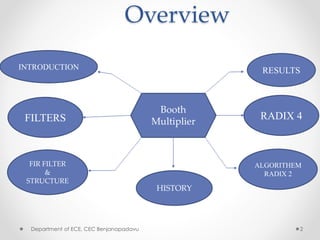
Booth
Multiplier
INTRODUCTION
FILTERS
FIR FILTER
&
STRUCTURE
HISTORY
ALGORITHEM
RADIX 2
RADIX 4
RESULTS
Department of ECE, CEC Benjanapadavu 3
INTRODUCTION
INTRODUCTION
 Multipliers are key components of many high performance systems such as
FIR filters, Microprocessor, digital signal processors, etc.
 A system’s performance is generally determined by the performance of the
Multiplier.
 With advances in technology, many researchers have tried and are trying to
design multipliers which offer either of the following design targets
i. High speed
ii. Low power consumption
iii. Regularity of layout
iv. Less area.
• .
Department of ECE, CEC Benjanapadavu 4
INTRODUCTION
 Why we use Filters ??
The filter is used to remove some unwanted
component or feature from a signal there by improving the quality
of signal.
 Functin Of Filter
To modify the frequency spectrum of a signal and
to model the input output relationship of a system .
 Application Of Filter
Signal processing and communication system in
applications like noise reduction, echo cancellation, image
enhancement, speech and waveform synthesis etc.
Department of ECE, CEC Benjanapadavu 5
Department of ECE, CEC Benjanapadavu 6
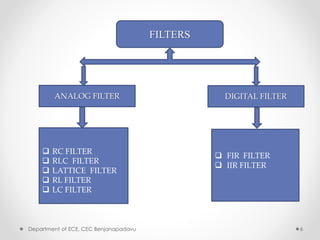
FILTERS
ANALOG FILTER DIGITAL FILTER
DIGIT
 RC FILTER
 RLC FILTER
 LATTICE FILTER
 RL FILTER
 LC FILTER
 FIR FILTER
 IIR FILTER
FIR FILTER
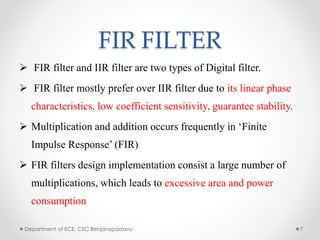
 FIR filter and IIR filter are two types of Digital filter.
 FIR filter mostly prefer over IIR filter due to its linear phase
characteristics, low coefficient sensitivity, guarantee stability.
 Multiplication and addition occurs frequently in ‘Finite
Impulse Response’ (FIR)
 FIR filters design implementation consist a large number of
multiplications, which leads to excessive area and power
consumption
Department of ECE, CEC Benjanapadavu 7
FIR FILTER
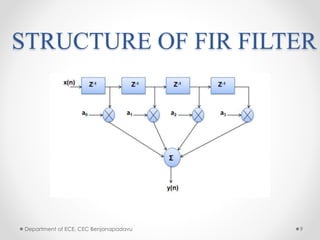
• The input- output relationship of FIR filter is given by
y(n) = 𝑘=0
𝑁−1
𝑎 𝑘 𝑥(𝑛 − 𝑘)
• x[n] and y [n] are the filter input and filter output
respectively
• a(k) ( k = 0,1,2,3……N-1) are the impulse response
coefficients of the filter.
• N is the filter length that is number of coefficients.
Department of ECE, CEC Benjanapadavu 8
STRUCTURE OF FIR FILTER
Department of ECE, CEC Benjanapadavu 9
Department of ECE, CEC Benjanapadavu 10
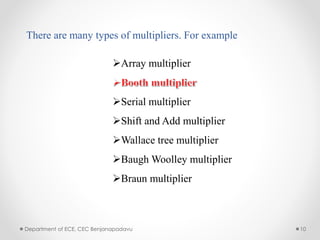
There are many types of multipliers. For example
Array multiplier
Serial multiplier
Shift and Add multiplier
Wallace tree multiplier
Baugh Woolley multiplier
Braun multiplier
HISTORY
Department of ECE, CEC Benjanapadavu 11
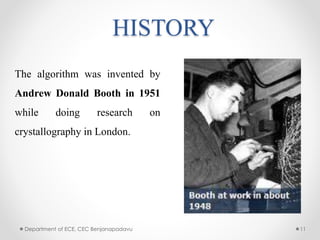
The algorithm was invented by
Andrew Donald Booth in 1951
while doing research on
crystallography in London.
BOOTH MULTIPLIER
• Booth’s multiplication algorithm is the multiplication algorithm that
multiplies two signed binary numbers in two's complement form.
• It is a powerful algorithm for signed-number multiplication which
treats both:
o Positive numbers
o Negative numbers
• Booth algorithm is a method that will reduce the number of
multiplicand multiples.
• This project presents an efficient implementation of high speed
parallel multipliers using both the encoding schemes Radix-2 &
Radix–4 which are further used in the designing of FIR filter.
Department of ECE, CEC
Benjanapadavu
12
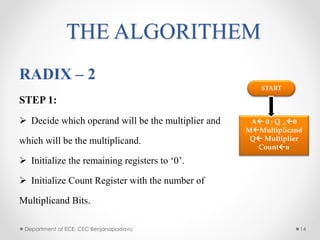
THE ALGORITHEM
RADIX – 2
STEP 1:
 Decide which operand will be the multiplier and
which will be the multiplicand.
 Initialize the remaining registers to ‘0’.
 Initialize Count Register with the number of
Multiplicand Bits.
Department of ECE, CEC Benjanapadavu 14
START
A 0 ; Q -10
MMultiplicand
Q Multiplier
Countn
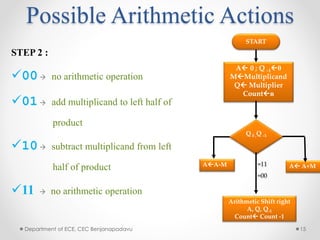
Possible Arithmetic Actions
STEP 2 :
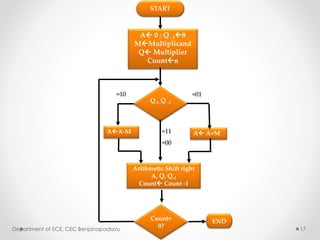
00 no arithmetic operation
01 add multiplicand to left half of
product
10 subtract multiplicand from left
half of product
11  no arithmetic operation
Department of ECE, CEC Benjanapadavu 15
START
A 0 ; Q -10
MMultiplicand
Q Multiplier
Countn
Q 0 ,Q -1
AA-M A A+M=11
=00
Arithmetic Shift right
A, Q, Q-1
Count Count -1
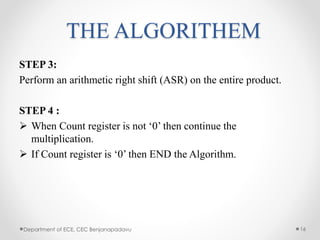
THE ALGORITHEM
STEP 3:
Perform an arithmetic right shift (ASR) on the entire product.
STEP 4 :
 When Count register is not ‘0’ then continue the
multiplication.
 If Count register is ‘0’ then END the Algorithm.
Department of ECE, CEC Benjanapadavu 16
Department of ECE, CEC Benjanapadavu 17
START
A 0 ; Q -10
MMultiplicand
Q Multiplier
Countn
Q 0 ,Q -1
AA-M A A+M
=01
=11
=00
=10
Arithmetic Shift right
A, Q, Q-1
Count Count -1
Count=
0?
END
Department of ECE, CEC Benjanapadavu 18
EXAMPLE
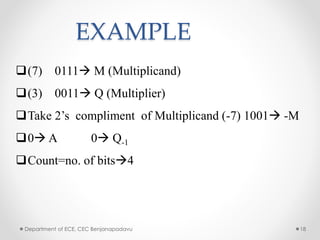
(7) 0111 M (Multiplicand)
(3) 0011 Q (Multiplier)
Take 2’s compliment of Multiplicand (-7) 1001 -M
0 A 0 Q-1
Count=no. of bits4
Department of ECE, CEC Benjanapadavu 19
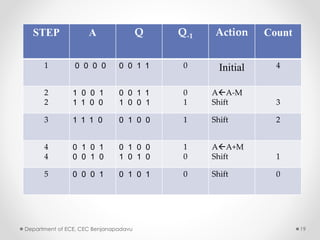
STEP A Q Q-1 Action Count
1 0 0 0 0 0 0 1 1 0 Initial 4
2
2
1 0 0 1
1 1 0 0
0 0 1 1
1 0 0 1
0
1
AA-M
Shift 3
3 1 1 1 0 0 1 0 0 1 Shift 2
4
4
0 1 0 1
0 0 1 0
0 1 0 0
1 0 1 0
1
0
AA+M
Shift 1
5 0 0 0 1 0 1 0 1 0 Shift 0
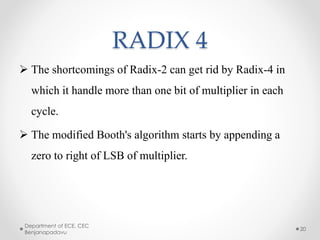
RADIX 4
 The shortcomings of Radix-2 can get rid by Radix-4 in
which it handle more than one bit of multiplier in each
cycle.
 The modified Booth's algorithm starts by appending a
zero to right of LSB of multiplier.
Department of ECE, CEC
Benjanapadavu
20
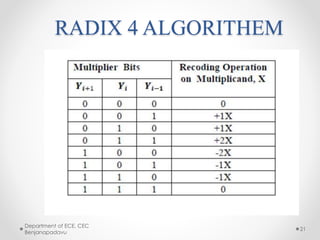
RADIX 4 ALGORITHEM
Department of ECE, CEC
Benjanapadavu
21
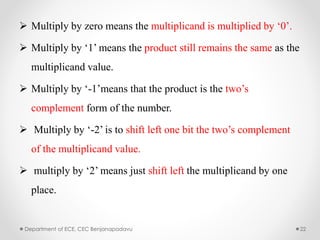
 Multiply by zero means the multiplicand is multiplied by ‘0’.
 Multiply by ‘1’ means the product still remains the same as the
multiplicand value.
 Multiply by ‘-1’means that the product is the two’s
complement form of the number.
 Multiply by ‘-2’ is to shift left one bit the two’s complement
of the multiplicand value.
 multiply by ‘2’ means just shift left the multiplicand by one
place.
Department of ECE, CEC Benjanapadavu 22
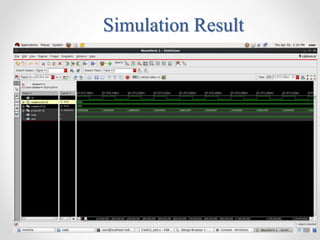
Simulation Result
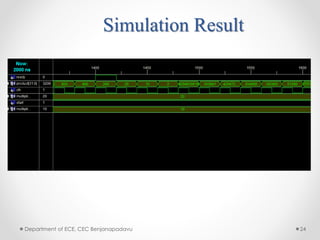
Simulation Result
Department of ECE, CEC Benjanapadavu 24
Department of ECE, CEC Benjanapadavu 25
[1] Ankit Jairath, Sunil Kumar Shah, Amit Jain – “Design & implementation of
FPGA based digital filters”, Journal of IJARCET, ISSN: 2278-1323, Vol. 1,
Issue 7, Sept.2012
[2] E. Ifeachor and B. Jervis, “Finite impulse response (FIR) filter design” in
Digital Signal Processing: A Practical Approach, 2nd ed., D. Kindersley,
Ed. South Asia: Pearson Education, 2002, pp. 342-440
[3] B. Rashidi, B. Rashidi and M. Pourormazd, “Design and Implementation of
Low Power Digital FIR Filter based on low power multipliers and adders
on Xilinx FPGA”, International Conference on Electronics Computer
Technology, 2011, pp.18- 22.
REFRENCES
Department of ECE, CEC
Benjanapadavu
26
THANK YOU

Boothmultiplication

  • 1.
    Modified Booth Multiplier withFIR Filter Seminar by Melisha Monteiro 1st year M.Tech EC Usn : 4CB14LEL07 Department of ECE, CEC Benjanapadavu 1
  • 2.
    Department of ECE,CEC Benjanapadavu 2 Overview Booth Multiplier INTRODUCTION FILTERS FIR FILTER & STRUCTURE HISTORY ALGORITHEM RADIX 2 RADIX 4 RESULTS
  • 3.
    Department of ECE,CEC Benjanapadavu 3 INTRODUCTION
  • 4.
    INTRODUCTION  Multipliers arekey components of many high performance systems such as FIR filters, Microprocessor, digital signal processors, etc.  A system’s performance is generally determined by the performance of the Multiplier.  With advances in technology, many researchers have tried and are trying to design multipliers which offer either of the following design targets i. High speed ii. Low power consumption iii. Regularity of layout iv. Less area. • . Department of ECE, CEC Benjanapadavu 4
  • 5.
    INTRODUCTION  Why weuse Filters ?? The filter is used to remove some unwanted component or feature from a signal there by improving the quality of signal.  Functin Of Filter To modify the frequency spectrum of a signal and to model the input output relationship of a system .  Application Of Filter Signal processing and communication system in applications like noise reduction, echo cancellation, image enhancement, speech and waveform synthesis etc. Department of ECE, CEC Benjanapadavu 5
  • 6.
    Department of ECE,CEC Benjanapadavu 6 FILTERS ANALOG FILTER DIGITAL FILTER DIGIT  RC FILTER  RLC FILTER  LATTICE FILTER  RL FILTER  LC FILTER  FIR FILTER  IIR FILTER
  • 7.
    FIR FILTER  FIRfilter and IIR filter are two types of Digital filter.  FIR filter mostly prefer over IIR filter due to its linear phase characteristics, low coefficient sensitivity, guarantee stability.  Multiplication and addition occurs frequently in ‘Finite Impulse Response’ (FIR)  FIR filters design implementation consist a large number of multiplications, which leads to excessive area and power consumption Department of ECE, CEC Benjanapadavu 7
  • 8.
    FIR FILTER • Theinput- output relationship of FIR filter is given by y(n) = 𝑘=0 𝑁−1 𝑎 𝑘 𝑥(𝑛 − 𝑘) • x[n] and y [n] are the filter input and filter output respectively • a(k) ( k = 0,1,2,3……N-1) are the impulse response coefficients of the filter. • N is the filter length that is number of coefficients. Department of ECE, CEC Benjanapadavu 8
  • 9.
    STRUCTURE OF FIRFILTER Department of ECE, CEC Benjanapadavu 9
  • 10.
    Department of ECE,CEC Benjanapadavu 10 There are many types of multipliers. For example Array multiplier Serial multiplier Shift and Add multiplier Wallace tree multiplier Baugh Woolley multiplier Braun multiplier
  • 11.
    HISTORY Department of ECE,CEC Benjanapadavu 11 The algorithm was invented by Andrew Donald Booth in 1951 while doing research on crystallography in London.
  • 12.
    BOOTH MULTIPLIER • Booth’smultiplication algorithm is the multiplication algorithm that multiplies two signed binary numbers in two's complement form. • It is a powerful algorithm for signed-number multiplication which treats both: o Positive numbers o Negative numbers • Booth algorithm is a method that will reduce the number of multiplicand multiples. • This project presents an efficient implementation of high speed parallel multipliers using both the encoding schemes Radix-2 & Radix–4 which are further used in the designing of FIR filter. Department of ECE, CEC Benjanapadavu 12
  • 13.
    THE ALGORITHEM RADIX –2 STEP 1:  Decide which operand will be the multiplier and which will be the multiplicand.  Initialize the remaining registers to ‘0’.  Initialize Count Register with the number of Multiplicand Bits. Department of ECE, CEC Benjanapadavu 14 START A 0 ; Q -10 MMultiplicand Q Multiplier Countn
  • 14.
    Possible Arithmetic Actions STEP2 : 00 no arithmetic operation 01 add multiplicand to left half of product 10 subtract multiplicand from left half of product 11  no arithmetic operation Department of ECE, CEC Benjanapadavu 15 START A 0 ; Q -10 MMultiplicand Q Multiplier Countn Q 0 ,Q -1 AA-M A A+M=11 =00 Arithmetic Shift right A, Q, Q-1 Count Count -1
  • 15.
    THE ALGORITHEM STEP 3: Performan arithmetic right shift (ASR) on the entire product. STEP 4 :  When Count register is not ‘0’ then continue the multiplication.  If Count register is ‘0’ then END the Algorithm. Department of ECE, CEC Benjanapadavu 16
  • 16.
    Department of ECE,CEC Benjanapadavu 17 START A 0 ; Q -10 MMultiplicand Q Multiplier Countn Q 0 ,Q -1 AA-M A A+M =01 =11 =00 =10 Arithmetic Shift right A, Q, Q-1 Count Count -1 Count= 0? END
  • 17.
    Department of ECE,CEC Benjanapadavu 18 EXAMPLE (7) 0111 M (Multiplicand) (3) 0011 Q (Multiplier) Take 2’s compliment of Multiplicand (-7) 1001 -M 0 A 0 Q-1 Count=no. of bits4
  • 18.
    Department of ECE,CEC Benjanapadavu 19 STEP A Q Q-1 Action Count 1 0 0 0 0 0 0 1 1 0 Initial 4 2 2 1 0 0 1 1 1 0 0 0 0 1 1 1 0 0 1 0 1 AA-M Shift 3 3 1 1 1 0 0 1 0 0 1 Shift 2 4 4 0 1 0 1 0 0 1 0 0 1 0 0 1 0 1 0 1 0 AA+M Shift 1 5 0 0 0 1 0 1 0 1 0 Shift 0
  • 19.
    RADIX 4  Theshortcomings of Radix-2 can get rid by Radix-4 in which it handle more than one bit of multiplier in each cycle.  The modified Booth's algorithm starts by appending a zero to right of LSB of multiplier. Department of ECE, CEC Benjanapadavu 20
  • 20.
    RADIX 4 ALGORITHEM Departmentof ECE, CEC Benjanapadavu 21
  • 21.
     Multiply byzero means the multiplicand is multiplied by ‘0’.  Multiply by ‘1’ means the product still remains the same as the multiplicand value.  Multiply by ‘-1’means that the product is the two’s complement form of the number.  Multiply by ‘-2’ is to shift left one bit the two’s complement of the multiplicand value.  multiply by ‘2’ means just shift left the multiplicand by one place. Department of ECE, CEC Benjanapadavu 22
  • 22.
  • 23.
    Simulation Result Department ofECE, CEC Benjanapadavu 24
  • 24.
    Department of ECE,CEC Benjanapadavu 25 [1] Ankit Jairath, Sunil Kumar Shah, Amit Jain – “Design & implementation of FPGA based digital filters”, Journal of IJARCET, ISSN: 2278-1323, Vol. 1, Issue 7, Sept.2012 [2] E. Ifeachor and B. Jervis, “Finite impulse response (FIR) filter design” in Digital Signal Processing: A Practical Approach, 2nd ed., D. Kindersley, Ed. South Asia: Pearson Education, 2002, pp. 342-440 [3] B. Rashidi, B. Rashidi and M. Pourormazd, “Design and Implementation of Low Power Digital FIR Filter based on low power multipliers and adders on Xilinx FPGA”, International Conference on Electronics Computer Technology, 2011, pp.18- 22. REFRENCES
  • 25.
    Department of ECE,CEC Benjanapadavu 26 THANK YOU