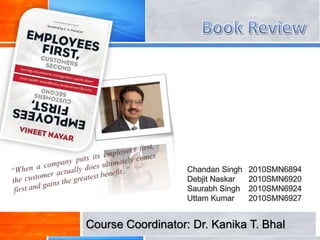
Course Coordinator: Dr. Kanika T. Bhal
2
 Employees First, Customers Second: Turning conventional
management upside down
 Published on June 08, 2010 by Harvard Business Press
 Vineet Nayar’s, CEO of HCL Technologies, firsthand account
on transformation of HCL from slow decline to vitality & growth
 Foreword by C. K. Prahlad: University Professor, Ross School of
Business, University of Michigan
Content Organization
1. Introduction
2. Mirror Mirror: Creating the need for change
3. Trust Through Transparency: Creating a Culture of Change
4. Inverting the Organizational Pyramid: Building a Structure for
Change
5. Recasting the role of the CEO: Transferring the Responsibility for
Change
6. Find Understanding in Misunderstanding: Renew the Cycle of
Change
3
 Between 2000-2005, it started losing market share and
started falling behind in mindshare, after remaining #1
for many years
 Compound annual growth rate (CAGR) of ~30% over
previous 5 years compared to Market leader was
achieving 50% CAGR
 In 2005, Shiv Nadar, chairman & founder, appointed
Vineet Nayar as CEO of HCLT
 Vineet told Shiv: “I want to be free to adopt an unconventional approach”
and Shiv agreed.
4
 In new role, Vineet spent
the next 2 weeks visiting
facilities and talking with
as many people at all
levels as he could
 He shared current
situation with employee
as:
 HCLT had lost its
competitive edge
 Company could crash any
day and have limited time
to prevent disaster
 Only way to prevent
disaster is to accelerate,
move faster and transform
the company
 Identified 3 types of employees
during conversation:
 Transformers:
 Frustrated because unable to
make changes they thought
necessary
 Wanted change immediately &
fast
 Lost Souls:
 Convinced that that absolutely
nothing we could do or change
anything
 Fence Sitters (largest of three):
 Speak less in the meetings;
When eyes meet, they would
smile. Mainly in “Wait and Watch”
mode
 Vineet decided to focus on the
5
 Employees started talking about
future vision but still there were
plenty of uncertainty
 As next move, he called a
meeting of hundred most senior
managers to discuss with them
future plan
 Shared following data:
 Fact #1: Market worth is of $500B (Big players were:
IBM, Accenture, EDS)
 Fact #2: Top 5 Indian companies accounted for
just $6B
 Fact #3: Indian players seems to be satisfied
with the 1%
 Fact #4: IT outsourcing customers are seeking
higher transparency, greater flexibility and
more attention
 Fact #5: Customers wanted to regain control by
collaborating with their outsourcers
 Plan of action based on 3
fundamental beliefs:
 Flexibility and
Transparency: Offering it of a
kind customers have never
seen before (even from the
big players)
 Centricity: Put energy into
increasing the value for the
customers rather than trying to
build volume of business HCL
do with them
 New Standards for value
delivered: Major differentiator,
Employees First Customers
Second, will enable HCL to
unleash positive energy and
passion of employees, to
create “wow” in the value zone
for customers.
6
 Post-discussion top hundred reached to
consensus that they need to make a
bold move
 Realized that first job should be of
building trust
 There are 4 dimensions of trust:
 Credibility: If the person has deep
knowledge and follows good practice.
 How can I ensure credibility in terms of
long term strategy?
 Reliability: Revealed through actions over
time
 Did my managers think of me as reliable
in July of 2005?
 Intimacy: Its about emotions.
 There was many meetings with all levels
of employees but people had seen the
result of sharing and soul searching. I
might yet betray them
 Self-Orientation: Its about motives and the
things you care about
 What did my managers think about my
motives? People may make all kind of
assumptions about a leader’s motives.
 Trust through Transparency: 5 main
reasons
1. It ensures that every stakeholder
knows company’s vision and
knows how his/her contribution
assists
2. It ensures that every stakeholder
has a deep, personal commitment
for the organization
3. Gen Y expect nothing less in their
ways
4. Customers wants us to be
transparent with them
5. New hires can be effective as
easily as possible through sharing
issues & concerns and complete
transparency about strength and
weaknesses
 Amsterdam Window:
 Why do you have such large
windows in Amsterdam?
 Bigger your windows the more glass
you have in your house, the more
visible the dirt will be to you and
7
• Employees have access to financial information to their projects but not of their
business units or whole organizations
• People would be able to see if they are rolling downhill or moving up.
• Financial info of each Employee’s team was available on his/her desktop
• This led to actions at grassroots level:
• Motivated the teams that were doing well (recognition of effort)
• New sense of purpose and direction was quite visible in the teams
Open the window of financial information
• Answers would be given by Vineet along with his leadership team if it remain
unanswered
• Everyone was able to see the question, the questioner and the answer
• Employees felt that they have leadership team that did not claim to know the
answers and they are willing to acknowledge dirt
• Employees on their own started working on the problem reported by other since
they believed they have answers
• Simply by allowing questions to be asked, they improved likelihood that answer
would emerge from someone, somewhere
U&I Portal: an Online forum for employee’s queries
8
 Reverse Accountability: What
if we made the boss as
accountable to the value
zone as the value zone was
accountable to the boss
 That is, certain elements of
hierarchy: enabling functions,
managerial chain of
command, influencers; to be
more accountable to the
value zone
Few
Many
Most: Value Zone
Employees
Customers
Managemen
t
 On completion of critical project
 CIO briefly said hello to Vineet and
then focused his attention on the
HCLT team, “I want to thank all of
you for the excellent work.. You have
gone far beyond our expectations.
Vineet, you don’t know how lucky
you are to have such wonderful
people working for you.”
 For project which was complete disaster
 CIO told Vineet, “The problem was
that your organization didn’t
support them properly. If it had, I’m
sure they would have been able to
9
 Employees were accountable to
Finance, HR, Training &
Development, Quality and
Administration
 Supposed to be supportive but
reality was different
 Smart Service Desk:
Transparent process for
resolving issues between
enabling function and
employees
 Soon 30,000 tickets were being
opened per month: It was victory
for honesty, transparency and
openness
 Later by looking at the pattern of
issues, they tried to fix root
causes of most problems
 Few years after SSD, HCL
ranked #1 in employees
 In February 2006: 300 Customer
representatives journeyed to Delhi
 Explaining EFCS:
 By putting our employees first –
doing everything we can enable
those people who bring real
value to you – we will server you
far better than ever before
 It doesn’t mean we take
customers for granted. Never.
We want to unleash the power of
our bright minds.
 We want them to align
themselves with your challenges
and become your enablers or
facilitators
 To realize EFCS potential, we
need your approval &
understanding and also active
involvement
10
 Opening up the 360-deg review
 Decided to allow anyone who had given feedback to a manager to
see the results of that manager’s 360
 Earlier, manager’s superior often disregard the 360 because of
his/her own concerns and perception, but now it was just one voice
among many
 Optional for managers to open their 360: Vineet led it by opening
his 360 to every employee
 Happy Feet: a new instrument
 Any employee could choose to do a 360-degree evaluation of any
of the managers they believed they had an influence – positive or
negative
 To avoid popular managers get highest rating and more disciplined
but effective get lower marks, questions were carefully designed
 Does this manager help you enhance the value you deliver to the customer?
 After discovering that you have a problem, does this manager help you define the problem and identify
its solution?
 People began to reach out to others with helping hands
11
 Huge emails:
 The employees were sending
many questions of “What do
you recommend?” or “What
should we do?”
 There were two reasons:
 Simply a habit: In a typical
command-and-control
organization
 They didn’t want to take
complete responsibility of the
outcome
 My Problems: new section
under U&I portal
 Vineet started posting question
received to him on this portal
 This created a shift in
responsibility of actions from
CEOs office to the other people
in organizations
 CEO office was now able to
focus more on other important
 Responsibility for managing
the company should be
shifted to employees from
CEO office for 3 reasons:
 CEO office is far away from
the value zone
 Impossible to possess all
kind of knowledge by CEO
office
 CEO is one who asks more
questions than answers
 The role of CEO is to
enable people to excel,
help them discover their
own wisdom, engage
themselves entirely in their
work and accept
responsibility for making
change
12
• During mid 2008 and end of 2009,
there was economic crisis.
• Through Smart Response program
leadership asked employees: How
should we respond to this challenge?
• Response was massive and immediate.
15 of them were implemented which
resulted into huge cost savings for the
company without any lay-offs.
• Employees felt included and assured
about their future and started to focus
on creating more values for customers
1st misunderstanding: It won’t
work when times get tough:
• It’s the way for you to keep growing even if times
are good
• Company may exceed expectations
2nd misunderstanding: Don’t need it
because times are good:
• Customer sees the value very clearly before the
leadership of organization sees it
3rd misunderstanding: Customers will
never see the value
• HCL relied on small-scale catalyst in form of U&I
portal, SSD, lots of communication
4th misunderstanding: Implementation
requires large scale initiatives
• 70% of major deals by HCL was against 4 big
players
• Number of customers five-folded
• Employee attrition fall by almost 50%
• 70% increase in employee satisfaction survey
• Revenue tripled
• Operating income also tripled
5th misunderstanding: This has
nothing to do with performance
13
 Looked into the mirror and recognized that they had changed
for the worse
 Stepped on the accelerator and surged forward: achieved 3X
revenue growth in 4 years
 Changed from a workplace of high attrition and low attraction to
being the #1 best employer in India, Best employer in Asia and
the UK
 Became a thought leader and innovator: emerged as top 5
emerging companies to watch
 EFCS was a cycle of activity, a journey that begins over and
over again
 A simple route to success: a catalyst that sets the process in
motion
 Gained attention and praise with coverage in major business
14
Thanks

Book review 3

  • 1.
  • 2.
    2  Employees First,Customers Second: Turning conventional management upside down  Published on June 08, 2010 by Harvard Business Press  Vineet Nayar’s, CEO of HCL Technologies, firsthand account on transformation of HCL from slow decline to vitality & growth  Foreword by C. K. Prahlad: University Professor, Ross School of Business, University of Michigan Content Organization 1. Introduction 2. Mirror Mirror: Creating the need for change 3. Trust Through Transparency: Creating a Culture of Change 4. Inverting the Organizational Pyramid: Building a Structure for Change 5. Recasting the role of the CEO: Transferring the Responsibility for Change 6. Find Understanding in Misunderstanding: Renew the Cycle of Change
  • 3.
    3  Between 2000-2005,it started losing market share and started falling behind in mindshare, after remaining #1 for many years  Compound annual growth rate (CAGR) of ~30% over previous 5 years compared to Market leader was achieving 50% CAGR  In 2005, Shiv Nadar, chairman & founder, appointed Vineet Nayar as CEO of HCLT  Vineet told Shiv: “I want to be free to adopt an unconventional approach” and Shiv agreed.
  • 4.
    4  In newrole, Vineet spent the next 2 weeks visiting facilities and talking with as many people at all levels as he could  He shared current situation with employee as:  HCLT had lost its competitive edge  Company could crash any day and have limited time to prevent disaster  Only way to prevent disaster is to accelerate, move faster and transform the company  Identified 3 types of employees during conversation:  Transformers:  Frustrated because unable to make changes they thought necessary  Wanted change immediately & fast  Lost Souls:  Convinced that that absolutely nothing we could do or change anything  Fence Sitters (largest of three):  Speak less in the meetings; When eyes meet, they would smile. Mainly in “Wait and Watch” mode  Vineet decided to focus on the
  • 5.
    5  Employees startedtalking about future vision but still there were plenty of uncertainty  As next move, he called a meeting of hundred most senior managers to discuss with them future plan  Shared following data:  Fact #1: Market worth is of $500B (Big players were: IBM, Accenture, EDS)  Fact #2: Top 5 Indian companies accounted for just $6B  Fact #3: Indian players seems to be satisfied with the 1%  Fact #4: IT outsourcing customers are seeking higher transparency, greater flexibility and more attention  Fact #5: Customers wanted to regain control by collaborating with their outsourcers  Plan of action based on 3 fundamental beliefs:  Flexibility and Transparency: Offering it of a kind customers have never seen before (even from the big players)  Centricity: Put energy into increasing the value for the customers rather than trying to build volume of business HCL do with them  New Standards for value delivered: Major differentiator, Employees First Customers Second, will enable HCL to unleash positive energy and passion of employees, to create “wow” in the value zone for customers.
  • 6.
    6  Post-discussion tophundred reached to consensus that they need to make a bold move  Realized that first job should be of building trust  There are 4 dimensions of trust:  Credibility: If the person has deep knowledge and follows good practice.  How can I ensure credibility in terms of long term strategy?  Reliability: Revealed through actions over time  Did my managers think of me as reliable in July of 2005?  Intimacy: Its about emotions.  There was many meetings with all levels of employees but people had seen the result of sharing and soul searching. I might yet betray them  Self-Orientation: Its about motives and the things you care about  What did my managers think about my motives? People may make all kind of assumptions about a leader’s motives.  Trust through Transparency: 5 main reasons 1. It ensures that every stakeholder knows company’s vision and knows how his/her contribution assists 2. It ensures that every stakeholder has a deep, personal commitment for the organization 3. Gen Y expect nothing less in their ways 4. Customers wants us to be transparent with them 5. New hires can be effective as easily as possible through sharing issues & concerns and complete transparency about strength and weaknesses  Amsterdam Window:  Why do you have such large windows in Amsterdam?  Bigger your windows the more glass you have in your house, the more visible the dirt will be to you and
  • 7.
    7 • Employees haveaccess to financial information to their projects but not of their business units or whole organizations • People would be able to see if they are rolling downhill or moving up. • Financial info of each Employee’s team was available on his/her desktop • This led to actions at grassroots level: • Motivated the teams that were doing well (recognition of effort) • New sense of purpose and direction was quite visible in the teams Open the window of financial information • Answers would be given by Vineet along with his leadership team if it remain unanswered • Everyone was able to see the question, the questioner and the answer • Employees felt that they have leadership team that did not claim to know the answers and they are willing to acknowledge dirt • Employees on their own started working on the problem reported by other since they believed they have answers • Simply by allowing questions to be asked, they improved likelihood that answer would emerge from someone, somewhere U&I Portal: an Online forum for employee’s queries
  • 8.
    8  Reverse Accountability:What if we made the boss as accountable to the value zone as the value zone was accountable to the boss  That is, certain elements of hierarchy: enabling functions, managerial chain of command, influencers; to be more accountable to the value zone Few Many Most: Value Zone Employees Customers Managemen t  On completion of critical project  CIO briefly said hello to Vineet and then focused his attention on the HCLT team, “I want to thank all of you for the excellent work.. You have gone far beyond our expectations. Vineet, you don’t know how lucky you are to have such wonderful people working for you.”  For project which was complete disaster  CIO told Vineet, “The problem was that your organization didn’t support them properly. If it had, I’m sure they would have been able to
  • 9.
    9  Employees wereaccountable to Finance, HR, Training & Development, Quality and Administration  Supposed to be supportive but reality was different  Smart Service Desk: Transparent process for resolving issues between enabling function and employees  Soon 30,000 tickets were being opened per month: It was victory for honesty, transparency and openness  Later by looking at the pattern of issues, they tried to fix root causes of most problems  Few years after SSD, HCL ranked #1 in employees  In February 2006: 300 Customer representatives journeyed to Delhi  Explaining EFCS:  By putting our employees first – doing everything we can enable those people who bring real value to you – we will server you far better than ever before  It doesn’t mean we take customers for granted. Never. We want to unleash the power of our bright minds.  We want them to align themselves with your challenges and become your enablers or facilitators  To realize EFCS potential, we need your approval & understanding and also active involvement
  • 10.
    10  Opening upthe 360-deg review  Decided to allow anyone who had given feedback to a manager to see the results of that manager’s 360  Earlier, manager’s superior often disregard the 360 because of his/her own concerns and perception, but now it was just one voice among many  Optional for managers to open their 360: Vineet led it by opening his 360 to every employee  Happy Feet: a new instrument  Any employee could choose to do a 360-degree evaluation of any of the managers they believed they had an influence – positive or negative  To avoid popular managers get highest rating and more disciplined but effective get lower marks, questions were carefully designed  Does this manager help you enhance the value you deliver to the customer?  After discovering that you have a problem, does this manager help you define the problem and identify its solution?  People began to reach out to others with helping hands
  • 11.
    11  Huge emails: The employees were sending many questions of “What do you recommend?” or “What should we do?”  There were two reasons:  Simply a habit: In a typical command-and-control organization  They didn’t want to take complete responsibility of the outcome  My Problems: new section under U&I portal  Vineet started posting question received to him on this portal  This created a shift in responsibility of actions from CEOs office to the other people in organizations  CEO office was now able to focus more on other important  Responsibility for managing the company should be shifted to employees from CEO office for 3 reasons:  CEO office is far away from the value zone  Impossible to possess all kind of knowledge by CEO office  CEO is one who asks more questions than answers  The role of CEO is to enable people to excel, help them discover their own wisdom, engage themselves entirely in their work and accept responsibility for making change
  • 12.
    12 • During mid2008 and end of 2009, there was economic crisis. • Through Smart Response program leadership asked employees: How should we respond to this challenge? • Response was massive and immediate. 15 of them were implemented which resulted into huge cost savings for the company without any lay-offs. • Employees felt included and assured about their future and started to focus on creating more values for customers 1st misunderstanding: It won’t work when times get tough: • It’s the way for you to keep growing even if times are good • Company may exceed expectations 2nd misunderstanding: Don’t need it because times are good: • Customer sees the value very clearly before the leadership of organization sees it 3rd misunderstanding: Customers will never see the value • HCL relied on small-scale catalyst in form of U&I portal, SSD, lots of communication 4th misunderstanding: Implementation requires large scale initiatives • 70% of major deals by HCL was against 4 big players • Number of customers five-folded • Employee attrition fall by almost 50% • 70% increase in employee satisfaction survey • Revenue tripled • Operating income also tripled 5th misunderstanding: This has nothing to do with performance
  • 13.
    13  Looked intothe mirror and recognized that they had changed for the worse  Stepped on the accelerator and surged forward: achieved 3X revenue growth in 4 years  Changed from a workplace of high attrition and low attraction to being the #1 best employer in India, Best employer in Asia and the UK  Became a thought leader and innovator: emerged as top 5 emerging companies to watch  EFCS was a cycle of activity, a journey that begins over and over again  A simple route to success: a catalyst that sets the process in motion  Gained attention and praise with coverage in major business
  • 14.

Editor's Notes

  • #4 In 2005, Shiv Nadar, chairman & founder, appointed Vineet Nayar as CEO of HCLT who was earlier working as CEO of HCL Comnet What will you do if you are in race and suddenly you find out that brakes are not working? Option 1: Try to get the brakes to work Option 2: Slow down Option 3: Speed up! Accelerate past the other cars and then take whatever actions are necessary When you meet a friend after many years, do you feel surprised/shocked for his/her changed looks? But, then you do not show surprise/shock for similar change in yourself We don’t notice gradual change until something forces us.
  • #5 Communication exercise: Talking with employees throughout the organization about the truth as they see it and getting them to acknowledge the reality that everyone knows about HCLT had lost its competitive edge because it is now tolerant of gradual change, and worse, it sees pace as acceptable progress Employees reaction was as he had spoken the unspeakable There were some questions & comments with no ready answers from Vineet Lost Souls: Sit in meetings with frowns on face and whatever we were doing was hopeless & wrong
  • #6  This cannot happen overnight it would take 5 years. It will require reorganization of the company structure from a collection of business units to matrix organization. Rejuvenate those employees who have lost their enthusiasm, improve outdated processes, build strategic partnerships, and develop new product and services. There were few people who objected on the plan of action saying that or “We should first get better at executing at our current business model. We have no idea how to compete with big players”. But also there were support in “Our current business model is outdated. Our employees know it. Our customers know it. Our Competitors know it. We are seeing customers leaving us every day. Shareholders are asking tough questions. Talented people are walking out. We are already good at current business model but it no longer works.” Vineet felt that if they decided to kill the plan I had presented then he was equally confident that they would come up with something equally big and probably better.
  • #7  Principles of transparency, value centricity, and the EFCS approach: A powerful differentiator for HCLT Difficult part was Execution & Change management: Vineet confronted the difference between “convinced by an idea” and “trusting that it can be executed”. Vineet says, “I said to myself, its not going to work without trust from top-most management. You know you are trustworthy but they don’t. Trust quotient is always lower than you think it is – probably quite a bit lower. No distrust but not 100% trust”.
  • #11  Brought in third party to ensure and certify the survey
  • #12  The employees were putting responsibility for change on me, my office or someone I might refer the problem