BOOK
BUILDING
Book Building
 Book building is the process by which an
underwriter attempts to determine the price
at which an initial public offering (IPO)
will be offered.
 An underwriter, normally an investment
bank, builds a book by inviting institutional
investors (fund managers et al.) to submit
bids for the number of shares and the
price(s) they would be willing to pay for
them.
• Book building is actually a price discovery method.
• In this method, the company doesn't fix up a
particular price for the shares, but instead gives a
price range, e.g. Rs 80-100.
• When bidding for the shares, investors have to decide
at which price they would like to BID Based on the
demand and supply of the shares, the final price is
fixed.
• The lowest price (Rs 80) is known as the floor price.
• The highest price (Rs 100) is known as cap price
• The price at which the shares are allotted is known as
cut off price.
• The entire process begins with the selection of the
lead manager, an investment banker whose job is to
bring the issue to the public.
CHARACTERISTICS
• Tendering Process
• Floor Price
 Minimum Price Level
• Price Band
Lower Band
Higher Band
• Bid
Bid Cum Application
• Allotment
• Participants
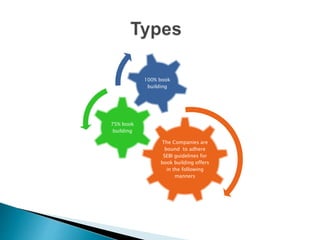
The Companies are
bound to adhere
SEBI guidelines for
book building offers
in the following
manners
75% book
building
100% book
building
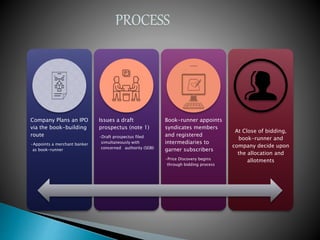
Company Plans an IPO
via the book-building
route
•Appoints a merchant banker
as book-runner
Issues a draft
prospectus (note 1)
•Draft prospectus filed
simultaneously with
concerned authority (SEBI)
Book-runner appoints
syndicates members
and registered
intermediaries to
garner subscribers
•Price Discovery begins
through bidding process
At Close of bidding,
book-runner and
company decide upon
the allocation and
allotments
Benefits
 Book building helps in evaluating the intrinsic worth of the instrument being
offered and the company’s credibility in the eyes of public. The entire exercise
is done on a wholesale basis.
 Price of instrument is determined in a more realistic way on the commitments
made by the prospective investors to the issue.
 Issuers can choose investors by quality
 The Issuer company saves advertising and brokerage commissions.
 Optimal demand based pricing is possible.
 Transparency of allocations is made.
 Book-building process creates a liquid and buoyant after market.
 Immediate allotment and listing of placement portion of securities.
 No Road show done.
 Still depended on good faith.
 No of invester invited are limited
 Lack of transparency
 Not proved to be good price discovery mechanism
 Issuer have to sell cheap due to collective bargaining
 This type of issues are not liable for a small type of
companies or new start-ups.
 This type is basically suitable for Mega issues.
Source
• www.investopedia.com
• www.yourarticlelibrary.com
• www.business.rediff.com
• www.slideshare.com
• www.accountingnotes.com
JINENDRA KOCHAR

Book building final

  • 1.
  • 2.
    Book Building  Bookbuilding is the process by which an underwriter attempts to determine the price at which an initial public offering (IPO) will be offered.  An underwriter, normally an investment bank, builds a book by inviting institutional investors (fund managers et al.) to submit bids for the number of shares and the price(s) they would be willing to pay for them.
  • 3.
    • Book buildingis actually a price discovery method. • In this method, the company doesn't fix up a particular price for the shares, but instead gives a price range, e.g. Rs 80-100. • When bidding for the shares, investors have to decide at which price they would like to BID Based on the demand and supply of the shares, the final price is fixed. • The lowest price (Rs 80) is known as the floor price. • The highest price (Rs 100) is known as cap price • The price at which the shares are allotted is known as cut off price. • The entire process begins with the selection of the lead manager, an investment banker whose job is to bring the issue to the public.
  • 4.
    CHARACTERISTICS • Tendering Process •Floor Price  Minimum Price Level • Price Band Lower Band Higher Band • Bid Bid Cum Application • Allotment • Participants
  • 5.
    The Companies are boundto adhere SEBI guidelines for book building offers in the following manners 75% book building 100% book building
  • 6.
    Company Plans anIPO via the book-building route •Appoints a merchant banker as book-runner Issues a draft prospectus (note 1) •Draft prospectus filed simultaneously with concerned authority (SEBI) Book-runner appoints syndicates members and registered intermediaries to garner subscribers •Price Discovery begins through bidding process At Close of bidding, book-runner and company decide upon the allocation and allotments
  • 7.
    Benefits  Book buildinghelps in evaluating the intrinsic worth of the instrument being offered and the company’s credibility in the eyes of public. The entire exercise is done on a wholesale basis.  Price of instrument is determined in a more realistic way on the commitments made by the prospective investors to the issue.  Issuers can choose investors by quality  The Issuer company saves advertising and brokerage commissions.  Optimal demand based pricing is possible.  Transparency of allocations is made.  Book-building process creates a liquid and buoyant after market.  Immediate allotment and listing of placement portion of securities.
  • 8.
     No Roadshow done.  Still depended on good faith.  No of invester invited are limited  Lack of transparency  Not proved to be good price discovery mechanism  Issuer have to sell cheap due to collective bargaining  This type of issues are not liable for a small type of companies or new start-ups.  This type is basically suitable for Mega issues.
  • 9.
    Source • www.investopedia.com • www.yourarticlelibrary.com •www.business.rediff.com • www.slideshare.com • www.accountingnotes.com
  • 10.

Editor's Notes

  • #7 1.Containing all Mandatory company disclosures other than price