THINK  PEOPLE AND PASSIONS RATHER THAN  CLASSES AND CONTENTEDUC 518Harriet GreaneyMarilupe RodriguezWenjie Wang
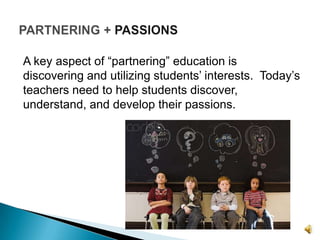
A key aspect of “partnering” education is discovering and utilizing students’ interests.  Today’s teachers need to help students discover, understand, and develop their passions.PARTNERING + PASSIONS
LEARN ABOUT STUDENTS’ INTEREST AND PASSIONSWhile partnering, it is important to know students’ passions in detail.Passion provides a source of energy that inspires learners to make an effort and determines how long they will be willing to endure an activity, how hard they will pursue it, and how much they learn.
“Passion” means a person’s central focus, what the learner cares about most, or what inspires him or her emotionally. A student need not become passionate about learning English in order to succeed in English class. Rather, the student needs connect English learning to his passionate interests.Today’s students expect individualized treatment. .WHY LEARN ABOUT STUDENTS’ PASSIONS?
Educators must discover the passions of individual students—the things that truly interest them—and use them as the drivers of student engagement and achievement.By accessing students’ passions, we can create individual learning that will stick in students’ minds, be valuable in their lives, and make them want to know more.PASSIONS DRIVE STUDENT ENGAGEMENT
 Educators can learn from their students by helping them find their passions and by organizing class activities around the theme of self-expression. 	To discover students’ passions, educators can use various methods--personalized tasks, idea journals, speaking circles, or interactive questionnaires.INDIVIDUALIZE INTRUCTION
To build respect and tolerance for individuality.To inspire more variety in our lessons.To allow us to create meaningful guiding questions.To encourage us to get and give constant feedback.HOW CAN WE USE PASSIONS?
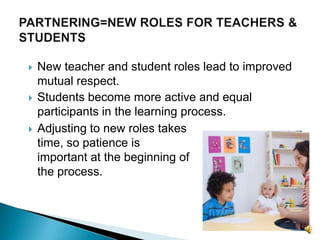
Adjusting to new roles takes time, so patience is important at the beginning of the process.PARTNERING=NEW ROLES FOR TEACHERS & STUDENTSNew teacher and student roles lead to improved mutual respect.
Students become more active and equal participants in the learning process. CoachGuideInstructional expertDesignerQuestionerContext setterRigor providerQuality assurerTEACHERS’ ROLES
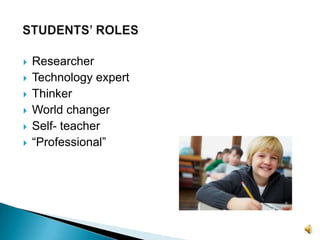
ResearcherTechnology expertThinkerWorld changerSelf- teacher“Professional”STUDENTS’ ROLES
Encourage variations in team work and peer- to- peer learning.Address slacker-free group work.Hold class discussions. “Circle the Chairs”Use students as assistants.MORE IDEAS
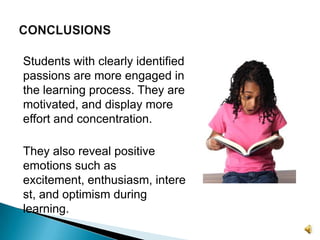
Students with clearly identified passions are more engaged in the learning process. They are motivated, and display more effort and concentration.They also reveal positive emotions such as excitement, enthusiasm, interest, and optimism during learning.CONCLUSIONS
Prensky, M. (2010). Teaching digital natives: Partnering for	real learning. Thousand Oaks, CA: Corwin a Sage	Company.REFERENCE

Book 1, chapter3

  • 1.
    THINK PEOPLEAND PASSIONS RATHER THAN CLASSES AND CONTENTEDUC 518Harriet GreaneyMarilupe RodriguezWenjie Wang
  • 2.
    A key aspectof “partnering” education is discovering and utilizing students’ interests. Today’s teachers need to help students discover, understand, and develop their passions.PARTNERING + PASSIONS
  • 3.
    LEARN ABOUT STUDENTS’INTEREST AND PASSIONSWhile partnering, it is important to know students’ passions in detail.Passion provides a source of energy that inspires learners to make an effort and determines how long they will be willing to endure an activity, how hard they will pursue it, and how much they learn.
  • 4.
    “Passion” means aperson’s central focus, what the learner cares about most, or what inspires him or her emotionally. A student need not become passionate about learning English in order to succeed in English class. Rather, the student needs connect English learning to his passionate interests.Today’s students expect individualized treatment. .WHY LEARN ABOUT STUDENTS’ PASSIONS?
  • 5.
    Educators must discoverthe passions of individual students—the things that truly interest them—and use them as the drivers of student engagement and achievement.By accessing students’ passions, we can create individual learning that will stick in students’ minds, be valuable in their lives, and make them want to know more.PASSIONS DRIVE STUDENT ENGAGEMENT
  • 6.
    Educators canlearn from their students by helping them find their passions and by organizing class activities around the theme of self-expression. To discover students’ passions, educators can use various methods--personalized tasks, idea journals, speaking circles, or interactive questionnaires.INDIVIDUALIZE INTRUCTION
  • 7.
    To build respectand tolerance for individuality.To inspire more variety in our lessons.To allow us to create meaningful guiding questions.To encourage us to get and give constant feedback.HOW CAN WE USE PASSIONS?
  • 8.
    Adjusting to newroles takes time, so patience is important at the beginning of the process.PARTNERING=NEW ROLES FOR TEACHERS & STUDENTSNew teacher and student roles lead to improved mutual respect.
  • 9.
    Students become moreactive and equal participants in the learning process. CoachGuideInstructional expertDesignerQuestionerContext setterRigor providerQuality assurerTEACHERS’ ROLES
  • 10.
    ResearcherTechnology expertThinkerWorld changerSelf-teacher“Professional”STUDENTS’ ROLES
  • 11.
    Encourage variations inteam work and peer- to- peer learning.Address slacker-free group work.Hold class discussions. “Circle the Chairs”Use students as assistants.MORE IDEAS
  • 12.
    Students with clearlyidentified passions are more engaged in the learning process. They are motivated, and display more effort and concentration.They also reveal positive emotions such as excitement, enthusiasm, interest, and optimism during learning.CONCLUSIONS
  • 13.
    Prensky, M. (2010).Teaching digital natives: Partnering for real learning. Thousand Oaks, CA: Corwin a Sage Company.REFERENCE

Editor's Notes

  • #5 Students’ passions are the routes and filters through which partnering teachers create individualized learning.
  • #7 Some students are kinesthetic learners, requiring a hands-on approach to learning. Some students learn visually, excelling when they can read or see photographs of the material. Others, learn better through listening, learning best when they can hear and talk through a problem.