USING QUIZ GAME TO IMPROVE PUPILS’ 
UNDERSTANDING OF SCIENCE 
KNOWLEDGE 
BONG JAK HIAN 
Laporan projek ini dikemukakan sebagai memenuhi sebahagian daripada syarat 
penganugerahan Ijazah Sarjana Muda Perguruan Dengan Kepujian 
(Sains Pendidikan Rendah) 
KAMPUS INSTITUT PENDIDIKAN GURU 
OKTOBER 2010 
2
USING QUIZ GAME TO IMPROVE PUPILS’ UNDERSTANDING OF 
SCIENCE KNOWLEDGE 
Bong Jak Hian 
S2 / T4 SN2 
E-mail: jhbong_hata@yahoo.com 
Institute Pendidikan Guru Kampus Pulau Pinang 
Abstract 
The purpose of this Action Research is to find out whether quiz game can 
improve pupils’ understanding of Science knowledge and control pupils 
from misbehaving. Findings from the interview indicated that pupils and 
teachers recommended using quiz game as one of the classroom activities. 
The mean value indicated that majority of the pupils achieved high marks 
in the post-test compared to the pre-test, whereby the result increased from 
8.36 to 8.90. Pupils behaved well during the game compared to a normal 
Science lesson, out of 41 pupils only 24 of them misbehaved. Quiz game is 
an effective classroom activity that can facilitate learning and control 
pupils’ from misbehaving in the classroom. 
The Context 
From the past experience during practicum in some school, almost everyday there 
will get a relief class from other teachers. Because it is so sudden, there is no time for 
preparation. Sometimes there is a relief class for unfamiliar subjects like Bahasa Arab, 
Art Education and Music. The teacher should not allow the pupils to just sit and do 
nothing in a relief class. This not only wastes their time but also gave them the 
opportunity to misbehave. Pupils will tend to make noise, walk around the classroom, 
disturb others, ask for drinks, and go to the toilet. Teaching and learning in the 
classroom could be maximized with proper lesson planning by the educators. 
Meaningful classroom activities can stimulate pupils to think and help them to 
practice their existing knowledge. A quiz game would be a good choice for the 
teachers to fill the free period meaningfully since it is interesting and relaxing and at 
the same time, enable the pupils to learn within a short period of time. Pupils should 
realize their own responsibility as a learner. A great learner must be initiative and 
proactive to learn whenever there is a chance. They must learn to appreciate time and 
make good use of every second of time meaningfully and beneficially to learn and 
improve themselves. They need to respect teacher and obey rules in school everyday. 
3
Research Focus 
An interesting classroom activity surely will attract pupils’ attention throughout 
the period and also helps pupils in learning. Quiz game is recommended by most of 
the teachers and pupils in school, so as most researchers in the world. It bring benefits 
for the both the pupils and the teacher. McCloud (2008) said that quiz game is good 
for reviewing and reinforcing previously taught material. It can also raise the 
understanding and it is good for warming up or ending lesson. It allows the students to 
practice listening to natural, non-scripted English during the quiz game activity. Not 
only this, quiz game is also believed can helps in controlling pupils from misbehaving. 
According to Vernon (2005), during the game, the teacher should establish the rules 
and consequences for good and bad behavior, apply them consistently, set a good 
example, use peer pressure and points, and use attention grabbing cues. The teacher 
should also create teams and deduct or reward behavior points to a team's score 
during a game. Your class will respond naturally by using peer pressure to keep the 
naughty children from misbehaving. Quiz game is a very useful strategy in making 
pupils’ engage in learning and also make them well-behaved. 
Action Plan 
The objective of this action research is to find out whether the quiz game can 
improve pupils’ understanding of Science knowledge and control pupils from 
misbehaving. The research questions are: Can quiz game help to improve pupils’ 
understanding of Science knowledge? Can quiz game help to control pupils from 
misbehaving during the learning process? The participants of the study will be a 
number of 28 pupils consisting of 12 boys and 16 girls were involved in this action 
research. They were all Year Three students from a primary school situated in Penang, 
Malaysia. To solve the problem, researcher conducted a quiz game among the Year 3 
pupils after the topic Magnet was taught. 
Implementation of Action Plan 
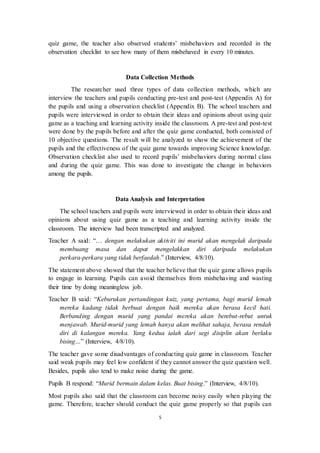
First of all, the school teachers and pupils were interviewed in order to obtain 
their ideas and opinions on using quiz game as a teaching and learning activity inside 
the classroom. A quiz game was then conducted with Year 3 pupils during the relief 
class period in order to check its effectiveness towards improving pupils’ 
understanding of Science knowledge. At the beginning, Year 3 pupils were taught the 
topic Magnet. The pupils sat for a pre-test that consisted of 10 objective questions in 
order to check their prior understanding on the topic taught. After the pre-test, a quiz 
game was conducted during the relief class, the pupils were guided to play the game. 
After the quiz game, pupils sat for a post-test that consisted of 10 objective questions. 
On the other hand, students’ misbehaviors were observed during the normal lesson 
when pupils were taught the Science topic. The number of students that misbehaved 
in every 10 minutes was recorded in an observation checklist. Similarly, during the 
4
quiz game, the teacher also observed students’ misbehaviors and recorded in the 
observation checklist to see how many of them misbehaved in every 10 minutes. 
Data Collection Methods 
The researcher used three types of data collection methods, which are 
interview the teachers and pupils conducting pre-test and post-test (Appendix A) for 
the pupils and using a observation checklist (Appendix B). The school teachers and 
pupils were interviewed in order to obtain their ideas and opinions about using quiz 
game as a teaching and learning activity inside the classroom. A pre-test and post-test 
were done by the pupils before and after the quiz game conducted, both consisted of 
10 objective questions. The result will be analyzed to show the achievement of the 
pupils and the effectiveness of the quiz game towards improving Science knowledge. 
Observation checklist also used to record pupils’ misbehaviors during normal class 
and during the quiz game. This was done to investigate the change in behaviors 
among the pupils. 
Data Analysis and Interpretation 
The school teachers and pupils were interviewed in order to obtain their ideas and 
opinions about using quiz game as a teaching and learning activity inside the 
classroom. The interview had been transcripted and analyzed. 
Teacher A said: “… dengan melakukan aktiviti ini murid akan mengelak daripada 
membuang masa dan dapat mengelakkan diri daripada melakukan 
perkara-perkara yang tidak berfaedah.” (Interview, 4/8/10). 
The statement above showed that the teacher believe that the q uiz game allows pupils 
to engage in learning. Pupils can avoid themselves from misbehaving and wasting 
their time by doing meaningless job. 
Teacher B said: “Keburukan pertandingan kuiz, yang pertama, bagi murid lemah 
mereka kadang tidak berbuat dengan baik mereka akan berasa kecil hati. 
Berbanding dengan murid yang pandai mereka akan berebut-rebut untuk 
menjawab. Murid-murid yang lemah hanya akan melihat sahaja, berasa rendah 
diri di kalangan mereka. Yang kedua ialah dari segi disiplin akan berlaku 
bising…” (Interview, 4/8/10). 
The teacher gave some disadvantages of conducting quiz game in classroom. Teacher 
said weak pupils may feel low confident if they cannot answer the quiz question well. 
Besides, pupils also tend to make noise during the game. 
Pupils B respond: “Murid bermain dalam kelas. Buat bising.” (Interview, 4/8/10). 
Most pupils also said that the classroom can become noisy easily when playing the 
game. Therefore, teacher should conduct the quiz game properly so that pupils can 
5
learn effectively and well-behaved during the period. 
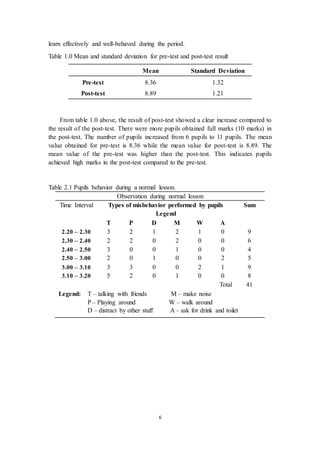
Table 1.0 Mean and standard deviation for pre-test and post-test result 
Mean Standard Deviation 
Pre-test 8.36 1.32 
Post-test 8.89 1.21 
From table 1.0 above, the result of post-test showed a clear increase compared to 
the result of the post-test. There were more pupils obtained full marks (10 marks) in 
the post-test. The number of pupils increased from 6 pupils to 11 pupils. The mean 
value obtained for pre-test is 8.36 while the mean value for post-test is 8.89. The 
mean value of the pre-test was higher than the post-test. This indicates pupils 
achieved high marks in the post-test compared to the pre-test. 
Table 2.1 Pupils behavior during a normal lesson. 
Observation during normal lesson 
Time Interval Types of misbehavior performed by pupils Sum 
Legend 
T P D M W A 
2.20 – 2.30 3 2 1 2 1 0 9 
2.30 – 2.40 2 2 0 2 0 0 6 
2.40 – 2.50 3 0 0 1 0 0 4 
2.50 – 3.00 2 0 1 0 0 2 5 
3.00 – 3.10 3 3 0 0 2 1 9 
3.10 – 3.20 5 2 0 1 0 0 8 
6 
Total 41 
Legend: T – talking with friends M – make noise 
P – Playing around W – walk around 
D – distract by other stuff A – ask for drink and toilet
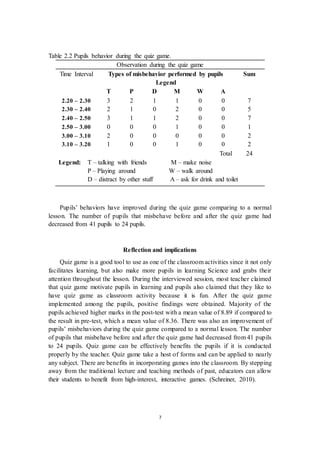
Table 2.2 Pupils behavior during the quiz game. 
Observation during the quiz game 
Time Interval Types of misbehavior performed by pupils Sum 
Legend 
T P D M W A 
2.20 – 2.30 3 2 1 1 0 0 7 
2.30 – 2.40 2 1 0 2 0 0 5 
2.40 – 2.50 3 1 1 2 0 0 7 
2.50 – 3.00 0 0 0 1 0 0 1 
3.00 – 3.10 2 0 0 0 0 0 2 
3.10 – 3.20 1 0 0 1 0 0 2 
7 
Total 24 
Legend: T – talking with friends M – make noise 
P – Playing around W – walk around 
D – distract by other stuff A – ask for drink and toilet 
Pupils’ behaviors have improved during the quiz game comparing to a normal 
lesson. The number of pupils that misbehave before and after the quiz game had 
decreased from 41 pupils to 24 pupils. 
Reflection and implications 
Quiz game is a good tool to use as one of the classroom activities since it not only 
facilitates learning, but also make more pupils in learning Science and grabs their 
attention throughout the lesson. During the interviewed session, most teacher claimed 
that quiz game motivate pupils in learning and pupils also claimed that they like to 
have quiz game as classroom activity because it is fun. After the quiz game 
implemented among the pupils, positive findings were obtained. Majority of the 
pupils achieved higher marks in the post-test with a mean value of 8.89 if compared to 
the result in pre-test, which a mean value of 8.36. There was also an improvement of 
pupils’ misbehaviors during the quiz game compared to a normal lesson. The number 
of pupils that misbehave before and after the quiz game had decreased from 41 pupils 
to 24 pupils. Quiz game can be effectively benefits the pupils if it is conducted 
properly by the teacher. Quiz game take a host of forms and can be applied to nearly 
any subject. There are benefits in incorporating games into the classroom. By stepping 
away from the traditional lecture and teaching methods of past, educators can allow 
their students to benefit from high-interest, interactive games. (Schreiner, 2010).
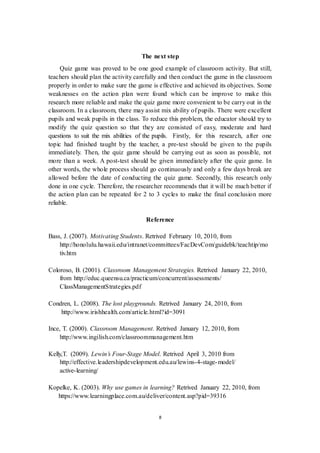
The next step 
Quiz game was proved to be one good example of classroom activity. But still, 
teachers should plan the activity carefully and then conduct the game in the classroom 
properly in order to make sure the game is effective and achieved its objectives. Some 
weaknesses on the action plan were found which can be improve to make this 
research more reliable and make the quiz game more convenient to be carry out in the 
classroom. In a classroom, there may assist mix ability of pupils. There were excellent 
pupils and weak pupils in the class. To reduce this problem, the educator should try to 
modify the quiz question so that they are consisted of easy, moderate and hard 
questions to suit the mix abilities of the pupils. Firstly, for this research, after one 
topic had finished taught by the teacher, a pre-test should be given to the pupils 
immediately. Then, the quiz game should be carrying out as soon as possible, not 
more than a week. A post-test should be given immediately after the quiz game. In 
other words, the whole process should go continuously and only a few days break are 
allowed before the date of conducting the quiz game. Secondly, this research only 
done in one cycle. Therefore, the researcher recommends that it will be much better if 
the action plan can be repeated for 2 to 3 cycles to make the final conclusion more 
reliable. 
Reference 
Bass, J. (2007). Motivating Students. Retrived February 10, 2010, from 
http://honolulu.hawaii.edu/intranet/committees/FacDevCom/guidebk/teachtip/mo 
tiv.htm 
Coloroso, B. (2001). Classroom Management Strategies. Retrived January 22, 2010, 
from http://educ.queensu.ca/practicum/concurrent/assessments/ 
ClassManagementStrategies.pdf 
Condren, L. (2008). The lost playgrounds. Retrived January 24, 2010, from 
http://www.irishhealth.com/article.html?id=3091 
Ince, T. (2000). Classroom Management. Retrived January 12, 2010, from 
http://www.ingilish.com/classroommanagement.htm 
Kelly,T. (2009). Lewin’s Four-Stage Model. Retrived April 3, 2010 from 
http://effective.leadershipdevelopment.edu.au/lewins-4-stage-model/ 
active-learning/ 
Kopelke, K. (2003). Why use games in learning? Retrived January 22, 2010, from 
https://www.learningplace.com.au/deliver/content.asp?pid=39316 
8
Lalonde, C. (2001). Jean Piaget. Retrived January 22, 2010, from 
http://social.jrank.org/pages/485/Piaget-Jean-1896-1980.html 
McCloud, M. (2009). Using quiz game in the classroom. Retrived January 22, 2010, 
from http://niigatajet.net/Documents/Quizes_MartinMcCloud.pdf 
Mitchell, A. and Savill-Smith, C. (2004). The use of computer and video 
games for learning. London: Learning and Skills Development Agency. 
Retrived April 3, 2010 from http://www.lsda.org.uk/files/PDF/1529.pdf 
Mungai, D., Jones, D. & Wong, L. (2005). Games to Teach By. 
Retrived April 3, 2010 from http://www.uwex.edu/disted/conference/ 
Resource_library/proceedings/02_47.pdf 
Pham, T. H. (2002). Learners’ and teachers’ preferences for classroom activities. 
Retrived January 20, 2010, from https://www.essex.ac.uk/ 
linguistics/publications/egspll/volume_7/pdf/Hanh.pdf 
White, J. (2007). Play. Retrived January 22, 2010, from 
http://findarticles.com/p/articles/mi_g2699/is_0005/ai_2699000586/ 
Vernon, S. (2005). Staying in Control of a Large Class. Retrived April 3, 2010 
from http://www.eslbase.com/articles/large-classes.asp 
9

tesis

  • 1.
    USING QUIZ GAMETO IMPROVE PUPILS’ UNDERSTANDING OF SCIENCE KNOWLEDGE BONG JAK HIAN Laporan projek ini dikemukakan sebagai memenuhi sebahagian daripada syarat penganugerahan Ijazah Sarjana Muda Perguruan Dengan Kepujian (Sains Pendidikan Rendah) KAMPUS INSTITUT PENDIDIKAN GURU OKTOBER 2010 2
  • 2.
    USING QUIZ GAMETO IMPROVE PUPILS’ UNDERSTANDING OF SCIENCE KNOWLEDGE Bong Jak Hian S2 / T4 SN2 E-mail: jhbong_hata@yahoo.com Institute Pendidikan Guru Kampus Pulau Pinang Abstract The purpose of this Action Research is to find out whether quiz game can improve pupils’ understanding of Science knowledge and control pupils from misbehaving. Findings from the interview indicated that pupils and teachers recommended using quiz game as one of the classroom activities. The mean value indicated that majority of the pupils achieved high marks in the post-test compared to the pre-test, whereby the result increased from 8.36 to 8.90. Pupils behaved well during the game compared to a normal Science lesson, out of 41 pupils only 24 of them misbehaved. Quiz game is an effective classroom activity that can facilitate learning and control pupils’ from misbehaving in the classroom. The Context From the past experience during practicum in some school, almost everyday there will get a relief class from other teachers. Because it is so sudden, there is no time for preparation. Sometimes there is a relief class for unfamiliar subjects like Bahasa Arab, Art Education and Music. The teacher should not allow the pupils to just sit and do nothing in a relief class. This not only wastes their time but also gave them the opportunity to misbehave. Pupils will tend to make noise, walk around the classroom, disturb others, ask for drinks, and go to the toilet. Teaching and learning in the classroom could be maximized with proper lesson planning by the educators. Meaningful classroom activities can stimulate pupils to think and help them to practice their existing knowledge. A quiz game would be a good choice for the teachers to fill the free period meaningfully since it is interesting and relaxing and at the same time, enable the pupils to learn within a short period of time. Pupils should realize their own responsibility as a learner. A great learner must be initiative and proactive to learn whenever there is a chance. They must learn to appreciate time and make good use of every second of time meaningfully and beneficially to learn and improve themselves. They need to respect teacher and obey rules in school everyday. 3
  • 3.
    Research Focus Aninteresting classroom activity surely will attract pupils’ attention throughout the period and also helps pupils in learning. Quiz game is recommended by most of the teachers and pupils in school, so as most researchers in the world. It bring benefits for the both the pupils and the teacher. McCloud (2008) said that quiz game is good for reviewing and reinforcing previously taught material. It can also raise the understanding and it is good for warming up or ending lesson. It allows the students to practice listening to natural, non-scripted English during the quiz game activity. Not only this, quiz game is also believed can helps in controlling pupils from misbehaving. According to Vernon (2005), during the game, the teacher should establish the rules and consequences for good and bad behavior, apply them consistently, set a good example, use peer pressure and points, and use attention grabbing cues. The teacher should also create teams and deduct or reward behavior points to a team's score during a game. Your class will respond naturally by using peer pressure to keep the naughty children from misbehaving. Quiz game is a very useful strategy in making pupils’ engage in learning and also make them well-behaved. Action Plan The objective of this action research is to find out whether the quiz game can improve pupils’ understanding of Science knowledge and control pupils from misbehaving. The research questions are: Can quiz game help to improve pupils’ understanding of Science knowledge? Can quiz game help to control pupils from misbehaving during the learning process? The participants of the study will be a number of 28 pupils consisting of 12 boys and 16 girls were involved in this action research. They were all Year Three students from a primary school situated in Penang, Malaysia. To solve the problem, researcher conducted a quiz game among the Year 3 pupils after the topic Magnet was taught. Implementation of Action Plan First of all, the school teachers and pupils were interviewed in order to obtain their ideas and opinions on using quiz game as a teaching and learning activity inside the classroom. A quiz game was then conducted with Year 3 pupils during the relief class period in order to check its effectiveness towards improving pupils’ understanding of Science knowledge. At the beginning, Year 3 pupils were taught the topic Magnet. The pupils sat for a pre-test that consisted of 10 objective questions in order to check their prior understanding on the topic taught. After the pre-test, a quiz game was conducted during the relief class, the pupils were guided to play the game. After the quiz game, pupils sat for a post-test that consisted of 10 objective questions. On the other hand, students’ misbehaviors were observed during the normal lesson when pupils were taught the Science topic. The number of students that misbehaved in every 10 minutes was recorded in an observation checklist. Similarly, during the 4
  • 4.
    quiz game, theteacher also observed students’ misbehaviors and recorded in the observation checklist to see how many of them misbehaved in every 10 minutes. Data Collection Methods The researcher used three types of data collection methods, which are interview the teachers and pupils conducting pre-test and post-test (Appendix A) for the pupils and using a observation checklist (Appendix B). The school teachers and pupils were interviewed in order to obtain their ideas and opinions about using quiz game as a teaching and learning activity inside the classroom. A pre-test and post-test were done by the pupils before and after the quiz game conducted, both consisted of 10 objective questions. The result will be analyzed to show the achievement of the pupils and the effectiveness of the quiz game towards improving Science knowledge. Observation checklist also used to record pupils’ misbehaviors during normal class and during the quiz game. This was done to investigate the change in behaviors among the pupils. Data Analysis and Interpretation The school teachers and pupils were interviewed in order to obtain their ideas and opinions about using quiz game as a teaching and learning activity inside the classroom. The interview had been transcripted and analyzed. Teacher A said: “… dengan melakukan aktiviti ini murid akan mengelak daripada membuang masa dan dapat mengelakkan diri daripada melakukan perkara-perkara yang tidak berfaedah.” (Interview, 4/8/10). The statement above showed that the teacher believe that the q uiz game allows pupils to engage in learning. Pupils can avoid themselves from misbehaving and wasting their time by doing meaningless job. Teacher B said: “Keburukan pertandingan kuiz, yang pertama, bagi murid lemah mereka kadang tidak berbuat dengan baik mereka akan berasa kecil hati. Berbanding dengan murid yang pandai mereka akan berebut-rebut untuk menjawab. Murid-murid yang lemah hanya akan melihat sahaja, berasa rendah diri di kalangan mereka. Yang kedua ialah dari segi disiplin akan berlaku bising…” (Interview, 4/8/10). The teacher gave some disadvantages of conducting quiz game in classroom. Teacher said weak pupils may feel low confident if they cannot answer the quiz question well. Besides, pupils also tend to make noise during the game. Pupils B respond: “Murid bermain dalam kelas. Buat bising.” (Interview, 4/8/10). Most pupils also said that the classroom can become noisy easily when playing the game. Therefore, teacher should conduct the quiz game properly so that pupils can 5
  • 5.
    learn effectively andwell-behaved during the period. Table 1.0 Mean and standard deviation for pre-test and post-test result Mean Standard Deviation Pre-test 8.36 1.32 Post-test 8.89 1.21 From table 1.0 above, the result of post-test showed a clear increase compared to the result of the post-test. There were more pupils obtained full marks (10 marks) in the post-test. The number of pupils increased from 6 pupils to 11 pupils. The mean value obtained for pre-test is 8.36 while the mean value for post-test is 8.89. The mean value of the pre-test was higher than the post-test. This indicates pupils achieved high marks in the post-test compared to the pre-test. Table 2.1 Pupils behavior during a normal lesson. Observation during normal lesson Time Interval Types of misbehavior performed by pupils Sum Legend T P D M W A 2.20 – 2.30 3 2 1 2 1 0 9 2.30 – 2.40 2 2 0 2 0 0 6 2.40 – 2.50 3 0 0 1 0 0 4 2.50 – 3.00 2 0 1 0 0 2 5 3.00 – 3.10 3 3 0 0 2 1 9 3.10 – 3.20 5 2 0 1 0 0 8 6 Total 41 Legend: T – talking with friends M – make noise P – Playing around W – walk around D – distract by other stuff A – ask for drink and toilet
  • 6.
    Table 2.2 Pupilsbehavior during the quiz game. Observation during the quiz game Time Interval Types of misbehavior performed by pupils Sum Legend T P D M W A 2.20 – 2.30 3 2 1 1 0 0 7 2.30 – 2.40 2 1 0 2 0 0 5 2.40 – 2.50 3 1 1 2 0 0 7 2.50 – 3.00 0 0 0 1 0 0 1 3.00 – 3.10 2 0 0 0 0 0 2 3.10 – 3.20 1 0 0 1 0 0 2 7 Total 24 Legend: T – talking with friends M – make noise P – Playing around W – walk around D – distract by other stuff A – ask for drink and toilet Pupils’ behaviors have improved during the quiz game comparing to a normal lesson. The number of pupils that misbehave before and after the quiz game had decreased from 41 pupils to 24 pupils. Reflection and implications Quiz game is a good tool to use as one of the classroom activities since it not only facilitates learning, but also make more pupils in learning Science and grabs their attention throughout the lesson. During the interviewed session, most teacher claimed that quiz game motivate pupils in learning and pupils also claimed that they like to have quiz game as classroom activity because it is fun. After the quiz game implemented among the pupils, positive findings were obtained. Majority of the pupils achieved higher marks in the post-test with a mean value of 8.89 if compared to the result in pre-test, which a mean value of 8.36. There was also an improvement of pupils’ misbehaviors during the quiz game compared to a normal lesson. The number of pupils that misbehave before and after the quiz game had decreased from 41 pupils to 24 pupils. Quiz game can be effectively benefits the pupils if it is conducted properly by the teacher. Quiz game take a host of forms and can be applied to nearly any subject. There are benefits in incorporating games into the classroom. By stepping away from the traditional lecture and teaching methods of past, educators can allow their students to benefit from high-interest, interactive games. (Schreiner, 2010).
  • 7.
    The next step Quiz game was proved to be one good example of classroom activity. But still, teachers should plan the activity carefully and then conduct the game in the classroom properly in order to make sure the game is effective and achieved its objectives. Some weaknesses on the action plan were found which can be improve to make this research more reliable and make the quiz game more convenient to be carry out in the classroom. In a classroom, there may assist mix ability of pupils. There were excellent pupils and weak pupils in the class. To reduce this problem, the educator should try to modify the quiz question so that they are consisted of easy, moderate and hard questions to suit the mix abilities of the pupils. Firstly, for this research, after one topic had finished taught by the teacher, a pre-test should be given to the pupils immediately. Then, the quiz game should be carrying out as soon as possible, not more than a week. A post-test should be given immediately after the quiz game. In other words, the whole process should go continuously and only a few days break are allowed before the date of conducting the quiz game. Secondly, this research only done in one cycle. Therefore, the researcher recommends that it will be much better if the action plan can be repeated for 2 to 3 cycles to make the final conclusion more reliable. Reference Bass, J. (2007). Motivating Students. Retrived February 10, 2010, from http://honolulu.hawaii.edu/intranet/committees/FacDevCom/guidebk/teachtip/mo tiv.htm Coloroso, B. (2001). Classroom Management Strategies. Retrived January 22, 2010, from http://educ.queensu.ca/practicum/concurrent/assessments/ ClassManagementStrategies.pdf Condren, L. (2008). The lost playgrounds. Retrived January 24, 2010, from http://www.irishhealth.com/article.html?id=3091 Ince, T. (2000). Classroom Management. Retrived January 12, 2010, from http://www.ingilish.com/classroommanagement.htm Kelly,T. (2009). Lewin’s Four-Stage Model. Retrived April 3, 2010 from http://effective.leadershipdevelopment.edu.au/lewins-4-stage-model/ active-learning/ Kopelke, K. (2003). Why use games in learning? Retrived January 22, 2010, from https://www.learningplace.com.au/deliver/content.asp?pid=39316 8
  • 8.
    Lalonde, C. (2001).Jean Piaget. Retrived January 22, 2010, from http://social.jrank.org/pages/485/Piaget-Jean-1896-1980.html McCloud, M. (2009). Using quiz game in the classroom. Retrived January 22, 2010, from http://niigatajet.net/Documents/Quizes_MartinMcCloud.pdf Mitchell, A. and Savill-Smith, C. (2004). The use of computer and video games for learning. London: Learning and Skills Development Agency. Retrived April 3, 2010 from http://www.lsda.org.uk/files/PDF/1529.pdf Mungai, D., Jones, D. & Wong, L. (2005). Games to Teach By. Retrived April 3, 2010 from http://www.uwex.edu/disted/conference/ Resource_library/proceedings/02_47.pdf Pham, T. H. (2002). Learners’ and teachers’ preferences for classroom activities. Retrived January 20, 2010, from https://www.essex.ac.uk/ linguistics/publications/egspll/volume_7/pdf/Hanh.pdf White, J. (2007). Play. Retrived January 22, 2010, from http://findarticles.com/p/articles/mi_g2699/is_0005/ai_2699000586/ Vernon, S. (2005). Staying in Control of a Large Class. Retrived April 3, 2010 from http://www.eslbase.com/articles/large-classes.asp 9