STRUCTURE AND
FUNCTION OF BONES
RAJOSI KHANRA
M.Sc. 1st Year , Roll No- 2288004
CONTENT
● INTRODUCTION
● COMPOSITIONS OF BONES
● TYPES OF BONES
● STRUCTURE OF BONES
1. GROSS STRUCTURE
2. MICROSCOPIC STRUCTURE
● FUNCTION OF BONES
● DISORDER OF BONES
● CONCLUSION
● SUMMARY
● BIBLIOGRAPHY
INTRODUCTION
The basic structure unit of a
human skeleton is bone. Bone is
essentially a highly vascular, living,
constantly changing mineralized
connective tissue.
It is remarkable for its hardness,
resilience and regenerative
capacity.
COMPOSITION OF BONE
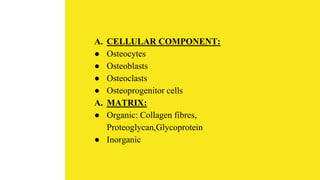
A. CELLULAR COMPONENT:
● Osteocytes
● Osteoblasts
● Osteoclasts
● Osteoprogenitor cells
A. MATRIX:
● Organic: Collagen fibres,
Proteoglycan,Glycoprotein
● Inorganic
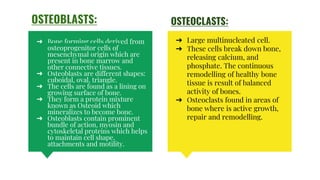
OSTEOBLASTS:
➔ Bone forming cells derived from
osteoprogenitor cells of
mesenchymal origin which are
present in bone marrow and
other connective tissues.
➔ Osteoblasts are different shapes:
cuboidal, oval, triangle.
➔ The cells are found as a lining on
growing surface of bone.
➔ They form a protein mixture
known as Osteoid which
mineralizes to become bone.
➔ Osteoblasts contain prominent
bundle of action, myosin and
cytoskeletal proteins which helps
to maintain cell shape,
attachments and motility.
OSTEOCLASTS:
➔ Large multinucleated cell.
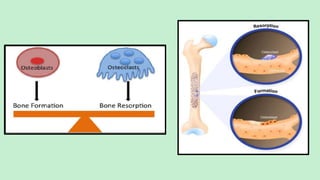
➔ These cells break down bone,
releasing calcium, and
phosphate. The continuous
remodelling of healthy bone
tissue is result of balanced
activity of bones.
➔ Osteoclasts found in areas of
bone where is active growth,
repair and remodelling.
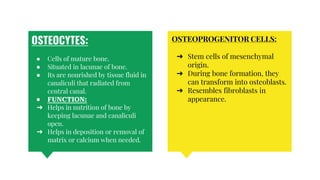
OSTEOCYTES:
● Cells of mature bone.
● Situated in lacunae of bone.
● Its are nourished by tissue fluid in
canaliculi that radiated from
central canal.
● FUNCTION:
➔ Helps in nutrition of bone by
keeping lacunae and canaliculi
open.
➔ Helps in deposition or removal of
matrix or calcium when needed.
OSTEOPROGENITOR CELLS:
➔ Stem cells of mesenchymal
origin.
➔ During bone formation, they
can transform into osteoblasts.
➔ Resembles fibroblasts in
appearance.
TYPES OF BONES
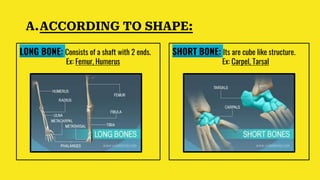
A.ACCORDING TO SHAPE:
LONG BONE: Consists of a shaft with 2 ends.
Ex: Femur, Humerus
SHORT BONE: Its are cube like structure.
Ex: Carpel, Tarsal
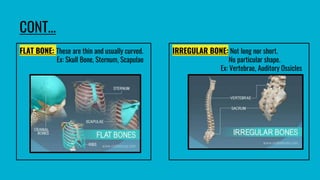
CONT…
FLAT BONE: These are thin and usually curved.
Ex: Skull Bone, Sternum, Scapulae
IRREGULAR BONE: Not long nor short.
No particular shape.
Ex: Vertebrae, Auditory Ossicles
CONT…
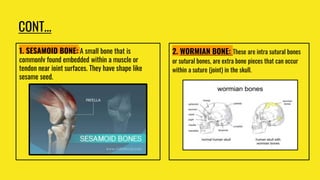
1. SESAMOID BONE: A small bone that is
commonly found embedded within a muscle or
tendon near joint surfaces. They have shape like
sesame seed.
2. WORMIAN BONE: These are intra sutural bones
or sutural bones, are extra bone pieces that can occur
within a suture (joint) in the skull.
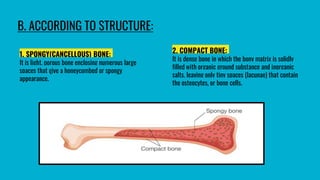
B. ACCORDING TO STRUCTURE:
1. SPONGY(CANCELLOUS) BONE:
It is light, porous bone enclosing numerous large
spaces that give a honeycombed or spongy
appearance.
2. COMPACT BONE:
It is dense bone in which the bony matrix is solidly
filled with organic ground substance and inorganic
salts, leaving only tiny spaces (lacunae) that contain
the osteocytes, or bone cells.
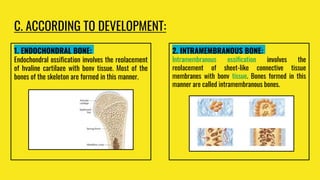
C. ACCORDING TO DEVELOPMENT:
1. ENDOCHONDRAL BONE:
Endochondral ossification involves the replacement
of hyaline cartilage with bony tissue. Most of the
bones of the skeleton are formed in this manner.
2. INTRAMEMBRANOUS BONE:
Intramembranous ossification involves the
replacement of sheet-like connective tissue
membranes with bony tissue. Bones formed in this
manner are called intramembranous bones.
STRUCTURE OF BONE
GROSS STRUCTURE
LONG BONE
● Long bones have a diaphysis(shaft) and two epiphysis.
For example ,femur has one elongated tubular shaft called diaphysis
which is having at both ends on expanded are known as epiphysis.
● Epiphysis is connected to diaphysis at both ends with a narrow zone
called as metaphysis.
● Diaphysis and epiphysis are separated by epiphyseal cartilage.
Diaphysis has a wall made up of
compact bone or dense bone which
surrounds medullary (marrow)cavity.
Epiphysis consists of an outer
covering of compact bone with
spongy bone inside which is called
cancellous.
Long bones are completely covered
by a vascular membrane called
periosteum which has 2 layers.
● Outer layer- tough and fibrous,
protects bone underneath.
● Inner layer- It contains
osteoblasts,osteoclasts which
helps in bone production, repair
and remodelling of bone.
Periosteum covers whole bone
except within joint cavities, it replace
with hyaline cartilage.
SHORT, IRREGULAR, FLAT AND SESAMOID BONE
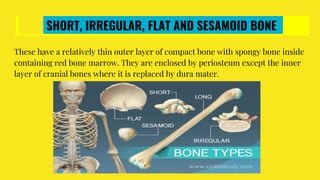
These have a relatively thin outer layer of compact bone with spongy bone inside
containing red bone marrow. They are enclosed by periosteum except the inner
layer of cranial bones where it is replaced by dura mater.
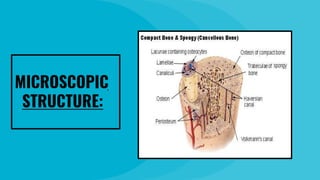
MICROSCOPIC
STRUCTURE
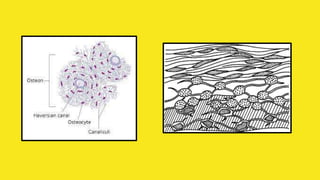
Bone is a strong and durable type of
connective tissue. Its major constituent is a
mixture of calcium salts, calcium phosphate.
This inorganic matrix gives bone great
hardness. The remaining third is
organic material called OSTEOID,
which is composed of mainly collagen.
Collagen is very strong and given
bone slight flexibility. The cellular
component of bone contributes less
than 2% of bone mass.
MICROSCOPIC
STRUCTURE:
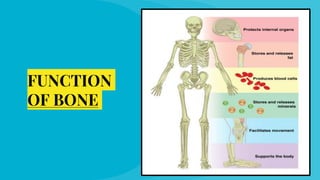
FUNCTION
OF BONE
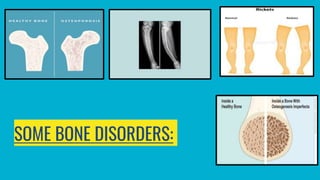
SOME BONE DISORDERS:
CONCLUSION Bone is living tissue that makes up the
body's skeleton.Bone, rigid body
tissue consisting of cells embedded
in an abundant hard intercellular
material. The two principal
components of this material,
collagen and calcium phosphate,
distinguish bone from such other
hard tissues as chitin, enamel, and
shell. Bone tissue makes up the
individual bones of the human
skeletal system and the skeletons of
other vertebrates.
SUMMARY
BIBLIOGRAPHY:
● Grant Allison,Waugh Anne, Ross And Wilson anatomy and
physiology in health and illness, 12th edition, Elsevier
Publication(2015), Pg No. 390-393.
● Ashalatha PR, Textbook of anatomy, 3rd edition, Jaypee
Publication(2021), Pg No. 34-36.
● https://www.britannica.com/science/bone-anatomy/Chemical-
composition-and-physical-properties.
● https://musculoskeletalkey.com/biology-of-bone/
● https://open.oregonstate.education/aandp/chapter/6-1-the-
functions-of-the-skeletal-system/
bone presentation.pptx

bone presentation.pptx

  • 2.
    STRUCTURE AND FUNCTION OFBONES RAJOSI KHANRA M.Sc. 1st Year , Roll No- 2288004
  • 3.
    CONTENT ● INTRODUCTION ● COMPOSITIONSOF BONES ● TYPES OF BONES ● STRUCTURE OF BONES 1. GROSS STRUCTURE 2. MICROSCOPIC STRUCTURE ● FUNCTION OF BONES ● DISORDER OF BONES ● CONCLUSION ● SUMMARY ● BIBLIOGRAPHY
  • 4.
    INTRODUCTION The basic structureunit of a human skeleton is bone. Bone is essentially a highly vascular, living, constantly changing mineralized connective tissue. It is remarkable for its hardness, resilience and regenerative capacity.
  • 5.
  • 6.
    A. CELLULAR COMPONENT: ●Osteocytes ● Osteoblasts ● Osteoclasts ● Osteoprogenitor cells A. MATRIX: ● Organic: Collagen fibres, Proteoglycan,Glycoprotein ● Inorganic
  • 7.
    OSTEOBLASTS: ➔ Bone formingcells derived from osteoprogenitor cells of mesenchymal origin which are present in bone marrow and other connective tissues. ➔ Osteoblasts are different shapes: cuboidal, oval, triangle. ➔ The cells are found as a lining on growing surface of bone. ➔ They form a protein mixture known as Osteoid which mineralizes to become bone. ➔ Osteoblasts contain prominent bundle of action, myosin and cytoskeletal proteins which helps to maintain cell shape, attachments and motility. OSTEOCLASTS: ➔ Large multinucleated cell. ➔ These cells break down bone, releasing calcium, and phosphate. The continuous remodelling of healthy bone tissue is result of balanced activity of bones. ➔ Osteoclasts found in areas of bone where is active growth, repair and remodelling.
  • 9.
    OSTEOCYTES: ● Cells ofmature bone. ● Situated in lacunae of bone. ● Its are nourished by tissue fluid in canaliculi that radiated from central canal. ● FUNCTION: ➔ Helps in nutrition of bone by keeping lacunae and canaliculi open. ➔ Helps in deposition or removal of matrix or calcium when needed. OSTEOPROGENITOR CELLS: ➔ Stem cells of mesenchymal origin. ➔ During bone formation, they can transform into osteoblasts. ➔ Resembles fibroblasts in appearance.
  • 11.
  • 12.
    A.ACCORDING TO SHAPE: LONGBONE: Consists of a shaft with 2 ends. Ex: Femur, Humerus SHORT BONE: Its are cube like structure. Ex: Carpel, Tarsal
  • 13.
    CONT… FLAT BONE: Theseare thin and usually curved. Ex: Skull Bone, Sternum, Scapulae IRREGULAR BONE: Not long nor short. No particular shape. Ex: Vertebrae, Auditory Ossicles
  • 14.
    CONT… 1. SESAMOID BONE:A small bone that is commonly found embedded within a muscle or tendon near joint surfaces. They have shape like sesame seed. 2. WORMIAN BONE: These are intra sutural bones or sutural bones, are extra bone pieces that can occur within a suture (joint) in the skull.
  • 15.
    B. ACCORDING TOSTRUCTURE: 1. SPONGY(CANCELLOUS) BONE: It is light, porous bone enclosing numerous large spaces that give a honeycombed or spongy appearance. 2. COMPACT BONE: It is dense bone in which the bony matrix is solidly filled with organic ground substance and inorganic salts, leaving only tiny spaces (lacunae) that contain the osteocytes, or bone cells.
  • 16.
    C. ACCORDING TODEVELOPMENT: 1. ENDOCHONDRAL BONE: Endochondral ossification involves the replacement of hyaline cartilage with bony tissue. Most of the bones of the skeleton are formed in this manner. 2. INTRAMEMBRANOUS BONE: Intramembranous ossification involves the replacement of sheet-like connective tissue membranes with bony tissue. Bones formed in this manner are called intramembranous bones.
  • 17.
  • 18.
    GROSS STRUCTURE LONG BONE ●Long bones have a diaphysis(shaft) and two epiphysis. For example ,femur has one elongated tubular shaft called diaphysis which is having at both ends on expanded are known as epiphysis. ● Epiphysis is connected to diaphysis at both ends with a narrow zone called as metaphysis. ● Diaphysis and epiphysis are separated by epiphyseal cartilage.
  • 19.
    Diaphysis has awall made up of compact bone or dense bone which surrounds medullary (marrow)cavity. Epiphysis consists of an outer covering of compact bone with spongy bone inside which is called cancellous. Long bones are completely covered by a vascular membrane called periosteum which has 2 layers. ● Outer layer- tough and fibrous, protects bone underneath. ● Inner layer- It contains osteoblasts,osteoclasts which helps in bone production, repair and remodelling of bone. Periosteum covers whole bone except within joint cavities, it replace with hyaline cartilage.
  • 20.
    SHORT, IRREGULAR, FLATAND SESAMOID BONE These have a relatively thin outer layer of compact bone with spongy bone inside containing red bone marrow. They are enclosed by periosteum except the inner layer of cranial bones where it is replaced by dura mater.
  • 21.
    MICROSCOPIC STRUCTURE Bone is astrong and durable type of connective tissue. Its major constituent is a mixture of calcium salts, calcium phosphate. This inorganic matrix gives bone great hardness. The remaining third is organic material called OSTEOID, which is composed of mainly collagen. Collagen is very strong and given bone slight flexibility. The cellular component of bone contributes less than 2% of bone mass.
  • 22.
  • 23.
  • 24.
  • 25.
    CONCLUSION Bone isliving tissue that makes up the body's skeleton.Bone, rigid body tissue consisting of cells embedded in an abundant hard intercellular material. The two principal components of this material, collagen and calcium phosphate, distinguish bone from such other hard tissues as chitin, enamel, and shell. Bone tissue makes up the individual bones of the human skeletal system and the skeletons of other vertebrates.
  • 26.
  • 28.
    BIBLIOGRAPHY: ● Grant Allison,WaughAnne, Ross And Wilson anatomy and physiology in health and illness, 12th edition, Elsevier Publication(2015), Pg No. 390-393. ● Ashalatha PR, Textbook of anatomy, 3rd edition, Jaypee Publication(2021), Pg No. 34-36. ● https://www.britannica.com/science/bone-anatomy/Chemical- composition-and-physical-properties. ● https://musculoskeletalkey.com/biology-of-bone/ ● https://open.oregonstate.education/aandp/chapter/6-1-the- functions-of-the-skeletal-system/