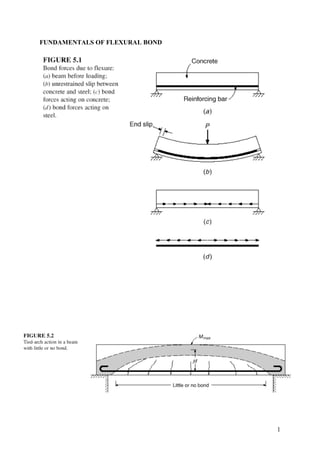
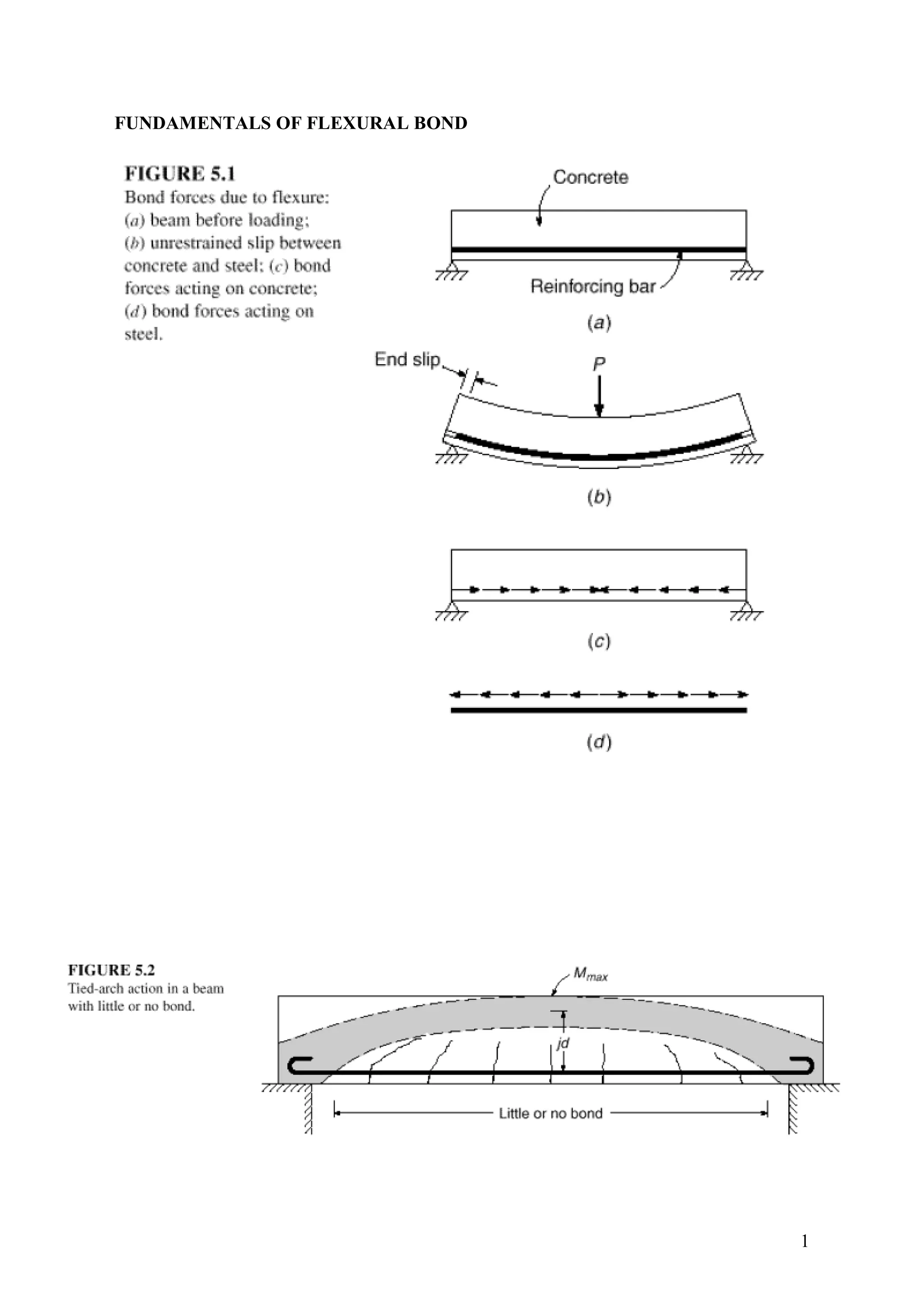
FUNDAMENTALS OF FLEXURAL BOND


                                1
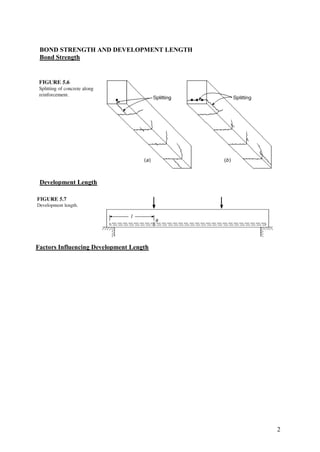
BOND STRENGTH AND DEVELOPMENT LENGTH
 Bond Strength


 Development Length


Factors Influencing Development Length


                                         2
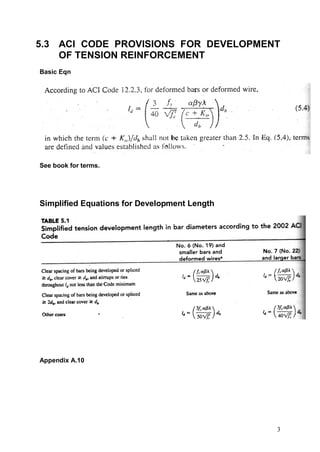
5.3 ACI CODE PROVISIONS FOR DEVELOPMENT
    OF TENSION REINFORCEMENT
Basic Eqn


See book for terms.


Simplified Equations for Development Length


Appendix A.10


                                              3
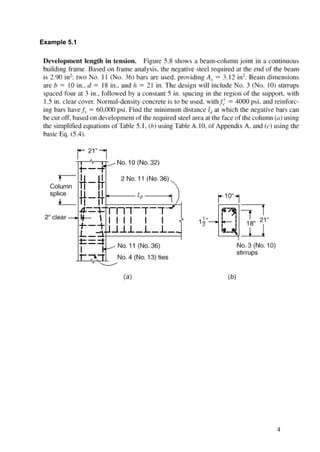
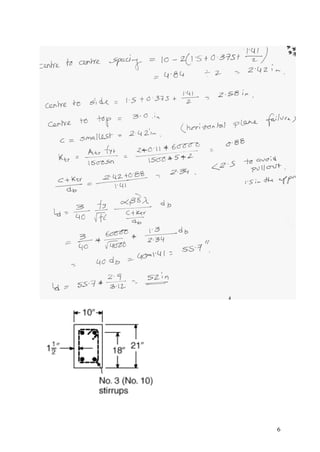
Example 5.1


              4
5
6
5.4 ANCHORAGE OF TENSION BARS BY HOOKS
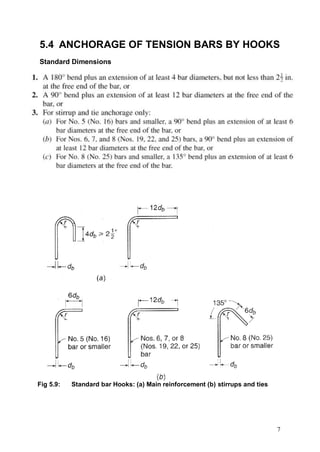
Standard Dimensions


Fig 5.9:   Standard bar Hooks: (a) Main reinforcement (b) stirrups and ties


                                                                              7
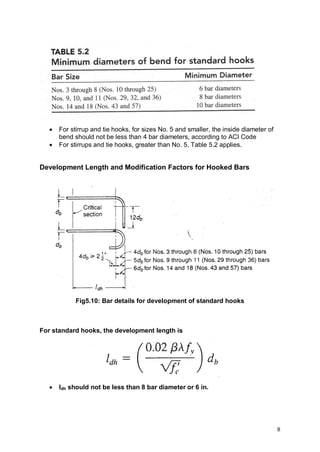
   For stirrup and tie hooks, for sizes No. 5 and smaller, the inside diameter of
       bend should not be less than 4 bar diameters, according to ACI Code
      For stirrups and tie hooks, greater than No. 5, Table 5.2 applies.


Development Length and Modification Factors for Hooked Bars


             Fig5.10: Bar details for development of standard hooks


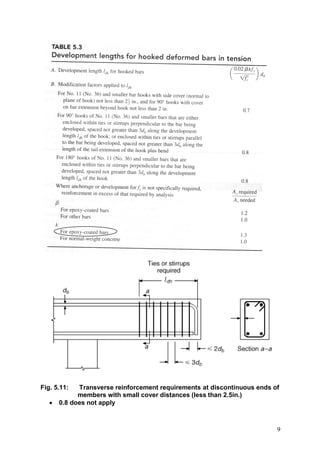
For standard hooks, the development length is


      ldh should not be less than 8 bar diameter or 6 in.


                                                                                        8
Fig. 5.11:   Transverse reinforcement requirements at discontinuous ends of
             members with small cover distances (less than 2.5in.)
      0.8 does not apply


                                                                          9
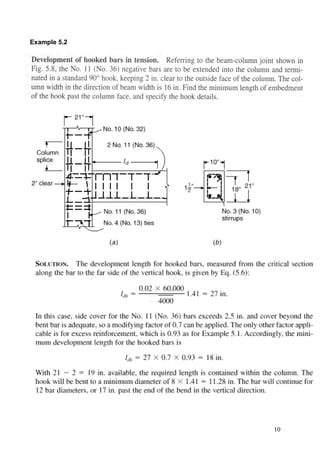
Example 5.2


              10
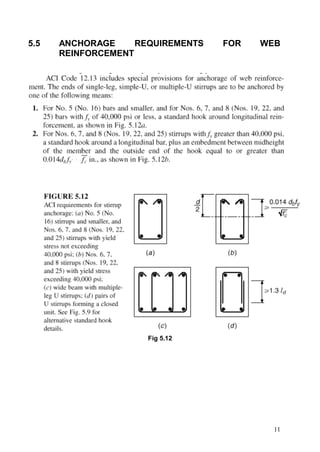
5.5   ANCHORAGE     REQUIREMENTS   FOR   WEB
      REINFORCEMENT


                      Fig 5.12


                                           11
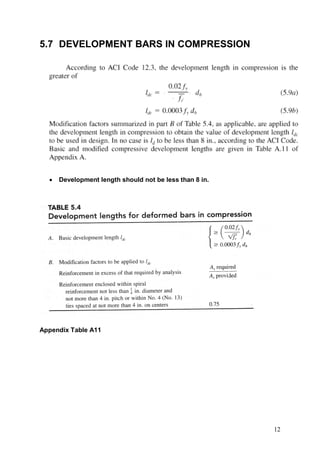
5.7 DEVELOPMENT BARS IN COMPRESSION


     Development length should not be less than 8 in.


Appendix Table A11


                                                         12
5.8 BUNDLED BARS


                   13
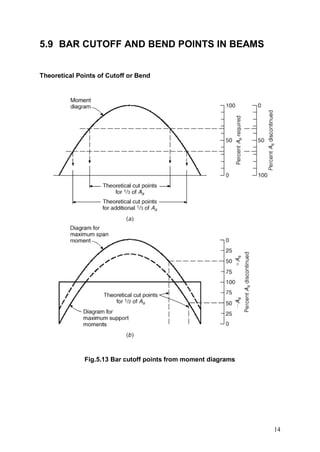
5.9 BAR CUTOFF AND BEND POINTS IN BEAMS


Theoretical Points of Cutoff or Bend


              Fig.5.13 Bar cutoff points from moment diagrams


                                                                14
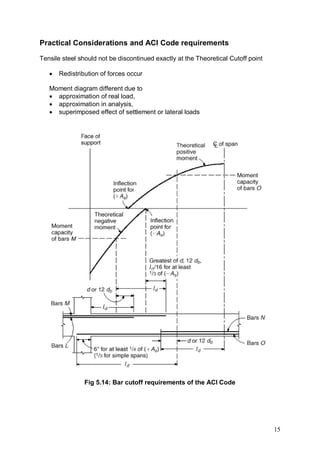
Practical Considerations and ACI Code requirements

Tensile steel should not be discontinued exactly at the Theoretical Cutoff point

      Redistribution of forces occur

   Moment diagram different due to
    approximation of real load,
    approximation in analysis,
    superimposed effect of settlement or lateral loads


                Fig 5.14: Bar cutoff requirements of the ACI Code


                                                                                   15
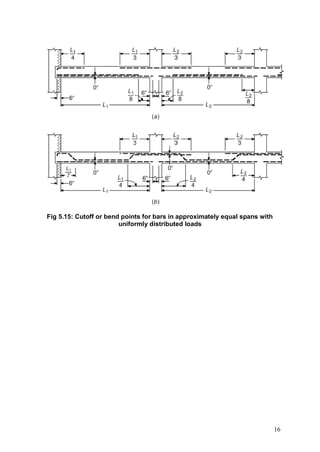
Fig 5.15: Cutoff or bend points for bars in approximately equal spans with
                        uniformly distributed loads


                                                                             16
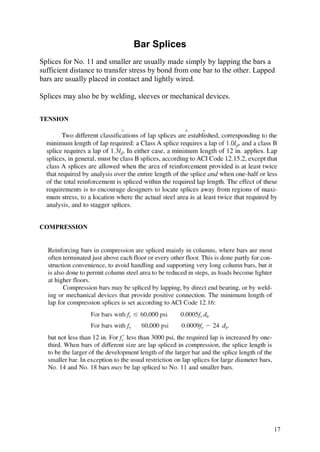
Bar Splices
Splices for No. 11 and smaller are usually made simply by lapping the bars a
sufficient distance to transfer stress by bond from one bar to the other. Lapped
bars are usually placed in contact and lightly wired.

Splices may also be by welding, sleeves or mechanical devices.


TENSION


COMPRESSION


                                                                               17
COLUMN


         18
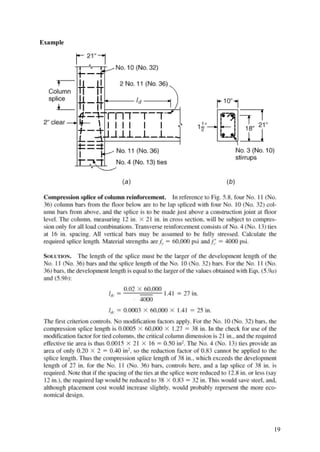
Example


          19

Bond strength anddevelopmentlength

  • 1.
  • 2.
    BOND STRENGTH ANDDEVELOPMENT LENGTH Bond Strength Development Length Factors Influencing Development Length 2
  • 3.
    5.3 ACI CODEPROVISIONS FOR DEVELOPMENT OF TENSION REINFORCEMENT Basic Eqn See book for terms. Simplified Equations for Development Length Appendix A.10 3
  • 4.
  • 5.
  • 6.
  • 7.
    5.4 ANCHORAGE OFTENSION BARS BY HOOKS Standard Dimensions Fig 5.9: Standard bar Hooks: (a) Main reinforcement (b) stirrups and ties 7
  • 8.
    For stirrup and tie hooks, for sizes No. 5 and smaller, the inside diameter of bend should not be less than 4 bar diameters, according to ACI Code  For stirrups and tie hooks, greater than No. 5, Table 5.2 applies. Development Length and Modification Factors for Hooked Bars Fig5.10: Bar details for development of standard hooks For standard hooks, the development length is  ldh should not be less than 8 bar diameter or 6 in. 8
  • 9.
    Fig. 5.11: Transverse reinforcement requirements at discontinuous ends of members with small cover distances (less than 2.5in.)  0.8 does not apply 9
  • 10.
  • 11.
    5.5 ANCHORAGE REQUIREMENTS FOR WEB REINFORCEMENT Fig 5.12 11
  • 12.
    5.7 DEVELOPMENT BARSIN COMPRESSION  Development length should not be less than 8 in. Appendix Table A11 12
  • 13.
  • 14.
    5.9 BAR CUTOFFAND BEND POINTS IN BEAMS Theoretical Points of Cutoff or Bend Fig.5.13 Bar cutoff points from moment diagrams 14
  • 15.
    Practical Considerations andACI Code requirements Tensile steel should not be discontinued exactly at the Theoretical Cutoff point  Redistribution of forces occur Moment diagram different due to  approximation of real load,  approximation in analysis,  superimposed effect of settlement or lateral loads Fig 5.14: Bar cutoff requirements of the ACI Code 15
  • 16.
    Fig 5.15: Cutoffor bend points for bars in approximately equal spans with uniformly distributed loads 16
  • 17.
    Bar Splices Splices forNo. 11 and smaller are usually made simply by lapping the bars a sufficient distance to transfer stress by bond from one bar to the other. Lapped bars are usually placed in contact and lightly wired. Splices may also be by welding, sleeves or mechanical devices. TENSION COMPRESSION 17
  • 18.
  • 19.