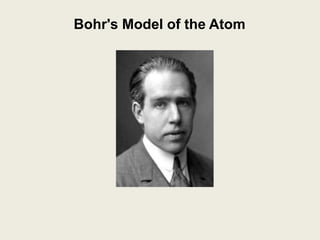
Bohr's Model of the Atom
Niels Bohr (1913):
Bohr's Model of the Atom
Niels Bohr (1913):
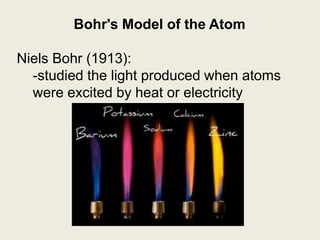
-studied the light produced when atoms
were excited by heat or electricity
Bohr's Model of the Atom
Niels Bohr (1913):
-studied the light produced when atoms
were excited by heat or electricity
Bohr's Model of the Atom
Niels Bohr (1913):
-studied the light produced when atoms
were excited by heat or electricity
Rutherford's model couldn't explain why
unique colours were obtained by atoms of
different elements
Bohr's Model of the Atom
Niels Bohr (1913):
-studied the light produced when atoms
were excited by heat or electricity
Rutherford's model couldn't explain why
unique colours were obtained by atoms of
different elements
Bohr proposed that electrons are in orbits &
when excited jump to a higher orbit. When
they fall back to the original they give off light
Bohr's Model of the Atom
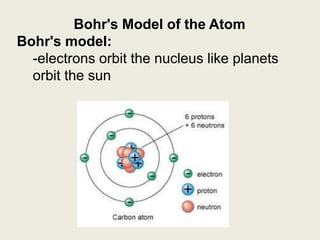
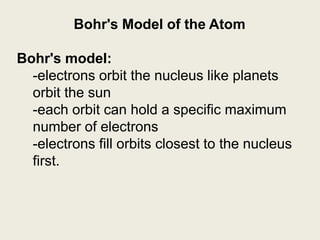
Bohr's model:
-electrons orbit the nucleus like planets
orbit the sun
Bohr's Model of the Atom
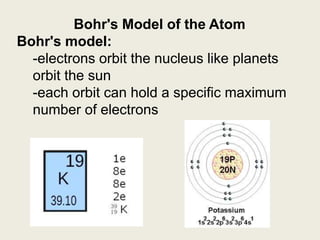
Bohr's model:
-electrons orbit the nucleus like planets
orbit the sun
-each orbit can hold a specific maximum
number of electrons
Bohr's Model of the Atom
Bohr's model:
-electrons orbit the nucleus like planets
orbit the sun
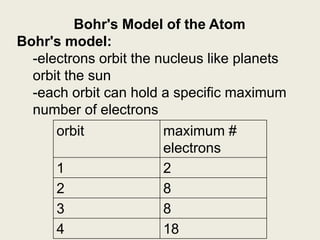
-each orbit can hold a specific maximum
number of electrons
orbit maximum #
electrons
1 2
2 8
3 8
4 18
Bohr's Model of the Atom
Bohr's model:
-electrons orbit the nucleus like planets
orbit the sun
-each orbit can hold a specific maximum
number of electrons
-electrons fill orbits closest to the nucleus
first.
Bohr's Model of the Atom
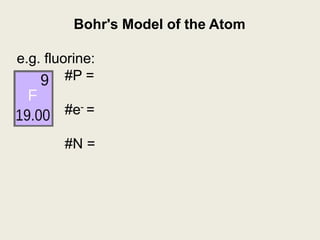
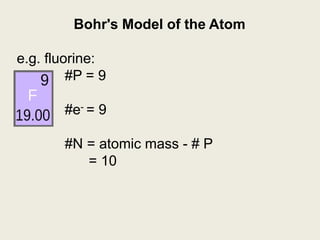
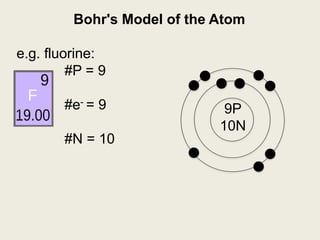
e.g. fluorine:
#P =
#e- =
#N =
Bohr's Model of the Atom
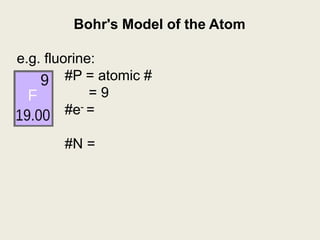
e.g. fluorine:
#P = atomic #
= 9
#e- =
#N =
Bohr's Model of the Atom
e.g. fluorine:
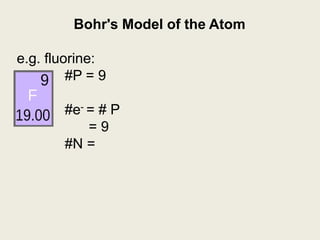
#P = 9
#e- = # P
= 9
#N =
Bohr's Model of the Atom
e.g. fluorine:
#P = 9
#e- = 9
#N = atomic mass - # P
= 10
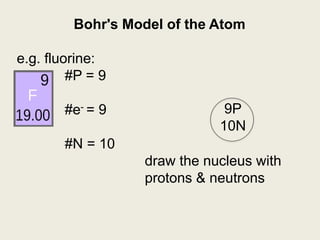
Bohr's Model of the Atom
e.g. fluorine:
#P = 9
#e- = 9
#N = 10
draw the nucleus with
protons & neutrons
9P
10N
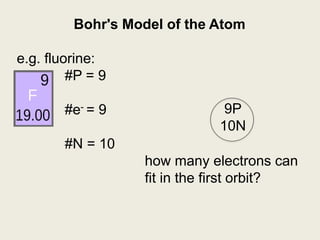
Bohr's Model of the Atom
e.g. fluorine:
#P = 9
#e- = 9
#N = 10
how many electrons can
fit in the first orbit?
9P
10N
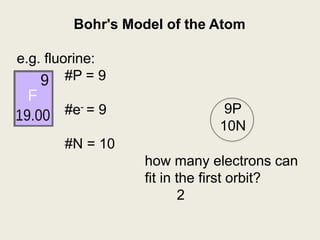
Bohr's Model of the Atom
e.g. fluorine:
#P = 9
#e- = 9
#N = 10
how many electrons can
fit in the first orbit?
2
9P
10N
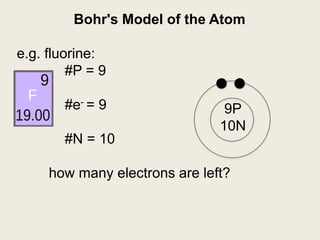
Bohr's Model of the Atom
e.g. fluorine:
#P = 9
#e- = 9
#N = 10
how many electrons are left?
9P
10N
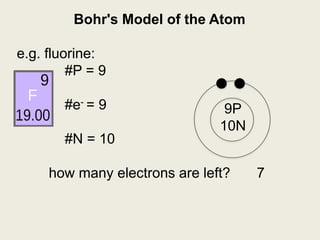
Bohr's Model of the Atom
e.g. fluorine:
#P = 9
#e- = 9
#N = 10
how many electrons are left? 7
9P
10N
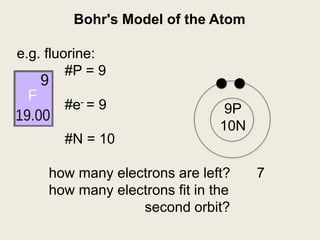
Bohr's Model of the Atom
e.g. fluorine:
#P = 9
#e- = 9
#N = 10
how many electrons are left? 7
how many electrons fit in the
second orbit?
9P
10N
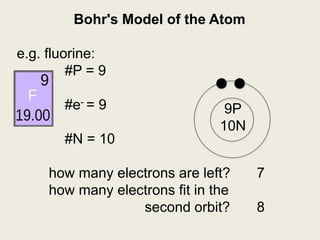
Bohr's Model of the Atom
e.g. fluorine:
#P = 9
#e- = 9
#N = 10
how many electrons are left? 7
how many electrons fit in the
second orbit? 8
9P
10N
Bohr's Model of the Atom
e.g. fluorine:
#P = 9
#e- = 9
#N = 10
9P
10N
Bohr's Model of the Atom
try these:
hydrogen
boron
magnesium
Bohr's Model of the Atom
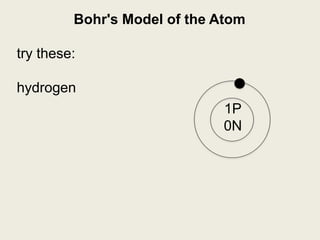
try these:
hydrogen
1P
0N
Bohr's Model of the Atom
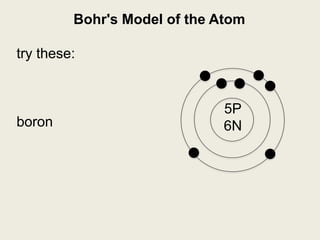
try these:
boron
5P
6N
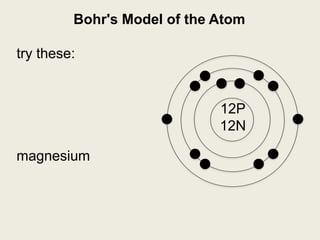
Bohr's Model of the Atom
try these:
magnesium
12P
12N

Bohr-Diagram-lesson.ppt

  • 1.
  • 2.
    Bohr's Model ofthe Atom Niels Bohr (1913):
  • 3.
    Bohr's Model ofthe Atom Niels Bohr (1913): -studied the light produced when atoms were excited by heat or electricity
  • 4.
    Bohr's Model ofthe Atom Niels Bohr (1913): -studied the light produced when atoms were excited by heat or electricity
  • 5.
    Bohr's Model ofthe Atom Niels Bohr (1913): -studied the light produced when atoms were excited by heat or electricity Rutherford's model couldn't explain why unique colours were obtained by atoms of different elements
  • 6.
    Bohr's Model ofthe Atom Niels Bohr (1913): -studied the light produced when atoms were excited by heat or electricity Rutherford's model couldn't explain why unique colours were obtained by atoms of different elements Bohr proposed that electrons are in orbits & when excited jump to a higher orbit. When they fall back to the original they give off light
  • 7.
    Bohr's Model ofthe Atom Bohr's model: -electrons orbit the nucleus like planets orbit the sun
  • 8.
    Bohr's Model ofthe Atom Bohr's model: -electrons orbit the nucleus like planets orbit the sun -each orbit can hold a specific maximum number of electrons
  • 9.
    Bohr's Model ofthe Atom Bohr's model: -electrons orbit the nucleus like planets orbit the sun -each orbit can hold a specific maximum number of electrons orbit maximum # electrons 1 2 2 8 3 8 4 18
  • 10.
    Bohr's Model ofthe Atom Bohr's model: -electrons orbit the nucleus like planets orbit the sun -each orbit can hold a specific maximum number of electrons -electrons fill orbits closest to the nucleus first.
  • 11.
    Bohr's Model ofthe Atom e.g. fluorine: #P = #e- = #N =
  • 12.
    Bohr's Model ofthe Atom e.g. fluorine: #P = atomic # = 9 #e- = #N =
  • 13.
    Bohr's Model ofthe Atom e.g. fluorine: #P = 9 #e- = # P = 9 #N =
  • 14.
    Bohr's Model ofthe Atom e.g. fluorine: #P = 9 #e- = 9 #N = atomic mass - # P = 10
  • 15.
    Bohr's Model ofthe Atom e.g. fluorine: #P = 9 #e- = 9 #N = 10 draw the nucleus with protons & neutrons 9P 10N
  • 16.
    Bohr's Model ofthe Atom e.g. fluorine: #P = 9 #e- = 9 #N = 10 how many electrons can fit in the first orbit? 9P 10N
  • 17.
    Bohr's Model ofthe Atom e.g. fluorine: #P = 9 #e- = 9 #N = 10 how many electrons can fit in the first orbit? 2 9P 10N
  • 18.
    Bohr's Model ofthe Atom e.g. fluorine: #P = 9 #e- = 9 #N = 10 how many electrons are left? 9P 10N
  • 19.
    Bohr's Model ofthe Atom e.g. fluorine: #P = 9 #e- = 9 #N = 10 how many electrons are left? 7 9P 10N
  • 20.
    Bohr's Model ofthe Atom e.g. fluorine: #P = 9 #e- = 9 #N = 10 how many electrons are left? 7 how many electrons fit in the second orbit? 9P 10N
  • 21.
    Bohr's Model ofthe Atom e.g. fluorine: #P = 9 #e- = 9 #N = 10 how many electrons are left? 7 how many electrons fit in the second orbit? 8 9P 10N
  • 22.
    Bohr's Model ofthe Atom e.g. fluorine: #P = 9 #e- = 9 #N = 10 9P 10N
  • 23.
    Bohr's Model ofthe Atom try these: hydrogen boron magnesium
  • 24.
    Bohr's Model ofthe Atom try these: hydrogen 1P 0N
  • 25.
    Bohr's Model ofthe Atom try these: boron 5P 6N
  • 26.
    Bohr's Model ofthe Atom try these: magnesium 12P 12N