Boeing 787
Dreamliner
September 25, 2013
A Case Study for Project Management:
Lessons Learned
2
Abdullah Gaznaii
Alfredo Martinez
Jamie Gregory
Mohamed F. Sollimon
A Case Study for Project Management:
Lessons Learned
Sorted alphabetically :
Outline
• The Aerospace Industry – An Overview
• 787 Dreamliner Project
• Lessons Learned
• Conclusion
3
The Aerospace Industry
• Aerospace has been an important employer,
providing highly skilled jobs.
• Aerospace manufacturing sector has been the
technological backbone of American
manufacturing.
• Decline in employment:
> 900 thousand in 1989
< 500 thousand in 2013
4
Large Commercial Aircraft (LCA)
• Defined as non-military aircraft with a seating
capacity above 100.
• Today the LCA market is a duopoly consisting of
Boeing and Airbus.
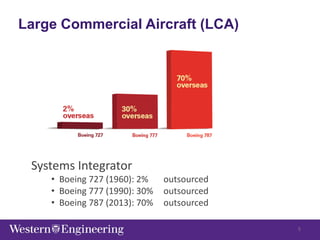
• New core business model: Boeing has become a
Systems Integrator
• Boeing 727 (1960): 2% outsourced
• Boeing 777 (1990): 30% outsourced
• Boeing 787 (2013): 70% outsourced
5
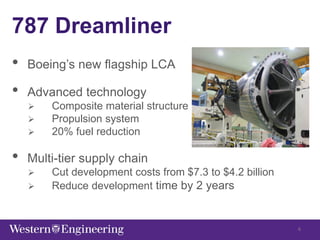
787 Dreamliner
• Boeing’s new flagship LCA
• Advanced technology
 Composite material structure
 Propulsion system
 20% fuel reduction
• Multi-tier supply chain
 Cut development costs from $7.3 to $4.2 billion
 Reduce development time by 2 years
6
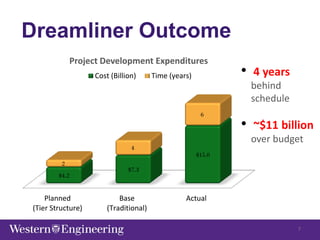
Dreamliner Outcome
Planned
(Tier Structure)
Base
(Traditional)
Actual
$4.2
$7.3
$15.0
2
4
6
Project Development Expenditures
Cost (Billion) Time (years) • 4 years
behind
schedule
• ~$11 billion
over budget
7
Lessons Learned
8
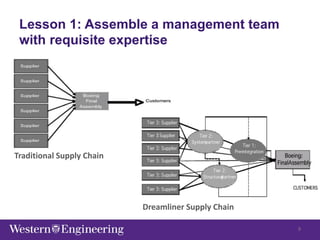
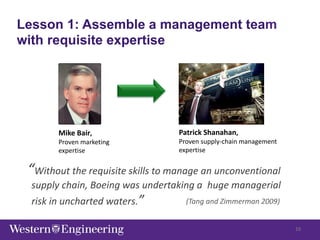
Lesson 1: Assemble a management team
with requisite expertise
Traditional Supply Chain
Dreamliner Supply Chain
9
Lesson 1: Assemble a management team
with requisite expertise
“Without the requisite skills to manage an unconventional
supply chain, Boeing was undertaking a huge managerial
risk in uncharted waters.”
Mike Bair,
Proven marketing
expertise
Patrick Shanahan,
Proven supply-chain management
expertise
(Tang and Zimmerman 2009)
10
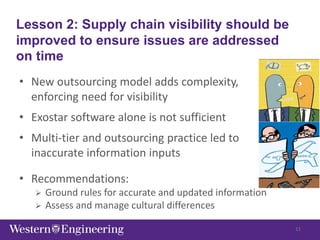
• New outsourcing model adds complexity,
enforcing need for visibility
• Exostar software alone is not sufficient
• Multi-tier and outsourcing practice led to
inaccurate information inputs
• Recommendations:
 Ground rules for accurate and updated information
 Assess and manage cultural differences
Lesson 2: Supply chain visibility should be
improved to ensure issues are addressed
on time
11
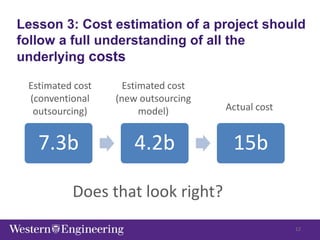
Lesson 3: Cost estimation of a project should
follow a full understanding of all the
underlying costs
12
7.3b 4.2b 15b
Estimated cost
(conventional
outsourcing)
Estimated cost
(new outsourcing
model) Actual cost
Does that look right?
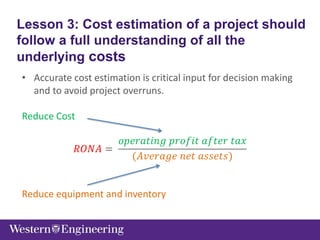
• Accurate cost estimation is critical input for decision making
and to avoid project overruns.
Reduce Cost
𝑅𝑂𝑁𝐴 =
𝑜𝑝𝑒𝑟𝑎𝑡𝑖𝑛𝑔 𝑝𝑟𝑜𝑓𝑖𝑡 𝑎𝑓𝑡𝑒𝑟 𝑡𝑎𝑥
(𝐴𝑣𝑒𝑟𝑎𝑔𝑒 𝑛𝑒𝑡 𝑎𝑠𝑠𝑒𝑡𝑠)
Reduce equipment and inventory
Lesson 3: Cost estimation of a project should
follow a full understanding of all the
underlying costs
• Taking on increased risk of outsourcing
• Hidden costs of integration, cooperation, and
collaboration
• Increased cost and time necessary to make design
changes through multi-tiered suppliers
Lesson 3: Cost estimation of a project should
follow a full understanding of all the
underlying costs
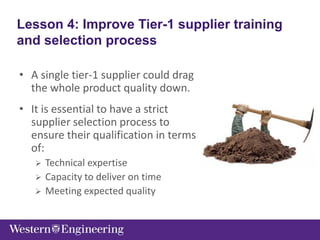
• A single tier-1 supplier could drag
the whole product quality down.
• It is essential to have a strict
supplier selection process to
ensure their qualification in terms
of:
 Technical expertise
 Capacity to deliver on time
 Meeting expected quality
Lesson 4: Improve Tier-1 supplier training
and selection process
• In such a high tech. and time critical project
suppliers should be provided with:
 On-site quality control
 Close management of supplier
 Technical support if necessary
Lesson 4: Improve Tier-1 supplier training
and selection process
Lesson 5: Proactively manage relationship
with labour unions
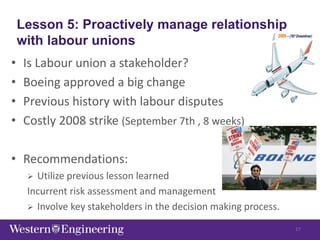
• Is Labour union a stakeholder?
• Boeing approved a big change
• Previous history with labour disputes
• Costly 2008 strike (September 7th , 8 weeks)
• Recommendations:
 Utilize previous lesson learned
Incurrent risk assessment and management
 Involve key stakeholders in the decision making process.
17
Lesson 6: Risk-sharing contracts need to
include partner specific incentives/penalties
for timely/late work
• All partners slow to the speed of the weakest
link
• Recommendations:
 Incentives for Tier-1 suppliers that meet
milestones early or on time
 Penalties for missed deadlines
 Increase buy-in from Tier-1 suppliers
18
Conclusion
19
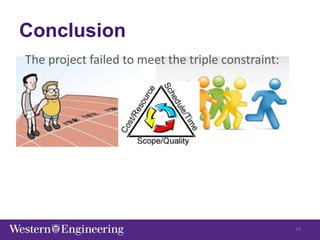
The project failed to meet the triple constraint:
20
21
Questions?

Boeing 787 dreamliner project lessson learned

  • 2.
    Boeing 787 Dreamliner September 25,2013 A Case Study for Project Management: Lessons Learned 2 Abdullah Gaznaii Alfredo Martinez Jamie Gregory Mohamed F. Sollimon A Case Study for Project Management: Lessons Learned Sorted alphabetically :
  • 3.
    Outline • The AerospaceIndustry – An Overview • 787 Dreamliner Project • Lessons Learned • Conclusion 3
  • 4.
    The Aerospace Industry •Aerospace has been an important employer, providing highly skilled jobs. • Aerospace manufacturing sector has been the technological backbone of American manufacturing. • Decline in employment: > 900 thousand in 1989 < 500 thousand in 2013 4
  • 5.
    Large Commercial Aircraft(LCA) • Defined as non-military aircraft with a seating capacity above 100. • Today the LCA market is a duopoly consisting of Boeing and Airbus. • New core business model: Boeing has become a Systems Integrator • Boeing 727 (1960): 2% outsourced • Boeing 777 (1990): 30% outsourced • Boeing 787 (2013): 70% outsourced 5
  • 6.
    787 Dreamliner • Boeing’snew flagship LCA • Advanced technology  Composite material structure  Propulsion system  20% fuel reduction • Multi-tier supply chain  Cut development costs from $7.3 to $4.2 billion  Reduce development time by 2 years 6
  • 7.
    Dreamliner Outcome Planned (Tier Structure) Base (Traditional) Actual $4.2 $7.3 $15.0 2 4 6 ProjectDevelopment Expenditures Cost (Billion) Time (years) • 4 years behind schedule • ~$11 billion over budget 7
  • 8.
  • 9.
    Lesson 1: Assemblea management team with requisite expertise Traditional Supply Chain Dreamliner Supply Chain 9
  • 10.
    Lesson 1: Assemblea management team with requisite expertise “Without the requisite skills to manage an unconventional supply chain, Boeing was undertaking a huge managerial risk in uncharted waters.” Mike Bair, Proven marketing expertise Patrick Shanahan, Proven supply-chain management expertise (Tang and Zimmerman 2009) 10
  • 11.
    • New outsourcingmodel adds complexity, enforcing need for visibility • Exostar software alone is not sufficient • Multi-tier and outsourcing practice led to inaccurate information inputs • Recommendations:  Ground rules for accurate and updated information  Assess and manage cultural differences Lesson 2: Supply chain visibility should be improved to ensure issues are addressed on time 11
  • 12.
    Lesson 3: Costestimation of a project should follow a full understanding of all the underlying costs 12 7.3b 4.2b 15b Estimated cost (conventional outsourcing) Estimated cost (new outsourcing model) Actual cost Does that look right?
  • 13.
    • Accurate costestimation is critical input for decision making and to avoid project overruns. Reduce Cost 𝑅𝑂𝑁𝐴 = 𝑜𝑝𝑒𝑟𝑎𝑡𝑖𝑛𝑔 𝑝𝑟𝑜𝑓𝑖𝑡 𝑎𝑓𝑡𝑒𝑟 𝑡𝑎𝑥 (𝐴𝑣𝑒𝑟𝑎𝑔𝑒 𝑛𝑒𝑡 𝑎𝑠𝑠𝑒𝑡𝑠) Reduce equipment and inventory Lesson 3: Cost estimation of a project should follow a full understanding of all the underlying costs
  • 14.
    • Taking onincreased risk of outsourcing • Hidden costs of integration, cooperation, and collaboration • Increased cost and time necessary to make design changes through multi-tiered suppliers Lesson 3: Cost estimation of a project should follow a full understanding of all the underlying costs
  • 15.
    • A singletier-1 supplier could drag the whole product quality down. • It is essential to have a strict supplier selection process to ensure their qualification in terms of:  Technical expertise  Capacity to deliver on time  Meeting expected quality Lesson 4: Improve Tier-1 supplier training and selection process
  • 16.
    • In sucha high tech. and time critical project suppliers should be provided with:  On-site quality control  Close management of supplier  Technical support if necessary Lesson 4: Improve Tier-1 supplier training and selection process
  • 17.
    Lesson 5: Proactivelymanage relationship with labour unions • Is Labour union a stakeholder? • Boeing approved a big change • Previous history with labour disputes • Costly 2008 strike (September 7th , 8 weeks) • Recommendations:  Utilize previous lesson learned Incurrent risk assessment and management  Involve key stakeholders in the decision making process. 17
  • 18.
    Lesson 6: Risk-sharingcontracts need to include partner specific incentives/penalties for timely/late work • All partners slow to the speed of the weakest link • Recommendations:  Incentives for Tier-1 suppliers that meet milestones early or on time  Penalties for missed deadlines  Increase buy-in from Tier-1 suppliers 18
  • 19.
    Conclusion 19 The project failedto meet the triple constraint:
  • 20.
  • 21.