Build Something Better
By
Ms. Anagha Indulkar
Ms. Kshyanaprava Beuria
Mr. Pratik Dodia
Mr. Sayed Umer
Mr. Manish Tripathi
A Brief Introduction of Boeing
• The Boeing Company is an American multinational
corporation that designs, manufactures, and sells
airplanes, rotorcraft, rockets and satellites.
• Founded in Seattle, Washington, United States on
July 15, 1916
• Headquarters: Chicago, Illinois, U.S.A.
• Founder: William E. Boeing (1916-1934)
• Type of industry: Aerospace and defence
• Ranked 27th on "Fortune 500" list (2015)
Boeing Commercial Airplanes
• Offering a family of airplanes and a broad
portfolio of aviation services for passenger and
cargo carriers worldwide
– Boeing airplanes represent three quarters
of the world’s fleet, with nearly 12,000
jetliners in service
– Approximately 70 percent of Boeing
commercial airplane sales (by value) go to
customers outside of the United States
Boeing Defense, Space & Security
• Involve research, development, production,
modification and support of global strike
systems, global mobility systems, rotorcraft
systems, airborne surveillance and
reconnaissance aircraft, network and tactical
systems, intelligence and security systems,
missile defense systems, and space and
intelligence systems
– Boeing Military Aircraft
– Network & Space systems
– Global services & support
Boeing Capital Corporation
• Financing subsidiary of The Boeing Company
• Focused on assets that are critical to the core operations of Boeing customers
• Arranging and/or providing financing for customers of Boeing products
Mission @ Boeing
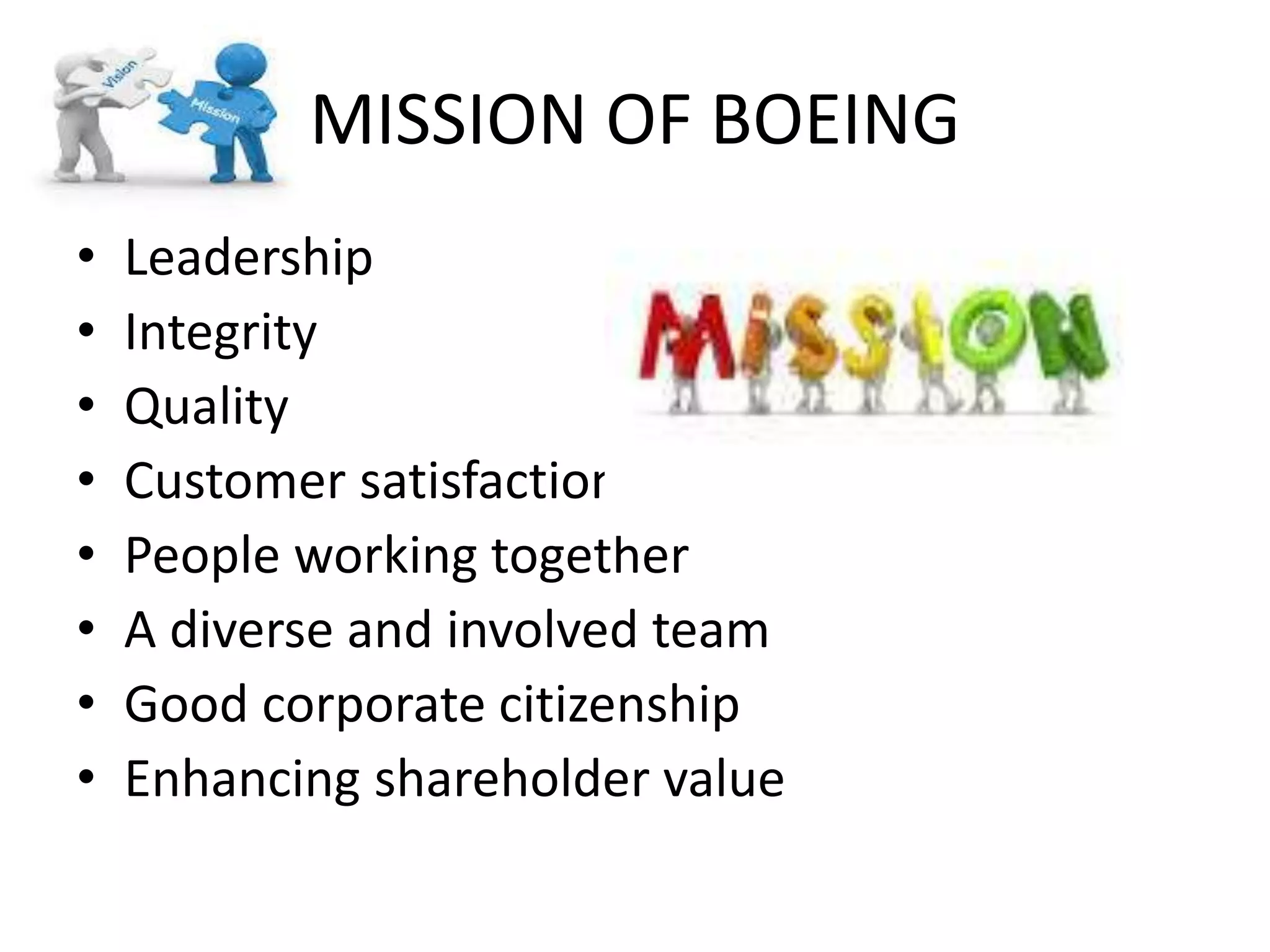
MISSION OF BOEING
• Leadership
• Integrity
• Quality
• Customer satisfaction
• People working together
• A diverse and involved team
• Good corporate citizenship
• Enhancing shareholder value
STRATEGY
“RUN HEALTHY CORE BUSINESS
LEVERAGE STRENGTHS INTO NEW SERVICES OPEN NEW
FRONTIERS PEOPLE WORKING TOGETHER
AS A GLOBAL ENTERPRISE FOR AEROSPACE LEADERSHIP”
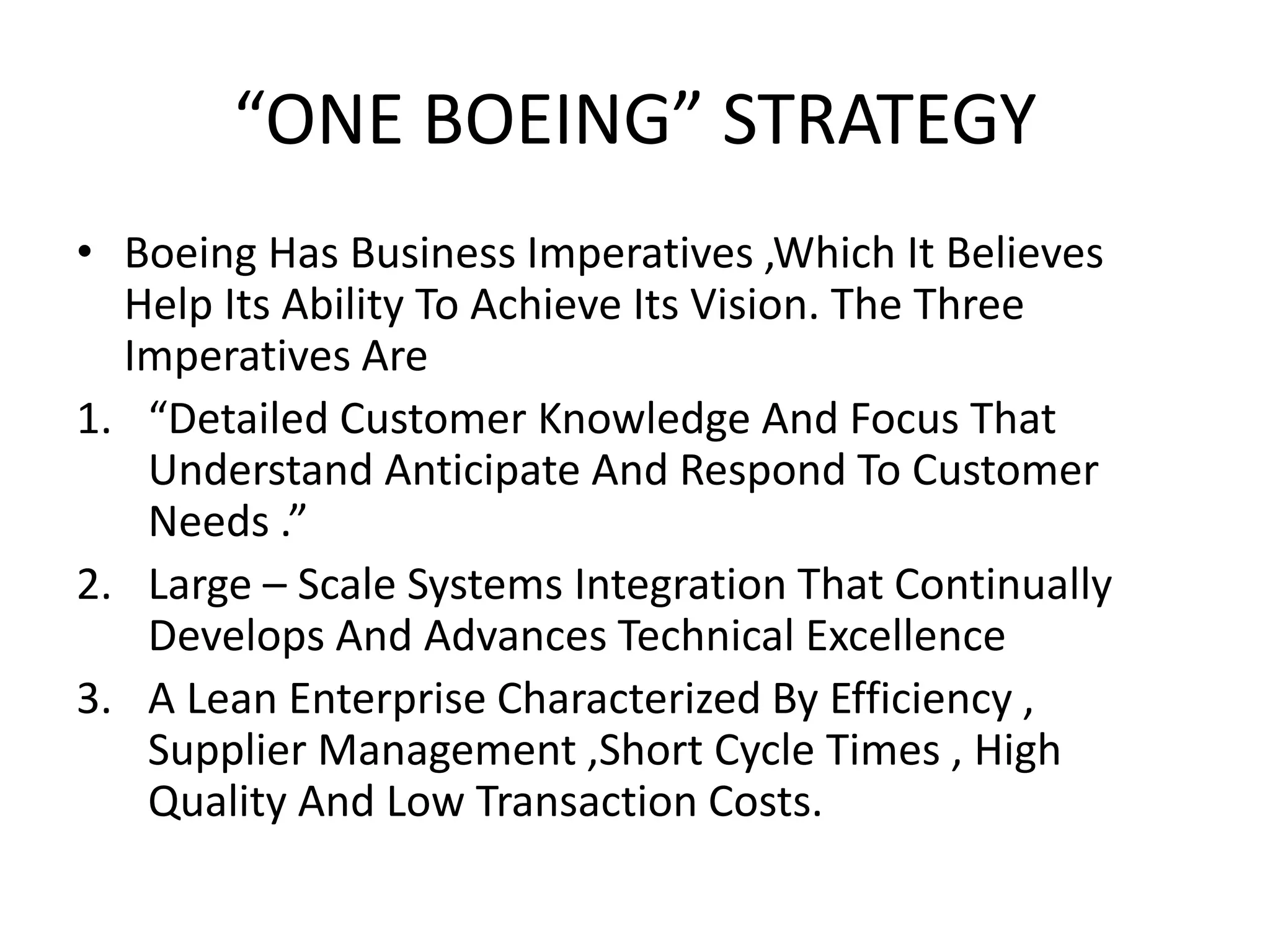
“ONE BOEING” STRATEGY
• Boeing Has Business Imperatives ,Which It Believes
Help Its Ability To Achieve Its Vision. The Three
Imperatives Are
1. “Detailed Customer Knowledge And Focus That
Understand Anticipate And Respond To Customer
Needs .”
2. Large – Scale Systems Integration That Continually
Develops And Advances Technical Excellence
3. A Lean Enterprise Characterized By Efficiency ,
Supplier Management ,Short Cycle Times , High
Quality And Low Transaction Costs.
COMPETITORS
• Airbus
• Embraer
• Bombardier
• Russia (Irkut-united
Aircraft Corporation)
• China(COMAC)
• JAPAN (Honda Aircraft
And Mitsubishi Aircraft)
CUSTOMERS
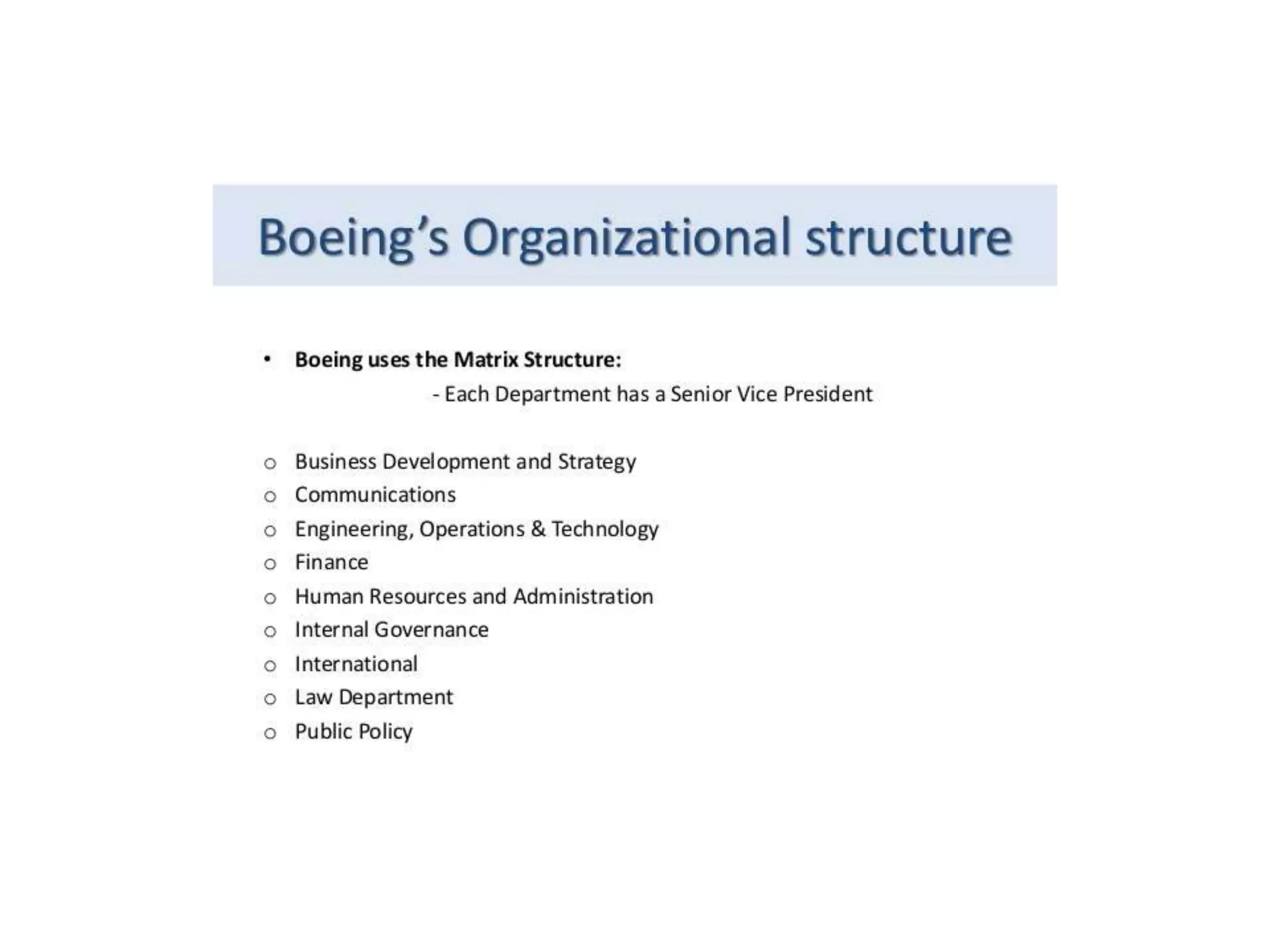
Organizational Structure @ Boeing
Leadership @ Boeing
Leadership Style
"Servant hood Model" of leadership.
"If you're doing it to become CEO, for your own career or for any other reason other than the
people that surround you --- then I would argue that you're doing something, but it's not
leadership,"
-- David Bowman
(Former president and general manager, Global Mobility Systems, Boeing)
Boeing's scramble
• In Boeing's scramble to turn around a program that was
plagued by late deliveries, cost overruns, quality problems
and a toxic culture, Bowman and other executives concluded
that traditional leadership roles must change.
The change..
• Leaders must employ a more participative approach and
solicit collective ideas from the workforce rather than
imposing initiatives on workforce.
• Senior managers in Boeing's C-17 program took a bold first
step toward establishing this new leadership paradigm by
gathering all 10,000 C-17 employees in a hangar and
communicating their philosophy directly to the front-line
employees -- not through middle management.
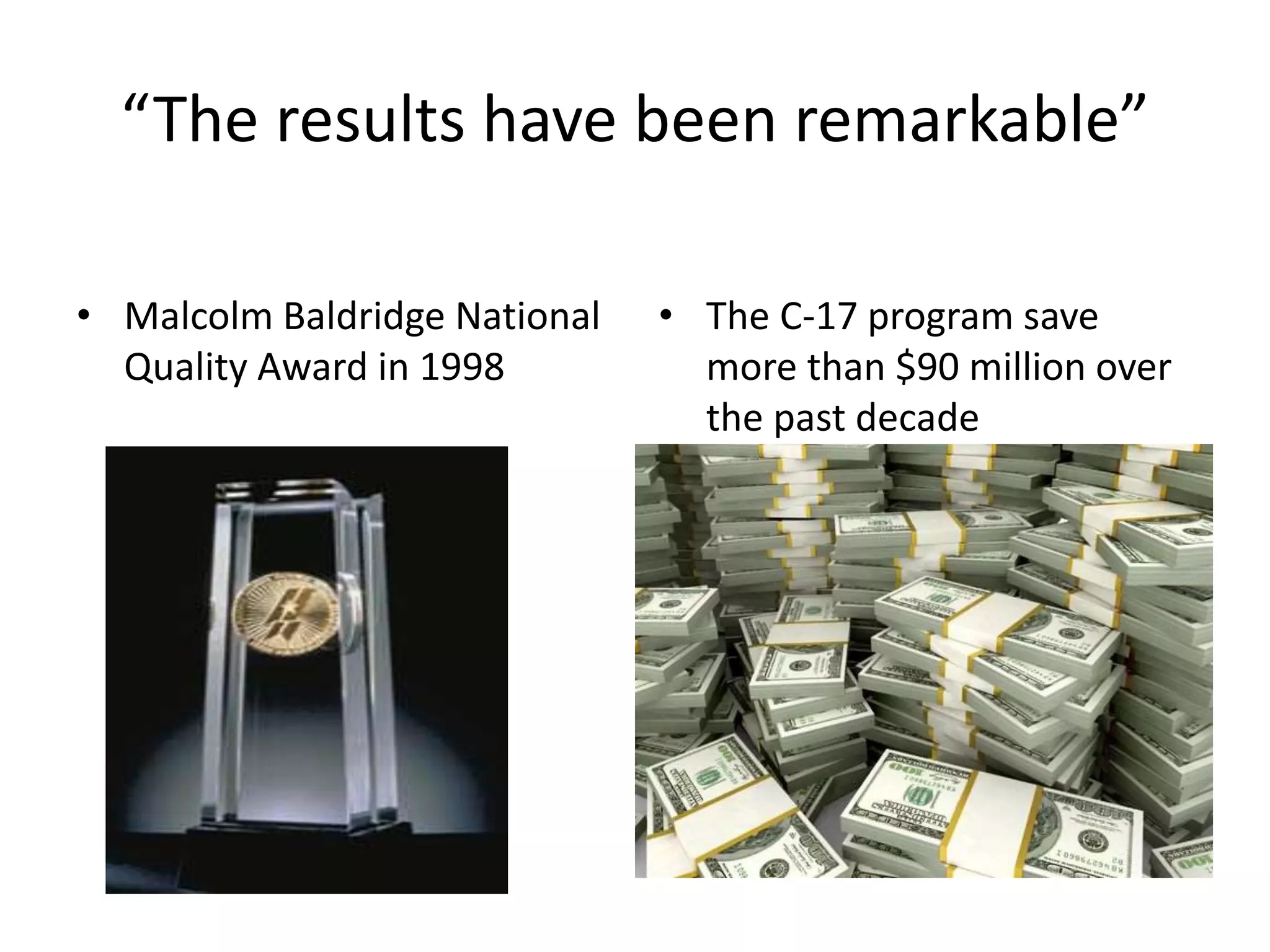
“The results have been remarkable”
• Malcolm Baldridge National
Quality Award in 1998
• The C-17 program save
more than $90 million over
the past decade
Motivational Environment
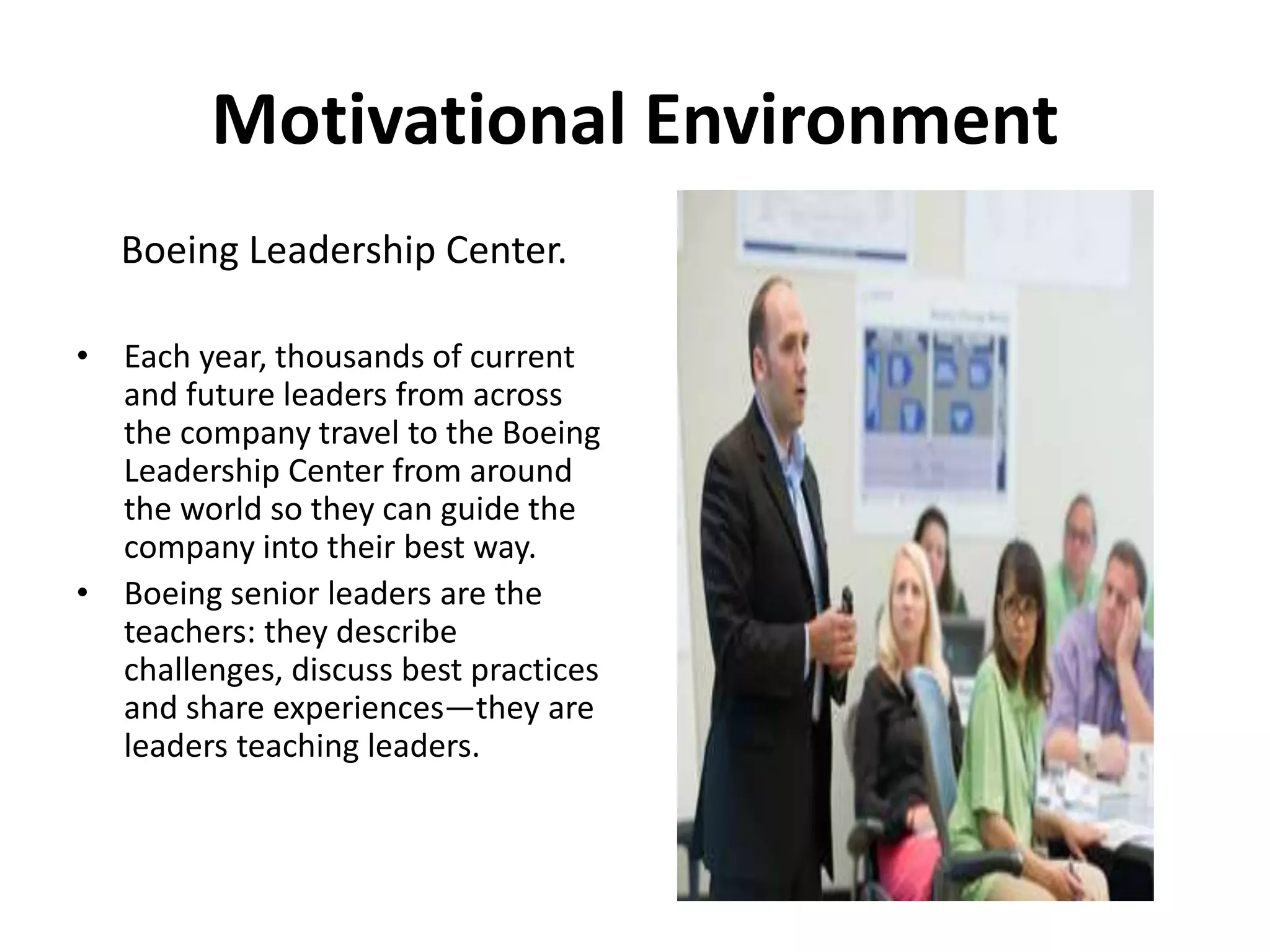
Boeing Leadership Center.
• Each year, thousands of current
and future leaders from across
the company travel to the Boeing
Leadership Center from around
the world so they can guide the
company into their best way.
• Boeing senior leaders are the
teachers: they describe
challenges, discuss best practices
and share experiences—they are
leaders teaching leaders.
What they do…
• They develop skills, gain new tools, and grow their leadership
capacity and networks. It’s also a place where their executives
coach, share feedback and model the behaviour they expect
of leaders.
• Boeing constantly look to improve and update courses using
feedback from participants.
Learning Together Program
• Boeing have invested more than $1 billion in their employees’
college tuition, books and fees through our industry-leading
tuition assistance program – the Learning Together Program
• Employees can pursue degree programs, professional
certificates and individual courses in strategic fields of study
at more than 270 quality colleges and universities
• Encourage our people to explore new roles within the
company throughout their careers, and course work does not
have to be related to your current job, so you can go
wherever your career path takes you
Strengths
•Growth through acquisitions
•Strong focus on research and development
•Realignment for growth and expansion to new
markets
•Global procurement network
•Increased operation focus
•Diverse range of products
Weakness
•Declining profits and margins
•Sluggish performance of business divisions
•Dependence on United States Department of Defense as they
account for 82% of revenue in 2010.
•Higher launching cost for aerospace business than global average
•Highly volatile customer
Opportunities
•Boeing's global outlook for aircraft demand about
22,000 in next 20 years
•Surge in the US defense spending
•decreasing fuel prices
•Increase in demand for satellite launching in
emerging countries
•Worsening global security situation
•Demand for more non stop flights
Threats
•Increasing prices of titanium and aluminum
•Intense competition
•Heavy dependency on US government contracts
•Government regulations
•Environmental regulations
•Entry of new players like china
•Worldwide increase in satellite launch business
Boeing 19 nov2015

Boeing 19 nov2015

  • 1.
    Build Something Better By Ms.Anagha Indulkar Ms. Kshyanaprava Beuria Mr. Pratik Dodia Mr. Sayed Umer Mr. Manish Tripathi
  • 2.
    A Brief Introductionof Boeing • The Boeing Company is an American multinational corporation that designs, manufactures, and sells airplanes, rotorcraft, rockets and satellites. • Founded in Seattle, Washington, United States on July 15, 1916 • Headquarters: Chicago, Illinois, U.S.A. • Founder: William E. Boeing (1916-1934) • Type of industry: Aerospace and defence • Ranked 27th on "Fortune 500" list (2015)
  • 3.
    Boeing Commercial Airplanes •Offering a family of airplanes and a broad portfolio of aviation services for passenger and cargo carriers worldwide – Boeing airplanes represent three quarters of the world’s fleet, with nearly 12,000 jetliners in service – Approximately 70 percent of Boeing commercial airplane sales (by value) go to customers outside of the United States
  • 4.
    Boeing Defense, Space& Security • Involve research, development, production, modification and support of global strike systems, global mobility systems, rotorcraft systems, airborne surveillance and reconnaissance aircraft, network and tactical systems, intelligence and security systems, missile defense systems, and space and intelligence systems – Boeing Military Aircraft – Network & Space systems – Global services & support
  • 5.
    Boeing Capital Corporation •Financing subsidiary of The Boeing Company • Focused on assets that are critical to the core operations of Boeing customers • Arranging and/or providing financing for customers of Boeing products
  • 6.
  • 7.
    MISSION OF BOEING •Leadership • Integrity • Quality • Customer satisfaction • People working together • A diverse and involved team • Good corporate citizenship • Enhancing shareholder value
  • 8.
    STRATEGY “RUN HEALTHY COREBUSINESS LEVERAGE STRENGTHS INTO NEW SERVICES OPEN NEW FRONTIERS PEOPLE WORKING TOGETHER AS A GLOBAL ENTERPRISE FOR AEROSPACE LEADERSHIP”
  • 9.
    “ONE BOEING” STRATEGY •Boeing Has Business Imperatives ,Which It Believes Help Its Ability To Achieve Its Vision. The Three Imperatives Are 1. “Detailed Customer Knowledge And Focus That Understand Anticipate And Respond To Customer Needs .” 2. Large – Scale Systems Integration That Continually Develops And Advances Technical Excellence 3. A Lean Enterprise Characterized By Efficiency , Supplier Management ,Short Cycle Times , High Quality And Low Transaction Costs.
  • 10.
    COMPETITORS • Airbus • Embraer •Bombardier • Russia (Irkut-united Aircraft Corporation) • China(COMAC) • JAPAN (Honda Aircraft And Mitsubishi Aircraft)
  • 11.
  • 12.
  • 22.
  • 23.
    Leadership Style "Servant hoodModel" of leadership. "If you're doing it to become CEO, for your own career or for any other reason other than the people that surround you --- then I would argue that you're doing something, but it's not leadership," -- David Bowman (Former president and general manager, Global Mobility Systems, Boeing)
  • 24.
    Boeing's scramble • InBoeing's scramble to turn around a program that was plagued by late deliveries, cost overruns, quality problems and a toxic culture, Bowman and other executives concluded that traditional leadership roles must change.
  • 25.
    The change.. • Leadersmust employ a more participative approach and solicit collective ideas from the workforce rather than imposing initiatives on workforce. • Senior managers in Boeing's C-17 program took a bold first step toward establishing this new leadership paradigm by gathering all 10,000 C-17 employees in a hangar and communicating their philosophy directly to the front-line employees -- not through middle management.
  • 26.
    “The results havebeen remarkable” • Malcolm Baldridge National Quality Award in 1998 • The C-17 program save more than $90 million over the past decade
  • 27.
    Motivational Environment Boeing LeadershipCenter. • Each year, thousands of current and future leaders from across the company travel to the Boeing Leadership Center from around the world so they can guide the company into their best way. • Boeing senior leaders are the teachers: they describe challenges, discuss best practices and share experiences—they are leaders teaching leaders.
  • 28.
    What they do… •They develop skills, gain new tools, and grow their leadership capacity and networks. It’s also a place where their executives coach, share feedback and model the behaviour they expect of leaders. • Boeing constantly look to improve and update courses using feedback from participants.
  • 29.
    Learning Together Program •Boeing have invested more than $1 billion in their employees’ college tuition, books and fees through our industry-leading tuition assistance program – the Learning Together Program • Employees can pursue degree programs, professional certificates and individual courses in strategic fields of study at more than 270 quality colleges and universities • Encourage our people to explore new roles within the company throughout their careers, and course work does not have to be related to your current job, so you can go wherever your career path takes you
  • 31.
    Strengths •Growth through acquisitions •Strongfocus on research and development •Realignment for growth and expansion to new markets •Global procurement network •Increased operation focus •Diverse range of products Weakness •Declining profits and margins •Sluggish performance of business divisions •Dependence on United States Department of Defense as they account for 82% of revenue in 2010. •Higher launching cost for aerospace business than global average •Highly volatile customer Opportunities •Boeing's global outlook for aircraft demand about 22,000 in next 20 years •Surge in the US defense spending •decreasing fuel prices •Increase in demand for satellite launching in emerging countries •Worsening global security situation •Demand for more non stop flights Threats •Increasing prices of titanium and aluminum •Intense competition •Heavy dependency on US government contracts •Government regulations •Environmental regulations •Entry of new players like china •Worldwide increase in satellite launch business

Editor's Notes

  • #4 The commercial airplanes business segment develops, produces and markets commercial jet aircraft and related support services, principally to the commercial airline industry worldwide. This segment offers a range of commercial jetliners designed to meet a broad spectrum of passenger and cargo requirements of domestic and non-US airlines. This range of commercial jet aircraft currently includes the 737 narrow-body model and the 747, 767, 777 and 787 wide-body models. The commercial airplanes segment also offers aviation services support, aircraft modifications, spares, training, maintenance documents and technical advice to commercial and government customers worldwide. In FY2010, the company delivered 462 airplanes, including 376 Boeing 737s.
  • #6 facilitates, arranges, structures and provides selective financing solutions for the company’s commercial airplanes customers. In the space and defense markets, BCC primarily arranges and structures financing solutions for its BDS government customers BCC’s portfolio consists of equipment under operating leases, finance leases, notes and other receivables, assets held for sale or re-lease and investments