Assignment on Body Language &
Effective Time Management
SUBMITTED BY: SUBMITTED TO:
Ajay kumar(CUHP18MBATT01) Dr. Yoginder Singh Verma
Ankit Kumar(CUHP18MBATT04)
BODY LANGUAGE, POSITIVE AND NEGATIVE BODY
LANGUAGE.
BODY LANGUAGE
BODY LANGUAGE
It’s a type of non verbal communication.
It is an essential skill to clear all interviews.
Body language also reflects the characteristics of an individual , a person having a
confident personality will carry a confident body language where as a person who is
not confident his body language reflects weakness.
Positive Body Language helps to convey our message in a better way.
Negative Body Language takes away the attention of the speaker and makes the
listener stop listening .
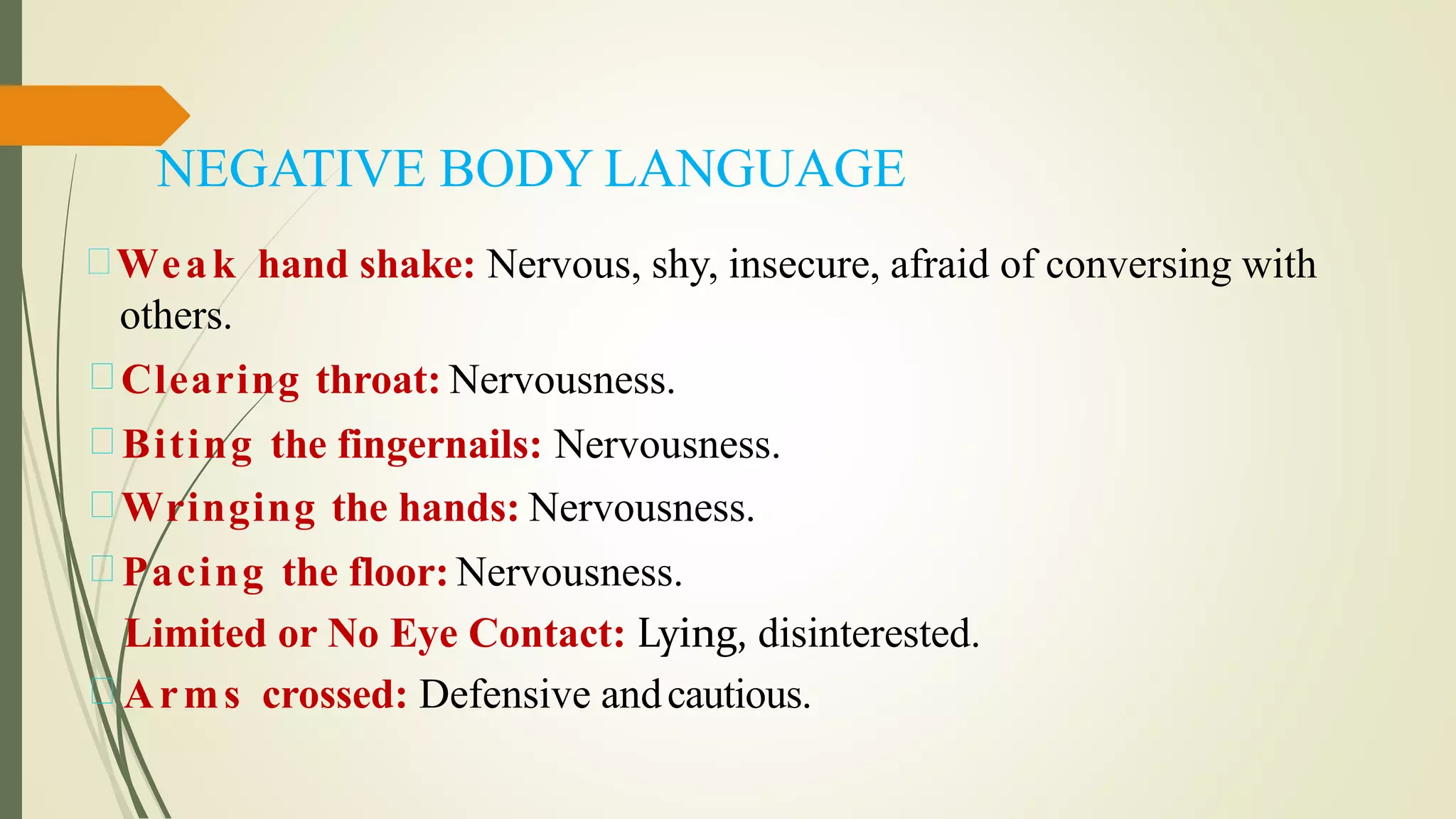
NEGATIVE BODY LANGUAGE
Weak hand shake: Nervous, shy, insecure, afraid of conversing with
others.
Clearing throat: Nervousness.
Biting the fingernails: Nervousness.
Wringing the hands: Nervousness.
Pacing the floor: Nervousness.
Limited or No Eye Contact: Lying, disinterested.
Arms crossed: Defensive andcautious.
NEGATIVE BODY LANGUAGE
Raising the eyebrows: Surprise.
Wisted Hands: Expression of a complex personality. It may indicate a difficult
emotional life.
Nose-rubbing or nose-touching: Doubt,it often reveals a negative reaction.
Tension in Brow : Confusion, tension, fear.
A big smile that goes on longer and disappears slower: Unreal or fake smile.
Making the eyes look larger: Shock.
POSITIVE BODY LANGUAGE
Direct Eye Contact: Interested, likes you.
Relaxed Brow: Comfortable.
Leaning forward : Interested.
Eyes open slightly more than usual: Gives people the
impression that they are welcome.
Nodding: Listening attentively.
Slowly nodding: Shows interest and that they are validating the comments of
the interviewer and this subtly encourages to continue.
POSITIVE BODY LANGUAGE
Pinching bridge ofthe nose: Communicates great thought.
Smiling Eyes: Comfortable.
Keeping Head-Up: Confident and secure.
Loud sigh: Understand the thing that is being told.
Rigid Body Posture : Anxious, upright.
POSITIVE BODY LANGUAGE
Walk briskly
Hold head up
Hold shoulders upright
Keep posture erect
Make firm handshake
Hold steady eye contact
Open arms/palms
SUMMING UP
Body language – very crucial and significant component of
Communication.
Mastering Body Language – very important skill in today’s world.
Understanding and effective use of our Body.
Language – improves and strengthens personal and official
relationships.
Effective Body Language – Effective Communication.
TIME MANAGEMENT
What is time management?
“Time management” refers to the way that you organize and plan how
long you spend on specific activities.
Time management refers to managing time effectively so that the right
time is allocated to the right activity.
Why do we need Time Management
 To save time
 To reduce stress
 To function effectively
 To increase our work output
 To have more control over or job responsibilities
How to use time effectively?
 Effectively Panning
 Setting goals and objective
 Setting deadlines
 Delegation of responsibilities
 Prioritizing activities as per their importance
 Spending the right time on the right activity
The process of Time Management
 Cost your time
 Making activity logs
 Goal setting
 Planning
 Prioritizing
 Scheduling
Costing your time
Understand your true value by calculating your cast per year
Cost per year=(Salary + taxes + office space + equipment + profit)
Calculate your hourly rate= cost per year / work hr per year
Making activity logs
 Make a realistic estimate of the time spend during the day on job
orders
 Pinpoint the critical areas: time spend on low value jobs
 Finding the high yielding time of our day
Goals setting
 Setting lifetime goals help you to chart your life course & your
career path
 Breakup your lifetime goals in smaller goals
 Make a daily TO-DO list
 Revise and update your list on daily bases & judge your
performance
Planning
Draw an action plan-
A list of things that need to be done to achieve your goals
Prioritizing
 Make a TO-DO list
 Consider the value of the task before to do it-
Is it worth spending your time and company resources
 Prioritize your task –
The most important jobs should be completed first followed by other
jobs.
Scheduling
 Make a realistic estimate of hoe much you can do
 Plan to make the best use of availability time
 Preserve some contingency time to deal with ‘unexpected jobs’
 Minimize stress by avoiding over- commitment by yourself and
others
Achieve your goals
 Be your own judge and your own motivator
Body Language and effective Time management

Body Language and effective Time management

  • 1.
    Assignment on BodyLanguage & Effective Time Management SUBMITTED BY: SUBMITTED TO: Ajay kumar(CUHP18MBATT01) Dr. Yoginder Singh Verma Ankit Kumar(CUHP18MBATT04)
  • 2.
    BODY LANGUAGE, POSITIVEAND NEGATIVE BODY LANGUAGE. BODY LANGUAGE
  • 3.
    BODY LANGUAGE It’s atype of non verbal communication. It is an essential skill to clear all interviews. Body language also reflects the characteristics of an individual , a person having a confident personality will carry a confident body language where as a person who is not confident his body language reflects weakness. Positive Body Language helps to convey our message in a better way. Negative Body Language takes away the attention of the speaker and makes the listener stop listening .
  • 4.
    NEGATIVE BODY LANGUAGE Weakhand shake: Nervous, shy, insecure, afraid of conversing with others. Clearing throat: Nervousness. Biting the fingernails: Nervousness. Wringing the hands: Nervousness. Pacing the floor: Nervousness. Limited or No Eye Contact: Lying, disinterested. Arms crossed: Defensive andcautious.
  • 5.
    NEGATIVE BODY LANGUAGE Raisingthe eyebrows: Surprise. Wisted Hands: Expression of a complex personality. It may indicate a difficult emotional life. Nose-rubbing or nose-touching: Doubt,it often reveals a negative reaction. Tension in Brow : Confusion, tension, fear. A big smile that goes on longer and disappears slower: Unreal or fake smile. Making the eyes look larger: Shock.
  • 6.
    POSITIVE BODY LANGUAGE DirectEye Contact: Interested, likes you. Relaxed Brow: Comfortable. Leaning forward : Interested. Eyes open slightly more than usual: Gives people the impression that they are welcome. Nodding: Listening attentively. Slowly nodding: Shows interest and that they are validating the comments of the interviewer and this subtly encourages to continue.
  • 7.
    POSITIVE BODY LANGUAGE Pinchingbridge ofthe nose: Communicates great thought. Smiling Eyes: Comfortable. Keeping Head-Up: Confident and secure. Loud sigh: Understand the thing that is being told. Rigid Body Posture : Anxious, upright.
  • 8.
    POSITIVE BODY LANGUAGE Walkbriskly Hold head up Hold shoulders upright Keep posture erect Make firm handshake Hold steady eye contact Open arms/palms
  • 9.
    SUMMING UP Body language– very crucial and significant component of Communication. Mastering Body Language – very important skill in today’s world. Understanding and effective use of our Body. Language – improves and strengthens personal and official relationships. Effective Body Language – Effective Communication.
  • 10.
  • 11.
    What is timemanagement? “Time management” refers to the way that you organize and plan how long you spend on specific activities. Time management refers to managing time effectively so that the right time is allocated to the right activity.
  • 12.
    Why do weneed Time Management  To save time  To reduce stress  To function effectively  To increase our work output  To have more control over or job responsibilities
  • 13.
    How to usetime effectively?  Effectively Panning  Setting goals and objective  Setting deadlines  Delegation of responsibilities  Prioritizing activities as per their importance  Spending the right time on the right activity
  • 14.
    The process ofTime Management  Cost your time  Making activity logs  Goal setting  Planning  Prioritizing  Scheduling
  • 15.
    Costing your time Understandyour true value by calculating your cast per year Cost per year=(Salary + taxes + office space + equipment + profit) Calculate your hourly rate= cost per year / work hr per year
  • 16.
    Making activity logs Make a realistic estimate of the time spend during the day on job orders  Pinpoint the critical areas: time spend on low value jobs  Finding the high yielding time of our day
  • 17.
    Goals setting  Settinglifetime goals help you to chart your life course & your career path  Breakup your lifetime goals in smaller goals  Make a daily TO-DO list  Revise and update your list on daily bases & judge your performance
  • 18.
    Planning Draw an actionplan- A list of things that need to be done to achieve your goals
  • 19.
    Prioritizing  Make aTO-DO list  Consider the value of the task before to do it- Is it worth spending your time and company resources  Prioritize your task – The most important jobs should be completed first followed by other jobs.
  • 20.
    Scheduling  Make arealistic estimate of hoe much you can do  Plan to make the best use of availability time  Preserve some contingency time to deal with ‘unexpected jobs’  Minimize stress by avoiding over- commitment by yourself and others
  • 21.
    Achieve your goals Be your own judge and your own motivator