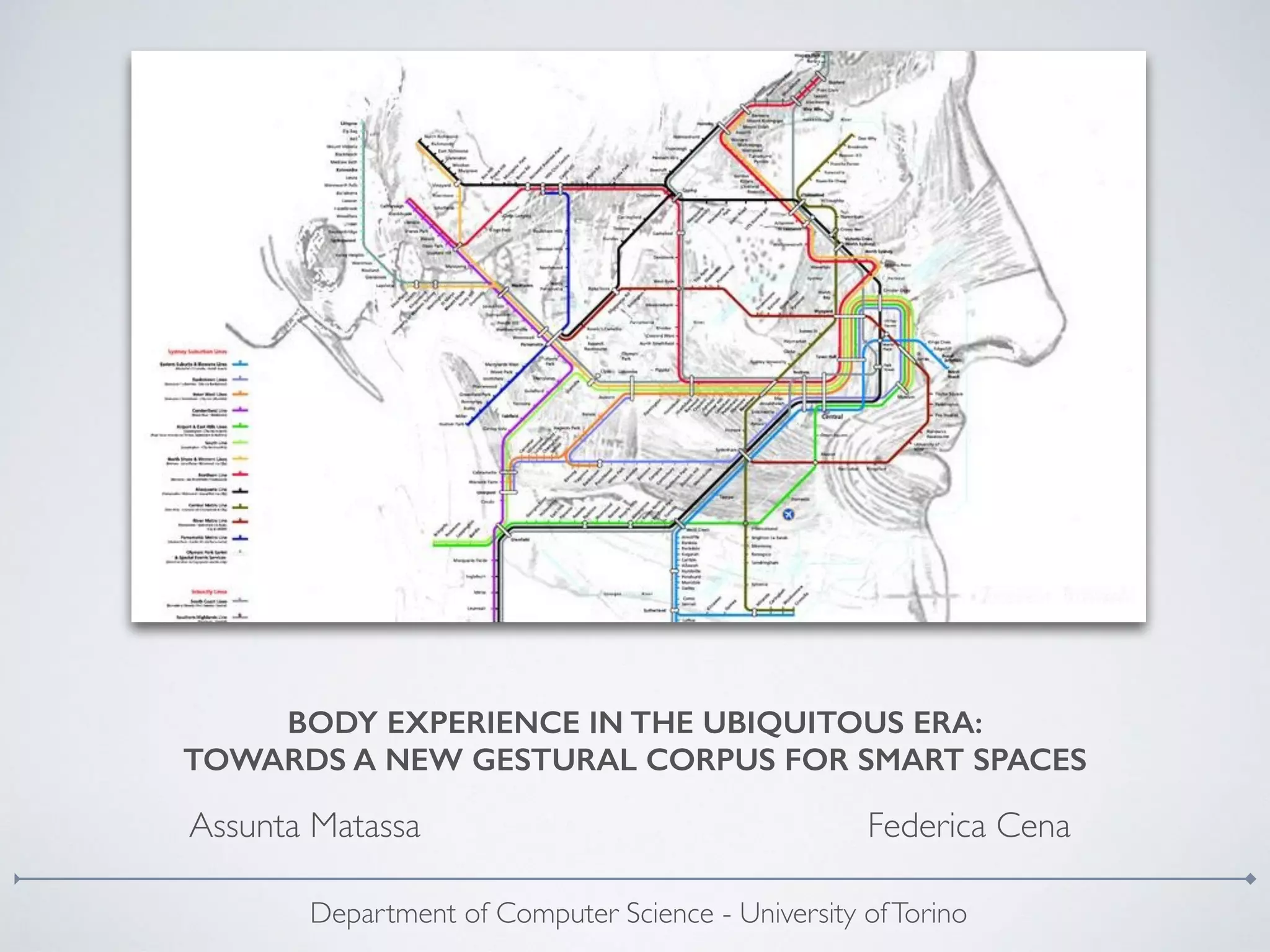
BODY EXPERIENCE IN THE UBIQUITOUS ERA:
TOWARDS A NEW GESTURAL CORPUS FOR SMART SPACES
Assunta Matassa Federica Cena
Department of Computer Science - University ofTorino
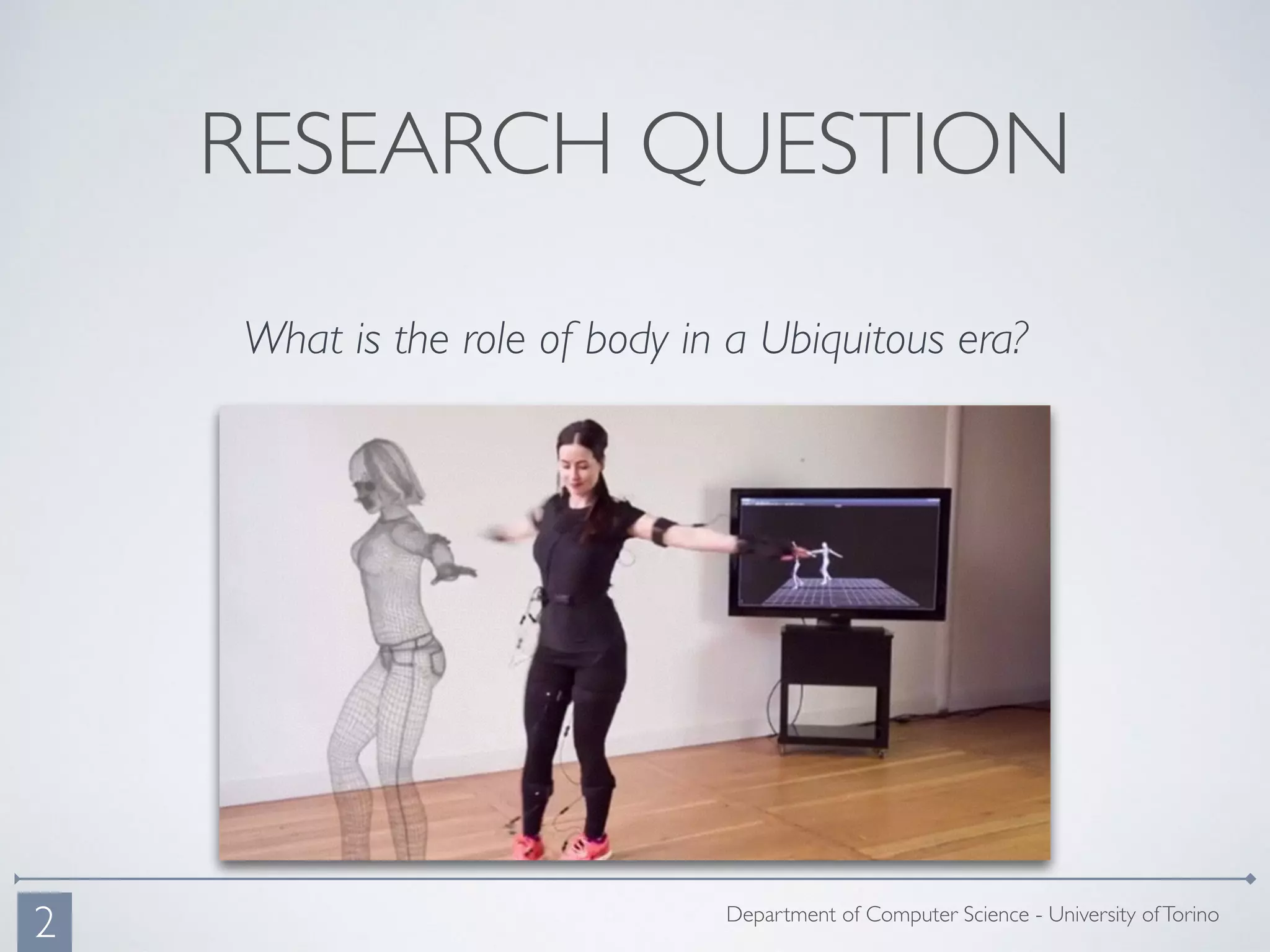
RESEARCH QUESTION
What is the role of body in a Ubiquitous era?
Department of Computer Science - University ofTorino
2
RESEARCH QUESTION/2
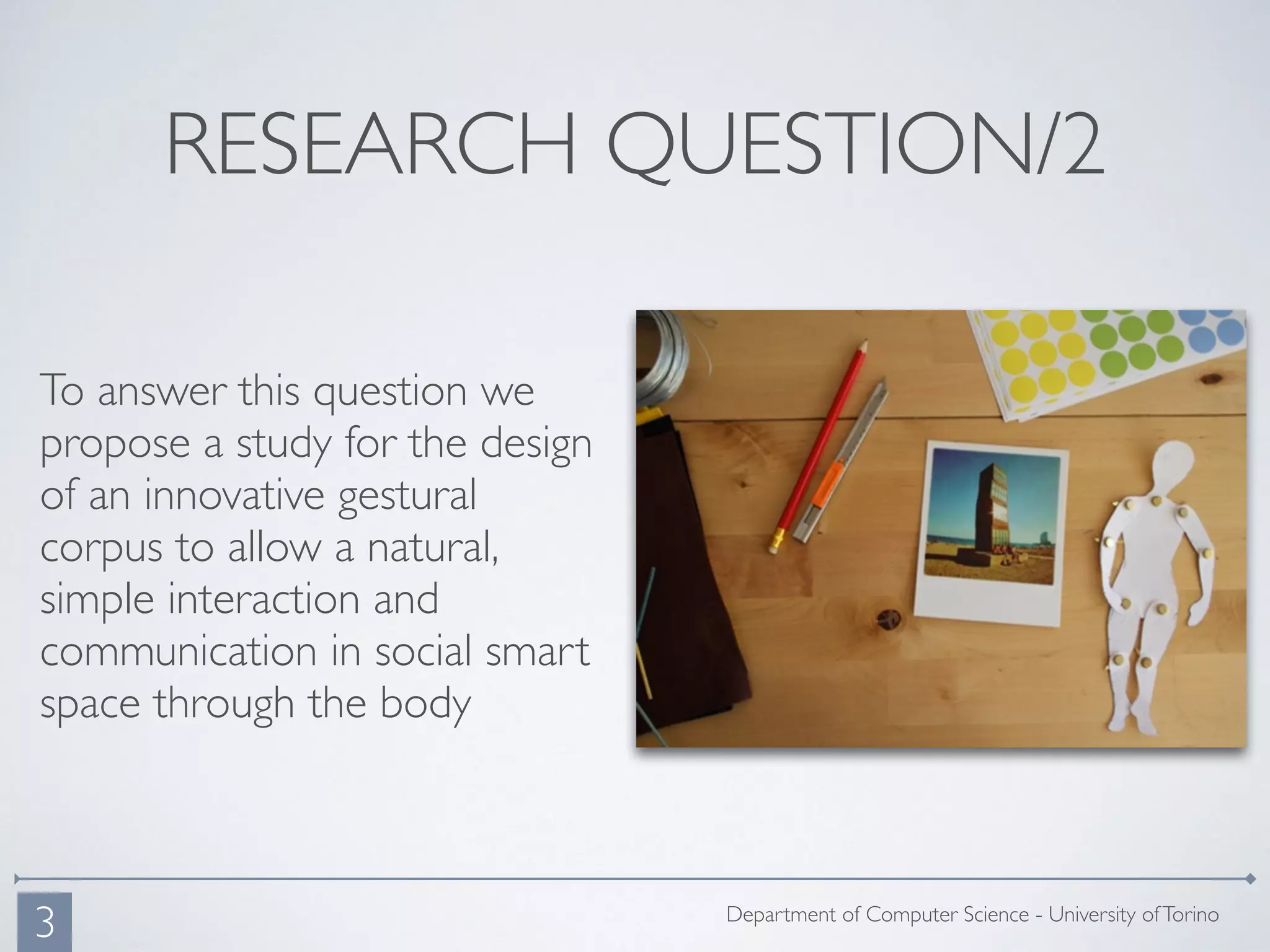
To answer this question we
propose a study for the design
of an innovative gestural
corpus to allow a natural,
simple interaction and
communication in social smart
space through the body
Department of Computer Science - University ofTorino
3
1) to examine the relation between body and space in
Ubiquitous era;
2) to investigate the potential of body and senses to improve
one’s ability to interact with surroundings;
3) to present a study for a new gestural corpus for smart
spaces, adopting a bodystorming approach.
GOALS
Department of Computer Science - University ofTorino4
BODY & SPACE
A long tradition in studying the relationship between human
bodies and space describes an anatomy of space generated by
living bodies.
It presented an important relation between body and its
material features, defining how it is a measure of the space
and occupies its space.
Department of Computer Science - University ofTorino
5
SOCIAL SPACE
Social Space is the place where people interact to each other,
using artifacts (digital and non- digital) as means of
communication.
Department of Computer Science - University ofTorino
6
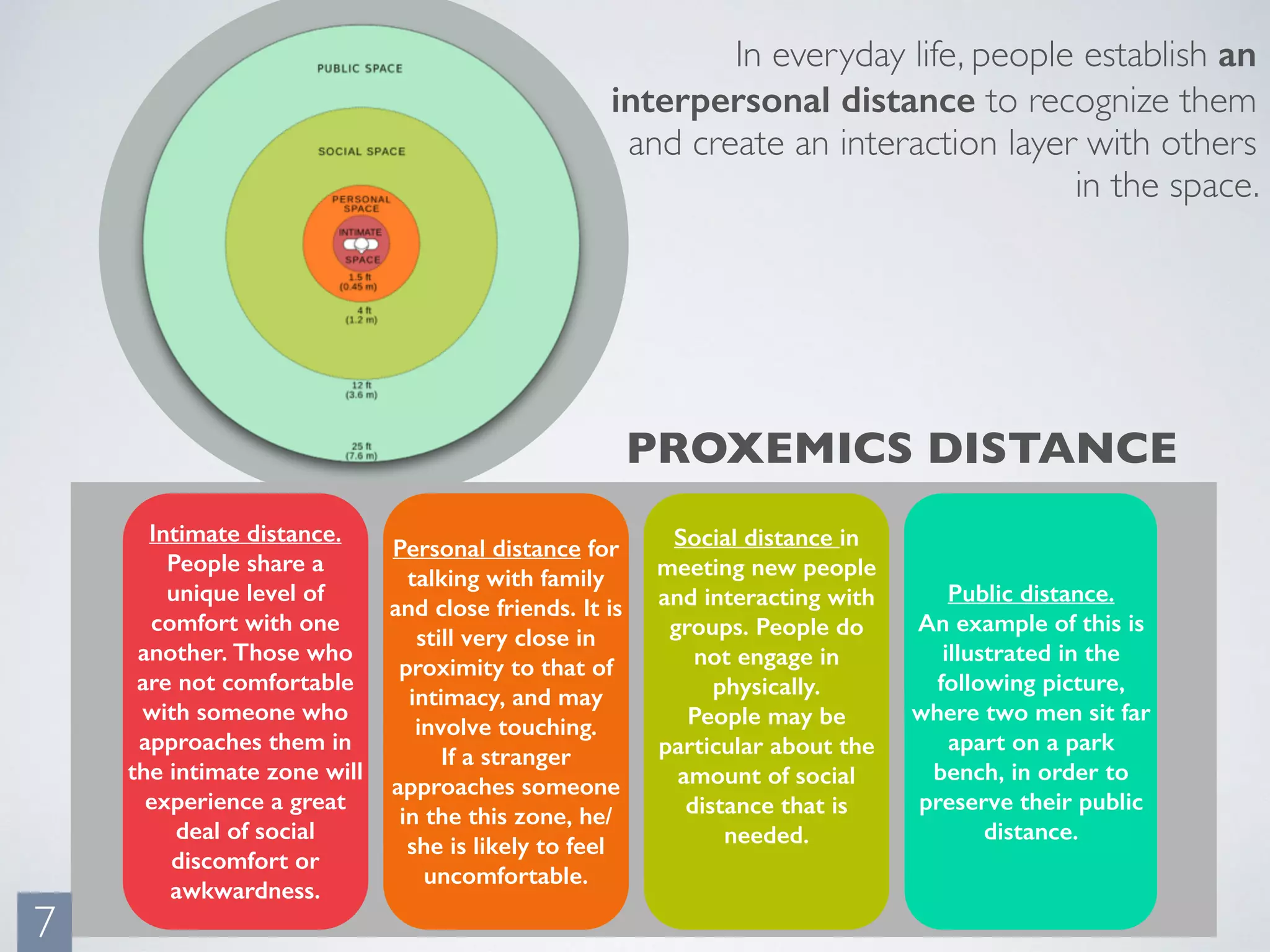
In everyday life, people establish an
interpersonal distance to recognize them
and create an interaction layer with others
in the space.
Intimate distance.
People share a
unique level of
comfort with one
another. Those who
are not comfortable
with someone who
approaches them in
the intimate zone will
experience a great
deal of social
discomfort or
awkwardness.
Personal distance for
talking with family
and close friends. It is
still very close in
proximity to that of
intimacy, and may
involve touching.
If a stranger
approaches someone
in the this zone, he/
she is likely to feel
uncomfortable.
Social distance in
meeting new people
and interacting with
groups. People do
not engage in
physically.
People may be
particular about the
amount of social
distance that is
needed.
Public distance.
An example of this is
illustrated in the
following picture,
where two men sit far
apart on a park
bench, in order to
preserve their public
distance.
7
PROXEMICS DISTANCE
Department of Computer Science - University ofTorino
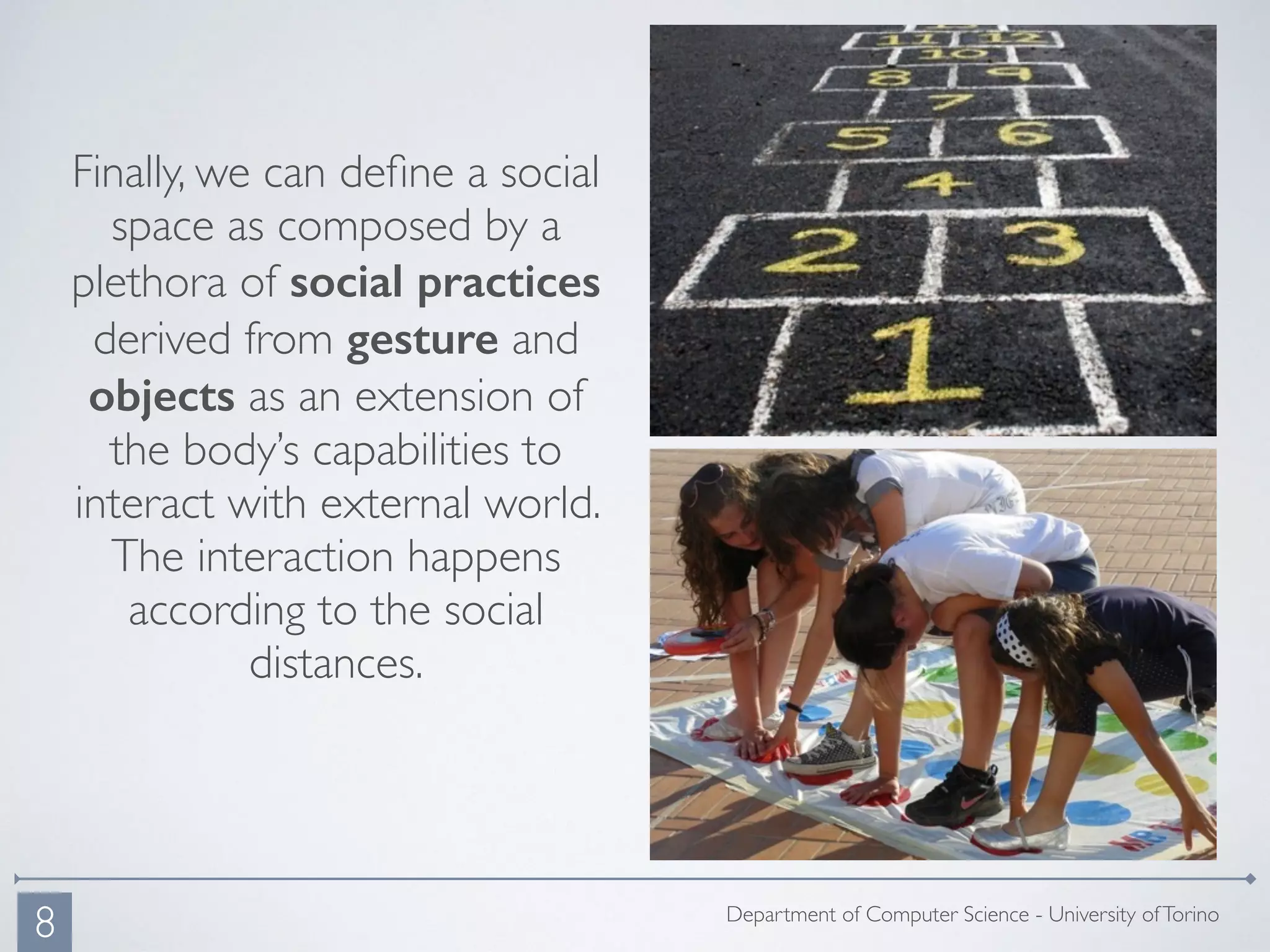
Finally, we can define a social
space as composed by a
plethora of social practices
derived from gesture and
objects as an extension of
the body’s capabilities to
interact with external world.
The interaction happens
according to the social
distances.
8
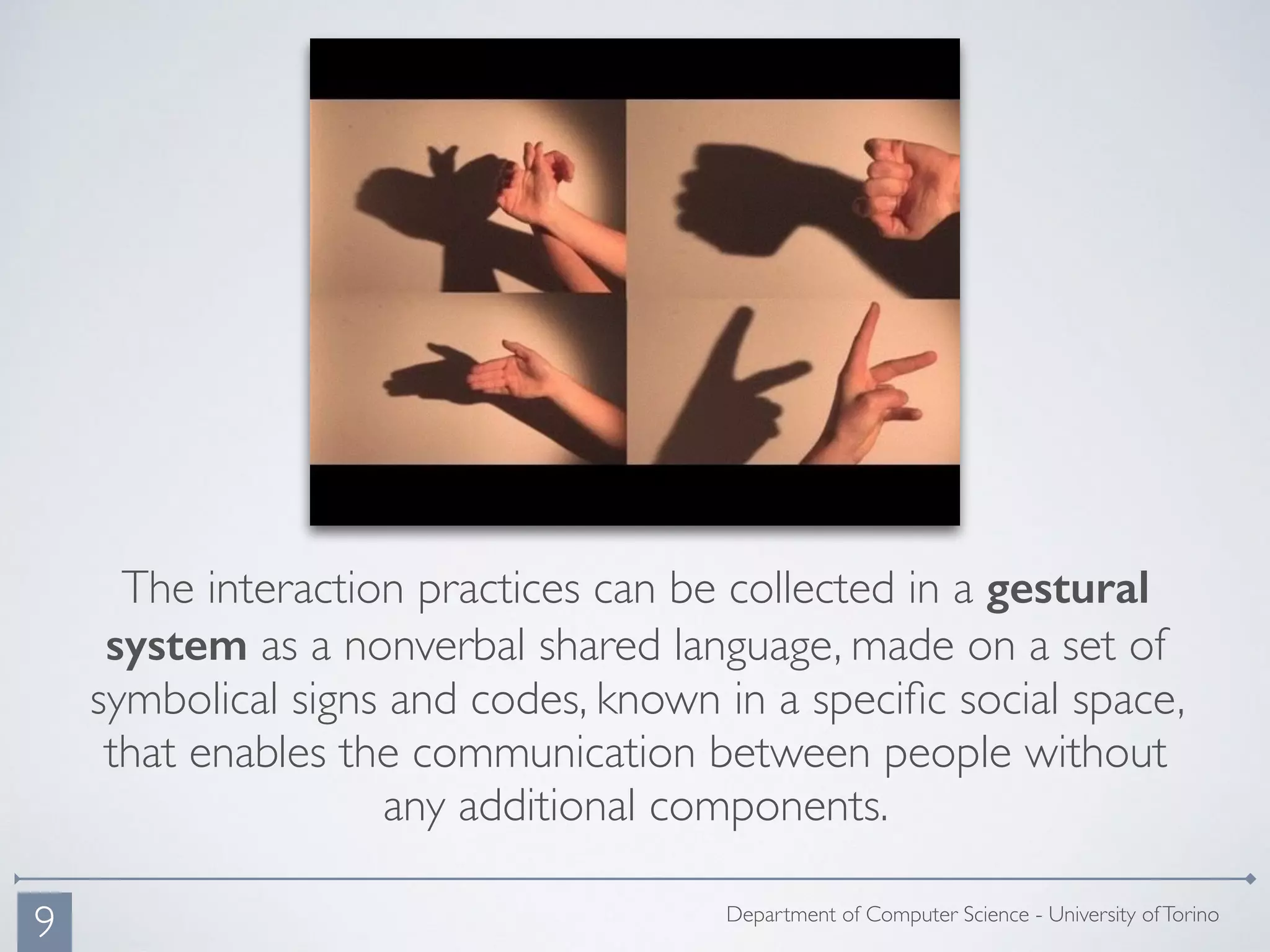
The interaction practices can be collected in a gestural
system as a nonverbal shared language, made on a set of
symbolical signs and codes, known in a specific social space,
that enables the communication between people without
any additional components.
Department of Computer Science - University ofTorino
9
SYMBOLIC
INTERACTION
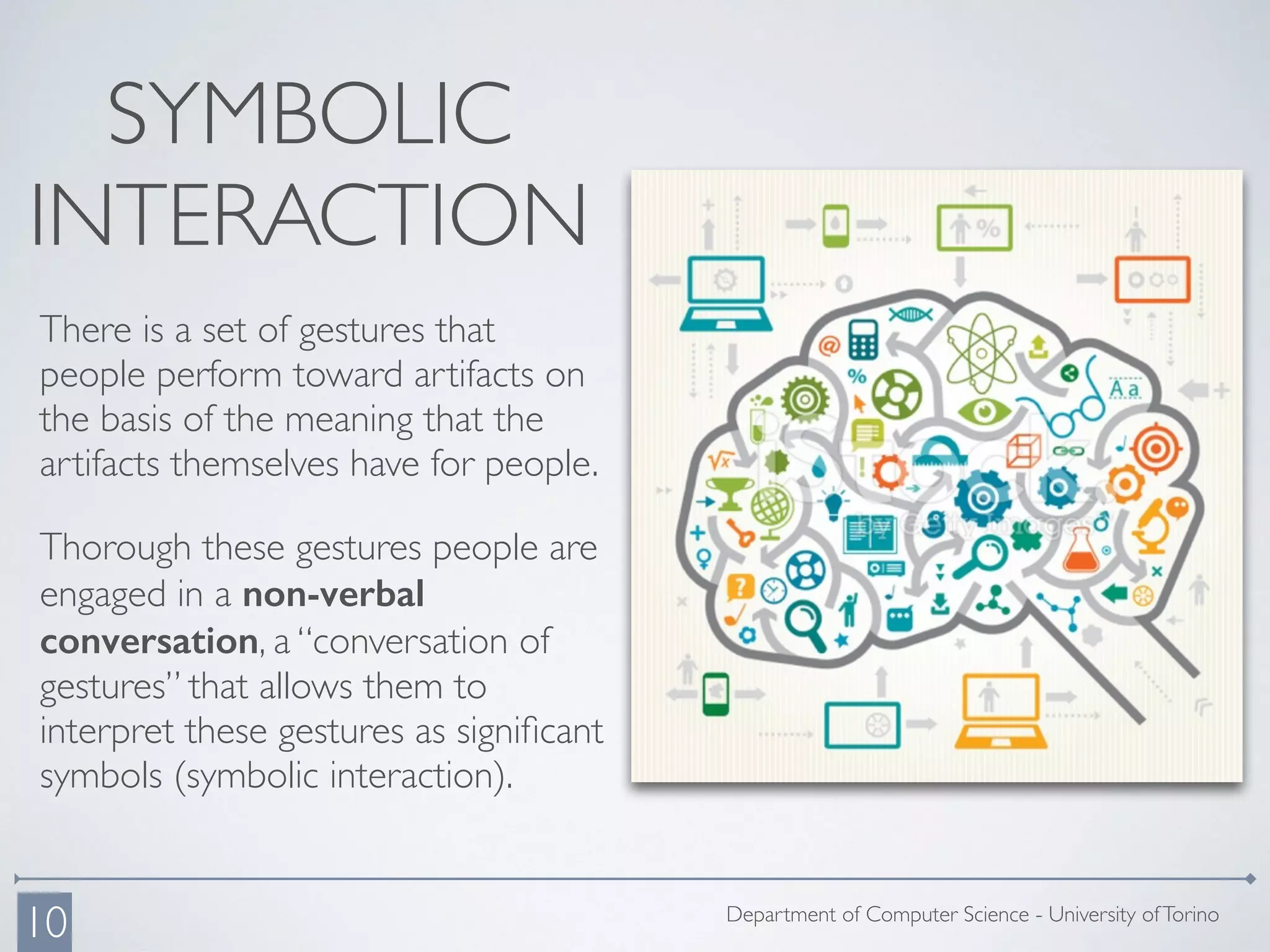
There is a set of gestures that
people perform toward artifacts on
the basis of the meaning that the
artifacts themselves have for people.
Thorough these gestures people are
engaged in a non-verbal
conversation, a “conversation of
gestures” that allows them to
interpret these gestures as significant
symbols (symbolic interaction).
Department of Computer Science - University ofTorino
10
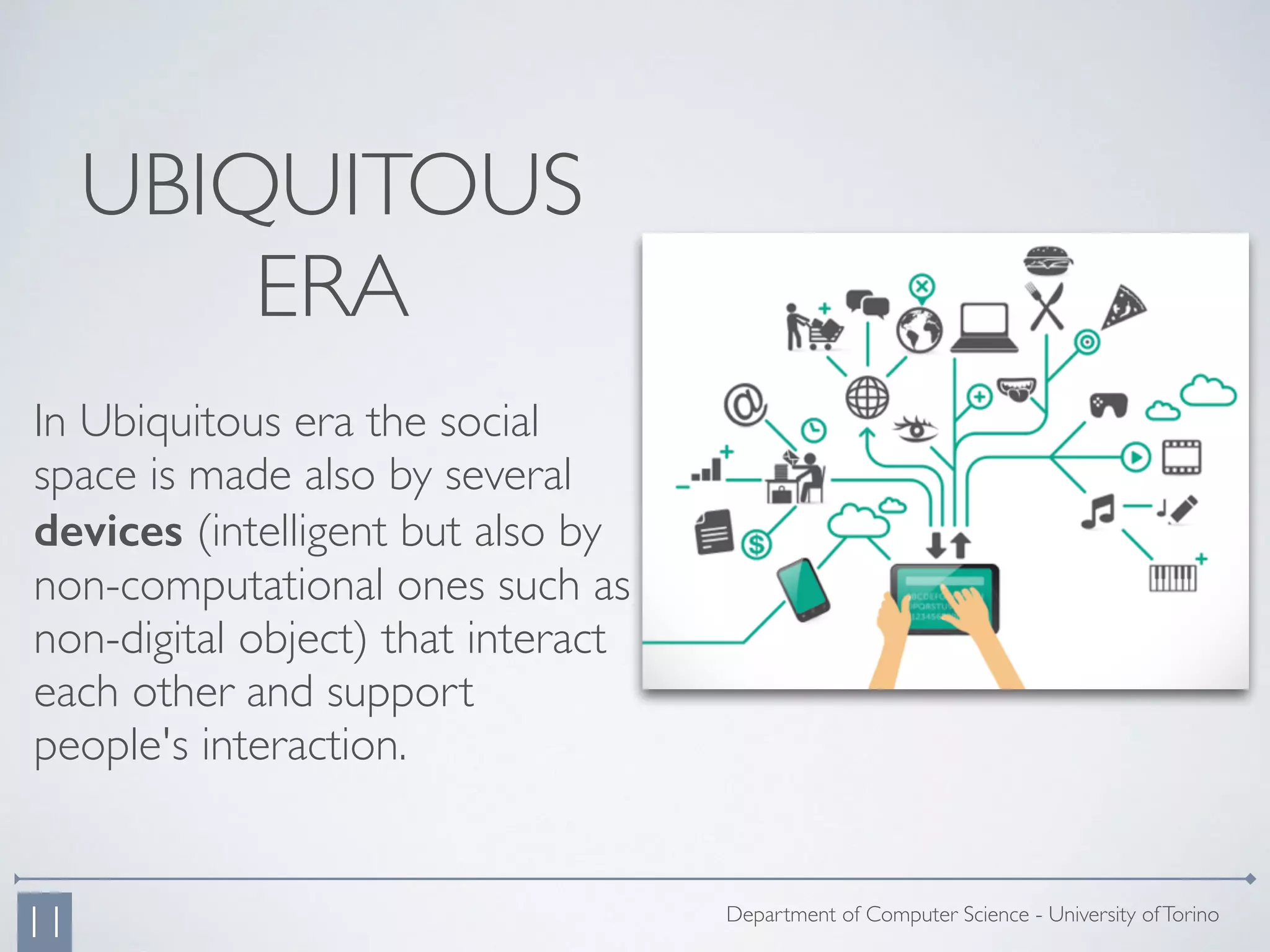
In Ubiquitous era the social
space is made also by several
devices (intelligent but also by
non-computational ones such as
non-digital object) that interact
each other and support
people's interaction.
Department of Computer Science - University ofTorino
11
UBIQUITOUS
ERA
Department of Computer Science - University ofTorino
12
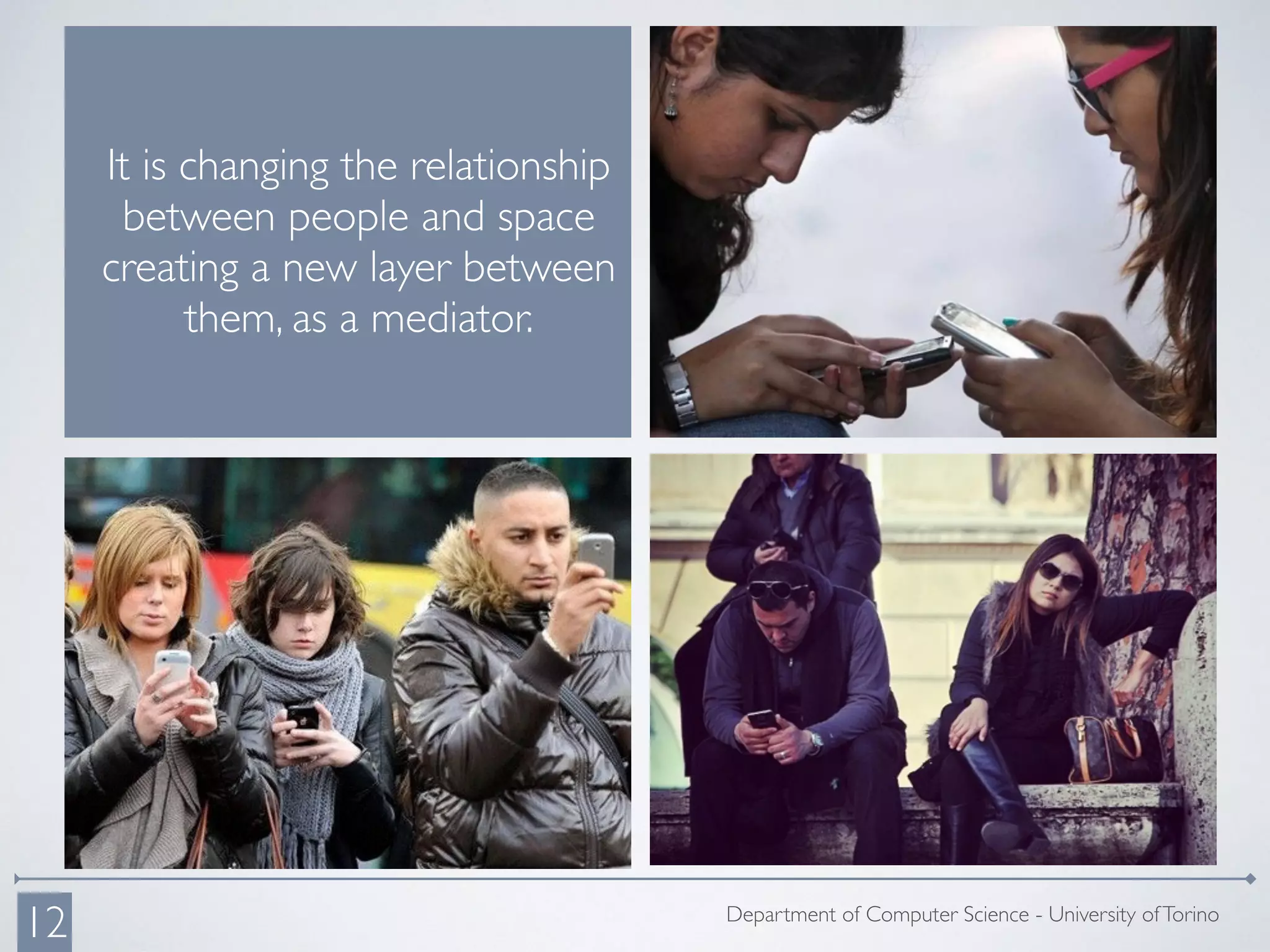
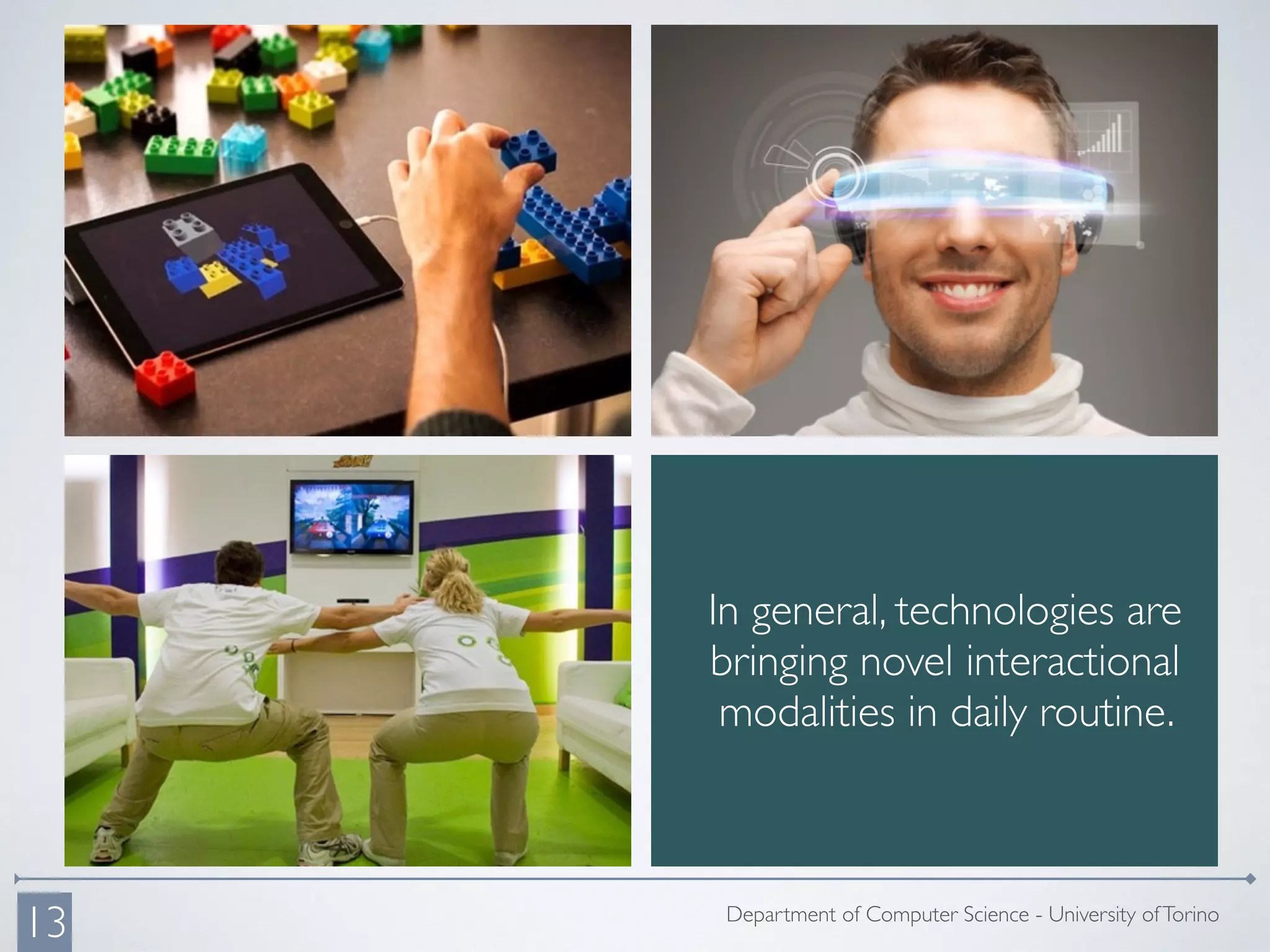
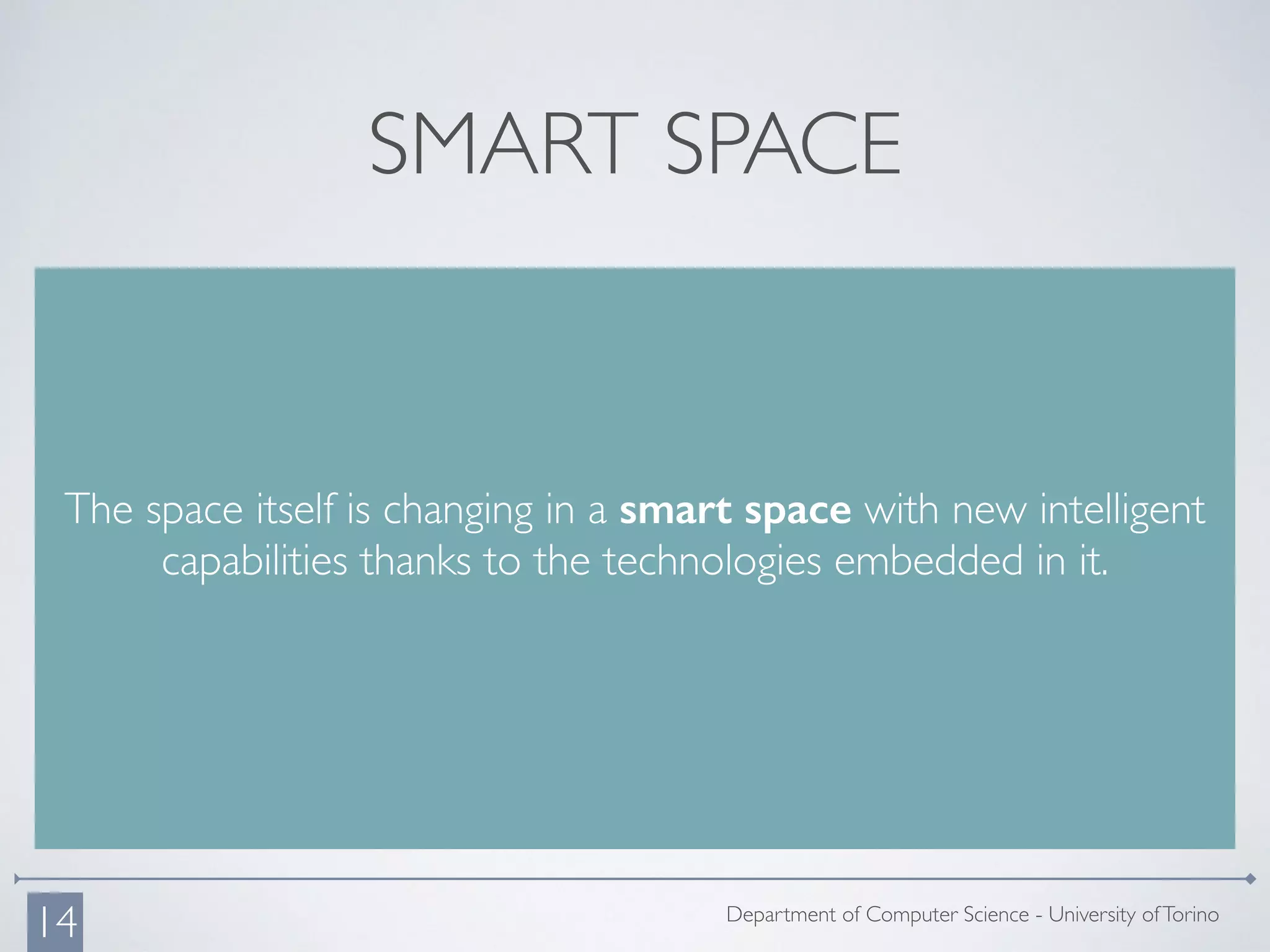
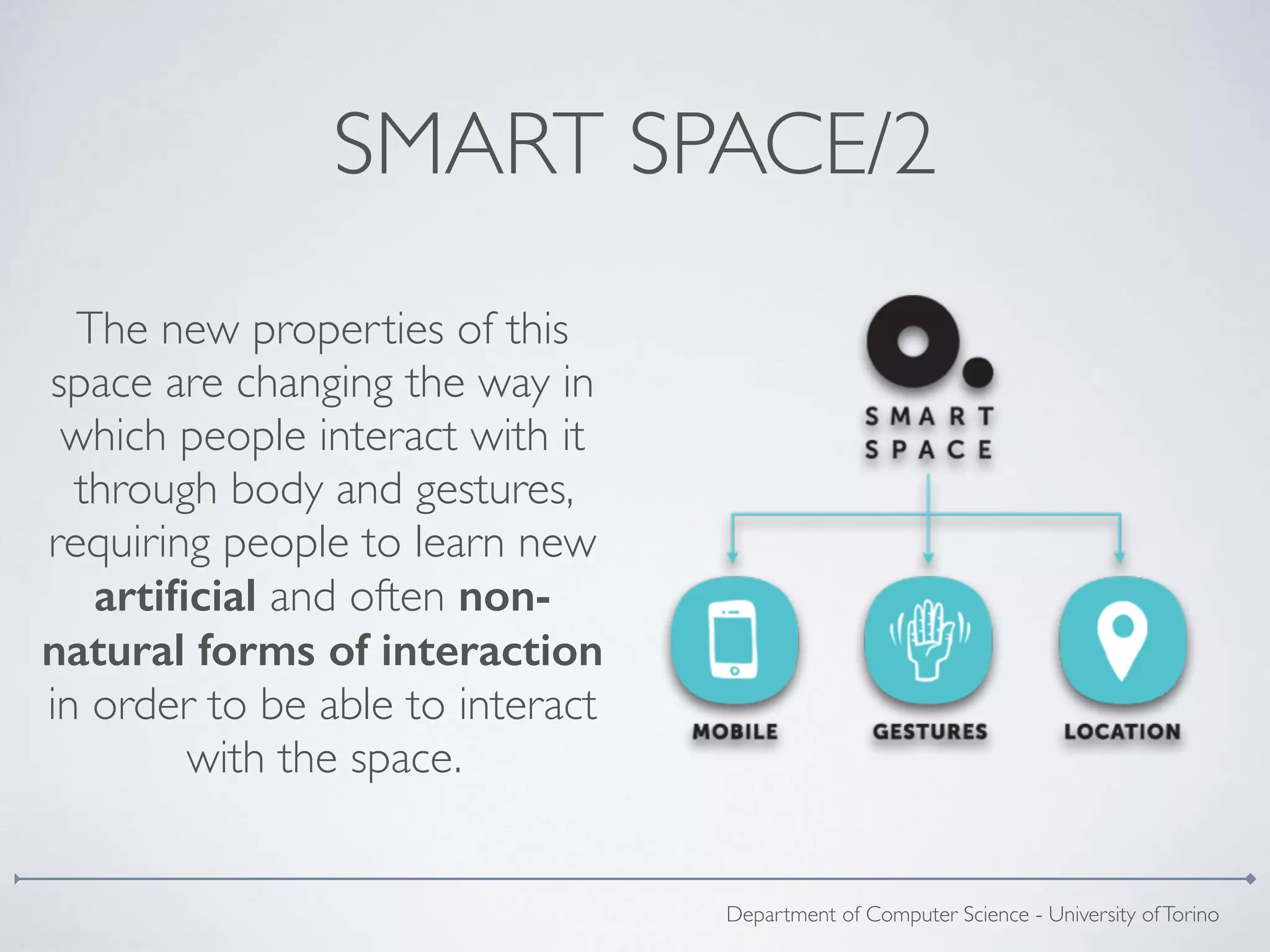
It is changing the relationship
between people and space
creating a new layer between
them, as a mediator.
Department of Computer Science - University ofTorino
13
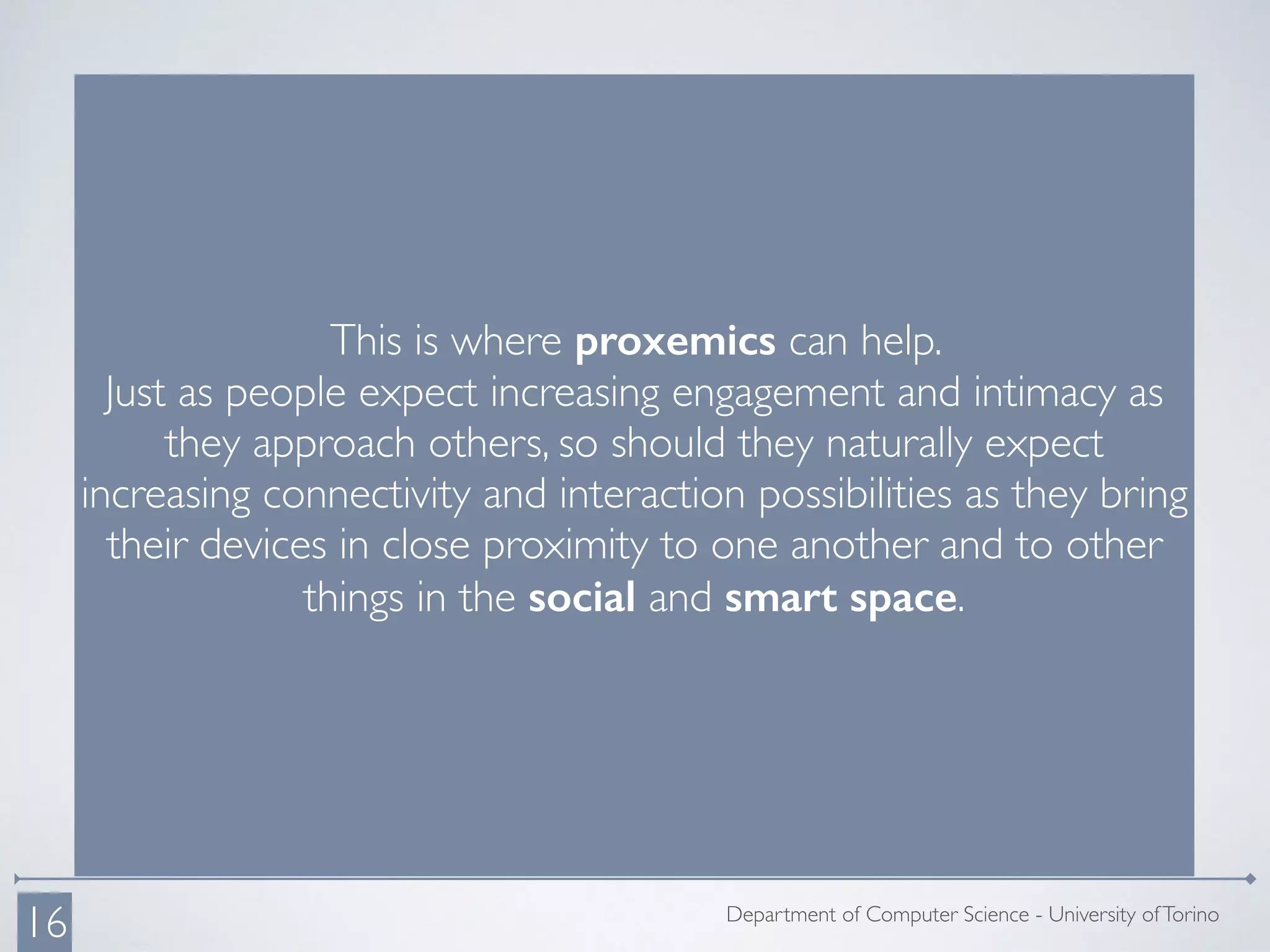
In general, technologies are
bringing novel interactional
modalities in daily routine.
SMART SPACE
The space itself is changing in a smart space with new intelligent
capabilities thanks to the technologies embedded in it.
Department of Computer Science - University ofTorino
14
SMART SPACE/2
The new properties of this
space are changing the way in
which people interact with it
through body and gestures,
requiring people to learn new
artificial and often non-
natural forms of interaction
in order to be able to interact
with the space.
Department of Computer Science - University ofTorino
This is where proxemics can help.
Just as people expect increasing engagement and intimacy as
they approach others, so should they naturally expect
increasing connectivity and interaction possibilities as they bring
their devices in close proximity to one another and to other
things in the social and smart space.
Department of Computer Science - University ofTorino
16
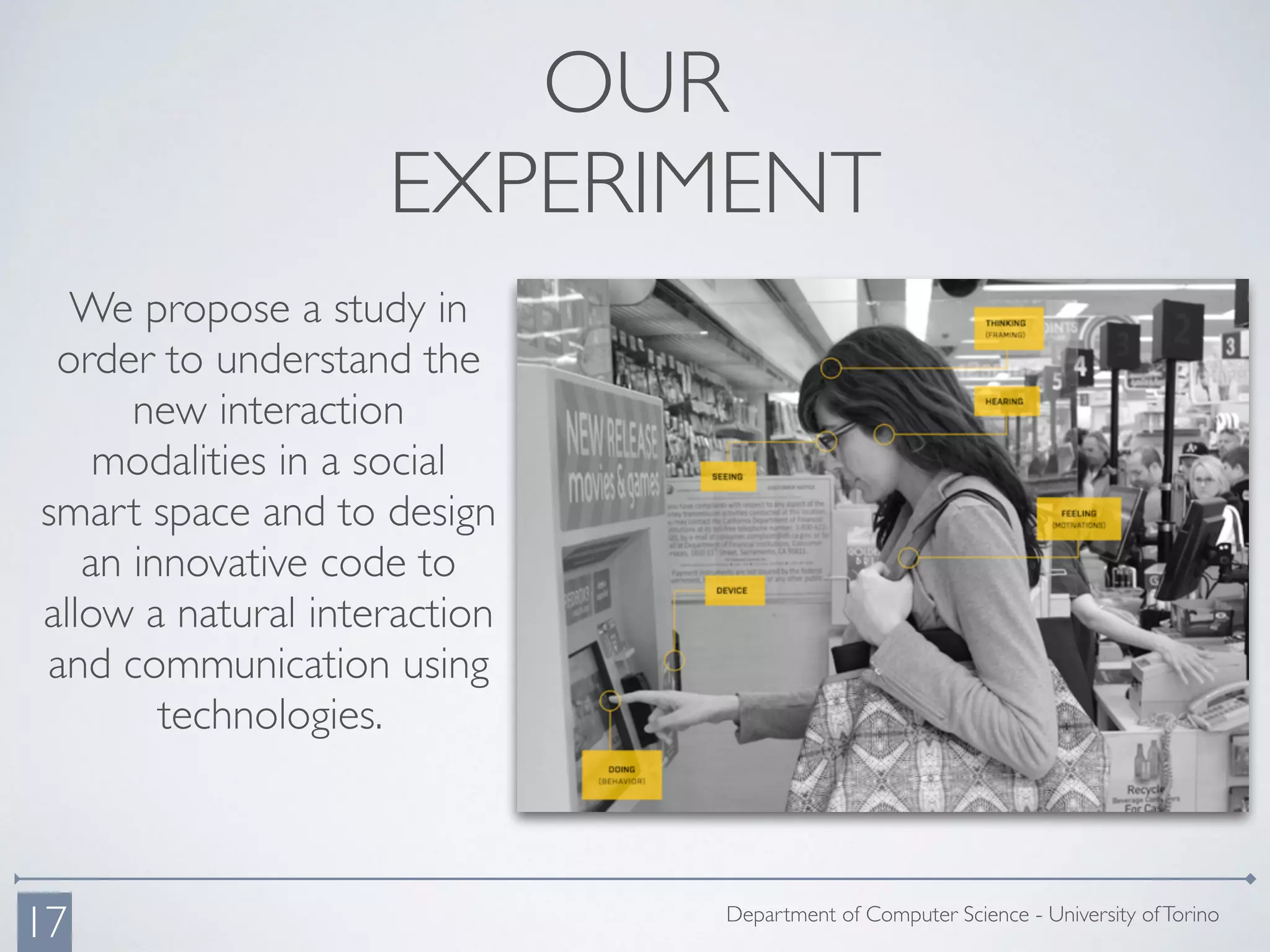
OUR
EXPERIMENT
We propose a study in
order to understand the
new interaction
modalities in a social
smart space and to design
an innovative code to
allow a natural interaction
and communication using
technologies.
Department of Computer Science - University ofTorino
17
OUR APPROACH
A. Smart space as a composite object whose intelligence
derives by the aggregation of the level of intelligence of the
composing objects.
B. Social smart space as the smart setting where social
activities happen supported by smart computational and
non- computational artifacts.
Department of Computer Science - University ofTorino
18
EXPECTED RESULTS
Taking inspiration from this example and starting from a set of
common gestures used in a social smart space,
our final goal will be to re-design a system of meaningful
gestures for humans in order to enable a natural interaction
between body and space in a Ubiquitous Era.
Department of Computer Science - University ofTorino
19
RESEARCH STUDY
1.  identify a set of everyday objects in a specific social space;
2.  identify the everyday user gesture in that specific space
with those objects;
3. enhance the objects in order to be smart and able to
understand such gestures as new input/output modalities. 

Department of Computer Science - University ofTorino
20
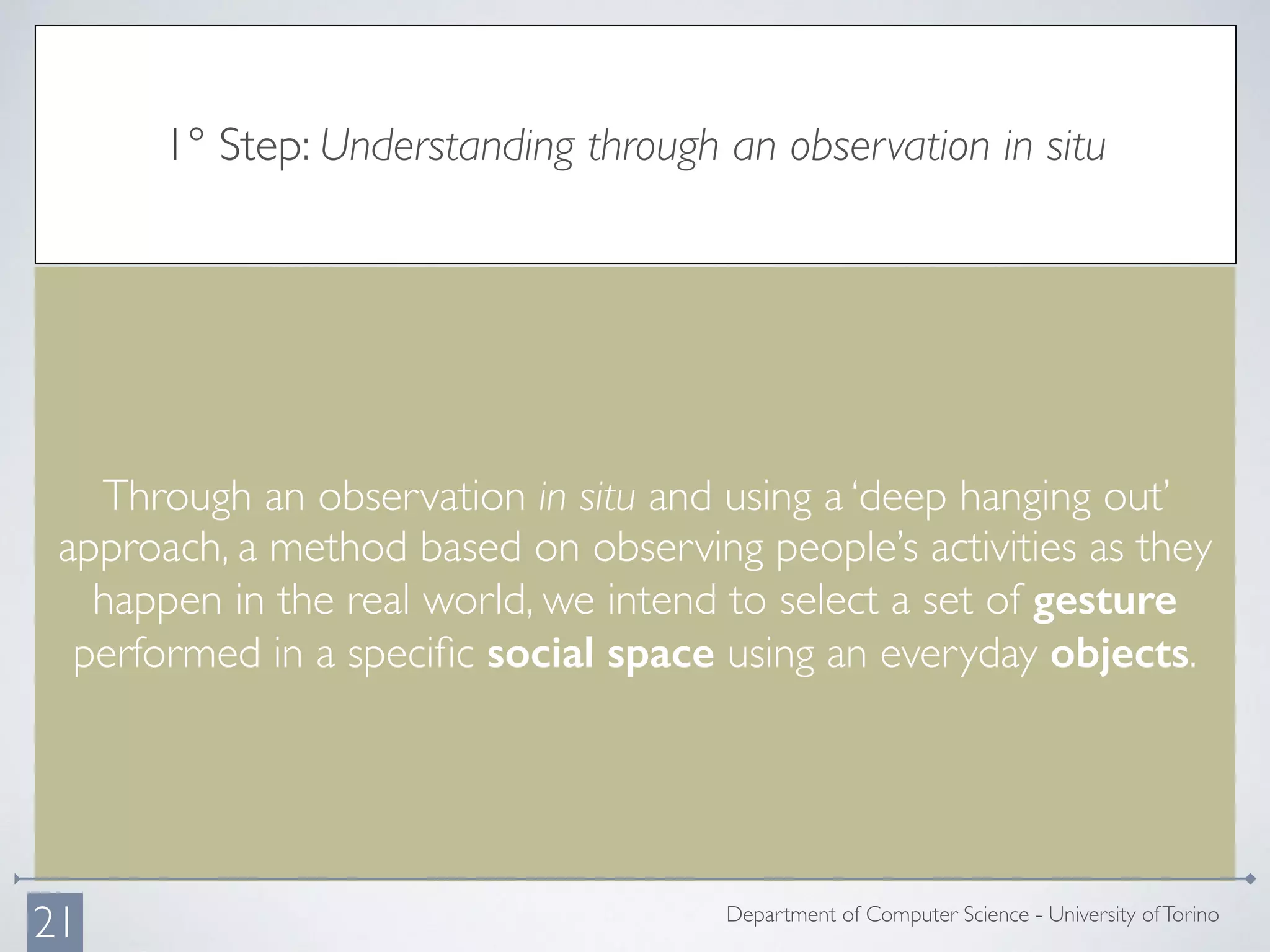
1° Step: Understanding through an observation in situ
Through an observation in situ and using a ‘deep hanging out’
approach, a method based on observing people’s activities as they
happen in the real world, we intend to select a set of gesture
performed in a specific social space using an everyday objects.
Department of Computer Science - University ofTorino
21
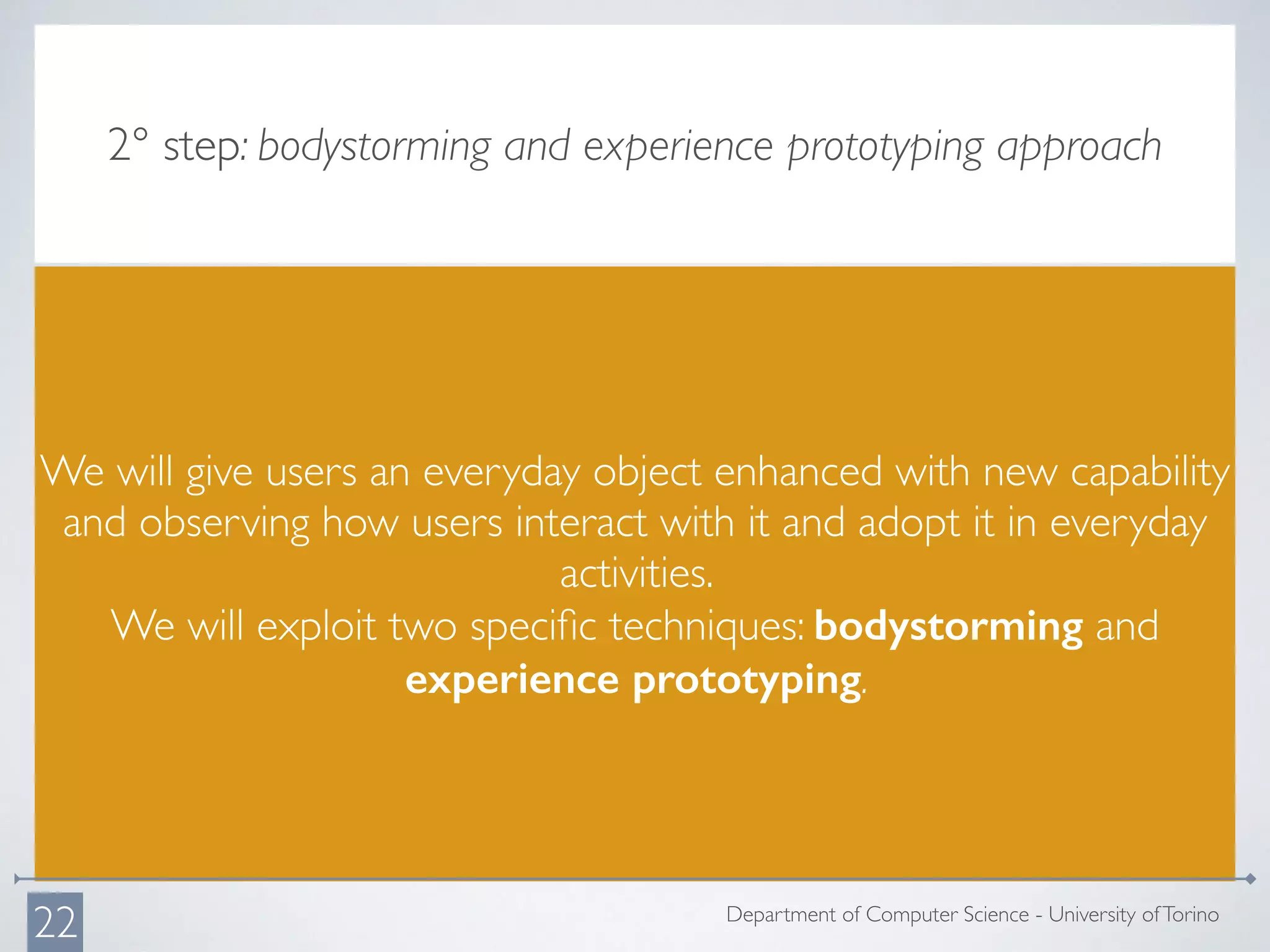
2° step: bodystorming and experience prototyping approach
We will give users an everyday object enhanced with new capability
and observing how users interact with it and adopt it in everyday
activities.
We will exploit two specific techniques: bodystorming and
experience prototyping.
Department of Computer Science - University ofTorino
22
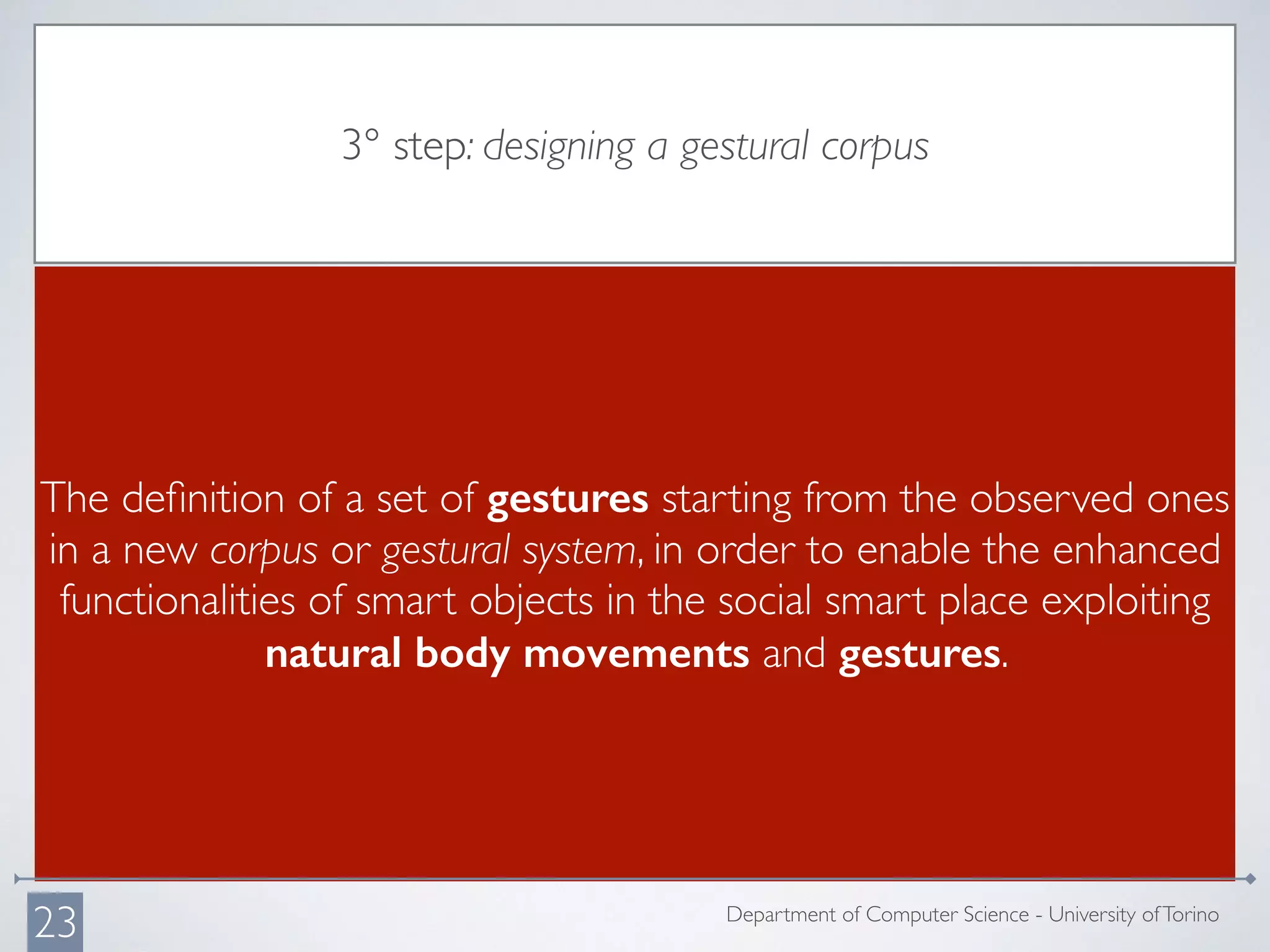
3° step: designing a gestural corpus
The definition of a set of gestures starting from the observed ones
in a new corpus or gestural system, in order to enable the enhanced
functionalities of smart objects in the social smart place exploiting
natural body movements and gestures.
Department of Computer Science - University ofTorino
23
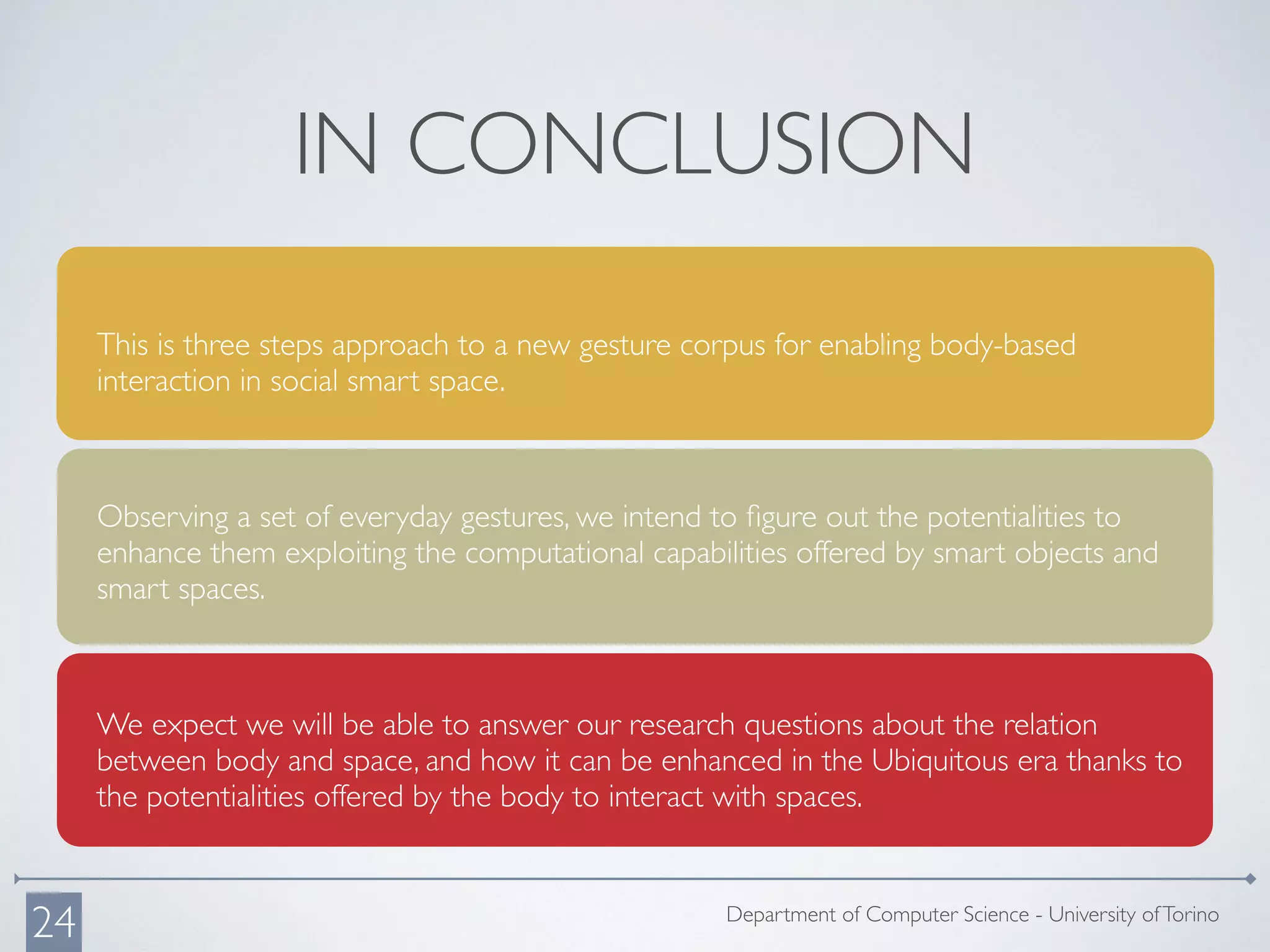
This is three steps approach to a new gesture corpus for enabling body-based
interaction in social smart space.
Observing a set of everyday gestures, we intend to figure out the potentialities to
enhance them exploiting the computational capabilities offered by smart objects and
smart spaces.
We expect we will be able to answer our research questions about the relation
between body and space, and how it can be enhanced in the Ubiquitous era thanks to
the potentialities offered by the body to interact with spaces.
IN CONCLUSION
Department of Computer Science - University ofTorino
24
Assunta Matassa
University of Torino
matassa@di.unito.it
Thank you for the attention!
Q&A

Body Experience in the Ubiquitous Era: towards a new gestural corpus for smart spaces

  • 1.
    BODY EXPERIENCE INTHE UBIQUITOUS ERA: TOWARDS A NEW GESTURAL CORPUS FOR SMART SPACES Assunta Matassa Federica Cena Department of Computer Science - University ofTorino
  • 2.
    RESEARCH QUESTION What isthe role of body in a Ubiquitous era? Department of Computer Science - University ofTorino 2
  • 3.
    RESEARCH QUESTION/2 To answerthis question we propose a study for the design of an innovative gestural corpus to allow a natural, simple interaction and communication in social smart space through the body Department of Computer Science - University ofTorino 3
  • 4.
    1) to examinethe relation between body and space in Ubiquitous era; 2) to investigate the potential of body and senses to improve one’s ability to interact with surroundings; 3) to present a study for a new gestural corpus for smart spaces, adopting a bodystorming approach. GOALS Department of Computer Science - University ofTorino4
  • 5.
    BODY & SPACE Along tradition in studying the relationship between human bodies and space describes an anatomy of space generated by living bodies. It presented an important relation between body and its material features, defining how it is a measure of the space and occupies its space. Department of Computer Science - University ofTorino 5
  • 6.
    SOCIAL SPACE Social Spaceis the place where people interact to each other, using artifacts (digital and non- digital) as means of communication. Department of Computer Science - University ofTorino 6
  • 7.
    In everyday life,people establish an interpersonal distance to recognize them and create an interaction layer with others in the space. Intimate distance. People share a unique level of comfort with one another. Those who are not comfortable with someone who approaches them in the intimate zone will experience a great deal of social discomfort or awkwardness. Personal distance for talking with family and close friends. It is still very close in proximity to that of intimacy, and may involve touching. If a stranger approaches someone in the this zone, he/ she is likely to feel uncomfortable. Social distance in meeting new people and interacting with groups. People do not engage in physically. People may be particular about the amount of social distance that is needed. Public distance. An example of this is illustrated in the following picture, where two men sit far apart on a park bench, in order to preserve their public distance. 7 PROXEMICS DISTANCE
  • 8.
    Department of ComputerScience - University ofTorino Finally, we can define a social space as composed by a plethora of social practices derived from gesture and objects as an extension of the body’s capabilities to interact with external world. The interaction happens according to the social distances. 8
  • 9.
    The interaction practicescan be collected in a gestural system as a nonverbal shared language, made on a set of symbolical signs and codes, known in a specific social space, that enables the communication between people without any additional components. Department of Computer Science - University ofTorino 9
  • 10.
    SYMBOLIC INTERACTION There is aset of gestures that people perform toward artifacts on the basis of the meaning that the artifacts themselves have for people. Thorough these gestures people are engaged in a non-verbal conversation, a “conversation of gestures” that allows them to interpret these gestures as significant symbols (symbolic interaction). Department of Computer Science - University ofTorino 10
  • 11.
    In Ubiquitous erathe social space is made also by several devices (intelligent but also by non-computational ones such as non-digital object) that interact each other and support people's interaction. Department of Computer Science - University ofTorino 11 UBIQUITOUS ERA
  • 12.
    Department of ComputerScience - University ofTorino 12 It is changing the relationship between people and space creating a new layer between them, as a mediator.
  • 13.
    Department of ComputerScience - University ofTorino 13 In general, technologies are bringing novel interactional modalities in daily routine.
  • 14.
    SMART SPACE The spaceitself is changing in a smart space with new intelligent capabilities thanks to the technologies embedded in it. Department of Computer Science - University ofTorino 14
  • 15.
    SMART SPACE/2 The newproperties of this space are changing the way in which people interact with it through body and gestures, requiring people to learn new artificial and often non- natural forms of interaction in order to be able to interact with the space. Department of Computer Science - University ofTorino
  • 16.
    This is whereproxemics can help. Just as people expect increasing engagement and intimacy as they approach others, so should they naturally expect increasing connectivity and interaction possibilities as they bring their devices in close proximity to one another and to other things in the social and smart space. Department of Computer Science - University ofTorino 16
  • 17.
    OUR EXPERIMENT We propose astudy in order to understand the new interaction modalities in a social smart space and to design an innovative code to allow a natural interaction and communication using technologies. Department of Computer Science - University ofTorino 17
  • 18.
    OUR APPROACH A. Smartspace as a composite object whose intelligence derives by the aggregation of the level of intelligence of the composing objects. B. Social smart space as the smart setting where social activities happen supported by smart computational and non- computational artifacts. Department of Computer Science - University ofTorino 18
  • 19.
    EXPECTED RESULTS Taking inspirationfrom this example and starting from a set of common gestures used in a social smart space, our final goal will be to re-design a system of meaningful gestures for humans in order to enable a natural interaction between body and space in a Ubiquitous Era. Department of Computer Science - University ofTorino 19
  • 20.
    RESEARCH STUDY 1.  identifya set of everyday objects in a specific social space; 2.  identify the everyday user gesture in that specific space with those objects; 3. enhance the objects in order to be smart and able to understand such gestures as new input/output modalities. 
 Department of Computer Science - University ofTorino 20
  • 21.
    1° Step: Understandingthrough an observation in situ Through an observation in situ and using a ‘deep hanging out’ approach, a method based on observing people’s activities as they happen in the real world, we intend to select a set of gesture performed in a specific social space using an everyday objects. Department of Computer Science - University ofTorino 21
  • 22.
    2° step: bodystormingand experience prototyping approach We will give users an everyday object enhanced with new capability and observing how users interact with it and adopt it in everyday activities. We will exploit two specific techniques: bodystorming and experience prototyping. Department of Computer Science - University ofTorino 22
  • 23.
    3° step: designinga gestural corpus The definition of a set of gestures starting from the observed ones in a new corpus or gestural system, in order to enable the enhanced functionalities of smart objects in the social smart place exploiting natural body movements and gestures. Department of Computer Science - University ofTorino 23
  • 24.
    This is threesteps approach to a new gesture corpus for enabling body-based interaction in social smart space. Observing a set of everyday gestures, we intend to figure out the potentialities to enhance them exploiting the computational capabilities offered by smart objects and smart spaces. We expect we will be able to answer our research questions about the relation between body and space, and how it can be enhanced in the Ubiquitous era thanks to the potentialities offered by the body to interact with spaces. IN CONCLUSION Department of Computer Science - University ofTorino 24
  • 25.
    Assunta Matassa University ofTorino matassa@di.unito.it Thank you for the attention! Q&A