The Foundations of
Spatial Computing
Sjors Timmer
@sjors
Now you can create documents
with words and pictures
Xerox Star 8010
1981
This is not a watered down version
of the internet
Or a mobile version of the internet
It’s just the Internet…
On your phone
iPhone
2007
It also comes with all the YouTube
features you already love
YouTube VR
2016
The ‘content’ of any medium is always another
medium.
Marshall McLuhan
The medium is the message
The ‘content’ of any new medium is the previous
best selling medium
Free after Marshall McLuhan
But it doesn’t have to be that way
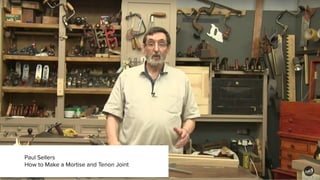
Paul Sellers

How to Make a Mortise and Tenon Joint
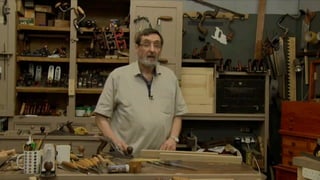
What if we could work with information like a carpenter works
with wood?
The intelligent use of space
Understanding through interaction
1.
2.
1. The intelligent use of space
The intelligent use of space
How we manage the spatial arrangement of items around us,
is not an afterthought; it is an integral part of the way we think,
plan and behave.
- David Kirsh
Extend memory
Sense making
Novel ways of seeing
Experts constantly re-arrange
items to make it easy to track the
state of the task, or to notice the
properties signaling what to do
next.
- David Kirsh
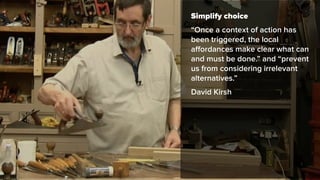
Simplify choice
“Once a context of action has
been triggered, the local
affordances make clear what can
and must be done.” and “prevent
us from considering irrelevant
alternatives.”
David Kirsh
Simplify what’s next
“If I can arrange items to display
the sequence they are are to be
used in, then I don’t have to
remember that order.
- David Kirsh
Simplify how next
The environment also indicates
how I should do my next action
Experts create little assembly lines of tasks, switching between
short bursts of high cognitive preparation tasks and longer
lower cognitive execution tasks.
2. Understanding through

interaction
We should invent knowledge work that incorporates the body
- Bret Victor
The humane representation of thought (2014)
Embodied Interaction is the creation, manipulation, and
sharing of meaning through engaged interaction with
artefacts.
- Paul Dourish
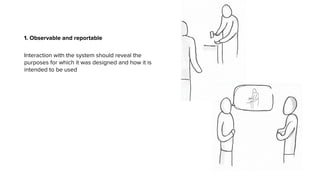
1. Observable and reportable
Interaction with the system should reveal the
purposes for which it was designed and how it is
intended to be used
2. Representations should relate to the world
The relation between what can be seen and what
is represented should make sense within the
user’s world experience
3. Physical representation
Being physical humans in a physical world has
endowed us with a rich set of skills. We should
build upon those
4. Direct manipulation
• Interaction through physical movements
• Allow for rapid and reversible actions that
provide immediate visible feedback
5. From space to place
Turn space into a place by transforming it from
‘just’ physical to a social environment
5. From space to place
Turn space into a place moving it from ‘just’
physical to a social environment
• How you move your body changes how you
experience the computing system
5. From space to place
Turn space into a place moving it from ‘just’
physical to a social environment
• How you move your body changes how you
experience the computing system
• The computational system can be adapted
through changes in your physical environment
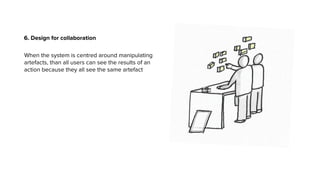
6. Design for collaboration
When the system is centred around manipulating
artefacts, than all users can see the results of an
action because they all see the same artefact
7. Design for model making
We should design for the dynamic spatial
representation of thought
- Bret Victor
The humane representation of thought (2014)
Illustration by David Hellman
Using our body to interact with the world around us frees up
underused capabilities for understanding complex information
Recap
- We use space to think
- We programme our environment through artefacts
- Using our body to interact with the world around us
opens up underused capabilities to understand
complex information
- Creating and interacting with dynamic spatial
models is the most powerful way to understand
complex information
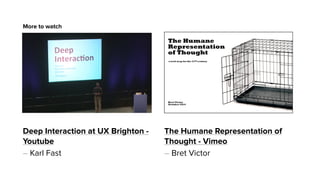
Deep Interaction at UX Brighton -
Youtube
– Karl Fast
The Humane Representation of
Thought - Vimeo
– Bret Victor
More to watch
Thank you!
Sjors Timmer
@sjors

The Foundations of Spatial Computing

  • 1.
    The Foundations of SpatialComputing Sjors Timmer @sjors
  • 2.
    Now you cancreate documents with words and pictures Xerox Star 8010 1981
  • 3.
    This is nota watered down version of the internet Or a mobile version of the internet It’s just the Internet… On your phone iPhone 2007
  • 4.
    It also comeswith all the YouTube features you already love YouTube VR 2016
  • 5.
    The ‘content’ ofany medium is always another medium. Marshall McLuhan The medium is the message
  • 6.
    The ‘content’ ofany new medium is the previous best selling medium Free after Marshall McLuhan
  • 7.
    But it doesn’thave to be that way
  • 8.
    Paul Sellers
 How toMake a Mortise and Tenon Joint
  • 10.
    What if wecould work with information like a carpenter works with wood?
  • 11.
    The intelligent useof space Understanding through interaction 1. 2.
  • 12.
    1. The intelligentuse of space
  • 13.
    The intelligent useof space How we manage the spatial arrangement of items around us, is not an afterthought; it is an integral part of the way we think, plan and behave. - David Kirsh
  • 14.
  • 15.
  • 16.
  • 18.
    Experts constantly re-arrange itemsto make it easy to track the state of the task, or to notice the properties signaling what to do next. - David Kirsh
  • 19.
    Simplify choice “Once acontext of action has been triggered, the local affordances make clear what can and must be done.” and “prevent us from considering irrelevant alternatives.” David Kirsh
  • 20.
    Simplify what’s next “IfI can arrange items to display the sequence they are are to be used in, then I don’t have to remember that order. - David Kirsh
  • 21.
    Simplify how next Theenvironment also indicates how I should do my next action
  • 22.
    Experts create littleassembly lines of tasks, switching between short bursts of high cognitive preparation tasks and longer lower cognitive execution tasks.
  • 23.
  • 24.
    We should inventknowledge work that incorporates the body - Bret Victor The humane representation of thought (2014)
  • 25.
    Embodied Interaction isthe creation, manipulation, and sharing of meaning through engaged interaction with artefacts. - Paul Dourish
  • 26.
    1. Observable andreportable Interaction with the system should reveal the purposes for which it was designed and how it is intended to be used
  • 27.
    2. Representations shouldrelate to the world The relation between what can be seen and what is represented should make sense within the user’s world experience
  • 28.
    3. Physical representation Beingphysical humans in a physical world has endowed us with a rich set of skills. We should build upon those
  • 29.
    4. Direct manipulation •Interaction through physical movements • Allow for rapid and reversible actions that provide immediate visible feedback
  • 30.
    5. From spaceto place Turn space into a place by transforming it from ‘just’ physical to a social environment
  • 31.
    5. From spaceto place Turn space into a place moving it from ‘just’ physical to a social environment • How you move your body changes how you experience the computing system
  • 32.
    5. From spaceto place Turn space into a place moving it from ‘just’ physical to a social environment • How you move your body changes how you experience the computing system • The computational system can be adapted through changes in your physical environment
  • 33.
    6. Design forcollaboration When the system is centred around manipulating artefacts, than all users can see the results of an action because they all see the same artefact
  • 34.
    7. Design formodel making We should design for the dynamic spatial representation of thought - Bret Victor The humane representation of thought (2014) Illustration by David Hellman
  • 35.
    Using our bodyto interact with the world around us frees up underused capabilities for understanding complex information
  • 36.
    Recap - We usespace to think - We programme our environment through artefacts - Using our body to interact with the world around us opens up underused capabilities to understand complex information - Creating and interacting with dynamic spatial models is the most powerful way to understand complex information
  • 37.
    Deep Interaction atUX Brighton - Youtube – Karl Fast The Humane Representation of Thought - Vimeo – Bret Victor More to watch
  • 38.