“From Good to Great”
Management Case Study - MBA/ HR/ 02
Current Status - Bank of Ceylon
ď‚§ Established on 1st August 1939
ď‚§ Leader in assets, deposits,
foreign currency remittance
ď‚§ 13 Subsidiaries and 5 associate
companies.
ď‚§ Over 620 branches &
540 ATM network
ď‚§ Operated in United Kingdom,
India, Maldives and Seychelles.
Bank of Ceylon - Profile
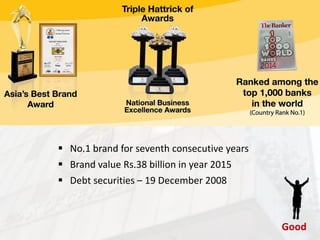
ď‚§ No.1 brand for seventh consecutive years
ď‚§ Brand value Rs.38 billion in year 2015
 Debt securities – 19 December 2008
Literature Review
ď‚§ Most fundamental management process
ď‚§ Managers must plan for future organizational
direction and for unexpected events.
ď‚§ The plans should meet environmental changes
and expectations of stakeholders.
 Advantages –
• Legitimacy and standard for performance
• Source of motivation and commitment,
• Guide resource allocation & action
• Provide rationale for decisions
Planning
“Planning is the process of determining organizational goals and
defining the means of achieving them” (Daft. L,2015).
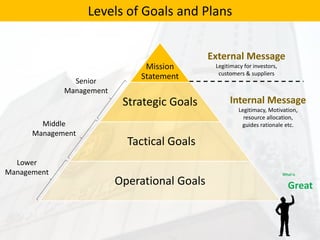
Levels of Goals and Plans
Mission
Statement
Strategic Goals
Tactical Goals
Operational Goals
Senior
Management
Middle
Management
Lower
Management
Internal Message
Legitimacy, Motivation,
resource allocation,
guides rationale etc.
External Message
Legitimacy for investors,
customers & suppliers
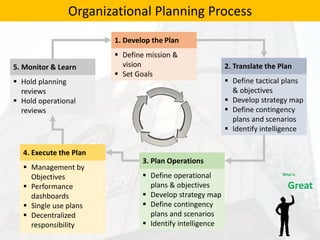
Organizational Planning Process
1. Develop the Plan
ď‚§ Define mission &
vision
ď‚§ Set Goals
2. Translate the Plan
ď‚§ Define tactical plans
& objectives
ď‚§ Develop strategy map
ď‚§ Define contingency
plans and scenarios
ď‚§ Identify intelligence
3. Plan Operations
ď‚§ Define operational
plans & objectives
ď‚§ Develop strategy map
ď‚§ Define contingency
plans and scenarios
ď‚§ Identify intelligence
4. Execute the Plan
ď‚§ Management by
Objectives
ď‚§ Performance
dashboards
ď‚§ Single use plans
ď‚§ Decentralized
responsibility
5. Monitor & Learn
ď‚§ Hold planning
reviews
ď‚§ Hold operational
reviews
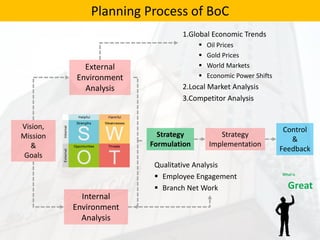
Vision,
Mission
&
Goals
Internal
Environment
Analysis
External
Environment
Analysis
Strategy
Implementation
Control
&
Feedback
Strategy
Formulation
1.Global Economic Trends
ď‚§ Oil Prices
ď‚§ Gold Prices
ď‚§ World Markets
ď‚§ Economic Power Shifts
2.Local Market Analysis
3.Competitor Analysis
Qualitative Analysis
ď‚§ Employee Engagement
ď‚§ Branch Net Work
Planning Process of BoC
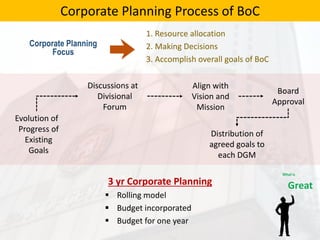
1. Resource allocation
2. Making Decisions
3. Accomplish overall goals of BoC
3 yr Corporate Planning
ď‚§ Rolling model
ď‚§ Budget incorporated
ď‚§ Budget for one year
Corporate Planning
Focus
Corporate Planning Process of BoC
Evolution of
Progress of
Existing
Goals
Discussions at
Divisional
Forum
Board
Approval
Align with
Vision and
Mission
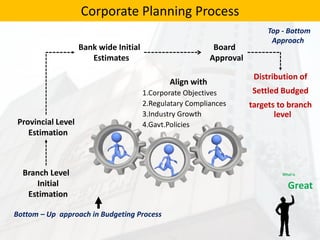
Distribution of
agreed goals to
each DGM
Distribution of
Settled Budged
targets to branch
level
Provincial Level
Estimation
Bank wide Initial
Estimates
Branch Level
Initial
Estimation
Board
Approval
Bottom – Up approach in Budgeting Process
Align with
1.Corporate Objectives
2.Regulatary Compliances
3.Industry Growth
4.Gavt.Policies
Top - Bottom
Approach
Corporate Planning Process
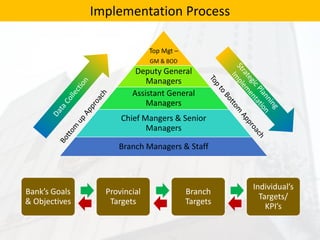
Top Mgt –
GM & BOD
Deputy General
Managers
Assistant General
Managers
Chief Mangers & Senior
Managers
Branch Managers & Staff
Bank’s Goals
& Objectives
Provincial
Targets
Branch
Targets
Individual’s
Targets/
KPI’s
Implementation Process
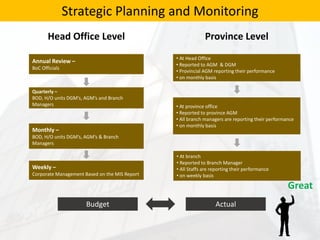
Head Office Level Province Level
Annual Review –
BoC Officials
• At Head Office
• Reported to AGM & DGM
• Provincial AGM reporting their performance
• on monthly basis
Quarterly –
BOD, H/O units DGM’s, AGM’s and Branch
Managers • At province office
• Reported to province AGM
• All branch managers are reporting their performance
• on monthly basis
Monthly –
BOD, H/O units DGM’s, AGM’s & Branch
Managers
Weekly –
Corporate Management Based on the MIS Report
Budget Actual
Strategic Planning and Monitoring
• At branch
• Reported to Branch Manager
• All Staffs are reporting their performance
• on weekly basis
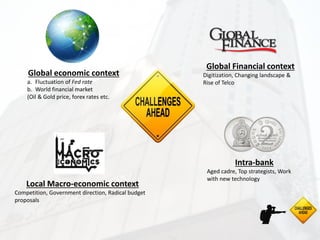
Challenges
Global economic context
a. Fluctuation of Fed rate
b. World financial market
(Oil & Gold price, forex rates etc.
Global Financial context
Digitization, Changing landscape &
Rise of Telco
Intra-bank
Aged cadre, Top strategists, Work
with new technology
Local Macro-economic context
Competition, Government direction, Radical budget
proposals
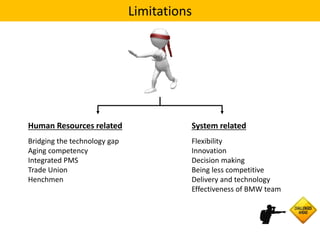
Limitations
Human Resources related
Bridging the technology gap
Aging competency
Integrated PMS
Trade Union
Henchmen
System related
Flexibility
Innovation
Decision making
Being less competitive
Delivery and technology
Effectiveness of BMW team
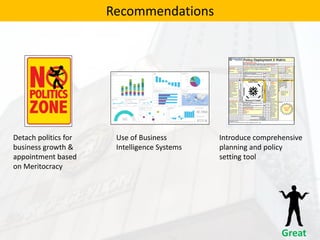
Recommendations
Recommendations
Detach politics for
business growth &
appointment based
on Meritocracy
Introduce comprehensive
planning and policy
setting tool
Use of Business
Intelligence Systems
References
- Robbins, S. P., Judge, T. A. & Vohra, N. (2013). Organizational behaviour. (15 th
edition). New Delhi: Pearson.
- Daft, R.L. (2015). New Era of Management, New Delhi: South-Western
Robins,S.P., Coulter,M., & Vohra , N.(2011). Management, New Delhi, Pearson
publications.
- Bank Of Ceylon (n.d.).Bank profile,corporate profile,financial highlights. Retrieved
10th January 2015,http://web.boc.lk/index.php?route=information/information
& information_id=4
www.combank.net
Presented by
MBA IN HRM 2015/17
GROUP NO.2
Ms. S.V.N Perera (2015/MBA/WE/HRM/14)
Mr. L.D.R.S. Lankage (2015/MBA/WE/HRM/08)
Mr. L. Havikkumar (2015/MBA/WE/HRM/04)
Mr. Hiran Kularatne (2015/MBA/WE/HRM/07)
Mr. M.M. Maddumabandara (2015/MBA/WE/HRM/09)
Questions?

BoC - MBA HR2

  • 1.
    “From Good toGreat” Management Case Study - MBA/ HR/ 02
  • 2.
    Current Status -Bank of Ceylon
  • 3.
    ď‚§ Established on1st August 1939 ď‚§ Leader in assets, deposits, foreign currency remittance ď‚§ 13 Subsidiaries and 5 associate companies. ď‚§ Over 620 branches & 540 ATM network ď‚§ Operated in United Kingdom, India, Maldives and Seychelles. Bank of Ceylon - Profile
  • 4.
     No.1 brandfor seventh consecutive years  Brand value Rs.38 billion in year 2015  Debt securities – 19 December 2008
  • 5.
  • 6.
     Most fundamentalmanagement process  Managers must plan for future organizational direction and for unexpected events.  The plans should meet environmental changes and expectations of stakeholders.  Advantages – • Legitimacy and standard for performance • Source of motivation and commitment, • Guide resource allocation & action • Provide rationale for decisions Planning “Planning is the process of determining organizational goals and defining the means of achieving them” (Daft. L,2015).
  • 7.
    Levels of Goalsand Plans Mission Statement Strategic Goals Tactical Goals Operational Goals Senior Management Middle Management Lower Management Internal Message Legitimacy, Motivation, resource allocation, guides rationale etc. External Message Legitimacy for investors, customers & suppliers
  • 8.
    Organizational Planning Process 1.Develop the Plan ď‚§ Define mission & vision ď‚§ Set Goals 2. Translate the Plan ď‚§ Define tactical plans & objectives ď‚§ Develop strategy map ď‚§ Define contingency plans and scenarios ď‚§ Identify intelligence 3. Plan Operations ď‚§ Define operational plans & objectives ď‚§ Develop strategy map ď‚§ Define contingency plans and scenarios ď‚§ Identify intelligence 4. Execute the Plan ď‚§ Management by Objectives ď‚§ Performance dashboards ď‚§ Single use plans ď‚§ Decentralized responsibility 5. Monitor & Learn ď‚§ Hold planning reviews ď‚§ Hold operational reviews
  • 9.
    Vision, Mission & Goals Internal Environment Analysis External Environment Analysis Strategy Implementation Control & Feedback Strategy Formulation 1.Global Economic Trends ď‚§Oil Prices ď‚§ Gold Prices ď‚§ World Markets ď‚§ Economic Power Shifts 2.Local Market Analysis 3.Competitor Analysis Qualitative Analysis ď‚§ Employee Engagement ď‚§ Branch Net Work Planning Process of BoC
  • 10.
    1. Resource allocation 2.Making Decisions 3. Accomplish overall goals of BoC 3 yr Corporate Planning ď‚§ Rolling model ď‚§ Budget incorporated ď‚§ Budget for one year Corporate Planning Focus Corporate Planning Process of BoC Evolution of Progress of Existing Goals Discussions at Divisional Forum Board Approval Align with Vision and Mission Distribution of agreed goals to each DGM
  • 11.
    Distribution of Settled Budged targetsto branch level Provincial Level Estimation Bank wide Initial Estimates Branch Level Initial Estimation Board Approval Bottom – Up approach in Budgeting Process Align with 1.Corporate Objectives 2.Regulatary Compliances 3.Industry Growth 4.Gavt.Policies Top - Bottom Approach Corporate Planning Process
  • 12.
    Top Mgt – GM& BOD Deputy General Managers Assistant General Managers Chief Mangers & Senior Managers Branch Managers & Staff Bank’s Goals & Objectives Provincial Targets Branch Targets Individual’s Targets/ KPI’s Implementation Process
  • 13.
    Head Office LevelProvince Level Annual Review – BoC Officials • At Head Office • Reported to AGM & DGM • Provincial AGM reporting their performance • on monthly basis Quarterly – BOD, H/O units DGM’s, AGM’s and Branch Managers • At province office • Reported to province AGM • All branch managers are reporting their performance • on monthly basis Monthly – BOD, H/O units DGM’s, AGM’s & Branch Managers Weekly – Corporate Management Based on the MIS Report Budget Actual Strategic Planning and Monitoring • At branch • Reported to Branch Manager • All Staffs are reporting their performance • on weekly basis
  • 14.
  • 15.
    Global economic context a.Fluctuation of Fed rate b. World financial market (Oil & Gold price, forex rates etc. Global Financial context Digitization, Changing landscape & Rise of Telco Intra-bank Aged cadre, Top strategists, Work with new technology Local Macro-economic context Competition, Government direction, Radical budget proposals
  • 16.
    Limitations Human Resources related Bridgingthe technology gap Aging competency Integrated PMS Trade Union Henchmen System related Flexibility Innovation Decision making Being less competitive Delivery and technology Effectiveness of BMW team
  • 17.
  • 18.
    Recommendations Detach politics for businessgrowth & appointment based on Meritocracy Introduce comprehensive planning and policy setting tool Use of Business Intelligence Systems
  • 21.
    References - Robbins, S.P., Judge, T. A. & Vohra, N. (2013). Organizational behaviour. (15 th edition). New Delhi: Pearson. - Daft, R.L. (2015). New Era of Management, New Delhi: South-Western Robins,S.P., Coulter,M., & Vohra , N.(2011). Management, New Delhi, Pearson publications. - Bank Of Ceylon (n.d.).Bank profile,corporate profile,financial highlights. Retrieved 10th January 2015,http://web.boc.lk/index.php?route=information/information & information_id=4
  • 22.
    www.combank.net Presented by MBA INHRM 2015/17 GROUP NO.2 Ms. S.V.N Perera (2015/MBA/WE/HRM/14) Mr. L.D.R.S. Lankage (2015/MBA/WE/HRM/08) Mr. L. Havikkumar (2015/MBA/WE/HRM/04) Mr. Hiran Kularatne (2015/MBA/WE/HRM/07) Mr. M.M. Maddumabandara (2015/MBA/WE/HRM/09)
  • 23.