The B
Th Board-CEO Relationship
       d CEO R l ti   hi
       TAHRA Annual Meeting
         September 24, 2012


           Gatlinburg, TN


      Presented By:
Leadership
L d hi


        Influence
Governance

  Organizational control by group
 leadership, usually on the behalf of
           p,       y
others, that ensures an organization
achieves what it should achieve while
     avoiding those behaviors and
  situations that should be avoided.
Management
M        t

The organization and coordination of  f
   the activities of an enterprise in
 accordance with certain policies and
          in achievement of
          defined objectives
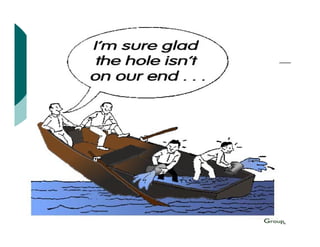
BOARD IS TO CEO AS…….
C
Crossing th St k h ld R I V E R
     i the Stakeholder R.I.V.E.R.
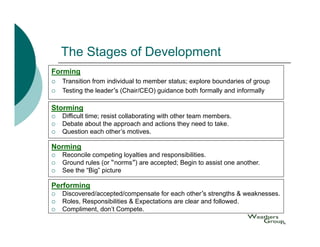
The Stages of Development
Forming
  Transition from individual to member status; explore boundaries of group
  Testing the leader’s (Chair/CEO) guidance both formally and informally

Storming
  Difficult time; resist collaborating with other team members.
  Debate about the approach and actions they need to take.
  Question each other’s motives.

Norming
  Reconcile competing loyalties and responsibilities.
  Ground rules (or “norms”) are accepted; Begin to assist one another.
  See the “Big” picture
           Big

Performing
  Discovered/accepted/compensate for each other’s strengths & weaknesses.
  Roles,
  Roles Responsibilities & Expectations are clear and followed
                                                      followed.
  Compliment, don’t Compete.
The Stages of
                Organizational D
                O    i ti     l Development
                                    l     t
                                         PERFORMING


              FORMING
       ance


                                   NORMING
 erforma
Pe


                        STORMING


                            Time
Strategic Framework


               VISION
      VALUES             VALUES


               MISSION
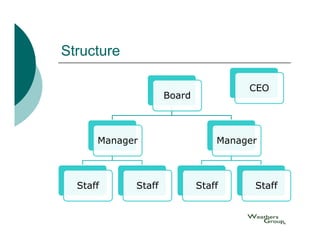
Structure
St t

                                     CEO
                    Board


      Manager                   Manager


  Staff     Staff           Staff     Staff
Structure
St t

                                   Board
                    CEO


      Manager                 Manager


  Staff     Staff         Staff     Staff
Structure: Governing Board
         St t       G     i B d

                                  Owners


Policy                            Board             Agent of the Owners


                                   CEO              Agent of the Board
Processes


                    Manager                    Manager


Procedures
                Staff     Staff            Staff     Staff
The 5 Dysfunctions of a
           Board-CEO Relationship*
           B d CEO R l ti       hi *


*Adapted from Patrick Lencioni:
The Five Dysfunctions of a
Team – A Leadership Fable
1. Fear of “Healthy” C fli t
        1 F      f “H lth ” Conflict
          Fear Conflict                      Engage Conflict
                                               g g


Everybody thinks the same thing.     Healthy debate and dialogue.  
No one challenges the status quo.    Consider new ways of doing 
Strive to be “liked”.                things.  Everyone is respected.
Take resistance to our ideas         De‐personalize the problems and 
personally without clarification.    focus on solutions
“Back office” conversations and      Communication is appropriately 
personal attacks thrive
personal attacks thrive              direct and intentional 
                                     direct and intentional
Ignore controversial topics (the     We discuss the “undiscussables”
   p
elephant in the room) )
2. Lack f Commitment
            2 L k of C    it   t
       Failure to Commit
       F il    t C    it                     Commitment
                                             C   it   t


Missed opportunities due to 
           pp                      Clarity around direction and 
                                         y
excessive analysis and             priorities
unnecessary delays 
Inability to make decisions and
          to make decisions and    Make decisions and when 
                                   Make decisions and when
“move”                             necessary, change direction 
                                   without guilt 
Continual second‐guessing  and 
C ti    l      d      i      d     Confident and focused on what 
                                   C fid t d f          d      h t
doubt                              will work
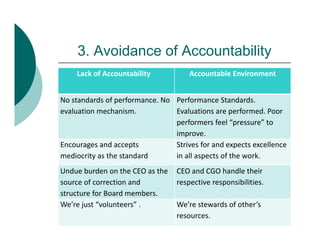
3. Avoidance of A
     3 A id        f Accountability
                           t bilit
    Lack of Accountability
                         y            Accountable Environment


No standards of performance. No  Performance Standards.  
evaluation mechanism.            Evaluations are performed. Poor 
                                 performers feel “pressure” to 
                                 improve.
Encourages and accepts           Strives for and expects excellence 
mediocrity as the standard       in all aspects of the work. 
Undue burden on the CEO as the 
Undue burden on the CEO as the CEO and CGO handle their
                                    and CGO handle their 
source of correction and        respective responsibilities. 
structure for Board members. 
We’re just “volunteers” .       We’re stewards of other’s 
                                resources. 
4. Inattention to Results
             4 I tt ti t R         lt
    Not Focused on Results
    Not Focused on Results         Focused on Collective Results
                                           on Collective Results


Loses achievement‐oriented       Retains achievement‐oriented
people                           people
Stagnates and fails to grow      A culture of “learning” and 
                                 continuous improvement
The needs of the individual come  Mission‐focused
before the mission 

Activity is significant          Accomplishment is significant. 
5. Absence of T t
                5 Ab        f Trust
        Absence of Trust
        Ab       fT t                        Presence of Trust
                                             P         fT t


Conceal weaknesses and mistakes  Admit weaknesses and mistakes
Conceal weaknesses and mistakes Admit weaknesses and mistakes


Hesitate to ask for help or provide  Ask for help
                       p p                      p
constructive feedback

Jump to conclusions about the       Give each other the benefit of the 
intentions of others without        doubt
attempting clarification
Trust F
             T t Formula*
                      l *


                        Trust             Speed

                                                   Nonsense


                                          Morale


                                                    Cost


*Stephen M.R. Covey, The Speed of Trust
Trust F
             T t Formula*
                      l *


                                                    Cost


                                                   Nonsense
                                          Morale

                      Trust

                                          Speed


*Stephen M.R. Covey, The Speed of Trust
Principles f Effective R l ti
P i i l of Eff ti Relationships
                              hi
1.
1    Establish Ground Rules
2.   Acknowledge the Realities of the
     Board CEO
     Board-CEO Relationship
3.   A Healthy Relationship Between the
     Board Chair and CEO
4.   Clarity of Roles, Responsibilities and
     Expectations
5.   Communicate, Communicate,
     Communicate
Thank You.
        h k


       www.weathersgroup.com
                    @charlesweathers

803.400.1991 (Ph)      *   info@weathersgroup.com

Board Ceo Relationship

  • 1.
    The B Th Board-CEORelationship d CEO R l ti hi TAHRA Annual Meeting September 24, 2012 Gatlinburg, TN Presented By:
  • 2.
  • 3.
    Governance Organizationalcontrol by group leadership, usually on the behalf of p, y others, that ensures an organization achieves what it should achieve while avoiding those behaviors and situations that should be avoided.
  • 4.
    Management M t The organization and coordination of f the activities of an enterprise in accordance with certain policies and in achievement of defined objectives
  • 5.
    BOARD IS TOCEO AS…….
  • 6.
    C Crossing th Stk h ld R I V E R i the Stakeholder R.I.V.E.R.
  • 7.
    The Stages ofDevelopment Forming Transition from individual to member status; explore boundaries of group Testing the leader’s (Chair/CEO) guidance both formally and informally Storming Difficult time; resist collaborating with other team members. Debate about the approach and actions they need to take. Question each other’s motives. Norming Reconcile competing loyalties and responsibilities. Ground rules (or “norms”) are accepted; Begin to assist one another. See the “Big” picture Big Performing Discovered/accepted/compensate for each other’s strengths & weaknesses. Roles, Roles Responsibilities & Expectations are clear and followed followed. Compliment, don’t Compete.
  • 8.
    The Stages of Organizational D O i ti l Development l t PERFORMING FORMING ance NORMING erforma Pe STORMING Time
  • 9.
    Strategic Framework VISION VALUES VALUES MISSION
  • 10.
    Structure St t CEO Board Manager Manager Staff Staff Staff Staff
  • 11.
    Structure St t Board CEO Manager Manager Staff Staff Staff Staff
  • 12.
    Structure: Governing Board St t G i B d Owners Policy Board Agent of the Owners CEO Agent of the Board Processes Manager Manager Procedures Staff Staff Staff Staff
  • 13.
    The 5 Dysfunctionsof a Board-CEO Relationship* B d CEO R l ti hi * *Adapted from Patrick Lencioni: The Five Dysfunctions of a Team – A Leadership Fable
  • 14.
    1. Fear of“Healthy” C fli t 1 F f “H lth ” Conflict Fear Conflict Engage Conflict g g Everybody thinks the same thing.   Healthy debate and dialogue.   No one challenges the status quo. Consider new ways of doing  Strive to be “liked”.   things.  Everyone is respected. Take resistance to our ideas  De‐personalize the problems and  personally without clarification.  focus on solutions “Back office” conversations and  Communication is appropriately  personal attacks thrive personal attacks thrive direct and intentional  direct and intentional Ignore controversial topics (the  We discuss the “undiscussables” p elephant in the room) )
  • 15.
    2. Lack fCommitment 2 L k of C it t Failure to Commit F il t C it Commitment C it t Missed opportunities due to  pp Clarity around direction and  y excessive analysis and  priorities unnecessary delays  Inability to make decisions and to make decisions and  Make decisions and when  Make decisions and when “move”  necessary, change direction  without guilt  Continual second‐guessing  and  C ti l d i d Confident and focused on what  C fid t d f d h t doubt will work
  • 16.
    3. Avoidance ofA 3 A id f Accountability t bilit Lack of Accountability y Accountable Environment No standards of performance. No  Performance Standards.   evaluation mechanism.  Evaluations are performed. Poor  performers feel “pressure” to  improve. Encourages and accepts  Strives for and expects excellence  mediocrity as the standard in all aspects of the work.  Undue burden on the CEO as the  Undue burden on the CEO as the CEO and CGO handle their and CGO handle their  source of correction and  respective responsibilities.  structure for Board members.  We’re just “volunteers” . We’re stewards of other’s  resources. 
  • 17.
    4. Inattention toResults 4 I tt ti t R lt Not Focused on Results Not Focused on Results Focused on Collective Results on Collective Results Loses achievement‐oriented  Retains achievement‐oriented people people Stagnates and fails to grow A culture of “learning” and  continuous improvement The needs of the individual come  Mission‐focused before the mission  Activity is significant Accomplishment is significant. 
  • 18.
    5. Absence ofT t 5 Ab f Trust Absence of Trust Ab fT t Presence of Trust P fT t Conceal weaknesses and mistakes  Admit weaknesses and mistakes Conceal weaknesses and mistakes Admit weaknesses and mistakes Hesitate to ask for help or provide  Ask for help p p p constructive feedback Jump to conclusions about the  Give each other the benefit of the  intentions of others without  doubt attempting clarification
  • 19.
    Trust F T t Formula* l * Trust Speed Nonsense Morale Cost *Stephen M.R. Covey, The Speed of Trust
  • 20.
    Trust F T t Formula* l * Cost Nonsense Morale Trust Speed *Stephen M.R. Covey, The Speed of Trust
  • 21.
    Principles f EffectiveR l ti P i i l of Eff ti Relationships hi 1. 1 Establish Ground Rules 2. Acknowledge the Realities of the Board CEO Board-CEO Relationship 3. A Healthy Relationship Between the Board Chair and CEO 4. Clarity of Roles, Responsibilities and Expectations 5. Communicate, Communicate, Communicate
  • 23.
    Thank You. h k www.weathersgroup.com @charlesweathers 803.400.1991 (Ph) * info@weathersgroup.com