BMAL 500
Research Paper Assignment Instructions
Overview
Please refer to the
Article Submission Assigment from the beginning of
the course to complete the
Research Paper Assignment. Please follow and format
your paper accordingly.
Instructions
ARTICLE SUBMITTED FOR THIS ASSIGNMENT WAS:
Article Summary:
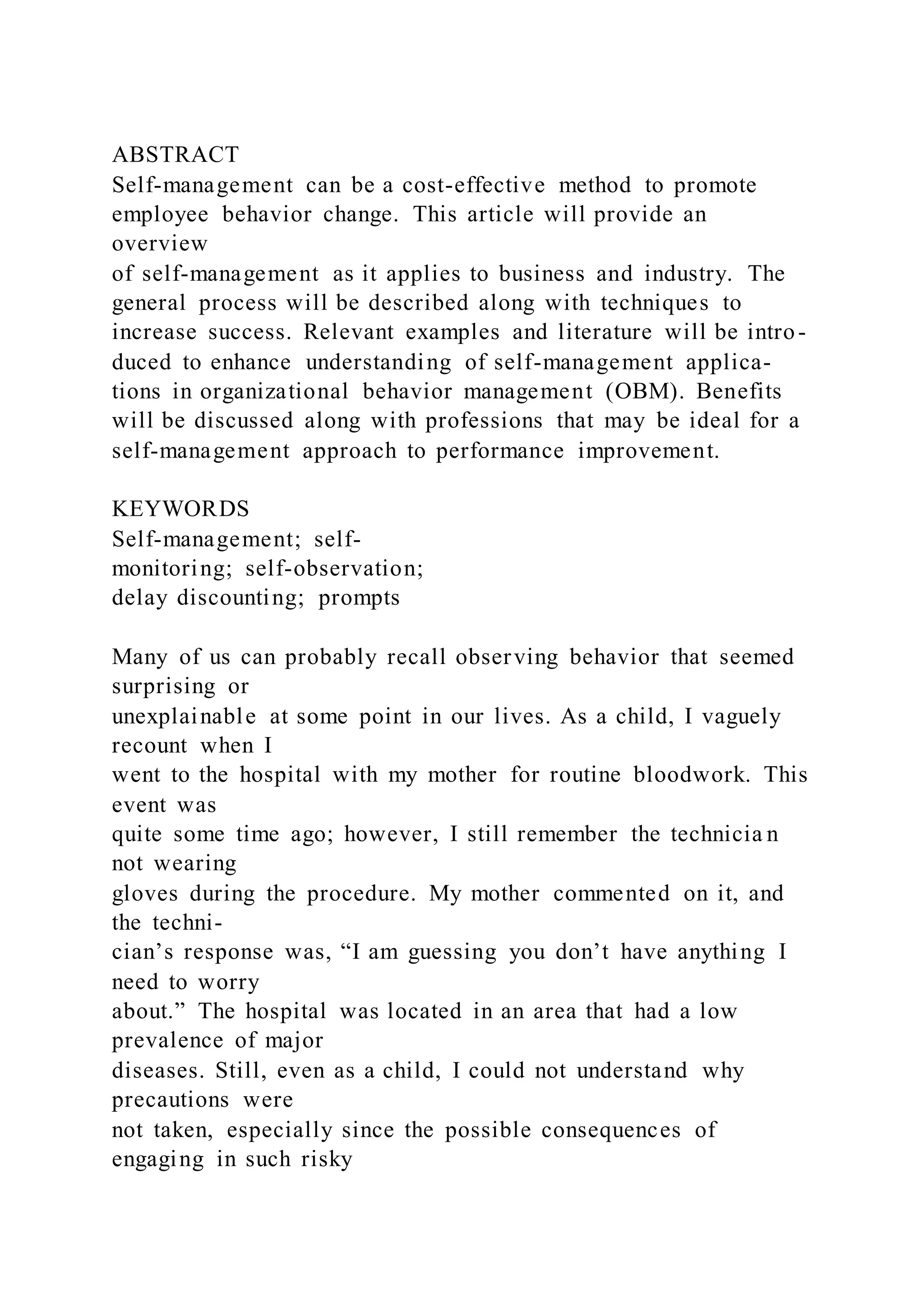
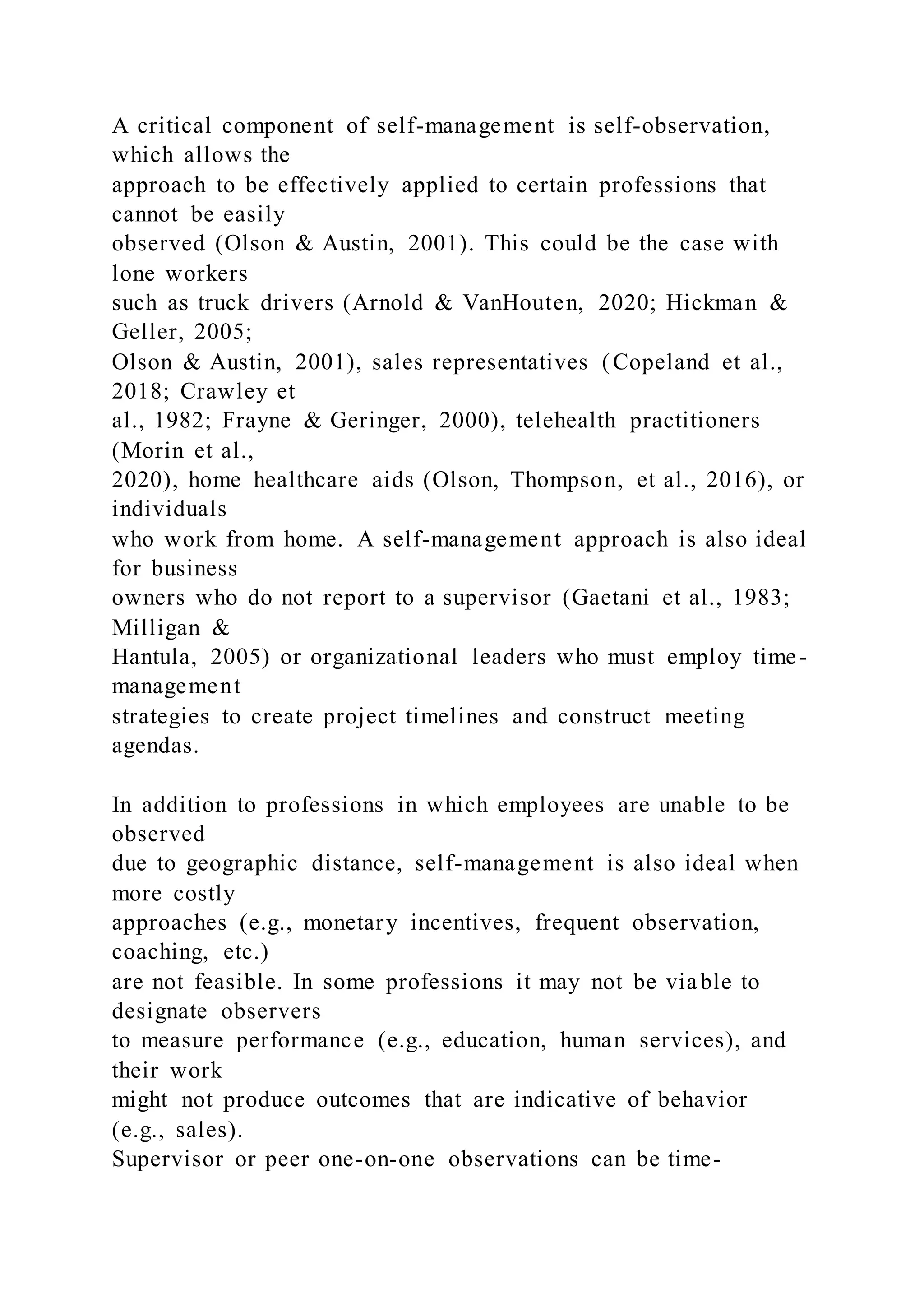
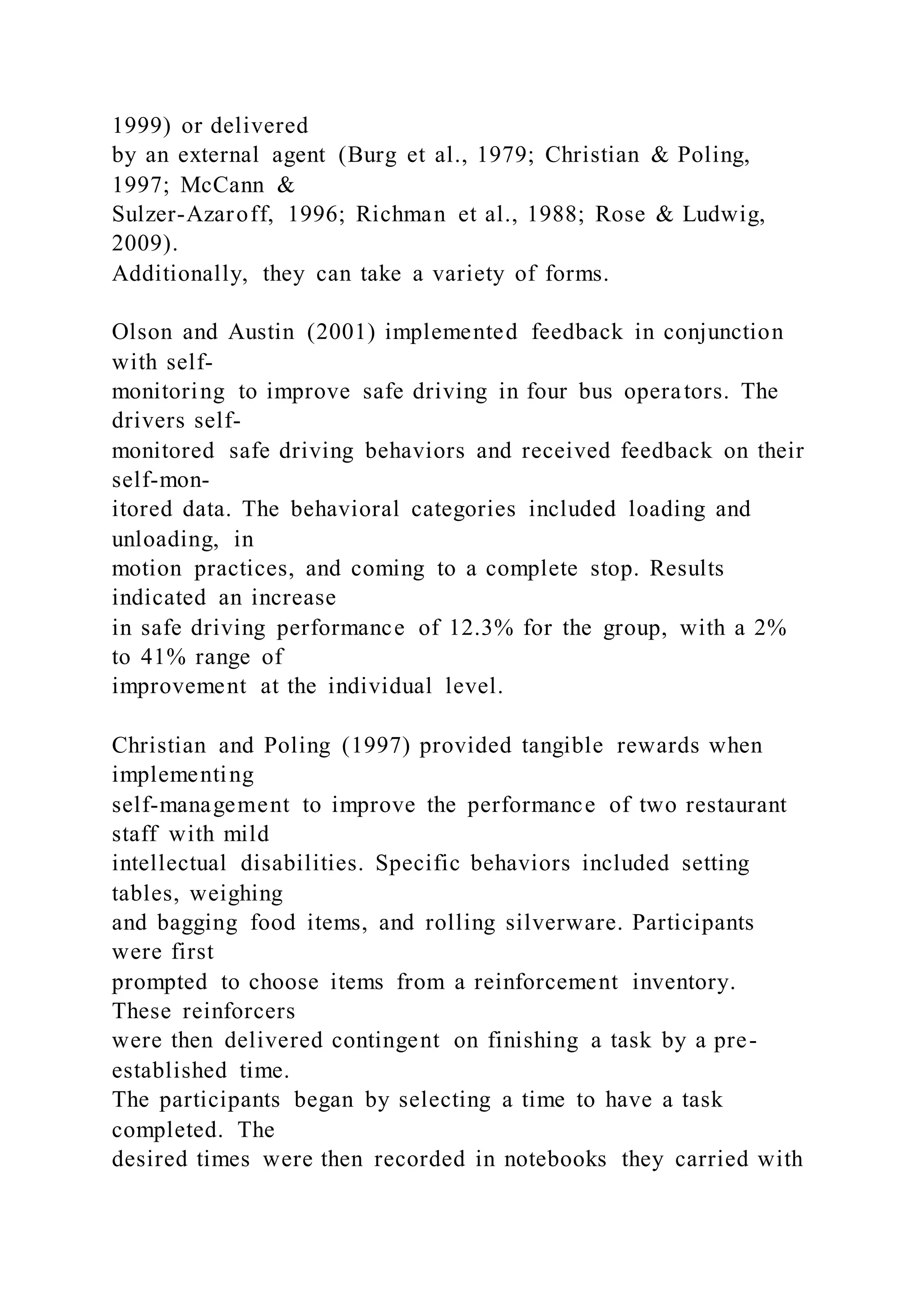
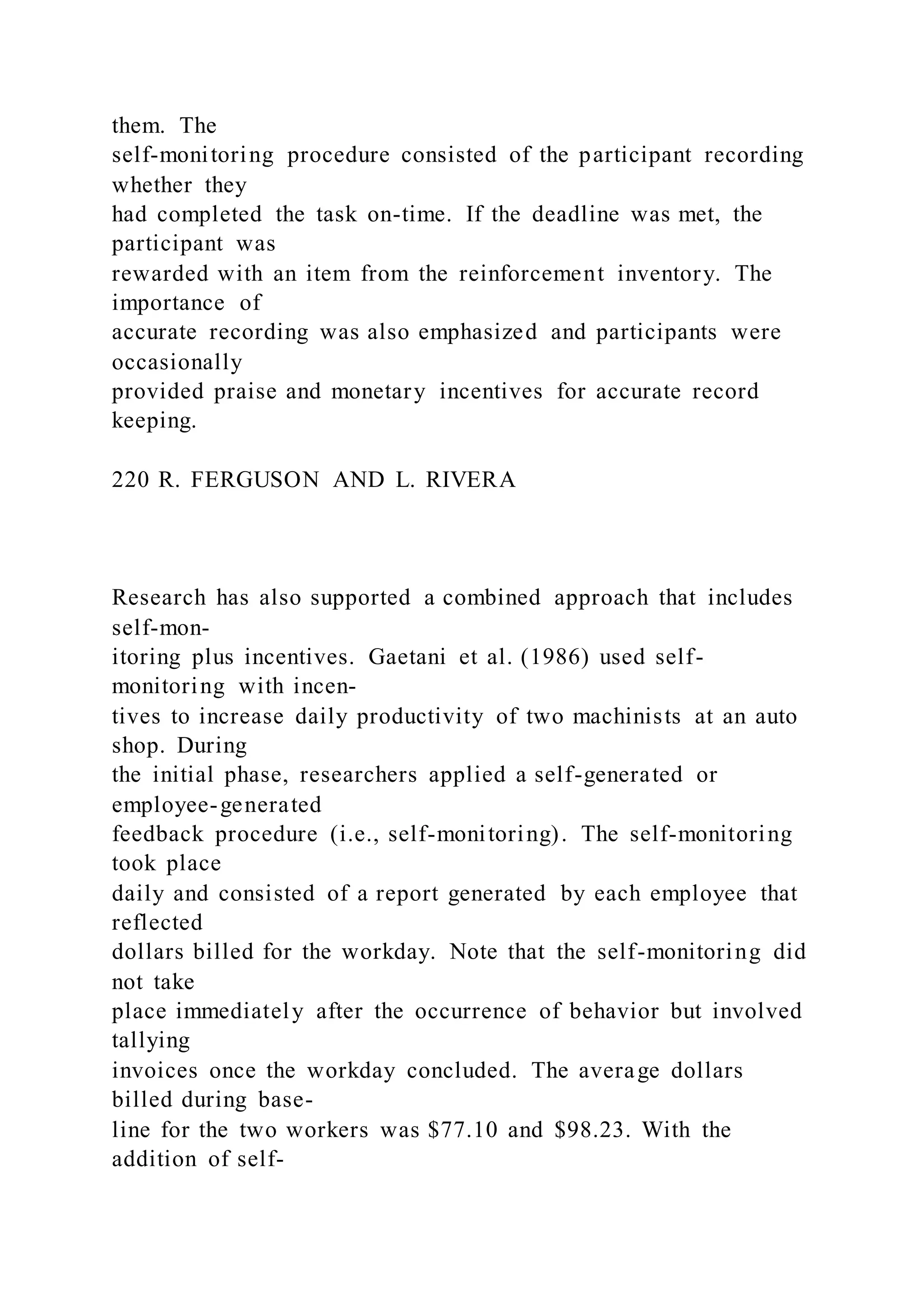
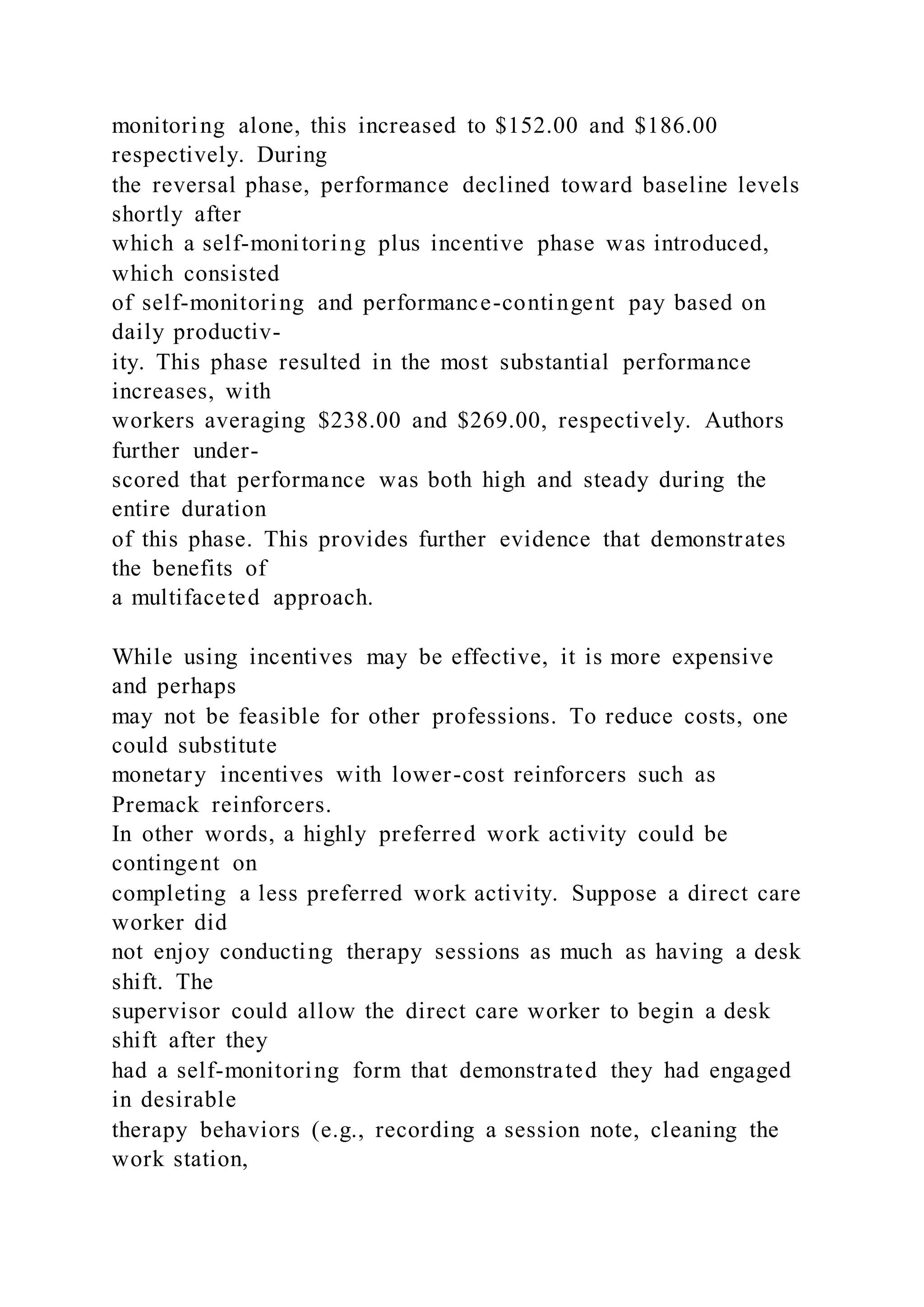
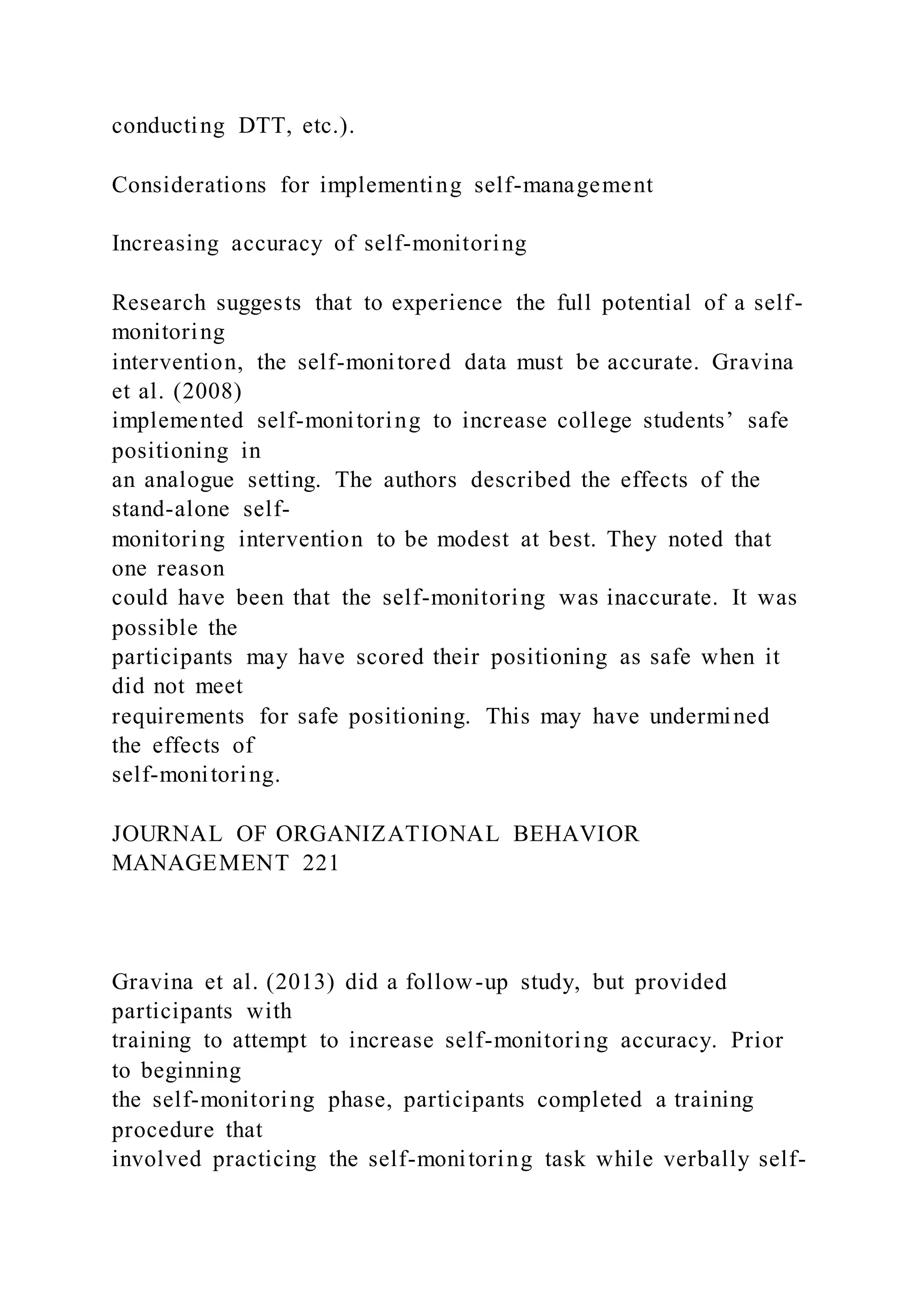
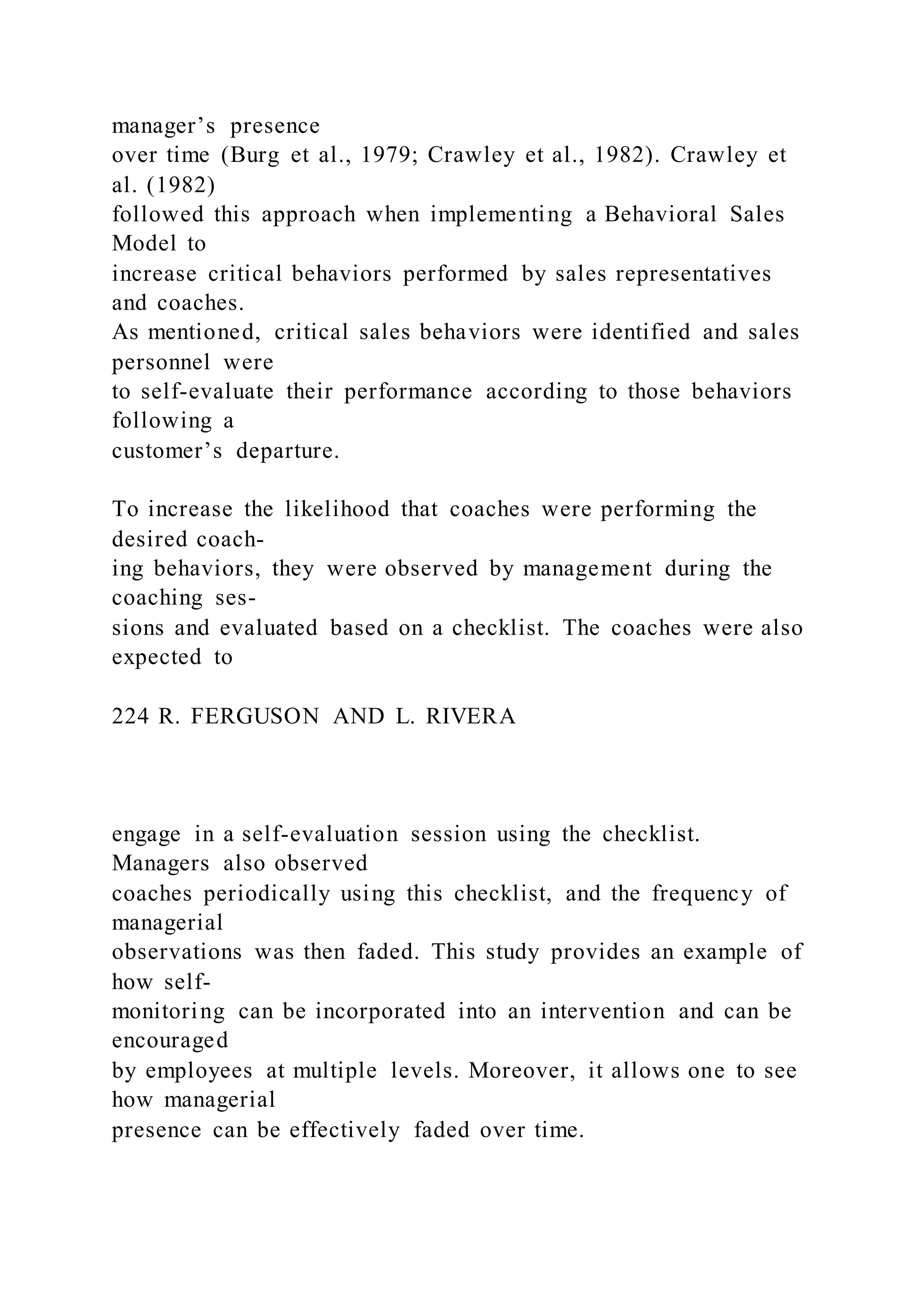
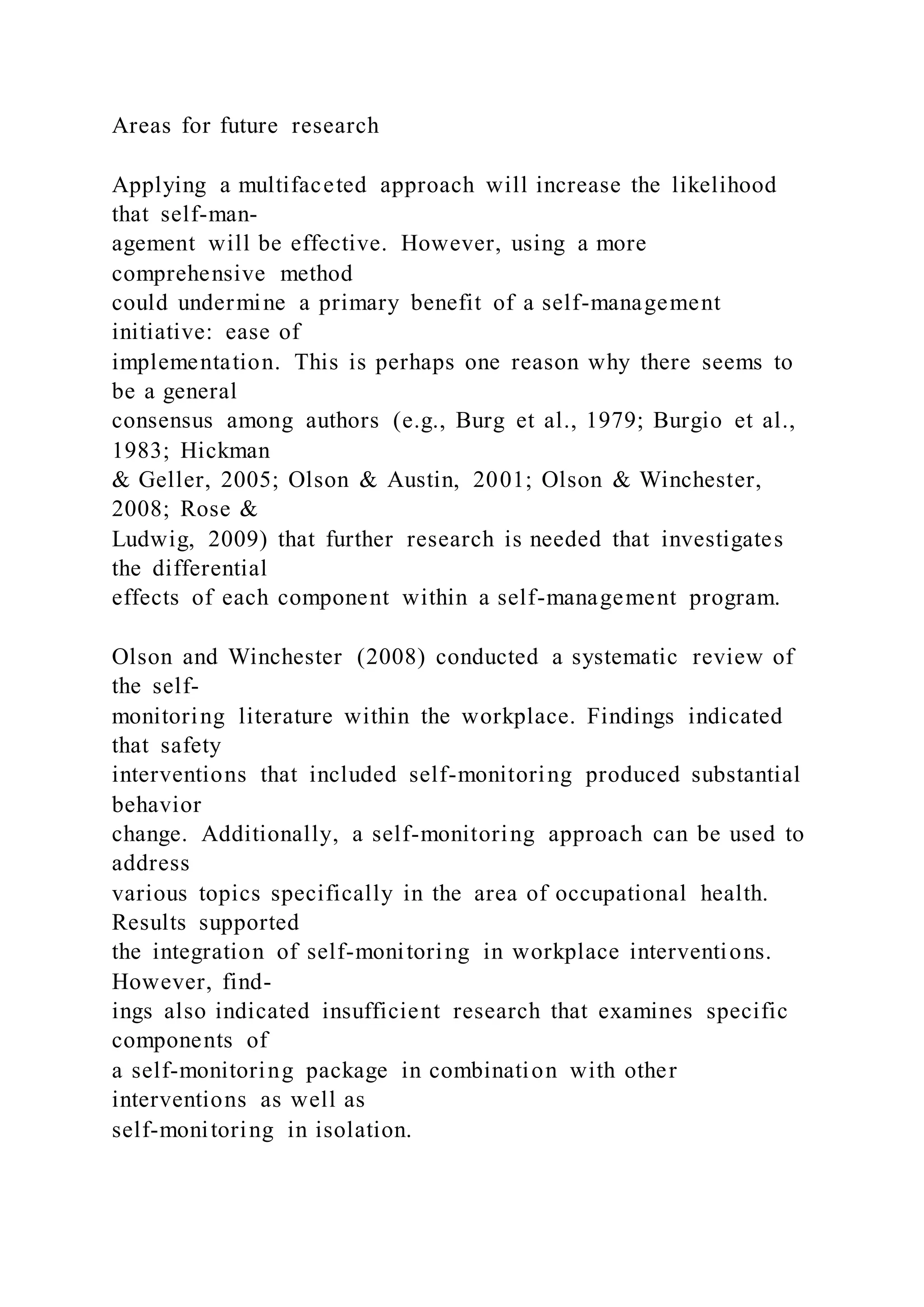
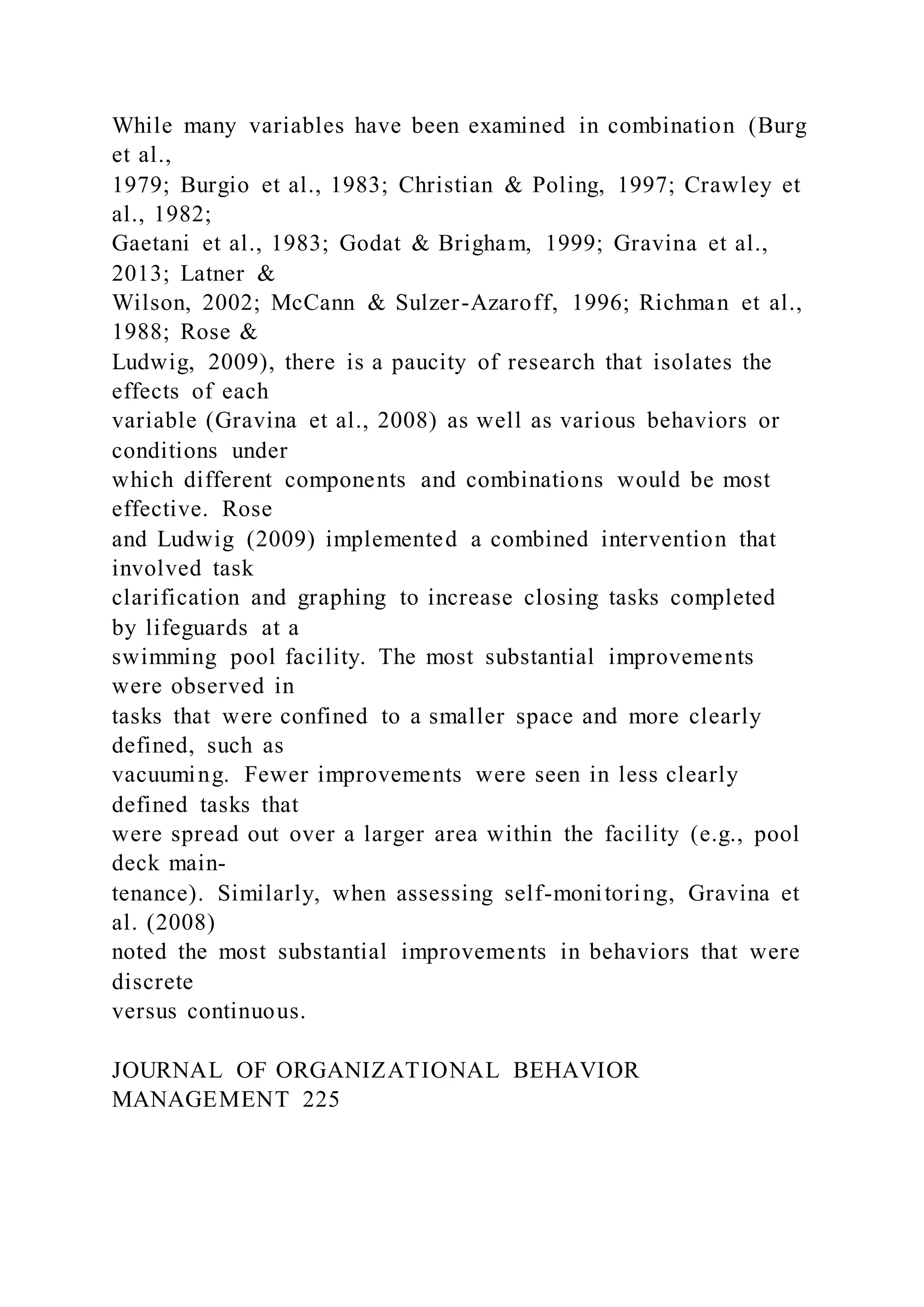
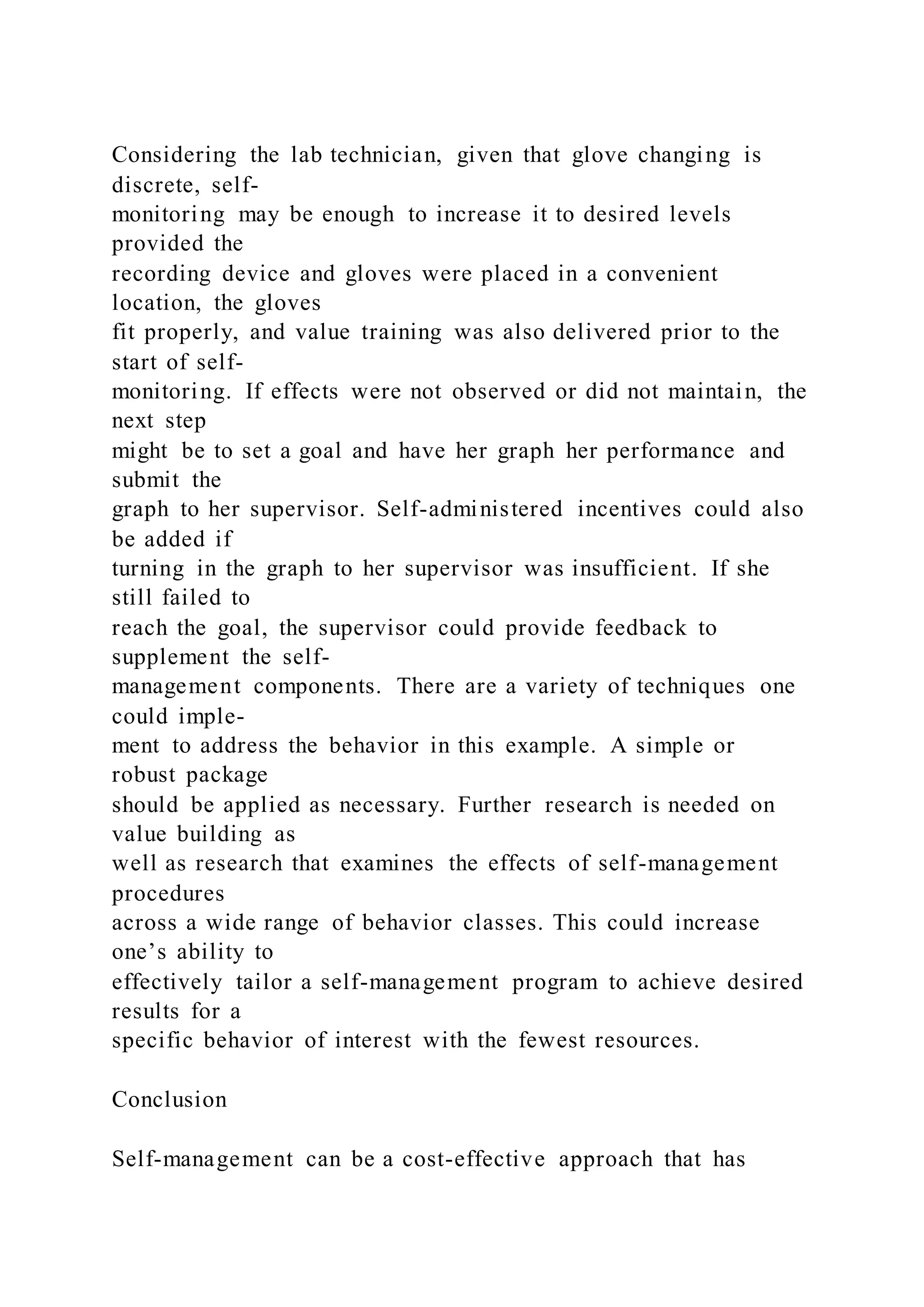
Self-management can be a cost-effective method to promote
employee behavior change. This article will provide an
overview of self-management as it applies to business and
industry (Ferguson & Rivera, 2021).
Topic:
describes techniques hot to increase and sustain success on self-
management.
Article:
Self-management in Organizational Behavior Management
(
USE THIS ARTICLE * CLICK ON IT )
Reference:
Ferguson, R., & Rivera, L. (2021). Self-management in
Organizational Behavior Management.
Journal of Organizational Behavior Management,
42(3), 210–229.
https://doi.org/10.1080/01608061.2021.1996502
Step 1
In the beginning of this course, you submitted a scholarly, peer -
reviewed article for approval. For this research paper, you will
discuss the importance of that article in regards to
organizational behavior while using the problem-solving,
integrative framework learned in Chapter 1. With your
organizational problem, provide the following information:
1. Brief summary of the organization.
2. Synopsis of the organizational challenges (Step 1 on the
problem-solving approach)
· What is the major overriding issue?
· Provide the facts and examples to support the explanation of
the problem.
· Discuss key issues that merit the discussion.
3. Who are the various individuals and what part do they play?
(Step 2 on the problem-solving approach)
· What challenges, threats, or opportunities do they pose?
· Explain the role of leadership in the situation.
· Provide any environmental issues that should be considered.
As you discuss these areas to address the first portion of the
problem-solving framework, provide examples and research to
support your discussion.
( USE THIS for
PROBLEM SOLVING APPROACH * CLICK ON IT )
Step 2
Now that you have laid the foundation of the problem, explain
how the theory you researched applies. Provide in depth
analysis with your article as the main evidence.
1. Explain the author’s current view on the chosen
organizational theory and how it relates to your problem.
2. Provide key indicators that the author applies from theory to
the concept in organizational behavior.
3. Discuss what you believe are the most relevant portions of
the article that tie the theory and concepts with your
organizational issue to create an explanation for the problem. In
other words, if you had to explain the organizational issue to
someone, how would you relate it to what the author has stated?
Step 3
The final process (Step 3) in the problem-solving framework is
recommendations. Based on your research, use this final step to
provide recommendation plans for the problem. Do you want to
resolve, solve, or dissolve the problem? Consider the
consequences as well for the plan of action in your
recommendation. Use well-thought-out ideas and research to
support your plan. Describe where you see your personality
style fitting into your recommendation for the organization to
make your plan work, to tie in the previous papers. Apply what
you have learned through Scripture, describing how the Lord
can utilize your strengths to implement the recommendation
plan.
Formatting
1. Use proper, current
APA format ( examples bellow) for every element of the
paper. Be sure to include the APA-formatted cover page,
abstract, and reference page. Refer to your APA manual for
help.
2. Write in first person—this is allowed due to the personal
nature of the assignment.
3. To facilitate the instructor’s grading of these assignments,
you must have major headings for Step 1, Step 2, and Step 3.
Additionally, under the major headings, you must have
subheadings as you see fit for the outlined instructions.
4. The exact number of paragraphs that you include in each
section is your decision; your instructor will not be grading you
on how many paragraphs you used per section, but rather the
extent to which you specifically addressed each of the areas
above.
5.
The 8–10 required pages do not include the title page,
abstract page, or reference page. Those must be counted as
additional pages.
6. Be sure to
double-space, using Times New Roman 12-point font
only, use 1-inch margins, and avoid bold font (except for
headlines, per current APA format), underlining, and
contractions.
7. The reference page must include a
minimum of the 5 following references Citations and
intext citations
(USE bellow) in current APA format (all sources must
be evident within the paper):
· The approved article for research
(Ferguson & Rivera, 2021)
Ferguson, R., & Rivera, L. (2021). Self-management in
Organizational Behavior Management.
Journal of Organizational Behavior Management,
42(3), 210–229.
https://doi.org/10.1080/01608061.2021.1996502
· Both of the course textbook(s)
(Kinicki, 2020)
Kinicki, A. (2020).
Ise Organizational Behavior: A practical, problem -
solving approach / C Angelo Kinicki. McGraw-Hill Education.
(Kroeger et al., 2002)
Kroeger, O., Thuesen, J. M., & Rutledge, H. (2002).
Type talk at work: How the 16 personality types
determine your success on the job. Dell Publishing.
·
2 other scholarly sources from a peer-reviewed journal
(Lieber & Graulich, 2020)
Lieber, L., & Graulich, N. (2020). Thinking in alternatives—a
task design for challenging students’ problem-solving
approaches in Organic Chemistry.
Journal of Chemical Education,
97(10), 3731–3738.
https://doi.org/10.1021/acs.jchemed.0c00248
(Chong, 2021)
Chong, P. K. (2021). Dilemma work: Problem-solving multiple
work roles into one work life.
Work and Occupations,
48(4), 432–469.
https://doi.org/10.1177/07308884211017623
Research Paper Tips
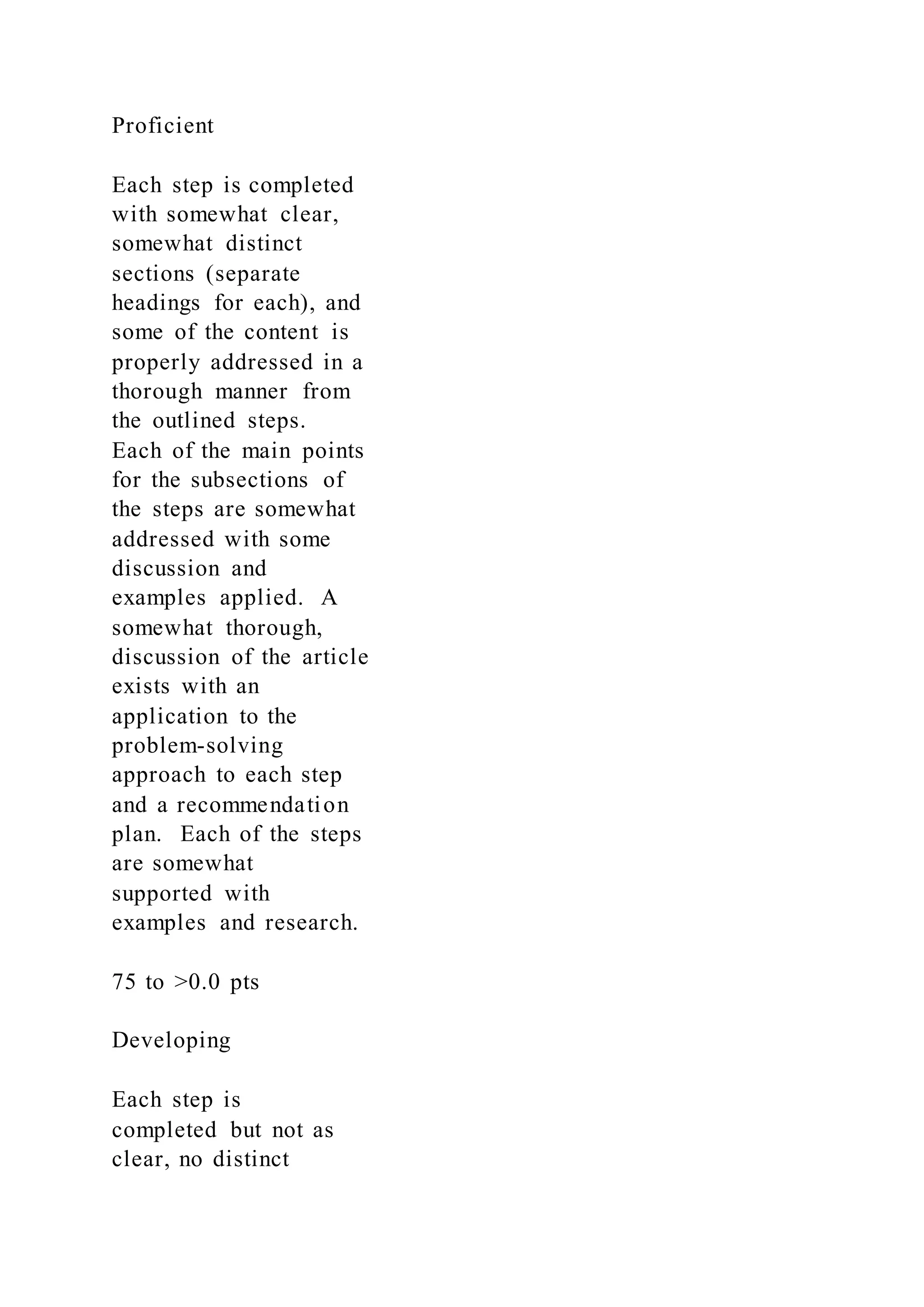
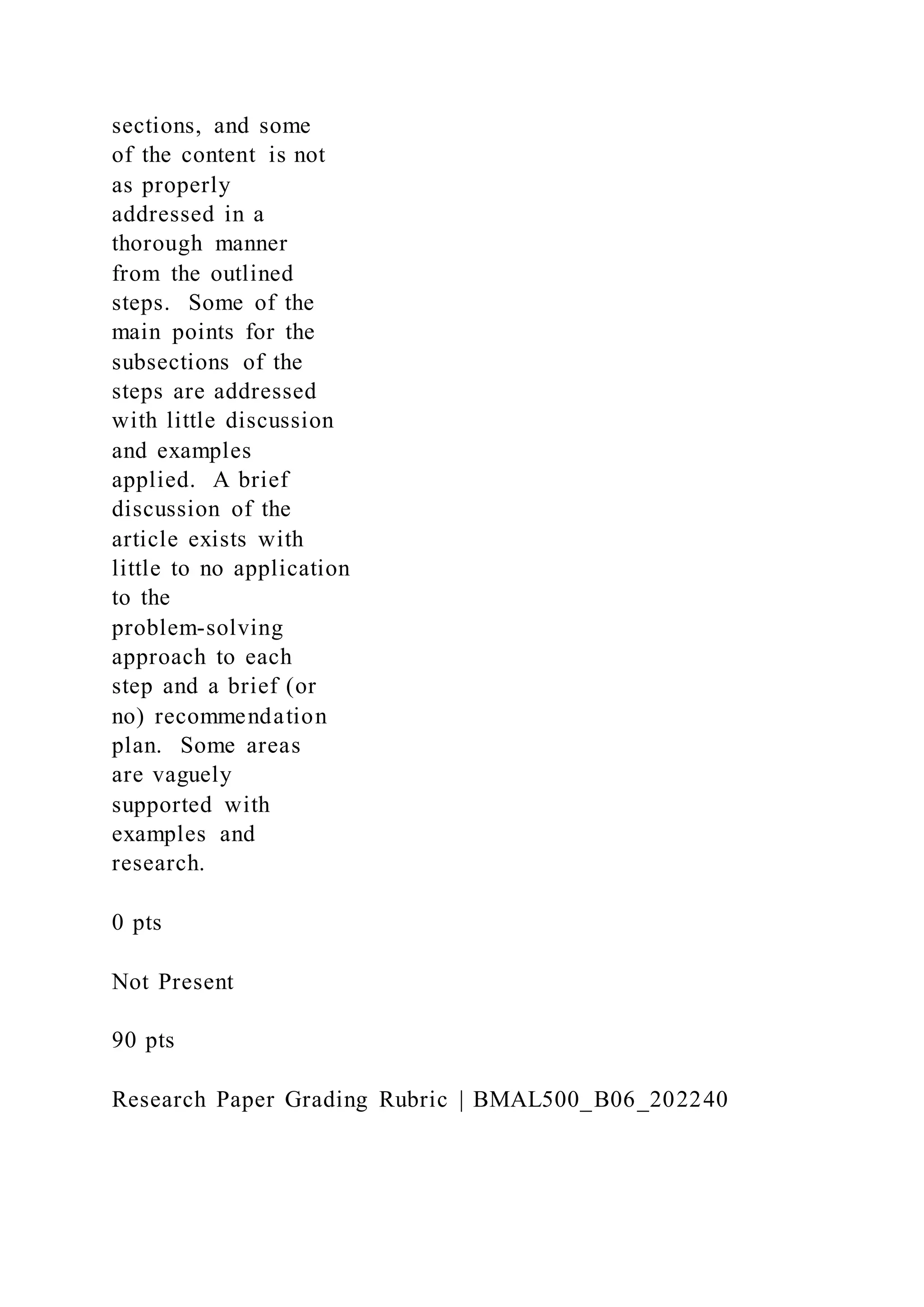
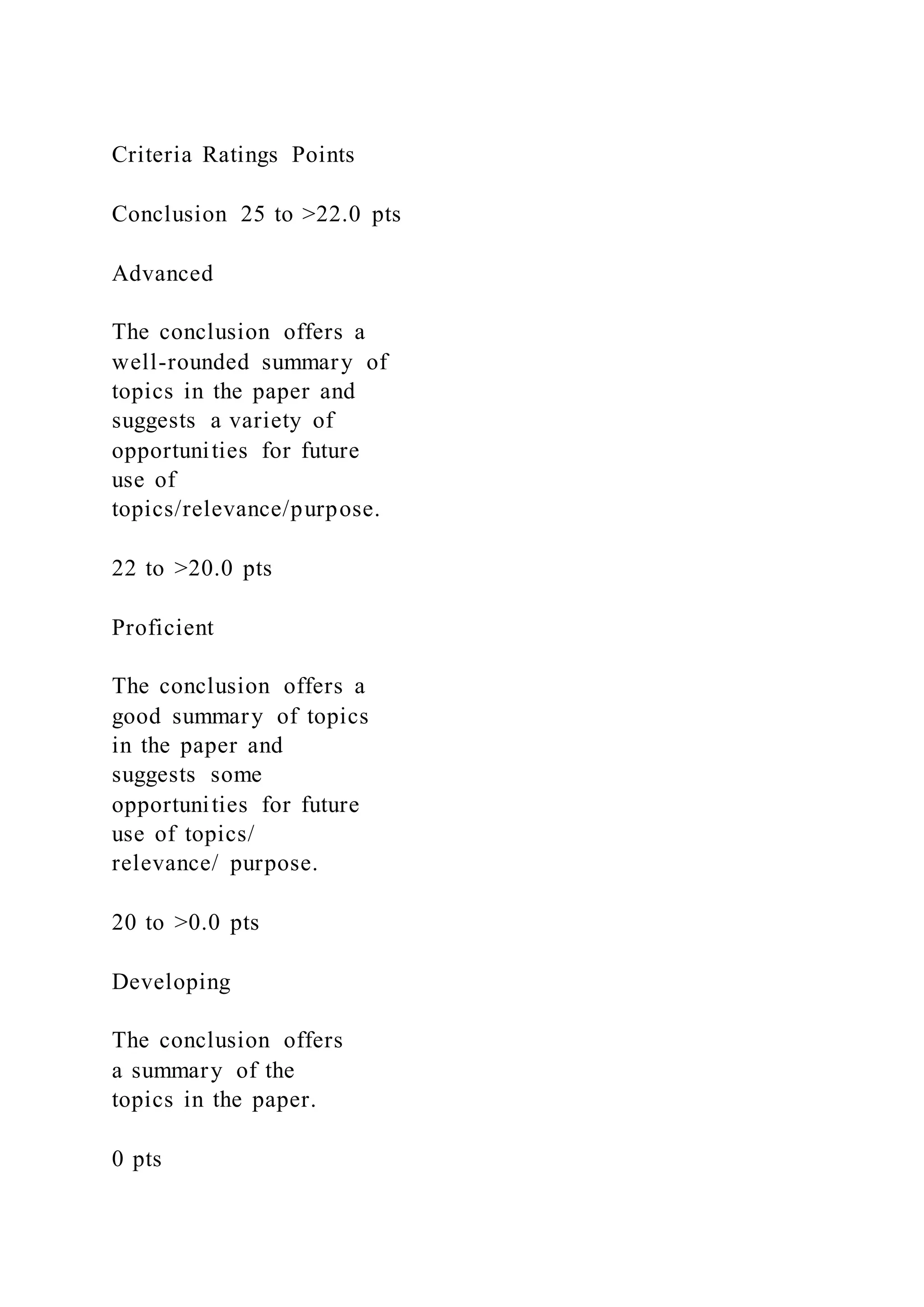
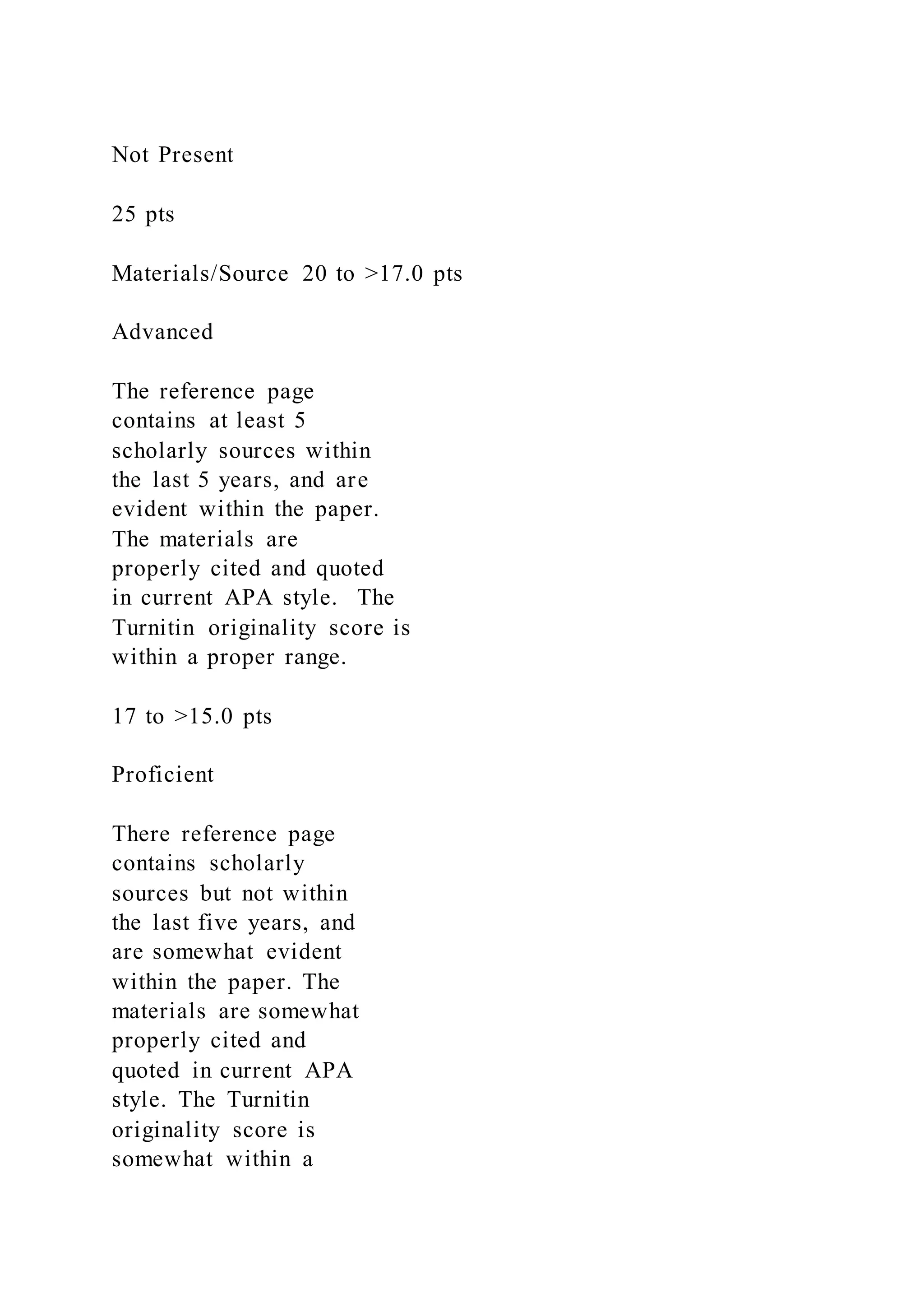
Research Paper Grading Rubric
Page 1 of 2
image2.emf
Microsoft_Word_Document.docx
image1.png
image2.png
image3.png
image3.emf
Microsoft_Word_Document1.docx
Personality Assesment
James W. Bland III
School of , Liberty University
Author Note
I have no known conflict of interest to disclose.
Correspondence concerning this article should be addressed to .
Email:
Abstract
Studies show that there are sixteen work personalities. Those
personalities are known as the type of table, which the Publisher
wrote, Consulting Psychologists Press, Inc. Palo Alto, Ca
94303. It shows how important it is to know identify your work
type for a healthy, happy, and fulfilled work environment for
yourself and others.
Keywords:
2
PERSONALITY ASSESSMENT 2
Introverts, extroverts, sensors, intuitive
Personality Assessment
Part 1: Jung and Briggs Myers personality results analysis
My personality test based on Jung and Briggs Myers
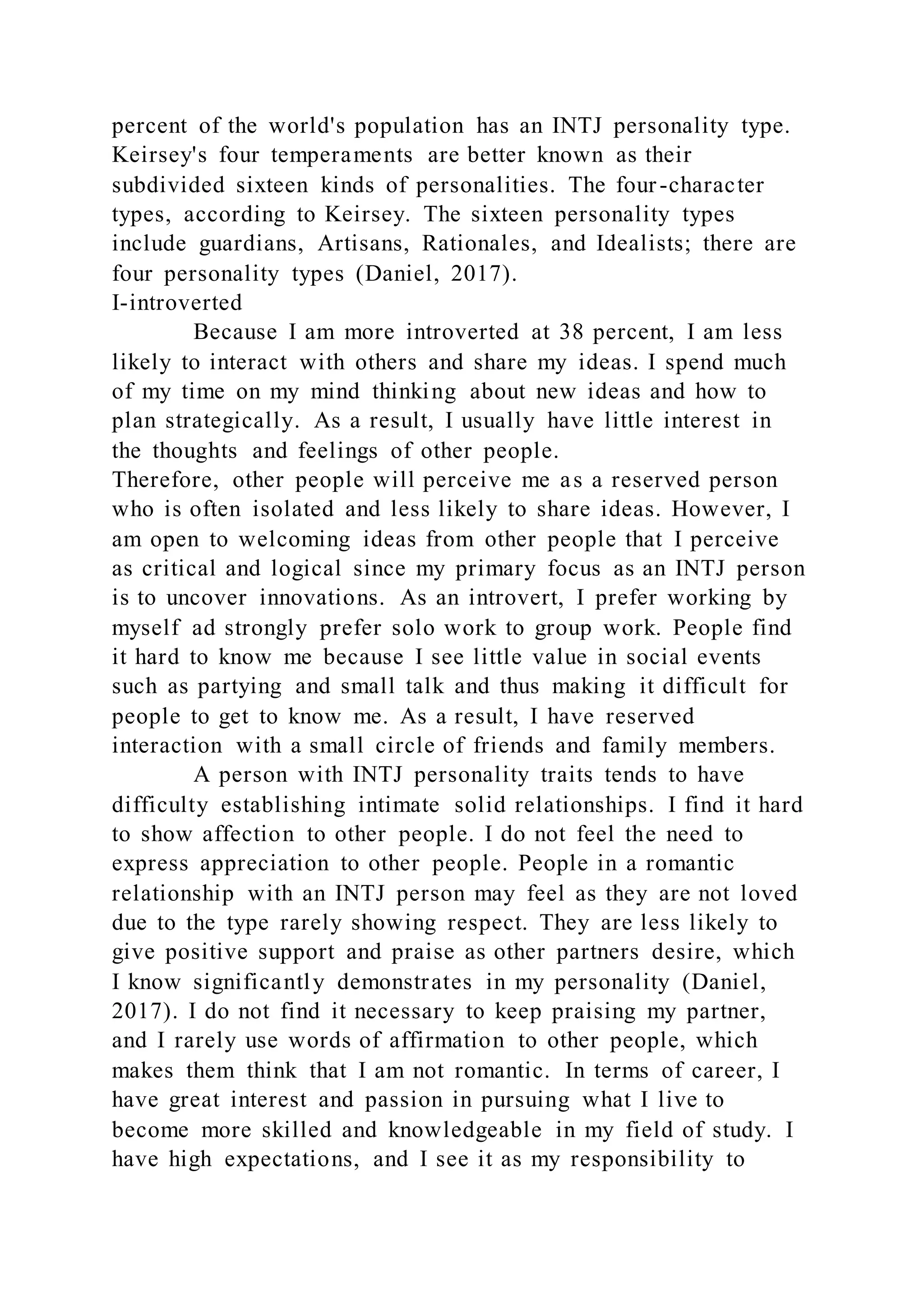
typology indicated that I have an INTJ (introverted (38
percent), Intuitive (19 percent), thinking (6 percent), and
judging (25 percent) type of personality. My results indicate
that I have a moderate preference for introversion over
extroversion. I have a slight preference for intuition over
sensing, a slight preference for thinking over feeling, and a mild
preference for judging over perceiving. As INTJ, my primary
mode of living is known to be focused intrinsically; I take
things and decisions based on my intuition. My secondary way
of living is external, where I deal with situations rationally and
logically. INTJ is known as masterminds; they live in a world of
ideas and plan strategically rather than following their
emotions. I value competence, intelligence, and knowledge as
an INTJ person, and I have similar expectations to other people
I work with currently and in the past. Since I am more of an
introvert, I channel my energy into observing the world to
generate potential ideas and possibilities which may turn out to
be innovative. According to David Keirsey, a psychologist, and
developer of the Keirsey Temperament Sorter, nearly 1 to 4
percent of the world's population has an INTJ personality type.
Keirsey's four temperaments are better known as their
subdivided sixteen kinds of personalities. The four-character
types, according to Keirsey. The sixteen personality types
include guardians, Artisans, Rationales, and Idealists; there are
four personality types (Daniel, 2017).
I-introverted
Because I am more introverted at 38 percent, I am less
likely to interact with others and share my ideas. I spend much
of my time on my mind thinking about new ideas and how to
plan strategically. As a result, I usually have little interest in
the thoughts and feelings of other people.
Therefore, other people will perceive me as a reserved person
who is often isolated and less likely to share ideas. However, I
am open to welcoming ideas from other people that I perceive
as critical and logical since my primary focus as an INTJ person
is to uncover innovations. As an introvert, I prefer working by
myself ad strongly prefer solo work to group work. People find
it hard to know me because I see little value in social events
such as partying and small talk and thus making it difficult for
people to get to know me. As a result, I have reserved
interaction with a small circle of friends and family members.
A person with INTJ personality traits tends to have
difficulty establishing intimate solid relationships. I find it hard
to show affection to other people. I do not feel the need to
express appreciation to other people. People in a romantic
relationship with an INTJ person may feel as they are not loved
due to the type rarely showing respect. They are less likely to
give positive support and praise as other partners desire, which
I know significantly demonstrates in my personality (Daniel,
2017). I do not find it necessary to keep praising my partner,
and I rarely use words of affirmation to other people, which
makes them think that I am not romantic. In terms of career, I
have great interest and passion in pursuing what I live to
become more skilled and knowledgeable in my field of study. I
have high expectations, and I see it as my responsibility to
become the better version of myself.
I -Intuitive
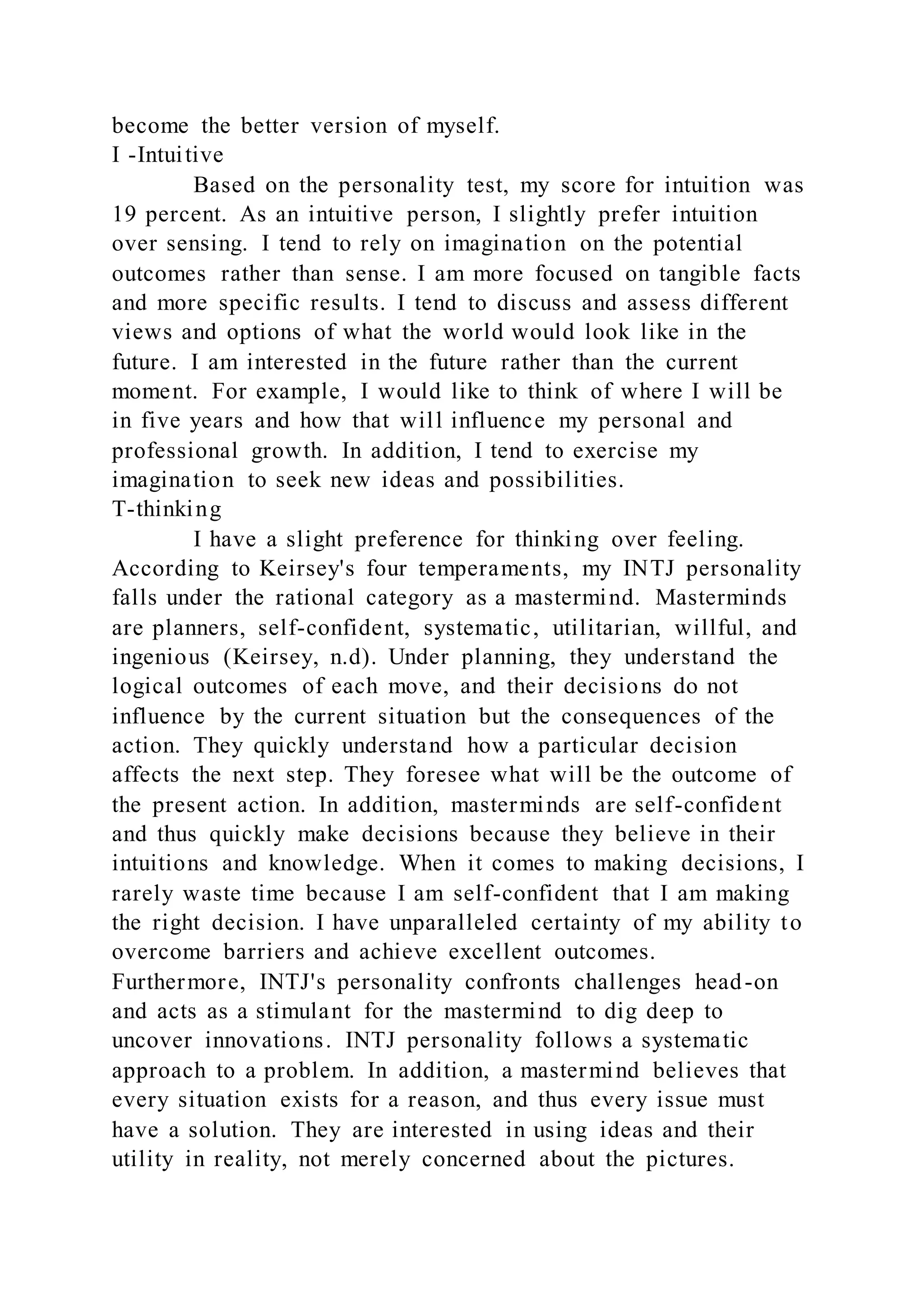
Based on the personality test, my score for intuition was
19 percent. As an intuitive person, I slightly prefer intuition
over sensing. I tend to rely on imagination on the potential
outcomes rather than sense. I am more focused on tangible facts
and more specific results. I tend to discuss and assess different
views and options of what the world would look like in the
future. I am interested in the future rather than the current
moment. For example, I would like to think of where I will be
in five years and how that will influence my personal and
professional growth. In addition, I tend to exercise my
imagination to seek new ideas and possibilities.
T-thinking
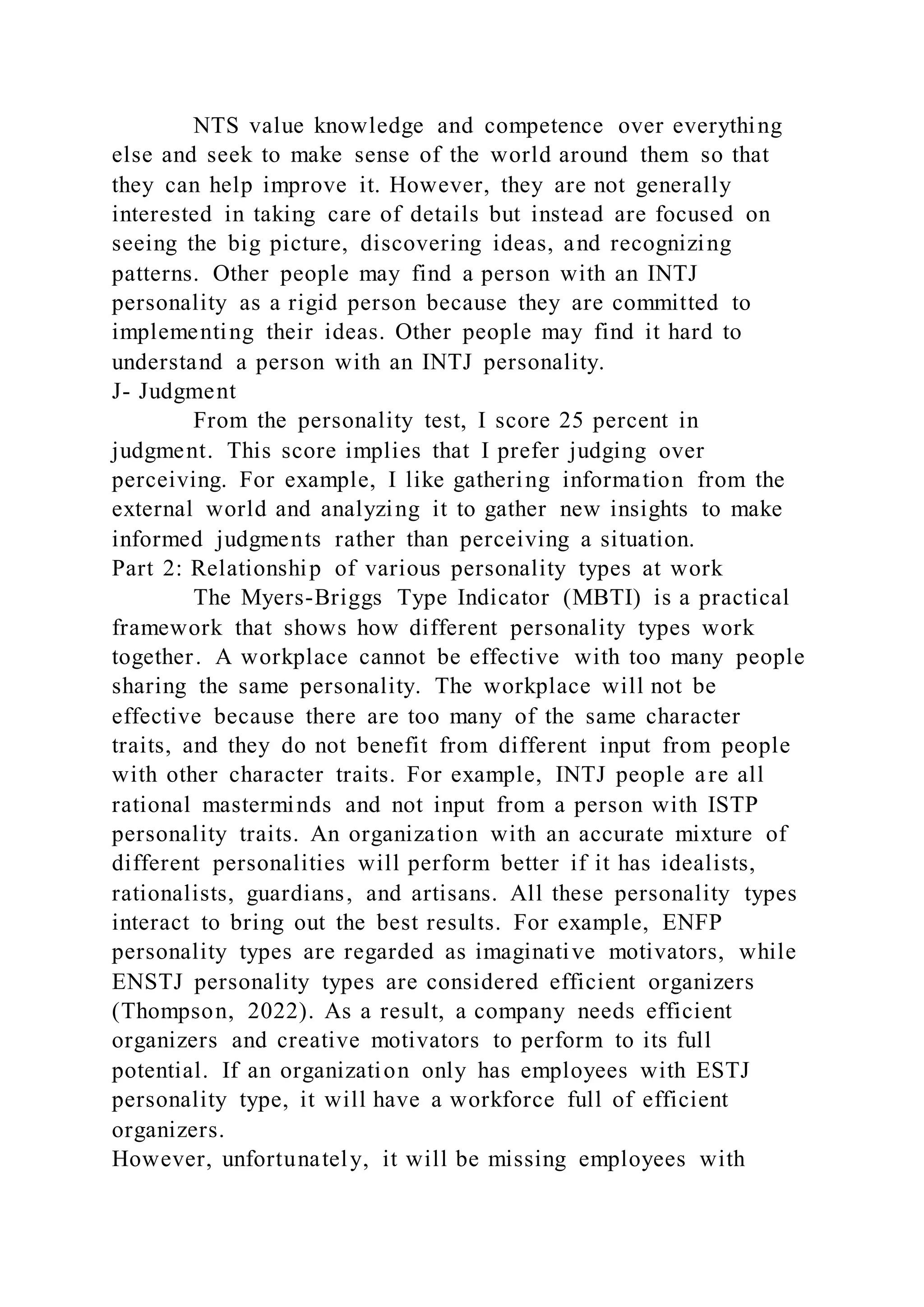
I have a slight preference for thinking over feeling.
According to Keirsey's four temperaments, my INTJ personality
falls under the rational category as a mastermind. Masterminds
are planners, self-confident, systematic, utilitarian, willful, and
ingenious (Keirsey, n.d). Under planning, they understand the
logical outcomes of each move, and their decisions do not
influence by the current situation but the consequences of the
action. They quickly understand how a particular decision
affects the next step. They foresee what will be the outcome of
the present action. In addition, masterminds are self-confident
and thus quickly make decisions because they believe in their
intuitions and knowledge. When it comes to making decisions, I
rarely waste time because I am self-confident that I am making
the right decision. I have unparalleled certainty of my ability to
overcome barriers and achieve excellent outcomes.
Furthermore, INTJ's personality confronts challenges head-on
and acts as a stimulant for the mastermind to dig deep to
uncover innovations. INTJ personality follows a systematic
approach to a problem. In addition, a mastermind believes that
every situation exists for a reason, and thus every issue must
have a solution. They are interested in using ideas and their
utility in reality, not merely concerned about the pictures.
NTS value knowledge and competence over everything
else and seek to make sense of the world around them so that
they can help improve it. However, they are not generally
interested in taking care of details but instead are focused on
seeing the big picture, discovering ideas, and recognizing
patterns. Other people may find a person with an INTJ
personality as a rigid person because they are committed to
implementing their ideas. Other people may find it hard to
understand a person with an INTJ personality.
J- Judgment
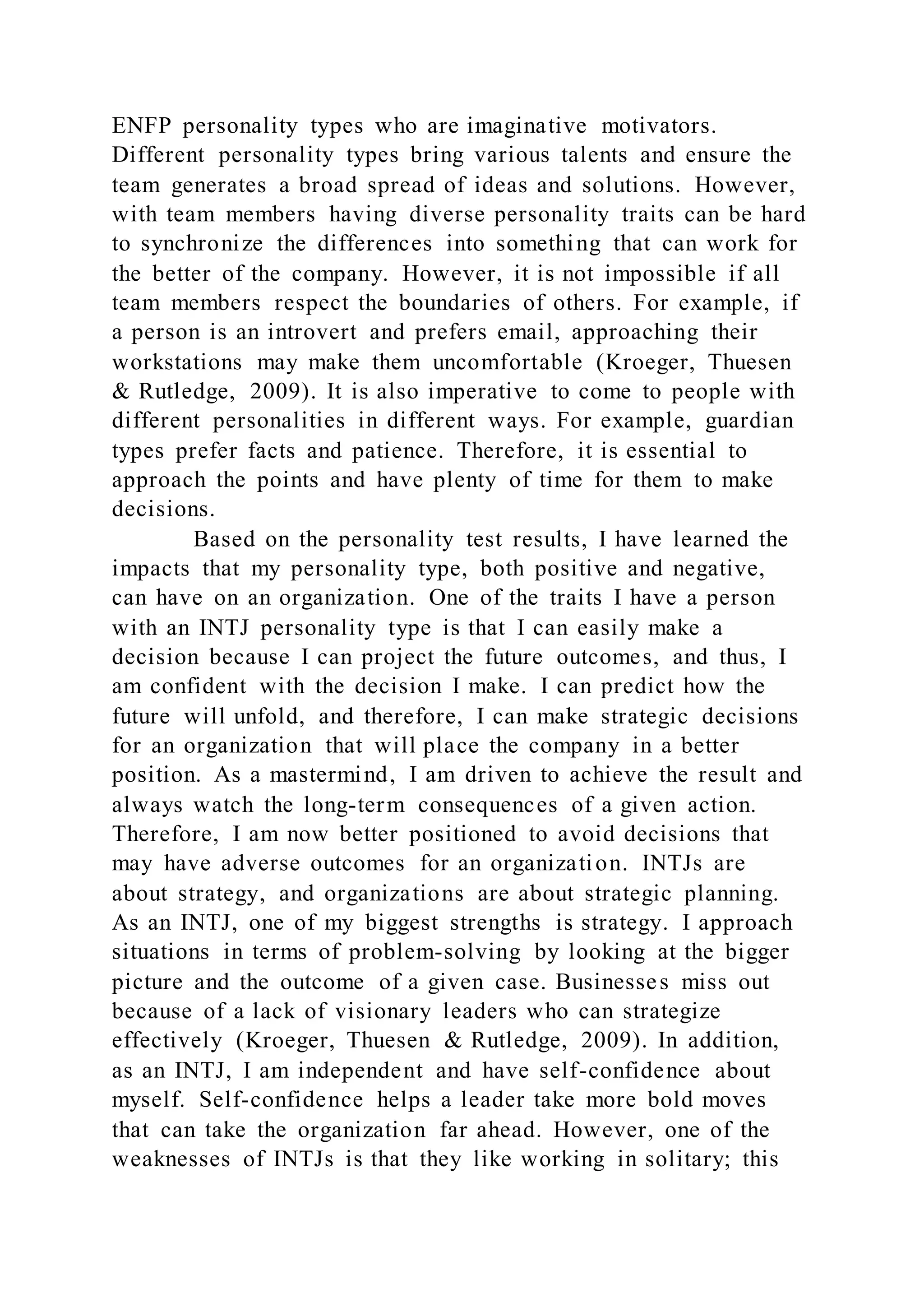
From the personality test, I score 25 percent in
judgment. This score implies that I prefer judging over
perceiving. For example, I like gathering information from the
external world and analyzing it to gather new insights to make
informed judgments rather than perceiving a situation.
Part 2: Relationship of various personality types at work
The Myers-Briggs Type Indicator (MBTI) is a practical
framework that shows how different personality types work
together. A workplace cannot be effective with too many people
sharing the same personality. The workplace will not be
effective because there are too many of the same character
traits, and they do not benefit from different input from people
with other character traits. For example, INTJ people are all
rational masterminds and not input from a person with ISTP
personality traits. An organization with an accurate mixture of
different personalities will perform better if it has idealists,
rationalists, guardians, and artisans. All these personality types
interact to bring out the best results. For example, ENFP
personality types are regarded as imaginative motivators, while
ENSTJ personality types are considered efficient organizers
(Thompson, 2022). As a result, a company needs efficient
organizers and creative motivators to perform to its full
potential. If an organization only has employees with ESTJ
personality type, it will have a workforce full of efficient
organizers.
However, unfortunately, it will be missing employees with
ENFP personality types who are imaginative motivators.
Different personality types bring various talents and ensure the
team generates a broad spread of ideas and solutions. However,
with team members having diverse personality traits can be hard
to synchronize the differences into something that can work for
the better of the company. However, it is not impossible if all
team members respect the boundaries of others. For example, if
a person is an introvert and prefers email, approaching their
workstations may make them uncomfortable (Kroeger, Thuesen
& Rutledge, 2009). It is also imperative to come to people with
different personalities in different ways. For example, guardian
types prefer facts and patience. Therefore, it is essential to
approach the points and have plenty of time for them to make
decisions.
Based on the personality test results, I have learned the
impacts that my personality type, both positive and negative,
can have on an organization. One of the traits I have a person
with an INTJ personality type is that I can easily make a
decision because I can project the future outcomes, and thus, I
am confident with the decision I make. I can predict how the
future will unfold, and therefore, I can make strategic decisions
for an organization that will place the company in a better
position. As a mastermind, I am driven to achieve the result and
always watch the long-term consequences of a given action.
Therefore, I am now better positioned to avoid decisions that
may have adverse outcomes for an organization. INTJs are
about strategy, and organizations are about strategic planning.
As an INTJ, one of my biggest strengths is strategy. I approach
situations in terms of problem-solving by looking at the bigger
picture and the outcome of a given case. Businesses miss out
because of a lack of visionary leaders who can strategize
effectively (Kroeger, Thuesen & Rutledge, 2009). In addition,
as an INTJ, I am independent and have self-confidence about
myself. Self-confidence helps a leader take more bold moves
that can take the organization far ahead. However, one of the
weaknesses of INTJs is that they like working in solitary; this
can be a disadvantage, especially for projects that require
teamwork. I prefer working on projects alone. However, it can
be hard when I am supposed to team with other employees to
complete a task.
References
Kroeger, O., Thuesen, J. M., & Rutledge, H. (2009).
Type talk at work (revised): How the 16
personality types determine your success on the job. Delta.
Thompson, J. (2022). How to work with all the Myers-Briggs
personality types.
https://www.atlassian.com/blog/leadership/every-
myers-briggs-personality-type
Keirsey. (n.d). Learn about the rational mastermind.
https://keirsey.com/temperament/rational-
mastermind/
Daniel. (2017). Keirsey temperaments.
https://www.personalityclub.com/blog/keirsey-
temperaments/
image4.emf
SAMPLE APA-7 PAPER FOR GRADUATE/DOCTORAL
STUDENTS 1
Created by Christy Owen of Liberty University’s Online
Writing Center
[email protected]; last date modified: November 7, 2021
Sample APA Paper: Professional Format for Graduate/Doctoral
Students
Claudia S. Sample
School of Behavioral Sciences, Liberty University
Author Note
Claudia S. Sample (usually only included if author has an
ORCID number)
I have no known conflict of interest to disclose.
Correspondence concerning this article should be addressed to
Claudia S. Sample.
Email: [email protected]
mailto:[email protected]
SAMPLE APA-7 PAPER FOR GRADUATE/DOCTORAL
STUDENTS 2
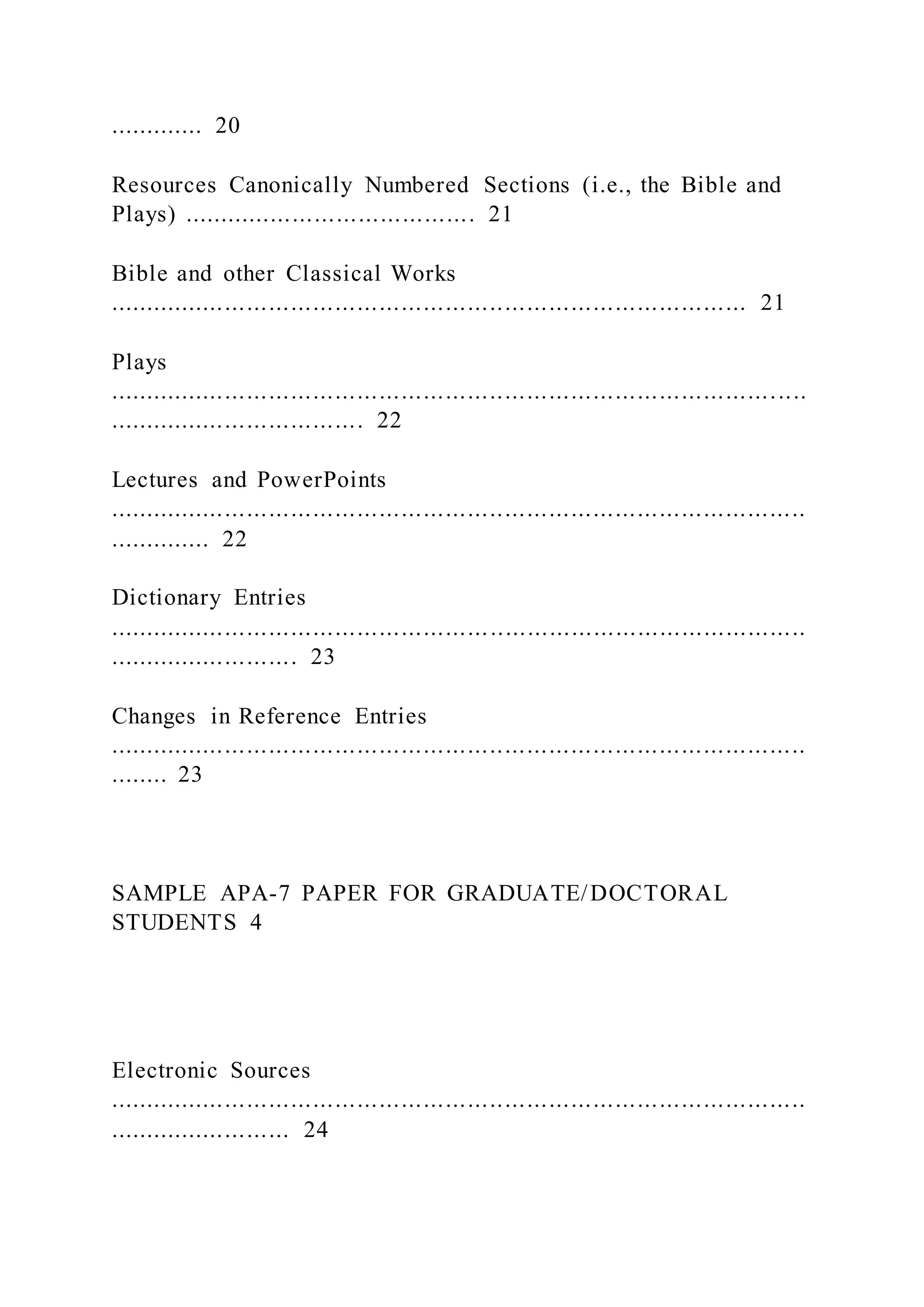
Table of Contents
(Only Included for Easy Navigation; Hyperlinked for Quick
Access)
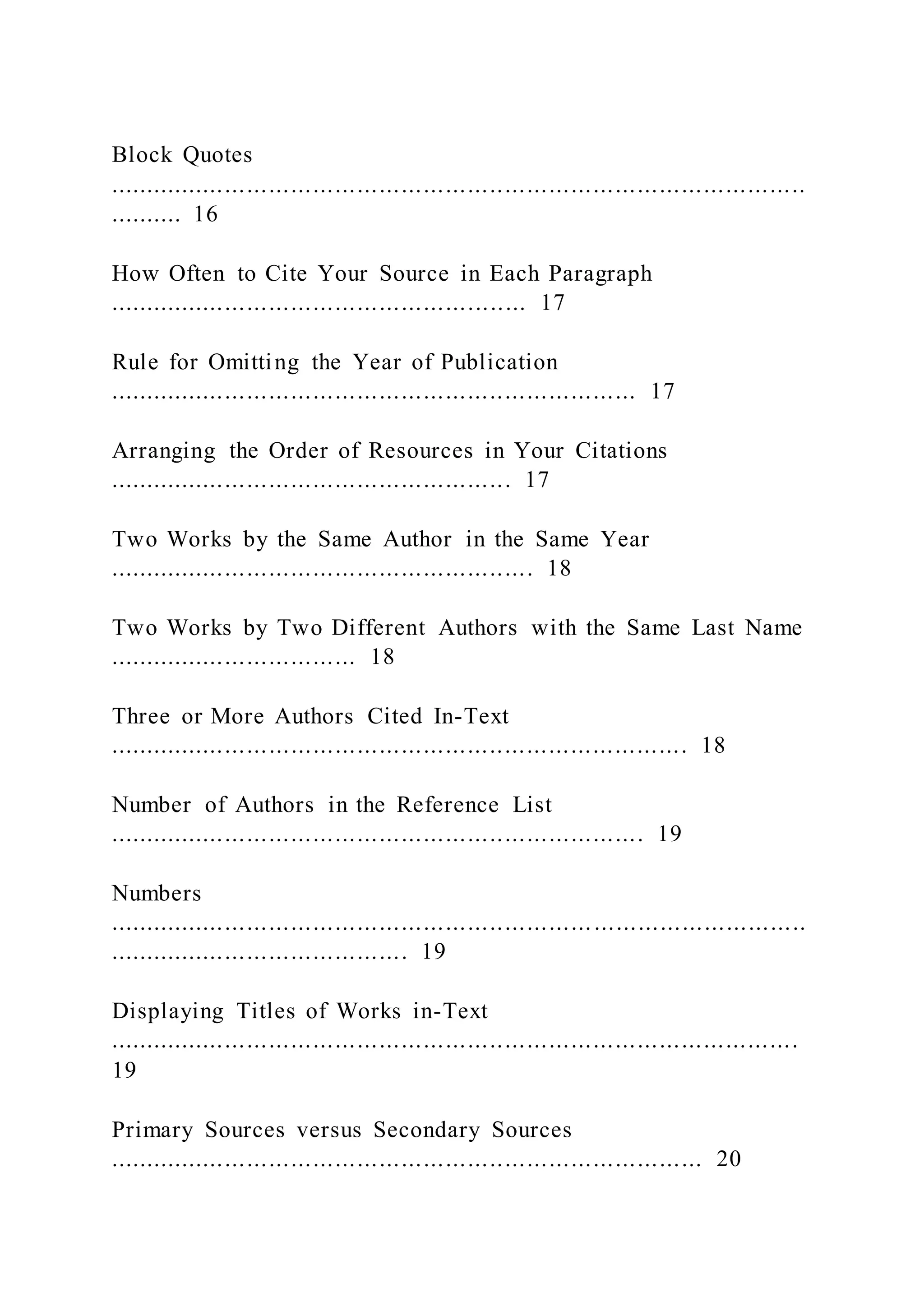
Sample APA Paper: Professional Format for Graduate/Doctoral
Students .................................... 6
Basic Rules of Scholarly Writing
...............................................................................................
.... 7
Brief Summary of Changes in APA-7
.............................................................................................
8
Running Head, Author Note, and Abstract
..................................................................................... 9
Basic Formatting Elements
...............................................................................................
............ 10
Font
...............................................................................................
.................................... 10
Line Spacing
...............................................................................................
...................... 10
Spaces After Punctuation
...............................................................................................
... 11
Footnotes
...............................................................................................
............................ 11
Heading Levels—Level 1
...............................................................................................
.............. 11
Level 2 Heading
...............................................................................................
................. 12
Level 3 Heading
...............................................................................................
..... 13
Level 4 Heading. Must be bolded and indented ½”. Add a
period, one
space, and begin your content on the same line as shown here.
....................................... 13
Level 5 Heading
............................................................................ 13
Specific Elements of Academic Papers
........................................................................................ 13
Tables of Contents and Outlines
....................................................................................... 13
Annotated Bibliographies
...............................................................................................
.. 14
Appendices
...............................................................................................
......................... 14
SAMPLE APA-7 PAPER FOR GRADUATE/DOCTORAL
STUDENTS 3
Crediting Your
Sources...................................................................................
.............................. 15
Paraphrasing and Direct Quotes
........................................................................................ 15
Paraphrasing
...............................................................................................
........... 16
Block Quotes
...............................................................................................
.......... 16
How Often to Cite Your Source in Each Paragraph
......................................................... 17
Rule for Omitting the Year of Publication
........................................................................ 17
Arranging the Order of Resources in Your Citations
....................................................... 17
Two Works by the Same Author in the Same Year
.......................................................... 18
Two Works by Two Different Authors with the Same Last Name
.................................. 18
Three or More Authors Cited In-Text
............................................................................... 18
Number of Authors in the Reference List
......................................................................... 19
Numbers
...............................................................................................
......................................... 19
Displaying Titles of Works in-Text
..............................................................................................
19
Primary Sources versus Secondary Sources
................................................................................. 20
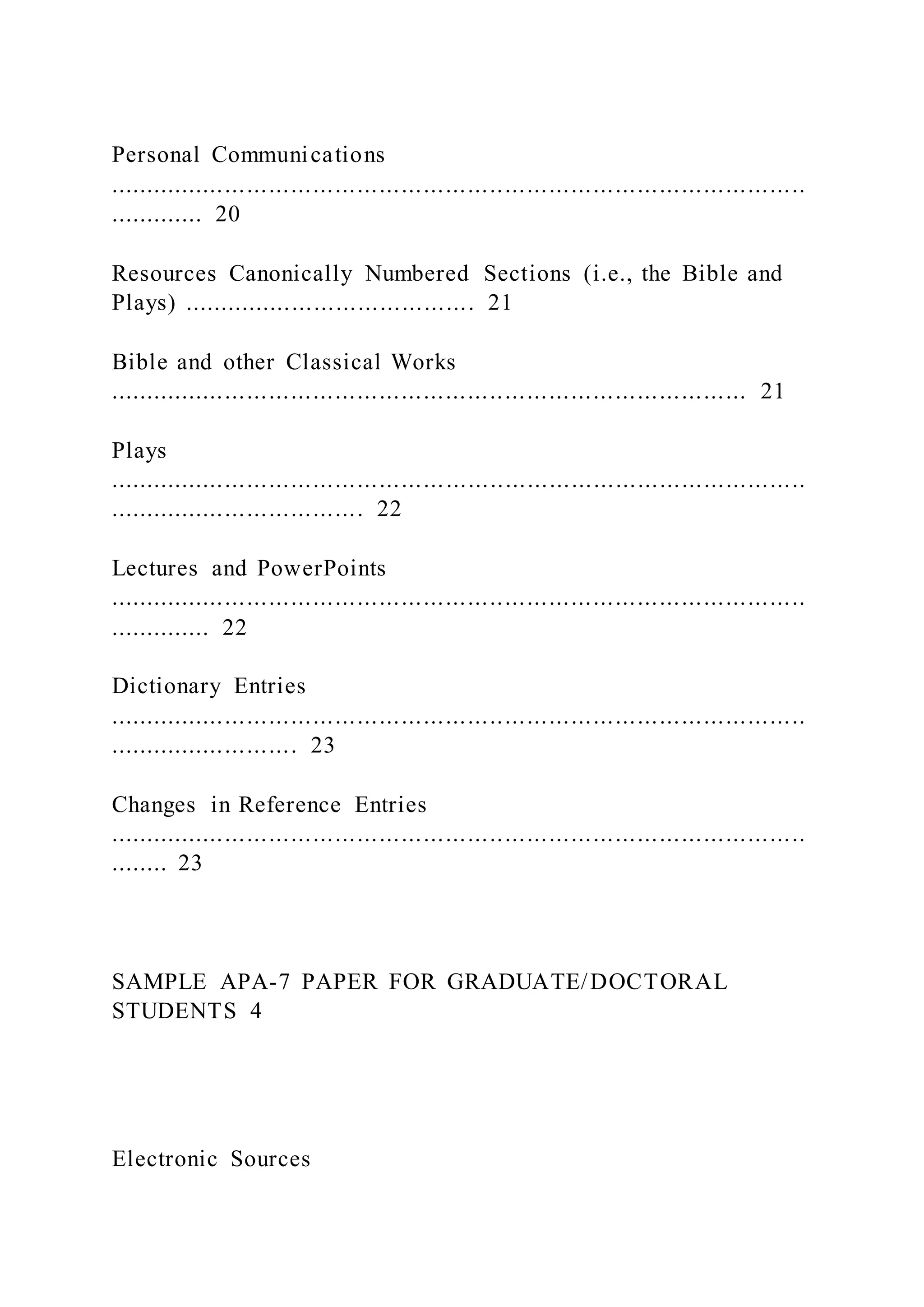
Personal Communications
...............................................................................................
............. 20
Resources Canonically Numbered Sections (i.e., the Bible and
Plays) ........................................ 21
Bible and other Classical Works
....................................................................................... 21
Plays
...............................................................................................
................................... 22
Lectures and PowerPoints
...............................................................................................
.............. 22
Dictionary Entries
...............................................................................................
.......................... 23
Changes in Reference Entries
...............................................................................................
........ 23
SAMPLE APA-7 PAPER FOR GRADUATE/DOCTORAL
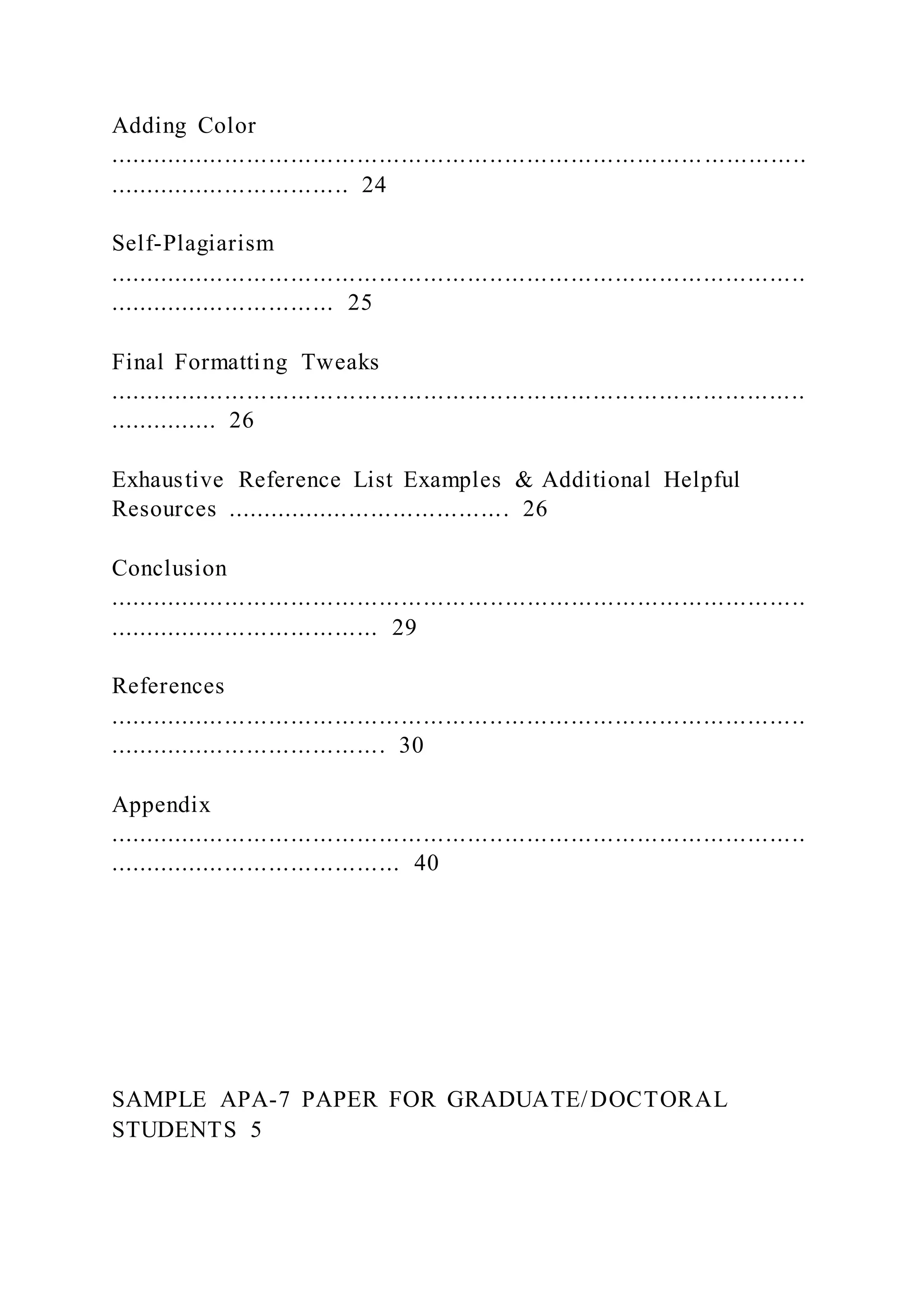
STUDENTS 4
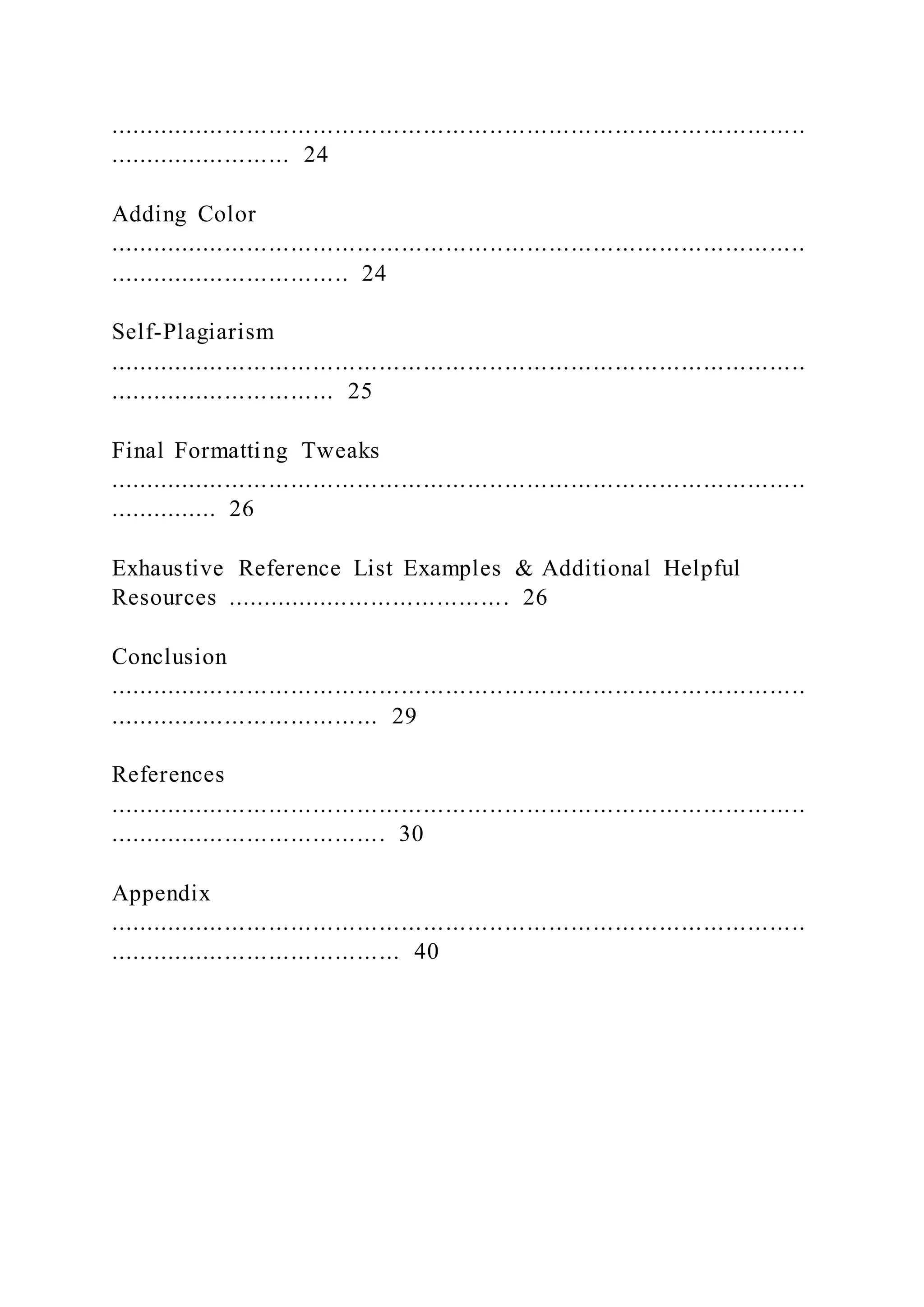
Electronic Sources
...............................................................................................
......................... 24
Adding Color
................................................................................. ..............
................................. 24
Self-Plagiarism
...............................................................................................
............................... 25
Final Formatting Tweaks
...............................................................................................
............... 26
Exhaustive Reference List Examples & Additional Helpful
Resources ....................................... 26
Conclusion
...............................................................................................
..................................... 29
References
...............................................................................................
...................................... 30
Appendix
...............................................................................................
........................................ 40
SAMPLE APA-7 PAPER FOR GRADUATE/DOCTORAL
STUDENTS 5
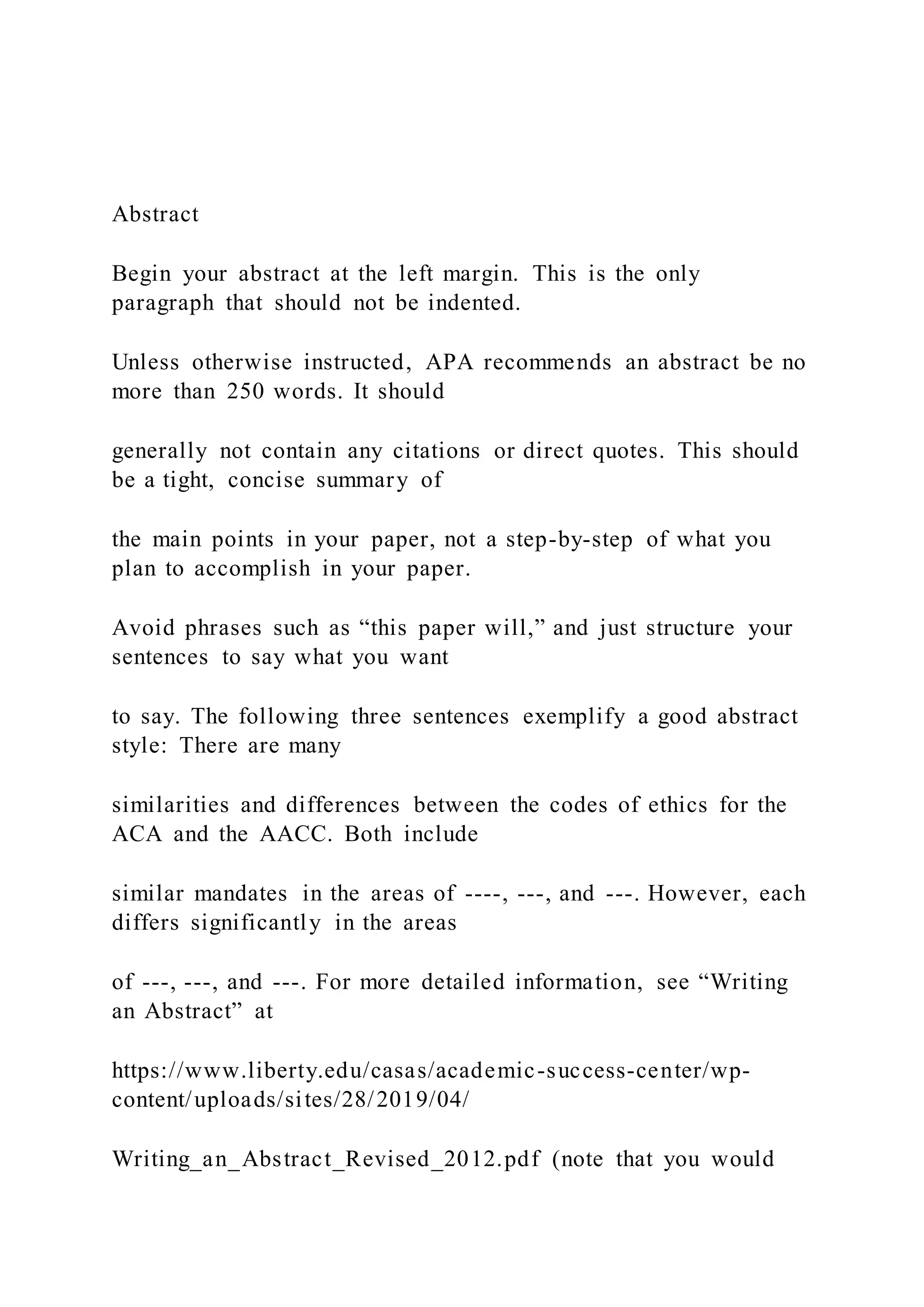
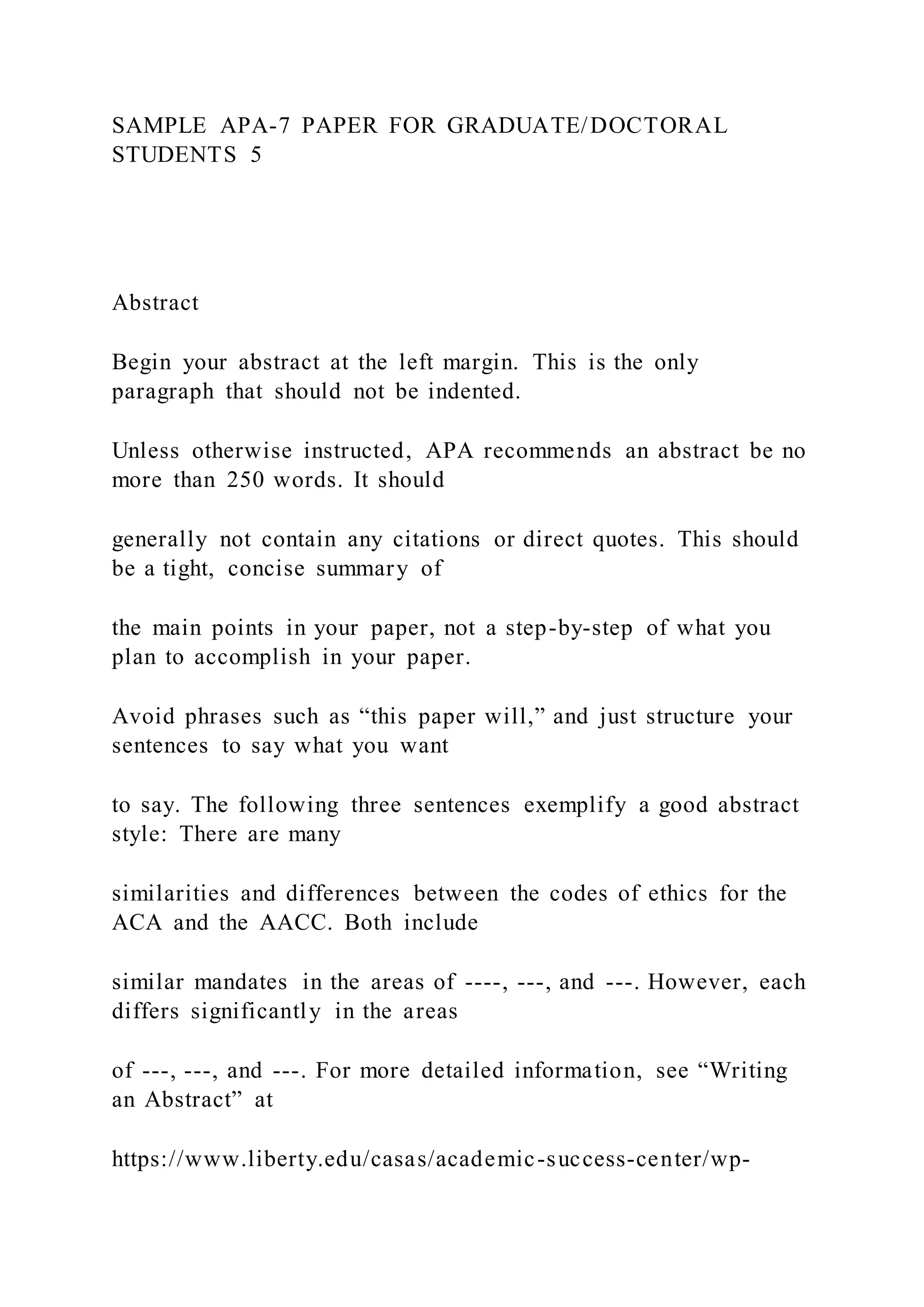
Abstract
Begin your abstract at the left margin. This is the only
paragraph that should not be indented.
Unless otherwise instructed, APA recommends an abstract be no
more than 250 words. It should
generally not contain any citations or direct quotes. This should
be a tight, concise summary of
the main points in your paper, not a step-by-step of what you
plan to accomplish in your paper.
Avoid phrases such as “this paper will,” and just structure your
sentences to say what you want
to say. The following three sentences exemplify a good abstract
style: There are many
similarities and differences between the codes of ethics for the
ACA and the AACC. Both include
similar mandates in the areas of ----, ---, and ---. However, each
differs significantly in the areas
of ---, ---, and ---. For more detailed information, see “Writing
an Abstract” at
https://www.liberty.edu/casas/academic-success-center/wp-
content/uploads/sites/28/2019/04/
Writing_an_Abstract_Revised_2012.pdf (note that you would
not include any links in your
abstract). This is just now at 168 words, so eyeball how brief
your abstract must be. Think of
your paper as a movie you want to sound enticing, and the
abstract as the summary of the plot
you would share to draw people’s interest into wanting to come
and see your movie. You want to
really hook and intrigue them. What you have to say is
important! Remember to stay under 250,
words. Keywords highlight the search terms someone would use
to find your paper in a database.
Keywords: main words, primary, necessary, search terms
https://www.liberty.edu/casas/academic-success-center/wp-
content/uploads/sites/28/2019/04/Writing_an_Abstract_Revised
_2012.pdf
https://www.liberty.edu/casas/academic-success-center/wp-
content/uploads/sites/28/2019/04/Writing_an_Abstract_Revised
_2012.pdf
SAMPLE APA-7 PAPER FOR GRADUATE/DOCTORAL
STUDENTS 6
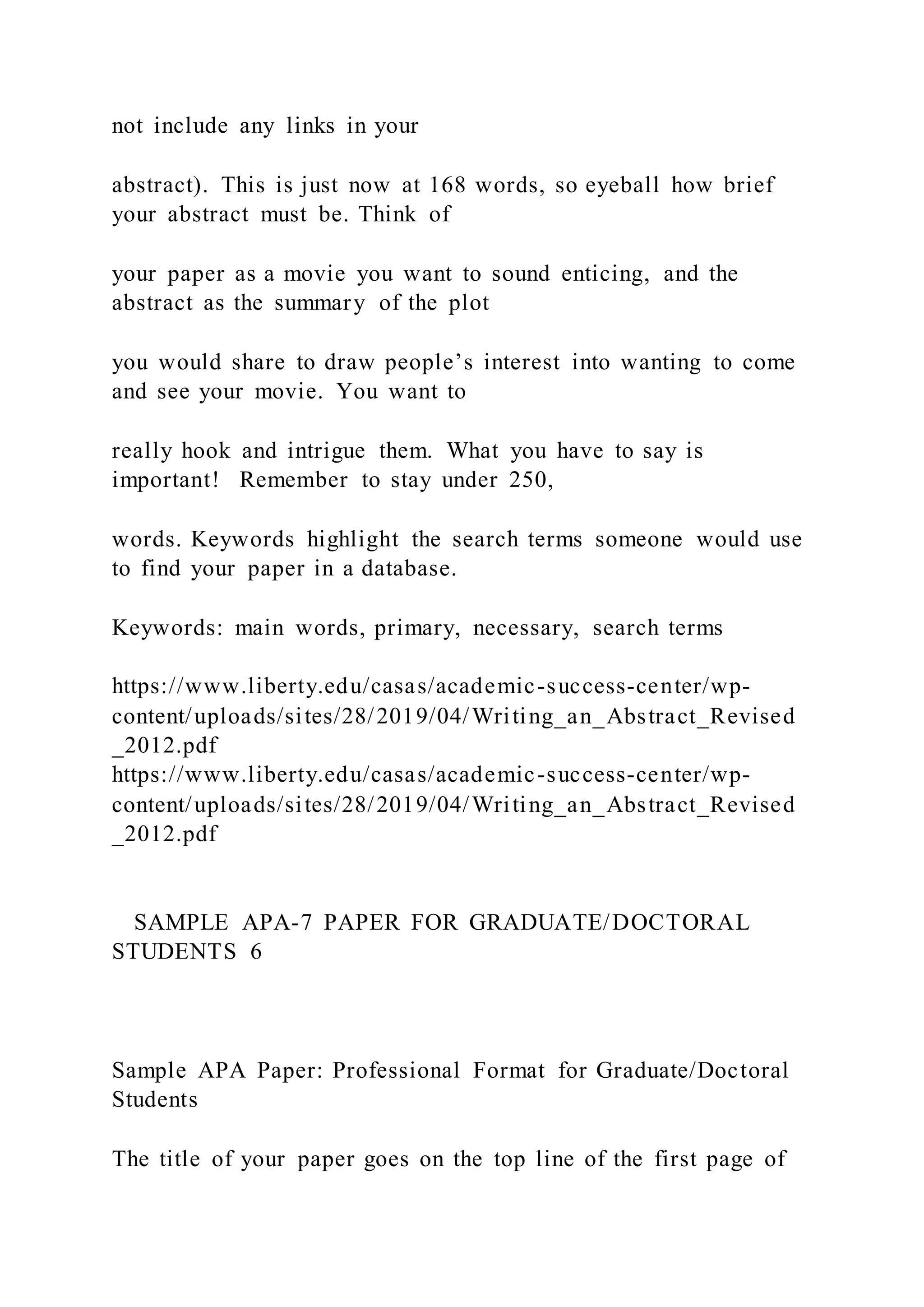
Sample APA Paper: Professional Format for Graduate/Doctoral
Students
The title of your paper goes on the top line of the first page of
the body (American
Psychological Association [APA], 2019, section 2.11). It should
be centered, bolded, and in title
case (all major words—usually those with four+ letters—should
begin with a capital letter)—see
p. 51 of your Publication Manual of the American Psychological
Association: Seventh Edition
(APA, 2019; hereinafter APA-7). It must match the title that is
on your title page (see last line on
p. 32). As shown in the previous sentence, use brackets to
denote an abbreviation within
parentheses (bottom of p. 159). Write out the full name of an
entity or term the first time
mentioned before using its acronym (see citation in first
sentence in this paragraph), and then use
the acronym throughout the body of the paper (section 6.25).
There are many changes in APA-7. One to mention here is that
APA-7 allows writers to
include subheadings within the introductory section (APA,
2019, p. 47). Since APA-7 now
regards the title, abstract, and term “References” to all be
Level-1 headings, a writer who opts to
include headings in his or her introduction must begin with
Level-2 headings as shown above
(see section 2.27) for any divisions within the introductory
section.
If you do choose to include headings in your introduction
section (which is optional), be
sure to include two or more subheadings, since APA (2019)
forbids stand-alone heading levels.
A second notable change in APA-7 is that writers are no longer
required to cite their source every
single sentence that content from it is mentioned (section 8.1).
As demonstrated in this paper,
since all of the content (other than the examples included for
illustration and reference-entry
variation purposes) comes directly from the APA-7 itself,
citations to the APA-7 are only
included for the first instance in each paragraph. Section and/or
page numbers are included
parenthetically throughout for the sake of students who desire to
know exactly where the stated
SAMPLE APA-7 PAPER FOR GRADUATE/DOCTORAL
STUDENTS 7
rule appears in the APA-7 itself. In your academic papers,
however, it is critical to include the
required author(s) and year, as applicable, for all citations that
are included; this may include
more than one citation for each resource per paragraph, as
required to avoid any confusion about
the source of that content.
Basic Rules of Scholarly Writing
Most beginning students have difficulty learning how to write
papers and also format
papers correctly using the seventh edition of the APA manual.
However, the Liberty University
Online Writing Center’s (OWC) mission includes helping
students learn how to be autonomous,
proficient writers. The OWC also provides students with
templates to help them with basic
formatting elements, but this sample paper is designed to help
graduate and doctoral students
learn to master APA rules and formatting on their own, which
will prove helpful as they progress
in their studies and work toward future publication in scholarly
journals.
For the purpose of instruction, this paper will use second person
(you, your), but third
person (this author) must be used in most student papers. First
person (I, me, we, us, our) is not
generally permitted in academic papers. Students should refrain
from using first or second person
in college courses (even though the APA manual encourages
this in other writing venues) unless
the assignment instructions clearly permit such (as in the case
of personal reflection sections or
life histories). If in doubt, students should clarify with their
professors.
APA-7 delineates separate rules and guidelines between
“student” and “professional”
writers (APA, 2019). Because a primary purpose of graduate
and doctoral studies is to prepare
those students to publish professionally, Liberty University has
decided to have undergraduate
students follow APA-7’s guidelines for “student papers,” and
graduate/doctoral students follow
APA-7’s guidelines for “professional papers.” Separate
templates are available for each level.
SAMPLE APA-7 PAPER FOR GRADUATE/DOCTORAL
STUDENTS 8
This sample paper illustrates and discusses the rules and
formatting of professional papers, as
required for all Liberty University graduate and doctoral
courses using APA-7 style.
Brief Summary of Changes in APA-7
Most of these changes will be discussed in more detail below;
this is just a very brief
overview here. APA-7 reverts back to only one space after
closing punctuation in the body of the
paper (APA-6 required two spaces; APA, 2019, section 6.1).
Student (undergraduate) papers no
longer include a running head or abstract (sections 2.2 and 2.8);
professional (graduate/doctoral)
papers require an abstract but the running head is now the same
on all pages (the added phrase
“Running head:” from APA-6 has been eliminated; see section
2.8). Title pages are different for
both student and professional formats. The title of a paper is no
longer limited to 12 words
(section 2.4).
Citations of all resources with three or more authors now use
the first author’s last name
and the term et al. (APA, 2019, section 8.17). Reference entries
must name up to the first 19
authors before adding an ampersand and ellipsis (up from APA-
6’s six authors; section 9.8).
APA-7 omits the phrase DOI and instead standardizes DOIs to
be presented in hyperlink format
(i.e., https://doi.org/10.1177%2F1524838017742386; section
9.35). Formatting guidelines for
annotated bibliographies are included in APA-7 (section 9.51),
as well as expanded and
standardized reference entry examples. As discussed above, it is
no longer necessary to cite a
source every single time you refer to content gleaned from it as
long as it is clear the content
comes from that source (section 8.1); APA-7 also expanded the
specific location noted in the
citation to include page, paragraph, section (as used throughout
this sample paper, to direct the
student to the exact relevant content), chapter, timestamp, etc.
(section 8.13).
APA-7 allows for “self-plagiarism” (clarified and defined
below). It also invites writers to
SAMPLE APA-7 PAPER FOR GRADUATE/DOCTORAL
STUDENTS 9
highlight the most relevant work first, rather than just present
all works in alphabetical order
(APA, 2019, section 8.12).
Heading-level formatting has changed, and APA-7 provides
more flexibility in font and
line spacing (APA, 2019). The Bible must now be included in
the reference list and its citations
must include the editor’s details and year (section 8.28); there
are also new rules for dictionary
entries. Publisher city and state details are omitted from all
reference entries except those
involving presentations or conferences, as is the phrase
“retrieved from.” Hyperlinks should be
live, but they may be either presented as blue underlining or
plain black text.
Running Head, Author Note, and Abstract
APA (2019) delineates separate formatting requirements for
what it terms “student” and
“professional” papers. Its descriptions for those labels,
however, suggests that it regards
undergraduate-level writing to fall within the student purview,
and graduate/doctoral-level
writing (including dissertations and theses) to fall within the
professional purview. Since a
significant goal in graduate and post-graduate studies is
preparing those students to publish in
scholarly journals at and beyond graduation, it makes sense to
train those students in the
formatting that is required for professionals. As such, Liberty
University has opted to require the
APA-7’s “student” version format for all undergraduate
assignments using APA, and its
“professional” version for all graduate and doctoral
assignments. To that end, this being the
sample paper for professional formatting, it includes the
additional elements required for such: a
running head (same on all pages), an author’s note, and an
abstract. Graduate and doctoral
students will use this format. Note that the first “paragraph”
under the author’s note is generally
only included if the author has an ORCID number, which most
students will not have. However,
it is included in this sample paper and the corresponding
template because the purpose of these
SAMPLE APA-7 PAPER FOR GRADUATE/DOCTORAL
STUDENTS 10
resources is to prepare students to publish manuscripts post-
graduation. The student’s full
address, however, is intentionally omitted from the Liberty
University template and this sample
paper for privacy and safety reasons, since student papers are
often unfortunately published
online and disclosing their home addresses could pose safety
risks.
Basic Formatting Elements
Font
APA-7 does not prescribe a specific font or size (APA, 2019,
section 2.19) but rather
allows for some choice (e.g., 12-point Times New Romans, 11-
point Calibri, 11-point Arial, 11-
point Georgia, or 10-point Lucinda Sans Unicode). Most
journals and academic institutions will
have a preference, however, as even APA-7 acknowledges on p.
44. For this reason—and
because font size can easily be changed if an editor interested in
publishing a student’s work
prefers a different font—Liberty University recommends that
students use 12-point Times New
Romans or 11-point Calibri font for the body text in all
academic papers. Data in charts, figures,
and tables should be presented in 8- to 14-point size in either
Calibri, Arial, or Lucinda Sans
Unicode font. Students are not permitted to use any fonts such
as script, calligraphy, poster,
decorative, or others not found in published scholarly journals.
Since APA-7 itself authorizes a
variety of fonts and sizes, assignments will be gauged by word
count rather than page count.
Word count constitutes the number of words within the body of
the paper, and excludes the title
page, abstract, reference list, appendices, and other
supplemental resources.
Line Spacing
APA-7 adds extra/blank lines on the title page (APA, 2019,
sections 2.5, 2.7, 2.21). It also
specifies that spacing in tables and figures may be single-, 1-
1/2-, or double-spaced; equations
can be triple- or quadruple-spaced. Footnotes, when used at the
bottom of a page, should be
SAMPLE APA-7 PAPER FOR GRADUATE/DOCTORAL
STUDENTS 11
single-spaced (section 2.21).
Spaces After Punctuation
APA-7 reverts back to just one space after closing punctuation
in the body of the paper, as
well as in reference entries (APA, 2019, section 6.1).
Ordinarily, it would be improper to have a
paragraph with only one sentence, though APA itself asserts
that for its purposes “sentences and
paragraphs of any length are technically allowed.”1
Footnotes
This leads to another new rule in APA-7, one allowing the
inclusion of footnotes (APA,
2019, section 2.13). Footnotes should be use very sparingly and
are appropriate to include
information such as that in the prior section to alert the reader
to supplemental material that is
available online for that thought. Though APA-7 authorizes
placement of footnote content either
at the bottom of the page (as in this sample paper) or on a
separate page after the reference list
(section 2.21), Liberty University recomme nds that student
place them, when used, at the bottom
of the page, as shown here.
Heading Levels—Level 1
This sample paper uses primarily two levels of headings (Levels
1 and 2). APA style,
however, has five heading levels, which will be demonstrated
briefly for visual purposes. See
section 2.27 of your APA-7 (APA, 2019) for more details on
heading levels and formatting. In
APA-7, all heading levels are now bolded and in title case
(capitalize each major word—usually
those with four or more letters, including hyphenated compound
words). Do not capitalize
articles (a, an, the) in headings unless they begin a title or
follow a colon. Level 1 headings are
centered, with the content falling on the line beneath each, in
standard paragraph format.
1 See https://blog.apastyle.org/apastyle/2016/05/index.html
https://blog.apastyle.org/apastyle/2016/05/index.html
SAMPLE APA-7 PAPER FOR GRADUATE/DOCTORAL
STUDENTS 12
Many students misunderstand that you progress from Level 1 to
Level 2 to Level 3 to
Level 4 to Level 5, but that is not correct. In fact, your paper
may have only Level 1 headings, or
just Levels 1 and 2. The rule of thumb is that you must have at
least two of each heading level
that you use, otherwise omit that heading level.
Headings are basically styling ways of organizing your paper,
without using an outline
format. APA specifies five levels of headings; you would likely
never use Level 5 and only very
rarely use Level 4 as a student. Think of each level as the
different levels in an outline. Roman
numerals, for example, would be Level 1 headings. Capital
letters would be Level 2 headings.
Numerals would be Level 3 headings. Lowercase letters would
be Level 4. And lowercase
Roman numerals would be Level 5. You must always have two
or more of each subheading, but
you do not need every level. You start with Level 1 and work
down from that (but not
consecutive 1-2-3-4-5). Under a Level 1, you would either have
two+ Level 2 headings or none
at all (just one big section in paragraphs before the next Level 1
section).
Special note about conclusion sections: Please note that some of
the sample papers
published by APA to demonstrate proper APA-7 format
(including the “professional” sample on
pp. 50-60 of the APA-7 manual) depict the “Conclusion” section
with a Level-2 heading. This is
limited to empirical papers that are being submitted for
publication in scholarly journals, as those
conclusions pertain to the “Discussion” sections in such papers
and are not conclusions of the
overall papers themselves. Conclusions in academic papers at
Liberty University will be Level 1
headings (including dissertations and theses, which are divided
by chapters, unlike journal article
manuscripts).
Level 2 Heading
Level 2 headings are left-justified (APA, 2019, p. 48). The
supporting information is
SAMPLE APA-7 PAPER FOR GRADUATE/DOCTORAL
STUDENTS 13
posed in standard paragraph form beneath it. Never use only one
of any level of heading. You
must use two or more of any level you use, though not every
paper will require more than one
level. The heading levels are simply demonstrated here for
visual purposes, but you would
always have two or more of each under a larger heading, as
shown throughout all the other
sections of this sample paper.
Level 3 Heading
Level 3 headings are bolded, left-justified, and italicized; the
content falls on the line
underneath, as with Levels 1 and 2.
Level 4 Heading. Must be bolded and indented ½”. Add a
period, one space, and begin
your content on the same line as shown here.
Level 5 Heading. Same as Level 4, but also italicized. Despite
heavy writing experience,
this author has never used Level 5 headings.
Specific Elements of Academic Papers
Tables of Contents and Outlines
APA (2019) does not regulate every type of paper and some
elements in various
assignments are not addressed in the APA-7 manual, including
outlines and tables of content. In
those cases, follow your professor’s instructions and the grading
rubric for the content and
format of the outline or annotations, and use standard APA
formatting for all other elements
(such as running head, title page, body, reference list, 1"
margins, double-spacing, permitted
font, etc.). Note that most academic papers will not require a
table of contents, nor would one be
appropriate. One was included in this paper simply for ease-of-
access so students could go
directly to the content they want to see. Generally speaking, no
table of contents would be
necessary for papers less than 20 pages of content, unless
otherwise required by your professor.
SAMPLE APA-7 PAPER FOR GRADUATE/DOCTORAL
STUDENTS 14
That being said, when organizing outlines in APA format, set
your headings up in the
proper levels (making sure there are at least two subheadings
under each level), and then use
those to make the entries in the outline. As discussed above,
Level 1 headings become uppercase
Roman numerals (I, II, III), Level 2 headings become capital
letters (A, B, C), Level 3 headings
become numbers (1, 2, 3), Level 4 headings become lowercase
letters (a, b, c), and Level 5
headings become lowercase Roman numerals (i, ii, iii). Many
courses now require “working
outlines,” which are designed to have the bones and
foundational framework of the paper in
place (such as title page, abstract, body with title,
outline/heading divisions, supporting content
with citations, and references), without the full “meat” that fills
out and forms a completed paper.
Annotated Bibliographies
Many Liberty University courses also now require students to
prepare and submit an
annotated bibliography as a foundational step to building a
research paper. There is significant
merit in these assignments, as they teach students to critique the
resources they have found and
rationalize why each is relevant for their paper’s focus. APA
(2019) includes a section on
annotated bibliographies (9.51; see the example provided on p.
308). The appendix attached to
this sample paper also includes a sample annotated
bibliography.
Appendices
Appendices, if any, are attached after the reference list (APA,
2019, section 2.14). You
must refer to them (i.e., “callout”) in the body of your paper so
that your reader knows to look
there (see the yellow-highlighted callouts to Table 1 on p. 54
and to Footnote 1 on p. 55 of your
APA-7 for visuals on how this should appear in your paper).
The word “Appendix” is singular;
use it to refer to individual appendices. APA-7 regards it as a
Level 1 heading so it should be
bolded. I attached a sample Annotated Bibliography as a visual
aid (see Appendix). You will see
SAMPLE APA-7 PAPER FOR GRADUATE/DOCTORAL
STUDENTS 15
that I included the title “Appendix” at the top of the page and
formatted it in standard APA
format beneath that. Because I only included one appendix, it is
simply titled as such. If there are
more appendices, assign a letter to each and denote each by
that: “Appendix A” and “Appendix
B.”
Crediting Your Sources
Paraphrasing and Direct Quotes
Paraphrasing is rephrasing another’s idea in one’s own words by
changing the wording
sufficiently without altering the meaning (remember not to just
change a word here or there or
rearrange the order of the original source’s wording). Quoting is
using another’s exact words.
Both need to be cited; failure to do so constitutes plagiarism.
Include the author(s) and year for
paraphrases, and the author(s), year, and page or paragraph
number for direct quotes. APA-7 also
expands this to include figure number, time stamp, etc.—
whatever detail is necessary to get the
reader directly to that content. Page numbers should be used for
any printed material (books,
articles, etc.), and paragraph numbers should be used in the
absence of page numbers (online
articles, webpages, etc.; see APA, 2019, section 8.13). Use p.
for one page and pp. (not italicized
in your paper) for more than one (section 8.25). Use para. for
one paragraph and paras. (also not
italicized in your paper) for two or more (section 8.28). For
example: (Perigogn & Brazel, 2012,
pp. 12–13) or (Liberty University, 2019, para. 8). Section 8.23
of the APA (2019) manual
specifies that it is not necessary to include a page or paragraph
number for paraphrases (just for
direct quotes), but writers may choose to do so to help their
readers find that content in the cited
resource.
When naming authors in the text of the sentence itself (called a
narrative citation), use the
word “and” to connect them. For example, Perigogn and Brazel
(2012) contemplated that . . .
SAMPLE APA-7 PAPER FOR GRADUATE/DOCTORAL
STUDENTS 16
Use an ampersand (&) in place of the word “and” in
parenthetical citations and reference lists:
(Perigogn & Brazel, 2012).
Paraphrasing
Only use quotes when the original text cannot be said as well in
your own words or
changing the original wording would change the author’s
meaning. You cannot simply change
one word and omit a second; if you paraphrase, the wording
must be substantially different, but
with the same meaning. Regardless, you would need to cite the
resource you took that
information from. For example, Benoit et al. (2010) wrote that
“although, a link between
attachment and posttraumatic stress disorder (PTSD) symptoms
has been established, the
mechanisms involved in this link have not yet been identified”
(p. 101). A paraphrase for that
quote might be: A link between dysfunctional attachment and
the development of PTSD has
been made, though there is insufficient data to determine
exactly how this mechanism works
(Benoit et al., 2010).
Block Quotes
Quotes that are 40 or more words must be blocked, with the left
margin of the entire
quote indented ½ inch. Maintain double-spacing of block
quotes. APA prefers that you introduce
quotes but note that the punctuation falls at the end of the direct
quote, with the page number
outside of that (which is contrary to punctuation for non-
blocked quotes). For example, Alone
(2008) claims:2
Half of a peanut butter sandwich contains as much bacteria as
the wisp of the planet
Mars. Thus, practicality requires that Mrs. Spotiker nibble one
bit at a time until she is
assured that she will not perish from ingesting it too quickly.
(p. 13)
2 Note that there are no quotation marks for block quotes, as
shown in the example.
SAMPLE APA-7 PAPER FOR GRADUATE/DOCTORAL
STUDENTS 17
Usually quotes within quotes use single quotation marks;
however, use double quotation marks
for quotes within blocked quotes, since there are no other
quotation marks involved. Also
understand that direct quotes should be used sparingly in
scholarly writing; paraphrasing is much
preferred in APA format (APA, 2019, section 8.23), as it
demonstrates that you read, understood,
and assimilated other writers’ content into one cohesive whole.
How Often to Cite Your Source in Each Paragraph
As already mentioned above, APA’s (2019) new official rule is
that you no longer must
cite your source every single time you refer to material you
gleaned from it (section 8.1). It is
now acceptable to cite your source the first time you refer to
content from it in your paragraph,
and then not again in that same paragraph unless your phrasing
does not make the source of your
content clear. This is demonstrated throughout this sample
paper.
Rule for Omitting the Year of Publication
That being said, APA (2019) has clarified its special rule that
excludes the year of
publication in subsequent narrative in-text citations (when you
name the authors in the text of the
sentence itself), after the first narrative citation in each
paragraph. It should continue to appear in
all parenthetical citations (see section 8.16). For example,
Alone (2008) portrays imagery of Mrs.
Spotiker. This includes her devouring a peanut butter sandwich
(Alone, 2008). Alone conveys
this through the lens of astronomy. Note that the year of
publication was omitted from the second
narrative citation (underlined for visual purposes).
Arranging the Order of Resources in Your Citations
If the material you cited was referred to in multiple resources,
separate different sets of
authors with semicolons, arranged in the order they appear
(alphabetically by the first author’s
last name) in the reference list (i.e., Carlisle, n.d.-a; Prayer,
2015) (APA, 2019, section 8.12).
SAMPLE APA-7 PAPER FOR GRADUATE/DOCTORAL
STUDENTS 18
APA-7 now invites writers to prioritize or highlight one or more
sources as most prominent or
relevant for that content by placing “those citations first within
parentheses in alphabetical order
and then insert[ing] a semicolon and a phrase, such as ‘see
also,’ before the first of the remaining
citations” (APA., 2019, p. 263)—i.e., (Cable, 2013; see also
Avramova, 2019; De Vries et al.,
2013; Fried & Polyakova, 2018). Periods are placed after the
closing parenthesis, except with
indented (blocked) quotes.
Two Works by the Same Author in the Same Year
Authors with more than one work published in the same year are
distinguished by lower-
case letters after the years, beginning with a (APA, 2019,
section 8.19). For example, Double
(2008a) and Double (2008b) would refer to resources by the
same author published in 2008.
When a resource has no date, use the term n.d. followed by a
dash and the lowercase letter (i.e.,
Carlisle, n.d.-a and Carlisle, n.d.-b; see APA, 2019, section
8.19).
Two Works by Two Different Authors with the Same Last Name
Citations in the body of the paper should include only the last
names, unless you have
two or more resources authored by individuals with the same
last name in the same year (or are
citing a personal communication). When there are two different
authors with the same last name
but different first names who published in the same year,
include the first initials: Brown, J.
(2009) and Brown, M. (2009) (APA, 2019, section 8.20).
Three or More Authors Cited In-Text
When referring to material that comes from three or more
authors, APA-7 now requires
that all citations name just the first author’s last name followed
by the words et al. (without
italics) (APA, 2019, section 8.17). Et al. is a Latin abbreviation
for et alii, meaning “and others,”
which is why the word “al.” has a period, whereas “et” does not.
Alone et al. (2011) stipulated
SAMPLE APA-7 PAPER FOR GRADUATE/DOCTORAL
STUDENTS 19
that peacocks strut. Every single time I refer to their material, I
would apply APA-7’s rule: Alone
et al. (2011) or (Alone et al., 2011). Since et al. denotes plural
authors, the verb must be plural to
match, too: Alone et al. (2011) are… This applies to all
citations within the body of the paper
with three or more authors.
Number of Authors in the Reference List
For resources with 20 or fewer authors in the reference list,
write out all of the authors’
last names with first and middle initials, up to and including the
20th author (APA, 2019, section
9.8). APA-7 has a special rule for resources with 21 or more
authors: Write out the first 19
authors’ last names with initials, insert an ellipsis (…) in place
of the ampersand (&), and finish
it with the last name and initials of the last author. See example
#4 provided on page 317 of your
APA-7, as well as this paper’s reference list for visuals of these
variances (Acborne et al. 2011;
Kalnay et al., 1996).
Numbers
Numbers one through nine must be written out in word format
(APA, 2019, section 6.33),
with some exceptions (such as ages—see section 6.32).
Numbers 10 and up must be written out
in numerical format (section 6.32). Always write out in word
format any number that begins a
sentence (section 6.33).
Displaying Titles of Works in-Text
The names of journals, books, plays, and other long works, if
mentioned in the body of
the paper, are italicized in title case (APA, 2019, section 6.17).
Titles of articles, lectures, poems,
chapters, website articles, and songs should be in title case,
encapsulated by quotation marks
(section 6.7). The year of publication should follow the author’s
name, whether in narrative or
parenthetical format: Perigogn and Brazel (2012) anticipated…,
or (Perigogn & Brazel, 2012).
SAMPLE APA-7 PAPER FOR GRADUATE/DOCTORAL
STUDENTS 20
The page or paragraph number must follow after the direct
quote. Second (2015) asserted that
“paper planes can fly to the moon” (p. 13). You can restate that
with a parenthetical citation as:
“Paper planes can fly to the moon” (Second, 2015, p. 13).
Second (2011) is another resource by
the same author in a different year.
Primary Sources versus Secondary Sources
APA (2019) strongly advocates against using secondary
sources; rather, it favors you
finding and citing the original (primary) resource whenever
possible (section 8.6). On the rare
occasion that you do find it necessary to cite from a secondary
source, both the primary (who
said it) and secondary (where the quote or idea was mentioned)
sources should be included in the
in-text citation information. If the year of publication is known
for both resources, include both
years in the citation (section 8.6). Only the secondary source
should be listed in the reference
section, however. Use “as cited in” (without the quotation
marks) to indicate the secondary
source. For example, James Morgan hinted that “goat milk
makes the best ice cream” (as cited in
Alone, 2008, p. 117). Morgan is the primary source (he said it)
and Alone is the secondary
source (he quoted what Morgan said). Only the secondary
source is listed in the reference section
(Alone, and not Morgan) because if readers want to confirm the
quote, they know to go to page
117 of Alone’s book.
Personal Communications
APA (2019) rationalizes the exclusion of references for
information obtained through
personal communication (such as an interview, email, telephone
call, postcard, text message, or
letter) in the reference list because your readers will not be able
to go directly to those sources
and verify the legitimacy of the material. Instead, these items
are cited only in the body of the
paper. You must include the individual’s first initial, his or her
last name, the phrase “personal
SAMPLE APA-7 PAPER FOR GRADUATE/DOCTORAL
STUDENTS 21
communication” (without the quotation marks), and the full date
of such communication (section
8.9). As with other citations, such citations may be either
narrative or parenthetical. For example,
L. Applebaum advised him to dip pretzel rolls in cheese fondue
(personal communication, July
13, 2015). The alternative is that he was advised to dip pretzel
rolls in cheese fondue (L.
Applebaum, personal communication, July 13, 2015). Note that
there is no entry for Applebaum
in the reference list below.
Resources Canonically Numbered Sections (i.e., the Bible and
Plays)
These resources should be cited in book format (APA, 2019,
Section 9.42). The Bible and
other religious works are generally regarded as having no
author; an annotated version would be
treated as having an editor. Include republished dates as
necessary. The OWC will publish a list
of reference entries for various Bible versions on its APA Quick
Guide webpage.
Bible and other Classical Works
Works such as the Bible, ancient Greek or Roman works, and
other classical works like
Shakespeare must be cited in the body of the paper (APA, 2019,
section 8.28). APA-7 now also
requires that they be included in the reference list, too (section
9.42), which is a significant
change from APA-6. Republished dates are included as well
(see section 9.41). As such, you
would add a parenthetical phrase at the end of your reference
entry with the original publication
details; note that there should be no punctuation following such
parenthetical content at the end
of a reference entry (the reference entries depicting this in the
reference list below are correctly
punctuated).
Citations for the Bible will include the Bible version’s name in
the author’s position (as
an anonymous work), original and republished years, and then
the book chapter/verse (spelled
out) in place of the page number (i.e., King James Bible,
1769/2017, Genesis 3:8)—see sections
https://www.liberty.edu/casas/academic-success-center/apa-
guide/
SAMPLE APA-7 PAPER FOR GRADUATE/DOCTORAL
STUDENTS 22
8.28 and 9.42. Note that APA (2019) requires book titles to be
italicized in every venue,
including citations and reference entries. Because Liberty
University is a distinctly-Christian
institution and many of its courses require biblical integration,
most if not all of its students will
cite the Bible in virtually every course. The examples provided
on pp. 274 and 325 of APA-7 are:
(note the italics in each)
Solomon 8:6)
Online.
https://www.kingjamesbibleonline.org/ (Original work
published 1769)
Plays
When citing plays, “cite the act, scene, and line(s), in a single
string, separated by
periods. For example, ‘1.3.36-37’ refers to Act 1 Scene 3, Lines
36-37” (APA, 2019, section
8.28; see also example #37 on p. 325).
Lectures and PowerPoints
APA (2019) has expanded and standardized its rules for
citations and reference entries in
an effort to best credit the original sources. It now includes
rules for crediting content in course
or seminar handouts, lecture notes, and PowerPoint
presentations (see #102 on p. 347). When
citing a PowerPoint presentation, include the slide number
rather than the page number. For
purposes of Liberty University course presentations and lectures
(which are not readily available
to the public), reference each as a video lecture with the URL
(if available) for the presentation,
naming the presenter(s) in the author’s position. Include the
course number, lecture title, and
enough details for others to identify it within that course, in a
sort of book format, naming
Liberty University as publisher. Peters (2012) is an example of
this in the reference list of this
SAMPLE APA-7 PAPER FOR GRADUATE/DOCTORAL
STUDENTS 23
paper. If the presenter for a Liberty University class lecture is
not named, credit Liberty
University as the author; see Liberty University (2020) in the
reference list below as an example.
Dictionary Entries
In keeping with its efforts to standardize reference entries, APA
(2019) now requires
citation and referencing of word definitions from dictionaries to
follow the same rules for
chapters in an edited book (see #47 and #48 on p. 328; section
8.13). As such, you will now
name either the individual, group, or corporate author of the
dictionary in the author’s place (e.g.,
Merriam-Webster, n.d.). If you searched online, include the
retrieval date and the URL to the
exact webpage. If you used a hard copy book, include the
publisher details. The in-text citation
in the body of the paper would follow standard author/year
format (e.g., Merriam-Webster, n.d.).
Changes in Reference Entries
There are a number of notable changes in APA-7 from past
versions. For the most part,
these simplify and unify the formats to be more consistent
across the different resource venues.
Some of these have already been discussed above (i.e., naming
up to 19 authors’ names before
adding an ellipsis, and crediting authors and editors of classical
works and dictionaries). Other
changes include italicizing names of webpages and website
resources in the reference list (APA,
2019, section 6.22), as well as book titles even when named in
the author’s position (such as
King James Bible). The city and state locations of publishers
are no longer required; only include
those details “for works that are associated with a specific
location, such as conference
presentations” (p. 297, section 9.31). Issue numbers are
required for all journal articles that have
such, regardless of what page number each issue begins with
(section 9.25). If two or more
publishers are listed on the copyright page, include all of them
in the order listed, separated by
semicolons (section 9.29). Omit the word Author in the
publisher’s place when it is the same as
SAMPLE APA-7 PAPER FOR GRADUATE/DOCTORAL
STUDENTS 24
the author (section 9.24).
Electronic Sources
Note that since the APA 6th edition was published in 2010,
great strides have been made
in online and electronic resource accessibility, and APA’s
position on electronic resources has
shifted to embrace this. More and more resources are available
electronically through the
Internet. The advent of this increased availability has resulted
in APA-7’s effort to standardize
the formatting of resources, which in turn simplifies them to
some extent. All reference entries
follow the same basic details: Author(s), year of publication,
name of resource, and location
details (i.e., either journal name/volume/issue/page numbers, or
book publisher, or webpage).
APA (2019) requires inclusion of a Digital Object Identifier
(DOI) in the references
whenever available (section 9.34); if not, then a webpage, if
available. In keeping with its
unification of resources, APA-7 now standardizes all DOIs and
URLs to be presented in
https://doi.org/10.1177%2F1524838017742386 format. The
phrase “Retrieved from” is now
excluded except when the content may have changed (such as
dictionary entries, Twitter profiles,
Facebook pages; see section 9.16). APA-7 requires all
hyperlinks to be active (so your reader can
click on one to go directly to that webpage), but they may
appear as either blue-underlined text
or simple black text (section 9.35). There should be no period
after any URL. APA-7 no longer
requires authors to break long URLs with soft returns (hold
down the Shift key and press the
Enter key) at forward slashes, periods, or underscores to avoid
unsightly spacing gaps, but it may
be best to do so in academic papers.
Adding Color
Though APA (2019) authorizes writers to include the use of
color in photographs and
figures (section 7.26), Liberty University discourages this in
academic papers. It risks becoming
https://doi.org/10.1177%2F1524838017742386
SAMPLE APA-7 PAPER FOR GRADUATE/DOCTORAL
STUDENTS 25
distracting for both students in their quest to be creative, and
professors in their quest to focus on
academic content.
Self-Plagiarism
APA (2019) also invites writers to repurpose some of their
work in future papers.
Specifically, APA-7 states that:
In specific circumstances, authors may wish to duplicate their
previously used works
without quotation marks or citation …, feeling that extensive
self-referencing is
undesirable or awkward and that rewording may lead to
inaccuracies. When the
duplicated material is limited in scope, this approach is
permissible. (p. 8.3)
APA-7 adds “Do not use quotation marks or block quotation
formatting around your own
duplicated material” (p. 256).
Liberty University, however, has stringent rules against self-
plagiarism, as do many
scholarly journals. Liberty University students receive grades
for their class papers; those who
have received feedback and a grade from a prior professor on a
prior paper have an advantage
over their classmates, both in having the benefit of that
feedback/grade and in not having to write
a whole paper from scratch during the subsequent class. Student
papers are also submitted to
SafeAssign to deter plagiarism. For these reasons, Liberty
University expressly forbids students
using significant portions of a prior paper in a subsequent
course (either a retake of the same
course or a new class altogether). It is conceivable that students
who are building their
knowledge base in a subject matter—particularly at the graduate
and post-graduate levels—
would reasonably justify incorporating brief excerpts from past
papers into current ones. In such
case, Liberty University authorizes students to utilize APA-7’s
disclosure (i.e., “I have previously
discussed”), along with a citation to the prior class paper and a
reference entry (i.e., Owen, 2012;
SAMPLE APA-7 PAPER FOR GRADUATE/DOCTORAL
STUDENTS 26
Yoo et al., 2016). Such self-references and re-use of content
from prior papers should be used
sparingly and disclosed fully in the current paper; that content
should not constitute a significant
portion of any academic assignment, however.
Final Formatting Tweaks
The templates provided by Liberty University are already
formatted with proper spacing,
margins, heading level structure, and hanging indents, as
necessary. With the exceptions of the
title page, figures, and equations, papers in APA format should
be double-spaced throughout,
with no extra spacing between lines. Academic papers at Liberty
University should also be in
one of the accepted fonts throughout (recommended: Times New
Romans, 12-point font).
Sometimes when you format your paper or cut-and-paste
material into it, things get skewed. One
quick way to ensure that your paper appears correct in these
regards is to do a final formatting
tweak after you have completed your paper. Hold down the
“Ctrl” button and press the “A” key,
which selects and highlights all of the text in your paper. Then
go to the Home tab in Microsoft
Word and make sure that whichever acceptable font/size you
choose to use is selected in the Font
box. Next, click on the arrow at the bottom of the Paragraph
tab. Set your spacing before and
after paragraphs to “0 pt” and click the “double” line spacing.
The extra spacing required on the
title page is already programmed into the template and should
not change even when you
complete these actions.
Exhaustive Reference List Examples & Additional Helpful
Resources
The reference list at the end of this paper includes an example
of a myriad of different
sources and how each is formatted in proper APA-7 format. One
example of each of the primary
types of resources will be included in the reference list, as cited
in the body of this paper.
Remember that, for purposes of this paper only, many of the
sources cited in the body of the
SAMPLE APA-7 PAPER FOR GRADUATE/DOCTORAL
STUDENTS 27
paper were provided for illustrative purposes only and thus are
fictional, so you will not be able
to locate them if you searched online. Nevertheless, in keeping
with APA-7 style, all resources
cited in the body of the paper are included in the reference list
and vice versa (except for personal
communications, per APA-7’s published exceptions). Be
absolutely sure that every resource cited
in the body of your paper is also included in your reference list
(and vice versa), excepting only
those resources with special rules, such as personal
communications and primary sources you
could not access directly.
The reference list in this paper is fairly comprehensive and will
include a book by one
author who also appears as one of many authors in another
resource (Alone, 2008; Alone et al.,
2011); chapters in edited books (Balsam et al., 2019; Haybron,
2008; Perigogn & Brazel, 2012;
Weinstock et al., 2003); electronic version of book (Strong &
Uhrbrock, 1923); electronic only
book (O’Keefe, n.d.); edited books with and without DOIs, with
multiple publishers (Hacker
Hughes, 2017; Schmid, 2017); work in an anthology (Lewin,
1999); journal articles (Andrews,
2016; Carlisle, n.d.-a, n.d.-b; De Vries R. et al., 2013;
McCauley & Christiansen, 2019);
newspaper article (Goldman, 2018; Guarino, 2017); online
webpages (Liberty University, 2019;
Prayer, 2015); resource with corporate author as publisher
(American Psychological Association,
2019); resources by two authors with the same last name but
different first names in the same
year of publication (Brown, J., 2009; Brown, M., 2009); two
resources by same author in the
same year (Double, 2008a, 2008b; Carlisle, n.d.-a, n.d.-b); two
resources by the same author in
different years (Second, 2011, 2015); resource with 20 authors
(maximum allowed by APA-7
before special rule applies) (Acborne et al., 2011); resource
with 21 or more authors (Kalnay et
al., 1996); dictionary entries (American Psychological
Association, n.d.; Graham, 2019;
Merriam-Webster, n.d.); Liberty University class lecture using
course details (Peters, 2012);
SAMPLE APA-7 PAPER FOR GRADUATE/DOCTORAL
STUDENTS 28
PowerPoint slides or lecture notes, not including course details
(Canan & Vasilev, 2019); citing a
student’s paper submitted in a prior class, in order to avoid self-
plagiarism (Owen, 2012);
unpublished manuscript with a university cited (Yoo et al.,
2016); code of ethics (American
Counseling Association, 2014); diagnostic manual (American
Psychiatric Association, 2013);
religious and classical works, including the Bible (Aristotle,
350 BC/1994; King James Bible,
1769/2017; Shakespeare, 1623/1995); dissertation or thesis
(Hollander, 2017; Hutcheson, 2012);
review of a book (Schatz, 2000); video (Forman, 1975); podcast
(Vedentam, 2015); recorded
webinar (Goldberg, 2018); YouTube or other streaming video
(University of Oxford, 2018); clip
art or stock image (GDJ, 2018); map (Cable, 2013); photograph
(McCurry, 1985); data set (Pew
Research Center, 2018); measurement instrument (Friedlander
et al., 2002); manual for a test,
scale, or inventory (Tellegen & Ben-Porah, 2011); test, scale, or
inventory itself (Project
Implicit, n.d.); report by a government agency or other
organization (National Cancer Institute,
2018); report by individual authors at a government agency or
other organization (Fried &
Polyakova, 2018); annual report (U.S. Securities and Exchange
Commission, 2017); conference
session (Fistek et al., 2017); and webpages (Avramova, 2019;
Centers for Disease Control and
Prevention, 2018; National Nurses United, n.d.; U.S. Census
Bureau, n.d.).
Lastly, below are a few webpages that address critical topics,
such as how to avoid
plagiarism and how to write a research paper. Be sure to check
out Liberty University’s Online
Writing Center (https://www.liberty.edu/online/casas/writing-
center/) for more tips and tools, as
well as its Facebook page
(https://www.facebook.com/groups/LUOWritingCenter).
Remember
that these links are only provided for your easy access and
reference throughout this sample
paper, but web links and URLs should never be included in the
body of scholarly papers; just in
the reference list. Writing a research paper
(https://www.youtube.com/watch?v=zaa-PTexW2E
https://www.liberty.edu/online/casas/writing-center/
https://www.facebook.com/groups/LUOWritingCenter
https://www.youtube.com/watch?v=zaa-PTexW2E%20
SAMPLE APA-7 PAPER FOR GRADUATE/DOCTORAL
STUDENTS 29
or https://www.youtube.com/watch?v=KNT6w8t3zDY and
avoiding plagiarism
(https://www.youtube.com/watch?v=VeCrUINa6nU).
Conclusion
The conclusion to your paper should provide your readers with a
concise summary of the
main points of your paper (though not via cut-and-pasted
sentences used above). It is a very
important element, as it frames your whole ideology and gives
your readers their last impression
of your thoughts. Be careful not to introduce new content in
your conclusion.
After your conclusion, if you are not using the template
provided by the Online Writing
Center, insert a page break at the end of the paper so that the
reference list begins at the top of a
new page. Do this by holding down the “Ctrl” key and then
clicking the “Enter” key. You will go
to an entirely new page in order to start the reference list. The
word “References” (not in
quotation marks) should be centered and bolded. Items in the
reference list are presented
alphabetically by the first author’s last name and are formatted
with hanging indents (the
second+ lines of each entry are indented 1/2” from the left
margin). APA authorizes the use of
singular “Reference” if you only have one resource.3 Students
would, of course, NOT include
any color-coding or footnotes in their reference entries.
However, for the sake of clarity and
ease in identifying what each entry represents, each one
included in the reference list of this
sample paper is color-coordinated to its corresponding footnote,
with a brief description of what
each depicts.
3 https://apastyle.apa.org/instructional-aids/creating-reference-
list.pdf
https://www.youtube.com/watch?v=KNT6w8t3zDY
https://www.youtube.com/watch?v=VeCrUINa6nU
https://apastyle.apa.org/instructional-aids/creating-reference-
list.pdf
SAMPLE APA-7 PAPER FOR GRADUATE STUDENTS 30
References
Acborne, A., Finley, I., Eigen, K., Ballou, P., Gould, M. C.,
Blight, D., Callum, M., Feist, M.,
Carroll, J. E., Drought, J., Kinney, P., Owen, C., Owen, K.,
Price, K., Harlow, K.,
Edwards, K., Fallow, P., Pinkley, O., Finkel, F., & Gould, P. P.
(2011). The emphasis of
the day after tomorrow. Strouthworks. 4
Alone, A. (2008). This author wrote a book by himself. Herald
Publishers. 5
Alone, A., Other, B., & Other, C. (2011). He wrote a book with
others, too: Arrange
alphabetically with the sole author first, then the others. Herald
Publishers. 6
American Counseling Association. (2014). 2014 ACA code of
ethics.
https://www.counseling.org/knowledge-center 7
American Psychiatric Association. (2013). Diagnostic and
statistical manual of mental disorders
(5th ed.).
https://www.doi.org/10.1176/appi.books.9780890425596 8
American Psychological Association. (n.d.). Positive
transference. In APA dictionary of
psychology. Retrieved August 31, 2019, from
https://dictionary.apa.org/positive-
transference 9
American Psychological Association. (2019). Publication
manual of the American Psychological
Association (7th ed.). 10
4 Resource with 20 authors (maximum allowed by APA before
special rule applies).
5 Entry by author who also appears as one of many authors in
another resource (single author
appears first in list).
6 Multiple authors appear after same single-author resource.
7 Code of ethics.
8 Diagnostic manual.
9 Entry in a dictionary, thesaurus, or encyclopedia, with group
author.
10 Resource with corporate author as publisher.
https://www.counseling.org/knowledge-center
https://www.doi.org/10.1176/appi.books.9780890425596
https://dictionary.apa.org/positive-transference
SAMPLE APA-7 PAPER FOR GRADUATE STUDENTS 31
Andrews, P. M. (2016). Congruence matters. Educational
Leadership, 63(6), 12-15. 11
Aristotle. (1994). Poetics (S. H. Butcher, Trans.). The internet
Classics Archive.
http://classics.mit.edu/Aristotle/poetics.html (Original work
published ca. 350 B.C.E.) 12
Avramova, N. (2019, January 3). The secret to a long, happy,
heathy life? Think age-positive.
CNN. https://www.cnn.com/2019/01/03/health/respect-toward-
elderly-leads-to-long-life-
intl/index.html 13
Balsam, K. F., Martell, C. R., Jones, K. P., & Safren, S. A.
(2019). Affirmative cognitive
behavior therapy with sexual and gender minority people. In G.
Y. Iwamasa & P. A.
Hays (Eds.), Culturally responsive cognitive behavior therapy:
Practice a supervision
(2nd ed., pp. 287-314). American Psychological Association.
https://doi.org/10.1037/0000119-012 14
Benoit, M., Bouthillier, D., Moss, E., Rousseau, C., & Brunet,
A. (2010). Emotion regulation
strategies as mediators of the association between level of
attachment security and PTSD
symptoms following trauma in adulthood. Anxiety, Stress, and
Coping, 23(1), 101-118.
http://dx.doi.org/10.1080/10615800802638279
Brown, J. (2009). Ardent anteaters. Brockton.
Brown, M. (2009). Capricious as a verb. Journal of Grammatical
Elements, 28(6), 11-12. 15
11 Journal article without DOI, from most academic research
databases or print version.
12 Ancient Greek or Roman work.
13 Webpage on a news website.
14 Chapter in an edited book with DOI.
15 Resources by two authors with the same last name but
different first names in the same year of
publication. Arrange alphabetically by the first initials.
http://classics.mit.edu/Aristotle/poetics.html
https://www.cnn.com/2019/01/03/health/respect-toward-elderly-
leads-to-long-life-intl/index.html
https://www.cnn.com/2019/01/03/health/respect-toward-elderly-
leads-to-long-life-intl/index.html
https://doi.org/10.1037/0000119-012
http://dx.doi.org/10.1080/10615800802638279
SAMPLE APA-7 PAPER FOR GRADUATE STUDENTS 32
Cable, D. (2013). The racial dot map [Map]. University of
Virginia, Weldon Cooper Center for
Public Service. https://demographics.coopercenter.org/Racial-
Dot-Map 16
Canan, E., & Vasilev, J. (2019, May 22). [Lecture notes on
resource allocation]. Department of
Management Control and Information Systems, University of
Chile. https:// uchilefau.
academia.edu/ElseZCanan 17
Carlisle, M. A. (n.d.-a). Erin and the perfect pitch. Journal of
Music, 21(3), 16-17. http:// make-
sure-it-goes-to-the-exact-webpage-of-the-source-otherwise-
don’t-include 18
Carlisle, M. A. (n.d.-b). Perfect pitch makes sweet music.
Journal of Music, 24(8), 3-6. http://
make-sure-it-goes-to-the-exact-webpage-of-the-source-
otherwise-don’t-include
Centers for Disease Control and Prevention. (2018, January 23).
People at high risk of
developing flu-related complications.
https://www.cdc.gov/flu/highrisk/index.htm 19
De Vries R., Nieuwenhuijze, M., Buitendijk, S. E., & the
members of Midwifery Science Work
Group. (2013). What does it take to have a strong and
independent profession of
midwifery? Lessons from the Netherlands. Midwifery, 29(10),
1122-1128.
https://doi.org/10.1016/j.midw.2013.07.007 20
Double, C. (2008a). This is arranged alphabetically by the name
of the title. Peters.
Double, C. (2008b). This is the second (“the” comes after
“arranged”). Peters. 21
16 Map.
17 PowerPoint slides or lecture notes.
18 Online journal article with a URL and no DOI; also depicts
one of two resources by the same
author with no known publication date.
19 Webpage on a website with a group author.
20 Journal article with a DOI, combination of individual and
group authors.
21 Two resources by same author in the same year. Arrange
alphabetically by the title and then
add lowercase letters (a and b, respectively here) to the year.
https://demographics.coopercenter.org/Racial-Dot-Map
https://www.cdc.gov/flu/highrisk/index.htm
https://doi.org/10.1016/j.midw.2013.07.007
SAMPLE APA-7 PAPER FOR GRADUATE STUDENTS 33
Fistek, A., Jester, E., & Sonnenberg, K. (2017, July 12-15).
Everybody’s got a little music in
them: Using music therapy to connect, engage, and motivate
[Conference session].
Autism Society National Conference, Milwaukee, WI, United
States.
https://asa.confex.com/asa/2017/webprogramarchives/Session95
17.html 22
Forman, M. (Director). (1975). One flew over the cuckoo’s nest
[Film]. United Artists. 23
Fried, D., & Polyakova, A. (2018). Democratic defense against
disinformation. Atlantic Council.
https://www.atlanticcouncil.org/in-depth-research-
reports/report/democratic-defense-
against-disinformation/ 24
Friedlander, M. L., Escudero, V., & Heatherton, L. (2002). E-
SOFTA: System for observing
family therapy alliances [Software and training videos]
[Unpublished instrument].
http://www.softa-soatif.com/ 25
GDJ. (2018). Neural network deep learning prismatic [Clip art].
Openclipart.
https://openclipart.org/detail/309343/neural-network-deep-
learning-prismatic 26
Goldberg, J. F. (2018). Evaluating adverse drug effects
[Webinar]. American Psychiatric
Association.
https://education.psychiatry.org/Users/ProductDetails.aspx?
ActivityID=6172 27
Goldman, C. (2018, November 28). The complicate calibration
of love, especially in adoption.
22 Conference session.
23 Video.
24 Report by individual authors at a government agency or other
organization.
25 Measurement instrument.
26 Clip art or stock image.
27 Webinar, recorded.
https://asa.confex.com/asa/2017/webprogramarchives/Session95
17.html
https://www.atlanticcouncil.org/in-depth-research-
reports/report/democratic-defense-against-disinformation/
https://www.atlanticcouncil.org/in-depth-research-
reports/report/democratic-defense-against-disinformation/
http://www.softa-soatif.com/
https://openclipart.org/detail/309343/neural-network-deep-
learning-prismatic
https://education.psychiatry.org/Users/ProductDetails.aspx?Acti
vityID=6172
https://education.psychiatry.org/Users/ProductDetails.aspx?Acti
vityID=6172
SAMPLE APA-7 PAPER FOR GRADUATE STUDENTS 34
Chicago Tribune. 28
Graham, G. (2019). Behaviorism. In E. N. Zalta (Ed.), The
Stanford encyclopedia of philosophy
(Summer 2019 ed.). Stanford University.
https://plato.stanford.edu/archives/sum2019/entries/behaviorism
29
Guarino, B. (2017, December 4). How will humanity react to
alien life? Psychologists have some
predictions. The Washington Post.
https://www.washingtonpost.com/news/speaking-of-
science/wp/2017/12/04/how-will-humanity-react-to-alien-life-
psychologists-have-some-
predictions/ 30
Hacker Hughes, J. (Eds.). (2017). Military veteran
psychological health and social care:
Contemporary approaches. Routledge. 31
Haybron, D. M. (2008). Philosophy and the science of
subjective well-being. In M. Eid & R. J.
Larsen (Eds.), The science of subjective well-being (pp. 17-43).
Guilford Press. 32
Hollander, M. M. (2017). Resistance to authority:
Methodological innovations and new lessons
from the Milgram experiment (Publication No. 10289373)
[Doctoral dissertation,
University of Wisconsin-Madison]. ProQuest Dissertations and
Theses Global. 33
Hutcheson, V. H. (2012). Dealing with dual differences: Social
coping strategies of gifted and
lesbian, gay, bisexual, transgender, and queer adolescents
[Master’s thesis, The College
28 Newspaper article without DOI, from most academic
research databases or print version
29 Entry in a dictionary, thesaurus, or encyclopedia, with
individual author.
30 Online newspaper article.
31 Edited book without a DOI, from most academic research
databases or print version.
32 Book chapter, print version.
33 Doctoral dissertation, from an institutional database.
https://plato.stanford.edu/archives/sum2019/entries/behaviorism
https://www.washingtonpost.com/news/speaking-of-
science/wp/2017/12/04/how-will-humanity-react-to-alien-life-
psychologists-have-some-predictions/
https://www.washingtonpost.com/news/speaking-of-
science/wp/2017/12/04/how-will-humanity-react-to-alien-life-
psychologists-have-some-predictions/
https://www.washingtonpost.com/news/speaking-of-
science/wp/2017/12/04/how-will-humanity-react-to-alien-life-
psychologists-have-some-predictions/
SAMPLE APA-7 PAPER FOR GRADUATE STUDENTS 35
of William & Mary]. William & Mary Digital Archive.
https://scholarworks.wm.edu/etd/1539272210/ 34
Kalnay, E., Kanimitsu, M., Kistler, R., Collins, W., Deaven, D.,
Gandin, L., Iredell, M., Saha, S.,
White, G., Whollen, J., Zhu, Y., Chelliah, M., Ebisuzaki, W.,
Higgins, W., Janowiak, J.,
Mo, K. C., Ropelewski, C., Wang, J., Leetmaa, A., … Joseph,
D. (1996). The
NCEP/NCAR 40-year reanalysis project. Bulletin of the
American Meteorological
Society, 77(3), 437-471. http://doi.org/ fg6rf9 35
King James Bible. (2017). King James Bible Online.
https://www.kingjamesbibleonline.org/
(Original work published 1769) 36
Lewin, K. (1999). Group decision and social change. In M. Gold
(Ed.), The complex social
scientist: A Kurt Lewin reader (pp. 265-284). American
Psychological Association.
https://doi.org/10.1037/10319-010 (Original work published
1948) 37
Liberty University. (2019). The online writing center.
https://www.liberty.edu/online/casas/
writing-center/ 38
Liberty University. (2020). BIOL 102: Human biology. Week
one, lecture two: Name of class
lecture. https://learn.liberty.edu 39
34 Thesis or dissertation, from the web (not in a database).
35 Resource with 21 or more authors. Note the ellipse (…) in
place of the ampersand (&).
36 Religious work.
37 Work in an anthology.
38 Online webpage with URL.
39 Liberty University class lecture with no presenter named.
https://scholarworks.wm.edu/etd/1539272210/
http://doi.org/%20fg6rf9
https://doi.org/10.1037/10319-010
https://www.liberty.edu/online/casas/%20writing-center/
https://nam04.safelinks.protection.outlook.com/?url=https%3A
%2F%2Flearn.liberty.edu%2F&data=02%7C01%7Ccmowen2%4
0liberty.edu%7Cb709d48eab614c47330308d7f67e8f9c%7Cbaf8
218eb3024465a9934a39c97251b2%7C0%7C0%7C63724889575
8832975&sdata=2kfyvpGtDiu0nVnT%2Fy0%2BUXZcfAi%2FB
AadIm9QwtjT0g8%3D&reserved=0
SAMPLE APA-7 PAPER FOR GRADUATE STUDENTS 36
McCauley, S. M., & Christiansen, M. H. (2019). Language
learning as language use: A cross-
linguistic model of child language development. Psychological
Review, 126(1), 1-51.
https://doi.org/10.1037/rev0000126 40
McCurry, S. (1985). Afghan girl [Photograph]. National
Geographic.
https://www.nationalgeographic.com/magazine/national-
geographic-magazine-50-years-
of-covers/#/ngm-1985-jun-714.jpg 41
Merriam-Webster. (n.d.). Heuristic. In Merriam-Webster.com
dictionary. Retrieved 01/02/2020,
from http://www.m-w.com/dictionary/heuristic 42
National Cancer Institute. (2018). Facing forward: Life after
cancer treatment (NIH Publication
No. 18-2424). U.S. Department of Health and Human Services,
National Institutes of
Health. https://www.cancer.gov/publications/patient-
education/life-after-treatment.pdf 43
National Nurses United. (n.d.). What employers should do to
protect nurses from Zika.
https://www.nationalnursesunited.org/pages/what-employers-
should-do-to-protect-rns-
from-zika 44
O’Keefe, E. (n.d.). Egoism & the crisis in Western values.
http:// www. onlineoriginals.com/
showitem.asp?itemID-135 45
40 Typical journal article with doi.
41 Photograph.
42 Dictionary entry.
43 Report by a government agency or other organization.
44 Webpage on a website with no date.
45 Electronic only book.
https://doi.org/10.1037/rev0000126
https://www.nationalgeographic.com/magazine/national-
geographic-magazine-50-years-of-covers/#/ngm-1985-jun-
714.jpg
https://www.nationalgeographic.com/magazine/national-
geographic-magazine-50-years-of-covers/#/ngm-1985-jun-
714.jpg
http://www.m-w.com/dictionary/heuristic
https://www.cancer.gov/publications/patient-education/life-
after-treatment.pdf
https://www.nationalnursesunited.org/pages/what-employers-
should-do-to-protect-rns-from-zika
https://www.nationalnursesunited.org/pages/what-employers-
should-do-to-protect-rns-from-zika
SAMPLE APA-7 PAPER FOR GRADUATE STUDENTS 37
Owen, C. (2012, Spring). Behavioral issues resulting from
attachment have spiritual
implications [Unpublished manuscript]. COUN502, Liberty
University. 46
Perigogn, A. U., & Brazel, P. L. (2012). Captain of the ship. In
J. L. Auger (Ed.) Wake up in the
dark (pp. 108-121). Shawshank Publications. 47
Peters, C. (2012). COUN 506: Integration of spirituality and
counseling. Week one, lecture two:
Defining integration: Key concepts. Liberty University.
https://podcasts.apple.com/us/podcast/defining-integration-key-
concepts/id427907777?i=1000092371727 48
Pew Research Center. (2018). American trend panel Wave 26
[Data set].
https://www.pewsocialtrends.org/dataset/american-trends-panel-
wave-26 49
Prayer. (2015). http:// www exact-webpage 50
Project Implicit. (n.d.). Gender–Science IAT.
https://implicit.harvard.edu/implici/take test.html 51
Schatz, B. R. (2000, November 17). Learning by text or
context? [Review of the book The social
life of information, by J. S. Brown & P. Duguid]. Science, 290,
1304.
https://doi.org/10.1126/science.290.5495.1304 52
Schmid, H.-J. (Ed.). (2017). Entrenchment and the psychology
of language learning: How we
reorganize ad adapt linguistic knowledge. American
Psychological Association; De
46 Citing a student’s paper submitted in a prior class, in order
to avoid self-plagiarism.
47 Chapter from an edited book.
48 Liberty University class lecture using course details.
49 Data set.
50 Online resource with no named author. Title of webpage is in
the author’s place.
51 Test, scale, or inventory itself.
52 Review of a book.
https://www.pewsocialtrends.org/dataset/american-trends-panel-
wave-26
https://implicit.harvard.edu/implici/taketest.html
https://doi.org/10.1126/science.290.5495.1304
SAMPLE APA-7 PAPER FOR GRADUATE STUDENTS 38
Gruyter Mouton. https://doi.org/10.1037/15969-000 53
Second, M. P. (2011). Same author arranged by date (earlier
first). Journal Name, 8, 12-13.
Second, M. P. (2015). Remember that earlier date goes first.
Journal Name, 11(1), 18. 54
Shakespeare, W. (1995). Much ado about nothing (B. A. Mowat
& P. Werstine, Eds.).
Washington Square Press. (Original work published 1623) 55
Strong, E. K., Jr., & Uhrbrock, R. S. (1923). Bibliography on
job analysis. In L. Outhwaite
(Series Ed.), Personnel research series: Vol. 1, Job analysis and
the curriculum (pp. 140-
146). https://doi.org/10.1037/10762-000 56
Tellegen, A., & Ben-Porah, Y. S. (2011). Minnesota
Multiphasic Personality Inventory–2
Restructured Form (MPI-2-RF): Technical manual. Pearson. 57
U.S. Census Bureau. (n.d.). U.S. and world population clock.
U.S. Department of Commerce.
Retrieved July 3, 2019, from https://www.census.gov/popclock
58
U.S. Securities and Exchange Commission. (2017). Agency
financial report: Fiscal year 2017.
https://www.sec.gov/files/sec-2017-agency-financial-report.pdf
59
University of Oxford. (2018, December 6). How do geckos walk
on water? [Video]. YouTube.
https://www.youtube.com/watch?v=qm1xGfOZJc8 60
53 Edited book with a DOI, with multiple publishers.
54 Two resources by the same author, in different years.
Arrange by the earlier year first.
55 Shakespeare.
56 Electronic version of book chapter in a volume in a series
57 Manual for a test, scale, or inventory.
58 Webpage on a website with a retrieval date.
59 Annual report.
60 YouTube or other streaming video.
https://doi.org/10.1037/15969-000
https://doi.org/10.1037/10762-000
https://www.census.gov/popclock
https://www.sec.gov/files/sec-2017-agency-financial-report.pdf
https://www.youtube.com/watch?v=qm1xGfOZJc8
SAMPLE APA-7 PAPER FOR GRADUATE STUDENTS 39
Vedentam, S. (Host). (2015-present). Hidden brain [Audio
podcast]. NPR. https://www.npr.org/
series/423302056/hidden-brain 61
Weinstock, R., Leong, G. B., & Silva, J. A. (2003). Defining
forensic psychiatry: Roles and
responsibilities. In R. Rosner (Ed.), Principles and practice of
forensic psychiatry (2nd
ed., pp. 7-13). CRC Press. 62
Yoo, J., Miyamoto, Y., Rigotti, A., & Ryff, C. (2016). Linking
positive affect to blood lipids: A
cultural perspective [Unpublished manuscript]. Department of
Psychology, University of
Wisconsin-Madison. 63
61 Podcast.
62 Chapter in an edited book without a DOI, from most
academic research databases or print
version.
63 Unpublished manuscript with a university cited.
https://www.npr.org/series/423302056/hidden-brain
SAMPLE APA-7 PAPER FOR GRADUATE STUDENTS 40
Appendix
Annotated Bibliography
Cross, D. & Purvis, K. (2008). Is maternal deprivation the root
of all evil? Avances en
Psycologia Latinoamericana, 26(1), 66-81.
Weaving spiritual applications throughout the article, the
authors incorporate a plethora
of references to substantiate that maltreatment has a direct
connection to attachment
disorders. They provide articulate and heavily-supported
reasoning, detailing the specific
causes of maternal deprivation individually and then
incorporating them in a broader
sense to answer the article’s title in the affirmative.
Feldman, R. (2007), Mother-infant synchrony and the
development of moral orientation in
childhood and adolescence: Direct and indirect mechanisms of
developmental continuity.
American Journal of Orthopsychiatry, 77(4), 582-597.
This longitudinal study tracked 31 Israeli children from ages 3
months to 13 years
(infancy to adolescence). There were direct parallels noted
between increased
attachment/coherence and the child’s moral cognition, empathy
development, and verbal
IQ. Toddlers who were able to regulate their own behavior later
proved to excel in lead-
lag structures and language skills.
image5.emf
SAMPLE APA-7 PAPER FOR GRADUATE/DOCTORAL
STUDENTS 1
Created by Christy Owen of Liberty University’s Online
Writing Center
[email protected]; last date modified: February 7, 2022
Sample APA Paper: Professional Format for Graduate/Doctoral
Students
Claudia S. Sample
School of Behavioral Sciences, Liberty University
Author Note
Claudia S. Sample (usually only included if author has an
ORCID number)
I have no known conflict of interest to disclose.
Correspondence concerning this article should be addressed to
Claudia S. Sample.
Email: [email protected]
mailto:[email protected]
SAMPLE APA-7 PAPER FOR GRADUATE/DOCTORAL
STUDENTS 2
Table of Contents
(Only Included for Easy Navigation; Hyperlinked for Quick
Access)
Sample APA Paper: Professional Format for Graduate/Doctoral
Students .................................... 6
Basic Rules of Scholarly Writing
...............................................................................................
.... 7
Brief Summary of Changes in APA-7
.............................................................................................
8
Running Head, Author Note, and Abstract
..................................................................................... 9
Basic Formatting Elements
...............................................................................................
............ 10
Font
...............................................................................................
.................................... 10
Line Spacing
...............................................................................................
...................... 10
Spaces After Punctuation
...............................................................................................
... 11
Footnotes
...............................................................................................
............................ 11
Heading Levels—Level 1
...............................................................................................
.............. 11
Level 2 Heading
...............................................................................................
................. 12
Level 3 Heading
...............................................................................................
..... 13
Level 4 Heading. Must be bolded and indented ½”. Add a
period, one
space, and begin your content on the same line as shown here.
....................................... 13
Level 5 Heading
............................................................................ 13
Specific Elements of Academic Papers
........................................................................................ 13
Tables of Contents and Outlines
....................................................................................... 13
Annotated Bibliographies
...............................................................................................
.. 14
Appendices
...............................................................................................
......................... 14
SAMPLE APA-7 PAPER FOR GRADUATE/DOCTORAL
STUDENTS 3
Crediting Your
Sources............................................................................... ....
.............................. 15
Paraphrasing and Direct Quotes
........................................................................................ 15
Paraphrasing
...............................................................................................
........... 16
Block Quotes
...............................................................................................
.......... 16
How Often to Cite Your Source in Each Paragraph
......................................................... 17
Rule for Omitting the Year of Publication
........................................................................ 17
Arranging the Order of Resources in Your Citations
....................................................... 17
Two Works by the Same Author in the Same Year
.......................................................... 18
Two Works by Two Different Authors with the Same Last Name
.................................. 18
Three or More Authors Cited In-Text
............................................................................... 18
Number of Authors in the Reference List
......................................................................... 19
Numbers
...............................................................................................
......................................... 19
Displaying Titles of Works in-Text
..............................................................................................
19
Primary Sources versus Secondary Sources
................................................................................. 20
Personal Communications
...............................................................................................
............. 20
Resources Canonically Numbered Sections (i.e., the Bible and
Plays) ........................................ 21
Bible and other Classical Works
....................................................................................... 21
Plays
...............................................................................................
................................... 22
Lectures and PowerPoints
...............................................................................................
.............. 22
Dictionary Entries
...............................................................................................
.......................... 23
Changes in Reference Entries
...............................................................................................
........ 23
SAMPLE APA-7 PAPER FOR GRADUATE/DOCTORAL
STUDENTS 4
Electronic Sources
...............................................................................................
......................... 24
Adding Color
...............................................................................................
................................. 24
Self-Plagiarism
...............................................................................................
............................... 25
Final Formatting Tweaks
...............................................................................................
............... 26
Exhaustive Reference List Examples & Additional Helpful
Resources ....................................... 26
Conclusion
...............................................................................................
..................................... 29
References
...............................................................................................
...................................... 30
Appendix
...............................................................................................
........................................ 40
SAMPLE APA-7 PAPER FOR GRADUATE/DOCTORAL
STUDENTS 5
Abstract
Begin your abstract at the left margin. This is the only
paragraph that should not be indented.
Unless otherwise instructed, APA recommends an abstract be no
more than 250 words. It should
generally not contain any citations or direct quotes. This should
be a tight, concise summary of
the main points in your paper, not a step-by-step of what you
plan to accomplish in your paper.
Avoid phrases such as “this paper will,” and just structure your
sentences to say what you want
to say. The following three sentences exemplify a good abstract
style: There are many
similarities and differences between the codes of ethics for the
ACA and the AACC. Both include
similar mandates in the areas of ----, ---, and ---. However, each
differs significantly in the areas
of ---, ---, and ---. For more detailed information, see “Writing
an Abstract” at
https://www.liberty.edu/casas/academic-success-center/wp-
content/uploads/sites/28/2019/04/
Writing_an_Abstract_Revised_2012.pdf (note that you would
not include any links in your
abstract). This is just now at 168 words, so eyeball how brief
your abstract must be. Think of
your paper as a movie you want to sound enticing, and the
abstract as the summary of the plot
you would share to draw people’s interest into wanting to come
and see your movie. You want to
really hook and intrigue them. What you have to say is
important! Remember to stay under 250,
words. Keywords highlight the search terms someone would use
to find your paper in a database.
Keywords: main words, primary, necessary, search terms
https://www.liberty.edu/casas/academic-success-center/wp-
content/uploads/sites/28/2019/04/Writing_an_Abstract_Revised
_2012.pdf
https://www.liberty.edu/casas/academic-success-center/wp-
content/uploads/sites/28/ 2019/04/Writing_an_Abstract_Revised
_2012.pdf
SAMPLE APA-7 PAPER FOR GRADUATE/DOCTORAL
STUDENTS 6
Sample APA Paper: Professional Format for Graduate/Doctoral
Students
The title of your paper goes on the top line of the first page of
the body (American
Psychological Association [APA], 2019, section 2.11). It should
be centered, bolded, and in title
case (all major words—usually those with four+ letters—should
begin with a capital letter)—see
p. 51 of your Publication Manual of the American Psychological
Association: Seventh Edition
(APA, 2019; hereinafter APA-7). It must match the title that is
on your title page (see last line on
p. 32). As shown in the previous sentence, use brackets to
denote an abbreviation within
parentheses (bottom of p. 159). Write out the full name of an
entity or term the first time
mentioned before using its acronym (see citation in first
sentence in this paragraph), and then use
the acronym throughout the body of the paper (section 6.25).
There are many changes in APA-7. One to mention here is that
APA-7 allows writers to
include subheadings within the introductory section (APA,
2019, p. 47). Since APA-7 now
regards the title, abstract, and term “References” to all be
Level-1 headings, a writer who opts to
include headings in his or her introduction must begin with
Level-2 headings as shown above
(see section 2.27) for any divisions within the introductory
section.
If you do choose to include headings in your introduction
section (which is optional), be
sure to include two or more subheadings, since APA (2019)
forbids stand-alone heading levels.
A second notable change in APA-7 is that writers are no longer
required to cite their source every
single sentence that content from it is mentioned (section 8.1).
As demonstrated in this paper,
since all of the content (other than the examples included for
illustration and reference-entry
variation purposes) comes directly from the APA-7 itself,
citations to the APA-7 are only
included for the first instance in each paragraph. Section and/or
page numbers are included
parenthetically throughout for the sake of students who desire to
know exactly where the stated
SAMPLE APA-7 PAPER FOR GRADUATE/DOCTORAL
STUDENTS 7
rule appears in the APA-7 itself. In your academic papers,
however, it is critical to include the
required author(s) and year, as applicable, for all citations that
are included; this may include
more than one citation for each resource per paragraph, as
required to avoid any confusion about
the source of that content.
Basic Rules of Scholarly Writing
Most beginning students have difficulty learning how to write
papers and also format
papers correctly using the seventh edition of the APA manual.
However, the Liberty University
Online Writing Center’s (OWC) mission includes helping
students learn how to be autonomous,
proficient writers. The OWC also provides students with
templates to help them with basic
formatting elements, but this sample paper is designed to help
graduate and doctoral students
learn to master APA rules and formatting on their own, which
will prove helpful as they progress
in their studies and work toward future publication in scholarly
journals.
For the purpose of instruction, this paper will use second person
(you, your), but third
person (this author) must be used in most student papers. First
person (I, me, we, us, our) is not
generally permitted in academic papers. Students should refrain
from using first or second person
in college courses (even though the APA manual encourages
this in other writing venues) unless
the assignment instructions clearly permit such (as in the case
of personal reflection sections or
life histories). If in doubt, students should clarify with their
professors.
APA-7 delineates separate rules and guidelines between
“student” and “professional”
writers (APA, 2019). Because a primary purpose of graduate
and doctoral studies is to prepare
those students to publish professionally, Liberty University has
decided to have undergraduate
students follow APA-7’s guidelines for “student papers,” and
graduate/doctoral students follow
APA-7’s guidelines for “professional papers.” Separate
templates are available for each level.
SAMPLE APA-7 PAPER FOR GRADUATE/DOCTORAL
STUDENTS 8
This sample paper illustrates and discusses the rules and
formatting of professional papers, as
required for all Liberty University graduate and doctoral
courses using APA-7 style.
Brief Summary of Changes in APA-7
Most of these changes will be discussed in more detail below;
this is just a very brief
overview here. APA-7 reverts back to only one space after
closing punctuation in the body of the
paper (APA-6 required two spaces; APA, 2019, section 6.1).
Student (undergraduate) papers no
longer include a running head or abstract (sections 2.2 and 2.8);
professional (graduate/doctoral)
papers require an abstract but the running head is now the same
on all pages (the added phrase
“Running head:” from APA-6 has been eliminated; see section
2.8). Title pages are different for
both student and professional formats. The title of a paper is no
longer limited to 12 words
(section 2.4).
Citations of all resources with three or more authors now use
the first author’s last name
and the term et al. (APA, 2019, section 8.17). Reference entries
must name up to the first 19
authors before adding an ampersand and ellipsis (up from APA-
6’s six authors; section 9.8).
APA-7 omits the phrase DOI and instead standardizes DOIs to
be presented in hyperlink format
(i.e., https://doi.org/10.1177%2F1524838017742386; section
9.35). Formatting guidelines for
annotated bibliographies are included in APA-7 (section 9.51),
as well as expanded and
standardized reference entry examples. As discussed above, it is
no longer necessary to cite a
source every single time you refer to content gleaned from it as
long as it is clear the content
comes from that source (section 8.1); APA-7 also expanded the
specific location noted in the
citation to include page, paragraph, section (as used throughout
this sample paper, to direct the
student to the exact relevant content), chapter, timestamp, etc.
(section 8.13).
APA-7 allows for “self-plagiarism” (clarified and defined
below). It also invites writers to
SAMPLE APA-7 PAPER FOR GRADUATE/DOCTORAL
STUDENTS 9
highlight the most relevant work first, rather than just present
all works in alphabetical order
(APA, 2019, section 8.12).
Heading-level formatting has changed, and APA-7 provides
more flexibility in font and
line spacing (APA, 2019). The Bible must now be included in
the reference list and its citations
must include the editor’s details and year (section 8.28); there
are also new rules for dictionary
entries. Publisher city and state details are omitted from all
reference entries except those
involving presentations or conferences, as is the phrase
“retrieved from.” Hyperlinks should be
live, but they may be either presented as blue underlining or
plain black text.
Running Head, Author Note, and Abstract
APA (2019) delineates separate formatting requirements for
what it terms “student” and
“professional” papers. Its descriptions for those labels,
however, suggests that it regards
undergraduate-level writing to fall within the student purview,
and graduate/doctoral-level
writing (including dissertations and theses) to fall within the
professional purview. Since a
significant goal in graduate and post-graduate studies is
preparing those students to publish in
scholarly journals at and beyond graduation, it makes sense to
train those students in the
formatting that is required for professionals. As such, Liberty
University has opted to require the
APA-7’s “student” version format for all undergraduate
assignments using APA, and its
“professional” version for all graduate and doctoral
assignments. To that end, this being the
sample paper for professional formatting, it includes the
additional elements required for such: a
running head (same on all pages), an author’s note, and an
abstract. Graduate and doctoral
students will use this format. Note that the first “paragraph”
under the author’s note is generally
only included if the author has an ORCID number, which most
students will not have. However,
it is included in this sample paper and the corresponding
template because the purpose of these
SAMPLE APA-7 PAPER FOR GRADUATE/DOCTORAL
STUDENTS 10
resources is to prepare students to publish manuscripts post-
graduation. The student’s full
address, however, is intentionally omitted from the Liberty
University template and this sample
paper for privacy and safety reasons, since student papers are
often unfortunately published
online and disclosing their home addresses could pose safety
risks.
Basic Formatting Elements
Font
APA-7 does not prescribe a specific font or size (APA, 2019,
section 2.19) but rather
allows for some choice (e.g., 12-point Times New Romans, 11-
point Calibri, 11-point Arial, 11-
point Georgia, or 10-point Lucinda Sans Unicode). Most
journals and academic institutions will
have a preference, however, as even APA-7 acknowledges on p.
44. For this reason—and
because font size can easily be changed if an editor interested in
publishing a student’s work
prefers a different font—Liberty University recommends that
students use 12-point Times New
Romans or 11-point Calibri font for the body text in all
academic papers. Data in charts, figures,
and tables should be presented in 8- to 14-point size in either
Calibri, Arial, or Lucinda Sans
Unicode font. Students are not permitted to use any fonts such
as script, calligraphy, poster,
decorative, or others not found in published scholarly journals.
Since APA-7 itself authorizes a
variety of fonts and sizes, assignments will be gauged by word
count rather than page count.
Word count constitutes the number of words within the body of
the paper, and excludes the title
page, abstract, reference list, appendices, and other
supplemental resources.
Line Spacing
APA-7 adds extra/blank lines on the title page (APA, 2019,
sections 2.5, 2.7, 2.21). It also
specifies that spacing in tables and figures may be single-, 1-
1/2-, or double-spaced; equations
can be triple- or quadruple-spaced. Footnotes, when used at the
bottom of a page, should be
SAMPLE APA-7 PAPER FOR GRADUATE/DOCTORAL
STUDENTS 11
single-spaced (section 2.21).
Spaces After Punctuation
APA-7 reverts back to just one space after closing punctuation
in the body of the paper, as
well as in reference entries (APA, 2019, section 6.1).
Ordinarily, it would be improper to have a
paragraph with only one sentence, though APA itself asserts
that for its purposes “sentences and
paragraphs of any length are technically allowed.”1
Footnotes
This leads to another new rule in APA-7, one allowing the
inclusion of footnotes (APA,
2019, section 2.13). Footnotes should be use very sparingly and
are appropriate to include
information such as that in the prior section to alert the reader
to supplemental material that is
available online for that thought. Though APA-7 authorizes
placement of footnote content either
at the bottom of the page (as in this sample paper) or on a
separate page after the reference list
(section 2.21), Liberty University recommends that student
place them, when used, at the bottom
of the page, as shown here.
Heading Levels—Level 1
This sample paper uses primarily two levels of headings (Levels
1 and 2). APA style,
however, has five heading levels, which will be demonstrated
briefly for visual purposes. See
section 2.27 of your APA-7 (APA, 2019) for more details on
heading levels and formatting. In
APA-7, all heading levels are now bolded and in title case
(capitalize each major word—usually
those with four or more letters, including hyphenated compound
words). Do not capitalize
articles (a, an, the) in headings unless they begin a title or
follow a colon. Level 1 headings are
centered, with the content falling on the line beneath each, in
standard paragraph format.
1 See https://blog.apastyle.org/apastyle/2016/05/index.html
https://blog.apastyle.org/apastyle/2016/05/index.html
SAMPLE APA-7 PAPER FOR GRADUATE/DOCTORAL
STUDENTS 12
Many students misunderstand that you progress from Level 1 to
Level 2 to Level 3 to
Level 4 to Level 5, but that is not correct. In fact, your paper
may have only Level 1 headings, or
just Levels 1 and 2. The rule of thumb is that you must have at
least two of each heading level
that you use, otherwise omit that heading level.
Headings are basically styling ways of organizing your paper,
without using an outline
format. APA specifies five levels of headings; you would likely
never use Level 5 and only very
rarely use Level 4 as a student. Think of each level as the
different levels in an outline. Roman
numerals, for example, would be Level 1 headings. Capital
letters would be Level 2 headings.
Numerals would be Level 3 headings. Lowercase letters would
be Level 4. And lowercase
Roman numerals would be Level 5. You must always have two
or more of each subheading, but
you do not need every level. You start with Level 1 and work
down from that (but not
consecutive 1-2-3-4-5). Under a Level 1, you would either have
two+ Level 2 headings or none
at all (just one big section in paragraphs before the next Level 1
section).
Special note about conclusion sections: Please note that some of
the sample papers
published by APA to demonstrate proper APA-7 format
(including the “professional” sample on
pp. 50-60 of the APA-7 manual) depict the “Conclusion” section
with a Level-2 heading. This is
limited to empirical papers that are being submitted for
publication in scholarly journals, as those
conclusions pertain to the “Discussion” sections in such papers
and are not conclusions of the
overall papers themselves. Conclusions in academic papers at
Liberty University will be Level 1
headings (including dissertations and theses, which are divided
by chapters, unlike journal article
manuscripts).
Level 2 Heading
Level 2 headings are left-justified (APA, 2019, p. 48). The
supporting information is
SAMPLE APA-7 PAPER FOR GRADUATE/DOCTORAL
STUDENTS 13
posed in standard paragraph form beneath it. Never use only one
of any level of heading. You
must use two or more of any level you use, though not every
paper will require more than one
level. The heading levels are simply demonstrated here for
visual purposes, but you would
always have two or more of each under a larger heading, as
shown throughout all the other
sections of this sample paper.
Level 3 Heading
Level 3 headings are bolded, left-justified, and italicized; the
content falls on the line
underneath, as with Levels 1 and 2.
Level 4 Heading. Must be bolded and indented ½”. Add a
period, one space, and begin
your content on the same line as shown here.
Level 5 Heading. Same as Level 4, but also italicized. Despite
heavy writing experience,
this author has never used Level 5 headings.
Specific Elements of Academic Papers
Tables of Contents and Outlines
APA (2019) does not regulate every type of paper and some
elements in various
assignments are not addressed in the APA-7 manual, including
outlines and tables of content. In
those cases, follow your professor’s instructions and the grading
rubric for the content and
format of the outline or annotations, and use standard APA
formatting for all other elements
(such as running head, title page, body, reference list, 1"
margins, double-spacing, permitted
font, etc.). Note that most academic papers will not require a
table of contents, nor would one be
appropriate. One was included in this paper simply for ease-of-
access so students could go
directly to the content they want to see. Generally speaking, no
table of contents would be
necessary for papers less than 20 pages of content, unless
otherwise required by your professor.
SAMPLE APA-7 PAPER FOR GRADUATE/DOCTORAL
STUDENTS 14
That being said, when organizing outlines in APA format, set
your headings up in the
proper levels (making sure there are at least two subheadings
under each level), and then use
those to make the entries in the outline. As discussed above,
Level 1 headings become uppercase
Roman numerals (I, II, III), Level 2 headings become capital
letters (A, B, C), Level 3 headings
become numbers (1, 2, 3), Level 4 headings become lowercase
letters (a, b, c), and Level 5
headings become lowercase Roman numerals (i, ii, iii). Many
courses now require “working
outlines,” which are designed to have the bones and
foundational framework of the paper in
place (such as title page, abstract, body with title,
outline/heading divisions, supporting content
with citations, and references), without the full “meat” that fills
out and forms a completed paper.
Annotated Bibliographies
Many Liberty University courses also now require students to
prepare and submit an
annotated bibliography as a foundational step to building a
research paper. There is significant
merit in these assignments, as they teach students to critique the
resources they have found and
rationalize why each is relevant for their paper’s focus. APA
(2019) includes a section on
annotated bibliographies (9.51; see the example provided on p.
308). The appendix attached to
this sample paper also includes a sample annotated
bibliography.
Appendices
Appendices, if any, are attached after the reference list (APA,
2019, section 2.14). You
must refer to them (i.e., “callout”) in the body of your paper so
that your reader knows to look
there (see the yellow-highlighted callouts to Table 1 on p. 54
and to Footnote 1 on p. 55 of your
APA-7 for visuals on how this should appear in your paper).
The word “Appendix” is singular;
use it to refer to individual appendices. APA-7 regards it as a
Level 1 heading so it should be
bolded. I attached a sample Annotated Bibliography as a visual
aid (see Appendix). You will see
SAMPLE APA-7 PAPER FOR GRADUATE/DOCTORAL
STUDENTS 15
that I included the title “Appendix” at the top of the page and
formatted it in standard APA
format beneath that. Because I only included one appendix, it is
simply titled as such. If there are
more appendices, assign a letter to each and denote each by
that: “Appendix A” and “Appendix
B.”
Crediting Your Sources
Paraphrasing and Direct Quotes
Paraphrasing is rephrasing another’s idea in one’s own words by
changing the wording
sufficiently without altering the meaning (remember not to just
change a word here or there or
rearrange the order of the original source’s wording). Quoting is
using another’s exact words.
Both need to be cited; failure to do so constitutes plagiarism.
Include the author(s) and year for
paraphrases, and the author(s), year, and page or paragraph
number for direct quotes. APA-7 also
expands this to include figure number, time stamp, etc.—
whatever detail is necessary to get the
reader directly to that content. Page numbers should be used for
any printed material (books,
articles, etc.), and paragraph numbers should be used in the
absence of page numbers (online
articles, webpages, etc.; see APA, 2019, section 8.13). Use p.
for one page and pp. (not italicized
in your paper) for more than one (section 8.25). Use para. for
one paragraph and paras. (also not
italicized in your paper) for two or more (section 8.28). For
example: (Perigogn & Brazel, 2012,
pp. 12–13) or (Liberty University, 2019, para. 8). Section 8.23
of the APA (2019) manual
specifies that it is not necessary to include a page or paragraph
number for paraphrases (just for
direct quotes), but writers may choose to do so to help their
readers find that content in the cited
resource.
When naming authors in the text of the sentence itself (called a
narrative citation), use the
word “and” to connect them. For example, Perigogn and Brazel
(2012) contemplated that . . .
SAMPLE APA-7 PAPER FOR GRADUATE/DOCTORAL
STUDENTS 16
Use an ampersand (&) in place of the word “and” in
parenthetical citations and reference lists:
(Perigogn & Brazel, 2012).
Paraphrasing
Only use quotes when the original text cannot be said as well in
your own words or
changing the original wording would change the author’s
meaning. You cannot simply change
one word and omit a second; if you paraphrase, the wording
must be substantially different, but
with the same meaning. Regardless, you would need to cite the
resource you took that
information from. For example, Benoit et al. (2010) wrote that
“although, a link between
attachment and posttraumatic stress disorder (PTSD) symptoms
has been established, the
mechanisms involved in this link have not yet been identified”
(p. 101). A paraphrase for that
quote might be: A link between dysfunctional attachment and
the development of PTSD has
been made, though there is insufficient data to determine
exactly how this mechanism works
(Benoit et al., 2010).
Block Quotes
Quotes that are 40 or more words must be blocked, with the left
margin of the entire
quote indented ½ inch. Maintain double-spacing of block
quotes. APA prefers that you introduce
quotes but note that the punctuation falls at the end of the direct
quote, with the page number
outside of that (which is contrary to punctuation for non-
blocked quotes). For example, Alone
(2008) claims:2
Half of a peanut butter sandwich contains as much bacteria as
the wisp of the planet
Mars. Thus, practicality requires that Mrs. Spotiker nibble one
bit at a time until she is
assured that she will not perish from ingesting it too quickly.
(p. 13)
2 Note that there are no quotation marks for block quotes, as
shown in the example.
SAMPLE APA-7 PAPER FOR GRADUATE/DOCTORAL
STUDENTS 17
Usually quotes within quotes use single quotation marks;
however, use double quotation marks
for quotes within blocked quotes, since there are no other
quotation marks involved. Also
understand that direct quotes should be used sparingly in
scholarly writing; paraphrasing is much
preferred in APA format (APA, 2019, section 8.23), as it
demonstrates that you read, understood,
and assimilated other writers’ content into one cohesive whole.
How Often to Cite Your Source in Each Paragraph
As already mentioned above, APA’s (2019) new official rule is
that you no longer must
cite your source every single time you refer to material you
gleaned from it (section 8.1). It is
now acceptable to cite your source the first time you refer to
content from it in your paragraph,
and then not again in that same paragraph unless your phrasing
does not make the source of your
content clear. This is demonstrated throughout this sample
paper.
Rule for Omitting the Year of Publication
That being said, APA (2019) has clarified its special rule that
excludes the year of
publication in subsequent narrative in-text citations (when you
name the authors in the text of the
sentence itself), after the first narrative citation in each
paragraph. It should continue to appear in
all parenthetical citations (see section 8.16). For example,
Alone (2008) portrays imagery of Mrs.
Spotiker. This includes her devouring a peanut butter sandwich
(Alone, 2008). Alone conveys
this through the lens of astronomy. Note that the year of
publication was omitted from the second
narrative citation (underlined for visual purposes).
Arranging the Order of Resources in Your Citations
If the material you cited was referred to in multiple resources,
separate different sets of
authors with semicolons, arranged in the order they appear
(alphabetically by the first author’s
last name) in the reference list (i.e., Carlisle, n.d.-a; Prayer,
2015) (APA, 2019, section 8.12).
SAMPLE APA-7 PAPER FOR GRADUATE/DOCTORAL
STUDENTS 18
APA-7 now invites writers to prioritize or highlight one or more
sources as most prominent or
relevant for that content by placing “those citations first within
parentheses in alphabetical order
and then insert[ing] a semicolon and a phrase, such as ‘see
also,’ before the first of the remaining
citations” (APA., 2019, p. 263)—i.e., (Cable, 2013; see also
Avramova, 2019; De Vries et al.,
2013; Fried & Polyakova, 2018). Periods are placed after the
closing parenthesis, except with
indented (blocked) quotes.
Two Works by the Same Author in the Same Year
Authors with more than one work published in the same year are
distinguished by lower-
case letters after the years, beginning with a (APA, 2019,
section 8.19). For example, Double
(2008a) and Double (2008b) would refer to resources by the
same author published in 2008.
When a resource has no date, use the term n.d. followed by a
dash and the lowercase letter (i.e.,
Carlisle, n.d.-a and Carlisle, n.d.-b; see APA, 2019, section
8.19).
Two Works by Two Different Authors with the Same Last Name
Citations in the body of the paper should include only the last
names, unless you have
two or more resources authored by individuals with the same
last name in the same year (or are
citing a personal communication). When there are two different
authors with the same last name
but different first names who published in the same year,
include the first initials: Brown, J.
(2009) and Brown, M. (2009) (APA, 2019, section 8.20).
Three or More Authors Cited In-Text
When referring to material that comes from three or more
authors, APA-7 now requires
that all citations name just the first author’s last name followed
by the words et al. (without
italics) (APA, 2019, section 8.17). Et al. is a Latin abbreviation
for et alii, meaning “and others,”
which is why the word “al.” has a period, whereas “et” does not.
Alone et al. (2011) stipulated
SAMPLE APA-7 PAPER FOR GRADUATE/DOCTORAL
STUDENTS 19
that peacocks strut. Every single time I refer to their material, I
would apply APA-7’s rule: Alone
et al. (2011) or (Alone et al., 2011). Since et al. denotes plural
authors, the verb must be plural to
match, too: Alone et al. (2011) are… This applies to all
citations within the body of the paper
with three or more authors.
Number of Authors in the Reference List
For resources with 20 or fewer authors in the reference list,
write out all of the authors’
last names with first and middle initials, up to and including the
20th author (APA, 2019, section
9.8). APA-7 has a special rule for resources with 21 or more
authors: Write out the first 19
authors’ last names with initials, insert an ellipsis (…) in place
of the ampersand (&), and finish
it with the last name and initials of the last author. See example
#4 provided on page 317 of your
APA-7, as well as this paper’s reference list for visuals of these
variances (Acborne et al. 2011;
Kalnay et al., 1996).
Numbers
Numbers one through nine must be written out in word format
(APA, 2019, section 6.33),
with some exceptions (such as ages—see section 6.32).
Numbers 10 and up must be written out
in numerical format (section 6.32). Always write out in word
format any number that begins a
sentence (section 6.33).
Displaying Titles of Works in-Text
The names of journals, books, plays, and other long works, if
mentioned in the body of
the paper, are italicized in title case (APA, 2019, section 6.17).
Titles of articles, lectures, poems,
chapters, website articles, and songs should be in title case,
encapsulated by quotation marks
(section 6.7). The year of publication should follow the author’s
name, whether in narrative or
parenthetical format: Perigogn and Brazel (2012) anticipated…,
or (Perigogn & Brazel, 2012).
SAMPLE APA-7 PAPER FOR GRADUATE/DOCTORAL
STUDENTS 20
The page or paragraph number must follow after the direct
quote. Second (2015) asserted that
“paper planes can fly to the moon” (p. 13). You can restate that
with a parenthetical citation as:
“Paper planes can fly to the moon” (Second, 2015, p. 13).
Second (2011) is another resource by
the same author in a different year.
Primary Sources versus Secondary Sources
APA (2019) strongly advocates against using secondary
sources; rather, it favors you
finding and citing the original (primary) resource whenever
possible (section 8.6). On the rare
occasion that you do find it necessary to cite from a secondary
source, both the primary (who
said it) and secondary (where the quote or idea was mentioned)
sources should be included in the
in-text citation information. If the year of publication is known
for both resources, include both
years in the citation (section 8.6). Only the secondary source
should be listed in the reference
section, however. Use “as cited in” (without the quotation
marks) to indicate the secondary
source. For example, James Morgan hinted that “goat milk
makes the best ice cream” (as cited in
Alone, 2008, p. 117). Morgan is the primary source (he said it)
and Alone is the secondary
source (he quoted what Morgan said). Only the secondary
source is listed in the reference section
(Alone, and not Morgan) because if readers want to confirm the
quote, they know to go to page
117 of Alone’s book.
Personal Communications
APA (2019) rationalizes the exclusion of references for
information obtained through
personal communication (such as an interview, email, telephone
call, postcard, text message, or
letter) in the reference list because your readers will not be able
to go directly to those sources
and verify the legitimacy of the material. Instead, these items
are cited only in the body of the
paper. You must include the individual’s first initial, his or her
last name, the phrase “personal
SAMPLE APA-7 PAPER FOR GRADUATE/DOCTORAL
STUDENTS 21
communication” (without the quotation marks), and the full date
of such communication (section
8.9). As with other citations, such citations may be either
narrative or parenthetical. For example,
L. Applebaum advised him to dip pretzel rolls in cheese fondue
(personal communication, July
13, 2015). The alternative is that he was advised to dip pretzel
rolls in cheese fondue (L.
Applebaum, personal communication, July 13, 2015). Note that
there is no entry for Applebaum
in the reference list below.
Resources Canonically Numbered Sections (i.e., the Bible and
Plays)
These resources should be cited in book format (APA, 2019,
Section 9.42). The Bible and
other religious works are generally regarded as having no
author; an annotated version would be
treated as having an editor. Include republished dates as
necessary. The OWC will publish a list
of reference entries for various Bible versions on its APA Quick
Guide webpage.
Bible and other Classical Works
Works such as the Bible, ancient Greek or Roman works, and
other classical works like
Shakespeare must be cited in the body of the paper (APA, 2019,
section 8.28). APA-7 now also
requires that they be included in the reference list, too (section
9.42), which is a significant
change from APA-6. Republished dates are included as well
(see section 9.41). As such, you
would add a parenthetical phrase at the end of your reference
entry with the original publication
details; note that there should be no punctuation following such
parenthetical content at the end
of a reference entry (the reference entries depicting this in the
reference list below are correctly
punctuated).
Citations for the Bible will include the Bible version’s name in
the author’s position (as
an anonymous work), original and republished years, and then
the book chapter/verse (spelled
out) in place of the page number (i.e., King James Bible,
1769/2017, Genesis 3:8)—see sections
https://www.liberty.edu/casas/academic-success-center/apa-
guide/
SAMPLE APA-7 PAPER FOR GRADUATE/DOCTORAL
STUDENTS 22
8.28 and 9.42. Note that APA (2019) requires book titles to be
italicized in every venue,
including citations and reference entries. Because Liberty
University is a distinctly-Christian
institution and many of its courses require biblical integration,
most if not all of its students will
cite the Bible in virtually every course. The examples provided
on pp. 274 and 325 of APA-7 are:
(note the italics in each)
• Narrative citation: King James Bible (1769/2017)
• Parenthetical citation: (King James Bible, 1769/2017, Song of
Solomon 8:6)
• Reference entry: King James Bible. (2017). King James Bible
Online.
https://www.kingjamesbibleonline.org/ (Original work
published 1769)
Plays
When citing plays, “cite the act, scene, and line(s), in a single
string, separated by
periods. For example, ‘1.3.36-37’ refers to Act 1 Scene 3, Lines
36-37” (APA, 2019, section
8.28; see also example #37 on p. 325).
Lectures and PowerPoints
APA (2019) has expanded and standardized its rules for
citations and reference entries in
an effort to best credit the original sources. It now includes
rules for crediting content in course
or seminar handouts, lecture notes, and PowerPoint
presentations (see #102 on p. 347). When
citing a PowerPoint presentation, include the slide number
rather than the page number. For
purposes of Liberty University course presentations and lectures
(which are not readily available
to the public), reference each as a video lecture with the URL
(if available) for the presentation,
naming the presenter(s) in the author’s position. Include the
course number, lecture title, and
enough details for others to identify it within that course, in a
sort of book format, naming
Liberty University as publisher. Peters (2012) is an example of
this in the reference list of this
SAMPLE APA-7 PAPER FOR GRADUATE/DOCTORAL
STUDENTS 23
paper. If the presenter for a Liberty University class lecture is
not named, credit Liberty
University as the author; see Liberty University (2020) in the
reference list below as an example.
Dictionary Entries
In keeping with its efforts to standardize reference entries, APA
(2019) now requires
citation and referencing of word definitions from dictionaries to
follow the same rules for
chapters in an edited book (see #47 and #48 on p. 328; section
8.13). As such, you will now
name either the individual, group, or corporate author of the
dictionary in the author’s place (e.g.,
Merriam-Webster, n.d.). If you searched online, include the
retrieval date and the URL to the
exact webpage. If you used a hard copy book, include the
publisher details. The in-text citation
in the body of the paper would follow standard author/year
format (e.g., Merriam-Webster, n.d.).
Changes in Reference Entries
There are a number of notable changes in APA-7 from past
versions. For the most part,
these simplify and unify the formats to be more consistent
across the different resource venues.
Some of these have already been discussed above (i.e., naming
up to 19 authors’ names before
adding an ellipsis, and crediting authors and editors of classical
works and dictionaries). Other
changes include italicizing names of webpages and website
resources in the reference list (APA,
2019, section 6.22), as well as book titles even when named in
the author’s position (such as
King James Bible). The city and state locations of publishers
are no longer required; only include
those details “for works that are associated with a specific
location, such as conference
presentations” (p. 297, section 9.31). Issue numbers are
required for all journal articles that have
such, regardless of what page number each issue begins with
(section 9.25). If two or more
publishers are listed on the copyright page, include all of them
in the order listed, separated by
semicolons (section 9.29). Omit the word Author in the
publisher’s place when it is the same as
SAMPLE APA-7 PAPER FOR GRADUATE/DOCTORAL
STUDENTS 24
the author (section 9.24).
Electronic Sources
Note that since the APA 6th edition was published in 2010,
great strides have been made
in online and electronic resource accessibility, and APA’s
position on electronic resources has
shifted to embrace this. More and more resources are available
electronically through the
Internet. The advent of this increased availability has resulted
in APA-7’s effort to standardize
the formatting of resources, which in turn simplifies them to
some extent. All reference entries
follow the same basic details: Author(s), year of publication,
name of resource, and location
details (i.e., either journal name/volume/issue/page numbers, or
book publisher, or webpage).
APA (2019) requires inclusion of a Digital Object Identifier
(DOI) in the references
whenever available (section 9.34); if not, then a webpage, if
available. In keeping with its
unification of resources, APA-7 now standardizes all DOIs and
URLs to be presented in
https://doi.org/10.1177%2F1524838017742386 format. The
phrase “Retrieved from” is now
excluded except when the content may have changed (such as
dictionary entries, Twitter profiles,
Facebook pages; see section 9.16). APA-7 requires all
hyperlinks to be active (so your reader can
click on one to go directly to that webpage), but they may
appear as either blue-underlined text
or simple black text (section 9.35). There should be no period
after any URL. APA-7 no longer
requires authors to break long URLs with soft returns (hold
down the Shift key and press the
Enter key) at forward slashes, periods, or underscores to avoid
unsightly spacing gaps, but it may
be best to do so in academic papers.
Adding Color
Though APA (2019) authorizes writers to include the use of
color in photographs and
figures (section 7.26), Liberty University discourages this in
academic papers. It risks becoming
https://doi.org/10.1177%2F1524838017742386
SAMPLE APA-7 PAPER FOR GRADUATE/DOCTORAL
STUDENTS 25
distracting for both students in their quest to be creative, and
professors in their quest to focus on
academic content.
Self-Plagiarism
APA (2019) also invites writers to repurpose some of their
work in future papers.
Specifically, APA-7 states that:
In specific circumstances, authors may wish to duplicate their
previously used works
without quotation marks or citation …, feeling that extensive
self-referencing is
undesirable or awkward and that rewording may lead to
inaccuracies. When the
duplicated material is limited in scope, this approach is
permissible. (p. 8.3)
APA-7 adds “Do not use quotation marks or block quotation
formatting around your own
duplicated material” (p. 256).
Liberty University, however, has stringent rules against self-
plagiarism, as do many
scholarly journals. Liberty University students receive grades
for their class papers; those who
have received feedback and a grade from a prior professor on a
prior paper have an advantage
over their classmates, both in having the benefit of that
feedback/grade and in not having to write
a whole paper from scratch during the subsequent class. Student
papers are also submitted to
SafeAssign to deter plagiarism. For these reasons, Liberty
University expressly forbids students
using significant portions of a prior paper in a subsequent
course (either a retake of the same
course or a new class altogether). It is conceivable that students
who are building their
knowledge base in a subject matter—particularly at the graduate
and post-graduate levels—
would reasonably justify incorporating brief excerpts from past
papers into current ones. In such
case, Liberty University authorizes students to utilize APA-7’s
disclosure (i.e., “I have previously
discussed”), along with a citation to the prior class paper and a
reference entry (i.e., Owen, 2012;
SAMPLE APA-7 PAPER FOR GRADUATE/DOCTORAL
STUDENTS 26
Yoo et al., 2016). Such self-references and re-use of content
from prior papers should be used
sparingly and disclosed fully in the current paper; that content
should not constitute a significant
portion of any academic assignment, however.
Final Formatting Tweaks
The templates provided by Liberty University are already
formatted with proper spacing,
margins, heading level structure, and hanging indents, as
necessary. With the exceptions of the
title page, figures, and equations, papers in APA format should
be double-spaced throughout,
with no extra spacing between lines. Academic papers at Liberty
University should also be in
one of the accepted fonts throughout (recommended: Times New
Romans, 12-point font).
Sometimes when you format your paper or cut-and-paste
material into it, things get skewed. One
quick way to ensure that your paper appears correct in these
regards is to do a final formatting
tweak after you have completed your paper. Hold down the
“Ctrl” button and press the “A” key,
which selects and highlights all of the text in your paper. Then
go to the Home tab in Microsoft
Word and make sure that whichever acceptable font/size you
choose to use is selected in the Font
box. Next, click on the arrow at the bottom of the Paragraph
tab. Set your spacing before and
after paragraphs to “0 pt” and click the “double” line spacing.
The extra spacing required on the
title page is already programmed into the template and should
not change even when you
complete these actions.
Exhaustive Reference List Examples & Additional Helpful
Resources
The reference list at the end of this paper includes an example
of a myriad of different
sources and how each is formatted in proper APA-7 format. One
example of each of the primary
types of resources will be included in the reference list, as cited
in the body of this paper.
Remember that, for purposes of this paper only, many of the
sources cited in the body of the
SAMPLE APA-7 PAPER FOR GRADUATE/DOCTORAL
STUDENTS 27
paper were provided for illustrative purposes only and thus are
fictional, so you will not be able
to locate them if you searched online. Nevertheless, in keeping
with APA-7 style, all resources
cited in the body of the paper are included in the reference list
and vice versa (except for personal
communications, per APA-7’s published exceptions). Be
absolutely sure that every resource cited
in the body of your paper is also included in your reference list
(and vice versa), excepting only
those resources with special rules, such as personal
communications and primary sources you
could not access directly.
The reference list in this paper is fairly comprehensive and will
include a book by one
author who also appears as one of many authors in another
resource (Alone, 2008; Alone et al.,
2011); chapters in edited books (Balsam et al., 2019; Haybron,
2008; Perigogn & Brazel, 2012;
Weinstock et al., 2003); electronic version of book (Strong &
Uhrbrock, 1923); electronic only
book (O’Keefe, n.d.); edited books with and without DOIs, with
multiple publishers (Hacker
Hughes, 2017; Schmid, 2017); work in an anthology (Lewin,
1999); journal articles (Andrews,
2016; Carlisle, n.d.-a, n.d.-b; De Vries R. et al., 2013;
McCauley & Christiansen, 2019);
newspaper article (Goldman, 2018; Guarino, 2017); online
webpages (Liberty University, 2019;
Prayer, 2015); resource with corporate author as publisher
(American Psychological Association,
2019); resources by two authors with the same last name but
different first names in the same
year of publication (Brown, J., 2009; Brown, M., 2009); two
resources by same author in the
same year (Double, 2008a, 2008b; Carlisle, n.d.-a, n.d.-b); two
resources by the same author in
different years (Second, 2011, 2015); resource with 20 authors
(maximum allowed by APA-7
before special rule applies) (Acborne et al., 2011); resource
with 21 or more authors (Kalnay et
al., 1996); dictionary entries (American Psychological
Association, n.d.; Graham, 2019;
Merriam-Webster, n.d.); Liberty University class lecture using
course details (Peters, 2012);
SAMPLE APA-7 PAPER FOR GRADUATE/DOCTORAL
STUDENTS 28
PowerPoint slides or lecture notes, not including course details
(Canan & Vasilev, 2019); citing a
student’s paper submitted in a prior class, in order to avoid self-
plagiarism (Owen, 2012);
unpublished manuscript with a university cited (Yoo et al.,
2016); code of ethics (American
Counseling Association, 2014); diagnostic manual (American
Psychiatric Association, 2013);
religious and classical works, including the Bible (Aristotle,
350 BC/1994; King James Bible,
1769/2017; Shakespeare, 1623/1995); dissertation or thesis
(Hollander, 2017; Hutcheson, 2012);
review of a book (Schatz, 2000); video (Forman, 1975); podcast
(Vedentam, 2015); recorded
webinar (Goldberg, 2018); YouTube or other streaming video
(University of Oxford, 2018); clip
art or stock image (GDJ, 2018); map (Cable, 2013); photograph
(McCurry, 1985); data set (Pew
Research Center, 2018); measurement instrument (Friedlander
et al., 2002); manual for a test,
scale, or inventory (Tellegen & Ben-Porah, 2011); test, scale, or
inventory itself (Project
Implicit, n.d.); report by a government agency or other
organization (National Cancer Institute,
2018); report by individual authors at a government agency or
other organization (Fried &
Polyakova, 2018); annual report (U.S. Securities and Exchange
Commission, 2017); conference
session (Fistek et al., 2017); and webpages (Avramova, 2019;
Centers for Disease Control and
Prevention, 2018; National Nurses United, n.d.; U.S. Census
Bureau, n.d.).
Lastly, below are a few webpages that address critical topics,
such as how to avoid
plagiarism and how to write a research paper. Be sure to check
out Liberty University’s Online
Writing Center (https://www.liberty.edu/online/casas/writing-
center/) for more tips and tools, as
well as its Facebook page
(https://www.facebook.com/groups/LUOWritingCenter).
Remember
that these links are only provided for your easy access and
reference throughout this sample
paper, but web links and URLs should never be included in the
body of scholarly papers; just in
the reference list. Writing a research paper
(https://www.youtube.com/watch?v=zaa-PTexW2E
https://www.liberty.edu/online/casas/writing-center/
https://www.facebook.com/groups/LUOWritingCenter
https://www.youtube.com/watch?v=zaa-PTexW2E%20
SAMPLE APA-7 PAPER FOR GRADUATE/DOCTORAL
STUDENTS 29
or https://www.youtube.com/watch?v=KNT6w8t3zDY and
avoiding plagiarism
(https://www.youtube.com/watch?v=VeCrUINa6nU).
Conclusion
The conclusion to your paper should provide your readers with a
concise summary of the
main points of your paper (though not via cut-and-pasted
sentences used above). It is a very
important element, as it frames your whole ideology and gives
your readers their last impression
of your thoughts. Be careful not to introduce new content in
your conclusion.
After your conclusion, if you are not using the template
provided by the Online Writing
Center, insert a page break at the end of the paper so that the
reference list begins at the top of a
new page. Do this by holding down the “Ctrl” key and then
clicking the “Enter” key. You will go
to an entirely new page in order to start the reference list. The
word “References” (not in
quotation marks) should be centered and bolded. Items in the
reference list are presented
alphabetically by the first author’s last name and are formatted
with hanging indents (the
second+ lines of each entry are indented 1/2” from the left
margin). APA authorizes the use of
singular “Reference” if you only have one resource.3 Students
would, of course, NOT include
any color-coding or footnotes in their reference entries.
However, for the sake of clarity and
ease in identifying what each entry represents, each one
included in the reference list of this
sample paper is color-coordinated to its corresponding footnote,
with a brief description of what
each depicts.
3 https://apastyle.apa.org/instructional-aids/creating-reference-
list.pdf
https://www.youtube.com/watch?v=KNT6w8t3zDY
https://www.youtube.com/watch?v=VeCrUINa6nU
https://apastyle.apa.org/instructional-aids/creating-reference-
list.pdf
SAMPLE APA-7 PAPER FOR GRADUATE STUDENTS 30
References
Acborne, A., Finley, I., Eigen, K., Ballou, P., Gould, M. C.,
Blight, D., Callum, M., Feist, M.,
Carroll, J. E., Drought, J., Kinney, P., Owen, C., Owen, K.,
Price, K., Harlow, K.,
Edwards, K., Fallow, P., Pinkley, O., Finkel, F., & Gould, P. P.
(2011). The emphasis of
the day after tomorrow. Strouthworks. 4
Alone, A. (2008). This author wrote a book by himself. Herald
Publishers. 5
Alone, A., Other, B., & Other, C. (2011). He wrote a book with
others, too: Arrange
alphabetically with the sole author first, then the others. Herald
Publishers. 6
American Counseling Association. (2014). 2014 ACA code of
ethics.
https://www.counseling.org/knowledge-center 7
American Psychiatric Association. (2013). Diagnostic and
statistical manual of mental disorders
(5th ed.).
https://www.doi.org/10.1176/appi.books.9780890425596 8
American Psychological Association. (n.d.). Positive
transference. In APA dictionary of
psychology. Retrieved August 31, 2019, from
https://dictionary.apa.org/positive-
transference 9
American Psychological Association. (2019). Publication
manual of the American Psychological
Association (7th ed.). 10
4 Resource with 20 authors (maximum allowed by APA before
special rule applies).
5 Entry by author who also appears as one of many authors in
another resource (single author
appears first in list).
6 Multiple authors appear after same single-author resource.
7 Code of ethics.
8 Diagnostic manual.
9 Entry in a dictionary, thesaurus, or encyclopedia, with group
author.
10 Resource with corporate author as publisher.
https://www.counseling.org/knowledge-center
https://www.doi.org/10.1176/appi.books.9780890425596
https://dictionary.apa.org/positive-transference
SAMPLE APA-7 PAPER FOR GRADUATE STUDENTS 31
Andrews, P. M. (2016). Congruence matters. Educational
Leadership, 63(6), 12-15. 11
Aristotle. (1994). Poetics (S. H. Butcher, Trans.). The internet
Classics Archive.
http://classics.mit.edu/Aristotle/poetics.html (Original work
published ca. 350 B.C.E.) 12
Avramova, N. (2019, January 3). The secret to a long, happy,
heathy life? Think age-positive.
CNN. https://www.cnn.com/2019/01/03/health/respect-toward-
elderly-leads-to-long-life-
intl/index.html 13
Balsam, K. F., Martell, C. R., Jones, K. P., & Safren, S. A.
(2019). Affirmative cognitive
behavior therapy with sexual and gender minority people. In G.
Y. Iwamasa & P. A.
Hays (Eds.), Culturally responsive cognitive behavior therapy:
Practice a supervision
(2nd ed., pp. 287-314). American Psychological Association.
https://doi.org/10.1037/0000119-012 14
Benoit, M., Bouthillier, D., Moss, E., Rousseau, C., & Brunet,
A. (2010). Emotion regulation
strategies as mediators of the association between level of
attachment security and PTSD
symptoms following trauma in adulthood. Anxiety, Stress, and
Coping, 23(1), 101-118.
http://dx.doi.org/10.1080/10615800802638279
Brown, J. (2009). Ardent anteaters. Brockton.
Brown, M. (2009). Capricious as a verb. Journal of Grammatical
Elements, 28(6), 11-12. 15
11 Journal article without DOI, from most academic research
databases or print version.
12 Ancient Greek or Roman work.
13 Webpage on a news website.
14 Chapter in an edited book with DOI.
15 Resources by two authors with the same last name but
different first names in the same year of
publication. Arrange alphabetically by the first initials.
http://classics.mit.edu/Aristotle/poetics.html
https://www.cnn.com/2019/01/03/health/respect-toward-elderly-
leads-to-long-life-intl/index.html
https://www.cnn.com/2019/01/03/health/respect-toward-elderly-
leads-to-long-life-intl/index.html
https://doi.org/10.1037/0000119-012
http://dx.doi.org/10.1080/10615800802638279
SAMPLE APA-7 PAPER FOR GRADUATE STUDENTS 32
Cable, D. (2013). The racial dot map [Map]. University of
Virginia, Weldon Cooper Center for
Public Service. https://demographics.coopercenter.org/Racial -
Dot-Map 16
Canan, E., & Vasilev, J. (2019, May 22). [Lecture notes on
resource allocation]. Department of
Management Control and Information Systems, University of
Chile. https:// uchilefau.
academia.edu/ElseZCanan 17
Carlisle, M. A. (n.d.-a). Erin and the perfect pitch. Journal of
Music, 21(3), 16-17. http:// make-
sure-it-goes-to-the-exact-webpage-of-the-source-otherwise-
don’t-include 18
Carlisle, M. A. (n.d.-b). Perfect pitch makes sweet music.
Journal of Music, 24(8), 3-6. http://
make-sure-it-goes-to-the-exact-webpage-of-the-source-
otherwise-don’t-include
Centers for Disease Control and Prevention. (2018, January 23).
People at high risk of
developing flu-related complications.
https://www.cdc.gov/flu/highrisk/index.htm 19
De Vries R., Nieuwenhuijze, M., Buitendijk, S. E., & the
members of Midwifery Science Work
Group. (2013). What does it take to have a strong and
independent profession of
midwifery? Lessons from the Netherlands. Midwifery, 29(10),
1122-1128.
https://doi.org/10.1016/j.midw.2013.07.007 20
Double, C. (2008a). This is arranged alphabetically by the name
of the title. Peters.
Double, C. (2008b). This is the second (“the” comes after
“arranged”). Peters. 21
16 Map.
17 PowerPoint slides or lecture notes.
18 Online journal article with a URL and no DOI; also depicts
one of two resources by the same
author with no known publication date.
19 Webpage on a website with a group author.
20 Journal article with a DOI, combination of individual and
group authors.
21 Two resources by same author in the same year. Arrange
alphabetically by the title and then
add lowercase letters (a and b, respectively here) to the year.
https://demographics.coopercenter.org/Racial-Dot-Map
https://www.cdc.gov/flu/highrisk/index.htm
https://doi.org/10.1016/j.midw.2013.07.007
SAMPLE APA-7 PAPER FOR GRADUATE STUDENTS 33
Fistek, A., Jester, E., & Sonnenberg, K. (2017, July 12-15).
Everybody’s got a little music in
them: Using music therapy to connect, engage, and motivate
[Conference session].
Autism Society National Conference, Milwaukee, WI, United
States.
https://asa.confex.com/asa/2017/webprogramarchives/Session95
17.html 22
Forman, M. (Director). (1975). One flew over the cuckoo’s nest
[Film]. United Artists. 23
Fried, D., & Polyakova, A. (2018). Democratic defense against
disinformation. Atlantic Council.
https://www.atlanticcouncil.org/in-depth-research-
reports/report/democratic-defense-
against-disinformation/ 24
Friedlander, M. L., Escudero, V., & Heatherton, L. (2002). E-
SOFTA: System for observing
family therapy alliances [Software and training videos]
[Unpublished instrument].
http://www.softa-soatif.com/ 25
GDJ. (2018). Neural network deep learning prismatic [Clip art].
Openclipart.
https://openclipart.org/detail/309343/neural-network-deep-
learning-prismatic 26
Goldberg, J. F. (2018). Evaluating adverse drug effects
[Webinar]. American Psychiatric
Association.
https://education.psychiatry.org/Users/ProductDetails.aspx?
ActivityID=6172 27
Goldman, C. (2018, November 28). The complicate calibration
of love, especially in adoption.
22 Conference session.
23 Video.
24 Report by individual authors at a government agency or other
organization.
25 Measurement instrument.
26 Clip art or stock image.
27 Webinar, recorded.
https://asa.confex.com/asa/2017/webprogramarchives/Session95
17.html
https://www.atlanticcouncil.org/in-depth-research-
reports/report/democratic-defense-against-disinformation/
https://www.atlanticcouncil.org/in-depth-research-
reports/report/democratic-defense-against-disinformation/
http://www.softa-soatif.com/
https://openclipart.org/detail/309343/neural-network-deep-
learning-prismatic
https://education.psychiatry.org/Users/ProductDetails.aspx?Acti
vityID=6172
https://education.psychiatry.org/Users/ProductDetails.aspx?Acti
vityID=6172
SAMPLE APA-7 PAPER FOR GRADUATE STUDENTS 34
Chicago Tribune. 28
Graham, G. (2019). Behaviorism. In E. N. Zalta (Ed.), The
Stanford encyclopedia of philosophy
(Summer 2019 ed.). Stanford University.
https://plato.stanford.edu/archives/sum2019/entries/behaviorism
29
Guarino, B. (2017, December 4). How will humanity react to
alien life? Psychologists have some
predictions. The Washington Post.
https://www.washingtonpost.com/news/speaking-of-
science/wp/2017/12/04/how-will-humanity-react-to-alien-life-
psychologists-have-some-
predictions/ 30
Hacker Hughes, J. (Eds.). (2017). Military veteran
psychological health and social care:
Contemporary approaches. Routledge. 31
Haybron, D. M. (2008). Philosophy and the science of
subjective well-being. In M. Eid & R. J.
Larsen (Eds.), The science of subjective well-being (pp. 17-43).
Guilford Press. 32
Hollander, M. M. (2017). Resistance to authority:
Methodological innovations and new lessons
from the Milgram experiment (Publication No. 10289373)
[Doctoral dissertation,
University of Wisconsin-Madison]. ProQuest Dissertations and
Theses Global. 33
Hutcheson, V. H. (2012). Dealing with dual differences: Social
coping strategies of gifted and
lesbian, gay, bisexual, transgender, and queer adolescents
[Master’s thesis, The College
28 Newspaper article without DOI, from most academic
research databases or print version
29 Entry in a dictionary, thesaurus, or encyclopedia, with
individual author.
30 Online newspaper article.
31 Edited book without a DOI, from most academic research
databases or print version.
32 Book chapter, print version.
33 Doctoral dissertation, from an institutional database.
https://plato.stanford.edu/archives/sum2019/entries/behaviorism
https://www.washingtonpost.com/news/speaking-of-
science/wp/2017/12/04/how-will-humanity-react-to-alien-life-
psychologists-have-some-predictions/
https://www.washingtonpost.com/news/speaking-of-
science/wp/2017/12/04/how-will-humanity-react-to-alien-life-
psychologists-have-some-predictions/
https://www.washingtonpost.com/news/speaking-of-
science/wp/2017/12/04/how-will-humanity-react-to-alien-life-
psychologists-have-some-predictions/
SAMPLE APA-7 PAPER FOR GRADUATE STUDENTS 35
of William & Mary]. William & Mary Digital Archive.
https://scholarworks.wm.edu/etd/1539272210/ 34
Kalnay, E., Kanimitsu, M., Kistler, R., Collins, W., Deaven, D.,
Gandin, L., Iredell, M., Saha, S.,
White, G., Whollen, J., Zhu, Y., Chelliah, M., Ebisuzaki, W.,
Higgins, W., Janowiak, J.,
Mo, K. C., Ropelewski, C., Wang, J., Leetmaa, A., … Joseph,
D. (1996). The
NCEP/NCAR 40-year reanalysis project. Bulletin of the
American Meteorological
Society, 77(3), 437-471. http://doi.org/ fg6rf9 35
King James Bible. (2017). King James Bible Online.
https://www.kingjamesbibleonline.org/
(Original work published 1769) 36
Lewin, K. (1999). Group decision and social change. In M. Gold
(Ed.), The complex social
scientist: A Kurt Lewin reader (pp. 265-284). American
Psychological Association.
https://doi.org/10.1037/10319-010 (Original work published
1948) 37
Liberty University. (2019). The online writing center.
https://www.liberty.edu/online/casas/
writing-center/ 38
Liberty University. (2020). BIOL 102: Human biology. Week
one, lecture two: Name of class
lecture. https://learn.liberty.edu 39
34 Thesis or dissertation, from the web (not in a database).
35 Resource with 21 or more authors. Note the ellipse (…) in
place of the ampersand (&).
36 Religious work.
37 Work in an anthology.
38 Online webpage with URL.
39 Liberty University class lecture with no presenter named.
https://scholarworks.wm.edu/etd/1539272210/
http://doi.org/%20fg6rf9
https://doi.org/10.1037/10319-010
https://www.liberty.edu/online/casas/%20writing-center/
https://nam04.safelinks.protection.outlook.com/?url=https%3A
%2F%2Flearn.liberty.edu%2F&data=02%7C01%7Ccmowen2%4
0liberty.edu%7Cb709d48eab614c47330308d7f67e8f9c%7Cbaf8
218eb3024465a9934a39c97251b2%7C0%7C0%7C63724889575
8832975&sdata=2kfyvpGtDiu0nVnT%2Fy0%2BUXZcfAi%2FB
AadIm9QwtjT0g8%3D&reserved=0
SAMPLE APA-7 PAPER FOR GRADUATE STUDENTS 36
McCauley, S. M., & Christiansen, M. H. (2019). Language
learning as language use: A cross-
linguistic model of child language development. Psychological
Review, 126(1), 1-51.
https://doi.org/10.1037/rev0000126 40
McCurry, S. (1985). Afghan girl [Photograph]. National
Geographic.
https://www.nationalgeographic.com/magazine/national-
geographic-magazine-50-years-
of-covers/#/ngm-1985-jun-714.jpg 41
Merriam-Webster. (n.d.). Heuristic. In Merriam-Webster.com
dictionary. Retrieved 01/02/2020,
from http://www.m-w.com/dictionary/heuristic 42
National Cancer Institute. (2018). Facing forward: Life after
cancer treatment (NIH Publication
No. 18-2424). U.S. Department of Health and Human Services,
National Institutes of
Health. https://www.cancer.gov/publications/patient-
education/life-after-treatment.pdf 43
National Nurses United. (n.d.). What employers should do to
protect nurses from Zika.
https://www.nationalnursesunited.org/pages/what-employers-
should-do-to-protect-rns-
from-zika 44
O’Keefe, E. (n.d.). Egoism & the crisis in Western values.
http:// www. onlineoriginals.com/
showitem.asp?itemID-135 45
40 Typical journal article with doi.
41 Photograph.
42 Dictionary entry.
43 Report by a government agency or other organization.
44 Webpage on a website with no date.
45 Electronic only book.
https://doi.org/10.1037/rev0000126
https://www.nationalgeographic.com/magazine/national-
geographic-magazine-50-years-of-covers/#/ngm-1985-jun-
714.jpg
https://www.nationalgeographic.com/magazine/national-
geographic-magazine-50-years-of-covers/#/ngm-1985-jun-
714.jpg
http://www.m-w.com/dictionary/heuristic
https://www.cancer.gov/publications/patient-education/life-
after-treatment.pdf
https://www.nationalnursesunited.org/pages/what-employers-
should-do-to-protect-rns-from-zika
https://www.nationalnursesunited.org/pages/what-employers-
should-do-to-protect-rns-from-zika
SAMPLE APA-7 PAPER FOR GRADUATE STUDENTS 37
Owen, C. (2012, Spring). Behavioral issues resulting from
attachment have spiritual
implications [Unpublished manuscript]. COUN502, Liberty
University. 46
Perigogn, A. U., & Brazel, P. L. (2012). Captain of the ship. In
J. L. Auger (Ed.) Wake up in the
dark (pp. 108-121). Shawshank Publications. 47
Peters, C. (2012). COUN 506: Integration of spirituality and
counseling. Week one, lecture two:
Defining integration: Key concepts. Liberty University.
https://podcasts.apple.com/us/podcast/defining-integration-key-
concepts/id427907777?i=1000092371727 48
Pew Research Center. (2018). American trend panel Wave 26
[Data set].
https://www.pewsocialtrends.org/dataset/american-trends-panel-
wave-26 49
Prayer. (2015). http:// www exact-webpage 50
Project Implicit. (n.d.). Gender–Science IAT.
https://implicit.harvard.edu/implici/taketest.html 51
Schatz, B. R. (2000, November 17). Learning by text or
context? [Review of the book The social
life of information, by J. S. Brown & P. Duguid]. Science, 290,
1304.
https://doi.org/10.1126/science.290.5495.1304 52
Schmid, H.-J. (Ed.). (2017). Entrenchment and the psychology
of language learning: How we
reorganize ad adapt linguistic knowledge. American
Psychological Association; De
46 Citing a student’s paper submitted in a prior class, in order
to avoid self-plagiarism.
47 Chapter from an edited book.
48 Liberty University class lecture using course details.
49 Data set.
50 Online resource with no named author. Title of webpage is in
the author’s place.
51 Test, scale, or inventory itself.
52 Review of a book.
https://www.pewsocialtrends.org/dataset/american-trends-panel-
wave-26
https://implicit.harvard.edu/implici/taketest.html
https://doi.org/10.1126/science.290.5495.1304
SAMPLE APA-7 PAPER FOR GRADUATE STUDENTS 38
Gruyter Mouton. https://doi.org/10.1037/15969-000 53
Second, M. P. (2011). Same author arranged by date (earlier
first). Journal Name, 8, 12-13.
Second, M. P. (2015). Remember that earlier date goes first.
Journal Name, 11(1), 18. 54
Shakespeare, W. (1995). Much ado about nothing (B. A. Mowat
& P. Werstine, Eds.).
Washington Square Press. (Original work published 1623) 55
Strong, E. K., Jr., & Uhrbrock, R. S. (1923). Bibliography on
job analysis. In L. Outhwaite
(Series Ed.), Personnel research series: Vol. 1, Job analysis and
the curriculum (pp. 140-
146). https://doi.org/10.1037/10762-000 56
Tellegen, A., & Ben-Porah, Y. S. (2011). Minnesota
Multiphasic Personality Inventory–2
Restructured Form (MPI-2-RF): Technical manual. Pearson. 57
U.S. Census Bureau. (n.d.). U.S. and world population clock.
U.S. Department of Commerce.
Retrieved July 3, 2019, from https://www.census.gov/popclock
58
U.S. Securities and Exchange Commission. (2017). Agency
financial report: Fiscal year 2017.
https://www.sec.gov/files/sec-2017-agency-financial-report.pdf
59
University of Oxford. (2018, December 6). How do geckos walk
on water? [Video]. YouTube.
https://www.youtube.com/watch?v=qm1xGfOZJc8 60
53 Edited book with a DOI, with multiple publishers.
54 Two resources by the same author, in different years.
Arrange by the earlier year first.
55 Shakespeare.
56 Electronic version of book chapter in a volume in a series
57 Manual for a test, scale, or inventory.
58 Webpage on a website with a retrieval date.
59 Annual report.
60 YouTube or other streaming video.
https://doi.org/10.1037/15969-000
https://doi.org/10.1037/10762-000
https://www.census.gov/popclock
https://www.sec.gov/files/sec-2017-agency-financial-report.pdf
https://www.youtube.com/watch?v=qm1xGfOZJc8
SAMPLE APA-7 PAPER FOR GRADUATE STUDENTS 39
Vedentam, S. (Host). (2015-present). Hidden brain [Audio
podcast]. NPR. https://www.npr.org/
series/423302056/hidden-brain 61
Weinstock, R., Leong, G. B., & Silva, J. A. (2003). Defining
forensic psychiatry: Roles and
responsibilities. In R. Rosner (Ed.), Principles and practice of
forensic psychiatry (2nd
ed., pp. 7-13). CRC Press. 62
Yoo, J., Miyamoto, Y., Rigotti, A., & Ryff, C. (2016). Linking
positive affect to blood lipids: A
cultural perspective [Unpublished manuscript]. Department of
Psychology, University of
Wisconsin-Madison. 63
61 Podcast.
62 Chapter in an edited book without a DOI, from most
academic research databases or print
version.
63 Unpublished manuscript with a university cited.
https://www.npr.org/series/423302056/hidden-brain
SAMPLE APA-7 PAPER FOR GRADUATE STUDENTS 40
Appendix
Annotated Bibliography
Cross, D., & Purvis, K. (2008). Is maternal deprivation the root
of all evil? Avances en
Psycologia Latinoamericana, 26(1), 66-81.
https://doi.org/10.1037/0002-9432.77.4.582
Weaving spiritual applications throughout the article, the
authors incorporate a plethora
of references to substantiate that maltreatment has a direct
connection to attachment
disorders. They provide articulate and heavily supported
reasoning, detailing the specific
causes of maternal deprivation individually and then
incorporating them in a broader
sense to answer the article’s title in the affirmative.
Feldman, R. (2007). Mother-infant synchrony and the
development of moral orientation in
childhood and adolescence: Direct and indirect mechanisms of
developmental continuity.
American Journal of Orthopsychiatry, 77(4), 582-597.
This longitudinal study tracked 31 Israeli children from ages 3
months to 13 years
(infancy to adolescence). There were direct parallels noted
between increased
attachment/coherence and the child’s moral cognition, empathy
development, and verbal
IQ. Toddlers who were able to regulate their own behavior later
proved to excel in lead-
lag structures and language skills.
https://doi.apa.org/doi/10.1037/0002-9432.77.4.582
Full Terms & Conditions of access and use can be found at
https://www.tandfonline.com/action/journalInformation?journal
Code=worg20
Journal of Organizational Behavior Management
ISSN: (Print) (Online) Journal homepage:
https://www.tandfonline.com/loi/worg20
Self-Management in Organizational Behavior
Management
Rachael Ferguson & Lauren Rivera
To cite this article: Rachael Ferguson & Lauren Rivera (2022)
Self-Management in Organizational
Behavior Management, Journal of Organizational Behavior
Management, 42:3, 210-229, DOI:
10.1080/01608061.2021.1996502
To link to this article:
https://doi.org/10.1080/01608061.2021.1996502
View supplementary material
Published online: 19 Nov 2021.
Submit your article to this journal
Article views: 1567
View related articles
View Crossmark data
Citing articles: 1 View citing articles
https://www.tandfonline.com/action/journalInformation?journal
Code=worg20
https://www.tandfonline.com/loi/worg20
https://www.tandfonline.com/action/showCitFormats?doi=10.10
80/01608061.2021.1996502
https://doi.org/10.1080/01608061.2021.1996502
https://www.tandfonline.com/doi/suppl/10.1080/01608061.2021.
1996502
https://www.tandfonline.com/doi/suppl/10.1080/01608061.2021.
1996502
https://www.tandfonline.com/action/authorSubmission?journalC
ode=worg20&show=instructions
https://www.tandfonline.com/action/authorSubmission?journalC
ode=worg20&show=instructions
https://www.tandfonline.com/doi/mlt/10.1080/01608061.2021.1
996502
https://www.tandfonline.com/doi/mlt/10.1080/01608061.2021.1
996502
http://crossmark.crossref.org/dialog/?doi=10.1080/01608061.20
21.1996502&domain=pdf&date_stamp=2021-11-19
http://crossmark.crossref.org/dialog/?doi=10.1080/01608061.20
21.1996502&domain=pdf&date_stamp=2021-11-19
https://www.tandfonline.com/doi/citedby/10.1080/01608061.202
1.1996502#tabModule
https://www.tandfonline.com/doi/citedby/10.1080/01608061.202
1.1996502#tabModule
Self-Management in Organizational Behavior Management
Rachael Ferguson and Lauren Rivera
School of Behavior Analysis, Florida Institute of Technology,
Melbourne, FL, USA
ABSTRACT
Self-management can be a cost-effective method to promote
employee behavior change. This article will provide an
overview
of self-management as it applies to business and industry. The
general process will be described along with techniques to
increase success. Relevant examples and literature will be intro-
duced to enhance understanding of self-management applica-
tions in organizational behavior management (OBM). Benefits
will be discussed along with professions that may be ideal for a
self-management approach to performance improvement.
KEYWORDS
Self-management; self-
monitoring; self-observation;
delay discounting; prompts
Many of us can probably recall observing behavior that seemed
surprising or
unexplainable at some point in our lives. As a child, I vaguely
recount when I
went to the hospital with my mother for routine bloodwork. This
event was
quite some time ago; however, I still remember the technicia n
not wearing
gloves during the procedure. My mother commented on it, and
the techni-
cian’s response was, “I am guessing you don’t have anything I
need to worry
about.” The hospital was located in an area that had a low
prevalence of major
diseases. Still, even as a child, I could not understand why
precautions were
not taken, especially since the possible consequences of
engaging in such risky
behavior were significant. The technician’s seemingly flippant
attitude toward
the apparent dangers appeared unusual. I concluded that little
could be done
to reason with her. When behavior is assumed to be entirely
random, one
might be tempted to conclude, as I did, that nothing can be done
to change it
(Johnston, 2014). This conclusion may be further pronounced if
the employee
works alone or in isolation and is unable to be observed or
managed. However,
when examining the variables systematically, it becomes clear
that behavior is
not random and can be understood and managed (Johnston,
2014).
Furthermore, behavior does not have to be managed by a
supervisor. An
alternative approach to behavior change is available that
requires less support
from management and may prove to be a viable option for
workers like the
one described in this example.
CONTACT Rachael Ferguson [email protected] School of
Behavior Analysis, Florida Institute of Technology, 150
W University Blvd., Melbourne, FL, 32901, USA
Supplemental data for this article can be accessed on the
publisher’s website.
JOURNAL OF ORGANIZATIONAL BEHAVIOR
MANAGEMENT
2022, VOL. 42, NO. 3, 210–229
https://doi.org/10.1080/01608061.2021.1996502
© 2021 Taylor & Francis
https://doi.org/10.1080/01608061.2021.1996502
http://www.tandfonline.com
https://crossmark.crossref.org/dialog/?doi=10.1080/01608061.2
021.1996502&domain=pdf&date_stamp=2022-07-18
Defining self-management
Self-management has been conceptualized as a process of self-
improvement
that involves changing one’s behavior to a desired level that is
consistent with a
goal (Hickman & Geller, 2005). In self-management, the
individual assumes
“responsibility” for their behavior, therefore lessening the need
for an outside
agent to monitor behavior change (Godat & Brigham, 1999).
There are three
broad components that are typically considered during self-
management.
These include self-observation, antecedents, and consequences
(Godat &
Brigham, 1999; Hickman & Geller, 2005; Mahoney & Thoresen,
1974;
Watson & Tharp, 2014). Each of these components will be
described in
more detail. However, one should first consider when self-
management
might be used in organizations.
When we might use self-management in organizations and in the
field of
OBM
A critical component of self-management is self-observation,
which allows the
approach to be effectively applied to certain professions that
cannot be easily
observed (Olson & Austin, 2001). This could be the case with
lone workers
such as truck drivers (Arnold & VanHouten, 2020; Hickman &
Geller, 2005;
Olson & Austin, 2001), sales representatives (Copeland et al.,
2018; Crawley et
al., 1982; Frayne & Geringer, 2000), telehealth practitioners
(Morin et al.,
2020), home healthcare aids (Olson, Thompson, et al., 2016), or
individuals
who work from home. A self-management approach is also ideal
for business
owners who do not report to a supervisor (Gaetani et al., 1983;
Milligan &
Hantula, 2005) or organizational leaders who must employ time-
management
strategies to create project timelines and construct meeting
agendas.
In addition to professions in which employees are unable to be
observed
due to geographic distance, self-management is also ideal when
more costly
approaches (e.g., monetary incentives, frequent observation,
coaching, etc.)
are not feasible. In some professions it may not be viable to
designate observers
to measure performance (e.g., education, human services), and
their work
might not produce outcomes that are indicative of behavior
(e.g., sales).
Supervisor or peer one-on-one observations can be time-
intensive. The
decreased productivity and added costs incurred from a peer
observation
system are typically met with reluctance to implement such
procedures.
Larger organizations with a substantial number of employees
who work
multiple shifts may also benefit from a self-management
approach (Gravina
et al., 2008).
Self-management is perhaps most widely recognized as a choice
interven-
tion in promoting general health and safety, which is also a
topic of interest in
organizational behavior management (OBM). It is typical for
individuals
JOURNAL OF ORGANIZATIONAL BEHAVIOR
MANAGEMENT 211
working in an office to remain sedentary for most of the
workday. Sedentary
behavior can increase risk for disease, including cardiovascular
disease and
certain cancers. Behavioral interventions such as feedback and
task clarifica-
tion have been successfully applied to address workplace
inactivity and pro-
mote health and wellness (Green & Dallery, 2019). Other
professions, such as
truck drivers, may also be at risk for inactivity, and obesity is
twice as common
for U.S. truck drivers than the general population (Olson,
Wipfli, et al., 2016).
Given that these individuals work independently, regular
feedback from man-
agement may not be feasible. Self-management techniques such
as self-obser-
vation have proven to be a viable alternative for promoting
weight loss (Olson,
Wipfli, et al., 2016). Self-management interventions have also
led to increased
healthy behaviors and outcomes such as ergonomic tool use,
hazard identifi-
cation and correction, healthy eating, communicating safety
concerns,
improving cholesterol levels, and injury reduction (Olson,
Thompson, et al.,
2016).
Delay discounting
Self-management is frequently needed when an individual must
choose
between a substantial but delayed consequence over a smaller,
but desirable,
more immediate consequence, sometimes referred to as delay
discounting.
With delay discounting, the value of a reinforcer is decreased as
a function of
the delay to that reinforcer. At times, a smaller, more immediate
reinforcer can
have a more apparent influence on behavior than a larger,
delayed reinforcer
(Odum, 2011).
Suppose a truck driver frequently enjoys fast food on the road,
but is trying
to get into shape to look and feel better. While the positive
consequences of
looking and feeling better may be substantial, they are also
delayed.
Alternatively, the satisfaction experienced by indulging in a
burger would be
immediate. Along with delay, less probable consequences have
less control
over behavior (Daniels & Bailey, 2014; Milligan & Hantula,
2005). An
increased likelihood of a heart attack may be a substantial
negative conse-
quence; however, it is improbable. Alternatively, the instant
delight that occurs
after taking a bite of a burger is guaranteed. While only a small
pleasure, it is
both immediate and probable, which is most critical (Daniels &
Bailey, 2014).
For the lab technician, performing a procedure without putting
on gloves is
similar to the truck driver taking that forbidden fast food exit.
There is
immediate reinforcement that is probable or likely (e.g.,
avoiding the gloves’
discomfort, working more quickly, etc.). Getting a disease from
failure to put
on gloves is significant. However, similar to a heart attack, this
is an unlikely
consequence and will be delayed if it does happen. The
technician could
neglect to put on gloves throughout her entire career and never
catch a disease.
212 R. FERGUSON AND L. RIVERA
Given that immediate positive consequences support unsafe
behavior, she
will be less likely to emit safe responses. Due to delayed
discounting, much like
the truck driver, the technician may be more likely to
demonstrate poor self-
management skills if it were left to chance. However, self-
management does
not have to be left to chance and can be accomplished by
following a process
that involves applying behavioral principles (Godat & Brigham,
1999; Skinner,
1953; Watson & Tharp, 2014; Yates, 1985).
Components of the self-management process
Self-monitoring
Self-observation is the first step in the self-management
process. It has been
identified using different terms within the literature such as
“self-monitoring,”
“behavioral self-monitoring,” or “self-recording,” to name a
few. Throughout
this article, self-observation will be referred to as “self-
monitoring.” Self-
monitoring is a technique that involves repeatedly observing,
recording, and
evaluating one’s behavior (Olson et al., 2011). Due to
reactivity, desired
behaviors will typically increase and undesired behaviors will
decrease when
an individual begins observing their behavior (Mahoney &
Thoresen, 1974;
Watson & Tharp, 2014). Thus, it is possible to change a
behavior in the desired
direction and achieve maximum benefit for minimal cost (Rose
& Ludwig,
2009; Yates, 1985).
OBM experts have noted that self-management procedures such
as self-
monitoring promote worker autonomy and eliminate the need to
apply more
aversive control techniques (Gaetani et al., 1983). Individuals
who engage in
self-observation are present during every occurrence of the
behavior, and
therefore have a better opportunity to provide a more accurate
representation
of the event (Godat & Brigham, 1999; Mahoney & Thoresen,
1974). Many
experts have endorsed self-monitoring and recommended that
modest inter-
ventions be applied first, with more intrusive interventions
adopted only as
needed (Christian & Poling, 1997; Olson & Austin, 2001).
Self-monitoring can easily be applied in the workplace through
a variety of
techniques. Richman et al. (1988) had direct care staff copy
their schedule onto
an index card that they carried with them while they worked.
Participants self-
monitored their behavior by initialing the card after completing
each activity.
For other professions such as truck drivers, it may not be
feasible to have the
participant record the behavior immediately after its occurrence.
Researchers
have had success allowing participants to estimate their
performance.
Hickman and Geller (2005) assessed the effects of self-
monitoring on speeding
and extreme breaking. Participants in one group estimated how
often they
intended to engage in these behaviors before beginning their
trip, whereas
participants in the other group made the same estimations after
their trip was
JOURNAL OF ORGANIZATIONAL BEHAVIOR
MANAGEMENT 213
completed. Each procedure was effective in promoting safe
driving. Other
techniques have also been used to promote more frequent
recording without
the need for a manager to be present. Gravina et al. (2008) used
a signaling
procedure to alert participants when it was time to record their
safe posture.
This procedure lends itself well to continuous behaviors that
occur over the
duration of the workday.
The evolution of technology further facilitates the ease of self-
monitoring. It
is possible to keep records on a cell phone or tablet.
Contemporary clinical
applications of self-monitoring have employed cell phone
programs that
promote timely, convenient, and accurate record keeping. It is
also possible
to have certain behaviors such as social media use monitored
automatically
through various applications.
As mentioned, self-monitoring is an ideal approach to
performance feed-
back when a supervisor is not available. Teachers are frequently
expected to
complete a variety of educational procedures without a
supervisor present and
self-monitoring has been used to increase the fidelity of
teacher-implemented
behavioral interventions and techniques (Wright et al., 2012). A
review of the
contemporary literature found a cross-section of studies using
self-monitoring
on the following behavioral methods in education: teacher
praise of student
behavior, implementation of token economies, use of
augmentative and alter-
native communication to replace student problem behavior, and
class-wide
challenging behavior prevention practices (Rispoli et al., 2017).
Along with more traditional approaches to teaching, other
modes of
instructional delivery can also benefit from self-monitoring.
Telehealth is a
mode of service delivery in applied behavior analysis that
allows remote
learning, enabling wider access to trained professionals. This
approach may
benefit from self-monitoring as it involves receiving services at
a distance from
the provider. Morin et al. (2020) used telehealth to train parents
on using video
analysis procedures to increase self-selected instructional
practices. The inde-
pendent variable was a video analysis intervention, which
consisted of instruc-
tional feedback and several self-management components such
as goal setting,
self-monitoring through video, self-graphing, and reflection.
Results indicated
that the intervention was effective in changing parents’
instructional practices
and the effects generalized to a second target behavior and
maintained.
Additionally, a social validity survey indicated that parents
found the inter-
vention acceptable and feasible.
Self-monitoring is a critical component of self-management.
Much early
research has been done to explore the impact of self-monitoring
under various
conditions (e.g., Hayes & Nelson, 1983; Nelson et al., 1982;
Nelson & Hayes,
1981). While self-management is generally conceptualized as a
process, spe-
cific self-management components can be implemented in
isolation. Self-
monitoring is one component of self-management that has been
implemented
on its own and achieved modest outcomes (e.g., Gravina et al.,
2008, 2013).
214 R. FERGUSON AND L. RIVERA
Motivating operations
One explanation for self-monitoring’s effectiveness could be
that observing
behavior might function as a motivating operation (MO) and
have a value
altering effect. Michael (1993) described MOs as environmental
antecedents
with value-altering and behavior-altering effects. Value-altering
effects alter
the effectiveness of a consequence, while behavior-altering
effects alter the
frequency of behavior that has led to that consequence in the
past. For
instance, if one has been water-deprived, water will be more
reinforcing
(value-altering effect), and one will be more likely to emit
behaviors that
have in the past been reinforced with water (behavior-altering
effect).
Considering how these concepts may apply to the workplace and
self-
management, visible differences between one’s current
performance level
and their goal level may function as an MO (Olson &
Winchester, 2008).
Again, considering the lab technician, suppose the goal was set
at 90% and she
has a schedule with patients she sees each day. She marks a
checkmark next to
a patient’s name if she uses personal protective equipment
(PPE) during the
interaction. At the end of the day, she, or a manager, adds these
performance
results to her overall score and graphs her daily performance. If
she neglects to
put on PPE, this will drop her daily percentage and bring her
farther away
from the goal. Imagine her current average is 80%, and again,
the goal was set
to 90%. If that 10% discrepancy between her current level and
goal level
functioned as an MO, it would have the value-altering effect
(specifically the
reinforcer establishing effect). Thus, it would establish the sight
of a reduction
in that discrepancy as reinforcing. It would also have the
behavior-altering
effect, increasing the frequency of behaviors that have in the
past led to
progress toward the goal such as putting on gloves prior to
interacting with
patients and marking off that she has done so (Olson &
Winchester, 2008). For
this reason, engaging in these behaviors can have a reactive
effect that typically
occurs immediately after the behavior is recorded and will
continue as long as
recording persists (Latner & Wilson, 2002; Watson & Tharp,
2014).
Antecedents
While self-monitoring may be effective on its own, it is best to
apply other self-
management techniques. Manipulating antecedents is another
typical compo-
nent of the self-management process. There are two reasons to
manipulate
antecedent stimuli. The first is to increase the frequency of self-
monitoring,
and the second is to promote positive behavior change.
Increasing compliance with self-monitoring through
manipulating antecedents
One of the most common reasons an individual may fail with
their self-
management plan is neglecting to document their behavior
(Watson &
Tharp, 2014). Individuals should record the behavior
immediately after it
JOURNAL OF ORGANIZATIONAL BEHAVIOR
MANAGEMENT 215
occurs in order to increase compliance (Crawley et al., 1982;
Latner & Wilson,
2002; Watson & Tharp, 2014). Prompts or antecedents to record
should be
strategically included where the behavior is likely to occur
(Watson & Tharp,
2014).
Gravina et al. (2008) provided an original application of
prompts that
helped support their significance to a self-monitoring
procedure.
Researchers began by providing participants with ergonomics
training,
which was supplemented with an informational sheet that could
be viewed
following training. Special care was taken to place the
informational sheet on a
nearby table during every experimental session. Participants
were prompted to
self-monitor through a tone that would go off after a set amount
of time. Each
time the tone sounded, they were to indicate if they were in a
safe or at-risk
position. This approach proved effective at gaining compliance
with self-
monitoring, with an average compliance of 82%.
Along with prompts, a device should be selected that is easy to
use and
transport (Burg et al., 1979; Christian & Poling, 1997; Watson
& Tharp, 2014).
Christian and Poling (1997) achieved results by having
participants self-
monitor using a notebook that was small enough to be carried
with them
during shifts. Other authors have applied original techniques to
increase ease
of recording. Burg et al. (1979) implemented self-monitoring
and minimal
supervisory involvement to increase the number of interactions
direct care
staff had with residents. Researchers had participants use a
small laminated
card that could be easily carried in the pockets of staff.
Convenience was
increased by having the staff self-monitor by removing a sticker
from one
side of the card and attaching it to the other side.
Promoting desired behavior change through manipulating
antecedents
The second reason to manipulate antecedents is to promote
positive behavior
change. One way an antecedent can promote desired behavior is
through
acting as a discriminative stimulus. A discriminative stimulus
signals access
to reinforcement for specific responses when present, and in its
absence,
responses of the same type will not be reinforced (Cooper et al.,
2007). As
mentioned, self-management involves increasing or decreasing a
target beha-
vior to reach a goal (Hickman & Geller, 2005). Goals have been
conceptualized
behaviorally as stimuli that come before a behavior and if
achieving one’s goal
generates positive reinforcement, the goal is said to have
discriminative con-
trol over the behavior (Fellner & Sulzer-Azaroff, 1984).
Considering the lab technician, suppose she is told that
achieving a goal of
90% of patients served with PPE by the end of the month will
lead to a small
incentive. Given that this goal has been established, her
behavior will be
reinforced in the presence of the goal, and in its absence, it
would not be
reinforced. Thus, the goal would function as a discriminative
stimulus in this
example and the absence of a goal would serve as the stimulus
delta.
216 R. FERGUSON AND L. RIVERA
In addition to goal setting, it is also possible to manipulate
antecedents in
other ways to promote desired behavior such as through
changing the materi-
als or decreasing response effort (Wilder et al., 2021). For
instance, the lab
technician may find that she is less likely to put on gloves
because they have an
improper fit or are inconveniently located. Adjusting these
antecedents may
increase her likelihood of engaging in the desired behavior.
Milligan and Hantula (2005) provide an excellent example of
manipulating
antecedents in a pet care facility. Prompts (i.e., index cards)
were introduced to
increase suggestive selling. The participant in the study was the
owner of the
facility, and the behavior was asking customers if they were
interested in
purchasing pet care products. Results indicated that sales
tripled. This inter-
vention is of particular interest given its simplicity, and the
impact it had on
critical outcome measures. Perhaps one reason the intervention
was successful
was that the participant was the owner and thus stood to benefit
from any
financial return gained from the change in behaviors and thus
recognized their
value.
Doll et al. (2007) also utilized antecedent components to
increase staff
cleaning behaviors at a ski shop. A checklist of desired
behaviors was placed
by the cash register where it could be easily seen by participants
and thus acted
as a prompt to record. Participants were instructed to self-
monitor by initial-
ing each behavior on the checklist after completing it at the end
of the day.
Graphic feedback and task specific feedback supplemented the
self-monitored
feedback. Immediately following the introduction of the
checklist, there was a
52% increase in desired behavior with an added 12% increase
once task-
specific feedback was introduced.
Arnold and VanHouten (2020) offer a recent application of
prompts to
increase safe driving. Researchers attempted to decrease
tailgating through a
packaged intervention that included prompts and self-
monitoring in addition
to goal setting and feedback. The study took place in a
simulated environment
and included three drivers. Participants were prompted to drive
safely and
were provided a target for following at a safe distance. For the
self-monitoring
component, they were instructed to estimate how frequently
they followed a
safe distance at the end of each session. Following self-
monitoring, partici-
pants were given feedback based on their actual safe driving
performance. Safe
driving behavior increased for all participants after
implementation of the
treatment package, and these effects generalized to a real -world
setting. This
study illustrates how prompts can be effectively used within a
self-manage-
ment initiative to promote desired behaviors and may benefit
from the addi-
tion of consequences such as feedback.
JOURNAL OF ORGANIZATIONAL BEHAVIOR
MANAGEMENT 217
Consequences
Self-monitoring and antecedents are two typical components of
a self-manage-
ment initiative that help influence behavior change. Another
component is
consequences. There are a variety of different consequences that
are relevant
and each will be discussed.
Self-generated feedback as a natural consequence of self-
monitoring
Self-generated feedback is an important natural consequence
associated with
the self-monitoring procedure. It has practical advantages of
being delivered
immediately and frequently. Environmental consequences
control reactivity to
self-monitoring procedures. Self-monitoring provides cues for
consequences
for the target behavior (Hayes & Nelson, 1983). The sight of
one’s self-
monitored data (e.g., number of tallies increasing) can also
function as an
antecedent cue that certain consequences associated with
engaging in the
target behavior may be forthcoming. As discussed, due to delay
discounting,
consequences that are more immediate are more likely to
influence behavior
than consequences that are more substantial but occur later
(Daniels & Bailey,
2014; Odum, 2011; Yates, 1985). Self-monitoring can be used
to bring con-
sequences closer in time to the response.
Once again, considering the lab technician, while the
consequence of
catching a disease may be delayed and improbable, if the
technician were to
self-monitor, the visual consequences generated through the
self-monitoring
procedure would be more immediate and probable. Every time
she put on
gloves before interacting with a patient, she could mark a
checkmark or tally
soon afterward, which would show progress toward her goal.
Similar to health and safety with a lab technician, sales is
another profession
that may experience inconsistent and delayed results. A sales
representative
could emit all the correct behaviors and the customer may still
not purchase if
they lack the funds. Furthermore, even if the customer
purchases, it may take a
long time for the sale to finalize and to receive the commission.
Not receiving
timely, consistent reinforcement may cause critical sales
behaviors to extin-
guish. However, if a sales associate were to track their sales
behaviors through
a checklist, feedback would be consistent, occurring every time
the behavior
occurred, and would occur shortly after the customer
interaction.
Crawley et al. (1982) offer an excellent example of how self-
generated
feedback can be applied with sales associates. Researchers
began by identifying
key sales behaviors by observing high performers. A sample of
behaviors
included greeting the customer, obtaining the customer’s name,
using the
appropriate questions to identify customer needs, reinforcing
the customer’s
statement of a need, suggesting additional products and
services, responding
to each objection, making an appointment with the appropriate
decision
maker, and asking for the sale. These behaviors were clarified
and then self-
218 R. FERGUSON AND L. RIVERA
monitored by sales associates. During this phase, sales
representatives were
expected to consistently monitor their performance based on the
checklist
within the first 5 minutes following a customer’s departure from
the store.
This method allowed sales representatives to generate their own
feedback
shortly following each customer interaction without relying on
feedback
from a manger.
Additionally, while Crawley et al. (1982) assessed internal sales
representa-
tives in close proximity to managers, self-management
components may be
ideal for external sales associates who must perform a number
of critical
behaviors without direct management oversight. Again, these
behaviors are
not always directly linked to a result and the results are
delayed, making it easy
for behaviors to extinguish if there is no manager available to
reinforce them.
Self-generated feedback has also been used as a consequence in
other
settings such as clinics. Hillman et al. (2020) trained
individuals diagnosed
with autism spectrum disorder interested in becoming
behavioral technicians
to implement discrete-trial training (DTT) with children. The
training proce-
dure included a self-monitoring component. Participants were
taught to self-
monitor their DTT sessions’ treatment integrity. Results
indicated that the
treatment integrity maintained initially without the addition of
feedback.
These results are promising given that many managers in
clinical settings
may not be available to observe and deliver supervisor
feedback. Self-gener-
ated feedback can be a valuable alternative that can occur
immediately follow-
ing the behavior.
Increasing compliance with self-monitoring through arranged
consequences
Proper use of arranged consequences is also important in the
self-management
process. Early in the process, consequences should be arranged
to support
completing the self-monitoring procedure. These consequences
can be simple
social consequences such as selecting a mediator who can
check-in on one’s
record-keeping (Burg et al., 1979; Watson & Tharp, 2014).
Additionally, when
the individual begins the initial process of collecting self-
monitored data, one
should reinforce engaging in the behavior of recording. Less
emphasis should
be placed (at least initially) on whether goals are met (Daniels
& Bailey, 2014).
Burg et al. (1979) implemented self-monitoring and minimal
supervisory
involvement to increase the number of interactions direct care
staff had with
residents in a residential treatment facility. Staff self-monitored
using a small
card, which they handed in to the supervisor’s office at the end
of their shift.
Minimal supervisor involvement consisted of thanking the staff
for self-mon-
itoring upon receipt of the card. Special caution was taken to
focus on use of
the card alone rather than the number of interactions. Although
the focus was
on self-monitoring alone, the reactive effect of self-monitoring
led to a sub-
stantial increase in the average number of interactions during
each shift. Prior
JOURNAL OF ORGANIZATIONAL BEHAVIOR
MANAGEMENT 219
to the intervention, there was little interaction; staff interacted
with residents
one time for every 14 observations. After the intervention, there
was a notice-
able increase of one interaction for every two observations.
Performance-contingent incentives can also be arranged for
completing the
self-monitoring procedure. These incentives do not have to be
substantial.
Hickman and Geller (2005) examined the effects of self-
monitoring and
individual feedback on speeding and extreme breaking in short-
haul truck
drivers. A small incentive of $1.00 was offered for each
completed self-mon-
itoring form which led to desired results. Additionally, these
researchers did
not require an observer to be present. This further demonstrates
the feasibility
of the approach for different professions.
Promoting desired behavior change through manipulating
consequences
Along with natural consequences that are generated through the
act of self-
monitoring and arranged consequences that can be provided for
engaging in
self-monitoring, arranged consequences can also be included to
promote
desired behavior change. These performance-contingent
consequences may
be self-administered (Burgio et al., 1983; Godat & Brigham,
1999) or delivered
by an external agent (Burg et al., 1979; Christian & Poling,
1997; McCann &
Sulzer-Azaroff, 1996; Richman et al., 1988; Rose & Ludwig,
2009).
Additionally, they can take a variety of forms.
Olson and Austin (2001) implemented feedback in conjunction
with self-
monitoring to improve safe driving in four bus operators. The
drivers self-
monitored safe driving behaviors and received feedback on their
self-mon-
itored data. The behavioral categories included loading and
unloading, in
motion practices, and coming to a complete stop. Results
indicated an increase
in safe driving performance of 12.3% for the group, with a 2%
to 41% range of
improvement at the individual level.
Christian and Poling (1997) provided tangible rewards when
implementing
self-management to improve the performance of two restaurant
staff with mild
intellectual disabilities. Specific behaviors included setting
tables, weighing
and bagging food items, and rolling silverware. Participants
were first
prompted to choose items from a reinforcement inventory.
These reinforcers
were then delivered contingent on finishing a task by a pre-
established time.
The participants began by selecting a time to have a task
completed. The
desired times were then recorded in notebooks they carried with
them. The
self-monitoring procedure consisted of the participant recording
whether they
had completed the task on-time. If the deadline was met, the
participant was
rewarded with an item from the reinforcement inventory. The
importance of
accurate recording was also emphasized and participants were
occasionally
provided praise and monetary incentives for accurate record
keeping.
220 R. FERGUSON AND L. RIVERA
Research has also supported a combined approach that includes
self-mon-
itoring plus incentives. Gaetani et al. (1986) used self-
monitoring with incen-
tives to increase daily productivity of two machinists at an auto
shop. During
the initial phase, researchers applied a self-generated or
employee-generated
feedback procedure (i.e., self-monitoring). The self-monitoring
took place
daily and consisted of a report generated by each employee that
reflected
dollars billed for the workday. Note that the self-monitoring did
not take
place immediately after the occurrence of behavior but involved
tallying
invoices once the workday concluded. The average dollars
billed during base-
line for the two workers was $77.10 and $98.23. With the
addition of self-
monitoring alone, this increased to $152.00 and $186.00
respectively. During
the reversal phase, performance declined toward baseline levels
shortly after
which a self-monitoring plus incentive phase was introduced,
which consisted
of self-monitoring and performance-contingent pay based on
daily productiv-
ity. This phase resulted in the most substantial performance
increases, with
workers averaging $238.00 and $269.00, respectively. Authors
further under-
scored that performance was both high and steady during the
entire duration
of this phase. This provides further evidence that demonstrates
the benefits of
a multifaceted approach.
While using incentives may be effective, it is more expensive
and perhaps
may not be feasible for other professions. To reduce costs, one
could substitute
monetary incentives with lower-cost reinforcers such as
Premack reinforcers.
In other words, a highly preferred work activity could be
contingent on
completing a less preferred work activity. Suppose a direct care
worker did
not enjoy conducting therapy sessions as much as having a desk
shift. The
supervisor could allow the direct care worker to begin a desk
shift after they
had a self-monitoring form that demonstrated they had engaged
in desirable
therapy behaviors (e.g., recording a session note, cleaning the
work station,
conducting DTT, etc.).
Considerations for implementing self-management
Increasing accuracy of self-monitoring
Research suggests that to experience the full potential of a self-
monitoring
intervention, the self-monitored data must be accurate. Gravina
et al. (2008)
implemented self-monitoring to increase college students’ safe
positioning in
an analogue setting. The authors described the effects of the
stand-alone self-
monitoring intervention to be modest at best. They noted that
one reason
could have been that the self-monitoring was inaccurate. It was
possible the
participants may have scored their positioning as safe when it
did not meet
requirements for safe positioning. This may have undermined
the effects of
self-monitoring.
JOURNAL OF ORGANIZATIONAL BEHAVIOR
MANAGEMENT 221
Gravina et al. (2013) did a follow-up study, but provided
participants with
training to attempt to increase self-monitoring accuracy. Prior
to beginning
the self-monitoring phase, participants completed a training
procedure that
involved practicing the self-monitoring task while verbally self-
monitoring
their behavior. The experimenter provided feedback on self-
monitoring accu-
racy. The average accuracy increased from the previous study
from 44% to
77%, with a 58% to 100% range. The intervention was effective
for six out of six
dependent variables, demonstrating a more substantial effect
compared to 11
out of 17 in the previous study. Thus, the effects of self-
monitoring may be
enhanced through increasing self-monitoring accuracy.
Personal value
Individuals are also more likely to experience success when
they personally
value changing their behavior (Chase et al., 2013; Olson &
Austin, 2001; Olson
et al., 2011). One way to promote value is through
demonstrating how
behavior change may be linked to a desired result. Gaetani et al.
(1983)
assessed the effects of three self-monitoring procedures
designed to reduce
tardiness of a small business owner. The first procedure
required the owner to
document arrival times. While this phase led to an initial
decrease in tardiness,
it did not maintain. In the next phase, the owner plotted the data
associated
with arrival time, which did not promote improvement. It was
not until the
owner began tracking lost potential customers due to the
tardiness that
tardiness levels were reduced and remained low. By having the
participant
track lost potential customers, it became easier for the business
owner to see
the impact of arriving late on potential revenue which made
arriving on time
valuable.
Another technique to increase the likelihood that behavior
change is valued
is to allow the individual to choose which behavior to change
(Gravina et al.,
2008; Olson & Austin, 2001; Olson et al., 2011; Watson &
Tharp, 2014). Choice
can moderate the effects of self-management. The individual
will frequently
select a behavior they care about (Gravina et al., 2008) which
increases
motivation to change (Olson et al., 2011). For instance, Olson et
al. (2011)
examined the effects of choice on self-monitoring compliance.
There was a
total of seven different health and safety behaviors. Participants
were expected
to self-monitor one of the seven and were either assigned to the
behavior or
given a choice. Results indicated an 18% higher rate of
compliance with the
self-monitoring procedures when participants were allowed to
choose the
behavior, which was statistically significant. During instances
in which choice
is not an option, employee buy-in may be increased by using a
participative
approach during goal development and during the design phase
of the self-
management intervention (Kazdin, 1974; Olson & Austin,
2001).
222 R. FERGUSON AND L. RIVERA
It would be impractical to allow an employee such as the lab
technician to
choose which safe behavior to engage in given that glove
wearing is a require-
ment to promote health and safety. Arguably, it would also not
be ideal to
allow her to participate in goal development since, for ethical
reasons, the goal
should remain high. An alternative approach to promoting value
in these
circumstances could be through value training or clarifying the
value of the
behavior early on. Chase et al. (2013) examined the impact of
online goal-
setting with and without personal values exploration on
undergraduate per-
formance. Psychology students were randomly assigned to one
of three con-
ditions: goal-setting training alone, values training plus goal-
setting training,
and a waitlist. Results showed those exposed to values training
plus goal-
setting training had significant improvement in their GPA.
Moreover, goal-
setting by itself did not affect performance.
It is possible that value training was successful due to the
dependent variable
of interest. Participants may have come to value GPA given that
reaching this
goal could help improve their life (Watson & Tharp, 2014). A
similar point can
be made about the lab technician. The technician would likely
value her long-
term health; thus, providing value training and clarifying the
dangers of failing
to wear PPE at the beginning could lead to desired outcomes
similar to those
observed by Chase et al. (2013).
Thus, a different approach to building value may be taken based
on a variety
of factors such as the behavior and position of interest.
Therefore, rather than
attempting to follow a prescriptive approach, one should
consider each factor
and the recommendations as a whole to tailor a self-
management plan that will
work best in addressing their specific performance concern.
The importance of a multifaceted approach
Many authors have advocated for a multifaceted approach to
self-manage-
ment, and research findings have further substantiated this point
(Arnold &
VanHouten, 2020; Burg et al., 1979; Burgio et al., 1983;
Christian & Poling,
1997; Crawley et al., 1982; Gaetani et al., 1983, 1986; Godat &
Brigham, 1999;
Gravina et al., 2008, 2013; Latner & Wilson, 2002; McCann &
Sulzer-Azaroff,
1996; Richman et al., 1988; Wilk & Redmon, 1998). A
multifaceted approach is
believed to be ideal given that each component can amplify any
performance
improvements that may be observed, and help ensure long-term
success of the
self-management initiative (Gravina et al., 2008).
While incentives were described in the previous examples as
supplemental
components to self-monitoring, the additional components do
not always
need to be as costly for success to be observed. Having some
additional
components may be sufficient (Burg et al., 1979; Burgio et al.,
1983;
Richman et al., 1988). As discussed, results have been obtained
by simply
having a supervisor available to collect the self-monitored data
(Burg et al.,
JOURNAL OF ORGANIZATIONAL BEHAVIOR
MANAGEMENT 223
1979). Results have also been experienced with little to no
supervisory invol-
vement. Burgio et al. (1983) developed a staff management
program designed
to be supported through the staff’s efforts. Staff were in charge
of setting their
own goals each day, self-monitoring those goals, and graphing
their data. The
two aforementioned studies each assessed the effects of self-
management on
staff-resident interactions, and both led to a substantial increase
in interac-
tions, with little managerial involvement. However, results have
been some-
what mixed. While each of the previous studies (e.g., Burg et
al., 1979; Burgio
et al., 1983) achieved results that maintained with little
involvement from
management, other studies (e.g., Richman et al., 1988) have
required addi-
tional components such as feedback. Richman et al. (1988)
implemented self-
monitoring to increase on-task and on-schedule behavior in
direct care staff.
However, some staff members’ performance did not maintain
when using self-
monitoring alone but recovered when feedback was introduced.
Researchers
concluded that feedback might be a necessary component to
ensure the long-
term effectiveness of self-monitoring. Results have been
somewhat inconsis-
tent concerning the specific components that are necessary to
supplement self-
monitoring to achieve long-term maintenance and may depend
on many
factors.
Other authors have utilized a combined approach and
experienced success.
Wilk and Redmon (1998) integrated self-monitoring into an
intervention
package consisting of self-monitoring, goal setting, and
feedback to increase
university admissions staff’s productivity and job satisfaction.
Authors noted
the self-monitoring component to be an integral part of the
package. The
primary dependent variable was productivity which was
operationalized as the
number of daily tasks completed, and this was assessed through
self-monitor-
ing. In the second phase, workers were also provided a graphic
display of the
number of tasks completed and this led to the highest levels of
performance.
Results indicated that productivity and job satisfaction both
improved through
this multifaceted approach.
Identifying an approach that would provide the necessary
support while
requiring minimal involvement from supervisors would seem to
be a worthy
topic of exploration. One option may be to begin by having
management play
a more substantial role and then gradually fade out the
manager’s presence
over time (Burg et al., 1979; Crawley et al., 1982). Crawley et
al. (1982)
followed this approach when implementing a Behavioral Sales
Model to
increase critical behaviors performed by sales representatives
and coaches.
As mentioned, critical sales behaviors were identified and sales
personnel were
to self-evaluate their performance according to those behaviors
following a
customer’s departure.
To increase the likelihood that coaches were performing the
desired coach-
ing behaviors, they were observed by management during the
coaching ses-
sions and evaluated based on a checklist. The coaches were also
expected to
224 R. FERGUSON AND L. RIVERA
engage in a self-evaluation session using the checklist.
Managers also observed
coaches periodically using this checklist, and the frequency of
managerial
observations was then faded. This study provides an example of
how self-
monitoring can be incorporated into an intervention and can be
encouraged
by employees at multiple levels. Moreover, it allows one to see
how managerial
presence can be effectively faded over time.
Areas for future research
Applying a multifaceted approach will increase the likelihood
that self-man-
agement will be effective. However, using a more
comprehensive method
could undermine a primary benefit of a self-management
initiative: ease of
implementation. This is perhaps one reason why there seems to
be a general
consensus among authors (e.g., Burg et al., 1979; Burgio et al.,
1983; Hickman
& Geller, 2005; Olson & Austin, 2001; Olson & Winchester,
2008; Rose &
Ludwig, 2009) that further research is needed that investigates
the differential
effects of each component within a self-management program.
Olson and Winchester (2008) conducted a systematic review of
the self-
monitoring literature within the workplace. Findings indicated
that safety
interventions that included self-monitoring produced substantial
behavior
change. Additionally, a self-monitoring approach can be used to
address
various topics specifically in the area of occupational health.
Results supported
the integration of self-monitoring in workplace interventions.
However, find-
ings also indicated insufficient research that examines specific
components of
a self-monitoring package in combination with other
interventions as well as
self-monitoring in isolation.
While many variables have been examined in combination (Burg
et al.,
1979; Burgio et al., 1983; Christian & Poling, 1997; Crawley et
al., 1982;
Gaetani et al., 1983; Godat & Brigham, 1999; Gravina et al.,
2013; Latner &
Wilson, 2002; McCann & Sulzer-Azaroff, 1996; Richman et al.,
1988; Rose &
Ludwig, 2009), there is a paucity of research that isolates the
effects of each
variable (Gravina et al., 2008) as well as various behaviors or
conditions under
which different components and combinations would be most
effective. Rose
and Ludwig (2009) implemented a combined intervention that
involved task
clarification and graphing to increase closing tasks completed
by lifeguards at a
swimming pool facility. The most substantial improvements
were observed in
tasks that were confined to a smaller space and more clearly
defined, such as
vacuuming. Fewer improvements were seen in less clearly
defined tasks that
were spread out over a larger area within the facility (e.g., pool
deck main-
tenance). Similarly, when assessing self-monitoring, Gravina et
al. (2008)
noted the most substantial improvements in behaviors that were
discrete
versus continuous.
JOURNAL OF ORGANIZATIONAL BEHAVIOR
MANAGEMENT 225
Considering the lab technician, given that glove changing is
discrete, self-
monitoring may be enough to increase it to desired levels
provided the
recording device and gloves were placed in a convenient
location, the gloves
fit properly, and value training was also delivered prior to the
start of self-
monitoring. If effects were not observed or did not maintain, the
next step
might be to set a goal and have her graph her performance and
submit the
graph to her supervisor. Self-administered incentives could also
be added if
turning in the graph to her supervisor was insufficient. If she
still failed to
reach the goal, the supervisor could provide feedback to
supplement the self-
management components. There are a variety of techniques one
could imple-
ment to address the behavior in this example. A simple or
robust package
should be applied as necessary. Further research is needed on
value building as
well as research that examines the effects of self-management
procedures
across a wide range of behavior classes. This could increase
one’s ability to
effectively tailor a self-management program to achieve desired
results for a
specific behavior of interest with the fewest resources.
Conclusion
Self-management can be a cost-effective approach that has
proven effective in
many areas. Its versatility makes it appealing to many
professions and an ideal
choice in OBM. The ability to manage one’s own behavior does
not have to be
left to chance. It can be achieved by following the appropriate
process and
applying self-management techniques. One last time let’s
consider the lab
technician’s behavior. I can perhaps still vaguely recall the
experience decades
later, given that her behavior seemed so unusual. Only years
later, after gaining
expertise in human behavior, would I come to learn that the
technician’s
behavior was not random or “lazy” and could have been
predicted and even
managed. Her life and the life of her patients did not need to be
put at risk.
Furthermore, her behavior did not have to be controlled by
another individual
to ensure it aligned with safety standards. She could be taught
to manage her
own behavior through a science of behavior and a process
referred to as “self-
management.”
Disclosure statement
No potential conflict of interest was reported by the author(s).
References
Arnold, M. L., & VanHouten, R. (2020). Increasing following
headway in a driving simulator
and transfer to real world driving. Journal of Organizational
Behavior Management, 40(1–2),
63–81. https://doi.org/10.1080/01608061.2020.1746475
226 R. FERGUSON AND L. RIVERA
https://doi.org/10.1080/01608061.2020.1746475
Burg, M. M., Reid, D. H., & Lattimore, J. (1979). Use of a self-
recording and supervision
program to change institutional staff behavior. Journal of
Applied Behavior Analysis, 12(3),
363–375. https://doi.org/10.1901/jaba.1979.12-363
Burgio, L. D., Whitman, T. L., & Reid, D. H. (1983). A
participative management approach for
improving direct-care staff performance in an institutional
setting. Journal of Applied
Behavior Analysis, 16(1), 37–53.
https://doi.org/10.1901/jaba.1983.16-37
Chase, J. A., Houmanfar, R., Hayes, S. C., Ward, T. A.,
Vilardaga, J. P., & Follette, V. (2013).
Values are not just goals: Online ACT-based values training
adds to goal setting in improv-
ing undergraduate college student performance. Journal of
Contextual Behavioral Science, 2
(3–4), 79–84. https://doi.org/10.1016/j.jcbs.2013.08.002
Christian, L., & Poling, A. (1997). Using self-management
procedures to improve the produc-
tivity of adults with developmental disabilities in a competitive
employment setting. Journal
of Applied Behavior Analysis, 30(1), 169–172.
https://doi.org/10.1901/jaba.1997.30-169
Cooper, J., Heron, T., & Heward, W. (2007). Applied behavior
analysis (2nd ed.). Merrill
Prentice Hall.
Copeland, J. E., Ludwig, T. D., Bergman, S., & Acikgoz, Y.
(2018). Increasing sales by managing
the interlocking contingencies between sales representatives and
customers using behavioral
self-monitoring. Journal of Organizational Behavior
Management, 38(2–3), 116–143. https://
doi.org/10.1080/01608061.2017.1423147
Crawley, W. J., Adler, B. S., O’Brien, R. M., & Duffy, E. M.
(1982). Making salesmen: Behavioral
assessment and intervention. In R. M. O’Brien, A. M.
Dickinson, & M. P. Rosow (Eds.),
Industrial behavior modification: A management handbook (pp.
184–199). Pergamon Press.
Daniels, A. C., & Bailey, J. S. (2014). Performance
management: Changing behavior that drives
organizational effectiveness (5th ed.). Performance Management
Publications.
Doll, J., Livesey, J., McHaffie, E., & Ludwig, T. D. (2007).
Keeping an uphill edge. Journal of
Organizational Behavior Management, 27(3), 41–60.
https://doi.org/10.1300/J075v27n03_04
Fellner, D. J., & Sulzer-Azaroff, B. (1984). A behavioral
analysis of goal-setting. Journal of
Organizational Behavior Management, 6(1), 33–51.
https://doi.org/10.1300/J075v06n01_03
Frayne, C. A., & Geringer, J. M. (2000). Self-management
training for improving job perfor-
mance: A field experiment involving salespeople. Journal of
Applied Psychology, 85(3), 361–
372. https://doi.org/10.1037/0021-9010.85.3.361
Gaetani, J. J., Hoxeng, D. D., & Austin, J. T. (1986).
Engineering compensation systems. Journal
of Organizational Behavior Management, 7(1–2), 51–64.
https://doi.org/10.1300/
J075v07n01_05
Gaetani, J. J., Johnson, C. M., & Austin, J. T. (1983). Self-
management by an owner of a small
business: Reduction of tardiness. Journal of Organizational
Behavior Management, 5(1), 31–
39. https://doi.org/10.1300/J075v05n01_04
Godat, L. M., & Brigham, T. A. (1999). The effect of a self-
management training program on
employees in a midsized organization. Journal of Organiza tional
Behavior Management, 19
(1), 65–83. https://doi.org/10.1300/J075v19n01_06
Gravina, N. E., Austin, J., Schoedtder, L., & Loewy, S. (2008).
The effects of self-monitoring on
safe posture performance. Journal of Organizational Behavior
Management, 28(4), 238–259.
https://doi.org/10.1080/01608060802454825
Gravina, N. E., Loewy, S., Rice, A., & Austin, J. (2013).
Evaluating behavioral self-monitoring
with accuracy training for changing computer work postures.
Journal of Organizational
Behavior Management, 33(1), 68–76.
https://doi.org/10.1080/01608061.2012.729397
Green, N., & Dallery, J. (2019). Evaluating the effectiveness of
education, feedback, & task
clarification to increase workplace physical activity. Journal of
Organizational Behavior
Management, 39(3–4), 237–246.
https://doi.org/10.1080/01608061.2019.1632239
JOURNAL OF ORGANIZATIONAL BEHAVIOR
MANAGEMENT 227
https://doi.org/10.1901/jaba.1979.12-363
https://doi.org/10.1901/jaba.1983.16-37
https://doi.org/10.1016/j.jcbs.2013.08.002
https://doi.org/10.1901/jaba.1997.30-169
https://doi.org/10.1080/01608061.2017.1423147
https://doi.org/10.1300/J075v27n03_04
https://doi.org/10.1300/J075v06n01_03
https://doi.org/10.1037/0021-9010.85.3.361
https://doi.org/10.1300/J075v07n01_05
https://doi.org/10.1300/J075v05n01_04
https://doi.org/10.1300/J075v19n01_06
https://doi.org/10.1080/01608060802454825
https://doi.org/10.1080/01608061.2012.729397
https://doi.org/10.1080/01608061.2019.1632239
Hayes, S. C., & Nelson, R. O. (1983). Similar reactivity
produced by external cues and self-
monitoring. Behavior Modification , 7(2), 183–196.
https://doi.org/10.1177/
01454455830072004
Hickman, J. S., & Geller, E. S. (2005). Self-management to
increase safe driving among short-
haul truck drivers. Journal of Organizational Behavior
Management, 23(4), 1–20. https://doi.
org/10.1300/J075v23n04_01
Hillman, C. B., Lerman, D. C., & Kosel, M. L. (2020). Discrete-
trial training performance of
behavior interventionists with autism spectrum disorder: A
systematic replication and
extension. Journal of Applied Behavior Analysis, 54(1), 374–
388. https://doi.org/10.1002/
jaba.755
Johnston, J. M. (2014). Radical behaviorism for ABA
practitioners. Sloan Publishing, LLC.
Kazdin, A. E. (1974). Reactive self-monitoring: The effects of
response desirability, goal setting,
and feedback. Journal of Consulting and Clinical Psychology,
42(5), 704–716. https://doi.org/
10.1037/h0037050
Latner, J. D., & Wilson, G. T. (2002). Self-monitoring and the
assessment of binge eating.
Behavior Therapy, 33(3), 465–477.
https://doi.org/10.1016/S0005-7894(02)80039-9
Mahoney, M. J., & Thoresen, C. E. (1974). Self-control: Power
to the person. Brooks/Cole
Publishing Company.
McCann, K. B., & Sulzer-Azaroff, B. (1996). Cumulative
trauma disorders: Behavioral injury
prevention at work. Journal of Applied Behavioral Science,
32(3), 277–291. https://doi.org/10.
1177/0021886396323003
Michael, J. (1993). Establishing operations. The Behavior
Analyst, 16(2), 191–206. https://doi.
org/10.1007/BF03392623
Milligan, J., & Hantula, D. A. (2005). A prompting procedure
for increasing sales in a small pet
store. Journal of Organizational Behavior Management, 25(3),
37–44. https://doi.org/10.
1300/J075v25n03_03
Morin, K. L., Vannest, K. J., Hong, E. R., Haas, A., Nagro, S.
A., Ganz, J. B., & Lavadia, C.
(2020). Using remote delivery to train parents in video analysis
procedures. Journal of
Behavioral Education, 29(2), 354–381.
https://doi.org/10.1007/s10864-019-09361-6
Nelson, R. O., Boykin, R. A., & Hayes, S. C. (1982). Long-term
effects of self-monitoring on
reactivity and on accuracy. Behavior Research & Therapy,
20(4), 357–363. https://doi.org/10.
1016/0005-7967(82)90095-X
Nelson, R. O., & Hayes, S. C. (1981). Theoretical explanations
for reactivity in self-monitoring.
Behavior Modification, 5(1), 3–14.
https://doi.org/10.1177/014544558151001
Odum, A. L. (2011). Delay discounting: I’m A K, you’re A K.
Journal of the Experimental
Analysis of Behavior, 96(3), 427–439.
https://doi.org/10.1901/jeab.2011.96-423
Olson, R., & Austin, J. (2001). Behavior-based safety and
working alone: The effects of a self-
monitoring package on the safe performance of bus operators.
Journal of Organizational
Behavior Management, 21(3), 5–43.
https://doi.org/10.1300/J075v21n03_02
Olson, R., Schmidt, S., Winkler, C., & Wipfli, B. (2011). The
effects of target behavior choice
and self-management skills training on compliance with
behavioral self-monitoring.
American Journal of Health Promotion, 25(5), 319–324.
https://doi.org/10.4278/ajhp.
090421-QUAN-143
Olson, R., Thompson, S. V., Elliot, D. L., Hess, J. A., Rhoten,
K. L., Parker, K. N., . . . Marino, M.
(2016). Safety and health support for home care workers: The
COMPASS randomized
controlled trial. American Journal of Public Health, 106(10),
1823–1832. http://dx.doi.org/
10.2105/AJPH.2016.303327
228 R. FERGUSON AND L. RIVERA
https://doi.org/10.1177/01454455830072004
https://doi.org/10.1300/J075v23n04_01
https://doi.org/10.1002/jaba.755
https://doi.org/10.1037/h0037050
https://doi.org/10.1016/S0005-7894(02)80039-9
https://doi.org/10.1177/0021886396323003
https://doi.org/10.1007/BF03392623
https://doi.org/10.1300/J075v25n03_03
https://doi.org/10.1007/s10864-019-09361-6
https://doi.org/10.1016/0005-7967(82)90095-X
https://doi.org/10.1177/014544558151001
https://doi.org/10.1901/jeab.2011.96-423
https://doi.org/10.1300/J075v21n03_02
https://doi.org/10.4278/ajhp.090421-QUAN-143
http://dx.doi.org/10.2105/AJPH.2016.303327
Olson, R., & Winchester, J. (2008). Behavioral self-monitoring
of safety and productivity in the
workplace: A methodological primer and quantitative literature
review. Journal of
Organizational Behavior Management , 28(1), 9–75.
https://doi.org/10.1080/
01608060802006823
Olson, R., Wipfli, B., Thompson, S. V., Elliot, D. L., Anger, W.
K., Bodner, T., Hammer, L. B., &
Perrin, N. A. (2016). Weight control intervention for truck
drivers: The shift randomized
controlled trial, United States. American Journal of Public
Health, 106(9), 1698–1706.
https://doi.org/10.2105/AJPH.2016.303262
Richman, G. S., Riordan, M. R., Reiss, M. L., Pyles, D. A., &
Bailey, J. S. (1988). The effects of
self-monitoring and supervisor feedback on staff performance in
a residential setting.
Journal of Applied Behavior Analysis, 21(4), 401–409.
https://doi.org/10.1901/jaba.1988.21-
401
Rispoli, M., Zaini, S., Mason, R., Brodhead, M., Burke, M. D.,
& Gregori, E. (2017). A
systematic review of teacher self-monitoring on implementation
of behavioral practices.
Teaching and Teacher Education, 63(1), 58–72.
https://doi.org/10.1016/j.tate.2016.12.007
Rose, H. M. S., & Ludwig, T. D. (2009). Swimming pool
hygiene: Self-monitoring, task
clarification, and performance feedback increase lifeguard
cleaning behaviors. Journal of
Organizational Behavior Management , 29(1), 69–79.
https://doi.org/10.1080/
01608060802660157
Skinner, B. F. (1953). Science and human behavior. Macmillan.
Watson, D. L., & Tharp, R. (2014). Self-directed behavior: Self-
modification for personal
adjustment (10th ed.). Jon-David Hague.
Wilder, D. A., Ertel, H. M., & Cymbal, D. J. (2021). A review
of recent research on the
manipulation of response effort in applied behavior analysis.
Behavior Modification, 45(5),
740–768. https://doi.org/10.1177/0145445 520908509
Wilk, L. A., & Redmon, W. K. (1998). The effects of feedback
and goal setting on the
productivity and satisfaction of university admissions staff.
Journal of Organizational
Behavior Management, 18(1), 45–68.
https://doi.org/10.1300/J075v18n01 _04
Wright, M. R., Ellis, D. N., & Baxter, A. (2012). The effect of
immediate or delayed video-based
teacher self-evaluation on head start teachers’ use of praise.
Journal of Research in Childhood
Education, 26(2), 187–198.
https://doi.org/10.1080/02568543.2012.657745
Yates, B. T. (1985). Self-management: The science and art of
helping yourself. Wadsworth.
JOURNAL OF ORGANIZATIONAL BEHAVIOR
MANAGEMENT 229
https://doi.org/10.1080/01608060802006823
https://doi.org/10.2105/AJPH.2016.303262
https://doi.org/10.1901/jaba.1988.21-401
https://doi.org/10.1016/j.tate.2016.12.007
https://doi.org/10.1080/01608060802660157
https://doi.org/10.1177/0145445520908509
https://doi.org/10.1300/J075v18n01_04
https://doi.org/10.1080/02568543.2012.657745AbstractDefining
self-managementWhen we might use self-management in
organizations and in the field of OBMDelay
discountingComponents of the self-management processSelf-
monitoringMotivating operationsAntecedentsIncreasing
compliance with self-monitoring through manipulating
antecedentsPromoting desired behavior change through
manipulating antecedentsConsequencesSelf-generated feedback
as a natural consequence of self-monitoringIncreasing
compliance with self-monitoring through arranged
consequencesPromoting desired behavior change through
manipulating consequencesConsiderations for implementing
self-managementIncreasing accuracy of self-monitoringPersonal
valueThe importance of a multifaceted approachAreas for future
researchConclusionDisclosure statementReferences
image6.png
image7.png
image8.emf
Students’
Problem-Solving Approaches in Organic Chemistry
Leonie Lieber and Nicole Graulich*
Cite This: J. Chem. Educ. 2020, 97, 3731−3738 Read Online
ACCESS Metrics & More Article Recommendations *sı
Supporting Information
ABSTRACT: In organic chemistry, meaningful learning is
essential
when reflecting about multiple reaction pathways and selecting
reaction
reasoning
approach to problem-solving. Meaningful learning is
characterized by
abstract, analytical thinking that might be time-consuming,
whereas rote
learning, on the other side of the continuum, facilitates simple
heuristic-
based recall of information. To challenge organic chemistry
students to
shift their problem-solving approach from rote learning to
meaningful
learning, we designed task sequences that initially required
students to use heuristics followed by an enforced reflection
about
alternative reaction pathways. Twenty-nine students who were
enrolled in a third-year organic chemistry course participated in
the
study. They solved two tasks, each with four subtasks, which
sequentially provoked the use of different problem-solving
approaches.
The tasks are centered on the chemical concept of
nucleophilicity and electrophilicity. In the first step, students
were prompted to
predict the product of an easy and familiar reaction. This step
aimed at provoking the use of heuristics. Afterward, students
received
five alternative product cards and were prompted to reflect on
the plausibility and the alternative mechanistic pathways
leading to
these products. Evaluation of these task sequences revealed (a)
to what extent students were engaged in reflecting on their own
problem-solving approaches and (b) the aspects students
perceived as important for adopting a more meaningful
approach to solving
typical tasks in organic chemistry. Implications and limitations
of the designed tasks are discussed.
KEYWORDS: Upper-Division Undergraduate, Organic
Chemistry, Problem Solving/Decision Making, Acids/Bases,
Mechanisms of Reactions, Nucleophilic Substitution
■ INTRODUCTION
Problem-solving is an essential ability possessed by successful
experts in a given discipline because it allows them to achieve
higher-order thinking.1,2 Experts often approach problems
differently than novices. They explore the problem, plan
strategies, and group information, whereas novices tend to use
commonplace solutions and to memorize given information.3
Experts are efficient because they organize their knowledge in a
way that relieves their working memory capacities.4 Thus, they
are able to analyze information in detail and restructure the
problem because they have more experience in their
professional domain.5 With regard to organic chemistry,
Cartrette and Bodner5 wrote that successful problem-solving
consists of “rationalizing trends in reactivity, determining
spatial relationships, and devising coherent mechanisms to
explain or predict chemical transformations” (p. 645). They
also mentioned that more successful participants work in a
more methodical manner as they always use the same strategy
when solving a problem, no matter how simple or difficult the
problem appears to be.5 As students often struggle with
problem-solving,3 a key goal of chemistry education is to help
students develop their problem-solving abilities.
Several studies have investigated problem-solving in organic
chemistry. Bode ́ et al.6 explored students’ ability to construct
arguments. Second-semester students received two reaction
mechanisms of nucleophilic substitutions and had to compare
these two reactions, predict the plausibility, and provide a
reasoned explanation.6 The researchers found that students’
correct claims were supported by evidence but did not have the
expected conceptual depth; students’ incorrect claims were
often based on incorrect evidence. The researchers concluded
that even though comparing and contrasting reaction pathways
seemed to engage students in problem-solving, the students
did not use the highest mode of reasoning (e.g., multi-
component mode of reasoning) in their problem-solving
approaches.6 Connecting contrasting cases with reflection
prompts may direct students to a greater awareness of their
problem-solving approaches.
DeCocq and Bhattacharyya7 gave second-year under-
graduate students elementary mechanistic steps to propose
the product and electron-pushing mechanism of a reaction and
Received: March 11, 2020
Revised: August 21, 2020
Published: September 10, 2020
Activitypubs.acs.org/jchemeduc
© 2020 American Chemical Society and
Division of Chemical Education, Inc.
3731
https://dx.doi.org/10.1021/acs.jchemed.0c00248
J. Chem. Educ. 2020, 97, 3731−3738
D
ow
nl
oa
de
d
vi
a
L
IB
E
R
T
Y
U
N
IV
o
n
Se
pt
em
be
r
30
, 2
02
2
at
1
2:
35
:3
2
(U
T
C
).
Se
e
ht
tp
s:
//p
ub
s.
ac
s.
or
g/
sh
ar
in
gg
ui
de
lin
es
f
or
o
pt
io
ns
o
n
ho
w
to
le
gi
tim
at
el
y
sh
ar
e
pu
bl
is
he
d
ar
tic
le
s.
https://pubs.acs.org/action/doSearch?field1=Contrib&text1="Le
onie+Lieber"&field2=AllField&text2=&publication=&accessTy
pe=allContent&Earliest=&ref=pdf
https://pubs.acs.org/action/doSearch?field1=Contrib&text1="Ni
cole+Graulich"&field2=AllField&text2=&publication=&access
Type=allContent&Earliest=&ref=pdf
https://pubs.acs.org/action/showCitFormats?doi=10.1021/acs.jch
emed.0c00248&ref=pdf
https://pubs.acs.org/doi/10.1021/acs.jchemed.0c00248?ref=pdf
https://pubs.acs.org/doi/10.1021/acs.jchemed.0c00248?goto=arti
cleMetrics&ref=pdf
https://pubs.acs.org/doi/10.1021/acs.jchemed.0c00248?goto=rec
ommendations&?ref=pdf
https://pubs.acs.org/doi/10.1021/acs.jchemed.0c00248?goto=sup
porting-info&ref=pdf
https://pubs.acs.org/doi/10.1021/acs.jchemed.0c00248?fig=agr1
&ref=pdf
https://pubs.acs.org/toc/jceda8/97/10?ref=pdf
pubs.acs.org/jchemeduc?ref=pdf
https://pubs.acs.org?ref=pdf
https://dx.doi.org/10.1021/acs.jchemed.0c00248?ref=pdf
https://pubs.acs.org/jchemeduc?ref=pdf
later gave them the overall reaction, aiming to investigate
whether external representations might evoke problem-solving
strategies.7 They stated that traditional tasks such as giving
students reagents, solvents, and products may not be the most
effective assessment to engage students in problem-solving.
They concluded that asking participants to consider inter -
mediates and multiple reaction centers might have helped
them to think more deeply about chemical transformations.7
Bhattacharyya and Bodner8 investigated problem-solving in
organic synthesis with electron-pushing tasks. They observed
that “rather than solving chemical problems, [students] were
essentially playing with puzzles” (p. 1406). We surmise that
this was because students focused on remembering reaction
products.
To summarize, a key goal of chemistry education research
that focuses on problem-solving is as follows: To help students
become aware that their analysis about reaction mechanisms
requires them to consider and apply underlying chemical
concepts and principles in order to make a judgment about the
plausibility of reactions.
■ THEORETICAL PERSPECTIVE
On a continuum from meaningful learning to rote learning, it
has been found that students mostly stand at the rote learning
end.9 In organic chemistry, meaningful learning is essential
because organic chemistry is a process-oriented field in which
complex, multivariate reasoning skills are required for effective
problem-solving.4,10 Many students have difficulty in
predicting
the outcome of reactions using strategies such as balancing
potential mechanistic pathways and reflecting on underlying
concepts; instead, they make use of product-oriented thinking
and predict products without weighing chemical concepts nor
considering mechanisms.11 Under the lens of human decision-
making, rote and meaningful learning can be defined as type 1
and type 2 reasoning.12
In type 1 reasoning, rote learning is intuitive and the
decision-making process is quick. Rote learning techniques,
such as heuristics, rely on patterns of recognition and
familiarity.13,14 When solving tasks in organic chemistry,
students often use “one-reason” decision-making to explain
changes or properties of reactions.15 Students tend to take
explicit features of representations into consideration rather
than analyze the implicit properties or influencing varia-
bles.16−20 Although heuristics are useful tools for quick
decision-making, they can lead to alternative conceptions
when fundamental knowledge is lacking.21
By using heuristics, students develop explanations that may
be accepted, even if they do not understand its underlying
meaning. Thus, an explanation can create an illusion of
competence when the student is not prompted to justify the
answer.13,22 Rote learning strategies are often used when the
cost of gaining information is high (e.g., in an information-rich
organic chemistry course).15,23 By neglecting to use appro-
priate meaningful techniques and relying instead on rote
memorization, students can encounter problems.9
Type 2 reasoning is characterized by abstract and analytical
thinking and is considered to be time-consuming.12 Even
though students tend to use simple heuristic strategies that
minimize their cognitive efforts, slow, analytical reasoning may
allow them to think through the underlying chemical processes
and to predict unknown reactions and alternative pathways
correctly and in depth. Therefore, students need to be aware
that both, explicit and implicit features of a reaction, should to
be included in the decision-making process. However,
meaningful strategies, such as thinking about alternative
mechanistic pathways, require the processing and application
of various pieces of information in the working memory, which
make it cognitively demanding and rather slow.24
Analytical thinking can be achieved by using moments of
cognitive dissonance (e.g., encountering inconsistences) to
recognize features that were previously irrelevant or over -
looked as relevant.25 Cognitive dissonance occurs when
students perceive a contrast between their own knowledge
and observations (e.g., of chemical phenomena or other
peoples’ beliefs).26 This dissonance is an uncomfortable
psychological state that presumably leads students to defend
or revise their positions to reduce dissonance and reach
consonance.25,27 As a result, students reflect on their possibly
erroneous approaches to problem-solving. In particular,
reflecting on one’s own incorrect approaches to problem-
solving has a positive effect on knowledge acquisition.28 An
error reflection can expand a learner’s cognitive model by
adding to it the ability to discriminate between incorrect
strategies and misconceptions. Thus, a more comprehensive
cognitive model can be generated, fostering a more reflective
approach to problem-solving.28 Loibl and Leuders29 found that
the most beneficial effects of reflection can occur when
students generate and then compare erroneous solutions with
correct solutions, which can lead to a revision of their cognitive
models.29
The literature review shows that students encounter
difficulties in learning organic chemistry and tend to use rote
learning as their preferred problem-solving approach. There-
fore, we designed task sequences to challenge students’
problem-solving approaches by creating moments of cognitive
dissonance. The goal of our study was to investigate (a) how
students rate the difficulty of these newly designed tasks, (b) if
the task design encourages them to reflect on their own
problem-solving approaches, and (c) to what extent students
adopt a more meaningful approach when solving these tasks.
■ METHODS
Activity
The following activity, which included two tasks, was designed
to challenge students’ problem-solving approaches in organic
chemistry and was quite unlike the questions and task design in
students’ traditional learning environment. The tasks were
centered on nucleophilicity and electrophilicity, two prominent
concepts that are susceptible to misconceptions in organic
chemistry courses.16,17,30,31 Both tasks (A/B) contained four
subtasks (A1−A4/B1−B4). An overview of task A is shown in
Figure 1; additional material is available in the Supporting
Information. Since both tasks are based on the same principle,
the design of the subtasks in task A is provided as an
illustrative
example.
The first subtask, A1, contained a typical, familiar reaction
that is normally discussed in introductory organic chemistry
courses. This task was designed to provoke the use of intuitive
heuristics as students can easily recognize explicit surface
features of an SN2 substitution reaction (e.g., a good leaving
group and a nucleophile).20 For instance, students might
remember SN2 substitution reactions and solve the task by
recalling the solution. Subtask A1 was purposely designed to
guarantee easy success from rote learning. Subtask A2
appeared as easy as subtask A1 because the reaction differed
Journal of Chemical Education pubs.acs.org/jchemeduc Activity
https://dx.doi.org/10.1021/acs.jchemed.0c00248
J. Chem. Educ. 2020, 97, 3731−3738
3732
http://pubs.acs.org/doi/suppl/10.1021/acs.jchemed.0c00248/sup
pl_file/ed0c00248_si_001.pdf
http://pubs.acs.org/doi/suppl/10.1021/acs.jchemed.0c00248/sup
pl_file/ed0c00248_si_001.pdf
pubs.acs.org/jchemeduc?ref=pdf
https://dx.doi.org/10.1021/acs.jchemed.0c00248?ref=pdf
only in one additional feature on the surface level (i.e., the
hydroxy group). A2 was designed to provoke the use of the
same problem-solving approach as A1, but this time a recall of
the same SN2 reaction pattern would not be productive. In the
next subtask, A3, students were provided with product cards
showing five alternative products for the reaction from subtask
A2. This was a crucial step that could lead students to
substitute intuitive approaches with analytical processes
because, in this subtask, students would be compelled to
take an outsiders’ perspective.32 These alternative reaction
product cards proposed various solutions that were partly
correct or plausible. The A3 step was designed such that
cognitive dissonance could occur in students’ reasoning
process because they were confronted with observations or
results that may contradict their existing beliefs.26 As per
previous research, cognitive dissonance causes students
discomfort and leads them to defend or correct their
decision,27 thus initiating a more analytical thinking process
in which they have to weigh chemical concepts to make a
decision.19 Lastly, subtask A4 provided students with the
opportunity to defend or revise the generated product in A2
after being prompted to reflect on the given alternatives.
Implementation
The tasks were assigned to students enrolled in an Organic
Chemistry 3 course at a German university at the beginning of
the fall semester of 2019. Forty students, all chemistry majors,
were enrolled in the course. Twenty-nine out of 40 students
(they identified themselves as males (18) and females (11))
volunteered to participate in individual, think-aloud interviews
guided by a semistructured protocol and conducted by the first
author. Students were recruited at the beginning of the
Organic Chemistry 3 course via an announcement in class. All
students were native German speakers, so the interviews were
conducted in German. The 29 interviews took place at the
Institute of Chemistry Education during which students solved
the tasks and answered questions on the Likert scale
questionnaire items. All participants were provided with
information about their rights and the manner of data
collection and gave written permission for the data collection.
They also gave permission to the authors to analyze and
publish their data (i.e., reproduce transcripts and drawings in
scientific publications). Institutional Review Board approval is
not required at German universities, but the interviews were
conducted as per the ethical guidelines of the German Data
Privacy Act, the recommendation of the German Research
Foundation, and the guidelines of the authors’ university. The
participants had the opportunity to terminate their interview at
any point. During the interviews, the participants received two
tasks (A/B) with four subtasks (A1−A4/B1−B4). Task A is
shown in Figure 1. Additional material is available in the
Supporting Information.
Data Collection and Data Analysis
The collected data included participants’ demographic
information, pseudonymized scans of participants’ work sheets,
and audio and video recordings. Verbal utterances were
transcribed verbatim and data analysis was conducted in
German. Quotes, selected for use in publications were
translated into English. To guarantee validity of translations
and meaning, quotes were checked multiple times by the
research group and a German English student teacher.
To evaluate students’ experiences with the designed tasks,
quantitative and qualitative data analyses were conducted.
Quantitative analysis was conducted on the Likert-scale data
collected from students for each subtask. Specifically, each
subtask was accompanied by a Likert scale item to rate the
level of subjective difficulty, from 1 (easy) to 5 (difficult), each
participant experienced in completing the subtask. After
solving a subtask, all 29 participants immediately determined
the rating of subjective difficulty of the subtask without
knowing what the content of the next subtask would be. To
Figure 1. Prompts and product cards for task A. Task A and B
each lasted each between 30 to 60 min.
Journal of Chemical Education pubs.acs.org/jchemeduc Activity
https://dx.doi.org/10.1021/acs.jchemed.0c00248
J. Chem. Educ. 2020, 97, 3731−3738
3733
http://pubs.acs.org/doi/suppl/10.1021/acs.jchemed.0c00248/sup
pl_file/ed0c00248_si_001.pdf
https://pubs.acs.org/doi/10.1021/acs.jchemed.0c00248?fig=fig1
&ref=pdf
https://pubs.acs.org/doi/10.1021/acs.jchemed.0c00248?fig=fig1
&ref=pdf
https://pubs.acs.org/doi/10.1021/acs.jchemed.0c00248?fig=fig1
&ref=pdf
https://pubs.acs.org/doi/10.1021/acs.jchemed.0c00248?fig=fig1
&ref=pdf
pubs.acs.org/jchemeduc?ref=pdf
https://dx.doi.org/10.1021/acs.jchemed.0c00248?ref=pdf
ascertain the subjective difficulty, we calculated the mean and
standard deviation of students’ rating for each subtask.
Additionally, we compared students’ rating on the difficulty
level of each subtask with their subtask solutions.
Qualitative analysis was conducted on participants’ interview
data and participants responses to the evaluation questions
posed at the end of task A and task B. The evaluation questions
addressed different aspects. The participants were asked (a)
how they had experienced the tasks in general, (b) how they
had approached typical organic chemistry tasks before the
interview and during the interview, (c) what aspects of the
tasks they considered important and usable in their learning
environments, and (d) what was their opinion on how these
designed task sequences differed from typical, familiar tasks
they encounter in their typical learning environment (e.g., give-
the-product tasks). To evaluate students’ experience with the
tasks, students’ transcripts were sorted based on the research
questions. Representative quotes are represented as examples
in the Results and Discussion section.
■ RESULTS AND DISCUSSION
How Do Students Rate the Difficulty of Solving the Tasks?
Two tasks were administered to 29 students from an Organic
Chemistry course to test their problem-solving approach for
organic chemistry tasks. To evaluate the subtasks, each subtask
included a Likert scale item that participants used to rate the
level of subjective difficulty of the tasks from 1 (easy) to 5
(difficult). All 29 participants responded to these items. These
data are reported in Table 1 and indicate, as expected, that
students perceived the tasks to be rather difficult. A1 was rated
as the easiest subtask because the rote learning approach was
successful. A2 differed from A1 in only one additional surface
feature but one that students found more difficult. A3 provided
five alternative products compared to A2. Students had to
compare and weigh different chemical concepts in which the
previously productive heuristics were not helpful. As a result,
students rated subtask A3 more difficult than A1/A2. The
same trend is noticeable for task B. Specifically, B1, as the
initial subtask, was rated easier in relation to the more complex
subtask B3. B2 seemed easier than B1 because many students
recognized the reagent lithium diisopropylamide (LDA) as a
base even though they could not explain why LDA reacts as a
strong base but as a weak nucleophile.
Compared with students’ subjective rating of the difficulty
level of the subtasks, students’ proposed products were
insightful. The total number of products was higher than the
number of participants because participants had the oppor -
tunity to propose more than one plausible product. Subtasks
A1 and B1 were designed to be easy and this easiness factor
was supported by students’ rating on the Likert scale and the
proposed products. Twenty-six out of the 29 students
proposed an alcohol via a nucleophilic substitution and six
students proposed an alkene via an elimination for subtask A1.
Both proposed products were correctly chosen. Twenty
students proposed an amide via a nucleophilic acyl substitution
for subtask B1. In subtask A2, 23 students proposed a diol as
the product of the reaction which was incorrect, and only three
students proposed the correct product, tetrahydrofuran
(THF). After discussing several product cards, 11 students
still proposed the diol as their main product for the reaction,
whereas 16 proposed THF. In subtask B2, 13 students
proposed an enolate via an acid−base reaction as the correct
product because they recognized LDA as a strong base. This
recognition effect can also be seen in students’ rating of
difficulty level as the participants rated subtask B2 easier than
subtask B1. Nevertheless, only four students proposed an
enolate as a precursor for an aldol reaction. After thinking
through the given product cards, 21 students proposed the
correct product of the aldol reaction as the main product. It
became apparent that students rarely proposed the correct
products of the given reaction already in subtask A2/B2. Whil e
discussing the product cards, students had to weigh chemical
concepts that often led to a correction of their proposed
product and an increasing number of correctly proposed
products.
To evaluate the tasks qualitatively and to what extent
students reflected about their problem-solving approaches, all
participants were asked the same questions after task A and B.
Representative quotes are shown in the relevant discussion
below.
Does the Task Design Initiate Students’ Reflection about
Their Problem-Solving Approach?
To investigate if the task design motivated students to reflect
on their problem-solving approach, it was necessary to check
students’ awareness of their approach. Accordingly, we asked
the participants to describe how they solved the tasks and
whether they had reflected about chemical concepts. Haley was
one of the few participants aware of her rote learning
approach; half of the students answered that they did not
think about chemical concepts when solving subtasks A1 and
A2.
Haley: “It was more like an automatism that I used.
Somehow, I saw the reaction and reagents before. That’s
how I do it. I don’t see it and think about how they behave
and so on. It’s more like “shoot from the hip” as the phrase
goes.”
Haley described that solving subtasks A1 and A2 initiated an
automation process. She stated that she had recognized explicit
surface features of the given structures and recalled the
matching product. While processing the task, Haley used a
problem-solving approach that revealed her rote memorization
approach. Subtasks A1 and A2 contained not only familiar
reactions for the students but also intentionally easy ones.
Haley’s comments show that the task-design leads, as intended,
to an activation of rote learning approaches because it is the
fastest way to propose a product for the reaction. When
students memorize the products of a reaction they tend to
ignore byproducts that could be generated as well.33
Memorizing reaction products often leads to the neglect of
Table 1. Results of the Likert Scalea After Completion of
Each Subtask
Subtask Xb SDc
A1 1.4 0.6
A2 2.2 1.1
A3 2.8 0.9
B1 2.5 0.9
B2 2.2 1.1
B3 2.9 0.9
aThe scale for response ranged from 1 to 5: 1 = easy, 2 = rather
easy,
3 = medium, 4 = rather difficult, 5 = difficult. bMeans.
cStandard
deviation.
Journal of Chemical Education pubs.acs.org/jchemeduc Activity
https://dx.doi.org/10.1021/acs.jchemed.0c00248
J. Chem. Educ. 2020, 97, 3731−3738
3734
pubs.acs.org/jchemeduc?ref=pdf
https://dx.doi.org/10.1021/acs.jchemed.0c00248?ref=pdf
underlying chemical processes. Hence, students tend to be
easily satisfied with their memorized products instead of being
critical of their decision. Subtask A3 is about weighing
chemical concepts and estimating the plausibility of alternative
pathways. Rote learning approaches may or may not be
productive when solving this subtask. After solving A3,
Mitchell was asked the same question as Haley; his statement
highlights that he valued the more challenging task.
Mitchell: “I think it is favorable to reflect on all the
alternatives and therefore even more about the chemical
processes that run in the background.”
Mitchell realized that he had to reflect on the product cards
in A3 using more meaningful techniques because he referred to
chemical concepts and mentioned that these processes are not
visible at first sight. Mitchell’s meaningful learning approach
does not guarantee a correct solution, per se, but he seemed to
be aware that the subtask required more analytical thinking to
lead him to a more appropriate solution. All 29 students
confirmed that they had reflected more than usual about
chemical concepts while solving A3/B3. Hence, it is desirable
that students use meaningful techniques more often, not only
to practice weighing chemical concepts but also to become
aware that organic chemistry is a process-oriented field.11 To
become aware of their own approach, students need to learn
first-hand, that rote learning does not necessarily guarantee
success. In this regard, Phil serves as an example of a student
who changed his approach because he began to doubt his
previous decisions during the task exercise and clearly
expressed his cognitive dissonance.
Phil: “I recognized that when you look at the first two
subtasks, that is kind of automized. You do the SN, that’s it,
and you go on. As I saw the other products, I began to have
doubts that made me think twice about it and even go
deeper. What alternatives do I have and how plausible are
they?”
As was our intention for subtasks A1 and A2, Phil initially
used a problem-solving approach that was connected to rote
learning. He stated that he solved A1 and A2 rather
automatically and did not reflect critically on his answers. In
A3, the variety of products initiated his awareness that thinking
about plausibility and alternatives might be necessary. By using
this rather meaningful problem-solving approach, Phil further
debated several chemical concepts and tried to weigh them
while solving the subtasks. Like Phil, more than three-quarter
of the students solved subtasks A1 and A2 in a rather
automatic manner.
Many students raised doubts about their initial problem-
solving approach, especially after being confronted with the
product cards in A3. Interestingly, not all students valued such
an intentionally “enforced” problem-solving approach as
positively as Phil. Gloria, one of four such students, claimed
that the subtasks evoked uncertainty.
Gloria: “These tasks made me uncertain. I questioned my
decisions and I’m a person who tends to lose track of the big
picture.”
Gloria’s uncertainty is understandable, in that students often
feel uncomfortable when they do not know the correct solution
or when they question their answers, especially in an
environment where teachers value the direct recall of
information. On the other hand, it is possible that the tasks
caused a cognitive overload and therefore created an
exhausting situation for students.34 Gloria might need more
practice and further scaffolding to approach the task mean-
ingfully. Even when students express uncertainty, the tasks can
be used as a diagnostic tool to identify students who have
reached the limit of their abilities with regard to conceptual
understanding or problem-solving. Even when students are not
certain about their conceptual understandi ng or do not have
the ability to solve the tasks successfully, these tasks can help
to
focus students on reworking chemical concepts or rethinking
their problem-solving approach.
Which Supportive Conditions Do Students Consider
Important for Adopting a More Meaningful Approach to
Solving Tasks?
To determine how instructions can be designed to support
students to reflect more deeply on alternative mechanistic
pathways, we asked participants to reflect on supportive
conditions. Most students gave similar answers. Cameron’s
answer is an example of the most prevalent opinion.
Cameron: “The problem is for these kinds of tasks that you
need someone to discuss it with. [···] A fellow student would
be sufficient for this. It would be enough if he said ‘How do
you come to this conclusion?’ You don’t need someone who
knows the correct answer, only someone asking ‘Why this
answer?’ I prefer this [approach to problem-solving].”
In general, students said that a partner would be crucial for a
valuable discussion, since they were less likely to think about a
problem in depth on their own than in discussion with a fellow
student. Working with a partner, or cooperative learning, is an
essential part of active learning.35,36 When solving tasks on
their own, with a partner or in groups, discussions are more
likely to motivate students to engage in counter-arguments and
to think beyond the surface to reason out the “chemical
processes that run in the background,” as Mitchell remarked.37
Participants were also asked to compare the tasks presented
that they had experienced during their study program. For
instance, Claire was asked this question after tasks A and B. In
her answer, she compared the tasks to the traditional exercises
she had experienced as follows.
Claire: “I haven’t done something like this in the last two
years because you’ve just got something in front of you
telling you that this is the mechanism of the reaction and
that’s it. [···] But I should have created a concept that I
could refer back to.”
Claire emphasized that the traditional environment provided
her with the correct reaction mechanisms and did not prompt
her to reason out the underlying chemical concepts. About
three-quarters of the participants gave similar answers stating
that they did not think about the concepts they should have
learned in the traditional lecture setting. Claire emphasized her
experience with the traditional setting again after task B as
follows.
Claire: “During [my studies in] the last few years, things
have just been written in the board and you copied it down.
You could’ve just copied the textbook instead.”
Claire mentioned that in the traditional setting she only
copied sample solutions that were written on the board. In
contrast, studies have revealed that students work more
intensively and learn more in cooperative learning environ-
ments than in traditional setting because active learning
approaches provide more opportunities for discussion.37,38
This could be because traditional settings convey a vast
amount of information in a brief time span so that students use
Journal of Chemical Education pubs.acs.org/jchemeduc Activity
https://dx.doi.org/10.1021/acs.jchemed.0c00248
J. Chem. Educ. 2020, 97, 3731−3738
3735
pubs.acs.org/jchemeduc?ref=pdf
https://dx.doi.org/10.1021/acs.jchemed.0c00248?ref=pdf
the rote learning approach to cope with the deluge of
information. In this study, the presented tasks created learning
settings in which students had the opportunity for discussion
with one another, an activity that can activate analytical
thinking. Analytical thinking and the use of chemical concepts
are central skills as weighing reactivities and judging reaction
centers is, for instance, essential to be aware of alternative
byproducts.7,33 Therefore, tasks used in organic chemistry
lectures should focus on supporting students to actively use
and develop their understanding of chemical concepts, instead
of relying on rote learning approaches. This finding has urgent
implications for changes in organic chemistry education,6,8,19
so that Claire and her classmates can learn to “create a concept
that they can refer back to” and apply to other situations.
However, creating opportunities for analytical thinking is only
the beginning of valuing the development of these skills.
■ CONCLUSION AND IMPLICATIONS
The presented task sequence, focusing on creating cognitive
dissonance, was designed to challenge the students’ problem-
solving approach. It was apparent that students used a rote
learning approach with simple, familiar tasks at the beginning
of the sequence.39 When the tasks became more complex,
simple recall was not productive in solving these tasks
successfully. Thus, students experienced a cognitive conflict
when they had to evaluate the plausibility of five alternative
products that eventually contradicted their own solutions.27
This cognitive conflict appeared to have initiated a change in
students’ problem-solving approach from rote memorization to
a more meaningful, analytical approach.39 Students had to
think deeply about the given alternatives to reach a decision.19
Moreover, due to the given reaction alternatives, the task
sequence seemed to have prevented students from focusing on
one main product. Instead, the task sequence led student to
evaluate the plausibility of byproducts and alternative path-
ways, which they did by weighing chemical concepts. This is a
very important process for planning syntheses and reasoning
mechanistically.33,40 As a result, the tasks created in students
an
increased awareness of their problem-solving strategies so that
they began to question them. Nevertheless, the tasks do
require that students have a certain amount of prior knowledge
and are able to activate, integrate, and use their knowledge.41
The aim of this activity was not to prevent students from
rote learning. Rather, its goal was to help students become
aware of their problem-solving approach and weigh the pros
and cons of rote learning and meaningful learning.9 With an
increased awareness of their problem-solving approach,
students may be able to use and apply conceptual knowledge
broadly; this can be helpful in the laboratory where rote
learning of reaction mechanisms may be ineffective because
reagents or conditions can differ and have an effect on the
outcome of a reaction. Therefore, these tasks and situations
were generated to develop students’ ability to apply chemical
concepts.
As these tasks can be quite complex, depending on the
student cohort, there are different ways to design and use
them. When teachers want to design these tasks on their own,
they could use their own students’ erroneous solutions and
diagnose them beforehand. The task could integrate these
alternative ideas and conceptions of their respective group of
students.
Moreover, designing tasks can also be a student activity in
which students can reflect on their own problem-solving
approach and also take an outsiders’ perspective to create
different product cards.32 On the basis of our analysis, when
implementing the tasks in the classroom, students should be
encouraged to discuss their answers in groups or with a
partner.
In the classroom, active pedagogies such as Think−Pair−
Share (TPS) or cooperative methods could be used to facilitate
the implementation of the tasks. The tasks can also be used as
a diagnostic tool, as an exercise to review chemical concepts
(as we did) or as part of an oral exam in which several chemical
concepts are integrated.
However, creating opportunities for analytical thinking and
reflecting on one’s own erroneous approaches to problem-
solving is only a first step toward more meaningful learning. If
students’ meaningful approaches to problem-solving (even if
they are erroneous) are not valued in assessments, rote
memorization will remain the dominant problem-solving
approach taken by students.
■ LIMITATIONS
The tasks in this study were well received by the students and
their feedback was consistently positive. However, four
students said that the tasks were overwhelming, or that they
lacked knowledge of several chemical concepts and so were not
able to complete the tasks meaningfully. These students
require additional scaffolding on how to approach these
complex tasks. They tend to reach a decision very quickly and
neglect key variables, which can lead to erroneous solutions.
The tasks, particularly with an additional scaffold, can help
slow down the decision-making process in, for example,
collecting and weighing arguments before reaching a
decision.42 This progressive approach can lead to a recognition
of more implicit features to incorporate a greater number of
variables.43
The impact of these tasks was evaluated using interviews and
the data were analyzed both quantitively and qualitatively.
However, our conclusions should be considered with caution
when implementing the tasks in the actual classrooms. This is
because the interviews may have influenced students in the
study to use their reasoning and analytical skills more
intensively than they would have used it normally.
The tasks were primarily designed as a diagnostic tool to
analyze organic chemistry students’ problem-solving approach
and their difficulties when reflecting on alternative reaction
products. However, to what extent the task-design will
influence students’ reasoning behavior cannot be determined
based on our current study.
■ ASSOCIATED CONTENT
*sı Supporting Information
The Supporting Information is available at https://pubs.ac-
s.org/doi/10.1021/acs.jchemed.0c00248.
Task A/B, corresponding product cards, and sample
solutions (PDF, DOCX)
■ AUTHOR INFORMATION
Corresponding Author
Nicole Graulich − Institute of Chemistry Education, Justus-
Liebig-University Giessen, Giessen 35392, Germany;
orcid.org/0000-0002-0444-8609;
Email: [email protected]
Journal of Chemical Education pubs.acs.org/jchemeduc Activity
https://dx.doi.org/10.1021/acs.jchemed.0c00248
J. Chem. Educ. 2020, 97, 3731−3738
3736
https://pubs.acs.org/doi/10.1021/acs.jchemed. 0c00248?goto=sup
porting-info
https://pubs.acs.org/doi/10.1021/acs.jchemed.0c00248?goto=sup
porting-info
http://pubs.acs.org/doi/suppl/10.1021/acs.jchemed.0c00248/sup
pl_file/ed0c00248_si_001.pdf
http://pubs.acs.org/doi/suppl/10.1021/acs.jchemed.0c00248/sup
pl_file/ed0c00248_si_002.docx
https://pubs.acs.org/action/doSearch?field1=Contrib&text1="Ni
cole+Graulich"&field2=AllField&text2=&publication=&access
Type=allContent&Earliest=&ref=pdf
http://orcid.org/0000-0002-0444-8609
mailto:[email protected]
pubs.acs.org/jchemeduc?ref=pdf
https://dx.doi.org/10.1021/acs.jchemed.0c00248?ref=pdf
Author
Leonie Lieber − Institute of Chemistry Education, Justus-
Liebig-
University Giessen, Giessen 35392, Germany; orcid.org/
0000-0001-9955-6655
Complete contact information is available at:
https://pubs.acs.org/10.1021/acs.jchemed.0c00248
Notes
The authors declare no competing financial interest.
■ ACKNOWLEDGMENTS
This publication is part of the first author’s doctoral (Dr. rer.
nat.) thesis at the Faculty of Biology and Chemistry, Justus-
Liebig-University Giessen, Germany. We thank the students
who participated in the study, the members of the Graulich
research group, Krenare Ibraj, Dr. Ira Caspari, and Prof. Dr.
Richard Göttlich for their support and fruitful discussions.
Leonie Lieber would like to thank the Verband der
Chemischen Industrie (German Chemical Industry Associa-
tion) for supporting her with the Kekule ́ Fellowship.
■ REFERENCES
(1) Krathwohl, D. R. A revision of Bloom’s taxonomy: An
overview.
Theory Pract. 2002, 41 (4), 212−218.
(2) Bloom, B.; Engelhart, M.; Furst, E.; Hill, W.; Krathwohl, D.
Taxonomy of educational objectives, the classification of
educational goals,
Handbook 1: Cognitive domain; David McKay Company. Inc:
New
York: 1956.
(3) Flynn, A. B. Developing problem-solving skills through
retrosynthetic analysis and clickers in organic chemistry. J.
Chem.
Educ. 2011, 88 (11), 1496−1500.
(4) Kraft, A.; Strickland, A. M.; Bhattacharyya, G. Reasonable
reasoning: multi-variate problem-solving in organic chemistry.
Chem.
Educ. Res. Pract. 2010, 11 (4), 281−292.
(5) Cartrette, D. P.; Bodner, G. M. Non-mathematical problem
solving in organic chemistry. J. Res. Sci. Teach. 2010, 47 (6),
643−660.
(6) Bode, N. E.; Deng, J. M.; Flynn, A. B. Getting Past the
Rules and
to the WHY: Causal Mechanistic Arguments When Judging the
Plausibility of Organic Reaction Mechanisms. J. Chem. Educ.
2019, 96,
1068−1082.
(7) DeCocq, V.; Bhattacharyya, G. TMI (Too much
information)!
Effects of given information on organic chemistry students’
approaches to solving mechanism tasks. Chem. Educ. Res.
Pract.
2019, 20 (1), 213−228.
(8) Bhattacharyya, G.; Bodner, G. M. ″It gets me to the
product″:
How students propose organic mechanisms. J. Chem. Educ.
2005, 82
(9), 1402.
(9) Grove, N. P.; Bretz, S. L. A continuum of learning: from
rote
memorization to meaningful learning in organic chemistry.
Chem.
Educ. Res. Pract. 2012, 13 (3), 201−208.
(10) Talanquer, V., How do students reason about chemical
substances and reactions? In Concepts of matter in science
education;
Springer: 2013; pp 331−346.
(11) Grove, N. P.; Cooper, M. M.; Cox, E. L. Does mechanistic
thinking improve student success in organic chemistry? J.
Chem. Educ.
2012, 89 (7), 850−853.
(12) Evans, J. S. B. In two minds: dual-process accounts of
reasoning. Trends Cognit. Sci. 2003, 7 (10), 454−459.
(13) Graulich, N. Intuitive judgments govern students’
answering
patterns in multiple-choice exercises in organic chemistry. J.
Chem.
Educ. 2015, 92 (2), 205−211.
(14) Gigerenzer, G.; Gaissmaier, W. Heuristic decision making.
Annu. Rev. Psychol. 2011, 62, 451−482.
(15) Talanquer, V. Commonsense chemistry: A model for
understanding students’ alternative conceptions. J. Chem. Educ.
2006, 83 (5), 811−816.
(16) Anzovino, M. E.; Bretz, S. L. Organic chemistry students’
ideas
about nucleophiles and electrophiles: the role of charges and
mechanisms. Chem. Educ. Res. Pract. 2015, 16 (4), 797−810.
(17) Anzovino, M. E.; Bretz, S. L. Organic chemistry students’
fragmented ideas about the structure and function of
nucleophiles and
electrophiles: a concept map analysis. Chem. Educ. Res. Pract.
2016, 17
(4), 1019−1029.
(18) Cooper, M. M.; Corley, L. M.; Underwood, S. M. An
investigation of college chemistry students’ understanding of
structure−property relationships. J. Res. Sci. Teach. 2013, 50
(6),
699−721.
(19) Talanquer, V. Concept Inventories: Predicting the Wrong
Answer May Boost Performance. J. Chem. Educ. 2017, 94 (12),
1805−
1810.
(20) Morewedge, C. K.; Kahneman, D. Associative processes in
intuitive judgment. Trends Cognit. Sci. 2010, 14 (10), 435−440.
(21) Graulich, N. The tip of the iceberg in organic chemistry
classes:
how do students deal with the invisible? Chem. Educ. Res.
Pract. 2015,
16 (1), 9−21.
(22) McClary, L.; Talanquer, V. College chemistry students’
mental
models of acids and acid strength. J. Res. Sci. Teach. 2011, 48
(4),
396−413.
(23) Newell, B. R.; Shanks, D. R. Take the best or look at the
rest?
Factors influencing″ one-reason″ decision making. J. Exp.
Psychol.
Learn. Mem. Cogn. 2003, 29 (1), 53−65.
(24) Glöckner, A.; Betsch, T. Multiple-reason decision making
based
on automatic processing. J. Exp. Psychol. Learn. Mem. Cogn.
2008, 34
(5), 1055−1075.
(25) Festinger, L. A Theory of Cognitive Dissonance. Stanford
University Press: 1957; Vol. 2.
(26) Linenberger, K. J.; Bretz, S. L. Generating cognitive
dissonance
in student interviews through multiple representations. Chem.
Educ.
Res. Pract. 2012, 13 (3), 172−178.
(27) Afmeur, E.; Dufort, H.; Leibu, D.; Frasson, C. In Some
justifications for the learning by disturbing strategy. Artificial
Intelligence in Education, 1997: Knowledge and Media in
Learning
Systems: Proceedings of AI-ED 97, World Conference on
Artificial
Intelligence in Education, IOS Press, Kobe, Japan: 1997; p 119.
(28) Heemsoth, T.; Heinze, A. The impact of incorrect examples
on
learning fractions: A field experiment with 6th grade students.
Instr.
Sci. 2014, 42 (4), 639−657.
(29) Loibl, K.; Leuders, T. How to make failure productive:
Fostering learning from errors through elaboration prompts.
Learn.
Instr. 2019, 62, 1−10.
(30) Akkuzu, N.; Uyulgan, M. A. An epistemological inquiry
into
organic chemistry education: exploration of undergraduate
students’
conceptual understanding of functional groups. Chem. Educ.
Res. Pract.
2016, 17 (1), 36−57.
(31) Cartrette, D. P.; Mayo, P. M. Students’ understanding of
acids/
bases in organic chemistry contexts. Chem. Educ. Res. Pract.
2011, 12
(1), 29−39.
(32) Milkman, K. L.; Chugh, D.; Bazerman, M. H. How can
decision
making be improved? Perspect. Psychol. Sci. 2009, 4 (4),
379−383.
(33) Popova, M.; Bretz, S. L. It’s Only the Major Product That
We
Care About in Organic Chemistry”: An Analysis of Students’
Annotations of Reaction Coordinate Diagrams. J. Chem. Educ.
2018,
95 (7), 1086−1093.
(34) Sweller, J. Evolution of human cognitive architecture.
Psychology of learning and motivation 2003, 43, 216−266.
(35) Adams, D.; Carlson, H.; Hamm, M. Cooperative learning &
educational media: Collaborating with technology and each
other;
Educational Technology: 1990.
(36) Johnson, D. W.; Johnson, R. T.; Smith, K. The state of
cooperative learning in postsecondary and professional settings.
Educ.
Psychol. Rev. 2007, 19 (1), 15−29.
(37) Tsay, M.; Brady, M. A case study of cooperative learning
and
communication pedagogy: Does working in teams make a
difference?
J. Scholars. Teach. Learn. 2010, 78−89.
Journal of Chemical Education pubs.acs.org/jchemeduc Activity
https://dx.doi.org/10.1021/acs.jchemed.0c00248
J. Chem. Educ. 2020, 97, 3731−3738
3737
https://pubs.acs.org/action/doSearch?field1=Contrib&text1="Le
onie+Lieber"&field2=AllField&text2=&publication=&accessTy
pe=allContent&Earliest=&ref=pdf
http://orcid.org/0000-0001-9955-6655
https://pubs.acs.org/doi/10.1021/acs.jchemed.0c00248?ref=pdf
https://dx.doi.org/10.1207/s15430421tip4104_2
https://dx.doi.org/10.1021/ed200143k
https://dx.doi.org/10.1039/C0RP90003F
https://dx.doi.org/10.1002/tea.20306
https://dx.doi.org/10.1021/acs.jchemed.8b00719
https://dx.doi.org/10.1039/C8RP00214B
https://dx.doi.org/10.1021/ed082p1402
https://dx.doi.org/10.1039/C1RP90069B
https://dx.doi.org/10.1021/ed200394d
https://dx.doi.org/10.1016/j.tics.2003.08.012
https://dx.doi.org/10.1021/ed500641n
https://dx.doi.org/10.1146/annurev-psych-120709-145346
https://dx.doi.org/10.1021/ed083p811
https://dx.doi.org/10.1039/C5RP00113G
https://dx.doi.org/10.1039/C6RP00111D
https://dx.doi.org/10.1002/tea.21093
https://dx.doi.org/10.1021/acs.jchemed.7b00427
https://dx.doi.org/10.1016/j.tics.2010.07.004
https://dx.doi.org/10.1039/C4RP00165F
https://dx.doi.org/10.1002/tea.20407
https://dx.doi.org/10.1037/0278-7393.29.1.53
https://dx.doi.org/10.1037/0278-7393.34.5.1055
https://dx.doi.org/10.1039/C1RP90064A
https://dx.doi.org/10.1007/s11251-013-9302-5
https://dx.doi.org/10.1016/j.learninstruc.2019.03.002
https://dx.doi.org/10.1039/C5RP00128E
https://dx.doi.org/10.1039/ C5RP00128E
https://dx.doi.org/10.1039/C5RP00128E
https://dx.doi.org/10.1039/C1RP90005F
https://dx.doi.org/10.1111/j.1745-6924.2009.01142.x
https://dx.doi.org/10.1021/acs.jchemed.8b00153
https://dx.doi.org/10.1016/S0079-7421(03)01015-6
https://dx.doi.org/10.1007/s10648-006-9038-8
pubs.acs.org/jchemeduc?ref=pdf
https://dx.doi.org/10.1021/acs.jchemed.0c00248?ref=pdf
(38) Carlsmith, K. M.; Cooper, J. A persuasive example of
collaborative learning. Teach. Psychol. 2002, 29 (2), 132−135.
(39) Bhatia, S. Conflict and bias in heuristic judgment. J. Exp.
Psychol. Learn. Mem. Cogn. 2017, 43 (2), 319.
(40) Caspari, I.; Weinrich, M.; Sevian, H.; Graulich, N. This
mechanistic step is “productive”: organic chemistry students’
backward-oriented reasoning. Chem. Educ. Res. Pract. 2018, 19
(1),
42−59.
(41) Ausubel, D. P.; Novak, J. D.; Hanesian, H., Educational
Psychology: A Cognitive View; Holt, Rinehart and Winston:
1968.
(42) Graulich, N.; Caspari, I. Designing a scaffold for
mechanistic
reasoning in organic chemistry. Chem. Teach. Int. Best Pract.
Chem.
Educ. 2020, DOI: 10.1515/cti-2020-0001.
(43) Caspari, I.; Graulich, N. Scaffolding the structure of
organic
chemistry students’ multivariate comparative mechanistic
reasoning.
Int. J. Phys. Chem. Educ. 2019, 11 (2), 31−43.
Journal of Chemical Education pubs.acs.org/jchemeduc Activity
https://dx.doi.org/10.1021/acs.jchemed.0c00248
J. Chem. Educ. 2020, 97, 3731−3738
3738
https://dx.doi.org/10.1207/S15328023TOP2902_12
https://dx.doi.org/10.1037/xlm0000307
https://dx.doi.org/10.1039/C7RP00124J
https://dx.doi.org/10.1515/cti-2020-0001
https://dx.doi.org/10.1515/cti-2020-0001?ref=pdf
pubs.acs.org/jchemeduc?ref=pdf
https://dx.doi.org/10.1021/acs.jchemed.0c00248?ref=pdf
image9.emf
Article
Dilemma Work:
Problem-Solving
Multiple Work
Roles Into One
Work Life
Phillipa K. Chong1
Abstract
Scholars have observed workers combining multiple work roles
to earn a
living to cope with the vicissitudes of the labor market. In
studies of creative
labor markets, this trend of workers broadening of their skills is
termed
“occupational generalism”. Previous scholarship has focused on
the struc-
tural factors that push and pull workers into generalizing and
combining
multiple work roles. But we lack an understanding of the
subjective expe-
rience of work as a generalist. I introduce the concept of
dilemma work: a
form of problem-solving wherein workers who have generalized
their work
portfolios, attempt to rationalize their professional practices to
overcome
conflicts that arise from occupying multiple work roles.
Drawing on in-
depth interviews with professional writers who also freelance as
book
reviewers, I find that these generalists use three dilemma work
strategies:
anchoring another role to guide action in the current one;
incorporating
multiple roles under a higher role or purpose; and
compartmentalizing
roles in order to act exclusively within a single identity. I
propose the
1Department of Sociology, McMaster University, Hamilton,
Canada
Corresponding author:
Phillipa K. Chong, Department of Sociology, McMaster
University, Hamilton, Canada.
Email: [email protected]
Work and Occupations
! The Author(s) 2021
Article reuse guidelines:
sagepub.com/journals-permissions
DOI: 10.1177/07308884211017623
journals.sagepub.com/home/wox
2021, Vol. 48(4) 432–469
https://orcid.org/0000-0002-2509-8003
mailto:[email protected]
http://us.sagepub.com/en-us/journals-permissions
http://dx.doi.org/10.1177/07308884211017623
journals.sagepub.com/home/wox
http://crossmark.crossref.org/dialog/?doi=10.1177%2F07308884
211017623&domain=pdf&date_stamp=2021-05-26
general value of a typology of dilemma work for understanding
workers’
experience both within artistic labor markets, and beyond.
Keywords
dilemma work, non-standard work, portfolio careers,
occupational general-
ism, role theory, artistic careers, identity, skill, values, book
reviewers
I’m primarily a novelist and a writer, and then
I also teach creative writing [and] I occasionally review books.
— occasional reviewer for the LA Times Book review
I freelance as a book reviewer, and sometimes a general feature
writer,
I also teach as an adjunct professor.
— occasional reviewer for The New York Times and NPR
In their introduction to aWork and Occupations special issue on
artistic
careers, Lingo and Tepper (2013) remark on artistic workers’
growing
tendency to invest in “broad competencies , rather than
discipline-
specific skills” (341). This trend has been termed occupational
general-
ism (Cornfield, 2015; Frenette & Dowd, 2018; Lingo & Tepper,
2013;
Pinheiro & Dowd, 2009). 1 The opening quotes, for instance,
come from
professional writers who have taken up multiple types of
writing
because it is increasingly difficult to make a living from one
form of
writing alone (Childress, 2017; Menger, 2014).
However, the imperative to broaden skills repertoires is not
unique
to writing, nor to the art world more broadly. It is a common
response
to an uncertain and casual employment environment (Cawsey et
al.,
1995; Kalleberg, 2009). Scholars have examined the combining
of
work roles as instances of “portfolio careers” (Bridgstock,
2005;
Throsby & Zednik, 2011), “polyoccupationalism” (Henaut &
Lena,
2019), and “plural careerism” (Caza et al., 2018). Such work
has
advanced our understanding of the factors that prompt
individuals to
combine multiple jobs, and the consequences of doing so. But
there has
been considerably less focus on generalists’ subjective
experience. What
it is really like to combine multiple jobs into a single work
practice?
With this study, I offer an interpretivist perspective on the
experience
of those who perform multiple work roles. I start from the
observation
that we cannot assume experiences based on the objective or
external
433Chong
features of work itself. Understanding the structural conditions
that
lead people to take on multiple jobs, and their specific
configurations
(e.g., hours, pay, etc.) is crucial to painting an empirical
portrait of the
large and growing cohort for whom portfolio work is a lived
reality
(Lale, 2015; see also Hipple, 2010). However, this perspective
cannot
adequately capture generalists’ lived experience and emotional
life
(Sandberg, 2000). To attain such a view, I anchor my analysis
in the
perspectives and experiences of workers themselves as they go
about
doing multiple forms of work.
Many studies have detailed the consequences of occupying
multiple
roles. Particularly relevant here are those that speak to the
social-
psychological consequences, such as work–family conflicts
resulting
from the clash between paid and unpaid roles (Jacobs & Gerson,
2004; Nomaguchi, 2009; Schieman et al., 2009). A related
stream
shows how occupying multiple occupational roles, in particular,
can
lead to stress and other negative outcomes for workers’
wellbeing
(Bamberry, 2012; Bouwhuis et al., 2018; Boyd et al., 2016;
Bruns &
Pilkauskas, 2019; Sliter & Boyd, 2014). Workers who
generalize may
also be viewed as less competent than specialists, which
subjects them to
legitimacy penalties, and may also create struggles with norms
around
authenticity (Caza et al., 2018; Stokes, 2021; Zuckerman,
2005). While
valuable, these studies still tell us relatively little about how
occupying
multiple roles influences the way individuals approach their
work, or
their experience of carrying it out.
I analyze individuals who hold multiple jobs—more
specifically,
those who have expanded their work portfolio to include
additional
roles2 (i.e., occupational generalists). Within that focus, my
specific
unit of analysis is those moments of tension or dilemma when
individ-
uals’ understanding and experience of one work role is
influenced by the
backdrop of their broader work portfolio. Specifically, I ask,
how do
portfolio workers respond to dilemmas arising from the roles
within their
portfolios?
I argue that as individuals carry out the tasks of one work role,
other
work roles may impinge on their work performance, creating an
occu-
pational dilemma. And dealing with dilemmas of this type
imposes a
burden of dilemma work: a form of problem-solving wherein
workers
attempt to rationalize their professional practices to overcome
conflicts
that arise from occupying multiple work roles. As I will show,
the
combination of multiple work roles is both the source of work
dilem-
mas and potentially also a means to resolve them.
434 Work and Occupations 48(4)
Empirically, I examine a specific group of occupational
generalists:
individuals who have extended their work portfolio to include
the work
of book reviewing. Book reviewers are typically hired on a
freelance,
single-assignment basis by news publications. In other words,
book
reviewing is rarely a full-time job, but instead is taken on by
those
who make the rest of their living through a combination of
teaching,
journalism, writing novels, professorships and other types of
work.
I consider how these generalists experience the influence of
their other
occupational roles on their practices as reviewers.
My data are drawn from in-depth interviews with 40 reviewers
for
leading outlets including The New York Times, the Los Angeles
Times,
and The Washington Post. The interviews reveal pivotal
moments when
reviewers encounter dilemmas about how to represent their
evaluations
of the books. These dilemmas specifically originate from the
other roles
in their work portfolios. As well as documenting these tensions,
I reveal
three strategies that reviewers use to resolve them: anchoring,
incorpo-
rating, and compartmentalizing. I argue that these strategies can
help us
understand the lived experience of people who combine multiple
work
roles of any type.
The article begins with a review of literature on occupational
gen-
eralism and related research, and an argument for deeper
research into
the subjective experience of portfolio workers. I also offer an
extended
definition of dilemma work. Next, I set out the unique strengths
of
book reviewing as a case for examining occupational generalism
and
dilemma work. In the findings section, I describe the moments
where
tensions between reviewers’ different roles are most likely to
arise, and
the three strategies respondents used to resolve them:
anchoring, incor-
porating, and compartmentalizing. Next, in the discussion, I
expand
upon the details of these three strategies and argue for the
generaliz-
ability of my findings. Finally, in the conclusion, I offer ideas
for future
research and practical implications for how understanding
dilemma
work can enrich our understanding of the experience and
challenges
facing the growing army of portfolio workers.
Literature Review
Occupational Generalism
“Occupational generalism” refers to the increasing tendency
among
artistic workers to invest in “broad competencies, rather than
discipline-specific skills” (Cornfield, 2015; Frenette & Dowd,
2018;
435Chong
Lingo & Tepper, 2013, p. 341; Pinheiro & Dowd, 2009). This
term has
primarily been used to describe the process through which
workers in
the arts generalize and broaden out their competencies.
However, this
pattern of workers pursuing transferrable skills and multiple
types of
work can also be found in many other sectors.
A canonical example of occupational generalism in the arts
comes
from Baker and Faulkner’s (1991) study of the film industry.
Focusing
on the rise of blockbusters, the authors trace the rise of the
specialist
producer, and describe how the previously separate roles of
producer,
director, and screenwriter came to be combined in patterned
ways.
Specifically, the director and screenwriter roles came to be held
by a
single individual known as an “artistic hyphenate.” The authors
argue
that this represents an adaptive response to a growing separation
between artistic (directing, screenwriting) and economic
(producing)
interests and incentives. We might also observe that individuals
on
the “artistic” side of filmmaking generalized their skills so they
could
take on roles as both directors and screenwriters.
More recent examples of occupational generalism can be found
among performing musicians, for whom both work and income
can
be inconsistent. One way for musicians to keep the wolf from
the
door is by developing additional skills and taking on multiple
jobs.
Specifically, jazz musicians who broaden their repertoire to
encompass
multiple genres (known as “aesthetic generalism”) are more
likely to
find gigs, and also command greater earnings than specialists
(Pinheiro
& Dowd, 2009; see also Cornfield, 2015). The additional
opportunities
for income allow them to mitigate the risks inherent to their
artistic
careers. The idea is that more skills lead to more work and more
oppor-
tunities. However, enacting multiple roles can also lead to
legitimacy
discounts when generalists are seen as less competent in their
core role.
This effect is encapsulated by the folk wisdom “jack of all
trades, master
of none” (Stokes, 2021; Zuckerman, 2003).
Similarly, the “portfolio career” model is characterized by
workers
combining multiple sources of income (Throsby & Hollister,
2003;
Throsby & Zednik, 2011) and developing broad and transferable
skills to maximize employment opportunities (Cawsey et al.,
1995;
Morrison & Hall, 2002). However, the motivation is not so
much finan-
cial necessity as the desire for a self-directed and value-driven
career
(Briscoe & Hall, 2006; Hall, 1996). That is, portfolio workers
may gen-
eralize because they want to develop new skills, or pursue
activities that
are not enabled by their primary jobs (Conway & Kimmel, 1998,
2001;
Panos et al., 2014). Thus, portfolio workers can include those
who
436 Work and Occupations 48(4)
extend their skills outside of a single field—like the salaried
accountant
who “moonlights” by selling handmade wedding wares on Etsy.
Bridgstock (2005) observes that artistic workers are
prototypical of
the portfolio career model, since self-direction and expanding
skills to
broaden opportunities have long been a reality for them (Caves,
2000;
Frenette & Dowd, 2018; Menger, 1999). However, these
features are far
from unique to the arts sector (Beckhusen, 2019; Lale, 2015;
Lingo &
Tepper, 2013). According to the Current Population Survey, 6.8
million
workers in the United States held multiple jobs in 2013. The
reasons
given were dominated by pecuniary concerns, including earning
more
money to meet economic needs (38.1 percent) or paying off debt
(25.6
percent) (Lale, 2015; see also, Hipple, 2010). Yet, 17.6% of
multiple
jobholders reported pursuing secondary jobs for enjoyment
(Lale,
2015). Hence, even outside the arts labor market, workers are
motivated
to combine multiple jobs for non-economic reasons, such as
pleasure or
learning (Caza et al., 2018; Mallon, 1999).
Taken together, studies clearly show that many workers are
making
their living by combining multiple work roles, for both
economic and
non-economic reasons—although the balance between these
factors
varies. However, we cannot infer the experience of portfolio
workers
solely from the factors that push or pull them into a multi-job
career.
Research points to emergent benefits that are incidental to the
initial
motive for combining roles. Frenette et al., (2018), for instance,
find
that taking on multiple jobs can increase overall work
satisfaction.
Drawing on SNAAP data on art-school alumni in the United
States,
the authors find that compared to specialists, artists who
expanded their
practice to include multiple artistic forms and disciplines
reported great-
er satisfaction with multiple aspects of their current work,
including
greater opportunity for creative expression.
Workers who generalize may also enjoy greater control over
their
work. Consider, for instance, musicians who broaden their skills
so they
can also produce their own recordings and publish their own
work (i.e.
what Nash(1970 [1955]) called “role versatility”) (Thomson,
2013).
Similarly, artists who take on teaching jobs achieve creative
indepen-
dence in their artistic practice (Gerber, 2017, p. 45). Similar
findings are
reported for workers in non-artistic fields, such as Caza et al.’s
(2018)
study of plural careerists, who report that occupying very
different
work roles can enhance creativity. As one of the authors’
respondents
explained, occupying multiple, relatively dissimilar jobs
sharpened up
their skill in terms of generating creative ideas for clients:
“‘The
work with children’s business education sometimes sparks an
idea for
437Chong
a client; or a freelance piece might give me an idea for a
dentistry
client’” (p. 729).
Scholars have also precisely captured the heterogeneity among
those
who take multiple jobs. For instance, people vary in terms of
the spe-
cific conditions that propel them to undertake multiple jobs, and
the
economic and noneconomic “rewards” they draw from these
arrange-
ments. Yet, surprisingly, we know relatively little about the
subjective
experience of these workers (Vallas & Christin, 2018) or the
consequen-
ces of portfolio working for how they actually perform their
work.
Encountering Dilemmas at Work
One point of entry into the study of portfolio workers’
experience is
through moments of conflict or tension. When tensions arise
between
their work roles, workers must decide how to reconcile or
prioritize
them, which forces them to confront the value—or values—
associated
with each one. Even within a single job, new responsibilities
can create
tensions between new and existing duties. Such “moments of
clarity”
foreshadow the tensions between multiple roles experienced by
portfo-
lio workers.
For instance, van de Ruit and Bosk (2020) write about the
evolution
of the public safety officer role in surgical departments in the
USA.
The authors explain that due to regulatory changes, data
analysts who
previously extracted safety information from patient charts were
newly
tasked with investigating and reporting on safety errors. This
caused
tensions, since they effectively had to police surgeons who were
of
higher organizational rank. Analysts thus faced professional
risks
such as the possibility of retribution in the workplace. One
practical
way that they found to address these power imbalances was
through
strategic use of the impersonality and authority of
documentation
records. More relevant to our interests, individual analysts
reconciled
their expanded dual roles by combining them under the wider
mission
of “safety.”
Subramanian and Suquet (2018) look at how the rationalizations
of
the customer complaint process at a French bank expanded the
respon-
sibilities of complaint specialists. Specifically, customer
complaints
that were not resolved by bank clerks would now be escalated to
the
specialists’ own department, meaning they were functionally
reliant on
non-specialists to perform their own work. However, this
change was
complicated by the fact that the specialists were on the same
hierarchi-
cal level as the non-specialists, which created tensions when
attempting
438 Work and Occupations 48(4)
to “manage sideways.” The specialists were not the bosses of
the non-
specialists, but neither were they their equals.
So, how did the specialists apprehend their new position? First,
many
expressed ambivalence about the surveillance element of their
role, and
even denied that it was part of their job. As the authors note,
“Specialists go to great lengths to deny that surveillance is an
integral
part of their interactions with non-specialists” (Subramanian &
Suquet,
2018, p. 63). Instead, they “frame” their roles in technocratic
terms, by
saying they are just sorting out technical details. They maintain
that
they are not there to take sides, calling on a shared sense of the
objective
standards of acceptable professional behavior. Additionally,
others
adopt the stance of a helpful colleague, trying to guide their
fellow
workers towards higher standards of professional behavior.
Here, we
see a work-role dilemma being rationalized through a
combination of
reframing and outright dismissal.
O’Mahoney (2011) studies the experience of people working in
the
UK consulting industry, which is witnessing growing ethical
individu-
alization. While new ethical codes of practice have been
implemented in
many consultancies, the responsibility for ethical action is not
being
maintained via organizational or industry-level mechanisms, but
placed on the shoulders of individual consultants. In the
absence of
professional support or institutional guidance, ethical issues are
framed in individual terms, such as how a consultant feels about
a
particular behavior. One might expect that consultants would
feel a
sense of freedom at their autonomy, but the author finds that
adding
ethical dimensions to their work merely generates deep anxiety
and
insecurity. For instance, even though a consultant’s line
manager may
be recommending unethical behavior, it is still the consultant’s
own
choice whether to comply. This shows us that adding
incompatible or
challenging tasks to a role can mean real angst for the worker.
Overall, past studies suggest that performing newly expanded
work
tasks at once is far from a straightforward experience. When
workers
must combine new and different and responsibilities, even
within a
single job, dilemmas and conflicts often arise, obliging the
workers
themselves to devise creative solutions to deal with them. Yet,
the les-
sons from these studies are limited by the fact that they emerge
from
studies of delimited specific phenomena (e.g., lateral
management or
individualization). And there is little theorizing about how
people nav-
igate and interpret the combination of different roles—whether
more
generally, or within a broader portfolio career.
439Chong
We would benefit from a more general examination of how
workers
subjectively experience the combination of work roles—and,
more spe-
cifically, how workers who take multiple jobs understand and
reconcile
these different roles. That is the purpose of this paper, with a
focus on
how holding multiple work roles affects work-related meaning-
making
and the experience of work—and even can guide action at work.
Introducing Dilemma Work
My purpose is to examine the subjective experience of
occupational
generalism, with a particular sensitivity towards how holding
multiple
jobs may influence workers’ enactment of their work. To do so,
I attend
to those times when individuals understand their other roles as
relevant
to the one they currently fulfil, and how they reconcile the
different
parts of their work portfolio in practice.
Such interconnections are most visible in moments of
uncertainty: that
is, when workers are trying to solve problems and must draw on
cultural
resources to resolve them. In such moments of uncertainty, or
when future
action is not “settled,” multiple logics for action are made
manifest and are
up for grabs (Swidler, 1986). The heart of my proposed
analytical approach
is the investigation of such moments of uncertainty, when
values, identities,
or other aspects of one’s work repertoire, and the “seams”
between them,
are made visible. I refer to such moments as dilemmas.
A dilemma is a situation where one must choose between two
options, neither of which is particularly desirable or
advantageous.
Here, I focus on the dilemmas that portfolio workers encounter
when
their enactment of one of their work roles is perceived as be ing
in con-
flict with the identity or values of another.
Solving such problems demands a specific form of labor, which
I
refer to as dilemma work. Dilemma work is more than merely
choosing
between two or more undesirable options. Rather, it is a form of
problem-solving, because its mechanics involve individuals
creatively
recombining the identities and values associated with their
multiple
work roles. Only by doing so can they devise a rationalization
for
how to proceed despite the quandary in which they find
themselves.
Methods
Setting
I explore dilemma work through a case study of book reviewers
as an
example of occupational generalists. Many book reviewers are
440 Work and Occupations 48(4)
professional writers or journalists who have expanded their
work port-
folios to include reviewing.
While book reviewers are a particular case of occupational
general-
ism, my broader theoretical goal is to introduce and typologize
the new
concept of dilemma work, which I argue has broader relevance.
Book reviewing is an ideal setting to study portfolio working,
for
several reasons. First, it is a highly uncertain and informally
organized
field. Although I refer to “book reviewers,” there are very few
full-time
employees bearing such a job title. The declining fortunes and
shifting
organizational structure of newspapers—the traditional
organizational
basis of arts reviewing—have made them increasingly reliant on
free-
lance reviewers rather than in-house staff. The National Arts
Journalism Program reveals that arts-related articles featuring
staff
bylines fell from 51.6% in 1998 to 45.8% in 2003, representing
a
drop of almost 6% in just five years. In other words, book
reviewing
in North America is not a full-time job. This precarity and
unpredict-
ability is a key reason why reviewing is usually a side job,
rather than a
primary means of employment, for those who undertake it.
Thus, book
reviewing nearly always forms part of a portfolio career, rather
than
being a full-time role in itself.
Moreover, book reviewing is accessible to people from a wide
range
of other professions with a writing slant, including fiction
writing, jour-
nalism, and teaching. Thus, the task of book reviewing is
combined
with many other roles, in many different configura tions. Indeed,
each
respondent in my study had a different profile in terms of the
roles they
fulfilled, and the proportions in which they fulfilled them.
In terms of book reviewers dealing with dilemma work, the key
observation is that they work alone, independently, and without
super-
vision. Once they have been commissioned to write a review,
they are
expected to read the book, evaluate it, and write up their review
without
further input from the editor. Apart from informal support they
may
seek from friends or fellow writers, they complete this task
alone.
Thus, they must resolve any tensions and dilemmas between
their var-
ious roles without any outside help.
This arrangement gives reviewers an intriguing blend of power
and
powerlessness. They have power in the sense that they have full
discre-
tion over the approach that they take and the content of the
review they
produce. However, they are powerless in the sense that they
lack much
of the social and professional support that might be avai lable to
them in
their other roles, such as teaching or journalism.
441Chong
Data Collection and Analysis
To explore how fiction reviewers approach the dilemmas in
their
work, I interviewed 40 fiction reviewers who had published a
review
in at least one of three influential American review outlets.3
One of
the challenges I faced was how to construct a sample of an
occupa-
tional group when there are no formal criteria or regulations for
determining its members. I began by generating a list of names
of
everyone who had published at least one fiction review in one
of
three major national newspapers in 2007. While I do not
identify
these journals in order to protect the anonymity of my
respondents,
each one was selected based on a combination of criteria that
included
comparable circulation figures (the selected newspapers had
among
the highest), readership demographics, and a reputation for
arts/cul-
ture reviewing.
After deleting duplicates, I was left with over 1000 names, from
which I began random sampling. Although I used only three
publica-
tions to generate my initial population, all my informants had
reviewed
for multiple publications, including the New York Times, the
Los
Angeles Times, the Washington Post, the Chicago Tribune, and
others.
The majority of interviews were conducted in 2010-2011.4
In keeping with the freelance structure of reviewing, of the 40
people
in my sample, only 11 could be described as having held a full -
time
position related to book reviewing, whether as book-section
editors or
columnists, at any point in their careers. Instead, most
respondents
made a living through other professional activities and wrote
occasional
reviews, with varying frequency, on the side. For instance,
many critics
reported some combination of work as freelance journalists,
creative-
writing teachers, academics, and—of course—authors. Of the
40, 15
worked in colleges or universities as professors, with most of
those
holding adjunct or temporary positions. Just five respondents
had not
authored their own books; the rest had published over 160
works of
fiction and non-fiction between them.
The goal of the interviews was to understand how book
reviewers
undertake the task of reviewing fiction, and the social factors
that influ-
ence how they do this work, including their engagement in other
activ-
ities. All interviews were audio-recorded and transcribed
verbatim.
I then analyzed the interviews and traced critics’ subjective
thoughts
and feelings through the review process from assignment to
publication.
I next performed a thematic analysis (Boyatzis, 1998) involving
a
broad and inductive reading of the data to uncover themes
regarding
442 Work and Occupations 48(4)
when and how critics drew upon, or made reference to, other
identities
at different phases of the review process. The results are
reported below.
Findings
The Origins and Contours of the Book Reviewer’s Dilemma
Where do the dilemmas of book reviewing come from? To
answer this,
we should first consider why so many book reviewers are
professional
writers or journalists who have expanded their work portfolios
to
include reviewing. The answer relates to certain organizational
factors
of journalism in general, and the unique understanding of
“competency” within book reviewing in particular (Chong,
2020).
Regarding organizational factors, recall that there is a move
towards
hiring freelancers to write reviews rather than relying on full -
time or in-
house writers. On the competency side, editors are looking for
people
who can write efficiently in a short form, and yet have
relatively spe-
cialized knowledge about literary topics (i.e., particular genres,
authors,
or topics). This drives review editors to search for a pool of
labor that is
highly specialized, yet remain casually employed.
A practical response to the challenges of hiring book reviewers,
then,
is to invite people from other work roles who are seen as having
com-
plementary skillsets. Often, this leads editors to individuals who
engage
in professional writing, but are also very familiar with
particular topics
or types of literature. This typically includes journalists,
English pro-
fessors, novelists, and creative writing teachers who are willing
to take
on occasional writing jobs (i.e., book reviewing).
While this may be a very efficient recruitment strategy, it is not
without its complications. Specifically, when soliciting
professional
writers for their technical skills and competencies, one may also
inherit
their professional experiences and attachme nts—which may
inform their enactment of their duties (as critics) in unexpected
and
unintended ways.
Consider, for example, the case of individuals who identify
primarily
as novelists, but also take on the additional work role of
freelance book
reviewer.5 They are primarily recruited to write a review
because of their
insight into the craft of fiction, their faculties as critics, and
their ability
to express their opinions in a cogent and perhaps entertaining
way.
At the same time, as we will see, some bring their lived
experience of
how difficult it is to write a book. That sensibility informs how
they
make sense of their obligation and actions as a critic, in ways
that a
443Chong
non-author could never fully understand. Thus, we see the seeds
of a
dilemma: the tension between the professional responsibilities
of the
critic and social-emotional empathy for the writer, which must
some-
how be resolved in order for the reviewer role to be performed.
Or consider an alternative hypothetical scenario: when a
reviewer is
recruited for their familiarity with a particular genre—say,
literary
thrillers. They are likely to be an avid reader of this sub-genre,
which
is why they are considered to have the required knowledge to
evaluate a
given work. However, their very commitment to the genre
complicates
their feelings about giving a negative review of a book, even if
it is
warranted. They are torn between their desire to legitimate the
literary
thriller genre, and to promote authors within it, on the one hand,
and
on the other to demonstrate their deep knowledge and
sophistication
with an informed and balanced review. Again, we see the
beginnings of
a dilemma between genre advocate and the reviewer’s duty to be
honest
with their readers.
The point is that critics are recruited from the ranks of those
who are
known to be professional writers and have a history with books
in some
way, shape, or form. While this makes sense, especially when
thinking
about the lack of formalized qualifications to write a book
review, I
suggest that when people take on multiple roles, there may be
moments
of unintentional or unforeseen influence between those roles—
outside
of the mere technical skills and knowledge that the reviewer
brings to
their task (e.g., drawing on their journalist or professor role to
inform
their critical work).
I find that the tensions between roles are strongest when
reviewers
are faced with the need to write a negative review. Most critics
report
that writing a positive review is a relatively unproblematic and
even
enjoyable experience. They enjoy reading a good book; they get
to
share that enthusiasm in a review; and they unproblematically
serve
the reading public by guiding them towards a book they might
like to
read. The author, meanwhile, is likely delighted to receive a
positive
review. Everybody wins. Moreover, the critic feels no tension
between
the roles of writer and reviewer.
A negative review, however, throws a harsh light on the
interpolation
of the reviewer’s other roles, and poses a unique set of
professional
challenges. Writing a highly critical review has its upside, as
polemical
reviews tend to garner a lot of publicity. However, the
downsides can be
significant. Specifically, critics must weigh up a range of
potential con-
sequences when deciding exactly how they render a negative
judgment.
For example, if they are too cavalier in their condemnation,
they may
444 Work and Occupations 48(4)
be judged as too harsh and invite future professional retribution.
Alternatively, if a critic is too timid in her criticism of a book,
she
might attract accusations of being dishonest, lacking critical
acumen,
or having poor taste.
Critics must also balance a range of social risks, particularly
when
writing negative reviews. They are concerned about the
emotional
impact of delivering such a devastating verdict on a writer’s
work.
This is made more poignant by the fact that many reviewers are
them-
selves authors who have felt the sting of a negative review.
Overall,
writing a negative review poses many more problems and
dilemmas
than writing a positive one.
So how do reviewers weigh the duty of their task (e.g.,
reporting on
the quality of a book) against the social and emotional stakes
(e.g.,
social repercussions, negative affect, and publicity)? How do
they bal-
ance perceived harm to others (i.e., the author, and also readers)
and
potential harm to themselves?
A key finding of the study is that combining multiple roles is
itself a
source of work dilemmas for critics. From this, it follows that
we
cannot predict what dilemmas might arise from looking at the
technical
competencies of the work roles in themselves. Instead, we must
attend
to the lived experience of those who carry them out. I find that
the
nature of the dilemma itself points the way to its solution. The
problem
can only be solved at the level at which it was created. In other
words,
the reviewer does not resolve their dilemma through mere
technical
competency, but by creative reassembling and reframing the
values
and identities associated with their different work roles in ways
to
help them rationalize their approach to writing negative
reviews.
The next section reviews the three strategies that reviewers use
to
resolve their role dilemmas.
How Reviewers Resolve the Dilemmas of Their Role
I found that reviewers used three main approaches to pick their
way
through the treacherous terrain of writing a negative review.
These are
anchoring, incorporating, and compartmentalization. Through
these
three strategies, reviewers resolve dilemmas created by tensions
between
their different work roles.
Anchoring. The first strategy involves critics using one of their
other
work identities as an anchor for problem-solving the dilemmas
inherent
in writing a negative review.
445Chong
Book reviewing is a highly non-routine, non-codified form of
labor.
Many aspects of the role—in terms of both reaching judgments
and
recording them in writing—are at the discretion of reviewers
them-
selves, which can leave them unsure how to proceed. As the
following
examples demonstrate, when faced with some of the
uncertainties inher-
ent to the reviewing process, some reviewers imported values
from
another of their occupations to guide their actions in the here-
and-now.
The first example concerns a book reviewer who uses his
occasional
work as a journalist to guide his approach to writing a negative
review. I
ask him to describe his working life. “Okay, I’m mostly a
writer,” he
replies. “I’m a novelist and a short story writer. I’ve published
four
books, and I occasionally write book reviews, as well as essays
and occa-
sional journalism, but mostly—I spend most of my days
working on
fiction.” Such a portfolio of writing work is typical of my
respondents.
I ask him to recall a time when he had to write a negative
review, and
what that experience was like. He begins by expressing his
dismay: “You
know, I wasn’t happy about it. I try not to think about the
author,
[because] I know it really is pretty disheartening to get a
negative
review, especially in The New York Times, which is such a
prominent
publication.” He speaks from personal experience as an author
who has
received his fair share of negative reviews. Many other
respondents also
express a sense of regret over the hurt caused by a negative
review—
particularly those who have received bad reviews themselves.
A common dilemma facing author-critics, then, is whether to
“pull
their punches” and give a book a kinder review than it deserves,
in
order to spare the author further pain. This critic pivots towards
his
professional experience as a journalist to resolve this dilemma
and steel
himself for the unpalatable—indeed, “painful”—task of
forthright
criticism.
First, he justifies being frank with his criticism through
reference to
fairness and integrity. “If I’m going to be fair to the writers
who do
great books, I’ve got to be negative toward the writers who
don’t do
great books. So I feel there is some amount of integrity
involved. I just
feel crummy.” Fairness and integrity are core to the self-image
of the
journalistic profession (Schudson, 2001; Ward, 2015). While the
critic
may still feel “crummy” writing a negative review, his decision
to be
plain in his criticism is buttressed by these appeals to core
journalistic
values. Since dilemmas often have no satisfactory resolution,
this is his
least-worst option.
Second, this critic decenters the evaluative function of book
reviews,
and instead positions them as pieces of journalistic writing.
“The most
446 Work and Occupations 48(4)
interesting thing about a book isn’t that [I] think that it’s good
or bad,”
he insists. Instead, “As a journalist, you’ve really got to find the
news
value.” Arguing that evaluation is not the core of his task as a
reviewer,
he appeals to the journalistic value of keeping oneself out of the
story
(Schudson, 2001).
There is precedent for regarding book reviews as cultural
journalism
(Chong, 2019). However, it is noteworthy that when this critic
first
describes his occupational background, he identifies primarily
as a nov-
elist and short story writer, not a journalist, and concludes by
reiterat-
ing that he spends most of his days on fiction. He only pivots
towards
his professional experience as a journalist to provide an anchor
and
justification for writing a negative review.
Concretely, this shift allows the critic to admit that writing a
partic-
ular negative review is “a real struggle” for him, because of the
devas-
tation a bad review can cause to an author. But at the same time,
he
prioritizes reader entertainment over author ego. “My main
interest in
writing a review is writing an interesting article,” he says. “I’m
a jour-
nalist, and I don’t care whether people read a book or not. I
want them
to read my article.”
While he may express regret over the hurt caused by a negative
review, a hurt he is acutely aware of because of his own
experience as
an author, the journalist in him is equally if not more worried
about
writing an article that is “totally bland.” “You have to tell
people what
you think,” he adds. “There was actually a line in there, which
was
actually a pretty good line, but I kind of wince when I think
about it
now.” Here, he refers to his struggles over how to frame his
criticisms
about the book. He had to tell people what he thought (his
evaluation),
and wanted to make his case in an entertaining way (“a pretty
good
line”). Today, he feels regret at the pain he may have caused,
and that
makes him wince. But overall, his actions can be viewed as
faithful to
the journalistic values that he uses as a conceptual anchor to
frame his
work as a book reviewer.
Overall, this critic struggles to balance three factors: negative
but
warranted criticism, “news value” or reader appeal, and the
feelings
of the author. While he recalls a “good line” from his review
with sat-
isfaction, he knows that this was also a bad line, in the sense
that it
probably hurt the author. Caught in a dilemma between loyalty
to his
fellow writer and the values of “fairness” and “integrity,” he
ultimately
calls on his journalistic identity as an anchor to resolve the
dilemma and
justify his writing of a negative review.
447Chong
Another critic uses a similar strategy to resolve this dilemma.
This
middle-aged reviewer identifies as “first and foremost a writer,”
but also
works as an assistant professor at a university in the southern
United
States, and previously edited a literary journal. Once again, we
see an
individual who makes a living from combining multiple work
roles, one
of which is book reviewing. Unlike the previous reviewer,
though, this
critic uses his work role as a writer as an anchor to resolve the
dilemmas
of writing a negative review.
At the time of our interview, the critic had published two books
and
was working on his third. His approach to reviewing is very
much
anchored in his role as author, in terms of how he makes sense
of
both phases of his work, evaluation and writing the review. For
instance, when I ask him about writing negative reviews, his
first
response is to reflect on his own experience as an author. “I’ve
been
on the receiving end of some extremely convoluted [reviews],
you know,
reviews that are positive and negative at once, and you’re just
like,
‘Huh?’” Having been unsure how to interpret feedback that he
found
incoherent, he is committed to being very clear in his own
reviews.
He then continues:
So I’m reading [a book] and I’m thinking, “Fuck,” you know,
“It’s really
good.” But is it really? Or am I just wanting it to be good
because then I
don’t have to have this moral conundrum of, “Am I responsible
for
harming some writer’s career?” You know, do I want to dish
something
out that I, myself, would be totally loath to be on the receiving
end of?
Here, we see that the reviewer draws on his own experience of
receiving
reviews to contextualize his own approach. Additionally, he
anticipates
the future dilemma of potentially having to write a negative
review, and
he wishes to avoid it. So although he strives for clarity in his
own
reviews, he still brings his own experience of being reviewed to
his
evaluation of others’ work.
Recalling an instance when he could not avoid writing a
negative
review, the same reviewer again relies on his anchor identity as
an
author to make sense of conflict. “I thought, ‘Gee, [author] is
[religion]
like me, and about my age,’” he recalls. “Am I being—you
know, like,
am I competing with him? Do I feel threatened by him?” In the
previous
example, the critic referred to his writing identity to work out
whether
he was trying to convince himself that he liked a book in order
to avoid
writing a negative review. Here, he draws on the same identity
to ask
448 Work and Occupations 48(4)
himself whether he disliked a book in order to ensure it
necessitated a
negative review, because of his perceived relationship with the
author.
However, while this reviewer’s identity as a writer is the source
of his
dilemma over negative reviews, it is also the signpost showing
him how
to resolve it. Specifically, he reports that he chose to “mask the
con-
flicts” he was feeling and write a rose-tinted review. “In the
end, I don’t
think I took any shots at him,” he admits. “Which was probably
a cop-
out on my part.” But the reviewer rationalizes his copping out,
and even
partially excuses it, as part of the “karmic deal” of writing a
review, and
identifying as “a writer first and a critic second.” Specifically,
this
reviewer chose to “play nice” and skew his review positively
even
though, in hindsight, he recognizes it was a “cop-out.” But more
than
that, he uses his writing identity as the primary lens through
which to
view his work as a reviewer, including the dilemmas he faces
and how to
resolve them.
Thus, reviewers approach the problem-solving required in
dilemma
work by anchoring their decision-making in the values
associated with a
particular identity from their broader work portfolio. The first
reviewer
refers to his identity as a journalist, and the second to his
identity as
“first and foremost” a writer. However, both use the same
underlying
strategy: in the absence of any other guiding principles, they
anchor
another identity from their work portfolios when problem-
solving as
part of dilemma work. This cardinal identity serves as the
lodestar to
guide their sensemaking and actions as reviewers in the face of
uncertainty.
Incorporation. The second approach taken by reviewers to
resolve dilem-
mas was to incorporate their other professional roles with the
role of
reviewer. In the anchoring strategy, reviewers give primacy to a
single
identity and import it wholesale to resolve the dilemmas of
reviewing.
With incorporation, however, reviewers reconcile the values of
an alter-
native professional role with those of book reviewing, and fuse
them
into a new relational identity by identifying commonalities in
the values
associated with different roles. Thus, these different roles are
made
complementary under the banner of an overarching mission.
The strategy is illustrated by a respondent whose work life is
divided
between teaching and writing. “I am a teacher and writer,” he
says.
“As a teacher, I often spend time in the classroom discussing
literature . . .As a writer, I do a variety of things. I write
fiction. I
write non-fiction and, within non-fiction, I write essays, book
reviews,
449Chong
and other forms of, I guess, opinion expression.” Thus, book
reviewing
is just one type of writing from which this respondent makes his
living.
Like all reviewers, he has to write positive, negative, and mixed
reviews. But unlike previous respondents, he exhibits no guilt
or anxiety
over writing a negative review. “Does one get a bad feeling
after giving
a bad review?” he ponders. “No, certainly no more than [after]
giving a
good review to a bad book. I think, in the end, book reviewing
is about
honesty—honesty with yourself, and honesty with others.”
At first sight, this critic’s response would seem to be an outlier
in terms
of his very clear-headed view. He prioritizes honesty above all,
and there-
fore it seems he has no real dilemma work to do—for him,
honesty is the
best policy, regardless of the situation. Seeing his approach, we
might
conclude that the previous two reviewers were merely fretful, or
over-
thinking it. However, in fact, this reviewer is acutely aware of
the of the
professional and ethical dilemmas that critics face when writing
a review.
“I come from a [foreign] country, where book reviewing was
always
tarnished by friendship and camaraderie, [and] you would never
really
know whether the book was good,” he explains. “You would
know
exactly who was having drinks with whom.”
Hence, while he may be relatively untroubled by writing
positive or
negative reviews when they are warranted, he is aware that
doing so can
raise moral and professional dilemmas. His ostensibly even-
handed
approach to reviewing is itself a conscious and principled
reaction to
what he sees as the failures of the critics in his country of birth.
He does
not deny that reviewing dilemmas exist, or that they can conjure
feelings
of insecurity or anxiety in other reviewers, but he comes to
those dilem-
mas from a very different place.
The reviewer goes on to contrast the “tarnished” state of
reviewing in
his homeland with reference to democracy and the marketplace
of
ideas, evoking notions of the Habermasian public sphere. “One
of the
important elements of a democracy is that we debate ideas, in
the
open,” he explains. “That the discussion of ideas is just as
important
a marketplace as the marketplace of merchandise.” Such
comments give
a sense of why the reviewer feels no compunction about
negatively
reviewing a bad book: he understands his book reviews as part
of his
broader contribution to the marketplace of ideas. For instance,
he com-
ments about how proud he has been to write negative reviews of
books
that many other critics publicly praised:
When big books are published . . .by a big publisher, I might be
critical
because I think that the big publisher simply went for the easy
novel, the
450 Work and Occupations 48(4)
one that is going to sell more copies rather than a more
complicated and
demanding author or novel. I will criticize that in public.
For instance, some years ago, for The Washington Post, I did a
critical
review of a [foreign] author who had written a novel [and] I was
very
critical. Other people praised the book. I thought the book was
lousy.
There are other [foreign] writers that could be published by a
big pub-
lishing house, but this book was sexy. It had violence, lunacy
and so on,
and I guess the editor thought this was going to attract readers.
I don’t
know whether it did or not, but I was critical. Other people were
not.
Here, the reviewer contextualizes his negative reviews of
specific books
with broader criticisms of what he sees as the lazy commercial
logic of
publishers and the “groupthink” of the critical consensus. He
empha-
sizes both the publicness of his critique and the independence of
his
thought: “others” did not criticize a book, but he did. Hence, his
neg-
ative reviews are folded into his role as an outspoken public
critic—not
just of books, but of the politics of publishing and reviewing in
the
English-speaking world. In other words, he casts himself as
stepping
over the interpersonal politics that evoke so much guilt for
other
reviewers, and focuses instead on the organizational dynamics
of pub-
lishing and his role as a public commentator—or, to use his own
words,
his work in “opinion expression” and as “an intellectual.”
This critic is not alone. Other reviewers also say that w hen they
review books negatively there is usually some larger message,
or some
fault in the system that they are trying to correct or comment on
(even if
it is only that people write too many nice reviews). These critics
use
incorporation to resolve their dilemma over writing negative
reviews by
folding in their reviewing role with another one of their work
roles. In
contrast to the anchoring strategy, however, the reviewer role is
not
superseded by another; rather, the two roles are viewed as
compatible
or mutually complementary, forming part of a larger mission.
This distinction is echoed in the example of another reviewer
who
identifies primarily as a writer. “I am primarily a fiction and
non-fiction
writer; a book writer,” she says. However, rather than letting
the writer
role dictate how she resolves reviewing dilemmas, she
incorporates her
writer identity into her reviewing practice. For instance, she
suggests
that her artistic work as an author is what qualifies her to be a
reviewer:
“I believe I’ve been given the books that I have been given
because the
editors [. . .] think that I’ll have some interesting perspective,
from an
artistic point of view, on the material.” When I ask this
reviewer to
451Chong
recount her experiences of writing negative reviews, she first
says that
she tends to give “mixed” reviews. When she does write a more
negative
review, she reveals, “[T]o be totally honest, it’s the hardest
thing I do,
and I don’t really enjoy it that much.”
Part of the reason is the social and professional risk involved in
writing a negative review, as discussed above. “It’s putting your
profes-
sional, sort of . . . your reputation and also your relationships
with other
writers, on the line, by writing negatively about a book.” To
mitigate
this risk of harm to herself through writing a negative review,
the
reviewer treads carefully, avoiding “brash negative statements
about
the book itself.” In dissecting a book, she views herself as
diligently
fair to the author; in particular, she emphasizes specific
passages in her
reviews, always being mindful that “every writer is good at
some things,
and every writer is not so good at other things.” To her mind,
she offers
a scrupulously balanced aesthetic evaluation of the book, which
follows
from her perception that it is her artistic skills as an author that
qualify
her to be a reviewer in the first place.
For this reviewer, this technical dissection offers lessons about
the
craft of writing, which she then brings back to her own writing
practice.
And this is why she works as a reviewer, even though she finds
writing
negative reviews difficult and even unenjoyable:
[Reviewing] is very difficult. I do find it extremely time-
consuming. There
isn’t a whole lot of reward for it, and especially if it’s a
negative review.
That said, I think it helps me to hone my own criteria, my own
way of
looking at fiction, by doing this, because it’s extremely
important that
you believe in the assertions you’re making and that you’re
willing to
stand behind them.
In this example, we see that this reviewer chooses to continue to
put her
professional reputation and relationship with other writers on
the line
because it supports her writing career in a broader sense.
Reviewing,
whether positive or negative, is instructive because the roles of
writer
and reviewer form part of a harmonious whole. The
competencies and
sensitivities of the artist are suitable qualification to work as a
reviewer;
conversely, reviewing helps the writer develop—even if it does
bring
some risk.
Many reviewers also state that they do reviewing because it
helps to
keep their names “in circulation” within the literary community
between novels. Hence, while the novelist and reviewer roles
remain
452 Work and Occupations 48(4)
distinct, they complement and support each other, coming
together to
further the individual’s broader mission to “become a better
writer.”
Compartmentalization. The third strategy that respondents use
to
approach their dilemma work is by compartmentalizi ng their
various
work roles. In this approach, individuals bracket the values and
identity
commitments of their other roles, and work within the
parameters of one
identity exclusively—in this case, that of a reviewer. They
temporarily put
on “blinders,” so to speak. The critics who employ this strategy
recognize
the dilemmas presented by reviewing, but choose to close off
their aware-
ness of the tensions between their multiple roles and proceed as
though
reviewing was their sole profession and responsibili ty.
One illustrative example is a reviewer who, like many
respondents,
describes her career as atypical: “There are a lot of things that
go into
what I do [for a living].” She also engages in freelance
journalism and
writes books (at the time we spoke, she was working on her
second). But
unlike the previous examples, when describing her approach to
review-
ing, she refers to her role as a critic to the exclusion of any
other role. For
instance, when I ask her how she feels about writing negative
reviews, she
singularly situates her approach vis-à-vis well-known
reviewers:
I’ve talked about this before [with] Ron Charles, a lot of times .
. . I know
our colleague, Michael Dirda, doesn’t review books—he doesn’t
write
critical, negative reviews. It’s just his policy. I don’t mind
doing that. I
also don’t mind criticizing a book . . . I’ve been fortunate
enough to get
feedback on reviews, and I know that I’ve been successful
sometimes in
doing that.
Unlike her fellow critics, this reviewer makes no reference to
her own
experience as an author to make sense of her approach to
reviewing.
Instead, she presents her approach as being informed by her
conversa-
tions with established and highly regarded critics in the field,6
who she
intimates have themselves struggled with dilemmas about
writing neg-
ative reviews. And I can confirm at least part of her story, as
Ron
Charles, book editor for the Washington Post, was interviewed
for
this project, has publicly confirmed his participation, and did
indeed
express a keen awareness of some of the dilemmas I describe.
Unlike Charles, however, this critic references the problem-
solving
aspect of book reviewing as something that she enjoys, and even
says
she has received positive feedback from authors she has
criticized.7
Why does she think this has been her experience?
453Chong
First, she describes feeling “pretty good” about writing a
negative
review because of the rigor that she feels she brings to her
evaluations
(i.e., the first phase of the review process):
I feel fine about writing the critical comments because I always
read the
entire book. I don’t know how everybody else works, but my
process is to
read the book through once, and then to take a second pass
before I write
the review. So I know that I’m not cheating the author.
The critic’s dual reading strategy ensures that her professional
judg-
ments are on solid evaluative grounds. Again, the vast majority
of
critics mentioned this dual reading strategy as part of their
process,
but this one chose to cite it as a reason why she feels okay
about writing
critical reviews. Without suggesting that other critics are not
being dil-
igent in the first phase of their review process, we see a
recourse to the
technicalities of reviewing and a sense of due process that
seems to
ground this critic’s sense of responsibility and obligation, and
thereby
minimize the negative affect of writing critical reviews.
Second, the critic explains that she feels okay writing bad
reviews
because of the intention behind her criticism. Specifically, she
frames
her criticism (and by extension, her role as a critic) as one of
helping
others:
Interviewer: When you have to write these negative comments,
how do
you feel about that?
Respondent: I always feel pretty good, actually, because as I
said, I’m
never trying to just do a hatchet job on someone. I’m
never trying to just cut them down to size or anything
like that. I’m always trying to think about, “Would this
criticism help this writer? Would this criticism help the
reader perhaps understand why the middle chapters are
great?”
This reviewer feels absolved of writing a negative review by her
good
intentions. Again, this alludes to her awareness that there are
people
who write negative reviews, for some of the complicated
reasons her
colleagues revealed above. Moreover, we see a particular duty
or value
being put forward regarding the role of book reviews:
specifically, to
help the writer, and to help the reader.
This critic’s resum�e also includes teaching, writing, and
freelance
magazine journalism, all of which her peers call upon to
contextualize
454 Work and Occupations 48(4)
and make sense of their practices and steer their dilemma work.
In
sharp distinction to the other critics we have met, however, she
doesn’t bring up any of these other work roles when describing
her
work as a reviewer. Instead, she compartmentalizes her
procedures
and experience as a critic from her experiences as an author or
journal-
ist. As such, while she is aware of the complications presented
by writ-
ing negative reviews, she does not report experiencing these
dilemmas in
the same way as many of her peers.
Another example comes from a critic who has authored four
books,
but also privileges his reviewer roles to the exclusion of any
others,
when engaged in a review assignment. Similar to the previous
reviewer,
he describes a sense of ease when tasked with writing a negative
review.
“Negative reviews are sometimes the easiest reviews to write,”
he
opines, because he has a lot to say if he passionately feels that
the
book is bad. Like the previous reviewer, he also relies on a
technocratic,
“due process” view of his reviewing to explain his neutral
feeling
towards negative reviews. “I neither like nor dislike writing [a
negative
review],” he states. “I write the review that presents itself, you
know? I
read a book, I have the response to the book, and then I have to
write
honestly about my response to it.” However, ironically, such a
mecha-
nistic approach to book reviewing takes significant personal
effort. The
critic explains that he aims to block out the social politics and
tensions
that accompany reviewing. For instance, he says that he tries
not to
“think of [the] audience,” because reviewing has “got to be
private
between me and the book, because I need the space to be able to
hon-
estly explore what I think about the book.” This is an active
choice and
a conscious effort, rather than something that just happens
naturally.
The reviewer uses a strategy of compartmentalization to protect
himself
against feeling conflicted or “complicated.”
But is compartmentalization only open to those who already
have
status privilege in the field? In this and the previous example,
we have
seen the dilemma-work strategies of well-established
individuals. Could
it perhaps be that only such well-established critics can “afford”
to
compartmentalize and ignore the dilemmas of reviewing?
In the next example, we meet a reviewer who also takes the
com-
partmentalization approach, but is considerably less established
and
well-known in the publishing world. Like a previous
respondent, he
describes his life as having “two facets”: his work as a college
creative
writing tutor and his other main professional activity as a
fiction writer.
At the time of our interview, he had written many short stories
and
published four books, which he describes as “disposable as
lettuce.”
455Chong
Most are no longer in print. Part of the reason for his more
marginal
status is that he operates in a very specific genre—not literary
fiction,
which is the highest status genre. Additionally, while he would
like to
review books outside his niche, and has asked editors to give
him gen-
eral fiction titles to review, none have been forthcoming so far.
Since this reviewer focuses on a particular genre, his
community of
readers and writers is necessarily smaller and more
concentrated.
Hence, we might assume that the pressures to “play nice,” or the
poten-
tial tensions between the writer and reviewer roles, would be
felt espe-
cially acutely. For example, poetry is a tiny subfield within
publishing,
and notoriously rife with conflict and interpersonal politics,
because
everyone knows everybody else. However, despite this
expectation, I
find that this reviewer is more relaxed than most about the
prospect
of writing negative reviews.
Interviewer: How did you feel about writing a negative review
like that?
Respondent: It doesn’t bother me a great deal. After all, it’s
only my
opinion.
Uncharacteristically of the many reviewers I interviewed, this
critic
appears nonchalant, or at least not greatly perturbed, by writing
a neg-
ative review. This partly results from him downplaying the
significance
of his judgment—just like the previous, high-status reviewer.
The reviewer faces the dilemma of knowing that writing a
negative
review can inflict pain and disappointment on the author—a
position he
has been in himself. But he compartmentalizes his experiences
as an
author and focuses instead on his function as a critic, which is
to eval-
uate the book (which he sees as merely “a product”).
I don’t feel any constraint. I want to be fair, you know, because
[writing]
takes a lot of time, and nobody invests in writing a novel
without some
kind of aspiration to achieve something. You don’t want to
insult that
aspiration, which should be encouraged, but in the end, you’re
evaluating
the success of a product.
A review can be many things to many people. We have seen a
journalist
position his reviews as “entertaining” articles, and another
reviewer
emphasize how theirs can be “helpful” documents for writers to
improve their future work. This critic frames his reviewing as a
neutral
evaluation of a consumer product that people might want to buy.
456 Work and Occupations 48(4)
Furthermore, he feels free (“no constraint”) to be direct with his
neg-
ative evaluations, because his is only one opinion among many:
You are only one among a multitude of voices, too . . . I think
you’re
insulated by the fact that yours is one among many voices
commenting
on the books. I think that gives you a certain freedom.
By compartmentalizing his role in terms of the goals he should
achieve
(e.g., the values he should act on) as well as the scope of
influence he has
(in terms of the wider reception of a book), this reviewer
succeeds in
making his work fairly straightforward, with a relatively small
amount
of dilemma work. His case also shows that the
compartmentalization
strategy was not exclusive to high-status individuals in the
literary field.
With the compartmentalizing strategy, reviewers insulate their
reviewer role from their other identities, and any potential
tensions
that may result from them. As the examples above show,
compartmen-
talization can take on slightly different shades. It can involve
reviewers
completely shutting out the concerns of their other identities, or
it can
involve narrowly focusing on the impact of their opinions as a
critic,
playing down their individual contribution to the overall
consensus or
reputation of a book. Both procedures rely on rationalized
perspectives
of reviewing, albeit in one of two ways: a view of reviewing as
a purely
technical activity, or the reviewer as merely a “cog in the
machine.”
However, both variants display an entrenchment in the critic
role to the
exclusion of other considerations as a strategy for moving
beyond the
dilemmas inherent to writing reviews.
Discussion
As work becomes increasingly casualized, workers are facing
increasing
pressure and incentive to broaden their skills and even combine
multiple
work roles to earn a living (Cawsey et al., 1995; Kalleberg,
2009). Work
scholars have made considerable inroads into understanding the
struc-
tural factors that lead people to take on multiple jobs—however,
we still
lack an interpretive account of how working multiple jobs
actually feels.
The present analysis probes the subjective experience of
occupational
generalism using book critics as a case study, highlighting
dilemma
work as an underappreciated dimension of the subjective
experience
of people who combine multiple forms of work.
My findings reveal that individuals confront dilemmas when
engag-
ing in the task of reviewer that stem from their other work
roles. There
457Chong
are multiple dilemmas, but the most prominent one concerns
how, or
whether, to write a negative review. As we saw, many reviewers
are
aware that writing a negative review carries risks, whether it be
hurt
feelings on the part of the author or professional consequences
for
reviewers themselves. Each reviewer grappled with the question
of
whether, on balance, they should inflict harm on themselves or
on
others. Both options involve risk, and neither is particularly
desirable.
I define dilemma work as justificatory labor carried out by
workers
when faced with a tension or conflict between two or more of
their work
roles. How do workers bring their roles together and justify
their chosen
way forward? Two preconditions seem to be recognizing a
quandary,
and accepting that there are no good options. Once that
realization has
been reached, multiple roles provide the raw cultural material
for craft-
ing a solution. I identified three distinct ways in which
respondents
drew upon their multiple roles as resources to resolve the
perceived
dilemmas posed by writing a negative review.
The first strategy, anchoring, is when respondents ground or
“anchor” their approach to a dilemma in their identities and
commit-
ments to another role in their portfolio. Specifically, they root
their
practice in another work role identity, and transpose the values
from
that role into their reviewing work, where it guides them or
provides a
model for how to approach the dilemma. For example, one
author
emphasized his sense of “solidarity” with the writer he was
reviewing,
while another pointed to his identity as a journalist and the
value of
“objectivity” when writing a negative review.
However, while the anchor strategy reflects the way respondents
make sense of their actions, it is not necessarily predictive of
their
actual reviewing practice. For example, the critic who takes a
writer-
reviewer anchor strategy uses his own negative experience of
bad
reviews as justification for not inflicting the pain on another.
But the
reviewer who anchors his work in his identity as a journalist,
and its
incumbent association with honesty and objectivity, ends up
being
bluntly critical in his review.
The strategy of incorporation involves drawing on elements of
other
roles to guide the reviewer’s approach to the dilemma over
writing a
negative review. Unlike the anchoring strategy, it involves
bringing the
identities involved together into a blended whole. The reviewer
refers to
another work role, but combines it with their reviewer role by
appealing
to a higher overarching mission or value that encompasses both
roles,
and is served by them. The roles incorporated can be assigned
different
weightings, as with the respondents who view book reviewing
and
458 Work and Occupations 48(4)
teaching or writing as equal expressions of their identity as
public intel-
lectuals. Another means of incorporation is when the roles are
seen as
reciprocal—for instance, with the writer who feels qualified to
review
because of her work as a novelist, and who feels that her work
as a
reviewer improves her work as a novelist. Here, the overarching
iden-
tity, encompassing both the novelist and reviewer roles, is that
of
an accomplished writer who is motivated to learn and improve.
The foundation of the strategy is that the perceived stakes of the
dilem-
ma are somehow mitigated by serving some other purpose.
Hence,
respondents who use this approach to dilemma work seem to
express
less angst and worry than those who used the anchoring
strategy.
Finally, the compartmentalization strategy involves bracketing
off all
the other roles one occupies outside of the reviewer role. Such
bound-
aries serve to prevent external anxieties from affecting the
reviewer’s
task at hand—which can result in their reviews becoming
harsher or
more benign. To be clear, these individuals are fully aware of
the dilem-
mas that present themselves when writing a negative review;
however,
the compartmentalization strategy means they make a conscious
effort to focus only on their critic role. These reviewers identify
solely
with the critic role, and restrict their considerations to this role
alone
as they work.
A common practice among compartmentalizers is to emphasize
the
purity or good-faith nature of their intentions as reviewers,
including
their commitment to rational ideas of the fairness of the
process. They
maintain that they have no hidden agendas or axes to grind, and
simply
wish to focus on the book in front of them and give it a fair
hearing. As
a result, the respondents who practice compartmentalization
expressed
the least negative affect over writing negative reviews; for
them, review-
ing was reduced almost to a mechanical operation. In offering
their
technical evaluations, they downplay their critical judgment and
suggest
that they are merely performing a function. They also view the
limits of
their responsibilities in similar terms. While they do recognize
social
considerations, they effortfully purge them from their mindset
so they
can focus on reviewing alone.
One point of variance across these three dilemma-work
strategies is in
how painful the individuals initially perceive the dilemmas as
being, as
well as their emotional perspective on the outcomes of their
reviews. For
example, people who adopt the anchoring strategy tend to speak
most
about “pain” when confronted with writing a negative review.
Through
their anchoring, they first decide how to proceed, after which
their emo-
tional response is based on a sense that they are doing what is
“right,” as
459Chong
defined by the values encoded in their chosen anchor identity.
In contrast,
those who take a compartmentalize d approach experience the
least neg-
ative affect. Those who use the incorporation strategy,
meanwhile, are
more ambivalent than compartmentalizers, but they present
themselves
as less haunted than those who use anchoring.
Dilemma variation also depends on whether the goal of the
review is
ambiguous, or at least open to interpretation. Is the review a
cultural
report? A book summary? An “interesting article”? Or just
another
page in one’s own writing portfolio? Is it the evaluation that
matters
most—or is the review just another “vote” among many others?
Those
using anchoring tend to see the review as a message passing
between
two writers, or an independent piece of writing addressed to
readers.
Either way, the relationship with the reader is crucial, and the
main
focus is on risks. In the incorporation strategy, the purpose of
reviewing
pertains more to reviewers’ individual agendas as public
intellectuals;
reviews are public essays that emphasize content and critique.
Reviewing can even be regarded as a platform for individual
self-
improvement or self-promotion; the focus seems to be more on
gains.
Finally, in the compartmentalization strategy, book reviews are
stand-
alone texts that take their place in a broader cultural context of
literary
criticism. It is, by far, the most depersonalized perspective:
those who
most commonly evoked this strategy were also those who
identified
themselves as simply parts of a larger literary evaluative
apparatus.
I do not argue that any one of these three dilemma-work
strategies is
superior to another. Moreover, there is no reason why
individuals
should be permanently limited to using just one strategy.
Rather, the
strategies constitute a range of problem-solving approaches that
are
available for workers to use. When these strategies are used, the
roles
in a portfolio constitute a pool of cultural resources that
workers can
draw on in order to navigate the professional dilemmas that they
face.
Limitations
This study and its findings have several limitations. The first is
the
specialized sample. Book reviewing is a unique type of work. It
is
increasingly casualized, with no formal qualifications and low
rewards,
and is usually carried out on a single-assignment basis.
Moreover, the
role itself is going through changes. Since most reviewers are
not full-
time critics, they are not solely dependent on reviewing for their
liveli-
hood. Therefore, the economic imperative of reviewing may be
less
pronounced, while the symbolic value may be greater.
460 Work and Occupations 48(4)
Reviewing work is also highly ambiguous, in the sense that the
goals
of a review, or what it means to write one, are multivalent.
Reviewing,
as a task, is open to interpretation in a way that even other
forms of
writing are not. Therefore, reviewing may raise more dilemmas
than
other types of work, purely because it attracts a wider range of
workers,
all of whom bring different meanings to their work. Overall,
this can
result in different “packages” of dilemma solutions.
Second, I have only sampled those who have reviewed for elite
pub-
lications—publications of high symbolic value, legitimacy, and
influence.
This might give reviewers’ dilemmas greater significance,
because they
know their reviews will be widely read. This relates to the idea
that con-
text might affect dilemma-work solutions, which I discuss
below.
Another limitation is that reviewing is expressly evaluative.
While other
jobs may have evaluative components or “moments” (e.g.,
teaching), book
reviewing is unique in that evaluation is its primary operation—
even if
individual reviewers may vary in how much importance they
place on the
evaluative function of their reviews. Evaluation signals the
quality of a
book to readers, and is referred to by publishing houses and the
literary
field more generally. Moreover, the evaluation is not a private
report, but a
very public judgment. All these features may make dilemmas
more pointed
for reviewers, or put them under greater pressure to justify their
actions.
Also, the fact that the writer and reviewer roles are so closely
linked,
giving reviewers first-hand knowledge of what it’s like to have
reviewing
work “done to them,” is at the heart of many of their dilemmas.
This link
would probably not be present in other portfolio-work contexts
where
the roles are very different – for example, musicians might
develop a lot
of skills, but none of them have a direct impact on
othermusicians’ work.
Though I argue this is what makes the case of book reviewing as
an
“extreme case” (Patton, 2007), uniquely ripe for studying
dilemma work.
A final limitation is that I do not have direct empirical evidence
that
reviewers’ accounts are what “truly” guided their practices.
While critics
offered accounts of how they resolved their dilemmas, I could
not
directly observe, for instance, changes that they made to their
prose
as a result of the resolutions that they found. Their accounts
may be
saving face, or soothing their own consciences, or self-
justification.
However, the vividness of their descriptions, whether pressured
or
not, can be used as an empirical jumping-off point for
theorizing gen-
eral types of ways people conceptualize their multiple roles in a
port-
folio. Therefore, this study is still instructive for thinking
generally
about how people experience their multiple roles in general, and
how
they resolve dilemmas in particular.
461Chong
Conclusion
In conclusion, I outline some of the research and practical
implications
of my findings. As I acknowledge above, book reviewing is an
idiosyn-
cratic sector—yet I believe many of the dynamics of dilemma
work that
I identify can be applied more widely. Anyone who has
broadened their
work portfolio to include multiple roles may experience
dilemmas aris-
ing from perceived conflicts between them. My study provides a
typol-
ogy of responses geared towards resolving such dilemmas. My
intention
is that these general dynamics of dilemma work provide a useful
van-
tage point from which to approach the subjective experience of
occu-
pational generalisms, and workers who combine multiple roles
more
generally. Below, I set out some of the benefits of this enhanced
under-
standing for research and practice.
One way forward would be to deepen our understanding of what
determines whether a worker will be inclined towards one
strategy of
dilemma work over another. There is reason to suspect that
strategies
will not all be equally distributed, since problem-solving can be
influenced
by personal characteristics. For instance, research by Lee et al.
(2020)
finds that workers’ approach to problem-solving is influenced
by job-
person characteristics including job tenure (time in the role) and
role
centrality. We might use these findings to hypothesize why
some people
are more likely to choose certain problem-solving variants over
others.
Consider, hypothetically, the reviewer who chooses either
anchoring
or compartmentalization. At the heart of both strategies is
prioritizing
one role over others—the critic role in the case of
compartmentaliza-
tion, and (often) the author role in the case of anchoring. But
how do
job-personal characteristics influence who is more likely to
identify
strongly with their critic role? Perhaps those who have
performed the
reviewer role for a long time are more likely to feel comfortable
with
embracing the critic identity because of their familiarity and
comfort
with it. (Long tenure may not be continuous, since reviewing is
a
freelance occupation, but nevertheless reviewers will
accumulate expe-
rience over time.)
Alternatively, perhaps those who are centrally embedded in the
field
as, say, authors, find they can more easily disregard certain
identities
with little risk. Consider, for instance, a very famous author
who may
feel no compunction about ignoring the feelings of their fellow
writers
and just focusing on doing the job of criticism—because they
will be
safe no matter what they write. Conversely, someone who is less
462 Work and Occupations 48(4)
established may feel less sure of their position as an author, and
play it
safe accordingly, using their author identity as an anchor.8
Beyond status, how is problem-solving influenced by contextual
fac-
tors? Studies elsewhere have pointed to the role that
organizational
culture, norms, and the influence of hierarchical superiors can
play in
normalizing some forms of decision-making (Fligstein et al.,
2017;
Vaughan, 2004). The common thread to all these studies is that
contin-
gencies in the context can affect the attractiveness of viability
of certain
pathways. This raises the question of how much power
managers have
to shape norms, risks, and rewards. In my setting, some
reviewers note
that certain publications or editors have a particular “house
style” that
leans towards more “cranky” reviews. James Wood, for
example, is
identified as actively promoting “teardowns.” In such a context,
the
nature of dilemmas may be experienced differently. An
authority
figure, such as an editor, could encourage or discourage certain
path-
ways—whether practically or symbolically—or incentivize
certain path-
ways over others. These preliminary thoughts highlight how
readily this
typology could be extended to portfolio workers in other
settings.
Another implication of this study is that we should attend to the
sub-
jective experience of occupational generalists, which has great
depths that
are not revealed by a strictly objectivist or external
understanding of dif-
ferent work roles. For instance, the literature review included
several
studies of workers who see their jobs expanded with new
responsibilities;
and someof these findings dovetail withmyown. Specifically,
van deRuit
and Bosk’s (2020) public safety officers resolved the tensions
arising from
their new surveillance responsibilities by incorporating them
into a larger
identity under the banner of “safety.” Subramanian and Suquet’s
(2018)
bank-complaint managers engaged in a compartmentalization
strategy by
effectively denying the managerial component of their job,
relying on a
strictly technical definition of their work, and wrapping up their
motives
in benevolent intentions (e.g., acting as an “older brother” to
those under
their purview, rather than policing them).
If the concept of dilemma work is broadly generalizable, this
sheds
new light on how we should study the experience of holding
multiple
work roles. Another avenue for future research would be to
examine
how the typology proposed in this paper holds true in other
types of
work, both inside and beyond the artistic world. For example,
how does
it relate to casualized workers in other settings, occupational
general-
ists, or people who take jobs in completely disparate fields
(e.g., the
teacher who also is an Uber driver) (Caza et al., 2018)? Through
the lens
463Chong
of dilemma work, we can consider the additional loads or risks
being
placed on these populations, and attend to their wellbeing.
Armed with an insight into dilemma work, employers can devise
ways to minimize role conflicts or support particular forms of
problem-solving, depending on their own preference or
management
style. When selecting freelancers or hiring staff, employers are
not
merely acquiring skills—they are also transplanting values that
could
create dilemmas. Workplaces could provide explicit guidance on
how
they want workers to value their pathways of action, or offer
support
with resolving dilemmas. Such dilemmas arise when the way
forward is
not clear, so better management can clarify which pathway is
more
favored, thus resolving the dilemma for the individual worker.
That
reduces their autonomy, in a sense—but as work becomes
increasingly
casualized, we may question whether we should add to the
problems of
“gig economy” workers by asking them to take on any further
stress.
On a practical level, the idea of dilemma work suggests that
occupa-
tional generalists undertake a type of moral labor that is
qualitatively
different from anything identified before. Previous research has
estab-
lished that workers who hold multiple jobs, or experience
precarious
work circumstances, face difficulties including increased stress,
work–
family conflict, and distress (Tausig, 1999; Wheaton et al.,
2012) as a
result of insecurity (Glavin & Schieman, 2014). These studies
underscore
the consequences of non-standard work in relation to
respondents’ health
and wellbeing. My study highlights that portfolio workers must
also
undertake a type of labor that has yet to be explored: dilemma
work.
Overall, the concept of dilemma work offers us insights into one
facet of the lived experience of occupational generalists who
perform
multiple work roles. Specifically, it sheds light on how the
values and
identities associated with certain roles can lead to dilemmas
when enact-
ing others, and how workers draw upon their multiple roles in
creative
ways to resolve those dilemmas. Hence, we get a peek into the
experi-
ence of occupational generalists or portfolio workers. The
overriding
message of this study is that people do not just bring skills or
expertise
from their other jobs, but also their emotions, allegiances,
values, and
aspirations—and all these aspects can influence how they
approach all
of the work they do. No matter how many jobs people hold, they
must
still resolve them into just one life.
Declaration of Conflicting Interests
The author declared no potential conflicts of interest with
respect to the
research, authorship, and/or publication of this article.
464 Work and Occupations 48(4)
Funding
The author received no financial support for the research,
authorship, and/or
publication of this article.
ORCID iD
Phillipa K. Chong https://orcid.org/0000-0002-2509-8003
Notes
1. Studies vary in terms of whether occupational generalism is
the focus of the
study, or explicitly referred to as such; yet the expansion of
artists’ work roles is
a common finding in case studies of artisticworkers acrossmany
creative fields.
2. Note that Bechky (2006) usefully employs the concept of
roles to study crew
members on film sets; however, her focus is on the puzzle of
how action gets
coordinated in temporary organizations.
3. My focus is on reviews of newly published fiction, which
typically appear in
the review pages of general interest publications such as daily
newspapers.
The reason for this focus, as opposed to reviewing for more
specialized lit-
erary journals, for example, is that this is the type of the
reviewing that
working writers most commonly take on as a secondary work
activity.
4. In 2015, I reached out to a few interviewees to confirm the
completeness of
my understanding of the data.
5. Book reviewing is by no means a taken-for-granted activity
or extension of a
career as a novelist; however, a sizable proportion of fiction
critics are them-
selves published novelists.
6. It is possible this respondent was merely name-dropping. But
her primary
focus on the critic role to the exclusion of all her other
professional experi-
ences extends beyond this one comment about her friendship
networks.
7. This critic isn’t alone in receiving feedback on her reviews
from authors. But
she is peculiar in the number of positive examples of flattering
feedback she
can apparently recall. For instance, she describes a particular
instance of
writing a negative review and getting a positive response:
[T]here was a character that just wasn’t well-formed enough. I
wrote the
reviewand talked agreat deal about [. . .] the problems that I
hadwith the
character. I got a message from [the author] a week or so later
saying,
“You know, this is incredible. Thank you somuch. You’ve
givenme the
gift of something I can work on, something that’s constructive.”
I
thought that was really amazing. So, for me, criticizing a book
does
not have to be destructive. I don’t think I’ve ever written a
review that
didn’t have some kind of—you know, something critical in it.
465Chong
https://orcid.org/0000-0002-2509-8003
From this experience, the critic seems to have crystallized her
philosophy that writing a
negative review can be not merely “non-destructive,” but
actively useful to the author;
hence, it makes sense that she does not express the same
anxieties as other reviewers
when viewing the task through this frame.
8. The point has been made elsewhere that this idea coincides
with the predic-
tions of middle-status conformity.
References
Alexandre, F., Nathan, D. M., & Steven, J. T. (2018). Oscillate
wildly: the
under-acknowledged prevalence, predictors, and outcomes of
multi-disci-
plinary arts practice. Cultural Trends, 27(5), 339–352. DOI:
10.1080/
09548963.2018.1534709
Baker, W. E., & Faulkner, R. R. (1991). Role as resource in the
Hollywood film
industry. American Journal of Sociology, 97(2), 279–309.
Bamberry, L. (2012). Multiple job holders in Australia: Motives
and personal
impact. Australian Bulletin of Labour, 38(4), 293.
Beckhusen, J. (2019). “Multiple jobholders in the United States:
2013,” Current
population reports, P70BR-163, U.S. Census Bureau,
Washington, DC, 2019.
https://www.census.gov/content/dam/Census/library/publication
s/2019/
demo/P70BR-163.pdf
Bechky, B. A. (2006). Gaffers, gofers, and grips: Role-based
coordination in
temporary organizations. Organization Science, 17(1), 3–21.
Bouwhuis, S., De Wind, A., De Kruif, A., Geuskens, G. A., van
der Beek, A. J.,
Bongers, P. M., & Boot, C. R. L. (2018). Experiences with
multiple job
holding: A qualitative study among Dutcholder workers. BMC
Public
Health, 18(1), 1054.
Boyatzis, R. E. (1998). Transforming qualitative information.
SAGE.
Boyd, E. M., Sliter, M. T., & Chatfield, S. (2016). Double
trouble: Work–family
conflict and well-being for second jobholders. Community,
Work & Family,
19(4), 462–480.
Bridgstock, R. (2005). Australian artists, starving and well -
nourished: What can
we learn from the prototypical protean career? Australian
Journal of Career
Development, 14, 40–47.
Briscoe, J. P., & Hall, D. T. (2006). The interplay of
boundaryless and protean
careers: Combinations and implications. Journal of Vocational
Behavior,
69(1), 4–18.
Bruns, A., & Pilkauskas, N. (2019). Multiple job holding and
mental health
among low-income mothers. Women’s Health Issues, 29(3),
205–212.
Caves, R. E. (2000). Creative industries: Contracts between art
and commerce.
Harvard University Press.
Cawsey, T., Deszca, G., & Mazerolle, M. (1995). The portfolio
career as a
response to a changing job market. Journal of Career Planning
and
Employment, 56(1), 41–47.
466 Work and Occupations 48(4)
https://www.census.gov/content/dam/Census/library/publication
s/2019/demo/P70BR-163.pdf
https://www.census.gov/content/dam/Census/library/publication
s/2019/demo/P70BR-163.pdf
Caza, B. B., Moss, S., & Vough, H. (2018). From synchronizing
to harmoniz-
ing: The process of authenticating multiple work identities.
Administrative
Science Quarterly, 63(4), 703–745.
Childress, C. (2017). Under the cover: The creation, production,
and reception of
a novel. Princeton University Press.
Chong, P. (2013). Legitimate judgment in art, the scientific
world reversed?
Maintaining critical distance in evaluation. Social Studies of
Science, 43(2),
265–281.
Chong, P. (2019). Valuing subjectivity in journalism: Bias,
emotions, and self-
interest as tools in arts reporting. Journalism, 20(3), 427–443.
Chong, P. (2020). Inside the critics’ circle: Book reviewing in
uncertain times.
Princeton University Press.
Conway, K. C., & Kimmel, J. (1998). Male labor supply
estimates and the
decision to moonlight. Labour Economics, 5(2), 135–166.
Conway, K. C., & Kimmel, J. (2001). Who moonlights and why?
Evidence from
the SIPP. Industrial Relations: A Journal of Economy and
Society, 40(1), 89–120.
Cornfield, D. B. (2015). Beyond the beat: Musicians building
community in
Nashville. Princeton University Press.
Fligstein, N., Stuart Brundage, J., & Schultz, M. (2017). Seeing
like the fed:
Culture, cognition, and framing in the failure to anticipate the
financial crisis
of 2008. American Sociological Review, 82(5), 879–909.
Frenette, A., & Dowd, T. (2018). Who stays and who leaves?
Arts education
and the career trajectories of arts alumni in the United States.
Report for the
National Endowment for the Arts.
https://www.arts.gov/sites/default/files/
Research-Art-Works-ASU2.pdf.
Gerber, A. (2017). The work of art: Value in creative careers.
Stanford
University Press.
Glavin, P., & Schieman, S. (2014). Control in the face of
uncertainty: Is job
insecurity a challenge to the mental health benefits of control
beliefs? Social
Psychology Quarterly, 77(4), 319–343.
Hall, D. T. (1996). The new protean career: Psychological
success and the path
with aheart. In D. T. Hall (Ed.), The career is dead-long live the
career: A
relational approach to careers (pp. 15–45). Jossey Bass.
Henaut, L., & Lena, J. (2019, April 19). Polyoccupationalism: A
challenge for
the study of work and occupation [Workshop]. Teachers
College, Columbia
University, New York City, NY, United States.
Hipple, S. F. (2010). Multiple jobholding during the 2000s.
Monthly Labour
Review, 133(7), 21–32.
Jacobs, J. A., & Gerson, K. (2004). The time divide: Work,
family, and gender
inequality. Harvard University Press.
Kalleberg, A. L. (2009). Precarious work, insecure workers:
Employment rela-
tions in transition. American Sociological Review, 74(1), 1–22.
Lale, E. (2015). Multiple jobholding over the past two decades.
Monthly Labor
Review. https://www.bls.gov/opub/mlr/2015/article/multipl e-
jobholding-
over-the-past-two-decades.htm
467Chong
https://www.arts.gov/sites/default/files/Research-Art-Works-
ASU2.pdf
https://www.arts.gov/sites/default/files/Research-Art-Works-
ASU2.pdf
https://www.bls.gov/opub/mlr/2015/article/multiple-jobholding-
over-the-past-two-decades.htm
https://www.bls.gov/opub/mlr/2015/article/multiple-jobholding-
over-the-past-two-decades.htm
Lee, Y. S., Nembhard, I. M., & Cleary, P. D. (2020).
Dissatisfied creators:
Generating creative ideas amid negative emotion in health care.
Work and
Occupations, 47(2), 200–227.
Lingo, E. L., & Tepper, S. J. (2013). Looking back, looking
forward: Arts-based
careers and creative work. Work and Occupations, 40(4), 337–
363.
Mallon, M. (1999). Going “portfolio”: Making sense of
changing careers.
Career Development International, 4(7), 358–370.
Menger, P. M. (1999). Artistic labor markets and careers.
Annual Review of
Sociology, 25(1), 541–574.
Menger, P. M. (2014). The economics of creativity. Harvard
University Press.
Moen, P., Robison, J., & Dempster-McClain, D. (1995).
Caregiving and
women’s well-being: A life course approach. Journal of Health
and Social
Behavior, 36, 259–273
Morrison, R. F., & Hall, D. T. (2002). Career adaptability.
Careers In and Out
of Organizations, 7, 205–232.
Nash, D. (1970 [1955]). The American composer’s career. InM.
Albrecht &M. G.
JBarnett (Eds.), The sociology of art and literature (pp. 256–
265). Duckworth.
Nomaguchi, K. M. (2009). Change in work-family conflict
among employed
parents between 1977 and 1997. Journal of Marriage and
Family, 71, 15–32.
O’Mahoney, J. (2011). Advisory anxieties: Ethical
individualisation in the UK
consulting industry. Journal of Business Ethics, 104(1), 101–
113.
Panos, G., Konstantinos, P., & Alexandros, Z. (2014). Multiple
job holding,
skill diversification, and mobility. Industrial Relations: A
Journal of Economy
and Society, 53(2), 223–272.
Patton, M.Q. (2007). Sampling, Qualitative (Purposive). In G.
Ritzer (Ed.). The
Blackwell Encyclopedia of Sociology. https://doi.org/10.1002/
9781405165518.wbeoss012
Pinheiro, D. L., & Dowd, T. J. (2009). All that jazz: The
success of jazz musi-
cians in three metropolitan areas. Poetics, 37, 490–506.
Sandberg, J. (2000). Understanding human competence at work:
An interpre-
tative approach. Academy of Management Journal, 43(1), 9–25.
Schieman, S., Milkie, M., & Glavin, P. (2009). When work
interferes with life: The
social distribution of work-nonwork interference and the
influence of work-
related demands and resources. American Sociological Review,
74, 966–987.
Schudson, M. (2001). The objectivity norm in American
journalism. Journalism,
2(2), 149–170.
Sliter, M. T., & Boyd, E. M. (2014). Two (or three) is not equal
to one: Multiple
jobholding as a neglected topic in organizational research.
Journal of
Organizational Behavior, 35(7), 1042–1046.
Stokes, A. (2021). Masters of none? How cultural workers use
reframing to
achieve legitimacy in portfolio careers. Work, Employment and
Society.
Advance online publication.
https://doi.org/10.1177/0950017020977324
468 Work and Occupations 48(4)
https://doi.org/10.1177/0950017020977324
Subramanian, D., & Suquet, J. B. (2018). Unpacking the service
triangle:
Arranging power relations between frontline occupations. Work
and
Occupations, 45(1), 38–81.
Swidler, A. (1986). Culture in action: Symbols and strategies.
American
Sociological Review, 51(2), 273–286.
Tausig, M. (1999). Work and mental health. In C. S. Aneshensel
& J. C. Phelan
(Eds.), Handbook of the sociology of mental health. Handbooks
of sociology
and social research (pp. 255–274). Springer.
https://doi.org/10.1007/0-387-
36223-1_13
Thomson, K. (2013). Roles, revenue, and responsibilities: The
changing nature
of being a working musician. Work and Occupations, 40(4),
514–525.
Throsby, D., & Hollister, V. (2003). Don’t give up your day
job: An economic
study of professional artists in Australia. Australia Council for
the Arts.
Throsby, D., & Zednik, A. (2011). Multiple job-holding and
artistic careers:
Some empirical evidence. Cultural Trends, 20(1), 9–24.
Vallas, S., & Christin, A. (2018). Work and identity in an era of
precarious
employment: How workers respond to ‘personal branding’
discourse. Work
and Occupations, 54(1), 3–37.
van de Ruit, C., & Bosk, C. L. (2020). Surgical patient safety
officers in the
United States: Negotiating contradictions between compliance
and work-
place transformation. Work and Occupations, 48(1),
0730888420930345.
Vaughan, D. (2004). Theorizing disaster: Analogy, historical
ethnography, and
the challenger accident. Ethnography, 5(3), 315–347.
Ward, S. J. A. (2015). The invention of journalism ethics (2nd
ed.). McGill-
Queen’s Press.
Wheaton, B., Marisa, Y., Shirin, M., & Catherine, S. (2012).
Social stress in the
21st century. In A. Carol, P. Jo, & B. Alex (Eds.), Handbook of
the sociology
of mental health (pp. 299–323). Springer.
Zuckerman, E. W., & Kim, T-Y. (2003). The critical trade-off:
identity assign-
ment and box-office success in the feature film industry.
Industrial and
Corporate Change, 12(1), 27–67.
https://doi.org/10.1093/icc/12.1.27
Zuckerman, E. W. (2005). Typecasting and generalism in firm
and market:
Genre-based career concentration in the feature film industry,
1933–1995.
In C. Jones & P. H. Thornton (Eds.), Research in the sociology
of organiza-
tions (pp. 171–214). Emerald Group Publishing.
Author Biography
Phillipa K. Chong specializes in how we define and evaluate
worth in
artistic labor markets. Her book, Inside the Critics’ Circle:
Book
Reviewing in Uncertain Times (Princeton University Press)
examines
how book reviewers legitimate their work at a time when
“anyone
can be a critic”. Chong is associate professor in Sociology
at McMaster University in Canada.
469Chong
https://doi.org/10.1007/0-387-36223-1_13
image10.emf
Microsoft_Word_Document2.docx
Research Paper Tips
Please use the
Research Paper Assignment Instructions so you can
follow along with these important notes. As with any
assignment, please review the instructions and the rubric
carefully.
Here are a few helpful tips on writing your research paper:
1. You are required to use the same approved topic you
submitted in Module 1: Week 1. Faculty will check that the
same topic is used in the paper to ensure you have researched
the approved article/topic. Remember that week 1 article
submission was a 0/0 points because the submission goes into
the research paper points. Failure to submit a topic for approval
by week 3 results in a zero score for the week 7 paper. The
purpose is to research the topic throughout the course.
2. Ensure you apply the topic to a specific organization as you
noted in your article summary. Often, it’s easy to get caught up
in the topic itself, you can forget to apply it.
3. Do not forget to utilize the problem-solving framework. Your
DB assignments have helped you in applying and writing this
with various case studies so now you get to apply it with your
specific article/topic. Remember the steps and include this as
part of your solution.
Formatting your paper
1. The instructions are very specific on how to format your
paper. Please ensure you read this portion carefully. Remember
that the length does not include the title, abstract, or reference
list.
image11.emf
Criteria Ratings Points
Abstract 25 to >22.0 pts
Advanced
There is an abstract
statement with topic
selection to provide a
clear overview of the
paper’s contents. The
statement adheres to
APA and is in depth to
properly introduce the
paper.
22 to >20.0 pts
Proficient
An abstract statement
is provided, there is a
somewhat clear
overview of the paper’s
contents and topic
selection. The
statement somewhat
adheres to APA with
some depth.
20 to >0.0 pts
Developing
A brief overview of
the paper is provided
but it is not clear of
the paper’s contents
and topic selection.
The statement does
not adhere to APA
and is not in depth
enough to properly
introduce the paper.
0 pts
Not Present
25 pts
Content 90 to >82.0 pts
Advanced
Each step is completed
with clear, distinct
sections (separate
headings for each), and
all the content is properly
addressed in a thorough
manner from the outlined
steps. Each of the main
points for the subsections
of the steps are
thoroughly addressed
with a specific discussion
and examples applied. A
thorough, specific
discussion of the article
exists with a clear
application to the
problem-solving approach
to each step and a
recommendation plan.
Each of the steps are
clearly supported with
examples and research.
82 to >75.0 pts
Proficient
Each step is completed
with somewhat clear,
somewhat distinct
sections (separate
headings for each), and
some of the content is
properly addressed in a
thorough manner from
the outlined steps.
Each of the main points
for the subsections of
the steps are somewhat
addressed with some
discussion and
examples applied. A
somewhat thorough,
discussion of the article
exists with an
application to the
problem-solving
approach to each step
and a recommendation
plan. Each of the steps
are somewhat
supported with
examples and research.
75 to >0.0 pts
Developing
Each step is
completed but not as
clear, no distinct
sections, and some
of the content is not
as properly
addressed in a
thorough manner
from the outlined
steps. Some of the
main points for the
subsections of the
steps are addressed
with little discussion
and examples
applied. A brief
discussion of the
article exists with
little to no application
to the
problem-solving
approach to each
step and a brief (or
no) recommendation
plan. Some areas
are vaguely
supported with
examples and
research.
0 pts
Not Present
90 pts
Research Paper Grading Rubric | BMAL500_B06_202240
Criteria Ratings Points
Conclusion 25 to >22.0 pts
Advanced
The conclusion offers a
well-rounded summary of
topics in the paper and
suggests a variety of
opportunities for future
use of
topics/relevance/purpose.
22 to >20.0 pts
Proficient
The conclusion offers a
good summary of topics
in the paper and
suggests some
opportunities for future
use of topics/
relevance/ purpose.
20 to >0.0 pts
Developing
The conclusion offers
a summary of the
topics in the paper.
0 pts
Not Present
25 pts
Materials/Source 20 to >17.0 pts
Advanced
The reference page
contains at least 5
scholarly sources within
the last 5 years, and are
evident within the paper.
The materials are
properly cited and quoted
in current APA style. The
Turnitin originality score is
within a proper range.
17 to >15.0 pts
Proficient
There reference page
contains scholarly
sources but not within
the last five years, and
are somewhat evident
within the paper. The
materials are somewhat
properly cited and
quoted in current APA
style. The Turnitin
originality score is
somewhat within a
proper range.
15 to >0.0 pts
Developing
The reference page
lacks enough
scholarly sources
within the last 5
years, and are not all
evident within the
paper. The materials
are not all properly
cited and quoted in
the current APA style.
The Turnitin
originality score is
somewhat within a
proper range.
0 pts
Not Present
The
reference
page does
not include
the
appropriate
scholarly
sources.
The
materials
were not
properly
cited and
quoted in
current APA
style. The
Turnitin
originality
score is not
within a
proper
range.
20 pts
Structure 20 to >17.0 pts
Advanced
The transitions between
paragraphs and sections
are clear with the use of
proper headings and
treated with logical order.
The required length (8-10
pages) is met.
17 to >15.0 pts
Proficient
The transitions between
paragraphs and
sections are somewhat
clear with the use of
headings and treated
with a somewhat logical
order. The required
length (8-10 pages) is
somewhat met.
15 to >0.0 pts
Developing
The required length
(8-10 pages) is not
fully met.
0 pts
Not Present
The
transitions
between
paragraphs
and
sections are
not
attempted
and no
logical order
exists.
20 pts
Research Paper Grading Rubric | BMAL500_B06_202240
Criteria Ratings Points
Style 20 to >17.0 pts
Advanced
The paper has current
APA formatted correctly,
and the paper is without
spelling and grammatical
errors.
17 to >15.0 pts
Proficient
The paper has current
APA format with minor
errors and the paper
has minor spelling and
grammatical errors.
15 to >0.0 pts
Developing
The paper has
somewhat current
APA format with
multiple errors and
the paper has
multiple spelling and
grammatical errors.
0 pts
Not Present
The paper
does not
comply with
current APA
format and
has
numerous
spelling and
grammatical
errors.
20 pts
Total Points: 200
Research Paper Grading Rubric | BMAL500_B06_202240
image1.emf
Full Terms & Conditions of access and use can be found at
https://www.tandfonline.com/action/journalInformation?journal
Code=worg20
Journal of Organizational Behavior Management
ISSN: (Print) (Online) Journal homepage:
https://www.tandfonline.com/loi/worg20
Self-Management in Organizational Behavior
Management
Rachael Ferguson & Lauren Rivera
To cite this article: Rachael Ferguson & Lauren Rivera (2022)
Self-Management in Organizational
Behavior Management, Journal of Organizational Behavior
Management, 42:3, 210-229, DOI:
10.1080/01608061.2021.1996502
To link to this article:
https://doi.org/10.1080/01608061.2021.1996502
View supplementary material
Published online: 19 Nov 2021.
Submit your article to this journal
Article views: 1567
View related articles
View Crossmark data
Citing articles: 1 View citing articles
https://www.tandfonline.com/action/journalInformation?journal
Code=worg20
https://www.tandfonline.com/loi/worg20
https://www.tandfonline.com/action/showCitFormats?doi=10.10
80/01608061.2021.1996502
https://doi.org/10.1080/01608061.2021.1996502
https://www.tandfonline.com/doi/suppl/10.1080/01608061.2021.
1996502
https://www.tandfonline.com/doi/suppl/10.1080/01608061.2021.
1996502
https://www.tandfonline.com/action/authorSubmission?journalC
ode=worg20&show=instructions
https://www.tandfonline.com/action/authorSubmission?journalC
ode=worg20&show=instructions
https://www.tandfonline.com/doi/mlt/10.1080/01608061.2021.1
996502
https://www.tandfonline.com/doi/mlt/10.1080/01608061.2021.1
996502
http://crossmark.crossref.org/dialog/?doi=10.1080/01608061.20
21.1996502&domain=pdf&date_stamp=2021-11-19
http://crossmark.crossref.org/dialog/?doi=10.1080/01608061.20
21.1996502&domain=pdf&date_stamp=2021-11-19
https://www.tandfonline.com/doi/cited by/10.1080/01608061.202
1.1996502#tabModule
https://www.tandfonline.com/doi/citedby/10.1080/01608061.202
1.1996502#tabModule
Self-Management in Organizational Behavior Management
Rachael Ferguson and Lauren Rivera
School of Behavior Analysis, Florida Institute of Technology,
Melbourne, FL, USA
ABSTRACT
Self-management can be a cost-effective method to promote
employee behavior change. This article will provide an
overview
of self-management as it applies to business and industry. The
general process will be described along with techniques to
increase success. Relevant examples and literature will be intro-
duced to enhance understanding of self-management applica-
tions in organizational behavior management (OBM). Benefits
will be discussed along with professions that may be ideal for a
self-management approach to performance improvement.
KEYWORDS
Self-management; self-
monitoring; self-observation;
delay discounting; prompts
Many of us can probably recall observing behavior that seemed
surprising or
unexplainable at some point in our lives. As a child, I vaguely
recount when I
went to the hospital with my mother for routine bloodwork. This
event was
quite some time ago; however, I still remember the technician
not wearing
gloves during the procedure. My mother commented on it, and
the techni-
cian’s response was, “I am guessing you don’t have anything I
need to worry
about.” The hospital was located in an area that had a low
prevalence of major
diseases. Still, even as a child, I could not understand why
precautions were
not taken, especially since the possible consequences of
engaging in such risky
behavior were significant. The technician’s seemingly flippant
attitude toward
the apparent dangers appeared unusual. I concluded that little
could be done
to reason with her. When behavior is assumed to be entirely
random, one
might be tempted to conclude, as I did, that nothing can be done
to change it
(Johnston, 2014). This conclusion may be further pronounced if
the employee
works alone or in isolation and is unable to be observed or
managed. However,
when examining the variables systematically, it becomes clear
that behavior is
not random and can be understood and managed (Johnston,
2014).
Furthermore, behavior does not have to be managed by a
supervisor. An
alternative approach to behavior change is available that
requires less support
from management and may prove to be a viable option for
workers like the
one described in this example.
CONTACT Rachael Ferguson [email protected] School of
Behavior Analysis, Florida Institute of Technology, 150
W University Blvd., Melbourne, FL, 32901, USA
Supplemental data for this article can be accessed on the
publisher’s website.
JOURNAL OF ORGANIZATIONAL BEHAVIOR
MANAGEMENT
2022, VOL. 42, NO. 3, 210–229
https://doi.org/10.1080/01608061.2021.1996502
© 2021 Taylor & Francis
https://doi.org/10.1080/01608061.2021.1996502
http://www.tandfonline.com
https://crossmark.crossref.org/dialog/?doi=10.1080/01608061.2
021.1996502&domain=pdf&date_stamp=2022-07-18
Defining self-management
Self-management has been conceptualized as a process of self-
improvement
that involves changing one’s behavior to a desired level that is
consistent with a
goal (Hickman & Geller, 2005). In self-management, the
individual assumes
“responsibility” for their behavior, therefore lessening the need
for an outside
agent to monitor behavior change (Godat & Brigham, 1999).
There are three
broad components that are typically considered during self-
management.
These include self-observation, antecedents, and consequences
(Godat &
Brigham, 1999; Hickman & Geller, 2005; Mahoney & Thoresen,
1974;
Watson & Tharp, 2014). Each of these components will be
described in
more detail. However, one should first consider when self-
management
might be used in organizations.
When we might use self-management in organizations and in the
field of
OBM
A critical component of self-management is self-observation,
which allows the
approach to be effectively applied to certain professions that
cannot be easily
observed (Olson & Austin, 2001). This could be the case with
lone workers
such as truck drivers (Arnold & VanHouten, 2020; Hickman &
Geller, 2005;
Olson & Austin, 2001), sales representatives (Copeland et al.,
2018; Crawley et
al., 1982; Frayne & Geringer, 2000), telehealth practitioners
(Morin et al.,
2020), home healthcare aids (Olson, Thompson, et al., 2016), or
individuals
who work from home. A self-management approach is also ideal
for business
owners who do not report to a supervisor (Gaetani et al., 1983;
Milligan &
Hantula, 2005) or organizational leaders who must employ time-
management
strategies to create project timelines and construct meeting
agendas.
In addition to professions in which employees are unable to be
observed
due to geographic distance, self-management is also ideal when
more costly
approaches (e.g., monetary incentives, frequent observation,
coaching, etc.)
are not feasible. In some professions it may not be viable to
designate observers
to measure performance (e.g., education, human services), and
their work
might not produce outcomes that are indicative of behavior
(e.g., sales).
Supervisor or peer one-on-one observations can be time-
intensive. The
decreased productivity and added costs incurred from a peer
observation
system are typically met with reluctance to implement such
procedures.
Larger organizations with a substantial number of employees
who work
multiple shifts may also benefit from a self-management
approach (Gravina
et al., 2008).
Self-management is perhaps most widely recognized as a choice
interven-
tion in promoting general health and safety, which is also a
topic of interest in
organizational behavior management (OBM). It is typical for
individuals
JOURNAL OF ORGANIZATIONAL BEHAVIOR
MANAGEMENT 211
working in an office to remain sedentary for most of the
workday. Sedentary
behavior can increase risk for disease, including cardiovascular
disease and
certain cancers. Behavioral interventions such as feedback and
task clarifica-
tion have been successfully applied to address workplace
inactivity and pro-
mote health and wellness (Green & Dallery, 2019). Other
professions, such as
truck drivers, may also be at risk for inactivity, and obesity is
twice as common
for U.S. truck drivers than the general population (Olson,
Wipfli, et al., 2016).
Given that these individuals work independently, regular
feedback from man-
agement may not be feasible. Self-management techniques such
as self-obser-
vation have proven to be a viable alternative for promoting
weight loss (Olson,
Wipfli, et al., 2016). Self-management interventions have also
led to increased
healthy behaviors and outcomes such as ergonomic tool use,
hazard identifi-
cation and correction, healthy eating, communicating safety
concerns,
improving cholesterol levels, and injury reduction (Olson,
Thompson, et al.,
2016).
Delay discounting
Self-management is frequently needed when an individual must
choose
between a substantial but delayed consequence over a smal ler,
but desirable,
more immediate consequence, sometimes referred to as delay
discounting.
With delay discounting, the value of a reinforcer is decreased as
a function of
the delay to that reinforcer. At times, a smaller, more immediate
reinforcer can
have a more apparent influence on behavior than a larger,
delayed reinforcer
(Odum, 2011).
Suppose a truck driver frequently enjoys fast food on the road,
but is trying
to get into shape to look and feel better. While the positive
consequences of
looking and feeling better may be substantial, they are also
delayed.
Alternatively, the satisfaction experienced by indulging in a
burger would be
immediate. Along with delay, less probable consequences have
less control
over behavior (Daniels & Bailey, 2014; Milligan & Hantula,
2005). An
increased likelihood of a heart attack may be a substantial
negative conse-
quence; however, it is improbable. Alternatively, the instant
delight that occurs
after taking a bite of a burger is guaranteed. While only a small
pleasure, it is
both immediate and probable, which is most critical (Daniels &
Bailey, 2014).
For the lab technician, performing a procedure without putting
on gloves is
similar to the truck driver taking that forbidden fast food exit.
There is
immediate reinforcement that is probable or likely (e.g.,
avoiding the gloves’
discomfort, working more quickly, etc.). Getting a disease from
failure to put
on gloves is significant. However, similar to a heart attack, this
is an unlikely
consequence and will be delayed if it does happen. The
technician could
neglect to put on gloves throughout her entire career and never
catch a disease.
212 R. FERGUSON AND L. RIVERA
Given that immediate positive consequences support unsafe
behavior, she
will be less likely to emit safe responses. Due to delayed
discounting, much like
the truck driver, the technician may be more likely to
demonstrate poor self-
management skills if it were left to chance. However, self-
management does
not have to be left to chance and can be accomplished by
following a process
that involves applying behavioral principles (Godat & Brigham,
1999; Skinner,
1953; Watson & Tharp, 2014; Yates, 1985).
Components of the self-management process
Self-monitoring
Self-observation is the first step in the self-management
process. It has been
identified using different terms within the literature such as
“self-monitoring,”
“behavioral self-monitoring,” or “self-recording,” to name a
few. Throughout
this article, self-observation will be referred to as “self-
monitoring.” Self-
monitoring is a technique that involves repeatedly observing,
recording, and
evaluating one’s behavior (Olson et al., 2011). Due to
reactivity, desired
behaviors will typically increase and undesired behaviors will
decrease when
an individual begins observing their behavior (Mahoney &
Thoresen, 1974;
Watson & Tharp, 2014). Thus, it is possible to change a
behavior in the desired
direction and achieve maximum benefit for minimal cost (Rose
& Ludwig,
2009; Yates, 1985).
OBM experts have noted that self-management procedures such
as self-
monitoring promote worker autonomy and eliminate the need to
apply more
aversive control techniques (Gaetani et al., 1983). Individuals
who engage in
self-observation are present during every occurrence of the
behavior, and
therefore have a better opportunity to provide a more accurate
representation
of the event (Godat & Brigham, 1999; Mahoney & Thoresen,
1974). Many
experts have endorsed self-monitoring and recommended that
modest inter-
ventions be applied first, with more intrusive interventions
adopted only as
needed (Christian & Poling, 1997; Olson & Austin, 2001).
Self-monitoring can easily be applied in the workplace through
a variety of
techniques. Richman et al. (1988) had direct care staff copy
their schedule onto
an index card that they carried with them while they worked.
Participants self-
monitored their behavior by initialing the card after completing
each activity.
For other professions such as truck drivers, it may not be
feasible to have the
participant record the behavior immediately after its occurrence.
Researchers
have had success allowing participants to estimate their
performance.
Hickman and Geller (2005) assessed the effects of self-
monitoring on speeding
and extreme breaking. Participants in one group estimated how
often they
intended to engage in these behaviors before beginning their
trip, whereas
participants in the other group made the same estimations after
their trip was
JOURNAL OF ORGANIZATIONAL BEHAVIOR
MANAGEMENT 213
completed. Each procedure was effective in promoting safe
driving. Other
techniques have also been used to promote more frequent
recording without
the need for a manager to be present. Gravina et al. (2008) used
a signaling
procedure to alert participants when it was time to record their
safe posture.
This procedure lends itself well to continuous behaviors that
occur over the
duration of the workday.
The evolution of technology further facilitates the ease of self-
monitoring. It
is possible to keep records on a cell phone or tablet.
Contemporary clinical
applications of self-monitoring have employed cell phone
programs that
promote timely, convenient, and accurate record keeping. It is
also possible
to have certain behaviors such as social media use monitored
automatically
through various applications.
As mentioned, self-monitoring is an ideal approach to
performance feed-
back when a supervisor is not available. Teachers are frequently
expected to
complete a variety of educational procedures without a
supervisor present and
self-monitoring has been used to increase the fidelity of
teacher-implemented
behavioral interventions and techniques (Wright et al., 2012). A
review of the
contemporary literature found a cross-section of studies using
self-monitoring
on the following behavioral methods in education: teacher
praise of student
behavior, implementation of token economies, use of
augmentative and alter-
native communication to replace student problem behavior, and
class-wide
challenging behavior prevention practices (Rispoli et al., 2017).
Along with more traditional approaches to teaching, other
modes of
instructional delivery can also benefit from self-monitoring.
Telehealth is a
mode of service delivery in applied behavior analysis that
allows remote
learning, enabling wider access to trained professionals. This
approach may
benefit from self-monitoring as it involves receiving services at
a distance from
the provider. Morin et al. (2020) used telehealth to train parents
on using video
analysis procedures to increase self-selected instructional
practices. The inde-
pendent variable was a video analysis intervention, which
consisted of instruc-
tional feedback and several self-management components such
as goal setting,
self-monitoring through video, self-graphing, and reflection.
Results indicated
that the intervention was effective in changing parents’
instructional practices
and the effects generalized to a second target behavior and
maintained.
Additionally, a social validity survey indicated that parents
found the inter-
vention acceptable and feasible.
Self-monitoring is a critical component of self-management.
Much early
research has been done to explore the impact of self-monitoring
under various
conditions (e.g., Hayes & Nelson, 1983; Nelson et al., 1982;
Nelson & Hayes,
1981). While self-management is generally conceptualized as a
process, spe-
cific self-management components can be implemented in
isolation. Self-
monitoring is one component of self-management that has been
implemented
on its own and achieved modest outcomes (e.g., Gravina et al.,
2008, 2013).
214 R. FERGUSON AND L. RIVERA
Motivating operations
One explanation for self-monitoring’s effectiveness could be
that observing
behavior might function as a motivating operation (MO) and
have a value
altering effect. Michael (1993) described MOs as environmental
antecedents
with value-altering and behavior-altering effects. Value-altering
effects alter
the effectiveness of a consequence, while behavior-altering
effects alter the
frequency of behavior that has led to that consequence in the
past. For
instance, if one has been water-deprived, water will be more
reinforcing
(value-altering effect), and one will be more likely to emit
behaviors that
have in the past been reinforced with water (behavior-altering
effect).
Considering how these concepts may apply to the workplace and
self-
management, visible differences between one’s current
performance level
and their goal level may function as an MO (Olson &
Winchester, 2008).
Again, considering the lab technician, suppose the goal was set
at 90% and she
has a schedule with patients she sees each day. She marks a
checkmark next to
a patient’s name if she uses personal protective equipment
(PPE) during the
interaction. At the end of the day, she, or a manager, adds these
performance
results to her overall score and graphs her daily performance. If
she neglects to
put on PPE, this will drop her daily percentage and bring her
farther away
from the goal. Imagine her current average is 80%, and again,
the goal was set
to 90%. If that 10% discrepancy between her current level and
goal level
functioned as an MO, it would have the value-altering effect
(specifically the
reinforcer establishing effect). Thus, it would establish the sight
of a reduction
in that discrepancy as reinforcing. It would also have the
behavior-altering
effect, increasing the frequency of behaviors that have in the
past led to
progress toward the goal such as putting on gloves prior to
interacting with
patients and marking off that she has done so (Olson &
Winchester, 2008). For
this reason, engaging in these behaviors can have a reactive
effect that typically
occurs immediately after the behavior is recorded and will
continue as long as
recording persists (Latner & Wilson, 2002; Watson & Tharp,
2014).
Antecedents
While self-monitoring may be effective on its own, it is best to
apply other self-
management techniques. Manipulating antecedents is another
typical compo-
nent of the self-management process. There are two reasons to
manipulate
antecedent stimuli. The first is to increase the frequency of self-
monitoring,
and the second is to promote positive behavior change.
Increasing compliance with self-monitoring through
manipulating antecedents
One of the most common reasons an individual may fail with
their self-
management plan is neglecting to document their behavior
(Watson &
Tharp, 2014). Individuals should record the behavior
immediately after it
JOURNAL OF ORGANIZATIONAL BEHAVIOR
MANAGEMENT 215
occurs in order to increase compliance (Crawley et al., 1982;
Latner & Wilson,
2002; Watson & Tharp, 2014). Prompts or antecedents to record
should be
strategically included where the behavior is likely to occur
(Watson & Tharp,
2014).
Gravina et al. (2008) provided an original application of
prompts that
helped support their significance to a self-monitoring
procedure.
Researchers began by providing participants with ergonomics
training,
which was supplemented with an informational sheet that could
be viewed
following training. Special care was taken to place the
informational sheet on a
nearby table during every experimental session. Participants
were prompted to
self-monitor through a tone that would go off after a set amount
of time. Each
time the tone sounded, they were to indicate if they were in a
safe or at-risk
position. This approach proved effective at gaining compliance
with self-
monitoring, with an average compliance of 82%.
Along with prompts, a device should be selected that is easy to
use and
transport (Burg et al., 1979; Christian & Poling, 1997; Watson
& Tharp, 2014).
Christian and Poling (1997) achieved results by having
participants self-
monitor using a notebook that was small enough to be carried
with them
during shifts. Other authors have applied original techniques to
increase ease
of recording. Burg et al. (1979) implemented self-monitoring
and minimal
supervisory involvement to increase the number of interactions
direct care
staff had with residents. Researchers had participants use a
small laminated
card that could be easily carried in the pockets of staff.
Convenience was
increased by having the staff self-monitor by removing a sticker
from one
side of the card and attaching it to the other side.
Promoting desired behavior change through manipulating
antecedents
The second reason to manipulate antecedents is to promote
positive behavior
change. One way an antecedent can promote desired behavior is
through
acting as a discriminative stimulus. A discriminative stimulus
signals access
to reinforcement for specific responses when present, and in its
absence,
responses of the same type will not be reinforced (Cooper et al.,
2007). As
mentioned, self-management involves increasing or decreasing a
target beha-
vior to reach a goal (Hickman & Geller, 2005). Goals have been
conceptualized
behaviorally as stimuli that come before a behavior and if
achieving one’s goal
generates positive reinforcement, the goal is said to have
discriminative con-
trol over the behavior (Fellner & Sulzer-Azaroff, 1984).
Considering the lab technician, suppose she is told that
achieving a goal of
90% of patients served with PPE by the end of the month wil l
lead to a small
incentive. Given that this goal has been established, her
behavior will be
reinforced in the presence of the goal, and in its absence, it
would not be
reinforced. Thus, the goal would function as a discriminative
stimulus in this
example and the absence of a goal would serve as the stimulus
delta.
216 R. FERGUSON AND L. RIVERA
In addition to goal setting, it is also possible to manipulate
antecedents in
other ways to promote desired behavior such as through
changing the materi-
als or decreasing response effort (Wilder et al., 2021). For
instance, the lab
technician may find that she is less likely to put on gloves
because they have an
improper fit or are inconveniently located. Adjusting these
antecedents may
increase her likelihood of engaging in the desired behavior.
Milligan and Hantula (2005) provide an excellent example of
manipulating
antecedents in a pet care facility. Prompts (i.e., index cards)
were introduced to
increase suggestive selling. The participant in the study was the
owner of the
facility, and the behavior was asking customers if they were
interested in
purchasing pet care products. Results indicated that sales
tripled. This inter-
vention is of particular interest given its simplicity, and the
impact it had on
critical outcome measures. Perhaps one reason the intervention
was successful
was that the participant was the owner and thus stood to benefit
from any
financial return gained from the change in behaviors and thus
recognized their
value.
Doll et al. (2007) also utilized antecedent components to
increase staff
cleaning behaviors at a ski shop. A checklist of desired
behaviors was placed
by the cash register where it could be easily seen by participants
and thus acted
as a prompt to record. Participants were instructed to self-
monitor by initial-
ing each behavior on the checklist after completing it at the end
of the day.
Graphic feedback and task specific feedback supplemented the
self-monitored
feedback. Immediately following the introduction of the
checklist, there was a
52% increase in desired behavior with an added 12% increase
once task-
specific feedback was introduced.
Arnold and VanHouten (2020) offer a recent application of
prompts to
increase safe driving. Researchers attempted to decrease
tailgating through a
packaged intervention that included prompts and self-
monitoring in addition
to goal setting and feedback. The study took place in a
simulated environment
and included three drivers. Participants were prompted to drive
safely and
were provided a target for following at a safe distance. For the
self-monitoring
component, they were instructed to estimate how frequently
they followed a
safe distance at the end of each session. Following self-
monitoring, partici-
pants were given feedback based on their actual safe driving
performance. Safe
driving behavior increased for all participants after
implementation of the
treatment package, and these effects generalized to a real -world
setting. This
study illustrates how prompts can be effectively used within a
self-manage-
ment initiative to promote desired behaviors and may benefit
from the addi-
tion of consequences such as feedback.
JOURNAL OF ORGANIZATIONAL BEHAVIOR
MANAGEMENT 217
Consequences
Self-monitoring and antecedents are two typical components of
a self-manage-
ment initiative that help influence behavior change. Another
component is
consequences. There are a variety of different consequences that
are relevant
and each will be discussed.
Self-generated feedback as a natural consequence of self-
monitoring
Self-generated feedback is an important natural consequence
associated with
the self-monitoring procedure. It has practical advantages of
being delivered
immediately and frequently. Environmental consequences
control reactivity to
self-monitoring procedures. Self-monitoring provides cues for
consequences
for the target behavior (Hayes & Nelson, 1983). The sight of
one’s self-
monitored data (e.g., number of tallies increasing) can also
function as an
antecedent cue that certain consequences associated with
engaging in the
target behavior may be forthcoming. As discussed, due to delay
discounting,
consequences that are more immediate are more likely to
influence behavior
than consequences that are more substantial but occur later
(Daniels & Bailey,
2014; Odum, 2011; Yates, 1985). Self-monitoring can be used
to bring con-
sequences closer in time to the response.
Once again, considering the lab technician, while the
consequence of
catching a disease may be delayed and improbable, if the
technician were to
self-monitor, the visual consequences generated through the
self-monitoring
procedure would be more immediate and probable. Every time
she put on
gloves before interacting with a patient, she could mark a
checkmark or tally
soon afterward, which would show progress toward her goal.
Similar to health and safety with a lab technician, sales is
another profession
that may experience inconsistent and delayed results. A sales
representative
could emit all the correct behaviors and the customer may still
not purchase if
they lack the funds. Furthermore, even if the customer
purchases, it may take a
long time for the sale to finalize and to receive the commission.
Not receiving
timely, consistent reinforcement may cause critical sales
behaviors to extin-
guish. However, if a sales associate were to track their sales
behaviors through
a checklist, feedback would be consistent, occurring every time
the behavior
occurred, and would occur shortly after the customer
interaction.
Crawley et al. (1982) offer an excellent example of how self-
generated
feedback can be applied with sales associates. Researchers
began by identifying
key sales behaviors by observing high performers. A sample of
behaviors
included greeting the customer, obtaining the customer’s name,
using the
appropriate questions to identify customer needs, reinforcing
the customer’s
statement of a need, suggesting additional products and
services, responding
to each objection, making an appointment with the appropriate
decision
maker, and asking for the sale. These behaviors were clarified
and then self-
218 R. FERGUSON AND L. RIVERA
monitored by sales associates. During this phase, sales
representatives were
expected to consistently monitor their performance based on the
checklist
within the first 5 minutes following a customer’s departure from
the store.
This method allowed sales representatives to generate their own
feedback
shortly following each customer interaction without relying on
feedback
from a manger.
Additionally, while Crawley et al. (1982) assessed internal sales
representa-
tives in close proximity to managers, self-management
components may be
ideal for external sales associates who must perform a number
of critical
behaviors without direct management oversight. Again, these
behaviors are
not always directly linked to a result and the results are
delayed, making it easy
for behaviors to extinguish if there is no manager available to
reinforce them.
Self-generated feedback has also been used as a consequence in
other
settings such as clinics. Hillman et al. (2020) trained
individuals diagnosed
with autism spectrum disorder interested in becoming
behavioral technicians
to implement discrete-trial training (DTT) with children. The
training proce-
dure included a self-monitoring component. Participants were
taught to self-
monitor their DTT sessions’ treatment integrity. Results
indicated that the
treatment integrity maintained initially without the addition of
feedback.
These results are promising given that many managers in
clinical settings
may not be available to observe and deliver supervisor
feedback. Self-gener-
ated feedback can be a valuable alternative that can occur
immediately follow-
ing the behavior.
Increasing compliance with self-monitoring through arranged
consequences
Proper use of arranged consequences is also important in the
self-management
process. Early in the process, consequences should be arranged
to support
completing the self-monitoring procedure. These consequences
can be simple
social consequences such as selecting a mediator who can
check-in on one’s
record-keeping (Burg et al., 1979; Watson & Tharp, 2014).
Additionally, when
the individual begins the initial process of collecting self-
monitored data, one
should reinforce engaging in the behavior of recording. Less
emphasis should
be placed (at least initially) on whether goals are met (Daniels
& Bailey, 2014).
Burg et al. (1979) implemented self-monitoring and minimal
supervisory
involvement to increase the number of interactions direct care
staff had with
residents in a residential treatment facility. Staff self-monitored
using a small
card, which they handed in to the supervisor’s office at the end
of their shift.
Minimal supervisor involvement consisted of thanking the staff
for self-mon-
itoring upon receipt of the card. Special caution was taken to
focus on use of
the card alone rather than the number of interactions. Although
the focus was
on self-monitoring alone, the reactive effect of self-monitoring
led to a sub-
stantial increase in the average number of interactions during
each shift. Prior
JOURNAL OF ORGANIZATIONAL BEHAVIOR
MANAGEMENT 219
to the intervention, there was little interaction; staff interacted
with residents
one time for every 14 observations. After the intervention, there
was a notice-
able increase of one interaction for every two observations.
Performance-contingent incentives can also be arranged for
completing the
self-monitoring procedure. These incentives do not have to be
substantial.
Hickman and Geller (2005) examined the effects of self-
monitoring and
individual feedback on speeding and extreme breaking in short-
haul truck
drivers. A small incentive of $1.00 was offered for each
completed self-mon-
itoring form which led to desired results. Additionally, these
researchers did
not require an observer to be present. This further demonstrates
the feasibility
of the approach for different professions.
Promoting desired behavior change through manipulating
consequences
Along with natural consequences that are generated through the
act of self-
monitoring and arranged consequences that can be provided for
engaging in
self-monitoring, arranged consequences can also be included to
promote
desired behavior change. These performance-contingent
consequences may
be self-administered (Burgio et al., 1983; Godat & Brigham,
1999) or delivered
by an external agent (Burg et al., 1979; Christian & Poling,
1997; McCann &
Sulzer-Azaroff, 1996; Richman et al., 1988; Rose & Ludwig,
2009).
Additionally, they can take a variety of forms.
Olson and Austin (2001) implemented feedback in conjunction
with self-
monitoring to improve safe driving in four bus operators. The
drivers self-
monitored safe driving behaviors and received feedback on their
self-mon-
itored data. The behavioral categories included loading and
unloading, in
motion practices, and coming to a complete stop. Results
indicated an increase
in safe driving performance of 12.3% for the group, with a 2%
to 41% range of
improvement at the individual level.
Christian and Poling (1997) provided tangible rewards when
implementing
self-management to improve the performance of two restaurant
staff with mild
intellectual disabilities. Specific behaviors included setting
tables, weighing
and bagging food items, and rolling silverware. Participants
were first
prompted to choose items from a reinforcement inventory.
These reinforcers
were then delivered contingent on finishing a task by a pre-
established time.
The participants began by selecting a time to have a task
completed. The
desired times were then recorded in notebooks they carried with
them. The
self-monitoring procedure consisted of the participant recording
whether they
had completed the task on-time. If the deadline was met, the
participant was
rewarded with an item from the reinforcement inventory. The
importance of
accurate recording was also emphasized and participants were
occasionally
provided praise and monetary incentives for accurate record
keeping.
220 R. FERGUSON AND L. RIVERA
Research has also supported a combined approach that includes
self-mon-
itoring plus incentives. Gaetani et al. (1986) used self-
monitoring with incen-
tives to increase daily productivity of two machinists at an auto
shop. During
the initial phase, researchers applied a self-generated or
employee-generated
feedback procedure (i.e., self-monitoring). The self-monitoring
took place
daily and consisted of a report generated by each employee that
reflected
dollars billed for the workday. Note that the self-monitoring did
not take
place immediately after the occurrence of behavior but involved
tallying
invoices once the workday concluded. The average dollars
billed during base-
line for the two workers was $77.10 and $98.23. With the
addition of self-
monitoring alone, this increased to $152.00 and $186.00
respectively. During
the reversal phase, performance declined toward baseline levels
shortly after
which a self-monitoring plus incentive phase was introduced,
which consisted
of self-monitoring and performance-contingent pay based on
daily productiv-
ity. This phase resulted in the most substantial performance
increases, with
workers averaging $238.00 and $269.00, respectively. Authors
further under-
scored that performance was both high and steady during the
entire duration
of this phase. This provides further evidence that demonstrates
the benefits of
a multifaceted approach.
While using incentives may be effective, it is more expensive
and perhaps
may not be feasible for other professions. To reduce costs, one
could substitute
monetary incentives with lower-cost reinforcers such as
Premack reinforcers.
In other words, a highly preferred work activity could be
contingent on
completing a less preferred work activity. Suppose a direct care
worker did
not enjoy conducting therapy sessions as much as having a desk
shift. The
supervisor could allow the direct care worker to begin a desk
shift after they
had a self-monitoring form that demonstrated they had engaged
in desirable
therapy behaviors (e.g., recording a session note, cleaning the
work station,
conducting DTT, etc.).
Considerations for implementing self-management
Increasing accuracy of self-monitoring
Research suggests that to experience the full potential of a self-
monitoring
intervention, the self-monitored data must be accurate. Gravina
et al. (2008)
implemented self-monitoring to increase college students’ safe
positioning in
an analogue setting. The authors described the effects of the
stand-alone self-
monitoring intervention to be modest at best. They noted that
one reason
could have been that the self-monitoring was inaccurate. It was
possible the
participants may have scored their positioning as safe when it
did not meet
requirements for safe positioning. This may have undermined
the effects of
self-monitoring.
JOURNAL OF ORGANIZATIONAL BEHAVIOR
MANAGEMENT 221
Gravina et al. (2013) did a follow-up study, but provided
participants with
training to attempt to increase self-monitoring accuracy. Prior
to beginning
the self-monitoring phase, participants completed a training
procedure that
involved practicing the self-monitoring task while verbally self-
monitoring
their behavior. The experimenter provided feedback on self-
monitoring accu-
racy. The average accuracy increased from the previous study
from 44% to
77%, with a 58% to 100% range. The intervention was effective
for six out of six
dependent variables, demonstrating a more substantial effect
compared to 11
out of 17 in the previous study. Thus, the effects of self-
monitoring may be
enhanced through increasing self-monitoring accuracy.
Personal value
Individuals are also more likely to experience success when
they personally
value changing their behavior (Chase et al., 2013; Olson &
Austin, 2001; Olson
et al., 2011). One way to promote value is through
demonstrating how
behavior change may be linked to a desired result. Gaetani et al.
(1983)
assessed the effects of three self-monitoring procedures
designed to reduce
tardiness of a small business owner. The first procedure
required the owner to
document arrival times. While this phase led to an initial
decrease in tardiness,
it did not maintain. In the next phase, the owner plotted the data
associated
with arrival time, which did not promote improvement. It was
not until the
owner began tracking lost potential customers due to the
tardiness that
tardiness levels were reduced and remained low. By having the
participant
track lost potential customers, it became easier for the business
owner to see
the impact of arriving late on potential revenue which made
arriving on time
valuable.
Another technique to increase the likelihood that behavior
change is valued
is to allow the individual to choose which behavior to change
(Gravina et al.,
2008; Olson & Austin, 2001; Olson et al., 2011; Watson &
Tharp, 2014). Choice
can moderate the effects of self-management. The individual
will frequently
select a behavior they care about (Gravina et al., 2008) which
increases
motivation to change (Olson et al., 2011). For instance, Olson et
al. (2011)
examined the effects of choice on self-monitoring compliance.
There was a
total of seven different health and safety behaviors. Participants
were expected
to self-monitor one of the seven and were either assigned to the
behavior or
given a choice. Results indicated an 18% higher rate of
compliance with the
self-monitoring procedures when participants were allowed to
choose the
behavior, which was statistically significant. During instances
in which choice
is not an option, employee buy-in may be increased by using a
participative
approach during goal development and during the design phase
of the self-
management intervention (Kazdin, 1974; Olson & Austin,
2001).
222 R. FERGUSON AND L. RIVERA
It would be impractical to allow an employee such as the lab
technician to
choose which safe behavior to engage in given that glove
wearing is a require-
ment to promote health and safety. Arguably, it would also not
be ideal to
allow her to participate in goal development since, for ethical
reasons, the goal
should remain high. An alternative approach to promoting value
in these
circumstances could be through value training or clarifying the
value of the
behavior early on. Chase et al. (2013) examined the impact of
online goal-
setting with and without personal values exploration on
undergraduate per-
formance. Psychology students were randomly assigned to one
of three con-
ditions: goal-setting training alone, values training plus goal-
setting training,
and a waitlist. Results showed those exposed to values training
plus goal-
setting training had significant improvement in their GPA.
Moreover, goal-
setting by itself did not affect performance.
It is possible that value training was successful due to the
dependent variable
of interest. Participants may have come to value GPA given that
reaching this
goal could help improve their life (Watson & Tharp, 2014). A
similar point can
be made about the lab technician. The technician would likely
value her long-
term health; thus, providing value training and clarifying the
dangers of failing
to wear PPE at the beginning could lead to desired outcomes
similar to those
observed by Chase et al. (2013).
Thus, a different approach to building value may be taken based
on a variety
of factors such as the behavior and position of interest.
Therefore, rather than
attempting to follow a prescriptive approach, one should
consider each factor
and the recommendations as a whole to tailor a self-
management plan that will
work best in addressing their specific performance concern.
The importance of a multifaceted approach
Many authors have advocated for a multifaceted approach to
self-manage-
ment, and research findings have further substantiated this point
(Arnold &
VanHouten, 2020; Burg et al., 1979; Burgio et al., 1983;
Christian & Poling,
1997; Crawley et al., 1982; Gaetani et al., 1983, 1986; Godat &
Brigham, 1999;
Gravina et al., 2008, 2013; Latner & Wilson, 2002; McCann &
Sulzer-Azaroff,
1996; Richman et al., 1988; Wilk & Redmon, 1998). A
multifaceted approach is
believed to be ideal given that each component can amplify any
performance
improvements that may be observed, and help ensure long-term
success of the
self-management initiative (Gravina et al., 2008).
While incentives were described in the previous examples as
supplemental
components to self-monitoring, the additional components do
not always
need to be as costly for success to be observed. Having some
additional
components may be sufficient (Burg et al., 1979; Burgio et al.,
1983;
Richman et al., 1988). As discussed, results have been obtained
by simply
having a supervisor available to collect the self-monitored data
(Burg et al.,
JOURNAL OF ORGANIZATIONAL BEHAVIOR
MANAGEMENT 223
1979). Results have also been experienced with little to no
supervisory invol-
vement. Burgio et al. (1983) developed a staff management
program designed
to be supported through the staff’s efforts. Staff were in charge
of setting their
own goals each day, self-monitoring those goals, and graphing
their data. The
two aforementioned studies each assessed the effects of self-
management on
staff-resident interactions, and both led to a substantial increase
in interac-
tions, with little managerial involvement. However, results have
been some-
what mixed. While each of the previous studies (e.g., Burg et
al., 1979; Burgio
et al., 1983) achieved results that maintained with little
involvement from
management, other studies (e.g., Richman et al., 1988) have
required addi-
tional components such as feedback. Richman et al. (1988)
implemented self-
monitoring to increase on-task and on-schedule behavior in
direct care staff.
However, some staff members’ performance did not maintain
when using self-
monitoring alone but recovered when feedback was introduced.
Researchers
concluded that feedback might be a necessary component to
ensure the long-
term effectiveness of self-monitoring. Results have been
somewhat inconsis-
tent concerning the specific components that are necessary to
supplement self-
monitoring to achieve long-term maintenance and may depend
on many
factors.
Other authors have utilized a combined approach and
experienced success.
Wilk and Redmon (1998) integrated self-monitoring into an
intervention
package consisting of self-monitoring, goal setting, and
feedback to increase
university admissions staff’s productivity and job satisfaction.
Authors noted
the self-monitoring component to be an integral part of the
package. The
primary dependent variable was productivity which was
operationalized as the
number of daily tasks completed, and this was assessed through
self-monitor-
ing. In the second phase, workers were also provided a graphic
display of the
number of tasks completed and this led to the highest levels of
performance.
Results indicated that productivity and job satisfaction both
improved through
this multifaceted approach.
Identifying an approach that would provide the necessary
support while
requiring minimal involvement from supervisors would seem to
be a worthy
topic of exploration. One option may be to begin by having
management play
a more substantial role and then gradually fade out the
manager’s presence
over time (Burg et al., 1979; Crawley et al., 1982). Crawley et
al. (1982)
followed this approach when implementing a Behavioral Sales
Model to
increase critical behaviors performed by sales representatives
and coaches.
As mentioned, critical sales behaviors were identified and sales
personnel were
to self-evaluate their performance according to those behaviors
following a
customer’s departure.
To increase the likelihood that coaches were performing the
desired coach-
ing behaviors, they were observed by management during the
coaching ses-
sions and evaluated based on a checklist. The coaches were also
expected to
224 R. FERGUSON AND L. RIVERA
engage in a self-evaluation session using the checklist.
Managers also observed
coaches periodically using this checklist, and the frequency of
managerial
observations was then faded. This study provides an example of
how self-
monitoring can be incorporated into an intervention and can be
encouraged
by employees at multiple levels. Moreover, it allows one to see
how managerial
presence can be effectively faded over time.
Areas for future research
Applying a multifaceted approach will increase the likelihood
that self-man-
agement will be effective. However, using a more
comprehensive method
could undermine a primary benefit of a self-management
initiative: ease of
implementation. This is perhaps one reason why there seems to
be a general
consensus among authors (e.g., Burg et al., 1979; Burgio et al.,
1983; Hickman
& Geller, 2005; Olson & Austin, 2001; Olson & Winchester,
2008; Rose &
Ludwig, 2009) that further research is needed that investigates
the differential
effects of each component within a self-management program.
Olson and Winchester (2008) conducted a systematic review of
the self-
monitoring literature within the workplace. Findings indicated
that safety
interventions that included self-monitoring produced substantial
behavior
change. Additionally, a self-monitoring approach can be used to
address
various topics specifically in the area of occupational health.
Results supported
the integration of self-monitoring in workplace interventions.
However, find-
ings also indicated insufficient research that examines specific
components of
a self-monitoring package in combination with other
interventions as well as
self-monitoring in isolation.
While many variables have been examined in combination (Burg
et al.,
1979; Burgio et al., 1983; Christian & Poling, 1997; Crawley et
al., 1982;
Gaetani et al., 1983; Godat & Brigham, 1999; Gravina et al.,
2013; Latner &
Wilson, 2002; McCann & Sulzer-Azaroff, 1996; Richman et al.,
1988; Rose &
Ludwig, 2009), there is a paucity of research that isolates the
effects of each
variable (Gravina et al., 2008) as well as various behaviors or
conditions under
which different components and combinations would be most
effective. Rose
and Ludwig (2009) implemented a combined intervention that
involved task
clarification and graphing to increase closing tasks completed
by lifeguards at a
swimming pool facility. The most substantial improvements
were observed in
tasks that were confined to a smaller space and more clearly
defined, such as
vacuuming. Fewer improvements were seen in less clearly
defined tasks that
were spread out over a larger area within the facility (e.g., pool
deck main-
tenance). Similarly, when assessing self-monitoring, Gravina et
al. (2008)
noted the most substantial improvements in behaviors that were
discrete
versus continuous.
JOURNAL OF ORGANIZATIONAL BEHAVIOR
MANAGEMENT 225
Considering the lab technician, given that glove changing is
discrete, self-
monitoring may be enough to increase it to desired levels
provided the
recording device and gloves were placed in a convenient
location, the gloves
fit properly, and value training was also delivered prior to the
start of self-
monitoring. If effects were not observed or did not maintain, the
next step
might be to set a goal and have her graph her performance and
submit the
graph to her supervisor. Self-administered incentives could also
be added if
turning in the graph to her supervisor was insufficient. If she
still failed to
reach the goal, the supervisor could provide feedback to
supplement the self-
management components. There are a variety of techniques one
could imple-
ment to address the behavior in this example. A simple or
robust package
should be applied as necessary. Further research is needed on
value building as
well as research that examines the effects of self-management
procedures
across a wide range of behavior classes. This could increase
one’s ability to
effectively tailor a self-management program to achieve desired
results for a
specific behavior of interest with the fewest resources.
Conclusion
Self-management can be a cost-effective approach that has
proven effective in
many areas. Its versatility makes it appealing to many
professions and an ideal
choice in OBM. The ability to manage one’s own behavior does
not have to be
left to chance. It can be achieved by following the appropriate
process and
applying self-management techniques. One last time let’s
consider the lab
technician’s behavior. I can perhaps still vaguely recall the
experience decades
later, given that her behavior seemed so unusual. Only years
later, after gaining
expertise in human behavior, would I come to learn that the
technician’s
behavior was not random or “lazy” and could have been
predicted and even
managed. Her life and the life of her patients did not need to be
put at risk.
Furthermore, her behavior did not have to be controlled by
another individual
to ensure it aligned with safety standards. She could be taught
to manage her
own behavior through a science of behavior and a process
referred to as “self-
management.”
Disclosure statement
No potential conflict of interest was reported by the author(s).
References
Arnold, M. L., & VanHouten, R. (2020). Increasing following
headway in a driving simulator
and transfer to real world driving. Journal of Organizational
Behavior Management, 40(1–2),
63–81. https://doi.org/10.1080/01608061.2020.1746475
226 R. FERGUSON AND L. RIVERA
https://doi.org/10.1080/01608061.2020.1746475
Burg, M. M., Reid, D. H., & Lattimore, J. (1979). Use of a self-
recording and supervision
program to change institutional staff behavior. Journal of
Applied Behavior Analysis, 12(3),
363–375. https://doi.org/10.1901/jaba.1979.12-363
Burgio, L. D., Whitman, T. L., & Reid, D. H. (1983). A
participative management approach for
improving direct-care staff performance in an institutio nal
setting. Journal of Applied
Behavior Analysis, 16(1), 37–53.
https://doi.org/10.1901/jaba.1983.16-37
Chase, J. A., Houmanfar, R., Hayes, S. C., Ward, T. A.,
Vilardaga, J. P., & Follette, V. (2013).
Values are not just goals: Online ACT-based values training
adds to goal setting in improv-
ing undergraduate college student performance. Journal of
Contextual Behavioral Science, 2
(3–4), 79–84. https://doi.org/10.1016/j.jcbs.2013.08.002
Christian, L., & Poling, A. (1997). Using self-management
procedures to improve the produc-
tivity of adults with developmental disabilities in a competitive
employment setting. Journal
of Applied Behavior Analysis, 30(1), 169–172.
https://doi.org/10.1901/jaba.1997.30-169
Cooper, J., Heron, T., & Heward, W. (2007). Applied behavior
analysis (2nd ed.). Merrill
Prentice Hall.
Copeland, J. E., Ludwig, T. D., Bergman, S., & Acikgoz, Y.
(2018). Increasing sales by managing
the interlocking contingencies between sales representatives and
customers using behavioral
self-monitoring. Journal of Organizational Behavior
Management, 38(2–3), 116–143. https://
doi.org/10.1080/01608061.2017.1423147
Crawley, W. J., Adler, B. S., O’Brien, R. M., & Duffy, E. M.
(1982). Making salesmen: Behavioral
assessment and intervention. In R. M. O’Brien, A. M.
Dickinson, & M. P. Rosow (Eds.),
Industrial behavior modification: A management handbook (pp.
184–199). Pergamon Press.
Daniels, A. C., & Bailey, J. S. (2014). Performance
management: Changing behavior that drives
organizational effectiveness (5th ed.). Performance Management
Publications.
Doll, J., Livesey, J., McHaffie, E., & Ludwig, T. D. (2007).
Keeping an uphill edge. Journal of
Organizational Behavior Management, 27(3), 41–60.
https://doi.org/10.1300/J075v27n03_04
Fellner, D. J., & Sulzer-Azaroff, B. (1984). A behavioral
analysis of goal-setting. Journal of
Organizational Behavior Management, 6(1), 33–51.
https://doi.org/10.1300/J075v06n01_03
Frayne, C. A., & Geringer, J. M. (2000). Self-management
training for improving job perfor-
mance: A field experiment involving salespeople. Journal of
Applied Psychology, 85(3), 361–
372. https://doi.org/10.1037/0021-9010.85.3.361
Gaetani, J. J., Hoxeng, D. D., & Austin, J. T. (1986).
Engineering compensation systems. Journal
of Organizational Behavior Management, 7(1–2), 51–64.
https://doi.org/10.1300/
J075v07n01_05
Gaetani, J. J., Johnson, C. M., & Austin, J. T. (1983). Self-
management by an owner of a small
business: Reduction of tardiness. Journal of Organizational
Behavior Management, 5(1), 31–
39. https://doi.org/10.1300/J075v05n01_04
Godat, L. M., & Brigham, T. A. (1999). The effect of a self-
management training program on
employees in a midsized organization. Journal of Organizational
Behavior Management, 19
(1), 65–83. https://doi.org/10.1300/J075v19n01_06
Gravina, N. E., Austin, J., Schoedtder, L., & Loewy, S. (2008).
The effects of self-monitoring on
safe posture performance. Journal of Organizational Behavior
Management, 28(4), 238–259.
https://doi.org/10.1080/01608060802454825
Gravina, N. E., Loewy, S., Rice, A., & Austin, J. (2013).
Evaluating behavioral self-monitoring
with accuracy training for changing computer work postures.
Journal of Organizational
Behavior Management, 33(1), 68–76.
https://doi.org/10.1080/01608061.2012.729397
Green, N., & Dallery, J. (2019). Evaluating the effectiveness of
education, feedback, & task
clarification to increase workplace physical activity. Journal of
Organizational Behavior
Management, 39(3–4), 237–246.
https://doi.org/10.1080/01608061.2019.1632239
JOURNAL OF ORGANIZATIONAL BEHAVIOR
MANAGEMENT 227
https://doi.org/10.1901/jaba.1979.12-363
https://doi.org/10.1901/jaba.1983.16-37
https://doi.org/10.1016/j.jcbs.2013.08.002
https://doi.org/10.1901/jaba.1997.30-169
https://doi.org/10.1080/01608061.2017.1423147
https://doi.org/10.1300/J075v27n03_04
https://doi.org/10.1300/J075v06n01_03
https://doi.org/10.1037/0021-9010.85.3.361
https://doi.org/10.1300/J075v07n01_05
https://doi.org/10.1300/J075v05n01_04
https://doi.org/10.1300/J075v19n01_06
https://doi.org/10.1080/01608060802454825
https://doi.org/10.1080/01608061.2012.729397
https://doi.org/10.1080/01608061.2019.1632239
Hayes, S. C., & Nelson, R. O. (1983). Similar reactivity
produced by external cues and self-
monitoring. Behavior Modification , 7(2), 183–196.
https://doi.org/10.1177/
01454455830072004
Hickman, J. S., & Geller, E. S. (2005). Self-management to
increase safe driving among short-
haul truck drivers. Journal of Organizational Behavior
Management, 23(4), 1–20. https://doi.
org/10.1300/J075v23n04_01
Hillman, C. B., Lerman, D. C., & Kosel, M. L. (2020). Discrete-
trial training performance of
behavior interventionists with autism spectrum disorder: A
systematic replication and
extension. Journal of Applied Behavior Analysis, 54(1), 374–
388. https://doi.org/10.1002/
jaba.755
Johnston, J. M. (2014). Radical behaviorism for ABA
practitioners. Sloan Publishing, LLC.
Kazdin, A. E. (1974). Reactive self-monitoring: The effects of
response desirability, goal setting,
and feedback. Journal of Consulting and Clinical Psychology,
42(5), 704–716. https://doi.org/
10.1037/h0037050
Latner, J. D., & Wilson, G. T. (2002). Self-monitoring and the
assessment of binge eating.
Behavior Therapy, 33(3), 465–477.
https://doi.org/10.1016/S0005-7894(02)80039-9
Mahoney, M. J., & Thoresen, C. E. (1974). Self-control: Power
to the person. Brooks/Cole
Publishing Company.
McCann, K. B., & Sulzer-Azaroff, B. (1996). Cumulative
trauma disorders: Behavioral injury
prevention at work. Journal of Applied Behavioral Science,
32(3), 277–291. https://doi.org/10.
1177/0021886396323003
Michael, J. (1993). Establishing operations. The Behavior
Analyst, 16(2), 191–206. https://doi.
org/10.1007/BF03392623
Milligan, J., & Hantula, D. A. (2005). A prompting procedure
for increasing sales in a small pet
store. Journal of Organizational Behavior Management, 25(3),
37–44. https://doi.org/10.
1300/J075v25n03_03
Morin, K. L., Vannest, K. J., Hong, E. R., Haas, A., Nagro, S.
A., Ganz, J. B., & Lavadia, C.
(2020). Using remote delivery to train parents in video analysis
procedures. Journal of
Behavioral Education, 29(2), 354–381.
https://doi.org/10.1007/s10864-019-09361-6
Nelson, R. O., Boykin, R. A., & Hayes, S. C. (1982). Long-term
effects of self-monitoring on
reactivity and on accuracy. Behavior Research & Therapy,
20(4), 357–363. https://doi.org/10.
1016/0005-7967(82)90095-X
Nelson, R. O., & Hayes, S. C. (1981). Theoretical explanations
for reactivity in self-monitoring.
Behavior Modification, 5(1), 3–14.
https://doi.org/10.1177/014544558151001
Odum, A. L. (2011). Delay discounting: I’m A K, you’re A K.
Journal of the Experimental
Analysis of Behavior, 96(3), 427–439.
https://doi.org/10.1901/jeab.2011.96-423
Olson, R., & Austin, J. (2001). Behavior-based safety and
working alone: The effects of a self-
monitoring package on the safe performance of bus operators.
Journal of Organizational
Behavior Management, 21(3), 5–43.
https://doi.org/10.1300/J075v21n03_02
Olson, R., Schmidt, S., Winkler, C., & Wipfli, B. (2011). The
effects of target behavior choice
and self-management skills training on compliance with
behavioral self-monitoring.
American Journal of Health Promotion, 25(5), 319–324.
https://doi.org/10.4278/ajhp.
090421-QUAN-143
Olson, R., Thompson, S. V., Elliot, D. L., Hess, J. A., Rhoten,
K. L., Parker, K. N., . . . Marino, M.
(2016). Safety and health support for home care workers: The
COMPASS randomized
controlled trial. American Journal of Public Health, 106(10),
1823–1832. http://dx.doi.org/
10.2105/AJPH.2016.303327
228 R. FERGUSON AND L. RIVERA
https://doi.org/10.1177/01454455830072004
https://doi.org/10.1300/J075v23n04_01
https://doi.org/10.1002/jaba.755
https://doi.org/10.1037/h0037050
https://doi.org/10.1016/S0005-7894(02)80039-9
https://doi.org/10.1177/0021886396323003
https://doi.org/10.1007/BF03392623
https://doi.org/10.1300/J075v25n03_03
https://doi.org/10.1007/s10864-019-09361-6
https://doi.org/10.1016/0005-7967(82)90095-X
https://doi.org/10.1177/014544558151001
https://doi.org/10.1901/jeab.2011.96-423
https://doi.org/10.1300/J075v21n03_02
https://doi.org/10.4278/ajhp.090421-QUAN-143
http://dx.doi.org/10.2105/AJPH.2016.303327
Olson, R., & Winchester, J. (2008). Behavioral self-monitoring
of safety and productivity in the
workplace: A methodological primer and quantitative literature
review. Journal of
Organizational Behavior Management , 28(1), 9–75.
https://doi.org/10.1080/
01608060802006823
Olson, R., Wipfli, B., Thompson, S. V., Elliot, D. L., Anger, W.
K., Bodner, T., Hammer, L. B., &
Perrin, N. A. (2016). Weight control intervention for truck
drivers: The shift randomized
controlled trial, United States. American Journal of Public
Health, 106(9), 1698–1706.
https://doi.org/10.2105/AJPH.2016.303262
Richman, G. S., Riordan, M. R., Reiss, M. L., Pyles, D. A., &
Bailey, J. S. (1988). The effects of
self-monitoring and supervisor feedback on staff performance in
a residential setting.
Journal of Applied Behavior Analysis, 21(4), 401–409.
https://doi.org/10.1901/jaba.1988.21-
401
Rispoli, M., Zaini, S., Mason, R., Brodhead, M., Burke, M. D.,
& Gregori, E. (2017). A
systematic review of teacher self-monitoring on implementation
of behavioral practices.
Teaching and Teacher Education, 63(1), 58–72.
https://doi.org/10.1016/j.tate.2016.12.007
Rose, H. M. S., & Ludwig, T. D. (2009). Swimming pool
hygiene: Self-monitoring, task
clarification, and performance feedback increase lifeguard
cleaning behaviors. Journal of
Organizational Behavior Management , 29(1), 69–79.
https://doi.org/10.1080/
01608060802660157
Skinner, B. F. (1953). Science and human behavior. Macmillan.
Watson, D. L., & Tharp, R. (2014). Self-directed behavior: Self-
modification for personal
adjustment (10th ed.). Jon-David Hague.
Wilder, D. A., Ertel, H. M., & Cymbal, D. J. (2021). A review
of recent research on the
manipulation of response effort in applied behavior analysis.
Behavior Modification, 45(5),
740–768. https://doi.org/10.1177/0145445520908509
Wilk, L. A., & Redmon, W. K. (1998). The effects of feedback
and goal setting on the
productivity and satisfaction of university admissions staff.
Journal of Organizational
Behavior Management, 18(1), 45–68.
https://doi.org/10.1300/J075v18n01_04
Wright, M. R., Ellis, D. N., & Baxter, A. (2012). The effect of
immediate or delayed video-based
teacher self-evaluation on head start teachers’ use of praise.
Journal of Research in Childhood
Education, 26(2), 187–198.
https://doi.org/10.1080/02568543.2012.657745
Yates, B. T. (1985). Self-management: The science and art of
helping yourself. Wadsworth.
JOURNAL OF ORGANIZATIONAL BEHAVIOR
MANAGEMENT 229
https://doi.org/10.1080/01608060802006823
https://doi.org/10.2105/AJPH.2016.303262
https://doi.org/10.1901/jaba.1988.21-401
https://doi.org/10.1016/j.tate.2016.12.007
https://doi.org/10.1080/01608060802660157
https://doi.org/10.1177/0145445520908509
https://doi.org/10.1300/J075v18n01_04
https://doi.org/10.1080/02568543.2012.657745AbstractDefining
self-managementWhen we might use self-management in
organizations and in the field of OBMDelay
discountingComponents of the self-management processSelf-
monitoringMotivating operationsAntecedentsIncreasing
compliance with self-monitoring through manipulating
antecedentsPromoting desired behavior change through
manipulating antecedentsConsequencesSelf-generated feedback
as a natural consequence of self-monitoringIncreasing
compliance with self-monitoring through arranged
consequencesPromoting desired behavior change through
manipulating consequencesConsiderations for implementing
self-managementIncreasing accuracy of self-monitoringPersonal
valueThe importance of a multifaceted approachAreas for future
researchConclusionDisclosure statementReferences
BMAL 500Research Paper Assignment InstructionsOverviewPlease

BMAL 500Research Paper Assignment InstructionsOverviewPlease

  • 1.
    BMAL 500 Research PaperAssignment Instructions Overview Please refer to the Article Submission Assigment from the beginning of the course to complete the Research Paper Assignment. Please follow and format your paper accordingly. Instructions ARTICLE SUBMITTED FOR THIS ASSIGNMENT WAS: Article Summary: Self-management can be a cost-effective method to promote employee behavior change. This article will provide an overview of self-management as it applies to business and industry (Ferguson & Rivera, 2021). Topic: describes techniques hot to increase and sustain success on self- management. Article: Self-management in Organizational Behavior Management ( USE THIS ARTICLE * CLICK ON IT ) Reference: Ferguson, R., & Rivera, L. (2021). Self-management in Organizational Behavior Management. Journal of Organizational Behavior Management, 42(3), 210–229. https://doi.org/10.1080/01608061.2021.1996502
  • 2.
    Step 1 In thebeginning of this course, you submitted a scholarly, peer - reviewed article for approval. For this research paper, you will discuss the importance of that article in regards to organizational behavior while using the problem-solving, integrative framework learned in Chapter 1. With your organizational problem, provide the following information: 1. Brief summary of the organization. 2. Synopsis of the organizational challenges (Step 1 on the problem-solving approach) · What is the major overriding issue? · Provide the facts and examples to support the explanation of the problem. · Discuss key issues that merit the discussion. 3. Who are the various individuals and what part do they play? (Step 2 on the problem-solving approach) · What challenges, threats, or opportunities do they pose? · Explain the role of leadership in the situation. · Provide any environmental issues that should be considered. As you discuss these areas to address the first portion of the problem-solving framework, provide examples and research to support your discussion. ( USE THIS for PROBLEM SOLVING APPROACH * CLICK ON IT ) Step 2 Now that you have laid the foundation of the problem, explain how the theory you researched applies. Provide in depth analysis with your article as the main evidence.
  • 3.
    1. Explain theauthor’s current view on the chosen organizational theory and how it relates to your problem. 2. Provide key indicators that the author applies from theory to the concept in organizational behavior. 3. Discuss what you believe are the most relevant portions of the article that tie the theory and concepts with your organizational issue to create an explanation for the problem. In other words, if you had to explain the organizational issue to someone, how would you relate it to what the author has stated? Step 3 The final process (Step 3) in the problem-solving framework is recommendations. Based on your research, use this final step to provide recommendation plans for the problem. Do you want to resolve, solve, or dissolve the problem? Consider the consequences as well for the plan of action in your recommendation. Use well-thought-out ideas and research to support your plan. Describe where you see your personality style fitting into your recommendation for the organization to make your plan work, to tie in the previous papers. Apply what you have learned through Scripture, describing how the Lord can utilize your strengths to implement the recommendation plan. Formatting 1. Use proper, current APA format ( examples bellow) for every element of the paper. Be sure to include the APA-formatted cover page, abstract, and reference page. Refer to your APA manual for help.
  • 4.
    2. Write infirst person—this is allowed due to the personal nature of the assignment. 3. To facilitate the instructor’s grading of these assignments, you must have major headings for Step 1, Step 2, and Step 3. Additionally, under the major headings, you must have subheadings as you see fit for the outlined instructions. 4. The exact number of paragraphs that you include in each section is your decision; your instructor will not be grading you on how many paragraphs you used per section, but rather the extent to which you specifically addressed each of the areas above. 5. The 8–10 required pages do not include the title page, abstract page, or reference page. Those must be counted as additional pages. 6. Be sure to double-space, using Times New Roman 12-point font only, use 1-inch margins, and avoid bold font (except for headlines, per current APA format), underlining, and contractions. 7. The reference page must include a minimum of the 5 following references Citations and intext citations (USE bellow) in current APA format (all sources must be evident within the paper): · The approved article for research
  • 5.
    (Ferguson & Rivera,2021) Ferguson, R., & Rivera, L. (2021). Self-management in Organizational Behavior Management. Journal of Organizational Behavior Management, 42(3), 210–229. https://doi.org/10.1080/01608061.2021.1996502 · Both of the course textbook(s) (Kinicki, 2020) Kinicki, A. (2020). Ise Organizational Behavior: A practical, problem - solving approach / C Angelo Kinicki. McGraw-Hill Education. (Kroeger et al., 2002) Kroeger, O., Thuesen, J. M., & Rutledge, H. (2002). Type talk at work: How the 16 personality types determine your success on the job. Dell Publishing. · 2 other scholarly sources from a peer-reviewed journal
  • 6.
    (Lieber & Graulich,2020) Lieber, L., & Graulich, N. (2020). Thinking in alternatives—a task design for challenging students’ problem-solving approaches in Organic Chemistry. Journal of Chemical Education, 97(10), 3731–3738. https://doi.org/10.1021/acs.jchemed.0c00248 (Chong, 2021) Chong, P. K. (2021). Dilemma work: Problem-solving multiple work roles into one work life. Work and Occupations, 48(4), 432–469. https://doi.org/10.1177/07308884211017623 Research Paper Tips Research Paper Grading Rubric Page 1 of 2
  • 7.
    image2.emf Microsoft_Word_Document.docx image1.png image2.png image3.png image3.emf Microsoft_Word_Document1.docx Personality Assesment James W.Bland III School of , Liberty University Author Note I have no known conflict of interest to disclose. Correspondence concerning this article should be addressed to . Email: Abstract Studies show that there are sixteen work personalities. Those personalities are known as the type of table, which the Publisher wrote, Consulting Psychologists Press, Inc. Palo Alto, Ca 94303. It shows how important it is to know identify your work type for a healthy, happy, and fulfilled work environment for
  • 8.
    yourself and others. Keywords: 2 PERSONALITYASSESSMENT 2 Introverts, extroverts, sensors, intuitive Personality Assessment Part 1: Jung and Briggs Myers personality results analysis My personality test based on Jung and Briggs Myers typology indicated that I have an INTJ (introverted (38 percent), Intuitive (19 percent), thinking (6 percent), and judging (25 percent) type of personality. My results indicate that I have a moderate preference for introversion over extroversion. I have a slight preference for intuition over sensing, a slight preference for thinking over feeling, and a mild preference for judging over perceiving. As INTJ, my primary mode of living is known to be focused intrinsically; I take things and decisions based on my intuition. My secondary way of living is external, where I deal with situations rationally and logically. INTJ is known as masterminds; they live in a world of ideas and plan strategically rather than following their emotions. I value competence, intelligence, and knowledge as an INTJ person, and I have similar expectations to other people I work with currently and in the past. Since I am more of an introvert, I channel my energy into observing the world to generate potential ideas and possibilities which may turn out to be innovative. According to David Keirsey, a psychologist, and developer of the Keirsey Temperament Sorter, nearly 1 to 4
  • 9.
    percent of theworld's population has an INTJ personality type. Keirsey's four temperaments are better known as their subdivided sixteen kinds of personalities. The four-character types, according to Keirsey. The sixteen personality types include guardians, Artisans, Rationales, and Idealists; there are four personality types (Daniel, 2017). I-introverted Because I am more introverted at 38 percent, I am less likely to interact with others and share my ideas. I spend much of my time on my mind thinking about new ideas and how to plan strategically. As a result, I usually have little interest in the thoughts and feelings of other people. Therefore, other people will perceive me as a reserved person who is often isolated and less likely to share ideas. However, I am open to welcoming ideas from other people that I perceive as critical and logical since my primary focus as an INTJ person is to uncover innovations. As an introvert, I prefer working by myself ad strongly prefer solo work to group work. People find it hard to know me because I see little value in social events such as partying and small talk and thus making it difficult for people to get to know me. As a result, I have reserved interaction with a small circle of friends and family members. A person with INTJ personality traits tends to have difficulty establishing intimate solid relationships. I find it hard to show affection to other people. I do not feel the need to express appreciation to other people. People in a romantic relationship with an INTJ person may feel as they are not loved due to the type rarely showing respect. They are less likely to give positive support and praise as other partners desire, which I know significantly demonstrates in my personality (Daniel, 2017). I do not find it necessary to keep praising my partner, and I rarely use words of affirmation to other people, which makes them think that I am not romantic. In terms of career, I have great interest and passion in pursuing what I live to become more skilled and knowledgeable in my field of study. I have high expectations, and I see it as my responsibility to
  • 10.
    become the betterversion of myself. I -Intuitive Based on the personality test, my score for intuition was 19 percent. As an intuitive person, I slightly prefer intuition over sensing. I tend to rely on imagination on the potential outcomes rather than sense. I am more focused on tangible facts and more specific results. I tend to discuss and assess different views and options of what the world would look like in the future. I am interested in the future rather than the current moment. For example, I would like to think of where I will be in five years and how that will influence my personal and professional growth. In addition, I tend to exercise my imagination to seek new ideas and possibilities. T-thinking I have a slight preference for thinking over feeling. According to Keirsey's four temperaments, my INTJ personality falls under the rational category as a mastermind. Masterminds are planners, self-confident, systematic, utilitarian, willful, and ingenious (Keirsey, n.d). Under planning, they understand the logical outcomes of each move, and their decisions do not influence by the current situation but the consequences of the action. They quickly understand how a particular decision affects the next step. They foresee what will be the outcome of the present action. In addition, masterminds are self-confident and thus quickly make decisions because they believe in their intuitions and knowledge. When it comes to making decisions, I rarely waste time because I am self-confident that I am making the right decision. I have unparalleled certainty of my ability to overcome barriers and achieve excellent outcomes. Furthermore, INTJ's personality confronts challenges head-on and acts as a stimulant for the mastermind to dig deep to uncover innovations. INTJ personality follows a systematic approach to a problem. In addition, a mastermind believes that every situation exists for a reason, and thus every issue must have a solution. They are interested in using ideas and their utility in reality, not merely concerned about the pictures.
  • 11.
    NTS value knowledgeand competence over everything else and seek to make sense of the world around them so that they can help improve it. However, they are not generally interested in taking care of details but instead are focused on seeing the big picture, discovering ideas, and recognizing patterns. Other people may find a person with an INTJ personality as a rigid person because they are committed to implementing their ideas. Other people may find it hard to understand a person with an INTJ personality. J- Judgment From the personality test, I score 25 percent in judgment. This score implies that I prefer judging over perceiving. For example, I like gathering information from the external world and analyzing it to gather new insights to make informed judgments rather than perceiving a situation. Part 2: Relationship of various personality types at work The Myers-Briggs Type Indicator (MBTI) is a practical framework that shows how different personality types work together. A workplace cannot be effective with too many people sharing the same personality. The workplace will not be effective because there are too many of the same character traits, and they do not benefit from different input from people with other character traits. For example, INTJ people are all rational masterminds and not input from a person with ISTP personality traits. An organization with an accurate mixture of different personalities will perform better if it has idealists, rationalists, guardians, and artisans. All these personality types interact to bring out the best results. For example, ENFP personality types are regarded as imaginative motivators, while ENSTJ personality types are considered efficient organizers (Thompson, 2022). As a result, a company needs efficient organizers and creative motivators to perform to its full potential. If an organization only has employees with ESTJ personality type, it will have a workforce full of efficient organizers. However, unfortunately, it will be missing employees with
  • 12.
    ENFP personality typeswho are imaginative motivators. Different personality types bring various talents and ensure the team generates a broad spread of ideas and solutions. However, with team members having diverse personality traits can be hard to synchronize the differences into something that can work for the better of the company. However, it is not impossible if all team members respect the boundaries of others. For example, if a person is an introvert and prefers email, approaching their workstations may make them uncomfortable (Kroeger, Thuesen & Rutledge, 2009). It is also imperative to come to people with different personalities in different ways. For example, guardian types prefer facts and patience. Therefore, it is essential to approach the points and have plenty of time for them to make decisions. Based on the personality test results, I have learned the impacts that my personality type, both positive and negative, can have on an organization. One of the traits I have a person with an INTJ personality type is that I can easily make a decision because I can project the future outcomes, and thus, I am confident with the decision I make. I can predict how the future will unfold, and therefore, I can make strategic decisions for an organization that will place the company in a better position. As a mastermind, I am driven to achieve the result and always watch the long-term consequences of a given action. Therefore, I am now better positioned to avoid decisions that may have adverse outcomes for an organization. INTJs are about strategy, and organizations are about strategic planning. As an INTJ, one of my biggest strengths is strategy. I approach situations in terms of problem-solving by looking at the bigger picture and the outcome of a given case. Businesses miss out because of a lack of visionary leaders who can strategize effectively (Kroeger, Thuesen & Rutledge, 2009). In addition, as an INTJ, I am independent and have self-confidence about myself. Self-confidence helps a leader take more bold moves that can take the organization far ahead. However, one of the weaknesses of INTJs is that they like working in solitary; this
  • 13.
    can be adisadvantage, especially for projects that require teamwork. I prefer working on projects alone. However, it can be hard when I am supposed to team with other employees to complete a task. References Kroeger, O., Thuesen, J. M., & Rutledge, H. (2009). Type talk at work (revised): How the 16 personality types determine your success on the job. Delta. Thompson, J. (2022). How to work with all the Myers-Briggs personality types. https://www.atlassian.com/blog/leadership/every- myers-briggs-personality-type Keirsey. (n.d). Learn about the rational mastermind. https://keirsey.com/temperament/rational- mastermind/ Daniel. (2017). Keirsey temperaments. https://www.personalityclub.com/blog/keirsey- temperaments/ image4.emf SAMPLE APA-7 PAPER FOR GRADUATE/DOCTORAL STUDENTS 1
  • 14.
    Created by ChristyOwen of Liberty University’s Online Writing Center [email protected]; last date modified: November 7, 2021 Sample APA Paper: Professional Format for Graduate/Doctoral Students Claudia S. Sample School of Behavioral Sciences, Liberty University Author Note Claudia S. Sample (usually only included if author has an ORCID number) I have no known conflict of interest to disclose. Correspondence concerning this article should be addressed to Claudia S. Sample.
  • 15.
    Email: [email protected] mailto:[emailprotected] mailto:[email protected] SAMPLE APA-7 PAPER FOR GRADUATE/DOCTORAL STUDENTS 2 Table of Contents (Only Included for Easy Navigation; Hyperlinked for Quick Access) Sample APA Paper: Professional Format for Graduate/Doctoral Students .................................... 6 Basic Rules of Scholarly Writing ............................................................................................... .... 7 Brief Summary of Changes in APA-7 ............................................................................................. 8 Running Head, Author Note, and Abstract ..................................................................................... 9 Basic Formatting Elements ............................................................................................... ............ 10
  • 16.
    Font ............................................................................................... .................................... 10 Line Spacing ............................................................................................... ......................10 Spaces After Punctuation ............................................................................................... ... 11 Footnotes ............................................................................................... ............................ 11 Heading Levels—Level 1 ............................................................................................... .............. 11 Level 2 Heading ............................................................................................... ................. 12 Level 3 Heading ............................................................................................... ..... 13 Level 4 Heading. Must be bolded and indented ½”. Add a period, one space, and begin your content on the same line as shown here. ....................................... 13 Level 5 Heading ............................................................................ 13
  • 17.
    Specific Elements ofAcademic Papers ........................................................................................ 13 Tables of Contents and Outlines ....................................................................................... 13 Annotated Bibliographies ............................................................................................... .. 14 Appendices ............................................................................................... ......................... 14 SAMPLE APA-7 PAPER FOR GRADUATE/DOCTORAL STUDENTS 3 Crediting Your Sources................................................................................... .............................. 15 Paraphrasing and Direct Quotes ........................................................................................ 15 Paraphrasing ............................................................................................... ........... 16 Block Quotes ...............................................................................................
  • 18.
    .......... 16 How Oftento Cite Your Source in Each Paragraph ......................................................... 17 Rule for Omitting the Year of Publication ........................................................................ 17 Arranging the Order of Resources in Your Citations ....................................................... 17 Two Works by the Same Author in the Same Year .......................................................... 18 Two Works by Two Different Authors with the Same Last Name .................................. 18 Three or More Authors Cited In-Text ............................................................................... 18 Number of Authors in the Reference List ......................................................................... 19 Numbers ............................................................................................... ......................................... 19 Displaying Titles of Works in-Text .............................................................................................. 19 Primary Sources versus Secondary Sources ................................................................................. 20 Personal Communications ...............................................................................................
  • 19.
    ............. 20 Resources CanonicallyNumbered Sections (i.e., the Bible and Plays) ........................................ 21 Bible and other Classical Works ....................................................................................... 21 Plays ............................................................................................... ................................... 22 Lectures and PowerPoints ............................................................................................... .............. 22 Dictionary Entries ............................................................................................... .......................... 23 Changes in Reference Entries ............................................................................................... ........ 23 SAMPLE APA-7 PAPER FOR GRADUATE/DOCTORAL STUDENTS 4 Electronic Sources ............................................................................................... ......................... 24
  • 20.
    Adding Color ................................................................................. .............. .................................24 Self-Plagiarism ............................................................................................... ............................... 25 Final Formatting Tweaks ............................................................................................... ............... 26 Exhaustive Reference List Examples & Additional Helpful Resources ....................................... 26 Conclusion ............................................................................................... ..................................... 29 References ............................................................................................... ...................................... 30 Appendix ............................................................................................... ........................................ 40 SAMPLE APA-7 PAPER FOR GRADUATE/DOCTORAL STUDENTS 5
  • 21.
    Abstract Begin your abstractat the left margin. This is the only paragraph that should not be indented. Unless otherwise instructed, APA recommends an abstract be no more than 250 words. It should generally not contain any citations or direct quotes. This should be a tight, concise summary of the main points in your paper, not a step-by-step of what you plan to accomplish in your paper. Avoid phrases such as “this paper will,” and just structure your sentences to say what you want to say. The following three sentences exemplify a good abstract style: There are many similarities and differences between the codes of ethics for the ACA and the AACC. Both include similar mandates in the areas of ----, ---, and ---. However, each differs significantly in the areas of ---, ---, and ---. For more detailed information, see “Writing an Abstract” at https://www.liberty.edu/casas/academic-success-center/wp- content/uploads/sites/28/2019/04/ Writing_an_Abstract_Revised_2012.pdf (note that you would
  • 22.
    not include anylinks in your abstract). This is just now at 168 words, so eyeball how brief your abstract must be. Think of your paper as a movie you want to sound enticing, and the abstract as the summary of the plot you would share to draw people’s interest into wanting to come and see your movie. You want to really hook and intrigue them. What you have to say is important! Remember to stay under 250, words. Keywords highlight the search terms someone would use to find your paper in a database. Keywords: main words, primary, necessary, search terms https://www.liberty.edu/casas/academic-success-center/wp- content/uploads/sites/28/2019/04/Writing_an_Abstract_Revised _2012.pdf https://www.liberty.edu/casas/academic-success-center/wp- content/uploads/sites/28/2019/04/Writing_an_Abstract_Revised _2012.pdf SAMPLE APA-7 PAPER FOR GRADUATE/DOCTORAL STUDENTS 6 Sample APA Paper: Professional Format for Graduate/Doctoral Students The title of your paper goes on the top line of the first page of
  • 23.
    the body (American PsychologicalAssociation [APA], 2019, section 2.11). It should be centered, bolded, and in title case (all major words—usually those with four+ letters—should begin with a capital letter)—see p. 51 of your Publication Manual of the American Psychological Association: Seventh Edition (APA, 2019; hereinafter APA-7). It must match the title that is on your title page (see last line on p. 32). As shown in the previous sentence, use brackets to denote an abbreviation within parentheses (bottom of p. 159). Write out the full name of an entity or term the first time mentioned before using its acronym (see citation in first sentence in this paragraph), and then use the acronym throughout the body of the paper (section 6.25). There are many changes in APA-7. One to mention here is that APA-7 allows writers to include subheadings within the introductory section (APA, 2019, p. 47). Since APA-7 now regards the title, abstract, and term “References” to all be Level-1 headings, a writer who opts to include headings in his or her introduction must begin with Level-2 headings as shown above
  • 24.
    (see section 2.27)for any divisions within the introductory section. If you do choose to include headings in your introduction section (which is optional), be sure to include two or more subheadings, since APA (2019) forbids stand-alone heading levels. A second notable change in APA-7 is that writers are no longer required to cite their source every single sentence that content from it is mentioned (section 8.1). As demonstrated in this paper, since all of the content (other than the examples included for illustration and reference-entry variation purposes) comes directly from the APA-7 itself, citations to the APA-7 are only included for the first instance in each paragraph. Section and/or page numbers are included parenthetically throughout for the sake of students who desire to know exactly where the stated SAMPLE APA-7 PAPER FOR GRADUATE/DOCTORAL STUDENTS 7 rule appears in the APA-7 itself. In your academic papers,
  • 25.
    however, it iscritical to include the required author(s) and year, as applicable, for all citations that are included; this may include more than one citation for each resource per paragraph, as required to avoid any confusion about the source of that content. Basic Rules of Scholarly Writing Most beginning students have difficulty learning how to write papers and also format papers correctly using the seventh edition of the APA manual. However, the Liberty University Online Writing Center’s (OWC) mission includes helping students learn how to be autonomous, proficient writers. The OWC also provides students with templates to help them with basic formatting elements, but this sample paper is designed to help graduate and doctoral students learn to master APA rules and formatting on their own, which will prove helpful as they progress in their studies and work toward future publication in scholarly journals. For the purpose of instruction, this paper will use second person (you, your), but third
  • 26.
    person (this author)must be used in most student papers. First person (I, me, we, us, our) is not generally permitted in academic papers. Students should refrain from using first or second person in college courses (even though the APA manual encourages this in other writing venues) unless the assignment instructions clearly permit such (as in the case of personal reflection sections or life histories). If in doubt, students should clarify with their professors. APA-7 delineates separate rules and guidelines between “student” and “professional” writers (APA, 2019). Because a primary purpose of graduate and doctoral studies is to prepare those students to publish professionally, Liberty University has decided to have undergraduate students follow APA-7’s guidelines for “student papers,” and graduate/doctoral students follow APA-7’s guidelines for “professional papers.” Separate templates are available for each level. SAMPLE APA-7 PAPER FOR GRADUATE/DOCTORAL STUDENTS 8
  • 27.
    This sample paperillustrates and discusses the rules and formatting of professional papers, as required for all Liberty University graduate and doctoral courses using APA-7 style. Brief Summary of Changes in APA-7 Most of these changes will be discussed in more detail below; this is just a very brief overview here. APA-7 reverts back to only one space after closing punctuation in the body of the paper (APA-6 required two spaces; APA, 2019, section 6.1). Student (undergraduate) papers no longer include a running head or abstract (sections 2.2 and 2.8); professional (graduate/doctoral) papers require an abstract but the running head is now the same on all pages (the added phrase “Running head:” from APA-6 has been eliminated; see section 2.8). Title pages are different for both student and professional formats. The title of a paper is no longer limited to 12 words (section 2.4). Citations of all resources with three or more authors now use the first author’s last name and the term et al. (APA, 2019, section 8.17). Reference entries
  • 28.
    must name upto the first 19 authors before adding an ampersand and ellipsis (up from APA- 6’s six authors; section 9.8). APA-7 omits the phrase DOI and instead standardizes DOIs to be presented in hyperlink format (i.e., https://doi.org/10.1177%2F1524838017742386; section 9.35). Formatting guidelines for annotated bibliographies are included in APA-7 (section 9.51), as well as expanded and standardized reference entry examples. As discussed above, it is no longer necessary to cite a source every single time you refer to content gleaned from it as long as it is clear the content comes from that source (section 8.1); APA-7 also expanded the specific location noted in the citation to include page, paragraph, section (as used throughout this sample paper, to direct the student to the exact relevant content), chapter, timestamp, etc. (section 8.13). APA-7 allows for “self-plagiarism” (clarified and defined below). It also invites writers to SAMPLE APA-7 PAPER FOR GRADUATE/DOCTORAL STUDENTS 9
  • 29.
    highlight the mostrelevant work first, rather than just present all works in alphabetical order (APA, 2019, section 8.12). Heading-level formatting has changed, and APA-7 provides more flexibility in font and line spacing (APA, 2019). The Bible must now be included in the reference list and its citations must include the editor’s details and year (section 8.28); there are also new rules for dictionary entries. Publisher city and state details are omitted from all reference entries except those involving presentations or conferences, as is the phrase “retrieved from.” Hyperlinks should be live, but they may be either presented as blue underlining or plain black text. Running Head, Author Note, and Abstract APA (2019) delineates separate formatting requirements for what it terms “student” and “professional” papers. Its descriptions for those labels, however, suggests that it regards undergraduate-level writing to fall within the student purview, and graduate/doctoral-level
  • 30.
    writing (including dissertationsand theses) to fall within the professional purview. Since a significant goal in graduate and post-graduate studies is preparing those students to publish in scholarly journals at and beyond graduation, it makes sense to train those students in the formatting that is required for professionals. As such, Liberty University has opted to require the APA-7’s “student” version format for all undergraduate assignments using APA, and its “professional” version for all graduate and doctoral assignments. To that end, this being the sample paper for professional formatting, it includes the additional elements required for such: a running head (same on all pages), an author’s note, and an abstract. Graduate and doctoral students will use this format. Note that the first “paragraph” under the author’s note is generally only included if the author has an ORCID number, which most students will not have. However, it is included in this sample paper and the corresponding template because the purpose of these
  • 31.
    SAMPLE APA-7 PAPERFOR GRADUATE/DOCTORAL STUDENTS 10 resources is to prepare students to publish manuscripts post- graduation. The student’s full address, however, is intentionally omitted from the Liberty University template and this sample paper for privacy and safety reasons, since student papers are often unfortunately published online and disclosing their home addresses could pose safety risks. Basic Formatting Elements Font APA-7 does not prescribe a specific font or size (APA, 2019, section 2.19) but rather allows for some choice (e.g., 12-point Times New Romans, 11- point Calibri, 11-point Arial, 11- point Georgia, or 10-point Lucinda Sans Unicode). Most journals and academic institutions will have a preference, however, as even APA-7 acknowledges on p. 44. For this reason—and because font size can easily be changed if an editor interested in publishing a student’s work
  • 32.
    prefers a differentfont—Liberty University recommends that students use 12-point Times New Romans or 11-point Calibri font for the body text in all academic papers. Data in charts, figures, and tables should be presented in 8- to 14-point size in either Calibri, Arial, or Lucinda Sans Unicode font. Students are not permitted to use any fonts such as script, calligraphy, poster, decorative, or others not found in published scholarly journals. Since APA-7 itself authorizes a variety of fonts and sizes, assignments will be gauged by word count rather than page count. Word count constitutes the number of words within the body of the paper, and excludes the title page, abstract, reference list, appendices, and other supplemental resources. Line Spacing APA-7 adds extra/blank lines on the title page (APA, 2019, sections 2.5, 2.7, 2.21). It also specifies that spacing in tables and figures may be single-, 1- 1/2-, or double-spaced; equations can be triple- or quadruple-spaced. Footnotes, when used at the bottom of a page, should be
  • 33.
    SAMPLE APA-7 PAPERFOR GRADUATE/DOCTORAL STUDENTS 11 single-spaced (section 2.21). Spaces After Punctuation APA-7 reverts back to just one space after closing punctuation in the body of the paper, as well as in reference entries (APA, 2019, section 6.1). Ordinarily, it would be improper to have a paragraph with only one sentence, though APA itself asserts that for its purposes “sentences and paragraphs of any length are technically allowed.”1 Footnotes This leads to another new rule in APA-7, one allowing the inclusion of footnotes (APA, 2019, section 2.13). Footnotes should be use very sparingly and are appropriate to include information such as that in the prior section to alert the reader to supplemental material that is available online for that thought. Though APA-7 authorizes placement of footnote content either at the bottom of the page (as in this sample paper) or on a
  • 34.
    separate page afterthe reference list (section 2.21), Liberty University recomme nds that student place them, when used, at the bottom of the page, as shown here. Heading Levels—Level 1 This sample paper uses primarily two levels of headings (Levels 1 and 2). APA style, however, has five heading levels, which will be demonstrated briefly for visual purposes. See section 2.27 of your APA-7 (APA, 2019) for more details on heading levels and formatting. In APA-7, all heading levels are now bolded and in title case (capitalize each major word—usually those with four or more letters, including hyphenated compound words). Do not capitalize articles (a, an, the) in headings unless they begin a title or follow a colon. Level 1 headings are centered, with the content falling on the line beneath each, in standard paragraph format. 1 See https://blog.apastyle.org/apastyle/2016/05/index.html https://blog.apastyle.org/apastyle/2016/05/index.html
  • 35.
    SAMPLE APA-7 PAPERFOR GRADUATE/DOCTORAL STUDENTS 12 Many students misunderstand that you progress from Level 1 to Level 2 to Level 3 to Level 4 to Level 5, but that is not correct. In fact, your paper may have only Level 1 headings, or just Levels 1 and 2. The rule of thumb is that you must have at least two of each heading level that you use, otherwise omit that heading level. Headings are basically styling ways of organizing your paper, without using an outline format. APA specifies five levels of headings; you would likely never use Level 5 and only very rarely use Level 4 as a student. Think of each level as the different levels in an outline. Roman numerals, for example, would be Level 1 headings. Capital letters would be Level 2 headings. Numerals would be Level 3 headings. Lowercase letters would be Level 4. And lowercase Roman numerals would be Level 5. You must always have two or more of each subheading, but you do not need every level. You start with Level 1 and work down from that (but not
  • 36.
    consecutive 1-2-3-4-5). Undera Level 1, you would either have two+ Level 2 headings or none at all (just one big section in paragraphs before the next Level 1 section). Special note about conclusion sections: Please note that some of the sample papers published by APA to demonstrate proper APA-7 format (including the “professional” sample on pp. 50-60 of the APA-7 manual) depict the “Conclusion” section with a Level-2 heading. This is limited to empirical papers that are being submitted for publication in scholarly journals, as those conclusions pertain to the “Discussion” sections in such papers and are not conclusions of the overall papers themselves. Conclusions in academic papers at Liberty University will be Level 1 headings (including dissertations and theses, which are divided by chapters, unlike journal article manuscripts). Level 2 Heading Level 2 headings are left-justified (APA, 2019, p. 48). The supporting information is
  • 37.
    SAMPLE APA-7 PAPERFOR GRADUATE/DOCTORAL STUDENTS 13 posed in standard paragraph form beneath it. Never use only one of any level of heading. You must use two or more of any level you use, though not every paper will require more than one level. The heading levels are simply demonstrated here for visual purposes, but you would always have two or more of each under a larger heading, as shown throughout all the other sections of this sample paper. Level 3 Heading Level 3 headings are bolded, left-justified, and italicized; the content falls on the line underneath, as with Levels 1 and 2. Level 4 Heading. Must be bolded and indented ½”. Add a period, one space, and begin your content on the same line as shown here. Level 5 Heading. Same as Level 4, but also italicized. Despite heavy writing experience, this author has never used Level 5 headings.
  • 38.
    Specific Elements ofAcademic Papers Tables of Contents and Outlines APA (2019) does not regulate every type of paper and some elements in various assignments are not addressed in the APA-7 manual, including outlines and tables of content. In those cases, follow your professor’s instructions and the grading rubric for the content and format of the outline or annotations, and use standard APA formatting for all other elements (such as running head, title page, body, reference list, 1" margins, double-spacing, permitted font, etc.). Note that most academic papers will not require a table of contents, nor would one be appropriate. One was included in this paper simply for ease-of- access so students could go directly to the content they want to see. Generally speaking, no table of contents would be necessary for papers less than 20 pages of content, unless otherwise required by your professor. SAMPLE APA-7 PAPER FOR GRADUATE/DOCTORAL STUDENTS 14
  • 39.
    That being said,when organizing outlines in APA format, set your headings up in the proper levels (making sure there are at least two subheadings under each level), and then use those to make the entries in the outline. As discussed above, Level 1 headings become uppercase Roman numerals (I, II, III), Level 2 headings become capital letters (A, B, C), Level 3 headings become numbers (1, 2, 3), Level 4 headings become lowercase letters (a, b, c), and Level 5 headings become lowercase Roman numerals (i, ii, iii). Many courses now require “working outlines,” which are designed to have the bones and foundational framework of the paper in place (such as title page, abstract, body with title, outline/heading divisions, supporting content with citations, and references), without the full “meat” that fills out and forms a completed paper. Annotated Bibliographies Many Liberty University courses also now require students to prepare and submit an annotated bibliography as a foundational step to building a
  • 40.
    research paper. Thereis significant merit in these assignments, as they teach students to critique the resources they have found and rationalize why each is relevant for their paper’s focus. APA (2019) includes a section on annotated bibliographies (9.51; see the example provided on p. 308). The appendix attached to this sample paper also includes a sample annotated bibliography. Appendices Appendices, if any, are attached after the reference list (APA, 2019, section 2.14). You must refer to them (i.e., “callout”) in the body of your paper so that your reader knows to look there (see the yellow-highlighted callouts to Table 1 on p. 54 and to Footnote 1 on p. 55 of your APA-7 for visuals on how this should appear in your paper). The word “Appendix” is singular; use it to refer to individual appendices. APA-7 regards it as a Level 1 heading so it should be bolded. I attached a sample Annotated Bibliography as a visual aid (see Appendix). You will see
  • 41.
    SAMPLE APA-7 PAPERFOR GRADUATE/DOCTORAL STUDENTS 15 that I included the title “Appendix” at the top of the page and formatted it in standard APA format beneath that. Because I only included one appendix, it is simply titled as such. If there are more appendices, assign a letter to each and denote each by that: “Appendix A” and “Appendix B.” Crediting Your Sources Paraphrasing and Direct Quotes Paraphrasing is rephrasing another’s idea in one’s own words by changing the wording sufficiently without altering the meaning (remember not to just change a word here or there or rearrange the order of the original source’s wording). Quoting is using another’s exact words. Both need to be cited; failure to do so constitutes plagiarism. Include the author(s) and year for paraphrases, and the author(s), year, and page or paragraph number for direct quotes. APA-7 also expands this to include figure number, time stamp, etc.—
  • 42.
    whatever detail isnecessary to get the reader directly to that content. Page numbers should be used for any printed material (books, articles, etc.), and paragraph numbers should be used in the absence of page numbers (online articles, webpages, etc.; see APA, 2019, section 8.13). Use p. for one page and pp. (not italicized in your paper) for more than one (section 8.25). Use para. for one paragraph and paras. (also not italicized in your paper) for two or more (section 8.28). For example: (Perigogn & Brazel, 2012, pp. 12–13) or (Liberty University, 2019, para. 8). Section 8.23 of the APA (2019) manual specifies that it is not necessary to include a page or paragraph number for paraphrases (just for direct quotes), but writers may choose to do so to help their readers find that content in the cited resource. When naming authors in the text of the sentence itself (called a narrative citation), use the word “and” to connect them. For example, Perigogn and Brazel (2012) contemplated that . . .
  • 43.
    SAMPLE APA-7 PAPERFOR GRADUATE/DOCTORAL STUDENTS 16 Use an ampersand (&) in place of the word “and” in parenthetical citations and reference lists: (Perigogn & Brazel, 2012). Paraphrasing Only use quotes when the original text cannot be said as well in your own words or changing the original wording would change the author’s meaning. You cannot simply change one word and omit a second; if you paraphrase, the wording must be substantially different, but with the same meaning. Regardless, you would need to cite the resource you took that information from. For example, Benoit et al. (2010) wrote that “although, a link between attachment and posttraumatic stress disorder (PTSD) symptoms has been established, the mechanisms involved in this link have not yet been identified” (p. 101). A paraphrase for that quote might be: A link between dysfunctional attachment and the development of PTSD has
  • 44.
    been made, thoughthere is insufficient data to determine exactly how this mechanism works (Benoit et al., 2010). Block Quotes Quotes that are 40 or more words must be blocked, with the left margin of the entire quote indented ½ inch. Maintain double-spacing of block quotes. APA prefers that you introduce quotes but note that the punctuation falls at the end of the direct quote, with the page number outside of that (which is contrary to punctuation for non- blocked quotes). For example, Alone (2008) claims:2 Half of a peanut butter sandwich contains as much bacteria as the wisp of the planet Mars. Thus, practicality requires that Mrs. Spotiker nibble one bit at a time until she is assured that she will not perish from ingesting it too quickly. (p. 13) 2 Note that there are no quotation marks for block quotes, as shown in the example.
  • 45.
    SAMPLE APA-7 PAPERFOR GRADUATE/DOCTORAL STUDENTS 17 Usually quotes within quotes use single quotation marks; however, use double quotation marks for quotes within blocked quotes, since there are no other quotation marks involved. Also understand that direct quotes should be used sparingly in scholarly writing; paraphrasing is much preferred in APA format (APA, 2019, section 8.23), as it demonstrates that you read, understood, and assimilated other writers’ content into one cohesive whole. How Often to Cite Your Source in Each Paragraph As already mentioned above, APA’s (2019) new official rule is that you no longer must cite your source every single time you refer to material you gleaned from it (section 8.1). It is now acceptable to cite your source the first time you refer to content from it in your paragraph, and then not again in that same paragraph unless your phrasing does not make the source of your content clear. This is demonstrated throughout this sample paper.
  • 46.
    Rule for Omittingthe Year of Publication That being said, APA (2019) has clarified its special rule that excludes the year of publication in subsequent narrative in-text citations (when you name the authors in the text of the sentence itself), after the first narrative citation in each paragraph. It should continue to appear in all parenthetical citations (see section 8.16). For example, Alone (2008) portrays imagery of Mrs. Spotiker. This includes her devouring a peanut butter sandwich (Alone, 2008). Alone conveys this through the lens of astronomy. Note that the year of publication was omitted from the second narrative citation (underlined for visual purposes). Arranging the Order of Resources in Your Citations If the material you cited was referred to in multiple resources, separate different sets of authors with semicolons, arranged in the order they appear (alphabetically by the first author’s last name) in the reference list (i.e., Carlisle, n.d.-a; Prayer, 2015) (APA, 2019, section 8.12). SAMPLE APA-7 PAPER FOR GRADUATE/DOCTORAL
  • 47.
    STUDENTS 18 APA-7 nowinvites writers to prioritize or highlight one or more sources as most prominent or relevant for that content by placing “those citations first within parentheses in alphabetical order and then insert[ing] a semicolon and a phrase, such as ‘see also,’ before the first of the remaining citations” (APA., 2019, p. 263)—i.e., (Cable, 2013; see also Avramova, 2019; De Vries et al., 2013; Fried & Polyakova, 2018). Periods are placed after the closing parenthesis, except with indented (blocked) quotes. Two Works by the Same Author in the Same Year Authors with more than one work published in the same year are distinguished by lower- case letters after the years, beginning with a (APA, 2019, section 8.19). For example, Double (2008a) and Double (2008b) would refer to resources by the same author published in 2008. When a resource has no date, use the term n.d. followed by a dash and the lowercase letter (i.e., Carlisle, n.d.-a and Carlisle, n.d.-b; see APA, 2019, section
  • 48.
    8.19). Two Works byTwo Different Authors with the Same Last Name Citations in the body of the paper should include only the last names, unless you have two or more resources authored by individuals with the same last name in the same year (or are citing a personal communication). When there are two different authors with the same last name but different first names who published in the same year, include the first initials: Brown, J. (2009) and Brown, M. (2009) (APA, 2019, section 8.20). Three or More Authors Cited In-Text When referring to material that comes from three or more authors, APA-7 now requires that all citations name just the first author’s last name followed by the words et al. (without italics) (APA, 2019, section 8.17). Et al. is a Latin abbreviation for et alii, meaning “and others,” which is why the word “al.” has a period, whereas “et” does not. Alone et al. (2011) stipulated SAMPLE APA-7 PAPER FOR GRADUATE/DOCTORAL STUDENTS 19
  • 49.
    that peacocks strut.Every single time I refer to their material, I would apply APA-7’s rule: Alone et al. (2011) or (Alone et al., 2011). Since et al. denotes plural authors, the verb must be plural to match, too: Alone et al. (2011) are… This applies to all citations within the body of the paper with three or more authors. Number of Authors in the Reference List For resources with 20 or fewer authors in the reference list, write out all of the authors’ last names with first and middle initials, up to and including the 20th author (APA, 2019, section 9.8). APA-7 has a special rule for resources with 21 or more authors: Write out the first 19 authors’ last names with initials, insert an ellipsis (…) in place of the ampersand (&), and finish it with the last name and initials of the last author. See example #4 provided on page 317 of your APA-7, as well as this paper’s reference list for visuals of these variances (Acborne et al. 2011; Kalnay et al., 1996).
  • 50.
    Numbers Numbers one throughnine must be written out in word format (APA, 2019, section 6.33), with some exceptions (such as ages—see section 6.32). Numbers 10 and up must be written out in numerical format (section 6.32). Always write out in word format any number that begins a sentence (section 6.33). Displaying Titles of Works in-Text The names of journals, books, plays, and other long works, if mentioned in the body of the paper, are italicized in title case (APA, 2019, section 6.17). Titles of articles, lectures, poems, chapters, website articles, and songs should be in title case, encapsulated by quotation marks (section 6.7). The year of publication should follow the author’s name, whether in narrative or parenthetical format: Perigogn and Brazel (2012) anticipated…, or (Perigogn & Brazel, 2012). SAMPLE APA-7 PAPER FOR GRADUATE/DOCTORAL STUDENTS 20
  • 51.
    The page orparagraph number must follow after the direct quote. Second (2015) asserted that “paper planes can fly to the moon” (p. 13). You can restate that with a parenthetical citation as: “Paper planes can fly to the moon” (Second, 2015, p. 13). Second (2011) is another resource by the same author in a different year. Primary Sources versus Secondary Sources APA (2019) strongly advocates against using secondary sources; rather, it favors you finding and citing the original (primary) resource whenever possible (section 8.6). On the rare occasion that you do find it necessary to cite from a secondary source, both the primary (who said it) and secondary (where the quote or idea was mentioned) sources should be included in the in-text citation information. If the year of publication is known for both resources, include both years in the citation (section 8.6). Only the secondary source should be listed in the reference section, however. Use “as cited in” (without the quotation marks) to indicate the secondary source. For example, James Morgan hinted that “goat milk
  • 52.
    makes the bestice cream” (as cited in Alone, 2008, p. 117). Morgan is the primary source (he said it) and Alone is the secondary source (he quoted what Morgan said). Only the secondary source is listed in the reference section (Alone, and not Morgan) because if readers want to confirm the quote, they know to go to page 117 of Alone’s book. Personal Communications APA (2019) rationalizes the exclusion of references for information obtained through personal communication (such as an interview, email, telephone call, postcard, text message, or letter) in the reference list because your readers will not be able to go directly to those sources and verify the legitimacy of the material. Instead, these items are cited only in the body of the paper. You must include the individual’s first initial, his or her last name, the phrase “personal SAMPLE APA-7 PAPER FOR GRADUATE/DOCTORAL STUDENTS 21
  • 53.
    communication” (without thequotation marks), and the full date of such communication (section 8.9). As with other citations, such citations may be either narrative or parenthetical. For example, L. Applebaum advised him to dip pretzel rolls in cheese fondue (personal communication, July 13, 2015). The alternative is that he was advised to dip pretzel rolls in cheese fondue (L. Applebaum, personal communication, July 13, 2015). Note that there is no entry for Applebaum in the reference list below. Resources Canonically Numbered Sections (i.e., the Bible and Plays) These resources should be cited in book format (APA, 2019, Section 9.42). The Bible and other religious works are generally regarded as having no author; an annotated version would be treated as having an editor. Include republished dates as necessary. The OWC will publish a list of reference entries for various Bible versions on its APA Quick Guide webpage. Bible and other Classical Works Works such as the Bible, ancient Greek or Roman works, and
  • 54.
    other classical workslike Shakespeare must be cited in the body of the paper (APA, 2019, section 8.28). APA-7 now also requires that they be included in the reference list, too (section 9.42), which is a significant change from APA-6. Republished dates are included as well (see section 9.41). As such, you would add a parenthetical phrase at the end of your reference entry with the original publication details; note that there should be no punctuation following such parenthetical content at the end of a reference entry (the reference entries depicting this in the reference list below are correctly punctuated). Citations for the Bible will include the Bible version’s name in the author’s position (as an anonymous work), original and republished years, and then the book chapter/verse (spelled out) in place of the page number (i.e., King James Bible, 1769/2017, Genesis 3:8)—see sections https://www.liberty.edu/casas/academic-success-center/apa- guide/ SAMPLE APA-7 PAPER FOR GRADUATE/DOCTORAL
  • 55.
    STUDENTS 22 8.28 and9.42. Note that APA (2019) requires book titles to be italicized in every venue, including citations and reference entries. Because Liberty University is a distinctly-Christian institution and many of its courses require biblical integration, most if not all of its students will cite the Bible in virtually every course. The examples provided on pp. 274 and 325 of APA-7 are: (note the italics in each) Solomon 8:6) Online. https://www.kingjamesbibleonline.org/ (Original work published 1769) Plays When citing plays, “cite the act, scene, and line(s), in a single string, separated by periods. For example, ‘1.3.36-37’ refers to Act 1 Scene 3, Lines 36-37” (APA, 2019, section
  • 56.
    8.28; see alsoexample #37 on p. 325). Lectures and PowerPoints APA (2019) has expanded and standardized its rules for citations and reference entries in an effort to best credit the original sources. It now includes rules for crediting content in course or seminar handouts, lecture notes, and PowerPoint presentations (see #102 on p. 347). When citing a PowerPoint presentation, include the slide number rather than the page number. For purposes of Liberty University course presentations and lectures (which are not readily available to the public), reference each as a video lecture with the URL (if available) for the presentation, naming the presenter(s) in the author’s position. Include the course number, lecture title, and enough details for others to identify it within that course, in a sort of book format, naming Liberty University as publisher. Peters (2012) is an example of this in the reference list of this SAMPLE APA-7 PAPER FOR GRADUATE/DOCTORAL STUDENTS 23
  • 57.
    paper. If thepresenter for a Liberty University class lecture is not named, credit Liberty University as the author; see Liberty University (2020) in the reference list below as an example. Dictionary Entries In keeping with its efforts to standardize reference entries, APA (2019) now requires citation and referencing of word definitions from dictionaries to follow the same rules for chapters in an edited book (see #47 and #48 on p. 328; section 8.13). As such, you will now name either the individual, group, or corporate author of the dictionary in the author’s place (e.g., Merriam-Webster, n.d.). If you searched online, include the retrieval date and the URL to the exact webpage. If you used a hard copy book, include the publisher details. The in-text citation in the body of the paper would follow standard author/year format (e.g., Merriam-Webster, n.d.). Changes in Reference Entries There are a number of notable changes in APA-7 from past versions. For the most part,
  • 58.
    these simplify andunify the formats to be more consistent across the different resource venues. Some of these have already been discussed above (i.e., naming up to 19 authors’ names before adding an ellipsis, and crediting authors and editors of classical works and dictionaries). Other changes include italicizing names of webpages and website resources in the reference list (APA, 2019, section 6.22), as well as book titles even when named in the author’s position (such as King James Bible). The city and state locations of publishers are no longer required; only include those details “for works that are associated with a specific location, such as conference presentations” (p. 297, section 9.31). Issue numbers are required for all journal articles that have such, regardless of what page number each issue begins with (section 9.25). If two or more publishers are listed on the copyright page, include all of them in the order listed, separated by semicolons (section 9.29). Omit the word Author in the publisher’s place when it is the same as
  • 59.
    SAMPLE APA-7 PAPERFOR GRADUATE/DOCTORAL STUDENTS 24 the author (section 9.24). Electronic Sources Note that since the APA 6th edition was published in 2010, great strides have been made in online and electronic resource accessibility, and APA’s position on electronic resources has shifted to embrace this. More and more resources are available electronically through the Internet. The advent of this increased availability has resulted in APA-7’s effort to standardize the formatting of resources, which in turn simplifies them to some extent. All reference entries follow the same basic details: Author(s), year of publication, name of resource, and location details (i.e., either journal name/volume/issue/page numbers, or book publisher, or webpage). APA (2019) requires inclusion of a Digital Object Identifier (DOI) in the references whenever available (section 9.34); if not, then a webpage, if available. In keeping with its
  • 60.
    unification of resources,APA-7 now standardizes all DOIs and URLs to be presented in https://doi.org/10.1177%2F1524838017742386 format. The phrase “Retrieved from” is now excluded except when the content may have changed (such as dictionary entries, Twitter profiles, Facebook pages; see section 9.16). APA-7 requires all hyperlinks to be active (so your reader can click on one to go directly to that webpage), but they may appear as either blue-underlined text or simple black text (section 9.35). There should be no period after any URL. APA-7 no longer requires authors to break long URLs with soft returns (hold down the Shift key and press the Enter key) at forward slashes, periods, or underscores to avoid unsightly spacing gaps, but it may be best to do so in academic papers. Adding Color Though APA (2019) authorizes writers to include the use of color in photographs and figures (section 7.26), Liberty University discourages this in academic papers. It risks becoming https://doi.org/10.1177%2F1524838017742386
  • 61.
    SAMPLE APA-7 PAPERFOR GRADUATE/DOCTORAL STUDENTS 25 distracting for both students in their quest to be creative, and professors in their quest to focus on academic content. Self-Plagiarism APA (2019) also invites writers to repurpose some of their work in future papers. Specifically, APA-7 states that: In specific circumstances, authors may wish to duplicate their previously used works without quotation marks or citation …, feeling that extensive self-referencing is undesirable or awkward and that rewording may lead to inaccuracies. When the duplicated material is limited in scope, this approach is permissible. (p. 8.3) APA-7 adds “Do not use quotation marks or block quotation formatting around your own duplicated material” (p. 256). Liberty University, however, has stringent rules against self-
  • 62.
    plagiarism, as domany scholarly journals. Liberty University students receive grades for their class papers; those who have received feedback and a grade from a prior professor on a prior paper have an advantage over their classmates, both in having the benefit of that feedback/grade and in not having to write a whole paper from scratch during the subsequent class. Student papers are also submitted to SafeAssign to deter plagiarism. For these reasons, Liberty University expressly forbids students using significant portions of a prior paper in a subsequent course (either a retake of the same course or a new class altogether). It is conceivable that students who are building their knowledge base in a subject matter—particularly at the graduate and post-graduate levels— would reasonably justify incorporating brief excerpts from past papers into current ones. In such case, Liberty University authorizes students to utilize APA-7’s disclosure (i.e., “I have previously discussed”), along with a citation to the prior class paper and a reference entry (i.e., Owen, 2012;
  • 63.
    SAMPLE APA-7 PAPERFOR GRADUATE/DOCTORAL STUDENTS 26 Yoo et al., 2016). Such self-references and re-use of content from prior papers should be used sparingly and disclosed fully in the current paper; that content should not constitute a significant portion of any academic assignment, however. Final Formatting Tweaks The templates provided by Liberty University are already formatted with proper spacing, margins, heading level structure, and hanging indents, as necessary. With the exceptions of the title page, figures, and equations, papers in APA format should be double-spaced throughout, with no extra spacing between lines. Academic papers at Liberty University should also be in one of the accepted fonts throughout (recommended: Times New Romans, 12-point font). Sometimes when you format your paper or cut-and-paste material into it, things get skewed. One quick way to ensure that your paper appears correct in these regards is to do a final formatting
  • 64.
    tweak after youhave completed your paper. Hold down the “Ctrl” button and press the “A” key, which selects and highlights all of the text in your paper. Then go to the Home tab in Microsoft Word and make sure that whichever acceptable font/size you choose to use is selected in the Font box. Next, click on the arrow at the bottom of the Paragraph tab. Set your spacing before and after paragraphs to “0 pt” and click the “double” line spacing. The extra spacing required on the title page is already programmed into the template and should not change even when you complete these actions. Exhaustive Reference List Examples & Additional Helpful Resources The reference list at the end of this paper includes an example of a myriad of different sources and how each is formatted in proper APA-7 format. One example of each of the primary types of resources will be included in the reference list, as cited in the body of this paper. Remember that, for purposes of this paper only, many of the sources cited in the body of the
  • 65.
    SAMPLE APA-7 PAPERFOR GRADUATE/DOCTORAL STUDENTS 27 paper were provided for illustrative purposes only and thus are fictional, so you will not be able to locate them if you searched online. Nevertheless, in keeping with APA-7 style, all resources cited in the body of the paper are included in the reference list and vice versa (except for personal communications, per APA-7’s published exceptions). Be absolutely sure that every resource cited in the body of your paper is also included in your reference list (and vice versa), excepting only those resources with special rules, such as personal communications and primary sources you could not access directly. The reference list in this paper is fairly comprehensive and will include a book by one author who also appears as one of many authors in another resource (Alone, 2008; Alone et al., 2011); chapters in edited books (Balsam et al., 2019; Haybron, 2008; Perigogn & Brazel, 2012;
  • 66.
    Weinstock et al.,2003); electronic version of book (Strong & Uhrbrock, 1923); electronic only book (O’Keefe, n.d.); edited books with and without DOIs, with multiple publishers (Hacker Hughes, 2017; Schmid, 2017); work in an anthology (Lewin, 1999); journal articles (Andrews, 2016; Carlisle, n.d.-a, n.d.-b; De Vries R. et al., 2013; McCauley & Christiansen, 2019); newspaper article (Goldman, 2018; Guarino, 2017); online webpages (Liberty University, 2019; Prayer, 2015); resource with corporate author as publisher (American Psychological Association, 2019); resources by two authors with the same last name but different first names in the same year of publication (Brown, J., 2009; Brown, M., 2009); two resources by same author in the same year (Double, 2008a, 2008b; Carlisle, n.d.-a, n.d.-b); two resources by the same author in different years (Second, 2011, 2015); resource with 20 authors (maximum allowed by APA-7 before special rule applies) (Acborne et al., 2011); resource with 21 or more authors (Kalnay et al., 1996); dictionary entries (American Psychological Association, n.d.; Graham, 2019;
  • 67.
    Merriam-Webster, n.d.); LibertyUniversity class lecture using course details (Peters, 2012); SAMPLE APA-7 PAPER FOR GRADUATE/DOCTORAL STUDENTS 28 PowerPoint slides or lecture notes, not including course details (Canan & Vasilev, 2019); citing a student’s paper submitted in a prior class, in order to avoid self- plagiarism (Owen, 2012); unpublished manuscript with a university cited (Yoo et al., 2016); code of ethics (American Counseling Association, 2014); diagnostic manual (American Psychiatric Association, 2013); religious and classical works, including the Bible (Aristotle, 350 BC/1994; King James Bible, 1769/2017; Shakespeare, 1623/1995); dissertation or thesis (Hollander, 2017; Hutcheson, 2012); review of a book (Schatz, 2000); video (Forman, 1975); podcast (Vedentam, 2015); recorded webinar (Goldberg, 2018); YouTube or other streaming video (University of Oxford, 2018); clip art or stock image (GDJ, 2018); map (Cable, 2013); photograph (McCurry, 1985); data set (Pew
  • 68.
    Research Center, 2018);measurement instrument (Friedlander et al., 2002); manual for a test, scale, or inventory (Tellegen & Ben-Porah, 2011); test, scale, or inventory itself (Project Implicit, n.d.); report by a government agency or other organization (National Cancer Institute, 2018); report by individual authors at a government agency or other organization (Fried & Polyakova, 2018); annual report (U.S. Securities and Exchange Commission, 2017); conference session (Fistek et al., 2017); and webpages (Avramova, 2019; Centers for Disease Control and Prevention, 2018; National Nurses United, n.d.; U.S. Census Bureau, n.d.). Lastly, below are a few webpages that address critical topics, such as how to avoid plagiarism and how to write a research paper. Be sure to check out Liberty University’s Online Writing Center (https://www.liberty.edu/online/casas/writing- center/) for more tips and tools, as well as its Facebook page (https://www.facebook.com/groups/LUOWritingCenter). Remember that these links are only provided for your easy access and
  • 69.
    reference throughout thissample paper, but web links and URLs should never be included in the body of scholarly papers; just in the reference list. Writing a research paper (https://www.youtube.com/watch?v=zaa-PTexW2E https://www.liberty.edu/online/casas/writing-center/ https://www.facebook.com/groups/LUOWritingCenter https://www.youtube.com/watch?v=zaa-PTexW2E%20 SAMPLE APA-7 PAPER FOR GRADUATE/DOCTORAL STUDENTS 29 or https://www.youtube.com/watch?v=KNT6w8t3zDY and avoiding plagiarism (https://www.youtube.com/watch?v=VeCrUINa6nU). Conclusion The conclusion to your paper should provide your readers with a concise summary of the main points of your paper (though not via cut-and-pasted sentences used above). It is a very important element, as it frames your whole ideology and gives your readers their last impression of your thoughts. Be careful not to introduce new content in your conclusion.
  • 70.
    After your conclusion,if you are not using the template provided by the Online Writing Center, insert a page break at the end of the paper so that the reference list begins at the top of a new page. Do this by holding down the “Ctrl” key and then clicking the “Enter” key. You will go to an entirely new page in order to start the reference list. The word “References” (not in quotation marks) should be centered and bolded. Items in the reference list are presented alphabetically by the first author’s last name and are formatted with hanging indents (the second+ lines of each entry are indented 1/2” from the left margin). APA authorizes the use of singular “Reference” if you only have one resource.3 Students would, of course, NOT include any color-coding or footnotes in their reference entries. However, for the sake of clarity and ease in identifying what each entry represents, each one included in the reference list of this sample paper is color-coordinated to its corresponding footnote, with a brief description of what each depicts.
  • 71.
    3 https://apastyle.apa.org/instructional-aids/creating-reference- list.pdf https://www.youtube.com/watch?v=KNT6w8t3zDY https://www.youtube.com/watch?v=VeCrUINa6nU https://apastyle.apa.org/instructional-aids/creating-reference- list.pdf SAMPLE APA-7PAPER FOR GRADUATE STUDENTS 30 References Acborne, A., Finley, I., Eigen, K., Ballou, P., Gould, M. C., Blight, D., Callum, M., Feist, M., Carroll, J. E., Drought, J., Kinney, P., Owen, C., Owen, K., Price, K., Harlow, K., Edwards, K., Fallow, P., Pinkley, O., Finkel, F., & Gould, P. P. (2011). The emphasis of the day after tomorrow. Strouthworks. 4 Alone, A. (2008). This author wrote a book by himself. Herald Publishers. 5 Alone, A., Other, B., & Other, C. (2011). He wrote a book with others, too: Arrange alphabetically with the sole author first, then the others. Herald Publishers. 6
  • 72.
    American Counseling Association.(2014). 2014 ACA code of ethics. https://www.counseling.org/knowledge-center 7 American Psychiatric Association. (2013). Diagnostic and statistical manual of mental disorders (5th ed.). https://www.doi.org/10.1176/appi.books.9780890425596 8 American Psychological Association. (n.d.). Positive transference. In APA dictionary of psychology. Retrieved August 31, 2019, from https://dictionary.apa.org/positive- transference 9 American Psychological Association. (2019). Publication manual of the American Psychological Association (7th ed.). 10 4 Resource with 20 authors (maximum allowed by APA before special rule applies). 5 Entry by author who also appears as one of many authors in another resource (single author appears first in list). 6 Multiple authors appear after same single-author resource. 7 Code of ethics.
  • 73.
    8 Diagnostic manual. 9Entry in a dictionary, thesaurus, or encyclopedia, with group author. 10 Resource with corporate author as publisher. https://www.counseling.org/knowledge-center https://www.doi.org/10.1176/appi.books.9780890425596 https://dictionary.apa.org/positive-transference https://dictionary.apa.org/positive-transference SAMPLE APA-7 PAPER FOR GRADUATE STUDENTS 31 Andrews, P. M. (2016). Congruence matters. Educational Leadership, 63(6), 12-15. 11 Aristotle. (1994). Poetics (S. H. Butcher, Trans.). The internet Classics Archive. http://classics.mit.edu/Aristotle/poetics.html (Original work published ca. 350 B.C.E.) 12 Avramova, N. (2019, January 3). The secret to a long, happy, heathy life? Think age-positive. CNN. https://www.cnn.com/2019/01/03/health/respect-toward- elderly-leads-to-long-life- intl/index.html 13 Balsam, K. F., Martell, C. R., Jones, K. P., & Safren, S. A.
  • 74.
    (2019). Affirmative cognitive behaviortherapy with sexual and gender minority people. In G. Y. Iwamasa & P. A. Hays (Eds.), Culturally responsive cognitive behavior therapy: Practice a supervision (2nd ed., pp. 287-314). American Psychological Association. https://doi.org/10.1037/0000119-012 14 Benoit, M., Bouthillier, D., Moss, E., Rousseau, C., & Brunet, A. (2010). Emotion regulation strategies as mediators of the association between level of attachment security and PTSD symptoms following trauma in adulthood. Anxiety, Stress, and Coping, 23(1), 101-118. http://dx.doi.org/10.1080/10615800802638279 Brown, J. (2009). Ardent anteaters. Brockton. Brown, M. (2009). Capricious as a verb. Journal of Grammatical Elements, 28(6), 11-12. 15 11 Journal article without DOI, from most academic research databases or print version. 12 Ancient Greek or Roman work. 13 Webpage on a news website.
  • 75.
    14 Chapter inan edited book with DOI. 15 Resources by two authors with the same last name but different first names in the same year of publication. Arrange alphabetically by the first initials. http://classics.mit.edu/Aristotle/poetics.html https://www.cnn.com/2019/01/03/health/respect-toward-elderly- leads-to-long-life-intl/index.html https://www.cnn.com/2019/01/03/health/respect-toward-elderly- leads-to-long-life-intl/index.html https://doi.org/10.1037/0000119-012 http://dx.doi.org/10.1080/10615800802638279 SAMPLE APA-7 PAPER FOR GRADUATE STUDENTS 32 Cable, D. (2013). The racial dot map [Map]. University of Virginia, Weldon Cooper Center for Public Service. https://demographics.coopercenter.org/Racial- Dot-Map 16 Canan, E., & Vasilev, J. (2019, May 22). [Lecture notes on resource allocation]. Department of Management Control and Information Systems, University of Chile. https:// uchilefau. academia.edu/ElseZCanan 17 Carlisle, M. A. (n.d.-a). Erin and the perfect pitch. Journal of
  • 76.
    Music, 21(3), 16-17.http:// make- sure-it-goes-to-the-exact-webpage-of-the-source-otherwise- don’t-include 18 Carlisle, M. A. (n.d.-b). Perfect pitch makes sweet music. Journal of Music, 24(8), 3-6. http:// make-sure-it-goes-to-the-exact-webpage-of-the-source- otherwise-don’t-include Centers for Disease Control and Prevention. (2018, January 23). People at high risk of developing flu-related complications. https://www.cdc.gov/flu/highrisk/index.htm 19 De Vries R., Nieuwenhuijze, M., Buitendijk, S. E., & the members of Midwifery Science Work Group. (2013). What does it take to have a strong and independent profession of midwifery? Lessons from the Netherlands. Midwifery, 29(10), 1122-1128. https://doi.org/10.1016/j.midw.2013.07.007 20 Double, C. (2008a). This is arranged alphabetically by the name of the title. Peters. Double, C. (2008b). This is the second (“the” comes after “arranged”). Peters. 21 16 Map.
  • 77.
    17 PowerPoint slidesor lecture notes. 18 Online journal article with a URL and no DOI; also depicts one of two resources by the same author with no known publication date. 19 Webpage on a website with a group author. 20 Journal article with a DOI, combination of individual and group authors. 21 Two resources by same author in the same year. Arrange alphabetically by the title and then add lowercase letters (a and b, respectively here) to the year. https://demographics.coopercenter.org/Racial-Dot-Map https://www.cdc.gov/flu/highrisk/index.htm https://doi.org/10.1016/j.midw.2013.07.007 SAMPLE APA-7 PAPER FOR GRADUATE STUDENTS 33 Fistek, A., Jester, E., & Sonnenberg, K. (2017, July 12-15). Everybody’s got a little music in them: Using music therapy to connect, engage, and motivate [Conference session]. Autism Society National Conference, Milwaukee, WI, United States.
  • 78.
    https://asa.confex.com/asa/2017/webprogramarchives/Session95 17.html 22 Forman, M.(Director). (1975). One flew over the cuckoo’s nest [Film]. United Artists. 23 Fried, D., & Polyakova, A. (2018). Democratic defense against disinformation. Atlantic Council. https://www.atlanticcouncil.org/in-depth-research- reports/report/democratic-defense- against-disinformation/ 24 Friedlander, M. L., Escudero, V., & Heatherton, L. (2002). E- SOFTA: System for observing family therapy alliances [Software and training videos] [Unpublished instrument]. http://www.softa-soatif.com/ 25 GDJ. (2018). Neural network deep learning prismatic [Clip art]. Openclipart. https://openclipart.org/detail/309343/neural-network-deep- learning-prismatic 26 Goldberg, J. F. (2018). Evaluating adverse drug effects [Webinar]. American Psychiatric Association. https://education.psychiatry.org/Users/ProductDetails.aspx? ActivityID=6172 27
  • 79.
    Goldman, C. (2018,November 28). The complicate calibration of love, especially in adoption. 22 Conference session. 23 Video. 24 Report by individual authors at a government agency or other organization. 25 Measurement instrument. 26 Clip art or stock image. 27 Webinar, recorded. https://asa.confex.com/asa/2017/webprogramarchives/Session95 17.html https://www.atlanticcouncil.org/in-depth-research- reports/report/democratic-defense-against-disinformation/ https://www.atlanticcouncil.org/in-depth-research- reports/report/democratic-defense-against-disinformation/ http://www.softa-soatif.com/ https://openclipart.org/detail/309343/neural-network-deep- learning-prismatic https://education.psychiatry.org/Users/ProductDetails.aspx?Acti vityID=6172 https://education.psychiatry.org/Users/ProductDetails.aspx?Acti vityID=6172 SAMPLE APA-7 PAPER FOR GRADUATE STUDENTS 34
  • 80.
    Chicago Tribune. 28 Graham,G. (2019). Behaviorism. In E. N. Zalta (Ed.), The Stanford encyclopedia of philosophy (Summer 2019 ed.). Stanford University. https://plato.stanford.edu/archives/sum2019/entries/behaviorism 29 Guarino, B. (2017, December 4). How will humanity react to alien life? Psychologists have some predictions. The Washington Post. https://www.washingtonpost.com/news/speaking-of- science/wp/2017/12/04/how-will-humanity-react-to-alien-life- psychologists-have-some- predictions/ 30 Hacker Hughes, J. (Eds.). (2017). Military veteran psychological health and social care: Contemporary approaches. Routledge. 31 Haybron, D. M. (2008). Philosophy and the science of subjective well-being. In M. Eid & R. J. Larsen (Eds.), The science of subjective well-being (pp. 17-43). Guilford Press. 32 Hollander, M. M. (2017). Resistance to authority: Methodological innovations and new lessons from the Milgram experiment (Publication No. 10289373)
  • 81.
    [Doctoral dissertation, University ofWisconsin-Madison]. ProQuest Dissertations and Theses Global. 33 Hutcheson, V. H. (2012). Dealing with dual differences: Social coping strategies of gifted and lesbian, gay, bisexual, transgender, and queer adolescents [Master’s thesis, The College 28 Newspaper article without DOI, from most academic research databases or print version 29 Entry in a dictionary, thesaurus, or encyclopedia, with individual author. 30 Online newspaper article. 31 Edited book without a DOI, from most academic research databases or print version. 32 Book chapter, print version. 33 Doctoral dissertation, from an institutional database. https://plato.stanford.edu/archives/sum2019/entries/behaviorism https://www.washingtonpost.com/news/speaking-of- science/wp/2017/12/04/how-will-humanity-react-to-alien-life- psychologists-have-some-predictions/ https://www.washingtonpost.com/news/speaking-of- science/wp/2017/12/04/how-will-humanity-react-to-alien-life- psychologists-have-some-predictions/
  • 82.
    https://www.washingtonpost.com/news/speaking-of- science/wp/2017/12/04/how-will-humanity-react-to-alien-life- psychologists-have-some-predictions/ SAMPLE APA-7 PAPERFOR GRADUATE STUDENTS 35 of William & Mary]. William & Mary Digital Archive. https://scholarworks.wm.edu/etd/1539272210/ 34 Kalnay, E., Kanimitsu, M., Kistler, R., Collins, W., Deaven, D., Gandin, L., Iredell, M., Saha, S., White, G., Whollen, J., Zhu, Y., Chelliah, M., Ebisuzaki, W., Higgins, W., Janowiak, J., Mo, K. C., Ropelewski, C., Wang, J., Leetmaa, A., … Joseph, D. (1996). The NCEP/NCAR 40-year reanalysis project. Bulletin of the American Meteorological Society, 77(3), 437-471. http://doi.org/ fg6rf9 35 King James Bible. (2017). King James Bible Online. https://www.kingjamesbibleonline.org/ (Original work published 1769) 36 Lewin, K. (1999). Group decision and social change. In M. Gold (Ed.), The complex social scientist: A Kurt Lewin reader (pp. 265-284). American
  • 83.
    Psychological Association. https://doi.org/10.1037/10319-010 (Originalwork published 1948) 37 Liberty University. (2019). The online writing center. https://www.liberty.edu/online/casas/ writing-center/ 38 Liberty University. (2020). BIOL 102: Human biology. Week one, lecture two: Name of class lecture. https://learn.liberty.edu 39 34 Thesis or dissertation, from the web (not in a database). 35 Resource with 21 or more authors. Note the ellipse (…) in place of the ampersand (&). 36 Religious work. 37 Work in an anthology. 38 Online webpage with URL. 39 Liberty University class lecture with no presenter named. https://scholarworks.wm.edu/etd/1539272210/ http://doi.org/%20fg6rf9 https://doi.org/10.1037/10319-010 https://www.liberty.edu/online/casas/%20writing-center/ https://www.liberty.edu/online/casas/%20writing-center/ https://nam04.safelinks.protection.outlook.com/?url=https%3A %2F%2Flearn.liberty.edu%2F&data=02%7C01%7Ccmowen2%4
  • 84.
    0liberty.edu%7Cb709d48eab614c47330308d7f67e8f9c%7Cbaf8 218eb3024465a9934a39c97251b2%7C0%7C0%7C63724889575 8832975&sdata=2kfyvpGtDiu0nVnT%2Fy0%2BUXZcfAi%2FB AadIm9QwtjT0g8%3D&reserved=0 SAMPLE APA-7 PAPERFOR GRADUATE STUDENTS 36 McCauley, S. M., & Christiansen, M. H. (2019). Language learning as language use: A cross- linguistic model of child language development. Psychological Review, 126(1), 1-51. https://doi.org/10.1037/rev0000126 40 McCurry, S. (1985). Afghan girl [Photograph]. National Geographic. https://www.nationalgeographic.com/magazine/national- geographic-magazine-50-years- of-covers/#/ngm-1985-jun-714.jpg 41 Merriam-Webster. (n.d.). Heuristic. In Merriam-Webster.com dictionary. Retrieved 01/02/2020, from http://www.m-w.com/dictionary/heuristic 42 National Cancer Institute. (2018). Facing forward: Life after cancer treatment (NIH Publication No. 18-2424). U.S. Department of Health and Human Services, National Institutes of
  • 85.
    Health. https://www.cancer.gov/publications/patient- education/life-after-treatment.pdf 43 NationalNurses United. (n.d.). What employers should do to protect nurses from Zika. https://www.nationalnursesunited.org/pages/what-employers- should-do-to-protect-rns- from-zika 44 O’Keefe, E. (n.d.). Egoism & the crisis in Western values. http:// www. onlineoriginals.com/ showitem.asp?itemID-135 45 40 Typical journal article with doi. 41 Photograph. 42 Dictionary entry. 43 Report by a government agency or other organization. 44 Webpage on a website with no date. 45 Electronic only book. https://doi.org/10.1037/rev0000126 https://www.nationalgeographic.com/magazine/national- geographic-magazine-50-years-of-covers/#/ngm-1985-jun- 714.jpg https://www.nationalgeographic.com/magazine/national- geographic-magazine-50-years-of-covers/#/ngm-1985-jun-
  • 86.
    714.jpg http://www.m-w.com/dictionary/heuristic https://www.cancer.gov/publications/patient-education/life- after-treatment.pdf https://www.nationalnursesunited.org/pages/what-employers- should-do-to-protect-rns-from-zika https://www.nationalnursesunited.org/pages/what-employers- should-do-to-protect-rns-from-zika SAMPLE APA-7 PAPERFOR GRADUATE STUDENTS 37 Owen, C. (2012, Spring). Behavioral issues resulting from attachment have spiritual implications [Unpublished manuscript]. COUN502, Liberty University. 46 Perigogn, A. U., & Brazel, P. L. (2012). Captain of the ship. In J. L. Auger (Ed.) Wake up in the dark (pp. 108-121). Shawshank Publications. 47 Peters, C. (2012). COUN 506: Integration of spirituality and counseling. Week one, lecture two: Defining integration: Key concepts. Liberty University. https://podcasts.apple.com/us/podcast/defining-integration-key- concepts/id427907777?i=1000092371727 48 Pew Research Center. (2018). American trend panel Wave 26 [Data set].
  • 87.
    https://www.pewsocialtrends.org/dataset/american-trends-panel- wave-26 49 Prayer. (2015).http:// www exact-webpage 50 Project Implicit. (n.d.). Gender–Science IAT. https://implicit.harvard.edu/implici/take test.html 51 Schatz, B. R. (2000, November 17). Learning by text or context? [Review of the book The social life of information, by J. S. Brown & P. Duguid]. Science, 290, 1304. https://doi.org/10.1126/science.290.5495.1304 52 Schmid, H.-J. (Ed.). (2017). Entrenchment and the psychology of language learning: How we reorganize ad adapt linguistic knowledge. American Psychological Association; De 46 Citing a student’s paper submitted in a prior class, in order to avoid self-plagiarism. 47 Chapter from an edited book. 48 Liberty University class lecture using course details. 49 Data set. 50 Online resource with no named author. Title of webpage is in the author’s place.
  • 88.
    51 Test, scale,or inventory itself. 52 Review of a book. https://www.pewsocialtrends.org/dataset/american-trends-panel- wave-26 https://implicit.harvard.edu/implici/taketest.html https://doi.org/10.1126/science.290.5495.1304 SAMPLE APA-7 PAPER FOR GRADUATE STUDENTS 38 Gruyter Mouton. https://doi.org/10.1037/15969-000 53 Second, M. P. (2011). Same author arranged by date (earlier first). Journal Name, 8, 12-13. Second, M. P. (2015). Remember that earlier date goes first. Journal Name, 11(1), 18. 54 Shakespeare, W. (1995). Much ado about nothing (B. A. Mowat & P. Werstine, Eds.). Washington Square Press. (Original work published 1623) 55 Strong, E. K., Jr., & Uhrbrock, R. S. (1923). Bibliography on job analysis. In L. Outhwaite (Series Ed.), Personnel research series: Vol. 1, Job analysis and the curriculum (pp. 140- 146). https://doi.org/10.1037/10762-000 56 Tellegen, A., & Ben-Porah, Y. S. (2011). Minnesota
  • 89.
    Multiphasic Personality Inventory–2 RestructuredForm (MPI-2-RF): Technical manual. Pearson. 57 U.S. Census Bureau. (n.d.). U.S. and world population clock. U.S. Department of Commerce. Retrieved July 3, 2019, from https://www.census.gov/popclock 58 U.S. Securities and Exchange Commission. (2017). Agency financial report: Fiscal year 2017. https://www.sec.gov/files/sec-2017-agency-financial-report.pdf 59 University of Oxford. (2018, December 6). How do geckos walk on water? [Video]. YouTube. https://www.youtube.com/watch?v=qm1xGfOZJc8 60 53 Edited book with a DOI, with multiple publishers. 54 Two resources by the same author, in different years. Arrange by the earlier year first. 55 Shakespeare. 56 Electronic version of book chapter in a volume in a series 57 Manual for a test, scale, or inventory. 58 Webpage on a website with a retrieval date. 59 Annual report.
  • 90.
    60 YouTube orother streaming video. https://doi.org/10.1037/15969-000 https://doi.org/10.1037/10762-000 https://www.census.gov/popclock https://www.sec.gov/files/sec-2017-agency-financial-report.pdf https://www.youtube.com/watch?v=qm1xGfOZJc8 SAMPLE APA-7 PAPER FOR GRADUATE STUDENTS 39 Vedentam, S. (Host). (2015-present). Hidden brain [Audio podcast]. NPR. https://www.npr.org/ series/423302056/hidden-brain 61 Weinstock, R., Leong, G. B., & Silva, J. A. (2003). Defining forensic psychiatry: Roles and responsibilities. In R. Rosner (Ed.), Principles and practice of forensic psychiatry (2nd ed., pp. 7-13). CRC Press. 62 Yoo, J., Miyamoto, Y., Rigotti, A., & Ryff, C. (2016). Linking positive affect to blood lipids: A cultural perspective [Unpublished manuscript]. Department of Psychology, University of Wisconsin-Madison. 63
  • 91.
    61 Podcast. 62 Chapterin an edited book without a DOI, from most academic research databases or print version. 63 Unpublished manuscript with a university cited. https://www.npr.org/series/423302056/hidden-brain https://www.npr.org/series/423302056/hidden-brain SAMPLE APA-7 PAPER FOR GRADUATE STUDENTS 40 Appendix Annotated Bibliography Cross, D. & Purvis, K. (2008). Is maternal deprivation the root of all evil? Avances en Psycologia Latinoamericana, 26(1), 66-81. Weaving spiritual applications throughout the article, the authors incorporate a plethora of references to substantiate that maltreatment has a direct connection to attachment disorders. They provide articulate and heavily-supported reasoning, detailing the specific
  • 92.
    causes of maternaldeprivation individually and then incorporating them in a broader sense to answer the article’s title in the affirmative. Feldman, R. (2007), Mother-infant synchrony and the development of moral orientation in childhood and adolescence: Direct and indirect mechanisms of developmental continuity. American Journal of Orthopsychiatry, 77(4), 582-597. This longitudinal study tracked 31 Israeli children from ages 3 months to 13 years (infancy to adolescence). There were direct parallels noted between increased attachment/coherence and the child’s moral cognition, empathy development, and verbal IQ. Toddlers who were able to regulate their own behavior later proved to excel in lead- lag structures and language skills. image5.emf SAMPLE APA-7 PAPER FOR GRADUATE/DOCTORAL STUDENTS 1
  • 93.
    Created by ChristyOwen of Liberty University’s Online Writing Center [email protected]; last date modified: February 7, 2022 Sample APA Paper: Professional Format for Graduate/Doctoral Students Claudia S. Sample School of Behavioral Sciences, Liberty University Author Note Claudia S. Sample (usually only included if author has an ORCID number) I have no known conflict of interest to disclose.
  • 94.
    Correspondence concerning thisarticle should be addressed to Claudia S. Sample. Email: [email protected] mailto:[email protected] mailto:[email protected] SAMPLE APA-7 PAPER FOR GRADUATE/DOCTORAL STUDENTS 2 Table of Contents (Only Included for Easy Navigation; Hyperlinked for Quick Access) Sample APA Paper: Professional Format for Graduate/Doctoral Students .................................... 6 Basic Rules of Scholarly Writing ............................................................................................... .... 7 Brief Summary of Changes in APA-7 ............................................................................................. 8 Running Head, Author Note, and Abstract ..................................................................................... 9 Basic Formatting Elements
  • 95.
    ............................................................................................... ............ 10 Font ............................................................................................... .................................... 10 LineSpacing ............................................................................................... ...................... 10 Spaces After Punctuation ............................................................................................... ... 11 Footnotes ............................................................................................... ............................ 11 Heading Levels—Level 1 ............................................................................................... .............. 11 Level 2 Heading ............................................................................................... ................. 12 Level 3 Heading ............................................................................................... ..... 13 Level 4 Heading. Must be bolded and indented ½”. Add a period, one space, and begin your content on the same line as shown here. ....................................... 13
  • 96.
    Level 5 Heading ............................................................................13 Specific Elements of Academic Papers ........................................................................................ 13 Tables of Contents and Outlines ....................................................................................... 13 Annotated Bibliographies ............................................................................................... .. 14 Appendices ............................................................................................... ......................... 14 SAMPLE APA-7 PAPER FOR GRADUATE/DOCTORAL STUDENTS 3 Crediting Your Sources............................................................................... .... .............................. 15 Paraphrasing and Direct Quotes ........................................................................................ 15 Paraphrasing ............................................................................................... ........... 16
  • 97.
    Block Quotes ............................................................................................... .......... 16 HowOften to Cite Your Source in Each Paragraph ......................................................... 17 Rule for Omitting the Year of Publication ........................................................................ 17 Arranging the Order of Resources in Your Citations ....................................................... 17 Two Works by the Same Author in the Same Year .......................................................... 18 Two Works by Two Different Authors with the Same Last Name .................................. 18 Three or More Authors Cited In-Text ............................................................................... 18 Number of Authors in the Reference List ......................................................................... 19 Numbers ............................................................................................... ......................................... 19 Displaying Titles of Works in-Text .............................................................................................. 19 Primary Sources versus Secondary Sources ................................................................................. 20
  • 98.
    Personal Communications ............................................................................................... ............. 20 ResourcesCanonically Numbered Sections (i.e., the Bible and Plays) ........................................ 21 Bible and other Classical Works ....................................................................................... 21 Plays ............................................................................................... ................................... 22 Lectures and PowerPoints ............................................................................................... .............. 22 Dictionary Entries ............................................................................................... .......................... 23 Changes in Reference Entries ............................................................................................... ........ 23 SAMPLE APA-7 PAPER FOR GRADUATE/DOCTORAL STUDENTS 4 Electronic Sources
  • 99.
    ............................................................................................... ......................... 24 Adding Color ............................................................................................... .................................24 Self-Plagiarism ............................................................................................... ............................... 25 Final Formatting Tweaks ............................................................................................... ............... 26 Exhaustive Reference List Examples & Additional Helpful Resources ....................................... 26 Conclusion ............................................................................................... ..................................... 29 References ............................................................................................... ...................................... 30 Appendix ............................................................................................... ........................................ 40
  • 100.
    SAMPLE APA-7 PAPERFOR GRADUATE/DOCTORAL STUDENTS 5 Abstract Begin your abstract at the left margin. This is the only paragraph that should not be indented. Unless otherwise instructed, APA recommends an abstract be no more than 250 words. It should generally not contain any citations or direct quotes. This should be a tight, concise summary of the main points in your paper, not a step-by-step of what you plan to accomplish in your paper. Avoid phrases such as “this paper will,” and just structure your sentences to say what you want to say. The following three sentences exemplify a good abstract style: There are many similarities and differences between the codes of ethics for the ACA and the AACC. Both include similar mandates in the areas of ----, ---, and ---. However, each differs significantly in the areas of ---, ---, and ---. For more detailed information, see “Writing an Abstract” at https://www.liberty.edu/casas/academic-success-center/wp-
  • 101.
    content/uploads/sites/28/2019/04/ Writing_an_Abstract_Revised_2012.pdf (note thatyou would not include any links in your abstract). This is just now at 168 words, so eyeball how brief your abstract must be. Think of your paper as a movie you want to sound enticing, and the abstract as the summary of the plot you would share to draw people’s interest into wanting to come and see your movie. You want to really hook and intrigue them. What you have to say is important! Remember to stay under 250, words. Keywords highlight the search terms someone would use to find your paper in a database. Keywords: main words, primary, necessary, search terms https://www.liberty.edu/casas/academic-success-center/wp- content/uploads/sites/28/2019/04/Writing_an_Abstract_Revised _2012.pdf https://www.liberty.edu/casas/academic-success-center/wp- content/uploads/sites/28/ 2019/04/Writing_an_Abstract_Revised _2012.pdf SAMPLE APA-7 PAPER FOR GRADUATE/DOCTORAL STUDENTS 6 Sample APA Paper: Professional Format for Graduate/Doctoral
  • 102.
    Students The title ofyour paper goes on the top line of the first page of the body (American Psychological Association [APA], 2019, section 2.11). It should be centered, bolded, and in title case (all major words—usually those with four+ letters—should begin with a capital letter)—see p. 51 of your Publication Manual of the American Psychological Association: Seventh Edition (APA, 2019; hereinafter APA-7). It must match the title that is on your title page (see last line on p. 32). As shown in the previous sentence, use brackets to denote an abbreviation within parentheses (bottom of p. 159). Write out the full name of an entity or term the first time mentioned before using its acronym (see citation in first sentence in this paragraph), and then use the acronym throughout the body of the paper (section 6.25). There are many changes in APA-7. One to mention here is that APA-7 allows writers to include subheadings within the introductory section (APA, 2019, p. 47). Since APA-7 now regards the title, abstract, and term “References” to all be Level-1 headings, a writer who opts to
  • 103.
    include headings inhis or her introduction must begin with Level-2 headings as shown above (see section 2.27) for any divisions within the introductory section. If you do choose to include headings in your introduction section (which is optional), be sure to include two or more subheadings, since APA (2019) forbids stand-alone heading levels. A second notable change in APA-7 is that writers are no longer required to cite their source every single sentence that content from it is mentioned (section 8.1). As demonstrated in this paper, since all of the content (other than the examples included for illustration and reference-entry variation purposes) comes directly from the APA-7 itself, citations to the APA-7 are only included for the first instance in each paragraph. Section and/or page numbers are included parenthetically throughout for the sake of students who desire to know exactly where the stated SAMPLE APA-7 PAPER FOR GRADUATE/DOCTORAL STUDENTS 7
  • 104.
    rule appears inthe APA-7 itself. In your academic papers, however, it is critical to include the required author(s) and year, as applicable, for all citations that are included; this may include more than one citation for each resource per paragraph, as required to avoid any confusion about the source of that content. Basic Rules of Scholarly Writing Most beginning students have difficulty learning how to write papers and also format papers correctly using the seventh edition of the APA manual. However, the Liberty University Online Writing Center’s (OWC) mission includes helping students learn how to be autonomous, proficient writers. The OWC also provides students with templates to help them with basic formatting elements, but this sample paper is designed to help graduate and doctoral students learn to master APA rules and formatting on their own, which will prove helpful as they progress in their studies and work toward future publication in scholarly journals.
  • 105.
    For the purposeof instruction, this paper will use second person (you, your), but third person (this author) must be used in most student papers. First person (I, me, we, us, our) is not generally permitted in academic papers. Students should refrain from using first or second person in college courses (even though the APA manual encourages this in other writing venues) unless the assignment instructions clearly permit such (as in the case of personal reflection sections or life histories). If in doubt, students should clarify with their professors. APA-7 delineates separate rules and guidelines between “student” and “professional” writers (APA, 2019). Because a primary purpose of graduate and doctoral studies is to prepare those students to publish professionally, Liberty University has decided to have undergraduate students follow APA-7’s guidelines for “student papers,” and graduate/doctoral students follow APA-7’s guidelines for “professional papers.” Separate templates are available for each level. SAMPLE APA-7 PAPER FOR GRADUATE/DOCTORAL
  • 106.
    STUDENTS 8 This samplepaper illustrates and discusses the rules and formatting of professional papers, as required for all Liberty University graduate and doctoral courses using APA-7 style. Brief Summary of Changes in APA-7 Most of these changes will be discussed in more detail below; this is just a very brief overview here. APA-7 reverts back to only one space after closing punctuation in the body of the paper (APA-6 required two spaces; APA, 2019, section 6.1). Student (undergraduate) papers no longer include a running head or abstract (sections 2.2 and 2.8); professional (graduate/doctoral) papers require an abstract but the running head is now the same on all pages (the added phrase “Running head:” from APA-6 has been eliminated; see section 2.8). Title pages are different for both student and professional formats. The title of a paper is no longer limited to 12 words (section 2.4). Citations of all resources with three or more authors now use
  • 107.
    the first author’slast name and the term et al. (APA, 2019, section 8.17). Reference entries must name up to the first 19 authors before adding an ampersand and ellipsis (up from APA- 6’s six authors; section 9.8). APA-7 omits the phrase DOI and instead standardizes DOIs to be presented in hyperlink format (i.e., https://doi.org/10.1177%2F1524838017742386; section 9.35). Formatting guidelines for annotated bibliographies are included in APA-7 (section 9.51), as well as expanded and standardized reference entry examples. As discussed above, it is no longer necessary to cite a source every single time you refer to content gleaned from it as long as it is clear the content comes from that source (section 8.1); APA-7 also expanded the specific location noted in the citation to include page, paragraph, section (as used throughout this sample paper, to direct the student to the exact relevant content), chapter, timestamp, etc. (section 8.13). APA-7 allows for “self-plagiarism” (clarified and defined below). It also invites writers to
  • 108.
    SAMPLE APA-7 PAPERFOR GRADUATE/DOCTORAL STUDENTS 9 highlight the most relevant work first, rather than just present all works in alphabetical order (APA, 2019, section 8.12). Heading-level formatting has changed, and APA-7 provides more flexibility in font and line spacing (APA, 2019). The Bible must now be included in the reference list and its citations must include the editor’s details and year (section 8.28); there are also new rules for dictionary entries. Publisher city and state details are omitted from all reference entries except those involving presentations or conferences, as is the phrase “retrieved from.” Hyperlinks should be live, but they may be either presented as blue underlining or plain black text. Running Head, Author Note, and Abstract APA (2019) delineates separate formatting requirements for what it terms “student” and “professional” papers. Its descriptions for those labels, however, suggests that it regards
  • 109.
    undergraduate-level writing tofall within the student purview, and graduate/doctoral-level writing (including dissertations and theses) to fall within the professional purview. Since a significant goal in graduate and post-graduate studies is preparing those students to publish in scholarly journals at and beyond graduation, it makes sense to train those students in the formatting that is required for professionals. As such, Liberty University has opted to require the APA-7’s “student” version format for all undergraduate assignments using APA, and its “professional” version for all graduate and doctoral assignments. To that end, this being the sample paper for professional formatting, it includes the additional elements required for such: a running head (same on all pages), an author’s note, and an abstract. Graduate and doctoral students will use this format. Note that the first “paragraph” under the author’s note is generally only included if the author has an ORCID number, which most students will not have. However, it is included in this sample paper and the corresponding template because the purpose of these
  • 110.
    SAMPLE APA-7 PAPERFOR GRADUATE/DOCTORAL STUDENTS 10 resources is to prepare students to publish manuscripts post- graduation. The student’s full address, however, is intentionally omitted from the Liberty University template and this sample paper for privacy and safety reasons, since student papers are often unfortunately published online and disclosing their home addresses could pose safety risks. Basic Formatting Elements Font APA-7 does not prescribe a specific font or size (APA, 2019, section 2.19) but rather allows for some choice (e.g., 12-point Times New Romans, 11- point Calibri, 11-point Arial, 11- point Georgia, or 10-point Lucinda Sans Unicode). Most journals and academic institutions will have a preference, however, as even APA-7 acknowledges on p. 44. For this reason—and
  • 111.
    because font sizecan easily be changed if an editor interested in publishing a student’s work prefers a different font—Liberty University recommends that students use 12-point Times New Romans or 11-point Calibri font for the body text in all academic papers. Data in charts, figures, and tables should be presented in 8- to 14-point size in either Calibri, Arial, or Lucinda Sans Unicode font. Students are not permitted to use any fonts such as script, calligraphy, poster, decorative, or others not found in published scholarly journals. Since APA-7 itself authorizes a variety of fonts and sizes, assignments will be gauged by word count rather than page count. Word count constitutes the number of words within the body of the paper, and excludes the title page, abstract, reference list, appendices, and other supplemental resources. Line Spacing APA-7 adds extra/blank lines on the title page (APA, 2019, sections 2.5, 2.7, 2.21). It also specifies that spacing in tables and figures may be single-, 1- 1/2-, or double-spaced; equations can be triple- or quadruple-spaced. Footnotes, when used at the
  • 112.
    bottom of apage, should be SAMPLE APA-7 PAPER FOR GRADUATE/DOCTORAL STUDENTS 11 single-spaced (section 2.21). Spaces After Punctuation APA-7 reverts back to just one space after closing punctuation in the body of the paper, as well as in reference entries (APA, 2019, section 6.1). Ordinarily, it would be improper to have a paragraph with only one sentence, though APA itself asserts that for its purposes “sentences and paragraphs of any length are technically allowed.”1 Footnotes This leads to another new rule in APA-7, one allowing the inclusion of footnotes (APA, 2019, section 2.13). Footnotes should be use very sparingly and are appropriate to include information such as that in the prior section to alert the reader to supplemental material that is available online for that thought. Though APA-7 authorizes
  • 113.
    placement of footnotecontent either at the bottom of the page (as in this sample paper) or on a separate page after the reference list (section 2.21), Liberty University recommends that student place them, when used, at the bottom of the page, as shown here. Heading Levels—Level 1 This sample paper uses primarily two levels of headings (Levels 1 and 2). APA style, however, has five heading levels, which will be demonstrated briefly for visual purposes. See section 2.27 of your APA-7 (APA, 2019) for more details on heading levels and formatting. In APA-7, all heading levels are now bolded and in title case (capitalize each major word—usually those with four or more letters, including hyphenated compound words). Do not capitalize articles (a, an, the) in headings unless they begin a title or follow a colon. Level 1 headings are centered, with the content falling on the line beneath each, in standard paragraph format. 1 See https://blog.apastyle.org/apastyle/2016/05/index.html
  • 114.
    https://blog.apastyle.org/apastyle/2016/05/index.html SAMPLE APA-7 PAPERFOR GRADUATE/DOCTORAL STUDENTS 12 Many students misunderstand that you progress from Level 1 to Level 2 to Level 3 to Level 4 to Level 5, but that is not correct. In fact, your paper may have only Level 1 headings, or just Levels 1 and 2. The rule of thumb is that you must have at least two of each heading level that you use, otherwise omit that heading level. Headings are basically styling ways of organizing your paper, without using an outline format. APA specifies five levels of headings; you would likely never use Level 5 and only very rarely use Level 4 as a student. Think of each level as the different levels in an outline. Roman numerals, for example, would be Level 1 headings. Capital letters would be Level 2 headings. Numerals would be Level 3 headings. Lowercase letters would be Level 4. And lowercase Roman numerals would be Level 5. You must always have two or more of each subheading, but
  • 115.
    you do notneed every level. You start with Level 1 and work down from that (but not consecutive 1-2-3-4-5). Under a Level 1, you would either have two+ Level 2 headings or none at all (just one big section in paragraphs before the next Level 1 section). Special note about conclusion sections: Please note that some of the sample papers published by APA to demonstrate proper APA-7 format (including the “professional” sample on pp. 50-60 of the APA-7 manual) depict the “Conclusion” section with a Level-2 heading. This is limited to empirical papers that are being submitted for publication in scholarly journals, as those conclusions pertain to the “Discussion” sections in such papers and are not conclusions of the overall papers themselves. Conclusions in academic papers at Liberty University will be Level 1 headings (including dissertations and theses, which are divided by chapters, unlike journal article manuscripts). Level 2 Heading Level 2 headings are left-justified (APA, 2019, p. 48). The
  • 116.
    supporting information is SAMPLEAPA-7 PAPER FOR GRADUATE/DOCTORAL STUDENTS 13 posed in standard paragraph form beneath it. Never use only one of any level of heading. You must use two or more of any level you use, though not every paper will require more than one level. The heading levels are simply demonstrated here for visual purposes, but you would always have two or more of each under a larger heading, as shown throughout all the other sections of this sample paper. Level 3 Heading Level 3 headings are bolded, left-justified, and italicized; the content falls on the line underneath, as with Levels 1 and 2. Level 4 Heading. Must be bolded and indented ½”. Add a period, one space, and begin your content on the same line as shown here. Level 5 Heading. Same as Level 4, but also italicized. Despite
  • 117.
    heavy writing experience, thisauthor has never used Level 5 headings. Specific Elements of Academic Papers Tables of Contents and Outlines APA (2019) does not regulate every type of paper and some elements in various assignments are not addressed in the APA-7 manual, including outlines and tables of content. In those cases, follow your professor’s instructions and the grading rubric for the content and format of the outline or annotations, and use standard APA formatting for all other elements (such as running head, title page, body, reference list, 1" margins, double-spacing, permitted font, etc.). Note that most academic papers will not require a table of contents, nor would one be appropriate. One was included in this paper simply for ease-of- access so students could go directly to the content they want to see. Generally speaking, no table of contents would be necessary for papers less than 20 pages of content, unless otherwise required by your professor.
  • 118.
    SAMPLE APA-7 PAPERFOR GRADUATE/DOCTORAL STUDENTS 14 That being said, when organizing outlines in APA format, set your headings up in the proper levels (making sure there are at least two subheadings under each level), and then use those to make the entries in the outline. As discussed above, Level 1 headings become uppercase Roman numerals (I, II, III), Level 2 headings become capital letters (A, B, C), Level 3 headings become numbers (1, 2, 3), Level 4 headings become lowercase letters (a, b, c), and Level 5 headings become lowercase Roman numerals (i, ii, iii). Many courses now require “working outlines,” which are designed to have the bones and foundational framework of the paper in place (such as title page, abstract, body with title, outline/heading divisions, supporting content with citations, and references), without the full “meat” that fills out and forms a completed paper. Annotated Bibliographies Many Liberty University courses also now require students to
  • 119.
    prepare and submitan annotated bibliography as a foundational step to building a research paper. There is significant merit in these assignments, as they teach students to critique the resources they have found and rationalize why each is relevant for their paper’s focus. APA (2019) includes a section on annotated bibliographies (9.51; see the example provided on p. 308). The appendix attached to this sample paper also includes a sample annotated bibliography. Appendices Appendices, if any, are attached after the reference list (APA, 2019, section 2.14). You must refer to them (i.e., “callout”) in the body of your paper so that your reader knows to look there (see the yellow-highlighted callouts to Table 1 on p. 54 and to Footnote 1 on p. 55 of your APA-7 for visuals on how this should appear in your paper). The word “Appendix” is singular; use it to refer to individual appendices. APA-7 regards it as a Level 1 heading so it should be bolded. I attached a sample Annotated Bibliography as a visual aid (see Appendix). You will see
  • 120.
    SAMPLE APA-7 PAPERFOR GRADUATE/DOCTORAL STUDENTS 15 that I included the title “Appendix” at the top of the page and formatted it in standard APA format beneath that. Because I only included one appendix, it is simply titled as such. If there are more appendices, assign a letter to each and denote each by that: “Appendix A” and “Appendix B.” Crediting Your Sources Paraphrasing and Direct Quotes Paraphrasing is rephrasing another’s idea in one’s own words by changing the wording sufficiently without altering the meaning (remember not to just change a word here or there or rearrange the order of the original source’s wording). Quoting is using another’s exact words. Both need to be cited; failure to do so constitutes plagiarism. Include the author(s) and year for paraphrases, and the author(s), year, and page or paragraph
  • 121.
    number for directquotes. APA-7 also expands this to include figure number, time stamp, etc.— whatever detail is necessary to get the reader directly to that content. Page numbers should be used for any printed material (books, articles, etc.), and paragraph numbers should be used in the absence of page numbers (online articles, webpages, etc.; see APA, 2019, section 8.13). Use p. for one page and pp. (not italicized in your paper) for more than one (section 8.25). Use para. for one paragraph and paras. (also not italicized in your paper) for two or more (section 8.28). For example: (Perigogn & Brazel, 2012, pp. 12–13) or (Liberty University, 2019, para. 8). Section 8.23 of the APA (2019) manual specifies that it is not necessary to include a page or paragraph number for paraphrases (just for direct quotes), but writers may choose to do so to help their readers find that content in the cited resource. When naming authors in the text of the sentence itself (called a narrative citation), use the word “and” to connect them. For example, Perigogn and Brazel (2012) contemplated that . . .
  • 122.
    SAMPLE APA-7 PAPERFOR GRADUATE/DOCTORAL STUDENTS 16 Use an ampersand (&) in place of the word “and” in parenthetical citations and reference lists: (Perigogn & Brazel, 2012). Paraphrasing Only use quotes when the original text cannot be said as well in your own words or changing the original wording would change the author’s meaning. You cannot simply change one word and omit a second; if you paraphrase, the wording must be substantially different, but with the same meaning. Regardless, you would need to cite the resource you took that information from. For example, Benoit et al. (2010) wrote that “although, a link between attachment and posttraumatic stress disorder (PTSD) symptoms has been established, the mechanisms involved in this link have not yet been identified” (p. 101). A paraphrase for that
  • 123.
    quote might be:A link between dysfunctional attachment and the development of PTSD has been made, though there is insufficient data to determine exactly how this mechanism works (Benoit et al., 2010). Block Quotes Quotes that are 40 or more words must be blocked, with the left margin of the entire quote indented ½ inch. Maintain double-spacing of block quotes. APA prefers that you introduce quotes but note that the punctuation falls at the end of the direct quote, with the page number outside of that (which is contrary to punctuation for non- blocked quotes). For example, Alone (2008) claims:2 Half of a peanut butter sandwich contains as much bacteria as the wisp of the planet Mars. Thus, practicality requires that Mrs. Spotiker nibble one bit at a time until she is assured that she will not perish from ingesting it too quickly. (p. 13) 2 Note that there are no quotation marks for block quotes, as shown in the example.
  • 124.
    SAMPLE APA-7 PAPERFOR GRADUATE/DOCTORAL STUDENTS 17 Usually quotes within quotes use single quotation marks; however, use double quotation marks for quotes within blocked quotes, since there are no other quotation marks involved. Also understand that direct quotes should be used sparingly in scholarly writing; paraphrasing is much preferred in APA format (APA, 2019, section 8.23), as it demonstrates that you read, understood, and assimilated other writers’ content into one cohesive whole. How Often to Cite Your Source in Each Paragraph As already mentioned above, APA’s (2019) new official rule is that you no longer must cite your source every single time you refer to material you gleaned from it (section 8.1). It is now acceptable to cite your source the first time you refer to content from it in your paragraph, and then not again in that same paragraph unless your phrasing does not make the source of your
  • 125.
    content clear. Thisis demonstrated throughout this sample paper. Rule for Omitting the Year of Publication That being said, APA (2019) has clarified its special rule that excludes the year of publication in subsequent narrative in-text citations (when you name the authors in the text of the sentence itself), after the first narrative citation in each paragraph. It should continue to appear in all parenthetical citations (see section 8.16). For example, Alone (2008) portrays imagery of Mrs. Spotiker. This includes her devouring a peanut butter sandwich (Alone, 2008). Alone conveys this through the lens of astronomy. Note that the year of publication was omitted from the second narrative citation (underlined for visual purposes). Arranging the Order of Resources in Your Citations If the material you cited was referred to in multiple resources, separate different sets of authors with semicolons, arranged in the order they appear (alphabetically by the first author’s last name) in the reference list (i.e., Carlisle, n.d.-a; Prayer, 2015) (APA, 2019, section 8.12).
  • 126.
    SAMPLE APA-7 PAPERFOR GRADUATE/DOCTORAL STUDENTS 18 APA-7 now invites writers to prioritize or highlight one or more sources as most prominent or relevant for that content by placing “those citations first within parentheses in alphabetical order and then insert[ing] a semicolon and a phrase, such as ‘see also,’ before the first of the remaining citations” (APA., 2019, p. 263)—i.e., (Cable, 2013; see also Avramova, 2019; De Vries et al., 2013; Fried & Polyakova, 2018). Periods are placed after the closing parenthesis, except with indented (blocked) quotes. Two Works by the Same Author in the Same Year Authors with more than one work published in the same year are distinguished by lower- case letters after the years, beginning with a (APA, 2019, section 8.19). For example, Double (2008a) and Double (2008b) would refer to resources by the same author published in 2008. When a resource has no date, use the term n.d. followed by a
  • 127.
    dash and thelowercase letter (i.e., Carlisle, n.d.-a and Carlisle, n.d.-b; see APA, 2019, section 8.19). Two Works by Two Different Authors with the Same Last Name Citations in the body of the paper should include only the last names, unless you have two or more resources authored by individuals with the same last name in the same year (or are citing a personal communication). When there are two different authors with the same last name but different first names who published in the same year, include the first initials: Brown, J. (2009) and Brown, M. (2009) (APA, 2019, section 8.20). Three or More Authors Cited In-Text When referring to material that comes from three or more authors, APA-7 now requires that all citations name just the first author’s last name followed by the words et al. (without italics) (APA, 2019, section 8.17). Et al. is a Latin abbreviation for et alii, meaning “and others,” which is why the word “al.” has a period, whereas “et” does not. Alone et al. (2011) stipulated
  • 128.
    SAMPLE APA-7 PAPERFOR GRADUATE/DOCTORAL STUDENTS 19 that peacocks strut. Every single time I refer to their material, I would apply APA-7’s rule: Alone et al. (2011) or (Alone et al., 2011). Since et al. denotes plural authors, the verb must be plural to match, too: Alone et al. (2011) are… This applies to all citations within the body of the paper with three or more authors. Number of Authors in the Reference List For resources with 20 or fewer authors in the reference list, write out all of the authors’ last names with first and middle initials, up to and including the 20th author (APA, 2019, section 9.8). APA-7 has a special rule for resources with 21 or more authors: Write out the first 19 authors’ last names with initials, insert an ellipsis (…) in place of the ampersand (&), and finish it with the last name and initials of the last author. See example #4 provided on page 317 of your APA-7, as well as this paper’s reference list for visuals of these variances (Acborne et al. 2011;
  • 129.
    Kalnay et al.,1996). Numbers Numbers one through nine must be written out in word format (APA, 2019, section 6.33), with some exceptions (such as ages—see section 6.32). Numbers 10 and up must be written out in numerical format (section 6.32). Always write out in word format any number that begins a sentence (section 6.33). Displaying Titles of Works in-Text The names of journals, books, plays, and other long works, if mentioned in the body of the paper, are italicized in title case (APA, 2019, section 6.17). Titles of articles, lectures, poems, chapters, website articles, and songs should be in title case, encapsulated by quotation marks (section 6.7). The year of publication should follow the author’s name, whether in narrative or parenthetical format: Perigogn and Brazel (2012) anticipated…, or (Perigogn & Brazel, 2012). SAMPLE APA-7 PAPER FOR GRADUATE/DOCTORAL
  • 130.
    STUDENTS 20 The pageor paragraph number must follow after the direct quote. Second (2015) asserted that “paper planes can fly to the moon” (p. 13). You can restate that with a parenthetical citation as: “Paper planes can fly to the moon” (Second, 2015, p. 13). Second (2011) is another resource by the same author in a different year. Primary Sources versus Secondary Sources APA (2019) strongly advocates against using secondary sources; rather, it favors you finding and citing the original (primary) resource whenever possible (section 8.6). On the rare occasion that you do find it necessary to cite from a secondary source, both the primary (who said it) and secondary (where the quote or idea was mentioned) sources should be included in the in-text citation information. If the year of publication is known for both resources, include both years in the citation (section 8.6). Only the secondary source should be listed in the reference section, however. Use “as cited in” (without the quotation
  • 131.
    marks) to indicatethe secondary source. For example, James Morgan hinted that “goat milk makes the best ice cream” (as cited in Alone, 2008, p. 117). Morgan is the primary source (he said it) and Alone is the secondary source (he quoted what Morgan said). Only the secondary source is listed in the reference section (Alone, and not Morgan) because if readers want to confirm the quote, they know to go to page 117 of Alone’s book. Personal Communications APA (2019) rationalizes the exclusion of references for information obtained through personal communication (such as an interview, email, telephone call, postcard, text message, or letter) in the reference list because your readers will not be able to go directly to those sources and verify the legitimacy of the material. Instead, these items are cited only in the body of the paper. You must include the individual’s first initial, his or her last name, the phrase “personal SAMPLE APA-7 PAPER FOR GRADUATE/DOCTORAL
  • 132.
    STUDENTS 21 communication” (withoutthe quotation marks), and the full date of such communication (section 8.9). As with other citations, such citations may be either narrative or parenthetical. For example, L. Applebaum advised him to dip pretzel rolls in cheese fondue (personal communication, July 13, 2015). The alternative is that he was advised to dip pretzel rolls in cheese fondue (L. Applebaum, personal communication, July 13, 2015). Note that there is no entry for Applebaum in the reference list below. Resources Canonically Numbered Sections (i.e., the Bible and Plays) These resources should be cited in book format (APA, 2019, Section 9.42). The Bible and other religious works are generally regarded as having no author; an annotated version would be treated as having an editor. Include republished dates as necessary. The OWC will publish a list of reference entries for various Bible versions on its APA Quick Guide webpage.
  • 133.
    Bible and otherClassical Works Works such as the Bible, ancient Greek or Roman works, and other classical works like Shakespeare must be cited in the body of the paper (APA, 2019, section 8.28). APA-7 now also requires that they be included in the reference list, too (section 9.42), which is a significant change from APA-6. Republished dates are included as well (see section 9.41). As such, you would add a parenthetical phrase at the end of your reference entry with the original publication details; note that there should be no punctuation following such parenthetical content at the end of a reference entry (the reference entries depicting this in the reference list below are correctly punctuated). Citations for the Bible will include the Bible version’s name in the author’s position (as an anonymous work), original and republished years, and then the book chapter/verse (spelled out) in place of the page number (i.e., King James Bible, 1769/2017, Genesis 3:8)—see sections https://www.liberty.edu/casas/academic-success-center/apa- guide/
  • 134.
    SAMPLE APA-7 PAPERFOR GRADUATE/DOCTORAL STUDENTS 22 8.28 and 9.42. Note that APA (2019) requires book titles to be italicized in every venue, including citations and reference entries. Because Liberty University is a distinctly-Christian institution and many of its courses require biblical integration, most if not all of its students will cite the Bible in virtually every course. The examples provided on pp. 274 and 325 of APA-7 are: (note the italics in each) • Narrative citation: King James Bible (1769/2017) • Parenthetical citation: (King James Bible, 1769/2017, Song of Solomon 8:6) • Reference entry: King James Bible. (2017). King James Bible Online. https://www.kingjamesbibleonline.org/ (Original work published 1769) Plays When citing plays, “cite the act, scene, and line(s), in a single string, separated by
  • 135.
    periods. For example,‘1.3.36-37’ refers to Act 1 Scene 3, Lines 36-37” (APA, 2019, section 8.28; see also example #37 on p. 325). Lectures and PowerPoints APA (2019) has expanded and standardized its rules for citations and reference entries in an effort to best credit the original sources. It now includes rules for crediting content in course or seminar handouts, lecture notes, and PowerPoint presentations (see #102 on p. 347). When citing a PowerPoint presentation, include the slide number rather than the page number. For purposes of Liberty University course presentations and lectures (which are not readily available to the public), reference each as a video lecture with the URL (if available) for the presentation, naming the presenter(s) in the author’s position. Include the course number, lecture title, and enough details for others to identify it within that course, in a sort of book format, naming Liberty University as publisher. Peters (2012) is an example of this in the reference list of this
  • 136.
    SAMPLE APA-7 PAPERFOR GRADUATE/DOCTORAL STUDENTS 23 paper. If the presenter for a Liberty University class lecture is not named, credit Liberty University as the author; see Liberty University (2020) in the reference list below as an example. Dictionary Entries In keeping with its efforts to standardize reference entries, APA (2019) now requires citation and referencing of word definitions from dictionaries to follow the same rules for chapters in an edited book (see #47 and #48 on p. 328; section 8.13). As such, you will now name either the individual, group, or corporate author of the dictionary in the author’s place (e.g., Merriam-Webster, n.d.). If you searched online, include the retrieval date and the URL to the exact webpage. If you used a hard copy book, include the publisher details. The in-text citation in the body of the paper would follow standard author/year format (e.g., Merriam-Webster, n.d.). Changes in Reference Entries
  • 137.
    There are anumber of notable changes in APA-7 from past versions. For the most part, these simplify and unify the formats to be more consistent across the different resource venues. Some of these have already been discussed above (i.e., naming up to 19 authors’ names before adding an ellipsis, and crediting authors and editors of classical works and dictionaries). Other changes include italicizing names of webpages and website resources in the reference list (APA, 2019, section 6.22), as well as book titles even when named in the author’s position (such as King James Bible). The city and state locations of publishers are no longer required; only include those details “for works that are associated with a specific location, such as conference presentations” (p. 297, section 9.31). Issue numbers are required for all journal articles that have such, regardless of what page number each issue begins with (section 9.25). If two or more publishers are listed on the copyright page, include all of them in the order listed, separated by semicolons (section 9.29). Omit the word Author in the publisher’s place when it is the same as
  • 138.
    SAMPLE APA-7 PAPERFOR GRADUATE/DOCTORAL STUDENTS 24 the author (section 9.24). Electronic Sources Note that since the APA 6th edition was published in 2010, great strides have been made in online and electronic resource accessibility, and APA’s position on electronic resources has shifted to embrace this. More and more resources are available electronically through the Internet. The advent of this increased availability has resulted in APA-7’s effort to standardize the formatting of resources, which in turn simplifies them to some extent. All reference entries follow the same basic details: Author(s), year of publication, name of resource, and location details (i.e., either journal name/volume/issue/page numbers, or book publisher, or webpage). APA (2019) requires inclusion of a Digital Object Identifier (DOI) in the references
  • 139.
    whenever available (section9.34); if not, then a webpage, if available. In keeping with its unification of resources, APA-7 now standardizes all DOIs and URLs to be presented in https://doi.org/10.1177%2F1524838017742386 format. The phrase “Retrieved from” is now excluded except when the content may have changed (such as dictionary entries, Twitter profiles, Facebook pages; see section 9.16). APA-7 requires all hyperlinks to be active (so your reader can click on one to go directly to that webpage), but they may appear as either blue-underlined text or simple black text (section 9.35). There should be no period after any URL. APA-7 no longer requires authors to break long URLs with soft returns (hold down the Shift key and press the Enter key) at forward slashes, periods, or underscores to avoid unsightly spacing gaps, but it may be best to do so in academic papers. Adding Color Though APA (2019) authorizes writers to include the use of color in photographs and figures (section 7.26), Liberty University discourages this in academic papers. It risks becoming
  • 140.
    https://doi.org/10.1177%2F1524838017742386 SAMPLE APA-7 PAPERFOR GRADUATE/DOCTORAL STUDENTS 25 distracting for both students in their quest to be creative, and professors in their quest to focus on academic content. Self-Plagiarism APA (2019) also invites writers to repurpose some of their work in future papers. Specifically, APA-7 states that: In specific circumstances, authors may wish to duplicate their previously used works without quotation marks or citation …, feeling that extensive self-referencing is undesirable or awkward and that rewording may lead to inaccuracies. When the duplicated material is limited in scope, this approach is permissible. (p. 8.3) APA-7 adds “Do not use quotation marks or block quotation formatting around your own
  • 141.
    duplicated material” (p.256). Liberty University, however, has stringent rules against self- plagiarism, as do many scholarly journals. Liberty University students receive grades for their class papers; those who have received feedback and a grade from a prior professor on a prior paper have an advantage over their classmates, both in having the benefit of that feedback/grade and in not having to write a whole paper from scratch during the subsequent class. Student papers are also submitted to SafeAssign to deter plagiarism. For these reasons, Liberty University expressly forbids students using significant portions of a prior paper in a subsequent course (either a retake of the same course or a new class altogether). It is conceivable that students who are building their knowledge base in a subject matter—particularly at the graduate and post-graduate levels— would reasonably justify incorporating brief excerpts from past papers into current ones. In such case, Liberty University authorizes students to utilize APA-7’s disclosure (i.e., “I have previously discussed”), along with a citation to the prior class paper and a
  • 142.
    reference entry (i.e.,Owen, 2012; SAMPLE APA-7 PAPER FOR GRADUATE/DOCTORAL STUDENTS 26 Yoo et al., 2016). Such self-references and re-use of content from prior papers should be used sparingly and disclosed fully in the current paper; that content should not constitute a significant portion of any academic assignment, however. Final Formatting Tweaks The templates provided by Liberty University are already formatted with proper spacing, margins, heading level structure, and hanging indents, as necessary. With the exceptions of the title page, figures, and equations, papers in APA format should be double-spaced throughout, with no extra spacing between lines. Academic papers at Liberty University should also be in one of the accepted fonts throughout (recommended: Times New Romans, 12-point font). Sometimes when you format your paper or cut-and-paste material into it, things get skewed. One
  • 143.
    quick way toensure that your paper appears correct in these regards is to do a final formatting tweak after you have completed your paper. Hold down the “Ctrl” button and press the “A” key, which selects and highlights all of the text in your paper. Then go to the Home tab in Microsoft Word and make sure that whichever acceptable font/size you choose to use is selected in the Font box. Next, click on the arrow at the bottom of the Paragraph tab. Set your spacing before and after paragraphs to “0 pt” and click the “double” line spacing. The extra spacing required on the title page is already programmed into the template and should not change even when you complete these actions. Exhaustive Reference List Examples & Additional Helpful Resources The reference list at the end of this paper includes an example of a myriad of different sources and how each is formatted in proper APA-7 format. One example of each of the primary types of resources will be included in the reference list, as cited in the body of this paper.
  • 144.
    Remember that, forpurposes of this paper only, many of the sources cited in the body of the SAMPLE APA-7 PAPER FOR GRADUATE/DOCTORAL STUDENTS 27 paper were provided for illustrative purposes only and thus are fictional, so you will not be able to locate them if you searched online. Nevertheless, in keeping with APA-7 style, all resources cited in the body of the paper are included in the reference list and vice versa (except for personal communications, per APA-7’s published exceptions). Be absolutely sure that every resource cited in the body of your paper is also included in your reference list (and vice versa), excepting only those resources with special rules, such as personal communications and primary sources you could not access directly. The reference list in this paper is fairly comprehensive and will include a book by one author who also appears as one of many authors in another resource (Alone, 2008; Alone et al.,
  • 145.
    2011); chapters inedited books (Balsam et al., 2019; Haybron, 2008; Perigogn & Brazel, 2012; Weinstock et al., 2003); electronic version of book (Strong & Uhrbrock, 1923); electronic only book (O’Keefe, n.d.); edited books with and without DOIs, with multiple publishers (Hacker Hughes, 2017; Schmid, 2017); work in an anthology (Lewin, 1999); journal articles (Andrews, 2016; Carlisle, n.d.-a, n.d.-b; De Vries R. et al., 2013; McCauley & Christiansen, 2019); newspaper article (Goldman, 2018; Guarino, 2017); online webpages (Liberty University, 2019; Prayer, 2015); resource with corporate author as publisher (American Psychological Association, 2019); resources by two authors with the same last name but different first names in the same year of publication (Brown, J., 2009; Brown, M., 2009); two resources by same author in the same year (Double, 2008a, 2008b; Carlisle, n.d.-a, n.d.-b); two resources by the same author in different years (Second, 2011, 2015); resource with 20 authors (maximum allowed by APA-7 before special rule applies) (Acborne et al., 2011); resource with 21 or more authors (Kalnay et
  • 146.
    al., 1996); dictionaryentries (American Psychological Association, n.d.; Graham, 2019; Merriam-Webster, n.d.); Liberty University class lecture using course details (Peters, 2012); SAMPLE APA-7 PAPER FOR GRADUATE/DOCTORAL STUDENTS 28 PowerPoint slides or lecture notes, not including course details (Canan & Vasilev, 2019); citing a student’s paper submitted in a prior class, in order to avoid self- plagiarism (Owen, 2012); unpublished manuscript with a university cited (Yoo et al., 2016); code of ethics (American Counseling Association, 2014); diagnostic manual (American Psychiatric Association, 2013); religious and classical works, including the Bible (Aristotle, 350 BC/1994; King James Bible, 1769/2017; Shakespeare, 1623/1995); dissertation or thesis (Hollander, 2017; Hutcheson, 2012); review of a book (Schatz, 2000); video (Forman, 1975); podcast (Vedentam, 2015); recorded webinar (Goldberg, 2018); YouTube or other streaming video (University of Oxford, 2018); clip
  • 147.
    art or stockimage (GDJ, 2018); map (Cable, 2013); photograph (McCurry, 1985); data set (Pew Research Center, 2018); measurement instrument (Friedlander et al., 2002); manual for a test, scale, or inventory (Tellegen & Ben-Porah, 2011); test, scale, or inventory itself (Project Implicit, n.d.); report by a government agency or other organization (National Cancer Institute, 2018); report by individual authors at a government agency or other organization (Fried & Polyakova, 2018); annual report (U.S. Securities and Exchange Commission, 2017); conference session (Fistek et al., 2017); and webpages (Avramova, 2019; Centers for Disease Control and Prevention, 2018; National Nurses United, n.d.; U.S. Census Bureau, n.d.). Lastly, below are a few webpages that address critical topics, such as how to avoid plagiarism and how to write a research paper. Be sure to check out Liberty University’s Online Writing Center (https://www.liberty.edu/online/casas/writing- center/) for more tips and tools, as well as its Facebook page (https://www.facebook.com/groups/LUOWritingCenter).
  • 148.
    Remember that these linksare only provided for your easy access and reference throughout this sample paper, but web links and URLs should never be included in the body of scholarly papers; just in the reference list. Writing a research paper (https://www.youtube.com/watch?v=zaa-PTexW2E https://www.liberty.edu/online/casas/writing-center/ https://www.facebook.com/groups/LUOWritingCenter https://www.youtube.com/watch?v=zaa-PTexW2E%20 SAMPLE APA-7 PAPER FOR GRADUATE/DOCTORAL STUDENTS 29 or https://www.youtube.com/watch?v=KNT6w8t3zDY and avoiding plagiarism (https://www.youtube.com/watch?v=VeCrUINa6nU). Conclusion The conclusion to your paper should provide your readers with a concise summary of the main points of your paper (though not via cut-and-pasted sentences used above). It is a very important element, as it frames your whole ideology and gives your readers their last impression
  • 149.
    of your thoughts.Be careful not to introduce new content in your conclusion. After your conclusion, if you are not using the template provided by the Online Writing Center, insert a page break at the end of the paper so that the reference list begins at the top of a new page. Do this by holding down the “Ctrl” key and then clicking the “Enter” key. You will go to an entirely new page in order to start the reference list. The word “References” (not in quotation marks) should be centered and bolded. Items in the reference list are presented alphabetically by the first author’s last name and are formatted with hanging indents (the second+ lines of each entry are indented 1/2” from the left margin). APA authorizes the use of singular “Reference” if you only have one resource.3 Students would, of course, NOT include any color-coding or footnotes in their reference entries. However, for the sake of clarity and ease in identifying what each entry represents, each one included in the reference list of this sample paper is color-coordinated to its corresponding footnote, with a brief description of what
  • 150.
    each depicts. 3 https://apastyle.apa.org/instructional-aids/creating-reference- list.pdf https://www.youtube.com/watch?v=KNT6w8t3zDY https://www.youtube.com/watch?v=VeCrUINa6nU https://apastyle.apa.org/instructional-aids/creating-reference- list.pdf SAMPLEAPA-7 PAPER FOR GRADUATE STUDENTS 30 References Acborne, A., Finley, I., Eigen, K., Ballou, P., Gould, M. C., Blight, D., Callum, M., Feist, M., Carroll, J. E., Drought, J., Kinney, P., Owen, C., Owen, K., Price, K., Harlow, K., Edwards, K., Fallow, P., Pinkley, O., Finkel, F., & Gould, P. P. (2011). The emphasis of the day after tomorrow. Strouthworks. 4 Alone, A. (2008). This author wrote a book by himself. Herald Publishers. 5 Alone, A., Other, B., & Other, C. (2011). He wrote a book with others, too: Arrange
  • 151.
    alphabetically with thesole author first, then the others. Herald Publishers. 6 American Counseling Association. (2014). 2014 ACA code of ethics. https://www.counseling.org/knowledge-center 7 American Psychiatric Association. (2013). Diagnostic and statistical manual of mental disorders (5th ed.). https://www.doi.org/10.1176/appi.books.9780890425596 8 American Psychological Association. (n.d.). Positive transference. In APA dictionary of psychology. Retrieved August 31, 2019, from https://dictionary.apa.org/positive- transference 9 American Psychological Association. (2019). Publication manual of the American Psychological Association (7th ed.). 10 4 Resource with 20 authors (maximum allowed by APA before special rule applies). 5 Entry by author who also appears as one of many authors in another resource (single author appears first in list).
  • 152.
    6 Multiple authorsappear after same single-author resource. 7 Code of ethics. 8 Diagnostic manual. 9 Entry in a dictionary, thesaurus, or encyclopedia, with group author. 10 Resource with corporate author as publisher. https://www.counseling.org/knowledge-center https://www.doi.org/10.1176/appi.books.9780890425596 https://dictionary.apa.org/positive-transference https://dictionary.apa.org/positive-transference SAMPLE APA-7 PAPER FOR GRADUATE STUDENTS 31 Andrews, P. M. (2016). Congruence matters. Educational Leadership, 63(6), 12-15. 11 Aristotle. (1994). Poetics (S. H. Butcher, Trans.). The internet Classics Archive. http://classics.mit.edu/Aristotle/poetics.html (Original work published ca. 350 B.C.E.) 12 Avramova, N. (2019, January 3). The secret to a long, happy, heathy life? Think age-positive. CNN. https://www.cnn.com/2019/01/03/health/respect-toward- elderly-leads-to-long-life-
  • 153.
    intl/index.html 13 Balsam, K.F., Martell, C. R., Jones, K. P., & Safren, S. A. (2019). Affirmative cognitive behavior therapy with sexual and gender minority people. In G. Y. Iwamasa & P. A. Hays (Eds.), Culturally responsive cognitive behavior therapy: Practice a supervision (2nd ed., pp. 287-314). American Psychological Association. https://doi.org/10.1037/0000119-012 14 Benoit, M., Bouthillier, D., Moss, E., Rousseau, C., & Brunet, A. (2010). Emotion regulation strategies as mediators of the association between level of attachment security and PTSD symptoms following trauma in adulthood. Anxiety, Stress, and Coping, 23(1), 101-118. http://dx.doi.org/10.1080/10615800802638279 Brown, J. (2009). Ardent anteaters. Brockton. Brown, M. (2009). Capricious as a verb. Journal of Grammatical Elements, 28(6), 11-12. 15 11 Journal article without DOI, from most academic research databases or print version.
  • 154.
    12 Ancient Greekor Roman work. 13 Webpage on a news website. 14 Chapter in an edited book with DOI. 15 Resources by two authors with the same last name but different first names in the same year of publication. Arrange alphabetically by the first initials. http://classics.mit.edu/Aristotle/poetics.html https://www.cnn.com/2019/01/03/health/respect-toward-elderly- leads-to-long-life-intl/index.html https://www.cnn.com/2019/01/03/health/respect-toward-elderly- leads-to-long-life-intl/index.html https://doi.org/10.1037/0000119-012 http://dx.doi.org/10.1080/10615800802638279 SAMPLE APA-7 PAPER FOR GRADUATE STUDENTS 32 Cable, D. (2013). The racial dot map [Map]. University of Virginia, Weldon Cooper Center for Public Service. https://demographics.coopercenter.org/Racial - Dot-Map 16 Canan, E., & Vasilev, J. (2019, May 22). [Lecture notes on resource allocation]. Department of Management Control and Information Systems, University of Chile. https:// uchilefau.
  • 155.
    academia.edu/ElseZCanan 17 Carlisle, M.A. (n.d.-a). Erin and the perfect pitch. Journal of Music, 21(3), 16-17. http:// make- sure-it-goes-to-the-exact-webpage-of-the-source-otherwise- don’t-include 18 Carlisle, M. A. (n.d.-b). Perfect pitch makes sweet music. Journal of Music, 24(8), 3-6. http:// make-sure-it-goes-to-the-exact-webpage-of-the-source- otherwise-don’t-include Centers for Disease Control and Prevention. (2018, January 23). People at high risk of developing flu-related complications. https://www.cdc.gov/flu/highrisk/index.htm 19 De Vries R., Nieuwenhuijze, M., Buitendijk, S. E., & the members of Midwifery Science Work Group. (2013). What does it take to have a strong and independent profession of midwifery? Lessons from the Netherlands. Midwifery, 29(10), 1122-1128. https://doi.org/10.1016/j.midw.2013.07.007 20 Double, C. (2008a). This is arranged alphabetically by the name of the title. Peters. Double, C. (2008b). This is the second (“the” comes after “arranged”). Peters. 21
  • 156.
    16 Map. 17 PowerPointslides or lecture notes. 18 Online journal article with a URL and no DOI; also depicts one of two resources by the same author with no known publication date. 19 Webpage on a website with a group author. 20 Journal article with a DOI, combination of individual and group authors. 21 Two resources by same author in the same year. Arrange alphabetically by the title and then add lowercase letters (a and b, respectively here) to the year. https://demographics.coopercenter.org/Racial-Dot-Map https://www.cdc.gov/flu/highrisk/index.htm https://doi.org/10.1016/j.midw.2013.07.007 SAMPLE APA-7 PAPER FOR GRADUATE STUDENTS 33 Fistek, A., Jester, E., & Sonnenberg, K. (2017, July 12-15). Everybody’s got a little music in them: Using music therapy to connect, engage, and motivate [Conference session].
  • 157.
    Autism Society NationalConference, Milwaukee, WI, United States. https://asa.confex.com/asa/2017/webprogramarchives/Session95 17.html 22 Forman, M. (Director). (1975). One flew over the cuckoo’s nest [Film]. United Artists. 23 Fried, D., & Polyakova, A. (2018). Democratic defense against disinformation. Atlantic Council. https://www.atlanticcouncil.org/in-depth-research- reports/report/democratic-defense- against-disinformation/ 24 Friedlander, M. L., Escudero, V., & Heatherton, L. (2002). E- SOFTA: System for observing family therapy alliances [Software and training videos] [Unpublished instrument]. http://www.softa-soatif.com/ 25 GDJ. (2018). Neural network deep learning prismatic [Clip art]. Openclipart. https://openclipart.org/detail/309343/neural-network-deep- learning-prismatic 26 Goldberg, J. F. (2018). Evaluating adverse drug effects [Webinar]. American Psychiatric Association. https://education.psychiatry.org/Users/ProductDetails.aspx?
  • 158.
    ActivityID=6172 27 Goldman, C.(2018, November 28). The complicate calibration of love, especially in adoption. 22 Conference session. 23 Video. 24 Report by individual authors at a government agency or other organization. 25 Measurement instrument. 26 Clip art or stock image. 27 Webinar, recorded. https://asa.confex.com/asa/2017/webprogramarchives/Session95 17.html https://www.atlanticcouncil.org/in-depth-research- reports/report/democratic-defense-against-disinformation/ https://www.atlanticcouncil.org/in-depth-research- reports/report/democratic-defense-against-disinformation/ http://www.softa-soatif.com/ https://openclipart.org/detail/309343/neural-network-deep- learning-prismatic https://education.psychiatry.org/Users/ProductDetails.aspx?Acti vityID=6172 https://education.psychiatry.org/Users/ProductDetails.aspx?Acti vityID=6172 SAMPLE APA-7 PAPER FOR GRADUATE STUDENTS 34
  • 159.
    Chicago Tribune. 28 Graham,G. (2019). Behaviorism. In E. N. Zalta (Ed.), The Stanford encyclopedia of philosophy (Summer 2019 ed.). Stanford University. https://plato.stanford.edu/archives/sum2019/entries/behaviorism 29 Guarino, B. (2017, December 4). How will humanity react to alien life? Psychologists have some predictions. The Washington Post. https://www.washingtonpost.com/news/speaking-of- science/wp/2017/12/04/how-will-humanity-react-to-alien-life- psychologists-have-some- predictions/ 30 Hacker Hughes, J. (Eds.). (2017). Military veteran psychological health and social care: Contemporary approaches. Routledge. 31 Haybron, D. M. (2008). Philosophy and the science of subjective well-being. In M. Eid & R. J. Larsen (Eds.), The science of subjective well-being (pp. 17-43). Guilford Press. 32 Hollander, M. M. (2017). Resistance to authority:
  • 160.
    Methodological innovations andnew lessons from the Milgram experiment (Publication No. 10289373) [Doctoral dissertation, University of Wisconsin-Madison]. ProQuest Dissertations and Theses Global. 33 Hutcheson, V. H. (2012). Dealing with dual differences: Social coping strategies of gifted and lesbian, gay, bisexual, transgender, and queer adolescents [Master’s thesis, The College 28 Newspaper article without DOI, from most academic research databases or print version 29 Entry in a dictionary, thesaurus, or encyclopedia, with individual author. 30 Online newspaper article. 31 Edited book without a DOI, from most academic research databases or print version. 32 Book chapter, print version. 33 Doctoral dissertation, from an institutional database. https://plato.stanford.edu/archives/sum2019/entries/behaviorism https://www.washingtonpost.com/news/speaking-of- science/wp/2017/12/04/how-will-humanity-react-to-alien-life- psychologists-have-some-predictions/
  • 161.
    https://www.washingtonpost.com/news/speaking-of- science/wp/2017/12/04/how-will-humanity-react-to-alien-life- psychologists-have-some-predictions/ https://www.washingtonpost.com/news/speaking-of- science/wp/2017/12/04/how-will-humanity-react-to-alien-life- psychologists-have-some-predictions/ SAMPLE APA-7 PAPERFOR GRADUATE STUDENTS 35 of William & Mary]. William & Mary Digital Archive. https://scholarworks.wm.edu/etd/1539272210/ 34 Kalnay, E., Kanimitsu, M., Kistler, R., Collins, W., Deaven, D., Gandin, L., Iredell, M., Saha, S., White, G., Whollen, J., Zhu, Y., Chelliah, M., Ebisuzaki, W., Higgins, W., Janowiak, J., Mo, K. C., Ropelewski, C., Wang, J., Leetmaa, A., … Joseph, D. (1996). The NCEP/NCAR 40-year reanalysis project. Bulletin of the American Meteorological Society, 77(3), 437-471. http://doi.org/ fg6rf9 35 King James Bible. (2017). King James Bible Online. https://www.kingjamesbibleonline.org/ (Original work published 1769) 36 Lewin, K. (1999). Group decision and social change. In M. Gold
  • 162.
    (Ed.), The complexsocial scientist: A Kurt Lewin reader (pp. 265-284). American Psychological Association. https://doi.org/10.1037/10319-010 (Original work published 1948) 37 Liberty University. (2019). The online writing center. https://www.liberty.edu/online/casas/ writing-center/ 38 Liberty University. (2020). BIOL 102: Human biology. Week one, lecture two: Name of class lecture. https://learn.liberty.edu 39 34 Thesis or dissertation, from the web (not in a database). 35 Resource with 21 or more authors. Note the ellipse (…) in place of the ampersand (&). 36 Religious work. 37 Work in an anthology. 38 Online webpage with URL. 39 Liberty University class lecture with no presenter named. https://scholarworks.wm.edu/etd/1539272210/ http://doi.org/%20fg6rf9 https://doi.org/10.1037/10319-010 https://www.liberty.edu/online/casas/%20writing-center/
  • 163.
    https://www.liberty.edu/online/casas/%20writing-center/ https://nam04.safelinks.protection.outlook.com/?url=https%3A %2F%2Flearn.liberty.edu%2F&data=02%7C01%7Ccmowen2%4 0liberty.edu%7Cb709d48eab614c47330308d7f67e8f9c%7Cbaf8 218eb3024465a9934a39c97251b2%7C0%7C0%7C63724889575 8832975&sdata=2kfyvpGtDiu0nVnT%2Fy0%2BUXZcfAi%2FB AadIm9QwtjT0g8%3D&reserved=0 SAMPLE APA-7 PAPERFOR GRADUATE STUDENTS 36 McCauley, S. M., & Christiansen, M. H. (2019). Language learning as language use: A cross- linguistic model of child language development. Psychological Review, 126(1), 1-51. https://doi.org/10.1037/rev0000126 40 McCurry, S. (1985). Afghan girl [Photograph]. National Geographic. https://www.nationalgeographic.com/magazine/national- geographic-magazine-50-years- of-covers/#/ngm-1985-jun-714.jpg 41 Merriam-Webster. (n.d.). Heuristic. In Merriam-Webster.com dictionary. Retrieved 01/02/2020, from http://www.m-w.com/dictionary/heuristic 42 National Cancer Institute. (2018). Facing forward: Life after cancer treatment (NIH Publication
  • 164.
    No. 18-2424). U.S.Department of Health and Human Services, National Institutes of Health. https://www.cancer.gov/publications/patient- education/life-after-treatment.pdf 43 National Nurses United. (n.d.). What employers should do to protect nurses from Zika. https://www.nationalnursesunited.org/pages/what-employers- should-do-to-protect-rns- from-zika 44 O’Keefe, E. (n.d.). Egoism & the crisis in Western values. http:// www. onlineoriginals.com/ showitem.asp?itemID-135 45 40 Typical journal article with doi. 41 Photograph. 42 Dictionary entry. 43 Report by a government agency or other organization. 44 Webpage on a website with no date. 45 Electronic only book. https://doi.org/10.1037/rev0000126 https://www.nationalgeographic.com/magazine/national- geographic-magazine-50-years-of-covers/#/ngm-1985-jun-
  • 165.
    714.jpg https://www.nationalgeographic.com/magazine/national- geographic-magazine-50-years-of-covers/#/ngm-1985-jun- 714.jpg http://www.m-w.com/dictionary/heuristic https://www.cancer.gov/publications/patient-education/life- after-treatment.pdf https://www.nationalnursesunited.org/pages/what-employers- should-do-to-protect-rns-from-zika https://www.nationalnursesunited.org/pages/what-employers- should-do-to-protect-rns-from-zika SAMPLE APA-7 PAPERFOR GRADUATE STUDENTS 37 Owen, C. (2012, Spring). Behavioral issues resulting from attachment have spiritual implications [Unpublished manuscript]. COUN502, Liberty University. 46 Perigogn, A. U., & Brazel, P. L. (2012). Captain of the ship. In J. L. Auger (Ed.) Wake up in the dark (pp. 108-121). Shawshank Publications. 47 Peters, C. (2012). COUN 506: Integration of spirituality and counseling. Week one, lecture two: Defining integration: Key concepts. Liberty University. https://podcasts.apple.com/us/podcast/defining-integration-key- concepts/id427907777?i=1000092371727 48
  • 166.
    Pew Research Center.(2018). American trend panel Wave 26 [Data set]. https://www.pewsocialtrends.org/dataset/american-trends-panel- wave-26 49 Prayer. (2015). http:// www exact-webpage 50 Project Implicit. (n.d.). Gender–Science IAT. https://implicit.harvard.edu/implici/taketest.html 51 Schatz, B. R. (2000, November 17). Learning by text or context? [Review of the book The social life of information, by J. S. Brown & P. Duguid]. Science, 290, 1304. https://doi.org/10.1126/science.290.5495.1304 52 Schmid, H.-J. (Ed.). (2017). Entrenchment and the psychology of language learning: How we reorganize ad adapt linguistic knowledge. American Psychological Association; De 46 Citing a student’s paper submitted in a prior class, in order to avoid self-plagiarism. 47 Chapter from an edited book. 48 Liberty University class lecture using course details. 49 Data set.
  • 167.
    50 Online resourcewith no named author. Title of webpage is in the author’s place. 51 Test, scale, or inventory itself. 52 Review of a book. https://www.pewsocialtrends.org/dataset/american-trends-panel- wave-26 https://implicit.harvard.edu/implici/taketest.html https://doi.org/10.1126/science.290.5495.1304 SAMPLE APA-7 PAPER FOR GRADUATE STUDENTS 38 Gruyter Mouton. https://doi.org/10.1037/15969-000 53 Second, M. P. (2011). Same author arranged by date (earlier first). Journal Name, 8, 12-13. Second, M. P. (2015). Remember that earlier date goes first. Journal Name, 11(1), 18. 54 Shakespeare, W. (1995). Much ado about nothing (B. A. Mowat & P. Werstine, Eds.). Washington Square Press. (Original work published 1623) 55 Strong, E. K., Jr., & Uhrbrock, R. S. (1923). Bibliography on job analysis. In L. Outhwaite (Series Ed.), Personnel research series: Vol. 1, Job analysis and the curriculum (pp. 140-
  • 168.
    146). https://doi.org/10.1037/10762-000 56 Tellegen,A., & Ben-Porah, Y. S. (2011). Minnesota Multiphasic Personality Inventory–2 Restructured Form (MPI-2-RF): Technical manual. Pearson. 57 U.S. Census Bureau. (n.d.). U.S. and world population clock. U.S. Department of Commerce. Retrieved July 3, 2019, from https://www.census.gov/popclock 58 U.S. Securities and Exchange Commission. (2017). Agency financial report: Fiscal year 2017. https://www.sec.gov/files/sec-2017-agency-financial-report.pdf 59 University of Oxford. (2018, December 6). How do geckos walk on water? [Video]. YouTube. https://www.youtube.com/watch?v=qm1xGfOZJc8 60 53 Edited book with a DOI, with multiple publishers. 54 Two resources by the same author, in different years. Arrange by the earlier year first. 55 Shakespeare. 56 Electronic version of book chapter in a volume in a series 57 Manual for a test, scale, or inventory.
  • 169.
    58 Webpage ona website with a retrieval date. 59 Annual report. 60 YouTube or other streaming video. https://doi.org/10.1037/15969-000 https://doi.org/10.1037/10762-000 https://www.census.gov/popclock https://www.sec.gov/files/sec-2017-agency-financial-report.pdf https://www.youtube.com/watch?v=qm1xGfOZJc8 SAMPLE APA-7 PAPER FOR GRADUATE STUDENTS 39 Vedentam, S. (Host). (2015-present). Hidden brain [Audio podcast]. NPR. https://www.npr.org/ series/423302056/hidden-brain 61 Weinstock, R., Leong, G. B., & Silva, J. A. (2003). Defining forensic psychiatry: Roles and responsibilities. In R. Rosner (Ed.), Principles and practice of forensic psychiatry (2nd ed., pp. 7-13). CRC Press. 62 Yoo, J., Miyamoto, Y., Rigotti, A., & Ryff, C. (2016). Linking positive affect to blood lipids: A cultural perspective [Unpublished manuscript]. Department of Psychology, University of
  • 170.
    Wisconsin-Madison. 63 61 Podcast. 62Chapter in an edited book without a DOI, from most academic research databases or print version. 63 Unpublished manuscript with a university cited. https://www.npr.org/series/423302056/hidden-brain https://www.npr.org/series/423302056/hidden-brain SAMPLE APA-7 PAPER FOR GRADUATE STUDENTS 40 Appendix Annotated Bibliography Cross, D., & Purvis, K. (2008). Is maternal deprivation the root of all evil? Avances en Psycologia Latinoamericana, 26(1), 66-81. https://doi.org/10.1037/0002-9432.77.4.582 Weaving spiritual applications throughout the article, the authors incorporate a plethora of references to substantiate that maltreatment has a direct connection to attachment
  • 171.
    disorders. They providearticulate and heavily supported reasoning, detailing the specific causes of maternal deprivation individually and then incorporating them in a broader sense to answer the article’s title in the affirmative. Feldman, R. (2007). Mother-infant synchrony and the development of moral orientation in childhood and adolescence: Direct and indirect mechanisms of developmental continuity. American Journal of Orthopsychiatry, 77(4), 582-597. This longitudinal study tracked 31 Israeli children from ages 3 months to 13 years (infancy to adolescence). There were direct parallels noted between increased attachment/coherence and the child’s moral cognition, empathy development, and verbal IQ. Toddlers who were able to regulate their own behavior later proved to excel in lead- lag structures and language skills. https://doi.apa.org/doi/10.1037/0002-9432.77.4.582
  • 172.
    Full Terms &Conditions of access and use can be found at https://www.tandfonline.com/action/journalInformation?journal Code=worg20 Journal of Organizational Behavior Management ISSN: (Print) (Online) Journal homepage: https://www.tandfonline.com/loi/worg20 Self-Management in Organizational Behavior Management Rachael Ferguson & Lauren Rivera To cite this article: Rachael Ferguson & Lauren Rivera (2022) Self-Management in Organizational Behavior Management, Journal of Organizational Behavior Management, 42:3, 210-229, DOI: 10.1080/01608061.2021.1996502 To link to this article: https://doi.org/10.1080/01608061.2021.1996502 View supplementary material Published online: 19 Nov 2021. Submit your article to this journal Article views: 1567 View related articles View Crossmark data
  • 173.
    Citing articles: 1View citing articles https://www.tandfonline.com/action/journalInformation?journal Code=worg20 https://www.tandfonline.com/loi/worg20 https://www.tandfonline.com/action/showCitFormats?doi=10.10 80/01608061.2021.1996502 https://doi.org/10.1080/01608061.2021.1996502 https://www.tandfonline.com/doi/suppl/10.1080/01608061.2021. 1996502 https://www.tandfonline.com/doi/suppl/10.1080/01608061.2021. 1996502 https://www.tandfonline.com/action/authorSubmission?journalC ode=worg20&show=instructions https://www.tandfonline.com/action/authorSubmission?journalC ode=worg20&show=instructions https://www.tandfonline.com/doi/mlt/10.1080/01608061.2021.1 996502 https://www.tandfonline.com/doi/mlt/10.1080/01608061.2021.1 996502 http://crossmark.crossref.org/dialog/?doi=10.1080/01608061.20 21.1996502&domain=pdf&date_stamp=2021-11-19 http://crossmark.crossref.org/dialog/?doi=10.1080/01608061.20 21.1996502&domain=pdf&date_stamp=2021-11-19 https://www.tandfonline.com/doi/citedby/10.1080/01608061.202 1.1996502#tabModule https://www.tandfonline.com/doi/citedby/10.1080/01608061.202 1.1996502#tabModule Self-Management in Organizational Behavior Management Rachael Ferguson and Lauren Rivera School of Behavior Analysis, Florida Institute of Technology, Melbourne, FL, USA
  • 174.
    ABSTRACT Self-management can bea cost-effective method to promote employee behavior change. This article will provide an overview of self-management as it applies to business and industry. The general process will be described along with techniques to increase success. Relevant examples and literature will be intro- duced to enhance understanding of self-management applica- tions in organizational behavior management (OBM). Benefits will be discussed along with professions that may be ideal for a self-management approach to performance improvement. KEYWORDS Self-management; self- monitoring; self-observation; delay discounting; prompts Many of us can probably recall observing behavior that seemed surprising or unexplainable at some point in our lives. As a child, I vaguely recount when I went to the hospital with my mother for routine bloodwork. This event was quite some time ago; however, I still remember the technicia n not wearing gloves during the procedure. My mother commented on it, and the techni- cian’s response was, “I am guessing you don’t have anything I need to worry about.” The hospital was located in an area that had a low prevalence of major diseases. Still, even as a child, I could not understand why precautions were not taken, especially since the possible consequences of engaging in such risky
  • 175.
    behavior were significant.The technician’s seemingly flippant attitude toward the apparent dangers appeared unusual. I concluded that little could be done to reason with her. When behavior is assumed to be entirely random, one might be tempted to conclude, as I did, that nothing can be done to change it (Johnston, 2014). This conclusion may be further pronounced if the employee works alone or in isolation and is unable to be observed or managed. However, when examining the variables systematically, it becomes clear that behavior is not random and can be understood and managed (Johnston, 2014). Furthermore, behavior does not have to be managed by a supervisor. An alternative approach to behavior change is available that requires less support from management and may prove to be a viable option for workers like the one described in this example. CONTACT Rachael Ferguson [email protected] School of Behavior Analysis, Florida Institute of Technology, 150 W University Blvd., Melbourne, FL, 32901, USA Supplemental data for this article can be accessed on the publisher’s website. JOURNAL OF ORGANIZATIONAL BEHAVIOR MANAGEMENT 2022, VOL. 42, NO. 3, 210–229 https://doi.org/10.1080/01608061.2021.1996502
  • 176.
    © 2021 Taylor& Francis https://doi.org/10.1080/01608061.2021.1996502 http://www.tandfonline.com https://crossmark.crossref.org/dialog/?doi=10.1080/01608061.2 021.1996502&domain=pdf&date_stamp=2022-07-18 Defining self-management Self-management has been conceptualized as a process of self- improvement that involves changing one’s behavior to a desired level that is consistent with a goal (Hickman & Geller, 2005). In self-management, the individual assumes “responsibility” for their behavior, therefore lessening the need for an outside agent to monitor behavior change (Godat & Brigham, 1999). There are three broad components that are typically considered during self- management. These include self-observation, antecedents, and consequences (Godat & Brigham, 1999; Hickman & Geller, 2005; Mahoney & Thoresen, 1974; Watson & Tharp, 2014). Each of these components will be described in more detail. However, one should first consider when self- management might be used in organizations. When we might use self-management in organizations and in the field of OBM
  • 177.
    A critical componentof self-management is self-observation, which allows the approach to be effectively applied to certain professions that cannot be easily observed (Olson & Austin, 2001). This could be the case with lone workers such as truck drivers (Arnold & VanHouten, 2020; Hickman & Geller, 2005; Olson & Austin, 2001), sales representatives (Copeland et al., 2018; Crawley et al., 1982; Frayne & Geringer, 2000), telehealth practitioners (Morin et al., 2020), home healthcare aids (Olson, Thompson, et al., 2016), or individuals who work from home. A self-management approach is also ideal for business owners who do not report to a supervisor (Gaetani et al., 1983; Milligan & Hantula, 2005) or organizational leaders who must employ time- management strategies to create project timelines and construct meeting agendas. In addition to professions in which employees are unable to be observed due to geographic distance, self-management is also ideal when more costly approaches (e.g., monetary incentives, frequent observation, coaching, etc.) are not feasible. In some professions it may not be viable to designate observers to measure performance (e.g., education, human services), and their work might not produce outcomes that are indicative of behavior (e.g., sales). Supervisor or peer one-on-one observations can be time-
  • 178.
    intensive. The decreased productivityand added costs incurred from a peer observation system are typically met with reluctance to implement such procedures. Larger organizations with a substantial number of employees who work multiple shifts may also benefit from a self-management approach (Gravina et al., 2008). Self-management is perhaps most widely recognized as a choice interven- tion in promoting general health and safety, which is also a topic of interest in organizational behavior management (OBM). It is typical for individuals JOURNAL OF ORGANIZATIONAL BEHAVIOR MANAGEMENT 211 working in an office to remain sedentary for most of the workday. Sedentary behavior can increase risk for disease, including cardiovascular disease and certain cancers. Behavioral interventions such as feedback and task clarifica- tion have been successfully applied to address workplace inactivity and pro- mote health and wellness (Green & Dallery, 2019). Other professions, such as truck drivers, may also be at risk for inactivity, and obesity is twice as common for U.S. truck drivers than the general population (Olson,
  • 179.
    Wipfli, et al.,2016). Given that these individuals work independently, regular feedback from man- agement may not be feasible. Self-management techniques such as self-obser- vation have proven to be a viable alternative for promoting weight loss (Olson, Wipfli, et al., 2016). Self-management interventions have also led to increased healthy behaviors and outcomes such as ergonomic tool use, hazard identifi- cation and correction, healthy eating, communicating safety concerns, improving cholesterol levels, and injury reduction (Olson, Thompson, et al., 2016). Delay discounting Self-management is frequently needed when an individual must choose between a substantial but delayed consequence over a smaller, but desirable, more immediate consequence, sometimes referred to as delay discounting. With delay discounting, the value of a reinforcer is decreased as a function of the delay to that reinforcer. At times, a smaller, more immediate reinforcer can have a more apparent influence on behavior than a larger, delayed reinforcer (Odum, 2011). Suppose a truck driver frequently enjoys fast food on the road, but is trying to get into shape to look and feel better. While the positive
  • 180.
    consequences of looking andfeeling better may be substantial, they are also delayed. Alternatively, the satisfaction experienced by indulging in a burger would be immediate. Along with delay, less probable consequences have less control over behavior (Daniels & Bailey, 2014; Milligan & Hantula, 2005). An increased likelihood of a heart attack may be a substantial negative conse- quence; however, it is improbable. Alternatively, the instant delight that occurs after taking a bite of a burger is guaranteed. While only a small pleasure, it is both immediate and probable, which is most critical (Daniels & Bailey, 2014). For the lab technician, performing a procedure without putting on gloves is similar to the truck driver taking that forbidden fast food exit. There is immediate reinforcement that is probable or likely (e.g., avoiding the gloves’ discomfort, working more quickly, etc.). Getting a disease from failure to put on gloves is significant. However, similar to a heart attack, this is an unlikely consequence and will be delayed if it does happen. The technician could neglect to put on gloves throughout her entire career and never catch a disease. 212 R. FERGUSON AND L. RIVERA
  • 181.
    Given that immediatepositive consequences support unsafe behavior, she will be less likely to emit safe responses. Due to delayed discounting, much like the truck driver, the technician may be more likely to demonstrate poor self- management skills if it were left to chance. However, self- management does not have to be left to chance and can be accomplished by following a process that involves applying behavioral principles (Godat & Brigham, 1999; Skinner, 1953; Watson & Tharp, 2014; Yates, 1985). Components of the self-management process Self-monitoring Self-observation is the first step in the self-management process. It has been identified using different terms within the literature such as “self-monitoring,” “behavioral self-monitoring,” or “self-recording,” to name a few. Throughout this article, self-observation will be referred to as “self- monitoring.” Self- monitoring is a technique that involves repeatedly observing, recording, and evaluating one’s behavior (Olson et al., 2011). Due to reactivity, desired behaviors will typically increase and undesired behaviors will decrease when an individual begins observing their behavior (Mahoney & Thoresen, 1974; Watson & Tharp, 2014). Thus, it is possible to change a
  • 182.
    behavior in thedesired direction and achieve maximum benefit for minimal cost (Rose & Ludwig, 2009; Yates, 1985). OBM experts have noted that self-management procedures such as self- monitoring promote worker autonomy and eliminate the need to apply more aversive control techniques (Gaetani et al., 1983). Individuals who engage in self-observation are present during every occurrence of the behavior, and therefore have a better opportunity to provide a more accurate representation of the event (Godat & Brigham, 1999; Mahoney & Thoresen, 1974). Many experts have endorsed self-monitoring and recommended that modest inter- ventions be applied first, with more intrusive interventions adopted only as needed (Christian & Poling, 1997; Olson & Austin, 2001). Self-monitoring can easily be applied in the workplace through a variety of techniques. Richman et al. (1988) had direct care staff copy their schedule onto an index card that they carried with them while they worked. Participants self- monitored their behavior by initialing the card after completing each activity. For other professions such as truck drivers, it may not be feasible to have the participant record the behavior immediately after its occurrence. Researchers have had success allowing participants to estimate their
  • 183.
    performance. Hickman and Geller(2005) assessed the effects of self- monitoring on speeding and extreme breaking. Participants in one group estimated how often they intended to engage in these behaviors before beginning their trip, whereas participants in the other group made the same estimations after their trip was JOURNAL OF ORGANIZATIONAL BEHAVIOR MANAGEMENT 213 completed. Each procedure was effective in promoting safe driving. Other techniques have also been used to promote more frequent recording without the need for a manager to be present. Gravina et al. (2008) used a signaling procedure to alert participants when it was time to record their safe posture. This procedure lends itself well to continuous behaviors that occur over the duration of the workday. The evolution of technology further facilitates the ease of self- monitoring. It is possible to keep records on a cell phone or tablet. Contemporary clinical applications of self-monitoring have employed cell phone programs that promote timely, convenient, and accurate record keeping. It is also possible to have certain behaviors such as social media use monitored
  • 184.
    automatically through various applications. Asmentioned, self-monitoring is an ideal approach to performance feed- back when a supervisor is not available. Teachers are frequently expected to complete a variety of educational procedures without a supervisor present and self-monitoring has been used to increase the fidelity of teacher-implemented behavioral interventions and techniques (Wright et al., 2012). A review of the contemporary literature found a cross-section of studies using self-monitoring on the following behavioral methods in education: teacher praise of student behavior, implementation of token economies, use of augmentative and alter- native communication to replace student problem behavior, and class-wide challenging behavior prevention practices (Rispoli et al., 2017). Along with more traditional approaches to teaching, other modes of instructional delivery can also benefit from self-monitoring. Telehealth is a mode of service delivery in applied behavior analysis that allows remote learning, enabling wider access to trained professionals. This approach may benefit from self-monitoring as it involves receiving services at a distance from the provider. Morin et al. (2020) used telehealth to train parents on using video analysis procedures to increase self-selected instructional
  • 185.
    practices. The inde- pendentvariable was a video analysis intervention, which consisted of instruc- tional feedback and several self-management components such as goal setting, self-monitoring through video, self-graphing, and reflection. Results indicated that the intervention was effective in changing parents’ instructional practices and the effects generalized to a second target behavior and maintained. Additionally, a social validity survey indicated that parents found the inter- vention acceptable and feasible. Self-monitoring is a critical component of self-management. Much early research has been done to explore the impact of self-monitoring under various conditions (e.g., Hayes & Nelson, 1983; Nelson et al., 1982; Nelson & Hayes, 1981). While self-management is generally conceptualized as a process, spe- cific self-management components can be implemented in isolation. Self- monitoring is one component of self-management that has been implemented on its own and achieved modest outcomes (e.g., Gravina et al., 2008, 2013). 214 R. FERGUSON AND L. RIVERA Motivating operations One explanation for self-monitoring’s effectiveness could be
  • 186.
    that observing behavior mightfunction as a motivating operation (MO) and have a value altering effect. Michael (1993) described MOs as environmental antecedents with value-altering and behavior-altering effects. Value-altering effects alter the effectiveness of a consequence, while behavior-altering effects alter the frequency of behavior that has led to that consequence in the past. For instance, if one has been water-deprived, water will be more reinforcing (value-altering effect), and one will be more likely to emit behaviors that have in the past been reinforced with water (behavior-altering effect). Considering how these concepts may apply to the workplace and self- management, visible differences between one’s current performance level and their goal level may function as an MO (Olson & Winchester, 2008). Again, considering the lab technician, suppose the goal was set at 90% and she has a schedule with patients she sees each day. She marks a checkmark next to a patient’s name if she uses personal protective equipment (PPE) during the interaction. At the end of the day, she, or a manager, adds these performance results to her overall score and graphs her daily performance. If she neglects to put on PPE, this will drop her daily percentage and bring her farther away
  • 187.
    from the goal.Imagine her current average is 80%, and again, the goal was set to 90%. If that 10% discrepancy between her current level and goal level functioned as an MO, it would have the value-altering effect (specifically the reinforcer establishing effect). Thus, it would establish the sight of a reduction in that discrepancy as reinforcing. It would also have the behavior-altering effect, increasing the frequency of behaviors that have in the past led to progress toward the goal such as putting on gloves prior to interacting with patients and marking off that she has done so (Olson & Winchester, 2008). For this reason, engaging in these behaviors can have a reactive effect that typically occurs immediately after the behavior is recorded and will continue as long as recording persists (Latner & Wilson, 2002; Watson & Tharp, 2014). Antecedents While self-monitoring may be effective on its own, it is best to apply other self- management techniques. Manipulating antecedents is another typical compo- nent of the self-management process. There are two reasons to manipulate antecedent stimuli. The first is to increase the frequency of self- monitoring, and the second is to promote positive behavior change. Increasing compliance with self-monitoring through
  • 188.
    manipulating antecedents One ofthe most common reasons an individual may fail with their self- management plan is neglecting to document their behavior (Watson & Tharp, 2014). Individuals should record the behavior immediately after it JOURNAL OF ORGANIZATIONAL BEHAVIOR MANAGEMENT 215 occurs in order to increase compliance (Crawley et al., 1982; Latner & Wilson, 2002; Watson & Tharp, 2014). Prompts or antecedents to record should be strategically included where the behavior is likely to occur (Watson & Tharp, 2014). Gravina et al. (2008) provided an original application of prompts that helped support their significance to a self-monitoring procedure. Researchers began by providing participants with ergonomics training, which was supplemented with an informational sheet that could be viewed following training. Special care was taken to place the informational sheet on a nearby table during every experimental session. Participants were prompted to self-monitor through a tone that would go off after a set amount of time. Each time the tone sounded, they were to indicate if they were in a
  • 189.
    safe or at-risk position.This approach proved effective at gaining compliance with self- monitoring, with an average compliance of 82%. Along with prompts, a device should be selected that is easy to use and transport (Burg et al., 1979; Christian & Poling, 1997; Watson & Tharp, 2014). Christian and Poling (1997) achieved results by having participants self- monitor using a notebook that was small enough to be carried with them during shifts. Other authors have applied original techniques to increase ease of recording. Burg et al. (1979) implemented self-monitoring and minimal supervisory involvement to increase the number of interactions direct care staff had with residents. Researchers had participants use a small laminated card that could be easily carried in the pockets of staff. Convenience was increased by having the staff self-monitor by removing a sticker from one side of the card and attaching it to the other side. Promoting desired behavior change through manipulating antecedents The second reason to manipulate antecedents is to promote positive behavior change. One way an antecedent can promote desired behavior is through acting as a discriminative stimulus. A discriminative stimulus signals access to reinforcement for specific responses when present, and in its
  • 190.
    absence, responses of thesame type will not be reinforced (Cooper et al., 2007). As mentioned, self-management involves increasing or decreasing a target beha- vior to reach a goal (Hickman & Geller, 2005). Goals have been conceptualized behaviorally as stimuli that come before a behavior and if achieving one’s goal generates positive reinforcement, the goal is said to have discriminative con- trol over the behavior (Fellner & Sulzer-Azaroff, 1984). Considering the lab technician, suppose she is told that achieving a goal of 90% of patients served with PPE by the end of the month will lead to a small incentive. Given that this goal has been established, her behavior will be reinforced in the presence of the goal, and in its absence, it would not be reinforced. Thus, the goal would function as a discriminative stimulus in this example and the absence of a goal would serve as the stimulus delta. 216 R. FERGUSON AND L. RIVERA In addition to goal setting, it is also possible to manipulate antecedents in other ways to promote desired behavior such as through changing the materi- als or decreasing response effort (Wilder et al., 2021). For instance, the lab
  • 191.
    technician may findthat she is less likely to put on gloves because they have an improper fit or are inconveniently located. Adjusting these antecedents may increase her likelihood of engaging in the desired behavior. Milligan and Hantula (2005) provide an excellent example of manipulating antecedents in a pet care facility. Prompts (i.e., index cards) were introduced to increase suggestive selling. The participant in the study was the owner of the facility, and the behavior was asking customers if they were interested in purchasing pet care products. Results indicated that sales tripled. This inter- vention is of particular interest given its simplicity, and the impact it had on critical outcome measures. Perhaps one reason the intervention was successful was that the participant was the owner and thus stood to benefit from any financial return gained from the change in behaviors and thus recognized their value. Doll et al. (2007) also utilized antecedent components to increase staff cleaning behaviors at a ski shop. A checklist of desired behaviors was placed by the cash register where it could be easily seen by participants and thus acted as a prompt to record. Participants were instructed to self- monitor by initial- ing each behavior on the checklist after completing it at the end of the day.
  • 192.
    Graphic feedback andtask specific feedback supplemented the self-monitored feedback. Immediately following the introduction of the checklist, there was a 52% increase in desired behavior with an added 12% increase once task- specific feedback was introduced. Arnold and VanHouten (2020) offer a recent application of prompts to increase safe driving. Researchers attempted to decrease tailgating through a packaged intervention that included prompts and self- monitoring in addition to goal setting and feedback. The study took place in a simulated environment and included three drivers. Participants were prompted to drive safely and were provided a target for following at a safe distance. For the self-monitoring component, they were instructed to estimate how frequently they followed a safe distance at the end of each session. Following self- monitoring, partici- pants were given feedback based on their actual safe driving performance. Safe driving behavior increased for all participants after implementation of the treatment package, and these effects generalized to a real -world setting. This study illustrates how prompts can be effectively used within a self-manage- ment initiative to promote desired behaviors and may benefit from the addi- tion of consequences such as feedback.
  • 193.
    JOURNAL OF ORGANIZATIONALBEHAVIOR MANAGEMENT 217 Consequences Self-monitoring and antecedents are two typical components of a self-manage- ment initiative that help influence behavior change. Another component is consequences. There are a variety of different consequences that are relevant and each will be discussed. Self-generated feedback as a natural consequence of self- monitoring Self-generated feedback is an important natural consequence associated with the self-monitoring procedure. It has practical advantages of being delivered immediately and frequently. Environmental consequences control reactivity to self-monitoring procedures. Self-monitoring provides cues for consequences for the target behavior (Hayes & Nelson, 1983). The sight of one’s self- monitored data (e.g., number of tallies increasing) can also function as an antecedent cue that certain consequences associated with engaging in the target behavior may be forthcoming. As discussed, due to delay discounting, consequences that are more immediate are more likely to influence behavior than consequences that are more substantial but occur later
  • 194.
    (Daniels & Bailey, 2014;Odum, 2011; Yates, 1985). Self-monitoring can be used to bring con- sequences closer in time to the response. Once again, considering the lab technician, while the consequence of catching a disease may be delayed and improbable, if the technician were to self-monitor, the visual consequences generated through the self-monitoring procedure would be more immediate and probable. Every time she put on gloves before interacting with a patient, she could mark a checkmark or tally soon afterward, which would show progress toward her goal. Similar to health and safety with a lab technician, sales is another profession that may experience inconsistent and delayed results. A sales representative could emit all the correct behaviors and the customer may still not purchase if they lack the funds. Furthermore, even if the customer purchases, it may take a long time for the sale to finalize and to receive the commission. Not receiving timely, consistent reinforcement may cause critical sales behaviors to extin- guish. However, if a sales associate were to track their sales behaviors through a checklist, feedback would be consistent, occurring every time the behavior occurred, and would occur shortly after the customer interaction.
  • 195.
    Crawley et al.(1982) offer an excellent example of how self- generated feedback can be applied with sales associates. Researchers began by identifying key sales behaviors by observing high performers. A sample of behaviors included greeting the customer, obtaining the customer’s name, using the appropriate questions to identify customer needs, reinforcing the customer’s statement of a need, suggesting additional products and services, responding to each objection, making an appointment with the appropriate decision maker, and asking for the sale. These behaviors were clarified and then self- 218 R. FERGUSON AND L. RIVERA monitored by sales associates. During this phase, sales representatives were expected to consistently monitor their performance based on the checklist within the first 5 minutes following a customer’s departure from the store. This method allowed sales representatives to generate their own feedback shortly following each customer interaction without relying on feedback from a manger. Additionally, while Crawley et al. (1982) assessed internal sales representa- tives in close proximity to managers, self-management
  • 196.
    components may be idealfor external sales associates who must perform a number of critical behaviors without direct management oversight. Again, these behaviors are not always directly linked to a result and the results are delayed, making it easy for behaviors to extinguish if there is no manager available to reinforce them. Self-generated feedback has also been used as a consequence in other settings such as clinics. Hillman et al. (2020) trained individuals diagnosed with autism spectrum disorder interested in becoming behavioral technicians to implement discrete-trial training (DTT) with children. The training proce- dure included a self-monitoring component. Participants were taught to self- monitor their DTT sessions’ treatment integrity. Results indicated that the treatment integrity maintained initially without the addition of feedback. These results are promising given that many managers in clinical settings may not be available to observe and deliver supervisor feedback. Self-gener- ated feedback can be a valuable alternative that can occur immediately follow- ing the behavior. Increasing compliance with self-monitoring through arranged consequences Proper use of arranged consequences is also important in the self-management
  • 197.
    process. Early inthe process, consequences should be arranged to support completing the self-monitoring procedure. These consequences can be simple social consequences such as selecting a mediator who can check-in on one’s record-keeping (Burg et al., 1979; Watson & Tharp, 2014). Additionally, when the individual begins the initial process of collecting self- monitored data, one should reinforce engaging in the behavior of recording. Less emphasis should be placed (at least initially) on whether goals are met (Daniels & Bailey, 2014). Burg et al. (1979) implemented self-monitoring and minimal supervisory involvement to increase the number of interactions direct care staff had with residents in a residential treatment facility. Staff self-monitored using a small card, which they handed in to the supervisor’s office at the end of their shift. Minimal supervisor involvement consisted of thanking the staff for self-mon- itoring upon receipt of the card. Special caution was taken to focus on use of the card alone rather than the number of interactions. Although the focus was on self-monitoring alone, the reactive effect of self-monitoring led to a sub- stantial increase in the average number of interactions during each shift. Prior JOURNAL OF ORGANIZATIONAL BEHAVIOR MANAGEMENT 219
  • 198.
    to the intervention,there was little interaction; staff interacted with residents one time for every 14 observations. After the intervention, there was a notice- able increase of one interaction for every two observations. Performance-contingent incentives can also be arranged for completing the self-monitoring procedure. These incentives do not have to be substantial. Hickman and Geller (2005) examined the effects of self- monitoring and individual feedback on speeding and extreme breaking in short- haul truck drivers. A small incentive of $1.00 was offered for each completed self-mon- itoring form which led to desired results. Additionally, these researchers did not require an observer to be present. This further demonstrates the feasibility of the approach for different professions. Promoting desired behavior change through manipulating consequences Along with natural consequences that are generated through the act of self- monitoring and arranged consequences that can be provided for engaging in self-monitoring, arranged consequences can also be included to promote desired behavior change. These performance-contingent consequences may be self-administered (Burgio et al., 1983; Godat & Brigham,
  • 199.
    1999) or delivered byan external agent (Burg et al., 1979; Christian & Poling, 1997; McCann & Sulzer-Azaroff, 1996; Richman et al., 1988; Rose & Ludwig, 2009). Additionally, they can take a variety of forms. Olson and Austin (2001) implemented feedback in conjunction with self- monitoring to improve safe driving in four bus operators. The drivers self- monitored safe driving behaviors and received feedback on their self-mon- itored data. The behavioral categories included loading and unloading, in motion practices, and coming to a complete stop. Results indicated an increase in safe driving performance of 12.3% for the group, with a 2% to 41% range of improvement at the individual level. Christian and Poling (1997) provided tangible rewards when implementing self-management to improve the performance of two restaurant staff with mild intellectual disabilities. Specific behaviors included setting tables, weighing and bagging food items, and rolling silverware. Participants were first prompted to choose items from a reinforcement inventory. These reinforcers were then delivered contingent on finishing a task by a pre- established time. The participants began by selecting a time to have a task completed. The desired times were then recorded in notebooks they carried with
  • 200.
    them. The self-monitoring procedureconsisted of the participant recording whether they had completed the task on-time. If the deadline was met, the participant was rewarded with an item from the reinforcement inventory. The importance of accurate recording was also emphasized and participants were occasionally provided praise and monetary incentives for accurate record keeping. 220 R. FERGUSON AND L. RIVERA Research has also supported a combined approach that includes self-mon- itoring plus incentives. Gaetani et al. (1986) used self- monitoring with incen- tives to increase daily productivity of two machinists at an auto shop. During the initial phase, researchers applied a self-generated or employee-generated feedback procedure (i.e., self-monitoring). The self-monitoring took place daily and consisted of a report generated by each employee that reflected dollars billed for the workday. Note that the self-monitoring did not take place immediately after the occurrence of behavior but involved tallying invoices once the workday concluded. The average dollars billed during base- line for the two workers was $77.10 and $98.23. With the addition of self-
  • 201.
    monitoring alone, thisincreased to $152.00 and $186.00 respectively. During the reversal phase, performance declined toward baseline levels shortly after which a self-monitoring plus incentive phase was introduced, which consisted of self-monitoring and performance-contingent pay based on daily productiv- ity. This phase resulted in the most substantial performance increases, with workers averaging $238.00 and $269.00, respectively. Authors further under- scored that performance was both high and steady during the entire duration of this phase. This provides further evidence that demonstrates the benefits of a multifaceted approach. While using incentives may be effective, it is more expensive and perhaps may not be feasible for other professions. To reduce costs, one could substitute monetary incentives with lower-cost reinforcers such as Premack reinforcers. In other words, a highly preferred work activity could be contingent on completing a less preferred work activity. Suppose a direct care worker did not enjoy conducting therapy sessions as much as having a desk shift. The supervisor could allow the direct care worker to begin a desk shift after they had a self-monitoring form that demonstrated they had engaged in desirable therapy behaviors (e.g., recording a session note, cleaning the work station,
  • 202.
    conducting DTT, etc.). Considerationsfor implementing self-management Increasing accuracy of self-monitoring Research suggests that to experience the full potential of a self- monitoring intervention, the self-monitored data must be accurate. Gravina et al. (2008) implemented self-monitoring to increase college students’ safe positioning in an analogue setting. The authors described the effects of the stand-alone self- monitoring intervention to be modest at best. They noted that one reason could have been that the self-monitoring was inaccurate. It was possible the participants may have scored their positioning as safe when it did not meet requirements for safe positioning. This may have undermined the effects of self-monitoring. JOURNAL OF ORGANIZATIONAL BEHAVIOR MANAGEMENT 221 Gravina et al. (2013) did a follow-up study, but provided participants with training to attempt to increase self-monitoring accuracy. Prior to beginning the self-monitoring phase, participants completed a training procedure that involved practicing the self-monitoring task while verbally self-
  • 203.
    monitoring their behavior. Theexperimenter provided feedback on self- monitoring accu- racy. The average accuracy increased from the previous study from 44% to 77%, with a 58% to 100% range. The intervention was effective for six out of six dependent variables, demonstrating a more substantial effect compared to 11 out of 17 in the previous study. Thus, the effects of self- monitoring may be enhanced through increasing self-monitoring accuracy. Personal value Individuals are also more likely to experience success when they personally value changing their behavior (Chase et al., 2013; Olson & Austin, 2001; Olson et al., 2011). One way to promote value is through demonstrating how behavior change may be linked to a desired result. Gaetani et al. (1983) assessed the effects of three self-monitoring procedures designed to reduce tardiness of a small business owner. The first procedure required the owner to document arrival times. While this phase led to an initial decrease in tardiness, it did not maintain. In the next phase, the owner plotted the data associated with arrival time, which did not promote improvement. It was not until the owner began tracking lost potential customers due to the tardiness that tardiness levels were reduced and remained low. By having the
  • 204.
    participant track lost potentialcustomers, it became easier for the business owner to see the impact of arriving late on potential revenue which made arriving on time valuable. Another technique to increase the likelihood that behavior change is valued is to allow the individual to choose which behavior to change (Gravina et al., 2008; Olson & Austin, 2001; Olson et al., 2011; Watson & Tharp, 2014). Choice can moderate the effects of self-management. The individual will frequently select a behavior they care about (Gravina et al., 2008) which increases motivation to change (Olson et al., 2011). For instance, Olson et al. (2011) examined the effects of choice on self-monitoring compliance. There was a total of seven different health and safety behaviors. Participants were expected to self-monitor one of the seven and were either assigned to the behavior or given a choice. Results indicated an 18% higher rate of compliance with the self-monitoring procedures when participants were allowed to choose the behavior, which was statistically significant. During instances in which choice is not an option, employee buy-in may be increased by using a participative approach during goal development and during the design phase of the self- management intervention (Kazdin, 1974; Olson & Austin,
  • 205.
    2001). 222 R. FERGUSONAND L. RIVERA It would be impractical to allow an employee such as the lab technician to choose which safe behavior to engage in given that glove wearing is a require- ment to promote health and safety. Arguably, it would also not be ideal to allow her to participate in goal development since, for ethical reasons, the goal should remain high. An alternative approach to promoting value in these circumstances could be through value training or clarifying the value of the behavior early on. Chase et al. (2013) examined the impact of online goal- setting with and without personal values exploration on undergraduate per- formance. Psychology students were randomly assigned to one of three con- ditions: goal-setting training alone, values training plus goal- setting training, and a waitlist. Results showed those exposed to values training plus goal- setting training had significant improvement in their GPA. Moreover, goal- setting by itself did not affect performance. It is possible that value training was successful due to the dependent variable of interest. Participants may have come to value GPA given that reaching this
  • 206.
    goal could helpimprove their life (Watson & Tharp, 2014). A similar point can be made about the lab technician. The technician would likely value her long- term health; thus, providing value training and clarifying the dangers of failing to wear PPE at the beginning could lead to desired outcomes similar to those observed by Chase et al. (2013). Thus, a different approach to building value may be taken based on a variety of factors such as the behavior and position of interest. Therefore, rather than attempting to follow a prescriptive approach, one should consider each factor and the recommendations as a whole to tailor a self- management plan that will work best in addressing their specific performance concern. The importance of a multifaceted approach Many authors have advocated for a multifaceted approach to self-manage- ment, and research findings have further substantiated this point (Arnold & VanHouten, 2020; Burg et al., 1979; Burgio et al., 1983; Christian & Poling, 1997; Crawley et al., 1982; Gaetani et al., 1983, 1986; Godat & Brigham, 1999; Gravina et al., 2008, 2013; Latner & Wilson, 2002; McCann & Sulzer-Azaroff, 1996; Richman et al., 1988; Wilk & Redmon, 1998). A multifaceted approach is believed to be ideal given that each component can amplify any performance
  • 207.
    improvements that maybe observed, and help ensure long-term success of the self-management initiative (Gravina et al., 2008). While incentives were described in the previous examples as supplemental components to self-monitoring, the additional components do not always need to be as costly for success to be observed. Having some additional components may be sufficient (Burg et al., 1979; Burgio et al., 1983; Richman et al., 1988). As discussed, results have been obtained by simply having a supervisor available to collect the self-monitored data (Burg et al., JOURNAL OF ORGANIZATIONAL BEHAVIOR MANAGEMENT 223 1979). Results have also been experienced with little to no supervisory invol- vement. Burgio et al. (1983) developed a staff management program designed to be supported through the staff’s efforts. Staff were in charge of setting their own goals each day, self-monitoring those goals, and graphing their data. The two aforementioned studies each assessed the effects of self- management on staff-resident interactions, and both led to a substantial increase in interac- tions, with little managerial involvement. However, results have been some-
  • 208.
    what mixed. Whileeach of the previous studies (e.g., Burg et al., 1979; Burgio et al., 1983) achieved results that maintained with little involvement from management, other studies (e.g., Richman et al., 1988) have required addi- tional components such as feedback. Richman et al. (1988) implemented self- monitoring to increase on-task and on-schedule behavior in direct care staff. However, some staff members’ performance did not maintain when using self- monitoring alone but recovered when feedback was introduced. Researchers concluded that feedback might be a necessary component to ensure the long- term effectiveness of self-monitoring. Results have been somewhat inconsis- tent concerning the specific components that are necessary to supplement self- monitoring to achieve long-term maintenance and may depend on many factors. Other authors have utilized a combined approach and experienced success. Wilk and Redmon (1998) integrated self-monitoring into an intervention package consisting of self-monitoring, goal setting, and feedback to increase university admissions staff’s productivity and job satisfaction. Authors noted the self-monitoring component to be an integral part of the package. The primary dependent variable was productivity which was operationalized as the
  • 209.
    number of dailytasks completed, and this was assessed through self-monitor- ing. In the second phase, workers were also provided a graphic display of the number of tasks completed and this led to the highest levels of performance. Results indicated that productivity and job satisfaction both improved through this multifaceted approach. Identifying an approach that would provide the necessary support while requiring minimal involvement from supervisors would seem to be a worthy topic of exploration. One option may be to begin by having management play a more substantial role and then gradually fade out the manager’s presence over time (Burg et al., 1979; Crawley et al., 1982). Crawley et al. (1982) followed this approach when implementing a Behavioral Sales Model to increase critical behaviors performed by sales representatives and coaches. As mentioned, critical sales behaviors were identified and sales personnel were to self-evaluate their performance according to those behaviors following a customer’s departure. To increase the likelihood that coaches were performing the desired coach- ing behaviors, they were observed by management during the coaching ses- sions and evaluated based on a checklist. The coaches were also expected to
  • 210.
    224 R. FERGUSONAND L. RIVERA engage in a self-evaluation session using the checklist. Managers also observed coaches periodically using this checklist, and the frequency of managerial observations was then faded. This study provides an example of how self- monitoring can be incorporated into an intervention and can be encouraged by employees at multiple levels. Moreover, it allows one to see how managerial presence can be effectively faded over time. Areas for future research Applying a multifaceted approach will increase the likelihood that self-man- agement will be effective. However, using a more comprehensive method could undermine a primary benefit of a self-management initiative: ease of implementation. This is perhaps one reason why there seems to be a general consensus among authors (e.g., Burg et al., 1979; Burgio et al., 1983; Hickman & Geller, 2005; Olson & Austin, 2001; Olson & Winchester, 2008; Rose & Ludwig, 2009) that further research is needed that investigates the differential effects of each component within a self-management program. Olson and Winchester (2008) conducted a systematic review of
  • 211.
    the self- monitoring literaturewithin the workplace. Findings indicated that safety interventions that included self-monitoring produced substantial behavior change. Additionally, a self-monitoring approach can be used to address various topics specifically in the area of occupational health. Results supported the integration of self-monitoring in workplace interventions. However, find- ings also indicated insufficient research that examines specific components of a self-monitoring package in combination with other interventions as well as self-monitoring in isolation. While many variables have been examined in combination (Burg et al., 1979; Burgio et al., 1983; Christian & Poling, 1997; Crawley et al., 1982; Gaetani et al., 1983; Godat & Brigham, 1999; Gravina et al., 2013; Latner & Wilson, 2002; McCann & Sulzer-Azaroff, 1996; Richman et al., 1988; Rose & Ludwig, 2009), there is a paucity of research that isolates the effects of each variable (Gravina et al., 2008) as well as various behaviors or conditions under which different components and combinations would be most effective. Rose and Ludwig (2009) implemented a combined intervention that involved task clarification and graphing to increase closing tasks completed by lifeguards at a swimming pool facility. The most substantial improvements
  • 212.
    were observed in tasksthat were confined to a smaller space and more clearly defined, such as vacuuming. Fewer improvements were seen in less clearly defined tasks that were spread out over a larger area within the facility (e.g., pool deck main- tenance). Similarly, when assessing self-monitoring, Gravina et al. (2008) noted the most substantial improvements in behaviors that were discrete versus continuous. JOURNAL OF ORGANIZATIONAL BEHAVIOR MANAGEMENT 225 Considering the lab technician, given that glove changing is discrete, self- monitoring may be enough to increase it to desired levels provided the recording device and gloves were placed in a convenient location, the gloves fit properly, and value training was also delivered prior to the start of self- monitoring. If effects were not observed or did not maintain, the next step might be to set a goal and have her graph her performance and submit the graph to her supervisor. Self-administered incentives could also be added if turning in the graph to her supervisor was insufficient. If she still failed to reach the goal, the supervisor could provide feedback to supplement the self-
  • 213.
    management components. Thereare a variety of techniques one could imple- ment to address the behavior in this example. A simple or robust package should be applied as necessary. Further research is needed on value building as well as research that examines the effects of self-management procedures across a wide range of behavior classes. This could increase one’s ability to effectively tailor a self-management program to achieve desired results for a specific behavior of interest with the fewest resources. Conclusion Self-management can be a cost-effective approach that has proven effective in many areas. Its versatility makes it appealing to many professions and an ideal choice in OBM. The ability to manage one’s own behavior does not have to be left to chance. It can be achieved by following the appropriate process and applying self-management techniques. One last time let’s consider the lab technician’s behavior. I can perhaps still vaguely recall the experience decades later, given that her behavior seemed so unusual. Only years later, after gaining expertise in human behavior, would I come to learn that the technician’s behavior was not random or “lazy” and could have been predicted and even managed. Her life and the life of her patients did not need to be put at risk.
  • 214.
    Furthermore, her behaviordid not have to be controlled by another individual to ensure it aligned with safety standards. She could be taught to manage her own behavior through a science of behavior and a process referred to as “self- management.” Disclosure statement No potential conflict of interest was reported by the author(s). References Arnold, M. L., & VanHouten, R. (2020). Increasing following headway in a driving simulator and transfer to real world driving. Journal of Organizational Behavior Management, 40(1–2), 63–81. https://doi.org/10.1080/01608061.2020.1746475 226 R. FERGUSON AND L. RIVERA https://doi.org/10.1080/01608061.2020.1746475 Burg, M. M., Reid, D. H., & Lattimore, J. (1979). Use of a self- recording and supervision program to change institutional staff behavior. Journal of Applied Behavior Analysis, 12(3), 363–375. https://doi.org/10.1901/jaba.1979.12-363 Burgio, L. D., Whitman, T. L., & Reid, D. H. (1983). A participative management approach for improving direct-care staff performance in an institutional setting. Journal of Applied Behavior Analysis, 16(1), 37–53.
  • 215.
    https://doi.org/10.1901/jaba.1983.16-37 Chase, J. A.,Houmanfar, R., Hayes, S. C., Ward, T. A., Vilardaga, J. P., & Follette, V. (2013). Values are not just goals: Online ACT-based values training adds to goal setting in improv- ing undergraduate college student performance. Journal of Contextual Behavioral Science, 2 (3–4), 79–84. https://doi.org/10.1016/j.jcbs.2013.08.002 Christian, L., & Poling, A. (1997). Using self-management procedures to improve the produc- tivity of adults with developmental disabilities in a competitive employment setting. Journal of Applied Behavior Analysis, 30(1), 169–172. https://doi.org/10.1901/jaba.1997.30-169 Cooper, J., Heron, T., & Heward, W. (2007). Applied behavior analysis (2nd ed.). Merrill Prentice Hall. Copeland, J. E., Ludwig, T. D., Bergman, S., & Acikgoz, Y. (2018). Increasing sales by managing the interlocking contingencies between sales representatives and customers using behavioral self-monitoring. Journal of Organizational Behavior Management, 38(2–3), 116–143. https:// doi.org/10.1080/01608061.2017.1423147 Crawley, W. J., Adler, B. S., O’Brien, R. M., & Duffy, E. M. (1982). Making salesmen: Behavioral assessment and intervention. In R. M. O’Brien, A. M. Dickinson, & M. P. Rosow (Eds.), Industrial behavior modification: A management handbook (pp. 184–199). Pergamon Press.
  • 216.
    Daniels, A. C.,& Bailey, J. S. (2014). Performance management: Changing behavior that drives organizational effectiveness (5th ed.). Performance Management Publications. Doll, J., Livesey, J., McHaffie, E., & Ludwig, T. D. (2007). Keeping an uphill edge. Journal of Organizational Behavior Management, 27(3), 41–60. https://doi.org/10.1300/J075v27n03_04 Fellner, D. J., & Sulzer-Azaroff, B. (1984). A behavioral analysis of goal-setting. Journal of Organizational Behavior Management, 6(1), 33–51. https://doi.org/10.1300/J075v06n01_03 Frayne, C. A., & Geringer, J. M. (2000). Self-management training for improving job perfor- mance: A field experiment involving salespeople. Journal of Applied Psychology, 85(3), 361– 372. https://doi.org/10.1037/0021-9010.85.3.361 Gaetani, J. J., Hoxeng, D. D., & Austin, J. T. (1986). Engineering compensation systems. Journal of Organizational Behavior Management, 7(1–2), 51–64. https://doi.org/10.1300/ J075v07n01_05 Gaetani, J. J., Johnson, C. M., & Austin, J. T. (1983). Self- management by an owner of a small business: Reduction of tardiness. Journal of Organizational Behavior Management, 5(1), 31– 39. https://doi.org/10.1300/J075v05n01_04 Godat, L. M., & Brigham, T. A. (1999). The effect of a self- management training program on employees in a midsized organization. Journal of Organiza tional
  • 217.
    Behavior Management, 19 (1),65–83. https://doi.org/10.1300/J075v19n01_06 Gravina, N. E., Austin, J., Schoedtder, L., & Loewy, S. (2008). The effects of self-monitoring on safe posture performance. Journal of Organizational Behavior Management, 28(4), 238–259. https://doi.org/10.1080/01608060802454825 Gravina, N. E., Loewy, S., Rice, A., & Austin, J. (2013). Evaluating behavioral self-monitoring with accuracy training for changing computer work postures. Journal of Organizational Behavior Management, 33(1), 68–76. https://doi.org/10.1080/01608061.2012.729397 Green, N., & Dallery, J. (2019). Evaluating the effectiveness of education, feedback, & task clarification to increase workplace physical activity. Journal of Organizational Behavior Management, 39(3–4), 237–246. https://doi.org/10.1080/01608061.2019.1632239 JOURNAL OF ORGANIZATIONAL BEHAVIOR MANAGEMENT 227 https://doi.org/10.1901/jaba.1979.12-363 https://doi.org/10.1901/jaba.1983.16-37 https://doi.org/10.1016/j.jcbs.2013.08.002 https://doi.org/10.1901/jaba.1997.30-169 https://doi.org/10.1080/01608061.2017.1423147 https://doi.org/10.1080/01608061.2017.1423147 https://doi.org/10.1300/J075v27n03_04 https://doi.org/10.1300/J075v06n01_03 https://doi.org/10.1037/0021-9010.85.3.361 https://doi.org/10.1300/J075v07n01_05
  • 218.
    https://doi.org/10.1300/J075v07n01_05 https://doi.org/10.1300/J075v05n01_04 https://doi.org/10.1300/J075v19n01_06 https://doi.org/10.1080/01608060802454825 https://doi.org/10.1080/01608061.2012.729397 https://doi.org/10.1080/01608061.2019.1632239 Hayes, S. C.,& Nelson, R. O. (1983). Similar reactivity produced by external cues and self- monitoring. Behavior Modification , 7(2), 183–196. https://doi.org/10.1177/ 01454455830072004 Hickman, J. S., & Geller, E. S. (2005). Self-management to increase safe driving among short- haul truck drivers. Journal of Organizational Behavior Management, 23(4), 1–20. https://doi. org/10.1300/J075v23n04_01 Hillman, C. B., Lerman, D. C., & Kosel, M. L. (2020). Discrete- trial training performance of behavior interventionists with autism spectrum disorder: A systematic replication and extension. Journal of Applied Behavior Analysis, 54(1), 374– 388. https://doi.org/10.1002/ jaba.755 Johnston, J. M. (2014). Radical behaviorism for ABA practitioners. Sloan Publishing, LLC. Kazdin, A. E. (1974). Reactive self-monitoring: The effects of response desirability, goal setting, and feedback. Journal of Consulting and Clinical Psychology, 42(5), 704–716. https://doi.org/ 10.1037/h0037050
  • 219.
    Latner, J. D.,& Wilson, G. T. (2002). Self-monitoring and the assessment of binge eating. Behavior Therapy, 33(3), 465–477. https://doi.org/10.1016/S0005-7894(02)80039-9 Mahoney, M. J., & Thoresen, C. E. (1974). Self-control: Power to the person. Brooks/Cole Publishing Company. McCann, K. B., & Sulzer-Azaroff, B. (1996). Cumulative trauma disorders: Behavioral injury prevention at work. Journal of Applied Behavioral Science, 32(3), 277–291. https://doi.org/10. 1177/0021886396323003 Michael, J. (1993). Establishing operations. The Behavior Analyst, 16(2), 191–206. https://doi. org/10.1007/BF03392623 Milligan, J., & Hantula, D. A. (2005). A prompting procedure for increasing sales in a small pet store. Journal of Organizational Behavior Management, 25(3), 37–44. https://doi.org/10. 1300/J075v25n03_03 Morin, K. L., Vannest, K. J., Hong, E. R., Haas, A., Nagro, S. A., Ganz, J. B., & Lavadia, C. (2020). Using remote delivery to train parents in video analysis procedures. Journal of Behavioral Education, 29(2), 354–381. https://doi.org/10.1007/s10864-019-09361-6 Nelson, R. O., Boykin, R. A., & Hayes, S. C. (1982). Long-term effects of self-monitoring on reactivity and on accuracy. Behavior Research & Therapy,
  • 220.
    20(4), 357–363. https://doi.org/10. 1016/0005-7967(82)90095-X Nelson,R. O., & Hayes, S. C. (1981). Theoretical explanations for reactivity in self-monitoring. Behavior Modification, 5(1), 3–14. https://doi.org/10.1177/014544558151001 Odum, A. L. (2011). Delay discounting: I’m A K, you’re A K. Journal of the Experimental Analysis of Behavior, 96(3), 427–439. https://doi.org/10.1901/jeab.2011.96-423 Olson, R., & Austin, J. (2001). Behavior-based safety and working alone: The effects of a self- monitoring package on the safe performance of bus operators. Journal of Organizational Behavior Management, 21(3), 5–43. https://doi.org/10.1300/J075v21n03_02 Olson, R., Schmidt, S., Winkler, C., & Wipfli, B. (2011). The effects of target behavior choice and self-management skills training on compliance with behavioral self-monitoring. American Journal of Health Promotion, 25(5), 319–324. https://doi.org/10.4278/ajhp. 090421-QUAN-143 Olson, R., Thompson, S. V., Elliot, D. L., Hess, J. A., Rhoten, K. L., Parker, K. N., . . . Marino, M. (2016). Safety and health support for home care workers: The COMPASS randomized controlled trial. American Journal of Public Health, 106(10), 1823–1832. http://dx.doi.org/ 10.2105/AJPH.2016.303327
  • 221.
    228 R. FERGUSONAND L. RIVERA https://doi.org/10.1177/01454455830072004 https://doi.org/10.1177/01454455830072004 https://doi.org/10.1300/J075v23n04_01 https://doi.org/10.1300/J075v23n04_01 https://doi.org/10.1002/jaba.755 https://doi.org/10.1002/jaba.755 https://doi.org/10.1037/h0037050 https://doi.org/10.1037/h0037050 https://doi.org/10.1016/S0005-7894(02)80039-9 https://doi.org/10.1177/0021886396323003 https://doi.org/10.1177/0021886396323003 https://doi.org/10.1007/BF03392623 https://doi.org/10.1007/BF03392623 https://doi.org/10.1300/J075v25n03_03 https://doi.org/10.1300/J075v25n03_03 https://doi.org/10.1007/s10864-019-09361-6 https://doi.org/10.1016/0005-7967(82)90095-X https://doi.org/10.1016/0005-7967(82)90095-X https://doi.org/10.1177/014544558151001 https://doi.org/10.1901/jeab.2011.96-423 https://doi.org/10.1300/J075v21n03_02 https://doi.org/10.4278/ajhp.090421-QUAN-143 https://doi.org/10.4278/ajhp.090421-QUAN-143 http://dx.doi.org/10.2105/AJPH.2016.303327 http://dx.doi.org/10.2105/AJPH.2016.303327 Olson, R., & Winchester, J. (2008). Behavioral self-monitoring of safety and productivity in the workplace: A methodological primer and quantitative literature review. Journal of Organizational Behavior Management , 28(1), 9–75. https://doi.org/10.1080/ 01608060802006823
  • 222.
    Olson, R., Wipfli,B., Thompson, S. V., Elliot, D. L., Anger, W. K., Bodner, T., Hammer, L. B., & Perrin, N. A. (2016). Weight control intervention for truck drivers: The shift randomized controlled trial, United States. American Journal of Public Health, 106(9), 1698–1706. https://doi.org/10.2105/AJPH.2016.303262 Richman, G. S., Riordan, M. R., Reiss, M. L., Pyles, D. A., & Bailey, J. S. (1988). The effects of self-monitoring and supervisor feedback on staff performance in a residential setting. Journal of Applied Behavior Analysis, 21(4), 401–409. https://doi.org/10.1901/jaba.1988.21- 401 Rispoli, M., Zaini, S., Mason, R., Brodhead, M., Burke, M. D., & Gregori, E. (2017). A systematic review of teacher self-monitoring on implementation of behavioral practices. Teaching and Teacher Education, 63(1), 58–72. https://doi.org/10.1016/j.tate.2016.12.007 Rose, H. M. S., & Ludwig, T. D. (2009). Swimming pool hygiene: Self-monitoring, task clarification, and performance feedback increase lifeguard cleaning behaviors. Journal of Organizational Behavior Management , 29(1), 69–79. https://doi.org/10.1080/ 01608060802660157 Skinner, B. F. (1953). Science and human behavior. Macmillan. Watson, D. L., & Tharp, R. (2014). Self-directed behavior: Self- modification for personal
  • 223.
    adjustment (10th ed.).Jon-David Hague. Wilder, D. A., Ertel, H. M., & Cymbal, D. J. (2021). A review of recent research on the manipulation of response effort in applied behavior analysis. Behavior Modification, 45(5), 740–768. https://doi.org/10.1177/0145445 520908509 Wilk, L. A., & Redmon, W. K. (1998). The effects of feedback and goal setting on the productivity and satisfaction of university admissions staff. Journal of Organizational Behavior Management, 18(1), 45–68. https://doi.org/10.1300/J075v18n01 _04 Wright, M. R., Ellis, D. N., & Baxter, A. (2012). The effect of immediate or delayed video-based teacher self-evaluation on head start teachers’ use of praise. Journal of Research in Childhood Education, 26(2), 187–198. https://doi.org/10.1080/02568543.2012.657745 Yates, B. T. (1985). Self-management: The science and art of helping yourself. Wadsworth. JOURNAL OF ORGANIZATIONAL BEHAVIOR MANAGEMENT 229 https://doi.org/10.1080/01608060802006823 https://doi.org/10.1080/01608060802006823 https://doi.org/10.2105/AJPH.2016.303262 https://doi.org/10.1901/jaba.1988.21-401 https://doi.org/10.1901/jaba.1988.21-401 https://doi.org/10.1016/j.tate.2016.12.007 https://doi.org/10.1080/01608060802660157 https://doi.org/10.1080/01608060802660157
  • 224.
    https://doi.org/10.1177/0145445520908509 https://doi.org/10.1300/J075v18n01_04 https://doi.org/10.1080/02568543.2012.657745AbstractDefining self-managementWhen we mightuse self-management in organizations and in the field of OBMDelay discountingComponents of the self-management processSelf- monitoringMotivating operationsAntecedentsIncreasing compliance with self-monitoring through manipulating antecedentsPromoting desired behavior change through manipulating antecedentsConsequencesSelf-generated feedback as a natural consequence of self-monitoringIncreasing compliance with self-monitoring through arranged consequencesPromoting desired behavior change through manipulating consequencesConsiderations for implementing self-managementIncreasing accuracy of self-monitoringPersonal valueThe importance of a multifaceted approachAreas for future researchConclusionDisclosure statementReferences image6.png image7.png image8.emf Students’ Problem-Solving Approaches in Organic Chemistry Leonie Lieber and Nicole Graulich* Cite This: J. Chem. Educ. 2020, 97, 3731−3738 Read Online ACCESS Metrics & More Article Recommendations *sı Supporting Information ABSTRACT: In organic chemistry, meaningful learning is essential when reflecting about multiple reaction pathways and selecting
  • 225.
    reaction reasoning approach to problem-solving.Meaningful learning is characterized by abstract, analytical thinking that might be time-consuming, whereas rote learning, on the other side of the continuum, facilitates simple heuristic- based recall of information. To challenge organic chemistry students to shift their problem-solving approach from rote learning to meaningful learning, we designed task sequences that initially required students to use heuristics followed by an enforced reflection about alternative reaction pathways. Twenty-nine students who were enrolled in a third-year organic chemistry course participated in the study. They solved two tasks, each with four subtasks, which sequentially provoked the use of different problem-solving approaches. The tasks are centered on the chemical concept of nucleophilicity and electrophilicity. In the first step, students were prompted to predict the product of an easy and familiar reaction. This step aimed at provoking the use of heuristics. Afterward, students received five alternative product cards and were prompted to reflect on the plausibility and the alternative mechanistic pathways leading to these products. Evaluation of these task sequences revealed (a) to what extent students were engaged in reflecting on their own problem-solving approaches and (b) the aspects students perceived as important for adopting a more meaningful approach to solving
  • 226.
    typical tasks inorganic chemistry. Implications and limitations of the designed tasks are discussed. KEYWORDS: Upper-Division Undergraduate, Organic Chemistry, Problem Solving/Decision Making, Acids/Bases, Mechanisms of Reactions, Nucleophilic Substitution ■ INTRODUCTION Problem-solving is an essential ability possessed by successful experts in a given discipline because it allows them to achieve higher-order thinking.1,2 Experts often approach problems differently than novices. They explore the problem, plan strategies, and group information, whereas novices tend to use commonplace solutions and to memorize given information.3 Experts are efficient because they organize their knowledge in a way that relieves their working memory capacities.4 Thus, they are able to analyze information in detail and restructure the problem because they have more experience in their professional domain.5 With regard to organic chemistry, Cartrette and Bodner5 wrote that successful problem-solving consists of “rationalizing trends in reactivity, determining spatial relationships, and devising coherent mechanisms to explain or predict chemical transformations” (p. 645). They also mentioned that more successful participants work in a more methodical manner as they always use the same strategy when solving a problem, no matter how simple or difficult the problem appears to be.5 As students often struggle with problem-solving,3 a key goal of chemistry education is to help students develop their problem-solving abilities. Several studies have investigated problem-solving in organic chemistry. Bode ́ et al.6 explored students’ ability to construct arguments. Second-semester students received two reaction mechanisms of nucleophilic substitutions and had to compare
  • 227.
    these two reactions,predict the plausibility, and provide a reasoned explanation.6 The researchers found that students’ correct claims were supported by evidence but did not have the expected conceptual depth; students’ incorrect claims were often based on incorrect evidence. The researchers concluded that even though comparing and contrasting reaction pathways seemed to engage students in problem-solving, the students did not use the highest mode of reasoning (e.g., multi- component mode of reasoning) in their problem-solving approaches.6 Connecting contrasting cases with reflection prompts may direct students to a greater awareness of their problem-solving approaches. DeCocq and Bhattacharyya7 gave second-year under- graduate students elementary mechanistic steps to propose the product and electron-pushing mechanism of a reaction and Received: March 11, 2020 Revised: August 21, 2020 Published: September 10, 2020 Activitypubs.acs.org/jchemeduc © 2020 American Chemical Society and Division of Chemical Education, Inc. 3731 https://dx.doi.org/10.1021/acs.jchemed.0c00248 J. Chem. Educ. 2020, 97, 3731−3738 D ow nl oa
  • 228.
  • 229.
  • 230.
  • 231.
    ar e pu bl is he d ar tic le s. https://pubs.acs.org/action/doSearch?field1=Contrib&text1="Le onie+Lieber"&field2=AllField&text2=&publication=&accessTy pe=allContent&Earliest=&ref=pdf https://pubs.acs.org/action/doSearch?field1=Contrib&text1="Ni cole+Graulich"&field2=AllField&text2=&publication=&access Type=allContent&Earliest=&ref=pdf https://pubs.acs.org/action/showCitFormats?doi=10.1021/acs.jch emed.0c00248&ref=pdf https://pubs.acs.org/doi/10.1021/acs.jchemed.0c00248?ref=pdf https://pubs.acs.org/doi/10.1021/acs.jchemed.0c00248?goto=arti cleMetrics&ref=pdf https://pubs.acs.org/doi/10.1021/acs.jchemed.0c00248?goto=rec ommendations&?ref=pdf https://pubs.acs.org/doi/10.1021/acs.jchemed.0c00248?goto=sup porting-info&ref=pdf https://pubs.acs.org/doi/10.1021/acs.jchemed.0c00248?fig=agr1 &ref=pdf https://pubs.acs.org/toc/jceda8/97/10?ref=pdf
  • 232.
    https://pubs.acs.org/toc/jceda8/97/10?ref=pdf https://pubs.acs.org/toc/jceda8/97/10?ref=pdf https://pubs.acs.org/toc/jceda8/97/10?ref=pdf pubs.acs.org/jchemeduc?ref=pdf https://pubs.acs.org?ref=pdf https://pubs.acs.org?ref=pdf https://dx.doi.org/10.1021/acs.jchemed.0c00248?ref=pdf https://pubs.acs.org/jchemeduc?ref=pdf https://pubs.acs.org/jchemeduc?ref=pdf later gave themthe overall reaction, aiming to investigate whether external representations might evoke problem-solving strategies.7 They stated that traditional tasks such as giving students reagents, solvents, and products may not be the most effective assessment to engage students in problem-solving. They concluded that asking participants to consider inter - mediates and multiple reaction centers might have helped them to think more deeply about chemical transformations.7 Bhattacharyya and Bodner8 investigated problem-solving in organic synthesis with electron-pushing tasks. They observed that “rather than solving chemical problems, [students] were essentially playing with puzzles” (p. 1406). We surmise that this was because students focused on remembering reaction products. To summarize, a key goal of chemistry education research that focuses on problem-solving is as follows: To help students become aware that their analysis about reaction mechanisms requires them to consider and apply underlying chemical concepts and principles in order to make a judgment about the plausibility of reactions. ■ THEORETICAL PERSPECTIVE On a continuum from meaningful learning to rote learning, it
  • 233.
    has been foundthat students mostly stand at the rote learning end.9 In organic chemistry, meaningful learning is essential because organic chemistry is a process-oriented field in which complex, multivariate reasoning skills are required for effective problem-solving.4,10 Many students have difficulty in predicting the outcome of reactions using strategies such as balancing potential mechanistic pathways and reflecting on underlying concepts; instead, they make use of product-oriented thinking and predict products without weighing chemical concepts nor considering mechanisms.11 Under the lens of human decision- making, rote and meaningful learning can be defined as type 1 and type 2 reasoning.12 In type 1 reasoning, rote learning is intuitive and the decision-making process is quick. Rote learning techniques, such as heuristics, rely on patterns of recognition and familiarity.13,14 When solving tasks in organic chemistry, students often use “one-reason” decision-making to explain changes or properties of reactions.15 Students tend to take explicit features of representations into consideration rather than analyze the implicit properties or influencing varia- bles.16−20 Although heuristics are useful tools for quick decision-making, they can lead to alternative conceptions when fundamental knowledge is lacking.21 By using heuristics, students develop explanations that may be accepted, even if they do not understand its underlying meaning. Thus, an explanation can create an illusion of competence when the student is not prompted to justify the answer.13,22 Rote learning strategies are often used when the cost of gaining information is high (e.g., in an information-rich organic chemistry course).15,23 By neglecting to use appro- priate meaningful techniques and relying instead on rote memorization, students can encounter problems.9
  • 234.
    Type 2 reasoningis characterized by abstract and analytical thinking and is considered to be time-consuming.12 Even though students tend to use simple heuristic strategies that minimize their cognitive efforts, slow, analytical reasoning may allow them to think through the underlying chemical processes and to predict unknown reactions and alternative pathways correctly and in depth. Therefore, students need to be aware that both, explicit and implicit features of a reaction, should to be included in the decision-making process. However, meaningful strategies, such as thinking about alternative mechanistic pathways, require the processing and application of various pieces of information in the working memory, which make it cognitively demanding and rather slow.24 Analytical thinking can be achieved by using moments of cognitive dissonance (e.g., encountering inconsistences) to recognize features that were previously irrelevant or over - looked as relevant.25 Cognitive dissonance occurs when students perceive a contrast between their own knowledge and observations (e.g., of chemical phenomena or other peoples’ beliefs).26 This dissonance is an uncomfortable psychological state that presumably leads students to defend or revise their positions to reduce dissonance and reach consonance.25,27 As a result, students reflect on their possibly erroneous approaches to problem-solving. In particular, reflecting on one’s own incorrect approaches to problem- solving has a positive effect on knowledge acquisition.28 An error reflection can expand a learner’s cognitive model by adding to it the ability to discriminate between incorrect strategies and misconceptions. Thus, a more comprehensive cognitive model can be generated, fostering a more reflective approach to problem-solving.28 Loibl and Leuders29 found that the most beneficial effects of reflection can occur when students generate and then compare erroneous solutions with correct solutions, which can lead to a revision of their cognitive
  • 235.
    models.29 The literature reviewshows that students encounter difficulties in learning organic chemistry and tend to use rote learning as their preferred problem-solving approach. There- fore, we designed task sequences to challenge students’ problem-solving approaches by creating moments of cognitive dissonance. The goal of our study was to investigate (a) how students rate the difficulty of these newly designed tasks, (b) if the task design encourages them to reflect on their own problem-solving approaches, and (c) to what extent students adopt a more meaningful approach when solving these tasks. ■ METHODS Activity The following activity, which included two tasks, was designed to challenge students’ problem-solving approaches in organic chemistry and was quite unlike the questions and task design in students’ traditional learning environment. The tasks were centered on nucleophilicity and electrophilicity, two prominent concepts that are susceptible to misconceptions in organic chemistry courses.16,17,30,31 Both tasks (A/B) contained four subtasks (A1−A4/B1−B4). An overview of task A is shown in Figure 1; additional material is available in the Supporting Information. Since both tasks are based on the same principle, the design of the subtasks in task A is provided as an illustrative example. The first subtask, A1, contained a typical, familiar reaction that is normally discussed in introductory organic chemistry courses. This task was designed to provoke the use of intuitive heuristics as students can easily recognize explicit surface features of an SN2 substitution reaction (e.g., a good leaving
  • 236.
    group and anucleophile).20 For instance, students might remember SN2 substitution reactions and solve the task by recalling the solution. Subtask A1 was purposely designed to guarantee easy success from rote learning. Subtask A2 appeared as easy as subtask A1 because the reaction differed Journal of Chemical Education pubs.acs.org/jchemeduc Activity https://dx.doi.org/10.1021/acs.jchemed.0c00248 J. Chem. Educ. 2020, 97, 3731−3738 3732 http://pubs.acs.org/doi/suppl/10.1021/acs.jchemed.0c00248/sup pl_file/ed0c00248_si_001.pdf http://pubs.acs.org/doi/suppl/10.1021/acs.jchemed.0c00248/sup pl_file/ed0c00248_si_001.pdf pubs.acs.org/jchemeduc?ref=pdf https://dx.doi.org/10.1021/acs.jchemed.0c00248?ref=pdf only in one additional feature on the surface level (i.e., the hydroxy group). A2 was designed to provoke the use of the same problem-solving approach as A1, but this time a recall of the same SN2 reaction pattern would not be productive. In the next subtask, A3, students were provided with product cards showing five alternative products for the reaction from subtask A2. This was a crucial step that could lead students to substitute intuitive approaches with analytical processes because, in this subtask, students would be compelled to take an outsiders’ perspective.32 These alternative reaction product cards proposed various solutions that were partly correct or plausible. The A3 step was designed such that cognitive dissonance could occur in students’ reasoning process because they were confronted with observations or results that may contradict their existing beliefs.26 As per
  • 237.
    previous research, cognitivedissonance causes students discomfort and leads them to defend or correct their decision,27 thus initiating a more analytical thinking process in which they have to weigh chemical concepts to make a decision.19 Lastly, subtask A4 provided students with the opportunity to defend or revise the generated product in A2 after being prompted to reflect on the given alternatives. Implementation The tasks were assigned to students enrolled in an Organic Chemistry 3 course at a German university at the beginning of the fall semester of 2019. Forty students, all chemistry majors, were enrolled in the course. Twenty-nine out of 40 students (they identified themselves as males (18) and females (11)) volunteered to participate in individual, think-aloud interviews guided by a semistructured protocol and conducted by the first author. Students were recruited at the beginning of the Organic Chemistry 3 course via an announcement in class. All students were native German speakers, so the interviews were conducted in German. The 29 interviews took place at the Institute of Chemistry Education during which students solved the tasks and answered questions on the Likert scale questionnaire items. All participants were provided with information about their rights and the manner of data collection and gave written permission for the data collection. They also gave permission to the authors to analyze and publish their data (i.e., reproduce transcripts and drawings in scientific publications). Institutional Review Board approval is not required at German universities, but the interviews were conducted as per the ethical guidelines of the German Data Privacy Act, the recommendation of the German Research Foundation, and the guidelines of the authors’ university. The participants had the opportunity to terminate their interview at any point. During the interviews, the participants received two
  • 238.
    tasks (A/B) withfour subtasks (A1−A4/B1−B4). Task A is shown in Figure 1. Additional material is available in the Supporting Information. Data Collection and Data Analysis The collected data included participants’ demographic information, pseudonymized scans of participants’ work sheets, and audio and video recordings. Verbal utterances were transcribed verbatim and data analysis was conducted in German. Quotes, selected for use in publications were translated into English. To guarantee validity of translations and meaning, quotes were checked multiple times by the research group and a German English student teacher. To evaluate students’ experiences with the designed tasks, quantitative and qualitative data analyses were conducted. Quantitative analysis was conducted on the Likert-scale data collected from students for each subtask. Specifically, each subtask was accompanied by a Likert scale item to rate the level of subjective difficulty, from 1 (easy) to 5 (difficult), each participant experienced in completing the subtask. After solving a subtask, all 29 participants immediately determined the rating of subjective difficulty of the subtask without knowing what the content of the next subtask would be. To Figure 1. Prompts and product cards for task A. Task A and B each lasted each between 30 to 60 min. Journal of Chemical Education pubs.acs.org/jchemeduc Activity https://dx.doi.org/10.1021/acs.jchemed.0c00248 J. Chem. Educ. 2020, 97, 3731−3738 3733
  • 239.
    http://pubs.acs.org/doi/suppl/10.1021/acs.jchemed.0c00248/sup pl_file/ed0c00248_si_001.pdf https://pubs.acs.org/doi/10.1021/acs.jchemed.0c00248?fig=fig1 &ref=pdf https://pubs.acs.org/doi/10.1021/acs.jchemed.0c00248?fig=fig1 &ref=pdf https://pubs.acs.org/doi/10.1021/acs.jchemed.0c00248?fig=fig1 &ref=pdf https://pubs.acs.org/doi/10.1021/acs.jchemed.0c00248?fig=fig1 &ref=pdf pubs.acs.org/jchemeduc?ref=pdf https://dx.doi.org/10.1021/acs.jchemed.0c00248?ref=pdf ascertain the subjectivedifficulty, we calculated the mean and standard deviation of students’ rating for each subtask. Additionally, we compared students’ rating on the difficulty level of each subtask with their subtask solutions. Qualitative analysis was conducted on participants’ interview data and participants responses to the evaluation questions posed at the end of task A and task B. The evaluation questions addressed different aspects. The participants were asked (a) how they had experienced the tasks in general, (b) how they had approached typical organic chemistry tasks before the interview and during the interview, (c) what aspects of the tasks they considered important and usable in their learning environments, and (d) what was their opinion on how these designed task sequences differed from typical, familiar tasks they encounter in their typical learning environment (e.g., give- the-product tasks). To evaluate students’ experience with the tasks, students’ transcripts were sorted based on the research questions. Representative quotes are represented as examples in the Results and Discussion section. ■ RESULTS AND DISCUSSION
  • 240.
    How Do StudentsRate the Difficulty of Solving the Tasks? Two tasks were administered to 29 students from an Organic Chemistry course to test their problem-solving approach for organic chemistry tasks. To evaluate the subtasks, each subtask included a Likert scale item that participants used to rate the level of subjective difficulty of the tasks from 1 (easy) to 5 (difficult). All 29 participants responded to these items. These data are reported in Table 1 and indicate, as expected, that students perceived the tasks to be rather difficult. A1 was rated as the easiest subtask because the rote learning approach was successful. A2 differed from A1 in only one additional surface feature but one that students found more difficult. A3 provided five alternative products compared to A2. Students had to compare and weigh different chemical concepts in which the previously productive heuristics were not helpful. As a result, students rated subtask A3 more difficult than A1/A2. The same trend is noticeable for task B. Specifically, B1, as the initial subtask, was rated easier in relation to the more complex subtask B3. B2 seemed easier than B1 because many students recognized the reagent lithium diisopropylamide (LDA) as a base even though they could not explain why LDA reacts as a strong base but as a weak nucleophile. Compared with students’ subjective rating of the difficulty level of the subtasks, students’ proposed products were insightful. The total number of products was higher than the number of participants because participants had the oppor - tunity to propose more than one plausible product. Subtasks A1 and B1 were designed to be easy and this easiness factor was supported by students’ rating on the Likert scale and the proposed products. Twenty-six out of the 29 students proposed an alcohol via a nucleophilic substitution and six
  • 241.
    students proposed analkene via an elimination for subtask A1. Both proposed products were correctly chosen. Twenty students proposed an amide via a nucleophilic acyl substitution for subtask B1. In subtask A2, 23 students proposed a diol as the product of the reaction which was incorrect, and only three students proposed the correct product, tetrahydrofuran (THF). After discussing several product cards, 11 students still proposed the diol as their main product for the reaction, whereas 16 proposed THF. In subtask B2, 13 students proposed an enolate via an acid−base reaction as the correct product because they recognized LDA as a strong base. This recognition effect can also be seen in students’ rating of difficulty level as the participants rated subtask B2 easier than subtask B1. Nevertheless, only four students proposed an enolate as a precursor for an aldol reaction. After thinking through the given product cards, 21 students proposed the correct product of the aldol reaction as the main product. It became apparent that students rarely proposed the correct products of the given reaction already in subtask A2/B2. Whil e discussing the product cards, students had to weigh chemical concepts that often led to a correction of their proposed product and an increasing number of correctly proposed products. To evaluate the tasks qualitatively and to what extent students reflected about their problem-solving approaches, all participants were asked the same questions after task A and B. Representative quotes are shown in the relevant discussion below. Does the Task Design Initiate Students’ Reflection about Their Problem-Solving Approach? To investigate if the task design motivated students to reflect on their problem-solving approach, it was necessary to check students’ awareness of their approach. Accordingly, we asked
  • 242.
    the participants todescribe how they solved the tasks and whether they had reflected about chemical concepts. Haley was one of the few participants aware of her rote learning approach; half of the students answered that they did not think about chemical concepts when solving subtasks A1 and A2. Haley: “It was more like an automatism that I used. Somehow, I saw the reaction and reagents before. That’s how I do it. I don’t see it and think about how they behave and so on. It’s more like “shoot from the hip” as the phrase goes.” Haley described that solving subtasks A1 and A2 initiated an automation process. She stated that she had recognized explicit surface features of the given structures and recalled the matching product. While processing the task, Haley used a problem-solving approach that revealed her rote memorization approach. Subtasks A1 and A2 contained not only familiar reactions for the students but also intentionally easy ones. Haley’s comments show that the task-design leads, as intended, to an activation of rote learning approaches because it is the fastest way to propose a product for the reaction. When students memorize the products of a reaction they tend to ignore byproducts that could be generated as well.33 Memorizing reaction products often leads to the neglect of Table 1. Results of the Likert Scalea After Completion of Each Subtask Subtask Xb SDc A1 1.4 0.6 A2 2.2 1.1 A3 2.8 0.9
  • 243.
    B1 2.5 0.9 B22.2 1.1 B3 2.9 0.9 aThe scale for response ranged from 1 to 5: 1 = easy, 2 = rather easy, 3 = medium, 4 = rather difficult, 5 = difficult. bMeans. cStandard deviation. Journal of Chemical Education pubs.acs.org/jchemeduc Activity https://dx.doi.org/10.1021/acs.jchemed.0c00248 J. Chem. Educ. 2020, 97, 3731−3738 3734 pubs.acs.org/jchemeduc?ref=pdf https://dx.doi.org/10.1021/acs.jchemed.0c00248?ref=pdf underlying chemical processes. Hence, students tend to be easily satisfied with their memorized products instead of being critical of their decision. Subtask A3 is about weighing chemical concepts and estimating the plausibility of alternative pathways. Rote learning approaches may or may not be productive when solving this subtask. After solving A3, Mitchell was asked the same question as Haley; his statement highlights that he valued the more challenging task. Mitchell: “I think it is favorable to reflect on all the alternatives and therefore even more about the chemical processes that run in the background.” Mitchell realized that he had to reflect on the product cards in A3 using more meaningful techniques because he referred to
  • 244.
    chemical concepts andmentioned that these processes are not visible at first sight. Mitchell’s meaningful learning approach does not guarantee a correct solution, per se, but he seemed to be aware that the subtask required more analytical thinking to lead him to a more appropriate solution. All 29 students confirmed that they had reflected more than usual about chemical concepts while solving A3/B3. Hence, it is desirable that students use meaningful techniques more often, not only to practice weighing chemical concepts but also to become aware that organic chemistry is a process-oriented field.11 To become aware of their own approach, students need to learn first-hand, that rote learning does not necessarily guarantee success. In this regard, Phil serves as an example of a student who changed his approach because he began to doubt his previous decisions during the task exercise and clearly expressed his cognitive dissonance. Phil: “I recognized that when you look at the first two subtasks, that is kind of automized. You do the SN, that’s it, and you go on. As I saw the other products, I began to have doubts that made me think twice about it and even go deeper. What alternatives do I have and how plausible are they?” As was our intention for subtasks A1 and A2, Phil initially used a problem-solving approach that was connected to rote learning. He stated that he solved A1 and A2 rather automatically and did not reflect critically on his answers. In A3, the variety of products initiated his awareness that thinking about plausibility and alternatives might be necessary. By using this rather meaningful problem-solving approach, Phil further debated several chemical concepts and tried to weigh them while solving the subtasks. Like Phil, more than three-quarter of the students solved subtasks A1 and A2 in a rather automatic manner. Many students raised doubts about their initial problem-
  • 245.
    solving approach, especiallyafter being confronted with the product cards in A3. Interestingly, not all students valued such an intentionally “enforced” problem-solving approach as positively as Phil. Gloria, one of four such students, claimed that the subtasks evoked uncertainty. Gloria: “These tasks made me uncertain. I questioned my decisions and I’m a person who tends to lose track of the big picture.” Gloria’s uncertainty is understandable, in that students often feel uncomfortable when they do not know the correct solution or when they question their answers, especially in an environment where teachers value the direct recall of information. On the other hand, it is possible that the tasks caused a cognitive overload and therefore created an exhausting situation for students.34 Gloria might need more practice and further scaffolding to approach the task mean- ingfully. Even when students express uncertainty, the tasks can be used as a diagnostic tool to identify students who have reached the limit of their abilities with regard to conceptual understanding or problem-solving. Even when students are not certain about their conceptual understandi ng or do not have the ability to solve the tasks successfully, these tasks can help to focus students on reworking chemical concepts or rethinking their problem-solving approach. Which Supportive Conditions Do Students Consider Important for Adopting a More Meaningful Approach to Solving Tasks? To determine how instructions can be designed to support students to reflect more deeply on alternative mechanistic
  • 246.
    pathways, we askedparticipants to reflect on supportive conditions. Most students gave similar answers. Cameron’s answer is an example of the most prevalent opinion. Cameron: “The problem is for these kinds of tasks that you need someone to discuss it with. [···] A fellow student would be sufficient for this. It would be enough if he said ‘How do you come to this conclusion?’ You don’t need someone who knows the correct answer, only someone asking ‘Why this answer?’ I prefer this [approach to problem-solving].” In general, students said that a partner would be crucial for a valuable discussion, since they were less likely to think about a problem in depth on their own than in discussion with a fellow student. Working with a partner, or cooperative learning, is an essential part of active learning.35,36 When solving tasks on their own, with a partner or in groups, discussions are more likely to motivate students to engage in counter-arguments and to think beyond the surface to reason out the “chemical processes that run in the background,” as Mitchell remarked.37 Participants were also asked to compare the tasks presented that they had experienced during their study program. For instance, Claire was asked this question after tasks A and B. In her answer, she compared the tasks to the traditional exercises she had experienced as follows. Claire: “I haven’t done something like this in the last two years because you’ve just got something in front of you telling you that this is the mechanism of the reaction and that’s it. [···] But I should have created a concept that I could refer back to.” Claire emphasized that the traditional environment provided
  • 247.
    her with thecorrect reaction mechanisms and did not prompt her to reason out the underlying chemical concepts. About three-quarters of the participants gave similar answers stating that they did not think about the concepts they should have learned in the traditional lecture setting. Claire emphasized her experience with the traditional setting again after task B as follows. Claire: “During [my studies in] the last few years, things have just been written in the board and you copied it down. You could’ve just copied the textbook instead.” Claire mentioned that in the traditional setting she only copied sample solutions that were written on the board. In contrast, studies have revealed that students work more intensively and learn more in cooperative learning environ- ments than in traditional setting because active learning approaches provide more opportunities for discussion.37,38 This could be because traditional settings convey a vast amount of information in a brief time span so that students use Journal of Chemical Education pubs.acs.org/jchemeduc Activity https://dx.doi.org/10.1021/acs.jchemed.0c00248 J. Chem. Educ. 2020, 97, 3731−3738 3735 pubs.acs.org/jchemeduc?ref=pdf https://dx.doi.org/10.1021/acs.jchemed.0c00248?ref=pdf the rote learning approach to cope with the deluge of information. In this study, the presented tasks created learning settings in which students had the opportunity for discussion
  • 248.
    with one another,an activity that can activate analytical thinking. Analytical thinking and the use of chemical concepts are central skills as weighing reactivities and judging reaction centers is, for instance, essential to be aware of alternative byproducts.7,33 Therefore, tasks used in organic chemistry lectures should focus on supporting students to actively use and develop their understanding of chemical concepts, instead of relying on rote learning approaches. This finding has urgent implications for changes in organic chemistry education,6,8,19 so that Claire and her classmates can learn to “create a concept that they can refer back to” and apply to other situations. However, creating opportunities for analytical thinking is only the beginning of valuing the development of these skills. ■ CONCLUSION AND IMPLICATIONS The presented task sequence, focusing on creating cognitive dissonance, was designed to challenge the students’ problem- solving approach. It was apparent that students used a rote learning approach with simple, familiar tasks at the beginning of the sequence.39 When the tasks became more complex, simple recall was not productive in solving these tasks successfully. Thus, students experienced a cognitive conflict when they had to evaluate the plausibility of five alternative products that eventually contradicted their own solutions.27 This cognitive conflict appeared to have initiated a change in students’ problem-solving approach from rote memorization to a more meaningful, analytical approach.39 Students had to think deeply about the given alternatives to reach a decision.19 Moreover, due to the given reaction alternatives, the task sequence seemed to have prevented students from focusing on one main product. Instead, the task sequence led student to evaluate the plausibility of byproducts and alternative path- ways, which they did by weighing chemical concepts. This is a
  • 249.
    very important processfor planning syntheses and reasoning mechanistically.33,40 As a result, the tasks created in students an increased awareness of their problem-solving strategies so that they began to question them. Nevertheless, the tasks do require that students have a certain amount of prior knowledge and are able to activate, integrate, and use their knowledge.41 The aim of this activity was not to prevent students from rote learning. Rather, its goal was to help students become aware of their problem-solving approach and weigh the pros and cons of rote learning and meaningful learning.9 With an increased awareness of their problem-solving approach, students may be able to use and apply conceptual knowledge broadly; this can be helpful in the laboratory where rote learning of reaction mechanisms may be ineffective because reagents or conditions can differ and have an effect on the outcome of a reaction. Therefore, these tasks and situations were generated to develop students’ ability to apply chemical concepts. As these tasks can be quite complex, depending on the student cohort, there are different ways to design and use them. When teachers want to design these tasks on their own, they could use their own students’ erroneous solutions and diagnose them beforehand. The task could integrate these alternative ideas and conceptions of their respective group of students. Moreover, designing tasks can also be a student activity in which students can reflect on their own problem-solving approach and also take an outsiders’ perspective to create different product cards.32 On the basis of our analysis, when implementing the tasks in the classroom, students should be encouraged to discuss their answers in groups or with a
  • 250.
    partner. In the classroom,active pedagogies such as Think−Pair− Share (TPS) or cooperative methods could be used to facilitate the implementation of the tasks. The tasks can also be used as a diagnostic tool, as an exercise to review chemical concepts (as we did) or as part of an oral exam in which several chemical concepts are integrated. However, creating opportunities for analytical thinking and reflecting on one’s own erroneous approaches to problem- solving is only a first step toward more meaningful learning. If students’ meaningful approaches to problem-solving (even if they are erroneous) are not valued in assessments, rote memorization will remain the dominant problem-solving approach taken by students. ■ LIMITATIONS The tasks in this study were well received by the students and their feedback was consistently positive. However, four students said that the tasks were overwhelming, or that they lacked knowledge of several chemical concepts and so were not able to complete the tasks meaningfully. These students require additional scaffolding on how to approach these complex tasks. They tend to reach a decision very quickly and neglect key variables, which can lead to erroneous solutions. The tasks, particularly with an additional scaffold, can help slow down the decision-making process in, for example, collecting and weighing arguments before reaching a decision.42 This progressive approach can lead to a recognition of more implicit features to incorporate a greater number of variables.43 The impact of these tasks was evaluated using interviews and the data were analyzed both quantitively and qualitatively. However, our conclusions should be considered with caution
  • 251.
    when implementing thetasks in the actual classrooms. This is because the interviews may have influenced students in the study to use their reasoning and analytical skills more intensively than they would have used it normally. The tasks were primarily designed as a diagnostic tool to analyze organic chemistry students’ problem-solving approach and their difficulties when reflecting on alternative reaction products. However, to what extent the task-design will influence students’ reasoning behavior cannot be determined based on our current study. ■ ASSOCIATED CONTENT *sı Supporting Information The Supporting Information is available at https://pubs.ac- s.org/doi/10.1021/acs.jchemed.0c00248. Task A/B, corresponding product cards, and sample solutions (PDF, DOCX) ■ AUTHOR INFORMATION Corresponding Author Nicole Graulich − Institute of Chemistry Education, Justus- Liebig-University Giessen, Giessen 35392, Germany; orcid.org/0000-0002-0444-8609; Email: [email protected] Journal of Chemical Education pubs.acs.org/jchemeduc Activity https://dx.doi.org/10.1021/acs.jchemed.0c00248 J. Chem. Educ. 2020, 97, 3731−3738 3736
  • 252.
    https://pubs.acs.org/doi/10.1021/acs.jchemed. 0c00248?goto=sup porting-info https://pubs.acs.org/doi/10.1021/acs.jchemed.0c00248?goto=sup porting-info http://pubs.acs.org/doi/suppl/10.1021/acs.jchemed.0c00248/sup pl_file/ed0c00248_si_001.pdf http://pubs.acs.org/doi/suppl/10.1021/acs.jchemed.0c00248/sup pl_file/ed0c00248_si_002.docx https://pubs.acs.org/action/doSearch?field1=Contrib&text1="Ni cole+Graulich"&field2=AllField&text2=&publication=&access Type=allContent&Earliest=&ref=pdf http://orcid.org/0000-0002-0444-8609 http://orcid.org/0000-0002-0444-8609 mailto:[email protected] pubs.acs.org/jchemeduc?ref=pdf https://dx.doi.org/10.1021/acs.jchemed.0c00248?ref=pdf Author LeonieLieber − Institute of Chemistry Education, Justus- Liebig- University Giessen, Giessen 35392, Germany; orcid.org/ 0000-0001-9955-6655 Complete contact information is available at: https://pubs.acs.org/10.1021/acs.jchemed.0c00248 Notes The authors declare no competing financial interest. ■ ACKNOWLEDGMENTS This publication is part of the first author’s doctoral (Dr. rer. nat.) thesis at the Faculty of Biology and Chemistry, Justus- Liebig-University Giessen, Germany. We thank the students
  • 253.
    who participated inthe study, the members of the Graulich research group, Krenare Ibraj, Dr. Ira Caspari, and Prof. Dr. Richard Göttlich for their support and fruitful discussions. Leonie Lieber would like to thank the Verband der Chemischen Industrie (German Chemical Industry Associa- tion) for supporting her with the Kekule ́ Fellowship. ■ REFERENCES (1) Krathwohl, D. R. A revision of Bloom’s taxonomy: An overview. Theory Pract. 2002, 41 (4), 212−218. (2) Bloom, B.; Engelhart, M.; Furst, E.; Hill, W.; Krathwohl, D. Taxonomy of educational objectives, the classification of educational goals, Handbook 1: Cognitive domain; David McKay Company. Inc: New York: 1956. (3) Flynn, A. B. Developing problem-solving skills through retrosynthetic analysis and clickers in organic chemistry. J. Chem. Educ. 2011, 88 (11), 1496−1500. (4) Kraft, A.; Strickland, A. M.; Bhattacharyya, G. Reasonable reasoning: multi-variate problem-solving in organic chemistry. Chem. Educ. Res. Pract. 2010, 11 (4), 281−292. (5) Cartrette, D. P.; Bodner, G. M. Non-mathematical problem solving in organic chemistry. J. Res. Sci. Teach. 2010, 47 (6), 643−660. (6) Bode, N. E.; Deng, J. M.; Flynn, A. B. Getting Past the Rules and to the WHY: Causal Mechanistic Arguments When Judging the Plausibility of Organic Reaction Mechanisms. J. Chem. Educ. 2019, 96, 1068−1082. (7) DeCocq, V.; Bhattacharyya, G. TMI (Too much information)!
  • 254.
    Effects of giveninformation on organic chemistry students’ approaches to solving mechanism tasks. Chem. Educ. Res. Pract. 2019, 20 (1), 213−228. (8) Bhattacharyya, G.; Bodner, G. M. ″It gets me to the product″: How students propose organic mechanisms. J. Chem. Educ. 2005, 82 (9), 1402. (9) Grove, N. P.; Bretz, S. L. A continuum of learning: from rote memorization to meaningful learning in organic chemistry. Chem. Educ. Res. Pract. 2012, 13 (3), 201−208. (10) Talanquer, V., How do students reason about chemical substances and reactions? In Concepts of matter in science education; Springer: 2013; pp 331−346. (11) Grove, N. P.; Cooper, M. M.; Cox, E. L. Does mechanistic thinking improve student success in organic chemistry? J. Chem. Educ. 2012, 89 (7), 850−853. (12) Evans, J. S. B. In two minds: dual-process accounts of reasoning. Trends Cognit. Sci. 2003, 7 (10), 454−459. (13) Graulich, N. Intuitive judgments govern students’ answering patterns in multiple-choice exercises in organic chemistry. J. Chem. Educ. 2015, 92 (2), 205−211. (14) Gigerenzer, G.; Gaissmaier, W. Heuristic decision making. Annu. Rev. Psychol. 2011, 62, 451−482. (15) Talanquer, V. Commonsense chemistry: A model for understanding students’ alternative conceptions. J. Chem. Educ. 2006, 83 (5), 811−816. (16) Anzovino, M. E.; Bretz, S. L. Organic chemistry students’
  • 255.
    ideas about nucleophiles andelectrophiles: the role of charges and mechanisms. Chem. Educ. Res. Pract. 2015, 16 (4), 797−810. (17) Anzovino, M. E.; Bretz, S. L. Organic chemistry students’ fragmented ideas about the structure and function of nucleophiles and electrophiles: a concept map analysis. Chem. Educ. Res. Pract. 2016, 17 (4), 1019−1029. (18) Cooper, M. M.; Corley, L. M.; Underwood, S. M. An investigation of college chemistry students’ understanding of structure−property relationships. J. Res. Sci. Teach. 2013, 50 (6), 699−721. (19) Talanquer, V. Concept Inventories: Predicting the Wrong Answer May Boost Performance. J. Chem. Educ. 2017, 94 (12), 1805− 1810. (20) Morewedge, C. K.; Kahneman, D. Associative processes in intuitive judgment. Trends Cognit. Sci. 2010, 14 (10), 435−440. (21) Graulich, N. The tip of the iceberg in organic chemistry classes: how do students deal with the invisible? Chem. Educ. Res. Pract. 2015, 16 (1), 9−21. (22) McClary, L.; Talanquer, V. College chemistry students’ mental models of acids and acid strength. J. Res. Sci. Teach. 2011, 48 (4), 396−413. (23) Newell, B. R.; Shanks, D. R. Take the best or look at the rest? Factors influencing″ one-reason″ decision making. J. Exp. Psychol. Learn. Mem. Cogn. 2003, 29 (1), 53−65. (24) Glöckner, A.; Betsch, T. Multiple-reason decision making
  • 256.
    based on automatic processing.J. Exp. Psychol. Learn. Mem. Cogn. 2008, 34 (5), 1055−1075. (25) Festinger, L. A Theory of Cognitive Dissonance. Stanford University Press: 1957; Vol. 2. (26) Linenberger, K. J.; Bretz, S. L. Generating cognitive dissonance in student interviews through multiple representations. Chem. Educ. Res. Pract. 2012, 13 (3), 172−178. (27) Afmeur, E.; Dufort, H.; Leibu, D.; Frasson, C. In Some justifications for the learning by disturbing strategy. Artificial Intelligence in Education, 1997: Knowledge and Media in Learning Systems: Proceedings of AI-ED 97, World Conference on Artificial Intelligence in Education, IOS Press, Kobe, Japan: 1997; p 119. (28) Heemsoth, T.; Heinze, A. The impact of incorrect examples on learning fractions: A field experiment with 6th grade students. Instr. Sci. 2014, 42 (4), 639−657. (29) Loibl, K.; Leuders, T. How to make failure productive: Fostering learning from errors through elaboration prompts. Learn. Instr. 2019, 62, 1−10. (30) Akkuzu, N.; Uyulgan, M. A. An epistemological inquiry into organic chemistry education: exploration of undergraduate students’ conceptual understanding of functional groups. Chem. Educ. Res. Pract. 2016, 17 (1), 36−57. (31) Cartrette, D. P.; Mayo, P. M. Students’ understanding of acids/
  • 257.
    bases in organicchemistry contexts. Chem. Educ. Res. Pract. 2011, 12 (1), 29−39. (32) Milkman, K. L.; Chugh, D.; Bazerman, M. H. How can decision making be improved? Perspect. Psychol. Sci. 2009, 4 (4), 379−383. (33) Popova, M.; Bretz, S. L. It’s Only the Major Product That We Care About in Organic Chemistry”: An Analysis of Students’ Annotations of Reaction Coordinate Diagrams. J. Chem. Educ. 2018, 95 (7), 1086−1093. (34) Sweller, J. Evolution of human cognitive architecture. Psychology of learning and motivation 2003, 43, 216−266. (35) Adams, D.; Carlson, H.; Hamm, M. Cooperative learning & educational media: Collaborating with technology and each other; Educational Technology: 1990. (36) Johnson, D. W.; Johnson, R. T.; Smith, K. The state of cooperative learning in postsecondary and professional settings. Educ. Psychol. Rev. 2007, 19 (1), 15−29. (37) Tsay, M.; Brady, M. A case study of cooperative learning and communication pedagogy: Does working in teams make a difference? J. Scholars. Teach. Learn. 2010, 78−89. Journal of Chemical Education pubs.acs.org/jchemeduc Activity https://dx.doi.org/10.1021/acs.jchemed.0c00248 J. Chem. Educ. 2020, 97, 3731−3738 3737
  • 258.
    https://pubs.acs.org/action/doSearch?field1=Contrib&text1="Le onie+Lieber"&field2=AllField&text2=&publication=&accessTy pe=allContent&Earliest=&ref=pdf http://orcid.org/0000-0001-9955-6655 http://orcid.org/0000-0001-9955-6655 https://pubs.acs.org/doi/10.1021/acs.jchemed.0c00248?ref=pdf https://dx.doi.org/10.1207/s15430421tip4104_2 https://dx.doi.org/10.1021/ed200143k https://dx.doi.org/10.1021/ed200143k https://dx.doi.org/10.1039/C0RP90003F https://dx.doi.org/10.1039/C0RP90003F https://dx.doi.org/10.1002/tea.20306 https://dx.doi.org/10.1002/tea.20306 https://dx.doi.org/10.1021/acs.jchemed.8b00719 https://dx.doi.org/10.1021/acs.jchemed.8b00719 https://dx.doi.org/10.1021/acs.jchemed.8b00719 https://dx.doi.org/10.1039/C8RP00214B https://dx.doi.org/10.1039/C8RP00214B https://dx.doi.org/10.1039/C8RP00214B https://dx.doi.org/10.1021/ed082p1402 https://dx.doi.org/10.1021/ed082p1402 https://dx.doi.org/10.1039/C1RP90069B https://dx.doi.org/10.1039/C1RP90069B https://dx.doi.org/10.1021/ed200394d https://dx.doi.org/10.1021/ed200394d https://dx.doi.org/10.1016/j.tics.2003.08.012 https://dx.doi.org/10.1016/j.tics.2003.08.012 https://dx.doi.org/10.1021/ed500641n https://dx.doi.org/10.1021/ed500641n https://dx.doi.org/10.1146/annurev-psych-120709-145346 https://dx.doi.org/10.1021/ed083p811 https://dx.doi.org/10.1021/ed083p811 https://dx.doi.org/10.1039/C5RP00113G https://dx.doi.org/10.1039/C5RP00113G https://dx.doi.org/10.1039/C5RP00113G https://dx.doi.org/10.1039/C6RP00111D
  • 259.
    https://dx.doi.org/10.1039/C6RP00111D https://dx.doi.org/10.1039/C6RP00111D https://dx.doi.org/10.1002/tea.21093 https://dx.doi.org/10.1002/tea.21093 https://dx.doi.org/10.1002/tea.21093 https://dx.doi.org/10.1021/acs.jchemed.7b00427 https://dx.doi.org/10.1021/acs.jchemed.7b00427 https://dx.doi.org/10.1016/j.tics.2010.07.004 https://dx.doi.org/10.1016/j.tics.2010.07.004 https://dx.doi.org/10.1039/C4RP00165F https://dx.doi.org/10.1039/C4RP00165F https://dx.doi.org/10.1002/tea.20407 https://dx.doi.org/10.1002/tea.20407 https://dx.doi.org/10.1037/0278-7393.29.1.53 https://dx.doi.org/10.1037/0278-7393.29.1.53 https://dx.doi.org/10.1037/0278-7393.34.5.1055 https://dx.doi.org/10.1037/0278-7393.34.5.1055 https://dx.doi.org/10.1039/C1RP90064A https://dx.doi.org/10.1039/C1RP90064A https://dx.doi.org/10.1007/s11251-013-9302-5 https://dx.doi.org/10.1007/s11251-013-9302-5 https://dx.doi.org/10.1016/j.learninstruc.2019.03.002 https://dx.doi.org/10.1016/j.learninstruc.2019.03.002 https://dx.doi.org/10.1039/C5RP00128E https://dx.doi.org/10.1039/ C5RP00128E https://dx.doi.org/10.1039/C5RP00128E https://dx.doi.org/10.1039/C1RP90005F https://dx.doi.org/10.1039/C1RP90005F https://dx.doi.org/10.1111/j.1745-6924.2009.01142.x https://dx.doi.org/10.1111/j.1745-6924.2009.01142.x https://dx.doi.org/10.1021/acs.jchemed.8b00153 https://dx.doi.org/10.1021/acs.jchemed.8b00153 https://dx.doi.org/10.1021/acs.jchemed.8b00153 https://dx.doi.org/10.1016/S0079-7421(03)01015-6 https://dx.doi.org/10.1007/s10648-006-9038-8 https://dx.doi.org/10.1007/s10648-006-9038-8
  • 260.
    pubs.acs.org/jchemeduc?ref=pdf https://dx.doi.org/10.1021/acs.jchemed.0c00248?ref=pdf (38) Carlsmith, K.M.; Cooper, J. A persuasive example of collaborative learning. Teach. Psychol. 2002, 29 (2), 132−135. (39) Bhatia, S. Conflict and bias in heuristic judgment. J. Exp. Psychol. Learn. Mem. Cogn. 2017, 43 (2), 319. (40) Caspari, I.; Weinrich, M.; Sevian, H.; Graulich, N. This mechanistic step is “productive”: organic chemistry students’ backward-oriented reasoning. Chem. Educ. Res. Pract. 2018, 19 (1), 42−59. (41) Ausubel, D. P.; Novak, J. D.; Hanesian, H., Educational Psychology: A Cognitive View; Holt, Rinehart and Winston: 1968. (42) Graulich, N.; Caspari, I. Designing a scaffold for mechanistic reasoning in organic chemistry. Chem. Teach. Int. Best Pract. Chem. Educ. 2020, DOI: 10.1515/cti-2020-0001. (43) Caspari, I.; Graulich, N. Scaffolding the structure of organic chemistry students’ multivariate comparative mechanistic reasoning. Int. J. Phys. Chem. Educ. 2019, 11 (2), 31−43. Journal of Chemical Education pubs.acs.org/jchemeduc Activity https://dx.doi.org/10.1021/acs.jchemed.0c00248 J. Chem. Educ. 2020, 97, 3731−3738 3738 https://dx.doi.org/10.1207/S15328023TOP2902_12 https://dx.doi.org/10.1207/S15328023TOP2902_12
  • 261.
    https://dx.doi.org/10.1037/xlm0000307 https://dx.doi.org/10.1039/C7RP00124J https://dx.doi.org/10.1039/C7RP00124J https://dx.doi.org/10.1039/C7RP00124J https://dx.doi.org/10.1515/cti-2020-0001 https://dx.doi.org/10.1515/cti-2020-0001 https://dx.doi.org/10.1515/cti-2020-0001?ref=pdf pubs.acs.org/jchemeduc?ref=pdf https://dx.doi.org/10.1021/acs.jchemed.0c00248?ref=pdf image9.emf Article Dilemma Work: Problem-Solving Multiple Work RolesInto One Work Life Phillipa K. Chong1 Abstract Scholars have observed workers combining multiple work roles to earn a living to cope with the vicissitudes of the labor market. In studies of creative labor markets, this trend of workers broadening of their skills is termed “occupational generalism”. Previous scholarship has focused on the struc-
  • 262.
    tural factors thatpush and pull workers into generalizing and combining multiple work roles. But we lack an understanding of the subjective expe- rience of work as a generalist. I introduce the concept of dilemma work: a form of problem-solving wherein workers who have generalized their work portfolios, attempt to rationalize their professional practices to overcome conflicts that arise from occupying multiple work roles. Drawing on in- depth interviews with professional writers who also freelance as book reviewers, I find that these generalists use three dilemma work strategies: anchoring another role to guide action in the current one; incorporating multiple roles under a higher role or purpose; and compartmentalizing roles in order to act exclusively within a single identity. I propose the 1Department of Sociology, McMaster University, Hamilton, Canada
  • 263.
    Corresponding author: Phillipa K.Chong, Department of Sociology, McMaster University, Hamilton, Canada. Email: [email protected] Work and Occupations ! The Author(s) 2021 Article reuse guidelines: sagepub.com/journals-permissions DOI: 10.1177/07308884211017623 journals.sagepub.com/home/wox 2021, Vol. 48(4) 432–469 https://orcid.org/0000-0002-2509-8003 mailto:[email protected] http://us.sagepub.com/en-us/journals-permissions http://dx.doi.org/10.1177/07308884211017623 journals.sagepub.com/home/wox http://crossmark.crossref.org/dialog/?doi=10.1177%2F07308884 211017623&domain=pdf&date_stamp=2021-05-26 general value of a typology of dilemma work for understanding workers’ experience both within artistic labor markets, and beyond. Keywords
  • 264.
    dilemma work, non-standardwork, portfolio careers, occupational general- ism, role theory, artistic careers, identity, skill, values, book reviewers I’m primarily a novelist and a writer, and then I also teach creative writing [and] I occasionally review books. — occasional reviewer for the LA Times Book review I freelance as a book reviewer, and sometimes a general feature writer, I also teach as an adjunct professor. — occasional reviewer for The New York Times and NPR In their introduction to aWork and Occupations special issue on artistic careers, Lingo and Tepper (2013) remark on artistic workers’ growing tendency to invest in “broad competencies , rather than discipline- specific skills” (341). This trend has been termed occupational general- ism (Cornfield, 2015; Frenette & Dowd, 2018; Lingo & Tepper, 2013; Pinheiro & Dowd, 2009). 1 The opening quotes, for instance,
  • 265.
    come from professional writerswho have taken up multiple types of writing because it is increasingly difficult to make a living from one form of writing alone (Childress, 2017; Menger, 2014). However, the imperative to broaden skills repertoires is not unique to writing, nor to the art world more broadly. It is a common response to an uncertain and casual employment environment (Cawsey et al., 1995; Kalleberg, 2009). Scholars have examined the combining of work roles as instances of “portfolio careers” (Bridgstock, 2005; Throsby & Zednik, 2011), “polyoccupationalism” (Henaut & Lena, 2019), and “plural careerism” (Caza et al., 2018). Such work has advanced our understanding of the factors that prompt individuals to combine multiple jobs, and the consequences of doing so. But there has
  • 266.
    been considerably lessfocus on generalists’ subjective experience. What it is really like to combine multiple jobs into a single work practice? With this study, I offer an interpretivist perspective on the experience of those who perform multiple work roles. I start from the observation that we cannot assume experiences based on the objective or external 433Chong features of work itself. Understanding the structural conditions that lead people to take on multiple jobs, and their specific configurations (e.g., hours, pay, etc.) is crucial to painting an empirical portrait of the large and growing cohort for whom portfolio work is a lived reality (Lale, 2015; see also Hipple, 2010). However, this perspective cannot adequately capture generalists’ lived experience and emotional life
  • 267.
    (Sandberg, 2000). Toattain such a view, I anchor my analysis in the perspectives and experiences of workers themselves as they go about doing multiple forms of work. Many studies have detailed the consequences of occupying multiple roles. Particularly relevant here are those that speak to the social- psychological consequences, such as work–family conflicts resulting from the clash between paid and unpaid roles (Jacobs & Gerson, 2004; Nomaguchi, 2009; Schieman et al., 2009). A related stream shows how occupying multiple occupational roles, in particular, can lead to stress and other negative outcomes for workers’ wellbeing (Bamberry, 2012; Bouwhuis et al., 2018; Boyd et al., 2016; Bruns & Pilkauskas, 2019; Sliter & Boyd, 2014). Workers who generalize may also be viewed as less competent than specialists, which subjects them to
  • 268.
    legitimacy penalties, andmay also create struggles with norms around authenticity (Caza et al., 2018; Stokes, 2021; Zuckerman, 2005). While valuable, these studies still tell us relatively little about how occupying multiple roles influences the way individuals approach their work, or their experience of carrying it out. I analyze individuals who hold multiple jobs—more specifically, those who have expanded their work portfolio to include additional roles2 (i.e., occupational generalists). Within that focus, my specific unit of analysis is those moments of tension or dilemma when individ- uals’ understanding and experience of one work role is influenced by the backdrop of their broader work portfolio. Specifically, I ask, how do portfolio workers respond to dilemmas arising from the roles within their portfolios? I argue that as individuals carry out the tasks of one work role,
  • 269.
    other work roles mayimpinge on their work performance, creating an occu- pational dilemma. And dealing with dilemmas of this type imposes a burden of dilemma work: a form of problem-solving wherein workers attempt to rationalize their professional practices to overcome conflicts that arise from occupying multiple work roles. As I will show, the combination of multiple work roles is both the source of work dilem- mas and potentially also a means to resolve them. 434 Work and Occupations 48(4) Empirically, I examine a specific group of occupational generalists: individuals who have extended their work portfolio to include the work of book reviewing. Book reviewers are typically hired on a freelance, single-assignment basis by news publications. In other words, book reviewing is rarely a full-time job, but instead is taken on by those
  • 270.
    who make therest of their living through a combination of teaching, journalism, writing novels, professorships and other types of work. I consider how these generalists experience the influence of their other occupational roles on their practices as reviewers. My data are drawn from in-depth interviews with 40 reviewers for leading outlets including The New York Times, the Los Angeles Times, and The Washington Post. The interviews reveal pivotal moments when reviewers encounter dilemmas about how to represent their evaluations of the books. These dilemmas specifically originate from the other roles in their work portfolios. As well as documenting these tensions, I reveal three strategies that reviewers use to resolve them: anchoring, incorpo- rating, and compartmentalizing. I argue that these strategies can help us understand the lived experience of people who combine multiple work roles of any type. The article begins with a review of literature on occupational gen- eralism and related research, and an argument for deeper research into the subjective experience of portfolio workers. I also offer an extended definition of dilemma work. Next, I set out the unique strengths of
  • 271.
    book reviewing asa case for examining occupational generalism and dilemma work. In the findings section, I describe the moments where tensions between reviewers’ different roles are most likely to arise, and the three strategies respondents used to resolve them: anchoring, incor- porating, and compartmentalizing. Next, in the discussion, I expand upon the details of these three strategies and argue for the generaliz- ability of my findings. Finally, in the conclusion, I offer ideas for future research and practical implications for how understanding dilemma work can enrich our understanding of the experience and challenges facing the growing army of portfolio workers. Literature Review Occupational Generalism “Occupational generalism” refers to the increasing tendency among artistic workers to invest in “broad competencies, rather than discipline-specific skills” (Cornfield, 2015; Frenette & Dowd, 2018; 435Chong Lingo & Tepper, 2013, p. 341; Pinheiro & Dowd, 2009). This term has
  • 272.
    primarily been usedto describe the process through which workers in the arts generalize and broaden out their competencies. However, this pattern of workers pursuing transferrable skills and multiple types of work can also be found in many other sectors. A canonical example of occupational generalism in the arts comes from Baker and Faulkner’s (1991) study of the film industry. Focusing on the rise of blockbusters, the authors trace the rise of the specialist producer, and describe how the previously separate roles of producer, director, and screenwriter came to be combined in patterned ways. Specifically, the director and screenwriter roles came to be held by a single individual known as an “artistic hyphenate.” The authors argue that this represents an adaptive response to a growing separation between artistic (directing, screenwriting) and economic (producing) interests and incentives. We might also observe that individuals on the “artistic” side of filmmaking generalized their skills so they could take on roles as both directors and screenwriters. More recent examples of occupational generalism can be found among performing musicians, for whom both work and income can be inconsistent. One way for musicians to keep the wolf from the
  • 273.
    door is bydeveloping additional skills and taking on multiple jobs. Specifically, jazz musicians who broaden their repertoire to encompass multiple genres (known as “aesthetic generalism”) are more likely to find gigs, and also command greater earnings than specialists (Pinheiro & Dowd, 2009; see also Cornfield, 2015). The additional opportunities for income allow them to mitigate the risks inherent to their artistic careers. The idea is that more skills lead to more work and more oppor- tunities. However, enacting multiple roles can also lead to legitimacy discounts when generalists are seen as less competent in their core role. This effect is encapsulated by the folk wisdom “jack of all trades, master of none” (Stokes, 2021; Zuckerman, 2003). Similarly, the “portfolio career” model is characterized by workers combining multiple sources of income (Throsby & Hollister, 2003; Throsby & Zednik, 2011) and developing broad and transferable skills to maximize employment opportunities (Cawsey et al., 1995; Morrison & Hall, 2002). However, the motivation is not so much finan- cial necessity as the desire for a self-directed and value-driven career (Briscoe & Hall, 2006; Hall, 1996). That is, portfolio workers may gen- eralize because they want to develop new skills, or pursue
  • 274.
    activities that are notenabled by their primary jobs (Conway & Kimmel, 1998, 2001; Panos et al., 2014). Thus, portfolio workers can include those who 436 Work and Occupations 48(4) extend their skills outside of a single field—like the salaried accountant who “moonlights” by selling handmade wedding wares on Etsy. Bridgstock (2005) observes that artistic workers are prototypical of the portfolio career model, since self-direction and expanding skills to broaden opportunities have long been a reality for them (Caves, 2000; Frenette & Dowd, 2018; Menger, 1999). However, these features are far from unique to the arts sector (Beckhusen, 2019; Lale, 2015; Lingo & Tepper, 2013). According to the Current Population Survey, 6.8 million workers in the United States held multiple jobs in 2013. The reasons given were dominated by pecuniary concerns, including earning more money to meet economic needs (38.1 percent) or paying off debt (25.6 percent) (Lale, 2015; see also, Hipple, 2010). Yet, 17.6% of multiple jobholders reported pursuing secondary jobs for enjoyment (Lale,
  • 275.
    2015). Hence, evenoutside the arts labor market, workers are motivated to combine multiple jobs for non-economic reasons, such as pleasure or learning (Caza et al., 2018; Mallon, 1999). Taken together, studies clearly show that many workers are making their living by combining multiple work roles, for both economic and non-economic reasons—although the balance between these factors varies. However, we cannot infer the experience of portfolio workers solely from the factors that push or pull them into a multi-job career. Research points to emergent benefits that are incidental to the initial motive for combining roles. Frenette et al., (2018), for instance, find that taking on multiple jobs can increase overall work satisfaction. Drawing on SNAAP data on art-school alumni in the United States, the authors find that compared to specialists, artists who expanded their practice to include multiple artistic forms and disciplines reported great- er satisfaction with multiple aspects of their current work, including greater opportunity for creative expression. Workers who generalize may also enjoy greater control over their work. Consider, for instance, musicians who broaden their skills so they
  • 276.
    can also producetheir own recordings and publish their own work (i.e. what Nash(1970 [1955]) called “role versatility”) (Thomson, 2013). Similarly, artists who take on teaching jobs achieve creative indepen- dence in their artistic practice (Gerber, 2017, p. 45). Similar findings are reported for workers in non-artistic fields, such as Caza et al.’s (2018) study of plural careerists, who report that occupying very different work roles can enhance creativity. As one of the authors’ respondents explained, occupying multiple, relatively dissimilar jobs sharpened up their skill in terms of generating creative ideas for clients: “‘The work with children’s business education sometimes sparks an idea for 437Chong a client; or a freelance piece might give me an idea for a dentistry client’” (p. 729). Scholars have also precisely captured the heterogeneity among those who take multiple jobs. For instance, people vary in terms of the spe- cific conditions that propel them to undertake multiple jobs, and
  • 277.
    the economic and noneconomic“rewards” they draw from these arrange- ments. Yet, surprisingly, we know relatively little about the subjective experience of these workers (Vallas & Christin, 2018) or the consequen- ces of portfolio working for how they actually perform their work. Encountering Dilemmas at Work One point of entry into the study of portfolio workers’ experience is through moments of conflict or tension. When tensions arise between their work roles, workers must decide how to reconcile or prioritize them, which forces them to confront the value—or values— associated with each one. Even within a single job, new responsibilities can create tensions between new and existing duties. Such “moments of clarity” foreshadow the tensions between multiple roles experienced by portfo-
  • 278.
    lio workers. For instance,van de Ruit and Bosk (2020) write about the evolution of the public safety officer role in surgical departments in the USA. The authors explain that due to regulatory changes, data analysts who previously extracted safety information from patient charts were newly tasked with investigating and reporting on safety errors. This caused tensions, since they effectively had to police surgeons who were of higher organizational rank. Analysts thus faced professional risks such as the possibility of retribution in the workplace. One practical way that they found to address these power imbalances was through strategic use of the impersonality and authority of documentation records. More relevant to our interests, individual analysts reconciled their expanded dual roles by combining them under the wider
  • 279.
    mission of “safety.” Subramanian andSuquet (2018) look at how the rationalizations of the customer complaint process at a French bank expanded the respon- sibilities of complaint specialists. Specifically, customer complaints that were not resolved by bank clerks would now be escalated to the specialists’ own department, meaning they were functionally reliant on non-specialists to perform their own work. However, this change was complicated by the fact that the specialists were on the same hierarchi- cal level as the non-specialists, which created tensions when attempting 438 Work and Occupations 48(4) to “manage sideways.” The specialists were not the bosses of the non- specialists, but neither were they their equals. So, how did the specialists apprehend their new position? First,
  • 280.
    many expressed ambivalence aboutthe surveillance element of their role, and even denied that it was part of their job. As the authors note, “Specialists go to great lengths to deny that surveillance is an integral part of their interactions with non-specialists” (Subramanian & Suquet, 2018, p. 63). Instead, they “frame” their roles in technocratic terms, by saying they are just sorting out technical details. They maintain that they are not there to take sides, calling on a shared sense of the objective standards of acceptable professional behavior. Additionally, others adopt the stance of a helpful colleague, trying to guide their fellow workers towards higher standards of professional behavior. Here, we see a work-role dilemma being rationalized through a combination of reframing and outright dismissal. O’Mahoney (2011) studies the experience of people working in
  • 281.
    the UK consulting industry,which is witnessing growing ethical individu- alization. While new ethical codes of practice have been implemented in many consultancies, the responsibility for ethical action is not being maintained via organizational or industry-level mechanisms, but placed on the shoulders of individual consultants. In the absence of professional support or institutional guidance, ethical issues are framed in individual terms, such as how a consultant feels about a particular behavior. One might expect that consultants would feel a sense of freedom at their autonomy, but the author finds that adding ethical dimensions to their work merely generates deep anxiety and insecurity. For instance, even though a consultant’s line manager may be recommending unethical behavior, it is still the consultant’s own
  • 282.
    choice whether tocomply. This shows us that adding incompatible or challenging tasks to a role can mean real angst for the worker. Overall, past studies suggest that performing newly expanded work tasks at once is far from a straightforward experience. When workers must combine new and different and responsibilities, even within a single job, dilemmas and conflicts often arise, obliging the workers themselves to devise creative solutions to deal with them. Yet, the les- sons from these studies are limited by the fact that they emerge from studies of delimited specific phenomena (e.g., lateral management or individualization). And there is little theorizing about how people nav- igate and interpret the combination of different roles—whether more generally, or within a broader portfolio career. 439Chong
  • 283.
    We would benefitfrom a more general examination of how workers subjectively experience the combination of work roles—and, more spe- cifically, how workers who take multiple jobs understand and reconcile these different roles. That is the purpose of this paper, with a focus on how holding multiple work roles affects work-related meaning- making and the experience of work—and even can guide action at work. Introducing Dilemma Work My purpose is to examine the subjective experience of occupational generalism, with a particular sensitivity towards how holding multiple jobs may influence workers’ enactment of their work. To do so, I attend to those times when individuals understand their other roles as relevant to the one they currently fulfil, and how they reconcile the different parts of their work portfolio in practice. Such interconnections are most visible in moments of uncertainty: that is, when workers are trying to solve problems and must draw on cultural resources to resolve them. In such moments of uncertainty, or when future action is not “settled,” multiple logics for action are made manifest and are up for grabs (Swidler, 1986). The heart of my proposed
  • 284.
    analytical approach is theinvestigation of such moments of uncertainty, when values, identities, or other aspects of one’s work repertoire, and the “seams” between them, are made visible. I refer to such moments as dilemmas. A dilemma is a situation where one must choose between two options, neither of which is particularly desirable or advantageous. Here, I focus on the dilemmas that portfolio workers encounter when their enactment of one of their work roles is perceived as be ing in con- flict with the identity or values of another. Solving such problems demands a specific form of labor, which I refer to as dilemma work. Dilemma work is more than merely choosing between two or more undesirable options. Rather, it is a form of problem-solving, because its mechanics involve individuals creatively recombining the identities and values associated with their multiple work roles. Only by doing so can they devise a rationalization for how to proceed despite the quandary in which they find themselves. Methods Setting I explore dilemma work through a case study of book reviewers as an
  • 285.
    example of occupationalgeneralists. Many book reviewers are 440 Work and Occupations 48(4) professional writers or journalists who have expanded their work port- folios to include reviewing. While book reviewers are a particular case of occupational general- ism, my broader theoretical goal is to introduce and typologize the new concept of dilemma work, which I argue has broader relevance. Book reviewing is an ideal setting to study portfolio working, for several reasons. First, it is a highly uncertain and informally organized field. Although I refer to “book reviewers,” there are very few full-time employees bearing such a job title. The declining fortunes and shifting organizational structure of newspapers—the traditional organizational basis of arts reviewing—have made them increasingly reliant on free- lance reviewers rather than in-house staff. The National Arts
  • 286.
    Journalism Program revealsthat arts-related articles featuring staff bylines fell from 51.6% in 1998 to 45.8% in 2003, representing a drop of almost 6% in just five years. In other words, book reviewing in North America is not a full-time job. This precarity and unpredict- ability is a key reason why reviewing is usually a side job, rather than a primary means of employment, for those who undertake it. Thus, book reviewing nearly always forms part of a portfolio career, rather than being a full-time role in itself. Moreover, book reviewing is accessible to people from a wide range of other professions with a writing slant, including fiction writing, jour- nalism, and teaching. Thus, the task of book reviewing is combined with many other roles, in many different configura tions. Indeed, each respondent in my study had a different profile in terms of the
  • 287.
    roles they fulfilled, andthe proportions in which they fulfilled them. In terms of book reviewers dealing with dilemma work, the key observation is that they work alone, independently, and without super- vision. Once they have been commissioned to write a review, they are expected to read the book, evaluate it, and write up their review without further input from the editor. Apart from informal support they may seek from friends or fellow writers, they complete this task alone. Thus, they must resolve any tensions and dilemmas between their var- ious roles without any outside help. This arrangement gives reviewers an intriguing blend of power and powerlessness. They have power in the sense that they have full discre- tion over the approach that they take and the content of the review they produce. However, they are powerless in the sense that they lack much
  • 288.
    of the socialand professional support that might be avai lable to them in their other roles, such as teaching or journalism. 441Chong Data Collection and Analysis To explore how fiction reviewers approach the dilemmas in their work, I interviewed 40 fiction reviewers who had published a review in at least one of three influential American review outlets.3 One of the challenges I faced was how to construct a sample of an occupa- tional group when there are no formal criteria or regulations for determining its members. I began by generating a list of names of everyone who had published at least one fiction review in one of three major national newspapers in 2007. While I do not identify these journals in order to protect the anonymity of my respondents,
  • 289.
    each one wasselected based on a combination of criteria that included comparable circulation figures (the selected newspapers had among the highest), readership demographics, and a reputation for arts/cul- ture reviewing. After deleting duplicates, I was left with over 1000 names, from which I began random sampling. Although I used only three publica- tions to generate my initial population, all my informants had reviewed for multiple publications, including the New York Times, the Los Angeles Times, the Washington Post, the Chicago Tribune, and others. The majority of interviews were conducted in 2010-2011.4 In keeping with the freelance structure of reviewing, of the 40 people in my sample, only 11 could be described as having held a full - time position related to book reviewing, whether as book-section editors or
  • 290.
    columnists, at anypoint in their careers. Instead, most respondents made a living through other professional activities and wrote occasional reviews, with varying frequency, on the side. For instance, many critics reported some combination of work as freelance journalists, creative- writing teachers, academics, and—of course—authors. Of the 40, 15 worked in colleges or universities as professors, with most of those holding adjunct or temporary positions. Just five respondents had not authored their own books; the rest had published over 160 works of fiction and non-fiction between them. The goal of the interviews was to understand how book reviewers undertake the task of reviewing fiction, and the social factors that influ- ence how they do this work, including their engagement in other activ- ities. All interviews were audio-recorded and transcribed verbatim.
  • 291.
    I then analyzedthe interviews and traced critics’ subjective thoughts and feelings through the review process from assignment to publication. I next performed a thematic analysis (Boyatzis, 1998) involving a broad and inductive reading of the data to uncover themes regarding 442 Work and Occupations 48(4) when and how critics drew upon, or made reference to, other identities at different phases of the review process. The results are reported below. Findings The Origins and Contours of the Book Reviewer’s Dilemma Where do the dilemmas of book reviewing come from? To answer this, we should first consider why so many book reviewers are professional writers or journalists who have expanded their work portfolios to include reviewing. The answer relates to certain organizational factors of journalism in general, and the unique understanding of “competency” within book reviewing in particular (Chong,
  • 292.
    2020). Regarding organizational factors,recall that there is a move towards hiring freelancers to write reviews rather than relying on full - time or in- house writers. On the competency side, editors are looking for people who can write efficiently in a short form, and yet have relatively spe- cialized knowledge about literary topics (i.e., particular genres, authors, or topics). This drives review editors to search for a pool of labor that is highly specialized, yet remain casually employed. A practical response to the challenges of hiring book reviewers, then, is to invite people from other work roles who are seen as having com- plementary skillsets. Often, this leads editors to individuals who engage in professional writing, but are also very familiar with particular topics or types of literature. This typically includes journalists, English pro- fessors, novelists, and creative writing teachers who are willing to take on occasional writing jobs (i.e., book reviewing). While this may be a very efficient recruitment strategy, it is not without its complications. Specifically, when soliciting professional writers for their technical skills and competencies, one may also inherit their professional experiences and attachme nts—which may
  • 293.
    inform their enactmentof their duties (as critics) in unexpected and unintended ways. Consider, for example, the case of individuals who identify primarily as novelists, but also take on the additional work role of freelance book reviewer.5 They are primarily recruited to write a review because of their insight into the craft of fiction, their faculties as critics, and their ability to express their opinions in a cogent and perhaps entertaining way. At the same time, as we will see, some bring their lived experience of how difficult it is to write a book. That sensibility informs how they make sense of their obligation and actions as a critic, in ways that a 443Chong non-author could never fully understand. Thus, we see the seeds of a dilemma: the tension between the professional responsibilities of the critic and social-emotional empathy for the writer, which must some- how be resolved in order for the reviewer role to be performed. Or consider an alternative hypothetical scenario: when a reviewer is recruited for their familiarity with a particular genre—say,
  • 294.
    literary thrillers. They arelikely to be an avid reader of this sub-genre, which is why they are considered to have the required knowledge to evaluate a given work. However, their very commitment to the genre complicates their feelings about giving a negative review of a book, even if it is warranted. They are torn between their desire to legitimate the literary thriller genre, and to promote authors within it, on the one hand, and on the other to demonstrate their deep knowledge and sophistication with an informed and balanced review. Again, we see the beginnings of a dilemma between genre advocate and the reviewer’s duty to be honest with their readers. The point is that critics are recruited from the ranks of those who are known to be professional writers and have a history with books in some way, shape, or form. While this makes sense, especially when thinking about the lack of formalized qualifications to write a book review, I suggest that when people take on multiple roles, there may be moments of unintentional or unforeseen influence between those roles— outside of the mere technical skills and knowledge that the reviewer brings to their task (e.g., drawing on their journalist or professor role to
  • 295.
    inform their critical work). Ifind that the tensions between roles are strongest when reviewers are faced with the need to write a negative review. Most critics report that writing a positive review is a relatively unproblematic and even enjoyable experience. They enjoy reading a good book; they get to share that enthusiasm in a review; and they unproblematically serve the reading public by guiding them towards a book they might like to read. The author, meanwhile, is likely delighted to receive a positive review. Everybody wins. Moreover, the critic feels no tension between the roles of writer and reviewer. A negative review, however, throws a harsh light on the interpolation of the reviewer’s other roles, and poses a unique set of professional challenges. Writing a highly critical review has its upside, as polemical reviews tend to garner a lot of publicity. However, the downsides can be significant. Specifically, critics must weigh up a range of potential con- sequences when deciding exactly how they render a negative judgment. For example, if they are too cavalier in their condemnation, they may
  • 296.
    444 Work andOccupations 48(4) be judged as too harsh and invite future professional retribution. Alternatively, if a critic is too timid in her criticism of a book, she might attract accusations of being dishonest, lacking critical acumen, or having poor taste. Critics must also balance a range of social risks, particularly when writing negative reviews. They are concerned about the emotional impact of delivering such a devastating verdict on a writer’s work. This is made more poignant by the fact that many reviewers are them- selves authors who have felt the sting of a negative review. Overall, writing a negative review poses many more problems and dilemmas than writing a positive one. So how do reviewers weigh the duty of their task (e.g., reporting on the quality of a book) against the social and emotional stakes
  • 297.
    (e.g., social repercussions, negativeaffect, and publicity)? How do they bal- ance perceived harm to others (i.e., the author, and also readers) and potential harm to themselves? A key finding of the study is that combining multiple roles is itself a source of work dilemmas for critics. From this, it follows that we cannot predict what dilemmas might arise from looking at the technical competencies of the work roles in themselves. Instead, we must attend to the lived experience of those who carry them out. I find that the nature of the dilemma itself points the way to its solution. The problem can only be solved at the level at which it was created. In other words, the reviewer does not resolve their dilemma through mere technical competency, but by creative reassembling and reframing the values
  • 298.
    and identities associatedwith their different work roles in ways to help them rationalize their approach to writing negative reviews. The next section reviews the three strategies that reviewers use to resolve their role dilemmas. How Reviewers Resolve the Dilemmas of Their Role I found that reviewers used three main approaches to pick their way through the treacherous terrain of writing a negative review. These are anchoring, incorporating, and compartmentalization. Through these three strategies, reviewers resolve dilemmas created by tensions between their different work roles. Anchoring. The first strategy involves critics using one of their other work identities as an anchor for problem-solving the dilemmas inherent in writing a negative review. 445Chong
  • 299.
    Book reviewing isa highly non-routine, non-codified form of labor. Many aspects of the role—in terms of both reaching judgments and recording them in writing—are at the discretion of reviewers them- selves, which can leave them unsure how to proceed. As the following examples demonstrate, when faced with some of the uncertainties inher- ent to the reviewing process, some reviewers imported values from another of their occupations to guide their actions in the here- and-now. The first example concerns a book reviewer who uses his occasional work as a journalist to guide his approach to writing a negative review. I ask him to describe his working life. “Okay, I’m mostly a writer,” he replies. “I’m a novelist and a short story writer. I’ve published four books, and I occasionally write book reviews, as well as essays and occa- sional journalism, but mostly—I spend most of my days working on fiction.” Such a portfolio of writing work is typical of my respondents. I ask him to recall a time when he had to write a negative review, and what that experience was like. He begins by expressing his dismay: “You
  • 300.
    know, I wasn’thappy about it. I try not to think about the author, [because] I know it really is pretty disheartening to get a negative review, especially in The New York Times, which is such a prominent publication.” He speaks from personal experience as an author who has received his fair share of negative reviews. Many other respondents also express a sense of regret over the hurt caused by a negative review— particularly those who have received bad reviews themselves. A common dilemma facing author-critics, then, is whether to “pull their punches” and give a book a kinder review than it deserves, in order to spare the author further pain. This critic pivots towards his professional experience as a journalist to resolve this dilemma and steel himself for the unpalatable—indeed, “painful”—task of forthright criticism. First, he justifies being frank with his criticism through reference to fairness and integrity. “If I’m going to be fair to the writers who do great books, I’ve got to be negative toward the writers who don’t do great books. So I feel there is some amount of integrity involved. I just feel crummy.” Fairness and integrity are core to the self-image of the
  • 301.
    journalistic profession (Schudson,2001; Ward, 2015). While the critic may still feel “crummy” writing a negative review, his decision to be plain in his criticism is buttressed by these appeals to core journalistic values. Since dilemmas often have no satisfactory resolution, this is his least-worst option. Second, this critic decenters the evaluative function of book reviews, and instead positions them as pieces of journalistic writing. “The most 446 Work and Occupations 48(4) interesting thing about a book isn’t that [I] think that it’s good or bad,” he insists. Instead, “As a journalist, you’ve really got to find the news value.” Arguing that evaluation is not the core of his task as a reviewer, he appeals to the journalistic value of keeping oneself out of the story (Schudson, 2001). There is precedent for regarding book reviews as cultural journalism (Chong, 2019). However, it is noteworthy that when this critic
  • 302.
    first describes his occupationalbackground, he identifies primarily as a nov- elist and short story writer, not a journalist, and concludes by reiterat- ing that he spends most of his days on fiction. He only pivots towards his professional experience as a journalist to provide an anchor and justification for writing a negative review. Concretely, this shift allows the critic to admit that writing a partic- ular negative review is “a real struggle” for him, because of the devas- tation a bad review can cause to an author. But at the same time, he prioritizes reader entertainment over author ego. “My main interest in writing a review is writing an interesting article,” he says. “I’m a jour- nalist, and I don’t care whether people read a book or not. I want them to read my article.” While he may express regret over the hurt caused by a negative
  • 303.
    review, a hurthe is acutely aware of because of his own experience as an author, the journalist in him is equally if not more worried about writing an article that is “totally bland.” “You have to tell people what you think,” he adds. “There was actually a line in there, which was actually a pretty good line, but I kind of wince when I think about it now.” Here, he refers to his struggles over how to frame his criticisms about the book. He had to tell people what he thought (his evaluation), and wanted to make his case in an entertaining way (“a pretty good line”). Today, he feels regret at the pain he may have caused, and that makes him wince. But overall, his actions can be viewed as faithful to the journalistic values that he uses as a conceptual anchor to frame his work as a book reviewer. Overall, this critic struggles to balance three factors: negative but
  • 304.
    warranted criticism, “newsvalue” or reader appeal, and the feelings of the author. While he recalls a “good line” from his review with sat- isfaction, he knows that this was also a bad line, in the sense that it probably hurt the author. Caught in a dilemma between loyalty to his fellow writer and the values of “fairness” and “integrity,” he ultimately calls on his journalistic identity as an anchor to resolve the dilemma and justify his writing of a negative review. 447Chong Another critic uses a similar strategy to resolve this dilemma. This middle-aged reviewer identifies as “first and foremost a writer,” but also works as an assistant professor at a university in the southern United States, and previously edited a literary journal. Once again, we see an
  • 305.
    individual who makesa living from combining multiple work roles, one of which is book reviewing. Unlike the previous reviewer, though, this critic uses his work role as a writer as an anchor to resolve the dilemmas of writing a negative review. At the time of our interview, the critic had published two books and was working on his third. His approach to reviewing is very much anchored in his role as author, in terms of how he makes sense of both phases of his work, evaluation and writing the review. For instance, when I ask him about writing negative reviews, his first response is to reflect on his own experience as an author. “I’ve been on the receiving end of some extremely convoluted [reviews], you know, reviews that are positive and negative at once, and you’re just like, ‘Huh?’” Having been unsure how to interpret feedback that he found
  • 306.
    incoherent, he iscommitted to being very clear in his own reviews. He then continues: So I’m reading [a book] and I’m thinking, “Fuck,” you know, “It’s really good.” But is it really? Or am I just wanting it to be good because then I don’t have to have this moral conundrum of, “Am I responsible for harming some writer’s career?” You know, do I want to dish something out that I, myself, would be totally loath to be on the receiving end of? Here, we see that the reviewer draws on his own experience of receiving reviews to contextualize his own approach. Additionally, he anticipates the future dilemma of potentially having to write a negative review, and he wishes to avoid it. So although he strives for clarity in his own reviews, he still brings his own experience of being reviewed to his
  • 307.
    evaluation of others’work. Recalling an instance when he could not avoid writing a negative review, the same reviewer again relies on his anchor identity as an author to make sense of conflict. “I thought, ‘Gee, [author] is [religion] like me, and about my age,’” he recalls. “Am I being—you know, like, am I competing with him? Do I feel threatened by him?” In the previous example, the critic referred to his writing identity to work out whether he was trying to convince himself that he liked a book in order to avoid writing a negative review. Here, he draws on the same identity to ask 448 Work and Occupations 48(4) himself whether he disliked a book in order to ensure it necessitated a negative review, because of his perceived relationship with the author. However, while this reviewer’s identity as a writer is the source of his
  • 308.
    dilemma over negativereviews, it is also the signpost showing him how to resolve it. Specifically, he reports that he chose to “mask the con- flicts” he was feeling and write a rose-tinted review. “In the end, I don’t think I took any shots at him,” he admits. “Which was probably a cop- out on my part.” But the reviewer rationalizes his copping out, and even partially excuses it, as part of the “karmic deal” of writing a review, and identifying as “a writer first and a critic second.” Specifically, this reviewer chose to “play nice” and skew his review positively even though, in hindsight, he recognizes it was a “cop-out.” But more than that, he uses his writing identity as the primary lens through which to view his work as a reviewer, including the dilemmas he faces and how to resolve them. Thus, reviewers approach the problem-solving required in
  • 309.
    dilemma work by anchoringtheir decision-making in the values associated with a particular identity from their broader work portfolio. The first reviewer refers to his identity as a journalist, and the second to his identity as “first and foremost” a writer. However, both use the same underlying strategy: in the absence of any other guiding principles, they anchor another identity from their work portfolios when problem- solving as part of dilemma work. This cardinal identity serves as the lodestar to guide their sensemaking and actions as reviewers in the face of uncertainty. Incorporation. The second approach taken by reviewers to resolve dilem- mas was to incorporate their other professional roles with the role of reviewer. In the anchoring strategy, reviewers give primacy to a single
  • 310.
    identity and importit wholesale to resolve the dilemmas of reviewing. With incorporation, however, reviewers reconcile the values of an alter- native professional role with those of book reviewing, and fuse them into a new relational identity by identifying commonalities in the values associated with different roles. Thus, these different roles are made complementary under the banner of an overarching mission. The strategy is illustrated by a respondent whose work life is divided between teaching and writing. “I am a teacher and writer,” he says. “As a teacher, I often spend time in the classroom discussing literature . . .As a writer, I do a variety of things. I write fiction. I write non-fiction and, within non-fiction, I write essays, book reviews, 449Chong and other forms of, I guess, opinion expression.” Thus, book reviewing
  • 311.
    is just onetype of writing from which this respondent makes his living. Like all reviewers, he has to write positive, negative, and mixed reviews. But unlike previous respondents, he exhibits no guilt or anxiety over writing a negative review. “Does one get a bad feeling after giving a bad review?” he ponders. “No, certainly no more than [after] giving a good review to a bad book. I think, in the end, book reviewing is about honesty—honesty with yourself, and honesty with others.” At first sight, this critic’s response would seem to be an outlier in terms of his very clear-headed view. He prioritizes honesty above all, and there- fore it seems he has no real dilemma work to do—for him, honesty is the best policy, regardless of the situation. Seeing his approach, we might conclude that the previous two reviewers were merely fretful, or over- thinking it. However, in fact, this reviewer is acutely aware of the of the professional and ethical dilemmas that critics face when writing a review. “I come from a [foreign] country, where book reviewing was always tarnished by friendship and camaraderie, [and] you would never really know whether the book was good,” he explains. “You would know exactly who was having drinks with whom.”
  • 312.
    Hence, while hemay be relatively untroubled by writing positive or negative reviews when they are warranted, he is aware that doing so can raise moral and professional dilemmas. His ostensibly even- handed approach to reviewing is itself a conscious and principled reaction to what he sees as the failures of the critics in his country of birth. He does not deny that reviewing dilemmas exist, or that they can conjure feelings of insecurity or anxiety in other reviewers, but he comes to those dilem- mas from a very different place. The reviewer goes on to contrast the “tarnished” state of reviewing in his homeland with reference to democracy and the marketplace of ideas, evoking notions of the Habermasian public sphere. “One of the important elements of a democracy is that we debate ideas, in the open,” he explains. “That the discussion of ideas is just as important a marketplace as the marketplace of merchandise.” Such comments give a sense of why the reviewer feels no compunction about negatively reviewing a bad book: he understands his book reviews as part of his broader contribution to the marketplace of ideas. For instance, he com- ments about how proud he has been to write negative reviews of books
  • 313.
    that many othercritics publicly praised: When big books are published . . .by a big publisher, I might be critical because I think that the big publisher simply went for the easy novel, the 450 Work and Occupations 48(4) one that is going to sell more copies rather than a more complicated and demanding author or novel. I will criticize that in public. For instance, some years ago, for The Washington Post, I did a critical review of a [foreign] author who had written a novel [and] I was very critical. Other people praised the book. I thought the book was lousy. There are other [foreign] writers that could be published by a big pub- lishing house, but this book was sexy. It had violence, lunacy and so on, and I guess the editor thought this was going to attract readers. I don’t know whether it did or not, but I was critical. Other people were
  • 314.
    not. Here, the reviewercontextualizes his negative reviews of specific books with broader criticisms of what he sees as the lazy commercial logic of publishers and the “groupthink” of the critical consensus. He empha- sizes both the publicness of his critique and the independence of his thought: “others” did not criticize a book, but he did. Hence, his neg- ative reviews are folded into his role as an outspoken public critic—not just of books, but of the politics of publishing and reviewing in the English-speaking world. In other words, he casts himself as stepping over the interpersonal politics that evoke so much guilt for other reviewers, and focuses instead on the organizational dynamics of pub- lishing and his role as a public commentator—or, to use his own words, his work in “opinion expression” and as “an intellectual.” This critic is not alone. Other reviewers also say that w hen they review books negatively there is usually some larger message, or some fault in the system that they are trying to correct or comment on (even if it is only that people write too many nice reviews). These critics use incorporation to resolve their dilemma over writing negative reviews by folding in their reviewing role with another one of their work
  • 315.
    roles. In contrast tothe anchoring strategy, however, the reviewer role is not superseded by another; rather, the two roles are viewed as compatible or mutually complementary, forming part of a larger mission. This distinction is echoed in the example of another reviewer who identifies primarily as a writer. “I am primarily a fiction and non-fiction writer; a book writer,” she says. However, rather than letting the writer role dictate how she resolves reviewing dilemmas, she incorporates her writer identity into her reviewing practice. For instance, she suggests that her artistic work as an author is what qualifies her to be a reviewer: “I believe I’ve been given the books that I have been given because the editors [. . .] think that I’ll have some interesting perspective, from an artistic point of view, on the material.” When I ask this reviewer to 451Chong recount her experiences of writing negative reviews, she first says that she tends to give “mixed” reviews. When she does write a more negative
  • 316.
    review, she reveals,“[T]o be totally honest, it’s the hardest thing I do, and I don’t really enjoy it that much.” Part of the reason is the social and professional risk involved in writing a negative review, as discussed above. “It’s putting your profes- sional, sort of . . . your reputation and also your relationships with other writers, on the line, by writing negatively about a book.” To mitigate this risk of harm to herself through writing a negative review, the reviewer treads carefully, avoiding “brash negative statements about the book itself.” In dissecting a book, she views herself as diligently fair to the author; in particular, she emphasizes specific passages in her reviews, always being mindful that “every writer is good at some things, and every writer is not so good at other things.” To her mind, she offers a scrupulously balanced aesthetic evaluation of the book, which follows
  • 317.
    from her perceptionthat it is her artistic skills as an author that qualify her to be a reviewer in the first place. For this reviewer, this technical dissection offers lessons about the craft of writing, which she then brings back to her own writing practice. And this is why she works as a reviewer, even though she finds writing negative reviews difficult and even unenjoyable: [Reviewing] is very difficult. I do find it extremely time- consuming. There isn’t a whole lot of reward for it, and especially if it’s a negative review. That said, I think it helps me to hone my own criteria, my own way of looking at fiction, by doing this, because it’s extremely important that you believe in the assertions you’re making and that you’re willing to stand behind them. In this example, we see that this reviewer chooses to continue to put her professional reputation and relationship with other writers on
  • 318.
    the line because itsupports her writing career in a broader sense. Reviewing, whether positive or negative, is instructive because the roles of writer and reviewer form part of a harmonious whole. The competencies and sensitivities of the artist are suitable qualification to work as a reviewer; conversely, reviewing helps the writer develop—even if it does bring some risk. Many reviewers also state that they do reviewing because it helps to keep their names “in circulation” within the literary community between novels. Hence, while the novelist and reviewer roles remain 452 Work and Occupations 48(4) distinct, they complement and support each other, coming together to further the individual’s broader mission to “become a better writer.” Compartmentalization. The third strategy that respondents use
  • 319.
    to approach their dilemmawork is by compartmentalizi ng their various work roles. In this approach, individuals bracket the values and identity commitments of their other roles, and work within the parameters of one identity exclusively—in this case, that of a reviewer. They temporarily put on “blinders,” so to speak. The critics who employ this strategy recognize the dilemmas presented by reviewing, but choose to close off their aware- ness of the tensions between their multiple roles and proceed as though reviewing was their sole profession and responsibili ty. One illustrative example is a reviewer who, like many respondents, describes her career as atypical: “There are a lot of things that go into what I do [for a living].” She also engages in freelance journalism and writes books (at the time we spoke, she was working on her second). But unlike the previous examples, when describing her approach to review- ing, she refers to her role as a critic to the exclusion of any other role. For instance, when I ask her how she feels about writing negative reviews, she singularly situates her approach vis-à-vis well-known reviewers: I’ve talked about this before [with] Ron Charles, a lot of times . . . I know
  • 320.
    our colleague, MichaelDirda, doesn’t review books—he doesn’t write critical, negative reviews. It’s just his policy. I don’t mind doing that. I also don’t mind criticizing a book . . . I’ve been fortunate enough to get feedback on reviews, and I know that I’ve been successful sometimes in doing that. Unlike her fellow critics, this reviewer makes no reference to her own experience as an author to make sense of her approach to reviewing. Instead, she presents her approach as being informed by her conversa- tions with established and highly regarded critics in the field,6 who she intimates have themselves struggled with dilemmas about writing neg- ative reviews. And I can confirm at least part of her story, as Ron Charles, book editor for the Washington Post, was interviewed for this project, has publicly confirmed his participation, and did indeed express a keen awareness of some of the dilemmas I describe. Unlike Charles, however, this critic references the problem- solving aspect of book reviewing as something that she enjoys, and even
  • 321.
    says she has receivedpositive feedback from authors she has criticized.7 Why does she think this has been her experience? 453Chong First, she describes feeling “pretty good” about writing a negative review because of the rigor that she feels she brings to her evaluations (i.e., the first phase of the review process): I feel fine about writing the critical comments because I always read the entire book. I don’t know how everybody else works, but my process is to read the book through once, and then to take a second pass before I write the review. So I know that I’m not cheating the author. The critic’s dual reading strategy ensures that her professional judg- ments are on solid evaluative grounds. Again, the vast majority of critics mentioned this dual reading strategy as part of their process, but this one chose to cite it as a reason why she feels okay about writing critical reviews. Without suggesting that other critics are not
  • 322.
    being dil- igent inthe first phase of their review process, we see a recourse to the technicalities of reviewing and a sense of due process that seems to ground this critic’s sense of responsibility and obligation, and thereby minimize the negative affect of writing critical reviews. Second, the critic explains that she feels okay writing bad reviews because of the intention behind her criticism. Specifically, she frames her criticism (and by extension, her role as a critic) as one of helping others: Interviewer: When you have to write these negative comments, how do you feel about that? Respondent: I always feel pretty good, actually, because as I said, I’m never trying to just do a hatchet job on someone. I’m never trying to just cut them down to size or anything like that. I’m always trying to think about, “Would this criticism help this writer? Would this criticism help the reader perhaps understand why the middle chapters are great?”
  • 323.
    This reviewer feelsabsolved of writing a negative review by her good intentions. Again, this alludes to her awareness that there are people who write negative reviews, for some of the complicated reasons her colleagues revealed above. Moreover, we see a particular duty or value being put forward regarding the role of book reviews: specifically, to help the writer, and to help the reader. This critic’s resum�e also includes teaching, writing, and freelance magazine journalism, all of which her peers call upon to contextualize 454 Work and Occupations 48(4) and make sense of their practices and steer their dilemma work. In sharp distinction to the other critics we have met, however, she doesn’t bring up any of these other work roles when describing her work as a reviewer. Instead, she compartmentalizes her procedures and experience as a critic from her experiences as an author or journal- ist. As such, while she is aware of the complications presented by writ- ing negative reviews, she does not report experiencing these dilemmas in the same way as many of her peers.
  • 324.
    Another example comesfrom a critic who has authored four books, but also privileges his reviewer roles to the exclusion of any others, when engaged in a review assignment. Similar to the previous reviewer, he describes a sense of ease when tasked with writing a negative review. “Negative reviews are sometimes the easiest reviews to write,” he opines, because he has a lot to say if he passionately feels that the book is bad. Like the previous reviewer, he also relies on a technocratic, “due process” view of his reviewing to explain his neutral feeling towards negative reviews. “I neither like nor dislike writing [a negative review],” he states. “I write the review that presents itself, you know? I read a book, I have the response to the book, and then I have to write honestly about my response to it.” However, ironically, such a mecha- nistic approach to book reviewing takes significant personal effort. The critic explains that he aims to block out the social politics and tensions that accompany reviewing. For instance, he says that he tries not to “think of [the] audience,” because reviewing has “got to be private between me and the book, because I need the space to be able to hon- estly explore what I think about the book.” This is an active
  • 325.
    choice and a consciouseffort, rather than something that just happens naturally. The reviewer uses a strategy of compartmentalization to protect himself against feeling conflicted or “complicated.” But is compartmentalization only open to those who already have status privilege in the field? In this and the previous example, we have seen the dilemma-work strategies of well-established individuals. Could it perhaps be that only such well-established critics can “afford” to compartmentalize and ignore the dilemmas of reviewing? In the next example, we meet a reviewer who also takes the com- partmentalization approach, but is considerably less established and well-known in the publishing world. Like a previous respondent, he describes his life as having “two facets”: his work as a college creative writing tutor and his other main professional activity as a fiction writer. At the time of our interview, he had written many short stories and published four books, which he describes as “disposable as lettuce.” 455Chong
  • 326.
    Most are nolonger in print. Part of the reason for his more marginal status is that he operates in a very specific genre—not literary fiction, which is the highest status genre. Additionally, while he would like to review books outside his niche, and has asked editors to give him gen- eral fiction titles to review, none have been forthcoming so far. Since this reviewer focuses on a particular genre, his community of readers and writers is necessarily smaller and more concentrated. Hence, we might assume that the pressures to “play nice,” or the poten- tial tensions between the writer and reviewer roles, would be felt espe- cially acutely. For example, poetry is a tiny subfield within publishing, and notoriously rife with conflict and interpersonal politics, because everyone knows everybody else. However, despite this expectation, I find that this reviewer is more relaxed than most about the prospect of writing negative reviews. Interviewer: How did you feel about writing a negative review like that? Respondent: It doesn’t bother me a great deal. After all, it’s only my opinion.
  • 327.
    Uncharacteristically of themany reviewers I interviewed, this critic appears nonchalant, or at least not greatly perturbed, by writing a neg- ative review. This partly results from him downplaying the significance of his judgment—just like the previous, high-status reviewer. The reviewer faces the dilemma of knowing that writing a negative review can inflict pain and disappointment on the author—a position he has been in himself. But he compartmentalizes his experiences as an author and focuses instead on his function as a critic, which is to eval- uate the book (which he sees as merely “a product”). I don’t feel any constraint. I want to be fair, you know, because [writing] takes a lot of time, and nobody invests in writing a novel without some kind of aspiration to achieve something. You don’t want to insult that aspiration, which should be encouraged, but in the end, you’re evaluating the success of a product. A review can be many things to many people. We have seen a journalist position his reviews as “entertaining” articles, and another reviewer
  • 328.
    emphasize how theirscan be “helpful” documents for writers to improve their future work. This critic frames his reviewing as a neutral evaluation of a consumer product that people might want to buy. 456 Work and Occupations 48(4) Furthermore, he feels free (“no constraint”) to be direct with his neg- ative evaluations, because his is only one opinion among many: You are only one among a multitude of voices, too . . . I think you’re insulated by the fact that yours is one among many voices commenting on the books. I think that gives you a certain freedom. By compartmentalizing his role in terms of the goals he should achieve (e.g., the values he should act on) as well as the scope of influence he has (in terms of the wider reception of a book), this reviewer succeeds in making his work fairly straightforward, with a relatively small amount of dilemma work. His case also shows that the compartmentalization strategy was not exclusive to high-status individuals in the literary field. With the compartmentalizing strategy, reviewers insulate their reviewer role from their other identities, and any potential
  • 329.
    tensions that may resultfrom them. As the examples above show, compartmen- talization can take on slightly different shades. It can involve reviewers completely shutting out the concerns of their other identities, or it can involve narrowly focusing on the impact of their opinions as a critic, playing down their individual contribution to the overall consensus or reputation of a book. Both procedures rely on rationalized perspectives of reviewing, albeit in one of two ways: a view of reviewing as a purely technical activity, or the reviewer as merely a “cog in the machine.” However, both variants display an entrenchment in the critic role to the exclusion of other considerations as a strategy for moving beyond the dilemmas inherent to writing reviews. Discussion As work becomes increasingly casualized, workers are facing increasing pressure and incentive to broaden their skills and even combine multiple work roles to earn a living (Cawsey et al., 1995; Kalleberg, 2009). Work scholars have made considerable inroads into understanding the struc- tural factors that lead people to take on multiple jobs—however, we still lack an interpretive account of how working multiple jobs
  • 330.
    actually feels. The presentanalysis probes the subjective experience of occupational generalism using book critics as a case study, highlighting dilemma work as an underappreciated dimension of the subjective experience of people who combine multiple forms of work. My findings reveal that individuals confront dilemmas when engag- ing in the task of reviewer that stem from their other work roles. There 457Chong are multiple dilemmas, but the most prominent one concerns how, or whether, to write a negative review. As we saw, many reviewers are aware that writing a negative review carries risks, whether it be hurt feelings on the part of the author or professional consequences for reviewers themselves. Each reviewer grappled with the question of whether, on balance, they should inflict harm on themselves or on others. Both options involve risk, and neither is particularly desirable. I define dilemma work as justificatory labor carried out by workers when faced with a tension or conflict between two or more of
  • 331.
    their work roles. Howdo workers bring their roles together and justify their chosen way forward? Two preconditions seem to be recognizing a quandary, and accepting that there are no good options. Once that realization has been reached, multiple roles provide the raw cultural material for craft- ing a solution. I identified three distinct ways in which respondents drew upon their multiple roles as resources to resolve the perceived dilemmas posed by writing a negative review. The first strategy, anchoring, is when respondents ground or “anchor” their approach to a dilemma in their identities and commit- ments to another role in their portfolio. Specifically, they root their practice in another work role identity, and transpose the values from that role into their reviewing work, where it guides them or provides a model for how to approach the dilemma. For example, one author emphasized his sense of “solidarity” with the writer he was reviewing, while another pointed to his identity as a journalist and the value of “objectivity” when writing a negative review. However, while the anchor strategy reflects the way respondents make sense of their actions, it is not necessarily predictive of their actual reviewing practice. For example, the critic who takes a
  • 332.
    writer- reviewer anchor strategyuses his own negative experience of bad reviews as justification for not inflicting the pain on another. But the reviewer who anchors his work in his identity as a journalist, and its incumbent association with honesty and objectivity, ends up being bluntly critical in his review. The strategy of incorporation involves drawing on elements of other roles to guide the reviewer’s approach to the dilemma over writing a negative review. Unlike the anchoring strategy, it involves bringing the identities involved together into a blended whole. The reviewer refers to another work role, but combines it with their reviewer role by appealing to a higher overarching mission or value that encompasses both roles, and is served by them. The roles incorporated can be assigned different weightings, as with the respondents who view book reviewing and 458 Work and Occupations 48(4) teaching or writing as equal expressions of their identity as public intel- lectuals. Another means of incorporation is when the roles are seen as
  • 333.
    reciprocal—for instance, withthe writer who feels qualified to review because of her work as a novelist, and who feels that her work as a reviewer improves her work as a novelist. Here, the overarching iden- tity, encompassing both the novelist and reviewer roles, is that of an accomplished writer who is motivated to learn and improve. The foundation of the strategy is that the perceived stakes of the dilem- ma are somehow mitigated by serving some other purpose. Hence, respondents who use this approach to dilemma work seem to express less angst and worry than those who used the anchoring strategy. Finally, the compartmentalization strategy involves bracketing off all the other roles one occupies outside of the reviewer role. Such bound- aries serve to prevent external anxieties from affecting the reviewer’s task at hand—which can result in their reviews becoming harsher or more benign. To be clear, these individuals are fully aware of the dilem- mas that present themselves when writing a negative review; however, the compartmentalization strategy means they make a conscious effort to focus only on their critic role. These reviewers identify solely with the critic role, and restrict their considerations to this role alone as they work.
  • 334.
    A common practiceamong compartmentalizers is to emphasize the purity or good-faith nature of their intentions as reviewers, including their commitment to rational ideas of the fairness of the process. They maintain that they have no hidden agendas or axes to grind, and simply wish to focus on the book in front of them and give it a fair hearing. As a result, the respondents who practice compartmentalization expressed the least negative affect over writing negative reviews; for them, review- ing was reduced almost to a mechanical operation. In offering their technical evaluations, they downplay their critical judgment and suggest that they are merely performing a function. They also view the limits of their responsibilities in similar terms. While they do recognize social considerations, they effortfully purge them from their mindset so they can focus on reviewing alone. One point of variance across these three dilemma-work strategies is in how painful the individuals initially perceive the dilemmas as being, as well as their emotional perspective on the outcomes of their reviews. For example, people who adopt the anchoring strategy tend to speak most about “pain” when confronted with writing a negative review.
  • 335.
    Through their anchoring, theyfirst decide how to proceed, after which their emo- tional response is based on a sense that they are doing what is “right,” as 459Chong defined by the values encoded in their chosen anchor identity. In contrast, those who take a compartmentalize d approach experience the least neg- ative affect. Those who use the incorporation strategy, meanwhile, are more ambivalent than compartmentalizers, but they present themselves as less haunted than those who use anchoring. Dilemma variation also depends on whether the goal of the review is ambiguous, or at least open to interpretation. Is the review a cultural report? A book summary? An “interesting article”? Or just another page in one’s own writing portfolio? Is it the evaluation that matters most—or is the review just another “vote” among many others? Those using anchoring tend to see the review as a message passing between two writers, or an independent piece of writing addressed to readers. Either way, the relationship with the reader is crucial, and the main
  • 336.
    focus is onrisks. In the incorporation strategy, the purpose of reviewing pertains more to reviewers’ individual agendas as public intellectuals; reviews are public essays that emphasize content and critique. Reviewing can even be regarded as a platform for individual self- improvement or self-promotion; the focus seems to be more on gains. Finally, in the compartmentalization strategy, book reviews are stand- alone texts that take their place in a broader cultural context of literary criticism. It is, by far, the most depersonalized perspective: those who most commonly evoked this strategy were also those who identified themselves as simply parts of a larger literary evaluative apparatus. I do not argue that any one of these three dilemma-work strategies is superior to another. Moreover, there is no reason why individuals should be permanently limited to using just one strategy. Rather, the strategies constitute a range of problem-solving approaches that are available for workers to use. When these strategies are used, the roles in a portfolio constitute a pool of cultural resources that workers can draw on in order to navigate the professional dilemmas that they face. Limitations
  • 337.
    This study andits findings have several limitations. The first is the specialized sample. Book reviewing is a unique type of work. It is increasingly casualized, with no formal qualifications and low rewards, and is usually carried out on a single-assignment basis. Moreover, the role itself is going through changes. Since most reviewers are not full- time critics, they are not solely dependent on reviewing for their liveli- hood. Therefore, the economic imperative of reviewing may be less pronounced, while the symbolic value may be greater. 460 Work and Occupations 48(4) Reviewing work is also highly ambiguous, in the sense that the goals of a review, or what it means to write one, are multivalent. Reviewing, as a task, is open to interpretation in a way that even other forms of writing are not. Therefore, reviewing may raise more dilemmas than other types of work, purely because it attracts a wider range of workers, all of whom bring different meanings to their work. Overall, this can result in different “packages” of dilemma solutions. Second, I have only sampled those who have reviewed for elite
  • 338.
    pub- lications—publications of highsymbolic value, legitimacy, and influence. This might give reviewers’ dilemmas greater significance, because they know their reviews will be widely read. This relates to the idea that con- text might affect dilemma-work solutions, which I discuss below. Another limitation is that reviewing is expressly evaluative. While other jobs may have evaluative components or “moments” (e.g., teaching), book reviewing is unique in that evaluation is its primary operation— even if individual reviewers may vary in how much importance they place on the evaluative function of their reviews. Evaluation signals the quality of a book to readers, and is referred to by publishing houses and the literary field more generally. Moreover, the evaluation is not a private report, but a very public judgment. All these features may make dilemmas more pointed for reviewers, or put them under greater pressure to justify their actions. Also, the fact that the writer and reviewer roles are so closely linked, giving reviewers first-hand knowledge of what it’s like to have reviewing work “done to them,” is at the heart of many of their dilemmas. This link would probably not be present in other portfolio-work contexts
  • 339.
    where the roles arevery different – for example, musicians might develop a lot of skills, but none of them have a direct impact on othermusicians’ work. Though I argue this is what makes the case of book reviewing as an “extreme case” (Patton, 2007), uniquely ripe for studying dilemma work. A final limitation is that I do not have direct empirical evidence that reviewers’ accounts are what “truly” guided their practices. While critics offered accounts of how they resolved their dilemmas, I could not directly observe, for instance, changes that they made to their prose as a result of the resolutions that they found. Their accounts may be saving face, or soothing their own consciences, or self- justification. However, the vividness of their descriptions, whether pressured or not, can be used as an empirical jumping-off point for theorizing gen- eral types of ways people conceptualize their multiple roles in a port- folio. Therefore, this study is still instructive for thinking generally about how people experience their multiple roles in general, and how they resolve dilemmas in particular. 461Chong
  • 340.
    Conclusion In conclusion, Ioutline some of the research and practical implications of my findings. As I acknowledge above, book reviewing is an idiosyn- cratic sector—yet I believe many of the dynamics of dilemma work that I identify can be applied more widely. Anyone who has broadened their work portfolio to include multiple roles may experience dilemmas aris- ing from perceived conflicts between them. My study provides a typol- ogy of responses geared towards resolving such dilemmas. My intention is that these general dynamics of dilemma work provide a useful van- tage point from which to approach the subjective experience of occu- pational generalisms, and workers who combine multiple roles more generally. Below, I set out some of the benefits of this enhanced under- standing for research and practice. One way forward would be to deepen our understanding of what determines whether a worker will be inclined towards one strategy of dilemma work over another. There is reason to suspect that strategies will not all be equally distributed, since problem-solving can be influenced by personal characteristics. For instance, research by Lee et al.
  • 341.
    (2020) finds that workers’approach to problem-solving is influenced by job- person characteristics including job tenure (time in the role) and role centrality. We might use these findings to hypothesize why some people are more likely to choose certain problem-solving variants over others. Consider, hypothetically, the reviewer who chooses either anchoring or compartmentalization. At the heart of both strategies is prioritizing one role over others—the critic role in the case of compartmentaliza- tion, and (often) the author role in the case of anchoring. But how do job-personal characteristics influence who is more likely to identify strongly with their critic role? Perhaps those who have performed the reviewer role for a long time are more likely to feel comfortable with embracing the critic identity because of their familiarity and comfort with it. (Long tenure may not be continuous, since reviewing is a freelance occupation, but nevertheless reviewers will accumulate expe- rience over time.) Alternatively, perhaps those who are centrally embedded in the field as, say, authors, find they can more easily disregard certain identities
  • 342.
    with little risk.Consider, for instance, a very famous author who may feel no compunction about ignoring the feelings of their fellow writers and just focusing on doing the job of criticism—because they will be safe no matter what they write. Conversely, someone who is less 462 Work and Occupations 48(4) established may feel less sure of their position as an author, and play it safe accordingly, using their author identity as an anchor.8 Beyond status, how is problem-solving influenced by contextual fac- tors? Studies elsewhere have pointed to the role that organizational culture, norms, and the influence of hierarchical superiors can play in normalizing some forms of decision-making (Fligstein et al., 2017; Vaughan, 2004). The common thread to all these studies is that contin- gencies in the context can affect the attractiveness of viability of certain pathways. This raises the question of how much power
  • 343.
    managers have to shapenorms, risks, and rewards. In my setting, some reviewers note that certain publications or editors have a particular “house style” that leans towards more “cranky” reviews. James Wood, for example, is identified as actively promoting “teardowns.” In such a context, the nature of dilemmas may be experienced differently. An authority figure, such as an editor, could encourage or discourage certain path- ways—whether practically or symbolically—or incentivize certain path- ways over others. These preliminary thoughts highlight how readily this typology could be extended to portfolio workers in other settings. Another implication of this study is that we should attend to the sub- jective experience of occupational generalists, which has great depths that are not revealed by a strictly objectivist or external understanding of dif-
  • 344.
    ferent work roles.For instance, the literature review included several studies of workers who see their jobs expanded with new responsibilities; and someof these findings dovetail withmyown. Specifically, van deRuit and Bosk’s (2020) public safety officers resolved the tensions arising from their new surveillance responsibilities by incorporating them into a larger identity under the banner of “safety.” Subramanian and Suquet’s (2018) bank-complaint managers engaged in a compartmentalization strategy by effectively denying the managerial component of their job, relying on a strictly technical definition of their work, and wrapping up their motives in benevolent intentions (e.g., acting as an “older brother” to those under their purview, rather than policing them). If the concept of dilemma work is broadly generalizable, this sheds new light on how we should study the experience of holding
  • 345.
    multiple work roles. Anotheravenue for future research would be to examine how the typology proposed in this paper holds true in other types of work, both inside and beyond the artistic world. For example, how does it relate to casualized workers in other settings, occupational general- ists, or people who take jobs in completely disparate fields (e.g., the teacher who also is an Uber driver) (Caza et al., 2018)? Through the lens 463Chong of dilemma work, we can consider the additional loads or risks being placed on these populations, and attend to their wellbeing. Armed with an insight into dilemma work, employers can devise ways to minimize role conflicts or support particular forms of problem-solving, depending on their own preference or management style. When selecting freelancers or hiring staff, employers are not merely acquiring skills—they are also transplanting values that could
  • 346.
    create dilemmas. Workplacescould provide explicit guidance on how they want workers to value their pathways of action, or offer support with resolving dilemmas. Such dilemmas arise when the way forward is not clear, so better management can clarify which pathway is more favored, thus resolving the dilemma for the individual worker. That reduces their autonomy, in a sense—but as work becomes increasingly casualized, we may question whether we should add to the problems of “gig economy” workers by asking them to take on any further stress. On a practical level, the idea of dilemma work suggests that occupa- tional generalists undertake a type of moral labor that is qualitatively different from anything identified before. Previous research has estab- lished that workers who hold multiple jobs, or experience precarious work circumstances, face difficulties including increased stress, work– family conflict, and distress (Tausig, 1999; Wheaton et al., 2012) as a result of insecurity (Glavin & Schieman, 2014). These studies underscore the consequences of non-standard work in relation to respondents’ health and wellbeing. My study highlights that portfolio workers must also undertake a type of labor that has yet to be explored: dilemma
  • 347.
    work. Overall, the conceptof dilemma work offers us insights into one facet of the lived experience of occupational generalists who perform multiple work roles. Specifically, it sheds light on how the values and identities associated with certain roles can lead to dilemmas when enact- ing others, and how workers draw upon their multiple roles in creative ways to resolve those dilemmas. Hence, we get a peek into the experi- ence of occupational generalists or portfolio workers. The overriding message of this study is that people do not just bring skills or expertise from their other jobs, but also their emotions, allegiances, values, and aspirations—and all these aspects can influence how they approach all of the work they do. No matter how many jobs people hold, they must still resolve them into just one life. Declaration of Conflicting Interests The author declared no potential conflicts of interest with respect to the research, authorship, and/or publication of this article. 464 Work and Occupations 48(4)
  • 348.
    Funding The author receivedno financial support for the research, authorship, and/or publication of this article. ORCID iD Phillipa K. Chong https://orcid.org/0000-0002-2509-8003 Notes 1. Studies vary in terms of whether occupational generalism is the focus of the study, or explicitly referred to as such; yet the expansion of artists’ work roles is a common finding in case studies of artisticworkers acrossmany creative fields. 2. Note that Bechky (2006) usefully employs the concept of roles to study crew members on film sets; however, her focus is on the puzzle of how action gets coordinated in temporary organizations. 3. My focus is on reviews of newly published fiction, which typically appear in the review pages of general interest publications such as daily newspapers. The reason for this focus, as opposed to reviewing for more specialized lit- erary journals, for example, is that this is the type of the reviewing that working writers most commonly take on as a secondary work activity.
  • 349.
    4. In 2015,I reached out to a few interviewees to confirm the completeness of my understanding of the data. 5. Book reviewing is by no means a taken-for-granted activity or extension of a career as a novelist; however, a sizable proportion of fiction critics are them- selves published novelists. 6. It is possible this respondent was merely name-dropping. But her primary focus on the critic role to the exclusion of all her other professional experi- ences extends beyond this one comment about her friendship networks. 7. This critic isn’t alone in receiving feedback on her reviews from authors. But she is peculiar in the number of positive examples of flattering feedback she can apparently recall. For instance, she describes a particular instance of writing a negative review and getting a positive response: [T]here was a character that just wasn’t well-formed enough. I wrote the reviewand talked agreat deal about [. . .] the problems that I hadwith the character. I got a message from [the author] a week or so later saying, “You know, this is incredible. Thank you somuch. You’ve givenme the
  • 350.
    gift of somethingI can work on, something that’s constructive.” I thought that was really amazing. So, for me, criticizing a book does not have to be destructive. I don’t think I’ve ever written a review that didn’t have some kind of—you know, something critical in it. 465Chong https://orcid.org/0000-0002-2509-8003 https://orcid.org/0000-0002-2509-8003 From this experience, the critic seems to have crystallized her philosophy that writing a negative review can be not merely “non-destructive,” but actively useful to the author; hence, it makes sense that she does not express the same anxieties as other reviewers when viewing the task through this frame. 8. The point has been made elsewhere that this idea coincides with the predic- tions of middle-status conformity. References Alexandre, F., Nathan, D. M., & Steven, J. T. (2018). Oscillate wildly: the under-acknowledged prevalence, predictors, and outcomes of multi-disci-
  • 351.
    plinary arts practice.Cultural Trends, 27(5), 339–352. DOI: 10.1080/ 09548963.2018.1534709 Baker, W. E., & Faulkner, R. R. (1991). Role as resource in the Hollywood film industry. American Journal of Sociology, 97(2), 279–309. Bamberry, L. (2012). Multiple job holders in Australia: Motives and personal impact. Australian Bulletin of Labour, 38(4), 293. Beckhusen, J. (2019). “Multiple jobholders in the United States: 2013,” Current population reports, P70BR-163, U.S. Census Bureau, Washington, DC, 2019. https://www.census.gov/content/dam/Census/library/publication s/2019/ demo/P70BR-163.pdf Bechky, B. A. (2006). Gaffers, gofers, and grips: Role-based coordination in temporary organizations. Organization Science, 17(1), 3–21. Bouwhuis, S., De Wind, A., De Kruif, A., Geuskens, G. A., van der Beek, A. J., Bongers, P. M., & Boot, C. R. L. (2018). Experiences with multiple job holding: A qualitative study among Dutcholder workers. BMC Public Health, 18(1), 1054. Boyatzis, R. E. (1998). Transforming qualitative information. SAGE.
  • 352.
    Boyd, E. M.,Sliter, M. T., & Chatfield, S. (2016). Double trouble: Work–family conflict and well-being for second jobholders. Community, Work & Family, 19(4), 462–480. Bridgstock, R. (2005). Australian artists, starving and well - nourished: What can we learn from the prototypical protean career? Australian Journal of Career Development, 14, 40–47. Briscoe, J. P., & Hall, D. T. (2006). The interplay of boundaryless and protean careers: Combinations and implications. Journal of Vocational Behavior, 69(1), 4–18. Bruns, A., & Pilkauskas, N. (2019). Multiple job holding and mental health among low-income mothers. Women’s Health Issues, 29(3), 205–212. Caves, R. E. (2000). Creative industries: Contracts between art and commerce. Harvard University Press. Cawsey, T., Deszca, G., & Mazerolle, M. (1995). The portfolio career as a response to a changing job market. Journal of Career Planning and Employment, 56(1), 41–47.
  • 353.
    466 Work andOccupations 48(4) https://www.census.gov/content/dam/Census/library/publication s/2019/demo/P70BR-163.pdf https://www.census.gov/content/dam/Census/library/publication s/2019/demo/P70BR-163.pdf Caza, B. B., Moss, S., & Vough, H. (2018). From synchronizing to harmoniz- ing: The process of authenticating multiple work identities. Administrative Science Quarterly, 63(4), 703–745. Childress, C. (2017). Under the cover: The creation, production, and reception of a novel. Princeton University Press. Chong, P. (2013). Legitimate judgment in art, the scientific world reversed? Maintaining critical distance in evaluation. Social Studies of Science, 43(2), 265–281. Chong, P. (2019). Valuing subjectivity in journalism: Bias, emotions, and self- interest as tools in arts reporting. Journalism, 20(3), 427–443. Chong, P. (2020). Inside the critics’ circle: Book reviewing in uncertain times. Princeton University Press. Conway, K. C., & Kimmel, J. (1998). Male labor supply estimates and the
  • 354.
    decision to moonlight.Labour Economics, 5(2), 135–166. Conway, K. C., & Kimmel, J. (2001). Who moonlights and why? Evidence from the SIPP. Industrial Relations: A Journal of Economy and Society, 40(1), 89–120. Cornfield, D. B. (2015). Beyond the beat: Musicians building community in Nashville. Princeton University Press. Fligstein, N., Stuart Brundage, J., & Schultz, M. (2017). Seeing like the fed: Culture, cognition, and framing in the failure to anticipate the financial crisis of 2008. American Sociological Review, 82(5), 879–909. Frenette, A., & Dowd, T. (2018). Who stays and who leaves? Arts education and the career trajectories of arts alumni in the United States. Report for the National Endowment for the Arts. https://www.arts.gov/sites/default/files/ Research-Art-Works-ASU2.pdf. Gerber, A. (2017). The work of art: Value in creative careers. Stanford University Press. Glavin, P., & Schieman, S. (2014). Control in the face of uncertainty: Is job insecurity a challenge to the mental health benefits of control beliefs? Social
  • 355.
    Psychology Quarterly, 77(4),319–343. Hall, D. T. (1996). The new protean career: Psychological success and the path with aheart. In D. T. Hall (Ed.), The career is dead-long live the career: A relational approach to careers (pp. 15–45). Jossey Bass. Henaut, L., & Lena, J. (2019, April 19). Polyoccupationalism: A challenge for the study of work and occupation [Workshop]. Teachers College, Columbia University, New York City, NY, United States. Hipple, S. F. (2010). Multiple jobholding during the 2000s. Monthly Labour Review, 133(7), 21–32. Jacobs, J. A., & Gerson, K. (2004). The time divide: Work, family, and gender inequality. Harvard University Press. Kalleberg, A. L. (2009). Precarious work, insecure workers: Employment rela- tions in transition. American Sociological Review, 74(1), 1–22. Lale, E. (2015). Multiple jobholding over the past two decades. Monthly Labor Review. https://www.bls.gov/opub/mlr/2015/article/multipl e- jobholding- over-the-past-two-decades.htm 467Chong
  • 356.
    https://www.arts.gov/sites/default/files/Research-Art-Works- ASU2.pdf https://www.arts.gov/sites/default/files/Research-Art-Works- ASU2.pdf https://www.bls.gov/opub/mlr/2015/article/multiple-jobholding- over-the-past-two-decades.htm https://www.bls.gov/opub/mlr/2015/article/multiple-jobholding- over-the-past-two-decades.htm Lee, Y. S.,Nembhard, I. M., & Cleary, P. D. (2020). Dissatisfied creators: Generating creative ideas amid negative emotion in health care. Work and Occupations, 47(2), 200–227. Lingo, E. L., & Tepper, S. J. (2013). Looking back, looking forward: Arts-based careers and creative work. Work and Occupations, 40(4), 337– 363. Mallon, M. (1999). Going “portfolio”: Making sense of changing careers. Career Development International, 4(7), 358–370. Menger, P. M. (1999). Artistic labor markets and careers. Annual Review of Sociology, 25(1), 541–574. Menger, P. M. (2014). The economics of creativity. Harvard University Press. Moen, P., Robison, J., & Dempster-McClain, D. (1995). Caregiving and women’s well-being: A life course approach. Journal of Health
  • 357.
    and Social Behavior, 36,259–273 Morrison, R. F., & Hall, D. T. (2002). Career adaptability. Careers In and Out of Organizations, 7, 205–232. Nash, D. (1970 [1955]). The American composer’s career. InM. Albrecht &M. G. JBarnett (Eds.), The sociology of art and literature (pp. 256– 265). Duckworth. Nomaguchi, K. M. (2009). Change in work-family conflict among employed parents between 1977 and 1997. Journal of Marriage and Family, 71, 15–32. O’Mahoney, J. (2011). Advisory anxieties: Ethical individualisation in the UK consulting industry. Journal of Business Ethics, 104(1), 101– 113. Panos, G., Konstantinos, P., & Alexandros, Z. (2014). Multiple job holding, skill diversification, and mobility. Industrial Relations: A Journal of Economy and Society, 53(2), 223–272. Patton, M.Q. (2007). Sampling, Qualitative (Purposive). In G. Ritzer (Ed.). The Blackwell Encyclopedia of Sociology. https://doi.org/10.1002/ 9781405165518.wbeoss012 Pinheiro, D. L., & Dowd, T. J. (2009). All that jazz: The
  • 358.
    success of jazzmusi- cians in three metropolitan areas. Poetics, 37, 490–506. Sandberg, J. (2000). Understanding human competence at work: An interpre- tative approach. Academy of Management Journal, 43(1), 9–25. Schieman, S., Milkie, M., & Glavin, P. (2009). When work interferes with life: The social distribution of work-nonwork interference and the influence of work- related demands and resources. American Sociological Review, 74, 966–987. Schudson, M. (2001). The objectivity norm in American journalism. Journalism, 2(2), 149–170. Sliter, M. T., & Boyd, E. M. (2014). Two (or three) is not equal to one: Multiple jobholding as a neglected topic in organizational research. Journal of Organizational Behavior, 35(7), 1042–1046. Stokes, A. (2021). Masters of none? How cultural workers use reframing to achieve legitimacy in portfolio careers. Work, Employment and Society. Advance online publication. https://doi.org/10.1177/0950017020977324 468 Work and Occupations 48(4) https://doi.org/10.1177/0950017020977324
  • 359.
    Subramanian, D., &Suquet, J. B. (2018). Unpacking the service triangle: Arranging power relations between frontline occupations. Work and Occupations, 45(1), 38–81. Swidler, A. (1986). Culture in action: Symbols and strategies. American Sociological Review, 51(2), 273–286. Tausig, M. (1999). Work and mental health. In C. S. Aneshensel & J. C. Phelan (Eds.), Handbook of the sociology of mental health. Handbooks of sociology and social research (pp. 255–274). Springer. https://doi.org/10.1007/0-387- 36223-1_13 Thomson, K. (2013). Roles, revenue, and responsibilities: The changing nature of being a working musician. Work and Occupations, 40(4), 514–525. Throsby, D., & Hollister, V. (2003). Don’t give up your day job: An economic study of professional artists in Australia. Australia Council for the Arts. Throsby, D., & Zednik, A. (2011). Multiple job-holding and artistic careers: Some empirical evidence. Cultural Trends, 20(1), 9–24. Vallas, S., & Christin, A. (2018). Work and identity in an era of precarious employment: How workers respond to ‘personal branding’
  • 360.
    discourse. Work and Occupations,54(1), 3–37. van de Ruit, C., & Bosk, C. L. (2020). Surgical patient safety officers in the United States: Negotiating contradictions between compliance and work- place transformation. Work and Occupations, 48(1), 0730888420930345. Vaughan, D. (2004). Theorizing disaster: Analogy, historical ethnography, and the challenger accident. Ethnography, 5(3), 315–347. Ward, S. J. A. (2015). The invention of journalism ethics (2nd ed.). McGill- Queen’s Press. Wheaton, B., Marisa, Y., Shirin, M., & Catherine, S. (2012). Social stress in the 21st century. In A. Carol, P. Jo, & B. Alex (Eds.), Handbook of the sociology of mental health (pp. 299–323). Springer. Zuckerman, E. W., & Kim, T-Y. (2003). The critical trade-off: identity assign- ment and box-office success in the feature film industry. Industrial and Corporate Change, 12(1), 27–67. https://doi.org/10.1093/icc/12.1.27 Zuckerman, E. W. (2005). Typecasting and generalism in firm and market: Genre-based career concentration in the feature film industry, 1933–1995. In C. Jones & P. H. Thornton (Eds.), Research in the sociology
  • 361.
    of organiza- tions (pp.171–214). Emerald Group Publishing. Author Biography Phillipa K. Chong specializes in how we define and evaluate worth in artistic labor markets. Her book, Inside the Critics’ Circle: Book Reviewing in Uncertain Times (Princeton University Press) examines how book reviewers legitimate their work at a time when “anyone can be a critic”. Chong is associate professor in Sociology at McMaster University in Canada. 469Chong https://doi.org/10.1007/0-387-36223-1_13 https://doi.org/10.1007/0-387-36223-1_13 image10.emf Microsoft_Word_Document2.docx Research Paper Tips Please use the Research Paper Assignment Instructions so you can follow along with these important notes. As with any assignment, please review the instructions and the rubric carefully. Here are a few helpful tips on writing your research paper: 1. You are required to use the same approved topic you submitted in Module 1: Week 1. Faculty will check that the same topic is used in the paper to ensure you have researched
  • 362.
    the approved article/topic.Remember that week 1 article submission was a 0/0 points because the submission goes into the research paper points. Failure to submit a topic for approval by week 3 results in a zero score for the week 7 paper. The purpose is to research the topic throughout the course. 2. Ensure you apply the topic to a specific organization as you noted in your article summary. Often, it’s easy to get caught up in the topic itself, you can forget to apply it. 3. Do not forget to utilize the problem-solving framework. Your DB assignments have helped you in applying and writing this with various case studies so now you get to apply it with your specific article/topic. Remember the steps and include this as part of your solution. Formatting your paper 1. The instructions are very specific on how to format your paper. Please ensure you read this portion carefully. Remember that the length does not include the title, abstract, or reference list. image11.emf Criteria Ratings Points Abstract 25 to >22.0 pts Advanced There is an abstract statement with topic selection to provide a
  • 363.
    clear overview ofthe paper’s contents. The statement adheres to APA and is in depth to properly introduce the paper. 22 to >20.0 pts Proficient An abstract statement is provided, there is a somewhat clear overview of the paper’s contents and topic selection. The statement somewhat adheres to APA with some depth. 20 to >0.0 pts Developing A brief overview of the paper is provided but it is not clear of the paper’s contents and topic selection. The statement does not adhere to APA and is not in depth enough to properly introduce the paper.
  • 364.
    0 pts Not Present 25pts Content 90 to >82.0 pts Advanced Each step is completed with clear, distinct sections (separate headings for each), and all the content is properly addressed in a thorough manner from the outlined steps. Each of the main points for the subsections of the steps are thoroughly addressed with a specific discussion and examples applied. A thorough, specific discussion of the article exists with a clear application to the problem-solving approach to each step and a recommendation plan. Each of the steps are clearly supported with examples and research. 82 to >75.0 pts
  • 365.
    Proficient Each step iscompleted with somewhat clear, somewhat distinct sections (separate headings for each), and some of the content is properly addressed in a thorough manner from the outlined steps. Each of the main points for the subsections of the steps are somewhat addressed with some discussion and examples applied. A somewhat thorough, discussion of the article exists with an application to the problem-solving approach to each step and a recommendation plan. Each of the steps are somewhat supported with examples and research. 75 to >0.0 pts Developing Each step is completed but not as clear, no distinct
  • 366.
    sections, and some ofthe content is not as properly addressed in a thorough manner from the outlined steps. Some of the main points for the subsections of the steps are addressed with little discussion and examples applied. A brief discussion of the article exists with little to no application to the problem-solving approach to each step and a brief (or no) recommendation plan. Some areas are vaguely supported with examples and research. 0 pts Not Present 90 pts Research Paper Grading Rubric | BMAL500_B06_202240
  • 367.
    Criteria Ratings Points Conclusion25 to >22.0 pts Advanced The conclusion offers a well-rounded summary of topics in the paper and suggests a variety of opportunities for future use of topics/relevance/purpose. 22 to >20.0 pts Proficient The conclusion offers a good summary of topics in the paper and suggests some opportunities for future use of topics/ relevance/ purpose. 20 to >0.0 pts Developing The conclusion offers a summary of the topics in the paper. 0 pts
  • 368.
    Not Present 25 pts Materials/Source20 to >17.0 pts Advanced The reference page contains at least 5 scholarly sources within the last 5 years, and are evident within the paper. The materials are properly cited and quoted in current APA style. The Turnitin originality score is within a proper range. 17 to >15.0 pts Proficient There reference page contains scholarly sources but not within the last five years, and are somewhat evident within the paper. The materials are somewhat properly cited and quoted in current APA style. The Turnitin originality score is somewhat within a
  • 369.
    proper range. 15 to>0.0 pts Developing The reference page lacks enough scholarly sources within the last 5 years, and are not all evident within the paper. The materials are not all properly cited and quoted in the current APA style. The Turnitin originality score is somewhat within a proper range. 0 pts Not Present The reference page does not include the appropriate scholarly sources. The materials were not
  • 370.
    properly cited and quoted in currentAPA style. The Turnitin originality score is not within a proper range. 20 pts Structure 20 to >17.0 pts Advanced The transitions between paragraphs and sections are clear with the use of proper headings and treated with logical order. The required length (8-10 pages) is met. 17 to >15.0 pts Proficient The transitions between paragraphs and sections are somewhat clear with the use of headings and treated with a somewhat logical
  • 371.
    order. The required length(8-10 pages) is somewhat met. 15 to >0.0 pts Developing The required length (8-10 pages) is not fully met. 0 pts Not Present The transitions between paragraphs and sections are not attempted and no logical order exists. 20 pts Research Paper Grading Rubric | BMAL500_B06_202240 Criteria Ratings Points
  • 372.
    Style 20 to>17.0 pts Advanced The paper has current APA formatted correctly, and the paper is without spelling and grammatical errors. 17 to >15.0 pts Proficient The paper has current APA format with minor errors and the paper has minor spelling and grammatical errors. 15 to >0.0 pts Developing The paper has somewhat current APA format with multiple errors and the paper has multiple spelling and grammatical errors. 0 pts Not Present
  • 373.
    The paper does not complywith current APA format and has numerous spelling and grammatical errors. 20 pts Total Points: 200 Research Paper Grading Rubric | BMAL500_B06_202240 image1.emf Full Terms & Conditions of access and use can be found at https://www.tandfonline.com/action/journalInformation?journal Code=worg20 Journal of Organizational Behavior Management ISSN: (Print) (Online) Journal homepage: https://www.tandfonline.com/loi/worg20 Self-Management in Organizational Behavior Management Rachael Ferguson & Lauren Rivera To cite this article: Rachael Ferguson & Lauren Rivera (2022)
  • 374.
    Self-Management in Organizational BehaviorManagement, Journal of Organizational Behavior Management, 42:3, 210-229, DOI: 10.1080/01608061.2021.1996502 To link to this article: https://doi.org/10.1080/01608061.2021.1996502 View supplementary material Published online: 19 Nov 2021. Submit your article to this journal Article views: 1567 View related articles View Crossmark data Citing articles: 1 View citing articles https://www.tandfonline.com/action/journalInformation?journal Code=worg20 https://www.tandfonline.com/loi/worg20 https://www.tandfonline.com/action/showCitFormats?doi=10.10 80/01608061.2021.1996502 https://doi.org/10.1080/01608061.2021.1996502 https://www.tandfonline.com/doi/suppl/10.1080/01608061.2021. 1996502 https://www.tandfonline.com/doi/suppl/10.1080/01608061.2021. 1996502 https://www.tandfonline.com/action/authorSubmission?journalC ode=worg20&show=instructions https://www.tandfonline.com/action/authorSubmission?journalC ode=worg20&show=instructions
  • 375.
    https://www.tandfonline.com/doi/mlt/10.1080/01608061.2021.1 996502 https://www.tandfonline.com/doi/mlt/10.1080/01608061.2021.1 996502 http://crossmark.crossref.org/dialog/?doi=10.1080/01608061.20 21.1996502&domain=pdf&date_stamp=2021-11-19 http://crossmark.crossref.org/dialog/?doi=10.1080/01608061.20 21.1996502&domain=pdf&date_stamp=2021-11-19 https://www.tandfonline.com/doi/cited by/10.1080/01608061.202 1.1996502#tabModule https://www.tandfonline.com/doi/citedby/10.1080/01608061.202 1.1996502#tabModule Self-Management inOrganizational Behavior Management Rachael Ferguson and Lauren Rivera School of Behavior Analysis, Florida Institute of Technology, Melbourne, FL, USA ABSTRACT Self-management can be a cost-effective method to promote employee behavior change. This article will provide an overview of self-management as it applies to business and industry. The general process will be described along with techniques to increase success. Relevant examples and literature will be intro- duced to enhance understanding of self-management applica- tions in organizational behavior management (OBM). Benefits will be discussed along with professions that may be ideal for a self-management approach to performance improvement. KEYWORDS Self-management; self- monitoring; self-observation; delay discounting; prompts
  • 376.
    Many of uscan probably recall observing behavior that seemed surprising or unexplainable at some point in our lives. As a child, I vaguely recount when I went to the hospital with my mother for routine bloodwork. This event was quite some time ago; however, I still remember the technician not wearing gloves during the procedure. My mother commented on it, and the techni- cian’s response was, “I am guessing you don’t have anything I need to worry about.” The hospital was located in an area that had a low prevalence of major diseases. Still, even as a child, I could not understand why precautions were not taken, especially since the possible consequences of engaging in such risky behavior were significant. The technician’s seemingly flippant attitude toward the apparent dangers appeared unusual. I concluded that little could be done to reason with her. When behavior is assumed to be entirely random, one might be tempted to conclude, as I did, that nothing can be done to change it (Johnston, 2014). This conclusion may be further pronounced if the employee works alone or in isolation and is unable to be observed or managed. However, when examining the variables systematically, it becomes clear that behavior is not random and can be understood and managed (Johnston, 2014). Furthermore, behavior does not have to be managed by a
  • 377.
    supervisor. An alternative approachto behavior change is available that requires less support from management and may prove to be a viable option for workers like the one described in this example. CONTACT Rachael Ferguson [email protected] School of Behavior Analysis, Florida Institute of Technology, 150 W University Blvd., Melbourne, FL, 32901, USA Supplemental data for this article can be accessed on the publisher’s website. JOURNAL OF ORGANIZATIONAL BEHAVIOR MANAGEMENT 2022, VOL. 42, NO. 3, 210–229 https://doi.org/10.1080/01608061.2021.1996502 © 2021 Taylor & Francis https://doi.org/10.1080/01608061.2021.1996502 http://www.tandfonline.com https://crossmark.crossref.org/dialog/?doi=10.1080/01608061.2 021.1996502&domain=pdf&date_stamp=2022-07-18 Defining self-management Self-management has been conceptualized as a process of self- improvement that involves changing one’s behavior to a desired level that is consistent with a goal (Hickman & Geller, 2005). In self-management, the individual assumes “responsibility” for their behavior, therefore lessening the need
  • 378.
    for an outside agentto monitor behavior change (Godat & Brigham, 1999). There are three broad components that are typically considered during self- management. These include self-observation, antecedents, and consequences (Godat & Brigham, 1999; Hickman & Geller, 2005; Mahoney & Thoresen, 1974; Watson & Tharp, 2014). Each of these components will be described in more detail. However, one should first consider when self- management might be used in organizations. When we might use self-management in organizations and in the field of OBM A critical component of self-management is self-observation, which allows the approach to be effectively applied to certain professions that cannot be easily observed (Olson & Austin, 2001). This could be the case with lone workers such as truck drivers (Arnold & VanHouten, 2020; Hickman & Geller, 2005; Olson & Austin, 2001), sales representatives (Copeland et al., 2018; Crawley et al., 1982; Frayne & Geringer, 2000), telehealth practitioners (Morin et al., 2020), home healthcare aids (Olson, Thompson, et al., 2016), or individuals who work from home. A self-management approach is also ideal for business owners who do not report to a supervisor (Gaetani et al., 1983;
  • 379.
    Milligan & Hantula, 2005)or organizational leaders who must employ time- management strategies to create project timelines and construct meeting agendas. In addition to professions in which employees are unable to be observed due to geographic distance, self-management is also ideal when more costly approaches (e.g., monetary incentives, frequent observation, coaching, etc.) are not feasible. In some professions it may not be viable to designate observers to measure performance (e.g., education, human services), and their work might not produce outcomes that are indicative of behavior (e.g., sales). Supervisor or peer one-on-one observations can be time- intensive. The decreased productivity and added costs incurred from a peer observation system are typically met with reluctance to implement such procedures. Larger organizations with a substantial number of employees who work multiple shifts may also benefit from a self-management approach (Gravina et al., 2008). Self-management is perhaps most widely recognized as a choice interven- tion in promoting general health and safety, which is also a topic of interest in organizational behavior management (OBM). It is typical for individuals
  • 380.
    JOURNAL OF ORGANIZATIONALBEHAVIOR MANAGEMENT 211 working in an office to remain sedentary for most of the workday. Sedentary behavior can increase risk for disease, including cardiovascular disease and certain cancers. Behavioral interventions such as feedback and task clarifica- tion have been successfully applied to address workplace inactivity and pro- mote health and wellness (Green & Dallery, 2019). Other professions, such as truck drivers, may also be at risk for inactivity, and obesity is twice as common for U.S. truck drivers than the general population (Olson, Wipfli, et al., 2016). Given that these individuals work independently, regular feedback from man- agement may not be feasible. Self-management techniques such as self-obser- vation have proven to be a viable alternative for promoting weight loss (Olson, Wipfli, et al., 2016). Self-management interventions have also led to increased healthy behaviors and outcomes such as ergonomic tool use, hazard identifi- cation and correction, healthy eating, communicating safety concerns, improving cholesterol levels, and injury reduction (Olson, Thompson, et al., 2016).
  • 381.
    Delay discounting Self-management isfrequently needed when an individual must choose between a substantial but delayed consequence over a smal ler, but desirable, more immediate consequence, sometimes referred to as delay discounting. With delay discounting, the value of a reinforcer is decreased as a function of the delay to that reinforcer. At times, a smaller, more immediate reinforcer can have a more apparent influence on behavior than a larger, delayed reinforcer (Odum, 2011). Suppose a truck driver frequently enjoys fast food on the road, but is trying to get into shape to look and feel better. While the positive consequences of looking and feeling better may be substantial, they are also delayed. Alternatively, the satisfaction experienced by indulging in a burger would be immediate. Along with delay, less probable consequences have less control over behavior (Daniels & Bailey, 2014; Milligan & Hantula, 2005). An increased likelihood of a heart attack may be a substantial negative conse- quence; however, it is improbable. Alternatively, the instant delight that occurs after taking a bite of a burger is guaranteed. While only a small pleasure, it is both immediate and probable, which is most critical (Daniels & Bailey, 2014).
  • 382.
    For the labtechnician, performing a procedure without putting on gloves is similar to the truck driver taking that forbidden fast food exit. There is immediate reinforcement that is probable or likely (e.g., avoiding the gloves’ discomfort, working more quickly, etc.). Getting a disease from failure to put on gloves is significant. However, similar to a heart attack, this is an unlikely consequence and will be delayed if it does happen. The technician could neglect to put on gloves throughout her entire career and never catch a disease. 212 R. FERGUSON AND L. RIVERA Given that immediate positive consequences support unsafe behavior, she will be less likely to emit safe responses. Due to delayed discounting, much like the truck driver, the technician may be more likely to demonstrate poor self- management skills if it were left to chance. However, self- management does not have to be left to chance and can be accomplished by following a process that involves applying behavioral principles (Godat & Brigham, 1999; Skinner, 1953; Watson & Tharp, 2014; Yates, 1985). Components of the self-management process
  • 383.
    Self-monitoring Self-observation is thefirst step in the self-management process. It has been identified using different terms within the literature such as “self-monitoring,” “behavioral self-monitoring,” or “self-recording,” to name a few. Throughout this article, self-observation will be referred to as “self- monitoring.” Self- monitoring is a technique that involves repeatedly observing, recording, and evaluating one’s behavior (Olson et al., 2011). Due to reactivity, desired behaviors will typically increase and undesired behaviors will decrease when an individual begins observing their behavior (Mahoney & Thoresen, 1974; Watson & Tharp, 2014). Thus, it is possible to change a behavior in the desired direction and achieve maximum benefit for minimal cost (Rose & Ludwig, 2009; Yates, 1985). OBM experts have noted that self-management procedures such as self- monitoring promote worker autonomy and eliminate the need to apply more aversive control techniques (Gaetani et al., 1983). Individuals who engage in self-observation are present during every occurrence of the behavior, and therefore have a better opportunity to provide a more accurate representation of the event (Godat & Brigham, 1999; Mahoney & Thoresen, 1974). Many
  • 384.
    experts have endorsedself-monitoring and recommended that modest inter- ventions be applied first, with more intrusive interventions adopted only as needed (Christian & Poling, 1997; Olson & Austin, 2001). Self-monitoring can easily be applied in the workplace through a variety of techniques. Richman et al. (1988) had direct care staff copy their schedule onto an index card that they carried with them while they worked. Participants self- monitored their behavior by initialing the card after completing each activity. For other professions such as truck drivers, it may not be feasible to have the participant record the behavior immediately after its occurrence. Researchers have had success allowing participants to estimate their performance. Hickman and Geller (2005) assessed the effects of self- monitoring on speeding and extreme breaking. Participants in one group estimated how often they intended to engage in these behaviors before beginning their trip, whereas participants in the other group made the same estimations after their trip was JOURNAL OF ORGANIZATIONAL BEHAVIOR MANAGEMENT 213 completed. Each procedure was effective in promoting safe driving. Other
  • 385.
    techniques have alsobeen used to promote more frequent recording without the need for a manager to be present. Gravina et al. (2008) used a signaling procedure to alert participants when it was time to record their safe posture. This procedure lends itself well to continuous behaviors that occur over the duration of the workday. The evolution of technology further facilitates the ease of self- monitoring. It is possible to keep records on a cell phone or tablet. Contemporary clinical applications of self-monitoring have employed cell phone programs that promote timely, convenient, and accurate record keeping. It is also possible to have certain behaviors such as social media use monitored automatically through various applications. As mentioned, self-monitoring is an ideal approach to performance feed- back when a supervisor is not available. Teachers are frequently expected to complete a variety of educational procedures without a supervisor present and self-monitoring has been used to increase the fidelity of teacher-implemented behavioral interventions and techniques (Wright et al., 2012). A review of the contemporary literature found a cross-section of studies using self-monitoring on the following behavioral methods in education: teacher praise of student
  • 386.
    behavior, implementation oftoken economies, use of augmentative and alter- native communication to replace student problem behavior, and class-wide challenging behavior prevention practices (Rispoli et al., 2017). Along with more traditional approaches to teaching, other modes of instructional delivery can also benefit from self-monitoring. Telehealth is a mode of service delivery in applied behavior analysis that allows remote learning, enabling wider access to trained professionals. This approach may benefit from self-monitoring as it involves receiving services at a distance from the provider. Morin et al. (2020) used telehealth to train parents on using video analysis procedures to increase self-selected instructional practices. The inde- pendent variable was a video analysis intervention, which consisted of instruc- tional feedback and several self-management components such as goal setting, self-monitoring through video, self-graphing, and reflection. Results indicated that the intervention was effective in changing parents’ instructional practices and the effects generalized to a second target behavior and maintained. Additionally, a social validity survey indicated that parents found the inter- vention acceptable and feasible. Self-monitoring is a critical component of self-management. Much early
  • 387.
    research has beendone to explore the impact of self-monitoring under various conditions (e.g., Hayes & Nelson, 1983; Nelson et al., 1982; Nelson & Hayes, 1981). While self-management is generally conceptualized as a process, spe- cific self-management components can be implemented in isolation. Self- monitoring is one component of self-management that has been implemented on its own and achieved modest outcomes (e.g., Gravina et al., 2008, 2013). 214 R. FERGUSON AND L. RIVERA Motivating operations One explanation for self-monitoring’s effectiveness could be that observing behavior might function as a motivating operation (MO) and have a value altering effect. Michael (1993) described MOs as environmental antecedents with value-altering and behavior-altering effects. Value-altering effects alter the effectiveness of a consequence, while behavior-altering effects alter the frequency of behavior that has led to that consequence in the past. For instance, if one has been water-deprived, water will be more reinforcing (value-altering effect), and one will be more likely to emit behaviors that have in the past been reinforced with water (behavior-altering effect).
  • 388.
    Considering how theseconcepts may apply to the workplace and self- management, visible differences between one’s current performance level and their goal level may function as an MO (Olson & Winchester, 2008). Again, considering the lab technician, suppose the goal was set at 90% and she has a schedule with patients she sees each day. She marks a checkmark next to a patient’s name if she uses personal protective equipment (PPE) during the interaction. At the end of the day, she, or a manager, adds these performance results to her overall score and graphs her daily performance. If she neglects to put on PPE, this will drop her daily percentage and bring her farther away from the goal. Imagine her current average is 80%, and again, the goal was set to 90%. If that 10% discrepancy between her current level and goal level functioned as an MO, it would have the value-altering effect (specifically the reinforcer establishing effect). Thus, it would establish the sight of a reduction in that discrepancy as reinforcing. It would also have the behavior-altering effect, increasing the frequency of behaviors that have in the past led to progress toward the goal such as putting on gloves prior to interacting with patients and marking off that she has done so (Olson & Winchester, 2008). For this reason, engaging in these behaviors can have a reactive
  • 389.
    effect that typically occursimmediately after the behavior is recorded and will continue as long as recording persists (Latner & Wilson, 2002; Watson & Tharp, 2014). Antecedents While self-monitoring may be effective on its own, it is best to apply other self- management techniques. Manipulating antecedents is another typical compo- nent of the self-management process. There are two reasons to manipulate antecedent stimuli. The first is to increase the frequency of self- monitoring, and the second is to promote positive behavior change. Increasing compliance with self-monitoring through manipulating antecedents One of the most common reasons an individual may fail with their self- management plan is neglecting to document their behavior (Watson & Tharp, 2014). Individuals should record the behavior immediately after it JOURNAL OF ORGANIZATIONAL BEHAVIOR MANAGEMENT 215 occurs in order to increase compliance (Crawley et al., 1982; Latner & Wilson, 2002; Watson & Tharp, 2014). Prompts or antecedents to record should be
  • 390.
    strategically included wherethe behavior is likely to occur (Watson & Tharp, 2014). Gravina et al. (2008) provided an original application of prompts that helped support their significance to a self-monitoring procedure. Researchers began by providing participants with ergonomics training, which was supplemented with an informational sheet that could be viewed following training. Special care was taken to place the informational sheet on a nearby table during every experimental session. Participants were prompted to self-monitor through a tone that would go off after a set amount of time. Each time the tone sounded, they were to indicate if they were in a safe or at-risk position. This approach proved effective at gaining compliance with self- monitoring, with an average compliance of 82%. Along with prompts, a device should be selected that is easy to use and transport (Burg et al., 1979; Christian & Poling, 1997; Watson & Tharp, 2014). Christian and Poling (1997) achieved results by having participants self- monitor using a notebook that was small enough to be carried with them during shifts. Other authors have applied original techniques to increase ease of recording. Burg et al. (1979) implemented self-monitoring and minimal
  • 391.
    supervisory involvement toincrease the number of interactions direct care staff had with residents. Researchers had participants use a small laminated card that could be easily carried in the pockets of staff. Convenience was increased by having the staff self-monitor by removing a sticker from one side of the card and attaching it to the other side. Promoting desired behavior change through manipulating antecedents The second reason to manipulate antecedents is to promote positive behavior change. One way an antecedent can promote desired behavior is through acting as a discriminative stimulus. A discriminative stimulus signals access to reinforcement for specific responses when present, and in its absence, responses of the same type will not be reinforced (Cooper et al., 2007). As mentioned, self-management involves increasing or decreasing a target beha- vior to reach a goal (Hickman & Geller, 2005). Goals have been conceptualized behaviorally as stimuli that come before a behavior and if achieving one’s goal generates positive reinforcement, the goal is said to have discriminative con- trol over the behavior (Fellner & Sulzer-Azaroff, 1984). Considering the lab technician, suppose she is told that achieving a goal of 90% of patients served with PPE by the end of the month wil l lead to a small
  • 392.
    incentive. Given thatthis goal has been established, her behavior will be reinforced in the presence of the goal, and in its absence, it would not be reinforced. Thus, the goal would function as a discriminative stimulus in this example and the absence of a goal would serve as the stimulus delta. 216 R. FERGUSON AND L. RIVERA In addition to goal setting, it is also possible to manipulate antecedents in other ways to promote desired behavior such as through changing the materi- als or decreasing response effort (Wilder et al., 2021). For instance, the lab technician may find that she is less likely to put on gloves because they have an improper fit or are inconveniently located. Adjusting these antecedents may increase her likelihood of engaging in the desired behavior. Milligan and Hantula (2005) provide an excellent example of manipulating antecedents in a pet care facility. Prompts (i.e., index cards) were introduced to increase suggestive selling. The participant in the study was the owner of the facility, and the behavior was asking customers if they were interested in purchasing pet care products. Results indicated that sales tripled. This inter- vention is of particular interest given its simplicity, and the
  • 393.
    impact it hadon critical outcome measures. Perhaps one reason the intervention was successful was that the participant was the owner and thus stood to benefit from any financial return gained from the change in behaviors and thus recognized their value. Doll et al. (2007) also utilized antecedent components to increase staff cleaning behaviors at a ski shop. A checklist of desired behaviors was placed by the cash register where it could be easily seen by participants and thus acted as a prompt to record. Participants were instructed to self- monitor by initial- ing each behavior on the checklist after completing it at the end of the day. Graphic feedback and task specific feedback supplemented the self-monitored feedback. Immediately following the introduction of the checklist, there was a 52% increase in desired behavior with an added 12% increase once task- specific feedback was introduced. Arnold and VanHouten (2020) offer a recent application of prompts to increase safe driving. Researchers attempted to decrease tailgating through a packaged intervention that included prompts and self- monitoring in addition to goal setting and feedback. The study took place in a simulated environment and included three drivers. Participants were prompted to drive
  • 394.
    safely and were provideda target for following at a safe distance. For the self-monitoring component, they were instructed to estimate how frequently they followed a safe distance at the end of each session. Following self- monitoring, partici- pants were given feedback based on their actual safe driving performance. Safe driving behavior increased for all participants after implementation of the treatment package, and these effects generalized to a real -world setting. This study illustrates how prompts can be effectively used within a self-manage- ment initiative to promote desired behaviors and may benefit from the addi- tion of consequences such as feedback. JOURNAL OF ORGANIZATIONAL BEHAVIOR MANAGEMENT 217 Consequences Self-monitoring and antecedents are two typical components of a self-manage- ment initiative that help influence behavior change. Another component is consequences. There are a variety of different consequences that are relevant and each will be discussed. Self-generated feedback as a natural consequence of self- monitoring
  • 395.
    Self-generated feedback isan important natural consequence associated with the self-monitoring procedure. It has practical advantages of being delivered immediately and frequently. Environmental consequences control reactivity to self-monitoring procedures. Self-monitoring provides cues for consequences for the target behavior (Hayes & Nelson, 1983). The sight of one’s self- monitored data (e.g., number of tallies increasing) can also function as an antecedent cue that certain consequences associated with engaging in the target behavior may be forthcoming. As discussed, due to delay discounting, consequences that are more immediate are more likely to influence behavior than consequences that are more substantial but occur later (Daniels & Bailey, 2014; Odum, 2011; Yates, 1985). Self-monitoring can be used to bring con- sequences closer in time to the response. Once again, considering the lab technician, while the consequence of catching a disease may be delayed and improbable, if the technician were to self-monitor, the visual consequences generated through the self-monitoring procedure would be more immediate and probable. Every time she put on gloves before interacting with a patient, she could mark a checkmark or tally soon afterward, which would show progress toward her goal.
  • 396.
    Similar to healthand safety with a lab technician, sales is another profession that may experience inconsistent and delayed results. A sales representative could emit all the correct behaviors and the customer may still not purchase if they lack the funds. Furthermore, even if the customer purchases, it may take a long time for the sale to finalize and to receive the commission. Not receiving timely, consistent reinforcement may cause critical sales behaviors to extin- guish. However, if a sales associate were to track their sales behaviors through a checklist, feedback would be consistent, occurring every time the behavior occurred, and would occur shortly after the customer interaction. Crawley et al. (1982) offer an excellent example of how self- generated feedback can be applied with sales associates. Researchers began by identifying key sales behaviors by observing high performers. A sample of behaviors included greeting the customer, obtaining the customer’s name, using the appropriate questions to identify customer needs, reinforcing the customer’s statement of a need, suggesting additional products and services, responding to each objection, making an appointment with the appropriate decision maker, and asking for the sale. These behaviors were clarified and then self-
  • 397.
    218 R. FERGUSONAND L. RIVERA monitored by sales associates. During this phase, sales representatives were expected to consistently monitor their performance based on the checklist within the first 5 minutes following a customer’s departure from the store. This method allowed sales representatives to generate their own feedback shortly following each customer interaction without relying on feedback from a manger. Additionally, while Crawley et al. (1982) assessed internal sales representa- tives in close proximity to managers, self-management components may be ideal for external sales associates who must perform a number of critical behaviors without direct management oversight. Again, these behaviors are not always directly linked to a result and the results are delayed, making it easy for behaviors to extinguish if there is no manager available to reinforce them. Self-generated feedback has also been used as a consequence in other settings such as clinics. Hillman et al. (2020) trained individuals diagnosed with autism spectrum disorder interested in becoming behavioral technicians to implement discrete-trial training (DTT) with children. The
  • 398.
    training proce- dure includeda self-monitoring component. Participants were taught to self- monitor their DTT sessions’ treatment integrity. Results indicated that the treatment integrity maintained initially without the addition of feedback. These results are promising given that many managers in clinical settings may not be available to observe and deliver supervisor feedback. Self-gener- ated feedback can be a valuable alternative that can occur immediately follow- ing the behavior. Increasing compliance with self-monitoring through arranged consequences Proper use of arranged consequences is also important in the self-management process. Early in the process, consequences should be arranged to support completing the self-monitoring procedure. These consequences can be simple social consequences such as selecting a mediator who can check-in on one’s record-keeping (Burg et al., 1979; Watson & Tharp, 2014). Additionally, when the individual begins the initial process of collecting self- monitored data, one should reinforce engaging in the behavior of recording. Less emphasis should be placed (at least initially) on whether goals are met (Daniels & Bailey, 2014). Burg et al. (1979) implemented self-monitoring and minimal supervisory
  • 399.
    involvement to increasethe number of interactions direct care staff had with residents in a residential treatment facility. Staff self-monitored using a small card, which they handed in to the supervisor’s office at the end of their shift. Minimal supervisor involvement consisted of thanking the staff for self-mon- itoring upon receipt of the card. Special caution was taken to focus on use of the card alone rather than the number of interactions. Although the focus was on self-monitoring alone, the reactive effect of self-monitoring led to a sub- stantial increase in the average number of interactions during each shift. Prior JOURNAL OF ORGANIZATIONAL BEHAVIOR MANAGEMENT 219 to the intervention, there was little interaction; staff interacted with residents one time for every 14 observations. After the intervention, there was a notice- able increase of one interaction for every two observations. Performance-contingent incentives can also be arranged for completing the self-monitoring procedure. These incentives do not have to be substantial. Hickman and Geller (2005) examined the effects of self- monitoring and individual feedback on speeding and extreme breaking in short- haul truck
  • 400.
    drivers. A smallincentive of $1.00 was offered for each completed self-mon- itoring form which led to desired results. Additionally, these researchers did not require an observer to be present. This further demonstrates the feasibility of the approach for different professions. Promoting desired behavior change through manipulating consequences Along with natural consequences that are generated through the act of self- monitoring and arranged consequences that can be provided for engaging in self-monitoring, arranged consequences can also be included to promote desired behavior change. These performance-contingent consequences may be self-administered (Burgio et al., 1983; Godat & Brigham, 1999) or delivered by an external agent (Burg et al., 1979; Christian & Poling, 1997; McCann & Sulzer-Azaroff, 1996; Richman et al., 1988; Rose & Ludwig, 2009). Additionally, they can take a variety of forms. Olson and Austin (2001) implemented feedback in conjunction with self- monitoring to improve safe driving in four bus operators. The drivers self- monitored safe driving behaviors and received feedback on their self-mon- itored data. The behavioral categories included loading and unloading, in motion practices, and coming to a complete stop. Results indicated an increase
  • 401.
    in safe drivingperformance of 12.3% for the group, with a 2% to 41% range of improvement at the individual level. Christian and Poling (1997) provided tangible rewards when implementing self-management to improve the performance of two restaurant staff with mild intellectual disabilities. Specific behaviors included setting tables, weighing and bagging food items, and rolling silverware. Participants were first prompted to choose items from a reinforcement inventory. These reinforcers were then delivered contingent on finishing a task by a pre- established time. The participants began by selecting a time to have a task completed. The desired times were then recorded in notebooks they carried with them. The self-monitoring procedure consisted of the participant recording whether they had completed the task on-time. If the deadline was met, the participant was rewarded with an item from the reinforcement inventory. The importance of accurate recording was also emphasized and participants were occasionally provided praise and monetary incentives for accurate record keeping. 220 R. FERGUSON AND L. RIVERA Research has also supported a combined approach that includes
  • 402.
    self-mon- itoring plus incentives.Gaetani et al. (1986) used self- monitoring with incen- tives to increase daily productivity of two machinists at an auto shop. During the initial phase, researchers applied a self-generated or employee-generated feedback procedure (i.e., self-monitoring). The self-monitoring took place daily and consisted of a report generated by each employee that reflected dollars billed for the workday. Note that the self-monitoring did not take place immediately after the occurrence of behavior but involved tallying invoices once the workday concluded. The average dollars billed during base- line for the two workers was $77.10 and $98.23. With the addition of self- monitoring alone, this increased to $152.00 and $186.00 respectively. During the reversal phase, performance declined toward baseline levels shortly after which a self-monitoring plus incentive phase was introduced, which consisted of self-monitoring and performance-contingent pay based on daily productiv- ity. This phase resulted in the most substantial performance increases, with workers averaging $238.00 and $269.00, respectively. Authors further under- scored that performance was both high and steady during the entire duration of this phase. This provides further evidence that demonstrates the benefits of a multifaceted approach.
  • 403.
    While using incentivesmay be effective, it is more expensive and perhaps may not be feasible for other professions. To reduce costs, one could substitute monetary incentives with lower-cost reinforcers such as Premack reinforcers. In other words, a highly preferred work activity could be contingent on completing a less preferred work activity. Suppose a direct care worker did not enjoy conducting therapy sessions as much as having a desk shift. The supervisor could allow the direct care worker to begin a desk shift after they had a self-monitoring form that demonstrated they had engaged in desirable therapy behaviors (e.g., recording a session note, cleaning the work station, conducting DTT, etc.). Considerations for implementing self-management Increasing accuracy of self-monitoring Research suggests that to experience the full potential of a self- monitoring intervention, the self-monitored data must be accurate. Gravina et al. (2008) implemented self-monitoring to increase college students’ safe positioning in an analogue setting. The authors described the effects of the stand-alone self- monitoring intervention to be modest at best. They noted that one reason could have been that the self-monitoring was inaccurate. It was
  • 404.
    possible the participants mayhave scored their positioning as safe when it did not meet requirements for safe positioning. This may have undermined the effects of self-monitoring. JOURNAL OF ORGANIZATIONAL BEHAVIOR MANAGEMENT 221 Gravina et al. (2013) did a follow-up study, but provided participants with training to attempt to increase self-monitoring accuracy. Prior to beginning the self-monitoring phase, participants completed a training procedure that involved practicing the self-monitoring task while verbally self- monitoring their behavior. The experimenter provided feedback on self- monitoring accu- racy. The average accuracy increased from the previous study from 44% to 77%, with a 58% to 100% range. The intervention was effective for six out of six dependent variables, demonstrating a more substantial effect compared to 11 out of 17 in the previous study. Thus, the effects of self- monitoring may be enhanced through increasing self-monitoring accuracy. Personal value Individuals are also more likely to experience success when they personally
  • 405.
    value changing theirbehavior (Chase et al., 2013; Olson & Austin, 2001; Olson et al., 2011). One way to promote value is through demonstrating how behavior change may be linked to a desired result. Gaetani et al. (1983) assessed the effects of three self-monitoring procedures designed to reduce tardiness of a small business owner. The first procedure required the owner to document arrival times. While this phase led to an initial decrease in tardiness, it did not maintain. In the next phase, the owner plotted the data associated with arrival time, which did not promote improvement. It was not until the owner began tracking lost potential customers due to the tardiness that tardiness levels were reduced and remained low. By having the participant track lost potential customers, it became easier for the business owner to see the impact of arriving late on potential revenue which made arriving on time valuable. Another technique to increase the likelihood that behavior change is valued is to allow the individual to choose which behavior to change (Gravina et al., 2008; Olson & Austin, 2001; Olson et al., 2011; Watson & Tharp, 2014). Choice can moderate the effects of self-management. The individual will frequently select a behavior they care about (Gravina et al., 2008) which increases
  • 406.
    motivation to change(Olson et al., 2011). For instance, Olson et al. (2011) examined the effects of choice on self-monitoring compliance. There was a total of seven different health and safety behaviors. Participants were expected to self-monitor one of the seven and were either assigned to the behavior or given a choice. Results indicated an 18% higher rate of compliance with the self-monitoring procedures when participants were allowed to choose the behavior, which was statistically significant. During instances in which choice is not an option, employee buy-in may be increased by using a participative approach during goal development and during the design phase of the self- management intervention (Kazdin, 1974; Olson & Austin, 2001). 222 R. FERGUSON AND L. RIVERA It would be impractical to allow an employee such as the lab technician to choose which safe behavior to engage in given that glove wearing is a require- ment to promote health and safety. Arguably, it would also not be ideal to allow her to participate in goal development since, for ethical reasons, the goal should remain high. An alternative approach to promoting value in these circumstances could be through value training or clarifying the
  • 407.
    value of the behaviorearly on. Chase et al. (2013) examined the impact of online goal- setting with and without personal values exploration on undergraduate per- formance. Psychology students were randomly assigned to one of three con- ditions: goal-setting training alone, values training plus goal- setting training, and a waitlist. Results showed those exposed to values training plus goal- setting training had significant improvement in their GPA. Moreover, goal- setting by itself did not affect performance. It is possible that value training was successful due to the dependent variable of interest. Participants may have come to value GPA given that reaching this goal could help improve their life (Watson & Tharp, 2014). A similar point can be made about the lab technician. The technician would likely value her long- term health; thus, providing value training and clarifying the dangers of failing to wear PPE at the beginning could lead to desired outcomes similar to those observed by Chase et al. (2013). Thus, a different approach to building value may be taken based on a variety of factors such as the behavior and position of interest. Therefore, rather than attempting to follow a prescriptive approach, one should consider each factor and the recommendations as a whole to tailor a self-
  • 408.
    management plan thatwill work best in addressing their specific performance concern. The importance of a multifaceted approach Many authors have advocated for a multifaceted approach to self-manage- ment, and research findings have further substantiated this point (Arnold & VanHouten, 2020; Burg et al., 1979; Burgio et al., 1983; Christian & Poling, 1997; Crawley et al., 1982; Gaetani et al., 1983, 1986; Godat & Brigham, 1999; Gravina et al., 2008, 2013; Latner & Wilson, 2002; McCann & Sulzer-Azaroff, 1996; Richman et al., 1988; Wilk & Redmon, 1998). A multifaceted approach is believed to be ideal given that each component can amplify any performance improvements that may be observed, and help ensure long-term success of the self-management initiative (Gravina et al., 2008). While incentives were described in the previous examples as supplemental components to self-monitoring, the additional components do not always need to be as costly for success to be observed. Having some additional components may be sufficient (Burg et al., 1979; Burgio et al., 1983; Richman et al., 1988). As discussed, results have been obtained by simply having a supervisor available to collect the self-monitored data (Burg et al.,
  • 409.
    JOURNAL OF ORGANIZATIONALBEHAVIOR MANAGEMENT 223 1979). Results have also been experienced with little to no supervisory invol- vement. Burgio et al. (1983) developed a staff management program designed to be supported through the staff’s efforts. Staff were in charge of setting their own goals each day, self-monitoring those goals, and graphing their data. The two aforementioned studies each assessed the effects of self- management on staff-resident interactions, and both led to a substantial increase in interac- tions, with little managerial involvement. However, results have been some- what mixed. While each of the previous studies (e.g., Burg et al., 1979; Burgio et al., 1983) achieved results that maintained with little involvement from management, other studies (e.g., Richman et al., 1988) have required addi- tional components such as feedback. Richman et al. (1988) implemented self- monitoring to increase on-task and on-schedule behavior in direct care staff. However, some staff members’ performance did not maintain when using self- monitoring alone but recovered when feedback was introduced. Researchers concluded that feedback might be a necessary component to ensure the long- term effectiveness of self-monitoring. Results have been
  • 410.
    somewhat inconsis- tent concerningthe specific components that are necessary to supplement self- monitoring to achieve long-term maintenance and may depend on many factors. Other authors have utilized a combined approach and experienced success. Wilk and Redmon (1998) integrated self-monitoring into an intervention package consisting of self-monitoring, goal setting, and feedback to increase university admissions staff’s productivity and job satisfaction. Authors noted the self-monitoring component to be an integral part of the package. The primary dependent variable was productivity which was operationalized as the number of daily tasks completed, and this was assessed through self-monitor- ing. In the second phase, workers were also provided a graphic display of the number of tasks completed and this led to the highest levels of performance. Results indicated that productivity and job satisfaction both improved through this multifaceted approach. Identifying an approach that would provide the necessary support while requiring minimal involvement from supervisors would seem to be a worthy topic of exploration. One option may be to begin by having management play a more substantial role and then gradually fade out the
  • 411.
    manager’s presence over time(Burg et al., 1979; Crawley et al., 1982). Crawley et al. (1982) followed this approach when implementing a Behavioral Sales Model to increase critical behaviors performed by sales representatives and coaches. As mentioned, critical sales behaviors were identified and sales personnel were to self-evaluate their performance according to those behaviors following a customer’s departure. To increase the likelihood that coaches were performing the desired coach- ing behaviors, they were observed by management during the coaching ses- sions and evaluated based on a checklist. The coaches were also expected to 224 R. FERGUSON AND L. RIVERA engage in a self-evaluation session using the checklist. Managers also observed coaches periodically using this checklist, and the frequency of managerial observations was then faded. This study provides an example of how self- monitoring can be incorporated into an intervention and can be encouraged by employees at multiple levels. Moreover, it allows one to see how managerial presence can be effectively faded over time.
  • 412.
    Areas for futureresearch Applying a multifaceted approach will increase the likelihood that self-man- agement will be effective. However, using a more comprehensive method could undermine a primary benefit of a self-management initiative: ease of implementation. This is perhaps one reason why there seems to be a general consensus among authors (e.g., Burg et al., 1979; Burgio et al., 1983; Hickman & Geller, 2005; Olson & Austin, 2001; Olson & Winchester, 2008; Rose & Ludwig, 2009) that further research is needed that investigates the differential effects of each component within a self-management program. Olson and Winchester (2008) conducted a systematic review of the self- monitoring literature within the workplace. Findings indicated that safety interventions that included self-monitoring produced substantial behavior change. Additionally, a self-monitoring approach can be used to address various topics specifically in the area of occupational health. Results supported the integration of self-monitoring in workplace interventions. However, find- ings also indicated insufficient research that examines specific components of a self-monitoring package in combination with other interventions as well as self-monitoring in isolation.
  • 413.
    While many variableshave been examined in combination (Burg et al., 1979; Burgio et al., 1983; Christian & Poling, 1997; Crawley et al., 1982; Gaetani et al., 1983; Godat & Brigham, 1999; Gravina et al., 2013; Latner & Wilson, 2002; McCann & Sulzer-Azaroff, 1996; Richman et al., 1988; Rose & Ludwig, 2009), there is a paucity of research that isolates the effects of each variable (Gravina et al., 2008) as well as various behaviors or conditions under which different components and combinations would be most effective. Rose and Ludwig (2009) implemented a combined intervention that involved task clarification and graphing to increase closing tasks completed by lifeguards at a swimming pool facility. The most substantial improvements were observed in tasks that were confined to a smaller space and more clearly defined, such as vacuuming. Fewer improvements were seen in less clearly defined tasks that were spread out over a larger area within the facility (e.g., pool deck main- tenance). Similarly, when assessing self-monitoring, Gravina et al. (2008) noted the most substantial improvements in behaviors that were discrete versus continuous. JOURNAL OF ORGANIZATIONAL BEHAVIOR MANAGEMENT 225
  • 414.
    Considering the labtechnician, given that glove changing is discrete, self- monitoring may be enough to increase it to desired levels provided the recording device and gloves were placed in a convenient location, the gloves fit properly, and value training was also delivered prior to the start of self- monitoring. If effects were not observed or did not maintain, the next step might be to set a goal and have her graph her performance and submit the graph to her supervisor. Self-administered incentives could also be added if turning in the graph to her supervisor was insufficient. If she still failed to reach the goal, the supervisor could provide feedback to supplement the self- management components. There are a variety of techniques one could imple- ment to address the behavior in this example. A simple or robust package should be applied as necessary. Further research is needed on value building as well as research that examines the effects of self-management procedures across a wide range of behavior classes. This could increase one’s ability to effectively tailor a self-management program to achieve desired results for a specific behavior of interest with the fewest resources. Conclusion Self-management can be a cost-effective approach that has
  • 415.
    proven effective in manyareas. Its versatility makes it appealing to many professions and an ideal choice in OBM. The ability to manage one’s own behavior does not have to be left to chance. It can be achieved by following the appropriate process and applying self-management techniques. One last time let’s consider the lab technician’s behavior. I can perhaps still vaguely recall the experience decades later, given that her behavior seemed so unusual. Only years later, after gaining expertise in human behavior, would I come to learn that the technician’s behavior was not random or “lazy” and could have been predicted and even managed. Her life and the life of her patients did not need to be put at risk. Furthermore, her behavior did not have to be controlled by another individual to ensure it aligned with safety standards. She could be taught to manage her own behavior through a science of behavior and a process referred to as “self- management.” Disclosure statement No potential conflict of interest was reported by the author(s). References Arnold, M. L., & VanHouten, R. (2020). Increasing following headway in a driving simulator and transfer to real world driving. Journal of Organizational
  • 416.
    Behavior Management, 40(1–2), 63–81.https://doi.org/10.1080/01608061.2020.1746475 226 R. FERGUSON AND L. RIVERA https://doi.org/10.1080/01608061.2020.1746475 Burg, M. M., Reid, D. H., & Lattimore, J. (1979). Use of a self- recording and supervision program to change institutional staff behavior. Journal of Applied Behavior Analysis, 12(3), 363–375. https://doi.org/10.1901/jaba.1979.12-363 Burgio, L. D., Whitman, T. L., & Reid, D. H. (1983). A participative management approach for improving direct-care staff performance in an institutio nal setting. Journal of Applied Behavior Analysis, 16(1), 37–53. https://doi.org/10.1901/jaba.1983.16-37 Chase, J. A., Houmanfar, R., Hayes, S. C., Ward, T. A., Vilardaga, J. P., & Follette, V. (2013). Values are not just goals: Online ACT-based values training adds to goal setting in improv- ing undergraduate college student performance. Journal of Contextual Behavioral Science, 2 (3–4), 79–84. https://doi.org/10.1016/j.jcbs.2013.08.002 Christian, L., & Poling, A. (1997). Using self-management procedures to improve the produc- tivity of adults with developmental disabilities in a competitive employment setting. Journal of Applied Behavior Analysis, 30(1), 169–172. https://doi.org/10.1901/jaba.1997.30-169
  • 417.
    Cooper, J., Heron,T., & Heward, W. (2007). Applied behavior analysis (2nd ed.). Merrill Prentice Hall. Copeland, J. E., Ludwig, T. D., Bergman, S., & Acikgoz, Y. (2018). Increasing sales by managing the interlocking contingencies between sales representatives and customers using behavioral self-monitoring. Journal of Organizational Behavior Management, 38(2–3), 116–143. https:// doi.org/10.1080/01608061.2017.1423147 Crawley, W. J., Adler, B. S., O’Brien, R. M., & Duffy, E. M. (1982). Making salesmen: Behavioral assessment and intervention. In R. M. O’Brien, A. M. Dickinson, & M. P. Rosow (Eds.), Industrial behavior modification: A management handbook (pp. 184–199). Pergamon Press. Daniels, A. C., & Bailey, J. S. (2014). Performance management: Changing behavior that drives organizational effectiveness (5th ed.). Performance Management Publications. Doll, J., Livesey, J., McHaffie, E., & Ludwig, T. D. (2007). Keeping an uphill edge. Journal of Organizational Behavior Management, 27(3), 41–60. https://doi.org/10.1300/J075v27n03_04 Fellner, D. J., & Sulzer-Azaroff, B. (1984). A behavioral analysis of goal-setting. Journal of Organizational Behavior Management, 6(1), 33–51. https://doi.org/10.1300/J075v06n01_03 Frayne, C. A., & Geringer, J. M. (2000). Self-management training for improving job perfor-
  • 418.
    mance: A fieldexperiment involving salespeople. Journal of Applied Psychology, 85(3), 361– 372. https://doi.org/10.1037/0021-9010.85.3.361 Gaetani, J. J., Hoxeng, D. D., & Austin, J. T. (1986). Engineering compensation systems. Journal of Organizational Behavior Management, 7(1–2), 51–64. https://doi.org/10.1300/ J075v07n01_05 Gaetani, J. J., Johnson, C. M., & Austin, J. T. (1983). Self- management by an owner of a small business: Reduction of tardiness. Journal of Organizational Behavior Management, 5(1), 31– 39. https://doi.org/10.1300/J075v05n01_04 Godat, L. M., & Brigham, T. A. (1999). The effect of a self- management training program on employees in a midsized organization. Journal of Organizational Behavior Management, 19 (1), 65–83. https://doi.org/10.1300/J075v19n01_06 Gravina, N. E., Austin, J., Schoedtder, L., & Loewy, S. (2008). The effects of self-monitoring on safe posture performance. Journal of Organizational Behavior Management, 28(4), 238–259. https://doi.org/10.1080/01608060802454825 Gravina, N. E., Loewy, S., Rice, A., & Austin, J. (2013). Evaluating behavioral self-monitoring with accuracy training for changing computer work postures. Journal of Organizational Behavior Management, 33(1), 68–76. https://doi.org/10.1080/01608061.2012.729397 Green, N., & Dallery, J. (2019). Evaluating the effectiveness of
  • 419.
    education, feedback, &task clarification to increase workplace physical activity. Journal of Organizational Behavior Management, 39(3–4), 237–246. https://doi.org/10.1080/01608061.2019.1632239 JOURNAL OF ORGANIZATIONAL BEHAVIOR MANAGEMENT 227 https://doi.org/10.1901/jaba.1979.12-363 https://doi.org/10.1901/jaba.1983.16-37 https://doi.org/10.1016/j.jcbs.2013.08.002 https://doi.org/10.1901/jaba.1997.30-169 https://doi.org/10.1080/01608061.2017.1423147 https://doi.org/10.1080/01608061.2017.1423147 https://doi.org/10.1300/J075v27n03_04 https://doi.org/10.1300/J075v06n01_03 https://doi.org/10.1037/0021-9010.85.3.361 https://doi.org/10.1300/J075v07n01_05 https://doi.org/10.1300/J075v07n01_05 https://doi.org/10.1300/J075v05n01_04 https://doi.org/10.1300/J075v19n01_06 https://doi.org/10.1080/01608060802454825 https://doi.org/10.1080/01608061.2012.729397 https://doi.org/10.1080/01608061.2019.1632239 Hayes, S. C., & Nelson, R. O. (1983). Similar reactivity produced by external cues and self- monitoring. Behavior Modification , 7(2), 183–196. https://doi.org/10.1177/ 01454455830072004 Hickman, J. S., & Geller, E. S. (2005). Self-management to increase safe driving among short- haul truck drivers. Journal of Organizational Behavior
  • 420.
    Management, 23(4), 1–20.https://doi. org/10.1300/J075v23n04_01 Hillman, C. B., Lerman, D. C., & Kosel, M. L. (2020). Discrete- trial training performance of behavior interventionists with autism spectrum disorder: A systematic replication and extension. Journal of Applied Behavior Analysis, 54(1), 374– 388. https://doi.org/10.1002/ jaba.755 Johnston, J. M. (2014). Radical behaviorism for ABA practitioners. Sloan Publishing, LLC. Kazdin, A. E. (1974). Reactive self-monitoring: The effects of response desirability, goal setting, and feedback. Journal of Consulting and Clinical Psychology, 42(5), 704–716. https://doi.org/ 10.1037/h0037050 Latner, J. D., & Wilson, G. T. (2002). Self-monitoring and the assessment of binge eating. Behavior Therapy, 33(3), 465–477. https://doi.org/10.1016/S0005-7894(02)80039-9 Mahoney, M. J., & Thoresen, C. E. (1974). Self-control: Power to the person. Brooks/Cole Publishing Company. McCann, K. B., & Sulzer-Azaroff, B. (1996). Cumulative trauma disorders: Behavioral injury prevention at work. Journal of Applied Behavioral Science, 32(3), 277–291. https://doi.org/10. 1177/0021886396323003 Michael, J. (1993). Establishing operations. The Behavior
  • 421.
    Analyst, 16(2), 191–206.https://doi. org/10.1007/BF03392623 Milligan, J., & Hantula, D. A. (2005). A prompting procedure for increasing sales in a small pet store. Journal of Organizational Behavior Management, 25(3), 37–44. https://doi.org/10. 1300/J075v25n03_03 Morin, K. L., Vannest, K. J., Hong, E. R., Haas, A., Nagro, S. A., Ganz, J. B., & Lavadia, C. (2020). Using remote delivery to train parents in video analysis procedures. Journal of Behavioral Education, 29(2), 354–381. https://doi.org/10.1007/s10864-019-09361-6 Nelson, R. O., Boykin, R. A., & Hayes, S. C. (1982). Long-term effects of self-monitoring on reactivity and on accuracy. Behavior Research & Therapy, 20(4), 357–363. https://doi.org/10. 1016/0005-7967(82)90095-X Nelson, R. O., & Hayes, S. C. (1981). Theoretical explanations for reactivity in self-monitoring. Behavior Modification, 5(1), 3–14. https://doi.org/10.1177/014544558151001 Odum, A. L. (2011). Delay discounting: I’m A K, you’re A K. Journal of the Experimental Analysis of Behavior, 96(3), 427–439. https://doi.org/10.1901/jeab.2011.96-423 Olson, R., & Austin, J. (2001). Behavior-based safety and working alone: The effects of a self- monitoring package on the safe performance of bus operators. Journal of Organizational
  • 422.
    Behavior Management, 21(3),5–43. https://doi.org/10.1300/J075v21n03_02 Olson, R., Schmidt, S., Winkler, C., & Wipfli, B. (2011). The effects of target behavior choice and self-management skills training on compliance with behavioral self-monitoring. American Journal of Health Promotion, 25(5), 319–324. https://doi.org/10.4278/ajhp. 090421-QUAN-143 Olson, R., Thompson, S. V., Elliot, D. L., Hess, J. A., Rhoten, K. L., Parker, K. N., . . . Marino, M. (2016). Safety and health support for home care workers: The COMPASS randomized controlled trial. American Journal of Public Health, 106(10), 1823–1832. http://dx.doi.org/ 10.2105/AJPH.2016.303327 228 R. FERGUSON AND L. RIVERA https://doi.org/10.1177/01454455830072004 https://doi.org/10.1177/01454455830072004 https://doi.org/10.1300/J075v23n04_01 https://doi.org/10.1300/J075v23n04_01 https://doi.org/10.1002/jaba.755 https://doi.org/10.1002/jaba.755 https://doi.org/10.1037/h0037050 https://doi.org/10.1037/h0037050 https://doi.org/10.1016/S0005-7894(02)80039-9 https://doi.org/10.1177/0021886396323003 https://doi.org/10.1177/0021886396323003 https://doi.org/10.1007/BF03392623 https://doi.org/10.1007/BF03392623 https://doi.org/10.1300/J075v25n03_03 https://doi.org/10.1300/J075v25n03_03
  • 423.
    https://doi.org/10.1007/s10864-019-09361-6 https://doi.org/10.1016/0005-7967(82)90095-X https://doi.org/10.1016/0005-7967(82)90095-X https://doi.org/10.1177/014544558151001 https://doi.org/10.1901/jeab.2011.96-423 https://doi.org/10.1300/J075v21n03_02 https://doi.org/10.4278/ajhp.090421-QUAN-143 https://doi.org/10.4278/ajhp.090421-QUAN-143 http://dx.doi.org/10.2105/AJPH.2016.303327 http://dx.doi.org/10.2105/AJPH.2016.303327 Olson, R., &Winchester, J. (2008). Behavioral self-monitoring of safety and productivity in the workplace: A methodological primer and quantitative literature review. Journal of Organizational Behavior Management , 28(1), 9–75. https://doi.org/10.1080/ 01608060802006823 Olson, R., Wipfli, B., Thompson, S. V., Elliot, D. L., Anger, W. K., Bodner, T., Hammer, L. B., & Perrin, N. A. (2016). Weight control intervention for truck drivers: The shift randomized controlled trial, United States. American Journal of Public Health, 106(9), 1698–1706. https://doi.org/10.2105/AJPH.2016.303262 Richman, G. S., Riordan, M. R., Reiss, M. L., Pyles, D. A., & Bailey, J. S. (1988). The effects of self-monitoring and supervisor feedback on staff performance in a residential setting. Journal of Applied Behavior Analysis, 21(4), 401–409. https://doi.org/10.1901/jaba.1988.21- 401
  • 424.
    Rispoli, M., Zaini,S., Mason, R., Brodhead, M., Burke, M. D., & Gregori, E. (2017). A systematic review of teacher self-monitoring on implementation of behavioral practices. Teaching and Teacher Education, 63(1), 58–72. https://doi.org/10.1016/j.tate.2016.12.007 Rose, H. M. S., & Ludwig, T. D. (2009). Swimming pool hygiene: Self-monitoring, task clarification, and performance feedback increase lifeguard cleaning behaviors. Journal of Organizational Behavior Management , 29(1), 69–79. https://doi.org/10.1080/ 01608060802660157 Skinner, B. F. (1953). Science and human behavior. Macmillan. Watson, D. L., & Tharp, R. (2014). Self-directed behavior: Self- modification for personal adjustment (10th ed.). Jon-David Hague. Wilder, D. A., Ertel, H. M., & Cymbal, D. J. (2021). A review of recent research on the manipulation of response effort in applied behavior analysis. Behavior Modification, 45(5), 740–768. https://doi.org/10.1177/0145445520908509 Wilk, L. A., & Redmon, W. K. (1998). The effects of feedback and goal setting on the productivity and satisfaction of university admissions staff. Journal of Organizational Behavior Management, 18(1), 45–68. https://doi.org/10.1300/J075v18n01_04 Wright, M. R., Ellis, D. N., & Baxter, A. (2012). The effect of immediate or delayed video-based
  • 425.
    teacher self-evaluation onhead start teachers’ use of praise. Journal of Research in Childhood Education, 26(2), 187–198. https://doi.org/10.1080/02568543.2012.657745 Yates, B. T. (1985). Self-management: The science and art of helping yourself. Wadsworth. JOURNAL OF ORGANIZATIONAL BEHAVIOR MANAGEMENT 229 https://doi.org/10.1080/01608060802006823 https://doi.org/10.1080/01608060802006823 https://doi.org/10.2105/AJPH.2016.303262 https://doi.org/10.1901/jaba.1988.21-401 https://doi.org/10.1901/jaba.1988.21-401 https://doi.org/10.1016/j.tate.2016.12.007 https://doi.org/10.1080/01608060802660157 https://doi.org/10.1080/01608060802660157 https://doi.org/10.1177/0145445520908509 https://doi.org/10.1300/J075v18n01_04 https://doi.org/10.1080/02568543.2012.657745AbstractDefining self-managementWhen we might use self-management in organizations and in the field of OBMDelay discountingComponents of the self-management processSelf- monitoringMotivating operationsAntecedentsIncreasing compliance with self-monitoring through manipulating antecedentsPromoting desired behavior change through manipulating antecedentsConsequencesSelf-generated feedback as a natural consequence of self-monitoringIncreasing compliance with self-monitoring through arranged consequencesPromoting desired behavior change through manipulating consequencesConsiderations for implementing self-managementIncreasing accuracy of self-monitoringPersonal valueThe importance of a multifaceted approachAreas for future researchConclusionDisclosure statementReferences