A Presentation On “Problems of  DEVELOPING INDIA”
Problems of Developing India Population Poverty Unemployment  Corruption
How do the environmental impacts of a growing population of a developed country, the United States, compares to the undeveloped country of India? Taken from: http://www.claybennett.com/pages/divide.html Population Growth
[INTRO]duction We predict that a growing population will cause: Higher rate of deforestation Greater loss of freshwater resources More pollution Increased global warming Strains of natural resources Social issues
[M]ethods We first searched to find what causes a growing population. We then looked to see the effects of the growing population on the environment. Stella and Excel were used to display the impacts of the population growth on: Forest Area Fresh Water Availability We also compared the two different growing populations.
What are we [model]ing? India  Population growth. United States  Growth. Effects on Environmental Resources: Fresh Water Availability Forest Areas Effects of varying levels of these subcategories.
Why a [grow]ing population? United States Increased Immigration Rates Better health care Higher living standards Abortion Laws Unintended Pregnancies ~ 40% births Teenage Pregnancies India Lack of Migration Lack of Education Desire for Male children Fertility rate declining Younger women having children Taken from: http://www.tashian.com/carl/archives/us-1896.gif Taken from: http://wwp.greenwichmeantime.com/time-zone/asia/india/images/india-flag.jpg
[Water] and [Forest] Factor Freshwater Availability Misconception of Oceans as freshwater Human Bodies – 60% water Sewage deposited in water Health problems Per Capita Water Use Forests Area Urbanization – more paved areas Less parks and nature Lack of Oxygen production Increase Quantity of Carbon Dioxide (Greenhouse Gases) Global Warming Taken from: http://static.flickr.com/33/38490644_41f946c4f2_b.jpg Taken from: http://pantransit.reptiles.org/images/1996-07-28/washington-rain-forest.png
[Environ]mental Impacts Pollution  –  increase in cars and emission of greenhouse gases into atmosphere Deforestation   – increase in paved areas to house increasing population Freshwater Availability   – increase in waste production and contamination of water Natural Resources   – increase burning of fossil fuels, excessive use of coal Global Warming   – overall increase in temperature and chances of natural disasters Habitat Loss   –  change in ecosystems affecting trophic levels
[Excel] Model Comparing the Population of India and US with no external pressures Both increasing. India   growth rate  per year: 1.51% US   growth rate  per year: 0.92% India  starts at a greater population.
WHY DO THEY DIFFER? EDUCATION GNP IMMIGRATION/MIGRATION
[Sol]utions Increase education programs  Later marriages Contraceptive use Less of a need for urbanization (jobs) Be energy efficient (wind/ solar) Organic farming Sustainable development (build vertically) Plant more trees! Have better governmental regulations for an improved economy
Poverty Redefining Poverty India Case Study
Redefining Poverty A New Poverty Line for a New India
The Government of India says that  24%  of India’s population is below the poverty line.*  * Planning Commission of India, 1999-2000, Government of India
Despite such abysmal figures on India’s development, how can the government claim that only 24% of India is poor? Clearly something is amiss…
The answer lies in how poverty is defined in India The present poverty line is a conveniently low threshold based largely on only caloric norms. In fact, it should be called the  starvation line . It  does not   factor in norms for nutrition, health, clothing, housing, education etc.  Even worse is that the Planning Commission recognizes this shortcoming and yet doesn’t do anything about it.
“ I have learnt to seek my happiness by limiting my desires rather than attempting to satisfy them.” John Stuart Mill
Table 1: Percentage and Number of Poor in India since 1973 * Year Percentage of Poor Number of Poor (crores) Annual Real Rate of Decline in the Number of Poor ^  1973-74 54.9 % 32.13 - 1977-78 51.3 % 32.89 ( 0.59 %) 1983 44.5 % 32.29 0.31 % 1987-88 38.9 % 30.71 1.25 % 1993-94 36.0 % 32.03 ( 0.70 %) 1999-00 26.1 % 26.02 3.40 % 2004** 23.6 % 24.97 0.82 % * As per the Expert Group Methodology ^ A negative rate of decline means the number of poor increased ** Based on the estimated population of 2004 and poverty ratio calculated using the latest National Sample Survey in 2004. Source: National Institute of Rural Development   (2004):  Rural Development Statistics, 2002-03 .
The redefined poverty line Summing up minimum costs for nutrition (Rs. 573), health (Rs. 30), clothing (Rs. 17), energy consumption (Rs. 55) and miscellaneous expenditure (Rs. 164);  the poverty line in India should be about Rs. 840 per capita per month*. * The actual sum is Rs. 839; we round it off for convenience.
A   person is poor in India if he or she has a monthly per capita expenditure lesser than Rs. 840 OR does not have access to either drinking water; proper shelter; sanitation; quality secondary education; or an all-weather road with public transport.
Incidence of Poverty Interventions - Program, Technology Natural  Resources  Institutional/  Social Factor Labour & Capital  Flow/Mobility  Spatial Integration of  Economic activities New Lively hood  opportunities ECOLOGICAL AND INCOME POVERTY - DYNAMICS  Databases on relationship to examine the direction of policies/interventions? Powerlessness of poor to gain access or use available natural resources Role of economic policies and interventions in altering the relationship Inequitable access land, Information, market and credit
He and She are poor; Not because they are borne so; In fact, it is the failure of the institutions,  polices and programme that they continue to be poor and marginalized.   -  A Perception
EMPLOYMENT , UNEMPLOYMENT AND TRAINING ISSUES
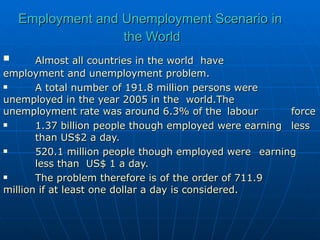
Employment and Unemployment Scenario in  the World Almost all countries in the world  have  employment and unemployment problem. A total number of 191.8 million persons were  unemployed in the year 2005 in the  world.The  unemployment rate was around 6.3% of the  labour  force 1.37 billion people though employed were earning  less  than US$2 a day. 520.1 million people though employed were  earning  less than  US$ 1 a day. The problem therefore is of the order of 711.9  million if at least one dollar a day is considered.
S.No.   Item   2004-2005 Total Population as on Jan. 2005   1092.96Million  Total Labour Force   469.94 Million Total Employment    459.10 Million Total  number of open      10.84 Million    Unemployment Unemployment rate as percentage   Around   of total labour force   2. 3 % Employment in Organised Sector(2004)  26.4  Million S EMPLOYMENT AND UNEMPLOYMENT  SCENARIO IN INDIA Cont...
STRUCTURE   OF WORKFORCE Sector   World  India Agriculture  40.1%  58.5% Industry  21.0%  18.1% Services  38.9%  23.4%  Vast majority of workers in Agriculture A significant proportion of them are below poverty line
Approach by various Countries Various countries are trying to address the  problem of  unemployment through various  means. Developed countries are trying to have separate  employment policies. Developing countries are relying on economic  growth as well as special employment generation  programme. Export of labour force to other countries will not  be  easy unless labour force in developing  countries can  claim better skills.
Approach to Employment in Economic Planning-India Planning in India focused on economic growth. Generation of employment was viewed as part of  the  process of development and not as a goal in  conflict  with, or to be pursued independently of economic  development  Thus there is no employment policy as such and  additional employment generation is attempted  through growth process and through special  employment generation programme
PROBLEMS Population growth and consequential increase in the  labour force. 10 to 12 million persons are entering the  labour force every year. Productivity and income generation from employment are low. Th ough, open unemployment is only2.3%(11 million)  the percentage of the population below the poverty line is  high. The fact of being employed is obviously  no guarantee of escaping from poverty,which in our situation  refers to a very basic level of subsistence. Out of around 470 million work force as many as 130million  are working poor. Therefore the problem is of the order of  130+11=141 million.
MAIN ISSUES There are primarily two main issues namely:-   Issue no-1 How to provide  employment to the new entrant to the  labour force and to the unemployed. That is how to  create additional employment opportunities needed. Issue no-2   How to improve quality of employment so that  productivity and income level of the workforce  increases.
Action taken to tackle Issue No-1 Planned Initiative. Tenth Plan envisages creation of  around 10 million jobs each year, around 6 million from  normal growth process and around 4 million  through  special employment generation programme proposed for   sectors. Economic growth and employment growth being  correlated attempts are made to achieve 8%  growth rate of the economy so that anticipated  employment generation takes place. As against a target of 10 million per year around12  million persons per year were provided  employment during 2000-2005
Action taken to tackle Issue No-2 Provide skill training to the new entrants to the  labour force Improving skill level of the work force. Organize Skill training as per the market demand. That  is, it should cater to the needs of both organized and  unorganized sector.
STUDENTS  ARE THE RISING POWERS OF INDIA
 

Blusters

  • 1.
    A Presentation On“Problems of DEVELOPING INDIA”
  • 2.
    Problems of DevelopingIndia Population Poverty Unemployment Corruption
  • 3.
    How do theenvironmental impacts of a growing population of a developed country, the United States, compares to the undeveloped country of India? Taken from: http://www.claybennett.com/pages/divide.html Population Growth
  • 4.
    [INTRO]duction We predictthat a growing population will cause: Higher rate of deforestation Greater loss of freshwater resources More pollution Increased global warming Strains of natural resources Social issues
  • 5.
    [M]ethods We firstsearched to find what causes a growing population. We then looked to see the effects of the growing population on the environment. Stella and Excel were used to display the impacts of the population growth on: Forest Area Fresh Water Availability We also compared the two different growing populations.
  • 6.
    What are we[model]ing? India Population growth. United States Growth. Effects on Environmental Resources: Fresh Water Availability Forest Areas Effects of varying levels of these subcategories.
  • 7.
    Why a [grow]ingpopulation? United States Increased Immigration Rates Better health care Higher living standards Abortion Laws Unintended Pregnancies ~ 40% births Teenage Pregnancies India Lack of Migration Lack of Education Desire for Male children Fertility rate declining Younger women having children Taken from: http://www.tashian.com/carl/archives/us-1896.gif Taken from: http://wwp.greenwichmeantime.com/time-zone/asia/india/images/india-flag.jpg
  • 8.
    [Water] and [Forest]Factor Freshwater Availability Misconception of Oceans as freshwater Human Bodies – 60% water Sewage deposited in water Health problems Per Capita Water Use Forests Area Urbanization – more paved areas Less parks and nature Lack of Oxygen production Increase Quantity of Carbon Dioxide (Greenhouse Gases) Global Warming Taken from: http://static.flickr.com/33/38490644_41f946c4f2_b.jpg Taken from: http://pantransit.reptiles.org/images/1996-07-28/washington-rain-forest.png
  • 9.
    [Environ]mental Impacts Pollution – increase in cars and emission of greenhouse gases into atmosphere Deforestation – increase in paved areas to house increasing population Freshwater Availability – increase in waste production and contamination of water Natural Resources – increase burning of fossil fuels, excessive use of coal Global Warming – overall increase in temperature and chances of natural disasters Habitat Loss – change in ecosystems affecting trophic levels
  • 10.
    [Excel] Model Comparingthe Population of India and US with no external pressures Both increasing. India growth rate per year: 1.51% US growth rate per year: 0.92% India starts at a greater population.
  • 11.
    WHY DO THEYDIFFER? EDUCATION GNP IMMIGRATION/MIGRATION
  • 12.
    [Sol]utions Increase educationprograms Later marriages Contraceptive use Less of a need for urbanization (jobs) Be energy efficient (wind/ solar) Organic farming Sustainable development (build vertically) Plant more trees! Have better governmental regulations for an improved economy
  • 13.
  • 14.
    Redefining Poverty ANew Poverty Line for a New India
  • 15.
    The Government ofIndia says that 24% of India’s population is below the poverty line.* * Planning Commission of India, 1999-2000, Government of India
  • 16.
    Despite such abysmalfigures on India’s development, how can the government claim that only 24% of India is poor? Clearly something is amiss…
  • 17.
    The answer liesin how poverty is defined in India The present poverty line is a conveniently low threshold based largely on only caloric norms. In fact, it should be called the starvation line . It does not factor in norms for nutrition, health, clothing, housing, education etc. Even worse is that the Planning Commission recognizes this shortcoming and yet doesn’t do anything about it.
  • 18.
    “ I havelearnt to seek my happiness by limiting my desires rather than attempting to satisfy them.” John Stuart Mill
  • 19.
    Table 1: Percentageand Number of Poor in India since 1973 * Year Percentage of Poor Number of Poor (crores) Annual Real Rate of Decline in the Number of Poor ^ 1973-74 54.9 % 32.13 - 1977-78 51.3 % 32.89 ( 0.59 %) 1983 44.5 % 32.29 0.31 % 1987-88 38.9 % 30.71 1.25 % 1993-94 36.0 % 32.03 ( 0.70 %) 1999-00 26.1 % 26.02 3.40 % 2004** 23.6 % 24.97 0.82 % * As per the Expert Group Methodology ^ A negative rate of decline means the number of poor increased ** Based on the estimated population of 2004 and poverty ratio calculated using the latest National Sample Survey in 2004. Source: National Institute of Rural Development (2004): Rural Development Statistics, 2002-03 .
  • 20.
    The redefined povertyline Summing up minimum costs for nutrition (Rs. 573), health (Rs. 30), clothing (Rs. 17), energy consumption (Rs. 55) and miscellaneous expenditure (Rs. 164); the poverty line in India should be about Rs. 840 per capita per month*. * The actual sum is Rs. 839; we round it off for convenience.
  • 21.
    A person is poor in India if he or she has a monthly per capita expenditure lesser than Rs. 840 OR does not have access to either drinking water; proper shelter; sanitation; quality secondary education; or an all-weather road with public transport.
  • 22.
    Incidence of PovertyInterventions - Program, Technology Natural Resources Institutional/ Social Factor Labour & Capital Flow/Mobility Spatial Integration of Economic activities New Lively hood opportunities ECOLOGICAL AND INCOME POVERTY - DYNAMICS Databases on relationship to examine the direction of policies/interventions? Powerlessness of poor to gain access or use available natural resources Role of economic policies and interventions in altering the relationship Inequitable access land, Information, market and credit
  • 23.
    He and Sheare poor; Not because they are borne so; In fact, it is the failure of the institutions, polices and programme that they continue to be poor and marginalized. - A Perception
  • 24.
    EMPLOYMENT , UNEMPLOYMENTAND TRAINING ISSUES
  • 25.
    Employment and UnemploymentScenario in the World Almost all countries in the world have employment and unemployment problem. A total number of 191.8 million persons were unemployed in the year 2005 in the world.The unemployment rate was around 6.3% of the labour force 1.37 billion people though employed were earning less than US$2 a day. 520.1 million people though employed were earning less than US$ 1 a day. The problem therefore is of the order of 711.9 million if at least one dollar a day is considered.
  • 26.
    S.No. Item 2004-2005 Total Population as on Jan. 2005 1092.96Million Total Labour Force 469.94 Million Total Employment 459.10 Million Total number of open 10.84 Million Unemployment Unemployment rate as percentage Around of total labour force 2. 3 % Employment in Organised Sector(2004) 26.4 Million S EMPLOYMENT AND UNEMPLOYMENT SCENARIO IN INDIA Cont...
  • 27.
    STRUCTURE OF WORKFORCE Sector World India Agriculture 40.1% 58.5% Industry 21.0% 18.1% Services 38.9% 23.4% Vast majority of workers in Agriculture A significant proportion of them are below poverty line
  • 28.
    Approach by variousCountries Various countries are trying to address the problem of unemployment through various means. Developed countries are trying to have separate employment policies. Developing countries are relying on economic growth as well as special employment generation programme. Export of labour force to other countries will not be easy unless labour force in developing countries can claim better skills.
  • 29.
    Approach to Employmentin Economic Planning-India Planning in India focused on economic growth. Generation of employment was viewed as part of the process of development and not as a goal in conflict with, or to be pursued independently of economic development Thus there is no employment policy as such and additional employment generation is attempted through growth process and through special employment generation programme
  • 30.
    PROBLEMS Population growthand consequential increase in the labour force. 10 to 12 million persons are entering the labour force every year. Productivity and income generation from employment are low. Th ough, open unemployment is only2.3%(11 million) the percentage of the population below the poverty line is high. The fact of being employed is obviously no guarantee of escaping from poverty,which in our situation refers to a very basic level of subsistence. Out of around 470 million work force as many as 130million are working poor. Therefore the problem is of the order of 130+11=141 million.
  • 31.
    MAIN ISSUES Thereare primarily two main issues namely:- Issue no-1 How to provide employment to the new entrant to the labour force and to the unemployed. That is how to create additional employment opportunities needed. Issue no-2 How to improve quality of employment so that productivity and income level of the workforce increases.
  • 32.
    Action taken totackle Issue No-1 Planned Initiative. Tenth Plan envisages creation of around 10 million jobs each year, around 6 million from normal growth process and around 4 million through special employment generation programme proposed for sectors. Economic growth and employment growth being correlated attempts are made to achieve 8% growth rate of the economy so that anticipated employment generation takes place. As against a target of 10 million per year around12 million persons per year were provided employment during 2000-2005
  • 33.
    Action taken totackle Issue No-2 Provide skill training to the new entrants to the labour force Improving skill level of the work force. Organize Skill training as per the market demand. That is, it should cater to the needs of both organized and unorganized sector.
  • 34.
    STUDENTS ARETHE RISING POWERS OF INDIA
  • 35.