BLUETOOTH CONTROLLED FLOOR
CLEANING ROBOT USING ARDUINO
GUIDED BY, SUBMITTED BY,
Ms. PONNAMBILI S ARYA B (VPE21EC004)
AP, ECE PRAVEEN SJ (VPE21EC007)
CONTENTS
INTRODUCTION
OBJECTIVES
LITERATURE SURVEY
BLOCK DIAGRAM
CIRCUIT DIAGRAM
WORKING
COMPONENTS
RESULTS
ADVANTAGES
DISADVANTAGES
APPLICATION
FUTURE SCOPE
CONCLUSION
REFERENCES
INTRODUCTION
Floor cleaning is a very tough job it requires lot of patience and lot of persons to
clean and in cleaning a person may damage his/her healthiness, cleaning is more
time taking work.
To do work easily we have developed the robot and it is designed in such a way
that it can clean house, offices, apartments, and even streets as well.
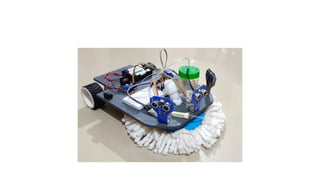
The Bluetooth controlled floor cleaning robot which cleans a dirty floor
automatically using a set of commands given to the robot by a smartphone.
The device communicates through Bluetooth technology via a HC05 Bluetooth
module that will be used to exchange commands to the microcontroller – Arduino
NANO
The Bluetooth-controlled floor cleaning robot offers convenience and flexibility
to users by allowing them to remotely control the robot's movements and cleaning
actions from a distance.
OBJECTIVES
Obstacle detection and avoidance.
Convenient and flexible to use.
Effectively remove dirt.
Bluetooth control capability.
LITERATURE SURVEY
“A smart autonomous floor
cleaner with an Android
based controller” by Anshu
Prakash Murdan, Pawan
Kumar Ramkissoon
This paper proposes a cheaper alternative to
expensive commercial robots by creating a robot
that can both vacuum and mop, and is
controllable through an app.
The robot uses Arduino Mega microcontroller, a
mobile app with Bluetooth connectivity, and has
autonomous and remote-controlled modes.
The system is built with rechargeable battery.
“Automatic Floor Cleaning
Robot Using Arduino and
Ultrasonic Sensor” by Yuda
Irawan
This paper proposes a design for an automatic
floor cleaning robot prototype It utilizes an
Arduino Uno microcontroller as the brain and
an ultrasonic sensor to detect obstacles within
15 cm.
When the sensor detects an obstacle, the robot
automatically changes direction to avoid it.
“Survey on Automatic and
manual floor cleaning robot”
by Meghana K V, Harshitha V,
Mahima Padmanabha B,
Nagesh N Dikshit, B R
Santosh Kumar
This project proposes a user-friendly robotic
vacuum cleaner with additional features.
The robot will be fully automatic and include a self-
emptying dustbin and a pick-and-place mechanism.
The design is intended to be simple to build,
operate, and improve people's lives.
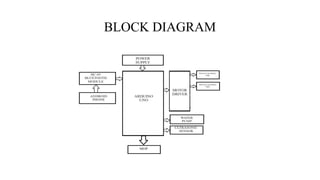
BLOCK DIAGRAM
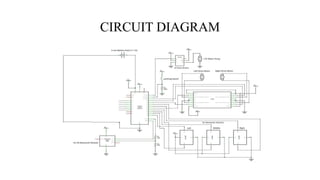
CIRCUIT DIAGRAM
WORKING PRINCIPLE
The user sends cleaning instructions through a smartphone app connected to the
robot via Bluetooth
The robot uses sensors to navigate around the room. Here distance sensors are
used .
The robot is equipped with wheels powered by electric motors that propel it
around. The user’s commands through app direct the motor movements and
dictating the robot’s cleaning path.
An android application is used either to control the floor cleaner or to put it
in autonomous mode.
The robot uses microfiber cloths for mopping or wiping the floor.
Water tanks and pumps are included in the robot.
The water tank stores the clean water used for mopping the floor.
The pump precisely controls the water flow from the tank to the mopping cloth.
The whole robotic system is powered by lithium ion battery.
COMPONENTS
ARDUINO NANO
• Compact and Breadboard-Friendly
• Similar to Uno, But Miniaturized
• Multiple Power Options
BLUETOOTH MODULE
• Enable wireless communication
• Low Power Consumption
• Easy Integration
ULTRASONIC SENSOR
• Work based on the principle of echolocations.
• Works in Various Lighting Conditions.
• less expensive compared to some other sensors.
L298N MOTOR DRIVER
• It controls two DC motors simultaneously,
• Simple Operation
• Cost-Effective and Popular
LITHIUM ION BATTERY
• Lithium Ion (Li-ion) batteries are popular for their high energy density.
• Unlike disposable batteries, Li-ion batteries can be recharged hundreds of
times.
• Li-ion batteries have a longer lifespan.
DC MOTOR
• Consisting of a rotating shaft and electromagnets.
• The speed and direction of a DC motor can be easily controlled by adjusting
the supplied voltage or current.
MINI SUBMERSIBLE WATER PUMP
• Small size allow them to fit in tight spaces and be submerged entirely in
liquids.
• Often powered by low voltage DC.
• Easy to use.
• Mini submersible water pumps are generally affordable.
RESULTS
The project demonstrates it's possible to build such a robot using Arduino and
Bluetooth for app-based control of the cleaning action.
The robot can be programmed for functionalities like moving forward/backward,
turning, and potentially even obstacle avoidance.
The robot could have a detachable mopping attachment that holds the microfiber
cloth. This would allow for easy removal and washing of the cloth.
A drip irrigation system allows for much finer control of water flow from the pump.
ADVANTAGES
It is convenient to use.
It can be focused on specific areas.
Saves time by cleaning on its own.
Cleans under furniture and other tricky areas, reaching where you might struggle.
Control your robot from phone, like a remote control.
DISADVANTAGES
• Arduino-based robots may have limited capabilities compared to commercial
alternatives, lacking advanced features such as mapping technology or room
detection.
• Building and programming a floor cleaning robot with Arduino may be
challenging for those without prior experience in electronics or programming.
• DIY robots may be more prone to malfunctions
• Users may have limited access to technical support or troubleshooting resources
compared to commercial robot manufacturers, making it more difficult to resolve
issues.
APPLICATION
Automate the process mopping floors in homes, reducing the manual effort
required for routine cleaning tasks.
Clean large areas such as offices, malls, and restaurants efficiently and
systematically, ensuring a consistently clean environment for customers and
employees.
Ensure sanitized floors in medical settings, reducing the risk of infections and
maintaining a sterile environment for patients and healthcare workers.
Keep school and university floors clean, promoting a conducive
learning environment for students and faculty members.
 Assist caregivers in maintaining clean floors in nursing homes and
assisted living facilities, providing a safe and comfortable living
environment for residents.
FUTURE SCOPE
Future iterations could incorporate advanced navigation technologies such as
SLAM (Simultaneous Localization and Mapping) for improved mapping and
navigation capabilities.
Integration of machine learning algorithms could enhance the robot's ability to
learn and adapt to its environment, optimizing cleaning patterns and efficiency
over time.
Future models may feature seamless integration with smart home systems,
allowing for voice commands, integration with virtual assistants, and
interoperability with other smart devices.
Incorporating advanced sensors, such as lidar or depth cameras, could
improve obstacle detection, navigation accuracy, and surface
recognition capabilities.
Future robots may be designed to clean a variety of surfaces,
including carpets, hardwood floors, and tiles, with interchangeable
cleaning attachments optimized for each surface type.
CONCLUSION
The Arduino-powered robot offers convenient automated floor cleaning, freeing
users from the chore of manual cleaning.
Building a floor cleaning robot with Arduino components can be cost-effective
compared to purchasing commercial alternatives, making it accessible to a wider
range of users.
While not as advanced as some commercial models, the Arduino-powered robot
still offers efficient floor cleaning, saving time and effort for users.
REFERENCES
• [1] Anshu Prakash Murdan, Pawan Kumar Ramkissoon, “A smart autonomous
floor cleaner with an Android based controller” Electrical and Electronics
Engineering Dept University of Mauritius 978-l-7281-5707-8/20 ©2020 IEEE
• [2] Meghana K V, Harshitha V, Mahima Padmanabha B, Nagesh N Dikshit, B R
Santosh Kumar Electronics and Communication Engineering, K.S. Institute of
Technology, Bangalore, India “Survey on Automatic and manual floor cleaning
robot” 2019 JETIR April 2019, Volume 6, Issue 4.
• [3] Pawan Kumar Ramkisssoon , “A Smart Autonomous Floor Cleaner With An
Android Based Controller”, IEEE, 2020.
• [4] Rizuwana Parween, “Autonomous Self-reconfigurable Floor Cleaning Robot”,
IEEE, 2020.
• [5] Yuda Irawan, “Automatic Floor Cleaning Robot Using Arduino And Ultrasonic
Sensor” , Journal Of Robotics And Control ( JRC) , 2021.
THANK YOU

BLUETOOTH CONTROLLED FLOOR CLEANING ROBOT USING ARDUINO FINAL.pptx

  • 1.
    BLUETOOTH CONTROLLED FLOOR CLEANINGROBOT USING ARDUINO GUIDED BY, SUBMITTED BY, Ms. PONNAMBILI S ARYA B (VPE21EC004) AP, ECE PRAVEEN SJ (VPE21EC007)
  • 2.
    CONTENTS INTRODUCTION OBJECTIVES LITERATURE SURVEY BLOCK DIAGRAM CIRCUITDIAGRAM WORKING COMPONENTS RESULTS ADVANTAGES DISADVANTAGES APPLICATION FUTURE SCOPE CONCLUSION REFERENCES
  • 3.
    INTRODUCTION Floor cleaning isa very tough job it requires lot of patience and lot of persons to clean and in cleaning a person may damage his/her healthiness, cleaning is more time taking work. To do work easily we have developed the robot and it is designed in such a way that it can clean house, offices, apartments, and even streets as well. The Bluetooth controlled floor cleaning robot which cleans a dirty floor automatically using a set of commands given to the robot by a smartphone.
  • 4.
    The device communicatesthrough Bluetooth technology via a HC05 Bluetooth module that will be used to exchange commands to the microcontroller – Arduino NANO The Bluetooth-controlled floor cleaning robot offers convenience and flexibility to users by allowing them to remotely control the robot's movements and cleaning actions from a distance.
  • 5.
    OBJECTIVES Obstacle detection andavoidance. Convenient and flexible to use. Effectively remove dirt. Bluetooth control capability.
  • 6.
    LITERATURE SURVEY “A smartautonomous floor cleaner with an Android based controller” by Anshu Prakash Murdan, Pawan Kumar Ramkissoon This paper proposes a cheaper alternative to expensive commercial robots by creating a robot that can both vacuum and mop, and is controllable through an app. The robot uses Arduino Mega microcontroller, a mobile app with Bluetooth connectivity, and has autonomous and remote-controlled modes. The system is built with rechargeable battery.
  • 7.
    “Automatic Floor Cleaning RobotUsing Arduino and Ultrasonic Sensor” by Yuda Irawan This paper proposes a design for an automatic floor cleaning robot prototype It utilizes an Arduino Uno microcontroller as the brain and an ultrasonic sensor to detect obstacles within 15 cm. When the sensor detects an obstacle, the robot automatically changes direction to avoid it.
  • 8.
    “Survey on Automaticand manual floor cleaning robot” by Meghana K V, Harshitha V, Mahima Padmanabha B, Nagesh N Dikshit, B R Santosh Kumar This project proposes a user-friendly robotic vacuum cleaner with additional features. The robot will be fully automatic and include a self- emptying dustbin and a pick-and-place mechanism. The design is intended to be simple to build, operate, and improve people's lives.
  • 9.
  • 10.
  • 11.
    WORKING PRINCIPLE The usersends cleaning instructions through a smartphone app connected to the robot via Bluetooth The robot uses sensors to navigate around the room. Here distance sensors are used . The robot is equipped with wheels powered by electric motors that propel it around. The user’s commands through app direct the motor movements and dictating the robot’s cleaning path.
  • 12.
    An android applicationis used either to control the floor cleaner or to put it in autonomous mode. The robot uses microfiber cloths for mopping or wiping the floor. Water tanks and pumps are included in the robot. The water tank stores the clean water used for mopping the floor. The pump precisely controls the water flow from the tank to the mopping cloth. The whole robotic system is powered by lithium ion battery.
  • 13.
    COMPONENTS ARDUINO NANO • Compactand Breadboard-Friendly • Similar to Uno, But Miniaturized • Multiple Power Options BLUETOOTH MODULE • Enable wireless communication • Low Power Consumption • Easy Integration
  • 14.
    ULTRASONIC SENSOR • Workbased on the principle of echolocations. • Works in Various Lighting Conditions. • less expensive compared to some other sensors. L298N MOTOR DRIVER • It controls two DC motors simultaneously, • Simple Operation • Cost-Effective and Popular
  • 15.
    LITHIUM ION BATTERY •Lithium Ion (Li-ion) batteries are popular for their high energy density. • Unlike disposable batteries, Li-ion batteries can be recharged hundreds of times. • Li-ion batteries have a longer lifespan. DC MOTOR • Consisting of a rotating shaft and electromagnets. • The speed and direction of a DC motor can be easily controlled by adjusting the supplied voltage or current.
  • 16.
    MINI SUBMERSIBLE WATERPUMP • Small size allow them to fit in tight spaces and be submerged entirely in liquids. • Often powered by low voltage DC. • Easy to use. • Mini submersible water pumps are generally affordable.
  • 17.
    RESULTS The project demonstratesit's possible to build such a robot using Arduino and Bluetooth for app-based control of the cleaning action. The robot can be programmed for functionalities like moving forward/backward, turning, and potentially even obstacle avoidance. The robot could have a detachable mopping attachment that holds the microfiber cloth. This would allow for easy removal and washing of the cloth. A drip irrigation system allows for much finer control of water flow from the pump.
  • 19.
    ADVANTAGES It is convenientto use. It can be focused on specific areas. Saves time by cleaning on its own. Cleans under furniture and other tricky areas, reaching where you might struggle. Control your robot from phone, like a remote control.
  • 20.
    DISADVANTAGES • Arduino-based robotsmay have limited capabilities compared to commercial alternatives, lacking advanced features such as mapping technology or room detection. • Building and programming a floor cleaning robot with Arduino may be challenging for those without prior experience in electronics or programming. • DIY robots may be more prone to malfunctions • Users may have limited access to technical support or troubleshooting resources compared to commercial robot manufacturers, making it more difficult to resolve issues.
  • 21.
    APPLICATION Automate the processmopping floors in homes, reducing the manual effort required for routine cleaning tasks. Clean large areas such as offices, malls, and restaurants efficiently and systematically, ensuring a consistently clean environment for customers and employees. Ensure sanitized floors in medical settings, reducing the risk of infections and maintaining a sterile environment for patients and healthcare workers.
  • 22.
    Keep school anduniversity floors clean, promoting a conducive learning environment for students and faculty members.  Assist caregivers in maintaining clean floors in nursing homes and assisted living facilities, providing a safe and comfortable living environment for residents.
  • 23.
    FUTURE SCOPE Future iterationscould incorporate advanced navigation technologies such as SLAM (Simultaneous Localization and Mapping) for improved mapping and navigation capabilities. Integration of machine learning algorithms could enhance the robot's ability to learn and adapt to its environment, optimizing cleaning patterns and efficiency over time. Future models may feature seamless integration with smart home systems, allowing for voice commands, integration with virtual assistants, and interoperability with other smart devices.
  • 24.
    Incorporating advanced sensors,such as lidar or depth cameras, could improve obstacle detection, navigation accuracy, and surface recognition capabilities. Future robots may be designed to clean a variety of surfaces, including carpets, hardwood floors, and tiles, with interchangeable cleaning attachments optimized for each surface type.
  • 25.
    CONCLUSION The Arduino-powered robotoffers convenient automated floor cleaning, freeing users from the chore of manual cleaning. Building a floor cleaning robot with Arduino components can be cost-effective compared to purchasing commercial alternatives, making it accessible to a wider range of users. While not as advanced as some commercial models, the Arduino-powered robot still offers efficient floor cleaning, saving time and effort for users.
  • 26.
    REFERENCES • [1] AnshuPrakash Murdan, Pawan Kumar Ramkissoon, “A smart autonomous floor cleaner with an Android based controller” Electrical and Electronics Engineering Dept University of Mauritius 978-l-7281-5707-8/20 ©2020 IEEE • [2] Meghana K V, Harshitha V, Mahima Padmanabha B, Nagesh N Dikshit, B R Santosh Kumar Electronics and Communication Engineering, K.S. Institute of Technology, Bangalore, India “Survey on Automatic and manual floor cleaning robot” 2019 JETIR April 2019, Volume 6, Issue 4.
  • 27.
    • [3] PawanKumar Ramkisssoon , “A Smart Autonomous Floor Cleaner With An Android Based Controller”, IEEE, 2020. • [4] Rizuwana Parween, “Autonomous Self-reconfigurable Floor Cleaning Robot”, IEEE, 2020. • [5] Yuda Irawan, “Automatic Floor Cleaning Robot Using Arduino And Ultrasonic Sensor” , Journal Of Robotics And Control ( JRC) , 2021.
  • 28.