Effective Customer
Segmentation
Blueffect: II Ogólnopolski Kongres Efektywności
Warsaw, July 26, 2013
Pavel Jašek
Agenda
1. How can a customer segmentation change
your usage of web analytics data
2. Why your marketing campaigns are evaluated
wrong
3. Customer cohorts
4. Actionable content segmentation and
prioritization
Why to Segment Your Customers
● Understanding the behaviour of different
customer segments on your website
● Evaluating acquisition and retention campaigns
properly
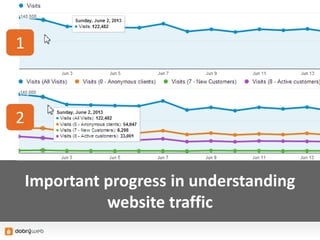
Important progress in understanding
website traffic
1
2
Customer Segmentation Options
Most Important Customer Segmentations (1/3)
● Customer Type
• Anonymous
• Registered users
• Customer with purchase history
Most Important Customer Segmentations (2/3)
● Customer Lifetime Status
• New Customer
• Frequent Customer
• VIP Customer
• Nonactive Customer
Most Important Customer Segmentations (3/3)
● Value segments for frequent customers
• <1 000 złoty in last 3 months purchases
• >1 000 złoty in last 3 months purchases
• > 10 000 złoty in last 3 months purchases
3 Ways to Gather Data for Segmentation
1. Implementing Custom Variables
• _gaq.push(['_setCustomVar', 5, 'customer', 'VIP', 1]);
• _gaq.push(['_setCustomVar', 4, 'ID', '123', 1]);
• For GA: visit-level or visitor-level scope
• Similarly in Piwik, Adobe, Webtrekk and Webtrends
2. Backward integration to customer ID
• Universal Analytics: Dimension Widening
3. Without any implementation
• Ad-hoc segments based on pageview /login.html
Recommendation #1
Start with a simple segmentation of
logged-in visitors. Your view on web
analytics data will change forever
since than.
Pavel Jašek
Good Sources to Read
● Google Analytics Custom Variables
• https://developers.google.com/analytics/devguides/
collection/gajs/gaTrackingCustomVariables
● Ideas from Lunametrics
• http://www.lunametrics.com/blog/2012/08/28/20-
ways-use-custom-variables/
Demystifying the conversion rate
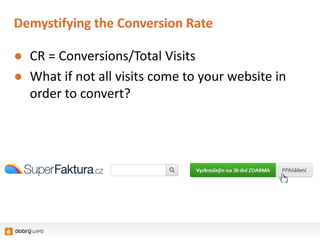
Demystifying the Conversion Rate
● CR = Conversions/Total Visits
● What if not all visits come to your website in
order to convert?
70-90 % of bank homepage visits
come only to login to e-banking
Prospects Instead of Visits
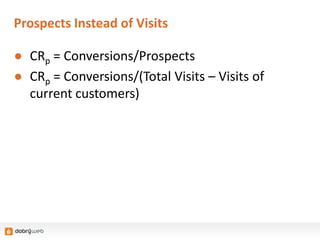
● CRp = Conversions/Prospects
● CRp = Conversions/(Total Visits – Visits of
current customers)
Using Visits Using Prospects
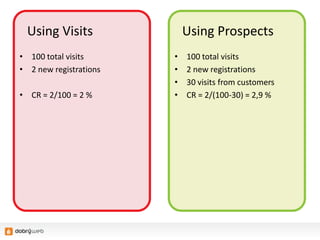
• 100 total visits
• 2 new registrations
• CR = 2/100 = 2 %
• 100 total visits
• 2 new registrations
• 30 visits from customers
• CR = 2/(100-30) = 2,9 %
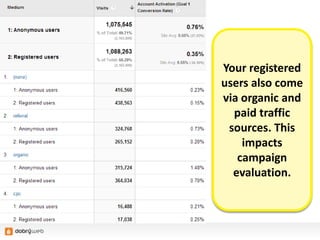
Your registered
users also come
via organic and
paid traffic
sources. This
impacts
campaign
evaluation.
Recommendation #2
Calculate conversion rates from
potentional customers only.
Pavel Jašek
Customer Cohorts
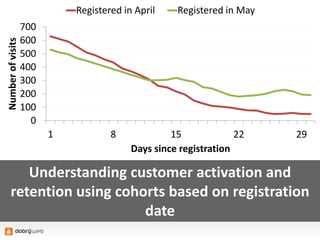
Understanding customer activation and
retention using cohorts based on registration
date
0
100
200
300
400
500
600
700
1 8 15 22 29
Numberofvisits
Days since registration
Registered in April Registered in May
What Cohorts Are Mostly Used
● Date, month or year of acquisition
● Most recent purchase date
● Traffic source of first visit
Recommendation #3
Don’t limit yourself to what your
web analytics tool offers. Make the
tool measure, process and visualize
what YOU want.
Pavel Jašek
Good Sources for Cohort Analysis
● Cohort Analysis 101 by RJ Metrics
• http://cohortanalysis.com/
● Cohort Analysis in Google Analytics
• http://cutroni.com/blog/2012/12/11/cohort-
analysis-with-google-analytics/
● Cohorts in Kissmetrics
• http://www.kissmetrics.com/demo/reports/cohort/
Content Segmentation Matrix
Content Segmentation Matrix Principles
● Group your content into sections of interest
● Compare pageviews by different types of visits
● Find significant differences as insights
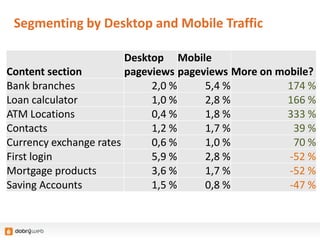
Segmenting by Desktop and Mobile Traffic
Content section
Desktop
pageviews
Mobile
pageviews More on mobile?
Bank branches 2,0 % 5,4 % 174 %
Loan calculator 1,0 % 2,8 % 166 %
ATM Locations 0,4 % 1,8 % 333 %
Contacts 1,2 % 1,7 % 39 %
Currency exchange rates 0,6 % 1,0 % 70 %
First login 5,9 % 2,8 % -52 %
Mortgage products 3,6 % 1,7 % -52 %
Saving Accounts 1,5 % 0,8 % -47 %
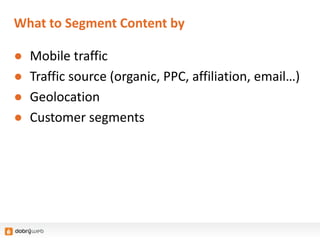
What to Segment Content by
● Mobile traffic
● Traffic source (organic, PPC, affiliation, email…)
● Geolocation
● Customer segments
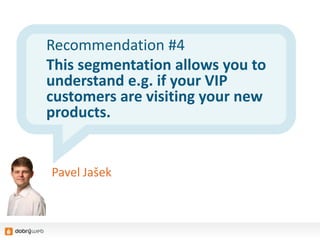
Recommendation #4
This segmentation allows you to
understand e.g. if your VIP
customers are visiting your new
products.
Pavel Jašek
Content-Content Matrix
Content-Content Matrix Principles
● Group your content into sections of interest
● Find number of visits that saw both sections
from each combination
● Using cross-selling principle „those who saw
section A also saw section B“
● Compute relative frequency of visits in such
combinations
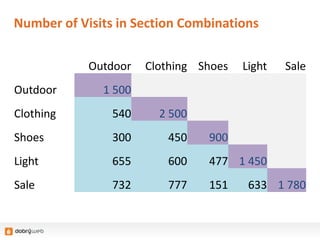
Number of Visits in Section Combinations
Outdoor Clothing Shoes Light Sale
Outdoor 1 500
Clothing 540 2 500
Shoes 300 450 900
Light 655 600 477 1 450
Sale 732 777 151 633 1 780
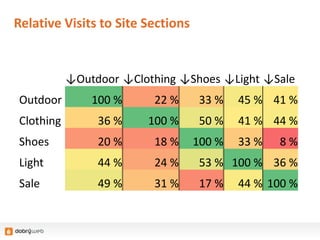
Relative Visits to Site Sections
↓Outdoor ↓Clothing ↓Shoes ↓Light ↓Sale
Outdoor 100 % 22 % 33 % 45 % 41 %
Clothing 36 % 100 % 50 % 41 % 44 %
Shoes 20 % 18 % 100 % 33 % 8 %
Light 44 % 24 % 53 % 100 % 36 %
Sale 49 % 31 % 17 % 44 % 100 %
What Page Types Are Useful for Segmentation
● Homepage
● Product categories
● Contact pages
● User login
● Support pages
Recommendation #5
Sections cross-views give you
actionable insights about which site
sections should be better linked
together.
Pavel Jašek
Conclusion
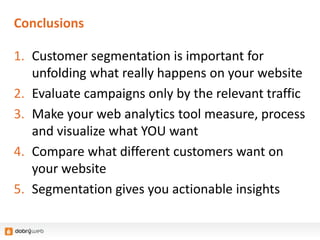
Conclusions
1. Customer segmentation is important for
unfolding what really happens on your website
2. Evaluate campaigns only by the relevant traffic
3. Make your web analytics tool measure, process
and visualize what YOU want
4. Compare what different customers want on
your website
5. Segmentation gives you actionable insights
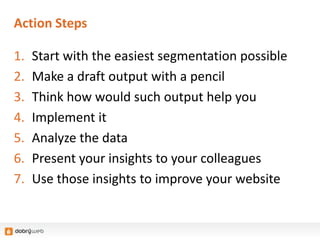
Action Steps
1. Start with the easiest segmentation possible
2. Make a draft output with a pencil
3. Think how would such output help you
4. Implement it
5. Analyze the data
6. Present your insights to your colleagues
7. Use those insights to improve your website
@paveljasek
pavel.jasek@dobryweb.cz

Blueffect 2013 - Skuteczna segmentacja klientów w Google Analytics

  • 1.
    Effective Customer Segmentation Blueffect: IIOgólnopolski Kongres Efektywności Warsaw, July 26, 2013 Pavel Jašek
  • 2.
    Agenda 1. How cana customer segmentation change your usage of web analytics data 2. Why your marketing campaigns are evaluated wrong 3. Customer cohorts 4. Actionable content segmentation and prioritization
  • 3.
    Why to SegmentYour Customers ● Understanding the behaviour of different customer segments on your website ● Evaluating acquisition and retention campaigns properly
  • 4.
    Important progress inunderstanding website traffic 1 2
  • 5.
  • 6.
    Most Important CustomerSegmentations (1/3) ● Customer Type • Anonymous • Registered users • Customer with purchase history
  • 7.
    Most Important CustomerSegmentations (2/3) ● Customer Lifetime Status • New Customer • Frequent Customer • VIP Customer • Nonactive Customer
  • 8.
    Most Important CustomerSegmentations (3/3) ● Value segments for frequent customers • <1 000 złoty in last 3 months purchases • >1 000 złoty in last 3 months purchases • > 10 000 złoty in last 3 months purchases
  • 9.
    3 Ways toGather Data for Segmentation 1. Implementing Custom Variables • _gaq.push(['_setCustomVar', 5, 'customer', 'VIP', 1]); • _gaq.push(['_setCustomVar', 4, 'ID', '123', 1]); • For GA: visit-level or visitor-level scope • Similarly in Piwik, Adobe, Webtrekk and Webtrends 2. Backward integration to customer ID • Universal Analytics: Dimension Widening 3. Without any implementation • Ad-hoc segments based on pageview /login.html
  • 10.
    Recommendation #1 Start witha simple segmentation of logged-in visitors. Your view on web analytics data will change forever since than. Pavel Jašek
  • 11.
    Good Sources toRead ● Google Analytics Custom Variables • https://developers.google.com/analytics/devguides/ collection/gajs/gaTrackingCustomVariables ● Ideas from Lunametrics • http://www.lunametrics.com/blog/2012/08/28/20- ways-use-custom-variables/
  • 12.
  • 13.
    Demystifying the ConversionRate ● CR = Conversions/Total Visits ● What if not all visits come to your website in order to convert?
  • 14.
    70-90 % ofbank homepage visits come only to login to e-banking
  • 15.
    Prospects Instead ofVisits ● CRp = Conversions/Prospects ● CRp = Conversions/(Total Visits – Visits of current customers)
  • 16.
    Using Visits UsingProspects • 100 total visits • 2 new registrations • CR = 2/100 = 2 % • 100 total visits • 2 new registrations • 30 visits from customers • CR = 2/(100-30) = 2,9 %
  • 17.
    Your registered users alsocome via organic and paid traffic sources. This impacts campaign evaluation.
  • 18.
    Recommendation #2 Calculate conversionrates from potentional customers only. Pavel Jašek
  • 19.
  • 20.
    Understanding customer activationand retention using cohorts based on registration date 0 100 200 300 400 500 600 700 1 8 15 22 29 Numberofvisits Days since registration Registered in April Registered in May
  • 21.
    What Cohorts AreMostly Used ● Date, month or year of acquisition ● Most recent purchase date ● Traffic source of first visit
  • 22.
    Recommendation #3 Don’t limityourself to what your web analytics tool offers. Make the tool measure, process and visualize what YOU want. Pavel Jašek
  • 23.
    Good Sources forCohort Analysis ● Cohort Analysis 101 by RJ Metrics • http://cohortanalysis.com/ ● Cohort Analysis in Google Analytics • http://cutroni.com/blog/2012/12/11/cohort- analysis-with-google-analytics/ ● Cohorts in Kissmetrics • http://www.kissmetrics.com/demo/reports/cohort/
  • 24.
  • 25.
    Content Segmentation MatrixPrinciples ● Group your content into sections of interest ● Compare pageviews by different types of visits ● Find significant differences as insights
  • 26.
    Segmenting by Desktopand Mobile Traffic Content section Desktop pageviews Mobile pageviews More on mobile? Bank branches 2,0 % 5,4 % 174 % Loan calculator 1,0 % 2,8 % 166 % ATM Locations 0,4 % 1,8 % 333 % Contacts 1,2 % 1,7 % 39 % Currency exchange rates 0,6 % 1,0 % 70 % First login 5,9 % 2,8 % -52 % Mortgage products 3,6 % 1,7 % -52 % Saving Accounts 1,5 % 0,8 % -47 %
  • 27.
    What to SegmentContent by ● Mobile traffic ● Traffic source (organic, PPC, affiliation, email…) ● Geolocation ● Customer segments
  • 28.
    Recommendation #4 This segmentationallows you to understand e.g. if your VIP customers are visiting your new products. Pavel Jašek
  • 29.
  • 30.
    Content-Content Matrix Principles ●Group your content into sections of interest ● Find number of visits that saw both sections from each combination ● Using cross-selling principle „those who saw section A also saw section B“ ● Compute relative frequency of visits in such combinations
  • 31.
    Number of Visitsin Section Combinations Outdoor Clothing Shoes Light Sale Outdoor 1 500 Clothing 540 2 500 Shoes 300 450 900 Light 655 600 477 1 450 Sale 732 777 151 633 1 780
  • 32.
    Relative Visits toSite Sections ↓Outdoor ↓Clothing ↓Shoes ↓Light ↓Sale Outdoor 100 % 22 % 33 % 45 % 41 % Clothing 36 % 100 % 50 % 41 % 44 % Shoes 20 % 18 % 100 % 33 % 8 % Light 44 % 24 % 53 % 100 % 36 % Sale 49 % 31 % 17 % 44 % 100 %
  • 33.
    What Page TypesAre Useful for Segmentation ● Homepage ● Product categories ● Contact pages ● User login ● Support pages
  • 34.
    Recommendation #5 Sections cross-viewsgive you actionable insights about which site sections should be better linked together. Pavel Jašek
  • 35.
  • 36.
    Conclusions 1. Customer segmentationis important for unfolding what really happens on your website 2. Evaluate campaigns only by the relevant traffic 3. Make your web analytics tool measure, process and visualize what YOU want 4. Compare what different customers want on your website 5. Segmentation gives you actionable insights
  • 37.
    Action Steps 1. Startwith the easiest segmentation possible 2. Make a draft output with a pencil 3. Think how would such output help you 4. Implement it 5. Analyze the data 6. Present your insights to your colleagues 7. Use those insights to improve your website
  • 38.