Blue Ocean StrategyBlue Ocean Strategy
How to Create Uncontested Market Space 
and Make the Competition Irrelevantp
Author ‐ W.Chan Kim & Renee Mauborgne
Chapter 1 – Creating Blue Oceans
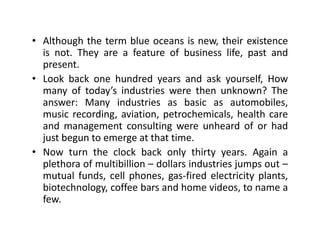
• Although the term blue oceans is new, their existenceg ,
is not. They are a feature of business life, past and
present.
L k b k h d d d k lf H• Look back one hundred years and ask yourself, How
many of today’s industries were then unknown? The
answer: Many industries as basic as automobiles,
music recording, aviation, petrochemicals, health care
and management consulting were unheard of or had
just begun to emerge at that timejust begun to emerge at that time.
• Now turn the clock back only thirty years. Again a
plethora of multibillion – dollars industries jumps out –
mutual funds, cell phones, gas‐fired electricity plants,
biotechnology, coffee bars and home videos, to name a
fewfew.
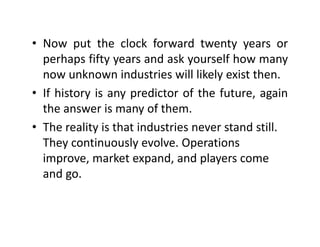
• Now put the clock forward twenty years orNow put the clock forward twenty years or
perhaps fifty years and ask yourself how many
now unknown industries will likely exist thennow unknown industries will likely exist then.
• If history is any predictor of the future, again
the answer is many of themthe answer is many of them.
• The reality is that industries never stand still. 
Th i l l O iThey continuously evolve. Operations 
improve, market expand, and players come 
dand go.
Chapter 2 – Analytical tools and Frameworks
The Four Actions Framework –The Four Actions Framework
1) Which of the factors that the industry takes
for granted should be eliminated?for granted should be eliminated?
2) Which factors should be reduced well below
h i d ’ d d?the industry’s standard?
3) Which factors should be raised well above
the industry’s standard?
4) Which factors should be created that the)
industry has never offered?
Chapter 3 – Reconstruct Market Boundaries
• The first principle of blue ocean strategy is toThe first principle of blue ocean strategy is to
re‐construct market boundaries to break from
the competition and create blue oceansthe competition and create blue oceans.
Thi i i l dd h h i k• This principle addresses the search risk many
company struggles with.
• The challenge is to successfully identify, out of g y y,
the haystack of possibilities that exist, 
commercially compelling blue ocean strategy.y p g gy
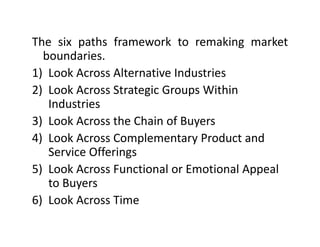
The six paths framework to remaking marketThe six paths framework to remaking market
boundaries.
1) Look Across Alternative Industries1) Look Across Alternative Industries
2) Look Across Strategic Groups Within 
IndustriesIndustries
3) Look Across the Chain of Buyers
4) Look Across Complementary Product and4) Look Across Complementary Product and 
Service Offerings
5) Look Across Functional or Emotional Appeal5) Look Across Functional or Emotional Appeal 
to Buyers
6) Look Across Time6) Look Across Time
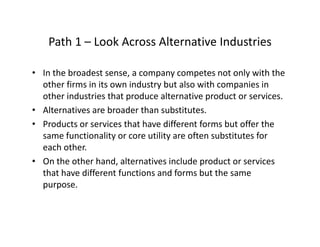
Path 1 – Look Across Alternative IndustriesPath 1  Look Across Alternative Industries
• In the broadest sense, a company competes not only with the , p y p y
other firms in its own industry but also with companies in 
other industries that produce alternative product or services.
Alt ti b d th b tit t• Alternatives are broader than substitutes.
• Products or services that have different forms but offer the 
same functionality or core utility are often substitutes for y y
each other. 
• On the other hand, alternatives include product or services 
h h diff f i d f b hthat have different functions and forms but the same 
purpose.  
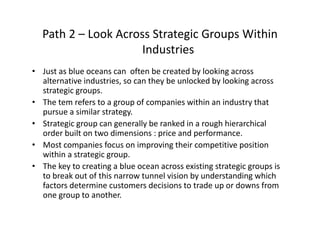
Path 2 – Look Across Strategic Groups Within 
I d iIndustries
• Just as blue oceans can  often be created by looking across 
alternative industries, so can they be unlocked by looking across 
strategic groups.
• The tem refers to a group of companies within an industry that 
pursue a similar strategy.
• Strategic group can generally be ranked in a rough hierarchical 
order built on two dimensions : price and performance.
• Most companies focus on improving their competitive position 
within a strategic group.
• The key to creating a blue ocean across existing strategic groups is y g g g g p
to break out of this narrow tunnel vision by understanding which 
factors determine customers decisions to trade up or downs from 
one group to another.
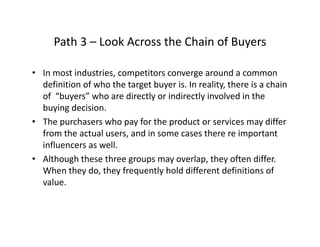
Path 3 – Look Across the Chain of BuyersPath 3  Look Across the Chain of Buyers
• In most industries, competitors converge around a common , p g
definition of who the target buyer is. In reality, there is a chain 
of  “buyers” who are directly or indirectly involved in the 
buying decisionbuying decision.
• The purchasers who pay for the product or services may differ 
from the actual users, and in some cases there re important 
influencers as well. 
• Although these three groups may overlap, they often differ.  
When they do they frequently hold different definitions ofWhen they do, they frequently hold different definitions of 
value. 
Path 4 ‐ Look Across Complementary Product 
d S i Off iand Service Offerings
• Few products and services are used in a vacuum. In mostp
cases, other products and services affect their value. But in
most industries rival converge within the bounds of their
industry’s product and service offeringindustry s product and service offering.
• Untapped value is often hidden in complementary products
and services.
• The key is to define the total solution buyers seek when they
choose a product or service.
A i l d i hi k b h h b f• A simple way to do so is to think about what happens before,
during and after your product is used.
Path 5 ‐ Look Across Functional or Emotional 
A l BAppeal to Buyers
• Competition in an industry tends to converge not only on an
accepted notion of the scope of its product and services but also on
one of two possibilities bases of appeal.
• Some industries compete principally on price and function largelySome industries compete principally on price and function largely
on calculations of utility; their appeal is rational. Other industries
compete largely on feelings; their appeal is emotional.
O ti f ti ll i t d i d t i b• Over time, functionally oriented industries become more
functionally oriented; emotionally oriented industries become more
emotionally oriented.
• When companies are willing to challenge the functional‐emotional
orientation of their industry, they often find new market space.
Path 6 ‐ Look Across TimePath 6  Look Across Time
• All industries are subject to external trends that effect their 
businesses over time. Think of the rapid rise of the internet or the 
global movement toward protecting the environment. 
• Looking at these trends with the right perspective can show you 
how t create blue ocean opportunities.
• Most companies adapt incrementally and somewhat passively as 
events unfold. Whether it’s the emergence of new technologies or 
major regulatory changes, managers tend to focus on projecting the 
trend itself.
• But key insights into blue ocean strategy rarely come from 
projecting the trend itself. Instead they rise from business insights 
into how the trend will change value to customers and impact the 
company’s business model.
Chapter 4 – Focus on the Big Picture, Not the 
Numbers
• Once you know the paths to creating blue y p g
oceans. The next question is, How do you align 
your strategic planning process to focus on the 
big picturebig picture.
• The key is to draw a strategy canvas not only 
visualizes a company’s current strategic position 
in its marketplace but also helps its future 
strategy.
• By building a company strategic planning process• By building a company strategic planning process 
around a strategy canvas, a company and its 
managers focus their main attention on the big 
i h h b i i d ipicture rather than becoming immersed in 
numbers and jargon and getting caught up in 
operational details. p
The four Steps of Visualizing StrategyThe four Steps of Visualizing Strategy
1) Visual Awakening
2) Vi l E l i2) Visual Exploration
3) Visual Strategy Fair
4) Visual Communication
Step 1 ‐ Visual AwakeningStep 1 Visual Awakening
• A common mistake is to discuss changes in strategy beforeg gy
resolving differences of opinion bout the current state of play.
• Another problem is that executives are often reluctant to
accept the need for changes; they may have a vested interest
in the status quo, or they ay feel that time will eventuallyq , y y y
indicate their previous choices.
Step 2 ‐ Visual ExplorationStep 2  Visual Exploration
• Getting the wake‐up call is only the first step. The next step isg p y p p
to send a team into the field, putting managers face‐to face
with what they must make sense of : how people use or don’t
use their products or servicesuse their products or services.
• A company should never outsource its eyes. There is simplyp y y p y
no substitute for seeing yourself. Great artist don’t paint from
other people descriptions or even from photographs; they like
to see the subject for themselves The same is true for greatto see the subject for themselves. The same is true for great
strategy.
Step 3 ‐ Visual Strategy fairStep 3  Visual Strategy fair
• After visual awakening and visual exploration, the next step isg p , p
drawing and re‐drawing of strategy on strategy canvases by
senior corporate executives and presenting in a visual strategy
fairfair.
• In visual strategy fair, various strategy canvas drawn would begy , gy
discussed followed by questions and answers session.
Step 4 ‐ Visual CommunicationStep 4  Visual Communication
• After the future strategy is set, the last step is to communicategy , p
it in a way that can be easily understood by any employees.
• It can be simple one‐page picture showing its new and old
strategic profiles so that every employees could see where
the company stood and where it had to focus its efforts top y
create a compelling future.
Chapter 5 – Reach Beyond Existing Demand
• No company wants to venture beyond redNo company wants to venture beyond red 
oceans only to find itself in a puddle. 
• The question is, how to maximize the size ofThe question is, how to maximize the size of 
the blue ocean you are creating?
• This bring us to the third principle of blue This bring us to the third principle of blue
ocean strategy: Reach beyond existing 
demand. This is  key component of achieving 
value innovation.
• By aggregating the greatest demand for a new 
offering, this approach attenuates the scale 
risk associated with creating a new market.
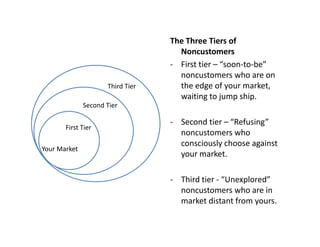
The Three Tiers of 
Noncustomers
‐ First tier – “soon‐to‐be” 
noncustomers who are on
Second Tier
Third Tier
noncustomers who are on 
the edge of your market, 
waiting to jump ship.
First Tier
‐ Second tier – “Refusing” 
noncustomers who 
Your Market
consciously choose against 
your market.
‐ Third tier ‐ “Unexplored” 
noncustomers who are in 
market distant from yoursmarket distant from yours.
Chapter 6 – Get the Strategic Sequence Right
• You’ve looked across paths to discoverYou ve looked across paths to discover 
possible blue oceans. You’ve have constructed 
a strategy canvas that clearly articulates youra strategy canvas that clearly articulates your 
future blue ocean strategy. And you have 
explored how to aggregate the largest possibleexplored how to aggregate the largest possible 
mass of buyers for your idea.
• The next challenge is to build a robust• The next challenge is to build a robust 
business model to ensure that you make a 
healthy profit on your blue ocean idea Thishealthy profit on your blue ocean idea. This 
bring us to the fourth principle of blue ocean 
strategy : get the strategic sequence rightstrategy : get the strategic sequence right.
The Sequence of Blue Ocean StrategyThe Sequence of Blue Ocean Strategy
• Buyer Utility – Is there exceptional buyer utility in your y y p y y y
business idea? If yes, move to next sequence. If No, rethink.
• Price – Is your price easily accessible to the mass of buyers? If 
t t If N thi kyes, move to next sequence. If No, rethink.
• Cost – Can you attain your cost target to profit at your 
strategic price? If yes, move to next sequence. If No, rethink.g p y , q ,
• Adoption – What are the adoption hurdles in actualizing your 
business idea? Are you addressing them up front? If yes, 
If N hi kmove to next sequence. If No, rethink.
• Passing through above mentioned sequence successfully,  we 
reach at “A commercially Viable Blue Ocean Idea”.reach at  A commercially Viable Blue Ocean Idea .
Chapter 7 – Overcome key organizational 
hurdles
• Once a company had developed a blue oceanOnce a company had developed a blue ocean 
strategy with a profitable business model, it 
must execute it The challenge of executionmust execute it. The challenge of execution 
exists, of course, for any strategy.
• Companies like individuals often have a• Companies, like individuals, often have a 
tough time translating thought into action 
whether in red or blue oceanswhether in red or blue oceans.
• But compared with red ocean strategy, blue 
t t t i ifiocean strategy represents a significance 
departure from the status quo.
The Four Organizational Hurdles to Strategy 
E iExecution
• Cognitive Hurdle – An organization wedded to the status quo.g g q
• Resource Hurdle – Limited resources
• Motivational Hurdle – Unmotivated Staff
• Political Hurdle – Opposition from powerful vested interests
Chapter 8 – Build Execution into Strategy
• A company is not only top management nor isA company is not only top management, nor is 
it only middle management. A company is 
everyone from the top to the front lineseveryone from the top to the front lines.
• And it is only when all the members of an 
organization are aligned around a strategy andorganization are aligned around a strategy and 
support it.
O i h i i l h dl• Overcoming the organizational hurdles to 
strategy execution is an important step toward 
th t d It th dbl k th tthat end. It removes the roadblocks that can 
put a halt to even the best of strategies.
Chapter 9 – Conclusion : The Sustainability and 
renewal of Blue ocean Strategy
• Creating Blue oceans is not a staticCreating Blue oceans is not a static 
achievement but a dynamic process.
• Once company creates a blue ocean and its• Once  company creates a blue ocean and its 
powerful performances consequences are 
known sooner or later imitators appear onknown, sooner or later imitators appear on 
the horizon.
Th i i H l ill h• The question is, How soon or late will they 
come? Put differently, how easy or difficult is 
bl t t t i it t ?blue ocean strategy to imitate?
THANK YOUTHANK YOU
H h d h di ☺Hope you had a happy reading ☺

Blue Ocean Strategy - Book Summary

  • 1.
  • 2.
  • 3.
    • Although theterm blue oceans is new, their existenceg , is not. They are a feature of business life, past and present. L k b k h d d d k lf H• Look back one hundred years and ask yourself, How many of today’s industries were then unknown? The answer: Many industries as basic as automobiles, music recording, aviation, petrochemicals, health care and management consulting were unheard of or had just begun to emerge at that timejust begun to emerge at that time. • Now turn the clock back only thirty years. Again a plethora of multibillion – dollars industries jumps out – mutual funds, cell phones, gas‐fired electricity plants, biotechnology, coffee bars and home videos, to name a fewfew.
  • 4.
    • Now putthe clock forward twenty years orNow put the clock forward twenty years or perhaps fifty years and ask yourself how many now unknown industries will likely exist thennow unknown industries will likely exist then. • If history is any predictor of the future, again the answer is many of themthe answer is many of them. • The reality is that industries never stand still.  Th i l l O iThey continuously evolve. Operations  improve, market expand, and players come  dand go.
  • 5.
  • 6.
    The Four ActionsFramework –The Four Actions Framework 1) Which of the factors that the industry takes for granted should be eliminated?for granted should be eliminated? 2) Which factors should be reduced well below h i d ’ d d?the industry’s standard? 3) Which factors should be raised well above the industry’s standard? 4) Which factors should be created that the) industry has never offered?
  • 7.
  • 8.
    • The firstprinciple of blue ocean strategy is toThe first principle of blue ocean strategy is to re‐construct market boundaries to break from the competition and create blue oceansthe competition and create blue oceans. Thi i i l dd h h i k• This principle addresses the search risk many company struggles with. • The challenge is to successfully identify, out of g y y, the haystack of possibilities that exist,  commercially compelling blue ocean strategy.y p g gy
  • 9.
    The six pathsframework to remaking marketThe six paths framework to remaking market boundaries. 1) Look Across Alternative Industries1) Look Across Alternative Industries 2) Look Across Strategic Groups Within  IndustriesIndustries 3) Look Across the Chain of Buyers 4) Look Across Complementary Product and4) Look Across Complementary Product and  Service Offerings 5) Look Across Functional or Emotional Appeal5) Look Across Functional or Emotional Appeal  to Buyers 6) Look Across Time6) Look Across Time
  • 10.
    Path 1 –Look Across Alternative IndustriesPath 1  Look Across Alternative Industries • In the broadest sense, a company competes not only with the , p y p y other firms in its own industry but also with companies in  other industries that produce alternative product or services. Alt ti b d th b tit t• Alternatives are broader than substitutes. • Products or services that have different forms but offer the  same functionality or core utility are often substitutes for y y each other.  • On the other hand, alternatives include product or services  h h diff f i d f b hthat have different functions and forms but the same  purpose.  
  • 11.
    Path 2 – Look Across Strategic Groups Within  I diIndustries • Just as blue oceans can  often be created by looking across  alternative industries, so can they be unlocked by looking across  strategic groups. • The tem refers to a group of companies within an industry that  pursue a similar strategy. • Strategic group can generally be ranked in a rough hierarchical  order built on two dimensions : price and performance. • Most companies focus on improving their competitive position  within a strategic group. • The key to creating a blue ocean across existing strategic groups is y g g g g p to break out of this narrow tunnel vision by understanding which  factors determine customers decisions to trade up or downs from  one group to another.
  • 12.
    Path 3 –Look Across the Chain of BuyersPath 3  Look Across the Chain of Buyers • In most industries, competitors converge around a common , p g definition of who the target buyer is. In reality, there is a chain  of  “buyers” who are directly or indirectly involved in the  buying decisionbuying decision. • The purchasers who pay for the product or services may differ  from the actual users, and in some cases there re important  influencers as well.  • Although these three groups may overlap, they often differ.   When they do they frequently hold different definitions ofWhen they do, they frequently hold different definitions of  value. 
  • 13.
    Path 4 ‐ Look Across Complementary Product  d Si Off iand Service Offerings • Few products and services are used in a vacuum. In mostp cases, other products and services affect their value. But in most industries rival converge within the bounds of their industry’s product and service offeringindustry s product and service offering. • Untapped value is often hidden in complementary products and services. • The key is to define the total solution buyers seek when they choose a product or service. A i l d i hi k b h h b f• A simple way to do so is to think about what happens before, during and after your product is used.
  • 14.
    Path 5 ‐ Look Across Functional or Emotional  A lBAppeal to Buyers • Competition in an industry tends to converge not only on an accepted notion of the scope of its product and services but also on one of two possibilities bases of appeal. • Some industries compete principally on price and function largelySome industries compete principally on price and function largely on calculations of utility; their appeal is rational. Other industries compete largely on feelings; their appeal is emotional. O ti f ti ll i t d i d t i b• Over time, functionally oriented industries become more functionally oriented; emotionally oriented industries become more emotionally oriented. • When companies are willing to challenge the functional‐emotional orientation of their industry, they often find new market space.
  • 15.
    Path 6 ‐Look Across TimePath 6  Look Across Time • All industries are subject to external trends that effect their  businesses over time. Think of the rapid rise of the internet or the  global movement toward protecting the environment.  • Looking at these trends with the right perspective can show you  how t create blue ocean opportunities. • Most companies adapt incrementally and somewhat passively as  events unfold. Whether it’s the emergence of new technologies or  major regulatory changes, managers tend to focus on projecting the  trend itself. • But key insights into blue ocean strategy rarely come from  projecting the trend itself. Instead they rise from business insights  into how the trend will change value to customers and impact the  company’s business model.
  • 16.
  • 17.
    • Once you know the paths to creating blue y pg oceans. The next question is, How do you align  your strategic planning process to focus on the  big picturebig picture. • The key is to draw a strategy canvas not only  visualizes a company’s current strategic position  in its marketplace but also helps its future  strategy. • By building a company strategic planning process• By building a company strategic planning process  around a strategy canvas, a company and its  managers focus their main attention on the big  i h h b i i d ipicture rather than becoming immersed in  numbers and jargon and getting caught up in  operational details. p
  • 18.
    The four Stepsof Visualizing StrategyThe four Steps of Visualizing Strategy 1) Visual Awakening 2) Vi l E l i2) Visual Exploration 3) Visual Strategy Fair 4) Visual Communication
  • 19.
    Step 1 ‐Visual AwakeningStep 1 Visual Awakening • A common mistake is to discuss changes in strategy beforeg gy resolving differences of opinion bout the current state of play. • Another problem is that executives are often reluctant to accept the need for changes; they may have a vested interest in the status quo, or they ay feel that time will eventuallyq , y y y indicate their previous choices.
  • 20.
    Step 2 ‐Visual ExplorationStep 2  Visual Exploration • Getting the wake‐up call is only the first step. The next step isg p y p p to send a team into the field, putting managers face‐to face with what they must make sense of : how people use or don’t use their products or servicesuse their products or services. • A company should never outsource its eyes. There is simplyp y y p y no substitute for seeing yourself. Great artist don’t paint from other people descriptions or even from photographs; they like to see the subject for themselves The same is true for greatto see the subject for themselves. The same is true for great strategy.
  • 21.
    Step 3 ‐Visual Strategy fairStep 3  Visual Strategy fair • After visual awakening and visual exploration, the next step isg p , p drawing and re‐drawing of strategy on strategy canvases by senior corporate executives and presenting in a visual strategy fairfair. • In visual strategy fair, various strategy canvas drawn would begy , gy discussed followed by questions and answers session.
  • 22.
    Step 4 ‐Visual CommunicationStep 4  Visual Communication • After the future strategy is set, the last step is to communicategy , p it in a way that can be easily understood by any employees. • It can be simple one‐page picture showing its new and old strategic profiles so that every employees could see where the company stood and where it had to focus its efforts top y create a compelling future.
  • 23.
  • 24.
    • No companywants to venture beyond redNo company wants to venture beyond red  oceans only to find itself in a puddle.  • The question is, how to maximize the size ofThe question is, how to maximize the size of  the blue ocean you are creating? • This bring us to the third principle of blue This bring us to the third principle of blue ocean strategy: Reach beyond existing  demand. This is  key component of achieving  value innovation. • By aggregating the greatest demand for a new  offering, this approach attenuates the scale  risk associated with creating a new market.
  • 25.
    The Three Tiers of  Noncustomers ‐ First tier – “soon‐to‐be”  noncustomerswho are on Second Tier Third Tier noncustomers who are on  the edge of your market,  waiting to jump ship. First Tier ‐ Second tier – “Refusing”  noncustomers who  Your Market consciously choose against  your market. ‐ Third tier ‐ “Unexplored”  noncustomers who are in  market distant from yoursmarket distant from yours.
  • 26.
  • 27.
    • You’ve lookedacross paths to discoverYou ve looked across paths to discover  possible blue oceans. You’ve have constructed  a strategy canvas that clearly articulates youra strategy canvas that clearly articulates your  future blue ocean strategy. And you have  explored how to aggregate the largest possibleexplored how to aggregate the largest possible  mass of buyers for your idea. • The next challenge is to build a robust• The next challenge is to build a robust  business model to ensure that you make a  healthy profit on your blue ocean idea Thishealthy profit on your blue ocean idea. This  bring us to the fourth principle of blue ocean  strategy : get the strategic sequence rightstrategy : get the strategic sequence right.
  • 28.
    The Sequence ofBlue Ocean StrategyThe Sequence of Blue Ocean Strategy • Buyer Utility – Is there exceptional buyer utility in your y y p y y y business idea? If yes, move to next sequence. If No, rethink. • Price – Is your price easily accessible to the mass of buyers? If  t t If N thi kyes, move to next sequence. If No, rethink. • Cost – Can you attain your cost target to profit at your  strategic price? If yes, move to next sequence. If No, rethink.g p y , q , • Adoption – What are the adoption hurdles in actualizing your  business idea? Are you addressing them up front? If yes,  If N hi kmove to next sequence. If No, rethink. • Passing through above mentioned sequence successfully,  we  reach at “A commercially Viable Blue Ocean Idea”.reach at  A commercially Viable Blue Ocean Idea .
  • 29.
  • 30.
    • Once acompany had developed a blue oceanOnce a company had developed a blue ocean  strategy with a profitable business model, it  must execute it The challenge of executionmust execute it. The challenge of execution  exists, of course, for any strategy. • Companies like individuals often have a• Companies, like individuals, often have a  tough time translating thought into action  whether in red or blue oceanswhether in red or blue oceans. • But compared with red ocean strategy, blue  t t t i ifiocean strategy represents a significance  departure from the status quo.
  • 31.
    The Four Organizational Hurdles to Strategy  E iExecution • CognitiveHurdle – An organization wedded to the status quo.g g q • Resource Hurdle – Limited resources • Motivational Hurdle – Unmotivated Staff • Political Hurdle – Opposition from powerful vested interests
  • 32.
  • 33.
    • A companyis not only top management nor isA company is not only top management, nor is  it only middle management. A company is  everyone from the top to the front lineseveryone from the top to the front lines. • And it is only when all the members of an  organization are aligned around a strategy andorganization are aligned around a strategy and  support it. O i h i i l h dl• Overcoming the organizational hurdles to  strategy execution is an important step toward  th t d It th dbl k th tthat end. It removes the roadblocks that can  put a halt to even the best of strategies.
  • 34.
  • 35.
    • Creating Blueoceans is not a staticCreating Blue oceans is not a static  achievement but a dynamic process. • Once company creates a blue ocean and its• Once  company creates a blue ocean and its  powerful performances consequences are  known sooner or later imitators appear onknown, sooner or later imitators appear on  the horizon. Th i i H l ill h• The question is, How soon or late will they  come? Put differently, how easy or difficult is  bl t t t i it t ?blue ocean strategy to imitate?
  • 36.
    THANK YOUTHANK YOU Hh d h di ☺Hope you had a happy reading ☺