Rights Analysis: Studying
Power Relations in an
Academic Setting
Presenters :
Sona Harare
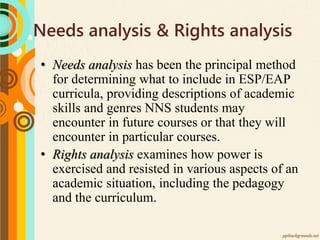
Needs analysis & Rights analysis
• Needs analysis has been the principal method
for determining what to include in ESP/EAP
curricula, providing descriptions of academic
skills and genres NNS students may
encounter in future courses or that they will
encounter in particular courses.
• Rights analysis examines how power is
exercised and resisted in various aspects of an
academic situation, including the pedagogy
and the curriculum.
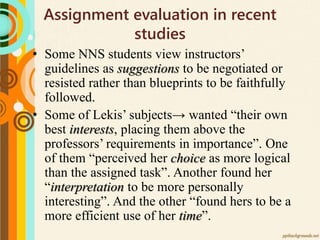
Assignment evaluation in recent
studies
• Some NNS students view instructors’
guidelines as suggestions to be negotiated or
resisted rather than blueprints to be faithfully
followed.
• Some of Lekis’ subjects→ wanted “their own
best interests, placing them above the
professors’ requirements in importance”. One
of them “perceived her choice as more logical
than the assigned task”. Another found her
“interpretation to be more personally
interesting”. And the other “found hers to be a
more efficient use of her time”.
• Students’ varied responses to assignments
points to the inadequacy of academic genres
and skills as the sole basis of English for
academic purposes (EAP) instructions. So,
EAP courses should consider not just
assigned tasks but also multiple
interpretations of assignments by
examining how teachers
and students negotiate control in the class.
Rights analysis
• Rights analysis recognizes the classroom as a
site of struggle. It studies how power is
exercised and resisted in an academic setting,
aiming to reveal how struggles for power and
control can be sources of democratic
participation in life both in and outside the
classroom.
• The term “rights” highlights power relations
and theorizes EAP students as potentially active
participants rather than compliant subjects.
Rights are not a set of pre-existing demands
what a conceptual framework for questions
about authority and control.
Foucault's’ power
• Power, for Foucault, is the central issue of
contemporary life, provoking such questions
as:
1.
• Who makes decisions for me?
2.
• Who is preventing me from doing this
and telling me to do that?
3.
• How are these decisions on which my
life is completely articulated taken?
The First Day: Establishing Professorial
Authority
 Wide and shallow room
 6 rows of 10-18 desk seats bolted to the floor
 Raised platform with the instructors’ desk and
chair
 Course outline
Feedback: Students’Responses to Professorial
Authority
 Complaints
 Class discussion
 Written responses
Coverage control
coverage is a common concern of postsecondary teachers.
 How can we cover all the material, they ask, if we let
student talk?
 How will they learn if we do not lecture?
In this class, teacher talk was regulated by the departmental
syllabus, the textbook and the lectures (the lectures follow
the textbook, I try to elaborate and explain the textbook).
We recognize that you Can’t do every thing in a
one-semester course. So we just decided what
would be a basic minimum with some choices.
There weren’t really that many choices. They
[the sections] cannot differ that much.
Though Bell upheld the coverage tradition, he
recognized that it was not working well. Many
students, native and non-native, could not
keep up with the pace of the lecture. They
could not listen and take notes at the rate
required for Bell to cover all 12 topics in his
syllabus.
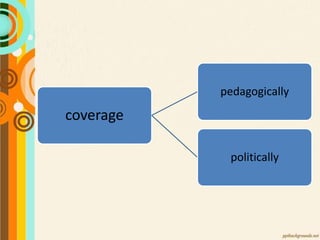
coverage
pedagogically
politically
Pedagogically
From a pedagogically view point, there has a
great deal of L1 and L2
research demonstrating the importance of
student talk and writing
in learning new material.
When a teachers invite students to use
expressive talk and writing to make sense of
academic concept, the students understand the
material better than if they simply listen to
lectures and textbooks.
Political
• Taking a political perspective, it may be that
lecturing persists because that mode of
discourse is a an expression of institutional
control over faculty and students alike. If, in
each of their course, students must
memorize large of amount of information,
there is no chance for them to challenge the
status quo.
 For their part, the teacher are so consumed with
covering the material that they have little time to
get to know the students, listen to their questions,
or invite them to write about and discuss the course
material.
 In other words, coverage is a control; it control both
teacher and students.
 The EAP students tried to follow that pace, using
questions to understand new concepts. Questioning
was an area of struggle over who controlled
classroom discourse and time; questions became
away for students to resist non-stop lecturing after
their requests to obtain more discussion had been
rejected.
Questions: negotiating power
They were into it, almost enjoying each others’
asking questions. They kind of all got into it.
One person asked question and they’d all be
behind it, be participating somehow in this
person asking a question.
During the same discussion, Bell explained that
he encouraged questions because he thought
they showed students were “thinking about
what we’re doing” and “they’re activity involved
in lecture” and because “asking and getting
answer to questions promotes more interest”.
Bell’s characterization of the conflict:
like students say “can you write that on the
board?” I can’t writ it. I don’t have time. If I
have to write everything, I’m really died. I don’t
like that. If someone ask me, I like do it, I don’t
like to say “no I can’t because I’m behind”. I just
feel like they’re rushed and they’re gonna get
confused. It make me uncomfortable.
Here is Ali’s explanation of the process:
I really think that in order to make it easier for
me to understand the lecture, I need some time
to capture the information. I think the question
give me time to do that. When people ask
some questions, I take my rest.
 Another function of questions had to do with NNS
students asserting their right to be in that classroom
and to be heard. In fact, this section of psychology
many of the EAP students participated more
comfortably than native students in both section of
psychology Bell taught, probably because they knew
each other and because the EAP class provided
support for their participation.
 A final observation about student’s questions is that
even when they were permitted, the questions were
only to be ones related directly to the material Bell
covered in his lecture. The students were not invited
to formulate questions about psychology based on
their own experience and intellectual curisity.
• EAP can make students aware of power
relations in academic setting to ask how
decisions about their education are made. It
can help student sort out their rights, to find
out what they are permitted to do and
whether there are possibilities for
challenging limitations. While offering
students practice in linguistic and cognitive
skills EAP can also encourage them to
question academic life and contribute to its
improvment.

Rights analysis

  • 1.
    Rights Analysis: Studying PowerRelations in an Academic Setting Presenters : Sona Harare
  • 2.
    Needs analysis &Rights analysis • Needs analysis has been the principal method for determining what to include in ESP/EAP curricula, providing descriptions of academic skills and genres NNS students may encounter in future courses or that they will encounter in particular courses. • Rights analysis examines how power is exercised and resisted in various aspects of an academic situation, including the pedagogy and the curriculum.
  • 3.
    Assignment evaluation inrecent studies • Some NNS students view instructors’ guidelines as suggestions to be negotiated or resisted rather than blueprints to be faithfully followed. • Some of Lekis’ subjects→ wanted “their own best interests, placing them above the professors’ requirements in importance”. One of them “perceived her choice as more logical than the assigned task”. Another found her “interpretation to be more personally interesting”. And the other “found hers to be a more efficient use of her time”.
  • 4.
    • Students’ variedresponses to assignments points to the inadequacy of academic genres and skills as the sole basis of English for academic purposes (EAP) instructions. So, EAP courses should consider not just assigned tasks but also multiple interpretations of assignments by examining how teachers and students negotiate control in the class.
  • 5.
    Rights analysis • Rightsanalysis recognizes the classroom as a site of struggle. It studies how power is exercised and resisted in an academic setting, aiming to reveal how struggles for power and control can be sources of democratic participation in life both in and outside the classroom. • The term “rights” highlights power relations and theorizes EAP students as potentially active participants rather than compliant subjects. Rights are not a set of pre-existing demands what a conceptual framework for questions about authority and control.
  • 6.
    Foucault's’ power • Power,for Foucault, is the central issue of contemporary life, provoking such questions as: 1. • Who makes decisions for me? 2. • Who is preventing me from doing this and telling me to do that? 3. • How are these decisions on which my life is completely articulated taken?
  • 7.
    The First Day:Establishing Professorial Authority  Wide and shallow room  6 rows of 10-18 desk seats bolted to the floor  Raised platform with the instructors’ desk and chair  Course outline Feedback: Students’Responses to Professorial Authority  Complaints  Class discussion  Written responses
  • 8.
    Coverage control coverage isa common concern of postsecondary teachers.  How can we cover all the material, they ask, if we let student talk?  How will they learn if we do not lecture? In this class, teacher talk was regulated by the departmental syllabus, the textbook and the lectures (the lectures follow the textbook, I try to elaborate and explain the textbook).
  • 9.
    We recognize thatyou Can’t do every thing in a one-semester course. So we just decided what would be a basic minimum with some choices. There weren’t really that many choices. They [the sections] cannot differ that much. Though Bell upheld the coverage tradition, he recognized that it was not working well. Many students, native and non-native, could not keep up with the pace of the lecture. They could not listen and take notes at the rate required for Bell to cover all 12 topics in his syllabus.
  • 10.
  • 11.
    Pedagogically From a pedagogicallyview point, there has a great deal of L1 and L2 research demonstrating the importance of student talk and writing in learning new material. When a teachers invite students to use expressive talk and writing to make sense of academic concept, the students understand the material better than if they simply listen to lectures and textbooks.
  • 12.
    Political • Taking apolitical perspective, it may be that lecturing persists because that mode of discourse is a an expression of institutional control over faculty and students alike. If, in each of their course, students must memorize large of amount of information, there is no chance for them to challenge the status quo.
  • 13.
     For theirpart, the teacher are so consumed with covering the material that they have little time to get to know the students, listen to their questions, or invite them to write about and discuss the course material.  In other words, coverage is a control; it control both teacher and students.  The EAP students tried to follow that pace, using questions to understand new concepts. Questioning was an area of struggle over who controlled classroom discourse and time; questions became away for students to resist non-stop lecturing after their requests to obtain more discussion had been rejected.
  • 14.
    Questions: negotiating power Theywere into it, almost enjoying each others’ asking questions. They kind of all got into it. One person asked question and they’d all be behind it, be participating somehow in this person asking a question. During the same discussion, Bell explained that he encouraged questions because he thought they showed students were “thinking about what we’re doing” and “they’re activity involved in lecture” and because “asking and getting answer to questions promotes more interest”.
  • 15.
    Bell’s characterization ofthe conflict: like students say “can you write that on the board?” I can’t writ it. I don’t have time. If I have to write everything, I’m really died. I don’t like that. If someone ask me, I like do it, I don’t like to say “no I can’t because I’m behind”. I just feel like they’re rushed and they’re gonna get confused. It make me uncomfortable. Here is Ali’s explanation of the process: I really think that in order to make it easier for me to understand the lecture, I need some time to capture the information. I think the question give me time to do that. When people ask some questions, I take my rest.
  • 16.
     Another functionof questions had to do with NNS students asserting their right to be in that classroom and to be heard. In fact, this section of psychology many of the EAP students participated more comfortably than native students in both section of psychology Bell taught, probably because they knew each other and because the EAP class provided support for their participation.  A final observation about student’s questions is that even when they were permitted, the questions were only to be ones related directly to the material Bell covered in his lecture. The students were not invited to formulate questions about psychology based on their own experience and intellectual curisity.
  • 17.
    • EAP canmake students aware of power relations in academic setting to ask how decisions about their education are made. It can help student sort out their rights, to find out what they are permitted to do and whether there are possibilities for challenging limitations. While offering students practice in linguistic and cognitive skills EAP can also encourage them to question academic life and contribute to its improvment.